EP3273349A1 - Approximate computing for application performance in heterogeneous systems - Google Patents
Approximate computing for application performance in heterogeneous systems Download PDFInfo
- Publication number
- EP3273349A1 EP3273349A1 EP17182032.7A EP17182032A EP3273349A1 EP 3273349 A1 EP3273349 A1 EP 3273349A1 EP 17182032 A EP17182032 A EP 17182032A EP 3273349 A1 EP3273349 A1 EP 3273349A1
- Authority
- EP
- European Patent Office
- Prior art keywords
- task
- heterogeneous network
- realization
- tasks
- realizations
- Prior art date
- Legal status (The legal status is an assumption and is not a legal conclusion. Google has not performed a legal analysis and makes no representation as to the accuracy of the status listed.)
- Granted
Links
Images

Classifications
-
- G—PHYSICS
- G06—COMPUTING OR CALCULATING; COUNTING
- G06Q—INFORMATION AND COMMUNICATION TECHNOLOGY [ICT] SPECIALLY ADAPTED FOR ADMINISTRATIVE, COMMERCIAL, FINANCIAL, MANAGERIAL OR SUPERVISORY PURPOSES; SYSTEMS OR METHODS SPECIALLY ADAPTED FOR ADMINISTRATIVE, COMMERCIAL, FINANCIAL, MANAGERIAL OR SUPERVISORY PURPOSES, NOT OTHERWISE PROVIDED FOR
- G06Q10/00—Administration; Management
- G06Q10/06—Resources, workflows, human or project management; Enterprise or organisation planning; Enterprise or organisation modelling
- G06Q10/063—Operations research, analysis or management
- G06Q10/0633—Workflow analysis
-
- G—PHYSICS
- G06—COMPUTING OR CALCULATING; COUNTING
- G06F—ELECTRIC DIGITAL DATA PROCESSING
- G06F9/00—Arrangements for program control, e.g. control units
- G06F9/06—Arrangements for program control, e.g. control units using stored programs, i.e. using an internal store of processing equipment to receive or retain programs
- G06F9/46—Multiprogramming arrangements
- G06F9/50—Allocation of resources, e.g. of the central processing unit [CPU]
- G06F9/5061—Partitioning or combining of resources
- G06F9/5066—Algorithms for mapping a plurality of inter-dependent sub-tasks onto a plurality of physical CPUs
-
- G—PHYSICS
- G06—COMPUTING OR CALCULATING; COUNTING
- G06Q—INFORMATION AND COMMUNICATION TECHNOLOGY [ICT] SPECIALLY ADAPTED FOR ADMINISTRATIVE, COMMERCIAL, FINANCIAL, MANAGERIAL OR SUPERVISORY PURPOSES; SYSTEMS OR METHODS SPECIALLY ADAPTED FOR ADMINISTRATIVE, COMMERCIAL, FINANCIAL, MANAGERIAL OR SUPERVISORY PURPOSES, NOT OTHERWISE PROVIDED FOR
- G06Q10/00—Administration; Management
- G06Q10/04—Forecasting or optimisation specially adapted for administrative or management purposes, e.g. linear programming or "cutting stock problem"
Definitions
- the embodiments herein generally relates to a system and method for determining a configuration of a plurality of tasks to meet the specified deadline of a linear workflow of a real-time heterogeneous network and, more particularly, a system and method using an approximate computing technique to ensure the timing constraints and optimizing quality of output of the plurality of tasks of a heterogeneous network.
- IoT Internet of Things
- an embodiment herein provides a system and method for determining a configuration of a plurality of tasks to meet the specified deadline of a linear workflow of a real-time heterogeneous network.
- a system for determining a configuration of a plurality of tasks to meet the specified deadline of a linear workflow of a real-time heterogeneous network comprises a processor, a memory communicatively coupled to the processor and the memory contains instructions that are readable by the processor, a task consideration module106 is configured to select a task from the plurality of tasks in the linear workflow of the real-time heterogeneous network, a realization module is configured to consider a realization from a plurality of realizations of the selected task, wherein the plurality of realizations approximate errors of the selected task and a relative quality among the plurality of realizations of the selected task, a configuration analyzing module is configured to analyze a plurality of configurations for the selected task, wherein each of the plurality of configurations depends on a plurality of implementations and a plurality of physical parts of the heterogeneous network and a decision module is configured to estimate the execution time for each of the analyzed plurality of configurations. Further the decision module determines a configuration for the selected task
- a method for determining a configuration of a plurality of tasks to meet the specified deadline of a linear workflow of a real-time heterogeneous network comprising steps of selecting a task from the plurality of tasks in the linear workflow of the real-time heterogeneous network using a task consideration module 106, considering a realization from a plurality of realizations of the selected task using realization module, wherein the plurality of realizations approximate errors of the selected task and a relative quality among the plurality of realizations of the selected task, defining a realization index based on the considered realization of the selected task of the linear workflow, analyzing a plurality of configurations for the selected task using a configuration analyzing module, wherein each of the plurality of configurations depends on a plurality of implementations and a plurality of physical parts of the heterogeneous network, estimating execution time for each of the analyzed plurality of configurations using a decision module and determining a configuration for the selected task based on the least execution time estimation for each of the plurality of tasks
- the one with higher accuracy takes higher execution time than the one with lower accuracy.
- any block diagram herein represent conceptual views of illustrative systems embodying the principles of the present subject matter.
- any flow charts, flow diagrams, state transition diagrams, pseudo code, and the like represent various processes which may be substantially represented in computer readable medium and so executed by a computing device or processor, whether or not such computing device or processor is explicitly shown.
- modules may include self-contained component in a hardware circuit comprising of logical gate, semiconductor device, integrated circuits or any other discrete component.
- the module may also be a part of any software program executed by any hardware entity for example processor.
- the implementation of module as a software program may include a set of logical instructions to be executed by a processor or any other hardware entity.
- Method steps of the invention may be performed by one or more computer processors executing a program tangibly embodied on a computer-readable medium to perform functions of the invention by operating on input and generating output.
- Suitable processors include, by way of example, both general and special purpose microprocessors.
- the processor receives (reads) instructions and data from a memory (such as a read-only memory and/or a random access memory) and writes (stores) instructions and data to the memory.
- Storage devices suitable for tangibly embodying computer program instructions and data include, for example, all forms of nonvolatile memory, such as semiconductor memory devices, including EPROM, EEPROM, and flash memory devices; magnetic disks such as internal hard disks and removable disks; magneto-optical disks; and CD-ROMs. Any of the foregoing may be supplemented by, or incorporated in, specially-designed ASICs (application-specific integrated circuits) or FPGAs (Field-Programmable Gate Arrays).
- a computer can generally also receive (read) programs and data from, and write (store) programs and data to, a non-transitory computer-readable storage medium such as an internal disk (not shown) or a removable disk.
- the present disclosure provides a system and method for determining a configuration of a plurality of tasks to meet the specified deadline of a linear workflow of a real-time heterogeneous network. Often times, while meeting expected application performance in the heterogeneous network, it may possible to have graceful degradation of quality for ensuring timing constraints at the same time.
- the time optimization for each of the plurality of tasks can be achieved through approximate computing and analyzing all possible configurations of each task in a workflow within a particular layer.
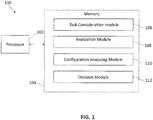
- FIG. 1 it is a block diagram of a system 100 for determining a configuration of a plurality of tasks to meet the specified deadline of a linear workflow of a real-time heterogeneous network.
- the system 100 comprising a processor 102, a memory 104 communicatively coupled to the processor 102, a task consideration module 106, a realization module 108, a configuration analyzing module 110 and a decision module 112.
- the system 100 receives various measured values from the profiler and tries to optimize the objective functions based on the received measured values.
- the profiler monitors the execution time of the plurality of tasks in the workflow and these monitored values are used as an input to the system 100.
- the task consideration module 106 is configured to select a task from the plurality of tasks in the linear workflow of the real-time heterogeneous network.
- an application consists of the plurality of tasks, some of which may be bound to specific layers, while the rest are free to be executed on any layer.
- Each task of the plurality of tasks has different realizations with different execution time on different layers.
- Consecutive tasks, if executed on different layers, involve transfer of data from the producer task to the consumer task.
- a synergistic execution framework needs to harness the cumulative capabilities of different compute elements to achieve best execution performance.
- the realization module 108 is configured to consider a realization from a plurality of realizations of the selected task, wherein the plurality of realizations approximate errors of the selected task and a relative quality among the plurality of realizations of the selected task.
- Quality of a realization is specific to the functionality of the application and also the manner through which the order of operations are realized. Usually, the best possible realization is fixed to have the highest quality of the each task, but the other realizations may add some element of inexactness to the computation and produce outputs with different orders of variations from the accurate one.
- a relative order of composition can be defined as g(1) ⁇ f(1) > g(1) ⁇ f(2) > g(2) ⁇ f(2).
- the order among compositions g(1) ⁇ f(2) and g(2) ⁇ f(1) cannot be generically defined and is only application specific. If the quality model is additive in nature then they are equivalent i.e., g(1) ⁇ f(2) ⁇ g(2) ⁇ f(1).
- the function f adds input numbers as integers and g multiplies a constant value with the input number. Then, in the composition g ⁇ f the error of the composition is proportional to that introduced by the conversion by f.
- the notion of composition in this case is additive.
- the configuration analyzing module 110 is configured to analyze a plurality of configurations for the selected task, wherein each of the plurality of configurations depends on a plurality of implementations and a plurality of physical parts of the heterogeneous network. Analysis of the plurality of configurations on account of the execution time of the workflow.
- the execution time of the workflow is computed as the cost of the longest path in the graph, where the cost of the task is defined as the execution time for a configuration.
- the selection of a configuration is considered on the cost of highest order of quality of the composition of the plurality of tasks in the workflow.
- the decision module 112 configured to estimate the execution time for each of the analyzed plurality of configurations, further wherein the decision module determines a configuration for the selected task based on the least execution time estimation for each of the plurality of tasks to meet the specified deadlines of the workflow of a real-time heterogeneous network.
- the system 100 tries to optimize the execution time based on the various measured values which are received from the profiler. Since the execution time of the heterogeneous network is dynamic, the optimal configuration of the workflow is variable. To handle this dynamism, the system 100 determines the configuration at every task invocation point in the workflow.
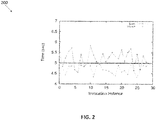
- FIG. 2 and 3 shows the comparison of execution times and quality for the fire evacuation workflow of an emergency evacuation assistance application.
- the emergency evacuation assistance application which helps user in its safe exit from a building during emergency situations like fire in the building.
- the building is equipped with temperature sensing equipments for monitoring heating, ventilating and air conditioning (HVAC) installation. All the floors of the building are under surveillance system using closed-circuit television (CCTV) arrangement.
- a fire monitor component is a pertinent workflow which analyzes data feeds from these sensors.
- the most compute intensive tasks in this workflow are localization and path planning.
- the deadline of the workflow was set to five seconds. The system selects lesser quality realizations to achieve the result within the specified deadline.
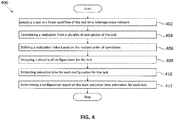
- a method 400 for determining a configuration of a plurality of tasks to meet the specified deadline of a linear workflow of a real-time heterogeneous network is provided.
- step 401 where the method 400 selects a task from the plurality of tasks in a linear workflow of the real-time heterogeneous network using a task consideration module 106.
- an application consists of the plurality of tasks, some of which may be bound to specific layers, while the rest are free to be executed on any layer.
- Each task of the plurality of tasks has different realizations with different execution time on different layers.
- a synergistic execution framework needs to harness the cumulative capabilities of different compute elements to achieve best execution performance.
- the method 400 considers a realization from a plurality of realizations of the selected task using realization module 108, wherein the plurality of realizations approximate errors of the selected task and a relative quality among the plurality of realizations of the selected task.
- Quality of a realization is specific to the functionality of the application and also the manner through which the order of operations are realized. Usually, the best possible realization is fixed to have the highest quality of the each task, but the other realizations may add some element of inexactness to the computation and produce outputs with different orders of variations from the accurate one.
- the method 400 is defining a realization index based on the realized one or more order of operations of the considered task.
- k be the highest number of realizations available for any task
- the quality index of the ith realization of the task is computed as (k-i).
- the first realization is the best quality and the fourth realization of the worst quality.
- the execution time of the first realization is highest and that the fourth realization is lowest.
- Quality indices are assigned in the reverse order i.e. the first consideration is assigned quality index of four and the fourth realization is one.
- the method 400 analyzes a plurality of configurations for the selected task using a configuration analyzing module, wherein each of the plurality of configurations depends on a plurality of implementations and a plurality of physical parts of the heterogeneous network. Analysis of the plurality of configurations on account of the execution time of the workflow.
- the execution time of the workflow is computed as the cost of the longest path in the graph, where the cost of the task is defined as the execution time for a configuration and the edge cost as the data transfer latency based on the present network condition.
- the selection of a configuration is considered on the cost of highest order of quality of the composition of the plurality of tasks in the workflow.
- the method 400 estimates execution time for each of the analyzed plurality of configurations using a decision module 112, wherein the estimation process follows a recursive routine and completes the execution within the predefined deadline on the cost of quality of output.
- the decision module 112 tries to optimize the execution time based on various measured values which is obtained from the profiler. Since the execution time of the heterogeneous network is dynamic, the optimal configuration of the workflow is variable. To handle this dynamism, the system 100 determines the configuration at every task invocation point in the workflow.
- the method 400 determines a configuration for the selected task based on the least execution time estimation for each of the plurality of tasks to meet the specified deadlines of the workflow of a real-time heterogeneous network.
- the decision module 112 of the system 100 chooses exactly one realization for each of the plurality of tasks and schedules the same at an appropriate layer of the heterogeneous network in a manner so that the end-to-end execution of the workflow meets the specified deadline and also the best possible quality of the output of each of the plurality of the tasks of the real-time heterogeneous network.
- the decision module 112 determines a configuration for the selected task based on the best output quality for each of the plurality of tasks, and yet meet the specified deadlines of the workflow of a real-time heterogeneous network.
Landscapes
- Engineering & Computer Science (AREA)
- Business, Economics & Management (AREA)
- Human Resources & Organizations (AREA)
- Economics (AREA)
- Strategic Management (AREA)
- Theoretical Computer Science (AREA)
- Entrepreneurship & Innovation (AREA)
- General Physics & Mathematics (AREA)
- Physics & Mathematics (AREA)
- Operations Research (AREA)
- Marketing (AREA)
- Quality & Reliability (AREA)
- Tourism & Hospitality (AREA)
- Game Theory and Decision Science (AREA)
- General Business, Economics & Management (AREA)
- Development Economics (AREA)
- Software Systems (AREA)
- Educational Administration (AREA)
- General Engineering & Computer Science (AREA)
- Management, Administration, Business Operations System, And Electronic Commerce (AREA)
Abstract
Description
- The present application claims priority to India Application (title: approximate computing for application performance in heterogeneous systems) No.
201621025212 filed in India on July 22, 2016 - The embodiments herein generally relates to a system and method for determining a configuration of a plurality of tasks to meet the specified deadline of a linear workflow of a real-time heterogeneous network and, more particularly, a system and method using an approximate computing technique to ensure the timing constraints and optimizing quality of output of the plurality of tasks of a heterogeneous network.
- Internet of Things (herein after read as IoT) has rose to prominence over the recent decade. Industry and academia alike subscribe to the grand vision it projects and have been investing in it heavily. Although, the industries are ready with all the basic components and technologies that IoT requires. But still the industry lacks in interfacing, composing, integrating and configuring them into a single working system remains a major challenge. IoT applications are inherently distributed and often possess several non-trivial constraints. On one hand, there are constraints on timely execution of applications utilizing various compute elements in the IoT stack. As an example, real time constraints are most naturally implied for applications which require to generate actuation signals based on events detected using environmental sensors. On the other hand, effective energy utilization remains an elusive challenge as well.
- An additional complexity in the loT context is posed by the extreme dynamism of the underlying infrastructure. The application therefore, needs to dynamically adapt to varying availability of compute resources at various loT layers. The variation of the resources may pose interesting optimization challenges for application execution in this heterogeneous infrastructure. Often times, the trade-off is between meeting expected application performance as well as guaranteeing quality, and ensuring timing constraints at the same time. This often necessitates graceful degradation of quality of output within acceptable limits to meet associated deadlines and guaranteeing an expected level of performance.
- The following presents a simplified summary of some embodiments of the disclosure in order to provide a basic understanding of the embodiments. This summary is not an extensive overview of the embodiments. It is not intended to identify key/critical elements of the embodiments or to delineate the scope of the embodiments. Its sole purpose is to present some embodiments in a simplified form as a prelude to the more detailed description that is presented below.
- In view of the foregoing, an embodiment herein provides a system and method for determining a configuration of a plurality of tasks to meet the specified deadline of a linear workflow of a real-time heterogeneous network.
- In one object, a system for determining a configuration of a plurality of tasks to meet the specified deadline of a linear workflow of a real-time heterogeneous network. The system comprises a processor, a memory communicatively coupled to the processor and the memory contains instructions that are readable by the processor, a task consideration module106 is configured to select a task from the plurality of tasks in the linear workflow of the real-time heterogeneous network, a realization module is configured to consider a realization from a plurality of realizations of the selected task, wherein the plurality of realizations approximate errors of the selected task and a relative quality among the plurality of realizations of the selected task, a configuration analyzing module is configured to analyze a plurality of configurations for the selected task, wherein each of the plurality of configurations depends on a plurality of implementations and a plurality of physical parts of the heterogeneous network and a decision module is configured to estimate the execution time for each of the analyzed plurality of configurations. Further the decision module determines a configuration for the selected task based on the least execution time estimation for each of the plurality of tasks to meet the specified deadlines of the workflow of a real-time heterogeneous network.
- In another object, a method for determining a configuration of a plurality of tasks to meet the specified deadline of a linear workflow of a real-time heterogeneous network. The method comprising steps of selecting a task from the plurality of tasks in the linear workflow of the real-time heterogeneous network using a
task consideration module 106, considering a realization from a plurality of realizations of the selected task using realization module, wherein the plurality of realizations approximate errors of the selected task and a relative quality among the plurality of realizations of the selected task, defining a realization index based on the considered realization of the selected task of the linear workflow, analyzing a plurality of configurations for the selected task using a configuration analyzing module, wherein each of the plurality of configurations depends on a plurality of implementations and a plurality of physical parts of the heterogeneous network, estimating execution time for each of the analyzed plurality of configurations using a decision module and determining a configuration for the selected task based on the least execution time estimation for each of the plurality of tasks to meet the specified deadlines of the workflow of a real-time heterogeneous network. - It would be appreciated that among the plurality of realizations of a task, the one with higher accuracy takes higher execution time than the one with lower accuracy.
- It should be appreciated by those skilled in the art that any block diagram herein represent conceptual views of illustrative systems embodying the principles of the present subject matter. Similarly, it will be appreciated that any flow charts, flow diagrams, state transition diagrams, pseudo code, and the like represent various processes which may be substantially represented in computer readable medium and so executed by a computing device or processor, whether or not such computing device or processor is explicitly shown.
- The embodiments herein will be better understood from the following detailed description with reference to the drawings, in which:
-
Figure 1 illustrates a system for determining a configuration of a plurality of tasks to meet the specified deadline of a linear workflow of a real-time heterogeneous network according to an embodiment of the present disclosure; -
Figure 2 is a schematic diagram of an example to show comparison of execution times for the fire evacuation workflow, according to an embodiment of the present disclosure; -
Figure 3 is a schematic diagram of an example to show comparison of quality of realizations for the fire evacuation workflow, according to an embodiment of the present disclosure; and -
Figure. 4 illustrates a method for determining a configuration of a plurality of tasks to meet the specified deadline of a linear workflow of a real-time heterogeneous network according to an embodiment of the present disclosure. - Some embodiments of this invention, illustrating all its features, will now be discussed in detail.
- The words "comprising," "having," "containing," and "including," and other forms thereof, are intended to be equivalent in meaning and be open ended in that an item or items following any one of these words is not meant to be an exhaustive listing of such item or items, or meant to be limited to only the listed item or items.
- It must also be noted that as used herein and in the appended claims, the singular forms "a," "an," and "the" include plural references unless the context clearly dictates otherwise. Although any systems and methods similar or equivalent to those described herein can be used in the practice or testing of embodiments of the present invention, the preferred, systems and methods are now described. In the following description for the purpose of explanation and understanding reference has been made to numerous embodiments for which the intent is not to limit the scope of the invention.
- One or more components of the invention are described as module for the understanding of the specification. For example, a module may include self-contained component in a hardware circuit comprising of logical gate, semiconductor device, integrated circuits or any other discrete component. The module may also be a part of any software program executed by any hardware entity for example processor. The implementation of module as a software program may include a set of logical instructions to be executed by a processor or any other hardware entity.
- The disclosed embodiments are merely exemplary of the invention, which may be embodied in various forms.
- The elements illustrated in the Figures interoperate as explained in more detail below. Before setting forth the detailed explanation, however, it is noted that all of the discussion below, regardless of the particular implementation being described, is exemplary in nature, rather than limiting.
- Method steps of the invention may be performed by one or more computer processors executing a program tangibly embodied on a computer-readable medium to perform functions of the invention by operating on input and generating output. Suitable processors include, by way of example, both general and special purpose microprocessors. Generally, the processor receives (reads) instructions and data from a memory (such as a read-only memory and/or a random access memory) and writes (stores) instructions and data to the memory. Storage devices suitable for tangibly embodying computer program instructions and data include, for example, all forms of nonvolatile memory, such as semiconductor memory devices, including EPROM, EEPROM, and flash memory devices; magnetic disks such as internal hard disks and removable disks; magneto-optical disks; and CD-ROMs. Any of the foregoing may be supplemented by, or incorporated in, specially-designed ASICs (application-specific integrated circuits) or FPGAs (Field-Programmable Gate Arrays). A computer can generally also receive (read) programs and data from, and write (store) programs and data to, a non-transitory computer-readable storage medium such as an internal disk (not shown) or a removable disk.
- The present disclosure provides a system and method for determining a configuration of a plurality of tasks to meet the specified deadline of a linear workflow of a real-time heterogeneous network. Often times, while meeting expected application performance in the heterogeneous network, it may possible to have graceful degradation of quality for ensuring timing constraints at the same time. In a multi-layered architecture, where each layer is equipped with multiple computational resources, the time optimization for each of the plurality of tasks can be achieved through approximate computing and analyzing all possible configurations of each task in a workflow within a particular layer.
- Referring to
fig. 1 , it is a block diagram of asystem 100 for determining a configuration of a plurality of tasks to meet the specified deadline of a linear workflow of a real-time heterogeneous network. Thesystem 100 comprising aprocessor 102, amemory 104 communicatively coupled to theprocessor 102, atask consideration module 106, arealization module 108, aconfiguration analyzing module 110 and adecision module 112. Thesystem 100 receives various measured values from the profiler and tries to optimize the objective functions based on the received measured values. The profiler monitors the execution time of the plurality of tasks in the workflow and these monitored values are used as an input to thesystem 100. - According to another embodiment of the invention, the
task consideration module 106 is configured to select a task from the plurality of tasks in the linear workflow of the real-time heterogeneous network. In the heterogeneous network an application consists of the plurality of tasks, some of which may be bound to specific layers, while the rest are free to be executed on any layer. Each task of the plurality of tasks has different realizations with different execution time on different layers. Consecutive tasks, if executed on different layers, involve transfer of data from the producer task to the consumer task. A synergistic execution framework needs to harness the cumulative capabilities of different compute elements to achieve best execution performance. - According to another embodiment of the invention, the
realization module 108 is configured to consider a realization from a plurality of realizations of the selected task, wherein the plurality of realizations approximate errors of the selected task and a relative quality among the plurality of realizations of the selected task. Quality of a realization is specific to the functionality of the application and also the manner through which the order of operations are realized. Usually, the best possible realization is fixed to have the highest quality of the each task, but the other realizations may add some element of inexactness to the computation and produce outputs with different orders of variations from the accurate one. - In an example of a floating point addition operation on two real number. Where the output of the addition operation is more accurate than its approximate version which replaces the accurate output with an integer addition operator, but the less accurate output is faster than accurate output. Let two functions f and g of a workflow are composed as g ⊕ f. The quality order of the composition on different realizations of the functions can be defined as follows. Let f has two realizations f(1) and f(2) and g as g(1) and g(2). Let f(1) > f(2) i.e., f(1) is more precise than f(2) in terms of quality of output. Also, g(1) > g(2). A relative order of composition can be defined as g(1) ⊕ f(1) > g(1) ⊕ f(2) > g(2) ⊕ f(2). However the order among compositions g(1) ⊕ f(2) and g(2) ⊕ f(1) cannot be generically defined and is only application specific. If the quality model is additive in nature then they are equivalent i.e., g(1) ⊕ f(2) ∼ g(2) ⊕ f(1). Further, if in the given two functions, the function f adds input numbers as integers and g multiplies a constant value with the input number. Then, in the composition g ⊕ f the error of the composition is proportional to that introduced by the conversion by f. The notion of composition in this case is additive.
- According to another embodiment of the invention, the
configuration analyzing module 110 is configured to analyze a plurality of configurations for the selected task, wherein each of the plurality of configurations depends on a plurality of implementations and a plurality of physical parts of the heterogeneous network. Analysis of the plurality of configurations on account of the execution time of the workflow. The execution time of the workflow is computed as the cost of the longest path in the graph, where the cost of the task is defined as the execution time for a configuration. Thus, the selection of a configuration is considered on the cost of highest order of quality of the composition of the plurality of tasks in the workflow. - According to another embodiment of the invention, the
decision module 112 configured to estimate the execution time for each of the analyzed plurality of configurations, further wherein the decision module determines a configuration for the selected task based on the least execution time estimation for each of the plurality of tasks to meet the specified deadlines of the workflow of a real-time heterogeneous network. There are two essential components in each of the architecture layers. Thesystem 100 tries to optimize the execution time based on the various measured values which are received from the profiler. Since the execution time of the heterogeneous network is dynamic, the optimal configuration of the workflow is variable. To handle this dynamism, thesystem 100 determines the configuration at every task invocation point in the workflow. - In an example, where the
system 100 applying a brute-force search technique to estimate execution time of an application and expedite the search task. Let's consider the workflow is linear and the path is s →d. The application works on a recursive routine, where each recursive step tries to determine the best configuration for the search task at each task i.e. n. In the recursive routine at each step the system divides the path in more than one sub-paths. Thesystem 100 estimates the execution time of each sub-path of the configuration at task n. Therefore, thesystem 100 selects the best configuration for the task n based on the estimated execution time and quality of the output. - In another example as shown in
fig. 2 and3 , shows the comparison of execution times and quality for the fire evacuation workflow of an emergency evacuation assistance application. The emergency evacuation assistance application which helps user in its safe exit from a building during emergency situations like fire in the building. The building is equipped with temperature sensing equipments for monitoring heating, ventilating and air conditioning (HVAC) installation. All the floors of the building are under surveillance system using closed-circuit television (CCTV) arrangement. A fire monitor component is a pertinent workflow which analyzes data feeds from these sensors. In this example, the most compute intensive tasks in this workflow are localization and path planning. The deadline of the workflow was set to five seconds. The system selects lesser quality realizations to achieve the result within the specified deadline. - Referring
fig. 4 , amethod 400 for determining a configuration of a plurality of tasks to meet the specified deadline of a linear workflow of a real-time heterogeneous network. - In the preferred embodiment, at step 401, where the
method 400 selects a task from the plurality of tasks in a linear workflow of the real-time heterogeneous network using atask consideration module 106. In the heterogeneous network an application consists of the plurality of tasks, some of which may be bound to specific layers, while the rest are free to be executed on any layer. Each task of the plurality of tasks has different realizations with different execution time on different layers. Consecutive tasks, if executed on different layers, involve transfer of data from the producer task to the consumer task. A synergistic execution framework needs to harness the cumulative capabilities of different compute elements to achieve best execution performance. - The process starts at
step 402, themethod 400 considers a realization from a plurality of realizations of the selected task usingrealization module 108, wherein the plurality of realizations approximate errors of the selected task and a relative quality among the plurality of realizations of the selected task. Quality of a realization is specific to the functionality of the application and also the manner through which the order of operations are realized. Usually, the best possible realization is fixed to have the highest quality of the each task, but the other realizations may add some element of inexactness to the computation and produce outputs with different orders of variations from the accurate one. - According to another embodiment of the invention, at
step 406, themethod 400 is defining a realization index based on the realized one or more order of operations of the considered task. Generally, for a workflow let k be the highest number of realizations available for any task, then the quality index of the ith realization of the task is computed as (k-i). Let's take an example, where the task has four realizations. The first realization is the best quality and the fourth realization of the worst quality. At the same time the execution time of the first realization is highest and that the fourth realization is lowest. Quality indices are assigned in the reverse order i.e. the first consideration is assigned quality index of four and the fourth realization is one. - According to another embodiment of the invention, at
step 408, themethod 400 analyzes a plurality of configurations for the selected task using a configuration analyzing module, wherein each of the plurality of configurations depends on a plurality of implementations and a plurality of physical parts of the heterogeneous network. Analysis of the plurality of configurations on account of the execution time of the workflow. The execution time of the workflow is computed as the cost of the longest path in the graph, where the cost of the task is defined as the execution time for a configuration and the edge cost as the data transfer latency based on the present network condition. Thus, the selection of a configuration is considered on the cost of highest order of quality of the composition of the plurality of tasks in the workflow. - According to another embodiment of the invention, at
step 410, themethod 400 estimates execution time for each of the analyzed plurality of configurations using adecision module 112, wherein the estimation process follows a recursive routine and completes the execution within the predefined deadline on the cost of quality of output. There are two essential components in each of the architecture layers. Thedecision module 112 tries to optimize the execution time based on various measured values which is obtained from the profiler. Since the execution time of the heterogeneous network is dynamic, the optimal configuration of the workflow is variable. To handle this dynamism, thesystem 100 determines the configuration at every task invocation point in the workflow. - According to another embodiment of the invention, at
final step 412, themethod 400 determines a configuration for the selected task based on the least execution time estimation for each of the plurality of tasks to meet the specified deadlines of the workflow of a real-time heterogeneous network. Thedecision module 112 of thesystem 100 chooses exactly one realization for each of the plurality of tasks and schedules the same at an appropriate layer of the heterogeneous network in a manner so that the end-to-end execution of the workflow meets the specified deadline and also the best possible quality of the output of each of the plurality of the tasks of the real-time heterogeneous network. And finally, thedecision module 112 determines a configuration for the selected task based on the best output quality for each of the plurality of tasks, and yet meet the specified deadlines of the workflow of a real-time heterogeneous network. - The written description describes the subject matter herein to enable any person skilled in the art to make and use the embodiments. The scope of the subject matter embodiments is defined by the claims and may include other modifications that occur to those skilled in the art. Such other modifications are intended to be within the scope of the claims if they have similar elements that do not differ from the literal language of the claims or if they include equivalent elements with insubstantial differences from the literal language of the claims.
Claims (11)
- A method for determining a configuration of a plurality of tasks to meet the specified deadline of a linear workflow of a real-time heterogeneous network, the method comprises steps of:selecting a task from the plurality of tasks in the linear workflow of the real-time heterogeneous network using a task consideration module;considering a realization from a plurality of realizations of the selected task using a realization module, wherein the plurality of realizations approximate errors of the selected task and a relative quality among the plurality of realizations of the selected task;defining a realization index based on the considered realization of the selected task of the linear workflow;analyzing a plurality of configurations for the selected task using a configuration analyzing module, wherein each of the plurality of configurations depends on a plurality of implementations and a plurality of physical parts of the heterogeneous network;estimating execution time for each of the analyzed plurality of configurations using a decision module, wherein the estimation follows a recursive routine and completes the execution within the specified deadline on the cost of quality of output; anddetermining a configuration for the selected task based on the least execution time estimation for each of the plurality of tasks to meet the specified deadlines of the workflow of a real-time heterogeneous network.
- A method according to claim 1, wherein the realization of the one or more order of operations accounts on the specified deadline and relative quality of output of the considered task.
- A method according to claim 1, wherein one or more resources within a layer of heterogeneous network are homogeneous.
- A method according to claim 1, wherein each of the plurality of realizations depends on one or more limitations of the layer of heterogeneous network.
- A method according to claim 4, wherein the one or more limitations of the layer includes execution time, power consumption values and quality of output.
- A system for determining a task configuration to meet the specified deadlines of a plurality of tasks of a real-time heterogeneous network, the system comprising:a processor;a memory communicatively coupled to the processor and the memory contains instructions that are readable by the processor;a task consideration module is configured to select a task from the plurality of tasks in a linear workflow of the real-time heterogeneous network;a realization module is configured to consider a realization from a plurality of realizations of the selected task, wherein the plurality of realizations approximate errors of the selected task and a relative quality among the plurality of realizations of the selected task;a configuration analyzing module is configured to analyze a plurality of configurations for the selected task, wherein each of the plurality of configurations depends on a plurality of implementations and a plurality of physical parts of the heterogeneous network; anda decision module is configured to estimate the execution time for each of the analyzed plurality of configurations, further wherein the decision module determines a configuration for the selected task based on the least execution time estimation for each of the plurality of tasks to meet the specified deadlines of the workflow of a real-time heterogeneous network.
- A system according to claim 6, wherein the realization of the one or more order of operations accounts on the specified deadline and relative quality of output of the considered task.
- A system according to claim 6, wherein one or more resources within a layer of heterogeneous network are homogeneous.
- A system according to claim 6, wherein each of the plurality of realizations depends on one or more limitations of the layer of heterogeneous network.
- A system according to claim 6, wherein the one or more limitations of the layer includes execution time, power consumption values and quality of output.
- A computer readable medium storing instructions for determining a configuration of a plurality of tasks to meet the specified deadline of a linear workflow of a real-time heterogeneous network, the instructions comprise:selecting a task from the plurality of tasks in the linear workflow of the real-time heterogeneous network using a task consideration module;considering a realization from a plurality of realizations of the selected task using a realization module, wherein the plurality of realizations approximate errors of the selected task and a relative quality among the plurality of realizations of the selected task;defining a realization index based on the considered realization of the selected task of the linear workflow;analyzing a plurality of configurations for the selected task using a configuration analyzing module, wherein each of the plurality of configurations depends on a plurality of implementations and a plurality of physical parts of the heterogeneous network;estimating execution time for each of the analyzed plurality of configurations using a decision module, wherein the estimation follows a recursive routine and completes the execution within the specified deadline on the cost of quality of output; anddetermining a configuration for the selected task based on the least execution time estimation for each of the plurality of tasks to meet the specified deadlines of the workflow of a real-time heterogeneous network.
Applications Claiming Priority (1)
| Application Number | Priority Date | Filing Date | Title |
|---|---|---|---|
| IN201621025212 | 2016-07-22 |
Publications (3)
| Publication Number | Publication Date |
|---|---|
| EP3273349A1 true EP3273349A1 (en) | 2018-01-24 |
| EP3273349C0 EP3273349C0 (en) | 2025-05-07 |
| EP3273349B1 EP3273349B1 (en) | 2025-05-07 |
Family
ID=59501159
Family Applications (1)
| Application Number | Title | Priority Date | Filing Date |
|---|---|---|---|
| EP17182032.7A Active EP3273349B1 (en) | 2016-07-22 | 2017-07-19 | Approximate computing for application performance in heterogeneous systems |
Country Status (3)
| Country | Link |
|---|---|
| US (1) | US10540625B2 (en) |
| EP (1) | EP3273349B1 (en) |
| JP (1) | JP6854727B2 (en) |
Families Citing this family (5)
| Publication number | Priority date | Publication date | Assignee | Title |
|---|---|---|---|---|
| US11307898B2 (en) | 2019-02-26 | 2022-04-19 | Sap Se | Server resource balancing using a dynamic-sharing strategy |
| US11126466B2 (en) * | 2019-02-26 | 2021-09-21 | Sap Se | Server resource balancing using a fixed-sharing strategy |
| US12032607B2 (en) * | 2020-05-18 | 2024-07-09 | Adobe Inc. | Context-based recommendation system for feature search |
| US20250004731A1 (en) * | 2023-06-27 | 2025-01-02 | Advanced Micro Devices, Inc. | Cross-Component Optimizing Compiler Systems |
| US20250158881A1 (en) * | 2023-11-09 | 2025-05-15 | Cisco Technology, Inc. | Workflow-based Configuration of Devices from a Cloud SaaS Controller |
Family Cites Families (28)
| Publication number | Priority date | Publication date | Assignee | Title |
|---|---|---|---|---|
| US5408663A (en) * | 1993-11-05 | 1995-04-18 | Adrem Technologies, Inc. | Resource allocation methods |
| US6567840B1 (en) * | 1999-05-14 | 2003-05-20 | Honeywell Inc. | Task scheduling and message passing |
| US6618573B2 (en) | 2000-09-20 | 2003-09-09 | Fuji Xerox Co., Ltd. | Fixing belt and fuser |
| US6765596B2 (en) * | 2001-02-27 | 2004-07-20 | International Business Machines Corporation | Multi-functional application launcher with integrated status |
| JP3857530B2 (en) * | 2001-03-09 | 2006-12-13 | インターナショナル・ビジネス・マシーンズ・コーポレーション | Job execution control device, method, and program |
| SG121719A1 (en) * | 2001-07-19 | 2006-05-26 | Oce Tech Bv | Method for creating a workflow |
| US7155400B1 (en) * | 2001-11-14 | 2006-12-26 | Qgenisys, Inc. | Universal task management system, method and product for automatically managing remote workers, including automatically recruiting workers |
| US6986021B2 (en) * | 2001-11-30 | 2006-01-10 | Quick Silver Technology, Inc. | Apparatus, method, system and executable module for configuration and operation of adaptive integrated circuitry having fixed, application specific computational elements |
| US7299244B2 (en) * | 2002-12-10 | 2007-11-20 | Hewlett-Packard Development Company, L.P. | System and method for dynamic sequencing of a requirements-based workflow |
| US20060248461A1 (en) * | 2005-04-29 | 2006-11-02 | Omron Corporation | Socially intelligent agent software |
| JP2006338264A (en) * | 2005-06-01 | 2006-12-14 | Toyota Infotechnology Center Co Ltd | Task allocation apparatus and task allocation method |
| US20070055558A1 (en) * | 2005-08-19 | 2007-03-08 | Shanahan James G | Method and apparatus for probabilistic workflow mining |
| WO2007104330A1 (en) * | 2006-03-15 | 2007-09-20 | Freescale Semiconductor, Inc. | Task scheduling method and apparatus |
| US7895071B2 (en) * | 2006-08-14 | 2011-02-22 | Hrl Laboratories, Llc | System and method for multi-mission prioritization using cost-based mission scheduling |
| US8341611B2 (en) * | 2007-04-11 | 2012-12-25 | Apple Inc. | Application interface on multiple processors |
| US8286196B2 (en) * | 2007-05-03 | 2012-10-09 | Apple Inc. | Parallel runtime execution on multiple processors |
| US20090112677A1 (en) * | 2007-10-24 | 2009-04-30 | Rhett Randolph L | Method for automatically developing suggested optimal work schedules from unsorted group and individual task lists |
| WO2009082384A1 (en) * | 2007-12-20 | 2009-07-02 | Hewlett-Packard Development Company, L.P. | Modelling computer based business process and simulating operation |
| US8959370B2 (en) * | 2008-10-03 | 2015-02-17 | University Of Sydney | Scheduling an application for performance on a heterogeneous computing system |
| US8732714B2 (en) * | 2008-12-08 | 2014-05-20 | Kpit Technologies Limited | Method for reorganizing tasks for optimization of resources |
| US9384053B2 (en) * | 2010-10-28 | 2016-07-05 | Nec Corporation | Task allocation optimization system, task allocation optimization method, and non-transitory computer readable medium storing task allocation optimization program |
| WO2013048986A1 (en) * | 2011-09-26 | 2013-04-04 | Knoa Software, Inc. | Method, system and program product for allocation and/or prioritization of electronic resources |
| US9420476B2 (en) * | 2013-02-20 | 2016-08-16 | Telefonaktiebolaget L M Ericsson (Publ) | Systems and methods of triggering interference mitigation without resource partitioning |
| US9135062B2 (en) * | 2013-04-09 | 2015-09-15 | National Instruments Corporation | Hardware assisted method and system for scheduling time critical tasks |
| IN2013MU03836A (en) * | 2013-12-06 | 2015-07-31 | Tata Consultancy Services Ltd | |
| CN105242966A (en) | 2015-09-28 | 2016-01-13 | 华东师范大学 | Independent energy acquisition heterogeneous system oriented non-precision real-time task scheduling method |
| US9942235B2 (en) * | 2015-12-16 | 2018-04-10 | Verizon Patent And Licensing Inc. | Network access security for internet of things (IoT) devices |
| US10241832B2 (en) * | 2016-06-20 | 2019-03-26 | Steering Solutions Ip Holding Corporation | Runtime determination of real time operating systems task timing behavior |
-
2017
- 2017-07-19 US US15/654,151 patent/US10540625B2/en active Active
- 2017-07-19 EP EP17182032.7A patent/EP3273349B1/en active Active
- 2017-07-21 JP JP2017141786A patent/JP6854727B2/en active Active
Non-Patent Citations (2)
| Title |
|---|
| GEORGIOS L STAVRINIDES ET AL: "Scheduling real-time DAGs in heterogeneous clusters by combining imprecise computations and bin packing techniques for the exploitation of schedule holes", FUTURE GENERATIONS COMPUTER SYSTEMS, ELSEVIER SCIENCE PUBLISHERS. AMSTERDAM, NL, vol. 28, no. 7, 1 March 2012 (2012-03-01), pages 977 - 988, XP028418770, ISSN: 0167-739X, [retrieved on 20120305], DOI: 10.1016/J.FUTURE.2012.03.002 * |
| STAVRINIDES G L ET AL: "Scheduling multiple task graphs with end-to-end deadlines in distributed real-time systems utilizing imprecise computations", JOURNAL OF SYSTEMS & SOFTWARE, ELSEVIER NORTH HOLLAND, NEW YORK, NY, US, vol. 83, no. 6, 1 June 2010 (2010-06-01), pages 1004 - 1014, XP027035184, ISSN: 0164-1212, [retrieved on 20100104] * |
Also Published As
| Publication number | Publication date |
|---|---|
| US20180025301A1 (en) | 2018-01-25 |
| EP3273349C0 (en) | 2025-05-07 |
| JP2018014107A (en) | 2018-01-25 |
| US10540625B2 (en) | 2020-01-21 |
| JP6854727B2 (en) | 2021-04-07 |
| EP3273349B1 (en) | 2025-05-07 |
Similar Documents
| Publication | Publication Date | Title |
|---|---|---|
| EP3273349B1 (en) | Approximate computing for application performance in heterogeneous systems | |
| Chen et al. | Using predictions in online optimization: Looking forward with an eye on the past | |
| Gil et al. | Open challenges for probabilistic measurement-based worst-case execution time | |
| US10452983B2 (en) | Determining an anomalous state of a system at a future point in time | |
| US9942103B2 (en) | Predicting service delivery metrics using system performance data | |
| Kalyvianaki et al. | Adaptive resource provisioning for virtualized servers using kalman filters | |
| US20040243457A1 (en) | Project estimating system and method | |
| US9003076B2 (en) | Identifying anomalies in original metrics of a system | |
| CN110300008A (en) | A kind of method and device of the state of the determining network equipment | |
| US9305043B2 (en) | Stream data anomaly detection method and device | |
| Ju et al. | Accounting for cache-related preemption delay in dynamic priority schedulability analysis | |
| US20150212974A1 (en) | Fast and automated arima model initialization | |
| Barrameda et al. | A novel statistical cost model and an algorithm for efficient application offloading to clouds | |
| US20150256421A1 (en) | Information processing method and information processing apparatus | |
| Civit et al. | A reliable statistical analysis of the best-fit distribution for high execution times | |
| Shibata et al. | PISRAT: Proportional intensity-based software reliability assessment tool | |
| Dang-Quang et al. | A study on deep learning-based multivariate resource estimation with feature selection in cloud computing | |
| US20140207267A1 (en) | Metric based on estimate value | |
| Promyslov et al. | The Approaches for the Estimation of Control System Parameters in “Network Calculus” | |
| Cheon et al. | Sw runtime estimation using automata theory and deep learning on hpc | |
| US12436870B2 (en) | Method and apparatus for detecting outliers in a set of runs of software applications | |
| Shestak et al. | The robustness of resource allocations in parallel and distributed computing systems | |
| Abdunabiev et al. | An Auto-Scaling Architecture for Container Clusters Using Deep Learning | |
| Traore et al. | Simpler analysis of serial transactions using reverse transactions | |
| Lambers et al. | Scheduling jobs that change over time |
Legal Events
| Date | Code | Title | Description |
|---|---|---|---|
| PUAI | Public reference made under article 153(3) epc to a published international application that has entered the european phase |
Free format text: ORIGINAL CODE: 0009012 |
|
| STAA | Information on the status of an ep patent application or granted ep patent |
Free format text: STATUS: THE APPLICATION HAS BEEN PUBLISHED |
|
| AK | Designated contracting states |
Kind code of ref document: A1 Designated state(s): AL AT BE BG CH CY CZ DE DK EE ES FI FR GB GR HR HU IE IS IT LI LT LU LV MC MK MT NL NO PL PT RO RS SE SI SK SM TR |
|
| AX | Request for extension of the european patent |
Extension state: BA ME |
|
| STAA | Information on the status of an ep patent application or granted ep patent |
Free format text: STATUS: REQUEST FOR EXAMINATION WAS MADE |
|
| 17P | Request for examination filed |
Effective date: 20180724 |
|
| RBV | Designated contracting states (corrected) |
Designated state(s): AL AT BE BG CH CY CZ DE DK EE ES FI FR GB GR HR HU IE IS IT LI LT LU LV MC MK MT NL NO PL PT RO RS SE SI SK SM TR |
|
| STAA | Information on the status of an ep patent application or granted ep patent |
Free format text: STATUS: EXAMINATION IS IN PROGRESS |
|
| 17Q | First examination report despatched |
Effective date: 20181130 |
|
| GRAP | Despatch of communication of intention to grant a patent |
Free format text: ORIGINAL CODE: EPIDOSNIGR1 |
|
| STAA | Information on the status of an ep patent application or granted ep patent |
Free format text: STATUS: GRANT OF PATENT IS INTENDED |
|
| INTG | Intention to grant announced |
Effective date: 20250115 |
|
| GRAS | Grant fee paid |
Free format text: ORIGINAL CODE: EPIDOSNIGR3 |
|
| GRAA | (expected) grant |
Free format text: ORIGINAL CODE: 0009210 |
|
| STAA | Information on the status of an ep patent application or granted ep patent |
Free format text: STATUS: THE PATENT HAS BEEN GRANTED |
|
| AK | Designated contracting states |
Kind code of ref document: B1 Designated state(s): AL AT BE BG CH CY CZ DE DK EE ES FI FR GB GR HR HU IE IS IT LI LT LU LV MC MK MT NL NO PL PT RO RS SE SI SK SM TR |
|
| REG | Reference to a national code |
Ref country code: GB Ref legal event code: FG4D |
|
| REG | Reference to a national code |
Ref country code: CH Ref legal event code: EP |
|
| REG | Reference to a national code |
Ref country code: IE Ref legal event code: FG4D |
|
| U01 | Request for unitary effect filed |
Effective date: 20250507 |
|
| U07 | Unitary effect registered |
Designated state(s): AT BE BG DE DK EE FI FR IT LT LU LV MT NL PT RO SE SI Effective date: 20250513 |
|
| U20 | Renewal fee for the european patent with unitary effect paid |
Year of fee payment: 9 Effective date: 20250725 |
|
| PG25 | Lapsed in a contracting state [announced via postgrant information from national office to epo] |
Ref country code: ES Free format text: LAPSE BECAUSE OF FAILURE TO SUBMIT A TRANSLATION OF THE DESCRIPTION OR TO PAY THE FEE WITHIN THE PRESCRIBED TIME-LIMIT Effective date: 20250507 |
|
| PG25 | Lapsed in a contracting state [announced via postgrant information from national office to epo] |
Ref country code: GR Free format text: LAPSE BECAUSE OF FAILURE TO SUBMIT A TRANSLATION OF THE DESCRIPTION OR TO PAY THE FEE WITHIN THE PRESCRIBED TIME-LIMIT Effective date: 20250808 Ref country code: NO Free format text: LAPSE BECAUSE OF FAILURE TO SUBMIT A TRANSLATION OF THE DESCRIPTION OR TO PAY THE FEE WITHIN THE PRESCRIBED TIME-LIMIT Effective date: 20250807 |
|
| PG25 | Lapsed in a contracting state [announced via postgrant information from national office to epo] |
Ref country code: PL Free format text: LAPSE BECAUSE OF FAILURE TO SUBMIT A TRANSLATION OF THE DESCRIPTION OR TO PAY THE FEE WITHIN THE PRESCRIBED TIME-LIMIT Effective date: 20250507 |
|
| PGFP | Annual fee paid to national office [announced via postgrant information from national office to epo] |
Ref country code: GB Payment date: 20250722 Year of fee payment: 9 |
|
| PG25 | Lapsed in a contracting state [announced via postgrant information from national office to epo] |
Ref country code: HR Free format text: LAPSE BECAUSE OF FAILURE TO SUBMIT A TRANSLATION OF THE DESCRIPTION OR TO PAY THE FEE WITHIN THE PRESCRIBED TIME-LIMIT Effective date: 20250507 |
|
| PGFP | Annual fee paid to national office [announced via postgrant information from national office to epo] |
Ref country code: CH Payment date: 20250801 Year of fee payment: 9 |
|
| PG25 | Lapsed in a contracting state [announced via postgrant information from national office to epo] |
Ref country code: RS Free format text: LAPSE BECAUSE OF FAILURE TO SUBMIT A TRANSLATION OF THE DESCRIPTION OR TO PAY THE FEE WITHIN THE PRESCRIBED TIME-LIMIT Effective date: 20250807 |
|
| PG25 | Lapsed in a contracting state [announced via postgrant information from national office to epo] |
Ref country code: IS Free format text: LAPSE BECAUSE OF FAILURE TO SUBMIT A TRANSLATION OF THE DESCRIPTION OR TO PAY THE FEE WITHIN THE PRESCRIBED TIME-LIMIT Effective date: 20250907 |
|
| PG25 | Lapsed in a contracting state [announced via postgrant information from national office to epo] |
Ref country code: SM Free format text: LAPSE BECAUSE OF FAILURE TO SUBMIT A TRANSLATION OF THE DESCRIPTION OR TO PAY THE FEE WITHIN THE PRESCRIBED TIME-LIMIT Effective date: 20250507 |
|
| PG25 | Lapsed in a contracting state [announced via postgrant information from national office to epo] |
Ref country code: CZ Free format text: LAPSE BECAUSE OF FAILURE TO SUBMIT A TRANSLATION OF THE DESCRIPTION OR TO PAY THE FEE WITHIN THE PRESCRIBED TIME-LIMIT Effective date: 20250507 |
|
| PG25 | Lapsed in a contracting state [announced via postgrant information from national office to epo] |
Ref country code: SK Free format text: LAPSE BECAUSE OF FAILURE TO SUBMIT A TRANSLATION OF THE DESCRIPTION OR TO PAY THE FEE WITHIN THE PRESCRIBED TIME-LIMIT Effective date: 20250507 |
|
| PLBE | No opposition filed within time limit |
Free format text: ORIGINAL CODE: 0009261 |
|
| STAA | Information on the status of an ep patent application or granted ep patent |
Free format text: STATUS: NO OPPOSITION FILED WITHIN TIME LIMIT |
|
| REG | Reference to a national code |
Ref country code: CH Ref legal event code: L10 Free format text: ST27 STATUS EVENT CODE: U-0-0-L10-L00 (AS PROVIDED BY THE NATIONAL OFFICE) Effective date: 20260318 |
|
| 26N | No opposition filed |
Effective date: 20260210 |