EP3272904A2 - Corrosion inhibitor-incorporated layered double hydroxide and sol-gel coating compositions and related processes - Google Patents
Corrosion inhibitor-incorporated layered double hydroxide and sol-gel coating compositions and related processes Download PDFInfo
- Publication number
- EP3272904A2 EP3272904A2 EP17181837.0A EP17181837A EP3272904A2 EP 3272904 A2 EP3272904 A2 EP 3272904A2 EP 17181837 A EP17181837 A EP 17181837A EP 3272904 A2 EP3272904 A2 EP 3272904A2
- Authority
- EP
- European Patent Office
- Prior art keywords
- sol
- corrosion inhibitor
- solution
- substrate
- corrosion
- Prior art date
- Legal status (The legal status is an assumption and is not a legal conclusion. Google has not performed a legal analysis and makes no representation as to the accuracy of the status listed.)
- Granted
Links
Images

Classifications
-
- C—CHEMISTRY; METALLURGY
- C09—DYES; PAINTS; POLISHES; NATURAL RESINS; ADHESIVES; COMPOSITIONS NOT OTHERWISE PROVIDED FOR; APPLICATIONS OF MATERIALS NOT OTHERWISE PROVIDED FOR
- C09D—COATING COMPOSITIONS, e.g. PAINTS, VARNISHES OR LACQUERS; FILLING PASTES; CHEMICAL PAINT OR INK REMOVERS; INKS; CORRECTING FLUIDS; WOODSTAINS; PASTES OR SOLIDS FOR COLOURING OR PRINTING; USE OF MATERIALS THEREFOR
- C09D5/00—Coating compositions, e.g. paints, varnishes or lacquers, characterised by their physical nature or the effects produced; Filling pastes
- C09D5/08—Anti-corrosive paints
- C09D5/10—Anti-corrosive paints containing metal dust
- C09D5/106—Anti-corrosive paints containing metal dust containing Zn
-
- B—PERFORMING OPERATIONS; TRANSPORTING
- B05—SPRAYING OR ATOMISING IN GENERAL; APPLYING FLUENT MATERIALS TO SURFACES, IN GENERAL
- B05D—PROCESSES FOR APPLYING FLUENT MATERIALS TO SURFACES, IN GENERAL
- B05D3/00—Pretreatment of surfaces to which liquids or other fluent materials are to be applied; After-treatment of applied coatings, e.g. intermediate treating of an applied coating preparatory to subsequent applications of liquids or other fluent materials
- B05D3/06—Pretreatment of surfaces to which liquids or other fluent materials are to be applied; After-treatment of applied coatings, e.g. intermediate treating of an applied coating preparatory to subsequent applications of liquids or other fluent materials by exposure to radiation
-
- C—CHEMISTRY; METALLURGY
- C23—COATING METALLIC MATERIAL; COATING MATERIAL WITH METALLIC MATERIAL; CHEMICAL SURFACE TREATMENT; DIFFUSION TREATMENT OF METALLIC MATERIAL; COATING BY VACUUM EVAPORATION, BY SPUTTERING, BY ION IMPLANTATION OR BY CHEMICAL VAPOUR DEPOSITION, IN GENERAL; INHIBITING CORROSION OF METALLIC MATERIAL OR INCRUSTATION IN GENERAL
- C23C—COATING METALLIC MATERIAL; COATING MATERIAL WITH METALLIC MATERIAL; SURFACE TREATMENT OF METALLIC MATERIAL BY DIFFUSION INTO THE SURFACE, BY CHEMICAL CONVERSION OR SUBSTITUTION; COATING BY VACUUM EVAPORATION, BY SPUTTERING, BY ION IMPLANTATION OR BY CHEMICAL VAPOUR DEPOSITION, IN GENERAL
- C23C18/00—Chemical coating by decomposition of either liquid compounds or solutions of the coating forming compounds, without leaving reaction products of surface material in the coating; Contact plating
- C23C18/02—Chemical coating by decomposition of either liquid compounds or solutions of the coating forming compounds, without leaving reaction products of surface material in the coating; Contact plating by thermal decomposition
- C23C18/12—Chemical coating by decomposition of either liquid compounds or solutions of the coating forming compounds, without leaving reaction products of surface material in the coating; Contact plating by thermal decomposition characterised by the deposition of inorganic material other than metallic material
- C23C18/1204—Chemical coating by decomposition of either liquid compounds or solutions of the coating forming compounds, without leaving reaction products of surface material in the coating; Contact plating by thermal decomposition characterised by the deposition of inorganic material other than metallic material inorganic material, e.g. non-oxide and non-metallic such as sulfides, nitrides based compounds
- C23C18/1208—Oxides, e.g. ceramics
-
- C—CHEMISTRY; METALLURGY
- C23—COATING METALLIC MATERIAL; COATING MATERIAL WITH METALLIC MATERIAL; CHEMICAL SURFACE TREATMENT; DIFFUSION TREATMENT OF METALLIC MATERIAL; COATING BY VACUUM EVAPORATION, BY SPUTTERING, BY ION IMPLANTATION OR BY CHEMICAL VAPOUR DEPOSITION, IN GENERAL; INHIBITING CORROSION OF METALLIC MATERIAL OR INCRUSTATION IN GENERAL
- C23C—COATING METALLIC MATERIAL; COATING MATERIAL WITH METALLIC MATERIAL; SURFACE TREATMENT OF METALLIC MATERIAL BY DIFFUSION INTO THE SURFACE, BY CHEMICAL CONVERSION OR SUBSTITUTION; COATING BY VACUUM EVAPORATION, BY SPUTTERING, BY ION IMPLANTATION OR BY CHEMICAL VAPOUR DEPOSITION, IN GENERAL
- C23C18/00—Chemical coating by decomposition of either liquid compounds or solutions of the coating forming compounds, without leaving reaction products of surface material in the coating; Contact plating
- C23C18/02—Chemical coating by decomposition of either liquid compounds or solutions of the coating forming compounds, without leaving reaction products of surface material in the coating; Contact plating by thermal decomposition
- C23C18/12—Chemical coating by decomposition of either liquid compounds or solutions of the coating forming compounds, without leaving reaction products of surface material in the coating; Contact plating by thermal decomposition characterised by the deposition of inorganic material other than metallic material
- C23C18/1229—Composition of the substrate
- C23C18/1233—Organic substrates
- C23C18/1237—Composite substrates, e.g. laminated, premixed
-
- C—CHEMISTRY; METALLURGY
- C23—COATING METALLIC MATERIAL; COATING MATERIAL WITH METALLIC MATERIAL; CHEMICAL SURFACE TREATMENT; DIFFUSION TREATMENT OF METALLIC MATERIAL; COATING BY VACUUM EVAPORATION, BY SPUTTERING, BY ION IMPLANTATION OR BY CHEMICAL VAPOUR DEPOSITION, IN GENERAL; INHIBITING CORROSION OF METALLIC MATERIAL OR INCRUSTATION IN GENERAL
- C23C—COATING METALLIC MATERIAL; COATING MATERIAL WITH METALLIC MATERIAL; SURFACE TREATMENT OF METALLIC MATERIAL BY DIFFUSION INTO THE SURFACE, BY CHEMICAL CONVERSION OR SUBSTITUTION; COATING BY VACUUM EVAPORATION, BY SPUTTERING, BY ION IMPLANTATION OR BY CHEMICAL VAPOUR DEPOSITION, IN GENERAL
- C23C18/00—Chemical coating by decomposition of either liquid compounds or solutions of the coating forming compounds, without leaving reaction products of surface material in the coating; Contact plating
- C23C18/02—Chemical coating by decomposition of either liquid compounds or solutions of the coating forming compounds, without leaving reaction products of surface material in the coating; Contact plating by thermal decomposition
- C23C18/12—Chemical coating by decomposition of either liquid compounds or solutions of the coating forming compounds, without leaving reaction products of surface material in the coating; Contact plating by thermal decomposition characterised by the deposition of inorganic material other than metallic material
- C23C18/125—Process of deposition of the inorganic material
- C23C18/1254—Sol or sol-gel processing
-
- C—CHEMISTRY; METALLURGY
- C23—COATING METALLIC MATERIAL; COATING MATERIAL WITH METALLIC MATERIAL; CHEMICAL SURFACE TREATMENT; DIFFUSION TREATMENT OF METALLIC MATERIAL; COATING BY VACUUM EVAPORATION, BY SPUTTERING, BY ION IMPLANTATION OR BY CHEMICAL VAPOUR DEPOSITION, IN GENERAL; INHIBITING CORROSION OF METALLIC MATERIAL OR INCRUSTATION IN GENERAL
- C23C—COATING METALLIC MATERIAL; COATING MATERIAL WITH METALLIC MATERIAL; SURFACE TREATMENT OF METALLIC MATERIAL BY DIFFUSION INTO THE SURFACE, BY CHEMICAL CONVERSION OR SUBSTITUTION; COATING BY VACUUM EVAPORATION, BY SPUTTERING, BY ION IMPLANTATION OR BY CHEMICAL VAPOUR DEPOSITION, IN GENERAL
- C23C18/00—Chemical coating by decomposition of either liquid compounds or solutions of the coating forming compounds, without leaving reaction products of surface material in the coating; Contact plating
- C23C18/02—Chemical coating by decomposition of either liquid compounds or solutions of the coating forming compounds, without leaving reaction products of surface material in the coating; Contact plating by thermal decomposition
- C23C18/12—Chemical coating by decomposition of either liquid compounds or solutions of the coating forming compounds, without leaving reaction products of surface material in the coating; Contact plating by thermal decomposition characterised by the deposition of inorganic material other than metallic material
- C23C18/125—Process of deposition of the inorganic material
- C23C18/1295—Process of deposition of the inorganic material with after-treatment of the deposited inorganic material
-
- C—CHEMISTRY; METALLURGY
- C23—COATING METALLIC MATERIAL; COATING MATERIAL WITH METALLIC MATERIAL; CHEMICAL SURFACE TREATMENT; DIFFUSION TREATMENT OF METALLIC MATERIAL; COATING BY VACUUM EVAPORATION, BY SPUTTERING, BY ION IMPLANTATION OR BY CHEMICAL VAPOUR DEPOSITION, IN GENERAL; INHIBITING CORROSION OF METALLIC MATERIAL OR INCRUSTATION IN GENERAL
- C23C—COATING METALLIC MATERIAL; COATING MATERIAL WITH METALLIC MATERIAL; SURFACE TREATMENT OF METALLIC MATERIAL BY DIFFUSION INTO THE SURFACE, BY CHEMICAL CONVERSION OR SUBSTITUTION; COATING BY VACUUM EVAPORATION, BY SPUTTERING, BY ION IMPLANTATION OR BY CHEMICAL VAPOUR DEPOSITION, IN GENERAL
- C23C22/00—Chemical surface treatment of metallic material by reaction of the surface with a reactive liquid, leaving reaction products of surface material in the coating, e.g. conversion coatings, passivation of metals
- C23C22/05—Chemical surface treatment of metallic material by reaction of the surface with a reactive liquid, leaving reaction products of surface material in the coating, e.g. conversion coatings, passivation of metals using aqueous solutions
- C23C22/60—Chemical surface treatment of metallic material by reaction of the surface with a reactive liquid, leaving reaction products of surface material in the coating, e.g. conversion coatings, passivation of metals using aqueous solutions using alkaline aqueous solutions with pH greater than 8
- C23C22/66—Treatment of aluminium or alloys based thereon
-
- C—CHEMISTRY; METALLURGY
- C23—COATING METALLIC MATERIAL; COATING MATERIAL WITH METALLIC MATERIAL; CHEMICAL SURFACE TREATMENT; DIFFUSION TREATMENT OF METALLIC MATERIAL; COATING BY VACUUM EVAPORATION, BY SPUTTERING, BY ION IMPLANTATION OR BY CHEMICAL VAPOUR DEPOSITION, IN GENERAL; INHIBITING CORROSION OF METALLIC MATERIAL OR INCRUSTATION IN GENERAL
- C23C—COATING METALLIC MATERIAL; COATING MATERIAL WITH METALLIC MATERIAL; SURFACE TREATMENT OF METALLIC MATERIAL BY DIFFUSION INTO THE SURFACE, BY CHEMICAL CONVERSION OR SUBSTITUTION; COATING BY VACUUM EVAPORATION, BY SPUTTERING, BY ION IMPLANTATION OR BY CHEMICAL VAPOUR DEPOSITION, IN GENERAL
- C23C22/00—Chemical surface treatment of metallic material by reaction of the surface with a reactive liquid, leaving reaction products of surface material in the coating, e.g. conversion coatings, passivation of metals
- C23C22/05—Chemical surface treatment of metallic material by reaction of the surface with a reactive liquid, leaving reaction products of surface material in the coating, e.g. conversion coatings, passivation of metals using aqueous solutions
- C23C22/68—Chemical surface treatment of metallic material by reaction of the surface with a reactive liquid, leaving reaction products of surface material in the coating, e.g. conversion coatings, passivation of metals using aqueous solutions using aqueous solutions with pH between 6 and 8
-
- C—CHEMISTRY; METALLURGY
- C23—COATING METALLIC MATERIAL; COATING MATERIAL WITH METALLIC MATERIAL; CHEMICAL SURFACE TREATMENT; DIFFUSION TREATMENT OF METALLIC MATERIAL; COATING BY VACUUM EVAPORATION, BY SPUTTERING, BY ION IMPLANTATION OR BY CHEMICAL VAPOUR DEPOSITION, IN GENERAL; INHIBITING CORROSION OF METALLIC MATERIAL OR INCRUSTATION IN GENERAL
- C23C—COATING METALLIC MATERIAL; COATING MATERIAL WITH METALLIC MATERIAL; SURFACE TREATMENT OF METALLIC MATERIAL BY DIFFUSION INTO THE SURFACE, BY CHEMICAL CONVERSION OR SUBSTITUTION; COATING BY VACUUM EVAPORATION, BY SPUTTERING, BY ION IMPLANTATION OR BY CHEMICAL VAPOUR DEPOSITION, IN GENERAL
- C23C22/00—Chemical surface treatment of metallic material by reaction of the surface with a reactive liquid, leaving reaction products of surface material in the coating, e.g. conversion coatings, passivation of metals
- C23C22/82—After-treatment
- C23C22/83—Chemical after-treatment
-
- C—CHEMISTRY; METALLURGY
- C23—COATING METALLIC MATERIAL; COATING MATERIAL WITH METALLIC MATERIAL; CHEMICAL SURFACE TREATMENT; DIFFUSION TREATMENT OF METALLIC MATERIAL; COATING BY VACUUM EVAPORATION, BY SPUTTERING, BY ION IMPLANTATION OR BY CHEMICAL VAPOUR DEPOSITION, IN GENERAL; INHIBITING CORROSION OF METALLIC MATERIAL OR INCRUSTATION IN GENERAL
- C23F—NON-MECHANICAL REMOVAL OF METALLIC MATERIAL FROM SURFACE; INHIBITING CORROSION OF METALLIC MATERIAL OR INCRUSTATION IN GENERAL; MULTI-STEP PROCESSES FOR SURFACE TREATMENT OF METALLIC MATERIAL INVOLVING AT LEAST ONE PROCESS PROVIDED FOR IN CLASS C23 AND AT LEAST ONE PROCESS COVERED BY SUBCLASS C21D OR C22F OR CLASS C25
- C23F11/00—Inhibiting corrosion of metallic material by applying inhibitors to the surface in danger of corrosion or adding them to the corrosive agent
- C23F11/06—Inhibiting corrosion of metallic material by applying inhibitors to the surface in danger of corrosion or adding them to the corrosive agent in markedly alkaline liquids
-
- C—CHEMISTRY; METALLURGY
- C23—COATING METALLIC MATERIAL; COATING MATERIAL WITH METALLIC MATERIAL; CHEMICAL SURFACE TREATMENT; DIFFUSION TREATMENT OF METALLIC MATERIAL; COATING BY VACUUM EVAPORATION, BY SPUTTERING, BY ION IMPLANTATION OR BY CHEMICAL VAPOUR DEPOSITION, IN GENERAL; INHIBITING CORROSION OF METALLIC MATERIAL OR INCRUSTATION IN GENERAL
- C23F—NON-MECHANICAL REMOVAL OF METALLIC MATERIAL FROM SURFACE; INHIBITING CORROSION OF METALLIC MATERIAL OR INCRUSTATION IN GENERAL; MULTI-STEP PROCESSES FOR SURFACE TREATMENT OF METALLIC MATERIAL INVOLVING AT LEAST ONE PROCESS PROVIDED FOR IN CLASS C23 AND AT LEAST ONE PROCESS COVERED BY SUBCLASS C21D OR C22F OR CLASS C25
- C23F11/00—Inhibiting corrosion of metallic material by applying inhibitors to the surface in danger of corrosion or adding them to the corrosive agent
- C23F11/08—Inhibiting corrosion of metallic material by applying inhibitors to the surface in danger of corrosion or adding them to the corrosive agent in other liquids
- C23F11/10—Inhibiting corrosion of metallic material by applying inhibitors to the surface in danger of corrosion or adding them to the corrosive agent in other liquids using organic inhibitors
- C23F11/173—Macromolecular compounds
-
- C—CHEMISTRY; METALLURGY
- C23—COATING METALLIC MATERIAL; COATING MATERIAL WITH METALLIC MATERIAL; CHEMICAL SURFACE TREATMENT; DIFFUSION TREATMENT OF METALLIC MATERIAL; COATING BY VACUUM EVAPORATION, BY SPUTTERING, BY ION IMPLANTATION OR BY CHEMICAL VAPOUR DEPOSITION, IN GENERAL; INHIBITING CORROSION OF METALLIC MATERIAL OR INCRUSTATION IN GENERAL
- C23C—COATING METALLIC MATERIAL; COATING MATERIAL WITH METALLIC MATERIAL; SURFACE TREATMENT OF METALLIC MATERIAL BY DIFFUSION INTO THE SURFACE, BY CHEMICAL CONVERSION OR SUBSTITUTION; COATING BY VACUUM EVAPORATION, BY SPUTTERING, BY ION IMPLANTATION OR BY CHEMICAL VAPOUR DEPOSITION, IN GENERAL
- C23C2222/00—Aspects relating to chemical surface treatment of metallic material by reaction of the surface with a reactive medium
- C23C2222/20—Use of solutions containing silanes
Definitions
- the present disclosure relates to coating compositions and processes and, more particularly, to compositions for layered double hydroxide coating and sol-gel coating and related processes.
- High strength alloys such as aluminum alloys are widely used in various industries such as the aerospace industry due to their high strength to weight ratio. However these alloys are prone to corrosion due to the presence of alloying materials.
- a chrome based coating may be provided on a surface of an alloy followed by application of primer and a top coat.
- organic paint systems applied on the surface provide good barrier properties against corrosion, even small defects formed in the organic paint ensure pathways for the ingress of electrolyte to the metallic surface, which initiates localized corrosion. Therefore, chromium has been used in anti-corrosion pretreatments before application of organic coatings. However, hexavalent chromium compounds have harmful effects.
- various methods and formulations are provided relating to layered double hydroxide (LDH) coating and sol-gel coating of substrates such as an aluminum substrate, an aluminum alloy substrate (e.g., AA 2024, AA 6061, or AA7075), or other aluminum-containing substrate.
- LDH coating and/or the sol-gel coating provided on a substrate advantageously provides corrosion protection.
- the LDH coating and/or the sol-gel coating provided on the substrate advantageously provides enhanced adhesion between the substrate and a paint system (e.g., primer and paint).
- method for providing a corrosion-resistant coating on an aluminum-containing substrate includes preparing a zinc-vanadate solution by dissolving a zinc salt and a corrosion inhibitor (e.g., a salt of an oxyanion of a transition metal such as a vanadate, a manganate, a permanganate, a molybdate, and/or a tungstate), and contacting the substrate in the solution to form a corrosion inhibitor-incorporated Zn-Al layered double hydroxide (LDH) layer on the substrate in a single step process.
- a corrosion inhibitor e.g., a salt of an oxyanion of a transition metal such as a vanadate, a manganate, a permanganate, a molybdate, and/or a tungstate
- the preparation of the zinc-corrosion inhibitor solution may include dissolving the zinc salt in a first aqueous media to form a first solution, adjusting the first solution to a pH ranging from about 6 to about 8, dissolving the corrosion inhibitor in a second aqueous media to form a second solution, adjusting the second solution to a pH ranging from about 8 to about 10, and mixing the first and second solution to form the zinc-corrosion inhibitor solution.
- the method also includes contacting a sol-gel composition on the corrosion inhibitor -incorporated Zn-Al LDH layer of the substrate to form a sol-gel layer, and curing the sol-gel layer.
- the method may further include contacting an alkoxysilane with water and an inorganic acid to form a first composition, contacting a zirconium alkoxide with an organic acid to form a second composition, and mixing the first composition with the second composition to form the sol-gel layer.
- a corrosion inhibiting compound e.g., a vanadate, a molybdate, a phosphate, a manganate, a permanganate, a titanate, titania, an aluminate, alumina, ceria, a ceric salt, and/or a cerous salt
- a corrosion inhibiting compound e.g., a vanadate, a molybdate, a phosphate, a manganate, a permanganate, a titanate, titania, an aluminate, alumina, ceria, a ceric salt, and/or a cerous salt
- a corrosion inhibiting compound e.g., a vanadate, a molybdate, a phosphate, a manganate, a permanganate, a titanate, titania, an aluminate, alumina, ceria, a ceric salt, and/or a cerous salt
- corrosion-resistant coated product includes a corrosion inhibitor-incorporated Zn-Al LDH layer on a substrate, and a sol-gel layer on the vanadate-incorporated Zn-Al LDH layer of the substrate, the sol-gel layer comprising a polymer composite of one or more alkoxysilanes and a zirconium alkoxide.
- the number of carbon atoms in a substituent can be indicated by the prefix "C A-B " where A is the minimum and B is the maximum number of carbon atoms in the substituent.
- alkyl embraces a linear or branched acyclic alkyl radical containing from 1 to about 15 carbon atoms.
- alkyl is a C 1-10 alkyl, C 1-6 alkyl, or C 1-3 alkyl radical.
- alkyl include, but are not limited to, methyl, ethyl, propyl, isopropyl, butyl, isobutyl, tert -butyl, sec -butyl, pentan-3-yl (i.e., ), and the like.
- alkoxy is RO- where R is alkyl.
- alkoxy include methoxy, ethoxy, propoxy, n-butyloxy, and tert -butyloxy.
- alkyloxy alkoxy
- alkoxy alkyl-O-
- methacryloxyalkyl embraces alkyl substituted with methacryloxy.
- methacryloxyalkyl include methacryloxyethyl, methacryloxypropyl, and methacryloxybutyl.
- glycoloxy is The terms “glycidyloxy” and “glycidoxy” may be used interchangeably.
- glycol embraces alkyl substituted with glycidoxy.
- Non-limiting examples of glycidoxyalkyl include, glycidoxyethyl, and glycidoxypropyl, and glycidoxybutyl.
- the terms “glycidyloxyalkyl” and “glycidoxyalkyl” may be used interchangeably.
- aminoalkyl embraces an amino radical attached to a parent molecular scaffold through an alkyl radical (e.g., NH 2 -alkyl-scaffold).
- aryl refers to any monocyclic, bicyclic, or tricyclic cyclized carbon radical, wherein at least one ring is aromatic.
- An aromatic radical may be fused to a nonaromatic cycloalkyl or heterocyclyl radical.
- Aryl may be substituted or unsubstituted. Examples of aryl include phenyl and naphthyl.
- aralkyl embraces aryl attached to a parent molecular scaffold through alkyl and may be used interchangeably with the term “arylalkyl.”
- arylalkyl examples include benzyl, diphenylmethyl, triphenylmethyl, phenylethyl, and diphenylethyl.
- benzyl and phenylmethyl may be used interchangeably.
- silane is a compound containing silicon.
- organosilane is a silane having at least one silicon to carbon bond.
- alkoxysilane is a silane having at least one silicon to alkoxy bond.
- organoalkoxysilane is a silane having at least one silicon to carbon bond and at least one silicon to alkoxy bond.
- corrosion inhibiting compound and “corrosion inhibitor” may be used interchangeably.
- LDH layered double hydroxide
- sol-gel coating of substrates such as metal or metal alloy substrates (e.g., aluminum substrates, aluminum alloy substrates (e.g., AA 2024, AA 6061, or AA7075), or other aluminum-containing substrates) are provided.
- LDH coating which may be combined with sol-gel coating, may be used as a chrome-free pretreatment on substrates prior to the application of organic coatings such as primer and paint.
- the pretreatment may be performed by forming a corrosion inhibitor-intercalated LDH layer and then applying a layer of sol-gel composition, which is obtained as a product of hydrolysis and condensation of a mixture of organoalkoxysilanes and a metal alkoxide.
- a corrosion inhibiting compound is added to the sol-gel composition.
- ultraviolet (UV) radiation is used to densify the sol-gel layer in addition to, or instead of, thermal curing of the sol-gel layer.
- Thermal curing may include exposing the sol-gel layer to a temperature ranging from about 70 to about 90 °C (e.g., in a hot air circulated oven).
- thermal curing may include exposing the sol-gel layer to infrared (IR) radiation or near IR radiation, which reduces curing time.
- IR infrared
- An aluminum-containing substrate e.g., an aluminum substrate, an aluminum alloy substrate, or other aluminum-containing substrate
- a solution that includes both zinc and a corrosion inhibitor such as vanadate.
- the passivation may include hydrothermally treating the aluminum-containing substrate in the solution to form a corrosion inhibitor-incorporated Zn-Al LDH layer (also referred to as a corrosion inhibitor-intercalated Zn-Al LDH layer, a corrosion inhibitor-encapsulated Zn-Al LDH layer, or a corrosion inhibitor-exchanged Zn-Al LDH layer) on the surface of the aluminum-containing substrate.
- the aluminum-containing substrate itself provides the aluminum in the corrosion inhibitor-incorporated Zn-Al LDH layer.
- a sol-gel composition is applied on the corrosion inhibitor-incorporated Zn-Al LDH layer of the aluminum-containing substrate in some embodiments.
- the sol-gel coating composition applied on a corrosion inhibitor-incorporated Zn-Al LDH layer of a substrate may be low temperature curable, provide excellent barrier protection, and provide active corrosion inhibition. Further, the sol-gel layer formed using the sol-gel coating composition may release corrosion inhibiting compounds on demand.
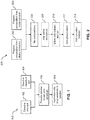
- FIG. 1 illustrates an example process 100 for forming a corrosion inhibitor-incorporated Zn-Al LDH layer on an aluminum-containing substrate.
- a solution including zinc and corrosion inhibitor is prepared, and a corrosion inhibitor-incorporated Zn-Al LDH layer is generated in-situ and in one step on the aluminum-containing substrate.
- a metal salt such as a zinc salt e.g., zinc nitrate or other zinc salt
- zinc nitrate is dissolved in an aqueous media such as water and stirred to form a solution of zinc nitrate.
- the amount of zinc nitrate may range from about 5 to about 30 parts by weight per 100 parts by weight of the zinc nitrate solution.
- the amount of zinc nitrate may be about 5, 10, 15, 20, 25, or 30 parts by weight per 100 parts by weight of the zinc nitrate solution, where any value may form an upper end point or a lower end point, as appropriate.
- the pH of the zinc nitrate solution is adjusted to a pH ranging from about 5 to about 9 (e.g., a neutral pH such as a pH of about 7 or a pH ranging from about 6 to about 8).
- the pH may be about 5, 6, 7, 8, or 9, where any value may form an upper end point or a lower end point, as appropriate.
- a corrosion inhibitor e.g., an inorganic corrosion inhibitor
- the corrosion inhibitor is a salt of an oxyanion of a transition metal.
- the corrosion inhibitor is a vanadate, a manganate, a permanganate, a molybdate, or a tungstate.
- Specific examples of the corrosion inhibitor include sodium metavanadate, potassium permanganate, sodium molybdate, and sodium tungstate.
- a combination of more than one corrosion inhibitors may be dissolved in some embodiments.
- a corrosion inhibitor such as vanadate (e.g., sodium metavanadate) is dissolved in an aqueous media such as water and stirred to form a solution of the corrosion inhibitor.
- the amount of the corrosion inhibitor may range from about 0.1 to about 2 parts by weight per 100 parts by weight of the corrosion inhibitor solution.
- the amount of the corrosion inhibitor may be about 0.1, 0.2, 0.4, 0.6, 0.8, 1, 1.2, 1.4, 1.6, 1.8, or 2 parts by weight per 100 parts by weight of the corrosion inhibitor solution, where any value may form an upper end point or a lower end point, as appropriate.
- the pH of the corrosion inhibitor solution is adjusted to a pH ranging from about 7 to about 11 (e.g., a basic pH such as a pH between about 8 and 10) using a base solution (e.g., NH 4 OH).
- the pH may be about 7, 8, 9, 10, or 11, where any value may form an upper end point or a lower end point, as appropriate.
- a solution of zinc and a corrosion inhibitor is prepared.
- the zinc nitrate solution and the corrosion inhibitor solution are mixed to form a solution of zinc and the corrosion inhibitor.
- the zinc nitrate and the corrosion inhibitor is dissolved in the same aqueous media at block 102 and 104 such that block 106 is performed by carrying out block 102 and 104 in any order.
- an aluminum-containing substrate is hydrothermally treated in the solution of zinc and corrosion inhibitor to form the corrosion inhibitor-incorporated Zn-Al LDH layer on the aluminum-containing substrate.
- an aluminum-containing substrate is immersed in or otherwise contacted with the solution of zinc and the corrosion inhibitor and hydrothermally treated at a temperature ranging from about 50 to about 150 °C (e.g., a temperature ranging from about 70 to about 90 °C) for a time period ranging from about 1 to 6 hours (h).
- the temperature may be 50, 60, 70, 80, 90, 100, 110, 120, 130, 140, or 150, where any value may form an upper end point or a lower end point, as appropriate.
- the thermal treatment may be performed in an autoclave and/or an oven.
- the time period may be about 1, 2, 3, 4, 5, or 6 h, where any value may form an upper end point or a lower end point, as appropriate.
- the pH of the solution during thermal treatment may be maintained at a pH range of about 7 to about 11 (e.g., a basic pH such as a pH between about 8 and 10).
- the pH may be maintained at about 7, 8, 9, 10, or 11, where any value may form an upper end point or a lower end point, as appropriate.
- the Zn-Al LDH layer is grown on the aluminum-containing substrate due to the reaction of zinc with aluminum from the aluminum-containing substrate, the formation of the Zn-Al LDH layer is referred to as in-situ generation.
- the formation of the corrosion inhibitor-incorporated Zn-Al LDH layer is performed in one step at block 108.
- the Zn-Al LDH layer is generated using a zinc-vanadate solution simultaneously followed by loading of vanadate in the same solution into the exfoliated spacing of the Zn-Al LDH layer by ion exchange to form the vanadate-incorporated Zn-Al LDH.
- conventional processes of forming Zn-Al LDH layers are carried out in two distinct steps-first a Zn-Al LDH layer is generated using a zinc solution, and second vanadate exchange is performed using a separate vanadate solution.
- formation of the corrosion inhibitor-incorporated Zn-Al LDH layer in one step at block 108, in which a Zn-Al LDH layer is grown and corrosion inhibitor exchange takes place simultaneously reduces process time compared to conventional processes.
- Sodium metavanadate in an amount of about 0.375 g (0.5 % by weight of the vanadate solution to be formed) was mixed with 74.625 g of deionised water and the pH of the resulting solution was adjusted to a pH of between 8 and 9 using a base solution of NH 4 OH while stirring with a magnetic stirrer.
- Zinc nitrate in an amount of about 7.5 g (10 % by weight of the zinc nitrate solution to be formed) was mixed with 67.5 g of deionised water while stirring with a magnetic stirrer and the resulting solution was adjusted to a neutral pH.
- a degreased and chemically cleaned aluminium alloy substrate was immersed in the mixture of the above solutions contained in an autoclave.
- the aluminium alloy substrate was subjected to heat treatment at about 80 °C for about 2 h by placing the autoclave in an oven.
- a vanadate-incorporated Zn-Al LDH layer was formed on the surface of the aluminium alloy substrate due to the reaction of zinc nitrate with aluminium from the alloy.
- sodium metavanadate was used in this example, one or more salts of other oxyanions of transition metals, such as potassium permanganate, sodium molybdate, sodium tungstate may also be used alone or in combination.
- FIG. 2 illustrates an example process 200 for preparing a sol-gel composition.
- a low temperature curable matrix sol is synthesized in two parts (Composition A and Composition B), and the two parts are subsequently mixed together to obtain a sol-gel composition.
- additional precursors may be added to the sol-gel composition.
- Composition A is prepared from an alkoxysilane such as an organoalkoxysilane.
- An alkoxysilane is contacted with water and an inorganic acid (e.g., HCl, HNO 3 , H 3 PO 4 , or other inorganic acid) to form Composition A.
- an inorganic acid e.g., HCl, HNO 3 , H 3 PO 4 , or other inorganic acid
- an alkoxysilane is mixed with water and stirred, and an inorganic acid is added to the solution of the alkoxysilane and water and stirred in an ice bath until the solution turns transparent.
- the ratio of the number of moles of the alkoxysilane (which is equal to the number of moles of silicon from the alkoxysilane) to the number of moles of water (n Si /n water ) in Composition A ranges from about 0.5 to about 2.
- the ratio may be, for example, about 0.5, 0.6, 0.7, 0.8, 0.9, 1.0, 1.1, 1.2, 1.3, 1.4, 1.5, 1.6, 1.7, 1.8, 1.9, or 2.0, where any value may form an upper end point or a lower end point, as appropriate.
- an alkoxysilane of Formula I is used as Precursor A: R A -Si-(R B ) 3 Formula I wherein;
- R A is methacryloxyalkyl (e.g., methacryloxymethyl, methacryloxyethyl, methacryloxypropyl, methacryloxybutyl, or other methacryloxyalkyl) or glycidoxyalkyl (e.g., glycidoxymethyl, glycidoxyethyl, glycidoxypropyl, glycidoxybutyl); and each R B is independently alkoxy (e.g., methoxy, ethoxy, propoxy).
- methacryloxyalkyl e.g., methacryloxymethyl, methacryloxyethyl, methacryloxypropyl, methacryloxybutyl, or other methacryloxyalkyl
- glycidoxyalkyl e.g., glycidoxymethyl, glycidoxyethyl, glycidoxypropyl, glycidoxybutyl
- each R B is independently alkoxy (e.g.
- R A -Si-(R B ) 3 include 3-methacryloxypropyltrimethoxysilane, 3-methacryloxypropyltriethoxysilane, 3-glycidyloxypropyltrimethoxysilane, and 3-glycidoxypropylethoxysilane.
- Composition B is prepared from a transition metal alkoxide such as a zirconium alkoxide.
- a zirconium alkoxide is contacted with an organic acid such as a carboxylic acid (e.g., methacrylic acid (MAA) or other carboxylic acid) to form Composition B.
- a carboxylic acid e.g., methacrylic acid (MAA) or other carboxylic acid
- the zirconium alkoxide is mixed with methacrylic acid and stirred.
- the ratio of the number of moles of the zirconium alkoxide (which is equal to the number of moles of zirconium from the zirconium alkoxide) to the ratio of the number of moles of methacrylic acid ((n Zr /n MAA ) ranges from about 0.5 to about 2.
- the ratio may be, for example, about 0.5, 0.6, 0.7, 0.8, 0.9, 1.0, 1.1, 1.2, 1.3, 1.4, 1.5, 1.6, 1.7, 1.8, 1.9, or 2.0, where any value may form an upper end point or a lower end point, as appropriate.
- a zirconium alkoxide of Formula II is used as Precursor B: Zr-(R C ) 4 Formula II wherein; R C is alkoxy.
- each R C is independently alkoxy (methoxy, ethoxy, n-propoxy, isopropoxy, n-butoxy, tert-butoxy, or other alkoxy).
- Zr-(R C ) 4 examples include zirconium ethoxide, zirconium n-propoxide, zirconium isopropoxide, zirconium n-butoxide, and zirconium tert-butoxide.
- a zirconium alkoxide is used as Precursor B of a sol-gel composition, for example, to match the coefficient of thermal expansion of the sol-gel composition with a substrate.
- the zirconium alkoxide may be used in an amount such that the coefficient of thermal expansion of the sol-gel composition is equal to or about the coefficient of thermal expansion of the substrate.
- Composition A and Composition B are mixed together.
- Composition B is added to Composition A drip-wise under stirring to avoid agglomeration, and the mixture of Composition A and Composition B is further stirred.
- the mixture formed at block 206 is used as the sol-gel composition to be applied to a substrate.
- one or more of blocks 208-214 are further performed to form the sol-gel composition to be applied to a substrate.
- one or more alkoxysilanes such as one or more organoalkoxysilanes are added to the mixture of Composition A and Composition B.
- One or more alkoxysilanes and an organic acid such as a carboxylic acid (e.g., methacrylic acid or other carboxylic acid) are contacted with the mixture of Composition A and Composition B to form a sol-gel composition.
- a carboxylic acid e.g., methacrylic acid or other carboxylic acid
- each of one or more alkoxysilanes are added to the mixture and stirred.
- methacrylic acid is added to the resulting mixture and stirred.
- an inorganic acid is added before, together with, or after the organic acid
- one or more alkoxysilane of Formula III is used as Precursor C: R D -Si-(R E ) 3 Formula III wherein;
- R D is aryl (e.g., phenyl or other aryl), aralkyl (e.g., benzyl, phenylethyl, phenylpropyl, or other aralkyl), glycidoxyalkyl (e.g., glycidomethyl, glycidoxyethyl, glycidoxypropyl, glycidoxybutyl, or other glycidoxyalkyl), or aminoalkyl (e.g., aminomethyl, aminoethyl, aminopropyl, aminobutyl, or other aminoalkyl); and each R E is independently alkoxy (e.g., methoxy, ethoxy, propoxy).
- aralkyl e.g., benzyl, phenylethyl, phenylpropyl, or other aralkyl
- glycidoxyalkyl e.g., glycidomethyl, glycid
- R D -Si-(R E ) 3 include phenyltrimethoxysilane, phenyltriethoxysilane, 3-glycidoxypropyltrimethoxysilane, 3-glycidoxypropyltriethoxysilane, 3-aminopropyltrimethoxysilane, and 3-aminopropyltriethoxysilane.
- one or more alkoxysilanes used as Precursor C of a sol-gel composition include an aryl alkoxysilane (an alkoxysilane of Formula III in which R D is aryl), a glycidyloxyalkyl alkoxysilane (an alkoxysilane of Formula III in which R D is glycidoxyalkyl), and/or an aminoalkyl alkoxysilane (an alkoxysilane of Formula III in which R D is aminoalkyl).
- the aryl alkoxysilane is used, for example, to improve the barrier properties of a coating formed from the sol-gel composition.
- the glycidyloxyalkyl alkoxysilane is used, for example, to generate a thick coating.
- the aminoalkyl alkoxysilane is used, for example, to improve the adhesion of the sol-gel composition to a substrate when deposited.
- an aryl alkoxysilane is added to the mixture and stirred.
- an aminoalkyl alkoxysilane is added to the mixture and stirred.
- a glycidyloxyalkyl alkoxysilane is added to the mixture.
- methacrylic acid is added and stirred.
- An inorganic acid may also be added. The order of the alkoxysilanes that are added may be changed in other examples.
- the total amount of the alkoxysilane(s) (which includes the alkoxysilane used in block 202 and the one or more alkoxysilanes used in block 208 if block 208 is performed) and the amount of the zirconium alkoxide used in block 204 are such that the sol-gel composition has a ratio of a number of moles of alkoxysilane(s) (which is equal to the number of moles of silicon from the alkoxysilane(s)) to a number of moles of zirconium alkoxide (which is equal to the number of moles of zirconium from the zirconium alkoxide) (n Si /n Zr ) ranging from about 2 to about 10.
- the ratio of the number of moles of silicon to the number of moles of zirconium (n Si /n Zr ) may be about 2, 3, 4, 5, 6, 7, 8, 9, or 10, where any value may form an upper end point or a lower end point, as appropriate.
- one or more of the stirring performed in blocks 202, 204, 206, and/or 208 may be performed for a time period ranging from about 10 min to about 120 min.
- the stirring performed in blocks 202, 204, 206, and/or 208 may be performed for a time period of about 10, 20, 30, 40, 50, 60, 70, 80, 90, 100, 110, or 120 min, where any value may form an upper end point or a lower end point, as appropriate.
- the sol-gel composition is diluted with a solvent such as alcohol (e.g., isopropanol or other solvent) and stirred to age the sol-gel composition.
- a solvent such as alcohol (e.g., isopropanol or other solvent)
- the dilution of the sol-gel composition, the stirring to age the sol-gel composition, or both (e.g., block 210 entirely) may be omitted in some embodiments.
- the sol-gel composition is diluted with isopropanol in a weight ratio of about 1:1.
- the diluted sol-gel composition, or the sol-gel composition formed by block 206 or 208 if dilution is omitted, is stirred to age the sol-gel composition for a time period ranging from 0.5 to about 24 h.
- the stirring to age the sol-gel composition may be performed for a time period of about 0.5, 1, 2, 3, 4, 5, 6, 9, 12, 15, 18, 21, or 24 h, where any value may form an upper end point or a lower end point, as appropriate.
- a photoinitiator e.g., IRGACURE ® 184 or other photoinitiator
- the photoinitiator in an amount ranging from about 0.5 to about 3 parts by weight per 100 parts by weight of the sol-gel composition (the weight of the sol-gel with the photoinitiator to be added or, alternatively, the weight of the sol-gel before adding the photoinitiator) is added, and the sol-gel composition with the photoinitiator is stirred.
- the amount of the photoinitiator may be about 0.5, 1, 1.5, 2, 2.5, or 3 parts by weight per 100 parts of the sol-gel composition, where any value may form an upper end point or a lower end point, as appropriate.
- the stirring may be performed for a time period ranging from about 10 to about 60 min.
- the stirring may be performed for a time period of about 10, 20, 30, 40, 50, or 60 min, where any value may form an upper end point or a lower end point, as appropriate.
- a corrosion inhibiting compound is added to the sol-gel composition to form a corrosion inhibiting compound-containing sol-gel composition.
- the corrosion inhibiting compound is an inorganic corrosion inhibiting compound.
- the corrosion inhibiting compound is a vanadate, a molybdate, a phosphate, a manganate, a permanganate, a titanate, titania, an aluminate, alumina, ceria, a ceric salt, or a cerous salt.
- Specific examples of the corrosion inhibiting compound include sodium metavanadate, potassium permanganate, sodium molybdate, sodium tungstate, and cerium nitrate. A combination of more than one corrosion inhibiting compounds may be dissolved in some embodiments.
- an inorganic corrosion inhibiting compound e.g., cerium nitrate or other inorganic corrosion inhibiting compound
- a solvent e.g., isopropanol or other solvent
- the corrosion inhibiting compound is added directly to the sol-gel composition.
- the amount of the corrosion inhibiting compound ranges from about 1 part by weight to about 10 parts by weight per 100 parts by weight of the sol-gel composition (e.g., the final sol-gel composition including the corrosion inhibiting compound).
- the amount of the corrosion inhibiting compound may be about 0.5, 1, 1.5, 2, 2.5, 3, 4, 5, 6, 7, 8, 9, or 10 parts by weight per 100 parts by weight of the sol-gel composition, where any value may form an upper end point or a lower end point, as appropriate.
- a sol-gel layer formed with a sol-gel composition including a corrosion inhibiting compound such as cerium nitrate advantageously has self-healing properties.
- Blocks 202-214 of process 200 may be performed in the order presented or in a different order and/or one or more of blocks 202-214 may be omitted in other embodiments.
- the sol-gel composition prepared by process 200 may be stored for a long time if stored at temperatures below 4 °C.
- Composition A was synthesized by mixing 26.3 g of 3-glycidoxypropyltrimethoxysilane, 7.5 g of isopropanol, and 0.86 g of a 0.1 N HCl solution in a glass jar loaded on a magnetic stirrer at room temperature. Stirring of composition A was continued for about 1 h.
- 3-glycidoxypropyltrimethoxysilane was used in this example, one or more other methoxysilanes may be used in place of, or in addition to, 3-glycidoxypropyltrimethoxysilane in other examples.
- HCl was used in this example, one or more other inorganic acids may be used in place of, or in addition to, HCl in other examples.
- Composition B was synthesized by mixing 2.229 g of methacrylic acid and 11.16 g of zirconium n-propoxide under vigorous stirring. Stirring was continued for about 0.5 h. Although zirconium n-propoxide was used in this example, one or more other zirconium alkoxides may be used in place of, or in addition to, zirconium n-propoxide in other examples.
- composition B was added drop-wise to composition A under vigorous stirring to avoid agglomeration and stirred for about 2 h to form a sol-gel composition.
- the sol-gel composition was stored at temperatures below 4 °C until use.
- cerium nitrate was prepared by dissolving 0.5 g of Ce(NO 3 ) 3 .6H 2 O in 5 g of isopropanol. The solution was added to the mixture of composition A and composition B formed by Example 2 and stirred.
- cerium nitrate was used as the corrosion inhibiting compound in this example, other inorganic corrosion inhibiting compounds may be used in other examples.
- FIG. 3 illustrates an example process 300 for forming a corrosion-resistant coating that includes a corrosion inhibitor-incorporated Zn-Al LDH layer and a sol-gel layer on an aluminum-containing substrate.
- a corrosion inhibitor-incorporated Zn-Al LDH layer is formed on the substrate.
- the corrosion inhibitor-incorporated Zn-Al LDH layer is formed by process 100 of FIG. 1 , discussed in further detail above.
- a sol-gel composition is applied on the substrate.
- the sol-gel composition prepared by process 200 of FIG. 2 described in further detail above, is contacted with the corrosion inhibitor-incorporated Zn-Al LDH layer by dipping the substrate in the sol-gel composition, by immersing the substrate in the sol-gel composition, by spraying the sol-gel composition on the substrate, and/or by other methods of applying the sol-gel composition to the substrate.
- sol-gel layers can be deposited using a withdrawals speed ranging from about 1 to about 15 mm/s (e.g., about 5 to about 12 mm/s, about 10 mm/s, or other withdrawal speed).
- the withdrawal speed may be about 1, 2, 3, 4, 5, 6, 7, 8, 9, 10, 11, 12, 13, 14, or 15 mm/s, where any value may form an upper end point or a lower end point, as appropriate.
- the sol-gel composition does not include a corrosion inhibiting compound (e.g., sol-gel compositions prepared by process 200 of FIG. 2 in which optional block 214 is not performed).
- the sol-gel composition includes a corrosion inhibiting compound (e.g., sol-gel compositions prepared by process 200 of FIG. 2 in which optional block 214 is performed).
- the sol-gel composition includes a photoinitiator (e.g., sol-gel compositions prepared by process 200 of FIG. 2 in which optional block 212 is performed) and, at block 306, the sol-gel layer is cured by UV radiation.
- the UV radiation has a light dose ranging from about 500 to about 1000 mJ/cm 2 .
- the UV radiation may have a light dose of about 500, 550, 600, 650, 700, 750, 800, 850, 900, 950, or 1000 mJ/cm 2 , where any value may form an upper end point or a lower end point, as appropriate.
- the curing by UV radiation may be performed for a time period ranging from about 0.5 to about 30 min.
- the time period may be about 0.5, 1, 2, 3, 4, 5, 10, 15, 20, 25, or 30 min, where any value may form an upper end point or a lower end point, as appropriate.
- block 306 is omitted.
- the sol-gel layer is thermally cured.
- the sol-gel layer is thermally cured at a temperature ranging from about 70 to about 90 °C.
- the sol-gel layer may be thermally cured at about 70, 75, 80, 85, or 90 °C, where any value may form an upper end point or a lower end point, as appropriate.
- the thermal curing may be performed for a time period ranging from about 40 to about 120 minutes. The time period may be 40, 50, 60, 70, 80, 90, 100, 110, or 120 min, where any value may form an upper end point or a lower end point, as appropriate.
- the thermal curing is performed in a hot air circulated oven.
- the thermal curing includes exposing the sol-gel layer to infrared (IR) radiation, near IR radiation, and/or microwave radiation.
- IR infrared
- the sol-gel layer is exposed to IR and/or near IR radiation for a time period ranging from about 10 to about 60 min (e.g., 30 min or other time period).
- the time period of exposure to IR and/or near IR may be about 10, 15, 20, 25, 30, 35, 40, 45, 50, 55, or 60 min, where any value may form an upper end point or a lower end point, as appropriate.
- primer and/or paint is applied on the substrate.
- the primer is applied on the sol-gel layer
- the paint is applied on the primer.
- the cured sol-gel layer not only provides corrosion resistance to the substrate but also facilitates adherence of the primer and/or paint to the substrate.
- the vanadate-incorporated Zn-Al LDH coated substrate was dried.
- a sol-gel composition (not including a corrosion inhibiting compound) was applied using a dip coater at a withdrawal speed of 5 mm/s to form a sol-gel layer. Then the sol-gel and vanadate-incorporated Zn-Al LDH coated substrate was subjected to thermal curing in a hot air circulated oven at 80°C for 1 h.
- the vanadate-incorporated Zn-Al LDH coated substrate was dried.
- a sol-gel composition including cerium nitrate was applied using a dip coater at a withdrawal speed of 5 mm/s to form a self-healing sol-gel layer.
- the sol-gel and vanadate-incorporated Zn-Al LDH coated substrate was subjected to thermal curing in a hot air circulated oven at 80°C for 1 h.
- FIG. 4A illustrates an example corrosion-resistant coating that includes a corrosion inhibitor-incorporated Zn-Al LDH layer 404 formed on a substrate 402. Corrosion inhibitor-incorporated Zn-Al LDH layer 404 is formed, for example, by process 100 of FIG. 1 , described in further detail above.
- FIG. 4B illustrates an example corrosion-resistant coating that includes a corrosion inhibitor-incorporated Zn-Al LDH layer 414 formed on a substrate 412 and a sol-gel layer 416 without a corrosion inhibiting compound formed on corrosion inhibitor-incorporated Zn-Al LDH layer 414. Corrosion inhibitor -incorporated Zn-Al LDH layer 414 is formed, for example, by process 100 of FIG. 1 .
- Sol-gel layer 416 is formed, for example, by process 300 of FIG. 3 (e.g., as described in Example 4) using a sol-gel composition formed by process 200 of FIG. 2 in which optional block 214 is omitted, described in further detail above.
- FIG. 4C illustrates an example corrosion-resistant coating that includes a corrosion inhibitor-incorporated Zn-Al LDH layer 424 formed on a substrate 422 and a corrosion inhibiting compound-containing sol-gel layer 426 formed on corrosion inhibitor-incorporated Zn-Al LDH layer 424.
- Corrosion inhibitor-incorporated Zn-Al LDH layer 424 is formed, for example, by process 100 of FIG. 1
- Sol-gel layer 426 is formed, for example, by process 300 of FIG.
- sol-gel composition formed by process 200 of FIG. 2 in which optional block 214 is performed, described in further detail above.
- optional block 214 is performed, described in further detail above.
- a single sol-gel layer 416, 426 is shown in each of FIG. 4B and 4C , additional sol-gel layers may be formed in other examples.
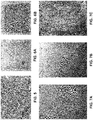
- FIG. 5 is a scanning electron microscopy (SEM) image of a vanadate-incorporated Zn-Al LDH layer 500 formed on a substrate.
- Vanadate-incorporated Zn-Al LDH layer 500 LDH is crystalline and has flower-like morphology due to its layered structure.
- FIG. 6A is an image of a coated substrate 600 with a vanadate-incorporated Zn-Al LDH layer after a corrosion test
- FIG. 6B is an image of an uncoated aluminum alloy substrate 610 after a corrosion test.
- FIGS. 6A and 6B show substrate 600 and substrate 610, respectively, after each substrate 600 and substrate 610 had been immersed in a sodium chloride solution having a concentration of 3.5 % for 300 h. While uncoated substrate 610 was corroded, coated substrate 600 did not show any sign of corrosion even after the 300 h of salt water immersion.
- FIG. 7A is an image of a coated substrate 700 with a vanadate-incorporated Zn-Al LDH layer and a sol-gel layer, formed by process 100 of FIG. 1 and process 300 of FIG. 3 , after a corrosion-resistance test. Coated substrate 700 was exposed to a 5% salt spray. FIG. 7A shows coated substrate 700 after 168 h of the salt spray test. Coated substrate 700 showed no significant corrosion even after 168 h of the salt spray test.
- FIG. 7B is an image of a chromated substrate 710, formed by chrome conversion coating, after a corrosion-resistance test. Chrome conversion coated substrate 710 was exposed to a 5% salt spray. FIG. 7B shows chrome conversion coated substrate 710 after 168 h of the salt spray test. Chrome conversion coating followed by applying a primer and paint is currently considered the state of the art for corrosion-resistant coatings for metal or metal alloy substrates. However, chrome conversion coated substrate 710 had started to show a few corrosion pits. Accordingly, coated substrate 700 shown in FIG. 7A advantageously has a corrosion resistance that is comparable to or better than that of chrome conversion coated substrate 710.
- FIG. 7C is an image of an uncoated aluminum alloy substrate 720 after a corrosion-resistance test. Uncoated substrate 720 was exposed to a 5% salt spray. FIG. 7C shows uncoated substrate 720 after 168 h of the salt spray test, which was severely corroded.
Landscapes
- Chemical & Material Sciences (AREA)
- Engineering & Computer Science (AREA)
- Materials Engineering (AREA)
- Organic Chemistry (AREA)
- Mechanical Engineering (AREA)
- Metallurgy (AREA)
- General Chemical & Material Sciences (AREA)
- Chemical Kinetics & Catalysis (AREA)
- Physics & Mathematics (AREA)
- Thermal Sciences (AREA)
- Inorganic Chemistry (AREA)
- Composite Materials (AREA)
- Ceramic Engineering (AREA)
- Dispersion Chemistry (AREA)
- Wood Science & Technology (AREA)
- Life Sciences & Earth Sciences (AREA)
- Plasma & Fusion (AREA)
- Paints Or Removers (AREA)
- Chemical Treatment Of Metals (AREA)
Abstract
Description
- The present disclosure relates to coating compositions and processes and, more particularly, to compositions for layered double hydroxide coating and sol-gel coating and related processes.
- High strength alloys such as aluminum alloys are widely used in various industries such as the aerospace industry due to their high strength to weight ratio. However these alloys are prone to corrosion due to the presence of alloying materials.
- In order to protect these alloys from the environment, a chrome based coating may be provided on a surface of an alloy followed by application of primer and a top coat. Although organic paint systems applied on the surface provide good barrier properties against corrosion, even small defects formed in the organic paint ensure pathways for the ingress of electrolyte to the metallic surface, which initiates localized corrosion. Therefore, chromium has been used in anti-corrosion pretreatments before application of organic coatings. However, hexavalent chromium compounds have harmful effects.
- Thus, there is a need for coating compositions and processes that are chromium-free and provide a coating that is corrosion-resistant.
- In accordance with embodiments of the present disclosure, various methods and formulations are provided relating to layered double hydroxide (LDH) coating and sol-gel coating of substrates such as an aluminum substrate, an aluminum alloy substrate (e.g., AA 2024, AA 6061, or AA7075), or other aluminum-containing substrate. The LDH coating and/or the sol-gel coating provided on a substrate advantageously provides corrosion protection. Further, the LDH coating and/or the sol-gel coating provided on the substrate advantageously provides enhanced adhesion between the substrate and a paint system (e.g., primer and paint).
- In one exemplary aspect, method for providing a corrosion-resistant coating on an aluminum-containing substrate (e.g., an aluminum substrate, an aluminum alloy substrate, or other aluminum-containing substrate) includes preparing a zinc-vanadate solution by dissolving a zinc salt and a corrosion inhibitor (e.g., a salt of an oxyanion of a transition metal such as a vanadate, a manganate, a permanganate, a molybdate, and/or a tungstate), and contacting the substrate in the solution to form a corrosion inhibitor-incorporated Zn-Al layered double hydroxide (LDH) layer on the substrate in a single step process. The preparation of the zinc-corrosion inhibitor solution may include dissolving the zinc salt in a first aqueous media to form a first solution, adjusting the first solution to a pH ranging from about 6 to about 8, dissolving the corrosion inhibitor in a second aqueous media to form a second solution, adjusting the second solution to a pH ranging from about 8 to about 10, and mixing the first and second solution to form the zinc-corrosion inhibitor solution.
- In an additional exemplary aspect, the method also includes contacting a sol-gel composition on the corrosion inhibitor -incorporated Zn-Al LDH layer of the substrate to form a sol-gel layer, and curing the sol-gel layer. The method may further include contacting an alkoxysilane with water and an inorganic acid to form a first composition, contacting a zirconium alkoxide with an organic acid to form a second composition, and mixing the first composition with the second composition to form the sol-gel layer. A corrosion inhibiting compound (e.g., a vanadate, a molybdate, a phosphate, a manganate, a permanganate, a titanate, titania, an aluminate, alumina, ceria, a ceric salt, and/or a cerous salt) may also be added to the sol-gel composition.
- In a further exemplary aspect, corrosion-resistant coated product includes a corrosion inhibitor-incorporated Zn-Al LDH layer on a substrate, and a sol-gel layer on the vanadate-incorporated Zn-Al LDH layer of the substrate, the sol-gel layer comprising a polymer composite of one or more alkoxysilanes and a zirconium alkoxide.
- The scope of the invention is defined by the claims, which are incorporated into this section by reference. A better understanding of the methods and formulations for LDH coating and sol-gel coating of the present disclosure, as well as an appreciation of the above and additional advantages thereof, will be afforded to those of skill in the art by a consideration of the following detailed description of one or more example embodiments thereof. In this description, reference is made to the various views of the appended sheets of drawings, which are briefly described below, and within which, like reference numerals are used to identify like ones of the elements illustrated therein.
-
-
FIG. 1 illustrates an example process for forming a corrosion inhibitor-incorporated Zn-Al layered double hydroxide (LDH) layer on an aluminum-containing substrate in accordance with an embodiment of the present disclosure. -
FIG. 2 illustrates an example process for preparing a sol-gel composition in accordance with an embodiment of the present disclosure. -
FIG. 3 illustrates an example process for forming a corrosion-resistant coating that includes a corrosion inhibitor-incorporated Zn-Al LDH layer and a sol-gel layer in accordance with an embodiment of the present disclosure. -
FIG. 4A illustrates an example corrosion-resistant coating that includes a corrosion inhibitor-incorporated Zn-Al LDH layer in accordance with an embodiment of the present disclosure. -
FIG. 4B illustrates an example corrosion-resistant coating that includes a corrosion inhibitor-incorporated Zn-Al LDH layer and a sol-gel layer in accordance with an embodiment of the present disclosure. -
FIG. 4C illustrates an example corrosion-resistant coating that includes a corrosion inhibitor-incorporated Zn-Al LDH layer made in a single step process and a corrosion inhibitor-containing sol-gel layer in accordance with an embodiment of the present disclosure. -
FIG. 5 is a scanning electron microscopy (SEM) image of a vanadate-incorporated Zn-Al LDH layer. -
FIG. 6A is an image of a coated substrate with a vanadate-incorporated Zn-Al LDH layer after a corrosion test. -
FIG. 6B is an image of an uncoated substrate after a corrosion test. -
FIG. 7A is an image of a coated substrate with a vanadate-incorporated Zn-Al LDH layer and a sol-gel layer after a corrosion-resistance test. -
FIG. 7B is an image of a chrome conversion coated substrate after a corrosion-resistance test. -
FIG. 7C is an image of an uncoated substrate after a corrosion-resistance test. - The following description is merely exemplary in nature and is not intended to limit the present disclosure, application, or uses.
- The terms "substituent", "radical", "group", "moiety," and "fragment" may be used interchangeably.
- Singular forms "a" and "an" may include plural reference unless the context clearly dictates otherwise.
- The number of carbon atoms in a substituent can be indicated by the prefix "CA-B" where A is the minimum and B is the maximum number of carbon atoms in the substituent.
- The term "alkyl" embraces a linear or branched acyclic alkyl radical containing from 1 to about 15 carbon atoms. In some embodiments, alkyl is a C1-10 alkyl, C1-6 alkyl, or C1-3 alkyl radical. Examples of alkyl include, but are not limited to, methyl, ethyl, propyl, isopropyl, butyl, isobutyl, tert-butyl, sec-butyl, pentan-3-yl (i.e.,

- The term "alkoxy" is RO- where R is alkyl. Non-limiting examples of alkoxy include methoxy, ethoxy, propoxy, n-butyloxy, and tert-butyloxy. The terms "alkyloxy", "alkoxy," and "alkyl-O-" may be used interchangeably.
- The term "methacryl" is

- The term "methacryloxy" is

- The term "methacryloxyalkyl" embraces alkyl substituted with methacryloxy. Non-limiting examples of methacryloxyalkyl include methacryloxyethyl, methacryloxypropyl, and methacryloxybutyl.
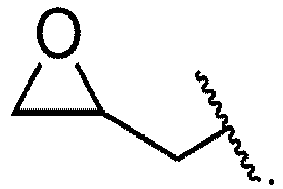
- The term "glycidyl" is
- The term "glycidyloxy" is
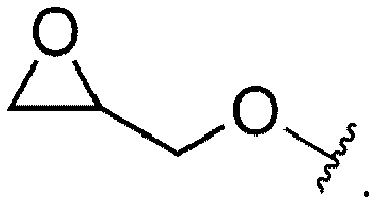
- The term "glycidoxyalkyl" embraces alkyl substituted with glycidoxy. Non-limiting examples of glycidoxyalkyl include, glycidoxyethyl, and glycidoxypropyl, and glycidoxybutyl. The terms "glycidyloxyalkyl" and "glycidoxyalkyl" may be used interchangeably.
- The term "aminoalkyl" embraces an amino radical attached to a parent molecular scaffold through an alkyl radical (e.g., NH2-alkyl-scaffold).
- The term "aryl" refers to any monocyclic, bicyclic, or tricyclic cyclized carbon radical, wherein at least one ring is aromatic. An aromatic radical may be fused to a nonaromatic cycloalkyl or heterocyclyl radical. Aryl may be substituted or unsubstituted. Examples of aryl include phenyl and naphthyl.
- The term "aralkyl" embraces aryl attached to a parent molecular scaffold through alkyl and may be used interchangeably with the term "arylalkyl." Examples of aralkyl include benzyl, diphenylmethyl, triphenylmethyl, phenylethyl, and diphenylethyl. The terms "benzyl" and "phenylmethyl" may be used interchangeably.
- The term "silane" is a compound containing silicon.
- The term "organosilane" is a silane having at least one silicon to carbon bond.
- The term "alkoxysilane" is a silane having at least one silicon to alkoxy bond.
- The term "organoalkoxysilane" is a silane having at least one silicon to carbon bond and at least one silicon to alkoxy bond.
- The terms "corrosion inhibiting compound" and "corrosion inhibitor" may be used interchangeably.
- The term "about," as used herein when referring to a measurable value such as an amount, concentration, time and the like, is meant to encompass variations of ±20%, ±10%, ±5%, ±1%, ±0.5%, or even ±0.1% of the specified value.
- Compositions and processes relating to layered double hydroxide (LDH) (e.g., Zn-Al LDH or other LDH) coating and sol-gel coating of substrates such as metal or metal alloy substrates (e.g., aluminum substrates, aluminum alloy substrates (e.g., AA 2024, AA 6061, or AA7075), or other aluminum-containing substrates) are provided. LDH coating, which may be combined with sol-gel coating, may be used as a chrome-free pretreatment on substrates prior to the application of organic coatings such as primer and paint. For example, the pretreatment may be performed by forming a corrosion inhibitor-intercalated LDH layer and then applying a layer of sol-gel composition, which is obtained as a product of hydrolysis and condensation of a mixture of organoalkoxysilanes and a metal alkoxide. In some examples, a corrosion inhibiting compound is added to the sol-gel composition. In some examples, ultraviolet (UV) radiation is used to densify the sol-gel layer in addition to, or instead of, thermal curing of the sol-gel layer. Thermal curing may include exposing the sol-gel layer to a temperature ranging from about 70 to about 90 °C (e.g., in a hot air circulated oven). Alternatively, or in addition, thermal curing may include exposing the sol-gel layer to infrared (IR) radiation or near IR radiation, which reduces curing time.
- An aluminum-containing substrate (e.g., an aluminum substrate, an aluminum alloy substrate, or other aluminum-containing substrate) such as an aluminum-containing panel is passivated using a solution that includes both zinc and a corrosion inhibitor such as vanadate. The passivation may include hydrothermally treating the aluminum-containing substrate in the solution to form a corrosion inhibitor-incorporated Zn-Al LDH layer (also referred to as a corrosion inhibitor-intercalated Zn-Al LDH layer, a corrosion inhibitor-encapsulated Zn-Al LDH layer, or a corrosion inhibitor-exchanged Zn-Al LDH layer) on the surface of the aluminum-containing substrate. The aluminum-containing substrate itself provides the aluminum in the corrosion inhibitor-incorporated Zn-Al LDH layer.
- A sol-gel composition is applied on the corrosion inhibitor-incorporated Zn-Al LDH layer of the aluminum-containing substrate in some embodiments. Advantageously, the sol-gel coating composition applied on a corrosion inhibitor-incorporated Zn-Al LDH layer of a substrate may be low temperature curable, provide excellent barrier protection, and provide active corrosion inhibition. Further, the sol-gel layer formed using the sol-gel coating composition may release corrosion inhibiting compounds on demand.
-
FIG. 1 illustrates anexample process 100 for forming a corrosion inhibitor-incorporated Zn-Al LDH layer on an aluminum-containing substrate. A solution including zinc and corrosion inhibitor is prepared, and a corrosion inhibitor-incorporated Zn-Al LDH layer is generated in-situ and in one step on the aluminum-containing substrate. - At
block 102, a metal salt such as a zinc salt (e.g., zinc nitrate or other zinc salt) is dissolved. For example, zinc nitrate is dissolved in an aqueous media such as water and stirred to form a solution of zinc nitrate. The amount of zinc nitrate may range from about 5 to about 30 parts by weight per 100 parts by weight of the zinc nitrate solution. The amount of zinc nitrate may be about 5, 10, 15, 20, 25, or 30 parts by weight per 100 parts by weight of the zinc nitrate solution, where any value may form an upper end point or a lower end point, as appropriate. In some examples, the pH of the zinc nitrate solution is adjusted to a pH ranging from about 5 to about 9 (e.g., a neutral pH such as a pH of about 7 or a pH ranging from about 6 to about 8). The pH may be about 5, 6, 7, 8, or 9, where any value may form an upper end point or a lower end point, as appropriate. - At
block 104, a corrosion inhibitor (e.g., an inorganic corrosion inhibitor) is dissolved. In an aspect, the corrosion inhibitor is a salt of an oxyanion of a transition metal. In another aspect, the corrosion inhibitor is a vanadate, a manganate, a permanganate, a molybdate, or a tungstate. Specific examples of the corrosion inhibitor include sodium metavanadate, potassium permanganate, sodium molybdate, and sodium tungstate. A combination of more than one corrosion inhibitors may be dissolved in some embodiments. - For example, a corrosion inhibitor such as vanadate (e.g., sodium metavanadate) is dissolved in an aqueous media such as water and stirred to form a solution of the corrosion inhibitor. The amount of the corrosion inhibitor may range from about 0.1 to about 2 parts by weight per 100 parts by weight of the corrosion inhibitor solution. The amount of the corrosion inhibitor may be about 0.1, 0.2, 0.4, 0.6, 0.8, 1, 1.2, 1.4, 1.6, 1.8, or 2 parts by weight per 100 parts by weight of the corrosion inhibitor solution, where any value may form an upper end point or a lower end point, as appropriate. In some examples, the pH of the corrosion inhibitor solution is adjusted to a pH ranging from about 7 to about 11 (e.g., a basic pH such as a pH between about 8 and 10) using a base solution (e.g., NH4OH). The pH may be about 7, 8, 9, 10, or 11, where any value may form an upper end point or a lower end point, as appropriate.
- At
block 106, a solution of zinc and a corrosion inhibitor is prepared. For example, the zinc nitrate solution and the corrosion inhibitor solution are mixed to form a solution of zinc and the corrosion inhibitor. In other embodiments, the zinc nitrate and the corrosion inhibitor is dissolved in the same aqueous media atblock block 106 is performed by carrying outblock - At
block 108, an aluminum-containing substrate is hydrothermally treated in the solution of zinc and corrosion inhibitor to form the corrosion inhibitor-incorporated Zn-Al LDH layer on the aluminum-containing substrate. For example, an aluminum-containing substrate is immersed in or otherwise contacted with the solution of zinc and the corrosion inhibitor and hydrothermally treated at a temperature ranging from about 50 to about 150 °C (e.g., a temperature ranging from about 70 to about 90 °C) for a time period ranging from about 1 to 6 hours (h). The temperature may be 50, 60, 70, 80, 90, 100, 110, 120, 130, 140, or 150, where any value may form an upper end point or a lower end point, as appropriate. The thermal treatment may be performed in an autoclave and/or an oven. The time period may be about 1, 2, 3, 4, 5, or 6 h, where any value may form an upper end point or a lower end point, as appropriate. In some examples, the pH of the solution during thermal treatment may be maintained at a pH range of about 7 to about 11 (e.g., a basic pH such as a pH between about 8 and 10). The pH may be maintained at about 7, 8, 9, 10, or 11, where any value may form an upper end point or a lower end point, as appropriate. As the Zn-Al LDH layer is grown on the aluminum-containing substrate due to the reaction of zinc with aluminum from the aluminum-containing substrate, the formation of the Zn-Al LDH layer is referred to as in-situ generation. - The formation of the corrosion inhibitor-incorporated Zn-Al LDH layer is performed in one step at
block 108. For example, the Zn-Al LDH layer is generated using a zinc-vanadate solution simultaneously followed by loading of vanadate in the same solution into the exfoliated spacing of the Zn-Al LDH layer by ion exchange to form the vanadate-incorporated Zn-Al LDH. In contrast, conventional processes of forming Zn-Al LDH layers are carried out in two distinct steps-first a Zn-Al LDH layer is generated using a zinc solution, and second vanadate exchange is performed using a separate vanadate solution. Advantageously, formation of the corrosion inhibitor-incorporated Zn-Al LDH layer in one step atblock 108, in which a Zn-Al LDH layer is grown and corrosion inhibitor exchange takes place simultaneously, reduces process time compared to conventional processes. - Sodium metavanadate in an amount of about 0.375 g (0.5 % by weight of the vanadate solution to be formed) was mixed with 74.625 g of deionised water and the pH of the resulting solution was adjusted to a pH of between 8 and 9 using a base solution of NH4OH while stirring with a magnetic stirrer. Zinc nitrate in an amount of about 7.5 g (10 % by weight of the zinc nitrate solution to be formed) was mixed with 67.5 g of deionised water while stirring with a magnetic stirrer and the resulting solution was adjusted to a neutral pH. A degreased and chemically cleaned aluminium alloy substrate was immersed in the mixture of the above solutions contained in an autoclave. The aluminium alloy substrate was subjected to heat treatment at about 80 °C for about 2 h by placing the autoclave in an oven. A vanadate-incorporated Zn-Al LDH layer was formed on the surface of the aluminium alloy substrate due to the reaction of zinc nitrate with aluminium from the alloy. Although sodium metavanadate was used in this example, one or more salts of other oxyanions of transition metals, such as potassium permanganate, sodium molybdate, sodium tungstate may also be used alone or in combination.
-
FIG. 2 illustrates anexample process 200 for preparing a sol-gel composition. A low temperature curable matrix sol is synthesized in two parts (Composition A and Composition B), and the two parts are subsequently mixed together to obtain a sol-gel composition. In some embodiments, additional precursors may be added to the sol-gel composition. - At
block 202, Composition A is prepared from an alkoxysilane such as an organoalkoxysilane. An alkoxysilane is contacted with water and an inorganic acid (e.g., HCl, HNO3, H3PO4, or other inorganic acid) to form Composition A. - For example, an alkoxysilane is mixed with water and stirred, and an inorganic acid is added to the solution of the alkoxysilane and water and stirred in an ice bath until the solution turns transparent. The ratio of the number of moles of the alkoxysilane (which is equal to the number of moles of silicon from the alkoxysilane) to the number of moles of water (nSi/nwater) in Composition A ranges from about 0.5 to about 2. The ratio may be, for example, about 0.5, 0.6, 0.7, 0.8, 0.9, 1.0, 1.1, 1.2, 1.3, 1.4, 1.5, 1.6, 1.7, 1.8, 1.9, or 2.0, where any value may form an upper end point or a lower end point, as appropriate.
- In an aspect, an alkoxysilane of Formula I is used as Precursor A:
RA-Si-(RB)3 Formula I
wherein; - RA is methacryloxyalkyl or glycidoxyalkyl; and
- RB is alkoxy.
- In another aspect, RA is methacryloxyalkyl (e.g., methacryloxymethyl, methacryloxyethyl, methacryloxypropyl, methacryloxybutyl, or other methacryloxyalkyl) or glycidoxyalkyl (e.g., glycidoxymethyl, glycidoxyethyl, glycidoxypropyl, glycidoxybutyl); and each RB is independently alkoxy (e.g., methoxy, ethoxy, propoxy).
- Specific examples of RA-Si-(RB)3 include 3-methacryloxypropyltrimethoxysilane, 3-methacryloxypropyltriethoxysilane, 3-glycidyloxypropyltrimethoxysilane, and 3-glycidoxypropylethoxysilane.
- At
block 204, Composition B is prepared from a transition metal alkoxide such as a zirconium alkoxide. A zirconium alkoxide is contacted with an organic acid such as a carboxylic acid (e.g., methacrylic acid (MAA) or other carboxylic acid) to form Composition B. - For example, the zirconium alkoxide is mixed with methacrylic acid and stirred. The ratio of the number of moles of the zirconium alkoxide (which is equal to the number of moles of zirconium from the zirconium alkoxide) to the ratio of the number of moles of methacrylic acid ((nZr/nMAA) ranges from about 0.5 to about 2. The ratio may be, for example, about 0.5, 0.6, 0.7, 0.8, 0.9, 1.0, 1.1, 1.2, 1.3, 1.4, 1.5, 1.6, 1.7, 1.8, 1.9, or 2.0, where any value may form an upper end point or a lower end point, as appropriate.
- In an aspect, a zirconium alkoxide of Formula II is used as Precursor B:
Zr-(RC)4 Formula II
wherein;
RC is alkoxy. - In another aspect, each RC is independently alkoxy (methoxy, ethoxy, n-propoxy, isopropoxy, n-butoxy, tert-butoxy, or other alkoxy).
- Specific examples of Zr-(RC)4 include zirconium ethoxide, zirconium n-propoxide, zirconium isopropoxide, zirconium n-butoxide, and zirconium tert-butoxide.
- In some aspects, a zirconium alkoxide is used as Precursor B of a sol-gel composition, for example, to match the coefficient of thermal expansion of the sol-gel composition with a substrate. The zirconium alkoxide may be used in an amount such that the coefficient of thermal expansion of the sol-gel composition is equal to or about the coefficient of thermal expansion of the substrate.
- At
block 206, Composition A and Composition B are mixed together. For example, Composition B is added to Composition A drip-wise under stirring to avoid agglomeration, and the mixture of Composition A and Composition B is further stirred. In some embodiments, the mixture formed atblock 206 is used as the sol-gel composition to be applied to a substrate. In other embodiments, one or more of blocks 208-214 are further performed to form the sol-gel composition to be applied to a substrate. - At
block 208, one or more alkoxysilanes such as one or more organoalkoxysilanes are added to the mixture of Composition A and Composition B. One or more alkoxysilanes and an organic acid such as a carboxylic acid (e.g., methacrylic acid or other carboxylic acid) are contacted with the mixture of Composition A and Composition B to form a sol-gel composition. - For example, each of one or more alkoxysilanes are added to the mixture and stirred. Then, methacrylic acid is added to the resulting mixture and stirred. Optionally, an inorganic acid is added before, together with, or after the organic acid
- In an aspect, one or more alkoxysilane of Formula III is used as Precursor C:
RD-Si-(RE)3 Formula III
wherein; - RD is aryl, aralkyl, glycidoxyalkyl, or aminoalkyl; and
- RE is alkoxy.
- In another aspect, RD is aryl (e.g., phenyl or other aryl), aralkyl (e.g., benzyl, phenylethyl, phenylpropyl, or other aralkyl), glycidoxyalkyl (e.g., glycidomethyl, glycidoxyethyl, glycidoxypropyl, glycidoxybutyl, or other glycidoxyalkyl), or aminoalkyl (e.g., aminomethyl, aminoethyl, aminopropyl, aminobutyl, or other aminoalkyl); and each RE is independently alkoxy (e.g., methoxy, ethoxy, propoxy).
- Specific examples of RD-Si-(RE)3 include phenyltrimethoxysilane, phenyltriethoxysilane, 3-glycidoxypropyltrimethoxysilane, 3-glycidoxypropyltriethoxysilane, 3-aminopropyltrimethoxysilane, and 3-aminopropyltriethoxysilane.
- In some aspects, one or more alkoxysilanes used as Precursor C of a sol-gel composition include an aryl alkoxysilane (an alkoxysilane of Formula III in which RD is aryl), a glycidyloxyalkyl alkoxysilane (an alkoxysilane of Formula III in which RD is glycidoxyalkyl), and/or an aminoalkyl alkoxysilane (an alkoxysilane of Formula III in which RD is aminoalkyl). The aryl alkoxysilane is used, for example, to improve the barrier properties of a coating formed from the sol-gel composition. The glycidyloxyalkyl alkoxysilane is used, for example, to generate a thick coating. The aminoalkyl alkoxysilane is used, for example, to improve the adhesion of the sol-gel composition to a substrate when deposited.
- In an example, an aryl alkoxysilane is added to the mixture and stirred. Then, an aminoalkyl alkoxysilane is added to the mixture and stirred. Then, a glycidyloxyalkyl alkoxysilane is added to the mixture. Then, methacrylic acid is added and stirred. An inorganic acid may also be added. The order of the alkoxysilanes that are added may be changed in other examples.
- The total amount of the alkoxysilane(s) (which includes the alkoxysilane used in
block 202 and the one or more alkoxysilanes used inblock 208 ifblock 208 is performed) and the amount of the zirconium alkoxide used inblock 204 are such that the sol-gel composition has a ratio of a number of moles of alkoxysilane(s) (which is equal to the number of moles of silicon from the alkoxysilane(s)) to a number of moles of zirconium alkoxide (which is equal to the number of moles of zirconium from the zirconium alkoxide) (nSi/nZr) ranging from about 2 to about 10. The ratio of the number of moles of silicon to the number of moles of zirconium (nSi/nZr) may be about 2, 3, 4, 5, 6, 7, 8, 9, or 10, where any value may form an upper end point or a lower end point, as appropriate. - In some examples, one or more of the stirring performed in
blocks blocks - At
block 210, the sol-gel composition is diluted with a solvent such as alcohol (e.g., isopropanol or other solvent) and stirred to age the sol-gel composition. The dilution of the sol-gel composition, the stirring to age the sol-gel composition, or both (e.g., block 210 entirely) may be omitted in some embodiments. - For example, the sol-gel composition is diluted with isopropanol in a weight ratio of about 1:1. The diluted sol-gel composition, or the sol-gel composition formed by
block - At
block 212, a photoinitiator (e.g., IRGACURE® 184 or other photoinitiator) is added to the sol-gel composition and stirred. For example, the photoinitiator in an amount ranging from about 0.5 to about 3 parts by weight per 100 parts by weight of the sol-gel composition (the weight of the sol-gel with the photoinitiator to be added or, alternatively, the weight of the sol-gel before adding the photoinitiator) is added, and the sol-gel composition with the photoinitiator is stirred. The amount of the photoinitiator may be about 0.5, 1, 1.5, 2, 2.5, or 3 parts by weight per 100 parts of the sol-gel composition, where any value may form an upper end point or a lower end point, as appropriate. The stirring may be performed for a time period ranging from about 10 to about 60 min. The stirring may be performed for a time period of about 10, 20, 30, 40, 50, or 60 min, where any value may form an upper end point or a lower end point, as appropriate. Once the photoinitiator is added, exposure of the sol-gel composition to light may be avoided by covering a container for the sol-gel composition (e.g., using aluminum foil) and/or storing in an amber-colored container. - At
block 214, a corrosion inhibiting compound is added to the sol-gel composition to form a corrosion inhibiting compound-containing sol-gel composition. In an aspect, the corrosion inhibiting compound is an inorganic corrosion inhibiting compound. In another aspect, the corrosion inhibiting compound is a vanadate, a molybdate, a phosphate, a manganate, a permanganate, a titanate, titania, an aluminate, alumina, ceria, a ceric salt, or a cerous salt. Specific examples of the corrosion inhibiting compound include sodium metavanadate, potassium permanganate, sodium molybdate, sodium tungstate, and cerium nitrate. A combination of more than one corrosion inhibiting compounds may be dissolved in some embodiments. - For example, an inorganic corrosion inhibiting compound (e.g., cerium nitrate or other inorganic corrosion inhibiting compound) is dissolved in a solvent (e.g., isopropanol or other solvent) and the solution of the corrosion inhibiting compound is added to the sol-gel composition. Alternatively, the corrosion inhibiting compound is added directly to the sol-gel composition. The amount of the corrosion inhibiting compound ranges from about 1 part by weight to about 10 parts by weight per 100 parts by weight of the sol-gel composition (e.g., the final sol-gel composition including the corrosion inhibiting compound). The amount of the corrosion inhibiting compound may be about 0.5, 1, 1.5, 2, 2.5, 3, 4, 5, 6, 7, 8, 9, or 10 parts by weight per 100 parts by weight of the sol-gel composition, where any value may form an upper end point or a lower end point, as appropriate. A sol-gel layer formed with a sol-gel composition including a corrosion inhibiting compound such as cerium nitrate advantageously has self-healing properties.
- Blocks 202-214 of
process 200 may be performed in the order presented or in a different order and/or one or more of blocks 202-214 may be omitted in other embodiments. The sol-gel composition prepared byprocess 200 may be stored for a long time if stored at temperatures below 4 °C. - Composition A was synthesized by mixing 26.3 g of 3-glycidoxypropyltrimethoxysilane, 7.5 g of isopropanol, and 0.86 g of a 0.1 N HCl solution in a glass jar loaded on a magnetic stirrer at room temperature. Stirring of composition A was continued for about 1 h. Although 3-glycidoxypropyltrimethoxysilane was used in this example, one or more other methoxysilanes may be used in place of, or in addition to, 3-glycidoxypropyltrimethoxysilane in other examples. Also, although HCl was used in this example, one or more other inorganic acids may be used in place of, or in addition to, HCl in other examples.
- Composition B was synthesized by mixing 2.229 g of methacrylic acid and 11.16 g of zirconium n-propoxide under vigorous stirring. Stirring was continued for about 0.5 h. Although zirconium n-propoxide was used in this example, one or more other zirconium alkoxides may be used in place of, or in addition to, zirconium n-propoxide in other examples.
- Composition B was added drop-wise to composition A under vigorous stirring to avoid agglomeration and stirred for about 2 h to form a sol-gel composition. The sol-gel composition was stored at temperatures below 4 °C until use.
- A solution of cerium nitrate was prepared by dissolving 0.5 g of Ce(NO3)3.6H2O in 5 g of isopropanol. The solution was added to the mixture of composition A and composition B formed by Example 2 and stirred. Although cerium nitrate was used as the corrosion inhibiting compound in this example, other inorganic corrosion inhibiting compounds may be used in other examples.
-
FIG. 3 illustrates anexample process 300 for forming a corrosion-resistant coating that includes a corrosion inhibitor-incorporated Zn-Al LDH layer and a sol-gel layer on an aluminum-containing substrate. - At block 302, a corrosion inhibitor-incorporated Zn-Al LDH layer is formed on the substrate. For example, the corrosion inhibitor-incorporated Zn-Al LDH layer is formed by
process 100 ofFIG. 1 , discussed in further detail above. - At
block 304, a sol-gel composition is applied on the substrate. For example, the sol-gel composition prepared byprocess 200 ofFIG. 2 , described in further detail above, is contacted with the corrosion inhibitor-incorporated Zn-Al LDH layer by dipping the substrate in the sol-gel composition, by immersing the substrate in the sol-gel composition, by spraying the sol-gel composition on the substrate, and/or by other methods of applying the sol-gel composition to the substrate. If dip coating is used, sol-gel layers can be deposited using a withdrawals speed ranging from about 1 to about 15 mm/s (e.g., about 5 to about 12 mm/s, about 10 mm/s, or other withdrawal speed). The withdrawal speed may be about 1, 2, 3, 4, 5, 6, 7, 8, 9, 10, 11, 12, 13, 14, or 15 mm/s, where any value may form an upper end point or a lower end point, as appropriate. In some embodiments, the sol-gel composition does not include a corrosion inhibiting compound (e.g., sol-gel compositions prepared byprocess 200 ofFIG. 2 in whichoptional block 214 is not performed). In other embodiments, the sol-gel composition includes a corrosion inhibiting compound (e.g., sol-gel compositions prepared byprocess 200 ofFIG. 2 in whichoptional block 214 is performed). - In some embodiments, the sol-gel composition includes a photoinitiator (e.g., sol-gel compositions prepared by
process 200 ofFIG. 2 in whichoptional block 212 is performed) and, atblock 306, the sol-gel layer is cured by UV radiation. For example, the UV radiation has a light dose ranging from about 500 to about 1000 mJ/cm2. The UV radiation may have a light dose of about 500, 550, 600, 650, 700, 750, 800, 850, 900, 950, or 1000 mJ/cm2, where any value may form an upper end point or a lower end point, as appropriate. The curing by UV radiation may be performed for a time period ranging from about 0.5 to about 30 min. The time period may be about 0.5, 1, 2, 3, 4, 5, 10, 15, 20, 25, or 30 min, where any value may form an upper end point or a lower end point, as appropriate. In other embodiments, block 306 is omitted. - At
block 308, the sol-gel layer is thermally cured. For example, the sol-gel layer is thermally cured at a temperature ranging from about 70 to about 90 °C. The sol-gel layer may be thermally cured at about 70, 75, 80, 85, or 90 °C, where any value may form an upper end point or a lower end point, as appropriate. The thermal curing may be performed for a time period ranging from about 40 to about 120 minutes. The time period may be 40, 50, 60, 70, 80, 90, 100, 110, or 120 min, where any value may form an upper end point or a lower end point, as appropriate. In an example, the thermal curing is performed in a hot air circulated oven. Alternatively, or in addition to, thermal curing at a high temperature, the thermal curing includes exposing the sol-gel layer to infrared (IR) radiation, near IR radiation, and/or microwave radiation. For example, the sol-gel layer is exposed to IR and/or near IR radiation for a time period ranging from about 10 to about 60 min (e.g., 30 min or other time period). The time period of exposure to IR and/or near IR may be about 10, 15, 20, 25, 30, 35, 40, 45, 50, 55, or 60 min, where any value may form an upper end point or a lower end point, as appropriate. - At
block 310, primer and/or paint is applied on the substrate. For example, the primer is applied on the sol-gel layer, and the paint is applied on the primer. Advantageously, the cured sol-gel layer not only provides corrosion resistance to the substrate but also facilitates adherence of the primer and/or paint to the substrate. - After forming a vanadate-incorporated Zn-Al LDH layer on an aluminum-containing substrate as described in Example 3, the vanadate-incorporated Zn-Al LDH coated substrate was dried. A sol-gel composition (not including a corrosion inhibiting compound) was applied using a dip coater at a withdrawal speed of 5 mm/s to form a sol-gel layer. Then the sol-gel and vanadate-incorporated Zn-Al LDH coated substrate was subjected to thermal curing in a hot air circulated oven at 80°C for 1 h.
- After forming a vanadate-incorporated Zn-Al LDH layer on an aluminum-containing substrate as described in Example 3, the vanadate-incorporated Zn-Al LDH coated substrate was dried. A sol-gel composition including cerium nitrate was applied using a dip coater at a withdrawal speed of 5 mm/s to form a self-healing sol-gel layer. Then the sol-gel and vanadate-incorporated Zn-Al LDH coated substrate was subjected to thermal curing in a hot air circulated oven at 80°C for 1 h.
-
FIG. 4A illustrates an example corrosion-resistant coating that includes a corrosion inhibitor-incorporated Zn-Al LDH layer 404 formed on asubstrate 402. Corrosion inhibitor-incorporated Zn-Al LDH layer 404 is formed, for example, byprocess 100 ofFIG. 1 , described in further detail above.FIG. 4B illustrates an example corrosion-resistant coating that includes a corrosion inhibitor-incorporated Zn-Al LDH layer 414 formed on asubstrate 412 and a sol-gel layer 416 without a corrosion inhibiting compound formed on corrosion inhibitor-incorporated Zn-Al LDH layer 414. Corrosion inhibitor -incorporated Zn-Al LDH layer 414 is formed, for example, byprocess 100 ofFIG. 1 . Sol-gel layer 416 is formed, for example, byprocess 300 ofFIG. 3 (e.g., as described in Example 4) using a sol-gel composition formed byprocess 200 ofFIG. 2 in whichoptional block 214 is omitted, described in further detail above.FIG. 4C illustrates an example corrosion-resistant coating that includes a corrosion inhibitor-incorporated Zn-Al LDH layer 424 formed on asubstrate 422 and a corrosion inhibiting compound-containing sol-gel layer 426 formed on corrosion inhibitor-incorporated Zn-Al LDH layer 424. Corrosion inhibitor-incorporated Zn-Al LDH layer 424 is formed, for example, byprocess 100 ofFIG. 1 , and Sol-gel layer 426 is formed, for example, byprocess 300 ofFIG. 3 (e.g., as described in Example 5) using a sol-gel composition formed byprocess 200 ofFIG. 2 in whichoptional block 214 is performed, described in further detail above. Although a single sol-gel layer FIG. 4B and 4C , additional sol-gel layers may be formed in other examples. -
FIG. 5 is a scanning electron microscopy (SEM) image of a vanadate-incorporated Zn-Al LDH layer 500 formed on a substrate. Vanadate-incorporated Zn-Al LDH layer 500 LDH is crystalline and has flower-like morphology due to its layered structure. -
FIG. 6A is an image of acoated substrate 600 with a vanadate-incorporated Zn-Al LDH layer after a corrosion test, andFIG. 6B is an image of an uncoatedaluminum alloy substrate 610 after a corrosion test.FIGS. 6A and 6B show substrate 600 andsubstrate 610, respectively, after eachsubstrate 600 andsubstrate 610 had been immersed in a sodium chloride solution having a concentration of 3.5 % for 300 h. Whileuncoated substrate 610 was corroded,coated substrate 600 did not show any sign of corrosion even after the 300 h of salt water immersion. -
FIG. 7A is an image of acoated substrate 700 with a vanadate-incorporated Zn-Al LDH layer and a sol-gel layer, formed byprocess 100 ofFIG. 1 andprocess 300 ofFIG. 3 , after a corrosion-resistance test.Coated substrate 700 was exposed to a 5% salt spray.FIG. 7A showscoated substrate 700 after 168 h of the salt spray test.Coated substrate 700 showed no significant corrosion even after 168 h of the salt spray test. -
FIG. 7B is an image of achromated substrate 710, formed by chrome conversion coating, after a corrosion-resistance test. Chrome conversion coatedsubstrate 710 was exposed to a 5% salt spray.FIG. 7B shows chrome conversion coatedsubstrate 710 after 168 h of the salt spray test. Chrome conversion coating followed by applying a primer and paint is currently considered the state of the art for corrosion-resistant coatings for metal or metal alloy substrates. However, chrome conversion coatedsubstrate 710 had started to show a few corrosion pits. Accordingly,coated substrate 700 shown inFIG. 7A advantageously has a corrosion resistance that is comparable to or better than that of chrome conversion coatedsubstrate 710. -
FIG. 7C is an image of an uncoatedaluminum alloy substrate 720 after a corrosion-resistance test.Uncoated substrate 720 was exposed to a 5% salt spray.FIG. 7C showsuncoated substrate 720 after 168 h of the salt spray test, which was severely corroded. - Further, embodiments according to the following clauses are described:
- Clause A1. A method for providing a corrosion-resistant coating on a substrate, the method comprising:
- preparing a zinc-corrosion inhibitor solution by dissolving a zinc salt and a corrosion inhibitor, the corrosion inhibitor comprising a salt of an oxyanion of a transition metal; and
- contacting the substrate comprising an aluminum alloy with the zinc-corrosion inhibitor solution to form a corrosion inhibitor-incorporated Zn-Al layered double hydroxide (LDH) layer on the substrate.
- Clause A2. The method of Clause A1, wherein the preparing the zinc-vanadate solution comprises:
- dissolving the zinc salt in a first aqueous media to form a first solution;
- adjusting the first solution to a pH ranging from about 6 to about 8 or from 6 to 8;
- dissolving the corrosion inhibitor in a second aqueous media to form a second solution, the corrosion inhibitor comprising a vanadate, a manganate, a permanganate, a molybdate, a tungstate, or a combination thereof;
- adjusting the second solution to a pH ranging from about 8 to about 10 or from 8 to 10; and
- mixing the first and second solution to form the zinc-corrosion inhibitor solution.
- Clause A3. The method of Clause A1 or A2, wherein the dissolving the zinc salt comprises dissolving zinc nitrate in an amount ranging from about 5 to about 30 parts or from 5 to 30 parts by weight per 100 parts by weight of the first solution.
- Clause A4. The method of any of Clauses A1 - A3, wherein the dissolving the corrosion inhibitor comprises dissolving sodium metavanadate in an amount ranging from of about 0.1 to about 2 parts or from 0.1 to 2 parts by weight per 100 parts by weight of the second solution, and wherein the zinc-corrosion inhibitor solution has a ratio of a number of moles of zinc to a number of moles of vanadium (nZn/nV) ranging from about 5 to about 100 or from 5 to 100.
- Clause A5. The method of any of Clauses A1 - A4, wherein the contacting comprises maintaining a pH ranging from about 8 to about 10 or from 8 to 10 and a temperature ranging from about 70 to about 90 °C or from 70 to 90 °C for a time period ranging from about 1 to about 6 h or from 1 to 6h.
- Clause A6. The method of any of Clauses A1 - A5, further comprising:
- contacting a sol-gel composition on the corrosion inhibitor-incorporated Zn-Al LDH layer of the substrate to form a sol-gel layer; and
- curing the sol-gel layer.
- Clause A7. The method of any of Clauses A1 - A6, further comprising:
- contacting an alkoxysilane with water and an inorganic acid to form a first composition;
- contacting a zirconium alkoxide with a first organic acid to form a second composition; and
- mixing the first composition with the second composition to form the sol-gel composition.
- Clause A8. The method of any of Clauses A1 - A7, wherein the contacting to form the first composition comprises mixing the alkoxysilane having the formula RA-Si-(RB)3 with the water and the inorganic acid, wherein the RA is methacryloxyalkyl or glycidyloxyalkyl, and wherein the RB is a methoxy or ethoxy.
- Clause A9. The method of any of Clauses A1 - A8, wherein the contacting to form the second composition comprises mixing the zirconium alkoxide having the formula Zr-(RC)4 with methacrylic acid (MAA), and wherein the RC is ethoxy, n-propoxy, isopropoxy, n-butyloxy, or tert-butyloxy.
- Clause A10. The method of any of Clauses A1 - A9, further comprising:
- adding an additional alkoxysilane and MAA to the sol-gel composition, the additional alkoxysilane having the formula RD-Si-(RE)3, wherein the RD is aryl, aminoalkyl, or glycidoxyalkyl, and wherein the RE is methoxy or ethoxy.
- Clause A11. The method of any of Clauses A1 - A10, further comprising:
- adding a corrosion inhibiting compound to the sol-gel composition in an amount ranging from about 1 to about 5 parts or from 1 to 5 parts by weight per 100 part by weight of the sol-gel composition.
- Clause A12. The method of Clause A11, wherein the adding the corrosion inhibiting compound comprises adding a vanadate, a molybdate, a phosphate, a manganate, a permanganate, a titanate, titania, an aluminate, alumina, ceria, a ceric salt, a cerous salt, or combination thereof.
- Clause A13. The method of any of Clauses A8 - A12, wherein the curing the sol-gel layer comprises exposing the sol-gel layer to a temperature ranging from about 70 to about 90 °C or from 70 to 90 °C for a time period ranging from about 30 to about 120 min or from 30 to 120 min in a hot air circulated oven.
- Clause A14. The method of any of Clauses A6 - A13, wherein the curing the sol-gel layer comprises exposing the sol-gel layer to infrared (IR) radiation and/or near IR radiation.
- Clause A15. The method of any of Clauses A6 - A14, further comprising applying primer or paint on the sol-gel layer of the substrate, the sol-gel layer facilitating adherence of the primer or the paint to the substrate.
- Clause A16. The zinc-corrosion inhibitor solution prepared according to the method of any of Clauses A1 - A4.
- Clause A17. The corrosion-resistant coating comprising the corrosion inhibitor-incorporated Zn-Al LDH layer formed by the method of any of Clauses A1 - A5.
- Clause A18. The corrosion-resistant coating comprising the corrosion inhibitor-incorporated Zn-Al LDH layer and the sol-gel layer formed by the method of any of Clauses A6 - A15.
- Clause A19. A corrosion-resistant coated product, comprising:
- a corrosion inhibitor-incorporated Zn-Al layered double hydroxide (LDH) layer on an aluminum alloy substrate, the corrosion inhibitor comprising a salt of an oxyanion of a transition metal, wherein the aluminum alloy substrate comprises 2024 aluminum alloy, 6061 aluminum alloy, or 7075 aluminum alloy; and
- a sol-gel layer on the corrosion inhibitor-incorporated Zn-Al LDH layer of the substrate, the sol-gel layer comprising a polymer composite of one or more alkoxysilanes and a zirconium alkoxide.
- Clause A20. The corrosion-resistant coated product of Clause A19, wherein the sol-gel layer contains a corrosion inhibiting compound comprising a vanadate, a molybdate, a phosphate, a manganate, a permanganate, a titanate, titania, an aluminate, alumina, ceria, a ceric salt, a cerous salt, or combination thereof.
- When introducing elements of the present invention or exemplary aspects or embodiment(s) thereof, the articles "a," "an," "the," and "said" are intended to mean that there are one or more of the elements. The terms "comprising," "including," and "having" are intended to be inclusive and mean that there may be additional elements other than the listed elements. Although this invention has been described with respect to specific embodiments, the details of these embodiments are not to be construed as limitations. Different aspects, embodiments and features are defined in detail herein. Each aspect, embodiment or feature so defined may be combined with any other aspect(s), embodiment(s) or feature(s) (preferred, advantageous or otherwise) unless clearly indicated to the contrary. Accordingly, the scope of the invention is defined only by the following claims.
Claims (15)
- A method for providing a corrosion-resistant coating on a substrate, the method comprising:preparing a zinc-corrosion inhibitor solution by dissolving a zinc salt and a corrosion inhibitor, the corrosion inhibitor comprising a salt of an oxyanion of a transition metal; andcontacting the substrate comprising an aluminum alloy with the zinc-corrosion inhibitor solution to form a corrosion inhibitor-incorporated Zn-Al layered double hydroxide (LDH) layer on the substrate.
- The method of claim 1, wherein the preparing the zinc-vanadate solution comprises:dissolving the zinc salt in a first aqueous media to form a first solution;adjusting the first solution to a pH ranging from about 6 to about 8;dissolving the corrosion inhibitor in a second aqueous media to form a second solution, the corrosion inhibitor comprising a vanadate, a manganate, a permanganate, a molybdate, a tungstate, or a combination thereof;adjusting the second solution to a pH ranging from about 8 to about 10; andmixing the first and second solution to form the zinc-corrosion inhibitor solution.
- The method of claims 1 or 2, wherein the dissolving the zinc salt comprises dissolving zinc nitrate in an amount ranging from about 5 to about 30 parts by weight per 100 parts by weight of the first solution; or
wherein the dissolving the corrosion inhibitor comprises dissolving sodium metavanadate in an amount ranging from of about 0.1 to about 2 parts by weight per 100 parts by weight of the second solution, and wherein the zinc-corrosion inhibitor solution has a ratio of a number of moles of zinc to a number of moles of vanadium (nZn/nV) ranging from about 5 to about 100. - The method of any of claims 1 - 3, wherein the contacting comprises maintaining a pH ranging from about 8 to about 10 and a temperature ranging from about 70 to about 90 °C for a time period ranging from about 1 to about 6 h.
- The method of any of claims 1 - 4, further comprising:contacting a sol-gel composition on the corrosion inhibitor-incorporated Zn-Al LDH layer of the substrate to form a sol-gel layer; andcuring the sol-gel layer.
- The method of any of claims 1 - 5, further comprising:contacting an alkoxysilane with water and an inorganic acid to form a first composition;contacting a zirconium alkoxide with a first organic acid to form a second composition; andmixing the first composition with the second composition to form the sol-gel composition.
- The method of any of claims 1 - 6, wherein the contacting to form the first composition comprises mixing the alkoxysilane having the formula RA-Si-(RB)3 with the water and the inorganic acid, wherein the RA is methacryloxyalkyl or glycidyloxyalkyl, and wherein the RB is a methoxy or ethoxy.
- The method of any of claims 1 - 7, wherein the contacting to form the second composition comprises mixing the zirconium alkoxide having the formula Zr-(RC)4 with methacrylic acid (MAA), and wherein the RC is ethoxy, n-propoxy, isopropoxy, n-butyloxy, or tert-butyloxy.
- The method of any of claims 1 - 8, further comprising:adding an additional alkoxysilane and MAA to the sol-gel composition, the additional alkoxysilane having the formula RD-Si-(RE)3, wherein the RD is aryl, aminoalkyl, or glycidoxyalkyl, and wherein the RE is methoxy or ethoxy.
- The method of any of claims 1 - 9, further comprising:adding a corrosion inhibiting compound to the sol-gel composition in an amount ranging from about 1 to about 5 parts by weight per 100 part by weight of the sol-gel composition; orwherein the adding the corrosion inhibiting compound comprises adding a vanadate, a molybdate, a phosphate, a manganate, a permanganate, a titanate, titania, an aluminate, alumina, ceria, a ceric salt, a cerous salt, or combination thereof
- The method of any of claims 5 - 10, wherein the curing the sol-gel layer comprises exposing the sol-gel layer to a temperature ranging from about 70 to about 90 °C for a time period ranging from about 30 to about 120 min in a hot air circulated oven; or
wherein the curing the sol-gel layer comprises exposing the sol-gel layer to infrared (IR) radiation and/or near IR radiation. - The method of any of claims 5 - 11, further comprising applying primer or paint on the sol-gel layer of the substrate, the sol-gel layer facilitating adherence of the primer or the paint to the substrate.
- The corrosion-resistant coating comprising the corrosion inhibitor-incorporated Zn-Al LDH layer and the sol-gel layer formed by the method of any of claims 5 - 12.
- The zinc-corrosion inhibitor solution prepared according to the method of any of claims 1 - 3.
- The corrosion-resistant coating comprising the corrosion inhibitor-incorporated Zn-Al LDH layer formed by the method of any of claims 1 - 4.
Applications Claiming Priority (2)
| Application Number | Priority Date | Filing Date | Title |
|---|---|---|---|
| US201662364678P | 2016-07-20 | 2016-07-20 | |
| US15/231,668 US10246594B2 (en) | 2016-07-20 | 2016-08-08 | Corrosion inhibitor-incorporated layered double hydroxide and sol-gel coating compositions and related processes |
Publications (3)
| Publication Number | Publication Date |
|---|---|
| EP3272904A2 true EP3272904A2 (en) | 2018-01-24 |
| EP3272904A3 EP3272904A3 (en) | 2018-03-14 |
| EP3272904B1 EP3272904B1 (en) | 2019-12-25 |
Family
ID=59564089
Family Applications (1)
| Application Number | Title | Priority Date | Filing Date |
|---|---|---|---|
| EP17181837.0A Active EP3272904B1 (en) | 2016-07-20 | 2017-07-18 | Corrosion inhibitor-incorporated layered double hydroxide and sol-gel coating compositions and related processes |
Country Status (3)
| Country | Link |
|---|---|
| US (2) | US10246594B2 (en) |
| EP (1) | EP3272904B1 (en) |
| CA (1) | CA2965233C (en) |
Cited By (2)
| Publication number | Priority date | Publication date | Assignee | Title |
|---|---|---|---|---|
| CN110158095A (en) * | 2019-06-28 | 2019-08-23 | 辽宁工业大学 | A kind of preparation method of surface of galvanized steel LDH |
| US20230094396A1 (en) * | 2021-08-31 | 2023-03-30 | The Boeing Company | Corrosion resistant coating systems |
Families Citing this family (14)
| Publication number | Priority date | Publication date | Assignee | Title |
|---|---|---|---|---|
| US10246593B2 (en) | 2016-07-20 | 2019-04-02 | The Boeing Company | Sol-gel coating compositions including corrosion inhibitor-encapsulated layered double hydroxide and related processes |
| US10246594B2 (en) | 2016-07-20 | 2019-04-02 | The Boeing Company | Corrosion inhibitor-incorporated layered double hydroxide and sol-gel coating compositions and related processes |
| US10428226B2 (en) | 2016-07-20 | 2019-10-01 | The Boeing Company | Sol-gel coating compositions and related processes |
| FR3061210B1 (en) * | 2016-12-22 | 2021-12-24 | Electricite De France | SOL-GEL PROCESS FOR MANUFACTURING AN ANTICORROSION COATING ON METALLIC SUBSTRATE |
| US10421869B2 (en) | 2017-01-09 | 2019-09-24 | The Boeing Company | Sol-gel coating compositions including corrosion inhibitor-encapsulated layered metal phosphates and related processes |
| DE102019102202A1 (en) * | 2019-01-29 | 2020-07-30 | Epg (Engineered Nanoproducts Germany) Ag | Doped alkali silicate protective layers on metal |
| US10837786B2 (en) | 2019-03-18 | 2020-11-17 | Uber Technologies, Inc. | Multi-modal transportation service planning and fulfillment |
| CN111778494B (en) * | 2020-06-28 | 2021-10-01 | 中国科学院上海硅酸盐研究所 | A kind of surface-modified medical metal material and its preparation method and application |
| CN112553664B (en) * | 2020-12-02 | 2022-08-05 | 上海电力大学 | Aluminum alloy part with layered double hydroxide-graphene oxide silane composite coating and preparation method thereof |
| CN113136575B (en) * | 2021-03-11 | 2022-08-05 | 首钢集团有限公司 | Passivating solution for improving bonding performance of zinc-aluminum-magnesium plated steel and preparation method thereof |
| CN115613022B (en) * | 2022-09-28 | 2024-08-16 | 湖南金裕环保科技有限公司 | Aluminium and aluminium alloy chromium-free natural-color passivating agent and preparation method thereof |
| US20240198315A1 (en) * | 2022-12-15 | 2024-06-20 | Battelle Savannah River Alliance, Llc | Functionalized porous material and related methods |
| US12146073B1 (en) | 2023-07-13 | 2024-11-19 | Imam Abdulrahman Bin Faisal University | Layered double hydroxide-polyvinylidene fluoride (LDH/PVDF) composites for reducing corrosion |
| CN117801579B (en) * | 2024-01-02 | 2025-07-01 | 四川大学 | Preparation method of protective coating of wastewater treatment filter press component |
Family Cites Families (62)
| Publication number | Priority date | Publication date | Assignee | Title |
|---|---|---|---|---|
| IL84025A0 (en) | 1986-10-03 | 1988-02-29 | Ppg Industries Inc | Organosiloxane/metal oxide coating compositions and their production |
| US4814017A (en) | 1986-10-03 | 1989-03-21 | Ppg Industries, Inc. | Aqueous organoalkoxysilane/metal oxide sol-gel compositions |
| US4753827A (en) | 1986-10-03 | 1988-06-28 | Ppg Industries, Inc. | Abrasion-resistant organosiloxane/metal oxide coating |
| US4754012A (en) | 1986-10-03 | 1988-06-28 | Ppg Industries, Inc. | Multi-component sol-gel protective coating composition |
| JP2986962B2 (en) | 1991-05-20 | 1999-12-06 | テイカ株式会社 | Rust preventive pigment composition and paint containing the same |
| US5328975A (en) | 1993-04-02 | 1994-07-12 | Ppg Industries, Inc. | Ultraviolet radiation absorbing coating |
| JP3186908B2 (en) | 1993-07-15 | 2001-07-11 | テイカ株式会社 | Rust prevention pigment composition |
| US6150033A (en) | 1995-06-06 | 2000-11-21 | Sermatech International, Inc. | Environmentally friendly coating compositions, bonding solution, and coated parts |
| US5866652A (en) | 1996-02-27 | 1999-02-02 | The Boeing Company | Chromate-free protective coatings |
| US5869141A (en) | 1996-11-04 | 1999-02-09 | The Boeing Company | Surface pretreatment for sol coating of metals |
| US5958578A (en) | 1996-11-04 | 1999-09-28 | The Boeing Company | Hybrid laminate having improved metal-to-resin adhesion |
| US6605365B1 (en) | 1996-11-04 | 2003-08-12 | The Boeing Company | Pigmented alkoxyzirconium sol |
| US6037060A (en) | 1996-11-04 | 2000-03-14 | The Boeing Company | Sol for bonding expoxies to aluminum or titanium alloys |
| US6169119B1 (en) | 1997-02-14 | 2001-01-02 | Reliance Electric Technologies, Llc | Metal oxide sols and process for making the same |
| DE19718891C2 (en) | 1997-05-03 | 2001-03-15 | Kluthe Gmbh Chem Werke | Process and agent for phosphating aluminum surfaces |
| CA2310219A1 (en) | 2000-05-29 | 2001-11-29 | Nu-Wave Photonics Inc. | Application of deuterium oxide in producing silicon containing and metal containing materials |
| WO2002088221A1 (en) | 2001-04-27 | 2002-11-07 | The University Of Sydney | Materials for optical applications |
| US6579472B2 (en) | 2001-07-27 | 2003-06-17 | The Boeing Company | Corrosion inhibiting sol-gel coatings for metal alloys |
| US6911263B2 (en) | 2002-01-30 | 2005-06-28 | Awi Licensing Company | PET wear layer/sol gel top coat layer composites |
| US7149826B2 (en) | 2002-08-05 | 2006-12-12 | Hewlett-Packard Development Company, L.P. | Peripheral device output job routing |
| JP2004099943A (en) | 2002-09-06 | 2004-04-02 | Tayca Corp | Rust inhibitor composition |
| WO2004024835A1 (en) | 2002-09-10 | 2004-03-25 | Rotomac Electricals Pvt Ltd | Self-priming chromate free corrosion resistant coating composition and method |
| US6768048B2 (en) | 2002-12-04 | 2004-07-27 | The Boeing Company | Sol-gel coatings for solar cells |
| US6852427B1 (en) | 2003-09-02 | 2005-02-08 | Olin Corporation | Chromium-free antitarnish adhesion promoting treatment composition |
| DE102004004147A1 (en) | 2004-01-28 | 2005-08-18 | Degussa Ag | Surface-modified silica-sheathed metalloid / metal oxides |
| US7052592B2 (en) | 2004-06-24 | 2006-05-30 | Gueguine Yedigarian | Chromium plating method |
| US7579049B2 (en) | 2004-07-06 | 2009-08-25 | The Boeing Company | Nano-structured inorganic zinc phosphate corrosion protective coating for metal alloys |
| US9158197B2 (en) | 2004-07-12 | 2015-10-13 | Industrial Technology Research Institute | Organic-inorganic hybrid material, hybrid film derived therefrom, and method for preparing the same |
| US20060009536A1 (en) | 2004-07-12 | 2006-01-12 | Guang-Way Jang | Functionalized sol-gel material, sol-gel film derived therefrom, and method for preparing the same |
| DE102004037045A1 (en) | 2004-07-29 | 2006-04-27 | Degussa Ag | Aqueous silane nanocomposites |
| US20070125451A1 (en) | 2005-01-14 | 2007-06-07 | Smith Steven R | Stable, thin-film organic passivates |
| US9125968B2 (en) | 2005-03-30 | 2015-09-08 | Boston Scientific Scimed, Inc. | Polymeric/ceramic composite materials for use in medical devices |
| FR2886309B1 (en) | 2005-05-31 | 2007-08-17 | Airbus France Sas | FLOOR FOR SOL-GEL COATING OF SURFACE AND SOL-GEL COATING PROCESS USING THE SAME |
| EP1832629B1 (en) | 2006-03-10 | 2016-03-02 | Max-Planck-Gesellschaft zur Förderung der Wissenschaften e.V. | Corrosion inhibiting pigment comprising nanoreservoirs of corrosion inhibitor |
| CN101528594B (en) | 2006-10-27 | 2012-05-30 | 东亚合成株式会社 | Novel Layered Zirconium Phosphate Compounds |
| US8592042B2 (en) | 2006-11-09 | 2013-11-26 | The Boeing Company | Sol-gel coating method and composition |
| FR2914631B1 (en) | 2007-04-06 | 2009-07-03 | Eads Europ Aeronautic Defence | PARTICULAR NANOSTRUCTURE MATERIAL, AS PROTECTIVE COATING OF METAL SURFACES. |
| US20090004486A1 (en) | 2007-06-27 | 2009-01-01 | Sarah Arsenault | Corrosion inhibiting additive |
| IE20080941A1 (en) | 2007-11-26 | 2009-09-02 | Univ Dublin City | Organosilane coating compositions and use thereof |
| CN101925660A (en) | 2007-11-26 | 2010-12-22 | 都柏林技术学院知识产权公司 | Organosilane coating composition and use thereof |
| DE102007059423A1 (en) | 2007-12-10 | 2009-06-18 | Epg (Engineered Nanoproducts Germany) Ag | Inorganic-organic binder, process for its preparation and its use |
| WO2010053629A1 (en) | 2008-11-05 | 2010-05-14 | Nitto Denko Corporation | Asymmetric photo-patternable sol-gel precursors and their methods of preparation |
| DE102009001372B4 (en) | 2009-03-06 | 2011-01-27 | Chemetall Gmbh | Process for coating metallic surfaces in a multistage process and use of the products coated by the process |
| KR100970462B1 (en) | 2010-02-09 | 2010-07-16 | 엘베스트지에이티 주식회사 | Anticorrosion metal film composition for energy saving and manufacturing method of the same |
| EP2361942A1 (en) | 2010-02-25 | 2011-08-31 | Corning Incorporated | Non-shrinkable sol-gel-polymer hybrid and methods thereof |
| DE102011003677B4 (en) | 2011-02-04 | 2015-09-24 | Schott Ag | Composite, process for its preparation and use of the composite |
| EP2743377A1 (en) | 2011-08-11 | 2014-06-18 | Universidade de Aveiro | Conversion films based on lamellar double-hydroxides for active protection against corrosion |
| EP2604661B1 (en) | 2011-12-12 | 2017-01-25 | Max-Planck-Gesellschaft zur Förderung der Wissenschaften e.V. | Corrosion inhibiting pigments and methods for preparing the same |
| PT106256A (en) | 2012-04-17 | 2013-10-17 | Chemetall Gmbh | METHOD SURFACES COATING PROCESS WITH COATINGS CONTAINING LAMELAR DUAL HYDROXIDE PARTICLES. |
| KR101550092B1 (en) | 2012-05-21 | 2015-09-03 | (주)엘지하우시스 | Transparent conductive film with a hybrid under coating layer and method for manufacturing thereof, touch panel using the same |
| EP2743374A1 (en) | 2012-12-11 | 2014-06-18 | AMAG rolling GmbH | Method for treating the surface of a metallic substrate made of aluminium or aluminium alloy |
| US20150376420A1 (en) | 2013-01-17 | 2015-12-31 | BASF Coating GmbH | Method For Producing An Anticorrosion Coating |
| US20140322540A1 (en) | 2013-04-26 | 2014-10-30 | The Boeing Company | Surface treatment for structural bonding to aluminum |
| EP3000785B1 (en) | 2013-05-22 | 2019-03-06 | Mitsui Chemicals, Inc. | Porous metal oxide particles, production method thereof and application thereof |
| ITTO20130416A1 (en) | 2013-05-23 | 2014-11-24 | Fiat Ricerche | COATING COMPOSITION FOR METALLIC SURFACES WITH IMPROVED ANTI-CORROSION PROPERTIES |
| FR3014890B1 (en) | 2013-12-12 | 2017-02-03 | Seb Sa | CULINARY ARTICLE HAVING A HYBRID COATING AND METHOD FOR REALIZING SUCH A ARTICLE |
| EP3130459B1 (en) | 2014-03-31 | 2021-05-05 | Dai Nippon Printing Co., Ltd. | Gas barrier film and method for producing same |
| US9670376B1 (en) | 2016-07-18 | 2017-06-06 | Advenira Enterprises, Inc. | Hybrid sol-gel coating materials and coatings and methods of forming and using thereof |
| US10246594B2 (en) | 2016-07-20 | 2019-04-02 | The Boeing Company | Corrosion inhibitor-incorporated layered double hydroxide and sol-gel coating compositions and related processes |
| US10246593B2 (en) | 2016-07-20 | 2019-04-02 | The Boeing Company | Sol-gel coating compositions including corrosion inhibitor-encapsulated layered double hydroxide and related processes |
| US10428226B2 (en) | 2016-07-20 | 2019-10-01 | The Boeing Company | Sol-gel coating compositions and related processes |
| US10421869B2 (en) | 2017-01-09 | 2019-09-24 | The Boeing Company | Sol-gel coating compositions including corrosion inhibitor-encapsulated layered metal phosphates and related processes |
-
2016
- 2016-08-08 US US15/231,668 patent/US10246594B2/en active Active
-
2017
- 2017-04-24 CA CA2965233A patent/CA2965233C/en active Active
- 2017-07-18 EP EP17181837.0A patent/EP3272904B1/en active Active
-
2019
- 2019-03-15 US US16/355,625 patent/US10738199B2/en active Active
Non-Patent Citations (1)
| Title |
|---|
| None |
Cited By (6)
| Publication number | Priority date | Publication date | Assignee | Title |
|---|---|---|---|---|
| CN110158095A (en) * | 2019-06-28 | 2019-08-23 | 辽宁工业大学 | A kind of preparation method of surface of galvanized steel LDH |
| CN110158095B (en) * | 2019-06-28 | 2021-11-30 | 辽宁工业大学 | Preparation method of zinc-coated steel surface LDH |
| US20230094396A1 (en) * | 2021-08-31 | 2023-03-30 | The Boeing Company | Corrosion resistant coating systems |
| US11932949B2 (en) * | 2021-08-31 | 2024-03-19 | The Boeing Company | Corrosion resistant coating systems |
| US20240218523A1 (en) * | 2021-08-31 | 2024-07-04 | The Boeing Company | Corrosion resistant coating systems |
| US12503776B2 (en) * | 2021-08-31 | 2025-12-23 | The Boeing Company | Corrosion resistant coating systems |
Also Published As
| Publication number | Publication date |
|---|---|
| US10738199B2 (en) | 2020-08-11 |
| EP3272904B1 (en) | 2019-12-25 |
| US20180022938A1 (en) | 2018-01-25 |
| US10246594B2 (en) | 2019-04-02 |
| CA2965233C (en) | 2022-06-14 |
| US20190211215A1 (en) | 2019-07-11 |
| CA2965233A1 (en) | 2018-01-20 |
| EP3272904A3 (en) | 2018-03-14 |
Similar Documents
| Publication | Publication Date | Title |
|---|---|---|
| US10738199B2 (en) | Corrosion inhibitor-incorporated layered double hydroxide and sol-gel coating compositions and related processes | |
| US10793725B2 (en) | Sol-gel coating compositions including corrosion inhibitor-encapsulated layered double hydroxide and related processes | |
| US11739225B2 (en) | Sol-gel coating compositions including corrosion inhibitor-encapsulated layered metal phosphates and related processes | |
| US11091653B2 (en) | Sol-gel coating compositions and related processes | |
| RU2418885C2 (en) | Method of applying coating on metal surface by treating with aqueous composition, aqueous composition and use of coated metal substrates | |
| CN1771096A (en) | Corrosion protection on metals | |
| CA2754138A1 (en) | Process for coating metallic surfaces in a multi-stage process | |
| EP3526279B1 (en) | A hybrid sol-gel corrosion-resistant coating composition | |
| EP3636800A2 (en) | Corrosion resistant surface treatment and primer system for aluminum aircraft using chromium-free inhibitors |
Legal Events
| Date | Code | Title | Description |
|---|---|---|---|
| PUAI | Public reference made under article 153(3) epc to a published international application that has entered the european phase |
Free format text: ORIGINAL CODE: 0009012 |
|
| STAA | Information on the status of an ep patent application or granted ep patent |
Free format text: STATUS: REQUEST FOR EXAMINATION WAS MADE |
|
| 17P | Request for examination filed |
Effective date: 20170718 |
|
| AK | Designated contracting states |
Kind code of ref document: A2 Designated state(s): AL AT BE BG CH CY CZ DE DK EE ES FI FR GB GR HR HU IE IS IT LI LT LU LV MC MK MT NL NO PL PT RO RS SE SI SK SM TR |
|
| AX | Request for extension of the european patent |
Extension state: BA ME |
|
| PUAL | Search report despatched |
Free format text: ORIGINAL CODE: 0009013 |
|
| AK | Designated contracting states |
Kind code of ref document: A3 Designated state(s): AL AT BE BG CH CY CZ DE DK EE ES FI FR GB GR HR HU IE IS IT LI LT LU LV MC MK MT NL NO PL PT RO RS SE SI SK SM TR |
|
| AX | Request for extension of the european patent |
Extension state: BA ME |
|
| RIC1 | Information provided on ipc code assigned before grant |
Ipc: C23C 22/84 20060101ALI20180206BHEP Ipc: C23C 22/83 20060101ALI20180206BHEP Ipc: C23C 18/12 20060101AFI20180206BHEP Ipc: C23C 22/68 20060101ALI20180206BHEP Ipc: C23C 22/66 20060101ALN20180206BHEP |
|
| STAA | Information on the status of an ep patent application or granted ep patent |
Free format text: STATUS: EXAMINATION IS IN PROGRESS |
|
| 17Q | First examination report despatched |
Effective date: 20181126 |
|
| GRAP | Despatch of communication of intention to grant a patent |
Free format text: ORIGINAL CODE: EPIDOSNIGR1 |
|
| STAA | Information on the status of an ep patent application or granted ep patent |
Free format text: STATUS: GRANT OF PATENT IS INTENDED |
|
| RIC1 | Information provided on ipc code assigned before grant |
Ipc: C23C 18/12 20060101AFI20190405BHEP Ipc: C23C 22/66 20060101ALN20190405BHEP Ipc: C23C 22/68 20060101ALI20190405BHEP Ipc: C23C 22/84 20060101ALI20190405BHEP Ipc: C23C 22/83 20060101ALI20190405BHEP |
|
| INTG | Intention to grant announced |
Effective date: 20190502 |
|
| GRAJ | Information related to disapproval of communication of intention to grant by the applicant or resumption of examination proceedings by the epo deleted |
Free format text: ORIGINAL CODE: EPIDOSDIGR1 |
|
| STAA | Information on the status of an ep patent application or granted ep patent |
Free format text: STATUS: EXAMINATION IS IN PROGRESS |
|
| GRAP | Despatch of communication of intention to grant a patent |
Free format text: ORIGINAL CODE: EPIDOSNIGR1 |
|
| STAA | Information on the status of an ep patent application or granted ep patent |
Free format text: STATUS: GRANT OF PATENT IS INTENDED |
|
| INTG | Intention to grant announced |
Effective date: 20190711 |
|
| RIC1 | Information provided on ipc code assigned before grant |
Ipc: C23C 22/66 20060101ALN20190703BHEP Ipc: C23C 22/84 20060101ALI20190703BHEP Ipc: C23C 18/12 20060101AFI20190703BHEP Ipc: C23C 22/83 20060101ALI20190703BHEP Ipc: C23C 22/68 20060101ALI20190703BHEP |
|
| GRAS | Grant fee paid |
Free format text: ORIGINAL CODE: EPIDOSNIGR3 |
|
| GRAA | (expected) grant |
Free format text: ORIGINAL CODE: 0009210 |
|
| STAA | Information on the status of an ep patent application or granted ep patent |
Free format text: STATUS: THE PATENT HAS BEEN GRANTED |
|
| AK | Designated contracting states |
Kind code of ref document: B1 Designated state(s): AL AT BE BG CH CY CZ DE DK EE ES FI FR GB GR HR HU IE IS IT LI LT LU LV MC MK MT NL NO PL PT RO RS SE SI SK SM TR |
|
| REG | Reference to a national code |
Ref country code: GB Ref legal event code: FG4D |
|
| REG | Reference to a national code |
Ref country code: CH Ref legal event code: EP |
|
| REG | Reference to a national code |
Ref country code: AT Ref legal event code: REF Ref document number: 1217216 Country of ref document: AT Kind code of ref document: T Effective date: 20200115 |
|
| REG | Reference to a national code |
Ref country code: DE Ref legal event code: R096 Ref document number: 602017010023 Country of ref document: DE |
|
| REG | Reference to a national code |
Ref country code: IE Ref legal event code: FG4D |
|
| REG | Reference to a national code |
Ref country code: NL Ref legal event code: MP Effective date: 20191225 |
|
| PG25 | Lapsed in a contracting state [announced via postgrant information from national office to epo] |
Ref country code: GR Free format text: LAPSE BECAUSE OF FAILURE TO SUBMIT A TRANSLATION OF THE DESCRIPTION OR TO PAY THE FEE WITHIN THE PRESCRIBED TIME-LIMIT Effective date: 20200326 Ref country code: LT Free format text: LAPSE BECAUSE OF FAILURE TO SUBMIT A TRANSLATION OF THE DESCRIPTION OR TO PAY THE FEE WITHIN THE PRESCRIBED TIME-LIMIT Effective date: 20191225 Ref country code: NO Free format text: LAPSE BECAUSE OF FAILURE TO SUBMIT A TRANSLATION OF THE DESCRIPTION OR TO PAY THE FEE WITHIN THE PRESCRIBED TIME-LIMIT Effective date: 20200325 Ref country code: SE Free format text: LAPSE BECAUSE OF FAILURE TO SUBMIT A TRANSLATION OF THE DESCRIPTION OR TO PAY THE FEE WITHIN THE PRESCRIBED TIME-LIMIT Effective date: 20191225 Ref country code: LV Free format text: LAPSE BECAUSE OF FAILURE TO SUBMIT A TRANSLATION OF THE DESCRIPTION OR TO PAY THE FEE WITHIN THE PRESCRIBED TIME-LIMIT Effective date: 20191225 Ref country code: BG Free format text: LAPSE BECAUSE OF FAILURE TO SUBMIT A TRANSLATION OF THE DESCRIPTION OR TO PAY THE FEE WITHIN THE PRESCRIBED TIME-LIMIT Effective date: 20200325 Ref country code: FI Free format text: LAPSE BECAUSE OF FAILURE TO SUBMIT A TRANSLATION OF THE DESCRIPTION OR TO PAY THE FEE WITHIN THE PRESCRIBED TIME-LIMIT Effective date: 20191225 |
|
| REG | Reference to a national code |
Ref country code: LT Ref legal event code: MG4D |
|
| PG25 | Lapsed in a contracting state [announced via postgrant information from national office to epo] |
Ref country code: RS Free format text: LAPSE BECAUSE OF FAILURE TO SUBMIT A TRANSLATION OF THE DESCRIPTION OR TO PAY THE FEE WITHIN THE PRESCRIBED TIME-LIMIT Effective date: 20191225 Ref country code: HR Free format text: LAPSE BECAUSE OF FAILURE TO SUBMIT A TRANSLATION OF THE DESCRIPTION OR TO PAY THE FEE WITHIN THE PRESCRIBED TIME-LIMIT Effective date: 20191225 |
|
| PG25 | Lapsed in a contracting state [announced via postgrant information from national office to epo] |
Ref country code: AL Free format text: LAPSE BECAUSE OF FAILURE TO SUBMIT A TRANSLATION OF THE DESCRIPTION OR TO PAY THE FEE WITHIN THE PRESCRIBED TIME-LIMIT Effective date: 20191225 |
|
| PG25 | Lapsed in a contracting state [announced via postgrant information from national office to epo] |
Ref country code: EE Free format text: LAPSE BECAUSE OF FAILURE TO SUBMIT A TRANSLATION OF THE DESCRIPTION OR TO PAY THE FEE WITHIN THE PRESCRIBED TIME-LIMIT Effective date: 20191225 Ref country code: NL Free format text: LAPSE BECAUSE OF FAILURE TO SUBMIT A TRANSLATION OF THE DESCRIPTION OR TO PAY THE FEE WITHIN THE PRESCRIBED TIME-LIMIT Effective date: 20191225 Ref country code: RO Free format text: LAPSE BECAUSE OF FAILURE TO SUBMIT A TRANSLATION OF THE DESCRIPTION OR TO PAY THE FEE WITHIN THE PRESCRIBED TIME-LIMIT Effective date: 20191225 Ref country code: CZ Free format text: LAPSE BECAUSE OF FAILURE TO SUBMIT A TRANSLATION OF THE DESCRIPTION OR TO PAY THE FEE WITHIN THE PRESCRIBED TIME-LIMIT Effective date: 20191225 Ref country code: PT Free format text: LAPSE BECAUSE OF FAILURE TO SUBMIT A TRANSLATION OF THE DESCRIPTION OR TO PAY THE FEE WITHIN THE PRESCRIBED TIME-LIMIT Effective date: 20200520 |
|
| PG25 | Lapsed in a contracting state [announced via postgrant information from national office to epo] |
Ref country code: SK Free format text: LAPSE BECAUSE OF FAILURE TO SUBMIT A TRANSLATION OF THE DESCRIPTION OR TO PAY THE FEE WITHIN THE PRESCRIBED TIME-LIMIT Effective date: 20191225 Ref country code: IS Free format text: LAPSE BECAUSE OF FAILURE TO SUBMIT A TRANSLATION OF THE DESCRIPTION OR TO PAY THE FEE WITHIN THE PRESCRIBED TIME-LIMIT Effective date: 20200425 Ref country code: SM Free format text: LAPSE BECAUSE OF FAILURE TO SUBMIT A TRANSLATION OF THE DESCRIPTION OR TO PAY THE FEE WITHIN THE PRESCRIBED TIME-LIMIT Effective date: 20191225 |
|
| REG | Reference to a national code |
Ref country code: DE Ref legal event code: R097 Ref document number: 602017010023 Country of ref document: DE |
|
| PG25 | Lapsed in a contracting state [announced via postgrant information from national office to epo] |
Ref country code: ES Free format text: LAPSE BECAUSE OF FAILURE TO SUBMIT A TRANSLATION OF THE DESCRIPTION OR TO PAY THE FEE WITHIN THE PRESCRIBED TIME-LIMIT Effective date: 20191225 Ref country code: DK Free format text: LAPSE BECAUSE OF FAILURE TO SUBMIT A TRANSLATION OF THE DESCRIPTION OR TO PAY THE FEE WITHIN THE PRESCRIBED TIME-LIMIT Effective date: 20191225 |
|
| PLBE | No opposition filed within time limit |
Free format text: ORIGINAL CODE: 0009261 |
|
| STAA | Information on the status of an ep patent application or granted ep patent |
Free format text: STATUS: NO OPPOSITION FILED WITHIN TIME LIMIT |
|
| REG | Reference to a national code |
Ref country code: AT Ref legal event code: MK05 Ref document number: 1217216 Country of ref document: AT Kind code of ref document: T Effective date: 20191225 |
|
| PG25 | Lapsed in a contracting state [announced via postgrant information from national office to epo] |
Ref country code: SI Free format text: LAPSE BECAUSE OF FAILURE TO SUBMIT A TRANSLATION OF THE DESCRIPTION OR TO PAY THE FEE WITHIN THE PRESCRIBED TIME-LIMIT Effective date: 20191225 |
|
| 26N | No opposition filed |
Effective date: 20200928 |
|
| PG25 | Lapsed in a contracting state [announced via postgrant information from national office to epo] |
Ref country code: AT Free format text: LAPSE BECAUSE OF FAILURE TO SUBMIT A TRANSLATION OF THE DESCRIPTION OR TO PAY THE FEE WITHIN THE PRESCRIBED TIME-LIMIT Effective date: 20191225 |
|
| PG25 | Lapsed in a contracting state [announced via postgrant information from national office to epo] |
Ref country code: PL Free format text: LAPSE BECAUSE OF FAILURE TO SUBMIT A TRANSLATION OF THE DESCRIPTION OR TO PAY THE FEE WITHIN THE PRESCRIBED TIME-LIMIT Effective date: 20191225 Ref country code: MC Free format text: LAPSE BECAUSE OF FAILURE TO SUBMIT A TRANSLATION OF THE DESCRIPTION OR TO PAY THE FEE WITHIN THE PRESCRIBED TIME-LIMIT Effective date: 20191225 |
|
| REG | Reference to a national code |
Ref country code: CH Ref legal event code: PL |
|
| REG | Reference to a national code |
Ref country code: BE Ref legal event code: MM Effective date: 20200731 |
|
| PG25 | Lapsed in a contracting state [announced via postgrant information from national office to epo] |
Ref country code: CH Free format text: LAPSE BECAUSE OF NON-PAYMENT OF DUE FEES Effective date: 20200731 Ref country code: LI Free format text: LAPSE BECAUSE OF NON-PAYMENT OF DUE FEES Effective date: 20200731 Ref country code: LU Free format text: LAPSE BECAUSE OF NON-PAYMENT OF DUE FEES Effective date: 20200718 |
|
| PG25 | Lapsed in a contracting state [announced via postgrant information from national office to epo] |
Ref country code: BE Free format text: LAPSE BECAUSE OF NON-PAYMENT OF DUE FEES Effective date: 20200731 |
|
| PG25 | Lapsed in a contracting state [announced via postgrant information from national office to epo] |
Ref country code: IE Free format text: LAPSE BECAUSE OF NON-PAYMENT OF DUE FEES Effective date: 20200718 |
|
| PG25 | Lapsed in a contracting state [announced via postgrant information from national office to epo] |
Ref country code: TR Free format text: LAPSE BECAUSE OF FAILURE TO SUBMIT A TRANSLATION OF THE DESCRIPTION OR TO PAY THE FEE WITHIN THE PRESCRIBED TIME-LIMIT Effective date: 20191225 Ref country code: MT Free format text: LAPSE BECAUSE OF FAILURE TO SUBMIT A TRANSLATION OF THE DESCRIPTION OR TO PAY THE FEE WITHIN THE PRESCRIBED TIME-LIMIT Effective date: 20191225 Ref country code: CY Free format text: LAPSE BECAUSE OF FAILURE TO SUBMIT A TRANSLATION OF THE DESCRIPTION OR TO PAY THE FEE WITHIN THE PRESCRIBED TIME-LIMIT Effective date: 20191225 |
|
| PG25 | Lapsed in a contracting state [announced via postgrant information from national office to epo] |
Ref country code: MK Free format text: LAPSE BECAUSE OF FAILURE TO SUBMIT A TRANSLATION OF THE DESCRIPTION OR TO PAY THE FEE WITHIN THE PRESCRIBED TIME-LIMIT Effective date: 20191225 |
|
| P01 | Opt-out of the competence of the unified patent court (upc) registered |
Effective date: 20230516 |
|
| PGFP | Annual fee paid to national office [announced via postgrant information from national office to epo] |
Ref country code: DE Payment date: 20250729 Year of fee payment: 9 |
|
| PGFP | Annual fee paid to national office [announced via postgrant information from national office to epo] |
Ref country code: IT Payment date: 20250721 Year of fee payment: 9 |
|
| PGFP | Annual fee paid to national office [announced via postgrant information from national office to epo] |
Ref country code: GB Payment date: 20250728 Year of fee payment: 9 |
|
| PGFP | Annual fee paid to national office [announced via postgrant information from national office to epo] |
Ref country code: FR Payment date: 20250725 Year of fee payment: 9 |