EP3272834A1 - Functional material including metal-organic framework, method of preparing the same, and photochemical sensor including the same - Google Patents
Functional material including metal-organic framework, method of preparing the same, and photochemical sensor including the same Download PDFInfo
- Publication number
- EP3272834A1 EP3272834A1 EP17182074.9A EP17182074A EP3272834A1 EP 3272834 A1 EP3272834 A1 EP 3272834A1 EP 17182074 A EP17182074 A EP 17182074A EP 3272834 A1 EP3272834 A1 EP 3272834A1
- Authority
- EP
- European Patent Office
- Prior art keywords
- functional material
- mof
- solvent
- organic
- metal
- Prior art date
- Legal status (The legal status is an assumption and is not a legal conclusion. Google has not performed a legal analysis and makes no representation as to the accuracy of the status listed.)
- Granted
Links
Images








Classifications
-
- G—PHYSICS
- G01—MEASURING; TESTING
- G01N—INVESTIGATING OR ANALYSING MATERIALS BY DETERMINING THEIR CHEMICAL OR PHYSICAL PROPERTIES
- G01N21/00—Investigating or analysing materials by the use of optical means, i.e. using sub-millimetre waves, infrared, visible or ultraviolet light
- G01N21/62—Systems in which the material investigated is excited whereby it emits light or causes a change in wavelength of the incident light
- G01N21/63—Systems in which the material investigated is excited whereby it emits light or causes a change in wavelength of the incident light optically excited
- G01N21/64—Fluorescence; Phosphorescence
- G01N21/6428—Measuring fluorescence of fluorescent products of reactions or of fluorochrome labelled reactive substances, e.g. measuring quenching effects, using measuring "optrodes"
- G01N21/643—Measuring fluorescence of fluorescent products of reactions or of fluorochrome labelled reactive substances, e.g. measuring quenching effects, using measuring "optrodes" non-biological material
-
- C—CHEMISTRY; METALLURGY
- C09—DYES; PAINTS; POLISHES; NATURAL RESINS; ADHESIVES; COMPOSITIONS NOT OTHERWISE PROVIDED FOR; APPLICATIONS OF MATERIALS NOT OTHERWISE PROVIDED FOR
- C09K—MATERIALS FOR MISCELLANEOUS APPLICATIONS, NOT PROVIDED FOR ELSEWHERE
- C09K11/00—Luminescent materials, e.g. electroluminescent or chemiluminescent
- C09K11/02—Use of particular materials as binders, particle coatings or suspension media therefor
- C09K11/025—Use of particular materials as binders, particle coatings or suspension media therefor non-luminescent particle coatings or suspension media
-
- C—CHEMISTRY; METALLURGY
- C09—DYES; PAINTS; POLISHES; NATURAL RESINS; ADHESIVES; COMPOSITIONS NOT OTHERWISE PROVIDED FOR; APPLICATIONS OF MATERIALS NOT OTHERWISE PROVIDED FOR
- C09K—MATERIALS FOR MISCELLANEOUS APPLICATIONS, NOT PROVIDED FOR ELSEWHERE
- C09K11/00—Luminescent materials, e.g. electroluminescent or chemiluminescent
- C09K11/06—Luminescent materials, e.g. electroluminescent or chemiluminescent containing organic luminescent materials
-
- G—PHYSICS
- G01—MEASURING; TESTING
- G01N—INVESTIGATING OR ANALYSING MATERIALS BY DETERMINING THEIR CHEMICAL OR PHYSICAL PROPERTIES
- G01N21/00—Investigating or analysing materials by the use of optical means, i.e. using sub-millimetre waves, infrared, visible or ultraviolet light
- G01N21/62—Systems in which the material investigated is excited whereby it emits light or causes a change in wavelength of the incident light
- G01N21/63—Systems in which the material investigated is excited whereby it emits light or causes a change in wavelength of the incident light optically excited
- G01N21/64—Fluorescence; Phosphorescence
- G01N21/6447—Fluorescence; Phosphorescence by visual observation
-
- G—PHYSICS
- G01—MEASURING; TESTING
- G01N—INVESTIGATING OR ANALYSING MATERIALS BY DETERMINING THEIR CHEMICAL OR PHYSICAL PROPERTIES
- G01N21/00—Investigating or analysing materials by the use of optical means, i.e. using sub-millimetre waves, infrared, visible or ultraviolet light
- G01N21/75—Systems in which material is subjected to a chemical reaction, the progress or the result of the reaction being investigated
- G01N21/76—Chemiluminescence; Bioluminescence
-
- C—CHEMISTRY; METALLURGY
- C09—DYES; PAINTS; POLISHES; NATURAL RESINS; ADHESIVES; COMPOSITIONS NOT OTHERWISE PROVIDED FOR; APPLICATIONS OF MATERIALS NOT OTHERWISE PROVIDED FOR
- C09K—MATERIALS FOR MISCELLANEOUS APPLICATIONS, NOT PROVIDED FOR ELSEWHERE
- C09K2211/00—Chemical nature of organic luminescent or tenebrescent compounds
- C09K2211/10—Non-macromolecular compounds
- C09K2211/1018—Heterocyclic compounds
- C09K2211/1025—Heterocyclic compounds characterised by ligands
- C09K2211/1029—Heterocyclic compounds characterised by ligands containing one nitrogen atom as the heteroatom
-
- C—CHEMISTRY; METALLURGY
- C09—DYES; PAINTS; POLISHES; NATURAL RESINS; ADHESIVES; COMPOSITIONS NOT OTHERWISE PROVIDED FOR; APPLICATIONS OF MATERIALS NOT OTHERWISE PROVIDED FOR
- C09K—MATERIALS FOR MISCELLANEOUS APPLICATIONS, NOT PROVIDED FOR ELSEWHERE
- C09K2211/00—Chemical nature of organic luminescent or tenebrescent compounds
- C09K2211/18—Metal complexes
-
- C—CHEMISTRY; METALLURGY
- C09—DYES; PAINTS; POLISHES; NATURAL RESINS; ADHESIVES; COMPOSITIONS NOT OTHERWISE PROVIDED FOR; APPLICATIONS OF MATERIALS NOT OTHERWISE PROVIDED FOR
- C09K—MATERIALS FOR MISCELLANEOUS APPLICATIONS, NOT PROVIDED FOR ELSEWHERE
- C09K2211/00—Chemical nature of organic luminescent or tenebrescent compounds
- C09K2211/18—Metal complexes
- C09K2211/188—Metal complexes of other metals not provided for in one of the previous groups
-
- G—PHYSICS
- G01—MEASURING; TESTING
- G01N—INVESTIGATING OR ANALYSING MATERIALS BY DETERMINING THEIR CHEMICAL OR PHYSICAL PROPERTIES
- G01N21/00—Investigating or analysing materials by the use of optical means, i.e. using sub-millimetre waves, infrared, visible or ultraviolet light
- G01N21/62—Systems in which the material investigated is excited whereby it emits light or causes a change in wavelength of the incident light
- G01N21/63—Systems in which the material investigated is excited whereby it emits light or causes a change in wavelength of the incident light optically excited
- G01N21/64—Fluorescence; Phosphorescence
- G01N21/6428—Measuring fluorescence of fluorescent products of reactions or of fluorochrome labelled reactive substances, e.g. measuring quenching effects, using measuring "optrodes"
- G01N2021/6439—Measuring fluorescence of fluorescent products of reactions or of fluorochrome labelled reactive substances, e.g. measuring quenching effects, using measuring "optrodes" with indicators, stains, dyes, tags, labels, marks
Definitions
- Example embodiments provide a functional material including a metal-organic framework (MOF), a method of preparing the same, and a photochemical sensor including the same.
- MOF metal-organic framework
- Optically active materials including luminescent materials have been the center of material research for a relatively wide range of sensing and lighting applications. Tunable chemico-physical properties play a crucial role in novel nanomaterials to control optical behavior and to achieve multi-stimuli sensing. Therefore, various kinds of materials including pure organic, hybrids, organic-inorganic, and purely inorganic materials with multiple chemical functionalities have been explored to construct highly sensitive and responsive sensors and energy-efficient lighting devices.
- probe solubility is the major concern in some of the heterogeneous sensors used for liquid-based sensing, and there is a danger of aging of a material surface in case of sensors made from polymers, which may change their detection limit and overall sensitivity.
- MOFs metal-organic frameworks
- MOFs metal-organic frameworks
- MOFs are an emerging class of nanoporous crystalline materials with many possibilities for tuning the chemistry and physical properties of hybrid materials, which are enabled by a plethora of chemical structures including organic and inorganic basic building blocks.
- the hybrid framework of MOFs has long-range ordering (crystalline strong bonds) to confer regular arrays of nanosized voids of an active chemical environment, which may include open metal sites, anionic-cationic species, or free organic functional groups.
- MOF frameworks guest encapsulation and infiltration in MOF frameworks is difficult, if not nearly impossible, when the pore size of the MOF is relatively small, although they possess generally larger internal voids (e.g. ZIF-8 - internal void dimension: >11 ⁇ , entry pore aperture size: ⁇ 3.4 ⁇ ). Therefore, most of the research in this field is concentrated on relatively small guest encapsulation with only a few exceptions of large guest encapsulation studies. Also, luminescent MOFs do not show intense emission properties unless they are made from rare-earth metal ions or long-chain conjugated organic linkers which are commercially expensive or tedious to synthesize.
- MOF compounds due to random and large size crystal growth of MOF compounds, they are difficult to fabricate in a thin-film form for device fabrication and thus limit the use of materials for large-area industrial applications and real-world commercialization.
- conventional guest encapsulation in MOF voids generally includes guests such as neutral species or small ionically charged species.
- guests such as neutral species or small ionically charged species.
- metal complexes as guest molecules for encapsulation within the MOF voids by in-situ methods have rarely been reported, because they may lead to multiple product formation where single pure product formation is difficult to reliably obtain.
- Example embodiments provide an inexpensive functional material which is relatively easily synthesized and suppresses photo-bleaching or concentration quenching and has improved luminescent characteristics and photochemical detectability; a method of preparing the same; and a sensor including the functional material and that is capable of detecting a trace amount of a relatively wide range of organic solvents and volatile organic compounds at a relatively high speed and having improved life-span characteristics and durability.
- a functional material includes a porous metal-organic framework (MOF) including an organic ligand derived from benzenedicarboxylic acid and a metal ion cluster coordination-bonded with the organic ligand, and a luminescent molecule in pores of the MOF.
- MOF metal-organic framework
- a metal of the metal ion cluster may be at least one selected from Li, Na, K, Rb, Be, Mg, Ca, Sr, Ba, Ti, Zr, Hf, V, Nb, Ta, Cr, Mo, W, Mn, Re, Fe, Ru, Os, Co, Rh, Ir, Ni, Pd, Pt, Cu, Ag, Au, Zn, Cd, Hg, Al, Ga, In, TI, Si, Ge, Sn, Pb, As, Sb, and Bi.
- the functional material may further include trialkylammonium ions in the pores of the MOF.
- the MOF may exhibit main peaks at (200), (110), (002), (111), (202), and (112) planes in a powder X-ray diffraction (PXRD) analysis pattern.
- PXRD powder X-ray diffraction
- the luminescent molecule may be a metal complex, and the metal complex may be one of an 8-hydroxyquinoline metal complex, a 2-methyl-8-hydroxyquinoline metal complex, a 7-n-propyl-8-hydroxyquinoline metal complex, a 10-hydroxybenzoquinoline metal complex, a hydroxyacridine metal complex, an azomethine metal complex, a 2-hydroxyphenyl benzothiazole metal complex, and a porphyrin metal complex.
- a metal of the metal complex may be at least one of Be, Mg, Ca, Sr, Ba, Ti, Zr, Hf, V, Nb, Ta, Cr, Mo, W, Mn, Re, Fe, Ru, Os, Co, Rh, Ir, Ni, Pd, Pt, Cu, Ag, Au, Zn, Cd, Hg, Al, Ga, In, TI, Si, Ge, Sn, Pb, As, Sb, and Bi.
- the luminescent molecule may be an organic molecule, and the organic molecule may be one of naphthalene, anthracene, fluorescein, pyrene, rhodamine, cyanine, quinine, coumarin, carbazole, and a derivative thereof.
- the functional material may be a nanoparticle, and the nanoparticle may have an average particle diameter of about 1 nm to about 100 nm.
- the functional material may emit light having a wavelength of about 100 nm to about 1000 nm.
- the functional material may be a dispersion that is dispersed within a solvent, and the functional material may exhibit hypsochromic shifting as a pH of the solvent becomes lower; and bathochromic shifting as the pH of the solvent becomes higher.
- the functional material may exhibit wavelength shifting by sensing one of an organic solvent and a volatile organic compound.
- a method of preparing a functional material includes reacting a benzenedicarboxylic acid, a metal ion, a trialkylamine, and a luminescent molecule in a solvent to form the functional material including a porous MOF and a luminescent molecule in pores of the MOF, the MOF including an organic ligand derived from the benzenedicarboxylic acid and a metal ion cluster coordination-bonded with the organic ligand, and the solvent including one of N,N-dimethyl formamide (DMF), N,N-dimethyl acetamide (DMA), and a combination thereof.
- DMF N,N-dimethyl formamide
- DMA N,N-dimethyl acetamide
- the reacting may be performed by a rapid one-pot synthesis method at room temperature.
- the reacting mixes the benzenedicarboxylic acid and the trialkylamine in the solvent, adds the luminescent molecule, and subsequently adds the metal ion thereto.
- the mole ratio of the metal ion and the benzenedicarboxylic acid may range from about 1:1 to about 1:5.
- the mole ratio of the benzenedicarboxylic acid and the trialkylamine may range from about 1:1 to about 1:5.
- the mole ratio of the luminescent molecule and the benzenedicarboxylic acid may range from about 1:1 to about 1:20.
- the functional material obtained when the solvent is N,N-dimethyl formamide (DMF) may emit light at a wavelength of about 400 nm to about 550 nm.
- the functional material obtained when the solvent is N,N-dimethyl acetamide (DMA) may emit light at a wavelength of about 450 nm to about 600 nm.
- a photochemical sensor includes the functional material, and is configured to sense one of an organic solvent and a volatile organic compound.
- the one of the organic solvent and the volatile organic compound may be one of acetone, acetonitrile, benzene, chloroform, cyclohexane, dichloromethane, ethanol, methanol, propanol, dioxane, N,N-dimethyl acetamide, N,N-dimethyl formamide, hexane, isopropanol, toluene, tetrahydrofuran, and a combination thereof.
- the functional material according to example embodiments is more easily synthesized and inexpensive, and suppresses photo-bleaching or concentration quenching and has improved luminescent characteristics and photochemical detecting performance.
- the photochemical sensor including the functional material may rapidly detect a trace amount of various organic solvents and volatile organic compounds and have improved life-span characteristics and durability.
- Example embodiments will hereinafter be described in detail, and may be easily performed by those who have common knowledge in the related art. However, this disclosure may be embodied in many different forms and is not construed as limited to the example embodiments set forth herein.
- the term “combination thereof” refers to a mixture, a stack, a complex, a copolymer, an alloy, a blend, a reaction product, etc. of constituents.
- a functional material includes a porous metal-organic framework (MOF) including an organic ligand derived from benzenedicarboxylic acid and a metal ion cluster coordination-bonded with the organic ligand, and a luminescent molecule in pores of the MOF.
- MOF metal-organic framework
- the MOF may be a kind of host, and the luminescent molecule may be kind of guest confined in pores of the MOF.
- the functional material having the host-guest structure may have a nanoparticle form which is photochemically active and structurally stable, and exhibits luminescent characteristics.
- the functional material may be a self-assembly material which is crystalline and porous and has a hierarchical organic/inorganic fine structure.
- the functional material which is a novel functional nano-size material may have the following effects.
- Sensors can be made using an ultra-small concentration of the functional MOF nanomaterial, and typically « 1 mg is sufficient for effective photo-chemical detection.
- the current system of the functional MOF compound offers multiple chemical interactions including non-covalent interactions such as H-bonding, ⁇ - ⁇ interactions, dipole-dipole interaction, and strong metal coordinating interaction in a single accessible site. Therefore, both strongly interacting molecules (e.g. DMF, methanol, or ethanol) and weakly interacting molecules (e.g. cyclohexane, hexane, isopropanol, or acetone) may be easily traced using this material.
- strongly interacting molecules e.g. DMF, methanol, or ethanol
- weakly interacting molecules e.g. cyclohexane, hexane, isopropanol, or acetone
- Metal-coordination to confine light-emitting materials by analytes is reversible only in the protected shell of the MOF framework, and non-covalent interactions may be interrupted without damaging the overall integrity of the porous framework structure. This makes sensing totally reversible with good recovery of original optical properties.
- the framework of the MOF is a highly ordered crystalline structure, it enables partitioning and separation of individual emissive guest molecules from adjacent guest molecules through a well-confined continuous 3-D array. This partitioning effect reduces or prevents phenomena such as photo-bleaching and concentration quenching which are commonly associated with self-aggregation of luminescent nanoparticles or luminescent complexes.
- photoluminescent guest species may be kept protected from environmental degradation (e.g. sunlight irradiation, and temperature and humidity attack), as the MOF host offers shielding and stays stable up to about 200 °C and in humid conditions during winter or summer seasons.
- environmental degradation e.g. sunlight irradiation, and temperature and humidity attack
- the material synthesis route invented here is a high yield and very cost effective one (using commercially available small organic molecules: 1,4-benzenedicarboxylic acid and Zn(II) salt), and is extremely rapid (reaction time ⁇ 1 min, processing time of about 2 h required for washing of material to remove excess reactants).
- Analyte detection (as low as 2 ⁇ L concentration) is very rapid and can be visualized under UV light by the naked eye without the requirement of a spectrometer using a proof-of-principle solid paper device as well as in liquid suspension form. There is huge potential of combining such a strategy with a low-cost hand-held spectrophotometer to afford even lower concentration detection at sub-ppm levels.
- the porous MOF material stays insoluble in almost all organic solvents and keeps confined emissive guest molecules stable within the functional MOF cavity, which are otherwise soluble in organic solvents.
- An MOF which is also called a metal-organic framework, is an organic-inorganic hybrid material in which the unit body with metal ions or a metal ion cluster coordination-bonded with an organic ligand (or organic linker) is regularly or irregularly arranged in one dimension, two dimensions, or three dimensions.
- the MOF included in the functional material according to example embodiments is a porous metal-organic framework including a unit body consisting of a metal ion cluster and an organic ligand derived from benzenedicarboxylic acid coordination-bonded with the same, wherein the unit body is arranged in three dimensions.
- the benzenedicarboxylic acid may be, for example, 1,4-benzenedicarboxylic acid (terephthalic acid).
- the metal may be an alkali metal, an alkaline-earth metal, a transition metal, a post-transition metal, or a semi-metal, and is specifically at least one selected from Li, Na, K, Rb, Be, Mg, Ca, Sr, Ba, Ti, Zr, Hf, V, Nb, Ta, Cr, Mo, W, Mn, Re, Fe, Ru, Os, Co, Rh, Ir, Ni, Pd, Pt, Cu, Ag, Au, Zn, Cd, Hg, Al, Ga, In, TI, Si, Ge, Sn, Pb, As, Sb, and Bi.
- the metal may be, for example, Zn, Bi, Co, Ni, Cu, Cd, Al, Ga, or In.
- the metal ion cluster is one in which metals or metal ions are gathered to form a given or predetermined structural unit.
- One example of the metal ion cluster may be [Zn4O] 6+ , but is not limited thereto.
- the MOF may include trialkylammonium cations in pores thereof.
- the trialkylammonium cations may act to neutralize a negative charge of the MOF.
- the trialkylammonium is estimated to have a hydrogen bond with an oxygen atom having a free negative charge in the organic ligand derived from benzenedicarboxylic acid.
- the volume may be expanded due to strain generated from the cations.
- two chemical interactive regions are provided so as to detect the inflow of extraneous guest species.
- the trialkylammonium may be represented by Chemical Formula 1.
- R 1 , R 2 , and R 3 are the same or different, and are independently a C1 to C10 alkyl group, for example, a C1 to C5 alkyl group or a C1 to C3 alkyl group.
- the trialkylammonium may be, for example, trimethylammonium or triethylammonium.
- the MOF may be one exhibiting main peaks at (200), (110), (002), (111), (202), and (112) planes in the powder X-ray diffraction (PXRD) analysis pattern. Among them, the intensity of peak corresponding to the (111) plane.
- PXRD powder X-ray diffraction
- the MOF may encapsulate even a luminescent molecule having a relatively large volume, and may maintain stability even after the encapsulation.
- the MOF has functions to provide strong non-covalent interactions with the surrounding chemical environment, so as to enable the photochemical detection and the photoelectron control.
- the luminescent molecule which is kind of guest confined in pores of the MOF, may include any molecules without limitation as long as the luminescence is monitored by naked eyes, or the luminescence is monitored by the naked eye under the ultraviolet (UV) radiation.
- the luminescent molecule is estimated to form a non-covalent interaction with the MOF in pores of the MOF.
- the luminescent molecule may be, for example, a metal complex or an organic molecule.
- the metal complex may be, for example, an 8-hydroxyquinoline metal complex, a 2-methyl-8-hydroxyquinoline metal complex, a 7-n-propyl-8-hydroxyquinoline metal complex, a 10-hydroxybenzoquinoline metal complex, a hydroxyacridine metal complex, an azomethine metal complex, a 2-hydroxyphenyl benzothiazole metal complex, or a porphyrin metal complex, but is not limited thereto.
- the metal may be at least one selected from Be, Mg, Ca, Sr, Ba, Ti, Zr, Hf, V, Nb, Ta, Cr, Mo, W, Mn, Re, Fe, Ru, Os, Co, Rh, Ir, Ni, Pd, Pt, Cu, Ag, Au, Zn, Cd, Hg, Al, Ga, In, TI, Si, Ge, Sn, Pb, As, Sb, and Bi.
- the metal may be, for example, Be, Mg, Zn, or Al.
- the luminescent metal complex may be, for example, an 8-hydroxyquinoline metal complex, for example a Zn-bis-(8-hydroxyquinoline), Be-bis-(8-hydroxyquinoline), Mg-bis-(8-hydroxyquinoline), Al-tris-(8-hydroxyquinoline), etc.
- the 8-hydroxyquinoline may be modified into 2-methyl-8-hydroxyquinoline or 7-n-propyl-8-hydroxyquinoline.
- the luminescent metal complex may be a hydroxyquinoline metal complex, for example, Be-bis-(10-hydroxybenzo[h]quinoline), Zn-bis-(10-hydroxybenzo[h]quinoline), Zn-bis-(4-hydroxyacridine), etc.
- the luminescent metal complex may be an azomethine metal complex, for example, a Zn-salicylidene-leucine complex, an Al-salicylidene-leucine complex, a Zn-salicylidene-amine complex, etc.
- the luminescent metal complex may be Zn-bis-(2-hydroxyphenyl benzothiazole) or Zn-porphyrin.
- the luminescent molecule may be an organic molecule, and the organic molecule may be, for example, naphthalene, anthracene, fluorescein, pyrene, rhodamine, cyanine, quinine, coumarin, carbazole, or a derivative thereof.
- the derivative may be, for example, 9,10-diphenylanthracene, 9,10-bis-(phenylethynyl)anthracene, 1-chloro-9,10-bis-(phenylethynyl)anthracene, 2-methyl-9,10-di-(2-naphthyl)anthracene, fluorescein disodium, 1-pyrene carboxylic acid, 1-pyrene boronic acid, 7-diethylamino-4-methyl coumarin, 4,4'-N,N'-dicarbazole-biphenyl, poly(n-vinylcarbazole), etc., but is not limited thereto.
- the functional material may have a nanoparticle form.
- the nanoparticles may be gathered to each other to form a nanosheet, and furthermore, the nanosheets may be connected with each other to form a fibrous shape.
- the fiber formed by gathering nanoparticles may have a gel-like form.
- the functional material may have a nanoparticle shape having a very uniform size.
- the nanoparticles may have an average particle diameter of about 1 nm to about 100 nm, for example, about 1 nm to about 80 nm, for example, about 1 nm to about 70 nm, for example, about 1 nm to about 60 nm, for example, about 1 nm to about 50 nm, or for example, about 1 nm to about 30 nm.
- the functional material may emit light having various wavelengths according to a kind of the included luminescent molecule.
- the functional material may emit light having a wavelength of about 100 nm to about 1000 nm, for example, about 200 nm to about 900 nm, for example, about 300 nm to about 800 nm, for example, about 400 nm to about 700 nm, or for example, about 400 nm to about 600 nm.
- the functional material may express light such as light blue, light green, light yellow, dark blue, dark green, dark yellow, or white.
- the luminescent molecules may be maintained to be separated from each other by the MOF, so the self-aggregation of luminescent molecules may be suppressed, thus the phenomenon such as photo-bleaching or concentration quenching may be reduced or prevented.
- the luminescent molecule may be protected from environmental influences of temperature, humidity, etc.
- Another merit of the functional material is that it may be simply and rapidly synthesized at a low cost.
- Another embodiment provides a method of preparing the functional material.
- the method of preparing the functional material may include reacting benzenedicarboxylic acid, metal ions, trialkylamine, and luminescent molecules in a solvent.
- the preparation method may include mixing benzenedicarboxylic acid and trialkylamine in a solvent, adding luminescent molecules, and subsequently adding metal ions thereto.
- the solvent is N,N-dimethyl formamide (DMF), N,N-dimethyl acetamide (DMA), or a combination thereof.
- the functional material is prepared to have a structure in which the luminescent molecules are successfully encapsulated in pores of the MOF, and the functional material may accomplish the stable emission characteristics and the photochemical sensing ability.
- the reactants including the solvent are easily available and inexpensive compounds.
- the preparation method may be performed at a rapid speed to complete the synthesis within 5 min, for example, 1 min, at room temperature, which is a one-pot or in-situ synthesis with a high yield without going through multiple steps. Therefore, the mass production is possible at a low cost.
- the synthesis products are easily separated to be directly applied to various applications such as a photochemical sensor, an electronic device, etc.
- the method of preparing the functional material may be considered as a remarkably improved method, compared to the conventional method of synthesizing MOF at a low speed under the conditions of a high temperature or a high pressure or the conventional reaction of encapsulating a guest in the MOF.
- the benzenedicarboxylic acid may be, for example, 1,4-benzenedicarboxylic acid (terephthalic acid).
- the metal ion may be present in a metal salt, and the metal may be, for example at least one selected from Li, Na, K, Rb, Be, Mg, Ca, Sr, Ba, Ti, Zr, Hf, V, Nb, Ta, Cr, Mo, W, Mn, Re, Fe, Ru, Os, Co, Rh, Ir, Ni, Pd, Pt, Cu, Ag, Au, Zn, Cd, Hg, Al, Ga, In, TI, Si, Ge, Sn, Pb, As, Sb, and Bi.
- the metal may be, for example, Zn, Bi, Co, Ni, Cu, Cd, Al, Ga, or In.
- the trialkylamine which is an organic base, may act to deprotonize the benzenedicarboxylic acid and may act for gelling the product.
- the trialkylamine may exist as ammonium cations in pores of the MOF of the functional material, which is a product after the reaction.
- the trialkylamine may be represented by Chemical Formula 2.
- R 11 , R 12 , and R 13 are the same or different, and are independently a C1 to C10 alkyl group, for example, a C1 to C5 alkyl group or a C1 to C3 alkyl group.
- the trialkylamine may be, for example, trimethylamine or triethylamine.
- the luminescent molecule is the same as described above.
- the content ratio of the reactants which is a content ratio of benzenedicarboxylic acid, metal ions, trialkylamine, and luminescent molecules, is not particularly limited, but may be appropriately adjusted according to goals of a person of ordinary skill in the art.
- the metal ions and the benzenedicarboxylic acid which are components of the MOF, may be mixed in a mole ratio of about 1:1 to about 1:5, for example, about 1:1 to about 1:4, about 1:1 to about 1:3, etc.
- a stable MOF may be provided.
- the mole ratio of benzenedicarboxylic acid and the trialkylamine may be about 1:1 to about 1:5, for example, about 1:1 to about 1:4, about 1:1 to about 1:3, etc.
- MOF may be synthesized at a very high speed, and a gel-state product may be obtained.
- the mole ratio of the luminescent molecule and the benzenedicarboxylic acid may be specifically about 1:1 to about 1:20, for example, about 1:2 to about 1:15, or about 1:2 to about 1:10. That is, the guest molecule of the luminescent molecule may be used at a rate of about 0.05 mol to 1 mol, etc. with respect to 1 mol of the benzenedicarboxylic acid, but is not limited thereto.
- the luminescent molecule is mixed within the range of the mole ratio, it may provide a functional material having improved emission characteristics and photochemical sensing ability. Meanwhile, it is also possible to control the bandgap of the functional material by adjusting a mole ratio of the luminescent molecule which is a concentration of the luminescent molecule loaded in pores of the MOF.
- the obtained functional material may emit light-blue light when observing by the naked eye under the ultraviolet (UV) radiation, for example, the functional material may emit light at a wavelength of about 400 nm to about 550 nm, or about 450 nm to about 500 nm.
- the obtained functional material in the preparation method, in the case that the solvent is N,N-dimethyl acetamide (DMA), the obtained functional material may emit light-yellow light when observing by the naked eye under the ultraviolet (UV) radiation, and may emit light having a wavelength of, for example, about 450 nm to about 600 nm, or about 480 nm to about 550 nm.
- the functional material may exist in a solid state, and it may be present in a dispersion dispersed in a solvent, so as to be applied for a wide range of usages.
- the functional material may be used in, for example, a sensor, a lighting device, an electronic device, a gas storage device, a fuel cell, etc.
- the latent application fields of the functional material are as follows.
- a photochemical sensor includes the functional material.
- the photochemical sensor may sense various organic solvents and volatile organic compounds (VOCs).
- the functional material When the functional material is dispersed in the various kinds of organic solvents, it non-covalently interacts with an organic solvent molecule to show the various emission responses. That is, the functional material shows the various wavelength shifting phenomena depending upon the kind of the contacted organic solvent, thus the emitted light change is easily sensed by the naked eye or sensed by the naked eye under the ultraviolet (UV) radiation.
- the functional material may be used as a sensor configured to detect the various kinds of organic solvents.
- the wavelength shifting of the functional sensor may occur in various forms, for example, hypsochromic shifting, bathochromic shifting, hypochromic shifting, hyperchromic shifting, etc., may occur.
- the functional material is thinly coated on a substrate such as paper to be used as a sensor. Even if the functional material is exposed to the volatile organic compound, it may strongly or weakly non-covalently interact with the volatile organic compound to show the various emission responses. That is, the functional material shows the various wavelength shifting depending upon the kind of the contacted volatile organic compound, such that the change of luminescent characteristics may be easily detected by the naked eye or detected by the naked eye under the ultraviolet (UV) radiation. Thereby, the functional material may be used as a sensor to detect a volatile organic compound.
- the organic solvent or the volatile organic compound may be, for example, acetone, acetonitrile, benzene, chloroform, cyclohexane, dichloromethane, ethanol, methanol, propanol, dioxane, N,N-dimethyl acetamide, N,N-dimethyl formamide, hexane, isopropanol, toluene, tetrahydrofuran, or a combination thereof, and may additionally be formaldehyde, xylene, ethylene, propylene, styrene, xylene, acetaldehyde, etc., but is not limited thereto.
- the functional material After the wavelength shifting by exposing the functional material to the organic solvent or the volatile organic compound, the functional material is contacted to the solvent used for synthesizing the functional material, which is a DMF or DMA solvent, then it is reverted to the original wavelength again. Due to the stable reversibility, the functional material may be worked as a permanent sensor.
- the solvent used for synthesizing the functional material which is a DMF or DMA solvent
- the photochemical sensor may show sufficient detecting properties even by including a very small amount of the functional material.
- the sensor may include the functional material at about 0.01 mg to about 5 mg, for example, about 0.01 mg to about 4 mg, about 0.01 mg to about 3 mg, about 0.01 mg to about 2 mg, or about 0.01 mg to about 1 mg.
- the sensor may show an improved detecting property even when including the functional material at less than or equal to about 1 mg.
- the photochemical sensor may rapidly detect the organic solvent or the volatile organic compound, which is an analyte, even in a very small amount.
- the photochemical sensor may be a sensor for detecting, for example, acetone.
- the photochemical sensor When the photochemical sensor is exposed to acetone at less than or equal to about 2 ⁇ l (in a case of sensing), the wavelength is shifted to change the emitting light, and the change may be observed by the naked eye or observed by the naked eye under the ultraviolet (UV) radiation.
- UV ultraviolet
- the sensor After exposing the sensor to acetone, it is exposed to the solvent used for synthesizing the functional material, which is a DMF or DMA solvent, again, then it is reverted to the original wavelength again.
- the sensor may repeatedly sense acetone.
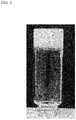
- a reaction of Zn(II) and 1,4-benzenedicarboxylc acid leads to the formation of a gel-like hybrid material ( FIGS. 1 and 2 ) triggered by the use of the organic base triethylamine.
- 6.0 mmol of triethylamine is added to a solution in which 3.0 mmol of 1,4-benzenedicarboxylic acid is mixed into 3 mL of an N-dimethyl formamide solvent and added with a solution in which 1.5 mmol of Zn(NO 3 ) 2 is mixed into 3 mL of an N-dimethyl formamide solvent to provide a product.
- the organic base plays dual roles of deprotonation of dicarboxylic acid and gelation of the molecular species, forming self-assembled microstructures.
- This reaction may be performed using two different solvents, namely N,N-dimethylformamide (DMF) and N,N-dimethylacetamide (DMA); other common polar solvents (methanol, ethanol, etc.) are incompatible due to the solubility problems of reactants.
- FIG. 1 shows a product obtained in the DMF solvent
- FIG. 2 shows a product obtained in the DMA solvent.
- a white color hybrid product behaves like a gel, which is confirmed by a gel inversion test depicted in FIGS. 1 and 2 .
- the gel-like hybrid materials are obtained from fibrous materials, which are first generated between two layers of the reactant solutions, i.e., the upper layer of the ligand solution that contains triethylamine and 1,4-benzenedicarboxylic acid, and the bottom layer of the metal ion solution that contains Zn(NO 3 ) 2 .
- the fibrous materials generated between the two layers start formation of thick fibres which eventually form gel-like hybrid materials in both sovent systems, i.e., N,N-dimethylformamide (DMF) and N,N-dimethylacetamide (DMA).
- DMF N,N-dimethylformamide
- DMA N,N-dimethylacetamide
- FIG. 3 A powder X-ray diffraction (PXRD) pattern helps in understanding of the framework structure ( FIG. 3 ), which shows similarity to the one reported in literature by Norbert Stock et al. (Solid State Sciences 2006, 8, 363-370 ).
- the lower pattern is a powder X-ray diffraction pattern of the simulation test
- the upper pattern is a pattern for the MOF obtained according to example embodiments.
- FIG. 3 presence of main Bragg peaks in the lower angle shows good agreement with simulated powder X-ray diffraction patterns of the reported structure. It has been confirmed that MOF crystals are oriented predominantly at the (111)-plane, thereby corresponding to the highest peak intensity.
- the structure of the MOF contains two types of Zn(II) coordination environment, that is, octahedral and tetrahedral sites, which lead to the formation of a metal-oxo cluster bridged by benzenedicarboxylic acid (BDC) linkers, that ultimately helps porous void formation within 3D MOF structures ( FIGS. 4 and 5 ).
- BDC benzenedicarboxylic acid
- the voids are very active in the sense that free cations sitting within the voids to neutralize the negative charge of uncoordinated benzenedicarboxylic acid (BDC) linker sites offer two sites of interaction for incoming foreign guest species.
- FIG. 6 is an optical microscope photograph showing a soft fiber material forming intact fibers containing a crystalline material with shiny surfaces.
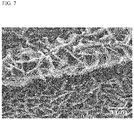
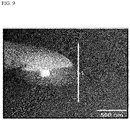
- nanosheets are noticed from the reaction of layered reactants on a glass surface without any sign of deformed crystal formation. Further understanding of these nanosheets reveals that each nanosheet is built from small nano-particles of the size of about 20 nm ( FIG. 8 ).
- Obtained MOF products encapsulating emissive guests display enhanced emission properties compared with non-emissive hybrid materials without luminescent guests. Additionally, interestingly, two different products synthesized in DMF and DMA solvents emit at two different wavelengths although all parameters and chemical reactants are kept exactly the same in these reactions. Products obtained in the DMF solvent emit bluish green light around 470 nm with a quantum yield (QY) of about 25 %, while the product obtained from the DMA solvent system emits greenish yellow at 510 nm with a QY of about 15 %.
- QY quantum yield
- FIG. 11 is a photograph showing irradiation of the crystalline powder product by irradiating ultraviolet (UV) at 365 nm.
- UV ultraviolet
- Matching peak positions of the functional hybrid material that is a final product with a parent MOF in Raman spectra indicate the intact framework formation with confined guest species in MOF pores.
- a key to formation of the functional host-guest couple is the stability of a monomeric ZnQ complex in the DMF solvent and its ability to facilitate strong non-covalent interactions to its chemical environment surroundings. MOF nanoparticle formation integrating in-situ ZnQ guest confinement is confirmed by means of systematic spectroscopic studies, which is discussed in the following sections.
- ZnQ luminescent guest confinement
- a tendency of DMF molecules to make non-covalent interactions by terminal hydrogen atoms may keep ZnQ species well separated and protected from weak interactions of the framework active site, i.e., an un-coordinated carboxylic acid and cationic trimethylammonium site. Therefore the inventors hypothesize that a hypsochromic shift in the emission spectrum of functional hybrid obtained in the DMF system arise from the little distortion in the complex and complete isolation from weak interactions coming from chemical surroundings of the framework side.
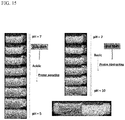
- the functional material dispersion exhibits various emission characteristics depending on pH ( FIG. 15 ). pH changes of the functional material dispersion induce the change in emission characteristics by exhibiting a hypsochromic shift in acidic pH while having a bathochromic shift in neutral pH, which suggests a novel multi-functionality response of a material.
- wavelength shifts may originate from molecular overlapping to form strong aromatic ⁇ - ⁇ and H-bond interactions in a solution state, unlike constrained molecular overlapping in the solid state.
- a weak interaction dependent emission response may be used to further distinguish between a series of solvents or volatile organic compounds (VOCs) which offer various interactions.
- FIGS. 16 and 17 show variations in the emission behavior and intensities of different solvent dispersions having the same amount of active functional materials (dispersion of 5 mg of the functional material in 15 mL of solvent).
- methanol shows diminishing fluorescence intensity within 3-4 min while 2-propanol shows an intense emission at 501 nm.
- Aliphatic long-chain alkanes e.g. n-hexane
- cyclic alkanes e.g. cyclohexane
- Disposable emissive paper device as a photochemical sensor for acetone and other volatile organic compounds (VOCs)
- a proof-of-concept paper-based device containing a thin layer of functional hybrid material which shows fast and reproducible response to solvents, especially acetone with a high bathochromic shift.
- the paper device can be fabricated by drop coating a very small amount (about 2 ⁇ L concentration was tested, but a much lower level should be feasible) of active material dispersed in a solvent (e.g. hexane) onto a Whatman filter paper. Because the solvent is highly volatile, the device is immediately ready to use after room temperature drying for about 5 min.
- Exposure of a minute concentration of acetone to this paper device shifts emission by about 30 nm to a higher wavelength which is easily perceptible by the naked eye when the paper device is irradiated by 365 nm UV light. Importantly, this change may be reverted back to a lower wavelength by exposing the device to a DMF solvent for just a few minutes (about 3 to about 5 min, FIGS. 18 and 19 ).
- acetone has a surface volume of 63.146 ⁇ 2 vs. DMF at 75.187 ⁇ 2 . It is clear that acetone can easily penetrate through the pores due to a smaller size and disrupt DMF-framework weak interactions pushing ZnQ molecules to form interactions with the framework which derives emission at a higher wavelength.
- the synthetic method of the functional material may be extended to other systems containing other metal ions which are potentially useful for emission properties, e.g. In(III), Ga(III), etc. Because the BDC linker is a strongly coordinating linker in its deprotonated form, its reaction with a series of metal ions will lead to the formation of extended frameworks with confinement of functional luminescent guests within the voids.
- other metal ions e.g. In(III), Ga(III), etc.
- FIG. 20 shows functional materials made from various metal ions by keeping the same coordinating organic linker and luminescent guest ZnQ species. Resulting hybrids exhibited different emissions with varying intensities and wavelengths. Those containing Cu(II), Co(II), or Ni(II) show quenching of luminescence, while a system with Ga(III) shows dark yellow emission unlike the light green-white emission from Cd(II) or Al(III), or light yellow from systems containing Zn(II) or Bi(III).
- the simple room-temperature method and in situ process of this disclosure allows the synthesis of hybrid organic-inorganic materials containing an MOF framework with encapsulated guest species or guest species as a central core of the framework nanoparticles.
Landscapes
- Chemical & Material Sciences (AREA)
- Health & Medical Sciences (AREA)
- Engineering & Computer Science (AREA)
- Physics & Mathematics (AREA)
- Organic Chemistry (AREA)
- Materials Engineering (AREA)
- Immunology (AREA)
- Life Sciences & Earth Sciences (AREA)
- Pathology (AREA)
- General Health & Medical Sciences (AREA)
- General Physics & Mathematics (AREA)
- Biochemistry (AREA)
- Analytical Chemistry (AREA)
- Chemical Kinetics & Catalysis (AREA)
- Nuclear Medicine, Radiotherapy & Molecular Imaging (AREA)
- Plasma & Fusion (AREA)
- Molecular Biology (AREA)
- Optics & Photonics (AREA)
- Investigating Or Analysing Materials By The Use Of Chemical Reactions (AREA)
Abstract
Description
- Example embodiments provide a functional material including a metal-organic framework (MOF), a method of preparing the same, and a photochemical sensor including the same.
- Optically active materials including luminescent materials have been the center of material research for a relatively wide range of sensing and lighting applications. Tunable chemico-physical properties play a crucial role in novel nanomaterials to control optical behavior and to achieve multi-stimuli sensing. Therefore, various kinds of materials including pure organic, hybrids, organic-inorganic, and purely inorganic materials with multiple chemical functionalities have been explored to construct highly sensitive and responsive sensors and energy-efficient lighting devices.
- Although efficient materials are available in the market or reported in scientific literature, most of the contemporary chemical sensory materials are long-chain polymers or conjugated organic molecules which are complex and tedious to synthesize, and require a relatively high cost for industrial scale-up. Rare-earth complexes also require a relatively high cost for synthesis and they are considered to be hazardous to the environment.
- Furthermore, due to limited reversibility for strongly interacting analytes, conventional sensor materials show diminishing sensitivity with repeated use, and changes in environmental condition such as temperature or humidity may affect the sensitivity of conventional sensors. Also, aggregation of organic molecules is softer (i.e., weaker interactions), leading to the self-photo bleaching of material which reduces the life of materials for use as a photo-chemical sensor.
- In addition, most of the chemical sensors detect analytes which are reactive, and therefore there is limited scope for conventional sensors for use in detection of weakly interacting analytes or inert analytes. Further, probe solubility is the major concern in some of the heterogeneous sensors used for liquid-based sensing, and there is a danger of aging of a material surface in case of sensors made from polymers, which may change their detection limit and overall sensitivity.
- Meanwhile, in order to apply a photochemical material for sensing and lighting devices, etc., metal-organic frameworks (MOFs) have been actively researched and reported. Metal-organic frameworks (MOFs) are an emerging class of nanoporous crystalline materials with many possibilities for tuning the chemistry and physical properties of hybrid materials, which are enabled by a plethora of chemical structures including organic and inorganic basic building blocks. Specifically, the hybrid framework of MOFs has long-range ordering (crystalline strong bonds) to confer regular arrays of nanosized voids of an active chemical environment, which may include open metal sites, anionic-cationic species, or free organic functional groups.
- However, guest encapsulation and infiltration in MOF frameworks is difficult, if not nearly impossible, when the pore size of the MOF is relatively small, although they possess generally larger internal voids (e.g. ZIF-8 - internal void dimension: >11 Å, entry pore aperture size: <3.4 Å). Therefore, most of the research in this field is concentrated on relatively small guest encapsulation with only a few exceptions of large guest encapsulation studies. Also, luminescent MOFs do not show intense emission properties unless they are made from rare-earth metal ions or long-chain conjugated organic linkers which are commercially expensive or tedious to synthesize.
- In addition, conventional hydrothermal synthesis affords relatively large crystals of MOF (several tens to hundreds of microns), which reduces the overall sensitivity of a compound for sensing purposes as signal transduction becomes harder to visualize rapidly or to monitor reliably. Further, larger crystal size (several tens to hundreds of microns) also generates the possibility of uneven guest distribution in the network which may disturb the continuous array of a host-guest chemical environment available for response signal gain and a reliable detection lifetime.
- Additionally, due to random and large size crystal growth of MOF compounds, they are difficult to fabricate in a thin-film form for device fabrication and thus limit the use of materials for large-area industrial applications and real-world commercialization. Furthermore, conventional guest encapsulation in MOF voids generally includes guests such as neutral species or small ionically charged species. To date, metal complexes as guest molecules for encapsulation within the MOF voids by in-situ methods have rarely been reported, because they may lead to multiple product formation where single pure product formation is difficult to reliably obtain.
- Example embodiments provide an inexpensive functional material which is relatively easily synthesized and suppresses photo-bleaching or concentration quenching and has improved luminescent characteristics and photochemical detectability; a method of preparing the same; and a sensor including the functional material and that is capable of detecting a trace amount of a relatively wide range of organic solvents and volatile organic compounds at a relatively high speed and having improved life-span characteristics and durability.
- According to example embodiments, a functional material includes a porous metal-organic framework (MOF) including an organic ligand derived from benzenedicarboxylic acid and a metal ion cluster coordination-bonded with the organic ligand, and a luminescent molecule in pores of the MOF.
- A metal of the metal ion cluster may be at least one selected from Li, Na, K, Rb, Be, Mg, Ca, Sr, Ba, Ti, Zr, Hf, V, Nb, Ta, Cr, Mo, W, Mn, Re, Fe, Ru, Os, Co, Rh, Ir, Ni, Pd, Pt, Cu, Ag, Au, Zn, Cd, Hg, Al, Ga, In, TI, Si, Ge, Sn, Pb, As, Sb, and Bi.
- The functional material may further include trialkylammonium ions in the pores of the MOF.
- The MOF may exhibit main peaks at (200), (110), (002), (111), (202), and (112) planes in a powder X-ray diffraction (PXRD) analysis pattern.
- The luminescent molecule may be a metal complex, and the metal complex may be one of an 8-hydroxyquinoline metal complex, a 2-methyl-8-hydroxyquinoline metal complex, a 7-n-propyl-8-hydroxyquinoline metal complex, a 10-hydroxybenzoquinoline metal complex, a hydroxyacridine metal complex, an azomethine metal complex, a 2-hydroxyphenyl benzothiazole metal complex, and a porphyrin metal complex. A metal of the metal complex may be at least one of Be, Mg, Ca, Sr, Ba, Ti, Zr, Hf, V, Nb, Ta, Cr, Mo, W, Mn, Re, Fe, Ru, Os, Co, Rh, Ir, Ni, Pd, Pt, Cu, Ag, Au, Zn, Cd, Hg, Al, Ga, In, TI, Si, Ge, Sn, Pb, As, Sb, and Bi.
- The luminescent molecule may be an organic molecule, and the organic molecule may be one of naphthalene, anthracene, fluorescein, pyrene, rhodamine, cyanine, quinine, coumarin, carbazole, and a derivative thereof.
- The functional material may be a nanoparticle, and the nanoparticle may have an average particle diameter of about 1 nm to about 100 nm.
- The functional material may emit light having a wavelength of about 100 nm to about 1000 nm.
- The functional material may be a dispersion that is dispersed within a solvent, and the functional material may exhibit hypsochromic shifting as a pH of the solvent becomes lower; and bathochromic shifting as the pH of the solvent becomes higher.
- The functional material may exhibit wavelength shifting by sensing one of an organic solvent and a volatile organic compound.
- According to example embodiments, a method of preparing a functional material includes reacting a benzenedicarboxylic acid, a metal ion, a trialkylamine, and a luminescent molecule in a solvent to form the functional material including a porous MOF and a luminescent molecule in pores of the MOF, the MOF including an organic ligand derived from the benzenedicarboxylic acid and a metal ion cluster coordination-bonded with the organic ligand, and the solvent including one of N,N-dimethyl formamide (DMF), N,N-dimethyl acetamide (DMA), and a combination thereof.
- The reacting may be performed by a rapid one-pot synthesis method at room temperature.
- The reacting mixes the benzenedicarboxylic acid and the trialkylamine in the solvent, adds the luminescent molecule, and subsequently adds the metal ion thereto.
- The mole ratio of the metal ion and the benzenedicarboxylic acid may range from about 1:1 to about 1:5.
- The mole ratio of the benzenedicarboxylic acid and the trialkylamine may range from about 1:1 to about 1:5.
- The mole ratio of the luminescent molecule and the benzenedicarboxylic acid may range from about 1:1 to about 1:20.
- The functional material obtained when the solvent is N,N-dimethyl formamide (DMF) may emit light at a wavelength of about 400 nm to about 550 nm.
- The functional material obtained when the solvent is N,N-dimethyl acetamide (DMA) may emit light at a wavelength of about 450 nm to about 600 nm.
- According to example embodiments, a photochemical sensor includes the functional material, and is configured to sense one of an organic solvent and a volatile organic compound.
- The one of the organic solvent and the volatile organic compound may be one of acetone, acetonitrile, benzene, chloroform, cyclohexane, dichloromethane, ethanol, methanol, propanol, dioxane, N,N-dimethyl acetamide, N,N-dimethyl formamide, hexane, isopropanol, toluene, tetrahydrofuran, and a combination thereof.
- The functional material according to example embodiments is more easily synthesized and inexpensive, and suppresses photo-bleaching or concentration quenching and has improved luminescent characteristics and photochemical detecting performance. The photochemical sensor including the functional material may rapidly detect a trace amount of various organic solvents and volatile organic compounds and have improved life-span characteristics and durability.
-
-
FIG. 1 is a photograph showing a gel-type hybrid material co-existing with a metal-organic framework (MOF), obtained in an N,N-dimethyl formamide (DMF) solvent according to example embodiments. -
FIG. 2 is a photograph showing a gel-type hybrid material co-existing with an MOF, obtained in an N,N-dimethyl acetamide (DMA) solvent according to example embodiments. -
FIG. 3 is a powder X-ray diffraction (PXRD) analysis pattern for an MOF obtained according to example embodiments. -
FIG. 4 is a schematic view showing a structure of an MOF according to example embodiments, which is a packing diagram along a b-axis in which metal oxo clusters having a Td-Oh-Td coordination of Zn(II) are connected by 1,4-benzenedicarboxylic acid to form an active pore having an uncoordinated COO-group and extra framework cations. -
FIG. 5 shows a packing diagram along an ac diagonal axis showing an MOF structure according to example embodiments with a void space and a triangular channel. -
FIG. 6 is an optical microscopic image showing a fibrous hybrid material including an MOF prepared in example embodiments. -
FIG. 7 is a scanning electron microscopic image showing a fibrous hybrid material including an MOF prepared in example embodiments. -
FIG. 8 is a transmission electron microscopic image showing a nanosheet including an MOF prepared in example embodiments. -
FIG. 9 is an atomic force microscopic image showing a nanosheet including an MOF prepared in example embodiments. -
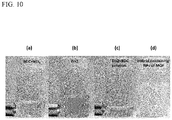
FIGS. 10(a) - 10(d) are image showing reactants and a product of functional material according to example embodiments,FIG. 10(a) shows a mixed solution of 1,4-benzenedicarboxylic acid and triethylamine,FIG. 10(b) shows a guest molecule of a ZnQ solution,FIG. 10(c) shows a mixed solution of solutions of (a) and (b), andFIG. 10(d) shows a final product solution obtained by adding a solution including Zn(II) ions into the solution of (c). The solvents inFIG. 10 (a) to (d) are all N,N-dimethyl formamide. -
FIG. 11 is a photograph showing irradiation of ultraviolet (UV) for the functional material obtained in example embodiments, wherein No. 1 shows an MOF host with no guest, No. 2 shows the functional material synthesized in a DMF solvent, and No. 3 shows the functional material synthesized in a DMA solvent. -
FIG. 12 shows Raman spectrums for the functional material obtained in example embodiments, which are an MOF host with no guest, a functional material synthesized in a DMF solvent, and a functional material synthesized in a DMA solvent, sequentially from the bottom. -
FIG. 13 is a photograph of pure solid-state ZnQ under the ultraviolet (UV) radiation, and a graph showing the emission characteristics. -
FIG. 14 is a photograph of ZnQ dispersed in DMF, DMA, and methanol, sequentially from the left, and a graph showing the emission characteristics. -
FIG. 15 is a view showing the emission characteristic change of functional material depending upon pH change of the solvent in the solvent dispersion of a functional material obtained in example embodiments. -
FIGS. 16(a) - (c) show results of observing the emission characteristic change of the dispersion in which the functional material obtained in a DMF solvent according to example embodiments is dispersed in the various solvents,FIG, 16(a) is a test tube image of the solvents used in a total of 8 dispersions, which are methanol, ethanol, isopropanol, acetonitrile, acetone, DMF, DMA, and dioxane, sequentially from the left,FIG. 16 (b) is an emission characteristic profile of each dispersion showing hypsochromic shifting, bathochromic shifting, hypochromic shifting, hyperchromic, shifting, etc., andFIG. 16 (c) is a chromaticity plot (CIE 1931) expressing emission color coordinates of each dispersion. -
FIG. 17 is a graph comparing fluorescence luminance intensity of dispersions in which the functional material according to example embodiments obtained in a DMF solvent is dispersed in the various solvents, wherein the number indicated above the bars means an emission wavelength (nm). -
FIG. 18 illustrates images showing that the functional material has a reversible sensing ability to acetone in a paper device coated with the functional material according to example embodiments. -
FIG. 19 is a graph showing that bathochromic shifting of around 30 nm is found when exposing a paper device coated with a functional material according to example embodiments to acetone, and it reverts to the original wavelength when exposing the same to DMF. -
FIG. 20 shows photographs of functional materials according to example embodiments obtained by employing a wide range of metal ions while using the same organic ligand (1,4-benzenedicarboxylic acid) and the same luminescent molecule (ZnQ). The metal ion employed in each test tube is Zn(II), Bi(III), Co(II), Ni(II), Cu(II), Cd(II), Al(III), Ga(III), and In(III), sequentially from the left in the upper and lower photographs. -
FIG. 21 shows a photograph of the functional materials obtained by employing the various luminescent molecules according to example embodiments. The luminescent molecules applied to each test tube in the upper part of areFIG. 21 are sequentially anthracene, fluorescein, an AIQ complex, and a ZnQ complex from the left side. -
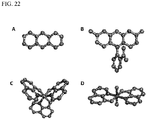
FIGS. 22A-D shows model molecular structures of anthracene (FIG. 22A ), fluorescein (FIG. 22B ), an AIQ complex (FIG. 22C ), and a ZnQ complex (FIG. 22D ). - Example embodiments will hereinafter be described in detail, and may be easily performed by those who have common knowledge in the related art. However, this disclosure may be embodied in many different forms and is not construed as limited to the example embodiments set forth herein.
- Hereinafter, the term "combination thereof" refers to a mixture, a stack, a complex, a copolymer, an alloy, a blend, a reaction product, etc. of constituents.
- In example embodiments, a functional material includes a porous metal-organic framework (MOF) including an organic ligand derived from benzenedicarboxylic acid and a metal ion cluster coordination-bonded with the organic ligand, and a luminescent molecule in pores of the MOF.
- The MOF may be a kind of host, and the luminescent molecule may be kind of guest confined in pores of the MOF. The functional material having the host-guest structure may have a nanoparticle form which is photochemically active and structurally stable, and exhibits luminescent characteristics. In addition, the functional material may be a self-assembly material which is crystalline and porous and has a hierarchical organic/inorganic fine structure.
- The functional material which is a novel functional nano-size material may have the following effects.
- Sensors can be made using an ultra-small concentration of the functional MOF nanomaterial, and typically « 1 mg is sufficient for effective photo-chemical detection.
- The current system of the functional MOF compound offers multiple chemical interactions including non-covalent interactions such as H-bonding, π-π interactions, dipole-dipole interaction, and strong metal coordinating interaction in a single accessible site. Therefore, both strongly interacting molecules (e.g. DMF, methanol, or ethanol) and weakly interacting molecules (e.g. cyclohexane, hexane, isopropanol, or acetone) may be easily traced using this material.
- Metal-coordination to confine light-emitting materials by analytes is reversible only in the protected shell of the MOF framework, and non-covalent interactions may be interrupted without damaging the overall integrity of the porous framework structure. This makes sensing totally reversible with good recovery of original optical properties.
- Because the framework of the MOF is a highly ordered crystalline structure, it enables partitioning and separation of individual emissive guest molecules from adjacent guest molecules through a well-confined continuous 3-D array. This partitioning effect reduces or prevents phenomena such as photo-bleaching and concentration quenching which are commonly associated with self-aggregation of luminescent nanoparticles or luminescent complexes.
- In the example of photo-chemical sensors, photoluminescent guest species may be kept protected from environmental degradation (e.g. sunlight irradiation, and temperature and humidity attack), as the MOF host offers shielding and stays stable up to about 200 °C and in humid conditions during winter or summer seasons.
- The material synthesis route invented here is a high yield and very cost effective one (using commercially available small organic molecules: 1,4-benzenedicarboxylic acid and Zn(II) salt), and is extremely rapid (reaction time < 1 min, processing time of about 2 h required for washing of material to remove excess reactants).
- Analyte detection (as low as 2 µL concentration) is very rapid and can be visualized under UV light by the naked eye without the requirement of a spectrometer using a proof-of-principle solid paper device as well as in liquid suspension form. There is huge potential of combining such a strategy with a low-cost hand-held spectrophotometer to afford even lower concentration detection at sub-ppm levels.
- The porous MOF material stays insoluble in almost all organic solvents and keeps confined emissive guest molecules stable within the functional MOF cavity, which are otherwise soluble in organic solvents.
- Hereinafter, a functional material according to example embodiments is described.
- An MOF, which is also called a metal-organic framework, is an organic-inorganic hybrid material in which the unit body with metal ions or a metal ion cluster coordination-bonded with an organic ligand (or organic linker) is regularly or irregularly arranged in one dimension, two dimensions, or three dimensions. The MOF included in the functional material according to example embodiments is a porous metal-organic framework including a unit body consisting of a metal ion cluster and an organic ligand derived from benzenedicarboxylic acid coordination-bonded with the same, wherein the unit body is arranged in three dimensions.
- The benzenedicarboxylic acid may be, for example, 1,4-benzenedicarboxylic acid (terephthalic acid).
- In the metal ion cluster, the metal may be an alkali metal, an alkaline-earth metal, a transition metal, a post-transition metal, or a semi-metal, and is specifically at least one selected from Li, Na, K, Rb, Be, Mg, Ca, Sr, Ba, Ti, Zr, Hf, V, Nb, Ta, Cr, Mo, W, Mn, Re, Fe, Ru, Os, Co, Rh, Ir, Ni, Pd, Pt, Cu, Ag, Au, Zn, Cd, Hg, Al, Ga, In, TI, Si, Ge, Sn, Pb, As, Sb, and Bi. Among them, the metal may be, for example, Zn, Bi, Co, Ni, Cu, Cd, Al, Ga, or In.
- The metal ion cluster is one in which metals or metal ions are gathered to form a given or predetermined structural unit. One example of the metal ion cluster may be [Zn4O]6+, but is not limited thereto.
- The MOF may include trialkylammonium cations in pores thereof. The trialkylammonium cations may act to neutralize a negative charge of the MOF. The trialkylammonium is estimated to have a hydrogen bond with an oxygen atom having a free negative charge in the organic ligand derived from benzenedicarboxylic acid. When the MOF includes trialkylammonium cations in the pores, the volume may be expanded due to strain generated from the cations. As the MOF accommodates the trialkylammonium cations in the pores, which are free cations for neutralizing the negative charge of the organic ligand, two chemical interactive regions are provided so as to detect the inflow of extraneous guest species.
- The trialkylammonium may be represented by
Chemical Formula 1.
- In
Chemical Formula 1, R1, R2, and R3 are the same or different, and are independently a C1 to C10 alkyl group, for example, a C1 to C5 alkyl group or a C1 to C3 alkyl group. - The trialkylammonium may be, for example, trimethylammonium or triethylammonium.
- The MOF may be one exhibiting main peaks at (200), (110), (002), (111), (202), and (112) planes in the powder X-ray diffraction (PXRD) analysis pattern. Among them, the intensity of peak corresponding to the (111) plane.
- The MOF may encapsulate even a luminescent molecule having a relatively large volume, and may maintain stability even after the encapsulation. In addition, the MOF has functions to provide strong non-covalent interactions with the surrounding chemical environment, so as to enable the photochemical detection and the photoelectron control.
- The luminescent molecule, which is kind of guest confined in pores of the MOF, may include any molecules without limitation as long as the luminescence is monitored by naked eyes, or the luminescence is monitored by the naked eye under the ultraviolet (UV) radiation. The luminescent molecule is estimated to form a non-covalent interaction with the MOF in pores of the MOF.
- The luminescent molecule may be, for example, a metal complex or an organic molecule.
- The metal complex may be, for example, an 8-hydroxyquinoline metal complex, a 2-methyl-8-hydroxyquinoline metal complex, a 7-n-propyl-8-hydroxyquinoline metal complex, a 10-hydroxybenzoquinoline metal complex, a hydroxyacridine metal complex, an azomethine metal complex, a 2-hydroxyphenyl benzothiazole metal complex, or a porphyrin metal complex, but is not limited thereto.
- In the metal complex, the metal may be at least one selected from Be, Mg, Ca, Sr, Ba, Ti, Zr, Hf, V, Nb, Ta, Cr, Mo, W, Mn, Re, Fe, Ru, Os, Co, Rh, Ir, Ni, Pd, Pt, Cu, Ag, Au, Zn, Cd, Hg, Al, Ga, In, TI, Si, Ge, Sn, Pb, As, Sb, and Bi. Among them, the metal may be, for example, Be, Mg, Zn, or Al.
- The luminescent metal complex may be, for example, an 8-hydroxyquinoline metal complex, for example a Zn-bis-(8-hydroxyquinoline), Be-bis-(8-hydroxyquinoline), Mg-bis-(8-hydroxyquinoline), Al-tris-(8-hydroxyquinoline), etc. Herein, the 8-hydroxyquinoline may be modified into 2-methyl-8-hydroxyquinoline or 7-n-propyl-8-hydroxyquinoline.
- For another example, the luminescent metal complex may be a hydroxyquinoline metal complex, for example, Be-bis-(10-hydroxybenzo[h]quinoline), Zn-bis-(10-hydroxybenzo[h]quinoline), Zn-bis-(4-hydroxyacridine), etc.
- For another example, the luminescent metal complex may be an azomethine metal complex, for example, a Zn-salicylidene-leucine complex, an Al-salicylidene-leucine complex, a Zn-salicylidene-amine complex, etc.
- Additionally, the luminescent metal complex may be Zn-bis-(2-hydroxyphenyl benzothiazole) or Zn-porphyrin.
- The luminescent molecule may be an organic molecule, and the organic molecule may be, for example, naphthalene, anthracene, fluorescein, pyrene, rhodamine, cyanine, quinine, coumarin, carbazole, or a derivative thereof. The derivative may be, for example, 9,10-diphenylanthracene, 9,10-bis-(phenylethynyl)anthracene, 1-chloro-9,10-bis-(phenylethynyl)anthracene, 2-methyl-9,10-di-(2-naphthyl)anthracene, fluorescein disodium, 1-pyrene carboxylic acid, 1-pyrene boronic acid, 7-diethylamino-4-methyl coumarin, 4,4'-N,N'-dicarbazole-biphenyl, poly(n-vinylcarbazole), etc., but is not limited thereto.
- The functional material may have a nanoparticle form.
- The nanoparticles may be gathered to each other to form a nanosheet, and furthermore, the nanosheets may be connected with each other to form a fibrous shape. The fiber formed by gathering nanoparticles may have a gel-like form.
- The functional material may have a nanoparticle shape having a very uniform size. The nanoparticles may have an average particle diameter of about 1 nm to about 100 nm, for example, about 1 nm to about 80 nm, for example, about 1 nm to about 70 nm, for example, about 1 nm to about 60 nm, for example, about 1 nm to about 50 nm, or for example, about 1 nm to about 30 nm.
- The functional material may emit light having various wavelengths according to a kind of the included luminescent molecule. For example, the functional material may emit light having a wavelength of about 100 nm to about 1000 nm, for example, about 200 nm to about 900 nm, for example, about 300 nm to about 800 nm, for example, about 400 nm to about 700 nm, or for example, about 400 nm to about 600 nm. The functional material may express light such as light blue, light green, light yellow, dark blue, dark green, dark yellow, or white.
- The luminescent molecules may be maintained to be separated from each other by the MOF, so the self-aggregation of luminescent molecules may be suppressed, thus the phenomenon such as photo-bleaching or concentration quenching may be reduced or prevented. In addition, as the luminescent molecule is surrounded by the MOF, it may be protected from environmental influences of temperature, humidity, etc.
- Another merit of the functional material is that it may be simply and rapidly synthesized at a low cost. Another embodiment provides a method of preparing the functional material.
- The method of preparing the functional material may include reacting benzenedicarboxylic acid, metal ions, trialkylamine, and luminescent molecules in a solvent. Specifically, the preparation method may include mixing benzenedicarboxylic acid and trialkylamine in a solvent, adding luminescent molecules, and subsequently adding metal ions thereto. Herein the solvent is N,N-dimethyl formamide (DMF), N,N-dimethyl acetamide (DMA), or a combination thereof.
- According to the preparation method, the functional material is prepared to have a structure in which the luminescent molecules are successfully encapsulated in pores of the MOF, and the functional material may accomplish the stable emission characteristics and the photochemical sensing ability.
- The reactants including the solvent are easily available and inexpensive compounds. In addition, the preparation method may be performed at a rapid speed to complete the synthesis within 5 min, for example, 1 min, at room temperature, which is a one-pot or in-situ synthesis with a high yield without going through multiple steps. Therefore, the mass production is possible at a low cost. In addition, the synthesis products are easily separated to be directly applied to various applications such as a photochemical sensor, an electronic device, etc.
- The method of preparing the functional material may be considered as a remarkably improved method, compared to the conventional method of synthesizing MOF at a low speed under the conditions of a high temperature or a high pressure or the conventional reaction of encapsulating a guest in the MOF.
- In the preparation method, the benzenedicarboxylic acid may be, for example, 1,4-benzenedicarboxylic acid (terephthalic acid).
- The metal ion may be present in a metal salt, and the metal may be, for example at least one selected from Li, Na, K, Rb, Be, Mg, Ca, Sr, Ba, Ti, Zr, Hf, V, Nb, Ta, Cr, Mo, W, Mn, Re, Fe, Ru, Os, Co, Rh, Ir, Ni, Pd, Pt, Cu, Ag, Au, Zn, Cd, Hg, Al, Ga, In, TI, Si, Ge, Sn, Pb, As, Sb, and Bi. Among them, the metal may be, for example, Zn, Bi, Co, Ni, Cu, Cd, Al, Ga, or In.
- The trialkylamine, which is an organic base, may act to deprotonize the benzenedicarboxylic acid and may act for gelling the product. The trialkylamine may exist as ammonium cations in pores of the MOF of the functional material, which is a product after the reaction.
- The trialkylamine may be represented by
Chemical Formula 2.
- In
Chemical Formula 2, R11, R12, and R13 are the same or different, and are independently a C1 to C10 alkyl group, for example, a C1 to C5 alkyl group or a C1 to C3 alkyl group. - The trialkylamine may be, for example, trimethylamine or triethylamine.
- The luminescent molecule is the same as described above.
- The content ratio of the reactants, which is a content ratio of benzenedicarboxylic acid, metal ions, trialkylamine, and luminescent molecules, is not particularly limited, but may be appropriately adjusted according to goals of a person of ordinary skill in the art.
- For example, the metal ions and the benzenedicarboxylic acid, which are components of the MOF, may be mixed in a mole ratio of about 1:1 to about 1:5, for example, about 1:1 to about 1:4, about 1:1 to about 1:3, etc. When mixing at the mole ratio, a stable MOF may be provided.
- In addition, the mole ratio of benzenedicarboxylic acid and the trialkylamine may be about 1:1 to about 1:5, for example, about 1:1 to about 1:4, about 1:1 to about 1:3, etc. When mixing at the mole ratio, MOF may be synthesized at a very high speed, and a gel-state product may be obtained.
- The mole ratio of the luminescent molecule and the benzenedicarboxylic acid may be specifically about 1:1 to about 1:20, for example, about 1:2 to about 1:15, or about 1:2 to about 1:10. That is, the guest molecule of the luminescent molecule may be used at a rate of about 0.05 mol to 1 mol, etc. with respect to 1 mol of the benzenedicarboxylic acid, but is not limited thereto. When the luminescent molecule is mixed within the range of the mole ratio, it may provide a functional material having improved emission characteristics and photochemical sensing ability. Meanwhile, it is also possible to control the bandgap of the functional material by adjusting a mole ratio of the luminescent molecule which is a concentration of the luminescent molecule loaded in pores of the MOF.
- In the preparation method, in the case that the solvent is N,N-dimethyl formamide (DMF), the obtained functional material may emit light-blue light when observing by the naked eye under the ultraviolet (UV) radiation, for example, the functional material may emit light at a wavelength of about 400 nm to about 550 nm, or about 450 nm to about 500 nm. On the other hand, in the preparation method, in the case that the solvent is N,N-dimethyl acetamide (DMA), the obtained functional material may emit light-yellow light when observing by the naked eye under the ultraviolet (UV) radiation, and may emit light having a wavelength of, for example, about 450 nm to about 600 nm, or about 480 nm to about 550 nm.
- The functional material may exist in a solid state, and it may be present in a dispersion dispersed in a solvent, so as to be applied for a wide range of usages. The functional material may be used in, for example, a sensor, a lighting device, an electronic device, a gas storage device, a fuel cell, etc. For example, the latent application fields of the functional material are as follows.
- 1. Rapid multi-responsive smart sensors for electronic-photochemical detection applications in both a solid state and liquid states.
- 2. Sub-ppm breath analyzer for detection of acetone applicable to non-invasive diabetes monitoring technology
- 3. Micro- and nano-sized light emitters and optical sensors for integration into microelectromechanical systems (MEMS) and MEMS devices, and microelectronics
- 4. Large-area thin film sensing surfaces and frequency-shifters for LED lighting and displays
- 5. Optical-pH sensors
- In example embodiments, a photochemical sensor includes the functional material. The photochemical sensor may sense various organic solvents and volatile organic compounds (VOCs).
- When the functional material is dispersed in the various kinds of organic solvents, it non-covalently interacts with an organic solvent molecule to show the various emission responses. That is, the functional material shows the various wavelength shifting phenomena depending upon the kind of the contacted organic solvent, thus the emitted light change is easily sensed by the naked eye or sensed by the naked eye under the ultraviolet (UV) radiation. Thereby, the functional material may be used as a sensor configured to detect the various kinds of organic solvents.
- In the organic solvent, the wavelength shifting of the functional sensor may occur in various forms, for example, hypsochromic shifting, bathochromic shifting, hypochromic shifting, hyperchromic shifting, etc., may occur.
- In addition, the functional material is thinly coated on a substrate such as paper to be used as a sensor. Even if the functional material is exposed to the volatile organic compound, it may strongly or weakly non-covalently interact with the volatile organic compound to show the various emission responses. That is, the functional material shows the various wavelength shifting depending upon the kind of the contacted volatile organic compound, such that the change of luminescent characteristics may be easily detected by the naked eye or detected by the naked eye under the ultraviolet (UV) radiation. Thereby, the functional material may be used as a sensor to detect a volatile organic compound.
- The organic solvent or the volatile organic compound may be, for example, acetone, acetonitrile, benzene, chloroform, cyclohexane, dichloromethane, ethanol, methanol, propanol, dioxane, N,N-dimethyl acetamide, N,N-dimethyl formamide, hexane, isopropanol, toluene, tetrahydrofuran, or a combination thereof, and may additionally be formaldehyde, xylene, ethylene, propylene, styrene, xylene, acetaldehyde, etc., but is not limited thereto.
- After the wavelength shifting by exposing the functional material to the organic solvent or the volatile organic compound, the functional material is contacted to the solvent used for synthesizing the functional material, which is a DMF or DMA solvent, then it is reverted to the original wavelength again. Due to the stable reversibility, the functional material may be worked as a permanent sensor.
- The photochemical sensor may show sufficient detecting properties even by including a very small amount of the functional material. For example, the sensor may include the functional material at about 0.01 mg to about 5 mg, for example, about 0.01 mg to about 4 mg, about 0.01 mg to about 3 mg, about 0.01 mg to about 2 mg, or about 0.01 mg to about 1 mg. The sensor may show an improved detecting property even when including the functional material at less than or equal to about 1 mg.
- Furthermore, the photochemical sensor may rapidly detect the organic solvent or the volatile organic compound, which is an analyte, even in a very small amount.
- The photochemical sensor may be a sensor for detecting, for example, acetone. When the photochemical sensor is exposed to acetone at less than or equal to about 2 µℓ (in a case of sensing), the wavelength is shifted to change the emitting light, and the change may be observed by the naked eye or observed by the naked eye under the ultraviolet (UV) radiation. In addition, after exposing the sensor to acetone, it is exposed to the solvent used for synthesizing the functional material, which is a DMF or DMA solvent, again, then it is reverted to the original wavelength again. Thus, the sensor may repeatedly sense acetone.
- Hereinafter, the specific process of synthesizing the functional material according to example embodiments, the various photochemical analyses for the functional material, and the sensing properties of the functional material will be described. However, the following specific examples are to describe but not to limit the range of the present inventive concepts.
- A reaction of Zn(II) and 1,4-benzenedicarboxylc acid leads to the formation of a gel-like hybrid material (
FIGS. 1 and2 ) triggered by the use of the organic base triethylamine. Specifically, 6.0 mmol of triethylamine is added to a solution in which 3.0 mmol of 1,4-benzenedicarboxylic acid is mixed into 3 mL of an N-dimethyl formamide solvent and added with a solution in which 1.5 mmol of Zn(NO3)2 is mixed into 3 mL of an N-dimethyl formamide solvent to provide a product. - The organic base, triethylamine, plays dual roles of deprotonation of dicarboxylic acid and gelation of the molecular species, forming self-assembled microstructures. This reaction may be performed using two different solvents, namely N,N-dimethylformamide (DMF) and N,N-dimethylacetamide (DMA); other common polar solvents (methanol, ethanol, etc.) are incompatible due to the solubility problems of reactants.
FIG. 1 shows a product obtained in the DMF solvent, andFIG. 2 shows a product obtained in the DMA solvent. - A white color hybrid product behaves like a gel, which is confirmed by a gel inversion test depicted in
FIGS. 1 and2 . The gel-like hybrid materials are obtained from fibrous materials, which are first generated between two layers of the reactant solutions, i.e., the upper layer of the ligand solution that contains triethylamine and 1,4-benzenedicarboxylic acid, and the bottom layer of the metal ion solution that contains Zn(NO3)2. Upon gradual shaking, the fibrous materials generated between the two layers start formation of thick fibres which eventually form gel-like hybrid materials in both sovent systems, i.e., N,N-dimethylformamide (DMF) and N,N-dimethylacetamide (DMA). Addition of an excess of methanol solvent to this hybrid yields a bulk amount of non-soluble white compound. - Detailed spectroscopic study on the obtained white solid powder reveals the process of formation of the metal-organic framework (MOF) integrated in the fibrous gel network. A powder X-ray diffraction (PXRD) pattern helps in understanding of the framework structure (
FIG. 3 ), which shows similarity to the one reported in literature by Norbert Stock et al. (). InFIG. 3 , the lower pattern is a powder X-ray diffraction pattern of the simulation test, and the upper pattern is a pattern for the MOF obtained according to example embodiments. Referring toFIG. 3 , presence of main Bragg peaks in the lower angle shows good agreement with simulated powder X-ray diffraction patterns of the reported structure. It has been confirmed that MOF crystals are oriented predominantly at the (111)-plane, thereby corresponding to the highest peak intensity. - Broadening of all peaks, and a shift in (110) and (002) peaks ascribed to nano-sized MOF particle formation with strain arising from the confined triethylammonium cations (NEt3) inside the voids of the framework, may lead to expansion of the structure volume (
FIG. 3 ). - The structure of the MOF contains two types of Zn(II) coordination environment, that is, octahedral and tetrahedral sites, which lead to the formation of a metal-oxo cluster bridged by benzenedicarboxylic acid (BDC) linkers, that ultimately helps porous void formation within 3D MOF structures (
FIGS. 4 and5 ). Particularly, the voids are very active in the sense that free cations sitting within the voids to neutralize the negative charge of uncoordinated benzenedicarboxylic acid (BDC) linker sites offer two sites of interaction for incoming foreign guest species. - Detailed investigation using scanning electron microscopy (SEM), transmission electron microscopy (TEM), atomic force microscopy (AFM), and optical microscopy on a hybrid material help to analyze a sequence of material formation and its main microstructural features. Use of a high concentration of reactants triggers formation of fibrous networks, which subsequently forms a partially crystalline fibrous hybrid material. Optical images of stable materials give the hint of two-step transition.
FIG. 6 is an optical microscope photograph showing a soft fiber material forming intact fibers containing a crystalline material with shiny surfaces. - Transition of a soft material where a hybrid material turns into a partially crystalline version is very rapid and difficult to monitor in order to capture SEM or optical images, but formation of fibers from stable partially crystalline hybrid materials may be traced. The fiber size ranges from a few microns to 10 microns in diameter. Interestingly, SEM images show that partially crystalline hybrid materials consist of crystalline nano-sheets connected or bound together via fibers (
FIG. 7 ). - Two major differences are observed in the morphology of products when reactants are treated together in layer form and in bulk quantities. Reaction of bulk amount of reactants yields a hybrid material containing deformed single crystals of few micron sizes fragmented into polycrystalline form constituting nano-sheets. These deformed single crystals are connected together by fibers passing through them. Highly concentrated fiber formation disrupts the complete formation of single crystal but results in partially connected nanosheets as a non-integrated part of the hybrid crystal.
- On the other hand, well grown nanosheets are noticed from the reaction of layered reactants on a glass surface without any sign of deformed crystal formation. Further understanding of these nanosheets reveals that each nanosheet is built from small nano-particles of the size of about 20 nm (
FIG. 8 ). - Extraction and purification of nanosheets from a fibrous material and PXRD diffraction on a bulk amount of samples clearly indicate that nanosheets containing nano-particles are nothing but an extended network of an MOF. Referring to images of
FIGS. 8 and9 , a thickness of each nanosheet is about 20 nm at a minimum. From the results, it is suggested that the nanosheet is a single layer of nano-MOF nanoparticles (20 nm) connected together. - Spontaneous formation of a hybrid material and evolution of an MOF framework material from the fibrous material allows the confinement of guest species in the hybrid material or eventually within the voids of the porous MOF. The present inventors demonstrated the successful encapsulation of Zn-bis-(8-hydoxyquinoline) complex (hereinafter referred to as ZnQ) in the MOF compound with high rate product formation and tunable pore loading. Hereinafter, the final product encapsulating a luminescent compound in pores of the MOF is referred to a functional material.
- In an experiment, careful mixing of a solution of guest species with an organic linker solution before allowing that to mix with a metal ion solution gives a functionalized hybrid material in the final product. Specifically, 3.0 mmol of 1,4-benzenedicarboxylic acid and 6.0 mmol of triethylamine are added and mixed into 3 mL of DMF solvent (
FIG. 10 (a) ); a ZnQ solution (FIG. 10 (b) ) in which 0.5 mmol of Zn(NO3)2 and 1.0 mmol of 8-hydroxyquzoline are mixed into 1 mL of DMF is added thereto (FIG. 10 (c) ); and a solution in which 1.5 mmol of Zn(NO3)2 is mixed into 3 mL of DMF is added thereto (FIG. 10 (d) ) to provide a final product. The test is also separately performed using a DMA solvent instead of the DMF solvent. - Herein, it is confirmed that a ZnQ solution and an organic linker benzenedicarboxylic acid solution stay stable without formation of any suspended particles evidenced by absence of any Tyndall scattering of the solution mixture (
FIG. 10 ). DeletedTexts - Obtained MOF products encapsulating emissive guests display enhanced emission properties compared with non-emissive hybrid materials without luminescent guests. Additionally, interestingly, two different products synthesized in DMF and DMA solvents emit at two different wavelengths although all parameters and chemical reactants are kept exactly the same in these reactions. Products obtained in the DMF solvent emit bluish green light around 470 nm with a quantum yield (QY) of about 25 %, while the product obtained from the DMA solvent system emits greenish yellow at 510 nm with a QY of about 15 %.
-
FIG. 11 is a photograph showing irradiation of the crystalline powder product by irradiating ultraviolet (UV) at 365 nm. Referring toFIG. 11 , there are differences between the emission behavior of three compounds, namely the host framework without a guest (negligibly emission), one synthesized in the DMF solvent (light blue emission), and the third compound made in the DMA solvent (light yellow emission). - Matching peak positions of the functional hybrid material that is a final product with a parent MOF in Raman spectra (
FIG. 12 ) indicate the intact framework formation with confined guest species in MOF pores. A key to formation of the functional host-guest couple is the stability of a monomeric ZnQ complex in the DMF solvent and its ability to facilitate strong non-covalent interactions to its chemical environment surroundings. MOF nanoparticle formation integrating in-situ ZnQ guest confinement is confirmed by means of systematic spectroscopic studies, which is discussed in the following sections. - Due to differences in coordination tendencies and non-covalent interactions among DMF and DMA solvents, there may be two different ways of producing luminescent guest confinement (ZnQ). Bulkier DMA may be easily displaced from a coordination center of Zn in a ZnQ complex when a hybrid forms, which may lead to the open Zn sites for weak/strong interaction with donor atoms from the host framework (MOF). On the contrary, DMF can promote intramolecular H-bonding within the ZnQ monomeric complex while simultaneously keeping strong coordination to the Zn center. Additionally, a tendency of DMF molecules to make non-covalent interactions by terminal hydrogen atoms may keep ZnQ species well separated and protected from weak interactions of the framework active site, i.e., an un-coordinated carboxylic acid and cationic trimethylammonium site. Therefore the inventors hypothesize that a hypsochromic shift in the emission spectrum of functional hybrid obtained in the DMF system arise from the little distortion in the complex and complete isolation from weak interactions coming from chemical surroundings of the framework side.
- Strong evidence for formation of a monomeric ZnQ complex and its confinement within a framework is emission of the hybrid material that matches to the emission of a monomeric ZnQ complex (about 500 nm; 20 nm less in compound MOF⊃ZnQDMF and 12 nm more in compound MOF⊃ZnQDMA, wherein MOF⊃ZnQDMF means that a functional material has a structure wherein ZnQ guests are confined in pores of an MOF host prepared in a DMF solvent). Except for monomeric ZnQ species, other oligomeric/polymeric forms of ZnQ emit at a higher wavelength (>530 nm). Hence, the availability of confined volume and stability of the ZnQ monomer in a DMF solvent leads to the stable formation of a host-guest monomeric ZnQ confined MOF compound with a blue shift in its optical property.
- An important observation on emission behavior of pure ZnQ compounds in both the solid state and liquid state gives an idea about the plausible molecular events taking place in a hybrid MOF compound. In a solid state, pure ZnQ emits at around 500 nm (
FIG. 13 ), however when the same compound is suspended in DMF, DMA, and methanol, it exhibits a bathochromic shift in the emission following constant intensity (FIG. 14 ). These emission characteristics are distinguished from the emission characteristic of the functional material. - In addition, the functional material dispersion exhibits various emission characteristics depending on pH (
FIG. 15 ). pH changes of the functional material dispersion induce the change in emission characteristics by exhibiting a hypsochromic shift in acidic pH while having a bathochromic shift in neutral pH, which suggests a novel multi-functionality response of a material. Particularly, wavelength shifts may originate from molecular overlapping to form strong aromatic π-π and H-bond interactions in a solution state, unlike constrained molecular overlapping in the solid state. Thereby, it can be understood that the functional material according to example embodiments is applicable to a sensor for distinguishing a pH-dependent chemical environment. - A weak interaction dependent emission response may be used to further distinguish between a series of solvents or volatile organic compounds (VOCs) which offer various interactions.
FIGS. 16 and17 show variations in the emission behavior and intensities of different solvent dispersions having the same amount of active functional materials (dispersion of 5 mg of the functional material in 15 mL of solvent). Among the group of small aliphatic alcohol guest molecules, methanol shows diminishing fluorescence intensity within 3-4 min while 2-propanol shows an intense emission at 501 nm. Aliphatic long-chain alkanes (e.g. n-hexane) and cyclic alkanes (e.g. cyclohexane) exhibit interesting features: they show similar fluorescence intensity but at different wavelengths. This difference possibly arises due to the easy molecular mobility of linear n-hexane to enter MOF pores compared to the relatively bulkier cyclohexane molecule. Moreover, molecular-size dependent emission may also be explained for an aromatic compound pair of benzene and toluene. A dispersion with bulkier toluene exhibits less intensity, while that of benzene shows the highest increase in emission compared to toluene and to the rest of the solvent guest species tested. Similarly for another pair of solvents, dichloromethane (DCM) and chloroform, the smaller sized DCM can easily penetrate through the MOF pore and decrease the fluorescence intensity due to its electron withdrawing ability. Not much change, however, is observed for the pair of tetrahydrofuran and 1,4-dioxane. It is discovered that key solvent parameters, namely polarity, molecular volume, hydrogen bond donor and acceptor ability, and non-covalent interaction ability, all play important roles for inducing various emission properties, thus making the active material powerful for application as a VOC detection and recognition agent. - Taking into account the stimulation of active material triggered by solvent species, a proof-of-concept paper-based device containing a thin layer of functional hybrid material is developed, which shows fast and reproducible response to solvents, especially acetone with a high bathochromic shift. The paper device can be fabricated by drop coating a very small amount (about 2 µL concentration was tested, but a much lower level should be feasible) of active material dispersed in a solvent (e.g. hexane) onto a Whatman filter paper. Because the solvent is highly volatile, the device is immediately ready to use after room temperature drying for about 5 min.
- Exposure of a minute concentration of acetone to this paper device shifts emission by about 30 nm to a higher wavelength which is easily perceptible by the naked eye when the paper device is irradiated by 365 nm UV light. Importantly, this change may be reverted back to a lower wavelength by exposing the device to a DMF solvent for just a few minutes (about 3 to about 5 min,
FIGS. 18 and19 ). - Few key observations in emission on exposure to DMF solvent suggests the plausible mechanism taking place in tuneable photochemical sensing ability of this material. The moment active material is exposed to DMF, emission becomes more greenish yellow for a very short time, and then it slowly starts to show a hypsochromic shift and reverts back to emission at around 475 nm. It is suggested that weak interactions of the ZnQ guest with framework sites start to slowly dissipate by the entry of the foreign DMF solvent. Initially the foreign guest DMF can coordinate with the surface exposed ZnQ molecules, which shows transient greenish yellow emission. Slow penetration of the DMF guest through the pockets of framework pores can isolate ZnQ from surrounding weak interactions in a stepwise fashion, and finally presents emission with a hypsochromic shift.
- The immediate response to acetone exposure by exhibiting higher wavelength emission can be explained by considering the molecular size of both solvents. Amongst the two solvents, acetone has a surface volume of 63.146 Å2 vs. DMF at 75.187 Å2. It is clear that acetone can easily penetrate through the pores due to a smaller size and disrupt DMF-framework weak interactions pushing ZnQ molecules to form interactions with the framework which derives emission at a higher wavelength.
- Moreover, a bathochromic shift in the functional material is observed by heating the compound at 120 °C or applying high vacuum for a few hours. This thermal stimulus is in good agreement with the mechanism suggesting that thermal energy could facilitate the formation of weak interactions between the MOF and the ZnQ guest by removing the solvent guest from framework pores.
- The synthetic method of the functional material may be extended to other systems containing other metal ions which are potentially useful for emission properties, e.g. In(III), Ga(III), etc. Because the BDC linker is a strongly coordinating linker in its deprotonated form, its reaction with a series of metal ions will lead to the formation of extended frameworks with confinement of functional luminescent guests within the voids.
-
FIG. 20 shows functional materials made from various metal ions by keeping the same coordinating organic linker and luminescent guest ZnQ species. Resulting hybrids exhibited different emissions with varying intensities and wavelengths. Those containing Cu(II), Co(II), or Ni(II) show quenching of luminescence, while a system with Ga(III) shows dark yellow emission unlike the light green-white emission from Cd(II) or Al(III), or light yellow from systems containing Zn(II) or Bi(III). - Unlike the conventional method of guest encapsulation from hydrothermal synthesis which does not allow the confinement of larger sized guest species, the simple room-temperature method and in situ process of this disclosure allows the synthesis of hybrid organic-inorganic materials containing an MOF framework with encapsulated guest species or guest species as a central core of the framework nanoparticles.
- After successful hybrid formation using ZnQ as a guest for induced emission on the overall framework of the MOF material, as shown in
FIG. 21 , the integration of other organic-based guests is successfully achieved, i.e., with naphthalene, anthracene, fluorescein, as well as the inorganic complex AI-(tris-8-hydroxyquinoline) [AIQ], to generate corresponding host-guest active systems. - While this disclosure has been described in connection with what is presently considered to be practical example embodiments, it is to be understood that the inventive concepts are not limited to the disclosed embodiments, but, on the contrary, is intended to cover various modifications and equivalent arrangements included within the scope of the appended claims.
Claims (15)
- A functional material comprising:a porous metal-organic framework (MOF) including an organic ligand derived from benzenedicarboxylic acid and a metal ion cluster coordination-bonded with the organic ligand; anda luminescent molecule in pores of the MOF.
- The functional material of claim 1, wherein a metal of the metal ion cluster is at least one of Li, Na, K, Rb, Be, Mg, Ca, Sr, Ba, Ti, Zr, Hf, V, Nb, Ta, Cr, Mo, W, Mn, Re, Fe, Ru, Os, Co, Rh, Ir, Ni, Pd, Pt, Cu, Ag, Au, Zn, Cd, Hg, Al, Ga, In, TI, Si, Ge, Sn, Pb, As, Sb, and Bi.
- The functional material of claims 1 or 2, wherein the functional material further comprises trialkylammonium ions in the pores of the MOF.
- The functional material of any of claims 1-3, wherein the MOF exhibits main peaks at (200), (110), (002), (111), (202), and (112) planes in a powder X-ray diffraction (PXRD) analysis pattern.
- The functional material of any of claims 1-4, wherein
the luminescent molecule is a metal complex,
the metal complex is one of an 8-hydroxyquinoline metal complex, a 2-methyl-8-hydroxyquinoline metal complex, a 7-n-propyl-8-hydroxyquinoline metal complex, a 10-hydroxybenzoquinoline metal complex, a hydroxyacridine metal complex, an azomethine metal complex, a 2-hydroxyphenyl benzothiazole metal complex, and a porphyrin metal complex, and
a metal of the metal complex is at least one of Be, Mg, Ca, Sr, Ba, Ti, Zr, Hf, V, Nb, Ta, Cr, Mo, W, Mn, Re, Fe, Ru, Os, Co, Rh, Ir, Ni, Pd, Pt, Cu, Ag, Au, Zn, Cd, Hg, Al, Ga, In, TI, Si, Ge, Sn, Pb, As, Sb, and Bi; or
wherein
the luminescent molecule is an organic molecule, and
the organic molecule is one of naphthalene, anthracene, fluorescein, pyrene, rhodamine, cyanine, quinine, coumarin, carbazole, and a derivative thereof. - The functional material of any of claims 1-5, wherein
the functional material is a nanoparticle, and
the nanoparticle has an average particle diameter of 1 nm to 100 nm. - The functional material of any of claims 1-6, wherein the functional material emits light having a wavelength of 100 nm to 1000 nm.
- The functional material of any of claims 1-7, wherein
the functional material is a dispersion that is dispersed within a solvent, and
the functional material exhibits hypsochromic shifting as a pH of the solvent becomes lower and bathochromic shifting as the pH of the solvent becomes higher. - The functional material of any of claims 1-8, wherein the functional material exhibits wavelength shifting by sensing one of an organic solvent and a volatile organic compound.
- A method of preparing a functional material, the method comprising:reacting a benzenedicarboxylic acid, a metal ion, a trialkylamine, and a luminescent molecule in a solvent to form the functional material including a porous metal-organic framework (MOF) and a luminescent molecule in pores of the MOF, the MOF including an organic ligand derived from the benzenedicarboxylic acid and a metal ion cluster coordination-bonded with the organic ligand, and the solvent including one of N,N-dimethyl formamide (DMF), N,N-dimethyl acetamide (DMA), and a combination thereof.
- The method of claim 10, wherein the reacting is performed by a rapid one-pot synthesis method at room temperature; and/or
wherein the reacting mixes the benzenedicarboxylic acid and the trialkylamine in the solvent, adds the luminescent molecule, and subsequently adds the metal ion thereto; and/or
wherein the metal ion and the benzenedicarboxylic acid have a mole ratio of 1:1 to 1:5; and/or
wherein the benzenedicarboxylic acid and the trialkylamine have a mole ratio of 1:1 to 1:5. - The method of claims 10 or 11, wherein the luminescent molecule and the benzenedicarboxylic acid have a mole ratio of 1:1 to 1:20.
- The method of any of claims 10-12, wherein
the solvent is N,N-dimethyl formamide (DMF), and
the obtained functional material emits light at a wavelength of 400 nm to 550 nm. - The method of any of claims 10-12, wherein
the solvent is N,N-dimethyl acetamide (DMA), and
the obtained functional material emits light at a wavelength of 450 nm to 600 nm. - A photochemical sensor comprising the functional material of any of claims 1-9, the photochemical sensor configured to sense one of an organic solvent and a volatile organic compound;
preferably wherein the one of the organic solvent and the volatile organic compound is one of acetone, acetonitrile, benzene, chloroform, cyclohexane, dichloromethane, ethanol, methanol, propanol, dioxane, N,N-dimethyl acetamide, N,N-dimethyl formamide, hexane, isopropanol, toluene, tetrahydrofuran, and a combination thereof.
Applications Claiming Priority (1)
| Application Number | Priority Date | Filing Date | Title |
|---|---|---|---|
| KR1020160092846A KR102747063B1 (en) | 2016-07-21 | 2016-07-21 | Functional Material including Metal Organic Framework, Method of Preparing the same, and Photochemical Sensor including the same |
Publications (2)
| Publication Number | Publication Date |
|---|---|
| EP3272834A1 true EP3272834A1 (en) | 2018-01-24 |
| EP3272834B1 EP3272834B1 (en) | 2020-04-29 |
Family
ID=59501160
Family Applications (1)
| Application Number | Title | Priority Date | Filing Date |
|---|---|---|---|
| EP17182074.9A Active EP3272834B1 (en) | 2016-07-21 | 2017-07-19 | Functional material including metal-organic framework, method of preparing the same, and photochemical sensor including the same |
Country Status (3)
| Country | Link |
|---|---|
| US (1) | US10914681B2 (en) |
| EP (1) | EP3272834B1 (en) |
| KR (1) | KR102747063B1 (en) |
Cited By (10)
| Publication number | Priority date | Publication date | Assignee | Title |
|---|---|---|---|---|
| CN109297942A (en) * | 2018-09-18 | 2019-02-01 | 曲阜师范大学 | Determination of AA content in mouse cerebrospinal fluid by RhB@MOF-5 composite |
| CN109293685A (en) * | 2018-09-27 | 2019-02-01 | 安阳师范学院 | Inorganic-organic hybrid copper iodide and preparation method thereof and application as fluorescence thermometer |
| CN109355931A (en) * | 2018-11-14 | 2019-02-19 | 东华大学 | A kind of preparation method of multifunctional dyed fluorescent cotton fabric based on MOF |
| CN109867798A (en) * | 2019-02-28 | 2019-06-11 | 浙江工业大学 | A kind of porphyrin palladium-based metal organic framework materials and its preparation method and application with excellent photocatalysis performance |
| CN109932363A (en) * | 2019-04-02 | 2019-06-25 | 济南大学 | A colorimetric probe for identifying iron ions and its preparation and application |
| CN110790932A (en) * | 2019-11-12 | 2020-02-14 | 江南大学 | Preparation of a benzobisthiazole-based covalent organic framework material and its application in supercapacitors |
| CN111944163A (en) * | 2020-08-25 | 2020-11-17 | 洛阳师范学院 | A kind of 5-carbazolyl isophthalate cadmium complex and its preparation method and application |
| WO2021234100A1 (en) * | 2020-05-20 | 2021-11-25 | Ecole Polytechnique Federale De Lausanne (Epfl) | Color-tunable emitter material |
| CN114563395A (en) * | 2020-11-27 | 2022-05-31 | 陕西师范大学 | A paper-based sensor decorated with metal-organic framework materials and its application in detecting volatile sulfur-containing compounds |
| CN115112566A (en) * | 2022-06-22 | 2022-09-27 | 陕西师范大学 | Paper-based sensor decorated by metal organic framework material and having aggregation-induced emission effect and application of paper-based sensor in detecting formaldehyde |
Families Citing this family (34)
| Publication number | Priority date | Publication date | Assignee | Title |
|---|---|---|---|---|
| KR102090736B1 (en) * | 2018-05-18 | 2020-04-23 | 서울대학교산학협력단 | Carrier complex AND Pharmaceutical composition comprising THE SAME |
| CN108610319A (en) * | 2018-06-07 | 2018-10-02 | 福建医科大学 | One kind is for detecting Al3+Chalcone Coumarins fluorescence probe synthesis and application |
| CN109627450B (en) * | 2018-11-05 | 2021-03-02 | 华南师范大学 | 3D lanthanide metal coordination polymer and synthesis method and application thereof |
| US11767331B2 (en) | 2018-12-18 | 2023-09-26 | King Fahd University Of Petroleum And Minerals | Water stable zinc-based metal organic framework and method of use |
| KR102757704B1 (en) * | 2018-12-28 | 2025-01-21 | 연세대학교 산학협력단 | Light emitting compounds, light emitting devices comprising the same |
| CN110018144B (en) * | 2019-04-17 | 2021-11-09 | 南京理工大学 | Inorganic ion electrochemiluminescence detection method based on ZnTCPP @ MOF |
| US11221318B2 (en) | 2019-07-24 | 2022-01-11 | International Business Machines Corporation | Adsorption/desorption-based sensor for volatile organic compounds (VOCs) |
| CN110734761A (en) * | 2019-10-29 | 2020-01-31 | 南京邮电大学 | Preparation method and application of two-primary-color white light OLED material |
| CN112940265B (en) * | 2019-12-10 | 2022-04-15 | 北京工业大学 | Zirconium metal organic framework material based on eight-head carboxylic acid ligand, preparation method thereof and sensing detection application thereof |
| CN111004397B (en) * | 2019-12-18 | 2021-06-29 | 河南大学 | A Class of Electron-Rich Metal-Organic Framework Molecular Materials and Their Applications in Photocatalytic Reduction of Heavy Metal Ions |
| CN111474167B (en) * | 2020-04-29 | 2022-11-29 | 中晋环境科技有限公司 | Cu-MOF-luminol-H 2 O 2 Detection of Pb by chemiluminescence system 2+ Method (2) |
| CN112387254A (en) * | 2020-09-30 | 2021-02-23 | 盐城工学院 | Preparation method and application of coumarin modified metal organic framework hybrid material |
| US12410197B2 (en) * | 2020-10-01 | 2025-09-09 | National Technology & Engineering Solutions Of Sandia, Llc | Tunable rare earth metal-organic frameworks for complex optical tags |
| CN112608492B (en) * | 2020-12-29 | 2022-05-27 | 北京工业大学 | Metal organic framework material of cobalt chain based on double-end pyrazole ligand, preparation and benzene adsorption application |
| KR102597304B1 (en) | 2021-01-18 | 2023-11-02 | 주식회사 신아티앤씨 | Method of manufacturing a core-shell structured quantum dot particle, core-shell structured quantum dot particle manufactured thereby, population of the core-shell structured quantum dot particles, and display device including the same |
| CN113234230B (en) * | 2021-05-08 | 2022-02-11 | 江南大学 | Biocompatible MOF crystal material, composite material, preparation and application |
| KR102761724B1 (en) * | 2021-07-23 | 2025-02-03 | 가천대학교 산학협력단 | The manufacturing method for a visible-blind UV sensor based on the wide bandgap and high stability metal-organic framework and a visible-blind UV sensor using the same |
| CN113549224B (en) * | 2021-08-15 | 2022-06-14 | 福州大学 | A metal covalent organic framework material with intrinsic white light emission |
| WO2023096909A1 (en) * | 2021-11-24 | 2023-06-01 | ExxonMobil Technology and Engineering Company | Appending amines to metal organic frameworks |
| CN114395137B (en) * | 2022-01-25 | 2023-06-16 | 郑州工程技术学院 | MOF material and preparation method and application thereof |
| CN114605656B (en) * | 2022-03-02 | 2023-08-22 | 许昌学院 | Preparation method and application of a neodymium-based metal-organic framework material Nd-MOF |
| CN114634392B (en) * | 2022-03-08 | 2022-12-30 | 西安近代化学研究所 | 7-hydroxy-dimethyl-full-carbon spiro-coumarin and CL-20 coating method |
| CN114588947A (en) * | 2022-03-10 | 2022-06-07 | 招商局重庆交通科研设计院有限公司 | Preparation method and application of a Zr-MOF-s(Pt)(Zr/Ti)-R photocatalyst |
| CN114858769A (en) * | 2022-04-25 | 2022-08-05 | 上海禹重实业有限公司 | Application of ratio type metal organic framework material in thiram detection |
| CN114920973A (en) * | 2022-05-20 | 2022-08-19 | 西安交通大学 | Membrane material with deformation-color change dual response to methanol steam, preparation method and application |
| CN115340678B (en) * | 2022-07-22 | 2023-11-07 | 聊城大学 | Cd-based coordination polymer material, preparation method thereof and application thereof in identification of antibiotics |
| CN115490871B (en) * | 2022-08-23 | 2023-10-24 | 郑州大学 | PolyMOF nano-sheet, preparation method, membrane prepared from PolyMOF nano-sheet and application of PolyMOF nano-sheet |
| CN115490874B (en) * | 2022-09-21 | 2023-08-04 | 中国矿业大学 | MOF compound with acetylene and ethylene adsorption and separation function and preparation method thereof |
| CN115651651B (en) * | 2022-11-10 | 2023-10-13 | 昆明理工大学 | Metal organic polymer yellow luminescent material and preparation method thereof |
| CN116083077A (en) * | 2022-12-16 | 2023-05-09 | 上海大学 | Boron difluoride complex luminescent material, preparation method thereof and application thereof in detecting VOCs |
| KR102795792B1 (en) * | 2023-05-09 | 2025-04-11 | 연세대학교 산학협력단 | Dual light emitting material and manufacturing method thereof |
| CN116875299B (en) * | 2023-06-30 | 2026-01-13 | 中国科学院上海微系统与信息技术研究所 | Fluorescent composite material, film, preparation and application thereof |
| CN117362299B (en) * | 2023-08-21 | 2026-03-20 | 西南交通大学 | Dual-emission fluorescent probe for detecting tricresyl phosphate, its preparation method and application |
| CN116925749B (en) * | 2023-08-29 | 2025-12-30 | 四川师范大学 | A rare-earth metal-organic framework material with fluorescein composite for acetaldehyde detection |
Citations (4)
| Publication number | Priority date | Publication date | Assignee | Title |
|---|---|---|---|---|
| US20100174047A1 (en) * | 2007-01-03 | 2010-07-08 | Insilicotech Co., Ltd. | Coordination Polymer Crystal With Porous Metal-Organic Frameworks and Preparation Method Thereof |
| US20100226991A1 (en) * | 2007-10-01 | 2010-09-09 | Centre National De La Recherche Scientifique - Cnrs- | Solid inorganic/organic hybrid with modified surface |
| WO2016028702A1 (en) * | 2014-08-18 | 2016-02-25 | The Trustees Of Boston College | Molecular encapsulation in metal-organic framework crystals |
| WO2016061256A1 (en) * | 2014-10-14 | 2016-04-21 | The University Of Chicago | Nanoparticles for photodynamic therapy, x-ray induced photodynamic therapy, radiotherapy, chemotherapy, immunotherapy, and any combination thereof |
Family Cites Families (3)
| Publication number | Priority date | Publication date | Assignee | Title |
|---|---|---|---|---|
| US8617421B2 (en) | 2008-09-18 | 2013-12-31 | University of Pittsburgh—of the Commonwealth System of Higher Education | Lanthanide metal-organic frameworks and uses thereof |
| US8480955B2 (en) | 2008-12-29 | 2013-07-09 | The Regents Of The University Of California | Gas sensor incorporating a porous framework |
| WO2013171660A1 (en) | 2012-05-14 | 2013-11-21 | Koninklijke Philips N.V. | Light-emitting device comprising an electroluminescent metal-organic framework |
-
2016
- 2016-07-21 KR KR1020160092846A patent/KR102747063B1/en active Active
-
2017
- 2017-07-19 EP EP17182074.9A patent/EP3272834B1/en active Active
- 2017-07-21 US US15/656,115 patent/US10914681B2/en active Active
Patent Citations (4)
| Publication number | Priority date | Publication date | Assignee | Title |
|---|---|---|---|---|
| US20100174047A1 (en) * | 2007-01-03 | 2010-07-08 | Insilicotech Co., Ltd. | Coordination Polymer Crystal With Porous Metal-Organic Frameworks and Preparation Method Thereof |
| US20100226991A1 (en) * | 2007-10-01 | 2010-09-09 | Centre National De La Recherche Scientifique - Cnrs- | Solid inorganic/organic hybrid with modified surface |
| WO2016028702A1 (en) * | 2014-08-18 | 2016-02-25 | The Trustees Of Boston College | Molecular encapsulation in metal-organic framework crystals |
| WO2016061256A1 (en) * | 2014-10-14 | 2016-04-21 | The University Of Chicago | Nanoparticles for photodynamic therapy, x-ray induced photodynamic therapy, radiotherapy, chemotherapy, immunotherapy, and any combination thereof |
Non-Patent Citations (2)
| Title |
|---|
| BIEMMI E ET AL: "Synthesis and characterization of a new metal organic framework structure with a 2D porous system: (H2NEt2)2[Zn3(BDC)4]@?3DEF", SOLID STATE SCIENCES, ELSEVIER, PARIS, FR, vol. 8, no. 3-4, 1 March 2006 (2006-03-01), pages 363 - 370, XP028072746, ISSN: 1293-2558, [retrieved on 20060301], DOI: 10.1016/J.SOLIDSTATESCIENCES.2006.02.025 * |
| NORBERT STOCK ET AL., SOLID STATE SCIENCES, vol. 8, 2006, pages 363 - 370 |
Cited By (16)
| Publication number | Priority date | Publication date | Assignee | Title |
|---|---|---|---|---|
| CN109297942A (en) * | 2018-09-18 | 2019-02-01 | 曲阜师范大学 | Determination of AA content in mouse cerebrospinal fluid by RhB@MOF-5 composite |
| CN109297942B (en) * | 2018-09-18 | 2021-05-04 | 曲阜师范大学 | Method for determining content of AA in cerebrospinal fluid of mouse by adopting RhB @ MOF-5 composite material |
| CN109293685A (en) * | 2018-09-27 | 2019-02-01 | 安阳师范学院 | Inorganic-organic hybrid copper iodide and preparation method thereof and application as fluorescence thermometer |
| CN109293685B (en) * | 2018-09-27 | 2020-07-24 | 安阳师范学院 | Inorganic-organic hybrid copper iodide and preparation method thereof and application as fluorescence thermometer |
| CN109355931A (en) * | 2018-11-14 | 2019-02-19 | 东华大学 | A kind of preparation method of multifunctional dyed fluorescent cotton fabric based on MOF |
| CN109867798A (en) * | 2019-02-28 | 2019-06-11 | 浙江工业大学 | A kind of porphyrin palladium-based metal organic framework materials and its preparation method and application with excellent photocatalysis performance |
| CN109867798B (en) * | 2019-02-28 | 2020-11-06 | 浙江工业大学 | Porphyrin palladium-based metal organic framework material with excellent photocatalytic performance and preparation method and application thereof |
| CN109932363A (en) * | 2019-04-02 | 2019-06-25 | 济南大学 | A colorimetric probe for identifying iron ions and its preparation and application |
| CN109932363B (en) * | 2019-04-02 | 2021-09-28 | 济南大学 | Colorimetric probe for identifying iron ions and preparation and application thereof |
| CN110790932B (en) * | 2019-11-12 | 2021-11-23 | 江南大学 | Preparation of benzo-bis-thiazolyl covalent organic framework material and application of benzo-bis-thiazolyl covalent organic framework material in super capacitor |
| CN110790932A (en) * | 2019-11-12 | 2020-02-14 | 江南大学 | Preparation of a benzobisthiazole-based covalent organic framework material and its application in supercapacitors |
| WO2021234100A1 (en) * | 2020-05-20 | 2021-11-25 | Ecole Polytechnique Federale De Lausanne (Epfl) | Color-tunable emitter material |
| CN111944163A (en) * | 2020-08-25 | 2020-11-17 | 洛阳师范学院 | A kind of 5-carbazolyl isophthalate cadmium complex and its preparation method and application |
| CN111944163B (en) * | 2020-08-25 | 2021-12-10 | 洛阳师范学院 | A kind of 5-carbazolyl isophthalate cadmium complex and its preparation method and application |
| CN114563395A (en) * | 2020-11-27 | 2022-05-31 | 陕西师范大学 | A paper-based sensor decorated with metal-organic framework materials and its application in detecting volatile sulfur-containing compounds |
| CN115112566A (en) * | 2022-06-22 | 2022-09-27 | 陕西师范大学 | Paper-based sensor decorated by metal organic framework material and having aggregation-induced emission effect and application of paper-based sensor in detecting formaldehyde |
Also Published As
| Publication number | Publication date |
|---|---|
| US20180024058A1 (en) | 2018-01-25 |
| EP3272834B1 (en) | 2020-04-29 |
| KR20180010562A (en) | 2018-01-31 |
| US10914681B2 (en) | 2021-02-09 |
| KR102747063B1 (en) | 2024-12-24 |
Similar Documents
| Publication | Publication Date | Title |
|---|---|---|
| EP3272834B1 (en) | Functional material including metal-organic framework, method of preparing the same, and photochemical sensor including the same | |
| Meher et al. | Recent development of the fluorescence-based detection of volatile organic compounds: a mechanistic overview | |
| Gao et al. | Photoluminescence-tunable carbon dots from synergy effect of sulfur doping and water engineering | |
| Zhou et al. | An Eu 3+ post-functionalized nanosized metal–organic framework for cation exchange-based Fe 3+-sensing in an aqueous environment | |
| Guan et al. | Luminescent films for chemo-and biosensing | |
| Buso et al. | Highly luminescent metal–organic frameworks through quantum dot doping | |
| Pinto et al. | Aggregation induced emission of gold (I) complexes in water or water mixtures | |
| Xu et al. | Design and preparation of platinum–acetylide organogelators containing ethynyl–pyrene moieties as the main skeleton | |
| DE102020132480B3 (en) | Molecularly imprinted fluorescent polymers for direct detection of glyphosate, its degradation products and metabolites | |
| Faulmann et al. | A facile route for the preparation of nanoparticles of the spin-crossover complex [Fe (Htrz) 2 (trz)](BF 4) in xerogel transparent composite films | |
| CN109836586B (en) | Fluorescent dye and metal organic framework MOFs composite material as well as preparation method and application thereof | |
| Zhou et al. | Solvent-induced self-assembly of copper nanoclusters for white light emitting diodes | |
| Zhang et al. | Functional copolymers married with lanthanide (III) ions: A win-win pathway to fabricate rare earth fluorescent materials with multiple applications | |
| Chen et al. | Functional polymeric micromaterials based on aggregation‐induced emission luminogens | |
| Zhang et al. | Luminescence sensing of oxygen using copper iodide hybrid material | |
| Lebret et al. | Synthesis and characterization of fluorescently doped mesoporous nanoparticles for two-photon excitation | |
| Zhai et al. | Film nanoarchitectonics of pillar [5] arene for high-performance fluorescent sensing: A proof-of-concept study | |
| Thakarda et al. | Detection of trace-level nitroaromatic explosives by 1-pyreneiodide-ligated luminescent gold nanostructures and their forensic applications | |
| Olivero et al. | Promotion of Förster resonance energy transfer in a saponite clay containing luminescent polyhedral oligomeric silsesquioxane and rhodamine dye | |
| Shen et al. | Luminescence enhancement of a gold nanocluster hydrogel facilitated by water for erasable water writing and visual solvent differentiation | |
| Lu et al. | Rational design of mixed-ligand metal–organic framework with dual emission signals for real-time visual detection and efficient adsorption of glyphosate in water | |
| Kim et al. | Highly luminescent tetra (biphenyl-4-yl) ethene-grafted molecularly imprinted mesoporous silica nanoparticles for fluorescent sensing of diethylstilbestrol | |
| Shen et al. | Barcoded materials based on photoluminescent hybrid system of lanthanide ions-doped metal organic framework and silica via ion exchange | |
| Sábio et al. | Near-infrared/visible-emitting nanosilica modified with silylated Ru (II) and Ln (III) complexes | |
| Dwivedi | Comparative spectroscopic study of Tb: Ce (Sal) 3Phen complex inhibited PVA nanofibres for flexible moisture sensor |
Legal Events
| Date | Code | Title | Description |
|---|---|---|---|
| PUAI | Public reference made under article 153(3) epc to a published international application that has entered the european phase |
Free format text: ORIGINAL CODE: 0009012 |
|
| STAA | Information on the status of an ep patent application or granted ep patent |
Free format text: STATUS: THE APPLICATION HAS BEEN PUBLISHED |
|
| AK | Designated contracting states |
Kind code of ref document: A1 Designated state(s): AL AT BE BG CH CY CZ DE DK EE ES FI FR GB GR HR HU IE IS IT LI LT LU LV MC MK MT NL NO PL PT RO RS SE SI SK SM TR |
|
| AX | Request for extension of the european patent |
Extension state: BA ME |
|
| STAA | Information on the status of an ep patent application or granted ep patent |
Free format text: STATUS: REQUEST FOR EXAMINATION WAS MADE |
|
| 17P | Request for examination filed |
Effective date: 20180724 |
|
| RBV | Designated contracting states (corrected) |
Designated state(s): AL AT BE BG CH CY CZ DE DK EE ES FI FR GB GR HR HU IE IS IT LI LT LU LV MC MK MT NL NO PL PT RO RS SE SI SK SM TR |
|
| STAA | Information on the status of an ep patent application or granted ep patent |
Free format text: STATUS: EXAMINATION IS IN PROGRESS |
|
| 17Q | First examination report despatched |
Effective date: 20181106 |
|
| GRAP | Despatch of communication of intention to grant a patent |
Free format text: ORIGINAL CODE: EPIDOSNIGR1 |
|
| STAA | Information on the status of an ep patent application or granted ep patent |
Free format text: STATUS: GRANT OF PATENT IS INTENDED |
|
| INTG | Intention to grant announced |
Effective date: 20191129 |
|
| GRAS | Grant fee paid |
Free format text: ORIGINAL CODE: EPIDOSNIGR3 |
|
| GRAA | (expected) grant |
Free format text: ORIGINAL CODE: 0009210 |
|
| STAA | Information on the status of an ep patent application or granted ep patent |
Free format text: STATUS: THE PATENT HAS BEEN GRANTED |
|
| AK | Designated contracting states |
Kind code of ref document: B1 Designated state(s): AL AT BE BG CH CY CZ DE DK EE ES FI FR GB GR HR HU IE IS IT LI LT LU LV MC MK MT NL NO PL PT RO RS SE SI SK SM TR |
|
| REG | Reference to a national code |
Ref country code: GB Ref legal event code: FG4D |
|
| REG | Reference to a national code |
Ref country code: CH Ref legal event code: EP |
|
| REG | Reference to a national code |
Ref country code: AT Ref legal event code: REF Ref document number: 1263268 Country of ref document: AT Kind code of ref document: T Effective date: 20200515 |
|
| REG | Reference to a national code |
Ref country code: DE Ref legal event code: R096 Ref document number: 602017015535 Country of ref document: DE |
|
| REG | Reference to a national code |
Ref country code: IE Ref legal event code: FG4D |
|
| REG | Reference to a national code |
Ref country code: NL Ref legal event code: MP Effective date: 20200429 |
|
| REG | Reference to a national code |
Ref country code: LT Ref legal event code: MG4D |
|
| PG25 | Lapsed in a contracting state [announced via postgrant information from national office to epo] |
Ref country code: LT Free format text: LAPSE BECAUSE OF FAILURE TO SUBMIT A TRANSLATION OF THE DESCRIPTION OR TO PAY THE FEE WITHIN THE PRESCRIBED TIME-LIMIT Effective date: 20200429 Ref country code: PT Free format text: LAPSE BECAUSE OF FAILURE TO SUBMIT A TRANSLATION OF THE DESCRIPTION OR TO PAY THE FEE WITHIN THE PRESCRIBED TIME-LIMIT Effective date: 20200831 Ref country code: GR Free format text: LAPSE BECAUSE OF FAILURE TO SUBMIT A TRANSLATION OF THE DESCRIPTION OR TO PAY THE FEE WITHIN THE PRESCRIBED TIME-LIMIT Effective date: 20200730 Ref country code: FI Free format text: LAPSE BECAUSE OF FAILURE TO SUBMIT A TRANSLATION OF THE DESCRIPTION OR TO PAY THE FEE WITHIN THE PRESCRIBED TIME-LIMIT Effective date: 20200429 Ref country code: NO Free format text: LAPSE BECAUSE OF FAILURE TO SUBMIT A TRANSLATION OF THE DESCRIPTION OR TO PAY THE FEE WITHIN THE PRESCRIBED TIME-LIMIT Effective date: 20200729 Ref country code: SE Free format text: LAPSE BECAUSE OF FAILURE TO SUBMIT A TRANSLATION OF THE DESCRIPTION OR TO PAY THE FEE WITHIN THE PRESCRIBED TIME-LIMIT Effective date: 20200429 Ref country code: IS Free format text: LAPSE BECAUSE OF FAILURE TO SUBMIT A TRANSLATION OF THE DESCRIPTION OR TO PAY THE FEE WITHIN THE PRESCRIBED TIME-LIMIT Effective date: 20200829 |
|
| REG | Reference to a national code |
Ref country code: AT Ref legal event code: MK05 Ref document number: 1263268 Country of ref document: AT Kind code of ref document: T Effective date: 20200429 |
|
| PG25 | Lapsed in a contracting state [announced via postgrant information from national office to epo] |
Ref country code: LV Free format text: LAPSE BECAUSE OF FAILURE TO SUBMIT A TRANSLATION OF THE DESCRIPTION OR TO PAY THE FEE WITHIN THE PRESCRIBED TIME-LIMIT Effective date: 20200429 Ref country code: RS Free format text: LAPSE BECAUSE OF FAILURE TO SUBMIT A TRANSLATION OF THE DESCRIPTION OR TO PAY THE FEE WITHIN THE PRESCRIBED TIME-LIMIT Effective date: 20200429 Ref country code: HR Free format text: LAPSE BECAUSE OF FAILURE TO SUBMIT A TRANSLATION OF THE DESCRIPTION OR TO PAY THE FEE WITHIN THE PRESCRIBED TIME-LIMIT Effective date: 20200429 Ref country code: BG Free format text: LAPSE BECAUSE OF FAILURE TO SUBMIT A TRANSLATION OF THE DESCRIPTION OR TO PAY THE FEE WITHIN THE PRESCRIBED TIME-LIMIT Effective date: 20200729 |
|
| PG25 | Lapsed in a contracting state [announced via postgrant information from national office to epo] |
Ref country code: AL Free format text: LAPSE BECAUSE OF FAILURE TO SUBMIT A TRANSLATION OF THE DESCRIPTION OR TO PAY THE FEE WITHIN THE PRESCRIBED TIME-LIMIT Effective date: 20200429 Ref country code: NL Free format text: LAPSE BECAUSE OF FAILURE TO SUBMIT A TRANSLATION OF THE DESCRIPTION OR TO PAY THE FEE WITHIN THE PRESCRIBED TIME-LIMIT Effective date: 20200429 |
|
| PG25 | Lapsed in a contracting state [announced via postgrant information from national office to epo] |
Ref country code: CZ Free format text: LAPSE BECAUSE OF FAILURE TO SUBMIT A TRANSLATION OF THE DESCRIPTION OR TO PAY THE FEE WITHIN THE PRESCRIBED TIME-LIMIT Effective date: 20200429 Ref country code: IT Free format text: LAPSE BECAUSE OF FAILURE TO SUBMIT A TRANSLATION OF THE DESCRIPTION OR TO PAY THE FEE WITHIN THE PRESCRIBED TIME-LIMIT Effective date: 20200429 Ref country code: RO Free format text: LAPSE BECAUSE OF FAILURE TO SUBMIT A TRANSLATION OF THE DESCRIPTION OR TO PAY THE FEE WITHIN THE PRESCRIBED TIME-LIMIT Effective date: 20200429 Ref country code: ES Free format text: LAPSE BECAUSE OF FAILURE TO SUBMIT A TRANSLATION OF THE DESCRIPTION OR TO PAY THE FEE WITHIN THE PRESCRIBED TIME-LIMIT Effective date: 20200429 Ref country code: DK Free format text: LAPSE BECAUSE OF FAILURE TO SUBMIT A TRANSLATION OF THE DESCRIPTION OR TO PAY THE FEE WITHIN THE PRESCRIBED TIME-LIMIT Effective date: 20200429 Ref country code: AT Free format text: LAPSE BECAUSE OF FAILURE TO SUBMIT A TRANSLATION OF THE DESCRIPTION OR TO PAY THE FEE WITHIN THE PRESCRIBED TIME-LIMIT Effective date: 20200429 Ref country code: SM Free format text: LAPSE BECAUSE OF FAILURE TO SUBMIT A TRANSLATION OF THE DESCRIPTION OR TO PAY THE FEE WITHIN THE PRESCRIBED TIME-LIMIT Effective date: 20200429 Ref country code: EE Free format text: LAPSE BECAUSE OF FAILURE TO SUBMIT A TRANSLATION OF THE DESCRIPTION OR TO PAY THE FEE WITHIN THE PRESCRIBED TIME-LIMIT Effective date: 20200429 |
|
| REG | Reference to a national code |
Ref country code: DE Ref legal event code: R097 Ref document number: 602017015535 Country of ref document: DE |
|
| PG25 | Lapsed in a contracting state [announced via postgrant information from national office to epo] |
Ref country code: SK Free format text: LAPSE BECAUSE OF FAILURE TO SUBMIT A TRANSLATION OF THE DESCRIPTION OR TO PAY THE FEE WITHIN THE PRESCRIBED TIME-LIMIT Effective date: 20200429 Ref country code: MC Free format text: LAPSE BECAUSE OF FAILURE TO SUBMIT A TRANSLATION OF THE DESCRIPTION OR TO PAY THE FEE WITHIN THE PRESCRIBED TIME-LIMIT Effective date: 20200429 Ref country code: PL Free format text: LAPSE BECAUSE OF FAILURE TO SUBMIT A TRANSLATION OF THE DESCRIPTION OR TO PAY THE FEE WITHIN THE PRESCRIBED TIME-LIMIT Effective date: 20200429 |
|
| REG | Reference to a national code |
Ref country code: CH Ref legal event code: PL |
|
| PLBE | No opposition filed within time limit |
Free format text: ORIGINAL CODE: 0009261 |
|
| STAA | Information on the status of an ep patent application or granted ep patent |
Free format text: STATUS: NO OPPOSITION FILED WITHIN TIME LIMIT |
|
| 26N | No opposition filed |
Effective date: 20210201 |
|
| REG | Reference to a national code |
Ref country code: BE Ref legal event code: MM Effective date: 20200731 |
|
| PG25 | Lapsed in a contracting state [announced via postgrant information from national office to epo] |
Ref country code: CH Free format text: LAPSE BECAUSE OF NON-PAYMENT OF DUE FEES Effective date: 20200731 Ref country code: LI Free format text: LAPSE BECAUSE OF NON-PAYMENT OF DUE FEES Effective date: 20200731 Ref country code: LU Free format text: LAPSE BECAUSE OF NON-PAYMENT OF DUE FEES Effective date: 20200719 |
|
| PG25 | Lapsed in a contracting state [announced via postgrant information from national office to epo] |
Ref country code: BE Free format text: LAPSE BECAUSE OF NON-PAYMENT OF DUE FEES Effective date: 20200731 Ref country code: SI Free format text: LAPSE BECAUSE OF FAILURE TO SUBMIT A TRANSLATION OF THE DESCRIPTION OR TO PAY THE FEE WITHIN THE PRESCRIBED TIME-LIMIT Effective date: 20200429 |
|
| PG25 | Lapsed in a contracting state [announced via postgrant information from national office to epo] |
Ref country code: IE Free format text: LAPSE BECAUSE OF NON-PAYMENT OF DUE FEES Effective date: 20200719 |
|
| PG25 | Lapsed in a contracting state [announced via postgrant information from national office to epo] |
Ref country code: TR Free format text: LAPSE BECAUSE OF FAILURE TO SUBMIT A TRANSLATION OF THE DESCRIPTION OR TO PAY THE FEE WITHIN THE PRESCRIBED TIME-LIMIT Effective date: 20200429 Ref country code: MT Free format text: LAPSE BECAUSE OF FAILURE TO SUBMIT A TRANSLATION OF THE DESCRIPTION OR TO PAY THE FEE WITHIN THE PRESCRIBED TIME-LIMIT Effective date: 20200429 Ref country code: CY Free format text: LAPSE BECAUSE OF FAILURE TO SUBMIT A TRANSLATION OF THE DESCRIPTION OR TO PAY THE FEE WITHIN THE PRESCRIBED TIME-LIMIT Effective date: 20200429 |
|
| PG25 | Lapsed in a contracting state [announced via postgrant information from national office to epo] |
Ref country code: MK Free format text: LAPSE BECAUSE OF FAILURE TO SUBMIT A TRANSLATION OF THE DESCRIPTION OR TO PAY THE FEE WITHIN THE PRESCRIBED TIME-LIMIT Effective date: 20200429 |
|
| PGFP | Annual fee paid to national office [announced via postgrant information from national office to epo] |
Ref country code: GB Payment date: 20250612 Year of fee payment: 9 |
|
| PGFP | Annual fee paid to national office [announced via postgrant information from national office to epo] |
Ref country code: FR Payment date: 20250623 Year of fee payment: 9 |
|
| PGFP | Annual fee paid to national office [announced via postgrant information from national office to epo] |
Ref country code: DE Payment date: 20250611 Year of fee payment: 9 |