EP3269750A1 - Syndiotactic crystalline dicyclopentadiene ring-opening polymer hydride - Google Patents
Syndiotactic crystalline dicyclopentadiene ring-opening polymer hydride Download PDFInfo
- Publication number
- EP3269750A1 EP3269750A1 EP15884634.5A EP15884634A EP3269750A1 EP 3269750 A1 EP3269750 A1 EP 3269750A1 EP 15884634 A EP15884634 A EP 15884634A EP 3269750 A1 EP3269750 A1 EP 3269750A1
- Authority
- EP
- European Patent Office
- Prior art keywords
- group
- opening polymer
- substituent
- ring
- dicyclopentadiene ring
- Prior art date
- Legal status (The legal status is an assumption and is not a legal conclusion. Google has not performed a legal analysis and makes no representation as to the accuracy of the status listed.)
- Granted
Links
Classifications
-
- C—CHEMISTRY; METALLURGY
- C08—ORGANIC MACROMOLECULAR COMPOUNDS; THEIR PREPARATION OR CHEMICAL WORKING-UP; COMPOSITIONS BASED THEREON
- C08G—MACROMOLECULAR COMPOUNDS OBTAINED OTHERWISE THAN BY REACTIONS ONLY INVOLVING UNSATURATED CARBON-TO-CARBON BONDS
- C08G61/00—Macromolecular compounds obtained by reactions forming a carbon-to-carbon link in the main chain of the macromolecule
- C08G61/02—Macromolecular compounds containing only carbon atoms in the main chain of the macromolecule, e.g. polyxylylenes
- C08G61/04—Macromolecular compounds containing only carbon atoms in the main chain of the macromolecule, e.g. polyxylylenes only aliphatic carbon atoms
- C08G61/06—Macromolecular compounds containing only carbon atoms in the main chain of the macromolecule, e.g. polyxylylenes only aliphatic carbon atoms prepared by ring-opening of carbocyclic compounds
- C08G61/08—Macromolecular compounds containing only carbon atoms in the main chain of the macromolecule, e.g. polyxylylenes only aliphatic carbon atoms prepared by ring-opening of carbocyclic compounds of carbocyclic compounds containing one or more carbon-to-carbon double bonds in the ring
-
- C—CHEMISTRY; METALLURGY
- C07—ORGANIC CHEMISTRY
- C07C—ACYCLIC OR CARBOCYCLIC COMPOUNDS
- C07C13/00—Cyclic hydrocarbons containing rings other than, or in addition to, six-membered aromatic rings
- C07C13/28—Polycyclic hydrocarbons or acyclic hydrocarbon derivatives thereof
- C07C13/32—Polycyclic hydrocarbons or acyclic hydrocarbon derivatives thereof with condensed rings
- C07C13/62—Polycyclic hydrocarbons or acyclic hydrocarbon derivatives thereof with condensed rings with more than three condensed rings
- C07C13/64—Polycyclic hydrocarbons or acyclic hydrocarbon derivatives thereof with condensed rings with more than three condensed rings with a bridged ring system
-
- C—CHEMISTRY; METALLURGY
- C08—ORGANIC MACROMOLECULAR COMPOUNDS; THEIR PREPARATION OR CHEMICAL WORKING-UP; COMPOSITIONS BASED THEREON
- C08F—MACROMOLECULAR COMPOUNDS OBTAINED BY REACTIONS ONLY INVOLVING CARBON-TO-CARBON UNSATURATED BONDS
- C08F132/00—Homopolymers of cyclic compounds containing no unsaturated aliphatic radicals in a side chain, and having one or more carbon-to-carbon double bonds in a carbocyclic ring system
- C08F132/08—Homopolymers of cyclic compounds containing no unsaturated aliphatic radicals in a side chain, and having one or more carbon-to-carbon double bonds in a carbocyclic ring system having condensed rings
-
- C—CHEMISTRY; METALLURGY
- C08—ORGANIC MACROMOLECULAR COMPOUNDS; THEIR PREPARATION OR CHEMICAL WORKING-UP; COMPOSITIONS BASED THEREON
- C08F—MACROMOLECULAR COMPOUNDS OBTAINED BY REACTIONS ONLY INVOLVING CARBON-TO-CARBON UNSATURATED BONDS
- C08F4/00—Polymerisation catalysts
- C08F4/42—Metals; Metal hydrides; Metallo-organic compounds; Use thereof as catalyst precursors
- C08F4/72—Metals; Metal hydrides; Metallo-organic compounds; Use thereof as catalyst precursors selected from metals not provided for in group C08F4/44
- C08F4/74—Metals; Metal hydrides; Metallo-organic compounds; Use thereof as catalyst precursors selected from metals not provided for in group C08F4/44 selected from refractory metals
- C08F4/78—Metals; Metal hydrides; Metallo-organic compounds; Use thereof as catalyst precursors selected from metals not provided for in group C08F4/44 selected from refractory metals selected from chromium, molybdenum or tungsten
-
- C—CHEMISTRY; METALLURGY
- C08—ORGANIC MACROMOLECULAR COMPOUNDS; THEIR PREPARATION OR CHEMICAL WORKING-UP; COMPOSITIONS BASED THEREON
- C08F—MACROMOLECULAR COMPOUNDS OBTAINED BY REACTIONS ONLY INVOLVING CARBON-TO-CARBON UNSATURATED BONDS
- C08F8/00—Chemical modification by after-treatment
- C08F8/04—Reduction, e.g. hydrogenation
-
- C—CHEMISTRY; METALLURGY
- C08—ORGANIC MACROMOLECULAR COMPOUNDS; THEIR PREPARATION OR CHEMICAL WORKING-UP; COMPOSITIONS BASED THEREON
- C08F—MACROMOLECULAR COMPOUNDS OBTAINED BY REACTIONS ONLY INVOLVING CARBON-TO-CARBON UNSATURATED BONDS
- C08F2500/00—Characteristics or properties of obtained polyolefins; Use thereof
- C08F2500/16—Syndiotactic
-
- C—CHEMISTRY; METALLURGY
- C08—ORGANIC MACROMOLECULAR COMPOUNDS; THEIR PREPARATION OR CHEMICAL WORKING-UP; COMPOSITIONS BASED THEREON
- C08G—MACROMOLECULAR COMPOUNDS OBTAINED OTHERWISE THAN BY REACTIONS ONLY INVOLVING UNSATURATED CARBON-TO-CARBON BONDS
- C08G2261/00—Macromolecular compounds obtained by reactions forming a carbon-to-carbon link in the main chain of the macromolecule
- C08G2261/10—Definition of the polymer structure
- C08G2261/21—Stereochemical aspects
- C08G2261/212—Regioregularity
-
- C—CHEMISTRY; METALLURGY
- C08—ORGANIC MACROMOLECULAR COMPOUNDS; THEIR PREPARATION OR CHEMICAL WORKING-UP; COMPOSITIONS BASED THEREON
- C08G—MACROMOLECULAR COMPOUNDS OBTAINED OTHERWISE THAN BY REACTIONS ONLY INVOLVING UNSATURATED CARBON-TO-CARBON BONDS
- C08G2261/00—Macromolecular compounds obtained by reactions forming a carbon-to-carbon link in the main chain of the macromolecule
- C08G2261/30—Monomer units or repeat units incorporating structural elements in the main chain
- C08G2261/33—Monomer units or repeat units incorporating structural elements in the main chain incorporating non-aromatic structural elements in the main chain
- C08G2261/332—Monomer units or repeat units incorporating structural elements in the main chain incorporating non-aromatic structural elements in the main chain containing only carbon atoms
- C08G2261/3325—Monomer units or repeat units incorporating structural elements in the main chain incorporating non-aromatic structural elements in the main chain containing only carbon atoms derived from other polycyclic systems
-
- C—CHEMISTRY; METALLURGY
- C08—ORGANIC MACROMOLECULAR COMPOUNDS; THEIR PREPARATION OR CHEMICAL WORKING-UP; COMPOSITIONS BASED THEREON
- C08G—MACROMOLECULAR COMPOUNDS OBTAINED OTHERWISE THAN BY REACTIONS ONLY INVOLVING UNSATURATED CARBON-TO-CARBON BONDS
- C08G2261/00—Macromolecular compounds obtained by reactions forming a carbon-to-carbon link in the main chain of the macromolecule
- C08G2261/40—Polymerisation processes
- C08G2261/41—Organometallic coupling reactions
- C08G2261/418—Ring opening metathesis polymerisation [ROMP]
-
- C—CHEMISTRY; METALLURGY
- C08—ORGANIC MACROMOLECULAR COMPOUNDS; THEIR PREPARATION OR CHEMICAL WORKING-UP; COMPOSITIONS BASED THEREON
- C08G—MACROMOLECULAR COMPOUNDS OBTAINED OTHERWISE THAN BY REACTIONS ONLY INVOLVING UNSATURATED CARBON-TO-CARBON BONDS
- C08G2261/00—Macromolecular compounds obtained by reactions forming a carbon-to-carbon link in the main chain of the macromolecule
- C08G2261/50—Physical properties
- C08G2261/59—Stability
- C08G2261/592—Stability against heat
-
- C—CHEMISTRY; METALLURGY
- C08—ORGANIC MACROMOLECULAR COMPOUNDS; THEIR PREPARATION OR CHEMICAL WORKING-UP; COMPOSITIONS BASED THEREON
- C08G—MACROMOLECULAR COMPOUNDS OBTAINED OTHERWISE THAN BY REACTIONS ONLY INVOLVING UNSATURATED CARBON-TO-CARBON BONDS
- C08G2261/00—Macromolecular compounds obtained by reactions forming a carbon-to-carbon link in the main chain of the macromolecule
- C08G2261/50—Physical properties
- C08G2261/62—Mechanical aspects
-
- C—CHEMISTRY; METALLURGY
- C08—ORGANIC MACROMOLECULAR COMPOUNDS; THEIR PREPARATION OR CHEMICAL WORKING-UP; COMPOSITIONS BASED THEREON
- C08G—MACROMOLECULAR COMPOUNDS OBTAINED OTHERWISE THAN BY REACTIONS ONLY INVOLVING UNSATURATED CARBON-TO-CARBON BONDS
- C08G2261/00—Macromolecular compounds obtained by reactions forming a carbon-to-carbon link in the main chain of the macromolecule
- C08G2261/70—Post-treatment
- C08G2261/72—Derivatisation
- C08G2261/724—Hydrogenation
Definitions
- the present invention relates to a hydrogenated syndiotactic crystalline dicyclopentadiene ring-opening polymer having high melting point and excellent heat resistance, a syndiotactic dicyclopentadiene ring-opening polymer that is excellent in solution stability after polymerization reaction and can be converted to the hydrogenated product by hydrogenation reaction, and a production method thereof.
- a hydrogenated ring-opening polymer of a norbornene-based monomer such as dicyclopentadiene is a type of so-called cycloolefin polymer that exhibits excellent transparency, low birefringence, forming processability and the like, and thus is used as a material that can be applied to various applications such as optical applications.
- a hydrogenated ring-opening polymer of dicyclopentadiene is normally obtained in the form of an amorphous polymer that has an atactic structure.
- the amorphous hydrogenated ring-opening polymer of dicyclopentadiene having the atactic structure may exhibit insufficient heat resistance, mechanical strength, solvent resistance and the like depending on the application.
- a hydrogenated ring-opening polymer of dicyclopentadiene that has crystallinity obtained by producing a hydrogenated ring-opening polymer of dicyclopentadiene having a tactic structure on its main chain has been proposed.
- Patent Literature 1 discloses that a dicyclopentadiene ring-opening polymer having cis-syndio regularity that is soluble in a hydrocarbon solvent such as a cyclohexane at room temperature is obtained by subjecting dicyclopentadiene to ring-opening polymerization using a polymerization catalyst that mainly includes a group 6 transition metal compound having a specific substituent such as a phenylimidotungsten tetrachloride diethyl ether complex, and furthermore a hydrogenated syndiotactic crystalline dicyclopentadiene ring-opening polymer having crystallinity is obtained by hydrogenating the carbon-carbon double bonds included in the ring-opening polymer using a mixture of a bis(tricyclohexylphosphine)benzylideneruthenium(IV) dichloride and ethyl vinyl ether or the like, as a hydrogenation catalyst.
- a polymerization catalyst that mainly
- Patent Literature 2 discloses that a crystalline dicyclopentadiene ring-opening polymer having cis-iso regularity that is insoluble in a hydrocarbon solvent such as cyclohexane at room temperature is obtained by subjecting dicyclopentadiene to ring-opening polymerization using a polymerization catalyst that mainly includes a group 4 to 6 transition metal compounds that include a specific aromatic dioxy group as a ligand such as a phenylimidotungsten bisphenolate complex, and a hydrogenated isotactic crystalline dicyclopentadiene ring-opening polymer having crystallinity is obtained by hydrogenating the carbon-carbon double bonds included in the ring-opening polymer using RuHCl(CO)(PPh 3 ) 2 or the like as a hydrogenation catalyst.
- a polymerization catalyst that mainly includes a group 4 to 6 transition metal compounds that include a specific aromatic dioxy group as a ligand such as a phenylimidotungs
- the hydrogenated isotactic crystalline dicyclopentadiene ring-opening polymer specifically described in Patent Literature 2 its isotacticity was 100% within the measurement accuracy for the analyzer, and its melting point was about 295°C which is extremely high.
- the dicyclopentadiene ring-opening polymer having a cis-isotactic structure was insoluble in a hydrocarbon solvent such as cyclohexane at room temperature, and thus the polymer was difficult to produce in an industrial production scale.
- an object of the present invention is to provide a hydrogenated syndiotactic crystalline dicyclopentadiene ring-opening polymer having a sufficiently high melting point, excellent heat resistance and advantageous industrial producibility, a syndiotactic dicyclopentadiene ring-opening polymer that is excellent in solution stability after polymerization reaction and can be converted into the hydrogenated product by hydrogenation reaction, and an efficient production method thereof.
- a dicyclopentadiene ring-opening polymer soluble in a hydrocarbon solvent at room temperature can be obtained by subjecting dicyclopentadiene to ring-opening polymerization using a polymerization catalyst including a tungsten compound having a particular structure, and a hydrogenated syndiotactic crystalline dicyclopentadiene ring-opening polymer having an extremely high melting point can be obtained by hydrogenating a carbon-carbon double bond in this dicyclopentadiene ring-opening polymer.
- the present invention has been completed on the basis of these findings.
- one aspect of the invention provides the followings: (1) a hydrogenated syndiotactic crystalline dicyclopentadiene ring-opening polymer, (2) a syndiotactic dicyclopentadiene ring-opening polymer, (3) a method for producing the syndiotactic dicyclopentadiene ring-opening polymer, (4) a method for producing a hydrogenated syndiotactic crystalline dicyclopentadiene ring-opening polymer, (5) a formed article of the hydrogenated syndiotactic crystalline dicyclopentadiene ring-opening polymer, and (6) a method for producing the formed article.
- One aspect of the invention provides a hydrogenated syndiotactic crystalline dicyclopentadiene ring-opening polymer having a high melting point of 280°C or higher, and a syndiotacticity of higher than 90%.
- the present invention provides a hydrogenated syndiotactic crystalline dicyclopentadiene ring-opening polymer having a melting point of 280°C or higher and a syndiotacticity of higher than 90% (hereinafter referred to as "hydrogenated crystalline dicyclopentadiene ring-opening polymer according to one embodiment of the invention" in some cases).
- the hydrogenated crystalline dicyclopentadiene ring-opening polymer according to one embodiment of the invention includes repeating a unit of a hydrogenated poly(endo-dicyclopentadiene) represented by the following formula (2).
- the melting point of the hydrogenated crystalline dicyclopentadiene ring-opening polymer according to one embodiment of the invention is 280°C or higher, and preferably 282°C or higher.
- the melting point in the present invention means a melting point determined after the hydrogenated crystalline dicyclopentadiene ring-opening polymer has been once sufficiently molten and then sufficiently crystallized.
- the upper limit of the melting point is not particularly limited, but approximately 310°C. In the present invention, the melting point can be measured in accordance with the method described in the following Examples.
- the initial melting temperature of the hydrogenated crystalline dicyclopentadiene ring-opening polymer according to one embodiment of the invention is preferably 260°C or higher, and more preferably 265°C or higher.
- the upper limit of the initial melting temperature is not particularly limited, but is approximately 310°C and equal to or lower than the melting point. Since the hydrogenated crystalline dicyclopentadiene ring-opening polymer according to one embodiment of the invention has a considerably high initial melting temperature, it has excellent processability such as solder reflow resistance.
- the hydrogenated crystalline dicyclopentadiene ring-opening polymer according to one embodiment of the invention has a tacticity, because the carbon represented by (1, 4) in the above formula (2) is an asymmetric carbon (indicated by *).
- the hydrogenated crystalline dicyclopentadiene ring-opening polymer according to one embodiment of the invention is a polymer that has syndiotacticity where the syndiotacticity i.e. a ratio of racemo diads relative to the total of meso diads and racemo diads in the steric configuration (hereinafter may be simply referred to as "ratio of racemo diads" in some cases) is higher than 90%.
- the ratio of the racemo diads is preferably higher than 91%, and more preferably higher than 92%.
- the ratio of the racemo diads is 90% or less, the crystallinity of the hydrogenated syndiotactic crystalline dicyclopentadiene ring-opening polymer is greatly decreased, and the high melting point and the properties such as processability are impaired.
- the syndiotacticity can be determined by the formula I: [(racemo diads) / (meso diads + racemo diads) ⁇ 100 (%)].
- the ratio of the racemo diads can be calculated by analyzing 13 C-NMR spectrum for the hydrogenated syndiotactic crystalline dicyclopentadiene ring-opening polymer. Specifically, the ratio can be determined by quantitatively measuring the spectrum of the carbon atoms indicated by (5, 9) in the above formula (2) of the hydrogenated syndiotactic crystalline dicyclopentadiene ring-opening polymer according to one embodiment of the invention.
- the 13 C-NMR spectrum measurement for the carbon atoms indicated by (5, 9) included in the repeating unit represented by the above formula (2) may be carried out in an o-dichlorobenzene-d 4 /trichlorobenzene [mixing ratio (weight basis): 1/2] mixed solvent at 200°C, and a peak area value of the signal attributed to the meso diads at 43.35 ppm and a peak area value of the signal attributed to the racemo diads at 43.43 ppm are substituted into the above formula 1 to determine the ratio of the racemo diads.
- the hydrogenated crystalline dicyclopentadiene ring-opening polymer and the dicyclopentadiene ring-opening polymer according to one embodiment of the invention have a repeating unit derived from dicyclopentadiene represented by the following formula (3).
- the syndiotactic dicyclopentadiene ring-opening polymer hereinafter referred to as "dicyclopentadiene ring-opening polymer" in some cases
- the hydrogenated crystalline dicyclopentadiene ring-opening polymer according to one embodiment of the invention particularly improve the heat resistance of the hydrogenated product and accelerate its crystallization rate, it is preferable to use a polymer including a large number of dicyclopentadiene-derived repeating units.
- the ratio of the dicyclopentadiene-derived repeating units relative to all repeating units in the hydrogenated crystalline dicyclopentadiene ring-opening polymer and the dicyclopentadiene ring-opening polymer according to one embodiment of the invention is not particularly limited, but is preferably 90 wt% or higher, more preferably 95 wt% or higher, and particularly preferably 97 wt% or higher.
- the hydrogenated crystalline dicyclopentadiene ring-opening polymer according to one embodiment of the invention can be efficiently obtained by a process where dicyclopentadiene or a monomer mixture including dicyclopentadiene and other cycloolefin monomers (hereinafter whole of them is referred to as "dicyclopentadiene and the like" in some cases) is subjected to ring-opening polymerization in the presence of a specific ring-opening polymerization catalyst to obtain a dicyclopentadiene ring-opening polymer, which is then hydrogenated.
- the dicyclopentadiene includes endo and exo stereoisomers, and both of them can be used as a monomer, either of which can be used alone, or a stereoisomer mixture including the endo and exo stereoisomers in any ratio can be used. From the viewpoint of increasing the crystallinity of the hydrogenated crystalline dicyclopentadiene ring-opening polymer and particularly improving its heat resistance, it is preferable to increase the ratio of one stereoisomer.
- the ratio of the endo or exo stereoisomer to be used is preferably 90% or higher, more preferably 95% or higher, and particularly preferably 99% or higher. Additionally, from the viewpoint of easiness of synthesis, it is preferable that the stereoisomer of which the ratio is increased, is the endo stereoisomer.
- dicyclopentadiene may be used in combination with other cycloolefin monomers.
- the amount of other cycloolefin monomers to be used is less than 10 wt%, preferably less than 3 wt%, and more preferably less than 1 wt% based on the total amount of dicyclopentadiene and other cycloolefin monomers.
- cycloolefin monomers examples include the followings:
- examples of tetracyclododecenes other than tetracyclododecene include the following:
- hexacycloheptadecenes examples include the followings:
- the number average molecular weight (Mn) of the hydrogenated crystalline dicyclopentadiene ring-opening polymer is normally 500 to 1,000,000, preferably 1000 to 600,000, and more preferably 2000 to 400,000. If the Mn is too low, the mechanical strength may be decreased, and if the Mn is too high, the polymer tends to be difficult to be formed. Note that the number average molecular weight of the hydrogenated syndiotactic crystalline dicyclopentadiene ring-opening polymer is approximately equal to that of the dicyclopentadiene ring-opening polymer before the hydrogenation process.
- the glass transition temperature (Tg) of the hydrogenated crystalline dicyclopentadiene ring-opening polymer according to one embodiment of the invention is preferably 80°C or higher, more preferably 85°C or higher. If the glass transition temperature is within these ranges, the polymer is favorable because of improved heat resistance e.g. high deflection temperature under load.
- the upper limit of the glass transition temperature is not particularly limited, but is approximately 120°C.
- the dicyclopentadiene ring-opening polymer according to one embodiment of the invention can be obtained by subjecting dicyclopentadiene and the like to ring-opening polymerization using a polymerization catalyst including a tungsten compound represented by the following formula (1).
- W represents a tungsten atom.
- Each of R 1 and R 2 independently represents a group selected from hydrogen atom, an alkyl group having 1 to 12 carbon atoms, an aryl group having 6 to 12 carbon atoms that may have a substituent, and a cycloalkyl group having 3 to 20 carbon atoms that may have a substituent.
- L 1 represents nitrogen atom that may have a substituent selected from an alkyl group having 1 to 12 carbon atoms, an aryl group having 6 to 12 carbon atoms that may have a substituent and a cycloalkyl group having 3 to 20 carbon atoms that may have a substituent.
- L 2 represents a conjugated heterocyclic group having at least one nitrogen atom and having 5 to 15-membered rings, where the conjugated heterocyclic group may have a substituent.
- L 3 represents an alkoxy group represented by O-R 3 , where R 3 represents a group selected from an alkyl group having 1 to 12 carbon atoms that may have a substituent and an aryl group having 6 to 30 carbon atoms that may have a substituent.
- L 4 represents a neutral conjugated heterocyclic ligand having at least two nitrogen atoms and having 12 to 24-membered rings, where the conjugated heterocyclic ligand may have a substituent.
- the tungsten compound represented by the above formula (1) is used as a polymerization active component of a polymerization catalyst for ring-opening polymerization of dicyclopentadiene and the like.
- W represents a tungsten atom.
- Each of R 1 and R 2 independently represents a hydrogen atom; an alkyl group having 1 to 12 carbon atoms such as a methyl group, an ethyl group, a n-propyl group, an isopropyl group, a n-butyl group, an isobutyl group and a t-butyl group; a cycloalkyl group having 3 to 20 carbon atoms that may have a substituent, such as a cyclopropyl group, a cyclopentyl group, a cyclohexyl group; or an aryl group having 6 to 12 carbon atoms that may have a substituent.
- Examples of an aryl group of the aryl group that may have a substituent include a phenyl group, a 1-naphthyl group, a 2-naphthyl group and the like.
- substituent for the cycloalkyl group and the aryl group include an alkyl group having 1 to 12 carbon atoms such as a methyl group and an ethyl group; a halogen atom such as a fluorine atom, a chlorine atom and a bromine atom; an alkoxy group having 1 to 12 carbon atoms such as a methoxy group, an ethoxy group and an isopropoxy group; a haloalkyl group having 1 to 12 carbon atoms such as a trifluoromethyl group; a haloalkoxy group having 1 to 12 carbon atoms such as a trifluoromethoxy group; an aryl group having 6 to 12 carbon atoms that may have a substituent, such as
- L 1 represents nitrogen atom that may have a substituent selected from an alkyl group having 1 to 12 carbon atoms, an aryl group having 6 to 12 carbon atoms that may have a substituent and a cycloalkyl group having 3 to 20 carbon atoms that may have a substituent.
- the alkyl group having 1 to 12 carbon atoms included in the nitrogen atom of the L 1 may be either linear or branched. Specific examples thereof include a methyl group, an ethyl group, a propyl group, an isopropyl group, a butyl group, a t-butyl group, a pentyl group, a hexyl group and the like.
- Examples of the aryl group having 6 to 12 carbon atoms include a phenyl group, a 1-naphthyl group and a 2-naphthyl group and the like.
- Examples of the cycloalkyl group having 3 to 20 carbon atoms include a cyclopropyl group, a cyclopentyl group, a cyclohexyl group, a cyclooctyl group, an adamantyl group and the like.
- the substituent present in nitrogen atom of the L 1 that may be included in the cycloalkyl group having 3 to 20 carbon atoms and the aryl group having 6 to 12 carbon atoms is not particularly limited.
- the substituent include an alkyl group having 1 to 12 carbon atoms such as a methyl group and ethyl group; halogen atom such as fluorine atom, chlorine atom and bromine atom; an alkoxy group having 1 to 12 carbon atoms such as a methoxy group, an ethoxy group and an isopropoxy group; a haloalkyl group having 1 to 12 carbon atoms such as a trifluoromethyl group; a haloalkoxy group having 1 to 12 carbon atoms such as trifluoromethoxy group; an aryl group having 6 to 12 carbon atoms that may have a substituent, such as phenyl group, 4-methylphenyl group, 2,4-dimethylphenyl group, 2-chlorophenyl
- L 2 represents a conjugated heterocyclic group having at least one nitrogen atom and having 5 to 15-membered rings, that may have a substituent.
- Examples of the conjugated heterocyclic group of L 2 include a 5-membered ring conjugated heterocyclic group such as a pyrrolyl group, an imidazolyl group, a pyrazolyl group, an oxazolyl group, and a thiazolyl group; a 6-membered ring conjugated heterocyclic group such as a pyridyl group, a pyridazinyl group, a pyrimidinyl group, a pyrazinyl group and a triazinyl group; a fused ring conjugated heterocyclic group such as a quinazolinyl group, a phthalazinyl group and a pyrrolopyridyl group; and the like.
- a 5-membered ring conjugated heterocyclic group such as a pyrrolyl group, an imidazolyl group, a pyrazolyl group, an oxazolyl group, and a thiazolyl
- the substituent that may be included in the conjugated heterocyclic group is not particularly limited. Its examples include an alkyl group having 1 to 12 carbon atoms such as a methyl group and an ethyl group; a halogen atom such as a fluorine atom, a chlorine atom and a bromine atom; an alkoxy group having 1 to 12 carbon atoms such as a methoxy group, an ethoxy group and an isopropoxy group; a haloalkyl group having 1 to 12 carbon atoms such as a trifluoromethyl group; a haloalkoxy group having 1 to 12 carbon atoms such as a trifluoromethoxy group; an aryl group having 6 to 12 carbon atoms that may have a substituent, such as a phenyl group, a 4-methylphenyl group, a 2,4-dimethylphenyl group, a 2-chlorophenyl group and a 3-methoxyphenyl group; an amino group
- L 3 is a group represented by -O-R 3 .
- R 3 is a group selected from an alkyl group having 1 to 12 carbon atoms that may have a substituent and an aryl group having 6 to 30 carbon atoms that may have a substituent.
- Examples of the alkyl group having 1 to 12 carbon atoms among the alkyl group having 1 to 12 carbon atoms that may have a substituent of the R 3, include a methyl group, an ethyl group, a propyl group, an isopropyl group, a butyl group, a t-butyl group, a pentyl group and the like.
- the substituent that may be included in the alkyl group having 1 to 12 carbon atoms of the R 3 is not particularly limited. Its examples include a halogen atom such as a fluorine atom, a chlorine atom and a bromine atom; an alkoxy group having 1 to 12 carbon atoms such as a methoxy group, an ethoxy group and an isopropoxy group; a haloalkyl group having 1 to 12 carbon atoms such as a trifluoromethyl group; a haloalkoxy group having 1 to 12 carbon atoms such as a trifluoromethoxy group; an aryl group having 6 to 12 carbon atoms that may have a substituent, such as a phenyl group, a 4-methylphenyl group, a 2,4-dimethylphenyl group, a 2-chlorophenyl group and a 3-methoxyphenyl group; an amino group; a monosubstituted amino group such as a methylamin
- Examples of the aryl group having 6 to 30 carbon atoms among the aryl group having 6 to 30 carbon atoms that may have a substituent include a phenyl group, a 1-naphthyl group, a 2-naphthyl group, an adamantyl group and the like.
- the substituent that may be included in the aryl group having 6 to 30 carbon atoms of the R 3 is not particularly limited. Its examples include a halogen atom such as a fluorine atom, a chlorine atom and a bromine atom; an alkyl group having 1 to 12 carbon atoms such as a methyl group, an ethyl group, an isopropyl group and a t-butyl group; a cycloalkyl group having 3 to 20 carbon atoms such as a cyclopropyl group, a cyclopentyl group and a cyclohexyl group; an alkoxy group having 1 to 12 carbon atoms such as a methoxy group, an ethoxy group and an isopropoxy group; a haloalkyl group having 1 to 12 carbon atoms such as a trifluoromethyl group; a haloalkoxy group having 1 to 12 carbon atoms such as a trifluoromethoxy group;
- L 3 examples include a group that is an alkyl group having 1 to 12 carbon atoms in which R 3 may have a substituent, such as a 1,1,1,3,3,3-hexafluoro-2-propoxy group, a 2-methyl-2-propoxy group, a 1,1,1-trifluoro-2-methyl-2-propoxy group, a 1,1,1-trifluoro-2-trifluoromethyl-2-propoxy group and a 2-trifluoromethyl-2-phenyl-1,1,1-trifluoroethoxy group; and a group that is an aryl group having 6 to 30 carbon atoms in which R 3 may have a substituent, such as a 2,6-bis(2,4,6-trimethylphenyl)phenoxy group, a 2,6-bis(2,4,6-triisopropylphenyl)phenoxy group, a 2,4,6-trimethylphenoxy group and a 2,3,5,6-tetraphenylphenoxy group.
- R 3 may have a substituent, such
- L 4 is a neutral conjugated heterocyclic ligand having at least two nitrogen atoms and having 12 to 24-membered rings.
- the ligand include 2,2'-bipyridyl, 5,5'-dimethyl-2,2'-bipyridyl, 4,4'-dimethyl-2,2'-bipyridyl, 4,4'-dibromo-2,2'-bipyridyl, 2,2'-biquinoline, 1,10-phenanthroline and terpyridine.
- the conjugated heterocyclic group of the L 4 may have a substituent.
- substituents include the same substituents as listed as the substituents that may be included in the conjugated heterocyclic group of the L 2 .
- tungsten compound used in the present invention include, but are not limited to, (2-trifluoromethyl-2-phenyl-1,1,1-trifluoroethoxy)2,6-dimethylphenylimide tungsten (VI) (2,5-dimethylpyrrolide) (neophylidene) (1,10-phenanthroline), (2-trifluoromethyl-2-phenyl-1,1,1-trifluoroethoxy)phenylimide tungsten (VI) (2,5-dimethylpyrrolide) (neophylidene) (1,10-phenanthroline), (2-trifluoromethyl-2-phenyl-1,1,1-trifluoroethoxy)2,6-dimethylphenylimide tungsten (VI) (2,5-dimethylpyrrolide) (neophylidene) (2,2'-bipyridine), (2-trifluoromethyl-2-phenyl-1,1,1-trifluoroethoxy)phenylimide
- the tungsten compound used as a polymerization catalyst has a neutral conjugated heterocyclic ligand, and may be used in combination with a metal salt compound for increasing the rate of the ring-opening polymerization of dicyclopentadiene.
- a metal salt compound By combining a metal salt compound, the neutral conjugated heterocyclic ligand can be separated from group 6 transition metal compounds in the periodic table to form highly active catalyst species.
- metal atom constituting the metal salt zinc, tin, copper, titanium, rare earth and the like are suitable.
- Specific examples of the metal salt that may be used include zinc chloride, copper chloride, tin chloride, titanium chloride, scandium chloride, yttrium chloride and the like.
- group 6 transition metal compounds in the periodic table can be produced e.g. in accordance with the method described in JP-T-2014-T-520103 ( WO 2012/167171 ) or the like. Also, those commercially available as group 6 transition metal compounds in the periodic table can be purified and used, as desired.
- dicyclopentadiene or the like and a polymerization catalyst may be mixed for ring-opening polymerization of dicyclopentadiene or the like.
- the amount of the polymerization catalyst to be used relative to dicyclopentadiene and the like is not particularly limited, the molar ratio of the tungsten compound in the polymerization catalyst: dicyclopentadiene and the like is preferably 1:10 to 1:2,000,000, more preferably 1:200 to 1:1,000,000, and particularly preferably 1:500 to 1:500,000. If the amount of the polymerization catalyst to be used is too large, it may be difficult to remove the polymerization catalyst, and if the amount of the polymerization catalyst to be used is too small, sufficient polymerization activity may not be obtained.
- the polymerization reaction may be effected in a solvent-free system, but preferably in an organic solvent from the viewpoint that the reaction can be advantageously controlled.
- the organic solvent used in this case is not particularly limited as long as the organic solvent can dissolve or disperse the resulting ring-opening polymer and does not adversely affect the polymerization reaction.
- organic solvent examples include an aliphatic hydrocarbon such as pentane, hexane and heptane; an alicyclic hydrocarbon such as cyclopentane, cyclohexane, methylcyclohexane, dimethylcyclohexane, trimethylcyclohexane, ethylcyclohexane, diethylcyclohexane, decahydronaphthalene, bicycloheptane, tricyclodecane, hexahydroindenecyclohexane and cyclooctane; an aromatic hydrocarbon such as benzene, toluene and xylene; a halogen-containing aliphatic hydrocarbon such as dichloromethane, chloroform and 1,2-dichloroethane; a halogen-containing aromatic hydrocarbon such as chlorobenzene and dichlorobenzene; a nitrogen-containing hydrocarbon such as nitromethan
- the concentration of the monomer in the reaction system is not particularly limited, but is preferably 1 to 50 wt%, more preferably 2 to 45 wt%, and particularly preferably 3 to 40 wt%. If the concentration of the monomer is too low, productivity may decrease, and if the concentration of the monomer is too high, the viscosity of the reaction solution may increase to a too large extent after completion of the polymerization reaction, and it may be difficult to effect the subsequent hydrogenation reaction.
- the polymerization temperature is not particularly limited, but is normally -30 to +200°C, and preferably 0 to 180°C. Further, the polymerization time is also not particularly limited, but is normally selected within the range of 1 minute to 100 hours.
- a vinyl compound or a diene compound may be added to the polymerization reaction system in order to adjust the molecular weight of the resulting dicyclopentadiene ring-opening polymer.
- the vinyl compound used for adjusting the molecular weight is not particularly limited as long as the vinyl compound is an organic compound having a vinyl group.
- ⁇ -olefins such as 1-butene, 1-pentene, 1-hexene and 1-octene
- styrenes such as styrene and vinyltoluene
- ethers such as ethyl vinyl ether, i-butyl vinyl ether and allyl glycidyl ether
- a halogen-containing vinyl compound such as allyl chloride
- an oxygen-containing vinyl compound such as allyl acetate, allyl alcohol and glycidyl methacrylate
- a nitrogen-containing vinyl compound such as acrylamide
- silicon-containing vinyl compound such as vinyltrimethylsilane, allyltrimethylsilane and vinyltrimethoxysilane; and the like can be used.
- the diene compound used for adjusting the molecular weight is not particularly limited.
- a non-conjugated diene such as 1,4-pentadiene, 1,4-hexadiene, 1,5-hexadiene, 1,6-heptadiene, 2-methyl-1,4-pentadiene and 2,5-dimethyl-1,5-hexadiene;
- a conjugated diene such as 1,3-butadiene, 2-methyl-1,3-butadiene, 2,3-dimethyl-1,3-butadiene, 1,3-pentadiene and 1,3-hexadiene; and the like can be used.
- the amount of the added vinyl compound or diene compound may be determined depending on the intended molecular weight, but is normally selected within a range of 0.1 to 10 mol based on 100 mol of the dicyclopentadiene and the like used as the monomer.
- the ring-opening polymerization reaction of dicyclopentadiene can be effected under the above-mentioned conditions using a polymerization catalyst including the tungsten compound represented by the above formula (1) to obtain a dicyclopentadiene ring-opening polymer having syndiotacticity.
- the dicyclopentadiene ring-opening polymer having this syndiotactic structure can be subjected to hydrogenation reaction to obtain a hydrogenated syndiotactic crystalline dicyclopentadiene ring-opening polymer having syndiotacticity as well as crystallinity.
- dicyclopentadiene ring-opening polymer may be collected from the reaction solution, and then subjected to the hydrogenation reaction, or the reaction solution including the dicyclopentadiene ring-opening polymer may be subjected directly to the hydrogenation reaction.
- the number average molecular weight (Mn) of the dicyclopentadiene ring-opening polymer to be subjected to the hydrogenation reaction determined by 1 H-NMR is not particularly limited, but is preferably 1,000 to 1,000,000, and more preferably 2,000 to 800,000.
- a hydrogenated syndiotactic crystalline dicyclopentadiene ring-opening polymer that exhibits particularly an excellent balance between forming processability and heat resistance, can be obtained by subjecting the dicyclopentadiene ring-opening polymer having such a number average molecular weight to the hydrogenation reaction.
- the number average molecular weight of the hydrogenated syndiotactic crystalline dicyclopentadiene ring-opening polymer can be regulated by adjusting the addition amount or the like of the molecular weight modifier to be used in polymerization.
- the cis content in the dicyclopentadiene ring-opening polymer to be subjected to the hydrogenation reaction determined by 1 H-NMR is preferably higher than 50%, more preferably higher than 70%, and particularly preferably higher than 90%.
- the ratio of the racemo diads is preferably higher than 90%, more preferably higher than 91%, particularly preferably higher than 92%.
- the solubility of the dicyclopentadiene ring-opening polymer in an organic solvent increases, and the producing process for directly subjecting the reaction solution including the dicyclopentadiene ring-opening polymer to hydrogenation reaction is advantageous, and thus the ratio is preferable.
- the dicyclopentadiene ring-opening polymer according to one embodiment of the invention that may be used as an intermediate of the hydrogenated syndiotactic crystalline dicyclopentadiene ring-opening polymer according to one embodiment of the invention, dissolves in an organic solvent at room temperature.
- the organic solvent reaction solution including the dicyclopentadiene ring-opening polymer is directly subjected to the hydrogenation reaction, it is preferable to dissolve the polymer in an organic solvent inert to hydrogenation.
- Examples of the solvent for dissolving the dicyclopentadiene ring-opening polymer according to one embodiment of the invention include an alicyclic hydrocarbon such as cyclopentane, cyclohexane, methylcyclohexane, dimethylcyclohexane, trimethylcyclohexane, ethylcyclohexane, diethylcyclohexane, decahydronaphthalene, bicycloheptane, tricyclodecane, hexahydroindenecyclohexane and cyclooctane; an aromatic hydrocarbon such as benzene, toluene and xylene; a halogen-containing aliphatic hydrocarbon such as dichloromethane, chloroform and 1,2-dichloroethane; a halogen-containing aromatic hydrocarbon such as chlorobenzene and dichlorobenzene; an ether such as diethyl ether and tetrahydro
- the hydrogenated syndiotactic crystalline dicyclopentadiene ring-opening polymer is obtained by a process (a) in which a hydrogenating agent is added to a system including the dicyclopentadiene ring-opening polymer obtained as above, then heated and reacted, or a process (b) in which a hydrogenation catalyst is added to the system, to which hydrogen is then added to hydrogenate the carbon-carbon double bond included in the dicyclopentadiene ring-opening polymer.
- a hydrogenating agent is added to a system including the dicyclopentadiene ring-opening polymer obtained as above, then heated and reacted
- a process (b) in which a hydrogenation catalyst is added to the system to which hydrogen is then added to hydrogenate the carbon-carbon double bond included in the dicyclopentadiene ring-opening polymer.
- the process (b) in which the hydrogenation is carried out using the hydrogenation catalyst and the hydrogen gas is preferable.
- a hydrazine-containing compound as a hydrogenating agent for a transfer hydrogenation is used to hydrogenate the carbon-carbon double bond included in the dicyclopentadiene ring-opening polymer.
- the compound used as a hydrogenating agent for a transfer hydrogenation is not particularly limited.
- the compound used as a hydrogenating agent for the hydrogenated dicyclopentadiene ring-opening polymer may be a compound used as a hydrogenation catalyst.
- Specific examples of the hydrogenating agent include hydrazine, paratoluenesulfonyl hydrazide and the like.
- a conventionally known catalyst can be used as a hydrogenation catalyst for ring-opening polymers.
- the catalyst include RuHCl(CO)(PPh 3 ) 3 , RuHCl(CO)[P(p-Me-Ph) 3 ] 3 , RuHCl(CO)(PCy 3 ) 2 , RuHCl(CO)[P(n-Bu) 3 ] 3 , RuHCl(CO)[P(i-Pr) 3 ] 2 , RuH 2 (CO)(PPh 3 ) 3 , RuH 2 (CO)[P(p-Me-Ph) 3 ] 3 , RuH 2 (CO)(PCy 3 ) 3 , RuH 2 (CO)[P(n-Bu) 3 ] 3 RuH(OCOCH 3 )(CO)(PPh 3 ) 2 , RuH(OCOPh)(CO)(PPh 3 ) 2 , RuH(OCOPh
- the hydrogenation reaction is normally effected in an inert organic solvent.
- the inert organic solvent that may be used include an alicyclic hydrocarbon such as cyclopentane, cyclohexane, methylcyclohexane, dimethylcyclohexane, trimethylcyclohexane, ethylcyclohexane, diethylcyclohexane, decahydronaphthalene, bicycloheptane, tricyclodecane, hexahydroindenecyclohexane and cyclooctane; an aromatic hydrocarbon such as benzene, toluene and xylene; a halogen-containing aliphatic hydrocarbon such as dichloromethane, chloroform and 1,2-dichloroethane; a halogen-containing aromatic hydrocarbon such as chlorobenzene and dichlorobenzene; an ether such as diethyl ether and tetrahydrofur
- hydrogen is further added to a system including a dicyclopentadiene ring-opening polymer and a hydrogenation catalyst to hydrogenate the carbon-carbon double bond included in the norbornene-based ring-opening polymer.
- the hydrogenation reaction may also be effected under different conditions depending on the hydrogenation catalyst system to be used, but the reaction temperature is normally -20 to +250°C, preferably -10 to +220°C, and more preferably 0 to +200°C. If the hydrogenation temperature is too low, the reaction rate may become too slow. If the hydrogenation temperature is too high, a side reaction may occur.
- the hydrogen pressure is normally set to 0.01 to 20 MPa, preferably 0.05 to 15 MPa, and more preferably 0.1 to 10 MPa. If the hydrogen pressure is too low, the hydrogenation rate may become too slow. If the hydrogen pressure is too high, a reactor that can endure high pressure is necessary, and in this respect, restriction of the apparatus is caused.
- the reaction time is not particularly limited as long as the hydrogenation ratio is suitable as desired, but is normally 0.1 to 10 hours.
- the desired hydrogenated crystalline norbornene-based ring-opening polymer may be simply collected using an ordinary method. When collecting the polymer, the residual catalyst may be removed by filtration or the like.
- the hydrogenation ratio of the ring-opening polymer in the hydrogenation reaction is not particularly limited, but is preferably 98% or higher, more preferably 99% or higher, and particularly preferably 99.5% or higher.
- the resulting hydrogenated syndiotactic crystalline dicyclopentadiene ring-opening polymer exhibits better heat resistance, as the hydrogenation ratio increases.
- the tacticity of the hydrogenated syndiotactic crystalline dicyclopentadiene ring-opening polymer is not particularly limited as long as the hydrogenated product has crystallinity (i.e. the melting point is 280°C or higher) and is syndiotactic (the ratio of the racemo diads is higher than 90%), but the ratio of the racemo diads for the repeating unit of dicyclopentadiene can also be higher than 91%.
- the hydrogenated syndiotactic crystalline dicyclopentadiene ring-opening polymer obtained by the production method according to one embodiment of the invention has a high melting point and a high initial melting temperature.
- this hydrogenated syndiotactic crystalline dicyclopentadiene ring-opening polymer may exhibit excellent heat resistance even after formed by melt forming, and it can be particularly advantageously used as a material of a formed article requiring heat resistance.
- the formed article can be produced according to a known method.
- Examples of the applications of the formed article include, but are not limited to, an optical reflector, an insulating material, an optical film, a connector, a food packaging material, a bottle, a pipe, a gear, fibers, a nonwoven fabric, and the like.
- the ratio of the number of hydrogen atoms present at the terminals of the polymer chain to the number of hydrogen atoms present in the polymer chain excluding the terminals was calculated based on the 1 H-NMR measurement results, and the number average molecular weight of the dicyclopentadiene ring-opening polymer was calculated based on the calculated ratio.
- the hydrogenated dicyclopentadiene ring-opening polymer was molten by heating at 320°C for 10 minutes, then cooled at 10°C/minute to room temperature to crystallize it, and then subjected to measurement by using a differential scanning calorimeter while heating at 10°C/minute.
- the temperature at which the endothermic (crystal melting) heat flow was the largest was defined as the melting point, and the start temperature for the endothermic peak was determined as the initial melting temperature.
- the hydrogenated syndiotactic crystalline dicyclopentadiene ring-opening polymer as a sample was molten by heating at 320°C for 10 minutes, formed into a shape of 10 mm ⁇ 100 mm ⁇ 1 mm and then cooled to room temperature at a rate of 10°C/minute, and the resulting sample piece was immersed in solder at 260°C for 20 seconds, and the presence or absence of deformation was evaluated in accordance with the following criteria. A case without visible deformation can be evaluated as "excellent in heat resistance".
- One end of the sample piece subjected to the solder immersion test was placed on a horizontal plane, and the distance between the other end in the longitudinal direction of the sample piece and the horizontal plane was measured, and the measured value was defined as a curling value. It was determined that the sample piece exhibited better heat resistance as the curling value decreased.
- This product was identified as (2-trifluoromethyl-2-phenyl-1,1,1-trifluoroethoxy)-2,6-dimethylphenylimide tungsten (VI) (2,5-dimethylpyrrolide) (neophylidene) (1,10-phenanthroline) by 1 H-NMR, 13 C-NMR and 19 F-NMR spectra of the resulting solid.
- a glass reactor equipped with a stirrer was charged with 0.072 g (1/500 mol/mol) of (2-trifluoromethyl-2-phenyl-1,1,1-trifluoroethoxy)-2,6-dimethylphenylimide tungsten (VI) (2,5-dimethylpyrrolide) (neophylidene) (1,10-phenanthroline) obtained in Synthesis Example 1 and 1 g of toluene, to which 5.0 g of dicyclopentadiene, 20.0 g of cyclohexane and 0.21 g of 1-hexene were subsequently added, and furthermore 0.0105 g of anhydrous zinc chloride dissolved in 5 g of 1,4-dioxane was added, which was subjected to polymerization reaction at 50°C.
- a dicyclopentadiene ring-opening polymer obtained had a yield of 4.3 g, had a number average molecular weight of 14,000, and a cis content of 97%.
- the hydrogenation ratio of the resulting hydrogenated ring-opening polymer was 99% or higher, and the ratio of racemo diads was 92%.
- the melting point of the hydrogenated product was 282°C
- the melting enthalpy was 53 J/g
- the initial melting temperature was 275°C.
- a solder immersion test and a curling value measurement were carried out for the hydrogenated product. The results are shown in Table 1.
- the hydrogenation ratio of the resulting hydrogenated ring-opening polymer was 99% or higher, and the ratio of racemo diads was 92%.
- the melting point was 284°C
- the melting enthalpy was 52 J/g
- the initial melting temperature was 274°C.
- a solder immersion test and a curling value measurement were carried out for the hydrogenated product. The results are shown in Table 1.
- the hydrogenated syndiotactic crystalline dicyclopentadiene ring-opening polymer according to one embodiment of the invention was proved to be a material that had a high melting point, a high initial melting temperature and excellent heat resistance, not thermally deformed even if brought into contact with solder, and allowed implementation of solder reflow and the like (Examples 1 and 2).
- a hydrogenated syndiotactic crystalline dicyclopentadiene ring-opening polymer that has a high melting point, a high initial melting temperature and excellent heat resistance after melting and is not thermally deformed even if brought into contact with solder, can be obtained.
Landscapes
- Chemical & Material Sciences (AREA)
- Organic Chemistry (AREA)
- Health & Medical Sciences (AREA)
- Chemical Kinetics & Catalysis (AREA)
- Medicinal Chemistry (AREA)
- Polymers & Plastics (AREA)
- General Chemical & Material Sciences (AREA)
- Engineering & Computer Science (AREA)
- Materials Engineering (AREA)
- Polyoxymethylene Polymers And Polymers With Carbon-To-Carbon Bonds (AREA)
- Organic Low-Molecular-Weight Compounds And Preparation Thereof (AREA)
Abstract
a syndiotactic dicyclopentadiene ring-opening polymer, and
a method for producing the syndiotactic dicyclopentadiene ring-opening polymer, and
a method for producing the hydrogenated syndiotactic crystalline dicyclopentadiene ring-opening polymer, and
a formed article, and
a method for producing the formed article.
Description
- The present invention relates to a hydrogenated syndiotactic crystalline dicyclopentadiene ring-opening polymer having high melting point and excellent heat resistance, a syndiotactic dicyclopentadiene ring-opening polymer that is excellent in solution stability after polymerization reaction and can be converted to the hydrogenated product by hydrogenation reaction, and a production method thereof.
- A hydrogenated ring-opening polymer of a norbornene-based monomer such as dicyclopentadiene is a type of so-called cycloolefin polymer that exhibits excellent transparency, low birefringence, forming processability and the like, and thus is used as a material that can be applied to various applications such as optical applications.
- A hydrogenated ring-opening polymer of dicyclopentadiene is normally obtained in the form of an amorphous polymer that has an atactic structure. However, the amorphous hydrogenated ring-opening polymer of dicyclopentadiene having the atactic structure may exhibit insufficient heat resistance, mechanical strength, solvent resistance and the like depending on the application. Hence, in order to improve the performance of such a hydrogenated ring-opening polymer, a hydrogenated ring-opening polymer of dicyclopentadiene that has crystallinity obtained by producing a hydrogenated ring-opening polymer of dicyclopentadiene having a tactic structure on its main chain has been proposed.
- For example, Patent Literature 1 discloses that a dicyclopentadiene ring-opening polymer having cis-syndio regularity that is soluble in a hydrocarbon solvent such as a cyclohexane at room temperature is obtained by subjecting dicyclopentadiene to ring-opening polymerization using a polymerization catalyst that mainly includes a group 6 transition metal compound having a specific substituent such as a phenylimidotungsten tetrachloride diethyl ether complex, and furthermore a hydrogenated syndiotactic crystalline dicyclopentadiene ring-opening polymer having crystallinity is obtained by hydrogenating the carbon-carbon double bonds included in the ring-opening polymer using a mixture of a bis(tricyclohexylphosphine)benzylideneruthenium(IV) dichloride and ethyl vinyl ether or the like, as a hydrogenation catalyst. In addition, Patent Literature 2 discloses that a crystalline dicyclopentadiene ring-opening polymer having cis-iso regularity that is insoluble in a hydrocarbon solvent such as cyclohexane at room temperature is obtained by subjecting dicyclopentadiene to ring-opening polymerization using a polymerization catalyst that mainly includes a group 4 to 6 transition metal compounds that include a specific aromatic dioxy group as a ligand such as a phenylimidotungsten bisphenolate complex, and a hydrogenated isotactic crystalline dicyclopentadiene ring-opening polymer having crystallinity is obtained by hydrogenating the carbon-carbon double bonds included in the ring-opening polymer using RuHCl(CO)(PPh3)2 or the like as a hydrogenation catalyst.
-
- Patent Literature 1:
JP-A-2005-089744 US2007/0185290A1 ) - Patent Literature 2:
JP-A-2013-139513 - A review by the present inventor about the hydrogenated syndiotactic crystalline dicyclopentadiene ring-opening polymer specifically described in Patent Literature 1 indicated that this hydrogenated syndiotactic crystalline dicyclopentadiene ring-opening polymer had a melting point as high as about 270°C, but it began to soften (melt) from lower than 260°C when the polymer was heated, and thus a substantial upper temperature limit was lower than 260°C.
- Meanwhile, the hydrogenated isotactic crystalline dicyclopentadiene ring-opening polymer specifically described in Patent Literature 2, its isotacticity was 100% within the measurement accuracy for the analyzer, and its melting point was about 295°C which is extremely high. However, the dicyclopentadiene ring-opening polymer having a cis-isotactic structure was insoluble in a hydrocarbon solvent such as cyclohexane at room temperature, and thus the polymer was difficult to produce in an industrial production scale.
- Thus, an object of the present invention is to provide a hydrogenated syndiotactic crystalline dicyclopentadiene ring-opening polymer having a sufficiently high melting point, excellent heat resistance and advantageous industrial producibility, a syndiotactic dicyclopentadiene ring-opening polymer that is excellent in solution stability after polymerization reaction and can be converted into the hydrogenated product by hydrogenation reaction, and an efficient production method thereof.
- As a result of extensive studies to achieve the above object, the present inventor has found that a dicyclopentadiene ring-opening polymer soluble in a hydrocarbon solvent at room temperature can be obtained by subjecting dicyclopentadiene to ring-opening polymerization using a polymerization catalyst including a tungsten compound having a particular structure, and a hydrogenated syndiotactic crystalline dicyclopentadiene ring-opening polymer having an extremely high melting point can be obtained by hydrogenating a carbon-carbon double bond in this dicyclopentadiene ring-opening polymer. The present invention has been completed on the basis of these findings.
- Thus, one aspect of the invention provides the followings: (1) a hydrogenated syndiotactic crystalline dicyclopentadiene ring-opening polymer, (2) a syndiotactic dicyclopentadiene ring-opening polymer, (3) a method for producing the syndiotactic dicyclopentadiene ring-opening polymer, (4) a method for producing a hydrogenated syndiotactic crystalline dicyclopentadiene ring-opening polymer, (5) a formed article of the hydrogenated syndiotactic crystalline dicyclopentadiene ring-opening polymer, and (6) a method for producing the formed article.
-
- [1] A hydrogenated syndiotactic crystalline dicyclopentadiene ring-opening polymer having a melting point of 280°C or higher and a syndiotacticity of higher than 90%.
- [2] A syndiotactic dicyclopentadiene ring-opening polymer, which can produce the hydrogenated syndiotactic crystalline dicyclopentadiene ring-opening polymer according to [1] by hydrogenation reaction, and has a syndiotacticity of higher than 90%.
- [3] A method for producing the syndiotactic dicyclopentadiene ring-opening polymer according to [2], which includes a step of subjecting dicyclopentadiene to ring-opening polymerization using a polymerization catalyst including a tungsten compound represented by the following formula (1):

- wherein W represents a tungsten atom;
- each of R1 and R2 independently represents a group selected from a hydrogen atom, an alkyl group having 1 to 12 carbon atoms, an aryl group having 6 to 12 carbon atoms that may have a substituent, and a cycloalkyl group having 3 to 20 carbon atoms that may have a substituent;
- L1 represents a nitrogen atom that may have a substituent, selected from an alkyl group having 1 to 12 carbon atoms, an aryl group having 6 to 12 carbon atoms that may have a substituent, and a cycloalkyl group having 3 to 20 carbon atoms that may have a substituent;
- L2 represents a conjugated heterocyclic group having 5 to 15-membered rings that includes at least one nitrogen atom, and the conjugated heterocyclic group may have a substituent;
- L3 represents an alkoxy group represented by O-R3, where R3 represents a group selected from an alkyl group having 1 to 12 carbon atoms that may have a substituent, and an aryl group having 6 to 30 carbon atoms that may have a substituent; and
- L4 represents a neutral conjugated heterocyclic ligand having at least two nitrogen atoms and having 12 to 24-membered rings, where the conjugated heterocyclic ligand may have a substituent.
- [4] A method for producing the hydrogenated syndiotactic crystalline dicyclopentadiene ring-opening polymer according to [1] including a step of subjecting the syndiotactic dicyclopentadiene ring-opening polymer according to [2] to hydrogenation reaction.
- [5] A formed article including the hydrogenated syndiotactic crystalline dicyclopentadiene ring-opening polymer according to [1].
- [6] A method for producing the formed article according to [5], including a step of forming the hydrogenated syndiotactic crystalline dicyclopentadiene ring-opening polymer according to [1].
- In the present description, "may have a substituent" means "being unsubstituted or having a substituent".
- One aspect of the invention provides a hydrogenated syndiotactic crystalline dicyclopentadiene ring-opening polymer having a high melting point of 280°C or higher, and a syndiotacticity of higher than 90%.
- The present invention provides a hydrogenated syndiotactic crystalline dicyclopentadiene ring-opening polymer having a melting point of 280°C or higher and a syndiotacticity of higher than 90% (hereinafter referred to as "hydrogenated crystalline dicyclopentadiene ring-opening polymer according to one embodiment of the invention" in some cases).
- The hydrogenated crystalline dicyclopentadiene ring-opening polymer according to one embodiment of the invention includes repeating a unit of a hydrogenated poly(endo-dicyclopentadiene) represented by the following formula (2).
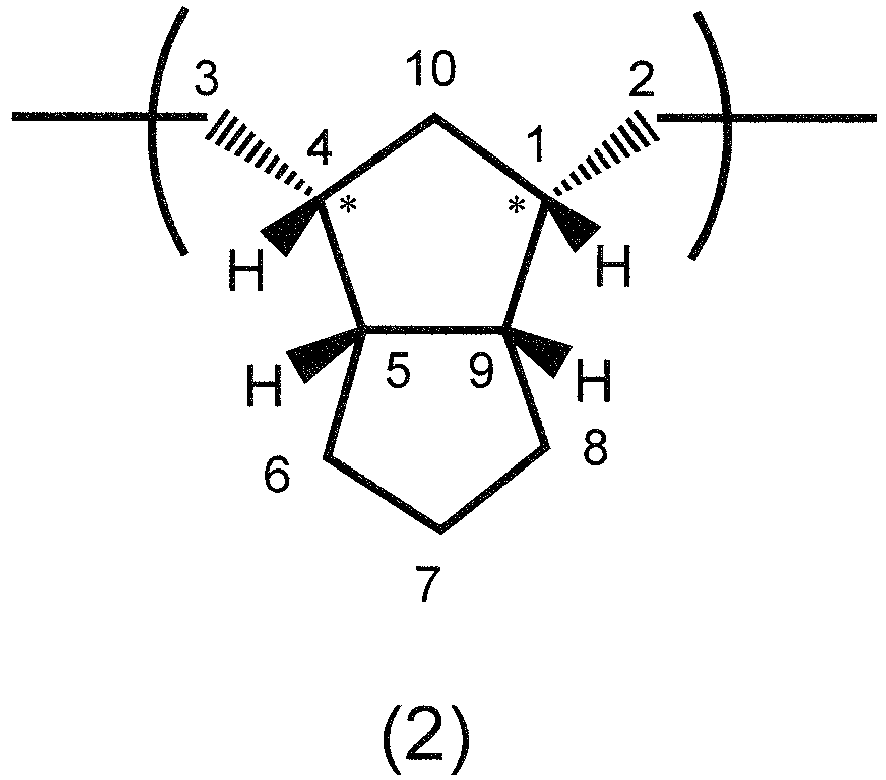
- The melting point of the hydrogenated crystalline dicyclopentadiene ring-opening polymer according to one embodiment of the invention is 280°C or higher, and preferably 282°C or higher. The melting point in the present invention means a melting point determined after the hydrogenated crystalline dicyclopentadiene ring-opening polymer has been once sufficiently molten and then sufficiently crystallized. The upper limit of the melting point is not particularly limited, but approximately 310°C. In the present invention, the melting point can be measured in accordance with the method described in the following Examples.
- The initial melting temperature of the hydrogenated crystalline dicyclopentadiene ring-opening polymer according to one embodiment of the invention is preferably 260°C or higher, and more preferably 265°C or higher. The upper limit of the initial melting temperature is not particularly limited, but is approximately 310°C and equal to or lower than the melting point. Since the hydrogenated crystalline dicyclopentadiene ring-opening polymer according to one embodiment of the invention has a considerably high initial melting temperature, it has excellent processability such as solder reflow resistance.
- The hydrogenated crystalline dicyclopentadiene ring-opening polymer according to one embodiment of the invention has a tacticity, because the carbon represented by (1, 4) in the above formula (2) is an asymmetric carbon (indicated by *).
- The hydrogenated crystalline dicyclopentadiene ring-opening polymer according to one embodiment of the invention is a polymer that has syndiotacticity where the syndiotacticity i.e. a ratio of racemo diads relative to the total of meso diads and racemo diads in the steric configuration (hereinafter may be simply referred to as "ratio of racemo diads" in some cases) is higher than 90%. In the hydrogenated crystalline dicyclopentadiene ring-opening polymer according to one embodiment of the invention, the ratio of the racemo diads is preferably higher than 91%, and more preferably higher than 92%.
- When the ratio of the racemo diads is 90% or less, the crystallinity of the hydrogenated syndiotactic crystalline dicyclopentadiene ring-opening polymer is greatly decreased, and the high melting point and the properties such as processability are impaired.
- Specifically, the syndiotacticity can be determined by the formula I: [(racemo diads) / (meso diads + racemo diads) × 100 (%)]. The ratio of the racemo diads can be calculated by analyzing 13C-NMR spectrum for the hydrogenated syndiotactic crystalline dicyclopentadiene ring-opening polymer. Specifically, the ratio can be determined by quantitatively measuring the spectrum of the carbon atoms indicated by (5, 9) in the above formula (2) of the hydrogenated syndiotactic crystalline dicyclopentadiene ring-opening polymer according to one embodiment of the invention. That is, the 13C-NMR spectrum measurement for the carbon atoms indicated by (5, 9) included in the repeating unit represented by the above formula (2) may be carried out in an o-dichlorobenzene-d4/trichlorobenzene [mixing ratio (weight basis): 1/2] mixed solvent at 200°C, and a peak area value of the signal attributed to the meso diads at 43.35 ppm and a peak area value of the signal attributed to the racemo diads at 43.43 ppm are substituted into the above formula 1 to determine the ratio of the racemo diads.
- The hydrogenated crystalline dicyclopentadiene ring-opening polymer and the dicyclopentadiene ring-opening polymer according to one embodiment of the invention have a repeating unit derived from dicyclopentadiene represented by the following formula (3).

- From the viewpoint that the syndiotactic dicyclopentadiene ring-opening polymer (hereinafter referred to as "dicyclopentadiene ring-opening polymer" in some cases) and the hydrogenated crystalline dicyclopentadiene ring-opening polymer according to one embodiment of the invention particularly improve the heat resistance of the hydrogenated product and accelerate its crystallization rate, it is preferable to use a polymer including a large number of dicyclopentadiene-derived repeating units. The ratio of the dicyclopentadiene-derived repeating units relative to all repeating units in the hydrogenated crystalline dicyclopentadiene ring-opening polymer and the dicyclopentadiene ring-opening polymer according to one embodiment of the invention is not particularly limited, but is preferably 90 wt% or higher, more preferably 95 wt% or higher, and particularly preferably 97 wt% or higher.
- As mentioned below, the hydrogenated crystalline dicyclopentadiene ring-opening polymer according to one embodiment of the invention can be efficiently obtained by a process where dicyclopentadiene or a monomer mixture including dicyclopentadiene and other cycloolefin monomers (hereinafter whole of them is referred to as "dicyclopentadiene and the like" in some cases) is subjected to ring-opening polymerization in the presence of a specific ring-opening polymerization catalyst to obtain a dicyclopentadiene ring-opening polymer, which is then hydrogenated.
- The dicyclopentadiene includes endo and exo stereoisomers, and both of them can be used as a monomer, either of which can be used alone, or a stereoisomer mixture including the endo and exo stereoisomers in any ratio can be used. From the viewpoint of increasing the crystallinity of the hydrogenated crystalline dicyclopentadiene ring-opening polymer and particularly improving its heat resistance, it is preferable to increase the ratio of one stereoisomer. The ratio of the endo or exo stereoisomer to be used is preferably 90% or higher, more preferably 95% or higher, and particularly preferably 99% or higher. Additionally, from the viewpoint of easiness of synthesis, it is preferable that the stereoisomer of which the ratio is increased, is the endo stereoisomer.
- In the production of the dicyclopentadiene ring-opening polymer according to one embodiment of the invention, dicyclopentadiene may be used in combination with other cycloolefin monomers. The amount of other cycloolefin monomers to be used is less than 10 wt%, preferably less than 3 wt%, and more preferably less than 1 wt% based on the total amount of dicyclopentadiene and other cycloolefin monomers.
- Examples of other cycloolefin monomers that can be used in combination with dicyclopentadiene include the followings:
- cycloalkenes such as cyclopentene, cyclohexene and cycloheptane;
- dicyclopentadienes such as tricyclo[4.3.12,5.0]dec-3-ene and tricyclo[4.4.12,5.0]undec-3-ene obtained by saturating the dicyclopentadiene or the double bond of the 5-membered ring moiety included in dicyclopentadiene;
- norbornenes unsubstituted or having an alkyl group as a substituent, such as norbornene, 5-methylnorbornene, 5-ethylnorbornene, 5-butylnorbornene, 5-hexylnorbornene, 5-decylnorbornene, 5-cyclohexylnorbornene and 5 -cyclopentylnorbornene;
- norbornenes having an alkenyl group as a substituent, such as 5-ethylidenenorbornane, 5-vinylnorbornene, 5-propenylnorbornene, 5-cyclohexenylnorbornene and 5-cyclopentenylnorbornene;
- norbornenes having an aromatic ring as a substituent, such as 5-phenylnorbornene;
- norbornenes having an oxygen atom-containing polar group, such as 5-methoxycarbonylnorbornene, 5-ethoxycarbonylnorbornene, 5-methyl-5-methoxycarbonylnorbornene, 5 -methyl-5-ethoxycarbonylnorbornene, norbornenyl-2-methyl propionate, norbornenyl-2-methyl octanoate, norbornene-5,6-dicarboxylic anhydride, 5-(hydroxymethyl)norbornene, 5,6-di(hydroxymethyl)norbornene, 5,5 -di(hydroxymethyl)norbornene, 5-hydroxy-i-propylnorbornene, 5,6-dicarboxynorbornene, and 5-methoxycarbonyl-6-carboxynorbornene; and
- norbornenes having a nitrogen atom-containing polar group, such as 5-cyanonorbornene and norbornene-5,6-dicarboxylic acid imide.
- In addition, examples of tetracyclododecenes other than tetracyclododecene include the following:
- a tetracyclododecene having an alkyl group as a substituent, such as 8-methyltetracyclododecene, 8-ethyltetracyclododecene, 8-cyclohexyltetracyclododecene and 8-cyclopentyltetracyclododecene;
- tetracyclododecenes having a double bond outside the ring, such as 8-methylidenetetracyclododecene, 8-ethylidenetetracyclododecene, 8-vinyltetracyclododecene, 8-propenyltetracyclododecene, 8-cyclohexenyltetracyclododecene, and 8-cyclopentenyltetracyclododecene;
- tetracyclododecenes having an aromatic ring, such as 8-phenyltetracyclododecene;
- tetracyclododecenes having an oxygen atom-containing substituent, such as 8-methoxycarbonyltetracyclododecene, 8-methyl-8-methoxycarbonyltetracyclododecene, 8-hydroxymethyltetracyclododecene, 8-carboxytetracyclododecene, tetracyclododecene-8,9-dicarboxylic acid, and tetracyclododecene-8,9-dicarboxylic anhydride;
- tetracyclododecenes having a nitrogen atom-containing substituent, such as 8-cyanotetracyclododecene and tetracyclododecene-8,9-dicarboxylic acid imide;
- tetracyclododecenes having a halogen atom-containing substituent, such as 8-chlorotetracyclododecene; and
- tetracyclododecenes having a silicon atom-containing substituent, such as 8-trimethoxysilyltetracyclododecene.
- Examples of hexacycloheptadecenes include the followings:
- hexacycloheptadecenes unsubstituted or having an alkyl group as a substituent, such as hexacycloheptadecene, 12-methylhexacycloheptadecene, 12-ethylhexacycloheptadecene, 12-cyclohexylhexacycloheptadecene and 12-cyclopentylhexacycloheptadecene;
- hexacycloheptadecenes having a double bond outside the ring, such as 12-methylidenehexacycloheptadecene, 12-ethylidenehexacycloheptadecene, 12-vinylhexacycloheptadecene, 12-propenylhexacycloheptadecene, 12-cyclohexenylhexacycloheptadecene and 12-cyclopentenylhexacycloheptadecene;
- hexacycloheptadecenes having an aromatic ring as a substituent, such as 12-phenylhexacycloheptadecene;
- hexacycloheptadecenes having an oxygen atom-containing substituent, such as 12-methoxycarbonylhexacycloheptadecene, 12-methyl-12-methoxycarbonylhexacycloheptadecene, 12-hydroxymethylhexacycloheptadecene, 12-carboxyhexacycloheptadecene, hexacycloheptadecene-12,13-dicarboxylic acid and hexacycloheptadecene-12,13-dicarboxylic anhydride;
- hexacycloheptadecenes having a nitrogen atom-containing substituent, such as 12-cyanohexacycloheptadecene and hexacycloheptadecene-12,13-dicarboxylic acid imide;
- hexacycloheptadecenes having a halogen atom-containing substituent, such as 12-chlorohexacycloheptadecene;
- hexacycloheptadecenes having a silicon atom-containing substituent, such as 12-trimethoxysilylhexacycloheptadecene; and
- tetracyclo[6.5.12,5.01,6.08,13]trideca-3,8,10,12-tetraene (also referred to as 1,4-methano-1,4,4a,9a-tetrahydrofluorene); tetracyclo[6.6.12,5.01,6.08,13]tetradeca-3,8,10,12-tetraene (also referred to as 1,4-methano-1,4,4a,5,10,10a-hexahydroanthracene); and the like.
- The number average molecular weight (Mn) of the hydrogenated crystalline dicyclopentadiene ring-opening polymer according to one embodiment of the invention is normally 500 to 1,000,000, preferably 1000 to 600,000, and more preferably 2000 to 400,000. If the Mn is too low, the mechanical strength may be decreased, and if the Mn is too high, the polymer tends to be difficult to be formed. Note that the number average molecular weight of the hydrogenated syndiotactic crystalline dicyclopentadiene ring-opening polymer is approximately equal to that of the dicyclopentadiene ring-opening polymer before the hydrogenation process.
- The glass transition temperature (Tg) of the hydrogenated crystalline dicyclopentadiene ring-opening polymer according to one embodiment of the invention is preferably 80°C or higher, more preferably 85°C or higher. If the glass transition temperature is within these ranges, the polymer is favorable because of improved heat resistance e.g. high deflection temperature under load. The upper limit of the glass transition temperature is not particularly limited, but is approximately 120°C.
- The dicyclopentadiene ring-opening polymer according to one embodiment of the invention can be obtained by subjecting dicyclopentadiene and the like to ring-opening polymerization using a polymerization catalyst including a tungsten compound represented by the following formula (1).

- In the formula (1), W represents a tungsten atom.
- Each of R1 and R2 independently represents a group selected from hydrogen atom, an alkyl group having 1 to 12 carbon atoms, an aryl group having 6 to 12 carbon atoms that may have a substituent, and a cycloalkyl group having 3 to 20 carbon atoms that may have a substituent.
- L1 represents nitrogen atom that may have a substituent selected from an alkyl group having 1 to 12 carbon atoms, an aryl group having 6 to 12 carbon atoms that may have a substituent and a cycloalkyl group having 3 to 20 carbon atoms that may have a substituent.
- L2 represents a conjugated heterocyclic group having at least one nitrogen atom and having 5 to 15-membered rings, where the conjugated heterocyclic group may have a substituent.
- L3 represents an alkoxy group represented by O-R3, where R3 represents a group selected from an alkyl group having 1 to 12 carbon atoms that may have a substituent and an aryl group having 6 to 30 carbon atoms that may have a substituent.
- L4 represents a neutral conjugated heterocyclic ligand having at least two nitrogen atoms and having 12 to 24-membered rings, where the conjugated heterocyclic ligand may have a substituent.
- That is, in the production method according to one embodiment of the invention, the tungsten compound represented by the above formula (1) is used as a polymerization active component of a polymerization catalyst for ring-opening polymerization of dicyclopentadiene and the like.
- In the above formula (1), W represents a tungsten atom.
- Each of R1 and R2 independently represents a hydrogen atom; an alkyl group having 1 to 12 carbon atoms such as a methyl group, an ethyl group, a n-propyl group, an isopropyl group, a n-butyl group, an isobutyl group and a t-butyl group; a cycloalkyl group having 3 to 20 carbon atoms that may have a substituent, such as a cyclopropyl group, a cyclopentyl group, a cyclohexyl group; or an aryl group having 6 to 12 carbon atoms that may have a substituent. Examples of an aryl group of the aryl group that may have a substituent include a phenyl group, a 1-naphthyl group, a 2-naphthyl group and the like. In addition, examples of the substituent for the cycloalkyl group and the aryl group include an alkyl group having 1 to 12 carbon atoms such as a methyl group and an ethyl group; a halogen atom such as a fluorine atom, a chlorine atom and a bromine atom; an alkoxy group having 1 to 12 carbon atoms such as a methoxy group, an ethoxy group and an isopropoxy group; a haloalkyl group having 1 to 12 carbon atoms such as a trifluoromethyl group; a haloalkoxy group having 1 to 12 carbon atoms such as a trifluoromethoxy group; an aryl group having 6 to 12 carbon atoms that may have a substituent, such as a phenyl group, a 4-methylphenyl group, a 2,4-dimethylphenyl group, a 2-chlorophenyl group and a 3-methoxyphenyl group; and the like.
- L1 represents nitrogen atom that may have a substituent selected from an alkyl group having 1 to 12 carbon atoms, an aryl group having 6 to 12 carbon atoms that may have a substituent and a cycloalkyl group having 3 to 20 carbon atoms that may have a substituent.
- The alkyl group having 1 to 12 carbon atoms included in the nitrogen atom of the L1 may be either linear or branched. Specific examples thereof include a methyl group, an ethyl group, a propyl group, an isopropyl group, a butyl group, a t-butyl group, a pentyl group, a hexyl group and the like.
- Examples of the aryl group having 6 to 12 carbon atoms include a phenyl group, a 1-naphthyl group and a 2-naphthyl group and the like.
- Examples of the cycloalkyl group having 3 to 20 carbon atoms include a cyclopropyl group, a cyclopentyl group, a cyclohexyl group, a cyclooctyl group, an adamantyl group and the like.
- The substituent present in nitrogen atom of the L1, that may be included in the cycloalkyl group having 3 to 20 carbon atoms and the aryl group having 6 to 12 carbon atoms is not particularly limited. Examples of the substituent include an alkyl group having 1 to 12 carbon atoms such as a methyl group and ethyl group; halogen atom such as fluorine atom, chlorine atom and bromine atom; an alkoxy group having 1 to 12 carbon atoms such as a methoxy group, an ethoxy group and an isopropoxy group; a haloalkyl group having 1 to 12 carbon atoms such as a trifluoromethyl group; a haloalkoxy group having 1 to 12 carbon atoms such as trifluoromethoxy group; an aryl group having 6 to 12 carbon atoms that may have a substituent, such as phenyl group, 4-methylphenyl group, 2,4-dimethylphenyl group, 2-chlorophenyl group and 3-methoxyphenyl group; an amino group; a monosubstituted amino group such as methylamino group; a disubstituted amino group such as dimethylamino group; an imino group; and the like.
- Specific examples of the aryl group having 6 to 12 carbon atoms that may have a substituent include a phenyl group, a 2-methylphenyl group, a 2,6-dimethylphenyl group, a 3,5-dimethylphenyl group, a pentafluorophenyl group and the like.
- L2 represents a conjugated heterocyclic group having at least one nitrogen atom and having 5 to 15-membered rings, that may have a substituent.
- Examples of the conjugated heterocyclic group of L2 include a 5-membered ring conjugated heterocyclic group such as a pyrrolyl group, an imidazolyl group, a pyrazolyl group, an oxazolyl group, and a thiazolyl group; a 6-membered ring conjugated heterocyclic group such as a pyridyl group, a pyridazinyl group, a pyrimidinyl group, a pyrazinyl group and a triazinyl group; a fused ring conjugated heterocyclic group such as a quinazolinyl group, a phthalazinyl group and a pyrrolopyridyl group; and the like.
- The substituent that may be included in the conjugated heterocyclic group is not particularly limited. Its examples include an alkyl group having 1 to 12 carbon atoms such as a methyl group and an ethyl group; a halogen atom such as a fluorine atom, a chlorine atom and a bromine atom; an alkoxy group having 1 to 12 carbon atoms such as a methoxy group, an ethoxy group and an isopropoxy group; a haloalkyl group having 1 to 12 carbon atoms such as a trifluoromethyl group; a haloalkoxy group having 1 to 12 carbon atoms such as a trifluoromethoxy group; an aryl group having 6 to 12 carbon atoms that may have a substituent, such as a phenyl group, a 4-methylphenyl group, a 2,4-dimethylphenyl group, a 2-chlorophenyl group and a 3-methoxyphenyl group; an amino group; a monosubstituted amino group such as a methylamino group; a disubstituted amino group such as a dimethylamino group; an imino group; and the like.
- L3 is a group represented by -O-R3. R3 is a group selected from an alkyl group having 1 to 12 carbon atoms that may have a substituent and an aryl group having 6 to 30 carbon atoms that may have a substituent.
- Examples of the alkyl group having 1 to 12 carbon atoms among the alkyl group having 1 to 12 carbon atoms that may have a substituent of the R3, include a methyl group, an ethyl group, a propyl group, an isopropyl group, a butyl group, a t-butyl group, a pentyl group and the like.
- The substituent that may be included in the alkyl group having 1 to 12 carbon atoms of the R3 is not particularly limited. Its examples include a halogen atom such as a fluorine atom, a chlorine atom and a bromine atom; an alkoxy group having 1 to 12 carbon atoms such as a methoxy group, an ethoxy group and an isopropoxy group; a haloalkyl group having 1 to 12 carbon atoms such as a trifluoromethyl group; a haloalkoxy group having 1 to 12 carbon atoms such as a trifluoromethoxy group; an aryl group having 6 to 12 carbon atoms that may have a substituent, such as a phenyl group, a 4-methylphenyl group, a 2,4-dimethylphenyl group, a 2-chlorophenyl group and a 3-methoxyphenyl group; an amino group; a monosubstituted amino group such as a methylamino group; a disubstituted amino group such as a dimethylamino group; an imino group; and the like.
- Examples of the aryl group having 6 to 30 carbon atoms among the aryl group having 6 to 30 carbon atoms that may have a substituent, include a phenyl group, a 1-naphthyl group, a 2-naphthyl group, an adamantyl group and the like.
- The substituent that may be included in the aryl group having 6 to 30 carbon atoms of the R3 is not particularly limited. Its examples include a halogen atom such as a fluorine atom, a chlorine atom and a bromine atom; an alkyl group having 1 to 12 carbon atoms such as a methyl group, an ethyl group, an isopropyl group and a t-butyl group; a cycloalkyl group having 3 to 20 carbon atoms such as a cyclopropyl group, a cyclopentyl group and a cyclohexyl group; an alkoxy group having 1 to 12 carbon atoms such as a methoxy group, an ethoxy group and an isopropoxy group; a haloalkyl group having 1 to 12 carbon atoms such as a trifluoromethyl group; a haloalkoxy group having 1 to 12 carbon atoms such as a trifluoromethoxy group; an aryl group having 6 to 12 carbon atoms that may have a substituent, such as a phenyl group, a 4-methylphenyl group, a 2,4-dimethylphenyl group, a 2-chlorophenyl group and a 3-methoxyphenyl group; an amino group; a monosubstituted amino group such as a methylamino group; a disubstituted amino group such as a dimethylamino group; an imino group; and the like.
- Specific examples of the L3 include a group that is an alkyl group having 1 to 12 carbon atoms in which R3 may have a substituent, such as a 1,1,1,3,3,3-hexafluoro-2-propoxy group, a 2-methyl-2-propoxy group, a 1,1,1-trifluoro-2-methyl-2-propoxy group, a 1,1,1-trifluoro-2-trifluoromethyl-2-propoxy group and a 2-trifluoromethyl-2-phenyl-1,1,1-trifluoroethoxy group; and a group that is an aryl group having 6 to 30 carbon atoms in which R3 may have a substituent, such as a 2,6-bis(2,4,6-trimethylphenyl)phenoxy group, a 2,6-bis(2,4,6-triisopropylphenyl)phenoxy group, a 2,4,6-trimethylphenoxy group and a 2,3,5,6-tetraphenylphenoxy group.
- L4 is a neutral conjugated heterocyclic ligand having at least two nitrogen atoms and having 12 to 24-membered rings. Specific examples of the ligand include 2,2'-bipyridyl, 5,5'-dimethyl-2,2'-bipyridyl, 4,4'-dimethyl-2,2'-bipyridyl, 4,4'-dibromo-2,2'-bipyridyl, 2,2'-biquinoline, 1,10-phenanthroline and terpyridine.
- In addition, the conjugated heterocyclic group of the L4 may have a substituent. Examples of the substituent include the same substituents as listed as the substituents that may be included in the conjugated heterocyclic group of the L2.
- Specific examples of the tungsten compound used in the present invention include, but are not limited to, (2-trifluoromethyl-2-phenyl-1,1,1-trifluoroethoxy)2,6-dimethylphenylimide tungsten (VI) (2,5-dimethylpyrrolide) (neophylidene) (1,10-phenanthroline), (2-trifluoromethyl-2-phenyl-1,1,1-trifluoroethoxy)phenylimide tungsten (VI) (2,5-dimethylpyrrolide) (neophylidene) (1,10-phenanthroline), (2-trifluoromethyl-2-phenyl-1,1,1-trifluoroethoxy)2,6-dimethylphenylimide tungsten (VI) (2,5-dimethylpyrrolide) (neophylidene) (2,2'-bipyridine), (2-trifluoromethyl-2-phenyl-1,1,1-trifluoroethoxy)phenylimide tungsten (VI) (2,5-dimethylpyrrolide) (neophylidene) (2,2'-bipyridine), and the like.
- In addition, the tungsten compound used as a polymerization catalyst has a neutral conjugated heterocyclic ligand, and may be used in combination with a metal salt compound for increasing the rate of the ring-opening polymerization of dicyclopentadiene. By combining a metal salt compound, the neutral conjugated heterocyclic ligand can be separated from group 6 transition metal compounds in the periodic table to form highly active catalyst species.
- As the metal atom constituting the metal salt, zinc, tin, copper, titanium, rare earth and the like are suitable. Specific examples of the metal salt that may be used include zinc chloride, copper chloride, tin chloride, titanium chloride, scandium chloride, yttrium chloride and the like.
- These group 6 transition metal compounds in the periodic table can be produced e.g. in accordance with the method described in
JP-T-2014-T-520103 WO 2012/167171 ) or the like. Also, those commercially available as group 6 transition metal compounds in the periodic table can be purified and used, as desired. - In the method for producing the dicyclopentadiene ring-opening polymer according to one embodiment of the invention, dicyclopentadiene or the like and a polymerization catalyst may be mixed for ring-opening polymerization of dicyclopentadiene or the like.
- Although the amount of the polymerization catalyst to be used relative to dicyclopentadiene and the like is not particularly limited, the molar ratio of the tungsten compound in the polymerization catalyst: dicyclopentadiene and the like is preferably 1:10 to 1:2,000,000, more preferably 1:200 to 1:1,000,000, and particularly preferably 1:500 to 1:500,000. If the amount of the polymerization catalyst to be used is too large, it may be difficult to remove the polymerization catalyst, and if the amount of the polymerization catalyst to be used is too small, sufficient polymerization activity may not be obtained.
- The polymerization reaction may be effected in a solvent-free system, but preferably in an organic solvent from the viewpoint that the reaction can be advantageously controlled. The organic solvent used in this case is not particularly limited as long as the organic solvent can dissolve or disperse the resulting ring-opening polymer and does not adversely affect the polymerization reaction. Specific examples of the organic solvent that may be used include an aliphatic hydrocarbon such as pentane, hexane and heptane; an alicyclic hydrocarbon such as cyclopentane, cyclohexane, methylcyclohexane, dimethylcyclohexane, trimethylcyclohexane, ethylcyclohexane, diethylcyclohexane, decahydronaphthalene, bicycloheptane, tricyclodecane, hexahydroindenecyclohexane and cyclooctane; an aromatic hydrocarbon such as benzene, toluene and xylene; a halogen-containing aliphatic hydrocarbon such as dichloromethane, chloroform and 1,2-dichloroethane; a halogen-containing aromatic hydrocarbon such as chlorobenzene and dichlorobenzene; a nitrogen-containing hydrocarbon such as nitromethane, nitrobenzene and acetonitrile; an ether such as diethyl ether and tetrahydrofuran; an aromatic ether such as anisole and phenetole; and the like. Among these, an aromatic hydrocarbon, an aliphatic hydrocarbon, an alicyclic hydrocarbon, an ether, and an aromatic ether are preferably used.
- When effecting the polymerization reaction in the organic solvent, the concentration of the monomer in the reaction system is not particularly limited, but is preferably 1 to 50 wt%, more preferably 2 to 45 wt%, and particularly preferably 3 to 40 wt%. If the concentration of the monomer is too low, productivity may decrease, and if the concentration of the monomer is too high, the viscosity of the reaction solution may increase to a too large extent after completion of the polymerization reaction, and it may be difficult to effect the subsequent hydrogenation reaction.
- The polymerization temperature is not particularly limited, but is normally -30 to +200°C, and preferably 0 to 180°C. Further, the polymerization time is also not particularly limited, but is normally selected within the range of 1 minute to 100 hours.
- When effecting the polymerization reaction, a vinyl compound or a diene compound may be added to the polymerization reaction system in order to adjust the molecular weight of the resulting dicyclopentadiene ring-opening polymer.
- The vinyl compound used for adjusting the molecular weight is not particularly limited as long as the vinyl compound is an organic compound having a vinyl group. For example, α-olefins such as 1-butene, 1-pentene, 1-hexene and 1-octene; styrenes such as styrene and vinyltoluene; ethers such as ethyl vinyl ether, i-butyl vinyl ether and allyl glycidyl ether; a halogen-containing vinyl compound such as allyl chloride; an oxygen-containing vinyl compound such as allyl acetate, allyl alcohol and glycidyl methacrylate; a nitrogen-containing vinyl compound such as acrylamide; a silicon-containing vinyl compound such as vinyltrimethylsilane, allyltrimethylsilane and vinyltrimethoxysilane; and the like can be used.
- Further, the diene compound used for adjusting the molecular weight is not particularly limited. For example, a non-conjugated diene such as 1,4-pentadiene, 1,4-hexadiene, 1,5-hexadiene, 1,6-heptadiene, 2-methyl-1,4-pentadiene and 2,5-dimethyl-1,5-hexadiene; a conjugated diene such as 1,3-butadiene, 2-methyl-1,3-butadiene, 2,3-dimethyl-1,3-butadiene, 1,3-pentadiene and 1,3-hexadiene; and the like can be used.
- The amount of the added vinyl compound or diene compound may be determined depending on the intended molecular weight, but is normally selected within a range of 0.1 to 10 mol based on 100 mol of the dicyclopentadiene and the like used as the monomer.
- In the present invention, the ring-opening polymerization reaction of dicyclopentadiene can be effected under the above-mentioned conditions using a polymerization catalyst including the tungsten compound represented by the above formula (1) to obtain a dicyclopentadiene ring-opening polymer having syndiotacticity.
- In addition, the dicyclopentadiene ring-opening polymer having this syndiotactic structure can be subjected to hydrogenation reaction to obtain a hydrogenated syndiotactic crystalline dicyclopentadiene ring-opening polymer having syndiotacticity as well as crystallinity.
- Note that the dicyclopentadiene ring-opening polymer may be collected from the reaction solution, and then subjected to the hydrogenation reaction, or the reaction solution including the dicyclopentadiene ring-opening polymer may be subjected directly to the hydrogenation reaction.
- The number average molecular weight (Mn) of the dicyclopentadiene ring-opening polymer to be subjected to the hydrogenation reaction determined by 1H-NMR is not particularly limited, but is preferably 1,000 to 1,000,000, and more preferably 2,000 to 800,000. A hydrogenated syndiotactic crystalline dicyclopentadiene ring-opening polymer that exhibits particularly an excellent balance between forming processability and heat resistance, can be obtained by subjecting the dicyclopentadiene ring-opening polymer having such a number average molecular weight to the hydrogenation reaction. The number average molecular weight of the hydrogenated syndiotactic crystalline dicyclopentadiene ring-opening polymer can be regulated by adjusting the addition amount or the like of the molecular weight modifier to be used in polymerization.
- The cis content in the dicyclopentadiene ring-opening polymer to be subjected to the hydrogenation reaction determined by 1H-NMR is preferably higher than 50%, more preferably higher than 70%, and particularly preferably higher than 90%.
- In the dicyclopentadiene ring-opening polymer, the ratio of the racemo diads is preferably higher than 90%, more preferably higher than 91%, particularly preferably higher than 92%. When the cis content is higher than 50% and the ratio of the racemo diads is higher than 90%, the solubility of the dicyclopentadiene ring-opening polymer in an organic solvent increases, and the producing process for directly subjecting the reaction solution including the dicyclopentadiene ring-opening polymer to hydrogenation reaction is advantageous, and thus the ratio is preferable.
- As described above, the dicyclopentadiene ring-opening polymer according to one embodiment of the invention that may be used as an intermediate of the hydrogenated syndiotactic crystalline dicyclopentadiene ring-opening polymer according to one embodiment of the invention, dissolves in an organic solvent at room temperature. In particular, from the viewpoint of the production process in which the polymerization reaction is carried out in an organic solvent and the organic solvent reaction solution including the dicyclopentadiene ring-opening polymer is directly subjected to the hydrogenation reaction, it is preferable to dissolve the polymer in an organic solvent inert to hydrogenation.
- Examples of the solvent for dissolving the dicyclopentadiene ring-opening polymer according to one embodiment of the invention include an alicyclic hydrocarbon such as cyclopentane, cyclohexane, methylcyclohexane, dimethylcyclohexane, trimethylcyclohexane, ethylcyclohexane, diethylcyclohexane, decahydronaphthalene, bicycloheptane, tricyclodecane, hexahydroindenecyclohexane and cyclooctane; an aromatic hydrocarbon such as benzene, toluene and xylene; a halogen-containing aliphatic hydrocarbon such as dichloromethane, chloroform and 1,2-dichloroethane; a halogen-containing aromatic hydrocarbon such as chlorobenzene and dichlorobenzene; an ether such as diethyl ether and tetrahydrofuran; an aromatic ether such as anisole and phenetole; and the like.
- In the method for producing the hydrogenated crystalline dicyclopentadiene ring-opening polymer according to one embodiment of the invention, the hydrogenated syndiotactic crystalline dicyclopentadiene ring-opening polymer is obtained by a process (a) in which a hydrogenating agent is added to a system including the dicyclopentadiene ring-opening polymer obtained as above, then heated and reacted, or a process (b) in which a hydrogenation catalyst is added to the system, to which hydrogen is then added to hydrogenate the carbon-carbon double bond included in the dicyclopentadiene ring-opening polymer. Among them, from the viewpoint of industrial production, the process (b) in which the hydrogenation is carried out using the hydrogenation catalyst and the hydrogen gas, is preferable.
- When conducting the method for producing the hydrogenated crystalline dicyclopentadiene ring-opening polymer according to one embodiment of the invention, in the process (a), it is preferable that a hydrazine-containing compound as a hydrogenating agent for a transfer hydrogenation is used to hydrogenate the carbon-carbon double bond included in the dicyclopentadiene ring-opening polymer.
- The compound used as a hydrogenating agent for a transfer hydrogenation is not particularly limited. The compound used as a hydrogenating agent for the hydrogenated dicyclopentadiene ring-opening polymer may be a compound used as a hydrogenation catalyst. Specific examples of the hydrogenating agent include hydrazine, paratoluenesulfonyl hydrazide and the like.
- In the present invention, for the hydrogenation catalyst used in the process (b), a conventionally known catalyst can be used as a hydrogenation catalyst for ring-opening polymers. Specific examples of the catalyst include RuHCl(CO)(PPh3)3, RuHCl(CO)[P(p-Me-Ph)3]3, RuHCl(CO)(PCy3)2, RuHCl(CO)[P(n-Bu)3]3, RuHCl(CO)[P(i-Pr)3]2, RuH2(CO)(PPh3)3, RuH2(CO)[P(p-Me-Ph)3]3, RuH2(CO)(PCy3)3, RuH2(CO)[P(n-Bu)3]3RuH(OCOCH3)(CO)(PPh3)2, RuH(OCOPh)(CO)(PPh3)2, RuH(OCOPh-CH3)(CO)(PPh3)2, RuH(OCOPh-OCH3)(CO)(PPh3)2, RuH(OCOPh)(CO)(PCy3)2, Raney nickel, nickel diatomaceous earth, nickel acetate, palladium acetate, PdCl2, RhCl(PPh)3, and the like.
- The hydrogenation reaction is normally effected in an inert organic solvent. Examples of the inert organic solvent that may be used include an alicyclic hydrocarbon such as cyclopentane, cyclohexane, methylcyclohexane, dimethylcyclohexane, trimethylcyclohexane, ethylcyclohexane, diethylcyclohexane, decahydronaphthalene, bicycloheptane, tricyclodecane, hexahydroindenecyclohexane and cyclooctane; an aromatic hydrocarbon such as benzene, toluene and xylene; a halogen-containing aliphatic hydrocarbon such as dichloromethane, chloroform and 1,2-dichloroethane; a halogen-containing aromatic hydrocarbon such as chlorobenzene and dichlorobenzene; an ether such as diethyl ether and tetrahydrofuran; an aromatic ether such as anisole and phenetole; and the like.
- In the method for producing the hydrogenated crystalline dicyclopentadiene ring-opening polymer according to one embodiment of the invention, preferably hydrogen is further added to a system including a dicyclopentadiene ring-opening polymer and a hydrogenation catalyst to hydrogenate the carbon-carbon double bond included in the norbornene-based ring-opening polymer. The hydrogenation reaction may also be effected under different conditions depending on the hydrogenation catalyst system to be used, but the reaction temperature is normally -20 to +250°C, preferably -10 to +220°C, and more preferably 0 to +200°C. If the hydrogenation temperature is too low, the reaction rate may become too slow. If the hydrogenation temperature is too high, a side reaction may occur. In a case of catalytic hydrogenation, the hydrogen pressure is normally set to 0.01 to 20 MPa, preferably 0.05 to 15 MPa, and more preferably 0.1 to 10 MPa. If the hydrogen pressure is too low, the hydrogenation rate may become too slow. If the hydrogen pressure is too high, a reactor that can endure high pressure is necessary, and in this respect, restriction of the apparatus is caused. The reaction time is not particularly limited as long as the hydrogenation ratio is suitable as desired, but is normally 0.1 to 10 hours. After completion of the hydrogenation reaction, the desired hydrogenated crystalline norbornene-based ring-opening polymer may be simply collected using an ordinary method. When collecting the polymer, the residual catalyst may be removed by filtration or the like.
- The hydrogenation ratio of the ring-opening polymer in the hydrogenation reaction (the ratio of the hydrogenated main-chain double bonds) is not particularly limited, but is preferably 98% or higher, more preferably 99% or higher, and particularly preferably 99.5% or higher. The resulting hydrogenated syndiotactic crystalline dicyclopentadiene ring-opening polymer exhibits better heat resistance, as the hydrogenation ratio increases.
- In addition, the tacticity of the hydrogenated syndiotactic crystalline dicyclopentadiene ring-opening polymer is not particularly limited as long as the hydrogenated product has crystallinity (i.e. the melting point is 280°C or higher) and is syndiotactic (the ratio of the racemo diads is higher than 90%), but the ratio of the racemo diads for the repeating unit of dicyclopentadiene can also be higher than 91%.
- The hydrogenated syndiotactic crystalline dicyclopentadiene ring-opening polymer obtained by the production method according to one embodiment of the invention has a high melting point and a high initial melting temperature. Thus, this hydrogenated syndiotactic crystalline dicyclopentadiene ring-opening polymer may exhibit excellent heat resistance even after formed by melt forming, and it can be particularly advantageously used as a material of a formed article requiring heat resistance. The formed article can be produced according to a known method.
- Examples of the applications of the formed article include, but are not limited to, an optical reflector, an insulating material, an optical film, a connector, a food packaging material, a bottle, a pipe, a gear, fibers, a nonwoven fabric, and the like.
- Next, the invention will be further described below by way of examples, but the invention is not limited to the following examples.
- Note that the following measurement methods and evaluation methods were used in connection with the examples.
- The ratio of the number of hydrogen atoms present at the terminals of the polymer chain to the number of hydrogen atoms present in the polymer chain excluding the terminals was calculated based on the 1H-NMR measurement results, and the number average molecular weight of the dicyclopentadiene ring-opening polymer was calculated based on the calculated ratio.
- Determination was carried out based on the 1H-NMR measurement results. (3) Hydrogenation ratio of the dicyclopentadiene ring-opening polymer in hydrogenation reaction
- Determination was carried out based on the 1H-NMR measurement results.
- The hydrogenated dicyclopentadiene ring-opening polymer was molten by heating at 320°C for 10 minutes, then cooled at 10°C/minute to room temperature to crystallize it, and then subjected to measurement by using a differential scanning calorimeter while heating at 10°C/minute. In an endothermic peak observed at the time of the measurement with rising temperature, the temperature at which the endothermic (crystal melting) heat flow was the largest, was defined as the melting point, and the start temperature for the endothermic peak was determined as the initial melting temperature.
- 13C-NMR measurement at 200°C was carried out using o-dichlorobenzene-d4/trichlorobenzene (mixing ratio (weight basis): 1/2) as a solvent, and the ratio of the racemo diads was determined based on the a peak area value of the signal at 43.35 ppm attributed to the meso diads and a peak area value of the signal at 43.43 ppm attributed to the racemo diads.
- The hydrogenated syndiotactic crystalline dicyclopentadiene ring-opening polymer as a sample was molten by heating at 320°C for 10 minutes, formed into a shape of 10 mm × 100 mm × 1 mm and then cooled to room temperature at a rate of 10°C/minute, and the resulting sample piece was immersed in solder at 260°C for 20 seconds, and the presence or absence of deformation was evaluated in accordance with the following criteria. A case without visible deformation can be evaluated as "excellent in heat resistance".
-
- "Good": No visible deformation
- "Bad": Visible deformation
- One end of the sample piece subjected to the solder immersion test was placed on a horizontal plane, and the distance between the other end in the longitudinal direction of the sample piece and the horizontal plane was measured, and the measured value was defined as a curling value. It was determined that the sample piece exhibited better heat resistance as the curling value decreased.
-

- As a bispyrrolide precursor, 312 mg (0.5 mmol) of W(CHCMe2Ph) (NArdiMe) (Me2Pyr)2 (wherein Me represents a methyl group, Ph represents a phenyl group, ArdiMe represents a 2,6-dimethylphenyl group, and Me2Pyr represents 2,5-dimethylpyrrole) was dissolved in 5 ml of benzene, to which 84 µl (0.5 mmol) of α,α-bistrifluoromethylbenzyl alcohol [Ph(CF3)2COH] was added, and the whole content (reaction mixture) was stirred at room temperature (20°C) for 30 minutes. Then, 90 mg (0.5 mmol) of 1,10-phenanthroline was added, the whole content was stirred at room temperature (20°C) for 1 hour, and then the reaction mixture was transferred into a freezer. 10 ml of pentane was added to the reaction mixture to quantitatively precipitate the reaction product. The reaction product was taken by filtration as an orange solid. This product was washed with pentane and dried. The yield was 480 mg (quantitatively).
- This product was identified as (2-trifluoromethyl-2-phenyl-1,1,1-trifluoroethoxy)-2,6-dimethylphenylimide tungsten (VI) (2,5-dimethylpyrrolide) (neophylidene) (1,10-phenanthroline) by 1H-NMR, 13C-NMR and 19F-NMR spectra of the resulting solid.
- A glass reactor equipped with a stirrer was charged with 0.072 g (1/500 mol/mol) of
(2-trifluoromethyl-2-phenyl-1,1,1-trifluoroethoxy)-2,6-dimethylphenylimide tungsten (VI) (2,5-dimethylpyrrolide) (neophylidene) (1,10-phenanthroline) obtained in Synthesis Example 1 and 1 g of toluene, to which 5.0 g of dicyclopentadiene, 20.0 g of cyclohexane and 0.21 g of 1-hexene were subsequently added, and furthermore 0.0105 g of anhydrous zinc chloride dissolved in 5 g of 1,4-dioxane was added, which was subjected to polymerization reaction at 50°C. After the start of the polymerization reaction, a white turbidness of 1,10-phenanthroline zinc was rapidly produced. After 3-hour reaction, a large quantity of acetone was poured into the polymerization reaction solution to aggregate a precipitate, the aggregate was filtered off, washed, and then dried under reduced pressure at 40°C for 24 hours. A dicyclopentadiene ring-opening polymer obtained had a yield of 4.3 g, had a number average molecular weight of 14,000, and a cis content of 97%. - Subsequently, a glass reactor equipped with a stirrer was charged with 2.5 g of the resulting dicyclopentadiene ring-opening polymer and 21 g of para toluenesulfonyl hydrazide were added, to which 500 ml of p-xylene was added, and hydrogenated at 125°C for 5 hours. This hydrogenation reaction solution was poured into a large quantity of methanol to completely precipitate the resulting hydrogenated dicyclopentadiene ring-opening polymer, which was filtered off, washed, and then dried under reduced pressure at 40°C for 24 hours.
- The hydrogenation ratio of the resulting hydrogenated ring-opening polymer was 99% or higher, and the ratio of racemo diads was 92%. As a result of measuring the melting point of the hydrogenated product, the melting point was 282°C, the melting enthalpy was 53 J/g, and the initial melting temperature was 275°C. In addition, a solder immersion test and a curling value measurement were carried out for the hydrogenated product. The results are shown in Table 1.
- In an autoclave equipped with a stirrer, 1.75 g of a polymerization mixture of the dicyclopentadiene ring-opening polymer obtained in Example 1 and 47 g of cyclohexane, were added. Then, a solution in which 0.00157 g of RuHCl(CO)(PPh3)3 was dispersed in 10 ml of cyclohexane was further added, and a hydrogenation reaction was carried out under a hydrogen pressure of 4.0 MPa at 160°C for 8 hours. The hydrogenated ring-opening polymer produced by pouring this hydrogenation reaction solution into a large amount of acetone was completely precipitated, filtered out, washed, and then dried under reduced pressure at 40°C for 24 hours.
- The hydrogenation ratio of the resulting hydrogenated ring-opening polymer was 99% or higher, and the ratio of racemo diads was 92%. As a result of measuring the melting point of the hydrogenated product, the melting point was 284°C, the melting enthalpy was 52 J/g, and the initial melting temperature was 274°C. In addition, a solder immersion test and a curling value measurement were carried out for the hydrogenated product. The results are shown in Table 1.
Table 1 Example 1 2 Hydrogenation ratio (%) 99%≦ 99%≦ Syndiotacticity [Ratio of racemo diads (%)] 92 92 Melting point (°C) 282 284 Initial melting temperature (°C) 275 274 Solder immersion test Good Good Curling value 0 0 - As is apparent from Table 1, the hydrogenated syndiotactic crystalline dicyclopentadiene ring-opening polymer according to one embodiment of the invention was proved to be a material that had a high melting point, a high initial melting temperature and excellent heat resistance, not thermally deformed even if brought into contact with solder, and allowed implementation of solder reflow and the like (Examples 1 and 2).
- Consequently, according to the present invention, a hydrogenated syndiotactic crystalline dicyclopentadiene ring-opening polymer that has a high melting point, a high initial melting temperature and excellent heat resistance after melting and is not thermally deformed even if brought into contact with solder, can be obtained.
Claims (6)
- A hydrogenated syndiotactic crystalline dicyclopentadiene ring-opening polymer having a melting point of 280°C or higher and a syndiotacticity of higher than 90%.
- A syndiotactic dicyclopentadiene ring-opening polymer, which can produce the hydrogenated syndiotactic crystalline dicyclopentadiene ring-opening polymer according to claim 1 by hydrogenation reaction and has a syndiotacticity of higher than 90%.
- A method for producing the syndiotactic dicyclopentadiene ring-opening polymer according to claim 2, which includes a step of subjecting dicyclopentadiene to ring-opening polymerization using a polymerization catalyst comprising a tungsten compound represented by the following formula (1):
 wherein W represents a tungsten atom;each of R1 and R2 independently represents a group selected from a hydrogen atom, an alkyl group having 1 to 12 carbon atoms, an aryl group having 6 to 12 carbon atoms that may have a substituent, and a cycloalkyl group having 3 to 20 carbon atoms that may have a substituent;L1 represents a nitrogen atom that may have a substituent, selected from an alkyl group having 1 to 12 carbon atoms, an aryl group having 6 to 12 carbon atoms that may have a substituent, and a cycloalkyl group having 3 to 20 carbon atoms that may have a substituent;L2 represents a conjugated heterocyclic group having 5 to 15-membered rings that comprises at least one nitrogen atom, wherein the conjugated heterocyclic group may have a substituent;L3 represents an alkoxy group represented by O-R3, wherein R3 represents a group selected from an alkyl group having 1 to 12 carbon atoms that may have a substituent, and an aryl group having 6 to 30 carbon atoms that may have a substituent; andL4 represents a neutral conjugated heterocyclic ligand having 12 to 24-membered rings that comprises at least two nitrogen atoms, wherein the conjugated heterocyclic ligand may have a substituent.
 - A method for producing the hydrogenated syndiotactic crystalline dicyclopentadiene ring-opening polymer according to claim 1 including a step of subjecting the syndiotactic dicyclopentadiene ring-opening polymer according to claim 2 to hydrogenation reaction.
- A formed article comprising the hydrogenated syndiotactic crystalline dicyclopentadiene ring-opening polymer according to claim 1.
- A method for producing the formed article according to claim 5, including a step of forming the hydrogenated syndiotactic crystalline dicyclopentadiene ring-opening polymer according to claim 1.
Applications Claiming Priority (2)
| Application Number | Priority Date | Filing Date | Title |
|---|---|---|---|
| JP2015046498 | 2015-03-09 | ||
| PCT/JP2015/062935 WO2016143148A1 (en) | 2015-03-09 | 2015-04-30 | Syndiotactic crystalline dicyclopentadiene ring-opening polymer hydride |
Publications (3)
| Publication Number | Publication Date |
|---|---|
| EP3269750A1 true EP3269750A1 (en) | 2018-01-17 |
| EP3269750A4 EP3269750A4 (en) | 2018-12-19 |
| EP3269750B1 EP3269750B1 (en) | 2023-10-18 |
Family
ID=56880252
Family Applications (2)
| Application Number | Title | Priority Date | Filing Date |
|---|---|---|---|
| EP15884634.5A Active EP3269750B1 (en) | 2015-03-09 | 2015-04-30 | Syndiotactic crystalline dicyclopentadiene ring-opening polymer hydride |
| EP16761396.7A Active EP3269751B1 (en) | 2015-03-09 | 2016-02-04 | Syndiotactic crystalline dicyclopentadiene ring-opening polymer hydride, syndiotactic dicyclopentadiene ring-opening polymer, and production method for these |
Family Applications After (1)
| Application Number | Title | Priority Date | Filing Date |
|---|---|---|---|
| EP16761396.7A Active EP3269751B1 (en) | 2015-03-09 | 2016-02-04 | Syndiotactic crystalline dicyclopentadiene ring-opening polymer hydride, syndiotactic dicyclopentadiene ring-opening polymer, and production method for these |
Country Status (5)
| Country | Link |
|---|---|
| US (2) | US10611878B2 (en) |
| EP (2) | EP3269750B1 (en) |
| JP (2) | JP5896194B1 (en) |
| CN (2) | CN107406583B (en) |
| WO (2) | WO2016143148A1 (en) |
Families Citing this family (8)
| Publication number | Priority date | Publication date | Assignee | Title |
|---|---|---|---|---|
| US10611878B2 (en) | 2015-03-09 | 2020-04-07 | Zeon Corporation | Hydrogenated syndiotactic crystalline dicyclopentadiene ring-opening polymer |
| US10519288B2 (en) | 2015-03-09 | 2019-12-31 | Zeon Corporation | Resin molded body manufacturing method, resin film manufacturing method, and injection molded article manufacturing method |
| US10351664B2 (en) * | 2015-03-09 | 2019-07-16 | Zeon Corporation | Resin molded body, resin film, and injection molded article |
| US11325287B2 (en) | 2017-03-21 | 2022-05-10 | Zeon Corporation | Shaping material, resin shaped product, cosmetic container, semiconductor container, and method of producing semiconductor container |
| JP7218753B2 (en) * | 2018-03-22 | 2023-02-07 | 日本ゼオン株式会社 | Dicyclopentadiene-based ring-opening polymer hydride and method for producing same, resin molding, resin film, and method for producing stretched film |
| JP7673643B2 (en) * | 2019-12-25 | 2025-05-09 | 日本ゼオン株式会社 | Resin composition, molded product obtained by molding the same, and method for producing resin composition |
| US20230203072A1 (en) * | 2020-05-27 | 2023-06-29 | Verbio Vereinigte Bioenergie Ag | Air-stable imido alkylidene complexes and use thereof in olefin metathesis reactions |
| JP7640262B2 (en) | 2020-12-28 | 2025-03-05 | 日本光電工業株式会社 | Gas measurement adapter |
Family Cites Families (16)
| Publication number | Priority date | Publication date | Assignee | Title |
|---|---|---|---|---|
| US6511756B1 (en) | 1997-10-23 | 2003-01-28 | Nippon Zeon Co., Ltd. | Thermoplastic dicyclopentadiene-base open-ring polymers, hydrogenated derivatives thereof, and processes for the preparation of both |
| JP2002249554A (en) | 2001-02-23 | 2002-09-06 | Nippon Zeon Co Ltd | Blow molding |
| JP4466273B2 (en) * | 2003-08-13 | 2010-05-26 | 日本ゼオン株式会社 | Ring-opening polymer, hydride of ring-opening polymer, production method thereof, and polymerization catalyst composition |
| US7608671B2 (en) | 2003-08-13 | 2009-10-27 | Zeon Corporation | Norbornene ring-opened polymer hydrogenated product and process for producing same |
| JP4466272B2 (en) * | 2004-08-12 | 2010-05-26 | 日本ゼオン株式会社 | Method for producing hydride of norbornene ring-opening polymer and hydride of norbornene ring-opening polymer |
| US8546500B2 (en) * | 2011-05-27 | 2013-10-01 | Massachusetts Institute Of Technology | Complexes for use in metathesis reactions |
| HK1197066A1 (en) | 2011-06-03 | 2015-01-02 | Massachusetts Institute Of Technology | Z-selective ring-closing metathesis reactions |
| JP5862268B2 (en) * | 2011-12-16 | 2016-02-16 | 日本ゼオン株式会社 | POLYMER, MOLDED BODY AND METHOD FOR PRODUCING POLYMER |
| JP5862299B2 (en) | 2011-12-29 | 2016-02-16 | 日本ゼオン株式会社 | Method for producing crystalline norbornene ring-opening polymer hydride |
| JP2014162811A (en) * | 2013-02-21 | 2014-09-08 | Nippon Zeon Co Ltd | Production method of hydrogenated cyclic olefin ring-opened polymer |
| WO2014169014A1 (en) * | 2013-04-09 | 2014-10-16 | Massachusetts Institute Of Technology | Metathesis catalysts and methods thereof |
| WO2015002019A1 (en) | 2013-07-01 | 2015-01-08 | 日本ゼオン株式会社 | Method for producing stretched film |
| EP3107655B1 (en) * | 2014-02-21 | 2024-05-08 | Massachusetts Institute of Technology | Catalysts and methods for ring opening metathesis polymerization |
| US10519288B2 (en) * | 2015-03-09 | 2019-12-31 | Zeon Corporation | Resin molded body manufacturing method, resin film manufacturing method, and injection molded article manufacturing method |
| US10611878B2 (en) | 2015-03-09 | 2020-04-07 | Zeon Corporation | Hydrogenated syndiotactic crystalline dicyclopentadiene ring-opening polymer |
| US10351664B2 (en) * | 2015-03-09 | 2019-07-16 | Zeon Corporation | Resin molded body, resin film, and injection molded article |
-
2015
- 2015-04-30 US US15/556,373 patent/US10611878B2/en active Active
- 2015-04-30 JP JP2015543196A patent/JP5896194B1/en active Active
- 2015-04-30 WO PCT/JP2015/062935 patent/WO2016143148A1/en not_active Ceased
- 2015-04-30 EP EP15884634.5A patent/EP3269750B1/en active Active
- 2015-04-30 CN CN201580077216.0A patent/CN107406583B/en active Active
-
2016
- 2016-02-04 JP JP2017504913A patent/JP6760259B2/en active Active
- 2016-02-04 US US15/556,168 patent/US10590233B2/en active Active
- 2016-02-04 WO PCT/JP2016/053339 patent/WO2016143424A1/en not_active Ceased
- 2016-02-04 CN CN201680012842.6A patent/CN107428916A/en active Pending
- 2016-02-04 EP EP16761396.7A patent/EP3269751B1/en active Active
Also Published As
| Publication number | Publication date |
|---|---|
| CN107406583B (en) | 2019-11-01 |
| US10611878B2 (en) | 2020-04-07 |
| JPWO2016143148A1 (en) | 2017-04-27 |
| EP3269751A1 (en) | 2018-01-17 |
| EP3269750B1 (en) | 2023-10-18 |
| CN107428916A (en) | 2017-12-01 |
| WO2016143424A1 (en) | 2016-09-15 |
| CN107406583A (en) | 2017-11-28 |
| WO2016143148A1 (en) | 2016-09-15 |
| EP3269751A4 (en) | 2018-12-19 |
| US20180105636A1 (en) | 2018-04-19 |
| JP6760259B2 (en) | 2020-09-23 |
| JP5896194B1 (en) | 2016-03-30 |
| EP3269750A4 (en) | 2018-12-19 |
| US20180044468A1 (en) | 2018-02-15 |
| EP3269751B1 (en) | 2023-08-09 |
| JPWO2016143424A1 (en) | 2017-12-21 |
| US10590233B2 (en) | 2020-03-17 |
Similar Documents
| Publication | Publication Date | Title |
|---|---|---|
| US10590233B2 (en) | Hydrogenated syndiotactic crystalline dicyclopentadiene ring-opening polymer, syndiotactic dicyclopentadiene ring-opening polymer, and production method for these | |
| JP4691867B2 (en) | Method for producing ring-opening polymer hydride of cyclic olefin | |
| JP7120764B2 (en) | Syndiotactic-norbornene ring-opening polymer hydride | |
| EP3118239B1 (en) | Tetracyclododecene ring-opened polymer hydride and method for producing same | |
| EP3269752B1 (en) | Resin molded body, resin film, and injection molded article | |
| JP5862299B2 (en) | Method for producing crystalline norbornene ring-opening polymer hydride | |
| TWI684610B (en) | Method for manufacturing resin molded body, method for manufacturing resin film, and method for manufacturing injection molded product | |
| US7084222B2 (en) | Ruthenium complexes, process for preparation thereof, and processes for producing open-ring polymer of cycloolefins and hydrogenation products thereof by using the complex as catalyst | |
| JP7207403B2 (en) | Norbornene ring-opening polymer hydride and method for producing the same | |
| CN117050276A (en) | Syndiotactic crystalline tetracyclo [6.2.1.13,6.02,7] dode-4 ene ring-opening polymer hydride and preparation method thereof |
Legal Events
| Date | Code | Title | Description |
|---|---|---|---|
| STAA | Information on the status of an ep patent application or granted ep patent |
Free format text: STATUS: THE INTERNATIONAL PUBLICATION HAS BEEN MADE |
|
| PUAI | Public reference made under article 153(3) epc to a published international application that has entered the european phase |
Free format text: ORIGINAL CODE: 0009012 |
|
| STAA | Information on the status of an ep patent application or granted ep patent |
Free format text: STATUS: REQUEST FOR EXAMINATION WAS MADE |
|
| 17P | Request for examination filed |
Effective date: 20170914 |
|
| AK | Designated contracting states |
Kind code of ref document: A1 Designated state(s): AL AT BE BG CH CY CZ DE DK EE ES FI FR GB GR HR HU IE IS IT LI LT LU LV MC MK MT NL NO PL PT RO RS SE SI SK SM TR |
|
| AX | Request for extension of the european patent |
Extension state: BA ME |
|
| DAV | Request for validation of the european patent (deleted) | ||
| DAX | Request for extension of the european patent (deleted) | ||
| A4 | Supplementary search report drawn up and despatched |
Effective date: 20181116 |
|
| RIC1 | Information provided on ipc code assigned before grant |
Ipc: C07F 9/66 20060101ALI20181112BHEP Ipc: C08G 61/08 20060101AFI20181112BHEP |
|
| STAA | Information on the status of an ep patent application or granted ep patent |
Free format text: STATUS: EXAMINATION IS IN PROGRESS |
|
| 17Q | First examination report despatched |
Effective date: 20200205 |
|
| GRAP | Despatch of communication of intention to grant a patent |
Free format text: ORIGINAL CODE: EPIDOSNIGR1 |
|
| STAA | Information on the status of an ep patent application or granted ep patent |
Free format text: STATUS: GRANT OF PATENT IS INTENDED |
|
| INTG | Intention to grant announced |
Effective date: 20230601 |
|
| P01 | Opt-out of the competence of the unified patent court (upc) registered |
Effective date: 20230621 |
|
| GRAS | Grant fee paid |
Free format text: ORIGINAL CODE: EPIDOSNIGR3 |
|
| GRAA | (expected) grant |
Free format text: ORIGINAL CODE: 0009210 |
|
| STAA | Information on the status of an ep patent application or granted ep patent |
Free format text: STATUS: THE PATENT HAS BEEN GRANTED |
|
| AK | Designated contracting states |
Kind code of ref document: B1 Designated state(s): AL AT BE BG CH CY CZ DE DK EE ES FI FR GB GR HR HU IE IS IT LI LT LU LV MC MK MT NL NO PL PT RO RS SE SI SK SM TR |
|
| REG | Reference to a national code |
Ref country code: GB Ref legal event code: FG4D |
|
| REG | Reference to a national code |
Ref country code: CH Ref legal event code: EP |
|
| REG | Reference to a national code |
Ref country code: IE Ref legal event code: FG4D |
|
| REG | Reference to a national code |
Ref country code: DE Ref legal event code: R096 Ref document number: 602015086172 Country of ref document: DE |
|
| REG | Reference to a national code |
Ref country code: LT Ref legal event code: MG9D |
|
| REG | Reference to a national code |
Ref country code: NL Ref legal event code: MP Effective date: 20231018 |
|
| REG | Reference to a national code |
Ref country code: AT Ref legal event code: MK05 Ref document number: 1622407 Country of ref document: AT Kind code of ref document: T Effective date: 20231018 |
|
| PG25 | Lapsed in a contracting state [announced via postgrant information from national office to epo] |
Ref country code: NL Free format text: LAPSE BECAUSE OF FAILURE TO SUBMIT A TRANSLATION OF THE DESCRIPTION OR TO PAY THE FEE WITHIN THE PRESCRIBED TIME-LIMIT Effective date: 20231018 |
|
| PG25 | Lapsed in a contracting state [announced via postgrant information from national office to epo] |
Ref country code: GR Free format text: LAPSE BECAUSE OF FAILURE TO SUBMIT A TRANSLATION OF THE DESCRIPTION OR TO PAY THE FEE WITHIN THE PRESCRIBED TIME-LIMIT Effective date: 20240119 |
|
| PG25 | Lapsed in a contracting state [announced via postgrant information from national office to epo] |
Ref country code: IS Free format text: LAPSE BECAUSE OF FAILURE TO SUBMIT A TRANSLATION OF THE DESCRIPTION OR TO PAY THE FEE WITHIN THE PRESCRIBED TIME-LIMIT Effective date: 20240218 |
|
| PG25 | Lapsed in a contracting state [announced via postgrant information from national office to epo] |
Ref country code: LT Free format text: LAPSE BECAUSE OF FAILURE TO SUBMIT A TRANSLATION OF THE DESCRIPTION OR TO PAY THE FEE WITHIN THE PRESCRIBED TIME-LIMIT Effective date: 20231018 |
|
| PG25 | Lapsed in a contracting state [announced via postgrant information from national office to epo] |
Ref country code: AT Free format text: LAPSE BECAUSE OF FAILURE TO SUBMIT A TRANSLATION OF THE DESCRIPTION OR TO PAY THE FEE WITHIN THE PRESCRIBED TIME-LIMIT Effective date: 20231018 |
|
| PG25 | Lapsed in a contracting state [announced via postgrant information from national office to epo] |
Ref country code: ES Free format text: LAPSE BECAUSE OF FAILURE TO SUBMIT A TRANSLATION OF THE DESCRIPTION OR TO PAY THE FEE WITHIN THE PRESCRIBED TIME-LIMIT Effective date: 20231018 |
|
| PG25 | Lapsed in a contracting state [announced via postgrant information from national office to epo] |
Ref country code: LT Free format text: LAPSE BECAUSE OF FAILURE TO SUBMIT A TRANSLATION OF THE DESCRIPTION OR TO PAY THE FEE WITHIN THE PRESCRIBED TIME-LIMIT Effective date: 20231018 Ref country code: IS Free format text: LAPSE BECAUSE OF FAILURE TO SUBMIT A TRANSLATION OF THE DESCRIPTION OR TO PAY THE FEE WITHIN THE PRESCRIBED TIME-LIMIT Effective date: 20240218 Ref country code: GR Free format text: LAPSE BECAUSE OF FAILURE TO SUBMIT A TRANSLATION OF THE DESCRIPTION OR TO PAY THE FEE WITHIN THE PRESCRIBED TIME-LIMIT Effective date: 20240119 Ref country code: ES Free format text: LAPSE BECAUSE OF FAILURE TO SUBMIT A TRANSLATION OF THE DESCRIPTION OR TO PAY THE FEE WITHIN THE PRESCRIBED TIME-LIMIT Effective date: 20231018 Ref country code: BG Free format text: LAPSE BECAUSE OF FAILURE TO SUBMIT A TRANSLATION OF THE DESCRIPTION OR TO PAY THE FEE WITHIN THE PRESCRIBED TIME-LIMIT Effective date: 20240118 Ref country code: AT Free format text: LAPSE BECAUSE OF FAILURE TO SUBMIT A TRANSLATION OF THE DESCRIPTION OR TO PAY THE FEE WITHIN THE PRESCRIBED TIME-LIMIT Effective date: 20231018 Ref country code: PT Free format text: LAPSE BECAUSE OF FAILURE TO SUBMIT A TRANSLATION OF THE DESCRIPTION OR TO PAY THE FEE WITHIN THE PRESCRIBED TIME-LIMIT Effective date: 20240219 |
|
| PG25 | Lapsed in a contracting state [announced via postgrant information from national office to epo] |
Ref country code: SE Free format text: LAPSE BECAUSE OF FAILURE TO SUBMIT A TRANSLATION OF THE DESCRIPTION OR TO PAY THE FEE WITHIN THE PRESCRIBED TIME-LIMIT Effective date: 20231018 Ref country code: RS Free format text: LAPSE BECAUSE OF FAILURE TO SUBMIT A TRANSLATION OF THE DESCRIPTION OR TO PAY THE FEE WITHIN THE PRESCRIBED TIME-LIMIT Effective date: 20231018 Ref country code: PL Free format text: LAPSE BECAUSE OF FAILURE TO SUBMIT A TRANSLATION OF THE DESCRIPTION OR TO PAY THE FEE WITHIN THE PRESCRIBED TIME-LIMIT Effective date: 20231018 Ref country code: NO Free format text: LAPSE BECAUSE OF FAILURE TO SUBMIT A TRANSLATION OF THE DESCRIPTION OR TO PAY THE FEE WITHIN THE PRESCRIBED TIME-LIMIT Effective date: 20240118 Ref country code: LV Free format text: LAPSE BECAUSE OF FAILURE TO SUBMIT A TRANSLATION OF THE DESCRIPTION OR TO PAY THE FEE WITHIN THE PRESCRIBED TIME-LIMIT Effective date: 20231018 Ref country code: HR Free format text: LAPSE BECAUSE OF FAILURE TO SUBMIT A TRANSLATION OF THE DESCRIPTION OR TO PAY THE FEE WITHIN THE PRESCRIBED TIME-LIMIT Effective date: 20231018 |
|
| PG25 | Lapsed in a contracting state [announced via postgrant information from national office to epo] |
Ref country code: DK Free format text: LAPSE BECAUSE OF FAILURE TO SUBMIT A TRANSLATION OF THE DESCRIPTION OR TO PAY THE FEE WITHIN THE PRESCRIBED TIME-LIMIT Effective date: 20231018 |
|
| REG | Reference to a national code |
Ref country code: DE Ref legal event code: R097 Ref document number: 602015086172 Country of ref document: DE |
|
| PG25 | Lapsed in a contracting state [announced via postgrant information from national office to epo] |
Ref country code: CZ Free format text: LAPSE BECAUSE OF FAILURE TO SUBMIT A TRANSLATION OF THE DESCRIPTION OR TO PAY THE FEE WITHIN THE PRESCRIBED TIME-LIMIT Effective date: 20231018 |
|
| PG25 | Lapsed in a contracting state [announced via postgrant information from national office to epo] |
Ref country code: SK Free format text: LAPSE BECAUSE OF FAILURE TO SUBMIT A TRANSLATION OF THE DESCRIPTION OR TO PAY THE FEE WITHIN THE PRESCRIBED TIME-LIMIT Effective date: 20231018 |
|
| PG25 | Lapsed in a contracting state [announced via postgrant information from national office to epo] |
Ref country code: SM Free format text: LAPSE BECAUSE OF FAILURE TO SUBMIT A TRANSLATION OF THE DESCRIPTION OR TO PAY THE FEE WITHIN THE PRESCRIBED TIME-LIMIT Effective date: 20231018 Ref country code: SK Free format text: LAPSE BECAUSE OF FAILURE TO SUBMIT A TRANSLATION OF THE DESCRIPTION OR TO PAY THE FEE WITHIN THE PRESCRIBED TIME-LIMIT Effective date: 20231018 Ref country code: RO Free format text: LAPSE BECAUSE OF FAILURE TO SUBMIT A TRANSLATION OF THE DESCRIPTION OR TO PAY THE FEE WITHIN THE PRESCRIBED TIME-LIMIT Effective date: 20231018 Ref country code: IT Free format text: LAPSE BECAUSE OF FAILURE TO SUBMIT A TRANSLATION OF THE DESCRIPTION OR TO PAY THE FEE WITHIN THE PRESCRIBED TIME-LIMIT Effective date: 20231018 Ref country code: EE Free format text: LAPSE BECAUSE OF FAILURE TO SUBMIT A TRANSLATION OF THE DESCRIPTION OR TO PAY THE FEE WITHIN THE PRESCRIBED TIME-LIMIT Effective date: 20231018 Ref country code: DK Free format text: LAPSE BECAUSE OF FAILURE TO SUBMIT A TRANSLATION OF THE DESCRIPTION OR TO PAY THE FEE WITHIN THE PRESCRIBED TIME-LIMIT Effective date: 20231018 Ref country code: CZ Free format text: LAPSE BECAUSE OF FAILURE TO SUBMIT A TRANSLATION OF THE DESCRIPTION OR TO PAY THE FEE WITHIN THE PRESCRIBED TIME-LIMIT Effective date: 20231018 |
|
| PLBE | No opposition filed within time limit |
Free format text: ORIGINAL CODE: 0009261 |
|
| STAA | Information on the status of an ep patent application or granted ep patent |
Free format text: STATUS: NO OPPOSITION FILED WITHIN TIME LIMIT |
|
| 26N | No opposition filed |
Effective date: 20240719 |
|
| PG25 | Lapsed in a contracting state [announced via postgrant information from national office to epo] |
Ref country code: SI Free format text: LAPSE BECAUSE OF FAILURE TO SUBMIT A TRANSLATION OF THE DESCRIPTION OR TO PAY THE FEE WITHIN THE PRESCRIBED TIME-LIMIT Effective date: 20231018 |
|
| PG25 | Lapsed in a contracting state [announced via postgrant information from national office to epo] |
Ref country code: SI Free format text: LAPSE BECAUSE OF FAILURE TO SUBMIT A TRANSLATION OF THE DESCRIPTION OR TO PAY THE FEE WITHIN THE PRESCRIBED TIME-LIMIT Effective date: 20231018 |
|
| PG25 | Lapsed in a contracting state [announced via postgrant information from national office to epo] |
Ref country code: MC Free format text: LAPSE BECAUSE OF FAILURE TO SUBMIT A TRANSLATION OF THE DESCRIPTION OR TO PAY THE FEE WITHIN THE PRESCRIBED TIME-LIMIT Effective date: 20231018 |
|
| PG25 | Lapsed in a contracting state [announced via postgrant information from national office to epo] |
Ref country code: MC Free format text: LAPSE BECAUSE OF FAILURE TO SUBMIT A TRANSLATION OF THE DESCRIPTION OR TO PAY THE FEE WITHIN THE PRESCRIBED TIME-LIMIT Effective date: 20231018 |
|
| REG | Reference to a national code |
Ref country code: CH Ref legal event code: PL |
|
| PG25 | Lapsed in a contracting state [announced via postgrant information from national office to epo] |
Ref country code: LU Free format text: LAPSE BECAUSE OF NON-PAYMENT OF DUE FEES Effective date: 20240430 |
|
| REG | Reference to a national code |
Ref country code: BE Ref legal event code: MM Effective date: 20240430 |
|
| PG25 | Lapsed in a contracting state [announced via postgrant information from national office to epo] |
Ref country code: LU Free format text: LAPSE BECAUSE OF NON-PAYMENT OF DUE FEES Effective date: 20240430 |
|
| PG25 | Lapsed in a contracting state [announced via postgrant information from national office to epo] |
Ref country code: BE Free format text: LAPSE BECAUSE OF NON-PAYMENT OF DUE FEES Effective date: 20240430 |
|
| PG25 | Lapsed in a contracting state [announced via postgrant information from national office to epo] |
Ref country code: BE Free format text: LAPSE BECAUSE OF NON-PAYMENT OF DUE FEES Effective date: 20240430 Ref country code: CH Free format text: LAPSE BECAUSE OF NON-PAYMENT OF DUE FEES Effective date: 20240430 |
|
| PG25 | Lapsed in a contracting state [announced via postgrant information from national office to epo] |
Ref country code: IE Free format text: LAPSE BECAUSE OF NON-PAYMENT OF DUE FEES Effective date: 20240430 |
|
| PGFP | Annual fee paid to national office [announced via postgrant information from national office to epo] |
Ref country code: DE Payment date: 20250305 Year of fee payment: 11 |
|
| PG25 | Lapsed in a contracting state [announced via postgrant information from national office to epo] |
Ref country code: CY Free format text: LAPSE BECAUSE OF FAILURE TO SUBMIT A TRANSLATION OF THE DESCRIPTION OR TO PAY THE FEE WITHIN THE PRESCRIBED TIME-LIMIT; INVALID AB INITIO Effective date: 20150430 |
|
| PG25 | Lapsed in a contracting state [announced via postgrant information from national office to epo] |
Ref country code: HU Free format text: LAPSE BECAUSE OF FAILURE TO SUBMIT A TRANSLATION OF THE DESCRIPTION OR TO PAY THE FEE WITHIN THE PRESCRIBED TIME-LIMIT; INVALID AB INITIO Effective date: 20150430 |
|
| PG25 | Lapsed in a contracting state [announced via postgrant information from national office to epo] |
Ref country code: FI Free format text: LAPSE BECAUSE OF FAILURE TO SUBMIT A TRANSLATION OF THE DESCRIPTION OR TO PAY THE FEE WITHIN THE PRESCRIBED TIME-LIMIT Effective date: 20231019 |
|
| PGFP | Annual fee paid to national office [announced via postgrant information from national office to epo] |
Ref country code: GB Payment date: 20260313 Year of fee payment: 12 |
|
| PGFP | Annual fee paid to national office [announced via postgrant information from national office to epo] |
Ref country code: FR Payment date: 20260309 Year of fee payment: 12 |