EP3268410B1 - Hexabenzocoronene-based compound for organic photovoltaic cells. - Google Patents
Hexabenzocoronene-based compound for organic photovoltaic cells. Download PDFInfo
- Publication number
- EP3268410B1 EP3268410B1 EP16713096.2A EP16713096A EP3268410B1 EP 3268410 B1 EP3268410 B1 EP 3268410B1 EP 16713096 A EP16713096 A EP 16713096A EP 3268410 B1 EP3268410 B1 EP 3268410B1
- Authority
- EP
- European Patent Office
- Prior art keywords
- compound
- formula
- inclusive
- following formula
- polymer
- Prior art date
- Legal status (The legal status is an assumption and is not a legal conclusion. Google has not performed a legal analysis and makes no representation as to the accuracy of the status listed.)
- Active
Links
Images

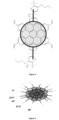


Classifications
-
- C—CHEMISTRY; METALLURGY
- C07—ORGANIC CHEMISTRY
- C07D—HETEROCYCLIC COMPOUNDS
- C07D333/00—Heterocyclic compounds containing five-membered rings having one sulfur atom as the only ring hetero atom
- C07D333/02—Heterocyclic compounds containing five-membered rings having one sulfur atom as the only ring hetero atom not condensed with other rings
- C07D333/04—Heterocyclic compounds containing five-membered rings having one sulfur atom as the only ring hetero atom not condensed with other rings not substituted on the ring sulphur atom
- C07D333/06—Heterocyclic compounds containing five-membered rings having one sulfur atom as the only ring hetero atom not condensed with other rings not substituted on the ring sulphur atom with only hydrogen atoms, hydrocarbon or substituted hydrocarbon radicals, directly attached to the ring carbon atoms
-
- C—CHEMISTRY; METALLURGY
- C08—ORGANIC MACROMOLECULAR COMPOUNDS; THEIR PREPARATION OR CHEMICAL WORKING-UP; COMPOSITIONS BASED THEREON
- C08G—MACROMOLECULAR COMPOUNDS OBTAINED OTHERWISE THAN BY REACTIONS ONLY INVOLVING UNSATURATED CARBON-TO-CARBON BONDS
- C08G61/00—Macromolecular compounds obtained by reactions forming a carbon-to-carbon link in the main chain of the macromolecule
- C08G61/12—Macromolecular compounds containing atoms other than carbon in the main chain of the macromolecule
- C08G61/122—Macromolecular compounds containing atoms other than carbon in the main chain of the macromolecule derived from five- or six-membered heterocyclic compounds, other than imides
- C08G61/123—Macromolecular compounds containing atoms other than carbon in the main chain of the macromolecule derived from five- or six-membered heterocyclic compounds, other than imides derived from five-membered heterocyclic compounds
- C08G61/126—Macromolecular compounds containing atoms other than carbon in the main chain of the macromolecule derived from five- or six-membered heterocyclic compounds, other than imides derived from five-membered heterocyclic compounds with a five-membered ring containing one sulfur atom in the ring
-
- C—CHEMISTRY; METALLURGY
- C08—ORGANIC MACROMOLECULAR COMPOUNDS; THEIR PREPARATION OR CHEMICAL WORKING-UP; COMPOSITIONS BASED THEREON
- C08L—COMPOSITIONS OF MACROMOLECULAR COMPOUNDS
- C08L65/00—Compositions of macromolecular compounds obtained by reactions forming a carbon-to-carbon link in the main chain; Compositions of derivatives of such polymers
-
- H—ELECTRICITY
- H10—SEMICONDUCTOR DEVICES; ELECTRIC SOLID-STATE DEVICES NOT OTHERWISE PROVIDED FOR
- H10K—ORGANIC ELECTRIC SOLID-STATE DEVICES
- H10K30/00—Organic devices sensitive to infrared radiation, light, electromagnetic radiation of shorter wavelength or corpuscular radiation
- H10K30/30—Organic devices sensitive to infrared radiation, light, electromagnetic radiation of shorter wavelength or corpuscular radiation comprising bulk heterojunctions, e.g. interpenetrating networks of donor and acceptor material domains
-
- H—ELECTRICITY
- H10—SEMICONDUCTOR DEVICES; ELECTRIC SOLID-STATE DEVICES NOT OTHERWISE PROVIDED FOR
- H10K—ORGANIC ELECTRIC SOLID-STATE DEVICES
- H10K85/00—Organic materials used in the body or electrodes of devices covered by this subclass
- H10K85/10—Organic polymers or oligomers
- H10K85/111—Organic polymers or oligomers comprising aromatic, heteroaromatic, or aryl chains, e.g. polyaniline, polyphenylene or polyphenylene vinylene
- H10K85/113—Heteroaromatic compounds comprising sulfur or selene, e.g. polythiophene
-
- H—ELECTRICITY
- H10—SEMICONDUCTOR DEVICES; ELECTRIC SOLID-STATE DEVICES NOT OTHERWISE PROVIDED FOR
- H10K—ORGANIC ELECTRIC SOLID-STATE DEVICES
- H10K85/00—Organic materials used in the body or electrodes of devices covered by this subclass
- H10K85/60—Organic compounds having low molecular weight
- H10K85/615—Polycyclic condensed aromatic hydrocarbons, e.g. anthracene
- H10K85/624—Polycyclic condensed aromatic hydrocarbons, e.g. anthracene containing six or more rings
-
- H—ELECTRICITY
- H10—SEMICONDUCTOR DEVICES; ELECTRIC SOLID-STATE DEVICES NOT OTHERWISE PROVIDED FOR
- H10K—ORGANIC ELECTRIC SOLID-STATE DEVICES
- H10K85/00—Organic materials used in the body or electrodes of devices covered by this subclass
- H10K85/60—Organic compounds having low molecular weight
- H10K85/649—Aromatic compounds comprising a hetero atom
- H10K85/655—Aromatic compounds comprising a hetero atom comprising only sulfur as heteroatom
-
- C—CHEMISTRY; METALLURGY
- C08—ORGANIC MACROMOLECULAR COMPOUNDS; THEIR PREPARATION OR CHEMICAL WORKING-UP; COMPOSITIONS BASED THEREON
- C08G—MACROMOLECULAR COMPOUNDS OBTAINED OTHERWISE THAN BY REACTIONS ONLY INVOLVING UNSATURATED CARBON-TO-CARBON BONDS
- C08G2261/00—Macromolecular compounds obtained by reactions forming a carbon-to-carbon link in the main chain of the macromolecule
- C08G2261/10—Definition of the polymer structure
- C08G2261/14—Side-groups
- C08G2261/141—Side-chains having aliphatic units
- C08G2261/1412—Saturated aliphatic units
-
- C—CHEMISTRY; METALLURGY
- C08—ORGANIC MACROMOLECULAR COMPOUNDS; THEIR PREPARATION OR CHEMICAL WORKING-UP; COMPOSITIONS BASED THEREON
- C08G—MACROMOLECULAR COMPOUNDS OBTAINED OTHERWISE THAN BY REACTIONS ONLY INVOLVING UNSATURATED CARBON-TO-CARBON BONDS
- C08G2261/00—Macromolecular compounds obtained by reactions forming a carbon-to-carbon link in the main chain of the macromolecule
- C08G2261/10—Definition of the polymer structure
- C08G2261/14—Side-groups
- C08G2261/142—Side-chains containing oxygen
- C08G2261/1424—Side-chains containing oxygen containing ether groups, including alkoxy
-
- C—CHEMISTRY; METALLURGY
- C08—ORGANIC MACROMOLECULAR COMPOUNDS; THEIR PREPARATION OR CHEMICAL WORKING-UP; COMPOSITIONS BASED THEREON
- C08G—MACROMOLECULAR COMPOUNDS OBTAINED OTHERWISE THAN BY REACTIONS ONLY INVOLVING UNSATURATED CARBON-TO-CARBON BONDS
- C08G2261/00—Macromolecular compounds obtained by reactions forming a carbon-to-carbon link in the main chain of the macromolecule
- C08G2261/30—Monomer units or repeat units incorporating structural elements in the main chain
- C08G2261/32—Monomer units or repeat units incorporating structural elements in the main chain incorporating heteroaromatic structural elements in the main chain
- C08G2261/322—Monomer units or repeat units incorporating structural elements in the main chain incorporating heteroaromatic structural elements in the main chain non-condensed
- C08G2261/3223—Monomer units or repeat units incorporating structural elements in the main chain incorporating heteroaromatic structural elements in the main chain non-condensed containing one or more sulfur atoms as the only heteroatom, e.g. thiophene
-
- C—CHEMISTRY; METALLURGY
- C08—ORGANIC MACROMOLECULAR COMPOUNDS; THEIR PREPARATION OR CHEMICAL WORKING-UP; COMPOSITIONS BASED THEREON
- C08G—MACROMOLECULAR COMPOUNDS OBTAINED OTHERWISE THAN BY REACTIONS ONLY INVOLVING UNSATURATED CARBON-TO-CARBON BONDS
- C08G2261/00—Macromolecular compounds obtained by reactions forming a carbon-to-carbon link in the main chain of the macromolecule
- C08G2261/90—Applications
- C08G2261/91—Photovoltaic applications
-
- H—ELECTRICITY
- H10—SEMICONDUCTOR DEVICES; ELECTRIC SOLID-STATE DEVICES NOT OTHERWISE PROVIDED FOR
- H10K—ORGANIC ELECTRIC SOLID-STATE DEVICES
- H10K30/00—Organic devices sensitive to infrared radiation, light, electromagnetic radiation of shorter wavelength or corpuscular radiation
- H10K30/50—Photovoltaic [PV] devices
-
- Y—GENERAL TAGGING OF NEW TECHNOLOGICAL DEVELOPMENTS; GENERAL TAGGING OF CROSS-SECTIONAL TECHNOLOGIES SPANNING OVER SEVERAL SECTIONS OF THE IPC; TECHNICAL SUBJECTS COVERED BY FORMER USPC CROSS-REFERENCE ART COLLECTIONS [XRACs] AND DIGESTS
- Y02—TECHNOLOGIES OR APPLICATIONS FOR MITIGATION OR ADAPTATION AGAINST CLIMATE CHANGE
- Y02E—REDUCTION OF GREENHOUSE GAS [GHG] EMISSIONS, RELATED TO ENERGY GENERATION, TRANSMISSION OR DISTRIBUTION
- Y02E10/00—Energy generation through renewable energy sources
- Y02E10/50—Photovoltaic [PV] energy
- Y02E10/549—Organic PV cells
Definitions
- the invention relates to a hexabenzocoronene-based compound, to a donor: acceptor layer comprising this compound.
- the invention also relates to processes for manufacturing these compounds and to a photovoltaic cell comprising at least one hexabenzocoronene-based compound of the invention.
- acceptor pairs for organic photovoltaic (OPV) applications is highly important for socio-economic and environmental reasons.
- the search for a better correlation in the electronic properties ranges from minor modifications in the chemical structures of one of the pair components to complete replacement of the donor or acceptor molecule.
- HBC hexabenzocoronene
- the short current circuit J sc of this composite couple is quasi -null so that the efficacy of the OPV devices using this composite couple is also quasi -null.
- the efficacy depends from the product ( V oc x J sc x FF ) divided by the power in, where FF is the fill factor and the V oc is the open circuit Voltage.
- the FF is the product of the maxima of the voltage and current divided by the product of the V oc and the J sc .
- the donor and acceptor are a blend and are not covalently connected, therefore the charge transfer is hindered by this disorganition.
- materials in organic photovoltaic cells should ideally be adapted and optimized for maximum efficiency at each stage of the process of converting solar energy into electricity.
- the invention aims to propose materials for organic photovoltaic applications based on graphene enabling to obtain such a maximum efficiency.
- the invention proposes a hexabenzocoronene-based compound of following formula I:
- R 1 , R 3 , R 4 and R 6 are identical.
- R 2 and R 5 are identical and are a poly(3-oxypentylthiophene) substituent.
- R 1 , R 3 , R 4 and R 6 are identical and are carboxylic groups.
- the invention also proposes a donor: acceptor layer comprising a stack of hexabenzocoronene-based compound according to the invention.
- a device comprising at least one hexabenzocoronene-based compound according to the invention is also proposed by the invention.
- this device is a photovoltaic cell.
- HBCs hexabenzocoronene
- HBC hexabenzocoronene-based compound
- PCBM PCBM
- the columnar structure is obtained by the choice of the position and nature of the substituents R 1 , R 3 , R 4 and R 6 in formula I. Such a choice permits to obtain an optimal close stacking of the different layers of the HBC of the invention.
- R 1 , R 3 , R 4 and R 6 a carboxylic group is particularly preferred because it is easier to graft on the HBC core.
- R 2 and R 5 are occupied with a conductor polymer which is, in the invention, chosen among a poly(3-oxypentylthiophene) (P3OPT) and a poly(3-hexylthiophene) (P3HT) substituent.
- P3OPT poly(3-oxypentylthiophene)
- P3HT poly(3-hexylthiophene)
- R 2 and R 5 are identical.
- R 1 , R 3 , R 4 and R 6 are identical and are a carboxylic group and R 2 and R 5 are also identical and are P3OPT substituents because when different layers of these compounde are formed, they are perfectly stacked.
- the compound of the invention has the structure shown in figure 3 .
- the compound of the invention forms a compact stack while providing a columnar structure as shown on the right on of figure 7 .
- circular hexabenzocoronenes (circ-HBCs) the inventors have found an acceptor compound with electronic properties that match the donor compound, in the present case P3OPT or P3HT or a mixture thereof.
- the substituents used for this chemical functionalization are independently from each other chosen among a carboxylic (-COOH), cyano (-C ⁇ N), isocyano (-N + ⁇ C - ), cyanate (-O-C ⁇ N) and -F atom.
- the substituent R 1 , R 3 , R 4 and R 6 are identical and more preferably, they are a carboxylic group.
- the substituents R 1 , R 3 , R 4 and R 6 modulate the electronic position of the LUMO's acceptor according to the electronic HOMO-LUMO electronic position of the selected donor.
- the HOMO and LUMO energy of the two donor systems (P3HT and P3OPT) with an acceptor according to the invention which is an HBC of formula I in which R 1 , R 3 , R 4 and R 6 are identical and are either an hexyl, CO 2 H, -CO 2 C 4 H 9 and -CO 2 C 6 H 13 are given in following table 1.
- HBC based-compounds are triangular HBCs.
- Table 1 Calculated ⁇ E LUMO and V oc (eV) values of the graphene-based molecules relative to that of P3HT and P3OPT donors.
- acceptor ⁇ E LUMO (eV) vs. donor V oc (eV) vs.
- P3HT P3OPT P3HT P3OPT R H -0.15 -0.38 2.15 1.79 hexyl -0.26 -0.49 2.26 1.90 CO 2 H 0.18 -0.05 1.82 1.46 CO 2 C 4 H 9 -0.03 -0.26 2.03 1.67 CO 2 C 6 H 13 -0.03 -0.26 2.03 1.67 H -0.35 -0.58 2.35 1.99 hexyl -0.45 -0.68 2.45 2.09 CO 2 H 0.55 0.32 1.45 1.09 CO 2 C 4 H 9 0.24 0.01 1.76 1.40 CO 2 C 6 H 13 0.23 0.00 1.75 1.39 PCBM 1.00 0.77 1.00 0.64 Ideal 0.3 1.3 P3HT:PCBM
- the donor systems P3HT and PCBM are compared to the ideal donor and in figure 2 , the donor system comprising a circ-HBC in which the substituents R 1 , R 3 , R 4 and R 6 are identical and are carboxylic groups, are compared to that of the donor system P3HT-OR in which R is also a carboxylic group.
- P3OPT is used as it has already showed a reduced intrinsic bandgap of 1.4 eV, making it possible to attain the theoretically optimised value of 1.5 eV, and is expected to demonstrate high stability and photostability.
- P3OPT gives rise to a greater electronic delocalisation which can favour the transfer of charges between the donor and the acceptor.
- the chosen acceptor i.e. the two-dimensional HBC
- the global delocalisation of electrons over the whole donor:acceptor system favours the transfer of charges.
- the intrinsic ability of the compound of the invention to form ordered stacks - the structure of which depends on the type of HBC substituents - is a useful property in that charge maybe more easily transponed to the electrodes.
- Figure 4 shows the ⁇ -stacking of the functionalized circ-HBC of the invention at the start and figure 5 shows this ⁇ -stacking at the end of.
- the HBC based-compound of the invention was demonstrated to be a suitable model of graphene, its size and structure being well adapted to replace PCBM because of its two-dimensionality.
- its columnar structure (which should resolve the weak efficiency observed by Gupta et al. with Graphene Quantum Dots) channels the electron flux and thus enable charges to diffuse to the electrode through a favorable graphene/electrode interaction.
- Figure 7 schematically shows such a donor: acceptor layer located between the two electrodes.
- a donor: acceptor layer comprising at least one compound of formula I of the invention is also a subject matter of the invention as well as any device comprising at least one compound of formula I of the invention.
- this device is an organic photovoltaic cell.
- a compound of formula I which is particularly preferred in the invention is the compound of the following formula I-1: wherein R 1 , R 3 , R 4 and R 6 are identical and are a carboxylic group (-COOH), and R 2 and R 5 are identical and are chosen among a poly(3-oxypentylthiophene) (P3OPT) substituent and a poly(3-hexylthiophene) (P3HT) substituent.
- P3OPT poly(3-oxypentylthiophene)
- P3HT poly(3-hexylthiophene)
- the invention proposes three methods of synthesis of this compound of formula I-1.
- This first method of synthesis according to the invention comprises the following steps:
- step e1) of introducing the carboxylic groups on the intermediate is carried out after the coupling of the polymer of formula (1) (P3HT) or of the polymer of formula (2) (P3OPT). And this grafting of the carboxylic groups is carried, in step e), by Friedel-Crafts acylation between an acid chloride and the compounds (7) or (8).
- a second process of the invention is a process wherein the introduction of the carboxylic groups is carried out before step e) of introduction of the polymer in the compound.
- the invention proposes a second method of synthesis of the compound of formula I-1 comprising the following steps:
- step f) of cyclodehydrogenation of the compound of formula (7') or of the compound of formula (8') or of the compound of formula (9) of the compound of formula (10), is carried out by reacting these compounds with 2,3-dichloro-5,6-dicyano-1,4-benzoquinone (DDQ).
- DDQ 2,3-dichloro-5,6-dicyano-1,4-benzoquinone
- step f) of cyclodehydrogenation is carried out on the intermediate in which all the substituents R 1 , R 3 , R 4 and R 5 are already grafted.
- the step of cyclodehydrogenation is carried out before introduction of the carboxylic groups and of polymers (1) or (2), i.e. after step c) of formation of the bis-boronic ester intermediate.
- the third method of synthesis of the compound of formula I-1 comprises the following steps:
- the dioxaborolane derivative is 2-isopropoxy-4,4,5,5-tetramethyl-[1,3,2]dioxaborolane.
- step b) is carried out in a microwave-heated apparatus at a temperature comprised between 200 and 256 °C, preferably at 250 °C and a power of between 250 and 350 W, preferably at 300 W during between 60 and 300 minutes and preferably during 150 minutes.
- All the methods of synthesis of the compound of formula I-1, according to the invention, may furthermore comprise a step g) of synthesis of the polymer of formula (1) (P3HT) or of the polymer of formula (2) (P3OPT).
- step g) may be a step of synthesis of the polymer of formula (1) (P3HT) which is carried out by Grignard Metathesis (GRIM) polymerization of 2,5-dibromo-3-hexylthiophene or 2,5-diiodo-3-hexylthiophene or 2-bromo-5-iodo-3-hexylthiophene or 2-iodo -5-bromo-3-hexylthiophene but most preferably 2,5-dibromo-3-hexylthiophene
- GRIM Grignard Metathesis
- step g) may also be a step of synthesis of polymer (2) (P3OPT) by the Grignard Metathesis (GRIM) polymerization of 2,5-dibromo(3-oxypentylthiophene) or 2,5-diiodo-(3-oxypentylthiophene) or 2-bromo-5-iodo-(3-oxypentylthiophene) or 2-iodo-5-bromo-(3-oxypentylthiophene) but most preferably 2,5-dibromo-(3-oxypentylthiophene).
- GRIM Grignard Metathesis
- Example 1 Step g) synthesis of polymer (1) which is poly(3-hexylthiophene) (P3HT).
- the synthesis of polymer 1 is carried out by a Grignard Metathesis (GRIM) polymerization of 2,5-dibromo(3-hexylthiophene) yielding to alpha-bromo-poly(3-hexylthiophene (P3HT) in which n may vary from is between 4 and 80 and preferably between 15 and 40 and ideally between 20 and 30.
- GRIM Grignard Metathesis
- This GRIM polymerization is carried out according to the method described by J. Liu, R. S. Loewe, R. D. McCullough, Macromolecules 1999, 32, 5777 .
- the polymerisation is stirred for 60 min, and terminated by the addition of 2 mL of HCl (5 M).
- the solution is dropped into methanol (100 mL) and filtered into a Soxhlet thimble.
- the purple polymer is Soxhlet washed with methanol, then hexane, and Soxhlet recovered with THF.
- the polymer is then precipitated three times from THF in methanol and recovered over a glass frit.
- Example 2 Synthesis of polymer of formula (2) which is alpha-bromo-poly(3-oxypentylthiophene (P3OPT).
- polymer (2) is a Grignard Metathesis (GRIM) polymerization of 2.5-dibromo(3-oxypentylthiophene) yielding polymer 2 wherein n is comprised between 4 and 80, inclusive, preferably between 6 and 40, inclusive, and more preferably between 6 and 25, inclusive.
- GRIM Grignard Metathesis
- This GRIM polymerization is carried out as disclosed in J. Liu, R. S. Loewe, R. D. McCullough, Macromolecules 1999, 32, 5777 .
- the polymerisation is stirred for 60 min, and terminated by the addition of 2 mL of HCl (5 M).
- the solution is dropped into methanol (100 mL) and filtered into a Soxhlet thimble.
- the purple polymer is Soxhlet washed with methanol, then hexane, and Soxhlet recovered with THF.
- the polymer is then precipitated three times from THF in methanol and recovered over a glass frit.
- Example 3 Synthesis of the hexabenzocoronene-based compound of formula I-1 using the first method of the invention.
- reaction schema used in this example is the following:
- Step a) Reaction of 1,3-bis(4-bromophenyl)-2-propanone (3) and benzil leading to 2,5-bis(4-bromophenyl)-3,4-diphenylcyclopenta-2,4-dienone (4).
- 1,3-bis(4-chlorophenyl)-2-propane or 1,3-bis(4-iodophenyl)-2-propane may also be used as starting compound (3) leading to the corresponding chlorinated or iodinated compound (4).
- Step b) Diels-Alder reaction of 2,5-bis(4-bromophenyl)-3,4-diphenylcyclopenta-2,4-dienone (4) with 1,2-bisphenylacetylene to yield 1,4-di(4-bromophenyl)-2,3,5,6-phenylbenzene (5).
- reaction schema of this step is the following:
- Step c) Formation of the bis-boronic ester compound (6) called 2,2'-(2',3',5',6'-tetraphenyl-[1,1':4',1"-terphenyl]-4,4"-diyl)bis(4,4,5,5-tetramethyl-1,3,2-dioxaborolane).
- reaction schema of this step is the following:
- Step d) Suzuki-Miyaura coupling of compound (6) and polymer 1 or polymer 2 leading to copolymers poly(3-hexylthiophene)- block -hexaphenylbenzene- block -poly(3-hexylthiophene) (7) or poly(3-oxypentylthiophene)- block- hexaphenylbenzene- block -poly(3-oxypentylthiophene) (8).
- reaction mixture is poured into a mixture of methanol (200 mL) and concentrated aqueous HCl solution (30 mL) and stirred overnight.
- the resulting black solid is filtered off and subjected to Soxhlet extraction for 2 days in acetone.
- the residue is redissolved in hot THF and precipitated again in methanol.
- the solid is filtered, washed with
- reaction schema of this step is the following:
- reaction schema of this step is the following:
- Example 4 Synthesis of the target compounds of formula I-1 by the second method of synthesis of the invention.
- This method is used in order to avoid attacks on the polymer chains present in compound (7) or (8) obtained in examples 3 and 4 during step e).
- step e) of the first method of synthesis according to the invention is carried out before step d) of the first method of synthesis of introduction of the polymers in the intermediate compound.
- the final step of cyclodehydrogenation of the first and second methods of synthesis of the invention is carried out before the introduction of the carboxylic groups.
- step noted f) in the first and second method of the invention is carried out, in the third method of the invention, after step d) of the first method of the invention or after e1) of the second method of the invention, and step e) of the first method of the invention and step d1) of the second method of the invention is the final step.
- This step of cyclodehydrogenation is noted e2) in the third method of the invention.
- This step is followed by the step of introduction of the carboxylic groups by Friedel-Crafts acylation noted f1) in the third method of the invention.
- step e2) is carried out as follows,
- Step a) to d) are the same as in the first method of the invention.
- Voc and ⁇ E LUMO values of compounds of examples 3-6 are reported in following table 2, together with the Voc and ⁇ E LUMO of compounds 10b and 10c of Jones et al. and of a non substituted HBC.
- Table 2 Compound V oc (eV) vs. donor ⁇ E LUMO (eV) vs.
- the compounds 10c and 10b exhibit ⁇ E LUMO which is very superior to 0.3 eV, so that they are not candidates for OPV devices and the ⁇ E LUMO of the HBC in which R 1 , R 2 , R 3 , R 4 , R 5 and R 6 is to low.
- the ⁇ E LUMO of the compounds of the invention are close to 0.3 eV.
- Voc Open circuit Voltage
- the Voc (Open circuit Voltage) of the compounds obtained in examples 3-6 and of the compounds 10b and 10c of Jones et al. as well as of the HBC in which all the substituents are H, are determined using the method disclosed in the article of G. E. Morse, A. Tournebize, A. Rivaton, T. Chassé, C. Taviot-Guého, N. Blouin, O. R. Lozman, S. Tierney, Phys. Chem. Chem. Phys. 2015, 17, 11884 .
Landscapes
- Chemical & Material Sciences (AREA)
- Organic Chemistry (AREA)
- Physics & Mathematics (AREA)
- Health & Medical Sciences (AREA)
- Chemical Kinetics & Catalysis (AREA)
- Medicinal Chemistry (AREA)
- Polymers & Plastics (AREA)
- Engineering & Computer Science (AREA)
- Materials Engineering (AREA)
- Spectroscopy & Molecular Physics (AREA)
- Electromagnetism (AREA)
- Polyoxymethylene Polymers And Polymers With Carbon-To-Carbon Bonds (AREA)
- Photovoltaic Devices (AREA)
- Low-Molecular Organic Synthesis Reactions Using Catalysts (AREA)
- Organic Low-Molecular-Weight Compounds And Preparation Thereof (AREA)
- Heterocyclic Carbon Compounds Containing A Hetero Ring Having Oxygen Or Sulfur (AREA)
Description
- The invention relates to a hexabenzocoronene-based compound, to a donor: acceptor layer comprising this compound. The invention also relates to processes for manufacturing these compounds and to a photovoltaic cell comprising at least one hexabenzocoronene-based compound of the invention.
- The search for new donor: acceptor pairs for organic photovoltaic (OPV) applications is highly important for socio-economic and environmental reasons.
- From the point of view of performance and stability, the composite couple of poly(3-hexylthiophene):[6,6]-phenyl-C61-methyl butyrate (P3HT:PCBM) has long been the standard bearer.
- However the poor electronic correlation between the donor (P3HT) and the acceptor (PCBM), combined with numerous morphological instabilities at the heart of the heterojunction are two of the major problems that are tackled through diverse solutions proposed in the literature.
- The search for a better correlation in the electronic properties ranges from minor modifications in the chemical structures of one of the pair components to complete replacement of the donor or acceptor molecule.
- Due to the inherent difficulties of synthesising or grafting groups onto fullerene, the precursor of PCBM, numerous authors have sought to replace it.
- Accordingly, graphene-based materials have rapidly appeared as good acceptor candidates, primarily because of their remarkable semiconducting properties.
- In particular, Jones et al. in "Synthesis of electron-poor-hexa-peri-hexabenzocoronenes", Chem. Commun, 2012, 48, 8066-8068, disclose a series of hexabenzocoronene (HBC) derivatives containing Br, F, CF3 and aryl substituents said to be appropriate acceptors to be substituted to PCBM in the composite couple of P3HT : PCBM.
- However, the short current circuit J sc of this composite couple is quasi-null so that the efficacy of the OPV devices using this composite couple is also quasi-null. The efficacy depends from the product (V oc x J sc x FF ) divided by the power in, where FF is the fill factor and the V oc is the open circuit Voltage. The FF is the product of the maxima of the voltage and current divided by the product of the V oc and the J sc. Furthermore the donor and acceptor are a blend and are not covalently connected, therefore the charge transfer is hindered by this disorganition.
Also, L. Schmidt-Mende et al. in, Science 111, 293, 2001, describe columnar systems in which the donor is an HBC modified by alkyl chains and the acceptor is a alkyl modified perylene and in which all other substituents are H, such an HBC. However, the electronic levels of the HBC moieties have not been modified through careful change of substituent groups to optimize the electronic efficacy nor have the donor and acceptor been covalently linked to provide structural stability and self-organization to optimize charge-collation and transfer to electrodes. - But, materials in organic photovoltaic cells should ideally be adapted and optimized for maximum efficiency at each stage of the process of converting solar energy into electricity.
- In this context, the invention aims to propose materials for organic photovoltaic applications based on graphene enabling to obtain such a maximum efficiency.
- For attaining this aim, the invention proposes a hexabenzocoronene-based compound of following formula I:

- wherein R1, R3, R4 and R6 are independently from each other chosen among a carboxylic (-COOH) group, a cyano (-C ≡ N) group, an isocyano (-N+ ≡ C-) group, a cyanate (-O-C ≡ N) group and a -F atom, and
- R2 and R5 are, independently from each other, chosen among a poly(3-oxypentylthiophene) (P3OPT) substituent and a poly(3-hexylthiophene) (P3HT) substituent.
- Preferably in the hexabenzocoronene-based compound of the invention, R1, R3, R4 and R6 are identical.
- Still preferably in the hexabenzocoronene-based compound of the invention, R2 and R5 are identical and are a poly(3-oxypentylthiophene) substituent.
- Again preferably in the hexabenzocoronene-based compound of the invention, R1, R3, R4 and R6 are identical and are carboxylic groups.
- The invention also proposes a donor: acceptor layer comprising a stack of hexabenzocoronene-based compound according to the invention.
- A device comprising at least one hexabenzocoronene-based compound according to the invention is also proposed by the invention.
- Preferably, this device is a photovoltaic cell.
- The invention will be better understood and other advantages and characteristics thereof will appear more clearly when reading the following description which is made in reference to the figures in which:
-
figure 1 shows the band-structure of the donor: acceptor P3HT:PCBM compared to that of an ideal donor: acceptor pair, -
figure 2 shows the band-structure of a donor: acceptor pair which is a compound of the invention compared to the donor system P3HT-OR in which R is a carboxylic group, -
figure 3 schematically shows the molecule structure of a compound of the invention, -
figure 4 schematically represents the stacking pattern at the start of the stacked molecules of the invention, -
figure 5 schematically represents a top view on the stacked molecules of the invention, -
figure 6 is a curve showing the stacking pattern of the molecules of the invention, -
figure 7 schematically represents a device comprising a stacking of compounds of the invention forming a donor: acceptor layer located between an anode and a cathode. - Based on a comparison between the band-structure of P3HT:PCBM and that of an ideal donor: acceptor pair, schematically represented in
figure 1 , the key parameters to be optimized for obtaining a material adapted and optimized for maximum efficiency of an organic photovoltaic cell at each stage of the process for converting solar energy into electricity are briefly summarized as being: - i) the energy difference between the LUMO of the donor and the LUMO of the acceptor (ΔELUMO), which should be of the order of 0.3 eV to ensure ideal efficiencies during exciton transfer. This value is sufficient to provoke ultra-fast electron transfer from the donor to the acceptor and cannot be reduced due to the possibility of charge transfer reversal.
- ii) the bandgap (Eg) of the donor molecule which should be close to 1.5 eV. For P3HT this value is about 1.9 eV and therefore too high, thus limiting the absorption of light in the infrared range by the polymer.
- iii) the open circuit voltage (Voc) must be adjusted: if it is too high, a large amount of the energy is lost. If it is too low, the resulting OPV would work at an unnecessary low voltage, making the potential energy conversion inefficient.
- The inventors have now discovered that new graphene-based materials, namely hexabenzocoronene (HBCs), meet the requirements of the whole set of parameters that govern the efficiency of the organic photovoltaic (OPV) device from both electronic and oxidative stability points of view.
- More precisely, hexabenzocoronene-based compound (HBC) having the formula I below:

- wherein R1, R3, R4 and R6 are independently from each other chosen among a carboxylic (-COOH) group, a cyano (-C ≡ N) group, an isocyano (-N+ ≡ C-) group, a cyanate (-O-C ≡ N) group and a -F atom, and
- R2 and R5 are, independently from each other, chosen among a poly(3-oxypentylthiophene) (P3OPT) substituent and a poly(3-hexylthiophene) (P3HT) substituent,
- were proven to have the expected electronic properties.
- They are superior to PCBM by way of their two-dimensionality, they avoid micro aggregations resulting in a disruption of the morphology and a rupture of the active layer and the device, they increase exciton pathway lengths and facilitate charge transport.
- This is due to the columnar structure of these compounds which provides a channel for the electron flux and thus enables charges to diffuse to the electrode through a favourable graphene/electrode interaction.
- The columnar structure is obtained by the choice of the position and nature of the substituents R1, R3, R4 and R6 in formula I. Such a choice permits to obtain an optimal close stacking of the different layers of the HBC of the invention.
- This columnar structure is very stable due to the choice of the substituents R1, R3, R4 and R6.
- Furthermore, all these substituents permit to fit the electronic levels of graphene of the HBC core so that these levels are in optimal phase for the electronic transfer from the donor system to the acceptor system.
- Among the substituents which are chosen among a carboxylic group, a cyano group, an isocyano group, a cyanate group and a -F atom, for R1, R3, R4 and R6 a carboxylic group is particularly preferred because it is easier to graft on the HBC core.
- In the compound of the invention, the
positions 2 and 5 are occupied with a conductor polymer which is, in the invention, chosen among a poly(3-oxypentylthiophene) (P3OPT) and a poly(3-hexylthiophene) (P3HT) substituent. Thus R2 and R5 in formula I may be both a P3OPT or a P3HT or one of R2 and R5 is P3OPT and the other is P3HT. - However, preferably R2 and R5 are identical.
- In the preferred compound of the invention of formula I, R1, R3, R4 and R6 are identical and are a carboxylic group and R2 and R5 are also identical and are P3OPT substituents because when different layers of these compounde are formed, they are perfectly stacked.
- The compound of the invention has the structure shown in
figure 3 . - When stacked, the different layers formed of the compound of formula I are stacked as shown in
figure 4 at the beginning of the stacking and as shown infigure 5 at the end of this stacking. - As one can see from
figures 3 and 4 , the compound of the invention forms a compact stack while providing a columnar structure as shown on the right on offigure 7 . - Thus, by appropriate chemical functionalization of circular hexabenzocoronenes (circ-HBCs) the inventors have found an acceptor compound with electronic properties that match the donor compound, in the present case P3OPT or P3HT or a mixture thereof.
- The substituents used for this chemical functionalization, which are to be grafted on
positions - Preferably, the substituent R1, R3, R4 and R6 are identical and more preferably, they are a carboxylic group.
- The substituents R1, R3, R4 and R6 modulate the electronic position of the LUMO's acceptor according to the electronic HOMO-LUMO electronic position of the selected donor.
- Moreover, their steric effect enables to obtain a columnar structure which channel the electron flux and thus enable charges to diffuse to the electrode.
- The HOMO and LUMO energy of the two donor systems (P3HT and P3OPT) with an acceptor according to the invention which is an HBC of formula I in which R1, R3, R4 and R6 are identical and are either an hexyl, CO2H, -CO2C4H9 and -CO2C6H13 are given in following table 1.
- Also, for comparison, the HOMO and LUMO energy of the same donor systems with an acceptor which is also an HBC but not according to the invention are given in following table 1. These HBC based-compounds are triangular HBCs.
Table 1. Calculated ΔELUMO and Voc (eV) values of the graphene-based molecules relative to that of P3HT and P3OPT donors. acceptor: ΔELUMO (eV) vs. donor Voc (eV) vs. donor P3HT P3OPT P3HT P3OPT R= 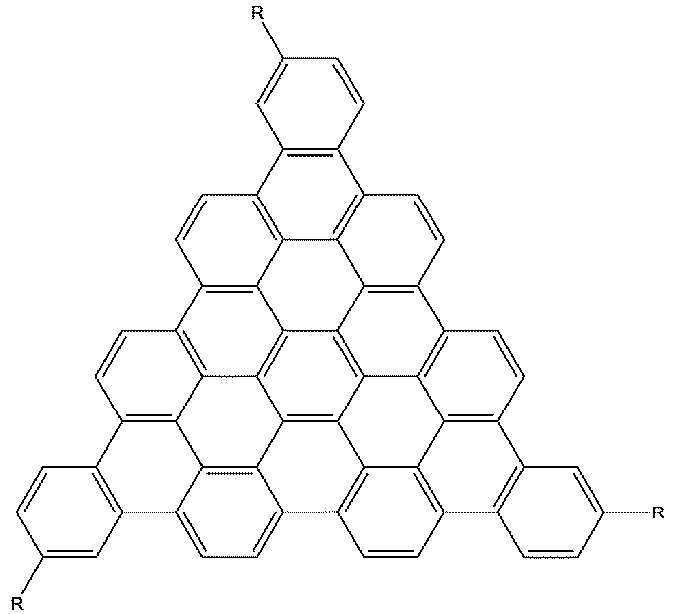
H -0.15 -0.38 2.15 1.79 hexyl -0.26 -0.49 2.26 1.90 CO2H 0.18 -0.05 1.82 1.46 CO2C4H9 -0.03 -0.26 2.03 1.67 CO2C6H13 -0.03 -0.26 2.03 1.67 
H -0.35 -0.58 2.35 1.99 hexyl -0.45 -0.68 2.45 2.09 CO2H 0.55 0.32 1.45 1.09 CO2C4H9 0.24 0.01 1.76 1.40 CO2C6H13 0.23 0.00 1.75 1.39 PCBM 1.00 0.77 1.00 0.64 Ideal 0.3 1.3 P3HT:PCBM - These HOMO and LUMO energy are also given in
figures 1 and 2 . - In
figure 1 , the donor systems P3HT and PCBM are compared to the ideal donor and infigure 2 , the donor system comprising a circ-HBC in which the substituents R1, R3, R4 and R6 are identical and are carboxylic groups, are compared to that of the donor system P3HT-OR in which R is also a carboxylic group. - In this donor system, P3OPT is used as it has already showed a reduced intrinsic bandgap of 1.4 eV, making it possible to attain the theoretically optimised value of 1.5 eV, and is expected to demonstrate high stability and photostability.
- In addition, P3OPT gives rise to a greater electronic delocalisation which can favour the transfer of charges between the donor and the acceptor.
- The chosen acceptor, i.e. the two-dimensional HBC, also shows a greater electronic delocalisation than that of PCBM due to the greater accessibility of the involved π-orbitals. As a consequence, the global delocalisation of electrons over the whole donor:acceptor system favours the transfer of charges.
- The electronic levels of grafted circ-HBC molecules which are compounds of the invention, are in good agreement with both an 'ideal electronic situation' (
Figure 1 ), the experimental attempt and the data reported by Gupta et al. into "Graphene Quantum Dots" J. Am Chem. Soc., 2011, 133, 9960. Interestingly, the theoretical data gathered on HBC systems demonstrate that the shape and functionalization of these molecules lead to a wealth of possibilities to modulate the electronic properties on a wide energy range. Both triangular and circular functionalized HBCs could get close to the ideal configuration (regarding V oc and ΔELUMO ) to match the target donor material P3OPT. However, it is clear that circ-HBC, allows much greater modularity when grafted by electron-withdrawing substituents. The systems constituted of a circ-HBC grafted with a CO2H substituent combined with P3OPT as donor material was calculated to possess a ΔELUMO of 0.32 eV and an open-circuit voltage of 1.09 eV. These two values, jointly to the Density Functional Theory (DFT) calculated HOMO/LUMO orbitals of the single P3OPT-circ-HBC(R=CO2H)- P3OPT of the invention depicted infigure 3 get very close to an ideal OPV system and provide an extremely good test candidate for future studies. - The intrinsic ability of the compound of the invention to form ordered stacks - the structure of which depends on the type of HBC substituents - is a useful property in that charge maybe more easily transponed to the electrodes.
- Additional investigations on the π-stacking properties using ab initio, DFT and molecular dynamics (MD) simulations were carried out. While using graphene-based acceptor molecules for the ab initio and DFT simulations, molecular dynamic simulations were applied to the combined donor:acceptor molecule of the invention (P3OPT-circ-HBC(R=CO2H)-P3OPT, see
figures 4 and5 , to investigate the stability of these π-stacked arrangements of HBC molecules of the invention in solution with an organic solvent. - An evaluation of the geometrical and electronic properties was performed and compared with graphite itself. The inter-HBC equilibrium distances was calculated to be 3.43 and 3.47 Ǻ at ωB97XD/6-31G* and SAPT-DFT [PBE0/cc-pVDZ] levels of calculation respectively. These results compare favourably to the inter-sheet distance of graphite (3.35 Ǻ) and also to the results reported by Mackie et al (J. Phys. Chem. A 2008, 112, 10968 and references therein) using various levels of theory. Further performance enhancements for OPVs are expected to be possible from directly linking donor and acceptor in a single molecule due to improved electron transfer rates. To ensure already at an early stage that the changes to the HBC core does not in principle infringe the π-stacking, the behaviour of functionalized circ-HBC in solution was dynamically-simulated.
-
Figure 4 shows the π-stacking of the functionalized circ-HBC of the invention at the start andfigure 5 shows this π-stacking at the end of. - After equilibrating the system for 1 ns (releasing more and more parts of the systems), a convergence via energy and structural features is obtained.
- For the production run of 2.5 ns, an average distance of 3.45 Ǻ between two circ-HBC molecules of the invention is obtained, which is in very good agreement with experimental (B. Park et al., Synth. Met. 1993, 56, 3258) and theoretical (B. R. Brooks et al., J. Comp. Chem. 2009, 30, 1545, and D. Andrienko et al., J. Chem. Phys. 2006 125, 124902) results for similar systems. The π-stacked structure remains stable throughout the whole simulation time and the stacking of the molecules is illustrated in
figures 4 ,5 and figure 6. Figure 6 provides the distribution function gz, in dependency of the z-coordinate. - The HBC based-compound of the invention was demonstrated to be a suitable model of graphene, its size and structure being well adapted to replace PCBM because of its two-dimensionality. In addition to its electronic properties, its columnar structure (which should resolve the weak efficiency observed by Gupta et al. with Graphene Quantum Dots) channels the electron flux and thus enable charges to diffuse to the electrode through a favorable graphene/electrode interaction. The influence of the substitution by side chains on the energy of the LUMO level of HBC provided exactly what the inventors were hoping to achieve: for a two component system consisting of a circ-HBC grafted with a -CO2H substituent as acceptor and P3OPT as donor, the obtained ΔELUMO = 0.32 and Voc = 1.09 eV, both excellent values to form a highly efficient solar cell.
- Thus, the compound of formula I of the invention has been proved to be quite appropriate for forming the donor: acceptor layer.
-
Figure 7 schematically shows such a donor: acceptor layer located between the two electrodes. - Accordingly, a donor: acceptor layer comprising at least one compound of formula I of the invention is also a subject matter of the invention as well as any device comprising at least one compound of formula I of the invention.
- More particularly, this device is an organic photovoltaic cell.
- A compound of formula I which is particularly preferred in the invention is the compound of the following formula I-1:

- The invention proposes three methods of synthesis of this compound of formula I-1.
- The schema reaction of the first method of synthesis of the invention is as follows:

- This first method of synthesis according to the invention comprises the following steps:
- a) reaction of a compound of following formula (3):

- wherein X is a halogen chosen among Br, Cl and I, preferably among Br and Cl, more preferably X is Br,
- with an equimolar amount of 1,2 phenylethane-1,2 dione (benzil),
- thereby obtaining a compound of following formula (4):

- wherein X is as defined above,
- b) Diels-Alder reaction of the compound of formula (4) obtained in step a) with 1,2-bisphenylacetylene of following formula (4b):

- thereby obtaining a compound of following formula (5):

- wherein X is as defined above,
- thereby obtaining a compound of following formula (5):
- c) reaction of the compound of formula (5) obtained in step b) with a dioxaborolane derivative, thereby obtaining a compound of following formula (6):

- d) Suzuki-Miyaura coupling of the compound of formula (6) obtained in step d) with a polymer of following formula (1) or a polymer of following formula (2):

- wherein n is comprised between 4 and 80 inclusive, preferably between 6 and 40 inclusive, and more preferably between 6 and 25 inclusive.

- wherein n = is between 4 and 80 inclusive, and preferably between 6 and 40 inclusive, more preferably between 6 and 25 inclusive,
- thereby obtaining a compound of following formula (7) when the polymer has the above formula (1):


- wherein n is comprised between 4 and 80 inclusive, preferably between 6 and 40 inclusive, and more preferably between 6 and 25 inclusive
- or a compound of following formula (8) when the polymer has the above formula (2):


- wherein n is comprised between 4 and 80 inclusive, preferably between 6 and 40 inclusive, and more preferably between 6 and 25 inclusive
- wherein n is comprised between 4 and 80 inclusive, preferably between 6 and 40 inclusive, and more preferably between 6 and 25 inclusive.
- e) Friedel-Crafts acylation between methyl carbonochloridate (methyl chloroformate), and the compound of formula (7) or the compound of formula (8) thereby obtaining the hexabenzocoronene-based compound of following formula (9) or (10):


- f) cyclodehydrogenation reaction of the compound of formula (9) or of the compound of formula (10) thereby obtaining the compound of formula I-1.
- In this first method according to the invention, step e1) of introducing the carboxylic groups on the intermediate is carried out after the coupling of the polymer of formula (1) (P3HT) or of the polymer of formula (2) (P3OPT). And this grafting of the carboxylic groups is carried, in step e), by Friedel-Crafts acylation between an acid chloride and the compounds (7) or (8).
- This Friedel-Crafts acylation could provoke attacks on the polymer chains grafted in step d), giving a lower yield.
- In order to avoid such attacks on the polymer chain, a second process of the invention is a process wherein the introduction of the carboxylic groups is carried out before step e) of introduction of the polymer in the compound.
- Thus, the invention proposes a second method of synthesis of the compound of formula I-1 comprising the following steps:
- a) reaction of a compound of following formula (3):

- wherein X is a halogen chosen among Br, Cl and I, preferably among Br and Cl, more preferably X is Br, with an equimolar amount of 1,2 phenylethan-1,2 dione (benzil),
- thereby obtaining a compound of following formula (4):

- wherein X is as defined above,
- b) Diels-Alder reaction of the compound of formula (4) obtained in step a) with 1,2-bisphenylacetylene of following formula (4b):

- thereby obtaining a compound of following formula (5):

- wherein X is as defined above,
- thereby obtaining a compound of following formula (5):
- c) reaction of the compound of formula (5) obtained in step b) with a dioxaborolane derivative, thereby obtaining a compound of following formula (6):

- d1) Friedel-Crafts acylation between methyl carbonochloridate, and the compound of formula (6) obtained in step c), thereby obtaining a compound of following formula (6'):

- e1) Suzuki-Miyaura coupling of the compound of formula (6') obtained in step d1) with a polymer of following formula (1) or of a polymer of following formula (2):

- wherein n is comprised between 4 and 80 inclusive, preferably between 6 and 40 inclusive, and more preferably between 6 and 25 inclusive

- wherein n is comprised between 4 and 80 inclusive, preferably between 6 and 40 inclusive, and more preferably between 6 and 25 inclusive
- thereby obtaining a compound of following formula (7') when the polymer has the above formula (1):

- wherein n is comprised between 4 and 80 inclusive, preferably between 6 and 40 inclusive, and more preferably between 6 and 25 inclusive
- or a compound of following formula (8') when the polymer has the above formula (2):
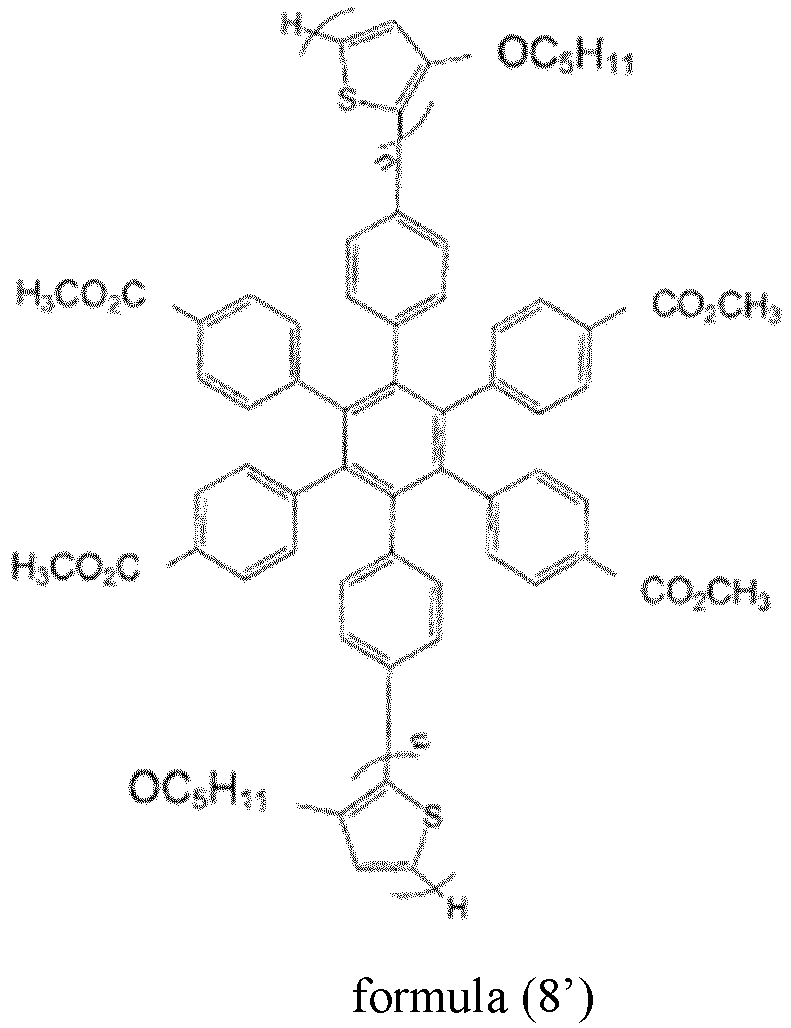
- wherein n is comprised between 4 and 80 inclusive, preferably between 6 and 40 inclusive, and more preferably between 6 and 25 inclusive.
- wherein n is comprised between 4 and 80 inclusive, preferably between 6 and 40 inclusive, and more preferably between 6 and 25 inclusive
- f) cyclodehydrogenation reaction of the compound of formula (7') or of the compound of formula (8'), thereby obtaining the compound of formula I-1.
- Preferably, in the first and second methods of the invention, step f) of cyclodehydrogenation of the compound of formula (7') or of the compound of formula (8') or of the compound of formula (9) of the compound of formula (10), is carried out by reacting these compounds with 2,3-dichloro-5,6-dicyano-1,4-benzoquinone (DDQ).
- But step f) may also be a step of reaction of the compound of formula (7') or the compound of formula (8') or of the compound of formula (9) or of the compound of formula (10) with FeCl3, dissolved in CH3NO2.
- In the first and second methods of synthesis of the invention, step f) of cyclodehydrogenation is carried out on the intermediate in which all the substituents R1, R3, R4 and R5 are already grafted.
- The presence of these substituents may render the final cyclodehydrogenation less effective, so that a lower yield is obtained.
- It is why the invention also proposes a third method of synthesis of the compound of formula I-1.
- In this third method, the step of cyclodehydrogenation is carried out before introduction of the carboxylic groups and of polymers (1) or (2), i.e. after step c) of formation of the bis-boronic ester intermediate.
- Accordingly, the third method of synthesis of the compound of formula I-1, according to the invention, comprises the following steps:
- a) reaction of a compound of following formula (3):

- wherein X is a halogen chosen among Br, Cl and I, preferably among Br and Cl, more preferably X is Br, with an equimolar amount of 1,2 phenylethane-1,2 dione (benzil),
- thereby obtaining a compound of following formula (4):

- wherein X is as defined above,
- b) Diels-Alder reaction of the compound of formula (4) obtained in step a) with 1,2-bisphenylacetylene of following formula (4b):

- thereby obtaining a compound of following formula (5):

- wherein X is as defined above,
- thereby obtaining a compound of following formula (5):
- c) reaction of the compound of formula (5) obtained in step b) with a dioxaborolane derivative, thereby obtaining a compound of following formula (6):

- d) Suzuki-Miyaura coupling of the compound of formula (6) obtained in step d) with a polymer of following formula (1) or a polymer of following formula (2):

- wherein n is comprised between 4 and 80 inclusive, preferably between 6 and 40 inclusive, and more preferably between 6 and 15 inclusive

- wherein n is comprised between 4 and 80 inclusive, preferably between 6 and 40 inclusive, and more preferably between 6 and 25 inclusive,
- thereby obtaining a compound of following formula (7) when the polymer has the above formula (1):

- wherein n is comprised between 4 and 80 inclusive, preferably between 6 and 40 inclusive, and more preferably between 6 and 25 inclusive,
- or a compound of following formula (8) when the polymer has the above formula (2):

- wherein n is comprised between 4 and 80 inclusive, preferably between 6 and 40 inclusive, and more preferably between 6 and 25 inclusive
- wherein n is comprised between 4 and 80 inclusive, preferably between 6 and 40 inclusive, and more preferably between 6 and 15 inclusive
- e2) cyclodehydrogenation of the compound of formula (7) or of the compound of formula (8) by reacting this compound with 2,3-dichloro-5,6-dicyano-1,4-benzoquinone (DDQ) or with FeCl3 in CH3NO2, thereby obtaining the compound of following formula (13) when the polymer has the above formula (1):

- wherein n is comprised between 4 and 80 inclusive, preferably between 6 and 40 inclusive, and more preferably between 6 and 25 inclusive
- or a compound of following formula (14) when the polymer has the above formula (2):


- wherein n is comprised between 4 and 80 inclusive, preferably between 6 and 40 inclusive, and more preferably between 6 and 25 inclusive
- f1) Friedel-Crafts acylation between methyl carbonochloridate, and the compound of formula (13) or the compound of formula (14), thereby obtaining the compound of formula I-1.
- In all the methods of synthesis of the compound of formula I-1, according to the invention, preferably, in step c), the dioxaborolane derivative is 2-isopropoxy-4,4,5,5-tetramethyl-[1,3,2]dioxaborolane.
- Also preferably, in all the method of synthesis of the compound of formula I-1, according to the invention, step b) is carried out in a microwave-heated apparatus at a temperature comprised between 200 and 256 °C, preferably at 250 °C and a power of between 250 and 350 W, preferably at 300 W during between 60 and 300 minutes and preferably during 150 minutes.
- All the methods of synthesis of the compound of formula I-1, according to the invention, may furthermore comprise a step g) of synthesis of the polymer of formula (1) (P3HT) or of the polymer of formula (2) (P3OPT).
- Otherwise stated, step g) may be a step of synthesis of the polymer of formula (1) (P3HT) which is carried out by Grignard Metathesis (GRIM) polymerization of 2,5-dibromo-3-hexylthiophene or 2,5-diiodo-3-hexylthiophene or 2-bromo-5-iodo-3-hexylthiophene or 2-iodo -5-bromo-3-hexylthiophene but most preferably 2,5-dibromo-3-hexylthiophene
- But, step g) may also be a step of synthesis of polymer (2) (P3OPT) by the Grignard Metathesis (GRIM) polymerization of 2,5-dibromo(3-oxypentylthiophene) or 2,5-diiodo-(3-oxypentylthiophene) or 2-bromo-5-iodo-(3-oxypentylthiophene) or 2-iodo-5-bromo-(3-oxypentylthiophene) but most preferably 2,5-dibromo-(3-oxypentylthiophene).
- In order to give a better understanding of the method of the invention, examples of synthesis of the compound of formula I-1 are given below.
- This reaction is carried out according to the following reaction schema:

- The synthesis of
polymer 1 is carried out by a Grignard Metathesis (GRIM) polymerization of 2,5-dibromo(3-hexylthiophene) yielding to alpha-bromo-poly(3-hexylthiophene (P3HT) in which n may vary from is between 4 and 80 and preferably between 15 and 40 and ideally between 20 and 30. This GRIM polymerization is carried out according to the method described by J. Liu, R. S. Loewe, R. D. McCullough, Macromolecules 1999, 32, 5777. - Into a 100 mL flask equipped with a stirring bar is stirred for 2 h at 25 °C a mixture of 2,5-dibromo-3-hexylthiophene (0.6 mL, 0.40 g, 1.2 x 10⁻³ mol), freshly distilled THF (2.4 mL) and isopropyl magnesium chloride (2 M in THF, 0.6 mL, 1.2 x 10⁻³ mol). The solution is diluted with THF (8 mL) prior to the one-shot addition of 1,3-bis(diphenylphosphino)propane nickel(II) chloride [Ni(dppp)Cl2] (6 x 10⁻⁵ mol). The polymerisation is stirred for 60 min, and terminated by the addition of 2 mL of HCl (5 M). The solution is dropped into methanol (100 mL) and filtered into a Soxhlet thimble. The purple polymer is Soxhlet washed with methanol, then hexane, and Soxhlet recovered with THF. The polymer is then precipitated three times from THF in methanol and recovered over a glass frit.
- This synthesis is carried out according to the following reaction schema:

- The synthesis of polymer (2) is a Grignard Metathesis (GRIM) polymerization of 2.5-dibromo(3-oxypentylthiophene) yielding
polymer 2 wherein n is comprised between 4 and 80, inclusive, preferably between 6 and 40, inclusive, and more preferably between 6 and 25, inclusive. - This GRIM polymerization is carried out as disclosed in J. Liu, R. S. Loewe, R. D. McCullough, Macromolecules 1999, 32, 5777.
- Into a 100 mL flask equipped with a stirring bar is stirred for 2 h at 25 °C a mixture of 2,5-dibromo-3-oxypentylthiophene (1.2 x 10⁻³ mol), freshly distilled THF (2.4 mL) and isopropyl magnesium chloride (2 M in THF, 0.6 mL, 1.2 x 10⁻³ mol). The solution is diluted with THF (8 mL) prior to the one-shot addition of 1,3-bis(diphenylphosphino)propane nickel(II) chloride [Ni(dppp)Cl2] (6 x 10⁻⁵ mol). The polymerisation is stirred for 60 min, and terminated by the addition of 2 mL of HCl (5 M). The solution is dropped into methanol (100 mL) and filtered into a Soxhlet thimble. The purple polymer is Soxhlet washed with methanol, then hexane, and Soxhlet recovered with THF. The polymer is then precipitated three times from THF in methanol and recovered over a glass frit.
- The reaction schema used in this example is the following:

-
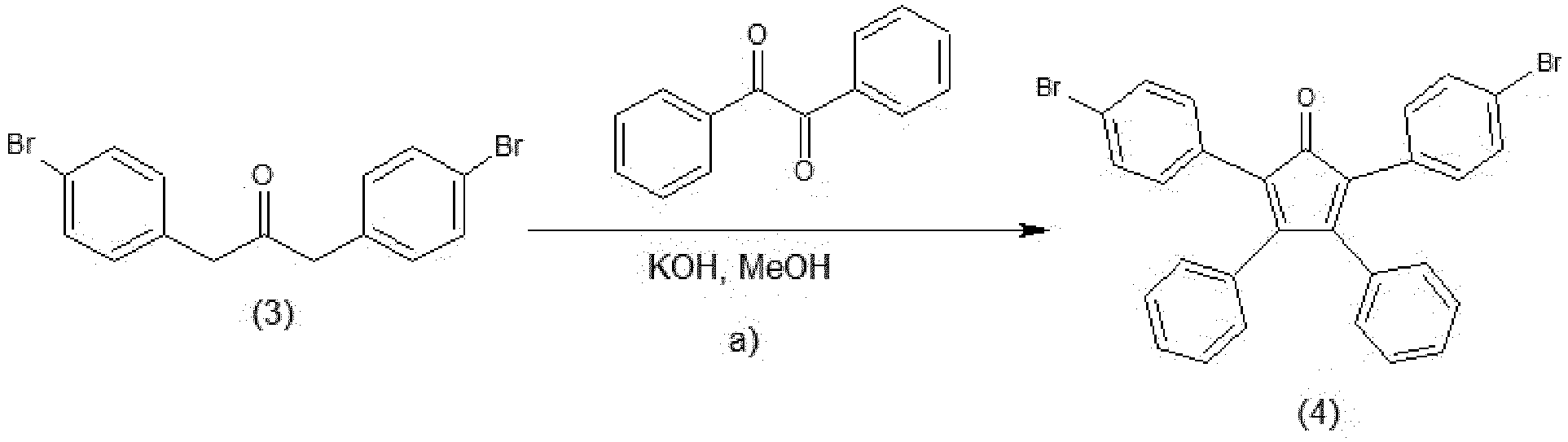
- This reaction is carried out according to method disclosed in C. M. Thompson, G. T. McCandless, S. N. Wijenayake, O. Alfarawati, M. Jahangiri, A. Kokash, Z. Tran, R. A. Smaldone, Macromolecules 2014, 47, 8645-8652.
- To a 50 cm3 round-bottom flask containing 1,3-bis(4-bromophenyl)-2-propanone (3, 300 mg, 0.815 mmol) and benzil (0.815 mmol) in dichloromethane (1.5 mL) is added potassium hydroxide (22.8 mg, 0.407 mmol) as a solution in methanol (3 mL). The reaction is heated to reflux under nitrogen for 90 min before being cooled in an ice bath. The mixture is introduced into 50 mL of ice cold methanol and the resulting solid 2,5-bis(4-bromophenyl)-3,4-diphenylcyclopenta-2,4-dienone (4) is filtered to provide a dark purple solid (404 mg, 91% yield). 1H NMR (400.6 MHz, CDCl3, ppm): δ 6.93 (d, 4H, J = 7.6 Hz), 7.13 (d, 4H, J = 8.8 Hz), 7.22 (t, 4H, J = 7.2 Hz), 7.30 (t, 2H, J = 7.6 Hz), 7.39 (d, 4H, J = 8.8 Hz). 13C NMR (100.16 MHz, CDCl3, ppm): δ 122.00 (s, aromatic), 124.38 (s, aromatic), 128.23 (s, aromatic), 128.89 (s, aromatic), 129.16 (s, aromatic), 129.51 (s, aromatic), 131.34 (s, aromatic), 131.64 (s, aromatic), 132.59 (s, aromatic), 155.02 (s, aromatic-Br), 199.52 (s, aromatic=O).
- In this step a), 1,3-bis(4-chlorophenyl)-2-propane or 1,3-bis(4-iodophenyl)-2-propane may also be used as starting compound (3) leading to the corresponding chlorinated or iodinated compound (4).
- The reaction schema of this step is the following:

- This reaction is carried out according to the method disclosed in A. Fechtenkötter, N. Tchebotareva, M. Watson, K. Müllen Tetrahedron, 2001, 57(17), 3769-3783.
- To a microwave vial containing 4 (372 mg, 0.686 mmol) in diphenyl ether (2 mL) is added 1,2-bisphenylacetylene (122.3 mg, 0.686 mmol). This is microwave-heated (250 °C and 300 W) for 150 min. The vial is cooled with a positive pressure of air, and the resulting purple slurry is filtered and washed with 10 mL of diphenyl ether. Dichloromethane is used to dissolve and recover all the products present on the paper filter and the solvent is evaporated. Methanol is added to remove diphenyl ether and the solution is filtered to yield 1,4-di(4-bromophenyl)-2,3,5,6-phenylbenzene (5) as white crystals (327 mg, 69% yield). 1H NMR (400.6 MHz, CDCl3, ppm): δ 6.70 (d, 4H, J = 8.4 Hz), 6.81 (d, 8H, J = 7.2 Hz), 6.90 (t, 8H, J = 2.4 Hz), 6.91 (t, 4H, J = 4 Hz), 7.00 (d, 4H, J = 8.4 Hz). 13C NMR (100.16 MHz, CDCl3, ppm): δ 119.53 (s, aromatic-Br), 125.54 (s, aromatic), 126.86 (s, aromatic), 129.82 (s, aromatic), 131.25 (s, aromatic), 132.93 (s, aromatic), 139.34 (s, aromatic), 139.53 (s, aromatic), 140.07 (s, aromatic), 140.40 (s, aromatic). Compound (5) is also known as 4-bromo-4'-(4-bromophenyl)-3',5',6'-triphenyl-1,1':2',1"-terphenyl.
- The reaction schema of this step is the following:

- This reaction is carried out according to the method disclosed in X. Yang, X. Dou, A. Rouhanipour, L. Zhi, H. J. Räder, K. Müllen, J. Am. Chem. Soc., 2008, 130, 4216-4217.
- To a solution of compound 5 (0.14 mmol) in dry THF (2.4 mL) under nitrogen at -78 °C, n-BuLi (2.5 M/n-hexane, 0.36 mmol) is added and the resulting solution is stirred at -78 °C for 30 minutes and then left to warm to 0 °C and held there for 15 minutes. Then the solution is cooled to -78 °C and 2-isopropoxy-4,4,5,5-tetramethyl-[1,3,2]dioxaborolane (0.42 mmol) is added and the reaction is stirred at -78 °C for 15 minutes and then the cooling bath is removed so that the solution warms to room temperature while stirring for 90 minutes. The reaction is quenched with water (5 mL) and the resulting mixture is extracted with dichloromethane. The combined organic layers are washed with brine, dried with MgSO4 and concentrated under reduced pressure. The residue is purified by passing through a column (silica gel, aluminium oxide, dichloromethane) to give compound 6 as a white solid, yield = 5 %).
- The reaction schema of this Suzuki-Miyaura coupling is the following:

- This reaction is carried out according to the method disclosed in X. Yang, X. Dou, A. Rouhanipour, L. Zhi, H.J. Räder, K. Müllen, J. Am. Chem. Soc., 2008, 130, 4216-4217.
- The method disclosed in this document has been changed by way of adding a polymer in place of small molecules.
- A mixture of
compound 1 or 2 (0.074 mmol), compound 6 (0.074 mmol), K2CO3 (2 M/H2O, 2 mL, 4 mmol) and Aliquat® 336 (0.6 mg, 0.0015 mmol) in toluene (5 mL) is degassed three times via 'freeze-pump-thaw' cycles. Pd(PPh3)4 (0.004 mmol) is added quickly and the reaction mixture degassed three times again via 'freeze-pump-thaw' cycles. The reaction is refluxed under argon for 3 days. Then, a degassed solution of 1 or 2 (0.074 mmol) in toluene (1 mL) is added into the reaction mixture via a syringe. - The reaction mixture is poured into a mixture of methanol (200 mL) and concentrated aqueous HCl solution (30 mL) and stirred overnight. The resulting black solid is filtered off and subjected to Soxhlet extraction for 2 days in acetone. The residue is redissolved in hot THF and precipitated again in methanol. The solid is filtered, washed with
- The reaction schema of this step is the following:

- Into a nitrogen flushed vessel containing 7 or 8 (1.44 mmol) in dichloromethane (10 mL) is added CH3OCOCl (28.8 mmol) followed by a solution of FeCl3 (1.6 mmol) in dichloromethane (10 mL). The solution is stirred under reflux for 2 h. After that time the reaction is filtered, and the resulting solid is dissolved in dichloromethane (30 mL) and precipitated in methanol (300 mL), and reprecipitated in the same manner, and dried under reduced pressure to the final product.
- The reaction schema of this step is the following:

- This reaction is based on the method disclosed in L. Zhai, R. Shukla, R. Rathore, Org. Lett. 2009, 11, 3474-3477.
- A solution of 9 or 10 in dichloromethane (10 mL) containing protic acid (10% v/v) or Lewis acid (~10 equiv.) at ~0 °C is treated with DDQ (1 equivalent per C-C bond formation), and the solution immediately took on a dark- green coloration. The progress of the reaction is monitored by TLC and 1H NMR spectroscopy. After completion of the reaction, it was quenched with a saturated aqueous solution of NaHCO3 (20 mL). The dichloromethane layer was separated and washed with water and brine solution and dried over anhydrous MgSO4 and filtered. Removal of the solvent in vacuo afforded the crude product.
- This method is used in order to avoid attacks on the polymer chains present in compound (7) or (8) obtained in examples 3 and 4 during step e).
- As already stated, in order to avoid such attacks, the introduction of the carboxylic groups (step e) of the first method of synthesis according to the invention) is carried out before step d) of the first method of synthesis of introduction of the polymers in the intermediate compound.
- Into a nitrogen flushed vessel containing 6 (1.44 mmol) in dichloromethane (10 mL) is added CH3OCOCl (28.8 mmol) followed by a solution of FeCl3 (1.6 mmol) in dichloromethane (10 mL). The solution is stirred under reflux for 2 h. After that time the reaction is filtered, and the resulting solid is dissolved in dichloromethane (30 mL) and precipitated in methanol (300 mL), and reprecipitated in the same manner, and dried under reduced pressure to the final product.
- Then, the step of introduction of the polymer in the intermediate compound thus obtained is carried out and the other steps are the same as in the first method of the invention.
- In this example, the final step of cyclodehydrogenation of the first and second methods of synthesis of the invention is carried out before the introduction of the carboxylic groups.
- Thus, step noted f) in the first and second method of the invention is carried out, in the third method of the invention, after step d) of the first method of the invention or after e1) of the second method of the invention, and step e) of the first method of the invention and step d1) of the second method of the invention is the final step.
- This step of cyclodehydrogenation is noted e2) in the third method of the invention. This step is followed by the step of introduction of the carboxylic groups by Friedel-Crafts acylation noted f1) in the third method of the invention.
- A 250 mL two necked round bottom flask is charged with 0.36 mmol of 7 or 8 with 100 mL of CH2Cl2. The solution is flushed with argon. FeCl3 (6.9 mmol) dissolved in CH3NO2 (13 mL) is added dropwise. After 30 min, the mixture is quenched with a large excess of methanol and the precipitate is filtered. The resulting yellow solid is redissolved in dichloromethane and filtered through a short pad of silica gel and dried under vacuum.
- Step a) to d) are the same as in the first method of the invention.
- The Voc (Open circuit Voltage) and ΔELUMO of the compounds obtained in examples 3-6 have been determined.
- These Voc and ΔELUMO values of compounds of examples 3-6 are reported in following table 2, together with the Voc and ΔELUMO of compounds 10b and 10c of Jones et al. and of a non substituted HBC.
Table 2 Compound Voc (eV) vs. donor ΔELUMO(eV) vs. donor P3HT P3OPT P3HT P3OPT Example 3 1.15 0.79 0.55 0.32 Example 4 1.15 0.79 0.55 0.32 Example 5 1.15 0.79 0.55 0.32 Example 6 1.15 0.79 0.55 0.32 Compound 10c of Jones et al » 0.3 » 0.3 Compound 10b of Jones et al » 0.3 » 0.3 HBC in which R1, R2, R3, R4, R5 and R6 are H 2.35 1.99 - 0.35 -0.58 - As can be seen from table 2, the compounds 10c and 10b exhibit ΔELUMO which is very superior to 0.3 eV, so that they are not candidates for OPV devices and the ΔELUMO of the HBC in which R1, R2, R3, R4, R5 and R6 is to low. In contrast, the ΔELUMO of the compounds of the invention are close to 0.3 eV.
- These results clearly demonstrate that the compounds of the invention which have a columnar structure are the best adapted for obtaining an ideal Voc, due to the particular choice of the R1, R3, R4 and R6 substituents and that this particular choice associated with the particular choice of the R2 and R5 substituents permits an ideal and simultaneous transfer of charges between the donor and the acceptor in an OPV device.
- The Voc (Open circuit Voltage) of the compounds obtained in examples 3-6 and of the compounds 10b and 10c of Jones et al. as well as of the HBC in which all the substituents are H, are determined using the method disclosed in the article of G. E. Morse, A. Tournebize, A. Rivaton, T. Chassé, C. Taviot-Guého, N. Blouin, O. R. Lozman, S. Tierney, Phys. Chem. Chem. Phys. 2015, 17, 11884.
Claims (15)
- A Hexabenzocoronene-based compound of following formula I:
 wherein R1, R3, R4 and R6 are independently from each other chosen among a carboxylic (-COOH) group, a cyano (-C ≡ N) group, an isocyano (-N+ ≡ C-) group, a cyanate (-O-C ≡ N) group and a -F atom, preferably R1, R3, R4 and R6 are identical, and more preferably R1, R3, R4 and R6 are identical and are carboxylic groups;R2 and R5 are, independently from each other, chosen among a poly(3-oxypentylthiophene) (P3OPT) substituent and a poly(3-hexylthiophene) (P3HT) substituent, preferably R2 and R5 are identical and more preferably R2 and R5 are identical and are both a poly(3-oxypentylthiophene) substituent.
 - The hexabenzocoronene-based compound according to claim 1 having the following formula I-1:

- A method of synthesis of a hexabenzocoronene-based compound according to claim 2 of following formula I-1:
 wherein R1, R3, R4 and R6 are identical and are a carboxylic group (-COOH), and R2 and R5 are identical and are chosen among a poly(3-oxypentylthiophene) (P3OPT) substituent and a poly(3-hexylthiophene) (P3HT),the method comprising the following steps:a) reaction of a compound of following formula (3):
 wherein X is a halogen chosen among Br, Cl and I, preferably among Br and Cl, more preferably X is Br, with an equimolar amount of 1,2 phenylethan-1,2 dione (benzil),thereby obtaining a compound of following formula (4):
 wherein X is as defined above,b) Diels-Alder reaction of the compound of formula (4) obtained in step a) with 1,2-bisphenylacetylene of following formula (4b):
 thereby obtaining a compound of following formula (5):
 wherein X is as defined above,c) reaction of the compound of formula (5) obtained in step b) with a dioxaborolane derivative, thereby obtaining a compound of following formula (6):
 d) Suzuki-Miyaura coupling of the compound of formula (6) obtained in step c) with a polymer of following formula (1) or a polymer of following formula (2):
 wherein n is comprised between 4 and 80, inclusive, preferably between 6 and 40, inclusive, and more preferably between 6 and 25, inclusive
 wherein n is comprised between 4 and 80, inclusive, preferably between 6 and 40, inclusive, and more preferably between 6 and 25, inclusivethereby obtaining a compound of following formula (7) when the polymer has the above formula (1):
 wherein n is comprised between 4 and 80 inclusive, preferably between 6 and 40 inclusive, and more preferably between 6 and 25 inclusiveor a compound of following formula (8) when the polymer has the above formula (2):
 wherein n is comprised between 4 and 80 inclusive, preferably between 6 and 40 inclusive, and more preferably between 6 and 25 inclusivee) Friedel-Crafts acylation between methyl carbonochloridate, and the compound of formula (7) or the compound of formula (8), thereby obtaining the hexabenzocoronene-based compound of following formula (9) or (10):
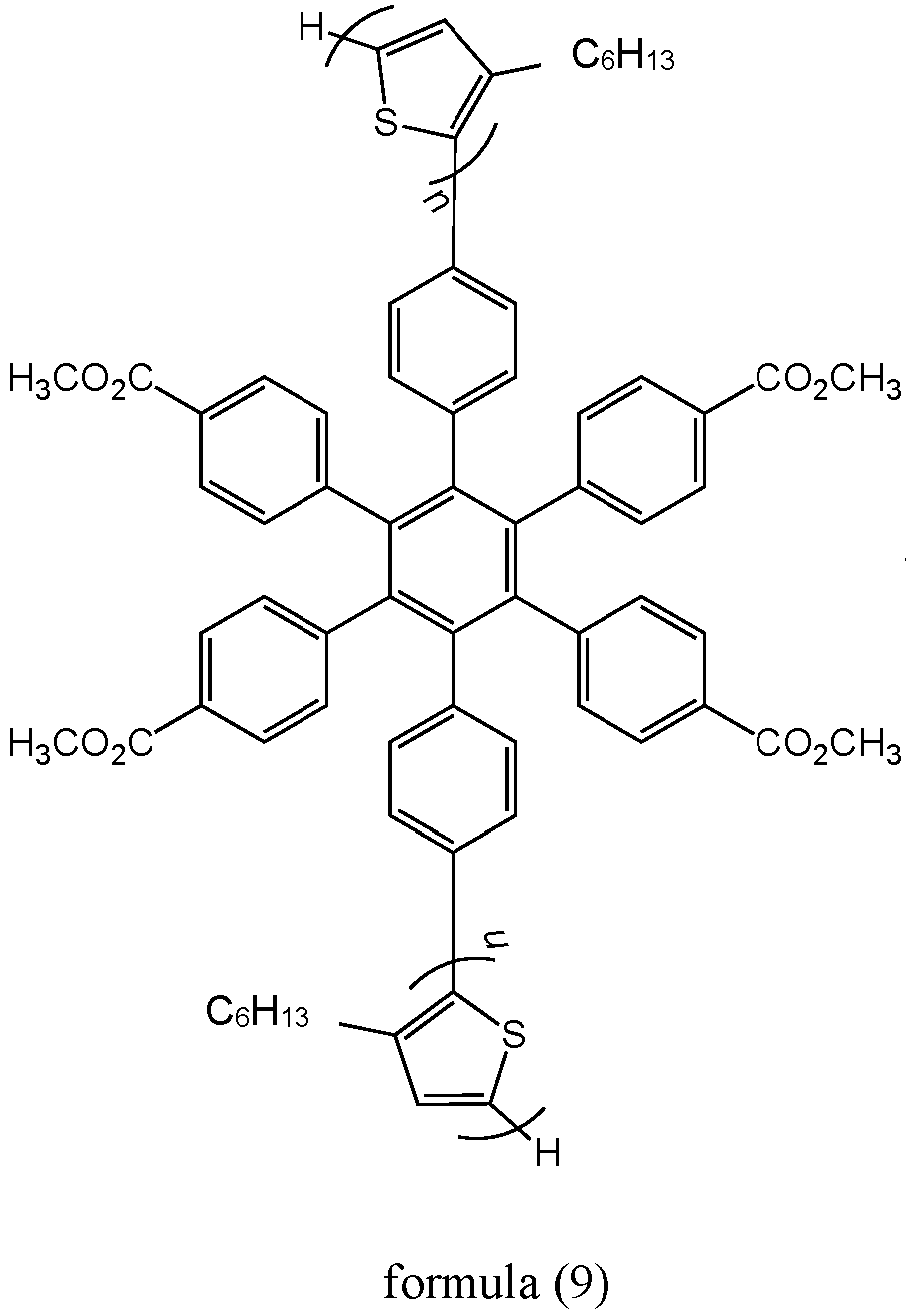 wherein n is comprised between 4 and 80 inclusive, preferably between 6 and 40 inclusive, and more preferably between 6 and 25 inclusive
 wherein n is comprised between 4 and 80 inclusive, preferably between 6 and 40 inclusive, and more preferably between 6 and 25 inclusivef) cyclodehydrogenation reaction of the compound of formula (9) or of the compound of formula (10),
thereby obtaining the compound of formula I-1. - A method of synthesis of a hexabenzocoronene-based compound according to claim 2 of following formula I-1:
 wherein R1, R3, R4 and R6 are identical and are a carboxylic group (-COOH), and R2 and R5 are identical and are chosen among a poly(3-oxypentylthiophene) (P3OPT) substituent and a poly(3-hexylthiophene) (P3HT),the method comprising the following steps:a) reaction of a compound of following formula (3):
 wherein X is a halogen chosen among Br, Cl and I, preferably among Br and Cl, more preferably X is Br, with an equimolar amount of 1,2 phenylethan-1,2 dione (benzil),thereby obtaining a compound of following formula (4):
 wherein X is as defined above,b) Diels-Alder reaction of the compound of formula (4) obtained in step a) with 1,2-bisphenylacetylene of following formula (4b):
 thereby obtaining a compound of following formula (5):
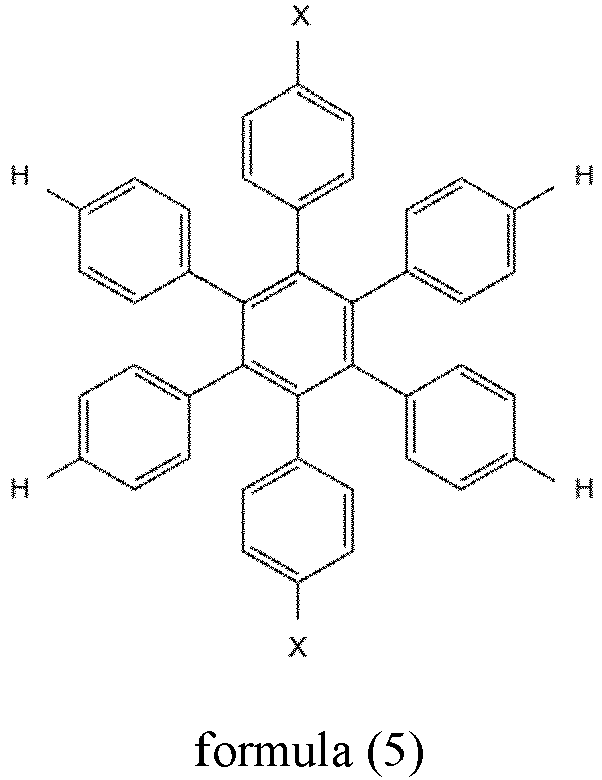 wherein X is as defined above,c) reaction of the compound of formula (5) obtained in step b) with a dioxaborolane derivative, thereby obtaining a compound of following formula (6):
 d1) Friedel-Crafts acylation between methyl carbonochloridate, and the compound of formula (6) obtained in step c), thereby obtaining a compound of following formula (6'):
 e1) Suzuki-Miyaura coupling of the compound of formula (6') obtained in step d1) with a polymer of following formula (1) or of a polymer of following formula (2):
 wherein n is comprised between 4 and 80 inclusive, preferably between 6 and 40 inclusive, and more preferably between 6 and 25 inclusive
 wherein n is comprised between 4 and 80 inclusive, preferably between 6 and 40 inclusive, and more preferably between 6 and 25 inclusivethereby obtaining a compound of following formula (7') when the polymer has the above formula (1):
 wherein n is comprised between 4 and 80 inclusive, preferably between 6 and 40 inclusive, and more preferably between 6 and 25 inclusiveor a compound of following formula (8') when the polymer has the above formula (2):
 wherein n is comprised between 4 and 80 inclusive, preferably between 6 and 40 inclusive, and more preferably between 6 and 25 inclusivef) cyclodehydrogenation reaction of the compound of formula (7') or of the compound of formula (8'),
thereby obtaining the compound of formula I-1. - The method according to claim 3 or 4, wherein step f) of cyclodehydrogenation of the compound of formula (9) or of the compound of formula (10) or of the compound of formula (7') or of the compound of formula (8') is carried out by reacting this compound with 2,3-dichloro-5,6-dicyano-1,4-benzoquinone (DDQ).
- The method according to claim 3 or 4, wherein step f) is a step of reaction of the compound of formula (9) or the compound of formula (10) or the compound of formula (7') or the compound of formula (8') with FeCl3, dissolved in CH3NO2.
- A method of synthesis of a hexabenzocoronene-based compound according to claim 2 of following formula I-1:
 wherein R1, R3, R4 and R6 are identical and are a carboxylic group (-COOH), and R1 and R2 are identical and are chosen among a poly(3-oxypentylthiophene) (P3OPT) substituent and a poly(3-hexylthiophene) (P3HT),the method comprising the following steps:a) reaction of a compound of following formula (3):
 wherein X is a halogen chosen among Br, Cl and I, preferably among Br and Cl, more preferably X is Br, with an equimolar amount of 1,2 phenylethan-1,2 dione (benzil),thereby obtaining a compound of following formula (4):
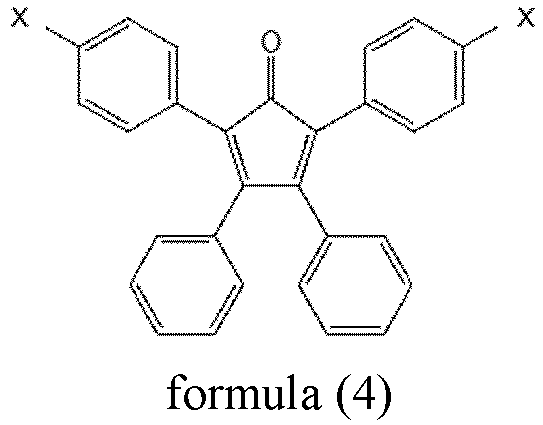 wherein X is as defined above,b) Diels-Alder reaction of the compound of formula (4) obtained in step a) with 1,2-bisphenylacetylene of following formula (4b):
 thereby obtaining a compound of following formula (5):
 wherein X is as defined above,c) reaction of the compound of formula (5) obtained in step b) with a dioxaborolane derivative, thereby obtaining a compound of following formula (6):
 d) Suzuki-Miyaura coupling of the compound of formula (6) obtained in step c) with a polymer of following formula (1) or a polymer of following formula (2):
 wherein n is comprised between 4 and 80 inclusive, preferably between 6 and 40 inclusive, and more preferably between 6 and 25 inclusive
 wherein n is comprised between 4 and 80 inclusive, preferably between 6 and 40 inclusive, and more preferably between 6 and 25 inclusivethereby obtaining a compound of following formula (7) when the polymer has the above formula (1):
 wherein n is comprised between 4 and 80 inclusive, preferably between 6 and 40 inclusive, and more preferably between 6 and 25 inclusiveor a compound of following formula (8) when the polymer has the above formula (2):
 wherein n is comprised between 4 and 80 inclusive, preferably between 6 and 40 inclusive, and more preferably between 6 and 25 inclusivee2) cyclodehydrogenation of the compound of formula (7) or of the compound of formula (8) by reacting this compound with 2,3-dichloro-5,6-dicyano-1,4-benzoquinone (DDQ) or with FeCl3 in CH3NO2, thereby obtaining the compound of following formula (13) when the polymer has the above formula (1):
 wherein n is comprised between 4 and 80 inclusive, preferably between 6 and 40 inclusive, and more preferably between 6 and 25 inclusiveor a compound of following formula (14) when the polymer has the above formula (2):
 wherein n is comprised between 4 and 80 inclusive, preferably between 6 and 40 inclusive, and more preferably between 6 and 25 inclusivef1) Friedel-Crafts acylation between methyl carbonochloridate, and the compound of formula (13) or the compound of formula (14), thereby obtaining the compound of formula I-1.
 - The method according to anyone of claims 3 to 7, wherein, in step c), the dioxaborolane derivative is 2-isopropoxy-4,4,5,5-tetramethyl-[1,3,2]dioxaborolane.
- The method according to anyone of claims 4 to 8, wherein step b) is carried out in a microwave-heated apparatus at a temperature comprised between 200 and 256 °C, preferably at 250 °C and a power of between 250 and 350 W, preferably at 300 W, during between 60 minutes and 300 minutes, preferably during 150 minutes.
- The method according to anyone of claims 4 to 9, furthermore comprising a step g) of synthesis of the polymer of formula (1) (P3HT) or of the polymer of formula (2) (P3OPT).
- The method according to claim 10, wherein step g) is a step of synthesis of the polymer of formula (1) (P3HT) by Grignard Metathesis (GRIM) polymerization of 2,5-dibromo-3-hexylthiophene or 2,5-diiodo-3-hexylthiophene or 2-bromo-5-iodo-3-hexylthiophene or 2-iodo -5-bromo-3-hexylthiophene, preferably of 2,5-dibromo-3-hexylthiophene.
- The method according to claim 10, wherein step g) is a step of synthesis of polymer (2) (P3OPT) comprising the Grignard Metathesis (GRIM) polymerization of 2,5-dibromo(3-oxypentylthiophene) or 2,5-diiodo-(3-oxypentylthiophene) or 2-bromo-5-iodo-(3-oxypentylthiophene) or 2-iodo-5-bromo-(3-oxypentylthiophene), preferably of 2,5-dibromo-(3-oxypentylthiophene).
- A donor: acceptor layer comprising a stack of a hexabenzocoronene-based compound according to claim 1 or 2 or obtained by the process according to anyone of claims 3 to 12.
- A device comprising at least one hexabenzocoronene-based compound according to claim 1 or 2 or obtained by the process according to anyone of claims 3 to 12.
- The device of claim 14 which is a photovoltaic cell.
Applications Claiming Priority (2)
| Application Number | Priority Date | Filing Date | Title |
|---|---|---|---|
| PCT/IB2015/000511 WO2016142731A1 (en) | 2015-03-12 | 2015-03-12 | Hexabenzocoronene-based compound for organic photovoltaic cells |
| PCT/IB2016/051411 WO2016142923A1 (en) | 2015-03-12 | 2016-03-11 | Hexabenzocoronene-based compound for organic photovoltaic cells. |
Publications (3)
| Publication Number | Publication Date |
|---|---|
| EP3268410A1 EP3268410A1 (en) | 2018-01-17 |
| EP3268410C0 EP3268410C0 (en) | 2025-05-07 |
| EP3268410B1 true EP3268410B1 (en) | 2025-05-07 |
Family
ID=53514365
Family Applications (1)
| Application Number | Title | Priority Date | Filing Date |
|---|---|---|---|
| EP16713096.2A Active EP3268410B1 (en) | 2015-03-12 | 2016-03-11 | Hexabenzocoronene-based compound for organic photovoltaic cells. |
Country Status (6)
| Country | Link |
|---|---|
| US (1) | US10454034B2 (en) |
| EP (1) | EP3268410B1 (en) |
| JP (1) | JP2018510938A (en) |
| KR (1) | KR20170128450A (en) |
| CN (1) | CN107428920B (en) |
| WO (2) | WO2016142731A1 (en) |
Families Citing this family (8)
| Publication number | Priority date | Publication date | Assignee | Title |
|---|---|---|---|---|
| US11034847B2 (en) | 2017-07-14 | 2021-06-15 | Samsung Electronics Co., Ltd. | Hardmask composition, method of forming pattern using hardmask composition, and hardmask formed from hardmask composition |
| KR102433666B1 (en) | 2017-07-27 | 2022-08-18 | 삼성전자주식회사 | Hardmask composition, method of forming patterning using the hardmask composition, and hardmask formed from the hardmask composition |
| KR102486388B1 (en) * | 2017-07-28 | 2023-01-09 | 삼성전자주식회사 | Method of preparing graphene quantum dot, hardmask composition including the graphene quantum dot obtained by the method, method of forming patterning using the hardmask composition, and hardmask formed from the hardmask composition |
| CN110337482B (en) * | 2018-01-02 | 2023-06-02 | 北京师范大学 | Triangular carbon quantum dots and their composition and use |
| KR102165013B1 (en) | 2019-03-18 | 2020-10-13 | 울산과학기술원 | An Anodic Active Material Comprising Contorted Hexabenzocoronene Derivative, Method Of Manufacturing Anode Using Thereof, And Secondary Battery Comprising The Same |
| KR102288047B1 (en) | 2019-09-17 | 2021-08-10 | 울산과학기술원 | Anodic active material comprising co-crystal of contorted hexabenzocoronene and fullerene, method of manufacturing anode using the same, and secondary battery comprising the same |
| CN114031753B (en) * | 2020-12-31 | 2023-11-03 | 广东聚华印刷显示技术有限公司 | Organic polymers and their use |
| CN114349771B (en) * | 2021-12-09 | 2023-03-31 | 上海师范大学 | Hexabenzocoronene-based non-fullerene acceptor material and preparation and application thereof |
Family Cites Families (2)
| Publication number | Priority date | Publication date | Assignee | Title |
|---|---|---|---|---|
| GB2430546A (en) * | 2005-09-20 | 2007-03-28 | Seiko Epson Corp | A semiconductor film comprising domains of an organic semiconductor and a method of its fabrication |
| AU2009321486A1 (en) * | 2008-11-28 | 2011-07-07 | The University Of Melbourne | Novel compounds, derivatives thereof and their use in heterojunction devices |
-
2015
- 2015-03-12 WO PCT/IB2015/000511 patent/WO2016142731A1/en not_active Ceased
-
2016
- 2016-03-11 WO PCT/IB2016/051411 patent/WO2016142923A1/en not_active Ceased
- 2016-03-11 KR KR1020177029114A patent/KR20170128450A/en not_active Withdrawn
- 2016-03-11 CN CN201680013295.3A patent/CN107428920B/en active Active
- 2016-03-11 US US15/556,053 patent/US10454034B2/en active Active
- 2016-03-11 EP EP16713096.2A patent/EP3268410B1/en active Active
- 2016-03-11 JP JP2017546999A patent/JP2018510938A/en active Pending
Non-Patent Citations (3)
| Title |
|---|
| ARNAUD MARC ALEXANDRE: "Modélisation multi-échelle de polymères conjugués pour le photovoltaïque organique : Confrontation expérience/théorie", 11 September 2013 (2013-09-11), pages 1 - 304, XP055825002, Retrieved from the Internet <URL:https://www.theses.fr/2013PAUU3053.pdf> [retrieved on 20210716] * |
| BÉGUÉ D ET AL: "Graphene-based acceptor molecules for organic photovoltaic cells: a predictive study identifying high modularity and morphological stability", RSC ADVANCES, 31 January 2012 (2012-01-31), pages 1 - 6, XP055824720, Retrieved from the Internet <URL:https://pubs.rsc.org/en/content/getauthorversionpdf/C5RA25531G> [retrieved on 20210715], DOI: 10.1039/x0xx00000x * |
| DAVID J. JONES ET AL: "Synthesis of electron-poor hexa-peri-hexabenzocoronenes", CHEMICAL COMMUNICATIONS, vol. 48, no. 65, 1 January 2012 (2012-01-01), pages 8066, XP055205321, ISSN: 1359-7345, DOI: 10.1039/c2cc33892k * |
Also Published As
| Publication number | Publication date |
|---|---|
| EP3268410A1 (en) | 2018-01-17 |
| WO2016142923A1 (en) | 2016-09-15 |
| EP3268410C0 (en) | 2025-05-07 |
| US20180047906A1 (en) | 2018-02-15 |
| KR20170128450A (en) | 2017-11-22 |
| WO2016142731A1 (en) | 2016-09-15 |
| CN107428920A (en) | 2017-12-01 |
| CN107428920B (en) | 2020-02-21 |
| JP2018510938A (en) | 2018-04-19 |
| US10454034B2 (en) | 2019-10-22 |
Similar Documents
| Publication | Publication Date | Title |
|---|---|---|
| US10454034B2 (en) | Hexabenzocoronene-based compound for organic photovoltaic cells | |
| Yue et al. | Novel NIR-absorbing conjugated polymers for efficient polymer solar cells: effect of alkyl chain length on device performance | |
| TWI511997B (en) | Conjugated polymers and their use in optoelectronic devices | |
| CN107074830B (en) | Difluorobithiophene-based D-A polymers for optoelectronic applications | |
| CN102460758A (en) | Semiconducting compound and device containing same | |
| CN102077368B (en) | Organic photoelectric conversion element | |
| Marshall et al. | Polythiophenes with vinylene linked ortho, meta and para-carborane sidechains | |
| CN112424966B (en) | organic semiconductor | |
| KR101387065B1 (en) | Conjugated polymer having electron donor and acceptor alternately, organic photoelectric device and organic solar cell comprising the same | |
| Li et al. | Molecular structure–property engineering for photovoltaic applications: Fluorene-acceptor alternating conjugated copolymers with varied bridged moieties | |
| Min et al. | A star-shaped D–π–A small molecule based on a tris (2-methoxyphenyl) amine core for highly efficient solution-processed organic solar cells | |
| Chan et al. | A new series of random conjugated copolymers containing 3, 4-diphenyl-maleimide and thiophene units for organic photovoltaic cell applications | |
| JPWO2013176156A1 (en) | Electron donating organic material, photovoltaic device material using the same, and photovoltaic device | |
| CN116120156B (en) | Dibromosubstituted hexabenzocorone monomer, hexabenzocorone conjugated polymer and preparation thereof | |
| Nazim et al. | Efficient spirobifluorene-core electron-donor material for application in solution-processed organic solar cells | |
| Gedefaw et al. | An alternating copolymer of fluorene donor and quinoxaline acceptor versus a terpolymer consisting of fluorene, quinoxaline and benzothiadiazole building units: synthesis and characterization | |
| Hsiow et al. | Impact of constitution of the terthiophene–vinylene conjugated side chain on the optical and photovoltaic properties of two-dimensional polythiophenes | |
| KR101739259B1 (en) | New pyrrole monomer and manufacturing method thereof, polymer or compound from new pyrrole monomer and manufacturing method thereof | |
| Chen et al. | Novel conjugated copolymers based on dithiafulvalene moiety for bulk heterojunction solar cells | |
| JP5428670B2 (en) | Material for photovoltaic element and photovoltaic element | |
| Mei et al. | Synthesis and photovoltaic properties of the copolymers based on 3-ethylrhodanine side group | |
| US20130228223A1 (en) | Photoelectric conversion material, method for producing the same, and organic photovoltaic cell containing the same | |
| JP2012193338A (en) | Polymer and organic thin film and organic thin film element using the same | |
| Geng et al. | Synthesis and photovoltaic properties of donor-acceptor type narrow bandgap copolymers based on benzo [def] carbazole | |
| Ardolic Jr | Synthesis and Characterization of Donor-Acceptor Fluorescent Conjugated Polymers by Acyclic Diene Metathesis (ADMET) and Suzuki Polycondensation (SPC) |
Legal Events
| Date | Code | Title | Description |
|---|---|---|---|
| STAA | Information on the status of an ep patent application or granted ep patent |
Free format text: STATUS: THE INTERNATIONAL PUBLICATION HAS BEEN MADE |
|
| PUAI | Public reference made under article 153(3) epc to a published international application that has entered the european phase |
Free format text: ORIGINAL CODE: 0009012 |
|
| STAA | Information on the status of an ep patent application or granted ep patent |
Free format text: STATUS: REQUEST FOR EXAMINATION WAS MADE |
|
| 17P | Request for examination filed |
Effective date: 20170911 |
|
| AK | Designated contracting states |
Kind code of ref document: A1 Designated state(s): AL AT BE BG CH CY CZ DE DK EE ES FI FR GB GR HR HU IE IS IT LI LT LU LV MC MK MT NL NO PL PT RO RS SE SI SK SM TR |
|
| AX | Request for extension of the european patent |
Extension state: BA ME |
|
| DAV | Request for validation of the european patent (deleted) | ||
| DAX | Request for extension of the european patent (deleted) | ||
| RIN1 | Information on inventor provided before grant (corrected) |
Inventor name: HIORNS, ROGER CLIVE Inventor name: BOUSSIRON, CHARLENE Inventor name: BEGUE, DIDIER Inventor name: SANTOS-SILVA, HUGO Inventor name: IRATCABAL, PIERRE Inventor name: GUILLE, EMILIE Inventor name: DAGRON-LARTIGAU, CHRISTINE |
|
| STAA | Information on the status of an ep patent application or granted ep patent |
Free format text: STATUS: EXAMINATION IS IN PROGRESS |
|
| 17Q | First examination report despatched |
Effective date: 20210722 |
|
| GRAP | Despatch of communication of intention to grant a patent |
Free format text: ORIGINAL CODE: EPIDOSNIGR1 |
|
| STAA | Information on the status of an ep patent application or granted ep patent |
Free format text: STATUS: GRANT OF PATENT IS INTENDED |
|
| RIC1 | Information provided on ipc code assigned before grant |
Ipc: H10K 85/60 20230101ALI20240902BHEP Ipc: H10K 30/30 20230101ALI20240902BHEP Ipc: C07D 333/06 20060101ALI20240902BHEP Ipc: C08L 65/00 20060101ALI20240902BHEP Ipc: C08G 61/12 20060101AFI20240902BHEP |
|
| INTG | Intention to grant announced |
Effective date: 20240930 |
|
| GRAS | Grant fee paid |
Free format text: ORIGINAL CODE: EPIDOSNIGR3 |
|
| GRAA | (expected) grant |
Free format text: ORIGINAL CODE: 0009210 |
|
| STAA | Information on the status of an ep patent application or granted ep patent |
Free format text: STATUS: THE PATENT HAS BEEN GRANTED |
|
| AK | Designated contracting states |
Kind code of ref document: B1 Designated state(s): AL AT BE BG CH CY CZ DE DK EE ES FI FR GB GR HR HU IE IS IT LI LT LU LV MC MK MT NL NO PL PT RO RS SE SI SK SM TR |
|
| REG | Reference to a national code |
Ref country code: GB Ref legal event code: FG4D |
|
| REG | Reference to a national code |
Ref country code: CH Ref legal event code: EP |
|
| REG | Reference to a national code |
Ref country code: DE Ref legal event code: R096 Ref document number: 602016092149 Country of ref document: DE |
|
| REG | Reference to a national code |
Ref country code: IE Ref legal event code: FG4D |
|
| U01 | Request for unitary effect filed |
Effective date: 20250606 |
|
| U07 | Unitary effect registered |
Designated state(s): AT BE BG DE DK EE FI FR IT LT LU LV MT NL PT RO SE SI Effective date: 20250616 |
|
| PG25 | Lapsed in a contracting state [announced via postgrant information from national office to epo] |
Ref country code: ES Free format text: LAPSE BECAUSE OF FAILURE TO SUBMIT A TRANSLATION OF THE DESCRIPTION OR TO PAY THE FEE WITHIN THE PRESCRIBED TIME-LIMIT Effective date: 20250507 |
|
| PG25 | Lapsed in a contracting state [announced via postgrant information from national office to epo] |
Ref country code: GR Free format text: LAPSE BECAUSE OF FAILURE TO SUBMIT A TRANSLATION OF THE DESCRIPTION OR TO PAY THE FEE WITHIN THE PRESCRIBED TIME-LIMIT Effective date: 20250808 Ref country code: NO Free format text: LAPSE BECAUSE OF FAILURE TO SUBMIT A TRANSLATION OF THE DESCRIPTION OR TO PAY THE FEE WITHIN THE PRESCRIBED TIME-LIMIT Effective date: 20250807 |
|
| PG25 | Lapsed in a contracting state [announced via postgrant information from national office to epo] |
Ref country code: PL Free format text: LAPSE BECAUSE OF FAILURE TO SUBMIT A TRANSLATION OF THE DESCRIPTION OR TO PAY THE FEE WITHIN THE PRESCRIBED TIME-LIMIT Effective date: 20250507 |
|
| PG25 | Lapsed in a contracting state [announced via postgrant information from national office to epo] |
Ref country code: HR Free format text: LAPSE BECAUSE OF FAILURE TO SUBMIT A TRANSLATION OF THE DESCRIPTION OR TO PAY THE FEE WITHIN THE PRESCRIBED TIME-LIMIT Effective date: 20250507 |
|
| PG25 | Lapsed in a contracting state [announced via postgrant information from national office to epo] |
Ref country code: RS Free format text: LAPSE BECAUSE OF FAILURE TO SUBMIT A TRANSLATION OF THE DESCRIPTION OR TO PAY THE FEE WITHIN THE PRESCRIBED TIME-LIMIT Effective date: 20250807 |
|
| PG25 | Lapsed in a contracting state [announced via postgrant information from national office to epo] |
Ref country code: IS Free format text: LAPSE BECAUSE OF FAILURE TO SUBMIT A TRANSLATION OF THE DESCRIPTION OR TO PAY THE FEE WITHIN THE PRESCRIBED TIME-LIMIT Effective date: 20250907 |
|
| U1N | Appointed representative for the unitary patent procedure changed after the registration of the unitary effect |
Representative=s name: SANTARELLI; FR |
|
| PG25 | Lapsed in a contracting state [announced via postgrant information from national office to epo] |
Ref country code: SM Free format text: LAPSE BECAUSE OF FAILURE TO SUBMIT A TRANSLATION OF THE DESCRIPTION OR TO PAY THE FEE WITHIN THE PRESCRIBED TIME-LIMIT Effective date: 20250507 |
|
| PG25 | Lapsed in a contracting state [announced via postgrant information from national office to epo] |
Ref country code: CZ Free format text: LAPSE BECAUSE OF FAILURE TO SUBMIT A TRANSLATION OF THE DESCRIPTION OR TO PAY THE FEE WITHIN THE PRESCRIBED TIME-LIMIT Effective date: 20250507 |
|
| PG25 | Lapsed in a contracting state [announced via postgrant information from national office to epo] |
Ref country code: SK Free format text: LAPSE BECAUSE OF FAILURE TO SUBMIT A TRANSLATION OF THE DESCRIPTION OR TO PAY THE FEE WITHIN THE PRESCRIBED TIME-LIMIT Effective date: 20250507 |
|
| PLBE | No opposition filed within time limit |
Free format text: ORIGINAL CODE: 0009261 |
|
| STAA | Information on the status of an ep patent application or granted ep patent |
Free format text: STATUS: NO OPPOSITION FILED WITHIN TIME LIMIT |
|
| REG | Reference to a national code |
Ref country code: CH Ref legal event code: L10 Free format text: ST27 STATUS EVENT CODE: U-0-0-L10-L00 (AS PROVIDED BY THE NATIONAL OFFICE) Effective date: 20260318 |
|
| 26N | No opposition filed |
Effective date: 20260210 |
|
| U20 | Renewal fee for the european patent with unitary effect paid |
Year of fee payment: 11 Effective date: 20260330 |