EP3267438A1 - Method and system for facilitating the detection of time series patterns - Google Patents
Method and system for facilitating the detection of time series patterns Download PDFInfo
- Publication number
- EP3267438A1 EP3267438A1 EP16305847.2A EP16305847A EP3267438A1 EP 3267438 A1 EP3267438 A1 EP 3267438A1 EP 16305847 A EP16305847 A EP 16305847A EP 3267438 A1 EP3267438 A1 EP 3267438A1
- Authority
- EP
- European Patent Office
- Prior art keywords
- artificial neural
- time series
- neural networks
- speaker
- detection
- Prior art date
- Legal status (The legal status is an assumption and is not a legal conclusion. Google has not performed a legal analysis and makes no representation as to the accuracy of the status listed.)
- Granted
Links
Images


Classifications
-
- G—PHYSICS
- G06—COMPUTING OR CALCULATING; COUNTING
- G06N—COMPUTING ARRANGEMENTS BASED ON SPECIFIC COMPUTATIONAL MODELS
- G06N3/00—Computing arrangements based on biological models
- G06N3/02—Neural networks
- G06N3/04—Architecture, e.g. interconnection topology
- G06N3/049—Temporal neural networks, e.g. delay elements, oscillating neurons or pulsed inputs
-
- G—PHYSICS
- G06—COMPUTING OR CALCULATING; COUNTING
- G06N—COMPUTING ARRANGEMENTS BASED ON SPECIFIC COMPUTATIONAL MODELS
- G06N3/00—Computing arrangements based on biological models
- G06N3/02—Neural networks
- G06N3/08—Learning methods
- G06N3/086—Learning methods using evolutionary algorithms, e.g. genetic algorithms or genetic programming
-
- G—PHYSICS
- G06—COMPUTING OR CALCULATING; COUNTING
- G06N—COMPUTING ARRANGEMENTS BASED ON SPECIFIC COMPUTATIONAL MODELS
- G06N3/00—Computing arrangements based on biological models
- G06N3/02—Neural networks
- G06N3/04—Architecture, e.g. interconnection topology
- G06N3/0499—Feedforward networks
-
- G—PHYSICS
- G06—COMPUTING OR CALCULATING; COUNTING
- G06N—COMPUTING ARRANGEMENTS BASED ON SPECIFIC COMPUTATIONAL MODELS
- G06N3/00—Computing arrangements based on biological models
- G06N3/02—Neural networks
- G06N3/08—Learning methods
- G06N3/082—Learning methods modifying the architecture, e.g. adding, deleting or silencing nodes or connections
-
- G—PHYSICS
- G06—COMPUTING OR CALCULATING; COUNTING
- G06N—COMPUTING ARRANGEMENTS BASED ON SPECIFIC COMPUTATIONAL MODELS
- G06N3/00—Computing arrangements based on biological models
- G06N3/02—Neural networks
- G06N3/08—Learning methods
- G06N3/09—Supervised learning
-
- G—PHYSICS
- G06—COMPUTING OR CALCULATING; COUNTING
- G06N—COMPUTING ARRANGEMENTS BASED ON SPECIFIC COMPUTATIONAL MODELS
- G06N3/00—Computing arrangements based on biological models
- G06N3/02—Neural networks
- G06N3/08—Learning methods
- G06N3/0985—Hyperparameter optimisation; Meta-learning; Learning-to-learn
-
- G—PHYSICS
- G10—MUSICAL INSTRUMENTS; ACOUSTICS
- G10L—SPEECH ANALYSIS TECHNIQUES OR SPEECH SYNTHESIS; SPEECH RECOGNITION; SPEECH OR VOICE PROCESSING TECHNIQUES; SPEECH OR AUDIO CODING OR DECODING
- G10L15/00—Speech recognition
- G10L15/06—Creation of reference templates; Training of speech recognition systems, e.g. adaptation to the characteristics of the speaker's voice
- G10L15/065—Adaptation
- G10L15/07—Adaptation to the speaker
-
- G—PHYSICS
- G10—MUSICAL INSTRUMENTS; ACOUSTICS
- G10L—SPEECH ANALYSIS TECHNIQUES OR SPEECH SYNTHESIS; SPEECH RECOGNITION; SPEECH OR VOICE PROCESSING TECHNIQUES; SPEECH OR AUDIO CODING OR DECODING
- G10L15/00—Speech recognition
- G10L15/08—Speech classification or search
- G10L15/16—Speech classification or search using artificial neural networks
-
- G—PHYSICS
- G10—MUSICAL INSTRUMENTS; ACOUSTICS
- G10L—SPEECH ANALYSIS TECHNIQUES OR SPEECH SYNTHESIS; SPEECH RECOGNITION; SPEECH OR VOICE PROCESSING TECHNIQUES; SPEECH OR AUDIO CODING OR DECODING
- G10L17/00—Speaker identification or verification techniques
- G10L17/02—Preprocessing operations, e.g. segment selection; Pattern representation or modelling, e.g. based on linear discriminant analysis [LDA] or principal components; Feature selection or extraction
-
- G—PHYSICS
- G10—MUSICAL INSTRUMENTS; ACOUSTICS
- G10L—SPEECH ANALYSIS TECHNIQUES OR SPEECH SYNTHESIS; SPEECH RECOGNITION; SPEECH OR VOICE PROCESSING TECHNIQUES; SPEECH OR AUDIO CODING OR DECODING
- G10L17/00—Speaker identification or verification techniques
- G10L17/18—Artificial neural networks; Connectionist approaches
-
- G—PHYSICS
- G10—MUSICAL INSTRUMENTS; ACOUSTICS
- G10L—SPEECH ANALYSIS TECHNIQUES OR SPEECH SYNTHESIS; SPEECH RECOGNITION; SPEECH OR VOICE PROCESSING TECHNIQUES; SPEECH OR AUDIO CODING OR DECODING
- G10L17/00—Speaker identification or verification techniques
- G10L17/22—Interactive procedures; Man-machine interfaces
-
- G—PHYSICS
- G10—MUSICAL INSTRUMENTS; ACOUSTICS
- G10L—SPEECH ANALYSIS TECHNIQUES OR SPEECH SYNTHESIS; SPEECH RECOGNITION; SPEECH OR VOICE PROCESSING TECHNIQUES; SPEECH OR AUDIO CODING OR DECODING
- G10L25/00—Speech or voice analysis techniques not restricted to a single one of groups G10L15/00 - G10L21/00
- G10L25/93—Discriminating between voiced and unvoiced parts of speech signals
-
- G—PHYSICS
- G06—COMPUTING OR CALCULATING; COUNTING
- G06N—COMPUTING ARRANGEMENTS BASED ON SPECIFIC COMPUTATIONAL MODELS
- G06N20/00—Machine learning
- G06N20/10—Machine learning using kernel methods, e.g. support vector machines [SVM]
-
- G—PHYSICS
- G06—COMPUTING OR CALCULATING; COUNTING
- G06N—COMPUTING ARRANGEMENTS BASED ON SPECIFIC COMPUTATIONAL MODELS
- G06N3/00—Computing arrangements based on biological models
- G06N3/02—Neural networks
- G06N3/04—Architecture, e.g. interconnection topology
- G06N3/044—Recurrent networks, e.g. Hopfield networks
-
- G—PHYSICS
- G10—MUSICAL INSTRUMENTS; ACOUSTICS
- G10L—SPEECH ANALYSIS TECHNIQUES OR SPEECH SYNTHESIS; SPEECH RECOGNITION; SPEECH OR VOICE PROCESSING TECHNIQUES; SPEECH OR AUDIO CODING OR DECODING
- G10L25/00—Speech or voice analysis techniques not restricted to a single one of groups G10L15/00 - G10L21/00
- G10L25/27—Speech or voice analysis techniques not restricted to a single one of groups G10L15/00 - G10L21/00 characterised by the analysis technique
- G10L25/30—Speech or voice analysis techniques not restricted to a single one of groups G10L15/00 - G10L21/00 characterised by the analysis technique using neural networks
Definitions
- the present disclosure relates to a method for facilitating the detection of one or more time series patterns. Furthermore, the present disclosure relates to a corresponding computer program, non-transitory computer-readable medium and system.
- Time series patterns are patterns of data points made over continuous time intervals out of successive measurements across said intervals, using equal spacing between every two consecutive measurements and with each time unit within the time intervals having at most one data point.
- Examples of time series patterns are audio patterns, such as sound patterns and human speech patterns. It may be useful to detect specific time series patterns, for example in order to recognize particular events or contexts (e.g., starting a car or being present in a running car) and to distinguish and identify different speakers. Furthermore, it may be useful to make such detections easier.
- a method for facilitating the detection of one or more time series patterns comprising building one or more artificial neural networks, wherein, for at least one time series pattern to be detected, a specific one of said artificial neural networks is built.
- building said artificial neural networks comprises employing neuroevolution of augmenting topologies.
- the artificial neural networks are stored for subsequent use in a detection task.
- each time series pattern to be detected represents a class of said detection task.
- said time series patterns are audio patterns.
- a raw time series signal is provided as an input to each artificial neural network that is built.
- the audio patterns include at least one of the group of: voiced speech, unvoiced speech, user-specific speech, contextual sound, a sound event.
- the detection of the time series patterns forms part of a speaker authentication function.
- At least one artificial neural network is built for detecting speech segments of said speaker.
- an artificial neural network is built for detecting voiced speech segments of said speaker, and another artificial neural network is built for detecting unvoiced speech segments of said speaker.
- a computer program comprising instructions which, when executed, carry out or control a method of the kind set forth.
- a non-transitory computer-readable medium that comprises a computer program of the kind set forth.
- a system for facilitating the detection of one or more time series patterns comprising a network building unit configured to build one or more artificial neural networks, wherein, for at least one time series pattern to be detected, the network building unit is configured to build a specific one of said artificial neural networks.
- the network building unit is configured to employ neuroevolution of augmenting topologies for building said artificial neural networks.
- system further comprises a storage unit
- network building unit is further configured to store the artificial neural networks in said storage unit for subsequent use in a detection task.
- a method for facilitating the detection of one or more time series patterns comprising building one or more artificial neural networks, wherein, for at least one time series pattern to be detected, a specific one of said artificial neural networks is built.
- MFCCs Mel-Frequency Cepstral Coefficients
- the extracted features are provided to a classifier that performs the classification task.
- the extraction of features reduces the input dimensionality, which in turn facilitates the classification task.
- reducing the input dimensionality may also negatively impact the pattern detection process. For instance, in case of a speaker authentication task, the same set of features is extracted, whoever the target speaker is. This impedes catching the characteristics that are very specific to a given speaker, which in turn may result in misidentifications.
- building an artificial neural network which is specific for the time series pattern corresponding to the target speaker facilitates catching the characteristics that are specific to said speaker.
- the specific ANN may subsequently be used as a classifier that may receive an input signal (e.g., a raw input signal that has not been preprocessed by a feature extractor), and that may detect the time series pattern corresponding to the target speaker within said signal.
- the ANN may be built, at least partially, by a computer program in the manner as described herein by way of example. The inventor has found that the presently disclosed method and corresponding system are particularly suitable for facilitating the detection of audio patterns; however, their application is not limited thereto.
- Fig. 1 shows an illustrative embodiment of a pattern detection facilitation method 100.
- the method 100 comprises, at 102, selecting a time series pattern to be detected.
- the selected time series pattern may be an audio pattern, in particular user-specific speech, voiced speech (vowels), unvoiced speech (consonants), contextual sound (e.g., a running car) or a sound event (e.g., starting a car).
- the method 100 comprises, at 104, building an ANN for the selected time series pattern. Then, at 106, it is checked whether more time series patterns should be detected. If so, the method 100 repeats steps 102 and 104 for each further time series pattern to be detected. If there are no more patterns to detect, the method 100 ends.
- building the ANNs comprises employing neuroevolution of augmenting topologies (NEAT).
- NEAT neuroevolution of augmenting topologies
- NEAT refers to a method for artificially evolving neural networks using genetic algorithms. The product obtained when applying such a method is called an artificial neural network (ANN); simple example ANNs are described herein with reference to Figs. 5(a)-(d) .
- ANN artificial neural network
- NEAT refers to a neuroevolution method wherein the structure of an evolving neural network is grown incrementally, such that the topology of the network may be minimized.
- the number of network nodes and the connections therebetween may be kept to a minimum, while the network still performs the desired task.
- the NEAT methodology has been described in, among others, US 2008/0267419 A1 and the article " Evolving Neural Networks through Augmenting Topologies", by Kenneth O. Stanley and Risto Miikkulainen in the journal Evolutionary Computation, Volume 10 Issue 2, Summer 2002, pages 99-127 .
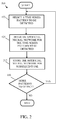
- Fig. 2 shows another illustrative embodiment of a pattern detection facilitation method 200.
- the method 200 comprises, in addition to the steps 102, 104, 106, already shown in Fig. 1 , storing, at 202, each ANN built in step 104 for subsequent use. Thereby, the use of the ANN or ANNs in a pattern detection task may be facilitated.
- the ANN or ANNs may for example be stored in a memory of a pattern detection system or pattern detection device that performs said pattern detection task.
- each time series pattern to be detected represents a class of a pattern detection task.
- a separate ANN may be evolved for each class of the detection task; the ANN thus effectively constitutes a model of the class.
- pattern detectors extract, for a given task, the same set of features for all classes. In other words, depending on its coordinates in a fixed space, a given feature vector will be classified as belonging to class C. This means that for instance, in an audio context recognition task, class "car” is distinguished from class "office” within the same feature space.
- speaker A and speaker B are authenticated within the same feature space. That is to say, speaker A is distinguished from any other speaker within the same space as for speaker B.
- a raw time series signal is provided as an input to each artificial neural network that is built. In that case, it is left to the network to extract the relevant features for the pattern to be detected, and it is more likely that the specific characteristics of said pattern are caught. That is to say, the aforementioned commonly used feature extractor may be omitted.
- Fig. 3 shows an illustrative embodiment of a pattern detection facilitation system 300.
- the system 300 comprises a network building unit 302 operatively coupled to a storage unit 304.
- the network building unit 302 is configured to build one or more ANNs.
- the network building unit 302 is configured to build, for each selected time series pattern to be detected, a specific ANN.
- the network building unit 302 may be configured to store the ANN or ANNs in the storage unit 304.
- the storage unit 304 may be any memory which is suitable for integration into the system 300.
- Fig. 4 shows an illustrative embodiment of a pattern detection system 400.
- the pattern detection system 400 comprises the pattern detection facilitation system 300 shown in Fig. 3 .
- the pattern detection facilitation system 300 may build and store one or more ANNs which are specific to selected time series patterns to be detected; this may be done, for example, in a training or enrolment mode of the pattern detection system 400.
- the pattern detection system 400 comprises a pattern detection unit 402 operatively coupled to the storage unit 304.
- the pattern detection unit 402 may detect one or more time series patterns in an input signal provided to said pattern detection unit 402, and output one or more corresponding detection decisions. This may be done, for instance, in an operational mode of the pattern detection system 400.
- a detection decision may be represented by a simple Boolean variable: one value may represent a "pattern detected" decision, while the other value may represent a "pattern not detected” decision.
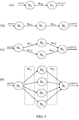
- Figs. 5(a) -(d) show illustrative embodiments of artificial neural networks. In particular, they show examples of ANNs that may be evolved in accordance with the present disclosure.
- Each network node N 1 -N 6 represents a processing element that forms part of a pattern detection task.
- Each processing elements performs a function on its received input.
- the network nodes N 3 in Fig. 5(b) , N 3 and N 4 in Fig. 5(c) , and N 3 -N 6 in Fig. 5(c) are often referred to as hidden nodes.
- the network nodes N 1 -N 6 are connected to each other by connections having a certain weight w 12 , w 13 , w 32 , w 34 , w 42 , w 1j , w j2 .
- the input to a processing element is multiplied by the weight of the connection through which the input is received.
- an evolving ANN is grown incrementally. For example, initially a simple ANN may be chosen, as shown in Fig. 5(a) , and it may be tested by means of a fitness function whether this simple ANN would correctly detect a selected pattern.
- the ANN under development may be extended, for example by adding one or more network nodes and/or connections, following evolutionary heuristics.
- the simple ANN of Fig. 5(a) may be extended to the ANN shown in Fig. 5(b) . Again, it may be tested by means of said fitness function whether the ANN would correctly detect a selected pattern. If not, the ANN under development may be again extended, for example to the ANN shown in Fig. 5(c) . Eventually, this iterative process may yield an ANN that correctly detects the selected pattern, for example the ANN shown in Fig. 5(d) , or a more complex ANN (not shown). It is noted that the process illustrated in Figs.
- 5(a)-(d) is a simplified process.
- hidden nodes are not necessarily added in "parallel” (i.e. across a single layer), but they can follow any topology.
- connections are not necessarily forward connections, but they can be recurrent as well.
- the term “unit” refers to a node in an ANN.
- the term “input unit” refers to a node that receives the input for the whole ANN, for example node N 1 in Figs. 5(a)-(d) . This input should not be confused with the (weighted) inputs of the individual nodes of the ANN, as discussed above.
- the term “output unit” refers to a node that produces the output of the ANN, for example node N 2 in Figs. 5(a)-(d) . It is noted that an ANN may have multiple inputs and/or multiple outputs (not shown).
- NEAT requires specifying an optimization setup.
- the presently disclosed method and system may use NEAT to evolve an ANN that takes a single input, i.e. one sample of a time series input signal, and one output, i.e. a detection decision.
- NEAT NEAT
- each individual of the population of solution candidates will be evaluated using the fitness function.
- this fitness function should reflect the way in which the ANN is intended to be used in practice.
- the voiced/unvoiced classification (i.e., the distinction between vowels and consonants in a speech signal) may be taken as an example.
- the fitness function may feed a test speech signal of length N into an individual ANN under consideration and evaluate its output. To do so, each sample of the test speech signal is placed, one after the other, at the input of the ANN, and one single activation step will be performed.
- An activation step consists of propagating the output of each unit (including the output of the input unit and the output of a bias unit) to the unit to which they are connected, and then updating the outputs of all units (including the output of the output unit).
- the bias unit is an input unit with a constant value, usually 1. It permits to add any constant value to the input of any unit in the network by creating a connection from the bias unit.
- the proposed evaluation algorithm can be summarized as:
- this champion is the evolved ANN that is stored for subsequent use in the pattern detection task.
- this optimization process may be performed for each class to detect.
- an ANN may be evolved for each speaker to authenticate.
- the test input signal is a speech signal wherein each sample is either part of a speech segment uttered by the target speaker, or by one of a cohort of non-target (impostor) speakers.
- two ANNs may be evolved for each speaker: one to authenticate on voiced segments and one to authenticate on unvoiced segments.
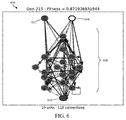
- Fig. 6 shows another illustrative embodiment of an artificial neural network 600.
- it shows the topology obtained for an authentication system trained on voiced segments of a female speaker at a sampling rate of 16000 Hz.
- it shows an individual ANN of the 215 th generation, having 19 units (i.e., network nodes) and 118 weighted connections, and a fitness value of 0.871936631944.
- the ANN 600 comprises an input unit 600, a bias unit 604, an output unit 606, and a plurality of hidden units 608.
- the ANN 600 has been generated using the above-described optimization process.
- the ANN to evolve may have multiple inputs, especially when a variant of NEAT like HyperNEAT is used, and/or multiple outputs. Multiple outputs are especially useful when the ANN is not expected to output a decision value, but rather a feature vector meant to be fed into a subsequent classifier such as a support vector machine (SVM). The training and testing of this classifier may then be included in the fitness function.
- SVM support vector machine
- the presently disclosed method and system are particularly useful for facilitating the detection of audio patterns.
- audio context recognition e.g., car, office, park
- predefined audio pattern recognition e.g. baby cry, glass breaking, fire alarm
- speaker authentication/recognition e.g., speaker authentication/recognition
- voice activity detection i.e., detection of the presence of speech in a signal
- voicing probability i.e., vowel/consonant distinction in a speech signal.
- the systems and methods described herein may at least partially be embodied by a computer program or a plurality of computer programs, which may exist in a variety of forms both active and inactive in a single computer system or across multiple computer systems.
- they may exist as software program(s) comprised of program instructions in source code, object code, executable code or other formats for performing some of the steps.
- Any of the above may be embodied on a computer-readable medium, which may include storage devices and signals, in compressed or uncompressed form.
- the term “mobile device” refers to any type of portable electronic device, including a cellular telephone, a Personal Digital Assistant (PDA), smartphone, tablet etc.
- the term “computer” refers to any electronic device comprising a processor, such as a general-purpose central processing unit (CPU), a specific-purpose processor or a microcontroller.
- CPU central processing unit
- a computer is capable of receiving data (an input), of performing a sequence of predetermined operations thereupon, and of producing thereby a result in the form of information or signals (an output).
- the term “computer” will mean either a processor in particular or more generally a processor in association with an assemblage of interrelated elements contained within a single case or housing.
- processor or “processing unit” refers to a data processing circuit that may be a microprocessor, a co-processor, a microcontroller, a microcomputer, a central processing unit, a field programmable gate array (FPGA), a programmable logic circuit, and/or any circuit that manipulates signals (analog or digital) based on operational instructions that are stored in a memory.
- memory refers to a storage circuit or multiple storage circuits such as read-only memory, random access memory, volatile memory, non-volatile memory, static memory, dynamic memory, Flash memory, cache memory, and/or any circuit that stores digital information.
- a "computer-readable medium” or “storage medium” may be any means that can contain, store, communicate, propagate, or transport a computer program for use by or in connection with the instruction execution system, apparatus, or device.
- the computer-readable medium may be, for example but not limited to, an electronic, magnetic, optical, electromagnetic, infrared, or semiconductor system, apparatus, device, or propagation medium.
- the computer-readable medium may include the following: an electrical connection having one or more wires, a portable computer diskette, a random access memory (RAM), a read-only memory (ROM), an erasable programmable read-only memory (EPROM or Flash memory), an optical fiber, a portable compact disc read-only memory (CDROM), a digital versatile disc (DVD), a Blu-ray disc (BD), and a memory card.
- RAM random access memory
- ROM read-only memory
- EPROM or Flash memory erasable programmable read-only memory
- CDROM compact disc read-only memory
- DVD digital versatile disc
- BD Blu-ray disc
Landscapes
- Engineering & Computer Science (AREA)
- Physics & Mathematics (AREA)
- Health & Medical Sciences (AREA)
- Theoretical Computer Science (AREA)
- Artificial Intelligence (AREA)
- Computational Linguistics (AREA)
- Evolutionary Computation (AREA)
- Multimedia (AREA)
- Acoustics & Sound (AREA)
- Human Computer Interaction (AREA)
- Audiology, Speech & Language Pathology (AREA)
- Life Sciences & Earth Sciences (AREA)
- General Physics & Mathematics (AREA)
- Biomedical Technology (AREA)
- Computing Systems (AREA)
- Mathematical Physics (AREA)
- Software Systems (AREA)
- Molecular Biology (AREA)
- General Engineering & Computer Science (AREA)
- Biophysics (AREA)
- Data Mining & Analysis (AREA)
- General Health & Medical Sciences (AREA)
- Physiology (AREA)
- Evolutionary Biology (AREA)
- Bioinformatics & Computational Biology (AREA)
- Bioinformatics & Cheminformatics (AREA)
- Computer Vision & Pattern Recognition (AREA)
- Signal Processing (AREA)
- Image Analysis (AREA)
- Telephonic Communication Services (AREA)
Abstract
Description
- The present disclosure relates to a method for facilitating the detection of one or more time series patterns. Furthermore, the present disclosure relates to a corresponding computer program, non-transitory computer-readable medium and system.
- Time series patterns are patterns of data points made over continuous time intervals out of successive measurements across said intervals, using equal spacing between every two consecutive measurements and with each time unit within the time intervals having at most one data point. Examples of time series patterns are audio patterns, such as sound patterns and human speech patterns. It may be useful to detect specific time series patterns, for example in order to recognize particular events or contexts (e.g., starting a car or being present in a running car) and to distinguish and identify different speakers. Furthermore, it may be useful to make such detections easier.
- According to a first aspect of the present disclosure, a method for facilitating the detection of one or more time series patterns is conceived, comprising building one or more artificial neural networks, wherein, for at least one time series pattern to be detected, a specific one of said artificial neural networks is built.
- In one or more embodiments of the method, building said artificial neural networks comprises employing neuroevolution of augmenting topologies.
- In one or more embodiments of the method, the artificial neural networks are stored for subsequent use in a detection task.
- In one or more embodiments of the method, each time series pattern to be detected represents a class of said detection task.
- In one or more embodiments of the method, said time series patterns are audio patterns.
- In one or more embodiments, a raw time series signal is provided as an input to each artificial neural network that is built.
- In one or more embodiments of the method, the audio patterns include at least one of the group of: voiced speech, unvoiced speech, user-specific speech, contextual sound, a sound event.
- In one or more embodiments of the method, the detection of the time series patterns forms part of a speaker authentication function.
- In one or more embodiments, for each speaker to be authenticated, at least one artificial neural network is built for detecting speech segments of said speaker.
- In one or more embodiments of the method, for each speaker to be authenticated, an artificial neural network is built for detecting voiced speech segments of said speaker, and another artificial neural network is built for detecting unvoiced speech segments of said speaker.
- According to a second aspect of the present disclosure, a computer program is provided, comprising instructions which, when executed, carry out or control a method of the kind set forth.
- According to a third aspect of the present disclosure, a non-transitory computer-readable medium is provided that comprises a computer program of the kind set forth.
- According to a fourth aspect of the present disclosure, a system for facilitating the detection of one or more time series patterns is provided, comprising a network building unit configured to build one or more artificial neural networks, wherein, for at least one time series pattern to be detected, the network building unit is configured to build a specific one of said artificial neural networks.
- In one or more embodiments of the system, the network building unit is configured to employ neuroevolution of augmenting topologies for building said artificial neural networks.
- In one or more embodiments of the system, the system further comprises a storage unit, and the network building unit is further configured to store the artificial neural networks in said storage unit for subsequent use in a detection task.
- Embodiments will be described in more detail with reference to the appended drawings, in which:
-
Fig. 1 shows an illustrative embodiment of a pattern detection facilitation method; -
Fig. 2 shows another illustrative embodiment of a pattern detection facilitation method; -
Fig. 3 shows an illustrative embodiment of a pattern detection facilitation system; -
Fig. 4 shows an illustrative embodiment of a pattern detection system; -
Figs. 5(a)-(d) show illustrative embodiments of artificial neural networks; -
Fig. 6 shows another illustrative embodiment of an artificial neural network. - As mentioned above, it may be useful to facilitate the detection of time series patterns. For example, in order to recognize particular audio events or contexts and to distinguish and identify different speakers, it may be necessary to detect specific time series patterns in an audio signal. Therefore, in accordance with the present disclosure, a method for facilitating the detection of one or more time series patterns is conceived, comprising building one or more artificial neural networks, wherein, for at least one time series pattern to be detected, a specific one of said artificial neural networks is built.
- Normally, a set of features is computed from an input signal before the input signal is classified. The so-called Mel-Frequency Cepstral Coefficients (MFCCs) are an example of such features. Then, the extracted features are provided to a classifier that performs the classification task. The extraction of features reduces the input dimensionality, which in turn facilitates the classification task. However, reducing the input dimensionality may also negatively impact the pattern detection process. For instance, in case of a speaker authentication task, the same set of features is extracted, whoever the target speaker is. This impedes catching the characteristics that are very specific to a given speaker, which in turn may result in misidentifications. In accordance with the present disclosure, building an artificial neural network (ANN) which is specific for the time series pattern corresponding to the target speaker facilitates catching the characteristics that are specific to said speaker. In particular, the specific ANN may subsequently be used as a classifier that may receive an input signal (e.g., a raw input signal that has not been preprocessed by a feature extractor), and that may detect the time series pattern corresponding to the target speaker within said signal. It is noted that the ANN may be built, at least partially, by a computer program in the manner as described herein by way of example. The inventor has found that the presently disclosed method and corresponding system are particularly suitable for facilitating the detection of audio patterns; however, their application is not limited thereto.
-
Fig. 1 shows an illustrative embodiment of a patterndetection facilitation method 100. Themethod 100 comprises, at 102, selecting a time series pattern to be detected. For instance, the selected time series pattern may be an audio pattern, in particular user-specific speech, voiced speech (vowels), unvoiced speech (consonants), contextual sound (e.g., a running car) or a sound event (e.g., starting a car). Furthermore, themethod 100 comprises, at 104, building an ANN for the selected time series pattern. Then, at 106, it is checked whether more time series patterns should be detected. If so, themethod 100 repeatssteps method 100 ends. - In one or more embodiments, building the ANNs comprises employing neuroevolution of augmenting topologies (NEAT). In this way, it is easier to find the specificity of selected time series patterns and the resulting ANNs may have a minimal topology, so that computing resources may be saved. Neuroevolution refers to a method for artificially evolving neural networks using genetic algorithms. The product obtained when applying such a method is called an artificial neural network (ANN); simple example ANNs are described herein with reference to
Figs. 5(a)-(d) . Furthermore, NEAT refers to a neuroevolution method wherein the structure of an evolving neural network is grown incrementally, such that the topology of the network may be minimized. More specifically, the number of network nodes and the connections therebetween may be kept to a minimum, while the network still performs the desired task. The NEAT methodology has been described in, among others,US 2008/0267419 A1 and the article "Evolving Neural Networks through Augmenting Topologies", by Kenneth O. Stanley and Risto Miikkulainen in the journal Evolutionary Computation, Volume 10 Issue 2, Summer 2002, pages 99-127. -
Fig. 2 shows another illustrative embodiment of a patterndetection facilitation method 200. Themethod 200 comprises, in addition to thesteps Fig. 1 , storing, at 202, each ANN built instep 104 for subsequent use. Thereby, the use of the ANN or ANNs in a pattern detection task may be facilitated. The ANN or ANNs may for example be stored in a memory of a pattern detection system or pattern detection device that performs said pattern detection task. - In one or more embodiments, each time series pattern to be detected represents a class of a pattern detection task. Thus, more specifically, a separate ANN may be evolved for each class of the detection task; the ANN thus effectively constitutes a model of the class. Normally, pattern detectors extract, for a given task, the same set of features for all classes. In other words, depending on its coordinates in a fixed space, a given feature vector will be classified as belonging to class C. This means that for instance, in an audio context recognition task, class "car" is distinguished from class "office" within the same feature space. In a speaker authentication task, speaker A and speaker B are authenticated within the same feature space. That is to say, speaker A is distinguished from any other speaker within the same space as for speaker B. In both examples, using the same feature space for all classes reduces the power of exploiting the specificities of each class. By evolving a separate ANN for each class or each speaker of the detection task, this may be avoided. Furthermore, in one or more embodiments, a raw time series signal is provided as an input to each artificial neural network that is built. In that case, it is left to the network to extract the relevant features for the pattern to be detected, and it is more likely that the specific characteristics of said pattern are caught. That is to say, the aforementioned commonly used feature extractor may be omitted.
-
Fig. 3 shows an illustrative embodiment of a patterndetection facilitation system 300. Thesystem 300 comprises anetwork building unit 302 operatively coupled to astorage unit 304. Thenetwork building unit 302 is configured to build one or more ANNs. In particular, thenetwork building unit 302 is configured to build, for each selected time series pattern to be detected, a specific ANN. Furthermore, thenetwork building unit 302 may be configured to store the ANN or ANNs in thestorage unit 304. Thestorage unit 304 may be any memory which is suitable for integration into thesystem 300. -
Fig. 4 shows an illustrative embodiment of apattern detection system 400. Thepattern detection system 400 comprises the patterndetection facilitation system 300 shown inFig. 3 . The patterndetection facilitation system 300 may build and store one or more ANNs which are specific to selected time series patterns to be detected; this may be done, for example, in a training or enrolment mode of thepattern detection system 400. Furthermore, thepattern detection system 400 comprises apattern detection unit 402 operatively coupled to thestorage unit 304. Thepattern detection unit 402 may detect one or more time series patterns in an input signal provided to saidpattern detection unit 402, and output one or more corresponding detection decisions. This may be done, for instance, in an operational mode of thepattern detection system 400. In a practical and efficient implementation, a detection decision may be represented by a simple Boolean variable: one value may represent a "pattern detected" decision, while the other value may represent a "pattern not detected" decision. -
Figs. 5(a) -(d) show illustrative embodiments of artificial neural networks. In particular, they show examples of ANNs that may be evolved in accordance with the present disclosure. Each network node N1-N6 represents a processing element that forms part of a pattern detection task. Each processing elements performs a function on its received input. In the field of ANNs, the network nodes N3 inFig. 5(b) , N3 and N4 inFig. 5(c) , and N3-N6 inFig. 5(c) , are often referred to as hidden nodes. Furthermore, the network nodes N1-N6 are connected to each other by connections having a certain weight w12, w13, w32, w34, w42, w 1j , w j2. In accordance with the principles of an ANN, the input to a processing element is multiplied by the weight of the connection through which the input is received. According to the principles of NEAT, an evolving ANN is grown incrementally. For example, initially a simple ANN may be chosen, as shown inFig. 5(a) , and it may be tested by means of a fitness function whether this simple ANN would correctly detect a selected pattern. If the fitness function has an output below a certain threshold, the ANN under development may be extended, for example by adding one or more network nodes and/or connections, following evolutionary heuristics. For instance, the simple ANN ofFig. 5(a) may be extended to the ANN shown inFig. 5(b) . Again, it may be tested by means of said fitness function whether the ANN would correctly detect a selected pattern. If not, the ANN under development may be again extended, for example to the ANN shown inFig. 5(c) . Eventually, this iterative process may yield an ANN that correctly detects the selected pattern, for example the ANN shown inFig. 5(d) , or a more complex ANN (not shown). It is noted that the process illustrated inFigs. 5(a)-(d) is a simplified process. In reality, for example, hidden nodes are not necessarily added in "parallel" (i.e. across a single layer), but they can follow any topology. Furthermore, connections are not necessarily forward connections, but they can be recurrent as well. - In the following explanation, the term "unit" refers to a node in an ANN. Specifically, the term "input unit" refers to a node that receives the input for the whole ANN, for example node N1 in
Figs. 5(a)-(d) . This input should not be confused with the (weighted) inputs of the individual nodes of the ANN, as discussed above. Furthermore, the term "output unit" refers to a node that produces the output of the ANN, for example node N2 inFigs. 5(a)-(d) . It is noted that an ANN may have multiple inputs and/or multiple outputs (not shown). - In general, NEAT requires specifying an optimization setup. In particular, the following should be specified:
- the number of input units of the ANN to evolve;
- the number of output units of the ANN to evolve;
- a fitness function, which is used to evaluate and select the best solution among a population of evolved, individual ANNs.
- In a simple implementation the presently disclosed method and system may use NEAT to evolve an ANN that takes a single input, i.e. one sample of a time series input signal, and one output, i.e. a detection decision. For a given generation, each individual of the population of solution candidates will be evaluated using the fitness function. Hence this fitness function should reflect the way in which the ANN is intended to be used in practice.
- The voiced/unvoiced classification (i.e., the distinction between vowels and consonants in a speech signal) may be taken as an example. The fitness function may feed a test speech signal of length N into an individual ANN under consideration and evaluate its output. To do so, each sample of the test speech signal is placed, one after the other, at the input of the ANN, and one single activation step will be performed. An activation step consists of propagating the output of each unit (including the output of the input unit and the output of a bias unit) to the unit to which they are connected, and then updating the outputs of all units (including the output of the output unit). The bias unit is an input unit with a constant value, usually 1. It permits to add any constant value to the input of any unit in the network by creating a connection from the bias unit.
- By repeating this operation until the entire input signal has been fed into the network and reading at each step the value out of the output unit, an output signal is obtained. Let input[i] be the i th sample of the input signal. The simplest fitness value can be expressed as:

- The proposed evaluation algorithm can be summarized as:
- 0. Start with pointer i = 0
- 1. Place input[i] as the output of the input unit of the ANN
- 2. Perform one activation step of the ANN
- 3. Store the output of the output unit of the ANN as output[i]
- 4. If i < N-1, increase i by one and go to step 1
- 5. Compute and return the fitness for this individual
- Once all individuals of the population of the current generation have been evaluated, those with a higher fitness are kept to generate the population of the next generation. When the champion of the current generation gives satisfying results (e.g., when the fitness value of the champion exceeds a predefined threshold) the optimization process has finished. In this example, this champion is the evolved ANN that is stored for subsequent use in the pattern detection task.
- In accordance with the present disclosure, this optimization process may be performed for each class to detect. Taking the example of a speaker authentication task, an ANN may be evolved for each speaker to authenticate. The test input signal is a speech signal wherein each sample is either part of a speech segment uttered by the target speaker, or by one of a cohort of non-target (impostor) speakers. To improve performance on the speaker authentication task, two ANNs may be evolved for each speaker: one to authenticate on voiced segments and one to authenticate on unvoiced segments.
-
Fig. 6 shows another illustrative embodiment of an artificialneural network 600. In particular, it shows the topology obtained for an authentication system trained on voiced segments of a female speaker at a sampling rate of 16000 Hz. More specifically, it shows an individual ANN of the 215th generation, having 19 units (i.e., network nodes) and 118 weighted connections, and a fitness value of 0.871936631944. TheANN 600 comprises aninput unit 600, a bias unit 604, anoutput unit 606, and a plurality of hiddenunits 608. TheANN 600 has been generated using the above-described optimization process. - In more complex applications of the presently disclosed method and system, the ANN to evolve may have multiple inputs, especially when a variant of NEAT like HyperNEAT is used, and/or multiple outputs. Multiple outputs are especially useful when the ANN is not expected to output a decision value, but rather a feature vector meant to be fed into a subsequent classifier such as a support vector machine (SVM). The training and testing of this classifier may then be included in the fitness function.
- As mentioned above, the presently disclosed method and system are particularly useful for facilitating the detection of audio patterns. For example, the following use cases of the presently disclosed method and system are envisaged: audio context recognition (e.g., car, office, park), predefined audio pattern recognition (e.g. baby cry, glass breaking, fire alarm), speaker authentication/recognition, voice activity detection (i.e., detection of the presence of speech in a signal), and voicing probability (i.e., vowel/consonant distinction in a speech signal).
- The systems and methods described herein may at least partially be embodied by a computer program or a plurality of computer programs, which may exist in a variety of forms both active and inactive in a single computer system or across multiple computer systems. For example, they may exist as software program(s) comprised of program instructions in source code, object code, executable code or other formats for performing some of the steps. Any of the above may be embodied on a computer-readable medium, which may include storage devices and signals, in compressed or uncompressed form.
- As used herein, the term "mobile device" refers to any type of portable electronic device, including a cellular telephone, a Personal Digital Assistant (PDA), smartphone, tablet etc. Furthermore, the term "computer" refers to any electronic device comprising a processor, such as a general-purpose central processing unit (CPU), a specific-purpose processor or a microcontroller. A computer is capable of receiving data (an input), of performing a sequence of predetermined operations thereupon, and of producing thereby a result in the form of information or signals (an output). Depending on the context, the term "computer" will mean either a processor in particular or more generally a processor in association with an assemblage of interrelated elements contained within a single case or housing.
- The term "processor" or "processing unit" refers to a data processing circuit that may be a microprocessor, a co-processor, a microcontroller, a microcomputer, a central processing unit, a field programmable gate array (FPGA), a programmable logic circuit, and/or any circuit that manipulates signals (analog or digital) based on operational instructions that are stored in a memory. The term "memory" refers to a storage circuit or multiple storage circuits such as read-only memory, random access memory, volatile memory, non-volatile memory, static memory, dynamic memory, Flash memory, cache memory, and/or any circuit that stores digital information.
- As used herein, a "computer-readable medium" or "storage medium" may be any means that can contain, store, communicate, propagate, or transport a computer program for use by or in connection with the instruction execution system, apparatus, or device. The computer-readable medium may be, for example but not limited to, an electronic, magnetic, optical, electromagnetic, infrared, or semiconductor system, apparatus, device, or propagation medium. More specific examples (non-exhaustive list) of the computer-readable medium may include the following: an electrical connection having one or more wires, a portable computer diskette, a random access memory (RAM), a read-only memory (ROM), an erasable programmable read-only memory (EPROM or Flash memory), an optical fiber, a portable compact disc read-only memory (CDROM), a digital versatile disc (DVD), a Blu-ray disc (BD), and a memory card.
- It is noted that the embodiments above have been described with reference to different subject-matters. In particular, some embodiments may have been described with reference to method-type claims whereas other embodiments may have been described with reference to apparatus-type claims. However, a person skilled in the art will gather from the above that, unless otherwise indicated, in addition to any combination of features belonging to one type of subject-matter also any combination of features relating to different subject-matters, in particular a combination of features of the method-type claims and features of the apparatus-type claims, is considered to be disclosed with this document.
- Furthermore, it is noted that the drawings are schematic. In different drawings, similar or identical elements are provided with the same reference signs. Furthermore, it is noted that in an effort to provide a concise description of the illustrative embodiments, implementation details which fall into the customary practice of the skilled person may not have been described. It should be appreciated that in the development of any such implementation, as in any engineering or design project, numerous implementation-specific decisions must be made in order to achieve the developers' specific goals, such as compliance with system-related and business-related constraints, which may vary from one implementation to another. Moreover, it should be appreciated that such a development effort might be complex and time consuming, but would nevertheless be a routine undertaking of design, fabrication, and manufacture for those of ordinary skill.
- Finally, it is noted that the skilled person will be able to design many alternative embodiments without departing from the scope of the appended claims. In the claims, any reference sign placed between parentheses shall not be construed as limiting the claim. The word "comprise(s)" or "comprising" does not exclude the presence of elements or steps other than those listed in a claim. The word "a" or "an" preceding an element does not exclude the presence of a plurality of such elements. Measures recited in the claims may be implemented by means of hardware comprising several distinct elements and/or by means of a suitably programmed processor. In a device claim enumerating several means, several of these means may be embodied by one and the same item of hardware. The mere fact that certain measures are recited in mutually different dependent claims does not indicate that a combination of these measures cannot be used to advantage.
-
- 100
- pattern detection facilitation method
- 102
- select a time series pattern to be detected
- 104
- build an artificial neural network for the time series pattern to be detected
- 106
- more patterns to detect?
- 200
- pattern detection facilitation method
- 202
- store the artificial neural network for subsequent use
- 300
- pattern detection facilitation system
- 302
- network building unit
- 304
- storage unit
- 400
- pattern detection system
- 402
- pattern detection unit
- N1-N6
- network nodes
- w12
- connection weight
- w13
- connection weight
- w32
- connection weight
- w14
- connection weight
- w42
- connection weight
- w 1j
- connection weights
- w j2
- connection weights
- 600
- artificial neural network
- 602
- input unit
- 604
- bias unit
- 606
- output unit
- 608
- hidden units
Claims (15)
- A method for facilitating the detection of one or more time series patterns, comprising building one or more artificial neural networks, wherein, for at least one time series pattern to be detected, a specific one of said artificial neural networks is built.
- A method as claimed in claim 1, wherein building said artificial neural networks comprises employing neuroevolution of augmenting topologies.
- A method as claimed in claim 1 or 2, wherein the artificial neural networks are stored for subsequent use in a detection task.
- A method as claimed in claim 3, wherein each time series pattern to be detected represents a class of said detection task.
- A method as claimed in any preceding claim, wherein said time series patterns are audio patterns.
- A method as claimed in any preceding claim, wherein a raw time series signal is provided as an input to each artificial neural network that is built.
- A method as claimed in claim 5, wherein the audio patterns include at least one of the group of: voiced speech, unvoiced speech, user-specific speech, contextual sound, a sound event.
- A method as claimed in any preceding claim, wherein the detection of the time series patterns forms part of a speaker authentication function.
- A method as claimed in claim 7, wherein, for each speaker to be authenticated, at least one artificial neural network is built for detecting speech segments of said speaker.
- A method as claimed in claim 9, wherein, for each speaker to be authenticated, an artificial neural network is built for detecting voiced speech segments of said speaker, and another artificial neural network is built for detecting unvoiced speech segments of said speaker.
- A computer program comprising instructions which, when executed, carry out or control a method as claimed in any preceding claim.
- A non-transitory computer-readable medium comprising a computer program as claimed in claim 11.
- A system for facilitating the detection of one or more time series patterns, comprising a network building unit configured to build one or more artificial neural networks, wherein, for at least one time series pattern to be detected, the network building unit is configured to build a specific one of said artificial neural networks.
- A system as claimed in claim 13, wherein the network building unit is configured to employ neuroevolution of augmenting topologies for building said artificial neural networks.
- A system as claimed in claim 13 or 14, further comprising a storage unit, wherein the network building unit is further configured to store the artificial neural networks in said storage unit for subsequent use in a detection task.
Priority Applications (3)
| Application Number | Priority Date | Filing Date | Title |
|---|---|---|---|
| EP16305847.2A EP3267438B1 (en) | 2016-07-05 | 2016-07-05 | Speaker authentication with artificial neural networks |
| US15/633,931 US20180012120A1 (en) | 2016-07-05 | 2017-06-27 | Method and System for Facilitating the Detection of Time Series Patterns |
| CN201710530192.0A CN107578774B (en) | 2016-07-05 | 2017-06-30 | Methods and systems for facilitating detection of time series patterns |
Applications Claiming Priority (1)
| Application Number | Priority Date | Filing Date | Title |
|---|---|---|---|
| EP16305847.2A EP3267438B1 (en) | 2016-07-05 | 2016-07-05 | Speaker authentication with artificial neural networks |
Publications (2)
| Publication Number | Publication Date |
|---|---|
| EP3267438A1 true EP3267438A1 (en) | 2018-01-10 |
| EP3267438B1 EP3267438B1 (en) | 2020-11-25 |
Family
ID=56411563
Family Applications (1)
| Application Number | Title | Priority Date | Filing Date |
|---|---|---|---|
| EP16305847.2A Active EP3267438B1 (en) | 2016-07-05 | 2016-07-05 | Speaker authentication with artificial neural networks |
Country Status (3)
| Country | Link |
|---|---|
| US (1) | US20180012120A1 (en) |
| EP (1) | EP3267438B1 (en) |
| CN (1) | CN107578774B (en) |
Families Citing this family (5)
| Publication number | Priority date | Publication date | Assignee | Title |
|---|---|---|---|---|
| EP3373208A1 (en) | 2017-03-08 | 2018-09-12 | Nxp B.V. | Method and system for facilitating reliable pattern detection |
| GB2567503A (en) * | 2017-10-13 | 2019-04-17 | Cirrus Logic Int Semiconductor Ltd | Analysing speech signals |
| US11531928B2 (en) * | 2018-06-30 | 2022-12-20 | Microsoft Technology Licensing, Llc | Machine learning for associating skills with content |
| JP7024691B2 (en) * | 2018-11-13 | 2022-02-24 | 日本電信電話株式会社 | Non-verbal utterance detector, non-verbal utterance detection method, and program |
| US20220335301A1 (en) * | 2020-11-30 | 2022-10-20 | Datavaloris S.A.S. | Phylogenetic replay learning in deep neural networks |
Citations (3)
| Publication number | Priority date | Publication date | Assignee | Title |
|---|---|---|---|---|
| EP0574951A2 (en) * | 1992-06-18 | 1993-12-22 | Seiko Epson Corporation | Speech recognition system |
| US20080267419A1 (en) | 2007-04-30 | 2008-10-30 | Scott M. DeBoer | Systems and Methods for Inducing Effects In A Signal |
| EP2221805A1 (en) * | 2009-02-20 | 2010-08-25 | Harman Becker Automotive Systems GmbH | Method for automated training of a plurality of artificial neural networks |
Family Cites Families (10)
| Publication number | Priority date | Publication date | Assignee | Title |
|---|---|---|---|---|
| JPH0642159B2 (en) * | 1989-10-03 | 1994-06-01 | 株式会社エイ・ティ・アール自動翻訳電話研究所 | Continuous speech recognizer |
| US5749066A (en) * | 1995-04-24 | 1998-05-05 | Ericsson Messaging Systems Inc. | Method and apparatus for developing a neural network for phoneme recognition |
| US6539352B1 (en) * | 1996-11-22 | 2003-03-25 | Manish Sharma | Subword-based speaker verification with multiple-classifier score fusion weight and threshold adaptation |
| KR100486735B1 (en) * | 2003-02-28 | 2005-05-03 | 삼성전자주식회사 | Method of establishing optimum-partitioned classifed neural network and apparatus and method and apparatus for automatic labeling using optimum-partitioned classifed neural network |
| US9202464B1 (en) * | 2012-10-18 | 2015-12-01 | Google Inc. | Curriculum learning for speech recognition |
| US9721562B2 (en) * | 2013-12-17 | 2017-08-01 | Google Inc. | Generating representations of acoustic sequences |
| CN106663383B (en) * | 2014-06-23 | 2020-04-28 | 因特维欧研发股份有限公司 | Methods and systems for analyzing subjects |
| KR101844932B1 (en) * | 2014-09-16 | 2018-04-03 | 한국전자통신연구원 | Signal process algorithm integrated deep neural network based speech recognition apparatus and optimization learning method thereof |
| US10229700B2 (en) * | 2015-09-24 | 2019-03-12 | Google Llc | Voice activity detection |
| GB2546325B (en) * | 2016-01-18 | 2019-08-07 | Toshiba Res Europe Limited | Speaker-adaptive speech recognition |
-
2016
- 2016-07-05 EP EP16305847.2A patent/EP3267438B1/en active Active
-
2017
- 2017-06-27 US US15/633,931 patent/US20180012120A1/en not_active Abandoned
- 2017-06-30 CN CN201710530192.0A patent/CN107578774B/en active Active
Patent Citations (3)
| Publication number | Priority date | Publication date | Assignee | Title |
|---|---|---|---|---|
| EP0574951A2 (en) * | 1992-06-18 | 1993-12-22 | Seiko Epson Corporation | Speech recognition system |
| US20080267419A1 (en) | 2007-04-30 | 2008-10-30 | Scott M. DeBoer | Systems and Methods for Inducing Effects In A Signal |
| EP2221805A1 (en) * | 2009-02-20 | 2010-08-25 | Harman Becker Automotive Systems GmbH | Method for automated training of a plurality of artificial neural networks |
Non-Patent Citations (4)
| Title |
|---|
| FARRELL K R ET AL: "Speaker identification using neural tree networks", PROCEEDINGS OF ICASSP '94. IEEE INTERNATIONAL CONFERENCE ON ACOUSTICS, SPEECH AND SIGNAL PROCESSING; 19-22 APRIL 1994; ADELAIDE, SA, AUSTRALIA, IEEE SERVICE CENTER, PISCATAWAY, NJ, vol. i, 19 April 1994 (1994-04-19), pages I/165 - I/168, XP010133567, ISBN: 978-0-7803-1775-8, DOI: 10.1109/ICASSP.1994.389329 * |
| KENNETH O. STANLEY; RISTO MIIKKULAINEN: "Evolving Neural Networks through Augmenting Topologies", THE JOURNAL EVOLUTIONARY COMPUTATION, vol. 10, no. 2, 2002, pages 99 - 127 |
| KENNETH O. STANLEY; RISTO MIIKKULAINEN: "Evolving Neural Networks through Augmenting Topologies", THE JOURNAL EVOLUTIONARY COMPUTATION, vol. 10, no. 2, 2002, pages 99 - 127, XP002765543 * |
| NIKOS FAKOTAKIS ET AL: "HIGH PERFORMANCE TEXT-INDEPENDENT SPEAKER RECOGNITION SYSTEM BASED ON VOICED/UNVOICED SEGMENTATION AND MULTIPLE NEURAL NETS", EUROSPEECH 1999, vol. 2, 1 January 1999 (1999-01-01), pages 979, XP007001144 * |
Also Published As
| Publication number | Publication date |
|---|---|
| US20180012120A1 (en) | 2018-01-11 |
| CN107578774A (en) | 2018-01-12 |
| EP3267438B1 (en) | 2020-11-25 |
| CN107578774B (en) | 2023-07-14 |
Similar Documents
| Publication | Publication Date | Title |
|---|---|---|
| US10930267B2 (en) | Speech recognition method and apparatus therefor | |
| US11355138B2 (en) | Audio scene recognition using time series analysis | |
| US10832685B2 (en) | Speech processing device, speech processing method, and computer program product | |
| US20180012120A1 (en) | Method and System for Facilitating the Detection of Time Series Patterns | |
| Hay et al. | From categories to gradience: Auto-coding sociophonetic variation with random forests | |
| US9595261B2 (en) | Pattern recognition device, pattern recognition method, and computer program product | |
| CN115803808A (en) | Synthesized speech detection | |
| US20200395042A1 (en) | Learning device, voice activity detector, and method for detecting voice activity | |
| CN112784016A (en) | Method and equipment for detecting speech information | |
| US20140257810A1 (en) | Pattern classifier device, pattern classifying method, computer program product, learning device, and learning method | |
| Chastagnol et al. | Personality traits detection using a parallelized modified SFFS algorithm | |
| US10529339B2 (en) | Method and system for facilitating reliable pattern detection | |
| Rahmawati et al. | Java and Sunda dialect recognition from Indonesian speech using GMM and I-Vector | |
| Surampudi et al. | Enhanced feature extraction approaches for detection of sound events | |
| US20180358002A1 (en) | Pulse-based automatic speech recognition | |
| CN106710588A (en) | Voice data sentence type identification method and device and system | |
| Kavitha et al. | Deep learning based audio processing speech emotion detection | |
| Moustafa et al. | Towards an Efficient Voice Identification Using Wav2Vec2. 0 and HuBERT Based on the Quran Reciters Dataset | |
| Luo et al. | Speech emotion recognition via ensembling neural networks | |
| Shankhdhar et al. | Human scream detection through three-stage supervised learning and deep learning | |
| KR102703333B1 (en) | Method for verifying identity in untact consultation | |
| Taran et al. | A Dual-Staged heterogeneous stacked ensemble model for gender recognition using speech signal | |
| JPWO2016152132A1 (en) | Audio processing apparatus, audio processing system, audio processing method, and program | |
| KR102795375B1 (en) | Method, apparatus and program for providing an acoustic recognition results with enhanced reliability | |
| JP5065693B2 (en) | A system for simultaneously learning and recognizing space-time patterns |
Legal Events
| Date | Code | Title | Description |
|---|---|---|---|
| PUAI | Public reference made under article 153(3) epc to a published international application that has entered the european phase |
Free format text: ORIGINAL CODE: 0009012 |
|
| STAA | Information on the status of an ep patent application or granted ep patent |
Free format text: STATUS: THE APPLICATION HAS BEEN PUBLISHED |
|
| AK | Designated contracting states |
Kind code of ref document: A1 Designated state(s): AL AT BE BG CH CY CZ DE DK EE ES FI FR GB GR HR HU IE IS IT LI LT LU LV MC MK MT NL NO PL PT RO RS SE SI SK SM TR |
|
| AX | Request for extension of the european patent |
Extension state: BA ME |
|
| STAA | Information on the status of an ep patent application or granted ep patent |
Free format text: STATUS: REQUEST FOR EXAMINATION WAS MADE |
|
| 17P | Request for examination filed |
Effective date: 20180710 |
|
| RBV | Designated contracting states (corrected) |
Designated state(s): AL AT BE BG CH CY CZ DE DK EE ES FI FR GB GR HR HU IE IS IT LI LT LU LV MC MK MT NL NO PL PT RO RS SE SI SK SM TR |
|
| STAA | Information on the status of an ep patent application or granted ep patent |
Free format text: STATUS: EXAMINATION IS IN PROGRESS |
|
| 17Q | First examination report despatched |
Effective date: 20200309 |
|
| REG | Reference to a national code |
Ref country code: DE Ref legal event code: R079 Ref document number: 602016048486 Country of ref document: DE Free format text: PREVIOUS MAIN CLASS: G10L0015160000 Ipc: G10L0017180000 |
|
| RIC1 | Information provided on ipc code assigned before grant |
Ipc: G10L 25/93 20130101ALI20200421BHEP Ipc: G06N 3/04 20060101ALN20200421BHEP Ipc: G10L 15/16 20060101ALI20200421BHEP Ipc: G10L 25/30 20130101ALN20200421BHEP Ipc: G10L 15/07 20130101ALI20200421BHEP Ipc: G10L 17/18 20130101AFI20200421BHEP Ipc: G06N 3/08 20060101ALI20200421BHEP |
|
| GRAP | Despatch of communication of intention to grant a patent |
Free format text: ORIGINAL CODE: EPIDOSNIGR1 |
|
| STAA | Information on the status of an ep patent application or granted ep patent |
Free format text: STATUS: GRANT OF PATENT IS INTENDED |
|
| INTG | Intention to grant announced |
Effective date: 20200626 |
|
| GRAS | Grant fee paid |
Free format text: ORIGINAL CODE: EPIDOSNIGR3 |
|
| GRAA | (expected) grant |
Free format text: ORIGINAL CODE: 0009210 |
|
| STAA | Information on the status of an ep patent application or granted ep patent |
Free format text: STATUS: THE PATENT HAS BEEN GRANTED |
|
| AK | Designated contracting states |
Kind code of ref document: B1 Designated state(s): AL AT BE BG CH CY CZ DE DK EE ES FI FR GB GR HR HU IE IS IT LI LT LU LV MC MK MT NL NO PL PT RO RS SE SI SK SM TR |
|
| REG | Reference to a national code |
Ref country code: GB Ref legal event code: FG4D |
|
| REG | Reference to a national code |
Ref country code: CH Ref legal event code: EP |
|
| REG | Reference to a national code |
Ref country code: AT Ref legal event code: REF Ref document number: 1339205 Country of ref document: AT Kind code of ref document: T Effective date: 20201215 |
|
| REG | Reference to a national code |
Ref country code: DE Ref legal event code: R096 Ref document number: 602016048486 Country of ref document: DE |
|
| REG | Reference to a national code |
Ref country code: IE Ref legal event code: FG4D |
|
| REG | Reference to a national code |
Ref country code: AT Ref legal event code: MK05 Ref document number: 1339205 Country of ref document: AT Kind code of ref document: T Effective date: 20201125 |
|
| REG | Reference to a national code |
Ref country code: NL Ref legal event code: MP Effective date: 20201125 |
|
| PG25 | Lapsed in a contracting state [announced via postgrant information from national office to epo] |
Ref country code: GR Free format text: LAPSE BECAUSE OF FAILURE TO SUBMIT A TRANSLATION OF THE DESCRIPTION OR TO PAY THE FEE WITHIN THE PRESCRIBED TIME-LIMIT Effective date: 20210226 Ref country code: FI Free format text: LAPSE BECAUSE OF FAILURE TO SUBMIT A TRANSLATION OF THE DESCRIPTION OR TO PAY THE FEE WITHIN THE PRESCRIBED TIME-LIMIT Effective date: 20201125 Ref country code: RS Free format text: LAPSE BECAUSE OF FAILURE TO SUBMIT A TRANSLATION OF THE DESCRIPTION OR TO PAY THE FEE WITHIN THE PRESCRIBED TIME-LIMIT Effective date: 20201125 Ref country code: PT Free format text: LAPSE BECAUSE OF FAILURE TO SUBMIT A TRANSLATION OF THE DESCRIPTION OR TO PAY THE FEE WITHIN THE PRESCRIBED TIME-LIMIT Effective date: 20210325 Ref country code: NO Free format text: LAPSE BECAUSE OF FAILURE TO SUBMIT A TRANSLATION OF THE DESCRIPTION OR TO PAY THE FEE WITHIN THE PRESCRIBED TIME-LIMIT Effective date: 20210225 |
|
| PG25 | Lapsed in a contracting state [announced via postgrant information from national office to epo] |
Ref country code: AT Free format text: LAPSE BECAUSE OF FAILURE TO SUBMIT A TRANSLATION OF THE DESCRIPTION OR TO PAY THE FEE WITHIN THE PRESCRIBED TIME-LIMIT Effective date: 20201125 Ref country code: BG Free format text: LAPSE BECAUSE OF FAILURE TO SUBMIT A TRANSLATION OF THE DESCRIPTION OR TO PAY THE FEE WITHIN THE PRESCRIBED TIME-LIMIT Effective date: 20210225 Ref country code: LV Free format text: LAPSE BECAUSE OF FAILURE TO SUBMIT A TRANSLATION OF THE DESCRIPTION OR TO PAY THE FEE WITHIN THE PRESCRIBED TIME-LIMIT Effective date: 20201125 Ref country code: PL Free format text: LAPSE BECAUSE OF FAILURE TO SUBMIT A TRANSLATION OF THE DESCRIPTION OR TO PAY THE FEE WITHIN THE PRESCRIBED TIME-LIMIT Effective date: 20201125 Ref country code: IS Free format text: LAPSE BECAUSE OF FAILURE TO SUBMIT A TRANSLATION OF THE DESCRIPTION OR TO PAY THE FEE WITHIN THE PRESCRIBED TIME-LIMIT Effective date: 20210325 Ref country code: SE Free format text: LAPSE BECAUSE OF FAILURE TO SUBMIT A TRANSLATION OF THE DESCRIPTION OR TO PAY THE FEE WITHIN THE PRESCRIBED TIME-LIMIT Effective date: 20201125 |
|
| REG | Reference to a national code |
Ref country code: LT Ref legal event code: MG9D |
|
| PG25 | Lapsed in a contracting state [announced via postgrant information from national office to epo] |
Ref country code: HR Free format text: LAPSE BECAUSE OF FAILURE TO SUBMIT A TRANSLATION OF THE DESCRIPTION OR TO PAY THE FEE WITHIN THE PRESCRIBED TIME-LIMIT Effective date: 20201125 |
|
| PG25 | Lapsed in a contracting state [announced via postgrant information from national office to epo] |
Ref country code: SK Free format text: LAPSE BECAUSE OF FAILURE TO SUBMIT A TRANSLATION OF THE DESCRIPTION OR TO PAY THE FEE WITHIN THE PRESCRIBED TIME-LIMIT Effective date: 20201125 Ref country code: RO Free format text: LAPSE BECAUSE OF FAILURE TO SUBMIT A TRANSLATION OF THE DESCRIPTION OR TO PAY THE FEE WITHIN THE PRESCRIBED TIME-LIMIT Effective date: 20201125 Ref country code: SM Free format text: LAPSE BECAUSE OF FAILURE TO SUBMIT A TRANSLATION OF THE DESCRIPTION OR TO PAY THE FEE WITHIN THE PRESCRIBED TIME-LIMIT Effective date: 20201125 Ref country code: LT Free format text: LAPSE BECAUSE OF FAILURE TO SUBMIT A TRANSLATION OF THE DESCRIPTION OR TO PAY THE FEE WITHIN THE PRESCRIBED TIME-LIMIT Effective date: 20201125 Ref country code: CZ Free format text: LAPSE BECAUSE OF FAILURE TO SUBMIT A TRANSLATION OF THE DESCRIPTION OR TO PAY THE FEE WITHIN THE PRESCRIBED TIME-LIMIT Effective date: 20201125 Ref country code: EE Free format text: LAPSE BECAUSE OF FAILURE TO SUBMIT A TRANSLATION OF THE DESCRIPTION OR TO PAY THE FEE WITHIN THE PRESCRIBED TIME-LIMIT Effective date: 20201125 |
|
| REG | Reference to a national code |
Ref country code: DE Ref legal event code: R097 Ref document number: 602016048486 Country of ref document: DE |
|
| PG25 | Lapsed in a contracting state [announced via postgrant information from national office to epo] |
Ref country code: DK Free format text: LAPSE BECAUSE OF FAILURE TO SUBMIT A TRANSLATION OF THE DESCRIPTION OR TO PAY THE FEE WITHIN THE PRESCRIBED TIME-LIMIT Effective date: 20201125 |
|
| PLBE | No opposition filed within time limit |
Free format text: ORIGINAL CODE: 0009261 |
|
| STAA | Information on the status of an ep patent application or granted ep patent |
Free format text: STATUS: NO OPPOSITION FILED WITHIN TIME LIMIT |
|
| PG25 | Lapsed in a contracting state [announced via postgrant information from national office to epo] |
Ref country code: IT Free format text: LAPSE BECAUSE OF FAILURE TO SUBMIT A TRANSLATION OF THE DESCRIPTION OR TO PAY THE FEE WITHIN THE PRESCRIBED TIME-LIMIT Effective date: 20201125 Ref country code: AL Free format text: LAPSE BECAUSE OF FAILURE TO SUBMIT A TRANSLATION OF THE DESCRIPTION OR TO PAY THE FEE WITHIN THE PRESCRIBED TIME-LIMIT Effective date: 20201125 Ref country code: NL Free format text: LAPSE BECAUSE OF FAILURE TO SUBMIT A TRANSLATION OF THE DESCRIPTION OR TO PAY THE FEE WITHIN THE PRESCRIBED TIME-LIMIT Effective date: 20201125 |
|
| 26N | No opposition filed |
Effective date: 20210826 |
|
| PG25 | Lapsed in a contracting state [announced via postgrant information from national office to epo] |
Ref country code: SI Free format text: LAPSE BECAUSE OF FAILURE TO SUBMIT A TRANSLATION OF THE DESCRIPTION OR TO PAY THE FEE WITHIN THE PRESCRIBED TIME-LIMIT Effective date: 20201125 |
|
| PG25 | Lapsed in a contracting state [announced via postgrant information from national office to epo] |
Ref country code: ES Free format text: LAPSE BECAUSE OF FAILURE TO SUBMIT A TRANSLATION OF THE DESCRIPTION OR TO PAY THE FEE WITHIN THE PRESCRIBED TIME-LIMIT Effective date: 20201125 |
|
| REG | Reference to a national code |
Ref country code: CH Ref legal event code: PL |
|
| GBPC | Gb: european patent ceased through non-payment of renewal fee |
Effective date: 20210705 |
|
| PG25 | Lapsed in a contracting state [announced via postgrant information from national office to epo] |
Ref country code: MC Free format text: LAPSE BECAUSE OF FAILURE TO SUBMIT A TRANSLATION OF THE DESCRIPTION OR TO PAY THE FEE WITHIN THE PRESCRIBED TIME-LIMIT Effective date: 20201125 |
|
| REG | Reference to a national code |
Ref country code: BE Ref legal event code: MM Effective date: 20210731 |
|
| PG25 | Lapsed in a contracting state [announced via postgrant information from national office to epo] |
Ref country code: LI Free format text: LAPSE BECAUSE OF NON-PAYMENT OF DUE FEES Effective date: 20210731 Ref country code: GB Free format text: LAPSE BECAUSE OF NON-PAYMENT OF DUE FEES Effective date: 20210705 Ref country code: CH Free format text: LAPSE BECAUSE OF NON-PAYMENT OF DUE FEES Effective date: 20210731 |
|
| PG25 | Lapsed in a contracting state [announced via postgrant information from national office to epo] |
Ref country code: IS Free format text: LAPSE BECAUSE OF FAILURE TO SUBMIT A TRANSLATION OF THE DESCRIPTION OR TO PAY THE FEE WITHIN THE PRESCRIBED TIME-LIMIT Effective date: 20210325 Ref country code: LU Free format text: LAPSE BECAUSE OF NON-PAYMENT OF DUE FEES Effective date: 20210705 Ref country code: FR Free format text: LAPSE BECAUSE OF NON-PAYMENT OF DUE FEES Effective date: 20210731 |
|
| PG25 | Lapsed in a contracting state [announced via postgrant information from national office to epo] |
Ref country code: IE Free format text: LAPSE BECAUSE OF NON-PAYMENT OF DUE FEES Effective date: 20210705 Ref country code: BE Free format text: LAPSE BECAUSE OF NON-PAYMENT OF DUE FEES Effective date: 20210731 |
|
| PG25 | Lapsed in a contracting state [announced via postgrant information from national office to epo] |
Ref country code: HU Free format text: LAPSE BECAUSE OF FAILURE TO SUBMIT A TRANSLATION OF THE DESCRIPTION OR TO PAY THE FEE WITHIN THE PRESCRIBED TIME-LIMIT; INVALID AB INITIO Effective date: 20160705 |
|
| PG25 | Lapsed in a contracting state [announced via postgrant information from national office to epo] |
Ref country code: CY Free format text: LAPSE BECAUSE OF FAILURE TO SUBMIT A TRANSLATION OF THE DESCRIPTION OR TO PAY THE FEE WITHIN THE PRESCRIBED TIME-LIMIT Effective date: 20201125 |
|
| P01 | Opt-out of the competence of the unified patent court (upc) registered |
Effective date: 20230725 |
|
| PG25 | Lapsed in a contracting state [announced via postgrant information from national office to epo] |
Ref country code: MK Free format text: LAPSE BECAUSE OF FAILURE TO SUBMIT A TRANSLATION OF THE DESCRIPTION OR TO PAY THE FEE WITHIN THE PRESCRIBED TIME-LIMIT Effective date: 20201125 |
|
| PG25 | Lapsed in a contracting state [announced via postgrant information from national office to epo] |
Ref country code: MT Free format text: LAPSE BECAUSE OF FAILURE TO SUBMIT A TRANSLATION OF THE DESCRIPTION OR TO PAY THE FEE WITHIN THE PRESCRIBED TIME-LIMIT Effective date: 20201125 |
|
| PGFP | Annual fee paid to national office [announced via postgrant information from national office to epo] |
Ref country code: DE Payment date: 20250620 Year of fee payment: 10 |
|
| PG25 | Lapsed in a contracting state [announced via postgrant information from national office to epo] |
Ref country code: TR Free format text: LAPSE BECAUSE OF FAILURE TO SUBMIT A TRANSLATION OF THE DESCRIPTION OR TO PAY THE FEE WITHIN THE PRESCRIBED TIME-LIMIT Effective date: 20201125 |