EP3267422A1 - Ship - Google Patents
Ship Download PDFInfo
- Publication number
- EP3267422A1 EP3267422A1 EP16758829.2A EP16758829A EP3267422A1 EP 3267422 A1 EP3267422 A1 EP 3267422A1 EP 16758829 A EP16758829 A EP 16758829A EP 3267422 A1 EP3267422 A1 EP 3267422A1
- Authority
- EP
- European Patent Office
- Prior art keywords
- ship
- sea
- distance
- image
- fixed point
- Prior art date
- Legal status (The legal status is an assumption and is not a legal conclusion. Google has not performed a legal analysis and makes no representation as to the accuracy of the status listed.)
- Ceased
Links
Images




Classifications
-
- G—PHYSICS
- G05—CONTROLLING; REGULATING
- G05D—SYSTEMS FOR CONTROLLING OR REGULATING NON-ELECTRIC VARIABLES
- G05D1/00—Control of position, course, altitude or attitude of land, water, air or space vehicles, e.g. using automatic pilots
- G05D1/02—Control of position or course in two dimensions
- G05D1/0206—Control of position or course in two dimensions specially adapted to water vehicles
- G05D1/0208—Control of position or course in two dimensions specially adapted to water vehicles dynamic anchoring
-
- B—PERFORMING OPERATIONS; TRANSPORTING
- B63—SHIPS OR OTHER WATERBORNE VESSELS; RELATED EQUIPMENT
- B63B—SHIPS OR OTHER WATERBORNE VESSELS; EQUIPMENT FOR SHIPPING
- B63B49/00—Arrangements of nautical instruments or navigational aids
-
- B—PERFORMING OPERATIONS; TRANSPORTING
- B63—SHIPS OR OTHER WATERBORNE VESSELS; RELATED EQUIPMENT
- B63H—MARINE PROPULSION OR STEERING
- B63H21/00—Use of propulsion power plant or units on vessels
- B63H21/21—Control means for engine or transmission, specially adapted for use on marine vessels
-
- G—PHYSICS
- G01—MEASURING; TESTING
- G01C—MEASURING DISTANCES, LEVELS OR BEARINGS; SURVEYING; NAVIGATION; GYROSCOPIC INSTRUMENTS; PHOTOGRAMMETRY OR VIDEOGRAMMETRY
- G01C21/00—Navigation; Navigational instruments not provided for in groups G01C1/00 - G01C19/00
- G01C21/20—Instruments for performing navigational calculations
- G01C21/203—Instruments for performing navigational calculations specially adapted for water-borne vessels
-
- G—PHYSICS
- G05—CONTROLLING; REGULATING
- G05D—SYSTEMS FOR CONTROLLING OR REGULATING NON-ELECTRIC VARIABLES
- G05D1/00—Control of position, course, altitude or attitude of land, water, air or space vehicles, e.g. using automatic pilots
- G05D1/12—Target-seeking control
-
- B—PERFORMING OPERATIONS; TRANSPORTING
- B63—SHIPS OR OTHER WATERBORNE VESSELS; RELATED EQUIPMENT
- B63H—MARINE PROPULSION OR STEERING
- B63H25/00—Steering; Slowing-down otherwise than by use of propulsive elements; Dynamic anchoring, i.e. positioning vessels by means of main or auxiliary propulsive elements
- B63H25/42—Steering or dynamic anchoring by propulsive elements; Steering or dynamic anchoring by propellers used therefor only; Steering or dynamic anchoring by rudders carrying propellers
-
- G—PHYSICS
- G01—MEASURING; TESTING
- G01S—RADIO DIRECTION-FINDING; RADIO NAVIGATION; DETERMINING DISTANCE OR VELOCITY BY USE OF RADIO WAVES; LOCATING OR PRESENCE-DETECTING BY USE OF THE REFLECTION OR RERADIATION OF RADIO WAVES; ANALOGOUS ARRANGEMENTS USING OTHER WAVES
- G01S17/00—Systems using the reflection or reradiation of electromagnetic waves other than radio waves, e.g. lidar systems
- G01S17/02—Systems using the reflection of electromagnetic waves other than radio waves
- G01S17/06—Systems determining position data of a target
- G01S17/08—Systems determining position data of a target for measuring distance only
-
- G—PHYSICS
- G06—COMPUTING OR CALCULATING; COUNTING
- G06T—IMAGE DATA PROCESSING OR GENERATION, IN GENERAL
- G06T2207/00—Indexing scheme for image analysis or image enhancement
- G06T2207/30—Subject of image; Context of image processing
- G06T2207/30248—Vehicle exterior or interior
- G06T2207/30252—Vehicle exterior; Vicinity of vehicle
-
- G—PHYSICS
- G06—COMPUTING OR CALCULATING; COUNTING
- G06T—IMAGE DATA PROCESSING OR GENERATION, IN GENERAL
- G06T7/00—Image analysis
- G06T7/70—Determining position or orientation of objects or cameras
- G06T7/73—Determining position or orientation of objects or cameras using feature-based methods
- G06T7/74—Determining position or orientation of objects or cameras using feature-based methods involving reference images or patches
-
- H—ELECTRICITY
- H04—ELECTRIC COMMUNICATION TECHNIQUE
- H04N—PICTORIAL COMMUNICATION, e.g. TELEVISION
- H04N23/00—Cameras or camera modules comprising electronic image sensors; Control thereof
- H04N23/90—Arrangement of cameras or camera modules, e.g. multiple cameras in TV studios or sports stadiums
Definitions
- the present invention relates to an art of recognition of a positon of a ship.
- GPS Global Positioning System
- Patent Literature 1 the Japanese Patent Laid Open Gazette 2013-28296
- a problem to be solved by the present invention is to provide a ship in which an accurate position of the ship itself on the sea can be recognized.
- a ship of the present invention has a recognition means for a position of the ship itself on sea, and preferably, the recognition means recognizes the position of the ship itself on the sea based on relative distances between the ship and a plurality of land-based targets.
- the recognition means photographs images of the plurality of the land-based targets by a plurality of cameras, and by operating the ship so as to maintain sizes of the plurality of the photographed images, fixed point holding on the sea is performed.
- the recognition means measures distances to the plurality of the land-based targets by a plurality of distance sensors, and by operating the ship so as to maintain the plurality of the measured distances, fixed point holding on the sea is performed.
- the accurate position of the ship itself on the sea can be recognized.
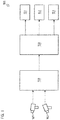
- FIG. 1 an apparatus configuration of a ship 100 is explained.
- Fig. 1 the apparatus configuration of the ship 100 is shown schematically by a block diagram.
- the ship 100 is a first embodiment according to the ship of the present invention.
- the ship 100 of this embodiment is not limited especially and may be a leisure boat, a fishing boat or the like.
- the ship 100 has a ship operation controller 150 and a recognition controller 160 as a recognition means.
- the ship operation controller 150 operates or steers the ship 100.
- the ship operation controller 150 is connected to an Engine Control Unit (hereinafter, referred to as ECU) 151 controlling rotation speed of an engine driving a screw propeller, a thruster controller 152 controlling rotation speed of a motor driving a thruster, and a hydraulic circuit 153 controlling a position of a hydraulic cylinder driving a rudder.
- ECU Engine Control Unit
- the thruster of this embodiment is a bow thruster or a stem thruster.
- the ship 100 of the present invention may have a propulsion device of stem drive type, POD type, or an outboard motor or the like.
- the recognition controller 160 recognizes a position of the ship 100 on the sea.
- the recognition controller 160 is connected to a first camera 161, a second camera 162 and the ship operation controller 150.
- the first camera 161 is provided in a front part of a hull.
- the second camera 162 is provided in a rear part of the hull (see Fig. 3 ).
- Fig. 2 the flow of the fixed point holding control S 100 is shown by a flow chart.
- an image of a structure S1 is photographed by the first camera 161
- an image of a structure S2 is photographed by the second camera 162
- the ship is operated so as to maintain sizes of the photographed images of the structure S1 and the structure S2, whereby the fixed point holding of the ship 100 is performed on the sea.
- a step S110 the recognition controller 160 photographs an image P of the structure S 1 as a land-based target by the first camera 161 and stores as an image P1.
- the recognition controller 160 photographs the image P of the structure S2 as another land-based target by the second camera 162 and stores as an image P2.
- the recognition controller 160 photographs the image P of the structure S1 by the first camera 161 again, and transmits a command to the ship operation controller 150 and operates the ship 100 so as to make a size of the photographed image P the same as that of the stored image P1.
- the recognition controller 160 photographs the image P of the structure S2 by the second camera 162 again, and transmits the command to the ship operation controller 150 and operates the ship 100 so as to make the size of the photographed image P the same as that of the stored image P2.
- the recognition controller 160 performs the fixed point holding of the ship 100 while repeating a step S130 (step S131 and step S 132) for every predetermined time.
- Fig. 3 the function of the fixed point holding control S 100 is shown schematically.
- the image P of the structure S 1 is photographed by the first camera 161 and stored as the image P1.
- the image P of the structure S2 is photographed by the second camera 162 and stored as the image P2.
- step S 131 he image P of the structure S 1 is photographed by the first camera 161 again, and a command is transmitted to the ship operation controller 150 and the ship 100 is operated so as to make the size of the photographed image P the same as that of the stored image P1.
- the ship 100 is operated so as to make a relative distance to the structure S 1 the same as that to a point at which the image P1 is photographed (step S 110).
- step S132 he image P of the structure S2 is photographed by the second camera 162 again, and a command is transmitted to the ship operation controller 150 and the ship 100 is operated so as to make the size of the photographed image P the same as that of the stored image P2.
- the ship 100 is operated so as to make a relative distance to the structure S2 the same as that to a point at which the image P2 is photographed (step S120). Namely, the ship 100 is held at the position at which the image P1 and the image P2 are photographed (step S110 and step S120).
- an accurate position of the ship 100 on the sea can be recognized so as to perform the fixed point holding.
- the position of the ship 100 on the sea is recognized by the recognition controller 160, the first camera 161 and the second camera 162 so as to perform the fixed point holding.
- the configuration is not limited thereto, and for example, it may alternatively be configured that the position of the ship 100 on the sea is recognized and automatic docking is performed.
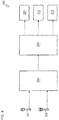
- FIG. 4 an apparatus configuration of a ship 200 is explained.
- Fig. 4 the apparatus configuration of the ship 200 is shown schematically by a block diagram.
- the ship 200 is a second embodiment according to the ship of the present invention.
- the ship 200 of this embodiment is not limited especially and may be a leisure boat, a fishing boat or the like.
- the ship 200 has a ship operation controller 250 and a recognition controller 260 as the recognition means.
- the ship operation controller 250 operates or steers the ship 200.
- the ship operation controller 250 is connected to an ECU 251 controlling rotation speed of an engine driving a screw propeller, a thruster controller 252 controlling rotation speed of a motor driving a thruster, and a hydraulic circuit 253 controlling a position of a hydraulic cylinder driving a rudder.
- the recognition controller 260 recognizes a position of the ship 200 on the sea.
- the recognition controller 260 is connected to a first distance sensor 261, a second distance sensor 262 and the ship operation controller 250.
- the first distance sensor 261 is provided in a front part of a hull.
- the second distance sensor 262 is provided in a rear part of the hull.
- the first distance sensor 261 and the second distance sensor 262 may be provided in any positon which is not interrupted by an obstacle, such as a cabin of the hull.
- the first distance sensor 261 and the second distance sensor 262 emit infrared light to a subject, detect the light reflected by the subject, and calculate a distance to the subject based on arrival time of the reflected light.
- the first distance sensor 261 and the second distance sensor 262 can be rotated for 360° so as to confirm subjects of all directions.
- Fig. 5 the flow of the fixed point holding control S200 is shown by a flow chart.
- a distance L1 to the structure S1 is measured by the first distance sensor 261
- a distance L2 to the structure S2 is measured by the second distance sensor 262
- the ship is operated so as to maintain the distance L1 and the distance L2, whereby the fixed point holding of the ship 200 is performed on the sea.
- the recognition controller 260 measures a distance L to the structure S1 as the land-based target by the first distance sensor 261, and stores the distance L as the distance L1.
- the recognition controller 260 measures the distance L to the structure S2 as the land-based target by the second distance sensor 262, and stores the distance L as the distance L2.
- the recognition controller 260 measures the distance L to the structure S1 by the first distance sensor 261 again, and transmits a command to the ship operation controller 250 and operates the ship 200 so as to make the measured distance L the same as the stored distance L1.
- the recognition controller 260 measures the distance L to the structure S2 by the second distance sensor 262 again, and transmits a command to the ship operation controller 250 and operates the ship 200 so as to make the measured distance L the same as the stored distance L2.
- the recognition controller 260 performs the fixed point holding of the ship 200 while repeating a step S230 (step S231 and step S232) for every predetermined time.
- Fig. 6 the function of the fixed point holding control S200 is shown schematically.
- the distance L to the structure S1 is measured by the first distance sensor 261 and stored as the distance L1.
- the distance L to the structure S2 is measured by the second distance sensor 262 and stored as the distance L2.
- the distance L to the structure S1 is measured by the first distance sensor 261 again, and the command is transmitted to the ship operation controller 250 and the ship 200 is operated so as to make the measured distance L the same as the stored distance L1.
- the distance L to the structure S2 is measured by the second distance sensor 262 again, and the command is transmitted to the ship operation controller 250 and the ship 200 is operated so as to make the measured distance L the same as the stored distance L2.
- the ship 200 is held at the position at which the distance L1 and the distance L2 are measured (step S210 and step S220).
- an accurate position of the ship 200 on the sea can be recognized so as to perform the fixed point holding.
- the position of the ship 200 on the sea is recognized by the recognition controller 260, the first distance sensor 261 and the second distance sensor 262 so as to perform the fixed point holding.
- the configuration is not limited thereto, and for example, it may alternatively be configured that the position of the ship 200 on the sea is recognized and automatic docking is performed.
- the present invention can be used for a ship. Description of Notations
Landscapes
- Engineering & Computer Science (AREA)
- Radar, Positioning & Navigation (AREA)
- Remote Sensing (AREA)
- Automation & Control Theory (AREA)
- Physics & Mathematics (AREA)
- General Physics & Mathematics (AREA)
- Aviation & Aerospace Engineering (AREA)
- Chemical & Material Sciences (AREA)
- Mechanical Engineering (AREA)
- Ocean & Marine Engineering (AREA)
- Combustion & Propulsion (AREA)
- Traffic Control Systems (AREA)
- Optical Radar Systems And Details Thereof (AREA)
Abstract
Description
- The present invention relates to an art of recognition of a positon of a ship.
- Conventionally, as a position recognition means for a position a ship on the sea, a Global Positioning System (GPS) is known (for example, see the Patent Literature 1). Conventionally, based on GPS information, operation of a ship such as fixed point holding or automatic docking on the sea is performed.
- However, a precision error of GPS information or precision error of map information stored previously may make it difficult to determine an accurate position of the ship itself on the sea.
- Patent Literature 1: the Japanese Patent Laid Open Gazette
2013-28296 - A problem to be solved by the present invention is to provide a ship in which an accurate position of the ship itself on the sea can be recognized.
- A ship of the present invention has a recognition means for a position of the ship itself on sea, and preferably, the recognition means recognizes the position of the ship itself on the sea based on relative distances between the ship and a plurality of land-based targets.
- According to the ship of the present invention, the recognition means photographs images of the plurality of the land-based targets by a plurality of cameras, and by operating the ship so as to maintain sizes of the plurality of the photographed images, fixed point holding on the sea is performed.
- According to the ship of the present invention, the recognition means measures distances to the plurality of the land-based targets by a plurality of distance sensors, and by operating the ship so as to maintain the plurality of the measured distances, fixed point holding on the sea is performed.
- According to the ship of the present invention, the accurate position of the ship itself on the sea can be recognized.
-
- [
Fig. 1] Fig. 1 is aFig. 1 is a block diagram of an apparatus configuration of a ship of a first embodiment. - [
Fig. 2] Fig. 2 is a flow chart of fixed point holding control. - [
Fig. 3] Fig. 3 is a schematic drawing of a function of the fixed point holding control. - [
Fig. 4] Fig. 4 is a block diagram of an apparatus configuration of a ship of a second embodiment. - [
Fig. 5] Fig. 5 is a flow chart of another embodiment of fixed point holding control. - [
Fig. 6] Fig. 6 is a schematic drawing of a function of the fixed point holding control. - Referring to
Fig. 1 , an apparatus configuration of aship 100 is explained. - In
Fig. 1 , the apparatus configuration of theship 100 is shown schematically by a block diagram. - The
ship 100 is a first embodiment according to the ship of the present invention. Theship 100 of this embodiment is not limited especially and may be a leisure boat, a fishing boat or the like. Theship 100 has aship operation controller 150 and arecognition controller 160 as a recognition means. - The
ship operation controller 150 operates or steers theship 100. Theship operation controller 150 is connected to an Engine Control Unit (hereinafter, referred to as ECU) 151 controlling rotation speed of an engine driving a screw propeller, athruster controller 152 controlling rotation speed of a motor driving a thruster, and ahydraulic circuit 153 controlling a position of a hydraulic cylinder driving a rudder. - The thruster of this embodiment is a bow thruster or a stem thruster. The
ship 100 of the present invention may have a propulsion device of stem drive type, POD type, or an outboard motor or the like. - The
recognition controller 160 recognizes a position of theship 100 on the sea. Therecognition controller 160 is connected to afirst camera 161, asecond camera 162 and theship operation controller 150. Thefirst camera 161 is provided in a front part of a hull. Thesecond camera 162 is provided in a rear part of the hull (seeFig. 3 ). - Referring to
Fig. 2 , a flow of a fixed pointholding control S 100 is explained. - In
Fig. 2 , the flow of the fixed pointholding control S 100 is shown by a flow chart. - In the fixed point holding control S100, an image of a structure S1 is photographed by the
first camera 161, an image of a structure S2 is photographed by thesecond camera 162, and the ship is operated so as to maintain sizes of the photographed images of the structure S1 and the structure S2, whereby the fixed point holding of theship 100 is performed on the sea. - In a step S110, the
recognition controller 160 photographs an image P of thestructure S 1 as a land-based target by thefirst camera 161 and stores as an image P1. - In a step S120, the
recognition controller 160 photographs the image P of the structure S2 as another land-based target by thesecond camera 162 and stores as an image P2. - In a step S131, the
recognition controller 160 photographs the image P of the structure S1 by thefirst camera 161 again, and transmits a command to theship operation controller 150 and operates theship 100 so as to make a size of the photographed image P the same as that of the stored image P1. - In a step S132, the
recognition controller 160 photographs the image P of the structure S2 by thesecond camera 162 again, and transmits the command to theship operation controller 150 and operates theship 100 so as to make the size of the photographed image P the same as that of the stored image P2. - Hereinafter, the
recognition controller 160 performs the fixed point holding of theship 100 while repeating a step S130 (step S131 and step S 132) for every predetermined time. - Referring to
Fig. 3 , a function of the fixed point holding control S100 is explained. - In
Fig. 3 , the function of the fixed pointholding control S 100 is shown schematically. - In the step S110, the image P of the
structure S 1 is photographed by thefirst camera 161 and stored as the image P1. In the step S120, the image P of the structure S2 is photographed by thesecond camera 162 and stored as the image P2. - In the step S 131, he image P of the
structure S 1 is photographed by thefirst camera 161 again, and a command is transmitted to theship operation controller 150 and theship 100 is operated so as to make the size of the photographed image P the same as that of the stored image P1. - In this case, the
ship 100 is operated so as to make a relative distance to thestructure S 1 the same as that to a point at which the image P1 is photographed (step S 110). - In the step S132, he image P of the structure S2 is photographed by the
second camera 162 again, and a command is transmitted to theship operation controller 150 and theship 100 is operated so as to make the size of the photographed image P the same as that of the stored image P2. - In this case, the
ship 100 is operated so as to make a relative distance to the structure S2 the same as that to a point at which the image P2 is photographed (step S120). Namely, theship 100 is held at the position at which the image P1 and the image P2 are photographed (step S110 and step S120). - An effect of the
ship 100 is explained. - According to the
ship 100, an accurate position of theship 100 on the sea can be recognized so as to perform the fixed point holding. - In this embodiment, the position of the
ship 100 on the sea is recognized by therecognition controller 160, thefirst camera 161 and thesecond camera 162 so as to perform the fixed point holding. However, the configuration is not limited thereto, and for example, it may alternatively be configured that the position of theship 100 on the sea is recognized and automatic docking is performed. - Referring to
Fig. 4 , an apparatus configuration of aship 200 is explained. - In
Fig. 4 , the apparatus configuration of theship 200 is shown schematically by a block diagram. - The
ship 200 is a second embodiment according to the ship of the present invention. Theship 200 of this embodiment is not limited especially and may be a leisure boat, a fishing boat or the like. Theship 200 has aship operation controller 250 and arecognition controller 260 as the recognition means. - The
ship operation controller 250 operates or steers theship 200. Theship operation controller 250 is connected to an ECU 251 controlling rotation speed of an engine driving a screw propeller, athruster controller 252 controlling rotation speed of a motor driving a thruster, and ahydraulic circuit 253 controlling a position of a hydraulic cylinder driving a rudder. - The
recognition controller 260 recognizes a position of theship 200 on the sea. Therecognition controller 260 is connected to afirst distance sensor 261, asecond distance sensor 262 and theship operation controller 250. Thefirst distance sensor 261 is provided in a front part of a hull. Thesecond distance sensor 262 is provided in a rear part of the hull. - The
first distance sensor 261 and thesecond distance sensor 262 may be provided in any positon which is not interrupted by an obstacle, such as a cabin of the hull. - The
first distance sensor 261 and thesecond distance sensor 262 emit infrared light to a subject, detect the light reflected by the subject, and calculate a distance to the subject based on arrival time of the reflected light. Thefirst distance sensor 261 and thesecond distance sensor 262 can be rotated for 360° so as to confirm subjects of all directions. - Referring to
Fig. 5 , a flow of a fixed point holding control S200 is explained. - In
Fig. 5 , the flow of the fixed point holding control S200 is shown by a flow chart. - In the fixed point holding control S200, a distance L1 to the structure S1 is measured by the
first distance sensor 261, a distance L2 to the structure S2 is measured by thesecond distance sensor 262, and the ship is operated so as to maintain the distance L1 and the distance L2, whereby the fixed point holding of theship 200 is performed on the sea. - In a step S210, the
recognition controller 260 measures a distance L to the structure S1 as the land-based target by thefirst distance sensor 261, and stores the distance L as the distance L1. - In a step S220, the
recognition controller 260 measures the distance L to the structure S2 as the land-based target by thesecond distance sensor 262, and stores the distance L as the distance L2. - In a step S231, the
recognition controller 260 measures the distance L to the structure S1 by thefirst distance sensor 261 again, and transmits a command to theship operation controller 250 and operates theship 200 so as to make the measured distance L the same as the stored distance L1. - In a step S232, the
recognition controller 260 measures the distance L to the structure S2 by thesecond distance sensor 262 again, and transmits a command to theship operation controller 250 and operates theship 200 so as to make the measured distance L the same as the stored distance L2. - Hereinafter, the
recognition controller 260 performs the fixed point holding of theship 200 while repeating a step S230 (step S231 and step S232) for every predetermined time. - Referring to
Fig. 6 , a function of the fixed point holding control S200 is explained. - In
Fig. 6 , the function of the fixed point holding control S200 is shown schematically. - In the step S210, the distance L to the structure S1 is measured by the
first distance sensor 261 and stored as the distance L1. In the step S220, the distance L to the structure S2 is measured by thesecond distance sensor 262 and stored as the distance L2. - In the step S231, the distance L to the structure S1 is measured by the
first distance sensor 261 again, and the command is transmitted to theship operation controller 250 and theship 200 is operated so as to make the measured distance L the same as the stored distance L1. - In the step S232, the distance L to the structure S2 is measured by the
second distance sensor 262 again, and the command is transmitted to theship operation controller 250 and theship 200 is operated so as to make the measured distance L the same as the stored distance L2. - In this case, the
ship 200 is held at the position at which the distance L1 and the distance L2 are measured (step S210 and step S220). - An effect of the
ship 200 is explained. - According to the
ship 200, an accurate position of theship 200 on the sea can be recognized so as to perform the fixed point holding. - In this embodiment, the position of the
ship 200 on the sea is recognized by therecognition controller 260, thefirst distance sensor 261 and thesecond distance sensor 262 so as to perform the fixed point holding. However, the configuration is not limited thereto, and for example, it may alternatively be configured that the position of theship 200 on the sea is recognized and automatic docking is performed. - The present invention can be used for a ship. Description of Notations
-
- 100
- ship
- 150
- ship operation controller
- 160
- recognition controller
- 161
- first camera
- 162
- second camera
Claims (3)
- A ship comprising
a recognition means structured to recognize a position of the ship itself on sea, and
wherein the recognition means structured to recognize the position of the ship itself on the sea based on relative distances between the ship and a plurality of land-based targets. - The ship according to claim 1, wherein
the recognition means is structured to photograph images of the plurality of the land-based targets by a plurality of cameras, and performs fixed point holding on the sea wherein the ship operation controller is structured to control the ship so as to maintain sizes of the plurality of the photographed images. - The ship according to claim 1, wherein
the recognition means is structured to measure distances to the plurality of the land-based targets by a plurality of distance sensors, and wherein the ship operation controller is structured to control the ship so as to maintain the plurality of the measured distances.
Applications Claiming Priority (2)
| Application Number | Priority Date | Filing Date | Title |
|---|---|---|---|
| JP2015041337A JP6302860B2 (en) | 2015-03-03 | 2015-03-03 | Ship |
| PCT/JP2016/055631 WO2016140135A1 (en) | 2015-03-03 | 2016-02-25 | Ship |
Publications (2)
| Publication Number | Publication Date |
|---|---|
| EP3267422A1 true EP3267422A1 (en) | 2018-01-10 |
| EP3267422A4 EP3267422A4 (en) | 2018-02-28 |
Family
ID=56846959
Family Applications (1)
| Application Number | Title | Priority Date | Filing Date |
|---|---|---|---|
| EP16758829.2A Ceased EP3267422A4 (en) | 2015-03-03 | 2016-02-25 | Ship |
Country Status (5)
| Country | Link |
|---|---|
| US (1) | US20180046190A1 (en) |
| EP (1) | EP3267422A4 (en) |
| JP (1) | JP6302860B2 (en) |
| AU (1) | AU2016227079A1 (en) |
| WO (1) | WO2016140135A1 (en) |
Families Citing this family (8)
| Publication number | Priority date | Publication date | Assignee | Title |
|---|---|---|---|---|
| WO2018100750A1 (en) * | 2016-12-02 | 2018-06-07 | ヤマハ発動機株式会社 | Small ship |
| JP2020512170A (en) | 2017-03-28 | 2020-04-23 | インダクティブ インテリジェンス,リミティド ライアビリティ カンパニー | Smart appliance, system and method |
| JP6986706B2 (en) * | 2018-01-23 | 2021-12-22 | 五洋建設株式会社 | Water mobile control device |
| US11334079B2 (en) | 2020-03-26 | 2022-05-17 | Yamaha Hatsudoki Kabushiki Kaisha | Watercraft and watercraft control system |
| US12065230B1 (en) | 2022-02-15 | 2024-08-20 | Brunswick Corporation | Marine propulsion control system and method with rear and lateral marine drives |
| US12258115B2 (en) | 2022-07-20 | 2025-03-25 | Brunswick Corporation | Marine propulsion system and joystick control method |
| US12134454B1 (en) | 2022-07-20 | 2024-11-05 | Brunswick Corporation | Marine propulsion system and method with single rear drive and lateral marine drive |
| US12110088B1 (en) | 2022-07-20 | 2024-10-08 | Brunswick Corporation | Marine propulsion system and method with rear and lateral marine drives |
Family Cites Families (21)
| Publication number | Priority date | Publication date | Assignee | Title |
|---|---|---|---|---|
| US3690767A (en) * | 1970-10-01 | 1972-09-12 | Systron Donner Corp | Optical tanker-docking system |
| JPS53106167A (en) * | 1977-02-28 | 1978-09-14 | Mitsubishi Heavy Ind Ltd | Position locator for sea structure |
| JPS5926913B2 (en) * | 1978-12-19 | 1984-07-02 | 三菱重工業株式会社 | Stability control method for ocean research vessel and position detection device for stability control |
| JPS6146792A (en) * | 1984-08-10 | 1986-03-07 | Mitsubishi Heavy Ind Ltd | Automatic ship position holding device for mooring |
| JPH0231213A (en) * | 1988-07-21 | 1990-02-01 | Nippon Telegr & Teleph Corp <Ntt> | Automatic satellite catching device |
| JPH0540894U (en) * | 1991-11-07 | 1993-06-01 | 株式会社光電製作所 | Position display device for ships |
| JPH09267798A (en) * | 1996-03-22 | 1997-10-14 | Mitsubishi Heavy Ind Ltd | Automatic fixed point holding system for ship |
| JP2978858B2 (en) * | 1997-10-15 | 1999-11-15 | 東芝テスコ株式会社 | Ship docking equipment |
| US6636296B1 (en) * | 1999-06-25 | 2003-10-21 | Robert L. Faulkner | Range finder |
| JP2001343213A (en) * | 2000-06-01 | 2001-12-14 | Minolta Co Ltd | Position-specifying apparatus loaded to mobile body |
| JP4559348B2 (en) * | 2004-12-10 | 2010-10-06 | 本田技研工業株式会社 | Outboard motor steering system |
| JP4666152B2 (en) * | 2005-07-20 | 2011-04-06 | トヨタ自動車株式会社 | Ship maneuvering device |
| JP5000244B2 (en) * | 2005-09-15 | 2012-08-15 | ヤマハ発動機株式会社 | Docking support device and ship equipped with the same |
| US7267068B2 (en) * | 2005-10-12 | 2007-09-11 | Brunswick Corporation | Method for maneuvering a marine vessel in response to a manually operable control device |
| US7561886B1 (en) * | 2006-01-06 | 2009-07-14 | Brunswick Corporation | Method for determining the position of a marine vessel relative to a fixed location |
| JP2008020204A (en) * | 2006-07-10 | 2008-01-31 | Omron Corp | Radar |
| US9098905B2 (en) * | 2010-03-12 | 2015-08-04 | Google Inc. | System and method for determining position of a device |
| US8622778B2 (en) * | 2010-11-19 | 2014-01-07 | Maxwell Tyers | Programmable automatic docking system |
| US9300954B2 (en) * | 2012-09-21 | 2016-03-29 | Tadano Ltd. | Surrounding information-obtaining device for working vehicle |
| JP5516693B2 (en) * | 2012-10-29 | 2014-06-11 | 富士通モバイルコミュニケーションズ株式会社 | Portable information device and information processing program |
| CN107577247B (en) * | 2014-07-30 | 2021-06-25 | 深圳市大疆创新科技有限公司 | Target tracking system and method |
-
2015
- 2015-03-03 JP JP2015041337A patent/JP6302860B2/en active Active
-
2016
- 2016-02-25 EP EP16758829.2A patent/EP3267422A4/en not_active Ceased
- 2016-02-25 US US15/554,860 patent/US20180046190A1/en not_active Abandoned
- 2016-02-25 AU AU2016227079A patent/AU2016227079A1/en not_active Abandoned
- 2016-02-25 WO PCT/JP2016/055631 patent/WO2016140135A1/en not_active Ceased
Also Published As
| Publication number | Publication date |
|---|---|
| WO2016140135A1 (en) | 2016-09-09 |
| JP2016162279A (en) | 2016-09-05 |
| EP3267422A4 (en) | 2018-02-28 |
| AU2016227079A1 (en) | 2017-10-26 |
| US20180046190A1 (en) | 2018-02-15 |
| JP6302860B2 (en) | 2018-03-28 |
Similar Documents
| Publication | Publication Date | Title |
|---|---|---|
| EP3267422A1 (en) | Ship | |
| US9904293B1 (en) | Systems and methods for automatically trailering a marine vessel on a boat trailer | |
| JP7258062B2 (en) | Automatic positioning system | |
| US10191490B2 (en) | Marine vessel | |
| US10457371B2 (en) | Vessel steering apparatus | |
| KR101683274B1 (en) | System for supporting vessel berth using unmanned aerial vehicle and the method thereof | |
| US10150551B2 (en) | Trolling motor with wind sensor | |
| EP4053822A1 (en) | Ship docking assistance device | |
| EP3957558B1 (en) | Situation avoidance systems for marine vessels | |
| US12307903B2 (en) | Unmanned aircraft system, a control system of a marine vessel and a method for controlling a navigation system of a marine vessel | |
| US20230221724A1 (en) | System and method for assisting a docking operation | |
| JP7554105B2 (en) | Distance recognition system and control method thereof, ship | |
| KR102328275B1 (en) | Bridge system for unmanned vessel and control method thereof | |
| KR20240059205A (en) | Drone for ship guidance, ship guidance system and method there of | |
| US12384509B2 (en) | Accumulating and utilizing port information by sensor recognition | |
| WO2021075364A1 (en) | Ship maneuvering assistance system and method | |
| EP4213111A1 (en) | System for detecting objects on a water surface | |
| CN119301474A (en) | Marine environment sensing system | |
| US12169946B2 (en) | Angular direction identifying device and angular direction identifying method | |
| US12559217B1 (en) | Marine propulsion control systems and methods with buffer zone adaptation | |
| JP7755419B2 (en) | Information processing device, ship steering support system | |
| JP2025167101A (en) | System and method for remotely steering a vessel | |
| US20210157322A1 (en) | Systems and methods for marine autonomous steering | |
| HK40077466A (en) | An automatic location placement system | |
| HK40062760A (en) | An automatic location placement system |
Legal Events
| Date | Code | Title | Description |
|---|---|---|---|
| STAA | Information on the status of an ep patent application or granted ep patent |
Free format text: STATUS: THE INTERNATIONAL PUBLICATION HAS BEEN MADE |
|
| PUAI | Public reference made under article 153(3) epc to a published international application that has entered the european phase |
Free format text: ORIGINAL CODE: 0009012 |
|
| STAA | Information on the status of an ep patent application or granted ep patent |
Free format text: STATUS: REQUEST FOR EXAMINATION WAS MADE |
|
| 17P | Request for examination filed |
Effective date: 20170929 |
|
| AK | Designated contracting states |
Kind code of ref document: A1 Designated state(s): AL AT BE BG CH CY CZ DE DK EE ES FI FR GB GR HR HU IE IS IT LI LT LU LV MC MK MT NL NO PL PT RO RS SE SI SK SM TR |
|
| AX | Request for extension of the european patent |
Extension state: BA ME |
|
| A4 | Supplementary search report drawn up and despatched |
Effective date: 20180131 |
|
| RIC1 | Information provided on ipc code assigned before grant |
Ipc: G01S 17/08 20060101ALN20180125BHEP Ipc: B63B 49/00 20060101ALI20180125BHEP Ipc: G01C 11/06 20060101ALN20180125BHEP Ipc: B63H 25/42 20060101ALI20180125BHEP Ipc: G05D 1/02 20060101AFI20180125BHEP |
|
| DAV | Request for validation of the european patent (deleted) | ||
| DAX | Request for extension of the european patent (deleted) | ||
| STAA | Information on the status of an ep patent application or granted ep patent |
Free format text: STATUS: EXAMINATION IS IN PROGRESS |
|
| 17Q | First examination report despatched |
Effective date: 20190102 |
|
| REG | Reference to a national code |
Ref country code: DE Ref legal event code: R003 |
|
| STAA | Information on the status of an ep patent application or granted ep patent |
Free format text: STATUS: THE APPLICATION HAS BEEN REFUSED |
|
| 18R | Application refused |
Effective date: 20191103 |