EP3267196A1 - Method for analyzing the ability of a substance to cross a bilayer membrane - Google Patents
Method for analyzing the ability of a substance to cross a bilayer membrane Download PDFInfo
- Publication number
- EP3267196A1 EP3267196A1 EP16305840.7A EP16305840A EP3267196A1 EP 3267196 A1 EP3267196 A1 EP 3267196A1 EP 16305840 A EP16305840 A EP 16305840A EP 3267196 A1 EP3267196 A1 EP 3267196A1
- Authority
- EP
- European Patent Office
- Prior art keywords
- droplets
- droplet
- amphiphilic molecules
- hydrophobic medium
- substance
- Prior art date
- Legal status (The legal status is an assumption and is not a legal conclusion. Google has not performed a legal analysis and makes no representation as to the accuracy of the status listed.)
- Granted
Links
Images


Classifications
-
- G—PHYSICS
- G01—MEASURING; TESTING
- G01N—INVESTIGATING OR ANALYSING MATERIALS BY DETERMINING THEIR CHEMICAL OR PHYSICAL PROPERTIES
- G01N33/00—Investigating or analysing materials by specific methods not covered by groups G01N1/00 - G01N31/00
- G01N33/48—Biological material, e.g. blood, urine; Haemocytometers
- G01N33/50—Chemical analysis of biological material, e.g. blood, urine; Testing involving biospecific ligand binding methods; Immunological testing
- G01N33/92—Chemical analysis of biological material, e.g. blood, urine; Testing involving biospecific ligand binding methods; Immunological testing involving lipids, e.g. cholesterol, lipoproteins, or their receptors
-
- B—PERFORMING OPERATIONS; TRANSPORTING
- B01—PHYSICAL OR CHEMICAL PROCESSES OR APPARATUS IN GENERAL
- B01L—CHEMICAL OR PHYSICAL LABORATORY APPARATUS FOR GENERAL USE
- B01L3/00—Containers or dishes for laboratory use, e.g. laboratory glassware; Droppers
- B01L3/50—Containers for the purpose of retaining a material to be analysed, e.g. test tubes
- B01L3/502—Containers for the purpose of retaining a material to be analysed, e.g. test tubes with fluid transport, e.g. in multi-compartment structures
- B01L3/5027—Containers for the purpose of retaining a material to be analysed, e.g. test tubes with fluid transport, e.g. in multi-compartment structures by integrated microfluidic structures, i.e. dimensions of channels and chambers are such that surface tension forces are important, e.g. lab-on-a-chip
- B01L3/502769—Containers for the purpose of retaining a material to be analysed, e.g. test tubes with fluid transport, e.g. in multi-compartment structures by integrated microfluidic structures, i.e. dimensions of channels and chambers are such that surface tension forces are important, e.g. lab-on-a-chip characterised by multiphase flow arrangements
- B01L3/502784—Containers for the purpose of retaining a material to be analysed, e.g. test tubes with fluid transport, e.g. in multi-compartment structures by integrated microfluidic structures, i.e. dimensions of channels and chambers are such that surface tension forces are important, e.g. lab-on-a-chip characterised by multiphase flow arrangements specially adapted for droplet or plug flow, e.g. digital microfluidics
-
- B—PERFORMING OPERATIONS; TRANSPORTING
- B01—PHYSICAL OR CHEMICAL PROCESSES OR APPARATUS IN GENERAL
- B01L—CHEMICAL OR PHYSICAL LABORATORY APPARATUS FOR GENERAL USE
- B01L2300/00—Additional constructional details
- B01L2300/04—Closures and closing means
- B01L2300/046—Function or devices integrated in the closure
- B01L2300/047—Additional chamber, reservoir
-
- B—PERFORMING OPERATIONS; TRANSPORTING
- B01—PHYSICAL OR CHEMICAL PROCESSES OR APPARATUS IN GENERAL
- B01L—CHEMICAL OR PHYSICAL LABORATORY APPARATUS FOR GENERAL USE
- B01L2300/00—Additional constructional details
- B01L2300/08—Geometry, shape and general structure
- B01L2300/0861—Configuration of multiple channels and/or chambers in a single devices
- B01L2300/087—Multiple sequential chambers
-
- B—PERFORMING OPERATIONS; TRANSPORTING
- B01—PHYSICAL OR CHEMICAL PROCESSES OR APPARATUS IN GENERAL
- B01L—CHEMICAL OR PHYSICAL LABORATORY APPARATUS FOR GENERAL USE
- B01L2300/00—Additional constructional details
- B01L2300/16—Surface properties and coatings
- B01L2300/161—Control and use of surface tension forces, e.g. hydrophobic, hydrophilic
- B01L2300/165—Specific details about hydrophobic, oleophobic surfaces
Definitions
- the present invention relates to a method for analyzing the ability of a substance to cross a bilayer membrane, and more particularly a biological bilayer membrane, method which can be used for performing a high-throughput screening (HTS).
- HTS high-throughput screening
- the ability of a drug to cross biological bilayer membranes is crucial for its activity.
- the drug when the drug is administered orally, the drug has first to cross the intestinal wall to be able to reach its target.
- drugs may be coupled with peptides able to cross these biological bilayer membranes.
- today few biological peptides are known and used. There is thus a great interest to be able to find new molecules capable of crossing biological bilayer membranes in order to help drugs to reach their target.
- PAMPA Parallel Artificial Membrane Permeability Assay
- Such a method uses 96 well plates comprising top and bottom phases separated by an oil phase. The two generated interfaces are covered by a phospholipid monolayer.
- a sample of the molecule to be tested is deposited at the aqueous top phase and after half a day or a day, the optical index of the bottom phase is measured to determine if the molecule has crossed the interphase which mimics the biological bilayer membrane.
- this method requires long experimental times to obtain a result.
- the interphase does not represent a good mimic of biological bilayer membrane giving results with a low accuracy.
- vesicles Another technique uses vesicles. These vesicles have a size from hundred nanometers to few micrometers and are put in a solution containing molecules to be tested. If these molecules are able to cross a bilayer membrane, they will translocate into the vesicles. After a sufficient time, the vesicles need thus to be rapidly recovered from the surrounding aqueous phase without being damaged and contaminated by the molecules contained in the aqueous phase, which can be a difficult task, in particular due to the low stability of the vesicles.
- Caco-2 Another technique is the so-called Caco-2 technique, which is cell-based. This method implies to form a layer of cells and to determine which substances are able to cross this layer of cells. This technique thus involves cell culture. The difficulty with this method is to form a uniform layer on the whole surface of the device used for this experiment and to always have healthy cells.
- the present invention allows providing a solution to such a problem.
- the present invention relates thus to a method to analyse the ability of a substance (3) to cross a bilayer membrane comprising the following steps:
- the bilayer of amphiphilic molecules (2) formed in step (iii) mimics biological bilayer membranes such as cell membranes. Consequently, a substance which is capable of crossing such a bilayer membrane will be able to cross a biological bilayer membrane. Such an ability can be determined easily with the method of the present invention. Indeed, when a substance initially present in the droplet D 2 (donor droplet) is found in the droplet D 1 (collector droplet), this means that the substance has crossed the bilayer membrane. Short times of about 1h or less are sufficient to obtain the result which is well below the experimental times of the prior art.
- the "hydrophobic medium” (1) according to the invention is a medium which is not miscible with water and in particular with the aqueous solutions AS 1 and AS 2 mentioned previously.
- an oil such as a vegetable oil (e.g. soybean oil), triglycerides (e.g. triolein, glycerol trivalerate, glyceryl trioctanoate), a silicone oil, a high molecular weight hydrocarbon (e.g. a hydrocarbon having from 10 to 40 carbon atoms such as squalene, decane, dodecane, etc.), or a mixture thereof; optionally in admixture with a solvent such as a halogenated hydrocarbon (e.g. chloroform or dichloromethane), an alcohol (e.g. butanol), an ether (e.g.
- a vegetable oil e.g. soybean oil
- triglycerides e.g. triolein, glycerol trivalerate, glyceryl trioctanoate
- silicone oil e.g. a hydrocarbon having from 10 to 40 carbon atoms such as squalene, decane,
- diethyl ether or 1,4-dioxane a fatty acid (e.g. oleic acid), a diglyceride (e.g. glyceryl dioctanoate or glyceryl dioleated), an ester (e.g. ethyl acetate or isopropyl acetate), a low molecular weight hydrocarbon (e.g. pentane, cyclopentane, hexane, cyclohexane, benzene or toluene), or a mixture thereof.
- a fatty acid e.g. oleic acid
- a diglyceride e.g. glyceryl dioctanoate or glyceryl dioleated
- an ester e.g. ethyl acetate or isopropyl acetate
- a low molecular weight hydrocarbon e.g. pentane, cyclopentan
- the hydrophobic medium (1) contains thus an oil having hydrophobic properties which can be a vegetable oil, triglycerides, a silicone oil, a high molecular weight hydrocarbon, or a mixture thereof.
- Triglycerides (also called TG, triacylglycerol, TAG, or triacylglyceride) is an ester derived from glycerol and three fatty acids, which can be identical or different, notably identical.
- a triglyceride has more particularly the following formula (I): wherein A 1 , A 2 and A 3 , identical or different, notably identical, are a hydrocarbon chain of a fatty acid.
- the triglycerides used in the present invention can be in the form of a mixture of various triglycerides, such as triglycerides present in a vegetable oil (for ex. soybean oil).
- fatty acid refers to a linear, saturated or unsaturated carboxylic acid (RCO 2 H comprising from 4 to 30, such as from 6 to 30, notably from 8 to 28, in particular from 10 to 24, for example from 12 to 22 carbon atoms (including the carbon atom of the carboxylic acid function).
- RCO 2 H linear, saturated or unsaturated carboxylic acid
- the fatty acid can have for example from 5 to 24 carbon atoms.
- valeric acid octanoic acid
- capric acid lauric acid
- myristic acid palmitic acid
- staric acid arachidic acid
- myristoleic acid myristelaidic acid
- palmitoleic acid palmitelaidic acid
- oleic acid elaidic acid
- linoleic acid linolenic acid
- ecosenoic acid or arachidonic acid notably valeric acid, octanoic acid, capric acid, lauric acid, myristic acid, palmitic acid, staric acid, arachidic acid, myristoleic acid, myristelaidic acid, palmitoleic acid, palmitelaidic acid, oleic acid, elaidic acid, linoleic acid, linolenic acid, ecosenoic acid or arachidonic acid.
- hydrocarbon chain of a fatty acid refers to the hydrocarbon chain (R) linked to the acid function of the fatty acid (RCO 2 H).
- R thus represents a linear, saturated or unsaturated hydrocarbon chain comprising from 3 to 29, such as from 5 to 29, notably from 7 to 27, in particular from 9 to 23, for example from 11 to 21 carbon atoms.
- valeric acid octanoic acid
- capric acid lauric acid
- myristic acid palmitic acid
- staric acid arachidic acid
- myristoleic acid myristelaidic acid
- palmitoleic acid palmitelaidic acid
- oleic acid elaidic acid
- linoleic acid linolenic acid
- ecosenoic acid or arachidonic acid it can be notably the hydrocarbon chain of valeric acid, octanoic acid, capric acid, lauric acid, myristic acid, palmitic acid, staric acid, arachidic acid, myristoleic acid, myristelaidic acid, palmitoleic acid, palmitelaidic acid, oleic acid, elaidic acid, linoleic acid, linolenic acid, ecosenoic acid or arachidonic acid.
- the triglycerides can be in particular triglycerides of formula (I) with A 1 , A 2 and A 3 , identical or different, notably identical, representing a linear, saturated or unsaturated hydrocarbon chain comprising from 3 to 23, such as from 4 to 24, notably from 5 to 19 carbon atoms.
- the triglycerides can be present in the form of a mixture of various triglycerides, such as those present in a vegetable oil, for ex. soybean oil. It can be also triolein, glycerol trivalerate or glyceryl trioctanoate.
- high molecular weight hydrocarbon in the present invention a linear or branched, saturated or unsaturated (including aromatic) hydrocarbon containing at least 10 carbon atoms.
- the high molecular weight hydrocarbon will contain from 10 to 40 carbon atoms, such as from 15 to 30 carbon atoms, provided that the hydrocarbon is liquid at the temperature at which the method is performed, typically room temperature (i.e. from 15 to 40°C, preferably from 20 to 30°C). It can be notably decane, dodecane, hexadecane or squalene, in particular squalene. It can be also in the form of a mixture of high molecular weight hydrocarbons such as a mineral oil.
- the oil will be more particularly a mixture of triglyceride(s) and high molecular weight hydrocarbon(s).
- the high molecular weight hydrocarbon can be squalene and the triglyceride (or mixture of triglycerides) can be triglycerides of formula (I) with A 1 , A 2 and A 3 , identical or different, notably identical, representing a linear, saturated or unsaturated hydrocarbon chain comprising from 5 to 23, such as from 7 to 21 carbon atoms, such as a vegetable oil (for ex. soybean oil), triolein, glyceryl octanoate or a mixture thereof.
- the oil will be more particularly a triglyceride or a mixture of triglycerides.
- the triglycerides can be in particular triglycerides of formula (I) with A 1 , A 2 and A 3 , identical or different, notably identical, representing a linear, saturated or unsaturated hydrocarbon chain comprising from 5 to 23, such as from 7 to 21 carbon atoms. It can be notably a vegetable oil (for ex. soybean oil), triolein, glyceryl octanoate or a mixture thereof.
- the hydrophobic medium (1) may contain also a solvent such as a halogenated hydrocarbon (e.g. chloroform or dichloromethane), an alcohol (e.g. butanol), an ether (e.g. diethyl ether or 1,4-dioxane), a fatty acid (e.g. oleic acid), a diglyceride (e.g. glyceryl dioctanoate or glyceryl dioleated), an ester (e.g. ethyl acetate or isopropyl acetate), a low molecular weight hydrocarbon (e.g.
- a solvent such as a halogenated hydrocarbon (e.g. chloroform or dichloromethane), an alcohol (e.g. butanol), an ether (e.g. diethyl ether or 1,4-dioxane), a fatty acid (e.g. oleic acid), a diglyceride (
- a halogenated hydrocarbon e.g. chloroform or dichloromethane
- an ether e.g. diethyl ether or 1,4-dioxane
- a low molecular weight hydrocarbon e.g. pentane, cyclopentane, he
- the presence of a solvent allows for the rapid recruitment of the amphiphilic molecules to the droplets interfaces and thereby providing rapid stable DIB formation.
- This solvent has a less hydrophobic character. Consequently, it may be present in an amount of less than 50 %, preferably less than 20 % (wt/wt) relatively to the total amount of the hydrophobic medium (1).
- the halogenated hydrocarbon is advantageously liquid at the temperature at which the method is performed, typically room temperature (i.e. from 15 to 40°C, preferably from 20 to 30°C).
- the halogenated hydrocarbon is advantageously a short chain halogenated hydrocarbon, comprising advantageously 1 to 6 carbon atoms, such as 1 to 4 carbon atoms. It can be in particular chloroform, dichloromethane, dichloroethane (e.g. 1,2-dichloroethane), etc. It can be chloroform or dichloromethane. Preferably it is choloroform.
- alcohol in the present invention a hydrocarbon in which a hydrogen atom has been replaced with an OH group.
- the alcohol is advantageously liquid at the temperature at which the method is performed, typically room temperature (i.e. from 15 to 40°C, preferably from 20 to 30°C).
- the alcohol is advantageously a short chain alcohol, comprising advantageously 1 to 12 carbon atoms, notably 1 to 6 carbon atoms, such as 1 to 4 carbon atoms. It can be also 4 to 12 carbon atoms, such as 4 to 8 carbon atoms, in particular 4 to 6 carbon atoms. It can be in particular butanol, more particularly n-butanol.
- ether is meant in the present invention a molecule of formula A 4 -O-A 5 wherein A 4 and A 5 each represent independently of one another a monovalent linear or branched, saturated or unsaturated, preferably saturated, hydrocarbon chain or A 4 and A 5 may form together a chain, such as a divalent linear or branched, saturated or unsaturated, preferably saturated, hydrocarbon chain optionally containing another oxygen atom.
- the ether is advantageously liquid at the temperature at which the method is performed, typically room temperature (i.e. from 15 to 40°C, preferably from 20 to 30°C).
- the monovalent or divalent hydrocarbon chain advantageously comprises 1 to 12 carbon atoms, notably 1 to 6 carbon atoms, such as 1 to 4 carbon atoms. It can be in particular diethyl ether or 1,4-dioxane. It could be also tetrahydrofurane.
- the fatty acid is as defined previously. It may comprise advantageously 4 to 18 carbon atoms. It can be in particular oleic acid.
- “Diglyceride” (also called DG, diacylglycerol, DAG, or diacylglyceride) is an ester derived from glycerol and two fatty acids, which can be identical or different, notably identical.
- a diglyceride has more particularly the following formula (II) or (III), or is a mixture thereof: wherein A 4 and A 5 , identical or different, notably identical, are a hydrocarbon chain of a fatty acid, in particular as defined previously.
- the diglycerides can be in particular diglycerides of formula (II) or (III) or a mixture thereof with A 4 and A 5 , identical or different, notably identical, representing a linear, saturated or unsaturated hydrocarbon chain comprising from 3 to 23, such as from 4 to 24, notably from 5 to 19 carbon atoms.
- the diglycerides can be notably glyceryl dioctanoate or dioleate.
- ester in the present invention a molecule of formula A 7 -OC(O)-A 8 wherein A 7 and A 8 each represent independently of one another a monovalent linear or branched, saturated or unsaturated, preferably saturated, hydrocarbon chain.
- the ester is advantageously liquid at the temperature at which the method is performed, typically room temperature (i.e. from 15 to 40°C, preferably from 20 to 30°C).
- the monovalent hydrocarbon chain advantageously comprises 1 to 12 carbon atoms, notably 1 to 6 carbon atoms, such as 1 to 4 carbon atoms. It can be in particular ethyl acetate or isopropyl acetate.
- the "low molecular weight hydrocarbon” is meant in the present invention a linear or branched, saturated or unsaturated (including aromatic) hydrocarbon containing no more than 9 carbon atoms, notably no more than 8 carbon atoms preferably no more than 7 carbon atoms.
- the low molecular weight hydrocarbon will contain from 5 to 9 carbon atoms, such as from 5 to 8 carbon atoms, notably from 5 to 7 carbon atoms, provided that the hydrocarbon is liquid at the temperature at which the method is performed, typically room temperature (i.e. from 15 to 40°C, preferably from 20 to 30°C). It can be notably pentane, cyclopentane, hexane, cyclohexane, benzene or toluene.
- the solvent used in the hydrophobic medium can be in particular pentane, cyclopentane, hexane, cyclohexane, benzene, toluene, 1,4-dioxane, diethyl ether, dichloromethane, chloroform or a mixture thereof, and preferably it is chloroform.
- amphiphilic molecule (2) is a molecule comprising a hydrophilic part and a hydrophobic part.
- the amphiphilic molecules (2) used in the present invention can be in particular lipids, such as phospholipids, glycolipids, monoglycerides, cholesterol, and mixtures thereof which are the types of lipids commonly present in cell membranes.
- the lipids can have a natural or synthetic origin.
- the amphiphilic molecules (2) can be phospholipids optionally in mixture with glycolipids and/or cholesterol.
- the amphiphilic molecules (2) will be phospholipids optionally in mixture with cholesterol.
- the amphiphilic molecules (2) will be phospholipids.
- “Monoglyceride” (also called MG, acylglycerol, or acylglyceride) is an ester derived from glycerol and one fatty acid.
- a monoglyceride has more particularly the following formula (IV) or (V), or is a mixture thereof: wherein A 6 is a hydrocarbon chain of a fatty acid, in particular as defined previously.
- Phospholipids are amphiphilic lipids comprising a phosphoric acid mono- or di-ester moiety as hydrophilic part. They can have a natural or synthetic origin. Preferably, synthetic phospholipids will be used. They can be a phosphatidylcholine (PC), a phosphatidylethanolamine (PE), a phosphatidylglycerol (PG), a phosphatidylserine (PS), a phosphatidic acid (PA), a phosphatidylinositol (PI), or a mixture thereof. Preferably, it is a PC, a PE, a PG, a PS or a mixture thereof. These phospholipids have more particularly the following formula (II): wherein:
- phospholipids can be obtained from Avanti Polar Lipids.
- Phospholipids formed with fatty acids having at least 12 carbon atoms offer better stability to the droplets.
- phospholipids are formed with fatty acids having 12 to 24 carbon atoms, notably 14 to 22 carbon atoms, such as 16 to 20 carbon atoms.
- Preferred phospholipids are those comprising a C18 fatty acid (i.e. with a hydrocarbon chain comprising 17 carbon atoms) such as oleic acid.
- the phospholipids will be a PC, a PE, a PS, a PG, or a mixture thereof, advantageously formed with fatty acids having 12 to 24 carbon atoms, notably 14 to 22 carbon atoms, such as 16 to 20 carbon atoms, such as DOPC (dioleoylphosphatidylcholine), DPPC (dipalmitoylphosphatidylcholine), DOPE (dioleoylphosphatidylethanolamine), DOPS (dioleoylphosphatidylserine notably as a sodium salt), DOPG (dioleoylphosphatidylglycerone notably as a sodium salt) or a mixture thereof.
- DOPC dioleoylphosphatidylcholine
- DPPC dipalmitoylphosphatidylcholine
- DOPE dioleoylphosphatidylethanolamine
- DOPS dioleoylphosphatidylserine notably as
- amphiphilic molecules (2) according to the present invention will be a mixture of:
- amphiphilic molecules (2) according to the present invention will have the following composition:
- amphiphilic molecules (2) according to the present invention will be advantageously a mixture of at least one PC, at least one PE and at least one PS or PG, preferably a mixture of at least one PC, at least one PE and at least one PG.
- the phospholipids are advantageously formed with fatty acids having 12 to 24 carbon atoms, notably 14 to 22 carbon atoms, such as 16 to 20 carbon atoms, in particular 18 carbon atoms.
- the amphiphilic molecules (2) can be in particular a mixture of DOPC (dioleoylphosphatidylcholine), DOPE (dioleoylphosphatidylethanolamine), and DOPS (dioleoylphosphatidylserine notably as a sodium salt) and/or DOPG (dioleoylphosphatidylglycerone notably as a sodium salt), such as a mixture of DOPC (dioleoylphosphatidylcholine), DOPE (dioleoylphosphatidylethanolamine) and DOPG (dioleoylphosphatidylglycerone notably as a sodium salt).
- DOPC dioleoylphosphatidylcholine
- DOPE dioleoylphosphatidylethanolamine
- DOPG dioleoylphosphatidylglycerone notably as a sodium salt
- the substance to be analysed can be any substance which could be used for example in the pharmaceutical field as a vehicle to improve the ability of a drug to cross the biological bilayer membranes. It can be a molecule or a salt thereof, a complex, etc. According to a particular embodiment, the substance to be analyzed will be a peptide.
- the droplets have a diameter comprised between 0.5 ⁇ m and 1000 ⁇ m, notably comprised between 20 ⁇ m and 500 ⁇ m, and preferably comprised between 50 ⁇ m and 200 ⁇ m.
- the droplets have thus substantially a spherical form.
- the diameter of the droplets can be measured by a brightfield camera.
- the droplets D 1 and D 2 have substantially the same size, i.e. that the diameter d 1 of the droplet D 1 and the diameter d 2 of the droplet D 2 should advantageously satisfied the following equation: Id 1 -d 2 I/(d 1 +d 2 ) ⁇ 0.9, notably ⁇ 0.5, preferably ⁇ 0.2.
- the aqueous solutions AS 1 and AS 2 will advantageously comprise a buffering agent in order to maintain the desired pH in these aqueous solutions.
- a buffering agent can be for example HEPES (4-(2-hydroxyethyl)-1-piperazine-ethanesulfonic acid).
- the aqueous solution AS 2 will further contain the substance (3) to be analyzed.
- the concentration of the substance (3) in the aqueous solution AS 2 is advantageously comprised between 1 nM and 10 mM, notably between 1 ⁇ M and 100 ⁇ M.
- a coloring agent e.g. a fluorescent agent such as rhodamine
- AS 1 or AS 2 aqueous solutions
- AS 1 comprises, notably consists in, water, a buffering agent and optionally a coloring agent
- AS 2 comprises, notably consists in, water, a buffering agent, the substance (3) to be analysed and optionally a coloring agent.
- Figure 2 represents D 1 and D 2 droplets after contacting, forming thus a bilayer of amphiphilic molecules (2).
- the various radii (R p , R 1 and R 2 ) can be measured by a brightfield high-speed camera.
- the contact angle 2 ⁇ is comprised in particular between 50° and 180°, such as between 90° and 180°, notably between 120° and 180°.
- bilayer area also called droplet interface bilayer (DIB)
- DIB droplet interface bilayer
- the solvent capable of separating the droplets D 1 and D 2 put into contact for example can be selected from a halogenated hydrocarbon (e.g. chloroform or dichloromethane), an alcohol (e.g. butanol), an ether (e.g. diethyl ether or 1,4-dioxane), a fatty acid (e.g. oleic acid), a diglyceride (e.g. glyceryl dioctanoate or glyceryl dioleated), an ester (e.g. ethyl acetate or isopropyl acetate), a low molecular weight hydrocarbon (e.g.
- a halogenated hydrocarbon e.g. chloroform or dichloromethane
- an alcohol e.g. butanol
- an ether e.g. diethyl ether or 1,4-dioxane
- a fatty acid e.g. oleic acid
- a halogenated hydrocarbon e.g. chloroform or dichloromethane
- an ether e.g. diethyl ether or 1,4-dioxane
- a low molecular weight hydrocarbon e.g. pentane, cyclopentan
- it will be a halogenated hydrocarbon, and more particularly chloroform.
- the droplet D 1 surrounded by a monolayer of amphiphilic molecules (2) can be provided by forming a droplet of the aqueous solution AS 1 in the hydrophobic medium (1) which contains the amphiphilic molecules (2).
- the amphiphilic molecules (2) will then spontaneously place themselves at the interface between the aqueous droplet and the hydrophobic medium (1).
- the volume of the hydrophobic medium (1) is at least twice the volume of the aqueous solution AS 1 used to form the droplets.
- the concentration of the amphiphilic molecules (2) in the hydrophobic medium (1) is advantageously at least 0.025 % (w/w).
- the droplet D 2 surrounded by a monolayer of amphiphilic molecules (2) can be provided by forming a droplet of the aqueous solution AS 2 in the hydrophobic medium (1) which contains the amphiphilic molecules (2).
- the amphiphilic molecules (2) will then spontaneously place themselves at the interface between the aqueous droplet and the hydrophobic medium (1).
- the volume of the hydrophobic medium (1) is at least twice the volume of the aqueous solution AS 2 used to form the droplets.
- the concentration of the amphiphilic molecules (2) in the hydrophobic medium (1) is advantageously at least 0.025 % (w/w).
- the two droplets D 1 and D 2 are brought into contact by any means (for ex. by mixing binary droplets or by changing the flow rate in microfluidics) used in the art.
- droplets D 1 and D 2 are formed separately in a hydrophobic medium (1) before merging together the two hydrophobic media (1) containing respectively droplets D 1 and D 2 .
- a microfluidic device can also be used to generate and put into contact the droplets as detailed hereafter.
- the droplets D 1 and D 2 are maintained into contact during a sufficient time to allow a substance to cross the bilayer of amphiphilic molecules (2).
- the droplets are maintained into contact during at least 1 min, notably between 1 and 180 min, such as between 5 and 60 min, in particular between 10 and 30 min.
- the two droplets D 1 and D 2 which are into contact are then separated by the addition of an appropriate solvent.
- Such a solvent capable of separating droplets D 1 and D 2 put into contact can be for example a halogenated hydrocarbon (e.g. chloroform or dichloromethane), an alcohol (e.g. butanol), an ether (e.g. diethyl ether or 1,4-dioxane), a fatty acid (e.g. oleic acid), a diglyceride (e.g. glyceryl dioctanoate or glyceryl dioleated), an ester (e.g. ethyl acetate or isopropyl acetate), a low molecular weight hydrocarbon (e.g.
- a halogenated hydrocarbon e.g. chloroform or dichloromethane
- an alcohol e.g. butanol
- an ether e.g. diethyl ether or 1,4-dioxane
- a fatty acid e.g. oleic acid
- a halogenated hydrocarbon e.g. chloroform or dichloromethane
- an ether e.g. diethyl ether or 1,4-dioxane
- a low molecular weight hydrocarbon e.g. pentane, cyclopentan
- it will be a halogenated hydrocarbon, and more particularly chloroform.
- droplet(s) D 1 is/are collected to be analysed.
- a coloring agent can be present in the aqueous solution AS 1 or AS 2 in order to distinguish droplets D 1 and D 2 .
- a microfluidic device it will be possible to generate alternatively droplets D 1 and D 2 so that droplets D 1 will be easily collected by collecting every second droplets.
- the content of the droplet(s) D 1 can be analysed to determine if the substance (3) is present and has thus been able to cross the bilayer of amphiphilic molecules (2) mimicking a cell membrane so as to move from droplet D 2 to droplet D 1 .
- Such an analysis can be performed by any usual analytical means used notably in chemistry or biochemistry. Such an analysis can be performed by fluorescence imaging if the substance is fluorescent or react with a target which becomes fluorescent when they are in contact, such a target being present in this case in the aqueous solution AS 1 . Otherwise, such an analysis can be performed for example by mass spectrometry or by high performance liquid chromatography (HPLC).
- HPLC high performance liquid chromatography
- the method according to the invention can be performed in high-throughput, in particular in a HTS method.
- Such a high-throughput method can be performed by the use of a microfluidic analysis system (4).
- Such an analysis system (4) could comprise:
- microfluidic channel (5) or (19) is meant in the present invention a channel having a cross section which has dimensions in the micrometer range.
- the microfluidic channel will have a width and a depth comprised between 10 ⁇ m and 1000 ⁇ m, in particular between 10 ⁇ m and 400 ⁇ m, notably between 10 ⁇ m and 250 ⁇ m, preferably between 10 and 100 ⁇ m or between 150 and 250 ⁇ m.
- the length of the microfluidic channel can be in the centimeter, decimeter or even meter range.
- Droplets D 1 are formed in the microfluidic device (18) by any means from the aqueous solution AS 1 (contained in a first reservoir (12)) and the hydrophobic medium (1) containing the amphiphilic molecules (2) (contained in a second reservoir (14)) which enter the microfluidic device (18) through its first and second inlets (11a,11b). Once formed, droplets D 1 flow in the hydrophobic medium (1) until the inlet (6) of the first microfluidic channel (5). Droplets D 1 can be formed for example by shearing a flow of aqueous solution AS 1 with two flows of hydrophobic medium (1) containing the amphiphilic molecules (2), method well-known to the one skilled in the art. The monolayer of amphiphilic molecules (2) is then formed spontaneously around the droplets D 1 .
- Droplets D 2 are formed similarly in the microfluidic device (18) by any means from the aqueous solution AS 2 containing the substance (3) (contained in a third reservoir (13)) and the hydrophobic medium (1) containing the amphiphilic molecules (2) (contained in the second reservoir (14) or a fourth reservoir (15)) which enter the microfluidic device (18) through its third and fourth inlets (11c,11d). Once formed, droplets D 2 flow in the hydrophobic medium (1) until the inlet (6) of the first microfluidic channel (5).
- Droplets D 2 can be formed for example by shearing a flow of aqueous solution AS 2 containing the substance (3) with two flows of hydrophobic medium (1) containing the amphiphilic molecules (2), method well-known to the one skilled in the art. The monolayer of amphiphilic molecules (2) is then formed spontaneously around the droplets D 2 .
- droplets D 1 and D 2 enter alternately the first microfluidic channel (5) through its inlet (6) and flow through this first microfluidic channel (5) from its inlet (6) to its outlet (7). Pairs of droplets D 1 and D 2 are brought into contact in this first microfluidic channel (5), for ex. by varying the pressure / flow rate in the first microfluidic channel (5), so as to form the bilayer of amphiphilic molecules (2) in the contact area. The pairs of droplets D 1 and D 2 will flow and be maintained into contact through this first microfluidic channel (5) until the end of this microfluidic channel (5).
- the pairs of droplets D 1 and D 2 enter a second microfluidic channel (19) through its inlet (20) and flow through this second microfluidic channel (19) from its inlet (20) to its outlet (21).
- a solvent capable of separating the droplets D 1 and D 2 put into contact is introduced in the microfluidic device (18) by a fifth inlet (11e) by any means. This solvent enters the second microfluidic channel (19) through its inlet (20) in order to separate the pairs droplets D 1 and D 2 put into contact in the second microfluidic channel (19).
- Droplets D 1 and D 2 get out alternately of the second microfluidic channel (19) through its outlet (21) so that it is possible to direct droplets D 1 towards the first outlet (8a) of the microfluidic device (18) and to direct droplets D 2 towards the second outlet (8b) of the microfluidic device (18).
- Droplets D 1 are thus collected in a first receiver container (9), whereas droplets D 2 are collected in a second receiver container (10). It is thus easy with such a device to collect separately droplets D 1 by collecting each second droplet.
- the content of the collected droplets D 1 is then analyzed by means of an analyzing device (17) to determine the presence or not of the substance (3) in the droplet D 1 .
- the analyzing device (17) can be any usual analytical device, notably usually used in chemistry or in biochemistry.
- Such an analyzing device (17) can be a device for fluorescence imaging if the substance (3) is fluorescent or react with a target which becomes fluorescent when they are in contact, such a target being present in this case in the aqueous solution AS 1 .
- an analyzing device (17) can be a mass spectrometer or a high performance liquid chromatography (HPLC).
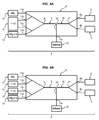
- FIG. 4A and 4B Various embodiments of such a microfluidic device (18) useful in a microfluidic analysis system (4) according to the invention are illustrated on Figures 4A and 4B .
- Such a microfluidic analysis system (4) will allow forming and analysing numerous pairs of droplets with an automated treatment of the results.
- it will be possible to introduce various substances (3) to be analyzed in aqueous solution AS 2 .
- An analysis of the content of droplets D 1 obtained at the end of the experiment will allow the identification of the substances (3) able to cross a bilayer membrane.
- Oils (triolein, glyceryl octanoate) and solvents (chloroform) were purchased from Sigma Aldrich.
- Phospholipids DOPC, DOPE and DOPG
- fluorescent phospholipids (rhodamine-PE) were purchased from Avanti Polar Lipids.
- Cyclosporine was purchased from Sigma Aldrich and penetratin-gfp was purified from bacteria ( Jo et al. Sci Rep. 2014 Mar 14;4:4378 ). All salts and Hepes were also purchased from Sigma Aldrich.
- Triolein-pyrene fluorescent triglyceride was purchased from Marker Genes.
- a phospholipid-oil mixture (hydrophobic medium containing phospholipids): 15 ⁇ l of DOPC at 25mg/ml, 7 ⁇ l of DOPE at 25 mg/ml, 7 ⁇ l ⁇ DOPG at 25 mg/ml in chloroform were mixed dried under vacuum. 400 ⁇ l of glyceryl trioctanoate were then added to obtain the hydrophobic medium with a phospholipid concentration at roughly 0.2% (w/w). Glyceryl trioctanoate can be replaced with trioelin.
- triolein-pyrene which is fluorescent after excitation by UV, in order to detect the optional presence of hydrophobic medium inside the droplet interface bilayer (DIB).
- DIB droplet interface bilayer
- Buffer solution a buffer solution was prepared by mixing Hepes (25mM in water), MgCl 2 (2mM in water) and potassium acetate (120mM in water).
- AS 1 corresponds to the Buffer solution.
- AS 2 is prepared by adding the peptide (cyclosporine or penetratin-gfp resp. 1 ⁇ M and 10 ⁇ M) to the Buffer solution.
- Two populations of water-in-oil droplets are prepared separately. 10 ⁇ l of AS 1 solution was mixed with 150 ⁇ l of the phospholipid-oil solution and thoroughly vortexed to generate droplets D 1 surrounded by a phospholipid layer. The same operation is conducted to generate droplets D 2 surrounded by a phospholipid layer from 10 ⁇ l of AS 2 solution containing a peptide and 150 ⁇ l of the phospholipid-oil solution.
- the pairs of droplets D 1 and D 2 can be followed over time by fluorescence imaging to study the passage of the peptide from droplets D 2 to droplets D 1 .
Landscapes
- Health & Medical Sciences (AREA)
- Chemical & Material Sciences (AREA)
- Life Sciences & Earth Sciences (AREA)
- Hematology (AREA)
- Molecular Biology (AREA)
- Engineering & Computer Science (AREA)
- Urology & Nephrology (AREA)
- Analytical Chemistry (AREA)
- Dispersion Chemistry (AREA)
- Biomedical Technology (AREA)
- Immunology (AREA)
- General Health & Medical Sciences (AREA)
- Microbiology (AREA)
- Biotechnology (AREA)
- Food Science & Technology (AREA)
- Medicinal Chemistry (AREA)
- Physics & Mathematics (AREA)
- Endocrinology (AREA)
- Biochemistry (AREA)
- Biophysics (AREA)
- General Physics & Mathematics (AREA)
- Pathology (AREA)
- Cell Biology (AREA)
- Clinical Laboratory Science (AREA)
- Chemical Kinetics & Catalysis (AREA)
- Measuring Or Testing Involving Enzymes Or Micro-Organisms (AREA)
Abstract
(i) providing in a hydrophobic medium (1) a first droplet D1 of an aqueous solution AS1, wherein the droplet D1 is surrounded by a monolayer of amphiphilic molecules (2),
(ii) providing in the said hydrophobic medium (1) a second droplet D2 of an aqueous solution AS2 containing the substance (3) to be analysed, wherein the droplet D2 is surrounded by a monolayer of amphiphilic molecules (2),
(iii) putting the first droplet D1 and the second droplet D2 into contact so as to form a bilayer of amphiphilic molecules (2) in the contact area and to have a contact angle 2θ between the two droplets D1 and D2 comprised between 10° and 180°,
(iv) adding to the hydrophobic medium (1) a solvent capable of separating the droplets D1 and D2 put into contact,
(v) collecting the droplet D1, and
(vi) analysing the content of the droplet D1 in order to determine the presence or not of the substance (3).
Description
- The present invention relates to a method for analyzing the ability of a substance to cross a bilayer membrane, and more particularly a biological bilayer membrane, method which can be used for performing a high-throughput screening (HTS).
- In the pharmaceutical field, the ability of a drug to cross biological bilayer membranes is crucial for its activity. In particular, when the drug is administered orally, the drug has first to cross the intestinal wall to be able to reach its target. To solve this problem, drugs may be coupled with peptides able to cross these biological bilayer membranes. However, today few biological peptides are known and used. There is thus a great interest to be able to find new molecules capable of crossing biological bilayer membranes in order to help drugs to reach their target.
- The main method used today for identifying molecules able to cross a biological bilayer membrane is PAMPA (Parallel Artificial Membrane Permeability Assay). Such a method uses 96 well plates comprising top and bottom phases separated by an oil phase. The two generated interfaces are covered by a phospholipid monolayer. A sample of the molecule to be tested is deposited at the aqueous top phase and after half a day or a day, the optical index of the bottom phase is measured to determine if the molecule has crossed the interphase which mimics the biological bilayer membrane. However, this method requires long experimental times to obtain a result. Furthermore, the interphase does not represent a good mimic of biological bilayer membrane giving results with a low accuracy.
- Another technique uses vesicles. These vesicles have a size from hundred nanometers to few micrometers and are put in a solution containing molecules to be tested. If these molecules are able to cross a bilayer membrane, they will translocate into the vesicles. After a sufficient time, the vesicles need thus to be rapidly recovered from the surrounding aqueous phase without being damaged and contaminated by the molecules contained in the aqueous phase, which can be a difficult task, in particular due to the low stability of the vesicles.
- Another technique is the so-called Caco-2 technique, which is cell-based. This method implies to form a layer of cells and to determine which substances are able to cross this layer of cells. This technique thus involves cell culture. The difficulty with this method is to form a uniform layer on the whole surface of the device used for this experiment and to always have healthy cells.
- There is thus a need for new methods capable of identifying molecules able of crossing biological bilayer membranes with a shorter experimental time and a higher accuracy.
- The present invention allows providing a solution to such a problem.
- The present invention relates thus to a method to analyse the ability of a substance (3) to cross a bilayer membrane comprising the following steps:
- (i) providing in a hydrophobic medium (1) a first droplet D1 of an aqueous solution AS1, wherein the droplet D1 is surrounded by a monolayer of amphiphilic molecules (2),
- (ii) providing in the said hydrophobic medium (1) a second droplet D2 of an aqueous solution AS2 containing the substance (3) to be analysed, wherein the droplet D2 is surrounded by a monolayer of amphiphilic molecules (2),
- (iii) putting the first droplet D1 and the second droplet D2 into contact so as to form a bilayer of amphiphilic molecules (2) in the contact area and to have a contact angle 2θ between the two droplets D1 and D2 comprised between 10° and 180°,
- (iv) adding to the hydrophobic medium (1) a solvent capable of separating the droplets D1 and D2 put into contact,
- (v) collecting the droplet D1, and
- (vi) analyzing the content of the droplet D1 in order to determine the presence or not of the substance (3).
- The invention will be described by way of example, with reference to the accompanying drawings.
-
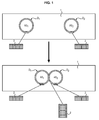
Figure 1 illustrates step (iii) of the method according to the invention relative to the formation of the bilayer of amphiphilic molecules (2). -
Figure 2 illustrates the contacted droplets D1 and D2 obtained in step (iii). -
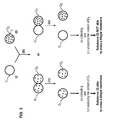
Figure 3 illustrates the whole method according to the invention, only droplets D1 and D2 and the substance (3) to be tested being represented. -
Figures 4A and 4B illustrate various embodiments of a microfluidic device (18) according to the invention useful to perform the method according to the invention in a high-throughput manner. -
Figure 5 represents the translocated signal of a peptide (i.e. the passage of a peptide from droplets D2 to droplets in function of the contact angle. -
Figure 6 represents photographs of a pair of droplets D1 and D2 with low or high contact angle, D1 containing a fluorescent peptide. -
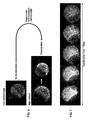
Figure 7 represents photographs of a pair of droplets D1 and D2 during time (30 min), D1 containing a fluorescent peptide which translocates to D2. -
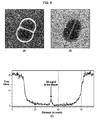
Figure 8 represents, for a Droplet Interface Bilayer (DIB) having a low contact angle: (A) the fluorescent image of rhodamine-PE contained in the DIB in order to visualize the phospholipid layers, (B) the fluorescent image of triolein-pyrene contained in the hydrophobic medium in order to visualize the hydrophobic medium, and (C) the oil signal (gray value) measured along the arrow showing the presence of an oil signal in the phospholipid bilayer. -
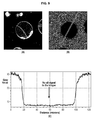
Figure 9 represents, for a Droplet Interface Bilayer (DIB) having a high contact angle: (A) the fluorescent image of rhodamine-PE contained in the DIB in order to visualize the phospholipid layers, (B) the fluorescent image of triolein-pyrene contained in the hydrophobic medium in order to visualize the hydrophobic medium, and (C) the oil signal (gray value) measured along the arrow showing the absence of an oil signal in the phospholipid bilayer. - The bilayer of amphiphilic molecules (2) formed in step (iii) (see
Figures 1 and2 ) mimics biological bilayer membranes such as cell membranes. Consequently, a substance which is capable of crossing such a bilayer membrane will be able to cross a biological bilayer membrane. Such an ability can be determined easily with the method of the present invention. Indeed, when a substance initially present in the droplet D2 (donor droplet) is found in the droplet D1 (collector droplet), this means that the substance has crossed the bilayer membrane. Short times of about 1h or less are sufficient to obtain the result which is well below the experimental times of the prior art. - The "hydrophobic medium" (1) according to the invention is a medium which is not miscible with water and in particular with the aqueous solutions AS1 and AS2 mentioned previously.
- Advantageously, it can comprise an oil such as a vegetable oil (e.g. soybean oil), triglycerides (e.g. triolein, glycerol trivalerate, glyceryl trioctanoate), a silicone oil, a high molecular weight hydrocarbon (e.g. a hydrocarbon having from 10 to 40 carbon atoms such as squalene, decane, dodecane, etc.), or a mixture thereof; optionally in admixture with a solvent such as a halogenated hydrocarbon (e.g. chloroform or dichloromethane), an alcohol (e.g. butanol), an ether (e.g. diethyl ether or 1,4-dioxane), a fatty acid (e.g. oleic acid), a diglyceride (e.g. glyceryl dioctanoate or glyceryl dioleated), an ester (e.g. ethyl acetate or isopropyl acetate), a low molecular weight hydrocarbon (e.g. pentane, cyclopentane, hexane, cyclohexane, benzene or toluene), or a mixture thereof.
- The hydrophobic medium (1) contains thus an oil having hydrophobic properties which can be a vegetable oil, triglycerides, a silicone oil, a high molecular weight hydrocarbon, or a mixture thereof.
- "Triglycerides" (also called TG, triacylglycerol, TAG, or triacylglyceride) is an ester derived from glycerol and three fatty acids, which can be identical or different, notably identical. A triglyceride has more particularly the following formula (I):

- In the context of the present invention, "fatty acid" refers to a linear, saturated or unsaturated carboxylic acid (RCO2H comprising from 4 to 30, such as from 6 to 30, notably from 8 to 28, in particular from 10 to 24, for example from 12 to 22 carbon atoms (including the carbon atom of the carboxylic acid function). The fatty acid can have for example from 5 to 24 carbon atoms. It can be notably valeric acid, octanoic acid, capric acid, lauric acid, myristic acid, palmitic acid, staric acid, arachidic acid, myristoleic acid, myristelaidic acid, palmitoleic acid, palmitelaidic acid, oleic acid, elaidic acid, linoleic acid, linolenic acid, ecosenoic acid or arachidonic acid.
- In the context of the present invention, "hydrocarbon chain of a fatty acid" refers to the hydrocarbon chain (R) linked to the acid function of the fatty acid (RCO2H). R thus represents a linear, saturated or unsaturated hydrocarbon chain comprising from 3 to 29, such as from 5 to 29, notably from 7 to 27, in particular from 9 to 23, for example from 11 to 21 carbon atoms. It can be notably the hydrocarbon chain of valeric acid, octanoic acid, capric acid, lauric acid, myristic acid, palmitic acid, staric acid, arachidic acid, myristoleic acid, myristelaidic acid, palmitoleic acid, palmitelaidic acid, oleic acid, elaidic acid, linoleic acid, linolenic acid, ecosenoic acid or arachidonic acid.
- By "unsaturated" is meant in the present invention that the chain comprises one or several double bonds C=C, notably one to four, such as one, two or three.
- The triglycerides can be in particular triglycerides of formula (I) with A1, A2 and A3, identical or different, notably identical, representing a linear, saturated or unsaturated hydrocarbon chain comprising from 3 to 23, such as from 4 to 24, notably from 5 to 19 carbon atoms. The triglycerides can be present in the form of a mixture of various triglycerides, such as those present in a vegetable oil, for ex. soybean oil. It can be also triolein, glycerol trivalerate or glyceryl trioctanoate.
- By "high molecular weight hydrocarbon" is meant in the present invention a linear or branched, saturated or unsaturated (including aromatic) hydrocarbon containing at least 10 carbon atoms. Advantageously, the high molecular weight hydrocarbon will contain from 10 to 40 carbon atoms, such as from 15 to 30 carbon atoms, provided that the hydrocarbon is liquid at the temperature at which the method is performed, typically room temperature (i.e. from 15 to 40°C, preferably from 20 to 30°C). It can be notably decane, dodecane, hexadecane or squalene, in particular squalene. It can be also in the form of a mixture of high molecular weight hydrocarbons such as a mineral oil.
- According to a particular embodiment, the oil will be more particularly a mixture of triglyceride(s) and high molecular weight hydrocarbon(s). The high molecular weight hydrocarbon can be squalene and the triglyceride (or mixture of triglycerides) can be triglycerides of formula (I) with A1, A2 and A3, identical or different, notably identical, representing a linear, saturated or unsaturated hydrocarbon chain comprising from 5 to 23, such as from 7 to 21 carbon atoms, such as a vegetable oil (for ex. soybean oil), triolein, glyceryl octanoate or a mixture thereof.
- According to another particular embodiment, the oil will be more particularly a triglyceride or a mixture of triglycerides. The triglycerides can be in particular triglycerides of formula (I) with A1, A2 and A3, identical or different, notably identical, representing a linear, saturated or unsaturated hydrocarbon chain comprising from 5 to 23, such as from 7 to 21 carbon atoms. It can be notably a vegetable oil (for ex. soybean oil), triolein, glyceryl octanoate or a mixture thereof.
- The hydrophobic medium (1) may contain also a solvent such as a halogenated hydrocarbon (e.g. chloroform or dichloromethane), an alcohol (e.g. butanol), an ether (e.g. diethyl ether or 1,4-dioxane), a fatty acid (e.g. oleic acid), a diglyceride (e.g. glyceryl dioctanoate or glyceryl dioleated), an ester (e.g. ethyl acetate or isopropyl acetate), a low molecular weight hydrocarbon (e.g. pentane, cyclopentane, hexane, cyclohexane, benzene or toluene), or a mixture thereof; notably a halogenated hydrocarbon (e.g. chloroform or dichloromethane), an ether (e.g. diethyl ether or 1,4-dioxane), a low molecular weight hydrocarbon (e.g. pentane, cyclopentane, hexane, cyclohexane, benzene or toluene), or a mixture thereof; preferably a halogenated hydrocarbon (e.g. chloroform or dichloromethane).
- The presence of a solvent allows for the rapid recruitment of the amphiphilic molecules to the droplets interfaces and thereby providing rapid stable DIB formation.
- This solvent has a less hydrophobic character. Consequently, it may be present in an amount of less than 50 %, preferably less than 20 % (wt/wt) relatively to the total amount of the hydrophobic medium (1).
- By "halogenated hydrocarbon" is meant in the sense of the present invention an hydrocarbon, which can be linear or branched, saturated or unsaturated (i.e. containing one or several double bond C=C), preferably linear or branched and saturated, in which one or more hydrogen atoms have been replaced by a halogen atom, i.e. F, Cl, Br or I, preferably Cl. The halogenated hydrocarbon is advantageously liquid at the temperature at which the method is performed, typically room temperature (i.e. from 15 to 40°C, preferably from 20 to 30°C). The halogenated hydrocarbon is advantageously a short chain halogenated hydrocarbon, comprising advantageously 1 to 6 carbon atoms, such as 1 to 4 carbon atoms. It can be in particular chloroform, dichloromethane, dichloroethane (e.g. 1,2-dichloroethane), etc. It can be chloroform or dichloromethane. Preferably it is choloroform.
- By "alcohol" is meant in the present invention a hydrocarbon in which a hydrogen atom has been replaced with an OH group. The hydrocarbon can be linear or branched, saturated or unsaturated (i.e. containing one or several double bond C=C), preferably linear or branched and saturated. The alcohol is advantageously liquid at the temperature at which the method is performed, typically room temperature (i.e. from 15 to 40°C, preferably from 20 to 30°C). The alcohol is advantageously a short chain alcohol, comprising advantageously 1 to 12 carbon atoms, notably 1 to 6 carbon atoms, such as 1 to 4 carbon atoms. It can be also 4 to 12 carbon atoms, such as 4 to 8 carbon atoms, in particular 4 to 6 carbon atoms. It can be in particular butanol, more particularly n-butanol.
- By "ether" is meant in the present invention a molecule of formula A4-O-A5 wherein A4 and A5 each represent independently of one another a monovalent linear or branched, saturated or unsaturated, preferably saturated, hydrocarbon chain or A4 and A5 may form together a chain, such as a divalent linear or branched, saturated or unsaturated, preferably saturated, hydrocarbon chain optionally containing another oxygen atom. The ether is advantageously liquid at the temperature at which the method is performed, typically room temperature (i.e. from 15 to 40°C, preferably from 20 to 30°C). The monovalent or divalent hydrocarbon chain advantageously comprises 1 to 12 carbon atoms, notably 1 to 6 carbon atoms, such as 1 to 4 carbon atoms. It can be in particular diethyl ether or 1,4-dioxane. It could be also tetrahydrofurane.
- The fatty acid is as defined previously. It may comprise advantageously 4 to 18 carbon atoms. It can be in particular oleic acid.
- "Diglyceride" (also called DG, diacylglycerol, DAG, or diacylglyceride) is an ester derived from glycerol and two fatty acids, which can be identical or different, notably identical. A diglyceride has more particularly the following formula (II) or (III), or is a mixture thereof:


- The diglycerides can be in particular diglycerides of formula (II) or (III) or a mixture thereof with A4 and A5, identical or different, notably identical, representing a linear, saturated or unsaturated hydrocarbon chain comprising from 3 to 23, such as from 4 to 24, notably from 5 to 19 carbon atoms. The diglycerides can be notably glyceryl dioctanoate or dioleate.
- By "ester" is meant in the present invention a molecule of formula A7-OC(O)-A8 wherein A7 and A8 each represent independently of one another a monovalent linear or branched, saturated or unsaturated, preferably saturated, hydrocarbon chain. The ester is advantageously liquid at the temperature at which the method is performed, typically room temperature (i.e. from 15 to 40°C, preferably from 20 to 30°C). The monovalent hydrocarbon chain advantageously comprises 1 to 12 carbon atoms, notably 1 to 6 carbon atoms, such as 1 to 4 carbon atoms. It can be in particular ethyl acetate or isopropyl acetate.
- The "low molecular weight hydrocarbon" is meant in the present invention a linear or branched, saturated or unsaturated (including aromatic) hydrocarbon containing no more than 9 carbon atoms, notably no more than 8 carbon atoms preferably no more than 7 carbon atoms. Advantageously, the low molecular weight hydrocarbon will contain from 5 to 9 carbon atoms, such as from 5 to 8 carbon atoms, notably from 5 to 7 carbon atoms, provided that the hydrocarbon is liquid at the temperature at which the method is performed, typically room temperature (i.e. from 15 to 40°C, preferably from 20 to 30°C). It can be notably pentane, cyclopentane, hexane, cyclohexane, benzene or toluene.
- The solvent used in the hydrophobic medium can be in particular pentane, cyclopentane, hexane, cyclohexane, benzene, toluene, 1,4-dioxane, diethyl ether, dichloromethane, chloroform or a mixture thereof, and preferably it is chloroform.
- An "amphiphilic molecule" (2) is a molecule comprising a hydrophilic part and a hydrophobic part.
- The amphiphilic molecules (2) used in the present invention can be in particular lipids, such as phospholipids, glycolipids, monoglycerides, cholesterol, and mixtures thereof which are the types of lipids commonly present in cell membranes. The lipids can have a natural or synthetic origin. More particularly, the amphiphilic molecules (2) can be phospholipids optionally in mixture with glycolipids and/or cholesterol. Advantageously, the amphiphilic molecules (2) will be phospholipids optionally in mixture with cholesterol. Preferably, the amphiphilic molecules (2) will be phospholipids.
- "Monoglyceride" (also called MG, acylglycerol, or acylglyceride) is an ester derived from glycerol and one fatty acid. A monoglyceride has more particularly the following formula (IV) or (V), or is a mixture thereof:


- "Phospholipids" are amphiphilic lipids comprising a phosphoric acid mono- or di-ester moiety as hydrophilic part. They can have a natural or synthetic origin. Preferably, synthetic phospholipids will be used. They can be a phosphatidylcholine (PC), a phosphatidylethanolamine (PE), a phosphatidylglycerol (PG), a phosphatidylserine (PS), a phosphatidic acid (PA), a phosphatidylinositol (PI), or a mixture thereof. Preferably, it is a PC, a PE, a PG, a PS or a mixture thereof. These phospholipids have more particularly the following formula (II):

- X+ is a counterion, and more particularly a monovalent cation such as Na+ or NH4 +,
- n is 0 (i.e. X+ is absent) or 1 (i.e. X+ is present),
- R1 and R2, identical or different, preferably identical, are a hydrocarbon chain of a fatty acid (as defined above), and
- R3 is:
- ■

- ■

- ■

- ■

- ■

- ■

- ■
- These phospholipids can be obtained from Avanti Polar Lipids.
- Phospholipids formed with fatty acids having at least 12 carbon atoms (i.e. with a hydrocarbon chain having at least 11 carbon atoms) offer better stability to the droplets. Advantageously, phospholipids are formed with fatty acids having 12 to 24 carbon atoms, notably 14 to 22 carbon atoms, such as 16 to 20 carbon atoms. Preferred phospholipids are those comprising a C18 fatty acid (i.e. with a hydrocarbon chain comprising 17 carbon atoms) such as oleic acid.
- In particular the phospholipids will be a PC, a PE, a PS, a PG, or a mixture thereof, advantageously formed with fatty acids having 12 to 24 carbon atoms, notably 14 to 22 carbon atoms, such as 16 to 20 carbon atoms, such as DOPC (dioleoylphosphatidylcholine), DPPC (dipalmitoylphosphatidylcholine), DOPE (dioleoylphosphatidylethanolamine), DOPS (dioleoylphosphatidylserine notably as a sodium salt), DOPG (dioleoylphosphatidylglycerone notably as a sodium salt) or a mixture thereof.
- According to a first embodiment, amphiphilic molecules (2) according to the present invention will be a mixture of:
- at least one PS or PG (i.e. a PS, a PG, a mixture of PSs, a mixture of PGs or a mixture thereof), phospholipids which facilitate the translocation of a substance such as a peptide through the bilayer (notably by Coulomb's interactions), (preferably it is at least one PG)
- at least one PC (i.e. a PC or a mixture of PCs), which stabilises the bilayer, and
- at least one PE (i.e. a PE or a mixture of PEs), which stabilises the DIB.
- According to a second embodiment, the amphiphilic molecules (2) according to the present invention will have the following composition:
- 15 wt% to 50 wt% of PS, PG, or a mixture of PS and PG (i.e. a PS, a PG, a mixture of PSs, a mixture of PGs or a mixture thereof), preferably of PG (i.e. a PG or a mixture of PGs),
- 1 wt% to 70 wt% of PC (i.e. a PC or a mixture of PCs), and
- 1 wt% to 40 wt% of PE (i.e. a PE or a mixture of PEs).
- Thus, the amphiphilic molecules (2) according to the present invention will be advantageously a mixture of at least one PC, at least one PE and at least one PS or PG, preferably a mixture of at least one PC, at least one PE and at least one PG.
- In the two above mentioned embodiments for the amphiphilic molecules (2), the phospholipids (PS, PG, PC and PE) are advantageously formed with fatty acids having 12 to 24 carbon atoms, notably 14 to 22 carbon atoms, such as 16 to 20 carbon atoms, in particular 18 carbon atoms. The amphiphilic molecules (2) can be in particular a mixture of DOPC (dioleoylphosphatidylcholine), DOPE (dioleoylphosphatidylethanolamine), and DOPS (dioleoylphosphatidylserine notably as a sodium salt) and/or DOPG (dioleoylphosphatidylglycerone notably as a sodium salt), such as a mixture of DOPC (dioleoylphosphatidylcholine), DOPE (dioleoylphosphatidylethanolamine) and DOPG (dioleoylphosphatidylglycerone notably as a sodium salt).
- The substance to be analysed can be any substance which could be used for example in the pharmaceutical field as a vehicle to improve the ability of a drug to cross the biological bilayer membranes. It can be a molecule or a salt thereof, a complex, etc. According to a particular embodiment, the substance to be analyzed will be a peptide.
- Advantageously, the droplets have a diameter comprised between 0.5 µm and 1000 µm, notably comprised between 20 µm and 500 µm, and preferably comprised between 50 µm and 200 µm. The droplets have thus substantially a spherical form.
- The diameter of the droplets can be measured by a brightfield camera.
- According to a preferred embodiment, the droplets D1 and D2 have substantially the same size, i.e. that the diameter d1 of the droplet D1 and the diameter d2 of the droplet D2 should advantageously satisfied the following equation: Id1-d2I/(d1+d2) ≤ 0.9, notably ≤ 0.5, preferably ≤ 0.2.
- The aqueous solutions AS1 and AS2 will advantageously comprise a buffering agent in order to maintain the desired pH in these aqueous solutions. Advantageously, the pH of these aqueous solutions AS1 and AS2 will be maintained between 6 and 8, notably around about 7. The buffering agent can be for example HEPES (4-(2-hydroxyethyl)-1-piperazine-ethanesulfonic acid).
- The aqueous solution AS2 will further contain the substance (3) to be analyzed. The concentration of the substance (3) in the aqueous solution AS2 is advantageously comprised between 1 nM and 10 mM, notably between 1 µM and 100 µM.
- It could be envisaged to add a coloring agent (e.g. a fluorescent agent such as rhodamine) soluble in water to one of these aqueous solutions (i.e. AS1 or AS2) in order to visually distinguish droplets D1 and D2.
- According to a particular embodiment, AS1 comprises, notably consists in, water, a buffering agent and optionally a coloring agent and AS2 comprises, notably consists in, water, a buffering agent, the substance (3) to be analysed and optionally a coloring agent.
-
Figure 2 represents D1 and D2 droplets after contacting, forming thus a bilayer of amphiphilic molecules (2). The main parameters of this pair of droplets are: R1 = d1/2 which is the radius of the D1 droplet; R2 = d2/2 which is the radius of the D2 droplet; Rp which is the radius of the bilayer area; and 2θ which is the contact angle and is calculated as follows:
- The various radii (Rp, R1 and R2) can be measured by a brightfield high-speed camera.
- Advantageously, the contact angle 2θ is comprised in particular between 50° and 180°, such as between 90° and 180°, notably between 120° and 180°.
- Having higher contact angles is advantageous as the bilayer area (also called droplet interface bilayer (DIB)) will be higher and the translocation time will be decreased.
- The solvent capable of separating the droplets D1 and D2 put into contact for example can be selected from a halogenated hydrocarbon (e.g. chloroform or dichloromethane), an alcohol (e.g. butanol), an ether (e.g. diethyl ether or 1,4-dioxane), a fatty acid (e.g. oleic acid), a diglyceride (e.g. glyceryl dioctanoate or glyceryl dioleated), an ester (e.g. ethyl acetate or isopropyl acetate), a low molecular weight hydrocarbon (e.g. pentane, cyclopentane, hexane, cyclohexane, benzene or toluene), or a mixture thereof; notably a halogenated hydrocarbon (e.g. chloroform or dichloromethane), an ether (e.g. diethyl ether or 1,4-dioxane), a low molecular weight hydrocarbon (e.g. pentane, cyclopentane, hexane, cyclohexane, benzene or toluene), or a mixture thereof; preferably a halogenated hydrocarbon (e.g. chloroform or dichloromethane), as defined previously.
- According to a particular embodiment, it will be a halogenated hydrocarbon, and more particularly chloroform.
- The droplet D1 surrounded by a monolayer of amphiphilic molecules (2) can be provided by forming a droplet of the aqueous solution AS1 in the hydrophobic medium (1) which contains the amphiphilic molecules (2). The amphiphilic molecules (2) will then spontaneously place themselves at the interface between the aqueous droplet and the hydrophobic medium (1).
- Preferably, in this step, the volume of the hydrophobic medium (1) is at least twice the volume of the aqueous solution AS1 used to form the droplets.
- The concentration of the amphiphilic molecules (2) in the hydrophobic medium (1) is advantageously at least 0.025 % (w/w).
- The droplet D2 surrounded by a monolayer of amphiphilic molecules (2) can be provided by forming a droplet of the aqueous solution AS2 in the hydrophobic medium (1) which contains the amphiphilic molecules (2). The amphiphilic molecules (2) will then spontaneously place themselves at the interface between the aqueous droplet and the hydrophobic medium (1).
- Preferably, in this step, the volume of the hydrophobic medium (1) is at least twice the volume of the aqueous solution AS2 used to form the droplets.
- The concentration of the amphiphilic molecules (2) in the hydrophobic medium (1) is advantageously at least 0.025 % (w/w).
- The two droplets D1 and D2 are brought into contact by any means (for ex. by mixing binary droplets or by changing the flow rate in microfluidics) used in the art. Generally, droplets D1 and D2 are formed separately in a hydrophobic medium (1) before merging together the two hydrophobic media (1) containing respectively droplets D1 and D2. A microfluidic device can also be used to generate and put into contact the droplets as detailed hereafter.
- The droplets D1 and D2 are maintained into contact during a sufficient time to allow a substance to cross the bilayer of amphiphilic molecules (2). Advantageously, the droplets are maintained into contact during at least 1 min, notably between 1 and 180 min, such as between 5 and 60 min, in particular between 10 and 30 min.
- The two droplets D1 and D2 which are into contact are then separated by the addition of an appropriate solvent.
- Such a solvent capable of separating droplets D1 and D2 put into contact can be for example a halogenated hydrocarbon (e.g. chloroform or dichloromethane), an alcohol (e.g. butanol), an ether (e.g. diethyl ether or 1,4-dioxane), a fatty acid (e.g. oleic acid), a diglyceride (e.g. glyceryl dioctanoate or glyceryl dioleated), an ester (e.g. ethyl acetate or isopropyl acetate), a low molecular weight hydrocarbon (e.g. pentane, cyclopentane, hexane, cyclohexane, benzene or toluene), or a mixture thereof; notably a halogenated hydrocarbon (e.g. chloroform or dichloromethane), an ether (e.g. diethyl ether or 1,4-dioxane), a low molecular weight hydrocarbon (e.g. pentane, cyclopentane, hexane, cyclohexane, benzene or toluene), or a mixture thereof; preferably a halogenated hydrocarbon (e.g. chloroform or dichloromethane), as defined previously.
- According to a particular embodiment, it will be a halogenated hydrocarbon, and more particularly chloroform.
- Once the droplets separated, droplet(s) D1 is/are collected to be analysed. In order to collect droplet(s) D1, a coloring agent can be present in the aqueous solution AS1 or AS2 in order to distinguish droplets D1 and D2. When a microfluidic device is used as detailed below, it will be possible to generate alternatively droplets D1 and D2 so that droplets D1 will be easily collected by collecting every second droplets.
- Once the droplet(s) D1 is/are collected, the content of the droplet(s) D1 can be analysed to determine if the substance (3) is present and has thus been able to cross the bilayer of amphiphilic molecules (2) mimicking a cell membrane so as to move from droplet D2 to droplet D1.
- Such an analysis can be performed by any usual analytical means used notably in chemistry or biochemistry. Such an analysis can be performed by fluorescence imaging if the substance is fluorescent or react with a target which becomes fluorescent when they are in contact, such a target being present in this case in the aqueous solution AS1. Otherwise, such an analysis can be performed for example by mass spectrometry or by high performance liquid chromatography (HPLC).
- The method according to the invention can be performed in high-throughput, in particular in a HTS method.
- Such a high-throughput method can be performed by the use of a microfluidic analysis system (4). Such an analysis system (4) could comprise:
- a microfluidic device (18) comprising:
- ▪ a first microfluidic channel (5) comprising one inlet (6) and one outlet (7), through which alternate droplets D1 and D2 can flow in the hydrophobic medium (1) from the inlet (6) to the outlet (7) of the first microfluidic channel (5) and can be put into contact,
- ▪ a second microfluidic channel (19) comprising one inlet (20) and one outlet (21), through which the droplets D1 and D2 can flow in the hydrophobic medium (1) from the inlet (20) to the outlet (21) of the second microfluidic channel (19) and the droplets D1 and D2 put into contact can be separated, the inlet (20) of the second microfluidic channel (19) being connected to the outlet (7) of the first microfluidic channel (5) ,
- ▪ at least two outlets (8a,8b) connected to the outlet (21) of the second microfluidic channel (19), wherein:
- the first outlet (8a) of the microfluidic device (18) is further connected to a first receiver container (9) intended to receive the droplets D1 to be analysed, and
- the second outlet (8b) of the microfluidic device (18) is further connected to a second receiver container (10) intended to receive the droplets D2,
- ▪ at least five inlets (11a,11b,11c,11d,11e):
- wherein four inlets (11a,11b,11c,11d) of the microfluidic device (18) are connected to the inlet (6) of the first microfluidic channel (5),
- the first two inlets (11a,11b) being further connected respectively to a reservoir (12) intended to contain the aqueous solution AS1 and to a reservoir (14) intended to contain the hydrophobic medium (1) and the amphiphilic molecules (2), and
- the last two inlets (11c,11d) being further connected respectively to a reservoir (13) intended to contain the aqueous solution AS2 and the substance (3) and to a reservoir (14 or 15) intended to contain the hydrophobic medium (1) and the amphiphilic molecules (2), and
- wherein one inlet (11e) of the microfluidic device (18) is connected to the inlet (20) of the second microfluidic channel (19) and is further connected to a reservoir (22) intended to contain the solvent capable of separating the droplets D1 and D2 put into contact,
- at least four reservoirs adapted for containing respectively (i) the aqueous solution AS1 (reservoir 12), (ii) the aqueous solution AS2 and the substance (3) (reservoir 13), (iii) the hydrophobic medium (1) and the amphiphilic molecules (2) (reservoir(s) 14, 15), and (iv) the solvent capable of separating the droplets D1 and D2 put into contact (reservoir 22),
- at least two receiver containers (9,10) adapted for receiving respectively (i) the droplets D1 to be analyzed, and (ii) the droplets D2, and
- an analyzing device (17) to analyze the content of droplets D1.
- By "microfluidic channel" ((5) or (19)) is meant in the present invention a channel having a cross section which has dimensions in the micrometer range. Typically, the microfluidic channel will have a width and a depth comprised between 10 µm and 1000 µm, in particular between 10 µm and 400 µm, notably between 10 µm and 250 µm, preferably between 10 and 100 µm or between 150 and 250 µm. However, the length of the microfluidic channel can be in the centimeter, decimeter or even meter range.
- Droplets D1 are formed in the microfluidic device (18) by any means from the aqueous solution AS1 (contained in a first reservoir (12)) and the hydrophobic medium (1) containing the amphiphilic molecules (2) (contained in a second reservoir (14)) which enter the microfluidic device (18) through its first and second inlets (11a,11b). Once formed, droplets D1 flow in the hydrophobic medium (1) until the inlet (6) of the first microfluidic channel (5). Droplets D1 can be formed for example by shearing a flow of aqueous solution AS1 with two flows of hydrophobic medium (1) containing the amphiphilic molecules (2), method well-known to the one skilled in the art. The monolayer of amphiphilic molecules (2) is then formed spontaneously around the droplets D1.
- Droplets D2 are formed similarly in the microfluidic device (18) by any means from the aqueous solution AS2 containing the substance (3) (contained in a third reservoir (13)) and the hydrophobic medium (1) containing the amphiphilic molecules (2) (contained in the second reservoir (14) or a fourth reservoir (15)) which enter the microfluidic device (18) through its third and fourth inlets (11c,11d). Once formed, droplets D2 flow in the hydrophobic medium (1) until the inlet (6) of the first microfluidic channel (5). Droplets D2 can be formed for example by shearing a flow of aqueous solution AS2 containing the substance (3) with two flows of hydrophobic medium (1) containing the amphiphilic molecules (2), method well-known to the one skilled in the art. The monolayer of amphiphilic molecules (2) is then formed spontaneously around the droplets D2.
- Advantageously, droplets D1 and D2 enter alternately the first microfluidic channel (5) through its inlet (6) and flow through this first microfluidic channel (5) from its inlet (6) to its outlet (7). Pairs of droplets D1 and D2 are brought into contact in this first microfluidic channel (5), for ex. by varying the pressure / flow rate in the first microfluidic channel (5), so as to form the bilayer of amphiphilic molecules (2) in the contact area. The pairs of droplets D1 and D2 will flow and be maintained into contact through this first microfluidic channel (5) until the end of this microfluidic channel (5).
- Then, the pairs of droplets D1 and D2 enter a second microfluidic channel (19) through its inlet (20) and flow through this second microfluidic channel (19) from its inlet (20) to its outlet (21). A solvent capable of separating the droplets D1 and D2 put into contact (contained in another reservoir (22)) is introduced in the microfluidic device (18) by a fifth inlet (11e) by any means. This solvent enters the second microfluidic channel (19) through its inlet (20) in order to separate the pairs droplets D1 and D2 put into contact in the second microfluidic channel (19). Droplets D1 and D2 get out alternately of the second microfluidic channel (19) through its outlet (21) so that it is possible to direct droplets D1 towards the first outlet (8a) of the microfluidic device (18) and to direct droplets D2 towards the second outlet (8b) of the microfluidic device (18). Droplets D1 are thus collected in a first receiver container (9), whereas droplets D2 are collected in a second receiver container (10). It is thus easy with such a device to collect separately droplets D1 by collecting each second droplet.
- The content of the collected droplets D1 is then analyzed by means of an analyzing device (17) to determine the presence or not of the substance (3) in the droplet D1. The analyzing device (17) can be any usual analytical device, notably usually used in chemistry or in biochemistry. Such an analyzing device (17) can be a device for fluorescence imaging if the substance (3) is fluorescent or react with a target which becomes fluorescent when they are in contact, such a target being present in this case in the aqueous solution AS1. Otherwise, such an analyzing device (17) can be a mass spectrometer or a high performance liquid chromatography (HPLC).
- When the substance (3) is detected in the content of droplet D1, it can be concluded that this substance (3) is able to cross a bilayer membrane since this substance has been able to move from droplet D2 to droplet D1 through the bilayer of amphiphilic molecules (2).
- On the contrary, when the substance (3) is not detected in the content of droplet D1, it can be concluded that this substance (3) is not able to cross a bilayer membrane since this substance has not been able to move from droplet D2 to droplet D1 through the bilayer of amphiphilic molecules (2).
- Various embodiments of such a microfluidic device (18) useful in a microfluidic analysis system (4) according to the invention are illustrated on
Figures 4A and 4B . - Such a microfluidic analysis system (4) will allow forming and analysing numerous pairs of droplets with an automated treatment of the results. In order to perform HTS, it will be possible to introduce various substances (3) to be analyzed in aqueous solution AS2. An analysis of the content of droplets D1 obtained at the end of the experiment will allow the identification of the substances (3) able to cross a bilayer membrane.
- The present invention will be illustrated by the following non-limiting examples.
- Oils (triolein, glyceryl octanoate) and solvents (chloroform) were purchased from Sigma Aldrich. Phospholipids (DOPC, DOPE and DOPG) and fluorescent phospholipids (rhodamine-PE) were purchased from Avanti Polar Lipids. Cyclosporine was purchased from Sigma Aldrich and penetratin-gfp was purified from bacteria (Jo et al. Sci Rep. 2014 ). All salts and Hepes were also purchased from Sigma Aldrich. Triolein-pyrene (fluorescent triglyceride) was purchased from Marker Genes.
- Preparation of a phospholipid-oil mixture (hydrophobic medium containing phospholipids): 15 µl of DOPC at 25mg/ml, 7 µl of DOPE at 25 mg/ml, 7 µl µDOPG at 25 mg/ml in chloroform were mixed dried under vacuum. 400 µl of glyceryl trioctanoate were then added to obtain the hydrophobic medium with a phospholipid concentration at roughly 0.2% (w/w). Glyceryl trioctanoate can be replaced with trioelin.
- When trioelin was used instead of trioctanoate, 5% of triolein can be replaced with triolein-pyrene which is fluorescent after excitation by UV, in order to detect the optional presence of hydrophobic medium inside the droplet interface bilayer (DIB). For all solutions, 15 % (v/v) chloroform was added and the solutions were put under closed vials.
- Buffer solution: a buffer solution was prepared by mixing Hepes (25mM in water), MgCl2 (2mM in water) and potassium acetate (120mM in water).
- Preparation of the aqueous solution AS 1 : AS1 corresponds to the Buffer solution.
- Preparation of the aqueous solution AS 2 containing a peptide: AS2 is prepared by adding the peptide (cyclosporine or penetratin-gfp resp. 1 µM and 10 µM) to the Buffer solution.
- Two populations of water-in-oil droplets (blank droplets D1 and peptide-containing droplets D2) are prepared separately. 10 µl of AS1 solution was mixed with 150 µl of the phospholipid-oil solution and thoroughly vortexed to generate droplets D1 surrounded by a phospholipid layer. The same operation is conducted to generate droplets D2 surrounded by a phospholipid layer from 10µl of AS2 solution containing a peptide and 150 µl of the phospholipid-oil solution.
- In a Lab-Tek™ chamber, 100 µl of the water-in-oil droplets D1 population are placed and 20 µl of the water-in-oil droplets D2 population are added. Then pairs of droplets D1 and D2 forming DIBs (i.e. into contact) are localized.
- When the peptide is penetratin-gfp, i.e. a fluorescent peptide, the pairs of droplets D1 and D2 can be followed over time by fluorescence imaging to study the passage of the peptide from droplets D2 to droplets D1.
- When the emulsion is in a closed Lab-Tek™ chamber, the contact angle is smalland no translocation is observed. When the lid of the Lab-Tek™ chamber is removed, chloroform evaporates and the contact angle increases (Thiam et al. Langmuir 2012, 28(15): 6291-6298)), corresponding to an increase of translocation. The results obtained are presented on
Figure 5 and onFigure 6 showing the increase of translocation with the increase of the contact angle, as well as onFigure 7 showing the evolution of translocation and thus fluorescence during time. - Using a fluorescent triolein (triolein containing 5% triolein-pyrene), we observed that for a DIB with a small contact angle obtained with DOPE containing 0.1wt% of rhodamine-PE (fluorescent phospholipid) as phospholipids (the total phospholipids being present at 0.2wt% in the oil, the concentration of rhodamine-PE in the oil is 0.0002wt%), an oil film is present between the two layers of the phospholipid bilayer that contributes actually to the stability of the DIB. However, this oil film behaves also as a consequent barrier to cross for the peptide to translocate. Such an oil film is not present for a DIB with a high contact angle obtained with DOPC containing 0.1wt% of rhodamine-PE. These results are presented on
Figures 8 and9 . - The experiment was repeated without chloroform with a phospholipid mixture (final concentration being still 0.2% w/w to the oil with DOPC/DOPG/DOPE at 40/30/30 (w/w/w)) to have phospholipids favouring stability and translocation. We observe translocation of penetratin-gfp.
Claims (15)
- A method to analyse the ability of a substance (3) to cross a bilayer membrane comprising the following steps:(i) providing in a hydrophobic medium (1) a first droplet D1 of an aqueous solution AS1, wherein the droplet D1 is surrounded by a monolayer of amphiphilic molecules (2),(ii) providing in the said hydrophobic medium (1) a second droplet D2 of an aqueous solution AS2 containing the substance (3) to be analysed, wherein the droplet D2 is surrounded by a monolayer of amphiphilic molecules (2),(iii) putting the first droplet D1 and the second droplet D2 into contact so as to form a bilayer of amphiphilic molecules (2) in the contact area and to have a contact angle 2θ between the two droplets D1 and D2 comprised between 10° and 180°,(iv) adding to the hydrophobic medium (1) a solvent capable of separating the droplets D1 and D2 put into contact,(v) collecting the droplet D1, and(vi) analysing the content of the droplet D1 in order to determine the presence or not of the substance (3).
- The method according to claim 1, wherein the hydrophobic medium (1) is an oil such as a vegetable oil, triglycerides, a silicone oil, a high molecular weight hydrocarbon or a mixture thereof; optionally in admixture with a solvent selected from a halogenated hydrocarbon, an alcohol, an ether, a fatty acid, a diglyceride, an ester, a low molecular weight hydrocarbon and a mixture thereof.
- The method according to any one of claims 1 and 2, wherein the amphiphilic molecules (2) are phospholipids, glycolipids, monoglycerides, cholesterol, or a mixture thereof; notably phospholipids, cholesterol, or a mixture thereof.
- The method according to claim 3, wherein the amphiphilic molecules (2) are phospholipids, and more particularly phosphatidylcholines (PC), phosphatidylethanolamines (PE), dioleoylphosphatidylglycerol (PG), dioleoylphosphatidylserine (DOPS), or a mixture thereof.
- The method according to claim 4, wherein the amphiphilic molecules (2) are selected from dioleoylphosphatidylcholine (DOPC), dipalmitoylphosphatidylcholine (DPPC), dioleoylphosphatidylethanolamine (DOPE), dioleoylphosphatidylserine (DOPS) notably as a sodium salt, dioleoylphosphatidylglycerol (DOPG) notably as a sodium salt, and mixtures thereof.
- The method according to any one of claims 1 to 5, wherein the aqueous solutions AS1 and AS2 contain a buffering agent, preferably a buffering agent which allows maintaining a pH comprised between 6 and 8.
- The method according to any one of claims 1 to 6, wherein the first and second droplets D1 and D2 have a diameter comprised between 0.5 µm and 1000 µm, in particular between 20 µm and 500 µm, preferably between 50 µm and 200µm.
- The method according to any one of claims 1 to 7, wherein step (i) is performed by:- providing the aqueous solution AS1,- providing the hydrophobic medium (1) further containing the amphiphilic molecules (2), and- forming a droplet of the aqueous solution AS1 in the hydrophobic medium (1) which contains the amphiphilic molecules (2).
- The method according to any one of claims 1 to 8, wherein step (ii) is performed by:- providing the aqueous solution AS2 containing the substance (3),- providing the hydrophobic medium (1) further containing the amphiphilic molecules (2), and- forming a droplet of the aqueous solution AS2 containing the substance (3) in the hydrophobic medium (1) which contains the amphiphilic molecules (2).
- The method according to any one of claims 1 to 9, wherein the contact angle 2θ is comprised between 50° and 180°, such as between 90° and 180°, notably between 120° and 180°.
- The method according to any one of claims 1 to 10, wherein the droplets D1 and D2 are maintained into contact in step (iii) during at least 1 min, notably between 1 and 180 min, such as between 5 and 60 min, in particular between 10 and 30 min.
- The method according to any one of claims 1 to 11, wherein the solvent capable of separating the droplets D1 and D2 put into contact is selected from a halogenated hydrocarbon such as chloroform or dichloromethane; an alcohol such as butanol; an ether such as diethyl ether or 1,4-dioxane; a fatty acid such as oleic acid; a diglyceride such as glyceryl dioctanoate or glyceryl dioleate; an ester such as ethyl acetate or isopropyl acetate; a low molecular weight hydrocarbon such as pentane, cyclopentane, hexane, cyclohexane, benzene or toluene; and a mixture thereof; and notably is chloroform.
- The method according to any one of claims 1 to 12, wherein step (vi) is performed by means of fluorescence imaging, HPLC or mass spectrometry.
- The method according to any one of claims 1 to 13, used in high-throughput, such as in a high-throughput screening.
- The method according to any one of claims 1 to 14, performed by means of a microfluidic analysis system (4) comprising:- a microfluidic device (18) comprising:▪ a first microfluidic channel (5) comprising one inlet (6) and one outlet (7), through which alternate droplets D1 and D2 can flow in the hydrophobic medium (1) from the inlet (6) to the outlet (7) of the first microfluidic channel (5) and can be put into contact,▪ a second microfluidic channel (19) comprising one inlet (20) and one outlet (21), through which the droplets D1 and D2 can flow in the hydrophobic medium (1) from the inlet (20) to the outlet (21) of the second microfluidic channel (19) and the droplets D1 and D2 put into contact can be separated, the inlet (20) of the second microfluidic channel (19) being connected to the outlet (7) of the first microfluidic channel (5),▪ at least two outlets (8a,8b) connected to the outlet (21) of the second microfluidic channel (19), wherein:the first outlet (8a) of the microfluidic device (18) is further connected to a first receiver container (9) intended to receive the droplets D1 to be analysed, andthe second outlet (8b) of the microfluidic device (18) is further connected to a second receiver container (10) intended to receive the droplets D2,- at least five inlets (11a,11b,11c,11d,11e):wherein four inlets (11a,11b,11c,11d) of the microfluidic device (18) are connected to the inlet (6) of the first microfluidic channel (5),the first two inlets (11a,11b) being further connected respectively to a reservoir (12) intended to contain the aqueous solution AS1 and to a reservoir (14) intended to contain the hydrophobic medium (1) and the amphiphilic molecules (2), andthe last two inlets (11c,11d) being further connected respectively to a reservoir (13) intended to contain the aqueous solution AS2 and the substance (3) and to a reservoir (14 or 15) intended to contain the hydrophobic medium (1) and the amphiphilic molecules (2), andwherein one inlet (11e) of the microfluidic device (18) is connected to the inlet (20) of the second microfluidic channel (19) and is further connected to a reservoir (22) intended to contain the solvent capable of separating the droplets D1 and D2 put into contact,- at least four reservoirs adapted for containing respectively (i) the aqueous solution AS1 (reservoir 12), (ii) the aqueous solution AS2 and the substance (3) (reservoir 13), (iii) the hydrophobic medium (1) and the amphiphilic molecules (2) (reservoir(s) 14, 15), and (iv) the solvent capable of separating the droplets D1 and D2 put into contact (reservoir 22),- at least two receiver containers (9,10) adapted for receiving respectively (i) the droplets D1 to be analyzed, and (ii) the droplets D2, and- an analyzing device (17) to analyze the content of droplets D1.
Priority Applications (3)
| Application Number | Priority Date | Filing Date | Title |
|---|---|---|---|
| EP16305840.7A EP3267196B1 (en) | 2016-07-04 | 2016-07-04 | Method for analyzing the ability of a substance to cross a bilayer membrane |
| PCT/EP2017/066682 WO2018007408A1 (en) | 2016-07-04 | 2017-07-04 | Method for analyzing the ability of a substance to cross a bilayer membrane |
| US16/315,452 US10816560B2 (en) | 2016-07-04 | 2017-07-04 | Method for analyzing the ability of a substance to cross a bilayer membrane |
Applications Claiming Priority (1)
| Application Number | Priority Date | Filing Date | Title |
|---|---|---|---|
| EP16305840.7A EP3267196B1 (en) | 2016-07-04 | 2016-07-04 | Method for analyzing the ability of a substance to cross a bilayer membrane |
Publications (2)
| Publication Number | Publication Date |
|---|---|
| EP3267196A1 true EP3267196A1 (en) | 2018-01-10 |
| EP3267196B1 EP3267196B1 (en) | 2019-10-23 |
Family
ID=56550154
Family Applications (1)
| Application Number | Title | Priority Date | Filing Date |
|---|---|---|---|
| EP16305840.7A Active EP3267196B1 (en) | 2016-07-04 | 2016-07-04 | Method for analyzing the ability of a substance to cross a bilayer membrane |
Country Status (3)
| Country | Link |
|---|---|
| US (1) | US10816560B2 (en) |
| EP (1) | EP3267196B1 (en) |
| WO (1) | WO2018007408A1 (en) |
-
2016
- 2016-07-04 EP EP16305840.7A patent/EP3267196B1/en active Active
-
2017
- 2017-07-04 US US16/315,452 patent/US10816560B2/en active Active
- 2017-07-04 WO PCT/EP2017/066682 patent/WO2018007408A1/en not_active Ceased
Non-Patent Citations (5)
| Title |
|---|
| ABDOU R. THIAM ET AL: "From Stability to Permeability of Adhesive Emulsion Bilayers", LANGMUIR, vol. 28, no. 15, 17 April 2012 (2012-04-17), US, pages 6291 - 6298, XP055330043, ISSN: 0743-7463, DOI: 10.1021/la3003349 * |
| BÁRBARA SCHLICHT ET AL: "Droplet-interface-bilayer assays in microfluidic passive networks", SCIENTIFIC REPORTS, vol. 5, 24 April 2015 (2015-04-24), pages 1 - 8, XP055260973, DOI: 10.1038/srep09951 * |
| H. M. G. BARRIGA ET AL: "Droplet interface bilayer reconstitution and activity measurement of the mechanosensitive channel of large conductance from Escherichia coli", BIOPHYSICAL JOURNAL, vol. 80, no. 5, 9 July 2014 (2014-07-09), US, pages 2198 - 20140404, XP055260957, ISSN: 0006-3495, DOI: 10.1016/S0006-3495(01)76192-9 * |
| HAGAN BAYLEY, ET. AL.: "Droplet interface bilayers", MOLECULAR BIOSYSTEMS, vol. 4, 1 December 2008 (2008-12-01), pages 1191 - 1208, XP055330070, Retrieved from the Internet <URL:http://pubs.rsc.org/en/content/articlepdf/2008/mb/b808893d> [retrieved on 20161219] * |
| THIAM ET AL., LANQMUIR, vol. 28, no. 15, 2012, pages 6291 - 6298 |
Also Published As
| Publication number | Publication date |
|---|---|
| US10816560B2 (en) | 2020-10-27 |
| EP3267196B1 (en) | 2019-10-23 |
| WO2018007408A1 (en) | 2018-01-11 |
| US20190242914A1 (en) | 2019-08-08 |
Similar Documents
| Publication | Publication Date | Title |
|---|---|---|
| EP3377906B1 (en) | A method for analyzing the activity of an ion channel | |
| Pautot et al. | Spontaneous formation of lipid structures at oil/water/lipid interfaces | |
| US11674955B2 (en) | Membrane and droplet-interface bilayer systems and methods | |
| US20220401558A1 (en) | Nanotube trans-membrane channels mimicking biological porins | |
| Naderkhani et al. | Development of a biomimetic phospholipid vesicle-based permeation assay for the estimation of intestinal drug permeability | |
| KR20220119434A (en) | Microhydrodynamic Production of Biologically Functionalized Large Monomembrane Vesicles for Targeted Cargo Delivery | |
| Gomes et al. | A new approach for a blood-brain barrier model based on phospholipid vesicles: Membrane development and siRNA-loaded nanoparticles permeability | |
| EP3267196B1 (en) | Method for analyzing the ability of a substance to cross a bilayer membrane | |
| Lira et al. | The Hidden Cost of Fusion: Intrinsic Asymmetry in Vesicle Fusion Restricts Synthetic Cell Growth | |
| Kataoka-Hamai et al. | Determination of the Coverage of Phosphatidylcholine Monolayers Formed at Silicone Oil–Water Interfaces by Vesicle Fusion | |
| Lindemann et al. | Membrane channels as a tool to control nanoreactors | |
| Behuria et al. | Preparation of Giant Unilamellar Vesicles (GUVS) from Bacterial Polar Lipid Extract: Developing a Prokaryotic Model Membrane System | |
| Dolder | The Challenges of Measuring Membrane Protein Function in Giant Unilamellar Vesicles | |
| Mishra et al. | Methods for preparation of giant liposomes: Conventional methods; modified electro-techniques | |
| Zabala-Ferrera | Electrostatic Effects on Lipid Bilayer Physicochemal Properties and Vesicle Adhesion | |
| EP1410020B1 (en) | Test system and method suitable for selecting test materials and formulations | |
| Cottenye et al. | Formation, stability, and pH sensitivity of free-floating, giant unilamellar vesicles using palmitic acid–cholesterol mixtures | |
| Otrin | A modular platform for growth of hybrid and polymer membrane systems by vesicle fusion | |
| US20230258665A1 (en) | Membrane protein analysis substrate, method of producing membrane protein analysis substrate, method of analyzing membrane protein and membrane protein analysis grid | |
| Rahman | Study on the purification of lipid membranes of giant unilamellar vesicles using a locally developed low cost technique | |
| Ahmed | Effects of salt concentrations on the size distribution of giant unilamellar vesicles | |
| Nasrin | Development and validation of a dual filtration technique to control the size distribution of giant lipid vesicles | |
| Bagatolli et al. | 1 Giant Unilamellar Vesicles (GUVs) as Laboratory to Study Mesoscopic Lipid Domains in Membranes | |
| Blosser | Measuring how lipid membranes respond to physical perturbations: How charge alters lipid miscibility, how shear disrupts interleaflet coupling, and how prebiotic compounds affect membrane stability | |
| Pambos et al. | Giant unilamellar vesicles and suspended nanobilayers as model systems for biophysical research |
Legal Events
| Date | Code | Title | Description |
|---|---|---|---|
| PUAI | Public reference made under article 153(3) epc to a published international application that has entered the european phase |
Free format text: ORIGINAL CODE: 0009012 |
|
| STAA | Information on the status of an ep patent application or granted ep patent |
Free format text: STATUS: THE APPLICATION HAS BEEN PUBLISHED |
|
| AK | Designated contracting states |
Kind code of ref document: A1 Designated state(s): AL AT BE BG CH CY CZ DE DK EE ES FI FR GB GR HR HU IE IS IT LI LT LU LV MC MK MT NL NO PL PT RO RS SE SI SK SM TR |
|
| AX | Request for extension of the european patent |
Extension state: BA ME |
|
| STAA | Information on the status of an ep patent application or granted ep patent |
Free format text: STATUS: REQUEST FOR EXAMINATION WAS MADE |
|
| 17P | Request for examination filed |
Effective date: 20180710 |
|
| RBV | Designated contracting states (corrected) |
Designated state(s): AL AT BE BG CH CY CZ DE DK EE ES FI FR GB GR HR HU IE IS IT LI LT LU LV MC MK MT NL NO PL PT RO RS SE SI SK SM TR |
|
| REG | Reference to a national code |
Ref country code: DE Ref legal event code: R079 Ref document number: 602016022863 Country of ref document: DE Free format text: PREVIOUS MAIN CLASS: G01N0033680000 Ipc: G01N0033920000 |
|
| GRAP | Despatch of communication of intention to grant a patent |
Free format text: ORIGINAL CODE: EPIDOSNIGR1 |
|
| STAA | Information on the status of an ep patent application or granted ep patent |
Free format text: STATUS: GRANT OF PATENT IS INTENDED |
|
| RIC1 | Information provided on ipc code assigned before grant |
Ipc: G01N 33/68 20060101ALI20190211BHEP Ipc: G01N 33/92 20060101AFI20190211BHEP Ipc: B01L 3/00 20060101ALI20190211BHEP |
|
| INTG | Intention to grant announced |
Effective date: 20190301 |
|
| GRAS | Grant fee paid |
Free format text: ORIGINAL CODE: EPIDOSNIGR3 |
|
| RAP1 | Party data changed (applicant data changed or rights of an application transferred) |
Owner name: PARIS SCIENCES ET LETTRES - QUARTIER LATIN Owner name: UNIVERSITE PARIS DIDEROT - PARIS 7 Owner name: CENTRE NATIONAL DE LA RECHERCHE SCIENTIFIQUE -CNRS Owner name: UNIVERSITE PIERRE ET MARIE CURIE (PARIS 6) |
|
| RAP1 | Party data changed (applicant data changed or rights of an application transferred) |
Owner name: PARIS SCIENCES ET LETTRES - QUARTIER LATIN Owner name: UNIVERSITE PARIS DIDEROT - PARIS 7 Owner name: CENTRE NATIONAL DE LA RECHERCHE SCIENTIFIQUE -CNRS Owner name: SORBONNE UNIVERSITE |
|
| RIN1 | Information on inventor provided before grant (corrected) |
Inventor name: THIAM, ABDOU RACHID |
|
| GRAA | (expected) grant |
Free format text: ORIGINAL CODE: 0009210 |
|
| STAA | Information on the status of an ep patent application or granted ep patent |
Free format text: STATUS: THE PATENT HAS BEEN GRANTED |
|
| AK | Designated contracting states |
Kind code of ref document: B1 Designated state(s): AL AT BE BG CH CY CZ DE DK EE ES FI FR GB GR HR HU IE IS IT LI LT LU LV MC MK MT NL NO PL PT RO RS SE SI SK SM TR |
|
| REG | Reference to a national code |
Ref country code: GB Ref legal event code: FG4D |
|
| REG | Reference to a national code |
Ref country code: CH Ref legal event code: EP |
|
| REG | Reference to a national code |
Ref country code: IE Ref legal event code: FG4D |
|
| REG | Reference to a national code |
Ref country code: DE Ref legal event code: R096 Ref document number: 602016022863 Country of ref document: DE |
|
| REG | Reference to a national code |
Ref country code: AT Ref legal event code: REF Ref document number: 1194244 Country of ref document: AT Kind code of ref document: T Effective date: 20191115 |
|
| REG | Reference to a national code |
Ref country code: NL Ref legal event code: MP Effective date: 20191023 |
|
| REG | Reference to a national code |
Ref country code: LT Ref legal event code: MG4D |
|
| PG25 | Lapsed in a contracting state [announced via postgrant information from national office to epo] |
Ref country code: LT Free format text: LAPSE BECAUSE OF FAILURE TO SUBMIT A TRANSLATION OF THE DESCRIPTION OR TO PAY THE FEE WITHIN THE PRESCRIBED TIME-LIMIT Effective date: 20191023 Ref country code: NL Free format text: LAPSE BECAUSE OF FAILURE TO SUBMIT A TRANSLATION OF THE DESCRIPTION OR TO PAY THE FEE WITHIN THE PRESCRIBED TIME-LIMIT Effective date: 20191023 Ref country code: PL Free format text: LAPSE BECAUSE OF FAILURE TO SUBMIT A TRANSLATION OF THE DESCRIPTION OR TO PAY THE FEE WITHIN THE PRESCRIBED TIME-LIMIT Effective date: 20191023 Ref country code: GR Free format text: LAPSE BECAUSE OF FAILURE TO SUBMIT A TRANSLATION OF THE DESCRIPTION OR TO PAY THE FEE WITHIN THE PRESCRIBED TIME-LIMIT Effective date: 20200124 Ref country code: PT Free format text: LAPSE BECAUSE OF FAILURE TO SUBMIT A TRANSLATION OF THE DESCRIPTION OR TO PAY THE FEE WITHIN THE PRESCRIBED TIME-LIMIT Effective date: 20200224 Ref country code: FI Free format text: LAPSE BECAUSE OF FAILURE TO SUBMIT A TRANSLATION OF THE DESCRIPTION OR TO PAY THE FEE WITHIN THE PRESCRIBED TIME-LIMIT Effective date: 20191023 Ref country code: BG Free format text: LAPSE BECAUSE OF FAILURE TO SUBMIT A TRANSLATION OF THE DESCRIPTION OR TO PAY THE FEE WITHIN THE PRESCRIBED TIME-LIMIT Effective date: 20200123 Ref country code: NO Free format text: LAPSE BECAUSE OF FAILURE TO SUBMIT A TRANSLATION OF THE DESCRIPTION OR TO PAY THE FEE WITHIN THE PRESCRIBED TIME-LIMIT Effective date: 20200123 Ref country code: LV Free format text: LAPSE BECAUSE OF FAILURE TO SUBMIT A TRANSLATION OF THE DESCRIPTION OR TO PAY THE FEE WITHIN THE PRESCRIBED TIME-LIMIT Effective date: 20191023 Ref country code: SE Free format text: LAPSE BECAUSE OF FAILURE TO SUBMIT A TRANSLATION OF THE DESCRIPTION OR TO PAY THE FEE WITHIN THE PRESCRIBED TIME-LIMIT Effective date: 20191023 |
|
| PG25 | Lapsed in a contracting state [announced via postgrant information from national office to epo] |
Ref country code: HR Free format text: LAPSE BECAUSE OF FAILURE TO SUBMIT A TRANSLATION OF THE DESCRIPTION OR TO PAY THE FEE WITHIN THE PRESCRIBED TIME-LIMIT Effective date: 20191023 Ref country code: RS Free format text: LAPSE BECAUSE OF FAILURE TO SUBMIT A TRANSLATION OF THE DESCRIPTION OR TO PAY THE FEE WITHIN THE PRESCRIBED TIME-LIMIT Effective date: 20191023 Ref country code: IS Free format text: LAPSE BECAUSE OF FAILURE TO SUBMIT A TRANSLATION OF THE DESCRIPTION OR TO PAY THE FEE WITHIN THE PRESCRIBED TIME-LIMIT Effective date: 20200224 |
|
| PG25 | Lapsed in a contracting state [announced via postgrant information from national office to epo] |
Ref country code: AL Free format text: LAPSE BECAUSE OF FAILURE TO SUBMIT A TRANSLATION OF THE DESCRIPTION OR TO PAY THE FEE WITHIN THE PRESCRIBED TIME-LIMIT Effective date: 20191023 |
|
| REG | Reference to a national code |
Ref country code: DE Ref legal event code: R097 Ref document number: 602016022863 Country of ref document: DE |
|
| PG2D | Information on lapse in contracting state deleted |
Ref country code: IS |
|
| PG25 | Lapsed in a contracting state [announced via postgrant information from national office to epo] |
Ref country code: ES Free format text: LAPSE BECAUSE OF FAILURE TO SUBMIT A TRANSLATION OF THE DESCRIPTION OR TO PAY THE FEE WITHIN THE PRESCRIBED TIME-LIMIT Effective date: 20191023 Ref country code: CZ Free format text: LAPSE BECAUSE OF FAILURE TO SUBMIT A TRANSLATION OF THE DESCRIPTION OR TO PAY THE FEE WITHIN THE PRESCRIBED TIME-LIMIT Effective date: 20191023 Ref country code: EE Free format text: LAPSE BECAUSE OF FAILURE TO SUBMIT A TRANSLATION OF THE DESCRIPTION OR TO PAY THE FEE WITHIN THE PRESCRIBED TIME-LIMIT Effective date: 20191023 Ref country code: RO Free format text: LAPSE BECAUSE OF FAILURE TO SUBMIT A TRANSLATION OF THE DESCRIPTION OR TO PAY THE FEE WITHIN THE PRESCRIBED TIME-LIMIT Effective date: 20191023 Ref country code: DK Free format text: LAPSE BECAUSE OF FAILURE TO SUBMIT A TRANSLATION OF THE DESCRIPTION OR TO PAY THE FEE WITHIN THE PRESCRIBED TIME-LIMIT Effective date: 20191023 Ref country code: IS Free format text: LAPSE BECAUSE OF FAILURE TO SUBMIT A TRANSLATION OF THE DESCRIPTION OR TO PAY THE FEE WITHIN THE PRESCRIBED TIME-LIMIT Effective date: 20200223 |
|
| REG | Reference to a national code |
Ref country code: AT Ref legal event code: MK05 Ref document number: 1194244 Country of ref document: AT Kind code of ref document: T Effective date: 20191023 |
|
| PLBE | No opposition filed within time limit |
Free format text: ORIGINAL CODE: 0009261 |
|
| STAA | Information on the status of an ep patent application or granted ep patent |
Free format text: STATUS: NO OPPOSITION FILED WITHIN TIME LIMIT |
|
| PG25 | Lapsed in a contracting state [announced via postgrant information from national office to epo] |
Ref country code: SK Free format text: LAPSE BECAUSE OF FAILURE TO SUBMIT A TRANSLATION OF THE DESCRIPTION OR TO PAY THE FEE WITHIN THE PRESCRIBED TIME-LIMIT Effective date: 20191023 Ref country code: SM Free format text: LAPSE BECAUSE OF FAILURE TO SUBMIT A TRANSLATION OF THE DESCRIPTION OR TO PAY THE FEE WITHIN THE PRESCRIBED TIME-LIMIT Effective date: 20191023 Ref country code: IT Free format text: LAPSE BECAUSE OF FAILURE TO SUBMIT A TRANSLATION OF THE DESCRIPTION OR TO PAY THE FEE WITHIN THE PRESCRIBED TIME-LIMIT Effective date: 20191023 |
|
| 26N | No opposition filed |
Effective date: 20200724 |
|
| PG25 | Lapsed in a contracting state [announced via postgrant information from national office to epo] |
Ref country code: AT Free format text: LAPSE BECAUSE OF FAILURE TO SUBMIT A TRANSLATION OF THE DESCRIPTION OR TO PAY THE FEE WITHIN THE PRESCRIBED TIME-LIMIT Effective date: 20191023 Ref country code: SI Free format text: LAPSE BECAUSE OF FAILURE TO SUBMIT A TRANSLATION OF THE DESCRIPTION OR TO PAY THE FEE WITHIN THE PRESCRIBED TIME-LIMIT Effective date: 20191023 |
|
| PG25 | Lapsed in a contracting state [announced via postgrant information from national office to epo] |
Ref country code: MC Free format text: LAPSE BECAUSE OF FAILURE TO SUBMIT A TRANSLATION OF THE DESCRIPTION OR TO PAY THE FEE WITHIN THE PRESCRIBED TIME-LIMIT Effective date: 20191023 |
|
| REG | Reference to a national code |
Ref country code: CH Ref legal event code: PL |
|
| REG | Reference to a national code |
Ref country code: BE Ref legal event code: MM Effective date: 20200731 |
|
| PG25 | Lapsed in a contracting state [announced via postgrant information from national office to epo] |
Ref country code: LI Free format text: LAPSE BECAUSE OF NON-PAYMENT OF DUE FEES Effective date: 20200731 Ref country code: LU Free format text: LAPSE BECAUSE OF NON-PAYMENT OF DUE FEES Effective date: 20200704 Ref country code: CH Free format text: LAPSE BECAUSE OF NON-PAYMENT OF DUE FEES Effective date: 20200731 Ref country code: IE Free format text: LAPSE BECAUSE OF NON-PAYMENT OF DUE FEES Effective date: 20200704 |
|
| PG25 | Lapsed in a contracting state [announced via postgrant information from national office to epo] |
Ref country code: BE Free format text: LAPSE BECAUSE OF NON-PAYMENT OF DUE FEES Effective date: 20200731 |
|
| REG | Reference to a national code |
Ref country code: DE Ref legal event code: R081 Ref document number: 602016022863 Country of ref document: DE Owner name: UNIVERSITE PARIS CITE, FR Free format text: FORMER OWNERS: CENTRE NATIONAL DE LA RECHERCHE SCIENTIFIQUE (CNRS), PARIS, FR; PARIS SCIENCES ET LETTRES - QUARTIER LATIN, PARIS, FR; SORBONNE UNIVERSITE, PARIS, FR; UNIVERSITE PARIS DIDEROT - PARIS 7, PARIS, FR Ref country code: DE Ref legal event code: R081 Ref document number: 602016022863 Country of ref document: DE Owner name: UNIVERSITE PARIS DIDEROT - PARIS 7, FR Free format text: FORMER OWNERS: CENTRE NATIONAL DE LA RECHERCHE SCIENTIFIQUE (CNRS), PARIS, FR; PARIS SCIENCES ET LETTRES - QUARTIER LATIN, PARIS, FR; SORBONNE UNIVERSITE, PARIS, FR; UNIVERSITE PARIS DIDEROT - PARIS 7, PARIS, FR Ref country code: DE Ref legal event code: R081 Ref document number: 602016022863 Country of ref document: DE Owner name: SORBONNE UNIVERSITE, FR Free format text: FORMER OWNERS: CENTRE NATIONAL DE LA RECHERCHE SCIENTIFIQUE (CNRS), PARIS, FR; PARIS SCIENCES ET LETTRES - QUARTIER LATIN, PARIS, FR; SORBONNE UNIVERSITE, PARIS, FR; UNIVERSITE PARIS DIDEROT - PARIS 7, PARIS, FR Ref country code: DE Ref legal event code: R081 Ref document number: 602016022863 Country of ref document: DE Owner name: PARIS SCIENCES ET LETTRES, FR Free format text: FORMER OWNERS: CENTRE NATIONAL DE LA RECHERCHE SCIENTIFIQUE (CNRS), PARIS, FR; PARIS SCIENCES ET LETTRES - QUARTIER LATIN, PARIS, FR; SORBONNE UNIVERSITE, PARIS, FR; UNIVERSITE PARIS DIDEROT - PARIS 7, PARIS, FR Ref country code: DE Ref legal event code: R081 Ref document number: 602016022863 Country of ref document: DE Owner name: CENTRE NATIONAL DE LA RECHERCHE SCIENTIFIQUE (, FR Free format text: FORMER OWNERS: CENTRE NATIONAL DE LA RECHERCHE SCIENTIFIQUE (CNRS), PARIS, FR; PARIS SCIENCES ET LETTRES - QUARTIER LATIN, PARIS, FR; SORBONNE UNIVERSITE, PARIS, FR; UNIVERSITE PARIS DIDEROT - PARIS 7, PARIS, FR |
|
| PG25 | Lapsed in a contracting state [announced via postgrant information from national office to epo] |
Ref country code: TR Free format text: LAPSE BECAUSE OF FAILURE TO SUBMIT A TRANSLATION OF THE DESCRIPTION OR TO PAY THE FEE WITHIN THE PRESCRIBED TIME-LIMIT Effective date: 20191023 Ref country code: MT Free format text: LAPSE BECAUSE OF FAILURE TO SUBMIT A TRANSLATION OF THE DESCRIPTION OR TO PAY THE FEE WITHIN THE PRESCRIBED TIME-LIMIT Effective date: 20191023 Ref country code: CY Free format text: LAPSE BECAUSE OF FAILURE TO SUBMIT A TRANSLATION OF THE DESCRIPTION OR TO PAY THE FEE WITHIN THE PRESCRIBED TIME-LIMIT Effective date: 20191023 |
|
| PG25 | Lapsed in a contracting state [announced via postgrant information from national office to epo] |
Ref country code: MK Free format text: LAPSE BECAUSE OF FAILURE TO SUBMIT A TRANSLATION OF THE DESCRIPTION OR TO PAY THE FEE WITHIN THE PRESCRIBED TIME-LIMIT Effective date: 20191023 |
|
| REG | Reference to a national code |
Ref country code: GB Ref legal event code: 732E Free format text: REGISTERED BETWEEN 20220707 AND 20220713 |
|
| REG | Reference to a national code |
Ref country code: DE Ref legal event code: R081 Ref document number: 602016022863 Country of ref document: DE Owner name: UNIVERSITE PARIS CITE, FR Free format text: FORMER OWNERS: CENTRE NATIONAL DE LA RECHERCHE SCIENTIFIQUE (CNRS), PARIS, FR; PARIS SCIENCES ET LETTRES, PARIS, FR; SORBONNE UNIVERSITE, PARIS, FR; UNIVERSITE PARIS DIDEROT - PARIS 7, PARIS, FR Ref country code: DE Ref legal event code: R081 Ref document number: 602016022863 Country of ref document: DE Owner name: SORBONNE UNIVERSITE, FR Free format text: FORMER OWNERS: CENTRE NATIONAL DE LA RECHERCHE SCIENTIFIQUE (CNRS), PARIS, FR; PARIS SCIENCES ET LETTRES, PARIS, FR; SORBONNE UNIVERSITE, PARIS, FR; UNIVERSITE PARIS DIDEROT - PARIS 7, PARIS, FR Ref country code: DE Ref legal event code: R081 Ref document number: 602016022863 Country of ref document: DE Owner name: PARIS SCIENCES ET LETTRES, FR Free format text: FORMER OWNERS: CENTRE NATIONAL DE LA RECHERCHE SCIENTIFIQUE (CNRS), PARIS, FR; PARIS SCIENCES ET LETTRES, PARIS, FR; SORBONNE UNIVERSITE, PARIS, FR; UNIVERSITE PARIS DIDEROT - PARIS 7, PARIS, FR Ref country code: DE Ref legal event code: R081 Ref document number: 602016022863 Country of ref document: DE Owner name: CENTRE NATIONAL DE LA RECHERCHE SCIENTIFIQUE (, FR Free format text: FORMER OWNERS: CENTRE NATIONAL DE LA RECHERCHE SCIENTIFIQUE (CNRS), PARIS, FR; PARIS SCIENCES ET LETTRES, PARIS, FR; SORBONNE UNIVERSITE, PARIS, FR; UNIVERSITE PARIS DIDEROT - PARIS 7, PARIS, FR |
|
| PGFP | Annual fee paid to national office [announced via postgrant information from national office to epo] |
Ref country code: DE Payment date: 20250722 Year of fee payment: 10 |
|
| PGFP | Annual fee paid to national office [announced via postgrant information from national office to epo] |
Ref country code: GB Payment date: 20250722 Year of fee payment: 10 |
|
| PGFP | Annual fee paid to national office [announced via postgrant information from national office to epo] |
Ref country code: FR Payment date: 20250725 Year of fee payment: 10 |