EP3266668A1 - Device for determining driving warning information - Google Patents
Device for determining driving warning information Download PDFInfo
- Publication number
- EP3266668A1 EP3266668A1 EP16465516.9A EP16465516A EP3266668A1 EP 3266668 A1 EP3266668 A1 EP 3266668A1 EP 16465516 A EP16465516 A EP 16465516A EP 3266668 A1 EP3266668 A1 EP 3266668A1
- Authority
- EP
- European Patent Office
- Prior art keywords
- driving
- warning information
- driver
- data
- neural network
- Prior art date
- Legal status (The legal status is an assumption and is not a legal conclusion. Google has not performed a legal analysis and makes no representation as to the accuracy of the status listed.)
- Granted
Links
Images


Classifications
-
- B—PERFORMING OPERATIONS; TRANSPORTING
- B60—VEHICLES IN GENERAL
- B60W—CONJOINT CONTROL OF VEHICLE SUB-UNITS OF DIFFERENT TYPE OR DIFFERENT FUNCTION; CONTROL SYSTEMS SPECIALLY ADAPTED FOR HYBRID VEHICLES; ROAD VEHICLE DRIVE CONTROL SYSTEMS FOR PURPOSES NOT RELATED TO THE CONTROL OF A PARTICULAR SUB-UNIT
- B60W30/00—Purposes of road vehicle drive control systems not related to the control of a particular sub-unit, e.g. of systems using conjoint control of vehicle sub-units
- B60W30/14—Adaptive cruise control
- B60W30/143—Speed control
-
- B—PERFORMING OPERATIONS; TRANSPORTING
- B60—VEHICLES IN GENERAL
- B60W—CONJOINT CONTROL OF VEHICLE SUB-UNITS OF DIFFERENT TYPE OR DIFFERENT FUNCTION; CONTROL SYSTEMS SPECIALLY ADAPTED FOR HYBRID VEHICLES; ROAD VEHICLE DRIVE CONTROL SYSTEMS FOR PURPOSES NOT RELATED TO THE CONTROL OF A PARTICULAR SUB-UNIT
- B60W2520/00—Input parameters relating to overall vehicle dynamics
- B60W2520/10—Longitudinal speed
-
- B—PERFORMING OPERATIONS; TRANSPORTING
- B60—VEHICLES IN GENERAL
- B60W—CONJOINT CONTROL OF VEHICLE SUB-UNITS OF DIFFERENT TYPE OR DIFFERENT FUNCTION; CONTROL SYSTEMS SPECIALLY ADAPTED FOR HYBRID VEHICLES; ROAD VEHICLE DRIVE CONTROL SYSTEMS FOR PURPOSES NOT RELATED TO THE CONTROL OF A PARTICULAR SUB-UNIT
- B60W2520/00—Input parameters relating to overall vehicle dynamics
- B60W2520/10—Longitudinal speed
- B60W2520/105—Longitudinal acceleration
-
- B—PERFORMING OPERATIONS; TRANSPORTING
- B60—VEHICLES IN GENERAL
- B60W—CONJOINT CONTROL OF VEHICLE SUB-UNITS OF DIFFERENT TYPE OR DIFFERENT FUNCTION; CONTROL SYSTEMS SPECIALLY ADAPTED FOR HYBRID VEHICLES; ROAD VEHICLE DRIVE CONTROL SYSTEMS FOR PURPOSES NOT RELATED TO THE CONTROL OF A PARTICULAR SUB-UNIT
- B60W2540/00—Input parameters relating to occupants
- B60W2540/043—Identity of occupants
-
- B—PERFORMING OPERATIONS; TRANSPORTING
- B60—VEHICLES IN GENERAL
- B60W—CONJOINT CONTROL OF VEHICLE SUB-UNITS OF DIFFERENT TYPE OR DIFFERENT FUNCTION; CONTROL SYSTEMS SPECIALLY ADAPTED FOR HYBRID VEHICLES; ROAD VEHICLE DRIVE CONTROL SYSTEMS FOR PURPOSES NOT RELATED TO THE CONTROL OF A PARTICULAR SUB-UNIT
- B60W2540/00—Input parameters relating to occupants
- B60W2540/10—Accelerator pedal position
-
- B—PERFORMING OPERATIONS; TRANSPORTING
- B60—VEHICLES IN GENERAL
- B60W—CONJOINT CONTROL OF VEHICLE SUB-UNITS OF DIFFERENT TYPE OR DIFFERENT FUNCTION; CONTROL SYSTEMS SPECIALLY ADAPTED FOR HYBRID VEHICLES; ROAD VEHICLE DRIVE CONTROL SYSTEMS FOR PURPOSES NOT RELATED TO THE CONTROL OF A PARTICULAR SUB-UNIT
- B60W2540/00—Input parameters relating to occupants
- B60W2540/12—Brake pedal position
-
- B—PERFORMING OPERATIONS; TRANSPORTING
- B60—VEHICLES IN GENERAL
- B60W—CONJOINT CONTROL OF VEHICLE SUB-UNITS OF DIFFERENT TYPE OR DIFFERENT FUNCTION; CONTROL SYSTEMS SPECIALLY ADAPTED FOR HYBRID VEHICLES; ROAD VEHICLE DRIVE CONTROL SYSTEMS FOR PURPOSES NOT RELATED TO THE CONTROL OF A PARTICULAR SUB-UNIT
- B60W2540/00—Input parameters relating to occupants
- B60W2540/18—Steering angle
-
- B—PERFORMING OPERATIONS; TRANSPORTING
- B60—VEHICLES IN GENERAL
- B60W—CONJOINT CONTROL OF VEHICLE SUB-UNITS OF DIFFERENT TYPE OR DIFFERENT FUNCTION; CONTROL SYSTEMS SPECIALLY ADAPTED FOR HYBRID VEHICLES; ROAD VEHICLE DRIVE CONTROL SYSTEMS FOR PURPOSES NOT RELATED TO THE CONTROL OF A PARTICULAR SUB-UNIT
- B60W2540/00—Input parameters relating to occupants
- B60W2540/20—Direction indicator values
-
- B—PERFORMING OPERATIONS; TRANSPORTING
- B60—VEHICLES IN GENERAL
- B60W—CONJOINT CONTROL OF VEHICLE SUB-UNITS OF DIFFERENT TYPE OR DIFFERENT FUNCTION; CONTROL SYSTEMS SPECIALLY ADAPTED FOR HYBRID VEHICLES; ROAD VEHICLE DRIVE CONTROL SYSTEMS FOR PURPOSES NOT RELATED TO THE CONTROL OF A PARTICULAR SUB-UNIT
- B60W2552/00—Input parameters relating to infrastructure
- B60W2552/30—Road curve radius
-
- B—PERFORMING OPERATIONS; TRANSPORTING
- B60—VEHICLES IN GENERAL
- B60W—CONJOINT CONTROL OF VEHICLE SUB-UNITS OF DIFFERENT TYPE OR DIFFERENT FUNCTION; CONTROL SYSTEMS SPECIALLY ADAPTED FOR HYBRID VEHICLES; ROAD VEHICLE DRIVE CONTROL SYSTEMS FOR PURPOSES NOT RELATED TO THE CONTROL OF A PARTICULAR SUB-UNIT
- B60W2555/00—Input parameters relating to exterior conditions, not covered by groups B60W2552/00, B60W2554/00
- B60W2555/20—Ambient conditions, e.g. wind or rain
Definitions
- the present invention relates to a device for determining driving warning information, to a system for determining driving warning information, to a method for determining driving warning information, as well as to a computer program element.
- the general background of this invention is the field of driving warning systems.
- Present systems for providing driver warning information for example for lane departure warning where lanes are delineated by line marking, are based on distance to a line crossing and based on time to a line crossing.
- Such systems cannot account for various combination of factors that could indicate that a lane line is about to be crossed unintentionally.
- a device for determining driving warning information comprising:
- the input unit is configured to provide the processing unit with driving relevant data.
- the processing unit is configured to implement an artificial neural network to process the driving relevant data to generate driving awareness data.
- the output unit is configured to output driving warning information based on the driving awareness data.
- the device is able to model the way a human would react to different scenarios, enabling the accurate and timely provision of driving warning information that can be used by a driver to take appropriate action.
- various combinations of conditions can be taken into account in order to generate driving awareness data and appropriate output driving warning information, minimising the issuance of unwanted warnings.
- driving conditions and different drivers can be taken into account in order to provide appropriate driving warning information on the basis of generated driving awareness data.
- the device determines when a warning should be issued and does so in a manner that is intuitive, and therefore both understandable and appropriate to a human. In other words, accurate, timely, and appropriate warning information can be provided to a driver.
- driving warning information can be provided in a live manner, meaning that the provision of that information can be adjusted and/or adapted on the basis of driving relevant data.
- the driving relevant data comprises one or more than one of: a distance to a relevant road marker; a curvature of a relevant lane marker; a vehicle speed; a vehicle acceleration; a steering angle; a status of a turn indicator; a time of day; a light condition; a weather condition; a driver identity; an accelerator pedal position; a brake pedal position; a driver interaction with on board systems.
- the driving awareness data comprises one or more than one of: a likelihood that a lane departure on the left is not intended; a likelihood that a lane departure on the right is not intended; a level of driver attention; a level of driver fatigue; a likelihood that taking into account the driving relevant data the vehicle speed is too high.
- the driving warning information comprises one or more than one of: a warning presented to a driver that a lane change appears to be unintentional; a warning presented to the driver that their level of attention appears to be deficient; a warning presented to the driver that they appear to be fatigued; a warning presented to the driver that their speed appears to be too high.
- the artificial neural network comprises a recurrent neural network configured with an internal cycle within the network.
- the device can dynamically adapt to various driver profiles; can continuously adjust to driver status changes like attention, fatigue etc; and can adapt to various driving conditions like day/night, incremental weather conditions etc.
- the artificial neural network comprises a learning algorithm.
- the artificial neural network by having a learning algorithm is self-configurable, in other words is set by itself, in order to detect expected actions, behaviours etc.
- the learning algorithm is taught on the basis of at least one driving scenario.
- the artificial neural network need only be trained with the relevant amount of scenarios, and there is no need to model the warning algorithm or the human behaviour.
- the artificial neural network is configured to adapt the determined driving warning information on the basis of received driving relevant data.
- the artificial neural network which in an example can be a recurrent neural network, is able to dynamically adapt to various driver profiles, continuously adjust to driver status changes like attention levels, levels of fatigue, adapt to driving style and changes in driving style, adapt to various driving conditions like day/night, and changes in weather conditions.
- the device is provided with a "live" learning/adapting capability.
- a system for determining driving warning information comprising:
- the at least one data acquisition unit is configured to acquire the driving relevant data.
- the at least one data acquisition unit comprises a camera.
- a method for determining driving warning information comprising:
- a computer program element controlling apparatus as previously described which, in the computer program element is executed by processing unit, is adapted to perform the method steps as previously described.
- Fig. 1 shows an example of a device 10 for determining driving warning information.
- the device 10 comprises an input unit 20, a processing unit 30, and an output unit 40.
- the input unit 20 is configured to provide the processing unit 30 with driving relevant data.
- the processing unit 30 is configured to implement an artificial neural network 50 to process the driving relevant data to generate driving awareness data.
- the output unit 40 is configured to output driving warning information based on the driving awareness data.
- the device is configured to adapt to a driver profile.
- the device is configured to save a driver configuration. In this manner, when a driver is detected for whom configuration data is available, the device can adapt to that driver on the basis of the configuring and does not have to re-adapt to the driver.
- the saved driver configuration is updated on the basis of driving relevant data. In an example, different configurations can be saved for different drivers.
- the driving relevant data comprises one or more than one of: a distance to a relevant road marker; a curvature of a relevant lane marker; a vehicle speed; a vehicle acceleration; a steering angle; a status of a turn indicator; a time of day; a light condition; a weather condition; a driver identity; an accelerator pedal position; a brake pedal position; a driver interaction with on board systems.
- a driver interaction with onboard systems includes interaction with one or more of a radio, a navigation system or a phone.
- the driving awareness data comprises one or more than one of: a likelihood that a lane departure on the left is not intended; a likelihood that a lane departure on the right is not intended; a level of driver attention; a level of driver fatigue; a likelihood that taking into account the driving relevant data the vehicle speed is too high.
- the driving warning information comprises one or more than one of: a warning presented to a driver that a lane change appears to be unintentional; a warning presented to the driver that their level of attention appears to be deficient; a warning presented to the driver that they appear to be fatigued; a warning presented to the driver that their speed appears to be too high.
- the artificial neural network 50 comprises a recurrent neural network 60 configured with an internal cycle within the network.
- the recurrent neural network (RNN) 60 is configured to use an internal memory to process the driving relevant data as an arbitrary sequence of inputs.
- a feedback connection is used to form the internal cycle.
- the artificial neural network 50 comprises a learning algorithm 70.
- the learning algorithm 70 is taught on the basis of at least one driving scenario.
- the training comprises the use of an off-the-shelf procedure such as "Gradient descent” in order to minimize training errors.
- Other off the shelf procedures can be used.
- a training set is made of field recordings comprising different driving conditions.
- these recordings are revived and the expected output is saved and used as reference material for training.
- the learning algorithm is a deep learning algorithm.
- a supervised learning algorithm is utilized.
- the artificial neural network 50 is configured to adapt the determined driving warning information on the basis of received driving relevant data.
- Fig. 2 shows an example of a system 100 for determining driving warning information.
- the system 100 comprises at least one data acquisition unit 110, and a device 10 for determining driving warning information as described with respect to any of the examples of Fig. 1 .
- the at least one data acquisition unit 110 is configured to acquire the driving relevant data.
- the at least one data acquisition unit is configured to provide the driving relevant data to the input unit.
- the input unit comprises the at least one data acquisition unit.
- the at least one data acquisition unit 110 comprises a camera 120.
- the camera 120 can be a forward looking camera, and/or a sideways looking camera.
- the camera 120 can provide imagery that is used to determine a distance to road lane markers, the curvature of road lane markers, the distance to the kerb, the distance to the car in front, and can be used to provide imagery that is used to determine the change in these parameters.
- the processing unit 30 processes the imagery to determine this information.
- the at least one data acquisition unit comprises a speedometer. In an example, the at least one data acquisition unit comprises a steering wheel orientation monitor. In an example, the at least one data acquisition unit comprises a turn indicator status monitor. In an example, the at least one data acquisition unit comprises a clock. In an example, the at least one data acquisition unit comprises a light monitor. In an example, the at least one data acquisition unit comprises a module configured to download weather report information. In an example, the at least one data acquisition unit is configured to provide information relating to the identity of the driver. For example, the weight of the driver could be determined to provide information relating to the driver identity. For example, the seat position, and/or steering wheel position, and/or mirror position can be determined in order to provide information relating to the driver identity. For example, the driver identity could be provided from a central processor of a vehicle, which was provided with this information by the driver as part of entering and setting up the vehicle for driving.
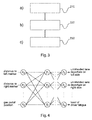
- Fig. 3 shows a method 200 for determining driving warning information in its basic steps. The method comprises:
- the driving relevant data is provided by an input unit 20.
- a processing unit 30 implements the artificial neural network.
- an output unit 40 outputs the driving warning information.
- Figs. 4 and 5 show examples of an artificial neural network implemented within examples of the device, system and method for determining driving warning information.
- an artificial neural network is used in order to model the way in actual human react to different scenarios.
- the ANN is fed with various inputs from a camera that is viewing the road scene. The inputs include: distance to relevant lane markers; curvature of relevant lane markers.
- the ANN is also fed with inputs coming from different systems within the car, such as: speed; acceleration; steering angle; turn indicator status; an accelerator pedal position; a brake pedal position; a driver interaction with on board system.
- the ANN is also fed with information derived from sensors on the car, and/or from information downloaded externally. This information includes: time; lighting conditions; weather conditions.
- the ANN is also fed with information relating to the driver identity. This can be provided directly, in terms that the driver has input their identity either directly or indirectly through use of a bespoke key that opens and starts the car. This can be provided indirectly, through information such as seat position, mirror positions, steering wheel position, driving style.
- the ANN then outputs the following relevant data:
- the constitutive unit of an ANN is the "Artificial Neuron".
- An artificial neuron is a mathematical function conceived as a model of biological neurons. The artificial neuron receives the one or more inputs (representing dendrites) and sums them to produce an output (representing a neuron's axon). The sums of each node are weighted, and the sum is passed through a non-linear function known as an activation function.
- the ANN is composed of several layers. Each layer contains several neurons. The neurons in a layer receive inputs from a previous layer and pass the processed output to the next layer.
- the inputs propagated through each layer in a cascading pattern until the last layer where the ANN output will be available.
- the outputs provided are intuitive to the driver in that the outputs are derived in a manner similar to how a human would derive the outputs. Also, the warning information is provided that takes into account the driver is in the driving conditions. Warning information is then provided at the right time according to different situations and different input parameters.
- recurrent neural network As shown in Fig. 5 , there are connections which form an internal cycle inside the network. This creates an internal state of the network which allows it to exhibit dynamic temporal behaviour. In this manner, a lane departure warning function can adapt during running time.
- the internal cycle is formed using a feedback connection. Because the output is feed back in the NN the output value is not lost and creates an internal state. Because the processing of future inputs can be altered by the previous output values the behavior will be temporal dynamic.
- ANN artificial neural network
- the device, system and method are described with respect to the automotive sector and the provision of warning information, such as lane departure warnings.
- the device, system and method are applicable to any other field with a human action or inaction can result in significant material losses or even human accidents. This includes, heavy machine operations, railway arbitration, industrial processes/powerplant supervision.
- a computer program or computer program element is provided that is characterized by being configured to execute the method steps of the method according to one of the preceding embodiments, on an appropriate system.
- the computer program element might therefore be stored on a computer unit, which might also be part of an embodiment.
- This computing unit may be configured to perform or induce performing of the steps of the method described above. Moreover, it may be configured to operate the components of the above described apparatus and/or system.
- the computing unit can be configured to operate automatically and/or to execute the orders of a user.
- a computer program may be loaded into a working memory of a data processor. The data processor may thus be equipped to carry out the method according to one of the preceding embodiments.
- a computer readable medium such as a CD-ROM
- the computer readable medium has a computer program element stored on it which computer program element is described by the preceding section.
Landscapes
- Engineering & Computer Science (AREA)
- Automation & Control Theory (AREA)
- Transportation (AREA)
- Mechanical Engineering (AREA)
- Traffic Control Systems (AREA)
Abstract
Description
- The present invention relates to a device for determining driving warning information, to a system for determining driving warning information, to a method for determining driving warning information, as well as to a computer program element.
- The general background of this invention is the field of driving warning systems. Present systems for providing driver warning information, for example for lane departure warning where lanes are delineated by line marking, are based on distance to a line crossing and based on time to a line crossing. Such systems cannot account for various combination of factors that could indicate that a lane line is about to be crossed unintentionally.
- It would be advantageous to have improved apparatus for determining driving warning information.
- The object of the present invention is solved with the subject matter of the independent claims, wherein further embodiments are incorporated in the dependent claims. It should be noted that the following described aspects and examples of the invention apply also for the device for determining driving warning information, the system for determining driving warning information, the method for determining driving warning information, and for the computer program element.
- According to a first aspect, there is provided a device for determining driving warning information, comprising:
- an input unit;
- a processing unit; and
- an output unit.
- The input unit is configured to provide the processing unit with driving relevant data. The processing unit is configured to implement an artificial neural network to process the driving relevant data to generate driving awareness data. The output unit is configured to output driving warning information based on the driving awareness data.
- In this manner, by implementing an artificial neural network to process driving relevant data, the device is able to model the way a human would react to different scenarios, enabling the accurate and timely provision of driving warning information that can be used by a driver to take appropriate action. In this way, various combinations of conditions can be taken into account in order to generate driving awareness data and appropriate output driving warning information, minimising the issuance of unwanted warnings. To put this another way, driving conditions and different drivers can be taken into account in order to provide appropriate driving warning information on the basis of generated driving awareness data.
- In this way, the device determines when a warning should be issued and does so in a manner that is intuitive, and therefore both understandable and appropriate to a human. In other words, accurate, timely, and appropriate warning information can be provided to a driver.
- Also, driving warning information can be provided in a live manner, meaning that the provision of that information can be adjusted and/or adapted on the basis of driving relevant data.
- In an example, the driving relevant data comprises one or more than one of: a distance to a relevant road marker; a curvature of a relevant lane marker; a vehicle speed; a vehicle acceleration; a steering angle; a status of a turn indicator; a time of day; a light condition; a weather condition; a driver identity; an accelerator pedal position; a brake pedal position; a driver interaction with on board systems.
- In an example, the driving awareness data comprises one or more than one of: a likelihood that a lane departure on the left is not intended; a likelihood that a lane departure on the right is not intended; a level of driver attention; a level of driver fatigue; a likelihood that taking into account the driving relevant data the vehicle speed is too high.
- In an example, the driving warning information comprises one or more than one of: a warning presented to a driver that a lane change appears to be unintentional; a warning presented to the driver that their level of attention appears to be deficient; a warning presented to the driver that they appear to be fatigued; a warning presented to the driver that their speed appears to be too high.
- In this way, appropriate and timely warning information can be provided to a driver, enabling them to steer back on course, to pay more attention to their driving, take a break; or slow down.
- In an example, the artificial neural network comprises a recurrent neural network configured with an internal cycle within the network.
- In this manner, by implementing a recurrent neural network with an internal cycle within the network an internal state of the network is created enabling dynamic temporal behaviour to be exhibited. In this way, the driving warning information can be determined dynamically. To put this another way, the device can dynamically adapt to various driver profiles; can continuously adjust to driver status changes like attention, fatigue etc; and can adapt to various driving conditions like day/night, incremental weather conditions etc.
- In an example, the artificial neural network comprises a learning algorithm.
- In this way, the artificial neural network by having a learning algorithm is self-configurable, in other words is set by itself, in order to detect expected actions, behaviours etc.
- In an example, the learning algorithm is taught on the basis of at least one driving scenario.
- In this manner, the artificial neural network need only be trained with the relevant amount of scenarios, and there is no need to model the warning algorithm or the human behaviour.
- In an example, the artificial neural network is configured to adapt the determined driving warning information on the basis of received driving relevant data.
- In this manner, the artificial neural network, which in an example can be a recurrent neural network, is able to dynamically adapt to various driver profiles, continuously adjust to driver status changes like attention levels, levels of fatigue, adapt to driving style and changes in driving style, adapt to various driving conditions like day/night, and changes in weather conditions. In other words, the device is provided with a "live" learning/adapting capability.
- According to a second aspect, there is provided a system for determining driving warning information, the system comprising:
- at least one data acquisition unit; and
- a device for determining driving warning information according to the first aspect.
- The at least one data acquisition unit is configured to acquire the driving relevant data.
- In an example, the at least one data acquisition unit comprises a camera.
- According to a third aspect, there is provided a method for determining driving warning information, comprising:
- a) providing driving relevant data;
- b) processing the driving relevant data with an artificial neural network to generate driving awareness data; and
- c) outputting driving warning information based on the driving awareness data.
- According to another aspect, there is provided a computer program element controlling apparatus as previously described which, in the computer program element is executed by processing unit, is adapted to perform the method steps as previously described.
- There is also provided a computer readable medium having stored the computer element as previously described.
- Advantageously, the benefits provided by any of the above aspects equally apply to all of the other aspects and vice versa.
- The above aspects and examples will become apparent from and be elucidated with reference to the embodiments described hereinafter.
- Exemplary embodiments will be described in the following with reference to the following drawings:
-
Fig. 1 shows a schematic set up of an example of a device for determining driving warning information; -
Fig. 2 shows a schematic set up of an example of a system for determining driving warning information; -
Fig. 3 shows a method for determining driving warning information; -
Figs. 4 and5 show examples of an artificial neural network implemented within examples of the device, system and method for determining driving warning information. -
Fig. 1 shows an example of adevice 10 for determining driving warning information. Thedevice 10 comprises aninput unit 20, aprocessing unit 30, and anoutput unit 40. Theinput unit 20 is configured to provide theprocessing unit 30 with driving relevant data. Theprocessing unit 30 is configured to implement an artificialneural network 50 to process the driving relevant data to generate driving awareness data. Theoutput unit 40 is configured to output driving warning information based on the driving awareness data. - In an example, the device is configured to adapt to a driver profile. In an example, the device is configured to save a driver configuration. In this manner, when a driver is detected for whom configuration data is available, the device can adapt to that driver on the basis of the configuring and does not have to re-adapt to the driver. In an example, the saved driver configuration is updated on the basis of driving relevant data. In an example, different configurations can be saved for different drivers.
- According to an example, the driving relevant data comprises one or more than one of: a distance to a relevant road marker; a curvature of a relevant lane marker; a vehicle speed; a vehicle acceleration; a steering angle; a status of a turn indicator; a time of day; a light condition; a weather condition; a driver identity; an accelerator pedal position; a brake pedal position; a driver interaction with on board systems.
- In an example, a driver interaction with onboard systems includes interaction with one or more of a radio, a navigation system or a phone.
- According to an example, the driving awareness data comprises one or more than one of: a likelihood that a lane departure on the left is not intended; a likelihood that a lane departure on the right is not intended; a level of driver attention; a level of driver fatigue; a likelihood that taking into account the driving relevant data the vehicle speed is too high.
- According to an example, the driving warning information comprises one or more than one of: a warning presented to a driver that a lane change appears to be unintentional; a warning presented to the driver that their level of attention appears to be deficient; a warning presented to the driver that they appear to be fatigued; a warning presented to the driver that their speed appears to be too high.
- According to an example, the artificial
neural network 50 comprises a recurrentneural network 60 configured with an internal cycle within the network. - In an example, the recurrent neural network (RNN) 60 is configured to use an internal memory to process the driving relevant data as an arbitrary sequence of inputs.
- In an example, a feedback connection is used to form the internal cycle.
- In this manner, because the processing of future inputs can be altered by the previous output values the behaviour will exhibit a temporal dynamic behaviour.
- According to an example, the artificial
neural network 50 comprises alearning algorithm 70. - According to an example, the
learning algorithm 70 is taught on the basis of at least one driving scenario. - In an example, the training comprises the use of an off-the-shelf procedure such as "Gradient descent" in order to minimize training errors. Other off the shelf procedures can be used.
- In an example, a training set is made of field recordings comprising different driving conditions. In an example, these recordings are revived and the expected output is saved and used as reference material for training.
- In an example, the learning algorithm is a deep learning algorithm.
- In other words, a supervised learning algorithm is utilized.
- According to an example, the artificial
neural network 50 is configured to adapt the determined driving warning information on the basis of received driving relevant data. -
Fig. 2 shows an example of asystem 100 for determining driving warning information. Thesystem 100 comprises at least onedata acquisition unit 110, and adevice 10 for determining driving warning information as described with respect to any of the examples ofFig. 1 . The at least onedata acquisition unit 110 is configured to acquire the driving relevant data. - In an example, the at least one data acquisition unit is configured to provide the driving relevant data to the input unit. In an example, the input unit comprises the at least one data acquisition unit.
- According to an example, the at least one
data acquisition unit 110 comprises acamera 120. Thecamera 120 can be a forward looking camera, and/or a sideways looking camera. Thecamera 120 can provide imagery that is used to determine a distance to road lane markers, the curvature of road lane markers, the distance to the kerb, the distance to the car in front, and can be used to provide imagery that is used to determine the change in these parameters. Theprocessing unit 30 processes the imagery to determine this information. - In an example, the at least one data acquisition unit comprises a speedometer. In an example, the at least one data acquisition unit comprises a steering wheel orientation monitor. In an example, the at least one data acquisition unit comprises a turn indicator status monitor. In an example, the at least one data acquisition unit comprises a clock. In an example, the at least one data acquisition unit comprises a light monitor. In an example, the at least one data acquisition unit comprises a module configured to download weather report information. In an example, the at least one data acquisition unit is configured to provide information relating to the identity of the driver. For example, the weight of the driver could be determined to provide information relating to the driver identity. For example, the seat position, and/or steering wheel position, and/or mirror position can be determined in order to provide information relating to the driver identity. For example, the driver identity could be provided from a central processor of a vehicle, which was provided with this information by the driver as part of entering and setting up the vehicle for driving.
-
Fig. 3 shows a method 200 for determining driving warning information in its basic steps. The method comprises: - in a providing
step 210, also referred to as step a), driving relevant data is provided; - in a
processing step 220, also referred to as step b), the driving relevant data is processed with an artificial neural network to generate driving awareness data; and - in an outputting
step 230, also referred to as step c), driving warning information is output based on the driving awareness data. - In an example, the driving relevant data is provided by an
input unit 20. In an example aprocessing unit 30 implements the artificial neural network. In an example, anoutput unit 40 outputs the driving warning information. -
Figs. 4 and5 show examples of an artificial neural network implemented within examples of the device, system and method for determining driving warning information. - As shown in
Figs 4 and5 an artificial neural network (ANN) is used in order to model the way in actual human react to different scenarios. The ANN is fed with various inputs from a camera that is viewing the road scene. The inputs include: distance to relevant lane markers; curvature of relevant lane markers. The ANN is also fed with inputs coming from different systems within the car, such as: speed; acceleration; steering angle; turn indicator status; an accelerator pedal position; a brake pedal position; a driver interaction with on board system. The ANN is also fed with information derived from sensors on the car, and/or from information downloaded externally. This information includes: time; lighting conditions; weather conditions. The ANN is also fed with information relating to the driver identity. This can be provided directly, in terms that the driver has input their identity either directly or indirectly through use of a bespoke key that opens and starts the car. This can be provided indirectly, through information such as seat position, mirror positions, steering wheel position, driving style. - The ANN then outputs the following relevant data:
- the likelihood that the lane departure on left/right side not intended;
- the level of driver attention;
- the level of driver fatigue.
- The constitutive unit of an ANN is the "Artificial Neuron". An artificial neuron is a mathematical function conceived as a model of biological neurons. The artificial neuron receives the one or more inputs (representing dendrites) and sums them to produce an output (representing a neuron's axon). The sums of each node are weighted, and the sum is passed through a non-linear function known as an activation function. The ANN is composed of several layers. Each layer contains several neurons. The neurons in a layer receive inputs from a previous layer and pass the processed output to the next layer. The ANN topology used in actually a Recurrent NN topology that are accepts feedback connection, but a non recurrent ANN can be utilised. The number of intermediate layers determines the depth of the ANN.
- The inputs propagated through each layer in a cascading pattern until the last layer where the ANN output will be available.
- By using the ANN in this manner, the outputs provided are intuitive to the driver in that the outputs are derived in a manner similar to how a human would derive the outputs. Also, the warning information is provided that takes into account the driver is in the driving conditions. Warning information is then provided at the right time according to different situations and different input parameters.
- In the recurrent neural network (RNN) as shown in
Fig. 5 , there are connections which form an internal cycle inside the network. This creates an internal state of the network which allows it to exhibit dynamic temporal behaviour. In this manner, a lane departure warning function can adapt during running time. In the RNN the internal cycle is formed using a feedback connection. Because the output is feed back in the NN the output value is not lost and creates an internal state. Because the processing of future inputs can be altered by the previous output values the behavior will be temporal dynamic. - With the artificial neural network (ANN) provided here there is no need to model the workings of the algorithm or human behaviour. Rather, the ANN is trained with the relevant amount of scenarios in it then sets itself in order to detect the expected actions, behaviours.
- For this training an off-the-shelf "Gradient descent" procedure is used, in order to minimize training error. Other training procedures can be used. For this specific problem the training set is made of field recordings spanning many hours of driving in multitude driving conditions. These recordings are revived and the expected output is saved and used as reference for training.
- After initial training RNN can then adapt during running time, providing the following features:
- dynamically adapting to various driver profiles;
- continuously adjusting to driver status changes like attention, fatigue et cetera;
- adapting to various driving conditions like day/night, changing weather conditions et cetera.
- The device, system and method are described with respect to the automotive sector and the provision of warning information, such as lane departure warnings. However, the device, system and method are applicable to any other field with a human action or inaction can result in significant material losses or even human accidents. This includes, heavy machine operations, railway arbitration, industrial processes/powerplant supervision.
- In another exemplary embodiment, a computer program or computer program element is provided that is characterized by being configured to execute the method steps of the method according to one of the preceding embodiments, on an appropriate system.
- The computer program element might therefore be stored on a computer unit, which might also be part of an embodiment. This computing unit may be configured to perform or induce performing of the steps of the method described above. Moreover, it may be configured to operate the components of the above described apparatus and/or system. The computing unit can be configured to operate automatically and/or to execute the orders of a user. A computer program may be loaded into a working memory of a data processor. The data processor may thus be equipped to carry out the method according to one of the preceding embodiments.
- According to a further exemplary embodiment of the present invention, a computer readable medium, such as a CD-ROM, is presented wherein the computer readable medium has a computer program element stored on it which computer program element is described by the preceding section.
- It has to be noted that embodiments of the invention are described with reference to different subject matters. In particular, some embodiments are described with reference to method type claims whereas other embodiments are described with reference to the device type claims. However, a person skilled in the art will gather from the above and the following description that, unless otherwise notified, in addition to any combination of features belonging to one type of subject matter also any combination between features relating to different subject matters is considered to be disclosed with this application. However, all features can be combined providing synergetic effects that are more than the simple summation of the features.
- While the invention has been illustrated and described in detail in the drawings and foregoing description, such illustration and description are to be considered illustrative or exemplary and not restrictive. The invention is not limited to the disclosed embodiments. Other variations to the disclosed embodiments can be understood and effected by those skilled in the art in practicing a claimed invention, from a study of the drawings, the disclosure, and the dependent claims.
- In the claims, the word "comprising" does not exclude other elements or steps, and the indefinite article "a" or "an" does not exclude a plurality. A single processor or other unit may fulfill the functions of several items re-cited in the claims. The mere fact that certain measures are re-cited in mutually different dependent claims does not indicate that a combination of these measures cannot be used to advantage. Any reference signs in the claims should not be construed as limiting the scope.
Claims (12)
- A device (10) for determining driving warning information, comprising:- an input unit (20);- a processing unit (30); and- an output unit (40);wherein, the input unit is configured to provide the processing unit with driving relevant data;
wherein, the processing unit is configured to implement an artificial neural network (50) to process the driving relevant data to generate driving awareness data; and
wherein, the output unit is configured to output driving warning information based on the driving awareness data. - Device according to claim 1, wherein the driving relevant data comprises one or more than one of: a distance to a relevant road marker; a curvature of a relevant lane marker; a vehicle speed; a vehicle acceleration; a steering angle; a status of a turn indicator; a time of day; a light condition; a weather condition; a driver identity; an accelerator pedal position; a brake pedal position; a driver interaction with on board systems.
- Device according to any of claims 1-2, wherein the driving awareness data comprises one or more than one of: a likelihood that a lane departure on the left is not intended; a likelihood that a lane departure on the right is not intended; a level of driver attention; a level of driver fatigue; a likelihood that taking into account the driving relevant data the vehicle speed is too high.
- Device according to any of claims 1-3, wherein the driving warning information comprises one or more than one of: a warning presented to a driver that a lane change appears to be unintentional; a warning presented to the driver that their level of attention appears to be deficient; a warning presented to the driver that they appear to be fatigued; a warning presented to the driver that their speed appears to be too high.
- Device according to any of claims 1-4, wherein the artificial neural network (50) comprises a recurrent neural network (60) configured with an internal cycle within the network.
- Device according to any of claims 1-5, wherein the artificial neural network (50) comprises a learning algorithm (70).
- Device according to claim 6, wherein the learning algorithm (70) is taught on the basis of at least one driving scenario.
- Device according to any of claims 5-7, wherein the artificial neural network (50) is configured to adapt the determined driving warning information on the basis of received driving relevant data.
- A system (100) for determining driving warning information, the system comprising:- at least one data acquisition unit (110); and- a device (10) for determining driving warning information according to any one of the preceding claims;wherein the at least one data acquisition unit is configured to acquire the driving relevant data.
- System according to claim 9, wherein the at least one data acquisition unit (110) comprises a camera (120).
- A method (200) for determining driving warning information, comprising:a) providing (210) driving relevant data;b) processing (220) the driving relevant data with an artificial neural network to generate driving awareness data; andc) outputting (230) driving warning information based on the driving awareness data.
- A computer program element for controlling an apparatus according to any one of claims 1 to 8 and/or a system according to any one of claims 9-10, which when executed by a processor is configured to carry out the method of claim 11.
Priority Applications (1)
| Application Number | Priority Date | Filing Date | Title |
|---|---|---|---|
| EP16465516.9A EP3266668B1 (en) | 2016-07-06 | 2016-07-06 | Device for determining driving warning information |
Applications Claiming Priority (1)
| Application Number | Priority Date | Filing Date | Title |
|---|---|---|---|
| EP16465516.9A EP3266668B1 (en) | 2016-07-06 | 2016-07-06 | Device for determining driving warning information |
Publications (2)
| Publication Number | Publication Date |
|---|---|
| EP3266668A1 true EP3266668A1 (en) | 2018-01-10 |
| EP3266668B1 EP3266668B1 (en) | 2025-02-19 |
Family
ID=56801487
Family Applications (1)
| Application Number | Title | Priority Date | Filing Date |
|---|---|---|---|
| EP16465516.9A Active EP3266668B1 (en) | 2016-07-06 | 2016-07-06 | Device for determining driving warning information |
Country Status (1)
| Country | Link |
|---|---|
| EP (1) | EP3266668B1 (en) |
Cited By (7)
| Publication number | Priority date | Publication date | Assignee | Title |
|---|---|---|---|---|
| CN109969180A (en) * | 2018-01-12 | 2019-07-05 | 合肥工业大学 | A Human-Machine Coordinated Control System for Lane Departure Assist System |
| CN110077398A (en) * | 2019-05-20 | 2019-08-02 | 上海域驾智能科技有限公司 | A kind of Risk Management method for intelligent driving |
| CN112863133A (en) * | 2019-11-12 | 2021-05-28 | 北京国电智深控制技术有限公司 | Alarm system, alarm method and computer readable storage medium |
| DE102021132544A1 (en) | 2021-12-09 | 2023-06-15 | Cariad Se | Method for supporting a vehicle management unit when reacting to at least one traffic situation in the vicinity of the motor vehicle, and motor vehicle that can be operated accordingly |
| CN117842086A (en) * | 2023-12-22 | 2024-04-09 | 岚图汽车科技有限公司 | Lane departure warning method, device, equipment and storage medium |
| EP4495833A4 (en) * | 2022-10-28 | 2025-07-02 | Streamax Tech Co Ltd | Method and device for assessing the driver's condition, electronic device and storage medium |
| EP4481708A4 (en) * | 2022-10-28 | 2025-07-23 | Streamax Tech Co Ltd | METHOD, DEVICE AND STORAGE MEDIUM FOR ASSESSING VEHICLE SAFETY DRIVING EVENTS |
Citations (5)
| Publication number | Priority date | Publication date | Assignee | Title |
|---|---|---|---|---|
| US20020128751A1 (en) * | 2001-01-21 | 2002-09-12 | Johan Engstrom | System and method for real-time recognition of driving patters |
| EP1531113A2 (en) * | 2003-11-13 | 2005-05-18 | Audi Ag | Driving assist system for supporting the tracking of a vehicle and apparatus for operating the driving assist system |
| US8013747B2 (en) * | 2008-09-24 | 2011-09-06 | Arima Communications Corp. | Driving safety warning method and device for a drowsy or distracted driver |
| US20120036097A1 (en) * | 2010-08-05 | 2012-02-09 | Toyota Motor Engineering & Manufacturing North America, Inc. | Systems And Methods For Recognizing Events |
| US20130335213A1 (en) * | 2011-02-16 | 2013-12-19 | Toyota Motor Engineering & Manufacturing North America, Inc. | Lane departure warning/assistance method and system having a threshold adjusted based on driver impairment determination using pupil size and driving patterns |
Family Cites Families (3)
| Publication number | Priority date | Publication date | Assignee | Title |
|---|---|---|---|---|
| FR2821311B1 (en) * | 2001-02-26 | 2003-05-23 | Renault | TRACK ASSISTANCE SYSTEM FOR A MOTOR VEHICLE |
| DE102013205788B4 (en) * | 2013-04-02 | 2025-05-15 | Bayerische Motoren Werke Aktiengesellschaft | Motor vehicle with a distance-related cruise control system and a lane departure warning system |
| EP2899669A1 (en) * | 2014-01-22 | 2015-07-29 | Honda Research Institute Europe GmbH | Lane relative position estimation method and system for driver assistance systems |
-
2016
- 2016-07-06 EP EP16465516.9A patent/EP3266668B1/en active Active
Patent Citations (5)
| Publication number | Priority date | Publication date | Assignee | Title |
|---|---|---|---|---|
| US20020128751A1 (en) * | 2001-01-21 | 2002-09-12 | Johan Engstrom | System and method for real-time recognition of driving patters |
| EP1531113A2 (en) * | 2003-11-13 | 2005-05-18 | Audi Ag | Driving assist system for supporting the tracking of a vehicle and apparatus for operating the driving assist system |
| US8013747B2 (en) * | 2008-09-24 | 2011-09-06 | Arima Communications Corp. | Driving safety warning method and device for a drowsy or distracted driver |
| US20120036097A1 (en) * | 2010-08-05 | 2012-02-09 | Toyota Motor Engineering & Manufacturing North America, Inc. | Systems And Methods For Recognizing Events |
| US20130335213A1 (en) * | 2011-02-16 | 2013-12-19 | Toyota Motor Engineering & Manufacturing North America, Inc. | Lane departure warning/assistance method and system having a threshold adjusted based on driver impairment determination using pupil size and driving patterns |
Cited By (9)
| Publication number | Priority date | Publication date | Assignee | Title |
|---|---|---|---|---|
| CN109969180A (en) * | 2018-01-12 | 2019-07-05 | 合肥工业大学 | A Human-Machine Coordinated Control System for Lane Departure Assist System |
| CN110077398A (en) * | 2019-05-20 | 2019-08-02 | 上海域驾智能科技有限公司 | A kind of Risk Management method for intelligent driving |
| CN112863133A (en) * | 2019-11-12 | 2021-05-28 | 北京国电智深控制技术有限公司 | Alarm system, alarm method and computer readable storage medium |
| DE102021132544A1 (en) | 2021-12-09 | 2023-06-15 | Cariad Se | Method for supporting a vehicle management unit when reacting to at least one traffic situation in the vicinity of the motor vehicle, and motor vehicle that can be operated accordingly |
| DE102021132544B4 (en) | 2021-12-09 | 2026-04-16 | Cariad Se | Method for supporting a vehicle control unit in responding to at least one traffic situation in the vicinity of the motor vehicle, and a correspondingly operable motor vehicle |
| EP4495833A4 (en) * | 2022-10-28 | 2025-07-02 | Streamax Tech Co Ltd | Method and device for assessing the driver's condition, electronic device and storage medium |
| EP4481708A4 (en) * | 2022-10-28 | 2025-07-23 | Streamax Tech Co Ltd | METHOD, DEVICE AND STORAGE MEDIUM FOR ASSESSING VEHICLE SAFETY DRIVING EVENTS |
| US12697980B2 (en) | 2022-10-28 | 2026-08-04 | Streamax Technology Co., Ltd. | Method for evaluating state of driver, electronic device, and non-transitory computer readable storage medium |
| CN117842086A (en) * | 2023-12-22 | 2024-04-09 | 岚图汽车科技有限公司 | Lane departure warning method, device, equipment and storage medium |
Also Published As
| Publication number | Publication date |
|---|---|
| EP3266668B1 (en) | 2025-02-19 |
Similar Documents
| Publication | Publication Date | Title |
|---|---|---|
| EP3266668B1 (en) | Device for determining driving warning information | |
| US11214280B2 (en) | Autonomous vehicle providing driver education | |
| KR20230159308A (en) | Method, system and computer program product for calibrating and validating an advanced driver assistance system (adas) and/or an automated driving system (ads) | |
| Lethaus et al. | A comparison of selected simple supervised learning algorithms to predict driver intent based on gaze data | |
| DE102017107396B4 (en) | Test procedure and test device for driver assistance systems | |
| US20220274603A1 (en) | Method of Modeling Human Driving Behavior to Train Neural Network Based Motion Controllers | |
| CN113525389B (en) | Driver alertness detection method, apparatus and system | |
| DE102019213182A1 (en) | DEVICE FOR AUTONOMOUS DRIVING CONTROL AND RELIABILITY INFORMATION GUIDANCE METHOD THEREFOR | |
| CN112506170B (en) | A test method and device based on driver model | |
| EP3088269B1 (en) | Method, system, and computer program product for monitoring a driver of a vehicle | |
| JP7415471B2 (en) | Driving evaluation device, driving evaluation system, in-vehicle device, external evaluation device, and driving evaluation program | |
| CN114667545A (en) | Method for training at least one algorithm for a control unit of a motor vehicle, computer program product and motor vehicle | |
| US12555417B2 (en) | Method for testing a driver assistance system of a vehicle | |
| DE102022117841B4 (en) | Method, system and computer program product for calibrating and validating a driver assistance system (ADAS) and/or an automated driving system (ADS) taking into account a subjective assessment | |
| JP2021504222A (en) | State estimator | |
| KR20230069940A (en) | Methods and systems for testing driver assistance systems | |
| EP4495833A1 (en) | Driver state assessment method and apparatus, electronic device, and storage medium | |
| KR20230148366A (en) | Method and system for generating scenario data for testing driver assistance systems in vehicles | |
| CN105808314A (en) | Traffic simulation method and device | |
| CN115066697A (en) | Collections of AI Agents in narrow sense | |
| US12071166B2 (en) | Method for transferring a motor vehicle from an autonomous into a manual driving mode, taking a cognitive model of the driver into consideration | |
| DE102018200980B4 (en) | Method for determining an object perception probability with which a driver of a motor vehicle perceives objects in the surroundings of the motor vehicle, as well as a control device for a motor vehicle and motor vehicle | |
| JP2021504218A (en) | State estimator | |
| CN115176297A (en) | Method for training at least one algorithm for a control unit of a motor vehicle, computer program product and motor vehicle | |
| CN112693470A (en) | Method and device for avoiding vehicle turning risk |
Legal Events
| Date | Code | Title | Description |
|---|---|---|---|
| PUAI | Public reference made under article 153(3) epc to a published international application that has entered the european phase |
Free format text: ORIGINAL CODE: 0009012 |
|
| STAA | Information on the status of an ep patent application or granted ep patent |
Free format text: STATUS: THE APPLICATION HAS BEEN PUBLISHED |
|
| AK | Designated contracting states |
Kind code of ref document: A1 Designated state(s): AL AT BE BG CH CY CZ DE DK EE ES FI FR GB GR HR HU IE IS IT LI LT LU LV MC MK MT NL NO PL PT RO RS SE SI SK SM TR |
|
| AX | Request for extension of the european patent |
Extension state: BA ME |
|
| STAA | Information on the status of an ep patent application or granted ep patent |
Free format text: STATUS: REQUEST FOR EXAMINATION WAS MADE |
|
| 17P | Request for examination filed |
Effective date: 20180710 |
|
| RBV | Designated contracting states (corrected) |
Designated state(s): AL AT BE BG CH CY CZ DE DK EE ES FI FR GB GR HR HU IE IS IT LI LT LU LV MC MK MT NL NO PL PT RO RS SE SI SK SM TR |
|
| RAP1 | Party data changed (applicant data changed or rights of an application transferred) |
Owner name: CONTINENTAL AUTOMOTIVE GMBH |
|
| STAA | Information on the status of an ep patent application or granted ep patent |
Free format text: STATUS: EXAMINATION IS IN PROGRESS |
|
| 17Q | First examination report despatched |
Effective date: 20210903 |
|
| RAP1 | Party data changed (applicant data changed or rights of an application transferred) |
Owner name: CONTINENTAL AUTONOMOUS MOBILITY GERMANY GMBH |
|
| GRAP | Despatch of communication of intention to grant a patent |
Free format text: ORIGINAL CODE: EPIDOSNIGR1 |
|
| STAA | Information on the status of an ep patent application or granted ep patent |
Free format text: STATUS: GRANT OF PATENT IS INTENDED |
|
| INTG | Intention to grant announced |
Effective date: 20241022 |
|
| GRAS | Grant fee paid |
Free format text: ORIGINAL CODE: EPIDOSNIGR3 |
|
| GRAA | (expected) grant |
Free format text: ORIGINAL CODE: 0009210 |
|
| STAA | Information on the status of an ep patent application or granted ep patent |
Free format text: STATUS: THE PATENT HAS BEEN GRANTED |
|
| AK | Designated contracting states |
Kind code of ref document: B1 Designated state(s): AL AT BE BG CH CY CZ DE DK EE ES FI FR GB GR HR HU IE IS IT LI LT LU LV MC MK MT NL NO PL PT RO RS SE SI SK SM TR |
|
| REG | Reference to a national code |
Ref country code: GB Ref legal event code: FG4D |
|
| REG | Reference to a national code |
Ref country code: CH Ref legal event code: EP |
|
| REG | Reference to a national code |
Ref country code: IE Ref legal event code: FG4D |
|
| REG | Reference to a national code |
Ref country code: DE Ref legal event code: R096 Ref document number: 602016091263 Country of ref document: DE |
|
| REG | Reference to a national code |
Ref country code: NL Ref legal event code: MP Effective date: 20250219 |
|
| PG25 | Lapsed in a contracting state [announced via postgrant information from national office to epo] |
Ref country code: RS Free format text: LAPSE BECAUSE OF FAILURE TO SUBMIT A TRANSLATION OF THE DESCRIPTION OR TO PAY THE FEE WITHIN THE PRESCRIBED TIME-LIMIT Effective date: 20250519 |
|
| PG25 | Lapsed in a contracting state [announced via postgrant information from national office to epo] |
Ref country code: FI Free format text: LAPSE BECAUSE OF FAILURE TO SUBMIT A TRANSLATION OF THE DESCRIPTION OR TO PAY THE FEE WITHIN THE PRESCRIBED TIME-LIMIT Effective date: 20250219 |
|
| PG25 | Lapsed in a contracting state [announced via postgrant information from national office to epo] |
Ref country code: PL Free format text: LAPSE BECAUSE OF FAILURE TO SUBMIT A TRANSLATION OF THE DESCRIPTION OR TO PAY THE FEE WITHIN THE PRESCRIBED TIME-LIMIT Effective date: 20250219 |
|
| PG25 | Lapsed in a contracting state [announced via postgrant information from national office to epo] |
Ref country code: ES Free format text: LAPSE BECAUSE OF FAILURE TO SUBMIT A TRANSLATION OF THE DESCRIPTION OR TO PAY THE FEE WITHIN THE PRESCRIBED TIME-LIMIT Effective date: 20250219 |
|
| REG | Reference to a national code |
Ref country code: LT Ref legal event code: MG9D |
|
| REG | Reference to a national code |
Ref country code: DE Ref legal event code: R081 Ref document number: 602016091263 Country of ref document: DE Owner name: AUMOVIO AUTONOMOUS MOBILITY GERMANY GMBH, DE Free format text: FORMER OWNER: CONTINENTAL AUTONOMOUS MOBILITY GERMANY GMBH, 85057 INGOLSTADT, DE |
|
| PG25 | Lapsed in a contracting state [announced via postgrant information from national office to epo] |
Ref country code: IS Free format text: LAPSE BECAUSE OF FAILURE TO SUBMIT A TRANSLATION OF THE DESCRIPTION OR TO PAY THE FEE WITHIN THE PRESCRIBED TIME-LIMIT Effective date: 20250619 Ref country code: NO Free format text: LAPSE BECAUSE OF FAILURE TO SUBMIT A TRANSLATION OF THE DESCRIPTION OR TO PAY THE FEE WITHIN THE PRESCRIBED TIME-LIMIT Effective date: 20250519 |
|
| PG25 | Lapsed in a contracting state [announced via postgrant information from national office to epo] |
Ref country code: NL Free format text: LAPSE BECAUSE OF FAILURE TO SUBMIT A TRANSLATION OF THE DESCRIPTION OR TO PAY THE FEE WITHIN THE PRESCRIBED TIME-LIMIT Effective date: 20250219 |
|
| PG25 | Lapsed in a contracting state [announced via postgrant information from national office to epo] |
Ref country code: HR Free format text: LAPSE BECAUSE OF FAILURE TO SUBMIT A TRANSLATION OF THE DESCRIPTION OR TO PAY THE FEE WITHIN THE PRESCRIBED TIME-LIMIT Effective date: 20250219 |
|
| PG25 | Lapsed in a contracting state [announced via postgrant information from national office to epo] |
Ref country code: PT Free format text: LAPSE BECAUSE OF FAILURE TO SUBMIT A TRANSLATION OF THE DESCRIPTION OR TO PAY THE FEE WITHIN THE PRESCRIBED TIME-LIMIT Effective date: 20250620 Ref country code: LV Free format text: LAPSE BECAUSE OF FAILURE TO SUBMIT A TRANSLATION OF THE DESCRIPTION OR TO PAY THE FEE WITHIN THE PRESCRIBED TIME-LIMIT Effective date: 20250219 |
|
| PG25 | Lapsed in a contracting state [announced via postgrant information from national office to epo] |
Ref country code: GR Free format text: LAPSE BECAUSE OF FAILURE TO SUBMIT A TRANSLATION OF THE DESCRIPTION OR TO PAY THE FEE WITHIN THE PRESCRIBED TIME-LIMIT Effective date: 20250520 Ref country code: BG Free format text: LAPSE BECAUSE OF FAILURE TO SUBMIT A TRANSLATION OF THE DESCRIPTION OR TO PAY THE FEE WITHIN THE PRESCRIBED TIME-LIMIT Effective date: 20250219 |
|
| RAP4 | Party data changed (patent owner data changed or rights of a patent transferred) |
Owner name: AUMOVIO AUTONOMOUS MOBILITY GERMANY GMBH |
|
| REG | Reference to a national code |
Ref country code: AT Ref legal event code: MK05 Ref document number: 1768038 Country of ref document: AT Kind code of ref document: T Effective date: 20250219 |
|
| PG25 | Lapsed in a contracting state [announced via postgrant information from national office to epo] |
Ref country code: SE Free format text: LAPSE BECAUSE OF FAILURE TO SUBMIT A TRANSLATION OF THE DESCRIPTION OR TO PAY THE FEE WITHIN THE PRESCRIBED TIME-LIMIT Effective date: 20250219 |
|
| PG25 | Lapsed in a contracting state [announced via postgrant information from national office to epo] |
Ref country code: SM Free format text: LAPSE BECAUSE OF FAILURE TO SUBMIT A TRANSLATION OF THE DESCRIPTION OR TO PAY THE FEE WITHIN THE PRESCRIBED TIME-LIMIT Effective date: 20250219 |
|
| PG25 | Lapsed in a contracting state [announced via postgrant information from national office to epo] |
Ref country code: DK Free format text: LAPSE BECAUSE OF FAILURE TO SUBMIT A TRANSLATION OF THE DESCRIPTION OR TO PAY THE FEE WITHIN THE PRESCRIBED TIME-LIMIT Effective date: 20250219 |
|
| PGFP | Annual fee paid to national office [announced via postgrant information from national office to epo] |
Ref country code: DE Payment date: 20250731 Year of fee payment: 10 |
|
| PG25 | Lapsed in a contracting state [announced via postgrant information from national office to epo] |
Ref country code: IT Free format text: LAPSE BECAUSE OF FAILURE TO SUBMIT A TRANSLATION OF THE DESCRIPTION OR TO PAY THE FEE WITHIN THE PRESCRIBED TIME-LIMIT Effective date: 20250219 |
|
| PG25 | Lapsed in a contracting state [announced via postgrant information from national office to epo] |
Ref country code: AT Free format text: LAPSE BECAUSE OF FAILURE TO SUBMIT A TRANSLATION OF THE DESCRIPTION OR TO PAY THE FEE WITHIN THE PRESCRIBED TIME-LIMIT Effective date: 20250219 |
|
| PG25 | Lapsed in a contracting state [announced via postgrant information from national office to epo] |
Ref country code: CZ Free format text: LAPSE BECAUSE OF FAILURE TO SUBMIT A TRANSLATION OF THE DESCRIPTION OR TO PAY THE FEE WITHIN THE PRESCRIBED TIME-LIMIT Effective date: 20250219 Ref country code: EE Free format text: LAPSE BECAUSE OF FAILURE TO SUBMIT A TRANSLATION OF THE DESCRIPTION OR TO PAY THE FEE WITHIN THE PRESCRIBED TIME-LIMIT Effective date: 20250219 |
|
| PG25 | Lapsed in a contracting state [announced via postgrant information from national office to epo] |
Ref country code: RO Free format text: LAPSE BECAUSE OF FAILURE TO SUBMIT A TRANSLATION OF THE DESCRIPTION OR TO PAY THE FEE WITHIN THE PRESCRIBED TIME-LIMIT Effective date: 20250219 |
|
| PG25 | Lapsed in a contracting state [announced via postgrant information from national office to epo] |
Ref country code: SK Free format text: LAPSE BECAUSE OF FAILURE TO SUBMIT A TRANSLATION OF THE DESCRIPTION OR TO PAY THE FEE WITHIN THE PRESCRIBED TIME-LIMIT Effective date: 20250219 |
|
| REG | Reference to a national code |
Ref country code: DE Ref legal event code: R097 Ref document number: 602016091263 Country of ref document: DE |
|
| PLBE | No opposition filed within time limit |
Free format text: ORIGINAL CODE: 0009261 |
|
| STAA | Information on the status of an ep patent application or granted ep patent |
Free format text: STATUS: NO OPPOSITION FILED WITHIN TIME LIMIT |
|
| REG | Reference to a national code |
Ref country code: CH Ref legal event code: L10 Free format text: ST27 STATUS EVENT CODE: U-0-0-L10-L00 (AS PROVIDED BY THE NATIONAL OFFICE) Effective date: 20251231 |
|
| 26N | No opposition filed |
Effective date: 20251120 |
|
| REG | Reference to a national code |
Ref country code: CH Ref legal event code: H13 Free format text: ST27 STATUS EVENT CODE: U-0-0-H10-H13 (AS PROVIDED BY THE NATIONAL OFFICE) Effective date: 20260224 |
|
| PG25 | Lapsed in a contracting state [announced via postgrant information from national office to epo] |
Ref country code: LU Free format text: LAPSE BECAUSE OF NON-PAYMENT OF DUE FEES Effective date: 20250706 |
|
| GBPC | Gb: european patent ceased through non-payment of renewal fee |
Effective date: 20250706 |
|
| REG | Reference to a national code |
Ref country code: BE Ref legal event code: MM Effective date: 20250731 |
|
| PG25 | Lapsed in a contracting state [announced via postgrant information from national office to epo] |
Ref country code: GB Free format text: LAPSE BECAUSE OF NON-PAYMENT OF DUE FEES Effective date: 20250706 |
|
| PG25 | Lapsed in a contracting state [announced via postgrant information from national office to epo] |
Ref country code: BE Free format text: LAPSE BECAUSE OF NON-PAYMENT OF DUE FEES Effective date: 20250731 |
|
| PG25 | Lapsed in a contracting state [announced via postgrant information from national office to epo] |
Ref country code: FR Free format text: LAPSE BECAUSE OF NON-PAYMENT OF DUE FEES Effective date: 20250731 |
|
| PG25 | Lapsed in a contracting state [announced via postgrant information from national office to epo] |
Ref country code: CH Free format text: LAPSE BECAUSE OF NON-PAYMENT OF DUE FEES Effective date: 20250731 |
|
| PG25 | Lapsed in a contracting state [announced via postgrant information from national office to epo] |
Ref country code: LT Free format text: LAPSE BECAUSE OF FAILURE TO SUBMIT A TRANSLATION OF THE DESCRIPTION OR TO PAY THE FEE WITHIN THE PRESCRIBED TIME-LIMIT Effective date: 20250219 |
|
| PG25 | Lapsed in a contracting state [announced via postgrant information from national office to epo] |
Ref country code: IE Free format text: LAPSE BECAUSE OF NON-PAYMENT OF DUE FEES Effective date: 20250706 |
|
| PG25 | Lapsed in a contracting state [announced via postgrant information from national office to epo] |
Ref country code: MC Free format text: LAPSE BECAUSE OF FAILURE TO SUBMIT A TRANSLATION OF THE DESCRIPTION OR TO PAY THE FEE WITHIN THE PRESCRIBED TIME-LIMIT Effective date: 20250219 |
|
| PG25 | Lapsed in a contracting state [announced via postgrant information from national office to epo] |
Ref country code: CY Free format text: LAPSE BECAUSE OF FAILURE TO SUBMIT A TRANSLATION OF THE DESCRIPTION OR TO PAY THE FEE WITHIN THE PRESCRIBED TIME-LIMIT Effective date: 20250219 |