EP3264505A1 - Silicon anode active material and preparation method therefor - Google Patents
Silicon anode active material and preparation method therefor Download PDFInfo
- Publication number
- EP3264505A1 EP3264505A1 EP15883413.5A EP15883413A EP3264505A1 EP 3264505 A1 EP3264505 A1 EP 3264505A1 EP 15883413 A EP15883413 A EP 15883413A EP 3264505 A1 EP3264505 A1 EP 3264505A1
- Authority
- EP
- European Patent Office
- Prior art keywords
- layer
- silicon
- carbon
- thickness
- silicon oxide
- Prior art date
- Legal status (The legal status is an assumption and is not a legal conclusion. Google has not performed a legal analysis and makes no representation as to the accuracy of the status listed.)
- Withdrawn
Links
Images



Classifications
-
- H—ELECTRICITY
- H01—ELECTRIC ELEMENTS
- H01M—PROCESSES OR MEANS, e.g. BATTERIES, FOR THE DIRECT CONVERSION OF CHEMICAL ENERGY INTO ELECTRICAL ENERGY
- H01M4/00—Electrodes
- H01M4/02—Electrodes composed of, or comprising, active material
- H01M4/36—Selection of substances as active materials, active masses, active liquids
- H01M4/362—Composites
- H01M4/366—Composites as layered products
-
- H—ELECTRICITY
- H01—ELECTRIC ELEMENTS
- H01M—PROCESSES OR MEANS, e.g. BATTERIES, FOR THE DIRECT CONVERSION OF CHEMICAL ENERGY INTO ELECTRICAL ENERGY
- H01M4/00—Electrodes
- H01M4/02—Electrodes composed of, or comprising, active material
- H01M4/36—Selection of substances as active materials, active masses, active liquids
- H01M4/58—Selection of substances as active materials, active masses, active liquids of inorganic compounds other than oxides or hydroxides, e.g. sulfides, selenides, tellurides, halogenides or LiCoFy; of polyanionic structures, e.g. phosphates, silicates or borates
- H01M4/583—Carbonaceous material, e.g. graphite-intercalation compounds or CFx
- H01M4/587—Carbonaceous material, e.g. graphite-intercalation compounds or CFx for inserting or intercalating light metals
-
- C—CHEMISTRY; METALLURGY
- C01—INORGANIC CHEMISTRY
- C01B—NON-METALLIC ELEMENTS; COMPOUNDS THEREOF; METALLOIDS OR COMPOUNDS THEREOF NOT COVERED BY SUBCLASS C01C
- C01B32/00—Carbon; Compounds thereof
- C01B32/90—Carbides
- C01B32/914—Carbides of single elements
- C01B32/956—Silicon carbide
-
- C—CHEMISTRY; METALLURGY
- C01—INORGANIC CHEMISTRY
- C01B—NON-METALLIC ELEMENTS; COMPOUNDS THEREOF; METALLOIDS OR COMPOUNDS THEREOF NOT COVERED BY SUBCLASS C01C
- C01B32/00—Carbon; Compounds thereof
- C01B32/90—Carbides
- C01B32/914—Carbides of single elements
- C01B32/956—Silicon carbide
- C01B32/963—Preparation from compounds containing silicon
- C01B32/984—Preparation from elemental silicon
-
- H—ELECTRICITY
- H01—ELECTRIC ELEMENTS
- H01M—PROCESSES OR MEANS, e.g. BATTERIES, FOR THE DIRECT CONVERSION OF CHEMICAL ENERGY INTO ELECTRICAL ENERGY
- H01M4/00—Electrodes
- H01M4/02—Electrodes composed of, or comprising, active material
- H01M4/04—Processes of manufacture in general
- H01M4/0471—Processes of manufacture in general involving thermal treatment, e.g. firing, sintering, backing particulate active material, thermal decomposition, pyrolysis
-
- H—ELECTRICITY
- H01—ELECTRIC ELEMENTS
- H01M—PROCESSES OR MEANS, e.g. BATTERIES, FOR THE DIRECT CONVERSION OF CHEMICAL ENERGY INTO ELECTRICAL ENERGY
- H01M4/00—Electrodes
- H01M4/02—Electrodes composed of, or comprising, active material
- H01M4/13—Electrodes for accumulators with non-aqueous electrolyte, e.g. for lithium-accumulators; Processes of manufacture thereof
- H01M4/134—Electrodes based on metals, Si or alloys
-
- H—ELECTRICITY
- H01—ELECTRIC ELEMENTS
- H01M—PROCESSES OR MEANS, e.g. BATTERIES, FOR THE DIRECT CONVERSION OF CHEMICAL ENERGY INTO ELECTRICAL ENERGY
- H01M4/00—Electrodes
- H01M4/02—Electrodes composed of, or comprising, active material
- H01M4/13—Electrodes for accumulators with non-aqueous electrolyte, e.g. for lithium-accumulators; Processes of manufacture thereof
- H01M4/139—Processes of manufacture
- H01M4/1395—Processes of manufacture of electrodes based on metals, Si or alloys
-
- H—ELECTRICITY
- H01—ELECTRIC ELEMENTS
- H01M—PROCESSES OR MEANS, e.g. BATTERIES, FOR THE DIRECT CONVERSION OF CHEMICAL ENERGY INTO ELECTRICAL ENERGY
- H01M4/00—Electrodes
- H01M4/02—Electrodes composed of, or comprising, active material
- H01M4/36—Selection of substances as active materials, active masses, active liquids
- H01M4/38—Selection of substances as active materials, active masses, active liquids of elements or alloys
-
- H—ELECTRICITY
- H01—ELECTRIC ELEMENTS
- H01M—PROCESSES OR MEANS, e.g. BATTERIES, FOR THE DIRECT CONVERSION OF CHEMICAL ENERGY INTO ELECTRICAL ENERGY
- H01M4/00—Electrodes
- H01M4/02—Electrodes composed of, or comprising, active material
- H01M4/36—Selection of substances as active materials, active masses, active liquids
- H01M4/38—Selection of substances as active materials, active masses, active liquids of elements or alloys
- H01M4/386—Silicon or alloys based on silicon
-
- H—ELECTRICITY
- H01—ELECTRIC ELEMENTS
- H01M—PROCESSES OR MEANS, e.g. BATTERIES, FOR THE DIRECT CONVERSION OF CHEMICAL ENERGY INTO ELECTRICAL ENERGY
- H01M4/00—Electrodes
- H01M4/02—Electrodes composed of, or comprising, active material
- H01M4/62—Selection of inactive substances as ingredients for active masses, e.g. binders, fillers
-
- H—ELECTRICITY
- H01—ELECTRIC ELEMENTS
- H01M—PROCESSES OR MEANS, e.g. BATTERIES, FOR THE DIRECT CONVERSION OF CHEMICAL ENERGY INTO ELECTRICAL ENERGY
- H01M4/00—Electrodes
- H01M4/02—Electrodes composed of, or comprising, active material
- H01M4/62—Selection of inactive substances as ingredients for active masses, e.g. binders, fillers
- H01M4/624—Electric conductive fillers
- H01M4/625—Carbon or graphite
-
- H—ELECTRICITY
- H01—ELECTRIC ELEMENTS
- H01M—PROCESSES OR MEANS, e.g. BATTERIES, FOR THE DIRECT CONVERSION OF CHEMICAL ENERGY INTO ELECTRICAL ENERGY
- H01M4/00—Electrodes
- H01M4/86—Inert electrodes with catalytic activity, e.g. for fuel cells
- H01M4/88—Processes of manufacture
- H01M4/8878—Treatment steps after deposition of the catalytic active composition or after shaping of the electrode being free-standing body
- H01M4/8882—Heat treatment, e.g. drying, baking
- H01M4/8885—Sintering or firing
-
- H—ELECTRICITY
- H01—ELECTRIC ELEMENTS
- H01M—PROCESSES OR MEANS, e.g. BATTERIES, FOR THE DIRECT CONVERSION OF CHEMICAL ENERGY INTO ELECTRICAL ENERGY
- H01M10/00—Secondary cells; Manufacture thereof
- H01M10/05—Accumulators with non-aqueous electrolyte
- H01M10/052—Li-accumulators
- H01M10/0525—Rocking-chair batteries, i.e. batteries with lithium insertion or intercalation in both electrodes; Lithium-ion batteries
-
- H—ELECTRICITY
- H01—ELECTRIC ELEMENTS
- H01M—PROCESSES OR MEANS, e.g. BATTERIES, FOR THE DIRECT CONVERSION OF CHEMICAL ENERGY INTO ELECTRICAL ENERGY
- H01M4/00—Electrodes
- H01M4/02—Electrodes composed of, or comprising, active material
- H01M2004/026—Electrodes composed of, or comprising, active material characterised by the polarity
- H01M2004/027—Negative electrodes
-
- H—ELECTRICITY
- H01—ELECTRIC ELEMENTS
- H01M—PROCESSES OR MEANS, e.g. BATTERIES, FOR THE DIRECT CONVERSION OF CHEMICAL ENERGY INTO ELECTRICAL ENERGY
- H01M4/00—Electrodes
- H01M4/02—Electrodes composed of, or comprising, active material
- H01M4/62—Selection of inactive substances as ingredients for active masses, e.g. binders, fillers
- H01M4/621—Binders
- H01M4/622—Binders being polymers
-
- Y—GENERAL TAGGING OF NEW TECHNOLOGICAL DEVELOPMENTS; GENERAL TAGGING OF CROSS-SECTIONAL TECHNOLOGIES SPANNING OVER SEVERAL SECTIONS OF THE IPC; TECHNICAL SUBJECTS COVERED BY FORMER USPC CROSS-REFERENCE ART COLLECTIONS [XRACs] AND DIGESTS
- Y02—TECHNOLOGIES OR APPLICATIONS FOR MITIGATION OR ADAPTATION AGAINST CLIMATE CHANGE
- Y02E—REDUCTION OF GREENHOUSE GAS [GHG] EMISSIONS, RELATED TO ENERGY GENERATION, TRANSMISSION OR DISTRIBUTION
- Y02E60/00—Enabling technologies; Technologies with a potential or indirect contribution to GHG emissions mitigation
- Y02E60/10—Energy storage using batteries
-
- Y—GENERAL TAGGING OF NEW TECHNOLOGICAL DEVELOPMENTS; GENERAL TAGGING OF CROSS-SECTIONAL TECHNOLOGIES SPANNING OVER SEVERAL SECTIONS OF THE IPC; TECHNICAL SUBJECTS COVERED BY FORMER USPC CROSS-REFERENCE ART COLLECTIONS [XRACs] AND DIGESTS
- Y02—TECHNOLOGIES OR APPLICATIONS FOR MITIGATION OR ADAPTATION AGAINST CLIMATE CHANGE
- Y02E—REDUCTION OF GREENHOUSE GAS [GHG] EMISSIONS, RELATED TO ENERGY GENERATION, TRANSMISSION OR DISTRIBUTION
- Y02E60/00—Enabling technologies; Technologies with a potential or indirect contribution to GHG emissions mitigation
- Y02E60/30—Hydrogen technology
- Y02E60/50—Fuel cells
Definitions
- the present invention relates to secondary battery technology, and more particularly, to a silicon anode active material and a method of fabricating the same.
- the secondary battery is a rechargeable battery using an electrode material having excellent reversibility and the secondary battery may be a nickel-hydrogen (Ni-MH) battery, a lithium battery or a lithium ion battery depending on the anode and the cathode active material.
- Ni-MH nickel-hydrogen
- Such secondary batteries are increasingly widely being applied to various applications as power supply sources for information technology(IT) devices such as smart phones, portable computers, and electronic paper, or for transportation systems such as electric vehicles.
- a carbon-based material having a theoretical capacity of 372 mAh/g is generally applied as a material capable of inhibiting dendrites of lithium in a lithium battery from growing.
- a non-carbon anode material capable of being alloyed with lithium such as silicon (Si), tin (Sn), or aluminum (Al) having a capacity of 500 mAh/g or more to replace the theoretical capacity of the carbon-based anode materials have greatly drawn attention.
- the silicon has the theoretical capacity of about 4,200 mAh / g, which is the largest.
- the volume of the silicon anode material expands by about 4 times during charging of the silicon anode material, due to the volume change during charging and discharging, the electrical connection between the active materials may be broken, the active material may be separated from a current collector, and the active material may be eroded by electrolyte, which are a barrier to its practical use. Therefore, for the application of the silicon material to the anode material, it is required to improve the irreversibility of the battery due to the volume change during charging and discharging of the battery. In addition, with explosive growth of demand for secondary batteries, it is necessary to secure fabrication technology that can economically and mass-produce silicon anode active materials.
- a technical problem to be solved by the present invention is to provide an anode active material having a high energy density and a long life by alleviating the volume change due to charging and discharging of a battery while having high capacity and high output by using silicone as the anode active material.
- a silicon anode active material comprising: a silicon core including silicon particles; And a double clamping layer having a silicon carbide layer on the silicon core and a silicon oxide layer between the silicon core and the silicon carbide layer.
- the silicon oxide layer may be a silicon source of the silicon carbide layer.
- the thickness of the double clamping layer is 0.5 nm to 20 nm, and the ratio of the thickness of the double clamping layer to the radius of the silicon core is in the range of 1% to 10%.
- the silicon anode active material may further comprise a conductive layer formed on the double clamping layer.
- the double clamping layer may include through holes, and the conductive layer may be continuously coated on the silicon anode active material through the through holes.
- the conductive layer may include a carbon-based conductive layer.
- a method of manufacturing a silicon anode active material comprising: forming a silicon core and a first intermediate particle having a silicon oxide layer on the silicon core. Thereafter, a first solid organic layer is coated on the first intermediate particles to form second intermediate particles; then the second intermediate particles are heat-treated at a first temperature to convert the first solid organic layer into a carbon layer to form third intermediate particles. Subsequently, the third intermediate particles are heat-treated at a second temperature to form a silicon carbide layer between the silicon oxide layer and the carbon layer to form a double clamping layer including the silicon oxide layer and the silicon carbide layer can do.
- the silicon oxide layer becomes the silicon source of the silicon carbide layer.
- the first temperature for forming the carbon layer is in the range of 700 ° C to 1,100 ° C.
- the second temperature for forming the silicon carbide layer may be in the range of 1,150 ⁇ to 1,300 ⁇ .
- the thickness of the silicon oxide layer of the first intermediate particles may be in the range of 1% to 10% of the radius of the silicon core. In some embodiments, the thickness of the silicon oxide layer of the third intermediate particles may range from 1 to 10 times the thickness of the carbon layer. Further, the thickness of the double clamping layer may be 0.5 nm to 20 nm, and the ratio of the thickness of the double clamping layer to the radius of the silicon core may be in the range of 1% to 10%.
- the forming of the second intermediate particles may include: preparing a dispersion solution containing a carbon precursor; Dispersing the first intermediate particles in the dispersion solution; And a step of obtaining the first intermediate particles with the dispersed solution wetted and drying.
- the carbon precursor may be one solution selected from the group consisting of hydrocarbon-based, alcohol-based, ether-based, and ester-based compounds, or two or more mixed solutions; Or the carbon-containing natural high-molecular substance and the carbon-containing synthetic polymer substance dissolved in the solution or water, or a mixture thereof.
- the carbon-containing polymer material may include the group consisting of chitosan, glucose, sucrose, maltose, lactose, starch, glycogen, polystyrene (PS), polypropylene (PP), polyvinyl chloride (PVC), polyacrylonitrile (PAN), polyethylene (PE), polyacrylic acid (PAA), polyvinylpyrrolidone (PVP).
- PS polystyrene
- PP polypropylene
- PVC polyvinyl chloride
- PAN polyacrylonitrile
- PE polyethylene
- PAA polyacrylic acid
- PVP polyvinylpyrrolidone
- a method of manufacturing a silicon anode active material comprising: forming a first intermediate particle having a silicon core and a silicon oxide layer on the silicon core; A first solid organic layer is coated on the first solid organic layer to form second intermediate particles. Thereafter, the second intermediate particles are heat-treated to convert the first solid organic layer into a carbon layer, and a silicon carbide layer is formed between the silicon oxide layer and the first solid organic layer to form the silicon oxide layer and the silicon carbide layer to form a double clamping layer.
- the silicon oxide layer may be a silicon source of the silicon carbide layer.
- the heat treatment temperature may be in the range of 1,150 ⁇ to 1,300 ⁇ .
- the thickness of the silicon oxide layer of the first intermediate particles may be in the range of 1% to 10% of the radius of the silicon core.
- the thickness of the double clamping layer is 0.5 nm to 20 nm and the ratio of the thickness of the double clamping layer to the radius of the silicon core is in the range of 1% to 10%.
- the forming of the second intermediate particles may include: preparing a dispersion solution containing a carbon precursor; Dispersing the first intermediate particles in the dispersion solution; And a step of obtaining the first intermediate particles with the dispersed solution wetted and drying.
- the carbon precursor may be one solution selected from the group consisting of hydrocarbon-based, alcohol-based, ether-based, and ester-based compounds, or two or more mixed solutions; Or the carbon-containing natural high-molecular substance and the carbon-containing synthetic polymer substance dissolved in the solution or water, or a mixture thereof
- the carbon-containing polymeric material may include chitosan, (PE), polypropylene (PP), polyvinyl chloride (PVC), polyacrylonitrile (PAN), polyethylene (PE), poly (ethylene terephthalate), polyvinylpyrrolidone Acrylic acid (PAA), Polyvinylpyrrolidone (PVP), or a mixture thereof.
- a silicon anode material which has a silicon core including pure silicon particles for securing a high capacity, and a double clamping layer having a silicon oxide layer and a silicon carbide layer on the silicon core.
- the double clamping layer may suppress volume change during the charging and discharging of the batteries, resulting in a silicon anode active material which realizes a cathode having an improved life span.
- ions such as lithium ions can freely pass between the silicon core and outside of the silicon anode material, thereby enabling charge and discharge of the battery with high efficiency and high output.
- the silicon oxide layer formed on the silicon core is used as the silicon source to form the silicon carbide layer, there is an advantage that the double clamping layer can be stably formed without erosion of the silicon core.
- the double clamping layer can be stably formed without erosion of the silicon core.
- optimal dispersion of the intermediate particles to be formed with the double clamping layer and uniform wetting of the solid organic layer are induced, and a dense carbon layer and a silicon carbide layer Can be economically and rapidly formed in a large amount
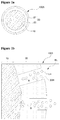
- FIG. 1A and 1B are cross-sectional views showing silicon anode active materials 100A and 100B, respectively according to an embodiment of the present invention.
- the silicon anode active material 100A has a particle structure.
- the anode active material 100A having the particle structure may have an average particle diameter between 20 nm and 2 ⁇ m and the diameter of the particle structure may be appropriately selected depending on the application field and the electrode structure of the battery. For example, considering that the smaller the particle diameter, the less the change in volume during the charge/discharge of the battery and a deterioration of lifetime can be prevented, and the larger the particle diameter, the more energy density may be improved, the diameter may be selected.
- the silicon anode active material 100A may include a silicon core 10.
- the silicon core 10 may be a single silicon particle or may have a secondary particle structure in which a plurality of silicon particles are aggregated together.
- the silicon particles may have a crystalline phase such as monocrystalline or polysilicon, amorphous or mixed phase thereof, and may be obtained by processes such as grinding, electrical explosion, or condensation of silicon precursor gases.
- the silicon anode active material 100A may further include a clamping layer 20 on the silicon core 10.
- the clamping layer 20 may be a layer for mechanically relaxing the volume change of the silicon core 10 during charging and discharging of the battery and maintaining the particle shape of the active material itself.
- the clamping layer 20 may have a bilayer configuration comprising a silicon carbide layer 21 as an outer shell and a silicon oxide layer 22 as an inner shell between the silicon core 10 and the silicon carbide layer 21.
- the silicon oxide layer 22 of the clamping layer 20 functions as a source of silicon for formation of the silicon carbide layer 21 as described below with reference to Fig. 2 , the silicon oxide layer 22 may be changed to have non-stoichiometric composition, SiO x (0 ⁇ X ⁇ 2) during formation of the silicon carbide 21, though the silicon oxide layer 22 has initially a stoichiometric composition.
- the silicon carbide layer (SiC) 21 formed from the silicon oxide layer 22 may have a crystalline, amorphous or mixed structure thereof. However, even in the case that the silicon carbide layer 21 has initially a crystalline structure, the silicon carbide layer may gradually become amorphous.
- the thickness of the double clamping layer 20 may be between 0.5 nm and 20 nm. When the thickness of the double clamping layer 20 is more than 20 nm, the energy density of the entire silicon anode active material will be lowered. When the thickness is less than 0.5 nm, sufficient mechanical strength for alleviating the volume change of the silicon core 10 cannot be secured. Further, the performances of the silicon anode active material 100A can be optimized in view of its energy density and mechanical strength when the ratio of the thickness of the double clamping layer to the radius of the silicon core is within the range of 1% to 10%.
- the double clamping layer 20 of the silicon anode active material 100B may include one or two or more through holes 20H.
- the lithium ion Li + diffuses through the double clamping layer 20 or passes freely through the through holes 20H between the silicon core 10 and the electrolyte EL outside the double clamping layer 20.
- the lithium ion Li + dissolved in the electrolyte EL is transfered to the silicon core 10 inside the double clamping layer 20 through the through holes 20H of the the double clamping layer 20 during charging of the battery, as shown arrow A and then the lithium ion Li + can be reduced.
- the lithium ions Li + in the silicon core 10 are oxidized to be discharged from the silicon core 10.
- the lithium ion Li + passing freely through the through holes 20H compensates for the amount of lithium that has been reduced by the double clamping layer 20 to secure the charging and discharging efficiency and this property can be appropriately adjusted depending on the application of the battery is. For example, when a high voltage efficiency such as a notebook computer is required, the size of the entire silicon core can be reduced, the through holes 20H can be formed. In contrast, in a high-capacity application such as an electric vehicle, the formation of the holes 20H may be reduced or eliminated to maximize the mechanical clamping effect of the double clamping layer 20.
- the silicon anode active material 100C may further include a carbon-based conductive layer 30 such as graphite, soft carbon, or graphene on the double clamping layer 20.
- the carbon-based conductive layer 30 may function for electrical connection between the silicon anode active materials 100B contacting each other and reduces the internal resistance from the silicon anode active materials 100B to the current collector (not shown).
- the carbon-based conductive layer 30 may be crystalline or at least partially an amorphous carbon film.
- the carbon-based conductive layer 30 has a high crystallinity, it may be graphite, but in this case, it may cause a reaction with an electrolytic solution on the surface of the graphite.
- the carbon-based conductive layer 30 may include an electrically conductive SP2 graphite structure and an insulating SP3 diamond structure. In order that the carbon-based conductive layer 30 has electrical conductivity, and the SP2 graphite structure may have a large mole fraction than that of the SP3 diamond structure, which can be controlled through a heat treatment process described below.
- the above-described carbon-based conductive layer 30 is illustrative, and the present invention is not limited thereto.
- another conductive layer such as nanoscale particles of conductive metal oxide, such as antimony zinc oxide or antimony tin oxide, or a layer thereof, may be formed on the double clamping layer 20.
- the nanoscale particles may form sintered bodies with the underlying silicon anode active material particles.
- the double clamping 20 of the silicon anode active material 100C may have a through-hole 20H, as described with reference to Figure IB, in which case the carbon-based conductive layer 30 may preferably continuously coat an entire surface of the silicon anode active material particle including the through hole 20H.
- the carbon-based conductive layer 30 is illustrative, and the nanoscale particle layer described above which functions as a suitable barrier layer for the electrolyte may be applied.
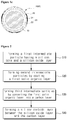
- FIG. 2 is a flow chart showing a method of fabricating a silicon anode active material according to an embodiment of the present invention
- FIGS. 3A to 3E show intermediate products according to the method of fabricating.
- a first intermediate particle 100a having a silicon core 10 and a silicon oxide layer 22L on a silicon core 10 may be formed (S10).
- the silicon oxide layer 22L may be a natural oxide film or a silicon oxide film formed artificially on the silicon core 10.
- the artificially formed silicon oxide layer 22L may be provided by thermally oxidizing the surface of the silicon core 10 or by depositing silicon oxide on the silicon core 10 by chemical vapor deposition or plasma enhanced chemical vapor deposition.
- the silicon carbide layer 21 is formed while the silicon oxide layer 22L is consumed, the ratio of the silicon oxide layer 22L of the formed first intermediate particles 100a to the thickness of the final designed double clamping layer 20 (see FIG. 3D ) is too small, the silicon oxide layer 22L may be entirely exhausted and then the double-clamping structure 20 may not be obtained. In other case, after the silicon oxide layer 22L is entirely exhausted, the internal silicon core 10 may be further consumed as a source of silicon, and then, the particle structure may be collapsed or a capacity of the resulting silicon anode active material decrease. Conversely, as the thickness T 1 of the silicon oxide layer 22L of the first intermediate particle 100a becomes greater, the thickness of the silicon oxide layer of the silicon anode active material (see 22 in FIG.
- the thickness of the silicon oxide layer 22L to be a silicon source for the silicon carbide layer of the double clamping layer 20 may be designed to have a sufficient margin by setting the thickness of the silicon oxide layer 22L to be within 50 % and 150 % to the thickness T des of the finally designed double clamping layer 20.
- the thickness of the silicon oxide layer 22L may be designed to be about 1 to 10 times larger than the thickness of the carbon layer 25L, preferably about 1.1 to 3 times larger than the thickness of the carbon layer 25L to meet desity variation of various carbon layers. This is because even if the carbon layer 25L is all consumed to form the silicon carbide layer 21, the underlying silicon oxide layer 21 can remain and the growth thickness of the double clamping layer 20 can be limited, thereby preventing the problem of an initial increase of an irreversible capacity of the anode material and transformation to be an inactive material, and the degradation of the rate performance due to the decrease of the mobility of Lithium.
- a first solid organic layer 25S which is a carbon precursor, may be coated on the first intermediate particles 100a to form second intermediate particles 100b (S20).
- one or two or more mixed solutions selected from the group consisting of hydrocarbon-based, alcohol-based, ether-based, and ester-based compounds may be used as the carbon precursor for producing the first solid organic layer 25S.
- the hydrocarbons may be hexene, nonene, dodecene, pentatetene, toluene, xylene, chlorobenzoic acid, benzene, hexadecyne, tetradecyne or octadecyne.
- the alcohol may be at least one selected from the group consisting of ethyl alcohol, methyl alcohol, glycerol, propylene glycol, isopropyl alcohol, isobutyl alcohol, polyvinyl alcohol, cyclohexanol, octyl alcohol, decanol, hexatecanol, ethylene glycol, 1,2-octeine diol 1,2-dodecane diol, and 1,2-hexadecane diol, or a mixture thereof.
- Other primary alcohols, secondary alcohols and tertiary alcohols may be used as the alcohol-based organic solution.
- the ether may be a cyclic ether such as octyl ether, butyl ether, hexyl ether, benzyl ether, phenyl ether, decyl ether, ethyl methyl ether, dimethyl ether, diethyl ether, diphenyl ether, tetrahydrofuran, and polyethers such as polyethylene glycol (PEG), polypropylene glycol (PPG), polytetramethylene glycol (PTMG), polyoxymethylene (POM), and polytetrahydrofuran.
- PEG polyethylene glycol
- PPG polypropylene glycol
- PTMG polytetramethylene glycol
- POM polyoxymethylene
- the aforementioned polyethers are only exemplary, and other aliphatic or aromatic polyethers may be used as the ether-based organic solvent.
- the ester may be selected from the group consisting of polyethylene terephthalate, acrylate esters and cellulose acetate, isobutyl acetate, isopropyl acetate, allyl hexanoate, benzyl acetate, bornyl acetate, butyl acetate and cyclic ester such as lactone.
- any or combination of carbon-containing natural and synthetic polymer material may be further used as an additional carbon precursor to increase the carbon-containing concentration, when using liquid organic compound as a solvent for the polymer materials.
- liquid organic compound as a solvent for the polymer materials.
- any one of carbon-containing natural and synthetic polymer materials or a mixture thereof may be dissolved in water such as another solvent, for example, distilled water or deionized water.
- the carbon-containing polymeric material may be chitosan, glucose, sucrose, maltose, lactose, starch, glycogen, polystylene (PS), polyethylene (PE), polypropylene (PP), polyvinyl chloride (PVC), polyacrylonitrile (PAN), polyethylene (PE), polyacrylic acid (PAA), polyvinylpyrrolidone (PVP), or a mixture thereof.
- a polymer material such as PAN, PAA or PVP may be dissolved in a suitable solvent as the above described solvent, the first intermediate particles 100a may be dispersed in the solvent, and then first intermediate particles wetted with the polymer material may be obtained.
- the second intermediate particles 100b can be obtained by drying the resulting first intermediate particles.
- the concentration of the dispersion solution of the first intermediate particle 100a and the solution which is the carbon precursor for forming the first solid organic layer 25S may be, for example, 0.1 wt% to 20 wt%.
- concentration of the dispersion solution is low, a yield may become low, and if the concentration is high, it is difficult to maintain the dispersion state, and therefore the wetting of the liquid organic compound may be difficult.
- a stirring process may be performed to enhance a dispersibility of the dispersed particles.
- the organic solid film, which is a carbon precursor can be coated on the first intermediate particles by a spray method or a scattering method, and the present invention is not limited.
- the mixed solution may further contain at least one compound selected from the group consisting of an amine surfactant such as octylamine, trioctylamine, decylamine, dodecylamine, tetradecylamine, hexadecylamine, oleylamine and/or other type surfactant such as octanoic acid, decanoic acid, lauric acid, hexadecanoic acid, oleic acid, erucic acid, stearic acid, benzoic acid or biphenylcarboxylic. This may improve the surface stability of the dispersed particles to help uniform wetting of the carbon precursor on the first intermediate particles.
- an amine surfactant such as octylamine, trioctylamine, decylamine, dodecylamine, tetradecylamine, hexadecylamine, oleylamine and/or other type surfactant such as octanoi
- the surfactant may be appropriately selected so as to control the shape of the dispersed particles such as spherical, nano-rods, tetrapods, and tripods by controlling the surface stability of the dispersed particles in the dispersion solution.
- the obtained second intermediate particles 100b may be heat-treated at a first temperature to convert the first solid organic layer 25S into a carbon layer 25L to form a third intermediate layer 100c in which the carbon layer 25L is formed on the silicon oxide layer 22L (S30).
- the first temperature may be selected within a temperature range in which only one solid organic layer 25L is selectively converted to the carbon layer 25L at a temperature below the temperature at which the silicon carbide layer is formed between the first solid organic layer 25S and the silicon oxide layer 22L.
- the first temperature may be in the range of about 700 ° C to about 1,100 ° C.
- the first solid organic layer 25S can be completely converted into the carbon layer 25L.
- the thickness T2 of the carbon layer 25L may be from 0.5 nm to 10 nm.
- the third intermediate particle 100c may be heat-treated at a second temperature to form a silicon carbide layer 21 between the silicon oxide layer 22L and the carbon layer 25L.
- the second temperature may be higher than the first temperature.
- the second temperature may be in the range of 1,200 ° C to 1,400 ° C.
- the position P is the interface position between the silicon oxide layer 22L and the carbon layer 25L before the heat treatment at the second temperature.
- the surface of the silicon oxide layer 22L retreats to the position P 1 , the thickness T 1 of the silicon oxide layer 22L decreases by value D1, and the inner surface of the carbon layer 25L may move forward to position P 2 , so that the thickness T 2 of the carbon layer 25L may be reduced by value D2.
- the silicon oxide layer 22L and the carbon layer 25L are gradually reduced in thickness while consumed, and a silicon carbide layer 21L having a predetermined thickness may be formed between the silicon oxide layer 22L and the carbon layer 25L.
- the thickness (T des ) of the resulting double clamping layer may be smaller than the sum of the actually reduced thicknesses, D1 + D2, due to the dense structure of the double clamping layer.
- the formation of the silicon carbide layer 21L may be terminated while the carbon layer 25L is exhausted. If the thickness T 1 of the silicon oxide layer 22L is 1 to 10 times larger than the thickness T 2 of the carbon layer 25L and preferably 1.1 to 3 times larger than the thickness T 2 of the carbon layer 25L, the silicon oxide layer 22L still remains after the end of the reaction due to the exhaustion of the carbon layer 25L, so that the double clamping film (20 of FIG. 1a ) including formed silicon carbide layer 21L and the remaining silicon oxide layer 22L can be obtained.
- the thickness T 2 of the carbon layer 25L may be sufficiently thick so that the carbon layer 25L that has not been converted to the silicon carbide layer 21 may remain on the double clamping layer 25L.
- the remaining carbon layer 25L may be used as a carbon-based conductive layer (30 in Fig. 1C ) to provide a silicon anode active material 100d having a carbon-based conductive layer formed thereon.
- a carbon-based conductive layer may be additionally formed.
- the second solid organic layer 30S may be coated on the double clamping layer 20 to form a fourth intermediate particles 100e.
- the second solid organic layer 30S is formed by dissolving a carbon precursor material such as PAN, PAA, and PVP described above in a suitable solvent in the same manner as the first solid organic layer 25S, and dispersing the silicon active material particles in which the double clamping layer 20 is formed, obtaining the intermediate particles wetted with the polymer precursor material, and drying the resultant.
- a carbon precursor material such as PAN, PAA, and PVP described above
- suitable solvent such as PAN, PAA, and PVP described above
- the fourth intermediate particle 100e may be heat-treated at a third temperature to convert the second solid organic layer 26L into a carbon layer to form a silicon anode active material (see 100B in FIG. 1B ) coated with a carbon-based conductive layer (see 30 in FIG. 1C ).
- the third temperature may be in the range of 700° C to 1,100 ° C, similar to the first temperature.
- FIG. 4 is a flow chart showing a method of fabricating a silicon anode active material according to another embodiment of the present invention
- FIGS. 5A and 5B show intermediate products according to the fabricating method. Reference may be made to the foregoing disclosure for elements having the same reference numerals.
- first intermediate particles having a silicon core 10 and a silicon oxide layer 22 on the silicon core 10 may be formed (S10).
- the silicon oxide layer 22L may be a natural oxide film or an artificially formed layer on the silicon core 10. Since the silicon carbide layer is formed while the silicon oxide layer 22L is consumed, the thickness of the silicon oxide layer 22L is within the range of 50 % to 150 % of the thickness (T des ) of the final designed double clamping layer.
- the first solid organic layer 26L is coated on the first intermediate particles to form second intermediate particles 100m (S20).
- the first solid organic layer 26L may be obtained by dispersing the first intermediate particles in a mixed solution of one or more selected from the group consisting of hydrocarbons based, alcohols based, ethers based, and esters based compound, and then drying the resulting first intermediated particles.
- the liquid organic compound may be used as a solvent to increase the concentration of the carbon precursor by further adding any one or a mixture of the carbon-containing natural and synthetic polymer materials soluble therein.
- any one or a mixture of carbon-containing natural and synthetic polymer materials in addition in another solvent, for example, water, and then mix the first intermediate particles (100 m) into the solvent, dispersing the first intermediate particles 100m in the mixed solution and then drying the resulting first intermediated particles to so that the first solid organic layer 26S may be coated on the first intermediated particles.
- these liquid phase methods have an advantage in that the first solid organic layer 26S can be uniformly coated on the first intermediate particles 100m on a large scale.
- water is used as the solvent, there is an advantage that an environmentally friendly process can be established.
- the organic solid film which is a carbon precursor
- the organic solid film may be coated on the first intermediate particles by a high-temperature spraying method or a scattering method, a suitable decompression or cooling process may be performed, and the present invention is not limited thereto Is not.
- the second intermediate particle 100m may be then heat-treated at a predetermined temperature to convert the first solid organic layer 26L into the carbon layer 26S, and at the same time, the silicon carbide layer 21L may be formed between the silicon oxide layer 22L and the first solid organic layers 26L (S30).
- the heat treatment temperature may be in the range of 1,150 ⁇ to 1,300 ⁇ .
- the formation of the silicon carbide layer 21L may be terminated while the carbon layer 26S is exhausted. Since the thickness of the silicon oxide layer 22L is 1.5 to 3 times larger than the thickness of the carbon layer 26S, even if the carbon layer 26S is consumed as the silicon carbide layer 21L is formed, the double clamping layer (see 20 of FIG. 1A ) including the silicon carbide layer 21L and the silicon oxide layer 22L can be obtained since the silicon oxide layer 22L remains.
- the silicon carbide layer 21L may be formed and the carbon layer 26S may not be exhausted, and the carbon layer may remain in the double clamping layer. In this case, the remaining carbon layer can be used as the carbon-based conductive layer.
- the carbon precursor PVP was dissolved in distilled water at room temperature, and the intermediate particles having the silicon oxide layer formed on the surface of the silicon core were dispersed in the PVP aqueous solution.
- the radius of the silicon core was 20 nm on average and the thickness of the silicon oxide layer was 2 nm.
- the concentration of PAN was increased to 10 wt%.
- the dispersed aqueous solution was stirred for about 30 minutes to obtain silicon particles, and a solvent on the particles was evaporated to prepare the intermediate particles coated with a solid organic layer as a carbon precursor layer on the surface. Thereafter, the intermediate particles were heat-treated at 800 °C for 1 hour in an Ar gas atmosphere to prepare intermediate particles having a carbon layer formed thereon. Then, the intermediate particles having the carbon layer formed thereon were heat-treated at 1,200 °C for 1 hour in an Ar gas atmosphere. A silicon carbide layer was formed between the silicon oxide layer and the carbon layer of the intermediate particles by the heat treatment, so that the double clamping film was formed on the silicon particles.
- PVP as a carbon precursor was dissolved in distilled water at room temperature, and silicon particles having a silicon oxide layer formed on the surface of the silicon core were dispersed in the PVP aqueous solution.
- the silicon particles are the same as the silicon particles of Experimental Example 1, the average radius of the silicon core is 20 nm, and the thickness of the silicon oxide layer is about 2 nm.
- the intermediate particles After the dispersion aqueous solution was stirred for about 30 minutes, silicon particles were obtained and the solvent on the particle was evaporated to prepare the intermediate particles having a carbon precursor layer coated on the surface thereof as a solid organic layer. Thereafter, the intermediate particles were heat-treated at 1,200 °C for 2 hours in an Ar gas atmosphere to form a silicon carbide layer and a carbon layer sequentially on the silicon oxide layer of the intermediate particles.
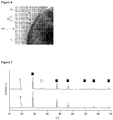
- FIG. 6 is a high-resolution transmission electron microscope (HR-TEM) image of the silicon anode active material particle 100 produced by the above experimental examples.
- the radius of the silicon core 10 is 20 nm on average, which is equal to the radius of the silicon core prior to the formation of the double clamping layer 20, which indicates that the silicon core was not eroded during the formation of the double clamping layer 20.
- the total thickness of the double clamping layer 20 formed on the silicon core 10 was 2.3 nm and the carbon layer 30 still remained after the silicon carbide layer 21 was formed.
- FIG. 7 is an X-ray diffraction pattern of a silicon anode active material according to an embodiment of the present invention.
- ⁇ is the peak of the silicon core
- ⁇ is the peak of the silicon carbide.
- Curve C is the measurement result of the silicon anode active material particle having the double clamping layer according to the embodiment of the present invention
- the curve R is the peak of the silicon core.
- Table 1 below shows the average electrode expansion ratio of the negative electrode to which the silicon anode active material according to Experimental Examples 1 and 2 was applied and the average electrode expansion ratio of the negative electrode to which the silicon negative active material was applied according to the comparative example.
- the change in thickness during the charging is suppressed to about 2% based on the initial thickness, and the change in thickness during charging and discharging may be suppressed to 42% or less based on the charging time.
- the silicon anode active material according to the comparative example (curve R) exhibited a change in the thickness at the time of charging to about 189% based on the initial thickness, and the change in thickness at the time of charging and discharging showed a change of more than 108% at discharging.
- FIG. 8A is a graph showing initial charging/discharging characteristics of half-cells manufactured using the silicon active material particles of Experimental Example 1 and the silicon active material particles of the comparative example
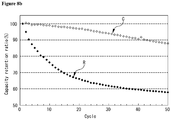
- FIG. 8B is a graph showing capacity retention ratios of the half-cells.
- the comparative example is obtained by forming a carbon layer on a silicon core.
- the charge/discharge rate is 0.1C.
- the curves C11, C12 and C13 show the charging characteristics of once, twice and three times in Experimental Example 1, and the curves C21, C22 and C23 show the discharging characteristics of the discharging characteristics of Example 1.
- the curves R11, R12 and R13 show the charging characteristics of once, twice and three times of the comparative example, and the curves R21, R22 and R23 show the discharge characteristics of once, twice and three times of the comparative example. It can be confirmed that the charging capacity in both Experimental Example 1 and Comparative Example is not less than 2,700 (mAh/h). The initial charge capacity tends to increase slightly in the second and third cycles, but gradually converges.
- the silicon active material of the comparative example has an initial charging capacity a little greater than that of experimental example 1.
- both the experimental example 1 and the comparative example exhibit substantially the same behavior.
- the discharge efficiency is somewhat reduced, which can be attributed to the increase of the irreversible capacity due to the volume change due to charging and discharging.
- the capacity of the battery (curve C) of Example 1 is maintained at 90% or more even at 40 cycles, while the battery (curve R) of the comparative example decreases from 40 cycles to 60% or less.
- the battery of Example 1 and the battery of Comparative Example exhibited relatively similar behavior in terms of charge and discharge capacity characteristics as shown in FIG. 8A , but in view of the capacity retention rate related to the life characteristic, the battery of Example 1 was remarkably improved by the double clamping film according to the embodiment of the present invention.
Landscapes
- Chemical & Material Sciences (AREA)
- Chemical Kinetics & Catalysis (AREA)
- Electrochemistry (AREA)
- General Chemical & Material Sciences (AREA)
- Engineering & Computer Science (AREA)
- Organic Chemistry (AREA)
- Inorganic Chemistry (AREA)
- Manufacturing & Machinery (AREA)
- Composite Materials (AREA)
- Materials Engineering (AREA)
- Physics & Mathematics (AREA)
- Thermal Sciences (AREA)
- Battery Electrode And Active Subsutance (AREA)
- Carbon And Carbon Compounds (AREA)
- Silicon Compounds (AREA)
Abstract
Description
- The present invention relates to secondary battery technology, and more particularly, to a silicon anode active material and a method of fabricating the same.
- Recently, demand for secondary batteries such as lithium batteries, lithium ion batteries, and lithium ion polymer batteries is greatly increasing. The secondary battery is a rechargeable battery using an electrode material having excellent reversibility and the secondary battery may be a nickel-hydrogen (Ni-MH) battery, a lithium battery or a lithium ion battery depending on the anode and the cathode active material. Such secondary batteries are increasingly widely being applied to various applications as power supply sources for information technology(IT) devices such as smart phones, portable computers, and electronic paper, or for transportation systems such as electric vehicles.
- A carbon-based material having a theoretical capacity of 372 mAh/g is generally applied as a material capable of inhibiting dendrites of lithium in a lithium battery from growing. However, as the application of the secondary battery has expanded, there has been a demand for higher capacity and higher output of the secondary battery than before. Accordingly, a non-carbon anode material capable of being alloyed with lithium such as silicon (Si), tin (Sn), or aluminum (Al) having a capacity of 500 mAh/g or more to replace the theoretical capacity of the carbon-based anode materials have greatly drawn attention.
- Among the non-carbon-based anode materials, the silicon has the theoretical capacity of about 4,200 mAh / g, which is the largest. However, since the volume of the silicon anode material expands by about 4 times during charging of the silicon anode material, due to the volume change during charging and discharging, the electrical connection between the active materials may be broken, the active material may be separated from a current collector, and the active material may be eroded by electrolyte, which are a barrier to its practical use. Therefore, for the application of the silicon material to the anode material, it is required to improve the irreversibility of the battery due to the volume change during charging and discharging of the battery. In addition, with explosive growth of demand for secondary batteries, it is necessary to secure fabrication technology that can economically and mass-produce silicon anode active materials.
- Accordingly, a technical problem to be solved by the present invention is to provide an anode active material having a high energy density and a long life by alleviating the volume change due to charging and discharging of a battery while having high capacity and high output by using silicone as the anode active material.
- Other technical problem to be solved by the present invention is to provide a method of fabricating the anode active material which may economically and rapidly mass-produce a silicon anode active material having the above-described advantages.
- According to an aspect of the present invention, there is provided a silicon anode active material comprising: a silicon core including silicon particles; And a double clamping layer having a silicon carbide layer on the silicon core and a silicon oxide layer between the silicon core and the silicon carbide layer. The silicon oxide layer may be a silicon source of the silicon carbide layer.
- In one embodiment, the thickness of the double clamping layer is 0.5 nm to 20 nm, and the ratio of the thickness of the double clamping layer to the radius of the silicon core is in the range of 1% to 10%.
- In some embodiments, the silicon anode active material may further comprise a conductive layer formed on the double clamping layer. In addition, the double clamping layer may include through holes, and the conductive layer may be continuously coated on the silicon anode active material through the through holes. The conductive layer may include a carbon-based conductive layer.
- According to another aspect of the present invention, there is provided a method of manufacturing a silicon anode active material, comprising: forming a silicon core and a first intermediate particle having a silicon oxide layer on the silicon core. Thereafter, a first solid organic layer is coated on the first intermediate particles to form second intermediate particles; then the second intermediate particles are heat-treated at a first temperature to convert the first solid organic layer into a carbon layer to form third intermediate particles. Subsequently, the third intermediate particles are heat-treated at a second temperature to form a silicon carbide layer between the silicon oxide layer and the carbon layer to form a double clamping layer including the silicon oxide layer and the silicon carbide layer can do.
- The silicon oxide layer becomes the silicon source of the silicon carbide layer. The first temperature for forming the carbon layer is in the range of 700 ° C to 1,100 ° C. The second temperature for forming the silicon carbide layer may be in the range of 1,150 □ to 1,300 □.
- The thickness of the silicon oxide layer of the first intermediate particles may be in the range of 1% to 10% of the radius of the silicon core. In some embodiments, the thickness of the silicon oxide layer of the third intermediate particles may range from 1 to 10 times the thickness of the carbon layer. Further, the thickness of the double clamping layer may be 0.5 nm to 20 nm, and the ratio of the thickness of the double clamping layer to the radius of the silicon core may be in the range of 1% to 10%.
- The forming of the second intermediate particles may include: preparing a dispersion solution containing a carbon precursor; Dispersing the first intermediate particles in the dispersion solution; And a step of obtaining the first intermediate particles with the dispersed solution wetted and drying. In one embodiment, the carbon precursor may be one solution selected from the group consisting of hydrocarbon-based, alcohol-based, ether-based, and ester-based compounds, or two or more mixed solutions; Or the carbon-containing natural high-molecular substance and the carbon-containing synthetic polymer substance dissolved in the solution or water, or a mixture thereof. The carbon-containing polymer material may include the group consisting of chitosan, glucose, sucrose, maltose, lactose, starch, glycogen, polystyrene (PS), polypropylene (PP), polyvinyl chloride (PVC), polyacrylonitrile (PAN), polyethylene (PE), polyacrylic acid (PAA), polyvinylpyrrolidone (PVP).
- According to another aspect of the present invention, there is provided a method of manufacturing a silicon anode active material, comprising: forming a first intermediate particle having a silicon core and a silicon oxide layer on the silicon core; A first solid organic layer is coated on the first solid organic layer to form second intermediate particles. Thereafter, the second intermediate particles are heat-treated to convert the first solid organic layer into a carbon layer, and a silicon carbide layer is formed between the silicon oxide layer and the first solid organic layer to form the silicon oxide layer and the silicon carbide layer to form a double clamping layer.
- The silicon oxide layer may be a silicon source of the silicon carbide layer. The heat treatment temperature may be in the range of 1,150 □ to 1,300 □.
- The thickness of the silicon oxide layer of the first intermediate particles may be in the range of 1% to 10% of the radius of the silicon core. The thickness of the double clamping layer is 0.5 nm to 20 nm and the ratio of the thickness of the double clamping layer to the radius of the silicon core is in the range of 1% to 10%.
- The forming of the second intermediate particles may include: preparing a dispersion solution containing a carbon precursor; Dispersing the first intermediate particles in the dispersion solution; And a step of obtaining the first intermediate particles with the dispersed solution wetted and drying.
- In one embodiment, the carbon precursor may be one solution selected from the group consisting of hydrocarbon-based, alcohol-based, ether-based, and ester-based compounds, or two or more mixed solutions; Or the carbon-containing natural high-molecular substance and the carbon-containing synthetic polymer substance dissolved in the solution or water, or a mixture thereof The carbon-containing polymeric material may include chitosan, (PE), polypropylene (PP), polyvinyl chloride (PVC), polyacrylonitrile (PAN), polyethylene (PE), poly (ethylene terephthalate), polyvinylpyrrolidone Acrylic acid (PAA), Polyvinylpyrrolidone (PVP), or a mixture thereof.
- According to an embodiment of the present invention, there is provided a silicon anode material which has a silicon core including pure silicon particles for securing a high capacity, and a double clamping layer having a silicon oxide layer and a silicon carbide layer on the silicon core. The double clamping layer may suppress volume change during the charging and discharging of the batteries, resulting in a silicon anode active material which realizes a cathode having an improved life span. In addition, when the double clamping layer has a through hole through which the silicon core is exposed, ions such as lithium ions can freely pass between the silicon core and outside of the silicon anode material, thereby enabling charge and discharge of the battery with high efficiency and high output.
- Further, according to the embodiment of the present invention, since the silicon oxide layer formed on the silicon core is used as the silicon source to form the silicon carbide layer, there is an advantage that the double clamping layer can be stably formed without erosion of the silicon core. In addition, by using a liquid carbon precursor to produce the silicon carbide layer, optimal dispersion of the intermediate particles to be formed with the double clamping layer and uniform wetting of the solid organic layer are induced, and a dense carbon layer and a silicon carbide layer Can be economically and rapidly formed in a large amount
-
-
FIGS. 1A and 1B are cross-sectional views illustrating silicon anode active materials according to an embodiment of the present invention, respectively. -
FIG. 2 is a flowchart showing a method of manufacturing a silicon anode active material according to an embodiment of the present invention. -
FIGS. 3A through 3E show intermediate products according to the above production method. -
FIG. 4 is a flowchart showing a method of manufacturing a silicon anode active material according to another embodiment of the present invention. -
FIGS. 5A and 5B show intermediate products by the manufacturing method according to an embodiment of the present invention. -
FIG. 6 is a high-resolution transmission electron microscope (HR-TEM) image of the silicon anode active material particles produced by the above experimental examples. -
FIG. 7 is an X-ray diffraction pattern of a silicon anode active material according to an embodiment of the present invention. -
FIG. 8A is a graph showing initial charging / discharging characteristics of half-cells manufactured using the silicon active material particles of Experimental Example 1 and the silicon active material particles of the comparative example, andFIG. 8B is a graph showing capacity retention ratios of the half-cells. - Hereinafter, preferred embodiments of the present invention will be described in detail with reference to the accompanying drawings.
- While the present invention has been particularly shown and described with reference to exemplary embodiments thereof, it is evident that many alternatives, modifications and variations will be apparent to those skilled in the art. But the present invention is not limited to these examples. Rather, these embodiments are provided so that this disclosure will be more faithful and complete, and will fully convey the scope of the invention to those skilled in the art.
- In the following drawings, the thickness and the size of each layer are exaggerated for convenience and clarity of description, and the same reference numerals designate the same elements in the drawings. As used herein, the term "and/or" includes any and all combinations of one or more of the listed items.
- The terminology used herein is for the purpose of describing particular embodiments only and is not intended to limit the invention. As used herein, the singular forms "a," "an," and "the" include plural referents unless the context clearly dictates otherwise. Also, "comprise" and / or "comprising" when used herein should be interpreted as specifying the presence of stated shapes, numbers, steps, operations, elements, elements and / And does not preclude the presence or addition of one or more other features, integers, operations, elements, elements, and / or groups.
-
FIG. 1A and 1B are cross-sectional views showing silicon anodeactive materials - Referring to
FIG. 1A , the silicon anodeactive material 100A has a particle structure. The anodeactive material 100A having the particle structure may have an average particle diameter between 20 nm and 2 µm and the diameter of the particle structure may be appropriately selected depending on the application field and the electrode structure of the battery. For example, considering that the smaller the particle diameter, the less the change in volume during the charge/discharge of the battery and a deterioration of lifetime can be prevented, and the larger the particle diameter, the more energy density may be improved, the diameter may be selected. - The silicon anode
active material 100A may include asilicon core 10. Thesilicon core 10 may be a single silicon particle or may have a secondary particle structure in which a plurality of silicon particles are aggregated together. The silicon particles may have a crystalline phase such as monocrystalline or polysilicon, amorphous or mixed phase thereof, and may be obtained by processes such as grinding, electrical explosion, or condensation of silicon precursor gases. - The silicon anode
active material 100A may further include aclamping layer 20 on thesilicon core 10. Theclamping layer 20 may be a layer for mechanically relaxing the volume change of thesilicon core 10 during charging and discharging of the battery and maintaining the particle shape of the active material itself. Theclamping layer 20 may have a bilayer configuration comprising asilicon carbide layer 21 as an outer shell and asilicon oxide layer 22 as an inner shell between thesilicon core 10 and thesilicon carbide layer 21. - Since the
silicon oxide layer 22 of theclamping layer 20 functions as a source of silicon for formation of thesilicon carbide layer 21 as described below with reference toFig. 2 , thesilicon oxide layer 22 may be changed to have non-stoichiometric composition, SiOx (0 < X < 2) during formation of thesilicon carbide 21, though thesilicon oxide layer 22 has initially a stoichiometric composition. The silicon carbide layer (SiC) 21 formed from thesilicon oxide layer 22 may have a crystalline, amorphous or mixed structure thereof. However, even in the case that thesilicon carbide layer 21 has initially a crystalline structure, the silicon carbide layer may gradually become amorphous. - The thickness of the
double clamping layer 20 may be between 0.5 nm and 20 nm. When the thickness of thedouble clamping layer 20 is more than 20 nm, the energy density of the entire silicon anode active material will be lowered. When the thickness is less than 0.5 nm, sufficient mechanical strength for alleviating the volume change of thesilicon core 10 cannot be secured. Further, the performances of the silicon anodeactive material 100A can be optimized in view of its energy density and mechanical strength when the ratio of the thickness of the double clamping layer to the radius of the silicon core is within the range of 1% to 10%. - Referring to
FIG. 1B , in some embodiments, thedouble clamping layer 20 of the silicon anodeactive material 100B may include one or two or more throughholes 20H. The lithium ion Li+ diffuses through thedouble clamping layer 20 or passes freely through the throughholes 20H between thesilicon core 10 and the electrolyte EL outside thedouble clamping layer 20. The lithium ion Li+ dissolved in the electrolyte EL is transfered to thesilicon core 10 inside thedouble clamping layer 20 through the throughholes 20H of the thedouble clamping layer 20 during charging of the battery, as shown arrow A and then the lithium ion Li+ can be reduced. During discharging of the battery, as shown by the arrow B, the lithium ions Li+ in thesilicon core 10 are oxidized to be discharged from thesilicon core 10. The lithium ion Li+ passing freely through the throughholes 20H compensates for the amount of lithium that has been reduced by thedouble clamping layer 20 to secure the charging and discharging efficiency and this property can be appropriately adjusted depending on the application of the battery is. For example, when a high voltage efficiency such as a notebook computer is required, the size of the entire silicon core can be reduced, the throughholes 20H can be formed. In contrast, in a high-capacity application such as an electric vehicle, the formation of theholes 20H may be reduced or eliminated to maximize the mechanical clamping effect of thedouble clamping layer 20. - Referring to
FIG. 1C , the silicon anodeactive material 100C may further include a carbon-basedconductive layer 30 such as graphite, soft carbon, or graphene on thedouble clamping layer 20. The carbon-basedconductive layer 30 may function for electrical connection between the silicon anodeactive materials 100B contacting each other and reduces the internal resistance from the silicon anodeactive materials 100B to the current collector (not shown). As described above, the carbon-basedconductive layer 30 may be crystalline or at least partially an amorphous carbon film. When the carbon-basedconductive layer 30 has a high crystallinity, it may be graphite, but in this case, it may cause a reaction with an electrolytic solution on the surface of the graphite. However, since the low-crystalline or amorphous carbon film has chemical resistance to the electrolyte, decomposition of the electrolyte may be suppressed during charging and discharging of the battery, so that the lifetime of an anode can be improved. In addition, the carbon-basedconductive layer 30 may include an electrically conductive SP2 graphite structure and an insulating SP3 diamond structure. In order that the carbon-basedconductive layer 30 has electrical conductivity, and the SP2 graphite structure may have a large mole fraction than that of the SP3 diamond structure, which can be controlled through a heat treatment process described below. - The above-described carbon-based
conductive layer 30 is illustrative, and the present invention is not limited thereto. For example, another conductive layer such as nanoscale particles of conductive metal oxide, such as antimony zinc oxide or antimony tin oxide, or a layer thereof, may be formed on thedouble clamping layer 20. The nanoscale particles may form sintered bodies with the underlying silicon anode active material particles. - In some embodiments, the double clamping 20 of the silicon anode
active material 100C may have a through-hole 20H, as described with reference to Figure IB, in which case the carbon-basedconductive layer 30 may preferably continuously coat an entire surface of the silicon anode active material particle including the throughhole 20H. In this case, it is possible to improve the mobility of the lithium ions through the throughholes 20H and reduce the volume change of the silicon anodeactive material 100C by thedouble clamping layer 20, (10) is prevented from being eroded by the carbon-basedconductive layer 30 into the external electrolyte. The carbon-basedconductive layer 30 is illustrative, and the nanoscale particle layer described above which functions as a suitable barrier layer for the electrolyte may be applied. -
FIG. 2 is a flow chart showing a method of fabricating a silicon anode active material according to an embodiment of the present invention, andFIGS. 3A to 3E show intermediate products according to the method of fabricating. - Referring to
FIGS. 2 and3A , a firstintermediate particle 100a having asilicon core 10 and asilicon oxide layer 22L on asilicon core 10 may be formed (S10). Thesilicon oxide layer 22L may be a natural oxide film or a silicon oxide film formed artificially on thesilicon core 10. For example, the artificially formedsilicon oxide layer 22L may be provided by thermally oxidizing the surface of thesilicon core 10 or by depositing silicon oxide on thesilicon core 10 by chemical vapor deposition or plasma enhanced chemical vapor deposition. - As described below, since the
silicon carbide layer 21 is formed while thesilicon oxide layer 22L is consumed, the ratio of thesilicon oxide layer 22L of the formed firstintermediate particles 100a to the thickness of the final designed double clamping layer 20 (seeFIG. 3D ) is too small, thesilicon oxide layer 22L may be entirely exhausted and then the double-clampingstructure 20 may not be obtained. In other case, after thesilicon oxide layer 22L is entirely exhausted, theinternal silicon core 10 may be further consumed as a source of silicon, and then, the particle structure may be collapsed or a capacity of the resulting silicon anode active material decrease. Conversely, as the thickness T1 of thesilicon oxide layer 22L of the firstintermediate particle 100a becomes greater, the thickness of the silicon oxide layer of the silicon anode active material (see 22 inFIG. 1A ) increases, decrease in the capacity of the silicon anode active material may occur. Since the density (for example, 2.3 g/cm3) of thesilicon oxide layer 22L is larger than the density (for example, 2.3 g / cm 3) of the carbon film, generally soft carbon film to be described later, the thickness of thesilicon oxide layer 22L to be a silicon source for the silicon carbide layer of thedouble clamping layer 20 may be designed to have a sufficient margin by setting the thickness of thesilicon oxide layer 22L to be within 50 % and 150 % to the thickness Tdes of the finally designeddouble clamping layer 20. - In addition, as will be described later, the thickness of the
silicon oxide layer 22L may be designed to be about 1 to 10 times larger than the thickness of thecarbon layer 25L, preferably about 1.1 to 3 times larger than the thickness of thecarbon layer 25L to meet desity variation of various carbon layers. This is because even if thecarbon layer 25L is all consumed to form thesilicon carbide layer 21, the underlyingsilicon oxide layer 21 can remain and the growth thickness of thedouble clamping layer 20 can be limited, thereby preventing the problem of an initial increase of an irreversible capacity of the anode material and transformation to be an inactive material, and the degradation of the rate performance due to the decrease of the mobility of Lithium. - Referring to
FIGS. 2 and3B , a first solidorganic layer 25S, which is a carbon precursor, may be coated on the firstintermediate particles 100a to form secondintermediate particles 100b (S20). In one embodiment, one or two or more mixed solutions selected from the group consisting of hydrocarbon-based, alcohol-based, ether-based, and ester-based compounds may be used as the carbon precursor for producing the first solidorganic layer 25S. In one embodiment, the hydrocarbons may be hexene, nonene, dodecene, pentatetene, toluene, xylene, chlorobenzoic acid, benzene, hexadecyne, tetradecyne or octadecyne. However, this is illustrative and other liquid hydrocarbons of linear or branched type having a carbon number in the range of 6 to 20 can be utilized. - The alcohol may be at least one selected from the group consisting of ethyl alcohol, methyl alcohol, glycerol, propylene glycol, isopropyl alcohol, isobutyl alcohol, polyvinyl alcohol, cyclohexanol, octyl alcohol, decanol, hexatecanol, ethylene glycol, 1,2-octeine diol 1,2-dodecane diol, and 1,2-hexadecane diol, or a mixture thereof. Other primary alcohols, secondary alcohols and tertiary alcohols may be used as the alcohol-based organic solution.
- The ether may be a cyclic ether such as octyl ether, butyl ether, hexyl ether, benzyl ether, phenyl ether, decyl ether, ethyl methyl ether, dimethyl ether, diethyl ether, diphenyl ether, tetrahydrofuran, and polyethers such as polyethylene glycol (PEG), polypropylene glycol (PPG), polytetramethylene glycol (PTMG), polyoxymethylene (POM), and polytetrahydrofuran. The aforementioned polyethers are only exemplary, and other aliphatic or aromatic polyethers may be used as the ether-based organic solvent. The ester may be selected from the group consisting of polyethylene terephthalate, acrylate esters and cellulose acetate, isobutyl acetate, isopropyl acetate, allyl hexanoate, benzyl acetate, bornyl acetate, butyl acetate and cyclic ester such as lactone.
- In other embodiment, any or combination of carbon-containing natural and synthetic polymer material may be further used as an additional carbon precursor to increase the carbon-containing concentration, when using liquid organic compound as a solvent for the polymer materials. As another example, in place of the liquid organic compound, any one of carbon-containing natural and synthetic polymer materials or a mixture thereof may be dissolved in water such as another solvent, for example, distilled water or deionized water.
- The carbon-containing polymeric material may be chitosan, glucose, sucrose, maltose, lactose, starch, glycogen, polystylene (PS), polyethylene (PE), polypropylene (PP), polyvinyl chloride (PVC), polyacrylonitrile (PAN), polyethylene (PE), polyacrylic acid (PAA), polyvinylpyrrolidone (PVP), or a mixture thereof. For example, a polymer material such as PAN, PAA or PVP may be dissolved in a suitable solvent as the above described solvent, the first
intermediate particles 100a may be dispersed in the solvent, and then first intermediate particles wetted with the polymer material may be obtained. The secondintermediate particles 100b can be obtained by drying the resulting first intermediate particles. - The concentration of the dispersion solution of the first
intermediate particle 100a and the solution which is the carbon precursor for forming the first solidorganic layer 25S may be, for example, 0.1 wt% to 20 wt%. When the concentration of the dispersion solution is low, a yield may become low, and if the concentration is high, it is difficult to maintain the dispersion state, and therefore the wetting of the liquid organic compound may be difficult. In some embodiments, a stirring process may be performed to enhance a dispersibility of the dispersed particles. As another method, the organic solid film, which is a carbon precursor, can be coated on the first intermediate particles by a spray method or a scattering method, and the present invention is not limited. - In some embodiments, the mixed solution may further contain at least one compound selected from the group consisting of an amine surfactant such as octylamine, trioctylamine, decylamine, dodecylamine, tetradecylamine, hexadecylamine, oleylamine and/or other type surfactant such as octanoic acid, decanoic acid, lauric acid, hexadecanoic acid, oleic acid, erucic acid, stearic acid, benzoic acid or biphenylcarboxylic. This may improve the surface stability of the dispersed particles to help uniform wetting of the carbon precursor on the first intermediate particles. The above-mentioned surfactants are illustrative, and the present invention is not limited thereto. For example, the surfactant may be appropriately selected so as to control the shape of the dispersed particles such as spherical, nano-rods, tetrapods, and tripods by controlling the surface stability of the dispersed particles in the dispersion solution.
- Referring to
FIGs. 2 and3C , the obtained secondintermediate particles 100b may be heat-treated at a first temperature to convert the first solidorganic layer 25S into acarbon layer 25L to form a thirdintermediate layer 100c in which thecarbon layer 25L is formed on thesilicon oxide layer 22L (S30). The first temperature may be selected within a temperature range in which only one solidorganic layer 25L is selectively converted to thecarbon layer 25L at a temperature below the temperature at which the silicon carbide layer is formed between the first solidorganic layer 25S and thesilicon oxide layer 22L. In one embodiment, the first temperature may be in the range of about 700 ° C to about 1,100 ° C. At this time, the first solidorganic layer 25S can be completely converted into thecarbon layer 25L. The thickness T2 of thecarbon layer 25L may be from 0.5 nm to 10 nm. - Referring to
FIG. 2 andFIG. 3D , the thirdintermediate particle 100c may be heat-treated at a second temperature to form asilicon carbide layer 21 between thesilicon oxide layer 22L and thecarbon layer 25L. The second temperature may be higher than the first temperature. The second temperature may be in the range of 1,200 ° C to 1,400 ° C. - In
FIG. 3D , the position P is the interface position between thesilicon oxide layer 22L and thecarbon layer 25L before the heat treatment at the second temperature. As the heat treatment at the second temperature progresses, the surface of thesilicon oxide layer 22L retreats to the position P1, the thickness T1 of thesilicon oxide layer 22L decreases by value D1, and the inner surface of thecarbon layer 25L may move forward to position P2, so that the thickness T2 of thecarbon layer 25L may be reduced by value D2. As described above, thesilicon oxide layer 22L and thecarbon layer 25L are gradually reduced in thickness while consumed, and asilicon carbide layer 21L having a predetermined thickness may be formed between thesilicon oxide layer 22L and thecarbon layer 25L. The thickness (Tdes) of the resulting double clamping layer may be smaller than the sum of the actually reduced thicknesses, D1 + D2, due to the dense structure of the double clamping layer. - In some embodiments, the formation of the
silicon carbide layer 21L may be terminated while thecarbon layer 25L is exhausted. If the thickness T1 of thesilicon oxide layer 22L is 1 to 10 times larger than the thickness T2 of thecarbon layer 25L and preferably 1.1 to 3 times larger than the thickness T2 of thecarbon layer 25L, thesilicon oxide layer 22L still remains after the end of the reaction due to the exhaustion of thecarbon layer 25L, so that the double clamping film (20 ofFIG. 1a ) including formedsilicon carbide layer 21L and the remainingsilicon oxide layer 22L can be obtained. In another embodiment, the thickness T2 of thecarbon layer 25L may be sufficiently thick so that thecarbon layer 25L that has not been converted to thesilicon carbide layer 21 may remain on thedouble clamping layer 25L. The remainingcarbon layer 25L may be used as a carbon-based conductive layer (30 inFig. 1C ) to provide a silicon anodeactive material 100d having a carbon-based conductive layer formed thereon. - Referring to
FIG. 2 andFIG. 3E , when thecarbon layer 25L is exhausted, as described above, in order to form a conductive layer having excellent conductivity and easy physical property of lithium diffusion, a carbon-based conductive layer may be additionally formed. To this end, the second solidorganic layer 30S may be coated on thedouble clamping layer 20 to form a fourthintermediate particles 100e. - The second solid
organic layer 30S is formed by dissolving a carbon precursor material such as PAN, PAA, and PVP described above in a suitable solvent in the same manner as the first solidorganic layer 25S, and dispersing the silicon active material particles in which thedouble clamping layer 20 is formed, obtaining the intermediate particles wetted with the polymer precursor material, and drying the resultant. The above-described embodiment is only illustrative and may be performed with reference to the above-described embodiment for forming the first solid organic layer. - Thereafter, the fourth
intermediate particle 100e may be heat-treated at a third temperature to convert the second solidorganic layer 26L into a carbon layer to form a silicon anode active material (see 100B inFIG. 1B ) coated with a carbon-based conductive layer (see 30 inFIG. 1C ). The third temperature may be in the range of 700° C to 1,100 ° C, similar to the first temperature. -
FIG. 4 is a flow chart showing a method of fabricating a silicon anode active material according to another embodiment of the present invention, andFIGS. 5A and 5B show intermediate products according to the fabricating method. Reference may be made to the foregoing disclosure for elements having the same reference numerals. - Referring to
FIGS. 4 and5A , first intermediate particles (see 100a inFIG. 3A ) having asilicon core 10 and asilicon oxide layer 22 on thesilicon core 10 may be formed (S10). As described above, thesilicon oxide layer 22L may be a natural oxide film or an artificially formed layer on thesilicon core 10. Since the silicon carbide layer is formed while thesilicon oxide layer 22L is consumed, the thickness of thesilicon oxide layer 22L is within the range of 50 % to 150 % of the thickness (Tdes) of the final designed double clamping layer. - Thereafter, the first solid
organic layer 26L is coated on the first intermediate particles to form secondintermediate particles 100m (S20). As described above, the first solidorganic layer 26L may be obtained by dispersing the first intermediate particles in a mixed solution of one or more selected from the group consisting of hydrocarbons based, alcohols based, ethers based, and esters based compound, and then drying the resulting first intermediated particles. In another embodiment, the liquid organic compound may be used as a solvent to increase the concentration of the carbon precursor by further adding any one or a mixture of the carbon-containing natural and synthetic polymer materials soluble therein. As another embodiment, it is also possible to dissolve any one or a mixture of carbon-containing natural and synthetic polymer materials in addition in another solvent, for example, water, and then mix the first intermediate particles (100 m) into the solvent, dispersing the firstintermediate particles 100m in the mixed solution and then drying the resulting first intermediated particles to so that the first solidorganic layer 26S may be coated on the first intermediated particles. These liquid phase methods have an advantage in that the first solidorganic layer 26S can be uniformly coated on the firstintermediate particles 100m on a large scale. In particular, when water is used as the solvent, there is an advantage that an environmentally friendly process can be established. - As another method, the organic solid film, which is a carbon precursor, may be coated on the first intermediate particles by a high-temperature spraying method or a scattering method, a suitable decompression or cooling process may be performed, and the present invention is not limited thereto Is not.
- Referring to
FIGs. 4 and5B , the secondintermediate particle 100m may be then heat-treated at a predetermined temperature to convert the first solidorganic layer 26L into thecarbon layer 26S, and at the same time, thesilicon carbide layer 21L may be formed between thesilicon oxide layer 22L and the first solidorganic layers 26L (S30). The heat treatment temperature may be in the range of 1,150 □ to 1,300 □. - In some embodiments, the formation of the
silicon carbide layer 21L may be terminated while thecarbon layer 26S is exhausted. Since the thickness of thesilicon oxide layer 22L is 1.5 to 3 times larger than the thickness of thecarbon layer 26S, even if thecarbon layer 26S is consumed as thesilicon carbide layer 21L is formed, the double clamping layer (see 20 ofFIG. 1A ) including thesilicon carbide layer 21L and thesilicon oxide layer 22L can be obtained since thesilicon oxide layer 22L remains. - In another embodiment, if the thickness of the first solid
organic layer 26L is sufficiently large, thesilicon carbide layer 21L may be formed and thecarbon layer 26S may not be exhausted, and the carbon layer may remain in the double clamping layer. In this case, the remaining carbon layer can be used as the carbon-based conductive layer. - The carbon precursor PVP was dissolved in distilled water at room temperature, and the intermediate particles having the silicon oxide layer formed on the surface of the silicon core were dispersed in the PVP aqueous solution. The radius of the silicon core was 20 nm on average and the thickness of the silicon oxide layer was 2 nm. In order to form a sufficient amount of the solid organic layer, the concentration of PAN was increased to 10 wt%.
- The dispersed aqueous solution was stirred for about 30 minutes to obtain silicon particles, and a solvent on the particles was evaporated to prepare the intermediate particles coated with a solid organic layer as a carbon precursor layer on the surface. Thereafter, the intermediate particles were heat-treated at 800 °C for 1 hour in an Ar gas atmosphere to prepare intermediate particles having a carbon layer formed thereon. Then, the intermediate particles having the carbon layer formed thereon were heat-treated at 1,200 °C for 1 hour in an Ar gas atmosphere. A silicon carbide layer was formed between the silicon oxide layer and the carbon layer of the intermediate particles by the heat treatment, so that the double clamping film was formed on the silicon particles.
- As in Experimental Example 1, PVP as a carbon precursor was dissolved in distilled water at room temperature, and silicon particles having a silicon oxide layer formed on the surface of the silicon core were dispersed in the PVP aqueous solution. The silicon particles are the same as the silicon particles of Experimental Example 1, the average radius of the silicon core is 20 nm, and the thickness of the silicon oxide layer is about 2 nm.
- After the dispersion aqueous solution was stirred for about 30 minutes, silicon particles were obtained and the solvent on the particle was evaporated to prepare the intermediate particles having a carbon precursor layer coated on the surface thereof as a solid organic layer. Thereafter, the intermediate particles were heat-treated at 1,200 °C for 2 hours in an Ar gas atmosphere to form a silicon carbide layer and a carbon layer sequentially on the silicon oxide layer of the intermediate particles.
-
FIG. 6 is a high-resolution transmission electron microscope (HR-TEM) image of the silicon anodeactive material particle 100 produced by the above experimental examples. The radius of thesilicon core 10 is 20 nm on average, which is equal to the radius of the silicon core prior to the formation of thedouble clamping layer 20, which indicates that the silicon core was not eroded during the formation of thedouble clamping layer 20. The total thickness of thedouble clamping layer 20 formed on thesilicon core 10 was 2.3 nm and thecarbon layer 30 still remained after thesilicon carbide layer 21 was formed. -
FIG. 7 is an X-ray diffraction pattern of a silicon anode active material according to an embodiment of the present invention. □ is the peak of the silicon core, and ● is the peak of the silicon carbide. Curve C is the measurement result of the silicon anode active material particle having the double clamping layer according to the embodiment of the present invention, and the curve R is the peak of the silicon core. - Table 1 below shows the average electrode expansion ratio of the negative electrode to which the silicon anode active material according to Experimental Examples 1 and 2 was applied and the average electrode expansion ratio of the negative electrode to which the silicon negative active material was applied according to the comparative example.
Table 1 Average Electrode Expansion Ratio Examples 1 and 2 Comparative Example A* 102% 189 % B** 42% 108 % * A = (thickness at charging - initial thickness) / thickness at charging X 100
** B = (Thickness at charging - Thickness at discharge) / Thickness at chargingX 100 - As shown in Table 1, according to the embodiment (curve C), the change in thickness during the charging is suppressed to about 2% based on the initial thickness, and the change in thickness during charging and discharging may be suppressed to 42% or less based on the charging time. However, the silicon anode active material according to the comparative example (curve R) exhibited a change in the thickness at the time of charging to about 189% based on the initial thickness, and the change in thickness at the time of charging and discharging showed a change of more than 108% at discharging.
-
FIG. 8A is a graph showing initial charging/discharging characteristics of half-cells manufactured using the silicon active material particles of Experimental Example 1 and the silicon active material particles of the comparative example, andFIG. 8B is a graph showing capacity retention ratios of the half-cells. The comparative example is obtained by forming a carbon layer on a silicon core. The charge/discharge rate is 0.1C. - In
FIG. 8A , the curves C11, C12 and C13 show the charging characteristics of once, twice and three times in Experimental Example 1, and the curves C21, C22 and C23 show the discharging characteristics of the discharging characteristics of Example 1. Likewise, the curves R11, R12 and R13 show the charging characteristics of once, twice and three times of the comparative example, and the curves R21, R22 and R23 show the discharge characteristics of once, twice and three times of the comparative example. It can be confirmed that the charging capacity in both Experimental Example 1 and Comparative Example is not less than 2,700 (mAh/h). The initial charge capacity tends to increase slightly in the second and third cycles, but gradually converges. The silicon active material of the comparative example has an initial charging capacity a little greater than that of experimental example 1. However, referring to the discharge characteristics, both the experimental example 1 and the comparative example exhibit substantially the same behavior. However, from the second time, the discharge efficiency is somewhat reduced, which can be attributed to the increase of the irreversible capacity due to the volume change due to charging and discharging. - Referring to
FIG. 8B , the capacity of the battery (curve C) of Example 1 is maintained at 90% or more even at 40 cycles, while the battery (curve R) of the comparative example decreases from 40 cycles to 60% or less. The battery of Example 1 and the battery of Comparative Example exhibited relatively similar behavior in terms of charge and discharge capacity characteristics as shown inFIG. 8A , but in view of the capacity retention rate related to the life characteristic, the battery of Example 1 was remarkably improved by the double clamping film according to the embodiment of the present invention. - It will be apparent to those skilled in the art that various modifications and variations can be made in the present invention without departing from the spirit or scope of the invention as defined in the appended claims. It will be clear to those who have knowledge.
Claims (24)
- A silicon core comprising silicon particles; and
a double clamping layer having a silicon carbide layer on the silicon core and a silicon oxide layer between the silicon core and the silicon carbide layer. - The method of claim 1, wherein the silicon oxide layer is a silicon source of the silicon carbide layer.
- The method of claim 1, wherein the thickness of the double clamping layer is 0.5 nm to 20 nm, and the ratio of the thickness of the double clamping layer to the radius of the silicon core is in the range of 0.1 % to 10 %.
- The method of claim 1, further comprising a conductive layer formed on the double clamping layer.
- The method of claim 4, wherein the double clamping layer includes through holes, and the conductive layer is continuously coated on the silicon anode active material through the through holes.
- The method of claim 4, wherein the conductive layer comprises a carbon-based conductive layer.
- Method of fabricating a silicon anode active material, the method comprising:forming a first intermediate particle having a silicon core and a silicon oxide layer on the silicon core;coating a first solid organic layer on the first intermediate particles to form second intermediate particles;heat treating the second intermediate particles at a first temperature to convert the first solid organic layer into a carbon layer thereby forming third intermediate particles; andheat treating the third intermediate particles at a second temperature to form a silicon carbide layer between the silicon oxide layer and the carbon layer to form a double clamping layer comprising the silicon oxide layer and the silicon carbide layer.
- The method of claim 7, wherein the silicon oxide layer is a silicon source of the silicon carbide layer.
- The method of claim 7, wherein the first temperature is in the range of 700 °C to 1,100 °C.
- The method of claim 7, wherein the second temperature is in the range of 1,150 °C to 1,300 °C.
- The method of claim 7, wherein the thickness of the silicon oxide layer of the first intermediate particles is in a range of 50 % to 150 % of the thickness of the double clamping layer.
- The method of claim 7, wherein the thickness of the silicon oxide layer of the third intermediate particle ranges from 1 to 10 times the thickness of the carbon layer.
- The method of claim 7, wherein the thickness of the double clamping layer is 0.5 nm to 20 nm, and the ratio of the thickness of the double clamping layer to the radius of the silicon core is in the range of 0.1 % to 10 %.
- The method of claim 7, wherein the forming of the second intermediate particles comprises:preparing a dispersion solution containing a carbon precursor;dispersing the first intermediate particles in the dispersion solution; andobtaining and drying the first intermediate particles with the dispersed solution wetted thereon.
- The method of claim 14, wherein the carbon precursor may be at least one selected from the group consisting of hydrocarbons based solution, alcohols based solution, ethers based solution, and esters based solution; or a carbon-containing natural polymer material and the carbon-containing synthetic polymer material dissolved in the solution or water, or a mixture thereof.
- The method of claim 15, wherein the carbon-containing polymer material comprises chitosan, glucose, sucrose, maltose, lactose, starch, glycogen, polystylene (PS), polyethylene (PE), polypropylene (PP), polyvinyl chloride (PVC), polyacrylonitrile (PAN), polyethylene (PE), polyacrylonitrile Polyacrylic acid (PAA), polyvinylpyrrolidone (PVP), or a mixture thereof.
- Method of fabricating silicon anode material, the method comprising:forming a first intermediate particle having a silicon core and a silicon oxide layer on the silicon core;coating a first solid organic layer on the first intermediate particles to form second intermediate particles; andheat treating the second intermediate particles to convert the first solid organic layer into a carbon layer and simultaneously forming a silicon carbide layer between the silicon oxide layer and the first solid organic layer to form a double clamping layer comprising the silicon oxide layer and the silicon carbide layer.
- The method of claim 17, wherein the silicon oxide layer is a silicon source of the silicon carbide layer.
- The method of claim 17, wherein the heat treatment temperature is in a range of 1,150 °C to 1,300 °C.
- The method of claim 17, wherein the thickness of the silicon oxide layer of the first intermediate particles is within a range of 50 % to 150 % of the thickness of the double clamping layer.
- The method of claim 17, wherein the thickness of the double clamping layer is 0.5 nm to 20 nm, and the ratio of the thickness of the double clamping layer to the radius of the silicon core is in the range of 0.1 % to 10 %.
- The method of claim 17, wherein the forming of the second intermediate particles comprises:preparing a dispersion solution comprising a carbon precursor;dispersing the first intermediate particles in the dispersion solution; andobtaining and drying the first intermediate particles with the dispersed solution wetted thereon.
- The method of claim 22, wherein the carbon precursor may be at least one selected from the group consisting of hydrocarbons based solution, alcohols based solution, ethers based solution, and esters based solution; or a carbon-containing natural polymer material and the carbon-containing synthetic polymer material dissolved in the solution or water, or a mixture thereof.
- The method of claim 23, wherein the carbon-containing polymeric material may be selected from the group consisting of chitosan, glucose, sucrose, maltose, lactose, starch, glycogen, polystyrene (PS), polyethylene (PE), polypropylene (PP), polyvinyl chloride (PVC), polyacrylonitrile (PAN), Polyethylene (PE), polyacrylic acid (PAA), polyvinyl pyrrolidone (PVP), or a mixture thereof.
Applications Claiming Priority (1)
| Application Number | Priority Date | Filing Date | Title |
|---|---|---|---|
| PCT/KR2015/001780 WO2016137024A1 (en) | 2015-02-24 | 2015-02-24 | Silicon anode active material and preparation method therefor |
Publications (2)
| Publication Number | Publication Date |
|---|---|
| EP3264505A1 true EP3264505A1 (en) | 2018-01-03 |
| EP3264505A4 EP3264505A4 (en) | 2018-08-01 |
Family
ID=56789390
Family Applications (1)
| Application Number | Title | Priority Date | Filing Date |
|---|---|---|---|
| EP15883413.5A Withdrawn EP3264505A4 (en) | 2015-02-24 | 2015-02-24 | Silicon anode active material and preparation method therefor |
Country Status (5)
| Country | Link |
|---|---|
| US (1) | US10673072B2 (en) |
| EP (1) | EP3264505A4 (en) |
| JP (2) | JP6720204B2 (en) |
| CN (1) | CN107408681B (en) |
| WO (1) | WO2016137024A1 (en) |
Cited By (1)
| Publication number | Priority date | Publication date | Assignee | Title |
|---|---|---|---|---|
| EP4051634A4 (en) * | 2019-10-29 | 2024-04-17 | Battelle Memorial Institute | STABILIZED POROUS SILICON STRUCTURE FOR HIGHLY STABLE SILICON ANODE AND MANUFACTURING PROCESS |
Families Citing this family (32)
| Publication number | Priority date | Publication date | Assignee | Title |
|---|---|---|---|---|
| GB2492167C (en) | 2011-06-24 | 2018-12-05 | Nexeon Ltd | Structured particles |
| JP2015510666A (en) | 2012-01-30 | 2015-04-09 | ネクソン リミテッドNexeon Limited | Si / C electroactive material composition |
| KR101567203B1 (en) | 2014-04-09 | 2015-11-09 | (주)오렌지파워 | Negative electrode material for rechargeable battery and method of fabricating the same |
| KR101604352B1 (en) | 2014-04-22 | 2016-03-18 | (주)오렌지파워 | Negative electrode active material and rechargeable battery having the same |
| KR101550781B1 (en) | 2014-07-23 | 2015-09-08 | (주)오렌지파워 | Method of forming silicon based active material for rechargeable battery |
| GB2533161C (en) | 2014-12-12 | 2019-07-24 | Nexeon Ltd | Electrodes for metal-ion batteries |
| KR101614016B1 (en) | 2014-12-31 | 2016-04-20 | (주)오렌지파워 | Silicon based negative electrode material for rechargeable battery and method of fabricating the same |
| KR101726037B1 (en) | 2015-03-26 | 2017-04-11 | (주)오렌지파워 | Silicon based negative electrode material for rechargeable battery and method of fabricating the same |
| KR101969484B1 (en) * | 2016-03-24 | 2019-04-16 | 주식회사 엘지화학 | Negative electrode active material, method of preparing the same, and lithium secondary battery comprising the same |
| EP3469644B1 (en) | 2016-06-14 | 2022-11-09 | Nexeon Limited | Electrodes for metal-ion batteries |
| KR101918815B1 (en) | 2016-08-23 | 2018-11-15 | 넥시온 엘티디. | Anode Active Material for Rechargeable Battery and Preparing Method thereof |
| KR101773719B1 (en) | 2016-08-23 | 2017-09-01 | (주)오렌지파워 | Silicon based active material for rechargeable battery and method of fabricating the same |
| CN106602036B (en) * | 2017-01-19 | 2023-11-21 | 华南理工大学 | A carbon core/copper oxide shell composite electrode for lithium-ion batteries and its preparation method |
| KR20190112809A (en) * | 2017-02-09 | 2019-10-07 | 와커 헤미 아게 | Silicon Particles for Anode Materials of Lithium Ion Batteries |
| GB2563455B (en) | 2017-06-16 | 2019-06-19 | Nexeon Ltd | Particulate electroactive materials for use in metal-ion batteries |
| US11223036B2 (en) | 2018-11-19 | 2022-01-11 | Apple Inc. | Interconnected silicon porous structure for anode active material |
| EP3879605A4 (en) * | 2018-11-24 | 2022-01-05 | Huawei Technologies Co., Ltd. | SILICON-OXYGEN COMPOSITE NEGATIVE ELECTRODE MATERIAL AND ITS MANUFACTURING PROCESS |
| CN109755500B (en) * | 2018-12-05 | 2022-06-24 | 华为技术有限公司 | Silica composite negative electrode material and preparation method thereof |
| KR20220098896A (en) * | 2021-01-05 | 2022-07-12 | 에스케이이노베이션 주식회사 | High Heat Spreading Separator and Electrochemical Device using the same |
| CN113571686B (en) * | 2021-06-23 | 2023-01-17 | 长沙矿冶研究院有限责任公司 | Preparation method of core-shell carbon-silicon negative electrode material |
| US11942418B2 (en) * | 2021-07-23 | 2024-03-26 | Taiwan Semiconductor Manufacturing Company, Ltd. | Semiconductor structure and method for making the same |
| CN114267839B (en) * | 2021-12-20 | 2023-03-21 | 北京卫蓝新能源科技有限公司 | Micron silicon composite material and preparation method and application thereof |
| CN114864909A (en) * | 2022-06-13 | 2022-08-05 | 珠海冠宇电池股份有限公司 | Negative electrode material, negative plate comprising negative electrode material and battery |
| KR102563466B1 (en) * | 2022-09-16 | 2023-08-03 | 주식회사 비츠로셀 | Pre-lithiated and carbon encapsulated silicon based anode materials and its manufacturing method using photoelectromagnetic energy |
| KR102932784B1 (en) * | 2022-11-04 | 2026-03-04 | 주식회사 한솔케미칼 | Anode active material, method for preparing the same, and rechargeable lithium battery comprising the same |
| TW202435475A (en) | 2022-11-08 | 2024-09-01 | 日商Dic股份有限公司 | Composite active material for secondary battery, and secondary battery |
| KR102708353B1 (en) * | 2023-06-28 | 2024-09-23 | 주식회사 이큐브머티리얼즈 | Silicon anode materials for lithium ion secondary battery |
| CN116553555B (en) * | 2023-07-07 | 2023-09-26 | 通威微电子有限公司 | A method for synthesizing large kilogram silicon carbide powder |
| WO2025110050A1 (en) * | 2023-11-22 | 2025-05-30 | 株式会社トクヤマ | Raw material for negative electrode active material of all-solid lithium ion secondary battery |
| WO2026054137A1 (en) * | 2024-09-06 | 2026-03-12 | 주식회사 이큐브머티리얼즈 | Silicon negative electrode material for lithium-ion secondary battery |
| KR20260036715A (en) * | 2024-09-09 | 2026-03-17 | 주식회사 이큐브머티리얼즈 | Silicon anode materials for lithium ion secondary battery comprising granular porous silicon composite with controlled porosity |
| WO2026058980A1 (en) * | 2024-09-12 | 2026-03-19 | 주식회사 이큐브머티리얼즈 | Method for manufacturing silicon anode material for lithium-ion secondary battery |
Family Cites Families (24)
| Publication number | Priority date | Publication date | Assignee | Title |
|---|---|---|---|---|
| US8568684B2 (en) | 2000-10-17 | 2013-10-29 | Nanogram Corporation | Methods for synthesizing submicron doped silicon particles |
| US6809229B2 (en) | 1999-01-12 | 2004-10-26 | Hyperion Catalysis International, Inc. | Method of using carbide and/or oxycarbide containing compositions |
| JP4171904B2 (en) * | 2003-08-05 | 2008-10-29 | 信越化学工業株式会社 | Lithium ion secondary battery negative electrode material and method for producing the same |
| JP4450192B2 (en) * | 2004-07-01 | 2010-04-14 | 信越化学工業株式会社 | Silicon composite, method for producing the same, and negative electrode material for non-aqueous electrolyte secondary battery |
| JP5210503B2 (en) * | 2006-06-26 | 2013-06-12 | Necエナジーデバイス株式会社 | Nonaqueous electrolyte secondary battery |
| US7615206B2 (en) | 2006-08-11 | 2009-11-10 | Georgia Tech Research Corporation | Methods of fabricating nanoscale-to-microscale structures |
| JP2008269827A (en) | 2007-04-17 | 2008-11-06 | Matsushita Electric Ind Co Ltd | Electrode element electrode material, method for producing the same, electrode plate using the same, and electrochemical element |
| US8105718B2 (en) | 2008-03-17 | 2012-01-31 | Shin-Etsu Chemical Co., Ltd. | Non-aqueous electrolyte secondary battery, negative electrode material, and making method |
| WO2011041468A1 (en) * | 2009-09-29 | 2011-04-07 | Georgia Tech Research Corporation | Electrodes, lithium-ion batteries, and methods of making and using same |
| JP5406799B2 (en) * | 2010-07-29 | 2014-02-05 | 信越化学工業株式会社 | Anode material for non-aqueous electrolyte secondary battery, method for producing the same, and lithium ion secondary battery |
| KR101191625B1 (en) * | 2010-12-01 | 2012-10-17 | 삼성에스디아이 주식회사 | Rechargeable Lithium Battery Including Negative Active Material |
| JP5598723B2 (en) * | 2011-02-25 | 2014-10-01 | 株式会社豊田自動織機 | Negative electrode active material for lithium ion secondary battery, and lithium ion secondary battery using the negative electrode active material |
| WO2013031993A1 (en) * | 2011-08-31 | 2013-03-07 | 国立大学法人東北大学 | Si/C COMPOSITE MATERIAL, METHOD FOR MANUFACTURING SAME, AND ELECTRODE |
| US11502326B2 (en) * | 2011-09-21 | 2022-11-15 | Samsung Sdi Co., Ltd. | Negative active material for rechargeable lithium battery, method of preparing the same and rechargeable lithium battery including the same |
| KR101772113B1 (en) * | 2011-11-08 | 2017-08-29 | 삼성에스디아이 주식회사 | anode electrode material, preparation method thereof, electrode comprising the material, and lithium battery comprising the electrode |
| CN103107315B (en) | 2011-11-10 | 2016-03-30 | 北京有色金属研究总院 | A kind of nano-silicone wire/carbon composite material and preparation method thereof |
| KR20150036132A (en) * | 2012-07-06 | 2015-04-07 | 도레이 카부시키가이샤 | Negative electrode material for lithium ion secondary batteries, composite negative electrode material for lithium ion secondary batteries, resin composition for negative electrodes of lithium ion secondary batteries, negative electrode for lithium ion secondary batteries, and lithium ion secondary battery |
| KR101473968B1 (en) * | 2012-08-14 | 2014-12-18 | 국립대학법인 울산과학기술대학교 산학협력단 | Negative electrode active material for rechargeable lithium battery, method for preparing the same, and rechargeable lithium battery including the same |
| JP6239326B2 (en) * | 2013-09-20 | 2017-11-29 | 株式会社東芝 | Negative electrode material for nonaqueous electrolyte secondary battery, negative electrode for nonaqueous electrolyte secondary battery, nonaqueous electrolyte secondary battery, and battery pack |
| JP5956690B2 (en) | 2014-04-16 | 2016-07-27 | 昭和電工株式会社 | Negative electrode material for lithium ion battery and its use |
| KR101604352B1 (en) | 2014-04-22 | 2016-03-18 | (주)오렌지파워 | Negative electrode active material and rechargeable battery having the same |
| KR101614016B1 (en) | 2014-12-31 | 2016-04-20 | (주)오렌지파워 | Silicon based negative electrode material for rechargeable battery and method of fabricating the same |
| KR101726037B1 (en) | 2015-03-26 | 2017-04-11 | (주)오렌지파워 | Silicon based negative electrode material for rechargeable battery and method of fabricating the same |
| TWI594487B (en) | 2015-04-28 | 2017-08-01 | 烏明克公司 | Composite powder for use in anode of lithium ion battery, method for manufacturing composite powder, and lithium ion battery |
-
2015
- 2015-02-24 WO PCT/KR2015/001780 patent/WO2016137024A1/en not_active Ceased
- 2015-02-24 CN CN201580076891.1A patent/CN107408681B/en active Active
- 2015-02-24 JP JP2017544763A patent/JP6720204B2/en active Active
- 2015-02-24 EP EP15883413.5A patent/EP3264505A4/en not_active Withdrawn
- 2015-02-24 US US15/553,294 patent/US10673072B2/en active Active
-
2020
- 2020-06-15 JP JP2020102813A patent/JP7150283B2/en active Active
Cited By (2)
| Publication number | Priority date | Publication date | Assignee | Title |
|---|---|---|---|---|
| EP4051634A4 (en) * | 2019-10-29 | 2024-04-17 | Battelle Memorial Institute | STABILIZED POROUS SILICON STRUCTURE FOR HIGHLY STABLE SILICON ANODE AND MANUFACTURING PROCESS |
| US12275641B2 (en) | 2019-10-29 | 2025-04-15 | Battelle Memorial Institute | Stabilized porous silicon structure for highly stable silicon anode and methods of making |
Also Published As
| Publication number | Publication date |
|---|---|
| US20180034056A1 (en) | 2018-02-01 |
| WO2016137024A1 (en) | 2016-09-01 |
| CN107408681A (en) | 2017-11-28 |
| EP3264505A4 (en) | 2018-08-01 |
| JP2018512702A (en) | 2018-05-17 |
| JP2020181820A (en) | 2020-11-05 |
| JP6720204B2 (en) | 2020-07-08 |
| JP7150283B2 (en) | 2022-10-11 |
| CN107408681B (en) | 2021-03-12 |
| US10673072B2 (en) | 2020-06-02 |
Similar Documents
| Publication | Publication Date | Title |
|---|---|---|
| US10673072B2 (en) | Silicon anode active material and preparation method therefor | |
| CN109994717B (en) | Silicon-containing composite and preparation method thereof, carbon composite, electrode, lithium battery and device each comprising the same | |
| KR102609866B1 (en) | Silicon-containing structure, preparing method thereof, carbon composite using the same, electrode including the same, lithium battery including the same, and device including the same | |
| CN110085856B (en) | Silicon-containing structure, method for producing same, carbon composite using same, and electrode, lithium battery, and device each including same | |
| CN108075117B (en) | Porous silicon composite cluster structure, method for producing same, carbon composite using same, and electrode, lithium battery, and device each containing same | |
| EP3131141B1 (en) | Negative electrode active material for secondary battery and method for manufacturing same | |
| KR101162588B1 (en) | Active material for Anode, Method for manufacturing the same, And Secondary Battery and Super Capacitor including the Same | |
| KR101726037B1 (en) | Silicon based negative electrode material for rechargeable battery and method of fabricating the same | |
| KR101211568B1 (en) | Active material for Anode, Method for manufacturing the same, And Secondary Battery and Super Capacitor including the Same | |
| US9070943B2 (en) | Anode active material including a multilayer metal nanotube, anode including the anode active material, lithium battery including the anode, and method of preparing the anode active material | |
| KR101614018B1 (en) | Silicon anode active material and method of fabricating the same | |
| KR101830334B1 (en) | Anode active material, method of fabricating the same and rechargeable battery using the same | |
| KR20180056395A (en) | Porous silicone composite cluster strucutre, carbon composite including the same, preparing method thereof, electrode, lithium battery, and device including the same | |
| KR20180031585A (en) | Porous silicon composite cluster, carbon composite thereof, electrode, lithium battery, field emission device, biosensor, and semiconductor device including the same | |
| KR20210000983A (en) | Composite Anode, and the lithium secondary battery comprising the same | |
| KR20190013457A (en) | Composite anode active material, a method of preparing the composite anode material, and Lithium secondary battery comprising the composite anode active material | |
| KR102380024B1 (en) | A composite anode, and lithium secondary battery comprising the anode | |
| KR20180031566A (en) | Porous silicone composite cluster, carbon composite using the same, electrode, lithium battery, field emission device, biosensor, and semiconductor device including the same | |
| KR101112754B1 (en) | Active material for Anode, Method for manufacturing the same, And Secondary Battery and Super Capacitor including the Same | |
| KR20230071485A (en) | A cathode active material, method of preparing the same, and lithium secondary battery including the cathode active material | |
| CN118693240B (en) | Composite positive electrode active material, preparation method thereof and related device comprising composite positive electrode active material | |
| CN116864798B (en) | Interface layer with high diffusion coefficient, preparation method thereof and battery | |
| KR20260015816A (en) | Negative electrode and method for manufacturing negative electrode | |
| KR20220018356A (en) | Electrode Active Material For Lithium Secondary Battery and Preparation Method Thereof |
Legal Events
| Date | Code | Title | Description |
|---|---|---|---|
| PUAI | Public reference made under article 153(3) epc to a published international application that has entered the european phase |
Free format text: ORIGINAL CODE: 0009012 |
|
| 17P | Request for examination filed |
Effective date: 20170922 |
|
| AK | Designated contracting states |
Kind code of ref document: A1 Designated state(s): AL AT BE BG CH CY CZ DE DK EE ES FI FR GB GR HR HU IE IS IT LI LT LU LV MC MK MT NL NO PL PT RO RS SE SI SK SM TR |
|
| AX | Request for extension of the european patent |
Extension state: BA ME |
|
| DAX | Request for extension of the european patent (deleted) | ||
| RAP1 | Party data changed (applicant data changed or rights of an application transferred) |
Owner name: NEXEON LTD |
|
| A4 | Supplementary search report drawn up and despatched |
Effective date: 20180702 |
|
| RIC1 | Information provided on ipc code assigned before grant |
Ipc: H01M 4/587 20100101ALI20180622BHEP Ipc: H01M 4/38 20060101AFI20180622BHEP Ipc: C01B 32/956 20170101ALI20180622BHEP Ipc: H01M 4/02 20060101ALI20180622BHEP Ipc: H01M 4/88 20060101ALI20180622BHEP Ipc: H01M 4/62 20060101ALI20180622BHEP |
|
| STAA | Information on the status of an ep patent application or granted ep patent |
Free format text: STATUS: THE APPLICATION IS DEEMED TO BE WITHDRAWN |
|
| 18D | Application deemed to be withdrawn |
Effective date: 20190130 |