EP3264342A1 - Visual voucher communication systems and methods - Google Patents
Visual voucher communication systems and methods Download PDFInfo
- Publication number
- EP3264342A1 EP3264342A1 EP17175540.8A EP17175540A EP3264342A1 EP 3264342 A1 EP3264342 A1 EP 3264342A1 EP 17175540 A EP17175540 A EP 17175540A EP 3264342 A1 EP3264342 A1 EP 3264342A1
- Authority
- EP
- European Patent Office
- Prior art keywords
- voucher
- data
- visual
- requestor
- current
- Prior art date
- Legal status (The legal status is an assumption and is not a legal conclusion. Google has not performed a legal analysis and makes no representation as to the accuracy of the status listed.)
- Withdrawn
Links
Images


Classifications
-
- G—PHYSICS
- G07—CHECKING-DEVICES
- G07C—TIME OR ATTENDANCE REGISTERS; REGISTERING OR INDICATING THE WORKING OF MACHINES; GENERATING RANDOM NUMBERS; VOTING OR LOTTERY APPARATUS; ARRANGEMENTS, SYSTEMS OR APPARATUS FOR CHECKING NOT PROVIDED FOR ELSEWHERE
- G07C9/00—Individual registration on entry or exit
- G07C9/20—Individual registration on entry or exit involving the use of a pass
-
- G—PHYSICS
- G06—COMPUTING OR CALCULATING; COUNTING
- G06Q—INFORMATION AND COMMUNICATION TECHNOLOGY [ICT] SPECIALLY ADAPTED FOR ADMINISTRATIVE, COMMERCIAL, FINANCIAL, MANAGERIAL OR SUPERVISORY PURPOSES; SYSTEMS OR METHODS SPECIALLY ADAPTED FOR ADMINISTRATIVE, COMMERCIAL, FINANCIAL, MANAGERIAL OR SUPERVISORY PURPOSES, NOT OTHERWISE PROVIDED FOR
- G06Q10/00—Administration; Management
- G06Q10/02—Reservations, e.g. for tickets, services or events
-
- G—PHYSICS
- G07—CHECKING-DEVICES
- G07B—TICKET-ISSUING APPARATUS; FARE-REGISTERING APPARATUS; FRANKING APPARATUS
- G07B15/00—Arrangements or apparatus for collecting fares, tolls or entrance fees at one or more control points
-
- G—PHYSICS
- G07—CHECKING-DEVICES
- G07C—TIME OR ATTENDANCE REGISTERS; REGISTERING OR INDICATING THE WORKING OF MACHINES; GENERATING RANDOM NUMBERS; VOTING OR LOTTERY APPARATUS; ARRANGEMENTS, SYSTEMS OR APPARATUS FOR CHECKING NOT PROVIDED FOR ELSEWHERE
- G07C9/00—Individual registration on entry or exit
- G07C9/20—Individual registration on entry or exit involving the use of a pass
- G07C9/27—Individual registration on entry or exit involving the use of a pass with central registration
Definitions
- Various embodiments each include at least one of systems, devices, methods, and software for visual voucher communication systems and methods.
- One such embodiment includes receiving an entry request with an account identifier from a requestor and retrieving data of a voucher from a voucher database based on the account identifier and a current voucher requirement.
- the voucher data is transmitted to the requestor.
- the method includes transmitting a voucher procurement option to the requestor that allows for the user to purchase, or otherwise acquire, a voucher. Otherwise, when no voucher data is retrieved and no voucher is available, data representative thereof is transmitted to the requestor.
- data of a voucher is retrieved via a network from a voucher database based on an account identifier and a current voucher requirement received via a radio transceiver device in an entry request.
- this method includes transmitting the voucher data to the requestor via the radio transceiver device. But when no voucher data is retrieved, the method includes transmitting data representative thereof to the requestor.
- a further embodiment is in the form of a device.
- a device of some embodiments includes at least one network interface device, at least one radio transceiver device included therein or coupled thereto, at least one processor and at least one memory device.
- An instruction set is accessible in the at least one memory device and is executable by the at least one processor to perform data processing activities.
- the data processing activities in some embodiments include retrieving, via the at least one network interface device, data of a voucher from a voucher database based on an account identifier and a current voucher requirement received in an entry request via the at least one radio transceiver device.
- the data processing activities when voucher data is received, the data processing activities include transmitting the voucher data to the requestor via the at least one radio transceiver device.
- the data processing activities include transmitting data representative thereof to the requestor via the at least one radio transceiver device.
- a method including receiving an entry request with an account identifier from a requestor; retrieving data of a voucher from a voucher database based on the account identifier and a current voucher requirement; when voucher data is retrieved, transmitting the voucher data to the requestor; when no voucher data is retrieved and at least one voucher is available, transmitting a voucher procurement option to the requestor; and when no voucher data is retrieved and no voucher is available, transmitting data representative thereof to the requestor.
- the entry request may include an identifier of the current voucher requirement.
- the identifier of the current voucher requirement may be a transportation segment identifier for which entry is being sought.
- the voucher data transmitted to the requestor may include visual voucher data.
- the voucher data may include an identifier of an image for presentation via a display device of a mobile device as a visual voucher.
- the voucher data may include a variable with regard to a property of the visual voucher, the variable utilized by an app on the mobile device that presents the visual voucher, the variable instructing the app on how to modify the image when presented.
- the requestor may be a computing device present on at a point of entry location where the entry request originates.
- the method may further include receiving a second request from the requestor for a current visual voucher with the identifier of the current voucher requirement; retrieving current visual voucher data from the voucher database based on the identifier of the current voucher requirement; and transmitting the current visual voucher data to the requestor.
- a method including retrieving, via a network, data of a voucher from a voucher database based on an account identifier and a current voucher requirement received via a radio transceiver device in an entry request; when voucher data is retrieved, transmitting the voucher data to the requestor via the radio transceiver device; and when no voucher data is retrieved, transmitting data representative thereof to the requestor.
- the method may be performed by a computing device deployed at a point of entry location where the entry request originates.
- the radio transceiver device may be at least one short-range radio device coupled to the computing device deployed at the point of entry location.
- the at least one short-range radio device may be a beacon device.
- the entry request may be received from an app that executes on a mobile device.
- the method may further include requesting the current visual voucher data with the identifier of the current voucher requirement via the network; receiving the current visual voucher data via the network; and presenting, on a display device, a view of the current visual voucher based on the received current visual voucher data.
- a device including at least one network interface device; at least one radio transceiver device included therein or coupled thereto; at least one processor and at least one memory device; and an instruction set accessible in the at least one memory device and executable by the at least one processor to perform data processing activities, the data processing activities comprising: retrieving, via the at least one network interface device, data of a voucher from a voucher database based on an account identifier and a current voucher requirement received in an entry request via the at least one radio transceiver device; when voucher data is received, transmitting the voucher data to the requestor via the at least one radio transceiver device; and when no voucher data is retrieved, transmitting data representative thereof to the requestor via the at least one radio transceiver device.
- the device may be deployed at a point of entry location where the entry request originates.
- the at least one radio transceiver device may include at least one short-range radio beacon device deployed at an entry location and coupled to the device that may be located elsewhere.
- the voucher data may include visual voucher data.
- the visual voucher data may include an identifier of an image for presentation via a display device of a mobile device as a visual voucher.
- the voucher data may include a variable with regard to a property of the visual voucher, the variable utilized by an app on the mobile device that presents the visual voucher, the variable instructing the app on how to modify the image when presented.
- a visual voucher is an electronic data item that may be presented on a mobile device, such as a smartphone, smartwatch, tablet, and the like, for presentation to enter, or show authorization to be present, a controlled access location. For example, to gain entry to, or to verify authorization to be present on, mass transit, such as a bus, subway, rail, ferry, and the like.
- a visual voucher is human-readable and presented for visual inspection, not read by a barcode scanner or other scanning/reading device, although a visual voucher may include a barcode or other machine-readable indicia in some embodiments.
- visual vouchers may also be utilized to gain entry to controlled access, e.g., ticketed, events, such as ball games, concerts, movies, and other such events.
- a visual voucher generally includes an image that is displayed on a mobile device and presented when requested by venue or vehicle personnel to gain entry, verify authorization to be present, or as otherwise requested.
- An image of a visual voucher may be one or more of still, animated, static, and dynamic. As visual vouchers may change, updating the visual voucher and communicating visual vouchers to mobile devices should be reliable and predicable.
- Visual vouchers that are current for a particular day, transit route, concert, or other event at a given time need to be updated on both patron mobile devices and for devices used by personnel that are checking visual vouchers.
- patron mobile devices may not have wireless service access due to dead zones, being within a building, radio interference, an overload of wireless devices attempting to access wireless service in an area, and other such reasons.
- One embodiment includes an Entry Point Device (EPD), such as a computer, a portable computer, or mobile device on board a mass transit vehicle or deployed at an event venue is connected to one or more two-way beacon devices, such as two-way BLUETOOTH® beacon devices or Wi-Fi routers.
- the EPD in such embodiments is connected to a network, such as the Internet, from which the EPD receives updates, either wirelessly or through some other method, as to the current inventory of visual vouchers (e.g., visual tickets) appropriate for that device, such as visual vouchers for a current route of a bus on which the EPD is deployed.
- the EPD for Train A receives an inventory list that may differ from the list received by the Onboard Device for Train B.
- the appropriate visual voucher image may be broadcast by the EPD using the beacon devices.
- a code string representative of the visual voucher image may be transmitted.
- the EPD may communicate data, which when received by a mobile device having an appropriate app of an authenticated user that has purchased or otherwise received a ticket or pass, the app will receive the broadcast visual voucher or data from which the appropriate visual voucher may be determined.
- the two-way beacon devices are included in some such embodiments for their capability to transmit and receive data.
- Wi-Fi routers and similar devices may instead be deployed and positioning technology such as GPS may be used in place of beacon devices, such as BLUETOOTH® beacon devices.
- an end user purchases or otherwise receives a ticket or pass via a predetermined method (e.g. via a website or mobile app) but does not view the actual visual voucher on their mobile device until boarding a vehicle or entering a venue.
- the end user has an app on their mobile device which is capable of receiving signals from the beacons or other wireless distribution devices or methods.
- the app may identify itself to an EPD via a wireless channel, such as via the two-way beacon devices, so that only authorized mobile devices can receive the valid visual voucher.
- the mobile device detects that it is within range of an applicable redemption location, it receives the current visual ticket characteristics for that particular train or venue, day, time, etc., the image can then be displayed for inspection by the conductor or other entry point personnel.
- the functions or algorithms described herein are implemented in hardware, software or a combination of software and hardware in one embodiment.
- the software comprises computer executable instructions stored on computer readable media such as memory or other type of storage devices. Further, described functions may correspond to modules, which may be software, hardware, firmware, or any combination thereof. Multiple functions are performed in one or more modules as desired, and the embodiments described are merely examples.
- the software is executed on a digital signal processor, ASIC, microprocessor, or other type of processor operating on a system, such as a personal computer, server, a router, or other device capable of processing data including network interconnection devices.
- Some embodiments implement the functions in two or more specific interconnected hardware modules or devices with related control and data signals communicated between and through the modules, or as portions of an application-specific integrated circuit.
- the exemplary process flow is applicable to software, firmware, and hardware implementations.
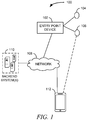
- FIG. 1 is an architectural diagram of a system 100, according to an example embodiment.
- the system 100 includes an Entry Point Device (EPD) 102 that is coupled, physically or wirelessly, to one or more beacon devices 104, 106, and a network 108.
- the system 100 also includes one or more backend systems 110 that are also connected to the network 108.
- the system 100 further includes user mobile devices 112 that connect wirelessly to the network 108 and to the beacon devices 104, 106.
- EPD Entry Point Device
- the EPD 102 may be a computer, a portable computer such as a laptop, a tablet, or other computing device.
- the EPD 102 is connected either via a wired or wireless connection to the network 108.
- the EPD 102 may include a display to present a view of a current visual voucher that is specific to an event, a transit route, and the like.
- the current visual voucher may change over time, such that the visual voucher may be specific to one or a combination of date, time, route, venue, event, gate, door, section, and other such variables.
- the current visual voucher is controlled by a process that executes on the one or more backend systems 110 and communicates current visual voucher data to the EPD 102 via the network 108.
- An app that executes on the mobile device 112 provides an interface through which a visual voucher may be purchased through interaction with the one or more backend systems 110.
- the mobile device 112 app may then receive visual voucher data in for the purchased ticket, or pass if it is good for more than one event, route, or day.
- the visual voucher may than be stored on the mobile device.
- the mobile device 112 needs, in some embodiments, an active network 108 connection to obtain current visual voucher data.
- the mobile device 112 may have direct network 108 access, but in other instances, network 108 access may be limited due to being below grade in a subway tunnel, at an event where wireless service capacity is not capable of meeting demand, inside a building, in a remote location, or in another location where direct network 108 access is not available via wireless service.
- the mobile device 112 may communicate with one or more two-way beacon devices 104, 106 to receive data from the EPD 102 and to communicate data thereto, such as data identifying an authenticated user of the mobile device 112 app.
- the mobile device 112 may not connect directly to the network 108, instead connecting indirectly to the network 108 via one of the beacon devices 104, 106, such as beacon device 106 as indicated by the illustrated dashed line in FIG. 1 .
- the connection between the mobile device 112 and the network 108 as indicated by the solid line in FIG. 1 would not be present, or at least active.
- the EPD 102 may then provide current visual voucher data to the mobile device 112 app either as an image to present, an identifier of an image already in inventory on the mobile device, one or more parameters from which to generate or manipulate an image, and the like.
- the mobile device 112 must be proximately present to obtain an update to a visual voucher.
- some embodiments may utilize Wi-FI or even wireless service to obtain updates.
- some such embodiments may still desire to enforce a physical proximity requirement before a mobile device 112 app is able to obtain a visual voucher update.
- a positioning requirement may be enforced though use of one-way beacon devices deployed at an entry point or within a venue or vehicle.
- Other embodiments may utilize global positioning system functionality that is available on many mobile devices 112. The position solution of a particular embodiment may then be utilized to determine a mobile device location in physical proximity to a certain location and then provide the visual voucher update.
- FIG. 2 is a block diagram of a computing device, according to an example embodiment.
- multiple such computer systems are utilized in a distributed network to implement multiple components in a transaction-based environment.
- An object-oriented, service-oriented, or other architecture may be used to implement such functions and communicate between the multiple systems and components.
- the computing device of FIG. 2 may be implemented as one or more of the EPD 102, one or more backend system 110, and mobile device 112 of FIG. 1 .
- One example computing device in the form of a computer 210 may include a processing unit 202, memory 204, removable storage 212, and non-removable storage 214.
- the example computing device is illustrated and described as computer 210, the computing device may be in different forms in different embodiments.
- the computing device may instead be a smartphone, a tablet, smartwatch, or other computing device including the same or similar elements as illustrated and described with regard to FIG. 2 .
- Devices such as smartphones, tablets, and smartwatches are generally collectively referred to as mobile devices.
- the various data storage elements are illustrated as part of the computer 210, the storage may also or alternatively include cloud-based storage accessible via a network, such as the Internet.
- memory 204 may include volatile memory 206 and non-volatile memory 208.
- Computer 210 may include - or have access to a computing environment that includes a variety of computer-readable media, such as volatile memory 206 and non-volatile memory 208, removable storage 212 and non-removable storage 214.
- Computer storage includes random access memory (RAM), read only memory (ROM), erasable programmable read-only memory (EPROM) and electrically erasable programmable read-only memory (EEPROM), flash memory or other memory technologies, compact disc read-only memory (CD ROM), Digital Versatile Disks (DVD) or other optical disk storage, magnetic cassettes, magnetic tape, magnetic disk storage or other magnetic storage devices, or any other medium capable of storing computer-readable instructions.
- RAM random access memory
- ROM read only memory
- EPROM erasable programmable read-only memory
- EEPROM electrically erasable programmable read-only memory
- flash memory or other memory technologies
- compact disc read-only memory (CD ROM) compact disc read-only memory
- DVD Digital Versatile Disks
- magnetic cassettes magnetic tape
- magnetic disk storage or other magnetic storage devices, or any other medium capable of storing computer-readable instructions.
- Computer 210 may include or have access to a computing environment that includes input 216, output 218, and a communication connection 220.
- the input 216 may include one or more of a touchscreen, touchpad, mouse, keyboard, camera, one or more device-specific buttons, one or more sensors integrated within or coupled via wired or wireless data connections to the computer 210, and other input devices.
- the computer 210 may operate in a networked environment using a communication connection 220 to connect to one or more remote computers, such as database servers, web servers, and other computing device.
- An example remote computer may include a personal computer (PC), server, router, network PC, a peer device or other common network node, or the like.
- the communication connection 220 may be a network interface device such as one or both of an Ethernet card and a wireless card or circuit that may be connected to a network.
- the network may include one or more of a Local Area Network (LAN), a Wide Area Network (WAN), the Internet, and other networks.
- the communication connection 220 may also or alternatively include a transceiver device, such as a BLUETOOTH® device that enables the computer 210 to wirelessly receive data from and transmit data to other BLUETOOTH® devices.
- Computer-readable instructions stored on a computer-readable medium are executable by the processing unit 202 of the computer 210.
- a hard drive magnetic disk or solid state
- CD-ROM compact disc or solid state
- RAM random access memory
- various computer programs 225 or apps such as one or more applications and modules implementing one or more of the methods illustrated and described herein or an app or application that executes on a mobile device or is accessible via a web browser, may be stored on a non-transitory computer-readable medium.
- FIG. 3 is a block flow diagram of a method 300, according to an example embodiment.
- the method 300 is an example of a method that may be performed by one or both of the EPD 102 and the one or more backend systems 110 of FIG. 1 .
- the method 300 includes receiving 302 an entry request with an account identifier from a requestor, such as a mobile device app.
- the method 300 then retrieves 304 data of a voucher from a voucher database based on the account identifier and a current voucher requirement.
- the voucher database may be a database that stores voucher data in association with user accounts.
- the voucher database may or may not be under management of a database management system as it may alternatively be a defined file structure, a defined and formatted dataset, or other data storage and retrieval arrangement.
- the method 300 when voucher data is retrieved 304, the method 300 includes transmitting 306 the voucher data to the requestor.
- the method 300 includes transmitting 308 a voucher procurement option to the requestor.
- the method 300 includes transmitting 310 data representative thereof to the requestor.
- the received 302 entry request includes an identifier of the current voucher requirement.
- the EPD device may transmit an identifier of a current voucher requirement to the backend system to allow the backend system to determine whether the particular user has purchased or otherwise procured a current visual voucher.
- the identifier of the current voucher requirement may be one or a combination of a transit route identifier, an event identifier, a current date and time, or other data items that may be relevant in a particular embodiment deployment context.
- the requirement identifier data item may be broadcast by a beacon device and received by a mobile device app. The mobile device app may then utilize the data item to retrieve the current visual voucher from the backend system.
- the voucher data transmitted 306 to the requestor includes visual voucher data.
- the voucher data may include an identifier of an image for presentation via a display device of a mobile device as a visual voucher.
- the voucher data may also or alternatively include a variable with regard to a property of the visual voucher, the variable utilized by an app on the mobile device that presents the visual voucher, the variable instructing the app on how to modify the image when presented.
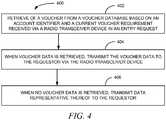
- FIG. 4 is a block flow diagram of a method 400, according to an example embodiment.
- the method 400 is a further streamlined embodiment that may be performed by one or both of the EPD 102 and the one or more backend systems 110 of FIG. 1 .
- the method 400 includes retrieving 402, via a network, data of a voucher from a voucher database based on an account identifier and a current voucher requirement received via a radio transceiver device in an entry request.
- voucher data is retrieved 402
- some embodiments include transmitting 404 the voucher data to the requestor via the radio transceiver device.
- the method 400 includes transmitting 406 data representative thereof to the requestor. This data may then inform a mobile device app to present a visual voucher procurement option.
Landscapes
- Business, Economics & Management (AREA)
- General Physics & Mathematics (AREA)
- Physics & Mathematics (AREA)
- Tourism & Hospitality (AREA)
- Engineering & Computer Science (AREA)
- Entrepreneurship & Innovation (AREA)
- Development Economics (AREA)
- Economics (AREA)
- Finance (AREA)
- Human Resources & Organizations (AREA)
- Marketing (AREA)
- Operations Research (AREA)
- Quality & Reliability (AREA)
- Strategic Management (AREA)
- General Business, Economics & Management (AREA)
- Theoretical Computer Science (AREA)
- Mobile Radio Communication Systems (AREA)
- Management, Administration, Business Operations System, And Electronic Commerce (AREA)
Abstract
Description
- In mass transit such as bus and rail, users download a ticket or pass to their mobile device that displays a symbol instead of a barcode or other scanable image or data item. The symbol can be easily viewed by a bus driver or train conductor, for example, to make sure that the person has a valid ticket or pass. Such solutions are utilized in situations such as mass transit where a bus driver or train conductor must manage passengers who board from one or multiple entry points where traditional ticket scanning would not be practical. However, such solutions can lend themselves to fraud as it is possible for the images to be replicated and shared, thereby allowing for others to use an image that they are not authorized to use. While changing the images and symbols therein and making them unique to a particular date, time, and route may be possible, such solutions would be challenged for successful deployment as they would rely on spotty wireless service across a number of wireless service providers that would prevent at least some mass transit users from obtaining a current image in a timely manner. The reliability of such a solution and efficiencies gained therefrom would be unpredictable. Additionally, there is also a challenge of communicating the "current" image or symbol to the bus driver or train conductor so that he or she knows what to consider valid. This is further compounded by the need to frequently change such an image.
- Various embodiments each include at least one of systems, devices, methods, and software for visual voucher communication systems and methods. One such embodiment includes receiving an entry request with an account identifier from a requestor and retrieving data of a voucher from a voucher database based on the account identifier and a current voucher requirement. In such embodiments, when voucher data is retrieved, the voucher data is transmitted to the requestor. However, when no voucher data is retrieved and at least one voucher is available, the method includes transmitting a voucher procurement option to the requestor that allows for the user to purchase, or otherwise acquire, a voucher. Otherwise, when no voucher data is retrieved and no voucher is available, data representative thereof is transmitted to the requestor.
- In another method embodiment, data of a voucher is retrieved via a network from a voucher database based on an account identifier and a current voucher requirement received via a radio transceiver device in an entry request. When voucher data is retrieved, this method includes transmitting the voucher data to the requestor via the radio transceiver device. But when no voucher data is retrieved, the method includes transmitting data representative thereof to the requestor.
- A further embodiment is in the form of a device. A device of some embodiments includes at least one network interface device, at least one radio transceiver device included therein or coupled thereto, at least one processor and at least one memory device. An instruction set is accessible in the at least one memory device and is executable by the at least one processor to perform data processing activities. The data processing activities in some embodiments include retrieving, via the at least one network interface device, data of a voucher from a voucher database based on an account identifier and a current voucher requirement received in an entry request via the at least one radio transceiver device. In such embodiments, when voucher data is received, the data processing activities include transmitting the voucher data to the requestor via the at least one radio transceiver device. However, when no voucher data is retrieved, the data processing activities include transmitting data representative thereof to the requestor via the at least one radio transceiver device.
- According to a first asepct of the present invention, there is provided a method including receiving an entry request with an account identifier from a requestor; retrieving data of a voucher from a voucher database based on the account identifier and a current voucher requirement; when voucher data is retrieved, transmitting the voucher data to the requestor; when no voucher data is retrieved and at least one voucher is available, transmitting a voucher procurement option to the requestor; and when no voucher data is retrieved and no voucher is available, transmitting data representative thereof to the requestor.
- Optionally, the entry request may include an identifier of the current voucher requirement.
- Optionally, the identifier of the current voucher requirement may be a transportation segment identifier for which entry is being sought.
- Optionally, the voucher data transmitted to the requestor may include visual voucher data.
- Optionally, the voucher data may include an identifier of an image for presentation via a display device of a mobile device as a visual voucher.
- Optionally, the voucher data may include a variable with regard to a property of the visual voucher, the variable utilized by an app on the mobile device that presents the visual voucher, the variable instructing the app on how to modify the image when presented.
- Optionally, the requestor may be a computing device present on at a point of entry location where the entry request originates.
- Optionally, the method may further include receiving a second request from the requestor for a current visual voucher with the identifier of the current voucher requirement; retrieving current visual voucher data from the voucher database based on the identifier of the current voucher requirement; and transmitting the current visual voucher data to the requestor.
- According to a second aspect of the present invention, there is provided a method including retrieving, via a network, data of a voucher from a voucher database based on an account identifier and a current voucher requirement received via a radio transceiver device in an entry request; when voucher data is retrieved, transmitting the voucher data to the requestor via the radio transceiver device; and when no voucher data is retrieved, transmitting data representative thereof to the requestor.
- Optionally, the method may be performed by a computing device deployed at a point of entry location where the entry request originates.
- Optionally, the radio transceiver device may be at least one short-range radio device coupled to the computing device deployed at the point of entry location.
- Optionally, the at least one short-range radio device may be a beacon device.
- Optionally, the entry request may be received from an app that executes on a mobile device.
- Optionally, the method may further include requesting the current visual voucher data with the identifier of the current voucher requirement via the network; receiving the current visual voucher data via the network; and presenting, on a display device, a view of the current visual voucher based on the received current visual voucher data.
- According to a third aspect of the present invention, there is provided a device including at least one network interface device; at least one radio transceiver device included therein or coupled thereto; at least one processor and at least one memory device; and an instruction set accessible in the at least one memory device and executable by the at least one processor to perform data processing activities, the data processing activities comprising: retrieving, via the at least one network interface device, data of a voucher from a voucher database based on an account identifier and a current voucher requirement received in an entry request via the at least one radio transceiver device; when voucher data is received, transmitting the voucher data to the requestor via the at least one radio transceiver device; and when no voucher data is retrieved, transmitting data representative thereof to the requestor via the at least one radio transceiver device.
- Optionally, the device may be deployed at a point of entry location where the entry request originates.
- Optionally, the at least one radio transceiver device may include at least one short-range radio beacon device deployed at an entry location and coupled to the device that may be located elsewhere.
- Optionally, the voucher data may include visual voucher data.
- Optionally, the visual voucher data may include an identifier of an image for presentation via a display device of a mobile device as a visual voucher.
- Optionally, the voucher data may include a variable with regard to a property of the visual voucher, the variable utilized by an app on the mobile device that presents the visual voucher, the variable instructing the app on how to modify the image when presented.
- These and other aspects of the present invention will be apparent from the following specific description, given by way of example, with reference to the accompanying drawings, in which:
-
FIG. 1 is an architectural diagram of a system, according to an example embodiment. -
FIG. 2 is a block diagram of a computing device, according to an example embodiment. -
FIG. 3 is a block flow diagram of a method, according to an example embodiment. -
FIG. 4 is a block flow diagram of a method, according to an example embodiment. - Various embodiments each include at least one of systems, devices, methods, and software for visual voucher communication systems and methods. A visual voucher is an electronic data item that may be presented on a mobile device, such as a smartphone, smartwatch, tablet, and the like, for presentation to enter, or show authorization to be present, a controlled access location. For example, to gain entry to, or to verify authorization to be present on, mass transit, such as a bus, subway, rail, ferry, and the like. Unlike a barcoded voucher, a visual voucher is human-readable and presented for visual inspection, not read by a barcode scanner or other scanning/reading device, although a visual voucher may include a barcode or other machine-readable indicia in some embodiments. In some embodiments, visual vouchers may also be utilized to gain entry to controlled access, e.g., ticketed, events, such as ball games, concerts, movies, and other such events. A visual voucher generally includes an image that is displayed on a mobile device and presented when requested by venue or vehicle personnel to gain entry, verify authorization to be present, or as otherwise requested. An image of a visual voucher may be one or more of still, animated, static, and dynamic. As visual vouchers may change, updating the visual voucher and communicating visual vouchers to mobile devices should be reliable and predicable.
- Visual vouchers that are current for a particular day, transit route, concert, or other event at a given time need to be updated on both patron mobile devices and for devices used by personnel that are checking visual vouchers. At the same time, patron mobile devices may not have wireless service access due to dead zones, being within a building, radio interference, an overload of wireless devices attempting to access wireless service in an area, and other such reasons. Some of the various embodiments herein include solutions that not only communicate visual vouchers, but also provide solutions to communicate visual vouchers to patron mobile devices in a reliable manner.
- One embodiment includes an Entry Point Device (EPD), such as a computer, a portable computer, or mobile device on board a mass transit vehicle or deployed at an event venue is connected to one or more two-way beacon devices, such as two-way BLUETOOTH® beacon devices or Wi-Fi routers. The EPD in such embodiments is connected to a network, such as the Internet, from which the EPD receives updates, either wirelessly or through some other method, as to the current inventory of visual vouchers (e.g., visual tickets) appropriate for that device, such as visual vouchers for a current route of a bus on which the EPD is deployed. For example, the EPD for Train A receives an inventory list that may differ from the list received by the Onboard Device for Train B.
- In some such embodiments, according to business rules associated with an individual visual voucher, the appropriate visual voucher image may be broadcast by the EPD using the beacon devices. In other embodiments, a code string representative of the visual voucher image may be transmitted. Regardless of how transmitted, the EPD may communicate data, which when received by a mobile device having an appropriate app of an authenticated user that has purchased or otherwise received a ticket or pass, the app will receive the broadcast visual voucher or data from which the appropriate visual voucher may be determined. The two-way beacon devices are included in some such embodiments for their capability to transmit and receive data. Alternatively, Wi-Fi routers and similar devices may instead be deployed and positioning technology such as GPS may be used in place of beacon devices, such as BLUETOOTH® beacon devices.
- Further in some embodiments, an end user purchases or otherwise receives a ticket or pass via a predetermined method (e.g. via a website or mobile app) but does not view the actual visual voucher on their mobile device until boarding a vehicle or entering a venue. The end user has an app on their mobile device which is capable of receiving signals from the beacons or other wireless distribution devices or methods. The app may identify itself to an EPD via a wireless channel, such as via the two-way beacon devices, so that only authorized mobile devices can receive the valid visual voucher. When the mobile device detects that it is within range of an applicable redemption location, it receives the current visual ticket characteristics for that particular train or venue, day, time, etc., the image can then be displayed for inspection by the conductor or other entry point personnel.
- Such solutions provide responsible personnel a simple and quick way to know what visual voucher is valid, i.e., by checking the EPD, and visual vouchers, e.g., visual tickets and passes, can be changed as often as justified by business needs, fraud potential, and other factors.
- These and other embodiments are described herein with reference to the figures.
- In the following detailed description, reference is made to the accompanying drawings that form a part hereof, and in which is shown by way of illustration specific embodiments in which the inventive subject matter may be practiced. These embodiments are described in sufficient detail to enable those skilled in the art to practice them, and it is to be understood that other embodiments may be utilized and that structural, logical, and electrical changes may be made without departing from the scope of the inventive subject matter. Such embodiments of the inventive subject matter may be referred to, individually and/or collectively, herein by the term "invention" merely for convenience and without intending to voluntarily limit the scope of this application to any single invention or inventive concept if more than one is in fact disclosed.
- The following description is, therefore, not to be taken in a limited sense, and the scope of the inventive subject matter is defined by the appended claims.
- The functions or algorithms described herein are implemented in hardware, software or a combination of software and hardware in one embodiment. The software comprises computer executable instructions stored on computer readable media such as memory or other type of storage devices. Further, described functions may correspond to modules, which may be software, hardware, firmware, or any combination thereof. Multiple functions are performed in one or more modules as desired, and the embodiments described are merely examples. The software is executed on a digital signal processor, ASIC, microprocessor, or other type of processor operating on a system, such as a personal computer, server, a router, or other device capable of processing data including network interconnection devices.
- Some embodiments implement the functions in two or more specific interconnected hardware modules or devices with related control and data signals communicated between and through the modules, or as portions of an application-specific integrated circuit. Thus, the exemplary process flow is applicable to software, firmware, and hardware implementations.
-
FIG. 1 is an architectural diagram of asystem 100, according to an example embodiment. Thesystem 100 includes an Entry Point Device (EPD) 102 that is coupled, physically or wirelessly, to one ormore beacon devices network 108. Thesystem 100 also includes one ormore backend systems 110 that are also connected to thenetwork 108. Thesystem 100 further includes usermobile devices 112 that connect wirelessly to thenetwork 108 and to thebeacon devices - The
EPD 102 may be a computer, a portable computer such as a laptop, a tablet, or other computing device. TheEPD 102 is connected either via a wired or wireless connection to thenetwork 108. TheEPD 102 may include a display to present a view of a current visual voucher that is specific to an event, a transit route, and the like. The current visual voucher may change over time, such that the visual voucher may be specific to one or a combination of date, time, route, venue, event, gate, door, section, and other such variables. The current visual voucher is controlled by a process that executes on the one ormore backend systems 110 and communicates current visual voucher data to theEPD 102 via thenetwork 108. - Users, such as patrons of mass transit services and events, gain access or validate their presence by presenting a visual voucher on their
mobile devices 112. An app that executes on themobile device 112 provides an interface through which a visual voucher may be purchased through interaction with the one ormore backend systems 110. Themobile device 112 app may then receive visual voucher data in for the purchased ticket, or pass if it is good for more than one event, route, or day. The visual voucher may than be stored on the mobile device. - However, as the visual voucher may change, the visual properties thereof may be updated or not even set until shortly before or at the start of an event or route, the
mobile device 112 needs, in some embodiments, anactive network 108 connection to obtain current visual voucher data. In some instances, themobile device 112 may havedirect network 108 access, but in other instances,network 108 access may be limited due to being below grade in a subway tunnel, at an event where wireless service capacity is not capable of meeting demand, inside a building, in a remote location, or in another location wheredirect network 108 access is not available via wireless service. In such instances, themobile device 112 may communicate with one or more two-way beacon devices EPD 102 and to communicate data thereto, such as data identifying an authenticated user of themobile device 112 app. In some such embodiments, themobile device 112 may not connect directly to thenetwork 108, instead connecting indirectly to thenetwork 108 via one of thebeacon devices beacon device 106 as indicated by the illustrated dashed line inFIG. 1 . In such embodiments, the connection between themobile device 112 and thenetwork 108 as indicated by the solid line inFIG. 1 would not be present, or at least active. TheEPD 102 may then provide current visual voucher data to themobile device 112 app either as an image to present, an identifier of an image already in inventory on the mobile device, one or more parameters from which to generate or manipulate an image, and the like. - As the
beacon devices mobile device 112 must be proximately present to obtain an update to a visual voucher. However, some embodiments may utilize Wi-FI or even wireless service to obtain updates. At the same time, some such embodiments may still desire to enforce a physical proximity requirement before amobile device 112 app is able to obtain a visual voucher update. In such embodiments, a positioning requirement may be enforced though use of one-way beacon devices deployed at an entry point or within a venue or vehicle. Other embodiments may utilize global positioning system functionality that is available on manymobile devices 112. The position solution of a particular embodiment may then be utilized to determine a mobile device location in physical proximity to a certain location and then provide the visual voucher update. -
FIG. 2 is a block diagram of a computing device, according to an example embodiment. In one embodiment, multiple such computer systems are utilized in a distributed network to implement multiple components in a transaction-based environment. An object-oriented, service-oriented, or other architecture may be used to implement such functions and communicate between the multiple systems and components. The computing device ofFIG. 2 may be implemented as one or more of theEPD 102, one ormore backend system 110, andmobile device 112 ofFIG. 1 . - One example computing device in the form of a
computer 210, may include aprocessing unit 202,memory 204,removable storage 212, andnon-removable storage 214. Although the example computing device is illustrated and described ascomputer 210, the computing device may be in different forms in different embodiments. For example, the computing device may instead be a smartphone, a tablet, smartwatch, or other computing device including the same or similar elements as illustrated and described with regard toFIG. 2 . Devices such as smartphones, tablets, and smartwatches are generally collectively referred to as mobile devices. Further, although the various data storage elements are illustrated as part of thecomputer 210, the storage may also or alternatively include cloud-based storage accessible via a network, such as the Internet. - Returning to the
computer 210,memory 204 may include volatile memory 206 andnon-volatile memory 208.Computer 210 may include - or have access to a computing environment that includes a variety of computer-readable media, such as volatile memory 206 andnon-volatile memory 208,removable storage 212 andnon-removable storage 214. Computer storage includes random access memory (RAM), read only memory (ROM), erasable programmable read-only memory (EPROM) and electrically erasable programmable read-only memory (EEPROM), flash memory or other memory technologies, compact disc read-only memory (CD ROM), Digital Versatile Disks (DVD) or other optical disk storage, magnetic cassettes, magnetic tape, magnetic disk storage or other magnetic storage devices, or any other medium capable of storing computer-readable instructions. -
Computer 210 may include or have access to a computing environment that includesinput 216,output 218, and acommunication connection 220. Theinput 216 may include one or more of a touchscreen, touchpad, mouse, keyboard, camera, one or more device-specific buttons, one or more sensors integrated within or coupled via wired or wireless data connections to thecomputer 210, and other input devices. Thecomputer 210 may operate in a networked environment using acommunication connection 220 to connect to one or more remote computers, such as database servers, web servers, and other computing device. An example remote computer may include a personal computer (PC), server, router, network PC, a peer device or other common network node, or the like. Thecommunication connection 220 may be a network interface device such as one or both of an Ethernet card and a wireless card or circuit that may be connected to a network. The network may include one or more of a Local Area Network (LAN), a Wide Area Network (WAN), the Internet, and other networks. In some embodiments, thecommunication connection 220 may also or alternatively include a transceiver device, such as a BLUETOOTH® device that enables thecomputer 210 to wirelessly receive data from and transmit data to other BLUETOOTH® devices. - Computer-readable instructions stored on a computer-readable medium are executable by the
processing unit 202 of thecomputer 210. A hard drive (magnetic disk or solid state), CD-ROM, and RAM are some examples of articles including a non-transitory computer-readable medium. For example,various computer programs 225 or apps, such as one or more applications and modules implementing one or more of the methods illustrated and described herein or an app or application that executes on a mobile device or is accessible via a web browser, may be stored on a non-transitory computer-readable medium. -
FIG. 3 is a block flow diagram of amethod 300, according to an example embodiment. Themethod 300 is an example of a method that may be performed by one or both of theEPD 102 and the one ormore backend systems 110 ofFIG. 1 . - The
method 300, in some embodiments, includes receiving 302 an entry request with an account identifier from a requestor, such as a mobile device app. Themethod 300 then retrieves 304 data of a voucher from a voucher database based on the account identifier and a current voucher requirement. The voucher database may be a database that stores voucher data in association with user accounts. The voucher database may or may not be under management of a database management system as it may alternatively be a defined file structure, a defined and formatted dataset, or other data storage and retrieval arrangement. In such embodiments, when voucher data is retrieved 304, themethod 300 includes transmitting 306 the voucher data to the requestor. Alternatively, when no voucher data is retrieved 304 and at least one voucher is available (e.g., a voucher is available for purchase), themethod 300 includes transmitting 308 a voucher procurement option to the requestor. However, when no voucher data is retrieved 304 and no voucher is available, themethod 300 includes transmitting 310 data representative thereof to the requestor. - In some embodiments, the received 302 entry request includes an identifier of the current voucher requirement. For example, an EPD upon received of a request for entry or a current visual voucher from a mobile device, the EPD device may transmit an identifier of a current voucher requirement to the backend system to allow the backend system to determine whether the particular user has purchased or otherwise procured a current visual voucher. The identifier of the current voucher requirement may be one or a combination of a transit route identifier, an event identifier, a current date and time, or other data items that may be relevant in a particular embodiment deployment context. In another embodiment, the requirement identifier data item may be broadcast by a beacon device and received by a mobile device app. The mobile device app may then utilize the data item to retrieve the current visual voucher from the backend system.
- In some embodiments of the
method 300, the voucher data transmitted 306 to the requestor includes visual voucher data. For example, the voucher data may include an identifier of an image for presentation via a display device of a mobile device as a visual voucher. The voucher data may also or alternatively include a variable with regard to a property of the visual voucher, the variable utilized by an app on the mobile device that presents the visual voucher, the variable instructing the app on how to modify the image when presented. -
FIG. 4 is a block flow diagram of amethod 400, according to an example embodiment. Themethod 400 is a further streamlined embodiment that may be performed by one or both of theEPD 102 and the one ormore backend systems 110 ofFIG. 1 . - The
method 400 includes retrieving 402, via a network, data of a voucher from a voucher database based on an account identifier and a current voucher requirement received via a radio transceiver device in an entry request. When voucher data is retrieved 402, some embodiments include transmitting 404 the voucher data to the requestor via the radio transceiver device. Otherwise, when no voucher data is retrieved 402, themethod 400 includes transmitting 406 data representative thereof to the requestor. This data may then inform a mobile device app to present a visual voucher procurement option. - In the foregoing description of the embodiments, various features are grouped together in a single embodiment for the purpose of streamlining the disclosure. This method of disclosure is not to be interpreted as reflecting that the claimed embodiments have more features than are expressly recited in each claim. Rather, as the following claims reflect, inventive subject matter lies in less than all features of a single disclosed embodiment.
Claims (14)
- A method comprising:receiving an entry request with an account identifier from a requestor (302);retrieving data of a voucher from a voucher database based on the account identifier and a current voucher requirement (304);when voucher data is retrieved, transmitting the voucher data to the requestor (306);when no voucher data is retrieved and at least one voucher is available, transmitting a voucher procurement option to the requestor (308); andwhen no voucher data is retrieved and no voucher is available, transmitting data representative thereof to the requestor (310).
- A method according to claim 1, wherein the entry request includes an identifier of the current voucher requirement.
- A method according to claim 2, wherein the identifier of the current voucher requirement is a transportation segment identifier for which entry is being sought.
- A method according to claim 2, wherein the voucher data transmitted to the requestor includes visual voucher data.
- A method according to claim 4, wherein the voucher data includes an identifier of an image for presentation via a display device of a mobile device as a visual voucher.
- A method according to claim 5, wherein the voucher data includes a variable with regard to a property of the visual voucher, the variable utilized by an app on the mobile device that presents the visual voucher, the variable instructing the app on how to modify the image when presented.
- A method according to claim 5, wherein the requestor is a computing device (102) present on at a point of entry location where the entry request originates.
- A method according to claim 7, further comprising:receiving a second request from the requestor for a current visual voucher with the identifier of the current voucher requirement;retrieving current visual voucher data from the voucher database based on the identifier of the current voucher requirement; andtransmitting the current visual voucher data to the requestor.
- A device comprising:at least one network interface device (220);at least one radio transceiver device included therein or coupled thereto;at least one processor (202) and at least one memory device (204); andan instruction set accessible in the at least one memory device and executable by the at least one processor to perform data processing activities, the data processing activities comprising:retrieving, via the at least one network interface device, data of a voucher from a voucher database based on an account identifier and a current voucher requirement received in an entry request via the at least one radio transceiver device (step 402);when voucher data is received, transmitting the voucher data to the requestor via the at least one radio transceiver device (step 404); andwhen no voucher data is retrieved, transmitting data representative thereof to the requestor via the at least one radio transceiver device (step 406).
- A device according to claim 9, wherein:the device (102) is deployed at a point of entry location where the entry request originates.
- A device according to claim 9, wherein the at least one radio transceiver device includes at least one short-range radio beacon device (104, 106) deployed at an entry location and coupled to the device (102) that may be located elsewhere.
- A device according to claim 9, wherein the voucher data includes visual voucher data.
- A device according to claim 12, wherein the visual voucher data includes an identifier of an image for presentation via a display device of a mobile device (112) as a visual voucher.
- A device according to claim 12, wherein the voucher data includes a variable with regard to a property of the visual voucher, the variable utilized by an app on the mobile device (112) that presents the visual voucher, the variable instructing the app on how to modify the image when presented.
Applications Claiming Priority (1)
| Application Number | Priority Date | Filing Date | Title |
|---|---|---|---|
| US15/197,587 US10586409B2 (en) | 2016-06-29 | 2016-06-29 | Visual voucher communication systems and methods |
Publications (1)
| Publication Number | Publication Date |
|---|---|
| EP3264342A1 true EP3264342A1 (en) | 2018-01-03 |
Family
ID=59070460
Family Applications (1)
| Application Number | Title | Priority Date | Filing Date |
|---|---|---|---|
| EP17175540.8A Withdrawn EP3264342A1 (en) | 2016-06-29 | 2017-06-12 | Visual voucher communication systems and methods |
Country Status (3)
| Country | Link |
|---|---|
| US (1) | US10586409B2 (en) |
| EP (1) | EP3264342A1 (en) |
| CN (1) | CN107545604B (en) |
Families Citing this family (2)
| Publication number | Priority date | Publication date | Assignee | Title |
|---|---|---|---|---|
| CN111179943A (en) * | 2019-10-30 | 2020-05-19 | 王东 | Conversation auxiliary equipment and method for acquiring information |
| CN118140228A (en) * | 2021-11-24 | 2024-06-04 | P·N·克留科夫 | Label and method and system for using the same for automatic product identification |
Citations (4)
| Publication number | Priority date | Publication date | Assignee | Title |
|---|---|---|---|---|
| US20100219234A1 (en) * | 2005-04-25 | 2010-09-02 | Mobiqa Limited | Mobile ticket authentication |
| US20140364148A1 (en) * | 2013-06-09 | 2014-12-11 | Apple Inc. | Location-Based Ticket Books |
| US20150213660A1 (en) * | 2011-03-11 | 2015-07-30 | Bytemark, Inc. | Systems and Methods for Electronic Ticket Validation Using Proximity Detection |
| US20160093127A1 (en) * | 2014-09-29 | 2016-03-31 | Ncr Corporation | Entry point validation systems and methods |
Family Cites Families (18)
| Publication number | Priority date | Publication date | Assignee | Title |
|---|---|---|---|---|
| WO1999009502A1 (en) * | 1997-08-13 | 1999-02-25 | Matsushita Electric Industrial Co., Ltd. | Mobile electronic commerce system |
| JP4503143B2 (en) * | 1999-07-14 | 2010-07-14 | パナソニック株式会社 | Electronic ticket system, service server and mobile terminal |
| US8266437B2 (en) * | 2001-06-25 | 2012-09-11 | Jpmorgan Chase Bank, N.A. | Electronic vouchers and a system and method for issuing the same |
| US20070265892A1 (en) * | 2006-05-15 | 2007-11-15 | Valentino Valeno J | Method and system for automated ticketing for events in a venue |
| JP2009015596A (en) * | 2007-07-04 | 2009-01-22 | Mitsubishi Space Software Kk | Ticketing system, ticketing program and ticketing method |
| CN101231727A (en) * | 2008-02-20 | 2008-07-30 | 深圳矽感科技有限公司 | Electric cheque paying method and implementing system thereof |
| US20090313105A1 (en) * | 2008-06-11 | 2009-12-17 | Stefan Magnusson | System and method for a mobile voucher |
| GB0820882D0 (en) * | 2008-11-14 | 2008-12-24 | Rue De Int Ltd | Document of value and method for detecting soil level |
| US10579995B2 (en) * | 2010-03-30 | 2020-03-03 | Visa International Service Association | Event access with data field encryption for validation and access control |
| WO2011156832A1 (en) * | 2010-06-13 | 2011-12-22 | Bnc Ventures B.V. | Method and system for managing customer relationships |
| CN104102950A (en) * | 2013-04-12 | 2014-10-15 | 同程网络科技股份有限公司 | Travel ticket ordering method based on two-dimension code |
| CN103488966A (en) * | 2013-09-04 | 2014-01-01 | 张家港保税区润桐电子技术研发有限公司 | Intelligent mobile phone capable of identifying real-name ticket information |
| US10235839B2 (en) * | 2013-09-24 | 2019-03-19 | Jcm American Corporation | Electronic voucher ticket system |
| CN104637133A (en) * | 2014-12-23 | 2015-05-20 | 韶关市英诺维科技设备有限公司 | Application of two-dimensional code locks in communities |
| CN204595956U (en) * | 2015-04-15 | 2015-08-26 | 苏州元澄智能科技有限公司 | Based on the gate control system of Quick Response Code |
| CN107071041A (en) * | 2015-06-11 | 2017-08-18 | 北京摩拜科技有限公司 | Control method, equipment and the control system of bicycle management system |
| CN205263913U (en) * | 2015-11-05 | 2016-05-25 | 伟屹智慧科技产业有限公司 | Regional access control system of two -dimensional code lock |
| US20180253747A1 (en) * | 2017-03-02 | 2018-09-06 | Farpointe Data, Inc. | System and Method for Electronic Access |
-
2016
- 2016-06-29 US US15/197,587 patent/US10586409B2/en active Active
-
2017
- 2017-06-05 CN CN201710412875.6A patent/CN107545604B/en active Active
- 2017-06-12 EP EP17175540.8A patent/EP3264342A1/en not_active Withdrawn
Patent Citations (4)
| Publication number | Priority date | Publication date | Assignee | Title |
|---|---|---|---|---|
| US20100219234A1 (en) * | 2005-04-25 | 2010-09-02 | Mobiqa Limited | Mobile ticket authentication |
| US20150213660A1 (en) * | 2011-03-11 | 2015-07-30 | Bytemark, Inc. | Systems and Methods for Electronic Ticket Validation Using Proximity Detection |
| US20140364148A1 (en) * | 2013-06-09 | 2014-12-11 | Apple Inc. | Location-Based Ticket Books |
| US20160093127A1 (en) * | 2014-09-29 | 2016-03-31 | Ncr Corporation | Entry point validation systems and methods |
Also Published As
| Publication number | Publication date |
|---|---|
| CN107545604B (en) | 2021-01-15 |
| US10586409B2 (en) | 2020-03-10 |
| CN107545604A (en) | 2018-01-05 |
| US20180005464A1 (en) | 2018-01-04 |
Similar Documents
| Publication | Publication Date | Title |
|---|---|---|
| US11887264B2 (en) | Generating augmented reality images using sensor and location data | |
| US10237256B1 (en) | Dynamic identity profiles | |
| KR102539939B1 (en) | Identification, location, and authentication systems and methods | |
| US9584524B2 (en) | Sensor-based human authorization evaluation | |
| US9467809B2 (en) | Apparatus, method, and system for providing spot location identification | |
| KR102662409B1 (en) | Method and system for intermediating user terminals to share vechiles | |
| US9940642B1 (en) | Electronic real estate access system | |
| US10499244B1 (en) | Arranging display of control icons that enable usage of keys | |
| US20170017947A1 (en) | Trusted nfc ticketing | |
| CA2904438C (en) | Portable communication device and system and method therefor | |
| US20150177006A1 (en) | Systems and methods for crowd congestion reduction at venue locations using beacons | |
| US20150271631A1 (en) | Mobile Network for On-site Management of an Event | |
| US9781557B1 (en) | System for and method of providing enhanced services by using machine-based wireless communications of portable computing devices | |
| US20190333063A1 (en) | Systems and methods for providing interactions between users and transportation service providers in an integrated public and/or private transportation service platform | |
| US10586409B2 (en) | Visual voucher communication systems and methods | |
| KR102237896B1 (en) | Computing device and system for store order with the same | |
| KR102275796B1 (en) | System for providing certification of hidden camera | |
| US20150178641A1 (en) | Check-in method | |
| JP7343545B2 (en) | Terminal device, information processing method, and information processing program | |
| AU2015101271A4 (en) | A hotel management system adapted for interfacing with authorised mobile communication devices | |
| US11113948B2 (en) | Method for reminding a first user to complete a task based on position relative to a second user | |
| US20210183190A1 (en) | Automatically providing access to vendor application by using mobile credentials |
Legal Events
| Date | Code | Title | Description |
|---|---|---|---|
| PUAI | Public reference made under article 153(3) epc to a published international application that has entered the european phase |
Free format text: ORIGINAL CODE: 0009012 |
|
| AK | Designated contracting states |
Kind code of ref document: A1 Designated state(s): AL AT BE BG CH CY CZ DE DK EE ES FI FR GB GR HR HU IE IS IT LI LT LU LV MC MK MT NL NO PL PT RO RS SE SI SK SM TR |
|
| AX | Request for extension of the european patent |
Extension state: BA ME |
|
| RAP1 | Party data changed (applicant data changed or rights of an application transferred) |
Owner name: NCR CORPORATION |
|
| 17P | Request for examination filed |
Effective date: 20180706 |
|
| RBV | Designated contracting states (corrected) |
Designated state(s): AL AT BE BG CH CY CZ DE DK EE ES FI FR GB GR HR HU IE IS IT LI LT LU LV MC MK MT NL NO PL PT RO RS SE SI SK SM TR |
|
| STAA | Information on the status of an ep patent application or granted ep patent |
Free format text: STATUS: THE APPLICATION HAS BEEN WITHDRAWN |
|
| 18W | Application withdrawn |
Effective date: 20190517 |