EP3264064A1 - Sensor including receptor layer coating comprising mixture of base material and particulate material - Google Patents
Sensor including receptor layer coating comprising mixture of base material and particulate material Download PDFInfo
- Publication number
- EP3264064A1 EP3264064A1 EP16755649.7A EP16755649A EP3264064A1 EP 3264064 A1 EP3264064 A1 EP 3264064A1 EP 16755649 A EP16755649 A EP 16755649A EP 3264064 A1 EP3264064 A1 EP 3264064A1
- Authority
- EP
- European Patent Office
- Prior art keywords
- particulate material
- group
- sensor according
- base material
- sensor
- Prior art date
- Legal status (The legal status is an assumption and is not a legal conclusion. Google has not performed a legal analysis and makes no representation as to the accuracy of the status listed.)
- Withdrawn
Links
- 239000000463 material Substances 0.000 title claims abstract description 82
- 239000011236 particulate material Substances 0.000 title claims description 89
- 238000000576 coating method Methods 0.000 title description 20
- 239000011248 coating agent Substances 0.000 title description 19
- 239000000203 mixture Substances 0.000 title description 4
- 239000002245 particle Substances 0.000 claims abstract description 38
- 239000012491 analyte Substances 0.000 claims abstract description 30
- 239000002131 composite material Substances 0.000 claims abstract description 27
- 229920000642 polymer Polymers 0.000 claims abstract description 15
- GWEVSGVZZGPLCZ-UHFFFAOYSA-N Titan oxide Chemical compound O=[Ti]=O GWEVSGVZZGPLCZ-UHFFFAOYSA-N 0.000 claims description 21
- -1 aminopropyl group Chemical group 0.000 claims description 20
- 150000001875 compounds Chemical class 0.000 claims description 18
- VYPSYNLAJGMNEJ-UHFFFAOYSA-N Silicium dioxide Chemical compound O=[Si]=O VYPSYNLAJGMNEJ-UHFFFAOYSA-N 0.000 claims description 11
- 239000006087 Silane Coupling Agent Substances 0.000 claims description 10
- 230000002209 hydrophobic effect Effects 0.000 claims description 10
- 238000001179 sorption measurement Methods 0.000 claims description 10
- 125000001997 phenyl group Chemical group [H]C1=C([H])C([H])=C(*)C([H])=C1[H] 0.000 claims description 8
- 230000005684 electric field Effects 0.000 claims description 6
- 230000004907 flux Effects 0.000 claims description 6
- 239000002105 nanoparticle Substances 0.000 claims description 5
- 239000000377 silicon dioxide Substances 0.000 claims description 5
- 125000000217 alkyl group Chemical group 0.000 claims description 4
- 239000002994 raw material Substances 0.000 claims description 4
- 230000005611 electricity Effects 0.000 claims description 3
- 125000001153 fluoro group Chemical group F* 0.000 claims description 3
- 125000003055 glycidyl group Chemical group C(C1CO1)* 0.000 claims description 3
- 125000001174 sulfone group Chemical group 0.000 claims description 3
- 125000000391 vinyl group Chemical group [H]C([*])=C([H])[H] 0.000 claims description 3
- 230000005389 magnetism Effects 0.000 claims description 2
- 230000035945 sensitivity Effects 0.000 abstract description 36
- 238000001514 detection method Methods 0.000 abstract description 7
- 229920000036 polyvinylpyrrolidone Polymers 0.000 description 28
- 239000001267 polyvinylpyrrolidone Substances 0.000 description 28
- 235000013855 polyvinylpyrrolidone Nutrition 0.000 description 28
- 239000000126 substance Substances 0.000 description 27
- 239000000243 solution Substances 0.000 description 19
- KFZMGEQAYNKOFK-UHFFFAOYSA-N Isopropanol Chemical compound CC(C)O KFZMGEQAYNKOFK-UHFFFAOYSA-N 0.000 description 18
- XLYOFNOQVPJJNP-UHFFFAOYSA-N water Chemical compound O XLYOFNOQVPJJNP-UHFFFAOYSA-N 0.000 description 15
- 238000005259 measurement Methods 0.000 description 13
- 125000000524 functional group Chemical group 0.000 description 10
- WSFSSNUMVMOOMR-UHFFFAOYSA-N Formaldehyde Chemical compound O=C WSFSSNUMVMOOMR-UHFFFAOYSA-N 0.000 description 8
- 239000007789 gas Substances 0.000 description 8
- 238000006243 chemical reaction Methods 0.000 description 7
- 238000000034 method Methods 0.000 description 7
- 125000004079 stearyl group Chemical group [H]C([*])([H])C([H])([H])C([H])([H])C([H])([H])C([H])([H])C([H])([H])C([H])([H])C([H])([H])C([H])([H])C([H])([H])C([H])([H])C([H])([H])C([H])([H])C([H])([H])C([H])([H])C([H])([H])C([H])([H])C([H])([H])[H] 0.000 description 6
- 238000003786 synthesis reaction Methods 0.000 description 6
- 230000008859 change Effects 0.000 description 5
- 230000000694 effects Effects 0.000 description 5
- QGZKDVFQNNGYKY-UHFFFAOYSA-N Ammonia Chemical compound N QGZKDVFQNNGYKY-UHFFFAOYSA-N 0.000 description 4
- REYJJPSVUYRZGE-UHFFFAOYSA-N Octadecylamine Chemical compound CCCCCCCCCCCCCCCCCCN REYJJPSVUYRZGE-UHFFFAOYSA-N 0.000 description 4
- 239000013626 chemical specie Substances 0.000 description 4
- 230000007423 decrease Effects 0.000 description 4
- 239000007788 liquid Substances 0.000 description 4
- 230000000704 physical effect Effects 0.000 description 4
- 230000004044 response Effects 0.000 description 4
- UHOVQNZJYSORNB-UHFFFAOYSA-N Benzene Chemical compound C1=CC=CC=C1 UHOVQNZJYSORNB-UHFFFAOYSA-N 0.000 description 3
- LFQSCWFLJHTTHZ-UHFFFAOYSA-N Ethanol Chemical compound CCO LFQSCWFLJHTTHZ-UHFFFAOYSA-N 0.000 description 3
- YXFVVABEGXRONW-UHFFFAOYSA-N Toluene Chemical compound CC1=CC=CC=C1 YXFVVABEGXRONW-UHFFFAOYSA-N 0.000 description 3
- 230000015572 biosynthetic process Effects 0.000 description 3
- 239000006185 dispersion Substances 0.000 description 3
- 238000002156 mixing Methods 0.000 description 3
- VLKZOEOYAKHREP-UHFFFAOYSA-N n-Hexane Chemical compound CCCCCC VLKZOEOYAKHREP-UHFFFAOYSA-N 0.000 description 3
- 238000000879 optical micrograph Methods 0.000 description 3
- 238000005457 optimization Methods 0.000 description 3
- 239000012466 permeate Substances 0.000 description 3
- 239000002243 precursor Substances 0.000 description 3
- 238000002360 preparation method Methods 0.000 description 3
- IJGRMHOSHXDMSA-UHFFFAOYSA-N Atomic nitrogen Chemical compound N#N IJGRMHOSHXDMSA-UHFFFAOYSA-N 0.000 description 2
- IMNFDUFMRHMDMM-UHFFFAOYSA-N N-Heptane Chemical compound CCCCCCC IMNFDUFMRHMDMM-UHFFFAOYSA-N 0.000 description 2
- 150000004703 alkoxides Chemical class 0.000 description 2
- 229910021529 ammonia Inorganic materials 0.000 description 2
- 229910003460 diamond Inorganic materials 0.000 description 2
- 239000010432 diamond Substances 0.000 description 2
- 230000006872 improvement Effects 0.000 description 2
- 238000002347 injection Methods 0.000 description 2
- 239000007924 injection Substances 0.000 description 2
- 239000012528 membrane Substances 0.000 description 2
- 239000000047 product Substances 0.000 description 2
- 102000004169 proteins and genes Human genes 0.000 description 2
- 108090000623 proteins and genes Proteins 0.000 description 2
- 238000010926 purge Methods 0.000 description 2
- 229910052710 silicon Inorganic materials 0.000 description 2
- 239000010703 silicon Substances 0.000 description 2
- 239000007921 spray Substances 0.000 description 2
- 238000005507 spraying Methods 0.000 description 2
- VXUYXOFXAQZZMF-UHFFFAOYSA-N titanium(IV) isopropoxide Chemical compound CC(C)O[Ti](OC(C)C)(OC(C)C)OC(C)C VXUYXOFXAQZZMF-UHFFFAOYSA-N 0.000 description 2
- WYTZZXDRDKSJID-UHFFFAOYSA-N (3-aminopropyl)triethoxysilane Chemical compound CCO[Si](OCC)(OCC)CCCN WYTZZXDRDKSJID-UHFFFAOYSA-N 0.000 description 1
- 102000040650 (ribonucleotides)n+m Human genes 0.000 description 1
- 108091032973 (ribonucleotides)n+m Proteins 0.000 description 1
- 108020004414 DNA Proteins 0.000 description 1
- ABLZXFCXXLZCGV-UHFFFAOYSA-N Phosphorous acid Chemical compound OP(O)=O ABLZXFCXXLZCGV-UHFFFAOYSA-N 0.000 description 1
- XUIMIQQOPSSXEZ-UHFFFAOYSA-N Silicon Chemical compound [Si] XUIMIQQOPSSXEZ-UHFFFAOYSA-N 0.000 description 1
- 239000004809 Teflon Substances 0.000 description 1
- 229920006362 Teflon® Polymers 0.000 description 1
- BOTDANWDWHJENH-UHFFFAOYSA-N Tetraethyl orthosilicate Chemical compound CCO[Si](OCC)(OCC)OCC BOTDANWDWHJENH-UHFFFAOYSA-N 0.000 description 1
- 238000002835 absorbance Methods 0.000 description 1
- 230000009471 action Effects 0.000 description 1
- 239000000654 additive Substances 0.000 description 1
- 125000003277 amino group Chemical group 0.000 description 1
- 239000000427 antigen Substances 0.000 description 1
- 102000036639 antigens Human genes 0.000 description 1
- 108091007433 antigens Proteins 0.000 description 1
- 239000007864 aqueous solution Substances 0.000 description 1
- 238000000498 ball milling Methods 0.000 description 1
- 230000008901 benefit Effects 0.000 description 1
- 239000008280 blood Substances 0.000 description 1
- 210000004369 blood Anatomy 0.000 description 1
- 239000012159 carrier gas Substances 0.000 description 1
- 238000005266 casting Methods 0.000 description 1
- 229920000891 common polymer Polymers 0.000 description 1
- 239000011258 core-shell material Substances 0.000 description 1
- 230000003247 decreasing effect Effects 0.000 description 1
- 238000003618 dip coating Methods 0.000 description 1
- 239000000839 emulsion Substances 0.000 description 1
- 238000007306 functionalization reaction Methods 0.000 description 1
- 239000012456 homogeneous solution Substances 0.000 description 1
- 238000006460 hydrolysis reaction Methods 0.000 description 1
- 230000003993 interaction Effects 0.000 description 1
- 229910052751 metal Inorganic materials 0.000 description 1
- 239000002184 metal Substances 0.000 description 1
- 150000002739 metals Chemical class 0.000 description 1
- WSFSSNUMVMOOMR-NJFSPNSNSA-N methanone Chemical compound O=[14CH2] WSFSSNUMVMOOMR-NJFSPNSNSA-N 0.000 description 1
- 230000004048 modification Effects 0.000 description 1
- 238000012986 modification Methods 0.000 description 1
- 239000003607 modifier Substances 0.000 description 1
- 229910052757 nitrogen Inorganic materials 0.000 description 1
- 239000011238 particulate composite Substances 0.000 description 1
- 238000012643 polycondensation polymerization Methods 0.000 description 1
- 238000001556 precipitation Methods 0.000 description 1
- 230000008569 process Effects 0.000 description 1
- 230000025508 response to water Effects 0.000 description 1
- 239000007779 soft material Substances 0.000 description 1
- 239000007787 solid Substances 0.000 description 1
- 238000003746 solid phase reaction Methods 0.000 description 1
- 239000012798 spherical particle Substances 0.000 description 1
- 238000004528 spin coating Methods 0.000 description 1
- 238000001694 spray drying Methods 0.000 description 1
- 239000000758 substrate Substances 0.000 description 1
- 238000005979 thermal decomposition reaction Methods 0.000 description 1
- 150000003568 thioethers Chemical class 0.000 description 1
- 125000003396 thiol group Chemical group [H]S* 0.000 description 1
- JCVQKRGIASEUKR-UHFFFAOYSA-N triethoxy(phenyl)silane Chemical compound CCO[Si](OCC)(OCC)C1=CC=CC=C1 JCVQKRGIASEUKR-UHFFFAOYSA-N 0.000 description 1
- 239000012808 vapor phase Substances 0.000 description 1
- 230000000007 visual effect Effects 0.000 description 1
- 229920003169 water-soluble polymer Polymers 0.000 description 1
Images



Classifications
-
- G—PHYSICS
- G01—MEASURING; TESTING
- G01N—INVESTIGATING OR ANALYSING MATERIALS BY DETERMINING THEIR CHEMICAL OR PHYSICAL PROPERTIES
- G01N27/00—Investigating or analysing materials by the use of electric, electrochemical, or magnetic means
- G01N27/02—Investigating or analysing materials by the use of electric, electrochemical, or magnetic means by investigating impedance
- G01N27/04—Investigating or analysing materials by the use of electric, electrochemical, or magnetic means by investigating impedance by investigating resistance
- G01N27/12—Investigating or analysing materials by the use of electric, electrochemical, or magnetic means by investigating impedance by investigating resistance of a solid body in dependence upon absorption of a fluid; of a solid body in dependence upon reaction with a fluid, for detecting components in the fluid
- G01N27/125—Composition of the body, e.g. the composition of its sensitive layer
-
- G—PHYSICS
- G01—MEASURING; TESTING
- G01N—INVESTIGATING OR ANALYSING MATERIALS BY DETERMINING THEIR CHEMICAL OR PHYSICAL PROPERTIES
- G01N21/00—Investigating or analysing materials by the use of optical means, i.e. using sub-millimetre waves, infrared, visible or ultraviolet light
-
- G—PHYSICS
- G01—MEASURING; TESTING
- G01N—INVESTIGATING OR ANALYSING MATERIALS BY DETERMINING THEIR CHEMICAL OR PHYSICAL PROPERTIES
- G01N27/00—Investigating or analysing materials by the use of electric, electrochemical, or magnetic means
- G01N27/02—Investigating or analysing materials by the use of electric, electrochemical, or magnetic means by investigating impedance
- G01N27/04—Investigating or analysing materials by the use of electric, electrochemical, or magnetic means by investigating impedance by investigating resistance
- G01N27/12—Investigating or analysing materials by the use of electric, electrochemical, or magnetic means by investigating impedance by investigating resistance of a solid body in dependence upon absorption of a fluid; of a solid body in dependence upon reaction with a fluid, for detecting components in the fluid
- G01N27/128—Microapparatus
-
- G—PHYSICS
- G01—MEASURING; TESTING
- G01N—INVESTIGATING OR ANALYSING MATERIALS BY DETERMINING THEIR CHEMICAL OR PHYSICAL PROPERTIES
- G01N29/00—Investigating or analysing materials by the use of ultrasonic, sonic or infrasonic waves; Visualisation of the interior of objects by transmitting ultrasonic or sonic waves through the object
- G01N29/02—Analysing fluids
- G01N29/022—Fluid sensors based on microsensors, e.g. quartz crystal-microbalance [QCM], surface acoustic wave [SAW] devices, tuning forks, cantilevers, flexural plate wave [FPW] devices
-
- G—PHYSICS
- G01—MEASURING; TESTING
- G01N—INVESTIGATING OR ANALYSING MATERIALS BY DETERMINING THEIR CHEMICAL OR PHYSICAL PROPERTIES
- G01N29/00—Investigating or analysing materials by the use of ultrasonic, sonic or infrasonic waves; Visualisation of the interior of objects by transmitting ultrasonic or sonic waves through the object
- G01N29/02—Analysing fluids
- G01N29/036—Analysing fluids by measuring frequency or resonance of acoustic waves
-
- G—PHYSICS
- G01—MEASURING; TESTING
- G01N—INVESTIGATING OR ANALYSING MATERIALS BY DETERMINING THEIR CHEMICAL OR PHYSICAL PROPERTIES
- G01N3/00—Investigating strength properties of solid materials by application of mechanical stress
-
- G—PHYSICS
- G01—MEASURING; TESTING
- G01N—INVESTIGATING OR ANALYSING MATERIALS BY DETERMINING THEIR CHEMICAL OR PHYSICAL PROPERTIES
- G01N5/00—Analysing materials by weighing, e.g. weighing small particles separated from a gas or liquid
- G01N5/02—Analysing materials by weighing, e.g. weighing small particles separated from a gas or liquid by absorbing or adsorbing components of a material and determining change of weight of the adsorbent, e.g. determining moisture content
-
- B—PERFORMING OPERATIONS; TRANSPORTING
- B82—NANOTECHNOLOGY
- B82Y—SPECIFIC USES OR APPLICATIONS OF NANOSTRUCTURES; MEASUREMENT OR ANALYSIS OF NANOSTRUCTURES; MANUFACTURE OR TREATMENT OF NANOSTRUCTURES
- B82Y15/00—Nanotechnology for interacting, sensing or actuating, e.g. quantum dots as markers in protein assays or molecular motors
-
- G—PHYSICS
- G01—MEASURING; TESTING
- G01N—INVESTIGATING OR ANALYSING MATERIALS BY DETERMINING THEIR CHEMICAL OR PHYSICAL PROPERTIES
- G01N11/00—Investigating flow properties of materials, e.g. viscosity, plasticity; Analysing materials by determining flow properties
- G01N11/10—Investigating flow properties of materials, e.g. viscosity, plasticity; Analysing materials by determining flow properties by moving a body within the material
- G01N11/16—Investigating flow properties of materials, e.g. viscosity, plasticity; Analysing materials by determining flow properties by moving a body within the material by measuring damping effect upon oscillatory body
-
- G—PHYSICS
- G01—MEASURING; TESTING
- G01N—INVESTIGATING OR ANALYSING MATERIALS BY DETERMINING THEIR CHEMICAL OR PHYSICAL PROPERTIES
- G01N2291/00—Indexing codes associated with group G01N29/00
- G01N2291/02—Indexing codes associated with the analysed material
- G01N2291/025—Change of phase or condition
- G01N2291/0255—(Bio)chemical reactions, e.g. on biosensors
-
- G—PHYSICS
- G01—MEASURING; TESTING
- G01N—INVESTIGATING OR ANALYSING MATERIALS BY DETERMINING THEIR CHEMICAL OR PHYSICAL PROPERTIES
- G01N2291/00—Indexing codes associated with group G01N29/00
- G01N2291/02—Indexing codes associated with the analysed material
- G01N2291/025—Change of phase or condition
- G01N2291/0256—Adsorption, desorption, surface mass change, e.g. on biosensors
-
- G—PHYSICS
- G01—MEASURING; TESTING
- G01N—INVESTIGATING OR ANALYSING MATERIALS BY DETERMINING THEIR CHEMICAL OR PHYSICAL PROPERTIES
- G01N2291/00—Indexing codes associated with group G01N29/00
- G01N2291/02—Indexing codes associated with the analysed material
- G01N2291/025—Change of phase or condition
- G01N2291/0256—Adsorption, desorption, surface mass change, e.g. on biosensors
- G01N2291/0257—Adsorption, desorption, surface mass change, e.g. on biosensors with a layer containing at least one organic compound
-
- G—PHYSICS
- G01—MEASURING; TESTING
- G01N—INVESTIGATING OR ANALYSING MATERIALS BY DETERMINING THEIR CHEMICAL OR PHYSICAL PROPERTIES
- G01N2291/00—Indexing codes associated with group G01N29/00
- G01N2291/02—Indexing codes associated with the analysed material
- G01N2291/028—Material parameters
- G01N2291/02827—Elastic parameters, strength or force
-
- G—PHYSICS
- G01—MEASURING; TESTING
- G01N—INVESTIGATING OR ANALYSING MATERIALS BY DETERMINING THEIR CHEMICAL OR PHYSICAL PROPERTIES
- G01N2291/00—Indexing codes associated with group G01N29/00
- G01N2291/04—Wave modes and trajectories
- G01N2291/042—Wave modes
- G01N2291/0427—Flexural waves, plate waves, e.g. Lamb waves, tuning fork, cantilever
-
- G—PHYSICS
- G01—MEASURING; TESTING
- G01N—INVESTIGATING OR ANALYSING MATERIALS BY DETERMINING THEIR CHEMICAL OR PHYSICAL PROPERTIES
- G01N9/00—Investigating density or specific gravity of materials; Analysing materials by determining density or specific gravity
- G01N9/002—Investigating density or specific gravity of materials; Analysing materials by determining density or specific gravity using variation of the resonant frequency of an element vibrating in contact with the material submitted to analysis
Definitions
- the present invention relates to a sensor that enables selective detection with high sensitivity of a substance to be detected, by coating a surface of a sensor main body with a receptor layer in which a base material and a particulate material are mixed.
- a sensor In order to easily detect the changes in physical parameters, a sensor is generally coated with a layer called as "receptor layer", and then used for measurements. Since available receptor materials differ depending on physical parameters to be measured, various receptor layers optimized for each sensor have been developed. For example, there is a surface stress sensor that detects a stress that occurs in accordance with adsorption of a molecule of an analyte. For a receptor layer in this kind of sensor, various substances such as self-organized single molecule films, DNAs/RNAs, proteins, antigens/antibodies and polymers are used.
- ⁇ z is a deflection of the cantilever
- w c is a width of the cantilever
- l c is a length of the cantilever
- t c is a thickness of the cantilever
- v c is a Poisson's ratio of the cantilever
- E c is a Young's modulus of the cantilever
- w f is a width of the receptor layer
- t f is a thickness of the receptor layer
- v f is a Poisson's ratio of the receptor layer
- E f is a Young's modulus of the receptor layer
- ⁇ f is a distortion applied to the receptor layer.
- sensitivity in this case, a deflection amount of the cantilever
- sensitivity significantly depends on the Young's modulus of the receptor layer. Therefore, in order to attain high sensitivity, it is necessary to design a receptor layer having optimal values for physical parameters such as a Young's modulus.
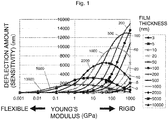
- the relationship between the Young's modulus and the deflection amount (sensitivity) is represented by a graph by using the film thicknesses of the receptor layer as parameters, and the graph is shown in Fig. 1 .
- the calculations were conducted under the size of the cantilever of a length of 500 ⁇ m, a width of 100 ⁇ m and a thickness of 1 ⁇ m, and silicon as the material of the cantilever. The following matters are found from this graph.
- a receptor layer specifically having chemical selectivity for this kind of sensor so as to selectively adsorb a molecule of an analyte.
- a functional group to be contained in the receptor layer and fix the functional group in the receptor layer in a stable state depending on the chemical property of the molecule of the analyte.
- the object of the present invention is to provide a method that achieves high performance by attaining selectivity of a molecule of an analyte derived from a chemical composition of a particulate material by using a receptor layer in which a base material, and the particulate material having different physical/chemical properties from those of the base material are mixed, while attaining physical properties that are different from those of the base material by forming a base material/particulate material composite by using a particulate material having different physical properties such as a Young's modulus.
- the present invention is a sensor comprising: a receptor layer of a composite containing a base material and a particulate material, and a sensor main body having the receptor layer on a surface thereof so that the sensor detects a variation in a physical parameter caused on adsorption of a molecule of an analyte to the receptor layer.
- the physical parameter may be one or more kinds selected from a surface stress, a stress, a force, a surface tension, a pressure, a mass, an elasticity, a Young's modulus, a Poisson's ratio, a resonance frequency, a frequency, a volume, a thickness, a viscosity, a density, a magnetic force, a quantity of magnetism, an electric field, a magnetic flux, a magnetic flux density, an electric resistance, a quantity of electricity, a dielectric constant, an electric power, an electric field, an electric charge, an electrical current, an electric voltage, an electric potential, a mobility, an electrostatic energy, a capacitance, an inductance, a reactance, a susceptance, an admittance, an impedance, a conductance, a plasmon, a refractive index, a luminous intensity and a temperature.
- the particulate material and the base material may have mutually different numerical values of a physical parameter.
- the particulate material may be a nanoparticle.
- the base material may be a polymeric material.
- the polymeric material may be a polymer.
- the particulate material may be a multicomponent material comprising a plurality of kinds of compounds.
- the above-mentioned multicomponent particulate material may contain at least silica and titania.
- the surface of the particulate material may be modified with one or more kinds of surface-modifying groups.
- At least one of the surface-modifying groups may adsorb the molecule of the analyte.
- the surface-modifying groups may comprise a hydrophobic surface-modifying group and a hydrophilic surface-modifying group.
- the surface-modifying group may be fixed on the surfaces of the particles by co-precipitating a silane coupling agent with a raw material of the particulate material.
- the surface-modifying group may be fixed by means of post-treatment of a surface of a previously synthesized particulate material with a silane coupling agent.
- the surface-modifying group may be one or more kinds selected from an aminopropyl group, a phenyl group, an alkyl group, a mercaptopropyl group, a glycidyl group, a vinyl group, a sulfone group and a fluoro group.
- the sensor main body may be a surface stress sensor.
- the base material and the particulate material may have different Young's moduli from each other.
- the present invention it becomes possible to attain high sensitivity and selectivity to various molecules of analytes, which have been difficult to attain by a single base material such as a polymer, by mixing particulate materials having different physical/chemical properties. More specifically, it becomes possible to control sensitivity and selectivity in a simultaneous and exhaustive manner by using, for example, one kind of polymer as a base material for a receptor layer, and adding particulate materials having different chemical compositions and Young's moduli to the base material. In other words, as shown in the curves of Fig.
- the Young's modulus can be varied freely within a very broad range by adding the particulate materials at any film thickness of the receptor layer (film of a base material)
- the sensitivity can be adjusted to an optional value along with each curve in Fig. 1 at any film thickness of the receptor layer (film of a base material).
- the selectivity by suitably selecting a particulate material having necessary functional groups and adding the particulate material to the base material according to the desired analyte, detectable analytes can be switched freely in a broad scope.
- the sensor of the present invention includes a receptor layer of a composite containing a base material and a particulate material (a base material/particulate material composite receptor layer) and a sensor main body having the receptor layer on the surface, which is configured to detect a change in a physical parameter which occurs when a molecule of an analyte is adsorbed by the receptor layer.
- the sensor main body may be any sensor main body that can detect a surface stress, a stress, a force, a surface tension, a pressure, a mass, an elasticity, a Young's modulus, a Poisson's ratio, a resonance frequency wave number, a frequency wave number, a volume, a thickness, a viscosity, a density, a magnetic force, a magnetic amount, an electric field, a magnetic flux, a magnetic flux density, an electric resistance, an amount of electricity, a dielectric constant, an electric power, an electric field, an electric charge, an electrical current, an electric voltage, an electric potential, a mobility, an electrostatic energy, a capacitance, an inductance, a reactance, a susceptance, an admittance, an impedance, a conductance, a plasmon, a refractive index, a luminous intensity and a temperature, and other various physical parameters, and the specific constitution of the sensor main body is not specifically limited.
- This sensor detects the change in the physical parameter(s) caused in the receptor layer due to the adsorption of the molecule of the analyte on the receptor layer by the sensor main body. Therefore, the structure, operation and the like of the sensor main body that can be used in the present invention are not specifically limited as long as the sensor main body detects the change caused in the receptor layer due to the adsorption of the substance to be detected by the base material/particulate material composite receptor layer with which the surface of the sensor main body is coated.
- the substance to be detected is adsorbed by the base material/particulate material composite receptor layer with which the surface of the surface stress sensor is coated, the change in the stress caused in the receptor layer is detected, and the surface stress sensor outputs a signal.
- adsorb herein is used in the broadest meaning that encompasses not only physical adsorption but also chemical bonding and adsorption by biochemical actions.
- the composite used in the receptor layer may be composed of only the base material and the particulate substance, or may be composed of other auxiliary components (for example, components that improve the dispersibility of the particles, modifiers for exerting any physical/chemical properties that are difficult to achieve by only the base material component, and the like) may also be added.
- the base material itself may be composed of plural substances (for example, plural kinds of polymers).
- the thickness (film thickness) of the receptor layer on the surface of the sensor main body can be suitably designed with consideration for the detection sensitivities of the various physical parameters and the like, and for example, a range of 1 nm to 1,000 ⁇ m can be exemplified.
- a range of 1 nm to 1,000 ⁇ m can be exemplified.
- the film thickness of the receptor layer is in the range from 100 nm to 10 ⁇ m, it is possible to maximize the deflection of the cantilever within the range of the Young's modulus of a generally-used material (1 MPa to 1,000 GPa).
- the Young's modulus may be lower than 1 MPa in the case when the receptor layer is constituted by a material containing very many voids, but in such case, it is preferable that the film thickness of the receptor layer is within the range of 100 nm to 1,000 ⁇ m from the viewpoint of maximization of the deflection of the cantilever.
- the particulate material used for the base material/particulate material composite receptor layer in the present invention may have any shape and structure as long as the particulate material satisfies the assumed condition that the particulate material has different physical/chemical properties from that of the base material such as a polymer.
- the particle size of the particulate material may be any particle size such that the particulate material can be dispersed in the base material and is not specifically limited, and nanoparticles are preferable because physical properties as a bulk are easily defined and a quantitative discussion can be made.
- the nanoparticles herein refer to particles having a particle size of 1 nm to 100 nm.
- each particle of the particulate material may be either isotropic or anisotropy.
- the structure of each particle may be a dense structure, a non-dense structure such as porous or hollow, or a core-shell type structure.
- one or more kinds of optional surface-modifying group(s) can be suitably fixed on the surface of the particulate material depending on a molecule of an analyte to be detected.
- the particulate material includes hydrophobic surface-modifying group(s) and hydrophilic surface-modifying group(s).
- at least one of the surface-modifying groups among the surface-modifying groups adsorbs a molecule of an analyte.
- the surface-modifying groups can be fixed on the surfaces of the particles by co-precipitating the silane coupling agent with the particulate material raw material, or can be fixed by subjecting the surfaces of the particulate material that has been synthesized in advance to a post-treatment with the silane coupling agent.
- the surface-modifying groups may be combined with polymers or bio-related molecules, in addition to molecules having a thiol group, phosphonic acid and the like.
- surface-modifying groups for example, one or more kinds of an aminopropyl group, a phenyl group, an alkyl group, a mercaptopropyl group, a glycidyl group, a vinyl group, a sulfone group and a fluoro group can be exemplified.
- the substance that constitutes the particles of the particulate material may be any substance as long as the condition that the substance has different physical/chemical properties from those of the base material.
- simple substance such as metals, or compounds such as oxides and sulfides, inorganic-organic hybrids, and the like can be preferably exemplified.
- the particulate material is a multicomponent material composed of plural kinds of compounds such as silica and titania.
- the base material when the base material is a soft material such as a polymer, it is desirable that the Young's modulus of the particles is higher than that of the base material.
- the base material when the base material is a substance that is hard to some extent, it is sometimes desirable to use a material, such as polymer particles and air bubbles, that decreases the Young's modulus of the entire composite receptor layer. That is, it is preferable that the particulate material and the base material have different values of physical parameters from each other.
- the above-mentioned particulate material may be synthesized by any technique.
- the technique is not specifically limited, and ranges from a precipitation reaction in a homogeneous solution, a reaction in a pseudo-homogeneous system utilizing an emulsion, a reaction in a vapor phase utilizing spray drying or thermal decomposition, to solid phase reactions such as ball milling.
- a surface stress sensor is exemplified, but the shape, material, size and the like thereof are not specifically limited, and any object can be used.
- a slice-like element supported at one portion or plural portions can be preferably exemplified.
- sensor main bodies having various forms such as slice-like objects supported at two or more portions such as a double-supported beam, membrane bodies and the like can be adopted.
- the technique for coating the sensor surface with the base material/particulate material composite receptor includes, but is not specifically limited to, dip coating, spray coating, spin coating, inkjet spotting, casting, coating using a doctor blade, and the like.
- the particulate material used as the receptor layer efficiently adsorbs a desired molecule of the analyte by itself, such particulate material can be used in its original form.
- the detection performance can be improved by modifying the particulate material with specific surface-modifying groups so that the particulate material adsorbs a desired molecule of the analyte, improving the adsorption efficiency, or increasing the selectivity of the substance to be adsorbed, or the like.
- the modification by the surface-modifying groups can be conducted for the purposes that do not directly relate to adsorption of the molecule of the analyte, for example, improvement of the durability, environment resistance and the like of a sensor coated with the base material/particulate material composite, such as mutual bonding of the particles and tackiness with a substrate.
- the major part or entirety of the surface of the particulate material is coated with the base material in the base material/particulate material composite layer.
- the base material is a polymer or the like
- the molecule of the analyte can permeate through the coating of the base material and easily reach the particulate material.
- the coating thickness is extremely thin, or pinholes or the like with a number/size sufficient for coating are present, the molecule of the analyte can also easily reach the particulate material.
- the base material and particulate material used it is desirable to suitably adjust the base material and particulate material used, the mixing ratio of the material and particulate material in a coating body, the thickness of a coating body layer, additives to the base material, and the like according to the molecule of the analyte, the necessary detection sensitivity, and the environment for use, and the like.
- selectivity it should be noted that it is also possible to utilize the selectivity of the base material itself due to the functional groups and the like in the base material and the selectivity possessed by the particulate material in combination.
- the selectivity of the base material itself due to the functional groups and the like in the base material and the selectivity possessed by the particulate material in combination.
- a composite layer in which a base material having hydrophobic functional groups is mixed with a particulate material having hydrophilic functional groups it becomes possible to efficiently adsorb amphipathic compounds.
- silica-titania hybrid particulate materials having various surface-modifying groups were each synthesized by co-hydrolysis and a condensation polymerization reaction of silicon tetraethoxide or various silane coupling agents and titanium tetraisopropoxide (TTIP) in an ammonia basic isopropanol (IPA) aqueous solution in which octadecylamine (ODA) was dissolved.
- TTIP titanium tetraisopropoxide
- IPA ammonia basic isopropanol
- ODA octadecylamine
- silane coupling agent 3-aminopropyltriethoxysilane and phenyltriethoxysilane were used.
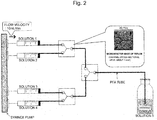
- Non-patent Literature 3 The above-mentioned synthesis reaction was conducted by using a microreactor made of Teflon (registered trademark) having a Y-shaped flow path of a size of micrometers ( Fig. 2 ) (Non-patent Literature 3).
- the precursor solutions were flowed simultaneously at a predetermined flow rate by a syringe pump.
- Solution 1 and Solution 2 were respectively mixed in microreactors disposed in parallel, and the solutions ejected from the two reactors were further mixed in another microreactor to give one reaction solution.
- the reaction solution was ejected into a precursor solution 5: ODA/H 2 O/IPA, which had been separately prepared in advance, and stirred at a predetermined velocity until the ejection was completed. Thereafter, the mixture was allowed to stand still at room temperature, whereby the above-mentioned particulate material dispersion liquid was obtained.
- the images of the particles observed under an SEM are shown in Fig. 3 .
- the particulate material synthesized in this Example is silica-titania hybrid particles having an aminopropyl group or a phenyl group, or silica-titania hybrid particles having no specific functional group, depending on the kind of the alkoxide or silane coupling agent used during the synthesis.
- silica-titania hybrid particles having an aminopropyl group or a phenyl group, or silica-titania hybrid particles having no specific functional group, depending on the kind of the alkoxide or silane coupling agent used during the synthesis.
- all of these three kinds of particulate materials were synthesized in the presence of ODA, and thus the particle structure includes an octadecyl group.
- polyvinyl pyrrolidone which is a kind of common polymer
- PVP polyvinyl pyrrolidone
- the above-mentioned particle dispersion liquid water and IPA
- preparation was conducted so that both of the PVP concentration and the particle concentration became 1 g/L.
- the product was ultrasonicated, the dispersion of the particles was confirmed by visual observation, and the product was immediately sprayed and dried on a sensor chip by using a spray coater.
- a piezo resistive MSS having a membrane type structure suggested in Patent Literature 1 was used.
- water and water-soluble/insoluble chemical species were measured. Specifically, eight kinds of chemical species: water, formaldehyde (formalin), ethanol, IPA, hexane, heptane, benzene and toluene were each taken into a vial, and nitrogen as a carrier gas was flown into the vial at 100 mL/min, whereby the chemical species was introduced as a gas containing a certain amount of sample vapor into a tightly-closed chamber in which MSS was housed. The results of the measurements of the respective samples are shown in Figs. 5 and 6 .
- PVP represents a sensor coated with only PVP with no particulate material
- PVPNPs represent sensors coated with a PVP containing PVP with no surface-modifying group
- PVPNH2NPs represent sensors coated with a PVP containing a particulate material modified with an aminopropyl group
- PVPPhNPs represent sensors coated with a PVP containing a particulate material modified with a phenyl group.
- the sensor responded to the water-soluble compounds, but responded faintly to the water-insoluble compounds.
- the PVP itself is a water-soluble polymer.
- the response to the water-soluble compounds was approximately the same, whereas the response to the water-insoluble compounds was improved.
- the relative signal intensity with respect to the signal intensity of the response to water is 1 or more for all of the four kinds of water-insoluble compounds, and this is considered to be the effect of the introduction of the hydrophobic phenyl groups.
- the response to the four kinds of the water-insoluble compounds was improved also in the cases of the silica-titania hybrid particles having no specific modifying groups, and this is considered to be due to the presence of the hydrophobic octadecyl group in the structure.
- the particles modified with the hydrophilic aminopropyl group were added ("PVPNH2NPs" in Fig. 6 )
- the response to the water-soluble compounds was significantly improved.
- the molecule of the analyte selectivity of the receptor layer can be controlled depending on the surface property of the added particulate material.
- Example 2 Preparation of high Young's modulus composite and improvement of sensitivity of MSS by addition of silica-titania hybrid particulate material to PVP
- the Young's moduli of silica and titania are about 70 GPa and about 200 GPa, and in the case of the hybrid particles used in this Example is considered, the Young's modulus of the hybrid particles is assumed to be around 100 GPa with consideration for a weighted average based on a weight ratio of silica and titania calculated from the raw materials for the preparation of the particles. Based on that the Young's modulus of PVP is about 2 GPa, the Young's modulus of the PVP/particulate material composite receptor layer in this Example can be estimated to be approximately 50 GPa.
- the film thickness of the composite coating was estimated to be approximately 100 to 200 nm by a film thickness meter.
- Non-patent Literature 1 for the sensitivities when the Young's modulus is 2 GPa and 50 GPa, the latter sensitivity tends to be several times larger in the case when the sensitivities are compared at a film thickness of 100 to 200 nm (see also Fig. 1 , which shows the relationship between the Young's modulus and sensitivity using film pressures as parameters).
- Fig. 1 shows the relationship between the Young's modulus and sensitivity using film pressures as parameters.
- the sensitivities against the water-soluble compounds are approximately twice or more, and thus the contribution of the Young's modulus is suggested.
- PVPPhNPs represents sensors each coated 20 times (x 20) or 30 (x 30) with PVP containing a particulate material modified with a phenyl group.
- Non-patent Literature 1 a film thickness that gives a maximum sensitivity is present in the case when the Young's modulus is constant, and it can be interpreted that the result in the present case follows such tendency.
- a receptor layer having a smaller film thickness and a larger Young's modulus is more advantageous in achieving high sensitivity.
- a material having a high Young's modulus i.e., a stiff material
- high sensitivity cannot always be achieved by using a material having a high Young's modulus.
- a diamond film is used, a film having a very large Young's modulus can be attained, but an analyte cannot enter into this film.
- little strain is induced in a receptor layer using diamond as a base material, and thus the detection sensitivity is extremely low.
- the reason why the sensitivity still tends to increase in the measurement of water and formaldehyde is expected to be the contribution of a chemical interaction with the receptor surface which cannot be explained based on only the physical parameters such as Young's modulus and film thickness.
- the surface of the particulate material can be made macroscopically hydrophobic but microscopically hydrophilic.
- the surface of the particle modified with an aminopropyl group prepared in this Example was surface-modified with an octadecyl group in addition to an aminopropyl group; when the surface of the particulate material is in such state, the surface is macroscopically hydrophobic due to the presence of the octadecyl group having a long chain length, but many sites that adsorb water are microscopically present due to the co-existence of the aminopropyl group.
- an octadecyl group and an aminopropyl group have chain lengths of about several angstroms to 1 nm, it is considered that only a molecule of an analyte can be adsorbed so as to be selectively removed from water, for example, by disposing the aminopropyl group particles/PVP-coated MSS of this Example in water in which molecules having affinity for amino groups (proteins and the like) are dissolved. Accordingly, not only measurements in gases, but also measurements in liquids which have not been achieved until now, such as direct measurements of concentrations of various gases in blood, can be attained.
- hydrophilic functional groups and the hydrophobic functional groups can be present in a periodically or approximately periodically mixed manner on the surfaces of the aminopropyl group/octadecyl group surface-modified particles of this Example.
- these particles are silica-titania hybrid nanoparticles, and silica parts and titania parts to which the respective functional groups are bonded repeatedly emerge on the surfaces thereof.
- the present invention greatly contributes to the field of sensors in which a receptor layer is disposed on a surface of a sensor main body.
Landscapes
- Physics & Mathematics (AREA)
- Chemical & Material Sciences (AREA)
- General Health & Medical Sciences (AREA)
- Life Sciences & Earth Sciences (AREA)
- Analytical Chemistry (AREA)
- Biochemistry (AREA)
- Health & Medical Sciences (AREA)
- General Physics & Mathematics (AREA)
- Immunology (AREA)
- Pathology (AREA)
- Acoustics & Sound (AREA)
- Chemical Kinetics & Catalysis (AREA)
- Electrochemistry (AREA)
- Investigating Or Analysing Materials By Optical Means (AREA)
- Investigating Or Analyzing Materials By The Use Of Fluid Adsorption Or Reactions (AREA)
Abstract
Description
- The present invention relates to a sensor that enables selective detection with high sensitivity of a substance to be detected, by coating a surface of a sensor main body with a receptor layer in which a base material and a particulate material are mixed.
- There are various kinds of sensors of a type such that changes in physical parameters which occur in accordance with adsorption of a molecule to be detected (a molecule of an analyte), and these sensors are used in various fields. In order to easily detect the changes in physical parameters, a sensor is generally coated with a layer called as "receptor layer", and then used for measurements. Since available receptor materials differ depending on physical parameters to be measured, various receptor layers optimized for each sensor have been developed. For example, there is a surface stress sensor that detects a stress that occurs in accordance with adsorption of a molecule of an analyte. For a receptor layer in this kind of sensor, various substances such as self-organized single molecule films, DNAs/RNAs, proteins, antigens/antibodies and polymers are used.
- To improve the sensitivity of such sensor, it is effective to optimize the physical and chemical properties of the receptor layer in many cases. For example, regarding a surface stress sensor, as shown in
Non-patent Literatures 
- The above-mentioned formula is for the cantilever-type surface stress sensor shown in Non-patent
Literature 1. In the formula, Δz is a deflection of the cantilever, wc is a width of the cantilever, lc is a length of the cantilever, tc is a thickness of the cantilever, vc is a Poisson's ratio of the cantilever, Ec is a Young's modulus of the cantilever, wf is a width of the receptor layer, tf is a thickness of the receptor layer, vf is a Poisson's ratio of the receptor layer, Ef is a Young's modulus of the receptor layer, and εf is a distortion applied to the receptor layer. When sensitivity (in this case, a deflection amount of the cantilever) is calculated based on this mathematical formula, it is found that the sensitivity significantly depends on the Young's modulus of the receptor layer. Therefore, in order to attain high sensitivity, it is necessary to design a receptor layer having optimal values for physical parameters such as a Young's modulus. Based on the above-mentioned formula, the relationship between the Young's modulus and the deflection amount (sensitivity) is represented by a graph by using the film thicknesses of the receptor layer as parameters, and the graph is shown inFig. 1 . The calculations were conducted under the size of the cantilever of a length of 500 µm, a width of 100 µm and a thickness of 1 µm, and silicon as the material of the cantilever. The following matters are found from this graph. - A. When the film thickness is fixed, there is an optimal value in the Young's modulus of the receptor layer for the sensitivity of the surface stress sensor, and the sensitivity decreases at a Young's modulus that is either higher or lower than the optimal value, and
- B. When the thickness of the receptor layer is varied, the optimal Young's modulus changes. Specifically, the optimal Young's modulus is shifted to larger values and the sensitivity is also improved as the thickness of the receptor layer is decreased, whereas, conversely, the sensitivity tends to be not exerted in a region of small Young's moduli.
- On the other hand, it is necessary to design a receptor layer specifically having chemical selectivity for this kind of sensor so as to selectively adsorb a molecule of an analyte. Specifically, it is necessary to design a functional group to be contained in the receptor layer and fix the functional group in the receptor layer in a stable state depending on the chemical property of the molecule of the analyte.
- As mentioned above, in order to optimize sensitivity and selectivity, which are critically important two elements in a sensor of a type in which a molecule of an analyte is measured, it is generally necessary to optimize physical properties and chemical properties at the same time. However, any effective method by which such optimization is easily attained has not been established, and thus early attainment of such optimization is strongly demanded.
- The object of the present invention is to provide a method that achieves high performance by attaining selectivity of a molecule of an analyte derived from a chemical composition of a particulate material by using a receptor layer in which a base material, and the particulate material having different physical/chemical properties from those of the base material are mixed, while attaining physical properties that are different from those of the base material by forming a base material/particulate material composite by using a particulate material having different physical properties such as a Young's modulus.
- The present invention is a sensor comprising: a receptor layer of a composite containing a base material and a particulate material, and a sensor main body having the receptor layer on a surface thereof so that the sensor detects a variation in a physical parameter caused on adsorption of a molecule of an analyte to the receptor layer.
- Here, the physical parameter may be one or more kinds selected from a surface stress, a stress, a force, a surface tension, a pressure, a mass, an elasticity, a Young's modulus, a Poisson's ratio, a resonance frequency, a frequency, a volume, a thickness, a viscosity, a density, a magnetic force, a quantity of magnetism, an electric field, a magnetic flux, a magnetic flux density, an electric resistance, a quantity of electricity, a dielectric constant, an electric power, an electric field, an electric charge, an electrical current, an electric voltage, an electric potential, a mobility, an electrostatic energy, a capacitance, an inductance, a reactance, a susceptance, an admittance, an impedance, a conductance, a plasmon, a refractive index, a luminous intensity and a temperature.
- Furthermore, the particulate material and the base material may have mutually different numerical values of a physical parameter.
- Furthermore, the particulate material may be a nanoparticle.
- Furthermore, the base material may be a polymeric material.
- Furthermore, the polymeric material may be a polymer.
- Furthermore, the particulate material may be a multicomponent material comprising a plurality of kinds of compounds.
- Furthermore, the above-mentioned multicomponent particulate material may contain at least silica and titania.
- Furthermore, the surface of the particulate material may be modified with one or more kinds of surface-modifying groups.
- Furthermore, at least one of the surface-modifying groups may adsorb the molecule of the analyte.
- Furthermore, the surface-modifying groups may comprise a hydrophobic surface-modifying group and a hydrophilic surface-modifying group.
- Furthermore, the surface-modifying group may be fixed on the surfaces of the particles by co-precipitating a silane coupling agent with a raw material of the particulate material.
- Furthermore, the surface-modifying group may be fixed by means of post-treatment of a surface of a previously synthesized particulate material with a silane coupling agent.
- Furthermore, the surface-modifying group may be one or more kinds selected from an aminopropyl group, a phenyl group, an alkyl group, a mercaptopropyl group, a glycidyl group, a vinyl group, a sulfone group and a fluoro group.
- Furthermore, the sensor main body may be a surface stress sensor.
- Furthermore, the base material and the particulate material may have different Young's moduli from each other.
- According to the present invention, it becomes possible to attain high sensitivity and selectivity to various molecules of analytes, which have been difficult to attain by a single base material such as a polymer, by mixing particulate materials having different physical/chemical properties. More specifically, it becomes possible to control sensitivity and selectivity in a simultaneous and exhaustive manner by using, for example, one kind of polymer as a base material for a receptor layer, and adding particulate materials having different chemical compositions and Young's moduli to the base material. In other words, as shown in the curves of
Fig. 1 , since the Young's modulus can be varied freely within a very broad range by adding the particulate materials at any film thickness of the receptor layer (film of a base material), the sensitivity can be adjusted to an optional value along with each curve inFig. 1 at any film thickness of the receptor layer (film of a base material). Furthermore, regarding the selectivity, by suitably selecting a particulate material having necessary functional groups and adding the particulate material to the base material according to the desired analyte, detectable analytes can be switched freely in a broad scope. By this way, not only it becomes unnecessary to modify the structure of the base material itself to a form that expresses affinity between the base material and the molecule of the analyte through various operations, as represented by an organic synthesis reaction, but also the process of reconsideration of conditions for the coating onto a surface of a sensor, which is necessitated in every change in the kind of the base material, can be omitted. Therefore, this is a significant advantage for not only practical realization at a laboratory scale but also practical realization at an industrial scale. -
-
Fig. 1 is a drawing showing the relationship among the sensitivity, and the Young's modulus and film thickness of the receptor layer, for a surface stress sensor coated with a receptor layer. -
Fig. 2 is a drawing showing an example of the constitution of the apparatus utilized for the synthesis of the particulate materials in Example 1. -
Fig. 3 shows scanning electron microscope (SEM) images of the particulate materials having different surface-modifying groups prepared in Example 1. -
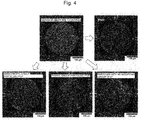
Fig. 4 shows optical microscope images before and after adding the particulate material of Example 1 to polyvinylpyrrolidone (PVP), and coating the surface of a membrane-type surface stress sensor (MSS) with the particulate material. -
Fig. 5 is a drawing showing the results of the measurements of eight compounds by using the PVP/particulate material composite-coated MSS of Example 1 and a PVP-coated MSS for comparison. -
Fig. 6 is a drawing in which the values of the sensor signals ofFig. 5 at around 30 seconds (just before switching to a purge gas) after the injection of a sample gas was extracted, and the values were plotted for every measured compound. -
Fig. 7 is a drawing showing the result of the measurements of eight kinds of compounds by using a PVP/particulate material composite-coated MSS, which is similar to that of Example 2 except for the number of coatings. -
Fig. 8 is a drawing in which the values of the sensor signals ofFig. 7 at around 30 seconds (just before switching to a purge gas) after the injection of a sample gas was extracted, and the values were plotted for every measured compound. - The sensor of the present invention includes a receptor layer of a composite containing a base material and a particulate material (a base material/particulate material composite receptor layer) and a sensor main body having the receptor layer on the surface, which is configured to detect a change in a physical parameter which occurs when a molecule of an analyte is adsorbed by the receptor layer.
- Specifically, the sensor main body may be any sensor main body that can detect a surface stress, a stress, a force, a surface tension, a pressure, a mass, an elasticity, a Young's modulus, a Poisson's ratio, a resonance frequency wave number, a frequency wave number, a volume, a thickness, a viscosity, a density, a magnetic force, a magnetic amount, an electric field, a magnetic flux, a magnetic flux density, an electric resistance, an amount of electricity, a dielectric constant, an electric power, an electric field, an electric charge, an electrical current, an electric voltage, an electric potential, a mobility, an electrostatic energy, a capacitance, an inductance, a reactance, a susceptance, an admittance, an impedance, a conductance, a plasmon, a refractive index, a luminous intensity and a temperature, and other various physical parameters, and the specific constitution of the sensor main body is not specifically limited.
- This sensor detects the change in the physical parameter(s) caused in the receptor layer due to the adsorption of the molecule of the analyte on the receptor layer by the sensor main body. Therefore, the structure, operation and the like of the sensor main body that can be used in the present invention are not specifically limited as long as the sensor main body detects the change caused in the receptor layer due to the adsorption of the substance to be detected by the base material/particulate material composite receptor layer with which the surface of the sensor main body is coated. For example, in the case when a surface stress sensor is used, the substance to be detected is adsorbed by the base material/particulate material composite receptor layer with which the surface of the surface stress sensor is coated, the change in the stress caused in the receptor layer is detected, and the surface stress sensor outputs a signal. It should be noted that the term "adsorb" herein is used in the broadest meaning that encompasses not only physical adsorption but also chemical bonding and adsorption by biochemical actions. Furthermore, the composite used in the receptor layer may be composed of only the base material and the particulate substance, or may be composed of other auxiliary components (for example, components that improve the dispersibility of the particles, modifiers for exerting any physical/chemical properties that are difficult to achieve by only the base material component, and the like) may also be added. The base material itself may be composed of plural substances (for example, plural kinds of polymers).
- Furthermore, the thickness (film thickness) of the receptor layer on the surface of the sensor main body can be suitably designed with consideration for the detection sensitivities of the various physical parameters and the like, and for example, a range of 1 nm to 1,000 µm can be exemplified. In addition, when considered based on
Fig. 1 , when the film thickness of the receptor layer is in the range from 100 nm to 10 µm, it is possible to maximize the deflection of the cantilever within the range of the Young's modulus of a generally-used material (1 MPa to 1,000 GPa). Furthermore, the Young's modulus may be lower than 1 MPa in the case when the receptor layer is constituted by a material containing very many voids, but in such case, it is preferable that the film thickness of the receptor layer is within the range of 100 nm to 1,000 µm from the viewpoint of maximization of the deflection of the cantilever. - The particulate material used for the base material/particulate material composite receptor layer in the present invention may have any shape and structure as long as the particulate material satisfies the assumed condition that the particulate material has different physical/chemical properties from that of the base material such as a polymer. The particle size of the particulate material may be any particle size such that the particulate material can be dispersed in the base material and is not specifically limited, and nanoparticles are preferable because physical properties as a bulk are easily defined and a quantitative discussion can be made. The nanoparticles herein refer to particles having a particle size of 1 nm to 100 nm.
- The shape of each particle of the particulate material may be either isotropic or anisotropy. The structure of each particle may be a dense structure, a non-dense structure such as porous or hollow, or a core-shell type structure. Furthermore, one or more kinds of optional surface-modifying group(s) can be suitably fixed on the surface of the particulate material depending on a molecule of an analyte to be detected. For example, in the case of a particulate material having two or more kinds of surface-modifying groups, it is preferable that the particulate material includes hydrophobic surface-modifying group(s) and hydrophilic surface-modifying group(s). Furthermore, it is preferable that at least one of the surface-modifying groups among the surface-modifying groups adsorbs a molecule of an analyte.
- Furthermore, for example, the surface-modifying groups can be fixed on the surfaces of the particles by co-precipitating the silane coupling agent with the particulate material raw material, or can be fixed by subjecting the surfaces of the particulate material that has been synthesized in advance to a post-treatment with the silane coupling agent. Furthermore, the surface-modifying groups may be combined with polymers or bio-related molecules, in addition to molecules having a thiol group, phosphonic acid and the like.
- As such surface-modifying groups, for example, one or more kinds of an aminopropyl group, a phenyl group, an alkyl group, a mercaptopropyl group, a glycidyl group, a vinyl group, a sulfone group and a fluoro group can be exemplified.
- The substance that constitutes the particles of the particulate material may be any substance as long as the condition that the substance has different physical/chemical properties from those of the base material. For example, simple substance such as metals, or compounds such as oxides and sulfides, inorganic-organic hybrids, and the like can be preferably exemplified. Furthermore, it is preferable that the particulate material is a multicomponent material composed of plural kinds of compounds such as silica and titania.
- In addition, in the case when the present invention is applied to a surface stress sensor such as MSS, when the base material is a soft material such as a polymer, it is desirable that the Young's modulus of the particles is higher than that of the base material. Conversely, in the case when the base material is a substance that is hard to some extent, it is sometimes desirable to use a material, such as polymer particles and air bubbles, that decreases the Young's modulus of the entire composite receptor layer. That is, it is preferable that the particulate material and the base material have different values of physical parameters from each other.
- Furthermore, the above-mentioned particulate material may be synthesized by any technique. Specifically, the technique is not specifically limited, and ranges from a precipitation reaction in a homogeneous solution, a reaction in a pseudo-homogeneous system utilizing an emulsion, a reaction in a vapor phase utilizing spray drying or thermal decomposition, to solid phase reactions such as ball milling.
- As an example of the sensor main body coated with the base material/particulate material composite receptor layer, a surface stress sensor is exemplified, but the shape, material, size and the like thereof are not specifically limited, and any object can be used. For example, a slice-like element supported at one portion or plural portions can be preferably exemplified. Furthermore, for example, sensor main bodies having various forms such as slice-like objects supported at two or more portions such as a double-supported beam, membrane bodies and the like can be adopted.
- The technique for coating the sensor surface with the base material/particulate material composite receptor includes, but is not specifically limited to, dip coating, spray coating, spin coating, inkjet spotting, casting, coating using a doctor blade, and the like.
- Furthermore, if the particulate material used as the receptor layer efficiently adsorbs a desired molecule of the analyte by itself, such particulate material can be used in its original form. Alternatively, the detection performance can be improved by modifying the particulate material with specific surface-modifying groups so that the particulate material adsorbs a desired molecule of the analyte, improving the adsorption efficiency, or increasing the selectivity of the substance to be adsorbed, or the like. Furthermore, the modification by the surface-modifying groups can be conducted for the purposes that do not directly relate to adsorption of the molecule of the analyte, for example, improvement of the durability, environment resistance and the like of a sensor coated with the base material/particulate material composite, such as mutual bonding of the particles and tackiness with a substrate.
- Meanwhile, it is considered that there are considerably many cases when the major part or entirety of the surface of the particulate material is coated with the base material in the base material/particulate material composite layer. Even in these cases, in the case when the base material is a polymer or the like, the molecule of the analyte can permeate through the coating of the base material and easily reach the particulate material. Alternatively, even a base material through which the molecule of the analyte is difficult to permeate is used, in the case when the coating thickness is extremely thin, or pinholes or the like with a number/size sufficient for coating are present, the molecule of the analyte can also easily reach the particulate material. Therefore, it is desirable to suitably adjust the base material and particulate material used, the mixing ratio of the material and particulate material in a coating body, the thickness of a coating body layer, additives to the base material, and the like according to the molecule of the analyte, the necessary detection sensitivity, and the environment for use, and the like.
- Regarding the selectivity, it should be noted that it is also possible to utilize the selectivity of the base material itself due to the functional groups and the like in the base material and the selectivity possessed by the particulate material in combination. For example, in the case when a composite layer in which a base material having hydrophobic functional groups is mixed with a particulate material having hydrophilic functional groups is utilized, it becomes possible to efficiently adsorb amphipathic compounds.
- The present invention will further be explained below in detail based on Examples. However, as a matter of course, the present invention is not limited to these Examples.
- In the following, an example of measurement by using sensors obtained by forming particulate materials having various surface-modifying groups and a polymer as a base material into composites, and coating the sensors with the composites as receptor layers, will be explained.
- The above-mentioned silica-titania hybrid particulate materials having various surface-modifying groups were each synthesized by co-hydrolysis and a condensation polymerization reaction of silicon tetraethoxide or various silane coupling agents and titanium tetraisopropoxide (TTIP) in an ammonia basic isopropanol (IPA) aqueous solution in which octadecylamine (ODA) was dissolved. As the silane coupling agent, 3-aminopropyltriethoxysilane and phenyltriethoxysilane were used. The above-mentioned synthesis reaction was conducted by using a microreactor made of Teflon (registered trademark) having a Y-shaped flow path of a size of micrometers (
Fig. 2 ) (Non-patent Literature 3). Four precursor solutions: Solution 1: silicon alkoxide or various silane coupling agents/IPA, Solution 2: H2O/IPA/ammonia, Solution 3: TTIP/IPA, Solution 4: H2O/IPA were used, and the solutions fromSolution 1 toSolution 4 were prepared at unified volumes. The precursor solutions were flowed simultaneously at a predetermined flow rate by a syringe pump.Solution 1 andSolution 2,Solution 3 andSolution 4 were respectively mixed in microreactors disposed in parallel, and the solutions ejected from the two reactors were further mixed in another microreactor to give one reaction solution. The reaction solution was ejected into a precursor solution 5: ODA/H2O/IPA, which had been separately prepared in advance, and stirred at a predetermined velocity until the ejection was completed. Thereafter, the mixture was allowed to stand still at room temperature, whereby the above-mentioned particulate material dispersion liquid was obtained. The images of the particles observed under an SEM are shown inFig. 3 . - The particulate material synthesized in this Example is silica-titania hybrid particles having an aminopropyl group or a phenyl group, or silica-titania hybrid particles having no specific functional group, depending on the kind of the alkoxide or silane coupling agent used during the synthesis. However, it should be noted that all of these three kinds of particulate materials were synthesized in the presence of ODA, and thus the particle structure includes an octadecyl group.
- As the polymer to which the above-mentioned particulate material is added, polyvinyl pyrrolidone (PVP), which is a kind of common polymer, was used here. By mixing predetermined amounts of PVP, the above-mentioned particle dispersion liquid, water and IPA, preparation was conducted so that both of the PVP concentration and the particle concentration became 1 g/L. The product was ultrasonicated, the dispersion of the particles was confirmed by visual observation, and the product was immediately sprayed and dried on a sensor chip by using a spray coater. As the sensor, a piezo resistive MSS having a membrane type structure suggested in
Patent Literature 1 was used. - The optical microscope images of the MSS coated with the PVP/silica-titania hybrid particulate material composite, which were prepared in this Example, are shown in
Fig. 4 . By comparing with the MSS before the coating, it can be confirmed that the entirety of the film structure was coated. - Subsequently, water and water-soluble/insoluble chemical species were measured. Specifically, eight kinds of chemical species: water, formaldehyde (formalin), ethanol, IPA, hexane, heptane, benzene and toluene were each taken into a vial, and nitrogen as a carrier gas was flown into the vial at 100 mL/min, whereby the chemical species was introduced as a gas containing a certain amount of sample vapor into a tightly-closed chamber in which MSS was housed. The results of the measurements of the respective samples are shown in
Figs. 5 and6 . As objects for comparison, a result obtained by coating a piezo resistive MSS having an identical structure with PVP (a 1 g/L solution) by using an identical spray coater, and conducting a measurement, and a result obtained by conducting a measurement by using an MSS with no coating are also shown inFigs. 5 and6 (the result of the measurement using the MSS with no coating ("MSS bare" in the drawing) is shown in onlyFig. 6 ). InFig. 6 , "PVP" represents a sensor coated with only PVP with no particulate material, "PVPNPs" represent sensors coated with a PVP containing PVP with no surface-modifying group, "PVPNH2NPs" represent sensors coated with a PVP containing a particulate material modified with an aminopropyl group, and "PVPPhNPs" represent sensors coated with a PVP containing a particulate material modified with a phenyl group. - In the case of the coating with only PVP ("PVP" in
Fig. 6 ), the sensor responded to the water-soluble compounds, but responded faintly to the water-insoluble compounds. This can be explained by that the PVP itself is a water-soluble polymer. It is found that, in the case when the phenyl group-modified particles were added ("PVPPhNPs" inFig. 6 ), the response to the water-soluble compounds was approximately the same, whereas the response to the water-insoluble compounds was improved. The relative signal intensity with respect to the signal intensity of the response to water is 1 or more for all of the four kinds of water-insoluble compounds, and this is considered to be the effect of the introduction of the hydrophobic phenyl groups. The response to the four kinds of the water-insoluble compounds was improved also in the cases of the silica-titania hybrid particles having no specific modifying groups, and this is considered to be due to the presence of the hydrophobic octadecyl group in the structure. On the other hand, in the case when the particles modified with the hydrophilic aminopropyl group were added ("PVPNH2NPs" inFig. 6 ), the response to the water-soluble compounds was significantly improved. As mentioned above, it was shown that the molecule of the analyte selectivity of the receptor layer can be controlled depending on the surface property of the added particulate material. - As is understood from the optical microscope images in
Fig. 4 , in the case when the particles modified with an aminopropyl group were added, the entirety of the surface of the sensor is coated in a relatively homogeneous manner. Therefore, in order to discuss the effect of the Young's modulus of the composite here, the case when particles modified with an aminopropyl group were added will be considered. - The Young's moduli of silica and titania are about 70 GPa and about 200 GPa, and in the case of the hybrid particles used in this Example is considered, the Young's modulus of the hybrid particles is assumed to be around 100 GPa with consideration for a weighted average based on a weight ratio of silica and titania calculated from the raw materials for the preparation of the particles. Based on that the Young's modulus of PVP is about 2 GPa, the Young's modulus of the PVP/particulate material composite receptor layer in this Example can be estimated to be approximately 50 GPa. The film thickness of the composite coating was estimated to be approximately 100 to 200 nm by a film thickness meter. According to
Non-patent Literature 1, for the sensitivities when the Young's modulus is 2 GPa and 50 GPa, the latter sensitivity tends to be several times larger in the case when the sensitivities are compared at a film thickness of 100 to 200 nm (see alsoFig. 1 , which shows the relationship between the Young's modulus and sensitivity using film pressures as parameters). As is apparent fromFigs. 5 and6 , for example, the sensitivities against the water-soluble compounds are approximately twice or more, and thus the contribution of the Young's modulus is suggested. - Subsequently, in order to confirm whether or not there is a tendency that the sensitivity increases in accordance with the increase in the film thickness as shown in
Non-patent Literature 1, the surface of the sensor was repeatedly coated with the above-mentioned PVP/aminopropyl group-modified particulate composite, and the above-mentioned eight kinds of chemical species were measured. The results are shown inFigs. 7 and8 . "PVPNH2NPs" inFig. 8 represents sensors each coated one or more times (x 1 to 10) with a PVP containing a particulate material modified with an aminopropyl group, and "PVPPhNPs" represents sensors each coated 20 times (x 20) or 30 (x 30) with PVP containing a particulate material modified with a phenyl group. - Regarding water and formaldehyde, a tendency that the sensitivity increased in accordance with the increase in film thickness was observed. On the other hand, as the hydrophobicity of the compound became strong, for example, as the alkyl chain became longer, a simple tendency of increase in sensitivity was not observed. More specifically, decrease in sensitivity was confirmed from the case when spray coating was conducted about 10 or 20 times. According to
Non-patent Literature 1, a film thickness that gives a maximum sensitivity is present in the case when the Young's modulus is constant, and it can be interpreted that the result in the present case follows such tendency. - In addition, when
Fig. 1 is referred to, it is understood that a receptor layer having a smaller film thickness and a larger Young's modulus is more advantageous in achieving high sensitivity. However, since a material having a high Young's modulus, i.e., a stiff material, generally tends to allow less absorbance/permeation of an analyte, high sensitivity cannot always be achieved by using a material having a high Young's modulus. For example, if a diamond film is used, a film having a very large Young's modulus can be attained, but an analyte cannot enter into this film. As a result, little strain is induced in a receptor layer using diamond as a base material, and thus the detection sensitivity is extremely low. Therefore, in principle, high detection sensitivity can be achieved if a base material that can increase the Young's modulus and decrease the film thickness and easily permeates and absorbs an analyte can be used; however, it is advantageous to use a polymer as a base material since it is easy to actually handle as a base material, and from the viewpoint of functionalization of a versatile material. - On the other hand, the reason why the sensitivity still tends to increase in the measurement of water and formaldehyde is expected to be the contribution of a chemical interaction with the receptor surface which cannot be explained based on only the physical parameters such as Young's modulus and film thickness.
- Furthermore, by modifying the surface of the particulate material with both a hydrophilic surface-modifying group and a hydrophobic surface-modifying group that is longer than this hydrophilic surface-modifying group, the surface can be made macroscopically hydrophobic but microscopically hydrophilic. For example, the surface of the particle modified with an aminopropyl group prepared in this Example was surface-modified with an octadecyl group in addition to an aminopropyl group; when the surface of the particulate material is in such state, the surface is macroscopically hydrophobic due to the presence of the octadecyl group having a long chain length, but many sites that adsorb water are microscopically present due to the co-existence of the aminopropyl group. By this way, a state that water in a bulk-shape such as a liquid state is repelled, whereas water vapor (in other words, water molecules in a state that they are dispersed in a gas, which are not bulk-like water) is adsorbed, is attained.
- Based on that an octadecyl group and an aminopropyl group have chain lengths of about several angstroms to 1 nm, it is considered that only a molecule of an analyte can be adsorbed so as to be selectively removed from water, for example, by disposing the aminopropyl group particles/PVP-coated MSS of this Example in water in which molecules having affinity for amino groups (proteins and the like) are dissolved. Accordingly, not only measurements in gases, but also measurements in liquids which have not been achieved until now, such as direct measurements of concentrations of various gases in blood, can be attained.
- The reason why the hydrophilic functional groups and the hydrophobic functional groups can be present in a periodically or approximately periodically mixed manner on the surfaces of the aminopropyl group/octadecyl group surface-modified particles of this Example is that these particles are silica-titania hybrid nanoparticles, and silica parts and titania parts to which the respective functional groups are bonded repeatedly emerge on the surfaces thereof. In order to produce particles in which plural kinds of materials repeatedly emerge on the surfaces in such way, it is only necessary to mix and react plural kinds of alkoxides in the presence of organic substances as shown in Example 1. Furthermore, in order to control the size and shape of the particles produced by this reaction, for example, it is only necessary to use a technique of flow synthesis as in Example 1.
- In either case, it was shown that it is possible to increase sensitivity by controlling the physical parameter (the physical parameter herein is Young's modulus) of a receptor layer, which is the object of the present invention.
- As explained above in detail, according to the present invention, it becomes possible to achieve high sensitivity and selectivity by using a base material/particulate material composite as a receptor layer material to thereby attain the physical/chemical properties of the receptor layer that affect measurements at a far higher degree of freedom than that in the case when a receptor layer is constituted singly by a base material. Therefore, it is expected that the present invention greatly contributes to the field of sensors in which a receptor layer is disposed on a surface of a sensor main body.
-
- Non-patent Literature 1: G. Yoshikawa, "Mechanical Analysis and Optimization of a Microcantilever Sensor Coated with a Solid Receptor Film," Appl. Phys. Lett. 98, 173502-1-173502-3 (2011).
- Non-patent Literature 2: G. Yoshikawa, C. J. Y. Lee and K. Shiba, "Effects of Coating Materials on Two Dimensional Stress-Induced Deflection of Nanomechanical Sensors," J. Nanosci. Nanotechnol. 14, 2908-2912 (2013).
- Non-patent Literature 3: K. Shiba and M. Ogawa, "Microfluidic syntheses of well-defined sub-micron nanoporous titania spherical particles," Chem. Commun. 6851-6853 (2009).
Claims (16)
- A sensor comprising:a receptor layer of a composite containing a base material and a particulate material, anda sensor main body having the receptor layer on a surface thereof so that the sensor detects a variation in a physical parameter caused on adsorption of a molecule of an analyte to the receptor layer.
- The sensor according to claim 1, wherein the physical parameter is one or more kinds selected from a surface stress, a stress, a force, a surface tension, a pressure, a mass, an elasticity, a Young's modulus, a Poisson's ratio, a resonance frequency, a frequency, a volume, a thickness, a viscosity, a density, a magnetic force, a quantity of magnetism, an electric field, a magnetic flux, a magnetic flux density, an electric resistance, an quantity of electricity, a dielectric constant, an electric power, an electric field, an electric charge, an electrical current, an electric voltage, an electric potential, a mobility, an electrostatic energy, a capacitance, an inductance, a reactance, a susceptance, an admittance, an impedance, a conductance, a plasmon, a refractive index, a luminous intensity and a temperature.
- The sensor according to claim 1 or 2, wherein the particulate material and the base material have mutually different numerical values of a physical parameter.
- The sensor according to any of claims 1 to 3, wherein the particulate material is a nanoparticle.
- The sensor according to any of claims 1 to 4, wherein the base material is a polymeric material.
- The sensor according to claim 5, wherein the polymeric material is a polymer.
- The sensor according to any of claims 1 to 6, wherein the particulate material is a multicomponent material comprising a plurality of kinds of compounds.
- The sensor according to claim 7, wherein the multicomponent particulate material comprises silica and titania.
- The sensor according to any of claims 1 to 8, wherein the surface of the particulate material is modified with one or more kinds of surface-modifying groups.
- The sensor according to claim 9, wherein at least one of the surface-modifying groups adsorbs the molecule of the analyte.
- The sensor according to claim 9, wherein the surface-modifying groups comprise a hydrophobic surface-modifying group and a hydrophilic surface-modifying group.
- The sensor according to any of claims 9 to 11, wherein the surface-modifying group is fixed on the surfaces of the particles by co-precipitating a silane coupling agent with a raw material of the particulate material.
- The sensor according to any of claims 9 to 11, wherein the surface-modifying group is fixed by means of post-treatment of a surface of a previously synthesized particulate material with a silane coupling agent.
- The sensor according to any of claims 8 to 13, wherein the surface-modifying group is one or more kinds selected from an aminopropyl group, a phenyl group, an alkyl group, a mercaptopropyl group, a glycidyl group, a vinyl group, a sulfone group and a fluoro group.
- The sensor according to any of claims 1 to 14, wherein the sensor main body is a surface stress sensor.
- The sensor according to claim 15, wherein the base material and the particulate material have different Young's moduli from each other.
Applications Claiming Priority (2)
| Application Number | Priority Date | Filing Date | Title |
|---|---|---|---|
| JP2015038190 | 2015-02-27 | ||
| PCT/JP2016/055689 WO2016136905A1 (en) | 2015-02-27 | 2016-02-25 | Sensor including receptor layer coating comprising mixture of base material and particulate material |
Publications (2)
| Publication Number | Publication Date |
|---|---|
| EP3264064A1 true EP3264064A1 (en) | 2018-01-03 |
| EP3264064A4 EP3264064A4 (en) | 2018-10-24 |
Family
ID=56789553
Family Applications (1)
| Application Number | Title | Priority Date | Filing Date |
|---|---|---|---|
| EP16755649.7A Withdrawn EP3264064A4 (en) | 2015-02-27 | 2016-02-25 | Sensor including receptor layer coating comprising mixture of base material and particulate material |
Country Status (5)
| Country | Link |
|---|---|
| US (1) | US10458939B2 (en) |
| EP (1) | EP3264064A4 (en) |
| JP (1) | JP6654324B2 (en) |
| CN (1) | CN107250759A (en) |
| WO (1) | WO2016136905A1 (en) |
Families Citing this family (4)
| Publication number | Priority date | Publication date | Assignee | Title |
|---|---|---|---|---|
| JP7138912B2 (en) * | 2018-04-25 | 2022-09-20 | 国立研究開発法人物質・材料研究機構 | Receptors for surface stress sensors |
| WO2019239950A1 (en) * | 2018-06-11 | 2019-12-19 | 国立研究開発法人物質・材料研究機構 | Material analysis method and material analysis device |
| CN113167717B (en) * | 2018-11-26 | 2024-08-06 | 国立研究开发法人物质材料研究机构 | Liquid sample analysis method and device |
| CN111007113B (en) * | 2019-11-22 | 2020-09-01 | 湖南城市学院 | Optimized design method for metal oxide semiconductor gas sensor structure |
Family Cites Families (17)
| Publication number | Priority date | Publication date | Assignee | Title |
|---|---|---|---|---|
| JPS6247552A (en) * | 1985-08-28 | 1987-03-02 | Konishiroku Photo Ind Co Ltd | Multi-layered analyzing element |
| US6599889B2 (en) * | 1997-12-24 | 2003-07-29 | Methylgere, Inc. | Acyl phosphonate inhibitors of β-lactamases |
| JP4385353B2 (en) * | 1999-03-31 | 2009-12-16 | 株式会社インテリジェントセンサーテクノロジー | Taste sensor |
| EP1278061B1 (en) * | 2001-07-19 | 2011-02-09 | Sony Deutschland GmbH | Chemical sensors from nanoparticle/dendrimer composite materials |
| US7799276B2 (en) * | 2003-10-27 | 2010-09-21 | Michigan Molecular Institute | Functionalized particles for composite sensors |
| WO2005119233A1 (en) * | 2004-06-01 | 2005-12-15 | Cantion A/S | Stress sensor with capture coating for detecting a target substance |
| JP2006153831A (en) * | 2004-10-27 | 2006-06-15 | Mitsubishi Chemicals Corp | Cantilever sensor, sensor system, and detection method of detection target substance in sample liquid |
| US20090011946A1 (en) * | 2004-12-20 | 2009-01-08 | Kalinex | Use of Sequence Specific Polymers in Chemical Detection |
| JP4639288B2 (en) * | 2005-08-18 | 2011-02-23 | 独立行政法人物質・材料研究機構 | Colloidal material and method for determining presence or absence of low dielectric constant solvent using the same |
| JP2009103518A (en) | 2007-10-22 | 2009-05-14 | Toshiba Corp | Method for producing functional membrane |
| CN101368925B (en) * | 2008-09-19 | 2011-10-26 | 浙江大学 | Poly-pyrrole and metal nanometer particle composite gas sensor and preparation thereof |
| US8736425B2 (en) | 2009-10-30 | 2014-05-27 | General Electric Company | Method and system for performance enhancement of resonant sensors |
| US8542955B2 (en) | 2010-10-28 | 2013-09-24 | General Electric Company | Gas detection system incorporating fiber gas sensors having fiber bragg gratings |
| WO2012161256A1 (en) * | 2011-05-24 | 2012-11-29 | コニカミノルタアドバンストレイヤー株式会社 | Sensor chip comprising charged layer and application therefor |
| JP5951522B2 (en) | 2012-03-28 | 2016-07-13 | 日本碍子株式会社 | Ceramic paste and laminate |
| EP2840372B1 (en) | 2012-04-17 | 2017-06-07 | National Institute for Materials Science | Double-sided coated surface stress sensor |
| CN104076066B (en) * | 2014-06-10 | 2018-01-12 | 桂林电子科技大学 | A kind of resistance-type hydrogen gas sensor based on nano composite material and preparation method thereof |
-
2016
- 2016-02-25 US US15/552,949 patent/US10458939B2/en active Active
- 2016-02-25 JP JP2017502484A patent/JP6654324B2/en active Active
- 2016-02-25 CN CN201680012175.1A patent/CN107250759A/en active Pending
- 2016-02-25 WO PCT/JP2016/055689 patent/WO2016136905A1/en not_active Ceased
- 2016-02-25 EP EP16755649.7A patent/EP3264064A4/en not_active Withdrawn
Also Published As
| Publication number | Publication date |
|---|---|
| US20180017515A1 (en) | 2018-01-18 |
| JP6654324B2 (en) | 2020-02-26 |
| JPWO2016136905A1 (en) | 2017-11-24 |
| CN107250759A (en) | 2017-10-13 |
| US10458939B2 (en) | 2019-10-29 |
| WO2016136905A1 (en) | 2016-09-01 |
| EP3264064A4 (en) | 2018-10-24 |
Similar Documents
| Publication | Publication Date | Title |
|---|---|---|
| CN107407621B (en) | Sensor with porous or granular material as receptor layer | |
| Popat et al. | Poly (ethylene glycol) interfaces: an approach for enhanced performance of microfluidic systems | |
| EP2379212B1 (en) | Hydrophobic valve | |
| JP6583836B2 (en) | Fuel oil identification sensor and fuel oil identification method using hydrocarbon group-modified fine particles as receptor layer | |
| US10458939B2 (en) | Sensor coated with receptor layer of mixture of base material and particulate material | |
| CN104169378B (en) | Hydrophilic fluid delivery device | |
| Soliveri et al. | Alkylsilane–SiO2 hybrids. A concerted picture of temperature effects in vapor phase functionalization | |
| JP6462746B2 (en) | Surface with a continuous gradient of charged nanoparticles, apparatus for analysis of adhesion phenomena, and use of the surface and apparatus | |
| Ayoub et al. | Enhancing hydrophilicity of PDMS surfaces through graphene oxide deposition | |
| Chen et al. | Nanoparticlelabelling-based magnetic immunoassay on chip combined with electrothermal vaporization-inductively coupled plasma mass spectrometry for the determination of carcinoembryonic antigen in human serum | |
| Huang et al. | Co-hydrolyzed bio-inspired antifouling coatings for functional membranes in oily wastewater treatment | |
| KR101836226B1 (en) | Manufacturing process of biochip of high efficiency using gold nanoparticle and polymer coating and biochip of high efficiency the same | |
| EP2617759A1 (en) | Method of Modifying the Properties of a Surface | |
| Yang et al. | On-demand one-step synthesis of small-sized fluorescent–magnetic bifunctional microparticles on a droplet-splitting chip | |
| Geerken et al. | Chemical and thermal stability of alkylsilane based coatings for membrane emulsification | |
| Zhang et al. | Superhydrophobicity of superparamagnetic nanocomposite modified with polystyrene | |
| Han et al. | An immunoassay in which magnetic beads act both as collectors and sensitive amplifiers for detecting antigens in a microfluidic chip (MFC)–quartz crystal microbalance (QCM) system | |
| Stoffelen et al. | Self-assembly of size-tunable supramolecular nanoparticle clusters in a microfluidic channel | |
| Liu et al. | In situ surface reaction induced adhesion force change for mobility control, droplet sorting and bio-detection | |
| CN107589254A (en) | A kind of manufacture method of immunoliposome complex nano-particle biochip and application | |
| Besser et al. | Surface functionalization of mesoporous membranes: Impact on pore structure and gas flow mechanisms | |
| Gu et al. | Electrostatic Interaction-Driven Fabrication of Large-Area, Freestanding Nanoparticle Surfactant Membranes with Controllable Elastic Properties | |
| Mo et al. | Dynamic forces of ionic liquid nano-droplets measured by atomic force microscope | |
| Wang et al. | Vapor phase deposition of uniform and ultrathin silanes | |
| SadAbadi | Nano-integrated polymeric suspended microfluidic platform for ultra-sensitive bio-molecular recognition |
Legal Events
| Date | Code | Title | Description |
|---|---|---|---|
| STAA | Information on the status of an ep patent application or granted ep patent |
Free format text: STATUS: THE INTERNATIONAL PUBLICATION HAS BEEN MADE |
|
| PUAI | Public reference made under article 153(3) epc to a published international application that has entered the european phase |
Free format text: ORIGINAL CODE: 0009012 |
|
| STAA | Information on the status of an ep patent application or granted ep patent |
Free format text: STATUS: REQUEST FOR EXAMINATION WAS MADE |
|
| 17P | Request for examination filed |
Effective date: 20170831 |
|
| AK | Designated contracting states |
Kind code of ref document: A1 Designated state(s): AL AT BE BG CH CY CZ DE DK EE ES FI FR GB GR HR HU IE IS IT LI LT LU LV MC MK MT NL NO PL PT RO RS SE SI SK SM TR |
|
| AX | Request for extension of the european patent |
Extension state: BA ME |
|
| DAV | Request for validation of the european patent (deleted) | ||
| DAX | Request for extension of the european patent (deleted) | ||
| A4 | Supplementary search report drawn up and despatched |
Effective date: 20180920 |
|
| RIC1 | Information provided on ipc code assigned before grant |
Ipc: G01N 29/036 20060101ALI20180915BHEP Ipc: G01N 27/12 20060101ALI20180915BHEP Ipc: B82Y 15/00 20110101ALI20180915BHEP Ipc: G01N 3/00 20060101ALI20180915BHEP Ipc: G01N 5/02 20060101AFI20180915BHEP Ipc: G01N 21/00 20060101ALI20180915BHEP |
|
| STAA | Information on the status of an ep patent application or granted ep patent |
Free format text: STATUS: EXAMINATION IS IN PROGRESS |
|
| 17Q | First examination report despatched |
Effective date: 20190617 |
|
| STAA | Information on the status of an ep patent application or granted ep patent |
Free format text: STATUS: THE APPLICATION IS DEEMED TO BE WITHDRAWN |
|
| 18D | Application deemed to be withdrawn |
Effective date: 20200603 |