EP3263700A1 - Uses of dipeptidyl peptidase 7 (dpp7) polypeptide - Google Patents
Uses of dipeptidyl peptidase 7 (dpp7) polypeptide Download PDFInfo
- Publication number
- EP3263700A1 EP3263700A1 EP16177150.6A EP16177150A EP3263700A1 EP 3263700 A1 EP3263700 A1 EP 3263700A1 EP 16177150 A EP16177150 A EP 16177150A EP 3263700 A1 EP3263700 A1 EP 3263700A1
- Authority
- EP
- European Patent Office
- Prior art keywords
- dpp7
- amino acid
- peptide
- seq
- set forth
- Prior art date
- Legal status (The legal status is an assumption and is not a legal conclusion. Google has not performed a legal analysis and makes no representation as to the accuracy of the status listed.)
- Withdrawn
Links
- 108090000765 processed proteins & peptides Proteins 0.000 title claims abstract description 281
- 102100020751 Dipeptidyl peptidase 2 Human genes 0.000 title claims abstract description 280
- 102000004196 processed proteins & peptides Human genes 0.000 title claims abstract description 130
- 229920001184 polypeptide Polymers 0.000 title claims description 104
- 101000931864 Homo sapiens Dipeptidyl peptidase 2 Proteins 0.000 title description 249
- 101150055462 dpp7 gene Proteins 0.000 title description 2
- 150000007523 nucleic acids Chemical class 0.000 claims abstract description 67
- 102000039446 nucleic acids Human genes 0.000 claims abstract description 45
- 108020004707 nucleic acids Proteins 0.000 claims abstract description 45
- 108091028043 Nucleic acid sequence Proteins 0.000 claims abstract description 24
- 239000013604 expression vector Substances 0.000 claims abstract description 18
- 238000003259 recombinant expression Methods 0.000 claims abstract description 8
- 101710087012 Dipeptidyl-peptidase 7 Proteins 0.000 claims abstract 31
- 235000001014 amino acid Nutrition 0.000 claims description 131
- 241001135194 Capnocytophaga canimorsus Species 0.000 claims description 120
- 239000012634 fragment Substances 0.000 claims description 96
- 150000001413 amino acids Chemical group 0.000 claims description 78
- 230000000694 effects Effects 0.000 claims description 43
- 108010014173 Factor X Proteins 0.000 claims description 35
- 239000013598 vector Substances 0.000 claims description 32
- 239000003146 anticoagulant agent Substances 0.000 claims description 30
- 229940127219 anticoagulant drug Drugs 0.000 claims description 29
- DHMQDGOQFOQNFH-UHFFFAOYSA-N Glycine Chemical compound NCC(O)=O DHMQDGOQFOQNFH-UHFFFAOYSA-N 0.000 claims description 26
- 108091005804 Peptidases Proteins 0.000 claims description 25
- 238000000338 in vitro Methods 0.000 claims description 24
- 108010023321 Factor VII Proteins 0.000 claims description 23
- 239000004365 Protease Substances 0.000 claims description 21
- 230000001580 bacterial effect Effects 0.000 claims description 20
- 102000015081 Blood Coagulation Factors Human genes 0.000 claims description 17
- 108010039209 Blood Coagulation Factors Proteins 0.000 claims description 17
- 108010076282 Factor IX Proteins 0.000 claims description 17
- 239000003114 blood coagulation factor Substances 0.000 claims description 17
- 238000003776 cleavage reaction Methods 0.000 claims description 17
- MTCFGRXMJLQNBG-UHFFFAOYSA-N Serine Natural products OCC(N)C(O)=O MTCFGRXMJLQNBG-UHFFFAOYSA-N 0.000 claims description 16
- 230000007017 scission Effects 0.000 claims description 16
- 102100029117 Coagulation factor X Human genes 0.000 claims description 15
- 241000605862 Porphyromonas gingivalis Species 0.000 claims description 15
- 229940105772 coagulation factor vii Drugs 0.000 claims description 15
- 229940105756 coagulation factor x Drugs 0.000 claims description 15
- CKLJMWTZIZZHCS-REOHCLBHSA-N L-aspartic acid Chemical compound OC(=O)[C@@H](N)CC(O)=O CKLJMWTZIZZHCS-REOHCLBHSA-N 0.000 claims description 13
- 235000003704 aspartic acid Nutrition 0.000 claims description 13
- OQFSQFPPLPISGP-UHFFFAOYSA-N beta-carboxyaspartic acid Natural products OC(=O)C(N)C(C(O)=O)C(O)=O OQFSQFPPLPISGP-UHFFFAOYSA-N 0.000 claims description 13
- 229940105774 coagulation factor ix Drugs 0.000 claims description 13
- 208000037265 diseases, disorders, signs and symptoms Diseases 0.000 claims description 13
- 239000004471 Glycine Substances 0.000 claims description 12
- 241000709816 Capnocytophaga canis Species 0.000 claims description 11
- 241001135159 Capnocytophaga cynodegmi Species 0.000 claims description 11
- HNDVDQJCIGZPNO-UHFFFAOYSA-N histidine Natural products OC(=O)C(N)CC1=CN=CN1 HNDVDQJCIGZPNO-UHFFFAOYSA-N 0.000 claims description 11
- 239000003112 inhibitor Substances 0.000 claims description 11
- 239000003550 marker Substances 0.000 claims description 10
- 230000002779 inactivation Effects 0.000 claims description 9
- 229940012413 factor vii Drugs 0.000 claims description 8
- 230000002068 genetic effect Effects 0.000 claims description 8
- 208000035475 disorder Diseases 0.000 claims description 7
- 238000004519 manufacturing process Methods 0.000 claims description 7
- 230000002103 transcriptional effect Effects 0.000 claims description 7
- 230000002401 inhibitory effect Effects 0.000 claims description 6
- 241000605108 Flavobacterium johnsoniae Species 0.000 claims description 5
- 230000000779 depleting effect Effects 0.000 claims description 5
- 230000002265 prevention Effects 0.000 claims description 5
- 201000005665 thrombophilia Diseases 0.000 claims description 5
- 208000031104 Arterial Occlusive disease Diseases 0.000 claims description 4
- 206010003658 Atrial Fibrillation Diseases 0.000 claims description 4
- 206010007559 Cardiac failure congestive Diseases 0.000 claims description 4
- 206010051055 Deep vein thrombosis Diseases 0.000 claims description 4
- 206010014522 Embolism venous Diseases 0.000 claims description 4
- 241000588724 Escherichia coli Species 0.000 claims description 4
- 206010019280 Heart failures Diseases 0.000 claims description 4
- 208000010378 Pulmonary Embolism Diseases 0.000 claims description 4
- 208000006011 Stroke Diseases 0.000 claims description 4
- 206010047249 Venous thrombosis Diseases 0.000 claims description 4
- 208000021328 arterial occlusion Diseases 0.000 claims description 4
- 208000010125 myocardial infarction Diseases 0.000 claims description 4
- 230000014508 negative regulation of coagulation Effects 0.000 claims description 4
- 230000002093 peripheral effect Effects 0.000 claims description 4
- 208000011580 syndromic disease Diseases 0.000 claims description 4
- 208000004043 venous thromboembolism Diseases 0.000 claims description 4
- 239000012313 reversal agent Substances 0.000 claims description 3
- 208000005189 Embolism Diseases 0.000 claims description 2
- 208000001435 Thromboembolism Diseases 0.000 claims description 2
- 102000013831 Coagulation factor IX Human genes 0.000 claims 5
- 102000016519 Coagulation factor VII Human genes 0.000 claims 5
- 102100037486 Reverse transcriptase/ribonuclease H Human genes 0.000 claims 1
- 238000000034 method Methods 0.000 abstract description 38
- 125000003275 alpha amino acid group Chemical group 0.000 description 148
- 229940024606 amino acid Drugs 0.000 description 79
- 210000004027 cell Anatomy 0.000 description 79
- 108090000623 proteins and genes Proteins 0.000 description 79
- 210000002381 plasma Anatomy 0.000 description 62
- 102000004169 proteins and genes Human genes 0.000 description 60
- 235000018102 proteins Nutrition 0.000 description 58
- 230000035602 clotting Effects 0.000 description 27
- 102000035195 Peptidases Human genes 0.000 description 24
- 206010053567 Coagulopathies Diseases 0.000 description 22
- 108020004414 DNA Proteins 0.000 description 22
- 230000002950 deficient Effects 0.000 description 21
- 230000015271 coagulation Effects 0.000 description 17
- 238000005345 coagulation Methods 0.000 description 17
- 108010000499 Thromboplastin Proteins 0.000 description 16
- 102000002262 Thromboplastin Human genes 0.000 description 16
- 102100023804 Coagulation factor VII Human genes 0.000 description 15
- 230000004913 activation Effects 0.000 description 15
- 238000001994 activation Methods 0.000 description 15
- MTCFGRXMJLQNBG-REOHCLBHSA-N (2S)-2-Amino-3-hydroxypropansäure Chemical compound OC[C@H](N)C(O)=O MTCFGRXMJLQNBG-REOHCLBHSA-N 0.000 description 14
- 108010022999 Serine Proteases Proteins 0.000 description 14
- 102000012479 Serine Proteases Human genes 0.000 description 14
- 238000003556 assay Methods 0.000 description 14
- 235000004400 serine Nutrition 0.000 description 14
- 125000000539 amino acid group Chemical group 0.000 description 13
- 230000003197 catalytic effect Effects 0.000 description 13
- 235000019419 proteases Nutrition 0.000 description 13
- 238000000746 purification Methods 0.000 description 12
- 101800001401 Activation peptide Proteins 0.000 description 11
- 102400000069 Activation peptide Human genes 0.000 description 11
- 241000894006 Bacteria Species 0.000 description 11
- 210000004369 blood Anatomy 0.000 description 11
- 239000008280 blood Substances 0.000 description 11
- 238000006467 substitution reaction Methods 0.000 description 11
- 102100022641 Coagulation factor IX Human genes 0.000 description 10
- 230000023555 blood coagulation Effects 0.000 description 10
- 239000013612 plasmid Substances 0.000 description 10
- 238000012360 testing method Methods 0.000 description 10
- 208000002109 Argyria Diseases 0.000 description 9
- HNDVDQJCIGZPNO-YFKPBYRVSA-N L-histidine Chemical compound OC(=O)[C@@H](N)CC1=CN=CN1 HNDVDQJCIGZPNO-YFKPBYRVSA-N 0.000 description 9
- VYPSYNLAJGMNEJ-UHFFFAOYSA-N Silicium dioxide Chemical compound O=[Si]=O VYPSYNLAJGMNEJ-UHFFFAOYSA-N 0.000 description 9
- UHBYWPGGCSDKFX-VKHMYHEASA-N gamma-carboxy-L-glutamic acid Chemical group OC(=O)[C@@H](N)CC(C(O)=O)C(O)=O UHBYWPGGCSDKFX-VKHMYHEASA-N 0.000 description 9
- 238000011534 incubation Methods 0.000 description 9
- 230000001105 regulatory effect Effects 0.000 description 9
- 108010094028 Prothrombin Proteins 0.000 description 8
- 102100027378 Prothrombin Human genes 0.000 description 8
- 230000023597 hemostasis Effects 0.000 description 8
- 210000004962 mammalian cell Anatomy 0.000 description 8
- 230000008569 process Effects 0.000 description 8
- 229940039716 prothrombin Drugs 0.000 description 8
- 241000894007 species Species 0.000 description 8
- 108091032973 (ribonucleotides)n+m Proteins 0.000 description 7
- 108090000190 Thrombin Proteins 0.000 description 7
- -1 but not limited to Chemical class 0.000 description 7
- 238000006243 chemical reaction Methods 0.000 description 7
- 239000000463 material Substances 0.000 description 7
- 229960004072 thrombin Drugs 0.000 description 7
- 238000013518 transcription Methods 0.000 description 7
- 230000035897 transcription Effects 0.000 description 7
- 108010011170 Ala-Trp-Arg-His-Pro-Gln-Phe-Gly-Gly Proteins 0.000 description 6
- 239000005995 Aluminium silicate Substances 0.000 description 6
- QNAYBMKLOCPYGJ-REOHCLBHSA-N L-alanine Chemical compound C[C@H](N)C(O)=O QNAYBMKLOCPYGJ-REOHCLBHSA-N 0.000 description 6
- 208000007536 Thrombosis Diseases 0.000 description 6
- 238000001042 affinity chromatography Methods 0.000 description 6
- 235000004279 alanine Nutrition 0.000 description 6
- 235000012211 aluminium silicate Nutrition 0.000 description 6
- 230000004071 biological effect Effects 0.000 description 6
- 230000015572 biosynthetic process Effects 0.000 description 6
- 210000004899 c-terminal region Anatomy 0.000 description 6
- 108090001015 cancer procoagulant Proteins 0.000 description 6
- 201000010099 disease Diseases 0.000 description 6
- NLYAJNPCOHFWQQ-UHFFFAOYSA-N kaolin Chemical compound O.O.O=[Al]O[Si](=O)O[Si](=O)O[Al]=O NLYAJNPCOHFWQQ-UHFFFAOYSA-N 0.000 description 6
- 239000002773 nucleotide Substances 0.000 description 6
- 125000003729 nucleotide group Chemical group 0.000 description 6
- 239000000758 substrate Substances 0.000 description 6
- 239000004475 Arginine Substances 0.000 description 5
- 101710177589 Asp/Glu-specific dipeptidyl-peptidase Proteins 0.000 description 5
- OYPRJOBELJOOCE-UHFFFAOYSA-N Calcium Chemical compound [Ca] OYPRJOBELJOOCE-UHFFFAOYSA-N 0.000 description 5
- 108020004705 Codon Proteins 0.000 description 5
- 102000009123 Fibrin Human genes 0.000 description 5
- 108010073385 Fibrin Proteins 0.000 description 5
- BWGVNKXGVNDBDI-UHFFFAOYSA-N Fibrin monomer Chemical compound CNC(=O)CNC(=O)CN BWGVNKXGVNDBDI-UHFFFAOYSA-N 0.000 description 5
- ODKSFYDXXFIFQN-BYPYZUCNSA-P L-argininium(2+) Chemical compound NC(=[NH2+])NCCC[C@H]([NH3+])C(O)=O ODKSFYDXXFIFQN-BYPYZUCNSA-P 0.000 description 5
- 240000004808 Saccharomyces cerevisiae Species 0.000 description 5
- 235000014680 Saccharomyces cerevisiae Nutrition 0.000 description 5
- ODKSFYDXXFIFQN-UHFFFAOYSA-N arginine Natural products OC(=O)C(N)CCCNC(N)=N ODKSFYDXXFIFQN-UHFFFAOYSA-N 0.000 description 5
- 239000011575 calcium Substances 0.000 description 5
- 229910052791 calcium Inorganic materials 0.000 description 5
- 230000015556 catabolic process Effects 0.000 description 5
- 230000007812 deficiency Effects 0.000 description 5
- 238000012217 deletion Methods 0.000 description 5
- 230000037430 deletion Effects 0.000 description 5
- 238000003745 diagnosis Methods 0.000 description 5
- 230000002255 enzymatic effect Effects 0.000 description 5
- 229950003499 fibrin Drugs 0.000 description 5
- 210000005260 human cell Anatomy 0.000 description 5
- 230000001939 inductive effect Effects 0.000 description 5
- 230000000670 limiting effect Effects 0.000 description 5
- 108020004999 messenger RNA Proteins 0.000 description 5
- 239000000243 solution Substances 0.000 description 5
- 239000002821 viper venom Substances 0.000 description 5
- 238000001262 western blot Methods 0.000 description 5
- 241000605059 Bacteroidetes Species 0.000 description 4
- 241000282472 Canis lupus familiaris Species 0.000 description 4
- 241000190890 Capnocytophaga Species 0.000 description 4
- 238000009007 Diagnostic Kit Methods 0.000 description 4
- 102000004190 Enzymes Human genes 0.000 description 4
- 108090000790 Enzymes Proteins 0.000 description 4
- 108010049003 Fibrinogen Proteins 0.000 description 4
- 102000008946 Fibrinogen Human genes 0.000 description 4
- 102000005720 Glutathione transferase Human genes 0.000 description 4
- 108010070675 Glutathione transferase Proteins 0.000 description 4
- 208000009292 Hemophilia A Diseases 0.000 description 4
- 208000032843 Hemorrhage Diseases 0.000 description 4
- 101710175625 Maltose/maltodextrin-binding periplasmic protein Proteins 0.000 description 4
- 206010060862 Prostate cancer Diseases 0.000 description 4
- 208000000236 Prostatic Neoplasms Diseases 0.000 description 4
- ISAKRJDGNUQOIC-UHFFFAOYSA-N Uracil Chemical group O=C1C=CNC(=O)N1 ISAKRJDGNUQOIC-UHFFFAOYSA-N 0.000 description 4
- 241000700605 Viruses Species 0.000 description 4
- 208000027418 Wounds and injury Diseases 0.000 description 4
- 230000005856 abnormality Effects 0.000 description 4
- 239000000729 antidote Substances 0.000 description 4
- 239000000969 carrier Substances 0.000 description 4
- 230000006378 damage Effects 0.000 description 4
- 230000001419 dependent effect Effects 0.000 description 4
- 239000012895 dilution Substances 0.000 description 4
- 238000010790 dilution Methods 0.000 description 4
- 229940088598 enzyme Drugs 0.000 description 4
- 229960004222 factor ix Drugs 0.000 description 4
- 229940012952 fibrinogen Drugs 0.000 description 4
- 239000012530 fluid Substances 0.000 description 4
- 230000002538 fungal effect Effects 0.000 description 4
- 235000013922 glutamic acid Nutrition 0.000 description 4
- 239000004220 glutamic acid Substances 0.000 description 4
- 238000001727 in vivo Methods 0.000 description 4
- 230000003993 interaction Effects 0.000 description 4
- 230000006623 intrinsic pathway Effects 0.000 description 4
- 238000002156 mixing Methods 0.000 description 4
- 150000003904 phospholipids Chemical class 0.000 description 4
- 230000010076 replication Effects 0.000 description 4
- 239000000126 substance Substances 0.000 description 4
- PGOHTUIFYSHAQG-LJSDBVFPSA-N (2S)-6-amino-2-[[(2S)-5-amino-2-[[(2S)-2-[[(2S)-2-[[(2S)-2-[[(2S)-4-amino-2-[[(2S)-2-[[(2S)-2-[[(2S)-2-[[(2S)-2-[[(2S)-5-amino-2-[[(2S)-5-amino-2-[[(2S)-2-[[(2S)-2-[[(2S)-2-[[(2S,3R)-2-[[(2S)-5-amino-2-[[(2S)-2-[[(2S)-2-[[(2S,3R)-2-[[(2S)-2-[[(2S)-2-[[(2S)-2-[[(2S)-2-[[(2S)-5-amino-2-[[(2S)-1-[(2S,3R)-2-[[(2S)-2-[[(2S)-2-[[(2R)-2-[[(2S)-2-[[(2S)-2-[[2-[[(2S)-2-[[(2S)-2-[[(2S)-2-[[(2S)-1-[(2S)-2-[[(2S)-2-[[(2S)-2-[[(2S)-2-amino-4-methylsulfanylbutanoyl]amino]-3-(1H-indol-3-yl)propanoyl]amino]-5-carbamimidamidopentanoyl]amino]propanoyl]pyrrolidine-2-carbonyl]amino]-3-methylbutanoyl]amino]-4-methylpentanoyl]amino]-4-methylpentanoyl]amino]acetyl]amino]-3-hydroxypropanoyl]amino]-4-methylpentanoyl]amino]-3-sulfanylpropanoyl]amino]-4-methylsulfanylbutanoyl]amino]-5-carbamimidamidopentanoyl]amino]-3-hydroxybutanoyl]pyrrolidine-2-carbonyl]amino]-5-oxopentanoyl]amino]-3-hydroxypropanoyl]amino]-3-hydroxypropanoyl]amino]-3-(1H-imidazol-5-yl)propanoyl]amino]-4-methylpentanoyl]amino]-3-hydroxybutanoyl]amino]-3-(1H-indol-3-yl)propanoyl]amino]-5-carbamimidamidopentanoyl]amino]-5-oxopentanoyl]amino]-3-hydroxybutanoyl]amino]-3-hydroxypropanoyl]amino]-3-carboxypropanoyl]amino]-3-hydroxypropanoyl]amino]-5-oxopentanoyl]amino]-5-oxopentanoyl]amino]-3-phenylpropanoyl]amino]-5-carbamimidamidopentanoyl]amino]-3-methylbutanoyl]amino]-4-methylpentanoyl]amino]-4-oxobutanoyl]amino]-5-carbamimidamidopentanoyl]amino]-3-(1H-indol-3-yl)propanoyl]amino]-4-carboxybutanoyl]amino]-5-oxopentanoyl]amino]hexanoic acid Chemical compound CSCC[C@H](N)C(=O)N[C@@H](Cc1c[nH]c2ccccc12)C(=O)N[C@@H](CCCNC(N)=N)C(=O)N[C@@H](C)C(=O)N1CCC[C@H]1C(=O)N[C@@H](C(C)C)C(=O)N[C@@H](CC(C)C)C(=O)N[C@@H](CC(C)C)C(=O)NCC(=O)N[C@@H](CO)C(=O)N[C@@H](CC(C)C)C(=O)N[C@@H](CS)C(=O)N[C@@H](CCSC)C(=O)N[C@@H](CCCNC(N)=N)C(=O)N[C@@H]([C@@H](C)O)C(=O)N1CCC[C@H]1C(=O)N[C@@H](CCC(N)=O)C(=O)N[C@@H](CO)C(=O)N[C@@H](CO)C(=O)N[C@@H](Cc1cnc[nH]1)C(=O)N[C@@H](CC(C)C)C(=O)N[C@@H]([C@@H](C)O)C(=O)N[C@@H](Cc1c[nH]c2ccccc12)C(=O)N[C@@H](CCCNC(N)=N)C(=O)N[C@@H](CCC(N)=O)C(=O)N[C@@H]([C@@H](C)O)C(=O)N[C@@H](CO)C(=O)N[C@@H](CC(O)=O)C(=O)N[C@@H](CO)C(=O)N[C@@H](CCC(N)=O)C(=O)N[C@@H](CCC(N)=O)C(=O)N[C@@H](Cc1ccccc1)C(=O)N[C@@H](CCCNC(N)=N)C(=O)N[C@@H](C(C)C)C(=O)N[C@@H](CC(C)C)C(=O)N[C@@H](CC(N)=O)C(=O)N[C@@H](CCCNC(N)=N)C(=O)N[C@@H](Cc1c[nH]c2ccccc12)C(=O)N[C@@H](CCC(O)=O)C(=O)N[C@@H](CCC(N)=O)C(=O)N[C@@H](CCCCN)C(O)=O PGOHTUIFYSHAQG-LJSDBVFPSA-N 0.000 description 3
- DCXYFEDJOCDNAF-UHFFFAOYSA-N Asparagine Natural products OC(=O)C(N)CC(N)=O DCXYFEDJOCDNAF-UHFFFAOYSA-N 0.000 description 3
- 108010027612 Batroxobin Proteins 0.000 description 3
- 206010006187 Breast cancer Diseases 0.000 description 3
- 208000026310 Breast neoplasm Diseases 0.000 description 3
- UXVMQQNJUSDDNG-UHFFFAOYSA-L Calcium chloride Chemical compound [Cl-].[Cl-].[Ca+2] UXVMQQNJUSDDNG-UHFFFAOYSA-L 0.000 description 3
- 102100026735 Coagulation factor VIII Human genes 0.000 description 3
- AFSDNFLWKVMVRB-UHFFFAOYSA-N Ellagic acid Chemical compound OC1=C(O)C(OC2=O)=C3C4=C2C=C(O)C(O)=C4OC(=O)C3=C1 AFSDNFLWKVMVRB-UHFFFAOYSA-N 0.000 description 3
- ATJXMQHAMYVHRX-CPCISQLKSA-N Ellagic acid Natural products OC1=C(O)[C@H]2OC(=O)c3cc(O)c(O)c4OC(=O)C(=C1)[C@H]2c34 ATJXMQHAMYVHRX-CPCISQLKSA-N 0.000 description 3
- 229920002079 Ellagic acid Polymers 0.000 description 3
- 241000672609 Escherichia coli BL21 Species 0.000 description 3
- WHUUTDBJXJRKMK-UHFFFAOYSA-N Glutamic acid Natural products OC(=O)C(N)CCC(O)=O WHUUTDBJXJRKMK-UHFFFAOYSA-N 0.000 description 3
- 108010043121 Green Fluorescent Proteins Proteins 0.000 description 3
- 102000004144 Green Fluorescent Proteins Human genes 0.000 description 3
- 208000031220 Hemophilia Diseases 0.000 description 3
- 101000911390 Homo sapiens Coagulation factor VIII Proteins 0.000 description 3
- 101001052793 Homo sapiens GDP-L-fucose synthase Proteins 0.000 description 3
- DCXYFEDJOCDNAF-REOHCLBHSA-N L-asparagine Chemical compound OC(=O)[C@@H](N)CC(N)=O DCXYFEDJOCDNAF-REOHCLBHSA-N 0.000 description 3
- WHUUTDBJXJRKMK-VKHMYHEASA-N L-glutamic acid Chemical compound OC(=O)[C@@H](N)CCC(O)=O WHUUTDBJXJRKMK-VKHMYHEASA-N 0.000 description 3
- ROHFNLRQFUQHCH-YFKPBYRVSA-N L-leucine Chemical compound CC(C)C[C@H](N)C(O)=O ROHFNLRQFUQHCH-YFKPBYRVSA-N 0.000 description 3
- KZSNJWFQEVHDMF-BYPYZUCNSA-N L-valine Chemical compound CC(C)[C@H](N)C(O)=O KZSNJWFQEVHDMF-BYPYZUCNSA-N 0.000 description 3
- ROHFNLRQFUQHCH-UHFFFAOYSA-N Leucine Natural products CC(C)CC(N)C(O)=O ROHFNLRQFUQHCH-UHFFFAOYSA-N 0.000 description 3
- 108010076504 Protein Sorting Signals Proteins 0.000 description 3
- AYFVYJQAPQTCCC-UHFFFAOYSA-N Threonine Natural products CC(O)C(N)C(O)=O AYFVYJQAPQTCCC-UHFFFAOYSA-N 0.000 description 3
- 239000004473 Threonine Substances 0.000 description 3
- KZSNJWFQEVHDMF-UHFFFAOYSA-N Valine Natural products CC(C)C(N)C(O)=O KZSNJWFQEVHDMF-UHFFFAOYSA-N 0.000 description 3
- 210000004102 animal cell Anatomy 0.000 description 3
- 239000003242 anti bacterial agent Substances 0.000 description 3
- 229940088710 antibiotic agent Drugs 0.000 description 3
- 235000009582 asparagine Nutrition 0.000 description 3
- 229960001230 asparagine Drugs 0.000 description 3
- 238000002869 basic local alignment search tool Methods 0.000 description 3
- 208000034158 bleeding Diseases 0.000 description 3
- 230000000740 bleeding effect Effects 0.000 description 3
- 239000003130 blood coagulation factor inhibitor Substances 0.000 description 3
- 210000004204 blood vessel Anatomy 0.000 description 3
- 239000001110 calcium chloride Substances 0.000 description 3
- 229910001628 calcium chloride Inorganic materials 0.000 description 3
- 150000001875 compounds Chemical class 0.000 description 3
- 238000006731 degradation reaction Methods 0.000 description 3
- 108010085662 ecarin Proteins 0.000 description 3
- 229960002852 ellagic acid Drugs 0.000 description 3
- 235000004132 ellagic acid Nutrition 0.000 description 3
- 208000005376 factor X deficiency Diseases 0.000 description 3
- 230000006870 function Effects 0.000 description 3
- 108020001507 fusion proteins Proteins 0.000 description 3
- 102000037865 fusion proteins Human genes 0.000 description 3
- 239000005090 green fluorescent protein Substances 0.000 description 3
- 102000050085 human TSTA3 Human genes 0.000 description 3
- RAXXELZNTBOGNW-UHFFFAOYSA-N imidazole Natural products C1=CNC=N1 RAXXELZNTBOGNW-UHFFFAOYSA-N 0.000 description 3
- 230000001965 increasing effect Effects 0.000 description 3
- 230000006698 induction Effects 0.000 description 3
- 208000014674 injury Diseases 0.000 description 3
- 230000007246 mechanism Effects 0.000 description 3
- 229930182817 methionine Natural products 0.000 description 3
- FAARLWTXUUQFSN-UHFFFAOYSA-N methylellagic acid Natural products O1C(=O)C2=CC(O)=C(O)C3=C2C2=C1C(OC)=C(O)C=C2C(=O)O3 FAARLWTXUUQFSN-UHFFFAOYSA-N 0.000 description 3
- 229940127066 new oral anticoagluant drug Drugs 0.000 description 3
- 230000036961 partial effect Effects 0.000 description 3
- 125000002467 phosphate group Chemical group [H]OP(=O)(O[H])O[*] 0.000 description 3
- 235000019833 protease Nutrition 0.000 description 3
- 238000002864 sequence alignment Methods 0.000 description 3
- 238000012163 sequencing technique Methods 0.000 description 3
- 239000000377 silicon dioxide Substances 0.000 description 3
- 235000000346 sugar Nutrition 0.000 description 3
- 150000008163 sugars Chemical class 0.000 description 3
- 238000001356 surgical procedure Methods 0.000 description 3
- 238000003786 synthesis reaction Methods 0.000 description 3
- 235000008521 threonine Nutrition 0.000 description 3
- 238000012032 thrombin generation assay Methods 0.000 description 3
- 210000001519 tissue Anatomy 0.000 description 3
- 230000009466 transformation Effects 0.000 description 3
- 239000004474 valine Substances 0.000 description 3
- OYIFNHCXNCRBQI-UHFFFAOYSA-N 2-aminoadipic acid Chemical compound OC(=O)C(N)CCCC(O)=O OYIFNHCXNCRBQI-UHFFFAOYSA-N 0.000 description 2
- FWMNVWWHGCHHJJ-SKKKGAJSSA-N 4-amino-1-[(2r)-6-amino-2-[[(2r)-2-[[(2r)-2-[[(2r)-2-amino-3-phenylpropanoyl]amino]-3-phenylpropanoyl]amino]-4-methylpentanoyl]amino]hexanoyl]piperidine-4-carboxylic acid Chemical compound C([C@H](C(=O)N[C@H](CC(C)C)C(=O)N[C@H](CCCCN)C(=O)N1CCC(N)(CC1)C(O)=O)NC(=O)[C@H](N)CC=1C=CC=CC=1)C1=CC=CC=C1 FWMNVWWHGCHHJJ-SKKKGAJSSA-N 0.000 description 2
- KDCGOANMDULRCW-UHFFFAOYSA-N 7H-purine Chemical compound N1=CNC2=NC=NC2=C1 KDCGOANMDULRCW-UHFFFAOYSA-N 0.000 description 2
- LRFVTYWOQMYALW-UHFFFAOYSA-N 9H-xanthine Chemical compound O=C1NC(=O)NC2=C1NC=N2 LRFVTYWOQMYALW-UHFFFAOYSA-N 0.000 description 2
- 241000222120 Candida <Saccharomycetales> Species 0.000 description 2
- 108010035563 Chloramphenicol O-acetyltransferase Proteins 0.000 description 2
- 108091026890 Coding region Proteins 0.000 description 2
- 102000004163 DNA-directed RNA polymerases Human genes 0.000 description 2
- 108090000626 DNA-directed RNA polymerases Proteins 0.000 description 2
- 241000271032 Daboia russelii Species 0.000 description 2
- 102000003779 Dipeptidyl-peptidases and tripeptidyl-peptidases Human genes 0.000 description 2
- 108090000194 Dipeptidyl-peptidases and tripeptidyl-peptidases Proteins 0.000 description 2
- LFQSCWFLJHTTHZ-UHFFFAOYSA-N Ethanol Chemical compound CCO LFQSCWFLJHTTHZ-UHFFFAOYSA-N 0.000 description 2
- 201000003542 Factor VIII deficiency Diseases 0.000 description 2
- 241000230562 Flavobacteriia Species 0.000 description 2
- 108091005503 Glutamic proteases Proteins 0.000 description 2
- 102000003886 Glycoproteins Human genes 0.000 description 2
- 108090000288 Glycoproteins Proteins 0.000 description 2
- HVLSXIKZNLPZJJ-TXZCQADKSA-N HA peptide Chemical compound C([C@@H](C(=O)N[C@@H](CC(O)=O)C(=O)N[C@@H](C(C)C)C(=O)N1[C@@H](CCC1)C(=O)N[C@@H](CC(O)=O)C(=O)N[C@@H](CC=1C=CC(O)=CC=1)C(=O)N[C@@H](C)C(O)=O)NC(=O)[C@H]1N(CCC1)C(=O)[C@@H](N)CC=1C=CC(O)=CC=1)C1=CC=C(O)C=C1 HVLSXIKZNLPZJJ-TXZCQADKSA-N 0.000 description 2
- HTTJABKRGRZYRN-UHFFFAOYSA-N Heparin Chemical compound OC1C(NC(=O)C)C(O)OC(COS(O)(=O)=O)C1OC1C(OS(O)(=O)=O)C(O)C(OC2C(C(OS(O)(=O)=O)C(OC3C(C(O)C(O)C(O3)C(O)=O)OS(O)(=O)=O)C(CO)O2)NS(O)(=O)=O)C(C(O)=O)O1 HTTJABKRGRZYRN-UHFFFAOYSA-N 0.000 description 2
- XUJNEKJLAYXESH-REOHCLBHSA-N L-Cysteine Chemical compound SC[C@H](N)C(O)=O XUJNEKJLAYXESH-REOHCLBHSA-N 0.000 description 2
- ONIBWKKTOPOVIA-BYPYZUCNSA-N L-Proline Chemical compound OC(=O)[C@@H]1CCCN1 ONIBWKKTOPOVIA-BYPYZUCNSA-N 0.000 description 2
- 150000008575 L-amino acids Chemical class 0.000 description 2
- ZDXPYRJPNDTMRX-VKHMYHEASA-N L-glutamine Chemical compound OC(=O)[C@@H](N)CCC(N)=O ZDXPYRJPNDTMRX-VKHMYHEASA-N 0.000 description 2
- AGPKZVBTJJNPAG-WHFBIAKZSA-N L-isoleucine Chemical compound CC[C@H](C)[C@H](N)C(O)=O AGPKZVBTJJNPAG-WHFBIAKZSA-N 0.000 description 2
- KDXKERNSBIXSRK-YFKPBYRVSA-N L-lysine Chemical compound NCCCC[C@H](N)C(O)=O KDXKERNSBIXSRK-YFKPBYRVSA-N 0.000 description 2
- FFEARJCKVFRZRR-BYPYZUCNSA-N L-methionine Chemical compound CSCC[C@H](N)C(O)=O FFEARJCKVFRZRR-BYPYZUCNSA-N 0.000 description 2
- COLNVLDHVKWLRT-QMMMGPOBSA-N L-phenylalanine Chemical compound OC(=O)[C@@H](N)CC1=CC=CC=C1 COLNVLDHVKWLRT-QMMMGPOBSA-N 0.000 description 2
- AYFVYJQAPQTCCC-GBXIJSLDSA-N L-threonine Chemical compound C[C@@H](O)[C@H](N)C(O)=O AYFVYJQAPQTCCC-GBXIJSLDSA-N 0.000 description 2
- QIVBCDIJIAJPQS-VIFPVBQESA-N L-tryptophane Chemical compound C1=CC=C2C(C[C@H](N)C(O)=O)=CNC2=C1 QIVBCDIJIAJPQS-VIFPVBQESA-N 0.000 description 2
- OUYCCCASQSFEME-QMMMGPOBSA-N L-tyrosine Chemical compound OC(=O)[C@@H](N)CC1=CC=C(O)C=C1 OUYCCCASQSFEME-QMMMGPOBSA-N 0.000 description 2
- KDXKERNSBIXSRK-UHFFFAOYSA-N Lysine Natural products NCCCCC(N)C(O)=O KDXKERNSBIXSRK-UHFFFAOYSA-N 0.000 description 2
- 239000004472 Lysine Substances 0.000 description 2
- 241000235648 Pichia Species 0.000 description 2
- 241000288906 Primates Species 0.000 description 2
- ONIBWKKTOPOVIA-UHFFFAOYSA-N Proline Natural products OC(=O)C1CCCN1 ONIBWKKTOPOVIA-UHFFFAOYSA-N 0.000 description 2
- 241000283984 Rodentia Species 0.000 description 2
- FAPWRFPIFSIZLT-UHFFFAOYSA-M Sodium chloride Chemical compound [Na+].[Cl-] FAPWRFPIFSIZLT-UHFFFAOYSA-M 0.000 description 2
- 108091023040 Transcription factor Proteins 0.000 description 2
- QIVBCDIJIAJPQS-UHFFFAOYSA-N Tryptophan Natural products C1=CC=C2C(CC(N)C(O)=O)=CNC2=C1 QIVBCDIJIAJPQS-UHFFFAOYSA-N 0.000 description 2
- 229930003448 Vitamin K Natural products 0.000 description 2
- 230000002378 acidificating effect Effects 0.000 description 2
- 150000001371 alpha-amino acids Chemical class 0.000 description 2
- 235000008206 alpha-amino acids Nutrition 0.000 description 2
- 239000011324 bead Substances 0.000 description 2
- 239000000872 buffer Substances 0.000 description 2
- 229910052799 carbon Inorganic materials 0.000 description 2
- 125000003178 carboxy group Chemical group [H]OC(*)=O 0.000 description 2
- 239000003153 chemical reaction reagent Substances 0.000 description 2
- 102000021178 chitin binding proteins Human genes 0.000 description 2
- 108091011157 chitin binding proteins Proteins 0.000 description 2
- 238000004587 chromatography analysis Methods 0.000 description 2
- 239000002299 complementary DNA Substances 0.000 description 2
- 150000004775 coumarins Chemical class 0.000 description 2
- 235000018417 cysteine Nutrition 0.000 description 2
- XUJNEKJLAYXESH-UHFFFAOYSA-N cysteine Natural products SCC(N)C(O)=O XUJNEKJLAYXESH-UHFFFAOYSA-N 0.000 description 2
- 230000009089 cytolysis Effects 0.000 description 2
- 238000001514 detection method Methods 0.000 description 2
- 239000003814 drug Substances 0.000 description 2
- 238000004520 electroporation Methods 0.000 description 2
- 238000010828 elution Methods 0.000 description 2
- 239000003623 enhancer Substances 0.000 description 2
- 235000020776 essential amino acid Nutrition 0.000 description 2
- 239000003797 essential amino acid Substances 0.000 description 2
- 230000006624 extrinsic pathway Effects 0.000 description 2
- BRZYSWJRSDMWLG-CAXSIQPQSA-N geneticin Chemical compound O1C[C@@](O)(C)[C@H](NC)[C@@H](O)[C@H]1O[C@@H]1[C@@H](O)[C@H](O[C@@H]2[C@@H]([C@@H](O)[C@H](O)[C@@H](C(C)O)O2)N)[C@@H](N)C[C@H]1N BRZYSWJRSDMWLG-CAXSIQPQSA-N 0.000 description 2
- 229930195712 glutamate Natural products 0.000 description 2
- ZDXPYRJPNDTMRX-UHFFFAOYSA-N glutamine Natural products OC(=O)C(N)CCC(N)=O ZDXPYRJPNDTMRX-UHFFFAOYSA-N 0.000 description 2
- 235000004554 glutamine Nutrition 0.000 description 2
- UYTPUPDQBNUYGX-UHFFFAOYSA-N guanine Chemical compound O=C1NC(N)=NC2=C1N=CN2 UYTPUPDQBNUYGX-UHFFFAOYSA-N 0.000 description 2
- 208000009429 hemophilia B Diseases 0.000 description 2
- 229960002897 heparin Drugs 0.000 description 2
- 229920000669 heparin Polymers 0.000 description 2
- 230000007062 hydrolysis Effects 0.000 description 2
- 238000006460 hydrolysis reaction Methods 0.000 description 2
- FDGQSTZJBFJUBT-UHFFFAOYSA-N hypoxanthine Chemical compound O=C1NC=NC2=C1NC=N2 FDGQSTZJBFJUBT-UHFFFAOYSA-N 0.000 description 2
- 230000000415 inactivating effect Effects 0.000 description 2
- 239000002198 insoluble material Substances 0.000 description 2
- 229960000310 isoleucine Drugs 0.000 description 2
- AGPKZVBTJJNPAG-UHFFFAOYSA-N isoleucine Natural products CCC(C)C(N)C(O)=O AGPKZVBTJJNPAG-UHFFFAOYSA-N 0.000 description 2
- 239000011159 matrix material Substances 0.000 description 2
- 239000012528 membrane Substances 0.000 description 2
- 229910052751 metal Inorganic materials 0.000 description 2
- 239000002184 metal Substances 0.000 description 2
- 230000004048 modification Effects 0.000 description 2
- 238000012986 modification Methods 0.000 description 2
- COLNVLDHVKWLRT-UHFFFAOYSA-N phenylalanine Natural products OC(=O)C(N)CC1=CC=CC=C1 COLNVLDHVKWLRT-UHFFFAOYSA-N 0.000 description 2
- SHUZOJHMOBOZST-UHFFFAOYSA-N phylloquinone Natural products CC(C)CCCCC(C)CCC(C)CCCC(=CCC1=C(C)C(=O)c2ccccc2C1=O)C SHUZOJHMOBOZST-UHFFFAOYSA-N 0.000 description 2
- 229920000642 polymer Polymers 0.000 description 2
- 239000000047 product Substances 0.000 description 2
- 230000017854 proteolysis Effects 0.000 description 2
- RXWNCPJZOCPEPQ-NVWDDTSBSA-N puromycin Chemical compound C1=CC(OC)=CC=C1C[C@H](N)C(=O)N[C@H]1[C@@H](O)[C@H](N2C3=NC=NC(=C3N=C2)N(C)C)O[C@@H]1CO RXWNCPJZOCPEPQ-NVWDDTSBSA-N 0.000 description 2
- 239000011347 resin Substances 0.000 description 2
- 229920005989 resin Polymers 0.000 description 2
- 238000002798 spectrophotometry method Methods 0.000 description 2
- 230000004083 survival effect Effects 0.000 description 2
- 230000001225 therapeutic effect Effects 0.000 description 2
- 238000001890 transfection Methods 0.000 description 2
- 238000012546 transfer Methods 0.000 description 2
- 238000013519 translation Methods 0.000 description 2
- 230000001960 triggered effect Effects 0.000 description 2
- 235000002374 tyrosine Nutrition 0.000 description 2
- OUYCCCASQSFEME-UHFFFAOYSA-N tyrosine Natural products OC(=O)C(N)CC1=CC=C(O)C=C1 OUYCCCASQSFEME-UHFFFAOYSA-N 0.000 description 2
- 229940035893 uracil Drugs 0.000 description 2
- 238000012800 visualization Methods 0.000 description 2
- 235000019168 vitamin K Nutrition 0.000 description 2
- 239000011712 vitamin K Substances 0.000 description 2
- 150000003721 vitamin K derivatives Chemical class 0.000 description 2
- 229940046010 vitamin k Drugs 0.000 description 2
- XLYOFNOQVPJJNP-UHFFFAOYSA-N water Substances O XLYOFNOQVPJJNP-UHFFFAOYSA-N 0.000 description 2
- 210000005253 yeast cell Anatomy 0.000 description 2
- DIGQNXIGRZPYDK-WKSCXVIASA-N (2R)-6-amino-2-[[2-[[(2S)-2-[[2-[[(2R)-2-[[(2S)-2-[[(2R,3S)-2-[[2-[[(2S)-2-[[2-[[(2S)-2-[[(2S)-2-[[(2R)-2-[[(2S,3S)-2-[[(2R)-2-[[(2S)-2-[[(2S)-2-[[(2S)-2-[[2-[[(2S)-2-[[(2R)-2-[[2-[[2-[[2-[(2-amino-1-hydroxyethylidene)amino]-3-carboxy-1-hydroxypropylidene]amino]-1-hydroxy-3-sulfanylpropylidene]amino]-1-hydroxyethylidene]amino]-1-hydroxy-3-sulfanylpropylidene]amino]-1,3-dihydroxypropylidene]amino]-1-hydroxyethylidene]amino]-1-hydroxypropylidene]amino]-1,3-dihydroxypropylidene]amino]-1,3-dihydroxypropylidene]amino]-1-hydroxy-3-sulfanylpropylidene]amino]-1,3-dihydroxybutylidene]amino]-1-hydroxy-3-sulfanylpropylidene]amino]-1-hydroxypropylidene]amino]-1,3-dihydroxypropylidene]amino]-1-hydroxyethylidene]amino]-1,5-dihydroxy-5-iminopentylidene]amino]-1-hydroxy-3-sulfanylpropylidene]amino]-1,3-dihydroxybutylidene]amino]-1-hydroxy-3-sulfanylpropylidene]amino]-1,3-dihydroxypropylidene]amino]-1-hydroxyethylidene]amino]-1-hydroxy-3-sulfanylpropylidene]amino]-1-hydroxyethylidene]amino]hexanoic acid Chemical compound C[C@@H]([C@@H](C(=N[C@@H](CS)C(=N[C@@H](C)C(=N[C@@H](CO)C(=NCC(=N[C@@H](CCC(=N)O)C(=NC(CS)C(=N[C@H]([C@H](C)O)C(=N[C@H](CS)C(=N[C@H](CO)C(=NCC(=N[C@H](CS)C(=NCC(=N[C@H](CCCCN)C(=O)O)O)O)O)O)O)O)O)O)O)O)O)O)O)N=C([C@H](CS)N=C([C@H](CO)N=C([C@H](CO)N=C([C@H](C)N=C(CN=C([C@H](CO)N=C([C@H](CS)N=C(CN=C(C(CS)N=C(C(CC(=O)O)N=C(CN)O)O)O)O)O)O)O)O)O)O)O)O DIGQNXIGRZPYDK-WKSCXVIASA-N 0.000 description 1
- MUQWDYYIYNYBQD-OFHININYSA-N (2s,3s,4s,5r,6r)-3-[(2r,3r,4r,5s,6r)-3-[6-[5-[(3as,4s,6ar)-2-oxo-1,3,3a,4,6,6a-hexahydrothieno[3,4-d]imidazol-4-yl]pentanoylamino]hexanoylamino]-4,5-dimethoxy-6-(sulfooxymethyl)oxan-2-yl]oxy-6-[(2r,3r,4s,5r,6r)-6-[(2r,3s,4s,5r,6r)-2-carboxy-4,5-dimethoxy- Chemical compound OS(=O)(=O)O[C@@H]1[C@@H](OS(O)(=O)=O)[C@@H](OC)O[C@H](COS(O)(=O)=O)[C@H]1O[C@H]1[C@H](OC)[C@@H](OC)[C@H](O[C@@H]2[C@@H]([C@@H](OS(O)(=O)=O)[C@H](O[C@H]3[C@@H]([C@@H](OC)[C@H](O[C@@H]4[C@@H]([C@@H](OC)[C@H](OC)[C@@H](COS(O)(=O)=O)O4)NC(=O)CCCCCNC(=O)CCCC[C@H]4[C@H]5NC(=O)N[C@H]5CS4)[C@H](O3)C(O)=O)OC)[C@@H](COS(O)(=O)=O)O2)OS(O)(=O)=O)[C@H](C(O)=O)O1 MUQWDYYIYNYBQD-OFHININYSA-N 0.000 description 1
- AJBMORBNKXNZSF-COSHMZDQSA-N (2s,3s,4s,5r,6r)-6-[(2r,3r,4s,5r,6r)-6-[(2r,3s,4s,5r,6r)-2-carboxy-4,5-dimethoxy-6-[(2r,3r,4s,5r,6s)-6-methoxy-4,5-disulfooxy-2-(sulfooxymethyl)oxan-3-yl]oxyoxan-3-yl]oxy-4,5-disulfooxy-2-(sulfooxymethyl)oxan-3-yl]oxy-4,5-dimethoxy-3-[(2r,3r,4s,5r,6r)-3,4 Chemical compound OS(=O)(=O)O[C@@H]1[C@@H](OS(O)(=O)=O)[C@@H](OC)O[C@H](COS(O)(=O)=O)[C@H]1O[C@H]1[C@H](OC)[C@@H](OC)[C@H](O[C@@H]2[C@@H]([C@@H](OS(O)(=O)=O)[C@H](O[C@H]3[C@@H]([C@@H](OC)[C@H](O[C@@H]4[C@@H]([C@@H](OC)[C@H](OC)[C@@H](COS(O)(=O)=O)O4)OC)[C@H](O3)C(O)=O)OC)[C@@H](COS(O)(=O)=O)O2)OS(O)(=O)=O)[C@H](C(O)=O)O1 AJBMORBNKXNZSF-COSHMZDQSA-N 0.000 description 1
- OWEGMIWEEQEYGQ-UHFFFAOYSA-N 100676-05-9 Natural products OC1C(O)C(O)C(CO)OC1OCC1C(O)C(O)C(O)C(OC2C(OC(O)C(O)C2O)CO)O1 OWEGMIWEEQEYGQ-UHFFFAOYSA-N 0.000 description 1
- QKNYBSVHEMOAJP-UHFFFAOYSA-N 2-amino-2-(hydroxymethyl)propane-1,3-diol;hydron;chloride Chemical compound Cl.OCC(N)(CO)CO QKNYBSVHEMOAJP-UHFFFAOYSA-N 0.000 description 1
- DJQYYYCQOZMCRC-UHFFFAOYSA-N 2-aminopropane-1,3-dithiol Chemical compound SCC(N)CS DJQYYYCQOZMCRC-UHFFFAOYSA-N 0.000 description 1
- UHPMCKVQTMMPCG-UHFFFAOYSA-N 5,8-dihydroxy-2-methoxy-6-methyl-7-(2-oxopropyl)naphthalene-1,4-dione Chemical compound CC1=C(CC(C)=O)C(O)=C2C(=O)C(OC)=CC(=O)C2=C1O UHPMCKVQTMMPCG-UHFFFAOYSA-N 0.000 description 1
- FHVDTGUDJYJELY-UHFFFAOYSA-N 6-{[2-carboxy-4,5-dihydroxy-6-(phosphanyloxy)oxan-3-yl]oxy}-4,5-dihydroxy-3-phosphanyloxane-2-carboxylic acid Chemical compound O1C(C(O)=O)C(P)C(O)C(O)C1OC1C(C(O)=O)OC(OP)C(O)C1O FHVDTGUDJYJELY-UHFFFAOYSA-N 0.000 description 1
- 108091005508 Acid proteases Proteins 0.000 description 1
- 101100295756 Acinetobacter baumannii (strain ATCC 19606 / DSM 30007 / JCM 6841 / CCUG 19606 / CIP 70.34 / NBRC 109757 / NCIMB 12457 / NCTC 12156 / 81) omp38 gene Proteins 0.000 description 1
- 208000031261 Acute myeloid leukaemia Diseases 0.000 description 1
- 229930024421 Adenine Natural products 0.000 description 1
- GFFGJBXGBJISGV-UHFFFAOYSA-N Adenine Chemical compound NC1=NC=NC2=C1N=CN2 GFFGJBXGBJISGV-UHFFFAOYSA-N 0.000 description 1
- 208000002004 Afibrinogenemia Diseases 0.000 description 1
- 229920000936 Agarose Polymers 0.000 description 1
- QNZCBYKSOIHPEH-UHFFFAOYSA-N Apixaban Chemical compound C1=CC(OC)=CC=C1N1C(C(=O)N(CC2)C=3C=CC(=CC=3)N3C(CCCC3)=O)=C2C(C(N)=O)=N1 QNZCBYKSOIHPEH-UHFFFAOYSA-N 0.000 description 1
- XNSKSTRGQIPTSE-ACZMJKKPSA-N Arg-Thr Chemical compound C[C@@H]([C@@H](C(=O)O)NC(=O)[C@H](CCCN=C(N)N)N)O XNSKSTRGQIPTSE-ACZMJKKPSA-N 0.000 description 1
- 108091005504 Asparagine peptide lyases Proteins 0.000 description 1
- 108091005502 Aspartic proteases Proteins 0.000 description 1
- 102000035101 Aspartic proteases Human genes 0.000 description 1
- 241000228212 Aspergillus Species 0.000 description 1
- 241000228245 Aspergillus niger Species 0.000 description 1
- 108090001008 Avidin Proteins 0.000 description 1
- 244000063299 Bacillus subtilis Species 0.000 description 1
- 235000014469 Bacillus subtilis Nutrition 0.000 description 1
- 241001141113 Bacteroidia Species 0.000 description 1
- 208000001593 Bernard-Soulier syndrome Diseases 0.000 description 1
- 101710201279 Biotin carboxyl carrier protein Proteins 0.000 description 1
- 241000680806 Blastobotrys adeninivorans Species 0.000 description 1
- 206010005949 Bone cancer Diseases 0.000 description 1
- 208000018084 Bone neoplasm Diseases 0.000 description 1
- 241000508772 Brucella sp. Species 0.000 description 1
- 241000190888 Capnocytophaga gingivalis Species 0.000 description 1
- 241000190566 Capnocytophaga granulosa Species 0.000 description 1
- 241000190564 Capnocytophaga haemolytica Species 0.000 description 1
- 241000190885 Capnocytophaga ochracea Species 0.000 description 1
- 241000190882 Capnocytophaga sputigena Species 0.000 description 1
- OKTJSMMVPCPJKN-UHFFFAOYSA-N Carbon Chemical compound [C] OKTJSMMVPCPJKN-UHFFFAOYSA-N 0.000 description 1
- 206010008342 Cervix carcinoma Diseases 0.000 description 1
- 229920001661 Chitosan Polymers 0.000 description 1
- 241000282552 Chlorocebus aethiops Species 0.000 description 1
- 241000123346 Chrysosporium Species 0.000 description 1
- 206010067787 Coagulation factor deficiency Diseases 0.000 description 1
- 241001312435 Coenonia Species 0.000 description 1
- 102000008186 Collagen Human genes 0.000 description 1
- 108010035532 Collagen Proteins 0.000 description 1
- 208000033131 Congenital factor II deficiency Diseases 0.000 description 1
- 208000028702 Congenital thrombocyte disease Diseases 0.000 description 1
- 241000699802 Cricetulus griseus Species 0.000 description 1
- 108010005843 Cysteine Proteases Proteins 0.000 description 1
- 102000005927 Cysteine Proteases Human genes 0.000 description 1
- 241000701022 Cytomegalovirus Species 0.000 description 1
- 241000343673 Cytophagia Species 0.000 description 1
- 102000053602 DNA Human genes 0.000 description 1
- 229920002307 Dextran Polymers 0.000 description 1
- 102000004860 Dipeptidases Human genes 0.000 description 1
- 108090001081 Dipeptidases Proteins 0.000 description 1
- 108010016626 Dipeptides Proteins 0.000 description 1
- 206010061818 Disease progression Diseases 0.000 description 1
- 241000255601 Drosophila melanogaster Species 0.000 description 1
- HGVDHZBSSITLCT-JLJPHGGASA-N Edoxaban Chemical compound N([C@H]1CC[C@@H](C[C@H]1NC(=O)C=1SC=2CN(C)CCC=2N=1)C(=O)N(C)C)C(=O)C(=O)NC1=CC=C(Cl)C=N1 HGVDHZBSSITLCT-JLJPHGGASA-N 0.000 description 1
- 102100037642 Elongation factor G, mitochondrial Human genes 0.000 description 1
- 241000196324 Embryophyta Species 0.000 description 1
- 102000005593 Endopeptidases Human genes 0.000 description 1
- 108010059378 Endopeptidases Proteins 0.000 description 1
- 108010062466 Enzyme Precursors Proteins 0.000 description 1
- 102000010911 Enzyme Precursors Human genes 0.000 description 1
- 241000588722 Escherichia Species 0.000 description 1
- 241001198387 Escherichia coli BL21(DE3) Species 0.000 description 1
- 102000018389 Exopeptidases Human genes 0.000 description 1
- 108010091443 Exopeptidases Proteins 0.000 description 1
- 108050001049 Extracellular proteins Proteins 0.000 description 1
- 108010079356 FIIa Proteins 0.000 description 1
- 206010016076 Factor II deficiency Diseases 0.000 description 1
- 206010016077 Factor IX deficiency Diseases 0.000 description 1
- 108010054265 Factor VIIa Proteins 0.000 description 1
- 201000007371 Factor XIII Deficiency Diseases 0.000 description 1
- 229940123583 Factor Xa inhibitor Drugs 0.000 description 1
- 241001141128 Flavobacteriales Species 0.000 description 1
- 241000233866 Fungi Species 0.000 description 1
- 241000223218 Fusarium Species 0.000 description 1
- 108010010803 Gelatin Proteins 0.000 description 1
- 208000013607 Glanzmann thrombasthenia Diseases 0.000 description 1
- 241000238631 Hexapoda Species 0.000 description 1
- 108010093488 His-His-His-His-His-His Proteins 0.000 description 1
- 241000282412 Homo Species 0.000 description 1
- 101000880344 Homo sapiens Elongation factor G, mitochondrial Proteins 0.000 description 1
- LCWXJXMHJVIJFK-UHFFFAOYSA-N Hydroxylysine Natural products NCC(O)CC(N)CC(O)=O LCWXJXMHJVIJFK-UHFFFAOYSA-N 0.000 description 1
- PMMYEEVYMWASQN-DMTCNVIQSA-N Hydroxyproline Chemical compound O[C@H]1CN[C@H](C(O)=O)C1 PMMYEEVYMWASQN-DMTCNVIQSA-N 0.000 description 1
- GRRNUXAQVGOGFE-UHFFFAOYSA-N Hygromycin-B Natural products OC1C(NC)CC(N)C(O)C1OC1C2OC3(C(C(O)C(O)C(C(N)CO)O3)O)OC2C(O)C(CO)O1 GRRNUXAQVGOGFE-UHFFFAOYSA-N 0.000 description 1
- 206010020608 Hypercoagulation Diseases 0.000 description 1
- 208000007646 Hypoprothrombinemias Diseases 0.000 description 1
- UGQMRVRMYYASKQ-UHFFFAOYSA-N Hypoxanthine nucleoside Natural products OC1C(O)C(CO)OC1N1C(NC=NC2=O)=C2N=C1 UGQMRVRMYYASKQ-UHFFFAOYSA-N 0.000 description 1
- 229930010555 Inosine Natural products 0.000 description 1
- UGQMRVRMYYASKQ-KQYNXXCUSA-N Inosine Chemical compound O[C@@H]1[C@H](O)[C@@H](CO)O[C@H]1N1C2=NC=NC(O)=C2N=C1 UGQMRVRMYYASKQ-KQYNXXCUSA-N 0.000 description 1
- 241000235058 Komagataella pastoris Species 0.000 description 1
- SNDPXSYFESPGGJ-BYPYZUCNSA-N L-2-aminopentanoic acid Chemical compound CCC[C@H](N)C(O)=O SNDPXSYFESPGGJ-BYPYZUCNSA-N 0.000 description 1
- AHLPHDHHMVZTML-BYPYZUCNSA-N L-Ornithine Chemical compound NCCC[C@H](N)C(O)=O AHLPHDHHMVZTML-BYPYZUCNSA-N 0.000 description 1
- 125000002059 L-arginyl group Chemical group O=C([*])[C@](N([H])[H])([H])C([H])([H])C([H])([H])C([H])([H])N([H])C(=N[H])N([H])[H] 0.000 description 1
- QEFRNWWLZKMPFJ-YGVKFDHGSA-N L-methionine S-oxide Chemical compound CS(=O)CC[C@H](N)C(O)=O QEFRNWWLZKMPFJ-YGVKFDHGSA-N 0.000 description 1
- SNDPXSYFESPGGJ-UHFFFAOYSA-N L-norVal-OH Natural products CCCC(N)C(O)=O SNDPXSYFESPGGJ-UHFFFAOYSA-N 0.000 description 1
- LRQKBLKVPFOOQJ-YFKPBYRVSA-N L-norleucine Chemical compound CCCC[C@H]([NH3+])C([O-])=O LRQKBLKVPFOOQJ-YFKPBYRVSA-N 0.000 description 1
- 201000001779 Leukocyte adhesion deficiency Diseases 0.000 description 1
- 108090000364 Ligases Proteins 0.000 description 1
- 102000003960 Ligases Human genes 0.000 description 1
- 108060001084 Luciferase Proteins 0.000 description 1
- 239000005089 Luciferase Substances 0.000 description 1
- GUBGYTABKSRVRQ-PICCSMPSSA-N Maltose Natural products O[C@@H]1[C@@H](O)[C@H](O)[C@@H](CO)O[C@@H]1O[C@@H]1[C@@H](CO)OC(O)[C@H](O)[C@H]1O GUBGYTABKSRVRQ-PICCSMPSSA-N 0.000 description 1
- 108010006035 Metalloproteases Proteins 0.000 description 1
- 102000005741 Metalloproteases Human genes 0.000 description 1
- 102000003792 Metallothionein Human genes 0.000 description 1
- 108090000157 Metallothionein Proteins 0.000 description 1
- 241001465754 Metazoa Species 0.000 description 1
- 208000033776 Myeloid Acute Leukemia Diseases 0.000 description 1
- 241001477931 Mythimna unipuncta Species 0.000 description 1
- 125000001429 N-terminal alpha-amino-acid group Chemical group 0.000 description 1
- 206010029260 Neuroblastoma Diseases 0.000 description 1
- 241000221960 Neurospora Species 0.000 description 1
- 102000035092 Neutral proteases Human genes 0.000 description 1
- 108091005507 Neutral proteases Proteins 0.000 description 1
- BZQFBWGGLXLEPQ-UHFFFAOYSA-N O-phosphoryl-L-serine Natural products OC(=O)C(N)COP(O)(O)=O BZQFBWGGLXLEPQ-UHFFFAOYSA-N 0.000 description 1
- 241000320412 Ogataea angusta Species 0.000 description 1
- 241001452677 Ogataea methanolica Species 0.000 description 1
- 241001489174 Ogataea minuta Species 0.000 description 1
- 108010038807 Oligopeptides Proteins 0.000 description 1
- 102000015636 Oligopeptides Human genes 0.000 description 1
- 108700026244 Open Reading Frames Proteins 0.000 description 1
- AHLPHDHHMVZTML-UHFFFAOYSA-N Orn-delta-NH2 Natural products NCCCC(N)C(O)=O AHLPHDHHMVZTML-UHFFFAOYSA-N 0.000 description 1
- UTJLXEIPEHZYQJ-UHFFFAOYSA-N Ornithine Natural products OC(=O)C(C)CCCN UTJLXEIPEHZYQJ-UHFFFAOYSA-N 0.000 description 1
- 241001135630 Ornithobacterium Species 0.000 description 1
- 241000425347 Phyla <beetle> Species 0.000 description 1
- 208000007913 Pituitary Neoplasms Diseases 0.000 description 1
- 208000013544 Platelet disease Diseases 0.000 description 1
- 108010020346 Polyglutamic Acid Proteins 0.000 description 1
- CZPWVGJYEJSRLH-UHFFFAOYSA-N Pyrimidine Chemical compound C1=CN=CN=C1 CZPWVGJYEJSRLH-UHFFFAOYSA-N 0.000 description 1
- 108020004511 Recombinant DNA Proteins 0.000 description 1
- 102000007056 Recombinant Fusion Proteins Human genes 0.000 description 1
- 108010008281 Recombinant Fusion Proteins Proteins 0.000 description 1
- 108091028664 Ribonucleotide Proteins 0.000 description 1
- 241000235070 Saccharomyces Species 0.000 description 1
- 241000607142 Salmonella Species 0.000 description 1
- 241000235346 Schizosaccharomyces Species 0.000 description 1
- 241000235347 Schizosaccharomyces pombe Species 0.000 description 1
- 108091081021 Sense strand Proteins 0.000 description 1
- 229920002684 Sepharose Polymers 0.000 description 1
- 206010040047 Sepsis Diseases 0.000 description 1
- 241000607715 Serratia marcescens Species 0.000 description 1
- 102000005686 Serum Globulins Human genes 0.000 description 1
- 108010045362 Serum Globulins Proteins 0.000 description 1
- 102220497176 Small vasohibin-binding protein_T47D_mutation Human genes 0.000 description 1
- 241000230565 Sphingobacteriia Species 0.000 description 1
- 241000256251 Spodoptera frugiperda Species 0.000 description 1
- 229920002472 Starch Polymers 0.000 description 1
- 101100226845 Strongylocentrotus purpuratus EGF2 gene Proteins 0.000 description 1
- 239000004098 Tetracycline Substances 0.000 description 1
- 102100036407 Thioredoxin Human genes 0.000 description 1
- 108091005501 Threonine proteases Proteins 0.000 description 1
- 102000035100 Threonine proteases Human genes 0.000 description 1
- 241000723873 Tobacco mosaic virus Species 0.000 description 1
- 101710120037 Toxin CcdB Proteins 0.000 description 1
- 102000040945 Transcription factor Human genes 0.000 description 1
- 241000223259 Trichoderma Species 0.000 description 1
- 241000499912 Trichoderma reesei Species 0.000 description 1
- 241000255993 Trichoplusia ni Species 0.000 description 1
- 208000006105 Uterine Cervical Neoplasms Diseases 0.000 description 1
- 208000006110 Wiskott-Aldrich syndrome Diseases 0.000 description 1
- 241000235015 Yarrowia lipolytica Species 0.000 description 1
- 241000607447 Yersinia enterocolitica Species 0.000 description 1
- 108010084455 Zeocin Proteins 0.000 description 1
- 230000021736 acetylation Effects 0.000 description 1
- 238000006640 acetylation reaction Methods 0.000 description 1
- 230000009471 action Effects 0.000 description 1
- 238000007792 addition Methods 0.000 description 1
- 229960000643 adenine Drugs 0.000 description 1
- 230000002411 adverse Effects 0.000 description 1
- 229940072056 alginate Drugs 0.000 description 1
- 235000010443 alginic acid Nutrition 0.000 description 1
- 229920000615 alginic acid Polymers 0.000 description 1
- 150000001412 amines Chemical group 0.000 description 1
- 230000006229 amino acid addition Effects 0.000 description 1
- 125000003277 amino group Chemical group 0.000 description 1
- 230000003321 amplification Effects 0.000 description 1
- 238000004458 analytical method Methods 0.000 description 1
- 230000002429 anti-coagulating effect Effects 0.000 description 1
- 230000000692 anti-sense effect Effects 0.000 description 1
- 229940127090 anticoagulant agent Drugs 0.000 description 1
- 229940075522 antidotes Drugs 0.000 description 1
- 229940030225 antihemorrhagics Drugs 0.000 description 1
- 239000004019 antithrombin Substances 0.000 description 1
- 229960003886 apixaban Drugs 0.000 description 1
- 101150042295 arfA gene Proteins 0.000 description 1
- 239000002473 artificial blood Substances 0.000 description 1
- 229940009098 aspartate Drugs 0.000 description 1
- 230000009286 beneficial effect Effects 0.000 description 1
- 229950011103 betrixaban Drugs 0.000 description 1
- XHOLNRLADUSQLD-UHFFFAOYSA-N betrixaban Chemical compound C=1C=C(Cl)C=NC=1NC(=O)C1=CC(OC)=CC=C1NC(=O)C1=CC=C(C(=N)N(C)C)C=C1 XHOLNRLADUSQLD-UHFFFAOYSA-N 0.000 description 1
- 239000003124 biologic agent Substances 0.000 description 1
- 239000000090 biomarker Substances 0.000 description 1
- 229960002685 biotin Drugs 0.000 description 1
- YBJHBAHKTGYVGT-ZKWXMUAHSA-N biotin Natural products N1C(=O)N[C@@H]2[C@H](CCCCC(=O)O)SC[C@@H]21 YBJHBAHKTGYVGT-ZKWXMUAHSA-N 0.000 description 1
- 235000020958 biotin Nutrition 0.000 description 1
- 239000011616 biotin Substances 0.000 description 1
- 229930189065 blasticidin Natural products 0.000 description 1
- 208000015294 blood coagulation disease Diseases 0.000 description 1
- 210000001124 body fluid Anatomy 0.000 description 1
- 239000010839 body fluid Substances 0.000 description 1
- 235000011148 calcium chloride Nutrition 0.000 description 1
- 239000001506 calcium phosphate Substances 0.000 description 1
- 229910000389 calcium phosphate Inorganic materials 0.000 description 1
- 235000011010 calcium phosphates Nutrition 0.000 description 1
- 238000011088 calibration curve Methods 0.000 description 1
- 150000007942 carboxylates Chemical group 0.000 description 1
- 239000000679 carrageenan Substances 0.000 description 1
- 235000010418 carrageenan Nutrition 0.000 description 1
- 229920001525 carrageenan Polymers 0.000 description 1
- 229940113118 carrageenan Drugs 0.000 description 1
- 239000005018 casein Substances 0.000 description 1
- BECPQYXYKAMYBN-UHFFFAOYSA-N casein, tech. Chemical compound NCCCCC(C(O)=O)N=C(O)C(CC(O)=O)N=C(O)C(CCC(O)=N)N=C(O)C(CC(C)C)N=C(O)C(CCC(O)=O)N=C(O)C(CC(O)=O)N=C(O)C(CCC(O)=O)N=C(O)C(C(C)O)N=C(O)C(CCC(O)=N)N=C(O)C(CCC(O)=N)N=C(O)C(CCC(O)=N)N=C(O)C(CCC(O)=O)N=C(O)C(CCC(O)=O)N=C(O)C(COP(O)(O)=O)N=C(O)C(CCC(O)=N)N=C(O)C(N)CC1=CC=CC=C1 BECPQYXYKAMYBN-UHFFFAOYSA-N 0.000 description 1
- 235000021240 caseins Nutrition 0.000 description 1
- 229920006317 cationic polymer Polymers 0.000 description 1
- 230000003833 cell viability Effects 0.000 description 1
- 230000001413 cellular effect Effects 0.000 description 1
- 239000001913 cellulose Substances 0.000 description 1
- 229920002678 cellulose Polymers 0.000 description 1
- 235000010980 cellulose Nutrition 0.000 description 1
- 238000005119 centrifugation Methods 0.000 description 1
- 201000010881 cervical cancer Diseases 0.000 description 1
- 238000007385 chemical modification Methods 0.000 description 1
- 239000003795 chemical substances by application Substances 0.000 description 1
- 239000003593 chromogenic compound Substances 0.000 description 1
- 239000013611 chromosomal DNA Substances 0.000 description 1
- 210000000349 chromosome Anatomy 0.000 description 1
- 230000009852 coagulant defect Effects 0.000 description 1
- 229920001436 collagen Polymers 0.000 description 1
- 210000001072 colon Anatomy 0.000 description 1
- 230000000052 comparative effect Effects 0.000 description 1
- 201000007182 congenital afibrinogenemia Diseases 0.000 description 1
- 238000012937 correction Methods 0.000 description 1
- 238000004132 cross linking Methods 0.000 description 1
- 238000012258 culturing Methods 0.000 description 1
- 230000001086 cytosolic effect Effects 0.000 description 1
- 230000034994 death Effects 0.000 description 1
- 230000003247 decreasing effect Effects 0.000 description 1
- 230000003111 delayed effect Effects 0.000 description 1
- YSMODUONRAFBET-UHFFFAOYSA-N delta-DL-hydroxylysine Natural products NCC(O)CCC(N)C(O)=O YSMODUONRAFBET-UHFFFAOYSA-N 0.000 description 1
- 239000000412 dendrimer Substances 0.000 description 1
- 229920000736 dendritic polymer Polymers 0.000 description 1
- 239000005547 deoxyribonucleotide Substances 0.000 description 1
- 125000002637 deoxyribonucleotide group Chemical group 0.000 description 1
- 230000008021 deposition Effects 0.000 description 1
- 229950006137 dexfosfoserine Drugs 0.000 description 1
- 238000000502 dialysis Methods 0.000 description 1
- 230000005750 disease progression Effects 0.000 description 1
- PMMYEEVYMWASQN-UHFFFAOYSA-N dl-hydroxyproline Natural products OC1C[NH2+]C(C([O-])=O)C1 PMMYEEVYMWASQN-UHFFFAOYSA-N 0.000 description 1
- 229940079593 drug Drugs 0.000 description 1
- 229960000622 edoxaban Drugs 0.000 description 1
- 238000003379 elimination reaction Methods 0.000 description 1
- 229940066758 endopeptidases Drugs 0.000 description 1
- 210000002472 endoplasmic reticulum Anatomy 0.000 description 1
- 238000005516 engineering process Methods 0.000 description 1
- 230000007613 environmental effect Effects 0.000 description 1
- 238000007824 enzymatic assay Methods 0.000 description 1
- 230000007515 enzymatic degradation Effects 0.000 description 1
- YSMODUONRAFBET-UHNVWZDZSA-N erythro-5-hydroxy-L-lysine Chemical compound NC[C@H](O)CC[C@H](N)C(O)=O YSMODUONRAFBET-UHNVWZDZSA-N 0.000 description 1
- 210000003527 eukaryotic cell Anatomy 0.000 description 1
- 238000002474 experimental method Methods 0.000 description 1
- 239000013613 expression plasmid Substances 0.000 description 1
- 208000018933 factor V and factor VIII, combined deficiency of, type 1 Diseases 0.000 description 1
- 201000007382 factor V deficiency Diseases 0.000 description 1
- 201000007386 factor VII deficiency Diseases 0.000 description 1
- 201000007219 factor XI deficiency Diseases 0.000 description 1
- 229940012414 factor viia Drugs 0.000 description 1
- 208000000065 fibrinolytic defect Diseases 0.000 description 1
- 239000012467 final product Substances 0.000 description 1
- GNBHRKFJIUUOQI-UHFFFAOYSA-N fluorescein Chemical compound O1C(=O)C2=CC=CC=C2C21C1=CC=C(O)C=C1OC1=CC(O)=CC=C21 GNBHRKFJIUUOQI-UHFFFAOYSA-N 0.000 description 1
- 229960001318 fondaparinux Drugs 0.000 description 1
- KANJSNBRCNMZMV-ABRZTLGGSA-N fondaparinux Chemical compound O[C@@H]1[C@@H](NS(O)(=O)=O)[C@@H](OC)O[C@H](COS(O)(=O)=O)[C@H]1O[C@H]1[C@H](OS(O)(=O)=O)[C@@H](O)[C@H](O[C@@H]2[C@@H]([C@@H](OS(O)(=O)=O)[C@H](O[C@H]3[C@@H]([C@@H](O)[C@H](O[C@@H]4[C@@H]([C@@H](O)[C@H](O)[C@@H](COS(O)(=O)=O)O4)NS(O)(=O)=O)[C@H](O3)C(O)=O)O)[C@@H](COS(O)(=O)=O)O2)NS(O)(=O)=O)[C@H](C(O)=O)O1 KANJSNBRCNMZMV-ABRZTLGGSA-N 0.000 description 1
- 230000037433 frameshift Effects 0.000 description 1
- 230000005714 functional activity Effects 0.000 description 1
- 125000000524 functional group Chemical group 0.000 description 1
- 230000009760 functional impairment Effects 0.000 description 1
- 229920000370 gamma-poly(glutamate) polymer Polymers 0.000 description 1
- 229920000159 gelatin Polymers 0.000 description 1
- 239000008273 gelatin Substances 0.000 description 1
- 235000019322 gelatine Nutrition 0.000 description 1
- 235000011852 gelatine desserts Nutrition 0.000 description 1
- 108091008053 gene clusters Proteins 0.000 description 1
- 238000010353 genetic engineering Methods 0.000 description 1
- 208000005017 glioblastoma Diseases 0.000 description 1
- 230000035430 glutathionylation Effects 0.000 description 1
- 230000013595 glycosylation Effects 0.000 description 1
- 238000006206 glycosylation reaction Methods 0.000 description 1
- 210000002288 golgi apparatus Anatomy 0.000 description 1
- 239000001963 growth medium Substances 0.000 description 1
- 230000010005 growth-factor like effect Effects 0.000 description 1
- 230000000025 haemostatic effect Effects 0.000 description 1
- 230000036541 health Effects 0.000 description 1
- 210000003709 heart valve Anatomy 0.000 description 1
- 230000002489 hematologic effect Effects 0.000 description 1
- 230000002209 hydrophobic effect Effects 0.000 description 1
- QJHBJHUKURJDLG-UHFFFAOYSA-N hydroxy-L-lysine Natural products NCCCCC(NO)C(O)=O QJHBJHUKURJDLG-UHFFFAOYSA-N 0.000 description 1
- 229960002591 hydroxyproline Drugs 0.000 description 1
- GRRNUXAQVGOGFE-NZSRVPFOSA-N hygromycin B Chemical compound O[C@@H]1[C@@H](NC)C[C@@H](N)[C@H](O)[C@H]1O[C@H]1[C@H]2O[C@@]3([C@@H]([C@@H](O)[C@@H](O)[C@@H](C(N)CO)O3)O)O[C@H]2[C@@H](O)[C@@H](CO)O1 GRRNUXAQVGOGFE-NZSRVPFOSA-N 0.000 description 1
- 229940097277 hygromycin b Drugs 0.000 description 1
- 230000028993 immune response Effects 0.000 description 1
- 238000003318 immunodepletion Methods 0.000 description 1
- 230000008676 import Effects 0.000 description 1
- 239000000411 inducer Substances 0.000 description 1
- 230000005764 inhibitory process Effects 0.000 description 1
- 230000000977 initiatory effect Effects 0.000 description 1
- 238000002347 injection Methods 0.000 description 1
- 239000007924 injection Substances 0.000 description 1
- 229960003786 inosine Drugs 0.000 description 1
- 230000010354 integration Effects 0.000 description 1
- 230000002452 interceptive effect Effects 0.000 description 1
- 230000003834 intracellular effect Effects 0.000 description 1
- 229940029329 intrinsic factor Drugs 0.000 description 1
- RGXCTRIQQODGIZ-UHFFFAOYSA-O isodesmosine Chemical compound OC(=O)C(N)CCCC[N+]1=CC(CCC(N)C(O)=O)=CC(CCC(N)C(O)=O)=C1CCCC(N)C(O)=O RGXCTRIQQODGIZ-UHFFFAOYSA-O 0.000 description 1
- BPHPUYQFMNQIOC-NXRLNHOXSA-N isopropyl beta-D-thiogalactopyranoside Chemical compound CC(C)S[C@@H]1O[C@H](CO)[C@H](O)[C@H](O)[C@H]1O BPHPUYQFMNQIOC-NXRLNHOXSA-N 0.000 description 1
- 210000003734 kidney Anatomy 0.000 description 1
- 210000001985 kidney epithelial cell Anatomy 0.000 description 1
- 238000011031 large-scale manufacturing process Methods 0.000 description 1
- 239000003446 ligand Substances 0.000 description 1
- 230000029226 lipidation Effects 0.000 description 1
- 150000002632 lipids Chemical class 0.000 description 1
- 229920002521 macromolecule Polymers 0.000 description 1
- 230000014759 maintenance of location Effects 0.000 description 1
- 238000005259 measurement Methods 0.000 description 1
- 230000001404 mediated effect Effects 0.000 description 1
- 230000011987 methylation Effects 0.000 description 1
- 238000007069 methylation reaction Methods 0.000 description 1
- 244000005700 microbiome Species 0.000 description 1
- 238000000520 microinjection Methods 0.000 description 1
- 239000000203 mixture Substances 0.000 description 1
- 239000003607 modifier Substances 0.000 description 1
- 239000013642 negative control Substances 0.000 description 1
- 230000007935 neutral effect Effects 0.000 description 1
- 238000003199 nucleic acid amplification method Methods 0.000 description 1
- 235000015097 nutrients Nutrition 0.000 description 1
- 101150087557 omcB gene Proteins 0.000 description 1
- 101150115693 ompA gene Proteins 0.000 description 1
- 210000000056 organ Anatomy 0.000 description 1
- 229960003104 ornithine Drugs 0.000 description 1
- PFGVNLZDWRZPJW-OPAMFIHVSA-N otamixaban Chemical compound C([C@@H](C(=O)OC)[C@@H](C)NC(=O)C=1C=CC(=CC=1)C=1C=C[N+]([O-])=CC=1)C1=CC=CC(C(N)=N)=C1 PFGVNLZDWRZPJW-OPAMFIHVSA-N 0.000 description 1
- 229950009478 otamixaban Drugs 0.000 description 1
- 210000001672 ovary Anatomy 0.000 description 1
- 230000003647 oxidation Effects 0.000 description 1
- 238000007254 oxidation reaction Methods 0.000 description 1
- 239000002245 particle Substances 0.000 description 1
- 230000001717 pathogenic effect Effects 0.000 description 1
- 230000037361 pathway Effects 0.000 description 1
- 235000010987 pectin Nutrition 0.000 description 1
- 239000001814 pectin Substances 0.000 description 1
- 229920001277 pectin Polymers 0.000 description 1
- 239000012071 phase Substances 0.000 description 1
- DQDAYGNAKTZFIW-UHFFFAOYSA-N phenprocoumon Chemical compound OC=1C2=CC=CC=C2OC(=O)C=1C(CC)C1=CC=CC=C1 DQDAYGNAKTZFIW-UHFFFAOYSA-N 0.000 description 1
- 229960004923 phenprocoumon Drugs 0.000 description 1
- 208000028591 pheochromocytoma Diseases 0.000 description 1
- CWCMIVBLVUHDHK-ZSNHEYEWSA-N phleomycin D1 Chemical compound N([C@H](C(=O)N[C@H](C)[C@@H](O)[C@H](C)C(=O)N[C@@H]([C@H](O)C)C(=O)NCCC=1SC[C@@H](N=1)C=1SC=C(N=1)C(=O)NCCCCNC(N)=N)[C@@H](O[C@H]1[C@H]([C@@H](O)[C@H](O)[C@H](CO)O1)O[C@@H]1[C@H]([C@@H](OC(N)=O)[C@H](O)[C@@H](CO)O1)O)C=1N=CNC=1)C(=O)C1=NC([C@H](CC(N)=O)NC[C@H](N)C(N)=O)=NC(N)=C1C CWCMIVBLVUHDHK-ZSNHEYEWSA-N 0.000 description 1
- 230000026731 phosphorylation Effects 0.000 description 1
- 238000006366 phosphorylation reaction Methods 0.000 description 1
- BZQFBWGGLXLEPQ-REOHCLBHSA-N phosphoserine Chemical compound OC(=O)[C@@H](N)COP(O)(O)=O BZQFBWGGLXLEPQ-REOHCLBHSA-N 0.000 description 1
- USRGIUJOYOXOQJ-GBXIJSLDSA-N phosphothreonine Chemical compound OP(=O)(O)O[C@H](C)[C@H](N)C(O)=O USRGIUJOYOXOQJ-GBXIJSLDSA-N 0.000 description 1
- 208000010916 pituitary tumor Diseases 0.000 description 1
- 230000036470 plasma concentration Effects 0.000 description 1
- 229920002704 polyhistidine Polymers 0.000 description 1
- 108091033319 polynucleotide Proteins 0.000 description 1
- 102000040430 polynucleotide Human genes 0.000 description 1
- 239000002157 polynucleotide Substances 0.000 description 1
- 239000013641 positive control Substances 0.000 description 1
- 230000008092 positive effect Effects 0.000 description 1
- 125000002924 primary amino group Chemical group [H]N([H])* 0.000 description 1
- 230000002035 prolonged effect Effects 0.000 description 1
- 108010042388 protease C Proteins 0.000 description 1
- 238000003614 protease activity assay Methods 0.000 description 1
- 230000012846 protein folding Effects 0.000 description 1
- 201000007183 prothrombin deficiency Diseases 0.000 description 1
- 108010014806 prothrombinase complex Proteins 0.000 description 1
- 230000005180 public health Effects 0.000 description 1
- 229950010131 puromycin Drugs 0.000 description 1
- 230000002285 radioactive effect Effects 0.000 description 1
- 238000011084 recovery Methods 0.000 description 1
- 230000007115 recruitment Effects 0.000 description 1
- 238000004064 recycling Methods 0.000 description 1
- 230000009467 reduction Effects 0.000 description 1
- 230000002829 reductive effect Effects 0.000 description 1
- 238000011160 research Methods 0.000 description 1
- 239000002336 ribonucleotide Substances 0.000 description 1
- 125000002652 ribonucleotide group Chemical group 0.000 description 1
- 229960001148 rivaroxaban Drugs 0.000 description 1
- KGFYHTZWPPHNLQ-AWEZNQCLSA-N rivaroxaban Chemical compound S1C(Cl)=CC=C1C(=O)NC[C@@H]1OC(=O)N(C=2C=CC(=CC=2)N2C(COCC2)=O)C1 KGFYHTZWPPHNLQ-AWEZNQCLSA-N 0.000 description 1
- 230000028327 secretion Effects 0.000 description 1
- 238000011896 sensitive detection Methods 0.000 description 1
- 238000000926 separation method Methods 0.000 description 1
- 230000035939 shock Effects 0.000 description 1
- 230000011664 signaling Effects 0.000 description 1
- 210000003625 skull Anatomy 0.000 description 1
- 150000003384 small molecules Chemical class 0.000 description 1
- 239000011780 sodium chloride Substances 0.000 description 1
- 239000007790 solid phase Substances 0.000 description 1
- 238000003153 stable transfection Methods 0.000 description 1
- 235000019698 starch Nutrition 0.000 description 1
- 239000008107 starch Substances 0.000 description 1
- 150000003431 steroids Chemical class 0.000 description 1
- 108010018381 streptavidin-binding peptide Proteins 0.000 description 1
- 125000001424 substituent group Chemical group 0.000 description 1
- 239000006228 supernatant Substances 0.000 description 1
- 208000024891 symptom Diseases 0.000 description 1
- 229920001059 synthetic polymer Polymers 0.000 description 1
- 230000008685 targeting Effects 0.000 description 1
- 230000002123 temporal effect Effects 0.000 description 1
- 229960002180 tetracycline Drugs 0.000 description 1
- 229930101283 tetracycline Natural products 0.000 description 1
- 235000019364 tetracycline Nutrition 0.000 description 1
- 150000003522 tetracyclines Chemical class 0.000 description 1
- 229940124597 therapeutic agent Drugs 0.000 description 1
- 238000002560 therapeutic procedure Methods 0.000 description 1
- 108060008226 thioredoxin Proteins 0.000 description 1
- 229940094937 thioredoxin Drugs 0.000 description 1
- 230000001732 thrombotic effect Effects 0.000 description 1
- 230000017423 tissue regeneration Effects 0.000 description 1
- FGMPLJWBKKVCDB-UHFFFAOYSA-N trans-L-hydroxy-proline Natural products ON1CCCC1C(O)=O FGMPLJWBKKVCDB-UHFFFAOYSA-N 0.000 description 1
- 238000003146 transient transfection Methods 0.000 description 1
- 102000027257 transmembrane receptors Human genes 0.000 description 1
- 108091008578 transmembrane receptors Proteins 0.000 description 1
- QORWJWZARLRLPR-UHFFFAOYSA-H tricalcium bis(phosphate) Chemical compound [Ca+2].[Ca+2].[Ca+2].[O-]P([O-])([O-])=O.[O-]P([O-])([O-])=O QORWJWZARLRLPR-UHFFFAOYSA-H 0.000 description 1
- 241000701161 unidentified adenovirus Species 0.000 description 1
- 241000701447 unidentified baculovirus Species 0.000 description 1
- 241001515965 unidentified phage Species 0.000 description 1
- 230000002792 vascular Effects 0.000 description 1
- 208000019553 vascular disease Diseases 0.000 description 1
- 239000013603 viral vector Substances 0.000 description 1
- 230000003612 virological effect Effects 0.000 description 1
- PJVWKTKQMONHTI-UHFFFAOYSA-N warfarin Chemical compound OC=1C2=CC=CC=C2OC(=O)C=1C(CC(=O)C)C1=CC=CC=C1 PJVWKTKQMONHTI-UHFFFAOYSA-N 0.000 description 1
- 229960005080 warfarin Drugs 0.000 description 1
- 229940075420 xanthine Drugs 0.000 description 1
- 229940098232 yersinia enterocolitica Drugs 0.000 description 1
- UHVMMEOXYDMDKI-JKYCWFKZSA-L zinc;1-(5-cyanopyridin-2-yl)-3-[(1s,2s)-2-(6-fluoro-2-hydroxy-3-propanoylphenyl)cyclopropyl]urea;diacetate Chemical compound [Zn+2].CC([O-])=O.CC([O-])=O.CCC(=O)C1=CC=C(F)C([C@H]2[C@H](C2)NC(=O)NC=2N=CC(=CC=2)C#N)=C1O UHVMMEOXYDMDKI-JKYCWFKZSA-L 0.000 description 1
Images






Classifications
-
- C—CHEMISTRY; METALLURGY
- C12—BIOCHEMISTRY; BEER; SPIRITS; WINE; VINEGAR; MICROBIOLOGY; ENZYMOLOGY; MUTATION OR GENETIC ENGINEERING
- C12N—MICROORGANISMS OR ENZYMES; COMPOSITIONS THEREOF; PROPAGATING, PRESERVING, OR MAINTAINING MICROORGANISMS; MUTATION OR GENETIC ENGINEERING; CULTURE MEDIA
- C12N9/00—Enzymes; Proenzymes; Compositions thereof; Processes for preparing, activating, inhibiting, separating or purifying enzymes
- C12N9/14—Hydrolases (3)
- C12N9/48—Hydrolases (3) acting on peptide bonds (3.4)
-
- A—HUMAN NECESSITIES
- A61—MEDICAL OR VETERINARY SCIENCE; HYGIENE
- A61K—PREPARATIONS FOR MEDICAL, DENTAL OR TOILETRY PURPOSES
- A61K38/00—Medicinal preparations containing peptides
- A61K38/16—Peptides having more than 20 amino acids; Gastrins; Somatostatins; Melanotropins; Derivatives thereof
- A61K38/43—Enzymes; Proenzymes; Derivatives thereof
- A61K38/46—Hydrolases (3)
- A61K38/48—Hydrolases (3) acting on peptide bonds (3.4)
- A61K38/4813—Exopeptidases (3.4.11. to 3.4.19)
-
- C—CHEMISTRY; METALLURGY
- C12—BIOCHEMISTRY; BEER; SPIRITS; WINE; VINEGAR; MICROBIOLOGY; ENZYMOLOGY; MUTATION OR GENETIC ENGINEERING
- C12N—MICROORGANISMS OR ENZYMES; COMPOSITIONS THEREOF; PROPAGATING, PRESERVING, OR MAINTAINING MICROORGANISMS; MUTATION OR GENETIC ENGINEERING; CULTURE MEDIA
- C12N9/00—Enzymes; Proenzymes; Compositions thereof; Processes for preparing, activating, inhibiting, separating or purifying enzymes
- C12N9/14—Hydrolases (3)
- C12N9/48—Hydrolases (3) acting on peptide bonds (3.4)
- C12N9/50—Proteinases, e.g. Endopeptidases (3.4.21-3.4.25)
- C12N9/64—Proteinases, e.g. Endopeptidases (3.4.21-3.4.25) derived from animal tissue
- C12N9/6421—Proteinases, e.g. Endopeptidases (3.4.21-3.4.25) derived from animal tissue from mammals
- C12N9/6424—Serine endopeptidases (3.4.21)
- C12N9/647—Blood coagulation factors not provided for in a preceding group or according to more than one of the proceeding groups
-
- C—CHEMISTRY; METALLURGY
- C12—BIOCHEMISTRY; BEER; SPIRITS; WINE; VINEGAR; MICROBIOLOGY; ENZYMOLOGY; MUTATION OR GENETIC ENGINEERING
- C12Y—ENZYMES
- C12Y304/00—Hydrolases acting on peptide bonds, i.e. peptidases (3.4)
- C12Y304/14—Dipeptidyl-peptidases and tripeptidyl-peptidases (3.4.14)
- C12Y304/14002—Dipeptidyl-peptidase II (3.4.14.2)
Definitions
- the present invention is situated in the field of DPP7 peptides. More particularly, the invention provides uses of these peptides, kits comprising these peptides, methods of producing these peptides, nucleic acid constructs comprising the nucleic acid sequence encoding these peptides and recombinant expression vectors and recombinant host cells comprising these nucleic acid constructs.
- Blood coagulation or clotting which is a complex, multi-step process that requires many different coagulation factors. These complex reactions ensure that blood coagulation occurs rapidly and yet remains localized. Blood coagulation results in the formation of a plug of platelets enmeshed in a network of insoluble fibrin strands, called a haemostatic clot, which controls bleeding and serves as a nidus for subsequent cellular ingrowth and tissue repair. This process also involves a feedback system that regulates clot formation in the body so that clots are removed when the injury site is healed. Abnormalities that result in failure or delay of clot formation or clot removal are associated with an increased risk of bleeding.
- Blood coagulation is typically regulated by two pathways involving numerous clotting factors: the initiation phase is triggered by the extrinsic pathway, whereas amplification requires the intrinsic pathway.
- the extrinsic pathway consists of the transmembrane receptor tissue factor (TF) and plasma factor VII/VIIa (FVII/FVIIa), and the intrinsic pathway consists of plasma factors FXI, FIX, and FVIII.
- TF transmembrane receptor tissue factor
- FVII/FVIIa plasma factor VII/VIIa
- FXI plasma factor VII/VIIa
- FVIII plasma factor VII/VIIa
- damage to blood vessel walls exposes TF-containing cells from underlying cell layers to the blood. TF is then able to bind in the presence of calcium to FVII, which circulates at low levels in the bloodstream, the calcium forming a bridge between TF and FVII.
- TF/FVII is activated by auto-cleavage to TF/FVIIa, which along with FVIIIa (cofactor) converts FIX to FIXa, which converts FX to FXa (although TF/FVIIa can also directly convert FX to FXa), which along with FVa (cofactor) converts FII (prothrombin) to FIIa (thrombin), which converts fibrinogen to fibrin, leading to fibrin deposition and the activation of platelets to form blood clots.
- FVIIIa cofactor
- FII prothrombin
- FIIa thrombin
- anticoagulants have been demonstrated to be important therapeutic agents in the treatment and prevention of thrombotic disorders.
- Many anticoagulants such as heparin and the coumarin derivatives warfarin or phenprocoumon have been associated with a number of adverse effects due to the relatively non-specific nature of their effects on the blood coagulation cascade.
- coumarin derivatives have a long plasma half-life, as well as a slow onset of action, while heparin has a short half-life and is a rapidly acting anticoagulant.
- the present invention provides uses of DPP7 peptides, or functionally active variants or fragments thereof, kits comprising these peptides, methods of producing these peptides, nucleic acid constructs comprising the nucleic acid sequence encoding these peptides and recombinant expression vectors and recombinant host cells comprising these nucleic acid constructs.
- kits comprising these peptides, methods of producing these peptides, nucleic acid constructs comprising the nucleic acid sequence encoding these peptides and recombinant expression vectors and recombinant host cells comprising these nucleic acid constructs.
- DPP7 peptides, or functionally active variants or fragments thereof can be used to cleave and inactivate coagulation factor X, VII and/or FIX.
- the DPP7 peptide, or functionally active variants or fragments thereof can be used as a fast- and long-acting anticoagulant, for producing FX-, FVII- and/or FIX-deficient plasma and for the production of an antidote against a FXa, FVIIa or FIXa inhibitor.
- DPP7 peptide, or functionally active variants or fragments thereof for use in the cleavage and inactivation of coagulation factor X, VII and/or IX.
- the DPP7 peptide, or functionally active variants or fragments thereof according to the invention are used in the treatment and/or prevention of a medical disorder chosen from the list comprising atrial fibrillation induced thromboembolism, pulmonary embolism, deep vein thrombosis, venous thromboembolism, congestive heart failure, stroke, coronary syndrome, peripheral arterial occlusion, myocardial infarction and/or genetic or acquired hypercoagulability.
- the DPP7 peptide, or functionally active variants or fragments thereof is used as an anticoagulant.
- the DPP7 peptide, or functionally active variants or fragments thereof is bacterial DPP7, preferably Porphyromonas gingivalis DPP7, Capnocytophaga canimorsus DPP7, Capnocytophaga canis nov. sp. DPP7 or Capnocytophaga cynodegmi DPP7, more preferably Capnocytophaga canimorsus DPP7.
- the DPP7 peptide comprises an amino acid sequence which has at least 90%, preferably at least 95%, most preferably 100% identity with the amino acid sequence set forth in SEQ ID NO:1, or functionally active variants or fragments thereof.
- the DPP7 peptide comprises:
- Another aspect of the invention relates to the in vitro use of a DPP7 peptide, or functionally active variants or fragments thereof, in the cleavage and inactivation of coagulation factor X, VII and/or IX.
- the DPP7 peptide, or functionally active variants or fragments thereof, for in vitro use according to present invention is further used in the production of an anticoagulant reversal agent, wherein said anticoagulant is a factor X(a), VII(a) or IX(a) inhibitor.
- the DPP7 peptide, or functionally active variants or fragments thereof, for in vitro use according to present invention is further used for depleting a plasma sample of coagulation factor X, VII and/or IX.
- the DPP7 peptide or functionally active variants or fragments thereof is used in medical devices.
- the DPP7 peptide, or functionally active variants or fragments thereof is used as an anticoagulant.
- the DPP7 peptide, or functionally active variants or fragments thereof is bacterial DPP7, preferably Porphyromonas gingivalis DPP7, Capnocytophaga canimorsus DPP7, Capnocytophaga canis nov. sp. DPP7 or Capnocytophaga cynodegmi DPP7, more preferably Capnocytophaga canimorsus DPP7.
- the DPP7 peptide comprises an amino acid sequence which has at least 90%, preferably at least 95%, most preferably 100% identity with the amino acid sequence set forth in SEQ ID NO:1, or functionally active variants or fragments thereof.
- the DPP7 peptide comprises:
- a further aspect of the invention relates to a kit comprising a DPP7 peptide, or functionally active variants or fragments thereof, wherein said peptide or functionally active variants or fragments thereof, has anticoagulant activity, preferably by inhibiting clotting factor X, VII and/or IX, preferably wherein said DPP7 peptide comprises an amino acid sequence which has at least 90%, preferably at least 95%, most preferably 100% identity with the amino acid sequence set forth in SEQ ID NO:1, or functionally active variants or fragments thereof.
- a further aspect of the invention relates to a kit comprising one or more plasma samples depleted of coagulation factor X, VII and/or IX, wherein said one or more plasma samples are depleted of coagulation factor X, VII and/or IX using a DPP7 peptide or functionally active variants or fragments thereof.
- a further aspect of the invention relates to a nucleic acid construct comprising a nucleic acid sequence which has
- a further aspect of the invention relates to a recombinant expression vector comprising the nucleic acid construct according to the invention, a promoter, and transcriptional, translational stop signals, and preferably, a selectable marker.
- a further aspect of the invention relates to a recombinant host cell comprising the nucleic acid construct according to the invention, preferably contained on a vector or integrated into the host cell genome.
- the host cell according to the invention is a bacterial cell, preferably Escherichia coli, Porphyromonas gingivalis, Capnocytophaga canimorsus, Capnocytophaga canis or Capnocytophaga cynodegmi, Flavobacterium johnsoniae, more preferably Capnocytophaga canimorsus.
- a further aspect of the invention relates to a method for producing a polypeptide having protease activity comprising (a) cultivating the host cell according to the invention under conditions conducive to expression of the polypeptide; and (b) recovering the polypeptide.
- HC heavy chain
- LC light chain
- Cc C. Canimorsus
- DPP7 Dipeptidyl-Peptidase 7
- F factor
- WF wash fraction
- EF elution fraction
- PT prothrombin time
- S seconds.
- kits comprising these peptides, methods of producing these peptides, nucleic acid constructs comprising the nucleic acid sequence encoding these peptides and recombinant expression vectors and recombinant host cells comprising these nucleic acid constructs used in the invention are described, it is to be understood that this invention is not limited to particular uses, kits, methods, nucleic acid constructs, vectors and host cells described, as such particular uses, kits, methods, nucleic acid constructs, vectors and host cells may, of course, vary. It is also to be understood that the terminology used herein is not intended to be limiting, since the scope of the present invention will be limited only by the appended claims.
- Capnocytophaga canimorsus a Gram-negative bacterium belonging to the oral flora of dogs, causes severe sepsis along with bleeding abnormalities in humans that have been bitten, licked or scratched.
- DPP7 dipeptidyl peptidase 7
- Figure 9 a new peptidase which they isolated from Capnocytophaga canimorsus and assigned as a dipeptidyl peptidase 7 (DPP7) type protease of the S46 serine protease family ( Figure 9 )
- DPP7 degrades FX heavy and light chain from the N-terminus and renders FX dysfunctional, thereby contributing to inhibit coagulation.
- the present invention is based in part on the identification of amino acid sequences of bacterial protease peptides that are related to the DPP7 subtype of the S46 protease family, as well as functionally active variants, fragments and mammalian orthologues thereof.
- These peptide sequences, as well as functionally active variants or fragments thereof can be used to cleave and inactivate coagulation FX, FVII and/or FIX, preferably FX, and therefore could serve as an inhibitor of coagulation for in vitro and in vivo applications.
- these peptide sequences could be used to obtain FX-, FVII-, and/or FIX-deficient plasma and for obtaining an antidote against anticoagulants that specifically target FX(a), FVII(a) and/or FIX(a).
- a first aspect of the invention provides a DPP7 peptide, or functionally active variants or fragments thereof, for use in the cleavage and inactivation of coagulation factor X, VII and/or IX, preferably factor X.
- peptide can be used interchangeably and relate to any natural, synthetic, or recombinant molecule comprising amino acids joined together by peptide bonds between adjacent amino acid residues.
- a “peptide bond”, “peptide link” or “amide bond” is a covalent bond formed between two amino acids when the carboxyl group of one amino acid reacts with the amino group of the other amino acid, thereby releasing a molecule of water.
- the polypeptide can be from any source, e.g., a naturally occurring polypeptide, a chemically synthesized polypeptide, a polypeptide produced by recombinant molecular genetic techniques, or a polypeptide from a cell or translation system.
- the polypeptide is a polypeptide produced by recombinant molecular genetic techniques.
- the polypeptide may be a linear chain or may be folded into a globular form.
- amino acid and “amino acid residue” may be used interchangeably herein.
- Prokaryote DPP7 type proteases belong to the S46 family of serine proteases. A member of this group, which has been characterized most extensively, is Porphyromonas gingivalis DPP7.
- the bacterium is dependent on extracellular peptides as a nutrient source and therefore expresses a vast array of proteases with different functions.
- P. gingivalis can only import dipeptides and is thus dependent on the synthesis of dipeptidases which further break-down oligopeptides.
- P. gingivalis DPP7 is anchored in the outer membrane which is perfectly in line with its function to degrade extracellular proteins.
- not all bacterial DPP7 type proteases have predicted signal peptides, for instance C.
- canimorsus DPP7 and are hence rather cytoplasmic. Their function is probably the recycling and degradation of intracellular proteins.
- C. canimorsus DPP7 can degrade and inactivate FX, FVII and/or FIX, preferably FX, thereby mediating an inhibiting effect on coagulation.
- Dipeptidyl-Peptidase 7 dipeptidylpeptidase 7
- Dipeptidyl Peptidase 7 dipeptidyl Peptidase 7
- DPP7 Dipeptidyl Peptidase 7
- DPP7 homologues can be found in many species.
- the DPP7 peptide according to present invention is preferably a bacterial DPP7.
- the kingdom of Bacteria can be divided into several phyla such as Bacteroidetes.
- the phylum of Bacteroidetes can be further divided into several classes such as Bacteroidia, Cytophagia, Flavobacteriia, Sphingobacteriia and Bacteroidetes incertai sedis.
- the class of Flavobacteriia can be further divided into orders, such as the Flavobacteriales which are subdivided into genera, for example, Capnocytophaga, Ornithobacterium and Coenonia.
- the genus of Capnocytophaga can be further divided into species, such as C. canimorsus, C. canis nov. sp., C. cynodegmi, C. gingivalis, C. granulosa, C. haemolytica, C. ochracea and C. spumblea.
- the DPP7 peptide, or functionally active variants or fragments thereof is a bacterial DPP7.
- Bacterial species may be all bacterial species known by the one skilled in the art.
- the DPP7 peptide, or functionally active variants or fragments thereof is a member of the Bacteroidetes phylum DPP7.
- the DPP7 peptide, or functionally active variants or fragments thereof, for use according the invention is Porphyromonas gingivalis DPP7, Capnocytophaga canimorsus DPP7, Capnocytophaga canis nov. sp. DPP7 or Capnocytophaga cynodegmi DPP7, preferably Capnocytophaga canimorsus DPP7.
- C. canimorsus The genomes of 19 clinical isolates of C. canimorsus, collected by the inventors, have been sequenced and all of them possess the C. canimorsus DDP7 encoding nucleic acid sequence as set forth in SEQ ID NO:2 with almost 100% gene identity ( Figure 8 ). More particularly, these C. canimorsus isolates are (in the inventors collection) C. canimorsus 2, C. canimorsus 3, C. canimorsus 5, C. canimorsus 6, C. canimorsus 7, C. canimorsus 8, C. canimorsus 9, C. canimorsus 10, C. canimorsus 11, C. canimorsus 12, C. canimorsus 13, C. canimorsus 14, C.
- canimorsus 15 C. canimorsus d6, C. canimorsus d43, C. canimorsus d68, C. canimorsus d38, C. canimorsus d 93 and C. canimorsus d95 , all isolated from the mouth of a dog, by the inventors, also possess the C. canimorsus DDP7 encoding nucleic acid sequence as set forth in SEQ ID NO:2 with almost 100% gene identity.
- the DPP7 peptide is a C . canimorsus 2 DPP7, C . canimorsus 3 DPP7, C. canimorsus 5 DPP7, C. canimorsus 6 DPP7, C. canimorsus 7 DPP7, C. canimorsus 8 DPP7, C. canimorsus 9 DPP7, C. canimorsus 10 DPP7, C. canimorsus 11 DPP7, C. canimorsus 12 DPP7, C. canimorsus 13 DPP7, C. canimorsus 14 DPP7, C. canimorsus 15 DPP7, C. canimorsus d6 DPP7, C.
- Exemplary C . canimorsus 5 DPP7 protein sequence may be as annotated under U.S. government's National Center for Biotechnology Information (NCBI) Genbank (http://www.ncbi.nlm.nih.gov/) accession number GI:754503141.
- C. canimorsus 5 DPP7 (cDNA) sequence may be as annotated under NCBI Genbank accession number NC_015846.1.
- the C. canimorsus 5 DPP7 amino acid sequence annotated under GI:754503141 and corresponds with the amino acid sequence as set forth in SEQ ID NO :1.
- Table 1 SEQ ID NO TYPE SEQUENCE SEQ ID NO:1 amino acid SEQ ID NO:2 nucleic acid SEQ ID NO:3 amino acid SEQ ID NO:4 amino acid SEQ ID NO:5 amino acid SEQ ID NO:6 amino acid TNHHCGYG SEQ ID NO:7 amino acid NNDITGGNSGSP
- amino acid generally refers to a molecule that contains both amine and carboxyl functional groups. In biochemistry, this term particularly refers to alpha-amino acids with the general formula H 2 NCHRCOOH, where R is an organic substituent. In the alpha-amino acids, the amino and carboxylate groups are attached to the same carbon, i.e., the ⁇ -carbon.
- the term includes the 20 naturally occurring amino acids; those amino acids often modified post-translationally in vivo, including, for example, hydroxyproline, phosphoserine and phosphothreonine; and other unusual amino acids including, but not limited to, 2-aminoadipic acid, hydroxylysine, isodesmosine, norvaline, norleucine and ornithine.
- the term includes both D- and L-amino acids. L-amino acids are preferred.
- the present disclosure also relates to "functionally active variants or fragments" of the DPP7 peptide disclosed herein.
- the expression comprises functionally active variants of the DPP7 peptide, functionally active fragments of the DPP7 peptide, as well as functionally active variants of fragments of the DPP7 peptide.
- fragment of a protein, polypeptide, or peptide generally refers to N-terminally and/or C-terminally deleted or truncated forms of said protein, polypeptide or peptide.
- the term encompasses fragments arising by any mechanism, such as, without limitation, by alternative translation, exo- and/or endo-proteolysis and/or degradation of said peptide, polypeptide or protein, such as, for example, in vivo or in vitro, such as, for example, by physical, chemical and/or enzymatic proteolysis.
- a fragment of a protein, polypeptide, or peptide may represent at least about 5% (by amino acid number), or at least about 10%, e.g., 20% or more, 30% or more, or 40% or more, such as preferably 50% or more, e.g., 60% or more, 70% or more, 80% or more, 90% or more, or 95% or more of the amino acid sequence of said protein, polypeptide, or peptide, e.g., a DPP7 peptide as set forth in SEQ ID NO: 1.
- a fragment of a protein, polypeptide, or peptide may include a sequence of 5 or more consecutive amino acids, 10 or more consecutive amino acids, 20 or more consecutive amino acids, 30 or more consecutive amino acids, e.g., 40 or more consecutive amino acids, such as for example 50 or more consecutive amino acids, 60 or more, 70 or more, 80 or more, 90 or more, 100 or more, 200 or more, 300 or more, 310 or more, 320 or more, 330 or more, 340 or more, 350 or more, 360 or more, 370 or more, 380 or more, or 390 or more consecutive amino acids of the corresponding full-length protein or polypeptide, e.g a DPP7 peptide as set forth in SEQ ID NO: 1.
- a fragment of a protein, polypeptide, or peptide may be N-terminally and/or C-terminally truncated by between 1 and about 20 amino acids, such as by between 1 and about 15 amino acids, or by between 1 and about 10 amino acids, or by between 1 and about 5 amino acids, compared with the corresponding full-length protein or polypeptide, e.g., a DPP7 peptide as set forth in SEQ ID NO: 1.
- variant of a protein, polypeptide or peptide generally refers to proteins, polypeptides or peptides the amino acid sequence of which is substantially identical (i.e., largely but not wholly identical) to the sequence of the protein, polypeptide, or peptide, e.g., at least about 80% identical or at least about 85% identical, e.g., preferably at least about 90% identical, e.g., at least 91% identical, 92% identical, more preferably at least about 93% identical, e.g., at least 94% identical, even more preferably at least about 95% identical, e.g., at least 96% identical, yet more preferably at least about 97% identical, e.g., at least 98% identical, and most preferably at least 99% identical to the sequence of the protein, polypeptide, or peptide, e.g., a DPP7 peptide as set forth in SEQ ID NO: 1.
- a variant may display such degrees of identity to a recited protein, polypeptide or peptide when the whole sequence of the recited protein, polypeptide or peptide is queried in the sequence alignment (i.e., overall sequence identity).
- Sequence identity may be determined using suitable algorithms for performing sequence alignments and determination of sequence identity as know per se. Exemplary but non-limiting algorithms include those based on the Basic Local Alignment Search Tool (BLAST) originally described by Altschul et al.
- BLAST Basic Local Alignment Search Tool
- An example procedure to determine the percent identity between a particular amino acid sequence and the amino acid sequence of a query polypeptide will entail aligning the two amino acid sequences using the Blast 2 sequences (BI2seq) algorithm, available as a web application or as a standalone executable programme (BLAST version 2.2.31+) at the NCBI web site (www.ncbi.nlm.nih.gov), using suitable algorithm parameters.
- Blast 2 sequences BLAST version 2.2.31+
- the output will present those regions of homology as aligned sequences. If the two compared sequences do not share homology, then the output will not present aligned sequences.
- the number of matches will be determined by counting the number of positions where an identical amino acid residue is presented in both sequences. The percent identity is determined by dividing the number of matches by the length of the query polypeptide, followed by multiplying the resulting value by 100. The percent identity value may, but need not, be rounded to the nearest tenth.
- 78.11, 78.12, 78.13, and 78.14 may be rounded down to 78.1, while 78.15, 78.16, 78.17, 78.18, and 78.19 may be rounded up to 78.2. It is further noted that the detailed view for each segment of alignment as outputted by BI2seq already conveniently includes the percentage of identities.
- a variant of a protein, polypeptide, or peptide may be a homologue (e.g., orthologue or paralogue) of said protein, polypeptide, or peptide.
- homologue e.g., orthologue or paralogue
- the term "homology” generally denotes structural similarity between two macromolecules, particularly between two proteins or polypeptides, from same or different taxons, wherein said similarity is due to shared ancestry.
- a variant of a protein, polypeptide, or peptide may comprise one or more amino acid additions, deletions, or substitutions relative to (i.e., compared with) the corresponding protein or polypeptide, e.g., a DPP7 peptide as set forth in SEQ ID NO: 1.
- a variant (substitution variant) of a protein, polypeptide, or peptide may comprise up to 50 (e.g., not more than one, two, three, four, five, six, seven, eight, nine, ten, 12, 15, 20, 25, 30, 35, 40, or 50) conservative amino acid substitutions relative to (i.e., compared with) the corresponding protein or polypeptide, e.g. a DPP7 peptide as set forth in SEQ ID NO: 1.
- a conservative amino acid substitution is a substitution of one amino acid for another with similar characteristics.
- Conservative amino acid substitutions include substitutions within the following groups: valine, alanine and glycine; leucine, valine, and isoleucine; aspartic acid and glutamic acid; asparagine and glutamine; serine, cysteine, and threonine; lysine and arginine; and phenylalanine and tyrosine.
- the nonpolar hydrophobic amino acids include alanine, leucine, isoleucine, valine, proline, phenylalanine, tryptophan and methionine.
- the polar neutral amino acids include glycine, serine, threonine, cysteine, tyrosine, asparagine and glutamine.
- the positively charged (i.e., basic) amino acids include arginine, lysine and histidine.
- the negatively charged (i.e., acidic) amino acids include aspartic acid and glutamic acid. Any substitution of one member of the above-mentioned polar, basic, or acidic groups by another member of the same group can be deemed a conservative substitution. By contrast, a non-conservative substitution is a substitution of one amino acid for another with dissimilar characteristics.
- a variant (deletion variant) of a protein, polypeptide, or peptide may lack up to 20 amino acid segments (e.g., one, two, three, four, five, six, seven, eight, nine, ten, 11, 12, 13, 14, 15, 16, 17, 18, 19, or 20 segments) relative to (i.e., compared with) the corresponding protein or polypeptide, e.g., a DPP7 peptide as set forth in SEQ ID NO: 1.
- the deletion segment(s) may each independently consist of one amino acid, two contiguous amino acids or three contiguous amino acids.
- the deletion segments may be non-contiguous, or two or more or all of the deletion segments may be contiguous.
- the DPP7 peptide may also be fused with one or more internal and/or terminal (i.e., N- and/or C-terminal) irrelevant or heterologous amino acid sequences (i.e., fusion protein).
- a heterologous sequence can be, for example a sequence used for purification of the recombinant protein (e.g., FLAG, polyhistidine (e.g., hexahistidine), hemagluttanin (HA), glutathione-S-transferase (GST), or maltose-binding protein (MBP)).
- Heterologous sequences can also be proteins useful as diagnostic or detectable markers, for example, luciferase, green fluorescent protein (GFP), or chloramphenicol acetyl transferase (CAT).
- the fusion protein may contain a signal sequence from another protein.
- host cells e.g., yeast host cells
- expression and/or secretion of the target protein can be increased through use of a heterologous signal sequence.
- the fusion protein can contain a carrier (e.g., KLH) useful, e.g., in eliciting an immune response (e.g., for antibody generation; see below) or endoplasmic reticulum or Golgi apparatus retention signals.
- Heterologous sequences can be of varying length and in some cases can be a longer sequences than the full-length protein or polypeptide to which the heterologous sequences are attached.
- a functionally active variant or fragment of DPP7 peptide as disclosed herein shall at least partly retain the biological activity of the DPP7 peptide.
- it may retain one or more aspects of the biological activity of the DPP7, such as its serine protease activity.
- a functionally active variant or fragment may retain at least about 20%, e.g., at least about 25%, or at least 30%, or at least about 40%, or at least about 50%, e.g., at least 60%, more preferably at least about 70%, e.g., at least 80%, yet more preferably at least about 85%, still more preferably at least about 90%, and most preferably at least about 95% or even about 100% or higher of the intended biological activity or functionality compared with the corresponding protein, polypeptide, or peptide.
- references to the "activity" of a protein, polypeptide, or peptide such as the DPP7 peptide may generally encompass any one or more aspects of the biological activity of the protein, polypeptide, or peptide, such as without limitation any one or more aspects of its biochemical activity, enzymatic activity, signalling activity, interaction activity, ligand activity, and/or structural activity, e.g., within a cell, tissue, organ or an organism.
- reference to the activity of the DPP7 peptide or functionally active variant or fragment thereof may particularly denote its activity as a serine protease, i.e., its ability to cleave and inactivate a coagulation factor, preferably FX.
- a functionally active variant or fragment of the protein, polypeptide, or peptide may display activity in such assays, which is at least about 20%, e.g., at least about 25%, or at least 30%, or at least about 40%, or at least about 50%, e.g., at least 60%, more preferably at least about 70%, e.g., at least 80%, yet more preferably at least about 85%, still more preferably at least about 90%, and most preferably at least about 95% or even about 100% or higher of the activity of the respective or corresponding protein, polypeptide, or peptide.
- the protease activity of the DPP7 peptide or functionally active variant or fragment thereof on a coagulation factor can be measured by a variety of methods for measuring clot formation, including but not limited to a chromogenic FX assay, activated partial thromboplastin time assay, prothrombin time, activated clotting time, thromboelastography, thrombin generation assay, dilute Russel's viper venom time, ecarin clotting time, kaolin clotting time, International Normalized Ratio (INR), fibrinogen testing (Clauss), thrombin time (TCT), mixing time.
- a chromogenic FX assay activated partial thromboplastin time assay, prothrombin time, activated clotting time, thromboelastography, thrombin generation assay, dilute Russel's viper venom time, ecarin clotting time, kaolin clotting time, International Normalized Ratio (INR
- proteases enzyme that performs proteolysis, that is, begins protein catabolism by hydrolysis of the peptide bonds that link amino acids together in a polypeptide chain.
- proteases can perform the same reaction by completely different catalytic mechanisms.
- Proteases can be classified into several groups based on the catalytic mechanism they use, for example, serine proteases use a serine alcohol, cysteine proteases use a cysteine thiol, threonine proteases use a threonine secondary alcohol, aspartic proteases use an aspartate carboxylic acid, glutamic proteases use a glutamate carboxylic acid, glutamic proteases use a glutamate carboxylic acid, metalloproteases use a metal and asparagine peptide lyases use an asparagine to perform an elimination reaction in the absence of water.
- serine proteases use a serine alcohol
- cysteine proteases use a cysteine thiol
- threonine proteases use a threonine secondary alcohol
- aspartic proteases use an aspartate carboxylic acid
- glutamic proteases use a glutamate carboxylic acid
- glutamic proteases
- proteases may be classified by the optimal pH in which they are active, for example acid proteases, neutral proteases and basic (alkaline) proteases, or according to the sites at which they catalyse the cleavage of proteins, for example exopeptidases which target the terminal ends of proteins and endopeptidases which target sites within proteins.
- proteolytic enzyme for example, acid proteases, neutral proteases and basic (alkaline) proteases
- proteases for example exopeptidases which target the terminal ends of proteins and endopeptidases which target sites within proteins.
- proteolytic enzyme proteases
- protease protease activity assays known to the skilled person. For example, colorimetric protease assays using a fluorescently labelled protease substrate such as fluorescein isothiocyanate-labelled casein.
- a functionally active variant or fragment of the DPP7 peptide may have at least 25% (e.g., at least 30%, at least 40%, at least 50%, at least 60%, at least 70%, at least 75%, at least 80%, at least 85%, at least 90%, at least 95%, at least 98%, at least 99%, at least 100%, or even greater than 100%) of the DPP7 enzymatic activity of the DPP7 peptide as set forth in SEQ ID NO: 1.
- the functional variant or fragment can generally, but not always, be comprised of a continuous region of the protein, wherein the region has functional activity.
- the amino acid residues forming the active site of the DPP7 peptide are located in three different conserved regions ( Rouf et al., Discrimination based on Gly and Arg/Ser at position 673 between dipeptidyl-peptidase (DPP) 7 and DPP11, widely distributed DPPs in pathogenic and environmental gram-negative bacteria, Biochemie, 2013, 95:824-832 ).
- the first region ranges from an alanine to a glutamic acid at an amino acid position corresponding to the position of amino acid 62 and 115 of the DPP7 polypeptide as set forth in SEQ ID NO: 1, respectively, and corresponding to the amino acid sequence as set forth in SEQ ID NO:3.
- the second region ranges from an aspartic acid to an arginine at an amino acid position corresponding to the position of amino acid 193 and 276 of the DPP7 polypeptide as set forth in SEQ ID NO: 1, respectively, and corresponding to the amino acid sequence as set forth in SEQ ID NO:4.
- the third region ranges from a proline to a leucine at an amino acid position corresponding to the position of amino acid 562 and 694 of the DPP7 polypeptide as set forth in SEQ ID NO: 1, respectively, and corresponding to the amino acid sequence as set forth in SEQ ID NO:5.
- These regions comprise subregions with highly similar amino acid residues, these subregions comprise amino acid sequences corresponding to the amino acid sequence as set forth in SEQ ID NO:6 and SEQ ID NO:7.
- the essential amino acids forming the catalytic triad of the serine protease family are a histidine, an aspartic acid and a serine at an amino acid position corresponding to the position of amino acid 86, 193 and 649 of the DPP7 polypeptide as set forth in SEQ ID NO: 1, respectively.
- a glycine instead of an arginine at an amino acid position corresponding to the position of amino acid 667 of the DPP7 polypeptide as set forth in SEQ ID NO: 1 is critical to define substrate specificity of DPP7 (glycine) and DPP11 (arginine) ( Figure 1 ).
- the first region comprises the amino acid sequence as set forth in SEQ ID NO:3, of which a highly conserved subregion comprises the amino acid sequence as set forth in SEQ ID NO:6.
- the second conserved region comprises the amino acid sequence as set forth in SEQ ID NO:4.
- the third conserved region comprises the amino acid sequence as set forth in SEQ ID NO:3, of which a highly conserved subregion comprises the amino acid sequence as set forth in SEQ ID NO:7.
- Candidate functional variants or fragments of DPP7 peptides can therefore be produced by one skilled in the art using well established methods, such as homology modelling and computational engineering, and tested for the desired enzymatic activity.
- the DPP7 peptide for use according to the invention comprises an amino acid sequence which has at least 90%, preferably at least 95%, most preferably 100% identity with the amino acid sequence set forth in SEQ ID NO:1, or functionally active variants or fragments thereof.
- the DPP7 peptide for use according to present invention comprises:
- nucleic acid, peptide, polypeptide or protein and variants or fragments thereof may generally also encompass altered forms of said nucleic acid, peptide, polypeptide or protein and variants or fragments such as bearing post-expression modifications including, for example, phosphorylation, glycosylation, lipidation, methylation, cysteinylation, sulphonation, glutathionylation, acetylation, oxidation of methionine to methionine sulphoxide or methionine sulphone, and the like.
- 'coagulation factor X', 'Factor X' and 'FX' refer to a plasma serine protease involved in the blood coagulation cascade.
- FX is a two-chain protein consisting of a light chain (17kDa) and a heavy chain (45kDa) held together by one or more di-sulphide bonds.
- the light chain contains an N-terminal gamma-carboxyglutamic acid domain (Gla domain and two epidermal growth factor-like domains (EGF1 and EGF2), while the heavy chain consists of an N-terminal activation peptide (AP, N-terminal 52 amino acid residues) and a serine-protease domain.
- AP N-terminal activation peptide
- FX is activated by hydrolysis into an active enzyme FXa. More particularly, the FX heavy chain is cleaved during coagulation by both FIX (with cofactor FVIII) and FVII (with its cofactor TF). The activation peptide is released when FX is activated to FXa, but the heavy and light chains remain covalently linked following activation. FXa acts by cleaving prothrombin in two places (firstly, an Arg-Thr and secondly, an Arg-IIe bond), which yields the active thrombin. FX shares extensive sequence homology with FVII and FIX.
- 'coagulation factor VII', 'Factor VII' and 'FVII' refer to a plasma serine protease involved in the blood coagulation cascade.
- FVII is a single chain, vitamin-K dependent, plasma glycoprotein.
- FVII is proteolytically activated to the serine protease FVIIa during coagulation.
- FVII can be activated by thrombin, FIXa, FXa or FXIIa.
- the activation results in cleavage of the single chain molecule on the COOH-terminal side of arginine-152 to produce an NH2-terminal derived light chain, comprising a Gla domain as well as two EGF domains, and a COOH-terminal derived heavy chain which remain covalently associated by a single disulfide bond.
- the heavy chain region of FVIIa contains the catalytic domain.
- FVIIa can become part of the Xase enzyme complex, which catalyses the conversion of FIX to FIXa and FX to FXa.
- FVII shares extensive sequence homology with FX and FIX.
- 'coagulation factor IX', 'Factor IX' and 'FIX' refer to a plasma serine protease involved in the blood coagulation cascade.
- FIX is a single chain, vitamin-K dependent, plasma glycoprotein.
- FIX is proteolytically activated to the serine protease FIXa during coagulation.
- FIX can be activated by thrombin, FXIa or the FVIIa/TF/phospholipid complex to the active two-chain form FIXa.
- the activation results in cleavage of the single chain molecule on the COOH-terminal side to produce an NH2-terminal derived light chain, comprising a Gla domain as well as two EGF domains, and a COOH-terminal derived heavy chain which remain covalently associated by a single disulfide bond.
- the heavy chain region of FIXa contains the catalytic domain.
- FIXa is the catalytic component of the intrinsic factor Xase complex, which catalyses the conversion of FX to FXa.
- FIX shares extensive sequence homology with FVII and FIX. FIX is inhibited by antithrombin.
- Reduced activity, delayed activation or complete inactivation of FX, FVII and FIX can be achieved by removing amino acid residues from the single, heavy and/or light chain or by preventing the binding of FIX and/or FVII and their cofactors to FX.
- the activity of FX, FVII and FIX can be determined by a variety of methods for measuring clot formation, including but not limited to a chromogenic FX(a) assay, activated partial thromboplastin time assay, prothrombin time, activated clotting time, thromboelastography, thrombin generation assay, dilute Russel's viper venom time, ecarin clotting time, kaolin clotting time, International Normalized Ratio (INR), fibrinogen testing (Clauss), mixing time.
- a chromogenic FX(a) assay activated partial thromboplastin time assay, prothrombin time, activated clotting time, thromboelastography, thrombin generation assay, dilute Russel's viper venom time, ecarin clotting time, kaolin clotting time, International Normalized Ratio (INR), fibrinogen testing (Clauss), mixing time.
- the DPP7 peptide, or functionally active variants or fragments according to present invention reduces or eliminates the activity of coagulation FX, FVII and/or FIX.
- the degree of inactivation is at least about 20%, e.g., at least about 25%, or at least 30%, or at least about 40%, or at least about 50%, e.g., at least 60%, more preferably at least about 70%, e.g., at least 80%, yet more preferably at least about 85%, still more preferably at least about 90%, and most preferably at least about 95% or even about 100% of the original biological activity.
- DPP7 acts by cleaving factor X in an area called the GLA domain. This domain is essential for the activity of factor X within the prothrombinase complex. By cleaving, and thus inactivating the Gla domain, DPP7 makes factor X inefficient.
- the DPP7 peptide, or functionally active variants or fragments according to the invention cleaves at least 1, at least 2, at least 3, at least 4, at least 5, at least 6, at least 7, at least 8, at least 9, at least 10, at least 20, at least 30, at least 40, at least 50, at least 60, at least 70, at least 80, at least 90 or at least 100 consecutive amino acid residues of the N-terminus and/or C-terminus of the heavy and/or light chain of FX, preferably at least one, more preferably at least 10 amino acid residues of the N-terminus of the heavy chain and one or more amino acid residues of the N-terminus of the light chain.
- Successful cleavage of FX by the DPP7 peptide can be determined by, for example, silver staining, western blot analysis using antibodies specifically binding the N-terminus or C-terminus of the heavy or light chain of FX or by N-terminal and/or C-terminal sequencing of the cleaved FX.
- the DPP7 peptide, or functionally active variants or fragments according to the invention cleaves at least 1, at least 2, at least 3, at least 4, at least 5, at least 6, at least 7, at least 8, at least 9, at least 10, at least 20, at least 30, at least 40, at least 50, at least 60, at least 70, at least 80, at least 90 or at least 100 consecutive amino acid residues of the FVII and/or FIX single chain, preferably at least 1 amino acid residues.
- Successful cleavage of FVII and/or FIX by the DPP7 peptide can be determined by, for example, silver staining, western blot analysis using antibodies specifically binding the N-terminus or C-terminus of the single chain of FVII and/or FIX or by N-terminal or C-terminal sequencing of the cleaved FVII and/or FIX.
- the DPP7 peptide, or functionally active variants or fragments according to the invention cleaves at least 1, at least 2, at least 3, at least 4, at least 5, at least 6, at least 7, at least 8, at least 9, at least 10, at least 20, at least 30, at least 40, at least 50, at least 60, at least 70, at least 80, at least 90 or at least 100 consecutive amino acid residues of FX alone; both FX and FVII; both FX and FIX; or FX, FVII and FIX.
- FX, FVII and/or FIX inhibitors can act as anticoagulants.
- Anticoagulants are typically used to treat or prevent a number of medical conditions caused by overactive clotting.
- a non-limiting list of medical conditions is atrial fibrillation, pulmonary embolism, deep vein thrombosis, venous thromboembolism, congestive heart failure, stroke, coronary syndrome, peripheral arterial occlusion, myocardial infarction, and/or genetic or acquired hypercoagulability.
- Anticoagulants may also be used to reduce the chance of blood clots forming during open-heart surgery or bypass surgery or after the replacement of a heart valve. Furthermore, low doses of anticoagulants may be given to prevent blood clots in patients who must stay in bed for a long time after certain types of surgery. Inhibiting FX, FVII and/or FIX before they are activated to FXa, FVIIa and/or FIXa, is especially important since residual FX, FVII and/or FIX can still be activated, providing a sufficient haemostasis once it is required (e.g. at a site of injury).
- the reduction of the thrombotic potential which can be linked to the level of FXa, FVIIa and/or FIXa, provides a sufficient anticoagulant effect.
- Current anticoagulants only target activated coagulation factors, while the DPP7 peptide, or functionally active variants or fragments according to the invention can inactivate FX, FVII and/or FIX.
- Haemostasis disorders and the activity of the anticoagulant may be determined by a variety of methods for measuring clot formation, including but not limited to a FX(a) chromogenic activity assay, FVIII(a) chromogenic activity assay, FIX(a) chromogenic activity assay, activated partial thromboplastin time assay, prothrombin time, thrombin time, activated clotting time, thromboelastography, thrombin generation assay, reptilase time, dilute Russel's viper venom time, ecarin clotting time, kaolin clotting time, International Normalized Ratio (INR), fibrinogen testing (Clauss), thrombin time (TCT), mixing time, and euglobulin lysis time.
- FX(a) chromogenic activity assay FVIII(a) chromogenic activity assay
- FIX(a) chromogenic activity assay FIX(a) chro
- the DPP7 peptide, or functionally active variants or fragments thereof, for use according to the invention, as an anticoagulant for use according to the invention, as an anticoagulant.
- the DPP7 peptide, or functionally active variants or fragments thereof, for use according to the invention in the treatment and/or prevention of a medical disorder chosen from the list comprising atrial fibrillation, pulmonary embolism, deep vein thrombosis, venous thromboembolism, congestive heart failure, stroke, coronary syndrome, peripheral arterial occlusion, myocardial infarction and/or genetic or acquired hypercoagulability.
- a medical disorder chosen from the list comprising atrial fibrillation, pulmonary embolism, deep vein thrombosis, venous thromboembolism, congestive heart failure, stroke, coronary syndrome, peripheral arterial occlusion, myocardial infarction and/or genetic or acquired hypercoagulability.
- treat or “treatment” encompass both the therapeutic treatment of an already developed disease or condition.
- beneficial or desired clinical results may include, without limitation, alleviation of one or more symptoms or one or more biological markers, diminishment of extent of disease, stabilised (i.e., not worsening) state of disease, delay or slowing of disease progression, amelioration or palliation of the disease state, and the like.
- Treatment can also mean prolonging survival as compared to expected survival if not receiving treatment.
- prevent or “prevention” encompass both the delaying or averting a disease or condition that has not developed yet. However, there are indications that the disease or condition would develop without administering the drug.
- anticoagulants can be used for devices which are intended to come into contact with blood in vitro or in vivo.
- containers for collecting, preserving and/or storing blood often comprise an anticoagulant to retain the blood in a fluid state for, for example, haematological testing or to obtain suitable plasma for coagulation and clinical chemistry analysis.
- Examples of such containers are blood collection tubes and blood transfusion bags.
- Anticoagulants can also be used to coat, for example, but not limited to, indwelling devices (e.g. stents, cathether, balloons, vascular prostheses, artificial blood vessels, artificial skins, transdermal devices, adhesion-preventing materials, and wound dressings), blood drawing devices (e.g. needles, syringes) and renal dialysis equipment.
- indwelling devices e.g. stents, cathether, balloons, vascular prostheses, artificial blood vessels, artificial skins, transdermal devices, adhesion-preventing materials, and wound dressings
- blood drawing devices
- Another aspect of the invention is the in vitro use of a DPP7 peptide, or functionally active variants or fragments thereof, in the cleavage and inactivation of coagulation factor X, VII and/or IX, preferably factor X.
- Haemostasis disorders can be separated into two main groups: inherited or acquired and are further classified in coagulation factor deficiencies, platelet disorders, vascular disorders and fibrinolytic defects.
- Non-limiting examples are Fibrinogen deficiency, Prothrombin deficiency, Factor V deficiency, Combined Factor V and VIII deficiency, Factor VII deficiency, Factor VIII deficiency (Haemophilia A), Factor IX deficiency (Haemophilia B), Factor X deficiency, Factor XI deficiency, Factor XIII deficiency, Glanzmann's thrombasthenia, Bernard Soulier Syndrome, Wiskott-Aldrich Syndrome and Leukocyte Adhesion deficiency.
- the coagulation inhibitor (also referred to herein as anticoagulant) is a molecule that inhibits coagulation process.
- the DPP7 peptide according to present invention can serve in the production of an antidote against coagulation inhibitors, more particularly, direct oral anticoagulants (DOACs), even more particularly FX(a), FVII(a) or FIX(a) inhibitors, preferably FXa inhibitors.
- DOACs direct oral anticoagulants
- FX(a), FVII(a) or FIX(a) inhibitors preferably FXa inhibitors.
- Non-limiting examples of FXa inhibitors are rivaroxaban, apixaban, edoxaban, betrixaban, otamixaban, fondaparinux, idraparinux and idrabiotaparinux.
- the DPP7 peptide according to present invention By cleaving the Gla domain, the DPP7 peptide according to present invention generates an inefficient/truncated FXa, FVIIa and/or FIXa which, once administered to the patient, will be able to compete with endogenous FXa, FVIIa and/or FIXa for the different FXa, FVIIa and/or FIXa inhibitors, respectively.
- the truncated FXa, FVIIa and/or FIXa will be able the restore normal haemostasis.
- the in vitro use of the DPP7 peptide, or functionally active variants or fragments thereof, according to the invention for producing of an anticoagulant reversal agent wherein said anticoagulant is a factor X(a), factor VII(a) or factor IX(a) inhibitor, preferably a factor Xa inhibitor.
- Coagulation factor-depleted plasmas are typically normal human plasmas from which coagulation factors have been removed by selective immunoaffinity chromatography.
- immuno-depletion is a method for removing a target molecule from a mixture. Depletion begins by adding an antibody targeting the molecule of interest and then following with a solid phase material to bind the antibody. Examples include beads (agarose or magnetic) conjugated to protein A, protein G, avidin or anti-IgG. After mixing, the samples are centrifuged and the supernatant is saved as the depleted product. Thus, several steps are required which increase the turn-around time, complicate the production process and increase the cost.
- depletion may not be optimal (some reported depletion rate between 90 and 95%) and not always specific which means that this process can introduce slight deficiencies of other factors.
- the use of these depleted plasma is generally limited to specific techniques which are insensitive to the depletion of other factors.
- Coagulation factor depleted plasmas are key components for the specific diagnosis of haemophilia or haemostasis abnormalities and are typically used as substrate plasmas in the quantitative determination of a coagulation factor activity in plasmas using a clot-based assay.
- Factor X activity in patient plasma can determined in vitro through the use of a modified prothrombin time test (PT).
- Patient plasma is diluted, mixed with plasma deficient in Factor X and a PT test performed. The result is interpolated using a reference curve generated with dilutions of calibrator plasma mixed with the Factor X deficient plasma. Correction of the clotting time of the deficient plasma is proportional to the concentration (% activity) of Factor X in the patient plasma, intrapolated from the calibartion curve.
- the DPP7 peptide can inactivate FX, FVII and FIX, preferably FX
- the DPP7 peptide can also be used for depleting fluids, preferably body fluids such as plasma obtained from a subject, of coagulation FX, FVII and/or FIX, preferably FX.
- the DPP7 peptide may be used for engineering FX-, FVII- and/or FIX-deficient plasma for human diagnostic purposes.
- DPP7 can be immobilized, for example, by attachment to the surface of an inert, insoluble material such as alginate, chitosan, chitan, collagen, carrageenan, gelatin, cellulose, starch, pectin, sepharose, synthetic polymers or any other inert, insoluble material known by the skilled in the art, preferably bead-shaped.
- the fluid containing coagulation FX, FIV and/or FVII can be put temporarily into contact with the DPP7-coated material in a container, preferably a test tube or column.
- chromatography centrifugation, a magnet or any other method known by the skilled person can be used to separate the fluid from the DPP7-coated material after contact.
- a chromogenic substrate for FXa, FIXa and/or FVIIa, TF, silica, celite, kaolin or ellagic acid, calcium chloride and/or phospholipids to verify the efficiency of depletion may be used in the depletion. It will be clear to the skilled in the art that other methods may be used to obtain FX-, FVII- and/or FIX-depleted plasma using the DPP7 peptide according to present invention.
- FX-, FVII- and/or FIX-deficient plasma can be used, for example, to detect FX, FIX or FVII deficiencies in patients.
- the plasmas depleted for FX, FIX or FVII using the DPP7 peptide according to present invention are of high-quality. Furthermore, the use of the DPP7 peptide according to present invention is easier and more efficient than existing methods. Furthermore, given that the DPP7 peptide according to present invention could be easily produced, the depleted plasma obtained by use of said DPP7 peptide is cheaper than existing commercial depleted plasmas.
- plasma sample refers to a plasma sample obtained from a subject, preferably a healthy subject.
- the in vitro use of the DPP7 peptide, or functionally active variants or fragments thereof, according to the invention, as an anticoagulant.
- medical devices refers to any instrument, apparatus, appliance, software, material or other article, whether used alone or in combination, to be used specifically for diagnostic and/or therapeutic purposes.
- the in vitro use of the DPP7 peptide according to the invention wherein said peptide comprises an amino acid sequence which has at least 90%, preferably at least 95%, most preferably 100% identity with the amino acid sequence set forth in SEQ ID NO:1, or functionally active variants or fragments thereof.
- the in vitro use of the DPP7 peptide according to the invention wherein said peptide comprises:
- kits comprising a DPP7 peptide, or functionally active variants or fragments thereof, wherein said peptide or functionally active variants or fragments thereof, has anticoagulant activity, preferably by inhibiting clotting FX, FVII and/or FIX, preferably wherein said DPP7 peptide comprises an amino acid sequence which has at least 90%, preferably at least 95%, most preferably 100% identity with the amino acid sequence set forth in SEQ ID NO:1, or functionally active variants or fragments thereof.
- the kit comprising a DPP7 peptide may be a diagnostic kit further comprising ready-to use substrate solutions, wash solutions, dilution buffers and additional compounds (e.g. reptilase, phospholipid, diluted Russell's viper venom, calcium, calcium chloride, TF, silica, celite, kaolin or ellagic acid).
- the diagnostic kit may also comprise positive and/or negative control samples.
- the kit may comprise carriers which allow visualization and/or a qualitative read-out of the clotting ability of the blood sample of the patient by, for example, spectrophotometry.
- the term 'carrier' as used herein refers to small containers in which the clotting reaction is performed. Typically, the minimum volume that the container can hold is larger than the minimum total volume required for the clotting reaction to occur.
- these carriers may also allow for cascade testing.
- Non-limiting examples of carriers are translucent microtiter plates, translucent stripwells or translucent tubes.
- the anticoagulant may be present in a solubilized form or a lyophilized form, if stable in that form. Lyophilized anticoagulant could be used to coat (microtiter) plates, stripwell plates or tubes, thereby simplifying the use of the diagnostic kit.
- the instructions included in the kit are unambiguous, concise and comprehensible to those skilled in the art.
- the instructions typically provide information on kit contents, how to collect the blood sample, methodology, experimental read-outs and interpretation thereof and cautions and warnings.
- the kit comprises a DPP7 peptide, or functionally active variants or fragments thereof, wherein said peptide or functionally active variants or fragments thereof, has anticoagulant activity, preferably by inhibiting clotting factor X, VII and/or IX, wherein said DPP7 peptide comprises,
- the DPP7 peptide according to present invention can be used for depleting plasma of FX, FIV and/or FVII, preferably FX.
- Coagulation factor-depleted plasmas are key components for the specific diagnosis of haemophilia or haemostasis abnormalities. For example, the correct diagnosis of a factor X deficiency is of major importance for patient-tailored treatment. Other source of possible clotting time prolongation need to be excluded.
- the factor X deficiency It is important to classify the factor X deficiency correctly with its severity according to the residual factor X activity (severe deficiency: ⁇ 0.011U/mL; moderate deficiency: 0.01-0.051U/mL or mild deficiency: 0.05-0.401U/mL).
- the first important contributor to the precision of factor assays is the quality of the deficient plasma used in the test.
- commercially available, immuno-depleted factor deficient plasma are used.
- An important issue is the possible residual factor activity in the depleted plasma, as those with a residual factor activity of more than 0.01IU/mL may significantly affect the calibration curve, especially in the range below 0.03IU/mL where the accurate diagnosis is crucial for the patient.
- all batches of deficient plasma are checked and not unfrequently rejected for residual clotting factor activity.
- the DPP7 peptide according to present invention produces, rapidly and easily a plasma completely depleted of FX, FVII and/or FIX respectively, which ensures a more accurate diagnosis.
- present invention also relates to a kit comprising a plasma sample deficient of factor X, a plasma sample deficient of factor IV and/or a plasma sample deficient of factor VII, wherein said plasma samples are depleted from factor X, factor IV and/or factor VII using a DPP7 peptide, or functionally active variants or fragments thereof according to present invention.
- Said kit comprising a plasma sample deficient of FX, a plasma sample deficient of FIV and/or a plasma sample deficient of FVII can be used to identify the missing clotting factor in patients that have a coagulation disorder.
- the kit according to the invention comprises an array of plasma samples, each of them depleted in one specific factor. This allows identifying the missing clotting factor in patients more quickly.
- the kit may be a diagnostic kit further comprising ready-to use substrate solutions, wash solutions, dilution buffers and additional compounds (e.g. reptilase, phospholipid, diluted Russell's viper venom, calcium, calcium chloride, TF, silica, celite, kaolin or ellagic acid).
- additional compounds e.g. reptilase, phospholipid, diluted Russell's viper venom, calcium, calcium chloride, TF, silica, celite, kaolin or ellagic acid).
- the kit may comprise carriers which allow visualization and/or a qualitative read-out of the clotting ability of the blood sample of the patient by, for example, spectrophotometry.
- nucleic acid construct comprising a nucleic acid sequence which
- nucleic acid is meant oligomers and polymers of any length composed essentially of nucleotides, e.g., deoxyribonucleotides and/or ribonucleotides.
- Nucleic acids can comprise purine and/or pyrimidine bases and/or other natural (e.g., xanthine, inosine, hypoxanthine), chemically or biochemically modified (e.g., methylated), non-natural, or derivatised nucleotide bases.
- the backbone of nucleic acids can comprise sugars and phosphate groups, as can typically be found in RNA or DNA, and/or one or more modified or substituted sugars and/or one or more modified or substituted phosphate groups.
- nucleic acid can be for example doublestranded, partly double stranded, or single-stranded. Where single-stranded, the nucleic acid can be the sense strand or the antisense strand. In addition, nucleic acid can be circular or linear.
- nucleic acid as used herein preferably encompasses DNA and RNA, specifically including RNA, genomic RNA, cDNA, DNA, provirus, pre-mRNA and mRNA.
- nucleic acid construct refers to an artificially constructed segment of nucleic acid which is going to be transferred into an expression host.
- the nucleic acid construct comprises a nucleic acid sequence which is substantially identical (i.e., largely but not wholly identical) to the sequence of the nucleic acid sequence as set forth in SEQ ID NO: 2, e.g., at least about 80% identical or at least about 85% identical, e.g., preferably at least about 90% identical, e.g., at least 91% identical, 92% identical, more preferably at least about 93% identical, e.g., at least 94% identical, even more preferably at least about 95% identical, e.g., at least 96% identical, yet more preferably at least about 97% identical, e.g., at least 98% identical, and most preferably at least 99% identical to the nucleic acid sequence as set forth in SEQ ID NO: 2.
- Sequence identity may be determined using suitable algorithms for performing sequence alignments and determination of sequence identity as know per se.
- the nucleic acid of SEQ ID NO:2 encodes the DPP7 peptide sequence as set forth in SEQ ID NO
- the nucleic acid sequence which has at least 90%, preferably at least 95%, most preferably 100% identity with the nucleic acid sequence set forth in SEQ ID NO:2, operably linked to one or more control sequences capable of directing the expression of the polypeptide in a suitable expression host according to present invention encodes a DPP7 peptide, or a functionally active variant or fragment thereof, preferably a DPP7 peptide, or a functionally active variant or fragment thereof, as set forth in SEQ ID NO: 1.
- nucleic acid sequence or part(s) thereof corresponds to another nucleic acid sequence in a template - transcription product (e.g., RNA or RNA analogue) relationship, or corresponds, by virtue of the genetic code of an organism in question, to a particular amino acid sequence, e.g., the amino acid sequence of one or more desired proteins or polypeptides.
- a template - transcription product e.g., RNA or RNA analogue
- the nucleic acid molecule may be codon optimized for expression of the DPP7 peptide or functionally active variant or fragment thereof in a host cell.
- a host cell For example in a bacterial cell, a fungal cell, including yeast cells, an animal cell, or a mammalian cell, including human cells and non-human mammalian cells.
- the nucleic acid molecule is codon optimized for expression of the DPP7 peptide or functionally active variant or fragment thereof in a bacterial cell, more preferably in Escherichia Coli, Porphyromonas gingivalis, Capnocytophaga canimorsus, Capnocytophaga canis, Capnocytophaga cynodegmi or Flavobacterium johnsoniae, more preferably Capnocytophaga canimorsus.
- operably linked is a linkage in which regulatory sequences and sequences sought to be expressed are connected in such a way as to permit said expression.
- sequences such as, e.g., a promoter and an ORF
- sequences may be said to be operably linked if the nature of the linkage between said sequences does not: (1) result in the introduction of a frame-shift mutation, (2) interfere with the ability of the promoter to direct the transcription of the ORF, (3) interfere with the ability of the ORF to be transcribed from the promoter sequence.
- "operably linked” may mean incorporated into a genetic construct so that expression control sequences, such as a promoter, effectively control expression of a coding sequence of interest, such as the nucleic acid molecule as defined herein.
- the nucleic acid sequence can also encompass a nucleic acid fragment encoding a tag.
- Tags can be used for various purposes, such as purification of the expressed peptide (e.g poly (His) tag), to assist proper protein folding (e.g. thioredoxin), separation techniques (e.g. FLAG-tag), or enzymatic or chemical modifications (e.g. biotin ligase tags, FIAsh), or detection (e.g.
- their main purpose is purification.
- Another aspect of the invention is a recombinant expression vector comprising the nucleic acid construct according to the invention, a promoter, and transcriptional, translational stop signals, and preferably, a selectable marker.
- promoter refers to a DNA sequence that enables a gene to be transcribed.
- a promoter is recognized by RNA polymerase, which then initiates transcription.
- a promoter contains a DNA sequence that is either bound directly by, or is involved in the recruitment, of RNA polymerase.
- a promoter sequence can also include "enhancer regions", which are one or more regions of DNA that can be bound with proteins (namely the trans-acting factors) to enhance transcription levels of genes in a gene-cluster.
- the enhancer while typically at the 5' end of a coding region, can also be separate from a promoter sequence, e.g., can be within an intronic region of a gene or 3' to the coding region of the gene.
- the promotor may be a constitutive or inducible (conditional) promoter.
- a constitutive promoter is understood to be a promoter whose expression is constant under the standard culturing conditions.
- Inducible promoters are promoters that are responsive to one or more induction cues.
- an inducible promoter can be chemically regulated (e.g., a promoter whose transcriptional activity is regulated by the presence or absence of a chemical inducing agent such as an alcohol, tetracycline, a steroid, a metal, or other small molecule) or physically regulated (e.g., a promoter whose transcriptional activity is regulated by the presence or absence of a physical inducer such as light or high or low temperatures).
- An inducible promoter can also be indirectly regulated by one or more transcription factors that are themselves directly regulated by chemical or physical cues.
- stop signal refers to a transcription terminator or a translational stop codon.
- a transcription terminator is a fragment of nucleic acid sequence that indicates the end of a gene or operon in genomic DNA during transcription. This sequence provides signals in the newly synthesized mRNA that trigger processes which release the mRNA from the transcriptional complex, thereby mediating transcriptional termination.
- a stop codon is a nucleotide triplet within mRNA that does not code for an amino acid and thereby signals the termination of the synthesis of a protein. In RNA, this stop codon can be either UAG, UAA or UGA, wherein U is uracil, A is adenine and G is guanine.
- selectable marker refers to a marker gene, such that it can be determined whether or not the cell is capable of expressing the different nucleic acids of the nucleic acid construct based on the expression of this marker gene.
- marker genes are used that confer resistance to a compound, which is added to the culture medium of the host cell, and will eliminate untransfected cells but not the transfected cells (positive selection, e.g. resistance to antibiotics).
- selection antibiotics can be geneticin, zeocin, hygromycin B, puromycin or blasticidin.
- Antibiotics and their coding sequences are typically incorporated into the nucleic acid vector used for delivering genetic material into a target cell.
- Another aspect of the invention is a recombinant host cell comprising the nucleic acid construct of claim 10, preferably contained on a vector or integrated into the host cell genome.
- vector is a tool that allows or facilitates the transfer of an entity from one environment to another. It is a replicon, such as a plasmid, phage, or cosmid, into which another DNA segment may be inserted so as to bring about the replication of the inserted segment.
- a vector is a nucleic acid molecule capable of transporting another nucleic acid to which it has been linked.
- plasmid which refers to a circular double stranded DNA loop into which additional DNA segments can be ligated.
- phage vector Another type of vector is a viral vector, wherein additional DNA segments can be ligated into the viral genome.
- vectors are capable of autonomous replication in a host cell into which they are introduced (e.g., bacterial vectors having a bacterial origin of replication and episomal mammalian vectors).
- Other vectors e.g., non-episomal mammalian vectors
- certain vectors are capable of directing the expression of genes to which they are operatively linked. Such vectors are referred to herein as "recombinant expression vectors" (or simply, "recombinant vectors”).
- expression vectors of utility in recombinant DNA techniques are often in the form of plasmids.
- plasmid and vector can be used interchangeably as the plasmid is the most commonly used form of vector.
- Factors of importance in selecting a particular vector include inter alia : choice of recipient host cell, ease with which recipient cells that contain the vector may be recognised and selected from those recipient cells which do not contain the vector; the number of copies of the vector which are desired in particular recipient cells; whether it is desired for the vector to integrate into the chromosome or to remain extra-chromosomal in the recipient cells; and whether it is desirable to be able to "shuttle" the vector between recipient cells of different species.
- Expression vectors can be autonomous or integrative.
- a recombinant nucleic acid can be in introduced into the host cell in the form of an expression vector such as a plasmid, phage, transposon, cosmid or virus particle.
- the recombinant nucleic acid can be maintained extrachromosomally or it can be integrated into the cell chromosomal DNA.
- Expression vectors can contain selection marker genes encoding proteins required for cell viability under selected conditions (e.g., URA3, which encodes an enzyme necessary for uracil biosynthesis or TRP1, which encodes an enzyme required for tryptophan biosynthesis) to permit detection and/or selection of those cells transformed with the desired nucleic acids.
- Expression vectors can also include an autonomous replication sequence (ARS).
- ARS autonomous replication sequence
- Integrative vectors generally include a serially arranged sequence of at least a first insertable DNA fragment, a selectable marker gene, and a second insertable DNA fragment.
- the first and second insertable DNA fragments are each about 200 (e.g., about 250, about 300, about 350, about 400, about 450, about 500, or about 1000 or more) nucleotides in length and have nucleotide sequences which are homologous to portions of the genomic DNA of the host cell species to be transformed.
- a nucleotide sequence containing a gene of interest for expression is inserted in this vector between the first and second insertable DNA fragments, whether before or after the marker gene.
- Integrative vectors can be linearized prior to transformation to facilitate the integration of the nucleotide sequence of interest into the host cell genome.
- a vector can be introduced into a host cell using a variety of methods.
- Methods of transfection foreign DNA into a host cell of are known in the art and can involve instruments (e.g. electroporation, biolistic technology, microinjection, laserfection, opto-injection) or reagents (e.g. lipids, calcium phosphate, cationic polymers, DEAE-dextran, activated dendrimers or magnetic beads), can be virus-mediated or by any other means known by the skilled person.
- instruments e.g. electroporation, biolistic technology, microinjection, laserfection, opto-injection
- reagents e.g. lipids, calcium phosphate, cationic polymers, DEAE-dextran, activated dendrimers or magnetic beads
- stable transfections cells have integrated the foreign DNA in their genome.
- transient transfections the foreign DNA does not integrate in the genome but genes are expressed for a limited time (24-96h).
- transformation is used to describe foreign
- the host cell may be a bacterial cell, a fungal cell, including yeast cells, an animal cell, or a mammalian cell, including human cells and non-human mammalian cells.
- expression systems or host cells that can be used for small or large scale production of polypeptides include, without limitation, microorganisms such as bacteria (e.g., Escherichia.
- coli Yersinia enterocolitica, Brucella sp., Salmonella tymphimurium, Serratia marcescens, or Bacillus subtilis
- fungal cells e.g., Yarrowia lipolytica, Arxula adeninivorans, methylotrophic yeast (e.g., methylotrophic yeast of the genus Candida, Hansenula, Oogataea, Pichia or Torulopsis, e.g., Pichia pastoris, Hansenula polymorpha, Ogataea minuta, or Pichia methanolica ), or filamentous fungi of the genus Aspergillus, Trichoderma, Neurospora, Fusarium, or Chrysosporium, e.g., Aspergillus niger, Trichoderma re
- Useful expression systems also include insect cell systems (e.g., cells derived from Drosophila melanogaster, such as Schneider 2 cells, cell lines derived from the army worm Spodoptera frugiperda, such as Sf9 and Sf21 cells, or cells derived from the cabbage looper Trichoplusia ni, such as High Five cells) infected with recombinant virus expression vectors (e.g., baculovirus) containing the nucleic acid molecules, and plant cell systems infected with recombinant virus expression vectors (e.g., tobacco mosaic virus) or transformed with recombinant plasmid expression vectors (e.g., Ti plasmid).
- insect cell systems e.g., cells derived from Drosophila melanogaster, such as Schneider 2 cells, cell lines derived from the army worm Spodoptera frugiperda, such as Sf9 and Sf21 cells, or cells derived from the cabbage looper Trichoplusia ni,
- Mammalian expression systems include human and non-human mammalian cells, such as rodent cells, primate cells, or human cells.
- Mammalian cells such as human or non-human mammalian cells, may include primary cells, secondary, tertiary etc. cells, or may include immortalised cell lines, including clonal cell lines.
- Preferred animal cells can be readily maintained and transformed in tissue culture.
- Non-limiting example of human cells include the human HeLa (cervical cancer) cell line.
- Other human cell lines common in tissue culture practice include inter alia human embryonic kidney 293 cells (HEK cells), DU145
- primate cells are Vero (African green monkey Chlorocebus kidney epithelial cell line) cells, and COS cells.
- Non-limiting examples of rodent cells are rat GH3 (pituitary tumor), CHO (Chinese hamster ovary), PC12 (pheochromocytoma) cell lines, or mouse MC3T3 (embryonic calvarium) cell line.
- Such cells prior to the genetic engineering as specified herein, can be obtained from a variety of commercial sources and research resource facilities, such as, for example, the American Type Culture Collection (Rockville, MD).
- Various promoters may be suitable for expression in mammalian cells, e.g., the metallothionein promoter, the adenovirus late promoter, or the cytomegalovirus promoter.
- Bacteria may be all bacterial species as known by the one skilled in the art.
- bacterial species that can be used in a biosafety level (BSL) 1 or 2 BSLs for bacteria are determined by, for example, U.S. Public Health Service guidelines or in the Council Directive 90/679/EEC of 26 November 1990 on the protection of workers from risks related to exposure to biological agents at work, OJ No. L 374, p. 1.
- the host cell according to the invention is a bacterial cell, preferably Escherichia Coli, Porphyromonas gingivalis, Capnocytophaga canimorsus, Capnocytophaga canis or Capnocytophaga cynodegmi, Flavobacterium johnsoniae, more preferably Capnocytophaga canimorsus.
- Another aspect of the invention is a method for producing a polypeptide having protease activity comprising (a) cultivating the host cell according to the invention under conditions conducive to expression of the polypeptide; and (b) recovering the polypeptide
- Affinity tags are appended to peptides so that they can be purified from their crude biological source using an affinity technique. Examples of such tags include chitin binding protein (CBP), maltose binding protein (MBP), glutathione-S-transferase (GST) and poly (His) tag.
- Example 1 The N-term of FX LC and HC is cleaved by the C. canimorsus 5 protease C . canimorsus DPP7
- the C. canimorsus Dpp7 gene with a C-terminal Strep-His tag was inserted into the expression plasmid pKH32, which resembles pKH31, but encodes a Strep-His tag including a linker instead of the HA tag and cloned in C. canimorsus 5.
- a two-step purification protocol was carried out with His-tag affinity chromatography, followed by a Strep-tag affinity chromatography. The purity was confirmed by Silver staining ( Figure 5 and 6 ).
- the activity of C. canimorsus DPP7 on NPP was tested. Incubation of NPP with the purified protocol led to prolonged PT and aPTT values ( Figure 2A ).
- a catalytic mutant of C . canimorsus DDP7 that was constructed by replacing the serine within the active site by an alanine was used as a control. This catalytic mutant did not have any impact on the clotting time.
- Incubation of purified FX with C. canimorsus DPP7 induced band shifts ( Figure 2B ) to a similar extent as was observed in plasma spiked with radioactive FX (data not shown). The band shift was absent if the incubation was performed with the catalytic mutant.
- C. canimorsus 5 All factors affected by C. canimorsus 5 were VKD factors meaning they all have gamma-carboxy glutamic acids (Gla) at their N-terminus which allows interaction with calcium and mediates conformational changes of the proteins facilitating membrane interactions. Cleavage of this Gla domain could severely impact factor activity.
- the Applicants investigated whether the C . canimorsus DPP7 exerted amino-terminal cleavage. Indeed, after incubation of FX with C . canimorsus DPP7, the antibody didn't bind anymore to the FX LC indicating that there was indeed N-terminal cleavage ( Figure 2C ).
- N-terminal sequencing of FX was carried out.
- the results indicate the absence of 10 N-terminal amino acids of HC and one or two residues of LC.
- the N-terminal 53 AA of HC represent the activation peptide (AP), which is recognized and bound within the active site pocket of FVII or FIX and is then cleaved-off to generate FXa. It could thus well be that the C . canimorsus DPP7 induced cleavage of terminal amino acids at this place strongly reduces the activation of FX.
- Example 2 The impact of C. canimorsus DPP7 on isolated FII, FVII, FIX and FX
- canimorsus DPP7 on FII was only very minor ( Figure 3D ).
- C. canimorsus DPP7 was directly added together with untreated factors to the plasma.
- the C. canimorsus dppS gene with a C-terminal Strep-His tag was inserted into the pET22b plasmid and cloned in E. coli BL21 (DE3).1 L of BL21 in LB were induced with IPTG 0.5 ⁇ M for 4 hours at 30°C. Bacteria were pelleted and snap frozen. Lysis was performed in Tris-HCl containing NaCl and Imidazole with a French Press at 2.4 kbar. Purification was carried out with a His-tag affinity ( Figure 4 ), followed by a Strep-tag affinity resin ( Figure 5 ).
- Elution fraction (EF) 2 and 3 were centrifuged with a 30 kDa cut off filter and concentrated to a 2X solution. The final concentrations were 88.4 ug/ml for EF2 and 36 ug/ml for EF3.
- the activity of purified C. canimorsus DPP7 was determined in normal pooled plasma (NPP) (1:5 dilution) after 1 hour incubation at 37°C.
- NPP normal pooled plasma
- PT prothrombin time
- Example 4 Purification of C. canimorsus DPP7 from C. canimorsus 5
- pKH32 encodes a C-terminal Strep-His tagged version of C. canimorsus DPP7 whose expression is controlled by the ompA promotor from F . johnsoniae to guarantee higher expression levels.
- the final product was tested for its activity by incubating several concentrations (50, 100 and 200 ng/ml) of C. canimorsus DPP7 in normal pooled plasma (NPP) during 1 hour at 37°C.
- NPP normal pooled plasma
Landscapes
- Health & Medical Sciences (AREA)
- Life Sciences & Earth Sciences (AREA)
- Chemical & Material Sciences (AREA)
- Engineering & Computer Science (AREA)
- Bioinformatics & Cheminformatics (AREA)
- Organic Chemistry (AREA)
- Wood Science & Technology (AREA)
- Zoology (AREA)
- Genetics & Genomics (AREA)
- General Health & Medical Sciences (AREA)
- Medicinal Chemistry (AREA)
- Biomedical Technology (AREA)
- Biochemistry (AREA)
- General Engineering & Computer Science (AREA)
- Microbiology (AREA)
- Biotechnology (AREA)
- Molecular Biology (AREA)
- Pharmacology & Pharmacy (AREA)
- Animal Behavior & Ethology (AREA)
- Public Health (AREA)
- Veterinary Medicine (AREA)
- Hematology (AREA)
- Epidemiology (AREA)
- Proteomics, Peptides & Aminoacids (AREA)
- Immunology (AREA)
- Gastroenterology & Hepatology (AREA)
- Medicines That Contain Protein Lipid Enzymes And Other Medicines (AREA)
- Peptides Or Proteins (AREA)
Abstract
The present invention is situated in the field of DPP7 peptides. More particularly, the invention provides uses of these peptides, kits comprising these peptides, methods of producing these peptides, nucleic acid constructs comprising the nucleic acid sequence encoding these peptides and recombinant expression vectors and recombinant host cells comprising these nucleic acid constructs.
Description
- The present invention is situated in the field of DPP7 peptides. More particularly, the invention provides uses of these peptides, kits comprising these peptides, methods of producing these peptides, nucleic acid constructs comprising the nucleic acid sequence encoding these peptides and recombinant expression vectors and recombinant host cells comprising these nucleic acid constructs.
- Upon blood vessel injury, the loss of blood from the system must be stopped before shock and possible death occur. This is achieved by the process of blood coagulation or clotting which is a complex, multi-step process that requires many different coagulation factors. These complex reactions ensure that blood coagulation occurs rapidly and yet remains localized. Blood coagulation results in the formation of a plug of platelets enmeshed in a network of insoluble fibrin strands, called a haemostatic clot, which controls bleeding and serves as a nidus for subsequent cellular ingrowth and tissue repair. This process also involves a feedback system that regulates clot formation in the body so that clots are removed when the injury site is healed. Abnormalities that result in failure or delay of clot formation or clot removal are associated with an increased risk of bleeding.
- Blood coagulation is typically regulated by two pathways involving numerous clotting factors: the initiation phase is triggered by the extrinsic pathway, whereas amplification requires the intrinsic pathway. The extrinsic pathway consists of the transmembrane receptor tissue factor (TF) and plasma factor VII/VIIa (FVII/FVIIa), and the intrinsic pathway consists of plasma factors FXI, FIX, and FVIII. In brief, damage to blood vessel walls exposes TF-containing cells from underlying cell layers to the blood. TF is then able to bind in the presence of calcium to FVII, which circulates at low levels in the bloodstream, the calcium forming a bridge between TF and FVII. This sets off an extracellular cascade involving sequential serine protease activations: TF/FVII is activated by auto-cleavage to TF/FVIIa, which along with FVIIIa (cofactor) converts FIX to FIXa, which converts FX to FXa (although TF/FVIIa can also directly convert FX to FXa), which along with FVa (cofactor) converts FII (prothrombin) to FIIa (thrombin), which converts fibrinogen to fibrin, leading to fibrin deposition and the activation of platelets to form blood clots. The activation of FXIII to FXIIIa stabilizes the fibrin clot by cross-linking the fibrin polymers.
- Substances which disturb the process of blood coagulation, namely anticoagulants, have been demonstrated to be important therapeutic agents in the treatment and prevention of thrombotic disorders. Many anticoagulants, such as heparin and the coumarin derivatives warfarin or phenprocoumon have been associated with a number of adverse effects due to the relatively non-specific nature of their effects on the blood coagulation cascade. Besides, coumarin derivatives have a long plasma half-life, as well as a slow onset of action, while heparin has a short half-life and is a rapidly acting anticoagulant.
- This has encouraged the search for more effective anticoagulant agents which can better control the activity of the coagulation cascade by selectively interfering with specific reactions in this process which may have a positive effect in reducing the complications of anticoagulant therapy, and which are fast-acting and could therefore be used in emergency situations.
- The present invention provides uses of DPP7 peptides, or functionally active variants or fragments thereof, kits comprising these peptides, methods of producing these peptides, nucleic acid constructs comprising the nucleic acid sequence encoding these peptides and recombinant expression vectors and recombinant host cells comprising these nucleic acid constructs. Indeed, the inventors have discovered that DPP7 peptides, or functionally active variants or fragments thereof, can be used to cleave and inactivate coagulation factor X, VII and/or FIX. Accordingly, the DPP7 peptide, or functionally active variants or fragments thereof can be used as a fast- and long-acting anticoagulant, for producing FX-, FVII- and/or FIX-deficient plasma and for the production of an antidote against a FXa, FVIIa or FIXa inhibitor.
- One aspect of the invention relates to a DPP7 peptide, or functionally active variants or fragments thereof, for use in the cleavage and inactivation of coagulation factor X, VII and/or IX. In particular embodiments, the DPP7 peptide, or functionally active variants or fragments thereof according to the invention are used in the treatment and/or prevention of a medical disorder chosen from the list comprising atrial fibrillation induced thromboembolism, pulmonary embolism, deep vein thrombosis, venous thromboembolism, congestive heart failure, stroke, coronary syndrome, peripheral arterial occlusion, myocardial infarction and/or genetic or acquired hypercoagulability. In particular embodiments, the DPP7 peptide, or functionally active variants or fragments thereof, is used as an anticoagulant. In particular embodiments, the DPP7 peptide, or functionally active variants or fragments thereof, is bacterial DPP7, preferably Porphyromonas gingivalis DPP7, Capnocytophaga canimorsus DPP7, Capnocytophaga canis nov. sp. DPP7 or Capnocytophaga cynodegmi DPP7, more preferably Capnocytophaga canimorsus DPP7. In particular embodiments, the DPP7 peptide comprises an amino acid sequence which has at least 90%, preferably at least 95%, most preferably 100% identity with the amino acid sequence set forth in SEQ ID NO:1, or functionally active variants or fragments thereof. In particular embodiments, the DPP7 peptide comprises:
- (a) an amino acid sequence which has at least 90%, preferably at least 95%, most preferably 100% identity with the amino acid sequence set forth in SEQ ID NO: 3 or 6, comprising a histidine at an amino acid position corresponding to the position of amino acid 86 of the DPP7 polypeptide as set forth in SEQ ID NO: 1,
- (b) an amino acid sequence which has at least 90%, preferably at least 95%, most preferably 100% identity with the amino acid sequence set forth in SEQ ID NO: 4, comprising an aspartic acid at an amino acid position corresponding to the position of amino acid 193 of the DPP7 polypeptide as set forth in SEQ ID NO: 1, and/or
- (c) an amino acid sequence which has at least 90%, preferably at least 95%, most preferably 100% identity with the amino acid sequence set forth in SEQ ID NO: 5 or 7, comprising a serine at an amino acid position corresponding to the position of amino acid 649 of the DPP7 polypeptide as set forth in SEQ ID NO: 1 and a glycine at an amino acid position corresponding to the position of amino acid 667 of the DPP7 polypeptide as set forth in SEQ ID NO: 1 ; or functionally active variants or fragments thereof.
- Another aspect of the invention relates to the in vitro use of a DPP7 peptide, or functionally active variants or fragments thereof, in the cleavage and inactivation of coagulation factor X, VII and/or IX. In particular embodiments, the DPP7 peptide, or functionally active variants or fragments thereof, for in vitro use according to present invention is further used in the production of an anticoagulant reversal agent, wherein said anticoagulant is a factor X(a), VII(a) or IX(a) inhibitor. In particular embodiments, the DPP7 peptide, or functionally active variants or fragments thereof, for in vitro use according to present invention is further used for depleting a plasma sample of coagulation factor X, VII and/or IX. In particular embodiments, the DPP7 peptide or functionally active variants or fragments thereof, is used in medical devices. In particular embodiments, the DPP7 peptide, or functionally active variants or fragments thereof, is used as an anticoagulant. In particular embodiments, the DPP7 peptide, or functionally active variants or fragments thereof, is bacterial DPP7, preferably Porphyromonas gingivalis DPP7, Capnocytophaga canimorsus DPP7, Capnocytophaga canis nov. sp. DPP7 or Capnocytophaga cynodegmi DPP7, more preferably Capnocytophaga canimorsus DPP7. In particular embodiments, the DPP7 peptide comprises an amino acid sequence which has at least 90%, preferably at least 95%, most preferably 100% identity with the amino acid sequence set forth in SEQ ID NO:1, or functionally active variants or fragments thereof. In particular embodiments, the DPP7 peptide comprises:
- (a) an amino acid sequence which has at least 90%, preferably at least 95%, most preferably 100% identity with the amino acid sequence set forth in SEQ ID NO: 3 or 6, comprising a histidine at an amino acid position corresponding to the position of amino acid 86 of the DPP7 polypeptide as set forth in SEQ ID NO: 1,
- (b) an amino acid sequence which has at least 90%, preferably at least 95%, most preferably 100% identity with the amino acid sequence set forth in SEQ ID NO: 4, comprising an aspartic acid at an amino acid position corresponding to the position of amino acid 193 of the DPP7 polypeptide as set forth in SEQ ID NO: 1, and/or
- (c) an amino acid sequence which has at least 90%, preferably at least 95%, most preferably 100% identity with the amino acid sequence set forth in SEQ ID NO: 5 or 7, comprising a serine at an amino acid position corresponding to the position of amino acid 649 of the DPP7 polypeptide as set forth in SEQ ID NO: 1 and a glycine at an amino acid position corresponding to the position of amino acid 667 of the DPP7 polypeptide as set forth in SEQ ID NO: 1 ;
- A further aspect of the invention relates to a kit comprising a DPP7 peptide, or functionally active variants or fragments thereof, wherein said peptide or functionally active variants or fragments thereof, has anticoagulant activity, preferably by inhibiting clotting factor X, VII and/or IX, preferably wherein said DPP7 peptide comprises an amino acid sequence which has at least 90%, preferably at least 95%, most preferably 100% identity with the amino acid sequence set forth in SEQ ID NO:1, or functionally active variants or fragments thereof.
- A further aspect of the invention relates to a kit comprising one or more plasma samples depleted of coagulation factor X, VII and/or IX, wherein said one or more plasma samples are depleted of coagulation factor X, VII and/or IX using a DPP7 peptide or functionally active variants or fragments thereof.
- A further aspect of the invention relates to a nucleic acid construct comprising a nucleic acid sequence which has
- (a) at least 90%, preferably at least 95%, most preferably 100% identity with the nucleic acid sequence set forth in SEQ ID NO:2,
- (b) an amino acid sequence which has at least 90%, preferably at least 95%, most preferably 100% identity with the amino acid sequence set forth in SEQ ID NO: 3 or 6, comprising a histidine at an amino acid position corresponding to the position of amino acid 86 of the DPP7 polypeptide as set forth in SEQ ID NO: 1,
- (c) an amino acid sequence which has at least 90%, preferably at least 95%, most preferably 100% identity with the amino acid sequence set forth in SEQ ID NO: 4, comprising an aspartic acid at an amino acid position corresponding to the position of amino acid 193 of the DPP7 polypeptide as set forth in SEQ ID NO: 1, and/or
- (d) an amino acid sequence which has at least 90%, preferably at least 95%, most preferably 100% identity with the amino acid sequence set forth in SEQ ID NO: 5 or 7, comprising a serine at an amino acid position corresponding to the position of amino acid 649 of the DPP7 polypeptide as set forth in SEQ ID NO: 1 and a glycine at an amino acid position corresponding to the position of amino acid 667 of the DPP7 polypeptide as set forth in SEQ ID NO: 1,
- A further aspect of the invention relates to a recombinant expression vector comprising the nucleic acid construct according to the invention, a promoter, and transcriptional, translational stop signals, and preferably, a selectable marker.
- A further aspect of the invention relates to a recombinant host cell comprising the nucleic acid construct according to the invention, preferably contained on a vector or integrated into the host cell genome. In particular embodiments, the host cell according to the invention is a bacterial cell, preferably Escherichia coli, Porphyromonas gingivalis, Capnocytophaga canimorsus, Capnocytophaga canis or Capnocytophaga cynodegmi, Flavobacterium johnsoniae, more preferably Capnocytophaga canimorsus.
- A further aspect of the invention relates to a method for producing a polypeptide having protease activity comprising (a) cultivating the host cell according to the invention under conditions conducive to expression of the polypeptide; and (b) recovering the polypeptide.
-
-
Figure 1 shows the C. canimorsus DDP7 amino acid sequence (SEQ ID NO :1) with an indication of the three conserved regions (grey). These three conserved regions comprise subregions (indicated by a thick black line above the amino acid sequence) with highly similar amino acids residues. The essential amino acids that form the catalytic triad of the serine protease family, namely H86, D193 and S649, are indicated with an arrow. The amino acid indicated with a star, namely G667, is critical to define substrate specificity of C. canimorsus DPP7. The numbers above the amino acid sequence indicate the location of the amino acid sequence. -
Figure 2 shows cleavage and inactivation of FX by C. canimorsus DPP7. (A) C. canimorsus DPP7, the catalytic mutant C. canimorsus DPP7* or PBS were diluted 1:10 in NPP to the indicated concentrations and incubated at 37 °C for 1 h. (B+C) 50 µg/ml of purified human FX in PBS was incubated for 30 min in the presence or absence of 12.5 µg/ml of C. canimorsus DPP7 or C. canimorsus DPP7 S649A. FX was visualized by silver staining. (B) Silver staining of FX incubated with C. canimorsus DPP7, DPP7* or PBS. (C). The N-terminus of FX LC was detected by WB with an antibody directed to aa 1-20. (D) 50 µg/ml of purified human FX in PBS was incubated for 30 min in the presence or absence of 12.5 µg/ml of C. canimorsus DPP7. Automated N-terminal Edman degradation was performed on LC and HC. Amino acid sequences from two independent experiments are shown. DPP7* is a catalytic inactive mutant of DPP7 where serine 649 was replaced by an alanine. -
Figure 3 shows FX, FIX, FVII, FII activity in factor depleted plasma after incubation with C. canimorsus DPP7, C. canimorsus DPP7* or PBS. 50 µg/ml of clotting factors were incubated in the presence or absence of 12.5 µg/ml of C. canimorsus DPP7 or C. canimorsus DPP7* for 30 min. FX and FIX were diluted 1:5 with plasma to their physiological plasma concentrations. FVII and FII were diluted 1:1 with plasma to 0.5 µg/ml or 10 µg/ml respectively to allow a more sensitive detection of functional impairment. To exclude interaction of C. canimorsus DPP7 with factor deficient plasma at the point of induction a control was included in which the factors and the protease were incubated separately and only mixed upon induction. DPP7* is a catalytic inactive mutant of DPP7 where serine 649 was replaced by an alanine. -
Figure 4 shows a silver staining (left) and a western blot using an anti-his tag antibody (6-His monoclonal antibody, Eurogentec) (right) after the his-tag affinity chromatography for the purification of C. canimorsus DPP7 from E. coli BL21. The numbers on the left sides of the blots indicate the size of the protein in kDa. -
Figure 5 shows a silver staining (left) and a western blot using an anti-strep tag antibody (anti-Strep tag classic HRP, Bio-Rad) (right) after the strep-tag affinity chromatography for the purification of C. canimorsus DPP7 from E. coli BL21. The numbers on the left sides of the blots indicate the size of the protein in kDa. -
Figure 6 shows a silver staining after the his-tag affinity chromatography for the purification of C. canimorsus DPP7 fromC. canimorsus 5. The numbers on the left sides of the blots indicate the size of the protein in kDa. -
Figure 7 shows the silver staining (left) and a western blot using an anti-his tag antibody (anti-Strep tag classic HRP, Bio-Rad) (right) after the strep-tag affinity chromatography for the purification of C. canimorsus DPP7 fromC. canimorsus 5. The numbers on the left sides of the images indicate the size of the protein in kDa. -
Figure 8 shows homologs of C. canimorsus 5 dppS in dog hosted Capnocytophaga species. Shown is the percentage of gene identity with dppS. Homologs of dppS have been identified using the MicroScope Comparative genomics Gene Phyloprofile tool (https://www.genoscope.cns.fr/aqc/microscope/compgenomics/phyloprofil.php?) searching for homologs in all these sequenced strains of the dog hosted Capnocytophaga species (C.canimorsus, C.canis, C.cynodegmi) choosing as homology constraints parameters: min Lrap≥0.8; max Lrap≥0; Identity≥30%. -
Figure 9 shows the alignment of Porphyromonas gingivalis DPP7 and DPP11 withC. Canimorsus 5 DPP7 and DPP11. Protein sequences were aligned with the CLUSTAL Omega (http://www.ebi.ac.uk/Tools/msa/clustalo/). Numbers on the top indicate the aa position in Ccan_08540, numbers on the right indicate positions for Ccan_11580, P. gingivalis DPP7 and P. gingivalis DPP11. Asterisks (*) indicate full conservation of single residues, colons (:) indicate conservation between groups of strongly similar proteins and periods (.) indicate conservation between groups of weakly similar proteins. - Abbreviations used: HC, heavy chain; LC, light chain; Cc, C. Canimorsus; DPP7, Dipeptidyl-
Peptidase 7; F, factor; WF, wash fraction; EF, elution fraction; PT, prothrombin time; S, seconds. - Before the present uses of these peptides, kits comprising these peptides, methods of producing these peptides, nucleic acid constructs comprising the nucleic acid sequence encoding these peptides and recombinant expression vectors and recombinant host cells comprising these nucleic acid constructs used in the invention are described, it is to be understood that this invention is not limited to particular uses, kits, methods, nucleic acid constructs, vectors and host cells described, as such particular uses, kits, methods, nucleic acid constructs, vectors and host cells may, of course, vary. It is also to be understood that the terminology used herein is not intended to be limiting, since the scope of the present invention will be limited only by the appended claims.
- Unless defined otherwise, all technical and scientific terms used herein have the same meaning as commonly understood by one of ordinary skill in the art to which this invention belongs. Although any methods and materials similar or equivalent to those described herein may be used in the practice or testing of the present invention, the preferred methods and materials are now described.
- In this specification and the appended claims, the singular forms "a", "an", and "the" include plural references unless the context clearly dictates otherwise.
- The terms "comprising", "comprises" and "comprised of" as used herein are synonymous with "including", "includes" or "containing", "contains", and are inclusive or open-ended and do not exclude additional, non-recited members, elements or method steps.
- The terms "comprising", "comprises" and "comprised of" also include the term "consisting of".
- The term "about" as used herein when referring to a measurable value such as a parameter, an amount, a temporal duration, and the like, is meant to encompass variations of +/-10% or less, preferably +/-5% or less, more preferably +/-1% or less, and still more preferably +/-0.1% or less of and from the specified value, insofar such variations are appropriate to perform in the disclosed invention. It is to be understood that the value to which the modifier "about" refers is itself also specifically, and preferably, disclosed.
- The recitation of numerical ranges by endpoints includes all numbers and fractions subsumed within the respective ranges, as well as the recited endpoints.
- In the following passages, different aspects or embodiments of the invention are defined in more detail. Each aspect or embodiment so defined may be combined with any other aspect(s) or embodiment(s) unless clearly indicated to the contrary. In particular, any feature indicated as being preferred or advantageous may be combined with any other feature or features indicated as being preferred or advantageous.
- Reference throughout this specification to "one embodiment", "an embodiment" means that a particular feature, structure or characteristic described in connection with the embodiment is included in at least one embodiment of the present invention. Thus, appearances of the phrases "in one embodiment" or "in an embodiment" in various places throughout this specification are not necessarily all referring to the same embodiment, but may. Furthermore, the particular features, structures or characteristics may be combined in any suitable manner, as would be apparent to a person skilled in the art from this disclosure, in one or more embodiments. Furthermore, while some embodiments described herein include some but not other features included in other embodiments, combinations of features of different embodiments are meant to be within the scope of the invention, and form different embodiments, as would be understood by those in the art. For example, in the appended claims, any of the claimed embodiments can be used in any combination.
- Capnocytophaga canimorsus, a Gram-negative bacterium belonging to the oral flora of dogs, causes severe sepsis along with bleeding abnormalities in humans that have been bitten, licked or scratched. The Applicants surprisingly discovered that a new peptidase which they isolated from Capnocytophaga canimorsus and assigned as a dipeptidyl peptidase 7 (DPP7) type protease of the S46 serine protease family (
Figure 9 ), cleaves FX, FVII and FIX. For example, DPP7 degrades FX heavy and light chain from the N-terminus and renders FX dysfunctional, thereby contributing to inhibit coagulation. - Accordingly, the present invention is based in part on the identification of amino acid sequences of bacterial protease peptides that are related to the DPP7 subtype of the S46 protease family, as well as functionally active variants, fragments and mammalian orthologues thereof. These peptide sequences, as well as functionally active variants or fragments thereof, can be used to cleave and inactivate coagulation FX, FVII and/or FIX, preferably FX, and therefore could serve as an inhibitor of coagulation for in vitro and in vivo applications. Furthermore, these peptide sequences, as well as functionally active variants or fragments thereof, could be used to obtain FX-, FVII-, and/or FIX-deficient plasma and for obtaining an antidote against anticoagulants that specifically target FX(a), FVII(a) and/or FIX(a).
- A first aspect of the invention provides a DPP7 peptide, or functionally active variants or fragments thereof, for use in the cleavage and inactivation of coagulation factor X, VII and/or IX, preferably factor X.
- The terms "peptide", "polypeptide", or "protein" can be used interchangeably and relate to any natural, synthetic, or recombinant molecule comprising amino acids joined together by peptide bonds between adjacent amino acid residues. A "peptide bond", "peptide link" or "amide bond" is a covalent bond formed between two amino acids when the carboxyl group of one amino acid reacts with the amino group of the other amino acid, thereby releasing a molecule of water. The polypeptide can be from any source, e.g., a naturally occurring polypeptide, a chemically synthesized polypeptide, a polypeptide produced by recombinant molecular genetic techniques, or a polypeptide from a cell or translation system. Preferably, the polypeptide is a polypeptide produced by recombinant molecular genetic techniques. The polypeptide may be a linear chain or may be folded into a globular form. The terms "amino acid" and "amino acid residue" may be used interchangeably herein.
- Prokaryote DPP7 type proteases belong to the S46 family of serine proteases. A member of this group, which has been characterized most extensively, is Porphyromonas gingivalis DPP7. The bacterium is dependent on extracellular peptides as a nutrient source and therefore expresses a vast array of proteases with different functions. P. gingivalis can only import dipeptides and is thus dependent on the synthesis of dipeptidases which further break-down oligopeptides. P. gingivalis DPP7 is anchored in the outer membrane which is perfectly in line with its function to degrade extracellular proteins. However, not all bacterial DPP7 type proteases have predicted signal peptides, for instance C. canimorsus DPP7, and are hence rather cytoplasmic. Their function is probably the recycling and degradation of intracellular proteins. Just now, the Applicants found that C. canimorsus DPP7 can degrade and inactivate FX, FVII and/or FIX, preferably FX, thereby mediating an inhibiting effect on coagulation.
- The terms "Dipeptidyl-
Peptidase 7", "dipeptidylpeptidase 7", "Dipeptidyl Peptidase 7" and "DPP7" can be used interchangeably herein. - DPP7 homologues can be found in many species. The DPP7 peptide according to present invention is preferably a bacterial DPP7.
- The kingdom of Bacteria can be divided into several phyla such as Bacteroidetes. The phylum of Bacteroidetes can be further divided into several classes such as Bacteroidia, Cytophagia, Flavobacteriia, Sphingobacteriia and Bacteroidetes incertai sedis. The class of Flavobacteriia can be further divided into orders, such as the Flavobacteriales which are subdivided into genera, for example, Capnocytophaga, Ornithobacterium and Coenonia. The genus of Capnocytophaga can be further divided into species, such as C. canimorsus, C. canis nov. sp., C. cynodegmi, C. gingivalis, C. granulosa, C. haemolytica, C. ochracea and C. sputigena. These scientific classifications are known by the skilled person.
- In particular embodiments, the DPP7 peptide, or functionally active variants or fragments thereof is a bacterial DPP7. Bacterial species may be all bacterial species known by the one skilled in the art. In more particular embodiments, the DPP7 peptide, or functionally active variants or fragments thereof is a member of the Bacteroidetes phylum DPP7.
- In more particular embodiments, the DPP7 peptide, or functionally active variants or fragments thereof, for use according the invention is Porphyromonas gingivalis DPP7, Capnocytophaga canimorsus DPP7, Capnocytophaga canis nov. sp. DPP7 or Capnocytophaga cynodegmi DPP7, preferably Capnocytophaga canimorsus DPP7.
- The genomes of 19 clinical isolates of C. canimorsus, collected by the inventors, have been sequenced and all of them possess the C. canimorsus DDP7 encoding nucleic acid sequence as set forth in SEQ ID NO:2 with almost 100% gene identity (
Figure 8 ). More particularly, these C. canimorsus isolates are (in the inventors collection)C. canimorsus 2, C. canimorsus 3, C. canimorsus 5, C. canimorsus 6, C. canimorsus 7, C. canimorsus 8, C. canimorsus 9, C. canimorsus 10, C. canimorsus 11, C. canimorsus 12, C. canimorsus 13, C. canimorsus 14, C. canimorsus 15, C. canimorsus d6, C. canimorsus d43, C. canimorsus d68, C. canimorsus d38, C. canimorsus d 93 and C. canimorsus d95 , all isolated from the mouth of a dog, by the inventors, also possess the C. canimorsus DDP7 encoding nucleic acid sequence as set forth in SEQ ID NO:2 with almost 100% gene identity. - In further particular embodiments, the DPP7 peptide is a
C . canimorsus 2 DPP7, C. canimorsus 3 DPP7, C. canimorsus 5 DPP7, C. canimorsus 6 DPP7, C. canimorsus 7 DPP7, C. canimorsus 8 DPP7, C. canimorsus 9 DPP7, C. canimorsus 10 DPP7, C. canimorsus 11 DPP7, C. canimorsus 12 DPP7, C. canimorsus 13 DPP7, C. canimorsus 14 DPP7, C. canimorsus 15 DPP7, C. canimorsus d6 DPP7, C. canimorsus d43 DPP7, C. canimorsus d68 DPP7, C. canimorsus d38 DPP7, C. canimorsus d 93 DPP7 or C. canimorsus d95 DPP7 peptide, preferably aC. canimorsus 5 DPP7 peptide. -
Exemplary C. canimorsus 5 DPP7 protein sequence may be as annotated under U.S. government's National Center for Biotechnology Information (NCBI) Genbank (http://www.ncbi.nlm.nih.gov/) accession number GI:754503141. C. canimorsus 5 DPP7 (cDNA) sequence may be as annotated under NCBI Genbank accession number NC_015846.1. - The C. canimorsus 5 DPP7 amino acid sequence annotated under GI:754503141 and corresponds with the amino acid sequence as set forth in SEQ ID NO :1.
Table 1 SEQ ID NO TYPE SEQUENCE SEQ ID NO:1 amino acid 

SEQ ID NO:2 nucleic acid 
SEQ ID NO:3 amino acid 
SEQ ID NO:4 amino acid 
SEQ ID NO:5 amino acid 
SEQ ID NO:6 amino acid TNHHCGYG SEQ ID NO:7 amino acid NNDITGGNSGSP - The term "amino acid" as used herein generally refers to a molecule that contains both amine and carboxyl functional groups. In biochemistry, this term particularly refers to alpha-amino acids with the general formula H2NCHRCOOH, where R is an organic substituent. In the alpha-amino acids, the amino and carboxylate groups are attached to the same carbon, i.e., the α-carbon. The term includes the 20 naturally occurring amino acids; those amino acids often modified post-translationally in vivo, including, for example, hydroxyproline, phosphoserine and phosphothreonine; and other unusual amino acids including, but not limited to, 2-aminoadipic acid, hydroxylysine, isodesmosine, norvaline, norleucine and ornithine. The term includes both D- and L-amino acids. L-amino acids are preferred.
- The present disclosure also relates to "functionally active variants or fragments" of the DPP7 peptide disclosed herein. The expression comprises functionally active variants of the DPP7 peptide, functionally active fragments of the DPP7 peptide, as well as functionally active variants of fragments of the DPP7 peptide.
- The term "fragment" of a protein, polypeptide, or peptide generally refers to N-terminally and/or C-terminally deleted or truncated forms of said protein, polypeptide or peptide. The term encompasses fragments arising by any mechanism, such as, without limitation, by alternative translation, exo- and/or endo-proteolysis and/or degradation of said peptide, polypeptide or protein, such as, for example, in vivo or in vitro, such as, for example, by physical, chemical and/or enzymatic proteolysis. Without limitation, a fragment of a protein, polypeptide, or peptide may represent at least about 5% (by amino acid number), or at least about 10%, e.g., 20% or more, 30% or more, or 40% or more, such as preferably 50% or more, e.g., 60% or more, 70% or more, 80% or more, 90% or more, or 95% or more of the amino acid sequence of said protein, polypeptide, or peptide, e.g., a DPP7 peptide as set forth in SEQ ID NO: 1.
- For example, a fragment of a protein, polypeptide, or peptide may include a sequence of 5 or more consecutive amino acids, 10 or more consecutive amino acids, 20 or more consecutive amino acids, 30 or more consecutive amino acids, e.g., 40 or more consecutive amino acids, such as for example 50 or more consecutive amino acids, 60 or more, 70 or more, 80 or more, 90 or more, 100 or more, 200 or more, 300 or more, 310 or more, 320 or more, 330 or more, 340 or more, 350 or more, 360 or more, 370 or more, 380 or more, or 390 or more consecutive amino acids of the corresponding full-length protein or polypeptide, e.g a DPP7 peptide as set forth in SEQ ID NO: 1.
- In an embodiment, a fragment of a protein, polypeptide, or peptide may be N-terminally and/or C-terminally truncated by between 1 and about 20 amino acids, such as by between 1 and about 15 amino acids, or by between 1 and about 10 amino acids, or by between 1 and about 5 amino acids, compared with the corresponding full-length protein or polypeptide, e.g., a DPP7 peptide as set forth in SEQ ID NO: 1.
- The term "variant" of a protein, polypeptide or peptide generally refers to proteins, polypeptides or peptides the amino acid sequence of which is substantially identical (i.e., largely but not wholly identical) to the sequence of the protein, polypeptide, or peptide, e.g., at least about 80% identical or at least about 85% identical, e.g., preferably at least about 90% identical, e.g., at least 91% identical, 92% identical, more preferably at least about 93% identical, e.g., at least 94% identical, even more preferably at least about 95% identical, e.g., at least 96% identical, yet more preferably at least about 97% identical, e.g., at least 98% identical, and most preferably at least 99% identical to the sequence of the protein, polypeptide, or peptide, e.g., a DPP7 peptide as set forth in SEQ ID NO: 1.
- Preferably, a variant may display such degrees of identity to a recited protein, polypeptide or peptide when the whole sequence of the recited protein, polypeptide or peptide is queried in the sequence alignment (i.e., overall sequence identity). Sequence identity may be determined using suitable algorithms for performing sequence alignments and determination of sequence identity as know per se. Exemplary but non-limiting algorithms include those based on the Basic Local Alignment Search Tool (BLAST) originally described by Altschul et al. 1990 (J Mol Biol 215: 403-10), such as the "
Blast 2 sequences" algorithm described by Tatusova and Madden 1999 (FEMS Microbiol Lett 174: 247-250), for example using the published default settings or other suitable settings (such as, e.g., for the BLASTN algorithm: cost to open a gap = 5, cost to extend a gap = 2, penalty for a mismatch = -2, reward for a match = 1, gap x_dropoff = 50, expectation value = 10.0, word size = 28; or for the BLASTP algorithm: matrix = Blosum62 (Henikoff et al., 1992, Proc. Natl. Acad. Sci., 89:10915-10919), cost to open a gap = 11, cost to extend a gap = 1, expectation value = 10.0, word size = 3). - An example procedure to determine the percent identity between a particular amino acid sequence and the amino acid sequence of a query polypeptide (e.g., a DPP7 peptide as set forth in SEQ ID NO: 1) will entail aligning the two amino acid sequences using the
Blast 2 sequences (BI2seq) algorithm, available as a web application or as a standalone executable programme (BLAST version 2.2.31+) at the NCBI web site (www.ncbi.nlm.nih.gov), using suitable algorithm parameters. An example of suitable algorithm parameters include: matrix = Blosum62, cost to open a gap = 11, cost to extend a gap = 1, expectation value = 10.0, word size = 3). If the two compared sequences share homology, then the output will present those regions of homology as aligned sequences. If the two compared sequences do not share homology, then the output will not present aligned sequences. Once aligned, the number of matches will be determined by counting the number of positions where an identical amino acid residue is presented in both sequences. The percent identity is determined by dividing the number of matches by the length of the query polypeptide, followed by multiplying the resulting value by 100. The percent identity value may, but need not, be rounded to the nearest tenth. For example, 78.11, 78.12, 78.13, and 78.14 may be rounded down to 78.1, while 78.15, 78.16, 78.17, 78.18, and 78.19 may be rounded up to 78.2. It is further noted that the detailed view for each segment of alignment as outputted by BI2seq already conveniently includes the percentage of identities. - A variant of a protein, polypeptide, or peptide may be a homologue (e.g., orthologue or paralogue) of said protein, polypeptide, or peptide. As used herein, the term "homology" generally denotes structural similarity between two macromolecules, particularly between two proteins or polypeptides, from same or different taxons, wherein said similarity is due to shared ancestry.
- A variant of a protein, polypeptide, or peptide may comprise one or more amino acid additions, deletions, or substitutions relative to (i.e., compared with) the corresponding protein or polypeptide, e.g., a DPP7 peptide as set forth in SEQ ID NO: 1.
- For example, a variant (substitution variant) of a protein, polypeptide, or peptide may comprise up to 50 (e.g., not more than one, two, three, four, five, six, seven, eight, nine, ten, 12, 15, 20, 25, 30, 35, 40, or 50) conservative amino acid substitutions relative to (i.e., compared with) the corresponding protein or polypeptide, e.g. a DPP7 peptide as set forth in SEQ ID NO: 1.
- A conservative amino acid substitution is a substitution of one amino acid for another with similar characteristics. Conservative amino acid substitutions include substitutions within the following groups: valine, alanine and glycine; leucine, valine, and isoleucine; aspartic acid and glutamic acid; asparagine and glutamine; serine, cysteine, and threonine; lysine and arginine; and phenylalanine and tyrosine. The nonpolar hydrophobic amino acids include alanine, leucine, isoleucine, valine, proline, phenylalanine, tryptophan and methionine. The polar neutral amino acids include glycine, serine, threonine, cysteine, tyrosine, asparagine and glutamine. The positively charged (i.e., basic) amino acids include arginine, lysine and histidine. The negatively charged (i.e., acidic) amino acids include aspartic acid and glutamic acid. Any substitution of one member of the above-mentioned polar, basic, or acidic groups by another member of the same group can be deemed a conservative substitution. By contrast, a non-conservative substitution is a substitution of one amino acid for another with dissimilar characteristics.
- Alternatively or in addition, for example, a variant (deletion variant) of a protein, polypeptide, or peptide may lack up to 20 amino acid segments (e.g., one, two, three, four, five, six, seven, eight, nine, ten, 11, 12, 13, 14, 15, 16, 17, 18, 19, or 20 segments) relative to (i.e., compared with) the corresponding protein or polypeptide, e.g., a DPP7 peptide as set forth in SEQ ID NO: 1. The deletion segment(s) may each independently consist of one amino acid, two contiguous amino acids or three contiguous amino acids. The deletion segments may be non-contiguous, or two or more or all of the deletion segments may be contiguous.
- As disclosed herein, the DPP7 peptide may also be fused with one or more internal and/or terminal (i.e., N- and/or C-terminal) irrelevant or heterologous amino acid sequences (i.e., fusion protein). A heterologous sequence can be, for example a sequence used for purification of the recombinant protein (e.g., FLAG, polyhistidine (e.g., hexahistidine), hemagluttanin (HA), glutathione-S-transferase (GST), or maltose-binding protein (MBP)). Heterologous sequences can also be proteins useful as diagnostic or detectable markers, for example, luciferase, green fluorescent protein (GFP), or chloramphenicol acetyl transferase (CAT). In some embodiments, the fusion protein may contain a signal sequence from another protein. In certain host cells (e.g., yeast host cells), expression and/or secretion of the target protein can be increased through use of a heterologous signal sequence. In certain embodiments, the fusion protein can contain a carrier (e.g., KLH) useful, e.g., in eliciting an immune response (e.g., for antibody generation; see below) or endoplasmic reticulum or Golgi apparatus retention signals. Heterologous sequences can be of varying length and in some cases can be a longer sequences than the full-length protein or polypeptide to which the heterologous sequences are attached.
- Where the present specification refers to or encompasses variants and/or fragments of proteins, polypeptides or peptides, this denotes variants or fragments which are functionally active or functional, i.e., which at least partly retain the biological activity or intended functionality of the respective or corresponding proteins, polypeptides, or peptides. By means of an example and not limitation, a functionally active variant or fragment of DPP7 peptide as disclosed herein shall at least partly retain the biological activity of the DPP7 peptide. For example, it may retain one or more aspects of the biological activity of the DPP7, such as its serine protease activity. Preferably, a functionally active variant or fragment may retain at least about 20%, e.g., at least about 25%, or at least 30%, or at least about 40%, or at least about 50%, e.g., at least 60%, more preferably at least about 70%, e.g., at least 80%, yet more preferably at least about 85%, still more preferably at least about 90%, and most preferably at least about 95% or even about 100% or higher of the intended biological activity or functionality compared with the corresponding protein, polypeptide, or peptide. Reference to the "activity" of a protein, polypeptide, or peptide such as the DPP7 peptide may generally encompass any one or more aspects of the biological activity of the protein, polypeptide, or peptide, such as without limitation any one or more aspects of its biochemical activity, enzymatic activity, signalling activity, interaction activity, ligand activity, and/or structural activity, e.g., within a cell, tissue, organ or an organism. By means of an example and not limitation, reference to the activity of the DPP7 peptide or functionally active variant or fragment thereof may particularly denote its activity as a serine protease, i.e., its ability to cleave and inactivate a coagulation factor, preferably FX. Where the activity of a given protein, polypeptide, or peptide such as the DPP7 peptide can be readily measured in an established assay, e.g., an enzymatic assay (such as, for example, by a fluorimetric assay), a functionally active variant or fragment of the protein, polypeptide, or peptide may display activity in such assays, which is at least about 20%, e.g., at least about 25%, or at least 30%, or at least about 40%, or at least about 50%, e.g., at least 60%, more preferably at least about 70%, e.g., at least 80%, yet more preferably at least about 85%, still more preferably at least about 90%, and most preferably at least about 95% or even about 100% or higher of the activity of the respective or corresponding protein, polypeptide, or peptide.
- For example, the protease activity of the DPP7 peptide or functionally active variant or fragment thereof on a coagulation factor can be measured by a variety of methods for measuring clot formation, including but not limited to a chromogenic FX assay, activated partial thromboplastin time assay, prothrombin time, activated clotting time, thromboelastography, thrombin generation assay, dilute Russel's viper venom time, ecarin clotting time, kaolin clotting time, International Normalized Ratio (INR), fibrinogen testing (Clauss), thrombin time (TCT), mixing time. These and other methods for measuring clot formation are known to the skilled person.
- By "protease" is meant enzyme that performs proteolysis, that is, begins protein catabolism by hydrolysis of the peptide bonds that link amino acids together in a polypeptide chain. Different classes of proteases can perform the same reaction by completely different catalytic mechanisms. Proteases can be classified into several groups based on the catalytic mechanism they use, for example, serine proteases use a serine alcohol, cysteine proteases use a cysteine thiol, threonine proteases use a threonine secondary alcohol, aspartic proteases use an aspartate carboxylic acid, glutamic proteases use a glutamate carboxylic acid, glutamic proteases use a glutamate carboxylic acid, metalloproteases use a metal and asparagine peptide lyases use an asparagine to perform an elimination reaction in the absence of water. Alternatively, proteases may be classified by the optimal pH in which they are active, for example acid proteases, neutral proteases and basic (alkaline) proteases, or according to the sites at which they catalyse the cleavage of proteins, for example exopeptidases which target the terminal ends of proteins and endopeptidases which target sites within proteins. The terms "proteolytic enzyme", "protease", "proteinase" and "peptidase" can be used interchangeably. Protease activity may be determined by a variety of protease activity assays known to the skilled person. For example, colorimetric protease assays using a fluorescently labelled protease substrate such as fluorescein isothiocyanate-labelled casein.
- In certain examples, a functionally active variant or fragment of the DPP7 peptide may have at least 25% (e.g., at least 30%, at least 40%, at least 50%, at least 60%, at least 70%, at least 75%, at least 80%, at least 85%, at least 90%, at least 95%, at least 98%, at least 99%, at least 100%, or even greater than 100%) of the DPP7 enzymatic activity of the DPP7 peptide as set forth in SEQ ID NO: 1. The functional variant or fragment can generally, but not always, be comprised of a continuous region of the protein, wherein the region has functional activity. The amino acid residues forming the active site of the DPP7 peptide are located in three different conserved regions (Rouf et al., Discrimination based on Gly and Arg/Ser at ). The first region ranges from an alanine to a glutamic acid at an amino acid position corresponding to the position of
amino acid 62 and 115 of the DPP7 polypeptide as set forth in SEQ ID NO: 1, respectively, and corresponding to the amino acid sequence as set forth in SEQ ID NO:3. The second region ranges from an aspartic acid to an arginine at an amino acid position corresponding to the position of amino acid 193 and 276 of the DPP7 polypeptide as set forth in SEQ ID NO: 1, respectively, and corresponding to the amino acid sequence as set forth in SEQ ID NO:4. The third region ranges from a proline to a leucine at an amino acid position corresponding to the position of amino acid 562 and 694 of the DPP7 polypeptide as set forth in SEQ ID NO: 1, respectively, and corresponding to the amino acid sequence as set forth in SEQ ID NO:5. These regions comprise subregions with highly similar amino acid residues, these subregions comprise amino acid sequences corresponding to the amino acid sequence as set forth in SEQ ID NO:6 and SEQ ID NO:7. The essential amino acids forming the catalytic triad of the serine protease family are a histidine, an aspartic acid and a serine at an amino acid position corresponding to the position of amino acid 86, 193 and 649 of the DPP7 polypeptide as set forth in SEQ ID NO: 1, respectively. Furthermore, a glycine instead of an arginine at an amino acid position corresponding to the position of amino acid 667 of the DPP7 polypeptide as set forth in SEQ ID NO: 1 is critical to define substrate specificity of DPP7 (glycine) and DPP11 (arginine) (Figure 1 ). - More particularly, the first region comprises the amino acid sequence as set forth in SEQ ID NO:3, of which a highly conserved subregion comprises the amino acid sequence as set forth in SEQ ID NO:6.
- More particularly, the second conserved region comprises the amino acid sequence as set forth in SEQ ID NO:4.
- More particularly, the third conserved region comprises the amino acid sequence as set forth in SEQ ID NO:3, of which a highly conserved subregion comprises the amino acid sequence as set forth in SEQ ID NO:7.
- Candidate functional variants or fragments of DPP7 peptides can therefore be produced by one skilled in the art using well established methods, such as homology modelling and computational engineering, and tested for the desired enzymatic activity.
- In particular embodiments, the DPP7 peptide for use according to the invention comprises an amino acid sequence which has at least 90%, preferably at least 95%, most preferably 100% identity with the amino acid sequence set forth in SEQ ID NO:1, or functionally active variants or fragments thereof.
- In particular embodiments, the DPP7 peptide for use according to present invention comprises:
- (a)an amino acid sequence which has at least 90%, preferably at least 95%, most preferably 100% identity with the amino acid sequence set forth in SEQ ID NO: 3 or 6, comprising a histidine at an amino acid position corresponding to the position of amino acid 86 of the DPP7 polypeptide as set forth in SEQ ID NO: 1,
- (b)an amino acid sequence which has at least 90%, preferably at least 95%, most preferably 100% identity with the amino acid sequence set forth in SEQ ID NO: 4, comprising an aspartic acid at an amino acid position corresponding to the position of amino acid 193 of the DPP7 polypeptide as set forth in SEQ ID NO: 1, and/or
- (c)an amino acid sequence which has at least 90%, preferably at least 95%, most preferably 100% identity with the amino acid sequence set forth in SEQ ID NO: 5 or 7, comprising a serine at an amino acid position corresponding to the position of amino acid 649 of the DPP7 polypeptide as set forth in SEQ ID NO: 1 and a glycine at an amino acid position corresponding to the position of amino acid 667 of the DPP7 polypeptide as set forth in SEQ ID NO: 1 ;
- Further, unless otherwise apparent from the context, reference herein to any nucleic acid, peptide, polypeptide or protein and variants or fragments thereof may generally also encompass altered forms of said nucleic acid, peptide, polypeptide or protein and variants or fragments such as bearing post-expression modifications including, for example, phosphorylation, glycosylation, lipidation, methylation, cysteinylation, sulphonation, glutathionylation, acetylation, oxidation of methionine to methionine sulphoxide or methionine sulphone, and the like.
- Incubation of DPP7 with FX surprisingly lead to an increase in clotting time as DPP7 degrades FX heavy and light chain from the N-terminus and renders FX dysfunctional.
- The terms 'coagulation factor X', 'Factor X' and 'FX' as used herein refer to a plasma serine protease involved in the blood coagulation cascade. FX is a two-chain protein consisting of a light chain (17kDa) and a heavy chain (45kDa) held together by one or more di-sulphide bonds. The light chain contains an N-terminal gamma-carboxyglutamic acid domain (Gla domain and two epidermal growth factor-like domains (EGF1 and EGF2), while the heavy chain consists of an N-terminal activation peptide (AP, N-terminal 52 amino acid residues) and a serine-protease domain. FX is activated by hydrolysis into an active enzyme FXa. More particularly, the FX heavy chain is cleaved during coagulation by both FIX (with cofactor FVIII) and FVII (with its cofactor TF). The activation peptide is released when FX is activated to FXa, but the heavy and light chains remain covalently linked following activation. FXa acts by cleaving prothrombin in two places (firstly, an Arg-Thr and secondly, an Arg-IIe bond), which yields the active thrombin. FX shares extensive sequence homology with FVII and FIX.
- The terms 'coagulation factor VII', 'Factor VII' and 'FVII' as used herein refer to a plasma serine protease involved in the blood coagulation cascade. FVII is a single chain, vitamin-K dependent, plasma glycoprotein. FVII is proteolytically activated to the serine protease FVIIa during coagulation. FVII can be activated by thrombin, FIXa, FXa or FXIIa. The activation results in cleavage of the single chain molecule on the COOH-terminal side of arginine-152 to produce an NH2-terminal derived light chain, comprising a Gla domain as well as two EGF domains, and a COOH-terminal derived heavy chain which remain covalently associated by a single disulfide bond. The heavy chain region of FVIIa contains the catalytic domain. FVIIa can become part of the Xase enzyme complex, which catalyses the conversion of FIX to FIXa and FX to FXa. FVII shares extensive sequence homology with FX and FIX.
- The terms 'coagulation factor IX', 'Factor IX' and 'FIX' as used herein refer to a plasma serine protease involved in the blood coagulation cascade. FIX is a single chain, vitamin-K dependent, plasma glycoprotein. FIX is proteolytically activated to the serine protease FIXa during coagulation. FIX can be activated by thrombin, FXIa or the FVIIa/TF/phospholipid complex to the active two-chain form FIXa. More particularly, the activation results in cleavage of the single chain molecule on the COOH-terminal side to produce an NH2-terminal derived light chain, comprising a Gla domain as well as two EGF domains, and a COOH-terminal derived heavy chain which remain covalently associated by a single disulfide bond. The heavy chain region of FIXa contains the catalytic domain. FIXa is the catalytic component of the intrinsic factor Xase complex, which catalyses the conversion of FX to FXa. FIX shares extensive sequence homology with FVII and FIX. FIX is inhibited by antithrombin.
- Reduced activity, delayed activation or complete inactivation of FX, FVII and FIX can be achieved by removing amino acid residues from the single, heavy and/or light chain or by preventing the binding of FIX and/or FVII and their cofactors to FX.
- The activity of FX, FVII and FIX can be determined by a variety of methods for measuring clot formation, including but not limited to a chromogenic FX(a) assay, activated partial thromboplastin time assay, prothrombin time, activated clotting time, thromboelastography, thrombin generation assay, dilute Russel's viper venom time, ecarin clotting time, kaolin clotting time, International Normalized Ratio (INR), fibrinogen testing (Clauss), mixing time. These and other methods for measuring clot formation are known to the skilled person.
- In particular embodiments, the DPP7 peptide, or functionally active variants or fragments according to present invention reduces or eliminates the activity of coagulation FX, FVII and/or FIX. Preferably, the degree of inactivation is at least about 20%, e.g., at least about 25%, or at least 30%, or at least about 40%, or at least about 50%, e.g., at least 60%, more preferably at least about 70%, e.g., at least 80%, yet more preferably at least about 85%, still more preferably at least about 90%, and most preferably at least about 95% or even about 100% of the original biological activity.
- DPP7 acts by cleaving factor X in an area called the GLA domain. This domain is essential for the activity of factor X within the prothrombinase complex. By cleaving, and thus inactivating the Gla domain, DPP7 makes factor X inefficient.
- In particular embodiments, the DPP7 peptide, or functionally active variants or fragments according to the invention cleaves at least 1, at least 2, at least 3, at least 4, at least 5, at least 6, at least 7, at least 8, at least 9, at least 10, at least 20, at least 30, at least 40, at least 50, at least 60, at least 70, at least 80, at least 90 or at least 100 consecutive amino acid residues of the N-terminus and/or C-terminus of the heavy and/or light chain of FX, preferably at least one, more preferably at least 10 amino acid residues of the N-terminus of the heavy chain and one or more amino acid residues of the N-terminus of the light chain. Removal of only few residues from the FX HC and LC N-terminus is sufficient to inactivate FX. For example, the absence of all, but three amino acids of the AP has been shown to hamper the activation of FX by intrinsic Xase (Duffy et al., Intrinsic pathway activation of factor X and its activation peptide-deficient derivative, factor Xdes-143-191. J Biol Chem. 1992 ; 267 :7821-7). Successful cleavage of FX by the DPP7 peptide can be determined by, for example, silver staining, western blot analysis using antibodies specifically binding the N-terminus or C-terminus of the heavy or light chain of FX or by N-terminal and/or C-terminal sequencing of the cleaved FX.
- In particular embodiments, the DPP7 peptide, or functionally active variants or fragments according to the invention cleaves at least 1, at least 2, at least 3, at least 4, at least 5, at least 6, at least 7, at least 8, at least 9, at least 10, at least 20, at least 30, at least 40, at least 50, at least 60, at least 70, at least 80, at least 90 or at least 100 consecutive amino acid residues of the FVII and/or FIX single chain, preferably at least 1 amino acid residues. Successful cleavage of FVII and/or FIX by the DPP7 peptide can be determined by, for example, silver staining, western blot analysis using antibodies specifically binding the N-terminus or C-terminus of the single chain of FVII and/or FIX or by N-terminal or C-terminal sequencing of the cleaved FVII and/or FIX.
- In particular embodiments, the DPP7 peptide, or functionally active variants or fragments according to the invention cleaves at least 1, at least 2, at least 3, at least 4, at least 5, at least 6, at least 7, at least 8, at least 9, at least 10, at least 20, at least 30, at least 40, at least 50, at least 60, at least 70, at least 80, at least 90 or at least 100 consecutive amino acid residues of FX alone; both FX and FVII; both FX and FIX; or FX, FVII and FIX.
- Inhibition of the synthesis or activity of FX, FVII and/or FIX prevents blood clots developing or worsening and therefore, FX, FVII and/or FIX inhibitors can act as anticoagulants. Anticoagulants are typically used to treat or prevent a number of medical conditions caused by overactive clotting. A non-limiting list of medical conditions is atrial fibrillation, pulmonary embolism, deep vein thrombosis, venous thromboembolism, congestive heart failure, stroke, coronary syndrome, peripheral arterial occlusion, myocardial infarction, and/or genetic or acquired hypercoagulability. Anticoagulants may also be used to reduce the chance of blood clots forming during open-heart surgery or bypass surgery or after the replacement of a heart valve. Furthermore, low doses of anticoagulants may be given to prevent blood clots in patients who must stay in bed for a long time after certain types of surgery. Inhibiting FX, FVII and/or FIX before they are activated to FXa, FVIIa and/or FIXa, is especially important since residual FX, FVII and/or FIX can still be activated, providing a sufficient haemostasis once it is required (e.g. at a site of injury). The reduction of the thrombotic potential, which can be linked to the level of FXa, FVIIa and/or FIXa, provides a sufficient anticoagulant effect. Current anticoagulants only target activated coagulation factors, while the DPP7 peptide, or functionally active variants or fragments according to the invention can inactivate FX, FVII and/or FIX.
- Haemostasis disorders and the activity of the anticoagulant may be determined by a variety of methods for measuring clot formation, including but not limited to a FX(a) chromogenic activity assay, FVIII(a) chromogenic activity assay, FIX(a) chromogenic activity assay, activated partial thromboplastin time assay, prothrombin time, thrombin time, activated clotting time, thromboelastography, thrombin generation assay, reptilase time, dilute Russel's viper venom time, ecarin clotting time, kaolin clotting time, International Normalized Ratio (INR), fibrinogen testing (Clauss), thrombin time (TCT), mixing time, and euglobulin lysis time. These methods help to determine various coagulation parameters, and are known to the skilled person.
- In particular embodiments, the DPP7 peptide, or functionally active variants or fragments thereof, for use according to the invention, as an anticoagulant.
- In particular embodiments, the DPP7 peptide, or functionally active variants or fragments thereof, for use according to the invention, in the treatment and/or prevention of a medical disorder chosen from the list comprising atrial fibrillation, pulmonary embolism, deep vein thrombosis, venous thromboembolism, congestive heart failure, stroke, coronary syndrome, peripheral arterial occlusion, myocardial infarction and/or genetic or acquired hypercoagulability.
- The terms "treat" or "treatment" encompass both the therapeutic treatment of an already developed disease or condition. Beneficial or desired clinical results may include, without limitation, alleviation of one or more symptoms or one or more biological markers, diminishment of extent of disease, stabilised (i.e., not worsening) state of disease, delay or slowing of disease progression, amelioration or palliation of the disease state, and the like. "Treatment" can also mean prolonging survival as compared to expected survival if not receiving treatment.
- The terms "prevent" or "prevention" encompass both the delaying or averting a disease or condition that has not developed yet. However, there are indications that the disease or condition would develop without administering the drug.
- Alternatively, anticoagulants can be used for devices which are intended to come into contact with blood in vitro or in vivo. In the field of in vitro diagnostics, containers for collecting, preserving and/or storing blood often comprise an anticoagulant to retain the blood in a fluid state for, for example, haematological testing or to obtain suitable plasma for coagulation and clinical chemistry analysis. Examples of such containers are blood collection tubes and blood transfusion bags. Anticoagulants can also be used to coat, for example, but not limited to, indwelling devices (e.g. stents, cathether, balloons, vascular prostheses, artificial blood vessels, artificial skins, transdermal devices, adhesion-preventing materials, and wound dressings), blood drawing devices (e.g. needles, syringes) and renal dialysis equipment.
- Another aspect of the invention is the in vitro use of a DPP7 peptide, or functionally active variants or fragments thereof, in the cleavage and inactivation of coagulation factor X, VII and/or IX, preferably factor X.
- Well-regulated haemostasis is crucial for health and both inadequate coagulation, such as in the inherited disorder haemophilia, and excessive coagulation, as occurs in thrombophilia, can have drastic consequences such as hemorrhage and thrombosis. Haemostasis disorders can be separated into two main groups: inherited or acquired and are further classified in coagulation factor deficiencies, platelet disorders, vascular disorders and fibrinolytic defects. Non-limiting examples are Fibrinogen deficiency, Prothrombin deficiency, Factor V deficiency, Combined Factor V and VIII deficiency, Factor VII deficiency, Factor VIII deficiency (Haemophilia A), Factor IX deficiency (Haemophilia B), Factor X deficiency, Factor XI deficiency, Factor XIII deficiency, Glanzmann's thrombasthenia, Bernard Soulier Syndrome, Wiskott-Aldrich Syndrome and Leukocyte Adhesion deficiency.
- Haemostasis disorders that lead to overactive clotting are mostly treated with a coagulation inhibitor. The coagulation inhibitor (also referred to herein as anticoagulant) is a molecule that inhibits coagulation process. With the involvement of the direct oral anticoagulants, several antidotes have emerged in the last years. The DPP7 peptide according to present invention can serve in the production of an antidote against coagulation inhibitors, more particularly, direct oral anticoagulants (DOACs), even more particularly FX(a), FVII(a) or FIX(a) inhibitors, preferably FXa inhibitors. Non-limiting examples of FXa inhibitors are rivaroxaban, apixaban, edoxaban, betrixaban, otamixaban, fondaparinux, idraparinux and idrabiotaparinux. By cleaving the Gla domain, the DPP7 peptide according to present invention generates an inefficient/truncated FXa, FVIIa and/or FIXa which, once administered to the patient, will be able to compete with endogenous FXa, FVIIa and/or FIXa for the different FXa, FVIIa and/or FIXa inhibitors, respectively. By fixing the FXa, FVIIa or FIXa inhibitor, the truncated FXa, FVIIa and/or FIXa will be able the restore normal haemostasis.
- In particular embodiments, the in vitro use of the DPP7 peptide, or functionally active variants or fragments thereof, according to the invention for producing of an anticoagulant reversal agent, wherein said anticoagulant is a factor X(a), factor VII(a) or factor IX(a) inhibitor, preferably a factor Xa inhibitor.
- Coagulation factor-depleted plasmas are typically normal human plasmas from which coagulation factors have been removed by selective immunoaffinity chromatography. In particular, immuno-depletion is a method for removing a target molecule from a mixture. Depletion begins by adding an antibody targeting the molecule of interest and then following with a solid phase material to bind the antibody. Examples include beads (agarose or magnetic) conjugated to protein A, protein G, avidin or anti-IgG. After mixing, the samples are centrifuged and the supernatant is saved as the depleted product. Thus, several steps are required which increase the turn-around time, complicate the production process and increase the cost. In addition, depending on the antibody, depletion may not be optimal (some reported depletion rate between 90 and 95%) and not always specific which means that this process can introduce slight deficiencies of other factors. Hence, the use of these depleted plasma is generally limited to specific techniques which are insensitive to the depletion of other factors.
- Coagulation factor depleted plasmas are key components for the specific diagnosis of haemophilia or haemostasis abnormalities and are typically used as substrate plasmas in the quantitative determination of a coagulation factor activity in plasmas using a clot-based assay. For example, Factor X activity in patient plasma can determined in vitro through the use of a modified prothrombin time test (PT). Patient plasma is diluted, mixed with plasma deficient in Factor X and a PT test performed. The result is interpolated using a reference curve generated with dilutions of calibrator plasma mixed with the Factor X deficient plasma. Correction of the clotting time of the deficient plasma is proportional to the concentration (% activity) of Factor X in the patient plasma, intrapolated from the calibartion curve.
- Since the Applicants demonstrated that the DPP7 peptide can inactivate FX, FVII and FIX, preferably FX, the DPP7 peptide can also be used for depleting fluids, preferably body fluids such as plasma obtained from a subject, of coagulation FX, FVII and/or FIX, preferably FX. In particular, the DPP7 peptide may be used for engineering FX-, FVII- and/or FIX-deficient plasma for human diagnostic purposes. To achieve a depletion of FX, FIV and/or FVII, DPP7 can be immobilized, for example, by attachment to the surface of an inert, insoluble material such as alginate, chitosan, chitan, collagen, carrageenan, gelatin, cellulose, starch, pectin, sepharose, synthetic polymers or any other inert, insoluble material known by the skilled in the art, preferably bead-shaped. The fluid containing coagulation FX, FIV and/or FVII can be put temporarily into contact with the DPP7-coated material in a container, preferably a test tube or column. For example, chromatography, centrifugation, a magnet or any other method known by the skilled person can be used to separate the fluid from the DPP7-coated material after contact. Furthermore, a chromogenic substrate for FXa, FIXa and/or FVIIa, TF, silica, celite, kaolin or ellagic acid, calcium chloride and/or phospholipids to verify the efficiency of depletion may be used in the depletion. It will be clear to the skilled in the art that other methods may be used to obtain FX-, FVII- and/or FIX-depleted plasma using the DPP7 peptide according to present invention.
- FX-, FVII- and/or FIX-deficient plasma can be used, for example, to detect FX, FIX or FVII deficiencies in patients. The plasmas depleted for FX, FIX or FVII using the DPP7 peptide according to present invention are of high-quality. Furthermore, the use of the DPP7 peptide according to present invention is easier and more efficient than existing methods. Furthermore, given that the DPP7 peptide according to present invention could be easily produced, the depleted plasma obtained by use of said DPP7 peptide is cheaper than existing commercial depleted plasmas.
- In particular embodiments, the in vitro use of the DPP7 peptide, or functionally active variants or fragments thereof, according to the invention, for depleting a plasma sample of coagulation factor X, VII and/or FIX, preferably factor X.
- As used herein, the term "plasma sample" refers to a plasma sample obtained from a subject, preferably a healthy subject.
- In particular embodiments, the in vitro use of the DPP7 peptide, or functionally active variants or fragments thereof, according to the invention, as an anticoagulant.
- In particular embodiments, the in vitro use of the DPP7 peptide, or functionally active variants or fragments thereof, according to the invention, in medical devices.
- The term "medical devices" as used herein refers to any instrument, apparatus, appliance, software, material or other article, whether used alone or in combination, to be used specifically for diagnostic and/or therapeutic purposes.
- In particular embodiments, the in vitro use of the DPP7 peptide, or functionally active variants or fragments thereof, according to the invention, wherein said DPP7 peptide is bacterial DPP7.
- In particular embodiments, the in vitro use of the DPP7 peptide, or functionally active variants or fragments thereof, according to the invention, wherein said DPP7 peptide is Porphyromonas gingivalis DPP7, Capnocytophaga canimorsus DPP7, Capnocytophaga canis nov. sp. DPP7 or Capnocytophaga cynodegmi DPP7, preferably Capnocytophaga canimorsus DPP7.
- In particular embodiments, the in vitro use of the DPP7 peptide according to the invention; wherein said peptide comprises an amino acid sequence which has at least 90%, preferably at least 95%, most preferably 100% identity with the amino acid sequence set forth in SEQ ID NO:1, or functionally active variants or fragments thereof.
- In particular embodiments, the in vitro use of the DPP7 peptide according to the invention; wherein said peptide comprises:
- (a)an amino acid sequence which has at least 90%, preferably at least 95%, most preferably 100% identity with the amino acid sequence set forth in SEQ ID NO: 3 or 6, comprising a histidine at an amino acid position corresponding to the position of amino acid 86 of the DPP7 polypeptide as set forth in SEQ ID NO: 1,
- (b)an amino acid sequence which has at least 90%, preferably at least 95%, most preferably 100% identity with the amino acid sequence set forth in SEQ ID NO: 4, comprising an aspartic acid at an amino acid position corresponding to the position of amino acid 193 of the DPP7 polypeptide as set forth in SEQ ID NO: 1, and/or
- (c)an amino acid sequence which has at least 90%, preferably at least 95%, most preferably 100% identity with the amino acid sequence set forth in SEQ ID NO: 5 or 7, comprising a serine at an amino acid position corresponding to the position of amino acid 649 of the DPP7 polypeptide as set forth in SEQ ID NO: 1 and a glycine at an amino acid position corresponding to the position of amino acid 667 of the DPP7 polypeptide as set forth in SEQ ID NO: 1 ;
- Another aspect of the invention relates to a kit comprising a DPP7 peptide, or functionally active variants or fragments thereof, wherein said peptide or functionally active variants or fragments thereof, has anticoagulant activity, preferably by inhibiting clotting FX, FVII and/or FIX, preferably wherein said DPP7 peptide comprises an amino acid sequence which has at least 90%, preferably at least 95%, most preferably 100% identity with the amino acid sequence set forth in SEQ ID NO:1, or functionally active variants or fragments thereof.
- The kit comprising a DPP7 peptide may be a diagnostic kit further comprising ready-to use substrate solutions, wash solutions, dilution buffers and additional compounds (e.g. reptilase, phospholipid, diluted Russell's viper venom, calcium, calcium chloride, TF, silica, celite, kaolin or ellagic acid). The diagnostic kit may also comprise positive and/or negative control samples.
- The kit may comprise carriers which allow visualization and/or a qualitative read-out of the clotting ability of the blood sample of the patient by, for example, spectrophotometry. The term 'carrier' as used herein refers to small containers in which the clotting reaction is performed. Typically, the minimum volume that the container can hold is larger than the minimum total volume required for the clotting reaction to occur. Optionally, these carriers may also allow for cascade testing. Non-limiting examples of carriers are translucent microtiter plates, translucent stripwells or translucent tubes.
- The anticoagulant may be present in a solubilized form or a lyophilized form, if stable in that form. Lyophilized anticoagulant could be used to coat (microtiter) plates, stripwell plates or tubes, thereby simplifying the use of the diagnostic kit.
- Preferably, the instructions included in the kit are unambiguous, concise and comprehensible to those skilled in the art. The instructions typically provide information on kit contents, how to collect the blood sample, methodology, experimental read-outs and interpretation thereof and cautions and warnings.
- In particular embodiments, the kit comprises a DPP7 peptide, or functionally active variants or fragments thereof, wherein said peptide or functionally active variants or fragments thereof, has anticoagulant activity, preferably by inhibiting clotting factor X, VII and/or IX, wherein said DPP7 peptide comprises,
- (a)an amino acid sequence which has at least 90%, preferably at least 95%, most preferably 100% identity with the amino acid sequence set forth in SEQ ID NO: 3 or 6, comprising a histidine at an amino acid position corresponding to the position of amino acid 86 of the DPP7 polypeptide as set forth in SEQ ID NO: 1,
- (b)an amino acid sequence which has at least 90%, preferably at least 95%, most preferably 100% identity with the amino acid sequence set forth in SEQ ID NO: 4, comprising an aspartic acid at an amino acid position corresponding to the position of amino acid 193 of the DPP7 polypeptide as set forth in SEQ ID NO: 1, and/or
- (c)an amino acid sequence which has at least 90%, preferably at least 95%, most preferably 100% identity with the amino acid sequence set forth in SEQ ID NO: 5 or 7, comprising a serine at an amino acid position corresponding to the position of amino acid 649 of the DPP7 polypeptide as set forth in SEQ ID NO: 1 and a glycine at an amino acid position corresponding to the position of amino acid 667 of the DPP7 polypeptide as set forth in SEQ ID NO: 1;
- As described above, the DPP7 peptide according to present invention can be used for depleting plasma of FX, FIV and/or FVII, preferably FX. Coagulation factor-depleted plasmas are key components for the specific diagnosis of haemophilia or haemostasis abnormalities. For example, the correct diagnosis of a factor X deficiency is of major importance for patient-tailored treatment. Other source of possible clotting time prolongation need to be excluded. It is important to classify the factor X deficiency correctly with its severity according to the residual factor X activity (severe deficiency: <0.011U/mL; moderate deficiency: 0.01-0.051U/mL or mild deficiency: 0.05-0.401U/mL). Thus, the first important contributor to the precision of factor assays is the quality of the deficient plasma used in the test. Currently, commercially available, immuno-depleted factor deficient plasma are used. An important issue is the possible residual factor activity in the depleted plasma, as those with a residual factor activity of more than 0.01IU/mL may significantly affect the calibration curve, especially in the range below 0.03IU/mL where the accurate diagnosis is crucial for the patient. Currently, all batches of deficient plasma are checked and not unfrequently rejected for residual clotting factor activity.
- By inactivating FX, FVII and/or FIX, the DPP7 peptide according to present invention produces, rapidly and easily a plasma completely depleted of FX, FVII and/or FIX respectively, which ensures a more accurate diagnosis.
- Accordingly, present invention also relates to a kit comprising a plasma sample deficient of factor X, a plasma sample deficient of factor IV and/or a plasma sample deficient of factor VII, wherein said plasma samples are depleted from factor X, factor IV and/or factor VII using a DPP7 peptide, or functionally active variants or fragments thereof according to present invention.
- Said kit comprising a plasma sample deficient of FX, a plasma sample deficient of FIV and/or a plasma sample deficient of FVII can be used to identify the missing clotting factor in patients that have a coagulation disorder.
- In particular embodiments, the kit according to the invention comprises an array of plasma samples, each of them depleted in one specific factor. This allows identifying the missing clotting factor in patients more quickly.
- The kit may be a diagnostic kit further comprising ready-to use substrate solutions, wash solutions, dilution buffers and additional compounds (e.g. reptilase, phospholipid, diluted Russell's viper venom, calcium, calcium chloride, TF, silica, celite, kaolin or ellagic acid).
- The kit may comprise carriers which allow visualization and/or a qualitative read-out of the clotting ability of the blood sample of the patient by, for example, spectrophotometry.
- Another aspect of the invention is a nucleic acid construct comprising a nucleic acid sequence which
- (a) has at least 90%, preferably at least 95%, most preferably 100% identity with the nucleic acid sequence set forth in SEQ ID NO:2,
and/or encodes a peptide comprising: - (b) an amino acid sequence which has at least 90%, preferably at least 95%, most preferably 100% identity with the amino acid sequence set forth in SEQ ID NO: 3 or 6, comprising a histidine at an amino acid position corresponding to the position of amino acid 86 of the DPP7 polypeptide as set forth in SEQ ID NO: 1,
- (c) an amino acid sequence which has at least 90%, preferably at least 95%, most preferably 100% identity with the amino acid sequence set forth in SEQ ID NO: 4, comprising an aspartic acid at an amino acid position corresponding to the position of amino acid 193 of the DPP7 polypeptide as set forth in SEQ ID NO: 1, and/or
- (d) an amino acid sequence which has at least 90%, preferably at least 95%, most preferably 100% identity with the amino acid sequence set forth in SEQ ID NO: 5 or 7, comprising a serine at an amino acid position corresponding to the position of amino acid 649 of the DPP7 polypeptide as set forth in SEQ ID NO: 1 and a glycine at an amino acid position corresponding to the position of amino acid 667 of the DPP7 polypeptide as set forth in SEQ ID NO: 1,
- By "nucleic acid" is meant oligomers and polymers of any length composed essentially of nucleotides, e.g., deoxyribonucleotides and/or ribonucleotides. Nucleic acids can comprise purine and/or pyrimidine bases and/or other natural (e.g., xanthine, inosine, hypoxanthine), chemically or biochemically modified (e.g., methylated), non-natural, or derivatised nucleotide bases. The backbone of nucleic acids can comprise sugars and phosphate groups, as can typically be found in RNA or DNA, and/or one or more modified or substituted sugars and/or one or more modified or substituted phosphate groups. Modifications of phosphate groups or sugars may be introduced to improve stability, resistance to enzymatic degradation, or some other useful property. A "nucleic acid" can be for example doublestranded, partly double stranded, or single-stranded. Where single-stranded, the nucleic acid can be the sense strand or the antisense strand. In addition, nucleic acid can be circular or linear. The term "nucleic acid" as used herein preferably encompasses DNA and RNA, specifically including RNA, genomic RNA, cDNA, DNA, provirus, pre-mRNA and mRNA. The term "nucleic acid construct" refers to an artificially constructed segment of nucleic acid which is going to be transferred into an expression host.
- The nucleic acid construct comprises a nucleic acid sequence which is substantially identical (i.e., largely but not wholly identical) to the sequence of the nucleic acid sequence as set forth in SEQ ID NO: 2, e.g., at least about 80% identical or at least about 85% identical, e.g., preferably at least about 90% identical, e.g., at least 91% identical, 92% identical, more preferably at least about 93% identical, e.g., at least 94% identical, even more preferably at least about 95% identical, e.g., at least 96% identical, yet more preferably at least about 97% identical, e.g., at least 98% identical, and most preferably at least 99% identical to the nucleic acid sequence as set forth in SEQ ID NO: 2. Sequence identity may be determined using suitable algorithms for performing sequence alignments and determination of sequence identity as know per se. In present invention, the nucleic acid of SEQ ID NO:2 encodes the DPP7 peptide sequence as set forth in SEQ ID NO: 1.
- In particular embodiments, the nucleic acid sequence which has at least 90%, preferably at least 95%, most preferably 100% identity with the nucleic acid sequence set forth in SEQ ID NO:2, operably linked to one or more control sequences capable of directing the expression of the polypeptide in a suitable expression host according to present invention encodes a DPP7 peptide, or a functionally active variant or fragment thereof, preferably a DPP7 peptide, or a functionally active variant or fragment thereof, as set forth in SEQ ID NO: 1.
- By "encoding" is particularly meant that a nucleic acid sequence or part(s) thereof corresponds to another nucleic acid sequence in a template - transcription product (e.g., RNA or RNA analogue) relationship, or corresponds, by virtue of the genetic code of an organism in question, to a particular amino acid sequence, e.g., the amino acid sequence of one or more desired proteins or polypeptides.
- In certain embodiments, the nucleic acid molecule may be codon optimized for expression of the DPP7 peptide or functionally active variant or fragment thereof in a host cell. For example in a bacterial cell, a fungal cell, including yeast cells, an animal cell, or a mammalian cell, including human cells and non-human mammalian cells. Preferably, the nucleic acid molecule is codon optimized for expression of the DPP7 peptide or functionally active variant or fragment thereof in a bacterial cell, more preferably in Escherichia Coli, Porphyromonas gingivalis, Capnocytophaga canimorsus, Capnocytophaga canis, Capnocytophaga cynodegmi or Flavobacterium johnsoniae, more preferably Capnocytophaga canimorsus.
- An "operable linkage" is a linkage in which regulatory sequences and sequences sought to be expressed are connected in such a way as to permit said expression. For example, sequences, such as, e.g., a promoter and an ORF, may be said to be operably linked if the nature of the linkage between said sequences does not: (1) result in the introduction of a frame-shift mutation, (2) interfere with the ability of the promoter to direct the transcription of the ORF, (3) interfere with the ability of the ORF to be transcribed from the promoter sequence. Hence, "operably linked" may mean incorporated into a genetic construct so that expression control sequences, such as a promoter, effectively control expression of a coding sequence of interest, such as the nucleic acid molecule as defined herein.
- The nucleic acid sequence can also encompass a nucleic acid fragment encoding a tag. Tags can be used for various purposes, such as purification of the expressed peptide (e.g poly (His) tag), to assist proper protein folding (e.g. thioredoxin), separation techniques (e.g. FLAG-tag), or enzymatic or chemical modifications (e.g. biotin ligase tags, FIAsh), or detection (e.g. AviTag, Calmodulin-tag, polyglutamate tag, E-tag, FLAG-tag, HA-tag, His-tag, Myc-tag, S-tag, SBP-tag,
Softag 1,Softag 3, Strep tag, TC tag, V5 tag, VSV-tag, Xpress tag, Isopeptag, SpyTag, Biotin Carboxyl Carrier Protein, Glutathione-S-transferase-tag, Green fluorescent protein tag, Halo-tag, Maltose binding protein-tag, Nus-tag, Thioredoxin-tag or Fc-tag). In the context of the present invention, their main purpose is purification. - Another aspect of the invention is a recombinant expression vector comprising the nucleic acid construct according to the invention, a promoter, and transcriptional, translational stop signals, and preferably, a selectable marker.
- As used herein, the term "promoter" refers to a DNA sequence that enables a gene to be transcribed. A promoter is recognized by RNA polymerase, which then initiates transcription. Thus, a promoter contains a DNA sequence that is either bound directly by, or is involved in the recruitment, of RNA polymerase. A promoter sequence can also include "enhancer regions", which are one or more regions of DNA that can be bound with proteins (namely the trans-acting factors) to enhance transcription levels of genes in a gene-cluster. The enhancer, while typically at the 5' end of a coding region, can also be separate from a promoter sequence, e.g., can be within an intronic region of a gene or 3' to the coding region of the gene.
- The promotor may be a constitutive or inducible (conditional) promoter. A constitutive promoter is understood to be a promoter whose expression is constant under the standard culturing conditions. Inducible promoters are promoters that are responsive to one or more induction cues. For example, an inducible promoter can be chemically regulated (e.g., a promoter whose transcriptional activity is regulated by the presence or absence of a chemical inducing agent such as an alcohol, tetracycline, a steroid, a metal, or other small molecule) or physically regulated (e.g., a promoter whose transcriptional activity is regulated by the presence or absence of a physical inducer such as light or high or low temperatures). An inducible promoter can also be indirectly regulated by one or more transcription factors that are themselves directly regulated by chemical or physical cues.
- As used herein, the term "stop signal" refers to a transcription terminator or a translational stop codon. A transcription terminator is a fragment of nucleic acid sequence that indicates the end of a gene or operon in genomic DNA during transcription. This sequence provides signals in the newly synthesized mRNA that trigger processes which release the mRNA from the transcriptional complex, thereby mediating transcriptional termination. A stop codon is a nucleotide triplet within mRNA that does not code for an amino acid and thereby signals the termination of the synthesis of a protein. In RNA, this stop codon can be either UAG, UAA or UGA, wherein U is uracil, A is adenine and G is guanine.
- As used herein, the term "selectable marker" refers to a marker gene, such that it can be determined whether or not the cell is capable of expressing the different nucleic acids of the nucleic acid construct based on the expression of this marker gene. Typically marker genes are used that confer resistance to a compound, which is added to the culture medium of the host cell, and will eliminate untransfected cells but not the transfected cells (positive selection, e.g. resistance to antibiotics). For example, selection antibiotics can be geneticin, zeocin, hygromycin B, puromycin or blasticidin. Antibiotics and their coding sequences are typically incorporated into the nucleic acid vector used for delivering genetic material into a target cell.
- Another aspect of the invention is a recombinant host cell comprising the nucleic acid construct of
claim 10, preferably contained on a vector or integrated into the host cell genome. - The term "vector" as used herein, is a tool that allows or facilitates the transfer of an entity from one environment to another. It is a replicon, such as a plasmid, phage, or cosmid, into which another DNA segment may be inserted so as to bring about the replication of the inserted segment. In present application, a vector is a nucleic acid molecule capable of transporting another nucleic acid to which it has been linked. One type of vector is a "plasmid" which refers to a circular double stranded DNA loop into which additional DNA segments can be ligated. Another type of vector is a phage vector. Another type of vector is a viral vector, wherein additional DNA segments can be ligated into the viral genome. Certain vectors are capable of autonomous replication in a host cell into which they are introduced (e.g., bacterial vectors having a bacterial origin of replication and episomal mammalian vectors). Other vectors (e.g., non-episomal mammalian vectors) can be integrated into the genome of a host cell upon introduction into the host cell, and thereby are replicated along with the host genome. Moreover, certain vectors are capable of directing the expression of genes to which they are operatively linked. Such vectors are referred to herein as "recombinant expression vectors" (or simply, "recombinant vectors"). In general, expression vectors of utility in recombinant DNA techniques are often in the form of plasmids. In the present specification, "plasmid" and "vector" can be used interchangeably as the plasmid is the most commonly used form of vector.
- Factors of importance in selecting a particular vector include inter alia: choice of recipient host cell, ease with which recipient cells that contain the vector may be recognised and selected from those recipient cells which do not contain the vector; the number of copies of the vector which are desired in particular recipient cells; whether it is desired for the vector to integrate into the chromosome or to remain extra-chromosomal in the recipient cells; and whether it is desirable to be able to "shuttle" the vector between recipient cells of different species.
- Expression vectors can be autonomous or integrative. A recombinant nucleic acid can be in introduced into the host cell in the form of an expression vector such as a plasmid, phage, transposon, cosmid or virus particle. The recombinant nucleic acid can be maintained extrachromosomally or it can be integrated into the cell chromosomal DNA. Expression vectors can contain selection marker genes encoding proteins required for cell viability under selected conditions (e.g., URA3, which encodes an enzyme necessary for uracil biosynthesis or TRP1, which encodes an enzyme required for tryptophan biosynthesis) to permit detection and/or selection of those cells transformed with the desired nucleic acids. Expression vectors can also include an autonomous replication sequence (ARS).
- Integrative vectors generally include a serially arranged sequence of at least a first insertable DNA fragment, a selectable marker gene, and a second insertable DNA fragment. The first and second insertable DNA fragments are each about 200 (e.g., about 250, about 300, about 350, about 400, about 450, about 500, or about 1000 or more) nucleotides in length and have nucleotide sequences which are homologous to portions of the genomic DNA of the host cell species to be transformed. A nucleotide sequence containing a gene of interest for expression is inserted in this vector between the first and second insertable DNA fragments, whether before or after the marker gene. Integrative vectors can be linearized prior to transformation to facilitate the integration of the nucleotide sequence of interest into the host cell genome.
- A vector can be introduced into a host cell using a variety of methods. Methods of transfection foreign DNA into a host cell of are known in the art and can involve instruments (e.g. electroporation, biolistic technology, microinjection, laserfection, opto-injection) or reagents (e.g. lipids, calcium phosphate, cationic polymers, DEAE-dextran, activated dendrimers or magnetic beads), can be virus-mediated or by any other means known by the skilled person. In stable transfections, cells have integrated the foreign DNA in their genome. In transient transfections, the foreign DNA does not integrate in the genome but genes are expressed for a limited time (24-96h). The term "transformation" is used to describe foreign DNA transfer in bacteria and non-animal eukaryotic cells. This can be obtained by heat-shock of chemically competent bacteria, by electroporation or other methods of transformation known in the art.
- The term "host cell" as used herein, refers to the cell that has been introduced with one or more polynucleotides, preferably DNA, by transfection. By means of an example, the host cell may be a bacterial cell, a fungal cell, including yeast cells, an animal cell, or a mammalian cell, including human cells and non-human mammalian cells. More particularly, expression systems or host cells that can be used for small or large scale production of polypeptides include, without limitation, microorganisms such as bacteria (e.g., Escherichia. coli, Yersinia enterocolitica, Brucella sp., Salmonella tymphimurium, Serratia marcescens, or Bacillus subtilis), for example transformed with recombinant bacteriophage DNA, plasmid DNA, or cosmid DNA expression vectors; or fungal cells (e.g., Yarrowia lipolytica, Arxula adeninivorans, methylotrophic yeast (e.g., methylotrophic yeast of the genus Candida, Hansenula, Oogataea, Pichia or Torulopsis, e.g., Pichia pastoris, Hansenula polymorpha, Ogataea minuta, or Pichia methanolica), or filamentous fungi of the genus Aspergillus, Trichoderma, Neurospora, Fusarium, or Chrysosporium, e.g., Aspergillus niger, Trichoderma reesei, or yeast of the genus Saccharomyces or Schizosaccharomyces, e.g., Saccharomyces cerevisiae, or Schizosaccharomyces pombe), for example transformed with recombinant fungal expression vectors. Useful expression systems also include insect cell systems (e.g., cells derived from Drosophila melanogaster, such as
Schneider 2 cells, cell lines derived from the army worm Spodoptera frugiperda, such as Sf9 and Sf21 cells, or cells derived from the cabbage looper Trichoplusia ni, such as High Five cells) infected with recombinant virus expression vectors (e.g., baculovirus) containing the nucleic acid molecules, and plant cell systems infected with recombinant virus expression vectors (e.g., tobacco mosaic virus) or transformed with recombinant plasmid expression vectors (e.g., Ti plasmid). Mammalian expression systems include human and non-human mammalian cells, such as rodent cells, primate cells, or human cells. Mammalian cells, such as human or non-human mammalian cells, may include primary cells, secondary, tertiary etc. cells, or may include immortalised cell lines, including clonal cell lines. Preferred animal cells can be readily maintained and transformed in tissue culture. Non-limiting example of human cells include the human HeLa (cervical cancer) cell line. Other human cell lines common in tissue culture practice include inter alia human embryonic kidney 293 cells (HEK cells), DU145 - (prostate cancer), Lncap (prostate cancer), MCF-7 (breast cancer), MDA-MB-438 (breast cancer), PC3 (prostate cancer), T47D (breast cancer), THP-1 (acute myeloid leukemia), U87 (glioblastoma), SHSY5Y (neuroblastoma), or Saos-2 cells (bone cancer). A non-limiting example of primate cells are Vero (African green monkey Chlorocebus kidney epithelial cell line) cells, and COS cells. Non-limiting examples of rodent cells are rat GH3 (pituitary tumor), CHO (Chinese hamster ovary), PC12 (pheochromocytoma) cell lines, or mouse MC3T3 (embryonic calvarium) cell line. Such cells, prior to the genetic engineering as specified herein, can be obtained from a variety of commercial sources and research resource facilities, such as, for example, the American Type Culture Collection (Rockville, MD). Various promoters may be suitable for expression in mammalian cells, e.g., the metallothionein promoter, the adenovirus late promoter, or the cytomegalovirus promoter.
- Bacteria may be all bacterial species as known by the one skilled in the art. Preferably, bacterial species that can be used in a biosafety level (BSL) 1 or 2 (BSLs for bacteria are determined by, for example, U.S. Public Health Service guidelines or in the
Council Directive 90/679/EEC of 26 November 1990 on the protection of workers from risks related to exposure to biological agents at work, OJ No. L 374, p. 1.) - In particular embodiments, the host cell according to the invention is a bacterial cell, preferably Escherichia Coli, Porphyromonas gingivalis, Capnocytophaga canimorsus, Capnocytophaga canis or Capnocytophaga cynodegmi, Flavobacterium johnsoniae, more preferably Capnocytophaga canimorsus.
- Another aspect of the invention is a method for producing a polypeptide having protease activity comprising (a) cultivating the host cell according to the invention under conditions conducive to expression of the polypeptide; and (b) recovering the polypeptide
- The recovery of the peptide can be achieved by use of a tag. Affinity tags are appended to peptides so that they can be purified from their crude biological source using an affinity technique. Examples of such tags include chitin binding protein (CBP), maltose binding protein (MBP), glutathione-S-transferase (GST) and poly (His) tag.
- The present invention is further illustrated in the following non-limiting examples.
- The C. canimorsus Dpp7 gene with a C-terminal Strep-His tag was inserted into the expression plasmid pKH32, which resembles pKH31, but encodes a Strep-His tag including a linker instead of the HA tag and cloned in
C. canimorsus 5. A two-step purification protocol was carried out with His-tag affinity chromatography, followed by a Strep-tag affinity chromatography. The purity was confirmed by Silver staining (Figure 5 and6 ). First, the activity of C. canimorsus DPP7 on NPP was tested. Incubation of NPP with the purified protocol led to prolonged PT and aPTT values (Figure 2A ). A catalytic mutant of C. canimorsus DDP7 that was constructed by replacing the serine within the active site by an alanine was used as a control. This catalytic mutant did not have any impact on the clotting time. Incubation of purified FX with C. canimorsus DPP7 induced band shifts (Figure 2B ) to a similar extent as was observed in plasma spiked with radioactive FX (data not shown). The band shift was absent if the incubation was performed with the catalytic mutant. - All factors affected by
C. canimorsus 5 were VKD factors meaning they all have gamma-carboxy glutamic acids (Gla) at their N-terminus which allows interaction with calcium and mediates conformational changes of the proteins facilitating membrane interactions. Cleavage of this Gla domain could severely impact factor activity. By means of an antibody that specifically binds to an N-terminal epitope of the FX light chain that comprises amino acids 41-60 and includes 5 Gla residues, the Applicants investigated whether the C. canimorsus DPP7 exerted amino-terminal cleavage. Indeed, after incubation of FX with C. canimorsus DPP7, the antibody didn't bind anymore to the FX LC indicating that there was indeed N-terminal cleavage (Figure 2C ). - There is no antibody binding the N-terminus of the heavy chain of FX available. Therefore, an N-terminal sequencing of FX was carried out. The results indicate the absence of 10 N-terminal amino acids of HC and one or two residues of LC. The N-terminal 53 AA of HC represent the activation peptide (AP), which is recognized and bound within the active site pocket of FVII or FIX and is then cleaved-off to generate FXa. It could thus well be that the C. canimorsus DPP7 induced cleavage of terminal amino acids at this place strongly reduces the activation of FX. It has indeed been demonstrated that removal of all but three amino acids from the AP of porcine FX resulted in a much slower activation rate by intrinsic Xase, the kcat for the activation of des-AP FX is 100-fold smaller than for FX (Duffy et al., Intrinsic pathway activation of factor X and its activation peptide-deficient derivative, factor Xdes-143-191. J Biol Chem. 1992 ; 267 :7821-7). The activation of human FX by the extrinsic Xase, on the contrary, seems not to require the activation peptide (Baugh et al., Role of the activation peptide domain in human factor X activation by the extrinsic Xase complex, J Biol Chem. 1996 ; 271 :16126-34, 1996).
- Purified zymogens FII, FVII, FIX and FX were incubated with C. canimorsus DPP7 protease and added to the appropriate factor deficient plasma and immediately triggered coagulation by the addition of Neoplastin R (for FII, FVII and FX) or HemosIL reagent (for FIX). Incubation of FX with C. canimorsus DPP7 led to a 10-fold increase of the PT (
Figure 3A ). Incubation of FIX or FVII with C. canimorsus DPP7 caused almost a doubling of the aPTT or a 30% rise in the PT, respectively (Figure 3B and C ). Interestingly, the effect of C. canimorsus DPP7 on FII was only very minor (Figure 3D ). As a control, in order to exclude an effect of C. canimorsus DPP7 on the factor deficient plasma at the moment of the measurement, C. canimorsus DPP7 was directly added together with untreated factors to the plasma. - The C. canimorsus dppS gene with a C-terminal Strep-His tag was inserted into the pET22b plasmid and cloned in E. coli BL21 (DE3).1 L of BL21 in LB were induced with IPTG 0.5µM for 4 hours at 30°C. Bacteria were pelleted and snap frozen. Lysis was performed in Tris-HCl containing NaCl and Imidazole with a French Press at 2.4 kbar. Purification was carried out with a His-tag affinity (
Figure 4 ), followed by a Strep-tag affinity resin (Figure 5 ). Elution fraction (EF) 2 and 3 were centrifuged with a 30 kDa cut off filter and concentrated to a 2X solution. The final concentrations were 88.4 ug/ml for EF2 and 36 ug/ml for EF3. The activity of purified C. canimorsus DPP7 was determined in normal pooled plasma (NPP) (1:5 dilution) after 1 hour incubation at 37°C. The prothrombin time (PT) of EF2 at a concentration of (17.7 ug/ml) was 54s, while the PT of EF3 at a concentration of 7.2ug/ml was 21 s. - The purification was carried out with ΔdppS (pKH32) and His-tag affinity (
Figure 6 ), followed by a Strep-tag affinity resin (Figure 7 ). pKH32 encodes a C-terminal Strep-His tagged version of C. canimorsus DPP7 whose expression is controlled by the ompA promotor from F. johnsoniae to guarantee higher expression levels. The final product was tested for its activity by incubating several concentrations (50, 100 and 200 ng/ml) of C. canimorsus DPP7 in normal pooled plasma (NPP) during 1 hour at 37°C.Figure 2A shows that aPTT and PT decreased with increasing concentration of C. canimorsus DPP7.


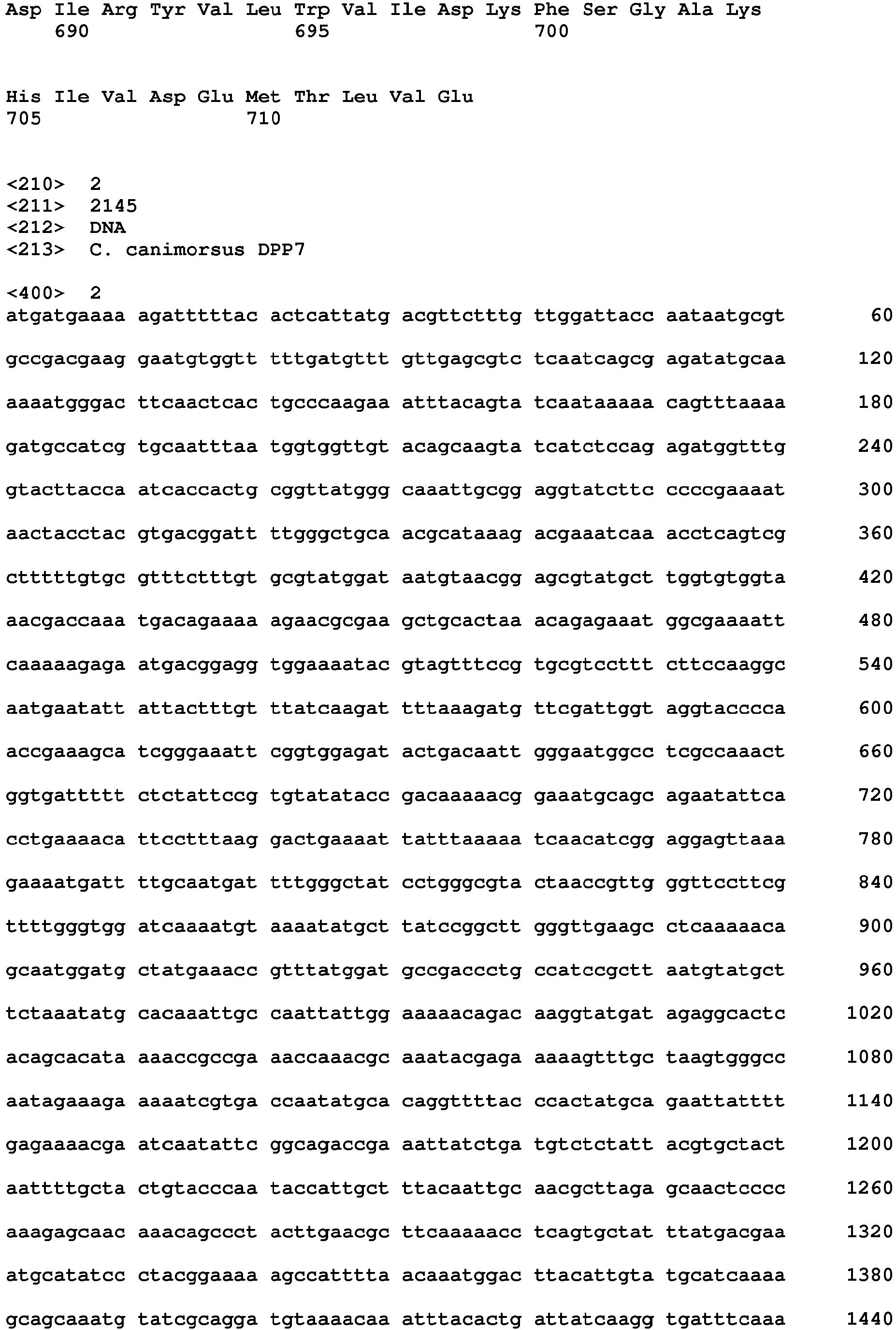


Claims (15)
- A DPP7 peptide, or functionally active variants or fragments thereof, for use in the cleavage and inactivation of coagulation factor X, VII and/or IX.
- The DPP7 peptide, or functionally active variants or fragments thereof, for use according to claim 1, in the treatment and/or prevention of a medical disorder chosen from the list comprising thromboembolism caused by atrial fibrillation, pulmonary embolism, deep vein thrombosis, venous thromboembolism, congestive heart failure, stroke, coronary syndrome, peripheral arterial occlusion, myocardial infarction and/or genetic or acquired hypercoagulability.
- In vitro use of a DPP7 peptide, or functionally active variants or fragments thereof, in the cleavage and inactivation of coagulation factor X, VII and/or IX.
- In vitro use of the DPP7 peptide, or functionally active variants or fragments thereof, according to claim 3, for producing an anticoagulant reversal agent, wherein said anticoagulant is a factor X(a), VII(a) or IX(a) inhibitor.
- In vitro use of the DPP7 peptide, or functionally active variants or fragments thereof, according to claim 3, for depleting a plasma sample of coagulation factor X, VII and/or IX.
- In vitro use of the DPP7 peptide, or functionally active variants or fragments thereof, according to claim 3, in medical devices.
- The DPP7 peptide, or functionally active variants or fragments thereof, for use according to claim 1 or 2, or the in vitro use of the DPP7 peptide, or functionally active variants or fragments thereof, according to claim 3 or 6, as an anticoagulant and, optionally wherein said DPP7 peptide is bacterial DPP7, preferably Porphyromonas gingivalis DPP7, Capnocytophaga canimorsus DPP7, Capnocytophaga canis nov. sp. DPP7 or Capnocytophaga cynodegmi DPP7, more preferably Capnocytophaga canimorsus DPP7.
- The DPP7 peptide for use according any one of claims 1, 2 or 7, or the in vitro use of the DPP7 peptide according to any one of claims 3 to 7; wherein said peptide comprises an amino acid sequence which has at least 90%, preferably at least 95%, most preferably 100% identity with the amino acid sequence set forth in SEQ ID NO:1, or functionally active variants or fragments thereof.
- The DPP7 peptide for use according any one of claims 1, 2, 7 or 8, or the in vitro use of the DPP7 peptide according to any one of claims 3 to 8; wherein said peptide comprises:(a) an amino acid sequence which has at least 90%, preferably at least 95%, most preferably 100% identity with the amino acid sequence set forth in SEQ ID NO: 3 or 6, comprising a histidine at an amino acid position corresponding to the position of amino acid 86 of the DPP7 polypeptide as set forth in SEQ ID NO: 1,(b) an amino acid sequence which has at least 90%, preferably at least 95%, most preferably 100% identity with the amino acid sequence set forth in SEQ ID NO: 4, comprising an aspartic acid at an amino acid position corresponding to the position of amino acid 193 of the DPP7 polypeptide as set forth in SEQ ID NO: 1, and/or(c) an amino acid sequence which has at least 90%, preferably at least 95%, most preferably 100% identity with the amino acid sequence set forth in SEQ ID NO: 5 or 7, comprising a serine at an amino acid position corresponding to the position of amino acid 649 of the DPP7 polypeptide as set forth in SEQ ID NO: 1 and a glycine at an amino acid position corresponding to the position of amino acid 667 of the DPP7 polypeptide as set forth in SEQ ID NO: 1 ;or functionally active variants or fragments thereof.
- A kit comprising a DPP7 peptide, or functionally active variants or fragments thereof, wherein said peptide or functionally active variants or fragments thereof, has anticoagulant activity, preferably by inhibiting clotting factor X, VII and/or FIX, preferably wherein said DPP7 peptide comprises an amino acid sequence which has at least 90%, preferably at least 95%, most preferably 100% identity with the amino acid sequence set forth in SEQ ID NO:1, or functionally active variants or fragments thereof.
- A kit comprising one or more plasma samples depleted of coagulation factor X, VII and/or IX, wherein said one or more plasma samples are depleted of coagulation factor X, VII and/or IX using a DPP7 peptide or functionally active variants or fragments thereof.
- A nucleic acid construct comprising a nucleic acid sequence which(a) has at least 90%, preferably at least 95%, most preferably 100% identity with the nucleic acid sequence set forth in SEQ ID NO:2, and/or encodes a peptide comprising:(b) an amino acid sequence which has at least 90%, preferably at least 95%, most preferably 100% identity with the amino acid sequence set forth in SEQ ID NO: 3 or 6, comprising a histidine at an amino acid position corresponding to the position of amino acid 86 of the DPP7 polypeptide as set forth in SEQ ID NO: 1,(c) an amino acid sequence which has at least 90%, preferably at least 95%, most preferably 100% identity with the amino acid sequence set forth in SEQ ID NO: 4, comprising an aspartic acid at an amino acid position corresponding to the position of amino acid 193 of the DPP7 polypeptide as set forth in SEQ ID NO: 1, and/or(d) an amino acid sequence which has at least 90%, preferably at least 95%, most preferably 100% identity with the amino acid sequence set forth in SEQ ID NO: 5 or 7, comprising a serine at an amino acid position corresponding to the position of amino acid 649 of the DPP7 polypeptide as set forth in SEQ ID NO: 1 and a glycine at an amino acid position corresponding to the position of amino acid 667 of the DPP7 polypeptide as set forth in SEQ ID NO: 1,operably linked to one or more control sequences capable of directing the expression of the polypeptide in a suitable expression host.
- A recombinant expression vector comprising the nucleic acid construct of claim 12, a promoter, and transcriptional, translational stop signals, and preferably, a selectable marker.
- A recombinant host cell comprising the nucleic acid construct of claim 12, preferably contained on a vector or integrated into the host cell genome; optionally, wherein the host cell is a bacterial cell, preferably Escherichia Coli, Porphyromonas gingivalis, Capnocytophaga canimorsus, Capnocytophaga canis or Capnocytophaga cynodegmi, Flavobacterium johnsoniae, more preferably Capnocytophaga canimorsus.
- A method for producing a polypeptide having protease activity comprising (a) cultivating the host cell of claim 14 under conditions conducive to expression of the polypeptide; and (b) recovering the polypeptide.
Priority Applications (1)
| Application Number | Priority Date | Filing Date | Title |
|---|---|---|---|
| EP16177150.6A EP3263700A1 (en) | 2016-06-30 | 2016-06-30 | Uses of dipeptidyl peptidase 7 (dpp7) polypeptide |
Applications Claiming Priority (1)
| Application Number | Priority Date | Filing Date | Title |
|---|---|---|---|
| EP16177150.6A EP3263700A1 (en) | 2016-06-30 | 2016-06-30 | Uses of dipeptidyl peptidase 7 (dpp7) polypeptide |
Publications (1)
| Publication Number | Publication Date |
|---|---|
| EP3263700A1 true EP3263700A1 (en) | 2018-01-03 |
Family
ID=56345018
Family Applications (1)
| Application Number | Title | Priority Date | Filing Date |
|---|---|---|---|
| EP16177150.6A Withdrawn EP3263700A1 (en) | 2016-06-30 | 2016-06-30 | Uses of dipeptidyl peptidase 7 (dpp7) polypeptide |
Country Status (1)
| Country | Link |
|---|---|
| EP (1) | EP3263700A1 (en) |
Citations (3)
| Publication number | Priority date | Publication date | Assignee | Title |
|---|---|---|---|---|
| US5118614A (en) * | 1988-01-18 | 1992-06-02 | Tessek Sdruzeni Praha | Concentrates of coagulation factors ii, vii, ix and x, method of their preparation and use |
| WO2002038742A2 (en) * | 2000-11-08 | 2002-05-16 | The University Of Georgia Research Foundation, Inc. | Dipeptidylpeptidases and methods of use |
| WO2004104215A2 (en) * | 2003-05-21 | 2004-12-02 | Bayer Healthcare Ag | Diagnostics and therapeutics for diseases associated with dipeptidylpeptidase 7 (dpp7) |
-
2016
- 2016-06-30 EP EP16177150.6A patent/EP3263700A1/en not_active Withdrawn
Patent Citations (3)
| Publication number | Priority date | Publication date | Assignee | Title |
|---|---|---|---|---|
| US5118614A (en) * | 1988-01-18 | 1992-06-02 | Tessek Sdruzeni Praha | Concentrates of coagulation factors ii, vii, ix and x, method of their preparation and use |
| WO2002038742A2 (en) * | 2000-11-08 | 2002-05-16 | The University Of Georgia Research Foundation, Inc. | Dipeptidylpeptidases and methods of use |
| WO2004104215A2 (en) * | 2003-05-21 | 2004-12-02 | Bayer Healthcare Ag | Diagnostics and therapeutics for diseases associated with dipeptidylpeptidase 7 (dpp7) |
Non-Patent Citations (12)
| Title |
|---|
| ALTSCHUL ET AL., J MOL BIOL, vol. 215, 1990, pages 403 - 10 |
| BAUGH ET AL.: "Role of the activation peptide domain in human factor X activation by the extrinsic Xase complex", J BIOL CHEM. 1996, vol. 271, 1996, pages 16126 - 34, XP002522139, DOI: doi:10.1074/jbc.271.27.16126 |
| DATABASE UniProt [online] 19 October 2011 (2011-10-19), "SubName: Full=Uncharacterized protein {ECO:0000313|EMBL:AEK22972.1};", XP002763878, retrieved from EBI accession no. UNIPROT:F9YUB7 Database accession no. F9YUB7 * |
| DUFFY ET AL.: "Intrinsic pathway activation of factor X and its activation peptide-deficient derivative, factor Xdes-143-191", J BIOL CHEM., vol. 267, 1992, pages 7821 - 7, XP001317205 |
| GUSTAVO ARRUDA BEZERRA ET AL: "Structures of Human DPP7 Reveal the Molecular Basis of Specific Inhibition and the Architectural Diversity of Proline-Specific Peptidases", PLOS ONE, vol. 7, no. 8, E43019, 29 August 2012 (2012-08-29), pages 1 - 13, XP055316788, DOI: 10.1371/journal.pone.0043019 * |
| HARUKA NISHIMATA ET AL: "Identification of Dipeptidyl-Peptidase (DPP)5 and DPP7 in Porphyromonas endodontalis, Distinct from Those in Porphyromonas gingivalis", PLOS ONE, vol. 9, no. 12, E114221, 10 December 2014 (2014-12-10), pages 1 - 15, XP055316786, DOI: 10.1371/journal.pone.0114221 * |
| HENIKOFF ET AL., PROC. NATL. ACAD. SCI., vol. 89, 1992, pages 10915 - 10919 |
| ROSENBLUM J S ET AL: "Prolyl peptidases: A serine protease subfamily with high potential for drug discovery", CURRENT OPINION IN CHEMICAL BIOLOGY, CURRENT BIOLOGY LTD, LONDON, GB, vol. 7, no. 4, 1 August 2003 (2003-08-01), pages 496 - 504, XP002329208, ISSN: 1367-5931, DOI: 10.1016/S1367-5931(03)00084-X * |
| ROUF ET AL.: "Discrimination based on Gly and Arg/Ser at position 673 between dipeptidyl-peptidase (DPP) 7 and DPP11, widely distributed DPPs in pathogenic and environmental gram-negative bacteria", BIOCHEMIE, vol. 95, 2013, pages 824 - 832, XP028994614, DOI: doi:10.1016/j.biochi.2012.11.019 |
| ROUF SHAKH M A ET AL: "Discrimination based on Gly and Arg/Ser at position 673 between dipeptidyl-peptidase (DPP) 7 and DPP11, widely distributed DPPs in pathogenic and environmental gram-negative bacteria", BIOCHIMIE, MASSON, PARIS, FR, vol. 95, no. 4, 12 December 2012 (2012-12-12), pages 824 - 832, XP028994614, ISSN: 0300-9084, DOI: 10.1016/J.BIOCHI.2012.11.019 * |
| SAKAMOTO YASUMITSU ET AL: "Structural and mutational analyses of dipeptidyl peptidase 11 from Porphyromonas gingivalis reveal the molecular basis for strict substrate specificity.", SCIENTIFIC REPORTS, vol. 5, 11151, 9 June 2015 (2015-06-09), pages 1 - 16, XP002763879, ISSN: 2045-2322, DOI: 0.1038/srep11151 * |
| TATUSOVA; MADDEN, FEMS MICROBIOL LETT, vol. 174, 1999, pages 247 - 250 |
Similar Documents
| Publication | Publication Date | Title |
|---|---|---|
| Crawley et al. | Proteolytic inactivation of ADAMTS13 by thrombin and plasmin | |
| US8338568B2 (en) | Chimeric PCSK9 proteins, cells comprising same, and assays using same | |
| EP1346034B1 (en) | VON WILLEBRAND FACTOR (vWF) CLEAVING PROTEASE POLYPEPTIDE, NUCLEIC ACID ENCODING THE POLYPEPTIDE AND USE OF POLYPEPTIDE | |
| US5716834A (en) | Cloned factor C cDNA of the Singapore horseshoe crab, Carcinoscorpius rotundicauda and purification of factor C proenzyme | |
| EP3044322A1 (en) | Bimolecular protease-based biosensor | |
| Kuliopulos et al. | Localization of the affinity peptide-substrate inactivator site on recombinant vitamin K-dependent carboxylase. | |
| Verweij et al. | Proteolytic cleavage of the precursor of von Willebrand factor is not essential for multimer formation. | |
| Filippovich et al. | Cloning and functional expression of venom prothrombin activator protease from Pseudonaja textilis with whole blood procoagulant activity | |
| DK2152735T3 (en) | METHOD FOR PRODUCING mature VWF FROM VWF PRO-PEPTIDE | |
| CN110724202A (en) | ADAMTS13 substrate with histidine tag as well as preparation method and application thereof | |
| CN120887998A (en) | Environmentally responsive anticoagulant fusion protein rHTA and its application | |
| EP3263700A1 (en) | Uses of dipeptidyl peptidase 7 (dpp7) polypeptide | |
| JP2010527588A5 (en) | ||
| JP2013517782A (en) | Factor VII fusion polypeptide | |
| CN105273072B (en) | Anticoagulant protein B26 of tick and its gene and application | |
| CN110627913A (en) | ADAMTS13 substrate with lysine tag and preparation method and application thereof | |
| US10954502B2 (en) | Thrombin-thrombomodulin fusion proteins as protein C activators | |
| JP2016525535A (en) | Insect metalloproteinase inhibitor | |
| US20260049292A1 (en) | Use of glycogen synthase kinase-3 (gsk3) as protease, and gsk3-based proteolysis-targeting chimera (protac) and preparation method and use thereof | |
| Fritz | On the 3D-structures of Meprin α and β, and the role of oligomerization for stability and activity of Meprin α | |
| Cooke | Characterisation of Cellular Fibrinogen Phosphorylation and its Functional Implications in Clot Formation | |
| WO2020028886A1 (en) | Protein c-factor vii chimeras | |
| CN101225112A (en) | A soluble fusion protein | |
| AU2012216707A1 (en) | Method for Producing Mature VWF From VWF Pro-peptide | |
| ZA200304741B (en) | Von willebrand factor (vWF) cleaving protease polypeptide, nucleic acid encoding the polypeptide and use of polypeptide. |
Legal Events
| Date | Code | Title | Description |
|---|---|---|---|
| PUAI | Public reference made under article 153(3) epc to a published international application that has entered the european phase |
Free format text: ORIGINAL CODE: 0009012 |
|
| AK | Designated contracting states |
Kind code of ref document: A1 Designated state(s): AL AT BE BG CH CY CZ DE DK EE ES FI FR GB GR HR HU IE IS IT LI LT LU LV MC MK MT NL NO PL PT RO RS SE SI SK SM TR |
|
| AX | Request for extension of the european patent |
Extension state: BA ME |
|
| STAA | Information on the status of an ep patent application or granted ep patent |
Free format text: STATUS: THE APPLICATION IS DEEMED TO BE WITHDRAWN |
|
| 18D | Application deemed to be withdrawn |
Effective date: 20180704 |