EP3263554A1 - Selective transfer hydrogenation of retinal to retinol - Google Patents
Selective transfer hydrogenation of retinal to retinol Download PDFInfo
- Publication number
- EP3263554A1 EP3263554A1 EP17184835.1A EP17184835A EP3263554A1 EP 3263554 A1 EP3263554 A1 EP 3263554A1 EP 17184835 A EP17184835 A EP 17184835A EP 3263554 A1 EP3263554 A1 EP 3263554A1
- Authority
- EP
- European Patent Office
- Prior art keywords
- signifies
- transfer hydrogenation
- alkyl
- group
- formula
- Prior art date
- Legal status (The legal status is an assumption and is not a legal conclusion. Google has not performed a legal analysis and makes no representation as to the accuracy of the status listed.)
- Granted
Links
- 0 *C(*)(*)*C(*)(*)NS(*)(=O)=O Chemical compound *C(*)(*)*C(*)(*)NS(*)(=O)=O 0.000 description 3
- HFPZCAJZSCWRBC-UHFFFAOYSA-N CC(C)c1ccc(C)cc1 Chemical compound CC(C)c1ccc(C)cc1 HFPZCAJZSCWRBC-UHFFFAOYSA-N 0.000 description 1
- FPIPGXGPPPQFEQ-OVSJKPMPSA-N CC1(C)C(/C=C/C(/C)=C/C=C/C(/C)=C/CO)=C(C)CCC1 Chemical compound CC1(C)C(/C=C/C(/C)=C/C=C/C(/C)=C/CO)=C(C)CCC1 FPIPGXGPPPQFEQ-OVSJKPMPSA-N 0.000 description 1
- WQIQNKQYEUMPBM-UHFFFAOYSA-N CC1C(C)=C(C)C(C)=C1C Chemical compound CC1C(C)=C(C)C(C)=C1C WQIQNKQYEUMPBM-UHFFFAOYSA-N 0.000 description 1
Classifications
-
- C—CHEMISTRY; METALLURGY
- C07—ORGANIC CHEMISTRY
- C07C—ACYCLIC OR CARBOCYCLIC COMPOUNDS
- C07C403/00—Derivatives of cyclohexane or of a cyclohexene or of cyclohexadiene, having a side-chain containing an acyclic unsaturated part of at least four carbon atoms, this part being directly attached to the cyclohexane or cyclohexene or cyclohexadiene rings, e.g. vitamin A, beta-carotene, beta-ionone
- C07C403/06—Derivatives of cyclohexane or of a cyclohexene or of cyclohexadiene, having a side-chain containing an acyclic unsaturated part of at least four carbon atoms, this part being directly attached to the cyclohexane or cyclohexene or cyclohexadiene rings, e.g. vitamin A, beta-carotene, beta-ionone having side-chains substituted by singly-bound oxygen atoms
- C07C403/08—Derivatives of cyclohexane or of a cyclohexene or of cyclohexadiene, having a side-chain containing an acyclic unsaturated part of at least four carbon atoms, this part being directly attached to the cyclohexane or cyclohexene or cyclohexadiene rings, e.g. vitamin A, beta-carotene, beta-ionone having side-chains substituted by singly-bound oxygen atoms by hydroxy groups
-
- C—CHEMISTRY; METALLURGY
- C07—ORGANIC CHEMISTRY
- C07C—ACYCLIC OR CARBOCYCLIC COMPOUNDS
- C07C2601/00—Systems containing only non-condensed rings
- C07C2601/12—Systems containing only non-condensed rings with a six-membered ring
- C07C2601/16—Systems containing only non-condensed rings with a six-membered ring the ring being unsaturated
Definitions
- the present invention relates to a selective transfer hydrogenation of retinal to retinol.
- Retinal is also called retinaldehyde or vitamin A aldehyde.
- Retinol also vitamin A 1
- Retinol is one form of vitamin A. It is a diterpenoid and an alcohol. It is convertible to other forms of vitamin A, and the retinyl ester derivative of the alcohol serves as the storage form of the vitamin in animals.
- Retinal (IUPAC:3,7-dimethyl-9-(2,6,6-trimethylcyclohexen-1-yl)nona-2,4,6,8-tetraenal) is the compound of formula (I)
- Retinol (IUPAC: 3,7-dimethyl-9-(2,6,6-trimethylcyclohex-1-enyl)nona-2,4,6,8-tetraen-1-ol) is the compound of formula (II)
- Retinol is an important precursor of vitamin A acetate (or retinyl acetate), Retinyl acetate (retinol acetate, vitamin A acetate) is a stable form of vitamin A which is the acetate ester of retinol. It has potential antineoplastic and chemopreventive activities.
- Retinal as well as retinol can have various isomeric configurations.
- the formula (I) as well as formula (II) are to be understood in the way that they cover all these configurations. Most preferred configuration is (all-E)-retinal/retinol. Other isomers can be converted into (all-E), when needed.
- the goal of the present invention was to find an improved way to provide retinol (compound of formula (II)), which is the selectively hydrogenated product of retinal.
- the present invention relates to a transfer hydrogenation (TH) of a compound of formula (I) to a compound of formula (II) characterized in that the hydrogenation is carried out in the presence of
- a preferred transfer hydrogenation is (TH), characterized in that the hydrogenation is carried out in the absence of water.
- the water content is usually below 3 weight-% (wt-%), preferably less than 2 wt-%, based on the total weight of the reaction solution.
- the selectivity, the yield and the conversion of the transfer hydrogenation according to the present invention are excellent.
- the monosulphonylated diamine is present in the complex as a monoanion and is accordingly denoted in formula III as "Z-(-H)".
- amino-amide transition metal catalyst it is meant that the transition metal is complexed to Z via the amine and the amide of Z.
- Transfer hydrogenation is the addition of hydrogen to a compound (molecule) from a source other than gaseous H 2 .
- H 2 gas has some issues with the handling of the explosive gas in regard to safety and in regard to the apparatus needed.
- H 2 donor system is used for transfer hydrogenation. Any H 2 donor system known from the prior art can be used.
- a further embodiment of the present invention is a transfer hydrogenation (TH 2 ), which is (TH) or (TH 1 ), wherein the hydrogenation is carried out by using at least one solvent which also serves as hydrogen donor.
- a further embodiment of the present invention is a transfer hydrogenation (TH 3 ), which is (TH) or (TH 1 ), wherein the hydrogenation is carried out by using at least one hydrogen donor and at least one inert solvent.
- the solvent there can be used especially alcohols, preferably secondary alcohols, e.g. isopropanol.
- a further embodiment of the present invention is a transfer hydrogenation (TH 4 ), which is (TH), (TH 1 ) or (TH 2 ), wherein the hydrogenation is carried out by using isopropanol as hydrogen donor and solvent.
- mixtures of hydrogen donors with an inert solvent there are conveniently used mixtures of alcohols with inert solvents, preferably a mixture of an alcohol with a lower aliphatic halogenated hydrocarbon, e.g. methylene chloride or 1,2-dichloroethane.
- suitable hydrogen donor/solvent mixtures are mixtures of formic acid with an inert solvent or a salt of formic acid with an inert solvent.
- Suitable inert solvents are i.e. hydrocarbons, esters, alcohol and ethers.
- Suitable salts of formic acids are any commonly known salts.
- Preferred salts are those of the following formula (VI) QOOCH (VI), wherein Q is an alkali cation or NH 4 + , NH 3 (R 7 ), NH 2 (R 7 ) 2 + , NH(R 7 ) 3 + or N(R 7 ) 4 + , wherein all R 7 are independently from each other -CH 3 or -CH 2 CH 3 .
- Q is Na + , K + , NH 4 + , more preferably Q is K + .
- a further embodiment of the present invention is a transfer hydrogenation (TH 5 ), which is (TH), (TH 1 ) or (TH 3 ), wherein the hydrogenation is carried out by using formic acid (or a salt of formic acid QOOCH) and triethylamine and wherein Q is an alkali cation or NH 4 + , NH 3 (R 7 ) + , NH 2 (R 7 ) 2 +, NH(R 7 ) 3 + or N(R 7 ) 4 + , wherein all R 7 are independently from each other -CH 3 or -CH 2 CH 3 .
- a further embodiment of the present invention is a transfer hydrogenation (TH 5' ), which is (TH 5 ), wherein Q is Na + , K + , NH 4 + .
- a further embodiment of the present invention is a transfer hydrogenation (TH 5" ), which is (TH 5 ), wherein Q is K + .
- ratio is from 1:1 to 10:1, preferably 1:1 to 6:1 (by molar ratio).
- a further embodiment of the present invention is a transfer hydrogenation (TH 6 ), which is (TH), (TH 1 ), (TH 3 ), (TH 5 ), (TH 5' ) or (TH 5" ), wherein a mixture of QOOCH and (CH 3 CH 2 ) 3 N wherein Q is an alkali cation or NH 4 + , NH 3 (R 7 ) + , NH 2 (R 7 ) 2 + , NH(R 7 ) 3 + or N(R 7 ) 4+ , wherein all R 7 are independently from each other-CH 3 or-CH 2 CH 3 , is used in a ratio from 1:1 to 10:1, preferably 1:1 to 6:1.
- substituted with one or more fluorine atoms means having at least one fluorine substituent to as many fluorines as the alkyl group so modified is capable of accepting; however one to five fluorines is preferred.
- alkyl embraces straight-chain or branched alkyl groups with 1 to 6 carbon atoms, preferably 1 to 4 carbon atoms.
- Methyl, ethyl, propyl, isopropyl, n-butyl, isobutyl and tert.-butyl, are examples such alkyl groups.
- Trifluromethyl, 2,2,2-trifluoroethyl and pentafluoroethyl are examples of mono- or multiply-fluorinated alkyl groups.
- alkenyl embraces straight-chain or branched alkenyl groups with 2 to 8 carbon atoms, preferably 2 to 6 carbon atoms, e.g. allyl, 2-butenyl and 3-butenyl.
- alkynyl signifies a straight-chain or branched alkynyl group with one triple bond and 2 to 8 carbon atoms, preferably 2 to 6 carbon atoms, e.g. propynyl and butynyl.
- cycloalkyl signifies a 4- to 7-membered alicyclic group, namely cyclobutyl, cyclopentyl, cyclohexyl or cycloheptyl, of which cyclopentyl and cyclohexyl are preferred.
- unsubstituted or substituted aryl or equally "aryl which may be substituted” or “optionally mono- or multiply-substituted aryl” preferably embraces a phenyl or naphthyl group, which can be unsubstituted, mono-substituted or multiply-substituted.
- substitutents come into consideration e.g. phenyl, halogen and straight-chain and branched alkyl and alkoxy groups with in each case 1 to 5 carbon atoms, whereby the multiply-substituted phenyl or naphthyl groups can have the same or different substituents.
- alkyl and alkoxy groups the methyl and, respectively, methoxy group is preferred.
- optionally substituted aryl groups are phenyl, chloro-, bromo- and fluorophenyl, tolyl, anisyl, as well as naphthyl. The place of the substitution can be at any position of the aromatic ring.
- heteroaryl embraces 5- or 6-membered heterocyclic groups featuring O, S or N as a ring member, i.e. heteroatom, such as, for example, furyl, thienyl, benzofuryl, dibenzofuryl, xanthenyl, pyrrolyl and pyridinyl.
- heteroatom such as, for example, furyl, thienyl, benzofuryl, dibenzofuryl, xanthenyl, pyrrolyl and pyridinyl.
- the heterocyclic groups featuring O as the heteroatom are especially preferred.
- a preferred embodiment of the present invention relates to a transfer hydrogenation of retinal, wherein the catalyst of formula (III)
- a further embodiment of the present invention is a transfer hydrogenation (TH 7 ), which is (TH), (TH 1 ), (TH 2 ), (TH 3 ), (TH 4 ), (TH 5 ), (TH 5' ), (TH 5" ) or (TH 6 ), wherein the catalyst is a compound of formula (III) MX[Z-(-H)][Y], wherein
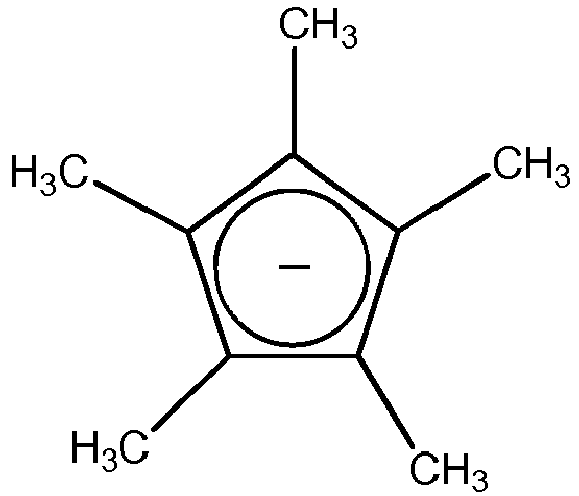
- Y is chosen from the group consisting of pentamethylcyclopentadienyl, benzene, p-cymene, toluene, anisole, xylene, 1,3,5-trimethylbenzene, p-dicyclohexylbenzene, naphthalene and tetralin.
- a further embodiment of the present invention is a transfer hydrogenation (TH 8 ), which is (TH), (TH 1 ), (TH 2 ), (TH 3 ), (TH 4 ), (TH 5 ), (TH 5' ), (TH 5" ), (TH 6 ) or (TH 7 ), wherein the ligand Y in the catalyst of formula (III) is chosen from the group consisting of pentamethylcyclopentadienyl, benzene, p-cymene, toluene, anisole, xylene, 1,3,5-trimethylbenzene, p-dicyclohexylbenzene, naphthalene and tetralin.
- a more preferred embodiment of the present invention relates to a transfer hydrogenation of retinal, wherein the catalyst of formula (III)
- a further embodiment of the present invention is a transfer hydrogenation (TH 9 ), which is (TH), (TH 1 ), (TH 2 ), (TH 3 ), (TH 4 ), (TH 5 ), (TH 5' ), (TH 5" ), (TH 6 ), (TH 1 ) or (TH 8 ), wherein wherein the catalyst of formula (III)
- a further embodiment of the present invention is a transfer hydrogenation ((TH 10 ), which is (TH 9 ), wherein the ligand Y in the catalyst of formula (III) is chosen from the group consisting of pentamethylcyclopentadienyl, benzene, p-cymene, toluene, anisole, xylene, 1,3,5-trimethylbenzene, p-dicyclohexylbenzene, naphthalene and tetralin.
- the present invention also relates to preferred transfer hydrogenations wherein the catalyst is of formula (III') wherein
- a further embodiment of the present invention is a transfer hydrogenation (TH 11 ), which is (TH), (TH 1 ), (TH 2 ), (TH 3 ), (TH 4 ), (TH 5 ), (TH 5' ), (TH 5" ), (TH 6 ), (TH 7 ), (TH 8 ), (TH 9 ) or (TH 10 ), wherein the catalyst is of formula (III') wherein
- Preferred transfer hydrogenations according to the present invention are such wherein the following catalysts are used: wherein Y is an aromatic ligand chosen from the group consisting of
- a further embodiment of the present invention is a transfer hydrogenation (TH 12 ), which is (TH), (TH 1 ), (TH 2 ), (TH 3 ), (TH 4 ), (TH 5 ), (TH 5' ), (TH 5" ), (TH 6 ), (TH 7 ), (TH 8 ), (TH 9 ), (TH 10 ) or (TH 11 ), wherein the catalyst is chosen from the group consisting of wherein Y is an aromatic ligand chosen from the group consisting of
- More preferred transfer hydrogenations according to the present invention are such wherein the following catalysts are used: and wherein Y is an aromatic ligand chosen from the group consisting of
- a further embodiment of the present invention is a transfer hydrogenation (TH 13 ), which is (TH), (TH 1 ), (TH 2 ), (TH 3 ), (TH 4 ), (TH 5 ), (TH 5' ), (TH 5" ), (TH 6 ), (TH 7 ), (TH 8 ), (TH 9 ), (TH 10 ), (TH 11 ) or (TH 12 ), wherein the catalyst is chosen from the group consisting of and wherein Y is an aromatic ligand chosen from the group consisting of
- the catalyst is prepared in situ starting from a metal precursor complex and various ligands: 0.5 Mol [M(Y)X 2 ] 2 and 1 Mol Z, which is as stated above represented by formula (IV) or formula (V) are mixed to form the catalyst. All the substituents (in formula (IV) and in formula (V)) have the same meanings as defined above as well as the same preferences.
- the reaction temperature of the process of production of the catalyst (compound of formula (III)) is usually 0 - 100°C.
- the reactants are usually mixed for a period of time and then all the reactants for the selective transfer hydrogenation of the present invention are added and the necessary reaction conditions of the hydrogenation are applied.
- the selective transfer hydrogenation reaction is usually carried out at a temperature of 0 - 100 °C, preferably 25 - 90°C.
- a further embodiment of the present invention is a transfer hydrogenation (TH 14 ), which is (TH), (TH 1 ), (TH 2 ), (TH 3 ), (TH 4 ), (TH 5 ), (TH 5' ), (TH 5" ), (TH 6 ), (TH 7 ), (TH 8 ), (TH 9 ), (TH 10 ), (TH 11 ), (TH 12 ) or (TH 13 ), wherein the transfer hydrogenation reaction is carried out at a temperature of 0 - 100 °C, preferably 25 - 90 °C.
- the selective transfer hydrogenation reaction is usually carried out at a normal (ambient) pressure. It could also been carried out at elevated and preferably at reduced pressure. Usually the transfer hydrogenation according to the present invention is carried out at a pressure of 50 - 1000 mbar.
- a further embodiment of the present invention is a transfer hydrogenation (TH 15 ), which is (TH), (TH 1 ), (TH 2 ), (TH 3 ), (TH 4 ), (TH 5 ), (TH 5' ), (TH 5" ), (TH 6 ), (TH 7 ), (TH 8 ), (TH 9 ), (TH 10 ), (TH 11 ), (TH 12 ), (TH 13 ) or (TH 14 ), wherein the transfer hydrogenation reaction is carried out at a pressure of 50 - 1000 mbar.
- the substrate to catalyst ratio (s/c ratio) in the selective transfer hydrogenation is usually from 20:1 to 10000:1, preferably 50:1 to 1000:1. This ratio is related to mol. Mol of substrate (which is compound of formula (I)) to mol of catalyst (compound of formula (III)).
- a further embodiment of the present invention is a transfer hydrogenation (TH 16 ), which is (TH), (TH 1 ), (TH 2 ), (TH 3 ), (TH 4 ), (TH 5 ), (TH 5' ), (TH 5" ), (TH 6 ), (TH 7 ), (TH 8 ), (TH 9 ), (TH 10 ), (TH 11 ), (TH 12 ), (TH 13 ), (TH 14 ) or (TH 15 ), wherein molar substrate to catalyst ratio (s/c ratio) is from 20:1 to 10000:1, preferably from 50:1 to 1000:1.
- the transfer hydrogenation according to the present invention allows obtaining retinol in excellent yield.
- the retinol which is obtained by the transfer hydrogenation according to the present invention can be used as such or in further application as well as a starting material for further synthesis.
- the solvent was ethyl acetate, isopropanol or methanol.
- the crude product (325 mg) was obtained as dark brown oil and was purified by column chromatography [SiO 2 60 (10 g), cyclohexane/ethyl acetate 8:2].
- the purified retinol was obtained in 83% yield and 75.2% purity at 97% conversion.
- Table 1 a For further results see Table 1 a.
- a stock solution of the catalyst was prepared as follows: 41.4 mg of catalyst C1 were weighed into a glass vial with magnetic stir bar. The vial was capped with a septum and flushed with argon. Then, 900 ⁇ l of dichloromethane and a solution of 41.1 mg of sodium formate in 465 ⁇ l of deionized water were added. The biphasic mixture was warmed to 35 °C in a water-bath and stirred for 30 min. After phase separation, samples of the organic phase were used as active catalyst solution for several reactions on the same day.
- the reaction mixture was cooled to r.t., transferred into a separating funnel with -150 ml of diethyl ether and extracted three times with -50 ml of deionized water.
- Table 1a with Cat C1 and Formic acid / triethylamine (ratio1:1) as red agent and dichloromethane as solvent
- Example Conc. [ml/mmol] s/c T [°C] t [h]
- Procedure Conv. [%] Yield [%] 2 4.0 20 23 2.2 A >99.9 87.1
- Table 1b with Cat C1 and i-propanol / sodium formate as red agent and i-propanol as solvent Example Conc. [ml/mmol] s/c T [°C] t [h] Procedure Conv.
- the catalyst is formed in situ.
- the following ligands have been used to form the catalyst in situ.
- the numbering of the ligands corresponds to the Examples they are used in.
Landscapes
- Chemical & Material Sciences (AREA)
- Organic Chemistry (AREA)
- Organic Low-Molecular-Weight Compounds And Preparation Thereof (AREA)
- Steroid Compounds (AREA)
- Low-Molecular Organic Synthesis Reactions Using Catalysts (AREA)
Abstract
Description
- The present invention relates to a selective transfer hydrogenation of retinal to retinol.
- Retinal is also called retinaldehyde or vitamin A aldehyde.
- Retinol (also vitamin A1) is one form of vitamin A. It is a diterpenoid and an alcohol. It is convertible to other forms of vitamin A, and the retinyl ester derivative of the alcohol serves as the storage form of the vitamin in animals.
- Retinal (IUPAC:3,7-dimethyl-9-(2,6,6-trimethylcyclohexen-1-yl)nona-2,4,6,8-tetraenal) is the compound of formula (I)

- Retinol (IUPAC: 3,7-dimethyl-9-(2,6,6-trimethylcyclohex-1-enyl)nona-2,4,6,8-tetraen-1-ol) is the compound of formula (II)

- Retinol is an important precursor of vitamin A acetate (or retinyl acetate), Retinyl acetate (retinol acetate, vitamin A acetate) is a stable form of vitamin A which is the acetate ester of retinol. It has potential antineoplastic and chemopreventive activities.
- Retinal as well as retinol can have various isomeric configurations. In the context of the present invention the formula (I) as well as formula (II) are to be understood in the way that they cover all these configurations. Most preferred configuration is (all-E)-retinal/retinol. Other isomers can be converted into (all-E), when needed.
- The goal of the present invention was to find an improved way to provide retinol (compound of formula (II)),

- Surprisingly we found that by using specific kinds of catalysts and reduction agents it is possible to hydrogenate retinal selectively by a transfer hydrogenation reaction whereas the selectivity, the conversion as well as the yield of the hydrogenation are excellent.
- The present invention relates to a transfer hydrogenation (TH) of a compound of formula (I)


- a) an amino-amide-transition-metal catalyst of formula (III)
MX[Z-(-H)][Y] (III)
wherein- M
- is a transition metal, preferably chosen from the group consisting of Ir, Rh and Ru, and
- X
- signifies H or a halogen atom, and
- Y
- signifies a ligand, preferably an aromatic ligand, and
- Z
- signifies a group of formula (IV) or (V)


- b) a H2 donor.
- A preferred transfer hydrogenation (TH1) is (TH), characterized in that the hydrogenation is carried out in the absence of water.
- This ("in the absence of water") means that water is not added intentionally to the reaction solution. The water content is usually below 3 weight-% (wt-%), preferably less than 2 wt-%, based on the total weight of the reaction solution.
- The selectivity, the yield and the conversion of the transfer hydrogenation according to the present invention are excellent.
- The monosulphonylated diamine is present in the complex as a monoanion and is accordingly denoted in formula III as "Z-(-H)".
- By the term "amino-amide transition metal catalyst" it is meant that the transition metal is complexed to Z via the amine and the amide of Z.
- Transfer hydrogenation is the addition of hydrogen to a compound (molecule) from a source other than gaseous H2.
The use of H2 gas has some issues with the handling of the explosive gas in regard to safety and in regard to the apparatus needed. - Instead of H2 gas a H2 donor system is used for transfer hydrogenation. Any H2 donor system known from the prior art can be used.
- The H2 donor (= reduction agent), which is used in the process according to the present invention, can be any commonly known H2 donor in the field of transfer hydrogenation.
- In principle a transfer hydrogenation can be carried out by using
- (option a) at least one solvent which also serves as hydrogen donor or
- (option b) at least one hydrogen donor and at least one inert solvent.
- Therefore a further embodiment of the present invention is a transfer hydrogenation (TH2), which is (TH) or (TH1), wherein the hydrogenation is carried out by using at least one solvent which also serves as hydrogen donor.
- Therefore a further embodiment of the present invention is a transfer hydrogenation (TH3), which is (TH) or (TH1), wherein the hydrogenation is carried out by using at least one hydrogen donor and at least one inert solvent.
- As the hydrogen donor and at the same time (option a) the solvent there can be used especially alcohols, preferably secondary alcohols, e.g. isopropanol.
- Therefore a further embodiment of the present invention is a transfer hydrogenation (TH4), which is (TH), (TH1) or (TH2), wherein the hydrogenation is carried out by using isopropanol as hydrogen donor and solvent.
- As mixtures of hydrogen donors with an inert solvent (option b) there are conveniently used mixtures of alcohols with inert solvents, preferably a mixture of an alcohol with a lower aliphatic halogenated hydrocarbon, e.g. methylene chloride or 1,2-dichloroethane. Other suitable hydrogen donor/solvent mixtures are mixtures of formic acid with an inert solvent or a salt of formic acid with an inert solvent.
Suitable inert solvents are i.e. hydrocarbons, esters, alcohol and ethers. - Suitable salts of formic acids are any commonly known salts. Preferred salts are those of the following formula (VI)
QOOCH (VI),
wherein
Q is an alkali cation or NH4 +, NH3(R7), NH2(R7)2 +, NH(R7)3 + or N(R7)4 +, wherein all R7 are independently from each other -CH3 or -CH2CH3.
Preferably Q is Na+, K+, NH4 +, more preferably Q is K+. - Therefore a further embodiment of the present invention is a transfer hydrogenation (TH5), which is (TH), (TH1) or (TH3), wherein the hydrogenation is carried out by using formic acid (or a salt of formic acid QOOCH) and triethylamine and wherein
Q is an alkali cation or NH4 +, NH3(R7)+, NH2(R7)2+, NH(R7)3 + or N(R7)4 +, wherein all R7 are independently from each other -CH3 or -CH2CH3. - Therefore a further embodiment of the present invention is a transfer hydrogenation (TH5'), which is (TH5), wherein Q is Na+, K+, NH4 +.
- Therefore a further embodiment of the present invention is a transfer hydrogenation (TH5"), which is (TH5), wherein Q is K+.
- When mixtures of hydrogen donors and inert solvents are used, in principle all mixture ratios can apply.
When a mixture of QOOCH and (CH3CH2)3N (=QOOCH/(CH3CH2)3N) is used then ratio is from 1:1 to 10:1, preferably 1:1 to 6:1 (by molar ratio). - Therefore a further embodiment of the present invention is a transfer hydrogenation (TH6), which is (TH), (TH1), (TH3), (TH5), (TH5') or (TH5"), wherein a mixture of QOOCH and (CH3CH2)3N wherein Q is an alkali cation or NH4 +, NH3(R7)+, NH2(R7)2 +, NH(R7)3 + or N(R7)4+, wherein all R7 are independently from each other-CH3 or-CH2CH3, is used in a ratio from 1:1 to 10:1, preferably 1:1 to 6:1.
- In the scope of the present invention the term "substituted with one or more fluorine atoms", otherwise expressed as "mono- or multiply-fluorinated", means having at least one fluorine substituent to as many fluorines as the alkyl group so modified is capable of accepting; however one to five fluorines is preferred.
- In the scope of the present invention the term "alkyl" embraces straight-chain or branched alkyl groups with 1 to 6 carbon atoms, preferably 1 to 4 carbon atoms. Methyl, ethyl, propyl, isopropyl, n-butyl, isobutyl and tert.-butyl, are examples such alkyl groups. Trifluromethyl, 2,2,2-trifluoroethyl and pentafluoroethyl are examples of mono- or multiply-fluorinated alkyl groups.
- The term "alkenyl" embraces straight-chain or branched alkenyl groups with 2 to 8 carbon atoms, preferably 2 to 6 carbon atoms, e.g. allyl, 2-butenyl and 3-butenyl.
- The term "alkynyl" signifies a straight-chain or branched alkynyl group with one triple bond and 2 to 8 carbon atoms, preferably 2 to 6 carbon atoms, e.g. propynyl and butynyl.
- The term "cycloalkyl" signifies a 4- to 7-membered alicyclic group, namely cyclobutyl, cyclopentyl, cyclohexyl or cycloheptyl, of which cyclopentyl and cyclohexyl are preferred.
- The term "unsubstituted or substituted aryl" or equally "aryl which may be substituted" or "optionally mono- or multiply-substituted aryl" preferably embraces a phenyl or naphthyl group, which can be unsubstituted, mono-substituted or multiply-substituted. As substitutents come into consideration e.g. phenyl, halogen and straight-chain and branched alkyl and alkoxy groups with in each case 1 to 5 carbon atoms, whereby the multiply-substituted phenyl or naphthyl groups can have the same or different substituents. Of the alkyl and alkoxy groups the methyl and, respectively, methoxy group is preferred. Examples of optionally substituted aryl groups are phenyl, chloro-, bromo- and fluorophenyl, tolyl, anisyl, as well as naphthyl. The place of the substitution can be at any position of the aromatic ring.
- The term "heteroaryl" embraces 5- or 6-membered heterocyclic groups featuring O, S or N as a ring member, i.e. heteroatom, such as, for example, furyl, thienyl, benzofuryl, dibenzofuryl, xanthenyl, pyrrolyl and pyridinyl. The heterocyclic groups featuring O as the heteroatom are especially preferred.
- A preferred embodiment of the present invention relates to a transfer hydrogenation of retinal, wherein the catalyst of formula (III)
- M
- is chosen from the group consisting of Ir, Rh and Ru, and
- X
- signifies H or a halogen atom, and
- Y
- signifies an aromatic ligand, preferably a 6π electrons aromatic system-ligand, and
- Z
- signifies a group of formula (IV) or (V)
- R1 signifies C1-C2-alkyl which may be substituted with one or more fluorine atoms, C2-C6-alkenyl, C2-C6-alkynyl, C4-C7-cycloalkyl, aryl which may be substituted, heteroaryl, or camphor-10-yl, and
- R2 and R3 each independently signify hydrogen, C1-C2-alkyl, C4-C7-cycloalkyl, or aryl which may be substituted, and
- R4 signifies hydrogen or C1-C2-alkyl, and
- R5 signifies hydrogen or C1-C2-alkyl, and
- R6 signifies hydrogen or C1-C2-alkyl, and
- n signifies 0,1,2 or 3, and
- m signifies 0,1,2 or 3,and
- with the proviso that in formula (V) the sum of n and m is 3 or 4.
- Therefore a further embodiment of the present invention is a transfer hydrogenation (TH7), which is (TH), (TH1), (TH2), (TH3), (TH4), (TH5), (TH5'), (TH5") or (TH6), wherein the catalyst is a compound of formula (III) MX[Z-(-H)][Y], wherein
- M
- is chosen from the group consisting of Ir, Rh and Ru, and
- X
- signifies H or a halogen atom, and
- Y
- signifies an aromatic ligand, 6π electrons aromatic system-ligand, and
- Z
- signifies a group of formula (IV) or (V)
- R1 signifies C1-C2-alkyl which may be substituted with one or more fluorine atoms, C2-C6-alkenyl, C2-C6-alkynyl, C4-C7-cycloalkyl, aryl which may be substituted, heteroaryl, or camphor-10-yl, and
- R2 and R3 each independently signify hydrogen, C1-C2-alkyl, C4-C7-cycloalkyl,or aryl which may be substituted, and
- R4 signifies hydrogen or C1-C2-alkyl, and
- R5 signifies hydrogen or C1-C2-alkyl, and
- R6 signifies hydrogen or C1-C2-alkyl, and
- n signifies 0,1,2 or 3, and
- m signifies 0,1,2 or 3, and
- with the proviso that in formula (V) the sum of n and m is 3 or 4.
- In the catalyst of formula (III) preferably Y is chosen from the group consisting of pentamethylcyclopentadienyl, benzene, p-cymene, toluene, anisole, xylene, 1,3,5-trimethylbenzene, p-dicyclohexylbenzene, naphthalene and tetralin.
- Therefore a further embodiment of the present invention is a transfer hydrogenation (TH8), which is (TH), (TH1), (TH2), (TH3), (TH4), (TH5), (TH5'), (TH5"), (TH6) or (TH7), wherein the ligand Y in the catalyst of formula (III) is chosen from the group consisting of pentamethylcyclopentadienyl, benzene, p-cymene, toluene, anisole, xylene, 1,3,5-trimethylbenzene, p-dicyclohexylbenzene, naphthalene and tetralin.
- A more preferred embodiment of the present invention relates to a transfer hydrogenation of retinal, wherein the catalyst of formula (III)
- M
- is chosen from the group consisting of Ir, Rh and Ru, preferably Ru, and
- X
- signifies H or Cl, and
- Y
- signifies an aromatic ligand, preferably a 6π electrons aromatic system-ligand, and
- Z
- signifies a group of formula (IV)
- R1 signifies C1-C2-alkyl which may be substituted with one or more fluorine atoms, C2-C6-alkenyl, C2-C6-alkynyl, C4-C7-cycloalkyl, aryl which may be substituted, heteroaryl, or camphor-10-yl, and
- R2 and R3 each independently signify hydrogen, C1-C2-alkyl, C4-C7-cycloalkyl, or aryl which may be substituted, and
- R4 signifies hydrogen or C1-C2-alkyl, and
- R5 signifies hydrogen or C1-C2-alkyl, and
- R6 signifies hydrogen or C1-C2-alkyl, and
- n signifies 0,1,2 or 3.
- Therefore a further embodiment of the present invention is a transfer hydrogenation (TH9), which is (TH), (TH1), (TH2), (TH3), (TH4), (TH5), (TH5'), (TH5"), (TH6), (TH1) or (TH8), wherein wherein the catalyst of formula (III)
- M
- is chosen from the group consisting of Ir, Rh and Ru, preferably Ru, and
- X
- signifies H or Cl, and
- Y
- signifies an aromatic ligand, preferably a 6π electrons aromatic system -ligand, and
- Z
- signifies a group of formula (IV)
- R1 signifies C1-C2-alkyl which may be substituted with one or more fluorine atoms, C2-C6-alkenyl, C2-C6-alkynyl, C4-C7-cycloalkyl, aryl which may be substituted, heteroaryl, or camphor-10-yl, and
- R2 and R3 each independently signify hydrogen, C1-C2-alkyl, C4-C7-cycloalkyl, or aryl which may be substituted, and
- R4 signifies hydrogen or C1-C2-alkyl, and
- R5 signifies hydrogen or C1-C2-alkyl, and
- R6 signifies hydrogen or C1-C2-alkyl, and
- n signifies 0,1,2 or 3.
- Therefore a further embodiment of the present invention is a transfer hydrogenation ((TH10), which is (TH9), wherein the ligand Y in the catalyst of formula (III) is chosen from the group consisting of pentamethylcyclopentadienyl, benzene, p-cymene, toluene, anisole, xylene, 1,3,5-trimethylbenzene, p-dicyclohexylbenzene, naphthalene and tetralin.
- Furthermore the present invention also relates to preferred transfer hydrogenations wherein the catalyst is of formula (III')

- M is Ru, Rh, Ir, preferably Ru, and
- Y is an aromatic ligand chosen from the group consisting of

- R1 is -CH3,

- Therefore a further embodiment of the present invention is a transfer hydrogenation (TH11), which is (TH), (TH1), (TH2), (TH3), (TH4), (TH5), (TH5'), (TH5"), (TH6), (TH7), (TH8), (TH9) or (TH10), wherein
the catalyst is of formula (III')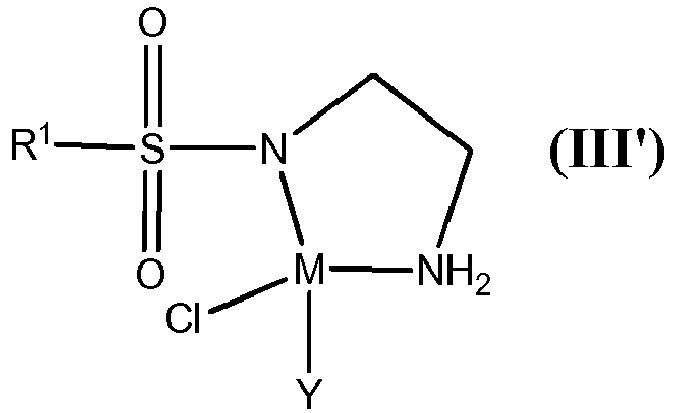
- M is Ru, Rh, Ir, preferably Ru, and
- Y is an aromatic ligand chosen from the group consisting of

- R1 is -CH3,

- Preferred transfer hydrogenations according to the present invention are such wherein the following catalysts are used:


- Therefore a further embodiment of the present invention is a transfer hydrogenation (TH12), which is (TH), (TH1), (TH2), (TH3), (TH4), (TH5), (TH5'), (TH5"), (TH6), (TH7), (TH8), (TH9), (TH10) or (TH11), wherein the catalyst is chosen from the group consisting of


- More preferred transfer hydrogenations according to the present invention are such wherein the following catalysts are used:


- Therefore a further embodiment of the present invention is a transfer hydrogenation (TH13), which is (TH), (TH1), (TH2), (TH3), (TH4), (TH5), (TH5'), (TH5"), (TH6), (TH7), (TH8), (TH9), (TH10), (TH11) or (TH12), wherein the catalyst is chosen from the group consisting of


- Preferably the catalyst is prepared in situ starting from a metal precursor complex and various ligands: 0.5 Mol [M(Y)X2]2 and 1 Mol Z, which is as stated above represented by formula (IV) or formula (V)

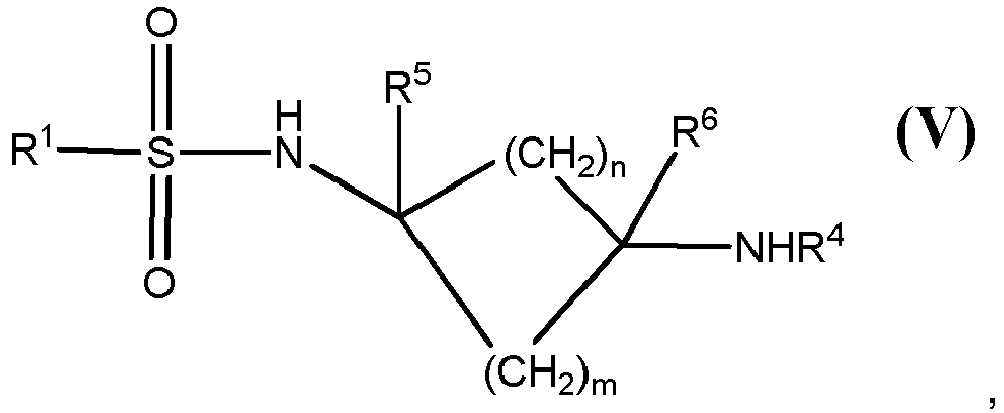
All the substituents (in formula (IV) and in formula (V)) have the same meanings as defined above as well as the same preferences. - The reaction temperature of the process of production of the catalyst (compound of formula (III)) is usually 0 - 100°C. The reactants are usually mixed for a period of time and then all the reactants for the selective transfer hydrogenation of the present invention are added and the necessary reaction conditions of the hydrogenation are applied.
- The selective transfer hydrogenation reaction is usually carried out at a temperature of 0 - 100 °C, preferably 25 - 90°C.
- Therefore a further embodiment of the present invention is a transfer hydrogenation (TH14), which is (TH), (TH1), (TH2), (TH3), (TH4), (TH5), (TH5'), (TH5"), (TH6), (TH7), (TH8), (TH9), (TH10), (TH11), (TH12) or (TH13), wherein the transfer hydrogenation reaction is carried out at a temperature of 0 - 100 °C, preferably 25 - 90 °C.
- The selective transfer hydrogenation reaction is usually carried out at a normal (ambient) pressure. It could also been carried out at elevated and preferably at reduced pressure. Usually the transfer hydrogenation according to the present invention is carried out at a pressure of 50 - 1000 mbar.
- Therefore a further embodiment of the present invention is a transfer hydrogenation (TH15), which is (TH), (TH1), (TH2), (TH3), (TH4), (TH5), (TH5'), (TH5"), (TH6), (TH7), (TH8), (TH9), (TH10), (TH11), (TH12), (TH13) or (TH14), wherein the transfer hydrogenation reaction is carried out at a pressure of 50 - 1000 mbar.
- The substrate to catalyst ratio (s/c ratio) in the selective transfer hydrogenation is usually from 20:1 to 10000:1, preferably 50:1 to 1000:1. This ratio is related to mol. Mol of substrate (which is compound of formula (I)) to mol of catalyst (compound of formula (III)).
- Therefore a further embodiment of the present invention is a transfer hydrogenation (TH16), which is (TH), (TH1), (TH2), (TH3), (TH4), (TH5), (TH5'), (TH5"), (TH6), (TH7), (TH8), (TH9), (TH10), (TH11), (TH12), (TH13), (TH14) or (TH15), wherein molar substrate to catalyst ratio (s/c ratio) is from 20:1 to 10000:1, preferably from 50:1 to 1000:1.
- The transfer hydrogenation according to the present invention allows obtaining retinol in excellent yield.
The retinol which is obtained by the transfer hydrogenation according to the present invention can be used as such or in further application as well as a starting material for further synthesis. - The invention is illustrated by the following Examples. All temperatures are given in °C and all parts and percentages are related to the weight.
- In a 25 mL 2-necked round bottomed flask equipped with thermometer and a magnetic stirrer, 0.020 mmol of metal complex (M(Y)X2]2) and 0.044 mmol of a ligand (Z) were dissolved in 9 mL solvent at room temperature. The mixture was stirred for 30 min.
- The solvent was ethyl acetate, isopropanol or methanol.
- All of the following catalysts [(C1) - (C8)] were produced according to the process of Example 1
-


-


-


-


-


-


-


-

- 299 mg of retinal and 24.2 mg (5 mol%) of C1 were dissolved in 4 ml of anhydrous dichloromethane. To the red solution 169 µl of formic acid/triethylamine complex (5:2) were added drop wise and the reaction was monitored by TLC. After stirring at 23 °C for 2.5 hours the reaction mixture was diluted with 15 ml of dichloromethane and washed with 15 ml of water. The layers were separated and the organic phase was again washed with water (2 x 15 ml). The aqueous phases were re-extracted with 15 ml of dichloromethane. The combined organic extracts were dried over sodium sulphate, filtered and evaporated to dryness. The crude product (325 mg) was obtained as dark brown oil and was purified by column chromatography [SiO2 60 (10 g), cyclohexane/ethyl acetate 8:2]. The purified retinol was obtained in 83% yield and 75.2% purity at 97% conversion. For further results see Table 1 a.
- In a 5 ml glass vial under argon atmosphere a stock solution of the catalyst was prepared as follows: 41.4 mg of catalyst C1 were weighed into a glass vial with magnetic stir bar. The vial was capped with a septum and flushed with argon. Then, 900 µl of dichloromethane and a solution of 41.1 mg of sodium formate in 465 µl of deionized water were added. The biphasic mixture was warmed to 35 °C in a water-bath and stirred for 30 min. After phase separation, samples of the organic phase were used as active catalyst solution for several reactions on the same day.
- 0.73 g of retinal were weighed into a 20 ml glass vial equipped with magnetic stir bar. The vial was sealed with a septum and flushed with argon via cannula. 4.29 ml of anhydrous isopropanol were added via syringe and the mixture was warmed to 38 °C in a water-bath until all retinal had dissolved. After that, 263 µl (1.0 mol%) of the freshly prepared catalyst solution were added via microliter-syringe at 38 °C and the reaction was monitored by TLC and HPLC. After 30 min the reaction was complete. For results see Table 1 b.
- 719 mg of retinal (2.5 mmol) were weighed into a round bottomed flask. The apparatus was evacuated to p = <0.1 mbar and then inflated with argon. This procedure was done three times. 9.6 ml of 2-propanol (125 mmol = 50 eq.) were added with a syringe. With magnetic stirring at r.t. the suspension was evacuated and inflated three times as described above (p = <0.1 mbar, foams heavily at the beginning!). Then 3.03 mg of ruthenium catalyst C1 (0.0063 mmol = 0.25 mol% = s/c 400) were weighed into a GC vial. The catalyst was dissolved in ∼1 ml of dichloromethane and transferred with a syringe into the reaction mixture. Evacuated (p = -0.4 mbar, foams heavily at the beginning!) and inflated with argon three times as described above. 5 µL of potassium hydroxide solution (2.5148 g KOH to 50 ml in deionized water, 0.0039 mmol = 0.625 eq. rel. to Ru-catalyst), were also transferred with a 10 µL GC syringe via the rubber seal into the reaction mixture. Evacuated and inflated with argon three times as described above.
- At an argon pressure of -0.3 bar, the reaction mixture was stirred for 18 hours in a pre-heated oil bath (TJ = 38 °C). For the work-up the reaction mixture was cooled to r.t., transferred into a separating funnel with -150 ml of diethyl ether and extracted three times with -50 ml of deionized water. The organic layer was dried over sodium sulphate, filtered and distilled on a rotary evaporator at TJ = 35 °C, p = 10 mbar. Most of the remaining 2-propanol was distilled off by switching to high vacuum, TJ = 35 °C, p = <0.1 mbar). 0.76 g of clear and sticky oil, amber in colour, 93.1 wt% of retinol by qNMR were obtained. Conversion 99.3%, yield 98.8% relative to retinal, selectivity 100%.
- For further results see Table 2.
Table 1a: with Cat C1 and Formic acid/triethylamine (ratio1:1) as red agent and dichloromethane as solvent Example Conc. [ml/mmol] s/c T [°C] t [h] Procedure Conv. [%] Yield [%] 2 4.0 20 23 2.2 A >99.9 87.1 Table 1b: with Cat C1 and i-propanol/ sodium formate as red agent and i-propanol as solvent Example Conc. [ml/mmol] s/c T [°C] t [h] Procedure Conv. [%] Yield [%] 3a 3.25 111 38 1 B >99.9 99.6 3b 1.72 100 38 3 B 99.2 88.4 Table 2: with Cat C1 and i-propanol/KOH as red. agent and dichloromethane as solvent Exp. s/c t [h] Conv. [%] Yield [%] 4a 100 2.75 98.2 94.7 4b 200 2.75 99.3 99.1 4c 300 24 99.2 97.3 4d 400 18 99.3 98.8 4e 400 24 97.3 95.5 - In the following examples the catalyst is formed in situ. The following ligands have been used to form the catalyst in situ. The numbering of the ligands corresponds to the Examples they are used in.


- 6 mg of dichloro(p-cymene)ruthenium(II) dimer (CAS No. 52462-29-0) and 7 mg of the ligand (in table 3 the numbering of the Example corresponds to the numbering of the ligand) were dissolved in 3 ml of ethyl acetate.
- After stirring for 5 minutes, a solution of 280 mg of retinal in 2 ml of ethyl acetate was added. The mixture was stirred for an additional 5 minutes and afterwards 0.45 ml of a 5:2 mixture of formic acid:triethylamine (5was added and the reaction mixture was stirred at room temperature. After 30-120 minutes, HPLC analysis indicated complete consumption of retinal (<99% conversion). For the results (in regard to the conversion and the yield) see the table 3 below.
Table 3: Exp. Time (min) Conversion [%] Product [%] 5a 120 >99 89.4 5b 45 >99 96.7 5c 45 >99 90.1


Claims (11)
- A transfer hydrogenation of a compound of formula (I)

 a) an amino-amide-transition-metal catalyst of formula (III)
MX[Z-(-H)][Y] (III)
whereinM is chosen from the group consisting of Ir, Rh and Ru, andX signifies H or a halogen atom, andY is chosen from the group consisting of pentamethylcyclopentadienyl, benzene, p-cymene, toluene, anisole, xylene, 1,3,5-trimethylbenzene, p-dicyclohexylbenzene, naphthalene and tetralin, andZ signifies a group of formula (IV) or (V)
 R1 signifies C1-C2-alkyl which may be substituted with one or more fluorine atoms, C2-C6-alkenyl, C2-C6-alkynyl, C4-C7-cycloalkyl, aryl which may be substituted, heteroaryl, or camphor-10-yl, andR2 and R3 each independently signify hydrogen, C1-C2-alkyl, C4-C7-cycloalkyl, or aryl which may be substituted, andR4 signifies hydrogen or C1-C2-alkyl, andR5 signifies hydrogen or C1-C2-alkyl, andR6 signifies hydrogen or C1-C2-alkyl, andn signifies 0,1,2 or 3, andm signifies 0,1,2 or 3, andwith the proviso that in formula (V) the sum of n and m is 3 or 4,andb) a H2 donor,
and wherein the hydrogenation is carried out by using at least one hydrogen donor and at least one inert solvent. - Transfer hydrogenation according to claim 1, wherein the hydrogenation is carried out in the absence of water.
- Transfer hydrogenation according to claims 1, or 2, wherein the hydrogenation is carried out by using formic acid (or a salt of formic acid QOOCH), wherein Q is an alkali cation or NH4 +, NH3(R7)+, NH2(R7)2 +, NH(R7)3 + or N(R7)4 +, wherein all R7 are independently from each other -CH3 or -CH2CH3.
- Transfer hydrogenation according to claim 6, wherein the molar ratio of formic acid (or a salt of formic acid) and triethylamine is from 1:1 to 10:1.
- Transfer hydrogenation according to anyone of the preceding claims, wherein the catalyst of formula (III)M is chosen from the group consisting of Ir, Rh and Ru, andX signifies H or Cl, andY is chosen from the group consisting of pentamethylcyclopentadienyl, benzene, p-cymene, toluene, anisole, xylene, 1,3,5-trimethylbenzene, p-dicyclohexylbenzene, naphthalene and tetralin, andZ signifies a group of formula (IV)
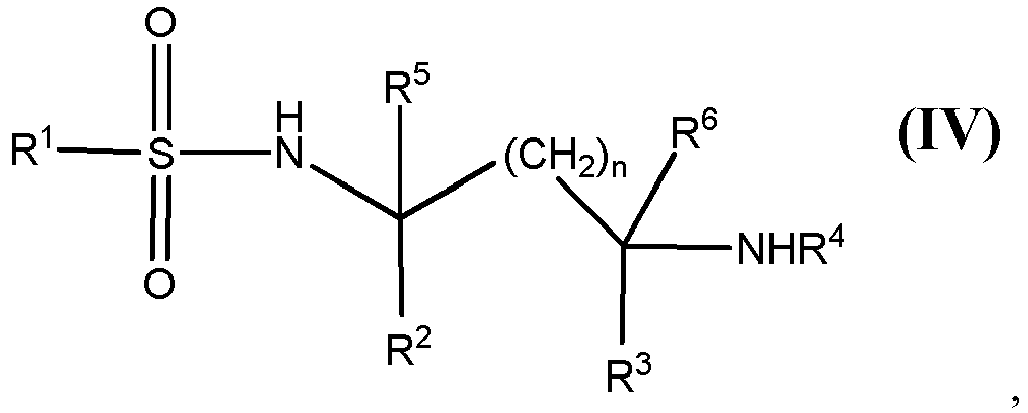 R1 signifies C1-C2-alkyl which may be substituted with one or more fluorine atoms, C2-C6-alkenyl, C2-C6-alkynyl, C4-C7-cycloalkyl, aryl which may be substituted, heteroaryl, or camphor-10-yl, andR2 and R3 each independently signify hydrogen, C1-C2-alkyl, C4-C7-cycloalkyl,or aryl which may be substituted, andR4 signifies hydrogen or C1-C2-alkyl, andR5 signifies hydrogen or C1-C2-alkyl, andR6 signifies hydrogen or C1-C2-alkyl, andn signifies 0,1,2 or 3.
 - Transfer hydrogenation according to anyone of the preceding claims, wherein the catalyst is of formula (III')
 M is Ru, Rh or Ir, andY is an aromatic ligand chosen from the group consisting of
 R1 is -CH3,
- Transfer hydrogenation according to anyone of the preceding claims, wherein the catalyst is chosen from the group consisting of

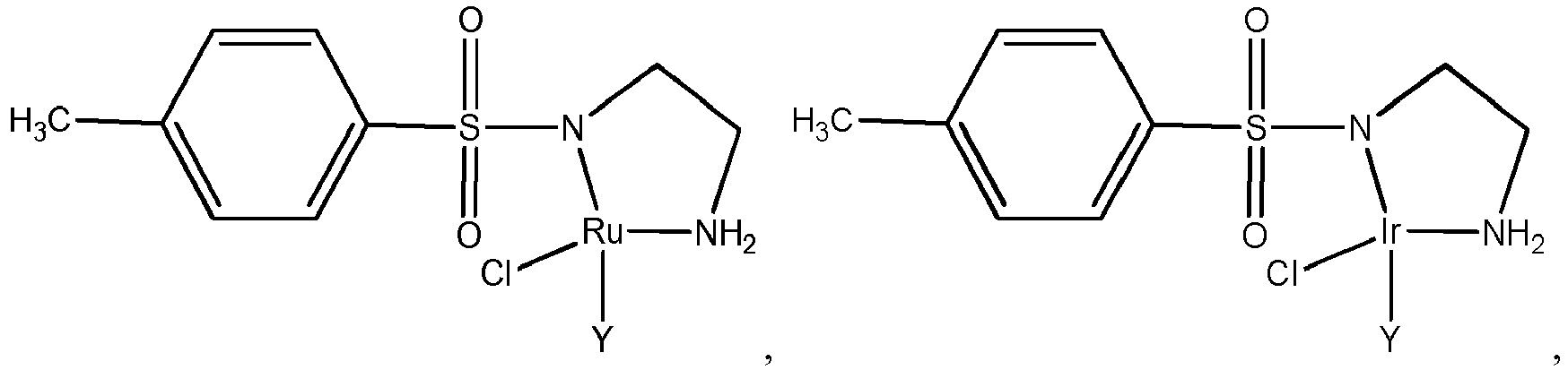


- Transfer hydrogenation according to anyone of the preceding claims 1 - 6, wherein the catalyst is chosen from the group consisting of


- Transfer hydrogenation according to anyone of the preceding claims, wherein transfer hydrogenation reaction is carried out at a temperature of 0 - 100 °C.
- Transfer hydrogenation according to anyone of the preceding claims, wherein the transfer hydrogenation reaction is carried out at a pressure of 50 - 1000 mbar.
- Transfer hydrogenation according to anyone of the preceding claims, wherein the molar substrate to catalyst ratio (s/c ratio) is from 20:1 to 10000:1.
Applications Claiming Priority (3)
| Application Number | Priority Date | Filing Date | Title |
|---|---|---|---|
| EP13175593 | 2013-07-08 | ||
| PCT/EP2014/064566 WO2015004117A1 (en) | 2013-07-08 | 2014-07-08 | Selective transfer hydrogenation of retinal |
| EP14736807.0A EP3019459B1 (en) | 2013-07-08 | 2014-07-08 | Selective transfer hydrogenation of retinal |
Related Parent Applications (2)
| Application Number | Title | Priority Date | Filing Date |
|---|---|---|---|
| EP14736807.0A Division EP3019459B1 (en) | 2013-07-08 | 2014-07-08 | Selective transfer hydrogenation of retinal |
| EP14736807.0A Division-Into EP3019459B1 (en) | 2013-07-08 | 2014-07-08 | Selective transfer hydrogenation of retinal |
Publications (2)
| Publication Number | Publication Date |
|---|---|
| EP3263554A1 true EP3263554A1 (en) | 2018-01-03 |
| EP3263554B1 EP3263554B1 (en) | 2019-02-27 |
Family
ID=48745852
Family Applications (2)
| Application Number | Title | Priority Date | Filing Date |
|---|---|---|---|
| EP14736807.0A Active EP3019459B1 (en) | 2013-07-08 | 2014-07-08 | Selective transfer hydrogenation of retinal |
| EP17184835.1A Active EP3263554B1 (en) | 2013-07-08 | 2014-07-08 | Selective transfer hydrogenation of retinal to retinol |
Family Applications Before (1)
| Application Number | Title | Priority Date | Filing Date |
|---|---|---|---|
| EP14736807.0A Active EP3019459B1 (en) | 2013-07-08 | 2014-07-08 | Selective transfer hydrogenation of retinal |
Country Status (4)
| Country | Link |
|---|---|
| EP (2) | EP3019459B1 (en) |
| CN (1) | CN105358512B (en) |
| MY (1) | MY180008A (en) |
| WO (1) | WO2015004117A1 (en) |
Citations (1)
| Publication number | Priority date | Publication date | Assignee | Title |
|---|---|---|---|---|
| US4906795A (en) * | 1987-12-01 | 1990-03-06 | Rhone-Poulenc Sante | Process for the preparation of vitamin A |
Family Cites Families (1)
| Publication number | Priority date | Publication date | Assignee | Title |
|---|---|---|---|---|
| FR2623799B1 (en) * | 1987-12-01 | 1990-01-26 | Rhone Poulenc Sante | PROCESS FOR THE PREPARATION OF UNSATURATED ALCOHOLS |
-
2014
- 2014-07-08 WO PCT/EP2014/064566 patent/WO2015004117A1/en not_active Ceased
- 2014-07-08 EP EP14736807.0A patent/EP3019459B1/en active Active
- 2014-07-08 CN CN201480038549.8A patent/CN105358512B/en active Active
- 2014-07-08 EP EP17184835.1A patent/EP3263554B1/en active Active
- 2014-07-08 MY MYPI2015704761A patent/MY180008A/en unknown
Patent Citations (1)
| Publication number | Priority date | Publication date | Assignee | Title |
|---|---|---|---|---|
| US4906795A (en) * | 1987-12-01 | 1990-03-06 | Rhone-Poulenc Sante | Process for the preparation of vitamin A |
Non-Patent Citations (3)
| Title |
|---|
| CHEMICAL ABSTRACTS, Columbus, Ohio, US; abstract no. 52462-29-0 |
| E. FACHE ET AL.: "Selective hydrogenation of alpha,beta-unsaturated aldehydes catalyzed by supported aqueous-phase catalysts and supported homogeneous catalysts", JOURNAL OF MOLECULAR CATALYSIS, vol. 79, 1993, pages 117 - 131, XP002719723 * |
| XIAOFENG WU ET AL: "A Versatile Iridium Catalyst for Aldehyde Reduction in Water", CHEMSUSCHEM, WILEY - VCH VERLAG GMBH & CO. KGAA, DE, IT, vol. 1, no. 1-2, 22 February 2008 (2008-02-22), pages 71 - 74, XP008164843, ISSN: 1864-5631, [retrieved on 20080102], DOI: 10.1002/CSSC.200700086 * |
Also Published As
| Publication number | Publication date |
|---|---|
| WO2015004117A1 (en) | 2015-01-15 |
| CN105358512B (en) | 2017-07-07 |
| EP3263554B1 (en) | 2019-02-27 |
| EP3019459B1 (en) | 2018-08-22 |
| EP3019459A1 (en) | 2016-05-18 |
| MY180008A (en) | 2020-11-19 |
| CN105358512A (en) | 2016-02-24 |
Similar Documents
| Publication | Publication Date | Title |
|---|---|---|
| EP3148927B1 (en) | Preparation of 2,6- and 2,7-disubstituted anthraquinone derivates | |
| US9988268B2 (en) | Preparation of 2,6- and 2,7-disubstituted anthraquinone derivatives | |
| EP4294783B1 (en) | Hydrogenation of dienals or dienones with rhodium complexes under carbon monoxide free atmosphere | |
| US6737531B1 (en) | Catalysts for hydrogenation and hydrosilylation, methods of making and using the same | |
| US7763748B2 (en) | Process for preparation of highly pure isotretinoin | |
| EP4324819A2 (en) | New intermediates for the vitamin a synthesis | |
| EP3263554B1 (en) | Selective transfer hydrogenation of retinal to retinol | |
| EP3019460B1 (en) | Selective transfer hydrogenation of citral or ethyl citral | |
| US5481008A (en) | Process for the preparation of optically active compounds | |
| DE10241555A1 (en) | Process for carrying out chemical reactions in the liquid phase in the presence of a catalyst and a 1,3-substituted imidazolium salt | |
| CN108430962A (en) | Intermolecular Reaction of Propargyl Ether with Dimethylfuran in the Presence of Gold(I) Complex | |
| CN101265181B (en) | Isomerization method of substituted aromatic nonatetraene derivatives | |
| EP2921228A1 (en) | Method for producing optically active isopulegol and optically active menthol | |
| US9908847B2 (en) | Method for producing specific α,β-unsaturated aldehydes by rearrangement process | |
| US6300509B1 (en) | Amino-amide-ruthenium complexes | |
| US6177579B1 (en) | Process for the preparation of 13-cis-retinoic acid | |
| Blanco-Urgoiti et al. | Aromatic enynes as substrates for the intramolecular Pauson-Khand reaction | |
| KR101117246B1 (en) | Process for obtaining vitamin D derivatives from monohalogenovinyl compounds | |
| US12139452B2 (en) | Process for the production of retinal | |
| HU201049B (en) | Process for production of 3-formil-tetrahydro-tiopiranes | |
| US9249074B2 (en) | Synthesis of tetrahydromyrcenol | |
| JP2001294594A (en) | Phosphine-containing amino compound, method for producing the same, ruthenium complex and method for producing alcohol | |
| CN106810430A (en) | A kind of preparation method of the naphthoquinone derivatives of 2 trifluoromethyl 1,4 | |
| US20050038268A1 (en) | Method for the preparation of enterolactone from matairesinol | |
| JPH06239832A (en) | Method for producing conjugated polyene-1,2-diol |
Legal Events
| Date | Code | Title | Description |
|---|---|---|---|
| PUAI | Public reference made under article 153(3) epc to a published international application that has entered the european phase |
Free format text: ORIGINAL CODE: 0009012 |
|
| STAA | Information on the status of an ep patent application or granted ep patent |
Free format text: STATUS: THE APPLICATION HAS BEEN PUBLISHED |
|
| AC | Divisional application: reference to earlier application |
Ref document number: 3019459 Country of ref document: EP Kind code of ref document: P |
|
| AK | Designated contracting states |
Kind code of ref document: A1 Designated state(s): AL AT BE BG CH CY CZ DE DK EE ES FI FR GB GR HR HU IE IS IT LI LT LU LV MC MK MT NL NO PL PT RO RS SE SI SK SM TR |
|
| STAA | Information on the status of an ep patent application or granted ep patent |
Free format text: STATUS: REQUEST FOR EXAMINATION WAS MADE |
|
| 17P | Request for examination filed |
Effective date: 20180328 |
|
| RBV | Designated contracting states (corrected) |
Designated state(s): AL AT BE BG CH CY CZ DE DK EE ES FI FR GB GR HR HU IE IS IT LI LT LU LV MC MK MT NL NO PL PT RO RS SE SI SK SM TR |
|
| GRAP | Despatch of communication of intention to grant a patent |
Free format text: ORIGINAL CODE: EPIDOSNIGR1 |
|
| STAA | Information on the status of an ep patent application or granted ep patent |
Free format text: STATUS: GRANT OF PATENT IS INTENDED |
|
| RIC1 | Information provided on ipc code assigned before grant |
Ipc: C07C 403/08 20060101AFI20180927BHEP |
|
| INTG | Intention to grant announced |
Effective date: 20181018 |
|
| GRAS | Grant fee paid |
Free format text: ORIGINAL CODE: EPIDOSNIGR3 |
|
| GRAA | (expected) grant |
Free format text: ORIGINAL CODE: 0009210 |
|
| STAA | Information on the status of an ep patent application or granted ep patent |
Free format text: STATUS: THE PATENT HAS BEEN GRANTED |
|
| AC | Divisional application: reference to earlier application |
Ref document number: 3019459 Country of ref document: EP Kind code of ref document: P |
|
| AK | Designated contracting states |
Kind code of ref document: B1 Designated state(s): AL AT BE BG CH CY CZ DE DK EE ES FI FR GB GR HR HU IE IS IT LI LT LU LV MC MK MT NL NO PL PT RO RS SE SI SK SM TR |
|
| REG | Reference to a national code |
Ref country code: GB Ref legal event code: FG4D |
|
| REG | Reference to a national code |
Ref country code: CH Ref legal event code: EP |
|
| REG | Reference to a national code |
Ref country code: AT Ref legal event code: REF Ref document number: 1101102 Country of ref document: AT Kind code of ref document: T Effective date: 20190315 |
|
| REG | Reference to a national code |
Ref country code: IE Ref legal event code: FG4D |
|
| REG | Reference to a national code |
Ref country code: DE Ref legal event code: R096 Ref document number: 602014042165 Country of ref document: DE |
|
| REG | Reference to a national code |
Ref country code: NL Ref legal event code: MP Effective date: 20190227 |
|
| REG | Reference to a national code |
Ref country code: LT Ref legal event code: MG4D |
|
| PG25 | Lapsed in a contracting state [announced via postgrant information from national office to epo] |
Ref country code: NO Free format text: LAPSE BECAUSE OF FAILURE TO SUBMIT A TRANSLATION OF THE DESCRIPTION OR TO PAY THE FEE WITHIN THE PRESCRIBED TIME-LIMIT Effective date: 20190527 Ref country code: PT Free format text: LAPSE BECAUSE OF FAILURE TO SUBMIT A TRANSLATION OF THE DESCRIPTION OR TO PAY THE FEE WITHIN THE PRESCRIBED TIME-LIMIT Effective date: 20190627 Ref country code: SE Free format text: LAPSE BECAUSE OF FAILURE TO SUBMIT A TRANSLATION OF THE DESCRIPTION OR TO PAY THE FEE WITHIN THE PRESCRIBED TIME-LIMIT Effective date: 20190227 Ref country code: NL Free format text: LAPSE BECAUSE OF FAILURE TO SUBMIT A TRANSLATION OF THE DESCRIPTION OR TO PAY THE FEE WITHIN THE PRESCRIBED TIME-LIMIT Effective date: 20190227 Ref country code: FI Free format text: LAPSE BECAUSE OF FAILURE TO SUBMIT A TRANSLATION OF THE DESCRIPTION OR TO PAY THE FEE WITHIN THE PRESCRIBED TIME-LIMIT Effective date: 20190227 Ref country code: LT Free format text: LAPSE BECAUSE OF FAILURE TO SUBMIT A TRANSLATION OF THE DESCRIPTION OR TO PAY THE FEE WITHIN THE PRESCRIBED TIME-LIMIT Effective date: 20190227 |
|
| PG25 | Lapsed in a contracting state [announced via postgrant information from national office to epo] |
Ref country code: GR Free format text: LAPSE BECAUSE OF FAILURE TO SUBMIT A TRANSLATION OF THE DESCRIPTION OR TO PAY THE FEE WITHIN THE PRESCRIBED TIME-LIMIT Effective date: 20190528 Ref country code: HR Free format text: LAPSE BECAUSE OF FAILURE TO SUBMIT A TRANSLATION OF THE DESCRIPTION OR TO PAY THE FEE WITHIN THE PRESCRIBED TIME-LIMIT Effective date: 20190227 Ref country code: LV Free format text: LAPSE BECAUSE OF FAILURE TO SUBMIT A TRANSLATION OF THE DESCRIPTION OR TO PAY THE FEE WITHIN THE PRESCRIBED TIME-LIMIT Effective date: 20190227 Ref country code: IS Free format text: LAPSE BECAUSE OF FAILURE TO SUBMIT A TRANSLATION OF THE DESCRIPTION OR TO PAY THE FEE WITHIN THE PRESCRIBED TIME-LIMIT Effective date: 20190627 Ref country code: BG Free format text: LAPSE BECAUSE OF FAILURE TO SUBMIT A TRANSLATION OF THE DESCRIPTION OR TO PAY THE FEE WITHIN THE PRESCRIBED TIME-LIMIT Effective date: 20190527 Ref country code: RS Free format text: LAPSE BECAUSE OF FAILURE TO SUBMIT A TRANSLATION OF THE DESCRIPTION OR TO PAY THE FEE WITHIN THE PRESCRIBED TIME-LIMIT Effective date: 20190227 |
|
| REG | Reference to a national code |
Ref country code: AT Ref legal event code: MK05 Ref document number: 1101102 Country of ref document: AT Kind code of ref document: T Effective date: 20190227 |
|
| PG25 | Lapsed in a contracting state [announced via postgrant information from national office to epo] |
Ref country code: SK Free format text: LAPSE BECAUSE OF FAILURE TO SUBMIT A TRANSLATION OF THE DESCRIPTION OR TO PAY THE FEE WITHIN THE PRESCRIBED TIME-LIMIT Effective date: 20190227 Ref country code: RO Free format text: LAPSE BECAUSE OF FAILURE TO SUBMIT A TRANSLATION OF THE DESCRIPTION OR TO PAY THE FEE WITHIN THE PRESCRIBED TIME-LIMIT Effective date: 20190227 Ref country code: IT Free format text: LAPSE BECAUSE OF FAILURE TO SUBMIT A TRANSLATION OF THE DESCRIPTION OR TO PAY THE FEE WITHIN THE PRESCRIBED TIME-LIMIT Effective date: 20190227 Ref country code: EE Free format text: LAPSE BECAUSE OF FAILURE TO SUBMIT A TRANSLATION OF THE DESCRIPTION OR TO PAY THE FEE WITHIN THE PRESCRIBED TIME-LIMIT Effective date: 20190227 Ref country code: CZ Free format text: LAPSE BECAUSE OF FAILURE TO SUBMIT A TRANSLATION OF THE DESCRIPTION OR TO PAY THE FEE WITHIN THE PRESCRIBED TIME-LIMIT Effective date: 20190227 Ref country code: AL Free format text: LAPSE BECAUSE OF FAILURE TO SUBMIT A TRANSLATION OF THE DESCRIPTION OR TO PAY THE FEE WITHIN THE PRESCRIBED TIME-LIMIT Effective date: 20190227 Ref country code: DK Free format text: LAPSE BECAUSE OF FAILURE TO SUBMIT A TRANSLATION OF THE DESCRIPTION OR TO PAY THE FEE WITHIN THE PRESCRIBED TIME-LIMIT Effective date: 20190227 Ref country code: ES Free format text: LAPSE BECAUSE OF FAILURE TO SUBMIT A TRANSLATION OF THE DESCRIPTION OR TO PAY THE FEE WITHIN THE PRESCRIBED TIME-LIMIT Effective date: 20190227 |
|
| REG | Reference to a national code |
Ref country code: DE Ref legal event code: R097 Ref document number: 602014042165 Country of ref document: DE |
|
| PG25 | Lapsed in a contracting state [announced via postgrant information from national office to epo] |
Ref country code: PL Free format text: LAPSE BECAUSE OF FAILURE TO SUBMIT A TRANSLATION OF THE DESCRIPTION OR TO PAY THE FEE WITHIN THE PRESCRIBED TIME-LIMIT Effective date: 20190227 Ref country code: SM Free format text: LAPSE BECAUSE OF FAILURE TO SUBMIT A TRANSLATION OF THE DESCRIPTION OR TO PAY THE FEE WITHIN THE PRESCRIBED TIME-LIMIT Effective date: 20190227 |
|
| PG25 | Lapsed in a contracting state [announced via postgrant information from national office to epo] |
Ref country code: AT Free format text: LAPSE BECAUSE OF FAILURE TO SUBMIT A TRANSLATION OF THE DESCRIPTION OR TO PAY THE FEE WITHIN THE PRESCRIBED TIME-LIMIT Effective date: 20190227 |
|
| PLBE | No opposition filed within time limit |
Free format text: ORIGINAL CODE: 0009261 |
|
| STAA | Information on the status of an ep patent application or granted ep patent |
Free format text: STATUS: NO OPPOSITION FILED WITHIN TIME LIMIT |
|
| 26N | No opposition filed |
Effective date: 20191128 |
|
| PG25 | Lapsed in a contracting state [announced via postgrant information from national office to epo] |
Ref country code: SI Free format text: LAPSE BECAUSE OF FAILURE TO SUBMIT A TRANSLATION OF THE DESCRIPTION OR TO PAY THE FEE WITHIN THE PRESCRIBED TIME-LIMIT Effective date: 20190227 Ref country code: MC Free format text: LAPSE BECAUSE OF FAILURE TO SUBMIT A TRANSLATION OF THE DESCRIPTION OR TO PAY THE FEE WITHIN THE PRESCRIBED TIME-LIMIT Effective date: 20190227 |
|
| GBPC | Gb: european patent ceased through non-payment of renewal fee |
Effective date: 20190708 |
|
| PG25 | Lapsed in a contracting state [announced via postgrant information from national office to epo] |
Ref country code: TR Free format text: LAPSE BECAUSE OF FAILURE TO SUBMIT A TRANSLATION OF THE DESCRIPTION OR TO PAY THE FEE WITHIN THE PRESCRIBED TIME-LIMIT Effective date: 20190227 |
|
| REG | Reference to a national code |
Ref country code: BE Ref legal event code: MM Effective date: 20190731 |
|
| PG25 | Lapsed in a contracting state [announced via postgrant information from national office to epo] |
Ref country code: GB Free format text: LAPSE BECAUSE OF NON-PAYMENT OF DUE FEES Effective date: 20190708 |
|
| PG25 | Lapsed in a contracting state [announced via postgrant information from national office to epo] |
Ref country code: BE Free format text: LAPSE BECAUSE OF NON-PAYMENT OF DUE FEES Effective date: 20190731 Ref country code: LU Free format text: LAPSE BECAUSE OF NON-PAYMENT OF DUE FEES Effective date: 20190708 |
|
| PG25 | Lapsed in a contracting state [announced via postgrant information from national office to epo] |
Ref country code: IE Free format text: LAPSE BECAUSE OF NON-PAYMENT OF DUE FEES Effective date: 20190708 |
|
| PG25 | Lapsed in a contracting state [announced via postgrant information from national office to epo] |
Ref country code: CY Free format text: LAPSE BECAUSE OF FAILURE TO SUBMIT A TRANSLATION OF THE DESCRIPTION OR TO PAY THE FEE WITHIN THE PRESCRIBED TIME-LIMIT Effective date: 20190227 |
|
| PG25 | Lapsed in a contracting state [announced via postgrant information from national office to epo] |
Ref country code: HU Free format text: LAPSE BECAUSE OF FAILURE TO SUBMIT A TRANSLATION OF THE DESCRIPTION OR TO PAY THE FEE WITHIN THE PRESCRIBED TIME-LIMIT; INVALID AB INITIO Effective date: 20140708 Ref country code: MT Free format text: LAPSE BECAUSE OF FAILURE TO SUBMIT A TRANSLATION OF THE DESCRIPTION OR TO PAY THE FEE WITHIN THE PRESCRIBED TIME-LIMIT Effective date: 20190227 |
|
| PG25 | Lapsed in a contracting state [announced via postgrant information from national office to epo] |
Ref country code: MK Free format text: LAPSE BECAUSE OF FAILURE TO SUBMIT A TRANSLATION OF THE DESCRIPTION OR TO PAY THE FEE WITHIN THE PRESCRIBED TIME-LIMIT Effective date: 20190227 |
|
| P01 | Opt-out of the competence of the unified patent court (upc) registered |
Effective date: 20230520 |
|
| PGFP | Annual fee paid to national office [announced via postgrant information from national office to epo] |
Ref country code: FR Payment date: 20250610 Year of fee payment: 12 |
|
| PGFP | Annual fee paid to national office [announced via postgrant information from national office to epo] |
Ref country code: DE Payment date: 20250624 Year of fee payment: 12 |
|
| PGFP | Annual fee paid to national office [announced via postgrant information from national office to epo] |
Ref country code: CH Payment date: 20250801 Year of fee payment: 12 |