EP3263090B1 - Two-liquid mixing-type aerosol product - Google Patents
Two-liquid mixing-type aerosol product Download PDFInfo
- Publication number
- EP3263090B1 EP3263090B1 EP16755447.6A EP16755447A EP3263090B1 EP 3263090 B1 EP3263090 B1 EP 3263090B1 EP 16755447 A EP16755447 A EP 16755447A EP 3263090 B1 EP3263090 B1 EP 3263090B1
- Authority
- EP
- European Patent Office
- Prior art keywords
- component
- liquid concentrate
- concentrate composition
- liquid
- oil
- Prior art date
- Legal status (The legal status is an assumption and is not a legal conclusion. Google has not performed a legal analysis and makes no representation as to the accuracy of the status listed.)
- Active
Links
Images
Classifications
-
- B—PERFORMING OPERATIONS; TRANSPORTING
- B65—CONVEYING; PACKING; STORING; HANDLING THIN OR FILAMENTARY MATERIAL
- B65D—CONTAINERS FOR STORAGE OR TRANSPORT OF ARTICLES OR MATERIALS, e.g. BAGS, BARRELS, BOTTLES, BOXES, CANS, CARTONS, CRATES, DRUMS, JARS, TANKS, HOPPERS, FORWARDING CONTAINERS; ACCESSORIES, CLOSURES, OR FITTINGS THEREFOR; PACKAGING ELEMENTS; PACKAGES
- B65D83/00—Containers or packages with special means for dispensing contents
- B65D83/14—Containers for dispensing liquid or semi-liquid contents by internal gaseous pressure, i.e. aerosol containers comprising propellant
- B65D83/68—Dispensing two or more contents
- B65D83/682—Dispensing two or more contents initially separated and subsequently mixed
-
- A—HUMAN NECESSITIES
- A45—HAND OR TRAVELLING ARTICLES
- A45D—HAIRDRESSING OR SHAVING EQUIPMENT; EQUIPMENT FOR COSMETICS OR COSMETIC TREATMENTS, e.g. FOR MANICURING OR PEDICURING
- A45D34/00—Containers or accessories specially adapted for handling liquid toiletry or cosmetic substances, e.g. perfumes
- A45D34/04—Appliances specially adapted for applying liquid, e.g. using roller or ball
-
- A—HUMAN NECESSITIES
- A61—MEDICAL OR VETERINARY SCIENCE; HYGIENE
- A61K—PREPARATIONS FOR MEDICAL, DENTAL OR TOILETRY PURPOSES
- A61K8/00—Cosmetics or similar toiletry preparations
- A61K8/02—Cosmetics or similar toiletry preparations characterised by special physical form
-
- A—HUMAN NECESSITIES
- A61—MEDICAL OR VETERINARY SCIENCE; HYGIENE
- A61K—PREPARATIONS FOR MEDICAL, DENTAL OR TOILETRY PURPOSES
- A61K8/00—Cosmetics or similar toiletry preparations
- A61K8/02—Cosmetics or similar toiletry preparations characterised by special physical form
- A61K8/04—Dispersions; Emulsions
- A61K8/046—Aerosols; Foams
-
- A—HUMAN NECESSITIES
- A61—MEDICAL OR VETERINARY SCIENCE; HYGIENE
- A61K—PREPARATIONS FOR MEDICAL, DENTAL OR TOILETRY PURPOSES
- A61K8/00—Cosmetics or similar toiletry preparations
- A61K8/02—Cosmetics or similar toiletry preparations characterised by special physical form
- A61K8/04—Dispersions; Emulsions
- A61K8/06—Emulsions
-
- A—HUMAN NECESSITIES
- A61—MEDICAL OR VETERINARY SCIENCE; HYGIENE
- A61K—PREPARATIONS FOR MEDICAL, DENTAL OR TOILETRY PURPOSES
- A61K8/00—Cosmetics or similar toiletry preparations
- A61K8/18—Cosmetics or similar toiletry preparations characterised by the composition
- A61K8/30—Cosmetics or similar toiletry preparations characterised by the composition containing organic compounds
- A61K8/31—Hydrocarbons
-
- A—HUMAN NECESSITIES
- A61—MEDICAL OR VETERINARY SCIENCE; HYGIENE
- A61K—PREPARATIONS FOR MEDICAL, DENTAL OR TOILETRY PURPOSES
- A61K8/00—Cosmetics or similar toiletry preparations
- A61K8/18—Cosmetics or similar toiletry preparations characterised by the composition
- A61K8/30—Cosmetics or similar toiletry preparations characterised by the composition containing organic compounds
- A61K8/33—Cosmetics or similar toiletry preparations characterised by the composition containing organic compounds containing oxygen
- A61K8/34—Alcohols
-
- A—HUMAN NECESSITIES
- A61—MEDICAL OR VETERINARY SCIENCE; HYGIENE
- A61K—PREPARATIONS FOR MEDICAL, DENTAL OR TOILETRY PURPOSES
- A61K8/00—Cosmetics or similar toiletry preparations
- A61K8/18—Cosmetics or similar toiletry preparations characterised by the composition
- A61K8/30—Cosmetics or similar toiletry preparations characterised by the composition containing organic compounds
- A61K8/33—Cosmetics or similar toiletry preparations characterised by the composition containing organic compounds containing oxygen
- A61K8/34—Alcohols
- A61K8/345—Alcohols containing more than one hydroxy group
-
- A—HUMAN NECESSITIES
- A61—MEDICAL OR VETERINARY SCIENCE; HYGIENE
- A61K—PREPARATIONS FOR MEDICAL, DENTAL OR TOILETRY PURPOSES
- A61K8/00—Cosmetics or similar toiletry preparations
- A61K8/18—Cosmetics or similar toiletry preparations characterised by the composition
- A61K8/30—Cosmetics or similar toiletry preparations characterised by the composition containing organic compounds
- A61K8/33—Cosmetics or similar toiletry preparations characterised by the composition containing organic compounds containing oxygen
- A61K8/36—Carboxylic acids; Salts or anhydrides thereof
- A61K8/362—Polycarboxylic acids
-
- A—HUMAN NECESSITIES
- A61—MEDICAL OR VETERINARY SCIENCE; HYGIENE
- A61K—PREPARATIONS FOR MEDICAL, DENTAL OR TOILETRY PURPOSES
- A61K8/00—Cosmetics or similar toiletry preparations
- A61K8/18—Cosmetics or similar toiletry preparations characterised by the composition
- A61K8/30—Cosmetics or similar toiletry preparations characterised by the composition containing organic compounds
- A61K8/33—Cosmetics or similar toiletry preparations characterised by the composition containing organic compounds containing oxygen
- A61K8/37—Esters of carboxylic acids
-
- A—HUMAN NECESSITIES
- A61—MEDICAL OR VETERINARY SCIENCE; HYGIENE
- A61K—PREPARATIONS FOR MEDICAL, DENTAL OR TOILETRY PURPOSES
- A61K8/00—Cosmetics or similar toiletry preparations
- A61K8/18—Cosmetics or similar toiletry preparations characterised by the composition
- A61K8/30—Cosmetics or similar toiletry preparations characterised by the composition containing organic compounds
- A61K8/58—Cosmetics or similar toiletry preparations characterised by the composition containing organic compounds containing atoms other than carbon, hydrogen, halogen, oxygen, nitrogen, sulfur or phosphorus
- A61K8/585—Organosilicon compounds
-
- A—HUMAN NECESSITIES
- A61—MEDICAL OR VETERINARY SCIENCE; HYGIENE
- A61K—PREPARATIONS FOR MEDICAL, DENTAL OR TOILETRY PURPOSES
- A61K8/00—Cosmetics or similar toiletry preparations
- A61K8/18—Cosmetics or similar toiletry preparations characterised by the composition
- A61K8/30—Cosmetics or similar toiletry preparations characterised by the composition containing organic compounds
- A61K8/67—Vitamins
- A61K8/676—Ascorbic acid, i.e. vitamin C
-
- A—HUMAN NECESSITIES
- A61—MEDICAL OR VETERINARY SCIENCE; HYGIENE
- A61K—PREPARATIONS FOR MEDICAL, DENTAL OR TOILETRY PURPOSES
- A61K8/00—Cosmetics or similar toiletry preparations
- A61K8/18—Cosmetics or similar toiletry preparations characterised by the composition
- A61K8/30—Cosmetics or similar toiletry preparations characterised by the composition containing organic compounds
- A61K8/67—Vitamins
- A61K8/678—Tocopherol, i.e. vitamin E
-
- A—HUMAN NECESSITIES
- A61—MEDICAL OR VETERINARY SCIENCE; HYGIENE
- A61K—PREPARATIONS FOR MEDICAL, DENTAL OR TOILETRY PURPOSES
- A61K8/00—Cosmetics or similar toiletry preparations
- A61K8/18—Cosmetics or similar toiletry preparations characterised by the composition
- A61K8/72—Cosmetics or similar toiletry preparations characterised by the composition containing organic macromolecular compounds
- A61K8/73—Polysaccharides
- A61K8/735—Mucopolysaccharides, e.g. hyaluronic acid; Derivatives thereof
-
- A—HUMAN NECESSITIES
- A61—MEDICAL OR VETERINARY SCIENCE; HYGIENE
- A61K—PREPARATIONS FOR MEDICAL, DENTAL OR TOILETRY PURPOSES
- A61K8/00—Cosmetics or similar toiletry preparations
- A61K8/18—Cosmetics or similar toiletry preparations characterised by the composition
- A61K8/72—Cosmetics or similar toiletry preparations characterised by the composition containing organic macromolecular compounds
- A61K8/84—Cosmetics or similar toiletry preparations characterised by the composition containing organic macromolecular compounds obtained by reactions otherwise than those involving only carbon-carbon unsaturated bonds
- A61K8/89—Polysiloxanes
- A61K8/891—Polysiloxanes saturated, e.g. dimethicone, phenyl trimethicone, C24-C28 methicone or stearyl dimethicone
-
- A—HUMAN NECESSITIES
- A61—MEDICAL OR VETERINARY SCIENCE; HYGIENE
- A61K—PREPARATIONS FOR MEDICAL, DENTAL OR TOILETRY PURPOSES
- A61K8/00—Cosmetics or similar toiletry preparations
- A61K8/18—Cosmetics or similar toiletry preparations characterised by the composition
- A61K8/72—Cosmetics or similar toiletry preparations characterised by the composition containing organic macromolecular compounds
- A61K8/84—Cosmetics or similar toiletry preparations characterised by the composition containing organic macromolecular compounds obtained by reactions otherwise than those involving only carbon-carbon unsaturated bonds
- A61K8/89—Polysiloxanes
- A61K8/891—Polysiloxanes saturated, e.g. dimethicone, phenyl trimethicone, C24-C28 methicone or stearyl dimethicone
- A61K8/892—Polysiloxanes saturated, e.g. dimethicone, phenyl trimethicone, C24-C28 methicone or stearyl dimethicone modified by a hydroxy group, e.g. dimethiconol
-
- A—HUMAN NECESSITIES
- A61—MEDICAL OR VETERINARY SCIENCE; HYGIENE
- A61K—PREPARATIONS FOR MEDICAL, DENTAL OR TOILETRY PURPOSES
- A61K8/00—Cosmetics or similar toiletry preparations
- A61K8/18—Cosmetics or similar toiletry preparations characterised by the composition
- A61K8/96—Cosmetics or similar toiletry preparations characterised by the composition containing materials, or derivatives thereof of undetermined constitution
- A61K8/97—Cosmetics or similar toiletry preparations characterised by the composition containing materials, or derivatives thereof of undetermined constitution from algae, fungi, lichens or plants; from derivatives thereof
- A61K8/9783—Angiosperms [Magnoliophyta]
- A61K8/9789—Magnoliopsida [dicotyledons]
-
- A—HUMAN NECESSITIES
- A61—MEDICAL OR VETERINARY SCIENCE; HYGIENE
- A61K—PREPARATIONS FOR MEDICAL, DENTAL OR TOILETRY PURPOSES
- A61K8/00—Cosmetics or similar toiletry preparations
- A61K8/18—Cosmetics or similar toiletry preparations characterised by the composition
- A61K8/96—Cosmetics or similar toiletry preparations characterised by the composition containing materials, or derivatives thereof of undetermined constitution
- A61K8/97—Cosmetics or similar toiletry preparations characterised by the composition containing materials, or derivatives thereof of undetermined constitution from algae, fungi, lichens or plants; from derivatives thereof
- A61K8/9783—Angiosperms [Magnoliophyta]
- A61K8/9794—Liliopsida [monocotyledons]
-
- A—HUMAN NECESSITIES
- A61—MEDICAL OR VETERINARY SCIENCE; HYGIENE
- A61Q—SPECIFIC USE OF COSMETICS OR SIMILAR TOILETRY PREPARATIONS
- A61Q17/00—Barrier preparations; Preparations brought into direct contact with the skin for affording protection against external influences, e.g. sunlight, X-rays or other harmful rays, corrosive materials, bacteria or insect stings
- A61Q17/04—Topical preparations for affording protection against sunlight or other radiation; Topical sun tanning preparations
-
- A—HUMAN NECESSITIES
- A61—MEDICAL OR VETERINARY SCIENCE; HYGIENE
- A61Q—SPECIFIC USE OF COSMETICS OR SIMILAR TOILETRY PREPARATIONS
- A61Q19/00—Preparations for care of the skin
-
- A—HUMAN NECESSITIES
- A61—MEDICAL OR VETERINARY SCIENCE; HYGIENE
- A61Q—SPECIFIC USE OF COSMETICS OR SIMILAR TOILETRY PREPARATIONS
- A61Q19/00—Preparations for care of the skin
- A61Q19/02—Preparations for care of the skin for chemically bleaching or whitening the skin
-
- A—HUMAN NECESSITIES
- A61—MEDICAL OR VETERINARY SCIENCE; HYGIENE
- A61Q—SPECIFIC USE OF COSMETICS OR SIMILAR TOILETRY PREPARATIONS
- A61Q19/00—Preparations for care of the skin
- A61Q19/08—Anti-ageing preparations
-
- B—PERFORMING OPERATIONS; TRANSPORTING
- B65—CONVEYING; PACKING; STORING; HANDLING THIN OR FILAMENTARY MATERIAL
- B65D—CONTAINERS FOR STORAGE OR TRANSPORT OF ARTICLES OR MATERIALS, e.g. BAGS, BARRELS, BOTTLES, BOXES, CANS, CARTONS, CRATES, DRUMS, JARS, TANKS, HOPPERS, FORWARDING CONTAINERS; ACCESSORIES, CLOSURES, OR FITTINGS THEREFOR; PACKAGING ELEMENTS; PACKAGES
- B65D83/00—Containers or packages with special means for dispensing contents
- B65D83/14—Containers for dispensing liquid or semi-liquid contents by internal gaseous pressure, i.e. aerosol containers comprising propellant
- B65D83/141—Containers for dispensing liquid or semi-liquid contents by internal gaseous pressure, i.e. aerosol containers comprising propellant specially adapted for specific contents or propellants
-
- B—PERFORMING OPERATIONS; TRANSPORTING
- B65—CONVEYING; PACKING; STORING; HANDLING THIN OR FILAMENTARY MATERIAL
- B65D—CONTAINERS FOR STORAGE OR TRANSPORT OF ARTICLES OR MATERIALS, e.g. BAGS, BARRELS, BOTTLES, BOXES, CANS, CARTONS, CRATES, DRUMS, JARS, TANKS, HOPPERS, FORWARDING CONTAINERS; ACCESSORIES, CLOSURES, OR FITTINGS THEREFOR; PACKAGING ELEMENTS; PACKAGES
- B65D83/00—Containers or packages with special means for dispensing contents
- B65D83/14—Containers for dispensing liquid or semi-liquid contents by internal gaseous pressure, i.e. aerosol containers comprising propellant
- B65D83/60—Containers for dispensing liquid or semi-liquid contents by internal gaseous pressure, i.e. aerosol containers comprising propellant with contents and propellant separated
- B65D83/62—Containers for dispensing liquid or semi-liquid contents by internal gaseous pressure, i.e. aerosol containers comprising propellant with contents and propellant separated by membranes, bags or the like
-
- B—PERFORMING OPERATIONS; TRANSPORTING
- B65—CONVEYING; PACKING; STORING; HANDLING THIN OR FILAMENTARY MATERIAL
- B65D—CONTAINERS FOR STORAGE OR TRANSPORT OF ARTICLES OR MATERIALS, e.g. BAGS, BARRELS, BOTTLES, BOXES, CANS, CARTONS, CRATES, DRUMS, JARS, TANKS, HOPPERS, FORWARDING CONTAINERS; ACCESSORIES, CLOSURES, OR FITTINGS THEREFOR; PACKAGING ELEMENTS; PACKAGES
- B65D83/00—Containers or packages with special means for dispensing contents
- B65D83/14—Containers for dispensing liquid or semi-liquid contents by internal gaseous pressure, i.e. aerosol containers comprising propellant
- B65D83/68—Dispensing two or more contents
-
- A—HUMAN NECESSITIES
- A45—HAND OR TRAVELLING ARTICLES
- A45D—HAIRDRESSING OR SHAVING EQUIPMENT; EQUIPMENT FOR COSMETICS OR COSMETIC TREATMENTS, e.g. FOR MANICURING OR PEDICURING
- A45D2200/00—Details not otherwise provided for in A45D
- A45D2200/05—Details of containers
- A45D2200/054—Means for supplying liquid to the outlet of the container
- A45D2200/057—Spray nozzles; Generating atomised liquid
-
- A—HUMAN NECESSITIES
- A45—HAND OR TRAVELLING ARTICLES
- A45D—HAIRDRESSING OR SHAVING EQUIPMENT; EQUIPMENT FOR COSMETICS OR COSMETIC TREATMENTS, e.g. FOR MANICURING OR PEDICURING
- A45D2200/00—Details not otherwise provided for in A45D
- A45D2200/05—Details of containers
- A45D2200/058—Means for mixing different substances prior to application
-
- A—HUMAN NECESSITIES
- A61—MEDICAL OR VETERINARY SCIENCE; HYGIENE
- A61K—PREPARATIONS FOR MEDICAL, DENTAL OR TOILETRY PURPOSES
- A61K2800/00—Properties of cosmetic compositions or active ingredients thereof or formulation aids used therein and process related aspects
- A61K2800/10—General cosmetic use
-
- A—HUMAN NECESSITIES
- A61—MEDICAL OR VETERINARY SCIENCE; HYGIENE
- A61K—PREPARATIONS FOR MEDICAL, DENTAL OR TOILETRY PURPOSES
- A61K2800/00—Properties of cosmetic compositions or active ingredients thereof or formulation aids used therein and process related aspects
- A61K2800/20—Chemical, physico-chemical or functional or structural properties of the composition as a whole
- A61K2800/22—Gas releasing
-
- A—HUMAN NECESSITIES
- A61—MEDICAL OR VETERINARY SCIENCE; HYGIENE
- A61K—PREPARATIONS FOR MEDICAL, DENTAL OR TOILETRY PURPOSES
- A61K2800/00—Properties of cosmetic compositions or active ingredients thereof or formulation aids used therein and process related aspects
- A61K2800/80—Process related aspects concerning the preparation of the cosmetic composition or the storage or application thereof
- A61K2800/87—Application Devices; Containers; Packaging
-
- A—HUMAN NECESSITIES
- A61—MEDICAL OR VETERINARY SCIENCE; HYGIENE
- A61K—PREPARATIONS FOR MEDICAL, DENTAL OR TOILETRY PURPOSES
- A61K2800/00—Properties of cosmetic compositions or active ingredients thereof or formulation aids used therein and process related aspects
- A61K2800/80—Process related aspects concerning the preparation of the cosmetic composition or the storage or application thereof
- A61K2800/88—Two- or multipart kits
-
- A—HUMAN NECESSITIES
- A61—MEDICAL OR VETERINARY SCIENCE; HYGIENE
- A61K—PREPARATIONS FOR MEDICAL, DENTAL OR TOILETRY PURPOSES
- A61K2800/00—Properties of cosmetic compositions or active ingredients thereof or formulation aids used therein and process related aspects
- A61K2800/80—Process related aspects concerning the preparation of the cosmetic composition or the storage or application thereof
- A61K2800/88—Two- or multipart kits
- A61K2800/882—Mixing prior to application
-
- A—HUMAN NECESSITIES
- A61—MEDICAL OR VETERINARY SCIENCE; HYGIENE
- A61M—DEVICES FOR INTRODUCING MEDIA INTO, OR ONTO, THE BODY; DEVICES FOR TRANSDUCING BODY MEDIA OR FOR TAKING MEDIA FROM THE BODY; DEVICES FOR PRODUCING OR ENDING SLEEP OR STUPOR
- A61M11/00—Sprayers or atomisers specially adapted for therapeutic purposes
- A61M11/006—Sprayers or atomisers specially adapted for therapeutic purposes operated by applying mechanical pressure to the liquid to be sprayed or atomised
-
- A—HUMAN NECESSITIES
- A61—MEDICAL OR VETERINARY SCIENCE; HYGIENE
- A61Q—SPECIFIC USE OF COSMETICS OR SIMILAR TOILETRY PREPARATIONS
- A61Q1/00—Make-up preparations; Body powders; Preparations for removing make-up
- A61Q1/02—Preparations containing skin colorants, e.g. pigments
Definitions
- the present invention relates to two-liquid mixing-type aerosol products, and in particular, to a two-liquid mixing-type aerosol product that delivers a discharge material as a mist.
- liquid compositions used as, for example, daily necessaries, food, and products for the human body such as cosmetic preparations contain two liquids immiscible with each other, for example, water and liquid oil, ethanol and liquid paraffin, or liquid paraffin and a certain ester compound, as media for active ingredients.
- liquid cosmetic formulations include those constituted by a water-based liquid composition containing a water-soluble component as an active ingredient in a medium of water, and an oil-based liquid composition containing an oil-soluble component as an active ingredient in a medium of a liquid oil immiscible with water.
- Such liquid cosmetic formulations are formed as an emulsion composition by the action of a surfactant.
- liquid cosmetic formulation undergoes separation between the aqueous phase (water-based liquid composition) and the oil phase (oil-based liquid composition) during a long-term storage, the liquid cosmetic formulation needs to be emulsified when it is applied.
- the surfactant may cause skin irritation at application sites or the like.
- a particular problem may arise depending on the intended use, specifically, the type of active ingredient used.
- vitamin C and vitamin C derivatives which are active ingredients for skin whitening are water-soluble substances
- vitamin E and vitamin E derivatives which are active ingredients for antioxidation are oil-soluble substances. It is thus difficult to maintain the stability (formulation stability) of these two active ingredients in the emulsion composition.
- liquid cosmetic formulations for sunscreens need to contain a large amount of oil medium for dissolving an ultraviolet absorbing component because such liquid cosmetic formulations for sunscreens contain an ultraviolet absorbing component as an active ingredient.
- a large amount of surfactant needs to be added.
- a large amount of surfactant tends to cause skin irritation and sticky feeling instead of comfort during use at application sites or the like.
- a cosmetic preparation composed of a liquid cosmetic formulation there is provided a preparation placed in a container and containing a water-based liquid composition and an oil-based liquid composition with these liquid compositions separated from each other.
- a cosmetic preparation requires mixing the water-based liquid composition and the oil-based liquid composition well on the palm after taken from the container. This process is burdensome.
- sticky feeling is caused instead of comfort during use.
- the present invention has been made in view of the foregoing circumstances and has as its object the provision of a two-liquid mixing-type aerosol product of an aerosol dispenser having high formulation stability, being capable of easily forming a discharge material having a desired composition, and providing comfort during use when it is applied to the human body.
- a two-liquid mixing-type aerosol product of the present invention has a double-structure container including a propellant filling space and two independent liquid concentrate filling spaces and having a discharging mechanism for simultaneously discharging contents filled in the two liquid concentrate filling spaces
- the propellant filling space in the double-structure container is filled with a propellant composed of a compressed gas
- a first liquid concentrate filling space in the double-structure container is filled with a first liquid concentrate composition
- a second liquid concentrate filling space in the double-structure container is filled with a second liquid concentrate composition
- the first liquid concentrate composition is a liquid that contains a first component in a first medium with the first component capable of being dissolved in the first medium
- the second liquid concentrate composition is a liquid that contains a second component in a second medium with the second medium capable of being dissolved in the second medium and that is immiscible with the first liquid concentrate composition
- the first liquid concentrate composition and the second liquid concentrate composition each have a viscosity from 1 to 1000 mPa ⁇ s at
- the first liquid concentrate composition may preferably contain the first component composed of an oil-soluble component or an oil-insoluble component in the first medium composed of an oil medium or a non-oil medium
- the second liquid concentrate composition may preferably be an oil product containing the second component composed of an oil-soluble component in the second medium composed of an oil medium.
- the mixing ratio of the first liquid concentrate composition to the second liquid concentrate composition (the mass of the first liquid concentrate composition : the mass of the second liquid concentrate composition) discharged from the discharging mechanism may preferably be from 0.8:1.2 to 1.2:0.8.
- the oil medium may preferably be at least one selected from the group consisting of a hydrocarbon compound, an ester compound, a silicone compound, an oil or fat, and a higher alcohol.
- the oil-insoluble component may preferably be at least one selected from the group consisting of a whitening component, an antioxidant component, an anti-wrinkle component, a film forming component, a moisturizing component, a sterilizing component, an ultraviolet absorbing component, a cooling component, an astringent component, a warming component, an anti-inflammatory component, a stratum corneum peeling component, an antipruritic component, a hair growth component and a deodorant component.
- the oil-soluble component may preferably be at least one selected from the group consisting of a whitening component, an antioxidant component, an anti-wrinkle component, a film forming component, a moisturizing component, a sterilizing component, an ultraviolet absorbing component, a cooling component, an astringent component, a warming component, an anti-inflammatory component, a stratum corneum peeling component, an antipruritic component, a hair growth component and a deodorant component.
- the discharging mechanism may preferably have a swirl passage through which the first liquid concentrate composition and the second liquid concentrate composition to be discharged are passed and broken down into fine droplets.
- the two-liquid mixing-type aerosol product of the present invention may preferably be used for the human body.
- the two-liquid mixing-type aerosol product of the present invention has a double-structure container including a discharging mechanism for simultaneously discharging the contents filled in two liquid concentrate filling spaces as mists.
- One of the two liquid concentrate filling spaces is filled with a first liquid concentrate composition having a particular viscosity, whereas the other is filled with a second liquid concentrate composition having a particular viscosity and being immiscible with the first liquid concentrate composition. Therefore, there is no need to use a surfactant for emulsifying the first liquid concentrate composition and the second liquid concentrate composition.
- the first liquid concentrate composition and the second liquid concentrate composition both have a large degree of freedom in formulation design, and high formulation stability is obtained.
- the first liquid concentrate composition and the second liquid concentrate composition can always be mixed at a constant quantitative ratio, and the discharge material can be applied to an application site thinly and uniformly.
- the two-liquid mixing-type aerosol product of the present invention has high formulation stability and easily enables a discharge material composed of a mixture containing the first liquid concentrate composition and the second liquid concentrate composition at a desired ratio to be uniformly applied to an application site in a desired amount.
- the two-liquid mixing-type aerosol product of the present invention can prevent or reduce occurrence of sticky feeling caused by addition of a surfactant and can thus provide comfort during use.
- a two-liquid mixing-type aerosol product of the present invention has a double-structure container including a propellant filling space and two independent liquid concentrate filling spaces and having a discharging mechanism for simultaneously discharging the contents filled in these two liquid concentrate filling spaces as mists.
- the propellant filling space is filled with a propellant composed of a compressed gas
- a first liquid concentrate filling space is filled with a first liquid concentrate composition
- a second liquid concentrate filling space is filled with a second liquid concentrate composition.
- the first liquid concentrate composition and the second liquid concentrate composition discharged simultaneously from the first liquid concentrate filling space and the second liquid concentrate filling space, respectively, are broken down into fine droplets by the discharging mechanism to form mists.
- the two-liquid mixing-type aerosol product of the present invention delivers a mixture of the first liquid concentrate composition and the second liquid concentrate composition as a discharge material in the form of mist.
- the first liquid concentrate composition is a liquid that contains a first component in a first medium with the first component capable of being dissolved in the first medium.
- the second liquid concentrate composition is a liquid that contains a second component in a second medium with the second component capable of being dissolved in the second medium and that is immiscible with the first liquid concentrate composition.
- the first liquid concentrate composition and the second liquid concentrate composition are immiscible with each other and each contain one of two liquids (specifically, the first medium and the second medium) as a medium for an active ingredient to be dissolved in each liquid.
- the first medium and the first component that constitute the first liquid concentrate composition and the second medium and the second component that constitute the second liquid concentrate composition are appropriately selected according to, for example, the intended use of the two-liquid mixing-type aerosol product of the present invention.
- the two-liquid mixing-type aerosol product of the present invention is not limited to the examples (1) to (3) described above, and other examples may be employed.
- the first medium constituting the first liquid concentrate composition may be miscible with the second medium constituting the second liquid concentrate composition as long as the first liquid concentrate composition and the second liquid concentrate composition are immiscible with each other.
- the first liquid concentrate composition is a liquid that contains a first component composed of an oil-insoluble component (specifically, a water-soluble component and an alcohol-soluble component) in a first medium composed of a non-oil medium (specifically, water and an alcohol).
- the second liquid concentrate composition is a liquid that contains a second component composed of an oil-soluble component in a second medium composed of an oil medium (specifically, a liquid oil) immiscible with water or an alcohol.
- the first liquid concentrate composition is a liquid that contains a first component composed of a water-soluble component in a first medium including water as a main component and optionally including an alcohol or the like.
- the first liquid concentrate composition is a liquid that contains a first component composed of an alcohol-soluble component in a first medium including an alcohol as a main component and optionally including water or the like.
- purified water or ion-exchanged water is used as water constituting the first medium in the first liquid concentrate composition.
- ethanol As an alcohol constituting the first medium, ethanol or the like is used.
- the content ratio of the first medium may preferably be 80.0% to 99.9% by mass per 100% by mass of the first liquid concentrate composition.
- the first component may not be present in a sufficient proportion.
- the content ratio of the first medium is too low, it is difficult to form the discharge material into a mist. Particularly for application to the human body, the comfort during use may not be obtained.
- the first component which is an essential component of the first liquid concentrate composition, serves as an active ingredient and is targeted for application.
- the first component is not necessarily an active ingredient associated with the intended use of the two-liquid mixing-type aerosol product and may be, for example, an auxiliary for a main active ingredient, or a secondary active ingredient.
- the first component composed of an oil-insoluble component may preferably be at least one selected from the group consisting of a whitening component, an antioxidant component, an anti-wrinkle component, a film forming component, a moisturizing component, a sterilizing component, an ultraviolet absorbing component, a cooling component, an astringent component, a warming component, an anti-inflammatory component, a stratum corneum peeling component, an antipruritic component, a hair growth component and a deodorant component.
- Examples of the whitening component include arbutin, tranexamic acid, kojic acid, hydroquinone, vitamin C and a vitamin C derivative.
- antioxidant component examples include polyphenol.
- anti-wrinkle component examples include glycerol and hyaluronic acid.
- Examples of the film forming component include polyvinyl alcohol, polyvinylpyrrolidone and cationized cellulose.
- moisturizing component examples include amino acids, urea, sodium pyrrolidone carboxylate, hyaluronic acid, glycerol and polyethylene glycol.
- sterilizing component examples include benzalkonium chloride, benzethonium chloride, chlorhexidine hydrochloride and hinokitiol.
- Examples of the ultraviolet absorbing component include phenylbenzimidazole sulfonic acid.
- astringent component examples include citric acid, succinic acid, tannic acid, hamamelis water, aloe and zinc sulfocarbolate.
- anti-inflammatory component examples include dipotassium glycyrrhizinate, an aloe extraction liquid (aloe extract) and a perilla extract.
- stratum corneum peeling component examples include salicylic acid, lactic acid, sulfur and resorcin.
- antipruritic component examples include diphenhydramine hydrochloride and chlorpheniramine maleate.
- hair growth component examples include a swertia herb extract, adenosine, calcium pantothenate and acetylpantothenyl ethyl ether.
- Examples of the deodorant component include a green tea extract and alum.
- the content ratio of the first component may preferably be 0.1% to 20% by mass per 100% by mass of the first liquid concentrate composition.
- the first component may not be dissolved well in the first liquid concentrate composition.
- the effect of the first component may not be exerted sufficiently.
- the first liquid concentrate composition may contain optional components if necessary, in addition to the first medium (non-oil medium) and the first component (oil-insoluble component), which are essential components.
- optional components examples include a preservative, a coloring agent and a flavoring agent.
- a surfactant can also be used as an optional component.
- the first liquid concentrate composition constituted by the essential components and the optional components as described above has a viscosity of 1 to 1000 mPa ⁇ s, preferably 1 to 500 mPa ⁇ s at a temperature of 20°C.
- the viscosity of the first liquid concentrate composition is too high, it is difficult to discharge the first liquid concentrate composition as a mist.
- the first liquid concentrate composition may not be discharged in a desired amount associated with the amount of the second liquid concentrate composition discharged.
- the second liquid concentrate composition is a liquid that contains a second component composed of an oil-soluble component in a second medium composed of an oil medium immiscible with the non-oil medium that constitutes the first medium in the first liquid concentrate composition.
- oil medium that constitutes the second medium which is an essential component of the second liquid concentrate composition
- a liquid oil that is in the form of liquid at room temperature is used.
- the liquid oil that constitutes the second medium may preferably be at least one selected from the group consisting of a hydrocarbon compound, an ester compound, a silicone compound, an oil or fat, and a higher alcohol.
- hydrocarbon compound examples include kerosene, gas oil, mineral oil, squalane, liquid paraffin and light isoparaffin.
- ester compound examples include fatty acid esters, such as isopropyl myristate, butyl myristate, isocetyl myristate, octyldodecyl myristate, butyl stearate, ethylhexyl stearate, isopropyl isostearate, isopropyl palmitate, ethylhexyl palmitate, ethyl linoleate, butyloctyl salicylate, cetyl ethylhexanoate and ethyl olivate (ethyl oleate) ; polyhydric alcohol fatty acid esters, such as triethylhexanoin, propylene glycol monocaprylate, propylene glycol dicaprylate, trimethylolpropane triethylhexanoate, trimethylolpropane triisostearate and caprylic/capric triglyceride
- silicone compound examples include dimethicone, cyclopentasiloxane and caprylyl methicone.
- oils or fat examples include vegetable oils and fats, such as white birch oil, rosehip oil, jojoba oil, chaulmoogra oil, sunflower oil, grape seed oil, avocado oil, hazelnut oil, camellia oleifera seed oil, broccoli seed oil, babasu oil, baobab oil, croton oil, olive oil, coffee bean oil, castor oil, rice bran oil, palm oil, palm kernel oil, tung oil, peach kernel oil, cherry oil, cranberry seed oil, jatropha curcas oil, shortening, cooking oil, refined rapeseed oil, perilla oil, pecan nut oil, pistachio oil, perilla seed oil, Torreya nucifera seed oil, apricot kernel oil, akebia oil, corn oil, stillingia oil, macadamia nut oil, linseed oil, coconut oil, sea buckthorn, cottonseed oil, hempseed oil, grape oil, poppyseed oil, mustard oil, camellia
- Examples of the higher alcohol include hexyldecanol, isostearyl alcohol, octyldodecanol, decyltetradecanol and oleyl alcohol.
- the content ratio of the second medium may preferably be 40.0% to 99.9% by mass per 100% by mass of the second liquid concentrate composition.
- the second component may not be present in a sufficient ratio.
- the discharge material may cause sticky feeling and may fail to provide comfort during use.
- the second component may not be dissolved well in the second liquid concentrate composition.
- the second component which is an essential component of the second liquid concentrate composition, is a substance insoluble in a non-oil medium.
- the second component serves as an active ingredient and is targeted for application.
- the second component is not necessarily an active ingredient associated with the intended use of the two-liquid mixing-type aerosol product and may be, for example, an auxiliary for a main active ingredient, or a secondary active ingredient.
- the second component composed of an oil-soluble component may preferably be at least one selected from the group consisting of a whitening component, an antioxidant component, an anti-wrinkle component, a film forming component, a moisturizing component, a sterilizing component, an ultraviolet absorbing component, a cooling component, an astringent component, a warming component, an anti-inflammatory component, a stratum corneum peeling component, an antipruritic component, a hair growth component and a deodorant component.
- antioxidant component examples include astaxanthin and vitamin E.
- anti-wrinkle component examples include retinol and retinoic acid.
- film forming component examples include nitrocellulose, polymeric silicone and silicone resin.
- Examples of the moisturizing component include vaseline.
- sterilizing component examples include piroctone olamine and isopropylmethyl phenol.
- Examples of the ultraviolet absorbing component include ethylhexyl methoxycinnamate, 2-ethylhexyl p-dimethylaminobenzoate, octocrylene, ethylhexyl triazone, oxybenzone, t-butyl methoxydibenzoylmethane, diethylamino hydroxydibenzoyl hexyl benzoate, bis-ethylhexyloxyphenol methoxyphenyl triazine and methylene bis-benzotriazolyl tetramethylbutylphenol.
- cooling component examples include menthol, menthyl lactate, mentha oil, peppermint oil, camphor, thymol and methyl salicylate.
- warming component examples include capsaicin.
- anti-inflammatory component examples include glycyrrhetinic acid and azulene.
- antipruritic component examples include camphor and menthol.
- the content ratio of the second component may preferably be 0.1% to 60% by mass per 100% by mass of the second liquid concentrate composition.
- the second component may not be dissolved well in the second liquid concentrate composition.
- the second liquid concentrate composition may contain optional components if necessary, in addition to the second medium (liquid oil) and the second component (oil-soluble component), which are essential components.
- optional components examples include an alcohol such as ethanol.
- a surfactant can also be used as an optional component.
- the second liquid concentrate composition constituted by the essential components and the optional components as described above has a viscosity of 1 to 1000 mPa ⁇ s, preferably 1 to 500 mPa ⁇ s at a temperature of 20°C.
- the second liquid concentrate composition may not be discharged in a desired amount associated with the amount of the first liquid concentrate composition discharged.
- a compressed gas is used as a propellant.
- Examples of the compressed gas include nitrous oxide gas, nitrogen gas, carbon dioxide gas and a mixture of these gases.
- This propellant is not discharged from the propellant filling space into the outside of the double-structure container along with simultaneous discharge of the first liquid concentrate composition and the second liquid concentrate composition.
- the propellant may preferably be enclosed such that the pressure applied when the double-structure container is filled with the propellant is 0.3 to 1.2 MPa at 25°C.
- the pressure applied when the double-structure container is filled with the propellant is too high or too low, in both cases, the contents may not be sprayed in favorable conditions.
- Double-Structure Container
- the double-structure container of the two-liquid mixing-type aerosol product of the present invention includes a propellant filling space to be filled with a propellant, a first liquid concentrate filling space to be filled with a first liquid concentrate composition, and a second liquid concentrate filling space to be filled with a second liquid concentrate composition.
- the double-structure container further includes a discharging mechanism for simultaneously discharging, as mists, the first liquid concentrate composition and the second liquid concentrate composition from the first liquid concentrate filling space and the second liquid concentrate filling space, respectively.
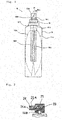
- double-structure container includes the following container illustrated in FIG. 1 and FIG. 2 .
- FIG. 1 is an explanatory view illustrating an example structure of the double-structure container used for the two-liquid mixing-type aerosol product of the present invention.
- FIG. 2 is a sectional view illustrating the cross section of an actuator in the double-structure container in FIG. 1 .
- This double-structure container 10 includes a pressure resistant container 11 made of metal and provided with an aerosol valve 12.
- the pressure resistant container 11 is provided thereinside with a first inner bag 15A that is formed of, for example, an aluminum laminated film and that defines a first liquid concentrate filling space to be filled with the first liquid concentrate composition, and a second inner bag 15B that is formed of, for example, an aluminum laminated film and that defines a second liquid concentrate filling space to be filled with the second liquid concentrate composition.
- a propellant filling space to be filled with the propellant is formed from a gap defined by the pressure resistant container 11, the first inner bag 15A, and the second inner bag 15B.
- the aerosol valve 12 is provided with a first stem 14A and a second stem 14B each having a stem passage inside.
- the first stem 14A and the second stem 14B are disposed to be movable up and down inside a first housing 13A and a second housing 13B, respectively.
- a common actuator 21 is disposed on the upper ends of the first stem 14A and the second stem 14B.
- a reference character 16A denotes a first dip tube in communication with the stem passage in the first stem 14A at the lower end of the first housing 13A.
- the first dip tube 16A extends inside the first inner bag 15A toward the bottom of the pressure resistant container 11.
- a reference character 16B denotes a second dip tube in communication with the stem passage in the second stem 14B at the lower end of the second housing 13B.
- the second dip tube 16B extends inside the second inner bag 15B toward the bottom of the pressure resistant container 11.
- FIG. 1 the components located inside the pressure resistant container 11 and the actuator 21 are drawn with broken lines.
- the common actuator 21 contains a first actuator passage 22A in communication with the stem passage in the first stem 14A, a second actuator passage 22B in communication with the stem passage in the second stem 14B, and an L-shaped mixing space 23 in communication with, at its end, the first actuator passage 22A and the second actuator passage 22B and in communication with, at its another end, a discharge port 24A of a jet port-forming member 24.
- the mixing space 23 includes a swirl passage 23A through which the first liquid concentrate composition and the second liquid concentrate composition are passed and broken down into fine droplets.
- the actuator 21 common to the first stem 14A for the first inner bag 15A and the second stem 14B for the second inner bag 15B is provided accordingly so as to form the discharging mechanism for simultaneously discharging, as mists, the first liquid concentrate composition filled in the first inner bag 15A and the second liquid concentrate composition filled in the second inner bag 15B from the first inner bag 15A and the second inner bag 15B, respectively.
- the first inner bag 15A is filled with the first liquid concentrate composition
- the second inner bag 15B is filled with the second liquid concentrate composition
- the propellant filling space is filled with a propellant.
- the inside of the pressure resistant container 11 is always pressurized with the propellant accordingly. Therefore, when the actuator 21 is actuated (depressed), the pressure of the propellant shrinks the first inner bag 15A and the second inner bag 15B, which causes the first liquid concentrate composition and the second liquid concentrate composition to be discharged simultaneously from the first inner bag 15A and the second inner bag 15B, respectively. As a result, a mixture of the first liquid concentrate composition and the second liquid concentrate composition is discharged as a mist from the discharge port 24A of the actuator 21.
- the first stem 14A and the second stem 14B are being pushed up to block the stem passage in the first stem 14A and the stem passage in the second stem 14B from the inside of the pressure resistant container 11. While the actuator 21 is actuated or depressed, the first stem 14A and the second stem 14B are pushed down, so that the stem passage in the first stem 14A and the stem passage in the second stem 14B simultaneously communicate with the inside of the pressure resistant container 11.
- the first liquid concentrate composition in the first inner bag 15A and the second liquid concentrate composition in the second inner bag 15B are discharged simultaneously through the fluid passages formed by the first dip tube 16A and the second dip tube 16B, respectively.
- the first liquid concentrate composition and the second liquid concentrate composition thus simultaneously discharged reach the mixing space 23 through the stem passage in the first stem 14A and the stem passage in the second stem 14B and through the first actuator passage 22A and the second actuator passage 22B, respectively.
- the first liquid concentrate composition and the second liquid concentrate composition are mixed in the mixing space 23, further broken down into fine droplets while passing through the swirl passage 23A, and discharged from the discharge port 24A as mists.
- the discharging mechanism enables the first liquid concentrate composition filled in the first liquid concentrate filling space and the second liquid concentrate composition filled in the second liquid concentrate filling space to be discharged simultaneously as mists.
- the discharging mechanism further enables the amount of the first liquid concentrate composition discharged from the first liquid concentrate filling space and the amount of the second liquid concentrate composition discharged from the second liquid concentrate filling space to be controlled at an appropriate quantitative ratio, specifically, so as to be substantially the same.
- the mixing ratio of the first liquid concentrate composition discharged from the first liquid concentrate filling space to the second liquid concentrate composition discharged from the second liquid concentrate filling space may preferably be from 0.8:1.2 to 1.2:0.8.
- the amount of the first liquid concentrate composition discharged from the first liquid concentrate filling space and the amount of the second liquid concentrate composition discharged from the second liquid concentrate filling space each may preferably fall within a range of ⁇ 20% of the mean of the amounts of the first liquid concentrate composition discharged and the second liquid concentrate composition discharged.
- the mixing ratio (the mass of the first liquid concentrate composition : the mass of the second liquid concentrate composition) can be controlled within the above-described range by setting, for example, the viscosity of the first liquid concentrate composition at a temperature of 20°C to 1 to 1,000 mPa ⁇ s, and the viscosity of the second liquid concentrate composition at a temperature of 20°C to 1 to 1,000 mPa ⁇ s.
- the mixing ratio (the mass of the first liquid concentrate composition : the mass of the second liquid concentrate composition) is out of the above-described range, the amount of the first liquid concentrate composition discharged from the first liquid concentrate filling space is significantly different from the amount of the second liquid concentrate composition discharged from the second liquid concentrate filling space. As a result, the discharge material may not provide desired effects or comfort during use when it is applied to the human body.
- the two-liquid mixing-type aerosol product of the present invention described above is produced by filling the first liquid concentrate filling space and the second liquid concentrate filling space in the double-structure container with the first liquid concentrate composition and the second liquid concentrate composition, respectively, and filling the propellant filling space with the propellant.
- the two-liquid mixing-type aerosol product of the present invention has a double-structure container including a discharging mechanism for simultaneously discharging the contents filled in two liquid concentrate filling spaces as mists.
- One of two liquid concentrate filling spaces is filled with the first liquid concentrate composition having a particular viscosity, whereas the other is filled with the second liquid concentrate composition having a particular viscosity and being immiscible with the first liquid concentrate composition.
- the first liquid concentrate composition and the second liquid concentrate composition both have a large degree of freedom in formulation design, and high formulation stability is obtained.
- the first liquid concentrate composition and the second liquid concentrate composition can be discharged simultaneously in appropriate amounts from two liquid concentrate filling spaces in the double-structure container. Therefore, the first liquid concentrate composition and the second liquid concentrate composition can always be mixed at a constant quantitative ratio, so that there is no possibility that the amount of one liquid concentrate composition discharged is much larger than the amount of another liquid concentrate composition discharged.
- the discharge material can be applied to an application site thinly and uniformly. As a result, desired effects are always obtained at an application site, that is, a discharge material having a desired composition can be applied in a desired amount by simply operating the discharging mechanism, specifically, for example, only depressing the actuator once (one push) to discharge the first liquid concentrate composition and the second liquid concentrate composition.
- the two-liquid mixing-type aerosol product of the present invention has high formulation stability and easily enables a mixture containing the first liquid concentrate composition and the second liquid concentrate composition at a desired ratio to be uniformly applied to an application site in a desired amount. Furthermore, the two-liquid mixing-type aerosol product of the present invention can prevent or reduce occurrence of sticky feeling caused by addition of a surfactant and can thus provide comfort during use when it is applied to the human body.
- vitamin C water-soluble component
- vitamin E oil-soluble component
- an aloe extract water-soluble component
- ethylhexyl methoxycinnamate oil-soluble component
- a non-flammable compressed gas is used as a propellant for the first liquid concentrate composition and the second liquid concentrate composition.
- the use of the non-flammable compressed gas provides high safety irrespective of the operation environment and eliminates the risk of an explosion accident in discarding the double-structure container.
- the long-term storage stability can be obtained because neither the first liquid concentrate composition nor the second liquid concentrate composition is exposed to the air outside the container during application.
- the discharge material is obtained as a mist, which eliminates the need to mix the first liquid concentrate composition and the second liquid concentrate composition at an application site or the like and also eliminates the need to spread the coating of the applied discharge material. It is thus easy to apply the discharge material.
- Such a two-liquid mixing-type aerosol product of the present invention can be used in various applications, such as products for the human body, daily necessaries, and food. Since the two-liquid mixing-type aerosol product of the present invention exerts comfort during use when it is applied to the human body, this product can preferably be used particularly for the human body.
- Examples of the product for the human body include whitening agents, beauty products, sunscreens, makeup bases, skin protective agents, moisturizers, hair styling products, hair waxes, hair treatments, hair growth agents, massaging agents and shaving agents.
- a first liquid concentrate composition was prepared by mixing the components described below.
- the viscosity of the obtained first liquid concentrate composition at a temperature of 20°C was measured using a BM-type rotary viscometer (rotor No. 1, 60 rpm, after 1 minute) and found to be 50 mPa ⁇ s.
- a second liquid concentrate composition was prepared by mixing the components described below.
- the viscosity of the obtained second liquid concentrate composition at a temperature of 20°C was measured using a BM-type rotary viscometer (rotor No. 2, 60 rpm, after 1 minute) and found to be 100 mPa ⁇ s.
- a two-liquid mixing-type aerosol product for use as a beauty product was produced by: preparing a double-structure container having the structure illustrated in FIG. 1 and FIG. 2 ; filling a first liquid concentrate filling space (first inner bag) in the double-structure container with the first liquid concentrate composition; filling a second liquid concentrate filling space (second inner bag) with the second liquid concentrate composition; and filling a propellant filling space with nitrogen gas as a propellant such that the product inner pressure in the double-structure container was 0.7 MPa at 25°C.
- the first liquid concentrate composition is a liquid cosmetic formulation for water-based beauty products in which a first medium contains water and which contains a vitamin C derivative (whitening component) as a first component composed of a water-soluble component.
- the second liquid concentrate composition is a liquid cosmetic formulation for oil-based beauty products in which a second medium contains a mineral oil and cyclopentasiloxane and which contains vitamin E as a second component composed of an oil-soluble component.
- a first liquid concentrate composition was prepared by mixing the components described below.
- the viscosity of the obtained first liquid concentrate composition at a temperature of 20°C was measured using a BM-type rotary viscometer (rotor No. 1, 60 rpm, after 1 minute) and found to be 50 mPa ⁇ s.
- a second liquid concentrate composition was prepared by mixing the components described below.
- the viscosity of the obtained second liquid concentrate composition at a temperature of 20°C was measured using a BM-type rotary viscometer (rotor No. 1, 60 rpm, after 1 minute) and found to be 80 mPa ⁇ s.
- a two-liquid mixing-type aerosol product for use as a sunscreen was produced by: preparing a double-structure container having the structure illustrated in FIG. 1 and FIG. 2 ; filling a first liquid concentrate filling space (first inner bag) in the double-structure container with the first liquid concentrate composition; filling a second liquid concentrate filling space (second inner bag) with the second liquid concentrate composition; and filling a propellant filling space with nitrogen gas as a propellant such that the product inner pressure in the double-structure container was 0.7 MPa at 25°C.
- the first liquid concentrate composition is a liquid cosmetic formulation for water-based lotions in which a first medium contains water and which contains an aloe extract (anti-inflammatory component) as a first component composed of a water-soluble component.
- the second liquid concentrate composition is a liquid cosmetic formulation for oil-based sunscreens in which a second medium contains ethylhexyl palmitate, caprylyl methicone, and cyclopentasiloxane and which contains ethylhexyl methoxycinnamate (ultraviolet absorbing component) as a second component composed of an oil-soluble component.
- Example 1 The two-liquid mixing-type aerosol products according to Example 1 and Example 2 were found to provide comfort during use without sticky feeling when they were applied to the skin just after production.
- Example 1 and Example 2 were also found to deliver a mist of discharge material that provides functions (effects) attributed to the first component (water-soluble component) and the second component (oil-soluble component) even after the products had been stored for a long time over one month in an environment at a temperature of 45°C.
Landscapes
- Health & Medical Sciences (AREA)
- Life Sciences & Earth Sciences (AREA)
- General Health & Medical Sciences (AREA)
- Veterinary Medicine (AREA)
- Public Health (AREA)
- Animal Behavior & Ethology (AREA)
- Birds (AREA)
- Epidemiology (AREA)
- Dispersion Chemistry (AREA)
- Chemical & Material Sciences (AREA)
- Dermatology (AREA)
- Engineering & Computer Science (AREA)
- Emergency Medicine (AREA)
- Mechanical Engineering (AREA)
- Mycology (AREA)
- Microbiology (AREA)
- Botany (AREA)
- Biotechnology (AREA)
- Gerontology & Geriatric Medicine (AREA)
- Cosmetics (AREA)
- Containers And Packaging Bodies Having A Special Means To Remove Contents (AREA)
Description
- The present invention relates to two-liquid mixing-type aerosol products, and in particular, to a two-liquid mixing-type aerosol product that delivers a discharge material as a mist.
- In the related art, liquid compositions used as, for example, daily necessaries, food, and products for the human body such as cosmetic preparations contain two liquids immiscible with each other, for example, water and liquid oil, ethanol and liquid paraffin, or liquid paraffin and a certain ester compound, as media for active ingredients.
- Specific examples of certain liquid cosmetic formulations include those constituted by a water-based liquid composition containing a water-soluble component as an active ingredient in a medium of water, and an oil-based liquid composition containing an oil-soluble component as an active ingredient in a medium of a liquid oil immiscible with water. Such liquid cosmetic formulations are formed as an emulsion composition by the action of a surfactant.
- However, since such a liquid cosmetic formulation undergoes separation between the aqueous phase (water-based liquid composition) and the oil phase (oil-based liquid composition) during a long-term storage, the liquid cosmetic formulation needs to be emulsified when it is applied. Furthermore, the surfactant may cause skin irritation at application sites or the like. In addition to these problems, a particular problem may arise depending on the intended use, specifically, the type of active ingredient used.
- For example, in liquid cosmetic formulations for beauty products, vitamin C and vitamin C derivatives which are active ingredients for skin whitening are water-soluble substances, whereas vitamin E and vitamin E derivatives which are active ingredients for antioxidation are oil-soluble substances. It is thus difficult to maintain the stability (formulation stability) of these two active ingredients in the emulsion composition.
- For example, liquid cosmetic formulations for sunscreens need to contain a large amount of oil medium for dissolving an ultraviolet absorbing component because such liquid cosmetic formulations for sunscreens contain an ultraviolet absorbing component as an active ingredient. When water is added to improve feeling during use, a large amount of surfactant needs to be added. A large amount of surfactant tends to cause skin irritation and sticky feeling instead of comfort during use at application sites or the like.
- As a cosmetic preparation composed of a liquid cosmetic formulation, there is provided a preparation placed in a container and containing a water-based liquid composition and an oil-based liquid composition with these liquid compositions separated from each other.
Before application to an application site, however, such a cosmetic preparation requires mixing the water-based liquid composition and the oil-based liquid composition well on the palm after taken from the container. This process is burdensome. In addition to this problem, there is another problem in that sticky feeling is caused instead of comfort during use. -
- Patent Literature 1: Japanese Patent Application Laid-Open No.
2001-26526 - Patent Literature 2: Japanese Patent Application Laid-Open No.
2012-036102 - Patent Literature 3: Japanese Patent Application Laid-Open No.
2004-161292 - Patent Literature 4: Japanese Patent Application Laid-Open No.
2010-69421 - The present invention has been made in view of the foregoing circumstances and has as its object the provision of a two-liquid mixing-type aerosol product of an aerosol dispenser having high formulation stability, being capable of easily forming a discharge material having a desired composition, and providing comfort during use when it is applied to the human body.
- A two-liquid mixing-type aerosol product of the present invention has a double-structure container including a propellant filling space and two independent liquid concentrate filling spaces and having a discharging mechanism for simultaneously discharging contents filled in the two liquid concentrate filling spaces,
the propellant filling space in the double-structure container is filled with a propellant composed of a compressed gas,
a first liquid concentrate filling space in the double-structure container is filled with a first liquid concentrate composition, and a second liquid concentrate filling space in the double-structure container is filled with a second liquid concentrate composition,
the first liquid concentrate composition is a liquid that contains a first component in a first medium with the first component capable of being dissolved in the first medium,
the second liquid concentrate composition is a liquid that contains a second component in a second medium with the second medium capable of being dissolved in the second medium and that is immiscible with the first liquid concentrate composition,
the first liquid concentrate composition and the second liquid concentrate composition each have a viscosity from 1 to 1000 mPa·s at a temperature of 20°C, and
the discharging mechanism has a function for breaking the first liquid concentrate composition and the second liquid concentrate composition down into fine droplets and discharging the liquid concentrate compositions as mists. - In the two-liquid mixing-type aerosol product of the present invention, the first liquid concentrate composition may preferably contain the first component composed of an oil-soluble component or an oil-insoluble component in the first medium composed of an oil medium or a non-oil medium, and
the second liquid concentrate composition may preferably be an oil product containing the second component composed of an oil-soluble component in the second medium composed of an oil medium. - In the two-liquid mixing-type aerosol product of the present invention, the mixing ratio of the first liquid concentrate composition to the second liquid concentrate composition (the mass of the first liquid concentrate composition : the mass of the second liquid concentrate composition) discharged from the discharging mechanism may preferably be from 0.8:1.2 to 1.2:0.8.
- In the two-liquid mixing-type aerosol product of the present invention, the oil medium may preferably be at least one selected from the group consisting of a hydrocarbon compound, an ester compound, a silicone compound, an oil or fat, and a higher alcohol.
- In the two-liquid mixing-type aerosol product of the present invention, the oil-insoluble component may preferably be at least one selected from the group consisting of a whitening component, an antioxidant component, an anti-wrinkle component, a film forming component, a moisturizing component, a sterilizing component, an ultraviolet absorbing component, a cooling component, an astringent component, a warming component, an anti-inflammatory component, a stratum corneum peeling component, an antipruritic component, a hair growth component and a deodorant component.
- In the two-liquid mixing-type aerosol product of the present invention, the oil-soluble component may preferably be at least one selected from the group consisting of a whitening component, an antioxidant component, an anti-wrinkle component, a film forming component, a moisturizing component, a sterilizing component, an ultraviolet absorbing component, a cooling component, an astringent component, a warming component, an anti-inflammatory component, a stratum corneum peeling component, an antipruritic component, a hair growth component and a deodorant component.
- In the two-liquid mixing-type aerosol product of the present invention, the discharging mechanism may preferably have a swirl passage through which the first liquid concentrate composition and the second liquid concentrate composition to be discharged are passed and broken down into fine droplets.
- The two-liquid mixing-type aerosol product of the present invention may preferably be used for the human body.
- The two-liquid mixing-type aerosol product of the present invention has a double-structure container including a discharging mechanism for simultaneously discharging the contents filled in two liquid concentrate filling spaces as mists. One of the two liquid concentrate filling spaces is filled with a first liquid concentrate composition having a particular viscosity, whereas the other is filled with a second liquid concentrate composition having a particular viscosity and being immiscible with the first liquid concentrate composition. Therefore, there is no need to use a surfactant for emulsifying the first liquid concentrate composition and the second liquid concentrate composition. The first liquid concentrate composition and the second liquid concentrate composition both have a large degree of freedom in formulation design, and high formulation stability is obtained. In addition, the first liquid concentrate composition and the second liquid concentrate composition can always be mixed at a constant quantitative ratio, and the discharge material can be applied to an application site thinly and uniformly.
- Therefore, the two-liquid mixing-type aerosol product of the present invention has high formulation stability and easily enables a discharge material composed of a mixture containing the first liquid concentrate composition and the second liquid concentrate composition at a desired ratio to be uniformly applied to an application site in a desired amount. In the case of application to the human body, the two-liquid mixing-type aerosol product of the present invention can prevent or reduce occurrence of sticky feeling caused by addition of a surfactant and can thus provide comfort during use.
-
- [
FIG. 1 ] is an explanatory view illustrating an example structure of a double-structure container used for a two-liquid mixing-type aerosol product of the present invention. - [
FIG. 2 ] is a sectional view illustrating a cross section of an actuator in the double-structure container inFIG. 1 . - A two-liquid mixing-type aerosol product of the present invention has a double-structure container including a propellant filling space and two independent liquid concentrate filling spaces and having a discharging mechanism for simultaneously discharging the contents filled in these two liquid concentrate filling spaces as mists. In this double-structure container, the propellant filling space is filled with a propellant composed of a compressed gas, a first liquid concentrate filling space is filled with a first liquid concentrate composition, and a second liquid concentrate filling space is filled with a second liquid concentrate composition.
- In the two-liquid mixing-type aerosol product of the present invention, the first liquid concentrate composition and the second liquid concentrate composition discharged simultaneously from the first liquid concentrate filling space and the second liquid concentrate filling space, respectively, are broken down into fine droplets by the discharging mechanism to form mists. In other words, the two-liquid mixing-type aerosol product of the present invention delivers a mixture of the first liquid concentrate composition and the second liquid concentrate composition as a discharge material in the form of mist.
- In the two-liquid mixing-type aerosol product of the present invention, the first liquid concentrate composition is a liquid that contains a first component in a first medium with the first component capable of being dissolved in the first medium. On the other hand, the second liquid concentrate composition is a liquid that contains a second component in a second medium with the second component capable of being dissolved in the second medium and that is immiscible with the first liquid concentrate composition. In other words, the first liquid concentrate composition and the second liquid concentrate composition are immiscible with each other and each contain one of two liquids (specifically, the first medium and the second medium) as a medium for an active ingredient to be dissolved in each liquid.
- The first medium and the first component that constitute the first liquid concentrate composition and the second medium and the second component that constitute the second liquid concentrate composition are appropriately selected according to, for example, the intended use of the two-liquid mixing-type aerosol product of the present invention.
- Specific suitable examples of the two-liquid mixing-type aerosol product of the present invention include the examples (1) to (3) described below.
- (1) In a first specific example, the first liquid concentrate composition contains a first component composed of a water-soluble component in a first medium including water as a main component. The second liquid concentrate composition contains a second component composed of an oil-soluble component in a second medium composed of an oil medium immiscible with water.
- (2) In a second specific example, the first liquid concentrate composition contains a first component composed of an alcohol-soluble component in a first medium including an alcohol as a main component. The second liquid concentrate composition contains a second component composed of an oil-soluble component in a second medium composed of an oil medium immiscible with the alcohol that constitutes the first medium.
- (3) In a third specific example, the first liquid concentrate composition contains a first component composed of an oil-soluble component in a first medium composed of an oil medium. The second liquid concentrate composition contains a second component composed of an oil-soluble component in a second medium composed of an oil medium immiscible with the oil medium that constitutes the first medium. The oil-soluble component that constitutes the first component is soluble in the oil medium that constitutes the first medium but is insoluble in the oil medium that constitutes the second medium. The oil-soluble component that constitutes the second component is soluble in the oil medium that constitutes the second medium but is insoluble in the oil medium that constitutes the first medium.
- The two-liquid mixing-type aerosol product of the present invention is not limited to the examples (1) to (3) described above, and other examples may be employed. For example, in the two-liquid mixing-type aerosol product of the present invention, the first medium constituting the first liquid concentrate composition may be miscible with the second medium constituting the second liquid concentrate composition as long as the first liquid concentrate composition and the second liquid concentrate composition are immiscible with each other.
- Hereinafter, an example of the two-liquid mixing-type aerosol product of the present invention will be described in detail.
- In this example of the two-liquid mixing-type aerosol product, the first liquid concentrate composition is a liquid that contains a first component composed of an oil-insoluble component (specifically, a water-soluble component and an alcohol-soluble component) in a first medium composed of a non-oil medium (specifically, water and an alcohol). The second liquid concentrate composition is a liquid that contains a second component composed of an oil-soluble component in a second medium composed of an oil medium (specifically, a liquid oil) immiscible with water or an alcohol.
- The first liquid concentrate composition is a liquid that contains a first component composed of a water-soluble component in a first medium including water as a main component and optionally including an alcohol or the like. Alternatively, the first liquid concentrate composition is a liquid that contains a first component composed of an alcohol-soluble component in a first medium including an alcohol as a main component and optionally including water or the like.
- As water constituting the first medium in the first liquid concentrate composition, purified water or ion-exchanged water is used.
- As an alcohol constituting the first medium, ethanol or the like is used.
- The content ratio of the first medium may preferably be 80.0% to 99.9% by mass per 100% by mass of the first liquid concentrate composition.
- If the content ratio of the first medium is too high, the first component may not be present in a sufficient proportion.
- If the content ratio of the first medium is too low, it is difficult to form the discharge material into a mist. Particularly for application to the human body, the comfort during use may not be obtained.
- The first component, which is an essential component of the first liquid concentrate composition, serves as an active ingredient and is targeted for application.
- The first component is not necessarily an active ingredient associated with the intended use of the two-liquid mixing-type aerosol product and may be, for example, an auxiliary for a main active ingredient, or a secondary active ingredient.
- In the first liquid concentrate composition, the first component composed of an oil-insoluble component may preferably be at least one selected from the group consisting of a whitening component, an antioxidant component, an anti-wrinkle component, a film forming component, a moisturizing component, a sterilizing component, an ultraviolet absorbing component, a cooling component, an astringent component, a warming component, an anti-inflammatory component, a stratum corneum peeling component, an antipruritic component, a hair growth component and a deodorant component.
- Examples of the whitening component include arbutin, tranexamic acid, kojic acid, hydroquinone, vitamin C and a vitamin C derivative.
- Examples of the antioxidant component include polyphenol.
- Examples of the anti-wrinkle component include glycerol and hyaluronic acid.
- Examples of the film forming component include polyvinyl alcohol, polyvinylpyrrolidone and cationized cellulose.
- Examples of the moisturizing component include amino acids, urea, sodium pyrrolidone carboxylate, hyaluronic acid, glycerol and polyethylene glycol.
- Examples of the sterilizing component include benzalkonium chloride, benzethonium chloride, chlorhexidine hydrochloride and hinokitiol.
- Examples of the ultraviolet absorbing component include phenylbenzimidazole sulfonic acid.
- Examples of the astringent component include citric acid, succinic acid, tannic acid, hamamelis water, aloe and zinc sulfocarbolate.
- Examples of the anti-inflammatory component include dipotassium glycyrrhizinate, an aloe extraction liquid (aloe extract) and a perilla extract.
- Examples of the stratum corneum peeling component include salicylic acid, lactic acid, sulfur and resorcin.
- Examples of the antipruritic component include diphenhydramine hydrochloride and chlorpheniramine maleate.
- Examples of the hair growth component include a swertia herb extract, adenosine, calcium pantothenate and acetylpantothenyl ethyl ether.
- Examples of the deodorant component include a green tea extract and alum.
- The content ratio of the first component may preferably be 0.1% to 20% by mass per 100% by mass of the first liquid concentrate composition.
- If the content ratio of the first component is too high, the first component may not be dissolved well in the first liquid concentrate composition.
- If the content ratio of the first component is too low, the effect of the first component may not be exerted sufficiently.
- The first liquid concentrate composition may contain optional components if necessary, in addition to the first medium (non-oil medium) and the first component (oil-insoluble component), which are essential components.
- Examples of the optional components include a preservative, a coloring agent and a flavoring agent. A surfactant can also be used as an optional component.
- The first liquid concentrate composition constituted by the essential components and the optional components as described above has a viscosity of 1 to 1000 mPa·s, preferably 1 to 500 mPa·s at a temperature of 20°C.
- If the viscosity of the first liquid concentrate composition is too high, it is difficult to discharge the first liquid concentrate composition as a mist. In addition, the first liquid concentrate composition may not be discharged in a desired amount associated with the amount of the second liquid concentrate composition discharged.
- The second liquid concentrate composition is a liquid that contains a second component composed of an oil-soluble component in a second medium composed of an oil medium immiscible with the non-oil medium that constitutes the first medium in the first liquid concentrate composition.
- As the oil medium that constitutes the second medium, which is an essential component of the second liquid concentrate composition, a liquid oil that is in the form of liquid at room temperature is used.
- The liquid oil that constitutes the second medium may preferably be at least one selected from the group consisting of a hydrocarbon compound, an ester compound, a silicone compound, an oil or fat, and a higher alcohol.
- Examples of the hydrocarbon compound include kerosene, gas oil, mineral oil, squalane, liquid paraffin and light isoparaffin.
- Examples of the ester compound include fatty acid esters, such as isopropyl myristate, butyl myristate, isocetyl myristate, octyldodecyl myristate, butyl stearate, ethylhexyl stearate, isopropyl isostearate, isopropyl palmitate, ethylhexyl palmitate, ethyl linoleate, butyloctyl salicylate, cetyl ethylhexanoate and ethyl olivate (ethyl oleate) ; polyhydric alcohol fatty acid esters, such as triethylhexanoin, propylene glycol monocaprylate, propylene glycol dicaprylate, trimethylolpropane triethylhexanoate, trimethylolpropane triisostearate and caprylic/capric triglyceride; and polybasic acid esters, such as diisopropyl adipate, diisopropyl sebacate and diethyl sebacate.
- Examples of the silicone compound include dimethicone, cyclopentasiloxane and caprylyl methicone.
- Examples of the oil or fat include vegetable oils and fats, such as white birch oil, rosehip oil, jojoba oil, chaulmoogra oil, sunflower oil, grape seed oil, avocado oil, hazelnut oil, camellia oleifera seed oil, broccoli seed oil, babasu oil, baobab oil, croton oil, olive oil, coffee bean oil, castor oil, rice bran oil, palm oil, palm kernel oil, tung oil, peach kernel oil, cherry oil, cranberry seed oil, jatropha curcas oil, shortening, cooking oil, refined rapeseed oil, perilla oil, pecan nut oil, pistachio oil, perilla seed oil, Torreya nucifera seed oil, apricot kernel oil, akebia oil, corn oil, stillingia oil, macadamia nut oil, linseed oil, coconut oil, sea buckthorn, cottonseed oil, hempseed oil, grape oil, poppyseed oil, mustard oil, camellia oil, wheat germ oil, evening primrose oil, peanut oil, pumpkinseed oil, laurel oil, safflower oil, argan oil, meadowfoam oil, marula nut oil, pomegranate seed oil, coconut oil, neem oil, soybean oil, kiwifruit seed oil, mongongo oil and walnut oil; and animal oils and fats, such as lanolin, horse oil, mink oil and squalene.
- Examples of the higher alcohol include hexyldecanol, isostearyl alcohol, octyldodecanol, decyltetradecanol and oleyl alcohol.
- The content ratio of the second medium may preferably be 40.0% to 99.9% by mass per 100% by mass of the second liquid concentrate composition.
- If the content ratio of the second medium is too high, the second component may not be present in a sufficient ratio. Particularly for application to the human body, the discharge material may cause sticky feeling and may fail to provide comfort during use.
- If the content ratio of the second medium is too low, the second component may not be dissolved well in the second liquid concentrate composition.
- The second component, which is an essential component of the second liquid concentrate composition, is a substance insoluble in a non-oil medium. The second component serves as an active ingredient and is targeted for application.
- The second component is not necessarily an active ingredient associated with the intended use of the two-liquid mixing-type aerosol product and may be, for example, an auxiliary for a main active ingredient, or a secondary active ingredient.
- In the second liquid concentrate composition, the second component composed of an oil-soluble component may preferably be at least one selected from the group consisting of a whitening component, an antioxidant component, an anti-wrinkle component, a film forming component, a moisturizing component, a sterilizing component, an ultraviolet absorbing component, a cooling component, an astringent component, a warming component, an anti-inflammatory component, a stratum corneum peeling component, an antipruritic component, a hair growth component and a deodorant component.
- Examples of the antioxidant component include astaxanthin and vitamin E.
- Examples of the anti-wrinkle component include retinol and retinoic acid.
- Examples of the film forming component include nitrocellulose, polymeric silicone and silicone resin.
- Examples of the moisturizing component include vaseline.
- Examples of the sterilizing component include piroctone olamine and isopropylmethyl phenol.
- Examples of the ultraviolet absorbing component include ethylhexyl methoxycinnamate, 2-ethylhexyl p-dimethylaminobenzoate, octocrylene, ethylhexyl triazone, oxybenzone, t-butyl methoxydibenzoylmethane, diethylamino hydroxydibenzoyl hexyl benzoate, bis-ethylhexyloxyphenol methoxyphenyl triazine and methylene bis-benzotriazolyl tetramethylbutylphenol.
- Examples of the cooling component include menthol, menthyl lactate, mentha oil, peppermint oil, camphor, thymol and methyl salicylate.
- Examples of the warming component include capsaicin.
- Examples of the anti-inflammatory component include glycyrrhetinic acid and azulene.
- Examples of the antipruritic component include camphor and menthol.
- The content ratio of the second component may preferably be 0.1% to 60% by mass per 100% by mass of the second liquid concentrate composition.
- If the content ratio of the second component is too high, the second component may not be dissolved well in the second liquid concentrate composition.
- If the content ratio of the second component is too low, the effect of the second component may not be exerted sufficiently.
- The second liquid concentrate composition may contain optional components if necessary, in addition to the second medium (liquid oil) and the second component (oil-soluble component), which are essential components.
- Examples of the optional components include an alcohol such as ethanol. A surfactant can also be used as an optional component.
- The second liquid concentrate composition constituted by the essential components and the optional components as described above has a viscosity of 1 to 1000 mPa·s, preferably 1 to 500 mPa·s at a temperature of 20°C.
- If the viscosity of the second liquid concentrate composition is too high, it is difficult to discharge the second liquid concentrate composition as a mist. In addition, the second liquid concentrate composition may not be discharged in a desired amount associated with the amount of the first liquid concentrate composition discharged.
- A compressed gas is used as a propellant.
- Examples of the compressed gas include nitrous oxide gas, nitrogen gas, carbon dioxide gas and a mixture of these gases.
- This propellant is not discharged from the propellant filling space into the outside of the double-structure container along with simultaneous discharge of the first liquid concentrate composition and the second liquid concentrate composition.
- The propellant may preferably be enclosed such that the pressure applied when the double-structure container is filled with the propellant is 0.3 to 1.2 MPa at 25°C.
- If the pressure applied when the double-structure container is filled with the propellant (product inner pressure) is too high or too low, in both cases, the contents may not be sprayed in favorable conditions.
- The double-structure container of the two-liquid mixing-type aerosol product of the present invention includes a propellant filling space to be filled with a propellant, a first liquid concentrate filling space to be filled with a first liquid concentrate composition, and a second liquid concentrate filling space to be filled with a second liquid concentrate composition. The double-structure container further includes a discharging mechanism for simultaneously discharging, as mists, the first liquid concentrate composition and the second liquid concentrate composition from the first liquid concentrate filling space and the second liquid concentrate filling space, respectively.
- Specific examples of the double-structure container according to the present invention include the following container illustrated in
FIG. 1 and FIG. 2 . -
FIG. 1 is an explanatory view illustrating an example structure of the double-structure container used for the two-liquid mixing-type aerosol product of the present invention.FIG. 2 is a sectional view illustrating the cross section of an actuator in the double-structure container inFIG. 1 . - This double-
structure container 10 includes a pressureresistant container 11 made of metal and provided with anaerosol valve 12. The pressureresistant container 11 is provided thereinside with a firstinner bag 15A that is formed of, for example, an aluminum laminated film and that defines a first liquid concentrate filling space to be filled with the first liquid concentrate composition, and a second inner bag 15B that is formed of, for example, an aluminum laminated film and that defines a second liquid concentrate filling space to be filled with the second liquid concentrate composition. In the pressureresistant container 11, a propellant filling space to be filled with the propellant is formed from a gap defined by the pressureresistant container 11, the firstinner bag 15A, and the second inner bag 15B. Theaerosol valve 12 is provided with afirst stem 14A and asecond stem 14B each having a stem passage inside. Thefirst stem 14A and thesecond stem 14B are disposed to be movable up and down inside a first housing 13A and asecond housing 13B, respectively. Acommon actuator 21 is disposed on the upper ends of thefirst stem 14A and thesecond stem 14B. - In the example illustrated in the figure, a
reference character 16A denotes a first dip tube in communication with the stem passage in thefirst stem 14A at the lower end of the first housing 13A. Thefirst dip tube 16A extends inside the firstinner bag 15A toward the bottom of the pressureresistant container 11. A reference character 16B denotes a second dip tube in communication with the stem passage in thesecond stem 14B at the lower end of thesecond housing 13B. The second dip tube 16B extends inside the second inner bag 15B toward the bottom of the pressureresistant container 11. - In
FIG. 1 , the components located inside the pressureresistant container 11 and theactuator 21 are drawn with broken lines. - The
common actuator 21 contains afirst actuator passage 22A in communication with the stem passage in thefirst stem 14A, asecond actuator passage 22B in communication with the stem passage in thesecond stem 14B, and an L-shapedmixing space 23 in communication with, at its end, thefirst actuator passage 22A and thesecond actuator passage 22B and in communication with, at its another end, a discharge port 24A of a jet port-formingmember 24. The mixingspace 23 includes aswirl passage 23A through which the first liquid concentrate composition and the second liquid concentrate composition are passed and broken down into fine droplets. - The
actuator 21 common to thefirst stem 14A for the firstinner bag 15A and thesecond stem 14B for the second inner bag 15B is provided accordingly so as to form the discharging mechanism for simultaneously discharging, as mists, the first liquid concentrate composition filled in the firstinner bag 15A and the second liquid concentrate composition filled in the second inner bag 15B from the firstinner bag 15A and the second inner bag 15B, respectively. - In the double-
structure container 10 having such a structure, the firstinner bag 15A is filled with the first liquid concentrate composition, the second inner bag 15B is filled with the second liquid concentrate composition, and the propellant filling space is filled with a propellant. The inside of the pressureresistant container 11 is always pressurized with the propellant accordingly. Therefore, when theactuator 21 is actuated (depressed), the pressure of the propellant shrinks the firstinner bag 15A and the second inner bag 15B, which causes the first liquid concentrate composition and the second liquid concentrate composition to be discharged simultaneously from the firstinner bag 15A and the second inner bag 15B, respectively. As a result, a mixture of the first liquid concentrate composition and the second liquid concentrate composition is discharged as a mist from the discharge port 24A of theactuator 21. - Specifically, while the
actuator 21 is not actuated or depressed in the double-structure container 10 filled with the first liquid concentrate composition, the second liquid concentrate composition, and the propellant, thefirst stem 14A and thesecond stem 14B are being pushed up to block the stem passage in thefirst stem 14A and the stem passage in thesecond stem 14B from the inside of the pressureresistant container 11. While theactuator 21 is actuated or depressed, thefirst stem 14A and thesecond stem 14B are pushed down, so that the stem passage in thefirst stem 14A and the stem passage in thesecond stem 14B simultaneously communicate with the inside of the pressureresistant container 11. The first liquid concentrate composition in the firstinner bag 15A and the second liquid concentrate composition in the second inner bag 15B are discharged simultaneously through the fluid passages formed by thefirst dip tube 16A and the second dip tube 16B, respectively. The first liquid concentrate composition and the second liquid concentrate composition thus simultaneously discharged reach the mixingspace 23 through the stem passage in thefirst stem 14A and the stem passage in thesecond stem 14B and through thefirst actuator passage 22A and thesecond actuator passage 22B, respectively. The first liquid concentrate composition and the second liquid concentrate composition are mixed in the mixingspace 23, further broken down into fine droplets while passing through theswirl passage 23A, and discharged from the discharge port 24A as mists. - In the double-structure container having the structure described above, the discharging mechanism enables the first liquid concentrate composition filled in the first liquid concentrate filling space and the second liquid concentrate composition filled in the second liquid concentrate filling space to be discharged simultaneously as mists. The discharging mechanism further enables the amount of the first liquid concentrate composition discharged from the first liquid concentrate filling space and the amount of the second liquid concentrate composition discharged from the second liquid concentrate filling space to be controlled at an appropriate quantitative ratio, specifically, so as to be substantially the same.
- In the two-liquid mixing-type aerosol product of the present invention, the mixing ratio of the first liquid concentrate composition discharged from the first liquid concentrate filling space to the second liquid concentrate composition discharged from the second liquid concentrate filling space (the mass of the first liquid concentrate composition : the mass of the second liquid concentrate composition) may preferably be from 0.8:1.2 to 1.2:0.8.
- In other words, the amount of the first liquid concentrate composition discharged from the first liquid concentrate filling space and the amount of the second liquid concentrate composition discharged from the second liquid concentrate filling space each may preferably fall within a range of ±20% of the mean of the amounts of the first liquid concentrate composition discharged and the second liquid concentrate composition discharged.
- The mixing ratio (the mass of the first liquid concentrate composition : the mass of the second liquid concentrate composition) can be controlled within the above-described range by setting, for example, the viscosity of the first liquid concentrate composition at a temperature of 20°C to 1 to 1,000 mPa·s, and the viscosity of the second liquid concentrate composition at a temperature of 20°C to 1 to 1,000 mPa·s.
- If the mixing ratio (the mass of the first liquid concentrate composition : the mass of the second liquid concentrate composition) is out of the above-described range, the amount of the first liquid concentrate composition discharged from the first liquid concentrate filling space is significantly different from the amount of the second liquid concentrate composition discharged from the second liquid concentrate filling space. As a result, the discharge material may not provide desired effects or comfort during use when it is applied to the human body.
- The two-liquid mixing-type aerosol product of the present invention described above is produced by filling the first liquid concentrate filling space and the second liquid concentrate filling space in the double-structure container with the first liquid concentrate composition and the second liquid concentrate composition, respectively, and filling the propellant filling space with the propellant.
- The two-liquid mixing-type aerosol product of the present invention has a double-structure container including a discharging mechanism for simultaneously discharging the contents filled in two liquid concentrate filling spaces as mists. One of two liquid concentrate filling spaces is filled with the first liquid concentrate composition having a particular viscosity, whereas the other is filled with the second liquid concentrate composition having a particular viscosity and being immiscible with the first liquid concentrate composition.
- Therefore, there is no need to use a surfactant for emulsifying the first liquid concentrate composition and the second liquid concentrate composition. The first liquid concentrate composition and the second liquid concentrate composition both have a large degree of freedom in formulation design, and high formulation stability is obtained.
- Furthermore, the first liquid concentrate composition and the second liquid concentrate composition can be discharged simultaneously in appropriate amounts from two liquid concentrate filling spaces in the double-structure container. Therefore, the first liquid concentrate composition and the second liquid concentrate composition can always be mixed at a constant quantitative ratio, so that there is no possibility that the amount of one liquid concentrate composition discharged is much larger than the amount of another liquid concentrate composition discharged. In addition, the discharge material can be applied to an application site thinly and uniformly. As a result, desired effects are always obtained at an application site, that is, a discharge material having a desired composition can be applied in a desired amount by simply operating the discharging mechanism, specifically, for example, only depressing the actuator once (one push) to discharge the first liquid concentrate composition and the second liquid concentrate composition.
- Therefore, the two-liquid mixing-type aerosol product of the present invention has high formulation stability and easily enables a mixture containing the first liquid concentrate composition and the second liquid concentrate composition at a desired ratio to be uniformly applied to an application site in a desired amount. Furthermore, the two-liquid mixing-type aerosol product of the present invention can prevent or reduce occurrence of sticky feeling caused by addition of a surfactant and can thus provide comfort during use when it is applied to the human body.
- In the two-liquid mixing-type aerosol product of the present invention, active ingredients that are considered difficult to use in combination in the same stock solution from the viewpoint of formulation stability and the like can be used together without any undesirable effects. Specifically, vitamin C (water-soluble component) and vitamin E (oil-soluble component) can be used in combination, and an aloe extract (water-soluble component) and ethylhexyl methoxycinnamate (oil-soluble component) can be used in combination.
- In the two-liquid mixing-type aerosol product of the present invention, a non-flammable compressed gas is used as a propellant for the first liquid concentrate composition and the second liquid concentrate composition. The use of the non-flammable compressed gas provides high safety irrespective of the operation environment and eliminates the risk of an explosion accident in discarding the double-structure container.
- Moreover, the long-term storage stability can be obtained because neither the first liquid concentrate composition nor the second liquid concentrate composition is exposed to the air outside the container during application.
- In the two-liquid mixing-type aerosol product of the present invention, the discharge material is obtained as a mist, which eliminates the need to mix the first liquid concentrate composition and the second liquid concentrate composition at an application site or the like and also eliminates the need to spread the coating of the applied discharge material. It is thus easy to apply the discharge material.
- Such a two-liquid mixing-type aerosol product of the present invention can be used in various applications, such as products for the human body, daily necessaries, and food. Since the two-liquid mixing-type aerosol product of the present invention exerts comfort during use when it is applied to the human body, this product can preferably be used particularly for the human body.
- Examples of the product for the human body include whitening agents, beauty products, sunscreens, makeup bases, skin protective agents, moisturizers, hair styling products, hair waxes, hair treatments, hair growth agents, massaging agents and shaving agents.
- Examples of the present invention will be described below, but the present invention is not limited by these.
- A first liquid concentrate composition was prepared by mixing the components described below.
- The viscosity of the obtained first liquid concentrate composition at a temperature of 20°C was measured using a BM-type rotary viscometer (rotor No. 1, 60 rpm, after 1 minute) and found to be 50 mPa·s.
- Constituents of First Liquid Concentrate Composition:
- Water: 93.96% by mass
- Sodium hyaluronate: 0.01% by mass
- Vitamin C derivative (disodium ascorbate sulfate) : 0.40% by mass
- 1,3-Butylene glycol: 5.00% by mass
- Phenoxyethanol: 0.30% by mass
- Citric acid: 0.02% by mass
- Sodium citrate: 0.01% by mass
- "Rosemary extract BG-J" (manufactured by Maruzen Pharmaceuticals Co. Ltd.,): 0.10% by mass
- "Chamomile extract BG-J" (manufactured by Maruzen Pharmaceuticals Co. Ltd.,): 0.10% by mass
- "Paeoniae radix extract BG-JC" (manufactured by Maruzen Pharmaceuticals Co. Ltd.,): 0.10% by mass
- Total: 100.00% by mass
- A second liquid concentrate composition was prepared by mixing the components described below.
- The viscosity of the obtained second liquid concentrate composition at a temperature of 20°C was measured using a BM-type rotary viscometer (rotor No. 2, 60 rpm, after 1 minute) and found to be 100 mPa·s.
- Constituents of Second Liquid Concentrate Composition:
- Mineral oil: 76.30% by mass
- Vitamin E (tocopherol acetate): 0.20% by mass
- Dimethicone: 2.00% by mass
- Cyclopentasiloxane: 20.00% by mass
- Jojoba oil: 0.50% by mass
- Olive oil: 0.50% by mass
- Squalane: 0.50% by mass
- Total: 100.00% by mass
- A two-liquid mixing-type aerosol product for use as a beauty product was produced by: preparing a double-structure container having the structure illustrated in
FIG. 1 and FIG. 2 ; filling a first liquid concentrate filling space (first inner bag) in the double-structure container with the first liquid concentrate composition; filling a second liquid concentrate filling space (second inner bag) with the second liquid concentrate composition; and filling a propellant filling space with nitrogen gas as a propellant such that the product inner pressure in the double-structure container was 0.7 MPa at 25°C. In this two-liquid mixing-type aerosol product, the first liquid concentrate composition is a liquid cosmetic formulation for water-based beauty products in which a first medium contains water and which contains a vitamin C derivative (whitening component) as a first component composed of a water-soluble component. The second liquid concentrate composition is a liquid cosmetic formulation for oil-based beauty products in which a second medium contains a mineral oil and cyclopentasiloxane and which contains vitamin E as a second component composed of an oil-soluble component. - A first liquid concentrate composition was prepared by mixing the components described below.
- The viscosity of the obtained first liquid concentrate composition at a temperature of 20°C was measured using a BM-type rotary viscometer (rotor No. 1, 60 rpm, after 1 minute) and found to be 50 mPa·s.
-
- Purified water: 97.7% by mass
- Glycerol: 2.00% by mass
- Aloe extract: 0.1% by mass
- Methylparaben: 0.2% by mass
- Total: 100.0% by mass
- A second liquid concentrate composition was prepared by mixing the components described below.
- The viscosity of the obtained second liquid concentrate composition at a temperature of 20°C was measured using a BM-type rotary viscometer (rotor No. 1, 60 rpm, after 1 minute) and found to be 80 mPa·s.
-
- Ethylhexyl methoxycinnamate: 10.0% by mass
- Ethylhexyl palmitate: 10.0% by mass
- Caprylyl methicone: 5.0% by mass
- Cyclopentasiloxane: 35.0% by mass
- Ethanol: 40.0% by mass
- Total: 100.0% by mass
- A two-liquid mixing-type aerosol product for use as a sunscreen was produced by: preparing a double-structure container having the structure illustrated in
FIG. 1 and FIG. 2 ; filling a first liquid concentrate filling space (first inner bag) in the double-structure container with the first liquid concentrate composition; filling a second liquid concentrate filling space (second inner bag) with the second liquid concentrate composition; and filling a propellant filling space with nitrogen gas as a propellant such that the product inner pressure in the double-structure container was 0.7 MPa at 25°C. In this two-liquid mixing-type aerosol product, the first liquid concentrate composition is a liquid cosmetic formulation for water-based lotions in which a first medium contains water and which contains an aloe extract (anti-inflammatory component) as a first component composed of a water-soluble component. The second liquid concentrate composition is a liquid cosmetic formulation for oil-based sunscreens in which a second medium contains ethylhexyl palmitate, caprylyl methicone, and cyclopentasiloxane and which contains ethylhexyl methoxycinnamate (ultraviolet absorbing component) as a second component composed of an oil-soluble component. - The two-liquid mixing-type aerosol products according to Example 1 and Example 2 were found to provide comfort during use without sticky feeling when they were applied to the skin just after production.
- The two-liquid mixing-type aerosol products according to Example 1 and Example 2 were also found to deliver a mist of discharge material that provides functions (effects) attributed to the first component (water-soluble component) and the second component (oil-soluble component) even after the products had been stored for a long time over one month in an environment at a temperature of 45°C.
-
- 10
- double-structure container
- 11
- pressure resistant container
- 12
- aerosol valve
- 13A
- first housing
- 13B
- second housing
- 14A
- first stem
- 14B
- second stem
- 15A
- first inner bag
- 15B
- second inner bag
- 16A
- first dip tube
- 16B
- second dip tube
- 21
- actuator
- 22A
- first actuator passage
- 22B
- second actuator passage
- 23
- mixing space
- 23A
- swirl passage
- 24
- jet port-forming member
- 24A
- discharge port
Claims (8)
- A two-liquid mixing-type aerosol product comprising:a double-structure container (10) including a propellant filling space and two independent liquid concentrate filling spaces (15A, 15B) and having a discharging mechanism (21) for simultaneously discharging contents filled in the two liquid concentrate filling spaces, whereinthe propellant filling space in the double-structure container is filled with a propellant composed of a compressed gas,the first liquid concentrate filling space (15A) in the double-structure container is filled with a first liquid concentrate composition, andthe second liquid concentrate filling space (15B) in the double-structure container is filled with a second liquid concentrate composition,the first liquid concentrate composition is a liquid that contains a first component in a first medium with the first component capable of being dissolved in the first medium,the second liquid concentrate composition is a liquid that contains a second component in a second medium with the second medium capable of being dissolved in the second medium and that is immiscible with the first liquid concentrate composition,the first liquid concentrate composition and the second liquid concentrate composition each have a viscosity from 1 to 1000 mPa·s at a temperature of 20°C, andthe discharging mechanism (21) has a function for breaking the first liquid concentrate composition and the second liquid concentrate composition down into fine droplets and discharging the liquid concentrate compositions as mists.
- The two-liquid mixing-type aerosol product according to claim 1, wherein
the first liquid concentrate composition contains the first component composed of an oil-soluble component or an oil-insoluble component in the first medium composed of an oil medium or a non-oil medium, and
the second liquid concentrate composition is an oil product containing the second component composed of an oil-soluble component in the second medium composed of an oil medium. - The two-liquid mixing-type aerosol product according to claim 1 or 2, wherein
a mixing ratio of the first liquid concentrate composition to the second liquid concentrate composition (a mass of the first liquid concentrate composition : a mass of the second liquid concentrate composition) discharged from the discharging mechanism is from 0.8:1.2 to 1.2:0.8. - The two-liquid mixing-type aerosol product according to claim 2 or 3, wherein
the oil medium is at least one selected from the group consisting of a hydrocarbon compound, an ester compound, a silicone compound, an oil or fat, and a higher alcohol. - The two-liquid mixing-type aerosol product according to any one of claims 2 to 4, wherein
the oil-insoluble component is at least one selected from the group consisting of a whitening component, an antioxidant component, an anti-wrinkle component, a film forming component, a moisturizing component, a sterilizing component, an ultraviolet absorbing component, a cooling component, an astringent component, a warming component, an anti-inflammatory component, a stratum corneum peeling component, an antipruritic component, a hair growth component and a deodorant component. - The two-liquid mixing-type aerosol product according to any one of claims 2 to 5, wherein
the oil-soluble component is at least one selected from the group consisting of a whitening component, an antioxidant component, an anti-wrinkle component, a film forming component, a moisturizing component, a sterilizing component, an ultraviolet absorbing component, a cooling component, an astringent component, a warming component, an anti-inflammatory component, a stratum corneum peeling component, an antipruritic component, a hair growth component and a deodorant component. - The two-liquid mixing-type aerosol product according to any one of claims 1 to 6, wherein
the discharging mechanism (21) has a swirl passage (23A) through which the first liquid concentrate composition and the second liquid concentrate composition to be discharged are passed and broken down into fine droplets. - The two-liquid mixing-type aerosol product according to any one of claims 1 to 7, which is used for a human body.
Applications Claiming Priority (2)
| Application Number | Priority Date | Filing Date | Title |
|---|---|---|---|
| JP2015038110A JP6570263B2 (en) | 2015-02-27 | 2015-02-27 | 2-component mixed aerosol products |
| PCT/JP2016/055160 WO2016136703A1 (en) | 2015-02-27 | 2016-02-23 | Two-liquid mixing-type aerosol product |
Publications (3)
| Publication Number | Publication Date |
|---|---|
| EP3263090A1 EP3263090A1 (en) | 2018-01-03 |
| EP3263090A4 EP3263090A4 (en) | 2018-03-14 |
| EP3263090B1 true EP3263090B1 (en) | 2020-05-06 |
Family
ID=56788889
Family Applications (1)
| Application Number | Title | Priority Date | Filing Date |
|---|---|---|---|
| EP16755447.6A Active EP3263090B1 (en) | 2015-02-27 | 2016-02-23 | Two-liquid mixing-type aerosol product |
Country Status (7)
| Country | Link |
|---|---|
| US (1) | US10435228B2 (en) |
| EP (1) | EP3263090B1 (en) |
| JP (1) | JP6570263B2 (en) |
| KR (1) | KR101991193B1 (en) |
| CN (1) | CN107405262B (en) |
| BR (1) | BR112017017159B1 (en) |
| WO (1) | WO2016136703A1 (en) |
Families Citing this family (7)
| Publication number | Priority date | Publication date | Assignee | Title |
|---|---|---|---|---|
| JP6959348B2 (en) * | 2017-09-19 | 2021-11-02 | 東洋エアゾール工業株式会社 | Aerosol products |
| FR3074701B1 (en) * | 2017-12-07 | 2022-03-25 | Fareva | TWO-WAY DISTRIBUTION DEVICE FOR A MICRONIZED BIPHASIC MIXTURE |
| EP3766586B1 (en) * | 2018-04-06 | 2024-03-27 | Toyo Aerosol Industry Co., Ltd. | Aerosol product |
| US11291621B2 (en) * | 2019-10-04 | 2022-04-05 | Johnson & Johnson Consumer Inc. | Transparent sunscreen composition |
| JP2022180081A (en) * | 2021-05-24 | 2022-12-06 | 株式会社ルミカ | Accumulation type discharge product for pet liquid food |
| CN113952249A (en) * | 2021-10-28 | 2022-01-21 | 栈秋(上海)化妆品有限公司 | Cosmetic for solving problem of easy inactivation of ascorbic acid and derivatives thereof in multiphase state and technical scheme thereof |
| US11957232B2 (en) * | 2022-02-28 | 2024-04-16 | Elc Management Llc | Applicator system for applying a cosmetic product |
Family Cites Families (24)
| Publication number | Priority date | Publication date | Assignee | Title |
|---|---|---|---|---|
| US6461622B2 (en) * | 1994-09-07 | 2002-10-08 | Johnson & Johnson Consumer Companies, Inc. | Topical compositions |
| US6168335B1 (en) | 1998-08-18 | 2001-01-02 | Arich, Inc. | Applicator and dispensing device using same |
| JP2000319643A (en) * | 1999-05-06 | 2000-11-21 | Toyo Aerosol Ind Co Ltd | Aerosol compositions and aerosol products |
| JP2001026526A (en) | 1999-07-09 | 2001-01-30 | Nonogawa Shoji Kk | Aerosol-type transparent hair cosmetic |
| JP2003327515A (en) | 2002-05-10 | 2003-11-19 | Kao Corp | Hair treatment agent |
| US7036685B1 (en) | 2002-06-17 | 2006-05-02 | Green Ronald D | Multi-valve delivery system |
| US7455195B2 (en) | 2002-06-26 | 2008-11-25 | Daizo Co., Ltd. | Container for discharging plural contents, a dispenser using the container, and a process for producing the dispenser |
| US7967220B2 (en) * | 2002-09-13 | 2011-06-28 | Bissell Homecare, Inc. | Manual sprayer with dual bag-on-valve assembly |
| JP2004161292A (en) * | 2002-11-11 | 2004-06-10 | Daizo:Kk | Packaging products for discharging multiple contents |
| JP2004244109A (en) | 2003-01-24 | 2004-09-02 | Toyo Aerosol Ind Co Ltd | Aerosol device for two-liquid delivery |
| US20070241133A1 (en) | 2006-04-17 | 2007-10-18 | The Procter & Gamble Company | Container visible package |
| JP5283068B2 (en) * | 2008-09-19 | 2013-09-04 | 東洋製罐株式会社 | Injection button |
| JP5431766B2 (en) * | 2009-03-31 | 2014-03-05 | 東洋製罐株式会社 | Injection button |
| JP2012036102A (en) | 2010-08-04 | 2012-02-23 | Toyo Aerosol Ind Co Ltd | Oil-in-water type emulsion composition and aerosol composition |
| JP5846819B2 (en) * | 2010-09-29 | 2016-01-20 | ライオン株式会社 | Powder-containing cosmetic container |
| US20120126034A1 (en) | 2010-11-23 | 2012-05-24 | Darren Edward Nolen | Impingement Mixing Liquid Dispensing Apparatus and Methods |
| WO2012073361A1 (en) * | 2010-12-02 | 2012-06-07 | 東洋エアゾール工業株式会社 | Multiple liquid dispensing aerosol device |
| CN103328347B (en) | 2010-12-22 | 2015-05-27 | 株式会社大造 | Valve assembly, aerosol container using same, aerosol product and manufacturing method thereof |
| JP2012229318A (en) * | 2011-04-26 | 2012-11-22 | Toyo Aerosol Ind Co Ltd | Foam forming aerosol product |
| CN104203773B (en) | 2012-03-30 | 2017-07-25 | 株式会社大造 | The manufacture method of aerosol product |
| BR112014010853B1 (en) * | 2012-08-16 | 2021-01-12 | Toyo Aerosol Industry Co., Ltd. | foaming aerosol product |
| JP6712837B2 (en) | 2013-06-10 | 2020-06-24 | 株式会社ダリヤ | Two-agent simultaneous discharge aerosol type hair dye |
| JP6391919B2 (en) | 2013-07-05 | 2018-09-19 | ホーユー株式会社 | Hair cosmetics and hair cosmetic products |
| TWI659743B (en) | 2013-06-28 | 2019-05-21 | 朋友股份有限公司 | Hair cosmetic composition and the composition comprising oxide, hair cosmetic material and hair cosmetic product |
-
2015
- 2015-02-27 JP JP2015038110A patent/JP6570263B2/en active Active
-
2016
- 2016-02-23 US US15/552,711 patent/US10435228B2/en active Active
- 2016-02-23 WO PCT/JP2016/055160 patent/WO2016136703A1/en not_active Ceased
- 2016-02-23 KR KR1020177025790A patent/KR101991193B1/en active Active
- 2016-02-23 CN CN201680012110.7A patent/CN107405262B/en active Active
- 2016-02-23 BR BR112017017159-7A patent/BR112017017159B1/en active IP Right Grant
- 2016-02-23 EP EP16755447.6A patent/EP3263090B1/en active Active
Non-Patent Citations (1)
| Title |
|---|
| None * |
Also Published As
| Publication number | Publication date |
|---|---|
| US10435228B2 (en) | 2019-10-08 |
| US20180029781A1 (en) | 2018-02-01 |
| BR112017017159B1 (en) | 2021-09-28 |
| JP6570263B2 (en) | 2019-09-04 |
| CN107405262B (en) | 2020-04-28 |
| EP3263090A4 (en) | 2018-03-14 |
| BR112017017159A2 (en) | 2018-04-03 |
| JP2016160185A (en) | 2016-09-05 |
| WO2016136703A1 (en) | 2016-09-01 |
| CN107405262A (en) | 2017-11-28 |
| KR20170117526A (en) | 2017-10-23 |
| KR101991193B1 (en) | 2019-06-19 |
| EP3263090A1 (en) | 2018-01-03 |
Similar Documents
| Publication | Publication Date | Title |
|---|---|---|
| US10435228B2 (en) | Two-liquid mixing-type aerosol product | |
| JP7618662B2 (en) | Cosmetic compositions having enhanced color stability | |
| JP7194483B2 (en) | skin composition booster oil | |
| JP2022105148A (en) | Methods for Stabilizing Tretinoin Acid Precursors and Skin Beneficial Compositions Containing Stabilized Tretinoin Acid Precursors | |
| CN104394938A (en) | Topical spray compositions and delivery systems therefor | |
| JP2024524229A (en) | Cosmetic composition with improved color stability | |
| CN116056681B (en) | Hydrable cosmetic compositions | |
| KR20170033483A (en) | Natural surfactant for cosmetics and cosmetic composition comprising the same | |
| JP7358243B2 (en) | Nanoemulsions with color-stabilized active substances | |
| US10159326B2 (en) | Two-liquid mixing-type aerosol product | |
| US20130303631A1 (en) | Environmentally Friendly and Aerated Topical Benefit Composition | |
| JP7771092B2 (en) | Cosmetic composition with improved color stability of retinoic acid precursors | |
| US10555885B2 (en) | Low viscous cosmetic composition using a natural emulsifying agent | |
| EP3876897B1 (en) | Red colorant free of cochineal red and compositions comprising the same | |
| US20230172823A1 (en) | Cooling personal care composition comprising a polyol and a polyoxyethylene-polyoxypropylene block copolymer |
Legal Events
| Date | Code | Title | Description |
|---|---|---|---|
| STAA | Information on the status of an ep patent application or granted ep patent |
Free format text: STATUS: THE INTERNATIONAL PUBLICATION HAS BEEN MADE |
|
| PUAI | Public reference made under article 153(3) epc to a published international application that has entered the european phase |
Free format text: ORIGINAL CODE: 0009012 |
|
| STAA | Information on the status of an ep patent application or granted ep patent |
Free format text: STATUS: REQUEST FOR EXAMINATION WAS MADE |
|
| 17P | Request for examination filed |
Effective date: 20170731 |
|
| AK | Designated contracting states |
Kind code of ref document: A1 Designated state(s): AL AT BE BG CH CY CZ DE DK EE ES FI FR GB GR HR HU IE IS IT LI LT LU LV MC MK MT NL NO PL PT RO RS SE SI SK SM TR |
|
| AX | Request for extension of the european patent |
Extension state: BA ME |
|
| A4 | Supplementary search report drawn up and despatched |
Effective date: 20180209 |
|
| RIC1 | Information provided on ipc code assigned before grant |
Ipc: A61Q 17/04 20060101ALI20180205BHEP Ipc: A61K 8/02 20060101AFI20180205BHEP Ipc: A45D 34/04 20060101ALI20180205BHEP Ipc: A61Q 19/00 20060101ALI20180205BHEP Ipc: B65D 83/68 20060101ALI20180205BHEP |
|
| DAV | Request for validation of the european patent (deleted) | ||
| DAX | Request for extension of the european patent (deleted) | ||
| GRAP | Despatch of communication of intention to grant a patent |
Free format text: ORIGINAL CODE: EPIDOSNIGR1 |
|
| STAA | Information on the status of an ep patent application or granted ep patent |
Free format text: STATUS: GRANT OF PATENT IS INTENDED |
|
| INTG | Intention to grant announced |
Effective date: 20200203 |
|
| GRAS | Grant fee paid |
Free format text: ORIGINAL CODE: EPIDOSNIGR3 |
|
| GRAA | (expected) grant |
Free format text: ORIGINAL CODE: 0009210 |
|
| STAA | Information on the status of an ep patent application or granted ep patent |
Free format text: STATUS: THE PATENT HAS BEEN GRANTED |
|
| AK | Designated contracting states |
Kind code of ref document: B1 Designated state(s): AL AT BE BG CH CY CZ DE DK EE ES FI FR GB GR HR HU IE IS IT LI LT LU LV MC MK MT NL NO PL PT RO RS SE SI SK SM TR |
|
| REG | Reference to a national code |
Ref country code: GB Ref legal event code: FG4D |
|
| REG | Reference to a national code |
Ref country code: AT Ref legal event code: REF Ref document number: 1265624 Country of ref document: AT Kind code of ref document: T Effective date: 20200515 Ref country code: CH Ref legal event code: NV Representative=s name: BOVARD AG PATENT- UND MARKENANWAELTE, CH Ref country code: CH Ref legal event code: EP |
|
| REG | Reference to a national code |
Ref country code: IE Ref legal event code: FG4D |
|
| REG | Reference to a national code |
Ref country code: DE Ref legal event code: R096 Ref document number: 602016035840 Country of ref document: DE |
|
| REG | Reference to a national code |
Ref country code: LT Ref legal event code: MG4D |
|
| REG | Reference to a national code |
Ref country code: NL Ref legal event code: MP Effective date: 20200506 |
|
| PG25 | Lapsed in a contracting state [announced via postgrant information from national office to epo] |
Ref country code: NO Free format text: LAPSE BECAUSE OF FAILURE TO SUBMIT A TRANSLATION OF THE DESCRIPTION OR TO PAY THE FEE WITHIN THE PRESCRIBED TIME-LIMIT Effective date: 20200806 Ref country code: IS Free format text: LAPSE BECAUSE OF FAILURE TO SUBMIT A TRANSLATION OF THE DESCRIPTION OR TO PAY THE FEE WITHIN THE PRESCRIBED TIME-LIMIT Effective date: 20200906 Ref country code: SE Free format text: LAPSE BECAUSE OF FAILURE TO SUBMIT A TRANSLATION OF THE DESCRIPTION OR TO PAY THE FEE WITHIN THE PRESCRIBED TIME-LIMIT Effective date: 20200506 Ref country code: GR Free format text: LAPSE BECAUSE OF FAILURE TO SUBMIT A TRANSLATION OF THE DESCRIPTION OR TO PAY THE FEE WITHIN THE PRESCRIBED TIME-LIMIT Effective date: 20200807 Ref country code: FI Free format text: LAPSE BECAUSE OF FAILURE TO SUBMIT A TRANSLATION OF THE DESCRIPTION OR TO PAY THE FEE WITHIN THE PRESCRIBED TIME-LIMIT Effective date: 20200506 Ref country code: LT Free format text: LAPSE BECAUSE OF FAILURE TO SUBMIT A TRANSLATION OF THE DESCRIPTION OR TO PAY THE FEE WITHIN THE PRESCRIBED TIME-LIMIT Effective date: 20200506 Ref country code: PT Free format text: LAPSE BECAUSE OF FAILURE TO SUBMIT A TRANSLATION OF THE DESCRIPTION OR TO PAY THE FEE WITHIN THE PRESCRIBED TIME-LIMIT Effective date: 20200907 |
|
| PG25 | Lapsed in a contracting state [announced via postgrant information from national office to epo] |
Ref country code: LV Free format text: LAPSE BECAUSE OF FAILURE TO SUBMIT A TRANSLATION OF THE DESCRIPTION OR TO PAY THE FEE WITHIN THE PRESCRIBED TIME-LIMIT Effective date: 20200506 Ref country code: RS Free format text: LAPSE BECAUSE OF FAILURE TO SUBMIT A TRANSLATION OF THE DESCRIPTION OR TO PAY THE FEE WITHIN THE PRESCRIBED TIME-LIMIT Effective date: 20200506 Ref country code: HR Free format text: LAPSE BECAUSE OF FAILURE TO SUBMIT A TRANSLATION OF THE DESCRIPTION OR TO PAY THE FEE WITHIN THE PRESCRIBED TIME-LIMIT Effective date: 20200506 Ref country code: BG Free format text: LAPSE BECAUSE OF FAILURE TO SUBMIT A TRANSLATION OF THE DESCRIPTION OR TO PAY THE FEE WITHIN THE PRESCRIBED TIME-LIMIT Effective date: 20200806 |
|
| REG | Reference to a national code |
Ref country code: AT Ref legal event code: MK05 Ref document number: 1265624 Country of ref document: AT Kind code of ref document: T Effective date: 20200506 |
|
| PG25 | Lapsed in a contracting state [announced via postgrant information from national office to epo] |
Ref country code: NL Free format text: LAPSE BECAUSE OF FAILURE TO SUBMIT A TRANSLATION OF THE DESCRIPTION OR TO PAY THE FEE WITHIN THE PRESCRIBED TIME-LIMIT Effective date: 20200506 Ref country code: AL Free format text: LAPSE BECAUSE OF FAILURE TO SUBMIT A TRANSLATION OF THE DESCRIPTION OR TO PAY THE FEE WITHIN THE PRESCRIBED TIME-LIMIT Effective date: 20200506 |
|
| PG25 | Lapsed in a contracting state [announced via postgrant information from national office to epo] |
Ref country code: RO Free format text: LAPSE BECAUSE OF FAILURE TO SUBMIT A TRANSLATION OF THE DESCRIPTION OR TO PAY THE FEE WITHIN THE PRESCRIBED TIME-LIMIT Effective date: 20200506 Ref country code: CZ Free format text: LAPSE BECAUSE OF FAILURE TO SUBMIT A TRANSLATION OF THE DESCRIPTION OR TO PAY THE FEE WITHIN THE PRESCRIBED TIME-LIMIT Effective date: 20200506 Ref country code: ES Free format text: LAPSE BECAUSE OF FAILURE TO SUBMIT A TRANSLATION OF THE DESCRIPTION OR TO PAY THE FEE WITHIN THE PRESCRIBED TIME-LIMIT Effective date: 20200506 Ref country code: SM Free format text: LAPSE BECAUSE OF FAILURE TO SUBMIT A TRANSLATION OF THE DESCRIPTION OR TO PAY THE FEE WITHIN THE PRESCRIBED TIME-LIMIT Effective date: 20200506 Ref country code: DK Free format text: LAPSE BECAUSE OF FAILURE TO SUBMIT A TRANSLATION OF THE DESCRIPTION OR TO PAY THE FEE WITHIN THE PRESCRIBED TIME-LIMIT Effective date: 20200506 Ref country code: AT Free format text: LAPSE BECAUSE OF FAILURE TO SUBMIT A TRANSLATION OF THE DESCRIPTION OR TO PAY THE FEE WITHIN THE PRESCRIBED TIME-LIMIT Effective date: 20200506 Ref country code: EE Free format text: LAPSE BECAUSE OF FAILURE TO SUBMIT A TRANSLATION OF THE DESCRIPTION OR TO PAY THE FEE WITHIN THE PRESCRIBED TIME-LIMIT Effective date: 20200506 |
|
| REG | Reference to a national code |
Ref country code: DE Ref legal event code: R097 Ref document number: 602016035840 Country of ref document: DE |
|
| PG25 | Lapsed in a contracting state [announced via postgrant information from national office to epo] |
Ref country code: SK Free format text: LAPSE BECAUSE OF FAILURE TO SUBMIT A TRANSLATION OF THE DESCRIPTION OR TO PAY THE FEE WITHIN THE PRESCRIBED TIME-LIMIT Effective date: 20200506 Ref country code: PL Free format text: LAPSE BECAUSE OF FAILURE TO SUBMIT A TRANSLATION OF THE DESCRIPTION OR TO PAY THE FEE WITHIN THE PRESCRIBED TIME-LIMIT Effective date: 20200506 |
|
| PLBE | No opposition filed within time limit |
Free format text: ORIGINAL CODE: 0009261 |
|
| STAA | Information on the status of an ep patent application or granted ep patent |
Free format text: STATUS: NO OPPOSITION FILED WITHIN TIME LIMIT |
|
| 26N | No opposition filed |
Effective date: 20210209 |
|
| PG25 | Lapsed in a contracting state [announced via postgrant information from national office to epo] |
Ref country code: SI Free format text: LAPSE BECAUSE OF FAILURE TO SUBMIT A TRANSLATION OF THE DESCRIPTION OR TO PAY THE FEE WITHIN THE PRESCRIBED TIME-LIMIT Effective date: 20200506 |
|
| PG25 | Lapsed in a contracting state [announced via postgrant information from national office to epo] |
Ref country code: MC Free format text: LAPSE BECAUSE OF FAILURE TO SUBMIT A TRANSLATION OF THE DESCRIPTION OR TO PAY THE FEE WITHIN THE PRESCRIBED TIME-LIMIT Effective date: 20200506 |
|
| REG | Reference to a national code |
Ref country code: BE Ref legal event code: MM Effective date: 20210228 |
|
| PG25 | Lapsed in a contracting state [announced via postgrant information from national office to epo] |
Ref country code: LU Free format text: LAPSE BECAUSE OF NON-PAYMENT OF DUE FEES Effective date: 20210223 |
|
| PG25 | Lapsed in a contracting state [announced via postgrant information from national office to epo] |
Ref country code: IE Free format text: LAPSE BECAUSE OF NON-PAYMENT OF DUE FEES Effective date: 20210223 |
|
| PG25 | Lapsed in a contracting state [announced via postgrant information from national office to epo] |
Ref country code: BE Free format text: LAPSE BECAUSE OF NON-PAYMENT OF DUE FEES Effective date: 20210228 |
|
| P01 | Opt-out of the competence of the unified patent court (upc) registered |
Effective date: 20230418 |
|
| PG25 | Lapsed in a contracting state [announced via postgrant information from national office to epo] |
Ref country code: CY Free format text: LAPSE BECAUSE OF FAILURE TO SUBMIT A TRANSLATION OF THE DESCRIPTION OR TO PAY THE FEE WITHIN THE PRESCRIBED TIME-LIMIT Effective date: 20200506 |
|
| PG25 | Lapsed in a contracting state [announced via postgrant information from national office to epo] |
Ref country code: HU Free format text: LAPSE BECAUSE OF FAILURE TO SUBMIT A TRANSLATION OF THE DESCRIPTION OR TO PAY THE FEE WITHIN THE PRESCRIBED TIME-LIMIT; INVALID AB INITIO Effective date: 20160223 |
|
| PG25 | Lapsed in a contracting state [announced via postgrant information from national office to epo] |
Ref country code: MK Free format text: LAPSE BECAUSE OF FAILURE TO SUBMIT A TRANSLATION OF THE DESCRIPTION OR TO PAY THE FEE WITHIN THE PRESCRIBED TIME-LIMIT Effective date: 20200506 |
|
| PG25 | Lapsed in a contracting state [announced via postgrant information from national office to epo] |
Ref country code: TR Free format text: LAPSE BECAUSE OF FAILURE TO SUBMIT A TRANSLATION OF THE DESCRIPTION OR TO PAY THE FEE WITHIN THE PRESCRIBED TIME-LIMIT Effective date: 20200506 |
|
| PG25 | Lapsed in a contracting state [announced via postgrant information from national office to epo] |
Ref country code: MT Free format text: LAPSE BECAUSE OF FAILURE TO SUBMIT A TRANSLATION OF THE DESCRIPTION OR TO PAY THE FEE WITHIN THE PRESCRIBED TIME-LIMIT Effective date: 20200506 |
|
| PGFP | Annual fee paid to national office [announced via postgrant information from national office to epo] |
Ref country code: CH Payment date: 20250301 Year of fee payment: 10 |
|
| PGFP | Annual fee paid to national office [announced via postgrant information from national office to epo] |
Ref country code: GB Payment date: 20260219 Year of fee payment: 11 |
|
| PGFP | Annual fee paid to national office [announced via postgrant information from national office to epo] |
Ref country code: DE Payment date: 20260218 Year of fee payment: 11 |
|
| PGFP | Annual fee paid to national office [announced via postgrant information from national office to epo] |
Ref country code: IT Payment date: 20260224 Year of fee payment: 11 |
|
| PGFP | Annual fee paid to national office [announced via postgrant information from national office to epo] |
Ref country code: FR Payment date: 20260218 Year of fee payment: 11 |