EP3262053B1 - Imidazothiadiazole compounds as par4-inhibitors - Google Patents
Imidazothiadiazole compounds as par4-inhibitors Download PDFInfo
- Publication number
- EP3262053B1 EP3262053B1 EP16754682.9A EP16754682A EP3262053B1 EP 3262053 B1 EP3262053 B1 EP 3262053B1 EP 16754682 A EP16754682 A EP 16754682A EP 3262053 B1 EP3262053 B1 EP 3262053B1
- Authority
- EP
- European Patent Office
- Prior art keywords
- alkyl
- group
- alkoxy
- aryl
- heteroaryl
- Prior art date
- Legal status (The legal status is an assumption and is not a legal conclusion. Google has not performed a legal analysis and makes no representation as to the accuracy of the status listed.)
- Active
Links
Classifications
-
- C—CHEMISTRY; METALLURGY
- C07—ORGANIC CHEMISTRY
- C07D—HETEROCYCLIC COMPOUNDS
- C07D513/00—Heterocyclic compounds containing in the condensed system at least one hetero ring having nitrogen and sulfur atoms as the only ring hetero atoms, not provided for in groups C07D463/00, C07D477/00 or C07D499/00 - C07D507/00
- C07D513/02—Heterocyclic compounds containing in the condensed system at least one hetero ring having nitrogen and sulfur atoms as the only ring hetero atoms, not provided for in groups C07D463/00, C07D477/00 or C07D499/00 - C07D507/00 in which the condensed system contains two hetero rings
- C07D513/04—Ortho-condensed systems
-
- A—HUMAN NECESSITIES
- A61—MEDICAL OR VETERINARY SCIENCE; HYGIENE
- A61K—PREPARATIONS FOR MEDICAL, DENTAL OR TOILETRY PURPOSES
- A61K31/00—Medicinal preparations containing organic active ingredients
- A61K31/33—Heterocyclic compounds
- A61K31/395—Heterocyclic compounds having nitrogen as a ring hetero atom, e.g. guanethidine or rifamycins
- A61K31/41—Heterocyclic compounds having nitrogen as a ring hetero atom, e.g. guanethidine or rifamycins having five-membered rings with two or more ring hetero atoms, at least one of which being nitrogen, e.g. tetrazole
- A61K31/433—Thidiazoles
-
- A—HUMAN NECESSITIES
- A61—MEDICAL OR VETERINARY SCIENCE; HYGIENE
- A61K—PREPARATIONS FOR MEDICAL, DENTAL OR TOILETRY PURPOSES
- A61K31/00—Medicinal preparations containing organic active ingredients
- A61K31/33—Heterocyclic compounds
- A61K31/395—Heterocyclic compounds having nitrogen as a ring hetero atom, e.g. guanethidine or rifamycins
- A61K31/435—Heterocyclic compounds having nitrogen as a ring hetero atom, e.g. guanethidine or rifamycins having six-membered rings with one nitrogen as the only ring hetero atom
- A61K31/44—Non condensed pyridines; Hydrogenated derivatives thereof
- A61K31/4427—Non condensed pyridines; Hydrogenated derivatives thereof containing further heterocyclic ring systems
- A61K31/4439—Non condensed pyridines; Hydrogenated derivatives thereof containing further heterocyclic ring systems containing a five-membered ring with nitrogen as a ring hetero atom, e.g. omeprazole
-
- A—HUMAN NECESSITIES
- A61—MEDICAL OR VETERINARY SCIENCE; HYGIENE
- A61K—PREPARATIONS FOR MEDICAL, DENTAL OR TOILETRY PURPOSES
- A61K31/00—Medicinal preparations containing organic active ingredients
- A61K31/33—Heterocyclic compounds
- A61K31/395—Heterocyclic compounds having nitrogen as a ring hetero atom, e.g. guanethidine or rifamycins
- A61K31/495—Heterocyclic compounds having nitrogen as a ring hetero atom, e.g. guanethidine or rifamycins having six-membered rings with two or more nitrogen atoms as the only ring heteroatoms, e.g. piperazine or tetrazines
- A61K31/4965—Non-condensed pyrazines
- A61K31/497—Non-condensed pyrazines containing further heterocyclic rings
-
- A—HUMAN NECESSITIES
- A61—MEDICAL OR VETERINARY SCIENCE; HYGIENE
- A61K—PREPARATIONS FOR MEDICAL, DENTAL OR TOILETRY PURPOSES
- A61K31/00—Medicinal preparations containing organic active ingredients
- A61K31/33—Heterocyclic compounds
- A61K31/395—Heterocyclic compounds having nitrogen as a ring hetero atom, e.g. guanethidine or rifamycins
- A61K31/495—Heterocyclic compounds having nitrogen as a ring hetero atom, e.g. guanethidine or rifamycins having six-membered rings with two or more nitrogen atoms as the only ring heteroatoms, e.g. piperazine or tetrazines
- A61K31/50—Pyridazines; Hydrogenated pyridazines
- A61K31/501—Pyridazines; Hydrogenated pyridazines not condensed and containing further heterocyclic rings
-
- A—HUMAN NECESSITIES
- A61—MEDICAL OR VETERINARY SCIENCE; HYGIENE
- A61K—PREPARATIONS FOR MEDICAL, DENTAL OR TOILETRY PURPOSES
- A61K31/00—Medicinal preparations containing organic active ingredients
- A61K31/33—Heterocyclic compounds
- A61K31/395—Heterocyclic compounds having nitrogen as a ring hetero atom, e.g. guanethidine or rifamycins
- A61K31/495—Heterocyclic compounds having nitrogen as a ring hetero atom, e.g. guanethidine or rifamycins having six-membered rings with two or more nitrogen atoms as the only ring heteroatoms, e.g. piperazine or tetrazines
- A61K31/505—Pyrimidines; Hydrogenated pyrimidines, e.g. trimethoprim
- A61K31/506—Pyrimidines; Hydrogenated pyrimidines, e.g. trimethoprim not condensed and containing further heterocyclic rings
-
- A—HUMAN NECESSITIES
- A61—MEDICAL OR VETERINARY SCIENCE; HYGIENE
- A61P—SPECIFIC THERAPEUTIC ACTIVITY OF CHEMICAL COMPOUNDS OR MEDICINAL PREPARATIONS
- A61P9/00—Drugs for disorders of the cardiovascular system
-
- C—CHEMISTRY; METALLURGY
- C07—ORGANIC CHEMISTRY
- C07B—GENERAL METHODS OF ORGANIC CHEMISTRY; APPARATUS THEREFOR
- C07B2200/00—Indexing scheme relating to specific properties of organic compounds
- C07B2200/07—Optical isomers
-
- C—CHEMISTRY; METALLURGY
- C07—ORGANIC CHEMISTRY
- C07B—GENERAL METHODS OF ORGANIC CHEMISTRY; APPARATUS THEREFOR
- C07B2200/00—Indexing scheme relating to specific properties of organic compounds
- C07B2200/09—Geometrical isomers
Definitions
- the present invention provides novel imidazothiadiazole inhibitors of platelet aggregation which are useful in preventing or treating thromboembolic disorders.
- This invention also relates to pharmaceutical compositions containing these compounds and the compounds or pharmaceutical compositions of the invention for use in therapy.
- Thromboembolic diseases remain the leading cause of death in developed countries despite the availability of anticoagulants such as warfarin (COUMADIN ® ), heparin, low molecular weight heparins (LMWH), synthetic pentasaccharides, and antiplatelet agents such as aspirin and clopidogrel (PLAVIX ® ).
- anticoagulants such as warfarin (COUMADIN ® ), heparin, low molecular weight heparins (LMWH), synthetic pentasaccharides, and antiplatelet agents such as aspirin and clopidogrel (PLAVIX ® ).
- Alpha-thrombin is the most potent known activator of platelet aggregation and degranulation. Activation of platelets is causally involved in atherothrombotic vascular occlusions.
- Thrombin activates platelets by cleaving G-protein coupled receptors termed protease activated receptors (PARs).
- PARs provide their own cryptic ligand present in the N-terminal extracellular domain that is unmasked by proteolytic cleavage, with subsequent intramolecular binding to the receptor to induce signaling (tethered ligand mechanism; Coughlin, S.R., Nature, 407:258-264 (2000 )).
- Synthetic peptides that mimic the sequence of the newly formed N-terminus upon proteolytic activation can induce signaling independent of receptor cleavage.
- Platelets are a key player in atherothrombotic events. Human platelets express at least two thrombin receptors, commonly referred to as PAR1 and PAR4. Inhibitors of PAR1 have been investigated extensively, and several compounds, including vorapaxar and atopaxar have advanced into late stage clinical trials. Recently, in the TRACER phase III trial in ACS patients, vorapaxar did not significantly reduce cardiovascular events, but significantly increased the risk of major bleeding ( Tricoci, P. et al., N. Eng. J. Med., 366(1):20-33 (2012 ). Vorapaxar is currently being marketed as Zontivity ® by Merck. Thus, there remains a need to discover new antiplatelet agents with increased efficacy and reduced bleeding side effects.
- Compound 58 is also referred to as YD-3 in Wu, C-C. et al., "Selective Inhibition of Protease-activated Receptor 4-Dependent Platelet Activation by YD-3", Thromb. Haemost., 87:1026-1033 (2002 ). Also, see Chen, H.S. et al., “Synthesis and antiplatelet activity of ethyl 4-(1-benzyl-1H-indazol-3-yl)benzoate (YD-3) derivatives"", Bioorg. Med. Chem., 16:1262-1278 (2008 ).
- EP1166785 A1 and EP0667345 disclose various pyrazole derivatives which are useful as inhibitors of platelet aggregation.
- compounds of Formula (I) in accordance with the present invention are PAR4 antagonists which inhibit platelet aggregation in gamma-thrombin induced platelet aggregation assays. wherein the various moieties are as defined herein.
- the present invention provides novel imidazothiadiazole analogues as defined in claim 1 which are PAR4 antagonists and are useful as selective inhibitors of platelet aggregation, including stereoisomers, tautomers, pharmaceutically acceptable salts, or solvates thereof.
- the present invention also provides pharmaceutical compositions comprising a pharmaceutically acceptable carrier and at least one of the compounds of the present invention or stereoisomers, tautomers, pharmaceutically acceptable salts, or solvates thereof.
- the present invention also provides a compound of the invention for use in a method for the treatment or prophylaxis of thromboembolic disorders, the method comprising administering to a patient in need of such treatment or prophylaxis a therapeutically effective amount of at least one of the compounds of the present invention or stereoisomers, tautomers, pharmaceutically acceptable salts, or solvates thereof.
- the present invention also provides the compounds of the present invention or stereoisomers, tautomers, pharmaceutically acceptable salts, or solvates thereof, for use in therapy.
- the compounds of the present invention or stereoisomers, tautomers, pharmaceutically acceptable salts, or solvates thereof, may be used for the manufacture of a medicament for the treatment or prophylaxis of a thromboembolic disorder.
- the present invention provides imidazothiadiazole compounds of Formula I having the structure: or a stereoisomer, tautomer, pharmaceutically acceptable salt, or solvate thereof, wherein:
- At least one nitrogen atom in the definition of the moiety means 1-3 nitrogen atoms.
- Formula I is Formula IA: or a stereoisomer, tautomer, pharmaceutically acceptable salt, or solvate thereof, wherein:
- the present invention provides compounds of Formula ID: or a stereoisomer, tautomer, pharmaceutically acceptable salt, or solvate thereof, wherein:
- the present invention provides compounds, stereoisomers, tautomers, salts, or solvates thereof, wherein the compounds of Formula I are compounds of formulas IE, IF, IG, IH and IJ: wherein the various moieties are independently selected and are as defined earlier, with the proviso that when A is then R 7 is not pyridazin-4-yl.
- Examples of IE-IJ are: with the proviso that when A is R 7 is not pyridazin-4-yl.
- the moiety: represents the moiety: wherein X 3 , X 4 and X 5 are as defined under Formula I.
- the present invention provides compounds of formula: or a stereoisomer, tautomer, pharmaceutically acceptable salt, or solvate thereof, wherein:
- the present invention provides compounds, stereoisomers, tautomers, salts, or solvates thereof, wherein the compounds are compounds of Formula I, or they are compounds of Formula IA, or they are compounds of Formula IE, or they are compounds of Formula IF, or they are compounds of Formula IG, or they are compounds of Formula IH, or they are compounds of Formula IJ: wherein the various moieties are independently selected and:
- the present invention provides compounds, stereoisomers, tautomers, salts, or solvates thereof, wherein the compounds are compounds of Formula I, or they are compounds of Formula IA, or they are compounds of Formula ID, or they are compounds of Formula IE, or they are compounds of Formula IF, or they are compounds of Formula IG, or they are compounds of Formula IH, or they are compounds of Formula IJ: wherein the various moieties are independently selected and:
- the present invention provides compounds, stereoisomers, tautomers, salts, or solvates thereof, wherein the compounds are compounds of Formula I, or they are compounds of Formula IA, or they are compounds of Formula ID, or they are compounds of Formula IE, or they are compounds of Formula IF, or they are compounds of Formula IG, or they are compounds of Formula IH, or they are compounds of Formula IJ: wherein the various moieties are independently selected and:
- the present invention provides compounds, stereoisomers, tautomers, salts, or solvates thereof, wherein the compounds are compounds of Formula I, or they are compounds of Formula IA, or they are compounds of Formula ID, or they are compounds of Formula IE, or they are compounds of Formula IF, or they are compounds of Formula IG, or they are compounds of Formula IH, or they are compounds of Formula IJ: wherein the various moieties are independently selected and:
- the present invention provides compounds, stereoisomers, tautomers, salts, or solvates thereof, wherein the compounds are compounds of Formula I, or they are compounds of Formula IA, or they are compounds of Formula ID, or they are compounds of Formula IE, or they are compounds of Formula IF, or they are compounds of Formula IG, or they are compounds of Formula IH, or they are compounds of Formula IJ: wherein the various moieties are independently selected and are:
- the present invention provides compounds, stereoisomers, tautomers, salts, or solvates thereof, wherein the compounds are compounds of Formula I, or they are compounds of Formula IA, or they are compounds of Formula ID, or they are compounds of Formula IE, or they are compounds of Formula IF, or they are compounds of Formula IG, or they are compounds of Formula IH, or they are compounds of Formula IJ: wherein the various moieties are independently selected and:
- the present invention provides compounds, stereoisomers, tautomers, salts, or solvates thereof, wherein the compounds are compounds of Formula I, or they are compounds of Formula IA, or they are compounds of Formula ID, or they are compounds of Formula IE, or they are compounds of Formula IF, or they are compounds of Formula IG, or they are compounds of Formula IH, or they are compounds of Formula IJ: wherein the various moieties are independently selected and:
- the present invention provides compounds, stereoisomers, tautomers, salts, or solvates thereof, wherein the compounds are compounds of Formula I, or they are compounds of Formula IA, or they are compounds of Formula ID, or they are compounds of Formula IE, or they are compounds of Formula IF, or they are compounds of Formula IG, or they are compounds of Formula IH, or they are compounds of Formula IJ: wherein the various moieties are independently selected and:
- the present invention provides compounds, stereoisomers, tautomers, salts, or solvates thereof, wherein the compounds of Formula I are compounds of formula: wherein the various moieties are independently selected and:
- this invention discloses the compounds listed in Table 1.
- the present invention provides compounds, stereoisomers, tautomers, salts, or solvates thereof, wherein the compounds are compounds of Formula I.
- the present invention provides compounds, stereoisomers, tautomers, salts, or solvates thereof, wherein the compounds are compounds of Formula IA.
- the present invention provides compounds, stereoisomers, tautomers, salts, or solvates thereof, wherein the compounds are compounds of Formula ID.
- the present invention provides compounds, stereoisomers, tautomers, salts, or solvates thereof, wherein the compounds are compounds of Formula IE.
- the present invention provides compounds, stereoisomers, tautomers, salts, or solvates thereof, wherein the compounds are compounds of Formula IF.
- the present invention provides compounds, stereoisomers, tautomers, salts, or solvates thereof, wherein the compounds are compounds of Formula IG.
- the present invention provides compounds, stereoisomers, tautomers, salts, or solvates thereof, wherein the compounds are compounds of Formula IH.
- the present invention provides compounds, stereoisomers, tautomers, salts, or solvates thereof, wherein the compounds are compounds of Formula IJ.
- the present invention provides compounds, stereoisomers, tautomers, salts, or solvates thereof, wherein the compounds are the examples.
- PAR4 compounds of the invention have IC 50 s in the FLIPR Assay (described hereinafter) of about 10 ⁇ M, or 5 ⁇ M or less, or 500 nM or less, or 10 nM or less.
- Activity data for Examples 1-166 are presented in the tables of Example E.
- the present invention provides at least one compound of the present invention or a stereoisomer, tautomer, pharmaceutically acceptable salt, or solvate thereof.
- the present invention provides one or more compounds of the present invention or a stereoisomer, tautomer, pharmaceutically acceptable salt, or solvate thereof.
- the present invention provides a pharmaceutical composition, which includes a pharmaceutically acceptable carrier and a therapeutically effective amount of at least one compound of Formula I, or Formula IA, or Formula ID, or Formula IE, or Formula IF, or Formula IG, or Formula IH, or Formula IJ, or preferably, a compound selected from one of the examples, more preferably, Examples 1 to 166, or stereoisomers, tautomers, pharmaceutically acceptable salts, or solvates thereof, alone or in combination with another therapeutic agent.
- the present invention provides a pharmaceutical composition which includes a therapeutically effective amount of at least one compound of Formula I, or Formula IA, or Formula ID, or Formula IE, or Formula IF, or Formula IG, or Formula IH, or Formula IJ, or and one or more additional therapeutic agent(s).
- the present invention provides a pharmaceutical composition, wherein the additional therapeutic agent(s) are an anti-platelet agent or a combination thereof.
- the anti-platelet agent(s) are P2Y12 antagonists and/or aspirin.
- the P2Y12 antagonists are clopidogrel, ticagrelor, or prasugrel.
- the present invention provides a pharmaceutical composition, wherein the additional therapeutic agent(s) are an anticoagulant or a combination thereof.
- the anticoagulant agent(s) are FXa inhibitors or thrombin inhibitors.
- the FXa inhibitors are apixaban or rivaroxaban.
- the thrombin inhibitor is dabigatran.
- the present invention provides a compound of the invention for use in a method for the treatment or prophylaxis of a thromboembolic disorder which includes the step of administering to a subject (for example, a human) in need of such treatment or prophylaxis a therapeutically effective amount of at least one compound of Formula I, or Formula IA, or Formula ID, or Formula IE, or Formula IF, or Formula IG, or Formula IH, or Formula IJ, or of the Examples herein or stereoisomers, tautomers, pharmaceutically acceptable salts, or solvates thereof.
- the present invention provides a compound of the invention for use in methods for the treatment of a thromboembolic disorder or the primary or secondary prophylaxis of a thromboembolic disorder, which include the steps of administering to a patient (for example, a human) in need thereof a therapeutically effective amount of one compound of Formula I, or Formula IA, or Formula ID, or Formula IE, or Formula IF, or Formula IG, or Formula IH, or Formula IJ, or a compound selected from one of the examples, more preferably, Examples 1 to 166, or stereoisomers, tautomers, pharmaceutically acceptable salts, or solvates thereof, wherein the thromboembolic disorder is selected from the group consisting of arterial cardiovascular thromboembolic disorders, venous cardiovascular thromboembolic disorders, cerebrovascular thromboembolic disorders, and thromboembolic disorders in the chambers of the heart or in the peripheral circulation.
- the present invention provides a compound of the invention for use in methods for the treatment of a thromboembolic disorder or the primary or secondary prophylaxis of a thromboembolic disorder, which include the steps of administering to a patient (for example, a human) in need thereof a therapeutically effective amount of one compound of Formula I, or Formula IA, or Formula ID, or Formula IE, or Formula IF, or Formula IG, or Formula IH, or Formula IJ, or a compound selected from one of the examples, more preferably, Examples 1 to 166, or stereoisomers, tautomers, pharmaceutically acceptable salts, or solvates thereof, wherein the thromboembolic disorder is selected from the group consisting of acute coronary syndrome, unstable angina, stable angina, ST-elevated myocardial infarction, non-ST-elevated myocardial infarction, atrial fibrillation, myocardial infarction, transient ischemic attack, stroke, atherosclerosis, peripheral arterial
- the present invention provides a compound of the invention for use in methods for the treatment of a thromboembolic disorder or the primary or secondary prophylaxis of a thromboembolic disorder, which include the steps of administering to a patient (for example, a human) in need thereof a therapeutically effective amount of one compound of Formula I, or Formula IA, or Formula ID, or Formula IE, or Formula IF, or Formula IG, or Formula IH, or Formula IJ, or a compound selected from one of the examples, more preferably, Examples 1 to 166, or stereoisomers, tautomers, pharmaceutically acceptable salts, or solvates thereof, wherein the thromboembolic disorder is selected from the group consisting of acute coronary syndrome, unstable angina, stable angina, ST-elevated myocardial infarction, and non-ST-elevated myocardial infarction.
- the present invention provides a compound of the invention for use in methods for the treatment of a thromboembolic disorder or the primary or secondary prophylaxis of a thromboembolic disorder, which include the steps of administering to a patient (for example, a human) in need thereof a therapeutically effective amount of one compound of Formula I, or Formula IA, or Formula ID, or Formula IE, or Formula IF, or Formula IG, or Formula IH, or Formula IJ, or a compound selected from one of the examples, more preferably, Examples 1 to 166, or stereoisomers, tautomers, pharmaceutically acceptable salts, or solvates thereof, wherein the thromboembolic disorder is selected from the group consisting of transient ischemic attack and stroke.
- the present invention provides a compound of the invention for use in methods for the treatment of a thromboembolic disorder or the primary or secondary prophylaxis of a thromboembolic disorder, which include the steps of administering to a patient (for example, a human) in need thereof a therapeutically effective amount of one compound of Formula I, or Formula IA, or Formula ID, or Formula IE, or Formula IF, or Formula IG, or Formula IH, or Formula IJ, or a compound selected from one of the examples, more preferably, Examples 1 to 166, or stereoisomers, tautomers, pharmaceutically acceptable salts, or solvates thereof, wherein the thromboembolic disorder is peripheral arterial disease.
- the present invention includes a compound of the invention for use in a method as described above wherein the thromboembolic disorder is selected from unstable angina, an acute coronary syndrome, atrial fibrillation, first myocardial infarction, recurrent myocardial infarction, ischemic sudden death, transient ischemic attack, stroke, atherosclerosis, peripheral occlusive arterial disease, venous thrombosis, deep vein thrombosis, thrombophlebitis, arterial embolism, coronary arterial thrombosis, cerebral arterial thrombosis, cerebral embolism, kidney embolism, pulmonary embolism, and thrombosis resulting from medical implants, devices, or procedures in which blood is exposed to an artificial surface that promotes thrombosis.
- the thromboembolic disorder is selected from unstable angina, an acute coronary syndrome, atrial fibrillation, first myocardial infarction, recurrent myocardial infarction, ischemic sudden death, transient ischemic
- the present invention includes a compound of the invention for use in a method of inhibiting or preventing platelet aggregation, which includes the step of administering to a subject (such as a human) in need thereof a therapeutically effective amount of a PAR4 antagonist, which is a compound of Formula I, or Formula IA, or Formula ID, or Formula IE, or Formula IF, or Formula IG, or Formula IH, or Formula IJ, or a compound selected from one of the examples, more preferably, Examples 1 to 166, of the invention.
- a PAR4 antagonist which is a compound of Formula I, or Formula IA, or Formula ID, or Formula IE, or Formula IF, or Formula IG, or Formula IH, or Formula IJ, or a compound selected from one of the examples, more preferably, Examples 1 to 166, of the invention.
- Disclosed herein is a process for making the compounds of the present invention or a stereoisomer, tautomer, pharmaceutically acceptable salt, or solvate thereof.
- Disclosed herein is an intermediate for making the compounds of the present invention or a stereoisomer, tautomer, pharmaceutically acceptable salt, or solvate thereof.
- the invention provides a compound of the invention for use in a method of treatment or prophylaxis of a thromboembolic disorder involving administering to a subject in need thereof (e.g., a human) a therapeutically effective amount of at least one compound that binds to PAR4 (such as a compound of Formula I of the invention) and inhibits PAR4 cleavage and/or signaling, wherein said subject has a dual PAR1/PAR4 platelet receptor repertoire.
- a subject in need thereof e.g., a human
- a therapeutically effective amount of at least one compound that binds to PAR4 such as a compound of Formula I of the invention
- said subject has a dual PAR1/PAR4 platelet receptor repertoire.
- the present invention provides a compound of the present invention or stereoisomers, tautomers, pharmaceutically acceptable salts, solvates, or prodrug esters thereof, for use in therapy for the treatment or prophylaxis of a thromboembolic disorder.
- alkyl or “alkylene”, alone or as part of another group, is intended to include both branched and straight-chain saturated aliphatic hydrocarbon groups having from 1 to 10 carbons or the specified number of carbon atoms.
- C 1-10 alkyl (or alkylene) is intended to include C 1 , C 2 , C 3 , C 4 , C 5 , C 6 , C 7 , C 8 , C 9 , and C 10 alkyl groups.
- C 1 -C 6 alkyl denotes alkyl having 1 to 6 carbon atoms.
- Alkyl groups can be unsubstituted or substituted with at least one hydrogen being replaced by another chemical group.
- Example alkyl groups include, but are not limited to, methyl (Me), ethyl (Et), propyl (e.g., n-propyl and isopropyl), butyl ( e.g., n-butyl, isobutyl, t -butyl), and pentyl ( e.g., n-pentyl, isopentyl, neopentyl), as well as chain isomers thereof, and the like.
- “Alkenyl” or “alkenylene”, alone or as part of another group, is intended to include hydrocarbon chains of either straight or branched configuration and having one or more carbon-carbon double bonds that may occur in any stable point along the chain.
- C 2-6 alkenyl (or alkenylene), is intended to include C 2 , C 3 , C 4 , C 5 , and C 6 alkenyl groups.
- alkenyl include, but are not limited to, ethenyl, 1-propenyl, 2-propenyl, 2-butenyl, 3-butenyl, 2-pentenyl, 3-pentenyl, 4-pentenyl, 2-hexenyl, 3-hexenyl, 4-hexenyl, 5-hexenyl, 2-methyl-2-propenyl, and 4-methyl-3-pentenyl, and which may be optionally substituted with 1 to 4 substituents, namely, halogen, haloalkyl, alkyl, alkoxy, alkenyl, alkynyl, aryl, arylalkyl, cycloalkyl, amino, hydroxy, heteroaryl, cycloheteroalkyl, alkanoylamino, alkyla
- Alkynyl or “alkynylene”, alone or as part of another group, is intended to include hydrocarbon chains of either straight or branched configuration and having one or more carbon-carbon triple bonds that may occur in any stable point along the chain.
- C 2-6 alkynyl (or alkynylene), is intended to include C 2 , C 3 , C 4 , C 5 , and C 6 alkynyl groups; such as ethynyl, propynyl, butynyl, pentynyl, and hexynyl.
- alkoxy or "alkyloxy”, alone or as part of another group, refers to an -O-alkyl group, where alkyl is as defined above.
- C 1-6 alkoxy (or alkyloxy), is intended to include C 1 , C 2 , C 3 , C 4 , C 5 , and C 6 alkoxy groups.
- Example alkoxy groups include, but are not limited to, methoxy, ethoxy, propoxy ( e.g ., n-propoxy and isopropoxy), and t -butoxy.
- alkylthio or “thioalkoxy”, alone or as part of another group, represents an alkyl group or alkoxy group as defined above with the indicated number of carbon atoms attached through a sulphur bridge; for example methyl-S- and ethyl-S-.
- Halo or "halogen”, alone or as part of another group, includes fluoro, chloro, bromo, and iodo.
- Haloalkyl is intended to include both branched and straight-chain saturated aliphatic hydrocarbon groups having the specified number of carbon atoms, substituted with at least1 halogen up to fully substituted with halogens (perhaloalkyl), alternatively 1 to 7 halogens, or 1 to 4 halogens, preferably F and/or Cl.
- haloalkyl examples include, but are not limited to, fluoromethyl, difluoromethyl, trifluoromethyl, trichloromethyl, pentafluoroethyl, pentachloroethyl, 1,1-difluoroethyl, 1-fluoroethyl, 2,2,2-trifluoroethyl, heptafluoropropyl, and heptachloropropyl.
- haloalkyl also include "fluoroalkyl” that is intended to include both branched and straight-chain saturated aliphatic hydrocarbon groups having the specified number of carbon atoms, substituted with 1 to 7 fluorine atoms, preferably 1 to 4 fluorine atoms.
- Halo-C 1 -C 2 -alkoxy or "haloalkyloxy” represents a haloalkyl group as defined above with the indicated number of carbon atoms attached through an oxygen bridge.
- C 1-6 haloalkoxy is intended to include C 1 , C 2 , C 3 , C 4 , C 5 , and C 6 haloalkoxy groups.
- Examples of haloalkoxy include, but are not limited to, trifluoromethoxy, 2,2,2-trifluoroethoxy, pentafluorothoxy, and the like.
- haloalkylthio or “thiohaloalkoxy” represents a haloalkyl group as defined above with the indicated number of carbon atoms attached through a sulphur bridge; for example trifluoromethyl-S-, and pentafluoroethyl-S-.
- cycloalkyl as employed herein alone or as part of another group includes saturated or partially unsaturated (containing 1 or 2 double bonds) cyclic hydrocarbon groups containing 1 to 3 rings, including monocyclic alkyl, bicyclic alkyl (or bicycloalkyl), and tricyclic alkyl, containing a total of 3 to 10 carbons forming the ring (C 3 -C 10 cycloalkyl), and which may be fused to 1 or 2 aromatic rings as described for aryl, which includes cyclopropyl, cyclobutyl, cyclopentyl, cyclohexyl, cycloheptyl, cyclooctyl, cyclodecyl, cyclododecyl, cyclohexenyl, norbornyl, any of which groups may be optionally substituted with 1 to 4 substituents such as halogen, alkyl, alkoxy, hydroxy, aryl, aryloxy
- carrier or “carbocyclic residue” is intended to mean any stable 3-, 4-, 5-, 6-, or 7-membered monocyclic or bicyclic or 7-, 8-, 9-, 10-, 11-, 12-, or 13-membered bicyclic or tricyclic ring, any of which may be saturated, partially unsaturated, unsaturated or aromatic.
- carbocycles include, but are not limited to, cyclopropyl, cyclobutyl, cyclobutenyl, cyclopentyl, cyclopentenyl, cyclohexyl, cycloheptenyl, cycloheptyl, cycloheptenyl, adamantyl, cyclooctyl, cyclooctenyl, cyclooctadienyl, [3.3.0]bicyclooctane, [4.3.0]bicyclononane, [4.4.0]bicyclodecane, [2.2.2]bicyclooctane, fluorenyl, phenyl, naphthyl, indanyl, adamantyl, anthracenyl, and tetrahydronaphthyl (tetralin).
- bridged rings are also included in the definition of carbocycle (e.g ., [2.2.2]bicyclooctane).
- carbocycles e.g ., [2.2.2]bicyclooctane.
- Preferred carbocycles are cyclopropyl, cyclobutyl, cyclopentyl, cyclohexyl, phenyl, and indanyl.
- carbocycle When the term “carbocycle” is used, it is intended to include “aryl”.
- a bridged ring occurs when one or more carbon atoms link two non-adjacent carbon atoms.
- Preferred bridges are one or two carbon atoms. It is noted that a bridge always converts a monocyclic ring into a tricyclic ring. When a ring is bridged, the substituents recited for the ring may also be present on the bridge.
- Aryl groups refer to monocyclic or polycyclic aromatic hydrocarbons, including, for example, phenyl, naphthyl, and phenanthranyl. Aryl moieties are well known and described, for example, in Lewis, R.J., ed., Hawley's Condensed Chemical Dictionary, 13th Edition, John Wiley & Sons, Inc., New York (1997 ). "C 6-10 aryl” refers to phenyl and naphthyl.
- heterocycle As used herein, the term “heterocycle”, “heterocyclo” “heterocyclic” or “heterocyclyl” group is intended to mean a stable 4- to 14-membered monocyclic, bicyclic or tricyclic heterocyclic ring which is saturated or partially unsaturated and which consists of carbon atoms and 1, 2, 3, or 4 heteroatoms independently selected from the group consisting of N, NH, O and S and including any bicyclic group in which any of the above-defined heterocyclic rings is fused to a benzene ring.
- the nitrogen and sulfur heteroatoms may optionally be oxidized ( i.e., N ⁇ O and S(O) p , wherein p is 0, 1 or 2).
- the nitrogen atom may be substituted or unsubstituted (i.e., N or NR wherein R is H or another substituent, if defined).
- the heterocyclic ring may be attached to its pendant group at any heteroatom or carbon atom that results in a stable structure.
- a nitrogen in the heterocycle may optionally be quaternized.
- Spiro and bridged rings are also included in the definition of heterocycle.
- a bridged ring occurs when one or more atoms ( i.e., C, O, N, or S) link two non-adjacent carbon or nitrogen atoms. Examples of bridged rings include, but are not limited to, one carbon atom, two carbon atoms, one nitrogen atom, two nitrogen atoms, and a carbon-nitrogen group.
- a bridge always converts a monocyclic ring into a tricyclic ring.
- the substituents recited for the ring may also be present on the bridge.
- heterocycle it is not intended to include heteroaryl.
- Exemplary monocyclic heterocyclic groups include azetidinyl, pyrrolidinyl, oxetanyl, imidazolinyl, oxazolidinyl, isoxazolinyl, thiazolidinyl, isothiazolidinyl, tetrahydrofuranyl, piperidyl, piperazinyl, 2-oxopiperazinyl, 2-oxopiperidyl, 2-oxopyrrolodinyl, 2-oxoazepinyl, azepinyl, 4-piperidonyl, tetrahydropyranyl, morpholinyl, thiamorpholinyl, thiamorpholinyl sulfoxide, thiamorpholinyl sulfone, 1,3-dioxolane, and tetrahydro-1,1-dioxothienyl, and the like.
- Exemplary bicyclic heterocyclo groups include quinuclidinyl.
- Preferred heterocyclo groups include which optionally may be substituted.
- aromatic heterocyclic group or "heteroaryl” is intended to mean stable monocyclic and polycyclic aromatic hydrocarbons that include at least one heteroatom ring member such as sulfur, oxygen, or nitrogen.
- Heteroaryl groups include, without limitation, pyridyl, pyrimidinyl, pyrazinyl, pyridazinyl, triazinyl, furyl, quinolyl, isoquinolyl, thienyl, imidazolyl, thiazolyl, indolyl, pyrroyl, oxazolyl, benzofuryl, benzothienyl, benzthiazolyl, isoxazolyl, pyrazolyl, triazolyl, tetrazolyl, indazolyl, 1,2,4-thiadiazolyl, isothiazolyl, purinyl, carbazolyl, benzimidazolyl, indolinyl, benzodiox
- Heteroaryl groups are unsubstituted or substituted.
- the nitrogen atom is substituted or unsubstituted (i.e., N or NR wherein R is H or another substituent, if defined).
- the nitrogen and sulfur heteroatoms may optionally be oxidized (i.e., N ⁇ O and S(O) p , wherein p is 0, 1 or 2).
- Bridged rings are also included in the definition of heteroaryl. A bridged ring occurs when one or more atoms (i.e., C, O, N, or S) link two non-adjacent carbon or nitrogen atoms.
- bridged rings include, but are not limited to, one carbon atom, two carbon atoms, one nitrogen atom, two nitrogen atoms, and a carbon-nitrogen group. It is noted that a bridge always converts a monocyclic ring into a tricyclic ring. When a ring is bridged, the substituents recited for the ring may also be present on the bridge.
- Heteroaryl groups include, but are not limited to, and the like.
- the group R e can be selected from alkyl, alkenyl, alkynyl, aminoalkyl, substituted alkyl, substituted alkenyl, or substituted alkynyl, as defined herein, or when appropriate, the corresponding bivalent group, e.g., alkylene, alkenylene, and the like.
- the designation attached to a ring or other group refers to a free bond or linking group.
- counterion is used to represent a negatively charged species such as chloride, bromide, hydroxide, acetate, and sulfate.
- At least one or “one or more” is used to represent one, or suitable multiples thereof such as, for example, two, three, four, five, six and the like.
- substituted means that at least one hydrogen atom is replaced with a non-hydrogen group, provided that normal valencies are maintained and that the substitution results in a stable compound.
- 2 hydrogens on the atom are replaced.
- Keto substituents are not present on aromatic moieties.
- valences When a group or moiety in a structure appears to be short on valence, the remaining valences are understood to be filled with hydrogen atoms unless otherwise stated, e.g. (e.g., -N should be considered -NH or -NH 2 and -O should be considered -OH, as needed, unless otherwise stated).
- nitrogen atoms e.g ., amines
- these may be converted to N-oxides by treatment with an oxidizing agent (e.g., mCPBA and/or hydrogen peroxides) to afford other compounds of this invention.
- an oxidizing agent e.g., mCPBA and/or hydrogen peroxides
- shown and claimed nitrogen atoms are considered to cover both the shown nitrogen and its N-oxide (N ⁇ O) derivative.
- these can be replaced by silicon atoms, provided they do not form Si-N or Si-O bonds.
- any variable occurs more than one time in any constituent or formula for a compound, its definition at each occurrence is independent of its definition at every other occurrence.
- a group is shown to be substituted with 0 to 3 R 3a , then said group may optionally be substituted with up to three R 3a groups, and at each occurrence R 3a is selected independently from the definition of R 3a .
- R 3a is selected independently from the definition of R 3a .
- combinations of substituents and/or variables are permissible only if such combinations result in stable compounds.
- phrases "pharmaceutically acceptable” is employed herein to refer to those compounds, materials, compositions, and/or dosage forms that are, within the scope of sound medical judgment, suitable for use in contact with the tissues of human beings and animals without excessive toxicity, irritation, allergic response, and/or other problem or complication, commensurate with a reasonable benefit/risk ratio.
- pharmaceutically acceptable salts refer to derivatives of the disclosed compounds wherein the parent compound is modified by making acid or base salts thereof.
- examples of pharmaceutically acceptable salts include, but are not limited to, mineral or organic acid salts of basic groups such as amines; and alkali or organic salts of acidic groups such as carboxylic acids.
- the pharmaceutically acceptable salts include the conventional non-toxic salts or the quaternary ammonium salts of the parent compound formed, for example, from non-toxic inorganic or organic acids.
- such conventional non-toxic salts include those derived from inorganic acids such as hydrochloric, hydrobromic, sulfuric, sulfamic, phosphoric, and nitric; and the salts prepared from organic acids such as acetic, propionic, succinic, glycolic, stearic, lactic, malic, tartaric, citric, ascorbic, pamoic, maleic, hydroxymaleic, phenylacetic, glutamic, benzoic, salicylic, sulfanilic, 2-acetoxybenzoic, fumaric, toluenesulfonic, methanesulfonic, ethane disulfonic, oxalic, and isethionic, and the like.
- inorganic acids such as hydrochloric, hydrobromic, sulfuric, sulfamic, phosphoric, and nitric
- organic acids such as acetic, propionic, succinic, glycolic, stearic, lactic, malic,
- the pharmaceutically acceptable salts of the present invention can be synthesized from the parent compound that contains a basic or acidic moiety by conventional chemical methods. Generally, such salts can be prepared by reacting the free acid or base forms of these compounds with a stoichiometric amount of the appropriate base or acid in water or in an organic solvent, or in a mixture of the two; generally, nonaqueous media like ether, ethyl acetate, ethanol, isopropanol, or acetonitrile are preferred. Lists of suitable salts are found in Allen, L.V., Jr., ed., Remington: The Science and Practice of Pharmacy, 22nd Edition, Pharmaceutical Press, London, UK (2012 ), the disclosure of which is hereby incorporated by reference.
- compounds of formula I may have prodrug forms. Any compound that will be converted in vivo to provide the bioactive agent (i.e., a compound of formula I) is a prodrug.
- a prodrug Any compound that will be converted in vivo to provide the bioactive agent (i.e., a compound of formula I) is a prodrug.
- Various forms of prodrugs are well known in the art. For examples of such prodrug derivatives, see:
- prodrugs Preparation of prodrugs is well known in the art and described in, for example, King, F.D., ed., Medicinal Chemistry: Principles and Practice, The Royal Society of Chemistry, Cambridge, UK (2nd Edition, reproduced (2006 )); Testa, B. et al., Hydrolysis in Drug and Prodrug Metabolism. Chemistry, Biochemistry and Enzymology, VCHA and Wiley-VCH, Zurich, Switzerland (2003 ); Wermuth, C.G., ed., The Practice of Medicinal Chemistry, 3rd Edition, Academic Press, San Diego, CA (2008 ).
- Isotopically labeled compounds of the present invention i.e., wherein one or more of the atoms described are replaced by an isotope of that atom (e.g., 12 C replaced by 13 C or by 14 C; and isotopes of hydrogen including tritium and deuterium), are also provided herein.
- Such compounds have a variety of potential uses, e.g., as standards and reagents in determining the ability of a potential pharmaceutical compound to bind to target proteins or receptors, or for imaging compounds of this invention bound to biological receptors in vivo or in vitro.
- Compounds of the present invention are, subsequent to their preparation, preferably isolated and purified to obtain a composition containing an amount by weight equal to or greater than 98%, preferably 99%, compound of the present invention ("substantially pure"), which is then used or formulated as described herein. Such “substantially pure” compounds are also contemplated herein as part of the present invention.
- “Stable compound” and “stable structure” are meant to indicate a compound that is sufficiently robust to survive isolation to a useful degree of purity from a reaction mixture, and formulation into an efficacious therapeutic agent. It is preferred that compounds of the present invention do not contain aN-halo, S(O) 2 H, or S(O)H group.
- solvate means a physical association of a compound of this invention with one or more solvent molecules, whether organic or inorganic. This physical association includes hydrogen bonding. In certain instances the solvate will be capable of isolation, for example when one or more solvent molecules are incorporated in the crystal lattice of the crystalline solid.
- solvent encompasses both solution-phase and isolable solvates. Exemplary solvates include, but are not limited to, hydrates, ethanolates, methanolates, and isopropanolates. Methods of solvation are generally known in the art.
- the compounds of the present invention can be prepared in a number of ways known to one skilled in the art of organic synthesis.
- the compounds of the present invention can be synthesized using the methods described below, together with synthetic methods known in the art of synthetic organic chemistry, or by variations thereon as appreciated by those skilled in the art. Preferred methods include, but are not limited to, those described below.
- the reactions are performed in a solvent or solvent mixture appropriate to the reagents and materials employed and suitable for the transformations being effected. It will be understood by those skilled in the art of organic synthesis that the functionality present on the molecule should be consistent with the transformations proposed. This will sometimes require a judgment to modify the order of the synthetic steps or to select one particular process scheme over another in order to obtain a desired compound of the invention.
- the crude material was purified via preparative LC/MS with the following conditions: Column: XBridge C18, 19 x 100 mm, 5- ⁇ m particles; Mobile Phase A: 5:95 acetonitrile: water with 0.05% TFA; Mobile Phase B: 95:5 acetonitrile: water with 0.05% TFA. Gradient: 0-100% B over 15 minutes; Flow: 20 mL/min. Fractions containing the desired product were combined and dried via centrifugal evaporation.
- Analytical Method G Column: Supelco Ascentris Express 4.6 x50 mm, 2.7 ⁇ m particles; Mobile Phase A: 5:95 acetonitrile:water with 10 mM NH4OAc; Mobile Phase B: 95:5 acetonitrile:water with 10 mM NH4OAc; Gradient: 0-100% B over 4 minutes, 4.0 mL/min; Detection: UV at 220 nm.
- PAR4 antagonist denotes an inhibitor of platelet aggregation which binds PAR4 and inhibits PAR4 cleavage and/or signaling. Typically, PAR4 activity is reduced in a dose dependent manner by at least 10%, 20%, 30%, 40%, 50%, 60%, 70%, 80%, 90%, or 100% compared to such activity in a control cell.
- the control cell is a cell that has not been treated with the compound.
- PAR4 activity is determined by any standard method in the art, including those described herein (for example calcium mobilization in PAR4 expressing cells, platelet aggregation, platelet activation assays measuring e.g., calcium mobilization, p-selectin or CD40L release, or thrombosis and hemostasis models).
- the term “PAR4 antagonist” also includes a compound that inhibits both PAR1 and PAR4.
- compound means a chemical, be it naturally-occurring or artificially-derived.
- Compounds may include, for example, peptides, polypeptides, synthetic organic molecules, naturally occurring organic molecules, nucleic acid molecules, peptide nucleic acid molecules, and components and derivatives thereof.
- patient encompasses all mammalian species.
- the term "subject” refers to any human or nonhuman organism that could potentially benefit from treatment with a PAR4 antagonist.
- exemplary subjects include human beings of any age with risk factors for cardiovascular disease, or patients that have already experienced one episode of cardiovascular disease.
- Common risk factors include, but are not limited to, age, male sex, hypertension, smoking or smoking history, elevation of triglycerides, elevation of total cholesterol or LDL cholesterol.
- the subject is a species having a dual PAR1/PAR4 platelet receptor repertoire.
- dual PAR1/PAR4 platelet receptor repertoire means that a subject expresses PAR1 and PAR4 in platelets or their precursors.
- Exemplary subjects having a dual PAR1/PAR4 platelet receptor repertoire include human beings, nonhuman primates, and guinea pigs.
- the subject is a species having a dual PAR3/PAR4 platelet receptor repertoire.
- dual PAR3/PAR4 platelet receptor repertoire means that a subject expresses PAR3 and PAR4 in platelets or their precursors.
- Exemplary subjects having a dual PAR3/PAR4 platelet receptor repertoire include rodents and rabbits.
- treating cover the treatment of a disease-state in a mammal, particularly in a human, and include: (a) inhibiting the disease-state, i.e., arresting its development; and/or (b) relieving the disease-state, i.e., causing regression of the disease state.
- prophylaxis or “prevention” cover the preventive treatment of a subclinical disease-state in a mammal, particularly in a human, aimed at reducing the probability of the occurrence of a clinical disease-state.
- Patients are selected for preventative therapy based on factors that are known to increase risk of suffering a clinical disease state compared to the general population.
- "Prophylaxis” therapies can be divided into (a) primary prevention and (b) secondary prevention.
- Primary prevention is defined as treatment in a subject that has not yet presented with a clinical disease state, whereas secondary prevention is defined as preventing a second occurrence of the same or similar clinical disease state.
- risk reduction covers therapies that lower the incidence of development of a clinical disease state.
- primary and secondary prevention therapies are examples of risk reduction.
- “Therapeutically effective amount” is intended to include an amount of a compound of the present invention that is effective when administered alone or in combination to inhibit and / or antagonize PAR4 and/or to prevent or treat the disorders listed herein. When applied to a combination, the term refers to combined amounts of the active ingredients that result in the preventive or therapeutic effect, whether administered in combination, serially, or simultaneously.
- thrombosis refers to formation or presence of a thrombus (pl. thrombi) within a blood vessel that may cause ischemia or infarction of tissues supplied by the vessel.
- emblism refers to sudden blocking of an artery by a clot or foreign material that has been brought to its site of lodgment by the blood current.
- thromboembolism refers to obstruction of a blood vessel with thrombotic material carried by the blood stream from the site of origin to plug another vessel.
- thromboembolic disorders entails both "thrombotic” and “embolic” disorders (defined above).
- thromboembolic disorders includes arterial cardiovascular thromboembolic disorders, venous cardiovascular or cerebrovascular thromboembolic disorders, and thromboembolic disorders in the chambers of the heart or in the peripheral circulation.
- thromboembolic disorders also includes specific disorders selected from, but not limited to, unstable angina or other acute coronary syndromes, atrial fibrillation, first or recurrent myocardial infarction, ischemic sudden death, transient ischemic attack, stroke, atherosclerosis, peripheral occlusive arterial disease, venous thrombosis, deep vein thrombosis, thrombophlebitis, arterial embolism, coronary arterial thrombosis, cerebral arterial thrombosis, cerebral embolism, kidney embolism, pulmonary embolism, and thrombosis resulting from medical implants, devices, or procedures in which blood is exposed to an artificial surface that promotes thrombosis.
- the medical implants or devices include, but are not limited to: prosthetic valves, artificial valves, indwelling catheters, stents, blood oxygenators, shunts, vascular access ports, ventricular assist devices and artificial hearts or heart chambers, and vessel grafts.
- the procedures include, but are not limited to: cardiopulmonary bypass, percutaneous coronary intervention, and hemodialysis.
- thromboembolic disorders includes acute coronary syndrome, stroke, deep vein thrombosis, and pulmonary embolism.
- the present invention provides a compound of the invention for use in a method for the treatment of a thromboembolic disorder, wherein the thromboembolic disorder is selected from unstable angina, an acute coronary syndrome, atrial fibrillation, myocardial infarction, transient ischemic attack, stroke, atherosclerosis, peripheral occlusive arterial disease, venous thrombosis, deep vein thrombosis, thrombophlebitis, arterial embolism, coronary arterial thrombosis, cerebral arterial thrombosis, cerebral embolism, kidney embolism, pulmonary embolism, and thrombosis resulting from medical implants, devices, or procedures in which blood is exposed to an artificial surface that promotes thrombosis.
- the thromboembolic disorder is selected from unstable angina, an acute coronary syndrome, atrial fibrillation, myocardial infarction, transient ischemic attack, stroke, atherosclerosis, peripheral occlusive arterial disease, venous thrombosis
- the present invention provides a compound of the invention for use in a method for the treatment of a thromboembolic disorder, wherein the thromboembolic disorder is selected from acute coronary syndrome, stroke, venous thrombosis, atrial fibrillation, and thrombosis resulting from medical implants and devices.
- the present invention provides a compound of the invention for use in a method for the primary prophylaxis of a thromboembolic disorder, wherein the thromboembolic disorder is selected from unstable angina, an acute coronary syndrome, atrial fibrillation, myocardial infarction, ischemic sudden death, transient ischemic attack, stroke, atherosclerosis, peripheral occlusive arterial disease, venous thrombosis, deep vein thrombosis, thrombophlebitis, arterial embolism, coronary arterial thrombosis, cerebral arterial thrombosis, cerebral embolism, kidney embolism, pulmonary embolism, and thrombosis resulting from medical implants, devices, or procedures in which blood is exposed to an artificial surface that promotes thrombosis.
- the thromboembolic disorder is selected from unstable angina, an acute coronary syndrome, atrial fibrillation, myocardial infarction, ischemic sudden death, transient ischemic attack, stroke, atherosclerosis
- the present invention provides a compound of the invention for use in a method for the primary prophylaxis of a thromboembolic disorder, wherein the thromboembolic disorder is selected from acute coronary syndrome, stroke, venous thrombosis, and thrombosis resulting from medical implants and devices.
- the present invention provides a compound of the invention for use in a method for the secondary prophylaxis of a thromboembolic disorder, wherein the thromboembolic disorder is selected from unstable angina, an acute coronary syndrome, atrial fibrillation, recurrent myocardial infarction, transient ischemic attack, stroke, atherosclerosis, peripheral occlusive arterial disease, venous thrombosis, deep vein thrombosis, thrombophlebitis, arterial embolism, coronary arterial thrombosis, cerebral arterial thrombosis, cerebral embolism, kidney embolism, pulmonary embolism, and thrombosis resulting from medical implants, devices, or procedures in which blood is exposed to an artificial surface that promotes thrombosis.
- the thromboembolic disorder is selected from unstable angina, an acute coronary syndrome, atrial fibrillation, recurrent myocardial infarction, transient ischemic attack, stroke, atherosclerosis, peripheral occlusive
- the present invention provides a compound of the invention for use in a method for the secondary prophylaxis of a thromboembolic disorder, wherein the thromboembolic disorder is selected from acute coronary syndrome, stroke, atrial fibrillation and venous thrombosis.
- stroke refers to embolic stroke or atherothrombotic stroke arising from occlusive thrombosis in the carotid communis, carotid interna, or intracerebral arteries.
- thrombosis includes vessel occlusion (e.g., after a bypass) and reocclusion (e.g., during or after percutaneous transluminal coronary angioplasty).
- the thromboembolic disorders may result from conditions including but not limited to atherosclerosis, surgery or surgical complications, prolonged immobilization, arterial fibrillation, congenital thrombophilia, cancer, diabetes, effects of medications or hormones, and complications of pregnancy.
- Thromboembolic disorders are frequently associated with patients with atherosclerosis.
- Risk factors for atherosclerosis include but are not limited to male gender, age, hypertension, lipid disorders, and diabetes mellitus. Risk factors for atherosclerosis are at the same time risk factors for complications of atherosclerosis, i.e., thromboembolic disorders.
- thromboembolic disorders Similarly, arterial fibrillation is frequently associated with thromboembolic disorders. Risk factors for arterial fibrillation and subsequent thromboembolic disorders include cardiovascular disease, rheumatic heart disease, nonrheumatic mitral valve disease, hypertensive cardiovascular disease, chronic lung disease, and a variety of miscellaneous cardiac abnormalities as well as thyrotoxicosis.
- Diabetes mellitus is frequently associated with atherosclerosis and thromboembolic disorders.
- Risk factors for the more common type 2 include but are not limited to family history, obesity, physical inactivity, race / ethnicity, previously impaired fasting glucose or glucose tolerance test, history of gestational diabetes mellitus or delivery of a "big baby", hypertension, low HDL cholesterol, and polycystic ovary syndrome.
- Thrombosis has been associated with a variety of tumor types, e.g., pancreatic cancer, breast cancer, brain tumors, lung cancer, ovarian cancer, prostate cancer, gastrointestinal malignancies, and Hodgkins or non-Hodgkins lymphoma.
- tumor types e.g., pancreatic cancer, breast cancer, brain tumors, lung cancer, ovarian cancer, prostate cancer, gastrointestinal malignancies, and Hodgkins or non-Hodgkins lymphoma.
- Recent studies suggest that the frequency of cancer in patients with thrombosis reflects the frequency of a particular cancer type in the general population.
- VTE venous thromboembolism
- Cancer patients at risk for thrombosis may possess any or all of the following risk factors: (i) the stage of the cancer (i.e., presence of metastases), (ii) the presence of central vein catheters, (iii) surgery and anticancer therapies including chemotherapy, and (iv) hormones and antiangiogenic drugs.
- stage of the cancer i.e., presence of metastases
- central vein catheters i.e., central vein catheters
- surgery and anticancer therapies including chemotherapy iv
- hormones and antiangiogenic drugs hormones and antiangiogenic drugs.
- composition means any composition, which contains at least one therapeutically or biologically active agent and is suitable for administration to the patient. Any of these formulations can be prepared by well-known and accepted methods of the art. See, for example, Gennaro, A.R., ed., Remington: The Science and Practice of Pharmacy, 20th Edition, Mack Publishing Co., Easton, Pa. (2000 ).
- a pharmaceutical composition that includes a compound of the invention that binds to PAR4 and inhibits PAR4 cleavage and/or signaling (referred to herein as a "PAR4 antagonist” or “therapeutic compound”) may be administered to a subject.
- the compounds of this disclosure can be administered in such oral dosage forms as tablets, capsules (each of which includes sustained release or timed release formulations), pills, powders, granules, elixirs, tinctures, suspensions, syrups, and emulsions. They may also be administered in intravenous (bolus or infusion), intraperitoneal, subcutaneous, or intramuscular form, all using dosage forms well known to those of ordinary skill in the pharmaceutical arts. They can be administered alone, but generally will be administered with a pharmaceutical carrier selected on the basis of the chosen route of administration and standard pharmaceutical practice.
- the preferred dose of the PAR4 antagonist is a biologically active dose.
- a biologically active dose is a dose that will inhibit cleavage and / or signaling of PAR4 and have an anti-thrombotic effect.
- the PAR4 antagonist has the ability to reduce the activity of PAR4 by at least 5%, 10%, 20%, 30%, 40%, 50%, 60%, 70%, 80%, 90%, 100%, or more than 100% below untreated control levels.
- the levels of PAR4 in platelets is measured by any method known in the art, including, for example, receptor binding assay, platelet aggregation, platelet activation assays (e.g., p-selectin expression by FACS), Western blot or ELISA analysis using PAR4 cleavage sensitive antibodies.
- the biological activity of PAR4 is measured by assessing cellular signaling elicited by PAR4 (e.g., calcium mobilization or other second messenger assays).
- a therapeutically effective amount of a PAR4 compound is preferably from about less than 100 mg/kg, 50 mg/kg, 10 mg/kg, 5 mg/kg, 1 mg/kg, or less than 1 mg/kg. In a more preferred embodiment, the therapeutically effective amount of the PAR4 compound is less than 5 mg/kg. In a most preferred embodiment, the therapeutically effective amount of the PAR4 compound is less than 1 mg/kg. Effective doses vary, as recognized by those skilled in the art, depending on route of administration and excipient usage.
- Compounds of this invention can be administered in intranasal form via topical use of suitable intranasal vehicles, or via transdermal routes, using transdermal skin patches.
- suitable intranasal vehicles or via transdermal routes, using transdermal skin patches.
- the dosage administration will, of course, be continuous rather than intermittent throughout the dosage regimen.
- the compounds are typically administered in admixture with suitable pharmaceutical diluents, excipients, or carriers (collectively referred to herein as pharmaceutical carriers) suitably selected with respect to the intended form of administration, that is, oral tablets, capsules, elixirs, syrups and the like, and consistent with conventional pharmaceutical practices.
- suitable pharmaceutical diluents, excipients, or carriers suitably selected with respect to the intended form of administration, that is, oral tablets, capsules, elixirs, syrups and the like, and consistent with conventional pharmaceutical practices.
- the active drug component can be combined with an oral, non-toxic, pharmaceutically acceptable, inert carrier such as lactose, starch, sucrose, glucose, methyl cellulose, magnesium stearate, dicalcium phosphate, calcium sulfate, mannitol, sorbitol and the like; for oral administration in liquid form, the oral drug components can be combined with any oral, non-toxic, pharmaceutically acceptable inert carrier such as ethanol, glycerol, water, and the like.
- suitable binders, lubricants, disintegrating agents, and coloring agents can also be incorporated into the mixture.
- Suitable binders include starch, gelatin, natural sugars such as glucose or beta-lactose, corn sweeteners, natural and synthetic gums such as acacia, tragacanth, or sodium alginate, carboxymethylcellulose, polyethylene glycol, waxes, and the like.
- Lubricants used in these dosage forms include sodium oleate, sodium stearate, magnesium stearate, sodium benzoate, sodium acetate, sodium chloride, and the like.
- Disintegrators include, without limitation, starch, methyl cellulose, agar, bentonite, xanthan gum, and the like.
- the compounds of the present invention can also be administered in the form of liposome delivery systems, such as small unilamellar vesicles, large unilamellar vesicles, and multilamellar vesicles.
- Liposomes can be formed from a variety of phospholipids, such as cholesterol, stearylamine, or phosphatidylcholines.
- Compounds of the present invention may also be coupled with soluble polymers as targetable drug carriers.
- soluble polymers can include polyvinylpyrrolidone, pyran copolymer, polyhydroxypropylmethacrylamide-phenol, polyhydroxyethylaspartamidephenol, or polyethyleneoxide-polylysine substituted with palmitoyl residues.
- the compounds of the present invention may be coupled to a class of biodegradable polymers useful in achieving controlled release of a drug, for example, polylactic acid, polyglycolic acid, copolymers of polylactic and polyglycolic acid, polyepsilon caprolactone, polyhydroxy butyric acid, polyorthoesters, polyacetals, polydihydropyrans, polycyanoacylates, and crosslinked or amphipathic block copolymers of hydrogels.
- a drug for example, polylactic acid, polyglycolic acid, copolymers of polylactic and polyglycolic acid, polyepsilon caprolactone, polyhydroxy butyric acid, polyorthoesters, polyacetals, polydihydropyrans, polycyanoacylates, and crosslinked or amphipathic block copolymers of hydrogels.
- Dosage forms suitable for administration may contain from about 1 milligram to about 100 milligrams of active ingredient per dosage unit.
- the active ingredient will ordinarily be present in an amount of about 0.5-95% by weight based on the total weight of the composition.
- Gelatin capsules may contain the active ingredient and powdered carriers, such as lactose, starch, cellulose derivatives, magnesium stearate, stearic acid, and the like. Similar diluents can be used to make compressed tablets. Both tablets and capsules can be manufactured as sustained release products to provide for continuous release of medication over a period of hours. Compressed tablets can be sugar coated or film coated to mask any unpleasant taste and protect the tablet from the atmosphere, or enteric coated for selective disintegration in the gastrointestinal tract.
- powdered carriers such as lactose, starch, cellulose derivatives, magnesium stearate, stearic acid, and the like. Similar diluents can be used to make compressed tablets. Both tablets and capsules can be manufactured as sustained release products to provide for continuous release of medication over a period of hours. Compressed tablets can be sugar coated or film coated to mask any unpleasant taste and protect the tablet from the atmosphere, or enteric coated for selective disintegration in the gastrointestinal tract.
- Liquid dosage forms for oral administration can contain coloring and flavoring to increase patient acceptance.
- parenteral solutions In general, water, a suitable oil, saline, aqueous dextrose (glucose), and related sugar solutions and glycols such as propylene glycol or polyethylene glycols are suitable carriers for parenteral solutions.
- Solutions for parenteral administration may contain a water soluble salt of the active ingredient, suitable stabilizing agents, and if necessary, buffer substances.
- Antioxidizing agents such as sodium bisulfite, sodium sulfite, or ascorbic acid, either alone or combined, are suitable stabilizing agents.
- citric acid and its salts and sodium EDTA are also used.
- parenteral solutions can contain preservatives, such as benzalkonium chloride, methyl- or propyl-paraben, and chlorobutanol.
- Suitable pharmaceutical carriers are described in Remington's Pharmaceutical Sciences, Mack Publishing Company, a standard reference text in this field.
- Representative useful pharmaceutical dosage-forms for administration of the compounds of this invention can be illustrated as follows:
- a large number of unit capsules can be prepared by filling standard two-piece hard gelatin capsules each with 100 milligrams of powdered active ingredient, 150 milligrams of lactose, 50 milligrams of cellulose, and 6 milligrams magnesium stearate.
- a mixture of active ingredient in a digestible oil such as soybean oil, cottonseed oil or olive oil may be prepared and injected by means of a positive displacement pump into gelatin to form soft gelatin capsules containing 100 milligrams of the active ingredient.
- the capsules should be washed and dried.
- Tablets may be prepared by conventional procedures so that the dosage unit is 100 milligrams of active ingredient, 0.2 milligrams of colloidal silicon dioxide, 5 milligrams of magnesium stearate, 275 milligrams of microcrystalline cellulose, 11 milligrams of starch and 98.8 milligrams of lactose. Appropriate coatings may be applied to increase palatability or delay absorption.
- a spray dried dispersion can be prepared for oral administration by methods know to one skilled in the art.
- a parenteral composition suitable for administration by injection may be prepared by stirring 1.5% by weight of active ingredient in 10% by volume propylene glycol and water. The solution should be made isotonic with sodium chloride and sterilized.
- An aqueous suspension can be prepared for oral administration so that each 5 mL contain 100 mg of finely divided active ingredient, 200 mg of sodium carboxymethyl cellulose, 5 mg of sodium benzoate, 1.0 g of sorbitol solution, U.S.P., and 0.025 mL of vanillin.
- the amount of each component in a typical daily dosage and typical dosage form may be reduced relative to the usual dosage of the agent when administered alone, in view of the additive or synergistic effect of the therapeutic agents when administered in combination.
- one active ingredient may be enteric coated.
- enteric coating one of the active ingredients it is possible not only to minimize the contact between the combined active ingredients, but also, it is possible to control the release of one of these components in the gastrointestinal tract such that one of these components is not released in the stomach but rather is released in the intestines.
- One of the active ingredients may also be coated with a material which effects a sustained-release throughout the gastrointestinal tract and also serves to minimize physical contact between the combined active ingredients.
- the sustained-released component can be additionally enteric coated such that the release of this component occurs only in the intestine.
- Still another approach would involve the formulation of a combination product in which the one component is coated with a sustained and/or enteric release polymer, and the other component is also coated with a polymer such as a low viscosity grade of hydroxypropyl methylcellulose (HPMC) or other appropriate materials as known in the art, in order to further separate the active components.
- HPMC hydroxypropyl methylcellulose
- the polymer coating serves to form an additional barrier to interaction with the other component.
- compounds disclosed herein may be useful as metabolites of other compounds. Therefore, in one embodiment, compounds may be useful either as a substantially pure compound, which may also then be incorporated into a pharmaceutical composition, or may be useful as metabolite which is generated after administration of the prodrug of that compound. In one embodiment, a compound may be useful as a metabolite by being useful for treating disorders as described herein.
- the activity of the PAR4 antagonists of the present invention can be measured in a variety of in vitro assays. Exemplary assays are shown in the Examples below.
- the FLIPR assay is an exemplary in vitro assay for measuring the activity of the PAR4 antagonists of the present invention.
- intracellular calcium mobilization is induced in PAR4 expressing cells by a PAR4 agonist and calcium mobilization is monitored. See, e.g., Example A.
- AYPGKF is a known PAR4 agonist.
- An alternative PAR4 agonist is H-Ala-Phe(4-F)-Pro-Gly-Trp-Leu-Val-Lys-Asn-Gly-NH 2 .
- H-Ala-Phe(4-F)-Pro-Gly-Trp-Leu-Val-Lys-Asn-Gly-NH 2 has improved agonist activity as compared to AYPGKF with an EC 50 that is 10 fold lower than the EC 50 for AYPGKF in the FLIPR assay.
- H-Ala-Phe(4-F)-Pro-Gly-Trp-Leu-Val-Lys-Asn-Gly-NH 2 can be synthesized using methods well known to those of skill in the art.
- the FLIPR assay can also be used as a counterscreen to test agonist activity or PAR1 antagonist activity in a cell line that expresses both PAR1 and PAR4.
- the PAR1 antagonist activity can be tested by the ability of the compound to inhibit calcium mobilization induced by the PAR1 agonist peptide SFLLRN or other PAR1 agonist peptides.
- the compounds of the current invention can be tested in vitro for their ability to inhibit platelet aggregation induced by gamma-thrombin as shown in Example B.
- Gamma-thrombin a proteolytic product of alpha-thrombin which no longer interacts with PAR1, selectively cleaves and activates PAR4 ( Soslau, G. et al., "Unique pathway of thrombin-induced platelet aggregation mediated by glycoprotein Ib", J. Biol. Chem., 276:21173-21183 (2001 )).
- Platelet aggregation can be monitored in a 96-well microplate aggregation assay format or using standard platelet aggregometer.
- the aggregation assay can also be employed to test the selectivity of the compound for inhibiting platelet aggregation induced by PAR4 agonist peptides, PAR1 agonist peptide, ADP, or thromboxane analogue U46619.
- Example C is an alpha-thrombin-induced platelet aggregation assay.
- Alpha-thrombin activates both PAR1 and PAR4.
- Example D is a tissue factor-induced platelet aggregation assay.
- the conditions in this assay mimic the physiological events during thrombus formation.
- platelet aggregation in human PRP was initiated by the addition of tissue factor and CaCl 2 .
- Tissue factor the initiator of the extrinsic coagulation cascade, is highly elevated in human atherosclerotic plaque. Exposure of blood to tissue factor at the atherosclerotic site triggers a robust generation of thrombin and induces the formation of obstructive thrombi.
- the efficacy of the PAR4 antagonists of the present invention in preventing thrombosis can also be measured in a variety of in vivo assays.
- Exemplary mammals that can provide models of thrombosis and hemostasis to test the effectiveness of the PAR4 antagonists of the present invention as antithrombotic agents include, but are not limited to, guinea pigs and primates.
- Relevant efficacy models include, but are not limited to, electrolytic injury-induced carotid artery thrombosis, FeCl 3 -induced carotid artery thrombosis and arteriovenous-shunt thrombosis.
- Example F describes an in vivo model of arterial thrombosis in cynolmolgus monkeys.
- Compounds of the present invention can be tested in this model for their ability to inhibit thrombus formation induced by electrolytic injury of the carotid artery.
- Demonstration of efficacy in this model supports the utility of PAR4 antagonists of the present invention for treatment of thromboembolic diseases.
- SFFLRR is a known high affinity PAR1 selective agonist peptide.
- the PAR4 agonist peptides AYPGKF and H-Ala-Phe(4-F)-Pro-Gly-Trp-Leu-Val-Lys-Asn-Gly-NH 2 were synthesized.
- H-Ala-Phe(4-F)-Pro-Gly-Trp-Leu-Val-Lys-Asn-Gly-NH 2 showed improved PAR4 agonist activity over AYPGKF in the FLIPR assay (EC 50 value of 8 ⁇ M for H-Ala-Phe(4-F)-Pro-Gly-Trp-Leu-Val-Lys-Asn-Gly-NH 2 and 60 ⁇ M for AYPGKF) and in washed platelet aggregation assay (EC 50 value of 0.9 ⁇ M for H-Ala-Phe(4-F)-Pro-Gly-Trp-Leu-Val-Lys-Asn-Gly-NH 2 and 12 ⁇ M for AYPGKF).
- HEK293 cells stably expressing PAR4 were generated by a standard method of transfection of human PAR4 (F2R23) cDNA expression vector and selected based on PAR4 protein expression or mRNA expression. Those cells demonstrated functional responses to PAR4 agonist peptide-induced intracellular calcium elevation using FLIPR ® (Fluorometric Imaging Plate Reader; Molecular Devices Corp.). These cells also express endogenous PAR1 and can elicit calcium signal upon stimulation with PAR1 agonist peptide. Therefore, the same cells were also used to determine selectivity against PAR1 and agonist activity for both receptors. Cells from HEK293 PAR4 Clone 1.2A (BMS Arctic ID 383940) were propagated and used for calcium mobilization studies.
- Human blood was collected in 3.8% sodium citrate at a ratio of 1 ml per 9 ml blood and centrifuged in a Sorvall ® RT6000B centrifuge at 900 revolution per minute (rpm) at room temperature (RT) for 15 minutes.
- PRP was collected and used for aggregation assay.
- Refludan (Berlex Labs, Wayne, NJ), a recombinant hirudin, at a final concentration of 1 unit/mL was added to the sample to selectively prevent PAR1 activation induced by residual alpha-thrombin contamination.
- the remaining blood sample was centrifuged at 2500 rpm at room temperature for 5 minutes to collect platelet-poor plasma (PPP).
- Human blood was collected in ACD (85 mM tri-sodium citrate, 78 mM citric acid, 110 mM D-glucose, pH 4.4) at a ratio of 1.4 ml per 10 ml blood.
- ACD 85 mM tri-sodium citrate, 78 mM citric acid, 110 mM D-glucose, pH 4.4
- PRP was isolated by centrifugation at 170 g for 14 minutes and platelets were further pelleted by centrifugation at 1300 g for 6 minutes. Platelets were washed once with 10 ml ACD containing 1 mg/ml bovine serum albumin.
- Platelets were resuspended at ⁇ 2.5 ⁇ 10 8 /ml in Tyrode's Buffer (137 mM NaCl, 2 mM KCl, 1.0 mM MgCl 2 , 1 mM CaCl 2 , 5 mM glucose, 20 mM HEPES pH 7.4).
- FLIPR-based calcium mobilization assay in HEK293 cells was used to measure PAR4 antagonism, agonism, and selectivity against PAR1.
- the activity of the PAR4 antagonists of the present invention were tested in PAR4 expressing cells by monitoring H-Ala-Phe(4-F)-Pro-Gly-Trp-Leu-Val-Lys-Asn-Gly-NH 2 -induced intracellular calcium mobilization. Counter screens for agonist activity and PAR1 antagonist activity were also performed.
- PAR1/PAR4-expressing HEK293 cells were grown in DMEM (Life Technology, Grand Island, NY) containing 10% heat-inactivated FBS, 1% Penicillin-Streptomycin, 10 ⁇ g/mL blasticidin, and 100 ⁇ g/mL Zeocin at 37 °C with 5% CO 2 .
- Cells were plated overnight prior to the experiment in a black 384-well Purecoat Amine clear bottom plate (Becton Dickinson Biosciences, San Jose, CA) at 10,000 cells /well in 30 ⁇ L growth medium and incubated in a humidified chamber at 37 °C with 5% CO 2 overnight.
- HBSS Hank's Balanced Saline Solution
- DMSO dimethyl sulfoxide
- the cells were then incubated for 30 minutes at room temperature followed by addition of 20 ⁇ L of agonist peptide for antagonist activity measurement.
- the PAR4 agonist peptide H-Ala-Phe(4-F)-Pro-Gly-Trp-Leu-Val-Lys-Asn-Gly-NH 2
- the PAR1 agonist peptide SFFLRR
- Compound potency was derived from 11-point concentration-response curves.
- the ability of the compounds of the current invention to inhibit platelet aggregation induced by gamma-thrombin was tested in a 96-well microplate aggregation assay format. Briefly, 90 ⁇ L of PRP or washed platelets were pre-incubated for 5 minutes at 37 °C with 3-fold serially diluted test compound, which was prepared as a 100-fold stock solution in dimethyl sulfoxide (DMSO). Aggregation was initiated by addition of 10 ⁇ L of gamma-thrombin (Haematologic Technologies, Inc. Essex Junction, VT) at 50-100 nM final concentration, which was titrated daily to achieve 80% platelet aggregation.
- DMSO dimethyl sulfoxide
- the plate was then placed into a SpectraMax ® Plus Plate Reader (Molecular Devices) at 37 °C. Platelet aggregation was monitored at a wavelength of 405 nm using a kinetic analysis mode. Prior to the first data collection time point, the plate was shaken for 10 seconds to allow thorough mixing. Data was subsequently collected every 10 seconds for up to 7 minutes total. Data was collected using SoftMax ® 5.4.1 software and exported to Microsoft Excel for analysis. The optical density (OD) values at the time point that achieved 75% platelet activation by agonist alone were used for analysis. The OD value from a PRP sample without any treatment served as ODmaximum, and the OD value from a PPP sample containing no platelets served as the ODminimum.
- OD optical density
- % IPA (100-100 ⁇ [ODcompound - ODminimum] / [ODmaximum - ODminimum]).
- the aggregation assays were also employed to test the selectivity of the compound against other platelet receptors by using SFFLRR for PAR1, collagen (Chrono-Log, Havertown, PA) for collagen receptors, ADP for P2Y1 and P2Y12 and U46619 (Cayman Chemical, Ann Arbor, MI) for thromboxane receptors.
- the ability of PAR4 antagonists to inhibit platelet aggregation induced by alpha-thrombin can be tested using human washed platelets.
- the antagonists are pre-incubated with washed platelets for 20 min. Aggregation is initiated by addition of 1.5 nM alpha-thrombin (Haematologic Technologies, Essex Junction, VT) to 300 ⁇ l of washed platelets at stirring speed of 1000 rpm. Platelet aggregation is monitored using an Optical Aggregometer (Chrono-Log, Havertown, PA) and the area under the curve (AUC) at 6 min was measured. IC 50 values are calculated using vehicle control as 0% inhibition.
- the ability of PAR1 or PAR4 antagonists to inhibit platelet aggregation induced by endogenous thrombin can be tested in a tissue factor driven aggregation assay. Aggregation is initiated by addition of CaCl 2 and recombinant human tissue factor, which results in the generation of thrombin through activation of the coagulation pathway in the plasma. Anticoagulant agents such as corn trypsin inhibitor (Haematologic Technologies, Essex Junction, VT) at 50 ⁇ g/ml and PEFABLOC ® FG (Centerchem, Norwalk, CT) are also added to the sample to prevent fibrin clot formation during the time of the study. Platelet aggregation is monitored using standard instrumentation including optical aggregometer or impedance aggregometer.
- Healthy cynomolgus monkeys can be used in the study. These monkeys are retired from other pharmacokinetic and pharmacodynamic studies and had at least a 4-week washout period.
- the carotid arterial thrombosis model in monkeys is based on a rabbit arterial thrombosis model, as described by Wong et al. ( Wong, P.C. et al., "Nonpeptide factor Xa inhibitors: II. Antithrombotic evaluation in a rabbit model of electrically induced carotid artery thrombosis", J. Pharmacol. Exp. Ther., 295:212-218 (2002 ).) Thrombosis is induced by electrical stimulation of the carotid artery for 5 min at 10 mA using an external stainless-steel bipolar electrode.
- Carotid blood flow is measured with an appropriately sized TRANSONIC ® flow probe and a TRANSONIC ® perivascular flowmeter (TS420 Model, Transonic Systems Inc., Ithaca, NY). It is continuously recorded over a 90-min period to monitor thrombosisinduced occlusion. Integrated carotid blood flow is measured by the area under the flow-time curve. It is expressed as percent of total control carotid blood flow, which would result if control blood flow had been maintained continuously for 90 min. In addition, thrombus from the injured artery is removed, blotted twice on a weighing paper to remove residual fluid, and weighed.
Landscapes
- Health & Medical Sciences (AREA)
- Chemical & Material Sciences (AREA)
- Public Health (AREA)
- Pharmacology & Pharmacy (AREA)
- Veterinary Medicine (AREA)
- General Health & Medical Sciences (AREA)
- Animal Behavior & Ethology (AREA)
- Medicinal Chemistry (AREA)
- Life Sciences & Earth Sciences (AREA)
- Epidemiology (AREA)
- Organic Chemistry (AREA)
- General Chemical & Material Sciences (AREA)
- Nuclear Medicine, Radiotherapy & Molecular Imaging (AREA)
- Cardiology (AREA)
- Chemical Kinetics & Catalysis (AREA)
- Engineering & Computer Science (AREA)
- Bioinformatics & Cheminformatics (AREA)
- Heart & Thoracic Surgery (AREA)
- Pharmaceuticals Containing Other Organic And Inorganic Compounds (AREA)
- Nitrogen Condensed Heterocyclic Rings (AREA)
Description
- The present invention provides novel imidazothiadiazole inhibitors of platelet aggregation which are useful in preventing or treating thromboembolic disorders. This invention also relates to pharmaceutical compositions containing these compounds and the compounds or pharmaceutical compositions of the invention for use in therapy.
- Thromboembolic diseases remain the leading cause of death in developed countries despite the availability of anticoagulants such as warfarin (COUMADIN®), heparin, low molecular weight heparins (LMWH), synthetic pentasaccharides, and antiplatelet agents such as aspirin and clopidogrel (PLAVIX®).
- Current anti-platelet therapies have limitations including increased risk of bleeding as well as partial efficacy (relative cardiovascular risk reduction in the 20 to 30% range). Thus, discovering and developing safe and efficacious oral or parenteral antithrombotics for the prevention and treatment of a wide range of thromboembolic disorders remains an important goal.
- Alpha-thrombin is the most potent known activator of platelet aggregation and degranulation. Activation of platelets is causally involved in atherothrombotic vascular occlusions. Thrombin activates platelets by cleaving G-protein coupled receptors termed protease activated receptors (PARs). PARs provide their own cryptic ligand present in the N-terminal extracellular domain that is unmasked by proteolytic cleavage, with subsequent intramolecular binding to the receptor to induce signaling (tethered ligand mechanism; Coughlin, S.R., Nature, 407:258-264 (2000)). Synthetic peptides that mimic the sequence of the newly formed N-terminus upon proteolytic activation can induce signaling independent of receptor cleavage. Platelets are a key player in atherothrombotic events. Human platelets express at least two thrombin receptors, commonly referred to as PAR1 and PAR4. Inhibitors of PAR1 have been investigated extensively, and several compounds, including vorapaxar and atopaxar have advanced into late stage clinical trials. Recently, in the TRACER phase III trial in ACS patients, vorapaxar did not significantly reduce cardiovascular events, but significantly increased the risk of major bleeding (Tricoci, P. et al., N. Eng. J. Med., 366(1):20-33 (2012). Vorapaxar is currently being marketed as Zontivity® by Merck. Thus, there remains a need to discover new antiplatelet agents with increased efficacy and reduced bleeding side effects.
- There are several early reports of preclinical studies of PAR4 inhibitors. Lee, F-Y. et al., "Synthesis of 1-Benzyl-3-(5'-hydroxymethyl-2'-furyl)indazole Analogues as Novel Antiplatelet Agents", J. Med. Chem., 44(22):3746-3749 (2001) discloses in the abstract that the compound

- Compound 58 is also referred to as YD-3 in Wu, C-C. et al., "Selective Inhibition of Protease-activated Receptor 4-Dependent Platelet Activation by YD-3", Thromb. Haemost., 87:1026-1033 (2002). Also, see Chen, H.S. et al., "Synthesis and antiplatelet activity of ethyl 4-(1-benzyl-1H-indazol-3-yl)benzoate (YD-3) derivatives"", Bioorg. Med. Chem., 16:1262-1278 (2008).
-
EP1166785 A1 andEP0667345 disclose various pyrazole derivatives which are useful as inhibitors of platelet aggregation. - The
PCT publications WO2013/163279 ,WO2013/163244 andWO2013/163241 disclose various PAR4 antagonists which are useful as inhibitors of platelet aggregation. - It has been found that compounds of Formula (I) in accordance with the present invention are PAR4 antagonists which inhibit platelet aggregation in gamma-thrombin induced platelet aggregation assays.

- Accordingly, the present invention provides novel imidazothiadiazole analogues as defined in claim 1 which are PAR4 antagonists and are useful as selective inhibitors of platelet aggregation, including stereoisomers, tautomers, pharmaceutically acceptable salts, or solvates thereof.
- Disclosed herein are processes and intermediates for making the compounds of the present invention or stereoisomers, tautomers, pharmaceutically acceptable salts, or solvates thereof.
- The present invention also provides pharmaceutical compositions comprising a pharmaceutically acceptable carrier and at least one of the compounds of the present invention or stereoisomers, tautomers, pharmaceutically acceptable salts, or solvates thereof.
- The present invention also provides a compound of the invention for use in a method for the treatment or prophylaxis of thromboembolic disorders, the method comprising administering to a patient in need of such treatment or prophylaxis a therapeutically effective amount of at least one of the compounds of the present invention or stereoisomers, tautomers, pharmaceutically acceptable salts, or solvates thereof.
- The present invention also provides the compounds of the present invention or stereoisomers, tautomers, pharmaceutically acceptable salts, or solvates thereof, for use in therapy.
- The compounds of the present invention or stereoisomers, tautomers, pharmaceutically acceptable salts, or solvates thereof, may be used for the manufacture of a medicament for the treatment or prophylaxis of a thromboembolic disorder.
- Other features and advantages of the invention will be apparent from the following detailed description and claims.
- In an embodiment, the present invention provides imidazothiadiazole compounds of Formula I having the structure:

- the dashed line represents an optional double-bond with the proviso that only one of the two dashed line double bonds exists at the same time;
- X1 is O and X2 is CR1a or N; or
- X1 is N and X2 is O; or
- X1 is N or CR1a, and X2 is S; or
- X1 is N and X2 is NR8; or
- X1 is NR8 and X2 is N; or
- X1 is NR8 and X2 is CR1a; or
- X1 is CR1a and X2 is NR8;
- Y is S;
- X3, X4 and X5 are independently selected from C(R9) or N;
- W is O or S;
- R1 is -N(R6)-C(O)-R7or -N(R6)-S(O)2-R7;

or alternately the moiety


- R1a is selected from the group consisting of H, halo, cyano, C1-C4 alkyl, C3-C5 cycloalkyl and C1-C4 alkoxy;
- R2 is H, halo, C1-C6 alkyl, C1-C3 alkoxy, CN or C3-C7 cycloalkyl;
- R3 is selected from the group consisting of C1-C4 alkyl, C1-C4 alkoxy, C1-C4 alkylthio, C1-C2 haloalkyl, C1-C2 haloalkoxy, C3-C6 cycloalkyl, C2-C3 alkenyl, C2-C3 alkynyl and halo;
- R4 and R5 are independently selected from H, C1-C6 alkyl, C1-C4 fluoroalkyl, and C1-C4 hydroxyalkyl, or R4 and R5 can be taken together with the carbon to which they are attached to form a C3-C7 cycloalkyl ring;
- R6 is selected from H, C1-C6 alkyl, C1-C3 haloalkyl, or C1-C3hydroxyalkyl; and
- R7 is selected from the group consisting of hydrogen, C2-C6 alkyl, C6-C10 aryl, C1-C7 alkoxy, 5-7 membered heterocyclic ring containing 1-3 hetero (ring) atoms independently selected from N, O or S, C3-7 cycloalkyl, and 6-10 membered heteroaryl, wherein each of said alkyl, cycloalkyl, aryl, heterocylic and heteroaryl group is independently unsubstituted or substituted with 1-3 moieties which can be the same or different and being independently selected from the group consisting of halo, alkyl, haloalkyl, aryl, heteroaryl, alkoxy, haloalkoxy, aryloxy, arylalkyloxy, alkyloxycarbonyl, alkylcarboxy, aryloxycarbonyl, arylcarboxy, nitro, cyano, OH, NH2, NH(alkyl), N(alkyl)2, CONR10R11, SONR10R11, NR10SO2R11, NR10COR11, NR10CONR10R11, COOH, COOR10, oxo and methylenedioxy, wherein R10 and R11 are the same or different and are H or C1-4 alkyl or R10 and R11 can be taken together with the N they are attached to form a 4-7 membered heterocycle ring;
or R6 and R7 may be taken together to form a monocyclic or bicyclic heterocyclic ring with 0-2 additional hetero (ring) atoms selected independently from N, O, or S, wherein each of said monocyclic or bicyclic heterocylic ring can be independently unsubstituted or substituted with 1-3 moieties which can be the same or different and being independently selected from the group consisting of halo, alkyl, aryl, heteroaryl, alkoxy, aryloxy, arylalkyoxy, alkyloxycarbonyl, alkylcarboxy, aryloxycarbonyl, arylcarboxy, nitro, cyano, OH, NH2, NH(alkyl), N(alkyl)2 , CONR12R13, SONR12R13, NR12SO2R13, NR12COR13, NR12CONR12R13, COOH, COOR12, oxo and methylenedioxy, wherein R12 and R13 are the same or different and are H or C1-4 alkyl, or R12 and R13 can be taken together with the N they are attached to form a 4-7 membered heterocycle ring. - R8 is H or C1-C4 alkyl; and
- R9 is selected from the group consisting of H, halo, C1-C6 alkyl, C1-6 haloalkyl, - C1-C6 alkoxy and C1-C3 haloalkoxy;
with the proviso that when A is
- The term "at least one nitrogen atom" in the definition of the moiety

- In an embodiment,
- X1 is O and X2 is CR1a or N; or
- X1 is N and X2 is O; or
- X1 is N or CR1a, and X2 is S.
- In an embodiment, Formula I is Formula IA:

- the dashed line represents an optional double-bond with the proviso that only one of the two dashed line double bonds exists at the same time;
- X1 is O and X2 is CR1a or N; or
- X1 is N and X2 is O; or
- X1 is N or CR1a, and X2 is S;
- X3, X4 and X5 are independently selected from C(R9) or N;
- W is O or S;
- R1 is -N(R6)-C(O)-R7or -N(R6)-S(O)2-R7;
or alternately the moiety


- R1a is selected from the group consisting of H, halo, cyano, C1-C4 alkyl, C3-C5 cycloalkyl and C1-C4 alkoxy;
- R2 is H, halo, C1-C6 alkyl, C1-C3 alkoxy, CN or C3-C7 cycloalkyl;
- R3 is selected from the group consisting of C1-4 alkyl, C1-4 alkoxy, C1-4 alkylthio, C1-2 haloalkyl, C1-2 haloalkoxy, C3-6 cycloalkyl, C2-3 alkenyl, C2-3 alkynyl and halo;
- R4 and R5 are independently selected from H, C1-C6 alkyl, C1-C4 fluoroalkyl, and C1-C4 hydroxyalkyl, or R4 and R5 can be taken together with the carbon to which they are attached to form a C3-C7 cycloalkyl ring;
- R8 is H or C1-C4 alkyl;
- R9 is selected from the group consisting of H, halo, C1-C6 alkyl, haloC1-6 alkyl, -O-(C1-C6 alkyl) and haloC1-3 alkoxy;
- R6 is selected from H, C1-C6 alkyl, haloC1-3alkyl, or hydroxyC1-3alkyl; and
- R7 is selected from the group consisting of hydrogen, C2-C6 alkyl, C6-C10 aryl, C1-C7 alkoxy, 5-7 membered heterocyclic ring containing 1-3 moieties independently selected from N, O or S, C3-7 cycloalkyl, and 6-10 membered heteroaryl, wherein each of said alkyl, aryl, heterocylic and heteroaryl is independently unsubstituted or substituted with 1-3 moieties which can be the same or different and being independently selected from the group consisting of halo, alkyl, aryl, heteroaryl, alkoxy, aryloxy, arylalkyloxy, alkyloxycarbonyl, alkylcarboxy, aryloxycarbonyl, arylcarboxy, nitro, cyano, OH, NH2, NH(alkyl), N(alkyl)2, CONR10R11, SONR10R11, COOH, COOR10, oxo and methylenedioxy, wherein R10 and R11 are the same or different and are H or C1-4 alkyl or R10 and R11 can be taken together with the N they are attached to form a 4-7 membered heterocycle ring;
- or R6 and R7 may be taken together to form a monocyclic or bicyclic heterocyclic ring with 0-2 additional hetero (ring) atoms selected independently from N, O, or S, wherein each of said monocyclic or bicyclic heterocylic ring can be independently unsubstituted or substituted with 1-3 moieties which can be the same or different and being independently selected from the group consisting of halo, alkyl, aryl, heteroaryl, alkoxy, aryloxy, arylalkyoxy, alkyloxycarbonyl, alkylcarboxy, aryloxycarbonyl, arylcarboxy, nitro, cyano, OH, NH2, NH(alkyl), N(alkyl)2, CONR12R13, SONR12R13, NR12SO2R13, NR12COR13, NR12CONR12R13, COOH, COOR12, oxo and methylenedioxy, wherein R12 and R13 are the same or different and are H or C1-4 alkyl or R12 and R13 can be taken together with the N they are attached to form a 4-7 membered heterocycle ring, with the proviso that when A is

- In still yet another embodiment, the present invention provides compounds of Formula ID:

- the dashed line represents an optional double-bond with the proviso that only one of the two dashed line double bonds exists at the same time;
- X1 is O and X2 is CR1a or N; or
- X1 is N and X2 is O; or
- X1 is N or CR1a, and X2 is S;
- W is O;
- R1 is -N(R6)-C(O)-R7or -N(R6)-S(O)2-R7;
-

or alternately the moiety


- R1a is selected from the group consisting of H,or methyl;
- R2 is H, or methyl;
- R3 is selected from the group consisting of methyl, ethyl, methoxy, 1,1-difluoroethyl, or 1-fluoroethyl;
- R4 and R5 are independently selected from H or methyl;
- R8 is H or methyl;
- R9 is methoxy;
- R6 is selected from H or methyl
- R7 is selected from the group consisting of C2-C6 alkyl, C6-C10 aryl, C1-C7 alkoxy, 5-7 membered heterocyclic ring containing 1-3 moieties independently selected from N, O or S, C3-7 cycloalkyl, and 6-10 membered heteroaryl, wherein each of said alkyl, aryl, heterocylic and heteroaryl is independently unsubstituted or substituted with 1-3 moieties which can be the same or different and being independently selected from the group consisting of halo, alkyl, aryl, heteroaryl, alkoxy, aryloxy, arylalkyloxy, alkyloxycarbonyl, alkylcarboxy, aryloxycarbonyl, arylcarboxy, nitro, cyano, OH, NH2, NH(alkyl), N(alkyl)2, CONR10R11, SONR10R11, COOH, COOR10, oxo and methylenedioxy, wherein R10 and R11 are the same or different and are H or C1-4 alkyl or R10 and R11 can be taken together with the N they are attached to form a 4-7 membered heterocycle ring;
- or R6 and R7 may be taken together to form a monocyclic or bicyclic heterocyclic ring with 0-2 additional hetero (ring) atoms selected independently from N, O, or S, wherein each of said monocyclic or bicyclic heterocylic ring can be independently unsubstituted or substituted with 1-3 moieties which can be the same or different and being independently selected from the group consisting of halo, alkyl, aryl, heteroaryl, alkoxy, aryloxy, arylalkyoxy, alkyloxycarbonyl, alkylcarboxy, aryloxycarbonyl, arylcarboxy, nitro, cyano, OH, NH2, NH(alkyl), N(alkyl)2 , CONR12R13, SONR12R13, NR12SO2R13, NR12COR13, NR12CONR12R13, COOH, COOR12, oxo and methylenedioxy, wherein R12 and R13 are the same or different and are H or C1-4 alkyl or R12 and R13 can be taken together with the N they are attached to form a 4-7 membered heterocycle ring, with the proviso that when A is

- In still yet another embodiment, the present invention provides compounds, stereoisomers, tautomers, salts, or solvates thereof, wherein the compounds of Formula I are compounds of formulas
IE, IF, IG, IH and IJ:


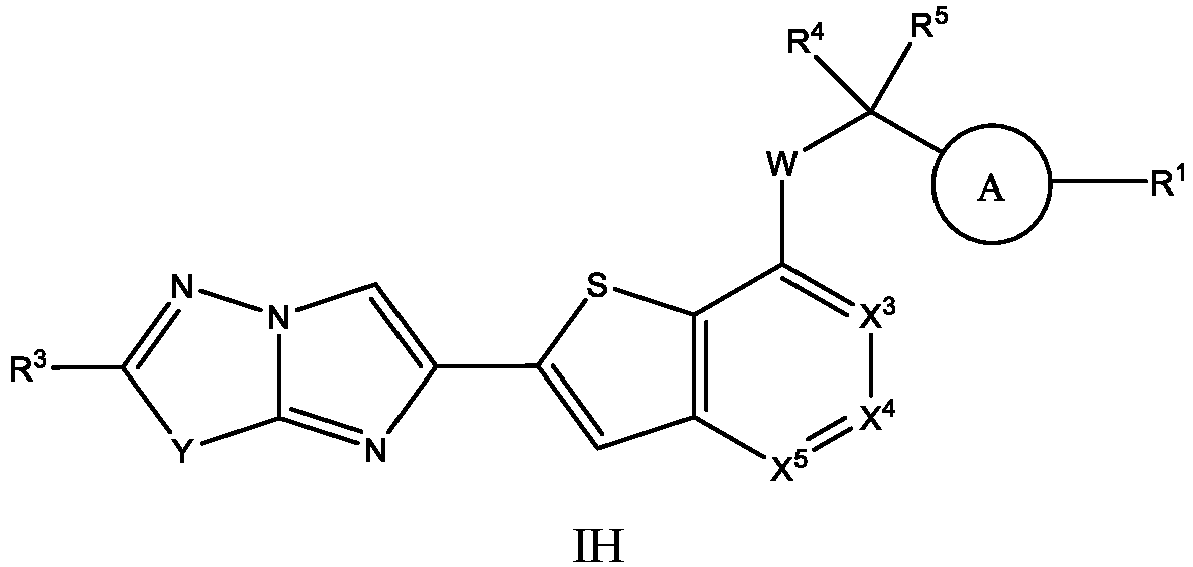


- Examples of IE-IJ are:
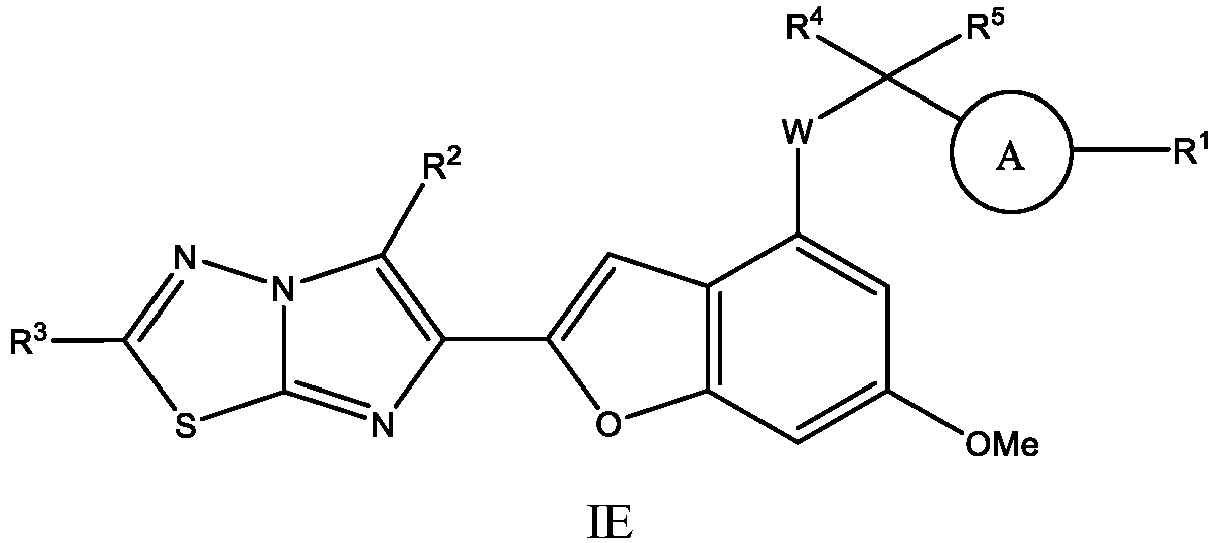


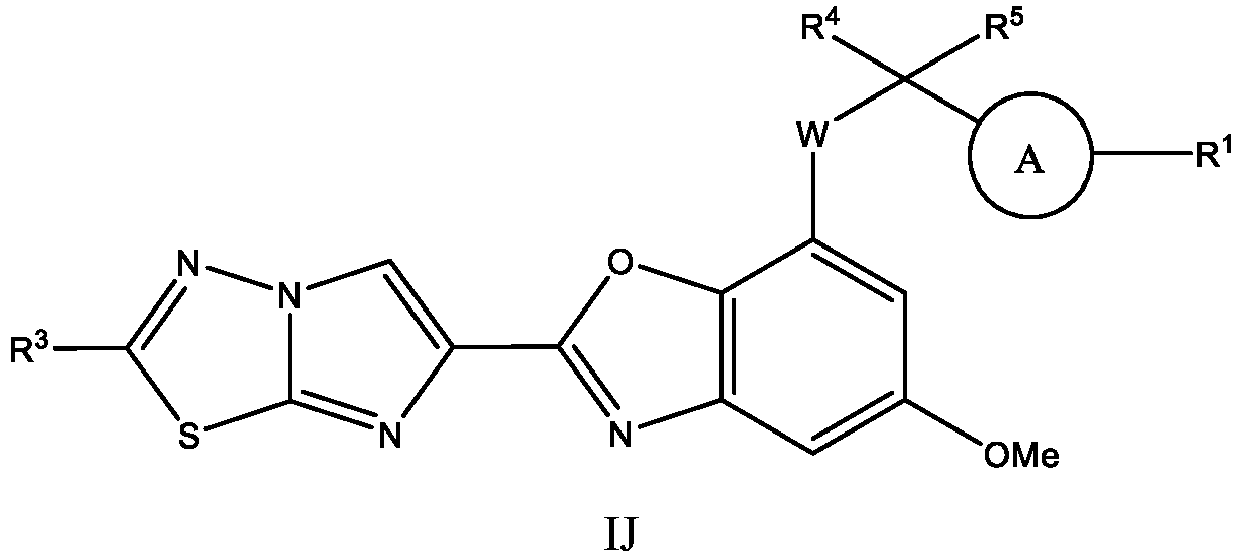

- In an embodiment, in the compound of Formula I, the moiety:


- In still yet another embodiment, the present invention provides compounds of formula:

- W is O or S;
- R1 is -N(R6)-C(O)-R7or -N(R6)-S(O)2-R7;
-

or alternately the moiety


- R2 is H, halo, C1-C6 alkyl, C1-C3 alkoxy, CN or C3-C7 cycloalkyl;
- R3 is selected from the group consisting of C1-C4 alkyl, C1-C4 alkoxy, C1-C4 alkylthio, C1-C2 haloalkyl, C1-C2 haloalkoxy, C3-C6 cycloalkyl, C2-C3 alkenyl, C2-C3 alkynyl and halo;
- R4 and R5 are independently selected from H, C1-C6 alkyl, C1-C4 fluoroalkyl, and C1-C4 hydroxyalkyl, or R4 and R5 can be taken together with the carbon to which they are attached to form a C3-C7 cycloalkyl ring;
- R6 is selected from H, C1-C6 alkyl, C1-C3 haloalkyl, or C1-C3hydroxyalkyl; and
- R7 is selected from the group consisting of hydrogen, C2-C6 alkyl, C6-C10 aryl, C1-C7 alkoxy, 5-7 membered heterocyclic ring containing 1-3 hetero (ring) atoms independently selected from N, O or S, C3-7 cycloalkyl, and 6-10 membered heteroaryl, wherein each of said alkyl, cycloalkyl, aryl, heterocylic and heteroaryl group is independently unsubstituted or substituted with 1-3 moieties which can be the same or different and being independently selected from the group consisting of halo, alkyl, haloalkyl, aryl, heteroaryl, alkoxy, haloalkoxy, aryloxy, arylalkyloxy, alkyloxycarbonyl, alkylcarboxy, aryloxycarbonyl, arylcarboxy, nitro, cyano, OH, NH2, NH(alkyl), N(alkyl)2, CONR10R11, SONR10R11, NR10SO2R11, NR10COR11, NR10CONR10R11, COOH, COOR10, oxo and methylenedioxy, wherein R10 and R11 are the same or different and are H or C1-4 alkyl or R10 and R11 can be taken together with the N they are attached to form a 4-7 membered heterocycle ring;
or R6 and R7 may be taken together to form a monocyclic or bicyclic heterocyclic ring with 0-2 additional hetero (ring) atoms selected independently from N, O, or S, wherein each of said monocyclic or bicyclic heterocylic ring can be independently unsubstituted or substituted with 1-3 moieties which can be the same or different and being independently selected from the group consisting of halo, alkyl, aryl, heteroaryl, alkoxy, aryloxy, arylalkyoxy, alkyloxycarbonyl, alkylcarboxy, aryloxycarbonyl, arylcarboxy, nitro, cyano, OH, NH2, NH(alkyl), N(alkyl)2 , CONR12R13, SONR12R13, NR12SO2R13, NR12COR13, NR12CONR12R13, COOH, COOR12, oxo and methylenedioxy, wherein R12 and R13 are the same or different and are H or C1-4 alkyl or R12 and R13 can be taken together with the N they are attached to form a 4-7 membered heterocycle ring; and - R9 is selected from the group consisting of H, halo, C1-C6 alkyl, C1-6 haloalkyl, - C1-C6 alkoxy and C1-C3 haloalkoxy,
with the proviso that when A is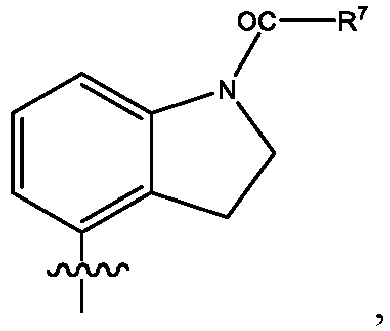
- In still yet another embodiment, the present invention provides compounds, stereoisomers, tautomers, salts, or solvates thereof, wherein the compounds are compounds of Formula I, or they are compounds of Formula IA, or they are compounds of Formula IE, or they are compounds of Formula IF, or they are compounds of Formula IG, or they are compounds of Formula IH, or they are compounds of Formula IJ:
wherein the various moieties are independently selected and: - X3, and X5 are CH;
- X4 is CR9;
- W is O;
- Y is S;
- R1a is H;
- R2 is H;
- R3 is-OCH3;
- R4 and R5 are H;
- R6 is H or methyl;
- R9 is -OCH3;
- R1 is -N(R6)-C(O)-R7 or -N(R6)-S(O)2-R7;
-

- or alternately the moiety
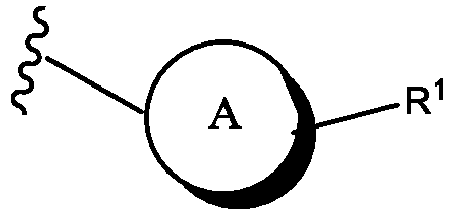

- R7 is selected from the group consisting of hydrogen, C2-C6 alkyl, C6-C10 aryl, C1-C7 alkoxy, 5-7 membered heterocyclic ring containing 1-3 moieties independently selected from N, O or S, C3-7 cycloalkyl, and 6-10 membered heteroaryl, wherein each of said alkyl, aryl, heterocylic and heteroaryl is independently unsubstituted or substituted with 1-3 moieties which can be the same or different and being independently selected from the group consisting of halo, alkyl, aryl, heteroaryl, alkoxy, aryloxy, arylalkyloxy, alkyloxycarbonyl, alkylcarboxy, aryloxycarbonyl, arylcarboxy, nitro, cyano, OH, NH2, NH(alkyl), N(alkyl)2, CONR10R11, SONR10R11, COOH, COOR10, oxo and methylenedioxy, wherein R10 and R11 are the same or different and are H or C1-4 alkyl or R10 and R11 can be taken together with the N they are attached to form a 4-7 membered heterocycle ring;
- or R6 and R7 may be taken together to form a monocyclic or bicyclic heterocyclic ring with 0-2 additional hetero (ring) atoms selected independently from N, O, or S, wherein each of said monocyclic or bicyclic heterocylic ring can be independently unsubstituted or substituted with 1-3 moieties which can be the same or different and being independently selected from the group consisting of halo, alkyl, aryl, heteroaryl, alkoxy, aryloxy, arylalkyoxy, alkyloxycarbonyl, alkylcarboxy, aryloxycarbonyl, arylcarboxy, nitro, cyano, OH, NH2, NH(alkyl), N(alkyl)2 , CONR12R13, SONR12R13, NR12SO2R13, NR12COR13, NR12CONR12R13, COOH, COOR12, oxo and methylenedioxy, wherein R12 and R13 are the same or different and are H or C1-4 alkyl or R12 and R13 can be taken together with the N they are attached to form a 4-7 membered heterocycle ring.
- In still yet another embodiment, the present invention provides compounds, stereoisomers, tautomers, salts, or solvates thereof, wherein the compounds are compounds of Formula I, or they are compounds of Formula IA, or they are compounds of Formula ID, or they are compounds of Formula IE, or they are compounds of Formula IF, or they are compounds of Formula IG, or they are compounds of Formula IH, or they are compounds of Formula IJ: wherein the various moieties are independently selected and:
- X3 = X5 = CH;
- X4 is CR9;
- W is O;
- Y is S;
- R1a is H;
- R2 is H;
- R3 is CH3 or methoxy;
- R4 and R5 are H;
- R6 is H;
- R9 is methoxy;
- R1 is -N(R6)-C(O)-R7 or -N(R6)-S(O)2-R7;
-

- or alternately the moiety
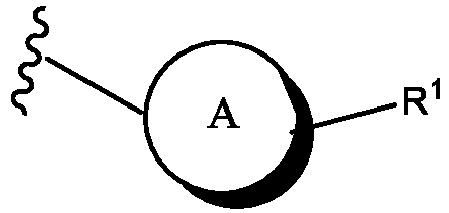

- R7 is selected from the group consisting of hydrogen, C2-C6 alkyl, C6-C10 aryl, C1-C7 alkoxy, 5-7 membered heterocyclic ring containing 1-3 moieties independently selected from N, O or S, C3-7 cycloalkyl, and 6-10 membered heteroaryl, wherein each of said alkyl, aryl, heterocylic and heteroaryl is independently unsubstituted or substituted with 1-3 moieties which can be the same or different and being independently selected from the group consisting of halo, alkyl, aryl, heteroaryl, alkoxy, aryloxy, arylalkyloxy, alkyloxycarbonyl, alkylcarboxy, aryloxycarbonyl, arylcarboxy, nitro, cyano, OH, NH2, NH(alkyl), N(alkyl)2, CONR10R11, SONR10R11, COOH, COOR10, oxo and methylenedioxy, wherein R10 and R11 are the same or different and are H or C1-4 alkyl or R10 and R11 can be taken together with the N they are attached to form a 4-7 membered heterocycle ring;
- or R6 and R7 may be taken together to form a monocyclic or bicyclic heterocyclic ring with 0-2 additional hetero (ring) atoms selected independently from N, O, or S, wherein each of said monocyclic or bicyclic heterocylic ring can be independently unsubstituted or substituted with 1-3 moieties which can be the same or different and being independently selected from the group consisting of halo, alkyl, aryl, heteroaryl, alkoxy, aryloxy, arylalkyoxy, alkyloxycarbonyl, alkylcarboxy, aryloxycarbonyl, arylcarboxy, nitro, cyano, OH, NH2, NH(alkyl), N(alkyl)2 , CONR12R13, SONR12R13, NR12SO2R13, NR12COR13, NR12CONR12R13, COOH, COOR12, oxo and methylenedioxy, wherein R12 and R13 are the same or different and are H or C1-4 alkyl or R12 and R13 can be taken together with the N they are attached to form a 4-7 membered heterocycle ring.
- In still yet another embodiment, the present invention provides compounds, stereoisomers, tautomers, salts, or solvates thereof, wherein the compounds are compounds of Formula I, or they are compounds of Formula IA, or they are compounds of Formula ID, or they are compounds of Formula IE, or they are compounds of Formula IF, or they are compounds of Formula IG, or they are compounds of Formula IH, or they are compounds of Formula IJ:
wherein the various moieties are independently selected and: - X3 = X5 = CH;
- X4 is CR9;
- W is O;
- Y is S;
- R1a is H;
- R2 is H or halo;
- R3 is CH3 or methoxy;
- R4 and R5 are H;
- R6 is H;
- R9 is methoxy;
- R1 is -N(R6)-C(O)-R7 or;

- or alternately the moiety


- R7 is selected from the group consisting of hydrogen, C2-C6 alkyl, C6-C10 aryl, C1-C7 alkoxy, 5-7 membered heterocyclic ring containing 1-3 moieties independently selected from N, O or S, C3-7 cycloalkyl, and 6-10 membered heteroaryl, wherein each of said alkyl, aryl, heterocylic and heteroaryl is independently unsubstituted or substituted with 1-3 moieties which can be the same or different and being independently selected from the group consisting of halo, alkyl, aryl, heteroaryl, alkoxy, aryloxy, arylalkyloxy, alkyloxycarbonyl, alkylcarboxy, aryloxycarbonyl, arylcarboxy, nitro, cyano, OH, NH2, NH(alkyl), N(alkyl)2, CONR10R11, SONR10R11, COOH, COOR10, oxo and methylenedioxy, wherein R10 and R11 are the same or different and are H or C1-4 alkyl or R10 and R11 can be taken together with the N they are attached to form a 4-7 membered heterocycle ring;
- or R6 and R7 may be taken together to form a monocyclic or bicyclic heterocyclic ring with 0-2 additional hetero (ring) atoms selected independently from N, O, or S, wherein each of said monocyclic or bicyclic heterocylic ring can be independently unsubstituted or substituted with 1-3 moieties which can be the same or different and being independently selected from the group consisting of halo, alkyl, aryl, heteroaryl, alkoxy, aryloxy, arylalkyoxy, alkyloxycarbonyl, alkylcarboxy, aryloxycarbonyl, arylcarboxy, nitro, cyano, OH, NH2, NH(alkyl), N(alkyl)2 , CONR12R13, SONR12R13, NR12SO2R13, NR12COR13, NR12CONR12R13, COOH, COOR12, oxo and methylenedioxy, wherein R12 and R13 are the same or different and are H or C1-4 alkyl or R12 and R13 can be taken together with the N they are attached to form a 4-7 membered heterocycle ring.
- In still yet another embodiment, the present invention provides compounds, stereoisomers, tautomers, salts, or solvates thereof, wherein the compounds are compounds of Formula I, or they are compounds of Formula IA, or they are compounds of Formula ID, or they are compounds of Formula IE, or they are compounds of Formula IF, or they are compounds of Formula IG, or they are compounds of Formula IH, or they are compounds of Formula IJ: wherein the various moieties are independently selected and:
- X3 = CH;
- X4 = CR9;
- X5 is N;
- W is O;
- Y is S;
- R1a is selected from the group consisting of H, halo, cyano, C1-C4 alkyl, and C1-C4 alkoxy;
- R2 is H;
- R3 is CH3 or methoxy;
- R4 and R5 are H;
- R6 is H;
- R1 is -N(R6)-C(O)-R7 or -N(R6)-S(O)2-R7;
-

- or alternately the moiety


- R7 is selected from the group consisting of hydrogen, C2-C6 alkyl, C6-C10 aryl, C1-C7 alkoxy, 5-7 membered heterocyclic ring containing 1-3 moieties independently selected from N, O or S, C3-7 cycloalkyl, and 6-10 membered heteroaryl, wherein each of said alkyl, aryl, heterocylic and heteroaryl is independently unsubstituted or substituted with 1-3 moieties which can be the same or different and being independently selected from the group consisting of halo, alkyl, aryl, heteroaryl, alkoxy, aryloxy, arylalkyloxy, alkyloxycarbonyl, alkylcarboxy, aryloxycarbonyl, arylcarboxy, nitro, cyano, OH, NH2, NH(alkyl), N(alkyl)2, CONR10R11, SONR10R11, COOH, COOR10, oxo and methylenedioxy, wherein R10 and R11 are the same or different and are C1-4 alkyl or R10 and R11 can be taken together with the N they are attached to form a 4-7 membered heterocycle ring;
- or R6 and R7 may be taken together to form a monocyclic or bicyclic heterocyclic ring with 0-2 additional hetero atoms selected independently from N, O, or S, wherein each of said monocyclic or bicyclic heterocylic ring can be independently unsubstituted or substituted with 1-3 moieties which can be the same or different and being independently selected from the group consisting of halo, alkyl, aryl, heteroaryl, alkoxy, aryloxy, arylalkyoxy, alkyloxycarbonyl, alkylcarboxy, aryloxycarbonyl, arylcarboxy, nitro, cyano, OH, NH2, NH(alkyl), N(alkyl)2 , CONR12R13, SONR12R13, NR12SO2R13, NR12COR13, NR12CONR12R13, COOH, COOR12, oxo and methylenedioxy, wherein R12 and R13 are the same or different and are C1-4 alkyl or R12 and R13 can be taken together with the N they are attached to form a 4-7 membered heterocycle ring.
- In still yet another embodiment, the present invention provides compounds, stereoisomers, tautomers, salts, or solvates thereof, wherein the compounds are compounds of Formula I, or they are compounds of Formula IA, or they are compounds of Formula ID, or they are compounds of Formula IE, or they are compounds of Formula IF, or they are compounds of Formula IG, or they are compounds of Formula IH, or they are compounds of Formula IJ: wherein the various moieties are independently selected and are:
- X4 = X5 = CH;
- X3 is N;
- W is O;
- Y is S;
- R1a is H;
- R2 is H or halo;
- R3 is CH3 or methoxy;
- R4 and R5 are H;
- R6 is H;
- R9 is methoxy;
- R1 is -N(R6)-C(O)-R7 or;
-

- or alternately the moiety
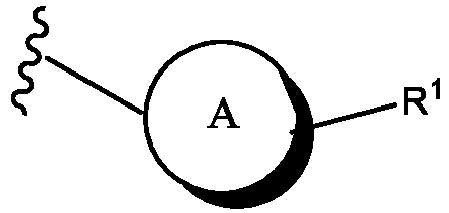
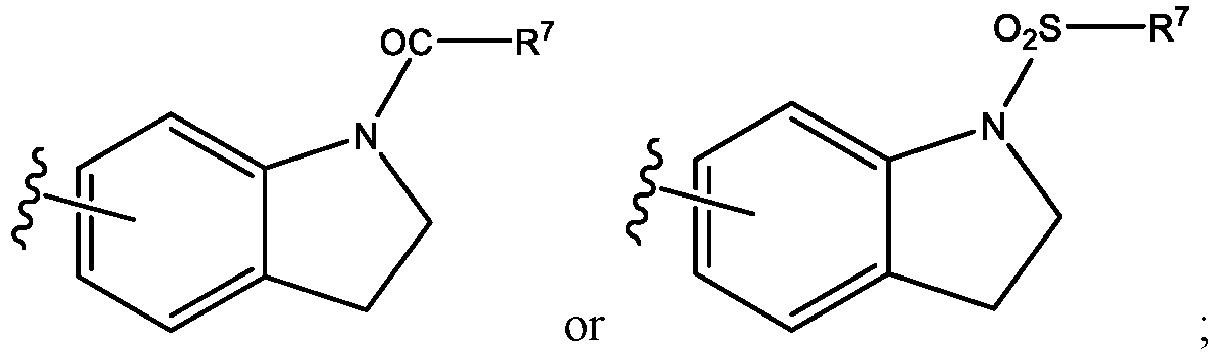
- R7 is selected from the group consisting of hydrogen, C2-C6 alkyl, C6-C10 aryl, C1-C7 alkoxy, 5-7 membered heterocyclic ring containing 1-3 moieties independently selected from N, O or S, C3-7 cycloalkyl, and 6-10 membered heteroaryl, wherein each of said alkyl, aryl, heterocylic and heteroaryl is independently unsubstituted or substituted with 1-3 moieties which can be the same or different and being independently selected from the group consisting of halo, alkyl, aryl, heteroaryl, alkoxy, aryloxy, arylalkyloxy, alkyloxycarbonyl, alkylcarboxy, aryloxycarbonyl, arylcarboxy, nitro, cyano, OH, NH2, NH(alkyl), N(alkyl)2, CONR10R11, SONR10R11, COOH, COOR10, oxo and methylenedioxy, wherein R10 and R11 are the same or different and are H or C1-4 alkyl or R10 and R11 can be taken together with the N they are attached to form a 4-7 membered heterocycle ring;
- or R6 and R7 may be taken together to form a monocyclic or bicyclic heterocyclic ring with 0-2 additional hetero atoms selected independently from N, O, or S, wherein each of said monocyclic or bicyclic heterocylic ring can be independently unsubstituted or substituted with 1-3 moieties which can be the same or different and being independently selected from the group consisting of halo, alkyl, aryl, heteroaryl, alkoxy, aryloxy, arylalkyoxy, alkyloxycarbonyl, alkylcarboxy, aryloxycarbonyl, arylcarboxy, nitro, cyano, OH, NH2, NH(alkyl), N(alkyl)2 , CONR12R13, SONR12R13, NR12SO2R13, NR12COR13, NR12CONR12R13, COOH, COOR12, oxo and methylenedioxy, wherein R12 and R13 are the same or different and are H or C1-4 alkyl or R12 and R13 can be taken together with the N they are attached to form a 4-7 membered heterocycle ring.
- In still yet another embodiment, the present invention provides compounds, stereoisomers, tautomers, salts, or solvates thereof, wherein the compounds are compounds of Formula I, or they are compounds of Formula IA, or they are compounds of Formula ID, or they are compounds of Formula IE, or they are compounds of Formula IF, or they are compounds of Formula IG, or they are compounds of Formula IH, or they are compounds of Formula IJ: wherein the various moieties are independently selected and:
- X3 = X4 = CH;
- X5 is N;
- W is O;
- Y is S;
- R1a is H;
- R2 is H or halo;
- R3 is CH3 or methoxy;
- R4 and R5 are H;
- R6 is H;
- R9 is methoxy;
- R1 is -N(R6)-C(O)-R7 or;
-

- or alternately the moiety


- R7 is selected from the group consisting of hydrogen, C2-C6 alkyl, C6-C10 aryl, C1-C7 alkoxy, 5-7 membered heterocyclic ring containing 1-3 moieties independently selected from N, O or S, C3-7 cycloalkyl, and 6-10 membered heteroaryl, wherein each of said alkyl, aryl, heterocylic and heteroaryl is independently unsubstituted or substituted with 1-3 moieties which can be the same or different and being independently selected from the group consisting of halo, alkyl, aryl, heteroaryl, alkoxy, aryloxy, arylalkyloxy, alkyloxycarbonyl, alkylcarboxy, aryloxycarbonyl, arylcarboxy, nitro, cyano, OH, NH2, NH(alkyl), N(alkyl)2, CONR10R11, SONR10R11, COOH, COOR10, oxo and methylenedioxy, wherein R10 and R11 are the same or different and are H or C1-4 alkyl or R10 and R11 can be taken together with the N they are attached to form a 4-7 membered heterocycle ring;
- In still yet another embodiment, the present invention provides compounds, stereoisomers, tautomers, salts, or solvates thereof, wherein the compounds are compounds of Formula I, or they are compounds of Formula IA, or they are compounds of Formula ID, or they are compounds of Formula IE, or they are compounds of Formula IF, or they are compounds of Formula IG, or they are compounds of Formula IH, or they are compounds of Formula IJ: wherein the various moieties are independently selected and:
- X4 = X5 = CH;
- X3 is N;
- W is O;
- Y is S;
- R1a is H;
- R2 is H or halo;
- R3 is CH3 or methoxy;
- R4 and R5 are H;
- R6 is H;
- R9 is methoxy;
- R1 is -N(R6)-C(O)-R7 or;
-

- or alternately the moiety


- R7 is selected from the group consisting of C2-C6 alkyl, C6-C10 aryl, C1-C7 alkoxy, 5-7 membered heterocyclic ring containing 1-3 moieties independently selected from N, O or S, C3-7 cycloalkyl, and 6-10 membered heteroaryl, wherein each of said alkyl, aryl, heterocylic and heteroaryl is independently unsubstituted or substituted with 1-3 moieties which can be the same or different and being independently selected from the group consisting of halo, alkyl, aryl, heteroaryl, alkoxy, aryloxy, arylalkyloxy, alkyloxycarbonyl, alkylcarboxy, aryloxycarbonyl, arylcarboxy, nitro, cyano, OH, NH2, NH(alkyl), N(alkyl)2, CONR10R11, SONR10R11, COOH, COOR10, oxo and methylenedioxy, wherein R10 and R11 are the same or different and are H or C1-4 alkyl or R10 and R11 can be taken together with the N they are attached to form a 4-7 membered heterocycle ring;
- or R6 and R7 may be taken together to form a monocyclic or bicyclic heterocyclic ring with 0-2 additional hetero atoms selected independently from N, O, or S, wherein each of said monocyclic or bicyclic heterocylic ring can be independently unsubstituted or substituted with 1-3 moieties which can be the same or different and being independently selected from the group consisting of halo, alkyl, aryl, heteroaryl, alkoxy, aryloxy, arylalkyoxy, alkyloxycarbonyl, alkylcarboxy, aryloxycarbonyl, arylcarboxy, nitro, cyano, OH, NH2, NH(alkyl), N(alkyl)2 , CONR12R13, SONR12R13, NR12SO2R13, NR12COR13, NR12CONR12R13, COOH, COOR12, oxo and methylenedioxy, wherein R12 and R13 are the same or different and are H or C1-4 alkyl or R12 and R13 can be taken together with the N they are attached to form a 4-7 membered heterocycle ring.
- In still yet another embodiment, the present invention provides compounds, stereoisomers, tautomers, salts, or solvates thereof, wherein the compounds are compounds of Formula I, or they are compounds of Formula IA, or they are compounds of Formula ID, or they are compounds of Formula IE, or they are compounds of Formula IF, or they are compounds of Formula IG, or they are compounds of Formula IH, or they are compounds of Formula IJ: wherein the various moieties are independently selected and:
- X3 = X4= X5 = CH;
- W is O;
- Y is S;
- R1a is H;
- R2 is H or halo;
- R3 is CH3 or methoxy;
- R4 and R5 are H;
- R6 is H;
- R9 is methoxy;
- R1 is -N(R6)-C(O)-R7 or;

- or alternately the moiety


- R7 is selected from the group consisting of hydrogen, C2-C6 alkyl, C6-C10 aryl, C1-C7 alkoxy, 5-7 membered heterocyclic ring containing 1-3 moieties independently selected from N, O or S, C3-7 cycloalkyl, and 6-10 membered heteroaryl, wherein each of said alkyl, aryl, heterocylic and heteroaryl is independently unsubstituted or substituted with 1-3 moieties which can be the same or different and being independently selected from the group consisting of halo, alkyl, aryl, heteroaryl, alkoxy, aryloxy, arylalkyloxy, alkyloxycarbonyl, alkylcarboxy, aryloxycarbonyl, arylcarboxy, nitro, cyano, OH, NH2, NH(alkyl), N(alkyl)2, CONR10R11, SONR10R11, COOH, COOR10, oxo and methylenedioxy, wherein R10 and R11 are the same or different and are H or C1-4 alkyl or R10 and R11 can be taken together with the N they are attached to form a 4-7 membered heterocycle ring;
- or R6 and R7 may be taken together to form a monocyclic or bicyclic heterocyclic ring with 0-2 additional hetero atoms selected independently from N, O, or S, wherein each of said monocyclic or bicyclic heterocylic ring can be independently unsubstituted or substituted with 1-3 moieties which can be the same or different and being independently selected from the group consisting of halo, alkyl, aryl, heteroaryl, alkoxy, aryloxy, arylalkyoxy, alkyloxycarbonyl, alkylcarboxy, aryloxycarbonyl, arylcarboxy, nitro, cyano, OH, NH2, NH(alkyl), N(alkyl)2 , CONR12R13, SONR12R13, NR12SO2R13, NR12COR13, NR12CONR12R13, COOH, COOR12, oxo and methylenedioxy, wherein R12 and R13 are the same or different and are H or C1-4 alkyl or R12 and R13 can be taken together with the N they are attached to form a 4-7 membered heterocycle ring.
- In another embodiment,


- In still yet another embodiment, the present invention provides compounds, stereoisomers, tautomers, salts, or solvates thereof, wherein the compounds of Formula I are compounds of formula:

- W is O;
- R2 is H;
- R3 is CH3 or methoxy;
- R4 and R5 are H;
- R6 is hydrogen, or C1-C6 alkyl;
- R1 is -N(R6)-C(O)-R7 or -N(R6)-S(O)2-R7;
-
- or alternately the moiety


- R7 is selected from the group consisting of hydrogen, C2-C6 alkyl, C6-C10 aryl, C1-C7 alkoxy, 5-7 membered heterocyclic ring containing 1-3 moieties independently selected from N, O or S, C3-7 cycloalkyl, and 6-10 membered heteroaryl, wherein each of said alkyl, aryl, heterocylic and heteroaryl is independently unsubstituted or substituted with 1-3 moieties which can be the same or different and being independently selected from the group consisting of halo, alkyl, aryl, heteroaryl, alkoxy, aryloxy, arylalkyloxy, alkyloxycarbonyl, alkylcarboxy, aryloxycarbonyl, arylcarboxy, nitro, cyano, OH, NH2, NH(alkyl), N(alkyl)2, CONR10R11, SONR10R11, NR10SO2R11, COOH, COOR10, oxo and methylenedioxy, wherein R10 and R11 are the same or different and are C1-4 alkyl or R10 and R11 can be taken together with the N they are attached to form a 4-7 membered heterocycle ring;
- or R6 and R7 may be taken together to form a monocyclic or bicyclic heterocyclic ring with 0-2 additional hetero atoms selected independently from N, O, or S, wherein each of said monocyclic or bicyclic heterocylic ring can be independently unsubstituted or substituted with 1-3 moieties which can be the same or different and being independently selected from the group consisting of halo, alkyl, aryl, heteroaryl, alkoxy, aryloxy, arylalkyoxy, alkyloxycarbonyl, alkylcarboxy, aryloxycarbonyl, arylcarboxy, nitro, cyano, OH, NH2, NH(alkyl), N(alkyl)2 , CONR12R13, SONR12R13, NR12SO2R13, NR12COR13, NR12CONR12R13, COOH, COOR12, oxo and methylenedioxy, wherein R12 and R13 are the same or different and are C1-4 alkyl or R12 and R13 can be taken together with the N they are attached to form a 4-7 membered heterocycle ring, with the proviso that when A is

- In yet another embodiment, this invention discloses the compounds listed in Table 1.


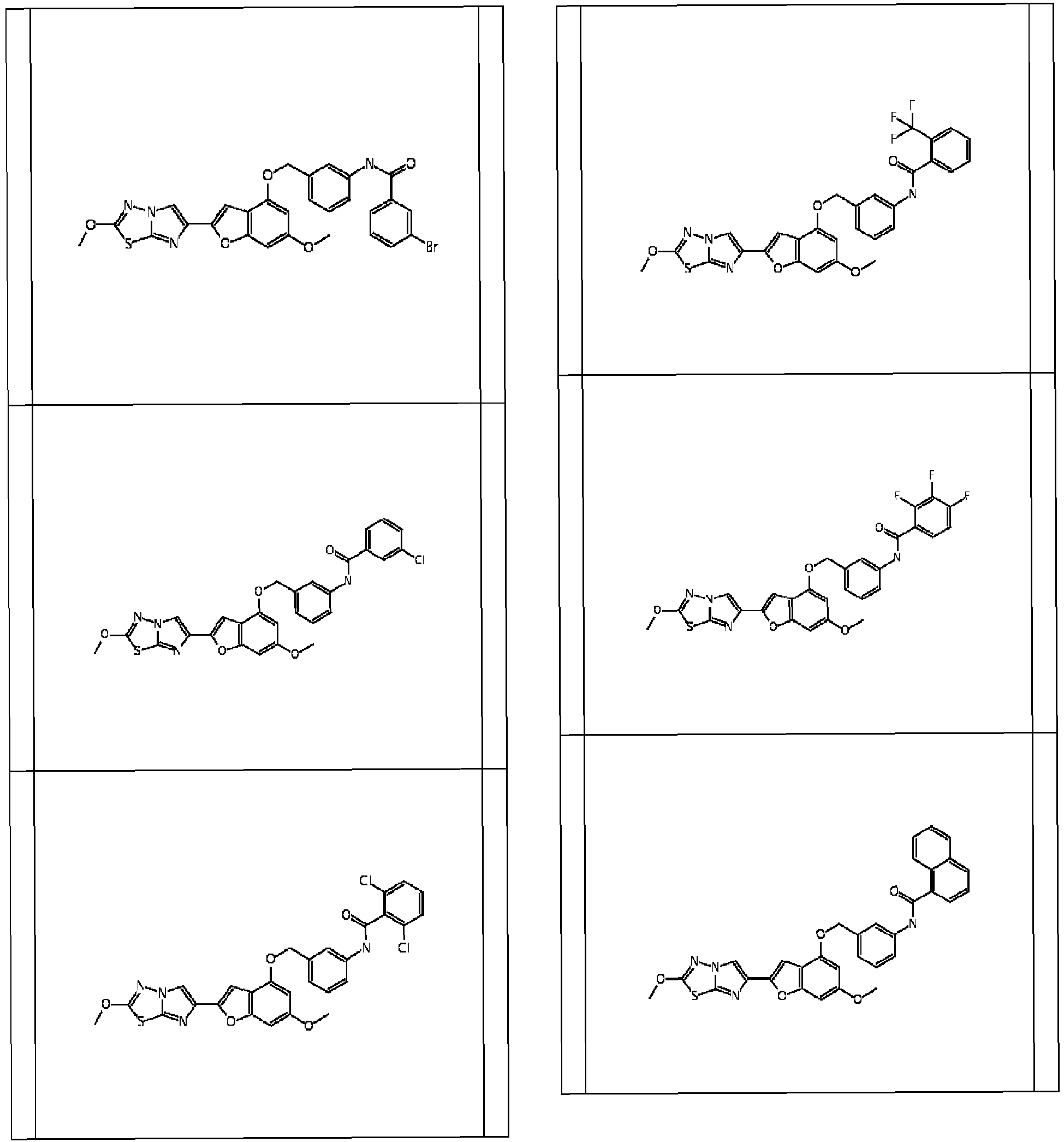


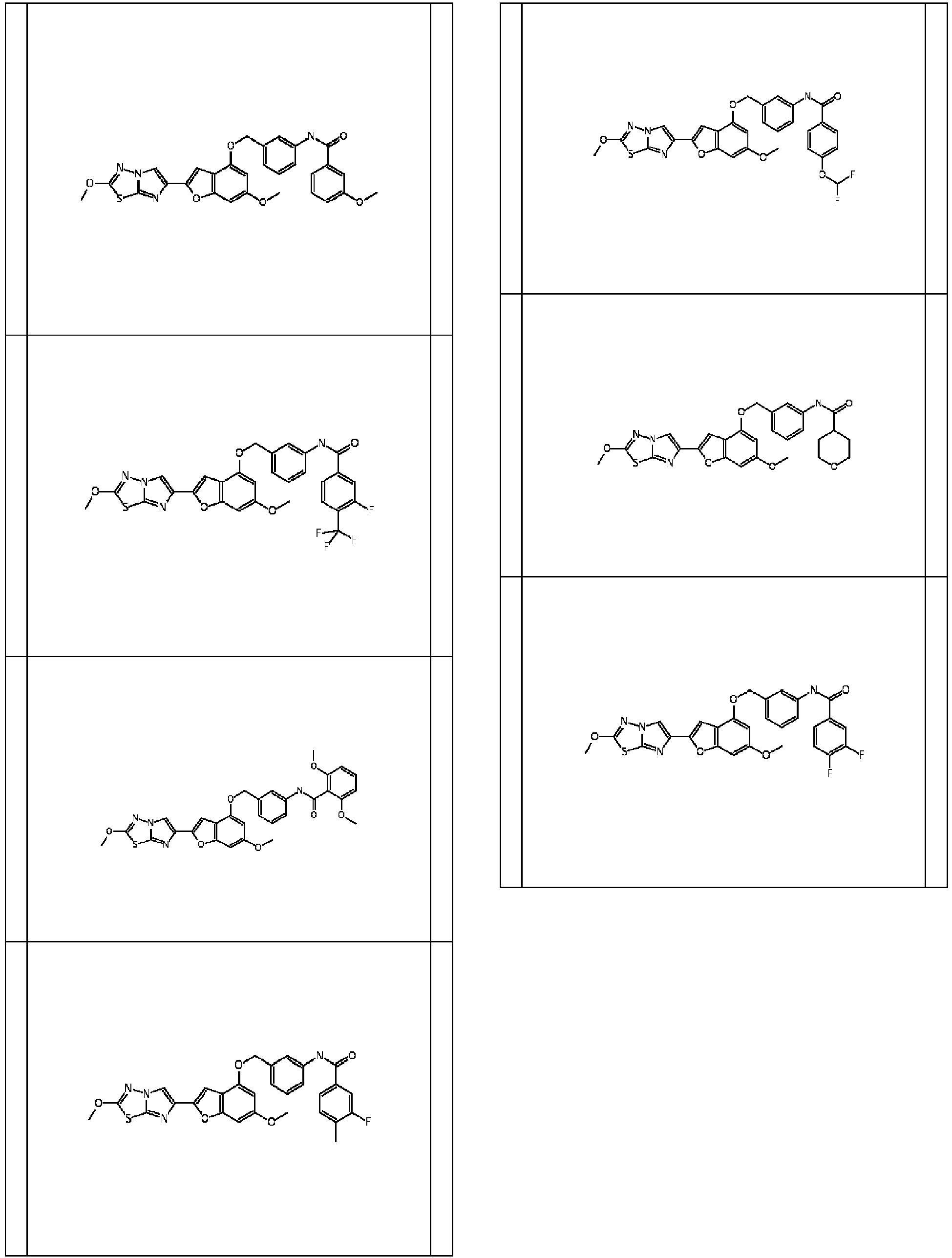

- In one embodiment, the present invention provides compounds, stereoisomers, tautomers, salts, or solvates thereof, wherein the compounds are compounds of Formula I.
- In one embodiment, the present invention provides compounds, stereoisomers, tautomers, salts, or solvates thereof, wherein the compounds are compounds of Formula IA.
- In one embodiment, the present invention provides compounds, stereoisomers, tautomers, salts, or solvates thereof, wherein the compounds are compounds of Formula ID.
- In one embodiment, the present invention provides compounds, stereoisomers, tautomers, salts, or solvates thereof, wherein the compounds are compounds of Formula IE.
- In one embodiment, the present invention provides compounds, stereoisomers, tautomers, salts, or solvates thereof, wherein the compounds are compounds of Formula IF.
- In one embodiment, the present invention provides compounds, stereoisomers, tautomers, salts, or solvates thereof, wherein the compounds are compounds of Formula IG.
- In one embodiment, the present invention provides compounds, stereoisomers, tautomers, salts, or solvates thereof, wherein the compounds are compounds of Formula IH.
- In one embodiment, the present invention provides compounds, stereoisomers, tautomers, salts, or solvates thereof, wherein the compounds are compounds of Formula IJ.
- In one embodiment, the present invention provides compounds, stereoisomers, tautomers, salts, or solvates thereof, wherein the compounds are the examples.
- PAR4 compounds of the invention have IC50s in the FLIPR Assay (described hereinafter) of about 10 µM, or 5 µM or less, or 500 nM or less, or 10 nM or less. Activity data for Examples 1-166 are presented in the tables of Example E.
- In some embodiments, the present invention provides at least one compound of the present invention or a stereoisomer, tautomer, pharmaceutically acceptable salt, or solvate thereof.
- In some embodiments, the present invention provides one or more compounds of the present invention or a stereoisomer, tautomer, pharmaceutically acceptable salt, or solvate thereof.
In some embodiments, the present invention provides a pharmaceutical composition, which includes a pharmaceutically acceptable carrier and a therapeutically effective amount of at least one compound of Formula I, or Formula IA, or Formula ID, or Formula IE, or Formula IF, or Formula IG, or Formula IH, or Formula IJ, or preferably, a compound selected from one of the examples, more preferably, Examples 1 to 166, or stereoisomers, tautomers, pharmaceutically acceptable salts, or solvates thereof, alone or in combination with another therapeutic agent. - In some embodiments, the present invention provides a pharmaceutical composition which includes a therapeutically effective amount of at least one compound of Formula I, or Formula IA, or Formula ID, or Formula IE, or Formula IF, or Formula IG, or Formula IH, or Formula IJ, or and one or more additional therapeutic agent(s). In a preferred embodiment, the present invention provides a pharmaceutical composition, wherein the additional therapeutic agent(s) are an anti-platelet agent or a combination thereof. Preferably, the anti-platelet agent(s) are P2Y12 antagonists and/or aspirin. Preferably, the P2Y12 antagonists are clopidogrel, ticagrelor, or prasugrel. In another preferred embodiment, the present invention provides a pharmaceutical composition, wherein the additional therapeutic agent(s) are an anticoagulant or a combination thereof. Preferably, the anticoagulant agent(s) are FXa inhibitors or thrombin inhibitors. Preferably, the FXa inhibitors are apixaban or rivaroxaban. Preferably, the thrombin inhibitor is dabigatran.
In some embodiments, the present invention provides a compound of the invention for use in a method for the treatment or prophylaxis of a thromboembolic disorder which includes the step of administering to a subject (for example, a human) in need of such treatment or prophylaxis a therapeutically effective amount of at least one compound of Formula I, or Formula IA, or Formula ID, or Formula IE, or Formula IF, or Formula IG, or Formula IH, or Formula IJ, or of the Examples herein or stereoisomers, tautomers, pharmaceutically acceptable salts, or solvates thereof. - In some embodiments, the present invention provides a compound of the invention for use in methods for the treatment of a thromboembolic disorder or the primary or secondary prophylaxis of a thromboembolic disorder, which include the steps of administering to a patient (for example, a human) in need thereof a therapeutically effective amount of one compound of Formula I, or Formula IA, or Formula ID, or Formula IE, or Formula IF, or Formula IG, or Formula IH, or Formula IJ, or a compound selected from one of the examples, more preferably, Examples 1 to 166, or stereoisomers, tautomers, pharmaceutically acceptable salts, or solvates thereof, wherein the thromboembolic disorder is selected from the group consisting of arterial cardiovascular thromboembolic disorders, venous cardiovascular thromboembolic disorders, cerebrovascular thromboembolic disorders, and thromboembolic disorders in the chambers of the heart or in the peripheral circulation.
- In some embodiments, the present invention provides a compound of the invention for use in methods for the treatment of a thromboembolic disorder or the primary or secondary prophylaxis of a thromboembolic disorder, which include the steps of administering to a patient (for example, a human) in need thereof a therapeutically effective amount of one compound of Formula I, or Formula IA, or Formula ID, or Formula IE, or Formula IF, or Formula IG, or Formula IH, or Formula IJ, or a compound selected from one of the examples, more preferably, Examples 1 to 166, or stereoisomers, tautomers, pharmaceutically acceptable salts, or solvates thereof, wherein the thromboembolic disorder is selected from the group consisting of acute coronary syndrome, unstable angina, stable angina, ST-elevated myocardial infarction, non-ST-elevated myocardial infarction, atrial fibrillation, myocardial infarction, transient ischemic attack, stroke, atherosclerosis, peripheral arterial disease, venous thrombosis, deep vein thrombosis, thrombophlebitis, arterial embolism, coronary arterial thrombosis, cerebral arterial thrombosis, cerebral embolism, kidney embolism, pulmonary embolism, cancer-related thrombosis, and thrombosis resulting from medical implants, devices, and procedures in which blood is exposed to an artificial surface that promotes thrombosis.
- In some embodiments, the present invention provides a compound of the invention for use in methods for the treatment of a thromboembolic disorder or the primary or secondary prophylaxis of a thromboembolic disorder, which include the steps of administering to a patient (for example, a human) in need thereof a therapeutically effective amount of one compound of Formula I, or Formula IA, or Formula ID, or Formula IE, or Formula IF, or Formula IG, or Formula IH, or Formula IJ, or a compound selected from one of the examples, more preferably, Examples 1 to 166, or stereoisomers, tautomers, pharmaceutically acceptable salts, or solvates thereof, wherein the thromboembolic disorder is selected from the group consisting of acute coronary syndrome, unstable angina, stable angina, ST-elevated myocardial infarction, and non-ST-elevated myocardial infarction.
- In some embodiments, the present invention provides a compound of the invention for use in methods for the treatment of a thromboembolic disorder or the primary or secondary prophylaxis of a thromboembolic disorder, which include the steps of administering to a patient (for example, a human) in need thereof a therapeutically effective amount of one compound of Formula I, or Formula IA, or Formula ID, or Formula IE, or Formula IF, or Formula IG, or Formula IH, or Formula IJ, or a compound selected from one of the examples, more preferably, Examples 1 to 166, or stereoisomers, tautomers, pharmaceutically acceptable salts, or solvates thereof, wherein the thromboembolic disorder is selected from the group consisting of transient ischemic attack and stroke.
- In some embodiments, the present invention provides a compound of the invention for use in methods for the treatment of a thromboembolic disorder or the primary or secondary prophylaxis of a thromboembolic disorder, which include the steps of administering to a patient (for example, a human) in need thereof a therapeutically effective amount of one compound of Formula I, or Formula IA, or Formula ID, or Formula IE, or Formula IF, or Formula IG, or Formula IH, or Formula IJ, or a compound selected from one of the examples, more preferably, Examples 1 to 166, or stereoisomers, tautomers, pharmaceutically acceptable salts, or solvates thereof, wherein the thromboembolic disorder is peripheral arterial disease.
- In some embodiments, the present invention includes a compound of the invention for use in a method as described above wherein the thromboembolic disorder is selected from unstable angina, an acute coronary syndrome, atrial fibrillation, first myocardial infarction, recurrent myocardial infarction, ischemic sudden death, transient ischemic attack, stroke, atherosclerosis, peripheral occlusive arterial disease, venous thrombosis, deep vein thrombosis, thrombophlebitis, arterial embolism, coronary arterial thrombosis, cerebral arterial thrombosis, cerebral embolism, kidney embolism, pulmonary embolism, and thrombosis resulting from medical implants, devices, or procedures in which blood is exposed to an artificial surface that promotes thrombosis.
In some embodiments, the present invention includes a compound of the invention for use in a method of inhibiting or preventing platelet aggregation, which includes the step of administering to a subject (such as a human) in need thereof a therapeutically effective amount of a PAR4 antagonist, which is a compound of Formula I, or Formula IA, or Formula ID, or Formula IE, or Formula IF, or Formula IG, or Formula IH, or Formula IJ, or a compound selected from one of the examples, more preferably, Examples 1 to 166, of the invention. - Disclosed herein is a process for making the compounds of the present invention or a stereoisomer, tautomer, pharmaceutically acceptable salt, or solvate thereof.
- Disclosed herein is an intermediate for making the compounds of the present invention or a stereoisomer, tautomer, pharmaceutically acceptable salt, or solvate thereof.
- In some embodiments, the invention provides a compound of the invention for use in a method of treatment or prophylaxis of a thromboembolic disorder involving administering to a subject in need thereof (e.g., a human) a therapeutically effective amount of at least one compound that binds to PAR4 (such as a compound of Formula I of the invention) and inhibits PAR4 cleavage and/or signaling, wherein said subject has a dual PAR1/PAR4 platelet receptor repertoire.
- In some embodiments, the present invention provides a compound of the present invention or stereoisomers, tautomers, pharmaceutically acceptable salts, solvates, or prodrug esters thereof, for use in therapy for the treatment or prophylaxis of a thromboembolic disorder.
- The present invention may be embodied in other specific forms. This invention encompasses all combinations of preferred aspects of the invention noted herein. It is understood that any and all embodiments of the present invention may be taken in conjunction with any other embodiment or embodiments to describe additional embodiments. It is also to be understood that each individual element of the embodiments is its own independent embodiment. Furthermore, any element of an embodiment is meant to be combined with any and all other elements from any embodiment to describe an additional embodiment.
- Compounds of this invention may have one or more asymmetric centers. Unless otherwise indicated, all chiral (enantiomeric and diastereomeric) and racemic forms of compounds of the present invention are included in the present invention. Many geometric isomers of olefins, C=N double bonds, and the like can also be present in the compounds, and all such stable isomers are contemplated in the present invention. Cis- and trans- geometric isomers of the compounds of the present invention are described and may be isolated as a mixture of isomers or as separated isomeric forms. The present compounds can be isolated in optically active or racemic forms. It is well known in the art how to prepare optically active forms, such as by resolution of racemic forms or by synthesis from optically active starting materials. All chiral, (enantiomeric and diastereomeric) and racemic forms and all geometric isomeric forms of a structure are intended, unless the specific stereochemistry or isomer form is specifically indicated. When no specific mention is made of the configuration (cis, trans or R or S) of a compound (or of an asymmetric carbon), then any one of the isomers or a mixture of more than one isomer is intended. The processes for preparation can use racemates, enantiomers, or diastereomers as starting materials. When enantiomeric or diastereomeric products are prepared, they can be separated by conventional methods, for example, by chromatography or fractional crystallization. Compounds of the present invention, and salts thereof, may exist in multiple tautomeric forms, in which hydrogen atoms are transposed to other parts of the molecules and the chemical bonds between the atoms of the molecules are consequently rearranged. It should be understood that all tautomeric forms, insofar as they may exist, are included within the invention.
- As used herein, the term "alkyl" or "alkylene", alone or as part of another group, is intended to include both branched and straight-chain saturated aliphatic hydrocarbon groups having from 1 to 10 carbons or the specified number of carbon atoms. For example, "C1-10 alkyl" (or alkylene), is intended to include C1, C2, C3, C4, C5, C6, C7, C8, C9, and C10 alkyl groups. Additionally, for example, "C1-C6 alkyl" denotes alkyl having 1 to 6 carbon atoms. Alkyl groups can be unsubstituted or substituted with at least one hydrogen being replaced by another chemical group. Example alkyl groups include, but are not limited to, methyl (Me), ethyl (Et), propyl (e.g., n-propyl and isopropyl), butyl (e.g., n-butyl, isobutyl, t-butyl), and pentyl (e.g., n-pentyl, isopentyl, neopentyl), as well as chain isomers thereof, and the like. "Alkenyl" or "alkenylene", alone or as part of another group, is intended to include hydrocarbon chains of either straight or branched configuration and having one or more carbon-carbon double bonds that may occur in any stable point along the chain. For example, "C2-6 alkenyl" (or alkenylene), is intended to include C2, C3, C4, C5, and C6 alkenyl groups. Examples of alkenyl include, but are not limited to, ethenyl, 1-propenyl, 2-propenyl, 2-butenyl, 3-butenyl, 2-pentenyl, 3-pentenyl, 4-pentenyl, 2-hexenyl, 3-hexenyl, 4-hexenyl, 5-hexenyl, 2-methyl-2-propenyl, and 4-methyl-3-pentenyl, and which may be optionally substituted with 1 to 4 substituents, namely, halogen, haloalkyl, alkyl, alkoxy, alkenyl, alkynyl, aryl, arylalkyl, cycloalkyl, amino, hydroxy, heteroaryl, cycloheteroalkyl, alkanoylamino, alkylamido, arylcarbonyl-amino, nitro, cyano, thiol, and/or alkylthio.
- "Alkynyl" or "alkynylene", alone or as part of another group, is intended to include hydrocarbon chains of either straight or branched configuration and having one or more carbon-carbon triple bonds that may occur in any stable point along the chain. For example, "C2-6 alkynyl" (or alkynylene), is intended to include C2, C3, C4, C5, and C6 alkynyl groups; such as ethynyl, propynyl, butynyl, pentynyl, and hexynyl.
- The term "alkoxy" or "alkyloxy", alone or as part of another group, refers to an -O-alkyl group, where alkyl is as defined above. "C1-6 alkoxy" (or alkyloxy), is intended to include C1, C2, C3, C4, C5, and C6 alkoxy groups. Example alkoxy groups include, but are not limited to, methoxy, ethoxy, propoxy (e.g., n-propoxy and isopropoxy), and t-butoxy. Similarly, "alkylthio" or "thioalkoxy", alone or as part of another group, represents an alkyl group or alkoxy group as defined above with the indicated number of carbon atoms attached through a sulphur bridge; for example methyl-S- and ethyl-S-.
- "Halo" or "halogen", alone or as part of another group, includes fluoro, chloro, bromo, and iodo.
- "Haloalkyl" is intended to include both branched and straight-chain saturated aliphatic hydrocarbon groups having the specified number of carbon atoms, substituted with at least1 halogen up to fully substituted with halogens (perhaloalkyl), alternatively 1 to 7 halogens, or 1 to 4 halogens, preferably F and/or Cl. Examples of haloalkyl include, but are not limited to, fluoromethyl, difluoromethyl, trifluoromethyl, trichloromethyl, pentafluoroethyl, pentachloroethyl, 1,1-difluoroethyl, 1-fluoroethyl, 2,2,2-trifluoroethyl, heptafluoropropyl, and heptachloropropyl. Examples of haloalkyl also include "fluoroalkyl" that is intended to include both branched and straight-chain saturated aliphatic hydrocarbon groups having the specified number of carbon atoms, substituted with 1 to 7 fluorine atoms, preferably 1 to 4 fluorine atoms.
- "Halo-C1-C2-alkoxy" or "haloalkyloxy" represents a haloalkyl group as defined above with the indicated number of carbon atoms attached through an oxygen bridge. For example, "C1-6 haloalkoxy", is intended to include C1, C2, C3, C4, C5, and C6 haloalkoxy groups. Examples of haloalkoxy include, but are not limited to, trifluoromethoxy, 2,2,2-trifluoroethoxy, pentafluorothoxy, and the like. Similarly, "haloalkylthio" or "thiohaloalkoxy" represents a haloalkyl group as defined above with the indicated number of carbon atoms attached through a sulphur bridge; for example trifluoromethyl-S-, and pentafluoroethyl-S-.
- Unless otherwise indicated, the term "cycloalkyl" as employed herein alone or as part of another group includes saturated or partially unsaturated (containing 1 or 2 double bonds) cyclic hydrocarbon groups containing 1 to 3 rings, including monocyclic alkyl, bicyclic alkyl (or bicycloalkyl), and tricyclic alkyl, containing a total of 3 to 10 carbons forming the ring (C3-C10 cycloalkyl), and which may be fused to 1 or 2 aromatic rings as described for aryl, which includes cyclopropyl, cyclobutyl, cyclopentyl, cyclohexyl, cycloheptyl, cyclooctyl, cyclodecyl, cyclododecyl, cyclohexenyl, norbornyl,


- As used herein, "carbocycle" or "carbocyclic residue" is intended to mean any stable 3-, 4-, 5-, 6-, or 7-membered monocyclic or bicyclic or 7-, 8-, 9-, 10-, 11-, 12-, or 13-membered bicyclic or tricyclic ring, any of which may be saturated, partially unsaturated, unsaturated or aromatic. Examples of such carbocycles include, but are not limited to, cyclopropyl, cyclobutyl, cyclobutenyl, cyclopentyl, cyclopentenyl, cyclohexyl, cycloheptenyl, cycloheptyl, cycloheptenyl, adamantyl, cyclooctyl, cyclooctenyl, cyclooctadienyl, [3.3.0]bicyclooctane, [4.3.0]bicyclononane, [4.4.0]bicyclodecane, [2.2.2]bicyclooctane, fluorenyl, phenyl, naphthyl, indanyl, adamantyl, anthracenyl, and tetrahydronaphthyl (tetralin). As shown above, bridged rings are also included in the definition of carbocycle (e.g., [2.2.2]bicyclooctane). Preferred carbocycles, unless otherwise specified, are cyclopropyl, cyclobutyl, cyclopentyl, cyclohexyl, phenyl, and indanyl. When the term "carbocycle" is used, it is intended to include "aryl". A bridged ring occurs when one or more carbon atoms link two non-adjacent carbon atoms. Preferred bridges are one or two carbon atoms. It is noted that a bridge always converts a monocyclic ring into a tricyclic ring. When a ring is bridged, the substituents recited for the ring may also be present on the bridge.
- "Aryl" groups refer to monocyclic or polycyclic aromatic hydrocarbons, including, for example, phenyl, naphthyl, and phenanthranyl. Aryl moieties are well known and described, for example, in Lewis, R.J., ed., Hawley's Condensed Chemical Dictionary, 13th Edition, John Wiley & Sons, Inc., New York (1997). "C6-10 aryl" refers to phenyl and naphthyl. Unless otherwise specified, "aryl", "C6-10 aryl" or "aromatic residue" may be unsubstituted or substituted with 1 to 3 groups selected from OH, C1-C3 alkoxy, heterocyclyl, Cl, F, Br, I, CN, NO2, NH2, N(CH3)H, N(CH3)2, CF3, OCF3, OCHF2, C(=O)CH3, SCH3, S(=O)CH3, S(=O)2CH3, S(=O)2NH2, C1-C3 alkyl, CO2H, and CO2CH3.
- As used herein, the term "heterocycle", "heterocyclo" "heterocyclic" or "heterocyclyl" group is intended to mean a stable 4- to 14-membered monocyclic, bicyclic or tricyclic heterocyclic ring which is saturated or partially unsaturated and which consists of carbon atoms and 1, 2, 3, or 4 heteroatoms independently selected from the group consisting of N, NH, O and S and including any bicyclic group in which any of the above-defined heterocyclic rings is fused to a benzene ring. The nitrogen and sulfur heteroatoms may optionally be oxidized (i.e., N→O and S(O)p, wherein p is 0, 1 or 2). The nitrogen atom may be substituted or unsubstituted (i.e., N or NR wherein R is H or another substituent, if defined). The heterocyclic ring may be attached to its pendant group at any heteroatom or carbon atom that results in a stable structure. The heterocyclic rings described herein may optionally be substituted on carbon or on a nitrogen atom if the resulting compound is stable, with 1 to 3 groups selected from OH, OC1-C3 alkoxy, Cl, F, Br, I, CN, NO2, NH2, N(CH3)H, N(CH3)2, CF3, OCF3, OCHF2, =O, C(=O)CH3, SCH3, S(=O)CH3, S(=O)2CH3, S(=O)2NH2, C1-C3 alkyl, CO2H and CO2CH3. A nitrogen in the heterocycle may optionally be quaternized. The heterocycle may optionally contain a =O. It is preferred that when the total number of S and O atoms in the heterocycle exceeds 1, then these heteroatoms are not adjacent to one another. It is preferred that the total number of S and O atoms in the heterocycle is not more than 1. Spiro and bridged rings are also included in the definition of heterocycle. A bridged ring occurs when one or more atoms (i.e., C, O, N, or S) link two non-adjacent carbon or nitrogen atoms. Examples of bridged rings include, but are not limited to, one carbon atom, two carbon atoms, one nitrogen atom, two nitrogen atoms, and a carbon-nitrogen group. It is noted that a bridge always converts a monocyclic ring into a tricyclic ring. When a ring is bridged, the substituents recited for the ring may also be present on the bridge. When the term "heterocycle" is used, it is not intended to include heteroaryl.
- Exemplary monocyclic heterocyclic groups include azetidinyl, pyrrolidinyl, oxetanyl, imidazolinyl, oxazolidinyl, isoxazolinyl, thiazolidinyl, isothiazolidinyl, tetrahydrofuranyl, piperidyl, piperazinyl, 2-oxopiperazinyl, 2-oxopiperidyl, 2-oxopyrrolodinyl, 2-oxoazepinyl, azepinyl, 4-piperidonyl, tetrahydropyranyl, morpholinyl, thiamorpholinyl, thiamorpholinyl sulfoxide, thiamorpholinyl sulfone, 1,3-dioxolane, and tetrahydro-1,1-dioxothienyl, and the like.
- Exemplary bicyclic heterocyclo groups include quinuclidinyl.
- Preferred heterocyclo groups include


- As used herein, the term "aromatic heterocyclic group" or "heteroaryl" is intended to mean stable monocyclic and polycyclic aromatic hydrocarbons that include at least one heteroatom ring member such as sulfur, oxygen, or nitrogen. Heteroaryl groups include, without limitation, pyridyl, pyrimidinyl, pyrazinyl, pyridazinyl, triazinyl, furyl, quinolyl, isoquinolyl, thienyl, imidazolyl, thiazolyl, indolyl, pyrroyl, oxazolyl, benzofuryl, benzothienyl, benzthiazolyl, isoxazolyl, pyrazolyl, triazolyl, tetrazolyl, indazolyl, 1,2,4-thiadiazolyl, isothiazolyl, purinyl, carbazolyl, benzimidazolyl, indolinyl, benzodioxolanyl, and benzodioxane. Heteroaryl groups are unsubstituted or substituted. The nitrogen atom is substituted or unsubstituted (i.e., N or NR wherein R is H or another substituent, if defined). The nitrogen and sulfur heteroatoms may optionally be oxidized (i.e., N→O and S(O)p, wherein p is 0, 1 or 2). Bridged rings are also included in the definition of heteroaryl. A bridged ring occurs when one or more atoms (i.e., C, O, N, or S) link two non-adjacent carbon or nitrogen atoms. Examples of bridged rings include, but are not limited to, one carbon atom, two carbon atoms, one nitrogen atom, two nitrogen atoms, and a carbon-nitrogen group. It is noted that a bridge always converts a monocyclic ring into a tricyclic ring. When a ring is bridged, the substituents recited for the ring may also be present on the bridge.
- Heteroaryl groups include, but are not limited to,





- When the term "unsaturated" is used herein to refer to a ring or group, which group may be fully unsaturated or partially unsaturated.
- The term "acyl" alone or as part of another group refers to a carbonyl group linked to an organic radical, more particularly, the group C(=O)Re, as well as the bivalent groups -C(=O)- or -C(=O)Re-, which are linked to organic radicals. The group Re can be selected from alkyl, alkenyl, alkynyl, aminoalkyl, substituted alkyl, substituted alkenyl, or substituted alkynyl, as defined herein, or when appropriate, the corresponding bivalent group, e.g., alkylene, alkenylene, and the like.
- The designation

- Throughout the specification, groups and substituents thereof may be chosen by one skilled in the field to provide stable moieties and compounds and compounds useful as pharmaceutically-acceptable compounds and/or intermediate compounds useful in making pharmaceutically-acceptable compounds.
- The term "counterion" is used to represent a negatively charged species such as chloride, bromide, hydroxide, acetate, and sulfate.
- The term "at least one" or "one or more" is used to represent one, or suitable multiples thereof such as, for example, two, three, four, five, six and the like.
- As referred to herein, the term "substituted" means that at least one hydrogen atom is replaced with a non-hydrogen group, provided that normal valencies are maintained and that the substitution results in a stable compound. When a substituent is keto (i.e., =O), then 2 hydrogens on the atom are replaced. Keto substituents are not present on aromatic moieties. Ring double bonds, as used herein, are double bonds that are formed between two adjacent ring atoms (e.g., C=C, C=N, or N=N).
- When a group or moiety in a structure appears to be short on valence, the remaining valences are understood to be filled with hydrogen atoms unless otherwise stated, e.g. (e.g., -N should be considered -NH or -NH2 and -O should be considered -OH, as needed, unless otherwise stated).
- In cases wherein there are nitrogen atoms (e.g., amines) on compounds of the present invention, these may be converted to N-oxides by treatment with an oxidizing agent (e.g., mCPBA and/or hydrogen peroxides) to afford other compounds of this invention. Thus, shown and claimed nitrogen atoms are considered to cover both the shown nitrogen and its N-oxide (N→O) derivative. In cases in which there are quaternary carbon atoms in compounds of the present invention, these can be replaced by silicon atoms, provided they do not form Si-N or Si-O bonds.
- When any variable occurs more than one time in any constituent or formula for a compound, its definition at each occurrence is independent of its definition at every other occurrence. Thus, for example, if a group is shown to be substituted with 0 to 3 R3a, then said group may optionally be substituted with up to three R3a groups, and at each occurrence R3a is selected independently from the definition of R3a. Also, combinations of substituents and/or variables are permissible only if such combinations result in stable compounds.
- When a bond to a substituent is shown to cross a bond connecting two atoms in a ring, then such substituent may be bonded to any atom on the ring. When a substituent is listed without indicating the atom in which such substituent is bonded to the rest of the compound of a given formula, then such substituent may be bonded via any atom in such substituent. Combinations of substituents and/or variables are permissible only if such combinations result in stable compounds.
- The phrase "pharmaceutically acceptable" is employed herein to refer to those compounds, materials, compositions, and/or dosage forms that are, within the scope of sound medical judgment, suitable for use in contact with the tissues of human beings and animals without excessive toxicity, irritation, allergic response, and/or other problem or complication, commensurate with a reasonable benefit/risk ratio.
- As used herein, "pharmaceutically acceptable salts" refer to derivatives of the disclosed compounds wherein the parent compound is modified by making acid or base salts thereof. Examples of pharmaceutically acceptable salts include, but are not limited to, mineral or organic acid salts of basic groups such as amines; and alkali or organic salts of acidic groups such as carboxylic acids. The pharmaceutically acceptable salts include the conventional non-toxic salts or the quaternary ammonium salts of the parent compound formed, for example, from non-toxic inorganic or organic acids. For example, such conventional non-toxic salts include those derived from inorganic acids such as hydrochloric, hydrobromic, sulfuric, sulfamic, phosphoric, and nitric; and the salts prepared from organic acids such as acetic, propionic, succinic, glycolic, stearic, lactic, malic, tartaric, citric, ascorbic, pamoic, maleic, hydroxymaleic, phenylacetic, glutamic, benzoic, salicylic, sulfanilic, 2-acetoxybenzoic, fumaric, toluenesulfonic, methanesulfonic, ethane disulfonic, oxalic, and isethionic, and the like.
- The pharmaceutically acceptable salts of the present invention can be synthesized from the parent compound that contains a basic or acidic moiety by conventional chemical methods. Generally, such salts can be prepared by reacting the free acid or base forms of these compounds with a stoichiometric amount of the appropriate base or acid in water or in an organic solvent, or in a mixture of the two; generally, nonaqueous media like ether, ethyl acetate, ethanol, isopropanol, or acetonitrile are preferred. Lists of suitable salts are found in Allen, L.V., Jr., ed., Remington: The Science and Practice of Pharmacy, 22nd Edition, Pharmaceutical Press, London, UK (2012), the disclosure of which is hereby incorporated by reference.
- In addition, compounds of formula I may have prodrug forms. Any compound that will be converted in vivo to provide the bioactive agent (i.e., a compound of formula I) is a prodrug. Various forms of prodrugs are well known in the art. For examples of such prodrug derivatives, see:
- a) Bundgaard, H., ed., Design of Prodrugs, Elsevier (1985), and Widder, K. et al., eds., Methods in Enzymology, 112:309-396, Academic Press (1985);
- b) Bundgaard, H., Chapter 5, "Design and Application of Prodrugs", Krosgaard-Larsen, P. et al., eds., A Textbook of Drug Design and Development, pp. 113-191, Harwood Academic Publishers (1991);
- c) Bundgaard, H., Adv. Drug Deliv. Rev., 8:1-38 (1992);
- d) Bundgaard, H. et al., J. Pharm. Sci., 77:285 (1988);
- e) Kakeya, N. et al., Chem. Pharm. Bull., 32:692 (1984); and
- f) Rautio, J (Editor). Prodrugs and Targeted Delivery (Methods and Principles in Medicinal Chemistry), Vol 47, Wiley-VCH, 2011.
- Preparation of prodrugs is well known in the art and described in, for example, King, F.D., ed., Medicinal Chemistry: Principles and Practice, The Royal Society of Chemistry, Cambridge, UK (2nd Edition, reproduced (2006)); Testa, B. et al., Hydrolysis in Drug and Prodrug Metabolism. Chemistry, Biochemistry and Enzymology, VCHA and Wiley-VCH, Zurich, Switzerland (2003); Wermuth, C.G., ed., The Practice of Medicinal Chemistry, 3rd Edition, Academic Press, San Diego, CA (2008).
- Isotopically labeled compounds of the present invention, i.e., wherein one or more of the atoms described are replaced by an isotope of that atom (e.g., 12C replaced by 13C or by 14C; and isotopes of hydrogen including tritium and deuterium), are also provided herein. Such compounds have a variety of potential uses, e.g., as standards and reagents in determining the ability of a potential pharmaceutical compound to bind to target proteins or receptors, or for imaging compounds of this invention bound to biological receptors in vivo or in vitro.
- Compounds of the present invention are, subsequent to their preparation, preferably isolated and purified to obtain a composition containing an amount by weight equal to or greater than 98%, preferably 99%, compound of the present invention ("substantially pure"), which is then used or formulated as described herein. Such "substantially pure" compounds are also contemplated herein as part of the present invention.
- "Stable compound" and "stable structure" are meant to indicate a compound that is sufficiently robust to survive isolation to a useful degree of purity from a reaction mixture, and formulation into an efficacious therapeutic agent. It is preferred that compounds of the present invention do not contain aN-halo, S(O)2H, or S(O)H group.
- The term "solvate" means a physical association of a compound of this invention with one or more solvent molecules, whether organic or inorganic. This physical association includes hydrogen bonding. In certain instances the solvate will be capable of isolation, for example when one or more solvent molecules are incorporated in the crystal lattice of the crystalline solid. "Solvate" encompasses both solution-phase and isolable solvates. Exemplary solvates include, but are not limited to, hydrates, ethanolates, methanolates, and isopropanolates. Methods of solvation are generally known in the art.
- Abbreviations as used herein, are defined as follows: "1 x" for once, "2 x" for twice, "3 x" for thrice, " °C" for degrees Celsius, "eq" for equivalent or equivalents, "g" for gram or grams, "mg" for milligram or milligrams, "L" for liter or liters, "mL" for milliliter or milliliters, "µL" for microliter or microliters, "N" for normal, "M" for molar, "mmol" for millimole or millimoles, "min" for minute or minutes, "h" for hour or hours, "rt" for room temperature, "RT" for retention time, "atm" for atmosphere, "psi" for pounds per square inch, "conc." for concentrate, "sat" or "sat'd " for saturated, "MW" for molecular weight, "mp" for melting point, "MS" or "Mass Spec" for mass spectrometry, "ESI" for electrospray ionization mass spectroscopy, "HR" for high resolution, "HRMS" for high resolution mass spectrometry, "LCMS" for liquid chromatography mass spectrometry, "HPLC" for high pressure liquid chromatography, "RP HPLC" for reverse phase HPLC, "TLC" for thin layer chromatography, "SM" for starting material, "NMR" for nuclear magnetic resonance spectroscopy, "1H" for proton, "δ" for delta, "s" for singlet, "d" for doublet, "t" for triplet, "q" for quartet, "m" for multiplet, "br" for broad, "Hz" for hertz, and "tlc" for thin layer chromatography. "α", "β", "R", "S", "E", and "Z" are stereochemical designations familiar to one skilled in the art.
Me methyl Et ethyl Pr propyl i-Pr isopropyl Bu butyl i-Bu isobutyl t-Bu tert-butyl Ph phenyl Bn benzyl AcOH acetic acid MeOH methanol EtOH ethanol EtOAc ethyl acetate Et2O diethyl ether i-PrOH or IPA isopropanol HOAc acetic acid BOP reagent benzotriazol-1-yloxytris(dimethylamino)phosphonium hexafluorophosphate BBr3 boron tribromide Boc tert-butyloxycarbonyl cDNA complimentary DNA CDCl3 deuterated chloroform CH2Cl2 dichloromethane CH3CN acetonitrile ACN acetonitrile DABCO 1,4-diazabicyclo[2.2.2]octane DCE 1,2 dichloroethane DCM dichloromethane DCC dicyclohexylcarbodiimide DIAD diisopropyl azodicarboxylate DIEA or DIPEA N,N-diisopropylethylamine DME 1,2-dimethoxyethane DMF dimethyl formamide DMAP N,N-dimethylaminopyridine DMSO dimethyl sulfoxide DPPA diphenyl phosphoryl azide EDC (or EDC.HCl) or EDCI (or EDCI.HCl) or EDAC 3-ethyl-3'-(dimethylamino)propyl-carbodiimide hydrochloride or 1-(3-dimethylaminopropyl)-3-ethylcarbodiimide hydrochloride EDTA ethylenediaminetetraacetic acid HATU O-(7-azabenzotriazol-1-yl)-N,N,N',N'-tetramethyluronium hexafluorophosphate HCl hydrochloric acid HEPES 4-(2-hydroxyethyl)piperaxine-1-ethanesulfonic acid Hex hexane HOBt or HOBT 1-hydroxybenzotriazole monohydrate Hunig's base N,N-diisopropylethyl amine LAH lithium aluminum hydride LDA Lithium diisopropylamide LiHMDS Lithium bis(trimethylsilyl) amide mCPBA or m-CPBA meta-chloroperbenzoic acid NMM N-methylmorpholine Pd/C palladium on carbon PPA polyphosphoric acid PS polystyrene PXPd2 bis[di-tert-butyl phosphinous chloride-kP]di-m-chlorodichloro dipalladium PyBOP (benzotriazol-1-yloxy)tripyrrolidinophosphonium hexafluorophosphate TEA triethylamine TFA trifluoroacetic acid THF tetrahydrofuran TRIS tris(hydroxymethyl)aminomethane KOAc potassium acetate K3PO4 potassium phosphate MgSO4 magnesium sulfate NaCl sodium chloride NaH sodium hydride NaHCO3 sodium bicarbonate NaOH sodium hydroxide Na2SO3 sodium sulfite Na2SO4 sodium sulfate NH3 ammonia NH4Cl ammonium chloride NH4OH ammonium hydroxide OTs tosylate, para-toluenesulfonate PBr3 phosphorous tribromide Pd(PPh3)4 tetrakis(triphenylphosphine) palladium (0) (S,S)-EtDuPhosRh(I) (+)-1,2-bis((2S,5S)-2,5-diethylphospholano)benzene (cyclooctadiene)rhodium (I) trifluoromethanesulfonate - The compounds of the present invention can be prepared in a number of ways known to one skilled in the art of organic synthesis. The compounds of the present invention can be synthesized using the methods described below, together with synthetic methods known in the art of synthetic organic chemistry, or by variations thereon as appreciated by those skilled in the art. Preferred methods include, but are not limited to, those described below. The reactions are performed in a solvent or solvent mixture appropriate to the reagents and materials employed and suitable for the transformations being effected. It will be understood by those skilled in the art of organic synthesis that the functionality present on the molecule should be consistent with the transformations proposed. This will sometimes require a judgment to modify the order of the synthetic steps or to select one particular process scheme over another in order to obtain a desired compound of the invention.
- It will also be recognized that another major consideration in the planning of any synthetic route in this field is the judicious choice of the protecting group used for protection of the reactive functional groups present in the compounds described in this invention. An authoritative account describing the many alternatives to the trained practitioner is Wuts et al. (Greene's Protective Groups In Organic Synthesis, 4th Edition, Wiley-Interscience (2006)).
- The following methods were used in the exemplified Examples, except where noted otherwise.
-
- Method A: Column Zorbax XDB-C18 3.5 microns, 4.6 × 30 mm; Mobile Phase: A=MeOH:H2O:TFA (95:5:05), B=MeOH:H2O:TFA (5:95:05). Grad.: T=0: 100% solv A; T=2:100% solv B; stop time: 4 min. Flow=3.0mL/min
- Method B: Agilent Poroshell 120; EC-C18, 2.7um; 2.1×30 mm; Mobile Phase: Solv A: 5% MeOH: 95% H2O + 0.1% AcOH; Solv B: 95% MeOH: 5% H2O + 0.1% AcOH; Grad.: T=0: 100% solv A; T=1:100% solv B; stop time: 4 min. Flow=1.0mL/min
- Method C: SunfireC18 3.5 microns column (4.6 × 30 mm) eluted at 3 mL/min with a 2 min. gradient from 100% A to 100% B (A: 5% methanol, 94.95% water, 0.05% TFA; B: 5% water, 94.95% methanol, 0.05% TFA, UV 220 nm)
- Method D: Eclipse XDB-C18 3.5 microns column (4.6 × 30 mm) eluted at 3 mL/min with a 2 min gradient from 100% A to 100% B (A: 5% methanol, 94.95% water, 0.05% TFA; B: 5% water, 94.95% methanol, 0.05% TFA, UV 220 nm)
- Method E: Eclipse XDB-C18 3.5 microns column (4.6 × 30 mm) eluted at 3 mL/min with a 2 min gradient from 100% A to 100% B (A: 5% acetonitrile, 94.95% water, 0.05% TFA; B: 5% water, 94.95% acetonitrile, 0.05% TFA, UV 220 nm)
- Method F: Zorbax SB-Phenyl 3.5microns column (4.6x50 mm) eluted at 3 mL/min with a 2 min gradient from 100% A to 100% B (A: 5% methanol, 94.95% water, 0.05% TFA; B: 5% water, 94.95% methanol, 0.05% TFA, UV 220 nm).

-

- A mixture of 6-methoxy-2-(2-methoxyimidazo[2,1-b][1,3,4]thiadiazol-6-yl)benzofuran-4-ol ( 0.050 g, 0.157 mmol, see
WO13163279 WO13163241 WO13163244 -
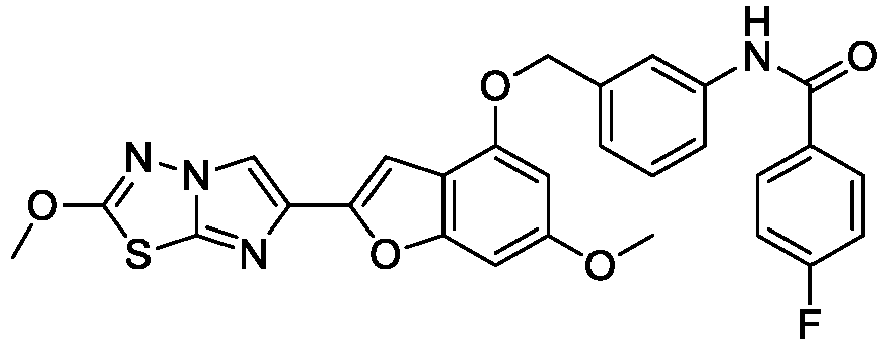
- Reaction of 6-methoxy-2-(2-methoxyimidazo[2,1-b][1,3,4]thiadiazol-6-yl)benzofuran-4-ol ( 0.080 g, 0.252 mmol) with 4-fluoro-N-(3-(hydroxymethyl)phenyl)benzamide ( 0.092 g, 0.378 mmol ) as described in example 1 gave 0.099 g ( 72 % yield ) of the title material as a white solid. HPLC (Method A): 2.371 min. HRMS (ESI) calcd for C28H22FN4O5S [M+H]+ m/z 545.1289, found 545.1301. 1H NMR (CDCl3, 400 MHz) δ ppm: 7.89 - 7.92 (m, 3H), 7.82 (s, 1H), 7.76 (br.d, J = 7.9 Hz, 1H), 7.61 (s, 1H), 7.39 (t, J = 7.9 Hz, 1H), 7.23 (overlapping with CHCl3 , 1H), 7.15 (t, J = 8.5 Hz, 2H), 7.09 (s, 1H), 6.67 (br. d, 1H), 6.36 (d, J = 1.7 Hz, 1H), 5.18 (s, 2H), 4.19 (s, 3H), 3.82 (s, 3H).

-

-

- A mixture of 3-aminobenzyl alcohol (1.365 g, 11.08 mmol) in dry tetrahydrofuran (15 mL ) was treated at 23 °C with di-tert-butyl dicarbonate ( 2.53 g, 11.59 mmol ) and the resulting mixture was stirred for 72 hours (the mixture became homogeneous after 5 min ). The reaction mixture was then concentrated under reduced pressure and the oily residue was chromatography on silica gel ( elution toluene - ethyl acetate 8 : 2 ) to give 2.48 g ( 100 % yield) of the title material as a thick syrup which crystallized to a white solid in the fridge. HPLC (Method A): 1.715 min. 1H NMR (CDCl3, 400 MHz) δ ppm: 7.43 (br. s, 1H), 7.26 (t, J = 7.9 Hz, 1H), 7.20 (br. d, J = 8.0 Hz, 1H), 7.02 (br. d, J= 7.5 Hz, 1H), 6.49 (br. s, 1H), 4.65 (d, J= 6.0 Hz, 2H), 1.76 (t, J= 6.0 Hz, 1H), 1.51 (s, 9H).
-

- A suspension of 6-methoxy-2-(2-methoxyimidazo[2,1-b][1,3,4]thiadiazol-6-yl)benzofuran-4-ol ( 2.25 g, 7.09 mmol), tert-butyl (3-(hydroxymethyl)phenyl)carbamate (1.90 g, 8.51 mmol ) and triphenylphosphine ( 2.79 g, 10.63 mmol ) in dry tetrahydrofuran ( 150 mL ) was treated at 22 ° C and under nitrogen with a solution of diisopropyl azodicarboxylate ( 2.15 g, 10.63 mmol ) in tetrahydrofuran ( 20 ml ) added drop-wise over 2 hours. The heterogeneous mixture was homogeneous at the end of the addition and was stirred for another 3 hours. The reaction mixture was then quenched by the addition of ethyl acetate ( 400 mL ) and saturated sodium bicarbonate. The organic phase was washed with brine, dried over anhydrous magnesium sulfate and concentrated in vacuo. Chromatography of the residue on silica gel ( elution toluene - ethyl acetate 9 : 1 ) followed by crystallization from ethyl acetate gave 2.595 g ( 70 % yield ) of the title material as colorless prisms. HPLC (Method A): 2.413 min. HRMS (ESI) calcd for C26H27N4O6S [M+H]+ m/z 523.1646, found 523.1676. 1H NMR (CDCl3, 400 MHz) δ ppm: 7.83 (s, 1H), 7.42 (br. s, 1H), 7.38 (br. d, J = 8 Hz, 1H), 7.30 (t, J = 8 Hz, 1H), 7.13 (br. d, J = 7.6 Hz, 1H), 7.08 (s, 1H), 6.67 (br. d, 1H), ), 6.51 (br. s, 1H), 6.35 (d, J= 1.9 Hz, 1H), 5.14 (s, 2H), 4.19 (s, 3H), 3.82 (s, 3H), 1.51 (s, 9H).
-

- A solution of tert-butyl (3-(((6-methoxy-2-(2-methoxyimidazo[2,1-b][1,3,4]thiadiazol-6-yl)benzofuran-4-yl)oxy)methyl)phenyl)carbamate ( 2.58 g, 4.93 mmol) in dichloromethane ( 150 mL ) was treated at 22 °C and under nitrogen with trifluoroacetic acid ( 15 mL ) added drop-wise over 5 min. After 2 hours, the solvent and excess reagent were evaporated under reduced pressure and the residue was partitioned between dichloromethane and saturated sodium bicarbonate. The organic phase was washed with brine, dried over anhydrous magnesium sulfate and concentrated under reduced pressure to give a white solid. Trituration of this solid in a small amount of 1,2-dichloroethane followed by filtration gave 1.74 g ( 83 % yield ) of the title aniline as a white solid. HPLC (Method A): 1.991 min. HRMS (ESI) calcd for C21H19N4O4S [M+H]+ m/z 423.1122, found 423.1129. 1H NMR (DMSO-d6, 400 MHz) δ ppm: 8.30 (s, 1H), 6.96 (t, J = 7.7 Hz, 1H), 6.89 ( s, 1H), 6.73 (br. d, 1H), 6.62 (t, J = 1.9 Hz, 1H), 6.53 (br. d, J = 7.9 Hz, 1H), 6.43 -6.45 (m, 1H), 6.40 (d, J = 1.9 Hz, 1H), 5.07 (br. s, 2H), 5.01 (s, 2H), 4.13 (s, 3H), 3.71 (s, 3H).
-

- A solution of 3-(((6-methoxy-2-(2-methoxyimidazo[2,1-b][1,3,4]thiadiazol-6-yl)benzofuran-4-yl)oxy)methyl)aniline ( 0.058 g, 0.137 mmol) in dry tetrahydrofuran ( 4 mL ) was treated at 22 ° C and under nitrogen with 4-methylmorpholine ( 0.031 g, 0.3 mmol ) followed by a solution of 4-chlorobenzoyl chloride ( 0.035 g, 0.20 mmol ) in dry tetrahydrofuran ( 2 mL ) added drop-wise over 2 min. After 1 hour, the reaction mixture was diluted with dichloromethane, washed successively with cold 0. IN hydrochloric acid, saturated sodium bicarbonate and brine. After drying over anhydrous magnesium sulfate, the organic phase was concentrated under reduced pressure. Chromatography of the residue on silica gel ( elution dichloromethane - ethyl acetate 9 : 1 ) followed by crystallization from ethyl acetate gave 0.046 g ( 60 % yield ) of the title material as a white solid. HPLC (Method A): 2.428 min. HRMS (ESI) calcd for C28H22ClN4O5S [M+H]+ m/z 561.0994, found 561.1023. 1H NMR (CDCl3, 400 MHz) δ ppm: 7.80 - 7.85 (m, 4H), 7.74 (br. d, J = 8.6 Hz, 1H), 7.60 (br. s, 1H), 7.45 (d, J = 8.6 Hz, 2H), 7.39 (t, J = 7.8 Hz, 1H), 7.24 (overlapping with CHCl3 , 1H), 7.09 (s, 1H), 6.67 (br. d, 1H), 6.35 (d, J = 1.42 Hz, 1H), 5.18 (s, 2H), 4.18 (s, 3H), 3.81 (s, 3H).
-

- Reaction of 3-(((6-methoxy-2-(2-methoxyimidazo[2,1-b][1,3,4]thiadiazol-6-yl)benzofuran-4-yl)oxy)methyl)aniline ( 0.056 g, 0.132 mmol) with 3-(trifluoromethoxy)benzoyl chloride ( 0.040 g, 0.178 mmol ) as described in example 5 gave 0.070 g ( 85 % yield ) of the title material as a white solid. HPLC (Method A): 2.437 min. HRMS (ESI) calcd for C29H22F3N4O6S [M+H]+ m/z 611.1207, found 611.1186. 1H NMR (CDCl3, 400 MHz) δ ppm: 7.85 (s, 1H), 7.81 (s, 1H), 7.77 ( d, J = 7.7 Hz, 1H), 7.71 - 7.75 (m, 2H), 7.62 (s, 1H), 7.50 (t, J = 8 Hz, 2H), 7.37- 7.41 (m, 2H), 7.26 (overlapping with CHCl3, 1H), 6.66 (br. d, 1H), 6.35 (d, J = 1.87 Hz, 1H), 5.17 (s, 2H), 4.18 (s, 3H), 3.81 (s, 3H).
-

- Reaction of 3-(((6-methoxy-2-(2-methoxyimidazo[2,1-b][1,3,4]thiadiazol-6-yl)benzofuran-4-yl)oxy)methyl)aniline ( 0.200 g, 0.473 mmol) with benzenesulfonyl chloride ( 0.125 g, 0.71 mmol ) as described in example 5 gave 0.206 g ( 77 % yield ) of the title material as a white solid. HPLC (Method A): 2.28 min. HRMS (ESI) calcd for C27H23N4O6S2 [M+H]+ m/z 563.1054, found 563.1045. 1H NMR (DMSO-d6, 400 MHz) δ ppm: 10.34 (s, 1H), 8.35 (s, 1H), 7.69 - 7.71 (m, 2H), 7.53 - 7.57 (m, 1H), 7.44 - 7.48 (m, 2H), 7.25 (s, 1H), 7.21 (t, J = 7.8 Hz, 1H), 7.09 (d, J = 7.8 Hz, 1H), 6.99 - 7.02 (m, 1H), 6.91 (s, 1H), 6.78 (br. d, 1H), 6.40 (d, J = 1.84 Hz, 1H), 5.17 (s, 2H), 4.17 (s, 3H), 3.74 (s, 3H).
-

- In a 4 mL vial was weighted the 3-(((6-methoxy-2-(2-methoxyimidazo[2,1-b][1,3,4]thiadiazol-6-yl)benzofuran-4-yl)oxy)methyl)aniline (0.025g, 0.059 mmol). Dry tetrahydrofuran ( 1 mL ) was added, followed by 4-methylmorpholine (25 µL, 0.22 mmol, ~ 3.7 equivalent). Then the acid chloride (0.082 mmol, 1.4 equivalent) in tetrahydrofuran ( 0.5 mL ) was added all at once. The resulting mixture was stirred on a Heidolph Unimax 1010 shaker (300 rpm ) for 2 h. HPLC indicated complete disappearance of the starting aniline. The reaction mixture was then quenched by the addition of water ( 0.5 mL) and acetic acid (two drops, the solution became homogeneous ).The reaction mixture is directly purified by prep HPLC ( Zorbax SB-C18 Prep HT 5um; 21.2 × 100 mm ; solvent A MeOH:H2O/TFA 0.05% (5:95), solvent B MeOH:H2O/TFA 0.05% (95:5), T 0 - 2 min: 40% solvent B ; 8 min gradient to 100 % solvent B; stop time 15 min. ; 220 nm ). The selected fractions are concentrated and the residue was lyophilized from an acetonitrile-water mixture to give ~ 15 - 30 mg of the amide as a white solid.
Ex. Structure Formula HPLC Retention Time (Min)/ Method Calc. [M+H]+ m/z LCMS [M+H]+ m/z NMR 8 
C30H24N4O7S 2.273 / A 585.1438 585.1432 1H NMR (CDCl3) δ ppm: 8.06 (s, 1H), 7.85 (d, J = 8.3 Hz, 1H), 7.83 (s, 1H), 7.62 - 7.66 (m, 2H), 7.48 - 7.52 (m, 1H), 7.33 - 7.40 (m, 2H), 7.25 - 7.27 (m, 1H), 7.13 - 7.15 (m, 2H), 6.66 (br. d, 1H), 6.36 (d, J = 1.9 Hz, 1H), 5.20 (s, 2H), 4.21 (s, 3H), 3.81 (s, 3H), 2.28 (s, 3H). 9 
C30H20F6N4O5S 2.373 / A 663.1131 663.1132 1H NMR (CDCl3) δ ppm: 7.86 (s, 1H), 7.83 (d, J = 8.2 Hz, 1H), 7.78 (d, J = 8.2 Hz, 1H), 7.75 (s, 1H), 7.69 (dd, J = 8.4, 1.3 Hz, 1H), 7.58 (s, 2H), 7.53 (s, 1H), 7.33 - 7.37 (m, 1H), 7.21 (d, J = 1.85 Hz, 1H), 7.09 (s, 1H), 6.60 (br. d, 1H), 6.31 (d, J = 1. 8 5 Hz, 1H), 5.13 (s, 2H), 4.14 (s, 3H), 3.76 (s, 3H). 10 
C28H21BrN4O5S 2.438 / A 605.0489 605.0475 1H NMR (CDCl3) δ ppm: 8.01 (br. s, 1H), 7.82 (s, 1H), 7.81 (br. s, 1H), 7.77 - 7.80 (m, 1H), 7.71 - 7.74 (m, 1H), 7.65 - 7.67 (m, 1H), 7.63 (br. s, 1H), 7.40 (t, J = 7.9 Hz, 1H), 7.35 (t, J = 7.9 Hz, 1H), 7.26 (s, 1H), 7.14 (s, 1H), 6.66 (br. d, 1H), 6.36 (d, J = 1.88 Hz, 1H), 5.19 (s, 2H), 4.20 (s, 3H), 3.82 (s, 3H). 11 
C28H21ClN4O5S 2.413 / A 561.0994 561.0982 1H NMR (CDCl3) δ ppm: 7.83 (br. s, 1H), 7.79 - 7.80 (m, 1H), 7.76 (s, 1H), 7.67 (br. d, J = 7.7 Hz, 2H), 7.57 (s, 1H), 7.42 - 7.55 (m, 1H), 7.31 - 7.36 (m, 2H), 7.20 (s, 1H), 7.11 (s, 1H), 6.59 (br. d, 1H), 6.30 (d, J = 1.84 Hz, 1H), 5.13 (s, 2H), 4.14 (s, 3H), 3.75 (s, 3H). 12 
C28H20Cl2N4O5S 2.327 / A 595.0604 595.0596 1H NMR (CDCl3) δ ppm: 7.75 (s, 1H), 7.72 (br. d, 1H), 7.57 (br. s, 1H), 7.41 (br. s, 1H), 7.34 (t, J = 7.8 Hz, 1H), 7.29 (d, J = 2.0 Hz, 1H), 7.28 (s, 1H), 7.23 (d, J = 8.5 Hz, 1H), 7.21 (d, J = 9.3 Hz, 1H), 7.09 (s, 1H), 6.60 (br. d, 1H), 6.32 (d, J = 1 . 8 6 Hz, 1H), 5.14 (s, 2H), 4.14 (s, 3H), 3.76 (s, 3H). 13 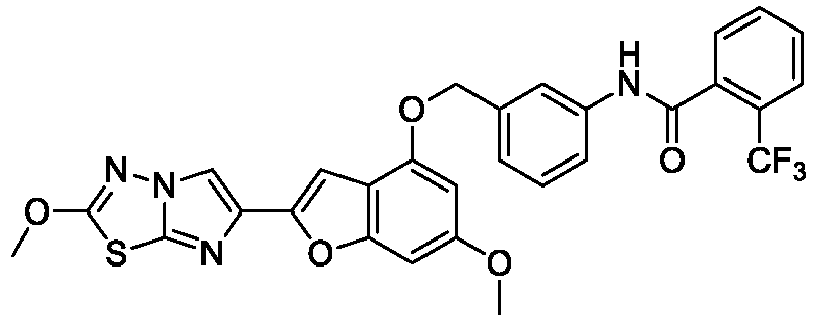
C29H21F3N4O5S 2.313 / A 595.1258 595.126 1H NMR (CDCl3) δ ppm: 7.75 (s, 1H), 7.68 (d, J = 7.8 Hz, 1H), 7.63 (br. d, J = 7.9 Hz, 1H), 7.49 - 7.62 (m, 4H), 7.43 (br. s, 1H), 7.33 (t, J = 7.8 Hz, 1H), 7.21 (d, J = 7.8 Hz, 1H), 7.03 (s, 1H), 6.60 (br. d, 1H), 6.30 (d, J = 1.9 Hz, 1H), 5.12 (s, 2H), 4.12 (s, 3H), 3.75 (s, 3H). 14 
C28H19F3N4O5S 2.373 / A 581.1101 581.1103 1H NMR (CDCl3) δ ppm: 8.18 (br. d, 1H), 7.8 - 7.87 (m, 1H), 7.76 (s, 1H), 7.63 (br. s, 1H), 7.60 (d, J = 8.1 Hz, 1H), 7.34 (t, J = 7.8 Hz, 1H), 7.23 (d, J = 7.8 Hz, 1H), 7.12 (s, 1H), 7.03 - 7.09 (m, 1H), 6.60 (d, J = 1.8 Hz, 1H), 6.31 (d, J = 1.8 Hz, 1H), 5.14 (s, 2H), 4.15 (s, 3H), 3.76 (s, 3H). 15 
C32H24N4O5S 2.385 / A 577.154 577.1535 1H NMR (CDCl3) δ ppm: 9.06 (d, J = 8.6 Hz, 1H), 8.35 (d, J = 7.2 Hz, 1H), 8.28 (d, J = 7.4 Hz, 1H), 8.07 (d, J = 7.7 Hz, 1H), 7.41 - 7.87 (m, 7H), 7.36 (t, J = 7.9 Hz, 1H), 7.22 (d, J = 7.5 Hz, 1H), 7.12 (s, 1H), 6.59 (d, J = 1.8 Hz, 1H), 6.32 (d, J = 1.8 Hz, 1H), 5.16 (s, 2H), 4.15 (s, 3H), 3.76 (s, 3H). 16 
C29H21N5O5S 2.351 / A 552.1336 552.1327 1H NMR (CDCl3) δ ppm: 8.21 (s, 1H), 8.16 (br. s, 1H), 8.09 (d, J = 8.0 Hz, 1H), 7.79 (s, 1H), 7.75 - 7.77 (m, 2H), 7.61 (s, 1H), 7.55 (t, J = 7.8 Hz, 1H), 7.39 (t, J = 7.9 Hz, 1H), 7.24 (d, J = 7.6 Hz, 1H), 7.04 (s, 1H), 6.64 (br. d, 1H), 6.33 (d, J = 1.8 Hz, 1H), 5.16 (s, 2H), 4.17 (s, 3H), 3.80 (s, 3H). 18 
C29H24N4O6S 2.337 / A 557.1487 557.1514 1H NMR (CDCl3) δ ppm: 7.72 - 7.79 (m, 4H), 7.66 (br. d, 1H), 7.57 (br. s, 1H), 7.32 (t, J = 7.9 Hz, 1H), 7.15 - 7.16 (m, 1H), 7.11 (s, 1H), 6.89 (br. d, J = 8.8 Hz, 2H), 6.59 (br. d, 1H), 6.30 (d, J = 1.8 Hz, 1H), 5.13 (s, 2H), 4.14 (s, 3H), 3.79 (s, 3H), 3.75 (s, 3H). 19 
C28H20Cl2N4O5S 2.540 / A 595.0604 595.0627 1H NMR (CDCl3) δ ppm: 7.81 (br. s, 1H), 7.75 (s, 1H), 7.67 (d, J = 1.9 Hz, 2H), 7.65 (br. d, 1H), 7.54 (br. s, 1H), 7.44 (t, J = 1.9 Hz, 1H), 7.33 (t, J = 7.9 Hz, 1H), 7.19 (br. d, overlapping with CHCl3, 1H), 7.04 (s, 1H), 6.60 (br. d, 1H), 6.29 (d, J = 1.9 Hz, 1H), 5.12 (s, 2H), 4.13 (s, 3H), 3.75 (s, 3H). 20 
C29H24N4O5S 2.387 / A 541.154 541.1566 1H NMR (CDCl3) δ ppm: 7.77 (br. s, 1H), 7.76 (s, 1H), 7.68 (br. d, J = 8 Hz, 1H), 7.62 (s, 1H), 7.57 - 7.60 (m, 2H), 7.32 (t, J = 7.9 Hz, 1H), 7.26 - 7.32 (m, 2H), 7.19 (m, overlapping with CHCl3, 1H), 7.06 (s, 1H), 6.60 (br. d, 1H), 6.30 (d, J = 1.9 Hz, 1H), 5.13 (s, 2H), 4.13 (s, 3H), 3.75 (s, 3H), 2.35 (s, 3H). 21 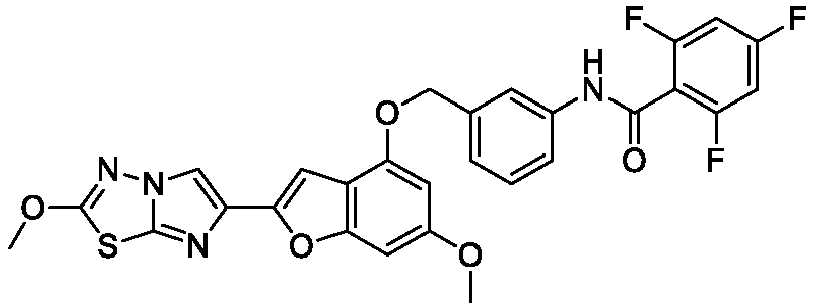
C28H19F3N4O5S 2.320 / A 581.1101 581.1129 1H NMR (CDCl3) δ ppm: 7.77 (s, 1H), 7.70 (br. d, J = 8 Hz, 1H), 7.64 (br. s, 1H), 7.56 (br. s, 1H), 7.34 (t, J = 7.9 Hz, 1H), 7.21 (d, J = 8.2 Hz, 1H), 7.10 (s, 1H), 6.67 - 6.73 (m, 2H), 6.61 (br. d, 1H), 6.31 (d, J = 1.9 Hz, 1H), 5.13 (s, 2H), 4.15 (s, 3H), 3.77 (s, 3H). 22 
C29H22N4O7S 2.338 / A 571.1282 571.1308 1H NMR (CDCl3) δ ppm: 7.76 (s, 1H), 7.7 (br. s, 1H), 7.64 (br. d, J = 8 Hz, 1H), 7.55 (br. s, 1H), 7.29 - 7.34 (m, 3H), 7.15 (m, overlapping with CHCl3, 1H), 7.09 (s, 1H), 6.79 (d, J = 8.05 Hz, 1H), 6.59 (br. d, 1H), 6.30 (d, J = 1.77 Hz, 1H), 5.97 (s, 2H), 5.12 (s, 2H), 4.14 (s, 3H), 3.75 (s, 3H). 23 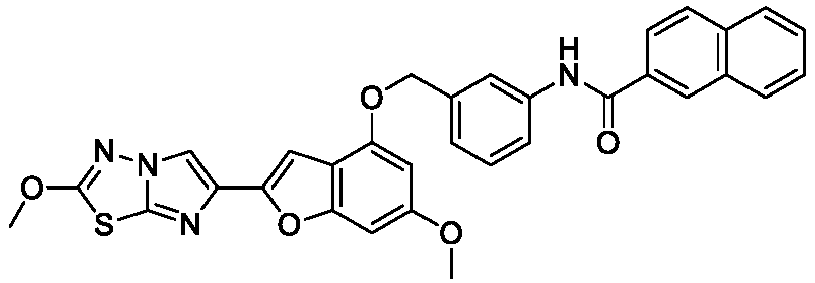
C32H24N4O5S 2.428 / A 577.154 577.1565 1H NMR (CDCl3) δ ppm: 8.32 (s, 1H), 7.96 (br. s, 1H), 7.87 - 7.90 (m, 3H), 7.81 - 7.83 (m, 1H), 7.72 - 7.75 (m, 2H), 7.63 (br. s, 1H), 7.46 - 7.53 (m, 2H), 7.35 (t, J = 7.9 Hz, 1H), 7.20 (d, J = 8.2 Hz, 1H), 7.06 (s, 1H), 6.60 (br. d, 1H), 6.31 (d, J = 1.86 Hz, 1H), 5.14 (s, 2H), 4.12 (s, 3H), 3.75 (s, 3H). 24 
C28H21IN4O5S 2.327 / A 653.035 653.037 1H NMR (CDCl3) δ ppm: 7.83 (d, J = 7.9 Hz, 1H), 7.75 (s, 1H), 7.66 (d, J = 8.3 Hz, 1H), 7.59 (s, 1H), 7.47 (br. d, J = 7.6 Hz, 1H), 7.42 (br. s, 1H), 7.37 (d, J = 8.0 Hz, 1H), 7.33 (d, J = 8.0 Hz, 1H), 7.21 (d, J = 7.5 Hz, 1H), 7.07 (br. t, 1H), 6.91 (s, 1H), 6.60 (br. d, 1H), 6.31 (d, J = 1.4 Hz, 1H), 5.13 (s, 2H), 4.12 (s, 3H), 3.75 (s, 3H). 25 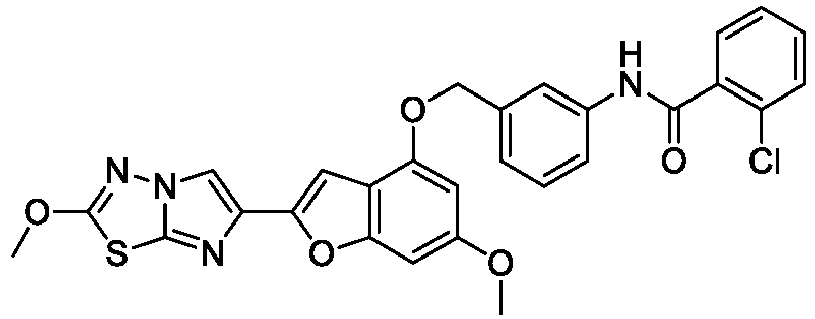
C28H21ClN4O5S 2.317 / A 561.0993 561.0994 1H NMR (CDCl3) δ ppm: 7.80 (br. s, 1H), 7.75 (s, 1H), 7.68 (dd, J = 7.3, 1.9 Hz, 1H), 7.64 (br. d, J = 8.1 Hz, 1H), 7.60 (br. s, 1H), 7.28 - 7.40 (m, 4H), 7.21 (d, J = 7.8 Hz, 1H), 7.03 (s, 1H), 6.60 (br. d, 1H), 6.31 (d, J = 1.8 Hz, 1H), 5.13 (s, 2H), 4.12 (s, 3H), 3.75 (s, 3H). 26 
C28H21FN4O5S 2.328 / A 545.1289 545.1283 1H NMR (CDCl3) δ ppm: 8.42 (br. d, J = 15.8 Hz, 1H), 8.09 (dt, J = 8.0, 1.8 Hz, 1H), 7.76 (br. s, 1H), 7.67 (s, 1H), 7.61 (d. J = 8.15 Hz, 1H), 7.41 - 7.47 (m, 1H), 7.33 (t, J = 7.8 Hz, 1H), 7.21 - 7.25 (m, 2H), 7.12 (s, 1H), 7.11 (dd, J = 12.4, 8.1 Hz, 1H), 6.59 (br. d, 1H), 6.31 (d, J = 1.8 Hz, 1H), 5.14 (s, 2H), 4.15 (s, 3H), 3.75 (s, 3H). 27 
C29H24N4O5S 2.339 / A 541.154 541.1538 1H NMR (CDCl3) δ ppm: 7.77 (s, 1H), 7.64 (br. d, J = 7.8 Hz, 1H), 7.56 (br. s, 1H), 7.41 - 7.44 (m, 2H), 7.32 (t, J = 7.8 Hz, 1H), 7.23 - 7.30 (m, 1H), 7.19 - 7.20 (m, 3H), 7.02 (s, 1H), 6.60 (br. d, 1H), 6.30 (d, J = 1.8 Hz, 1H), 5.12 (s, 2H), 4.12 (s, 3H), 3.75 (s, 3H), 2.44 (s, 3H). 28 
C28H21FN4O5S 2.358 / A 545.1289 545.1176 1H NMR (CDCl3) δ ppm: 7.82 (br. s, 1H), 7.76 (s, 1H), 7.68 (br. d, J = 8.0 Hz, 1H), 7.51- 7.57 (m, 3H), 7.37- 7.41 (m, 1H), 7.33 (t, J = 7.9 Hz, 1H), 7.13 - 7.20 (m, 3H), 6.59 (br. d, 1H), 6.30 (d, J = 1.8 Hz, 1H), 5.13 (s, 2H), 4.15 (s, 3H), 3.75 (s, 3H). 29 
C29H24F3N4O6S 2.356 / A 557.1489 557.1357 1H NMR (CDCl3) δ ppm: 9.75 (br. s, 1H), 8.21 (dd, J = 7.8, 1.8 Hz, 1H), 7.76 (s, 1H), 7.65 (br. s, 1H), 7.62 (br. d, J = 7.9 Hz, 1H), 7.4 - 7.44 (m, 1H), 7.31 (t, J = 7.8 Hz, 1H), 7.20 (m, 1H), 7.07 (br. d, J = 8 Hz, 1H), 7.04 (s, 1H), 6.96 (d, J = 8.3 Hz, 1H), 6.61 (br. d, 1H), 6.32 (d, J = 1.9 Hz, 1H), 5.13 (s, 2H), 4.12 (s, 3H), 3.98 (s, 3H), 3.75 (s, 3H). 30 
C29H20F4N4O5S 2.424 / A 613.1163 613.1188 1H NMR (CDCl3) δ ppm: 8.09 (br. dd, J = 6.8, 2.0 Hz, 1H), 8.01 - 8.04 (m, 1H), 7.86 (br. s, 1H), 7.76 (s, 1H), 7.70 (br. d, J = 8 Hz, 1H), 7.55 (br. s, 1H), 7.34 (t, J = 7.8 Hz, 1H), 7.25 (t, J = 9.2 Hz, 1H), 7.20 (m, 1H), 7.07 (s, 1H), 6.60 (br. d, 1H), 6.30 (d, J = 1.6 Hz, 1H), 5.13 (s, 2H), 4.13 (s, 3H), 3.75 (s, 3H). 31 
C31H28N4O5S 2.468 / A 569.1853 569.1851 1H NMR (CDCl3) δ ppm: 7.86 (s, 2H), 7.82 (d, J = 8.2 Hz, 2H), 7.76 (br. d, J = 8 Hz, 1H), 7.67 (br. s, 1H), 7.42 (t, J = 8.0 Hz, 1H), 7.31 (d, J = 8.2 Hz, 2H), 7.25 (m, overlapping with CHCl3, 1H), 7.17 (s, 1H), 6.70 (br. d, 1H), 6.40 (d, J = 2.0 Hz, 1H), 5.22 (s, 2H), 4.23 (s, 3H), 3.85 (s, 3H), 2.67 (t, J = 7.6 Hz, 2H), 1.72 - 1.75 (m, 2H), 0.96 (t, J = 7.2 Hz, 3H). 32 
C29H24N4O5S 2.376 / A 541.154 541.1565 1H NMR (CDCl3) δ ppm: 7.77 (br. s, 1H), 7.76 (s, 1H), 7.70 (br. d, J = 8.0 Hz, 2H), 7.67 (br. dd, J = 7.9, 1.5 Hz, 1H), 7.58 (br. s, 1H), 7.32 (t, J = 7.8 Hz, 1H), 7.20 (br. d, J = 8.0 Hz, 2H), 7.17 (m, overlapping with CHCl3, 1H), 7.10 (s, 1H), 6.60 (br. d, 1H), 6.30 (d, J = 1.9 Hz, 1H), 5.13 (s, 2H), 4.14 (s, 3H), 3.75 (s, 3H), 2.34 (s, 3H). 33 
C28H21N5O7S 2.358 / A 572.1234 572.1255 1H NMR (CDCl3) δ ppm: 8.25 (d, J = 8.8 Hz, 2H), 7.99 (s, 1H), 7.98 (d, J = 8.8 Hz, 2H), 7.76 (s, 1H), 7.75 (br. d, J = 7.6 Hz, 1H), 7.55 (br. s, 1H), 7.35 (t, J = 7.9 Hz, 1H), 7.19 (m, overlapping with CHCl3, 1H), 7.10 (s, 1H), 6.60 (br. d, 1H), 6.30 (d, J = 1.8 Hz, 1H), 5.13 (s, 2H), 4.14 (s, 3H), 3.75 (s, 3H). 34 
C30H24N4O7S 2.367 / A 585.1438 585.1454 1H NMR (CDCl3) δ ppm: 8.07 (d, J = 8.2 Hz, 2H), 7.87 (d, J = 8.2 Hz, 2H), 7.86 (s, 1H), 7.76 (s, 1H), 7.71 (br. dd, J = 7.6, 1.1 Hz, 1H), 7.58 (br. s, 1H), 7.34 (t, J = 7.9 Hz, 1H), 7.19 (m, overlapping with CHCl3, 1H), 7.09 (s, 1H), 6.60 (br. d, 1H), 6.30 (d, J = 1.86 Hz, 1H), 5.13 (s, 2H), 4.14 (s, 3H), 3.87 (s, 3H), 3.75 (s, 3H). 36 
C29H21N5O5S 2.315 / A 552.1336 552.1254 1H NMR (CDCl3) δ ppm: 7.97 (br. d, J = 8.6 Hz, 2H), 7.90 (br. s, 1H), 7.82 (s, 1H), 7.75 - 7.80 (m, 3H), 7.59 (br. s, 1H), 7.41 (t, J = 7.9 Hz, 1H), 7.24 (m, overlapping with CHCl3, 1H), 7.08 (d, J = 0.7 Hz, 1H), 6.67 (br. d, 1H), 6.35 (d, J = 1.9 Hz, 1H), 5.19 (s, 2H), 4.19 (s, 3H), 3.81 (s, 3H). 37 
C32H30N4O5S 2.405 / A 583.201 583.2019 1H NMR (CDCl3) δ ppm: 7.78 (br. s, 1H), 7.74 (d, J = 8.4 Hz, 2H), 7.67 (br. d, J = 8.3 Hz, 1H), 7.59 (br. s, 1H), 7.42 (d, J = 8.4 Hz, 2H), 7.32 (t, J = 7.9 Hz, 1H), 7.2 (m, overlapping with CHCl3, 2H), 7.1 (br. s, 1H), 6.61 (br. s, 1H), 6.31 (s, 1H), 5.13 (s, 2H), 4.13 (s, 3H), 3.75 (s, 3H), 1.27 (s, 9H). 39 
C28H21IN4O5S 2.444 / A 653.035 653.0362 1H NMR (CDCl3) δ ppm: 7.82 (d, J = 8.2 Hz, 2H), 7.75 - 7.8 (m, 2H), 7.74 (br. d, J = 8.6 Hz, 1H), 7.60 (s, 1H), 7.59 (d, J = 8.2 Hz, 2H), 7.38 (t, J = 7.9 Hz, 1H), 7.2 - 7.3 (m, 1H), 7.09 (br. s, 1H), 6.66 (br. d, 1H), 6.35 (d, J = 1.5 Hz, 1H), 5.17 (s, 2H), 4.18 (s, 3H), 3.81 (s, 3H). 40 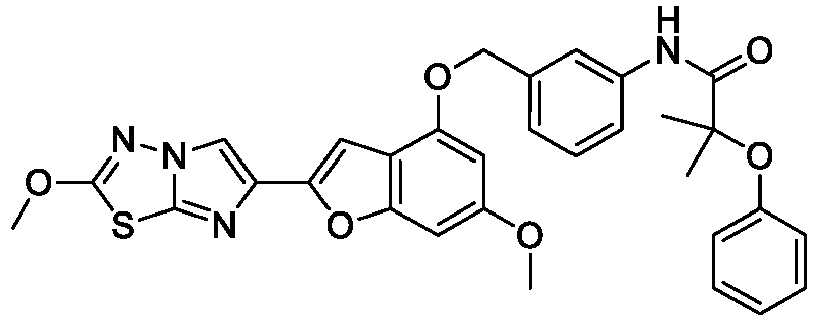
C31H28N4O6S 2.453 / A 585.1802 585.1812 1H NMR (CDCl3) δ ppm: 8.62 (br. s, 1H), 7.81 (s, 1H), 7.64 (br. s, 1H), 7.59 (br. d, J = 8 Hz, 1H), 7.35 (t, J = 7.9 Hz, 1H), 7.25 - 7.3 (m, 3H), 7.07 - 7.11 (m, 1H), 7.06 (d, J = 0.53 Hz, 1H), 6.97 - 7.0 (m, 2H), 6.67 (br. d, 1H), 6.35 (d, J = 1.9 Hz, 1H), 5.15 (s, 2H), 4.18 (s, 3H), 3.81 (s, 3H), 1.57 (s, 6H). 41 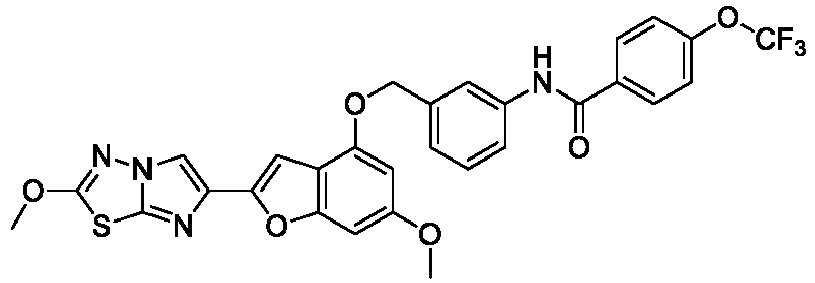
C29H21F3N4O6S 2.311 / A 611.1207 611.1238 1H NMR (CDCl3) δ ppm: 7.93 (d, J = 8.4 Hz, 2H), 7.86 (br. s, 1H), 7.82 (br. s, 1H), 7.76 (d, J = 8.1 Hz, 1H), 7.61 (br. s, 1H), 7.39 (t, J = 7.9 Hz, 1H), 7.31 (d, J = 8.4 Hz, 2H), 7.24 (d, J = 7.2 Hz, 1H), 7.1 (br. s, 1H), 6.67 (br. s, 1H), 6.36 (br. s, 1H), 5.18 (s, 2H), 4.18 (s, 3H), 3.81 (s, 3H). 42 
C3OH26N4O7S 2.392 / A 587.1595 587.1626 1H NMR (CDCl3) δ ppm: 9.72 (s, 1H), 8.22 (d, J = 8.4 Hz, 1H),7.8 (br. s, 1H), 7.70 (s, 1H) 7.64 (dd, J = 8.6. 1.0 Hz, 1H), 7.35 (t, J = 8.6 Hz, 1H), 7.1 - 7.25 (m, 2H), 6.66 (br. s, 1H), 6.62 (dd, J = 8.6. 2.0 Hz, 1H), 6.5 (br. d, 1H), 6.37 (br. d, 1H), 5.19 (s, 2H), 4.19 (s, 3H), 4.0 (s, 3H), 3.85 (s, 3H), 3.81 (s, 3H). 43 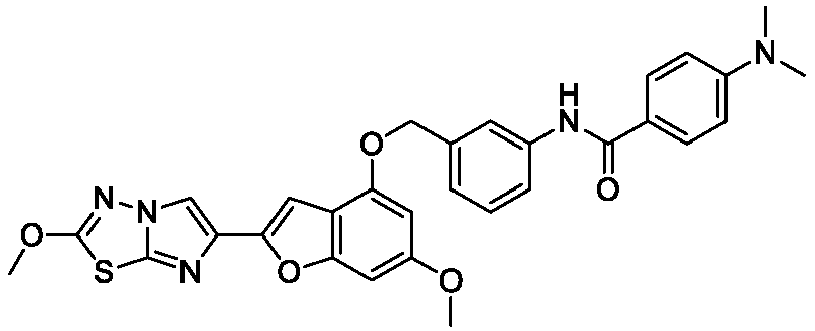
C30H27N5O5S 2.351 / A 570.1806 570.1837 1H NMR (CDCl3) δ ppm: 7.83 (br. s, 1H), 7.80 (br. s, 1H), 7.78 (d, J = 8.9 Hz, 2H), 7.70 (br. d, J = 9 Hz, 1H), 7.65 (br. s, 1H), 7.37 (t, J = 8.6 Hz, 1H), 7.21 (d, J = 7.8 Hz, 1H), 7.19 (br. s, 1H), 6.74 (d, J = 8.9 Hz, 2H), 6.65 (br. d, 1H), 6.37 (d, J = 1.6 Hz, 1H), 5.19 (s, 2H), 4.21 (s, 3H), 3.81 (s, 3H), 3.02 (s, 6H). 46 
C28H23N5O6S 2.370 / A 558.1442 558.1408 1H NMR (CDCl3) δ ppm: 8.70 (d, J = 2.5 Hz, 1H), 8.06 (dd, J = 8.7, 2.5 Hz, 1H), 7.86 (br. s, 1H), 7.81 (s, 1H), 7.70 (dd, J = 8.1, 1.2 Hz, 1H), 7.61 (br. s, 1H), 7.38 (t, J = 7.9 Hz, 1H), 7.22 - 7.24 (m, 1H), 7.07 (s, 1H), 6.79 (dd, J = 8.7, 0.65 Hz, 1H), 6.66 (br. d, 1H), 6.35 (d, J = 1.9 Hz, 1H), 5.17 (s, 2H), 4.18 (s, 3H), 3.98 (s, 3H), 3.81 (s, 3H). 48 
C27H20FN5O5S 2.218 / A 546.1242 546.1266 1H NMR (CDCl3) δ ppm: 8.32 (d, 5.1 Hz, 1H), 7.93 (br. s, 1H), 7.76 (s, 1H), 7.73 (br. d, 1H), 7.52 - 7.56 (m, 2H), 7.35 (t, J = 7.9 Hz, 1H), 7.32 (br. s, 1H), 7.20 (d, J = 8.5 Hz, 1H), 7.10 (s, 1H), 6.60 (br. d, 1H), 6.30 (d, J = 1.9 Hz, 1H), 5.13 (s, 2H), 4.14 (s, 3H), 3.75 (s, 3H). 51 
C33H25N5O6S 2.416 / A 620.1598 620.1612 1H NMR (CDCl3) δ ppm: 8.61 (d, J = 2.5 Hz, 1H), 8.14 (dd, J = 8.6, 2.5 Hz, 1H), 7.80 (br. s, 1H), 7.76 (s, 1H), 7.65 (br. d, J = 8 Hz, 1H), 7.57 (br. s, 1H), 7.31 - 7.38 (m, 3H), 7.15 - 7.20 (m, 2H), 7.06 - 7.13 (m, 3H), 6.91 (d, J = 8.7 Hz, 1H), 6.59 (br. d, 1H), 6.30 (d, J = 1.9 Hz, 1H), 5.13 (s, 2H), 4.15 (s, 3H), 3.75 (s, 3H). 52 
C27H20N4O4S 2.361 / A 497.1278 497.1291 1H NMR (CDCl3) δ ppm: 7.80 - 7.82 (m, 4H), 7.66 (br. d, J = 8 Hz, 1H), 7.60 (br. s, 1H), 7.39 - 7.47 (m, 3H), 7.32 (t, J = 7.9 Hz, 1H), 7.18 (d, J = 8 Hz, 1H), 7.12 (s, 1H), 7.05 - 7.12 (m, 2H), 6.63 (dd, J = 7.0, 1.7 Hz, 1H), 5.16 (s, 2H), 4.12 (s, 3H). 53 
C27H20ClN5O5S 2.343 / A 562.0946 562.0956 1H NMR (DMSO-d6) δ ppm: 10.49 (s, 1H), 8.88 (d, J = 2.5 Hz, 1H), 8.32 (s, 1H), 8.28 (dd, J = 8.3, 2.5 Hz, 1H), 7.85 (br. s, 1H), 7.69 (dd, J = 8.3, 1.1 Hz, 1H), 7.64 (d, J = 8.3 Hz, 1H), 7.35 (t, J = 7.8 Hz, 1H), 7.20 (d, J = 7.8 Hz, 1H), 6.93 (s, 1H), 6.77 (br. d, 1H), 6.46 (d, J = 1.8 Hz, 1H), 5.20 (s, 2H), 4.13 (s, 3H), 3.72 (s, 3H). 54 
C30H21F6N5O6S 2.395 /A 694.1189 694.1209 1H NMR (CDCl3) δ ppm: 8.51 (s, 1H), 7.82 (s, 1H), 7.75 (br. dd, 1H), 7.66 (br. s, 1H), 7.59 (br. s, 1H), 7.40 (t, J = 7.9 Hz, 1H), 7.24 - 7.27 (m, 1H), 7.21 (s, 1H), 7.16 (s, 1H), 6.66 (br. d, 1H), 6.37 (d, J = 1.6 Hz, 1H), 5.19 (s, 2H), 4.83 (q, J = 8.2 Hz, 2H), 4.20 (s, 3H), 3.82 (s, 3H). 55 
C27H19Cl2N5O5S 2.453 / A 596.0557 596.0567 1H NMR (CDCl3) δ ppm: 8.31 (br. s, 1H), 7.73 - 7.76 (m, 2H), 7.60 (s, 2H), 7.52 (br. s, 1H), 7.33 (t, J = 7.8 Hz, 1H), 7.15 - 7.18 (m, 1H), 7.1 (s, 1H), 6.56 (br. d, 1H), 6.26 (d, J = 1.7 Hz, 1H), 5.11 (s, 2H), 4.14 (s, 3H), 3.74 (s, 3H). 56 
C27H21N5O6S 2.215 / A 544.1285 544.1297 1H NMR (CDCl3) δ ppm: 8.69 (br. s, 1H), 7.71 - 7.76 (m, 2H), 7.59 (br. s, 1H), 7.27 - 7.33 (m, 2H), 7.14 (d, J = 7.5 Hz, 1H), 7.07 (s, 1H), 7.0 (br. s, 1H), 6.72 (br. d, J = 7 Hz, 1H), 6.56 (br. s, 1H), 6.26 (br. s, 1H), 5.10 (s, 2H), 4.11 (s, 3H), 3.73 (s, 3H). 57 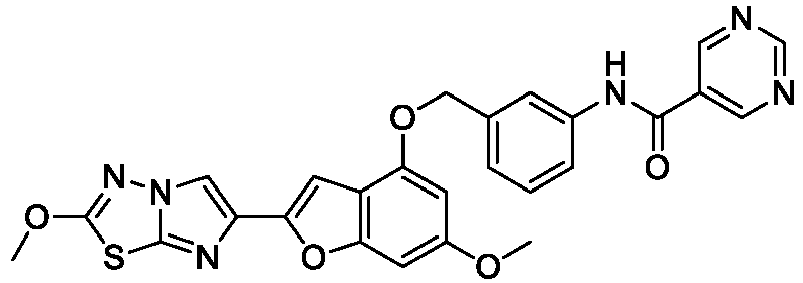
C26H20N6O5S 2.273 / A 529.1289 529.1306 1H NMR (CDCl3) δ ppm: 9.0 - 9.6 (br. s, 5H), 8.26 (br. s, 1H), 7.78 (br. d, J = 8 Hz, 1H), 7.58 (br. s, 1H), 7.35 (t, J = 7.8 Hz, 1H), 7.18 - 7.19 (m, 1H), 6.59 (br. s, 1H), 6.30 (s, 1H), 5.14 (s, 2H), 4.15 (s, 3H), 3.75 (s, 3H). 58 
C27H20ClN5O5S 2.261 / A 562.0946 562.0948 1H NMR (CDCl3) δ ppm: 8.45 (dd, J = 4.8, 1.9 Hz, 1H), 8.12 (dd, J = 7.6, 1.9 Hz, 1H), 8.07 (br. s, 1H), 7.75 (s, 1H), 7.64 (br. d, J = 8 Hz, 1H), 7.61 (br. s, 1H), 7.31 - 7.37 (m, 2H), 7.23 (br. d, J = 7.8 Hz, 1H), 7.03 (s, 1H), 6.61 (br. d, 1H), 6.31 (d, J = 1.8 Hz, 1H), 5.13 (s, 2H), 4.12 (s, 3H), 3.75 (s, 3H). 61 
C27H20FN5O5S 2.271 / A 546.1242 546.1248 1H NMR (CDCl3) δ ppm: 8.55 - 8.60 (m, 1H), 8.49 (br. d, J = 14 Hz, 1H), 8.29 - 8.31 (m, 1H), 7.76 (s, 1H), 7.68 (s, 1H), 7.60 (br. d, J = 7.8 Hz, 1H), 7.32 - 7.37 (m, 2H), 7.25 (d, J = 7.5 Hz, 1H), 7.12 (s, 1H), 6.60 (br. d, 1H), 6.31 (d, J = 1.8 Hz, 1H), 5.14 (s, 2H), 4.15 (s, 3H), 3.75 (s, 3H). 62 
C36H27F3N4O6S 2.599 / A 701.1676 701.1524 1H NMR (CDCl3) δ ppm: 7.88 (br. s, 1H), 7.75 (br. s, 1H), 7.64 (br. d, J = 8.2 Hz, 1H), 7.58 - 7.62 (m, 3H), 7.25 - 7.44 (m, 7H), 7.20 (d, J = 7.3 Hz, 1H), 7.03 (br. s, 1H), 6.60 (br. s, 1H), 6.30 (br. s, 1H), 5.12 (s, 2H), 5.06 (s, 2H), 4.12 (s, 3H), 3.74 (s, 3H). 63 
C29H23ClN4O6S 2.456 / A 591.11 591.0974 1H NMR (CDCl3) δ ppm: 7.85 (br. s, 1H), 7.82 (br. s, 1H), 7.73 (br. d, J = 8 Hz, 1H), 7.67 (s, 1H), 7.43 (t, J = 8 Hz, 1H), 7.40 (s, 1H), 7.33 (s, 1H), 7.29 (d, J = 8.6 Hz, 1H), 7.15 (br. s, 1H), 7.08 (s, 1H), 6.70 (br. s, 1H), 6.39 (br. s, 1H), 5.22 (s, 2H), 4.22 (s, 3H), 3.88 (s, 3H), 3.85 (s, 3H). 64 
C28H22ClN5O5S 2.282 / A 576.1103 576.1098 1H NMR (DMSO-d6) δ ppm: 10.57 (s, 1H), 8.31 (s, 1H), 7.89 (d, J = 7.6 Hz, 1H), 7.80 (br. s, 1H), 7.62 (br. d, J = 8 Hz, 1H), 7.34 (d, J = 7.7 Hz, 1H), 7.33 (t, J = 7.8 Hz, 1H), 7.18 (br. d, J = 8 Hz, 1H), 6.92 (s, 1H), 6.76 (br. d, 1H), 6.46 (d, J = 1.9 Hz, 1H), 5.19 (s, 2H), 4.13 (s, 3H), 3.73 (s, 3H), 2.42 (s, 3H). 65 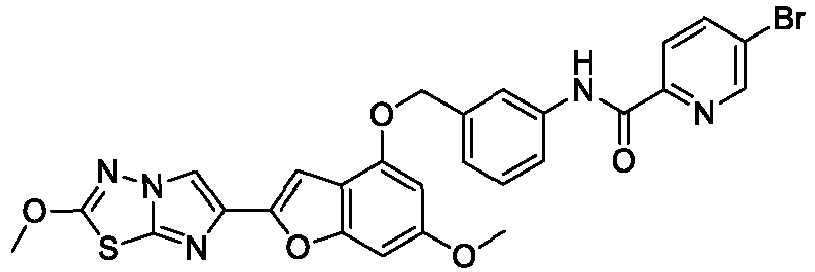
C27H20BrN5O5S 2.449 / A 606.0441 606.0305 1H NMR (CDCl3) δ ppm: 9.86 (br. s, 1H), 8.67 (d, J = 1.9 Hz, 1H), 8.17 (d, J = 8.4 Hz, 1H), 8.02 (dd, J = 8.4, 2.3 Hz, 1H), 7.79 - 7.82 (m, 3H), 7.40 (t, J = 7.8 Hz, 1H), 7.26 (d, J = 7.5 Hz, 1H), 7.11 (s, 1H), 6.67 (br. d, 1H), 6.37 (d, J = 1.9 Hz, 1H), 5.20 (s, 2H), 4.19 (s, 3H), 3.82 (s, 3H). 66 
C33H26N6O5S 2.467 / A 619.1758 619.1575 1H NMR (CDCl3) δ ppm: 8.77 (s, 1H), 8.34 - 8.37 (m, 2H), 7.99 (br. s, 1H), 7.75 (br. d, J = 8 Hz, 1H), 7.73 (s, 1H), 7.56 (br. s, 1H), 7.38 - 7.43 (m, 3H), 7.34 (t, J = 7.9 Hz, 1H), 7.17 - 7.19 (m, 1H), 7.14 (s, 1H), 6.53 (br. d, 1H), 6.30 (d, J = 1.9 Hz, 1H), 5.14 (s, 2H), 4.13 (s, 3H), 3.72 (s, 3H), 2.65 (s, 3H). 67 
C35H27ClN4O6S 2.527 / A 667.1413 667.1447 1H NMR (CDCl3) δ ppm: 7.82 (s, 1H), 7.76 (br. s, 1H), 7.69 (br. d, J = 8 Hz, 1H), 7.63 (br. s, 1H), 7.31 - 7.42 (m, 8H), 7.24 - 7.26 (m, 1H), 7.12 (t, J = 2 Hz, 1H), 7.09 (s, 1H), 6.67 (br. d, 1H), 6.36 (d, J = 1.9 Hz, 1H), 5.18 (s, 2H), 5.09 (s, 2H), 4.18 (s, 3H), 3.81 (s, 3H). 68 
C28H21F2N7O5S2 2.432 / A 638.1086 638.112 1H NMR (CDCl3) δ ppm: 9.04 (s, 1H), 8.45 (s, 1H), 7.86 (br. s, 1H), 7.75 - 7.82 (m, 2H), 7.42 (t, J = 8.0 Hz, 1H), 7.27 - 7.29 (m, 1H), 7.16 (s, 1H), 6.70 (br. d, 1H), 6.40 (d, J = 1.6 Hz, 1H), 5.23 (s, 2H), 4.23 (s, 3H), 3.85 (s, 3H), 2.22 (t, J = 18.4 Hz, 3H). 69 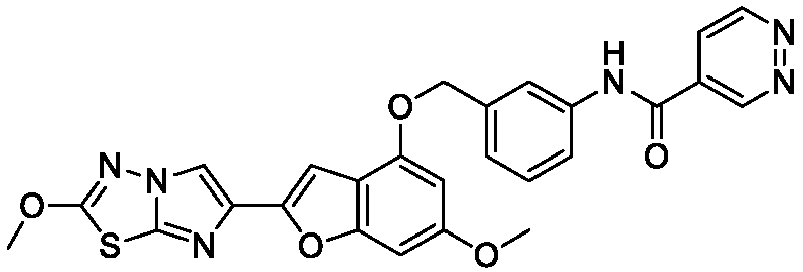
C26H20N6O5S 2.243 / A 529.1289 529.1325 1H NMR (CDCl3) δ ppm: 9.62 (s, 1H), 9.31 (d, J = 5.2 Hz, 1H), 8.63 (br. s, 1H), 7.88 - 7.90 (m, 1H), 7.81 (br. d, J = 8 Hz, 1H), 7.79 (s, 1H), 7.58 (br. s, 1H), 7.34 (t, J = 7.9 Hz, 1H), 7.26 (d, J = 8.5 Hz, 1H), 7.0 (s, 1H), 6.63 (br. d, 1H), 6.31 (d, J = 1.7 Hz, 1H), 5.18 (s, 2H), 4.17 (s, 3H), 3.80 (s, 3H). 71 
C30H23F3N4O5S 2.437 / A 609.1414 609.1424 1H NMR (CDCl3) δ ppm: 7.89 (br. s, 1H), 7.84 (s, 1H), 7.79 (s, 1H), 7.76 (s, 1H), 7.69 (br. d, J = 8.5 Hz, 1H), 7.59 (s, 1H), 7.52 (s, 1H), 7.34 (t, J = 8.0 Hz, 1H), 7.17 - 7.21 (m, 1H), 7.13 (s, 1H), 6.59 (br. d, 1H), 6.31 (d, J = 1.9 Hz, 1H), 5.14 (s, 2H), 4.15 (s, 3H), 3.76 (s, 3H), 2.41 (s, 3H). 73 
C28H23N5O6S 2.412 / A 558.1442 558.144 1H NMR (DMSO-d6) δ ppm: 12.64 (s, 1H), 12.14 (s, 1H), 8.31 (s, 1H), 8.28 (d, J = 7.4 Hz, 1H), 7.78 (s, 1H), 7.59 (br. dd, J = 8, 1 Hz, 1H), 7.32 (t, J = 7.8 Hz, 1H), 7.16 (d, J = 7.8 Hz, 1H), 6.92 (s, 1H), 6.76 (br. d, 1H), 6.47 (d, J = 2.0 Hz, 1H), 6.35 (d, J = 7.4 Hz, 1H), 5.19 (s, 2H), 4.13 (s, 3H), 3.73 (s, 3H), 2.27 (s, 3H). 74 
C30H21F5N4O5S 2.061 / A 661.1175 661.1154 1H NMR (CDCl3) δ ppm: 8.06 (br. s, 1H), 7.90 (s, 1H), 7.79 (s, 1H), 7.75 (s, 1H), 7.69 (br. d, J = 7.8 Hz, 1H), 7.59 (s, 1H), 7.47 (s, 1H), 7.34 (t, J = 8 Hz, 1H), 7.20 (d, J = 8.1 Hz, 1H), 7.05 (s, 1H), 6.60 (br. d, 1H), 6.56 (t, J = 72 Hz, 1H), 6.30 (d, J = 1.5 Hz, 1H), 5.12 (s, 2H), 4.13 (s, 3H), 3.75 (s, 3H). 75 
C29H23FN4O5S 2.018 / A 559.1446 559.1467 1H NMR (CDCl3) δ ppm: 7.82 (s, 1H), 7.70 (br. d, J = 7.6 Hz, 1H), 7.62 (br. s, 1H), 7.49 (br. s, 1H), 7.39 (t, J = 7.8 Hz, 1H), 7.2 - 7.3 (m, 3H), 7.08 (s, 1H), 7.05 (dt, J = 8.3, 2.7 Hz, 1H), 6.67 (br. s, 1H), 6.37 (br. s, 1H), 5.18 (s, 2H), 4.18 (s, 3H), 3.82 (s, 3H), 2.45 (s, 3H). 76 
C29H20F4N4O6S 2.152 / A 629.1112 629.1133 1H NMR (CDCl3) δ ppm: 7.82 (br. s, 2H), 7.72 (br. d, J = 7.8 Hz, 1H), 7.62 (br. s, 1H), 7.53 (br. s, 2H), 7.40 (t, J = 7.8 Hz, 1H), 7.27 (d, J = 7.8 Hz, 1H), 7.13 (br. d, J = 8.6 Hz, 1H), 7.08 (s, 1H), 6.67 (br. s, 1H), 6.36 (br. s, 1H), 5.19 (s, 2H), 4.19 (s, 3H), 3.82 (s, 3H). 78 
C30H24F2N4O7S 2.648 / B 623.1407 623.1436 1H NMR (CDCl3) δ ppm: 7.85 (s, 1H), 7.83 (br. s, 1H), 7.72 (br. d, J = 8.2 Hz, 1H), 7.67 (br. s, 1H), 7.42 (t, J = 7.8 Hz, 1H), 7.25 - 7.3 (m, 2H), 7.19 (br. s, 1H), 7.11 (s, 1H), 6.85 (t, J = 2.2 Hz, 1H), 6.70 (d, J = 2 Hz, 1H), 6.58 (t, J = 73 Hz, 1H), 6.39 (d, J = 2 Hz, 1H), 5.21 (s, 2H), 4.21 (s, 3H), 3.88 (s, 3H), 3.85 (s, 3H). 
-

-
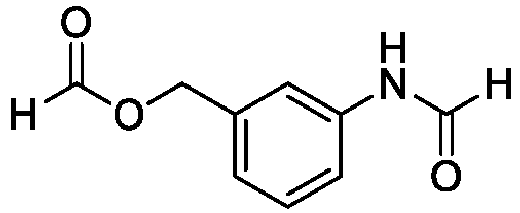
- A solution of 3-aminobenzyl alcohol ( 2.00 g, 16.24 mmol ) in formic acid ( 30 mL ) was heated under reflux ( bath temperature 110 ° C ) for 2 hours. The excess formic acid was evaporated under reduced pressure and the residual oil was chromatographed on silica gel ( elution toluene - ethyl acetate 7 : 3 ) to give 2.47 g ( 85 % yield ) of the title material as a clear oil. HPLC (Method A): 1.255 min. 1H NMR (CDCl3, 400 MHz) δ ppm: (mixture of rotamers) 8.72 and 8.69 (two s, 0.4H), 8.38 (two s, 0.5H), 8.13 and 8.14 (two s, 0.9H), 8.0 (broad s, 0.4 H), 7.61 (br. s, 0.5H), 7.49 (br. d, 0.6H), 7.32 - 7.38 (m, 1.5H), 7.19 (d, J = 7.7 Hz, 0.5H), 7.14 (d, J = 7.5 Hz, 0.5H), 7.05 - 7.09 (m, 1H), 5.18 and 5.19 (two s, ratio 1 : 1, 2H).
-

- A solution of 3-formamidobenzyl formate ( 2.068 g, 11.54 mmol) in N,N-dimethylformamide ( 40 mL ) was treated at 23 ° C and under nitrogen with cesium carbonate (5.64 g, 17.31 mmol) followed by methyl iodide ( 0.80 mL, 12.8 mmol ) added drop wise over 5 min. After 24 h, the solid carbonate was filtered and the filtrate was concentrated under reduced pressure. The residual oil was chromatographed on silica gel ( gradient of ethyl acetate in toluene) to give 1.780 g ( 80 % yield ) of the title material as a clear oil which solidified to a white solid in the fridge. HPLC (Method A): 1.376 min. HRMS (ESI) calcd for C10H12NO3 [M+H]+ m/z 194.0812, found 194.0809. 1H NMR (CDCl3, 400 MHz) δ ppm: 8.47 (s, 1H), 8.13 (d, J = 0.8 Hz, 1H), 7.40 (tr, J = 7.8 Hz, 1H), 7.26 (d, J = 7.6 Hz, 1H), 7.17 (br. s, 1H), 7.13 (dd, J = 7.9, 2.2 Hz, 1H), 5.20 (s, 2H), 3.30 (s, 3H).
-

- A solution of 3-(N-methylformamido)benzyl formate ( 1.76 g, 9.1 mmol ) in methanol ( 11 mL ) was treated at 23 ° C and under nitrogen with 5 N aqueous sodium hydroxide ( 8 mL, 40 mmol ) and the resulting mixture was heated to 70 ° C for 4 hours. The methanol was then evaporated under reduced pressure and the residue was diluted with saturated aqueous ammonium chloride ( 10 mL ). The aqueous phase was extracted three times with ether and the combined organic extract was dried over anhydrous sodium sulfate and concentrated under reduced pressure to give a light brown oil. Distillation under vacuum ( bulb to bulb distillation, bp 75 - 85 ° C / 0.1 torr, air bath temperature) gave 1.18 g ( 95 % yield ) of a clear oil. HPLC (Method A): 0.146 min. HRMS (ESI) calcd for C8H12NO [M+H]+ m/z 138.0913, found 138.088. 1H NMR (DMSO-d6, 400 MHz) δ ppm: 6.97 (t, J = 7.7 Hz, 1H), 6.46 (br. s, 1H), 6.43 (br. d, J = 7 Hz, 1H), 6.33 - 6.36 (m, 1H), 5.50 (br. s, 1H), 4.95 (t, J = 5.6 Hz, 1H), 4.33 (d, J = 5.6 Hz, 2H), 2.61 (s, 3H).
-

- A solution of (3-(methylamino)phenyl)methanol ( 1.17 g, 8.53 mmol ) in dry tetrahydrofuran ( 15 mL ) was treated at 23 ° C with di-tert-butyl dicarbonate ( 2.15 g, 9.85 mmol ) and the resulting mixture was stirred for 72 hours. The reaction mixture was then concentrated under reduced pressure and the oily residue was purified by chromatography on silica gel ( elution toluene - ethyl acetate 8 : 2 ) to give 1.97 g ( 97 % yield ) of the title material as a thick syrup. HPLC (Method A): 1.836 min. 1H NMR (CDCl3, 400 MHz) δ ppm: 7.29 (t, J= 7.8 Hz, 1H), 7.25 (br. s, 1H), 7.14 (dd, J= 7.8, 1.6 Hz, 2H), 4.67 (d, J= 6.0 Hz, 2H), 3.24 (s, 3H), 1.74 (t, J= 6.0 Hz, 1H), 1.43 (s, 9H).
-

- A suspension of 6-methoxy-2-(2-methoxyimidazo[2,1-b][1,3,4]thiadiazol-6-yl)benzofuran-4-ol ( 2.00 g, 6.30 mmol), tert-butyl (3-(hydroxymethyl)phenyl)(methyl)carbamate (1.90 g, 8.0 mmol ) and triphenylphosphine ( 2.47 g, 9.41 mmol ) in dry tetrahydrofuran ( 200 mL ) was treated at 22 ° C and under nitrogen with a solution of diisopropyl azodicarboxylate ( 1.70 g, 8.40 mmol ) in tetrahydrofuran ( 15 ml ) added drop-wise over 2 hours. The heterogeneous mixture was homogeneous at the end of the addition and was stirred for another 3 hours. The reaction mixture was then quenched by the addition of ethyl acetate ( 400 mL ) and saturated sodium bicarbonate. The organic phase was washed with brine, dried over anhydrous magnesium sulfate and concentrated in vacuo. Chromatography of the residue on silica gel ( elution dichloromethane - ethyl acetate 5 - 10 % ) followed by crystallization from ethyl acetate gave 2.35 g ( 70 % yield ) of the title material as colorless crystals. HPLC (Method A): 2.443 min. HRMS (ESI) calcd for C27H19N4O6S [M+H]+ m/z 537.1802, found 537.1848. 1H NMR (CDCl3, 400 MHz) δ ppm: 7.82 (s, 1H), 7.31 - 7.35 (m, 2H), 7.26 (br. d, J = 7.5 Hz, 1H), 7.19 (br. d, J = 7.5 Hz, 1H), 7.06 (s, 1H), 6.68 (br. d, 1H), ), 6.37 (d, J = 1.9 Hz, 1H), 5.14 (s, 2H), 4.18 (s, 3H), 3.81 (s, 3H), 3.25 (s, 3H), 1.42 (s, 9H).
-

- A solution of tert-butyl (3-(((6-methoxy-2-(2-methoxyimidazo[2,1-b][1,3,4]thiadiazol-6-yl)benzofuran-4-yl)oxy)methyl)phenyl)(methyl)carbamate (2.20 g, 4.10 mmol) in dichloromethane ( 100 mL ) was treated at 22 ° C and under nitrogen with trifluoroacetic acid ( 15 mL ) added drop-wise over 5 min. After 2 hours, the solvent and excess reagent were evaporated under reduced pressure and the residue was partitioned between dichloromethane and saturated sodium bicarbonate. The organic phase was washed with brine, dried over anhydrous magnesium sulfate and concentrated under reduced pressure to give a white solid. Crystallization from 1,2-dichloroethane ( 10 mL, - 15 ° C, 18 h ) gave 1.66 g ( 92 % yield ) of the title aniline as white cubes. HPLC (Method A): 2.037 min. HRMS (ESI) calcd for C22H21N4O4S [M+H]+ m/z 438.1307, found 438.1344. 1H NMR (DMSO-d6, 400 MHz) δ ppm: 8.30 (s, 1H), 7.03 (t, J= 7.8 Hz, 1H), 6.89 ( s, 1H), 6.73 (br. d, 1H), 6.58 (s, 1H), 6.57 (br. d, J = 7 Hz, 1H), 6.42 (d, J = 1.8 Hz, 1H), 6.41 (br. dd, J= 7, 1.5 Hz, 1H), 5.65 (br. s, 1H), 5.05 (s, 2H), 4.13 (s, 3H), 3.71 (s, 3H), 2.59 (s, 3H).
-

- A solution of 3-(((6-methoxy-2-(2-methoxyimidazo[2,1-b][1,3,4]thiadiazol-6-yl)benzofuran-4-yl)oxy)methyl)-N-methylaniline ( 0.100 g, 0.23 mmol) in dry tetrahydrofuran ( 4 mL ) was treated at 22 ° C and under nitrogen with 4-methylmorpholine ( 0.070 g, 0.69 mmol ) followed by a solution of benzoyl chloride ( 0.040 g, 0.28 mmol ) in dry tetrahydrofuran ( 2 mL ) added drop-wise over 2 min. After 1 hour, the reaction mixture was diluted with dichloromethane, washed successively with cold 0.1N hydrochloric acid, saturated sodium bicarbonate and brine. After drying over anhydrous magnesium sulfate, the organic phase was concentrated under reduced pressure. Chromatography of the residue on silica gel (elution dichloromethane - ethyl acetate 15 - 20 % ) followed by crystallization from ethyl acetate gave 0.096 g ( 78 % yield ) of the title material as colorless prisms. HPLC (Method A): 2.343 min. HRMS (ESI) calcd for C29H25N4O5S [M+H]+ m/z 541.154, found 541.1545. 1H NMR (CDCl3, 400 MHz) δ ppm: 7.77 (s, 1H), 7.04 - 7.20 (m, 8H), 6.95 (s, 1H), 6.86 - 6.89 (m, 1H), 6.61 (br. d, 1H), 6.19 (d, J= 1.8 Hz, 1H), 4.99 (s, 2H), 4.12 (s, 3H), 3.75 (s, 3H), 3.43 (s, 3H).
- The following compounds were prepared using the methodology described for preparation of example 83
Ex. Structure Formula HPLC Retention Time (Min)/ Method Calc. [M+H]+ m/z LCMS [M+H]+ m/z NMR 84 
C30H26N4O5S 2.398 / B 555.1697 555.1695 1H NMR (CDCl3) δ ppm: 7.87 (s, 1H), 7.10 - 7.27 (m, 3H), 7.12 (s, 1H), 6.8 - 7.1 (m, 5H), 6.71 (d, J = 2 Hz, 1H), 6.26 (br. s, 1H), 5.08 (br. s, 2H), 4.24 (s, 3H), 3.84 (s, 3H), 3.51 (br. s, 3H), 2.29 (br. s, 3H). 85 
C29H23FN4O5S 2.363 / B 559.1446 559.1443 1H NMR (CDCl3) δ ppm: 7.78 (s, 1H), 7.19 (s, 1H), 7.16 - 7.19 (m, 1H), 7.09 (br. s, 1H), 7.03 (s, 1H), 6.91 - 7.0 (m, 2H), 6.90 (s, 1H), 6.88 (br. s, 1H), 6.80 (dt, J = 8.5, 2.5 Hz, 1H), 6.60 (br. d, 1H), 6.18 (d, J = 1.7 Hz, 1H), 5.02 (s, 2H), 4.15 (s, 3H), 3.75 (s, 3H), 3.42 (s, 3H). 86 
C30H26N4O6S 2.343 / B 571.1646 571.1639 1H NMR (CDCl3) δ ppm: 7.78 (s, 1H), 7.0 - 7.2 (m, 6H), 6.90 (br. s, 1H), 6.67 (br. t, 1H), 6.60 (br. s, 1H), 6.49 (br. d, 1H), 6.16 (br. s, 1H), 4.94 (br. s, 2H), 4.15 (s, 3H), 3.75 (s, 3H), 3.48 (br. s, 3H), 3.42 (br. s, 3H). 87 
C29H23FN4O5S 2.349 / A 559.1446 559.1435 1H NMR (CDCl3) δ ppm: 7.78 (s, 1H), 7.15 - 7.2 (m, 4H), 7.09 (br. s, 1H), 6.95 (s, 1H), 6.85 - 6.87 (m, 1H), 6.72 (br. t, J = 8.8 Hz, 2H), 6.61 (br. d, 1H), 6.16 (d, J = 1.9 Hz, 1H), 5.02 (s, 2H), 4.12 (s, 3H), 3.75 (s, 3H), 3.41 (s, 3H). 88 
C29H23FN4O5S 2.365 / B 559.1446 559.1469 1H NMR (CDCl3) δ ppm: 7.77 (s, 1H), 7.0 - 7.18 (m, 5H), 7.00 (s, 1H), 6.93 (br. s, 1H), 6.85 (br. s, 1H), 6.70 (br. s, 1H), 6.61 (s, 1H), 6.17 (br. s, 1H), 4.97 (s, 2H), 4.14 (s, 3H), 3.75 (s, 3H), 3.42 (br. s, 3H). 89 
C30H26N4O5S 2.427 / B 555.1697 555.1728 1H NMR (CDCl3) δ ppm: 7.77 (s, 1H), 7.17 - 7.19 (m, 1H), 7.14 (t, J = 7.4 Hz, 1H), 7.12 (br. s, 1H), 7.09 (br. d, J = 8.2 Hz, 2H), 7.03 (s, 1H), 6.84 - 6.87 (m, 3H), 6.61 (br. d, 1H), 6.21 (d, J = 1.9 Hz, 1H), 5.02 (s, 2H), 4.14 (s, 3H), 3.75 (s, 3H), 3.41 (s, 3H), 2.15 (s, 3H). 90 
C29H25N5O6S 2.337 / B 572.1598 572.1627 1H NMR (CDCl3) δ ppm: 8.07 (br. s, 1H), 7.79 (s, 1H), 7.36 (br. d, 1H), 7.17 - 7.25 (m, 2H), 7.15 (s, 1H), 7.04 (s, 1H), 6.89 - 6.91 (m, 1H), 6.60 (br. s, 1H), 6.40 (d, J = 9 Hz, 1H), 6.21 (br. s, 1H), 5.05 (s, 2H), 4.15 (s, 3H), 3.77 (s, 3H), 3.76 (s, 3H), 3.41 (s, 3H). 91 
C28H24N4O6S2 2.326 / A 577.121 577.122 1H NMR (CDCl3) δ ppm: 7.77 (s, 1H), 7.44 - 7.48 (m, 3H), 7.30 - 7.35 (m, 3H), 7.25 (t, J = 8 Hz, 1H), 7.02 - 7.04 (m, 2H), 6.92 (s, 1H), 6.62 (br. d, 1H), 6.24 (d, J = 1.9 Hz, 1H), 5.03 (s, 2H), 4.13 (s, 3H), 3.75 (s, 3H), 3.11 (s, 3H). 92 
C27H22N6O5S 2.190 / B 543.1445 543.1451 1H NMR (CDCl3) δ ppm: 8.94 (br. s, 1H), 8.53 (br. s, 2H), 7.80 (s, 1H), 7.22 - 7.28 (m, 2H), 7.16 - 7.18 (m, 1H), 7.04 (s, 1H), 6.91 - 6.94 (m, 1H), 6.61 (br. d, 1H), 6.18 (d, J = 1.8 Hz, 1H), 5.04 (s, 2H), 4.15 (s, 3H), 3.76 (s, 3H), 3.45 (s, 3H). 96 
C31H25F3N4O5S 2.150 / A 623.1571 623.1612 1H NMR (CDCl3) δ ppm: 8.1, 8.07, 8.05, 8.0, 7.68 and 7.58 ( six broad s, 1H), 7.7 (s, 1H), 7.15 - 7.25 (m, 4H), 7.12 (br. s, 1H), 7.01 (s, 1H), 6.87 - 6.92 (m, 1H), 6.60 (d, J = 1.6 Hz, 1H), 6.20 (d, J = 1.6 Hz, 1H), 5.01 (s, 2H), 4.15 (s, 3H), 3.75 (s, 3H), 3.44 (s, 3H), 2.14 (s, 3H). 97 
C23H20N4O5S 2.547 / A 465.1227 465.1231 1H NMR (CDCl3) δ ppm: 8.51 (s, 1H), 7.86 (s, 1H), 7.37 - 7.48 (m, 2H), 7.30 (br. s, 1H), 7.14 (d, J = 7.8 Hz, 1H), 7.08 (s, 1H), 6.72 (br. d, 1H), 6.39 (br. d, 1H), 5.21 (s, 2H), 4.21 (s, 3H), 3.85 (s, 3H), 3.35 (s, 3H). 
-
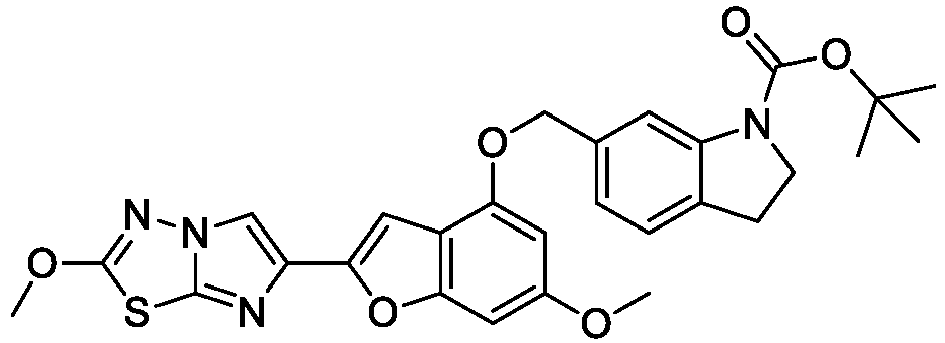
-

- A solution of methyl 1H-indole-6-carboxylate ( 4.80 g, 27.4 mmol ) in acetic acid ( 40 mL ) was cooled to 15 ° C and then treated with sodium cyanoborohydride ( 6.90 g, 0.11 mmol ) added in small portions over 30 min. After 5 h at 15 ° C, the reaction mixture was diluted with a mixture of ice and water (200 mL) and carefully adjusted to pH 9 -10 with solid potassium carbonate. The aqueous phase was extracted three times with dichloromethane and the combined organic phase was washed with brine and dried over anhydrous magnesium sulfate. The solvent was evaporated under reduced pressure and the residual oil was chromatographed on silica gel ( elution toluene - ethyl acetate 8 : 2 ) to give 3.54 g ( 73 % yield ) of the title material as yellowish solid. HPLC (Method A): 0.9 min (tailing). HRMS (ESI) calcd for C10H12NO2 [M+H]+ m/z 178.0863, found 178.0882. 1H NMR (CDCl3, 400 MHz) δ ppm: 7.40 (dd, J = 7.6, 1.5 Hz, 1H), 7.25 (d, J = 1.5 Hz, 1H), 7.12 (br. d, J = 7.6 Hz, 1H), 3.85 (s, 3H), 3.59 (t, J = 8.5 Hz, 2H), 3.05 (t, J = 8.5 Hz, 2H).
-
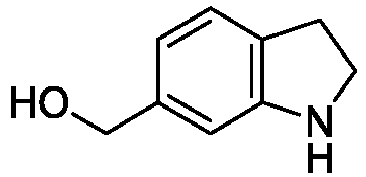
- A solution of methyl indoline-6-carboxylate ( 0.830 g, 4.68 mmol) in dry tetrahydrofuran ( 20 mL ) was treated at 23 ° C and under nitrogen with lithium aluminum hydride ( 0.23 g, 6.08 mmol) and the resulting mixture was stirred for 3.5 h. The reaction mixture was carefully quenched by successive addition of ethyl acetate ( 1 mL ), water ( 0.2 mL), 15 % aqueous sodium hydroxide ( 0.2 mL ) and water ( 0.6 mL ). The solid formed was filtered and the filtrate was concentrated under reduced pressure. Chromatography of the residual oil on silica gel ( elution ethyl acetate ) followed by distillation under vacuum (bulb to bulb distillation, bp 95 - 105 ° C / 0.1 torr, air bath temperature ) gave 0.460 g ( 57 % yield ) of a clear oil which crystallized to a white solid. HPLC (Method A): 0.132 min. HRMS (ESI) calcd for C9H12NO [M+H]+ m/z 150.0913, found 150.0932. 1H NMR (CDCl3, 400 MHz) δ ppm: 7.4 (d, J = 7.4 Hz, 1H), 6.66 (dd, J = 7.4, 1.5 Hz, 1H), 6.63 (br. s, 1H), 4.55 (s, 2H), 3.54 (t, J = 8.4 Hz, 2H), 2.99 (t, J = 8.4 Hz, 2H).
-

- A solution of indolin-6-ylmethanol ( 0.630 g, 4.22 mmol ) in dry tetrahydrofuran ( 15 mL ) was treated at 23 ° C with di-tert-butyl dicarbonate ( 0.99 g, 4.53 mmol ) and the resulting mixture was stirred for 18 hours. The reaction mixture was then concentrated under reduced pressure and the oily residue was purified by chromatography on silica gel ( elution toluene - ethyl acetate 7 : 3 ) to give 1.052 g ( 100 % yield ) of the title material as a thick syrup which crystallized to a white solid in the fridge. HPLC (Method A): 1.905 min. 1H NMR (CDCl3, 400 MHz) δ ppm: 7.84 (br. s, 1H), 7.10 (d, J = 7.5 Hz, 1H), 6.93 (br. d, J = 7.5 Hz, 1H), 4.62 (d, J = 6.0 Hz, 2H), 3.96 (t, J= 8.7 Hz, 2H), 3.05 (t, J= 8.7 Hz, 2H), 1.57 (t, J= 6.0 Hz, 1H), 1.54 (s, 9H).
-
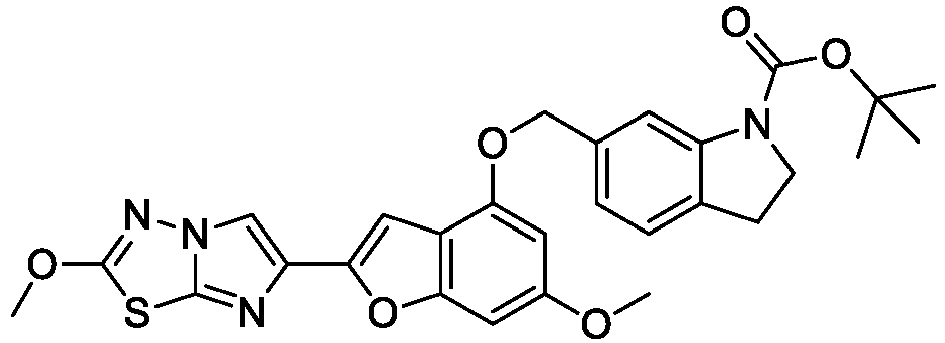
- A suspension of 6-methoxy-2-(2-methoxyimidazo[2,1-b][1,3,4]thiadiazol-6-yl)benzofuran-4-ol ( 0.500 g, 1.57 mmol), tert-butyl 6-(hydroxymethyl)indoline-1-carboxylate ( 0.500 g, 2.0 mmol ) and triphenylphosphine ( 0.62 g, 2.36 mmol ) in dry tetrahydrofuran ( 50 mL ) was treated at 22 ° C and under nitrogen with a solution of diisopropyl azodicarboxylate ( 0.47 g, 2.32 mmol ) in tetrahydrofuran ( 10 ml ) added drop-wise over 2 hours. The heterogeneous mixture was homogeneous at the end of the addition and was stirred for another 3 hours. The reaction mixture was then quenched by the addition of ethyl acetate and saturated sodium bicarbonate. The organic phase was washed with brine, dried over anhydrous magnesium sulfate and concentrated in vacuo. Chromatography of the residue on silica gel ( elution toluene - ethyl acetate 10 - 15 % ) gave 0.582 g ( 67 % yield ) of the title material as a white solid. HPLC (Method A): 2.523 min. HRMS (ESI) calcd for C28H29N4O6S [M+H]+ m/z 549.1802, found 549.1793. 1H NMR (CDCl3, 400 MHz) δ ppm: 7.86 (br. s, 1H), 7.74 (s, 1H), 7.06 (d, J= 7.5 Hz, 1H), 6.98 - 7.04 (m, 2H), 6.59 (br. d, 1H), 6.29 (d, J= 1.8 Hz, 1H), 5.06 (s, 2H), 4.11 (s, 3H), 3.91 (t, J = 8.7 Hz, 2H), 3.74 (s, 3H), 3.0 (t, J = 8.7 Hz, 2H), 1.46 (s, 9H).
-

- A solution of tert-butyl 6-(((6-methoxy-2-(2-methoxyimidazo[2,1-b][1,3,4]thiadiazol-6-yl)benzofuran-4-yl)oxy)methyl)indoline-1-carboxylate ( 0.379 g, 0.69 mmol) in dichloromethane ( 15 mL ) was treated at 22 ° C and under nitrogen with trifluoroacetic acid ( 1.5 mL ) added drop-wise over 2 min. After 2 hours, the solvent and excess reagent were evaporated under reduced pressure and the residue was partitioned between dichloromethane and saturated sodium bicarbonate. The organic phase was washed with brine, dried over anhydrous magnesium sulfate and concentrated under reduced pressure to give 0.259 g ( 83 % yield ) of a white solid. HPLC (Method A): 1.948 min. HRMS (ESI) calcd for C23H21N4O4S [M+H]+ m/z 449.1278, found 449.1284. 1H NMR (CDCl3, 400 MHz) δ ppm: 7.75 (s, 1H), 7.03 (d, J= 7.9 Hz, 1H), 7.01 ( s, 1H), 6.71 (d, J = 7.2 Hz, 1H), 6.70 (s, 1H), 6.60 (br. d, 1H), 6.31 (d, J= 1.9 Hz, 1H), 5.01 (s, 2H), 4.13 (s, 3H), 3.75 (s, 3H), 3.74 (br. s, 1H), 3.50 (t, J = 8.3 Hz, 2H), 2.95 (t, J = 8.3 Hz, 2H).
-

- A solution of 6-(4-(indolin-6-ylmethoxy)-6-methoxybenzofuran-2-yl)-2-methoxyimidazo[2,1-b][1,3,4]thiadiazole ( 0.065 g, 0.145 mmol) in dry tetrahydrofuran ( 4 mL ) was treated at 22 ° C and under nitrogen with 4-methylmorpholine ( 0.050 g, 0.49 mmol ) followed by a solution of benzoyl chloride ( 0.025 g, 0.18 mmol ) in dry tetrahydrofuran ( 1 mL ) added drop-wise over 2 min. After 1 hour, the reaction mixture was diluted with dichloromethane, washed successively with cold 0.1N hydrochloric acid, saturated sodium bicarbonate and brine. After drying over anhydrous magnesium sulfate, the organic phase was concentrated under reduced pressure. Chromatography of the residue on silica gel ( elution dichloromethane - ethyl acetate 10 - 15 % ) gave 0.053 g ( 66 % yield ) of the title material as a white solid. HPLC (Method A): 2.354 min. HRMS (ESI) calcd for C30H25N4O5S [M+H]+ m/z 553.154, found 553.154. 1H NMR (CDCl3, 400 MHz) δ ppm: 7.76 (s, 1H), 7.4 - 7.5 (m, 2H), 7.3 - 7.4 (m, 3H), 7.13 (br. d, J = 7.0 Hz, 1H), 7.08 (br. s, 2H), 6.94 (br. s, 1H), 6.65 (br. s, 1H), 6.24 (br. s, 1H), 5.05 (br. s, 2H), 4.12 (s, 3H), 4.03 (br. s, 2H), 3.75 (s, 3H), 3.04 (t, J = 8.3 Hz, 2H).
- The following compounds were prepared using the methodology described for preparation of example 100
Ex. Structure Formula HPLC Retention Time (Min)/ Method Calc. [M+H]+ m/z LCMS [M+H]+ m/z NMR 101 
C31H26N4O5S 2.495 /B 567.1697 567.1704 1H NMR (CDCl3) δ ppm: (mixture of rotamers) 8.47 (br. s, 0.7H), 7.88 (br. s, 1.2 H), 7.2 - 7.4 (m, 4H), 7.0 - 7.15 (m, 1.6H), 6.69 and 6.67 (two s, 1.1H), 6.44 (s, 0.7H), 6.10 (s, 0.6H), 5.67 (s, 0.65H), 5.24 (s, 1.3H), 4.84 (s, 1H), 4.34 (br. t, 1H), 4.25 (s, 3H), 3.86 and 3.83 (two s, 3H), 3.75 -3.83 (m, 1.4H), 3.10 - 3.2 (m, 2H), 2.16 and 2.39 (two s, 3H). 102 
C30H23FN4O5S 2.017 / A 571.1446 571.1453 1H NMR (CDCl3) δ ppm: 7.76 (s, 1H), 7.31 (br. s, 1H), 7.24 (br. s, 1H), 7.06 - 7.22 (m, 4H), 7.05 (br. t, 1H), 6.95 (br. s, 1H), 6.60 (br. d, 1H), 6.25 (br. s, 1H), 5.02 (br. s, 2H), 4.12 (s, 3H), 4.0 (br. s, 2H), 3.75 (s, 3H), 3.05 (t, J = 8.3 Hz, 2H). 103 
C31H26N4O6S 1.999 / A 583.1646 583.1658 1H NMR (CDCl3) δ ppm: (mixture of rotamers) 8.36 (s, 0.7H), 7.75 and 7.77 (two s, 1H), 7.05 - 7.35 (m, 3H), 7.01 (s, 0.7H), 6.95 (t, J = 7.5 Hz, 0.7H), 6.85 - 6.9 (m, 2H), 6.65 (d, J = 8 Hz, 0.3H), 6.55 - 6.55 (m, 1H), 6.34 (s, 0.7H), 6.04 (s, 0.3H), 5.82 (s, 0.3H), 5.13 (s, 1.3H), 4.77 (s, 0.6H), 4.2 - 4.35 (m, 0.6H), 4.11 and 4.13 (two s, 3H), 3.7 - 3.8 (m, 7H), 3.44 (s, 0.9H), 3.01 (br. t, J = 8.4 Hz, 2H). 104 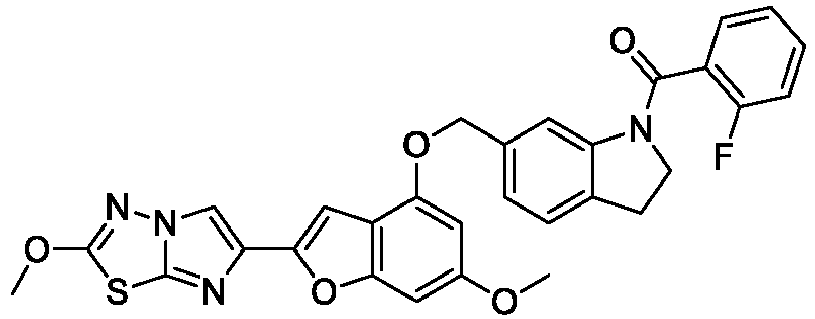
C30H23FN4O5S 2.042 / A 571.1446 571.1447 1H NMR (CDCl3) δ ppm: (mixture of rotamers) 8.33 (s, 0.8H), 7.76 ( broad s, 1H), 6.9 - 7.4 (m, 7H), 6.61 (br. s, 1H), 6.34 (s, 0.8H), 5.95 and 6.06 (two br. s, 0.4H), 5.14 and 4.78 (two s, 2H), 4.32 and 4.18 (two br. s, 0.6H), 4.12 (s, 3H), 3.8 (t, J = 8.2 Hz, 1.4H), 3.76 and 3.74 (two s, 3H), 3.06 (br. t, J = 8.2 Hz, 2H). 105 
C31H26N4O5S 2.083 /A 567.1697 567.1698 1H NMR (CDCl3) δ ppm: 7.76 (s, 1H), 7.37 (d, J = 80 Hz, 2H), 7.14 (d, J = 8.0 Hz, 2H), 7.1 - 7.15(m, 2H), 7.09 (br. s, 1H), 6.96 (br. s, 1H), 6.60 (br. d, 1H), 6.26 (br. s, 1H), 5.01 (br. s, 2H), 4.12 (s, 3H), 4.04 (br. t, 2H), 3.75 (s, 3H), 3.03 (t, J = 8.3 Hz, 2H), 2.28 (br. s, 3H). 106 
C30H25N5O6S 2.000 / A 584.1598 584.1601 1H NMR (CDCl3) δ ppm: 8.38 (d, J = 1.6Hz, 1H), 7.77 (s, 1H), 7.72 (dd, J = 8.2, 2.1 Hz, 1H), 7.08 - 7.15 (m, 2H), 6.99 (s, 1H), 6.59 (br. d, 1H), 6.30 (d, J = 1.9Hz, 1H), 5.06 (br. s, 2H), 4.13 (s, 3H), 4.08 (t, J = 8.2 Hz, 2H), 3.89 (s, 3H), 3.76 (s, 3H), 3.07 (t, J = 8.2 Hz, 2H). 108 
C28H22N6O5S 1.935 / A 555.1445 555.1449 1H NMR (CDCl3) δ ppm: 9.25 (s, 1H), 8.90 (s, 2H), 8.25 (br. s, 1H), 7.77 (broad s, 1H), 7.15 - 7.2 (m, 2H), 6.99 (br. s, 1H), 6.61 (s, 1H), 6.30 (br. s, 1H), 5.12 (br. s, 2H), 4.12 (s, 3H), 3.90 - 4.1 (m, 2H), 3.76 (s, 3H), 3.12 (t, J = 8.2 Hz, 2H). 111 
C32H25F3N4O5S 2.274 / A 635.1571 635.1589 1H NMR (CDCl3) δ ppm: (mixture of rotamers) 8.11, 8.07, 8.05 and 8.0 (four s, 0.6H), 7.76 ( broad s, 1H), 7.4 - 7.7 (m, 4H), 7.15 - 7.20 (m, 2H), 7.05 (br. s, 1H), 6.59 (s, 1H), 6.30 (br. s, 1H), 5.08 (br. s, 1H), 4.14 (s, 3H), 4.0 (br. s, 2H), 3.76 (s, 3H), 3.07 (t, J = 8.2 Hz, 2H), 2.36 br. s, 3H). 
-
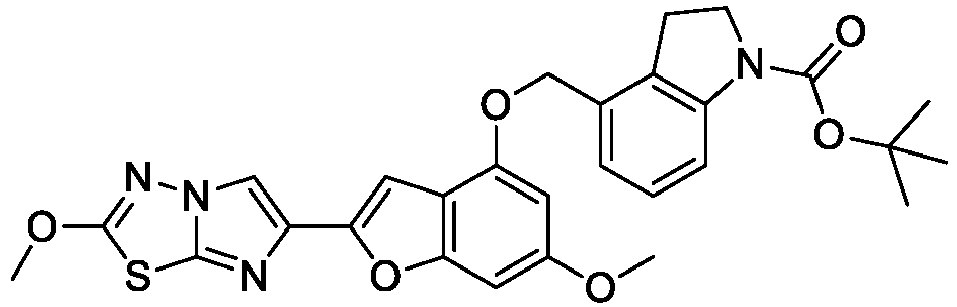
-

- A solution of methyl 1H-indole-4-carboxylate ( 2.60 g, 14.84 mmol ) in acetic acid ( 26 mL ) was cooled to 15 ° C and then treated with sodium cyanoborohydride ( 3.82 g, 0.061 mmol ) added in small portions over 30 min. After 5 h at 15 ° C, the reaction mixture was diluted with a mixture of ice and water ( 200 mL ) and carefully adjusted to pH 9 -10 with solid potassium carbonate. The aqueous phase was extracted three times with dichloromethane and the combined organic phase was washed with brine and dried over anhydrous magnesium sulfate. The solvent was evaporated under reduced pressure and the residual oil was chromatographed on silica gel ( elution dichloromethane - ethyl acetate 5 - 10 % ) to give 1.26 g ( 48 % yield ) of the title material as white solid. HPLC (Method A): 0.9 min (tailing ). HRMS (ESI) calcd for C10H12NO2 [M+H]+ m/z 178.0863, found 178.0867. 1H NMR (CDCl3, 400 MHz) δ ppm: 7.32 (br. d, J = 7.9 Hz, 1H), 7.05 (br. t, J = 8 Hz, 1H), 6.77 (d, J = 7.8 Hz, 1H), 3.86 (s, 3H), 3.57 (t, J = 8.4 Hz, 2H), 3.37 (t, J = 8.4 Hz, 2H).
-

- A solution of methyl indoline-4-carboxylate ( 1.20 g, 6.77 mmol) in dry tetrahydrofuran ( 20 mL ) was treated at 23 ° C and under nitrogen with lithium aluminum hydride ( 0.35 g, 6.08 mmol) added in small portions over 20 min and the resulting mixture was stirred for 3 h. The reaction mixture was carefully quenched by successive addition of ethyl acetate ( 1 mL ), water ( 0.4 mL), 15 % aqueous sodium hydroxide ( 0.4 mL ) and water ( 1.2 mL ). The solid formed was filtered and the filtrate was concentrated under reduced pressure. Chromatography of the residual oil on silica gel ( elution ethyl acetate ) followed by distillation under vacuum ( bulb to bulb distillation, bp 105 - 110 ° C / 0.1 torr, air bath temperature ) gave 0.62 g ( 61 % yield ) of a white solid. HPLC (Method A): 0.13 min. HRMS (ESI) calcd for C9H12NO [M+H]+ m/z 150.0913, found 150.0932. 1H NMR (CDCl3, 400 MHz) δ ppm: 7.05 (t, J = 7.6 Hz, 1H), 6.74 (d, J = 7.1 Hz, 1H), 6.62 (d, J = 7.7 Hz, 1H), 4.64 (s, 2H), 3.60 (t, J = 8.4 Hz, 2H), 3.06 (t, J = 8.4 Hz, 2H).
-

- A solution of indolin-4-ylmethanol ( 0.57 g, 3.82 mmol ) in dry tetrahydrofuran ( 15 mL ) was treated at 23 ° C with di-tert-butyl dicarbonate ( 0.92 g, 4.2 mmol ) and the resulting mixture was stirred for 18 hours. The reaction mixture was then concentrated under reduced pressure and the residue was purified by chromatography on silica gel ( elution toluene - ethyl acetate 7 : 3 ) to give 0.95 g ( 100 % yield ) of the title material as a thick syrup which crystallized to a white solid in the fridge. HPLC (Method A): 1.901 min. 1H NMR (CDCl3, 400 MHz) δ ppm: 7.8 (br. s, 1H), 7.19 (t, J = 7.9 Hz, 1H), 6.97 (d, J = 7.4 Hz, 1H), 4.64 (d, J = 5.9 Hz, 2H), 4.01 (br. t, J = 8.7 Hz, 2H), 3.11 (t, J = 8.7 Hz, 2H), 1.58 (s, 9H).
-

- A suspension of 6-methoxy-2-(2-methoxyimidazo[2,1-b][1,3,4]thiadiazol-6-yl)benzofuran-4-ol ( 0.529 g, 1.67 mmol), tert-butyl 6-(hydroxymethyl)indoline-1-carboxylate ( 0.462 g, 1.85 mmol ) and triphenylphosphine ( 0.66 g, 2.5 mmol ) in dry tetrahydrofuran ( 40 mL ) was treated at 22 ° C and under nitrogen with a solution of diisopropyl azodicarboxylate ( 0.41 g, 2.0 mmol ) in tetrahydrofuran ( 10 ml ) added drop-wise over 2 hours. The heterogeneous mixture was homogeneous at the end of the addition and was stirred for another 3 hours. The reaction mixture was then quenched by the addition of ethyl acetate and saturated sodium bicarbonate. The organic phase was washed with brine, dried over anhydrous magnesium sulfate and concentrated in vacuo. Chromatography of the residue on silica gel ( elution dichloromethane - ethyl acetate 2 - 5 % ) followed by crystallization from ethyl acetate gave 0.621 g ( 68 % yield ) of the title material as a white solid. HPLC (Method A): 2.543 min. HRMS (ESI) calcd for C28H29N4O6S [M+H]+ m/z 549.1802, found 549.182. 1H NMR (CDCl3, 400 MHz) δ ppm: 7.7 - 8.0 (br. s, 1H), 7.84 (s, 1H), 7.21 (t, J = 7.8 Hz, 1H), 7.07 (d, J= 7.8 Hz, 1H), 7.05 (s, 1H), 6.70 (br. d, 1H), 6.39 (d, J= 2.0 Hz, 1H), 5.12 (s, 2H), 4.21 (s, 3H), 4.02 (br. t, 2H), 3.85 (s, 3H), 3.16 (t, J = 8.6 Hz, 2H), 1.58 (s, 9H).
-
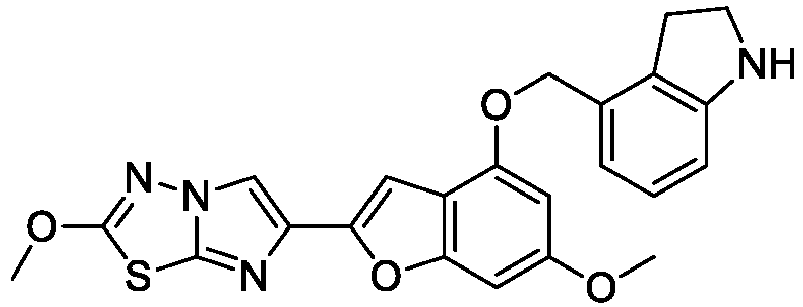
- A suspension of tert-butyl 4-(((6-methoxy-2-(2-methoxyimidazo[2,1-b][1,3,4]thiadiazol-6-yl)benzofuran-4-yl)oxy)methyl)indoline-1-carboxylate ( 0.600 g, 1.09 mmol) in dichloromethane (20 mL ) was treated at 22 ° C and under nitrogen with trifluoroacetic acid ( 5 mL ) added drop-wise over 2 min and the resulting solution was stirred for 2 hours. The solvent and excess reagent were evaporated under reduced pressure and the residue was partitioned between dichloromethane and saturated sodium bicarbonate. The organic phase was washed with brine, dried over anhydrous magnesium sulfate and concentrated under reduced pressure to give 0.490 g ( 99 % yield ) of a white solid. HPLC (Method A): 1.981 min. HRMS (ESI) calcd for C23H21N4O4S [M+H]+ m/z 449.1278, found 449.1293. 1H NMR (CDCl3, 400 MHz) δ ppm: 7.84 (s, 1H), 7.07 (s, 1H), 7.06 (t, J= 7.8 Hz, 1H), 6.84 (d, J = 7.5 Hz, 1H), 6.69 (br. d, 1H), 6.65 (d, J = 7.9 Hz, 1H), 6.42 (d, J = 1.9 Hz, 1H), 5.12 (s, 2H), 4.21 (s, 3H), 3.85 (s, 3H), 3.50 (t, J = 8.4 Hz, 2H), 3.12 (t, J = 8.4 Hz, 2H).
-

- A solution of 6-(4-(indolin-4-ylmethoxy)-6-methoxybenzofuran-2-yl)-2-methoxyimidazo[2,1-b][1,3,4]thiadiazole ( 0.080 g, 0.178 mmol) in dry tetrahydrofuran ( 5 mL ) was treated at 22 ° C and under nitrogen with 4-methylmorpholine ( 0.054 g, 0.535 mmol ) followed by a solution of benzoyl chloride ( 0.030 g, 0.23 mmol ) in dry tetrahydrofuran ( 1 mL ) added drop-wise over 2 min. After 1 hour, the reaction mixture was diluted with dichloromethane, washed successively with cold 0.1N hydrochloric acid, saturated sodium bicarbonate and brine. After drying over anhydrous magnesium sulfate, the organic phase was concentrated under reduced pressure. Chromatography of the residue on silica gel ( elution dichloromethane - ethyl acetate 5 - 15 % ) gave 0.087 g ( 84 % yield ) of the title material as a white solid. HPLC (Method A): 2.449 min. HRMS (ESI) calcd for C30H25N4O5S [M+H]+ m/z 553.154, found 553.155. 1H NMR (CDCl3, 400 MHz) δ ppm: 7.84 (s, 1H), 7.54 - 7.6 (m, 2H), 7.4 - 7.5 (m, 3H), 7.1 - 7.3 (m, 3H), 7.04 (d, J = 0.8 Hz, 1H), 6.71 (br. d, 1H), 6.40 (d, J = 2.0 Hz, 1H), 5.15 (s, 2H), 4.21 (s, 3H), 4.12 (br. s, 2H), 3.85 (s, 3H), 3.20 (t, J = 8.2 Hz, 2H).
- The following compounds were prepared using the methodology described for preparation of Example 115
Ex. Structure Formula HPLC Retention Time (Min)/ Method Calc. [M+H]+ m/z LCMS [M+H]+ m/z NMR 116 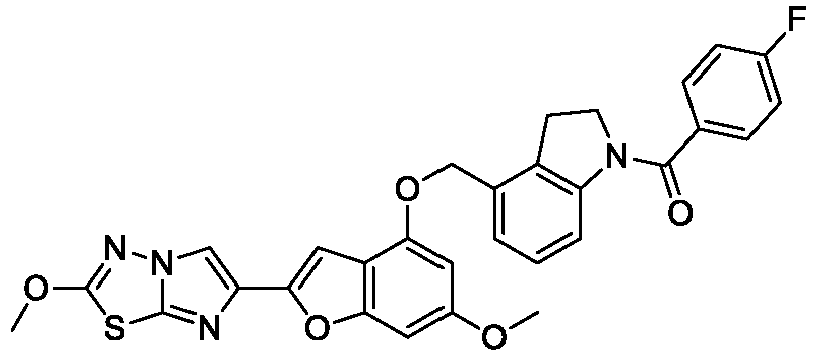
C30H23FN4O5S 2.394 / A 571.1446 571.1462 1H NMR (CDCl3) δ ppm: 7.85 (s, 1H), 7.55 - 7.65 (m, 2H), 7.11 - 7.21 (m, 5H), 7.04 (s, 1H), 6.70 (br. d, 1H), 6.40 (d, J = 2.0 Hz, 1H), 5.16 (s, 2H), 4.21 (s, 3H), 4.12 (br. t, 2H), 3.85 (s, 3H), 3.21 (t, J = 8.2 Hz, 2H). 120 
C30H23FN4O5S 2.030 / A 571.1446 571.1465 1H NMR (CDCl3) δ ppm: 8.24 (br. d, J = 7.4 Hz, 1H), 7.75 (s, 1H), 7.3 - 7.45 (m, 2H), 7.2 - 7.25 (m, 1H), 7.13 - 7.18 (m, 2H), 7.07 (t, J = 9.0 Hz, 1H), 6.94 (s, 1H), 6.61 (br. d, 1H), 6.29 (d, J = 1.9 Hz, 1H), 5.07 (s, 2H), 4.12 (s, 3H), 3.88 (t, J = 8.2 Hz, 2H), 3.76 (s, 3H), 3.13 (t, J = 8.5 Hz, 2H). 121 
C30H23FN4O5S 2.045 / A 571.1446 571.1455 1H NMR (CDCl3) δ ppm: 8.1 (br. s, 1H), 7.76 (s, 1H), 7.3 - 7.38 (m, 1H), 7.26 (br. d, J = 7.6 Hz, 1H), 7.15 - 7.2 (m, 2H), 7.08 - 7.12 (m, 2H), 6.95 (s, 1H), 6.61 (br. d, 1H), 6.31 (d, J = 2.0 Hz, 1H), 5.07 (s, 2H), 4.12 (s, 3H), 4.02 (br. t, 2H), 3.76 (s, 3H), 3.12 (t, J = 8.3 Hz, 2H). 122 
C31H26N4O5S 2.136 / A 567.1697 567.1695 1H NMR (CDCl3) δ ppm: (mixture of rotamers) 8.31 (br. d, J = 8.2 Hz, 0.5H), 7.93 (br. dd, J = 8.3, 1.6 Hz, 0.2H), 7.05 - 7.4 (m, 7H), 6.95 (br. s, 1H), 6.75 (br. s, 0.3H), 6.62 (br. s, 1H), 6.31 (d, J = 2 Hz, 1H), 5.56 (br. s, 0.3 H), 5.05 (br. s, 2H), 4.27 and 3.68 (two br. t, 2H), 4.12 (s, 3H), 3.76 (s, 3H), 3.1 (br. t, 2H), 2.19 and 2.3 (two broad s, 3H). 123 
C31H26N4O5S 2.125 / A 567.1697 567.1693 1H NMR (CDCl3) δ ppm: 7.75 (s, 1H), 7.38 (d, J = 8.1 Hz, 2H), 7.1 - 7.2 ( m, 4H), 7.06 (br. s, 1H), 6.95 (s, 1H), 6.61 (br. d, 1H), 6.31 (d, J = 1.6 Hz, 1H), 5.06 (br. s, 2H), 4.12 (s, 3H), 4.04 (br. t, J = 8 Hz, 2H), 3.76 (s, 3H), 3.1 (t, J = 8.1 Hz, 2H), 2.33 (s, 3H). 124 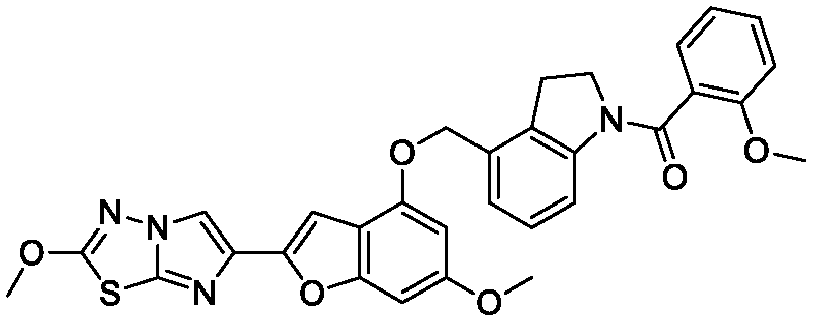
C31H26N4O6S 2.042 / A 583.1646 583.1634 1H NMR (CDCl3) δ ppm: (mixture of rotamers) 8.29 (br. d, J = 7.9 Hz, 0.7H), 7.75 (s, 1H), 7.2 - 7.4 (m, 3 H), 7.10 (d, J = 7.8 Hz, 0.7H), 6.9 - 7.0 (m, 2.3H), 6.87 (d, J = 8.3 Hz, 1H), 6.75 (br. s, 0.3H), 6.61 (br. s, 1H), 6.31 (br.s, 1H), 5.05 (s, 2H), 4.2 and 3.8 (two br. s, 2H), 4.12 (s, 3H), 3.78 (s, 3H), 3.76 (s, 3H), 3.08 (br. t, J = 8.3 Hz, 2H). 125 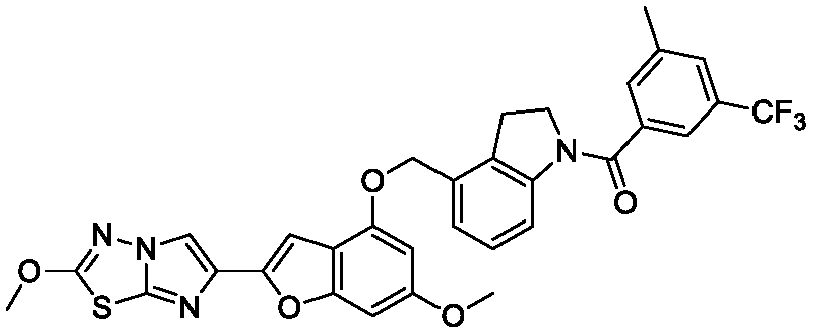
C32H25F3N4O5S 2.163 / A 635.1571 635.157 1H NMR (CDCl3) δ ppm: 8.2 (br. s, 1H), 7.76 (s, 1H), 7.54 (s, 1H), 7.47 (br. s, 2H), 7.1 - 7.2 (m, 2H), 6.95 (s, 1H), 6.61 (br. d, 1H), 6.31 (d, J = 1.6 Hz, 1H), 5.07 (s, 2H), 4.12 (s, 3H), 3.98 (br. s, 2H), 3.76 (s, 3H), 3.13 (t, J = 8.2 Hz, 2H), 2.39 (s, 3H). 126 
C28H22N6O5S 1.926 / A 555.1445 555.1431 1H NMR (CDCl3) δ ppm: 9.25 (s, 1H), 8.89 (s, 2H), 8.15 (br. s, 1H), 7.75 (s, 1H), 7.0 - 7.25 ( m, 2H), 6.94 (s, 1H), 6.62 (br. d, 1H), 6.30 (d, J = 2.0 Hz, 1H), 5.09 (s, 2H), 4.12 (s, 3H), 4.06 (br. s, 2H), 3.76 (s, 3H), 3.19 (t, J = 8.2 Hz, 2H). 127 
C30H25N5O6S 2.005 / A 584.1598 584.1595 1H NMR (CDCl3) δ ppm: 8.36 (d, J = 2.3 Hz, 2H), 7.76 (s, 1H), 7.73 (dd, J = 8.6, 2.3 Hz, 1H), 7.07 - 7.18 ( m, 2H), 6.95 (s, 1H), 6.72 (d, J = 8.6 Hz, 1H), 6.61 (br. d, 1H), 6.31 (d, J = 1.8 Hz, 1H), 5.07 (s, 2H), 4.12 (s, 3H), 4.08 (t, J = 8.2 Hz, 2H), 3.92 (s, 3H), 3.76 (s, 3H), 3.13 (t, J = 8.2 Hz, 2H). 130 
C32H23F5N4O6S 2.074 / A 687.1331 687.1334 1H NMR (CDCl3) δ ppm: 8.1 (br. s, 1H), 7.76 (s, 1H), 7.61 (s, 1H), 7.44 (s, 1H), 7.42 (s, 1H), 7.1 - 7.2 (m, 2H), 6.95 (s, 1H), 6.62 (br. d, 1H), 6.52 (t, J = 72 Hz, 1H), 6.31 (d, J = 2.0 Hz, 1H), 5.07 (s, 2H), 4.12 (s, 3H), 3.98 (br. s, 2H), 3.76 (s, 3H), 3.1 (t, J = 8.2 Hz, 2H). 131 
C31H25FN4O5S 2.109 / A 585.1602 585.1605 1H NMR (CDCl3) δ ppm: (mixture of rotamers) 8.33 (br. d, J = 7.1 Hz, 0.5H), 7.82 (s, 1H), 7.2 - 7.4 ( m, 2.5H), 7.0 - 7.15 ( m, 3.5H), 6.85 (br. s, 0.5H), 6.68 (br. s, 1H), 6.37 (d, J = 1.5 Hz, 1H), 5.28 (br. s, 2H), 4.32 and 3.76 (two br. t, 2H), 4.19 (s, 3H), 3.83 (s, 3H), 3.15 - 3.23 (m, 2H), 2.2 and 2.32 (two broad s, 3H). -

- Into a reaction vessel containing acylating reagent (0.091mmol) was added 3-(((6-Methoxy-2-(2-methoxyimidazo[2,1-b][1,3,4]thiadiazol-6-yl)benzofuran-4-yl)oxy)methyl)aniline (Example 4, 18 mg, 0.043 mmol) dissolved in THF (0.076 M) and N-methylmorpholine (20 µl, 0.182mmol). The reaction mixture was stirred at rt for 3h. Upon complete conversion as monitored by LC-MS, to the reaction mixture was added water (0.1mL), acetic acid (5 µl) and DMF (0.5 mL). The reaction mixture was subjected to reverse-phase HPLC purification to afford the desired product.
- The crude material was purified via preparative LC/MS with the following conditions: Column: XBridge C18, 19 x 100 mm, 5-µm particles;
Mobile Phase A: 5:95 acetonitrile: water with 0.05% TFA; Mobile Phase B: 95:5 acetonitrile: water with 0.05% TFA. Gradient: 0-100% B over 15 minutes; Flow: 20 mL/min. Fractions containing the desired product were combined and dried via centrifugal evaporation. - Analytical Method G: Column: Supelco Ascentris Express 4.6 x50 mm, 2.7 µm particles; Mobile Phase A: 5:95 acetonitrile:water with 10 mM NH4OAc; Mobile Phase B: 95:5 acetonitrile:water with 10 mM NH4OAc; Gradient: 0-100% B over 4 minutes, 4.0 mL/min; Detection: UV at 220 nm.


- The term "PAR4 antagonist" denotes an inhibitor of platelet aggregation which binds PAR4 and inhibits PAR4 cleavage and/or signaling. Typically, PAR4 activity is reduced in a dose dependent manner by at least 10%, 20%, 30%, 40%, 50%, 60%, 70%, 80%, 90%, or 100% compared to such activity in a control cell. The control cell is a cell that has not been treated with the compound. PAR4 activity is determined by any standard method in the art, including those described herein (for example calcium mobilization in PAR4 expressing cells, platelet aggregation, platelet activation assays measuring e.g., calcium mobilization, p-selectin or CD40L release, or thrombosis and hemostasis models). The term "PAR4 antagonist" also includes a compound that inhibits both PAR1 and PAR4.
- It is desirable to find compounds with advantageous and improved characteristics compared with known anti-platelet agents, in one or more of the following categories that are given as examples, and are not intended to be limiting: (a) pharmacokinetic properties, including oral bioavailability, half life, and clearance; (b) pharmaceutical properties; (c) dosage requirements; (d) factors that decrease blood concentration peak-to-trough characteristics; (e) factors that increase the concentration of active drug at the receptor; (f) factors that decrease the liability for clinical drug-drug interactions; (g) factors that decrease the potential for adverse sideeffects, including selectivity versus other biological targets; (h) improved therapeutic index with less propensity for bleeding; and (h) factors that improve manufacturing costs or feasibility.
- The term "compound", as used herein, means a chemical, be it naturally-occurring or artificially-derived. Compounds may include, for example, peptides, polypeptides, synthetic organic molecules, naturally occurring organic molecules, nucleic acid molecules, peptide nucleic acid molecules, and components and derivatives thereof.
- As used herein, the term "patient" encompasses all mammalian species.
- As used herein, the term "subject" refers to any human or nonhuman organism that could potentially benefit from treatment with a PAR4 antagonist. Exemplary subjects include human beings of any age with risk factors for cardiovascular disease, or patients that have already experienced one episode of cardiovascular disease. Common risk factors include, but are not limited to, age, male sex, hypertension, smoking or smoking history, elevation of triglycerides, elevation of total cholesterol or LDL cholesterol.
- In some embodiments, the subject is a species having a dual PAR1/PAR4 platelet receptor repertoire. As used herein, the term "dual PAR1/PAR4 platelet receptor repertoire" means that a subject expresses PAR1 and PAR4 in platelets or their precursors. Exemplary subjects having a dual PAR1/PAR4 platelet receptor repertoire include human beings, nonhuman primates, and guinea pigs.
- In other embodiments, the subject is a species having a dual PAR3/PAR4 platelet receptor repertoire. As used herein, the term "dual PAR3/PAR4 platelet receptor repertoire" means that a subject expresses PAR3 and PAR4 in platelets or their precursors. Exemplary subjects having a dual PAR3/PAR4 platelet receptor repertoire include rodents and rabbits.
- As used herein, "treating" or "treatment" cover the treatment of a disease-state in a mammal, particularly in a human, and include: (a) inhibiting the disease-state, i.e., arresting its development; and/or (b) relieving the disease-state, i.e., causing regression of the disease state.
- As used herein, "prophylaxis" or "prevention" cover the preventive treatment of a subclinical disease-state in a mammal, particularly in a human, aimed at reducing the probability of the occurrence of a clinical disease-state. Patients are selected for preventative therapy based on factors that are known to increase risk of suffering a clinical disease state compared to the general population. "Prophylaxis" therapies can be divided into (a) primary prevention and (b) secondary prevention. Primary prevention is defined as treatment in a subject that has not yet presented with a clinical disease state, whereas secondary prevention is defined as preventing a second occurrence of the same or similar clinical disease state.
- As used herein, "risk reduction" covers therapies that lower the incidence of development of a clinical disease state. As such, primary and secondary prevention therapies are examples of risk reduction.
- "Therapeutically effective amount" is intended to include an amount of a compound of the present invention that is effective when administered alone or in combination to inhibit and / or antagonize PAR4 and/or to prevent or treat the disorders listed herein. When applied to a combination, the term refers to combined amounts of the active ingredients that result in the preventive or therapeutic effect, whether administered in combination, serially, or simultaneously.
- The term "thrombosis", as used herein, refers to formation or presence of a thrombus (pl. thrombi) within a blood vessel that may cause ischemia or infarction of tissues supplied by the vessel. The term "embolism", as used herein, refers to sudden blocking of an artery by a clot or foreign material that has been brought to its site of lodgment by the blood current. The term "thromboembolism", as used herein, refers to obstruction of a blood vessel with thrombotic material carried by the blood stream from the site of origin to plug another vessel. The term "thromboembolic disorders" entails both "thrombotic" and "embolic" disorders (defined above).
- The term "thromboembolic disorders" as used herein includes arterial cardiovascular thromboembolic disorders, venous cardiovascular or cerebrovascular thromboembolic disorders, and thromboembolic disorders in the chambers of the heart or in the peripheral circulation. The term "thromboembolic disorders" as used herein also includes specific disorders selected from, but not limited to, unstable angina or other acute coronary syndromes, atrial fibrillation, first or recurrent myocardial infarction, ischemic sudden death, transient ischemic attack, stroke, atherosclerosis, peripheral occlusive arterial disease, venous thrombosis, deep vein thrombosis, thrombophlebitis, arterial embolism, coronary arterial thrombosis, cerebral arterial thrombosis, cerebral embolism, kidney embolism, pulmonary embolism, and thrombosis resulting from medical implants, devices, or procedures in which blood is exposed to an artificial surface that promotes thrombosis. The medical implants or devices include, but are not limited to: prosthetic valves, artificial valves, indwelling catheters, stents, blood oxygenators, shunts, vascular access ports, ventricular assist devices and artificial hearts or heart chambers, and vessel grafts. The procedures include, but are not limited to: cardiopulmonary bypass, percutaneous coronary intervention, and hemodialysis. In another embodiment, the term "thromboembolic disorders" includes acute coronary syndrome, stroke, deep vein thrombosis, and pulmonary embolism.
- In another embodiment, the present invention provides a compound of the invention for use in a method for the treatment of a thromboembolic disorder, wherein the thromboembolic disorder is selected from unstable angina, an acute coronary syndrome, atrial fibrillation, myocardial infarction, transient ischemic attack, stroke, atherosclerosis, peripheral occlusive arterial disease, venous thrombosis, deep vein thrombosis, thrombophlebitis, arterial embolism, coronary arterial thrombosis, cerebral arterial thrombosis, cerebral embolism, kidney embolism, pulmonary embolism, and thrombosis resulting from medical implants, devices, or procedures in which blood is exposed to an artificial surface that promotes thrombosis. In another embodiment, the present invention provides a compound of the invention for use in a method for the treatment of a thromboembolic disorder, wherein the thromboembolic disorder is selected from acute coronary syndrome, stroke, venous thrombosis, atrial fibrillation, and thrombosis resulting from medical implants and devices.
- In another embodiment, the present invention provides a compound of the invention for use in a method for the primary prophylaxis of a thromboembolic disorder, wherein the thromboembolic disorder is selected from unstable angina, an acute coronary syndrome, atrial fibrillation, myocardial infarction, ischemic sudden death, transient ischemic attack, stroke, atherosclerosis, peripheral occlusive arterial disease, venous thrombosis, deep vein thrombosis, thrombophlebitis, arterial embolism, coronary arterial thrombosis, cerebral arterial thrombosis, cerebral embolism, kidney embolism, pulmonary embolism, and thrombosis resulting from medical implants, devices, or procedures in which blood is exposed to an artificial surface that promotes thrombosis. In another embodiment, the present invention provides a compound of the invention for use in a method for the primary prophylaxis of a thromboembolic disorder, wherein the thromboembolic disorder is selected from acute coronary syndrome, stroke, venous thrombosis, and thrombosis resulting from medical implants and devices.
- In another embodiment, the present invention provides a compound of the invention for use in a method for the secondary prophylaxis of a thromboembolic disorder, wherein the thromboembolic disorder is selected from unstable angina, an acute coronary syndrome, atrial fibrillation, recurrent myocardial infarction, transient ischemic attack, stroke, atherosclerosis, peripheral occlusive arterial disease, venous thrombosis, deep vein thrombosis, thrombophlebitis, arterial embolism, coronary arterial thrombosis, cerebral arterial thrombosis, cerebral embolism, kidney embolism, pulmonary embolism, and thrombosis resulting from medical implants, devices, or procedures in which blood is exposed to an artificial surface that promotes thrombosis. In another embodiment, the present invention provides a compound of the invention for use in a method for the secondary prophylaxis of a thromboembolic disorder, wherein the thromboembolic disorder is selected from acute coronary syndrome, stroke, atrial fibrillation and venous thrombosis.
- The term "stroke", as used herein, refers to embolic stroke or atherothrombotic stroke arising from occlusive thrombosis in the carotid communis, carotid interna, or intracerebral arteries.
- It is noted that thrombosis includes vessel occlusion (e.g., after a bypass) and reocclusion (e.g., during or after percutaneous transluminal coronary angioplasty). The thromboembolic disorders may result from conditions including but not limited to atherosclerosis, surgery or surgical complications, prolonged immobilization, arterial fibrillation, congenital thrombophilia, cancer, diabetes, effects of medications or hormones, and complications of pregnancy.
- Thromboembolic disorders are frequently associated with patients with atherosclerosis. Risk factors for atherosclerosis include but are not limited to male gender, age, hypertension, lipid disorders, and diabetes mellitus. Risk factors for atherosclerosis are at the same time risk factors for complications of atherosclerosis, i.e., thromboembolic disorders.
- Similarly, arterial fibrillation is frequently associated with thromboembolic disorders. Risk factors for arterial fibrillation and subsequent thromboembolic disorders include cardiovascular disease, rheumatic heart disease, nonrheumatic mitral valve disease, hypertensive cardiovascular disease, chronic lung disease, and a variety of miscellaneous cardiac abnormalities as well as thyrotoxicosis.
- Diabetes mellitus is frequently associated with atherosclerosis and thromboembolic disorders. Risk factors for the more common type 2 include but are not limited to family history, obesity, physical inactivity, race / ethnicity, previously impaired fasting glucose or glucose tolerance test, history of gestational diabetes mellitus or delivery of a "big baby", hypertension, low HDL cholesterol, and polycystic ovary syndrome.
- Thrombosis has been associated with a variety of tumor types, e.g., pancreatic cancer, breast cancer, brain tumors, lung cancer, ovarian cancer, prostate cancer, gastrointestinal malignancies, and Hodgkins or non-Hodgkins lymphoma. Recent studies suggest that the frequency of cancer in patients with thrombosis reflects the frequency of a particular cancer type in the general population. (Levitan, N. et al., Medicine (Baltimore), 78(5):285-291 (1999); Levine M. et al., N. Engl. J. Med., 334(11):677-681 (1996); Blom, J.W. et al., JAMA, 293(6):715-722 (2005).) Hence, the most common cancers associated with thrombosis in men are prostate, colorectal, brain, and lung cancer, and in women are breast, ovary, and lung cancer. The observed rate of venous thromboembolism (VTE) in cancer patients is significant. The varying rates of VTE between different tumor types are most likely related to the selection of the patient population. Cancer patients at risk for thrombosis may possess any or all of the following risk factors: (i) the stage of the cancer (i.e., presence of metastases), (ii) the presence of central vein catheters, (iii) surgery and anticancer therapies including chemotherapy, and (iv) hormones and antiangiogenic drugs. Thus, it is common clinical practice to dose patients having advanced tumors with heparin or low molecular heparin to prevent thromboembolic disorders. A number of low molecular weight heparin preparations have been approved by the FDA for these indications.
- The term "pharmaceutical composition", as used herein, means any composition, which contains at least one therapeutically or biologically active agent and is suitable for administration to the patient. Any of these formulations can be prepared by well-known and accepted methods of the art. See, for example, Gennaro, A.R., ed., Remington: The Science and Practice of Pharmacy, 20th Edition, Mack Publishing Co., Easton, Pa. (2000).
- A pharmaceutical composition that includes a compound of the invention that binds to PAR4 and inhibits PAR4 cleavage and/or signaling (referred to herein as a "PAR4 antagonist" or "therapeutic compound") may be administered to a subject.
- The compounds of this disclosure can be administered in such oral dosage forms as tablets, capsules (each of which includes sustained release or timed release formulations), pills, powders, granules, elixirs, tinctures, suspensions, syrups, and emulsions. They may also be administered in intravenous (bolus or infusion), intraperitoneal, subcutaneous, or intramuscular form, all using dosage forms well known to those of ordinary skill in the pharmaceutical arts. They can be administered alone, but generally will be administered with a pharmaceutical carrier selected on the basis of the chosen route of administration and standard pharmaceutical practice.
- The preferred dose of the PAR4 antagonist is a biologically active dose. A biologically active dose is a dose that will inhibit cleavage and / or signaling of PAR4 and have an anti-thrombotic effect. Desirably, the PAR4 antagonist has the ability to reduce the activity of PAR4 by at least 5%, 10%, 20%, 30%, 40%, 50%, 60%, 70%, 80%, 90%, 100%, or more than 100% below untreated control levels. The levels of PAR4 in platelets is measured by any method known in the art, including, for example, receptor binding assay, platelet aggregation, platelet activation assays (e.g., p-selectin expression by FACS), Western blot or ELISA analysis using PAR4 cleavage sensitive antibodies. Alternatively, the biological activity of PAR4 is measured by assessing cellular signaling elicited by PAR4 (e.g., calcium mobilization or other second messenger assays).
- In some embodiments, a therapeutically effective amount of a PAR4 compound is preferably from about less than 100 mg/kg, 50 mg/kg, 10 mg/kg, 5 mg/kg, 1 mg/kg, or less than 1 mg/kg. In a more preferred embodiment, the therapeutically effective amount of the PAR4 compound is less than 5 mg/kg. In a most preferred embodiment, the therapeutically effective amount of the PAR4 compound is less than 1 mg/kg. Effective doses vary, as recognized by those skilled in the art, depending on route of administration and excipient usage.
- Compounds of this invention can be administered in intranasal form via topical use of suitable intranasal vehicles, or via transdermal routes, using transdermal skin patches. When administered in the form of a transdermal delivery system, the dosage administration will, of course, be continuous rather than intermittent throughout the dosage regimen.
- The compounds are typically administered in admixture with suitable pharmaceutical diluents, excipients, or carriers (collectively referred to herein as pharmaceutical carriers) suitably selected with respect to the intended form of administration, that is, oral tablets, capsules, elixirs, syrups and the like, and consistent with conventional pharmaceutical practices.
- For instance, for oral administration in the form of a tablet or capsule, the active drug component can be combined with an oral, non-toxic, pharmaceutically acceptable, inert carrier such as lactose, starch, sucrose, glucose, methyl cellulose, magnesium stearate, dicalcium phosphate, calcium sulfate, mannitol, sorbitol and the like; for oral administration in liquid form, the oral drug components can be combined with any oral, non-toxic, pharmaceutically acceptable inert carrier such as ethanol, glycerol, water, and the like. Moreover, when desired or necessary, suitable binders, lubricants, disintegrating agents, and coloring agents can also be incorporated into the mixture. Suitable binders include starch, gelatin, natural sugars such as glucose or beta-lactose, corn sweeteners, natural and synthetic gums such as acacia, tragacanth, or sodium alginate, carboxymethylcellulose, polyethylene glycol, waxes, and the like. Lubricants used in these dosage forms include sodium oleate, sodium stearate, magnesium stearate, sodium benzoate, sodium acetate, sodium chloride, and the like. Disintegrators include, without limitation, starch, methyl cellulose, agar, bentonite, xanthan gum, and the like.
- The compounds of the present invention can also be administered in the form of liposome delivery systems, such as small unilamellar vesicles, large unilamellar vesicles, and multilamellar vesicles. Liposomes can be formed from a variety of phospholipids, such as cholesterol, stearylamine, or phosphatidylcholines.
- Compounds of the present invention may also be coupled with soluble polymers as targetable drug carriers. Such polymers can include polyvinylpyrrolidone, pyran copolymer, polyhydroxypropylmethacrylamide-phenol, polyhydroxyethylaspartamidephenol, or polyethyleneoxide-polylysine substituted with palmitoyl residues. Furthermore, the compounds of the present invention may be coupled to a class of biodegradable polymers useful in achieving controlled release of a drug, for example, polylactic acid, polyglycolic acid, copolymers of polylactic and polyglycolic acid, polyepsilon caprolactone, polyhydroxy butyric acid, polyorthoesters, polyacetals, polydihydropyrans, polycyanoacylates, and crosslinked or amphipathic block copolymers of hydrogels.
- Dosage forms (pharmaceutical compositions) suitable for administration may contain from about 1 milligram to about 100 milligrams of active ingredient per dosage unit. In these pharmaceutical compositions the active ingredient will ordinarily be present in an amount of about 0.5-95% by weight based on the total weight of the composition.
- Gelatin capsules may contain the active ingredient and powdered carriers, such as lactose, starch, cellulose derivatives, magnesium stearate, stearic acid, and the like. Similar diluents can be used to make compressed tablets. Both tablets and capsules can be manufactured as sustained release products to provide for continuous release of medication over a period of hours. Compressed tablets can be sugar coated or film coated to mask any unpleasant taste and protect the tablet from the atmosphere, or enteric coated for selective disintegration in the gastrointestinal tract.
- Liquid dosage forms for oral administration can contain coloring and flavoring to increase patient acceptance.
- In general, water, a suitable oil, saline, aqueous dextrose (glucose), and related sugar solutions and glycols such as propylene glycol or polyethylene glycols are suitable carriers for parenteral solutions. Solutions for parenteral administration may contain a water soluble salt of the active ingredient, suitable stabilizing agents, and if necessary, buffer substances. Antioxidizing agents such as sodium bisulfite, sodium sulfite, or ascorbic acid, either alone or combined, are suitable stabilizing agents. Also used are citric acid and its salts and sodium EDTA. In addition, parenteral solutions can contain preservatives, such as benzalkonium chloride, methyl- or propyl-paraben, and chlorobutanol.
- Suitable pharmaceutical carriers are described in Remington's Pharmaceutical Sciences, Mack Publishing Company, a standard reference text in this field.
- Representative useful pharmaceutical dosage-forms for administration of the compounds of this invention can be illustrated as follows:
- A large number of unit capsules can be prepared by filling standard two-piece hard gelatin capsules each with 100 milligrams of powdered active ingredient, 150 milligrams of lactose, 50 milligrams of cellulose, and 6 milligrams magnesium stearate.
- A mixture of active ingredient in a digestible oil such as soybean oil, cottonseed oil or olive oil may be prepared and injected by means of a positive displacement pump into gelatin to form soft gelatin capsules containing 100 milligrams of the active ingredient. The capsules should be washed and dried.
- Tablets may be prepared by conventional procedures so that the dosage unit is 100 milligrams of active ingredient, 0.2 milligrams of colloidal silicon dioxide, 5 milligrams of magnesium stearate, 275 milligrams of microcrystalline cellulose, 11 milligrams of starch and 98.8 milligrams of lactose. Appropriate coatings may be applied to increase palatability or delay absorption.
- A spray dried dispersion can be prepared for oral administration by methods know to one skilled in the art.
- A parenteral composition suitable for administration by injection may be prepared by stirring 1.5% by weight of active ingredient in 10% by volume propylene glycol and water. The solution should be made isotonic with sodium chloride and sterilized.
- An aqueous suspension can be prepared for oral administration so that each 5 mL contain 100 mg of finely divided active ingredient, 200 mg of sodium carboxymethyl cellulose, 5 mg of sodium benzoate, 1.0 g of sorbitol solution, U.S.P., and 0.025 mL of vanillin.
Where two or more of the foregoing second therapeutic agents are administered with the compound of Formula I, or Formula IA, or Formula ID, or Formula IE, or Formula IF, or Formula IG, or Formula IH, or Formula IJ, or a compound selected from one of the examples, generally the amount of each component in a typical daily dosage and typical dosage form may be reduced relative to the usual dosage of the agent when administered alone, in view of the additive or synergistic effect of the therapeutic agents when administered in combination. - Particularly when provided as a single dosage unit, the potential exists for a chemical interaction between the combined active ingredients. For this reason, when the compound of the examples and a second therapeutic agent are combined in a single dosage unit they are formulated such that although the active ingredients are combined in a single dosage unit, the physical contact between the active ingredients is minimized (that is, reduced). For example, one active ingredient may be enteric coated. By enteric coating one of the active ingredients, it is possible not only to minimize the contact between the combined active ingredients, but also, it is possible to control the release of one of these components in the gastrointestinal tract such that one of these components is not released in the stomach but rather is released in the intestines. One of the active ingredients may also be coated with a material which effects a sustained-release throughout the gastrointestinal tract and also serves to minimize physical contact between the combined active ingredients. Furthermore, the sustained-released component can be additionally enteric coated such that the release of this component occurs only in the intestine. Still another approach would involve the formulation of a combination product in which the one component is coated with a sustained and/or enteric release polymer, and the other component is also coated with a polymer such as a low viscosity grade of hydroxypropyl methylcellulose (HPMC) or other appropriate materials as known in the art, in order to further separate the active components. The polymer coating serves to form an additional barrier to interaction with the other component.
- These as well as other ways of minimizing contact between the components of combination products of the present invention, whether administered in a single dosage form or administered in separate forms but at the same time by the same manner, will be readily apparent to those skilled in the art, once armed with the present disclosure.
- Additionally, certain compounds disclosed herein may be useful as metabolites of other compounds. Therefore, in one embodiment, compounds may be useful either as a substantially pure compound, which may also then be incorporated into a pharmaceutical composition, or may be useful as metabolite which is generated after administration of the prodrug of that compound. In one embodiment, a compound may be useful as a metabolite by being useful for treating disorders as described herein.
- The activity of the PAR4 antagonists of the present invention can be measured in a variety of in vitro assays. Exemplary assays are shown in the Examples below.
- The FLIPR assay is an exemplary in vitro assay for measuring the activity of the PAR4 antagonists of the present invention. In this assay, intracellular calcium mobilization is induced in PAR4 expressing cells by a PAR4 agonist and calcium mobilization is monitored. See, e.g., Example A.
- AYPGKF is a known PAR4 agonist. An alternative PAR4 agonist is H-Ala-Phe(4-F)-Pro-Gly-Trp-Leu-Val-Lys-Asn-Gly-NH2. H-Ala-Phe(4-F)-Pro-Gly-Trp-Leu-Val-Lys-Asn-Gly-NH2 has improved agonist activity as compared to AYPGKF with an EC50 that is 10 fold lower than the EC50 for AYPGKF in the FLIPR assay. H-Ala-Phe(4-F)-Pro-Gly-Trp-Leu-Val-Lys-Asn-Gly-NH2 can be synthesized using methods well known to those of skill in the art.
- The FLIPR assay can also be used as a counterscreen to test agonist activity or PAR1 antagonist activity in a cell line that expresses both PAR1 and PAR4. The PAR1 antagonist activity can be tested by the ability of the compound to inhibit calcium mobilization induced by the PAR1 agonist peptide SFLLRN or other PAR1 agonist peptides.
- The compounds of the current invention can be tested in vitro for their ability to inhibit platelet aggregation induced by gamma-thrombin as shown in Example B. Gamma-thrombin, a proteolytic product of alpha-thrombin which no longer interacts with PAR1, selectively cleaves and activates PAR4 (Soslau, G. et al., "Unique pathway of thrombin-induced platelet aggregation mediated by glycoprotein Ib", J. Biol. Chem., 276:21173-21183 (2001)). Platelet aggregation can be monitored in a 96-well microplate aggregation assay format or using standard platelet aggregometer. The aggregation assay can also be employed to test the selectivity of the compound for inhibiting platelet aggregation induced by PAR4 agonist peptides, PAR1 agonist peptide, ADP, or thromboxane analogue U46619.
- Example C is an alpha-thrombin-induced platelet aggregation assay. Alpha-thrombin activates both PAR1 and PAR4.
- Example D is a tissue factor-induced platelet aggregation assay. The conditions in this assay mimic the physiological events during thrombus formation. In this assay, platelet aggregation in human PRP was initiated by the addition of tissue factor and CaCl2. Tissue factor, the initiator of the extrinsic coagulation cascade, is highly elevated in human atherosclerotic plaque. Exposure of blood to tissue factor at the atherosclerotic site triggers a robust generation of thrombin and induces the formation of obstructive thrombi.
- The efficacy of the PAR4 antagonists of the present invention in preventing thrombosis can also be measured in a variety of in vivo assays. Exemplary mammals that can provide models of thrombosis and hemostasis to test the effectiveness of the PAR4 antagonists of the present invention as antithrombotic agents include, but are not limited to, guinea pigs and primates. Relevant efficacy models include, but are not limited to, electrolytic injury-induced carotid artery thrombosis, FeCl3-induced carotid artery thrombosis and arteriovenous-shunt thrombosis. Models of kidney bleeding time, renal bleeding time and other bleeding time measurements can be used to assess the bleeding risk of the antithrombotic agents described in the current invention. Example F describes an in vivo model of arterial thrombosis in cynolmolgus monkeys. Compounds of the present invention can be tested in this model for their ability to inhibit thrombus formation induced by electrolytic injury of the carotid artery. Demonstration of efficacy in this model supports the utility of PAR4 antagonists of the present invention for treatment of thromboembolic diseases.
- SFFLRR is a known high affinity PAR1 selective agonist peptide. (Reference: Seiler, S.M., "Thrombin receptor antagonists", Seminars in Thrombosis and Hemostasis, 22(3):223-232 (1996).) The PAR4 agonist peptides AYPGKF and H-Ala-Phe(4-F)-Pro-Gly-Trp-Leu-Val-Lys-Asn-Gly-NH2 were synthesized. H-Ala-Phe(4-F)-Pro-Gly-Trp-Leu-Val-Lys-Asn-Gly-NH2 showed improved PAR4 agonist activity over AYPGKF in the FLIPR assay (EC50 value of 8 µM for H-Ala-Phe(4-F)-Pro-Gly-Trp-Leu-Val-Lys-Asn-Gly-NH2 and 60 µM for AYPGKF) and in washed platelet aggregation assay (EC50 value of 0.9 µM for H-Ala-Phe(4-F)-Pro-Gly-Trp-Leu-Val-Lys-Asn-Gly-NH2 and 12 µM for AYPGKF).
- HEK293 cells stably expressing PAR4 were generated by a standard method of transfection of human PAR4 (F2R23) cDNA expression vector and selected based on PAR4 protein expression or mRNA expression. Those cells demonstrated functional responses to PAR4 agonist peptide-induced intracellular calcium elevation using FLIPR® (Fluorometric Imaging Plate Reader; Molecular Devices Corp.). These cells also express endogenous PAR1 and can elicit calcium signal upon stimulation with PAR1 agonist peptide. Therefore, the same cells were also used to determine selectivity against PAR1 and agonist activity for both receptors. Cells from HEK293 PAR4 Clone 1.2A (BMS Arctic ID 383940) were propagated and used for calcium mobilization studies.
- Human blood was collected in 3.8% sodium citrate at a ratio of 1 ml per 9 ml blood and centrifuged in a Sorvall® RT6000B centrifuge at 900 revolution per minute (rpm) at room temperature (RT) for 15 minutes. PRP was collected and used for aggregation assay. Refludan (Berlex Labs, Wayne, NJ), a recombinant hirudin, at a final concentration of 1 unit/mL was added to the sample to selectively prevent PAR1 activation induced by residual alpha-thrombin contamination. The remaining blood sample was centrifuged at 2500 rpm at room temperature for 5 minutes to collect platelet-poor plasma (PPP).
- Human blood was collected in ACD (85 mM tri-sodium citrate, 78 mM citric acid, 110 mM D-glucose, pH 4.4) at a ratio of 1.4 ml per 10 ml blood. PRP was isolated by centrifugation at 170 g for 14 minutes and platelets were further pelleted by centrifugation at 1300 g for 6 minutes. Platelets were washed once with 10 ml ACD containing 1 mg/ml bovine serum albumin. Platelets were resuspended at ~2.5×10⁸/ml in Tyrode's Buffer (137 mM NaCl, 2 mM KCl, 1.0 mM MgCl2, 1 mM CaCl2, 5 mM glucose, 20 mM HEPES pH 7.4).
- FLIPR-based calcium mobilization assay in HEK293 cells was used to measure PAR4 antagonism, agonism, and selectivity against PAR1. The activity of the PAR4 antagonists of the present invention were tested in PAR4 expressing cells by monitoring H-Ala-Phe(4-F)-Pro-Gly-Trp-Leu-Val-Lys-Asn-Gly-NH2-induced intracellular calcium mobilization. Counter screens for agonist activity and PAR1 antagonist activity were also performed. Briefly, PAR1/PAR4-expressing HEK293 cells were grown in DMEM (Life Technology, Grand Island, NY) containing 10% heat-inactivated FBS, 1% Penicillin-Streptomycin, 10 µg/mL blasticidin, and 100 µg/mL Zeocin at 37 °C with 5% CO2. Cells were plated overnight prior to the experiment in a black 384-well Purecoat Amine clear bottom plate (Becton Dickinson Biosciences, San Jose, CA) at 10,000 cells /well in 30 µL growth medium and incubated in a humidified chamber at 37 °C with 5% CO2 overnight. Prior to compound addition, the cell medium was replaced with 40 µL of 1× calcium and magnesium-containing Hank's Balanced Saline Solution (HBSS) (with 20 mM HEPES) and 1:1000 diluted fluorescent calcium indicator (Codex Biosolutions, Gaithersburg, MD). After a 30 minute incubation period at 37 °C and a further 30 minute incubation and equilibration period at room temperature, 20 µL test compound (diluted in 1× HBSS buffer) was added at various concentrations at 0.17% dimethyl sulfoxide (DMSO) final concentration. Changes in fluorescence intensity were measured using a Functional Drug Screening System (FDSS, Hamamatsu, Japan) to determine agonist activities. The cells were then incubated for 30 minutes at room temperature followed by addition of 20 µL of agonist peptide for antagonist activity measurement. The PAR4 agonist peptide (H-Ala-Phe(4-F)-Pro-Gly-Trp-Leu-Val-Lys-Asn-Gly-NH2) and the PAR1 agonist peptide (SFFLRR) were routinely tested to ensure a proper response at the EC50 value in the assay (~5 µM for PAR4 agonist peptide and ~2 µM for PAR1 agonist peptide). Compound potency was derived from 11-point concentration-response curves.
- The ability of the compounds of the current invention to inhibit platelet aggregation induced by gamma-thrombin was tested in a 96-well microplate aggregation assay format. Briefly, 90 µL of PRP or washed platelets were pre-incubated for 5 minutes at 37 °C with 3-fold serially diluted test compound, which was prepared as a 100-fold stock solution in dimethyl sulfoxide (DMSO). Aggregation was initiated by addition of 10 µL of gamma-thrombin (Haematologic Technologies, Inc. Essex Junction, VT) at 50-100 nM final concentration, which was titrated daily to achieve 80% platelet aggregation. The plate was then placed into a SpectraMax® Plus Plate Reader (Molecular Devices) at 37 °C. Platelet aggregation was monitored at a wavelength of 405 nm using a kinetic analysis mode. Prior to the first data collection time point, the plate was shaken for 10 seconds to allow thorough mixing. Data was subsequently collected every 10 seconds for up to 7 minutes total. Data was collected using SoftMax® 5.4.1 software and exported to Microsoft Excel for analysis. The optical density (OD) values at the time point that achieved 75% platelet activation by agonist alone were used for analysis. The OD value from a PRP sample without any treatment served as ODmaximum, and the OD value from a PPP sample containing no platelets served as the ODminimum. Inhibition of platelet aggregation (IPA) was calculated based on the formula: % IPA= (100-100∗[ODcompound - ODminimum] / [ODmaximum - ODminimum]). The IC50 value of the test compound was calculated by fitting the % IPA values to the one-site concentration response equation: Y=A+(B-A)/{1 +(C/X)^D]}, using XLfit for 32 bit Excel® Version 2 Build 30 (ID Business Solutions Limited).
- The aggregation assays were also employed to test the selectivity of the compound against other platelet receptors by using SFFLRR for PAR1, collagen (Chrono-Log, Havertown, PA) for collagen receptors, ADP for P2Y1 and P2Y12 and U46619 (Cayman Chemical, Ann Arbor, MI) for thromboxane receptors.
- The ability of PAR4 antagonists to inhibit platelet aggregation induced by alpha-thrombin can be tested using human washed platelets. The antagonists are pre-incubated with washed platelets for 20 min. Aggregation is initiated by addition of 1.5 nM alpha-thrombin (Haematologic Technologies, Essex Junction, VT) to 300 µl of washed platelets at stirring speed of 1000 rpm. Platelet aggregation is monitored using an Optical Aggregometer (Chrono-Log, Havertown, PA) and the area under the curve (AUC) at 6 min was measured. IC50 values are calculated using vehicle control as 0% inhibition.
- The ability of PAR1 or PAR4 antagonists to inhibit platelet aggregation induced by endogenous thrombin can be tested in a tissue factor driven aggregation assay. Aggregation is initiated by addition of CaCl2 and recombinant human tissue factor, which results in the generation of thrombin through activation of the coagulation pathway in the plasma. Anticoagulant agents such as corn trypsin inhibitor (Haematologic Technologies, Essex Junction, VT) at 50 µg/ml and PEFABLOC® FG (Centerchem, Norwalk, CT) are also added to the sample to prevent fibrin clot formation during the time of the study. Platelet aggregation is monitored using standard instrumentation including optical aggregometer or impedance aggregometer.
- The following Table sets out results obtained employing variouscompounds of the invention tested in the FLIPR assay . As indicated above, the FLIPR assay, an in vitro assay, measures the PAR4 antagonist activity of compounds tested as described in Example A.
Table 2 Example PAR4 FLIPR assay (EC50, nM) 1 1.1 2 1.0 3 2.6 5 1.3 6 1.4 7 10 8 1.6 9 2.0 10 1.9 11 1.7 12 1.5 13 1.9 14 1.4 15 1.7 16 1.4 18 0.91 19 3.3 20 1.4 21 1.5 22 1.1 23 1.8 24 1.4 25 1.7 26 0.75 27 0.87 28 2.0 29 1.1 30 1.8 31 1.3 32 1.6 33 1.8 34 1.2 36 2.5 37 2.5 39 2.4 40 1.4 41 1.4 42 2.3 43 1.6 46 1.1 48 2.7 51 2.3 52 0.41 53 3.5 54 NT 55 1.1 56 5.5 57 1.8 58 0.74 61 1.5 62 57 63 1.4 64 1.4 65 1.1 66 5.7 67 680 68 8.9 69 12 71 1.9 73 3.6 74 0.95 75 1.7 76 2.5 78 2.3 81 4.8 83 4.1 84 2.5 85 6.1 86 1.8 87 5.7 88 3.3 89 3.5 90 1.1 91 2.0 92 3.5 96 NT 97 2.5 98 NT 100 NT 101 3.1 102 4.1 103 4.5 104 2.2 105 3.4 106 1.5 108 NT 111 6.0 113 NT 115 96 116 140 120 4.2 121 140 122 5.0 123 5.0 124 190 125 3.9 126 260 127 2.9 130 5.2 131 NT 133 2.7 136 3.9 137 3.4 139 2.7 140 1.5 141 1.9 142 1.3 143 5.9 144 3.8 145 6.8 147 1.6 148 6.8 149 2.0 150 2.3 151 3.4 152 1.3 153 0.99 154 2.2 156 1.7 157 2.8 158 12 159 1.6 160 36 161 1.5 162 11 163 2.1 164 2.0 165 4.6 166 2.3 - Healthy cynomolgus monkeys can be used in the study. These monkeys are retired from other pharmacokinetic and pharmacodynamic studies and had at least a 4-week washout period.
- On the day of the study, compounds or vehicles are administered orally at 1 to 2 hours before the experiment. Monkeys are then sedated by intramuscular administration of 0.2 mg/kg atropine, 5 mg/kg TELAZOL® (tiletamine/zolazepam) and 0.1 mg/kg hydromorphone to facilitate placement of an endotracheal tube. An intravenous catheter is placed in the left cephalic vein for fluid administration to prevent dehydration. Animals are then administered with an inhalant anesthetic, isoflurane (1-5% to effect) and oxygen, ventilated, and placed on a thermostatically controlled heating pad to maintain the body temperature at 37 °C. General anesthesia is maintained at a surgical plane using inhaled isoflurane and oxygen. The left brachial artery is cannulated to record blood pressure and heart rate. Blood pressure and heart rate are monitored to maintain normal vital signs.
- The carotid arterial thrombosis model in monkeys is based on a rabbit arterial thrombosis model, as described by Wong et al. (Wong, P.C. et al., "Nonpeptide factor Xa inhibitors: II. Antithrombotic evaluation in a rabbit model of electrically induced carotid artery thrombosis", J. Pharmacol. Exp. Ther., 295:212-218 (2002).) Thrombosis is induced by electrical stimulation of the carotid artery for 5 min at 10 mA using an external stainless-steel bipolar electrode. Carotid blood flow is measured with an appropriately sized TRANSONIC® flow probe and a TRANSONIC® perivascular flowmeter (TS420 Model, Transonic Systems Inc., Ithaca, NY). It is continuously recorded over a 90-min period to monitor thrombosisinduced occlusion. Integrated carotid blood flow is measured by the area under the flow-time curve. It is expressed as percent of total control carotid blood flow, which would result if control blood flow had been maintained continuously for 90 min. In addition, thrombus from the injured artery is removed, blotted twice on a weighing paper to remove residual fluid, and weighed.
- While it is apparent that the embodiments of the application herein disclosed are well suited to fulfill the objectives stated above, it will be appreciated that numerous modifications and other embodiments may be implemented by those skilled in the art.
Claims (13)
- A compound of Formula I:
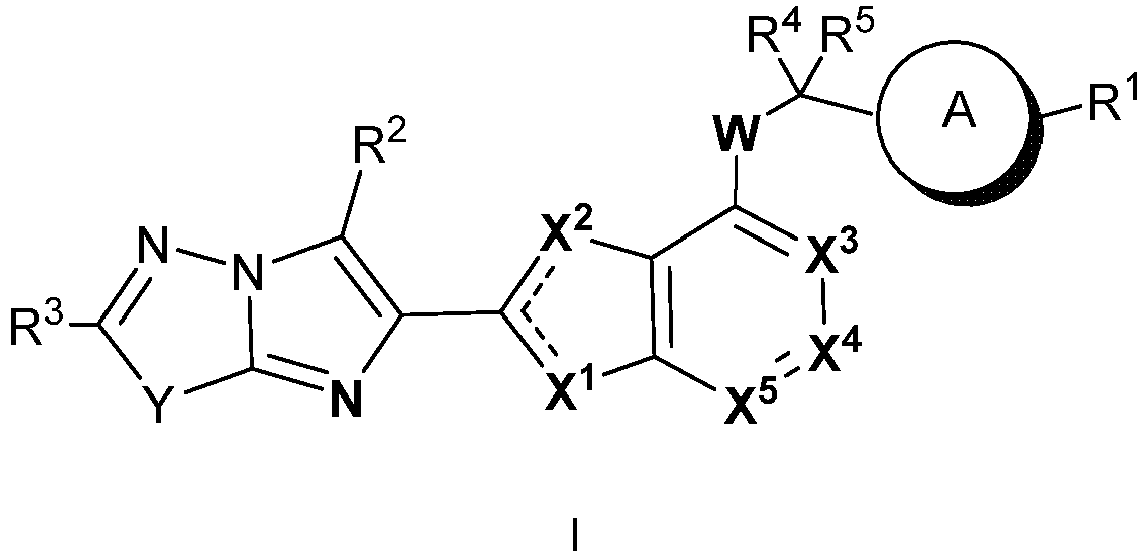 the dashed line represents an optional double-bond with the proviso that only one of the two dashed line double bonds exists at the same time;X1 is O and X2 is CR1a or N; orX1 is N and X2 is O; orX1 is N or CR1a, and X2 is S; orX1 is N and X2 is NR8; orX1 is NR8 and X2 is N; orX1 is NR8 and X2 is CR1a; orX1 is CR1a and X2 is NR8;Y is S;X3, X4 and X5 are independently selected from C(R9) or N;W is O or S;R1 is -N(R6)-C(O)-R7 or -N(R6)-S(O)2-R7;

or alternately the moiety

 R1a is selected from the group consisting of H, halo, cyano, C1-C4 alkyl, C3-C5 cycloalkyl and C1-C4 alkoxy;R2 is H, halo, C1-C6 alkyl, C1-C3 alkoxy, CN or C3-C7 cycloalkyl;R3 is selected from the group consisting of C1-C4 alkyl, C1-C4 alkoxy, C1-C4 alkylthio, C1-C2 haloalkyl, C1-C2 haloalkoxy, C3-C6 cycloalkyl, C2-C3 alkenyl, C2-C3 alkynyl and halo;R4 and R5 are independently selected from H, C1-C6 alkyl, C1-C4 fluoroalkyl, and C1-C4 hydroxyalkyl, or R4 and R5 can be taken together with the carbon to which they are attached to form a C3-C7 cycloalkyl ring;R6 is selected from H, C1-C6 alkyl, C1-C3 haloalkyl, or C1-C3hydroxyalkyl; andR7 is selected from the group consisting of hydrogen, C2-C6 alkyl, C6-C10 aryl, C1-C7 alkoxy, 5-7 membered heterocyclic ring containing 1-3 hetero atoms independently selected from N, O or S, C3-7 cycloalkyl, and 6-10 membered heteroaryl, wherein each of said alkyl, cycloalkyl, aryl, heterocylic and heteroaryl group is independently unsubstituted or substituted with 1-3 moieties which can be the same or different and being independently selected from the group consisting of halo, alkyl, haloalkyl, aryl, heteroaryl, alkoxy, haloalkoxy, aryloxy, arylalkyloxy, alkyloxycarbonyl, alkylcarboxy, aryloxycarbonyl, arylcarboxy, nitro, cyano, OH, NH2, NH(alkyl), N(alkyl)2, CONR10R11, SONR10R11, NR10SO2R11, NR10COR11, NR10CONR10R11, COOH, COOR10, oxo and methylenedioxy, wherein R10 and R11 are the same or different and are H or C1-4 alkyl or R10 and R11 can be taken together with the N they are attached to form a 4-7 membered heterocycle ring;or R6 and R7 may be taken together to form a monocyclic or bicyclic heterocyclic ring with 0-2 additional heteroatoms selected independently from N, O, or S, wherein each of said monocyclic or bicyclic heterocylic ring can be independently unsubstituted or substituted with 1-3 moieties which can be the same or different and being independently selected from the group consisting of halo, alkyl, aryl, heteroaryl, alkoxy, aryloxy, arylalkyoxy, alkyloxycarbonyl, alkylcarboxy, aryloxycarbonyl, arylcarboxy, nitro, cyano, OH, NH2, NH(alkyl), N(alkyl)2, CONR12R13, SONR12R13, NR12SO2R13, NR12COR13, NR12CONR12R13, COOH, COOR12, oxo and methylenedioxy, wherein R12 and R13 are the same or different and are H or C1-4 alkyl or R12 and R13 can be taken together with the N they are attached to form a 4-7 membered heterocycle ring.R8 is H or C1-C4 alkyl; andR9 is selected from the group consisting of H, halo, C1-C6 alkyl, C1-6 haloalkyl, C1-C6 alkoxy and C1-C3 haloalkoxy;with the proviso that when A is

- The compound of claim 1, or a stereoisomer, tautomer, pharmaceutically acceptable salt, or solvate thereof, wherein:X1 is O and X2 is CR1a or N; orX1 is N and X2 is O; orX1 is N or CR1a, and X2 is S.
- The compound of claim 1, or a stereoisomer, tautomer, pharmaceutically acceptable salt, or solvate thereof, wherein the compound has Formula IA:
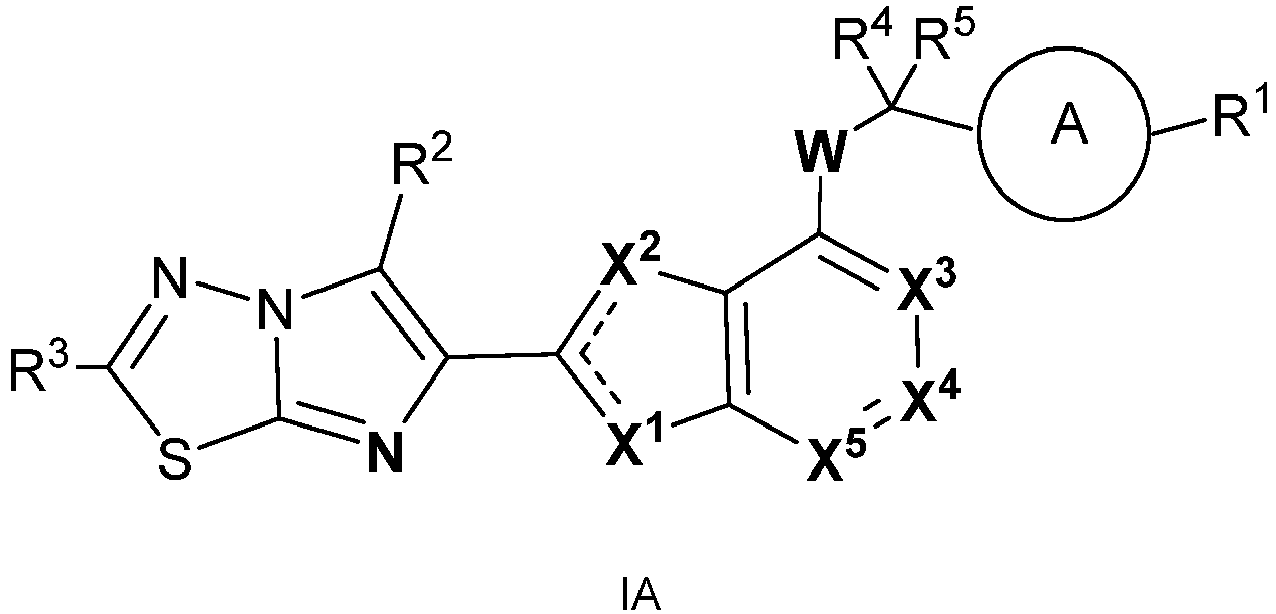 the dashed line represents an optional double-bond with the proviso that only one of the two dashed line double bonds exists at the same time;X1 is O and X2 is CR1a or N; orX1 is N and X2 is O; orX1 is N or CR1a, and X2 is S;X3, X4 and X5 are independently selected from C(R9) or N;W is O or S;R1 is -N(R6)-C(O)-R7or -N(R6)-S(O)2-R7;
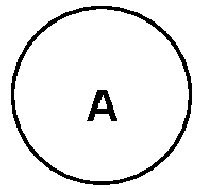
or alternately the moiety
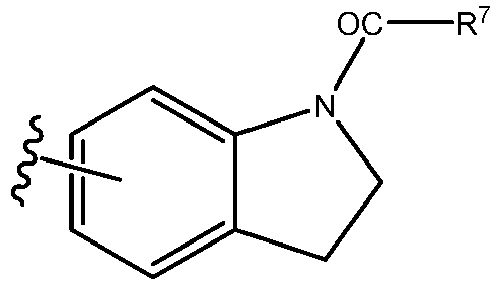
 R1a is selected from the group consisting of H, halo, cyano, C1-C4 alkyl, C3-C5 cycloalkyl and C1-C4 alkoxy;R2 is H, halo, C1-C6 alkyl, C1-C3 alkoxy, CN or C3-C7 cycloalkyl;R3 is selected from the group consisting of C1-4 alkyl, C1-4 alkoxy, C1-4 alkylthio, C1-2 haloalkyl, C1-2 haloalkoxy, C3-6 cycloalkyl, C2-3 alkenyl, C2-3 alkynyl and halo;R4 and R5 are independently selected from H, C1-C6 alkyl, C1-C4 fluoroalkyl, and C1-C4 hydroxyalkyl, or R4 and R5 can be taken together with the carbon to which they are attached to form a C3-C7 cycloalkyl ring;R8 is H or C1-C4 alkyl;R9 is selected from the group consisting of H, halo, C1-C6 alkyl, haloC1-6 alkyl, -O-(C1-C6 alkyl) and haloC1-3 alkoxy;R6 is selected from H, C1-C6 alkyl, haloC1-3alkyl, or hydroxyC1-3alkyl; andR7 is selected from the group consisting of hydrogen, C2-C6 alkyl, C6-C10 aryl, C1-C7 alkoxy, 5-7 membered heterocyclic ring containing 1-3 moieties independently selected from N, O or S, C3-7 cycloalkyl, and 6-10 membered heteroaryl, wherein each of said alkyl, aryl, heterocylic and heteroaryl is independently unsubstituted or substituted with 1-3 moieties which can be the same or different and being independently selected from the group consisting of halo, alkyl, aryl, heteroaryl, alkoxy, aryloxy, arylalkyloxy, alkyloxycarbonyl, alkylcarboxy, aryloxycarbonyl, arylcarboxy, nitro, cyano, OH, NH2, NH(alkyl), N(alkyl)2, CONR10R11, SONR10R11, COOH, COOR10, oxo and methylenedioxy, wherein R10 and R11 are the same or different and are H or C1-4 alkyl or R10 and R11 can be taken together with the N they are attached to form a 4-7 membered heterocycle ring;or R6 and R7 may be taken together to form a monocyclic or bicyclic heterocyclic ring with 0-2 additional hetero atoms selected independently from N, O, or S, wherein each of said monocyclic or bicyclic heterocylic ring can be independently unsubstituted or substituted with 1-3 moieties which can be the same or different and being independently selected from the group consisting of halo, alkyl, aryl, heteroaryl, alkoxy, aryloxy, arylalkyoxy, alkyloxycarbonyl, alkylcarboxy, aryloxycarbonyl, arylcarboxy, nitro, cyano, OH, NH2, NH(alkyl), N(alkyl)2 , CONR12R13, SONR12R13, COOH, COOR12, oxo and methylenedioxy, wherein R12 and R13 are the same or different and are H or C1-4 alkyl or R12 and R13 can be taken together with the N they are attached to form a 4-7 membered heterocycle ring.
- The compound of claim 1, or a stereoisomer, tautomer, pharmaceutically acceptable salt, or solvate thereof, wherein the compound has Formula ID:
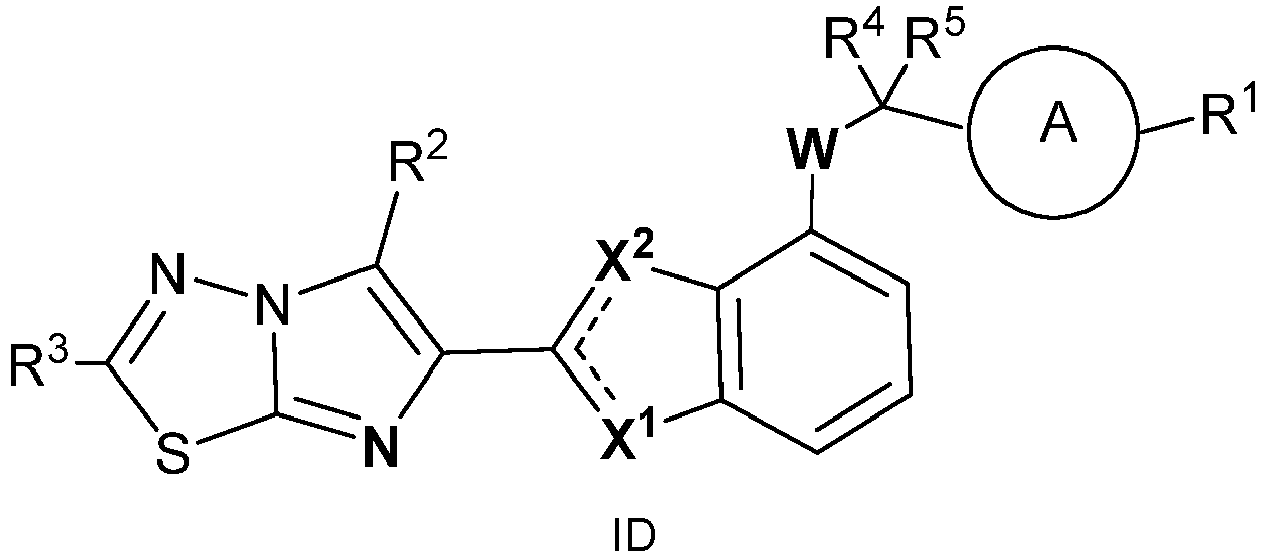 the dashed line represents an optional double-bond with the proviso that only one of the two dashed line double bonds exists at the same time;X1 is O and X2 is CR1a or N; orX1 is N and X2 is O; orX1 is N or CR1a, and X2 is S;W is O;R1 is -N(R6)-C(O)-R7or -N(R6)-S(O)2-R7;

or alternately the moiety

 R1a is selected from the group consisting of H, or methyl;R2 is H, or methyl;R3 is selected from the group consisting of methyl, ethyl, methoxy, 1,1-difluoroethyl, or 1-fluoroethyl;R4 and R5 are independently selected from H or methyl;R8 is H or methyl;R9 is methoxy;R6 is selected from H or methylR7 is selected from the group consisting of hydrogen, C2-C6 alkyl, C6-C10 aryl, C1-C7 alkoxy, 5-7 membered heterocyclic ring containing 1-3 moieties independently selected from N, O or S, C3-7 cycloalkyl, and 6-10 membered heteroaryl, wherein each of said alkyl, aryl, heterocylic and heteroaryl is independently unsubstituted or substituted with 1-3 moieties which can be the same or different and being independently selected from the group consisting of halo, alkyl, aryl, heteroaryl, alkoxy, aryloxy, arylalkyloxy, alkyloxycarbonyl, alkylcarboxy, aryloxycarbonyl, arylcarboxy, nitro, cyano, OH, NH2, NH(alkyl), N(alkyl)2, CONR10R11, SONR10R11, COOH, COOR10, oxo and methylenedioxy, wherein R10 and R11 are the same or different and are H or C1-4 alkyl or R10 and R11 can be taken together with the N they are attached to form a 4-7 membered heterocycle ring;or R6 and R7 may be taken together to form a monocyclic or bicyclic heterocyclic ring with 0-2 additional hetero atoms selected independently from N, O, or S, wherein each of said monocyclic or bicyclic heterocylic ring can be independently unsubstituted or substituted with 1-3 moieties which can be the same or different and being independently selected from the group consisting of halo, alkyl, aryl, heteroaryl, alkoxy, aryloxy, arylalkyoxy, alkyloxycarbonyl, alkylcarboxy, aryloxycarbonyl, arylcarboxy, nitro, cyano, OH, NH2, NH(alkyl), N(alkyl)2 , CONR12R13, SONR12R13, COOH, COOR12, oxo and methylenedioxy, wherein R12 and R13 are the same or different and are H or C1-4 alkyl or R12 and R13 can be taken together with the N they are attached to form a 4-7 membered heterocycle ring.
- The compound of claim 1, or a stereoisomer, tautomer, pharmaceutically acceptable salt, or solvate thereof, wherein the compound of Formula I is selected from the compounds of formulas IE, IF, IG, IH and IJ:


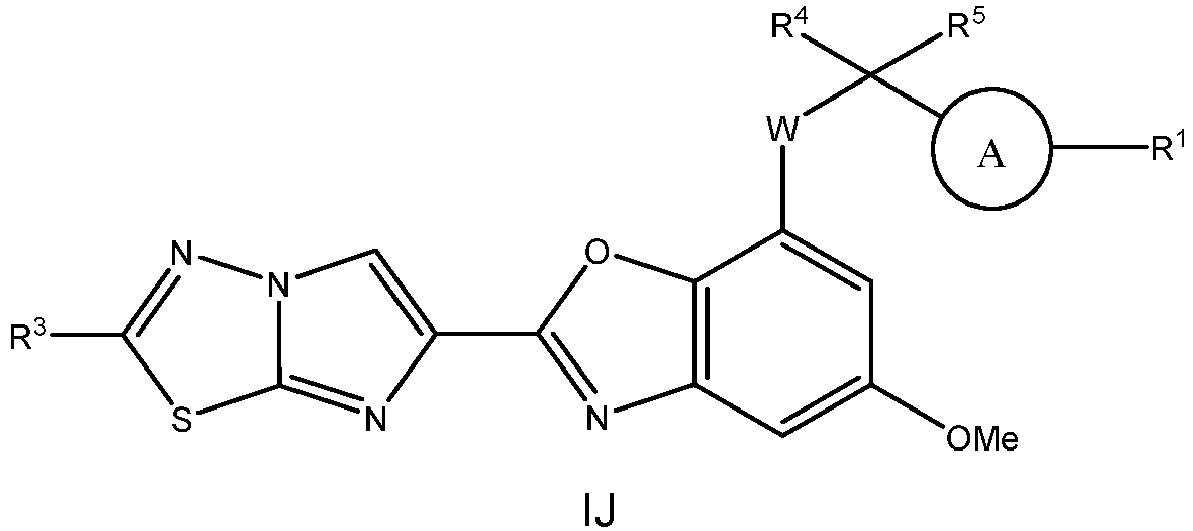
- The compound of claim 1, or a stereoisomer, tautomer, pharmaceutically acceptable salt, or solvate thereof, wherein the various moieties are independently selected, andX3, and X5 are CH;X4 is CR9;W is O;Y is S;R1a is H;R2 is H;R3 is -OCH3 or CH3;R4 and R5 are H;R6 is H or methyl;R9 is -OCH3;R1 is -N(R6)-C(O)-R7 or -N(R6)-S(O)2-R7;
 or alternately the moiety

 R7 is selected from the group consisting of hydrogen, C2-C6 alkyl, C6-C10 aryl, C1-C7 alkoxy, 5-7 membered heterocyclic ring containing 1-3 moieties independently selected from N, O or S, C3-7 cycloalkyl, and 6-10 membered heteroaryl, wherein each of said alkyl, aryl, heterocylic and heteroaryl is independently unsubstituted or substituted with 1-3 moieties which can be the same or different and being independently selected from the group consisting of halo, alkyl, aryl, heteroaryl, alkoxy, aryloxy, arylalkyloxy, alkyloxycarbonyl, alkylcarboxy, aryloxycarbonyl, arylcarboxy, nitro, cyano, OH, NH2, NH(alkyl), N(alkyl)2, CONR10R11, SONR10R11, COOH, COOR10, oxo and methylenedioxy, wherein R10 and R11 are the same or different and are H or C1-4 alkyl or R10 and R11 can be taken together with the N they are attached to form a 4-7 membered heterocycle ring;or R6 and R7 may be taken together to form a monocyclic or bicyclic heterocyclic ring with 0-2 additional hetero atoms selected independently from N, O, or S, wherein each of said monocyclic or bicyclic heterocylic ring can be independently unsubstituted or substituted with 1-3 moieties which can be the same or different and being independently selected from the group consisting of halo, alkyl, aryl, heteroaryl, alkoxy, aryloxy, arylalkyoxy, alkyloxycarbonyl, alkylcarboxy, aryloxycarbonyl, arylcarboxy, nitro, cyano, OH, NH2, NH(alkyl), N(alkyl)2 , CONR12R13, SONR12R13, COOH, COOR12, oxo and methylenedioxy, wherein R12 and R13 are the same or different and are H or C1-4 alkyl or R12 and R13 can be taken together with the N they are attached to form a 4-7 membered heterocycle ring.
- The compound of claim 1, or a stereoisomer, tautomer, pharmaceutically acceptable salt, or solvate thereof, wherein the various moieties are independently selected, andX3 = X5 = CH;X4 is CR9;W is O;Y is S;R1a is H;R2 is H;R3 is CH3 or methoxy;R4 and R5 are H;R6 is H;R9 is methoxy;R1 is -N(R6)-C(O)-R7 or -N(R6)-S(O)2-R7;
 or alternately the moiety

 R7 is selected from the group consisting of hydrogen, C2-C6 alkyl, C6-C10 aryl, C1-C7 alkoxy, 5-7 membered heterocyclic ring containing 1-3 moieties independently selected from N, O or S, C3-7 cycloalkyl, and 6-10 membered heteroaryl, wherein each of said alkyl, aryl, heterocylic and heteroaryl is independently unsubstituted or substituted with 1-3 moieties which can be the same or different and being independently selected from the group consisting of halo, alkyl, aryl, heteroaryl, alkoxy, aryloxy, arylalkyloxy, alkyloxycarbonyl, alkylcarboxy, aryloxycarbonyl, arylcarboxy, nitro, cyano, OH, NH2, NH(alkyl), N(alkyl)2, CONR10R11, SONR10R11, COOH, COOR10, oxo and methylenedioxy, wherein R10 and R11 are the same or different and are H or C1-4 alkyl or R10 and R11 can be taken together with the N they are attached to form a 4-7 membered heterocycle ring;or R6 and R7 may be taken together to form a monocyclic or bicyclic heterocyclic ring with 0-2 additional hetero atoms selected independently from N, O, or S, wherein each of said monocyclic or bicyclic heterocylic ring can be independently unsubstituted or substituted with 1-3 moieties which can be the same or different and being independently selected from the group consisting of halo, alkyl, aryl, heteroaryl, alkoxy, aryloxy, arylalkyoxy, alkyloxycarbonyl, alkylcarboxy, aryloxycarbonyl, arylcarboxy, nitro, cyano, OH, NH2, NH(alkyl), N(alkyl)2, CONR12R13, SONR12R13, COOH, COOR12, oxo and methylenedioxy, wherein R12 and R13 are the same or different and are H or C1-4 alkyl or R12 and R13 can be taken together with the N they are attached to form a 4-7 membered heterocycle ring.
- The compound of claim 1, or a stereoisomer, tautomer, pharmaceutically acceptable salt, or solvate thereof, wherein the various moieties are independently selected, andX3 = X5 = CH;X4 is CR9;W is O;Y is S;R1a is H;R2 is H;R3 is CH3 or methoxy;R4 and R5 are H;R6 is H;R9 is methoxy;R1 is -N(R6)-C(O)-R7;

andR7 is selected from the group consisting of hydrogen, C2-C6 alkyl, C6-C10 aryl, C1-C7 alkoxy, 5-7 membered heterocyclic ring containing 1-3 moieties independently selected from N, O or S, C3-7 cycloalkyl, and 6-10 membered heteroaryl, wherein each of said alkyl, aryl, heterocylic and heteroaryl is independently unsubstituted or substituted with 1-3 moieties which can be the same or different and being independently selected from the group consisting of halo, alkyl, aryl, heteroaryl, alkoxy, aryloxy, arylalkyloxy, alkyloxycarbonyl, alkylcarboxy, aryloxycarbonyl, arylcarboxy, nitro, cyano, OH, NH2, NH(alkyl), N(alkyl)2, CONR10R11, SONR10R11, COOH, COOR10, oxo and methylenedioxy, wherein R10 and R11 are the same or different and are H or C1-4 alkyl or R10 and R11 can be taken together with the N they are attached to form a 4-7 membered heterocycle ring;or R6 and R7 may be taken together to form a monocyclic or bicyclic heterocyclic ring with 0-2 additional hetero atoms selected independently from N, O, or S, wherein each of said monocyclic or bicyclic heterocylic ring can be independently unsubstituted or substituted with 1-3 moieties which can be the same or different and being independently selected from the group consisting of halo, alkyl, aryl, heteroaryl, alkoxy, aryloxy, arylalkyoxy, alkyloxycarbonyl, alkylcarboxy, aryloxycarbonyl, arylcarboxy, nitro, cyano, OH, NH2, NH(alkyl), N(alkyl)2, CONR12R13, SONR12R13, COOH, COOR12, oxo and methylenedioxy, wherein R12 and R13 are the same or different and are H or C1-4 alkyl or R12 and R13 can be taken together with the N they are attached to form a 4-7 membered heterocycle ring. - A compound of claim 1, or a stereoisomer, tautomer, pharmaceutically acceptable salt, or solvate thereof wherein the compound has Formula IE:

- The compound as defined in Claim 1, wherein the compound is selected from:


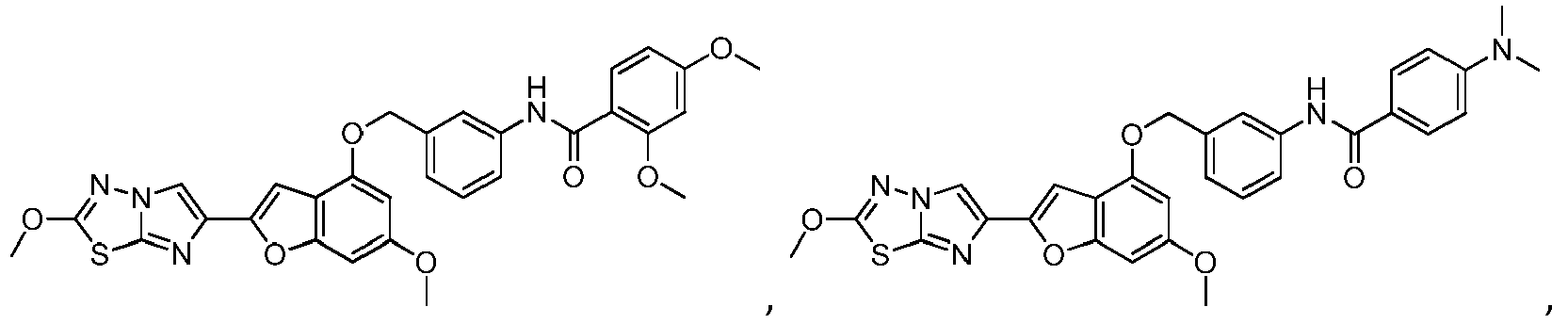






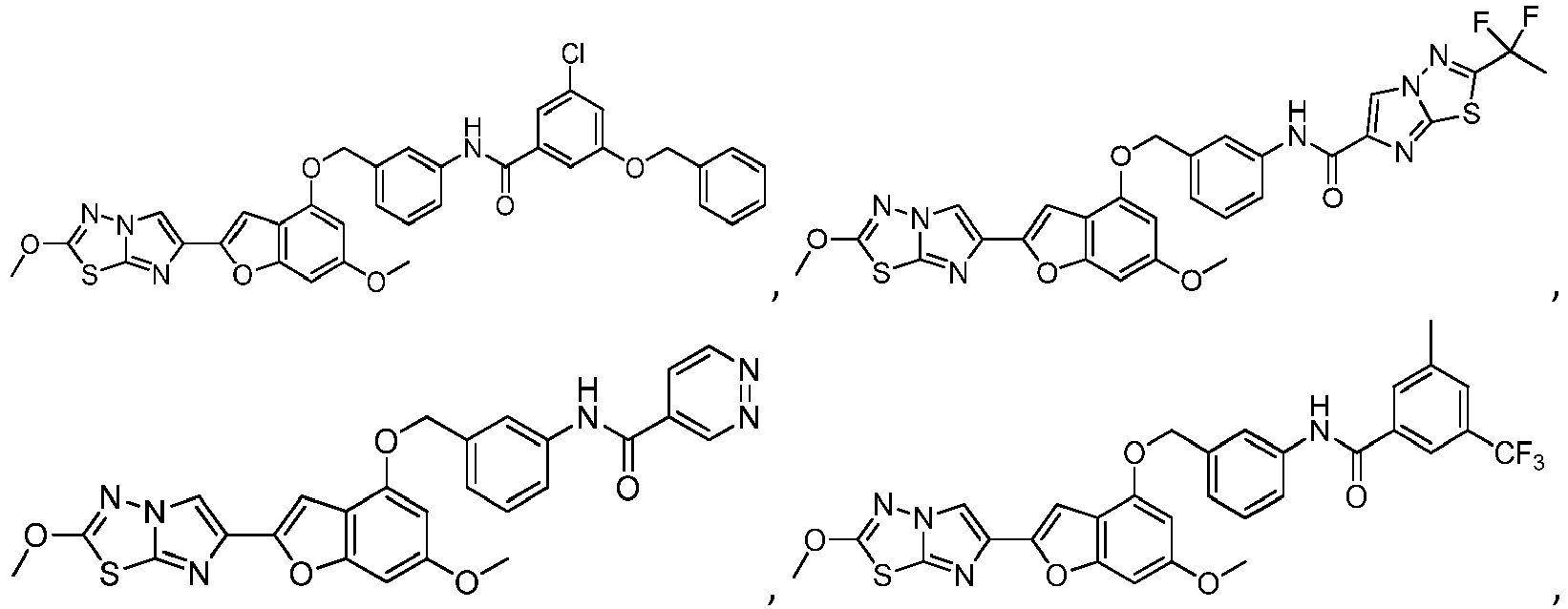


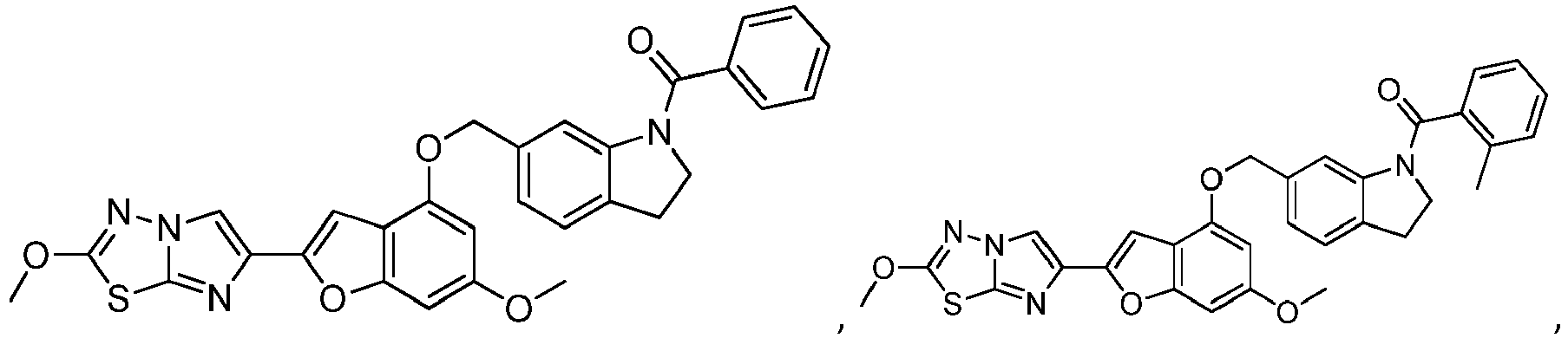

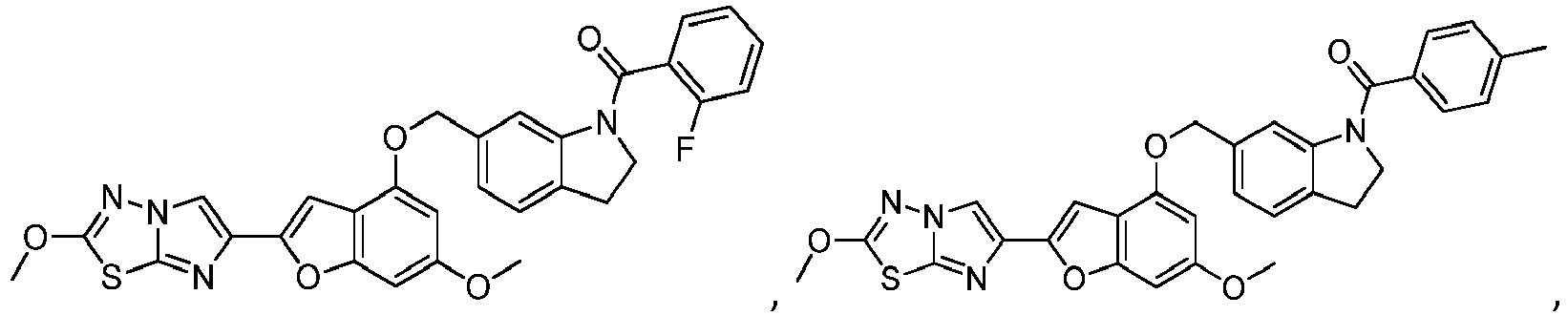


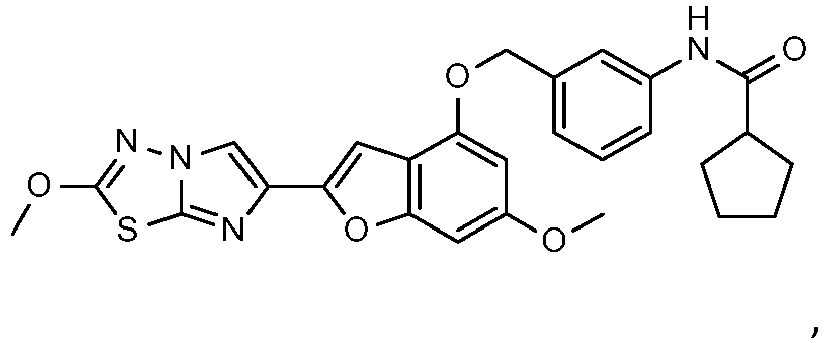


- A pharmaceutical composition, which comprises a pharmaceutically acceptable carrier and a compound as defined in any of Claims 1-10, or stereoisomers, tautomers, pharmaceutically acceptable salts, or solvates thereof, alone or in combination with another therapeutic agent.
- A compound as defined in any of Claims 1-10, or stereoisomers, tautomers, pharmaceutically acceptable salts, or solvates thereof, or the pharmaceutical composition as defined in Claim 11, for use in the treatment of a thromboembolic disorder or the primary or secondary prophylaxis of a thromboembolic disorder, wherein the thromboembolic disorder is selected from the group consisting of arterial cardiovascular thromboembolic disorders, venous cardiovascular thromboembolic disorders, cerebrovascular thromboembolic disorders, and thromboembolic disorders in the chambers of the heart or in the peripheral circulation; or for use in inhibiting or preventing platelet aggregation.
- A compound as defined in any of Claims 1-10, or stereoisomers, tautomers, pharmaceutically acceptable salts, or solvates thereof, or the pharmaceutical composition as defined in Claim 11, for use in therapy.
Applications Claiming Priority (2)
| Application Number | Priority Date | Filing Date | Title |
|---|---|---|---|
| US201562120971P | 2015-02-26 | 2015-02-26 | |
| PCT/CA2016/000050 WO2016134450A1 (en) | 2015-02-26 | 2016-02-25 | Imidazopyridazine and imidazothiadiazole compounds |
Publications (3)
| Publication Number | Publication Date |
|---|---|
| EP3262053A1 EP3262053A1 (en) | 2018-01-03 |
| EP3262053A4 EP3262053A4 (en) | 2018-11-14 |
| EP3262053B1 true EP3262053B1 (en) | 2022-10-05 |
Family
ID=56787817
Family Applications (1)
| Application Number | Title | Priority Date | Filing Date |
|---|---|---|---|
| EP16754682.9A Active EP3262053B1 (en) | 2015-02-26 | 2016-02-25 | Imidazothiadiazole compounds as par4-inhibitors |
Country Status (4)
| Country | Link |
|---|---|
| US (1) | US10214544B2 (en) |
| EP (1) | EP3262053B1 (en) |
| ES (1) | ES2929208T3 (en) |
| WO (1) | WO2016134450A1 (en) |
Families Citing this family (8)
| Publication number | Priority date | Publication date | Assignee | Title |
|---|---|---|---|---|
| EP3371196B1 (en) | 2015-10-19 | 2021-10-27 | Université de Montréal | Heterocyclic compounds as inhibitors of platelet aggregation |
| US10730868B2 (en) | 2016-07-14 | 2020-08-04 | Bristol-Myers Squibb Company | Bicyclic heteroaryl substituted compounds |
| CN109689642B (en) | 2016-07-14 | 2022-04-12 | 百时美施贵宝公司 | Monocyclic Heteroaryl Substituted Compounds |
| EP3484894B1 (en) | 2016-07-14 | 2020-08-19 | Bristol-Myers Squibb Company | Tricyclic heteroaryl-substituted quinoline and azaquinoline compounds as par4 inhibitors |
| ES2823180T3 (en) | 2016-07-14 | 2021-05-06 | Bristol Myers Squibb Co | Heteroaryl substituted bicyclic compounds |
| CN110218218B (en) * | 2018-03-01 | 2022-04-08 | 江苏恒瑞医药股份有限公司 | Benzofuran derivative, preparation method and medical application thereof |
| CN111349105B (en) * | 2018-12-24 | 2023-04-07 | 江苏恒瑞医药股份有限公司 | Benzofuran derivative, preparation method and medical application thereof |
| CN117247345A (en) * | 2023-09-07 | 2023-12-19 | 山东丰金美业科技有限公司 | A selective preparation method of 5,6-dihydroxyindoline and 5,6-dihydroxyindoline |
Family Cites Families (6)
| Publication number | Priority date | Publication date | Assignee | Title |
|---|---|---|---|---|
| JP2928079B2 (en) | 1994-02-14 | 1999-07-28 | 永信薬品工業股▲ふん▼有限公司 | 1- (Substituted benzyl) -3- (substituted aryl) condensed pyrazoles, their production and use |
| US6387942B2 (en) | 2000-06-19 | 2002-05-14 | Yung Shin Pharmaceutical Ind. Co. Ltd | Method of treating disorders related to protease-activated receptors-induced cell activation |
| SG11201406759YA (en) | 2012-04-26 | 2014-11-27 | Bristol Myers Squibb Co | Imidazothiadiazole derivatives as protease activated receptor 4 (par4) inhibitors for treating platelet aggregation |
| MX2014012803A (en) * | 2012-04-26 | 2015-01-15 | Squibb Bristol Myers Co | Par4 agonist peptides. |
| KR20150003766A (en) | 2012-04-26 | 2015-01-09 | 브리스톨-마이어스 스큅 컴퍼니 | Imidazothiadiazole and imidazopyridazine derivatives as protease activated receptor 4 (par4) inhibitors for treating platelet aggregation |
| ES2640916T3 (en) | 2012-04-26 | 2017-11-07 | Bristol-Myers Squibb Company | Imidazothiadiazole and imidazopyrazine derivatives as protease activated receptor 4 inhibitors (PAR4) to treat platelet aggregation |
-
2016
- 2016-02-25 EP EP16754682.9A patent/EP3262053B1/en active Active
- 2016-02-25 ES ES16754682T patent/ES2929208T3/en active Active
- 2016-02-25 US US15/549,257 patent/US10214544B2/en active Active
- 2016-02-25 WO PCT/CA2016/000050 patent/WO2016134450A1/en not_active Ceased
Also Published As
| Publication number | Publication date |
|---|---|
| EP3262053A1 (en) | 2018-01-03 |
| EP3262053A4 (en) | 2018-11-14 |
| WO2016134450A1 (en) | 2016-09-01 |
| ES2929208T3 (en) | 2022-11-25 |
| US10214544B2 (en) | 2019-02-26 |
| US20180237457A1 (en) | 2018-08-23 |
Similar Documents
| Publication | Publication Date | Title |
|---|---|---|
| US10214544B2 (en) | Imidazopyridazine and imidazothiadiazole compounds | |
| US9518064B2 (en) | Imidazothiadiazole and imidazopyridazine derivatives as protease activated receptor 4 (PAR4) inhibitors for treating platelet aggregation | |
| US9617279B1 (en) | Imidazooxadiazole compounds | |
| US9862730B2 (en) | Imidazothiadiazole derivatives as protease activated receptor 4 (PAR4) inhibitors for treating platelet aggregation | |
| KR102494647B1 (en) | Bicyclic Heteroaryl Substituted Compounds | |
| EP3632919A1 (en) | Imidazothiadiazole and imidazopyrazine derivatives as protease activated receptor 4 (par4) inhibitors for treating platelet aggregation | |
| KR20060027802A (en) | 3-cyclic compounds | |
| US9598419B1 (en) | Imidazotriazine and imidazodiazine compounds | |
| KR102492715B1 (en) | Monocyclic Heteroaryl Substituted Compounds | |
| JP2015516983A (en) | PAR4 agonist peptide | |
| EP3371196B1 (en) | Heterocyclic compounds as inhibitors of platelet aggregation | |
| US10238638B2 (en) | Benzothiazole and benzothiophene compounds | |
| CN100390173C (en) | 3 ring compounds | |
| KR20250084132A (en) | Macrocyclic CFTR modulators |
Legal Events
| Date | Code | Title | Description |
|---|---|---|---|
| STAA | Information on the status of an ep patent application or granted ep patent |
Free format text: STATUS: THE INTERNATIONAL PUBLICATION HAS BEEN MADE |
|
| PUAI | Public reference made under article 153(3) epc to a published international application that has entered the european phase |
Free format text: ORIGINAL CODE: 0009012 |
|
| STAA | Information on the status of an ep patent application or granted ep patent |
Free format text: STATUS: REQUEST FOR EXAMINATION WAS MADE |
|
| 17P | Request for examination filed |
Effective date: 20170926 |
|
| AK | Designated contracting states |
Kind code of ref document: A1 Designated state(s): AL AT BE BG CH CY CZ DE DK EE ES FI FR GB GR HR HU IE IS IT LI LT LU LV MC MK MT NL NO PL PT RO RS SE SI SK SM TR |
|
| AX | Request for extension of the european patent |
Extension state: BA ME |
|
| DAV | Request for validation of the european patent (deleted) | ||
| DAX | Request for extension of the european patent (deleted) | ||
| A4 | Supplementary search report drawn up and despatched |
Effective date: 20181011 |
|
| RIC1 | Information provided on ipc code assigned before grant |
Ipc: C07D 487/04 20060101ALI20181005BHEP Ipc: C07D 513/04 20060101AFI20181005BHEP Ipc: A61P 7/02 20060101ALI20181005BHEP Ipc: A61K 31/433 20060101ALI20181005BHEP |
|
| STAA | Information on the status of an ep patent application or granted ep patent |
Free format text: STATUS: EXAMINATION IS IN PROGRESS |
|
| 17Q | First examination report despatched |
Effective date: 20200513 |
|
| REG | Reference to a national code |
Ref country code: DE Ref legal event code: R079 Ref document number: 602016075445 Country of ref document: DE Free format text: PREVIOUS MAIN CLASS: C07D0513040000 Ipc: A61K0031443900 |
|
| GRAP | Despatch of communication of intention to grant a patent |
Free format text: ORIGINAL CODE: EPIDOSNIGR1 |
|
| STAA | Information on the status of an ep patent application or granted ep patent |
Free format text: STATUS: GRANT OF PATENT IS INTENDED |
|
| RIC1 | Information provided on ipc code assigned before grant |
Ipc: C07D 513/04 20060101ALI20220316BHEP Ipc: A61P 9/00 20060101ALI20220316BHEP Ipc: A61K 31/506 20060101ALI20220316BHEP Ipc: A61K 31/501 20060101ALI20220316BHEP Ipc: A61K 31/497 20060101ALI20220316BHEP Ipc: A61K 31/4439 20060101AFI20220316BHEP |
|
| INTG | Intention to grant announced |
Effective date: 20220420 |
|
| GRAS | Grant fee paid |
Free format text: ORIGINAL CODE: EPIDOSNIGR3 |
|
| GRAA | (expected) grant |
Free format text: ORIGINAL CODE: 0009210 |
|
| STAA | Information on the status of an ep patent application or granted ep patent |
Free format text: STATUS: THE PATENT HAS BEEN GRANTED |
|
| AK | Designated contracting states |
Kind code of ref document: B1 Designated state(s): AL AT BE BG CH CY CZ DE DK EE ES FI FR GB GR HR HU IE IS IT LI LT LU LV MC MK MT NL NO PL PT RO RS SE SI SK SM TR |
|
| REG | Reference to a national code |
Ref country code: GB Ref legal event code: FG4D |
|
| REG | Reference to a national code |
Ref country code: CH Ref legal event code: EP |
|
| REG | Reference to a national code |
Ref country code: AT Ref legal event code: REF Ref document number: 1522313 Country of ref document: AT Kind code of ref document: T Effective date: 20221015 |
|
| REG | Reference to a national code |
Ref country code: IE Ref legal event code: FG4D |
|
| REG | Reference to a national code |
Ref country code: DE Ref legal event code: R096 Ref document number: 602016075445 Country of ref document: DE |
|
| REG | Reference to a national code |
Ref country code: ES Ref legal event code: FG2A Ref document number: 2929208 Country of ref document: ES Kind code of ref document: T3 Effective date: 20221125 |
|
| REG | Reference to a national code |
Ref country code: LT Ref legal event code: MG9D |
|
| REG | Reference to a national code |
Ref country code: NL Ref legal event code: MP Effective date: 20221005 |
|
| REG | Reference to a national code |
Ref country code: AT Ref legal event code: MK05 Ref document number: 1522313 Country of ref document: AT Kind code of ref document: T Effective date: 20221005 |
|
| PG25 | Lapsed in a contracting state [announced via postgrant information from national office to epo] |
Ref country code: NL Free format text: LAPSE BECAUSE OF FAILURE TO SUBMIT A TRANSLATION OF THE DESCRIPTION OR TO PAY THE FEE WITHIN THE PRESCRIBED TIME-LIMIT Effective date: 20221005 |
|
| PG25 | Lapsed in a contracting state [announced via postgrant information from national office to epo] |
Ref country code: SE Free format text: LAPSE BECAUSE OF FAILURE TO SUBMIT A TRANSLATION OF THE DESCRIPTION OR TO PAY THE FEE WITHIN THE PRESCRIBED TIME-LIMIT Effective date: 20221005 Ref country code: PT Free format text: LAPSE BECAUSE OF FAILURE TO SUBMIT A TRANSLATION OF THE DESCRIPTION OR TO PAY THE FEE WITHIN THE PRESCRIBED TIME-LIMIT Effective date: 20230206 Ref country code: NO Free format text: LAPSE BECAUSE OF FAILURE TO SUBMIT A TRANSLATION OF THE DESCRIPTION OR TO PAY THE FEE WITHIN THE PRESCRIBED TIME-LIMIT Effective date: 20230105 Ref country code: LT Free format text: LAPSE BECAUSE OF FAILURE TO SUBMIT A TRANSLATION OF THE DESCRIPTION OR TO PAY THE FEE WITHIN THE PRESCRIBED TIME-LIMIT Effective date: 20221005 Ref country code: FI Free format text: LAPSE BECAUSE OF FAILURE TO SUBMIT A TRANSLATION OF THE DESCRIPTION OR TO PAY THE FEE WITHIN THE PRESCRIBED TIME-LIMIT Effective date: 20221005 Ref country code: AT Free format text: LAPSE BECAUSE OF FAILURE TO SUBMIT A TRANSLATION OF THE DESCRIPTION OR TO PAY THE FEE WITHIN THE PRESCRIBED TIME-LIMIT Effective date: 20221005 |
|
| PG25 | Lapsed in a contracting state [announced via postgrant information from national office to epo] |
Ref country code: RS Free format text: LAPSE BECAUSE OF FAILURE TO SUBMIT A TRANSLATION OF THE DESCRIPTION OR TO PAY THE FEE WITHIN THE PRESCRIBED TIME-LIMIT Effective date: 20221005 Ref country code: PL Free format text: LAPSE BECAUSE OF FAILURE TO SUBMIT A TRANSLATION OF THE DESCRIPTION OR TO PAY THE FEE WITHIN THE PRESCRIBED TIME-LIMIT Effective date: 20221005 Ref country code: LV Free format text: LAPSE BECAUSE OF FAILURE TO SUBMIT A TRANSLATION OF THE DESCRIPTION OR TO PAY THE FEE WITHIN THE PRESCRIBED TIME-LIMIT Effective date: 20221005 Ref country code: IS Free format text: LAPSE BECAUSE OF FAILURE TO SUBMIT A TRANSLATION OF THE DESCRIPTION OR TO PAY THE FEE WITHIN THE PRESCRIBED TIME-LIMIT Effective date: 20230205 Ref country code: HR Free format text: LAPSE BECAUSE OF FAILURE TO SUBMIT A TRANSLATION OF THE DESCRIPTION OR TO PAY THE FEE WITHIN THE PRESCRIBED TIME-LIMIT Effective date: 20221005 Ref country code: GR Free format text: LAPSE BECAUSE OF FAILURE TO SUBMIT A TRANSLATION OF THE DESCRIPTION OR TO PAY THE FEE WITHIN THE PRESCRIBED TIME-LIMIT Effective date: 20230106 |
|
| P01 | Opt-out of the competence of the unified patent court (upc) registered |
Effective date: 20230329 |
|
| REG | Reference to a national code |
Ref country code: DE Ref legal event code: R097 Ref document number: 602016075445 Country of ref document: DE |
|
| PG25 | Lapsed in a contracting state [announced via postgrant information from national office to epo] |
Ref country code: SM Free format text: LAPSE BECAUSE OF FAILURE TO SUBMIT A TRANSLATION OF THE DESCRIPTION OR TO PAY THE FEE WITHIN THE PRESCRIBED TIME-LIMIT Effective date: 20221005 Ref country code: RO Free format text: LAPSE BECAUSE OF FAILURE TO SUBMIT A TRANSLATION OF THE DESCRIPTION OR TO PAY THE FEE WITHIN THE PRESCRIBED TIME-LIMIT Effective date: 20221005 Ref country code: EE Free format text: LAPSE BECAUSE OF FAILURE TO SUBMIT A TRANSLATION OF THE DESCRIPTION OR TO PAY THE FEE WITHIN THE PRESCRIBED TIME-LIMIT Effective date: 20221005 Ref country code: DK Free format text: LAPSE BECAUSE OF FAILURE TO SUBMIT A TRANSLATION OF THE DESCRIPTION OR TO PAY THE FEE WITHIN THE PRESCRIBED TIME-LIMIT Effective date: 20221005 Ref country code: CZ Free format text: LAPSE BECAUSE OF FAILURE TO SUBMIT A TRANSLATION OF THE DESCRIPTION OR TO PAY THE FEE WITHIN THE PRESCRIBED TIME-LIMIT Effective date: 20221005 |
|
| PLBE | No opposition filed within time limit |
Free format text: ORIGINAL CODE: 0009261 |
|
| STAA | Information on the status of an ep patent application or granted ep patent |
Free format text: STATUS: NO OPPOSITION FILED WITHIN TIME LIMIT |
|
| PG25 | Lapsed in a contracting state [announced via postgrant information from national office to epo] |
Ref country code: SK Free format text: LAPSE BECAUSE OF FAILURE TO SUBMIT A TRANSLATION OF THE DESCRIPTION OR TO PAY THE FEE WITHIN THE PRESCRIBED TIME-LIMIT Effective date: 20221005 Ref country code: AL Free format text: LAPSE BECAUSE OF FAILURE TO SUBMIT A TRANSLATION OF THE DESCRIPTION OR TO PAY THE FEE WITHIN THE PRESCRIBED TIME-LIMIT Effective date: 20221005 |
|
| 26N | No opposition filed |
Effective date: 20230706 |
|
| PG25 | Lapsed in a contracting state [announced via postgrant information from national office to epo] |
Ref country code: MC Free format text: LAPSE BECAUSE OF FAILURE TO SUBMIT A TRANSLATION OF THE DESCRIPTION OR TO PAY THE FEE WITHIN THE PRESCRIBED TIME-LIMIT Effective date: 20221005 |
|
| REG | Reference to a national code |
Ref country code: CH Ref legal event code: PL |
|
| REG | Reference to a national code |
Ref country code: BE Ref legal event code: MM Effective date: 20230228 |
|
| PG25 | Lapsed in a contracting state [announced via postgrant information from national office to epo] |
Ref country code: LU Free format text: LAPSE BECAUSE OF NON-PAYMENT OF DUE FEES Effective date: 20230225 Ref country code: LI Free format text: LAPSE BECAUSE OF NON-PAYMENT OF DUE FEES Effective date: 20230228 Ref country code: CH Free format text: LAPSE BECAUSE OF NON-PAYMENT OF DUE FEES Effective date: 20230228 |
|
| PG25 | Lapsed in a contracting state [announced via postgrant information from national office to epo] |
Ref country code: SI Free format text: LAPSE BECAUSE OF FAILURE TO SUBMIT A TRANSLATION OF THE DESCRIPTION OR TO PAY THE FEE WITHIN THE PRESCRIBED TIME-LIMIT Effective date: 20221005 |
|
| REG | Reference to a national code |
Ref country code: IE Ref legal event code: MM4A |
|
| PG25 | Lapsed in a contracting state [announced via postgrant information from national office to epo] |
Ref country code: IE Free format text: LAPSE BECAUSE OF NON-PAYMENT OF DUE FEES Effective date: 20230225 |
|
| PG25 | Lapsed in a contracting state [announced via postgrant information from national office to epo] |
Ref country code: BE Free format text: LAPSE BECAUSE OF NON-PAYMENT OF DUE FEES Effective date: 20230228 |
|
| PG25 | Lapsed in a contracting state [announced via postgrant information from national office to epo] |
Ref country code: BG Free format text: LAPSE BECAUSE OF FAILURE TO SUBMIT A TRANSLATION OF THE DESCRIPTION OR TO PAY THE FEE WITHIN THE PRESCRIBED TIME-LIMIT Effective date: 20221005 |
|
| PG25 | Lapsed in a contracting state [announced via postgrant information from national office to epo] |
Ref country code: BG Free format text: LAPSE BECAUSE OF FAILURE TO SUBMIT A TRANSLATION OF THE DESCRIPTION OR TO PAY THE FEE WITHIN THE PRESCRIBED TIME-LIMIT Effective date: 20221005 |
|
| PG25 | Lapsed in a contracting state [announced via postgrant information from national office to epo] |
Ref country code: CY Free format text: LAPSE BECAUSE OF FAILURE TO SUBMIT A TRANSLATION OF THE DESCRIPTION OR TO PAY THE FEE WITHIN THE PRESCRIBED TIME-LIMIT; INVALID AB INITIO Effective date: 20160225 |
|
| PG25 | Lapsed in a contracting state [announced via postgrant information from national office to epo] |
Ref country code: HU Free format text: LAPSE BECAUSE OF FAILURE TO SUBMIT A TRANSLATION OF THE DESCRIPTION OR TO PAY THE FEE WITHIN THE PRESCRIBED TIME-LIMIT; INVALID AB INITIO Effective date: 20160225 |
|
| PG25 | Lapsed in a contracting state [announced via postgrant information from national office to epo] |
Ref country code: TR Free format text: LAPSE BECAUSE OF FAILURE TO SUBMIT A TRANSLATION OF THE DESCRIPTION OR TO PAY THE FEE WITHIN THE PRESCRIBED TIME-LIMIT Effective date: 20221005 |
|
| PGFP | Annual fee paid to national office [announced via postgrant information from national office to epo] |
Ref country code: FR Payment date: 20251231 Year of fee payment: 11 |
|
| PGFP | Annual fee paid to national office [announced via postgrant information from national office to epo] |
Ref country code: GB Payment date: 20260106 Year of fee payment: 11 |
|
| PGFP | Annual fee paid to national office [announced via postgrant information from national office to epo] |
Ref country code: ES Payment date: 20260310 Year of fee payment: 11 |
|
| PGFP | Annual fee paid to national office [announced via postgrant information from national office to epo] |
Ref country code: DE Payment date: 20260102 Year of fee payment: 11 |
|
| PGFP | Annual fee paid to national office [announced via postgrant information from national office to epo] |
Ref country code: IT Payment date: 20260122 Year of fee payment: 11 |