EP3262033B1 - Ethylenediaminetetraacetic acid bis(amide) derivatives and their respective complexes with mn(ii) ion for use as mri contrast agent - Google Patents
Ethylenediaminetetraacetic acid bis(amide) derivatives and their respective complexes with mn(ii) ion for use as mri contrast agent Download PDFInfo
- Publication number
- EP3262033B1 EP3262033B1 EP16706597.8A EP16706597A EP3262033B1 EP 3262033 B1 EP3262033 B1 EP 3262033B1 EP 16706597 A EP16706597 A EP 16706597A EP 3262033 B1 EP3262033 B1 EP 3262033B1
- Authority
- EP
- European Patent Office
- Prior art keywords
- substituted
- compound
- atom
- compound according
- ring
- Prior art date
- Legal status (The legal status is an assumption and is not a legal conclusion. Google has not performed a legal analysis and makes no representation as to the accuracy of the status listed.)
- Active
Links
- 0 C[C@](*)CC(C(CN)N(CC(N(*)*)=O)CC(O)=O)N(CC(N(*)*)=O)CC(O)=O Chemical compound C[C@](*)CC(C(CN)N(CC(N(*)*)=O)CC(O)=O)N(CC(N(*)*)=O)CC(O)=O 0.000 description 2
- LXTGJWVKRITGML-UHFFFAOYSA-N O=C(CN(C1)c(cccc2)c2N(CC(O2)=O)CC2=O)OC1=O Chemical compound O=C(CN(C1)c(cccc2)c2N(CC(O2)=O)CC2=O)OC1=O LXTGJWVKRITGML-UHFFFAOYSA-N 0.000 description 1
- DWEXLTUQYNPELZ-UHFFFAOYSA-N OC(CN(CC(N1CCC(Cc2ccccc2)CC1)=O)c(cccc1)c1N(CC(N1CCC(Cc2ccccc2)CC1)=O)CC(O)=O)=O Chemical compound OC(CN(CC(N1CCC(Cc2ccccc2)CC1)=O)c(cccc1)c1N(CC(N1CCC(Cc2ccccc2)CC1)=O)CC(O)=O)=O DWEXLTUQYNPELZ-UHFFFAOYSA-N 0.000 description 1
Classifications
-
- A—HUMAN NECESSITIES
- A61—MEDICAL OR VETERINARY SCIENCE; HYGIENE
- A61K—PREPARATIONS FOR MEDICAL, DENTAL OR TOILETRY PURPOSES
- A61K49/00—Preparations for testing in vivo
- A61K49/06—Nuclear magnetic resonance [NMR] contrast preparations; Magnetic resonance imaging [MRI] contrast preparations
- A61K49/08—Nuclear magnetic resonance [NMR] contrast preparations; Magnetic resonance imaging [MRI] contrast preparations characterised by the carrier
- A61K49/10—Organic compounds
- A61K49/101—Organic compounds the carrier being a complex-forming compound able to form MRI-active complexes with paramagnetic metals
- A61K49/103—Organic compounds the carrier being a complex-forming compound able to form MRI-active complexes with paramagnetic metals the complex-forming compound being acyclic, e.g. DTPA
-
- A—HUMAN NECESSITIES
- A61—MEDICAL OR VETERINARY SCIENCE; HYGIENE
- A61B—DIAGNOSIS; SURGERY; IDENTIFICATION
- A61B5/00—Measuring for diagnostic purposes; Identification of persons
- A61B5/05—Detecting, measuring or recording for diagnosis by means of electric currents or magnetic fields; Measuring using microwaves or radio waves
- A61B5/055—Detecting, measuring or recording for diagnosis by means of electric currents or magnetic fields; Measuring using microwaves or radio waves involving electronic [EMR] or nuclear [NMR] magnetic resonance, e.g. magnetic resonance imaging
-
- A—HUMAN NECESSITIES
- A61—MEDICAL OR VETERINARY SCIENCE; HYGIENE
- A61K—PREPARATIONS FOR MEDICAL, DENTAL OR TOILETRY PURPOSES
- A61K49/00—Preparations for testing in vivo
- A61K49/06—Nuclear magnetic resonance [NMR] contrast preparations; Magnetic resonance imaging [MRI] contrast preparations
- A61K49/08—Nuclear magnetic resonance [NMR] contrast preparations; Magnetic resonance imaging [MRI] contrast preparations characterised by the carrier
- A61K49/10—Organic compounds
- A61K49/101—Organic compounds the carrier being a complex-forming compound able to form MRI-active complexes with paramagnetic metals
- A61K49/106—Organic compounds the carrier being a complex-forming compound able to form MRI-active complexes with paramagnetic metals the complex-forming compound being cyclic, e.g. DOTA
-
- C—CHEMISTRY; METALLURGY
- C07—ORGANIC CHEMISTRY
- C07C—ACYCLIC OR CARBOCYCLIC COMPOUNDS
- C07C211/00—Compounds containing amino groups bound to a carbon skeleton
- C07C211/01—Compounds containing amino groups bound to a carbon skeleton having amino groups bound to acyclic carbon atoms
- C07C211/02—Compounds containing amino groups bound to a carbon skeleton having amino groups bound to acyclic carbon atoms of an acyclic saturated carbon skeleton
- C07C211/09—Diamines
- C07C211/10—Diaminoethanes
-
- C—CHEMISTRY; METALLURGY
- C07—ORGANIC CHEMISTRY
- C07C—ACYCLIC OR CARBOCYCLIC COMPOUNDS
- C07C211/00—Compounds containing amino groups bound to a carbon skeleton
- C07C211/33—Compounds containing amino groups bound to a carbon skeleton having amino groups bound to carbon atoms of rings other than six-membered aromatic rings
- C07C211/34—Compounds containing amino groups bound to a carbon skeleton having amino groups bound to carbon atoms of rings other than six-membered aromatic rings of a saturated carbon skeleton
- C07C211/35—Compounds containing amino groups bound to a carbon skeleton having amino groups bound to carbon atoms of rings other than six-membered aromatic rings of a saturated carbon skeleton containing only non-condensed rings
-
- C—CHEMISTRY; METALLURGY
- C07—ORGANIC CHEMISTRY
- C07C—ACYCLIC OR CARBOCYCLIC COMPOUNDS
- C07C211/00—Compounds containing amino groups bound to a carbon skeleton
- C07C211/33—Compounds containing amino groups bound to a carbon skeleton having amino groups bound to carbon atoms of rings other than six-membered aromatic rings
- C07C211/34—Compounds containing amino groups bound to a carbon skeleton having amino groups bound to carbon atoms of rings other than six-membered aromatic rings of a saturated carbon skeleton
- C07C211/36—Compounds containing amino groups bound to a carbon skeleton having amino groups bound to carbon atoms of rings other than six-membered aromatic rings of a saturated carbon skeleton containing at least two amino groups bound to the carbon skeleton
-
- C—CHEMISTRY; METALLURGY
- C07—ORGANIC CHEMISTRY
- C07C—ACYCLIC OR CARBOCYCLIC COMPOUNDS
- C07C211/00—Compounds containing amino groups bound to a carbon skeleton
- C07C211/43—Compounds containing amino groups bound to a carbon skeleton having amino groups bound to carbon atoms of six-membered aromatic rings of the carbon skeleton
- C07C211/44—Compounds containing amino groups bound to a carbon skeleton having amino groups bound to carbon atoms of six-membered aromatic rings of the carbon skeleton having amino groups bound to only one six-membered aromatic ring
- C07C211/49—Compounds containing amino groups bound to a carbon skeleton having amino groups bound to carbon atoms of six-membered aromatic rings of the carbon skeleton having amino groups bound to only one six-membered aromatic ring having at least two amino groups bound to the carbon skeleton
- C07C211/50—Compounds containing amino groups bound to a carbon skeleton having amino groups bound to carbon atoms of six-membered aromatic rings of the carbon skeleton having amino groups bound to only one six-membered aromatic ring having at least two amino groups bound to the carbon skeleton with at least two amino groups bound to carbon atoms of six-membered aromatic rings of the carbon skeleton
- C07C211/51—Phenylenediamines
-
- C—CHEMISTRY; METALLURGY
- C07—ORGANIC CHEMISTRY
- C07C—ACYCLIC OR CARBOCYCLIC COMPOUNDS
- C07C231/00—Preparation of carboxylic acid amides
- C07C231/02—Preparation of carboxylic acid amides from carboxylic acids or from esters, anhydrides, or halides thereof by reaction with ammonia or amines
-
- C—CHEMISTRY; METALLURGY
- C07—ORGANIC CHEMISTRY
- C07C—ACYCLIC OR CARBOCYCLIC COMPOUNDS
- C07C233/00—Carboxylic acid amides
- C07C233/01—Carboxylic acid amides having carbon atoms of carboxamide groups bound to hydrogen atoms or to acyclic carbon atoms
-
- C—CHEMISTRY; METALLURGY
- C07—ORGANIC CHEMISTRY
- C07C—ACYCLIC OR CARBOCYCLIC COMPOUNDS
- C07C237/00—Carboxylic acid amides, the carbon skeleton of the acid part being further substituted by amino groups
- C07C237/02—Carboxylic acid amides, the carbon skeleton of the acid part being further substituted by amino groups having the carbon atoms of the carboxamide groups bound to acyclic carbon atoms of the carbon skeleton
- C07C237/04—Carboxylic acid amides, the carbon skeleton of the acid part being further substituted by amino groups having the carbon atoms of the carboxamide groups bound to acyclic carbon atoms of the carbon skeleton the carbon skeleton being acyclic and saturated
- C07C237/06—Carboxylic acid amides, the carbon skeleton of the acid part being further substituted by amino groups having the carbon atoms of the carboxamide groups bound to acyclic carbon atoms of the carbon skeleton the carbon skeleton being acyclic and saturated having the nitrogen atoms of the carboxamide groups bound to hydrogen atoms or to acyclic carbon atoms
-
- C—CHEMISTRY; METALLURGY
- C07—ORGANIC CHEMISTRY
- C07D—HETEROCYCLIC COMPOUNDS
- C07D207/00—Heterocyclic compounds containing five-membered rings not condensed with other rings, with one nitrogen atom as the only ring hetero atom
- C07D207/02—Heterocyclic compounds containing five-membered rings not condensed with other rings, with one nitrogen atom as the only ring hetero atom with only hydrogen or carbon atoms directly attached to the ring nitrogen atom
- C07D207/30—Heterocyclic compounds containing five-membered rings not condensed with other rings, with one nitrogen atom as the only ring hetero atom with only hydrogen or carbon atoms directly attached to the ring nitrogen atom having two double bonds between ring members or between ring members and non-ring members
- C07D207/32—Heterocyclic compounds containing five-membered rings not condensed with other rings, with one nitrogen atom as the only ring hetero atom with only hydrogen or carbon atoms directly attached to the ring nitrogen atom having two double bonds between ring members or between ring members and non-ring members with only hydrogen atoms, hydrocarbon or substituted hydrocarbon radicals, directly attached to ring carbon atoms
- C07D207/325—Heterocyclic compounds containing five-membered rings not condensed with other rings, with one nitrogen atom as the only ring hetero atom with only hydrogen or carbon atoms directly attached to the ring nitrogen atom having two double bonds between ring members or between ring members and non-ring members with only hydrogen atoms, hydrocarbon or substituted hydrocarbon radicals, directly attached to ring carbon atoms with substituted hydrocarbon radicals directly attached to the ring nitrogen atom
-
- C—CHEMISTRY; METALLURGY
- C07—ORGANIC CHEMISTRY
- C07D—HETEROCYCLIC COMPOUNDS
- C07D207/00—Heterocyclic compounds containing five-membered rings not condensed with other rings, with one nitrogen atom as the only ring hetero atom
- C07D207/02—Heterocyclic compounds containing five-membered rings not condensed with other rings, with one nitrogen atom as the only ring hetero atom with only hydrogen or carbon atoms directly attached to the ring nitrogen atom
- C07D207/30—Heterocyclic compounds containing five-membered rings not condensed with other rings, with one nitrogen atom as the only ring hetero atom with only hydrogen or carbon atoms directly attached to the ring nitrogen atom having two double bonds between ring members or between ring members and non-ring members
- C07D207/34—Heterocyclic compounds containing five-membered rings not condensed with other rings, with one nitrogen atom as the only ring hetero atom with only hydrogen or carbon atoms directly attached to the ring nitrogen atom having two double bonds between ring members or between ring members and non-ring members with hetero atoms or with carbon atoms having three bonds to hetero atoms with at the most one bond to halogen, e.g. ester or nitrile radicals, directly attached to ring carbon atoms
-
- C—CHEMISTRY; METALLURGY
- C07—ORGANIC CHEMISTRY
- C07D—HETEROCYCLIC COMPOUNDS
- C07D211/00—Heterocyclic compounds containing hydrogenated pyridine rings, not condensed with other rings
- C07D211/04—Heterocyclic compounds containing hydrogenated pyridine rings, not condensed with other rings with only hydrogen or carbon atoms directly attached to the ring nitrogen atom
- C07D211/06—Heterocyclic compounds containing hydrogenated pyridine rings, not condensed with other rings with only hydrogen or carbon atoms directly attached to the ring nitrogen atom having no double bonds between ring members or between ring members and non-ring members
- C07D211/08—Heterocyclic compounds containing hydrogenated pyridine rings, not condensed with other rings with only hydrogen or carbon atoms directly attached to the ring nitrogen atom having no double bonds between ring members or between ring members and non-ring members with hydrocarbon or substituted hydrocarbon radicals directly attached to ring carbon atoms
- C07D211/10—Heterocyclic compounds containing hydrogenated pyridine rings, not condensed with other rings with only hydrogen or carbon atoms directly attached to the ring nitrogen atom having no double bonds between ring members or between ring members and non-ring members with hydrocarbon or substituted hydrocarbon radicals directly attached to ring carbon atoms with radicals containing only carbon and hydrogen atoms attached to ring carbon atoms
- C07D211/16—Heterocyclic compounds containing hydrogenated pyridine rings, not condensed with other rings with only hydrogen or carbon atoms directly attached to the ring nitrogen atom having no double bonds between ring members or between ring members and non-ring members with hydrocarbon or substituted hydrocarbon radicals directly attached to ring carbon atoms with radicals containing only carbon and hydrogen atoms attached to ring carbon atoms with acylated ring nitrogen atom
-
- C—CHEMISTRY; METALLURGY
- C07—ORGANIC CHEMISTRY
- C07D—HETEROCYCLIC COMPOUNDS
- C07D211/00—Heterocyclic compounds containing hydrogenated pyridine rings, not condensed with other rings
- C07D211/04—Heterocyclic compounds containing hydrogenated pyridine rings, not condensed with other rings with only hydrogen or carbon atoms directly attached to the ring nitrogen atom
- C07D211/06—Heterocyclic compounds containing hydrogenated pyridine rings, not condensed with other rings with only hydrogen or carbon atoms directly attached to the ring nitrogen atom having no double bonds between ring members or between ring members and non-ring members
- C07D211/08—Heterocyclic compounds containing hydrogenated pyridine rings, not condensed with other rings with only hydrogen or carbon atoms directly attached to the ring nitrogen atom having no double bonds between ring members or between ring members and non-ring members with hydrocarbon or substituted hydrocarbon radicals directly attached to ring carbon atoms
- C07D211/18—Heterocyclic compounds containing hydrogenated pyridine rings, not condensed with other rings with only hydrogen or carbon atoms directly attached to the ring nitrogen atom having no double bonds between ring members or between ring members and non-ring members with hydrocarbon or substituted hydrocarbon radicals directly attached to ring carbon atoms with substituted hydrocarbon radicals attached to ring carbon atoms
- C07D211/30—Heterocyclic compounds containing hydrogenated pyridine rings, not condensed with other rings with only hydrogen or carbon atoms directly attached to the ring nitrogen atom having no double bonds between ring members or between ring members and non-ring members with hydrocarbon or substituted hydrocarbon radicals directly attached to ring carbon atoms with substituted hydrocarbon radicals attached to ring carbon atoms with hydrocarbon radicals, substituted by doubly bound oxygen or sulfur atoms or by two oxygen or sulfur atoms singly bound to the same carbon atom
- C07D211/32—Heterocyclic compounds containing hydrogenated pyridine rings, not condensed with other rings with only hydrogen or carbon atoms directly attached to the ring nitrogen atom having no double bonds between ring members or between ring members and non-ring members with hydrocarbon or substituted hydrocarbon radicals directly attached to ring carbon atoms with substituted hydrocarbon radicals attached to ring carbon atoms with hydrocarbon radicals, substituted by doubly bound oxygen or sulfur atoms or by two oxygen or sulfur atoms singly bound to the same carbon atom by oxygen atoms
-
- C—CHEMISTRY; METALLURGY
- C07—ORGANIC CHEMISTRY
- C07D—HETEROCYCLIC COMPOUNDS
- C07D211/00—Heterocyclic compounds containing hydrogenated pyridine rings, not condensed with other rings
- C07D211/04—Heterocyclic compounds containing hydrogenated pyridine rings, not condensed with other rings with only hydrogen or carbon atoms directly attached to the ring nitrogen atom
- C07D211/06—Heterocyclic compounds containing hydrogenated pyridine rings, not condensed with other rings with only hydrogen or carbon atoms directly attached to the ring nitrogen atom having no double bonds between ring members or between ring members and non-ring members
- C07D211/36—Heterocyclic compounds containing hydrogenated pyridine rings, not condensed with other rings with only hydrogen or carbon atoms directly attached to the ring nitrogen atom having no double bonds between ring members or between ring members and non-ring members with hetero atoms or with carbon atoms having three bonds to hetero atoms with at the most one bond to halogen, e.g. ester or nitrile radicals, directly attached to ring carbon atoms
- C07D211/40—Oxygen atoms
- C07D211/42—Oxygen atoms attached in position 3 or 5
-
- C—CHEMISTRY; METALLURGY
- C07—ORGANIC CHEMISTRY
- C07D—HETEROCYCLIC COMPOUNDS
- C07D211/00—Heterocyclic compounds containing hydrogenated pyridine rings, not condensed with other rings
- C07D211/04—Heterocyclic compounds containing hydrogenated pyridine rings, not condensed with other rings with only hydrogen or carbon atoms directly attached to the ring nitrogen atom
- C07D211/06—Heterocyclic compounds containing hydrogenated pyridine rings, not condensed with other rings with only hydrogen or carbon atoms directly attached to the ring nitrogen atom having no double bonds between ring members or between ring members and non-ring members
- C07D211/36—Heterocyclic compounds containing hydrogenated pyridine rings, not condensed with other rings with only hydrogen or carbon atoms directly attached to the ring nitrogen atom having no double bonds between ring members or between ring members and non-ring members with hetero atoms or with carbon atoms having three bonds to hetero atoms with at the most one bond to halogen, e.g. ester or nitrile radicals, directly attached to ring carbon atoms
- C07D211/40—Oxygen atoms
- C07D211/44—Oxygen atoms attached in position 4
- C07D211/46—Oxygen atoms attached in position 4 having a hydrogen atom as the second substituent in position 4
-
- C—CHEMISTRY; METALLURGY
- C07—ORGANIC CHEMISTRY
- C07D—HETEROCYCLIC COMPOUNDS
- C07D211/00—Heterocyclic compounds containing hydrogenated pyridine rings, not condensed with other rings
- C07D211/04—Heterocyclic compounds containing hydrogenated pyridine rings, not condensed with other rings with only hydrogen or carbon atoms directly attached to the ring nitrogen atom
- C07D211/06—Heterocyclic compounds containing hydrogenated pyridine rings, not condensed with other rings with only hydrogen or carbon atoms directly attached to the ring nitrogen atom having no double bonds between ring members or between ring members and non-ring members
- C07D211/36—Heterocyclic compounds containing hydrogenated pyridine rings, not condensed with other rings with only hydrogen or carbon atoms directly attached to the ring nitrogen atom having no double bonds between ring members or between ring members and non-ring members with hetero atoms or with carbon atoms having three bonds to hetero atoms with at the most one bond to halogen, e.g. ester or nitrile radicals, directly attached to ring carbon atoms
- C07D211/40—Oxygen atoms
- C07D211/44—Oxygen atoms attached in position 4
- C07D211/48—Oxygen atoms attached in position 4 having an acyclic carbon atom attached in position 4
-
- C—CHEMISTRY; METALLURGY
- C07—ORGANIC CHEMISTRY
- C07D—HETEROCYCLIC COMPOUNDS
- C07D211/00—Heterocyclic compounds containing hydrogenated pyridine rings, not condensed with other rings
- C07D211/04—Heterocyclic compounds containing hydrogenated pyridine rings, not condensed with other rings with only hydrogen or carbon atoms directly attached to the ring nitrogen atom
- C07D211/06—Heterocyclic compounds containing hydrogenated pyridine rings, not condensed with other rings with only hydrogen or carbon atoms directly attached to the ring nitrogen atom having no double bonds between ring members or between ring members and non-ring members
- C07D211/36—Heterocyclic compounds containing hydrogenated pyridine rings, not condensed with other rings with only hydrogen or carbon atoms directly attached to the ring nitrogen atom having no double bonds between ring members or between ring members and non-ring members with hetero atoms or with carbon atoms having three bonds to hetero atoms with at the most one bond to halogen, e.g. ester or nitrile radicals, directly attached to ring carbon atoms
- C07D211/60—Carbon atoms having three bonds to hetero atoms with at the most one bond to halogen, e.g. ester or nitrile radicals
- C07D211/62—Carbon atoms having three bonds to hetero atoms with at the most one bond to halogen, e.g. ester or nitrile radicals attached in position 4
-
- C—CHEMISTRY; METALLURGY
- C07—ORGANIC CHEMISTRY
- C07D—HETEROCYCLIC COMPOUNDS
- C07D221/00—Heterocyclic compounds containing six-membered rings having one nitrogen atom as the only ring hetero atom, not provided for by groups C07D211/00 - C07D219/00
- C07D221/02—Heterocyclic compounds containing six-membered rings having one nitrogen atom as the only ring hetero atom, not provided for by groups C07D211/00 - C07D219/00 condensed with carbocyclic rings or ring systems
- C07D221/22—Bridged ring systems
-
- C—CHEMISTRY; METALLURGY
- C07—ORGANIC CHEMISTRY
- C07D—HETEROCYCLIC COMPOUNDS
- C07D295/00—Heterocyclic compounds containing polymethylene-imine rings with at least five ring members, 3-azabicyclo [3.2.2] nonane, piperazine, morpholine or thiomorpholine rings, having only hydrogen atoms directly attached to the ring carbon atoms
- C07D295/16—Heterocyclic compounds containing polymethylene-imine rings with at least five ring members, 3-azabicyclo [3.2.2] nonane, piperazine, morpholine or thiomorpholine rings, having only hydrogen atoms directly attached to the ring carbon atoms acylated on ring nitrogen atoms
- C07D295/18—Heterocyclic compounds containing polymethylene-imine rings with at least five ring members, 3-azabicyclo [3.2.2] nonane, piperazine, morpholine or thiomorpholine rings, having only hydrogen atoms directly attached to the ring carbon atoms acylated on ring nitrogen atoms by radicals derived from carboxylic acids, or sulfur or nitrogen analogues thereof
- C07D295/182—Radicals derived from carboxylic acids
- C07D295/185—Radicals derived from carboxylic acids from aliphatic carboxylic acids
-
- C—CHEMISTRY; METALLURGY
- C07—ORGANIC CHEMISTRY
- C07D—HETEROCYCLIC COMPOUNDS
- C07D295/00—Heterocyclic compounds containing polymethylene-imine rings with at least five ring members, 3-azabicyclo [3.2.2] nonane, piperazine, morpholine or thiomorpholine rings, having only hydrogen atoms directly attached to the ring carbon atoms
- C07D295/16—Heterocyclic compounds containing polymethylene-imine rings with at least five ring members, 3-azabicyclo [3.2.2] nonane, piperazine, morpholine or thiomorpholine rings, having only hydrogen atoms directly attached to the ring carbon atoms acylated on ring nitrogen atoms
- C07D295/18—Heterocyclic compounds containing polymethylene-imine rings with at least five ring members, 3-azabicyclo [3.2.2] nonane, piperazine, morpholine or thiomorpholine rings, having only hydrogen atoms directly attached to the ring carbon atoms acylated on ring nitrogen atoms by radicals derived from carboxylic acids, or sulfur or nitrogen analogues thereof
- C07D295/182—Radicals derived from carboxylic acids
- C07D295/192—Radicals derived from carboxylic acids from aromatic carboxylic acids
-
- C—CHEMISTRY; METALLURGY
- C07—ORGANIC CHEMISTRY
- C07D—HETEROCYCLIC COMPOUNDS
- C07D401/00—Heterocyclic compounds containing two or more hetero rings, having nitrogen atoms as the only ring hetero atoms, at least one ring being a six-membered ring with only one nitrogen atom
- C07D401/02—Heterocyclic compounds containing two or more hetero rings, having nitrogen atoms as the only ring hetero atoms, at least one ring being a six-membered ring with only one nitrogen atom containing two hetero rings
- C07D401/12—Heterocyclic compounds containing two or more hetero rings, having nitrogen atoms as the only ring hetero atoms, at least one ring being a six-membered ring with only one nitrogen atom containing two hetero rings linked by a chain containing hetero atoms as chain links
-
- C—CHEMISTRY; METALLURGY
- C07—ORGANIC CHEMISTRY
- C07D—HETEROCYCLIC COMPOUNDS
- C07D403/00—Heterocyclic compounds containing two or more hetero rings, having nitrogen atoms as the only ring hetero atoms, not provided for by group C07D401/00
- C07D403/02—Heterocyclic compounds containing two or more hetero rings, having nitrogen atoms as the only ring hetero atoms, not provided for by group C07D401/00 containing two hetero rings
- C07D403/12—Heterocyclic compounds containing two or more hetero rings, having nitrogen atoms as the only ring hetero atoms, not provided for by group C07D401/00 containing two hetero rings linked by a chain containing hetero atoms as chain links
-
- C—CHEMISTRY; METALLURGY
- C07—ORGANIC CHEMISTRY
- C07D—HETEROCYCLIC COMPOUNDS
- C07D471/00—Heterocyclic compounds containing nitrogen atoms as the only ring hetero atoms in the condensed system, at least one ring being a six-membered ring with one nitrogen atom, not provided for by groups C07D451/00 - C07D463/00
- C07D471/02—Heterocyclic compounds containing nitrogen atoms as the only ring hetero atoms in the condensed system, at least one ring being a six-membered ring with one nitrogen atom, not provided for by groups C07D451/00 - C07D463/00 in which the condensed system contains two hetero rings
- C07D471/08—Bridged systems
-
- C—CHEMISTRY; METALLURGY
- C07—ORGANIC CHEMISTRY
- C07D—HETEROCYCLIC COMPOUNDS
- C07D491/00—Heterocyclic compounds containing in the condensed ring system both one or more rings having oxygen atoms as the only ring hetero atoms and one or more rings having nitrogen atoms as the only ring hetero atoms, not provided for by groups C07D451/00 - C07D459/00, C07D463/00, C07D477/00 or C07D489/00
- C07D491/02—Heterocyclic compounds containing in the condensed ring system both one or more rings having oxygen atoms as the only ring hetero atoms and one or more rings having nitrogen atoms as the only ring hetero atoms, not provided for by groups C07D451/00 - C07D459/00, C07D463/00, C07D477/00 or C07D489/00 in which the condensed system contains two hetero rings
- C07D491/10—Spiro-condensed systems
- C07D491/107—Spiro-condensed systems with only one oxygen atom as ring hetero atom in the oxygen-containing ring
-
- C—CHEMISTRY; METALLURGY
- C07—ORGANIC CHEMISTRY
- C07F—ACYCLIC, CARBOCYCLIC OR HETEROCYCLIC COMPOUNDS CONTAINING ELEMENTS OTHER THAN CARBON, HYDROGEN, HALOGEN, OXYGEN, NITROGEN, SULFUR, SELENIUM OR TELLURIUM
- C07F13/00—Compounds containing elements of Groups 7 or 17 of the Periodic Table
-
- G—PHYSICS
- G01—MEASURING; TESTING
- G01N—INVESTIGATING OR ANALYSING MATERIALS BY DETERMINING THEIR CHEMICAL OR PHYSICAL PROPERTIES
- G01N24/00—Investigating or analyzing materials by the use of nuclear magnetic resonance, electron paramagnetic resonance or other spin effects
- G01N24/08—Investigating or analyzing materials by the use of nuclear magnetic resonance, electron paramagnetic resonance or other spin effects by using nuclear magnetic resonance
-
- G—PHYSICS
- G01—MEASURING; TESTING
- G01N—INVESTIGATING OR ANALYSING MATERIALS BY DETERMINING THEIR CHEMICAL OR PHYSICAL PROPERTIES
- G01N33/00—Investigating or analysing materials by specific methods not covered by groups G01N1/00 - G01N31/00
- G01N33/48—Biological material, e.g. blood, urine; Haemocytometers
- G01N33/50—Chemical analysis of biological material, e.g. blood, urine; Testing involving biospecific ligand binding methods; Immunological testing
- G01N33/58—Chemical analysis of biological material, e.g. blood, urine; Testing involving biospecific ligand binding methods; Immunological testing involving labelled substances
-
- A—HUMAN NECESSITIES
- A61—MEDICAL OR VETERINARY SCIENCE; HYGIENE
- A61B—DIAGNOSIS; SURGERY; IDENTIFICATION
- A61B2503/00—Evaluating a particular growth phase or type of persons or animals
- A61B2503/40—Animals
Definitions
- the present invention relates to the field of diagnostic imaging and to novel contrast agents possessing improved kinetic inertness. More in particular, it relates to novel substituted ethylenediaminetetraacetic acid bisamide derivatives, their preparation and their applications as potential ligands for preparation of Mn(II)-based MRI contrast agents.
- Magnetic Resonance Imaging is a renowned diagnostic imaging technique increasingly used in clinical diagnostics for a growing number of indications.
- the contrast is basically due to differences existing in the longitudinal T1 and the transverse T2 relaxation times of the water protons in the different body organs and tissues, which allows the in-vivo acquisition of high-resolution, three-dimensional images of the distribution of water.
- the intensity of the signal recorded in MRI stems, essentially, from the local value of the longitudinal relaxation rate 1/T1, and the transverse rate, 1/T2 of water protons, and increases with increasing of the 1/T1 value (of the longitudinal relaxation rate of water protons) while decreases with the increase of 1/T2.
- T1 the higher is the intensity of the recorded signal in MRI, the better is the diagnostic image.
- MRI contrast agents that act by causing a dramatic variation of nearby water proton relaxation rates in the tissues/organs/fluids wherein they distributes, thus adding relevant physiological information to the impressive anatomical resolution commonly obtained in the uncontrasted MRI images.
- contrast agents used in the clinical practice are complexes of paramagnetic Gd(III) ion formed with different ligands. While these contrast agents are widely used in the diagnostic field, it may be desirable to have contrast agents based on endogenous metal ions.
- Mn(II) cation has a great potential since it is an endogenous metal ion, which is thus better tolerated by living systems and biological organisms (as they have an efficient route to control its homeostasis).
- a commercial contrast agent used in MRI containing Mn(II) ion as paramagnetic center is the so-called Mangafodipir (Teslascan, no longer available on the EU market).
- Mangafodipir can be used in the diagnostics of the liver thanks to the different Mn(II) uptake of the healthy and abnormal liver cells.
- the Mn(II) ions released after the dissociation of the complex are absorbed because of the low kinetic inertness of the complex.
- the manganese is an essential element, its release has to be controlled in living systems and kept at the lowest level as possible because the overexposure to Mn(II) results in its accumulation in the brain leading to neurotoxicity with Parkinson-like symptoms. For this reason, it is highly desired to use non-dissociating Mn(II) complexes as contrast agents.
- a Mn(II) complex shall display a high thermodynamic, and possibly kinetic, stability ensuring against the release of toxic metal ion.
- Contrast agents containing Mn(II) ion and exhibiting high kinetic stability against the release of toxic metal ion are known in the art.
- the patents US 5,419,894 , and US 5,693,310 describe CDTA-bisamide derivatives and their Mn(II) complexes.
- the applicant has now found a new group of CDTA-bisamides ligands which forms uncharged complexes with the Mn(II) ion having good thermodynamic stability and high kinetic inertness for the in vivo application.
- An aspect of the invention relates to novel substituted ethylenediaminetetraacetic acid bisamide derivatives of general formula I, or a pharmaceutical acceptable salt thereof: wherein:
- the compounds of the above formula (I) may have two asymmetric carbon atom (marked with asterisks "*" in formula I), otherwise referred to as chiral carbon atoms, and may thus give rise to diastereoisomers and optical isomers.
- the present invention further includes all such possible diastereoisomers as well as their racemic mixtures, their substantially pure resolved enantiomers, all possible geometric isomers, and pharmaceutical acceptable salts thereof.
- the invention refers to respective complexes of substituted ethylenediaminetetraacetic acid bisamide derivatives of the general formula I with a Mn(II) ion or physiologically acceptable salts thereof.
- a further aspect of the invention relates to the use of such complexes as contrast agents, in particular for the diagnostic imaging of a human or animal body organ or tissue by use of the MRI technique.
- the invention relates to a manufacturing process for the preparation of the provided ligands, their complex compounds with a Mn(II) ion, or physiologically acceptable salts thereof and their use in the preparation of a diagnostic agent.
- the invention further relates to a pharmaceutically acceptable composition
- a pharmaceutically acceptable composition comprising at least one Mn(II) complex compound of the invention, or a pharmaceutical salt thereof, in admixture with one or more physiologically acceptable carriers or excipients.
- Said compositions are useful in particular as MRI contrast media, to provide diagnostically useful images of human or animal body organs or tissues.
- the present disclosure describes a method for the diagnostic imaging of a body organ, tissue or region by use of MRI technique that comprises the use of an effective dose of a compound of the invention.
- alkyl comprises within its meanings a linear or branched chain comprising carbon atoms.
- acyl comprises within its meanings a linear or branched chain comprising a double bonded oxygen atom and an alkyl group.
- hydroxyalkyl comprises within its meanings any of the corresponding alkyl chain wherein one hydrogen atom is replaced by hydroxyl groups.
- polyhydroxyalkyl comprises within its meanings any of the corresponding alkyl chain wherein more than one hydrogen atom is replaced by hydroxyl groups.
- aryl refers to an aromatic hydrocarbon and, preferably, a phenyl ring.
- cycloalkyl ring refers to a cycloaliphatic ring, and, preferably, a C 5 -C 7 carbocyclic ring e.g. a cyclopentyl ring.
- heterocycloalkyl ring comprises within its meanings a satured heterocycle having 2 equal or different heteroatoms in the cyclic chain.
- bicyclic ring refers to a molecule that features two rings. The joining of the rings can occur through an unbranched chain of atoms that connects two carbon atoms of a ring, as in bridged compounds, or through a single atom shared by the two rings, as in spiro compounds.
- any composite-name such as cycloalkyl-alkyl and the like should be clear to a skilled person.
- pharmaceutically acceptable salt refers to derivatives of the compounds of the invention wherein the parent compound is suitably modified by converting any of the free acid or basic groups, if present, into the corresponding addition salt with any base or acid conventionally intended as being pharmaceutically acceptable.
- an effective amount refers to any amount of a paramagnetic chelated complex of the formula (I) according to the invention or pharmaceutical composition thereof, that is sufficient to fulfil its intended diagnostic purpose(s): i.e., for example, to ex vivo visualize a biological element including cells, biological fluids and biological tissues or the in vivo diagnostic imaging of body organs, tissues or regions of a patient.
- the invention relates to substituted ethylenediaminetetraacetic acid bisamide derivatives of the general formula I, or a pharmaceutical acceptable salt thereof: wherein n, R 1 and R 2 are as defined above.
- the invention relates to compounds of formula (I) in which n is 2.
- the invention relates to compounds of formula (I) in which R 1 and R 2 in the above formula (I), taken together with the adjacent N atom, form a 5-6 membered, preferably 5 membered, unsubstituted aromatic ring.
- R 1 and R 2 taken together with the adjacent N atom, form a 5-7 membered, preferably 6 membered, saturated ring substituted by one or more, preferably one, hydroxyl and one additional moiety selected from: alkyl, hydroxyalkyl, cycloalkyl-alkyl, preferably methyl, hydroxymethyl, cyclopentylmethylene or cyclohexylmethylene.
- the hydroxyl moiety is in the meta or para position with respect to the N atom, methyl or hydroxymethyl moieties are in the orto or meta position, and cyclopentylmethylene or cyclohexylmethylene moieties are in the para position.
- the hydroxyl moiety on the saturated ring is more preferably in the meta position.
- the hydroxyl moiety on the saturated ring is more preferably in the meta or para position. If the additional moiety is a cyclopentylmethylene or cyclohexylmethylene, the hydroxyl moiety on the saturated ring is more preferably in the para position.
- the saturated ring is substituted by carboxyl in the meta or para position, more preferably in the para position.
- the saturated ring is substituted in the para position.
- the phenyl residue is preferably unsubstituted or substituted by one or two hydroxyls or by one moiety selected from nitro, amino, sulphonic, hydroxyalkyl, more preferably hydroxymethyl.
- the saturated ring is substituted in the para position by phenyl or phenylmethylene wherein the phenyl residue is unsubstituted or substituted by two hydroxyl moieties in the orto positions or by one moiety selected from nitro, ammino, sulphonic, hydroxymethyl in the para position.
- the phenyl residue is preferably substituted by one or two hydroxyls.
- the saturated ring is substituted in the para position by phenylcarboxy, wherein the phenyl residue is substituted by one hydroxyl moiety in the para position.
- the phenyl residue is preferably substituted by one or two hydroxyls or by one hydroxyalkyl.
- the saturated ring is substituted in the orto or para position, more preferably in the para position, by a phenylaminocarbonyl residue, wherein the phenyl residue is further substituted by two hydroxyl moieties, one in the orto and the other in the para position (with respect to the C linked to the aminocarbonyl group) or, more preferably, both in the orto positions, or by one hydroxyl or hydroxyalkyl in the para position.
- the second heteroatom on said 6 membered heterocycloalkyl ring is in the para position with respect to the N atom.
- the second heteroatom is substituted by a carbonylphenyl residue, wherein the phenyl is in turn substituted by two hydroxyl moieties, one in the orto and the other in the para position or, more preferably, both in the orto positions.
- R 1 and R 2 in the above formula (I), taken together with the adjacent N atom form an 8-membered bridged ring, preferably substituted by one or two hydroxyl, more preferably one, preferably in the para position.
- the invention refers to the respective complexes of the compounds of formula I as above illustrated with a Mn(II) ion or physiologically acceptable salts thereof.
- R,S diasteroisomeric form is particularly preferred, e.g. for the Mn(II) complexes of Compound 2, Compound 9 and Compound 12.
- the present Mn(II) complexes or pharmaceutically acceptable salts thereof are suitable for the use as MRI contrast agent.
- the invention relates to the use of the compounds of formula (I) in the form of Mn(II) complex, or a pharmaceutical acceptable salt thereof, as contrast agents, in particular for the diagnostic imaging of a human or animal body organ or tissue by use of the MRI technique.
- the invention relates to a manufacturing process for the preparation of the compound of formula I, their complex compounds with a Mn(II) ion, or physiologically acceptable salts thereof and their use in the preparation of a diagnostic agent.
- the secondary amine is not commercially available, it may be synthesized in an intermediate step between a) and b), according to procedures known to those skilled in the relevant art, for instance by simple coupling reaction between amine and carboxylic acid adding protective groups.
- a HPLC separation of the racemic mixture may be performed either before or after the complexation of Mn(II) with the compound of formula I. If before complexation, a chiral column has to be used; if after complexation, a standard HPLC column (such as a preparative column C18 RP) may be advantageously used.
- the CDTA-dianhydride may be obtained as disclosed for instance in these publications: G. Sosnovsky, S. W. Li, R. N. U. Maheswara, Z. Naturforsch. (1985), 40b, 1558-62 ; G. Sosnovsky, R., N. U. Maheswara, J. Lukszo, R. C. Brasch, Zeitschrift fuer Naturforschung, Mol B: Anorganische Chemie, Organische Chemie (1986), 41B(9), 1170-7 ; N. Kensuke, T. Yasuyuki, Y. Kunitoshi, O. Akira, C. Yoshiki, M. Shigeru, Bulletin of the Chemical Society of Japan (2001), 74(3), 571-577 .
- the opening reaction of the CDTA-dianhydride to give the corresponding bisamide may be obtained as disclosed for instance in this publication: T. Zhang, J.-M. Liu, X.-F. Huang, B. Xia, C.-Y. Su, G.-F. Luo,Y.-W. Xu, Y.-X. Wu, Z.-W. Mao, R.-L. Qiu, Journal of Hazardous Materials (2013), 262, 464-471 .
- the complexation of the compounds of formula (I) e.g. with a Mn(II) ion may be performed, for instance, by stoichiometric addition of a suitable Mn(II) derivative, particularly a Mn(II) salt (e.g. MnCI2), or oxide (e.g. MnO), to a solution of the ligand (e.g. water), by working according to well-known experimental methods.
- a suitable Mn(II) derivative particularly a Mn(II) salt (e.g. MnCI2), or oxide (e.g. MnO)
- a solution of the ligand e.g. water
- any of the free acidic groups (e.g. carboxylic) of the complex may be optionally converted into a corresponding pharmaceutically acceptable salt.
- the operative conditions for the optional salification of the compounds of the invention are within the ordinary knowledge of the skilled person.
- the Applicant considers that the kinetic inertness of the Mn(II) complexes of the compounds of formula (I) may be significantly improved as a result of the combined effect promoted by these peculiar structural components.
- the rigid structure of the ligands of the present invention ensures a relatively high kinetic inertness, which results in a negligible decomplexation of the Mn(II) ion.
- the 6 membered saturated ring of CDTA and/or the tertiary N atoms of the amides provide a surprising stability to the complexes of the invention.
- the possible release of the metal ion from the complex is strongly impaired or substantially avoided.
- the relaxivity values of the Mn(II) complexes of the invention are comparable to the relaxivity values of known Gd(III)-based compounds.
- Mn(II) complex compounds of the invention suitable as Non Specific contrast agents, i.e. as MRI contrast agents suitable for a general use, similar to the contrast agents of the market like Dotarem®, ProHance® and Magnevist®.
- Mn(II) complexes of the compounds of formula (I), or the pharmaceutical acceptable salt thereof thus find advantageous use in the preparation of pharmaceutical formulations intended for a general use in the diagnostic imaging of a human or animal body organ, tissue or region either in vivo or in vitro, ex vivo.
- the invention further relates to a pharmaceutically acceptable composition
- a pharmaceutically acceptable composition comprising a compound of formula (I) in the form of Mn(II) complex, or of a pharmaceutical salt thereof, in admixture with one or more physiologically excipients, diluents or solvents.
- the pharmaceutical composition is a contrast-producing composition and, more preferably, a MRI contrast producing composition comprising at least one Mn(II) complex according to the invention.
- the invention relates to a MRI contrast medium comprising an effective amount of at least one compound according to the invention and, especially, of a Mn(II) complex with a compound of formula (I), or of a pharmaceutical acceptable salt thereof, in combination with one or more pharmaceutically acceptable excipients, diluents or solvents.
- Mn(II) complex with a compound of formula (I) have a wide range of applications as they can be used for intravasal, (for instance intravenous, intraarterial, intracoronaric, intraventricular administration and the like), intrathecal, intraperitoneal, intralymphatic and intracavital administrations. Furthermore, they are suitable for the oral or parenteral administration and, therefore, specifically for the imaging of the gastrointestinal tract.
- parenteral administration can be preferably formulated as sterile aqueous solutions or suspensions, whose pH can range from 6.0 to 8.5.
- formulations can be lyophilized and supplied as they are, to be reconstituted before use.
- these agents can be formulated as a solution or suspension optionally containing suitable excipients in order, for example, to control viscosity.
- the oral administration they can be formulated according to preparation methods routinely used in the pharmaceutical technique or as coated formulations to gain additional protection against the stomach acidic pH thus preventing, in case of chelated metal ions, their release which may take place particularly at the typical pH values of gastric fluids.
- excipients for example including sweeteners and/or flavouring agents, can also be added, according to known techniques of pharmaceutical formulations.
- solutions or suspensions of the compounds of this invention can also be formulated as aerosol to be used in aerosol-bronchography and instillation.
- liposomes can be also encapsulated into liposomes or even constitute the liposomes themselves, as set forth above, and thus can be used as uni- or multi-lamellar vesicles.
- compositions according to the invention are formulated in isotonic sterile aqueous, optionally buffered, solutions for parenteral administration, and most preferably for intravenous or intra-arterial administration.
- the said diagnostic composition has a concentration of Mn(II) complex with a compound of formula (I) of from 0.002 and 1.0 M and is supplied, for instance as a bolus, or as two or more doses separated in time, or as a constant or nonlinear flow infusion.
- the invention relates to the use of a pharmaceutical composition including a Mn(II) complex compound formula (I) or pharmaceutical acceptable salt thereof for the diagnostic imaging, both in vitro ( ex vivo ) and in vivo, of pathological systems, including cells, biological fluids and biological tissues originating from a live mammal patient, and preferably, human patient, as well as of human body organ, regions or tissues, including tumors or cancerous tissues, inflammations, wherein fibrin deposition occurs as well as for monitoring the progress and results of therapeutic treatment of the said pathologies.
- a pharmaceutical composition including a Mn(II) complex compound formula (I) or pharmaceutical acceptable salt thereof for the diagnostic imaging, both in vitro ( ex vivo ) and in vivo, of pathological systems, including cells, biological fluids and biological tissues originating from a live mammal patient, and preferably, human patient, as well as of human body organ, regions or tissues, including tumors or cancerous tissues, inflammations, wherein fibrin deposition occurs as well as for monitoring the progress and results
- the present invention concerns a method for the in vivo imaging of a body organ, tissue or region by use of the MRI technique, said method comprising enhancing the signal generated by the water protons by use of a Mn(II) complex with a compound of formula (I) according to the invention, or a physiological acceptable salt thereof.
- said method comprises administering to a human or animal patient to be imaged a diagnostically effective amount of a composition of the invention comprising a compound of formula (I) in the form of complex with a Mn(II) ion then subjecting the administered patient to the diagnostic imaging by use of the MRI technique.
- the above MRI method is performed on human or animal bodies suitably pre-administered with a diagnostically effective amount of a composition of the invention as above defined.
- the present invention refers to a method for the in vivo imaging a human or animal body organ or tissue by use of the MRI technique that comprises the steps of:
- the invention provides a method for the in vitro ( ex vivo ) imaging of biological samples, including cells, biological fluids and biological tissues originating from a live mammal patient, and preferably, human patient, by use of the MRI technique, that comprises contacting an effective amount of a Mn(II) complex compound of formula (I), or of a physiologically acceptable salt thereof, with the biological sample of interest and then obtaining MRI signals from said samples by use of the MRI technique.
- step a. 0.5 g (0.00161 mol) of CDTA-dianhydride, synthesized in Example 1. step a.), is mixed with 1.06 g, (0.00483 mol, 3 eq.) of benzyl-(piperidine-4-carboxylic acid), synthesized in step a.) in 30 ml of dry DMF under N 2 and stirred for 18 hours at 50-60 °C.
- the reaction mixture is concentrated under reduced pressure and the resulting brown oil is purified with HPLC. (column: Luna 10u-Prep C18(2) 100A (250x21.20 mm; 10 ⁇ m)), eluent: ACN:H 2 O/0.005 M TFA. Yield: 0.46 g (38 %).
- Benzyl protecting groups are removed via catalytic hydrogenation.
- the benzyl-ester is dissolved in 60 cm 3 of methanol, argon is bubbled through the solution for 10 minutes and 0.0460 g (10%) of Pd/C catalyst is added. Hydrogenation took place at a pressure of 5 bar in a Parr apparatus for 24 hours at room temperature.
- the catalyst is filtered out, washed with methanol and the methanol filtrate is evaporated under reduced pressure, resulting in a white solid.
- Compound 12 is obtained by using the following synthetic procedure:
- the reaction mixture is concentrated under reduced pressure and the resulting brownish oil is purified by HPLC: (YL9100 HPLC instrument equipped with column: Luna 10u-Prep C18(2) 100A (250x21.20 mm; 10 ⁇ m); 0 - 20 % MeCN - H2O gradient elution), eluent: ACN:H 2 O/TFA-t [ACN: acetonitrile; TFA: trifluoroacetic acid]. TFA is present at 0.005 M concentration in the water only. Yield: 1.02 g (48 %).
- Mn(II) complexes require the use of manganese(II) salts with anions tolerable to the human body (chloride, sulfate, acetate, etc.)
- Use of MnCl 2 is the simplest solution, though the increase of chloride concentration by at least 2 equivalents per molecule, needs to be calculated with. From a medical viewpoint however, reacting MnO or MnCO 3 with the acid form of the ligand is the most favorable, as the only byproducts are water and CO 2 .
- Mn(II) complexes During the synthesis of Mn(II) complexes, it is practical to use 1:1 molar ratio. Ligands and Mn(II) were mixed in 1:1 ratio in concentrations ranging between 0.001-0.05 mol/dm 3 at pH 6-8 throughout the laboratory examination of Mn(II) complexes. This range may be expanded, it is both possible to synthesize the complexes on a micromolar scale and to raise concentrations into the 0.1-1.0 mol/dm 3 range. The upper limit is of course defined by the solubility of the individual complexes. When choosing the applied concentrations however, the relaxation properties of the complexes must also be considered, as high-relaxivity complexes may allow the use of lower concentration solutions.
- the relaxivity values r 1 obtained from some representative compounds according to the invention, in water, both in absence and presence of human serum albumin (HSA), at 25 and 37°C, at 20 MHz, are summarized in the following Table 1, together with the structure of tested compounds, and compared with corresponding values measured for some Comparative Compounds.
- HSA human serum albumin
Landscapes
- Chemical & Material Sciences (AREA)
- Organic Chemistry (AREA)
- Health & Medical Sciences (AREA)
- Life Sciences & Earth Sciences (AREA)
- Nuclear Medicine, Radiotherapy & Molecular Imaging (AREA)
- Physics & Mathematics (AREA)
- General Health & Medical Sciences (AREA)
- Radiology & Medical Imaging (AREA)
- Animal Behavior & Ethology (AREA)
- Public Health (AREA)
- Veterinary Medicine (AREA)
- Engineering & Computer Science (AREA)
- Molecular Biology (AREA)
- High Energy & Nuclear Physics (AREA)
- Pathology (AREA)
- Biomedical Technology (AREA)
- Medicinal Chemistry (AREA)
- Epidemiology (AREA)
- Biophysics (AREA)
- Heart & Thoracic Surgery (AREA)
- Medical Informatics (AREA)
- Surgery (AREA)
- Immunology (AREA)
- General Physics & Mathematics (AREA)
- Hematology (AREA)
- Analytical Chemistry (AREA)
- Biochemistry (AREA)
- Urology & Nephrology (AREA)
- Food Science & Technology (AREA)
- Cell Biology (AREA)
- Microbiology (AREA)
- Biotechnology (AREA)
- Chemical Kinetics & Catalysis (AREA)
- Medicines Containing Antibodies Or Antigens For Use As Internal Diagnostic Agents (AREA)
- Organic Low-Molecular-Weight Compounds And Preparation Thereof (AREA)
- Hydrogenated Pyridines (AREA)
- Other In-Based Heterocyclic Compounds (AREA)
- Pyrrole Compounds (AREA)
- Nitrogen And Oxygen Or Sulfur-Condensed Heterocyclic Ring Systems (AREA)
- Magnetic Resonance Imaging Apparatus (AREA)
Description
- The present invention relates to the field of diagnostic imaging and to novel contrast agents possessing improved kinetic inertness. More in particular, it relates to novel substituted ethylenediaminetetraacetic acid bisamide derivatives, their preparation and their applications as potential ligands for preparation of Mn(II)-based MRI contrast agents.
- Magnetic Resonance Imaging (MRI) is a renowned diagnostic imaging technique increasingly used in clinical diagnostics for a growing number of indications.
- In MRI the contrast is basically due to differences existing in the longitudinal T1 and the transverse T2 relaxation times of the water protons in the different body organs and tissues, which allows the in-vivo acquisition of high-resolution, three-dimensional images of the distribution of water.
- The intensity of the signal recorded in MRI stems, essentially, from the local value of the longitudinal relaxation rate 1/T1, and the transverse rate, 1/T2 of water protons, and increases with increasing of the 1/T1 value (of the longitudinal relaxation rate of water protons) while decreases with the increase of 1/T2. In other words, the shorter is T1, the higher is the intensity of the recorded signal in MRI, the better is the diagnostic image.
- The strong expansion of medical MRI has further benefited from the development of a class of compounds, the MRI contrast agents, that act by causing a dramatic variation of nearby water proton relaxation rates in the tissues/organs/fluids wherein they distributes, thus adding relevant physiological information to the impressive anatomical resolution commonly obtained in the uncontrasted MRI images.
- Most contrast agents used in the clinical practice are complexes of paramagnetic Gd(III) ion formed with different ligands. While these contrast agents are widely used in the diagnostic field, it may be desirable to have contrast agents based on endogenous metal ions.
- Among the possible Gd(III) ion substitutes, the Mn(II) cation has a great potential since it is an endogenous metal ion, which is thus better tolerated by living systems and biological organisms (as they have an efficient route to control its homeostasis). A commercial contrast agent used in MRI containing Mn(II) ion as paramagnetic center is the so-called Mangafodipir (Teslascan, no longer available on the EU market).
- Mangafodipir can be used in the diagnostics of the liver thanks to the different Mn(II) uptake of the healthy and abnormal liver cells. In the case of Mangafodipir, the Mn(II) ions released after the dissociation of the complex are absorbed because of the low kinetic inertness of the complex. Even though the manganese is an essential element, its release has to be controlled in living systems and kept at the lowest level as possible because the overexposure to Mn(II) results in its accumulation in the brain leading to neurotoxicity with Parkinson-like symptoms. For this reason, it is highly desired to use non-dissociating Mn(II) complexes as contrast agents.
- Therefore, in order to be considered as a potentially valuable MRI contrast agent, a Mn(II) complex shall display a high thermodynamic, and possibly kinetic, stability ensuring against the release of toxic metal ion.
- Contrast agents containing Mn(II) ion and exhibiting high kinetic stability against the release of toxic metal ion are known in the art. For instance, the patents
US 5,419,894 , andUS 5,693,310 describe CDTA-bisamide derivatives and their Mn(II) complexes. - The applicant has now found a new group of CDTA-bisamides ligands which forms uncharged complexes with the Mn(II) ion having good thermodynamic stability and high kinetic inertness for the in vivo application.
- An aspect of the invention relates to novel substituted ethylenediaminetetraacetic acid bisamide derivatives of general formula I, or a pharmaceutical acceptable salt thereof:

- n is 2; and
- R1 and R2, taken together with the adjacent N atom, form a 5-6 membered unsubstituted aromatic ring; or
- R1 and R2, taken together with the adjacent N atom, form a 6-7 membered unsubstituted saturated ring; or
- R1 and R2, taken together with the adjacent N atom, form a 5-7 membered saturated ring substituted (i) by one or more hydroxyls and one additional moiety selected from: alkyl, hydroxyalkyl, cycloalkyl-alkyl; or (ii) by one moiety selected from: acyl, carboxyl, aminocarbonyl substituted at the aminocarbonyl nitrogen by one polyhydroxyalkyl, Ar, -Y-Ar, wherein Y is a moiety selected from alkyl, acyl, carbamoyl and Ar is aryl optionally substituted; or
- R1 and R2, taken together with the adjacent N atom, form a 6 membered heterocycloalkyl ring comprising a second heteroatom, said second heteroatom being substituted by -Y-Ar where Y and Ar are as defined above; or
- R1 and R2, taken together with the adjacent N atom, form a 8-11 membered satured bicyclic ring, optionally containing an heteroatom and optionally substituted.
- The compounds of the above formula (I) may have two asymmetric carbon atom (marked with asterisks "*" in formula I), otherwise referred to as chiral carbon atoms, and may thus give rise to diastereoisomers and optical isomers. Unless otherwise provided, the present invention further includes all such possible diastereoisomers as well as their racemic mixtures, their substantially pure resolved enantiomers, all possible geometric isomers, and pharmaceutical acceptable salts thereof.
- According to another aspect, the invention refers to respective complexes of substituted ethylenediaminetetraacetic acid bisamide derivatives of the general formula I with a Mn(II) ion or physiologically acceptable salts thereof.
- A further aspect of the invention relates to the use of such complexes as contrast agents, in particular for the diagnostic imaging of a human or animal body organ or tissue by use of the MRI technique.
- In a further aspect the invention relates to a manufacturing process for the preparation of the provided ligands, their complex compounds with a Mn(II) ion, or physiologically acceptable salts thereof and their use in the preparation of a diagnostic agent.
- The invention further relates to a pharmaceutically acceptable composition comprising at least one Mn(II) complex compound of the invention, or a pharmaceutical salt thereof, in admixture with one or more physiologically acceptable carriers or excipients. Said compositions are useful in particular as MRI contrast media, to provide diagnostically useful images of human or animal body organs or tissues.
- Therefore, in another aspect, the present disclosure describes a method for the diagnostic imaging of a body organ, tissue or region by use of MRI technique that comprises the use of an effective dose of a compound of the invention.
- In the present description, and unless otherwise provided, the term "alkyl" comprises within its meanings a linear or branched chain comprising carbon atoms.
- The term "acyl" comprises within its meanings a linear or branched chain comprising a double bonded oxygen atom and an alkyl group.
- The term "hydroxyalkyl" comprises within its meanings any of the corresponding alkyl chain wherein one hydrogen atom is replaced by hydroxyl groups.
- The term "polyhydroxyalkyl" comprises within its meanings any of the corresponding alkyl chain wherein more than one hydrogen atom is replaced by hydroxyl groups.
- The term "aryl" refers to an aromatic hydrocarbon and, preferably, a phenyl ring.
- The term "cycloalkyl ring" as used herein refers to a cycloaliphatic ring, and, preferably, a C5-C7 carbocyclic ring e.g. a cyclopentyl ring.
- The term "heterocycloalkyl ring" comprises within its meanings a satured heterocycle having 2 equal or different heteroatoms in the cyclic chain.
- The term "bicyclic ring" as used herein refers to a molecule that features two rings. The joining of the rings can occur through an unbranched chain of atoms that connects two carbon atoms of a ring, as in bridged compounds, or through a single atom shared by the two rings, as in spiro compounds.
- From all the above, having defined the meanings for alkyl and aryl, any composite-name such as cycloalkyl-alkyl and the like should be clear to a skilled person.
- Just as an example, and unless otherwise provided, the term cycloalkyl-alkyl comprises within its meanings an alkyl further substituted by a cycloalkyl (e.g. cyclopentylmethyl = C5H11-CH3-).
- The term "pharmaceutically acceptable salt", as used herein, refers to derivatives of the compounds of the invention wherein the parent compound is suitably modified by converting any of the free acid or basic groups, if present, into the corresponding addition salt with any base or acid conventionally intended as being pharmaceutically acceptable.
- The term "effective amount" or "effective dose", as used herein, refers to any amount of a paramagnetic chelated complex of the formula (I) according to the invention or pharmaceutical composition thereof, that is sufficient to fulfil its intended diagnostic purpose(s): i.e., for example, to ex vivo visualize a biological element including cells, biological fluids and biological tissues or the in vivo diagnostic imaging of body organs, tissues or regions of a patient.
- Unless otherwise indicated, with "individual patient" or "patient" as used herein we refer to a living human or animal patient, and, preferably a human being undergoing MR diagnostic assessment.
- In a first aspect, the invention relates to substituted ethylenediaminetetraacetic acid bisamide derivatives of the general formula I, or a pharmaceutical acceptable salt thereof:

- The invention relates to compounds of formula (I) in which n is 2.
- In another embodiment, the invention relates to compounds of formula (I) in which R1 and R2 in the above formula (I), taken together with the adjacent N atom, form a 5-6 membered, preferably 5 membered, unsubstituted aromatic ring.
- In an alternative embodiment, R1 and R2 in the above formula (I), taken together with the adjacent N atom, form a 6-7 membered unsubstituted saturated ring.
- In an alternative embodiment, in the above formula (I) R1 and R2, taken together with the adjacent N atom, form a 5-7 membered, preferably 6 membered, saturated ring substituted by one or more, preferably one, hydroxyl and one additional moiety selected from: alkyl, hydroxyalkyl, cycloalkyl-alkyl, preferably methyl, hydroxymethyl, cyclopentylmethylene or cyclohexylmethylene.
- Preferably, the hydroxyl moiety is in the meta or para position with respect to the N atom, methyl or hydroxymethyl moieties are in the orto or meta position, and cyclopentylmethylene or cyclohexylmethylene moieties are in the para position.
- If the additional moiety is a methyl or hydroxymethyl in the orto position, the hydroxyl moiety on the saturated ring is more preferably in the meta position.
- If the additional moiety is a methyl or hydroxymethyl in the meta position, the hydroxyl moiety on the saturated ring is more preferably in the meta or para position. If the additional moiety is a cyclopentylmethylene or cyclohexylmethylene, the hydroxyl moiety on the saturated ring is more preferably in the para position.
- In one additional embodiment, R1 and R2 in the above formula (I), taken together with the adjacent N atom, form a 5-7 membered, preferably 5-6 membered, saturated ring substituted by acyl, preferably carboxyl.
Preferably, the saturated ring is substituted by carboxyl in the meta or para position, more preferably in the para position. - In another embodiment, R1 and R2 in the above formula (I), taken together with the adjacent N atom, form a 5-7 membered, preferably 6 membered, saturated ring substituted by a aminocarbonyl moiety which is in turn substituted at the aminocarbonyl nitrogen by one polyhydroxyalkyl, preferably bis(hydroxymethyl)methyl [-CH(CH2OH)2], 2,3,4,5,6-hydroxyhexyl [-CH2-CH(OH)-CH(OH)-CH(OH)-CH(OH)-CH2(OH)], or, more preferably, 2,3-hydroxypropyl [-CH2-CH(OH)-CH2(OH)].
- Preferably, the saturated ring is substituted in the para position.
- In another embodiment, R1 and R2 in the above formula (I), taken together with the adjacent N atom, form a 5-7 membered, preferably 6 membered, saturated ring substituted by Ar or by -Y-Ar wherein Y is preferably methylene (-CH2-), carbonyl (-CO-), aminocarbonyl (-CO-NH-) and Ar is preferably phenyl.
- If the saturated ring is substituted by Ar or by -Y-Ar wherein Y is methylene, the phenyl residue is preferably unsubstituted or substituted by one or two hydroxyls or by one moiety selected from nitro, amino, sulphonic, hydroxyalkyl, more preferably hydroxymethyl. Preferably, the saturated ring is substituted in the para position by phenyl or phenylmethylene wherein the phenyl residue is unsubstituted or substituted by two hydroxyl moieties in the orto positions or by one moiety selected from nitro, ammino, sulphonic, hydroxymethyl in the para position.
- If Y is carbonyl, the phenyl residue is preferably substituted by one or two hydroxyls. Preferably, the saturated ring is substituted in the para position by phenylcarboxy, wherein the phenyl residue is substituted by one hydroxyl moiety in the para position.
- If Y is aminocarbonyl, the phenyl residue is preferably substituted by one or two hydroxyls or by one hydroxyalkyl. Preferably, the saturated ring is substituted in the orto or para position, more preferably in the para position, by a phenylaminocarbonyl residue, wherein the phenyl residue is further substituted by two hydroxyl moieties, one in the orto and the other in the para position (with respect to the C linked to the aminocarbonyl group) or, more preferably, both in the orto positions, or by one hydroxyl or hydroxyalkyl in the para position.
In one additional embodiment, R1 and R2 in the above formula (I), taken together with the adjacent N atom, form a 6 membered heterocycloalkyl ring comprising a second heteroatom, preferably N, said second heteroatom being substituted by -Y-Ar wherein Y is preferably carbonyl and Ar is preferably phenyl substituted by one or, preferably, two hydroxyl moieties. Preferably, the second heteroatom on said 6 membered heterocycloalkyl ring is in the para position with respect to the N atom. Preferably, the second heteroatom is substituted by a carbonylphenyl residue, wherein the phenyl is in turn substituted by two hydroxyl moieties, one in the orto and the other in the para position or, more preferably, both in the orto positions. - In an alternative embodiment, R1 and R2 in the above formula (I), taken together with the adjacent N atom, form a 10- or 11-membered spiro ring, preferably containing an additional heteroatom, preferably O, and preferably substituted by one hydroxyl, preferably in the para position. In a further embodiment, R1 and R2 in the above formula (I), taken together with the adjacent N atom, form an 8-membered bridged ring, preferably substituted by one or two hydroxyl, more preferably one, preferably in the para position.
- The following are preferred examples of compounds of formula (I) :


- According to another aspect, the invention refers to the respective complexes of the compounds of formula I as above illustrated with a Mn(II) ion or physiologically acceptable salts thereof.
- In certain embodiments the R,S diasteroisomeric form is particularly preferred, e.g. for the Mn(II) complexes of Compound 2, Compound 9 and Compound 12.
- The present Mn(II) complexes or pharmaceutically acceptable salts thereof are suitable for the use as MRI contrast agent.
- Therefore, in a further aspect, the invention relates to the use of the compounds of formula (I) in the form of Mn(II) complex, or a pharmaceutical acceptable salt thereof, as contrast agents, in particular for the diagnostic imaging of a human or animal body organ or tissue by use of the MRI technique.
- In a further aspect the invention relates to a manufacturing process for the preparation of the compound of formula I, their complex compounds with a Mn(II) ion, or physiologically acceptable salts thereof and their use in the preparation of a diagnostic agent.
- Compounds of formula (I), and the Mn(II) complexes thereof, may be prepared through a general synthetic process comprising the following steps:
- a) synthesis of CDTA-dianhydride;
- b) opening reaction of the CDTA-dianhydride in the presence of a secondary amine to give the corresponding bisamide;
- c) complexation of the obtained bisamide with a Mn(II) ion and isolation of the Mn(II) complex, or the salt thereof;
- In the case the secondary amine is not commercially available, it may be synthesized in an intermediate step between a) and b), according to procedures known to those skilled in the relevant art, for instance by simple coupling reaction between amine and carboxylic acid adding protective groups.
- Optionally, a HPLC separation of the racemic mixture may be performed either before or after the complexation of Mn(II) with the compound of formula I. If before complexation, a chiral column has to be used; if after complexation, a standard HPLC column (such as a preparative column C18 RP) may be advantageously used.
- The single steps of the above general process, comprehensive of any variant thereof, may be carried out according to conventional methods known in the art.
- The CDTA-dianhydride may be obtained as disclosed for instance in these publications: G. Sosnovsky, S. W. Li, R. N. U. Maheswara, Z. Naturforsch. (1985), 40b, 1558-62; G. Sosnovsky, R., N. U. Maheswara, J. Lukszo, R. C. Brasch, Zeitschrift fuer Naturforschung, Teil B: Anorganische Chemie, Organische Chemie (1986), 41B(9), 1170-7; N. Kensuke, T. Yasuyuki, Y. Kunitoshi, O. Akira, C. Yoshiki, M. Shigeru, Bulletin of the Chemical Society of Japan (2001), 74(3), 571-577.
- The opening reaction of the CDTA-dianhydride to give the corresponding bisamide may be obtained as disclosed for instance in this publication:
T. Zhang, J.-M. Liu, X.-F. Huang, B. Xia, C.-Y. Su, G.-F. Luo,Y.-W. Xu, Y.-X. Wu, Z.-W. Mao, R.-L. Qiu, Journal of Hazardous Materials (2013), 262, 464-471. - The complexation of the compounds of formula (I) e.g. with a Mn(II) ion may be performed, for instance, by stoichiometric addition of a suitable Mn(II) derivative, particularly a Mn(II) salt (e.g. MnCI2), or oxide (e.g. MnO), to a solution of the ligand (e.g. water), by working according to well-known experimental methods.
- Finally, any of the free acidic groups (e.g. carboxylic) of the complex may be optionally converted into a corresponding pharmaceutically acceptable salt. The operative conditions for the optional salification of the compounds of the invention are within the ordinary knowledge of the skilled person.
- An exemplificative implementation of the above general procedure leading to the compounds of the formula (I) and of the Mn(II) complexes thereof, is schematized in the following Scheme:


- Specific examples of preparation of preferred compounds of formula (I) according to the invention are moreover provided in the following experimental section, constituting a general reference to the operative conditions being employed in the above processes.
- Although not willing to be bound by any particular theory, the Applicant considers that the kinetic inertness of the Mn(II) complexes of the compounds of formula (I) may be significantly improved as a result of the combined effect promoted by these peculiar structural components. In particular, it may be hypothesized that the rigid structure of the ligands of the present invention ensures a relatively high kinetic inertness, which results in a negligible decomplexation of the Mn(II) ion. More in particular, it is hypothesized that the 6 membered saturated ring of CDTA and/or the tertiary N atoms of the amides provide a surprising stability to the complexes of the invention. In view of the improved kinetic inertness values of the compounds of the invention, the possible release of the metal ion from the complex is strongly impaired or substantially avoided. For instance, as inferable from the experimental data, the percentage of the decomplexation related to the total injected amount lies between 0.3-3 %, while the half-life (measured at 25 °C and pH=7.4) reaches the value of 984 hours.
- Furthermore, as shown in the Experimental part, the relaxivity values of the Mn(II) complexes of the invention are comparable to the relaxivity values of known Gd(III)-based compounds.
- These results render the Mn(II) complex compounds of the invention suitable as Non Specific contrast agents, i.e. as MRI contrast agents suitable for a general use, similar to the contrast agents of the market like Dotarem®, ProHance® and Magnevist®.
- Mn(II) complexes of the compounds of formula (I), or the pharmaceutical acceptable salt thereof, thus find advantageous use in the preparation of pharmaceutical formulations intended for a general use in the diagnostic imaging of a human or animal body organ, tissue or region either in vivo or in vitro, ex vivo.
- The invention further relates to a pharmaceutically acceptable composition comprising a compound of formula (I) in the form of Mn(II) complex, or of a pharmaceutical salt thereof, in admixture with one or more physiologically excipients, diluents or solvents. Preferably, the pharmaceutical composition is a contrast-producing composition and, more preferably, a MRI contrast producing composition comprising at least one Mn(II) complex according to the invention.
- In an additional aspect the invention relates to a MRI contrast medium comprising an effective amount of at least one compound according to the invention and, especially, of a Mn(II) complex with a compound of formula (I), or of a pharmaceutical acceptable salt thereof, in combination with one or more pharmaceutically acceptable excipients, diluents or solvents.
- The selection of Mn(II) complex with a compound of formula (I) have a wide range of applications as they can be used for intravasal, (for instance intravenous, intraarterial, intracoronaric, intraventricular administration and the like), intrathecal, intraperitoneal, intralymphatic and intracavital administrations. Furthermore, they are suitable for the oral or parenteral administration and, therefore, specifically for the imaging of the gastrointestinal tract.
- For instance, for parenteral administration they can be preferably formulated as sterile aqueous solutions or suspensions, whose pH can range from 6.0 to 8.5.
- These formulations can be lyophilized and supplied as they are, to be reconstituted before use.
- For the gastrointestinal use or for injection in the body cavities, these agents can be formulated as a solution or suspension optionally containing suitable excipients in order, for example, to control viscosity.
- For the oral administration they can be formulated according to preparation methods routinely used in the pharmaceutical technique or as coated formulations to gain additional protection against the stomach acidic pH thus preventing, in case of chelated metal ions, their release which may take place particularly at the typical pH values of gastric fluids.
- Other excipients, for example including sweeteners and/or flavouring agents, can also be added, according to known techniques of pharmaceutical formulations.
- The solutions or suspensions of the compounds of this invention can also be formulated as aerosol to be used in aerosol-bronchography and instillation.
- For example, they can be also encapsulated into liposomes or even constitute the liposomes themselves, as set forth above, and thus can be used as uni- or multi-lamellar vesicles.
- In a preferred aspect, pharmaceutical compositions according to the invention are formulated in isotonic sterile aqueous, optionally buffered, solutions for parenteral administration, and most preferably for intravenous or intra-arterial administration.
- More preferably, the said diagnostic composition has a concentration of Mn(II) complex with a compound of formula (I) of from 0.002 and 1.0 M and is supplied, for instance as a bolus, or as two or more doses separated in time, or as a constant or nonlinear flow infusion.
- In a further aspect, the invention relates to the use of a pharmaceutical composition including a Mn(II) complex compound formula (I) or pharmaceutical acceptable salt thereof for the diagnostic imaging, both in vitro (ex vivo) and in vivo, of pathological systems, including cells, biological fluids and biological tissues originating from a live mammal patient, and preferably, human patient, as well as of human body organ, regions or tissues, including tumors or cancerous tissues, inflammations, wherein fibrin deposition occurs as well as for monitoring the progress and results of therapeutic treatment of the said pathologies.
- In an additional aspect, the present invention concerns a method for the in vivo imaging of a body organ, tissue or region by use of the MRI technique, said method comprising enhancing the signal generated by the water protons by use of a Mn(II) complex with a compound of formula (I) according to the invention, or a physiological acceptable salt thereof.
- In one embodiment, said method comprises administering to a human or animal patient to be imaged a diagnostically effective amount of a composition of the invention comprising a compound of formula (I) in the form of complex with a Mn(II) ion then subjecting the administered patient to the diagnostic imaging by use of the MRI technique.
- According to an embodiment of the invention, the above MRI method is performed on human or animal bodies suitably pre-administered with a diagnostically effective amount of a composition of the invention as above defined.
- More particularly, according to an embodiment the present invention refers to a method for the in vivo imaging a human or animal body organ or tissue by use of the MRI technique that comprises the steps of:
- a) submitting a human or animal pre-administered with a composition of the invention comprising a compound of formula (I) in the form of a Mn(II)-complex, or of a pharmaceutically acceptable salt thereof, and positioned in a MRI imaging system, to a radiation frequency selected to excite the non-zero proton spin nuclei of the active paramagnetic substrate; and
- b) recording a MR signal from said excited nuclei.
- In yet another aspect the invention provides a method for the in vitro (ex vivo) imaging of biological samples, including cells, biological fluids and biological tissues originating from a live mammal patient, and preferably, human patient, by use of the MRI technique, that comprises contacting an effective amount of a Mn(II) complex compound of formula (I), or of a physiologically acceptable salt thereof, with the biological sample of interest and then obtaining MRI signals from said samples by use of the MRI technique.
- Non-limiting examples of preferred compounds of the invention and intermediates for their preparation is reported in the following section, aimed to illustrate the invention in greater detail without limiting its scope.
-

- In detail, 12,00 g (0.0347 mol) of CDTA, 10,92 g (0.138 mol) of pyridine and 66.0 cm3 (71.28 g, 0.700 mol) of acetic anhydride are mixed under N2 and stirred for 18 hours at room temperature. The reaction mixture is added dropwise to diethyl ether, the formed yellowish precipitate is vacuum filtered on a G3 glass frit and dried to constant weight. Yield: 3.52 g (34%).
Melting point: T=214-218 °C;
1H NMR [360 MHz, DMSO] δ 1,10 (4H, m, (CH2CH2) ring), 1.62 (4H, t, (CHCH2) ring), 2.72 (2H, m, (CHCH) ring), 3.72 (8H, q, (NCH2);
13C NMR [100 MHz, DMSO] δ 24.1 (2C CH2 ring); 26.7(2C CH2 ring); 48.4 (2C CH); 60.76 (4C NCH2); 165.7 (4C COO);
IR: 1768 cm-1 (>C=O) and 1100 cm-1 (≥C-O-C≤);
EA (C14H18N2O6 ∗1/2 CH3COOH): C, 52.29 %; H, 6.14 % and N, 8.60 %) (expected: C, 52.94 %; H, 5.92 % and N, 8.23 %). - Compound 2 is obtained by using the following synthetic procedure:
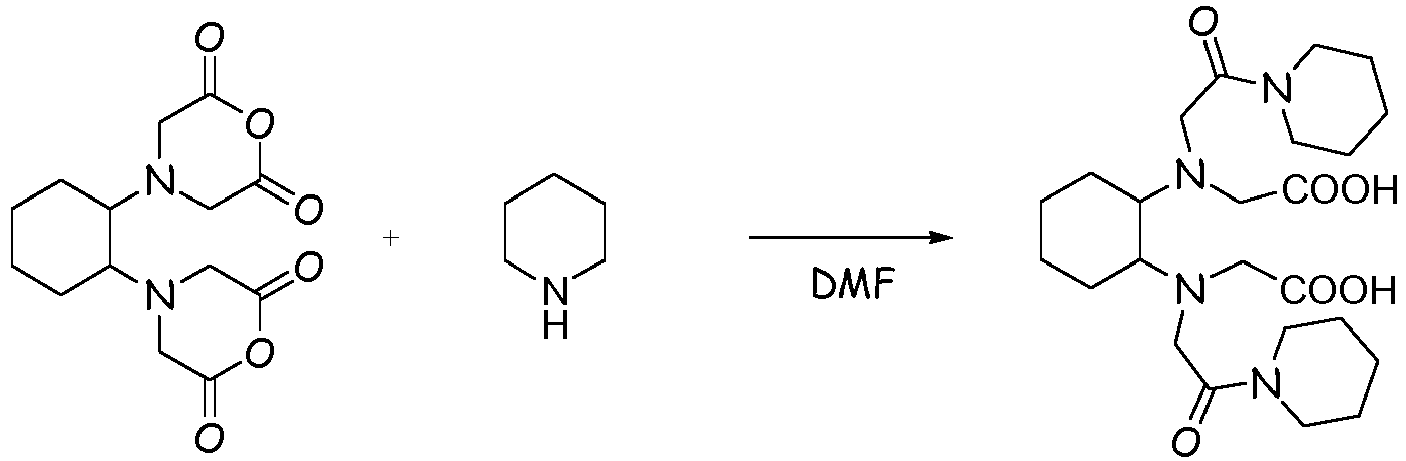
- In detail, 0.264 g (0.000851 mol) of CDTA-dianhydride obtained in Example 1 and 0.29 g (0.00341 mol) of piperidine are mixed in 15 ml of dry DMF under N2 and stirred for 18 hours at 50-60 °C. The reaction mixture is concentrated under reduced pressure and the resulting brownish oil left to crystallize at 4 °C for 48 hours (the product may be precipitated by the addition of acetone, if crystallization does not occur). The crystals are vacuum filtered on a G3 glass frit, washed with 3x5 cm3 cold acetone and dried to constant weight. Yield: 0.16 g (39 %).
Melting point: T= 180-185 °C;
1H NMR [360 MHz, D2O, pD= 12.5] δ 0.8-1.8 (18H, m, 4CH2 ring, 6CH2 piperidine), 2.3 (2H, d, CHCH), 2.7-3.9 (16H, m, 8H NCH2, 8H NCH2 piperidine);
13C NMR [100 MHz, D2O, pD= 12.5] δ 27.5 (2C CH2 ring), 28.9 (4C CH2 piperidine), 29.2 (2C CH2 ring), 29.7 (4C CH2 piperidine), 47.2 (4C CH2 piperidine), 49.8 (2C CON), 64.5 (2C COOH);
IR: 1634 cm-1 (>C=O);
EA (C24H40N4O6 ∗H2O): C, 57.91 %; H, .8.35 % and N, 11.56 %) (expected: C, 57.81 %; H, 8.49 % & N, 11.24 %);
MS (ESI) m/z 481.300(M+H)+ 35%; 503.282(M+Na)+ 100%; 519.250(M+K)+ 13%. - Compound 9 is obtained by using the following synthetic procedure:

- In detail, 0.5 g (0.00161 mol) of CDTA-dianhydride, synthesized in Example 1. step a.), is mixed with 1.06 g, (0.00483 mol, 3 eq.) of benzyl-(piperidine-4-carboxylic acid), synthesized in step a.) in 30 ml of dry DMF under N2 and stirred for 18 hours at 50-60 °C. The reaction mixture is concentrated under reduced pressure and the resulting brown oil is purified with HPLC. (column: Luna 10u-Prep C18(2) 100A (250x21.20 mm; 10 µm)), eluent: ACN:H2O/0.005 M TFA. Yield: 0.46 g (38 %).
Benzyl protecting groups are removed via catalytic hydrogenation. The benzyl-ester is dissolved in 60 cm3 of methanol, argon is bubbled through the solution for 10 minutes and 0.0460 g (10%) of Pd/C catalyst is added. Hydrogenation took place at a pressure of 5 bar in a Parr apparatus for 24 hours at room temperature. The catalyst is filtered out, washed with methanol and the methanol filtrate is evaporated under reduced pressure, resulting in a white solid. Yield: 0.33g (94%).Melting point: T= 143 - 146 °C;
1H NMR [400 MHz, D2O] δ 1.0-1.2 (2H, m, CH2 ring), 1.2-1.5 (4H, m, CH2CH2 ring), 1.6-1.9 (8H, m, 4CH piperidine), 1.9-2.1 (2H, m, CH2 ring), 2.5 (2H, m, CHCOOH), 2.8-4.2 (18H, m, 4H NCH2CON, 4H NCH2COOH, 2H CHCOOH, 8H CH2 piperidine);
13C NMR [100 MHz, D2O] δ 23.5 (2C CH2 ring), 26.6 (2C CH2 ring), 28.7 (4C CH2 piperidine), 41.0 (4C, CH2 piperidine), 41.5 (2C, CHCOOH), 52.7 (2C, NCH2CON), 53.7 (2C, CH ring), 55.5 (2C, NCH2COOH), 167.9 (2C, CON), 173.2 (2C, CH2COOH), 180.0 (2C, CHCOOH;
IR: 3410 cm-1 (COOH), 1720 & 1640 cm-1(>C=O);
MS (ESI) m/z 569.277 (M+H)+ 100%; 591.244 (M+Na)+ 20%; 607.223 (M+K)+ 25%. - Compound 12 is obtained by using the following synthetic procedure:

- In detail, 1.0 g (0.00322 mol) of CDTA-dianhydride obtained in Example 1 and 2.26 g (0.0129 mol, 2.30 cm3, 4 eq.) of 4-benzylpiperidine are mixed in 50 ml dry DMF under N2 and stirred for 18 hours at 50-60 °C. The reaction mixture is concentrated under reduced pressure and the resulting brownish oil is purified by HPLC: (YL9100 HPLC instrument equipped with column: Luna 10u-Prep C18(2) 100A (250x21.20 mm; 10 µm); 0 - 20 % MeCN - H2O gradient elution), eluent: ACN:H2O/TFA-t [ACN: acetonitrile; TFA: trifluoroacetic acid]. TFA is present at 0.005 M concentration in the water only. Yield: 1.02 g (48 %).
Melting point: T= 136 - 139 °C;
1H NMR [360 MHz, CH3CN] δ 1.1-1.9 (16H, m, 4CH2 ring, 4CH2 piperidine), 2.15 (2H, m, CHCH), 2.5-2.7 (6H, m, 2CH2 benzyl, 2CH piperidine), 3.4-4.5 (16H, m, 8H NCH2, 8H NCH2 piperidine), 7.1-7.4 (10H, m, CH aromatic);
13C NMR [100 MHz, CH3CN] δ 27.5 (2C CH2 ring), 28.0 (2C CH piperidine), 35.0 (2C CH2 ring), 39.0 (4C, CH2 piperidine), 41.5 (2C, CH2 benzyl), 46.1 (4C, CH2 piperidine), 47.5 (2C, NCH2CON), 48.5 (2C, NCH2COOH), 66.5 (2C, CH ring) 129.6 (2C, CH aromatic), 132.0 (4C, CH aromatic); 132.8 (4C, CH aromatic), 144.2 (2C, C aromatic), 164.2 (2C, CON), 173.0 (2C, COOH);
IR: 3398 cm-1 (COOH), 1734 cm-1(>C=O), 700 and 750 cm-1 monosubstituated aromatic; 1644 cm-1 (aromatic C=C);
MS (ESI) m/z 661.398 (M+H)+ 15%; 683.382 (M+Na)+ 100%; 705.362 (M+K)+ 25%. - Comparative Compound D is obtained by using the following synthetic procedure:

- In detail, 2.28 g (0.00745 mol) of the CDTA-dianhydride obtained in Example 1 and 3,80 g (0.0520 mol) of butylamine are mixed in 90 ml of dry DMF under N2 and stirred for 18 hours at 50-60 °C. The reaction mixture is concentrated under reduced pressure and the resulting brownish oil left to crystallize at 4 °C for 48 hours (the product may be precipitated by the addition of acetone, if crystallization does not occur). The crystals are vacuum filtered on a G3 glass frit, washed with 3X30 cm3 acetone and dried to constant weight. Yield: 1.93 g (57 %).
Melting point: T= 158-162 °C;
1H NMR [360 MHz, D2O, pD= 12,5] δ 0.87 (6H, t, CH3), 1.09 (4H, broad, CH2 butyl), 1.30 (4H, m, CH2 butyl), 1.47 (4H, m, CH2CH2 ring), 1.66 (2H, broad, CHCH2 ring), 1.94 (2H, broad, CHCH2 ring), 2.43 (2H, broad, CH ring), 3.0 - 3.4 (12H, m, 8H NCH2CO, 4H CONHCH2)
13C NMR [100 MHz, D2O, pD= 12.5] δ 16.8 (2C CH3); 22.3 (2C CH2); 28,94 (2C CH2 ring); 30.5 (2C CH2 ring); 34.3 (2C CH2); 42.6 (2C CH2); 58.8 (2C NCH2COOH); 59.3 (2C NCH2CO); 65.2 (2C CH); 178.7 (2C CONH); 184.0 (2C COOH);
IR: 1644 cm-1 (>C=O) & 3078 cm-1 (>NH);
EA (C22H40N4O6 ∗H2O): C, 56.07 %; H, .8.83 % and N, 11.90 %) (expected: C, 55.68 %; H, 8.83 % & N, 11.90 %);
MS (ESI) m/z 457.299(M+H)+ 50%; 479.281(M+Na)+ 100%; 495.250(M+K)+ 13%. -

- In detail, 1.10 g (0.0102 mol) of 1,2-diaminobenzene, 6.70 cm3 (10.1 g, 0.0605 mol) of ethyl-bromoacetate, 1.30 g (0.00867 mol) of sodium iodide and 8.30 cm3 (6.16 g, 0.0477 mol) of diisopropyl-ethylamine are mixed in 10 cm3 of acetonitrile under N2 and refluxed for 7 hours. The reaction mixture is cooled to room temperature and concentrated under reduced pressure, redissolved in 50 cm3 of water and extracted with 3X40 cm3 of chloroform. The organic phases are combined, dried over Na2SO4, and concentrated under reduced pressure. The resulting brownish oil is purified with flash chromatography:
(column: SiO2, eluent: 10:1 v/v petroleum ether:ethyl-acetate).
Yield: 2.90 g (62 %). - 2.90 g (0,00641 mol) of PhDTA-tetra(ethyl)-ester is dissolved in 40 cm3 of ethanol and a solution of 1.28 g of NaOH (0.0320 mol) made with 5 cm3 of water is added dropwise. The addition of NaOH causes the immediate formation of white precipitate, however the reaction mixture is refluxed for 18 hours to achieve better yield. The crystalline white product is vacuum filtered on a G3 glass frit, redissolved in 2-3 cm3 water and the pH is set with cc. HCl to pH=0-1. The precipitated white substance (acid form of PhDTA) is again vacuum filtered on a G3 glass frit, washed with 3X5 cm3 cold water and dried to constant weight.
Yield: 1.78 g (52 %).
1H NMR [360 MHz, D2O] δ 4.05 (8H, s, NCH2), 7.2-7.4(4H, m, CHCH aromatic);
13C NMR [100 MHz, D2O] δ 57.7 (4C NCH2), 123.2(2C CH ring), 127.6 (2C CH ring), 141.0 (2C C ring), 174.7 (4C CO);
MS (ESI) m/z 481.300(M+H)+ 35%; 503.282(M+Na)+ 100%; 519.250(M+K)+ 13%. -

- 0.45 g (0.00132 mol) of PhDTA, 0.411 g (0.420 ml, 0.00520 mol) of pyridine and 7.50 ml (8.10 g, 0.0793 mol) of acetic anhydride are mixed under N2 and stirred for 18 hours at room temperature. The reaction mixture is added dropwise to diethyl ether, the formed white precipitate is vacuum filtered on a G3 glass frit and dried to constant weight.
Yield: 0.26 g (65%).
1H NMR [360 MHz, DMSO] δ 4.29 (8H, s, NCH2), 6.41(4H, s, CHCH aromatic);
13C NMR [100 MHz, DMSO] δ 61.3 (4C NCH2), 115.2(2C CH ring), 119.2 (2C CH ring), 135.6 (2C C ring), 166.0 (4C CO). - Comparative Compound E (is obtained by using the following synthetic procedure:

- In detail 0.26 g (0.000854 mol) of PhDTA-dianhydride obtained in Example 6, step b.) and 0.29 g (0.00341 mol) of piperidine are mixed in 5 cm3 of dry DMF, under N2 and stirred for 18 hours at 50-60 °C. The resulting white precipitate is filtered on a G3 glass frit and redissolved in 3 cm3 of distilled water. White precipitation occurs when pH is set to 4-5 with concentrated hydrochloric acid, which is filtered once more (on a G3 glass frit), washed with 3X3 cm3 cold distilled water and dried to constant weight under vacuum.
Yield: 0.19 g (47 %).
1H NMR [360 MHz, D2O] δ 1.1-1.5 (12H, m, CH2 piperidine), 3.2 (8H, m, NCH2 piperidine), 3.85 (4H, s, CH2CON), 4.4 (4H, s, CH2COOH), 6.7-6.9 (4H, m, (CH aromatic);
13C NMR [100 MHz, D2O] δ 25.4 (4C CH2 piperidine), 25.6 (2C CH2 piperidine), 44.5 (2C CH2 piperidine), 57.5 (2C NCH2CO), 59.6 (2C NCH2COOH), 115.2 (2C CH aromatic), 119.2 (2C CHCH aromatic), 135.8 (2C, C aromatic), 167.9 (2C CON), 173.2 (2C COOH). - Comparative Compound F is obtained by using the following synthetic procedure:

- In detail, 0.42 g (0.00138mol) of PhDTA-dianhydride, synthesized in Example 6, step b.) and 0.97 g (0.00552 mol) of 4-benzylpiperidine are mixed in 25 cm3 of dry DMF under N2, and stirred for 18 hours at 50-60 °C. The solvent is evaporated under reduced pressure and the product is purified with HPLC (YL9100 HPLC instrument equipped with column: Luna 10u-Prep C18(2) 100A (250x21.20 mm; 10 µm); 0 - 20 % MeCN - H2O gradient elution), eluent: ACN:H2O/0.005 M TFA. Yield: 0.3 g (33 %).
Melting point: T= 96 - 100 °C;
1H NMR [360 MHz, CH3CN] δ 1.1-1.3 (4H, m, CH2 piperidine), 1.6 (4H, m, NCH2 piperidine), 1.8 (2H, m, CHCH ring), 2.6 (4H, d, CH2 benzyl), 3.4 (8H, m, CH2 piperidine), 4.3 (8H, m, 4H NCH2CON, 4H NCH2COOH), 7.1-7.6 (14H, m CH aromatic);
13C NMR [100 MHz, D2O] δ 24.2 (2C CH piperidine), 29.4 (4C CH2 piperidine), 40.7 (2C CH2 benzyl), 42.3 (4C CH2 piperidine), 57.5 (2C NCH2CO), 59.3 (2C NCH2COOH), 115.2 (2C CH aromatic), 119.2 (2C CHCH aromatic), 126.0 (2C CH aromatic), 128.2 (4C CH aromatic), 135.4 (2C, C aromatic), 138.7 (2C CH aromatic), 167.6 (2C CON), 173.2 (2C COOH);
IR: 3404 cm-1 (COOH), 1734 cm-1 (>C=O), 700 & 746 cm-1 aromatic monosubstituted; 1636 cm-1 (aromatic C=C). - The synthesis of Mn(II) complexes requires the use of manganese(II) salts with anions tolerable to the human body (chloride, sulfate, acetate, etc.) Use of MnCl2 is the simplest solution, though the increase of chloride concentration by at least 2 equivalents per molecule, needs to be calculated with. From a medical viewpoint however, reacting MnO or MnCO3 with the acid form of the ligand is the most favorable, as the only byproducts are water and CO2.
- During the synthesis of Mn(II) complexes, it is practical to use 1:1 molar ratio. Ligands and Mn(II) were mixed in 1:1 ratio in concentrations ranging between 0.001-0.05 mol/dm3 at pH 6-8 throughout the laboratory examination of Mn(II) complexes. This range may be expanded, it is both possible to synthesize the complexes on a micromolar scale and to raise concentrations into the 0.1-1.0 mol/dm3 range. The upper limit is of course defined by the solubility of the individual complexes. When choosing the applied concentrations however, the relaxation properties of the complexes must also be considered, as high-relaxivity complexes may allow the use of lower concentration solutions.
- The relaxivity values r1 obtained from some representative compounds according to the invention, in water, both in absence and presence of human serum albumin (HSA), at 25 and 37°C, at 20 MHz, are summarized in the following Table 1, together with the structure of tested compounds, and compared with corresponding values measured for some Comparative Compounds.
Table 1 (relaxivity values r1) Complex T (°C) r 1 (mM-1s-1) r 1 (mM-1s-1) HSA 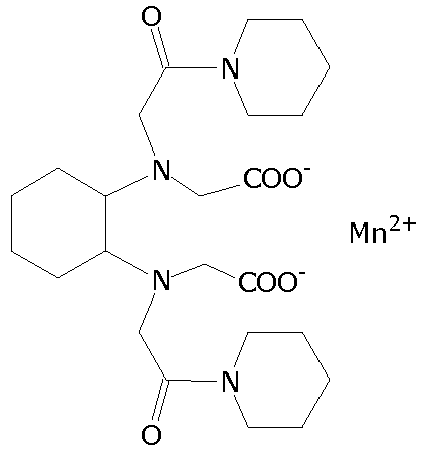
25 4.43 5.63 37 3.49 4.56 Compound 2 Mn(II) complex 
25 4.97 5.98 37 3.75 4.65 Compound 9 Mn(II) complex 
25 5.56 19.44 37 4.17 18.16 Compound 12 Mn(II) complex 
25 3.77 7.64 37 2.95 6.57 Compound A Mn(II) complex (Comparative, Ex. 4 in US 5,693,310 )
25 5.17 6.01 37 3.94 4.44 Compound B Mn(II) complex (Comparative, Ex. 7 in US 5,419,894 )
25 4.37 13.10 37 3.43 9.94 Compound C Mn(II) complex (Comparative, Ex.11 in US 5,693,310 )
25 4.64 6.55 37 3.62 5.37 Compound D Mn(II) complex (Comparative) 
25 4.60 9.09 37 3.50 6.78 Compound E Mn(II) complex (Comparative) 
25 5.29 28.20 37 4.04 23.84 Compound F Mn(II) complex (Comparative) - The half-lives of some representative compounds according to the invention, calculated using the rate constants characterizing the decomplexation of the Mn(II) complexes at 25 °C and pH=7.4, are summarized in the following Table 2, together with the structure of tested compounds, and compared with corresponding values measured for some Comparative Compounds. These studies were performed by following the transmetallation reaction between the Mn2+ based complexes and Cu2+ ions by spectrophotometry as reported in Kálmán, F. K.; Tircsó, G. Inorganic Chemistry (2012), 51, 10065-7.
Table 2 (half-lives) Complex t1/2 (h) 
285 Mn(II) complex of Compound 2 (R,R) 
541 Mn(II) complex of Compound 2 (R,S) 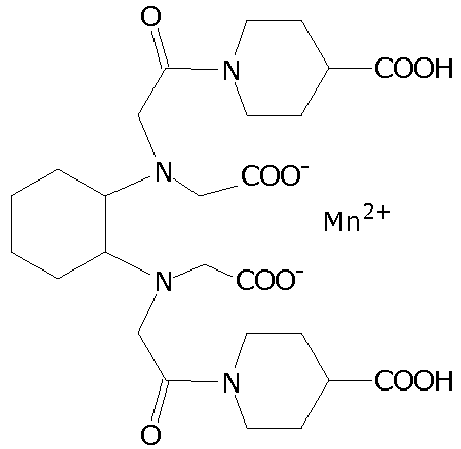
123 Mn(II) complex of Compound 9 (R,R) 
948 Mn(II) complex of Compound 9 (R,S) 
115 Mn(II) complex of Compound 12 (R,R) 
653 Mn(II) complex of Compound 12 (R,S) 
16 Mn(II) complex of Comparative Compound A (R,R) 
201 Mn(II) complex of Comparative Compound A (R,S) 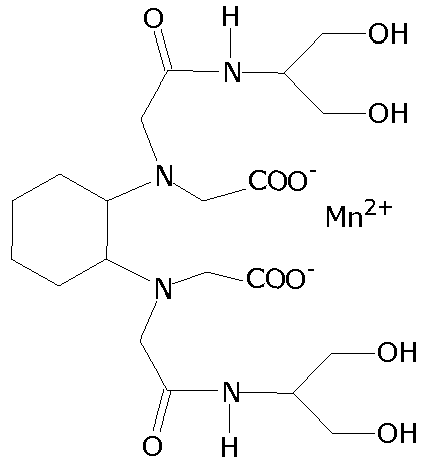
166 Mn(II) complex of Comparative Compound B 
131 Mn(II) complex of Comparative Compound C 
57 Mn(II) complex of Comparative Compound D 
(83)* Mn(II) complex of Comparative Compound E 
(60)* Mn(II) complex of Comparative Compound F *=half-life in seconds - These results confirm that the particular selection represented by the Mn(II) complexes of the compounds of formula (I) of the invention show an increased kinetic inertness, which is at least 2 times the kinetic inertness shown, at the same conditions, by the contrast agents known in the art.
Claims (24)
- A compound of formula (I)
 n is 2;R1 and R2, taken together with the adjacent N atom, form a 5-6 membered unsubstituted aromatic ring; ora 6-7 membered unsubstituted saturated ring; ora 5-7 membered saturated ring substituted (i) by one or more hydroxyls and by one additional group selected from the group consisting of: alkyl, hydroxyalkyl, and cycloalkyl-alkyl; or (ii) by one group selected from the group consisting of: acyl, carboxyl, aminocarbonyl substituted at the aminocarbonyl nitrogen by one polyhydroxyalkyl, Ar, and -Y-Ar, wherein Y is a moiety selected from alkyl, acyl and carbamoyl and Ar is aryl optionally substituted; ora 6 membered heterocycloalkyl ring comprising a second heteroatom, said second heteroatom being substituted by -Y-Ar where Y and Ar are as defined above; ora 8-11 membered saturated bicyclic ring, optionally containing an heteroatom and optionally substituted.
 - The compound according to claim 1 wherein R1 and R2, taken together with the adjacent N atom, form a 5 membered unsubstituted aromatic ring.
- The compound according to claim 1 wherein R1 and R2, taken together with the adjacent N atom, form a 6-7 membered unsubstituted saturated ring.
- The compound according to claim 1 wherein R1 and R2, taken together with the adjacent N atom, form a 6 membered saturated ring substituted by one hydroxyl and one additional moiety selected from the group consisting of: methyl, hydroxymethyl, cyclopentylmethylene and cyclohexylmethylene.
- The compound according to claim 4 wherein the additional moiety is methyl or hydroxymethyl which is in the orto position and the hydroxyl moiety on the saturated ring is in the meta position; or the methyl or hydroxymethyl moiety is in the meta position and the hydroxyl moiety on the saturated ring is in the meta or para position.
- The compound according to claim 1 wherein R1 and R2, taken together with the adjacent N atom, form a 5-6 membered saturated ring substituted by a carboxyl moiety.
- The compound according to claim 1 wherein R1 and R2, taken together with the adjacent N atom, form a 6 membered saturated ring substituted by an aminocarbonyl moiety which is in turn substituted at the aminocarbonyl nitrogen by a polyhydroxyalkyl.
- The compound according to claim 7 wherein the aminocarbonyl moiety on the saturated ring is in the para position and the polyhydroxyalkyl is selected from the group consisting of: -CH(CH2OH)2, -CH2-CH(OH)-CH(OH)-CH(OH)-CH(OH)-CH2(OH) and -CH2-CH(OH)-CH2(OH).
- The compound according to claim 1 wherein R1 and R2, taken together with the adjacent N atom, form a 6 membered saturated ring substituted by Ar or by -Y-Ar wherein Y is methylene (-CH2-), carbonyl (-CO-) or aminocarbonyl (-CO-NH-), and Ar is phenyl.
- The compound according to claim 9 wherein Y is methylene and the phenyl residue is optionally substituted by one or two hydroxyl or by one group selected from nitro, amino, sulphonic or hydroxymethyl.
- The compound according to claims 9 or 10 wherein the saturated ring is substituted in the para position with respect to the N of the saturated ring by phenyl or phenylmethylene, wherein the phenyl residue is unsubstituted or substituted by two hydroxyl moieties in the orto positions.
- The compound according to claim 9 in which Y is carbonyl and the phenyl residue is substituted by one or two hydroxyl; or Y is aminocarbonyl and the phenyl residue is substituted by one or two hydroxyl or by one hydroxyalkyl.
- The compound according to claim 1 in which R1 and R2, taken together with the adjacent N atom, form a 6 membered heterocycloalkyl ring comprising a second N atom, said second N atom being substituted by a sulphonic group or by -Y-Ar wherein Y is carbonyl and Ar is phenyl substituted by one or two hydroxyl moieties.
- The compound according to claim 13 in which the second N atom on the 6 membered heterocycloalkyl ring is in the para position with respect to the adjacent N atom and the two hydroxyl moieties on the phenyl are one in an orto and the other in the para position or both in the orto positions.
- The compound according to claim 1 in which R1 and R2, taken together with the adjacent N atom, form a 10- or 11-membered spiro ring optionally containing O as additional heteroatom.
- The compound according to claim 1 in which R1 and R2, taken together with the adjacent N atom, form a 8-membered bridged ring optionally substituted by one or two hydroxyl moieties.
- The compound according to claim 1 selected from the group consisting of:


- The compound according to claim 17 wherein Compound 2, Compound 9 and Compound 12 are in the R,S diastereoisomeric form.
- The compound of formula (I) according to any one of claims 1-18, in the form of a complex with a Mn(II) ion or of a physiologically acceptable salt thereof.
- The compound of formula (I) as defined in claim 19 for use as a MRI contrast agent.
- A pharmaceutical composition comprising the compound of formula (I) as defined in claim 19 in combination with one or more pharmaceutically acceptable carriers, diluents or excipients.
- A process for the preparation of the compound of formula (I) as defined in claim 19 comprising the following main steps:a) synthesis of CDTA-dianhydride of formula
 b) opening reaction of the CDTA-dianhydride in the presence of a secondary amine to give the corresponding bisamide;c) complexation of the obtained bisamide with a Mn(II) ion and isolation of the Mn(II) complex, or the salt thereof.
 - A method for the in vivo imaging of a human or animal body organ, tissue or region by use of the MRI technique that comprises the steps of:a) submitting a human or animal pre-administered with a composition comprising the compound of claim 19 and positioned in a MRI imaging system, to a radiation frequency selected to excite the non-zero proton spin nuclei of the active paramagnetic substrate; andb) recording a MR signal from said excited nuclei.
- A method for the in vitro (ex vivo) imaging of biological samples, including cells, biological fluids and biological tissues originating from a live mammal patient, e.g. a human patient, by use of the MRI technique, that comprises contacting an effective amount of the Mn(II) complex of claim 19 with the biological sample of interest and then obtaining MRI signals from said samples by use of the MRI technique.
Applications Claiming Priority (3)
| Application Number | Priority Date | Filing Date | Title |
|---|---|---|---|
| HU1500076A HUP1500076A2 (en) | 2015-02-25 | 2015-02-25 | New, substituted ethylenediamine-tetraacetic acid-bis-amide derivatives and their application as mn(ii) based mri contrast agent ligand |
| PCT/HU2015/000074 WO2016135523A1 (en) | 2015-02-25 | 2015-11-23 | New substituted ethylene-diamine-tetraacetic-acid-bis(amide) derivatives and use thereof as ligand containing mn (ii) of mri contrast agent |
| PCT/EP2016/053960 WO2016135234A1 (en) | 2015-02-25 | 2016-02-25 | Ethylenediaminetetraacetic acid bis(amide) derivatives and their respective complexes with mn(ii) ion for use as mri contrast agent |
Publications (2)
| Publication Number | Publication Date |
|---|---|
| EP3262033A1 EP3262033A1 (en) | 2018-01-03 |
| EP3262033B1 true EP3262033B1 (en) | 2020-08-26 |
Family
ID=89991743
Family Applications (1)
| Application Number | Title | Priority Date | Filing Date |
|---|---|---|---|
| EP16706597.8A Active EP3262033B1 (en) | 2015-02-25 | 2016-02-25 | Ethylenediaminetetraacetic acid bis(amide) derivatives and their respective complexes with mn(ii) ion for use as mri contrast agent |
Country Status (10)
| Country | Link |
|---|---|
| US (1) | US10265422B2 (en) |
| EP (1) | EP3262033B1 (en) |
| JP (1) | JP6826989B2 (en) |
| CN (1) | CN107428684B (en) |
| AU (1) | AU2016223419B2 (en) |
| BR (1) | BR112017017959B1 (en) |
| CA (1) | CA2973643C (en) |
| ES (1) | ES2819529T3 (en) |
| HU (2) | HUP1500076A2 (en) |
| WO (2) | WO2016135523A1 (en) |
Families Citing this family (2)
| Publication number | Priority date | Publication date | Assignee | Title |
|---|---|---|---|---|
| FR3140634B1 (en) | 2022-10-06 | 2026-02-13 | Commissariat Energie Atomique | USE OF LIPOPHILE DERIVATIVES OF AMINOPOLYCARBOXYL ACIDS FOR THE EXTRACTION OF RARE EARTHS FROM AN ACID AQUEOUS SOLUTION |
| CN115634295B (en) * | 2022-10-18 | 2026-02-17 | 中国科学院深圳先进技术研究院 | A near-infrared fluorescence/magnetic resonance dual-mode probe, its preparation method and application |
Family Cites Families (9)
| Publication number | Priority date | Publication date | Assignee | Title |
|---|---|---|---|---|
| DE3324235A1 (en) * | 1983-07-01 | 1985-01-10 | Schering AG, 1000 Berlin und 4709 Bergkamen | NEW COMPLEX ILLUMINATORS, COMPLEX AND COMPLEX SALTS |
| IL83966A (en) * | 1986-09-26 | 1992-03-29 | Schering Ag | Amides of aminopolycarboxylic acids and pharmaceutical compositions containing them |
| GB9007965D0 (en) * | 1990-04-09 | 1990-06-06 | Nycomed As | Compounds |
| EP0490897A1 (en) * | 1989-09-05 | 1992-06-24 | Mallinckrodt, Inc. | Novel magnetic resonance imaging agents |
| JP2670903B2 (en) * | 1990-05-17 | 1997-10-29 | 富士写真フイルム株式会社 | Silver halide color photographic light-sensitive material processing composition and processing method |
| GB9027922D0 (en) * | 1990-12-21 | 1991-02-13 | Nycomed As | Compounds |
| US5312617A (en) * | 1991-05-23 | 1994-05-17 | Unger Evan C | Liposoluble compounds useful as magnetic resonance imaging agents |
| WO1995015319A1 (en) * | 1993-12-03 | 1995-06-08 | Bracco S.P.A. | Paramagnetic chelates for nuclear magnetic resonance diagnosis |
| DE19603033A1 (en) * | 1996-01-19 | 1997-07-24 | Schering Ag | Perfluoroalkyl-containing metal complexes, processes for their preparation and their use in NMR diagnostics |
-
2015
- 2015-02-25 HU HU1500076A patent/HUP1500076A2/en unknown
- 2015-11-23 WO PCT/HU2015/000074 patent/WO2016135523A1/en not_active Ceased
-
2016
- 2016-02-25 WO PCT/EP2016/053960 patent/WO2016135234A1/en not_active Ceased
- 2016-02-25 HU HUE16706597A patent/HUE050765T2/en unknown
- 2016-02-25 US US15/551,612 patent/US10265422B2/en active Active
- 2016-02-25 AU AU2016223419A patent/AU2016223419B2/en active Active
- 2016-02-25 BR BR112017017959-8A patent/BR112017017959B1/en active IP Right Grant
- 2016-02-25 ES ES16706597T patent/ES2819529T3/en active Active
- 2016-02-25 JP JP2017544912A patent/JP6826989B2/en active Active
- 2016-02-25 CA CA2973643A patent/CA2973643C/en active Active
- 2016-02-25 CN CN201680010620.0A patent/CN107428684B/en active Active
- 2016-02-25 EP EP16706597.8A patent/EP3262033B1/en active Active
Non-Patent Citations (1)
| Title |
|---|
| None * |
Also Published As
| Publication number | Publication date |
|---|---|
| CN107428684A (en) | 2017-12-01 |
| WO2016135234A1 (en) | 2016-09-01 |
| JP2018507862A (en) | 2018-03-22 |
| WO2016135523A1 (en) | 2016-09-01 |
| AU2016223419A1 (en) | 2017-07-27 |
| CA2973643C (en) | 2021-10-19 |
| CA2973643A1 (en) | 2016-09-01 |
| HUE050765T2 (en) | 2021-01-28 |
| US20180036436A1 (en) | 2018-02-08 |
| JP6826989B2 (en) | 2021-02-10 |
| BR112017017959B1 (en) | 2021-11-03 |
| CN107428684B (en) | 2024-04-26 |
| BR112017017959A2 (en) | 2018-07-17 |
| AU2016223419B2 (en) | 2020-02-27 |
| ES2819529T3 (en) | 2021-04-16 |
| EP3262033A1 (en) | 2018-01-03 |
| HUP1500076A2 (en) | 2016-09-28 |
| US10265422B2 (en) | 2019-04-23 |
Similar Documents
| Publication | Publication Date | Title |
|---|---|---|
| US11401262B2 (en) | Dimeric contrast agents | |
| US11021451B2 (en) | Contrast agents | |
| EP3551614B1 (en) | Dimeric contrast agents | |
| AU2016223419B2 (en) | Ethylenediaminetetraacetic acid bis(amide) derivatives and their respective complexes with Mn(II) ion for use as MRI contrast agent | |
| EP3386953B1 (en) | Contrast agents |
Legal Events
| Date | Code | Title | Description |
|---|---|---|---|
| STAA | Information on the status of an ep patent application or granted ep patent |
Free format text: STATUS: THE INTERNATIONAL PUBLICATION HAS BEEN MADE |
|
| PUAI | Public reference made under article 153(3) epc to a published international application that has entered the european phase |
Free format text: ORIGINAL CODE: 0009012 |
|
| STAA | Information on the status of an ep patent application or granted ep patent |
Free format text: STATUS: REQUEST FOR EXAMINATION WAS MADE |
|
| 17P | Request for examination filed |
Effective date: 20170913 |
|
| AK | Designated contracting states |
Kind code of ref document: A1 Designated state(s): AL AT BE BG CH CY CZ DE DK EE ES FI FR GB GR HR HU IE IS IT LI LT LU LV MC MK MT NL NO PL PT RO RS SE SI SK SM TR |
|
| AX | Request for extension of the european patent |
Extension state: BA ME |
|
| DAV | Request for validation of the european patent (deleted) | ||
| DAX | Request for extension of the european patent (deleted) | ||
| STAA | Information on the status of an ep patent application or granted ep patent |
Free format text: STATUS: EXAMINATION IS IN PROGRESS |
|
| 17Q | First examination report despatched |
Effective date: 20180829 |
|
| GRAJ | Information related to disapproval of communication of intention to grant by the applicant or resumption of examination proceedings by the epo deleted |
Free format text: ORIGINAL CODE: EPIDOSDIGR1 |
|
| GRAP | Despatch of communication of intention to grant a patent |
Free format text: ORIGINAL CODE: EPIDOSNIGR1 |
|
| RIC1 | Information provided on ipc code assigned before grant |
Ipc: C07D 211/62 20060101ALI20200316BHEP Ipc: C07D 211/16 20060101ALI20200316BHEP Ipc: C07D 221/22 20060101ALI20200316BHEP Ipc: C07D 207/06 20060101ALI20200316BHEP Ipc: C07D 295/192 20060101ALI20200316BHEP Ipc: C07D 403/12 20060101ALI20200316BHEP Ipc: A61K 49/10 20060101ALI20200316BHEP Ipc: C07D 211/42 20060101ALI20200316BHEP Ipc: C07D 211/48 20060101ALI20200316BHEP Ipc: C07D 401/12 20060101AFI20200316BHEP Ipc: C07D 471/08 20060101ALI20200316BHEP Ipc: C07D 211/46 20060101ALI20200316BHEP |
|
| GRAJ | Information related to disapproval of communication of intention to grant by the applicant or resumption of examination proceedings by the epo deleted |
Free format text: ORIGINAL CODE: EPIDOSDIGR1 |
|
| GRAP | Despatch of communication of intention to grant a patent |
Free format text: ORIGINAL CODE: EPIDOSNIGR1 |
|
| GRAP | Despatch of communication of intention to grant a patent |
Free format text: ORIGINAL CODE: EPIDOSNIGR1 |
|
| STAA | Information on the status of an ep patent application or granted ep patent |
Free format text: STATUS: GRANT OF PATENT IS INTENDED |
|
| INTG | Intention to grant announced |
Effective date: 20200424 |
|
| INTG | Intention to grant announced |
Effective date: 20200504 |
|
| INTG | Intention to grant announced |
Effective date: 20200512 |
|
| GRAS | Grant fee paid |
Free format text: ORIGINAL CODE: EPIDOSNIGR3 |
|
| GRAA | (expected) grant |
Free format text: ORIGINAL CODE: 0009210 |
|
| STAA | Information on the status of an ep patent application or granted ep patent |
Free format text: STATUS: THE PATENT HAS BEEN GRANTED |
|
| AK | Designated contracting states |
Kind code of ref document: B1 Designated state(s): AL AT BE BG CH CY CZ DE DK EE ES FI FR GB GR HR HU IE IS IT LI LT LU LV MC MK MT NL NO PL PT RO RS SE SI SK SM TR |
|
| REG | Reference to a national code |
Ref country code: GB Ref legal event code: FG4D |
|
| REG | Reference to a national code |
Ref country code: CH Ref legal event code: EP |
|
| REG | Reference to a national code |
Ref country code: AT Ref legal event code: REF Ref document number: 1306255 Country of ref document: AT Kind code of ref document: T Effective date: 20200915 |
|
| REG | Reference to a national code |
Ref country code: IE Ref legal event code: FG4D |
|
| REG | Reference to a national code |
Ref country code: DE Ref legal event code: R096 Ref document number: 602016042680 Country of ref document: DE |
|
| REG | Reference to a national code |
Ref country code: SE Ref legal event code: TRGR |
|
| REG | Reference to a national code |
Ref country code: NL Ref legal event code: FP |
|
| REG | Reference to a national code |
Ref country code: LT Ref legal event code: MG4D |
|
| REG | Reference to a national code |
Ref country code: HU Ref legal event code: AG4A Ref document number: E050765 Country of ref document: HU |
|
| PG25 | Lapsed in a contracting state [announced via postgrant information from national office to epo] |
Ref country code: GR Free format text: LAPSE BECAUSE OF FAILURE TO SUBMIT A TRANSLATION OF THE DESCRIPTION OR TO PAY THE FEE WITHIN THE PRESCRIBED TIME-LIMIT Effective date: 20201127 Ref country code: NO Free format text: LAPSE BECAUSE OF FAILURE TO SUBMIT A TRANSLATION OF THE DESCRIPTION OR TO PAY THE FEE WITHIN THE PRESCRIBED TIME-LIMIT Effective date: 20201126 Ref country code: LT Free format text: LAPSE BECAUSE OF FAILURE TO SUBMIT A TRANSLATION OF THE DESCRIPTION OR TO PAY THE FEE WITHIN THE PRESCRIBED TIME-LIMIT Effective date: 20200826 Ref country code: BG Free format text: LAPSE BECAUSE OF FAILURE TO SUBMIT A TRANSLATION OF THE DESCRIPTION OR TO PAY THE FEE WITHIN THE PRESCRIBED TIME-LIMIT Effective date: 20201126 Ref country code: HR Free format text: LAPSE BECAUSE OF FAILURE TO SUBMIT A TRANSLATION OF THE DESCRIPTION OR TO PAY THE FEE WITHIN THE PRESCRIBED TIME-LIMIT Effective date: 20200826 Ref country code: PT Free format text: LAPSE BECAUSE OF FAILURE TO SUBMIT A TRANSLATION OF THE DESCRIPTION OR TO PAY THE FEE WITHIN THE PRESCRIBED TIME-LIMIT Effective date: 20201228 Ref country code: FI Free format text: LAPSE BECAUSE OF FAILURE TO SUBMIT A TRANSLATION OF THE DESCRIPTION OR TO PAY THE FEE WITHIN THE PRESCRIBED TIME-LIMIT Effective date: 20200826 |
|
| REG | Reference to a national code |
Ref country code: AT Ref legal event code: MK05 Ref document number: 1306255 Country of ref document: AT Kind code of ref document: T Effective date: 20200826 |
|
| PG25 | Lapsed in a contracting state [announced via postgrant information from national office to epo] |
Ref country code: IS Free format text: LAPSE BECAUSE OF FAILURE TO SUBMIT A TRANSLATION OF THE DESCRIPTION OR TO PAY THE FEE WITHIN THE PRESCRIBED TIME-LIMIT Effective date: 20201226 Ref country code: PL Free format text: LAPSE BECAUSE OF FAILURE TO SUBMIT A TRANSLATION OF THE DESCRIPTION OR TO PAY THE FEE WITHIN THE PRESCRIBED TIME-LIMIT Effective date: 20200826 Ref country code: RS Free format text: LAPSE BECAUSE OF FAILURE TO SUBMIT A TRANSLATION OF THE DESCRIPTION OR TO PAY THE FEE WITHIN THE PRESCRIBED TIME-LIMIT Effective date: 20200826 Ref country code: LV Free format text: LAPSE BECAUSE OF FAILURE TO SUBMIT A TRANSLATION OF THE DESCRIPTION OR TO PAY THE FEE WITHIN THE PRESCRIBED TIME-LIMIT Effective date: 20200826 |
|
| REG | Reference to a national code |
Ref country code: ES Ref legal event code: FG2A Ref document number: 2819529 Country of ref document: ES Kind code of ref document: T3 Effective date: 20210416 |
|
| PG25 | Lapsed in a contracting state [announced via postgrant information from national office to epo] |
Ref country code: EE Free format text: LAPSE BECAUSE OF FAILURE TO SUBMIT A TRANSLATION OF THE DESCRIPTION OR TO PAY THE FEE WITHIN THE PRESCRIBED TIME-LIMIT Effective date: 20200826 Ref country code: SM Free format text: LAPSE BECAUSE OF FAILURE TO SUBMIT A TRANSLATION OF THE DESCRIPTION OR TO PAY THE FEE WITHIN THE PRESCRIBED TIME-LIMIT Effective date: 20200826 Ref country code: RO Free format text: LAPSE BECAUSE OF FAILURE TO SUBMIT A TRANSLATION OF THE DESCRIPTION OR TO PAY THE FEE WITHIN THE PRESCRIBED TIME-LIMIT Effective date: 20200826 Ref country code: CZ Free format text: LAPSE BECAUSE OF FAILURE TO SUBMIT A TRANSLATION OF THE DESCRIPTION OR TO PAY THE FEE WITHIN THE PRESCRIBED TIME-LIMIT Effective date: 20200826 Ref country code: DK Free format text: LAPSE BECAUSE OF FAILURE TO SUBMIT A TRANSLATION OF THE DESCRIPTION OR TO PAY THE FEE WITHIN THE PRESCRIBED TIME-LIMIT Effective date: 20200826 |
|
| REG | Reference to a national code |
Ref country code: DE Ref legal event code: R097 Ref document number: 602016042680 Country of ref document: DE |
|
| PG25 | Lapsed in a contracting state [announced via postgrant information from national office to epo] |
Ref country code: AT Free format text: LAPSE BECAUSE OF FAILURE TO SUBMIT A TRANSLATION OF THE DESCRIPTION OR TO PAY THE FEE WITHIN THE PRESCRIBED TIME-LIMIT Effective date: 20200826 Ref country code: AL Free format text: LAPSE BECAUSE OF FAILURE TO SUBMIT A TRANSLATION OF THE DESCRIPTION OR TO PAY THE FEE WITHIN THE PRESCRIBED TIME-LIMIT Effective date: 20200826 |
|
| PG25 | Lapsed in a contracting state [announced via postgrant information from national office to epo] |
Ref country code: SK Free format text: LAPSE BECAUSE OF FAILURE TO SUBMIT A TRANSLATION OF THE DESCRIPTION OR TO PAY THE FEE WITHIN THE PRESCRIBED TIME-LIMIT Effective date: 20200826 |
|
| PLBE | No opposition filed within time limit |
Free format text: ORIGINAL CODE: 0009261 |
|
| STAA | Information on the status of an ep patent application or granted ep patent |
Free format text: STATUS: NO OPPOSITION FILED WITHIN TIME LIMIT |
|
| 26N | No opposition filed |
Effective date: 20210527 |
|
| PG25 | Lapsed in a contracting state [announced via postgrant information from national office to epo] |
Ref country code: SI Free format text: LAPSE BECAUSE OF FAILURE TO SUBMIT A TRANSLATION OF THE DESCRIPTION OR TO PAY THE FEE WITHIN THE PRESCRIBED TIME-LIMIT Effective date: 20200826 |
|
| PG25 | Lapsed in a contracting state [announced via postgrant information from national office to epo] |
Ref country code: MC Free format text: LAPSE BECAUSE OF FAILURE TO SUBMIT A TRANSLATION OF THE DESCRIPTION OR TO PAY THE FEE WITHIN THE PRESCRIBED TIME-LIMIT Effective date: 20200826 |
|
| PG25 | Lapsed in a contracting state [announced via postgrant information from national office to epo] |
Ref country code: LU Free format text: LAPSE BECAUSE OF NON-PAYMENT OF DUE FEES Effective date: 20210225 |
|
| PG25 | Lapsed in a contracting state [announced via postgrant information from national office to epo] |
Ref country code: CY Free format text: LAPSE BECAUSE OF FAILURE TO SUBMIT A TRANSLATION OF THE DESCRIPTION OR TO PAY THE FEE WITHIN THE PRESCRIBED TIME-LIMIT Effective date: 20200826 |
|
| PG25 | Lapsed in a contracting state [announced via postgrant information from national office to epo] |
Ref country code: MK Free format text: LAPSE BECAUSE OF FAILURE TO SUBMIT A TRANSLATION OF THE DESCRIPTION OR TO PAY THE FEE WITHIN THE PRESCRIBED TIME-LIMIT Effective date: 20200826 |
|
| PG25 | Lapsed in a contracting state [announced via postgrant information from national office to epo] |
Ref country code: TR Free format text: LAPSE BECAUSE OF FAILURE TO SUBMIT A TRANSLATION OF THE DESCRIPTION OR TO PAY THE FEE WITHIN THE PRESCRIBED TIME-LIMIT Effective date: 20200826 |
|
| PG25 | Lapsed in a contracting state [announced via postgrant information from national office to epo] |
Ref country code: MT Free format text: LAPSE BECAUSE OF FAILURE TO SUBMIT A TRANSLATION OF THE DESCRIPTION OR TO PAY THE FEE WITHIN THE PRESCRIBED TIME-LIMIT Effective date: 20200826 |
|
| REG | Reference to a national code |
Ref country code: CH Ref legal event code: U11 Free format text: ST27 STATUS EVENT CODE: U-0-0-U10-U11 (AS PROVIDED BY THE NATIONAL OFFICE) Effective date: 20260301 |
|
| PGFP | Annual fee paid to national office [announced via postgrant information from national office to epo] |
Ref country code: NL Payment date: 20260226 Year of fee payment: 11 |
|
| PGFP | Annual fee paid to national office [announced via postgrant information from national office to epo] |
Ref country code: HU Payment date: 20260209 Year of fee payment: 11 |
|
| PGFP | Annual fee paid to national office [announced via postgrant information from national office to epo] |
Ref country code: SE Payment date: 20260227 Year of fee payment: 11 |
|
| PGFP | Annual fee paid to national office [announced via postgrant information from national office to epo] |
Ref country code: GB Payment date: 20260227 Year of fee payment: 11 |
|
| PGFP | Annual fee paid to national office [announced via postgrant information from national office to epo] |
Ref country code: ES Payment date: 20260302 Year of fee payment: 11 |
|
| PGFP | Annual fee paid to national office [announced via postgrant information from national office to epo] |
Ref country code: DE Payment date: 20260227 Year of fee payment: 11 Ref country code: IE Payment date: 20260227 Year of fee payment: 11 |
|
| PGFP | Annual fee paid to national office [announced via postgrant information from national office to epo] |
Ref country code: BE Payment date: 20260227 Year of fee payment: 11 Ref country code: IT Payment date: 20260219 Year of fee payment: 11 |
|
| PGFP | Annual fee paid to national office [announced via postgrant information from national office to epo] |
Ref country code: FR Payment date: 20260225 Year of fee payment: 11 |
|
| PGFP | Annual fee paid to national office [announced via postgrant information from national office to epo] |
Ref country code: CH Payment date: 20260301 Year of fee payment: 11 |