EP3261452B1 - Novel thermotolerant lactobacillus - Google Patents
Novel thermotolerant lactobacillus Download PDFInfo
- Publication number
- EP3261452B1 EP3261452B1 EP16705781.9A EP16705781A EP3261452B1 EP 3261452 B1 EP3261452 B1 EP 3261452B1 EP 16705781 A EP16705781 A EP 16705781A EP 3261452 B1 EP3261452 B1 EP 3261452B1
- Authority
- EP
- European Patent Office
- Prior art keywords
- strain
- lactobacillus
- milk
- lactis
- lactobacillus delbrueckii
- Prior art date
- Legal status (The legal status is an assumption and is not a legal conclusion. Google has not performed a legal analysis and makes no representation as to the accuracy of the status listed.)
- Active
Links
Images



Classifications
-
- A—HUMAN NECESSITIES
- A23—FOODS OR FOODSTUFFS; TREATMENT THEREOF, NOT COVERED BY OTHER CLASSES
- A23C—DAIRY PRODUCTS, e.g. MILK, BUTTER OR CHEESE; MILK OR CHEESE SUBSTITUTES; PREPARATION THEREOF
- A23C19/00—Cheese; Cheese preparations; Making thereof
- A23C19/02—Making cheese curd
- A23C19/032—Making cheese curd characterised by the use of specific microorganisms, or enzymes of microbial origin
- A23C19/0323—Making cheese curd characterised by the use of specific microorganisms, or enzymes of microbial origin using only lactic acid bacteria, e.g. Pediococcus and Leuconostoc species; Bifidobacteria; Microbial starters in general
-
- C—CHEMISTRY; METALLURGY
- C12—BIOCHEMISTRY; BEER; SPIRITS; WINE; VINEGAR; MICROBIOLOGY; ENZYMOLOGY; MUTATION OR GENETIC ENGINEERING
- C12N—MICROORGANISMS OR ENZYMES; COMPOSITIONS THEREOF; PROPAGATING, PRESERVING, OR MAINTAINING MICROORGANISMS; MUTATION OR GENETIC ENGINEERING; CULTURE MEDIA
- C12N1/00—Microorganisms; Compositions thereof; Processes of propagating, maintaining or preserving microorganisms or compositions thereof; Processes of preparing or isolating a composition containing a microorganism; Culture media therefor
- C12N1/20—Bacteria; Culture media therefor
-
- C—CHEMISTRY; METALLURGY
- C12—BIOCHEMISTRY; BEER; SPIRITS; WINE; VINEGAR; MICROBIOLOGY; ENZYMOLOGY; MUTATION OR GENETIC ENGINEERING
- C12N—MICROORGANISMS OR ENZYMES; COMPOSITIONS THEREOF; PROPAGATING, PRESERVING, OR MAINTAINING MICROORGANISMS; MUTATION OR GENETIC ENGINEERING; CULTURE MEDIA
- C12N1/00—Microorganisms; Compositions thereof; Processes of propagating, maintaining or preserving microorganisms or compositions thereof; Processes of preparing or isolating a composition containing a microorganism; Culture media therefor
- C12N1/20—Bacteria; Culture media therefor
- C12N1/205—Bacterial isolates
-
- A—HUMAN NECESSITIES
- A23—FOODS OR FOODSTUFFS; TREATMENT THEREOF, NOT COVERED BY OTHER CLASSES
- A23V—INDEXING SCHEME RELATING TO FOODS, FOODSTUFFS OR NON-ALCOHOLIC BEVERAGES AND LACTIC OR PROPIONIC ACID BACTERIA USED IN FOODSTUFFS OR FOOD PREPARATION
- A23V2400/00—Lactic or propionic acid bacteria
- A23V2400/11—Lactobacillus
- A23V2400/137—Delbrueckii
-
- C—CHEMISTRY; METALLURGY
- C12—BIOCHEMISTRY; BEER; SPIRITS; WINE; VINEGAR; MICROBIOLOGY; ENZYMOLOGY; MUTATION OR GENETIC ENGINEERING
- C12R—INDEXING SCHEME ASSOCIATED WITH SUBCLASSES C12C - C12Q, RELATING TO MICROORGANISMS
- C12R2001/00—Microorganisms ; Processes using microorganisms
- C12R2001/01—Bacteria or Actinomycetales ; using bacteria or Actinomycetales
- C12R2001/225—Lactobacillus
Definitions
- the present invention relates to a thermotolerant Lactobacillus delbrueckii subsp. lactis DSM 32009 strain that can be used in the production of cheese where curd cooking at high temperature (>50°C) is a part of the cheese manufacturing process, such as e.g. Grana and Emmental cheese.
- the curd-whey mixture is often heated in order to promote syneresis.
- the step is referred to as scalding or cooking.
- the temperature used is different for each cheese variety.
- this temperature is high, usually in the range of 52 to 55°C.
- Such high temperatures can have a negative consequence on syneresis and cheese quality as they can kill or strongly inhibit the growth of the starter culture, thus resulting in poor acidification of the curd.
- it is important that the starter culture is composed of thermophilic strains that can survive the high temperature cooking step. Strains that can grow and acidify at high temperature would also be a clear advantage.
- Lactobacillus delbrueckii subsp. lactis can acidify milk at a temperature ⁇ 50°C and consequently perform satisfactory in the temperature profile used for the production of whey starter for manufacture of Grana Padano cheese.
- the strain is assigned the deposit number: DSM 32009.
- an aspect of the present invention relates to the use of a Lactobacillus delbrueckii subsp. lactis DSM 32009 strain, that can acidify milk at high temperature, in a cheese making process that involves a high temperature cooking step (>50°C).
- the present invention relates to a process for producing cheese, which comprises adding to milk a starter culture comprising an acidifying strain belonging to the genus Lactobacillus and heating the mixture to a temperature (or maintaining the temperature) in the range of 45°C to 65°C, such as in the range 50°C to 60°C or in the range 53-54°C, such as e.g. 54°C.
- the present invention relates to a process for producing cheese, which comprises adding to milk a starter culture comprising an acidifying strain belonging to the genus Lactobacillus and heating the mixture to a temperature (or maintaining the temperature) in the range of 45°C to 65°C, such as in the range 50°C to 60°C or in the range 53-54°C, such as e.g. 54°C and adding to mixture one or more bacterial strains or cultures, such as e.g. adjunct cultures and optionally one or more coagulants.
- the acidifying Lactobacillus is able to acidify the milk by at least 0.4 pH units in 2.5 hours at a temperature around 50 °C when inoculated with a 3% whey starter culture.
- the acidifying strain of Lactobacillus is a Lactobacillus delbrueckii subsp. lactis strain deposited as DSM 32009, or a mutant thereof.
- the starter culture further comprise one or more bacterial strains selected from the list consisting of: Lactococcus lactis, Leuconostoc mesenteroides, Pediococcus pentosaceus, Lactobacillus casei, Lactobacillus paracasei, Streptococcus ther mophilus, Enterococcus faecium, Lactobacillus delbrueckii subsp. bulgaricus, Lactobacillus delbrueckii subsp. lactis, Lactobacillus helveticus spp, Lactobacillus acidophilus or Propionibacterium.
- bacterial strains selected from the list consisting of: Lactococcus lactis, Leuconostoc mesenteroides, Pediococcus pentosaceus, Lactobacillus casei, Lactobacillus paracasei, Streptococcus ther mophilus, Enterococcus fae
- the one or more coagulants is selected from the list comprising: bovine derived coagulants or variants thereof, microbial derived coagulants or variants thereof, camel derived coagulants or variants thereof, rennets and chymosins.
- the starter culture is a whey starter culture and in related embodiments the whey starter culture may be subject to the physical conditions comprising: 1) a temperature drop from around 48°C to around 39°C in 9 hours, 2) a constant temperature of around 39°C for around 8 hours, 3) cooling and storing at around 16°C until it is used for milk acidification.
- the starter culture and or one or more bacterial strains is added as a direct vat set (DVS) culture, such as e.g. a frozen direct vat set (F-DVS) culture or a freeze-dried direct vat set (FD-DVS) culture.
- DVS direct vat set
- the DVS culture may be added to a whey starter and/or directly to the milk. If added to the whey, the acidifying strain belonging to the genus Lactobacillus may be added in an amount of at least 5x10 10 CFU/500liter whey.
- the process of present invention may further comprise adding one or more bacterial strains or cultures, such as e.g. adjunct cultures such as e.g. Propionibacterium to the milk.
- one or more bacterial strains or cultures such as e.g. adjunct cultures such as e.g. Propionibacterium to the milk.
- the process of present invention may further comprise the necessary actions needed to produce a cheese.
- a cheese including a low-fat cheese
- the present invention also relate to a cheese (including a low-fat cheese) obtainable by the process of any of the aspect disclosed herein. More specifically the may be a Grana type cheese such as e.g. a Grana Padano, Pgiano Reggiano or alternatively of the Emmental type.
- the invention also relate to an acidifying Lactobacillus delbrueckii subsp. lactis strain deposited as DSM 32009 or any mutant thereof. If commercially relevant, the acidifying strain of Lactobacillus may be modified by the act of man.
- the Lactobacillus of present invention may be forming part of a mixture with desired properties.
- the present invention also relates to a composition comprising the acidifying Lactobacillus delbrueckii as described in present disclosure.
- Such composition may comprise one or more excipients such as e.g. polyhydroxy compounds such as e.g. sugars, polyalcohols and glycols and their derivatives, trehalose and dimethyl sulfoxide (DMSO).
- excipients such as e.g. polyhydroxy compounds such as e.g. sugars, polyalcohols and glycols and their derivatives, trehalose and dimethyl sulfoxide (DMSO).
- the composition may be a direct vat set (DVS) starter culture composition, such as e.g. a frozen direct vat set (F-DVS) starter culture composition or a freeze-dried direct vat set (FD-DVS) starter culture composition.
- DVS starter culture may be added to a whey starter.
- the DVS starter culture composition comprises at least 1x10 10 CFU/g.
- the starter culture is added to the milk in an amount sufficient to facilitate acidification of the milk by at least 0.4 pH units in 2.5 hours at a temperature around 50°C.
- the invention also relate to the use of the acidifying Lactobacillus delbrueckii subsp. lactis strain DSM32009 in a process for making cheese, such as e.g. Grana or Emmental type cheese as well as a composition as described in the aspects herein, in a process for making cheese, such as e.g. Grana or Emmental type cheese.
- milk is understood a composition comprising lacteal secretion obtained from any mammal, such as an animal of a species belonging to the subfamily Bovinae (which includes the domestic cow ( Bos taurus ) and buffalo); an animal of a species belonging to the subfamily Caprinae (which includes goat and sheep); or an animal of the species Camelidae (which includes camels).
- the milk is acidified, e.g. by addition of an acid (such as citric, acetic or lactic acid) or by addition of an acid producing microorganism.
- the milk may be raw or processed, e.g. by filtering, sterilizing, pasteurizing, homogenizing, fractionating (e.g.
- milk according to the present invention is pasteurized cow's milk. It is understood that the milk may be acidified, mixed or processed before, during and/or after the adding of bacterial cultures.
- milk also comprises milk with protein, calcium or other additives added.
- cheese refers to a product prepared by contacting optionally acidified milk (e.g. by means of a lactic acid bacterial culture) with a coagulant, and draining the resultant curd.
- optionally acidified milk e.g. by means of a lactic acid bacterial culture
- a coagulant e.g. a lactic acid bacterial culture
- cheeses and their preparation are described in e.g. Cheese and Fermented Milk Foods, by Frank V. Kosikowski.
- high temperature cooking step should be understood as a cooking step with a temperature >50°C. This is typical for e.g. cheese of the Grana and Emmental type.
- the term 'modified by the act of man' should be understood as a modification of the Lactobacillus strain aiming to increase the commercial applicability of said Lactobacillus strain.
- Such methods comprise increasing the thermo-tolerance by growing the strain at elevated temperatures such as e.g. >50°C, subjecting the strain to heat-stress to cure antibiotic resistance, such as e.g. kanamycin resistance if relevant.
- Other modifications made by man could be optimization for accelerated germination or acidification.
- lactic acid bacterium designates a gram-positive, microaerophilic or anaerobic bacterium, which ferments sugars with the production of acids including lactic acid as the predominantly produced acid.
- the industrially most useful lactic acid bacteria are found among Lactococcus spp., Streptococcus spp., Lactobacillus spp., Leuconostoc spp., Pediococcus spp..
- lactic acid producing bacteria belonging to the group of the strict anaerobic bacteria, bifidobacteria, i.e. Bifidobacterium spp. which are frequently used as food cultures alone or in combination with other lactic acid bacteria, are generally included in the group of lactic acid bacteria.
- starter culture relates to any bacterial culture that is suitable for use in milk acidification, especially lactic acid bacteria such as Bifidobacteria, Lactobacilli, Lactococci, Leuconostocs, Micrococci, Streptococci and Pediococci. It will be appreciated that the term starter culture may encompass a culture containing a single strain of bacterium, or more than one bacterial strain. The term may also include genetically modified organisms (GMO's). In any event, the term is well known in the art and the invention extends equally to all known starter cultures.
- GMO's genetically modified organisms
- the term includes bacterial cultures containing a strain of a genus selected from the group consisting of Lactococcus, Lactobacillus, Micrococcus, Leuconostoc, Pediococcus, Streptococcus, Enterococcus, etc. such as a strain of a species selected from the group consisting of: Lactococcus lactis (incl. Lactococcus subsp. lactis subsp. lactis, Lactococcus lactis subsp. cremoris, and Lactococcus lactis subsp. lactis biovar. diacetylactis ), Leuconostoc mesenteroides (incl subsp.
- Pediococcus pentosaceus Lactobacillus casei (incl. subsp. casei ) and Lactobacillus paracasei (incl. subsp. paracasei ), Streptococcus thermophilus, Enterococcus faecium, Lactobacillus helveticus, Lactobacillus delbrueckii subsp. bulgaricus, Lactobacillus delbrueckii subsp. subsp. lactis and Lactobacillus acidophilus.
- Other useful bacterial species are Bifidobacterium species including B. bifidum, B. lactis and B. longum, Streptococcus faecium, Leuconostoc lactis.
- lactic acid bacteria are essential in the making of nearly all fermented milk products e.g. cheese, and they are normally supplied to the dairy industry either as frozen or freeze-dried cultures for bulk starter propagation or as so-called "Direct Vat Set” (DVS) cultures, intended for direct inoculation into a fermentation vessel or vat for the production of a dairy product.
- DVS Direct Vat Set
- Such cultures are in general referred to as “starter cultures” or “starters”.
- Commonly used starter culture strains of lactic acid bacteria are generally divided into mesophilic organisms having optimum growth temperatures at about 30 to 35°C and thermophilic organisms having optimum growth temperatures in the range of about 40 to about 45°C.
- Typical organisms belonging to the mesophilic group include Lactococcus lactis subsp. lactis, Lactococcus lactis subsp. cremoris, Leuconostoc mesenteroides subsp. cremoris, Pediococcus pentosaceus, Lactococcus lactis subsp. lactis biovar. diacetylactis, Lactobacillus casei subsp. casei and Lactobacillus paracasei subsp. paracasei.
- Thermophilic or thermotolerant lactic acid bacterial species include as examples Streptococcus thermophilus, Enterococcus faecium, Lactobacillus delbrueckii subsp. lactis, Lactobacillus helveticus, Lactobacillus delbrueckii subsp. bulgaricus, Lactobacillus delbrueckii subsp. lactis and Lactobacillus acidophilus. Additionally, species of Propionibacterium are used as dairy starter cultures, in particular in the manufacture of cheese. As reflected by the teachings disclosed in e.g. Rossetti et al. 2008, several studies have been made on the microbial composition of starter cultures in cheese making. Hence the person skilled in the art of making cheese (and in particular Grana) will know the composition of the starter-culture to which the strain according to present invention may be added.
- Example 1 Acidification of milk by a whey starter containing the Lactobacillus delbrueckii subsp. lactis DSM 32009 strain when a temperature gradient with a high temperature cooking step is applied.
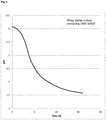
- Whey starter media consisted of a 7% sweet whey powder solution in water. After dissolution of the whey powder, the whey media was pasteurized for 20 minutes at 90°C. 200ml of sweet whey media were inoculated with the whey starter culture comprising a mix of Lactobacillus spp and Streptococcus thermophilus with and without DSM 32009 The starter was incubated as described in Figure 1 . pH was measured continuously with pH probes connected to a datalogger as shown in Figure 2 . Temperature compensation was used to secure accurate pH measurement throughout the temperature gradient. The whey starter culture containing the Lactobacillus delbrueckii subsp. lactis DSM 32009 strain acidified to pH 3.5 in 16 hours.
- Figure 1 shows the temperature profile used for the generation of the whey starter culture. This temperature profile simulates the temperature profile used for the production of whey starter for manufacture of Grana Padano cheese.
- the temperature profile consists of:
- Figure 2 shows the evolution of the pH in the whey starter solution during the incubation step as described in Figure 1 .
- Figure 3 shows the temperature profile used for the milk acidification using a whey starter containing the Lactobacillus delbrueckii subsp. lactis DSM 32009 strain. This temperature profile simulates the temperature profile used for the manufacture of Grana Padano cheese.
- the temperature profile consists of:
- Figure 4 shows the evolution of the pH in milk inoculated with a whey starter solution containing or not the Lactobacillus delbrueckii subsp. lactis DSM 32009 strain. Temperature gradient is as described in Figure 3 .
Landscapes
- Life Sciences & Earth Sciences (AREA)
- Chemical & Material Sciences (AREA)
- Engineering & Computer Science (AREA)
- Health & Medical Sciences (AREA)
- Biotechnology (AREA)
- Organic Chemistry (AREA)
- Zoology (AREA)
- Bioinformatics & Cheminformatics (AREA)
- Wood Science & Technology (AREA)
- Genetics & Genomics (AREA)
- Microbiology (AREA)
- Medicinal Chemistry (AREA)
- Biomedical Technology (AREA)
- Virology (AREA)
- Biochemistry (AREA)
- General Engineering & Computer Science (AREA)
- General Health & Medical Sciences (AREA)
- Tropical Medicine & Parasitology (AREA)
- Food Science & Technology (AREA)
- Polymers & Plastics (AREA)
- Dairy Products (AREA)
- Micro-Organisms Or Cultivation Processes Thereof (AREA)
Description
- The present invention relates to a thermotolerant Lactobacillus delbrueckii subsp. lactis DSM 32009 strain that can be used in the production of cheese where curd cooking at high temperature (>50°C) is a part of the cheese manufacturing process, such as e.g. Grana and Emmental cheese.
- During cheese manufacture the curd-whey mixture is often heated in order to promote syneresis. The step is referred to as scalding or cooking. The temperature used is different for each cheese variety. For cheeses such as Emmental and Parmesan this temperature is high, usually in the range of 52 to 55°C. Such high temperatures can have a negative consequence on syneresis and cheese quality as they can kill or strongly inhibit the growth of the starter culture, thus resulting in poor acidification of the curd. For these types of cheeses, it is important that the starter culture is composed of thermophilic strains that can survive the high temperature cooking step. Strains that can grow and acidify at high temperature would also be a clear advantage.
- NEVIANI E ET AL, JOURNAL OF DAIRY SCIENCE, AMERICAN DAIRY SCIENCE ASSOCIATION, US, vol. 78, no. 6, 1 June 1995 (1995-06-01), pages 1248-1252, XP000518496, ISSN: 0022-0302, DOI: 10.3168/JDS.S0022-0302(95)76744-3 investigates the acidification activity of thermophilic Lactobacilli under the temperature gradient of Grana cheese making.
- To develop bacterial strains that are able to acidify milk even at temperatures above 50°C and therefore can be used for cheese making processes with a high temperature cooking step (>50°C) a screening process was designed and executed. The outcome of the screening was surprising as only one strain was able to perform satisfactory in the temperature profile used for the production of whey starter for manufacture of Grana Padano cheese. This strain was identified to be a Lactobacillus delbrueckii subsp. lactis strain.
- It was further observed that only one isolate of the tested strains, Lactobacillus delbrueckii subsp. lactis can acidify milk at a temperature ≥50°C and consequently perform satisfactory in the temperature profile used for the production of whey starter for manufacture of Grana Padano cheese. The strain is assigned the deposit number: DSM 32009. In accordance with the surprising finding, an aspect of the present invention relates to the use of a Lactobacillus delbrueckii subsp. lactis DSM 32009 strain, that can acidify milk at high temperature, in a cheese making process that involves a high temperature cooking step (>50°C).
- The present invention relates to a process for producing cheese, which comprises adding to milk a starter culture comprising an acidifying strain belonging to the genus Lactobacillus and heating the mixture to a temperature (or maintaining the temperature) in the range of 45°C to 65°C, such as in the range 50°C to 60°C or in the range 53-54°C, such as e.g. 54°C.
- In a related aspect, the present invention relates to a process for producing cheese, which comprises adding to milk a starter culture comprising an acidifying strain belonging to the genus Lactobacillus and heating the mixture to a temperature (or maintaining the temperature) in the range of 45°C to 65°C, such as in the range 50°C to 60°C or in the range 53-54°C, such as e.g. 54°C and adding to mixture one or more bacterial strains or cultures, such as e.g. adjunct cultures and optionally one or more coagulants.
- The acidifying Lactobacillus is able to acidify the milk by at least 0.4 pH units in 2.5 hours at a temperature around 50 °C when inoculated with a 3% whey starter culture.
- According to the invention, the acidifying strain of Lactobacillus is a Lactobacillus delbrueckii subsp. lactis strain deposited as DSM 32009, or a mutant thereof.
- In a related aspect, the starter culture further comprise one or more bacterial strains selected from the list consisting of: Lactococcus lactis, Leuconostoc mesenteroides, Pediococcus pentosaceus, Lactobacillus casei, Lactobacillus paracasei, Streptococcus ther mophilus, Enterococcus faecium, Lactobacillus delbrueckii subsp. bulgaricus, Lactobacillus delbrueckii subsp. lactis, Lactobacillus helveticus spp, Lactobacillus acidophilus or Propionibacterium.
In yet a related aspect, the one or more coagulants is selected from the list comprising: bovine derived coagulants or variants thereof, microbial derived coagulants or variants thereof, camel derived coagulants or variants thereof, rennets and chymosins.
In yet a related aspect, the starter culture is a whey starter culture and in related embodiments the whey starter culture may be subject to the physical conditions comprising: 1) a temperature drop from around 48°C to around 39°C in 9 hours, 2) a constant temperature of around 39°C for around 8 hours, 3) cooling and storing at around 16°C until it is used for milk acidification. - In yet a related aspect, the starter culture and or one or more bacterial strains is added as a direct vat set (DVS) culture, such as e.g. a frozen direct vat set (F-DVS) culture or a freeze-dried direct vat set (FD-DVS) culture. The DVS culture may be added to a whey starter and/or directly to the milk. If added to the whey, the acidifying strain belonging to the genus Lactobacillus may be added in an amount of at least 5x10¹⁰ CFU/500liter whey.
- The process of present invention may further comprise adding one or more bacterial strains or cultures, such as e.g. adjunct cultures such as e.g. Propionibacterium to the milk.
- The process of present invention may further comprise the necessary actions needed to produce a cheese. Hence the present invention also relate to a cheese (including a low-fat cheese) obtainable by the process of any of the aspect disclosed herein. More specifically the may be a Grana type cheese such as e.g. a Grana Padano, Parmigiano Reggiano or alternatively of the Emmental type.
- As disclosed herein, the invention also relate to an acidifying Lactobacillus delbrueckii subsp. lactis strain deposited as DSM 32009 or any mutant thereof. If commercially relevant, the acidifying strain of Lactobacillus may be modified by the act of man.
The Lactobacillus of present invention may be forming part of a mixture with desired properties. Hence the present invention also relates to a composition comprising the acidifying Lactobacillus delbrueckii as described in present disclosure.
Such composition may comprise one or more excipients such as e.g. polyhydroxy compounds such as e.g. sugars, polyalcohols and glycols and their derivatives, trehalose and dimethyl sulfoxide (DMSO). - The composition may be a direct vat set (DVS) starter culture composition, such as e.g. a frozen direct vat set (F-DVS) starter culture composition or a freeze-dried direct vat set (FD-DVS) starter culture composition. The DVS starter culture may be added to a whey starter. In a related aspect, the DVS starter culture composition comprises at least 1x10¹⁰ CFU/g.
- In a related aspect, the starter culture is added to the milk in an amount sufficient to facilitate acidification of the milk by at least 0.4 pH units in 2.5 hours at a temperature around 50°C.
- As illustrated by the vast aspects described herein, the invention also relate to the use of the acidifying Lactobacillus delbrueckii subsp. lactis strain DSM32009 in a process for making cheese, such as e.g. Grana or Emmental type cheese as well as a composition as described in the aspects herein, in a process for making cheese, such as e.g. Grana or Emmental type cheese.
- By the term "milk" is understood a composition comprising lacteal secretion obtained from any mammal, such as an animal of a species belonging to the subfamily Bovinae (which includes the domestic cow (Bos taurus) and buffalo); an animal of a species belonging to the subfamily Caprinae (which includes goat and sheep); or an animal of the species Camelidae (which includes camels). Optionally the milk is acidified, e.g. by addition of an acid (such as citric, acetic or lactic acid) or by addition of an acid producing microorganism. The milk may be raw or processed, e.g. by filtering, sterilizing, pasteurizing, homogenizing, fractionating (e.g. reducing the fat content of the milk), etc., or it may be reconstituted dried milk. An important example of "milk" according to the present invention is pasteurized cow's milk. It is understood that the milk may be acidified, mixed or processed before, during and/or after the adding of bacterial cultures. The term "milk" also comprises milk with protein, calcium or other additives added.
- The term "cheese" refers to a product prepared by contacting optionally acidified milk (e.g. by means of a lactic acid bacterial culture) with a coagulant, and draining the resultant curd. Cheeses and their preparation are described in e.g. Cheese and Fermented Milk Foods, by Frank V. Kosikowski.
- The term "high temperature cooking step" should be understood as a cooking step with a temperature >50°C. This is typical for e.g. cheese of the Grana and Emmental type.
- As used herein the term 'modified by the act of man' should be understood as a modification of the Lactobacillus strain aiming to increase the commercial applicability of said Lactobacillus strain. Such methods comprise increasing the thermo-tolerance by growing the strain at elevated temperatures such as e.g. >50°C, subjecting the strain to heat-stress to cure antibiotic resistance, such as e.g. kanamycin resistance if relevant. Other modifications made by man could be optimization for accelerated germination or acidification.
- As used herein the term "lactic acid bacterium" designates a gram-positive, microaerophilic or anaerobic bacterium, which ferments sugars with the production of acids including lactic acid as the predominantly produced acid. The industrially most useful lactic acid bacteria are found among Lactococcus spp., Streptococcus spp., Lactobacillus spp., Leuconostoc spp., Pediococcus spp.. Additionally, lactic acid producing bacteria belonging to the group of the strict anaerobic bacteria, bifidobacteria, i.e. Bifidobacterium spp., which are frequently used as food cultures alone or in combination with other lactic acid bacteria, are generally included in the group of lactic acid bacteria.
- The term "starter culture" relates to any bacterial culture that is suitable for use in milk acidification, especially lactic acid bacteria such as Bifidobacteria, Lactobacilli, Lactococci, Leuconostocs, Micrococci, Streptococci and Pediococci. It will be appreciated that the term starter culture may encompass a culture containing a single strain of bacterium, or more than one bacterial strain. The term may also include genetically modified organisms (GMO's). In any event, the term is well known in the art and the invention extends equally to all known starter cultures. The term includes bacterial cultures containing a strain of a genus selected from the group consisting of Lactococcus, Lactobacillus, Micrococcus, Leuconostoc, Pediococcus, Streptococcus, Enterococcus, etc. such as a strain of a species selected from the group consisting of: Lactococcus lactis (incl. Lactococcus subsp. lactis subsp. lactis, Lactococcus lactis subsp. cremoris, and Lactococcus lactis subsp. lactis biovar. diacetylactis), Leuconostoc mesenteroides (incl subsp. cremoris), Pediococcus pentosaceus, Lactobacillus casei (incl. subsp. casei) and Lactobacillus paracasei (incl. subsp. paracasei), Streptococcus thermophilus, Enterococcus faecium, Lactobacillus helveticus, Lactobacillus delbrueckii subsp. bulgaricus, Lactobacillus delbrueckii subsp. subsp. lactis and Lactobacillus acidophilus. Other useful bacterial species are Bifidobacterium species including B. bifidum, B. lactis and B. longum, Streptococcus faecium, Leuconostoc lactis.
- As previous mentioned, lactic acid bacteria are essential in the making of nearly all fermented milk products e.g. cheese, and they are normally supplied to the dairy industry either as frozen or freeze-dried cultures for bulk starter propagation or as so-called "Direct Vat Set" (DVS) cultures, intended for direct inoculation into a fermentation vessel or vat for the production of a dairy product. Such cultures are in general referred to as "starter cultures" or "starters".
- Commonly used starter culture strains of lactic acid bacteria are generally divided into mesophilic organisms having optimum growth temperatures at about 30 to 35°C and thermophilic organisms having optimum growth temperatures in the range of about 40 to about 45°C. Typical organisms belonging to the mesophilic group include Lactococcus lactis subsp. lactis, Lactococcus lactis subsp. cremoris, Leuconostoc mesenteroides subsp. cremoris, Pediococcus pentosaceus, Lactococcus lactis subsp. lactis biovar. diacetylactis, Lactobacillus casei subsp. casei and Lactobacillus paracasei subsp. paracasei. Thermophilic or thermotolerant lactic acid bacterial species include as examples Streptococcus thermophilus, Enterococcus faecium, Lactobacillus delbrueckii subsp. lactis, Lactobacillus helveticus, Lactobacillus delbrueckii subsp. bulgaricus, Lactobacillus delbrueckii subsp. lactis and Lactobacillus acidophilus.
Additionally, species of Propionibacterium are used as dairy starter cultures, in particular in the manufacture of cheese. As reflected by the teachings disclosed in e.g. Rossetti et al. 2008, several studies have been made on the microbial composition of starter cultures in cheese making. Hence the person skilled in the art of making cheese (and in particular Grana) will know the composition of the starter-culture to which the strain according to present invention may be added. - The use of the terms "a" and "an" and "the" and similar referents in the context of describing the invention (especially in the context of the following claims) are to be construed to cover both the singular and the plural, unless otherwise indicated herein or clearly contradicted by context. The terms "comprising", "having", "including" and "containing" are to be construed as open-ended terms (i.e., meaning "including, but not limited to,") unless otherwise noted. Recitation of ranges of values herein are merely intended to serve as a shorthand method of referring individually to each separate value falling within the range, unless otherwise indicated herein, and each separate value is incorporated into the specification as if it were individually recited herein. All methods described herein can be performed in any suitable order unless otherwise indicated herein or otherwise clearly contradicted by context. The use of any and all examples, or exemplary language (e.g., "such as") provided herein, is intended merely to better illuminate the invention and does not pose a limitation on the scope of the invention unless otherwise claimed. No language in the specification should be construed as indicating any non-claimed element as essential to the practice of the invention.
-
-
Figure 1 depicts the temperature profile used for the generation of the whey starter culture containing the Lactobacillus delbrueckii subsp.lactis DSM 32009, cf. the example 1. -
Figure 2 depicts the evolution of the pH in the whey starter solution during the incubation step as described inFigure 1 . -
Figure 3 depicts the temperature profile used for the milk acidification using a whey starter containing the L. delbrueckii subsp. lactis. -
Figure 4 depicts the evolution of the pH in milk inoculated with a whey starter solution with and without the L. delbrueckii subsp. lactis. - Whey starter media consisted of a 7% sweet whey powder solution in water. After dissolution of the whey powder, the whey media was pasteurized for 20 minutes at 90°C. 200ml of sweet whey media were inoculated with the whey starter culture comprising a mix of Lactobacillus spp and Streptococcus thermophilus with and without
DSM 32009 The starter was incubated as described inFigure 1 . pH was measured continuously with pH probes connected to a datalogger as shown inFigure 2 . Temperature compensation was used to secure accurate pH measurement throughout the temperature gradient. The whey starter culture containing the Lactobacillus delbrueckii subsp.lactis DSM 32009 strain acidified to pH 3.5 in 16 hours. -
Figure 1 shows the temperature profile used for the generation of the whey starter culture. This temperature profile simulates the temperature profile used for the production of whey starter for manufacture of Grana Padano cheese. The temperature profile consists of: - A temperature drop from 48°C to 39°C in 9 hours
- A constant temperature of 39°C for 8 hours
- The whey starter is then cooled and maintained at 16°C until it is used for milk acidification.
-
Figure 2 shows the evolution of the pH in the whey starter solution during the incubation step as described inFigure 1 . - Milk used for acidification experiment was prepared from 9.5 % skim milk powder rehydrated in water and subsequently heat treated at 140 °C/8 sec and 100 °C/30 min. Milk was inoculated with 3% of the whey starter prepared as described in Example 1.a. The pH was measured continuously with pH probes connected to a datalogger as shown in
Figure 4 . Temperature compensation was used to secure accurate pH measurement throughout the temperature gradient. Incubation temperature was as described inFigure 3 . During the time where the temperature is above 50°C, the whey starter culture containing the Lactobacillus delbrueckii subsp.lactis DSM 32009 strain decreased the pH of the milk from pH 6.30 to pH 5.80 (deltapH=0.50 pH units). The whey starter culture without the Lactobacillus delbrueckii subsp.lactis DSM 32009 strain decreased the pH of the milk from pH 6.40 to pH 6.20 (deltapH=0.2 pH units). Moreover, it is observed that the whey starter culture containing the Lactobacillus delbrueckii subsp.lactis DSM 32009 strain continues to lower the milk pH after the cooking step while the whey starter culture without the Lactobacillus delbrueckii subsp.lactis DSM 32009 strain has a longer lag phase with no or very little pH drop. As a comparison, the milk acidified with the whey starter culture containing the Lactobacillus delbrueckii subsp.lactis DSM 32009 strain reaches pH 5.0 in 10 hours while the milk acidified with the whey starter culture without the Lactobacillus delbrueckii subsp.lactis DSM 32009 strain reaches pH 5.0 in 12.5 hours. -
Figure 3 shows the temperature profile used for the milk acidification using a whey starter containing the Lactobacillus delbrueckii subsp.lactis DSM 32009 strain. This temperature profile simulates the temperature profile used for the manufacture of Grana Padano cheese. The temperature profile consists of: - A constant temperature of 32°C for 30 min
- A temperature increase to 54°C and kept constant for 3 hours
- A linear temperature decrease to 30°C
-
Figure 4 shows the evolution of the pH in milk inoculated with a whey starter solution containing or not the Lactobacillus delbrueckii subsp.lactis DSM 32009 strain. Temperature gradient is as described inFigure 3 . - Rosetti, L., Fornasari, M. E., Gatti, M., Lazzi, C., Neviani, E. and Giraffa, G. Grana Padano cheese whey starters: Microbial composition and strain distribution. International Journal of Food Microbiology 127 (2008) pp. 168-171.
Claims (3)
- An acidifying Lactobacillus delbrueckii strain, wherein the Lactobacillus delbrueckii strain is an acidifying Lactobacillus delbrueckii subsp. lactis strain desposited as DSM 32009 or a mutant of the acidifying Lactobacillus delbrueckii subsp. lactis strain deposited as DSM 32009.
- An acidifying Lactobacillus delbrueckii strain according to claim 1, wherein the Lactobacillus delbrueckii strain is an acidifying Lactobacillus delbrueckii subsp. lactis strain desposited as DSM 32009.
- A process for producing cheese, which comprises adding to milk:- a starter culture comprising an acidifying strain belonging to the genus Lactobacillus of any of claim 1-2 andheating the mixture to a temperature in the range of 45 to 65°C.
Applications Claiming Priority (2)
| Application Number | Priority Date | Filing Date | Title |
|---|---|---|---|
| EP15156057 | 2015-02-23 | ||
| PCT/EP2016/053664 WO2016135093A1 (en) | 2015-02-23 | 2016-02-22 | Novel thermotolerant lactobacillus |
Publications (2)
| Publication Number | Publication Date |
|---|---|
| EP3261452A1 EP3261452A1 (en) | 2018-01-03 |
| EP3261452B1 true EP3261452B1 (en) | 2019-01-02 |
Family
ID=52544368
Family Applications (1)
| Application Number | Title | Priority Date | Filing Date |
|---|---|---|---|
| EP16705781.9A Active EP3261452B1 (en) | 2015-02-23 | 2016-02-22 | Novel thermotolerant lactobacillus |
Country Status (7)
| Country | Link |
|---|---|
| US (2) | US20180042256A1 (en) |
| EP (1) | EP3261452B1 (en) |
| AR (1) | AR103754A1 (en) |
| AU (1) | AU2016223637B2 (en) |
| BR (1) | BR112017015280B1 (en) |
| LT (1) | LT3261452T (en) |
| WO (1) | WO2016135093A1 (en) |
Families Citing this family (1)
| Publication number | Priority date | Publication date | Assignee | Title |
|---|---|---|---|---|
| CN118530916A (en) * | 2024-07-26 | 2024-08-23 | 江苏省环境工程技术有限公司 | Method for screening and breeding high-temperature fungus compost fungus |
Family Cites Families (1)
| Publication number | Priority date | Publication date | Assignee | Title |
|---|---|---|---|---|
| WO2010022790A1 (en) * | 2008-08-29 | 2010-03-04 | Chr. Hansen A/S | Method for making cheese |
-
2016
- 2016-02-22 AU AU2016223637A patent/AU2016223637B2/en active Active
- 2016-02-22 EP EP16705781.9A patent/EP3261452B1/en active Active
- 2016-02-22 WO PCT/EP2016/053664 patent/WO2016135093A1/en not_active Ceased
- 2016-02-22 LT LTEP16705781.9T patent/LT3261452T/en unknown
- 2016-02-22 US US15/552,398 patent/US20180042256A1/en not_active Abandoned
- 2016-02-22 BR BR112017015280-0A patent/BR112017015280B1/en active IP Right Grant
- 2016-02-23 AR ARP160100465A patent/AR103754A1/en active IP Right Grant
-
2023
- 2023-02-27 US US18/175,107 patent/US20230329264A1/en active Pending
Non-Patent Citations (1)
| Title |
|---|
| None * |
Also Published As
| Publication number | Publication date |
|---|---|
| EP3261452A1 (en) | 2018-01-03 |
| WO2016135093A1 (en) | 2016-09-01 |
| US20230329264A1 (en) | 2023-10-19 |
| CA2976296A1 (en) | 2016-09-01 |
| AR103754A1 (en) | 2017-05-31 |
| AU2016223637B2 (en) | 2020-08-13 |
| AU2016223637A1 (en) | 2017-08-17 |
| BR112017015280A2 (en) | 2018-01-09 |
| US20180042256A1 (en) | 2018-02-15 |
| LT3261452T (en) | 2019-04-25 |
| BR112017015280B1 (en) | 2022-12-20 |
Similar Documents
| Publication | Publication Date | Title |
|---|---|---|
| EP3344052B1 (en) | Lactobacillus fermentum bacteria inhibiting post-acidification | |
| US20180249727A1 (en) | Lactobacillus fermentum bacteria with antifungal activity | |
| US11241019B2 (en) | Method for making cheese | |
| WO2017026481A1 (en) | Method for manufacturing flavorsome fermented dairy product and fermented dairy product manufactured using same | |
| US20230329264A1 (en) | Novel thermotolerant lactobacillus | |
| US10548333B2 (en) | Method for preparing camembert type cheese | |
| Eren‐Vapur et al. | Protective culture: Is it a solution to improve the quality of culture‐free white cheese? | |
| EP3178329B1 (en) | Process for manufacturing of quark or sour cream, starter culture, quark or sour cream | |
| CA2976296C (en) | Novel thermotolerant lactobacillus | |
| US20230232851A1 (en) | Method of reducing growth of listeria in food products | |
| Semko | Starter cultures in raw milk manufacturing industry | |
| EP3068232B2 (en) | Lactic acid bacterial culture | |
| US12239141B2 (en) | Method for production of soft cheese comprising simultaneous addition of acidifying bacteria and coagulant | |
| JP2026082876A (en) | Lactobacillus for biological control with low post-acidification | |
| AU2024256668A1 (en) | Storage stable lacticaseibacillus rhamnosus | |
| Vlasenko et al. | Starter cultures in raw milk manufacturing industry | |
| Kelly | 86 What are the differences between acid-curd cheese and yoghurt/fermented milks? | |
| WO2010139333A1 (en) | Prematuration of milk |
Legal Events
| Date | Code | Title | Description |
|---|---|---|---|
| STAA | Information on the status of an ep patent application or granted ep patent |
Free format text: STATUS: THE INTERNATIONAL PUBLICATION HAS BEEN MADE |
|
| PUAI | Public reference made under article 153(3) epc to a published international application that has entered the european phase |
Free format text: ORIGINAL CODE: 0009012 |
|
| STAA | Information on the status of an ep patent application or granted ep patent |
Free format text: STATUS: REQUEST FOR EXAMINATION WAS MADE |
|
| 17P | Request for examination filed |
Effective date: 20170925 |
|
| AK | Designated contracting states |
Kind code of ref document: A1 Designated state(s): AL AT BE BG CH CY CZ DE DK EE ES FI FR GB GR HR HU IE IS IT LI LT LU LV MC MK MT NL NO PL PT RO RS SE SI SK SM TR |
|
| AX | Request for extension of the european patent |
Extension state: BA ME |
|
| DAV | Request for validation of the european patent (deleted) | ||
| DAX | Request for extension of the european patent (deleted) | ||
| GRAP | Despatch of communication of intention to grant a patent |
Free format text: ORIGINAL CODE: EPIDOSNIGR1 |
|
| STAA | Information on the status of an ep patent application or granted ep patent |
Free format text: STATUS: GRANT OF PATENT IS INTENDED |
|
| RIC1 | Information provided on ipc code assigned before grant |
Ipc: C12R 1/225 20060101ALI20180618BHEP Ipc: A23C 19/032 20060101AFI20180618BHEP Ipc: C12N 1/20 20060101ALI20180618BHEP |
|
| INTG | Intention to grant announced |
Effective date: 20180713 |
|
| GRAS | Grant fee paid |
Free format text: ORIGINAL CODE: EPIDOSNIGR3 |
|
| GRAA | (expected) grant |
Free format text: ORIGINAL CODE: 0009210 |
|
| STAA | Information on the status of an ep patent application or granted ep patent |
Free format text: STATUS: THE PATENT HAS BEEN GRANTED |
|
| AK | Designated contracting states |
Kind code of ref document: B1 Designated state(s): AL AT BE BG CH CY CZ DE DK EE ES FI FR GB GR HR HU IE IS IT LI LT LU LV MC MK MT NL NO PL PT RO RS SE SI SK SM TR |
|
| REG | Reference to a national code |
Ref country code: GB Ref legal event code: FG4D |
|
| REG | Reference to a national code |
Ref country code: CH Ref legal event code: EP Ref country code: AT Ref legal event code: REF Ref document number: 1083275 Country of ref document: AT Kind code of ref document: T Effective date: 20190115 |
|
| REG | Reference to a national code |
Ref country code: IE Ref legal event code: FG4D |
|
| REG | Reference to a national code |
Ref country code: DE Ref legal event code: R096 Ref document number: 602016008975 Country of ref document: DE |
|
| REG | Reference to a national code |
Ref country code: NL Ref legal event code: MP Effective date: 20190102 |
|
| REG | Reference to a national code |
Ref country code: EE Ref legal event code: FG4A Ref document number: E017037 Country of ref document: EE Effective date: 20190402 |
|
| REG | Reference to a national code |
Ref country code: AT Ref legal event code: MK05 Ref document number: 1083275 Country of ref document: AT Kind code of ref document: T Effective date: 20190102 |
|
| PG25 | Lapsed in a contracting state [announced via postgrant information from national office to epo] |
Ref country code: NL Free format text: LAPSE BECAUSE OF FAILURE TO SUBMIT A TRANSLATION OF THE DESCRIPTION OR TO PAY THE FEE WITHIN THE PRESCRIBED TIME-LIMIT Effective date: 20190102 |
|
| PG25 | Lapsed in a contracting state [announced via postgrant information from national office to epo] |
Ref country code: SE Free format text: LAPSE BECAUSE OF FAILURE TO SUBMIT A TRANSLATION OF THE DESCRIPTION OR TO PAY THE FEE WITHIN THE PRESCRIBED TIME-LIMIT Effective date: 20190102 Ref country code: PL Free format text: LAPSE BECAUSE OF FAILURE TO SUBMIT A TRANSLATION OF THE DESCRIPTION OR TO PAY THE FEE WITHIN THE PRESCRIBED TIME-LIMIT Effective date: 20190102 Ref country code: NO Free format text: LAPSE BECAUSE OF FAILURE TO SUBMIT A TRANSLATION OF THE DESCRIPTION OR TO PAY THE FEE WITHIN THE PRESCRIBED TIME-LIMIT Effective date: 20190402 Ref country code: PT Free format text: LAPSE BECAUSE OF FAILURE TO SUBMIT A TRANSLATION OF THE DESCRIPTION OR TO PAY THE FEE WITHIN THE PRESCRIBED TIME-LIMIT Effective date: 20190502 Ref country code: FI Free format text: LAPSE BECAUSE OF FAILURE TO SUBMIT A TRANSLATION OF THE DESCRIPTION OR TO PAY THE FEE WITHIN THE PRESCRIBED TIME-LIMIT Effective date: 20190102 Ref country code: ES Free format text: LAPSE BECAUSE OF FAILURE TO SUBMIT A TRANSLATION OF THE DESCRIPTION OR TO PAY THE FEE WITHIN THE PRESCRIBED TIME-LIMIT Effective date: 20190102 |
|
| PG25 | Lapsed in a contracting state [announced via postgrant information from national office to epo] |
Ref country code: IS Free format text: LAPSE BECAUSE OF FAILURE TO SUBMIT A TRANSLATION OF THE DESCRIPTION OR TO PAY THE FEE WITHIN THE PRESCRIBED TIME-LIMIT Effective date: 20190502 Ref country code: HR Free format text: LAPSE BECAUSE OF FAILURE TO SUBMIT A TRANSLATION OF THE DESCRIPTION OR TO PAY THE FEE WITHIN THE PRESCRIBED TIME-LIMIT Effective date: 20190102 Ref country code: GR Free format text: LAPSE BECAUSE OF FAILURE TO SUBMIT A TRANSLATION OF THE DESCRIPTION OR TO PAY THE FEE WITHIN THE PRESCRIBED TIME-LIMIT Effective date: 20190403 Ref country code: BG Free format text: LAPSE BECAUSE OF FAILURE TO SUBMIT A TRANSLATION OF THE DESCRIPTION OR TO PAY THE FEE WITHIN THE PRESCRIBED TIME-LIMIT Effective date: 20190402 Ref country code: LV Free format text: LAPSE BECAUSE OF FAILURE TO SUBMIT A TRANSLATION OF THE DESCRIPTION OR TO PAY THE FEE WITHIN THE PRESCRIBED TIME-LIMIT Effective date: 20190102 Ref country code: RS Free format text: LAPSE BECAUSE OF FAILURE TO SUBMIT A TRANSLATION OF THE DESCRIPTION OR TO PAY THE FEE WITHIN THE PRESCRIBED TIME-LIMIT Effective date: 20190102 |
|
| REG | Reference to a national code |
Ref country code: CH Ref legal event code: PL |
|
| REG | Reference to a national code |
Ref country code: DE Ref legal event code: R097 Ref document number: 602016008975 Country of ref document: DE |
|
| PG25 | Lapsed in a contracting state [announced via postgrant information from national office to epo] |
Ref country code: AL Free format text: LAPSE BECAUSE OF FAILURE TO SUBMIT A TRANSLATION OF THE DESCRIPTION OR TO PAY THE FEE WITHIN THE PRESCRIBED TIME-LIMIT Effective date: 20190102 Ref country code: MC Free format text: LAPSE BECAUSE OF FAILURE TO SUBMIT A TRANSLATION OF THE DESCRIPTION OR TO PAY THE FEE WITHIN THE PRESCRIBED TIME-LIMIT Effective date: 20190102 Ref country code: LU Free format text: LAPSE BECAUSE OF NON-PAYMENT OF DUE FEES Effective date: 20190222 Ref country code: CZ Free format text: LAPSE BECAUSE OF FAILURE TO SUBMIT A TRANSLATION OF THE DESCRIPTION OR TO PAY THE FEE WITHIN THE PRESCRIBED TIME-LIMIT Effective date: 20190102 Ref country code: AT Free format text: LAPSE BECAUSE OF FAILURE TO SUBMIT A TRANSLATION OF THE DESCRIPTION OR TO PAY THE FEE WITHIN THE PRESCRIBED TIME-LIMIT Effective date: 20190102 Ref country code: RO Free format text: LAPSE BECAUSE OF FAILURE TO SUBMIT A TRANSLATION OF THE DESCRIPTION OR TO PAY THE FEE WITHIN THE PRESCRIBED TIME-LIMIT Effective date: 20190102 Ref country code: DK Free format text: LAPSE BECAUSE OF FAILURE TO SUBMIT A TRANSLATION OF THE DESCRIPTION OR TO PAY THE FEE WITHIN THE PRESCRIBED TIME-LIMIT Effective date: 20190102 Ref country code: SK Free format text: LAPSE BECAUSE OF FAILURE TO SUBMIT A TRANSLATION OF THE DESCRIPTION OR TO PAY THE FEE WITHIN THE PRESCRIBED TIME-LIMIT Effective date: 20190102 |
|
| PLBE | No opposition filed within time limit |
Free format text: ORIGINAL CODE: 0009261 |
|
| STAA | Information on the status of an ep patent application or granted ep patent |
Free format text: STATUS: NO OPPOSITION FILED WITHIN TIME LIMIT |
|
| REG | Reference to a national code |
Ref country code: IE Ref legal event code: MM4A |
|
| PG25 | Lapsed in a contracting state [announced via postgrant information from national office to epo] |
Ref country code: SM Free format text: LAPSE BECAUSE OF FAILURE TO SUBMIT A TRANSLATION OF THE DESCRIPTION OR TO PAY THE FEE WITHIN THE PRESCRIBED TIME-LIMIT Effective date: 20190102 |
|
| 26N | No opposition filed |
Effective date: 20191003 |
|
| PG25 | Lapsed in a contracting state [announced via postgrant information from national office to epo] |
Ref country code: LI Free format text: LAPSE BECAUSE OF NON-PAYMENT OF DUE FEES Effective date: 20190228 Ref country code: CH Free format text: LAPSE BECAUSE OF NON-PAYMENT OF DUE FEES Effective date: 20190228 |
|
| PG25 | Lapsed in a contracting state [announced via postgrant information from national office to epo] |
Ref country code: IE Free format text: LAPSE BECAUSE OF NON-PAYMENT OF DUE FEES Effective date: 20190222 |
|
| PG25 | Lapsed in a contracting state [announced via postgrant information from national office to epo] |
Ref country code: SI Free format text: LAPSE BECAUSE OF FAILURE TO SUBMIT A TRANSLATION OF THE DESCRIPTION OR TO PAY THE FEE WITHIN THE PRESCRIBED TIME-LIMIT Effective date: 20190102 Ref country code: FR Free format text: LAPSE BECAUSE OF NON-PAYMENT OF DUE FEES Effective date: 20190302 |
|
| PG25 | Lapsed in a contracting state [announced via postgrant information from national office to epo] |
Ref country code: TR Free format text: LAPSE BECAUSE OF FAILURE TO SUBMIT A TRANSLATION OF THE DESCRIPTION OR TO PAY THE FEE WITHIN THE PRESCRIBED TIME-LIMIT Effective date: 20190102 |
|
| PG25 | Lapsed in a contracting state [announced via postgrant information from national office to epo] |
Ref country code: MT Free format text: LAPSE BECAUSE OF NON-PAYMENT OF DUE FEES Effective date: 20190222 |
|
| GBPC | Gb: european patent ceased through non-payment of renewal fee |
Effective date: 20200222 |
|
| PG25 | Lapsed in a contracting state [announced via postgrant information from national office to epo] |
Ref country code: GB Free format text: LAPSE BECAUSE OF NON-PAYMENT OF DUE FEES Effective date: 20200222 |
|
| PG25 | Lapsed in a contracting state [announced via postgrant information from national office to epo] |
Ref country code: CY Free format text: LAPSE BECAUSE OF FAILURE TO SUBMIT A TRANSLATION OF THE DESCRIPTION OR TO PAY THE FEE WITHIN THE PRESCRIBED TIME-LIMIT Effective date: 20190102 |
|
| PG25 | Lapsed in a contracting state [announced via postgrant information from national office to epo] |
Ref country code: HU Free format text: LAPSE BECAUSE OF FAILURE TO SUBMIT A TRANSLATION OF THE DESCRIPTION OR TO PAY THE FEE WITHIN THE PRESCRIBED TIME-LIMIT; INVALID AB INITIO Effective date: 20160222 |
|
| PG25 | Lapsed in a contracting state [announced via postgrant information from national office to epo] |
Ref country code: MK Free format text: LAPSE BECAUSE OF FAILURE TO SUBMIT A TRANSLATION OF THE DESCRIPTION OR TO PAY THE FEE WITHIN THE PRESCRIBED TIME-LIMIT Effective date: 20190102 |
|
| PGFP | Annual fee paid to national office [announced via postgrant information from national office to epo] |
Ref country code: LT Payment date: 20260120 Year of fee payment: 11 |
|
| PGFP | Annual fee paid to national office [announced via postgrant information from national office to epo] |
Ref country code: DE Payment date: 20260121 Year of fee payment: 11 |
|
| PGFP | Annual fee paid to national office [announced via postgrant information from national office to epo] |
Ref country code: BE Payment date: 20260122 Year of fee payment: 11 Ref country code: IT Payment date: 20260128 Year of fee payment: 11 |
|
| PGFP | Annual fee paid to national office [announced via postgrant information from national office to epo] |
Ref country code: EE Payment date: 20260123 Year of fee payment: 11 |