EP3261065A1 - Dokumentenlesegerät - Google Patents
Dokumentenlesegerät Download PDFInfo
- Publication number
- EP3261065A1 EP3261065A1 EP17172437.0A EP17172437A EP3261065A1 EP 3261065 A1 EP3261065 A1 EP 3261065A1 EP 17172437 A EP17172437 A EP 17172437A EP 3261065 A1 EP3261065 A1 EP 3261065A1
- Authority
- EP
- European Patent Office
- Prior art keywords
- light
- spectrum
- document
- authentication
- authentication document
- Prior art date
- Legal status (The legal status is an assumption and is not a legal conclusion. Google has not performed a legal analysis and makes no representation as to the accuracy of the status listed.)
- Granted
Links
Images


Classifications
-
- G—PHYSICS
- G07—CHECKING-DEVICES
- G07D—HANDLING OF COINS OR VALUABLE PAPERS, e.g. TESTING, SORTING BY DENOMINATIONS, COUNTING, DISPENSING, CHANGING OR DEPOSITING
- G07D7/00—Testing specially adapted to determine the identity or genuineness of valuable papers or for segregating those which are unacceptable, e.g. banknotes that are alien to a currency
- G07D7/06—Testing specially adapted to determine the identity or genuineness of valuable papers or for segregating those which are unacceptable, e.g. banknotes that are alien to a currency using wave or particle radiation
- G07D7/12—Visible light, infrared or ultraviolet radiation
- G07D7/1205—Testing spectral properties
-
- G—PHYSICS
- G07—CHECKING-DEVICES
- G07D—HANDLING OF COINS OR VALUABLE PAPERS, e.g. TESTING, SORTING BY DENOMINATIONS, COUNTING, DISPENSING, CHANGING OR DEPOSITING
- G07D7/00—Testing specially adapted to determine the identity or genuineness of valuable papers or for segregating those which are unacceptable, e.g. banknotes that are alien to a currency
- G07D7/02—Testing electrical properties of the materials thereof
-
- G—PHYSICS
- G07—CHECKING-DEVICES
- G07D—HANDLING OF COINS OR VALUABLE PAPERS, e.g. TESTING, SORTING BY DENOMINATIONS, COUNTING, DISPENSING, CHANGING OR DEPOSITING
- G07D7/00—Testing specially adapted to determine the identity or genuineness of valuable papers or for segregating those which are unacceptable, e.g. banknotes that are alien to a currency
- G07D7/20—Testing patterns thereon
- G07D7/202—Testing patterns thereon using pattern matching
- G07D7/205—Matching spectral properties
Definitions
- the present invention relates to a document reader for an authentication document and a method for authenticating an authentication document.
- a document such as an identification document or a banknote usually has a multiplicity of security features which prove the authenticity of the document and make it difficult to falsify the document.
- the security features usually have characteristic properties that can be checked during authentication of the document.
- the security features may further include electronic circuitry that is read out upon authentication of the document.
- the invention relates to a document reading device for an authentication document, wherein the authentication document comprises a carrier layer and a molecular layer arranged on the carrier layer, wherein the authentication document is further configured to generate a stimulation field in response to an electrical voltage which places the molecular layer in an excited state offset, with a communication interface, which is electrically connected to the authentication document and configured to apply the voltage to generate the stimulation field to the authentication document, a lighting device which is adapted to illuminate the molecular layer of the authentication document with illumination light, wherein the illumination light is a first Light spectrum has, wherein the illumination light is reflected on the support layer, a light sensor, which is formed detecting the illumination light reflected at the carrier layer, the reflected illumination light having a second spectrum of light different from the first spectrum of light, and a processor configured to authenticate the authentication document based on a comparison of the first spectrum of light with the second spectrum of light ,
- the processor is designed to work on analog and / or digital and / or optical basis.
- the authentication document can be efficiently authenticated on the basis of a spectral change of the illumination light when the molecular layer is illuminated.
- This spectral change depends in particular on the structure of the molecular layer and on the applied electrical voltage and is therefore particularly tamper-proof.
- the authentication of the authentication document may include an identification of the authentication document and / or a verification of the identity of the authentication document.
- the authentication of the authentication document can be carried out as part of a signature process, wherein the signature creator can be identified by means of the authentication.
- the authentication document may be an ID card or a smart card.
- the authentication document may also be one of the following identification documents: Identity document, such as identity card, passport, access control card, authorization card, company card, tax stamp or ticket, birth certificate, driver's license or vehicle pass, means of payment, for example a bank card or credit card.
- Identity document such as identity card, passport, access control card, authorization card, company card, tax stamp or ticket, birth certificate, driver's license or vehicle pass, means of payment, for example a bank card or credit card.
- the authentication document may further comprise an electronically readable circuit, for example an RFID chip.
- the authentication document can be single-layered or multi-layered or paper and / or plastic-based.
- the authentication document can be constructed from plastic-based films which are joined together to form a card body by means of gluing and / or lamination, the films preferably having similar material properties.
- the molecular layer of the authentication document may include or form a security feature of the authentication document.
- the molecular layer may further form a physically unclonable function (PUF).
- PEF physically unclonable function
- the molecular layer can be arranged on or at the authentication document, and can be used to authenticate the authentication document, for example to verify the authenticity of the authentication document.
- the molecular layer of the authentication document may comprise a plurality of oriented molecules or polymer chains which may be disposed on the carrier layer and may be chemically or physically bound to the carrier layer.
- the oriented molecules and / or polymer chains can be anchored with one end to the carrier layer.
- the oriented molecules and / or polymer chains can be randomly arranged on the carrier layer.
- the polymer chains or oriented molecules may be deflectable from a rest position in response to the stimulation field.
- the second light spectrum of the reflected illumination light may be determined by the deflection of the polymer chains or oriented molecules, or influenced in a characteristic manner.
- the deflected oriented molecules or polymer chains have a characteristic absorption spectrum, which depends on the deflection and thus on the stimulation field or the applied electrical voltage.
- the absorption spectrum of the molecular layer in the excited state can depend on a multiplicity of factors, in particular the type of molecules or polymer chains, the length of the molecules or polymer chains and the density or distribution of the plurality of molecules or polymer chains on the carrier layer. Due to the large number of molecules or polymer chains on the support layer, this can result in a unique and difficult to copy absorption spectrum, which is a characteristic property of the molecular layer.
- the stimulation field may be an electrical stimulation field, an electrostatic stimulation field, a magnetic stimulation field, or an electromagnetic stimulation field.
- the excitation of the molecular layer with the stimulation field may comprise a purely electrical excitation, a purely magnetic excitation and / or a combination of both excitations.
- the stimulation field can be generated by applying the voltage to two electrodes.
- the electrodes may be disposed on two opposite sides of the molecular layer.
- the carrier layer may be formed as one of the two electrodes.
- the second electrode may be disposed adjacent to the molecular layer.
- the carrier layer may also comprise both electrodes.
- the carrier layer of the authentication document may be a metal layer, in particular a gold or silver layer, a conductive oxide layer, a dielectric layer, a plastic layer, in particular a polycarbonate layer, or a semiconductor layer.
- the communication interface of the document reader may include a voltage source, in particular a DC or an AC voltage source, for generating the electrical voltage.
- the electrical voltage may have a voltage value, in particular a voltage amplitude.
- the voltage source can be electrically connectable to the authentication document, in particular to electrodes of the authentication document.
- the communication interface may further comprise a wireless Interface, in particular a Bluetooth interface or a WLAN interface, or include an RFID reader.
- the processor may be implemented as a microprocessor in the document reader.
- the processor may also be integrated into a data processing device, such as a computer or a laptop, which is connected to the document reader.
- the processor is designed to work on analog and / or digital and / or optical basis.
- the processor includes a random generator configured to generate the voltage or a voltage value of the voltage at random.
- the processor can be designed to control the communication interface with the generated electrical voltage, in particular with a voltage value of the generated electrical voltage, for acting on the authentication document.
- the processor is configured to determine an absorption spectrum of the molecular layer based on the comparison of the first light spectrum and the second light spectrum, wherein the processor is configured to authenticate the authentication document based on the absorption spectrum.
- the absorption spectrum can depend on the molecular layer and the applied, in particular random, electrical voltage and can form a physically unclonable function.
- the processor is configured to calculate an expected spectrum based on the first light spectrum of the illumination light and the determined absorption spectrum, wherein the processor is configured to the second light spectrum of the reflected illumination light with the expected spectrum compare and authenticate the authentication document, if the second light spectrum corresponds to the expected spectrum.
- the illumination device comprises at least one light source, in particular an LED and / or a laser diode.
- the light sources can be arranged in an array, for example an LED array, and designed to illuminate the molecular layer of the authentication document as evenly as possible.
- the illumination device is designed to generate the illumination light in a white light wavelength range, an infrared wavelength range or an ultraviolet wavelength range.
- the first light spectrum may be defined by the wavelength range of the illumination light.
- the light sensor has at least one photodiode or a photodiode layer or a transistor layer.
- the light sensor comprises a spectrometer device, which is designed to detect the second light spectrum of the reflected illumination light. This achieves the advantage that the second light spectrum can be detected efficiently.
- the spectrometer device may comprise at least one photodiode.
- the spectrometer device comprises a prism spectrometer, a grating spectrometer, a Fourier transform spectrometer or a laser spectrometer.
- the spectrometer device can be designed as a microspectrometer and integrated into the document reader.
- the communication interface comprises a voltage source, in particular a DC voltage source or a AC voltage source, for generating the electrical voltage.
- a voltage source in particular a DC voltage source or a AC voltage source, for generating the electrical voltage.
- the communication interface is configured to receive an authentication request signal, wherein the communication interface is configured to control the illumination device in response to receiving the authentication request signal for emitting the illumination light.
- the document reading device comprises a display, in particular a display, wherein the display is designed to indicate a successful or a failed authentication of the authentication document.
- a display in particular a display
- the display is designed to indicate a successful or a failed authentication of the authentication document.
- the display may be a touch display, which in addition to operating the document reader, for example, to initialize an authentication process, can be used.
- the invention relates to a method for authenticating an authentication document, wherein the authentication document has a carrier layer and a molecular layer arranged on the carrier layer, wherein the authentication document is further configured to generate a stimulation field in response to an electrical voltage Excited state, with applying to the authentication document with the voltage for generating the stimulation field, irradiating the molecular layer with illumination light, wherein the illumination light has a first light spectrum, wherein the illumination light is reflected on the support layer, detecting the reflected on the support layer illumination light, wherein the reflected Illumination light has a second light spectrum, which differs from the first light spectrum, and authentication of the authentication document on the basis of a comparison of the first light spectrum with the second light spectrum.
- the authentication document can be authenticated efficiently based on a spectral change of the illumination light when the molecular layer is illuminated.
- This spectral change depends in particular on the structure of the molecular layer and on the applied electrical voltage and is therefore particularly tamper-proof.
- the method can be carried out by means of the document reader according to the invention. Further features of the method emerge directly from the functionality of the document reader according to the invention.
- the authentication of the authentication document may include an identification of the authentication document and / or a verification of the identity of the authentication document.
- the authentication of the authentication document can be carried out as part of a signature process, wherein the signature creator can be identified by means of the authentication.
- the method step of authenticating the authentication document based on a comparison of the first light spectrum with the second light spectrum comprises the following further method steps: determining an absorption spectrum of the molecular layer based on the comparison of the first light spectrum and the second light spectrum, and authenticating the authentication document the basis of the absorption spectrum.
- the method step of authenticating the authentication document based on the absorption spectrum comprises the following further method steps: calculating an expected spectrum on the basis of the first light spectrum of the illumination light and the determined absorption spectrum, Comparing the second light spectrum of the reflected illumination light with the expected spectrum, and authenticating the authentication document, if the second light spectrum corresponds to the expected spectrum.
- the invention relates to a computer program with a program code for carrying out the method according to the second aspect of the invention.
- the invention can be implemented in software and / or hardware.
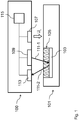
- Fig. 1 shows a schematic representation of a document reader 100 for an authentication document 101 according to one embodiment.
- the authentication document 101 has a carrier layer 103 and a molecular layer 105 arranged on the carrier layer 103.
- the authentication document 101 is further configured to generate a stimulation field in response to an electrical voltage which places the molecular layer 105 in an excited state.
- the document reader 100 includes a communication interface 107, which is electrically connectable to the authentication document 101 and configured to apply the voltage to the authentication document 101 to generate the stimulation field, a lighting device 109 which is formed, the molecular layer 105 of the authentication document 101 with illumination light 111th -1, wherein the illumination light 111-1 has a first light spectrum, wherein the illumination light 111-1 is reflectable on the carrier layer 103, a light sensor 113, which is designed to detect the illumination light 111-2 reflected on the carrier layer 103, wherein the reflected illumination light 111-2 has a second spectrum of light different from the first spectrum of light, and a processor 115, which is configured, the authentication document 101 based on a comparison of the first spectrum of light ms to authenticate with the second light spectrum.
- the authentication document 101 is authenticated.
- the authentication of the authentication document 101 may include an identification of the authentication document 101 and / or a verification of the identity of the authentication document 101.
- the authentication of the authentication document 101 can take place within the framework of a signature process, wherein the signature creator can be identified by means of the authentication.
- the authentication document 101 may be an ID card or a smart card.
- the authentication document 101 can also be one of the following identification documents: Identity document, such as identity card, passport, access control card, authorization card, company card, tax stamp or ticket, birth certificate, driving license or motor vehicle pass, means of payment, for example a bank card or credit card.
- Identity document such as identity card, passport, access control card, authorization card, company card, tax stamp or ticket, birth certificate, driving license or motor vehicle pass, means of payment, for example a bank card or credit card.
- the authentication document 101 may further comprise an electronically readable circuit, for example an RFID chip.
- the authentication document 101 may be single or multi-layered or paper and / or be plastic-based.
- the authentication document 101 may be constructed from plastic-based films which are joined together to form a card body by means of gluing and / or lamination, wherein the films preferably have similar material properties.
- the molecular layer 105 of the authentication document 101 may include or form a security feature of the authentication document 101.
- the molecular layer 105 may further form a physically unclonable function (PUF).
- PEF physically unclonable function
- the molecular layer 105 may be disposed on or at the authentication document 101, and may be used to authenticate the authentication document 101, for example, to verify the authenticity of the authentication document 101.
- the molecular layer 105 of the authentication document 101 may comprise a plurality of oriented molecules or polymer chains, which may be disposed on the support layer 103 and may be chemically or physically bonded to the support layer 103.
- the oriented molecules and / or polymer chains may be anchored to the carrier layer 103 with one end each.
- the oriented molecules and / or polymer chains may be randomly disposed on the carrier layer 103.
- the polymer chains or oriented molecules may be deflectable from a rest position in response to the stimulation field.
- the second light spectrum of the reflected illumination light 111-2 may be fixed by the deflection of the polymer chains or oriented molecules, or influenced in a characteristic manner.
- the deflected oriented molecules or polymer chains have a characteristic absorption spectrum, which depends on the deflection and thus on the stimulation field or the applied electrical voltage.
- the absorption spectrum of the molecular layer 105 in the excited state can depend on a multiplicity of factors, in particular the nature of the molecules or Polymer chains, the length of the molecules or polymer chains and the density or distribution of the plurality of molecules or polymer chains on the support layer 103. Due to the large number of molecules or polymer chains on the support layer 103, this can result in a unique and difficult to copy absorption spectrum, which is a characteristic property of the molecular layer 105.
- the stimulation field may be an electrical stimulation field, an electrostatic stimulation field, a magnetic stimulation field, or an electromagnetic stimulation field.
- the excitation of the molecular layer 105 with the stimulation field may comprise a purely electrical excitation, a purely magnetic excitation and / or a combination of both excitations.
- the stimulation field can be generated by applying the voltage to two electrodes.
- the electrodes may be disposed on two opposite sides of the molecular layer 105.
- the carrier layer 103 may be formed as one of the two electrodes.
- the second electrode may be disposed adjacent to the molecular layer 105.
- the carrier layer 103 may also comprise both electrodes.
- the carrier layer 103 of the authentication document 101 may be a metal layer, in particular a gold or silver layer, a conductive oxide layer, a dielectric layer, a plastic layer, in particular a polycarbonate layer, or a semiconductor layer.
- the communication interface 107 may include a voltage source, in particular a DC or an AC voltage source, for generating the electrical voltage.
- the electrical voltage may have a voltage value, in particular a voltage amplitude.
- the voltage source can be electrically connectable to the authentication document 101, in particular to electrodes of the authentication document 101.
- the communication interface 107 may further comprise a wireless interface, in particular a Bluetooth interface or a WLAN interface, or an RFID reader.
- the processor 115 may be implemented as a microprocessor in the document reader 100.
- the processor 115 may also be incorporated in a data processing device, For example, a computer or a laptop may be integrated, which is connected to the document reader 100.
- the processor is designed to work on analog and / or digital and / or optical basis.
- the processor 115 may include a random number generator or be configured as a random number generator.
- the random number generator may be configured to determine the electrical voltage based on a random algorithm.
- the processor 115 may be configured, after the determination of the electrical voltage, to actuate the communication interface 107 for applying the electrical voltage to the authentication document 101.
- the processor 115 may further be configured to determine an absorption spectrum based on the comparison of the first light spectrum of the illumination light 111-1 and the second light spectrum of the reflected illumination light 111-2.
- the processor 115 may be configured to authenticate the authentication document 101 based on the absorption spectrum.
- the processor 115 may further be configured to calculate an expected spectrum based on the first light spectrum of the illumination light 111-1 and the determined absorption spectrum.
- the processor 115 may be configured to compare the second light spectrum of the reflected illumination light 111-2 with the expected spectrum and to authenticate the authentication document 101 if the second light spectrum corresponds to the expected spectrum.
- the illumination device 109 may comprise at least one light source, in particular an LED and / or a laser diode, which is designed to emit the illumination light 111-1 in the direction of the molecular layer 105 of the authentication document 101.
- the light sources may be configured to generate the illumination light 111-1 in a white light wavelength range, an infrared wavelength range or an ultraviolet wavelength range.
- the wavelength range of the illumination light 111-1 may set the first light spectrum of the illumination light 111-1.
- the light sensor 113 may include at least one of a photodiode or a photodiode layer or a transistor layer to detect the reflected illumination light 111-2.
- the light sensor 113 may further include a spectrometer device configured to detect the second light spectrum of the reflected illumination light 111-2.
- the spectrometer device may be formed as a microspectrometer in the document reader 100.
- the spectrometer device may comprise a prism spectrometer, a grating spectrometer, a Fourier transform spectrometer or a laser spectrometer.
- the spectrometer device may comprise the at least one photodiode.
- the communication interface 107 may be configured to receive an authentication request signal and to drive the lighting device 109 in response to receiving the authentication request signal for transmitting the illumination light 111-1. In this way, an authentication of the authentication document 101 can be initiated.
- the authentication request signal may be sent out by the authentication document 101 itself or by a communication device such as a smartphone.
- the document reader 100 further comprises a display, in particular a display.
- the display may be configured to indicate successful or failed authentication of the authentication document 101.
- Fig. 2a and Fig. 2b 12 show a schematic representation of the molecular layer 105, which is formed by a large number of deflectable molecules 201, according to an embodiment in the resting state and after application of the stimulation field.
- the deflectable molecules 201 may form elongated polymer chains, and may be disposed on the carrier layer 103 as a self-assembled monolayer (SAM).
- SAM self-assembled monolayer
- the deflectable molecules 201 may be electrically charged.
- the deflectable molecules 201 may also be mechanically flexible or rigid. In particular, the mechanical flexibility of the deflectable molecules 201 may depend on their length and / or their electrical charge.
- the deflectable molecules 201 may comprise synthetic molecules, for example alkyl chains with further functional groups, biomolecules, for example DNA or modified biomolecules.
- the deflectable molecules 201 may be formed as electrical monopolies, dipoles or quadrupoles.
- the deflectable molecules 201 may be anchored to the support layer 103 by covalent bonds, ionic bonds, van der Waals bonds, hydrogen bonds, or adsorption. Furthermore, the deflectable molecules 201 may comprise linker molecules, in particular thiols, which are arranged at one end of the deflectable molecules 201 and which anchor the respective molecules 201 on the carrier layer 103. The end of the deflectable molecules 201 not anchored on the carrier layer 103 can, as in FIG Fig. 2a and Fig. 2b shown projecting from the carrier layer 103.
- the deflectable molecules 201 in the rest position are perpendicular to the carrier layer 103 due to mutual repulsion of the similarly charged molecules 201.
- Fig. 2b shows the molecular layer 105 Fig. 2a upon application of the stimulation field according to one embodiment.
- the stimulation field is, for example, an electric field between the two electrodes.
- the excitation state of the molecular layer 105 can be determined by this deflection of the deflectable molecules 201 from the rest position.
- the deflection of the molecules 201 may characteristically change the absorption properties of the molecular layer 105, in particular an absorption spectrum of the molecular layer 105.
- the change in the absorption properties can be directly related to the deflection of the molecules 201 and the applied voltage.
- An indexing of a movement, in particular a collective movement, of a molecular layer on a surface by means of an electric field and the macroscopic detection of this movement is, for example, in Lahann, Joerg, et al. "A reversibly switching surface.” Science 299 (5605), p. 371-374, 2003 disclosed.
- the electrical voltage that can be applied to the authentication document 101 for generating the stimulation field is designed as a DC voltage or as an AC voltage.
- the generated stimulation field may be a DC field or an AC field in response to the nature of the electrical voltage. If the stimulation field is a constant field, the deflectable molecules 201 can remain in the deflected state until the stimulation field is deactivated again after the stimulation field has been applied. If, however, the stimulation field is an alternating field, the deflectable molecules 201 can be excited by the alternating field for oscillating, in particular for collective oscillation, on the carrier layer 103. In this case, the excited state of the molecules 201 is determined by the molecular vibration.
- the molecular layer 105 in particular the deflectable molecules 201, may further comprise an electrical moment, in particular an electric dipole or quadrupole moment, or a magnetic moment, in particular a magnetic dipole or quadrupole moment.
- the stimulation field effects a change in the electrical or magnetic moments of the molecular layer 105.
- the change in the electrical or magnetic moments can determine the characteristic change in the absorption properties of the molecular layer 105.
- the change in the electrical or magnetic moments of the molecular layer 105 may cause a characteristic change in a dielectric function of the molecular layer 105.
- the dielectric function of the molecular layer 105 depends on the orientation of the deflectable molecules 201.
- the application of the stimulation field causes phonon excitation in the molecular layer 105.
- Fig. 3 12 shows a flow chart of a method 300 for authenticating the authentication document 101 according to an embodiment.
- the authentication document 101 has the carrier layer 103 and the molecular layer 105 arranged on the carrier layer 103, wherein the authentication document 101 is further configured to generate the stimulation field in response to the electrical voltage, which places the molecular layer 105 in the excited state.
- the method 300 comprises applying 301 the authentication document 101 with the electrical voltage for generating the stimulation field, screening 303 the molecular layer 105 with illumination light 111-1, wherein the illumination light 111-1 has a first light spectrum, wherein the illumination light 111-1 at the Carrier layer 103 is reflectable, detecting 305 of the reflected light on the support layer 103 illumination light 111-2, wherein the reflected illumination light 111-2 has a second light spectrum, which differs from the first light spectrum, and an authentication 307 of the authentication document 101 based on a Comparison of the first light spectrum with the second light spectrum.
- the authentication document 101 is authenticated.
- the authentication of the authentication document 101 may include an identification of the authentication document 101 and / or a verification of the identity of the authentication document 101.
- the method step 307 of authenticating the authentication document 101 based on a comparison of the first light spectrum with the second light spectrum further comprises determining an absorption spectrum of the molecular layer 105 based on the comparison of the first light spectrum and the second light spectrum, and authenticating the authentication document 101 based on the absorption spectrum.
- the step of authenticating the authentication document 101 based on the absorption spectrum further comprises calculating an expected spectrum on the basis of the first light spectrum of the illumination light 111-1 and the detected absorption spectrum, comparing the second light spectrum of the reflected illumination light 111-2 with the one Expectation spectrum, and an authentication of the authentication document 101, if the second light spectrum corresponds to the expected spectrum.
- Fig. 4 12 shows a flow chart of a method 400 for authenticating the authentication document 101 according to another embodiment.
- the method 400 includes an emitting 401 of the illumination light 111-1 with the first spectrum of light E ( ⁇ ) and applying 401 of the authentication document 101 with the electric voltage U L, a first absorbing 403 of the illumination light 111-1 during irradiation of the molecular layer 105, wherein the first light spectrum E ( ⁇ ) is spectrally changed after the first irradiation of the molecular layer 105 due to light absorption in the molecular layer 105.
- the absorption spectrum of the molecular view A 1 ( ⁇ , U L ) is a function of the wavelength ⁇ and the applied electrical voltage.
- the method 400 further comprises secondly absorbing 405 the reflected illumination light 111-2 upon re-irradiation of the molecular layer 105 after reflection on the support layer 103, the already changed light spectrum of the illumination light 111-2 re-irradiating the molecular layer 105 a second time from the absorption spectrum the molecular layer A 2 ( ⁇ , U L ) is spectrally changed.
- the method 400 further comprises detecting 407 the reflected illumination light 111-2, which has the second light spectrum I ( ⁇ ) after twice irradiating the molecular layer 105, and comparing 409 the detected second light spectrum C ( ⁇ ) with an expected spectrum Er ( ⁇ ).
- the expected spectrum Er ( ⁇ ) can be determined by the processor 115 of the document reader 100 on the basis of the known emitted first light spectrum E ( ⁇ ) and the applied electrical voltage U L. Further, the expectation spectrum Er ( ⁇ ) may be stored as a reference spectrum in a memory of the document reader 100.
- the methods 300, 400 for authenticating the authentication document 101 are signature methods for the authentication document 101.
- the authentication or signature methods 300, 400 do not include digitized encryption methods, whereby the present methods 300, 400 can not be deciphered with the aid of quantum computers, in contrast to, for example, RSA cryptosystems.
- the document reader 100 is designed as a card reader for an authentication card.
- the document reader 100 may further include an overlay upon which the authentication document 101 may be placed to initialize the authentication process.
Landscapes
- Physics & Mathematics (AREA)
- General Physics & Mathematics (AREA)
- Spectroscopy & Molecular Physics (AREA)
- Health & Medical Sciences (AREA)
- General Health & Medical Sciences (AREA)
- Toxicology (AREA)
- Engineering & Computer Science (AREA)
- Computer Vision & Pattern Recognition (AREA)
- Image Input (AREA)
- Credit Cards Or The Like (AREA)
Abstract
Description
- Die vorliegende Erfindung betrifft ein Dokumentenlesegerät für ein Authentifikationsdokument und ein Verfahren zum Authentifizieren eines Authentifikationsdokuments.
- Ein Dokument wie ein Identifikationsdokument oder eine Banknote weist meist eine Vielzahl an Sicherheitsmerkmalen auf, welche die Authentizität des Dokuments beweisen und eine Fälschung des Dokuments erschweren sollen. Die Sicherheitsmerkmale weisen dabei meist charakteristische Eigenschaften auf, welche bei einer Authentifizierung des Dokuments überprüft werden können. Die Sicherheitsmerkmale können ferner elektronische Schaltkreise umfassen, welche bei der Authentifizierung des Dokuments ausgelesen werden.
- Bei gängigen Authentifizierungsverfahren erfolgt ein Datenaustausch zwischen einem Dokumentenlesegerät und dem Dokument meist über kontaktlose, digitale Kommunikationsprotokolle. Dabei können digitale Verschlüsselungsverfahren wie das Transport-Layer-Security Protokoll und/oder das RSA-Kryptosystem zum Authentifizieren des Dokuments bzw. zum digitalen Signieren mit dem Dokument eingesetzt werden. Diese digitalen Verschlüsselungsprotokolle können jedoch von besonders leistungsstarken Computersystemen, beispielsweise Quantencomputern, entschlüsselt werden. Ferner wird zum Durchführen der Authentifizierungsverfahren ein Prozessor, beispielsweise in Form eines Computerchips, in dem Dokument benötigt, wodurch die Herstellungskosten des Dokuments zusätzlich erhöht werden.
- Es ist daher die Aufgabe der vorliegenden Erfindung, ein effizientes Konzept zum Authentifizieren eines Authentifikationsdokuments zu schaffen, welches insbesondere keinen Prozessor bzw. Mikrochip in dem Authentifikationsdokument voraussetzt.
- Diese Aufgabe wird durch Gegenstände mit den Merkmalen nach den unabhängigen Ansprüchen gelöst. Vorteilhafte Ausführungsformen der Erfindung sind Gegenstand der Figuren, der Beschreibung und der abhängigen Ansprüche.
- Gemäß einem ersten Aspekt betrifft die Erfindung ein Dokumentenlesegerät für ein Authentifikationsdokument, wobei das Authentifikationsdokument eine Trägerschicht und eine auf der Trägerschicht angeordnete Molekularschicht aufweist, wobei das Authentifikationsdokument ferner ausgebildet ist, ansprechend auf eine elektrische Spannung ein Stimulationsfeld zu erzeugen, welches die Molekularschicht in einen Anregungszustand versetzt, mit einer Kommunikationsschnittstelle, welche mit dem Authentifikationsdokument elektrisch verbindbar und ausgebildet ist, das Authentifikationsdokument mit der elektrischen Spannung zum Erzeugen des Stimulationsfeldes zu beaufschlagen, einer Beleuchtungsvorrichtung, welche ausgebildet ist, die Molekularschicht des Authentifikationsdokumentes mit Beleuchtungslicht zu durchleuchten, wobei das Beleuchtungslicht ein erstes Lichtspektrum aufweist, wobei das Beleuchtungslicht an der Trägerschicht reflektierbar ist, einem Lichtsensor, welcher ausgebildet ist, das an der Trägerschicht reflektierte Beleuchtungslicht zu erfassen, wobei das reflektierte Beleuchtungslicht ein zweites Lichtspektrum aufweist, welches sich von dem ersten Lichtspektrum unterscheidet, und einem Prozessor, welcher ausgebildet ist, das Authentifikationsdokument auf der Basis eines Vergleichs des ersten Lichtspektrums mit dem zweiten Lichtspektrum zu authentifizieren. Dabei ist der Prozessor ausgelegt, auf analoger und/oder digitaler und/oder optischen Basis zu arbeiten. Dadurch wird der Vorteil erreicht, dass das Authentifikationsdokument effizient auf der Basis einer spektralen Veränderung des Beleuchtungslichts bei durchleuchten der Molekularschicht authentifiziert werden kann. Diese spektrale Veränderung hängt insbesondere von dem Aufbau der Molekularschicht und von der beaufschlagten elektrischen Spannung ab und ist deshalb besonders fälschungssicher.
- Durch die Authentifizierung des Authentifikationsdokuments wird das Authentifikationsdokument authentifiziert. Die Authentifizierung des Authentifikationsdokuments kann eine Identifizierung des Authentifikationsdokuments und/oder eine Verifizierung der Identität des Authentifikationsdokuments umfassen. Die Authentifizierung des Authentifikationsdokuments kann im Rahmen eines Signaturvorganges erfolgen, wobei der Signaturersteller mittels der Authentifizierung identifiziert werden kann.
- Das Authentifikationsdokument kann eine ID-Karte oder eine Smartcard, sein. Das Authentifikationsdokument kann ferner eines der folgenden Identifikationsdokumente sein: Identitätsdokument, wie Personalausweis, Reisepass, Zugangskontrollausweis, Berechtigungsausweis, Unternehmensausweis, Steuerzeichen oder Ticket, Geburtsurkunde, Führerschein oder Kraftfahrzeugausweis, Zahlungsmittel, beispielsweise eine Bankkarte oder Kreditkarte. Das Authentifikationsdokument kann ferner einen elektronisch auslesbaren Schaltkreis, beispielsweise einen RFID-Chip umfassen. Das Authentifikationsdokument kann ein- oder mehrlagig bzw. papier- und/oder kunststoffbasiert sein. Das Authentifikationsdokument kann aus kunststoffbasierten Folien aufgebaut sein, welche zu einem Kartenkörper mittels Verkleben und/oder Laminieren zusammengefügt werden, wobei die Folien bevorzugt ähnliche stoffliche Eigenschaften aufweisen.
- Die Molekularschicht des Authentifikationsdokuments kann ein Sicherheitsmerkmal des Authentifikationsdokuments umfassen oder bilden. Die Molekularschicht kann ferner eine physikalisch unklonbare Funktion (physical unclonable function, PUF) bilden. Die Molekularschicht kann auf oder an dem Authentifikationsdokument angeordnet sein, und kann zur Authentifizierung des Authentifikationsdokuments, beispielsweise zum Verifizieren der Echtheit des Authentifikationsdokuments, eingesetzt werden.
- Die Molekularschicht des Authentifikationsdokuments kann eine Mehrzahl von orientierten Molekülen oder Polymerketten aufweisen, welche auf der Trägerschicht angeordnet sein können und chemisch oder physikalisch mit der Trägerschicht gebunden sein können. Die orientierten Moleküle und/oder Polymerketten können mit jeweils einem Ende mit der Trägerschicht verankert sein. Die orientierten Moleküle und/oder Polymerketten können zufällig auf der Trägerschicht angeordnet sein.
- Die Polymerketten oder orientierten Moleküle können ansprechend auf das Stimulationsfeld aus einer Ruhelage auslenkbar sein. Das zweite Lichtspektrum des reflektierten Beleuchtungslichts kann durch die Auslenkung der Polymerketten oder orientierten Moleküle festgelegt sein, oder auf eine charakteristische Art und Weise beeinflusst sein. Beispielsweise weisen die ausgelenkten orientierten Moleküle oder Polymerketten ein charakteristisches Absorptionsspektrum auf, welches von der Auslenkung und somit von dem Stimulationsfeld bzw. der beaufschlagten elektrischen Spannung abhängt. Bei Durchleuchten der Molekularschicht, insbesondere zweifachem Durchleuchten der Molekularschicht, kann das erste Lichtspektrum des Beleuchtungslichts aufgrund der charakteristischen Absorption in der angeregten Molekularschicht in das zweite Lichtspektrum umgewandelt werden.
- Dabei kann das Absorptionsspektrum der Molekularschicht in dem Anregungszustand von einer Vielzahl von Faktoren abhängen, insbesondere der Art der Moleküle oder Polymerketten, der Länge der Moleküle oder Polymerketten und der Dichte bzw. der Verteilung der Mehrzahl von Molekülen oder Polymerketten auf der Trägerschicht. Aufgrund der großen Zahl von Molekülen oder Polymerketten auf der Trägerschicht kann sich daraus ein einzigartiges und schwer zu kopierendes Absorptionsspektrum ergeben, welches eine charakteristische Eigenschaft der Molekularschicht darstellt.
- Das Stimulationsfeld kann ein elektrisches Stimulationsfeld, ein elektrostatisches Stimulationsfeld, ein magnetisches Stimulationsfeld oder ein elektromagnetisches Stimulationsfeld sein. Die Anregung der Molekularschicht mit dem Stimulationsfeld kann eine rein elektrische Anregung, eine rein magnetische Anregung und/oder eine Kombination aus beiden Anregungen umfassen. Das Stimulationsfeld kann durch das Anlegen der elektrischen Spannung an zwei Elektroden erzeugt werden. Die Elektroden können auf zwei gegenüberliegenden Seiten der Molekularschicht angeordnet sein. Alternativ kann die Trägerschicht als eine der zwei Elektroden ausgebildet sein. Die zweite Elektrode kann neben der Molekularschicht angeordnet sein. Ferner kann die Trägerschicht auch beide Elektroden umfassen.
- Die Trägerschicht des Authentifikationsdokuments kann eine Metallschicht, insbesondere eine Gold- oder Silberschicht, eine leitende Oxidschicht, eine dielektrische Schicht, eine Kunststoffschicht, insbesondere eine Polycarbonat-Schicht, oder eine Halbleiterschicht sein.
- Die Kommunikationsschnittstelle des Dokumentenlesegeräts kann eine Spannungsquelle, insbesondere eine Gleich- oder eine Wechselspannungsquelle, zum Erzeugen der elektrischen Spannung umfassen. Die elektrische Spannung kann einen Spannungswert, insbesondere eine Spannungsamplitude, aufweisen. Die Spannungsquelle kann mit dem Authentifikationsdokument, insbesondere mit Elektroden des Authentifikationsdokuments, elektrisch verbindbar sein. Die Kommunikationsschnittstelle kann ferner eine drahtlose Schnittstelle, insbesondere eine Bluetooth-Schnittstelle oder eine WLAN-Schnittstelle, oder einen RFID-Leser umfassen.
- Der Prozessor kann als Mikroprozessor in dem Dokumentenlesegerät ausgebildet sein. Der Prozessor kann ferner in ein Datenverarbeitungsgerät, beispielsweise einen Computer oder einen Laptop, integriert sein, welches an das Dokumentenlesegerät angeschlossen ist. Dabei ist der Prozessor ausgelegt, auf analoger und/oder digitaler und/oder optischen Basis zu arbeiten.
- Gemäß einer Ausführungsform umfasst der Prozessor einen Zufallsgenerator, welcher ausgebildet ist, die elektrische Spannung oder einen Spannungswert der elektrischen Spannung auf Zufallsbasis zu erzeugen. Dadurch wird der Vorteil erreicht, dass das zweite Lichtspektrum des reflektierten Beleuchtungslichts besonders schwer nachzubilden bzw. zu fälschen ist.
- Der Prozessor kann ausgebildet sein, die Kommunikationsschnittstelle mit der erzeugten elektrischen Spannung, insbesondere mit einem Spannungswert der erzeugten elektrischen Spannung, zum Beaufschlagen des Authentifikationsdokuments anzusteuern.
- Gemäß einer Ausführungsform ist der Prozessor ausgebildet, auf der Basis des Vergleichs des ersten Lichtspektrums und des zweiten Lichtspektrums ein Absorptionsspektrum der Molekularschicht zu ermitteln, wobei der Prozessor ausgebildet ist, das Authentifikationsdokument auf der Basis des Absorptionsspektrums zu authentifizieren. Dadurch wird der Vorteil erreicht, dass das Authentifikationsdokument effizient auf der Basis des charakteristischen Absorptionsspektrums der Molekularschicht authentifiziert werden kann. Das Absorptionsspektrum kann dabei von der Molekularschicht und der beaufschlagten, insbesondere zufälligen, elektrischen Spannung abhängen und kann eine physikalisch unklonbare Funktion bilden.
- Gemäß einer Ausführungsform ist der Prozessor ausgebildet, auf der Basis des ersten Lichtspektrums des Beleuchtungslichts und des ermittelten Absorptionsspektrums ein Erwartungsspektrum zu berechnen, wobei der Prozessor ausgebildet ist, das zweite Lichtspektrum des reflektierten Beleuchtungslichts mit dem Erwartungsspektrum zu vergleichen und das Authentifikationsdokument zu authentifizieren, falls das zweite Lichtspektrum dem Erwartungsspektrum entspricht. Dadurch wird der Vorteil erreicht, dass das Authentifikationsdokument effizient auf der Basis des erfassten Absorptionsspektrums der Molekularschicht authentifiziert werden kann.
- Gemäß einer Ausführungsform umfasst die Beleuchtungsvorrichtung zumindest eine Lichtquelle, insbesondere eine LED und/oder eine Laserdiode. Dadurch wird der Vorteil erreicht, dass eine effiziente Beleuchtung der Molekularschicht erfolgen kann. Die Lichtquellen können in einem Array, beispielsweise einem LED-Array, angeordnet und ausgebildet sein, die Molekularschicht des Authentifikationsdokuments möglichst gleichmäßig zu beleuchten.
- Gemäß einer Ausführungsform ist die Beleuchtungseinrichtung ausgebildet, das Beleuchtungslicht in einem Weißlicht-Wellenlängenbereich, einem Infrarot-Wellenlängenbereich oder einem Ultraviolett-Wellenlängenbereich zu erzeugen. Das erste Lichtspektrum kann durch den Wellenlängenbereich des Beleuchtungslichts festgelegt sein.
- Gemäß einer Ausführungsform weist der Lichtsensor zumindest eine Fotodiode oder eine Fotodioden-Schicht oder eine Transistorschicht auf. Dadurch wird der Vorteil erreicht, dass das reflektierte Beleuchtungslicht effizient erfasst werden kann.
- Gemäß einer Ausführungsform umfasst der Lichtsensor eine Spektrometervorrichtung, welche ausgebildet ist, das zweite Lichtspektrum des reflektierten Beleuchtungslichts zu erfassen. Dadurch wird der Vorteil erreicht, dass das zweite Lichtspektrum effizient erfasst werden kann. Die Spektrometervorrichtung kann zumindest eine Fotodiode umfassen.
- Gemäß einer Ausführungsform umfasst die Spektrometervorrichtung ein Prismen-Spektrometer, ein Gitterspektrometer, ein Fourier-Transform-Spektrometer oder ein Laser-Spektrometer. Die Spektrometervorrichtung kann als Mikrospektrometer ausgebildet und in das Dokumentenlesegerät integriert sein.
- Gemäß einer Ausführungsform umfasst die Kommunikationsschnittstelle eine Spannungsquelle, insbesondere eine Gleichspannungsquelle oder eine Wechselspannungsquelle, zum Erzeugen der elektrischen Spannung. Dadurch wird der Vorteil erreicht, dass die elektrische Spannung effizient als Gleichspannung oder als Wechselspannung erzeugt werden kann.
- Gemäß einer Ausführungsform ist die Kommunikationsschnittstelle ausgebildet, ein Authentifizierungsanfragesignal zu empfangen, wobei die Kommunikationsschnittstelle ausgebildet ist, die Beleuchtungsvorrichtung ansprechend auf das Empfangen des Authentifizierungsanfragesignals zum Aussenden des Beleuchtungslichts anzusteuern. Dadurch wird der Vorteil erreicht, dass die Authentifizierung des Authentifikationsdokuments durch das Dokumentenlesegerät effizient initialisiert werden kann. Das Authentifizierungsanfragesignal kann von dem Authentifikationsdokument selbst ausgesendet werden.
- Gemäß einer Ausführungsform umfasst das Dokumentenlesegerät eine Anzeige, insbesondere ein Display, wobei die Anzeige ausgebildet ist, eine erfolgreiche oder eine fehlgeschlagene Authentifizierung des Authentifikationsdokuments anzuzeigen. Dadurch wird der Vorteil erreicht, dass eine erfolgreiche oder fehlgeschlagene Authentifizierung effizient angezeigt werden kann. Die Anzeige kann ein Touch-Display sein, welche zusätzlich zum Bedienen des Dokumentenlesegeräts, beispielsweise zum Initialisieren eines Authentifizierungsvorgangs, genutzt werden kann.
- Gemäß einem zweiten Aspekt betrifft die Erfindung ein Verfahren zum Authentifizieren eines Authentifikationsdokuments, wobei das Authentifikationsdokument eine Trägerschicht und eine auf der Trägerschicht angeordnete Molekularschicht aufweist, wobei das Authentifikationsdokument ferner ausgebildet ist, ansprechend auf eine elektrische Spannung ein Stimulationsfeld zu erzeugen, welches die Molekularschicht in einen Anregungszustand versetzt, mit Beaufschlagen des Authentifikationsdokuments mit der elektrischen Spannung zum Erzeugen des Stimulationsfeldes, Durchleuchten der Molekularschicht mit Beleuchtungslicht, wobei das Beleuchtungslicht ein erstes Lichtspektrum aufweist, wobei das Beleuchtungslicht an der Trägerschicht reflektierbar ist, Erfassen des an der Trägerschicht reflektierten Beleuchtungslichts, wobei das reflektierte Beleuchtungslicht ein zweites Lichtspektrum aufweist, welches sich von dem ersten Lichtspektrum unterscheidet, und Authentifizieren des Authentifikationsdokuments auf der Basis eines Vergleichs des ersten Lichtspektrums mit dem zweiten Lichtspektrum.
- Dadurch wird der Vorteil erreicht, dass das Authentifikationsdokument effizient auf der Basis einer spektralen Veränderung des Beleuchtungslichts beim Durchleuchten der Molekularschicht authentifiziert werden kann. Diese spektrale Veränderung hängt insbesondere von dem Aufbau der Molekularschicht und von der beaufschlagten elektrischen Spannung ab und ist deshalb besonders fälschungssicher.
- Das Verfahren kann mittels des erfindungsgemäßen Dokumentenlesegeräts durchgeführt werden. Weitere Merkmale des Verfahrens ergeben sich unmittelbar aus der Funktionalität des erfindungsgemäßen Dokumentenlesegeräts.
- Durch die Authentifizierung des Authentifikationsdokuments wird das Authentifikationsdokument authentifiziert. Die Authentifizierung des Authentifikationsdokuments kann eine Identifizierung des Authentifikationsdokuments und/oder eine Verifizierung der Identität des Authentifikationsdokuments umfassen. Die Authentifizierung des Authentifikationsdokuments kann im Rahmen eines Signaturvorganges erfolgen, wobei der Signaturersteller mittels der Authentifizierung identifiziert werden kann.
- Gemäß einer Ausführungsform umfasst der Verfahrensschritt des Authentifizierens des Authentifikationsdokuments auf der Basis eines Vergleichs des ersten Lichtspektrums mit dem zweiten Lichtspektrum die folgenden weiteren Verfahrensschritte: Ermitteln eines Absorptionsspektrums der Molekularschicht auf der Basis des Vergleichs des ersten Lichtspektrums und des zweiten Lichtspektrums, und Authentifizierenes des Authentifikationsdokuments auf der Basis des Absorptionsspektrums. Dadurch wird der Vorteil erreicht, dass das Authentifikationsdokument effizient auf der Basis des charakteristischen Absorptionsspektrums der Molekularschicht authentifiziert werden kann. Das Absorptionsspektrum kann dabei von der Molekularschicht und der beaufschlagten, insbesondere zufälligen, elektrischen Spannung abhängen und kann eine physikalisch unklonbare Funktion bilden.
- Gemäß einer Ausführungsform umfasst der Verfahrensschritt des Authentifizierenes des Authentifikationsdokuments auf der Basis des Absorptionsspektrums die folgenden weiteren Verfahrensschritte: Berechnen eines Erwartungsspektrums auf der Basis des ersten Lichtspektrums des Beleuchtungslichts und des ermittelten Absorptionsspektrums, Vergleichen des zweiten Lichtspektrums des reflektierten Beleuchtungslichts mit dem Erwartungsspektrum, und Authentifizieren des Authentifikationsdokuments, falls das zweite Lichtspektrum dem Erwartungsspektrum entspricht. Dadurch wird der Vorteil erreicht, dass das Authentifikationsdokument effizient auf der Basis des erfassten Absorptionsspektrums der Molekularschicht authentifiziert werden kann.
- Gemäß einem dritten Aspekt betrifft die Erfindung ein Computerprogramm mit einem Programmcode zum Ausführen des Verfahrens nach dem zweiten Aspekt der Erfindung.
- Die Erfindung kann in Software und/oder Hardware realisiert werden.
- Weitere Ausführungsformen der vorliegenden Erfindung werden Bezug nehmend auf die beigefügten Zeichnungen beschrieben. Es zeigen:
- Fig. 1
- eine schematische Darstellung eines Dokumentenlesegeräts für ein Authentifikationsdokument;
- Fig. 2a
- eine schematische Darstellung einer Molekularschicht, welche durch eine Vielzahl von auslenkbaren Molekülen gebildet ist, im Ruhezustand;
- Fig. 2b
- eine schematische Darstellung der Molekularschicht aus
Fig. 2a nach Anlegen eines Stimulationsfeldes; - Fig. 3
- ein Flussidagramm eines Verfahrens zum Authentifizieren eines Authentifikationsdokuments; und
- Fig.4
- ein Flussidagramm eines Verfahrens zum Authentifizieren eines Authentifikationsdokuments.
-
Fig. 1 zeigt eine schematische Darstellung eines Dokumentenlesegeräts 100 für ein Authentifikationsdokument 101 gemäß einer Ausführungsform. - Das Authentifikationsdokument 101 weist eine Trägerschicht 103 und eine auf der Trägerschicht 103 angeordnete Molekularschicht 105 auf. Das Authentifikationsdokument 101 ist ferner ausgebildet, ansprechend auf eine elektrische Spannung ein Stimulationsfeld zu erzeugen, welches die Molekularschicht 105 in einen Anregungszustand versetzt.
- Das Dokumentenlesegerät 100 umfasst eine Kommunikationsschnittstelle 107, welche mit dem Authentifikationsdokument 101 elektrisch verbindbar und ausgebildet ist, das Authentifikationsdokument 101 mit der elektrischen Spannung zum Erzeugen des Stimulationsfeldes zu beaufschlagen, eine Beleuchtungsvorrichtung 109, welche ausgebildet ist, die Molekularschicht 105 des Authentifikationsdokumentes 101 mit Beleuchtungslicht 111-1 zu durchleuchten, wobei das Beleuchtungslicht 111-1 ein erstes Lichtspektrum aufweist, wobei das Beleuchtungslicht 111-1 an der Trägerschicht 103 reflektierbar ist, einen Lichtsensor 113, welcher ausgebildet ist, das an der Trägerschicht 103 reflektierte Beleuchtungslicht 111-2 zu erfassen, wobei das reflektierte Beleuchtungslicht 111-2 ein zweites Lichtspektrum aufweist, welches sich von dem ersten Lichtspektrum unterscheidet, und einen Prozessor 115, welcher ausgebildet ist, das Authentifikationsdokument 101 auf der Basis eines Vergleichs des ersten Lichtspektrums mit dem zweiten Lichtspektrum zu authentifizieren.
- Durch die Authentifizierung des Authentifikationsdokuments 101 wird das Authentifikationsdokument 101 authentifiziert. Die Authentifizierung des Authentifikationsdokuments 101 kann eine Identifizierung des Authentifikationsdokuments 101 und/oder eine Verifizierung der Identität des Authentifikationsdokuments 101 umfassen. Die Authentifizierung des Authentifikationsdokuments 101 kann im Rahmen eines Signaturvorganges erfolgen, wobei der Signaturersteller mittels der Authentifizierung identifiziert werden kann.
- Das Authentifikationsdokument 101 kann eine ID-Karte oder eine Smartcard, sein. Das Authentifikationsdokument 101 kann ferner eines der folgenden Identifikationsdokumente sein: Identitätsdokument, wie Personalausweis, Reisepass, Zugangskontrollausweis, Berechtigungsausweis, Unternehmensausweis, Steuerzeichen oder Ticket, Geburtsurkunde, Führerschein oder Kraftfahrzeugausweis, Zahlungsmittel, beispielsweise eine Bankkarte oder Kreditkarte. Das Authentifikationsdokument 101 kann ferner einen elektronisch auslesbaren Schaltkreis, beispielsweise einen RFID-Chip umfassen. Das Authentifikationsdokument 101 kann ein- oder mehrlagig bzw. papier- und/oder kunststoffbasiert sein. Das Authentifikationsdokument 101 kann aus kunststoffbasierten Folien aufgebaut sein, welche zu einem Kartenkörper mittels Verkleben und/oder Laminieren zusammengefügt werden, wobei die Folien bevorzugt ähnliche stoffliche Eigenschaften aufweisen.
- Die Molekularschicht 105 des Authentifikationsdokuments 101 kann ein Sicherheitsmerkmal des Authentifikationsdokuments 101 umfassen oder bilden. Die Molekularschicht 105 kann ferner eine physikalisch unklonbare Funktion (physical unclonable function, PUF) bilden. Die Molekularschicht 105 kann auf oder an dem Authentifikationsdokument 101 angeordnet sein, und kann zur Authentifizierung des Authentifikationsdokuments 101, beispielsweise zum Verifizieren der Echtheit des Authentifikationsdokuments 101, eingesetzt werden.
- Die Molekularschicht 105 des Authentifikationsdokuments 101 kann eine Mehrzahl von orientierten Molekülen oder Polymerketten aufweisen, welche auf der Trägerschicht 103 angeordnet sein können und chemisch oder physikalisch mit der Trägerschicht 103 gebunden sein können. Die orienteierten Moleküle und/oder Polymerketten können mit jeweils einem Ende mit der Trägerschicht 103 verankert sein. Die orientierten Moleküle und/oder Polymerketten können zufällig auf der Trägerschicht 103 angeordnet sein.
- Die Polymerketten oder orientierten Moleküle können ansprechend auf das Stimulationsfeld aus einer Ruhelage auslenkbar sein. Das zweite Lichtspektrum des reflektierten Beleuchtungslichts 111-2 kann durch die Auslenkung der Polymerketten oder orientierten Moleküle festgelegt sein, oder auf eine charakteristische Art und Weise beeinflusst sein. Beispielsweise weisen die ausgelenkten orientierten Moleküle oder Polymerketten ein charakteristisches Absorptionsspektrum auf, welches von der Auslenkung und somit von dem Stimulationsfeld bzw. der beaufschlagten elektrischen Spannung abhängt. Bei Durchleuchten der Molekularschicht 105, insbesondere zweifachem Durchleuchten der Molekularschicht 105, kann das erste Lichtspektrum des Beleuchtungslichts 111-1 aufgrund der charakteristischen Absorption in der angeregten Molekularschicht 105 in das zweite Lichtspektrum umgewandelt werden.
- Dabei kann das Absorptionsspektrum der Molekularschicht 105 in dem Anregungszustand von einer Vielzahl von Faktoren abhängen, insbesondere der Art der Moleküle oder Polymerketten, der Länge der Moleküle oder Polymerketten und der Dichte bzw. der Verteilung der Mehrzahl von Molekülen oder Polymerketten auf der Trägerschicht 103. Aufgrund der großen Zahl von Molekülen oder Polymerketten auf der Trägerschicht 103 kann sich daraus ein einzigartiges und schwer zu kopierendes Absorptionsspektrum ergeben, welches eine charakteristische Eigenschaft der Molekularschicht 105 darstellt.
- Das Stimulationsfeld kann ein elektrisches Stimulationsfeld, ein elektrostatisches Stimulationsfeld, ein magnetisches Stimulationsfeld oder ein elektromagnetisches Stimulationsfeld sein. Die Anregung der Molekularschicht 105 mit dem Stimulationsfeld kann eine rein elektrische Anregung, eine rein magnetische Anregung und/oder eine Kombination aus beiden Anregungen umfassen. Das Stimulationsfeld kann durch das Anlegen der elektrischen Spannung an zwei Elektroden erzeugt werden. Die Elektroden können auf zwei gegenüberliegenden Seiten der Molekularschicht 105 angeordnet sein. Alternativ kann die Trägerschicht 103 als eine der zwei Elektroden ausgebildet sein. Die zweite Elektrode kann neben der Molekularschicht 105 angeordnet sein. Ferner kann die Trägerschicht 103 auch beide Elektroden umfassen.
- Die Trägerschicht 103 des Authentifikationsdokuments 101 kann eine Metallschicht, insbesondere eine Gold- oder Silberschicht, eine leitende Oxidschicht, eine dielektrische Schicht, eine Kunststoffschicht, insbesondere eine Polycarbonat-Schicht, oder eine Halbleiterschicht sein.
- Die Kommunikationsschnittstelle 107 kann eine Spannungsquelle, insbesondere eine Gleich- oder eine Wechselspannungsquelle, zum Erzeugen der elektrischen Spannung umfassen. Die elektrische Spannung kann einen Spannungswert, insbesondere eine Spannungsamplitude, aufweisen. Die Spannungsquelle kann mit dem Authentifikationsdokument 101, insbesondere mit Elektroden des Authentifikationsdokuments 101, elektrisch verbindbar sein. Die Kommunikationsschnittstelle 107 kann ferner eine drahtlose Schnittstelle, insbesondere eine Bluetooth-Schnittstelle oder eine WLAN-Schnittstelle, oder einen RFID-Leser umfassen.
- Der Prozessor 115 kann als Mikroprozessor in dem Dokumentenlesegerät 100 ausgebildet sein. Der Prozessor 115 kann ferner in ein Datenverarbeitungsgerät, beispielsweise einen Computer oder einen Laptop, integriert sein, welches an das Dokumentenlesegerät 100 angeschlossen ist. Dabei ist der Prozessor ausgelegt, auf analoger und/oder digitaler und/oder optischen Basis zu arbeiten.
- Der Prozessor 115 kann einen Zufallsgenerator umfassen oder als Zufallsgenerator ausgebildet sein. Der Zufallsgenerator kann ausgebildet sein, die elektrische Spannung auf der Basis eines Zufallsalgorithmus zu bestimmen. Der Prozessor 115 kann ausgebildet sein, nach dem Bestimmen der elektrischen Spannung, die Kommunikationsschnittstelle 107 zum Beaufschlagen des Authentifikationsdokuments 101 mit der elektrischen Spannung anzusteuern.
- Der Prozessor 115 kann ferner ausgebildet sein, auf der Basis des Vergleichs des ersten Lichtspektrums des Beleuchtungslichts 111-1 und des zweiten Lichtspektrums des reflektierten Beleuchtungslichts 111-2 ein Absorptionsspektrum zu ermitteln. Der Prozessor 115 kann ausgebildet sein, das Authentifikationsdokument 101 auf der Basis des Absorptionsspektrums zu authentifizieren.
- Der Prozessor 115 kann ferner ausgebildet sein, auf der Basis des ersten Lichtspektrums des Beleuchtungslichts 111-1 und des ermittelten Absorptionsspektrums ein Erwartungsspektrum zu berechnen. Der Prozessor 115 kann ausgebildet sein, das zweite Lichtspektrum des reflektierten Beleuchtungslichts 111-2 mit dem Erwartungsspektrum zu vergleichen und das Authentifikationsdokument 101 zu authentifizieren, falls das zweite Lichtspektrum dem Erwartungsspektrum entspricht.
- Die Beleuchtungsvorrichtung 109 kann zumindest eine Lichtquelle, insbesondere eine LED und/oder eine Laserdiode, umfassen, welche ausgebildet ist, das Beleuchtungslicht 111-1 in Richtung der Molekularschicht 105 des Authentifikationsdokuments 101 auszustrahlen.
- Die Lichtquellen können dabei ausgebildet sein, das Beleuchtungslicht 111-1 in einem Weißlicht-Wellenlängenbereich, einem Infrarot-Wellenlängenbereich oder einem Ultraviolett-Wellenlängenbereich zu erzeugen. Der Wellenlängenbereich des Beleuchtungslichts 111-1 kann das erste Lichtspektrum des Beleuchtungslichts 111-1 festlegen.
- Der Lichtsensor 113 kann zumindest eine Fotodiode oder eine Fotodioden-Schicht oder eine Transistorschicht aufweisen, um das reflektierte Beleuchtungslicht 111-2 zu erfassen.
- Der Lichtsensor 113 kann ferner eine Spektrometervorrichtung umfassen, welche ausgebildet ist, das zweite Lichtspektrum des reflektierten Beleuchtungslichts 111-2 zu erfassen. Die Spektrometervorrichtung kann als Mikrospektrometer in dem Dokumentenlesegerät 100 ausgebildet sein. Die Spektrometervorrichtung kann ein Prismen-Spektrometer, ein Gitterspektrometer, ein Fourier-Transform-Spektrometer oder ein Laser-Spektrometer umfassen. Die Spektrometervorrichtung kann die zumindest eine Fotodiode umfassen.
- Die Kommunikationsschnittstelle 107 kann ausgebildet sein, ein Authentifizierungsanfragesignal zu empfangen und die Beleuchtungsvorrichtung 109 ansprechend auf das Empfangen des Authentifizierungsanfragesignals zum Aussenden des Beleuchtungslichts 111-1 anzusteuern. Auf diese Art und Weise kann eine Authentifizierung des Authentifikationsdokuments 101 initiiert werden. Das Authentifizierungsanfragesignal kann von dem Authentifikationsdokument 101 selbst, oder von einem Kommunikationsgerät wie einem Smartphone ausgesendet werden.
- Gemäß einer Ausführungsform umfasst das Dokumentenlesegerät 100 ferner eine Anzeige, insbesondere ein Display. Die Anzeige kann ausgebildet sein, eine erfolgreiche oder eine fehlgeschlagene Authentifizierung des Authentifikationsdokuments 101 anzuzeigen.
-
Fig. 2a und Fig. 2b zeigen schematische Darstellung der Molekularschicht 105, welche durch eine Vielzahl von auslenkbaren Molekülen 201 gebildet ist, gemäß einer Ausführungsform im Ruhezustand und nach Anlegen des Stimulationsfeldes. - Die auslenkbaren Moleküle 201 können längliche Polymerketten bilden, und können als self-assembled Monolayer (SAM) auf der Trägerschicht 103 angeordnet sein.
- Die auslenkbaren Moleküle 201 können elektrisch geladen sein. Die auslenkbaren Moleküle 201 können ferner mechanisch flexibel oder steif sein. Insbesondere kann die mechanische Flexibilität der auslenkbaren Moleküle 201 von ihrer Länge und/oder ihrer elektrischen Ladung abhängen. Die auslenkbaren Moleküle 201 können synthetische Moleküle, beispielsweise Alkylketten mit weiteren funktionalen Gruppen, Biomoleküle , beispielsweise DNA oder modifizierte Biomoleküle umfassen. Die auslenkbaren Moleküle 201 können als elektrische Monopole, Dipole oder Quadrupole ausgebildet sein.
- Die auslenkbaren Moleküle 201 können mittels kovalenter Bindungen, ionischer Bindungen, van-der-Waals Bindungen, Wasserstoffbrückenbindungen oder Adsorption auf der Trägerschicht 103 verankert sein. Ferner können die auslenkbaren Moleküle 201 Linkermoleküle, insbesondere Thiole, umfassen, welche an einem Ende der auslenkbaren Moleküle 201 angeordnet sind, und welche die jeweiligen Moleküle 201 auf der Trägerschicht 103 verankern. Das nicht auf der Trägerschicht 103 verankerte Ende der auslenkbaren Moleküle 201 kann, wie in
Fig. 2a und Fig. 2b gezeigt, von der Trägerschicht 103 abstehen. - Die auslenkbaren Moleküle 201 befinden sich in
Fig. 2a in einer Ruhelage, beispielsweise weil das Authentifikationsdokument 101 mit keiner elektrischen Spannung beaufschlagt ist (U = 0 V). Die auslenkbaren Moleküle 201 in der Ruhelage stehen beispielsweise senkrecht von der Trägerschicht 103 ab, aufgrund von gegenseitiger Abstoßung der gleich geladenen Moleküle 201. -
Fig. 2b zeigt die Molekularschicht 105 ausFig. 2a nach Anlegen des Stimulationsfelds gemäß einer Ausführungsform. - Das Stimulationsfeld wird in
Fig. 2b durch Anlegen der elektrischen Spannung U = UL an die Trägerschicht 103, welche eine erste Elektrode bildet, und eine zweite nicht gezeigte Elektrode erzeugt. Das Stimulationsfeld ist beispielsweise ein elektrisches Feld zwischen den beiden Elektroden. - Die auslenkbaren Moleküle 201, welche beispielsweise eine negative elektrische Ladung tragen, werden in
Fig. 2b ansprechend auf das Anlegen der elektrischen Spannung (U = UL) bzw. das Erzeugen des Stimulationsfeldes aus der Ruhelage ausgelenkt. - Der Anregungszustand der Molekularschicht 105 kann durch diese Auslenkung der auslenkbaren Moleküle 201 aus der Ruhelage bestimmt sein. Dabei kann die Auslenkung der Moleküle 201 die Absorptionseigenschaften der Molekularschicht 105, insbesondere ein Absorptionsspektrum der Molekularschicht 105, charakteristisch verändern. Die Veränderung der Absorptionseigenschaften kann dabei in direktem Zusammenhang zu der Auslenkung der Moleküle 201 und der angelegten Spannung stehen.
- Eine Indizierung einer Bewegung, insbesondere einer kollektiven Bewegung, einer Molekülschicht auf einer Oberfläche mittels eines elektrischen Feldes und die makroskopische Erfassung dieser Bewegung ist beispielsweise in Lahann, Joerg, et al. "A reversibly switching surface." Science 299(5605), p. 371-374, 2003 offenbart.
- Gemäß einer Ausführungsform ist die elektrische Spannung, welche an das Authentifikationsdokument 101 zum Erzeugen des Stimulationsfeldes anlegbar ist, als Gleichspannung oder als Wechselspannung ausgebildet. Das erzeugte Stimulationsfeld kann ansprechend auf die Art der elektrischen Spannung ein Gleichfeld oder ein Wechselfeld sein. Ist das Stimulationsfeld ein Gleichfeld, so können die auslenkbaren Moleküle 201 nach Anlegen des Stimulationsfeldes so lange in dem ausgelenkten Zustand verbleiben bis das Stimulationsfeld wieder deaktiviert wird. Ist das Stimulationsfeld hingegen ein Wechselfeld, so können die auslenkbaren Moleküle 201 durch das Wechselfeld zum Schwingen, insbesondere zum kollektiven Schwingen, auf der Trägerschicht 103 angeregt werden. In diesem Fall wird der Anregungszustand der Moleküle 201 durch die Molekülschwingung festgelegt.
- Die Molekularschicht 105, insbesondere die auslenkbaren Moleküle 201, können ferner ein elektrisches Moment, insbesondere ein elektrisches Dipol- oder Quadrupolmoment, oder ein magnetisches Moment, insbesondere ein magnetisches Dipol- oder Quadrupolmoment, aufweisen.
- Gemäß einer Ausführungsform bewirkt das Stimulationsfeld eine Änderung der elektrischen oder magnetischen Momente der Molekularschicht 105. Die Änderung der elektrischen oder magnetischen Momente kann die charakteristische Änderung der Absorptionseigenschaften der Molekularschicht 105 bestimmen.
- Ferner kann die Änderung der elektrischen oder magnetischen Momente der Molekularschicht 105 eine charakteristische Veränderung einer dielektrischen Funktion der Molekularschicht 105 verursachen. Beispielsweise ist die dielektrische Funktion der Molekularschicht 105 von der Ausrichtung der auslenkbaren Moleküle 201 abhängig.
- Gemäß einer Ausführungsform bewirkt das Anlegen des Stimulationsfeldes eine Phononenanregung in der Molekularschicht 105.
-
Fig. 3 zeigt ein Flussidagramm eines Verfahrens 300 zum Authentifizieren des Authentifikationsdokuments 101 gemäß einer Ausführungsform. - Das Authentifikationsdokument 101 weist die Trägerschicht 103 und die auf der Trägerschicht 103 angeordnete Molekularschicht 105 auf, wobei das Authentifikationsdokument 101 ferner ausgebildet ist, ansprechend auf die elektrische Spannung das Stimulationsfeld zu erzeugen, welches die Molekularschicht 105 in den Anregungszustand versetzt.
- Das Verfahren 300 umfasst ein Beaufschlagen 301 des Authentifikationsdokuments 101 mit der elektrischen Spannung zum Erzeugen des Stimulationsfeldes, ein Durchleuchten 303 der Molekularschicht 105 mit Beleuchtungslicht 111-1, wobei das Beleuchtungslicht 111-1 ein erstes Lichtspektrum aufweist, wobei das Beleuchtungslicht 111-1 an der Trägerschicht 103 reflektierbar ist, ein Erfassen 305 des an der Trägerschicht 103 reflektierten Beleuchtungslichts 111-2, wobei das reflektierte Beleuchtungslicht 111-2 ein zweites Lichtspektrum aufweist, welches sich von dem ersten Lichtspektrum unterscheidet, und ein Authentifizieren 307 des Authentifikationsdokuments 101 auf der Basis eines Vergleichs des ersten Lichtspektrums mit dem zweiten Lichtspektrum.
- Durch die Authentifizierung des Authentifikationsdokuments 101 wird das Authentifikationsdokument 101 authentifiziert. Die Authentifizierung des Authentifikationsdokuments 101 kann eine Identifizierung des Authentifikationsdokuments 101 und/oder eine Verifizierung der Identität des Authentifikationsdokuments 101 umfassen.
- Gemäß einer Ausführungsform umfasst der Verfahrensschritt 307 des Authentifizierens des Authentifikationsdokuments 101 auf der Basis eines Vergleichs des ersten Lichtspektrums mit dem zweiten Lichtspektrum ferner ein Ermitteln eines Absorptionsspektrums der Molekularschicht 105 auf der Basis des Vergleichs des ersten Lichtspektrums und des zweiten Lichtspektrums, und ein Authentifizieren des Authentifikationsdokuments 101 auf der Basis des Absorptionsspektrums.
- Gemäß einer Ausführungsform umfasst der Verfahrensschritt des Authentifizierens des Authentifikationsdokuments 101 auf der Basis des Absorptionsspektrums ferner ein Berechnen eines Erwartungsspektrums auf der Basis des ersten Lichtspektrums des Beleuchtungslichts 111-1 und des ermittelten Absorptionsspektrums, ein Vergleichen des zweiten Lichtspektrums des reflektierten Beleuchtungslichts 111-2 mit dem Erwartungsspektrum, und ein Authentifizieren des Authentifikationsdokuments 101, falls das zweite Lichtspektrum dem Erwartungsspektrum entspricht.
-
Fig. 4 zeigt ein Flussidagramm eines Verfahrens 400 zum Authentifizieren des Authentifikationsdokuments 101 gemäß einer weiteren Ausführungsform. - Das Verfahren 400 umfasst ein Emittieren 401 des Beleuchtungslichts 111-1 mit dem ersten Lichtspektrums E(λ) und ein Beaufschlagen 401 des Authentifikationsdokuments 101 mit der elektrischen Spannung UL, ein erstes Absorbieren 403 des Beleuchtungslichts 111-1 beim Durchstrahlen der Molekularschicht 105, wobei das erste Lichtspektrums E(λ) nach dem ersten Durchstrahlen der Molekularschicht 105 aufgrund von Lichtabsorption in der Molekularschicht 105 spektral verändert wird. Dabei ist das Absorptionsspektrum der Molekularsicht A1(λ, UL) eine Funktion der Wellenlänge λ und der beaufschlagten elektrischen Spannung. Das Verfahren 400 umfasst ferner ein zweites Absorbieren 405 des reflektierten Beleuchtungslichts 111-2 beim erneuten Durchstrahlen der Molekularschicht 105 nach Reflexion an der Trägerschicht 103, wobei das bereits veränderte Lichtspektrum des Beleuchtungslichts 111-2 beim erneuten Durchstrahlen der Molekularschicht 105 ein zweites Mal von dem Absorptionsspektrum der Molekularschicht A2(λ, UL) spektral verändert wird. Das Verfahren 400 umfasst ferner ein Detektieren 407 des reflektierten Beleuchtungslichts 111-2, welches nach dem zweimaligen Durchstrahlen der Molekularschicht 105 das zweite Lichtspektrum I(λ) aufweist, und ein Vergleichen 409 des detektierten zweiten Lichtspektrums C(λ) mit einem Erwartungsspektrum Er(λ). Das Verfahren 400 umfasst ferner ein erfolgreiches Authentifizieren 411 des Authentifikationsdokuments 101, falls das zweite Lichtspektrum I(λ) dem Erwartungsspektrum Er(λ) entspricht (I(λ) - Er(λ) = 0), oder ein erfolgloses Authentifizieren 413 des Authentifikationsdokuments 101, falls das zweite Lichtspektrum I(λ) nicht dem Erwartungsspektrum Er(λ) entspricht (I(λ) - Er(λ) ≠ 0).
- Das Erwartungsspektrum Er(λ) kann von dem Prozessor 115 des Dokumentenlesegeräts 100 auf der Basis des bekannten ausgestrahlten ersten Lichtspektrums E(λ) und der angelegten elektrischen Spannung UL ermittelt werden. Ferner kann das Erwartungsspektrum Er(λ) als ein Referenzspektrum in einem Speicher des Dokumentenlesegeräts 100 gespeichert sein.
- Gemäß einer Ausführungsform sind die Verfahren 300, 400 zum Authentifizieren des Authentifikationsdokuments 101 Signaturverfahren für das Authentifikationsdokument 101.
- Gemäß einer Ausführungsform umfassen die Authentifizierungs- bzw. Signaturverfahren 300, 400 keine digitalisierten Verschlüsselungsverfahren, wodurch die vorliegenden Verfahren 300, 400 auch nicht mit Hilfe von Quantencomputern entschlüsselbar sind, im Gegensatz zu beispielsweise RSA-Kryptosystemen.
- Gemäß einer Ausführungsform ist das Dokumentenlesegerät 100 als Kartenlesegerät für eine Authentifikationskarte ausgebildet. Das Dokumentenlesegerät 100 kann ferner eine Auflage umfassen, auf welche das Authentifikationsdokument 101 auflegbar ist, um den Authentifikationsvorgang zu initialisieren.
-
- 100
- Dokumentenlesegerät
- 101
- Authentifikationsdokument
- 103
- Trägerschicht
- 105
- Molekularschicht
- 107
- Kommunikationsschnittstelle
- 109
- Beleuchtungsvorrichtung
- 111-1
- Beleuchtungslicht
- 111-2
- reflektiertes Beleuchtungslicht
- 113
- Lichtsensor
- 115
- Prozessor
- 201
- auslenkbare Moleküle
- 300
- Verfahren zum Authentifizieren eines Authentifikationsdokuments
- 301
- Beaufschlagen
- 303
- Durchleuchten
- 305
- Erfassen
- 307
- Authentifizieren
- 400
- Verfahren zum Authentifizieren eines Authentifikationsdokuments
- 401
- Emittieren und Beaufschlagen
- 403
- erstes Absorbieren
- 405
- zweites Absorbieren
- 407
- Detektieren
- 409
- Vergleichen
- 411
- erfolgreiches Authentifizieren
- 413
- erfolgloses Authentifizieren
Claims (15)
- Dokumentenlesegerät (100) für ein Authentifikationsdokument (101), wobei das Authentifikationsdokument (101) eine Trägerschicht (103) und eine auf der Trägerschicht (103) angeordnete Molekularschicht (105) aufweist, wobei das Authentifikationsdokument (101) ferner ausgebildet ist, ansprechend auf eine elektrische Spannung ein Stimulationsfeld zu erzeugen, welches die Molekularschicht (105) in einen Anregungszustand versetzt, mit:einer Kommunikationsschnittstelle (107), welche mit dem Authentifikationsdokument (101) elektrisch verbindbar und ausgebildet ist, das Authentifikationsdokument (101) mit der elektrischen Spannung zum Erzeugen des Stimulationsfeldes zu beaufschlagen;einer Beleuchtungsvorrichtung (109), welche ausgebildet ist, die Molekularschicht (105) des Authentifikationsdokumentes (101) mit Beleuchtungslicht (111-1) zu durchleuchten, wobei das Beleuchtungslicht (111-1) ein erstes Lichtspektrum aufweist, wobei das Beleuchtungslicht (111-1) an der Trägerschicht (103) reflektierbar ist;einem Lichtsensor (113), welcher ausgebildet ist, das an der Trägerschicht (103) reflektierte Beleuchtungslicht (111-2) zu erfassen, wobei das reflektierte Beleuchtungslicht (111-2) ein zweites Lichtspektrum aufweist, welches sich von dem ersten Lichtspektrum unterscheidet; undeinem Prozessor (115), welcher ausgebildet ist, das Authentifikationsdokument (101) auf der Basis eines Vergleichs des ersten Lichtspektrums mit dem zweiten Lichtspektrum zu authentifizieren.
- Dokumentenlesegerät (100) nach Anspruch 1, wobei der Prozessor (115) einen Zufallsgenerator umfasst, welcher ausgebildet ist, die elektrische Spannung oder einen Spannungswert der elektrischen Spannung auf Zufallsbasis zu erzeugen.
- Dokumentenlesegerät (100) nach einem der vorstehenden Ansprüche, wobei der Prozessor (115) ausgebildet ist, auf der Basis eines Vergleichs des ersten Lichtspektrums ,mit dem zweiten Lichtspektrums ein Absorptionsspektrum der Molekularschicht (105) zu ermitteln, wobei der Prozessor (115) ausgebildet ist, das Authentifikationsdokument (101) auf der Basis des ermittelten Absorptionsspektrums zu authentifizieren.
- Dokumentenlesegerät (100) nach Anspruch 3, wobei der Prozessor (115) ausgebildet ist, auf der Basis des ersten Lichtspektrums des Beleuchtungslichts (111-1) und des ermittelten Absorptionsspektrums ein Erwartungsspektrum zu berechnen, wobei der Prozessor (115) ausgebildet ist, das zweite Lichtspektrum des reflektierten Beleuchtungslichts (111-2) mit dem Erwartungsspektrum zu vergleichen und das Authentifikationsdokument (101) zu authentifizieren, falls das zweite Lichtspektrum dem Erwartungsspektrum entspricht.
- Dokumentenlesegerät (100) nach einem der vorstehenden Ansprüche, wobei die Beleuchtungsvorrichtung (109) zumindest eine Lichtquelle, insbesondere eine LED und/oder eine Laserdiode, umfasst.
- Dokumentenlesegerät (100) nach einem der vorstehenden Ansprüche, wobei die Beleuchtungseinrichtung (109) ausgebildet ist, das Beleuchtungslicht (111-1) in einem Weißlicht-Wellenlängenbereich, einem Infrarot-Wellenlängenbereich oder einem Ultraviolett-Wellenlängenbereich zu erzeugen.
- Dokumentenlesegerät (100) nach einem der vorstehenden Ansprüche, wobei der Lichtsensor (113) zumindest eine Fotodiode oder eine Fotodioden-Schicht oder eine Transistorschicht aufweist.
- Dokumentenlesegerät (100) nach einem der vorstehenden Ansprüche, wobei der Lichtsensor (113) eine Spektrometervorrichtung umfasst, welche ausgebildet ist, das zweite Lichtspektrum des reflektierten Beleuchtungslichts (111-2) zu erfassen.
- Dokumentenlesegerät (100) nach Anspruch 8, wobei die Spektrometervorrichtung ein Prismen-Spektrometer, ein Gitterspektrometer, ein Fourier-Transform-Spektrometer oder ein Laser-Spektrometer umfasst.
- Dokumentenlesegerät (100) nach einem der vorstehenden Ansprüche, wobei die Kommunikationsschnittstelle (107) eine Spannungsquelle, insbesondere eine Gleichspannungsquelle oder eine Wechselspannungsquelle, zum Erzeugen der elektrischen Spannung umfasst.
- Dokumentenlesegerät (100) nach einem der vorstehenden Ansprüche, wobei das Dokumentenlesegerät (100) eine Anzeige, insbesondere ein Display, umfasst, wobei die Anzeige ausgebildet ist, eine erfolgreiche oder eine fehlgeschlagene Authentifizierung des Authentifikationsdokuments (101) anzuzeigen.
- Verfahren (300) zum Authentifizieren eines Authentifikationsdokuments (101), wobei das Authentifikationsdokument (101) eine Trägerschicht (103) und eine auf der Trägerschicht (103) angeordnete Molekularschicht (105) aufweist, wobei das Authentifikationsdokument (101) ferner ausgebildet ist, ansprechend auf eine elektrische Spannung ein Stimulationsfeld zu erzeugen, welches die Molekularschicht (105) in einen Anregungszustand versetzt, mit:Beaufschlagen (301) des Authentifikationsdokuments (101) mit der elektrischen Spannung zum Erzeugen des Stimulationsfeldes;Durchleuchten (303) der Molekularschicht (105) mit Beleuchtungslicht (111-1), wobei das Beleuchtungslicht (111-1) ein erstes Lichtspektrum aufweist, wobei das Beleuchtungslicht (111-1) an der Trägerschicht (103) reflektierbar ist;Erfassen (305) des an der Trägerschicht (103) reflektierten Beleuchtungslichts (111-2), wobei das reflektierte Beleuchtungslicht (111-2) ein zweites Lichtspektrum aufweist, welches sich von dem ersten Lichtspektrum unterscheidet; undAuthentifizieren (307) des Authentifikationsdokuments (101) auf der Basis eines Vergleichs des ersten Lichtspektrums mit dem zweiten Lichtspektrum.
- Verfahren (300) nach Anspruch 12, wobei der Schritt (307) des Authentifizierens des Authentifikationsdokuments (101) auf der Basis eines Vergleichs des ersten Lichtspektrums mit dem zweiten Lichtspektrum die folgenden weiteren Verfahrensschritte umfasst:Ermitteln eines Absorptionsspektrums der Molekularschicht (105) auf der Basis des Vergleichs des ersten Lichtspektrums und des zweiten Lichtspektrums; undAuthentifizieren des Authentifikationsdokuments (101) auf der Basis des Absorptionsspektrums.
- Verfahren (300) nach Anspruch 13, wobei der Schritt des Authentifizierens des Authentifikationsdokuments (101) auf der Basis des Absorptionsspektrums die folgenden weiteren Verfahrensschritte umfasst:Berechnen eines Erwartungsspektrums auf der Basis des ersten Lichtspektrums des Beleuchtungslichts (111-1) und des ermittelten Absorptionsspektrums;Vergleichen des zweiten Lichtspektrums des reflektierten Beleuchtungslichts (111-2) mit dem Erwartungsspektrum; undAuthentifizieren des Authentifikationsdokuments (101), falls das zweite Lichtspektrum dem Erwartungsspektrum entspricht.
- Computerprogramm mit einem Programmcode zum Ausführen des Verfahrens (300) nach einem der Ansprüche 12 bis 14, wenn das Computerprogramm auf einem Prozessor (115) ausgeführt wird.
Applications Claiming Priority (1)
| Application Number | Priority Date | Filing Date | Title |
|---|---|---|---|
| DE102016111348.4A DE102016111348A1 (de) | 2016-06-21 | 2016-06-21 | Dokumentenlesegerät |
Publications (2)
| Publication Number | Publication Date |
|---|---|
| EP3261065A1 true EP3261065A1 (de) | 2017-12-27 |
| EP3261065B1 EP3261065B1 (de) | 2021-11-03 |
Family
ID=58778894
Family Applications (1)
| Application Number | Title | Priority Date | Filing Date |
|---|---|---|---|
| EP17172437.0A Active EP3261065B1 (de) | 2016-06-21 | 2017-05-23 | Dokumentenlesegerät |
Country Status (2)
| Country | Link |
|---|---|
| EP (1) | EP3261065B1 (de) |
| DE (1) | DE102016111348A1 (de) |
Citations (3)
| Publication number | Priority date | Publication date | Assignee | Title |
|---|---|---|---|---|
| WO2011130843A1 (en) * | 2010-04-21 | 2011-10-27 | Fortress Optical Features Ltd. | Optically variable devices, their production and use |
| WO2015066808A1 (en) * | 2013-11-08 | 2015-05-14 | Bank Of Canada | Optically variable devices, their production and use |
| DE102013225517A1 (de) * | 2013-12-10 | 2015-06-11 | Bundesdruckerei Gmbh | Sicherheitsdokument mit Prüfeinrichtung für eine Schaltung und Verfahren zum Prüfen einer Schaltung in einem Sicherheitsdokument |
Family Cites Families (3)
| Publication number | Priority date | Publication date | Assignee | Title |
|---|---|---|---|---|
| GB9525078D0 (en) * | 1995-12-07 | 1996-02-07 | Univ Southampton | Identification device and method |
| GB0615921D0 (en) * | 2006-08-10 | 2006-09-20 | Rue De Int Ltd | Photonic crystal security device |
| EP2614360A4 (de) * | 2010-09-10 | 2015-04-22 | Integrated Electronics Mfg Corp | Signal- und detektionssystem für eingabeanwendungen |
-
2016
- 2016-06-21 DE DE102016111348.4A patent/DE102016111348A1/de not_active Withdrawn
-
2017
- 2017-05-23 EP EP17172437.0A patent/EP3261065B1/de active Active
Patent Citations (3)
| Publication number | Priority date | Publication date | Assignee | Title |
|---|---|---|---|---|
| WO2011130843A1 (en) * | 2010-04-21 | 2011-10-27 | Fortress Optical Features Ltd. | Optically variable devices, their production and use |
| WO2015066808A1 (en) * | 2013-11-08 | 2015-05-14 | Bank Of Canada | Optically variable devices, their production and use |
| DE102013225517A1 (de) * | 2013-12-10 | 2015-06-11 | Bundesdruckerei Gmbh | Sicherheitsdokument mit Prüfeinrichtung für eine Schaltung und Verfahren zum Prüfen einer Schaltung in einem Sicherheitsdokument |
Non-Patent Citations (1)
| Title |
|---|
| LAHANN, JOERG ET AL.: "A reversibly switching surface", SCIENCE, vol. 299, no. 5605, 2003, pages 371 - 374 |
Also Published As
| Publication number | Publication date |
|---|---|
| DE102016111348A1 (de) | 2017-12-21 |
| EP3261065B1 (de) | 2021-11-03 |
Similar Documents
| Publication | Publication Date | Title |
|---|---|---|
| DE102018102015A1 (de) | Verfahren zur Verifikationsprüfung eines Sicherheitsdokuments mit einem gedruckten Sicherheitsmerkmal, Sicherheitsmerkmal und Anordnung zur Verifikation | |
| DE102009028991A1 (de) | Dokument mit einem integrierten Display und Verfahren zu seiner Herstellung | |
| EP2774083B1 (de) | Dokument, elektronisches system, verfahren zur eingabe von daten in ein dokument und verfahren zur prüfung der echtheit eines dokuments | |
| EP4306366A3 (de) | Fahrzeugidentifikationsmittel | |
| US20170317830A1 (en) | Access Medium | |
| EP3261064B1 (de) | Authentifikationsdokument | |
| EP3261065B1 (de) | Dokumentenlesegerät | |
| EP2838055B1 (de) | Dokument mit einer integrierten Anzeigevorrichtung, Verfahren zur Herstellung eines Dokuments und Lesegerät | |
| JP2017130878A (ja) | 偽造防止回路 | |
| US20130185217A1 (en) | Feature specification for authentication feature | |
| EP2649563B1 (de) | Tragbarer datenträger mit echtheitsprüfung durch verformung | |
| EP3427247B1 (de) | Sicherheitsmerkmal für ein dokument und verfahren zum überprüfen eines sicherheitsmerkmals | |
| WO2023135234A1 (de) | Offline methode zur eindeutigen kennzeichnung und identifizierung von physischen objekten | |
| EP3408789B1 (de) | Authentifikationsvorrichtung, authentifikationsdokument und verfahren zur authentifizierung einer person | |
| EP3427248B1 (de) | Elektronisches bauelement und verfahren zum authentifizieren eines elektronischen bauelementes unter verwendung von cnpuf | |
| DE102007016329B4 (de) | Authentifizierbares Etikett sowie Vorrichtung zum Authentifizieren eines authentifizierbaren Etiketts | |
| EP3380985B1 (de) | Identifikationsdokument und verfahren zur identifizierung einer person | |
| DE102013225517A1 (de) | Sicherheitsdokument mit Prüfeinrichtung für eine Schaltung und Verfahren zum Prüfen einer Schaltung in einem Sicherheitsdokument | |
| WO2003057501A1 (de) | Wert- oder sicherheitsdokument mit einer schaltung | |
| DE102016101607A1 (de) | Authentifikationsvorrichtung zum Authentifizieren einer Person | |
| DE102013112931A1 (de) | Chipanordnung und Verfahren zum Überprüfen, ob ein Chip in einem vorgesehenen Chipträger angeordnet ist | |
| DE102016122926A1 (de) | Sensor zum Bereitstellen einer physikalisch unklonbaren Funktion, Herstellungsverfahren, Identifizierungsvorrichtung sowie Auslesesystem |
Legal Events
| Date | Code | Title | Description |
|---|---|---|---|
| PUAI | Public reference made under article 153(3) epc to a published international application that has entered the european phase |
Free format text: ORIGINAL CODE: 0009012 |
|
| STAA | Information on the status of an ep patent application or granted ep patent |
Free format text: STATUS: THE APPLICATION HAS BEEN PUBLISHED |
|
| AK | Designated contracting states |
Kind code of ref document: A1 Designated state(s): AL AT BE BG CH CY CZ DE DK EE ES FI FR GB GR HR HU IE IS IT LI LT LU LV MC MK MT NL NO PL PT RO RS SE SI SK SM TR |
|
| AX | Request for extension of the european patent |
Extension state: BA ME |
|
| STAA | Information on the status of an ep patent application or granted ep patent |
Free format text: STATUS: REQUEST FOR EXAMINATION WAS MADE |
|
| 17P | Request for examination filed |
Effective date: 20180614 |
|
| RBV | Designated contracting states (corrected) |
Designated state(s): AL AT BE BG CH CY CZ DE DK EE ES FI FR GB GR HR HU IE IS IT LI LT LU LV MC MK MT NL NO PL PT RO RS SE SI SK SM TR |
|
| STAA | Information on the status of an ep patent application or granted ep patent |
Free format text: STATUS: EXAMINATION IS IN PROGRESS |
|
| 17Q | First examination report despatched |
Effective date: 20200327 |
|
| GRAP | Despatch of communication of intention to grant a patent |
Free format text: ORIGINAL CODE: EPIDOSNIGR1 |
|
| STAA | Information on the status of an ep patent application or granted ep patent |
Free format text: STATUS: GRANT OF PATENT IS INTENDED |
|
| INTG | Intention to grant announced |
Effective date: 20210728 |
|
| GRAS | Grant fee paid |
Free format text: ORIGINAL CODE: EPIDOSNIGR3 |
|
| GRAA | (expected) grant |
Free format text: ORIGINAL CODE: 0009210 |
|
| STAA | Information on the status of an ep patent application or granted ep patent |
Free format text: STATUS: THE PATENT HAS BEEN GRANTED |
|
| AK | Designated contracting states |
Kind code of ref document: B1 Designated state(s): AL AT BE BG CH CY CZ DE DK EE ES FI FR GB GR HR HU IE IS IT LI LT LU LV MC MK MT NL NO PL PT RO RS SE SI SK SM TR |
|
| REG | Reference to a national code |
Ref country code: GB Ref legal event code: FG4D Free format text: NOT ENGLISH |
|
| REG | Reference to a national code |
Ref country code: AT Ref legal event code: REF Ref document number: 1444670 Country of ref document: AT Kind code of ref document: T Effective date: 20211115 Ref country code: CH Ref legal event code: EP |
|
| REG | Reference to a national code |
Ref country code: DE Ref legal event code: R096 Ref document number: 502017011873 Country of ref document: DE |
|
| REG | Reference to a national code |
Ref country code: IE Ref legal event code: FG4D Free format text: LANGUAGE OF EP DOCUMENT: GERMAN |
|
| REG | Reference to a national code |
Ref country code: LT Ref legal event code: MG9D |
|
| REG | Reference to a national code |
Ref country code: NL Ref legal event code: MP Effective date: 20211103 |
|
| PG25 | Lapsed in a contracting state [announced via postgrant information from national office to epo] |
Ref country code: RS Free format text: LAPSE BECAUSE OF FAILURE TO SUBMIT A TRANSLATION OF THE DESCRIPTION OR TO PAY THE FEE WITHIN THE PRESCRIBED TIME-LIMIT Effective date: 20211103 Ref country code: LT Free format text: LAPSE BECAUSE OF FAILURE TO SUBMIT A TRANSLATION OF THE DESCRIPTION OR TO PAY THE FEE WITHIN THE PRESCRIBED TIME-LIMIT Effective date: 20211103 Ref country code: FI Free format text: LAPSE BECAUSE OF FAILURE TO SUBMIT A TRANSLATION OF THE DESCRIPTION OR TO PAY THE FEE WITHIN THE PRESCRIBED TIME-LIMIT Effective date: 20211103 Ref country code: BG Free format text: LAPSE BECAUSE OF FAILURE TO SUBMIT A TRANSLATION OF THE DESCRIPTION OR TO PAY THE FEE WITHIN THE PRESCRIBED TIME-LIMIT Effective date: 20220203 |
|
| PG25 | Lapsed in a contracting state [announced via postgrant information from national office to epo] |
Ref country code: IS Free format text: LAPSE BECAUSE OF FAILURE TO SUBMIT A TRANSLATION OF THE DESCRIPTION OR TO PAY THE FEE WITHIN THE PRESCRIBED TIME-LIMIT Effective date: 20220303 Ref country code: SE Free format text: LAPSE BECAUSE OF FAILURE TO SUBMIT A TRANSLATION OF THE DESCRIPTION OR TO PAY THE FEE WITHIN THE PRESCRIBED TIME-LIMIT Effective date: 20211103 Ref country code: PT Free format text: LAPSE BECAUSE OF FAILURE TO SUBMIT A TRANSLATION OF THE DESCRIPTION OR TO PAY THE FEE WITHIN THE PRESCRIBED TIME-LIMIT Effective date: 20220303 Ref country code: PL Free format text: LAPSE BECAUSE OF FAILURE TO SUBMIT A TRANSLATION OF THE DESCRIPTION OR TO PAY THE FEE WITHIN THE PRESCRIBED TIME-LIMIT Effective date: 20211103 Ref country code: NO Free format text: LAPSE BECAUSE OF FAILURE TO SUBMIT A TRANSLATION OF THE DESCRIPTION OR TO PAY THE FEE WITHIN THE PRESCRIBED TIME-LIMIT Effective date: 20220203 Ref country code: NL Free format text: LAPSE BECAUSE OF FAILURE TO SUBMIT A TRANSLATION OF THE DESCRIPTION OR TO PAY THE FEE WITHIN THE PRESCRIBED TIME-LIMIT Effective date: 20211103 Ref country code: LV Free format text: LAPSE BECAUSE OF FAILURE TO SUBMIT A TRANSLATION OF THE DESCRIPTION OR TO PAY THE FEE WITHIN THE PRESCRIBED TIME-LIMIT Effective date: 20211103 Ref country code: HR Free format text: LAPSE BECAUSE OF FAILURE TO SUBMIT A TRANSLATION OF THE DESCRIPTION OR TO PAY THE FEE WITHIN THE PRESCRIBED TIME-LIMIT Effective date: 20211103 Ref country code: GR Free format text: LAPSE BECAUSE OF FAILURE TO SUBMIT A TRANSLATION OF THE DESCRIPTION OR TO PAY THE FEE WITHIN THE PRESCRIBED TIME-LIMIT Effective date: 20220204 Ref country code: ES Free format text: LAPSE BECAUSE OF FAILURE TO SUBMIT A TRANSLATION OF THE DESCRIPTION OR TO PAY THE FEE WITHIN THE PRESCRIBED TIME-LIMIT Effective date: 20211103 |
|
| PG25 | Lapsed in a contracting state [announced via postgrant information from national office to epo] |
Ref country code: SM Free format text: LAPSE BECAUSE OF FAILURE TO SUBMIT A TRANSLATION OF THE DESCRIPTION OR TO PAY THE FEE WITHIN THE PRESCRIBED TIME-LIMIT Effective date: 20211103 Ref country code: SK Free format text: LAPSE BECAUSE OF FAILURE TO SUBMIT A TRANSLATION OF THE DESCRIPTION OR TO PAY THE FEE WITHIN THE PRESCRIBED TIME-LIMIT Effective date: 20211103 Ref country code: RO Free format text: LAPSE BECAUSE OF FAILURE TO SUBMIT A TRANSLATION OF THE DESCRIPTION OR TO PAY THE FEE WITHIN THE PRESCRIBED TIME-LIMIT Effective date: 20211103 Ref country code: EE Free format text: LAPSE BECAUSE OF FAILURE TO SUBMIT A TRANSLATION OF THE DESCRIPTION OR TO PAY THE FEE WITHIN THE PRESCRIBED TIME-LIMIT Effective date: 20211103 Ref country code: DK Free format text: LAPSE BECAUSE OF FAILURE TO SUBMIT A TRANSLATION OF THE DESCRIPTION OR TO PAY THE FEE WITHIN THE PRESCRIBED TIME-LIMIT Effective date: 20211103 Ref country code: CZ Free format text: LAPSE BECAUSE OF FAILURE TO SUBMIT A TRANSLATION OF THE DESCRIPTION OR TO PAY THE FEE WITHIN THE PRESCRIBED TIME-LIMIT Effective date: 20211103 |
|
| REG | Reference to a national code |
Ref country code: DE Ref legal event code: R097 Ref document number: 502017011873 Country of ref document: DE |
|
| PLBE | No opposition filed within time limit |
Free format text: ORIGINAL CODE: 0009261 |
|
| STAA | Information on the status of an ep patent application or granted ep patent |
Free format text: STATUS: NO OPPOSITION FILED WITHIN TIME LIMIT |
|
| 26N | No opposition filed |
Effective date: 20220804 |
|
| PG25 | Lapsed in a contracting state [announced via postgrant information from national office to epo] |
Ref country code: AL Free format text: LAPSE BECAUSE OF FAILURE TO SUBMIT A TRANSLATION OF THE DESCRIPTION OR TO PAY THE FEE WITHIN THE PRESCRIBED TIME-LIMIT Effective date: 20211103 |
|
| PG25 | Lapsed in a contracting state [announced via postgrant information from national office to epo] |
Ref country code: SI Free format text: LAPSE BECAUSE OF FAILURE TO SUBMIT A TRANSLATION OF THE DESCRIPTION OR TO PAY THE FEE WITHIN THE PRESCRIBED TIME-LIMIT Effective date: 20211103 |
|
| REG | Reference to a national code |
Ref country code: CH Ref legal event code: PL |
|
| REG | Reference to a national code |
Ref country code: BE Ref legal event code: MM Effective date: 20220531 |
|
| PG25 | Lapsed in a contracting state [announced via postgrant information from national office to epo] |
Ref country code: MC Free format text: LAPSE BECAUSE OF FAILURE TO SUBMIT A TRANSLATION OF THE DESCRIPTION OR TO PAY THE FEE WITHIN THE PRESCRIBED TIME-LIMIT Effective date: 20211103 Ref country code: LU Free format text: LAPSE BECAUSE OF NON-PAYMENT OF DUE FEES Effective date: 20220523 Ref country code: LI Free format text: LAPSE BECAUSE OF NON-PAYMENT OF DUE FEES Effective date: 20220531 Ref country code: CH Free format text: LAPSE BECAUSE OF NON-PAYMENT OF DUE FEES Effective date: 20220531 |
|
| PG25 | Lapsed in a contracting state [announced via postgrant information from national office to epo] |
Ref country code: IE Free format text: LAPSE BECAUSE OF NON-PAYMENT OF DUE FEES Effective date: 20220523 |
|
| PG25 | Lapsed in a contracting state [announced via postgrant information from national office to epo] |
Ref country code: IT Free format text: LAPSE BECAUSE OF FAILURE TO SUBMIT A TRANSLATION OF THE DESCRIPTION OR TO PAY THE FEE WITHIN THE PRESCRIBED TIME-LIMIT Effective date: 20211103 Ref country code: BE Free format text: LAPSE BECAUSE OF NON-PAYMENT OF DUE FEES Effective date: 20220531 |
|
| P01 | Opt-out of the competence of the unified patent court (upc) registered |
Effective date: 20230526 |
|
| REG | Reference to a national code |
Ref country code: AT Ref legal event code: MM01 Ref document number: 1444670 Country of ref document: AT Kind code of ref document: T Effective date: 20220523 |
|
| PG25 | Lapsed in a contracting state [announced via postgrant information from national office to epo] |
Ref country code: AT Free format text: LAPSE BECAUSE OF NON-PAYMENT OF DUE FEES Effective date: 20220523 |
|
| PG25 | Lapsed in a contracting state [announced via postgrant information from national office to epo] |
Ref country code: HU Free format text: LAPSE BECAUSE OF FAILURE TO SUBMIT A TRANSLATION OF THE DESCRIPTION OR TO PAY THE FEE WITHIN THE PRESCRIBED TIME-LIMIT; INVALID AB INITIO Effective date: 20170523 |
|
| PG25 | Lapsed in a contracting state [announced via postgrant information from national office to epo] |
Ref country code: MK Free format text: LAPSE BECAUSE OF FAILURE TO SUBMIT A TRANSLATION OF THE DESCRIPTION OR TO PAY THE FEE WITHIN THE PRESCRIBED TIME-LIMIT Effective date: 20211103 Ref country code: CY Free format text: LAPSE BECAUSE OF FAILURE TO SUBMIT A TRANSLATION OF THE DESCRIPTION OR TO PAY THE FEE WITHIN THE PRESCRIBED TIME-LIMIT Effective date: 20211103 |
|
| PG25 | Lapsed in a contracting state [announced via postgrant information from national office to epo] |
Ref country code: TR Free format text: LAPSE BECAUSE OF FAILURE TO SUBMIT A TRANSLATION OF THE DESCRIPTION OR TO PAY THE FEE WITHIN THE PRESCRIBED TIME-LIMIT Effective date: 20211103 |
|
| PG25 | Lapsed in a contracting state [announced via postgrant information from national office to epo] |
Ref country code: MT Free format text: LAPSE BECAUSE OF FAILURE TO SUBMIT A TRANSLATION OF THE DESCRIPTION OR TO PAY THE FEE WITHIN THE PRESCRIBED TIME-LIMIT Effective date: 20211103 |
|
| PGFP | Annual fee paid to national office [announced via postgrant information from national office to epo] |
Ref country code: DE Payment date: 20250519 Year of fee payment: 9 |
|
| PGFP | Annual fee paid to national office [announced via postgrant information from national office to epo] |
Ref country code: FR Payment date: 20250521 Year of fee payment: 9 |
|
| PGFP | Annual fee paid to national office [announced via postgrant information from national office to epo] |
Ref country code: GB Payment date: 20260324 Year of fee payment: 10 |