EP3260473A1 - High pressure, free radical polymerizations to produce ethylene-based polymers - Google Patents
High pressure, free radical polymerizations to produce ethylene-based polymers Download PDFInfo
- Publication number
- EP3260473A1 EP3260473A1 EP16382297.6A EP16382297A EP3260473A1 EP 3260473 A1 EP3260473 A1 EP 3260473A1 EP 16382297 A EP16382297 A EP 16382297A EP 3260473 A1 EP3260473 A1 EP 3260473A1
- Authority
- EP
- European Patent Office
- Prior art keywords
- ethylene
- mwd
- polymer
- reaction zone
- broad
- Prior art date
- Legal status (The legal status is an assumption and is not a legal conclusion. Google has not performed a legal analysis and makes no representation as to the accuracy of the status listed.)
- Withdrawn
Links
- VGGSQFUCUMXWEO-UHFFFAOYSA-N Ethene Chemical compound C=C VGGSQFUCUMXWEO-UHFFFAOYSA-N 0.000 title claims abstract description 394
- 239000005977 Ethylene Substances 0.000 title claims abstract description 390
- 229920000642 polymer Polymers 0.000 title claims abstract description 192
- 238000010526 radical polymerization reaction Methods 0.000 title description 5
- 238000006243 chemical reaction Methods 0.000 claims abstract description 264
- 238000000034 method Methods 0.000 claims abstract description 194
- 230000008569 process Effects 0.000 claims abstract description 190
- 238000006116 polymerization reaction Methods 0.000 claims abstract description 79
- 230000000694 effects Effects 0.000 claims abstract description 52
- 239000000203 mixture Substances 0.000 claims abstract description 37
- 238000012546 transfer Methods 0.000 claims abstract description 31
- 239000003999 initiator Substances 0.000 claims abstract description 28
- 230000000379 polymerizing effect Effects 0.000 claims abstract description 8
- 239000012986 chain transfer agent Substances 0.000 description 134
- 238000009826 distribution Methods 0.000 description 36
- 239000000047 product Substances 0.000 description 29
- 150000003254 radicals Chemical class 0.000 description 22
- 238000004088 simulation Methods 0.000 description 22
- 239000000178 monomer Substances 0.000 description 20
- NBBJYMSMWIIQGU-UHFFFAOYSA-N Propionic aldehyde Chemical compound CCC=O NBBJYMSMWIIQGU-UHFFFAOYSA-N 0.000 description 18
- 101100136062 Mycobacterium tuberculosis (strain ATCC 25618 / H37Rv) PE10 gene Proteins 0.000 description 12
- 238000010968 computed tomography angiography Methods 0.000 description 11
- NNPPMTNAJDCUHE-UHFFFAOYSA-N isobutane Chemical compound CC(C)C NNPPMTNAJDCUHE-UHFFFAOYSA-N 0.000 description 10
- QQONPFPTGQHPMA-UHFFFAOYSA-N propylene Natural products CC=C QQONPFPTGQHPMA-UHFFFAOYSA-N 0.000 description 10
- 125000004805 propylene group Chemical group [H]C([H])([H])C([H])([*:1])C([H])([H])[*:2] 0.000 description 10
- ZTQSAGDEMFDKMZ-UHFFFAOYSA-N butyric aldehyde Natural products CCCC=O ZTQSAGDEMFDKMZ-UHFFFAOYSA-N 0.000 description 9
- 229920001684 low density polyethylene Polymers 0.000 description 8
- 239000004702 low-density polyethylene Substances 0.000 description 8
- 229940099514 low-density polyethylene Drugs 0.000 description 8
- 238000001816 cooling Methods 0.000 description 7
- 238000004519 manufacturing process Methods 0.000 description 7
- 230000015572 biosynthetic process Effects 0.000 description 6
- -1 cyclic peroxides Chemical class 0.000 description 6
- 238000010586 diagram Methods 0.000 description 6
- 238000010926 purge Methods 0.000 description 6
- 239000002904 solvent Substances 0.000 description 6
- 239000004711 α-olefin Substances 0.000 description 6
- 238000013461 design Methods 0.000 description 5
- 239000001282 iso-butane Substances 0.000 description 5
- 229920005989 resin Polymers 0.000 description 5
- 239000011347 resin Substances 0.000 description 5
- VXNZUUAINFGPBY-UHFFFAOYSA-N 1-Butene Chemical compound CCC=C VXNZUUAINFGPBY-UHFFFAOYSA-N 0.000 description 4
- 239000004698 Polyethylene Substances 0.000 description 4
- 238000007068 beta-elimination reaction Methods 0.000 description 4
- 238000004364 calculation method Methods 0.000 description 4
- 230000006835 compression Effects 0.000 description 4
- 238000007906 compression Methods 0.000 description 4
- 229920001577 copolymer Polymers 0.000 description 4
- LSXWFXONGKSEMY-UHFFFAOYSA-N di-tert-butyl peroxide Chemical compound CC(C)(C)OOC(C)(C)C LSXWFXONGKSEMY-UHFFFAOYSA-N 0.000 description 4
- 239000012535 impurity Substances 0.000 description 4
- 230000001965 increasing effect Effects 0.000 description 4
- 239000000463 material Substances 0.000 description 4
- 229920000573 polyethylene Polymers 0.000 description 4
- 238000005516 engineering process Methods 0.000 description 3
- 238000010438 heat treatment Methods 0.000 description 3
- 230000000977 initiatory effect Effects 0.000 description 3
- 239000000155 melt Substances 0.000 description 3
- 125000002496 methyl group Chemical group [H]C([H])([H])* 0.000 description 3
- SWAXTRYEYUTSAP-UHFFFAOYSA-N tert-butyl ethaneperoxoate Chemical compound CC(=O)OOC(C)(C)C SWAXTRYEYUTSAP-UHFFFAOYSA-N 0.000 description 3
- XLYOFNOQVPJJNP-UHFFFAOYSA-N water Substances O XLYOFNOQVPJJNP-UHFFFAOYSA-N 0.000 description 3
- HGXJDMCMYLEZMJ-UHFFFAOYSA-N (2-methylpropan-2-yl)oxy 2,2-dimethylpropaneperoxoate Chemical compound CC(C)(C)OOOC(=O)C(C)(C)C HGXJDMCMYLEZMJ-UHFFFAOYSA-N 0.000 description 2
- ZGEGCLOFRBLKSE-UHFFFAOYSA-N 1-Heptene Chemical compound CCCCCC=C ZGEGCLOFRBLKSE-UHFFFAOYSA-N 0.000 description 2
- AFFLGGQVNFXPEV-UHFFFAOYSA-N 1-decene Chemical compound CCCCCCCCC=C AFFLGGQVNFXPEV-UHFFFAOYSA-N 0.000 description 2
- LIKMAJRDDDTEIG-UHFFFAOYSA-N 1-hexene Chemical compound CCCCC=C LIKMAJRDDDTEIG-UHFFFAOYSA-N 0.000 description 2
- JRZJOMJEPLMPRA-UHFFFAOYSA-N 1-nonene Chemical compound CCCCCCCC=C JRZJOMJEPLMPRA-UHFFFAOYSA-N 0.000 description 2
- KWKAKUADMBZCLK-UHFFFAOYSA-N 1-octene Chemical compound CCCCCCC=C KWKAKUADMBZCLK-UHFFFAOYSA-N 0.000 description 2
- WSSSPWUEQFSQQG-UHFFFAOYSA-N 4-methyl-1-pentene Chemical compound CC(C)CC=C WSSSPWUEQFSQQG-UHFFFAOYSA-N 0.000 description 2
- 241000196324 Embryophyta Species 0.000 description 2
- LFQSCWFLJHTTHZ-UHFFFAOYSA-N Ethanol Chemical compound CCO LFQSCWFLJHTTHZ-UHFFFAOYSA-N 0.000 description 2
- XYFCBTPGUUZFHI-UHFFFAOYSA-N Phosphine Chemical compound P XYFCBTPGUUZFHI-UHFFFAOYSA-N 0.000 description 2
- 241000183024 Populus tremula Species 0.000 description 2
- 230000004913 activation Effects 0.000 description 2
- 239000000654 additive Substances 0.000 description 2
- 150000001299 aldehydes Chemical class 0.000 description 2
- 150000001335 aliphatic alkanes Chemical class 0.000 description 2
- 125000004432 carbon atom Chemical group C* 0.000 description 2
- 239000007795 chemical reaction product Substances 0.000 description 2
- 239000003795 chemical substances by application Substances 0.000 description 2
- 230000000052 comparative effect Effects 0.000 description 2
- 238000005094 computer simulation Methods 0.000 description 2
- 238000000354 decomposition reaction Methods 0.000 description 2
- 150000002148 esters Chemical class 0.000 description 2
- 239000007789 gas Substances 0.000 description 2
- 150000002576 ketones Chemical class 0.000 description 2
- 238000005461 lubrication Methods 0.000 description 2
- YWAKXRMUMFPDSH-UHFFFAOYSA-N pentene Chemical compound CCCC=C YWAKXRMUMFPDSH-UHFFFAOYSA-N 0.000 description 2
- 150000002978 peroxides Chemical class 0.000 description 2
- 229920005638 polyethylene monopolymer Polymers 0.000 description 2
- 229920002959 polymer blend Polymers 0.000 description 2
- 239000000376 reactant Substances 0.000 description 2
- 239000011541 reaction mixture Substances 0.000 description 2
- 230000009257 reactivity Effects 0.000 description 2
- 229920006300 shrink film Polymers 0.000 description 2
- WYKYCHHWIJXDAO-UHFFFAOYSA-N tert-butyl 2-ethylhexaneperoxoate Chemical compound CCCCC(CC)C(=O)OOC(C)(C)C WYKYCHHWIJXDAO-UHFFFAOYSA-N 0.000 description 2
- 238000010998 test method Methods 0.000 description 2
- 238000001644 13C nuclear magnetic resonance spectroscopy Methods 0.000 description 1
- DALNRYLBTOJSOH-UHFFFAOYSA-N 3,3,5,7,7-pentamethyl-1,2,4-trioxepane Chemical compound CC1CC(C)(C)OOC(C)(C)O1 DALNRYLBTOJSOH-UHFFFAOYSA-N 0.000 description 1
- QRIQYQXNFSXNGR-UHFFFAOYSA-N 3,3,6,6,9,9-hexamethyl-1,2,4,5-tetraoxonane Chemical compound CC1(C)CCC(C)(C)OOC(C)(C)OO1 QRIQYQXNFSXNGR-UHFFFAOYSA-N 0.000 description 1
- 239000004215 Carbon black (E152) Substances 0.000 description 1
- 238000005033 Fourier transform infrared spectroscopy Methods 0.000 description 1
- LSDPWZHWYPCBBB-UHFFFAOYSA-N Methanethiol Chemical compound SC LSDPWZHWYPCBBB-UHFFFAOYSA-N 0.000 description 1
- 239000006057 Non-nutritive feed additive Substances 0.000 description 1
- YGYAWVDWMABLBF-UHFFFAOYSA-N Phosgene Chemical compound ClC(Cl)=O YGYAWVDWMABLBF-UHFFFAOYSA-N 0.000 description 1
- 102100022068 Serine palmitoyltransferase 1 Human genes 0.000 description 1
- 101710122478 Serine palmitoyltransferase 1 Proteins 0.000 description 1
- 150000001252 acrylic acid derivatives Chemical class 0.000 description 1
- 239000000853 adhesive Substances 0.000 description 1
- 230000001070 adhesive effect Effects 0.000 description 1
- 150000008064 anhydrides Chemical class 0.000 description 1
- 239000003963 antioxidant agent Substances 0.000 description 1
- 239000002216 antistatic agent Substances 0.000 description 1
- QVGXLLKOCUKJST-UHFFFAOYSA-N atomic oxygen Chemical compound [O] QVGXLLKOCUKJST-UHFFFAOYSA-N 0.000 description 1
- 239000002981 blocking agent Substances 0.000 description 1
- 238000000576 coating method Methods 0.000 description 1
- 150000001875 compounds Chemical class 0.000 description 1
- 230000001276 controlling effect Effects 0.000 description 1
- 239000013256 coordination polymer Substances 0.000 description 1
- 230000001186 cumulative effect Effects 0.000 description 1
- 230000003247 decreasing effect Effects 0.000 description 1
- 239000007857 degradation product Substances 0.000 description 1
- 238000001739 density measurement Methods 0.000 description 1
- 239000012933 diacyl peroxide Substances 0.000 description 1
- 239000000975 dye Substances 0.000 description 1
- 230000003028 elevating effect Effects 0.000 description 1
- 125000002573 ethenylidene group Chemical group [*]=C=C([H])[H] 0.000 description 1
- 238000002474 experimental method Methods 0.000 description 1
- 238000007765 extrusion coating Methods 0.000 description 1
- 239000000835 fiber Substances 0.000 description 1
- 239000000945 filler Substances 0.000 description 1
- 239000012467 final product Substances 0.000 description 1
- 239000003063 flame retardant Substances 0.000 description 1
- 210000004907 gland Anatomy 0.000 description 1
- 229920001519 homopolymer Polymers 0.000 description 1
- 229930195733 hydrocarbon Natural products 0.000 description 1
- 150000002430 hydrocarbons Chemical class 0.000 description 1
- 125000004435 hydrogen atom Chemical group [H]* 0.000 description 1
- 150000002432 hydroperoxides Chemical class 0.000 description 1
- 230000006872 improvement Effects 0.000 description 1
- 239000003112 inhibitor Substances 0.000 description 1
- 238000002347 injection Methods 0.000 description 1
- 239000007924 injection Substances 0.000 description 1
- 229920000092 linear low density polyethylene Polymers 0.000 description 1
- 239000004707 linear low-density polyethylene Substances 0.000 description 1
- 239000007788 liquid Substances 0.000 description 1
- 238000005259 measurement Methods 0.000 description 1
- 150000002734 metacrylic acid derivatives Chemical class 0.000 description 1
- 239000003607 modifier Substances 0.000 description 1
- TVMXDCGIABBOFY-UHFFFAOYSA-N n-Octanol Natural products CCCCCCCC TVMXDCGIABBOFY-UHFFFAOYSA-N 0.000 description 1
- 239000004745 nonwoven fabric Substances 0.000 description 1
- 239000002667 nucleating agent Substances 0.000 description 1
- 239000012934 organic peroxide initiator Substances 0.000 description 1
- 150000001451 organic peroxides Chemical class 0.000 description 1
- 239000001301 oxygen Substances 0.000 description 1
- 229910052760 oxygen Inorganic materials 0.000 description 1
- 239000008188 pellet Substances 0.000 description 1
- 125000002081 peroxide group Chemical group 0.000 description 1
- 150000004978 peroxycarbonates Chemical class 0.000 description 1
- 125000005634 peroxydicarbonate group Chemical group 0.000 description 1
- 229910000073 phosphorus hydride Inorganic materials 0.000 description 1
- 239000000049 pigment Substances 0.000 description 1
- 239000004014 plasticizer Substances 0.000 description 1
- 238000003825 pressing Methods 0.000 description 1
- 238000011165 process development Methods 0.000 description 1
- 230000002250 progressing effect Effects 0.000 description 1
- 230000005855 radiation Effects 0.000 description 1
- 239000012429 reaction media Substances 0.000 description 1
- 230000001105 regulatory effect Effects 0.000 description 1
- 239000000565 sealant Substances 0.000 description 1
- 238000000926 separation method Methods 0.000 description 1
- 238000007086 side reaction Methods 0.000 description 1
- 239000004460 silage Substances 0.000 description 1
- 239000002356 single layer Substances 0.000 description 1
- 239000012748 slip agent Substances 0.000 description 1
- 239000000779 smoke Substances 0.000 description 1
- 239000003381 stabilizer Substances 0.000 description 1
- 229920006302 stretch film Polymers 0.000 description 1
- 239000000126 substance Substances 0.000 description 1
- 239000000758 substrate Substances 0.000 description 1
- 230000003797 telogen phase Effects 0.000 description 1
- OPQYOFWUFGEMRZ-UHFFFAOYSA-N tert-butyl 2,2-dimethylpropaneperoxoate Chemical compound CC(C)(C)OOC(=O)C(C)(C)C OPQYOFWUFGEMRZ-UHFFFAOYSA-N 0.000 description 1
- 125000000999 tert-butyl group Chemical group [H]C([H])([H])C(*)(C([H])([H])[H])C([H])([H])[H] 0.000 description 1
- 238000012360 testing method Methods 0.000 description 1
- 229920001169 thermoplastic Polymers 0.000 description 1
- 239000004416 thermosoftening plastic Substances 0.000 description 1
- 125000000391 vinyl group Chemical group [H]C([*])=C([H])[H] 0.000 description 1
- 229920002554 vinyl polymer Polymers 0.000 description 1
- 239000001993 wax Substances 0.000 description 1
- 239000002759 woven fabric Substances 0.000 description 1
Images


Classifications
-
- C—CHEMISTRY; METALLURGY
- C08—ORGANIC MACROMOLECULAR COMPOUNDS; THEIR PREPARATION OR CHEMICAL WORKING-UP; COMPOSITIONS BASED THEREON
- C08F—MACROMOLECULAR COMPOUNDS OBTAINED BY REACTIONS ONLY INVOLVING CARBON-TO-CARBON UNSATURATED BONDS
- C08F110/00—Homopolymers of unsaturated aliphatic hydrocarbons having only one carbon-to-carbon double bond
- C08F110/02—Ethene
-
- C—CHEMISTRY; METALLURGY
- C08—ORGANIC MACROMOLECULAR COMPOUNDS; THEIR PREPARATION OR CHEMICAL WORKING-UP; COMPOSITIONS BASED THEREON
- C08F—MACROMOLECULAR COMPOUNDS OBTAINED BY REACTIONS ONLY INVOLVING CARBON-TO-CARBON UNSATURATED BONDS
- C08F2/00—Processes of polymerisation
-
- C—CHEMISTRY; METALLURGY
- C08—ORGANIC MACROMOLECULAR COMPOUNDS; THEIR PREPARATION OR CHEMICAL WORKING-UP; COMPOSITIONS BASED THEREON
- C08F—MACROMOLECULAR COMPOUNDS OBTAINED BY REACTIONS ONLY INVOLVING CARBON-TO-CARBON UNSATURATED BONDS
- C08F10/00—Homopolymers and copolymers of unsaturated aliphatic hydrocarbons having only one carbon-to-carbon double bond
- C08F10/02—Ethene
-
- C—CHEMISTRY; METALLURGY
- C08—ORGANIC MACROMOLECULAR COMPOUNDS; THEIR PREPARATION OR CHEMICAL WORKING-UP; COMPOSITIONS BASED THEREON
- C08F—MACROMOLECULAR COMPOUNDS OBTAINED BY REACTIONS ONLY INVOLVING CARBON-TO-CARBON UNSATURATED BONDS
- C08F2/00—Processes of polymerisation
- C08F2/001—Multistage polymerisation processes characterised by a change in reactor conditions without deactivating the intermediate polymer
-
- C—CHEMISTRY; METALLURGY
- C08—ORGANIC MACROMOLECULAR COMPOUNDS; THEIR PREPARATION OR CHEMICAL WORKING-UP; COMPOSITIONS BASED THEREON
- C08F—MACROMOLECULAR COMPOUNDS OBTAINED BY REACTIONS ONLY INVOLVING CARBON-TO-CARBON UNSATURATED BONDS
- C08F2/00—Processes of polymerisation
- C08F2/01—Processes of polymerisation characterised by special features of the polymerisation apparatus used
-
- C—CHEMISTRY; METALLURGY
- C08—ORGANIC MACROMOLECULAR COMPOUNDS; THEIR PREPARATION OR CHEMICAL WORKING-UP; COMPOSITIONS BASED THEREON
- C08F—MACROMOLECULAR COMPOUNDS OBTAINED BY REACTIONS ONLY INVOLVING CARBON-TO-CARBON UNSATURATED BONDS
- C08F2/00—Processes of polymerisation
- C08F2/38—Polymerisation using regulators, e.g. chain terminating agents, e.g. telomerisation
-
- C—CHEMISTRY; METALLURGY
- C08—ORGANIC MACROMOLECULAR COMPOUNDS; THEIR PREPARATION OR CHEMICAL WORKING-UP; COMPOSITIONS BASED THEREON
- C08F—MACROMOLECULAR COMPOUNDS OBTAINED BY REACTIONS ONLY INVOLVING CARBON-TO-CARBON UNSATURATED BONDS
- C08F2400/00—Characteristics for processes of polymerization
- C08F2400/02—Control or adjustment of polymerization parameters
-
- C—CHEMISTRY; METALLURGY
- C08—ORGANIC MACROMOLECULAR COMPOUNDS; THEIR PREPARATION OR CHEMICAL WORKING-UP; COMPOSITIONS BASED THEREON
- C08F—MACROMOLECULAR COMPOUNDS OBTAINED BY REACTIONS ONLY INVOLVING CARBON-TO-CARBON UNSATURATED BONDS
- C08F2500/00—Characteristics or properties of obtained polyolefins; Use thereof
- C08F2500/03—Narrow molecular weight distribution, i.e. Mw/Mn < 3
-
- C—CHEMISTRY; METALLURGY
- C08—ORGANIC MACROMOLECULAR COMPOUNDS; THEIR PREPARATION OR CHEMICAL WORKING-UP; COMPOSITIONS BASED THEREON
- C08F—MACROMOLECULAR COMPOUNDS OBTAINED BY REACTIONS ONLY INVOLVING CARBON-TO-CARBON UNSATURATED BONDS
- C08F2500/00—Characteristics or properties of obtained polyolefins; Use thereof
- C08F2500/04—Broad molecular weight distribution, i.e. Mw/Mn > 6
-
- C—CHEMISTRY; METALLURGY
- C08—ORGANIC MACROMOLECULAR COMPOUNDS; THEIR PREPARATION OR CHEMICAL WORKING-UP; COMPOSITIONS BASED THEREON
- C08F—MACROMOLECULAR COMPOUNDS OBTAINED BY REACTIONS ONLY INVOLVING CARBON-TO-CARBON UNSATURATED BONDS
- C08F2500/00—Characteristics or properties of obtained polyolefins; Use thereof
- C08F2500/08—Low density, i.e. < 0.91 g/cm3
-
- C—CHEMISTRY; METALLURGY
- C08—ORGANIC MACROMOLECULAR COMPOUNDS; THEIR PREPARATION OR CHEMICAL WORKING-UP; COMPOSITIONS BASED THEREON
- C08F—MACROMOLECULAR COMPOUNDS OBTAINED BY REACTIONS ONLY INVOLVING CARBON-TO-CARBON UNSATURATED BONDS
- C08F2500/00—Characteristics or properties of obtained polyolefins; Use thereof
- C08F2500/12—Melt flow index or melt flow ratio
-
- C—CHEMISTRY; METALLURGY
- C08—ORGANIC MACROMOLECULAR COMPOUNDS; THEIR PREPARATION OR CHEMICAL WORKING-UP; COMPOSITIONS BASED THEREON
- C08F—MACROMOLECULAR COMPOUNDS OBTAINED BY REACTIONS ONLY INVOLVING CARBON-TO-CARBON UNSATURATED BONDS
- C08F2500/00—Characteristics or properties of obtained polyolefins; Use thereof
- C08F2500/18—Bulk density
-
- Y—GENERAL TAGGING OF NEW TECHNOLOGICAL DEVELOPMENTS; GENERAL TAGGING OF CROSS-SECTIONAL TECHNOLOGIES SPANNING OVER SEVERAL SECTIONS OF THE IPC; TECHNICAL SUBJECTS COVERED BY FORMER USPC CROSS-REFERENCE ART COLLECTIONS [XRACs] AND DIGESTS
- Y02—TECHNOLOGIES OR APPLICATIONS FOR MITIGATION OR ADAPTATION AGAINST CLIMATE CHANGE
- Y02P—CLIMATE CHANGE MITIGATION TECHNOLOGIES IN THE PRODUCTION OR PROCESSING OF GOODS
- Y02P20/00—Technologies relating to chemical industry
- Y02P20/50—Improvements relating to the production of bulk chemicals
- Y02P20/582—Recycling of unreacted starting or intermediate materials
Definitions
- LDPE Low Density Poly Ethylene
- MWD Molecular Weight Distribution
- MS melt-index and melt strength
- MWD and MS are influenced by the process conditions, such as reactor type, pressure and temperature conditions and monomer ethylene conversion, while the product melt-index is controlled with the level of chain transfer agent (CTA).
- CTA chain transfer agent
- broad MWD resins are made using higher max. polymerization temps. in each reaction zone, while narrow MWD resins are made by using lower max. polymerization temps. in each zone, and thus, broad MWD resins are consequently made at higher monomer ethylene conversion and polymer output, while the narrow MWD resins are made at lower ethylene conversion and lower polymer output.
- Another important parameter is the polymer output of a high pressure polymerization process, which can range from 40 to 450 KTA or higher.
- the polymer output of a tubular process is affected by ethylene conversion and monomer throughput.
- the ethylene conversion is governed by the desired product properties.
- the monomer throughput depends on the design and the operating conditions of a hyper compressor system, which compresses the monomer feed stream to the required reactor inlet pressure.
- Another parameter of importance is the energy required to produce a unit of polymer. This energy requirement is largely determined by the compression energy required by the hyper compressor.
- the maximization polymer production needs to be combined with maximization the flexibility in product design, as expressed as the ratio of broad MWD to narrow MWD capability at a given melt-index.
- the extension of product design, while maximizing polymer output and/or reducing energy input, have been met herein.
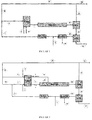
- Figure 1 is a process flow diagram containing a tubular reactor used for polymerizations PE1 to PE10.
- Figure 2 is a process flow diagram containing a tubular reactor used for polymerization PEB11 to PEB18 (broad MWD).
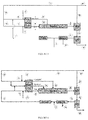
- Figure 3 is a process flow diagram for narrow MWD 50/50/0/0.
- Figure 4 is a process flow diagram for broad 25/25/50/0.
- Figure 5 is a process flow diagram for narrow 25/25/50/0.
- Figure 6 is a process flow diagram for even CTA for 25/25/50/0/0.
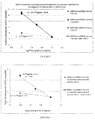
- Figure 7 depicts the ratio broad/narrow MWD capability as a function front gas% of log(m) (see claim 1).
- Figure 8 depicts the ratio of broad versus narrow MWD capability as function front gas% of log(m) (see claim 3).
- Figure 9 depicts temperature profiles of PEN20 (narrow) and PEB20 (broad).
- Figure 10 depicts LCB as a function of polymer formed along the reactor for PEN20 and PEB20.
- New polymerization processes have been discovered that provide ethylene-based polymers with wide variation in molecular weight distributions, at reduced pressure levels with high polymer output.
- the broad and narrow MWD polymers can be produced at high polymer output, providing better economics.
- the invention increases the ratio of broad MWD to narrow MWD polymers, by a polymerization, at constant, or varying, high ethylene conversion (for example, conversion ⁇ 28%).
- make-up ethylene distributions and/or make-up CTA distributions can be used over the reactor feed stream(s), to further enhance product and process capabilities.
- An inventive process may comprise a combination of two or more embodiments described herein.
- the "chain transfer activity ratio" and "T” is from 0.5 to 1.5, or from 0.6 to 1.4. In one embodiment, for the first aspect, the MWD B > MWD N + 1.0, or MWD B > MWD + 2.0, or MWD B > MWD + 5.0.
- the "chain transfer activity ratio" and "T” is from 0.5 to 1.5, or from 0.6 to 1.4. In one embodiment, for the second aspect, the MWD B > MWD N + 0.5, or MWD B > MWD N + 1.0, or MWD B > MWD N + 2.0.
- the "chain transfer activity ratio" and "T” is from 0.5 to 1.5, or from 0.6 to 1.4. In one embodiment, for the third aspect, the MWD B > MWD N + 1.0, or MWD B > MWD N + 2.0, or MWD B > MWD N + 5.0.
- ⁇ 2 of the following ratios are met:
- the first ethylene-based feed stream comprises at least one CTA, and wherein the activity of the CTA system in the first ethylene-based feed stream is greater than, or equal to, the activity of the CTA system in each subsequent ethylene-based feed stream. In one embodiment, the first ethylene feed stream comprises at least one CTA, and wherein the activity of the CTA system in the first ethylene feed stream is less than the activity of the CTA system in each subsequent ethylene feed stream.
- the average of peak temperatures in the reaction zones is ⁇ 320°C, or ⁇ 319°C, or ⁇ 318°C, or ⁇ 317°C, or ⁇ 316°C.
- the total ethylene based feed flow to the reactor configuration is from 30 to 400 tons per hr, or from 50 to 350 tons per hour.
- the reactor configuration comprises at least three ethylene-based feed streams. In one embodiment, the reactor configuration comprises only two ethylene-based feed streams. In one embodiment, the reactor configuration comprising at least four reaction zones and at least three ethylene feed streams.
- one or more CTAs is/are fed to the first reaction zone, in an amount from 20 mole% to 70 mole%, based on the total moles of ethylene, and optionally one or more comonomers and the one or more CTAs, fed to the polymerization.
- the reactor configuration comprises ⁇ 4 ethylene feed streams. In one embodiment, the reactor configuration comprises only three ethylene feed streams.
- the combined amount of monomers and CTA(s) fed to the first reaction zone is from 20 to 40 mole% of the combined amount of monomers and CTA(s) fed to the polymerization.
- the amount of ethylene, and optionally one or more comonomers, and optionally one or more CTAs, fed to the first reaction zone is from 30 mole% to 75 mole%, or from 40 to 70 mole%, based on the total moles of ethylene, and optionally one or more comonomers, and optionally one or more CTAs, fed to the polymerization.
- the combined amount of monomers and CTA(s) fed to the first reaction zone is from 20 to 60, or from 20 to 50, or from 20 to 45 mole%, of the combined amount of monomers and CTA(s) fed to the polymerization.
- the ethylene conversion is ⁇ 29%, or ⁇ 30%, or ⁇ 31%, or ⁇ 32%.
- the ethylene is fed to a first reaction zone (1), and wherein the following are met: a) the first reaction zone receives make-up ethylene; b) the second ethylene based feed to the reactor contains make-up ethylene; c) the third ethylene based feed to the reactor doesn't contain make-up ethylene; d) the fourth optional ethylene based feed to the reactor does not contain make-up ethylene.
- the ethylene is fed to a first reaction zone (1) and to two subsequent reaction zones, and wherein the following conditions are met: a) the first reaction zone receives make-up ethylene; b) the second ethylene based feed to the reactor does not contain make-up ethylene; c) the third ethylene based feed to the reactor does not contain make-up ethylene.
- the ethylene is fed to a first reaction zone (1) and to one subsequent reaction zone, and wherein the following conditions are met: a) the first reaction zone receives make-up ethylene; and b) the second ethylene based feed to the reactor does not contain make-up ethylene.
- the ethylene is fed to a first reaction zone (1) and to two or more subsequent reaction zone, and wherein the following conditions are met: a) the first reaction zone doesn't contain make-up ethylene; b) the second ethylene based feed to the reactor doesn't receive make-up ethylene; c) the third ethylene based feed to the reactor receive make-up ethylene; d) the fourth optional ethylene based feed to the reactor contain make-up ethylene.
- the first ethylene feed stream comprises from 20 to 100 mole%, or from 25 to 100 mole%, or from 30 to 100 mole%, or from 35 to 100 mole%, or from 40 to 100 mole%, or from 45 to 100 mole%, or from 50 to 100 mole% of the total amount of CTA added to the polymerization.
- the activity of the CTA system in the first ethylene-based feed is greater than, or equal to, the activity of the CTA system in each subsequent ethylene-based feed.
- the activity of the CTA system in the first ethylene feed is equal to the activity of the CTA system in the second ethylene feed.
- the activity of the CTA system in the first ethylene feed is greater than the activity of the CTA system in the second ethylene-based feed.
- the ratio (Y) of the normalized MWD of the broad to narrow MWD polymer produced, at a constant ethylene conversion is selected from the following: A * ln Cs narrow MWD process / Cs broad MWD process + 1 * B * log m + ⁇ 2.1 * B + 0.8 ⁇ Y ⁇ A * ln Cs narrow MWD process / Cs broad MWD process + 1 * ⁇ 6.5 * log m ] + 14.0 ; A * ln Cs narrow MWD process / Cs broad MWD process + 1 * B * log m + ⁇ 2.1 * B + 0.8 ⁇ Y ⁇ A * ln Cs narrow MWD process / Cs broad MWD process + 1 * ⁇ 7.0 * log m + 15.0 ; A * ln Cs narrow MWD process / Cs broad MWD process + 1 * B ⁇ log m + ⁇ 2.1 * B + 0.8 ⁇ Y ⁇ A * ln Cs narrow MWD process + 15.0 ; A
- the ratio (Q) of the "broad to narrow MWD polymer polymerized" is as follows: (I) 1 ⁇ Q ⁇ A*ln (CS narrow MWD process /Cs broad MWD process )+1)* (-13.0 x log(m) + 29.0); or (II) (A*ln (Cs narrow MWD process /Cs broad MWD process )+1)* ([B*log(m)] + (-2.0 * B+2.7)) ⁇ Q ⁇ (A*ln (Cs narrow MWD process /Cs broad MWD process )+1)* (-13.0 x log(m) + 29.0); Or (III) 1 ⁇ Q ⁇ A*ln (CS narrow MWD process /Cs broad MWD process )+1)* (-12.0 x log(m)+ 27.0); Or (IV) (A*ln (Cs narrow MWD process /Cs broad MWD process )+1)* ([B*log(m)] + (
- each polymer has the same melt index (I2); and wherein Cs narrow MWD process is average Cs value of the CTA system at the outlet of the reactor system used to produce the narrow MWD polymer, and wherein Cs broad MWD process is average Cs value of the CTA system at the outlet of the reactor system used to produce the broad MWD polymer, where A is in the range from 0.09 to 0.11, or from 0.09 to 0.1, or from 0.09 to 0.11; B is in the range from -4.3 to -2.3 or from -4.3 to -3.3, or from -4.3 to -2.3.
- the ratio (W) of the normalized MWD of the broad MWD to narrow MWD polymers produced, at constant ethylene conversion is selected the following: (I) 0.9 ⁇ W ⁇ (A*ln (Cs narrow MWD process /Cs broad MWD process )+1)* (-6.5* log(m) + 14.0)) * 1 ⁇ 0.115 * P B ⁇ P N 400 Bar ; (II) (A*ln (Cs narrow MWD process /Cs broad MWD process )+1)* (B*log(m) + ⁇ 2.1 * B + 0.8 ) * 1 ⁇ 0.115 * P B ⁇ P N 400 Bar ⁇ W ⁇ ( A * ln ( Cs narrow MWD process / Cs broad MWD process ) + 1 ) * ⁇ 6.5 * log m ] + 14.0 * 1 ⁇ 0.115 * P B ⁇ P N 400 Bar ; (III) 0.9 ⁇ W ⁇ (A*ln (Cs narrow MWD process /C
- the number of reaction zones is ⁇ 3, ⁇ 4, or ⁇ 5, or ⁇ 6, or ⁇ 10.
- the reactor system comprises ⁇ 3, or ⁇ 4, or ⁇ 5, or ⁇ 6 ethylene-based feed streams.
- the reactor configuration comprises at least one tubular reactor. In one embodiment the only reactors in the reactor configuration are tubular reactors, and further, if two or more tubular reactors are present, these reactors are in a series configuration.
- the first reaction zone is a tubular reaction zone. In a further embodiment, each reaction zone is a tubular reaction zone.
- the reactor configuration comprises at least one tubular reactor, and each tubular reactor is equipped with multiple heat transfer zones, and where heat is ex-changed between the process side and a heat transfer medium.
- the reactor configuration comprises at least one tubular reactor, and the cooling and/or heating to each reactor, is provided by pressurized liquid water operating in a co-current mode and/or counter current mode, in multiple cooling zones surrounding the reactor.
- the reactor system comprises at least one Primary Compressor, at least one Booster compressor, and at least one Hyper compressor.
- the ethylene fed to the first reaction zone is at least 10 mole percent of the total ethylene fed to the polymerization. In one embodiment, the ethylene fed to the first reaction zone is 10 to 70 mole percent, or 20 to 65 mole percent, or 25 to 60 mole percent, or 30 to 55 mole percent, or 45 to 55 mole percent of the total ethylene fed to the polymerization. In one embodiment, total amount of make-up (fresh) ethylene is distributed to all reaction zones. In one embodiment, the make-up ethylene is only distributed to the reaction zone i (i>1). In one embodiment, total amount of make-up (fresh) CTA is only distributed to the first reaction zone. In one embodiment, no make-up CTA is distributed to the first reaction zone. In one embodiment, total amount of make-up CTA is distributed to all reaction zones receiving an ethylene based feed flow. In one embodiment, each feed to each reaction zone contains the same CTA system. In a further embodiment the CTA system of each feed contains a single CTA.
- the peak polymerization temperature in the reaction zone 1 for producing a polymer with narrow MWD is less ⁇ 260°C, or ⁇ 255°C, or ⁇ 250°C, or ⁇ 245°C.
- the peak polymerization temp. in the reaction zones 1 and 2 for producing a polymer with narrow MWD is ⁇ 260°C, or ⁇ 255°C, or ⁇ 250°C, or ⁇ 245°C.
- peak polymerization temp. in the reaction zone 1, 2 and 3 for producing a polymer with narrow MWD is ⁇ 260°C, or ⁇ 255°C, or ⁇ 250°C, or ⁇ 245°C.
- the peak polymerization temperature in the reaction zone 1 for producing a polymer with broad MWD is >300°C, or > 305°C, or > 310°C, or > 315°C. In one embodiment, the peak polymerization temperature in the reaction zone 1 and 2 for producing a polymer with broad MWD, is > 300°C, or > 305, or > 310°C or > 315°C. In one embodiment, the peak polymerization temperature in the reaction zone 1, 2 and 3 for producing a polymer with broad MWD, is > 300°C, or > 305°C, or > 310°C, or > 315°C.
- the mixture further comprises at least one CTA selected from an aldehyde, an alkane, a ketone, an alcohol, an ester, a mercaptan, a phosphine, a phosgene, an alpha-olefin, or a combination thereof. In one embodiment, the mixture further comprises at least one CTA selected from an aldehyde, an alkane, a ketone, an alcohol, an ester, an alpha-olefin, or a combination thereof.
- the ethylene-based polymer is a polyethylene homopolymer. In one embodiment, the ethylene-based polymer is LDPE. In one embodiment, the ethylene-based polymer is an ethylene-based interpolymer comprising at least one comonomer. In one embodiment, the ethylene-based polymer comprises ethylene and one or more comonomers, and preferably one comonomer. Comonomers include, but are not limited to, ⁇ -olefins, acrylates, methacrylates and anhydrides, each typically having no more than 20 carbon atoms. The ⁇ -olefin comonomers, which have a combined monomer and CTA functionality, may have 3 to 10, or 3 to 8 carbon atoms.
- Exemplary ⁇ -olefins include, but are not limited to, propylene, 1-butene, 1-pentene, 1-hexene, 1-hep-tene, 1-octene, 1-nonene, 1-decene, and/or 4 methyl-1-pentene. Further, the ⁇ -olefin comonomers are selected from propylene and/or 1-butene.
- Free radical initiators are generally used to produce the inventive ethylene-based polymers.
- a free radical initiator refers to a free radical generated by chemical and/or radiation means.
- Free radical initiators include organic peroxides including cyclic peroxides, diacyl peroxides, dialkyl peroxides, hydroperoxides, peroxycarbonates, peroxydicarbonates, peroxyesters, and peroxyketals.
- Preferred initiators are t-butyl peroxy pivalate, di-t-butyl peroxide, t-butyl peroxy acetate and t-butyl peroxy-2-hexanoate, or mixtures thereof.
- these organic peroxide initiators are used in an amount from 0.001 to 0.2 wt%, based upon the weight of polymerizable monomers.
- an initiator is added to at least one reaction zone, which has a half-life temperature, at one second, > 255°C, preferably > 260°C. In an embodiment, such initiators are used at a peak polymerization temperature from 320°C to 350°C.
- the initiator comprises at least one peroxide group incorporated in a ring structure, such as initiators include TRIGONOXTM 301 (3,6,9-triethyl-3,6,9-trimethyl-1,4,7-triperoxonaan) and TRIGONOXTM 311 (3,3,5,7,7-pentamethyl-1,2,4-trioxepane), both available from Akzo Nobel, and HMCH-4-AL (3,3,6,6,9,9-hexamethyl-1,2,4,5-tetroxonane) from United Initiators. See also WO 02/14379 and WO 01/68723 .
- oxygen can be used as initiator.
- the mixture of single or multiple initiators, potentially diluted with a solvent, injected into a reaction zone i is called initiation system for reaction zone i.
- the polymerization pressure as measured at the first inlet of the reactor is from 1000 Bar to 3200 bar, or from 1200 to 3100 Bar, or from 1400 to 3000 Bar, or from 1600 to 2800 Bar, or from 1800 to 2600 Bar.
- the invention provides a process for controlling product MWD and associated product properties like melt elasticity, G' and melt strength through process conditions like peak temperatures, start and re-initiation temperatures, CTA and make-up ethylene distribution, ethylene-based feed stream to the multiple reaction zones while maintaining the reactor inlet pressure and ethylene conversion.
- Melt elasticity, melt strength and/or other rheological properties are influenced by MWD.
- different product quality targets are set for each product grade.
- An inventive process may comprise a combination of two or more embodiments described herein
- the invention also provides an ethylene-based polymer made by an inventive process.
- the ethylene-based polymer is a polyethylene homopolymer.
- the ethylene-based polymer is an ethylene-based interpolymer.
- the ethylene-based polymer is LDPE.
- the ethylene-based polymer has a density from 0.910 to 0.940 g/cc" or from 0.912 to 0.937 g/cc, or from 0.914 to 0.935 g/cc, or from 0.916 to 0.932 g/cc. In one embodiment, the ethylene-based polymer has a melt index from 0.1 to 1000 g/10 min, or from 0.1 to 500 g/10 min, or from 0.1 to 100 g/10 min, or from 0.1 to 50 g/10 min, or from 0.1 to 20 g/10 min.
- An inventive polymer may comprise a combination of ⁇ 2 embodiments as described herein.
- the invention also provides a composition comprising an inventive ethylene-based polymer.
- the composition further comprises another ethylene-based polymer, for example, an LLDPE.
- An inventive composition may comprise one or more additives, such as, stabilizers (e.g., antioxidants), plasticizers, antistatic agents, pigments, dyes, nucleating agents, fillers, slip agents, fire retardants, processing aids, smoke inhibitors, viscosity control agents and anti-blocking agents.
- the polymer composition may comprise less than 10 wt% of the sum weight of one or more additives, based on the weight of the composition.
- the polymers, polymer blends and compositions of this invention may be employed in a variety of conventional thermoplastic fabrication processes to produce useful articles, including extrusion coating onto various substrates; monolayer and multilayer films; molded articles, such as blow molded, injection molded, or rotomolded articles; coatings; fibers; and woven or non-woven fabrics.
- An inventive polymer may be used in a variety of films, including but not limited to, clarity and/or shrink films, collation shrink films, cast stretch films, silage films, stretch hood, sealants, diaper back sheets, wires and cables, gaskets and profiles, adhesives; footwear components, and auto interior parts.
- composition includes a mixture of materials, which comprise the composition, as well as reaction products and decomposition products formed from the materials of the composition.
- blend or “polymer blend,” as used, refers to a mixture of two or more polymers. A blend may or may not be miscible (not phase separated at molecular level). A blend may or may not be phase separated.
- comprising do not exclude the presence of any additional component, step or procedure, whether or not the same is specifically recited.
- high pressure polymerization process refers to a free radical polymerization process carried out at an elevated pressure of at least 1000 bar (100 MPa).
- feed refers to make-up and/or recycled components (for example, ethylene, initiator, CTA, and/or solvent) added to a reaction zone at an inlet.
- ethylene-based feed stream or “ethylene feed” or “ethylene based feed stream,” or “ethylene feed,” as used herein, refer to a feed stream to a reaction zone, and which contains a majority amount of ethylene, based on the molar amount of all of the components in the feed stream.
- one of more CTAs, comonomers, other process components (like lubrication oil, solvent, etc.) and/or impurities (as for instance initiator degradation products) might be present in the feed stream.
- LCB content refers to a level of long chain branches per 1000 carbons (total carbons) incorporated in the polymer.
- the LCB content is calculated with the help of kinetics on "Transfer to Polymer” and “Propagation” of ethylene and optionally present comonomers.
- the LCB content can be given as level in the final polymer (final product LCBf), in the progressing polymer formation along the reactor (cumulative LCBf) or in the locally formed polymer as function of the local polymerization conditions in the reactor (local LCBf).
- composition includes a mixture of materials which comprise the composition, as well as reaction products and decomposition products formed from the materials of the composition.
- polymer refers to a compound prepared by polymerizing monomers, whether of the same or a different type.
- the generic term polymer thus embraces the term homopolymer (which refers to polymers prepared from only one type of monomer with the understanding that trace amounts of impurities can be incorporated into the polymer structure), and the term “interpolymer” as defined below. Trace amounts of impurities may be incorporated into and/or within the polymer.
- interpolymer refers to polymers prepared by the polymerization of at least two different types of monomers.
- the generic term interpolymer includes copolymers (which refers to polymers prepared from two different monomers), and polymers prepared from more than two different types of monomers.
- ethylene-based polymer refers to a polymer that comprises a majority amount of polymerized ethylene, based on the weight of the polymer, and, optionally, at least one comonomer.
- ethylene-based interpolymer refers to an interpolymer that comprises a majority amount of polymerized ethylene, based on the weight of the interpolymer, and at least one comonomer.
- ethylene-based copolymer refers to a copolymer that comprises a majority amount of polymerized ethylene, based on the weight of the copolymer, and a comonomer as the only monomer types.
- side stream or “side feed stream,” as used herein, refer to the ethylene based feed stream, CTA system feed stream, and/or initiator system, to sequential rnx zones.
- reactor system refers to the devices used to polymerize and isolate a polymer. Such devices include, but are not limited to, one or more reactors, reactor pre-heater(s), monomer-reactor cooling device(s), Secondary compressor(s) (or Hyper compressor(s)), Primary compressor(s), and/or Booster compressor(s).
- reactor pre-heater refers to a reactor system that comprises only one or more tubular reactor(s) as the reactor(s) of the reactor system, and exclude autoclave reactors. When more than one tubular reactor is used, they are preferably used in a series configureation.
- reactor configuration refers to one or more reactors, and optionally one or more reactor pre-heaters, used to polymerize a polymer.
- inlet pressure refers to the pressure level at the first inlet of the first reaction zone.
- reaction zone refers to a reactor zone where polymerization reaction is initiated or reinitiated by the addition of free radicals or components which dissociate into and/or generate free radicals.
- reaction medium is heated and/or cooled by a heat transfer medium flowing through a jacket around the reactor.
- a reaction zone may also start with the addition of make-up and/or recycled ethylene, and/or free radicals or components which dissociate into and/or generate free radicals.
- first reaction zone refers to the first reactor zone where the polymerization is initiated by the addition of radicals and/or components which dissociate into and/or generate radicals.
- the first reaction zone ends at the point where there is a new feed of radicals, and/or components which dissociate into and/or generate radicals, and, optionally, make-up and/or recycled ethylene and/or comonomer(s).
- the term "subsequent reaction zone,” and similar terms, as used herein, refers to the reaction zone following a previous reaction zone is ended, and which is started by a new feed of radicals, and/or components which dissociate into and/or generate radicals, and, optionally, make-up and/or recycled ethylene and/or comonomer(s) are fed into the reactor system at a new downstream of the reactor system.
- peak temperature for a reaction zone refers to the highest temperature measured in a reaction zone.
- peak temperature refers to the average of the max. or peak temperature in the reaction zones.
- cycled when used herein, in reference to a reactant (i.e., “recycled ethylene,” “recycled CTA”), refers to unreacted reactant separated from the polymer in the high pressure separator(s) and/or the low pressure separator(s), and returned/compressed to the reactor.
- CTA system includes a single CTA, or a mixture of CTAs, added to the polymerization process, typically to control the melt index.
- a CTA system includes a component able to transfer a hydrogen atom to a growing polymer molecule containing a radical, by which the polymer radical is terminated and a new radical is formed on the CTA molecule, which can then initiate a new polymer chain.
- CTA is also known as telogen or telomer.
- CTA activity or “chain transfer activity coefficient (Cs value)” as used herein, refer to the ratio between the "rate of chain transfer” to the "rate of ethylene propagation.” See Mortimer references provided in the experimental section below.
- Z1/Zi The terms "Z1/Zi” as used herein is determined as follows.
- the "transfer activity or activity of a CTA (system) in a reactor zone I (Zi)” is defined as the “sum of the reactor zone molar concentration of each CTA in the reactor zone” multiplied with its chain transfer activity constant (Cs) - see Equation BC.
- the chain transfer activity constant (Cs) is the ratio of reaction rates Ks/Kp, at a reference pressure (1360 atm) and a reference temperature (130°C). This relationship is shown in Eqn. BC, where n compi is the total number of CTAs in reactor zone i. Note i ⁇ 1, and n compi ⁇ 1.
- Z 1 /Z i is controlled to be greater than 1. In another embodiment, Z 1 /Z i is controlled to be less than 1.
- Z 1 /Z i is controlled to be from 0.2 to 2.0, or from 0.3 to 1.8, or 0.4 to 1.6 or 0.5 to 1.5.
- Cs narrow MWD process refers to an average Cs value of the CTA system at the outlet of the reactor configuration used to produce narrow MWD polymer.
- Cs broad MWD process refers to an average Cs value of the CTA system at the reactor outlet of the reactor configuration used to produce broad MWD polymer.
- average Cs at the outlet of the reactor configuration refers to the molar weighted compositional Cs of the components with chain transfer activity at the outlet of the reactor configuration, which is calculated as the sum of each individual Cs value multiplied with each individual mole fraction in the total CTA system at the reactor outlet of the reactor configuration.
- CTA A with Cs of 0.3 and mole fraction of 0.2
- CTA B with Cs of 0.05 and mole fraction of 0.2
- CTA C with Cs of 0.01 and mole fraction 0f 0.6.
- the CTA amount at the outlet can be measured by an on-line analyzer, such as an on-line FTIR analyzer.
- initiator system includes a single initiator, or a mixture of initiators, each typically dissolved in a solvent (for example, a hydrocarbon solvent) added to the polymerization process.
- a solvent for example, a hydrocarbon solvent
- make-up when used herein, in reference to a feed component (i.e., “make-up ethylene or make-up ethylene feed,” “make-up CTA or make-up CTA feed”), refers to a feed provided to compensate for the ethylene, or CTA, or other respective component, consumed by the polymerization and/or lost through, for example, ethylene-based purge from the process, and residual component in the polymer.
- mole fraction refers to the molar ratio of one component in a mixture to the total moles of the components of the mixture. Molar fraction can be determined by calculating the ratios of molar amounts or molar flows.
- mole fraction of make-up ethylene fed to the first reaction zone refers to the molar amount of make-up ethylene fed (via a front stream) to the first reaction zone, divided by the molar amount of ethylene plus optional comonomer(s) plus optional CTA(s) fed to all reaction zones.
- mole fraction of make-up ethylene fed to the nth reaction zone (FEn), refers to the molar amount of make-up ethylene fed (via a side stream) to the nth reaction zone divided by the molar amount of ethylene plus optional comonomer(s) plus optional CTA(s) fed (via a side stream) to reaction zones.
- RFEn FE1/FEn
- FE1 the ratio of the "mole fraction of make-up ethylene fed to the first reaction zone (FE1)” to the "mole fraction of make-up ethylene fed to reaction zone n (FEn)”.
- FE1 the ratio of the "mole fraction of make-up ethylene fed to the first reaction zone (FE1)" to the "mole fraction of make-up ethylene fed to reaction zone n (FEn)”.
- FE1 is the ratio of the amount of make-up (fresh) ethylene in the front ethylene based feed stream vs. the total amount of the front ethylene based feed stream.
- FE2 is the ratio of the amount of make-up (fresh) ethylene in the first side of ethylene based feed stream vs. the total amount of the first side ethylene based feed stream.
- FE2 is the ratio of the amount of make-up (fresh) ethylene in the second side ethylene based feed stream vs. the total amount of the second side ethylene based feed stream.
- the polymerization is initiated by a free radical initiation system injected, and/or activated, at the inlet of each reaction zone.
- the maximum temperature in each reaction zone is controlled at a set point, by regulating the concentration and/or adjusting the composition of initiation system at the start of each reaction zone.
- the reaction mixture is depresssurized and/or cooled in (10), and separated in the high pressure separator (HPS).
- HPS separates the reaction mixture into an ethylene rich stream (15), containing minor amounts of waxes and/or entrained polymer, and a polymer rich stream (11), which is sent to the LPS for further separation.
- Ethylene stream (15) is cooled and cleaned in stream (17).
- Stream (16) is a purge stream to remove impurities and/or inerts.
- the polymer separated in LPS is further processed to polymer pellets in (12).
- the ethylene removed in the LPS is fed to the Booster, where, during the compression, condensables such as solvent, lubrication oil, and others components, are collected and removed through stream (14).
- the outlet of the Booster is combined with make-up ethylene stream (1), and further compressed by the Primary.
- Figure 1 shows a generalized flow scheme of a simulated high pressure polymerization plant configuration containing a tubular reactor, where the whole compressed flow from a hyper compressor is sent to the first (front) reaction zone of the reactor, representing 100/0/0/0 ethylene based feed distribution.
- Stream (1) is the ethylene make-up, which is compressed together, with the outlet of the Booster, by the Primary to stream (2).
- Stream (2) is combined with a high pressure recycle stream (HPR) line (18) to line (3) and is sent to the inlet of the secondary compressor system (Hyper).
- the secondary compressor system pressurizes the ethylene based feed stream to a sufficient level and feeds to the high pressure tubular reactor (Reactor).
- Stream (4) depicts the CTA system make-up (fresh) feed in this reactor configuration, which could be fed in the inlet (s), interstage or outlet of the hyper.
- stream (4) can be fed to the inlet, interstage or outlet of Booster or Primary compressor systems.
- the CTA system can consist of either a single or multiple components and can include varying compositions.
- Stream (6) presents a potential comonomer feed.
- Comonomer streams (6) can be fed in the inlet(s), interstage(s), outlet(s) of the secondary compressor system and/or directly into the reaction zones.
- stream (6) can be fed to the inlet, interstage or outlet of Booster or Primary compressor systems.
- the discharge temp. of the secondary compressor system is typically in the range from 60 to 100°C.
- the ethylene based feed to the first rnx. zone is typically preheated to a temp. from 130 to 180°C.
- Flow Scheme of PEB11 through PEB18 - Figure 2 shows a generalized flow scheme of a simulated high pressure polymerization plant configuration containing a tubular reactor.
- ethylene based feed streams are distributed to the front and the side of the reactor according 50/50/0/0 ethylene based feed configuration, in which 50% of the total ethylene based feed stream is fed to the first reaction zone while the remaining 50% is sent to the second reaction zone.
- Stream (1) is the ethylene make-up, which is compressed together with the outlet of the Booster by the Primary to stream (2).
- the recycle stream (17) and (18) from HPR is split into a stream (4) which is sent to the Hyper compressor system and subsequently through line (8) and (20) to the side of the reactor.
- a smaller flow (line 19) is combined with stream (2) from Primary compressor system to stream (5), which is sent to the Hyper compressor system and fed via line (9) to the first reaction zone of the reactor.
- Stream (6) and/or stream (7) depict the CTA system make-up (fresh) feed.
- comonomer(s) can be fed through stream (6) and/or (7).
- CTA make-up streams (4) and/or (5) can be fed in the inlet(s), interstage(s), out-let(s) of the secondary compressor system, and/or inlet(s) of the reaction zones.
- stream (6) and/or (7) can be fed to the inlet, interstage or outlet of Booster or Primary compressor systems. The remaining scheme - see above.
- Flow Scheme used for PEN11 to PEN18 - Figure 3 represents the high pressure polymerization in which ethylene based feed stream is sent to the front (stream 9) and side (stream 20) of the reactor with 50/50/0/0 feed distribution.
- a major flow from HPR (line 17) is sent to the suction of the Hyper of which the discharge flow is distributed over the front of the reactor (line 9).
- the remaining HPR flow is combined with the flow from the primary compressor (line 2) containing very low CTA level and sent to the Hyper of which the discharge flow is distributed to the side of the reactor (line 20).
- This scheme shows that the front of the reactor receives max. HPR with high CTA level while the reactor side receives the max. make-up ethylene used to make narrow MWD polymers.
- Flow Scheme of PEBl9 to PEB23 - Figure 4 represents the high pressure polymerization with three ethylene based feed distribution (25/25/50/0/0) and four reaction zones.
- a major part of the HPR flow (line 18) is sent to the third reaction zone (line 21), while a remaining flow is combined with the remaining Hyper discharge flow from the Primary compressor (line 2), and distributed over the second reaction zone (line 20).
- the flow from Primary compressor containing almost no CTA will be mainly sent to the suction of the Hyper wherein the ethylene base feed discharge flow is sent to first reaction zone through line 9.
- the first reaction zone (line 9) receives a maximum amount of make-up ethylene from the Primary (line 2) while the side streams (line 20 and 21) receive a maximum amount of CTA from the HPR flow. All other remaining streams are discussed above.
- Flow Scheme of PEN19 to PEN23 and PEN19.1, PEN19.2 - Figure 5 represents the high pressure polymerization comprising three ethylene based feed distribution (25/25/50/0/0) and with five reaction zones.
- the HPR flow (line 18) with high level of CTA is mainly sent to the suction of the Hyper of which the discharge flow is distributed over the front (line 9 - first reaction zone) and side (line 20 - second reaction zone) of the reactor system.
- the remaining HPR flow is combined with the Primary compressor flow which contains almost no CTA (line 2) and sent to the Hyper. This discharge flow from the Hyper is sent to the third reaction zone through line 21. All other remaining streams are discussed above.
- Flow Scheme used for PEB19.1 and PEB19.2 - Figure 6 shows a generalized flow scheme of a simulated, high pressure polymerization reactor system containing a tubular reactor used for PEB19.1 and PEB19.2 examples with three ethylene based feed distribution (25/25/50/0/0).
- High Pressure Recycle flow line 17
- Primary compressor flow line 2
- the Hyper pressurizes the ethylene feed stream to a level sufficient to feed the high pressure tubular reactor (Reactor).
- the discharge temperature of the Hyper is typically between 60 and 100°C.
- the ethylene feed to the first reaction zone is typically preheated to a temperature from 130 to 180°C, while the ethylene, fed to a side feed to the reactor, is fed at the Hyper discharge temperature, or cooled prior to feeding to the reactor.
- the discharge flow from the Hyper is then distributed over the front (first reaction zone - line 9) and side (line 20 and 21) of the reactor. It thus results in even CTA distribution process.
- Stream (6) and/or (7) depict the CTA system make-up (fresh) feed.
- the CTA make-up can, in principle, be freely distributed over the main compression streams fed and/or distributed over the side (line 8) and front (line 9).
- CTA make-up (line 6) and/or (line 7) can be fed in the inlet(s), interstage(s), outlet(s) of the Hyper, and/or inlet(s) of the reaction zones.
- the co-monomer flow can be fed to the suction of the Hyper via line 6 and/or line 7. Remaining parts of the reactor system - see above.
- the polymerization simulations were achieved with Goto, LDPE simulation model, as discussed above.
- the kinetic data used by Goto et al. was derived from high pressure, free radical polyethylene polymerization experiments, performed at varying temperature, pressure and polymer concentration, as described in the following references: K. Yamamoto, M. Sugimoto; Rate constant for long chain-chain branch formation in free-radical polymerization of ethylene; J. Macromol. Science-Chem., A13 (8), pp. 1067-1080 (1979 ).
- the elementary reaction steps are described by Goto et al.
- the kinetic data for selected CTAs is given in Table 2.
- the kinetic constants haven been calculated with the help of the kinetic constants on the Cs-value (ks/kp) as determined by Mortimer (see References below), and the ethylene propagation kinetics as given by Goto et al. (see Table 1).
- Propylene will beside of its CTA functionality also act as a comonomer, resulting in additional methyl branches. These additional methyl branches will typically lower the density of the polymer by 0.001 to 0.004 g/cc. Furthermore the comonomer activity will increase the overall consumption level per reactor pass, by which more propylene has to be added to compensate for the consumption as CTA as well as comonomer.
- the CTA types used for simulations, to control melt index are propionaldehyde (PA), propylene and isobutane.
- PA has the activity (Cs) of 0.33 and a reactor ethylene conversion of about 10%
- Propylene has Cs of 0.012 and an assumed reactor ethylene conversion of about 20%, since it has both CTA and comonomer functionality
- isobutane has Cs of 0.0072 and a reactor ethylene conversion/make-up of about 1%.
- the melt index of polymers used in the simulations is 0.2 g/10min, 1 g/10min and 10 g/10min, and can be easily extended to a wider MI range.
- the polymerizations are simulated for a high pressure tubular reactor, operating at a reactor inlet pressure equal or below 320 MPa (3200 bar), using an ethylene-based throughput of 60 metric tons/hr.
- the ethylene based feed flow coming from the hyper compressor is split in 100/0/0/0 (PE1 through PE10), or 50/50/0/0 (PEB11 through PEB18 and PEN11 through PEN18) or 25/25/50/0 (PEB19 through PEB23 and PEN19 through PEN23).
- a tubular reactor configuration comprises up to several thousand meters of total length, for four or more reaction zones.
- the reactor length is varying from 1250 to 1450 meter, depending on the reactor configuration.
- the inside diameters of the reactor tubes are varied from 27 mm to 54 mm, for the first reaction zone, and from 38 mm to 54 mm, for the remaining part of the reactor depending on the ethylene based feed distribution.
- the reactor dimensions are selected to maintain a good process velocity of about 12 to 14 m/s.
- the pressure drop over the reactor is around 500 bar for all simulations. In all simulations, the side stream has been cooled down between 60°C and 40°C before feeding to the reactor resulting in a re-initiation temperature above 135°C.
- Initiator systems comprising a mixture of multiple single initiators are injected into the reactor at different locations, to create multiple reaction zones, and thus creating a four peak temp. profile, and elevating the overall ethylene conversion.
- TBPO Tert Butyl peroxy-2-ethylhexanoate
- DTBP Di-tert-butyl peroxide
- Tert Butyl peroxypivalate (TBPIV) was added or in case of a peak temp. of 270°C or lower DTBP was replaced by Tert Butyl peracetate (TBPA).
- TBPA Tert Butyl peracetate
- reaction zone 1 including the preheating zone
- reaction zone 1 including the preheating zone
- All zones were simulated with a counter current cooling/ heating configuration. Alternatively the pressurized water temperatures can be operated at other uniform or non-uniform settings.
- the cooling zones can be operated in a co- and/or countercurrent mode. The simulations have been done with an inlet temp. of the first reaction zone of 150°C.
- Molecular Weight Distribution (representing the relationship between (dw/dlogM) and logM) is an important parameter used in the polymerization designs, process development, improvement and operation. It is necessary to determine the types of polymer produced (narrow or broad MWD) which provide the desired product properties. Normalized MWD data can be obtained by using PREDICI commercial software package (licensed by Dr. M. Wulkow , Computing in Technology,, GmbH, Pater-Klbe-Stra ⁇ e 7, D-26180 Rastede, Germany ), to construct MWD from polymerization kinetics (Goto kinetics in this study), through solving polymer population balance equations.
- the required inputs for PREDICI includes the used Goto kinetics, and the monomer and/or co-monomer, initiator and CTA flows, temperature and pressure profiles, as well as elapsed time, all of which can be obtained from the process simulation.
- PREDICI software package can be used to generate normalized MWD data.
- MWD of each polymer has been calculated and subsequently normalized with the MWD of CP1 (100/0/0/0), following (Eqn.5).
- MWD normalized MWD example MWD PEs ⁇ 100 %
- the simulations of polymers PE1 through PE10 have been done for the reactor configuration 100/0/0/0 (where the ethylene-based feed stream is fully sent to the first reaction zone).
- the inner tube diameter of the reactor is of 54 mm, giving an average process velocity of about 13 to 14 m/s over the whole reactor length.
- the reactor inlet pressure is varied between 2400 bar (very broad MWD) to 3200 bar (very narrow MWD). In case of narrow MWD, as shown in PE2, PE6, PE8 and PE10, the reactor inlet pressure and the overall ethylene conversion level are maintained at respectively 3200 bar and at minimum ethylene conversion level of 28.2%.
- the MWD of PE3 is used to calculate the normalized MWD values reported in Table 5.
- PE1 PE5, PE7 and PE9 ethylene is polymerized with the peak temperatures of 315, 315, 315 and 315°C in four reaction zones and the pressure of 2400 bar for making very broad polymer.
- LCB f is around 5.4/1000C.
- the very narrow MWD polymers as named by PE2, PE4, PE6, PE8, PE10, have been simulated at a peak temperature of 230°C for the first peak while the sequence peak temperatures have been adjusted to maintained a minimum ethylene conversion level of around 28.2% (see Table 4).
- the normalized MWD is below 100% for PA and MEK examples and just slightly above 100% for isobutane example.
- the final LCBf is decreased to around 2.09/1000C. Additional simulations PE3 and PE4 have been done at a constant pressure (2800 bar) and ethylene conversion level (31.9%).
- the peak temperatures have been kept as 290, 290, 290 and 290°C while in PE4, a lowering of the first peak temperature (240°C) and adjusted three last peak temperatures have been applied to maintain the ethylene conversion at 31.9%. It is surprisingly found that lowering the first peak results in broader polymer (normalized MWD of 103% for PE4 vs. 100% for PE3). It is also reflected in LCB content which is increased from 3.13/1000C (PE3) to 3.32/1000C (PE4).
- PEB11 to PEB18 examples represent the high pressure reactor configuration with an ethylene based feed distribution of 50/50/0/0 over the reaction zones.
- the simulations were performed for products with varying MI from 0.2 to 10 g/10min, and using different CTA activity (Cs is varying from 0.007 to 0.33).
- the PEB11, PEB12 and PEB13 indicate the simulations carried out at the peak temperatures between 290/290/290/290°C to 296/296/296/296°C, while the pressure was varied from 2400 bar, 2800 bar to 3200 bar respectively with ethylene conversion level at 31.9%.
- a CTA with Cs 0.33 has been used for those simulations.
- PEB14 very broad MWD product has been simulated under more extreme conditions, such as at the reaction peak temps. of 315, 315, 315 and 315°C, and the reactor inlet pressure of 2400 Bar, and thus the ethylene conversion is increased to 35.8%.
- PEB14 shows much broader MWD (normalized MWD is of 348% vs. 213%), and with significantly higher LCB level (5.26 vs. 3.891/1000C).
- the influence of melt-index and CTA types on the polymer properties have been studied in PEB15 through PEB18, which indicate that a lower MI will give broader normalized MWD, as compared to a higher MI (PEB16 vs. PEB 15).
- the LCB of CP 15 is much higher than PEB16 (4.96/1000C vs. 5.68/1000C).
- PEB19 through PEB23 The process conditions and product properties of PEB19 through PEB23 have been simulated for the ethylene based feed distribution of 25/25/50/0.
- the make-up ethylene coming from the primary compressor is distributed over the first reaction zone of the reactor while the recycled ethylene coming from the HPR and the CTA (make up and recycle) is distributed over the side of the reactor for making very broad MWD. It thus results in the low CTA feed concs. in the first reaction zone (see Table 5).
- the inventive polymers have been simulated using different reactor configurations and operation conditions, as well as other important process parameters, such as make-up ethylene and/or make-up CTA distribution (see Table 3 and Table 4 for more detail).
- PEN11 through PEN13 ethylene based feed distribution 50/50/0/0
- make-up ethylene coming from the primary compressor is mainly sent to the side of the reactor, while recycled ethylene coming from the HPR and fresh/make-up CTA are preferably sent to first reaction zone, resulting in high CTA conc.
- the polymers can be further narrowed by lowering peak temperatures and applying a higher pressure level (3200 bar for instance), as shown in IP 14 and IP 19, in which ethylene conversion is maintained at a min. level of 28.2%. Additional simulations have been done to cover the effect of melt-index and CTA types on the polymer properties - shown in PEN 15 through PEN18 and PEN21 through PEN23.
- the narrower MWD polymer is made with higher melt-index and using CTA with higher activity.
- the lower limit for the ratio between broad and narrow MWD capability reflects the current MWD capability as function of CTA choice and percentage of total ethylene-based feed flow sent to the first reaction zone, while the upper limit reflects the maximum ratio between broad and narrow MWD capability by the inventive operation.
- the values between the lower and upper limit reflects the inventive operating space as shown in Equation (a). Further detail on the process conditions, see Tables 3 and 4. The data used in Eqn. a, and plotted in Figure 7 , can be found in Table 6a, b and c.
- the impact of the ethylene-based split ratio (percentage of ethylene sent to the front of the reactor) and process conditions (pressure, temperature, selection of CTA system and distribution of make-up ethylene and/or make-up CTA) on the product properties (represented by normalized MWD, LCBf) have been investigated.
- the inventive polymerization allows the production of narrow and broad MWD polymers at high ethylene conversion. For example, (i) at a constant ethylene conversion level, at reactor configurations using a distribution of the overall ethylene based feed over the front reaction zone and side reaction zone(s); by varying the inlet pressure, and operating all peak temperatures at a constant high level, will broaden the MWD capability.
- narrow MWD polymers can be produced at high ethylene conversion level, and low operating pressure, by applying low peak temperature(s) in the first, second or third reaction zones, and distributing the make-up ethylene primarily to the side of the reactor, and/or distributing the make-up CTA primarily to the first and/or second reaction zones and selecting CTA systems with different Cs value.
- Table 3 Process Configurations and Operating Conditions Ethylene based feed distribution Ex. Temp. of the side ethylene based feed [°C] Peak temp. in each rnx zone [°C] Start/re-initiation temp.
- C) Z1/Z3 is the ratio of the activity of the CTA system in the first ethylene feed (Z1) to the activity of the CTA system in the third ethylene feed (Z3).
- the RZ1, RZ3 and RZ3 are calculated with the assumptions that the about 60% ethylene based feed is come from the high pressure recycle (HPR) flow.
- the rest of the about 40 wt% ethylene based feed is from primary which includes make-up ethylene and low pressure recycle (LPR) flow.
- Make-up (fresh) ethylene is 33.3 mol% which includes ethylene converted and lost by purge flow.
- the LPR flow is 6.7 mol% which includes ethylene from LPR and secondary compressor gland leaks.
- RX1 is the first rnx zone Ethylene based feed distribution to RX1 (m*) Broad MWD example /Narrow MWD example Cs narrow MWD process /Cs broad MWD process log(m) T (T) ⁇ [-2.3 ⁇ log(m) + 7.0] Q (T) ⁇ [-13.0 ⁇ log(m)+29.8] 100 PE1/PE2 1.0 2 1.0 2.4 2.6 3.8 100 PE5/PE6 1.0 2 1.0 2.4 2.7 3.8 100 PE7/PE8 1.0 2 1.0 2.4 2.6 3.8 100 PE9/PE10 1.0 2 1.0 2.4 2.4 1 3.8 50 PEB14/PEN14 1.0 1.70 1.0 3.1 6.7 7.7 50 PEB 17/ PEN17 1.0 1.70 1.0 3.1 6.9 7.7 50 PEB 18/ PEN18 1.0 1.70 1.0 3.1 5.9 7.7 25
- Table 6c Ratio of broad MWD vs.
- T (0.1*ln (Cs narrow MWD process /Cs broadMWD process )+1) which reflects the effect the activity of CTA system at the outlet of the reactor system.
- Ethylene based feed distribution to RX1 m* Broad MWD example /Narrow MWD example Cs narrow MWD process /Cs broad MWD process T (T) x [-1.1 x log(m) + 3.0] Y (T) x [-6.2 x log(m) + 13.5] 100 PE3/ PE4 1 1 0.8 0.97 1.1 50 PEB12/ PEN12 1 1 1.1 2.4 3.0 25 PEB19/ PEN19 1 1 1.5 4.79 4.83 * m mol% of ethylene-based feed to the first reaction zone (based on the total moles of ethylene based feed fed to the reactor).
Landscapes
- Chemical & Material Sciences (AREA)
- Health & Medical Sciences (AREA)
- Chemical Kinetics & Catalysis (AREA)
- Medicinal Chemistry (AREA)
- Polymers & Plastics (AREA)
- Organic Chemistry (AREA)
- Polymerisation Methods In General (AREA)
- Addition Polymer Or Copolymer, Post-Treatments, Or Chemical Modifications (AREA)
Abstract
The invention provides a process to form an ethylene-based polymer, said process comprising polymerizing a mixture comprising ethylene, in the presence of at least one free-radical initiator, and in a tubular reactor system comprising at least two ethylene-based feed streams, and a reactor configuration that comprises at least three reaction zones; and
wherein the inlet pressure of the first reaction zone is less than, or equal to, 3200 Bar; and the polymerization has an ethylene conversion ¥ 28%, and an m value from 20 mole% to70 mole%, where m = mol% of ethylene-based feed stream to the first reaction zone, based on the total moles of ethylene-based feed streams fed to the reactor configuration; and
wherein the ratio (Q) of a "MWD B of a broad polymer polymerized, to a "MWD N of a narrow polymer polymerized, is as follows: {(T) * (-2.3 x log(m) + 7)} ¤ Q ¤{ (T) * (-13.0 x log(m) + 29.8)}; and wherein the "MWD B polymer" and the "MWD N polymer" both have the same melt index; and wherein the "T" is the "chain transfer activity ratio" and "T" is from 0.6 to 1.6, and T is defined as follows: T = {[0.1*ln (Cs narrow M WD process /Cs broad MWD process )] +1}; wherein Cs narrow MWD process and Cs broad MWD process are average Cs value of the CTA system at the outlet of the reactor configuration used to produce, respectively, the narrow and the broad MWD polymers, and wherein MWD B > MWD N .
Description
- Low Density Poly Ethylene (LDPE) is produced in an autoclave and/or tubular reactor at high pressure and temperature. High pressure, free-radical polymerizations are disclosed in the following references:
U.S. Patent Nos. 8445606 ,4135044 ,7582709 , andJP050534422 - The polymer output of a tubular process is affected by ethylene conversion and monomer throughput. The ethylene conversion is governed by the desired product properties. The monomer throughput depends on the design and the operating conditions of a hyper compressor system, which compresses the monomer feed stream to the required reactor inlet pressure. Another parameter of importance is the energy required to produce a unit of polymer. This energy requirement is largely determined by the compression energy required by the hyper compressor. Thus, there is a need to maximize polymer production by increasing ethylene conversion for a given amount of compression energy. The maximization polymer production needs to be combined with maximization the flexibility in product design, as expressed as the ratio of broad MWD to narrow MWD capability at a given melt-index. The extension of product design, while maximizing polymer output and/or reducing energy input, have been met herein.
- The invention provides, in a first aspect, a process to form an ethylene-based polymer, said process comprising polymerizing a mixture comprising ethylene, in the presence of at least one free-radical initiator, and in a tubular reactor system comprising at least two ethylene-based feed streams, and a reactor configuration that comprises at least three reaction zones; and
wherein the inlet pressure of the first reaction zone is less than, or equal to, 3200 Bar; and the polymerization has an ethylene conversion ≥ 28%, and an m value from 20 mole% to 70 mole%, where m = mol% of ethylene-based feed stream to the first reaction zone, based on the total moles of ethylene-based feed streams fed to the reactor configuration; and
wherein the ratio (Q) of a "MWDB of a broad polymer polymerized, to a "MWDN of a narrow polymer polymerized, is as follows: {(T) * (-2.3 x log(m) + 7)} ≤ Q ≤{ (T) * (-13.0 x log(m) + 29.8)}; and wherein the "MWDB polymer" and the "MWDN polymer" both have the same melt index; and wherein the "T" is the "chain transfer activity ratio" and "T" is from 0.6 to 1.6, and T is defined as follows: T = {[0.1 *ln (Cs narrow MWD process/Cs broad MWD process)] +1}; wherein Cs narrow MWD process and Cs broad MWD process are average Cs value of the CTA system at the outlet of the reactor configuration used to produce, respectively, the narrow and the broad MWD polymers, and wherein MWDB > MWDN. - In a second aspect, the invention provides a process to form an ethylene-based polymer, said process comprising polymerizing a mixture comprising ethylene, in the presence of at least one free-radical initiator, and in a tubular reactor system comprising at least two ethylene-based feed streams, and a reactor configuration that comprises at least three reaction zones; and
wherein the inlet pressure of the first reaction zone is less than, or equal to, 3200 Bar; and the polymerization has an ethylene conversion ≥ 28%, and an m value from 20 mole% to 70 mole%, where m = mol% of ethylene-based feed stream to the first reaction zone, based on the total moles of ethylene-based feed streams fed to the reactor configuration; and
wherein the ratio (W) of a "MWDB of a broad polymer" polymerized," to the "MWDN of a narrow polymer" polymerized, is as follows: {[(T) x (-1.1 x log(m) +

- In a third aspect, the invention provides a process to form an ethylene-based polymer, said process comprising polymerizing a mixture comprising ethylene, in the presence of at least one free-radical initiator, and in a tubular reactor system comprising at least two ethylene-based feed streams, and a reactor configuration that comprises at least three reaction zones; and
wherein the inlet pressure of the first reaction zone is less than, or equal to, 3200 Bar; and the polymerization has an ethylene conversion ≥ 28%, and an m value from 20 mole% to 70 mole%, where m = mol% of ethylene-based feed stream to the first reaction zone, based on the total moles of ethylene-based feed streams fed to the reactor; and
wherein the ratio (Y) of a "MWDB of a broad polymer" polymerized, to a narrow "MWDN polymer" polymerized, is as follows: {(T) x (-1.1 x log(m) + 3.0)} ≤ Y ≤ {(T) x (-6.2 x log(m) + 13.5)}; and wherein the "MWDB polymer" and the "MWDN polymer" both have the same melt index (12); and wherein "T" is the "chain transfer activity ratio" and T = {[0.1*ln (Cs narrow MWD process/Cs broad MWD process)] +1}, and "T" is from 0.4 to 1.6; and wherein Cs narrow MWD process and Cs broad MWD process are average Cs value of the CTA system at the outlet of the reactor configuration used to produce, respectively, the narrow and the broad MWD polymers, and wherein MWDB > MWDN; and wherein the ethylene conversion of the polymerization for the broad polymer polymerized is equal to the ethylene conversion of the polymerization for the narrow polymer polymerized; and wherein the inlet pressure of the polymerization for the broad polymer polymerized is equal to the inlet pressure of the polymerization for the narrow polymer polymerized. -
Figure 1 is a process flow diagram containing a tubular reactor used for polymerizations PE1 to PE10.Figure 2 is a process flow diagram containing a tubular reactor used for polymerization PEB11 to PEB18 (broad MWD).Figure 3 is a process flow diagram for narrow MWD 50/50/0/0.Figure 4 is a process flow diagram for broad 25/25/50/0.Figure 5 is a process flow diagram for narrow 25/25/50/0.Figure 6 is a process flow diagram for even CTA for 25/25/50/0/0.Figure 7 depicts the ratio broad/narrow MWD capability as a function front gas% of log(m) (see claim 1).Figure 8 depicts the ratio of broad versus narrow MWD capability as function front gas% of log(m) (see claim 3).Figure 9 depicts temperature profiles of PEN20 (narrow) and PEB20 (broad).Figure 10 depicts LCB as a function of polymer formed along the reactor for PEN20 and PEB20. - New polymerization processes have been discovered that provide ethylene-based polymers with wide variation in molecular weight distributions, at reduced pressure levels with high polymer output. The broad and narrow MWD polymers can be produced at high polymer output, providing better economics. The invention increases the ratio of broad MWD to narrow MWD polymers, by a polymerization, at constant, or varying, high ethylene conversion (for example, conversion ≥ 28%). Also, it has been discovered that make-up ethylene distributions and/or make-up CTA distributions can be used over the reactor feed stream(s), to further enhance product and process capabilities. An inventive process may comprise a combination of two or more embodiments described herein.
- In one embodiment, with respect to the first aspect, the "chain transfer activity ratio" and "T" is from 0.5 to 1.5, or from 0.6 to 1.4. In one embodiment, for the first aspect, the MWDB > MWDN + 1.0, or MWDB > MWD + 2.0, or MWDB > MWD + 5.0.
- In one embodiment, with respect to the second aspect, the "chain transfer activity ratio" and "T" is from 0.5 to 1.5, or from 0.6 to 1.4. In one embodiment, for the second aspect, the MWDB > MWDN + 0.5, or MWDB > MWDN + 1.0, or MWDB > MWDN + 2.0.
- In one embodiment, with respect to the third aspect, the "chain transfer activity ratio" and "T" is from 0.5 to 1.5, or from 0.6 to 1.4. In one embodiment, for the third aspect, the MWDB > MWDN + 1.0, or MWDB > MWDN + 2.0, or MWDB > MWDN + 5.0.
- As used herein, for each aspect, the phrase "the same melt index (12 or MI)" or similar phrases, are defined as an I2 difference within ± 5.0%, where the I2 difference = {[(I2 of broad - I2 of narrow) / average I2] x 100}. As used herein, the phrase "equal or same ethylene conversion," or similar phrases, are defined as an ethylene conversion difference within ± 1.0%, where the ethylene conversion difference = {[(ethylene conversion of broad - ethylene conversion of narrow) / average ethylene conversion] x 100}. As used herein, the phrase "equal or same inlet pressure," or similar phrases, are defined as an inlet pressure difference within ± 1.0%, where the inlet pressure difference = {[(inlet pressure of broad - inlet pressure of narrow) / average inlet pressure] x 100}.
- The following embodiments apply to each of the three inventive aspects above.
- In one embodiment an ethylene-based feed stream fed to the first reaction zone (1) and to two or more subsequent reaction zones selected from the following: zone n and zone n+1, or zone n+2, where n > 1. In a further embodiment, ≥ 2 of the following ratios are met:
- a) for reaction zone n, the ratio, RFEn, of "mole fraction of make-up (fresh) ethylene
- b) fed to the first reaction zone (FE1)" to "mole fraction of make-up (fresh) ethylene fed to reaction zone n (FEn)" is (RFEn = FE1/FEn) is FE1/FEn is > 1, or from > 1 to 200, or from > 1 to 100, or from > 1 to 50, or from > 1 to 20, or from > 1 to 10, or from > to 5, or from 1 to 2;
- c) for reaction zone n+1, the ratio, RFEn+1, of "mole fraction of make-up ethylene fed to the first reaction zone (FE1)" to "mole fraction of make-up ethylene fed to reaction zone n+1 (FEn+1)" is (RFEn+1 = FE1/FEn+1) is > 1; or from >1 to 200, or from >1 to 100, or from > 1 to 50, or from > 1 to 20, or from > 1 to 10, or from > 1 to 5, or from 1 to 2;
- c) for reaction zone n+2, the ratio, RFEn+2, of "mole fraction of make-up ethylene fed to the first reaction zone (FE1)" to "mole fraction of make-up ethylene fed to reaction zone n+2 (FEn+2)" is (RFEn+2 = FE1/FEn+2) is ≥ 1; or from 1 to 200, or from 1 to 100, or from 1 to 50, or from 1 to 20, or from 1 to 10, or from 1 to 5, or from 1 to 2; and wherein the "total amount of ethylene fed to the polymerization process" derives from at least one make-up ethylene-based feed stream and at least one recycled ethylene-based feed stream. In another embodiment, at least two of the following ratios are met:
- a) for reaction zone n, the ratio, RFEn, of "mole fraction of make-up ethylene fed to the first reaction zone (FE1)" to "mole fraction of make-up ethylene fed to reaction zone n (FEn)" is (RFEn = FE1/FEn) is FE1/Fen, wherein 0 ≤ RFEn < 1, or RFEn is from 0 to 0.9, or from 0 to 0.8, or from 0 to 0.7, or from 0 to 0.5, or from 0 to 0.3;
- b) for reaction zone n+1, the ratio, RFEn+1, of "mole fraction of make-up ethylene fed to the first reaction zone (FE1)" to "mole fraction of make-up ethylene fed to reaction zone n+1 (FEn+1)" is (RFEn+1 = FE1/FEn+1) is < 1, wherein 0 ≤ RFEn+1 ≤ 1; or RFEn +1 is from 0 to 0.9, or from 0 to 0.8, or from 0 to 0.7, or from 0 to 0.5, or from 0 to 0.3;
- c) for reaction zone n+2, the ratio, RFEn+2, of "mole fraction of make-up ethylene fed to the first reaction zone (FE1)" to "mole fraction of make-up ethylene fed to reaction zone n+2 (FEn+2)" is (RFEn+2 = FE1/FEn+2), wherein 0 ≤ RFEn+2 < 1, or RFEn +2 is from 0 to 0.9, or from 0 to 0.8, or from 0 to 0.7, or from 0 to 0.5, or from 0 to 0.3; and wherein the "total amount of ethylene fed to the polymerization process" derives from at least one make-up ethylene-based feed stream and at least one recycled ethylene-based feed stream.
- In one embodiment, the first ethylene-based feed stream comprises at least one CTA, and wherein the activity of the CTA system in the first ethylene-based feed stream is greater than, or equal to, the activity of the CTA system in each subsequent ethylene-based feed stream. In one embodiment, the first ethylene feed stream comprises at least one CTA, and wherein the activity of the CTA system in the first ethylene feed stream is less than the activity of the CTA system in each subsequent ethylene feed stream.
- In one embodiment, the average of peak temperatures in the reaction zones is < 320°C, or < 319°C, or < 318°C, or < 317°C, or < 316°C.
- In one embodiment, the total ethylene based feed flow to the reactor configuration is from 30 to 400 tons per hr, or from 50 to 350 tons per hour.
- In one embodiment, the reactor configuration comprises at least three ethylene-based feed streams. In one embodiment, the reactor configuration comprises only two ethylene-based feed streams. In one embodiment, the reactor configuration comprising at least four reaction zones and at least three ethylene feed streams.
- In one embodiment, one or more CTAs is/are fed to the first reaction zone, in an amount from 20 mole% to 70 mole%, based on the total moles of ethylene, and optionally one or more comonomers and the one or more CTAs, fed to the polymerization. In one embodiment, the reactor configuration comprises ≥ 4 ethylene feed streams. In one embodiment, the reactor configuration comprises only three ethylene feed streams.
- In one embodiment, the combined amount of monomers and CTA(s) fed to the first reaction zone is from 20 to 40 mole% of the combined amount of monomers and CTA(s) fed to the polymerization. In one embodiment, the amount of ethylene, and optionally one or more comonomers, and optionally one or more CTAs, fed to the first reaction zone, is from 30 mole% to 75 mole%, or from 40 to 70 mole%, based on the total moles of ethylene, and optionally one or more comonomers, and optionally one or more CTAs, fed to the polymerization. In one embodiment, the combined amount of monomers and CTA(s) fed to the first reaction zone is from 20 to 60, or from 20 to 50, or from 20 to 45 mole%, of the combined amount of monomers and CTA(s) fed to the polymerization.
- In one embodiment, the ethylene conversion is ≥29%, or ≥ 30%, or ≥ 31%, or ≥ 32%.
- In one embodiment, the ethylene is fed to a first reaction zone (1), and wherein the following are met: a) the first reaction zone receives make-up ethylene; b) the second ethylene based feed to the reactor contains make-up ethylene; c) the third ethylene based feed to the reactor doesn't contain make-up ethylene; d) the fourth optional ethylene based feed to the reactor does not contain make-up ethylene. In one embodiment, the ethylene is fed to a first reaction zone (1) and to two subsequent reaction zones, and wherein the following conditions are met: a) the first reaction zone receives make-up ethylene; b) the second ethylene based feed to the reactor does not contain make-up ethylene; c) the third ethylene based feed to the reactor does not contain make-up ethylene. In one embodiment, the ethylene is fed to a first reaction zone (1) and to one subsequent reaction zone, and wherein the following conditions are met: a) the first reaction zone receives make-up ethylene; and b) the second ethylene based feed to the reactor does not contain make-up ethylene. In one embodiment, the ethylene is fed to a first reaction zone (1) and to two or more subsequent reaction zone, and wherein the following conditions are met: a) the first reaction zone doesn't contain make-up ethylene; b) the second ethylene based feed to the reactor doesn't receive make-up ethylene; c) the third ethylene based feed to the reactor receive make-up ethylene; d) the fourth optional ethylene based feed to the reactor contain make-up ethylene.
- In one embodiment, the first ethylene feed stream comprises from 20 to 100 mole%, or from 25 to 100 mole%, or from 30 to 100 mole%, or from 35 to 100 mole%, or from 40 to 100 mole%, or from 45 to 100 mole%, or from 50 to 100 mole% of the total amount of CTA added to the polymerization. In a further embodiment, the activity of the CTA system in the first ethylene-based feed is greater than, or equal to, the activity of the CTA system in each subsequent ethylene-based feed. In a further embodiment, the activity of the CTA system in the first ethylene feed is equal to the activity of the CTA system in the second ethylene feed. In another embodiment, the activity of the CTA system in the first ethylene feed is greater than the activity of the CTA system in the second ethylene-based feed.
- In one embodiment, the ratio (Y) of the normalized MWD of the broad to narrow MWD polymer produced, at a constant ethylene conversion, is selected from the following:


- In one embodiment, the ratio (Q) of the "broad to narrow MWD polymer polymerized" is as follows: (I) 1 ≤ Q ≤ A*ln (CS narrow MWD process/Cs broad MWD process)+1)* (-13.0 x log(m) + 29.0); or (II) (A*ln (Cs narrow MWD process/Cs broad MWD process)+1)* ([B*log(m)] + (-2.0 * B+2.7)) ≤ Q ≤ (A*ln (Cs narrow MWD process/Cs broad MWD process)+1)* (-13.0 x log(m) + 29.0); Or (III) 1 ≤ Q ≤ A*ln (CS narrow MWD process/Cs broad MWD process)+1)* (-12.0 x log(m)+ 27.0); Or (IV) (A*ln (Cs narrow MWD process/Cs broad MWD process)+1)* ([B*log(m)] + (-2.0*B+2.7)) ≤ Q ≤ (A*ln(Cs narrow MWD process/Cs broad MWD process)+1)* (-12.0 x log(m) + 27.0); Or (V) 1 ≤ Q ≤ A*ln (Cs narrow MWD process/Cs broad MWD process)+1)* (-11.0 x log(m) + 25.0); Or (VI) (A*ln (Cs narrow MWD process/Cs broad MWD process)+1)* ([B*log(m)] + (-2.0 * B+2.7)) ≤ Q ≤ (A*ln (Cs narro MWD process/Cs broad MWD process)+1)* (-11.0 x log(m) + 25.0); Or (VII) 1 ≤ Q ≤ A*ln (Cs narrow MWD process/Cs broad MWD process)+1)* (-10.0 x log(m) + 23.0); or (VIII) (A*ln (Cs narrow MWD process/Cs broad MWD process)+1)* ([B*log(m)]+(-2.0*B+2.7)) ≤ Q ≤ (A*ln (Cs narrowMWD process/Cs broad MWD process)+1)* (-10.0 x log(m) + 23.0); wherein m = mol% of ethylene based feed to the first reaction zone (based on the total moles of feed to the reactor); and wherein
- each polymer has the same melt index (I2); and wherein Cs narrow MWD process is average Cs value of the CTA system at the outlet of the reactor system used to produce the narrow MWD polymer, and wherein Cs broad MWD process is average Cs value of the CTA system at the outlet of the reactor system used to produce the broad MWD polymer, where A is in the range from 0.09 to 0.11, or from 0.09 to 0.1, or from 0.09 to 0.11; B is in the range from -4.3 to -2.3 or from -4.3 to -3.3, or from -4.3 to -2.3.
- In one embodiment, the ratio (W) of the normalized MWD of the broad MWD to narrow MWD polymers produced, at constant ethylene conversion, is selected the following: (I) 0.9 ≤ W ≤ (A*ln (Cs narrow MWD process/Cs broad MWD process)+1)* (-6.5* log(m) + 14.0))








- In one embodiment, the number of reaction zones is ≥ 3, ≥ 4, or ≥ 5, or ≥ 6, or ≥ 10. In one embodiment, the reactor system comprises ≥ 3, or ≥ 4, or ≥ 5, or ≥ 6 ethylene-based feed streams. In one embodiment the reactor configuration comprises at least one tubular reactor. In one embodiment the only reactors in the reactor configuration are tubular reactors, and further, if two or more tubular reactors are present, these reactors are in a series configuration. In one embodiment, the first reaction zone is a tubular reaction zone. In a further embodiment, each reaction zone is a tubular reaction zone. In one embodiment, the reactor configuration comprises at least one tubular reactor, and each tubular reactor is equipped with multiple heat transfer zones, and where heat is ex-changed between the process side and a heat transfer medium. In one embodiment, the reactor configuration comprises at least one tubular reactor, and the cooling and/or heating to each reactor, is provided by pressurized liquid water operating in a co-current mode and/or counter current mode, in multiple cooling zones surrounding the reactor. In one embodiment, the reactor system comprises at least one Primary Compressor, at least one Booster compressor, and at least one Hyper compressor.
- In one embodiment, the ethylene fed to the first reaction zone is at least 10 mole percent of the total ethylene fed to the polymerization. In one embodiment, the ethylene fed to the first reaction zone is 10 to 70 mole percent, or 20 to 65 mole percent, or 25 to 60 mole percent, or 30 to 55 mole percent, or 45 to 55 mole percent of the total ethylene fed to the polymerization. In one embodiment, total amount of make-up (fresh) ethylene is distributed to all reaction zones. In one embodiment, the make-up ethylene is only distributed to the reaction zone i (i>1). In one embodiment, total amount of make-up (fresh) CTA is only distributed to the first reaction zone. In one embodiment, no make-up CTA is distributed to the first reaction zone. In one embodiment, total amount of make-up CTA is distributed to all reaction zones receiving an ethylene based feed flow. In one embodiment, each feed to each reaction zone contains the same CTA system. In a further embodiment the CTA system of each feed contains a single CTA.
- In one embodiment, the peak polymerization temperature in the
reaction zone 1 for producing a polymer with narrow MWD, is less < 260°C, or < 255°C, or < 250°C, or < 245°C. In one embodiment, the peak polymerization temp. in thereaction zones reaction zone - In one embodiment, the peak polymerization temperature in the
reaction zone 1 for producing a polymer with broad MWD, is >300°C, or > 305°C, or > 310°C, or > 315°C. In one embodiment, the peak polymerization temperature in thereaction zone reaction zone - In one embodiment, the mixture further comprises at least one CTA selected from an aldehyde, an alkane, a ketone, an alcohol, an ester, a mercaptan, a phosphine, a phosgene, an alpha-olefin, or a combination thereof. In one embodiment, the mixture further comprises at least one CTA selected from an aldehyde, an alkane, a ketone, an alcohol, an ester, an alpha-olefin, or a combination thereof.
- In one embodiment, the ethylene-based polymer is a polyethylene homopolymer. In one embodiment, the ethylene-based polymer is LDPE. In one embodiment, the ethylene-based polymer is an ethylene-based interpolymer comprising at least one comonomer. In one embodiment, the ethylene-based polymer comprises ethylene and one or more comonomers, and preferably one comonomer. Comonomers include, but are not limited to, α-olefins, acrylates, methacrylates and anhydrides, each typically having no more than 20 carbon atoms. The α-olefin comonomers, which have a combined monomer and CTA functionality, may have 3 to 10, or 3 to 8 carbon atoms. Exemplary α-olefins include, but are not limited to, propylene, 1-butene, 1-pentene, 1-hexene, 1-hep-tene, 1-octene, 1-nonene, 1-decene, and/or 4 methyl-1-pentene. Further, the α-olefin comonomers are selected from propylene and/or 1-butene.
- Free radical initiators are generally used to produce the inventive ethylene-based polymers. A free radical initiator, as used here, refers to a free radical generated by chemical and/or radiation means. Free radical initiators include organic peroxides including cyclic peroxides, diacyl peroxides, dialkyl peroxides, hydroperoxides, peroxycarbonates, peroxydicarbonates, peroxyesters, and peroxyketals. Preferred initiators are t-butyl peroxy pivalate, di-t-butyl peroxide, t-butyl peroxy acetate and t-butyl peroxy-2-hexanoate, or mixtures thereof. In one embodiment, these organic peroxide initiators are used in an amount from 0.001 to 0.2 wt%, based upon the weight of polymerizable monomers. In one embodiment, an initiator is added to at least one reaction zone, which has a half-life temperature, at one second, > 255°C, preferably > 260°C. In an embodiment, such initiators are used at a peak polymerization temperature from 320°C to 350°C. In a further embodiment, the initiator comprises at least one peroxide group incorporated in a ring structure, such as initiators include TRIGONOX™ 301 (3,6,9-triethyl-3,6,9-trimethyl-1,4,7-triperoxonaan) and TRIGONOX™ 311 (3,3,5,7,7-pentamethyl-1,2,4-trioxepane), both available from Akzo Nobel, and HMCH-4-AL (3,3,6,6,9,9-hexamethyl-1,2,4,5-tetroxonane) from United Initiators. See also
WO 02/14379 WO 01/68723 - In one embodiment, the polymerization pressure as measured at the first inlet of the reactor is from 1000 Bar to 3200 bar, or from 1200 to 3100 Bar, or from 1400 to 3000 Bar, or from 1600 to 2800 Bar, or from 1800 to 2600 Bar.
- In one embodiment, the invention provides a process for controlling product MWD and associated product properties like melt elasticity, G' and melt strength through process conditions like peak temperatures, start and re-initiation temperatures, CTA and make-up ethylene distribution, ethylene-based feed stream to the multiple reaction zones while maintaining the reactor inlet pressure and ethylene conversion. Melt elasticity, melt strength and/or other rheological properties are influenced by MWD. Depending on the final end- usage, different product quality targets are set for each product grade. An inventive process may comprise a combination of two or more embodiments described herein
- The invention also provides an ethylene-based polymer made by an inventive process. In one embodiment, the ethylene-based polymer is a polyethylene homopolymer. In another embodiment, the ethylene-based polymer is an ethylene-based interpolymer.
- In one embodiment, the ethylene-based polymer is LDPE.
- In one embodiment, the ethylene-based polymer has a density from 0.910 to 0.940 g/cc" or from 0.912 to 0.937 g/cc, or from 0.914 to 0.935 g/cc, or from 0.916 to 0.932 g/cc. In one embodiment, the ethylene-based polymer has a melt index from 0.1 to 1000 g/10 min, or from 0.1 to 500 g/10 min, or from 0.1 to 100 g/10 min, or from 0.1 to 50 g/10 min, or from 0.1 to 20 g/10 min.
- An inventive polymer may comprise a combination of ≥ 2 embodiments as described herein. The invention also provides a composition comprising an inventive ethylene-based polymer. In one embodiment, the composition further comprises another ethylene-based polymer, for example, an LLDPE. An inventive composition may comprise one or more additives, such as, stabilizers (e.g., antioxidants), plasticizers, antistatic agents, pigments, dyes, nucleating agents, fillers, slip agents, fire retardants, processing aids, smoke inhibitors, viscosity control agents and anti-blocking agents. The polymer composition may comprise less than 10 wt% of the sum weight of one or more additives, based on the weight of the composition. The polymers, polymer blends and compositions of this invention may be employed in a variety of conventional thermoplastic fabrication processes to produce useful articles, including extrusion coating onto various substrates; monolayer and multilayer films; molded articles, such as blow molded, injection molded, or rotomolded articles; coatings; fibers; and woven or non-woven fabrics. An inventive polymer may be used in a variety of films, including but not limited to, clarity and/or shrink films, collation shrink films, cast stretch films, silage films, stretch hood, sealants, diaper back sheets, wires and cables, gaskets and profiles, adhesives; footwear components, and auto interior parts.
- Unless stated to the contrary, implicit from the context, or customary in the art, all parts and percents are based on weight, and all test methods are current as of the filing date of this application. The term "composition," as used herein, includes a mixture of materials, which comprise the composition, as well as reaction products and decomposition products formed from the materials of the composition. The terms "blend" or "polymer blend," as used, refers to a mixture of two or more polymers. A blend may or may not be miscible (not phase separated at molecular level). A blend may or may not be phase separated. The terms "comprising," "including," "having," and their derivatives, do not exclude the presence of any additional component, step or procedure, whether or not the same is specifically recited. The term, "consisting essentially of" excludes from the scope of any succeeding recitation, any other component, step, or procedure, except those that are not essential to operability. The term "consisting of" excludes any component, step, or procedure not specifically recited. The term "high pressure polymerization process," as used herein, refers to a free radical polymerization process carried out at an elevated pressure of at least 1000 bar (100 MPa).
- The terms "feed," 'feed flow," or "feed stream," as used herein, refer to make-up and/or recycled components (for example, ethylene, initiator, CTA, and/or solvent) added to a reaction zone at an inlet. The terms "ethylene-based feed stream" or "ethylene feed" or "ethylene based feed stream," or "ethylene feed," as used herein, refer to a feed stream to a reaction zone, and which contains a majority amount of ethylene, based on the molar amount of all of the components in the feed stream. Optionally one of more CTAs, comonomers, other process components (like lubrication oil, solvent, etc.) and/or impurities (as for instance initiator degradation products) might be present in the feed stream.
- The terms "ethylene conversion" refer to weight percentage of the total amount of ethylene fed to the reactor, which is incorporated into the final polymer produced; and {[(weight of polymer produced)/(total weight of ethylene fed to the reactor] x 100} = ethylene conversion in wt%]. When propylene is used as a chain transfer agent, the amount of propylene is included in the calculation, such that, {[(weight of polymer produced)/(total weight of ethylene and propylene fed to the reactor] x 100} = ethylene conversion in wt%].
- The term "LCB content" refers to a level of long chain branches per 1000 carbons (total carbons) incorporated in the polymer. The LCB content is calculated with the help of kinetics on "Transfer to Polymer" and "Propagation" of ethylene and optionally present comonomers. The LCB content can be given as level in the final polymer (final product LCBf), in the progressing polymer formation along the reactor (cumulative LCBf) or in the locally formed polymer as function of the local polymerization conditions in the reactor (local LCBf).
- The term "composition," as used herein, includes a mixture of materials which comprise the composition, as well as reaction products and decomposition products formed from the materials of the composition. The term "polymer" refers to a compound prepared by polymerizing monomers, whether of the same or a different type. The generic term polymer thus embraces the term homopolymer (which refers to polymers prepared from only one type of monomer with the understanding that trace amounts of impurities can be incorporated into the polymer structure), and the term "interpolymer" as defined below. Trace amounts of impurities may be incorporated into and/or within the polymer. The term "interpolymer" refers to polymers prepared by the polymerization of at least two different types of monomers. The generic term interpolymer includes copolymers (which refers to polymers prepared from two different monomers), and polymers prepared from more than two different types of monomers.
- The term "ethylene-based polymer" refers to a polymer that comprises a majority amount of polymerized ethylene, based on the weight of the polymer, and, optionally, at least one comonomer. The term "ethylene-based interpolymer" refers to an interpolymer that comprises a majority amount of polymerized ethylene, based on the weight of the interpolymer, and at least one comonomer. The term "ethylene-based copolymer" refers to a copolymer that comprises a majority amount of polymerized ethylene, based on the weight of the copolymer, and a comonomer as the only monomer types.
- The terms "side stream" or "side feed stream," as used herein, refer to the ethylene based feed stream, CTA system feed stream, and/or initiator system, to sequential rnx zones.
- The term "reactor system," as used herein, refers to the devices used to polymerize and isolate a polymer. Such devices include, but are not limited to, one or more reactors, reactor pre-heater(s), monomer-reactor cooling device(s), Secondary compressor(s) (or Hyper compressor(s)), Primary compressor(s), and/or Booster compressor(s). The term "tubular reactor system," as used herein, refers to a reactor system that comprises only one or more tubular reactor(s) as the reactor(s) of the reactor system, and exclude autoclave reactors. When more than one tubular reactor is used, they are preferably used in a series configureation. The term "reactor configuration," as used herein, refers to one or more reactors, and optionally one or more reactor pre-heaters, used to polymerize a polymer.
- The term "inlet pressure," "reactor inlet pressure," or "inlet pressure of the first reaction zone," as used herein, refers to the pressure level at the first inlet of the first reaction zone.
- The term "reaction zone," as used herein, refers to a reactor zone where polymerization reaction is initiated or reinitiated by the addition of free radicals or components which dissociate into and/or generate free radicals. Typically, the reaction medium is heated and/or cooled by a heat transfer medium flowing through a jacket around the reactor. A reaction zone may also start with the addition of make-up and/or recycled ethylene, and/or free radicals or components which dissociate into and/or generate free radicals. The term "first reaction zone," as used herein, refers to the first reactor zone where the polymerization is initiated by the addition of radicals and/or components which dissociate into and/or generate radicals. The first reaction zone ends at the point where there is a new feed of radicals, and/or components which dissociate into and/or generate radicals, and, optionally, make-up and/or recycled ethylene and/or comonomer(s). The term "subsequent reaction zone," and similar terms, as used herein, refers to the reaction zone following a previous reaction zone is ended, and which is started by a new feed of radicals, and/or components which dissociate into and/or generate radicals, and, optionally, make-up and/or recycled ethylene and/or comonomer(s) are fed into the reactor system at a new downstream of the reactor system.
- The phrase "peak temperature for a reaction zone," or "peak temperature," as used herein, refers to the highest temperature measured in a reaction zone. The phrase "the average of the max. or peak temperature in the reaction zones," as used herein, refers to the sum of the max. or peak temperatures in the reaction zones divided by the number of reaction zones.
- The term "recycled," when used herein, in reference to a reactant (i.e., "recycled ethylene," "recycled CTA"), refers to unreacted reactant separated from the polymer in the high pressure separator(s) and/or the low pressure separator(s), and returned/compressed to the reactor.
- The term "CTA system" includes a single CTA, or a mixture of CTAs, added to the polymerization process, typically to control the melt index. A CTA system includes a component able to transfer a hydrogen atom to a growing polymer molecule containing a radical, by which the polymer radical is terminated and a new radical is formed on the CTA molecule, which can then initiate a new polymer chain. CTA is also known as telogen or telomer. The terms "CTA activity" or "chain transfer activity coefficient (Cs value)" as used herein, refer to the ratio between the "rate of chain transfer" to the "rate of ethylene propagation." See Mortimer references provided in the experimental section below.
- The terms "Z1/Zi" as used herein is determined as follows. The "reactor zone molar concentration of a CTAj in a reactor zone i ([CTA]ji)" is defined as the "total molar amount of that CTA fed into reactor zones k =1 to k = i" divided by the "total molar amount of ethylene fed into
reactor zones 1 to i." Note i ≥ 1. This relationship is shown in Eqn. AC:
k is the "amount of moles of the jth CTA injected to the k-th reactor zone (where k = 1 to i)," and nethk is the "amount of moles of ethylene injected to the k-th reactor zone (where k = 1 to i)." The "transfer activity or activity of a CTA (system) in a reactor zone I (Zi)" is defined as the "sum of the reactor zone molar concentration of each CTA in the reactor zone" multiplied with its chain transfer activity constant (Cs) - see Equation BC. The chain transfer activity constant (Cs) is the ratio of reaction rates Ks/Kp, at a reference pressure (1360 atm) and a reference temperature (130°C). This relationship is shown in Eqn. BC, where ncompi is the total number of CTAs in reactor zone i. Note i ≥ 1, and ncompi ≥ 1.
- The term "average Cs at the outlet of the reactor configuration" refers to the molar weighted compositional Cs of the components with chain transfer activity at the outlet of the reactor configuration, which is calculated as the sum of each individual Cs value multiplied with each individual mole fraction in the total CTA system at the reactor outlet of the reactor configuration. For example: CTA A with Cs of 0.3 and mole fraction of 0.2, CTA B with Cs of 0.05 and mole fraction of 0.2, CTA C with Cs of 0.01 and mole fraction 0f 0.6. The average Cs at the outlet of the reactor configuration is 0.3*0.2+0.05*0.2+0.01*0.6 = 0.0616. The CTA amount at the outlet can be measured by an on-line analyzer, such as an on-line FTIR analyzer.
- The term "initiator system" includes a single initiator, or a mixture of initiators, each typically dissolved in a solvent (for example, a hydrocarbon solvent) added to the polymerization process.
- The term "make-up," when used herein, in reference to a feed component (i.e., "make-up ethylene or make-up ethylene feed," "make-up CTA or make-up CTA feed"), refers to a feed provided to compensate for the ethylene, or CTA, or other respective component, consumed by the polymerization and/or lost through, for example, ethylene-based purge from the process, and residual component in the polymer.
- The term "mole fraction," as used herein, refers to the molar ratio of one component in a mixture to the total moles of the components of the mixture. Molar fraction can be determined by calculating the ratios of molar amounts or molar flows.
- The phrase "mole fraction of make-up ethylene fed to the first reaction zone (FE1)," as used herein, refers to the molar amount of make-up ethylene fed (via a front stream) to the first reaction zone, divided by the molar amount of ethylene plus optional comonomer(s) plus optional CTA(s) fed to all reaction zones. The phrase "mole fraction of make-up ethylene fed to the nth reaction zone (FEn)," as used herein, refers to the molar amount of make-up ethylene fed (via a side stream) to the nth reaction zone divided by the molar amount of ethylene plus optional comonomer(s) plus optional CTA(s) fed (via a side stream) to reaction zones. The term "RFEn = FE1/FEn," as used herein, refers to, for reaction zone n, the ratio of the "mole fraction of make-up ethylene fed to the first reaction zone (FE1)" to the "mole fraction of make-up ethylene fed to reaction zone n (FEn)". Calculation examples of make-up (fresh) ethylene ratio in ethylene based feed stream: FE1, FE2, FE3 and RFE2 and RFE3. Assumptions used for RFEn calculation in all configurations from
Figure 1 to Figure 5 :Stream Stream 13 is 20% of the polymer output ofstream 12. Stream 1 (make-up ethylene) is the ethylene conversion = purge flow (stream 16) which is 1%. FE1 is the ratio of the amount of make-up (fresh) ethylene in the front ethylene based feed stream vs. the total amount of the front ethylene based feed stream. FE2 is the ratio of the amount of make-up (fresh) ethylene in the first side of ethylene based feed stream vs. the total amount of the first side ethylene based feed stream. FE2 is the ratio of the amount of make-up (fresh) ethylene in the second side ethylene based feed stream vs. the total amount of the second side ethylene based feed stream.
Example PEB20 - Ethylene conversion: 34.9%. Purge flow: 1%. Ethylene in the Polymer from LPR: 7%. Make-up ethylene concentration at the outlet of the primary = (34.9%+1%)/(34.9%+1%+7%)=84%. Make-up ethylene concentration to the front (zone 1) FE1 = 84%*25%/25% ≈ 0.8. Make-up ethylene concentration in the 1st side stream (zone 2) FE2= 84%*(34.9%+1%+7%-25%)/25% ≈ 0.6. Make-up ethylene concentration in the 2nd side stream (zone 3) FE3 = 0. RFE2 = FE1/FE2 = 0.8/0.6 = 1.33. RFE3 = FE1/FE3 = 0.8/0 (infinite). Example PEN20 - Ethylene conversion: 28.2%. Purge flow: 1%. Ethylene in the Polymer from LPR: 5.6%. Make-up ethylene concentration in the outlet of the primary = (28.2%+1%) /(28.2%+1%+5.6%) = 84%. Make-up ethylene concentration to the front (1st reaction zone), FE1 = 0. Make-up ethylene concentration in the 1st side stream , FE2 = 0. Make-up ethylene concentration in the 2nd side stream, FE3 = (28.2%+1%)/50% ≈ 0.6. RFE2 = FE1/FE2 = 0/0 = Infinite. RFE3 = FE1/FE3 = 0/0.6 = 0. - Melt Index - Melt index, or I2, was measured in accordance by ASTM D 1238, Condition 190°C/2.16 kg, and was reported in grams eluted per 10 minutes. The I10 was measured in accordance with ASTM D 1238, Condition 190°C/10 kg, and was reported in grams eluted per 10 minutes. Density - Samples for density measurement are prepared according to ASTM D 1928. Samples are pressed at 190°C and 30,000 psi for three minutes, and then at (21°C) and 207 MPa for one min. Measurements made within one hour of sample pressing using ASTM D792, Method B.
- For each polymerization, in the tubular reactor system, the polymerization is initiated by a free radical initiation system injected, and/or activated, at the inlet of each reaction zone. The maximum temperature in each reaction zone is controlled at a set point, by regulating the concentration and/or adjusting the composition of initiation system at the start of each reaction zone. After finishing the reaction, and having applied multiple cooling steps, the reaction mixture is depresssurized and/or cooled in (10), and separated in the high pressure separator (HPS). The HPS separates the reaction mixture into an ethylene rich stream (15), containing minor amounts of waxes and/or entrained polymer, and a polymer rich stream (11), which is sent to the LPS for further separation. Ethylene stream (15) is cooled and cleaned in stream (17). Stream (16) is a purge stream to remove impurities and/or inerts. The polymer separated in LPS is further processed to polymer pellets in (12). The ethylene removed in the LPS is fed to the Booster, where, during the compression, condensables such as solvent, lubrication oil, and others components, are collected and removed through stream (14). The outlet of the Booster is combined with make-up ethylene stream (1), and further compressed by the Primary.
-
Figure 1 shows a generalized flow scheme of a simulated high pressure polymerization plant configuration containing a tubular reactor, where the whole compressed flow from a hyper compressor is sent to the first (front) reaction zone of the reactor, representing 100/0/0/0 ethylene based feed distribution. Stream (1) is the ethylene make-up, which is compressed together, with the outlet of the Booster, by the Primary to stream (2). Stream (2) is combined with a high pressure recycle stream (HPR) line (18) to line (3) and is sent to the inlet of the secondary compressor system (Hyper). The secondary compressor system pressurizes the ethylene based feed stream to a sufficient level and feeds to the high pressure tubular reactor (Reactor). Stream (4) depicts the CTA system make-up (fresh) feed in this reactor configuration, which could be fed in the inlet (s), interstage or outlet of the hyper. Alternatively stream (4) can be fed to the inlet, interstage or outlet of Booster or Primary compressor systems. The CTA system can consist of either a single or multiple components and can include varying compositions. Stream (6) presents a potential comonomer feed. Comonomer streams (6) can be fed in the inlet(s), interstage(s), outlet(s) of the secondary compressor system and/or directly into the reaction zones. Alternatively stream (6) can be fed to the inlet, interstage or outlet of Booster or Primary compressor systems. The discharge temp. of the secondary compressor system is typically in the range from 60 to 100°C. The ethylene based feed to the first rnx. zone is typically preheated to a temp. from 130 to 180°C. - Flow Scheme of PEB11 through PEB18 -
Figure 2 shows a generalized flow scheme of a simulated high pressure polymerization plant configuration containing a tubular reactor. In this flow sheet, ethylene based feed streams are distributed to the front and the side of the reactor according 50/50/0/0 ethylene based feed configuration, in which 50% of the total ethylene based feed stream is fed to the first reaction zone while the remaining 50% is sent to the second reaction zone. Stream (1) is the ethylene make-up, which is compressed together with the outlet of the Booster by the Primary to stream (2). The recycle stream (17) and (18) from HPR is split into a stream (4) which is sent to the Hyper compressor system and subsequently through line (8) and (20) to the side of the reactor. A smaller flow (line 19) is combined with stream (2) from Primary compressor system to stream (5), which is sent to the Hyper compressor system and fed via line (9) to the first reaction zone of the reactor. Stream (6) and/or stream (7) depict the CTA system make-up (fresh) feed. Optionally, comonomer(s) can be fed through stream (6) and/or (7). CTA make-up streams (4) and/or (5) can be fed in the inlet(s), interstage(s), out-let(s) of the secondary compressor system, and/or inlet(s) of the reaction zones. Alternatively stream (6) and/or (7) can be fed to the inlet, interstage or outlet of Booster or Primary compressor systems. The remaining scheme - see above. Flow Scheme used for PEN11 to PEN18 -Figure 3 represents the high pressure polymerization in which ethylene based feed stream is sent to the front (stream 9) and side (stream 20) of the reactor with 50/50/0/0 feed distribution. InFigure 3 , a major flow from HPR (line 17) is sent to the suction of the Hyper of which the discharge flow is distributed over the front of the reactor (line 9). The remaining HPR flow is combined with the flow from the primary compressor (line 2) containing very low CTA level and sent to the Hyper of which the discharge flow is distributed to the side of the reactor (line 20). This scheme shows that the front of the reactor receives max. HPR with high CTA level while the reactor side receives the max. make-up ethylene used to make narrow MWD polymers. Remaining streams see above. Flow Scheme of PEBl9 to PEB23 -Figure 4 represents the high pressure polymerization with three ethylene based feed distribution (25/25/50/0/0) and four reaction zones. A major part of the HPR flow (line 18) is sent to the third reaction zone (line 21), while a remaining flow is combined with the remaining Hyper discharge flow from the Primary compressor (line 2), and distributed over the second reaction zone (line 20). The flow from Primary compressor containing almost no CTA will be mainly sent to the suction of the Hyper wherein the ethylene base feed discharge flow is sent to first reaction zone through line 9. Note that in this flow scheme, the first reaction zone (line 9) receives a maximum amount of make-up ethylene from the Primary (line 2) while the side streams (line 20 and 21) receive a maximum amount of CTA from the HPR flow. All other remaining streams are discussed above. - Flow Scheme of PEN19 to PEN23 and PEN19.1, PEN19.2 -
Figure 5 represents the high pressure polymerization comprising three ethylene based feed distribution (25/25/50/0/0) and with five reaction zones. The HPR flow (line 18) with high level of CTA is mainly sent to the suction of the Hyper of which the discharge flow is distributed over the front (line 9 - first reaction zone) and side (line 20 - second reaction zone) of the reactor system. The remaining HPR flow is combined with the Primary compressor flow which contains almost no CTA (line 2) and sent to the Hyper. This discharge flow from the Hyper is sent to the third reaction zone throughline 21. All other remaining streams are discussed above. Flow Scheme used for PEB19.1 and PEB19.2 -Figure 6 shows a generalized flow scheme of a simulated, high pressure polymerization reactor system containing a tubular reactor used for PEB19.1 and PEB19.2 examples with three ethylene based feed distribution (25/25/50/0/0). In this flow scheme, High Pressure Recycle flow (line 17) is combined with Primary compressor flow (line 2) and distributed over the suction of the Hyper. It means that the CTA level is evenly distributed over the reaction zones. The Hyper pressurizes the ethylene feed stream to a level sufficient to feed the high pressure tubular reactor (Reactor). The discharge temperature of the Hyper is typically between 60 and 100°C. The ethylene feed to the first reaction zone is typically preheated to a temperature from 130 to 180°C, while the ethylene, fed to a side feed to the reactor, is fed at the Hyper discharge temperature, or cooled prior to feeding to the reactor. The discharge flow from the Hyper is then distributed over the front (first reaction zone - line 9) and side (line 20 and 21) of the reactor. It thus results in even CTA distribution process. Stream (6) and/or (7) depict the CTA system make-up (fresh) feed. The CTA make-up can, in principle, be freely distributed over the main compression streams fed and/or distributed over the side (line 8) and front (line 9). CTA make-up (line 6) and/or (line 7) can be fed in the inlet(s), interstage(s), outlet(s) of the Hyper, and/or inlet(s) of the reaction zones. The co-monomer flow can be fed to the suction of the Hyper vialine 6 and/orline 7. Remaining parts of the reactor system - see above. - A polymerization simulation model with applied reaction scheme and kinetics is described by Goto et al. (Goto et al; Journal of Applied Polymer Science: Applied Polymer Symposium, 36, 21-40, 1981 (Title: Computer model for commercial high pressure polyethylene reactor based on elementary reaction rates obtained experimentally)). Other reactor and product modeling frameworks are available through ASPEN PLUS of Aspen Technology, Inc., Burlington, Massachusetts, USA; and PREDICI of Dr. Wulkow, Computing in Technology GmbH (CiT), Rastede, Germany. Process and product responses predicted by these model frameworks are determined by the reactor parameters, the applied reaction scheme, and kinetic parameters. The applied reaction scheme and kinetic parameters are described below. The polymerization simulations were achieved with Goto, LDPE simulation model, as discussed above. The kinetic data used by Goto et al. was derived from high pressure, free radical polyethylene polymerization experiments, performed at varying temperature, pressure and polymer concentration, as described in the following references: K. Yamamoto, M. Sugimoto; Rate constant for long chain-chain branch formation in free-radical polymerization of ethylene; J. Macromol. Science-Chem., A13 (8), pp. 1067-1080 (1979 ). The elementary reaction steps are described by Goto et al. as follows: i) propagation of ethylene, ii) termination of radicals, iii) backbiting or SCB formation, iv) transfer to polymer or LCB formation, v) beta elimination of secondary radicals leading to vinyl formation, and vi) beta elimination of tertiary radicals leading to vinylidene formation. Kinetic data for main reactions are shown in Table 1, where ko is the pre-exponential or frequency factor; Ea is the activation energy, reflecting the temperature dependence; and ΔV is the activation volume, reflecting the pressure dependence. All kinetic constants are from Goto et al., except the ko, Ea and ΔV values for backbiting, which have been optimized to better reflect the level of methyl branches (by C13 NMR) in high pressure polyethylene, as a function of pressure and temperature conditions.
Table 1: Kinetic Constants for Main Reactions Reaction ko Ea ΔV Units m3/hr/kmol cal/mol cc/mol Propagation 5.63E+11 10520 -19.7 Termination 3E+11 3000 13 Backbiting 2.6E+12 12130 -14 Transfer to Polymer 1.75E+12 14080 4.4 Beta Elimination of sec rad 5.82E+11 15760 -22.6 Beta Elimination of tert rad 8.51E+10 14530 -19.7 - The kinetic data for selected CTAs is given in Table 2. The kinetic constants haven been calculated with the help of the kinetic constants on the Cs-value (ks/kp) as determined by Mortimer (see References below), and the ethylene propagation kinetics as given by Goto et al. (see Table 1).
Table 2: Kinetic Constants for Selected CTAs Chain Transfer to Modifier Reactivity Ratios Component kao (m3/hr/kgmol) Ea (cal/mol) ΔV (cc/mol) r1 (k11/k12) r2 (k22/k21) Propylene (CTA) 2.20E+11 13220 -16.7 3.10 0.77 Propionaldehyde (CTA) 1.07E+11 9720 -8.4 0.00 0.00 Isobutane (CTA) 3.51E+11 14020 -16.7 0.00 0.00 - Propylene will beside of its CTA functionality also act as a comonomer, resulting in additional methyl branches. These additional methyl branches will typically lower the density of the polymer by 0.001 to 0.004 g/cc. Furthermore the comonomer activity will increase the overall consumption level per reactor pass, by which more propylene has to be added to compensate for the consumption as CTA as well as comonomer. References: General: G. Luft, Chem.-Ing.-Tech., Hochdruck-Polyaethylen, Vol. 51 (1979) Nr. 10, pages 960-969 . Peroxide efficiency: T. van der Molen et al., Ing. Chim. Ital, "Light-off" temperature and consumption of 16 initiators in LDPE production, Vol. 18, N. 1-2, Feb 1982, pages 7-15 . Chain transfer activity and comonomer reactivity data are described in the following: P.Ehrlich, G.A. Mortimer, Fundamentals of the free radical polymerization of ethylene, Adv. Polymer Sci., Vol. 7, 386-448 (1970); G. Mortimer, Journal of Polymer Science: Part A-1; Chain transfer in ethylene polymerization; Vol. 4, p 881-900 (1966); G. Mortimer, Journal of Polymer Science: Part A-1, Chain Transfer in ethylene polymerization. Part IV. Additional study at 1360 atm and 130°C: Vol. 8, p1513-1523 (1970); G. Mortimer, Journal of Polymer Science: Part A-1, Chain transfer in ethylene polymerization. Part V. The effect of temperature; Vol. 8, p1535-1542 (1970); G. Mortimer, Journal of Polymer Science: Part A-1, Chain transfer in ethylene polymerization Part V. The effect of pressure, Vol. 8, p1543-1548 (1970); and G. Mortimer, Journal of Polymer Science: Part A-1, Chain transfer in ethylene polymerization VII. Very reactive and depleteable transfer agents, Vol. 10, p 163-168 (1972). See LDPE simulation model in S. Goto et al., Journal of Applied Polymer Science: Applied Polymer Symposium, 36, 21-40, 1981 (Title: Computer model for commercial high pressure polyethylene reactor based on elementary reaction rates obtained experimentally).
- Detail of Tubular Reactor Simulations - Table 3 and Table 4 present the reactor configurations and process conditions for inventive and comparative polymerizations. The CTA types used for simulations, to control melt index, are propionaldehyde (PA), propylene and isobutane. PA has the activity (Cs) of 0.33 and a reactor ethylene conversion of about 10%, Propylene has Cs of 0.012 and an assumed reactor ethylene conversion of about 20%, since it has both CTA and comonomer functionality, while isobutane has Cs of 0.0072 and a reactor ethylene conversion/make-up of about 1%. The melt index of polymers used in the simulations is 0.2 g/10min, 1 g/10min and 10 g/10min, and can be easily extended to a wider MI range. The polymerizations are simulated for a high pressure tubular reactor, operating at a reactor inlet pressure equal or below 320 MPa (3200 bar), using an ethylene-based throughput of 60 metric tons/hr. The ethylene based feed flow coming from the hyper compressor is split in 100/0/0/0 (PE1 through PE10), or 50/50/0/0 (PEB11 through PEB18 and PEN11 through PEN18) or 25/25/50/0 (PEB19 through PEB23 and PEN19 through PEN23). A tubular reactor configuration comprises up to several thousand meters of total length, for four or more reaction zones. In this invention, the reactor length is varying from 1250 to 1450 meter, depending on the reactor configuration. The inside diameters of the reactor tubes are varied from 27 mm to 54 mm, for the first reaction zone, and from 38 mm to 54 mm, for the remaining part of the reactor depending on the ethylene based feed distribution. The reactor dimensions are selected to maintain a good process velocity of about 12 to 14 m/s. The pressure drop over the reactor is around 500 bar for all simulations. In all simulations, the side stream has been cooled down between 60°C and 40°C before feeding to the reactor resulting in a re-initiation temperature above 135°C.
- Initiator systems comprising a mixture of multiple single initiators are injected into the reactor at different locations, to create multiple reaction zones, and thus creating a four peak temp. profile, and elevating the overall ethylene conversion. Typically mixtures of Tert Butyl peroxy-2-ethylhexanoate (TBPO) and Di-tert-butyl peroxide (DTBP) have been used; however with low start and/or reinitition temp. Tert Butyl peroxypivalate (TBPIV) was added or in case of a peak temp. of 270°C or lower DTBP was replaced by Tert Butyl peracetate (TBPA). The pressurized water temperatures, for cooling or heating the reaction zones, are operated with an inlet temp. of 155°C, with the exemption of reaction zone 1 (including the preheating zone) which is operated at 190°C. All zones were simulated with a counter current cooling/ heating configuration. Alternatively the pressurized water temperatures can be operated at other uniform or non-uniform settings. The cooling zones can be operated in a co- and/or countercurrent mode. The simulations have been done with an inlet temp. of the first reaction zone of 150°C.
- Molecular Weight Distribution (representing the relationship between (dw/dlogM) and logM) is an important parameter used in the polymerization designs, process development, improvement and operation. It is necessary to determine the types of polymer produced (narrow or broad MWD) which provide the desired product properties. Normalized MWD data can be obtained by using PREDICI commercial software package (licensed by Dr. M. Wulkow, Computing in Technology,, GmbH, Pater-Klbe-
Straβe 7, D-26180 Rastede, Germany), to construct MWD from polymerization kinetics (Goto kinetics in this study), through solving polymer population balance equations. The required inputs for PREDICI includes the used Goto kinetics, and the monomer and/or co-monomer, initiator and CTA flows, temperature and pressure profiles, as well as elapsed time, all of which can be obtained from the process simulation. PREDICI software package can be used to generate normalized MWD data. In this study, the MWD of each polymer has been calculated and subsequently normalized with the MWD of CP1 (100/0/0/0), following (Eqn.5).
- The simulations of polymers PE1 through PE10 have been done for the
reactor configuration 100/0/0/0 (where the ethylene-based feed stream is fully sent to the first reaction zone). The inner tube diameter of the reactor is of 54 mm, giving an average process velocity of about 13 to 14 m/s over the whole reactor length. Depending on the desired MWD of polymer, the reactor inlet pressure is varied between 2400 bar (very broad MWD) to 3200 bar (very narrow MWD). In case of narrow MWD, as shown in PE2, PE6, PE8 and PE10, the reactor inlet pressure and the overall ethylene conversion level are maintained at respectively 3200 bar and at minimum ethylene conversion level of 28.2%. As shown in Tables 3 and 4, simulations were performed for products with a wide range of melt-index (0.2 to 10 MI) and with several CTA types. In the simulations for the 100/0/0/0 reactor configuration all CTA, make-up or recycled, is fed to the first reaction zone. The normalized Molecular Weight Distribution
- The MWD of PE3 is used to calculate the normalized MWD values reported in Table 5. In PE1, PE5, PE7 and PE9 ethylene is polymerized with the peak temperatures of 315, 315, 315 and 315°C in four reaction zones and the pressure of 2400 bar for making very broad polymer. As can be clearly seen in Table 6, when using the same operating conditions (temp. and pressure), and PA as a CTA with activity (Cs) of 0.33, the corresponding normalized MWD (169%) is much lower than with MEK as CTA (Cs = 0.06, normalized MWD = 201%) and isobutane as CTA (Cs= 0.0072, normalized MWD = 261%). This impact was surprisingly not accompanied with significant variation in LCB content (LCBf is around 5.4/1000C). The very narrow MWD polymers, as named by PE2, PE4, PE6, PE8, PE10, have been simulated at a peak temperature of 230°C for the first peak while the sequence peak temperatures have been adjusted to maintained a minimum ethylene conversion level of around 28.2% (see Table 4). The normalized MWD is below 100% for PA and MEK examples and just slightly above 100% for isobutane example. The final LCBf is decreased to around 2.09/1000C. Additional simulations PE3 and PE4 have been done at a constant pressure (2800 bar) and ethylene conversion level (31.9%). In PE3, the peak temperatures have been kept as 290, 290, 290 and 290°C while in PE4, a lowering of the first peak temperature (240°C) and adjusted three last peak temperatures have been applied to maintain the ethylene conversion at 31.9%. It is surprisingly found that lowering the first peak results in broader polymer (normalized MWD of 103% for PE4 vs. 100% for PE3). It is also reflected in LCB content which is increased from 3.13/1000C (PE3) to 3.32/1000C (PE4).
- PEB11 to PEB18 examples represent the high pressure reactor configuration with an ethylene based feed distribution of 50/50/0/0 over the reaction zones. The simulations were performed for products with varying MI from 0.2 to 10 g/10min, and using different CTA activity (Cs is varying from 0.007 to 0.33). The PEB11, PEB12 and PEB13 indicate the simulations carried out at the peak temperatures between 290/290/290/290°C to 296/296/296/296°C, while the pressure was varied from 2400 bar, 2800 bar to 3200 bar respectively with ethylene conversion level at 31.9%. A CTA with Cs = 0.33 has been used for those simulations. It is noted that in those examples, (i) the make-up ethylene coming from the primary compressor is mainly distributed over the first reaction zone while (ii) recycled ethylene coming from the HPR and make-up CTA are distributed over the side of the reactor, resulting in low CTA concentration in the front of the reactor (Z1/Z2 = 0.45), thus making broad polymers at the specified ethylene conversion level (31.9% in this study). The effect of make-up ethylene and make-up CTA distributions is presented in Table 5 (see RFE2 and RFE3 for make-up ethylene effect and Z1/Z2 for CTA concentration effect). The influence of the pressure level on the polymer properties can be clearly seen at which a higher operating pressure resulting in significantly lower LCB level (MWD becomes narrower), see PEB11, PEB12 and PEB13.
- In PEB14, very broad MWD product has been simulated under more extreme conditions, such as at the reaction peak temps. of 315, 315, 315 and 315°C, and the reactor inlet pressure of 2400 Bar, and thus the ethylene conversion is increased to 35.8%. Compared to the PEB11 to PEB13, PEB14 shows much broader MWD (normalized MWD is of 348% vs. 213%), and with significantly higher LCB level (5.26 vs. 3.891/1000C). The influence of melt-index and CTA types on the polymer properties have been studied in PEB15 through PEB18, which indicate that a lower MI will give broader normalized MWD, as compared to a higher MI (PEB16 vs. PEB 15). Surprisingly the LCB of
CP 15 is much higher than PEB16 (4.96/1000C vs. 5.68/1000C). Also, the polymer made using a lower CTA activity, for instance i-C4 (Cs = 0.007), is much broader than a polymer made with MEK (Cs = 0.06) or PA (Cs = 0.33), as shown in PEB14, PEB17 and PEB18. It is surprisingly that, despite of significantly broader MWD of polymer made with i-C4 (normalized MWD is 488%) than polymer made with PA (normalized MWD of 348%), the final LCB level for the polymers still remained very close (5.37/1000C for i-C4 vs. 5.26/1000C for PA), see Table 5 for simulated polymer properties. - Broad Polyms. for Tubular Reactor: PEB19 through PEB23, PEB19 . 1 and PEB19.2. - The process conditions and product properties of PEB19 through PEB23 have been simulated for the ethylene based feed distribution of 25/25/50/0. In those examples, which are similar to the PEB11 through PEB18, the make-up ethylene coming from the primary compressor is distributed over the first reaction zone of the reactor while the recycled ethylene coming from the HPR and the CTA (make up and recycle) is distributed over the side of the reactor for making very broad MWD. It thus results in the low CTA feed concs. in the first reaction zone (see Table 5). Note that PEB19 has been carried out at the process conditions 290, 290, 290, 290°C and 2800 bar and at a constant ethylene conversion of 31.9%, while other simulation have been done with more extreme conditions to make very broad MWD, thus resulting in higher conversion. Also, PEB19.1 and PEB19.2 indicate the polymerization with even CTA distribution to the front and side of the reactor (Z1/Zi =1) to establish the lower limit of the MWD range, see the lower curves of "MWD vs. ethylene based feed distribution," as plotted in
Figures 7 and 8 . The peak temperatures of 315/315/315/315°C and 293/293/293/293°C were applied for PEB19.1 and PEB19.2, showing the ethylene conversion of 35.6% and 31.9% respectively. Also the polymers made by different CTA's have also been studied. It is also investigated that the reactor configuration with higher number of ethylene based feed distribution results in broader normalized MWD when operated at the same reactor inlet pressure and reaction peak temp. (see 25/25/50/0 vs. 50/50/0/0 reactor configurations), indicating broader MWD capability. The SCB levels for making narrow and broad MWD polymers, varying between 18 to 30 (1/1000C), resulting in the product density in the range from 0.915 to 0.933 g/cm3. - The inventive polymers have been simulated using different reactor configurations and operation conditions, as well as other important process parameters, such as make-up ethylene and/or make-up CTA distribution (see Table 3 and Table 4 for more detail). PEN11 through PEN13 (ethylene based feed distribution 50/50/0/0) have been carried out at the pressure level of 2400, 2800 and 3200 bar, with lowering the first peak temperature to 240°C, while the remaining peak temperatures are adjusted to maintain the ethylene conversion level at 31.9%. In contrast to the PEB examples, in these simulations make-up ethylene coming from the primary compressor is mainly sent to the side of the reactor, while recycled ethylene coming from the HPR and fresh/make-up CTA are preferably sent to first reaction zone, resulting in high CTA conc. in the front of the reactor (see Table 4) to control melt-index, thus making narrow polymers at a certain ethylene conversion level. As seen in Table 5, PEN11 through PEN13 shown much lower normalized MWD level than the broad polymer PEB11 though PEB13 cases. Surprisingly at the same pressure and ethylene conversion level, as seen in PEB11 vs. PEN11, PEB12 vs.
PEN 12 and PEB13 vs. PEN13, even though the resins are significantly narrower (with much higher product density as indicated by lower SCB number); the LCB level is at the same level. Similar effect has been obtained forIP 19 example (ethylene based feed distribution of 25/25/50/0). The polymers can be further narrowed by lowering peak temperatures and applying a higher pressure level (3200 bar for instance), as shown inIP 14 andIP 19, in which ethylene conversion is maintained at a min. level of 28.2%. Additional simulations have been done to cover the effect of melt-index and CTA types on the polymer properties - shown inPEN 15 through PEN18 and PEN21 through PEN23. The narrower MWD polymer is made with higher melt-index and using CTA with higher activity. - Molecular Weight Distribution Product Capability - The relationship between the MWD ratio of the very broad and very narrow MWD polymers, as a function of ethylene based feed flow to the front of the reactor is plotted in
Figure 7 . As can be seen, a lowering of the ethylene based feed flow sent to the front of the reactor broadens the MWD product capability. It is found that, the CTA system plays an important impact on the MWD ratio, for instance, a CTA system with a lower Cs value will increase the MWD. Surprisingly the MWD ratio between broad and narrow MWD products is strongly affected when CTA systems with different Cs values are applied. This influence on the MWD ratio can be reflected by following factor: the normalized MWD capacity as described by (Eqn. a):
- The lower limit for the ratio between broad and narrow MWD capability reflects the current MWD capability as function of CTA choice and percentage of total ethylene-based feed flow sent to the first reaction zone, while the upper limit reflects the maximum ratio between broad and narrow MWD capability by the inventive operation. The values between the lower and upper limit reflects the inventive operating space as shown in Equation (a). Further detail on the process conditions, see Tables 3 and 4. The data used in Eqn. a, and plotted in
Figure 7 , can be found in Table 6a, b and c. Moreover, when the train is operated at a constant ethylene conversion level, the calculation of the MWD broad and MWD narrow ratios (Y) obtained from simulated polymers for each reactor configuration has been reported and compared to the high and low limit values in Equation (b) The data to build the equation and simulated test cases to validate the equation have been reported in Tables 7a and 7b, and plotted inFigure 8 .
- In addition, the influence of the reactor inlet pressure on the broad and narrow MWD ratio at a constant ethylene conversion level has also been described by Eqn. (c) and calculated in Table 8.
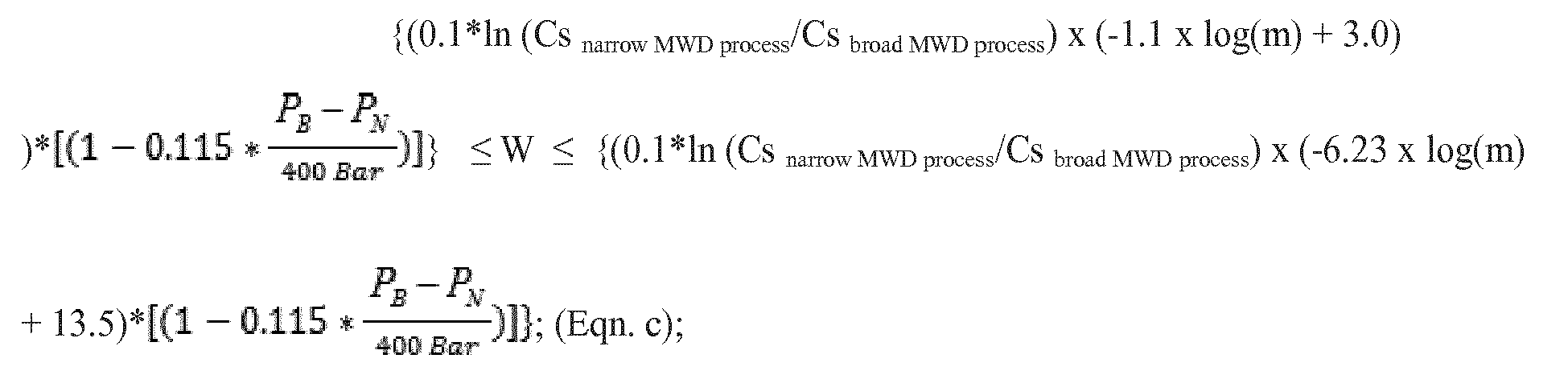
Figure 7 and Figure 8 , the operation of the train at a constant ethylene conversion level will result in narrower product capability (ratio between broad and narrow MWD) than when operating at varying ethylene conversion levels. It has also been found that that by a) sending less ethylene to the first reaction zone, b) increasing the flow and/or the number of feed streams at the side of the reactor, and/or c) varying the operating conditions can be used to expand the MWD capability of a tubular reactor configuration. - Summary - The impact of the ethylene-based split ratio (percentage of ethylene sent to the front of the reactor) and process conditions (pressure, temperature, selection of CTA system and distribution of make-up ethylene and/or make-up CTA) on the product properties (represented by normalized MWD, LCBf) have been investigated. The inventive polymerization allows the production of narrow and broad MWD polymers at high ethylene conversion. For example, (i) at a constant ethylene conversion level, at reactor configurations using a distribution of the overall ethylene based feed over the front reaction zone and side reaction zone(s); by varying the inlet pressure, and operating all peak temperatures at a constant high level, will broaden the MWD capability. The effect of CTA system, pressure level, make-up CTA and make-up ethylene distributions has also been inventively applied to maximize and improve product capability of a tubular train. It has also been discovered that a reactor with ≥ 3 ethylene feed s will result in broader MWD product capability, as compared to a reactor with two ethylene feeds and/or sending more overall ethylene-based feed stream to front reaction zone. It has been discovered that the production of LDPE with multiple (≥2) ethylene based feeds, and the application of inventive operating conditions, including low peak temperature(s) in the first, second or third reaction zones, enables the production of narrow and broad MWD polymers, at constant and/or high ethylene conversion levels. Furthermore, it has been surprisingly discovered that narrow MWD polymers can be produced at high ethylene conversion level, and low operating pressure, by applying low peak temperature(s) in the first, second or third reaction zones, and distributing the make-up ethylene primarily to the side of the reactor, and/or distributing the make-up CTA primarily to the first and/or second reaction zones and selecting CTA systems with different Cs value.
Table 3: Process Configurations and Operating Conditions Ethylene based feed distribution Ex. Temp. of the side ethylene based feed [°C] Peak temp. in each rnx zone [°C] Start/re-initiation temp. of each rnx zone [°C] Ethylene conversion% Reactor inlet pressure Bar Total reactor length 1408 (m) and reactor inside diameter 54 (mm) with ethylene throughput of 60 tons/hr 100/0/0/0 PE1 NA 315/315/315/315 150/262/270/281 35.9 2400 PE2 NA 230/276/276/276 150/206/245/251 28.2 3200 PE3 NA 290/290/290/290 150/251/253/262 31.9 2800 PE4 NA 240/302/302/302 150/211/263/270 31.9 2800 PE5 NA 315/315/315/315 150/263/270/280 35.8 2400 PE6 NA 230/278/278/278 150/207/246/252 28.2 3200 PE5.1 NA 292/292/292/292 150/253/247/258 31.9 2400 PE6.1 NA 291/291/291/291 150/261/260/269 31.9 3200 PE7 NA 315/315/315/315 150/263/270/280 35.7 2400 PE8 NA 230/278/278/278 150/207/247/252 28.2 3200 PE9 NA 315/315/315/315 150/264/270/280 35.4 2400 PE10 NA 230/282/282/282 150/208/250/255 28.2 3200 Total reactor length 1272 (m) and reactor inside diameter 38/54/54/54 (mm) with ethylene throughput of 60 tons/hr 50/50/0/0 PEB11 40 293/293/293/293 150/168/253/254 31.9 2400 PEN11 60 240/297/297/297 150/138/258/256 31.9 2400 PEB12 40 290/290/290/290 150/168/253/258 31.9 2800 PEN12 60 240/295/295/295 150/140/289/261 31.9 2800 PEB13 40 296/296/296/296 150/173/271/269 31.9 3200 PEN13 60 240/297/297/297 150/142/273/269 31.9 3200 PEB14 40 315/315/315/315 150/182/262/276 35.3 2400 PEN14 60 230/270/270/270 150/144/233/242 28.2 3200 PEB15 40 315/315/315/315 150/180/250/264 38.1 2400 PEN15 60 230/261/261/261 150/144/234/243 28.2 3200 PEB16 40 315/315/315/315 150/183/271/283 33.4 2400 PEN16 60 230/280/280/280 150/145/248/258 28.2 3200 PEB17 40 315/315/315/315 150/182/263/276 35.2 2400 PEN117 60 230/271/271/271 150/144/234/243 28.2 3200 PEB18 40 315/315/315/315 150/182/263/275 34.9 2400 PEN18 60 230/274/274/274 150/144/238/246 28.2 3200 Total reactor length 1289 (m) and reactor inside diameter 27/38/54/54 (mm) with ethylene throughput of 60 tons/hr 25/25/50/0 PEB19 40 290/290/290/290 150/165/168/231 31.9 2800 PEN 19 40 240/240/300/300 150/139/140/238 31.9 2800 PEB19.1 40 (EVEN CTA) 315/315/315/315 150/161/177/239 35.6 2400 PEN19.1 60 267/267/267/267 150/151/158/242 28.2 3200 PEB19.2 40 (EVEN CTA) 293/293/293/293 150/161/172/226 31.9 2400 PEN19.2 40 287/287/287/287 150/154/168/242 31.9 3200 PEB20 40 315/315/315/315 150/169/179/240 34.9 2400 PEN20 60 230/230/276/276 150/141/147/217 28.2 3200 PEB21 40 315/315/315/315 150/169/179/240 34.9 2400 PEN21 60 230/230/276/276 150/142/147/214 28.2 3200 PEB22 40 315/315/315/315 150/169/179/240 34.7 2400 PEN22 60 230/230/273/273 150/141/147/218 28.2 3200 PEB23 40 315/315/315/315 150/169/178/239 34.6 2400 PEN23 60 230/230/281/281 150/142/147/221 28.2 3200 Table 4: Make-up Ethylene Distrib. and CTA Properties and Distrib. - Comp. and Inv. Ethylene feed distrib. Ex. MI dg/min Cs FE1 FE2 FE3 RFE2 RFE3 Z1/Z2 Z1/Z3 100/0/0/0 PE1 1.0 0.33 0.4 NA NA NA NA NA NA PE2 1.0 0.33 0.3 NA NA NA NA NA NA PE3 1.0 0.33 0.3 NA NA NA NA NA NA PE4 1.0 0.33 0.3 NA NA NA NA NA NA PE5 1.0 0.06 0.4 NA NA NA NA NA NA PE6 1.0 0.06 0.3 NA NA NA NA NA NA PE5.1 1.0 0.33 0.3 NA NA NA NA NA NA PE6.1 1.0 0.33 0.3 NA NA NA NA NA NA PE7 1.0 0.012 0.4 NA NA NA NA NA NA PE8 1.0 0.012 0.3 NA NA NA NA NA NA PE9 1.0 0.0072 0.4 NA NA NA NA NA NA PE10 1.0 0.0072 0.3 NA NA NA NA NA NA 50/50/0/0 PEB11 1.0 0.33 0.7 0 NA Infinite NA 0.45 NA PEN11 1.0 0.33 0 0.7 NA 0 NA 1.55 NA PEB12 1.0 0.33 0.7 0 NA Infinite NA 0.45 NA PEN12 1.0 0.33 0 0.7 NA 0 NA 1.55 NA PEB13 1.0 0.33 0.7 0 NA Infinite NA 0.45 NA PEN13 1.0 0.33 0 0.7 NA 0 NA 1.55 NA PEB14 1.0 0.33 0.7 0 NA Infinite NA 0.45 NA PEN14 1.0 0.33 0 0.6 NA 0 NA 1.55 NA PEB15 10.0 0.33 0.8 0 NA Infinite NA 0.45 NA PEN15 10.0 0.33 0 0.6 NA 0 NA 1.55 NA PEB16 0.2 0.33 0.7 0 NA Infinite NA 0.45 NA PEN16 0.2 0.33 0 0.6 NA 0 NA 1.55 NA PEB17 1.0 0.06 0.7 0 NA Infinite NA 0.47 NA PEN17 1.0 0.06 0 0.6 NA 0 NA 1.53 NA PEB18 1.0 0.0072 0.7 0 NA Infinite NA 0.48 NA PEN18 1.0 0.0072 0 0.6 NA 0 NA 1.52 NA 25/25/50/0 PEB19 1.0 0.33 0.8 0.5 0 1.6 Infinite 0.5 0.22 PEN19 1.0 0.33 0 0 0.7 NA 0 1.07 1.68 PEB19.1 1.0 0.33 0.4 0.4 0.4 1.3 Infinite 1 1 PEN19.1 1.0 0.33 0 0 0.6 NA 0 1.28 1.48 PEB19.2 1.0 0.33 0.4 0.4 0.4 1 1 1 1 PEN19.2 1.0 0.33 0 0 0.7 NA 0 1.28 1.48 PEB20 1.0 0.33 0.8 0.6 0 1 1 0.5 0.22 PEN20 1.0 0.33 0 0 0.7 NA 0 1.07 1.68 PEB21 1.0 0.06 0.8 0.6 0 1.3 Infinite 0.48 0.22 PEN21 1.0 0.06 0 0 0.6 NA 0 1.04 1.59 PEB22 1.0 0.012 0.8 0.6 0 1.3 Infinite 0.53 0.22 PEN22 1.0 0.012 0 0 0.6 NA 0 1.19 1.88 PEB23 1.0 0.0072 0.8 0.6 0 1.3 Infinite 0.47 0.22 PEN23 1.0 0.0072 0 0 0.6 NA 0 1.01 1.54 B) Z1/Z2 is the ratio of the activity of the CTA system in the first ethylene feed (Z1) to the activity of the CTA system in the second ethylene feed (Z2). C) Z1/Z3 is the ratio of the activity of the CTA system in the first ethylene feed (Z1) to the activity of the CTA system in the third ethylene feed (Z3). The RZ1, RZ3 and RZ3 are calculated with the assumptions that the about 60% ethylene based feed is come from the high pressure recycle (HPR) flow. The rest of the about 40 wt% ethylene based feed is from primary which includes make-up ethylene and low pressure recycle (LPR) flow. Make-up (fresh) ethylene is 33.3 mol% which includes ethylene converted and lost by purge flow. Thus the LPR flow is 6.7 mol% which includes ethylene from LPR and secondary compressor gland leaks. Table 5: Predicted product properties for comparative and inventive examples Ethylene based feed distribution Example LCB 1/1000C SCB 1/1000C Mw/Mn Mw/Mn normalized% 100/0/0/0 PE1 5.35 28 13.6 169 PE2 1.89 19 5.2 65 PE3 3.13 23 8.1 100 PE4 3.32 23 8.3 103 PE5 5.35 28 16.2 201 PE6 1.93 19 6 75 PE5.1 3.86 25 9.32 116 PE6.1 2.61 21 7.37 92 PE7 5.4 30 18.8 233 PE8 1.99 24 7.1 89 PE9 5.44 28 21 261 PE10 2.15 21 8.8 109 50/50/0/0 PEB11 3.89 25 17.2 213 PEN11 3.83 24 7.5 93 PEB12 3.22 23 15.8 196 PEN12 3.1 22 6.5 81 PEB13 2.71 21 13.9 173 PEN13 2.6 20 5.8 72 PEB14 5.26 27 28 348 PEN14 1.77 18 4.2 52 PEB15 5.68 28 23.2 288 PEN15 2.02 20 3.6 44 PEB16 4.96 27 31.2 388 PEN16 1.95 19 5.3 66 PEB17 5.25 27 32 398 PEN117 1.77 18 4.7 58 PEB18 5.37 28 39.3 488 PEN18 1.98 20 6.6 82 25/25/50/0 PEB19 3.43 23 33.6 417 PEN19 3.09 22 7 87 PEB19.1 5.45 27 24.5 305 PEN19.1 1.85 18 5.4 67 PEB19.2 4.00 25 15.8 197 PEN19.2 2.61 20 8.1 101 PEB20 5.41 27 46.4 577 PEN20 1.75 18 4 50 PEB21 5.41 27 50.3 624 PEN21 1.8 18 4.7 58 PEB22 5.48 30 54.5 677 PEN22 1.89 24 5.2 65 PEB23 5.56 28 57.4 713 PEN23 2.01 20 7 87 Table 6a: Ratio of broad MWD vs. narrow MWD, The data lines with Cs narrow MWDprocess/Cs broad MWD process = 1 are used in Fig. 7. RX1 is the first rnx zone Ethylene based feed distribution to RX1 (m*) Broad MWD example /Narrow MWD example Cs narrow MWD process /Cs broad MWD process log(m) T (T) × [-2.3 × log(m) + 7.0] Q (T) × [-13.0 × log(m)+29.8] 100 PE1/PE2 1.0 2 1.0 2.4 2.6 3.8 100 PE5/PE6 1.0 2 1.0 2.4 2.7 3.8 100 PE7/PE8 1.0 2 1.0 2.4 2.6 3.8 100 PE9/PE10 1.0 2 1.0 2.4 2.4 1 3.8 50 PEB14/PEN14 1.0 1.70 1.0 3.1 6.7 7.7 50 PEB 17/ PEN171.0 1.70 1.0 3.1 6.9 7.7 50 PEB 18/ PEN181.0 1.70 1.0 3.1 5.9 7.7 25 PEB20/ PEN20 1.0 1.40 1.0 3.8 11.5 11.7 25 PEB21/ PEN21 1.0 1.40 1.0 3.8 10.7 11.7 25 PEB22/ PEN22 1.0 1.40 1.0 3.8 10.5 11.7 25 PEB23/ PEN23 1.0 1.40 1.0 3.8 8.2 11.7 * m = mol% of ethylene-based feed to the first reaction zone (based on the total moles of ethylene based feed fed to the reactor). Table 6b: Ratio of broad MWD vs. narrow MWD - the data lines with Cs narrow MWD process /CS broad MWD process = 1 are used in Figure 7. Ethylene based feed distribution to RX1 (m)* Broad MWD example /Narrow MWD example Cs narrow MWD process /Cs broad MWD process T (T) × [-2.3 × log(m) + 7.0] Q 100 PE5.1/PE6.1 1.0 1.0 2.4 2.5 25 PEB19.1/ PEN19.1 1.0 1.0 3.8 4.6 * m = mol% of ethylene-based feed to the first reaction zone (based on the total moles of ethylene based feed fed to the reactor). Table 6c: Ratio of broad MWD vs. narrow MWD for different Cs narrow MWD process /Cs broad MWD process, T = (0.1*ln (Cs narrow MWD process/Cs broadMWD process)+1) which reflects the effect the activity of CTA system at the outlet of the reactor system. Ethylene based feed distribution to RX1 m* Broad MWD ex. narrow MWD ex. Cs narrow MWD process /Cs broad MWD process T (T) x [-2.3 x log(m) + 8.0] Q (T) x [-13.0 x log(m)+ 29.8] 100 PE1/ PE10 0.021 0.61 1.5 1.6 2.3 50 PEB14/ PEN18 0.021 0.61 1.9 4.2 4.7 25 PEB20/ PEN23 0.021 0.61 2.3 6.6 7.1 100 PE9/ PE2 47.1 1.39 3.3 4 5.2 50 PEB 18/ PEN1447.1 1.39 4.3 9.4 10.7 25 PEB 23/ PEN20 47.1 1.39 5.3 14.2 16.1 * m = mol% of ethylene-based feed to the first reaction zone (based on the total moles of ethylene based feed fed to the reactor). Table 7a: Ratio broad MWD vs. narrow MWD - .the data lines with Cs narrow MWD process/Cs broad MWD process = 1 at a constant ethylene conversion level are used in Figure 8. Ethylene based feed distribution to RX1 m* Broad MWD example /Narrow MWD example Cs narrow MWD process /Cs broad MWD process T (T) x [-1.1 x log(m) + 3.0] Y (T) x [-6.2 x log(m) + 13.5] 100 PE3/ PE4 1 1 0.8 0.97 1.1 50 PEB12/ PEN12 1 1 1.1 2.4 3.0 25 PEB19/ PEN19 1 1 1.5 4.79 4.83 * m = mol% of ethylene-based feed to the first reaction zone (based on the total moles of ethylene based feed fed to the reactor). Table 7b: Ratio broad MWD vs. narrow MWD (for lower limit) - the data lines with Cs narrow MWD process/Cs broad MWD process = 1 at a constant ethylene conversion level are used in Figure 8. Ethylene based feed distribution to RX1 m* Broad MWD /Nanow MWD example Cs narrow MWD process /Cs broad MWD process T (T) x [-1.1 x log(m) + 3.0] Y 100 PE3/ PE4 1 1.00 0.8 0.97 50 PEB19.2/ PEN19.2 1 1.00 1.46 1.95 * m = mol% of ethylene-based feed to the first reaction zone (based on the total moles of ethylene based feed fed to the reactor). Table 8: Ratio broad MWD vs. narrow MWD with CsN/CsB = 1 as function of varying reactor inlet pressure and constant ethylene conversion level. Ethylene based feed distribution to RX1 m* Broad MWD example /Narrow MWD example Cs narrow MWD process /Cs broad MWD process T [(T) x (-1.1 x log(m) + 3.0)] 
w [(T) X (-6.23 X log(m) + 13.5)]x [ 
PB PN 50 PEB11/ PEN13 1 1 1.4 2.94 3.62 2400 3200 50 PEB12/ PEN13 1 1 1.3 2.71 3.28 2800 3200 50 PEB13/ PEN13 1 1 1.1 2.39 2.95 3200 3200 * m = mol% of ethylene-based feed to the first reaction zone (based on the total moles of ethylene based feed fed to the reactor).
Claims (10)
- A process to form an ethylene-based polymer, said process comprising polymerizing a mixture comprising ethylene, in the presence of at least one free-radical initiator, and in a tubular reactor system comprising at least two ethylene-based feed streams, and a reactor configuration that comprises at least three reaction zones; and
wherein the inlet pressure of the first reaction zone is less than, or equal to, 3200 Bar; and the polymerization has an ethylene conversion ≥ 28%, and an m value from 20 mole% to70 mole%, where m = mol% of ethylene-based feed stream to the first reaction zone, based on the total moles of ethylene-based feed streams fed to the reactor configuration; and
wherein the ratio (Q) of a "MWDB of a broad polymer polymerized, to a "MWDN of a narrow polymer polymerized, is as follows: {(T) * (-2.3 x log(m) + 7)} ≤ Q ≤ {(T) * (-13.0 x log(m) + 29.8)}; and wherein the "MWDB polymer" and the "MWDN polymer" both have the same melt index; and wherein the "T" is the "chain transfer activity ratio" and "T" is from 0.6 to 1.6, and T is defined as follows: T = {[0.1 *ln (Cs narrow MWD process/Cs broad MWD process)] +1}; wherein Cs narrow MWD process and Cs broad MWD process are average Cs value of the CTA system at the outlet of the reactor configuration used to produce, respectively, the narrow and the broad MWD polymers, and wherein MWDB > MWDN. - A process to form an ethylene-based polymer, said process comprising polymerizing a mixture comprising ethylene, in the presence of at least one free-radical initiator, and in a tubular reactor system comprising at least two ethylene-based feed streams, and a reactor configuration that comprises at least three reaction zones; and
wherein the inlet pressure of the first reaction zone is less than, or equal to, 3200 Bar; and the polymerization has an ethylene conversion ≥ 28%, and an m value from 20 mole% to70 mole%, where m = mol% of ethylene-based feed stream to the first reaction zone, based on the total moles of ethylene-based feed streams fed to the reactor configuration; and
wherein the ratio (W) of a "MWDB of a broad polymer" polymerized," to the "MWDN of a narrow polymer" polymerized, is as follows:


- A process to form an ethylene-based polymer, said process comprising polymerizing a mixture comprising ethylene, in the presence of at least one free-radical initiator, and in a tubular reactor system comprising at least two ethylene-based feed streams, and a reactor configuration that comprises at least three reaction zones; and
wherein the inlet pressure of the first reaction zone is less than, or equal to, 3200 Bar; and the polymerization has an ethylene conversion ≥ 28%, and an m value from 20 mole% to70 mole%, where m = mol% of ethylene-based feed stream to the first reaction zone, based on the total moles of ethylene-based feed streams fed to the reactor; and
wherein the ratio (Y) of a "MWDB of a broad polymer" polymerized, to a narrow "MWDN polymer" polymerized, is as follows: {(T) x (-1.1 x log(m) + 3.0)} ≤ Y ≤ {(T) x (-6.2 x log(m) + 13.5)}; and wherein the "MWDB polymer" and the "MWDN polymer" both have the same melt index (I2); and wherein "T" is the "chain transfer activity ratio" and T = {[0.1*ln (Cs narrow MWD process/Cs broad MWD process)] +1}, and "T" is from 0.4 to 1.6; and wherein Cs narrow MWD process and Cs broad MWD process are average Cs value of the CTA system at the outlet of the reactor configuration used to produce, respectively, the narrow and the broad MWD polymers, and wherein MWDB > MWDN; and wherein the ethylene conversion of the polymerization for the broad polymer polymerized is equal to the ethylene conversion of the polymerization for the narrow polymer polymerized; and wherein the inlet pressure of the polymerization for the broad polymer polymerized is equal to the inlet pressure of the polymerization for the narrow polymer polymerized. - The process of any one of the previous claims, wherein an ethylene-based feed stream fed to the first reaction zone (1), and to two or more subsequent reaction zones selected from the following: zone n and zone n+1, or zone n+2, where n > 1.
- The process of claim 4, wherein at least two of the following ratios are met:a) for reaction zone n, the ratio, RFEn, of "mole fraction of make-up ethylene fed to the first reaction zone (FE1)" to "mole fraction of make-up ethylene fed to reaction zone n (FEn)" is (RFEn = FE1/FEn) is FE1/FEn is > 1;b) b) for reaction zone n+1, the ratio, RFEn+1, of "mole fraction of make-up ethylene fed to the first reaction zone (FE1)" to "mole fraction of make-up ethylene fed to reaction zone n+1 (FEn+1)" is (RFEn+1 = FE1/FEn+1) is > 1;c) for reaction zone n+2, the ratio, RFEn+2, of "mole fraction of make-up ethylene fed to the first reaction zone (FE1)" to "mole fraction of make-up ethylene fed to reaction zone n+2 (FEn+2)" is (RFEn+2 = FE1/FEn+2) is ≥ 1; and wherein the "total amount of ethylene fed to the polymerization process" derives from at least one make-up ethylene-based feed stream and at least one recycled ethylene-based feed stream.
- The process of claim 4, wherein at least two of the following ratios are met:a) for reaction zone n, the ratio, RFEn, of "mole fraction of make-up ethylene fed to the first reaction zone (FE1)" to "mole fraction of make-up ethylene fed to reaction zone n (FEn)" is RFEn = FE1/FEn, and 0 ≤ RFEn < 1;b) for reaction zone n+1, the ratio, RFEn+1, of "mole fraction of make-up ethylene fed to the first reaction zone (FE1)" to "mole fraction of make-up ethylene fed to reaction zone n+1 (FEn+1)" is RFEn+1 = FE1/FEn+1, and 0 ≤ RFEn+1 < 1;c) for reaction zone n+2, the ratio, RFEn+2, of "mole fraction of make-up ethylene fed to the first reaction zone (FE1)" to "mole fraction of make-up ethylene fed to reaction zone n+2 (FEn+2)" is RFEn+2 = FE1/FEn+2, and 0 ≤ RFEn+2 < 1; andwherein the "total amount of ethylene fed to the polymerization process" derives from at least one make-up ethylene-based feed stream and at least one recycled ethylene -based feed stream.
- The process of any one of the previous claims, wherein the first ethylene-based feed stream comprises at least one CTA, and wherein the activity of the CTA system in the first ethylene-based feed stream is greater than, or equal to, the activity of the CTA system in each subsequent ethylene-based feed stream.
- The process of any one of claims 1-6, wherein the first ethylene feed stream comprises at least one CTA, and wherein the activity of the CTA system in the first ethylene feed stream is less than, the activity of the CTA system in each subsequent ethylene feed stream.
- The process of any one of the previous claims, wherein the ethylene-based polymer has a melt-index from 0.1 to 50 g/10 min.
- The process of any one of the previous claims, wherein the ethylene-based polymer has a density from 0.910 to 0.940 g/cc.
Priority Applications (10)
| Application Number | Priority Date | Filing Date | Title |
|---|---|---|---|
| EP16382297.6A EP3260473A1 (en) | 2016-06-24 | 2016-06-24 | High pressure, free radical polymerizations to produce ethylene-based polymers |
| PCT/US2017/038777 WO2017223329A1 (en) | 2016-06-24 | 2017-06-22 | High pressure, free radical polymerizations to produce ethylene-based polymers |
| EP17733925.6A EP3475316B1 (en) | 2016-06-24 | 2017-06-22 | High pressure, free radical polymerizations to produce ethylene-based polymers |
| ES17733925T ES2842551T3 (en) | 2016-06-24 | 2017-06-22 | High pressure free radical polymerizations to produce ethylene-based polymers |
| BR112018074624-0A BR112018074624B1 (en) | 2016-06-24 | 2017-06-22 | PROCESS TO FORM AN ETHYLENE-BASED POLYMER |
| KR1020197001375A KR102403518B1 (en) | 2016-06-24 | 2017-06-22 | High Pressure, Free Radical Polymerization to Prepare Ethylene-Based Polymers |
| US16/302,830 US10774159B2 (en) | 2016-06-24 | 2017-06-22 | High pressure, free radical polymerizations to produce ethylene-based polymers |
| CN201780034788.XA CN109312008B (en) | 2016-06-24 | 2017-06-22 | High pressure free radical polymerization for the production of vinyl polymers |
| JP2018564220A JP7495207B2 (en) | 2016-06-24 | 2017-06-22 | High Pressure Free Radical Polymerization to Produce Ethylene-Based Polymers |
| JP2022008159A JP2022064936A (en) | 2016-06-24 | 2022-01-21 | High-pressure free radical polymerization to produce ethylene-based polymers |
Applications Claiming Priority (1)
| Application Number | Priority Date | Filing Date | Title |
|---|---|---|---|
| EP16382297.6A EP3260473A1 (en) | 2016-06-24 | 2016-06-24 | High pressure, free radical polymerizations to produce ethylene-based polymers |
Publications (1)
| Publication Number | Publication Date |
|---|---|
| EP3260473A1 true EP3260473A1 (en) | 2017-12-27 |
Family
ID=56235769
Family Applications (2)
| Application Number | Title | Priority Date | Filing Date |
|---|---|---|---|
| EP16382297.6A Withdrawn EP3260473A1 (en) | 2016-06-24 | 2016-06-24 | High pressure, free radical polymerizations to produce ethylene-based polymers |
| EP17733925.6A Active EP3475316B1 (en) | 2016-06-24 | 2017-06-22 | High pressure, free radical polymerizations to produce ethylene-based polymers |
Family Applications After (1)
| Application Number | Title | Priority Date | Filing Date |
|---|---|---|---|
| EP17733925.6A Active EP3475316B1 (en) | 2016-06-24 | 2017-06-22 | High pressure, free radical polymerizations to produce ethylene-based polymers |
Country Status (7)
| Country | Link |
|---|---|
| US (1) | US10774159B2 (en) |
| EP (2) | EP3260473A1 (en) |
| JP (2) | JP7495207B2 (en) |
| KR (1) | KR102403518B1 (en) |
| CN (1) | CN109312008B (en) |
| ES (1) | ES2842551T3 (en) |
| WO (1) | WO2017223329A1 (en) |
Cited By (4)
| Publication number | Priority date | Publication date | Assignee | Title |
|---|---|---|---|---|
| WO2021067007A1 (en) * | 2019-09-30 | 2021-04-08 | Exxonmobil Chemical Patents Inc. | High pressure polyethylene tubular reactor processes for improved wire coating product |
| WO2023034685A1 (en) * | 2021-09-01 | 2023-03-09 | Exxonmobil Chemical Patents Inc. | Variable temperature tubular reactor profiles and intermediate density polyethylene compositions produced therefrom |
| WO2024089081A1 (en) | 2022-10-26 | 2024-05-02 | International Technical Excellence Centers, Inc | Process for producing ethylene copolymers at high pressure in a tubular reactor |
| EP4375304A1 (en) | 2022-11-28 | 2024-05-29 | International Technical Excellence Centers, Llc | Process for producing ethylene copolymers at high pressure in a tubular reactor |
Families Citing this family (4)
| Publication number | Priority date | Publication date | Assignee | Title |
|---|---|---|---|---|
| CA3148833A1 (en) * | 2019-09-24 | 2021-04-01 | Nova Chemicals Corporation | Steam generation in oxidative dehydrogenation |
| WO2024002393A1 (en) * | 2022-07-01 | 2024-01-04 | 中国石油化工股份有限公司 | Olefin free radical polymerization method and olefin free radical polymerization apparatus |
| CN121889437A (en) * | 2023-09-29 | 2026-04-17 | 陶氏环球技术有限责任公司 | High pressure radical tubular reactor configuration for improving LDPE product performance and plant capacity |
| WO2025181065A1 (en) * | 2024-02-29 | 2025-09-04 | Basell Polyolefine Gmbh | Film with high weathering resistance |
Citations (8)
| Publication number | Priority date | Publication date | Assignee | Title |
|---|---|---|---|---|
| US4135044A (en) | 1977-08-08 | 1979-01-16 | Exxon Research & Engineering Co. | Process for achieving high conversions in the production of polyethylene |
| WO2001068723A2 (en) | 2000-03-16 | 2001-09-20 | Basell Polyolefine Gmbh | Method for the production of polyethylene |
| WO2002014379A1 (en) | 2000-08-15 | 2002-02-21 | Akzo Nobel N.V. | Use of trioxepans in the process to make high-solid acrylic, styrenic, and ldpe-type resins |
| JP2003534422A (en) | 2000-05-23 | 2003-11-18 | オズモニクス, インコーポレイテッド | Modified sulfonamide polymer |
| US20070032614A1 (en) * | 2005-08-05 | 2007-02-08 | Goossens Ivo T | Process and apparatus for manufacturing ethylene polymers and copolymers |
| US20100087606A1 (en) * | 2008-10-07 | 2010-04-08 | Karjala Teresa P | High pressure low density polyethylene resins with improved optical properties produced through use of highly active chain transfer agents |
| WO2012044504A1 (en) * | 2010-09-30 | 2012-04-05 | Dow Global Technologies Llc | Polymerization process to make low density polyethylene |
| US8445606B2 (en) | 2008-12-18 | 2013-05-21 | Exxonmobil Chemical Patents Inc. | High pressure polymerization process |
Family Cites Families (27)
| Publication number | Priority date | Publication date | Assignee | Title |
|---|---|---|---|---|
| GB1370101A (en) | 1971-10-11 | 1974-10-09 | Exxon Research Engineering Co | Production of polyethylene |
| GB1419012A (en) | 1973-03-29 | 1975-12-24 | Ici Ltd | Production of polyethylene |
| JPS6137010A (en) | 1984-07-30 | 1986-02-21 | 三菱農機株式会社 | Automatic plowing depth controller |
| DD276598A3 (en) | 1988-04-12 | 1990-03-07 | Leuna Werke Veb | METHOD FOR ADJUSTING AND REGULATING THE INTAKE GAS PROBES FOR MULTI-TUBE TUBE REACTORS |
| DE19829399A1 (en) | 1998-07-01 | 2000-02-03 | Buna Sow Leuna Olefinverb Gmbh | Process for the production of low density ethylene homo- and ethylene copolymers |
| US6887955B2 (en) * | 2001-08-20 | 2005-05-03 | Basell Polyolefine Gmbh | Method for high pressure polymerization of ethylene |
| US6596241B2 (en) | 2001-12-19 | 2003-07-22 | Exxonmobil Chemical Patents Inc | Tubular polymerization reactors and polymers made therein |
| US7745550B2 (en) | 2001-12-19 | 2010-06-29 | Exxonmobil Chemical Patents Inc. | Tubular polymerization reactors and polymers made therein |
| EP1595468B1 (en) | 2003-02-14 | 2012-07-11 | Kabushiki Kaisha Bandai | Press form mounting method in badge production device |
| KR101391511B1 (en) | 2005-03-09 | 2014-05-07 | 사우디 베이식 인더스트리즈 코포레이션 | An ethylene copolymer prepared by a process in a tubular reactor |
| JP5034422B2 (en) | 2005-11-28 | 2012-09-26 | 住友化学株式会社 | Method for producing polyethylene |
| EP2231470B1 (en) | 2007-12-19 | 2011-09-07 | Skysails GmbH & Co. KG | Aerodynamic wind propulsion device having active and passive steering lines and method for controlling of such a device |
| WO2011075465A1 (en) * | 2009-12-18 | 2011-06-23 | Dow Global Technology Llc | Polymerization process to make low density polyethylene |
| WO2012044503A1 (en) | 2010-09-30 | 2012-04-05 | Dow Global Technologies Llc | Ethylene-based interpolymers and processes to make the same |
| EP2681250B2 (en) | 2011-03-03 | 2018-11-14 | Basell Polyolefine GmbH | Process for preparing ethylene homopolymers or copolymers in a tubular reactor with at least two reaction zones having different concentrations of chain transfer agent |
| EP2751146B1 (en) | 2011-10-19 | 2016-01-20 | Dow Global Technologies LLC | Polymerization processes with fresh ethylene distributions for preparation of low density ethylene-based polymers |
| CN104053717B (en) | 2011-11-23 | 2016-08-31 | 陶氏环球技术有限责任公司 | Low density ethylene-based polymers with lower molecular weight extractables |
| KR102057264B1 (en) | 2011-11-23 | 2019-12-19 | 다우 글로벌 테크놀로지스 엘엘씨 | Low density ethylene-based polymers with broad molecular weight distributions and low extractables |
| JP5945001B2 (en) | 2011-12-09 | 2016-07-05 | ボレアリス・アクチェンゲゼルシャフトBorealis Ag | Method for producing low density polyethylene |
| BR112015010787B1 (en) | 2012-11-20 | 2022-01-18 | Dow Global Technologies Llc | LOW DENSITY ETHYLENE BASED COMPOSITION, ITEM AND POLYMERIZATION METHOD TO FORM A LOW DENSITY ETHYLENE BASED COMPOSITION |
| CN105189637B (en) | 2013-05-22 | 2018-02-06 | 陶氏环球技术有限责任公司 | Compositions containing high melt strength low density vinyl polymers and films formed therefrom |
| BR112016013042B1 (en) | 2013-12-19 | 2020-12-15 | Dow Global Technologies Llc | POLYMER BASED ON ETHYLENE, COMPOSITION AND ARTICLE |
| US9718906B2 (en) | 2013-12-26 | 2017-08-01 | Dow Global Technologies Llc | Processes to form ethylene-based polymers using asymmetrical polyenes |
| KR102315130B1 (en) | 2013-12-26 | 2021-10-22 | 다우 글로벌 테크놀로지스 엘엘씨 | Ethylene-based polymers formed using asymmetrical polyenes |
| ES2775506T3 (en) | 2015-06-25 | 2020-07-27 | Dow Global Technologies Llc | Ethylene-based polymers with low hexane-extractable content |
| US10730973B2 (en) | 2015-06-25 | 2020-08-04 | Dow Global Technologies Llc | Ethylene-based polymers with low hexane extractables and low densities |
| US10400046B2 (en) | 2015-06-25 | 2019-09-03 | Joseph J. Matsko | Portable powered paint system |
-
2016
- 2016-06-24 EP EP16382297.6A patent/EP3260473A1/en not_active Withdrawn
-
2017
- 2017-06-22 ES ES17733925T patent/ES2842551T3/en active Active
- 2017-06-22 WO PCT/US2017/038777 patent/WO2017223329A1/en not_active Ceased
- 2017-06-22 US US16/302,830 patent/US10774159B2/en active Active
- 2017-06-22 KR KR1020197001375A patent/KR102403518B1/en active Active
- 2017-06-22 EP EP17733925.6A patent/EP3475316B1/en active Active
- 2017-06-22 JP JP2018564220A patent/JP7495207B2/en active Active
- 2017-06-22 CN CN201780034788.XA patent/CN109312008B/en active Active
-
2022
- 2022-01-21 JP JP2022008159A patent/JP2022064936A/en active Pending
Patent Citations (9)
| Publication number | Priority date | Publication date | Assignee | Title |
|---|---|---|---|---|
| US4135044A (en) | 1977-08-08 | 1979-01-16 | Exxon Research & Engineering Co. | Process for achieving high conversions in the production of polyethylene |
| WO2001068723A2 (en) | 2000-03-16 | 2001-09-20 | Basell Polyolefine Gmbh | Method for the production of polyethylene |
| JP2003534422A (en) | 2000-05-23 | 2003-11-18 | オズモニクス, インコーポレイテッド | Modified sulfonamide polymer |
| WO2002014379A1 (en) | 2000-08-15 | 2002-02-21 | Akzo Nobel N.V. | Use of trioxepans in the process to make high-solid acrylic, styrenic, and ldpe-type resins |
| US20070032614A1 (en) * | 2005-08-05 | 2007-02-08 | Goossens Ivo T | Process and apparatus for manufacturing ethylene polymers and copolymers |
| US7582709B2 (en) | 2005-08-05 | 2009-09-01 | Exxonmobil Chemical Patents Inc. | Process and apparatus for manufacturing ethylene polymers and copolymers |
| US20100087606A1 (en) * | 2008-10-07 | 2010-04-08 | Karjala Teresa P | High pressure low density polyethylene resins with improved optical properties produced through use of highly active chain transfer agents |
| US8445606B2 (en) | 2008-12-18 | 2013-05-21 | Exxonmobil Chemical Patents Inc. | High pressure polymerization process |
| WO2012044504A1 (en) * | 2010-09-30 | 2012-04-05 | Dow Global Technologies Llc | Polymerization process to make low density polyethylene |
Non-Patent Citations (11)
| Title |
|---|
| G. LUFT, CHEM.-ING.- TECH., vol. 51, no. 10, 1979, pages 960 - 969 |
| G. MORTIMER, JOURNAL OF POLYMER SCIENCE, vol. 10, 1972, pages 163 - 168 |
| G. MORTIMER, JOURNAL OF POLYMER SCIENCE, vol. 4, 1966, pages 881 - 900 |
| G. MORTIMER, JOURNAL OF POLYMER SCIENCE, vol. 8, 1970, pages 1513 - 1523 |
| G. MORTIMER, JOURNAL OF POLYMER SCIENCE, vol. 8, 1970, pages 1535 - 1542 |
| GOTO ET AL., JOURNAL OF APPLIED POLYMER SCIENCE: APPLIED POLYMER SYMPOSIUM, vol. 36, 1981, pages 21 - 40 |
| JOURNAL OF POLYMER SCIENCE, vol. 8, 1970, pages 1543 - 1548 |
| K. YAMAMOTO; M. SUGIMOTO: "Rate constant for long chain-chain branch formation in free-radical polymerization of ethylene", J. MACROMOL. SCIENCE-CHEM., vol. A13, no. 8, 1979, pages 1067 - 1080 |
| P.EHRLICH; G.A. MORTIMER: "Fundamentals of the free radical polymerization of ethylene", ADV. POLYMER SCI., vol. 7, 1970, pages 386 - 448 |
| S. GOTO ET AL., JOURNAL OF APPLIED POLYMER SCIENCE, vol. 36, 1981, pages 21 - 40 |
| T. VAN DER MOLEN ET AL., ING. CHIM. ITAL, ''LIGHT-OFF'' TEMPERATURE AND CONSUMPTION OF 16 INITIATORS IN LDPE PRODUCTION, vol. 18, no. 1-2, February 1982 (1982-02-01), pages 7 - 15 |
Cited By (7)
| Publication number | Priority date | Publication date | Assignee | Title |
|---|---|---|---|---|
| WO2021067007A1 (en) * | 2019-09-30 | 2021-04-08 | Exxonmobil Chemical Patents Inc. | High pressure polyethylene tubular reactor processes for improved wire coating product |
| US11325999B2 (en) * | 2019-09-30 | 2022-05-10 | Exxonmobil Chemical Patents Inc. | High pressure polyethylene tubular reactor processes for improved wire coating product |
| CN114502602A (en) * | 2019-09-30 | 2022-05-13 | 埃克森美孚化学专利公司 | High Pressure Polyethylene Tubular Reactor Process for Improved Wire Coated Products |
| CN114502602B (en) * | 2019-09-30 | 2024-02-06 | 埃克森美孚化学专利公司 | High-pressure polyethylene tubular reactor process for improved wire coating products |
| WO2023034685A1 (en) * | 2021-09-01 | 2023-03-09 | Exxonmobil Chemical Patents Inc. | Variable temperature tubular reactor profiles and intermediate density polyethylene compositions produced therefrom |
| WO2024089081A1 (en) | 2022-10-26 | 2024-05-02 | International Technical Excellence Centers, Inc | Process for producing ethylene copolymers at high pressure in a tubular reactor |
| EP4375304A1 (en) | 2022-11-28 | 2024-05-29 | International Technical Excellence Centers, Llc | Process for producing ethylene copolymers at high pressure in a tubular reactor |
Also Published As
| Publication number | Publication date |
|---|---|
| JP2022064936A (en) | 2022-04-26 |
| US20190177443A1 (en) | 2019-06-13 |
| JP7495207B2 (en) | 2024-06-04 |
| US10774159B2 (en) | 2020-09-15 |
| WO2017223329A1 (en) | 2017-12-28 |
| EP3475316A1 (en) | 2019-05-01 |
| CN109312008A (en) | 2019-02-05 |
| CN109312008B (en) | 2021-04-09 |
| JP2019518842A (en) | 2019-07-04 |
| KR20190021330A (en) | 2019-03-05 |
| KR102403518B1 (en) | 2022-06-02 |
| EP3475316B1 (en) | 2020-11-18 |
| ES2842551T3 (en) | 2021-07-14 |
Similar Documents
| Publication | Publication Date | Title |
|---|---|---|
| EP3475316B1 (en) | High pressure, free radical polymerizations to produce ethylene-based polymers | |
| EP3374405B1 (en) | High pressure, free radical polymerizations to produce ethylene-based polymers | |
| EP3374406B1 (en) | High pressure free radical polymerizations | |
| EP3240810B1 (en) | Process to control output and quality of ethylene-based polymer formed by high pressure free radical polymerization | |
| EP3374404B1 (en) | Ethylene-based polymers formed by high pressure free radical polymerizations | |
| EP3475317B1 (en) | Ethylene-based polymers formed by high pressure free radical polymerizations | |
| EP3645581B9 (en) | High pressure, free radical polymerizations to produce ethylene-based polymers |
Legal Events
| Date | Code | Title | Description |
|---|---|---|---|
| PUAI | Public reference made under article 153(3) epc to a published international application that has entered the european phase |
Free format text: ORIGINAL CODE: 0009012 |
|
| STAA | Information on the status of an ep patent application or granted ep patent |
Free format text: STATUS: THE APPLICATION HAS BEEN PUBLISHED |
|
| AK | Designated contracting states |
Kind code of ref document: A1 Designated state(s): AL AT BE BG CH CY CZ DE DK EE ES FI FR GB GR HR HU IE IS IT LI LT LU LV MC MK MT NL NO PL PT RO RS SE SI SK SM TR |
|
| AX | Request for extension of the european patent |
Extension state: BA ME |
|
| STAA | Information on the status of an ep patent application or granted ep patent |
Free format text: STATUS: THE APPLICATION IS DEEMED TO BE WITHDRAWN |
|
| 18D | Application deemed to be withdrawn |
Effective date: 20180628 |