EP3258398A1 - Engaged micro-interactions on digital devices - Google Patents
Engaged micro-interactions on digital devices Download PDFInfo
- Publication number
- EP3258398A1 EP3258398A1 EP17163282.1A EP17163282A EP3258398A1 EP 3258398 A1 EP3258398 A1 EP 3258398A1 EP 17163282 A EP17163282 A EP 17163282A EP 3258398 A1 EP3258398 A1 EP 3258398A1
- Authority
- EP
- European Patent Office
- Prior art keywords
- user
- content
- digital device
- friends associated
- time
- Prior art date
- Legal status (The legal status is an assumption and is not a legal conclusion. Google has not performed a legal analysis and makes no representation as to the accuracy of the status listed.)
- Granted
Links
Images


Classifications
-
- H—ELECTRICITY
- H04—ELECTRIC COMMUNICATION TECHNIQUE
- H04L—TRANSMISSION OF DIGITAL INFORMATION, e.g. TELEGRAPHIC COMMUNICATION
- H04L67/00—Network arrangements or protocols for supporting network services or applications
- H04L67/50—Network services
- H04L67/535—Tracking the activity of the user
-
- G—PHYSICS
- G06—COMPUTING OR CALCULATING; COUNTING
- G06F—ELECTRIC DIGITAL DATA PROCESSING
- G06F11/00—Error detection; Error correction; Monitoring
- G06F11/30—Monitoring
- G06F11/34—Recording or statistical evaluation of computer activity, e.g. of down time, of input/output operation ; Recording or statistical evaluation of user activity, e.g. usability assessment
- G06F11/3438—Recording or statistical evaluation of computer activity, e.g. of down time, of input/output operation ; Recording or statistical evaluation of user activity, e.g. usability assessment monitoring of user actions
-
- G—PHYSICS
- G06—COMPUTING OR CALCULATING; COUNTING
- G06F—ELECTRIC DIGITAL DATA PROCESSING
- G06F16/00—Information retrieval; Database structures therefor; File system structures therefor
- G06F16/20—Information retrieval; Database structures therefor; File system structures therefor of structured data, e.g. relational data
- G06F16/24—Querying
- G06F16/245—Query processing
- G06F16/2457—Query processing with adaptation to user needs
- G06F16/24578—Query processing with adaptation to user needs using ranking
-
- G—PHYSICS
- G06—COMPUTING OR CALCULATING; COUNTING
- G06F—ELECTRIC DIGITAL DATA PROCESSING
- G06F16/00—Information retrieval; Database structures therefor; File system structures therefor
- G06F16/90—Details of database functions independent of the retrieved data types
- G06F16/95—Retrieval from the web
-
- G—PHYSICS
- G06—COMPUTING OR CALCULATING; COUNTING
- G06F—ELECTRIC DIGITAL DATA PROCESSING
- G06F16/00—Information retrieval; Database structures therefor; File system structures therefor
- G06F16/90—Details of database functions independent of the retrieved data types
- G06F16/95—Retrieval from the web
- G06F16/953—Querying, e.g. by the use of web search engines
- G06F16/9535—Search customisation based on user profiles and personalisation
-
- G—PHYSICS
- G06—COMPUTING OR CALCULATING; COUNTING
- G06Q—INFORMATION AND COMMUNICATION TECHNOLOGY [ICT] SPECIALLY ADAPTED FOR ADMINISTRATIVE, COMMERCIAL, FINANCIAL, MANAGERIAL OR SUPERVISORY PURPOSES; SYSTEMS OR METHODS SPECIALLY ADAPTED FOR ADMINISTRATIVE, COMMERCIAL, FINANCIAL, MANAGERIAL OR SUPERVISORY PURPOSES, NOT OTHERWISE PROVIDED FOR
- G06Q30/00—Commerce
- G06Q30/02—Marketing; Price estimation or determination; Fundraising
- G06Q30/0241—Advertisements
- G06Q30/0272—Period of advertisement exposure
-
- H—ELECTRICITY
- H04—ELECTRIC COMMUNICATION TECHNIQUE
- H04L—TRANSMISSION OF DIGITAL INFORMATION, e.g. TELEGRAPHIC COMMUNICATION
- H04L51/00—User-to-user messaging in packet-switching networks, transmitted according to store-and-forward or real-time protocols, e.g. e-mail
- H04L51/07—User-to-user messaging in packet-switching networks, transmitted according to store-and-forward or real-time protocols, e.g. e-mail characterised by the inclusion of specific contents
- H04L51/10—Multimedia information
-
- H—ELECTRICITY
- H04—ELECTRIC COMMUNICATION TECHNIQUE
- H04L—TRANSMISSION OF DIGITAL INFORMATION, e.g. TELEGRAPHIC COMMUNICATION
- H04L51/00—User-to-user messaging in packet-switching networks, transmitted according to store-and-forward or real-time protocols, e.g. e-mail
- H04L51/52—User-to-user messaging in packet-switching networks, transmitted according to store-and-forward or real-time protocols, e.g. e-mail for supporting social networking services
-
- H—ELECTRICITY
- H04—ELECTRIC COMMUNICATION TECHNIQUE
- H04L—TRANSMISSION OF DIGITAL INFORMATION, e.g. TELEGRAPHIC COMMUNICATION
- H04L67/00—Network arrangements or protocols for supporting network services or applications
- H04L67/2866—Architectures; Arrangements
- H04L67/30—Profiles
- H04L67/306—User profiles
Definitions
- the embodiments herein generally relate to micro-interactions and, more particularly, to engaged micro-interactions on digital devices.
- service providers on Internet give different services to their users. Every service provider wants users to stay on the site as long as possible and use their services.
- One of the factors which is responsible for bad user experience and user engagement is Internet on which the service provider doesn't have control.
- the request to response time can vary based upon network latency, server capacity, device capacity, etc. In such cases, the user may shift to other service providers to use their services.
- a method for engaged micro-interactions on digital devices is disclosed.
- activities performed on a digital device are monitored, the activities comprise collocated or non-collocated reading, browsing, playing game and chatting and a collaborative session.
- at least one user accessing the digital device and friends associated with the at least one user are determined based on the activities performed on the digital device.
- a profile for the at least one user and friends associated with the at least one user is determined, the profile comprises a voice profile, a behavior profile, a gesture profile and an activity profile.
- time spent on content presented on the digital device and time required to perform an action on the content by the at least one user and/or the friends associated with the at least one user are determined based on the profile of the at least one user and/or the friends associated with the at least one user, the action comprises at least one of reading, viewing and making a decision.
- a list of desires associated with the at least one of the user and/or the friends associated with the at least one user is determined based upon at least one of the time spent on the content, time required to perform the action on the content and the activities. Further, the list of desires are ranked based on the activities to be performed by the at least one user and the friends associated with the at least one user. Further, a download time of online content is computed when the at least one user and/or the friends associated with the at least one user request for the online content on the digital device. Furthermore, the at least one user and/or the friends associated with the at least one user are engaged by providing a micro-interaction on the digital device based on the ranking of the list of desires and the computed download time.
- a digital device for engaged micro-interactions includes one or more processors and a memory communicatively coupled to the processors. Further, the memory includes an engagement unit. In an example implementation, the engagement unit monitors activities performed on the digital device, the activities include collocated or non-collocated reading, browsing, playing game and chatting and a collaborative session. Further, the engagement unit determines at least one user accessing the digital device and friends associated with the at least one user based on the activities performed on the digital device. Furthermore, the engagement unit creates a profile for the at least one user and friends associated with the at least one user, the profile includes a voice profile, a behavior profile, a gesture profile and an activity profile.
- the engagement unit determines time spent on content presented on the digital device and time required to perform an action on the content by the at least one user and/or the friends associated with the at least one user based on the profile of the at least one user and/or the friends associated with the at least one user, the action includes at least one of reading, viewing and making a decision.
- the engagement unit determines a list of desires associated with the at least one of the user and/or the friends associated with the at least one user based upon at least one of the time spent on the content, time required to perform the action on the content and the activities. Also, the engagement unit ranks the list of desires based on the activities to be performed by the at least one user and the friends associated with the at least one user.
- the engagement unit computes a download time of online content when the at least one user and/or the friends associated with the at least one user request for the online content on the digital device. Furthermore, the engagement unit engages the at least one user and/or the friends associated with the at least one user by providing a micro-interaction on the digital device based on the ranking of the list of desires and the computed download time.
- any block diagram herein represent conceptual views of illustrative systems embodying the principles of the present subject matter.
- any flow charts, flow diagrams, state transition diagrams, pseudo code, and the like represent various processes which may be substantially represented in computer readable medium and so executed by a computing device or processor, whether or not such computing device or processor is explicitly shown.
- the present technique provides micro-interactions for user engagement with digital devices in computer supported collaborative work (CSCW) settings.
- CSCW computer supported collaborative work
- the present technique engages a user or user group (user and associated friends) with the digital devices using micro-interactions.
- engagement means when the user is performing an activity, resources are provided to the group of users to interact with each other that makes the user use the digital device without any disconnect between user and the digital device.
- the present technique also qualifies activities for micro-interactions that involve triggers and feedbacks. The activities include, but not limited to, when the user or group is idle, the user or group wants to interact, play, chat, draw, and work and so on.
- the present technique determines user or user group desires and optimizes resources (e.g. text, voice, video, image, interactions and so on) for micro-interaction based user engagement. Thus, optimizing the time for which the user or user group be engaged with the digital device and the resources for better engagement.
- the present technique performs the user or user group engagement by determining the user or user group desires, computing time for consumption for each user, determining appropriate resources for the user or user group and determining appropriate micro-interaction for the user or user group.
- FIG. 1 illustrates a block diagram of a system 100 for engaged micro-interactions on digital devices, according to an embodiment of the present disclosure.
- the system 100 includes multiple digital devices 102A-N communicatively coupled to each other via a communication network 104.
- Example digital devices 102A-N include mobile phones, computing devices and so on.
- each of the digital devices 102A-N includes an engagement unit 106A-N, respectively.
- an engagement unit monitors activities performed on the digital device 102A.
- the activities may include collocated or non-collocated reading, browsing, playing game and chatting and a collaborative session.
- the activities performed on the digital device 102A are monitored using multiple sensors in the digital device 102A.
- the multiple sensors include a proximity sensor, a gyroscope, an accelerometer, an orientation sensor and the like.
- the engagement unit 102A determines at least one user accessing the digital device 102A and friends associated with the at least one user based on the activities performed on the digital device 102A.
- the friends associated with the user include one or more users accessing the digital devices 102B-N or friends sitting around the user accessing the digital device 102A.
- the engagement unit 106A determines a profile for the at least one user and friends associated with the at least one user.
- the profile may include a voice profile, a behavior profile, a gesture profile, an activity profile and the like.
- the engagement unit 106A determines time spent on content presented on the digital device and time required to perform an action on the content by the at least one user and/or the friends associated with the at least one user based on the profile of the at least one user and/or the friends associated with the at least one user.
- the action may include reading, viewing, making a decision and the like.
- the engagement unit 106A divides the content presented on the digital device into multiple pages, each of the multiple pages is a unit of content visible to the at least one user and/or the friends associated with the at least one user. Further, the engagement unit 106A computes a number of words and images in each of the multiple pages.
- the engagement unit 106A determines the time spent on the content and the time required to perform the action on the content based on the profile of the at least one user and/or the friends associated with the at least one user when one of the multiple pages appears on the digital device. In some embodiments, the engagement unit 106A determines at least one of a tag or a comment in the one of the multiple pages. The engagement unit 106A determines the time spent on the one of the multiple pages and the time required to perform the action on the one of the multiple pages along with the determined at least one of the tag or comment on the digital device based on the profile of the at least one user and/or the friends associated with the at least one user. In another example implementation, the engagement unit 106A records triggers in the activities. The triggers may include the content that requires user's input. Further, the engagement unit 106A determines the time spent on the content and time required for making the decision on the content.
- the engagement unit 106A determines a list of desires associated with the at least one of the user and/or the friends associated with the at least one user based upon at least one of the time spent on the content, time required to perform the action on the content and the activities.
- the list of desires include at least one of reading jokes and viewing images of a person or place, content which is required to read or view based on an activity being performed, any useful content or micro-interaction.
- the engagement unit 106A ranks the list of desires based on the activities to be performed by the at least one user and the friends associated with the at least one user. Further, the engagement unit 106A computes a download time of online content when the at least one user and/or the friends associated with the at least one user request for the online content on the digital device. In an example implementation, the engagement unit 106A obtains network latency information, a number of concurrent requests, network utilization information and response time information from a service provider used in the digital device 102A when the at least one user and/or the friends associated with the at least one user request for the online content. The engagement unit 106A then computes the download time of the online content based on the obtained network latency information, number of concurrent requests, network utilization information and response time information.
- the engagement unit 106A engages the at least one user and/or the friends associated with the at least one user by providing a micro-interaction on the digital device 102A based on the ranking of the list of desires and the computed download time.
- the micro-interaction includes phone vibrations, a change of screen brightness or colors and/or displaying text or image snippets to the at least one user and the friends associated with the at least one user.
- the engagement unit 106A engages the at least one user and/or the friends associated with the at least one user by providing the micro-interaction on the digital device 102A based on the ranking of the list of desires and the download time when the download time is greater than a predetermined threshold time.
- the engagement unit 106A engages the at least one user and/or the friends associated with the at least one user by providing the micro-interaction on the digital device 102A such that a difference between the download time and a time required to perform an action on the micro-interaction by the at least one user and/or the friends associated with the at least one user is zero. This is explained in more detail with reference to FIG. 2 .
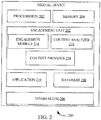
- FIG. 2 illustrates a block diagram of a digital device 200 (one of the digital devices 102A-N), according to an embodiment of the present disclosure.
- the digital device 200 includes one or more processor(s) 202 and a memory 204 communicatively coupled to each other.
- the digital device 200 also includes interface(s) 206.
- the memory 204 includes a database 208, an application 210 and modules, such as an engagement unit 212 (one of the engagement units 106A-N) and other modules.
- the engagement unit 212 includes an engagement module 214, a content analyzer 216 and a content provider 218.
- the engagement module 214 is a main operating unit that co-ordinates with the application 210 and other modules 216 and 218.
- the application 210 (e.g., a mobile browser and so on) runs in the environment of the digital device 200.
- the content provider 218 may store data downloaded or data present in the digital device 200 indexed for easier search. The data is saved in the database 208 under read content and unread content. The content provider 218 has access to Internet.
- the database 208 also stores the logs of the user, user read and unread content along with tags to categorize the content.
- FIG. 2 shows example components of the digital device 200, in other implementations, the digital device 200 may contain fewer components, additional components, different components, or differently arranged components than depicted in FIG. 2 .
- the processor(s) 202 and the memory 204 may be communicatively coupled by a system bus.
- the processor(s) 202 may include circuitry implementing, among others, audio and logic functions associated with the communication.
- the processor(s) 202 may include, among other things, a clock, an arithmetic logic unit (ALU) and logic gates configured to support operation of the processor(s) 202.
- the processor(s) 202 can be a single processing unit or a number of units, all of which include multiple computing units.
- the processor(s) 202 may be implemented as one or more microprocessors, microcomputers, microcontrollers, digital signal processors, central processing units, state machines, logic circuitries, and/or any devices that manipulate signals based on operational instructions.
- the processor(s) 202 is configured to fetch and execute computer-readable instructions and data stored in the memory 204.
- processors may be provided through the use of dedicated hardware as well as hardware capable of executing software in association with appropriate software.
- the functions may be provided by a single dedicated processor, by a single shared processor, or by a plurality of individual processors, some of which may be shared.
- explicit use of the term "processor” should not be construed to refer exclusively to hardware capable of executing software, and may implicitly include, without limitation, digital signal processor (DSP) hardware, network processor, application specific integrated circuit (ASIC), field programmable gate array (FPGA), read only memory (ROM) for storing software, random access memory (RAM), and non-volatile storage.
- DSP digital signal processor
- ASIC application specific integrated circuit
- FPGA field programmable gate array
- ROM read only memory
- RAM random access memory
- non-volatile storage Other hardware, conventional, and/or custom, may also be included.
- the interface(s) 206 may include a variety of software and hardware interfaces, for example, interfaces for peripheral device(s), such as a keyboard, a mouse, an external memory, and a printer.
- the interface(s) 206 can facilitate multiple communications within a wide variety of networks and protocol types, including wired networks, for example, local area network (LAN), cable, etc., and wireless networks, such as Wireless LAN (WLAN), cellular, or satellite.
- the interface(s) 206 may include one or more ports for connecting the digital device 200 to other devices as shown in FIG. 1 .
- the memory 204 may include any computer-readable medium known in the art including, for example, volatile memory, such as static random access memory (SRAM) and dynamic random access memory (DRAM), and/or non-volatile memory, such as read only memory (ROM), erasable programmable ROM, flash memories, hard disks, optical disks, and magnetic tapes.
- volatile memory such as static random access memory (SRAM) and dynamic random access memory (DRAM)
- non-volatile memory such as read only memory (ROM), erasable programmable ROM, flash memories, hard disks, optical disks, and magnetic tapes.
- ROM read only memory
- the memory 204 may be configured to store instructions which when executed by the processor(s) 202 causes the digital device 200 to behave in a manner as described in various embodiments.
- the memory 204 includes the engagement unit 208 and other modules.
- the unit 212 and other modules include routines, programs, objects, components, data structures, etc., which perform particular tasks or implement particular abstract data types.
- the other modules may include programs or coded instructions that supplement applications and functions of the digital device 200
- the engagement module 214 determines a user or user group's (i.e., user and friends associated with the user) context, users in a group, group activities and desires/needs/intents.
- the activities include collocated or non-collocated, synchronous or asynchronous activities.
- the activities include offline and online activities such as, but not limited to meetings, discussion, presentation, play game, constructing a model, watching a movie, reviewing a document, deciding on a pizza or movie or tourism, taking a selfie, calling, using Facebook Messenger, Google Docs, reading literature, video or audio or text calls or chats (group conversations), eating at a place together or watching YouTube videos or TV series or movies together or playing Teen Patti online, etc.
- the engagement module 214 captures user emotions, hand gestures, user behavior, eye gaze and so on. Furthermore, the engagement module 214 records the user's voice and other user's voices (e.g., friends or other users). The engagement module 214 then match the voices and recognize people. Then, the engagement module 214 use voice recognition to determine speech and keyword spotting from multiple users to support the engagement in terms of new content or micro-interactions. For example, keyword spotting is distributed across people and the keywords are different for different people (e.g., there are profiles as U1, U2, U3, and so on). These user personalities have weightage and a user is given different suggestions for users U2, U3 and so on.
- the engagement module 214 captures voice samples from incoming calls to the user and creates a voice profile for each of callers and associate a label with the voice profile.
- the engagement module 214 captures the voice samples of the people in surrounding.
- the engagement module 214 matches with the earlier created voice profiles. If they don't match, then the engagement module 214 requests the devices in vicinity to share voice profiles of the respective users.
- the digital device 200 senses presence of other digital devices in the current settings using Wi-Fi or Bluetooth or global positioning system (GPS). Hence, the engagement module 214 determines if the users and/or friends are collocated or are at remote locations.
- the engagement module 214 creates a profile of the user as a voice profile, a behavior profile, an activity profile and so on. Such profiles resides on users' digital devices.
- the engagement module 214 creates profiles for other people (e.g., friends) who are in a group.
- the digital device 200 have owner's profiles and other friend's profiles.
- cluster mapping time series cluster analysis is performed
- desires are determined.
- the profiles of the users are clusters of desires.
- the engagement module 214 captures voice samples from incoming calls to the user and creates a voice profile for each of callers and associate a label with the voice profile.
- the engagement module 214 captures the voice samples of the people in surrounding.
- the engagement module 214 matches with the earlier created voice profiles. If they don't match, then the engagement module 214 requests the devices in vicinity to share voice profiles of the respective users.
- the digital device 200 senses presence of other digital devices in the current settings using Wi-Fi or Bluetooth or global positioning system (GPS). Hence, the engagement module 214 determines if the users and/or friends are collocated or are at remote locations.
- the engagement module 214 records engagement level or activities (via sensors, gyroscope, accelerometer, orientation sensors, etc.,) with the digital device 200 and with other users in the group. Rules give the user idea, nudge, give interesting tidbits, clues (micro-interaction) what the user can contribute, etc. For example, the activities can be determined from the photography, music or common tourist spots as inferred from latitude longitude of photos present in the digital device 200.
- the content analyzer 216 has access to the application 210 installed on the device 200.
- the content analyzer 216 records users and/or friends' preferences for different categories of contents based upon the time spent by the users and/or friends on the content categories. Based upon the interactions or activities with the device 200, the content analyzer 216 determines a consumption rate for different types of contents.
- the content analyzer 216 monitors the activities (i.e., engagement or interaction) with the device 200 and the application 210 (when the users and/or friends are idle/not engaged). Further, the content analyzer 216 determines types of triggers the users and/or friends requires to perform an interaction with the digital device 200. Furthermore, the content analyzer 216 then motivates the users and/or friends to do something.
- the content analyzer 216 records user cues.
- the cues can act as a micro-interaction and can be shown to other users who is not collocated to show engagement of other users with the digital device 200.
- the content analyzer 216 understands body language/verbal/nonverbal cues, gestures of the other users who are bored, not understanding, monopolizing the digital device 200.
- the content analyzer 216 analyzes the content (text, image, etc.) and builds a statistical model for user engagement.
- the users and/or friends have many applications (e.g., the application 210) which belong to different categories e.g. news, entertainment, education, games, etc.
- the users and/or friends have preferences over content and the users and/or friends have different levels of interest in different categories e.g. a user may like to read political news than educational content and some other user may like education content over news and so on.
- time to read for a person changes based upon his abilities and interests.
- the content analyzer 216 computes user reading preferences based upon the time spent on reading the preferred content and time required to read the content.
- the time to read some content can be captured by a) presenting some content and computing the time or b) monitoring user activities on the applications for computing the time.
- the content analyzer 216 presents the content to the users and/or friends from a category X, and computes time till the users and/or friends press a button done (or next, et cetera).
- the users and/or friends are presented a sequence of images and time for which the image is visible to the users and/or friends is computed.
- the content analyzer 216 divides the content presented as a response to a request in pages.
- the page may be a unit of content visible to the user.
- the content analyzer 216 computes the number of words, images in each page.
- the content analyzer 216 starts computing the time and as the user scrolls through the pages. In some embodiments, if the content is associated with tags or comments, then the time for that content along with tag is saved in the database. A user may be going through of skimming through the text at rapid pace, this may be ignored by the content analyzer 216. For example, a user U has average reading speed of 50 words per minute with standard deviation of 10 words for Israel news. Now, while the content analyzer 216 computing the reading speed, it records more than 100 words per minute speed. At such point, the content analyzer 216 may ignore it. In these embodiments, a proximity sensor present with the device 200 may compute a distance of the user from the screen. Thus, finding out if the user is reading the content carefully or skimming through the content.
- Tr the time user takes to read some content.
- the time is different for different categories of content, for example, reading everyday news not take much time as compared to reading Dan Brown's mystery book. This time is set for each user of the digital device 200.
- the time to read may modify based upon user interaction with the digital device 200 and the content analyzer 216 computes reading time for the content.
- tr (i) Mean + SD, where SD is standard deviation and tr (i) is content consumption rate for content type "i".
- Tr -Td ⁇ t, where ⁇ t is a time difference between time to consume content and time to download some other content. Time to download some content and time to read some other content cannot be exactly same and there will be a delta time difference.
- the Td is known based upon computed network latency received from the engagement module 214.
- the content is given ranks based upon the user interests.
- the user is shown the text which is interested to the user and the time difference between Tr and Td tends to zero.
- the content provider 218 implements a statistical model for displaying the users and/or friends with interesting and appropriate content. Whenever a user requests for content, some other content gets downloaded along with it. For example, when one opens twitter app, many tweets gets downloaded and one may not get time to read all the tweets, even though the tweets are interesting. Same is with Facebook posts or website with a list of jokes. User may close the app even before the content appears on the mobile handset screen. Such content can be called as unread content and the other as read content i.e. displayed on the screen, is read data. Both type of content is kept in the database 208. The engagement module 214 computes the time to download the requested content and sends it to the content provider 216.
- the content provider 218 searches the database 208 for the content which satisfies the criteria for the user. Now, the user may get top three results for the user as a. 2 tweets b. 3 jokes to display c. 5 Rajanikanth Photos. Now, the database 208 has user interests according to rank. The rank is computed based upon time spent by the user and some other system defined criteria. E.g. the content provider 218 ranks Jokes as 1st category, then it will display the three jokes from that category to the user while some content is being downloaded over Internet.
- the engagement module 214 has access to demographic information of the user.
- the demographic information of the user is kept in the database 208.
- the service provider sends network latency information, number of concurrent requests, network utilization and response time, etc.
- the engagement module 214 computes a response time for a total packets of data transfer. If the download time is perceivably (by user) small (let's say Isecond), then the module 214 allows the application 210 to download the content without showing any information. If the total response time is not negligible, then the module 214 invokes the content provider 218 to show offline content to the user. The content provider 218 finds out the appropriate and interesting content for the user.
- the engagement module 214 displays the information to the user and invokes the content analyzer 216 to compute time to consume the content.
- FIG. 3 is a flow chart illustrating a method 300 for engaged micro-interactions on digital devices, according to an embodiment of the present disclosure.
- activities performed on a digital device are monitored.
- the activities may include collocated or non-collocated reading, browsing, playing game and chatting, a collaborative session and the like.
- the activities performed on the digital device are monitored using multiple sensors in the digital device.
- the multiple sensors may include a proximity sensor, a gyroscope, an accelerometer, an orientation sensor and the like.
- at least one user accessing the digital device and friends associated with the at least one user are determined based on the activities performed on the digital device.
- a profile for the at least one user and friends associated with the at least one user is determined.
- the profile includes a voice profile, a behavior profile, a gesture profile and an activity profile.
- time spent on content presented on the digital device and time required to perform an action on the content by the at least one user and/or the friends associated with the at least one user are determined based on the profile of the at least one user and/or the friends associated with the at least one user.
- the action may include at least one of reading, viewing and making a decision.
- the content presented on the digital device is divided into multiple pages, each of the multiple pages is a unit of content visible to the at least one user and/or the friends associated with the at least one user. Further, a number of words and images in each of the multiple pages is computed.
- the time spent on the content and the time required to perform the action on the content are determined based on the profile of the at least one user and/or the friends associated with the at least one user when one of the multiple pages appears on the digital device.
- at least one of a tag or a comment in the one of the multiple pages is determined.
- the time spent on the one of the multiple pages and the time required to perform the action on the one of the multiple pages along with the determined at least one of the tag or comment on the digital device are determined based on the profile of the at least one user and/or the friends associated with the at least one user.
- triggers in the activities are recorded, the triggers include the content that requires user's input. Further, the time spent on the content and time required for making the decision on the content are determined.
- a list of desires associated with the at least one of the user and/or the friends associated with the at least one user is determined based upon at least one of the time spent on the content, time required to perform the action on the content and the activities.
- the list of desires include at least one of reading jokes and viewing images of a person or place, content which is required to read or view based on an activity being performed, any useful content or micro-interaction.
- the list of desires are ranked based on the activities to be performed by the at least one user and the friends associated with the at least one user.
- a download time of online content is computed when the at least one user and/or the friends associated with the at least one user request for the online content on the digital device.
- network latency information, a number of concurrent requests, network utilization information and response time information are obtained from a service provider used in the digital device when the at least one user and/or the friends associated with the at least one user request for the online content.
- the download time of the online content is then computed based on the obtained network latency information, number of concurrent requests, network utilization information and response time information.
- the at least one user and/or the friends associated with the at least one user are engaged by providing a micro-interaction on the digital device based on the ranking of the list of desires and the computed download time.
- the micro-interaction includes phone vibrations, a change of screen brightness or colors and/or displaying text or image snippets to the at least one user and the friends associated with the at least one user.
- the at least one user and/or the friends associated with the at least one user are engaged by providing the micro-interaction on the digital device based on the ranking of the list of desires and the download time when the download time is greater than a predetermined threshold time.
- the at least one user and/or the friends associated with the at least one user are engaged by providing the micro-interaction on the digital device such that a difference between the download time and a time required to perform an action on the micro-interaction by the at least one user and/or the friends associated with the at least one user is zero.
- one or more of the method(s) described herein may be implemented at least in part as instructions embodied in non-transitory computer-readable storage medium and executable by one or more computing devices.
- a processor for example a microprocessor
- Such instructions may be stored and/or transmitted using any of a variety of known computer-readable media.
Landscapes
- Engineering & Computer Science (AREA)
- Theoretical Computer Science (AREA)
- Databases & Information Systems (AREA)
- General Engineering & Computer Science (AREA)
- Physics & Mathematics (AREA)
- General Physics & Mathematics (AREA)
- Computer Networks & Wireless Communication (AREA)
- Signal Processing (AREA)
- Data Mining & Analysis (AREA)
- Business, Economics & Management (AREA)
- Computer Hardware Design (AREA)
- Finance (AREA)
- Strategic Management (AREA)
- Accounting & Taxation (AREA)
- Development Economics (AREA)
- Multimedia (AREA)
- Quality & Reliability (AREA)
- Computational Linguistics (AREA)
- Entrepreneurship & Innovation (AREA)
- Game Theory and Decision Science (AREA)
- Computing Systems (AREA)
- Economics (AREA)
- Marketing (AREA)
- General Business, Economics & Management (AREA)
- Information Transfer Between Computers (AREA)
Abstract
Description
- This patent application claims priority to India Patent Application
201621020816, filed on June 17, 2016 - The embodiments herein generally relate to micro-interactions and, more particularly, to engaged micro-interactions on digital devices.
- Generally, service providers on Internet give different services to their users. Every service provider wants users to stay on the site as long as possible and use their services. One of the factors which is responsible for bad user experience and user engagement is Internet on which the service provider doesn't have control. The request to response time can vary based upon network latency, server capacity, device capacity, etc. In such cases, the user may shift to other service providers to use their services.
- The following presents a simplified summary of some embodiments of the disclosure in order to provide a basic understanding of the embodiments. This summary is not an extensive overview of the embodiments. It is not intended to identify key/critical elements of the embodiments or to delineate the scope of the embodiments. Its sole purpose is to present some embodiments in a simplified form as a prelude to the more detailed description that is presented below. In view of the foregoing, an embodiment herein provides a technique for engaged micro-interactions on digital devices is disclosed.
- In one aspect, a method for engaged micro-interactions on digital devices is disclosed. In this aspect, activities performed on a digital device are monitored, the activities comprise collocated or non-collocated reading, browsing, playing game and chatting and a collaborative session. Further, at least one user accessing the digital device and friends associated with the at least one user are determined based on the activities performed on the digital device. Furthermore, a profile for the at least one user and friends associated with the at least one user is determined, the profile comprises a voice profile, a behavior profile, a gesture profile and an activity profile. In addition, time spent on content presented on the digital device and time required to perform an action on the content by the at least one user and/or the friends associated with the at least one user are determined based on the profile of the at least one user and/or the friends associated with the at least one user, the action comprises at least one of reading, viewing and making a decision.
- Moreover, a list of desires associated with the at least one of the user and/or the friends associated with the at least one user is determined based upon at least one of the time spent on the content, time required to perform the action on the content and the activities. Further, the list of desires are ranked based on the activities to be performed by the at least one user and the friends associated with the at least one user. Further, a download time of online content is computed when the at least one user and/or the friends associated with the at least one user request for the online content on the digital device. Furthermore, the at least one user and/or the friends associated with the at least one user are engaged by providing a micro-interaction on the digital device based on the ranking of the list of desires and the computed download time.
- In another aspect, a digital device for engaged micro-interactions is disclosed. In an example, the digital device includes one or more processors and a memory communicatively coupled to the processors. Further, the memory includes an engagement unit. In an example implementation, the engagement unit monitors activities performed on the digital device, the activities include collocated or non-collocated reading, browsing, playing game and chatting and a collaborative session. Further, the engagement unit determines at least one user accessing the digital device and friends associated with the at least one user based on the activities performed on the digital device. Furthermore, the engagement unit creates a profile for the at least one user and friends associated with the at least one user, the profile includes a voice profile, a behavior profile, a gesture profile and an activity profile.
- In addition, the engagement unit determines time spent on content presented on the digital device and time required to perform an action on the content by the at least one user and/or the friends associated with the at least one user based on the profile of the at least one user and/or the friends associated with the at least one user, the action includes at least one of reading, viewing and making a decision. Moreover, the engagement unit determines a list of desires associated with the at least one of the user and/or the friends associated with the at least one user based upon at least one of the time spent on the content, time required to perform the action on the content and the activities. Also, the engagement unit ranks the list of desires based on the activities to be performed by the at least one user and the friends associated with the at least one user. Further, the engagement unit computes a download time of online content when the at least one user and/or the friends associated with the at least one user request for the online content on the digital device. Furthermore, the engagement unit engages the at least one user and/or the friends associated with the at least one user by providing a micro-interaction on the digital device based on the ranking of the list of desires and the computed download time.
- It should be appreciated by those skilled in the art that any block diagram herein represent conceptual views of illustrative systems embodying the principles of the present subject matter. Similarly, it is appreciated that any flow charts, flow diagrams, state transition diagrams, pseudo code, and the like represent various processes which may be substantially represented in computer readable medium and so executed by a computing device or processor, whether or not such computing device or processor is explicitly shown.
- The embodiments herein are better understood from the following detailed description with reference to the drawings, in which:
-
FIG. 1 illustrates a block diagram of a system for engaged micro-interactions on digital devices, according to an embodiment of the present disclosure; -
FIG. 2 illustrates a digital device shown inFIG. 1 , according to an embodiment of the present disclosure; and -
FIG. 3 is a flow chart illustrating a method for engaged micro-interactions on digital devices, according to an embodiment of the present disclosure. - The embodiments herein and the various features and advantageous details thereof are explained more fully with reference to the non-limiting embodiments that are illustrated in the accompanying drawings and detailed in the following description. The examples used herein are intended merely to facilitate an understanding of ways in which the embodiments herein may be practiced and to further enable those of skill in the art to practice the embodiments herein. Accordingly, the examples should not be construed as limiting the scope of the embodiments herein.
- The term "people" is used to refer "users and/or friends" throughout the document.
- In an example embodiment, the present technique provides micro-interactions for user engagement with digital devices in computer supported collaborative work (CSCW) settings. In other words, the present technique engages a user or user group (user and associated friends) with the digital devices using micro-interactions. For example, engagement means when the user is performing an activity, resources are provided to the group of users to interact with each other that makes the user use the digital device without any disconnect between user and the digital device. The present technique also qualifies activities for micro-interactions that involve triggers and feedbacks. The activities include, but not limited to, when the user or group is idle, the user or group wants to interact, play, chat, draw, and work and so on. The present technique determines user or user group desires and optimizes resources (e.g. text, voice, video, image, interactions and so on) for micro-interaction based user engagement. Thus, optimizing the time for which the user or user group be engaged with the digital device and the resources for better engagement.
- In an example implementation, the present technique performs the user or user group engagement by determining the user or user group desires, computing time for consumption for each user, determining appropriate resources for the user or user group and determining appropriate micro-interaction for the user or user group.
-
FIG. 1 illustrates a block diagram of asystem 100 for engaged micro-interactions on digital devices, according to an embodiment of the present disclosure. As shown inFIG. 1 , thesystem 100 includes multipledigital devices 102A-N communicatively coupled to each other via acommunication network 104. Exampledigital devices 102A-N include mobile phones, computing devices and so on. Further as shown inFIG. 1 , each of thedigital devices 102A-N includes anengagement unit 106A-N, respectively. - In an example embodiment, an engagement unit (e.g., the
engagement unit 106A) monitors activities performed on thedigital device 102A. The activities may include collocated or non-collocated reading, browsing, playing game and chatting and a collaborative session. In an example, the activities performed on thedigital device 102A are monitored using multiple sensors in thedigital device 102A. For example, the multiple sensors include a proximity sensor, a gyroscope, an accelerometer, an orientation sensor and the like. Further, theengagement unit 102A determines at least one user accessing thedigital device 102A and friends associated with the at least one user based on the activities performed on thedigital device 102A. For example, the friends associated with the user include one or more users accessing the digital devices 102B-N or friends sitting around the user accessing thedigital device 102A. Furthermore, theengagement unit 106A determines a profile for the at least one user and friends associated with the at least one user. The profile may include a voice profile, a behavior profile, a gesture profile, an activity profile and the like. - In addition, the
engagement unit 106A determines time spent on content presented on the digital device and time required to perform an action on the content by the at least one user and/or the friends associated with the at least one user based on the profile of the at least one user and/or the friends associated with the at least one user. The action may include reading, viewing, making a decision and the like. In an example implementation, theengagement unit 106A divides the content presented on the digital device into multiple pages, each of the multiple pages is a unit of content visible to the at least one user and/or the friends associated with the at least one user. Further, theengagement unit 106A computes a number of words and images in each of the multiple pages. Furthermore, theengagement unit 106A determines the time spent on the content and the time required to perform the action on the content based on the profile of the at least one user and/or the friends associated with the at least one user when one of the multiple pages appears on the digital device. In some embodiments, theengagement unit 106A determines at least one of a tag or a comment in the one of the multiple pages. Theengagement unit 106A determines the time spent on the one of the multiple pages and the time required to perform the action on the one of the multiple pages along with the determined at least one of the tag or comment on the digital device based on the profile of the at least one user and/or the friends associated with the at least one user. In another example implementation, theengagement unit 106A records triggers in the activities. The triggers may include the content that requires user's input. Further, theengagement unit 106A determines the time spent on the content and time required for making the decision on the content. - Also, the
engagement unit 106A determines a list of desires associated with the at least one of the user and/or the friends associated with the at least one user based upon at least one of the time spent on the content, time required to perform the action on the content and the activities. In an example, the list of desires include at least one of reading jokes and viewing images of a person or place, content which is required to read or view based on an activity being performed, any useful content or micro-interaction. - Moreover, the
engagement unit 106A ranks the list of desires based on the activities to be performed by the at least one user and the friends associated with the at least one user. Further, theengagement unit 106A computes a download time of online content when the at least one user and/or the friends associated with the at least one user request for the online content on the digital device. In an example implementation, theengagement unit 106A obtains network latency information, a number of concurrent requests, network utilization information and response time information from a service provider used in thedigital device 102A when the at least one user and/or the friends associated with the at least one user request for the online content. Theengagement unit 106A then computes the download time of the online content based on the obtained network latency information, number of concurrent requests, network utilization information and response time information. - Further, the
engagement unit 106A engages the at least one user and/or the friends associated with the at least one user by providing a micro-interaction on thedigital device 102A based on the ranking of the list of desires and the computed download time. In an example, the micro-interaction includes phone vibrations, a change of screen brightness or colors and/or displaying text or image snippets to the at least one user and the friends associated with the at least one user. In an example implementation, theengagement unit 106A engages the at least one user and/or the friends associated with the at least one user by providing the micro-interaction on thedigital device 102A based on the ranking of the list of desires and the download time when the download time is greater than a predetermined threshold time. In another example implementation, theengagement unit 106A engages the at least one user and/or the friends associated with the at least one user by providing the micro-interaction on thedigital device 102A such that a difference between the download time and a time required to perform an action on the micro-interaction by the at least one user and/or the friends associated with the at least one user is zero. This is explained in more detail with reference toFIG. 2 . -
FIG. 2 illustrates a block diagram of a digital device 200 (one of thedigital devices 102A-N), according to an embodiment of the present disclosure. As shown inFIG. 2 , thedigital device 200 includes one or more processor(s) 202 and amemory 204 communicatively coupled to each other. Thedigital device 200 also includes interface(s) 206. Further, thememory 204 includes adatabase 208, anapplication 210 and modules, such as an engagement unit 212 (one of theengagement units 106A-N) and other modules. Furthermore, theengagement unit 212 includes anengagement module 214, acontent analyzer 216 and acontent provider 218. In an example, theengagement module 214 is a main operating unit that co-ordinates with theapplication 210 andother modules digital device 200. Thecontent provider 218 may store data downloaded or data present in thedigital device 200 indexed for easier search. The data is saved in thedatabase 208 under read content and unread content. Thecontent provider 218 has access to Internet. Thedatabase 208 also stores the logs of the user, user read and unread content along with tags to categorize the content. AlthoughFIG. 2 shows example components of thedigital device 200, in other implementations, thedigital device 200 may contain fewer components, additional components, different components, or differently arranged components than depicted inFIG. 2 . - The processor(s) 202 and the
memory 204 may be communicatively coupled by a system bus. The processor(s) 202 may include circuitry implementing, among others, audio and logic functions associated with the communication. The processor(s) 202 may include, among other things, a clock, an arithmetic logic unit (ALU) and logic gates configured to support operation of the processor(s) 202. The processor(s) 202 can be a single processing unit or a number of units, all of which include multiple computing units. The processor(s) 202 may be implemented as one or more microprocessors, microcomputers, microcontrollers, digital signal processors, central processing units, state machines, logic circuitries, and/or any devices that manipulate signals based on operational instructions. Among other capabilities, the processor(s) 202 is configured to fetch and execute computer-readable instructions and data stored in thememory 204. - The functions of the various elements shown in the figure, including any functional blocks labeled as "processor(s)", may be provided through the use of dedicated hardware as well as hardware capable of executing software in association with appropriate software. When provided by a processor, the functions may be provided by a single dedicated processor, by a single shared processor, or by a plurality of individual processors, some of which may be shared. Moreover, explicit use of the term "processor" should not be construed to refer exclusively to hardware capable of executing software, and may implicitly include, without limitation, digital signal processor (DSP) hardware, network processor, application specific integrated circuit (ASIC), field programmable gate array (FPGA), read only memory (ROM) for storing software, random access memory (RAM), and non-volatile storage. Other hardware, conventional, and/or custom, may also be included.
- The interface(s) 206 may include a variety of software and hardware interfaces, for example, interfaces for peripheral device(s), such as a keyboard, a mouse, an external memory, and a printer. The interface(s) 206 can facilitate multiple communications within a wide variety of networks and protocol types, including wired networks, for example, local area network (LAN), cable, etc., and wireless networks, such as Wireless LAN (WLAN), cellular, or satellite. For the purpose, the interface(s) 206 may include one or more ports for connecting the
digital device 200 to other devices as shown inFIG. 1 . - The
memory 204 may include any computer-readable medium known in the art including, for example, volatile memory, such as static random access memory (SRAM) and dynamic random access memory (DRAM), and/or non-volatile memory, such as read only memory (ROM), erasable programmable ROM, flash memories, hard disks, optical disks, and magnetic tapes. Thememory 204, may store any number of pieces of information, and data, used by thedigital device 200 to implement the functions of thedigital device 200. Thememory 204 may be configured to store information, data, applications, instructions or the like for enabling thedigital device 200 to carry out various functions in accordance with various example embodiments. Additionally or alternatively, thememory 204 may be configured to store instructions which when executed by the processor(s) 202 causes thedigital device 200 to behave in a manner as described in various embodiments. Thememory 204 includes theengagement unit 208 and other modules. Theunit 212 and other modules include routines, programs, objects, components, data structures, etc., which perform particular tasks or implement particular abstract data types. The other modules may include programs or coded instructions that supplement applications and functions of thedigital device 200 - In operation, the
engagement module 214 determines a user or user group's (i.e., user and friends associated with the user) context, users in a group, group activities and desires/needs/intents. For example, the activities include collocated or non-collocated, synchronous or asynchronous activities. In this example, the activities include offline and online activities such as, but not limited to meetings, discussion, presentation, play game, constructing a model, watching a movie, reviewing a document, deciding on a pizza or movie or tourism, taking a selfie, calling, using Facebook Messenger, Google Docs, reading literature, video or audio or text calls or chats (group conversations), eating at a place together or watching YouTube videos or TV series or movies together or playing Teen Patti online, etc. - Further, the
engagement module 214 captures user emotions, hand gestures, user behavior, eye gaze and so on. Furthermore, theengagement module 214 records the user's voice and other user's voices (e.g., friends or other users). Theengagement module 214 then match the voices and recognize people. Then, theengagement module 214 use voice recognition to determine speech and keyword spotting from multiple users to support the engagement in terms of new content or micro-interactions. For example, keyword spotting is distributed across people and the keywords are different for different people (e.g., there are profiles as U1, U2, U3, and so on). These user personalities have weightage and a user is given different suggestions for users U2, U3 and so on. - In an example, the
engagement module 214 captures voice samples from incoming calls to the user and creates a voice profile for each of callers and associate a label with the voice profile. When theengagement module 214 want to know who the users are in vicinity, theengagement module 214 captures the voice samples of the people in surrounding. Theengagement module 214 matches with the earlier created voice profiles. If they don't match, then theengagement module 214 requests the devices in vicinity to share voice profiles of the respective users. In an embodiment, thedigital device 200 senses presence of other digital devices in the current settings using Wi-Fi or Bluetooth or global positioning system (GPS). Hence, theengagement module 214 determines if the users and/or friends are collocated or are at remote locations. - In an example implementation, the
engagement module 214 creates a profile of the user as a voice profile, a behavior profile, an activity profile and so on. Such profiles resides on users' digital devices. In an embodiment, theengagement module 214 creates profiles for other people (e.g., friends) who are in a group. Thus, thedigital device 200 have owner's profiles and other friend's profiles. In an example embodiment, when two people are doing an activity together and separately, there are three clusters (distinct profiles of person A and B, and overlap). Based on cluster mapping (time series cluster analysis is performed) with individual and in the group, desires are determined. In this embodiment, the profiles of the users are clusters of desires. - In an example, the
engagement module 214 captures voice samples from incoming calls to the user and creates a voice profile for each of callers and associate a label with the voice profile. When theengagement module 214 want to know who the users are in vicinity, theengagement module 214 captures the voice samples of the people in surrounding. Theengagement module 214 matches with the earlier created voice profiles. If they don't match, then theengagement module 214 requests the devices in vicinity to share voice profiles of the respective users. In an embodiment, thedigital device 200 senses presence of other digital devices in the current settings using Wi-Fi or Bluetooth or global positioning system (GPS). Hence, theengagement module 214 determines if the users and/or friends are collocated or are at remote locations. - In addition, the
engagement module 214 records engagement level or activities (via sensors, gyroscope, accelerometer, orientation sensors, etc.,) with thedigital device 200 and with other users in the group. Rules give the user idea, nudge, give interesting tidbits, clues (micro-interaction) what the user can contribute, etc. For example, the activities can be determined from the photography, music or common tourist spots as inferred from latitude longitude of photos present in thedigital device 200. - Also, the
content analyzer 216 has access to theapplication 210 installed on thedevice 200. Thecontent analyzer 216 records users and/or friends' preferences for different categories of contents based upon the time spent by the users and/or friends on the content categories. Based upon the interactions or activities with thedevice 200, thecontent analyzer 216 determines a consumption rate for different types of contents. In an embodiment, thecontent analyzer 216 monitors the activities (i.e., engagement or interaction) with thedevice 200 and the application 210 (when the users and/or friends are idle/not engaged). Further, thecontent analyzer 216 determines types of triggers the users and/or friends requires to perform an interaction with thedigital device 200. Furthermore, thecontent analyzer 216 then motivates the users and/or friends to do something. - In some embodiments, the
content analyzer 216 records user cues. The cues can act as a micro-interaction and can be shown to other users who is not collocated to show engagement of other users with thedigital device 200. Thecontent analyzer 216 understands body language/verbal/nonverbal cues, gestures of the other users who are bored, not understanding, monopolizing thedigital device 200. - Further, the
content analyzer 216 analyzes the content (text, image, etc.) and builds a statistical model for user engagement. In thedigital device 200, the users and/or friends have many applications (e.g., the application 210) which belong to different categories e.g. news, entertainment, education, games, etc. The users and/or friends have preferences over content and the users and/or friends have different levels of interest in different categories e.g. a user may like to read political news than educational content and some other user may like education content over news and so on. Thus, time to read for a person changes based upon his abilities and interests. Thecontent analyzer 216 computes user reading preferences based upon the time spent on reading the preferred content and time required to read the content. The time to read some content can be captured by a) presenting some content and computing the time or b) monitoring user activities on the applications for computing the time. In a) thecontent analyzer 216 presents the content to the users and/or friends from a category X, and computes time till the users and/or friends press a button done (or next, et cetera). The users and/or friends are presented a sequence of images and time for which the image is visible to the users and/or friends is computed. In b) thecontent analyzer 216 divides the content presented as a response to a request in pages. The page may be a unit of content visible to the user. Thecontent analyzer 216 computes the number of words, images in each page. Whenever a page appears on the screen, thecontent analyzer 216 starts computing the time and as the user scrolls through the pages. In some embodiments, if the content is associated with tags or comments, then the time for that content along with tag is saved in the database. A user may be going through of skimming through the text at rapid pace, this may be ignored by thecontent analyzer 216. For example, a user U has average reading speed of 50 words per minute with standard deviation of 10 words for Bollywood news. Now, while thecontent analyzer 216 computing the reading speed, it records more than 100 words per minute speed. At such point, thecontent analyzer 216 may ignore it. In these embodiments, a proximity sensor present with thedevice 200 may compute a distance of the user from the screen. Thus, finding out if the user is reading the content carefully or skimming through the content. - Consider Td is the time to download some content over network, Tr is the time user takes to read some content. The
content analyzer 216 computes the time to download for each request and the time to read with the help of the statistical model which is built. Initially, thecontent analyzer 216 captures the time required for a set of users who have the application installed on theirdevice 200. Thus, the time required for a user to consume given content of a given category by population is computed using a below example equation:
- The time is different for different categories of content, for example, reading everyday news not take much time as compared to reading Dan Brown's mystery book. This time is set for each user of the
digital device 200. The time to read may modify based upon user interaction with thedigital device 200 and thecontent analyzer 216 computes reading time for the content. tr (i) = Mean + SD, where SD is standard deviation and tr (i) is content consumption rate for content type "i". - Assume that for 50 words it takes 2 minutes and downloading time is 3 minutes. Then, tr (i) = f (content) (i) = content/time = content consumption rate + Δt. Over a period of time, the
digital device 200 have content consumption rate for different categories and Δt is standard deviation. While displaying content to the user, thedigital device 200 optimizes Tr -Td = Δt, where Δt is a time difference between time to consume content and time to download some other content. Time to download some content and time to read some other content cannot be exactly same and there will be a delta time difference. The Td is known based upon computed network latency received from theengagement module 214. Thecontent analyzer 216 needs to find Tr for which the user is interested to consume the content and the time difference between reading content and download some other content (Δt) tends to zero. Now, content to show is found out as follows:
- Now, the content is given ranks based upon the user interests. Thus, the user is shown the text which is interested to the user and the time difference between Tr and Td tends to zero. In some embodiments, there is a transformation function that transforms signals into appropriate micro-interactions form. For example, Haptic/vibrations of the
digital device 200 for feedback, showing colors if playing games online or visual, haptic cues while they are remote (use of sensors, or vibrations of devices could communicate), emotions of users presented by colors. - The
content provider 218 implements a statistical model for displaying the users and/or friends with interesting and appropriate content. Whenever a user requests for content, some other content gets downloaded along with it. For example, when one opens twitter app, many tweets gets downloaded and one may not get time to read all the tweets, even though the tweets are interesting. Same is with Facebook posts or website with a list of jokes. User may close the app even before the content appears on the mobile handset screen. Such content can be called as unread content and the other as read content i.e. displayed on the screen, is read data. Both type of content is kept in thedatabase 208. Theengagement module 214 computes the time to download the requested content and sends it to thecontent provider 216. Now, thecontent provider 218 uses the computed time Td to find out content which satisfies Tr-Td = Δt. Further, thecontent provider 218 uses below equation to find out content for presenting it to the user.
- Consider, suggestion to show 4 photographs from "Katrina" category which the user likes or 300 words from "Bollywood News" category. Now the
content provider 218 searches thedatabase 208 for the content which satisfies the criteria for the user. Now, the user may get top three results for the user as a. 2 tweets b. 3 jokes to display c. 5 Rajanikanth Photos. Now, thedatabase 208 has user interests according to rank. The rank is computed based upon time spent by the user and some other system defined criteria. E.g. thecontent provider 218 ranks Jokes as 1st category, then it will display the three jokes from that category to the user while some content is being downloaded over Internet. - Further in operation, the
engagement module 214 has access to demographic information of the user. The demographic information of the user is kept in thedatabase 208. While using thedigital device 200, when theapplication 210 sends requests for content, some packets as a request to the server, the service provider sends network latency information, number of concurrent requests, network utilization and response time, etc. Thus, theengagement module 214 computes a response time for a total packets of data transfer. If the download time is perceivably (by user) small (let's say Isecond), then themodule 214 allows theapplication 210 to download the content without showing any information. If the total response time is not negligible, then themodule 214 invokes thecontent provider 218 to show offline content to the user. Thecontent provider 218 finds out the appropriate and interesting content for the user. Theengagement module 214 displays the information to the user and invokes thecontent analyzer 216 to compute time to consume the content. -
FIG. 3 is a flow chart illustrating amethod 300 for engaged micro-interactions on digital devices, according to an embodiment of the present disclosure. Atblock 302, activities performed on a digital device are monitored. The activities may include collocated or non-collocated reading, browsing, playing game and chatting, a collaborative session and the like. In an example, the activities performed on the digital device are monitored using multiple sensors in the digital device. The multiple sensors may include a proximity sensor, a gyroscope, an accelerometer, an orientation sensor and the like. Atblock 304, at least one user accessing the digital device and friends associated with the at least one user are determined based on the activities performed on the digital device. Atblock 306, a profile for the at least one user and friends associated with the at least one user is determined. The profile includes a voice profile, a behavior profile, a gesture profile and an activity profile. - At
block 308, time spent on content presented on the digital device and time required to perform an action on the content by the at least one user and/or the friends associated with the at least one user are determined based on the profile of the at least one user and/or the friends associated with the at least one user. The action may include at least one of reading, viewing and making a decision. In an example implementation, the content presented on the digital device is divided into multiple pages, each of the multiple pages is a unit of content visible to the at least one user and/or the friends associated with the at least one user. Further, a number of words and images in each of the multiple pages is computed. Furthermore, the time spent on the content and the time required to perform the action on the content are determined based on the profile of the at least one user and/or the friends associated with the at least one user when one of the multiple pages appears on the digital device. In some embodiments, at least one of a tag or a comment in the one of the multiple pages is determined. The time spent on the one of the multiple pages and the time required to perform the action on the one of the multiple pages along with the determined at least one of the tag or comment on the digital device are determined based on the profile of the at least one user and/or the friends associated with the at least one user. In another example implementation, triggers in the activities are recorded, the triggers include the content that requires user's input. Further, the time spent on the content and time required for making the decision on the content are determined. - At
block 310, a list of desires associated with the at least one of the user and/or the friends associated with the at least one user is determined based upon at least one of the time spent on the content, time required to perform the action on the content and the activities. In an example, the list of desires include at least one of reading jokes and viewing images of a person or place, content which is required to read or view based on an activity being performed, any useful content or micro-interaction. - At
block 312, the list of desires are ranked based on the activities to be performed by the at least one user and the friends associated with the at least one user. Atblock 314, a download time of online content is computed when the at least one user and/or the friends associated with the at least one user request for the online content on the digital device. In an example implementation, network latency information, a number of concurrent requests, network utilization information and response time information are obtained from a service provider used in the digital device when the at least one user and/or the friends associated with the at least one user request for the online content. The download time of the online content is then computed based on the obtained network latency information, number of concurrent requests, network utilization information and response time information. - At
block 316, the at least one user and/or the friends associated with the at least one user are engaged by providing a micro-interaction on the digital device based on the ranking of the list of desires and the computed download time. In an example, the micro-interaction includes phone vibrations, a change of screen brightness or colors and/or displaying text or image snippets to the at least one user and the friends associated with the at least one user. In an example implementation, the at least one user and/or the friends associated with the at least one user are engaged by providing the micro-interaction on the digital device based on the ranking of the list of desires and the download time when the download time is greater than a predetermined threshold time. In another example implementation, the at least one user and/or the friends associated with the at least one user are engaged by providing the micro-interaction on the digital device such that a difference between the download time and a time required to perform an action on the micro-interaction by the at least one user and/or the friends associated with the at least one user is zero. - The order in which the method(s) are described is not intended to be construed as a limitation, and any number of the described method blocks can be combined in any order to implement the above method, or an alternative method. Additionally, individual blocks may be deleted from the methods without departing from the spirit and scope of the subject matter described herein. Furthermore, the above method can be implemented in any suitable hardware, software, firmware, or combination thereof.
- In an implementation, one or more of the method(s) described herein may be implemented at least in part as instructions embodied in non-transitory computer-readable storage medium and executable by one or more computing devices. In general, a processor (for example a microprocessor) receives instructions, from a non-transitory computer-readable medium, for example, a memory, and executes those instructions, thereby performing one or more method(s), including one or more of the method(s) described herein. Such instructions may be stored and/or transmitted using any of a variety of known computer-readable media.
- It is, however to be understood that the scope of the protection is extended to such a program and in addition to a computer-readable means having a message therein; such computer-readable storage means contain program-code means for implementation of one or more steps of the method, when the program runs on a server or mobile device or any suitable programmable device.
- The preceding description has been presented with reference to various embodiments. Persons having ordinary skill in the art and technology to which this application pertains appreciate that alterations and changes in the described structures and methods of operation can be practiced without meaningfully departing from the principle, spirit and scope.
Claims (15)
- A method comprising:monitoring activities performed on a digital device, wherein the activities comprise collocated or non-collocated reading, browsing, playing game and chatting and a collaborative session;determining at least one user accessing the digital device and friends associated with the at least one user based on the activities performed on the digital device;creating a profile for the at least one user and friends associated with the at least one user, wherein the profile comprises a voice profile, a behavior profile, a gesture profile and an activity profile;determining time spent on content presented on the digital device and time required to perform an action on the content by the at least one of the user and the friends associated with the at least one user based on the profile of the at least one of the user and the friends associated with the at least one user, wherein the action comprises at least one of reading, viewing and making a decision;determining a list of desires associated with the at least one of the user and the friends associated with the at least one user based upon at least one of the time spent on the content, time required to perform the action on the content and the activities;ranking the list of desires based on the activities to be performed by the at least one user and the friends associated with the at least one user;computing a download time of online content when the at least one of the user and the friends associated with the at least one user request for the online content on the digital device; andengaging the at least one of the user and the friends associated with the at least one user by providing a micro-interaction on the digital device based on the ranking of the list of desires and the computed download time.
- The method as claimed in claim 1, wherein monitoring the activities performed on the digital device, comprises:monitoring the activities performed on the digital device using multiple sensors in the digital device, wherein the multiple sensors comprise a proximity sensor, a gyroscope, an accelerometer and an orientation sensor.
- The method as claimed in claim 1, wherein determining at least one of the time spent on the content and time required for reading and viewing the content by the at least one of the user and the friends associated with the at least one user based on the profile of the at least one of the user and the friends associated with the at least one user, comprises:dividing the content presented on the digital device into multiple pages, wherein each of the multiple pages is a unit of content visible to the at least one of the user and the friends associated with the at least one user;computing a number of words and images in each of the multiple pages; anddetermining the time spent on the content and the time required to perform the action on the content based on the profile of the at least one of the user and the friends associated with the at least one user when one of the multiple pages appears on the digital device.
- The method as claimed in claim 3, further comprising:determining at least one of a tag or a comment in the one of the multiple pages; anddetermining the time spent on the one of the multiple pages and the time required to perform the action on the one of the multiple pages along with the determined at least one of the tag or comment on the digital device based on the profile of the at least one of the user and the friends associated with the at least one user.
- The method as claimed in claim 1, wherein determining the time spent on the content and time required for making the decision on the content by the at least one of the user and the friends associated with the at least one user based on the profile of the at least one of the user and the friends associated with the at least one user, comprises:recording triggers in the activities, wherein the triggers comprise the content that requires user's input; anddetermining the time spent on the content and time required for making the decision on the content.
- The method as claimed in claim 1, wherein providing the micro-interaction comprises at least one of phone vibrations, a change of screen brightness or colors and displaying text or image snippets to the at least one user and the friends associated with the at least one user, and wherein the list of desires comprise at least one of reading jokes and viewing images of a person or place and content which is required to read or view based on an activity being performed.
- The method as claimed in claim 1, wherein computing the download time of the online content when the at least one of the user and the friends associated with the at least one user request for the online content, comprises:obtaining network latency information, a number of concurrent requests, network utilization information and response time information from a service provider used in the digital device when the at least one user and/or the friends associated with the at least one user request for the online content; andcomputing the download time of the online content based on the obtained network latency information, number of concurrent requests, network utilization information and response time information.
- The method as claimed in claim 1, wherein engaging the at least one of the user and the friends associated with the at least one user by providing the micro-interaction on the digital device based on the ranking of the list of desires and the download time, comprises:engaging the at least one of the user and the friends associated with the at least one user by providing the micro-interaction on the digital device based on the ranking of the list of desires and the download time when the download time is greater than a predetermined threshold time.
- The method as claimed in claim 1, wherein engaging the at least one of the user and the friends associated with the at least one user by providing the micro-interaction on the digital device based on the ranking of the list of desires and the download time, comprises:engaging the at least one of the user and the friends associated with the at least one user by providing the micro-interaction on the digital device such that a difference between the download time and a time required to perform an action on the micro-interaction by the at least one of the user and the friends associated with the at least one user is zero.
- A digital device comprising:at least one processor; anda memory communicatively coupled to the at least one processor, wherein the memory comprises an engagement unit to:monitor activities performed on the digital device, wherein the activities comprise collocated or non-collocated reading, browsing, playing game and chatting and a collaborative session;determine at least one user accessing the digital device and friends associated with the at least one user based on the activities performed on the digital device;create a profile for the at least one user and friends associated with the at least one user, wherein the profile comprises a voice profile, a behavior profile, a gesture profile and an activity profile;determine time spent on content presented on the digital device and time required to perform an action on the content by the at least one of the user and the friends associated with the at least one user based on the profile of the at least one of the user and the friends associated with the at least one user, wherein the action comprises at least one of reading, viewing and making a decision;determine a list of desires associated with the at least one of the user and the friends associated with the at least one user based upon at least one of the time spent on the content, time required to perform the action on the content and the activities;rank the list of desires based on the activities to be performed by the at least one user and the friends associated with the at least one user;compute a download time of online content when the at least one of the user and the friends associated with the at least one user request for the online content on the digital device; andengage the at least one user and/or the friends associated with the at least one user by providing a micro-interaction on the digital device based on the ranking of the list of desires and the computed download time.
- The digital device as claimed in claim 10, wherein the engagement unit monitors the activities performed on the digital device using multiple sensors in the digital device, wherein the multiple sensors comprise a proximity sensor, a gyroscope, an accelerometer and an orientation sensor, and wherein the engagement unit is configured to:divide the content presented on the digital device into multiple pages, wherein each of the multiple pages is a unit of content visible to the at least one of the user and the friends associated with the at least one user;compute a number of words and images in each of the multiple pages; anddetermine the time spent on the content and the time required to perform the action on the content based on the profile of the at least one of the user and the friends associated with the at least one user when one of the multiple pages appears on the digital device.
- The digital device as claimed in claim 11, wherein the engagement unit is further configured to:determine at least one of a tag or a comment in the one of the multiple pages; anddetermine the time spent on the one of the multiple pages and the time required to perform the action on the one of the multiple pages along with the determined at least one of the tag or comment on the digital device based on the profile of the at least one of the user and the friends associated with the at least one user.
- The digital device as claimed in claim 10, wherein the engagement unit is configured to:record triggers in the activities, wherein the triggers comprise the content that requires user's input; anddetermine the time spent on the content and time required for making the decision on the content.
- The digital device as claimed in claim 10,
wherein providing the micro-interaction comprises at least one of phone vibrations, a change of screen brightness or colors and displaying text or image snippets to the at least one user and the friends associated with the at least one user,
wherein the engagement unit engages the at least one of the user and the friends associated with the at least one user by providing the micro-interaction on the digital device based on the ranking of the list of desires and the download time when the download time is greater than a predetermined threshold time,
wherein the engagement unit engages the at least one of the user and the friends associated with the at least one user by providing the micro-interaction on the digital device such that a difference between the download time and a time required to perform an action on the micro-interaction by the at least one of the user and the friends associated with the at least one user is zero, and
wherein the list of desires comprise at least one of reading jokes and viewing images of a person or place and content which is required to read or view based on an activity being performed. - The digital device as claimed in claim 10, wherein the engagement unit is configured to:obtain network latency information, a number of concurrent requests, network utilization information and response time information from a service provider used in the digital device when the at least one of the user and the friends associated with the at least one user request for the online content; andcompute the download time of the online content based on the obtained network latency information, number of concurrent requests, network utilization information and response time information.
Applications Claiming Priority (1)
| Application Number | Priority Date | Filing Date | Title |
|---|---|---|---|
| IN201621020816 | 2016-06-17 |
Publications (2)
| Publication Number | Publication Date |
|---|---|
| EP3258398A1 true EP3258398A1 (en) | 2017-12-20 |
| EP3258398B1 EP3258398B1 (en) | 2020-12-23 |
Family
ID=58464217
Family Applications (1)
| Application Number | Title | Priority Date | Filing Date |
|---|---|---|---|
| EP17163282.1A Active EP3258398B1 (en) | 2016-06-17 | 2017-03-28 | Engaged micro-interactions on digital devices |
Country Status (2)
| Country | Link |
|---|---|
| US (1) | US10701164B2 (en) |
| EP (1) | EP3258398B1 (en) |
Families Citing this family (3)
| Publication number | Priority date | Publication date | Assignee | Title |
|---|---|---|---|---|
| US10986194B2 (en) * | 2017-06-30 | 2021-04-20 | Snap Inc. | Selecting content for high velocity users |
| US11200524B2 (en) * | 2017-11-30 | 2021-12-14 | Telefonaktiebolaget Lm Ericsson (Publ) | Technique for utility network management |
| US11144972B2 (en) * | 2017-12-28 | 2021-10-12 | General Electric Company | Methods and systems related to calculating equpment consumption rates for power plant maintenance and service |
Citations (2)
| Publication number | Priority date | Publication date | Assignee | Title |
|---|---|---|---|---|
| KR20040103069A (en) * | 2003-05-30 | 2004-12-08 | 주식회사 어니언텍이십일 | Method for downloading service for wireless contents of contents providing server, mobile communication terminal which provides downloading service for wireless contents, method for downloading service for wireless contents of mobile communication terminal |
| US20070184820A1 (en) * | 2006-02-08 | 2007-08-09 | Richard Marshall | System and method for delivering content |
Family Cites Families (18)
| Publication number | Priority date | Publication date | Assignee | Title |
|---|---|---|---|---|
| US5996022A (en) * | 1996-06-03 | 1999-11-30 | Webtv Networks, Inc. | Transcoding data in a proxy computer prior to transmitting the audio data to a client |
| US6892354B1 (en) | 1997-04-16 | 2005-05-10 | Sony Corporation | Method of advertising on line during a communication link idle time |
| US20010056370A1 (en) * | 2000-02-10 | 2001-12-27 | Sivan Tafla | Method and system for presenting an animated advertisement on a web page |
| US8306859B2 (en) | 2006-07-21 | 2012-11-06 | Say Media, Inc. | Dynamic configuration of an advertisement |
| US8060407B1 (en) * | 2007-09-04 | 2011-11-15 | Sprint Communications Company L.P. | Method for providing personalized, targeted advertisements during playback of media |
| US20090077568A1 (en) * | 2007-09-17 | 2009-03-19 | Inventec Corporation | System and method for adjusting message hold time |
| US8886637B2 (en) | 2008-05-12 | 2014-11-11 | Enpulz, L.L.C. | Web browser accessible search engine which adapts based on user interaction |
| US20110154213A1 (en) * | 2009-12-18 | 2011-06-23 | Nokia Corporation | Method and apparatus for presenting content download progress |
| US20110173198A1 (en) * | 2010-01-12 | 2011-07-14 | Yahoo! Inc. | Recommendations based on relevant friend behaviors |
| US10127564B2 (en) * | 2011-09-15 | 2018-11-13 | Stephan HEATH | System and method for using impressions tracking and analysis, location information, 2D and 3D mapping, mobile mapping, social media, and user behavior and information for generating mobile and internet posted promotions or offers for, and/or sales of, products and/or services |
| US20130110864A1 (en) | 2011-10-27 | 2013-05-02 | Cbs Interactive, Inc. | Generating an electronic message during a browsing session |
| US8903927B2 (en) * | 2012-06-01 | 2014-12-02 | Facebook, Inc. | Increasing engagement of low engagement users in a social network |
| US9081859B2 (en) * | 2012-07-13 | 2015-07-14 | Telefonaktiebolaget L M Ericsson (Publ) | Apparatuses and methods for assessing user interest scores as altered by friends influence |
| US9338622B2 (en) * | 2012-10-04 | 2016-05-10 | Bernt Erik Bjontegard | Contextually intelligent communication systems and processes |
| US9544647B2 (en) * | 2012-11-21 | 2017-01-10 | Google Technology Holdings LLC | Attention-based advertisement scheduling in time-shifted content |
| US10025861B2 (en) | 2013-08-28 | 2018-07-17 | Oath Inc. | Prioritizing items from different categories in a news stream |
| US20160267520A1 (en) * | 2015-03-10 | 2016-09-15 | Bidtellect, Inc. | Method and system for online user engagement measurement |
| US10110608B2 (en) * | 2016-01-07 | 2018-10-23 | Google Llc | Authorizing transaction on a shared device using a personal device |
-
2017
- 2017-03-28 EP EP17163282.1A patent/EP3258398B1/en active Active
- 2017-03-29 US US15/473,378 patent/US10701164B2/en active Active
Patent Citations (2)
| Publication number | Priority date | Publication date | Assignee | Title |
|---|---|---|---|---|
| KR20040103069A (en) * | 2003-05-30 | 2004-12-08 | 주식회사 어니언텍이십일 | Method for downloading service for wireless contents of contents providing server, mobile communication terminal which provides downloading service for wireless contents, method for downloading service for wireless contents of mobile communication terminal |
| US20070184820A1 (en) * | 2006-02-08 | 2007-08-09 | Richard Marshall | System and method for delivering content |
Non-Patent Citations (4)
| Title |
|---|
| DANIEL L ASHBROOK: "Enabling Mobile Microinteractions", 31 May 2010 (2010-05-31), Atlanta, USA, pages 1 - 186, XP055374164, ISBN: 978-1-124-07697-3, Retrieved from the Internet <URL:http://danielashbrook.com/wp-content/uploads/2012/06/2009-Ashbrook-Thesis.pdf> [retrieved on 20170518] * |
| MICHAEL B DEL ROSARIO ET AL: "Tracking the Evolution of Smartphone Sensing for Monitoring Human Movement", SENSORS, vol. 15, no. 8, 31 July 2015 (2015-07-31), pages 18901 - 18933, XP055374128, DOI: 10.3390/s150818901 * |
| SATHYA NARAYANAN NAGARAJAN ET AL: "Model for Predicting End User Web Page Response Time", 27 April 2012 (2012-04-27), arXiv.org, pages 1 - 10, XP055374178, Retrieved from the Internet <URL:https://arxiv.org/abs/1204.6304v1> [retrieved on 20170518] * |
| WEIDONG SHI ET AL: "SenGuard: Passive user identification on smartphones using multiple sensors", WIRELESS AND MOBILE COMPUTING, NETWORKING AND COMMUNICATIONS (WIMOB), 2011 IEEE 7TH INTERNATIONAL CONFERENCE ON, IEEE, 10 October 2011 (2011-10-10), pages 141 - 148, XP032000232, ISBN: 978-1-4577-2013-0, DOI: 10.1109/WIMOB.2011.6085412 * |
Also Published As
| Publication number | Publication date |
|---|---|
| EP3258398B1 (en) | 2020-12-23 |
| US20170366628A1 (en) | 2017-12-21 |
| US10701164B2 (en) | 2020-06-30 |
Similar Documents
| Publication | Publication Date | Title |
|---|---|---|
| US9338242B1 (en) | Processes for generating content sharing recommendations | |
| US10706325B2 (en) | Method and apparatus for selecting a network resource as a source of content for a recommendation system | |
| RU2632100C2 (en) | Method and server of recommended set of elements creation | |
| US10430481B2 (en) | Method and apparatus for generating a content recommendation in a recommendation system | |
| US11805165B2 (en) | Computerized system and method for an interactive online learning experience | |
| US9531823B1 (en) | Processes for generating content sharing recommendations based on user feedback data | |
| US9971830B2 (en) | Recommending users to add to groups in a social networking system | |
| US8938512B2 (en) | Recommending groups to create in a social networking system | |
| US11720640B2 (en) | Searching social media content | |
| US8935346B2 (en) | Recommending groups to join in a social networking system | |
| CN104903889B (en) | content organizing method | |
| US9177347B2 (en) | Group recommendations based on answered questions in a social networking system | |
| US9405964B1 (en) | Processes for generating content sharing recommendations based on image content analysis | |
| JP2015201157A (en) | Dynamic content recommendation system using social network data | |
| MX2013014211A (en) | Context-based ranking of search results. | |
| JP2014520345A (en) | Text suggestions for images | |
| US20250219979A1 (en) | Method and system for dynamically generating a card | |
| US20180302761A1 (en) | Recommendation System for Multi-party Communication Sessions | |
| CN113836400A (en) | Keyword search method and system using communication tool service | |
| US20130212178A1 (en) | System and method for recommending online multimedia content | |
| RU2649797C1 (en) | Interactive system, method and computer reading medium data of presentation of advertising content | |
| US20220046394A9 (en) | System and method for location-based content delivery and visualization | |
| KR20160098951A (en) | Server for sharing contents, method for providing contents list, and computer program for executing the method of | |
| EP3267386A1 (en) | Method and apparatus for generating a content recommendation in a recommendation system | |
| CN115964553A (en) | Page display method, device, equipment and storage medium |
Legal Events
| Date | Code | Title | Description |
|---|---|---|---|
| PUAI | Public reference made under article 153(3) epc to a published international application that has entered the european phase |
Free format text: ORIGINAL CODE: 0009012 |
|
| STAA | Information on the status of an ep patent application or granted ep patent |
Free format text: STATUS: THE APPLICATION HAS BEEN PUBLISHED |
|
| AK | Designated contracting states |
Kind code of ref document: A1 Designated state(s): AL AT BE BG CH CY CZ DE DK EE ES FI FR GB GR HR HU IE IS IT LI LT LU LV MC MK MT NL NO PL PT RO RS SE SI SK SM TR |
|
| AX | Request for extension of the european patent |
Extension state: BA ME |
|
| STAA | Information on the status of an ep patent application or granted ep patent |
Free format text: STATUS: REQUEST FOR EXAMINATION WAS MADE |
|
| 17P | Request for examination filed |
Effective date: 20180620 |
|
| RBV | Designated contracting states (corrected) |
Designated state(s): AL AT BE BG CH CY CZ DE DK EE ES FI FR GB GR HR HU IE IS IT LI LT LU LV MC MK MT NL NO PL PT RO RS SE SI SK SM TR |
|
| STAA | Information on the status of an ep patent application or granted ep patent |
Free format text: STATUS: EXAMINATION IS IN PROGRESS |
|
| 17Q | First examination report despatched |
Effective date: 20181204 |
|
| REG | Reference to a national code |
Ref country code: DE Ref legal event code: R079 Ref document number: 602017029866 Country of ref document: DE Free format text: PREVIOUS MAIN CLASS: G06F0017300000 Ipc: G06F0016953500 |
|
| GRAP | Despatch of communication of intention to grant a patent |
Free format text: ORIGINAL CODE: EPIDOSNIGR1 |
|
| STAA | Information on the status of an ep patent application or granted ep patent |
Free format text: STATUS: GRANT OF PATENT IS INTENDED |
|
| RIC1 | Information provided on ipc code assigned before grant |
Ipc: G06Q 30/02 20120101ALI20200615BHEP Ipc: G06F 16/9535 20190101AFI20200615BHEP |
|
| INTG | Intention to grant announced |
Effective date: 20200706 |
|
| GRAS | Grant fee paid |
Free format text: ORIGINAL CODE: EPIDOSNIGR3 |
|
| GRAA | (expected) grant |
Free format text: ORIGINAL CODE: 0009210 |
|
| STAA | Information on the status of an ep patent application or granted ep patent |
Free format text: STATUS: THE PATENT HAS BEEN GRANTED |
|
| AK | Designated contracting states |
Kind code of ref document: B1 Designated state(s): AL AT BE BG CH CY CZ DE DK EE ES FI FR GB GR HR HU IE IS IT LI LT LU LV MC MK MT NL NO PL PT RO RS SE SI SK SM TR |
|
| REG | Reference to a national code |
Ref country code: GB Ref legal event code: FG4D |
|
| REG | Reference to a national code |
Ref country code: DE Ref legal event code: R096 Ref document number: 602017029866 Country of ref document: DE |
|
| REG | Reference to a national code |
Ref country code: AT Ref legal event code: REF Ref document number: 1348409 Country of ref document: AT Kind code of ref document: T Effective date: 20210115 |
|
| REG | Reference to a national code |
Ref country code: IE Ref legal event code: FG4D |
|
| PG25 | Lapsed in a contracting state [announced via postgrant information from national office to epo] |
Ref country code: GR Free format text: LAPSE BECAUSE OF FAILURE TO SUBMIT A TRANSLATION OF THE DESCRIPTION OR TO PAY THE FEE WITHIN THE PRESCRIBED TIME-LIMIT Effective date: 20210324 Ref country code: FI Free format text: LAPSE BECAUSE OF FAILURE TO SUBMIT A TRANSLATION OF THE DESCRIPTION OR TO PAY THE FEE WITHIN THE PRESCRIBED TIME-LIMIT Effective date: 20201223 Ref country code: NO Free format text: LAPSE BECAUSE OF FAILURE TO SUBMIT A TRANSLATION OF THE DESCRIPTION OR TO PAY THE FEE WITHIN THE PRESCRIBED TIME-LIMIT Effective date: 20210323 Ref country code: RS Free format text: LAPSE BECAUSE OF FAILURE TO SUBMIT A TRANSLATION OF THE DESCRIPTION OR TO PAY THE FEE WITHIN THE PRESCRIBED TIME-LIMIT Effective date: 20201223 |
|
| REG | Reference to a national code |
Ref country code: AT Ref legal event code: MK05 Ref document number: 1348409 Country of ref document: AT Kind code of ref document: T Effective date: 20201223 |
|
| REG | Reference to a national code |
Ref country code: NL Ref legal event code: MP Effective date: 20201223 |
|
| PG25 | Lapsed in a contracting state [announced via postgrant information from national office to epo] |
Ref country code: SE Free format text: LAPSE BECAUSE OF FAILURE TO SUBMIT A TRANSLATION OF THE DESCRIPTION OR TO PAY THE FEE WITHIN THE PRESCRIBED TIME-LIMIT Effective date: 20201223 Ref country code: BG Free format text: LAPSE BECAUSE OF FAILURE TO SUBMIT A TRANSLATION OF THE DESCRIPTION OR TO PAY THE FEE WITHIN THE PRESCRIBED TIME-LIMIT Effective date: 20210323 Ref country code: LV Free format text: LAPSE BECAUSE OF FAILURE TO SUBMIT A TRANSLATION OF THE DESCRIPTION OR TO PAY THE FEE WITHIN THE PRESCRIBED TIME-LIMIT Effective date: 20201223 |
|
| PG25 | Lapsed in a contracting state [announced via postgrant information from national office to epo] |
Ref country code: NL Free format text: LAPSE BECAUSE OF FAILURE TO SUBMIT A TRANSLATION OF THE DESCRIPTION OR TO PAY THE FEE WITHIN THE PRESCRIBED TIME-LIMIT Effective date: 20201223 Ref country code: HR Free format text: LAPSE BECAUSE OF FAILURE TO SUBMIT A TRANSLATION OF THE DESCRIPTION OR TO PAY THE FEE WITHIN THE PRESCRIBED TIME-LIMIT Effective date: 20201223 |
|
| REG | Reference to a national code |
Ref country code: LT Ref legal event code: MG9D |
|
| PG25 | Lapsed in a contracting state [announced via postgrant information from national office to epo] |
Ref country code: SK Free format text: LAPSE BECAUSE OF FAILURE TO SUBMIT A TRANSLATION OF THE DESCRIPTION OR TO PAY THE FEE WITHIN THE PRESCRIBED TIME-LIMIT Effective date: 20201223 Ref country code: RO Free format text: LAPSE BECAUSE OF FAILURE TO SUBMIT A TRANSLATION OF THE DESCRIPTION OR TO PAY THE FEE WITHIN THE PRESCRIBED TIME-LIMIT Effective date: 20201223 Ref country code: PT Free format text: LAPSE BECAUSE OF FAILURE TO SUBMIT A TRANSLATION OF THE DESCRIPTION OR TO PAY THE FEE WITHIN THE PRESCRIBED TIME-LIMIT Effective date: 20210423 Ref country code: EE Free format text: LAPSE BECAUSE OF FAILURE TO SUBMIT A TRANSLATION OF THE DESCRIPTION OR TO PAY THE FEE WITHIN THE PRESCRIBED TIME-LIMIT Effective date: 20201223 Ref country code: CZ Free format text: LAPSE BECAUSE OF FAILURE TO SUBMIT A TRANSLATION OF THE DESCRIPTION OR TO PAY THE FEE WITHIN THE PRESCRIBED TIME-LIMIT Effective date: 20201223 Ref country code: SM Free format text: LAPSE BECAUSE OF FAILURE TO SUBMIT A TRANSLATION OF THE DESCRIPTION OR TO PAY THE FEE WITHIN THE PRESCRIBED TIME-LIMIT Effective date: 20201223 Ref country code: LT Free format text: LAPSE BECAUSE OF FAILURE TO SUBMIT A TRANSLATION OF THE DESCRIPTION OR TO PAY THE FEE WITHIN THE PRESCRIBED TIME-LIMIT Effective date: 20201223 |
|
| PG25 | Lapsed in a contracting state [announced via postgrant information from national office to epo] |
Ref country code: PL Free format text: LAPSE BECAUSE OF FAILURE TO SUBMIT A TRANSLATION OF THE DESCRIPTION OR TO PAY THE FEE WITHIN THE PRESCRIBED TIME-LIMIT Effective date: 20201223 Ref country code: AT Free format text: LAPSE BECAUSE OF FAILURE TO SUBMIT A TRANSLATION OF THE DESCRIPTION OR TO PAY THE FEE WITHIN THE PRESCRIBED TIME-LIMIT Effective date: 20201223 |
|
| REG | Reference to a national code |
Ref country code: DE Ref legal event code: R097 Ref document number: 602017029866 Country of ref document: DE |
|
| PG25 | Lapsed in a contracting state [announced via postgrant information from national office to epo] |
Ref country code: IS Free format text: LAPSE BECAUSE OF FAILURE TO SUBMIT A TRANSLATION OF THE DESCRIPTION OR TO PAY THE FEE WITHIN THE PRESCRIBED TIME-LIMIT Effective date: 20210423 |
|
| PG25 | Lapsed in a contracting state [announced via postgrant information from national office to epo] |
Ref country code: AL Free format text: LAPSE BECAUSE OF FAILURE TO SUBMIT A TRANSLATION OF THE DESCRIPTION OR TO PAY THE FEE WITHIN THE PRESCRIBED TIME-LIMIT Effective date: 20201223 Ref country code: MC Free format text: LAPSE BECAUSE OF FAILURE TO SUBMIT A TRANSLATION OF THE DESCRIPTION OR TO PAY THE FEE WITHIN THE PRESCRIBED TIME-LIMIT Effective date: 20201223 |
|
| PLBE | No opposition filed within time limit |
Free format text: ORIGINAL CODE: 0009261 |
|
| REG | Reference to a national code |
Ref country code: CH Ref legal event code: PL |
|
| STAA | Information on the status of an ep patent application or granted ep patent |
Free format text: STATUS: NO OPPOSITION FILED WITHIN TIME LIMIT |
|
| PG25 | Lapsed in a contracting state [announced via postgrant information from national office to epo] |
Ref country code: DK Free format text: LAPSE BECAUSE OF FAILURE TO SUBMIT A TRANSLATION OF THE DESCRIPTION OR TO PAY THE FEE WITHIN THE PRESCRIBED TIME-LIMIT Effective date: 20201223 |
|
| 26N | No opposition filed |
Effective date: 20210924 |
|
| REG | Reference to a national code |
Ref country code: BE Ref legal event code: MM Effective date: 20210331 |
|
| PG25 | Lapsed in a contracting state [announced via postgrant information from national office to epo] |
Ref country code: LU Free format text: LAPSE BECAUSE OF NON-PAYMENT OF DUE FEES Effective date: 20210328 Ref country code: LI Free format text: LAPSE BECAUSE OF NON-PAYMENT OF DUE FEES Effective date: 20210331 Ref country code: CH Free format text: LAPSE BECAUSE OF NON-PAYMENT OF DUE FEES Effective date: 20210331 Ref country code: ES Free format text: LAPSE BECAUSE OF FAILURE TO SUBMIT A TRANSLATION OF THE DESCRIPTION OR TO PAY THE FEE WITHIN THE PRESCRIBED TIME-LIMIT Effective date: 20201223 Ref country code: IE Free format text: LAPSE BECAUSE OF NON-PAYMENT OF DUE FEES Effective date: 20210328 Ref country code: FR Free format text: LAPSE BECAUSE OF NON-PAYMENT OF DUE FEES Effective date: 20210331 |
|
| PG25 | Lapsed in a contracting state [announced via postgrant information from national office to epo] |
Ref country code: SI Free format text: LAPSE BECAUSE OF FAILURE TO SUBMIT A TRANSLATION OF THE DESCRIPTION OR TO PAY THE FEE WITHIN THE PRESCRIBED TIME-LIMIT Effective date: 20201223 |
|
| PG25 | Lapsed in a contracting state [announced via postgrant information from national office to epo] |
Ref country code: IS Free format text: LAPSE BECAUSE OF FAILURE TO SUBMIT A TRANSLATION OF THE DESCRIPTION OR TO PAY THE FEE WITHIN THE PRESCRIBED TIME-LIMIT Effective date: 20210423 |
|
| PG25 | Lapsed in a contracting state [announced via postgrant information from national office to epo] |
Ref country code: BE Free format text: LAPSE BECAUSE OF NON-PAYMENT OF DUE FEES Effective date: 20210331 |
|
| PG25 | Lapsed in a contracting state [announced via postgrant information from national office to epo] |
Ref country code: CY Free format text: LAPSE BECAUSE OF FAILURE TO SUBMIT A TRANSLATION OF THE DESCRIPTION OR TO PAY THE FEE WITHIN THE PRESCRIBED TIME-LIMIT Effective date: 20201223 |
|
| P01 | Opt-out of the competence of the unified patent court (upc) registered |
Effective date: 20230526 |
|
| PG25 | Lapsed in a contracting state [announced via postgrant information from national office to epo] |
Ref country code: HU Free format text: LAPSE BECAUSE OF FAILURE TO SUBMIT A TRANSLATION OF THE DESCRIPTION OR TO PAY THE FEE WITHIN THE PRESCRIBED TIME-LIMIT; INVALID AB INITIO Effective date: 20170328 |
|
| PG25 | Lapsed in a contracting state [announced via postgrant information from national office to epo] |
Ref country code: MK Free format text: LAPSE BECAUSE OF FAILURE TO SUBMIT A TRANSLATION OF THE DESCRIPTION OR TO PAY THE FEE WITHIN THE PRESCRIBED TIME-LIMIT Effective date: 20201223 |
|
| PG25 | Lapsed in a contracting state [announced via postgrant information from national office to epo] |
Ref country code: TR Free format text: LAPSE BECAUSE OF FAILURE TO SUBMIT A TRANSLATION OF THE DESCRIPTION OR TO PAY THE FEE WITHIN THE PRESCRIBED TIME-LIMIT Effective date: 20201223 |
|
| PG25 | Lapsed in a contracting state [announced via postgrant information from national office to epo] |
Ref country code: MT Free format text: LAPSE BECAUSE OF FAILURE TO SUBMIT A TRANSLATION OF THE DESCRIPTION OR TO PAY THE FEE WITHIN THE PRESCRIBED TIME-LIMIT Effective date: 20201223 |
|
| PGFP | Annual fee paid to national office [announced via postgrant information from national office to epo] |
Ref country code: GB Payment date: 20260304 Year of fee payment: 10 |
|
| PGFP | Annual fee paid to national office [announced via postgrant information from national office to epo] |
Ref country code: DE Payment date: 20260320 Year of fee payment: 10 |
|
| PGFP | Annual fee paid to national office [announced via postgrant information from national office to epo] |
Ref country code: IT Payment date: 20260320 Year of fee payment: 10 |