EP3257846A1 - Method for forming polyalkynyl-arenes - Google Patents
Method for forming polyalkynyl-arenes Download PDFInfo
- Publication number
- EP3257846A1 EP3257846A1 EP16181566.7A EP16181566A EP3257846A1 EP 3257846 A1 EP3257846 A1 EP 3257846A1 EP 16181566 A EP16181566 A EP 16181566A EP 3257846 A1 EP3257846 A1 EP 3257846A1
- Authority
- EP
- European Patent Office
- Prior art keywords
- aromatic compound
- substituted
- fluorosulfonate
- alkyne
- catalyst
- Prior art date
- Legal status (The legal status is an assumption and is not a legal conclusion. Google has not performed a legal analysis and makes no representation as to the accuracy of the status listed.)
- Withdrawn
Links
- 238000000034 method Methods 0.000 title claims abstract description 23
- 150000001491 aromatic compounds Chemical class 0.000 claims abstract description 62
- -1 arene compounds Chemical class 0.000 claims abstract description 53
- 150000001345 alkine derivatives Chemical class 0.000 claims abstract description 46
- 125000003118 aryl group Chemical group 0.000 claims description 66
- 239000011541 reaction mixture Substances 0.000 claims description 41
- 239000003054 catalyst Substances 0.000 claims description 40
- 239000003446 ligand Substances 0.000 claims description 28
- 125000004400 (C1-C12) alkyl group Chemical group 0.000 claims description 24
- 125000002887 hydroxy group Chemical group [H]O* 0.000 claims description 19
- UHOVQNZJYSORNB-UHFFFAOYSA-N Benzene Chemical compound C1=CC=CC=C1 UHOVQNZJYSORNB-UHFFFAOYSA-N 0.000 claims description 18
- 239000003795 chemical substances by application Substances 0.000 claims description 17
- JUJWROOIHBZHMG-UHFFFAOYSA-N Pyridine Chemical compound C1=CC=NC=C1 JUJWROOIHBZHMG-UHFFFAOYSA-N 0.000 claims description 16
- 125000004429 atom Chemical group 0.000 claims description 13
- 150000004699 copper complex Chemical class 0.000 claims description 13
- PXHVJJICTQNCMI-UHFFFAOYSA-N Nickel Chemical compound [Ni] PXHVJJICTQNCMI-UHFFFAOYSA-N 0.000 claims description 11
- DXBHBZVCASKNBY-UHFFFAOYSA-N 1,2-Benz(a)anthracene Chemical compound C1=CC=C2C3=CC4=CC=CC=C4C=C3C=CC2=C1 DXBHBZVCASKNBY-UHFFFAOYSA-N 0.000 claims description 10
- UJOBWOGCFQCDNV-UHFFFAOYSA-N 9H-carbazole Chemical compound C1=CC=C2C3=CC=CC=C3NC2=C1 UJOBWOGCFQCDNV-UHFFFAOYSA-N 0.000 claims description 10
- UFWIBTONFRDIAS-UHFFFAOYSA-N Naphthalene Chemical compound C1=CC=CC2=CC=CC=C21 UFWIBTONFRDIAS-UHFFFAOYSA-N 0.000 claims description 10
- KDLHZDBZIXYQEI-UHFFFAOYSA-N Palladium Chemical compound [Pd] KDLHZDBZIXYQEI-UHFFFAOYSA-N 0.000 claims description 10
- MWPLVEDNUUSJAV-UHFFFAOYSA-N anthracene Chemical compound C1=CC=CC2=CC3=CC=CC=C3C=C21 MWPLVEDNUUSJAV-UHFFFAOYSA-N 0.000 claims description 10
- VPUGDVKSAQVFFS-UHFFFAOYSA-N coronene Chemical compound C1=C(C2=C34)C=CC3=CC=C(C=C3)C4=C4C3=CC=C(C=C3)C4=C2C3=C1 VPUGDVKSAQVFFS-UHFFFAOYSA-N 0.000 claims description 10
- ZUOUZKKEUPVFJK-UHFFFAOYSA-N diphenyl Chemical compound C1=CC=CC=C1C1=CC=CC=C1 ZUOUZKKEUPVFJK-UHFFFAOYSA-N 0.000 claims description 10
- BBEAQIROQSPTKN-UHFFFAOYSA-N pyrene Chemical compound C1=CC=C2C=CC3=CC=CC4=CC=C1C2=C43 BBEAQIROQSPTKN-UHFFFAOYSA-N 0.000 claims description 10
- RAXXELZNTBOGNW-UHFFFAOYSA-N imidazole Natural products C1=CNC=N1 RAXXELZNTBOGNW-UHFFFAOYSA-N 0.000 claims description 9
- 125000004642 (C1-C12) alkoxy group Chemical group 0.000 claims description 8
- XYFCBTPGUUZFHI-UHFFFAOYSA-N Phosphine Chemical compound P XYFCBTPGUUZFHI-UHFFFAOYSA-N 0.000 claims description 8
- 125000004404 heteroalkyl group Chemical group 0.000 claims description 8
- UMJSCPRVCHMLSP-UHFFFAOYSA-N pyridine Natural products COC1=CC=CN=C1 UMJSCPRVCHMLSP-UHFFFAOYSA-N 0.000 claims description 8
- 125000001424 substituent group Chemical group 0.000 claims description 8
- YLQBMQCUIZJEEH-UHFFFAOYSA-N Furan Chemical compound C=1C=COC=1 YLQBMQCUIZJEEH-UHFFFAOYSA-N 0.000 claims description 7
- 150000001412 amines Chemical class 0.000 claims description 7
- FCEHBMOGCRZNNI-UHFFFAOYSA-N 1-benzothiophene Chemical compound C1=CC=C2SC=CC2=C1 FCEHBMOGCRZNNI-UHFFFAOYSA-N 0.000 claims description 6
- ROFVEXUMMXZLPA-UHFFFAOYSA-N Bipyridyl Chemical compound N1=CC=CC=C1C1=CC=CC=N1 ROFVEXUMMXZLPA-UHFFFAOYSA-N 0.000 claims description 6
- SIKJAQJRHWYJAI-UHFFFAOYSA-N Indole Chemical compound C1=CC=C2NC=CC2=C1 SIKJAQJRHWYJAI-UHFFFAOYSA-N 0.000 claims description 6
- KAESVJOAVNADME-UHFFFAOYSA-N Pyrrole Chemical compound C=1C=CNC=1 KAESVJOAVNADME-UHFFFAOYSA-N 0.000 claims description 6
- SMWDFEZZVXVKRB-UHFFFAOYSA-N Quinoline Chemical compound N1=CC=CC2=CC=CC=C21 SMWDFEZZVXVKRB-UHFFFAOYSA-N 0.000 claims description 6
- YTPLMLYBLZKORZ-UHFFFAOYSA-N Thiophene Chemical compound C=1C=CSC=1 YTPLMLYBLZKORZ-UHFFFAOYSA-N 0.000 claims description 6
- IOJUPLGTWVMSFF-UHFFFAOYSA-N benzothiazole Chemical compound C1=CC=C2SC=NC2=C1 IOJUPLGTWVMSFF-UHFFFAOYSA-N 0.000 claims description 6
- TXCDCPKCNAJMEE-UHFFFAOYSA-N dibenzofuran Chemical compound C1=CC=C2C3=CC=CC=C3OC2=C1 TXCDCPKCNAJMEE-UHFFFAOYSA-N 0.000 claims description 6
- IYYZUPMFVPLQIF-UHFFFAOYSA-N dibenzothiophene Chemical compound C1=CC=C2C3=CC=CC=C3SC2=C1 IYYZUPMFVPLQIF-UHFFFAOYSA-N 0.000 claims description 6
- 125000001072 heteroaryl group Chemical group 0.000 claims description 6
- AWJUIBRHMBBTKR-UHFFFAOYSA-N isoquinoline Chemical compound C1=NC=CC2=CC=CC=C21 AWJUIBRHMBBTKR-UHFFFAOYSA-N 0.000 claims description 6
- SXWIAEOZZQADEY-UHFFFAOYSA-N 1,3,5-triphenylbenzene Chemical compound C1=CC=CC=C1C1=CC(C=2C=CC=CC=2)=CC(C=2C=CC=CC=2)=C1 SXWIAEOZZQADEY-UHFFFAOYSA-N 0.000 claims description 5
- YJTKZCDBKVTVBY-UHFFFAOYSA-N 1,3-Diphenylbenzene Chemical group C1=CC=CC=C1C1=CC=CC(C=2C=CC=CC=2)=C1 YJTKZCDBKVTVBY-UHFFFAOYSA-N 0.000 claims description 5
- VLDPXPPHXDGHEW-UHFFFAOYSA-N 1-chloro-2-dichlorophosphoryloxybenzene Chemical compound ClC1=CC=CC=C1OP(Cl)(Cl)=O VLDPXPPHXDGHEW-UHFFFAOYSA-N 0.000 claims description 5
- ZDZHCHYQNPQSGG-UHFFFAOYSA-N 1-naphthalen-1-ylnaphthalene Chemical compound C1=CC=C2C(C=3C4=CC=CC=C4C=CC=3)=CC=CC2=C1 ZDZHCHYQNPQSGG-UHFFFAOYSA-N 0.000 claims description 5
- YJXGIKFFRTZEMW-UHFFFAOYSA-N 9,9-dinaphthalen-1-ylfluorene Chemical compound C1(=CC=CC2=CC=CC=C12)C1(C2=CC=CC=C2C=2C=CC=CC12)C1=CC=CC2=CC=CC=C12 YJXGIKFFRTZEMW-UHFFFAOYSA-N 0.000 claims description 5
- BKQXUNGELBDWLS-UHFFFAOYSA-N 9,9-diphenylfluorene Chemical compound C1=CC=CC=C1C1(C=2C=CC=CC=2)C2=CC=CC=C2C2=CC=CC=C21 BKQXUNGELBDWLS-UHFFFAOYSA-N 0.000 claims description 5
- LGRFSURHDFAFJT-UHFFFAOYSA-N Phthalic anhydride Natural products C1=CC=C2C(=O)OC(=O)C2=C1 LGRFSURHDFAFJT-UHFFFAOYSA-N 0.000 claims description 5
- XBDYBAVJXHJMNQ-UHFFFAOYSA-N Tetrahydroanthracene Natural products C1=CC=C2C=C(CCCC3)C3=CC2=C1 XBDYBAVJXHJMNQ-UHFFFAOYSA-N 0.000 claims description 5
- SLGBZMMZGDRARJ-UHFFFAOYSA-N Triphenylene Natural products C1=CC=C2C3=CC=CC=C3C3=CC=CC=C3C2=C1 SLGBZMMZGDRARJ-UHFFFAOYSA-N 0.000 claims description 5
- 125000003342 alkenyl group Chemical group 0.000 claims description 5
- 239000004305 biphenyl Substances 0.000 claims description 5
- 235000010290 biphenyl Nutrition 0.000 claims description 5
- JHIWVOJDXOSYLW-UHFFFAOYSA-N butyl 2,2-difluorocyclopropane-1-carboxylate Chemical compound CCCCOC(=O)C1CC1(F)F JHIWVOJDXOSYLW-UHFFFAOYSA-N 0.000 claims description 5
- GVEPBJHOBDJJJI-UHFFFAOYSA-N fluoranthrene Natural products C1=CC(C2=CC=CC=C22)=C3C2=CC=CC3=C1 GVEPBJHOBDJJJI-UHFFFAOYSA-N 0.000 claims description 5
- RMBPEFMHABBEKP-UHFFFAOYSA-N fluorene Chemical compound C1=CC=C2C3=C[CH]C=CC3=CC2=C1 RMBPEFMHABBEKP-UHFFFAOYSA-N 0.000 claims description 5
- QBHWPVJPWQGYDS-UHFFFAOYSA-N hexaphenylbenzene Chemical compound C1=CC=CC=C1C(C(=C(C=1C=CC=CC=1)C(C=1C=CC=CC=1)=C1C=2C=CC=CC=2)C=2C=CC=CC=2)=C1C1=CC=CC=C1 QBHWPVJPWQGYDS-UHFFFAOYSA-N 0.000 claims description 5
- NIHNNTQXNPWCJQ-UHFFFAOYSA-N o-biphenylenemethane Natural products C1=CC=C2CC3=CC=CC=C3C2=C1 NIHNNTQXNPWCJQ-UHFFFAOYSA-N 0.000 claims description 5
- 229910052763 palladium Inorganic materials 0.000 claims description 5
- SLIUAWYAILUBJU-UHFFFAOYSA-N pentacene Chemical compound C1=CC=CC2=CC3=CC4=CC5=CC=CC=C5C=C4C=C3C=C21 SLIUAWYAILUBJU-UHFFFAOYSA-N 0.000 claims description 5
- 125000002080 perylenyl group Chemical group C1(=CC=C2C=CC=C3C4=CC=CC5=CC=CC(C1=C23)=C45)* 0.000 claims description 5
- CSHWQDPOILHKBI-UHFFFAOYSA-N peryrene Natural products C1=CC(C2=CC=CC=3C2=C2C=CC=3)=C3C2=CC=CC3=C1 CSHWQDPOILHKBI-UHFFFAOYSA-N 0.000 claims description 5
- YNPNZTXNASCQKK-UHFFFAOYSA-N phenanthrene Chemical compound C1=CC=C2C3=CC=CC=C3C=CC2=C1 YNPNZTXNASCQKK-UHFFFAOYSA-N 0.000 claims description 5
- IFLREYGFSNHWGE-UHFFFAOYSA-N tetracene Chemical compound C1=CC=CC2=CC3=CC4=CC=CC=C4C=C3C=C21 IFLREYGFSNHWGE-UHFFFAOYSA-N 0.000 claims description 5
- 125000005580 triphenylene group Chemical group 0.000 claims description 5
- XQJHRCVXRAJIDY-UHFFFAOYSA-N aminophosphine Chemical compound PN XQJHRCVXRAJIDY-UHFFFAOYSA-N 0.000 claims description 4
- 150000001732 carboxylic acid derivatives Chemical class 0.000 claims description 4
- 229910000073 phosphorus hydride Inorganic materials 0.000 claims description 4
- JYEUMXHLPRZUAT-UHFFFAOYSA-N 1,2,3-triazine Chemical compound C1=CN=NN=C1 JYEUMXHLPRZUAT-UHFFFAOYSA-N 0.000 claims description 3
- HYZJCKYKOHLVJF-UHFFFAOYSA-N 1H-benzimidazole Chemical compound C1=CC=C2NC=NC2=C1 HYZJCKYKOHLVJF-UHFFFAOYSA-N 0.000 claims description 3
- VHMICKWLTGFITH-UHFFFAOYSA-N 2H-isoindole Chemical compound C1=CC=CC2=CNC=C21 VHMICKWLTGFITH-UHFFFAOYSA-N 0.000 claims description 3
- ZCQWOFVYLHDMMC-UHFFFAOYSA-N Oxazole Chemical compound C1=COC=N1 ZCQWOFVYLHDMMC-UHFFFAOYSA-N 0.000 claims description 3
- CZPWVGJYEJSRLH-UHFFFAOYSA-N Pyrimidine Chemical compound C1=CN=CN=C1 CZPWVGJYEJSRLH-UHFFFAOYSA-N 0.000 claims description 3
- FZWLAAWBMGSTSO-UHFFFAOYSA-N Thiazole Chemical compound C1=CSC=N1 FZWLAAWBMGSTSO-UHFFFAOYSA-N 0.000 claims description 3
- 159000000021 acetate salts Chemical class 0.000 claims description 3
- RFRXIWQYSOIBDI-UHFFFAOYSA-N benzarone Chemical compound CCC=1OC2=CC=CC=C2C=1C(=O)C1=CC=C(O)C=C1 RFRXIWQYSOIBDI-UHFFFAOYSA-N 0.000 claims description 3
- QRUDEWIWKLJBPS-UHFFFAOYSA-N benzotriazole Chemical compound C1=CC=C2N[N][N]C2=C1 QRUDEWIWKLJBPS-UHFFFAOYSA-N 0.000 claims description 3
- 239000012964 benzotriazole Substances 0.000 claims description 3
- 150000005323 carbonate salts Chemical class 0.000 claims description 3
- 150000002148 esters Chemical class 0.000 claims description 3
- PZOUSPYUWWUPPK-UHFFFAOYSA-N indole Natural products CC1=CC=CC2=C1C=CN2 PZOUSPYUWWUPPK-UHFFFAOYSA-N 0.000 claims description 3
- RKJUIXBNRJVNHR-UHFFFAOYSA-N indolenine Natural products C1=CC=C2CC=NC2=C1 RKJUIXBNRJVNHR-UHFFFAOYSA-N 0.000 claims description 3
- HZVOZRGWRWCICA-UHFFFAOYSA-N methanediyl Chemical compound [CH2] HZVOZRGWRWCICA-UHFFFAOYSA-N 0.000 claims description 3
- 150000003013 phosphoric acid derivatives Chemical class 0.000 claims description 3
- PBMFSQRYOILNGV-UHFFFAOYSA-N pyridazine Chemical compound C1=CC=NN=C1 PBMFSQRYOILNGV-UHFFFAOYSA-N 0.000 claims description 3
- 229930192474 thiophene Natural products 0.000 claims description 3
- 150000003852 triazoles Chemical class 0.000 claims description 3
- 150000001734 carboxylic acid salts Chemical class 0.000 claims description 2
- 125000005843 halogen group Chemical group 0.000 claims description 2
- 125000003368 amide group Chemical group 0.000 claims 1
- 150000001244 carboxylic acid anhydrides Chemical class 0.000 claims 1
- 125000004093 cyano group Chemical group *C#N 0.000 claims 1
- FVZVCSNXTFCBQU-UHFFFAOYSA-N phosphanyl Chemical group [PH2] FVZVCSNXTFCBQU-UHFFFAOYSA-N 0.000 claims 1
- 125000001476 phosphono group Chemical group [H]OP(*)(=O)O[H] 0.000 claims 1
- 238000005859 coupling reaction Methods 0.000 abstract description 21
- UQSQSQZYBQSBJZ-UHFFFAOYSA-M fluorosulfonate Chemical group [O-]S(F)(=O)=O UQSQSQZYBQSBJZ-UHFFFAOYSA-M 0.000 abstract description 18
- 230000008878 coupling Effects 0.000 abstract description 10
- 238000010168 coupling process Methods 0.000 abstract description 10
- 238000002360 preparation method Methods 0.000 abstract description 2
- BZLVMXJERCGZMT-UHFFFAOYSA-N Methyl tert-butyl ether Chemical compound COC(C)(C)C BZLVMXJERCGZMT-UHFFFAOYSA-N 0.000 description 36
- IJGRMHOSHXDMSA-UHFFFAOYSA-N Atomic nitrogen Chemical compound N#N IJGRMHOSHXDMSA-UHFFFAOYSA-N 0.000 description 31
- ZMXDDKWLCZADIW-UHFFFAOYSA-N N,N-Dimethylformamide Chemical compound CN(C)C=O ZMXDDKWLCZADIW-UHFFFAOYSA-N 0.000 description 30
- 238000006243 chemical reaction Methods 0.000 description 25
- XEKOWRVHYACXOJ-UHFFFAOYSA-N Ethyl acetate Chemical compound CCOC(C)=O XEKOWRVHYACXOJ-UHFFFAOYSA-N 0.000 description 23
- VEXZGXHMUGYJMC-UHFFFAOYSA-N Hydrochloric acid Chemical compound Cl VEXZGXHMUGYJMC-UHFFFAOYSA-N 0.000 description 23
- 239000010410 layer Substances 0.000 description 21
- ZMANZCXQSJIPKH-UHFFFAOYSA-N Triethylamine Chemical compound CCN(CC)CC ZMANZCXQSJIPKH-UHFFFAOYSA-N 0.000 description 18
- 125000002768 hydroxyalkyl group Chemical group 0.000 description 17
- 229910052757 nitrogen Inorganic materials 0.000 description 17
- 239000000203 mixture Substances 0.000 description 16
- 238000002390 rotary evaporation Methods 0.000 description 16
- 238000003756 stirring Methods 0.000 description 16
- HEMHJVSKTPXQMS-UHFFFAOYSA-M Sodium hydroxide Chemical compound [OH-].[Na+] HEMHJVSKTPXQMS-UHFFFAOYSA-M 0.000 description 15
- RTZKZFJDLAIYFH-UHFFFAOYSA-N Diethyl ether Chemical compound CCOCC RTZKZFJDLAIYFH-UHFFFAOYSA-N 0.000 description 14
- 150000001875 compounds Chemical class 0.000 description 14
- 239000000047 product Substances 0.000 description 14
- XLYOFNOQVPJJNP-UHFFFAOYSA-N water Substances O XLYOFNOQVPJJNP-UHFFFAOYSA-N 0.000 description 13
- KWYUFKZDYYNOTN-UHFFFAOYSA-M Potassium hydroxide Chemical compound [OH-].[K+] KWYUFKZDYYNOTN-UHFFFAOYSA-M 0.000 description 12
- 238000003477 Sonogashira cross-coupling reaction Methods 0.000 description 12
- RIOQSEWOXXDEQQ-UHFFFAOYSA-N triphenylphosphine Chemical compound C1=CC=CC=C1P(C=1C=CC=CC=1)C1=CC=CC=C1 RIOQSEWOXXDEQQ-UHFFFAOYSA-N 0.000 description 12
- 125000004432 carbon atom Chemical group C* 0.000 description 11
- 239000000706 filtrate Substances 0.000 description 11
- OBTWBSRJZRCYQV-UHFFFAOYSA-N sulfuryl difluoride Chemical compound FS(F)(=O)=O OBTWBSRJZRCYQV-UHFFFAOYSA-N 0.000 description 11
- 125000000217 alkyl group Chemical group 0.000 description 10
- BWHMMNNQKKPAPP-UHFFFAOYSA-L potassium carbonate Chemical compound [K+].[K+].[O-]C([O-])=O BWHMMNNQKKPAPP-UHFFFAOYSA-L 0.000 description 10
- 238000005160 1H NMR spectroscopy Methods 0.000 description 9
- WMFOQBRAJBCJND-UHFFFAOYSA-M Lithium hydroxide Chemical compound [Li+].[OH-] WMFOQBRAJBCJND-UHFFFAOYSA-M 0.000 description 9
- 150000004945 aromatic hydrocarbons Chemical class 0.000 description 9
- 230000015572 biosynthetic process Effects 0.000 description 9
- 235000019439 ethyl acetate Nutrition 0.000 description 9
- 125000004169 (C1-C6) alkyl group Chemical group 0.000 description 8
- VYPSYNLAJGMNEJ-UHFFFAOYSA-N Silicium dioxide Chemical compound O=[Si]=O VYPSYNLAJGMNEJ-UHFFFAOYSA-N 0.000 description 8
- HXGDTGSAIMULJN-UHFFFAOYSA-N acenaphthylene Chemical compound C1=CC(C=C2)=C3C2=CC=CC3=C1 HXGDTGSAIMULJN-UHFFFAOYSA-N 0.000 description 8
- 239000007787 solid Substances 0.000 description 8
- 239000002904 solvent Substances 0.000 description 8
- 239000005935 Sulfuryl fluoride Substances 0.000 description 7
- 238000004458 analytical method Methods 0.000 description 7
- 230000002708 enhancing effect Effects 0.000 description 7
- 239000011521 glass Substances 0.000 description 7
- 238000004895 liquid chromatography mass spectrometry Methods 0.000 description 7
- 150000008648 triflates Chemical class 0.000 description 7
- 125000000008 (C1-C10) alkyl group Chemical group 0.000 description 6
- 238000001644 13C nuclear magnetic resonance spectroscopy Methods 0.000 description 6
- 241001120493 Arene Species 0.000 description 6
- OKKJLVBELUTLKV-UHFFFAOYSA-N Methanol Chemical compound OC OKKJLVBELUTLKV-UHFFFAOYSA-N 0.000 description 6
- 125000000304 alkynyl group Chemical group 0.000 description 6
- 239000011203 carbon fibre reinforced carbon Substances 0.000 description 6
- VLKZOEOYAKHREP-UHFFFAOYSA-N n-Hexane Chemical compound CCCCCC VLKZOEOYAKHREP-UHFFFAOYSA-N 0.000 description 6
- 239000012044 organic layer Substances 0.000 description 6
- BASFCYQUMIYNBI-UHFFFAOYSA-N platinum Chemical compound [Pt] BASFCYQUMIYNBI-UHFFFAOYSA-N 0.000 description 6
- 239000012041 precatalyst Substances 0.000 description 6
- 0 *c1c(*)c(C#C*)c(*)c(C#C*)c1* Chemical compound *c1c(*)c(C#C*)c(*)c(C#C*)c1* 0.000 description 5
- KUZBIUTZPWIHSI-UHFFFAOYSA-N 3,5-diethynylbenzoic acid Chemical compound OC(=O)C1=CC(C#C)=CC(C#C)=C1 KUZBIUTZPWIHSI-UHFFFAOYSA-N 0.000 description 5
- 125000006577 C1-C6 hydroxyalkyl group Chemical group 0.000 description 5
- 229910021595 Copper(I) iodide Inorganic materials 0.000 description 5
- LSXDOTMGLUJQCM-UHFFFAOYSA-M copper(i) iodide Chemical compound I[Cu] LSXDOTMGLUJQCM-UHFFFAOYSA-M 0.000 description 5
- 239000000284 extract Substances 0.000 description 5
- 229910052759 nickel Inorganic materials 0.000 description 5
- MUJIDPITZJWBSW-UHFFFAOYSA-N palladium(2+) Chemical compound [Pd+2] MUJIDPITZJWBSW-UHFFFAOYSA-N 0.000 description 5
- 239000004810 polytetrafluoroethylene Substances 0.000 description 5
- 229920001343 polytetrafluoroethylene Polymers 0.000 description 5
- 229910000027 potassium carbonate Inorganic materials 0.000 description 5
- HPALAKNZSZLMCH-UHFFFAOYSA-M sodium;chloride;hydrate Chemical compound O.[Na+].[Cl-] HPALAKNZSZLMCH-UHFFFAOYSA-M 0.000 description 5
- RYHBNJHYFVUHQT-UHFFFAOYSA-N 1,4-Dioxane Chemical compound C1COCCO1 RYHBNJHYFVUHQT-UHFFFAOYSA-N 0.000 description 4
- GQHTUMJGOHRCHB-UHFFFAOYSA-N 2,3,4,6,7,8,9,10-octahydropyrimido[1,2-a]azepine Chemical compound C1CCCCN2CCCN=C21 GQHTUMJGOHRCHB-UHFFFAOYSA-N 0.000 description 4
- CEBKHWWANWSNTI-UHFFFAOYSA-N 2-methylbut-3-yn-2-ol Chemical compound CC(C)(O)C#C CEBKHWWANWSNTI-UHFFFAOYSA-N 0.000 description 4
- WEVYAHXRMPXWCK-UHFFFAOYSA-N Acetonitrile Chemical compound CC#N WEVYAHXRMPXWCK-UHFFFAOYSA-N 0.000 description 4
- CWRYPZZKDGJXCA-UHFFFAOYSA-N acenaphthalene Natural products C1=CC(CC2)=C3C2=CC=CC3=C1 CWRYPZZKDGJXCA-UHFFFAOYSA-N 0.000 description 4
- 239000008346 aqueous phase Substances 0.000 description 4
- QVGXLLKOCUKJST-UHFFFAOYSA-N atomic oxygen Chemical compound [O] QVGXLLKOCUKJST-UHFFFAOYSA-N 0.000 description 4
- 239000012455 biphasic mixture Substances 0.000 description 4
- 239000012267 brine Substances 0.000 description 4
- 125000000490 cinnamyl group Chemical group C(C=CC1=CC=CC=C1)* 0.000 description 4
- 239000013058 crude material Substances 0.000 description 4
- 229960004132 diethyl ether Drugs 0.000 description 4
- 238000001914 filtration Methods 0.000 description 4
- 125000000524 functional group Chemical group 0.000 description 4
- KHFKMSRXJISUIA-UHFFFAOYSA-N methyl 3,5-bis(fluorosulfonyloxy)benzoate Chemical compound FS(=O)(=O)OC=1C=C(C(=O)OC)C=C(C=1)OS(=O)(=O)F KHFKMSRXJISUIA-UHFFFAOYSA-N 0.000 description 4
- 229910052760 oxygen Inorganic materials 0.000 description 4
- 239000001301 oxygen Substances 0.000 description 4
- 239000002002 slurry Substances 0.000 description 4
- 239000000243 solution Substances 0.000 description 4
- 239000007858 starting material Substances 0.000 description 4
- 229910052717 sulfur Inorganic materials 0.000 description 4
- WLPUWLXVBWGYMZ-UHFFFAOYSA-N tricyclohexylphosphine Chemical compound C1CCCCC1P(C1CCCCC1)C1CCCCC1 WLPUWLXVBWGYMZ-UHFFFAOYSA-N 0.000 description 4
- WJKHJLXJJJATHN-UHFFFAOYSA-N triflic anhydride Chemical compound FC(F)(F)S(=O)(=O)OS(=O)(=O)C(F)(F)F WJKHJLXJJJATHN-UHFFFAOYSA-N 0.000 description 4
- 125000004178 (C1-C4) alkyl group Chemical group 0.000 description 3
- OISVCGZHLKNMSJ-UHFFFAOYSA-N 2,6-dimethylpyridine Chemical compound CC1=CC=CC(C)=N1 OISVCGZHLKNMSJ-UHFFFAOYSA-N 0.000 description 3
- ZWEHNKRNPOVVGH-UHFFFAOYSA-N 2-Butanone Chemical compound CCC(C)=O ZWEHNKRNPOVVGH-UHFFFAOYSA-N 0.000 description 3
- MSXVEPNJUHWQHW-UHFFFAOYSA-N 2-methylbutan-2-ol Chemical compound CCC(C)(C)O MSXVEPNJUHWQHW-UHFFFAOYSA-N 0.000 description 3
- ADLVDYMTBOSDFE-UHFFFAOYSA-N 5-chloro-6-nitroisoindole-1,3-dione Chemical compound C1=C(Cl)C([N+](=O)[O-])=CC2=C1C(=O)NC2=O ADLVDYMTBOSDFE-UHFFFAOYSA-N 0.000 description 3
- CSCPPACGZOOCGX-UHFFFAOYSA-N Acetone Chemical compound CC(C)=O CSCPPACGZOOCGX-UHFFFAOYSA-N 0.000 description 3
- OKTJSMMVPCPJKN-UHFFFAOYSA-N Carbon Chemical compound [C] OKTJSMMVPCPJKN-UHFFFAOYSA-N 0.000 description 3
- LFQSCWFLJHTTHZ-UHFFFAOYSA-N Ethanol Chemical compound CCO LFQSCWFLJHTTHZ-UHFFFAOYSA-N 0.000 description 3
- LYCAIKOWRPUZTN-UHFFFAOYSA-N Ethylene glycol Chemical compound OCCO LYCAIKOWRPUZTN-UHFFFAOYSA-N 0.000 description 3
- PEDCQBHIVMGVHV-UHFFFAOYSA-N Glycerine Chemical compound OCC(O)CO PEDCQBHIVMGVHV-UHFFFAOYSA-N 0.000 description 3
- DGAQECJNVWCQMB-PUAWFVPOSA-M Ilexoside XXIX Chemical compound C[C@@H]1CC[C@@]2(CC[C@@]3(C(=CC[C@H]4[C@]3(CC[C@@H]5[C@@]4(CC[C@@H](C5(C)C)OS(=O)(=O)[O-])C)C)[C@@H]2[C@]1(C)O)C)C(=O)O[C@H]6[C@@H]([C@H]([C@@H]([C@H](O6)CO)O)O)O.[Na+] DGAQECJNVWCQMB-PUAWFVPOSA-M 0.000 description 3
- KFZMGEQAYNKOFK-UHFFFAOYSA-N Isopropanol Chemical compound CC(C)O KFZMGEQAYNKOFK-UHFFFAOYSA-N 0.000 description 3
- WHXSMMKQMYFTQS-UHFFFAOYSA-N Lithium Chemical compound [Li] WHXSMMKQMYFTQS-UHFFFAOYSA-N 0.000 description 3
- CTQNGGLPUBDAKN-UHFFFAOYSA-N O-Xylene Chemical compound CC1=CC=CC=C1C CTQNGGLPUBDAKN-UHFFFAOYSA-N 0.000 description 3
- NINIDFKCEFEMDL-UHFFFAOYSA-N Sulfur Chemical compound [S] NINIDFKCEFEMDL-UHFFFAOYSA-N 0.000 description 3
- YXFVVABEGXRONW-UHFFFAOYSA-N Toluene Chemical compound CC1=CC=CC=C1 YXFVVABEGXRONW-UHFFFAOYSA-N 0.000 description 3
- 229910052782 aluminium Inorganic materials 0.000 description 3
- XAGFODPZIPBFFR-UHFFFAOYSA-N aluminium Chemical compound [Al] XAGFODPZIPBFFR-UHFFFAOYSA-N 0.000 description 3
- 125000004103 aminoalkyl group Chemical group 0.000 description 3
- BTANRVKWQNVYAZ-UHFFFAOYSA-N butan-2-ol Chemical compound CCC(C)O BTANRVKWQNVYAZ-UHFFFAOYSA-N 0.000 description 3
- 239000006227 byproduct Substances 0.000 description 3
- 239000003518 caustics Substances 0.000 description 3
- 125000004122 cyclic group Chemical group 0.000 description 3
- UAOMVDZJSHZZME-UHFFFAOYSA-N diisopropylamine Chemical compound CC(C)NC(C)C UAOMVDZJSHZZME-UHFFFAOYSA-N 0.000 description 3
- 230000005484 gravity Effects 0.000 description 3
- 238000010438 heat treatment Methods 0.000 description 3
- 125000005842 heteroatom Chemical group 0.000 description 3
- 229910052744 lithium Inorganic materials 0.000 description 3
- 229910052751 metal Inorganic materials 0.000 description 3
- 239000002184 metal Substances 0.000 description 3
- 229910000000 metal hydroxide Inorganic materials 0.000 description 3
- 150000004692 metal hydroxides Chemical class 0.000 description 3
- ANXWIQGQNXVCMZ-UHFFFAOYSA-N methyl 3,5-bis(2-trimethylsilylethynyl)benzoate Chemical compound C[Si](C)(C)C#CC=1C=C(C(=O)OC)C=C(C=1)C#C[Si](C)(C)C ANXWIQGQNXVCMZ-UHFFFAOYSA-N 0.000 description 3
- 125000000449 nitro group Chemical group [O-][N+](*)=O 0.000 description 3
- QJGQUHMNIGDVPM-UHFFFAOYSA-N nitrogen group Chemical group [N] QJGQUHMNIGDVPM-UHFFFAOYSA-N 0.000 description 3
- 239000003921 oil Substances 0.000 description 3
- 235000019198 oils Nutrition 0.000 description 3
- 239000012074 organic phase Substances 0.000 description 3
- WYURNTSHIVDZCO-SVYQBANQSA-N oxolane-d8 Chemical compound [2H]C1([2H])OC([2H])([2H])C([2H])([2H])C1([2H])[2H] WYURNTSHIVDZCO-SVYQBANQSA-N 0.000 description 3
- 239000012071 phase Substances 0.000 description 3
- 229910052697 platinum Inorganic materials 0.000 description 3
- BDERNNFJNOPAEC-UHFFFAOYSA-N propan-1-ol Chemical compound CCCO BDERNNFJNOPAEC-UHFFFAOYSA-N 0.000 description 3
- 150000003839 salts Chemical class 0.000 description 3
- 238000000926 separation method Methods 0.000 description 3
- 239000011734 sodium Substances 0.000 description 3
- 229910052708 sodium Inorganic materials 0.000 description 3
- 239000011593 sulfur Substances 0.000 description 3
- 239000003039 volatile agent Substances 0.000 description 3
- CYPYTURSJDMMMP-WVCUSYJESA-N (1e,4e)-1,5-diphenylpenta-1,4-dien-3-one;palladium Chemical compound [Pd].[Pd].C=1C=CC=CC=1\C=C\C(=O)\C=C\C1=CC=CC=C1.C=1C=CC=CC=1\C=C\C(=O)\C=C\C1=CC=CC=C1.C=1C=CC=CC=1\C=C\C(=O)\C=C\C1=CC=CC=C1 CYPYTURSJDMMMP-WVCUSYJESA-N 0.000 description 2
- LVEYOSJUKRVCCF-UHFFFAOYSA-N 1,3-bis(diphenylphosphino)propane Chemical compound C=1C=CC=CC=1P(C=1C=CC=CC=1)CCCP(C=1C=CC=CC=1)C1=CC=CC=C1 LVEYOSJUKRVCCF-UHFFFAOYSA-N 0.000 description 2
- AVJBQMXODCVJCJ-UHFFFAOYSA-M 1,3-bis[2,6-di(propan-2-yl)phenyl]imidazol-1-ium;chloride Chemical compound [Cl-].CC(C)C1=CC=CC(C(C)C)=C1N1C=[N+](C=2C(=CC=CC=2C(C)C)C(C)C)C=C1 AVJBQMXODCVJCJ-UHFFFAOYSA-M 0.000 description 2
- OYFRNYNHAZOYNF-UHFFFAOYSA-N 2,5-dihydroxyterephthalic acid Chemical compound OC(=O)C1=CC(O)=C(C(O)=O)C=C1O OYFRNYNHAZOYNF-UHFFFAOYSA-N 0.000 description 2
- UYEMGAFJOZZIFP-UHFFFAOYSA-N 3,5-dihydroxybenzoic acid Chemical compound OC(=O)C1=CC(O)=CC(O)=C1 UYEMGAFJOZZIFP-UHFFFAOYSA-N 0.000 description 2
- QGZKDVFQNNGYKY-UHFFFAOYSA-N Ammonia Chemical compound N QGZKDVFQNNGYKY-UHFFFAOYSA-N 0.000 description 2
- USFZMSVCRYTOJT-UHFFFAOYSA-N Ammonium acetate Chemical compound N.CC(O)=O USFZMSVCRYTOJT-UHFFFAOYSA-N 0.000 description 2
- 239000004254 Ammonium phosphate Substances 0.000 description 2
- 125000002853 C1-C4 hydroxyalkyl group Chemical group 0.000 description 2
- UEXCJVNBTNXOEH-UHFFFAOYSA-N Ethynylbenzene Chemical compound C#CC1=CC=CC=C1 UEXCJVNBTNXOEH-UHFFFAOYSA-N 0.000 description 2
- YNAVUWVOSKDBBP-UHFFFAOYSA-N Morpholine Chemical compound C1COCCN1 YNAVUWVOSKDBBP-UHFFFAOYSA-N 0.000 description 2
- JGFZNNIVVJXRND-UHFFFAOYSA-N N,N-Diisopropylethylamine (DIPEA) Chemical compound CCN(C(C)C)C(C)C JGFZNNIVVJXRND-UHFFFAOYSA-N 0.000 description 2
- LRHPLDYGYMQRHN-UHFFFAOYSA-N N-Butanol Chemical compound CCCCO LRHPLDYGYMQRHN-UHFFFAOYSA-N 0.000 description 2
- SECXISVLQFMRJM-UHFFFAOYSA-N N-Methylpyrrolidone Chemical compound CN1CCCC1=O SECXISVLQFMRJM-UHFFFAOYSA-N 0.000 description 2
- AMQJEAYHLZJPGS-UHFFFAOYSA-N N-Pentanol Chemical compound CCCCCO AMQJEAYHLZJPGS-UHFFFAOYSA-N 0.000 description 2
- 238000005481 NMR spectroscopy Methods 0.000 description 2
- URLKBWYHVLBVBO-UHFFFAOYSA-N Para-Xylene Chemical group CC1=CC=C(C)C=C1 URLKBWYHVLBVBO-UHFFFAOYSA-N 0.000 description 2
- JPYHHZQJCSQRJY-UHFFFAOYSA-N Phloroglucinol Natural products CCC=CCC=CCC=CCC=CCCCCC(=O)C1=C(O)C=C(O)C=C1O JPYHHZQJCSQRJY-UHFFFAOYSA-N 0.000 description 2
- KYQCOXFCLRTKLS-UHFFFAOYSA-N Pyrazine Chemical compound C1=CN=CC=N1 KYQCOXFCLRTKLS-UHFFFAOYSA-N 0.000 description 2
- CDBYLPFSWZWCQE-UHFFFAOYSA-L Sodium Carbonate Chemical compound [Na+].[Na+].[O-]C([O-])=O CDBYLPFSWZWCQE-UHFFFAOYSA-L 0.000 description 2
- PMZURENOXWZQFD-UHFFFAOYSA-L Sodium Sulfate Chemical compound [Na+].[Na+].[O-]S([O-])(=O)=O PMZURENOXWZQFD-UHFFFAOYSA-L 0.000 description 2
- DKGAVHZHDRPRBM-UHFFFAOYSA-N Tert-Butanol Chemical compound CC(C)(C)O DKGAVHZHDRPRBM-UHFFFAOYSA-N 0.000 description 2
- WYURNTSHIVDZCO-UHFFFAOYSA-N Tetrahydrofuran Chemical compound C1CCOC1 WYURNTSHIVDZCO-UHFFFAOYSA-N 0.000 description 2
- 150000001336 alkenes Chemical class 0.000 description 2
- 235000019257 ammonium acetate Nutrition 0.000 description 2
- 239000001099 ammonium carbonate Substances 0.000 description 2
- 235000019289 ammonium phosphates Nutrition 0.000 description 2
- IISBACLAFKSPIT-UHFFFAOYSA-N bisphenol A Chemical compound C=1C=C(O)C=CC=1C(C)(C)C1=CC=C(O)C=C1 IISBACLAFKSPIT-UHFFFAOYSA-N 0.000 description 2
- KDKYADYSIPSCCQ-UHFFFAOYSA-N but-1-yne Chemical compound CCC#C KDKYADYSIPSCCQ-UHFFFAOYSA-N 0.000 description 2
- XJHCXCQVJFPJIK-UHFFFAOYSA-M caesium fluoride Chemical compound [F-].[Cs+] XJHCXCQVJFPJIK-UHFFFAOYSA-M 0.000 description 2
- 125000006244 carboxylic acid protecting group Chemical group 0.000 description 2
- 125000001309 chloro group Chemical group Cl* 0.000 description 2
- 239000003426 co-catalyst Substances 0.000 description 2
- 125000000058 cyclopentadienyl group Chemical group C1(=CC=CC1)* 0.000 description 2
- 125000003963 dichloro group Chemical group Cl* 0.000 description 2
- 238000004090 dissolution Methods 0.000 description 2
- 229920001971 elastomer Polymers 0.000 description 2
- ZSWFCLXCOIISFI-UHFFFAOYSA-N endo-cyclopentadiene Natural products C1C=CC=C1 ZSWFCLXCOIISFI-UHFFFAOYSA-N 0.000 description 2
- 239000006260 foam Substances 0.000 description 2
- 239000007789 gas Substances 0.000 description 2
- ZSIAUFGUXNUGDI-UHFFFAOYSA-N hexan-1-ol Chemical compound CCCCCCO ZSIAUFGUXNUGDI-UHFFFAOYSA-N 0.000 description 2
- 238000004128 high performance liquid chromatography Methods 0.000 description 2
- 125000004435 hydrogen atom Chemical group [H]* 0.000 description 2
- IVSZLXZYQVIEFR-UHFFFAOYSA-N m-xylene Chemical group CC1=CC=CC(C)=C1 IVSZLXZYQVIEFR-UHFFFAOYSA-N 0.000 description 2
- 239000000463 material Substances 0.000 description 2
- 125000005358 mercaptoalkyl group Chemical group 0.000 description 2
- AFVFQIVMOAPDHO-UHFFFAOYSA-M methanesulfonate group Chemical group CS(=O)(=O)[O-] AFVFQIVMOAPDHO-UHFFFAOYSA-M 0.000 description 2
- 125000002496 methyl group Chemical group [H]C([H])([H])* 0.000 description 2
- 230000000269 nucleophilic effect Effects 0.000 description 2
- 238000005580 one pot reaction Methods 0.000 description 2
- 239000003960 organic solvent Substances 0.000 description 2
- LXNAVEXFUKBNMK-UHFFFAOYSA-N palladium(II) acetate Substances [Pd].CC(O)=O.CC(O)=O LXNAVEXFUKBNMK-UHFFFAOYSA-N 0.000 description 2
- PIBWKRNGBLPSSY-UHFFFAOYSA-L palladium(II) chloride Chemical compound Cl[Pd]Cl PIBWKRNGBLPSSY-UHFFFAOYSA-L 0.000 description 2
- YJVFFLUZDVXJQI-UHFFFAOYSA-L palladium(ii) acetate Chemical compound [Pd+2].CC([O-])=O.CC([O-])=O YJVFFLUZDVXJQI-UHFFFAOYSA-L 0.000 description 2
- 239000003444 phase transfer catalyst Substances 0.000 description 2
- 125000001997 phenyl group Chemical group [H]C1=C([H])C([H])=C(*)C([H])=C1[H] 0.000 description 2
- QCDYQQDYXPDABM-UHFFFAOYSA-N phloroglucinol Chemical compound OC1=CC(O)=CC(O)=C1 QCDYQQDYXPDABM-UHFFFAOYSA-N 0.000 description 2
- SCVFZCLFOSHCOH-UHFFFAOYSA-M potassium acetate Chemical compound [K+].CC([O-])=O SCVFZCLFOSHCOH-UHFFFAOYSA-M 0.000 description 2
- NROKBHXJSPEDAR-UHFFFAOYSA-M potassium fluoride Chemical compound [F-].[K+] NROKBHXJSPEDAR-UHFFFAOYSA-M 0.000 description 2
- 159000000001 potassium salts Chemical class 0.000 description 2
- 239000000376 reactant Substances 0.000 description 2
- PUZPDOWCWNUUKD-UHFFFAOYSA-M sodium fluoride Chemical compound [F-].[Na+] PUZPDOWCWNUUKD-UHFFFAOYSA-M 0.000 description 2
- 239000000126 substance Substances 0.000 description 2
- FPGGTKZVZWFYPV-UHFFFAOYSA-M tetrabutylammonium fluoride Chemical compound [F-].CCCC[N+](CCCC)(CCCC)CCCC FPGGTKZVZWFYPV-UHFFFAOYSA-M 0.000 description 2
- URAYPUMNDPQOKB-UHFFFAOYSA-N triacetin Chemical compound CC(=O)OCC(OC(C)=O)COC(C)=O URAYPUMNDPQOKB-UHFFFAOYSA-N 0.000 description 2
- ITMCEJHCFYSIIV-UHFFFAOYSA-M triflate Chemical compound [O-]S(=O)(=O)C(F)(F)F ITMCEJHCFYSIIV-UHFFFAOYSA-M 0.000 description 2
- NVRBTKMAZQNKPX-UHFFFAOYSA-N trimethyl-(4-trimethylsilylphenyl)silane Chemical compound C[Si](C)(C)C1=CC=C([Si](C)(C)C)C=C1 NVRBTKMAZQNKPX-UHFFFAOYSA-N 0.000 description 2
- XFNJVJPLKCPIBV-UHFFFAOYSA-N trimethylenediamine Chemical compound NCCCN XFNJVJPLKCPIBV-UHFFFAOYSA-N 0.000 description 2
- CWMFRHBXRUITQE-UHFFFAOYSA-N trimethylsilylacetylene Chemical group C[Si](C)(C)C#C CWMFRHBXRUITQE-UHFFFAOYSA-N 0.000 description 2
- LWIHDJKSTIGBAC-UHFFFAOYSA-K tripotassium phosphate Chemical compound [K+].[K+].[K+].[O-]P([O-])([O-])=O LWIHDJKSTIGBAC-UHFFFAOYSA-K 0.000 description 2
- COIOYMYWGDAQPM-UHFFFAOYSA-N tris(2-methylphenyl)phosphane Chemical compound CC1=CC=CC=C1P(C=1C(=CC=CC=1)C)C1=CC=CC=C1C COIOYMYWGDAQPM-UHFFFAOYSA-N 0.000 description 2
- BWHDROKFUHTORW-UHFFFAOYSA-N tritert-butylphosphane Chemical compound CC(C)(C)P(C(C)(C)C)C(C)(C)C BWHDROKFUHTORW-UHFFFAOYSA-N 0.000 description 2
- DNIAPMSPPWPWGF-VKHMYHEASA-N (+)-propylene glycol Chemical compound C[C@H](O)CO DNIAPMSPPWPWGF-VKHMYHEASA-N 0.000 description 1
- UKSZBOKPHAQOMP-SVLSSHOZSA-N (1e,4e)-1,5-diphenylpenta-1,4-dien-3-one;palladium Chemical compound [Pd].C=1C=CC=CC=1\C=C\C(=O)\C=C\C1=CC=CC=C1.C=1C=CC=CC=1\C=C\C(=O)\C=C\C1=CC=CC=C1 UKSZBOKPHAQOMP-SVLSSHOZSA-N 0.000 description 1
- ZATLZEHZPXYMFE-QZTJIDSGSA-N (1r,2r)-2-diphenylphosphanylcyclohexan-1-amine Chemical compound N[C@@H]1CCCC[C@H]1P(C=1C=CC=CC=1)C1=CC=CC=C1 ZATLZEHZPXYMFE-QZTJIDSGSA-N 0.000 description 1
- JHVZGAIDVLLSEV-TUAOUCFPSA-N (1r,2s,9s)-(+)-11-methyl-7,11-diazatricyclo[7.3.1.02,7]tridecane Chemical compound C([C@H]12)CCCN1C[C@@]1([H])C[C@]2([H])CN(C)C1 JHVZGAIDVLLSEV-TUAOUCFPSA-N 0.000 description 1
- JRTIUDXYIUKIIE-KZUMESAESA-N (1z,5z)-cycloocta-1,5-diene;nickel Chemical compound [Ni].C\1C\C=C/CC\C=C/1.C\1C\C=C/CC\C=C/1 JRTIUDXYIUKIIE-KZUMESAESA-N 0.000 description 1
- NFRYVRNCDXULEX-UHFFFAOYSA-N (2-diphenylphosphanylphenyl)-diphenylphosphane Chemical compound C1=CC=CC=C1P(C=1C(=CC=CC=1)P(C=1C=CC=CC=1)C=1C=CC=CC=1)C1=CC=CC=C1 NFRYVRNCDXULEX-UHFFFAOYSA-N 0.000 description 1
- AJNZWRKTWQLAJK-KLHDSHLOSA-N (2r,5r)-1-[2-[(2r,5r)-2,5-dimethylphospholan-1-yl]phenyl]-2,5-dimethylphospholane Chemical compound C[C@@H]1CC[C@@H](C)P1C1=CC=CC=C1P1[C@H](C)CC[C@H]1C AJNZWRKTWQLAJK-KLHDSHLOSA-N 0.000 description 1
- IUFHJPXOLHSJTC-IRXDYDNUSA-N (4r)-4-phenyl-2-[[(4r)-4-phenyl-4,5-dihydro-1,3-oxazol-2-yl]methyl]-4,5-dihydro-1,3-oxazole Chemical compound C1([C@H]2N=C(OC2)CC=2OC[C@H](N=2)C=2C=CC=CC=2)=CC=CC=C1 IUFHJPXOLHSJTC-IRXDYDNUSA-N 0.000 description 1
- OIEQQWQZUYZCRJ-ROUUACIJSA-N (4s)-4-benzyl-2-[(4s)-4-benzyl-4,5-dihydro-1,3-oxazol-2-yl]-4,5-dihydro-1,3-oxazole Chemical compound C([C@@H]1N=C(OC1)C=1OC[C@@H](N=1)CC=1C=CC=CC=1)C1=CC=CC=C1 OIEQQWQZUYZCRJ-ROUUACIJSA-N 0.000 description 1
- XFZUPCITFHSROM-VXGBXAGGSA-N (4s)-4-propan-2-yl-2-[2-[(4s)-4-propan-2-yl-4,5-dihydro-1,3-oxazol-2-yl]propan-2-yl]-4,5-dihydro-1,3-oxazole Chemical compound CC(C)[C@H]1COC(C(C)(C)C=2OC[C@@H](N=2)C(C)C)=N1 XFZUPCITFHSROM-VXGBXAGGSA-N 0.000 description 1
- RRHPTXZOMDSKRS-PGUQZTAYSA-L (5z)-cycloocta-1,5-diene;palladium(2+);dichloride Chemical compound [Cl-].[Cl-].[Pd+2].C1C\C=C/CCC=C1 RRHPTXZOMDSKRS-PGUQZTAYSA-L 0.000 description 1
- DNIAPMSPPWPWGF-GSVOUGTGSA-N (R)-(-)-Propylene glycol Chemical compound C[C@@H](O)CO DNIAPMSPPWPWGF-GSVOUGTGSA-N 0.000 description 1
- PPTXVXKCQZKFBN-UHFFFAOYSA-N (S)-(-)-1,1'-Bi-2-naphthol Chemical compound C1=CC=C2C(C3=C4C=CC=CC4=CC=C3O)=C(O)C=CC2=C1 PPTXVXKCQZKFBN-UHFFFAOYSA-N 0.000 description 1
- ZMPSAJZWHPLTKH-HYTOEPEZSA-L (e)-but-2-ene;chloropalladium(1+) Chemical compound [Pd+]Cl.[Pd+]Cl.C\C=C\[CH2-].C\C=C\[CH2-] ZMPSAJZWHPLTKH-HYTOEPEZSA-L 0.000 description 1
- KZPYGQFFRCFCPP-UHFFFAOYSA-N 1,1'-bis(diphenylphosphino)ferrocene Chemical compound [Fe+2].C1=CC=C[C-]1P(C=1C=CC=CC=1)C1=CC=CC=C1.C1=CC=C[C-]1P(C=1C=CC=CC=1)C1=CC=CC=C1 KZPYGQFFRCFCPP-UHFFFAOYSA-N 0.000 description 1
- QFMZQPDHXULLKC-UHFFFAOYSA-N 1,2-bis(diphenylphosphino)ethane Chemical compound C=1C=CC=CC=1P(C=1C=CC=CC=1)CCP(C=1C=CC=CC=1)C1=CC=CC=C1 QFMZQPDHXULLKC-UHFFFAOYSA-N 0.000 description 1
- ZQLOWXRDVDYRGA-UHFFFAOYSA-N 1,2-dihydroxyfluorene Chemical compound C1=CC=C2CC3=C(O)C(O)=CC=C3C2=C1 ZQLOWXRDVDYRGA-UHFFFAOYSA-N 0.000 description 1
- HOOKQVAAJVEFHV-UHFFFAOYSA-N 1,3-bis(2,4,6-trimethylphenyl)imidazolidin-1-ium;chloride Chemical compound [Cl-].CC1=CC(C)=CC(C)=C1N1C[NH+](C=2C(=CC(C)=CC=2C)C)CC1 HOOKQVAAJVEFHV-UHFFFAOYSA-N 0.000 description 1
- VYCIHDBIKGRENI-UHFFFAOYSA-N 1,3-bis[2,6-di(propan-2-yl)phenyl]-2h-imidazol-1-ium-2-ide Chemical group CC(C)C1=CC=CC(C(C)C)=C1N1C=CN(C=2C(=CC=CC=2C(C)C)C(C)C)[C]1 VYCIHDBIKGRENI-UHFFFAOYSA-N 0.000 description 1
- NREOZXRFNFCTHM-UHFFFAOYSA-N 1,3-bis[2,6-di(propan-2-yl)phenyl]imidazolidin-1-ium;chloride Chemical compound [Cl-].CC(C)C1=CC=CC(C(C)C)=C1N1C[NH+](C=2C(=CC=CC=2C(C)C)C(C)C)CC1 NREOZXRFNFCTHM-UHFFFAOYSA-N 0.000 description 1
- LNUDOSLAIDZLGW-UHFFFAOYSA-L 1,3-bis[2,6-di(propan-2-yl)phenyl]imidazolidin-2-ide;3-chloropyridine;palladium(2+);dichloride Chemical compound [Cl-].[Cl-].[Pd+2].ClC1=CC=CN=C1.CC(C)C1=CC=CC(C(C)C)=C1N1[CH-]N(C=2C(=CC=CC=2C(C)C)C(C)C)CC1 LNUDOSLAIDZLGW-UHFFFAOYSA-L 0.000 description 1
- JACUDTKAZHCIPU-UHFFFAOYSA-M 1,3-dicyclohexylbenzimidazol-3-ium;chloride Chemical compound [Cl-].C1CCCCC1N1C2=CC=CC=C2[N+](C2CCCCC2)=C1 JACUDTKAZHCIPU-UHFFFAOYSA-M 0.000 description 1
- YPFDHNVEDLHUCE-UHFFFAOYSA-N 1,3-propanediol Substances OCCCO YPFDHNVEDLHUCE-UHFFFAOYSA-N 0.000 description 1
- SGUVLZREKBPKCE-UHFFFAOYSA-N 1,5-diazabicyclo[4.3.0]-non-5-ene Chemical compound C1CCN=C2CCCN21 SGUVLZREKBPKCE-UHFFFAOYSA-N 0.000 description 1
- RQJSAJJBBSJUFF-UHFFFAOYSA-N 1,6-Dihydroxypyrene Chemical compound C1=C2C(O)=CC=C(C=C3)C2=C2C3=C(O)C=CC2=C1 RQJSAJJBBSJUFF-UHFFFAOYSA-N 0.000 description 1
- GJFNRSDCSTVPCJ-UHFFFAOYSA-N 1,8-bis(dimethylamino)naphthalene Chemical compound C1=CC(N(C)C)=C2C(N(C)C)=CC=CC2=C1 GJFNRSDCSTVPCJ-UHFFFAOYSA-N 0.000 description 1
- KBIAVTUACPKPFJ-UHFFFAOYSA-N 1-ethynyl-4-methoxybenzene Chemical compound COC1=CC=C(C#C)C=C1 KBIAVTUACPKPFJ-UHFFFAOYSA-N 0.000 description 1
- IGSKYRAPJLTXSO-UHFFFAOYSA-N 1-isocyanatoethylcyclohexane Chemical compound O=C=NC(C)C1CCCCC1 IGSKYRAPJLTXSO-UHFFFAOYSA-N 0.000 description 1
- PAGZTSLSNQZYEV-UHFFFAOYSA-L 2,2-dimethylpropanoate;palladium(2+) Chemical compound [Pd+2].CC(C)(C)C([O-])=O.CC(C)(C)C([O-])=O PAGZTSLSNQZYEV-UHFFFAOYSA-L 0.000 description 1
- UWKQJZCTQGMHKD-UHFFFAOYSA-N 2,6-di-tert-butylpyridine Chemical compound CC(C)(C)C1=CC=CC(C(C)(C)C)=N1 UWKQJZCTQGMHKD-UHFFFAOYSA-N 0.000 description 1
- ZEMZPXWZVTUONV-UHFFFAOYSA-N 2-(2-dicyclohexylphosphanylphenyl)-n,n-dimethylaniline Chemical group CN(C)C1=CC=CC=C1C1=CC=CC=C1P(C1CCCCC1)C1CCCCC1 ZEMZPXWZVTUONV-UHFFFAOYSA-N 0.000 description 1
- PHLPNEHPCYZBNZ-UHFFFAOYSA-N 2-(2-ditert-butylphosphanylphenyl)-n,n-dimethylaniline Chemical group CN(C)C1=CC=CC=C1C1=CC=CC=C1P(C(C)(C)C)C(C)(C)C PHLPNEHPCYZBNZ-UHFFFAOYSA-N 0.000 description 1
- MIOCUERTSIJEDP-UHFFFAOYSA-N 2-diethylphosphanylethyl(diethyl)phosphane Chemical compound CCP(CC)CCP(CC)CC MIOCUERTSIJEDP-UHFFFAOYSA-N 0.000 description 1
- RXEPBCWNHKZECN-UHFFFAOYSA-N 2-diphenylphosphanylethanamine Chemical compound C=1C=CC=CC=1P(CCN)C1=CC=CC=C1 RXEPBCWNHKZECN-UHFFFAOYSA-N 0.000 description 1
- DZDGRVHIUYIMDS-UHFFFAOYSA-N 2-ditert-butylphosphanylethanamine Chemical compound CC(C)(C)P(C(C)(C)C)CCN DZDGRVHIUYIMDS-UHFFFAOYSA-N 0.000 description 1
- VSCUCHUDCLERMY-UHFFFAOYSA-N 2-ethoxybutane Chemical compound CCOC(C)CC VSCUCHUDCLERMY-UHFFFAOYSA-N 0.000 description 1
- XWKFPIODWVPXLX-UHFFFAOYSA-N 2-methyl-5-methylpyridine Natural products CC1=CC=C(C)N=C1 XWKFPIODWVPXLX-UHFFFAOYSA-N 0.000 description 1
- ZTMADXFOCUXMJE-UHFFFAOYSA-N 2-methylbenzene-1,3-diol Chemical compound CC1=C(O)C=CC=C1O ZTMADXFOCUXMJE-UHFFFAOYSA-N 0.000 description 1
- SDTMFDGELKWGFT-UHFFFAOYSA-N 2-methylpropan-2-olate Chemical class CC(C)(C)[O-] SDTMFDGELKWGFT-UHFFFAOYSA-N 0.000 description 1
- JWUJQDFVADABEY-UHFFFAOYSA-N 2-methyltetrahydrofuran Chemical compound CC1CCCO1 JWUJQDFVADABEY-UHFFFAOYSA-N 0.000 description 1
- NPAXPTHCUCUHPT-UHFFFAOYSA-N 3,4,7,8-tetramethyl-1,10-phenanthroline Chemical compound CC1=CN=C2C3=NC=C(C)C(C)=C3C=CC2=C1C NPAXPTHCUCUHPT-UHFFFAOYSA-N 0.000 description 1
- CLRPXACRDTXENY-UHFFFAOYSA-N 3-ethynylpyridine Chemical compound C#CC1=CC=CN=C1 CLRPXACRDTXENY-UHFFFAOYSA-N 0.000 description 1
- CVLYVBJTZKPVRV-UHFFFAOYSA-N 4,5-dihydroxy-2-benzofuran-1,3-dione Chemical compound OC1=CC=C2C(=O)OC(=O)C2=C1O CVLYVBJTZKPVRV-UHFFFAOYSA-N 0.000 description 1
- ZPGVCQYKXIQWTP-UHFFFAOYSA-N 4,7-dimethoxy-1,10-phenanthroline Chemical compound C1=CC2=C(OC)C=CN=C2C2=C1C(OC)=CC=N2 ZPGVCQYKXIQWTP-UHFFFAOYSA-N 0.000 description 1
- BCJVBDBJSMFBRW-UHFFFAOYSA-N 4-diphenylphosphanylbutyl(diphenyl)phosphane Chemical compound C=1C=CC=CC=1P(C=1C=CC=CC=1)CCCCP(C=1C=CC=CC=1)C1=CC=CC=C1 BCJVBDBJSMFBRW-UHFFFAOYSA-N 0.000 description 1
- IQTHEAQKKVAXGV-UHFFFAOYSA-N 4-ditert-butylphosphanyl-n,n-dimethylaniline Chemical compound CN(C)C1=CC=C(P(C(C)(C)C)C(C)(C)C)C=C1 IQTHEAQKKVAXGV-UHFFFAOYSA-N 0.000 description 1
- NBPGPQJFYXNFKN-UHFFFAOYSA-N 4-methyl-2-(4-methylpyridin-2-yl)pyridine Chemical group CC1=CC=NC(C=2N=CC=C(C)C=2)=C1 NBPGPQJFYXNFKN-UHFFFAOYSA-N 0.000 description 1
- TXNLQUKVUJITMX-UHFFFAOYSA-N 4-tert-butyl-2-(4-tert-butylpyridin-2-yl)pyridine Chemical group CC(C)(C)C1=CC=NC(C=2N=CC=C(C=2)C(C)(C)C)=C1 TXNLQUKVUJITMX-UHFFFAOYSA-N 0.000 description 1
- DDFHBQSCUXNBSA-UHFFFAOYSA-N 5-(5-carboxythiophen-2-yl)thiophene-2-carboxylic acid Chemical compound S1C(C(=O)O)=CC=C1C1=CC=C(C(O)=O)S1 DDFHBQSCUXNBSA-UHFFFAOYSA-N 0.000 description 1
- MZFPAWGWFDGCHP-UHFFFAOYSA-N 5-diphenylphosphanylpentyl(diphenyl)phosphane Chemical compound C=1C=CC=CC=1P(C=1C=CC=CC=1)CCCCCP(C=1C=CC=CC=1)C1=CC=CC=C1 MZFPAWGWFDGCHP-UHFFFAOYSA-N 0.000 description 1
- QGZKDVFQNNGYKY-UHFFFAOYSA-O Ammonium Chemical compound [NH4+] QGZKDVFQNNGYKY-UHFFFAOYSA-O 0.000 description 1
- 239000005695 Ammonium acetate Substances 0.000 description 1
- ATRRKUHOCOJYRX-UHFFFAOYSA-N Ammonium bicarbonate Chemical compound [NH4+].OC([O-])=O ATRRKUHOCOJYRX-UHFFFAOYSA-N 0.000 description 1
- ZOXJGFHDIHLPTG-UHFFFAOYSA-N Boron Chemical compound [B] ZOXJGFHDIHLPTG-UHFFFAOYSA-N 0.000 description 1
- ULIYWLKDTFAESA-UHFFFAOYSA-N C1(CCCCC1)P(C1=C(C=CC=C1)C1=C(C=CC=C1NC)NC)C1CCCCC1 Chemical group C1(CCCCC1)P(C1=C(C=CC=C1)C1=C(C=CC=C1NC)NC)C1CCCCC1 ULIYWLKDTFAESA-UHFFFAOYSA-N 0.000 description 1
- 125000006374 C2-C10 alkenyl group Chemical group 0.000 description 1
- RYGMFSIKBFXOCR-UHFFFAOYSA-N Copper Chemical compound [Cu] RYGMFSIKBFXOCR-UHFFFAOYSA-N 0.000 description 1
- VMQMZMRVKUZKQL-UHFFFAOYSA-N Cu+ Chemical compound [Cu+] VMQMZMRVKUZKQL-UHFFFAOYSA-N 0.000 description 1
- XTHFKEDIFFGKHM-UHFFFAOYSA-N Dimethoxyethane Chemical compound COCCOC XTHFKEDIFFGKHM-UHFFFAOYSA-N 0.000 description 1
- LCGLNKUTAGEVQW-UHFFFAOYSA-N Dimethyl ether Chemical compound COC LCGLNKUTAGEVQW-UHFFFAOYSA-N 0.000 description 1
- BDAGIHXWWSANSR-UHFFFAOYSA-M Formate Chemical class [O-]C=O BDAGIHXWWSANSR-UHFFFAOYSA-M 0.000 description 1
- 229910004039 HBF4 Inorganic materials 0.000 description 1
- AFVFQIVMOAPDHO-UHFFFAOYSA-N Methanesulfonic acid Chemical compound CS(O)(=O)=O AFVFQIVMOAPDHO-UHFFFAOYSA-N 0.000 description 1
- 229920001410 Microfiber Polymers 0.000 description 1
- KWYHDKDOAIKMQN-UHFFFAOYSA-N N,N,N',N'-tetramethylethylenediamine Chemical compound CN(C)CCN(C)C KWYHDKDOAIKMQN-UHFFFAOYSA-N 0.000 description 1
- GSCCALZHGUWNJW-UHFFFAOYSA-N N-Cyclohexyl-N-methylcyclohexanamine Chemical compound C1CCCCC1N(C)C1CCCCC1 GSCCALZHGUWNJW-UHFFFAOYSA-N 0.000 description 1
- 239000007832 Na2SO4 Substances 0.000 description 1
- VEQPNABPJHWNSG-UHFFFAOYSA-N Nickel(2+) Chemical compound [Ni+2] VEQPNABPJHWNSG-UHFFFAOYSA-N 0.000 description 1
- 229910021586 Nickel(II) chloride Inorganic materials 0.000 description 1
- 239000004677 Nylon Substances 0.000 description 1
- MXRIRQGCELJRSN-UHFFFAOYSA-N O.O.O.[Al] Chemical compound O.O.O.[Al] MXRIRQGCELJRSN-UHFFFAOYSA-N 0.000 description 1
- 235000019502 Orange oil Nutrition 0.000 description 1
- 229910021605 Palladium(II) bromide Inorganic materials 0.000 description 1
- PCNDJXKNXGMECE-UHFFFAOYSA-N Phenazine Natural products C1=CC=CC2=NC3=CC=CC=C3N=C21 PCNDJXKNXGMECE-UHFFFAOYSA-N 0.000 description 1
- NBIIXXVUZAFLBC-UHFFFAOYSA-N Phosphoric acid Chemical class OP(O)(O)=O NBIIXXVUZAFLBC-UHFFFAOYSA-N 0.000 description 1
- OAICVXFJPJFONN-UHFFFAOYSA-N Phosphorus Chemical compound [P] OAICVXFJPJFONN-UHFFFAOYSA-N 0.000 description 1
- 239000002202 Polyethylene glycol Substances 0.000 description 1
- 229920000265 Polyparaphenylene Polymers 0.000 description 1
- ZLMJMSJWJFRBEC-UHFFFAOYSA-N Potassium Chemical compound [K] ZLMJMSJWJFRBEC-UHFFFAOYSA-N 0.000 description 1
- XBDQKXXYIPTUBI-UHFFFAOYSA-M Propionate Chemical compound CCC([O-])=O XBDQKXXYIPTUBI-UHFFFAOYSA-M 0.000 description 1
- VMHLLURERBWHNL-UHFFFAOYSA-M Sodium acetate Chemical compound [Na+].CC([O-])=O VMHLLURERBWHNL-UHFFFAOYSA-M 0.000 description 1
- DGEZNRSVGBDHLK-UHFFFAOYSA-N [1,10]phenanthroline Chemical compound C1=CN=C2C3=NC=CC=C3C=CC2=C1 DGEZNRSVGBDHLK-UHFFFAOYSA-N 0.000 description 1
- GRTJBNJOHNTQBO-UHFFFAOYSA-N [2-(2-diphenylphosphanylphenyl)phenyl]-diphenylphosphane Chemical group C1=CC=CC=C1P(C=1C(=CC=CC=1)C=1C(=CC=CC=1)P(C=1C=CC=CC=1)C=1C=CC=CC=1)C1=CC=CC=C1 GRTJBNJOHNTQBO-UHFFFAOYSA-N 0.000 description 1
- XJJVPYMFHXMROQ-UHFFFAOYSA-N [4-[5-bis(3,5-dimethylphenyl)phosphanyl-1,3-benzodioxol-4-yl]-1,3-benzodioxol-5-yl]-bis(3,5-dimethylphenyl)phosphane Chemical compound CC1=CC(C)=CC(P(C=2C=C(C)C=C(C)C=2)C=2C(=C3OCOC3=CC=2)C=2C(=CC=C3OCOC3=2)P(C=2C=C(C)C=C(C)C=2)C=2C=C(C)C=C(C)C=2)=C1 XJJVPYMFHXMROQ-UHFFFAOYSA-N 0.000 description 1
- DBOQTXVSGUZHCU-UHFFFAOYSA-N [diphenylphosphanyl(pyridin-2-yl)methyl]-diphenylphosphane Chemical compound C1=CC=CC=C1P(C=1C=CC=CC=1)C(C=1N=CC=CC=1)P(C=1C=CC=CC=1)C1=CC=CC=C1 DBOQTXVSGUZHCU-UHFFFAOYSA-N 0.000 description 1
- RKSZCOGKXZGLAI-UHFFFAOYSA-N ac1lbdqa Chemical class [SiH3]N[SiH3] RKSZCOGKXZGLAI-UHFFFAOYSA-N 0.000 description 1
- KXKVLQRXCPHEJC-UHFFFAOYSA-N acetic acid trimethyl ester Natural products COC(C)=O KXKVLQRXCPHEJC-UHFFFAOYSA-N 0.000 description 1
- 229940022682 acetone Drugs 0.000 description 1
- RBYGDVHOECIAFC-UHFFFAOYSA-L acetonitrile;palladium(2+);dichloride Chemical compound [Cl-].[Cl-].[Pd+2].CC#N.CC#N RBYGDVHOECIAFC-UHFFFAOYSA-L 0.000 description 1
- 150000001335 aliphatic alkanes Chemical class 0.000 description 1
- 125000004450 alkenylene group Chemical group 0.000 description 1
- 125000005103 alkyl silyl group Chemical group 0.000 description 1
- 125000002947 alkylene group Chemical group 0.000 description 1
- TWKVUTXHANJYGH-UHFFFAOYSA-L allyl palladium chloride Chemical class Cl[Pd]CC=C.Cl[Pd]CC=C TWKVUTXHANJYGH-UHFFFAOYSA-L 0.000 description 1
- 150000001408 amides Chemical class 0.000 description 1
- 229910021529 ammonia Inorganic materials 0.000 description 1
- 229940043376 ammonium acetate Drugs 0.000 description 1
- PRKQVKDSMLBJBJ-UHFFFAOYSA-N ammonium carbonate Chemical class N.N.OC(O)=O PRKQVKDSMLBJBJ-UHFFFAOYSA-N 0.000 description 1
- 235000012501 ammonium carbonate Nutrition 0.000 description 1
- 235000011162 ammonium carbonates Nutrition 0.000 description 1
- 229910000148 ammonium phosphate Inorganic materials 0.000 description 1
- ZRIUUUJAJJNDSS-UHFFFAOYSA-N ammonium phosphates Chemical class [NH4+].[NH4+].[NH4+].[O-]P([O-])([O-])=O ZRIUUUJAJJNDSS-UHFFFAOYSA-N 0.000 description 1
- 150000003863 ammonium salts Chemical class 0.000 description 1
- 238000010936 aqueous wash Methods 0.000 description 1
- 150000004982 aromatic amines Chemical class 0.000 description 1
- 125000004104 aryloxy group Chemical group 0.000 description 1
- RQPZNWPYLFFXCP-UHFFFAOYSA-L barium dihydroxide Chemical compound [OH-].[OH-].[Ba+2] RQPZNWPYLFFXCP-UHFFFAOYSA-L 0.000 description 1
- WPYMKLBDIGXBTP-UHFFFAOYSA-N benzoic acid Chemical compound OC(=O)C1=CC=CC=C1 WPYMKLBDIGXBTP-UHFFFAOYSA-N 0.000 description 1
- WXNOJTUTEXAZLD-UHFFFAOYSA-L benzonitrile;dichloropalladium Chemical compound Cl[Pd]Cl.N#CC1=CC=CC=C1.N#CC1=CC=CC=C1 WXNOJTUTEXAZLD-UHFFFAOYSA-L 0.000 description 1
- UZCPNEBHTFYJNY-UHFFFAOYSA-N benzyl(diphenyl)phosphane Chemical compound C=1C=CC=CC=1CP(C=1C=CC=CC=1)C1=CC=CC=C1 UZCPNEBHTFYJNY-UHFFFAOYSA-N 0.000 description 1
- MUALRAIOVNYAIW-UHFFFAOYSA-N binap Chemical group C1=CC=CC=C1P(C=1C(=C2C=CC=CC2=CC=1)C=1C2=CC=CC=C2C=CC=1P(C=1C=CC=CC=1)C=1C=CC=CC=1)C1=CC=CC=C1 MUALRAIOVNYAIW-UHFFFAOYSA-N 0.000 description 1
- CCBRRSUORFMQCZ-UHFFFAOYSA-N bis(1-adamantyl)-(2-morpholin-4-ylphenyl)phosphane Chemical compound C1COCCN1C1=CC=CC=C1P(C12CC3CC(CC(C3)C1)C2)C1(C2)CC(C3)CC2CC3C1 CCBRRSUORFMQCZ-UHFFFAOYSA-N 0.000 description 1
- BJOGEGHLGNQBBZ-UHFFFAOYSA-N bis(1-adamantyl)phosphanyl-naphthalen-1-ylmethanone Chemical compound C12(CC3CC(CC(C1)C3)C2)P(C(=O)C2=CC=CC3=CC=CC=C23)C23CC1CC(CC(C2)C1)C3 BJOGEGHLGNQBBZ-UHFFFAOYSA-N 0.000 description 1
- XGIUDIMNNMKGDE-UHFFFAOYSA-N bis(trimethylsilyl)azanide Chemical class C[Si](C)(C)[N-][Si](C)(C)C XGIUDIMNNMKGDE-UHFFFAOYSA-N 0.000 description 1
- 229910052796 boron Inorganic materials 0.000 description 1
- 125000001246 bromo group Chemical group Br* 0.000 description 1
- 229910052792 caesium Inorganic materials 0.000 description 1
- ZOAIGCHJWKDIPJ-UHFFFAOYSA-M caesium acetate Chemical compound [Cs+].CC([O-])=O ZOAIGCHJWKDIPJ-UHFFFAOYSA-M 0.000 description 1
- TVFDJXOCXUVLDH-UHFFFAOYSA-N caesium atom Chemical compound [Cs] TVFDJXOCXUVLDH-UHFFFAOYSA-N 0.000 description 1
- FJDQFPXHSGXQBY-UHFFFAOYSA-L caesium carbonate Chemical compound [Cs+].[Cs+].[O-]C([O-])=O FJDQFPXHSGXQBY-UHFFFAOYSA-L 0.000 description 1
- 229910000024 caesium carbonate Inorganic materials 0.000 description 1
- AXCZMVOFGPJBDE-UHFFFAOYSA-L calcium dihydroxide Chemical compound [OH-].[OH-].[Ca+2] AXCZMVOFGPJBDE-UHFFFAOYSA-L 0.000 description 1
- BVKZGUZCCUSVTD-UHFFFAOYSA-N carbonic acid Chemical class OC(O)=O BVKZGUZCCUSVTD-UHFFFAOYSA-N 0.000 description 1
- 150000007942 carboxylates Chemical class 0.000 description 1
- 150000001733 carboxylic acid esters Chemical class 0.000 description 1
- 239000012018 catalyst precursor Substances 0.000 description 1
- ACRRLAATBVAFBT-UHFFFAOYSA-L chloropalladium(1+);2-methanidylprop-1-ene Chemical compound [Pd+]Cl.[Pd+]Cl.CC([CH2-])=C.CC([CH2-])=C ACRRLAATBVAFBT-UHFFFAOYSA-L 0.000 description 1
- 229940125898 compound 5 Drugs 0.000 description 1
- 229910052802 copper Inorganic materials 0.000 description 1
- 239000010949 copper Substances 0.000 description 1
- ORTQZVOHEJQUHG-UHFFFAOYSA-L copper(II) chloride Chemical compound Cl[Cu]Cl ORTQZVOHEJQUHG-UHFFFAOYSA-L 0.000 description 1
- GBRBMTNGQBKBQE-UHFFFAOYSA-L copper;diiodide Chemical compound I[Cu]I GBRBMTNGQBKBQE-UHFFFAOYSA-L 0.000 description 1
- YEIOLSIOGKBJAR-UHFFFAOYSA-N cyclopenta-1,3-dien-1-yl(diphenyl)phosphanium;dichloronickel;iron(2+) Chemical compound [Cl-].[Cl-].[Fe+2].[Ni+2].C1=C[CH-]C([PH+](C=2C=CC=CC=2)C=2C=CC=CC=2)=C1.C1=C[CH-]C([PH+](C=2C=CC=CC=2)C=2C=CC=CC=2)=C1 YEIOLSIOGKBJAR-UHFFFAOYSA-N 0.000 description 1
- IDLVJIDYJDJHOI-UHFFFAOYSA-N cyclopenta-2,4-dien-1-yl-di(propan-2-yl)phosphane;iron(2+) Chemical compound [Fe+2].CC(C)P(C(C)C)C1=CC=C[CH-]1.CC(C)P(C(C)C)C1=CC=C[CH-]1 IDLVJIDYJDJHOI-UHFFFAOYSA-N 0.000 description 1
- HGTBZFMPHBAUCQ-KHZPMNTOSA-N cyclopentane;dicyclohexyl-[(1r)-1-(2-diphenylphosphanylcyclopentyl)ethyl]phosphane;iron Chemical compound [Fe].[CH]1[CH][CH][CH][CH]1.[C]1([C@@H](C)P(C2CCCCC2)C2CCCCC2)[CH][CH][CH][C]1P(C=1C=CC=CC=1)C1=CC=CC=C1 HGTBZFMPHBAUCQ-KHZPMNTOSA-N 0.000 description 1
- 238000007872 degassing Methods 0.000 description 1
- MNNHAPBLZZVQHP-UHFFFAOYSA-N diammonium hydrogen phosphate Chemical compound [NH4+].[NH4+].OP([O-])([O-])=O MNNHAPBLZZVQHP-UHFFFAOYSA-N 0.000 description 1
- OCMNCWNTDDVHFK-UHFFFAOYSA-L dichloronickel;1,2-dimethoxyethane Chemical compound Cl[Ni]Cl.COCCOC OCMNCWNTDDVHFK-UHFFFAOYSA-L 0.000 description 1
- XXECWTBMGGXMKP-UHFFFAOYSA-L dichloronickel;2-diphenylphosphanylethyl(diphenyl)phosphane Chemical compound Cl[Ni]Cl.C=1C=CC=CC=1P(C=1C=CC=CC=1)CCP(C=1C=CC=CC=1)C1=CC=CC=C1 XXECWTBMGGXMKP-UHFFFAOYSA-L 0.000 description 1
- ZBQUMMFUJLOTQC-UHFFFAOYSA-L dichloronickel;3-diphenylphosphanylpropyl(diphenyl)phosphane Chemical compound Cl[Ni]Cl.C=1C=CC=CC=1P(C=1C=CC=CC=1)CCCP(C=1C=CC=CC=1)C1=CC=CC=C1 ZBQUMMFUJLOTQC-UHFFFAOYSA-L 0.000 description 1
- VPLLTGLLUHLIHA-UHFFFAOYSA-N dicyclohexyl(phenyl)phosphane Chemical compound C1CCCCC1P(C=1C=CC=CC=1)C1CCCCC1 VPLLTGLLUHLIHA-UHFFFAOYSA-N 0.000 description 1
- PFJAHDIIEPTASS-UHFFFAOYSA-N dicyclohexyl-[2-(1-methylindol-2-yl)phenyl]phosphane Chemical compound C=1C2=CC=CC=C2N(C)C=1C1=CC=CC=C1P(C1CCCCC1)C1CCCCC1 PFJAHDIIEPTASS-UHFFFAOYSA-N 0.000 description 1
- GPVWUKXZFDHGMZ-UHFFFAOYSA-N dicyclohexyl-[2-(2-methylphenyl)phenyl]phosphane Chemical group CC1=CC=CC=C1C1=CC=CC=C1P(C1CCCCC1)C1CCCCC1 GPVWUKXZFDHGMZ-UHFFFAOYSA-N 0.000 description 1
- MXFYYFVVIIWKFE-UHFFFAOYSA-N dicyclohexyl-[2-[2,6-di(propan-2-yloxy)phenyl]phenyl]phosphane Chemical group CC(C)OC1=CC=CC(OC(C)C)=C1C1=CC=CC=C1P(C1CCCCC1)C1CCCCC1 MXFYYFVVIIWKFE-UHFFFAOYSA-N 0.000 description 1
- 238000012672 diels-alder polymerization Methods 0.000 description 1
- 229940043279 diisopropylamine Drugs 0.000 description 1
- ARSGXAZDYSTSKI-UHFFFAOYSA-N diphenyl(2-pyridin-2-ylethyl)phosphane Chemical compound C=1C=CC=CC=1P(C=1C=CC=CC=1)CCC1=CC=CC=N1 ARSGXAZDYSTSKI-UHFFFAOYSA-N 0.000 description 1
- WDUDHEOUGWAKFD-UHFFFAOYSA-N ditert-butyl(cyclopenta-2,4-dien-1-yl)phosphane;iron(2+) Chemical compound [Fe+2].CC(C)(C)P(C(C)(C)C)C1=CC=C[CH-]1.CC(C)(C)P(C(C)(C)C)C1=CC=C[CH-]1 WDUDHEOUGWAKFD-UHFFFAOYSA-N 0.000 description 1
- CNXMDTWQWLGCPE-UHFFFAOYSA-N ditert-butyl-(2-phenylphenyl)phosphane Chemical group CC(C)(C)P(C(C)(C)C)C1=CC=CC=C1C1=CC=CC=C1 CNXMDTWQWLGCPE-UHFFFAOYSA-N 0.000 description 1
- UJONYAVMBYXBJQ-UHFFFAOYSA-N ditert-butyl-[2-(2-methylphenyl)phenyl]phosphane Chemical group CC1=CC=CC=C1C1=CC=CC=C1P(C(C)(C)C)C(C)(C)C UJONYAVMBYXBJQ-UHFFFAOYSA-N 0.000 description 1
- REWLCYPYZCHYSS-UHFFFAOYSA-N ditert-butyl-[3,6-dimethoxy-2-[2,4,6-tri(propan-2-yl)phenyl]phenyl]phosphane Chemical group COC1=CC=C(OC)C(C=2C(=CC(=CC=2C(C)C)C(C)C)C(C)C)=C1P(C(C)(C)C)C(C)(C)C REWLCYPYZCHYSS-UHFFFAOYSA-N 0.000 description 1
- 239000000839 emulsion Substances 0.000 description 1
- 229940093499 ethyl acetate Drugs 0.000 description 1
- PQVSTLUFSYVLTO-UHFFFAOYSA-N ethyl n-ethoxycarbonylcarbamate Chemical compound CCOC(=O)NC(=O)OCC PQVSTLUFSYVLTO-UHFFFAOYSA-N 0.000 description 1
- 125000002534 ethynyl group Chemical group [H]C#C* 0.000 description 1
- 239000012847 fine chemical Substances 0.000 description 1
- 125000001153 fluoro group Chemical group F* 0.000 description 1
- QEWYKACRFQMRMB-UHFFFAOYSA-N fluoroacetic acid Chemical class OC(=O)CF QEWYKACRFQMRMB-UHFFFAOYSA-N 0.000 description 1
- 125000003709 fluoroalkyl group Chemical group 0.000 description 1
- 239000003517 fume Substances 0.000 description 1
- 238000007306 functionalization reaction Methods 0.000 description 1
- 229910021513 gallium hydroxide Inorganic materials 0.000 description 1
- DNUARHPNFXVKEI-UHFFFAOYSA-K gallium(iii) hydroxide Chemical compound [OH-].[OH-].[OH-].[Ga+3] DNUARHPNFXVKEI-UHFFFAOYSA-K 0.000 description 1
- 238000002290 gas chromatography-mass spectrometry Methods 0.000 description 1
- 239000001087 glyceryl triacetate Substances 0.000 description 1
- 235000013773 glyceryl triacetate Nutrition 0.000 description 1
- 150000004820 halides Chemical class 0.000 description 1
- 125000001188 haloalkyl group Chemical group 0.000 description 1
- 229910052736 halogen Inorganic materials 0.000 description 1
- 150000002367 halogens Chemical class 0.000 description 1
- 239000002920 hazardous waste Substances 0.000 description 1
- 150000002390 heteroarenes Chemical class 0.000 description 1
- 239000012456 homogeneous solution Substances 0.000 description 1
- 125000001183 hydrocarbyl group Chemical group 0.000 description 1
- 239000001257 hydrogen Substances 0.000 description 1
- 229910052739 hydrogen Inorganic materials 0.000 description 1
- IKGLACJFEHSFNN-UHFFFAOYSA-N hydron;triethylazanium;trifluoride Chemical compound F.F.F.CCN(CC)CC IKGLACJFEHSFNN-UHFFFAOYSA-N 0.000 description 1
- 238000011065 in-situ storage Methods 0.000 description 1
- IGUXCTSQIGAGSV-UHFFFAOYSA-K indium(iii) hydroxide Chemical compound [OH-].[OH-].[OH-].[In+3] IGUXCTSQIGAGSV-UHFFFAOYSA-K 0.000 description 1
- 230000000977 initiatory effect Effects 0.000 description 1
- 150000007529 inorganic bases Chemical class 0.000 description 1
- 239000002198 insoluble material Substances 0.000 description 1
- 230000010354 integration Effects 0.000 description 1
- 125000002346 iodo group Chemical group I* 0.000 description 1
- JMMWKPVZQRWMSS-UHFFFAOYSA-N isopropanol acetate Natural products CC(C)OC(C)=O JMMWKPVZQRWMSS-UHFFFAOYSA-N 0.000 description 1
- 229940011051 isopropyl acetate Drugs 0.000 description 1
- GWYFCOCPABKNJV-UHFFFAOYSA-N isovaleric acid Chemical compound CC(C)CC(O)=O GWYFCOCPABKNJV-UHFFFAOYSA-N 0.000 description 1
- 239000007788 liquid Substances 0.000 description 1
- 238000004811 liquid chromatography Methods 0.000 description 1
- XIXADJRWDQXREU-UHFFFAOYSA-M lithium acetate Chemical compound [Li+].CC([O-])=O XIXADJRWDQXREU-UHFFFAOYSA-M 0.000 description 1
- XGZVUEUWXADBQD-UHFFFAOYSA-L lithium carbonate Chemical compound [Li+].[Li+].[O-]C([O-])=O XGZVUEUWXADBQD-UHFFFAOYSA-L 0.000 description 1
- 229910052808 lithium carbonate Inorganic materials 0.000 description 1
- 229940040692 lithium hydroxide monohydrate Drugs 0.000 description 1
- GLXDVVHUTZTUQK-UHFFFAOYSA-M lithium hydroxide monohydrate Substances [Li+].O.[OH-] GLXDVVHUTZTUQK-UHFFFAOYSA-M 0.000 description 1
- 229910001386 lithium phosphate Inorganic materials 0.000 description 1
- VTHJTEIRLNZDEV-UHFFFAOYSA-L magnesium dihydroxide Chemical compound [OH-].[OH-].[Mg+2] VTHJTEIRLNZDEV-UHFFFAOYSA-L 0.000 description 1
- 238000003760 magnetic stirring Methods 0.000 description 1
- 238000004519 manufacturing process Methods 0.000 description 1
- QSHDDOUJBYECFT-UHFFFAOYSA-N mercury Chemical compound [Hg] QSHDDOUJBYECFT-UHFFFAOYSA-N 0.000 description 1
- 229910052753 mercury Inorganic materials 0.000 description 1
- 229910001512 metal fluoride Inorganic materials 0.000 description 1
- 229940032007 methylethyl ketone Drugs 0.000 description 1
- 239000003658 microfiber Substances 0.000 description 1
- 239000000178 monomer Substances 0.000 description 1
- DNIAPMSPPWPWGF-UHFFFAOYSA-N monopropylene glycol Natural products CC(O)CO DNIAPMSPPWPWGF-UHFFFAOYSA-N 0.000 description 1
- YKYONYBAUNKHLG-UHFFFAOYSA-N n-Propyl acetate Natural products CCCOC(C)=O YKYONYBAUNKHLG-UHFFFAOYSA-N 0.000 description 1
- MHJUNMARMFAUBI-UHFFFAOYSA-N n-phenyliminobenzamide Chemical compound C=1C=CC=CC=1C(=O)N=NC1=CC=CC=C1 MHJUNMARMFAUBI-UHFFFAOYSA-N 0.000 description 1
- QMMRZOWCJAIUJA-UHFFFAOYSA-L nickel dichloride Chemical compound Cl[Ni]Cl QMMRZOWCJAIUJA-UHFFFAOYSA-L 0.000 description 1
- YOCBOYPGZVFUCQ-UHFFFAOYSA-L nickel(2+);tricyclohexylphosphane;dichloride Chemical compound Cl[Ni]Cl.C1CCCCC1P(C1CCCCC1)C1CCCCC1.C1CCCCC1P(C1CCCCC1)C1CCCCC1 YOCBOYPGZVFUCQ-UHFFFAOYSA-L 0.000 description 1
- ZBRJXVVKPBZPAN-UHFFFAOYSA-L nickel(2+);triphenylphosphane;dichloride Chemical compound [Cl-].[Cl-].[Ni+2].C1=CC=CC=C1P(C=1C=CC=CC=1)C1=CC=CC=C1.C1=CC=CC=C1P(C=1C=CC=CC=1)C1=CC=CC=C1 ZBRJXVVKPBZPAN-UHFFFAOYSA-L 0.000 description 1
- AIYYMMQIMJOTBM-UHFFFAOYSA-L nickel(ii) acetate Chemical compound [Ni+2].CC([O-])=O.CC([O-])=O AIYYMMQIMJOTBM-UHFFFAOYSA-L 0.000 description 1
- UYLRKRLDQUXYKB-UHFFFAOYSA-N nickel;triphenylphosphane Chemical compound [Ni].C1=CC=CC=C1P(C=1C=CC=CC=1)C1=CC=CC=C1.C1=CC=CC=C1P(C=1C=CC=CC=1)C1=CC=CC=C1 UYLRKRLDQUXYKB-UHFFFAOYSA-N 0.000 description 1
- 125000006574 non-aromatic ring group Chemical group 0.000 description 1
- SJYNFBVQFBRSIB-UHFFFAOYSA-N norbornadiene Chemical compound C1=CC2C=CC1C2 SJYNFBVQFBRSIB-UHFFFAOYSA-N 0.000 description 1
- 229920001778 nylon Polymers 0.000 description 1
- 239000010502 orange oil Substances 0.000 description 1
- HBEQXAKJSGXAIQ-UHFFFAOYSA-N oxopalladium Chemical compound [Pd]=O HBEQXAKJSGXAIQ-UHFFFAOYSA-N 0.000 description 1
- PBDBXAQKXCXZCJ-UHFFFAOYSA-L palladium(2+);2,2,2-trifluoroacetate Chemical compound [Pd+2].[O-]C(=O)C(F)(F)F.[O-]C(=O)C(F)(F)F PBDBXAQKXCXZCJ-UHFFFAOYSA-L 0.000 description 1
- FJOUSQLMIDWVAY-UHFFFAOYSA-L palladium(2+);n,n,n',n'-tetramethylethane-1,2-diamine;dichloride Chemical compound [Cl-].[Cl-].[Pd+2].CN(C)CCN(C)C FJOUSQLMIDWVAY-UHFFFAOYSA-L 0.000 description 1
- JKDRQYIYVJVOPF-FDGPNNRMSA-L palladium(ii) acetylacetonate Chemical compound [Pd+2].C\C([O-])=C\C(C)=O.C\C([O-])=C\C(C)=O JKDRQYIYVJVOPF-FDGPNNRMSA-L 0.000 description 1
- INIOZDBICVTGEO-UHFFFAOYSA-L palladium(ii) bromide Chemical compound Br[Pd]Br INIOZDBICVTGEO-UHFFFAOYSA-L 0.000 description 1
- XDASSWBZWFFNPX-UHFFFAOYSA-N palladium(ii) cyanide Chemical compound [Pd+2].N#[C-].N#[C-] XDASSWBZWFFNPX-UHFFFAOYSA-N 0.000 description 1
- 238000005192 partition Methods 0.000 description 1
- ISWSIDIOOBJBQZ-UHFFFAOYSA-N phenol group Chemical group C1(=CC=CC=C1)O ISWSIDIOOBJBQZ-UHFFFAOYSA-N 0.000 description 1
- 229960001553 phloroglucinol Drugs 0.000 description 1
- 150000003003 phosphines Chemical class 0.000 description 1
- 229910052698 phosphorus Inorganic materials 0.000 description 1
- 239000011574 phosphorus Substances 0.000 description 1
- 229920001223 polyethylene glycol Polymers 0.000 description 1
- 229920000166 polytrimethylene carbonate Polymers 0.000 description 1
- 229910052700 potassium Inorganic materials 0.000 description 1
- 239000011591 potassium Substances 0.000 description 1
- 235000011056 potassium acetate Nutrition 0.000 description 1
- 239000011698 potassium fluoride Substances 0.000 description 1
- 235000003270 potassium fluoride Nutrition 0.000 description 1
- 229910000160 potassium phosphate Inorganic materials 0.000 description 1
- 235000011009 potassium phosphates Nutrition 0.000 description 1
- TVDSBUOJIPERQY-UHFFFAOYSA-N prop-2-yn-1-ol Chemical compound OCC#C TVDSBUOJIPERQY-UHFFFAOYSA-N 0.000 description 1
- 229940090181 propyl acetate Drugs 0.000 description 1
- 235000013772 propylene glycol Nutrition 0.000 description 1
- UORVCLMRJXCDCP-UHFFFAOYSA-N propynoic acid Chemical compound OC(=O)C#C UORVCLMRJXCDCP-UHFFFAOYSA-N 0.000 description 1
- 238000000425 proton nuclear magnetic resonance spectrum Methods 0.000 description 1
- 238000000746 purification Methods 0.000 description 1
- TXQWFIVRZNOPCK-UHFFFAOYSA-N pyridin-4-ylmethanamine Chemical compound NCC1=CC=NC=C1 TXQWFIVRZNOPCK-UHFFFAOYSA-N 0.000 description 1
- GGOZGYRTNQBSSA-UHFFFAOYSA-N pyridine-2,3-diol Chemical compound OC1=CC=CN=C1O GGOZGYRTNQBSSA-UHFFFAOYSA-N 0.000 description 1
- 150000003254 radicals Chemical class 0.000 description 1
- 229910052701 rubidium Inorganic materials 0.000 description 1
- IGLNJRXAVVLDKE-UHFFFAOYSA-N rubidium atom Chemical compound [Rb] IGLNJRXAVVLDKE-UHFFFAOYSA-N 0.000 description 1
- WPFGFHJALYCVMO-UHFFFAOYSA-L rubidium carbonate Chemical compound [Rb+].[Rb+].[O-]C([O-])=O WPFGFHJALYCVMO-UHFFFAOYSA-L 0.000 description 1
- 229910000026 rubidium carbonate Inorganic materials 0.000 description 1
- FOGKDYADEBOSPL-UHFFFAOYSA-M rubidium(1+);acetate Chemical compound [Rb+].CC([O-])=O FOGKDYADEBOSPL-UHFFFAOYSA-M 0.000 description 1
- KBAHJOGZLVQNBH-UHFFFAOYSA-K rubidium(1+);phosphate Chemical compound [Rb+].[Rb+].[Rb+].[O-]P([O-])([O-])=O KBAHJOGZLVQNBH-UHFFFAOYSA-K 0.000 description 1
- 230000035945 sensitivity Effects 0.000 description 1
- 239000000741 silica gel Substances 0.000 description 1
- 229910002027 silica gel Inorganic materials 0.000 description 1
- 229940096017 silver fluoride Drugs 0.000 description 1
- REYHXKZHIMGNSE-UHFFFAOYSA-M silver monofluoride Chemical compound [F-].[Ag+] REYHXKZHIMGNSE-UHFFFAOYSA-M 0.000 description 1
- 239000010802 sludge Substances 0.000 description 1
- 239000001632 sodium acetate Substances 0.000 description 1
- 235000017281 sodium acetate Nutrition 0.000 description 1
- 229910000029 sodium carbonate Inorganic materials 0.000 description 1
- 239000011775 sodium fluoride Substances 0.000 description 1
- 235000013024 sodium fluoride Nutrition 0.000 description 1
- 239000001488 sodium phosphate Substances 0.000 description 1
- 229910000162 sodium phosphate Inorganic materials 0.000 description 1
- 235000011008 sodium phosphates Nutrition 0.000 description 1
- 229910052938 sodium sulfate Inorganic materials 0.000 description 1
- 239000011343 solid material Substances 0.000 description 1
- 238000004611 spectroscopical analysis Methods 0.000 description 1
- 230000006641 stabilisation Effects 0.000 description 1
- 238000011105 stabilization Methods 0.000 description 1
- 238000003860 storage Methods 0.000 description 1
- UUCCCPNEFXQJEL-UHFFFAOYSA-L strontium dihydroxide Chemical compound [OH-].[OH-].[Sr+2] UUCCCPNEFXQJEL-UHFFFAOYSA-L 0.000 description 1
- 239000000758 substrate Substances 0.000 description 1
- 229940124530 sulfonamide Drugs 0.000 description 1
- 150000003456 sulfonamides Chemical class 0.000 description 1
- 125000000472 sulfonyl group Chemical group *S(*)(=O)=O 0.000 description 1
- 125000004434 sulfur atom Chemical group 0.000 description 1
- BZWKPZBXAMTXNQ-UHFFFAOYSA-N sulfurocyanidic acid Chemical compound OS(=O)(=O)C#N BZWKPZBXAMTXNQ-UHFFFAOYSA-N 0.000 description 1
- 239000004094 surface-active agent Substances 0.000 description 1
- 238000010189 synthetic method Methods 0.000 description 1
- 229910052716 thallium Inorganic materials 0.000 description 1
- BKVIYDNLLOSFOA-UHFFFAOYSA-N thallium Chemical compound [Tl] BKVIYDNLLOSFOA-UHFFFAOYSA-N 0.000 description 1
- 125000004001 thioalkyl group Chemical group 0.000 description 1
- 150000003568 thioethers Chemical class 0.000 description 1
- 150000003573 thiols Chemical class 0.000 description 1
- 125000003944 tolyl group Chemical group 0.000 description 1
- 229960002622 triacetin Drugs 0.000 description 1
- IFXORIIYQORRMJ-UHFFFAOYSA-N tribenzylphosphane Chemical compound C=1C=CC=CC=1CP(CC=1C=CC=CC=1)CC1=CC=CC=C1 IFXORIIYQORRMJ-UHFFFAOYSA-N 0.000 description 1
- TUQOTMZNTHZOKS-UHFFFAOYSA-N tributylphosphine Chemical compound CCCCP(CCCC)CCCC TUQOTMZNTHZOKS-UHFFFAOYSA-N 0.000 description 1
- CPWJKGIJFGMVPL-UHFFFAOYSA-K tricesium;phosphate Chemical compound [Cs+].[Cs+].[Cs+].[O-]P([O-])([O-])=O CPWJKGIJFGMVPL-UHFFFAOYSA-K 0.000 description 1
- IMNIMPAHZVJRPE-UHFFFAOYSA-N triethylenediamine Chemical compound C1CN2CCN1CC2 IMNIMPAHZVJRPE-UHFFFAOYSA-N 0.000 description 1
- 125000002023 trifluoromethyl group Chemical group FC(F)(F)* 0.000 description 1
- TWQULNDIKKJZPH-UHFFFAOYSA-K trilithium;phosphate Chemical compound [Li+].[Li+].[Li+].[O-]P([O-])([O-])=O TWQULNDIKKJZPH-UHFFFAOYSA-K 0.000 description 1
- FQLSDFNKTNBQLC-UHFFFAOYSA-N tris(2,3,4,5,6-pentafluorophenyl)phosphane Chemical compound FC1=C(F)C(F)=C(F)C(F)=C1P(C=1C(=C(F)C(F)=C(F)C=1F)F)C1=C(F)C(F)=C(F)C(F)=C1F FQLSDFNKTNBQLC-UHFFFAOYSA-N 0.000 description 1
- IQKSLJOIKWOGIZ-UHFFFAOYSA-N tris(4-chlorophenyl)phosphane Chemical compound C1=CC(Cl)=CC=C1P(C=1C=CC(Cl)=CC=1)C1=CC=C(Cl)C=C1 IQKSLJOIKWOGIZ-UHFFFAOYSA-N 0.000 description 1
- UYUUAUOYLFIRJG-UHFFFAOYSA-N tris(4-methoxyphenyl)phosphane Chemical compound C1=CC(OC)=CC=C1P(C=1C=CC(OC)=CC=1)C1=CC=C(OC)C=C1 UYUUAUOYLFIRJG-UHFFFAOYSA-N 0.000 description 1
- WXAZIUYTQHYBFW-UHFFFAOYSA-N tris(4-methylphenyl)phosphane Chemical compound C1=CC(C)=CC=C1P(C=1C=CC(C)=CC=1)C1=CC=C(C)C=C1 WXAZIUYTQHYBFW-UHFFFAOYSA-N 0.000 description 1
- DLQYXUGCCKQSRJ-UHFFFAOYSA-N tris(furan-2-yl)phosphane Chemical compound C1=COC(P(C=2OC=CC=2)C=2OC=CC=2)=C1 DLQYXUGCCKQSRJ-UHFFFAOYSA-N 0.000 description 1
- RYFMWSXOAZQYPI-UHFFFAOYSA-K trisodium phosphate Chemical compound [Na+].[Na+].[Na+].[O-]P([O-])([O-])=O RYFMWSXOAZQYPI-UHFFFAOYSA-K 0.000 description 1
- ZXYAAVBXHKCJJB-UHFFFAOYSA-N uracil-5-carboxylic acid Chemical compound OC(=O)C1=CNC(=O)NC1=O ZXYAAVBXHKCJJB-UHFFFAOYSA-N 0.000 description 1
- 238000003828 vacuum filtration Methods 0.000 description 1
- NQPDZGIKBAWPEJ-UHFFFAOYSA-N valeric acid Chemical compound CCCCC(O)=O NQPDZGIKBAWPEJ-UHFFFAOYSA-N 0.000 description 1
- 238000010626 work up procedure Methods 0.000 description 1
- FBZONXHGGPHHIY-UHFFFAOYSA-N xanthurenic acid Chemical compound C1=CC=C(O)C2=NC(C(=O)O)=CC(O)=C21 FBZONXHGGPHHIY-UHFFFAOYSA-N 0.000 description 1
- CXNIUSPIQKWYAI-UHFFFAOYSA-N xantphos Chemical compound C=12OC3=C(P(C=4C=CC=CC=4)C=4C=CC=CC=4)C=CC=C3C(C)(C)C2=CC=CC=1P(C=1C=CC=CC=1)C1=CC=CC=C1 CXNIUSPIQKWYAI-UHFFFAOYSA-N 0.000 description 1
- UGOMMVLRQDMAQQ-UHFFFAOYSA-N xphos Chemical group CC(C)C1=CC(C(C)C)=CC(C(C)C)=C1C1=CC=CC=C1P(C1CCCCC1)C1CCCCC1 UGOMMVLRQDMAQQ-UHFFFAOYSA-N 0.000 description 1
- 239000008096 xylene Substances 0.000 description 1
Classifications
-
- C—CHEMISTRY; METALLURGY
- C07—ORGANIC CHEMISTRY
- C07C—ACYCLIC OR CARBOCYCLIC COMPOUNDS
- C07C37/00—Preparation of compounds having hydroxy or O-metal groups bound to a carbon atom of a six-membered aromatic ring
- C07C37/11—Preparation of compounds having hydroxy or O-metal groups bound to a carbon atom of a six-membered aromatic ring by reactions increasing the number of carbon atoms
-
- C—CHEMISTRY; METALLURGY
- C07—ORGANIC CHEMISTRY
- C07C—ACYCLIC OR CARBOCYCLIC COMPOUNDS
- C07C1/00—Preparation of hydrocarbons from one or more compounds, none of them being a hydrocarbon
- C07C1/32—Preparation of hydrocarbons from one or more compounds, none of them being a hydrocarbon starting from compounds containing hetero-atoms other than or in addition to oxygen or halogen
- C07C1/321—Preparation of hydrocarbons from one or more compounds, none of them being a hydrocarbon starting from compounds containing hetero-atoms other than or in addition to oxygen or halogen the hetero-atom being a non-metal atom
- C07C1/322—Preparation of hydrocarbons from one or more compounds, none of them being a hydrocarbon starting from compounds containing hetero-atoms other than or in addition to oxygen or halogen the hetero-atom being a non-metal atom the hetero-atom being a sulfur atom
-
- C—CHEMISTRY; METALLURGY
- C07—ORGANIC CHEMISTRY
- C07C—ACYCLIC OR CARBOCYCLIC COMPOUNDS
- C07C29/00—Preparation of compounds having hydroxy or O-metal groups bound to a carbon atom not belonging to a six-membered aromatic ring
- C07C29/32—Preparation of compounds having hydroxy or O-metal groups bound to a carbon atom not belonging to a six-membered aromatic ring increasing the number of carbon atoms by reactions without formation of -OH groups
-
- C—CHEMISTRY; METALLURGY
- C07—ORGANIC CHEMISTRY
- C07C—ACYCLIC OR CARBOCYCLIC COMPOUNDS
- C07C303/00—Preparation of esters or amides of sulfuric acids; Preparation of sulfonic acids or of their esters, halides, anhydrides or amides
- C07C303/24—Preparation of esters or amides of sulfuric acids; Preparation of sulfonic acids or of their esters, halides, anhydrides or amides of esters of sulfuric acids
-
- C—CHEMISTRY; METALLURGY
- C07—ORGANIC CHEMISTRY
- C07C—ACYCLIC OR CARBOCYCLIC COMPOUNDS
- C07C37/00—Preparation of compounds having hydroxy or O-metal groups bound to a carbon atom of a six-membered aromatic ring
- C07C37/11—Preparation of compounds having hydroxy or O-metal groups bound to a carbon atom of a six-membered aromatic ring by reactions increasing the number of carbon atoms
- C07C37/16—Preparation of compounds having hydroxy or O-metal groups bound to a carbon atom of a six-membered aromatic ring by reactions increasing the number of carbon atoms by condensation involving hydroxy groups of phenols or alcohols or the ether or mineral ester group derived therefrom
-
- C—CHEMISTRY; METALLURGY
- C07—ORGANIC CHEMISTRY
- C07C—ACYCLIC OR CARBOCYCLIC COMPOUNDS
- C07C51/00—Preparation of carboxylic acids or their salts, halides or anhydrides
- C07C51/347—Preparation of carboxylic acids or their salts, halides or anhydrides by reactions not involving formation of carboxyl groups
- C07C51/353—Preparation of carboxylic acids or their salts, halides or anhydrides by reactions not involving formation of carboxyl groups by isomerisation; by change of size of the carbon skeleton
-
- C—CHEMISTRY; METALLURGY
- C07—ORGANIC CHEMISTRY
- C07C—ACYCLIC OR CARBOCYCLIC COMPOUNDS
- C07C51/00—Preparation of carboxylic acids or their salts, halides or anhydrides
- C07C51/347—Preparation of carboxylic acids or their salts, halides or anhydrides by reactions not involving formation of carboxyl groups
- C07C51/367—Preparation of carboxylic acids or their salts, halides or anhydrides by reactions not involving formation of carboxyl groups by introduction of functional groups containing oxygen only in singly bound form
-
- C—CHEMISTRY; METALLURGY
- C07—ORGANIC CHEMISTRY
- C07D—HETEROCYCLIC COMPOUNDS
- C07D213/00—Heterocyclic compounds containing six-membered rings, not condensed with other rings, with one nitrogen atom as the only ring hetero atom and three or more double bonds between ring members or between ring members and non-ring members
- C07D213/02—Heterocyclic compounds containing six-membered rings, not condensed with other rings, with one nitrogen atom as the only ring hetero atom and three or more double bonds between ring members or between ring members and non-ring members having three double bonds between ring members or between ring members and non-ring members
- C07D213/04—Heterocyclic compounds containing six-membered rings, not condensed with other rings, with one nitrogen atom as the only ring hetero atom and three or more double bonds between ring members or between ring members and non-ring members having three double bonds between ring members or between ring members and non-ring members having no bond between the ring nitrogen atom and a non-ring member or having only hydrogen or carbon atoms directly attached to the ring nitrogen atom
- C07D213/06—Heterocyclic compounds containing six-membered rings, not condensed with other rings, with one nitrogen atom as the only ring hetero atom and three or more double bonds between ring members or between ring members and non-ring members having three double bonds between ring members or between ring members and non-ring members having no bond between the ring nitrogen atom and a non-ring member or having only hydrogen or carbon atoms directly attached to the ring nitrogen atom containing only hydrogen and carbon atoms in addition to the ring nitrogen atom
-
- C—CHEMISTRY; METALLURGY
- C07—ORGANIC CHEMISTRY
- C07D—HETEROCYCLIC COMPOUNDS
- C07D213/00—Heterocyclic compounds containing six-membered rings, not condensed with other rings, with one nitrogen atom as the only ring hetero atom and three or more double bonds between ring members or between ring members and non-ring members
- C07D213/02—Heterocyclic compounds containing six-membered rings, not condensed with other rings, with one nitrogen atom as the only ring hetero atom and three or more double bonds between ring members or between ring members and non-ring members having three double bonds between ring members or between ring members and non-ring members
- C07D213/04—Heterocyclic compounds containing six-membered rings, not condensed with other rings, with one nitrogen atom as the only ring hetero atom and three or more double bonds between ring members or between ring members and non-ring members having three double bonds between ring members or between ring members and non-ring members having no bond between the ring nitrogen atom and a non-ring member or having only hydrogen or carbon atoms directly attached to the ring nitrogen atom
- C07D213/06—Heterocyclic compounds containing six-membered rings, not condensed with other rings, with one nitrogen atom as the only ring hetero atom and three or more double bonds between ring members or between ring members and non-ring members having three double bonds between ring members or between ring members and non-ring members having no bond between the ring nitrogen atom and a non-ring member or having only hydrogen or carbon atoms directly attached to the ring nitrogen atom containing only hydrogen and carbon atoms in addition to the ring nitrogen atom
- C07D213/127—Preparation from compounds containing pyridine rings
-
- C—CHEMISTRY; METALLURGY
- C07—ORGANIC CHEMISTRY
- C07D—HETEROCYCLIC COMPOUNDS
- C07D213/00—Heterocyclic compounds containing six-membered rings, not condensed with other rings, with one nitrogen atom as the only ring hetero atom and three or more double bonds between ring members or between ring members and non-ring members
- C07D213/02—Heterocyclic compounds containing six-membered rings, not condensed with other rings, with one nitrogen atom as the only ring hetero atom and three or more double bonds between ring members or between ring members and non-ring members having three double bonds between ring members or between ring members and non-ring members
- C07D213/04—Heterocyclic compounds containing six-membered rings, not condensed with other rings, with one nitrogen atom as the only ring hetero atom and three or more double bonds between ring members or between ring members and non-ring members having three double bonds between ring members or between ring members and non-ring members having no bond between the ring nitrogen atom and a non-ring member or having only hydrogen or carbon atoms directly attached to the ring nitrogen atom
- C07D213/24—Heterocyclic compounds containing six-membered rings, not condensed with other rings, with one nitrogen atom as the only ring hetero atom and three or more double bonds between ring members or between ring members and non-ring members having three double bonds between ring members or between ring members and non-ring members having no bond between the ring nitrogen atom and a non-ring member or having only hydrogen or carbon atoms directly attached to the ring nitrogen atom with substituted hydrocarbon radicals attached to ring carbon atoms
- C07D213/28—Radicals substituted by singly-bound oxygen or sulphur atoms
- C07D213/30—Oxygen atoms
-
- C—CHEMISTRY; METALLURGY
- C07—ORGANIC CHEMISTRY
- C07D—HETEROCYCLIC COMPOUNDS
- C07D215/00—Heterocyclic compounds containing quinoline or hydrogenated quinoline ring systems
- C07D215/02—Heterocyclic compounds containing quinoline or hydrogenated quinoline ring systems having no bond between the ring nitrogen atom and a non-ring member or having only hydrogen atoms or carbon atoms directly attached to the ring nitrogen atom
- C07D215/16—Heterocyclic compounds containing quinoline or hydrogenated quinoline ring systems having no bond between the ring nitrogen atom and a non-ring member or having only hydrogen atoms or carbon atoms directly attached to the ring nitrogen atom with hetero atoms or with carbon atoms having three bonds to hetero atoms with at the most one bond to halogen, e.g. ester or nitrile radicals, directly attached to ring carbon atoms
- C07D215/48—Carbon atoms having three bonds to hetero atoms with at the most one bond to halogen
-
- C—CHEMISTRY; METALLURGY
- C07—ORGANIC CHEMISTRY
- C07D—HETEROCYCLIC COMPOUNDS
- C07D239/00—Heterocyclic compounds containing 1,3-diazine or hydrogenated 1,3-diazine rings
- C07D239/02—Heterocyclic compounds containing 1,3-diazine or hydrogenated 1,3-diazine rings not condensed with other rings
- C07D239/24—Heterocyclic compounds containing 1,3-diazine or hydrogenated 1,3-diazine rings not condensed with other rings having three or more double bonds between ring members or between ring members and non-ring members
- C07D239/28—Heterocyclic compounds containing 1,3-diazine or hydrogenated 1,3-diazine rings not condensed with other rings having three or more double bonds between ring members or between ring members and non-ring members with hetero atoms or with carbon atoms having three bonds to hetero atoms with at the most one bond to halogen, directly attached to ring carbon atoms
-
- C—CHEMISTRY; METALLURGY
- C07—ORGANIC CHEMISTRY
- C07D—HETEROCYCLIC COMPOUNDS
- C07D307/00—Heterocyclic compounds containing five-membered rings having one oxygen atom as the only ring hetero atom
- C07D307/77—Heterocyclic compounds containing five-membered rings having one oxygen atom as the only ring hetero atom ortho- or peri-condensed with carbocyclic rings or ring systems
- C07D307/87—Benzo [c] furans; Hydrogenated benzo [c] furans
- C07D307/89—Benzo [c] furans; Hydrogenated benzo [c] furans with two oxygen atoms directly attached in positions 1 and 3
-
- C—CHEMISTRY; METALLURGY
- C07—ORGANIC CHEMISTRY
- C07D—HETEROCYCLIC COMPOUNDS
- C07D401/00—Heterocyclic compounds containing two or more hetero rings, having nitrogen atoms as the only ring hetero atoms, at least one ring being a six-membered ring with only one nitrogen atom
- C07D401/02—Heterocyclic compounds containing two or more hetero rings, having nitrogen atoms as the only ring hetero atoms, at least one ring being a six-membered ring with only one nitrogen atom containing two hetero rings
- C07D401/06—Heterocyclic compounds containing two or more hetero rings, having nitrogen atoms as the only ring hetero atoms, at least one ring being a six-membered ring with only one nitrogen atom containing two hetero rings linked by a carbon chain containing only aliphatic carbon atoms
-
- C—CHEMISTRY; METALLURGY
- C07—ORGANIC CHEMISTRY
- C07F—ACYCLIC, CARBOCYCLIC OR HETEROCYCLIC COMPOUNDS CONTAINING ELEMENTS OTHER THAN CARBON, HYDROGEN, HALOGEN, OXYGEN, NITROGEN, SULFUR, SELENIUM OR TELLURIUM
- C07F7/00—Compounds containing elements of Groups 4 or 14 of the Periodic Table
- C07F7/02—Silicon compounds
- C07F7/08—Compounds having one or more C—Si linkages
- C07F7/0803—Compounds with Si-C or Si-Si linkages
- C07F7/081—Compounds with Si-C or Si-Si linkages comprising at least one atom selected from the elements N, O, halogen, S, Se or Te
Definitions
- the present invention relates to forming certain substituted-aromatic compounds and more particularly to forming polyalkynyl-arenes.
- Sonogashira coupling is a valuable synthetic method for coupling an aromatic compound to an alkyne, thereby forming a new carbon-carbon bond between the aromatic compound and the alkyne.
- One common Sonogashira coupling reaction uses a halo-substituted aromatic compound as a starting material.
- Another common coupling reaction uses a hydroxyl-substituted aromatic compound.
- triflates having the formula F 3 CSO 3 -
- the expense of triflic anhydride (CF 3 SO 2 ) 2 0) has limited the use of triflates in Sonogashira couplings to the production of fine chemicals.
- the atom economy of triflic anhydride is low since half of the molecule is expended as monomeric triflate anion (CF 3 SO 3 - ) following functionalization of a phenolic starting material.
- Sonogashira coupling reactions involving triflates exhibit sensitivity to water under basic conditions.
- Aryl methanesulfonates are also suitable for Sonogashira coupling reactions, but have the drawback of requiring expensive palladium catalysts. Another drawback of using aryl methanesulfonates is low atom economy.
- Polyalkynyl-substituted arenes are useful as monomers in Diels-Alder polymerizations to form polyphenylene polymers.
- this application fails to disclose the formation of polyalkynyl-substituted arenes.
- a method of forming polyalkynyl-substituted arenes using Sonogashira coupling without the use of triflates or methanesulfonates is desired.
- the present invention provides a method of forming a polyalkynyl-substituted arene compound comprising: (a) reacting a polyhydroxy-substituted aromatic compound with a fluorosulfonating agent to form a poly(fluorosulfonate)-substituted aromatic compound; and (b) reacting the poly(fluorosulfonate)-substituted aromatic compound with an alkyne in the presence of a catalyst under conditions effective to couple the alkyne to the poly(fluorosulfonate)-substituted aromatic compound and form the polyalkynyl-substituted arene compound; wherein the catalyst comprises one or more group 10 atoms or a copper complex.
- the present invention also provides a method of forming a polyalkynyl-substituted arene compound comprising: (a) providing an aromatic compound having two or more fluorosulfonate substituents; and (b) reacting the aromatic compound having two or more fluorosulfonate substituents with an alkyne in a reaction mixture under conditions effective to couple the alkyne to the aromatic compound and form the polyalkynyl-substituted arene compound, the reaction mixture comprising a catalyst comprising one or more group 10 atoms or a copper complex.
- Halo refers to fluoro, chloro, bromo, and iodo.
- alkyl refers to an alkane radical, and includes alkane monoradicals, diradicals (alkylene), and higher-radicals.
- Alkyl refers to linear, branched and cyclic alkyl unless otherwise specified.
- heteroalkyl refers to an alkyl group with one or more heteroatoms, such as nitrogen, oxygen, sulfur, phosphorus, replacing one or more carbon atoms within the radical, for example, as in an ether or a thioether. If no number of carbons is indicated for any alkyl or heteroalkyl, then 1-12 carbons are contemplated.
- alkenyl refers to an alkene radical, and includes alkene monoradicals, diradicals (alkenylene), and higher-radicals.
- alkenyl refers to linear, branched and cyclic alkenyl unless otherwise specified.
- alkynyl refers to an alkyne radical, and includes alkyne monoradicals, diradicals, and higher-radicals.
- Alkynyl refers to linear and branched alkynyl. If no number of carbons is indicated for any alkenyl or alkynyl, then 2-12 carbons are contemplated.
- aromatic compound refers to a compound having one or more aryl moieties.
- An "aryl” moiety refers to any functional group or substituent derived from an aromatic ring.
- aryl and aromatic include “heteroaryl” and “heteroaromatic”, respectively.
- Aryl moieties contain 4n+2 pi electrons, where n is an integer.
- Heteroaryl and “heteroaromatic” refer to any functional group or substituent derived from an aromatic ring having at least one heteroatom chosen from nitrogen, oxygen, and sulfur.
- the present invention provides a method of forming a polyalkynyl-substituted arene compound comprising: (a) reacting a polyhydroxy-substituted aromatic compound with a fluorosulfonating agent to form a poly(fluorosulfonate)-substituted aromatic compound; and (b) reacting the poly(fluorosulfonate)-substituted aromatic compound with an alkyne in the presence of a catalyst under conditions effective to couple the alkyne to the poly(fluorosulfonate)-substituted aromatic compound and form the polyalkynyl-substituted arene compound; wherein the catalyst comprises one or more group 10 atoms or a copper complex.
- Aromatic compounds useful in the present invention have two or more hydroxy substituents on the aryl moiety, that is, two or more of the hydrogens on the aryl moiety are replaced by hydroxyls.
- the hydroxyl substituents may be on the same aromatic ring or on different aromatic rings of the aryl moiety.
- Suitable aryl moieties are any individual aromatic rings or any fused ring systems, or any combination thereof.
- fused ring systems may be composed of 2 or more, preferably from 2 to 8, fused rings, where at least one of the fused rings is aromatic. It is preferred that 2 or more of the fused rings are aromatic.
- Suitable fused ring systems may be composed only of fused aromatic rings, or, alternatively, may be composed of one or more aromatic rings fused with one or more non-aromatic rings.
- Suitable aryl moieties have from 6 to 50 aromatic ring atoms.
- Exemplary aryl moieties having individual (that is, non-fused) aromatic rings include, without limitation, those derived from benzene, biphenyl, terphenyl, triphenylbenzene, hexaphenylbenzene, pyridine, bipyridine, pyrimidine, pyridazine, pyrrole, imidazole, triazine, triazole, furan, oxazole, thiazole, and thiophene.
- Exemplary aryl moieties having fused aromatic rings include, without limitation, those derived from fluorene, 9,9-diphenylfluorene, 9,9-dinaphthylfluorene, carbazole, dibenzofuran, dibenzothiophene, naphthalene, acenaphthalene, binaphthalene, phenanthracene, anthracene, pyrene, indole, isoindole, triphenylene, tetracene, tetraphene, pentacene, perylene, coronene, quinoline, isoquinoline, phthalic anhydride, pyromellitic dianhydride, benzimidazole, benzotriazole, benzofuran, benzothiophene, benzoxaxole, and benzothiazole.
- aryl moieties are not heteroaryl.
- the aryl moiety of the aromatic compound in addition to having two or more hydroxyl substituents, may optionally have one or more additional substituents.
- additional substituents include, without limitation, boron-containing groups, alkyl, haloalkyl, halogen, C 1-12 alkoxy, C 1-12 mercaptoalkyl, C 6-20 aryloxy, dialkylphosphino, di-C 6-20 arylphosphino, dialkylphosphono, di-C 6-20 arylphosphono, C 2 -C 8 alkene, tri-C 1-12 alkylsilyl, and solubility enhancing moieties.
- the polyhydroxy-substituted aromatic compound also has one or more solubility enhancing moieties.
- solubility enhancing moieties include, but are not limited to, hydroxyl, hydroxyalkyl (having 1 to 12 carbon atoms), thioalkyl (having 1 to 12 carbon atoms), mercaptoalkyl (having 1 to 12 carbon atoms), carboxylic acid, carboxylic acid esters (having 2 to 30 carbon atoms), amines (having 0 to 60 carbon atoms), amides (having 1 to 60 carbon atoms), ammonium salts (having 0 to 30 carbon atoms), nitro, thiol, sulfonamides (having 0 to 30 carbon atoms), cyano, sulfonic acid, and sulfonyl esters (having 1 to 30 carbon atoms).
- the polyhydroxy-substituted aromatic compound useful in the present invention has the structure (1): wherein Ar represents an aryl moiety having from 6 to 50 aromatic ring atoms; each R 1 is a solubility enhancing moiety; a is an integer from 2 to 6; and b is an integer from 0 to 4.
- Ar is chosen from benzene, biphenyl, terphenyl, triphenylbenzene, hexaphenylbenzene, pyridine, bipyridine, pyrimidine, pyridazine, pyrrole, imidazole, triazine, triazole, furan, oxazole, thiazole, thiophene, fluorene, 9,9-diphenylfluorene, 9,9-dinaphthylfluorene, carbazole, dibenzofuran, dibenzothiophene, naphthalene, acenaphthalene, binaphthalene, phenanthracene, anthracene, pyrene, indole, isoindole, triphenylene, tetracene, tetraphene, pentacene, perylene, coronene, quinoline, isoquinoline, phthalic anhydride,
- Ar is chosen from benzene, biphenyl, terphenyl, triphenylbenzene, hexaphenylbenzene, pyridine, bipyridine, fluorene, 9,9-diphenylfluorene, 9,9-dinaphthylfluorene, carbazole, naphthalene, acenaphthalene, binaphthalene, phenanthracene, anthracene, pyrene, triphenylene, tetracene, tetraphene, pentacene, perylene, coronene, phthalic anhydride, and pyromellitic dianhydride.
- R 3 is H, C 1-6 alkyl, C 1-6 hydroxyalkyl, C 1-6 aminoalkyl, or C 6-30 aryl, more preferably H, C 1-4 alkyl, or C 1-6 hydroxyalkyl, and even more preferably H.
- R 4 is preferably H, C 6-30 aryl, or C 1-6 alkyl, and more preferably H or C 1-4 alkyl.
- R 5 is C 1-6 alkyl, C 1-6 hydroxyalkyl, C 6-30 aryl, -O(C 1-10 alkyl), or-N(R 4 ) 2 , and more preferably C 1-6 alkyl, C 1-6 hydroxyalkyl, C 6-20 aryl, -O(C 1-6 alkyl), or-N(R 4 ) 2 .
- R 6 is preferably H, C 1-10 alkyl, C 1-6 hydroxyalkyl, C 6-20 aryl, -O(C 1-10 alkyl), or-N(R 4 ) 2 , and more preferably H, C 1-6 alkyl, -O(C 1-6 alkyl), or -N(R 4 ) 2 .
- R 7 is preferably H, C 1-6 alkyl, or C 6-20 aryl, more preferably H or C 1-4 alkyl, and even more preferably H. It is preferred that R 8 is C 6-20 aryl, C 1-10 alkyl, and C 1-10 fluoroalkyl, and more preferably phenyl, tolyl, methyl, and trifluoromethyl.
- any reactive functional groups such as hydroxyl and carboxylic acid, in R 1 may be protected.
- hydroxyl and carboxylic acid protecting groups are well known to those skilled in the art.
- Suitable polyhydroxy-substituted aromatic compounds are commercially available, such as from Sigma-Aldrich, or may be prepared by procedures known in the art.
- the polyhydroxy-substituted aromatic compound is reacted with a fluorosulfonating agent to form a poly(fluorosulfonate)-substituted aromatic compound.
- a fluorosulfonating agent may be used, and is preferably sulfuryl fluoride (SO 2 F 2 ).
- SO 2 F 2 sulfuryl fluoride
- the polyhydroxy-substituted aromatic compound is reacted with the fluorosulfonating agent in the presence of a base in a suitable solvent.
- a phase-transfer catalyst is used in combination with the base.
- the base is used in the presence of water.
- the base is used in the presence of an organic solvent.
- the base is used in the presence of one or more of a phase-transfer catalyst, water or an organic solvent.
- a surfactant is used in the reaction mixture.
- the polyhydroxy-substituted aromatic compound is combined with the optional base in a suitable solvent, followed by addition of the fluorosulfonating agent.
- sulfuryl fluoride is used as the fluorosulfonating agent, it is preferably used as a gas, but it may, alternatively, be used at a sufficiently low temperature such that the sulfuryl fluoride is in a liquid state.
- any suitable base compatible with the fluorosulfonating agent may be used, it is preferred that the base is selected to also be compatible with the catalyst used in the subsequent alkyne coupling step.
- Preferred bases include, but are not limited to, carbonate salts, phosphate salts, acetate salts and carboxylic acid salts.
- Inorganic bases may suitably be used in the reaction mixture.
- carbonate salts include, but are not limited to, lithium carbonate, sodium carbonate, potassium carbonate, rubidium carbonate, cesium carbonate, ammonium carbonate, substituted ammonium carbonates, and the corresponding hydrogen carbonate salts.
- phosphate salts include, without limitation, lithium phosphate, sodium phosphate, potassium phosphate, rubidium phosphate, cesium phosphate, ammonium phosphate, substituted ammonium phosphates, and the corresponding hydrogen phosphate salts of the foregoing.
- acetate salts include, but are not limited to, lithium acetate, sodium acetate, potassium acetate, rubidium acetate, cesium acetate, ammonium acetate, and substituted ammonium acetates.
- Suitable bases for use in the fluorosulfonating step include, but are not limited to, salts of formate, fluoroacetate, and propionate anions with lithium, sodium, potassium, rubidium, cesium, ammonium, and substituted ammonium cations; bis(silyl)amide salts such as the lithium, sodium, and potassium salts of bis(trimethylsilyl)amide; alkoxide salts such as the lithium, sodium, and potassium salts of tert-butoxide; metal fluorides, such as sodium fluoride, potassium fluoride, cesium fluoride, silver fluoride, tetrabutylammonium fluoride, ammonium fluoride, and triethyl ammonium fluoride; metal hydroxides; and non-nucleophilic organic amines such as hindered amines and heteroarenes.
- metal hydroxides used herein includes metal polyhydroxides such as metal dihydroxides and metal trihydroxides.
- metal hydroxides include, without limitation, lithium hydroxide, sodium hydroxide, potassium hydroxide, magnesium dihydroxide, calcium dihydroxide, strontium dihydroxide, barium dihydroxide, aluminum trihydroxide, gallium trihydroxide, indium trihydroxide, and thallium trihydroxide.
- non-nucleophilic organic amines include, but are not limited to, triethylamine, pyridine, morpholine, 2,6-lutidine, N,N-dicyclohexylmethylamine, diisopropylamine, N,N-diisopropylethylamine, 1,4-diazabicyclo[2.2.2]octane (DABCO), 1,5-diazabicyclo[4.3.0]non-5-ene (DBN), 1,8-diazabicyclo[5.4.0]undec-7-ene (DBU), and 1,8-bis(dimethylamino)naphthalene.
- DABCO 1,4-diazabicyclo[2.2.2]octane
- DBN 1,5-diazabicyclo[4.3.0]non-5-ene
- DBU 1,8-diazabicyclo[5.4.0]undec-7-ene
- DBU 1,8-bis(dimethylamino
- At least one equivalent of base is present for each equivalent of fluorosulfonate. In some embodiments, no more than 10 equivalents of base are present for each equivalent of fluorosulfonate. In some embodiments, at least 2 equivalents of base are present for each equivalent of fluorosulfonate. In some embodiments, no more than 6 equivalents of base are present for each equivalent of fluorosulfonate.
- the solvent in the fluorosulfonating reaction mixture is selected such that it is suitable for use with the reactants, the base, and also preferably suitable for use with the reactants, catalyst, and the ligand used in the alkyne coupling step.
- suitable solvents include toluene, xylene ( ortho -xylene, meta -xylene, para -xylene or mixtures thereof), benzene, water, methanol, ethanol, 1-propanol, 2-propanol, n -butanol, 2-butanol, pentanol, hexanol, tert -butanol, tert -amyl alcohol, ethylene glycol, 1,2-propanediol, 1,3-propanediol, glycerol, N -methyl-2-pyrrolidone, acetonitrile, N,N -dimethylformamide, methyl acetate, ethyl acetate, prop
- water may be included in the fluorosulfonating step reaction mixture.
- fluorosulfonates as compared to triflates, is that the reaction can be carried out without a subsequent separation step, or with a simple separation step.
- a dedicated purification step is required to remove byproducts since the products and the byproducts typically occupy the same phase.
- the byproducts are either in the gas phase, and will bubble out spontaneously or with a simple degassing step, or will partition into the aqueous phase, which is easily separable.
- the reaction scheme described herein provides additional benefits as compared to couplings involving triflates.
- the sulfur atom of the fluorosulfonate group is bonded to the oxygen of the hydroxyl groups of the polyhydroxy-substituted aromatic compound. At least two hydroxyl substituents of the polyhydroxyl-substituted aromatic compound are converted to fluorosulfonate substituents.
- the amount of the fluorosulfonating agent used is sufficient to convert at least two hydroxyl substituents on the aryl moiety of the aromatic compound to two fluorosulfonate substituents. If the polyhydroxy-substituted aromatic compound has more than two hydroxyl substituents on the aryl moiety, the amount of fluorosulfonate agent may vary from an amount sufficient to convert two of the hydroxyl substituents up to an amount sufficient to convert all of the hydroxyl substituents to fluorosulfonate substituents. The amount of fluorosulfonating agent used is typically greater than or equal to one equivalent for each hydroxyl substituent to be fluorosulfonated.
- the number of fluorosulfonate substituents desired in the poly(fluorosulfonate)-substituted aromatic compound depends on the desired number of alkyne moieties to be coupled to the aromatic compound.
- the fluorosulfonate substituents may be on the same aromatic ring or on different aromatic rings of the aryl moiety.
- the poly(fluorosulfonate)-substituted aromatic compound is reacted with an alkyne in the presence of a catalyst under conditions effective to couple the alkyne to the poly(fluorosulfonate)-substituted aromatic compound and form the desired polyalkynyl-substituted arene compound.
- the catalyst comprises one or more group 10 atoms or a copper complex.
- one or more ligands, one or more bases, or a combination of one or more ligands and one or more bases may also be present in addition to the catalyst.
- This alkyne coupling reaction is typically performed in a solvent, and any of the solvents discussed above for the fluorosulfonating step are suitable for the alkyne coupling reaction.
- the fluorosulfonate group serves as a leaving group from the aromatic compound. That is, a fluorosulfonate substituent in the aromatic compound is replaced with an alkyne moiety during the coupling reaction.
- the result of the coupling reaction is the formation of a new carbon-carbon bond between the aromatic compound and the alkyne.
- this alkyne coupling step is illustrated by Reaction Scheme 2 where A represents an aromatic moiety and R-C ⁇ C-H represents an alkyne.
- alkynes may be used in the coupling step to form the present polyalkynyl-substituted arenes.
- Such alkynes are terminal alkynes, that is, they have at least one carbon-carbon triple bond wherein one of the carbons that forms the carbon-carbon triple bonds is bonded to a hydrogen.
- Suitable alkynes may also have internal carbon-carbon triple bond linkages and/or carbon-carbon double bond linkages.
- Suitable alkynes may also contain one or more heteroatoms, such as nitrogen, oxygen, or sulfur.
- alkynes may be used. It will also be apparent to those skilled in the art that any reactive functional groups, such as hydroxyl and carboxylic acid, in the terminal alkyne may be protected. Such hydroxyl and carboxylic acid protecting groups are well known to those skilled in the art. Suitable alkynes are generally commercially available, such as from Sigma-Aldrich, or may be prepared by methods known in the art.
- the alkyne coupling reaction herein uses one or more catalysts chosen from catalysts having at least one group 10 atom or a copper complex.
- a mixture of catalysts may be used, such as a mixture of a catalyst having at least one group 10 atom and a copper complex.
- the alkyne coupling reaction may include a ligand and a base, in addition to the catalyst.
- the group 10 atoms include nickel, palladium and platinum.
- the catalyst is provided in a form suitable to the reaction conditions.
- the catalyst may be provided on a substrate, or the catalyst having at least one group 10 atom may be generated in situ from one or more pre-catalysts and one or more ligands.
- nickel-based catalysts are used.
- platinum-based catalysts are used.
- a catalyst including one or more of nickel, platinum and palladium-based catalysts are used.
- palladium precatalysts include, but are not limited to, palladium(II) acetate, palladium(II) chloride, dichlorobis(acetonitrile)palladium(II), dichlorobis(benzonitrile)palladium(II), allylpalladium chloride dimer, palladium(II) acetylacetonate, palladium(II) bromide, bis(dibenzylideneacetone)palladium(0), bis(2-methylallyl)palladium chloride dimer, crotylpalladium chloride dimer, dichloro(1,5-cyclooctadiene)palladium(II), dichloro(norbornadiene)palladium(II), palladium(II) trifluoroacetate, palladium(II) benzoate, palladium(II) trimethylacetate, palladium(II) oxide, palladium(II) cyan
- pyridine-enhanced precatalyst preparation stabilization and initiation (PEPPSI) type catalysts are used, for example, [1,3-bis(2,6-diisopropylphenyl)imidazol-2-ylidene](3-chloropyridyl)palladium(II) dichloride, and (1,3-bis(2,6-diisopropylphenyl)imidazolidene) ( 3-chloropyridyl) palladium(II) dichloride.
- nickel precatalysts include, but are not limited to: nickel(II) acetate; nickel(II) chloride; bis(triphenylphosphine)nickel(II) dichloride; bis(tricyclohexylphosphine) nickel(II) dichloride; [1,1'-bis(diphenylphosphino)ferrocene]dichloronickel(II); dichloro[1,2-bis(diethylphosphino)ethane]nickel(II); chloro(1-naphthyl)bis(triphenylphosphine)nickel(II); 1,3-bis(2,6-diisopropylphenyl)imidazolium chloride; bis(1,5-cyclooctadiene)nickel(0); nickel(II) chloride ethylene glycol dimethyl ether complex; [1,3-bis(diphenylphosphino) propane]dichloronickel(II); [1,
- Ligands used in the alkyne coupling reaction mixture are preferably selected to generate the selected catalyst from a pre-catalyst.
- the ligand may be a phosphine ligand, a carbene ligand, an amine-based ligand, a carboxylate-based ligand, an aminodextran, an aminophosphine-based ligands or an N-heterocyclic carbene-based ligand.
- the ligand is monodentate.
- the ligand is bidentate.
- the ligand is polydentate.
- Suitable phosphine ligands may include, but are not limited to, mono- and bidentate phosphines containing functionalized aryl or alkyl substituents or their salts.
- suitable phosphine ligands include, but are not limited to, triphenylphosphine; tri(o-tolyl)phosphine; tris(4-methoxyphenyl)phosphine; tris(pentafluorophenyl)phosphine; tri(p-tolyl)phosphine; tri(2-furyl)phosphine; tris(4-chlorophenyl)phosphine; di(1-adamantyl)(1-naphthoyl)phosphine; benzyldiphenylphosphine; 1,1'-bis(di-t-butylphosphino)ferrocene; (-)-1,2-Bis((2R,5R)-2,5-
- Suitable amine and aminophosphine-based ligands include any combination of monodentate or bidentate alkyl and aromatic amines including, but not limited to: pyridine; 2,2'-bipyridyl; 4,4'-dimethyl-2,2'-dipyridyl; 1,10-phenanthroline; 3,4,7,8-tetramethyl-1,10-phenanthroline; 4,7-dimethoxy-1,10-phenanthroline; N,N,N',N'-tetramethylethylenediamine; 1,3-diaminopropane; ammonia; 4-(aminomethyl)pyridine; (1 R ,2 S ,9 S )-(+)-11-methyl-7,11-diazatricyclo[7.3.1.0 2,7 ]tridecane; 2,6-di- tert -butylpyridine; 2,2'-bis[(4 S )-4-benzyl-2-oxazoline]; 2,2-bis((4 S
- aminophosphine ligands such as 2-(diphenylphosphino)ethylamine, 2-(2-(diphenylphosphino)ethyl)pyridine, (1R,2R)-2-(diphenylphosphino)cyclohexanamine, and 2-(di- tert -butylphosphino)ethylamine.
- Suitable carbene ligands include N-heterocyclic carbene (NHC) based ligands, including, but not limited to: 1,3-bis(2,4,6-trimethylphenyl)imidazolinium chloride; 1,3-bis(2,6-diisopropylphenyl)imidazolium chloride; 1,3-bis-(2,6-diisopropylphenyl) imidazolinium chloride; 1,3-diisopropylimidazolium chloride, and 1,3-dicyclohexylbenzimidazolium chloride.
- N-heterocyclic carbene (NHC) based ligands including, but not limited to: 1,3-bis(2,4,6-trimethylphenyl)imidazolinium chloride; 1,3-bis(2,6-diisopropylphenyl)imidazolium chloride; 1,3-bis-(2,6-diisopropylphenyl) imidazolini
- a co-catalyst may be used in the present reaction in addition to the group 10 catalyst.
- the co-catalyst is a copper complex as is known for use in Sonogashira couplings.
- the copper complex is a halide salt of copper(I), for example, copper iodide or copper chloride.
- a copper complex may be used as the catalyst, with or without the use of a group 10 catalyst.
- the present polyalkynyl-substituted arenes may be prepared according to the present invention by performing discrete steps or by performing a one-pot reaction.
- the first step comprises reacting a polyhydroxy-substituted aromatic compound with a fluorosulfonating agent in the presence of a base to provide a poly(fluorosulfonate)-substituted aromatic compound
- the second step comprises coupling the poly(fluorosulfonate)-substituted aromatic compound with an alkyne in the presence of a catalyst.
- the crude polyfluorosulfonylated product does not need to be isolated, but instead can be directly carried forward in a single pot to undergo catalyzed Sonogashira cross-coupling. Accordingly, the present process may be performed as a one-pot reaction, the polyhydroxy-substituted aromatic compound is first reacted with a fluorosulfonating agent in the presence of a base and is then reacted with an alkyne in the presence of a catalyst.
- Exemplary polyalkynyl-substituted arenes that can be prepared according to the present invention include, but are not limited to, the following structures, wherein each R is as defined above and each R 9 is independently chosen from H and R 1 , wherein each R 1 is as defined above.
- Example 1 To a 500 mL 3-necked, round bottom flask vented to a knockout pot and caustic scrubber is added phloroglucinol (10.0 g; 79.3 mmol) and potassium carbonate (36.3 g; 238 mmol). To the mixture is added 120 mL dimethylformamide (DMF). Sulfuryl fluoride is slowly bubbled sub-surface to the reaction mixture. The reaction mixture is purged with nitrogen and the knockout pot is disconnected and replaced with a nitrogen bubbler. To the reaction mixture are added 2-methyl-3-butyn-2-ol (19.2 mL; 208 mmol) and triethylamine (33.1 mL; 236 mmol) via syringe addition.
- phloroglucinol 10.0 g; 79.3 mmol
- potassium carbonate 36.3 g; 238 mmol
- DMF dimethylformamide
- Sulfuryl fluoride is slowly bubbled sub-surface to the
- Cyclopentadienyl[(1,2,3-n)-1-phenyl-2- propenyl]palladium(II) ("CpPd (cinnamyl)") (0.227 g; 0.79 mmol), triphenylphosphine (0.625 g; 2.36 mmol) and copper(I) iodide (0.605 g) are pre-weighted in a glovebox and the mixture is added to the reaction flask under slight positive nitrogen pressure. The reaction mixture is heated to 50 °C and is allowed to stir at this temperature until analysis of the mixture by liquid chromatography-mass spectrometry (LCMS) shows formation of the desired product.
- LCMS liquid chromatography-mass spectrometry
- the crude reaction mixture is washed dilute HCl and extracted into 1 L of ethyl acetate. The volatiles are removed by rotary evaporation at 60 °C.
- the crude material is treated with 2 N aqueous sodium hydroxide (400 mL) and MTBE (400 mL) and the resulting biphasic mixture is transferred to a separatory funnel. The layers are shaken and separated. The aqueous layer is filtered through a bed of water-wet Celite and the cake is washed with 400 mL of water. With vigorous stirring, the filtrate is treated with 12.1 N hydrochloric acid until a pH ⁇ 1 is obtained.
- aqueous phase is transferred to a 2 L separatory funnel and extracted with methyl tert-butyl ether (MTBE) (2 x 200 mL).
- MTBE methyl tert-butyl ether
- the combined organic extracts are evaporated to dryness.
- the solid residue is re-dissolved in diethyl ether ( ⁇ 250 mL) and filtered through Celite. The filtrate is concentrated by rotary evaporation and then under high vacuum ( ⁇ 1 mmHg) at 50 °C and is expected to provide Compound 4.
- Example 2 A 30-mL glass scintillation vial fitted with a magnetic stir bar and a threaded cap is charged sequentially with Compound 4 from Example 1 (0.5 g, 1.93 mmol, 1.0 equiv.), powdered potassium hydroxide (0.572 g, 14.32 mmol, 7.4 equiv.), and 1,4-dioxane (10.0 mL).
- the vial is capped and placed in an aluminum block pre-heated to 100 °C and the reaction mixture is allowed to stir at this temperature for 120 min.
- the reaction mixture is then allowed to cool to room temperature and is diluted with 10 mL of 6 N hydrochloric acid and 75 mL of MTBE. The layers are shaken and allowed to separate.
- Solids that are present are removed by gravity filtration directly into a separatory funnel.
- the layers are shaken and separated and the organic phase is washed sequentially with DI water (1X) and brine (1X).
- the organic layer is decanted into a tared round-bottom flask and concentrated by rotary evaporation and then under high vacuum ( ⁇ 1 mmHg) and is expected to provide crude Compound 5.
- Example 3 To a 500 mL 3-necked, round bottom flask vented to a knockout pot and caustic scrubber was added 3,5-dihydroxybenzoic acid (10.0 g; 83.9 mmol) and potassium carbonate (38.4 g; 252 mmol). To the mixture was added 125 mL dimethylformamide (DMF). Sulfuryl fluoride was slowly bubbled sub-surface to the reaction mixture. After 6 hr., analysis by liquid chromatography -mass sprectrometry (LCMS) showed conversion of starting material to the desired bis-fluorosulfonate. The reaction mixture was purged with nitrogen and the knockout pot was disconnected and replaced with a nitrogen bubbler.
- DMF dimethylformamide
- LCMS liquid chromatography -mass sprectrometry
- the volatiles were removed by rotary evaporation at 60 °C to reveal a black sludge. Analysis of the resulting material by 1 H NMR spectroscopy showed the desired product and DMF.
- the crude material was treated with 2 N aqueous sodium hydroxide (400 mL) and MTBE (400 mL) and the resulting biphasic mixture was transferred to a 2-L separatory funnel. The layers were shaken and separated. The aqueous layer was filtered through a bed of water-wet Celite and the cake was washed with approximately 400 mL of water. With vigorous stirring, the filtrate was treated with 12.1 N hydrochloric acid until a pH ⁇ 1 was obtained. The pH swing induced the formation of cloudiness/solids.
- the heterogeneous aqueous phase was transferred to a 2 L separatory funnel and extracted with methyl tert-butyl ether (MTBE) (2 x 200 mL). The combined organic extracts were evaporated to dryness to provide a dark brown oily foam.
- the 1 H NMR spectrum of this material was collected in THF-d 8 .
- the solid residue was re-dissolved in diethyl ether ( ⁇ 250 mL) and filtered through Celite.
- the filtrate was concentrated by rotary evaporation and then under high vacuum ( ⁇ 1 mmHg) at 50 °C to provide Compound 6 as a dark brown oily foam (14.3 g; 59%). The compound was confirmed by 1 H and 13 C NMR spectroscopy.
- Example 4 A 30-mL glass scintillation vial fitted with a magnetic stir bar and a threaded cap was charged sequentially with Compound 6 from Example 3 (0.493 g, 0.84 mmol, 1.0 equiv., 49 wt% purity), powdered potassium hydroxide (0.399 g, 6.26 mmol, 7.4 equiv.), and 1,4-dioxane (5.0 mL).
- the vial was capped and placed in an aluminum block that had been pre-heated to 100 °C and the reaction mixture was allowed to stir at this temperature for 60 min. The reaction mixture was then allowed to cool slightly and then an approximate 0.1 mL sample was collected. The sample was diluted with 6 N hydrochloric acid and MTBE.
- the layers were shaken and allowed to separate.
- the aqueous (bottom) layer was removed and discarded.
- the organic layer was concentrated by rotary evaporation.
- the dark brown oily residue was dissolved in THF- d 8 and analyzed by 1 H NMR spectroscopy.
- the reaction mixture was re-heated to 100 °C. After having been stirred for an additional 60 min., the reaction mixture was cooled and sampled. The sample was subjected to work-up and analysis as described above.
- the reaction mixture was diluted with 6 N hydrochloric acid ( ⁇ 35 mL) and MTBE. Most of the insoluble dark brown solid material that was present was removed by gravity filtration directly into a separatory funnel.
- Example 5 To a 500 mL 3-necked, round bottom flask vented to a knockout pot and caustic scrubber is added dihydroxyisobenzofurandione (10.0 g; 55.5 mmol) and potassium carbonate (25.4 g; 167 mmol). To the mixture is added 90 mL dimethylformamide (DMF). Sulfuryl fluoride is slowly bubbled sub-surface to the reaction mixture. The reaction mixture is purged with nitrogen and the knockout pot is disconnected and replaced with an nitrogen bubbler. To the reaction mixture are added 2-methyl-3-butyn-2-ol (13.4 mL; 146 mmol) and triethylamine (23.2 mL; 165 mmol) via syringe addition.
- DMF dimethylformamide
- the crude material is treated with 2 N aqueous sodium hydroxide (325 mL) and MTBE (325 mL) and the resulting biphasic mixture is transferred to a separatory funnel.
- the layers are shaken and separated.
- the aqueous layer is filtered through a bed of water-wet Celite and the cake is washed with 400 mL of water. With vigorous stirring, the filtrate is treated with 12.1 N hydrochloric acid until a pH ⁇ 1 is obtained.
- the aqueous phase is transferred to a 2 L separatory funnel and extracted with methyl tert-butyl ether (MTBE) (2 x 150 mL).
- MTBE methyl tert-butyl ether
- Example 6 A 30-mL glass scintillation vial fitted with a magnetic stir bar and a threaded cap is charged sequentially with Compound 8 from Example 5 (0.5 g, 1.60 mmol, 1.0 equiv.), powdered potassium hydroxide (0.474 g, 11.85 mmol, 7.4 equiv.), and 1,4-dioxane (10.0 mL).
- the vial is capped and placed in an aluminum block pre-heated to 100 °C and the reaction mixture is allowed to stir at this temperature for 120 min.
- the reaction mixture is then allowed to cool to room temperature and is diluted with 10 mL 6 N hydrochloric acid and 75 mL MTBE. The layers are shaken and allowed to separate.
- Example 7 The general procedure of Example 3 is repeated using the polyhydroxy-substituted aromatic compounds in Table 1 and the alkynes in Table 2 to prepare the polyalkynyl-substituted arene compounds in Table 3.
- the moles of fluorosulfonating agent (FSA) indicate the number of hydroxyl substituents converted to alkynyl substituents.
- Example 8 A 3-neck 2-L round-bottom flask equipped with an overhead stirrer (PTFE paddle agitator), PTFE-coated thermocouple, sulfuryl fluoride (SO 2 F 2 ) inlet line, and a Graham condenser fitted with a headspace outlet line that was vented to an aqueous sodium hydroxide (1 N) scrubber was charged with methyl 3,5-dihydroxybenozoate (30.17 g, 174 mmol, 1.0 equiv), powdered potassium carbonate (60.42 g, 433 mmol, 2.5 equiv) and 450 mL ethyl acetate (EtOAc).
- PTFE paddle agitator PTFE paddle agitator
- SO 2 F 2 sulfuryl fluoride
- EtOAc ethyl acetate
- Example 9 A 250-mL 3-neck round-bottom flask fitted with a PTFE-coated magnetic stir bar was charged with methyl 3,5-bis[(fluorosulfonyl)oxy]benzoate from Example 8 (5.00 g, 15.06 mmol, 1.0 equiv) and the flask was transferred to a nitrogen-filled glove box. In the nitrogen-filled glove box, a 10-mL glass scintillation vial was charged with triphenylphosphine (0.245 g, 0.92 mmol, 6 mol%), palladium(II) acetate (0.097 g, 0.43 mmol, 3 mol%) and copper(I) iodide (0.170 g, 0.89 mmol, 6 mol%).
- triphenylphosphine 0.245 g, 0.92 mmol, 6 mol
- palladium(II) acetate 0.097 g, 0.43 mmol, 3 mol
- copper(I) iodide
- reaction flask was sealed with rubber septa, moved from the glove box to a fume hood, and fitted with a Dimroth condenser, nitrogen inlet, and a PTFE-coated thermocouple. At this point it became evident that the addition of triethylamine had induced an exotherm. Once the exotherm had peaked (ca. 45 °C), the reaction flask was fitted with a heating mantle and the reaction mixture was warmed to 50 °C and stirred at this temperature overnight. After having been stirred for 15 hours, analysis of the reaction mixture by GC/MS revealed that the starting material had been consumed and the desired product was cleanly formed.
- the reaction mixture was transferred to a single-neck round-bottom flask and concentrated by rotary evaporation (ca. 10 mmHg @ 60 °C).
- the resulting dark brown slurry was partitioned between MTBE (250 mL) and 1 N hydrochloric acid (100 mL), which induced the formation of a emulsion.
- the biphasic mixture was filtered through a bed of water-wet Celite ® and then the layers were separated. The rag layer that remained was taken with the aqueous layer.
- the organic layer was washed with 1 N hydrochloric acid (100 mL).
- the combined aqueous washes were extracted with MTBE (2 x 50 mL).
- Example 10 A 1-L 4-neck round-bottom flask fitted with an overhead stirrer (PTFE paddle agitator), nitrogen inlet, Dimroth condenser, 125-mL pressure-equalizing addition funnel and PFTE-coated thermocouple was charged with methyl 3,5-bis[(trimethylsilyl)ethynyl]benzoate (24.37 g, 74.17 mmol, 1.0 equiv) and methanol (300 mL). The reactor was sealed with a rubber septum and stirring was initiated. Gentle heating with a heat gun to ca. 35 °C was required for complete dissolution of the ester.
- PTFE paddle agitator PTFE paddle agitator
- nitrogen inlet Dimroth condenser
- Dimroth condenser 125-mL pressure-equalizing addition funnel
- PFTE-coated thermocouple PFTE-coated thermocouple was charged with methyl 3,5-bis[(trimethylsilyl)ethynyl]benzo
- the reaction mixture was transferred to a single-neck round-bottom flask and concentrated by rotary evaporation ( ⁇ 10 mmHg @ 40 °C).
- the aqueous slurry was combined with HPLC grade water (300 mL) and MTBE (100 mL). The layers were shaken and separated and the organic layer was discarded as hazardous waste.
- the aqueous layer was transferred to a 1-L Erlenmeyer flask and, with vigorous stirring, the homogenous solution was acidified to a pH of approximately 1 using 6 N HCl (81 g), which induced the formation of a heavy cream-colored slurry.
- the slurry was combined with MTBE (150 mL) in a separatory funnel and the layers were shaken to produce a homogeneous two-phase system.
- the layers were separated and the aqueous layer was extracted with MTBE (2 x 150 mL).
- the combined organic extracts were stirred for several minutes with activated carbon ( ⁇ 5 g, Darco ® G-60, 100 mesh) and then filtered.
- the filtrate was concentrated by rotary evaporation and then in a vacuum oven ( ⁇ 1 mmHg @ 50 °C) to provide 3,5-diethynylbenzoic acid as a cream-colored solid (11.56 g, 65.42 mmol, 88% yield).
Landscapes
- Chemical & Material Sciences (AREA)
- Organic Chemistry (AREA)
- Chemical Kinetics & Catalysis (AREA)
- Engineering & Computer Science (AREA)
- Oil, Petroleum & Natural Gas (AREA)
- Organic Low-Molecular-Weight Compounds And Preparation Thereof (AREA)
- Low-Molecular Organic Synthesis Reactions Using Catalysts (AREA)
- Furan Compounds (AREA)
Abstract
A method of coupling an aromatic compound having a two or more fluorosulfonate substituents to an alkyne is useful in the preparation of polyalkynyl-substituted arene compounds.
Description
- The present invention relates to forming certain substituted-aromatic compounds and more particularly to forming polyalkynyl-arenes.
- Sonogashira coupling is a valuable synthetic method for coupling an aromatic compound to an alkyne, thereby forming a new carbon-carbon bond between the aromatic compound and the alkyne. One common Sonogashira coupling reaction uses a halo-substituted aromatic compound as a starting material. Another common coupling reaction uses a hydroxyl-substituted aromatic compound.
- It is known that triflates, having the formula F3CSO3-, may be used in the place of the halides in Sonogashira coupling reactions, however the expense of triflic anhydride ((CF3SO2)20) has limited the use of triflates in Sonogashira couplings to the production of fine chemicals. Further, the atom economy of triflic anhydride is low since half of the molecule is expended as monomeric triflate anion (CF3SO3 -) following functionalization of a phenolic starting material. In some instances Sonogashira coupling reactions involving triflates exhibit sensitivity to water under basic conditions.
- Aryl methanesulfonates are also suitable for Sonogashira coupling reactions, but have the drawback of requiring expensive palladium catalysts. Another drawback of using aryl methanesulfonates is low atom economy.
- When performing a Sonogashira coupling using either a triflate or methanesulfonate moiety, it is common to perform the reaction in two steps, a first step comprising replacing a hydroxyl group on the aromatic compound with the triflate or the methanesulfonate, and a second step comprising coupling the aromatic compound with the alkyne. A separation step is generally required between the first and second steps.
- Polyalkynyl-substituted arenes are useful as monomers in Diels-Alder polymerizations to form polyphenylene polymers.
U.S. Patent Application No. 62/206,343, filed on August 18, 2015 - The present invention provides a method of forming a polyalkynyl-substituted arene compound comprising: (a) reacting a polyhydroxy-substituted aromatic compound with a fluorosulfonating agent to form a poly(fluorosulfonate)-substituted aromatic compound; and (b) reacting the poly(fluorosulfonate)-substituted aromatic compound with an alkyne in the presence of a catalyst under conditions effective to couple the alkyne to the poly(fluorosulfonate)-substituted aromatic compound and form the polyalkynyl-substituted arene compound; wherein the catalyst comprises one or more group 10 atoms or a copper complex.
- The present invention also provides a method of forming a polyalkynyl-substituted arene compound comprising: (a) providing an aromatic compound having two or more fluorosulfonate substituents; and (b) reacting the aromatic compound having two or more fluorosulfonate substituents with an alkyne in a reaction mixture under conditions effective to couple the alkyne to the aromatic compound and form the polyalkynyl-substituted arene compound, the reaction mixture comprising a catalyst comprising one or more group 10 atoms or a copper complex.
- As used throughout this specification, the following abbreviations shall have the following meanings, unless the context clearly indicates otherwise: °C = degree Celsius; g = gram; mg = milligram; mmol = millimole; L = liter; mL = milliliter; mmHg = millimeters of mercury; Pa = pascal; 1 mmHg = 133.3 Pa; min. = minute; hr. = hour; DI = deionized; Da = Dalton; and NMR = nuclear magnetic resonance. Unless otherwise specified, all amounts are percent by weight ("wt%") and all ratios are molar ratios. All numerical ranges are inclusive and combinable in any order, except where it is clear that such numerical ranges are constrained to add up to 100%. The articles "a", "an" and "the" refer to the singular and the plural. When an element is referred to as being "disposed on" another element, it can be directly on the other element or intervening elements may be present therebetween. In contrast, when an element is referred to as being "disposed directly on" another element, there are no intervening elements present.
- "Halo" refers to fluoro, chloro, bromo, and iodo. The term "alkyl" refers to an alkane radical, and includes alkane monoradicals, diradicals (alkylene), and higher-radicals. "Alkyl" refers to linear, branched and cyclic alkyl unless otherwise specified. The term "heteroalkyl" refers to an alkyl group with one or more heteroatoms, such as nitrogen, oxygen, sulfur, phosphorus, replacing one or more carbon atoms within the radical, for example, as in an ether or a thioether. If no number of carbons is indicated for any alkyl or heteroalkyl, then 1-12 carbons are contemplated. The term "alkenyl" refers to an alkene radical, and includes alkene monoradicals, diradicals (alkenylene), and higher-radicals. "Alkenyl" refers to linear, branched and cyclic alkenyl unless otherwise specified. The term "alkynyl" refers to an alkyne radical, and includes alkyne monoradicals, diradicals, and higher-radicals. "Alkynyl" refers to linear and branched alkynyl. If no number of carbons is indicated for any alkenyl or alkynyl, then 2-12 carbons are contemplated.
- The terms "arene" and "aromatic compound" are used interchangeably. As used herein, "aromatic compound" refers to a compound having one or more aryl moieties. An "aryl" moiety refers to any functional group or substituent derived from an aromatic ring. Also as used herein, the terms "aryl" and "aromatic" include "heteroaryl" and "heteroaromatic", respectively. Aryl moieties contain 4n+2 pi electrons, where n is an integer. "Heteroaryl" and "heteroaromatic" refer to any functional group or substituent derived from an aromatic ring having at least one heteroatom chosen from nitrogen, oxygen, and sulfur.
- The present invention provides a method of forming a polyalkynyl-substituted arene compound comprising: (a) reacting a polyhydroxy-substituted aromatic compound with a fluorosulfonating agent to form a poly(fluorosulfonate)-substituted aromatic compound; and (b) reacting the poly(fluorosulfonate)-substituted aromatic compound with an alkyne in the presence of a catalyst under conditions effective to couple the alkyne to the poly(fluorosulfonate)-substituted aromatic compound and form the polyalkynyl-substituted arene compound; wherein the catalyst comprises one or more group 10 atoms or a copper complex. Aromatic compounds useful in the present invention have two or more hydroxy substituents on the aryl moiety, that is, two or more of the hydrogens on the aryl moiety are replaced by hydroxyls. The hydroxyl substituents may be on the same aromatic ring or on different aromatic rings of the aryl moiety. Suitable aryl moieties are any individual aromatic rings or any fused ring systems, or any combination thereof. Such fused ring systems may be composed of 2 or more, preferably from 2 to 8, fused rings, where at least one of the fused rings is aromatic. It is preferred that 2 or more of the fused rings are aromatic. Suitable fused ring systems may be composed only of fused aromatic rings, or, alternatively, may be composed of one or more aromatic rings fused with one or more non-aromatic rings. Suitable aryl moieties have from 6 to 50 aromatic ring atoms. Exemplary aryl moieties having individual (that is, non-fused) aromatic rings include, without limitation, those derived from benzene, biphenyl, terphenyl, triphenylbenzene, hexaphenylbenzene, pyridine, bipyridine, pyrimidine, pyridazine, pyrrole, imidazole, triazine, triazole, furan, oxazole, thiazole, and thiophene. Exemplary aryl moieties having fused aromatic rings include, without limitation, those derived from fluorene, 9,9-diphenylfluorene, 9,9-dinaphthylfluorene, carbazole, dibenzofuran, dibenzothiophene, naphthalene, acenaphthalene, binaphthalene, phenanthracene, anthracene, pyrene, indole, isoindole, triphenylene, tetracene, tetraphene, pentacene, perylene, coronene, quinoline, isoquinoline, phthalic anhydride, pyromellitic dianhydride, benzimidazole, benzotriazole, benzofuran, benzothiophene, benzoxaxole, and benzothiazole. It is preferred that the aryl moieties are not heteroaryl. Preferred are aryl moieties derived from benzene, biphenyl, terphenyl, triphenylbenzene, hexaphenylbenzene, pyridine, bipyridine, fluorene, 9,9-diphenylfluorene, 9,9-dinaphthylfluorene, carbazole, naphthalene, acenaphthalene, binaphthalene, phenanthracene, anthracene, pyrene, triphenylene, tetracene, tetraphene, pentacene, perylene, coronene, phthalic anhydride, and pyromellitic dianhydride. The aryl moiety of the aromatic compound, in addition to having two or more hydroxyl substituents, may optionally have one or more additional substituents. Exemplary additional substituents include, without limitation, boron-containing groups, alkyl, haloalkyl, halogen, C1-12 alkoxy, C1-12 mercaptoalkyl, C6-20 aryloxy, dialkylphosphino, di-C6-20 arylphosphino, dialkylphosphono, di-C6-20 arylphosphono, C2-C8 alkene, tri-C1-12 alkylsilyl, and solubility enhancing moieties. Preferably, the polyhydroxy-substituted aromatic compound also has one or more solubility enhancing moieties. Exemplary solubility enhancing moieties include, but are not limited to, hydroxyl, hydroxyalkyl (having 1 to 12 carbon atoms), thioalkyl (having 1 to 12 carbon atoms), mercaptoalkyl (having 1 to 12 carbon atoms), carboxylic acid, carboxylic acid esters (having 2 to 30 carbon atoms), amines (having 0 to 60 carbon atoms), amides (having 1 to 60 carbon atoms), ammonium salts (having 0 to 30 carbon atoms), nitro, thiol, sulfonamides (having 0 to 30 carbon atoms), cyano, sulfonic acid, and sulfonyl esters (having 1 to 30 carbon atoms).
- Preferably, the polyhydroxy-substituted aromatic compound useful in the present invention has the structure (1):

- The polyhydroxy-substituted aromatic compound is reacted with a fluorosulfonating agent to form a poly(fluorosulfonate)-substituted aromatic compound. Any suitable fluorosulfonating agent may be used, and is preferably sulfuryl fluoride (SO2F2). Preferably, the polyhydroxy-substituted aromatic compound is reacted with the fluorosulfonating agent in the presence of a base in a suitable solvent. Optionally, a phase-transfer catalyst is used in combination with the base. In another optional embodiment, the base is used in the presence of water. In yet another instance, the base is used in the presence of an organic solvent. In still another instance, the base is used in the presence of one or more of a phase-transfer catalyst, water or an organic solvent. Optionally, a surfactant is used in the reaction mixture. Typically, the polyhydroxy-substituted aromatic compound is combined with the optional base in a suitable solvent, followed by addition of the fluorosulfonating agent. When sulfuryl fluoride is used as the fluorosulfonating agent, it is preferably used as a gas, but it may, alternatively, be used at a sufficiently low temperature such that the sulfuryl fluoride is in a liquid state.
- While any suitable base compatible with the fluorosulfonating agent may be used, it is preferred that the base is selected to also be compatible with the catalyst used in the subsequent alkyne coupling step. Preferred bases include, but are not limited to, carbonate salts, phosphate salts, acetate salts and carboxylic acid salts. Inorganic bases may suitably be used in the reaction mixture. Examples of carbonate salts include, but are not limited to, lithium carbonate, sodium carbonate, potassium carbonate, rubidium carbonate, cesium carbonate, ammonium carbonate, substituted ammonium carbonates, and the corresponding hydrogen carbonate salts. Examples of phosphate salts include, without limitation, lithium phosphate, sodium phosphate, potassium phosphate, rubidium phosphate, cesium phosphate, ammonium phosphate, substituted ammonium phosphates, and the corresponding hydrogen phosphate salts of the foregoing. Examples of acetate salts include, but are not limited to, lithium acetate, sodium acetate, potassium acetate, rubidium acetate, cesium acetate, ammonium acetate, and substituted ammonium acetates.
- Other suitable bases for use in the fluorosulfonating step include, but are not limited to, salts of formate, fluoroacetate, and propionate anions with lithium, sodium, potassium, rubidium, cesium, ammonium, and substituted ammonium cations; bis(silyl)amide salts such as the lithium, sodium, and potassium salts of bis(trimethylsilyl)amide; alkoxide salts such as the lithium, sodium, and potassium salts of tert-butoxide; metal fluorides, such as sodium fluoride, potassium fluoride, cesium fluoride, silver fluoride, tetrabutylammonium fluoride, ammonium fluoride, and triethyl ammonium fluoride; metal hydroxides; and non-nucleophilic organic amines such as hindered amines and heteroarenes. The term "metal hydroxides" used herein includes metal polyhydroxides such as metal dihydroxides and metal trihydroxides. Exemplary metal hydroxides include, without limitation, lithium hydroxide, sodium hydroxide, potassium hydroxide, magnesium dihydroxide, calcium dihydroxide, strontium dihydroxide, barium dihydroxide, aluminum trihydroxide, gallium trihydroxide, indium trihydroxide, and thallium trihydroxide. Exemplary non-nucleophilic organic amines include, but are not limited to, triethylamine, pyridine, morpholine, 2,6-lutidine, N,N-dicyclohexylmethylamine, diisopropylamine, N,N-diisopropylethylamine, 1,4-diazabicyclo[2.2.2]octane (DABCO), 1,5-diazabicyclo[4.3.0]non-5-ene (DBN), 1,8-diazabicyclo[5.4.0]undec-7-ene (DBU), and 1,8-bis(dimethylamino)naphthalene.
- Preferably, at least one equivalent of base is present for each equivalent of fluorosulfonate. In some embodiments, no more than 10 equivalents of base are present for each equivalent of fluorosulfonate. In some embodiments, at least 2 equivalents of base are present for each equivalent of fluorosulfonate. In some embodiments, no more than 6 equivalents of base are present for each equivalent of fluorosulfonate.
- The solvent in the fluorosulfonating reaction mixture is selected such that it is suitable for use with the reactants, the base, and also preferably suitable for use with the reactants, catalyst, and the ligand used in the alkyne coupling step. For example, suitable solvents include toluene, xylene (ortho-xylene, meta-xylene, para-xylene or mixtures thereof), benzene, water, methanol, ethanol, 1-propanol, 2-propanol, n-butanol, 2-butanol, pentanol, hexanol, tert-butanol, tert-amyl alcohol, ethylene glycol, 1,2-propanediol, 1,3-propanediol, glycerol, N-methyl-2-pyrrolidone, acetonitrile, N,N-dimethylformamide, methyl acetate, ethyl acetate, propyl acetate, isopropyl acetate, triacetin, acetone, methyl ethyl ketone, and ethereal solvents, such as 1,4-dioxane, tetrahydrofuran, 2-methyltetrahydrofuran, diethylether, cyclopenyl methyl ether, 2-butyl ethyl ether, dimethoxyethane, polyethyleneglycol. Mixtures of solvents may be suitably employed.
- Optionally, water may be included in the fluorosulfonating step reaction mixture. One benefit of using fluorosulfonates as compared to triflates, is that the reaction can be carried out without a subsequent separation step, or with a simple separation step. In couplings involving triflates, a dedicated purification step is required to remove byproducts since the products and the byproducts typically occupy the same phase. In the reaction schemes described herein, the byproducts are either in the gas phase, and will bubble out spontaneously or with a simple degassing step, or will partition into the aqueous phase, which is easily separable. As such, the reaction scheme described herein provides additional benefits as compared to couplings involving triflates.
- Following reaction with the fluorosulfonating agent, a poly(fluorosulfonate)-substituted aromatic compound is obtained. A fluorosulfonate substituent (or group) refers to -O-fluorosulfonate of the formula -OS(=O)2F. Without being bound by theory, it is believed that the sulfur atom of the fluorosulfonate group is bonded to the oxygen of the hydroxyl groups of the polyhydroxy-substituted aromatic compound. At least two hydroxyl substituents of the polyhydroxyl-substituted aromatic compound are converted to fluorosulfonate substituents. The amount of the fluorosulfonating agent used is sufficient to convert at least two hydroxyl substituents on the aryl moiety of the aromatic compound to two fluorosulfonate substituents. If the polyhydroxy-substituted aromatic compound has more than two hydroxyl substituents on the aryl moiety, the amount of fluorosulfonate agent may vary from an amount sufficient to convert two of the hydroxyl substituents up to an amount sufficient to convert all of the hydroxyl substituents to fluorosulfonate substituents. The amount of fluorosulfonating agent used is typically greater than or equal to one equivalent for each hydroxyl substituent to be fluorosulfonated. Accordingly, the number of fluorosulfonate substituents desired in the poly(fluorosulfonate)-substituted aromatic compound depends on the desired number of alkyne moieties to be coupled to the aromatic compound. The fluorosulfonate substituents may be on the same aromatic ring or on different aromatic rings of the aryl moiety.
- By way of example, Reaction Scheme 1 illustrates the general reaction of forming a poly(fluorosulfonate)-substituted aromatic compound of the formula (2) by reacting the polyhydroxy-substituted aromatic compound of formula (1) with a fluorosulfonating agent (FSA), where Ar, R1, a, and b in both compounds (1) and (2) are as defined above for compound (1); c refers to the number of fluorosulfonate substituents and is an integer from 2 to 6; and d represents any remaining hydroxyl substituents and is an integer from 0 to 4. It will be appreciated by those skilled in the art that d = a - c in Reaction Scheme 1.

- In the next step, the poly(fluorosulfonate)-substituted aromatic compound is reacted with an alkyne in the presence of a catalyst under conditions effective to couple the alkyne to the poly(fluorosulfonate)-substituted aromatic compound and form the desired polyalkynyl-substituted arene compound. The catalyst comprises one or more group 10 atoms or a copper complex. Optionally, one or more ligands, one or more bases, or a combination of one or more ligands and one or more bases may also be present in addition to the catalyst. This alkyne coupling reaction is typically performed in a solvent, and any of the solvents discussed above for the fluorosulfonating step are suitable for the alkyne coupling reaction. In this alkyne coupling reaction, the fluorosulfonate group serves as a leaving group from the aromatic compound. That is, a fluorosulfonate substituent in the aromatic compound is replaced with an alkyne moiety during the coupling reaction. The result of the coupling reaction is the formation of a new carbon-carbon bond between the aromatic compound and the alkyne. In general, this alkyne coupling step is illustrated by Reaction Scheme 2 where A represents an aromatic moiety and R-C≡C-H represents an alkyne.

- A wide variety of alkynes may be used in the coupling step to form the present polyalkynyl-substituted arenes. Such alkynes are terminal alkynes, that is, they have at least one carbon-carbon triple bond wherein one of the carbons that forms the carbon-carbon triple bonds is bonded to a hydrogen. Suitable alkynes may also have internal carbon-carbon triple bond linkages and/or carbon-carbon double bond linkages. Suitable alkynes may also contain one or more heteroatoms, such as nitrogen, oxygen, or sulfur. A typical alkyne useful in the present coupling reaction has the general formula R-C=C-H, where R is H or an organic moiety having from 1 to 30 carbon atoms. Such organic moiety may be aromatic or nonaromatic. Preferably, R is alkyl, heteroalkyl, hydroxyalkyl, C6-30 aryl, C6-30 aryl-substituted alkyl, -CO2Ra, -Si(Za)3, or any other substituent compatible with a Sonogashira coupling; wherein Ra = H, alkyl, alkenyl, alkynyl, heteroalkyl, hydroxyalkyl, C6-30 aryl, or C6-30 aryl-substituted alkyl; and each Za is independently chosen from H, alkyl, heteroalkyl, C6-30 aryl, C6-30 aryl-substituted alkyl, and C1-12 alkoxy. Preferred alkynes are those wherein R = C1-10 alkyl, C1-10 heteroalkyl, C1-10 hydroxyalkyl, C6-30 aryl, C6-30 aryl-substituted alkyl,-CO2Ra, or -Si(Za)3; wherein Ra = H, C1-10 alkyl, C2-10 alkenyl, C2-10 alkynyl, C1-10 heteroalkyl, C1-10 hydroxyalkyl, C6-30 aryl, C6-30 aryl-substituted alkyl, or a C1-30 hydrocarbyl moiety having one or more solubility enhancing substituents; and each Za is independently chosen from H, alkyl, C6-30 aryl, C6-30 aryl-substituted alkyl, and C1-12 alkoxy. Suitable solubility enhancing substituents include, but are not limited to,-OH, C1-12 hydroxyalkyl, -C(=O)OR13, -C(=O)N(R14)2, -O-C(=O)R15, -NR14C(=O)R16, -NO2; -S(=O)2-OR17, -O-S(=O)2-R18, -NR14-S(=O)2-R16, S(=O)2-N(R14)2, and -Si(Z1)3; wherein R13 = H, C1-12 alkyl, C1-12 hydroxyalkyl, C1-12 aminoalkyl, or C6-30 aryl; each R14 is independently H, C6-30 aryl, or C1-12 alkyl; each R15 is independently chosen from H, C1-12 alkyl, C1-12 hydroxyalkyl, C6-30 aryl, -O(C1-12 alkyl), - O(C6-30 aryl) and -N(R14)2; R16 = H, C1-12 alkyl, C1-12 hydroxyalkyl, C6-30 aryl, -O(C1-12 alkyl), or -NH(C1-12 alkyl); R17 = H, C1-12 alkyl, or C6-30 aryl; R18 = C6-30 aryl, C1-12 alkyl, and halo C1-12 alkyl; each Z1 is independently chosen from C1-12 alkyl, C1-12 hydroxyalkyl, C1-12 alkoxy, C1-12 alkanecarboxylate, -N(R14)2, or -OSi(Y1)3; and each Y1 is chosen from C1-12 alkyl, C1-12 hydroxyalkyl, C1-12 alkoxy, or C1-12 alkanecarboxylate. It will be appreciated by those skilled in the art that a mixture of alkynes may be used. It will also be apparent to those skilled in the art that any reactive functional groups, such as hydroxyl and carboxylic acid, in the terminal alkyne may be protected. Such hydroxyl and carboxylic acid protecting groups are well known to those skilled in the art. Suitable alkynes are generally commercially available, such as from Sigma-Aldrich, or may be prepared by methods known in the art.
- Reaction Scheme 3 illustrates a preferred coupling reaction where poly(fluorosulfonate)-substituted aromatic compound of formula (2) is reacted with an alkyne (R-C=C-H) in the presence of a catalyst to provide a polyalkyne-substituted arene of formula (3), wherein Ar, R1, R, a, b, c and d are as described above.

- The alkyne coupling reaction herein uses one or more catalysts chosen from catalysts having at least one group 10 atom or a copper complex. A mixture of catalysts may be used, such as a mixture of a catalyst having at least one group 10 atom and a copper complex. Optionally, the alkyne coupling reaction may include a ligand and a base, in addition to the catalyst. The group 10 atoms include nickel, palladium and platinum. The catalyst is provided in a form suitable to the reaction conditions. For example, the catalyst may be provided on a substrate, or the catalyst having at least one group 10 atom may be generated in situ from one or more pre-catalysts and one or more ligands. In one instance, nickel-based catalysts are used. In another instance, platinum-based catalysts are used. In yet another instance, a catalyst including one or more of nickel, platinum and palladium-based catalysts are used.
- Examples of palladium precatalysts include, but are not limited to, palladium(II) acetate, palladium(II) chloride, dichlorobis(acetonitrile)palladium(II), dichlorobis(benzonitrile)palladium(II), allylpalladium chloride dimer, palladium(II) acetylacetonate, palladium(II) bromide, bis(dibenzylideneacetone)palladium(0), bis(2-methylallyl)palladium chloride dimer, crotylpalladium chloride dimer, dichloro(1,5-cyclooctadiene)palladium(II), dichloro(norbornadiene)palladium(II), palladium(II) trifluoroacetate, palladium(II) benzoate, palladium(II) trimethylacetate, palladium(II) oxide, palladium(II) cyanide, tris(dibenzylideneacetone)dipalladium(0), palladium(II) hexafluoroacetylacetonate, cis-dichloro(N,N,N',N'-tetramethylethylenediamine)palladium(II), and cyclopentadienyl[(1,2,3-n)-1-phenyl-2-propenyl]palladium(II). In one instance, pyridine-enhanced precatalyst preparation stabilization and initiation (PEPPSI) type catalysts are used, for example, [1,3-bis(2,6-diisopropylphenyl)imidazol-2-ylidene](3-chloropyridyl)palladium(II) dichloride, and (1,3-bis(2,6-diisopropylphenyl)imidazolidene) ( 3-chloropyridyl) palladium(II) dichloride.
- Examples of nickel precatalysts include, but are not limited to: nickel(II) acetate; nickel(II) chloride; bis(triphenylphosphine)nickel(II) dichloride; bis(tricyclohexylphosphine) nickel(II) dichloride; [1,1'-bis(diphenylphosphino)ferrocene]dichloronickel(II); dichloro[1,2-bis(diethylphosphino)ethane]nickel(II); chloro(1-naphthyl)bis(triphenylphosphine)nickel(II); 1,3-bis(2,6-diisopropylphenyl)imidazolium chloride; bis(1,5-cyclooctadiene)nickel(0); nickel(II) chloride ethylene glycol dimethyl ether complex; [1,3-bis(diphenylphosphino) propane]dichloronickel(II); [1,2-bis(diphenylphosphino)ethane]dichloronickel(II); and bis(tricyclohexylphosphine)nickel(0).
- Ligands used in the alkyne coupling reaction mixture are preferably selected to generate the selected catalyst from a pre-catalyst. For example, the ligand may be a phosphine ligand, a carbene ligand, an amine-based ligand, a carboxylate-based ligand, an aminodextran, an aminophosphine-based ligands or an N-heterocyclic carbene-based ligand. In one instance, the ligand is monodentate. In another instance, the ligand is bidentate. In a further instance, the ligand is polydentate.
- Suitable phosphine ligands may include, but are not limited to, mono- and bidentate phosphines containing functionalized aryl or alkyl substituents or their salts. For example, suitable phosphine ligands include, but are not limited to, triphenylphosphine; tri(o-tolyl)phosphine; tris(4-methoxyphenyl)phosphine; tris(pentafluorophenyl)phosphine; tri(p-tolyl)phosphine; tri(2-furyl)phosphine; tris(4-chlorophenyl)phosphine; di(1-adamantyl)(1-naphthoyl)phosphine; benzyldiphenylphosphine; 1,1'-bis(di-t-butylphosphino)ferrocene; (-)-1,2-Bis((2R,5R)-2,5-dimethylphospholano)benzene; (-)-2,3-bis[(2R,5R)-2,5-dimethylphospholanyl]-1-[3,5-bis(trifluoromethyl)phenyl]-1H-pyrrole-2,5-dione; 1,2-bis(diphenylphosphino)benzene; 2,2'-bis(diphenylphosphino)-1,1 '-binaphthyl; 2,2'-bis(diphenylphosphino)-1,1 '-biphenyl, 1,4-bis(diphenylphosphino)butane; 1,2-bis(diphenylphosphino)ethane; 2-[bis(diphenylphosphino)methyl]pyridine; 1,5-bis(diphenylphosphino)pentane; 1,3-bis(diphenylphosphino)propane; 1,1'-bis(di-i-propylphosphino)ferrocene; (S)-(-)-5,5'-bis[di(3,5-xylyl)phosphino]-4,4'-bi-1,3-benzodioxole; tricyclohexylphosphine(referred to herein as PCy3); tricyclohexylphosphine tetrafluoroborate (referred to herein as PCy3•HBF4); N-[2-(di-1-adamantylphosphino)phenyl]morpholine; 2-(di-t-butylphosphino)biphenyl; 2-(di-t-butylphosphino)-3,6-dimethoxy-2',4',6'-tri-i-propyl-1,1'-biphenyl; 2-di-t-butylphosphino-2'-(N,N-dimethylamino)biphenyl; 2-di-t-butylphosphino-2'-methylbiphenyl; dicyclohexylphenylphosphine; 2-(dicyclohexylphosphino)-3,6-dimethoxy-2',4',6'-tri-i-propyl-1; 2-(dicyclohexylphosphino)-2'-(N,N-dimethylamino)biphenyl; 2-dicyclohexylphosphino-2',6'-dimethylamino-1,1'-biphenyl; 2-dicyclohexylphosphino-2',6'-di-i-propoxy-1,1'-biphenyl; 2-dicyclohexylphosphino-2'-methylbiphenyl; 2-[2-(dicyclohexylphosphino)phenyl]-1-methyl-1H-indole; 2-(dicyclohexylphosphino)-2',4',6'-tri-i-propyl-1,1'-biphenyl; [4-(N,N-dimethylamino) phenyl]di-t-butylphosphine; 9,9-dimethyl-4,5-bis(diphenylphosphino)xanthene; (R)-(-)-1-[(S)-2-(diphenylphosphino)ferrocenyl]ethyldicyclohexylphosphine; tribenzylphosphine; tri-t-butylphosphine; tri-n-butylphosphine; and 1,1'-bis(diphenylphosphino)ferrocene.
- Suitable amine and aminophosphine-based ligands include any combination of monodentate or bidentate alkyl and aromatic amines including, but not limited to: pyridine; 2,2'-bipyridyl; 4,4'-dimethyl-2,2'-dipyridyl; 1,10-phenanthroline; 3,4,7,8-tetramethyl-1,10-phenanthroline; 4,7-dimethoxy-1,10-phenanthroline; N,N,N',N'-tetramethylethylenediamine; 1,3-diaminopropane; ammonia; 4-(aminomethyl)pyridine; (1R,2S,9S)-(+)-11-methyl-7,11-diazatricyclo[7.3.1.02,7]tridecane; 2,6-di-tert-butylpyridine; 2,2'-bis[(4S)-4-benzyl-2-oxazoline]; 2,2-bis((4S)-(-)-4-isopropyloxazoline)propane; 2,2'-methylenebis[(4S)-4-phenyl-2-oxazoline]; and 4,4'-di-tert-butyl-2,2'bipyridyl. In addition, aminophosphine ligands such as 2-(diphenylphosphino)ethylamine, 2-(2-(diphenylphosphino)ethyl)pyridine, (1R,2R)-2-(diphenylphosphino)cyclohexanamine, and 2-(di-tert-butylphosphino)ethylamine.
- Suitable carbene ligands include N-heterocyclic carbene (NHC) based ligands, including, but not limited to: 1,3-bis(2,4,6-trimethylphenyl)imidazolinium chloride; 1,3-bis(2,6-diisopropylphenyl)imidazolium chloride; 1,3-bis-(2,6-diisopropylphenyl) imidazolinium chloride; 1,3-diisopropylimidazolium chloride, and 1,3-dicyclohexylbenzimidazolium chloride.
- Optionally, a co-catalyst may be used in the present reaction in addition to the group 10 catalyst. In one instance, the co-catalyst is a copper complex as is known for use in Sonogashira couplings. In one instance, the copper complex is a halide salt of copper(I), for example, copper iodide or copper chloride. Without being limited by theory, it is possible that the use of both a group 10 catalyst and a copper catalyst serves to increase the rate of the reaction. Alternatively, a copper complex may be used as the catalyst, with or without the use of a group 10 catalyst.
- The present polyalkynyl-substituted arenes may be prepared according to the present invention by performing discrete steps or by performing a one-pot reaction. When performed in discrete steps, the first step comprises reacting a polyhydroxy-substituted aromatic compound with a fluorosulfonating agent in the presence of a base to provide a poly(fluorosulfonate)-substituted aromatic compound, and the second step comprises coupling the poly(fluorosulfonate)-substituted aromatic compound with an alkyne in the presence of a catalyst. The crude polyfluorosulfonylated product does not need to be isolated, but instead can be directly carried forward in a single pot to undergo catalyzed Sonogashira cross-coupling. Accordingly, the present process may be performed as a one-pot reaction, the polyhydroxy-substituted aromatic compound is first reacted with a fluorosulfonating agent in the presence of a base and is then reacted with an alkyne in the presence of a catalyst.
- Exemplary polyalkynyl-substituted arenes that can be prepared according to the present invention include, but are not limited to, the following structures, wherein each R is as defined above and each R9 is independently chosen from H and R1, wherein each R1 is as defined above.


- Example 1. To a 500 mL 3-necked, round bottom flask vented to a knockout pot and caustic scrubber is added phloroglucinol (10.0 g; 79.3 mmol) and potassium carbonate (36.3 g; 238 mmol). To the mixture is added 120 mL dimethylformamide (DMF). Sulfuryl fluoride is slowly bubbled sub-surface to the reaction mixture. The reaction mixture is purged with nitrogen and the knockout pot is disconnected and replaced with a nitrogen bubbler. To the reaction mixture are added 2-methyl-3-butyn-2-ol (19.2 mL; 208 mmol) and triethylamine (33.1 mL; 236 mmol) via syringe addition. Cyclopentadienyl[(1,2,3-n)-1-phenyl-2- propenyl]palladium(II) ("CpPd (cinnamyl)") (0.227 g; 0.79 mmol), triphenylphosphine (0.625 g; 2.36 mmol) and copper(I) iodide (0.605 g) are pre-weighted in a glovebox and the mixture is added to the reaction flask under slight positive nitrogen pressure. The reaction mixture is heated to 50 °C and is allowed to stir at this temperature until analysis of the mixture by liquid chromatography-mass spectrometry (LCMS) shows formation of the desired product. The crude reaction mixture is washed dilute HCl and extracted into 1 L of ethyl acetate. The volatiles are removed by rotary evaporation at 60 °C. The crude material is treated with 2 N aqueous sodium hydroxide (400 mL) and MTBE (400 mL) and the resulting biphasic mixture is transferred to a separatory funnel. The layers are shaken and separated. The aqueous layer is filtered through a bed of water-wet Celite and the cake is washed with 400 mL of water. With vigorous stirring, the filtrate is treated with 12.1 N hydrochloric acid until a pH <1 is obtained. The aqueous phase is transferred to a 2 L separatory funnel and extracted with methyl tert-butyl ether (MTBE) (2 x 200 mL). The combined organic extracts are evaporated to dryness. The solid residue is re-dissolved in diethyl ether (∼250 mL) and filtered through Celite. The filtrate is concentrated by rotary evaporation and then under high vacuum (<1 mmHg) at 50 °C and is expected to provide Compound 4.

- Example 2. A 30-mL glass scintillation vial fitted with a magnetic stir bar and a threaded cap is charged sequentially with Compound 4 from Example 1 (0.5 g, 1.93 mmol, 1.0 equiv.), powdered potassium hydroxide (0.572 g, 14.32 mmol, 7.4 equiv.), and 1,4-dioxane (10.0 mL). The vial is capped and placed in an aluminum block pre-heated to 100 °C and the reaction mixture is allowed to stir at this temperature for 120 min. The reaction mixture is then allowed to cool to room temperature and is diluted with 10 mL of 6 N hydrochloric acid and 75 mL of MTBE. The layers are shaken and allowed to separate. Solids that are present are removed by gravity filtration directly into a separatory funnel. The layers are shaken and separated and the organic phase is washed sequentially with DI water (1X) and brine (1X). The organic layer is decanted into a tared round-bottom flask and concentrated by rotary evaporation and then under high vacuum (<1 mmHg) and is expected to provide crude Compound 5.

- Example 3. To a 500 mL 3-necked, round bottom flask vented to a knockout pot and caustic scrubber was added 3,5-dihydroxybenzoic acid (10.0 g; 83.9 mmol) and potassium carbonate (38.4 g; 252 mmol). To the mixture was added 125 mL dimethylformamide (DMF). Sulfuryl fluoride was slowly bubbled sub-surface to the reaction mixture. After 6 hr., analysis by liquid chromatography -mass sprectrometry (LCMS) showed conversion of starting material to the desired bis-fluorosulfonate. The reaction mixture was purged with nitrogen and the knockout pot was disconnected and replaced with a nitrogen bubbler. To the reaction mixture was added 2-methyl-3-butyn-2-ol (20.3 mL; 220 mmol) and triethylamine (35 mL; 250 mmol) via syringe addition. CpPd(cinnamyl) (0.240 g; 0.84 mmol), triphenylphosphine (0.661 g; 2.52 mmol) and copper(I) iodide (0.640 g) were pre-weighted in a glovebox and the mixture was added to the reaction flask under slight positive nitrogen pressure. The reaction mixture turned a dark black color. The reaction mixture was heated to 50 °C overnight (15 hr.). LCMS analysis showed formation of the desired product and the mono-substituted intermediate in an approximate 2:1 ratio. After heating for an additional 6 hr., no change in the ratio of products was observed. To the mixture was added additional catalyst precursors CpPd(cinnamyl) (0.121 g), triphenylphosphine (0.330 g) and copper(I) iodide (0.320 g) that was pre-weighted in a glovebox. The reaction mixture was allowed to stir overnight at 50 °C. LCMS showed formation of the desired product. The crude reaction mixture was washed dilute HCl and extracted into 1 L of ethyl acetate. The volatiles were removed by rotary evaporation at 60 °C to reveal a black sludge. Analysis of the resulting material by 1H NMR spectroscopy showed the desired product and DMF. The crude material was treated with 2 N aqueous sodium hydroxide (400 mL) and MTBE (400 mL) and the resulting biphasic mixture was transferred to a 2-L separatory funnel. The layers were shaken and separated. The aqueous layer was filtered through a bed of water-wet Celite and the cake was washed with approximately 400 mL of water. With vigorous stirring, the filtrate was treated with 12.1 N hydrochloric acid until a pH <1 was obtained. The pH swing induced the formation of cloudiness/solids. The heterogeneous aqueous phase was transferred to a 2 L separatory funnel and extracted with methyl tert-butyl ether (MTBE) (2 x 200 mL). The combined organic extracts were evaporated to dryness to provide a dark brown oily foam. The 1H NMR spectrum of this material was collected in THF-d8. The solid residue was re-dissolved in diethyl ether (∼250 mL) and filtered through Celite. The filtrate was concentrated by rotary evaporation and then under high vacuum (<1 mmHg) at 50 °C to provide Compound 6 as a dark brown oily foam (14.3 g; 59%). The compound was confirmed by 1H and 13C NMR spectroscopy.
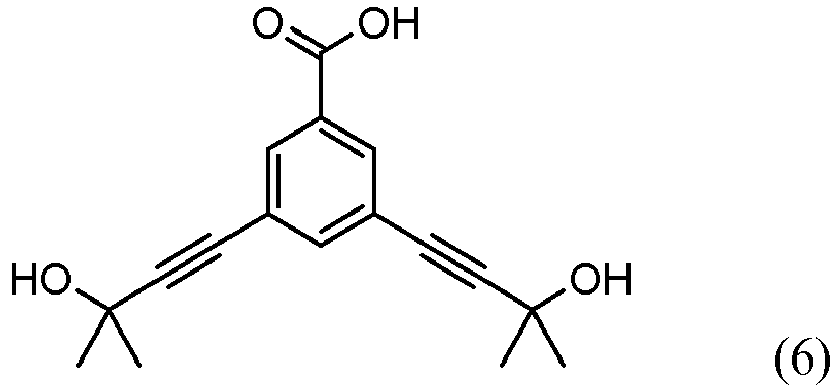
- Example 4: A 30-mL glass scintillation vial fitted with a magnetic stir bar and a threaded cap was charged sequentially with Compound 6 from Example 3 (0.493 g, 0.84 mmol, 1.0 equiv., 49 wt% purity), powdered potassium hydroxide (0.399 g, 6.26 mmol, 7.4 equiv.), and 1,4-dioxane (5.0 mL). The vial was capped and placed in an aluminum block that had been pre-heated to 100 °C and the reaction mixture was allowed to stir at this temperature for 60 min. The reaction mixture was then allowed to cool slightly and then an approximate 0.1 mL sample was collected. The sample was diluted with 6 N hydrochloric acid and MTBE. The layers were shaken and allowed to separate. The aqueous (bottom) layer was removed and discarded. The organic layer was concentrated by rotary evaporation. The dark brown oily residue was dissolved in THF-d8 and analyzed by 1H NMR spectroscopy. The reaction mixture was re-heated to 100 °C. After having been stirred for an additional 60 min., the reaction mixture was cooled and sampled. The sample was subjected to work-up and analysis as described above. The reaction mixture was diluted with 6 N hydrochloric acid (∼35 mL) and MTBE. Most of the insoluble dark brown solid material that was present was removed by gravity filtration directly into a separatory funnel. The layers were shaken and separated and the organic phase was washed sequentially with DI water (1X) and brine (1X). The organic layer was decanted into a tared round-bottom flask and concentrated by rotary evaporation and then under high vacuum (<1 mmHg) to leave crude 3,5-diethynylbenzoic acid (Compound 7) as an orange solid residue (0.223 g). A sample of the crude material (27.6 mg) was combined with 1,4-bis(trimethylsilyl)benzene (31.5 mg, 0.1412 mmol, 99.7 wt% purity) and the mixture was dissolved in THF-d8 (0.75 mL). The resulting solution was passed through a 0.2 µm nylon syringe filter and the filtrate was analyzed by 1H NMR spectroscopy (16 scans, 20 second relaxation delay). On the basis of relative integration against the resonances of 1,4-bis(trimethylsilyl)benzene, the purity of Compound 7 was determined to be 28 wt%, which corresponded to a yield of 43%. The structure of the compound was confirmed by 1H and 13C NMR spectroscopy.

- Example 5. To a 500 mL 3-necked, round bottom flask vented to a knockout pot and caustic scrubber is added dihydroxyisobenzofurandione (10.0 g; 55.5 mmol) and potassium carbonate (25.4 g; 167 mmol). To the mixture is added 90 mL dimethylformamide (DMF). Sulfuryl fluoride is slowly bubbled sub-surface to the reaction mixture. The reaction mixture is purged with nitrogen and the knockout pot is disconnected and replaced with an nitrogen bubbler. To the reaction mixture are added 2-methyl-3-butyn-2-ol (13.4 mL; 146 mmol) and triethylamine (23.2 mL; 165 mmol) via syringe addition. CpPd(cinnamyl) (0.159 g; 0.55 mmol), triphenylphosphine (0.438 g; 1.65 mmol) and copper(I) iodide (0.423 g) are pre-weighted in a glovebox and the mixture is added to the reaction flask under slight positive nitrogen pressure. The reaction mixture is heated to 50 °C and is allowed to stir at this temperature until LCMS shows formation of the desired product. The crude reaction mixture is washed dilute HCl and extracted into 1 L of ethyl acetate. The volatiles are removed by rotary evaporation at 60 °C. The crude material is treated with 2 N aqueous sodium hydroxide (325 mL) and MTBE (325 mL) and the resulting biphasic mixture is transferred to a separatory funnel. The layers are shaken and separated. The aqueous layer is filtered through a bed of water-wet Celite and the cake is washed with 400 mL of water. With vigorous stirring, the filtrate is treated with 12.1 N hydrochloric acid until a pH <1 is obtained. The aqueous phase is transferred to a 2 L separatory funnel and extracted with methyl tert-butyl ether (MTBE) (2 x 150 mL). The combined organic extracts are evaporated to dryness. The solid residue is re-dissolved in diethyl ether (∼200 mL) and filtered through Celite. The filtrate is concentrated by rotary evaporation and then under high vacuum (<1 mmHg) at 50 °C and is expected to provide Compound 8.

- Example 6: A 30-mL glass scintillation vial fitted with a magnetic stir bar and a threaded cap is charged sequentially with Compound 8 from Example 5 (0.5 g, 1.60 mmol, 1.0 equiv.), powdered potassium hydroxide (0.474 g, 11.85 mmol, 7.4 equiv.), and 1,4-dioxane (10.0 mL). The vial is capped and placed in an aluminum block pre-heated to 100 °C and the reaction mixture is allowed to stir at this temperature for 120 min. The reaction mixture is then allowed to cool to room temperature and is diluted with 10 mL 6 N hydrochloric acid and 75 mL MTBE. The layers are shaken and allowed to separate. Gravity filtration into a separatory funnel is used to remove any solids that are present. The layers are shaken and separated and the organic phase is washed sequentially with DI water (1X) and brine (1X). The organic layer is decanted into a tared round-bottom flask and concentrated by rotary evaporation and then under high vacuum (<1 mmHg) and is expected to provide crude Compound 9.
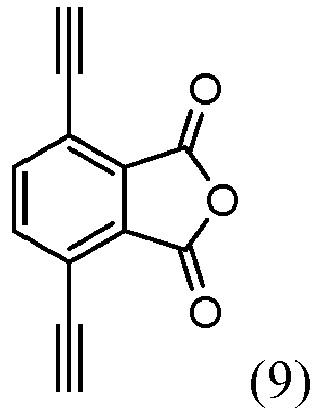
- Example 7. The general procedure of Example 3 is repeated using the polyhydroxy-substituted aromatic compounds in Table 1 and the alkynes in Table 2 to prepare the polyalkynyl-substituted arene compounds in Table 3. In Table 3, the moles of fluorosulfonating agent (FSA) indicate the number of hydroxyl substituents converted to alkynyl substituents.
Table 1 Polyhydroxy Aromatic Compound Chemical Name A 1,1-Bi-2-naphthol B Bisphenol A C 1,3,5-Trihydroxybenzene D 2,3-Didihydroxynaphthalene E 2,3-Dihydroxypyridine F 2,5-Dihydroxyterephthalic acid G 2,6-Dihydroxytoluene H 2,4-Dihydroxypyrimidine-5-carboxylic acid I 4,8-dihydroxyquinoline-2-carboxylic acid J 1,6-dihydroxypyrene K 1,2-dihydroxyfluorene Table 2 Alkyne Compound Chemical Name A Ethynylbenzene B Propargyl alcohol C Propiolic acid D 2-Methyl-3-butyn-2-ol E 1-Butyne F 3-Ethynylpyridine G 1-Ethynyl-4-methoxybenzene Table 3 Polyalkynyl Arene Polyhydroxy Aromatic Compound Moles of FSA Alkyne Compound 7-1 A 2 A 7-2 C 2 D 7-3 C 3 A 7-4 E 2 G 7-5 D 2 C 7-6 I 2 E 7-7 H 2 A 7-8 J 2 C 7-9 K 2 D 7-10 F 2 A 7-11 G 2 F 7-12 B 2 B 7-13 H 2 F - Example 8. A 3-neck 2-L round-bottom flask equipped with an overhead stirrer (PTFE paddle agitator), PTFE-coated thermocouple, sulfuryl fluoride (SO2F2) inlet line, and a Graham condenser fitted with a headspace outlet line that was vented to an aqueous sodium hydroxide (1 N) scrubber was charged with methyl 3,5-dihydroxybenozoate (30.17 g, 174 mmol, 1.0 equiv), powdered potassium carbonate (60.42 g, 433 mmol, 2.5 equiv) and 450 mL ethyl acetate (EtOAc). Overhead stirring was initiated and gaseous SO2F2 was bubbled subsurface into the reaction mixture for several hours. Once the reaction had reached full conversion (as evidenced by analysis of a filtered, concentrated reactor sample by 1H NMR spectroscopy), the SO2F2 inlet line was replaced with a nitrogen inlet line and the system was purged for several minutes. The inorganic salts were removed by vacuum filtration through a 1 µm Whatman GFB glass microfiber medium that had been placed over a medium-porosity glass frit housing and the salt cake was washed with fresh EtOAc. The organic filtrate was concentrated by rotary evaporation and then under high vacuum (<1 mmHg) overnight to provide methyl 3,5-bis[(fluorosulfonyl)oxy]benzoate as a pale-yellow oil (57.62 g, 173 mmol, quantitative yield). The oil readily crystallized upon being transferred to a amber glass storage bottle. The product, methyl 3,5-bis[(fluorosulfonyl)oxy]benzoate, was confirmed by 1H and 13C NMR spectroscopy.
- Example 9. A 250-mL 3-neck round-bottom flask fitted with a PTFE-coated magnetic stir bar was charged with methyl 3,5-bis[(fluorosulfonyl)oxy]benzoate from Example 8 (5.00 g, 15.06 mmol, 1.0 equiv) and the flask was transferred to a nitrogen-filled glove box. In the nitrogen-filled glove box, a 10-mL glass scintillation vial was charged with triphenylphosphine (0.245 g, 0.92 mmol, 6 mol%), palladium(II) acetate (0.097 g, 0.43 mmol, 3 mol%) and copper(I) iodide (0.170 g, 0.89 mmol, 6 mol%). To the round-bottom flask containing methyl 3,5-bis[(fluorosulfonyl)oxy]benzoate was added 50 mL anhydrous dimethyl formamide (DMF) and, with magnetic stirring, the pre-catalyst mixture, which produced a dark tan-colored homogeneous solution. (Trimethylsilyl)acetylene (5.5 mL, 37.86 mmol, 2.5 equiv) and anhydrous triethylamine (5.3 mL, 37.84 mL, 2.5 equiv) were then added sequentially. The addition of (trimethylsilyl)acetylene was accompanied by a change in the reaction mixture color from dark tan to nearly black. The reaction flask was sealed with rubber septa, moved from the glove box to a fume hood, and fitted with a Dimroth condenser, nitrogen inlet, and a PTFE-coated thermocouple. At this point it became evident that the addition of triethylamine had induced an exotherm. Once the exotherm had peaked (ca. 45 °C), the reaction flask was fitted with a heating mantle and the reaction mixture was warmed to 50 °C and stirred at this temperature overnight. After having been stirred for 15 hours, analysis of the reaction mixture by GC/MS revealed that the starting material had been consumed and the desired product was cleanly formed. The reaction mixture was transferred to a single-neck round-bottom flask and concentrated by rotary evaporation (ca. 10 mmHg @ 60 °C). The resulting dark brown slurry was partitioned between MTBE (250 mL) and 1 N hydrochloric acid (100 mL), which induced the formation of a emulsion. The biphasic mixture was filtered through a bed of water-wet Celite® and then the layers were separated. The rag layer that remained was taken with the aqueous layer. The organic layer was washed with 1 N hydrochloric acid (100 mL). The combined aqueous washes were extracted with MTBE (2 x 50 mL). The combined organic extracts were washed with half-saturated brine (100 mL), brine (1x), dried (anhydrous Na2SO4), filtered and concentrated by rotary evaporation. The resulting dark brown crude residue was dissolved in a minimum amount of 2% EtOAc/hexane and plug-filtered through a bed of silica gel (∼25 g) using additional 2% EtOAc/hexane as needed to completely elute the desired product. The filtrate was concentrated by rotary evaporation and then under high vacuum overnight (<1 mmHg) to afford methyl 3,5-bis[(trimethylsilyl)ethynyl]benzoate as a highly-viscous orange oil (4.61 g, 14.03 mmol, 93% yield). The oil crystallized upon standing at ambient temperature. The product, methyl 3,5-bis[(trimethylsilyl)ethynyl]benzoate, was confirmed by 1H and 13C NMR spectroscopy.
- Example 10. A 1-L 4-neck round-bottom flask fitted with an overhead stirrer (PTFE paddle agitator), nitrogen inlet, Dimroth condenser, 125-mL pressure-equalizing addition funnel and PFTE-coated thermocouple was charged with methyl 3,5-bis[(trimethylsilyl)ethynyl]benzoate (24.37 g, 74.17 mmol, 1.0 equiv) and methanol (300 mL). The reactor was sealed with a rubber septum and stirring was initiated. Gentle heating with a heat gun to ca. 35 °C was required for complete dissolution of the ester. Meanwhile, a sample of lithium hydroxide monohydrate (15.60 g, 372 mmol, 5.0 equiv) was combined with HPLC grade water (75 mL) and the resulting mixture was sonicated for several minutes to aid dissolution of the base. Any insoluble material that remained in the lithium hydroxide solution was removed by filtration and the filtrate was charged to the addition funnel. Aqueous lithium hydroxide solution was then added dropwise over the course of 5 minutes. During this time the internal temperature increased from 36 °C to 46 °C. After having been stirred for 1.5 hours at ambient temperature, a 0.1 mL sample of the reaction mixture was removed and diluted with 1 N HCl/CH3CN (0.5 mL/4.0 mL). Analysis of the sample by LC/MS revealed that the desired product had been formed cleanly. The reaction mixture was transferred to a single-neck round-bottom flask and concentrated by rotary evaporation (∼10 mmHg @ 40 °C). The aqueous slurry was combined with HPLC grade water (300 mL) and MTBE (100 mL). The layers were shaken and separated and the organic layer was discarded as hazardous waste. The aqueous layer was transferred to a 1-L Erlenmeyer flask and, with vigorous stirring, the homogenous solution was acidified to a pH of approximately 1 using 6 N HCl (81 g), which induced the formation of a heavy cream-colored slurry. The slurry was combined with MTBE (150 mL) in a separatory funnel and the layers were shaken to produce a homogeneous two-phase system. The layers were separated and the aqueous layer was extracted with MTBE (2 x 150 mL). The combined organic extracts were stirred for several minutes with activated carbon (∼5 g, Darco® G-60, 100 mesh) and then filtered. The filtrate was concentrated by rotary evaporation and then in a vacuum oven (<1 mmHg @ 50 °C) to provide 3,5-diethynylbenzoic acid as a cream-colored solid (11.56 g, 65.42 mmol, 88% yield). The product, 3,5-diethynylbenzoic acid, was confirmed by 1H and 13C NMR spectroscopy. On the basis of quantitative 13C NMR spectroscopic analysis with pyrazine as an internal standard, the purity of 3,5-diethynylbenzoic acid was determined to be 96.3 wt%.
Claims (12)
- A method of forming a polyalkynyl-arene compound comprising:(a) reacting a polyhydroxy-substituted aromatic compound with a fluorosulfonating agent to form a poly(fluorosulfonate)-substituted aromatic compound; and(b) reacting the poly(fluorosulfonate)-substituted aromatic compound with an alkyne in the presence of a catalyst under conditions effective to couple the alkyne to the poly(fluorosulfonate)-substituted aromatic compound and form the polyalkynyl-substituted arene compound;wherein the catalyst comprises one or more group 10 atoms or a copper complex.
- The method of claim 1 wherein the reaction mixture further comprises a ligand, and a base.
- The method of claim 2 wherein the ligand includes one or more of a phosphine ligand, a carbene ligand, an amine-based ligand, and an aminophosphine-based ligand.
- The method of claim 2 wherein the base is a carbonate salt, a phosphate salt, an acetate salt or a carboxylic acid salt.
- The method of claim 1 wherein the aromatic compound has 1 to 8 aromatic rings.
- The method of claim 1 wherein the aromatic compound has an aryl moiety derived from benzene, biphenyl, terphenyl, triphenylbenzene, hexaphenylbenzene, pyridine, bipyridine, pyrimidine, pyridazine, pyrrole, imidazole, triazine, triazole, furan, oxazole, thiazole, thiophene, fluorene, 9,9-diphenylfluorene, 9,9-dinaphthylfluorene, carbazole, dibenzofuran, dibenzothiophene, naphthalene, binaphthalene, phenanthracene, anthracene, pyrene, indole, isoindole, triphenylene, tetracene, tetraphene, pentacene, perylene, coronene, quinoline, isoquinoline, phthalic anhydride, pyromellitic dianhydride, benzimidazole, benzotriazole, benzofuran, benzothiophene, benzoxaxole, and benzothiazole.
- The method of claim 1 wherein the aromatic compound is heteroaromatic.
- The method of claim 1 wherein the aromatic compound has one or more substituents chosen from carboxylic acid, carboxylic acid anhydride, C1-20 ester, substituted C1-20 ester, C1-12 alkoxy, C1-12 alkyl, C1-12 heteroalkyl, substituted C1-12 alkyl, C2-12 alkenyl, cyano, nitro, hydroxyl, protected hydroxyl, halo, amido, amino, mercapto, sulfido, silyl, phosphino, and phosphono.
- The method of claim 1 wherein the catalyst is one or more of a palladium catalyst or a nickel catalyst or a copper complex.
- The method of claim 1 wherein the alkyne is a primary alkyne.
- The method of claim 1 wherein the catalyst comprises one or more group 10 atoms and a copper complex.
- A method of forming a polyalkynyl-arene compound comprising:(a) providing a poly(fluorosulfonate)-substituted aromatic compound; and(b) reacting the poly(fluorosulfonate)-substituted aromatic compound with an alkyne in the presence of a catalyst under conditions effective to couple the alkyne to the poly(fluorosulfonate)-substituted aromatic compound and form the polyalkynyl-substituted arene compound;wherein the catalyst comprises one or more group 10 atoms or a copper complex.
Applications Claiming Priority (1)
| Application Number | Priority Date | Filing Date | Title |
|---|---|---|---|
| US201615183840A | 2016-06-16 | 2016-06-16 |
Publications (1)
| Publication Number | Publication Date |
|---|---|
| EP3257846A1 true EP3257846A1 (en) | 2017-12-20 |
Family
ID=56551292
Family Applications (1)
| Application Number | Title | Priority Date | Filing Date |
|---|---|---|---|
| EP16181566.7A Withdrawn EP3257846A1 (en) | 2016-06-16 | 2016-07-27 | Method for forming polyalkynyl-arenes |
Country Status (4)
| Country | Link |
|---|---|
| EP (1) | EP3257846A1 (en) |
| JP (1) | JP2017222632A (en) |
| CN (1) | CN107513007A (en) |
| TW (1) | TWI614231B (en) |
Cited By (1)
| Publication number | Priority date | Publication date | Assignee | Title |
|---|---|---|---|---|
| US12102625B2 (en) | 2019-02-19 | 2024-10-01 | Gilead Sciences, Inc. | Solid forms of FXR agonists |
Family Cites Families (7)
| Publication number | Priority date | Publication date | Assignee | Title |
|---|---|---|---|---|
| JPH06135862A (en) * | 1992-10-21 | 1994-05-17 | Sanyo Chem Ind Ltd | Production of phenylnaphthalene derivative |
| JP4786876B2 (en) * | 2004-03-10 | 2011-10-05 | ダイセル化学工業株式会社 | Method for producing alkynes |
| EP1741696A4 (en) * | 2004-04-28 | 2010-12-29 | Cambridge Entpr Ltd | METHOD FOR SYNTHESIZING COMPOUND AND CATALYST FOR SYNTHESIS REACTION |
| WO2009003590A1 (en) * | 2007-07-03 | 2009-01-08 | Sanofi-Aventis | A process for the palladium-catalyzed coupling of terminal alkynes with heteroaryl tosylates and heteroaryl benzenesulfonates |
| JP5583009B2 (en) * | 2007-07-03 | 2014-09-03 | サノフイ | Process for palladium-catalyzed coupling of terminal alkynes and aryl tosylates |
| JP5152859B2 (en) * | 2008-09-18 | 2013-02-27 | 国立大学法人鳥取大学 | Zeolite-palladium complex, method for producing the complex, catalyst containing the complex, and method for producing a coupling compound using the catalyst |
| JP6084874B2 (en) * | 2012-03-28 | 2017-02-22 | 北興化学工業株式会社 | Synthesis method of compound by Sonogashira-Hagiwara reaction using palladium nanoparticles as catalyst |
-
2016
- 2016-07-20 TW TW105122952A patent/TWI614231B/en not_active IP Right Cessation
- 2016-07-27 EP EP16181566.7A patent/EP3257846A1/en not_active Withdrawn
- 2016-07-27 CN CN201610601617.8A patent/CN107513007A/en active Pending
- 2016-07-28 JP JP2016149043A patent/JP2017222632A/en active Pending
Non-Patent Citations (3)
| Title |
|---|
| ALEXEY SMEYANOV ET AL: "K 3 PO 4 -KOH Mixture as Efficient Reagent for the Deprotection of 4-Aryl-2-methyl-3-butyn-2-ols to Terminal Acetylenes", SYNTHETIC COMMUNICATIONS, vol. 43, no. 20, 18 October 2013 (2013-10-18), PHILADELPHIA, PA; US, pages 2809 - 2816, XP055321450, ISSN: 0039-7911, DOI: 10.1080/00397911.2012.744841 * |
| MÜNCH ALEXANDER S ET AL: "Synthesis, spectroscopic characterization and structural investigation of a new symmetrically trisubstituted benzene derivative: 3,3',3''-(Benzene-1,3,5-triyl)tripr", JOURNAL OF MOLECULAR STRUCTURE, ELSEVIER, AMSTERDAM, NL, vol. 1043, 13 April 2013 (2013-04-13), pages 103 - 108, XP028564741, ISSN: 0022-2860, DOI: 10.1016/J.MOLSTRUC.2013.04.005 * |
| QIAOBIN LIANG ET AL: "Palladium-Catalyzed, Ligand-Free Suzuki Reaction in Water Using Aryl Fluorosulfates", ORGANIC LETTERS, vol. 17, no. 8, 17 April 2015 (2015-04-17), pages 1942 - 1945, XP055192240, ISSN: 1523-7060, DOI: 10.1021/acs.orglett.5b00654 * |
Cited By (1)
| Publication number | Priority date | Publication date | Assignee | Title |
|---|---|---|---|---|
| US12102625B2 (en) | 2019-02-19 | 2024-10-01 | Gilead Sciences, Inc. | Solid forms of FXR agonists |
Also Published As
| Publication number | Publication date |
|---|---|
| TWI614231B (en) | 2018-02-11 |
| TW201800376A (en) | 2018-01-01 |
| JP2017222632A (en) | 2017-12-21 |
| CN107513007A (en) | 2017-12-26 |
Similar Documents
| Publication | Publication Date | Title |
|---|---|---|
| EP3122707B1 (en) | Method for coupling a first aromatic compound to a second aromatic compound | |
| US20180237459A1 (en) | Method for coupling an aromatic or vinylic compound to a boron-containing compound | |
| CN110105305B (en) | Transition metal catalyzed C-H activation/cyclization synthesis 1,2-benzothiazine derivative green synthesis method | |
| US10125082B2 (en) | Method for coupling a first compound to a second compound | |
| US20190177265A1 (en) | Method for coupling a first compound to a second compound | |
| CN111056986A (en) | Preparation method of 1, 3-dicarbazolyl benzene | |
| EP3257846A1 (en) | Method for forming polyalkynyl-arenes | |
| KR101824912B1 (en) | Method of forming polyaryl polymers and polymers formed thereby | |
| CN107922305A (en) | Method for aromatic compounds to be coupled to alkynes | |
| CN115232091A (en) | A kind of method for converting amide into α-substituted amine compound | |
| JP7419865B2 (en) | Aromatic halogen compounds, their uses, and manufacturing methods | |
| TW201800383A (en) | Method for coupling a first compound to a second compound | |
| CN110028487A (en) | A kind of preparation method of thio chromogen ketone compound | |
| WO2017112576A1 (en) | Methods for external base-free suzuki couplings |
Legal Events
| Date | Code | Title | Description |
|---|---|---|---|
| PUAI | Public reference made under article 153(3) epc to a published international application that has entered the european phase |
Free format text: ORIGINAL CODE: 0009012 |
|
| 17P | Request for examination filed |
Effective date: 20160727 |
|
| AK | Designated contracting states |
Kind code of ref document: A1 Designated state(s): AL AT BE BG CH CY CZ DE DK EE ES FI FR GB GR HR HU IE IS IT LI LT LU LV MC MK MT NL NO PL PT RO RS SE SI SK SM TR |
|
| AX | Request for extension of the european patent |
Extension state: BA ME |
|
| STAA | Information on the status of an ep patent application or granted ep patent |
Free format text: STATUS: THE APPLICATION HAS BEEN WITHDRAWN |
|
| 18W | Application withdrawn |
Effective date: 20180517 |