EP3257844A1 - Method of preparing a high purity imidazolium salt - Google Patents
Method of preparing a high purity imidazolium salt Download PDFInfo
- Publication number
- EP3257844A1 EP3257844A1 EP16174312.5A EP16174312A EP3257844A1 EP 3257844 A1 EP3257844 A1 EP 3257844A1 EP 16174312 A EP16174312 A EP 16174312A EP 3257844 A1 EP3257844 A1 EP 3257844A1
- Authority
- EP
- European Patent Office
- Prior art keywords
- iii
- water
- compounds
- process according
- reaction
- Prior art date
- Legal status (The legal status is an assumption and is not a legal conclusion. Google has not performed a legal analysis and makes no representation as to the accuracy of the status listed.)
- Withdrawn
Links
- 238000000034 method Methods 0.000 title claims abstract description 27
- 150000004693 imidazolium salts Chemical class 0.000 title description 3
- XLYOFNOQVPJJNP-UHFFFAOYSA-N water Substances O XLYOFNOQVPJJNP-UHFFFAOYSA-N 0.000 claims abstract description 30
- 150000001875 compounds Chemical class 0.000 claims description 43
- 238000006243 chemical reaction Methods 0.000 claims description 18
- 230000008569 process Effects 0.000 claims description 18
- 239000003960 organic solvent Substances 0.000 claims description 15
- 239000001257 hydrogen Substances 0.000 claims description 9
- 229910052739 hydrogen Inorganic materials 0.000 claims description 9
- 125000002496 methyl group Chemical group [H]C([H])([H])* 0.000 claims description 8
- 125000000217 alkyl group Chemical group 0.000 claims description 6
- 125000001495 ethyl group Chemical group [H]C([H])([H])C([H])([H])* 0.000 claims description 6
- 125000004432 carbon atom Chemical group C* 0.000 claims description 4
- UFHFLCQGNIYNRP-UHFFFAOYSA-N Hydrogen Chemical compound [H][H] UFHFLCQGNIYNRP-UHFFFAOYSA-N 0.000 claims description 3
- 150000002431 hydrogen Chemical group 0.000 claims description 3
- 125000004435 hydrogen atom Chemical group [H]* 0.000 claims description 3
- 238000004519 manufacturing process Methods 0.000 claims description 3
- 150000003839 salts Chemical class 0.000 abstract description 2
- 239000007858 starting material Substances 0.000 abstract 1
- 230000002194 synthesizing effect Effects 0.000 abstract 1
- 239000002608 ionic liquid Substances 0.000 description 9
- 239000012535 impurity Substances 0.000 description 8
- MCTWTZJPVLRJOU-UHFFFAOYSA-N 1-methyl-1H-imidazole Chemical compound CN1C=CN=C1 MCTWTZJPVLRJOU-UHFFFAOYSA-N 0.000 description 6
- 241001550224 Apha Species 0.000 description 5
- 238000010521 absorption reaction Methods 0.000 description 5
- 238000004378 air conditioning Methods 0.000 description 5
- 238000004821 distillation Methods 0.000 description 5
- 238000001035 drying Methods 0.000 description 5
- -1 for example Chemical class 0.000 description 5
- 239000000047 product Substances 0.000 description 5
- KFZMGEQAYNKOFK-UHFFFAOYSA-N Isopropanol Chemical compound CC(C)O KFZMGEQAYNKOFK-UHFFFAOYSA-N 0.000 description 4
- 238000007791 dehumidification Methods 0.000 description 4
- 239000011541 reaction mixture Substances 0.000 description 4
- DQWPFSLDHJDLRL-UHFFFAOYSA-N triethyl phosphate Chemical compound CCOP(=O)(OCC)OCC DQWPFSLDHJDLRL-UHFFFAOYSA-N 0.000 description 4
- UHOVQNZJYSORNB-UHFFFAOYSA-N Benzene Chemical compound C1=CC=CC=C1 UHOVQNZJYSORNB-UHFFFAOYSA-N 0.000 description 3
- YMWUJEATGCHHMB-UHFFFAOYSA-N Dichloromethane Chemical compound ClCCl YMWUJEATGCHHMB-UHFFFAOYSA-N 0.000 description 3
- RTZKZFJDLAIYFH-UHFFFAOYSA-N Diethyl ether Chemical compound CCOCC RTZKZFJDLAIYFH-UHFFFAOYSA-N 0.000 description 3
- XEKOWRVHYACXOJ-UHFFFAOYSA-N Ethyl acetate Chemical compound CCOC(C)=O XEKOWRVHYACXOJ-UHFFFAOYSA-N 0.000 description 3
- OKKJLVBELUTLKV-UHFFFAOYSA-N Methanol Chemical compound OC OKKJLVBELUTLKV-UHFFFAOYSA-N 0.000 description 3
- YXFVVABEGXRONW-UHFFFAOYSA-N Toluene Chemical compound CC1=CC=CC=C1 YXFVVABEGXRONW-UHFFFAOYSA-N 0.000 description 3
- ZMANZCXQSJIPKH-UHFFFAOYSA-N Triethylamine Chemical compound CCN(CC)CC ZMANZCXQSJIPKH-UHFFFAOYSA-N 0.000 description 3
- 238000001816 cooling Methods 0.000 description 3
- 150000002500 ions Chemical class 0.000 description 3
- VLKZOEOYAKHREP-UHFFFAOYSA-N n-Hexane Chemical compound CCCCCC VLKZOEOYAKHREP-UHFFFAOYSA-N 0.000 description 3
- 239000002904 solvent Substances 0.000 description 3
- CSCPPACGZOOCGX-UHFFFAOYSA-N Acetone Chemical compound CC(C)=O CSCPPACGZOOCGX-UHFFFAOYSA-N 0.000 description 2
- IJGRMHOSHXDMSA-UHFFFAOYSA-N Atomic nitrogen Chemical compound N#N IJGRMHOSHXDMSA-UHFFFAOYSA-N 0.000 description 2
- HEDRZPFGACZZDS-UHFFFAOYSA-N Chloroform Chemical compound ClC(Cl)Cl HEDRZPFGACZZDS-UHFFFAOYSA-N 0.000 description 2
- LFQSCWFLJHTTHZ-UHFFFAOYSA-N Ethanol Chemical compound CCO LFQSCWFLJHTTHZ-UHFFFAOYSA-N 0.000 description 2
- QUSNBJAOOMFDIB-UHFFFAOYSA-N Ethylamine Chemical compound CCN QUSNBJAOOMFDIB-UHFFFAOYSA-N 0.000 description 2
- BZLVMXJERCGZMT-UHFFFAOYSA-N Methyl tert-butyl ether Chemical compound COC(C)(C)C BZLVMXJERCGZMT-UHFFFAOYSA-N 0.000 description 2
- LRHPLDYGYMQRHN-UHFFFAOYSA-N N-Butanol Chemical compound CCCCO LRHPLDYGYMQRHN-UHFFFAOYSA-N 0.000 description 2
- IMNFDUFMRHMDMM-UHFFFAOYSA-N N-Heptane Chemical compound CCCCCCC IMNFDUFMRHMDMM-UHFFFAOYSA-N 0.000 description 2
- OFBQJSOFQDEBGM-UHFFFAOYSA-N Pentane Chemical compound CCCCC OFBQJSOFQDEBGM-UHFFFAOYSA-N 0.000 description 2
- DKGAVHZHDRPRBM-UHFFFAOYSA-N Tert-Butanol Chemical compound CC(C)(C)O DKGAVHZHDRPRBM-UHFFFAOYSA-N 0.000 description 2
- 150000001298 alcohols Chemical class 0.000 description 2
- 238000010276 construction Methods 0.000 description 2
- DIOQZVSQGTUSAI-UHFFFAOYSA-N decane Chemical compound CCCCCCCCCC DIOQZVSQGTUSAI-UHFFFAOYSA-N 0.000 description 2
- ZDIRKWICVFDSNX-UHFFFAOYSA-N diethyl phosphate 1-ethyl-3-methyl-1,2-dihydroimidazol-1-ium Chemical compound P(=O)(OCC)(OCC)O.C(C)N1CN(C=C1)C ZDIRKWICVFDSNX-UHFFFAOYSA-N 0.000 description 2
- 230000005611 electricity Effects 0.000 description 2
- 150000002148 esters Chemical class 0.000 description 2
- 238000000605 extraction Methods 0.000 description 2
- 238000002290 gas chromatography-mass spectrometry Methods 0.000 description 2
- RAXXELZNTBOGNW-UHFFFAOYSA-N imidazole Natural products C1=CNC=N1 RAXXELZNTBOGNW-UHFFFAOYSA-N 0.000 description 2
- 229960004592 isopropanol Drugs 0.000 description 2
- 239000007788 liquid Substances 0.000 description 2
- AMXOYNBUYSYVKV-UHFFFAOYSA-M lithium bromide Chemical compound [Li+].[Br-] AMXOYNBUYSYVKV-UHFFFAOYSA-M 0.000 description 2
- KWGKDLIKAYFUFQ-UHFFFAOYSA-M lithium chloride Chemical compound [Li+].[Cl-] KWGKDLIKAYFUFQ-UHFFFAOYSA-M 0.000 description 2
- 239000000463 material Substances 0.000 description 2
- 238000010992 reflux Methods 0.000 description 2
- 230000008929 regeneration Effects 0.000 description 2
- 238000011069 regeneration method Methods 0.000 description 2
- 238000001179 sorption measurement Methods 0.000 description 2
- DURPTKYDGMDSBL-UHFFFAOYSA-N 1-butoxybutane Chemical compound CCCCOCCCC DURPTKYDGMDSBL-UHFFFAOYSA-N 0.000 description 1
- DKPFZGUDAPQIHT-UHFFFAOYSA-N Butyl acetate Natural products CCCCOC(C)=O DKPFZGUDAPQIHT-UHFFFAOYSA-N 0.000 description 1
- UXVMQQNJUSDDNG-UHFFFAOYSA-L Calcium chloride Chemical compound [Cl-].[Cl-].[Ca+2] UXVMQQNJUSDDNG-UHFFFAOYSA-L 0.000 description 1
- XDTMQSROBMDMFD-UHFFFAOYSA-N Cyclohexane Chemical compound C1CCCCC1 XDTMQSROBMDMFD-UHFFFAOYSA-N 0.000 description 1
- CTQNGGLPUBDAKN-UHFFFAOYSA-N O-Xylene Chemical compound CC1=CC=CC=C1C CTQNGGLPUBDAKN-UHFFFAOYSA-N 0.000 description 1
- 229910019142 PO4 Inorganic materials 0.000 description 1
- XBDQKXXYIPTUBI-UHFFFAOYSA-M Propionate Chemical compound CCC([O-])=O XBDQKXXYIPTUBI-UHFFFAOYSA-M 0.000 description 1
- KXKVLQRXCPHEJC-UHFFFAOYSA-N acetic acid trimethyl ester Natural products COC(C)=O KXKVLQRXCPHEJC-UHFFFAOYSA-N 0.000 description 1
- 239000003463 adsorbent Substances 0.000 description 1
- 238000005273 aeration Methods 0.000 description 1
- 125000001931 aliphatic group Chemical group 0.000 description 1
- 150000001412 amines Chemical class 0.000 description 1
- 150000001450 anions Chemical class 0.000 description 1
- 239000007864 aqueous solution Substances 0.000 description 1
- 239000003849 aromatic solvent Substances 0.000 description 1
- 230000008901 benefit Effects 0.000 description 1
- 229910001628 calcium chloride Inorganic materials 0.000 description 1
- 239000001110 calcium chloride Substances 0.000 description 1
- 229950005499 carbon tetrachloride Drugs 0.000 description 1
- 230000000052 comparative effect Effects 0.000 description 1
- 230000003750 conditioning effect Effects 0.000 description 1
- 239000012043 crude product Substances 0.000 description 1
- 238000000354 decomposition reaction Methods 0.000 description 1
- 238000003795 desorption Methods 0.000 description 1
- 238000007865 diluting Methods 0.000 description 1
- POLCUAVZOMRGSN-UHFFFAOYSA-N dipropyl ether Chemical compound CCCOCCC POLCUAVZOMRGSN-UHFFFAOYSA-N 0.000 description 1
- 150000002170 ethers Chemical class 0.000 description 1
- 239000011552 falling film Substances 0.000 description 1
- 239000007789 gas Substances 0.000 description 1
- 238000004817 gas chromatography Methods 0.000 description 1
- 238000003988 headspace gas chromatography Methods 0.000 description 1
- 230000036541 health Effects 0.000 description 1
- 238000010438 heat treatment Methods 0.000 description 1
- FUZZWVXGSFPDMH-UHFFFAOYSA-M hexanoate Chemical compound CCCCCC([O-])=O FUZZWVXGSFPDMH-UHFFFAOYSA-M 0.000 description 1
- 230000000266 injurious effect Effects 0.000 description 1
- DNHVXYDGZKWYNU-UHFFFAOYSA-N lead;hydrate Chemical compound O.[Pb] DNHVXYDGZKWYNU-UHFFFAOYSA-N 0.000 description 1
- 229910003002 lithium salt Inorganic materials 0.000 description 1
- 159000000002 lithium salts Chemical class 0.000 description 1
- 238000004949 mass spectrometry Methods 0.000 description 1
- 239000007769 metal material Substances 0.000 description 1
- 239000000203 mixture Substances 0.000 description 1
- YKYONYBAUNKHLG-UHFFFAOYSA-N n-Propyl acetate Natural products CCCOC(C)=O YKYONYBAUNKHLG-UHFFFAOYSA-N 0.000 description 1
- 229910052757 nitrogen Inorganic materials 0.000 description 1
- TVMXDCGIABBOFY-UHFFFAOYSA-N octane Chemical compound CCCCCCCC TVMXDCGIABBOFY-UHFFFAOYSA-N 0.000 description 1
- 150000002894 organic compounds Chemical class 0.000 description 1
- 239000010452 phosphate Substances 0.000 description 1
- 239000003495 polar organic solvent Substances 0.000 description 1
- BDERNNFJNOPAEC-UHFFFAOYSA-N propan-1-ol Chemical compound CCCO BDERNNFJNOPAEC-UHFFFAOYSA-N 0.000 description 1
- 229940090181 propyl acetate Drugs 0.000 description 1
- 230000035484 reaction time Effects 0.000 description 1
- 230000009467 reduction Effects 0.000 description 1
- 239000007787 solid Substances 0.000 description 1
- 239000000243 solution Substances 0.000 description 1
- 239000000126 substance Substances 0.000 description 1
- VZGDMQKNWNREIO-UHFFFAOYSA-N tetrachloromethane Chemical compound ClC(Cl)(Cl)Cl VZGDMQKNWNREIO-UHFFFAOYSA-N 0.000 description 1
- CZDYPVPMEAXLPK-UHFFFAOYSA-N tetramethylsilane Chemical compound C[Si](C)(C)C CZDYPVPMEAXLPK-UHFFFAOYSA-N 0.000 description 1
- 239000010409 thin film Substances 0.000 description 1
- 229940086542 triethylamine Drugs 0.000 description 1
- NQPDZGIKBAWPEJ-UHFFFAOYSA-N valeric acid Chemical compound CCCCC(O)=O NQPDZGIKBAWPEJ-UHFFFAOYSA-N 0.000 description 1
- 239000008096 xylene Substances 0.000 description 1
Classifications
-
- C—CHEMISTRY; METALLURGY
- C07—ORGANIC CHEMISTRY
- C07D—HETEROCYCLIC COMPOUNDS
- C07D233/00—Heterocyclic compounds containing 1,3-diazole or hydrogenated 1,3-diazole rings, not condensed with other rings
- C07D233/54—Heterocyclic compounds containing 1,3-diazole or hydrogenated 1,3-diazole rings, not condensed with other rings having two double bonds between ring members or between ring members and non-ring members
- C07D233/56—Heterocyclic compounds containing 1,3-diazole or hydrogenated 1,3-diazole rings, not condensed with other rings having two double bonds between ring members or between ring members and non-ring members with only hydrogen atoms or radicals containing only hydrogen and carbon atoms, attached to ring carbon atoms
- C07D233/58—Heterocyclic compounds containing 1,3-diazole or hydrogenated 1,3-diazole rings, not condensed with other rings having two double bonds between ring members or between ring members and non-ring members with only hydrogen atoms or radicals containing only hydrogen and carbon atoms, attached to ring carbon atoms with only hydrogen atoms or radicals containing only hydrogen and carbon atoms, attached to ring nitrogen atoms
-
- C—CHEMISTRY; METALLURGY
- C07—ORGANIC CHEMISTRY
- C07D—HETEROCYCLIC COMPOUNDS
- C07D239/00—Heterocyclic compounds containing 1,3-diazine or hydrogenated 1,3-diazine rings
- C07D239/02—Heterocyclic compounds containing 1,3-diazine or hydrogenated 1,3-diazine rings not condensed with other rings
- C07D239/20—Heterocyclic compounds containing 1,3-diazine or hydrogenated 1,3-diazine rings not condensed with other rings having two double bonds between ring members or between ring members and non-ring members
Definitions
- the invention relates to a method of preparing a high purity imidazolium salt.
- the air In air conditioning systems for the aeration and conditioning of buildings or vehicles, the air generally not only has to be cooled, but also dehumidified since the air to be cooled often has such a high humidity that, upon cooling to the desired temperature, the dew point is fallen below.
- dehumidification of the air accounts for a large part of the electricity consumption.
- One option of reducing the electricity consumption of air conditioning systems for buildings is the dehumidification of air by adsorption or absorption of water using a drying medium and a regeneration of the drying medium laden with water by heating to a temperature at which the water is desorbed again.
- the advantage of absorption in a liquid absorption medium is that drying of air can be performed with reduced equipment complexity and with less drying medium and that regeneration of the water-laden drying medium using solar heat is easier to carry out.
- aqueous solutions of lithium bromide, lithium chloride or calcium chloride hitherto employed as liquid absorption media in commercial air conditioning systems have the disadvantage that they are corrosive towards the metallic materials of construction typically employed in air conditioning systems and that they thus necessitate the use of expensive specific materials of construction. These solutions can additionally cause problems due to salt crystallizing out of the absorption medium.
- Ionic liquids comprising dialkylimidazolium ions (as described in WO 2004/016631 A1 ) have been described as alternatives to lithium salts in the prior art for similar applications.
- US 2011/0247494 A1 proposes, in paragraph [0145], the use of trimethylammonium acetate or 1-ethyl-3-methylimidazolium acetate as liquid drying agent instead of aqueous lithium chloride solution.
- Example 3 compares water uptake from humid air for a series of further ionic liquids.
- ionic liquids comprising dialkylimidazolium ions
- they often comprise impurities, which lead to substances that are odour-intensive or are injurious to health entering the dehumidified air upon a dehumidification of air using the ionic liquid.
- odour-intensive decomposition products are formed which, in the event of a subsequent use of the ionic liquid for the dehumidification of air, enter the dehumidified air.
- the problem to be solved by the present invention is hence provision of a process for the production of ionic liquids comprising dialkylimidazolium ions, wherein the level of volatile compounds is brought to a minimum and wherein the ionic liquid is not coloured.
- the invention hence provides a process for preparing a compound of formula (I): Q + A - , wherein Q + is and wherein A - is the process comprising reacting a compound of formula (II) with a compound of formula (III) in the presence of water, wherein (II) and (III) are: giving the compound of formula (I), wherein:
- R 5 methyl
- each of R 4 , R 6 , R 7 are independently methyl or ethyl.
- step a) of the process according to the invention a compound of formula (II) is reacted with a compound of formula (III) in the presence of water, giving a crude product comprising a compound of formula (I).
- the skilled person is familiar with the reaction conditions, which are described in WO 2004/016631 A1 , for example.
- step a) of the process according to the invention is preferably carried out at a temperature in the range of from 130 °C to 200 °C, more preferably 140 °C to 190 °C, even more preferably 150 °C to 175 °C.
- the pressure of the reaction is not critical and may be for example atmospheric pressure, preferably under an inert atmosphere, such as nitrogen.
- reaction is exothermic, it may be desirable to control the rate of addition in some cases and/or to apply external cooling during the addition step.
- the compounds of formula (II) and (III) are present in stoichiometric amounts, i.e. the molar relation of compound (II) to compound (III) is in the range 0.9 : 1 to 1.1 : 1, more preferably 1 : 1.
- the imidazole compound (II) in a slight excess over the phosphate ester (III) , for example in the range of 1.01 to 1.4 molar equivalents, preferable 1.02 to 1.4.
- the reaction time is not particularly limited. Typically, the reaction is continued until at least 90 % of the compounds (II) or (III) has reacted to form compound (I). "Completion of the reaction” means that at least 90 % of the compounds (II) or (III) has reacted to form compound (I).
- the progress of the reaction can be conveniently controlled by methods known to the skilled person, such as NMR.
- the reaction is carried out in the presence of water. It has been surprisingly found that even small amounts of water lead to surprising improvements, i.e. bring the level of smelly impurities and the colour number in the resultant product (I) to a minimum.
- Presence of water means that compounds (II) and (III) are reacted in the presence of at least 1.0 weight-% of water, based on the combined masses of compounds (II) and (III) . Even more preferred, it means that that compounds (II) and (III) are reacted in the presence of at least 3.7 weight-% of water, based on the combined masses of compounds (II) and (III) . Even more preferred, it means that that compounds (II) and (III) are reacted in the presence of at least 7.4 weight-% of water, based on the combined masses of compounds (II) and (III).
- reaction between compounds (II) and (III) may be carried out in the presence or absence of an organic solvent, while it is preferred to carry it out in the absence of an organic solvent.
- Organic solvent means organic compounds which are known to the skilled person as solvents such as (and preferably) selected from the group consisting of aliphatic solvents, preferably pentane, hexane, heptane, octane, decane, cyclohexane, tetramethylsilane; aromatic solvents, preferably benzene, toluene, xylene; ether compounds, preferably diethyl ether, dipropyl ether, dibutyl ether, methyl tert -butyl ether; halogenated solvents, preferably dichloromethane, chloroform, tetrachloromethane; alcohols, preferably methanol, ethanol, propanol, iso -propanol, butanol, tert -butanol; esters, preferably methyl acetate, ethyl acetate, propyl acetate, butyl acetate; ace
- “Absence of an organic solvent” means particularly that the overall content of all organic solvents in the reaction mixture is below 10 weight-% based on the sum of the weights of compounds (II) and (III) , preferably below 5 weight-% b based on the sum of the weights of compounds (II) and (III) , more preferably below 1 weight-% based on the sum of the weights of compounds (II) and (III).
- the water and the organic solvent, in case the reaction is carried out in the presence of such organic solvent, can be at least partially removed by the methods described in the prior art.
- Such at least partial removal can be carried out by extraction, stripping, distillation or any other process known to the skilled person, preferably by extraction, stripping, distillation.
- partial removal means in particular, that at least 50 % of the water (or respectively of the water and the organic solvent, in case the reaction is carried out in the presence of such organic solvent) in the reaction mixture is removed, preferably at least 70 %, even more preferably at least 90 %, even more preferably 99 % of the water (or in each case the respective amount of the water and the organic solvent, in case the reaction is carried out in the presence of such organic solvent) is removed.
- the method of the present invention thus provides as a product an imidazolium salt with a surprisingly low APHA number (indicative of a low level of discolouring) and a low level of odorous impurities such as amines and N -methylimidazole.
- N -methylimidazole (CAS number: 616-47-7) and triethylphosphate (CAS number: 78-40-0) were purchased from Sigma Aldrich.
- the APHA numbers were determined by diluting the respective sample 1 : 1 with water and determining the number according to the procedure described in DIN EN ISO 6271 (2005).
- the impurities were determined by headspace GC/MS as follows: 0.1 g of the sample were incubated for 20 minutes at 70 °C in a sampler. The composition of the gas phase was analyzed by condensating it in a cooling trap and analyzing the condensate with gas chromatography ("GC") and mass spectrometry ("MS"). GC was performed with an apparatus of Hewlett Packard ("HP 6890"; sampler: Turbomatrix 40, Perkin Elmer). MS was performed with an apparatus of Hewlett-Packard ("HP 5973").
- Triethylphosphate (929 g, 5.0 mole) was added dropwise over 2 hours to a reaction vessel containing N methylimidazole (411 g, 5.0 mole). Afterwards, the reaction mixture was heated up to 130 °C and stirred under reflux for 14 h. Then, the volatile parts were removed under reduced pressure with a rotary evaporator. 1-Ethyl-3-methylimidazole diethylphosphate was obtained in 98 % (V1) and 99 % (V2) yield, respectively.
- Triethylphosphate (929 g, 5.0 mole) was added dropwise over 2 hours to a reaction vessel containing N -methylimidazole (411 g, 5.0 mole) and water ( E1: 50 mL; E2: 100 mL). Afterwards the reaction mixture was heated up to 130 °C and stirred under reflux for 14 h. Then, the volatile parts were removed under reduced pressure with a rotary evaporator. In each case, 1-ethyl-3-methylimidazole diethylphosphate was obtained in 99 % yield.
Landscapes
- Chemical & Material Sciences (AREA)
- Organic Chemistry (AREA)
- Organic Low-Molecular-Weight Compounds And Preparation Thereof (AREA)
Abstract
The present invention encompasses a novel method for synthesizing highly pure salts of the general formula Q+A-, wherein the starting materials are reacted in the presence of water, and wherein Q+ is

and wherein A- is
Description
- The invention relates to a method of preparing a high purity imidazolium salt.
- In air conditioning systems for the aeration and conditioning of buildings or vehicles, the air generally not only has to be cooled, but also dehumidified since the air to be cooled often has such a high humidity that, upon cooling to the desired temperature, the dew point is fallen below. Hence in conventional air conditioning systems dehumidification of the air accounts for a large part of the electricity consumption.
- One option of reducing the electricity consumption of air conditioning systems for buildings is the dehumidification of air by adsorption or absorption of water using a drying medium and a regeneration of the drying medium laden with water by heating to a temperature at which the water is desorbed again. Compared to adsorption on a solid adsorbent, the advantage of absorption in a liquid absorption medium is that drying of air can be performed with reduced equipment complexity and with less drying medium and that regeneration of the water-laden drying medium using solar heat is easier to carry out.
- The aqueous solutions of lithium bromide, lithium chloride or calcium chloride hitherto employed as liquid absorption media in commercial air conditioning systems have the disadvantage that they are corrosive towards the metallic materials of construction typically employed in air conditioning systems and that they thus necessitate the use of expensive specific materials of construction. These solutions can additionally cause problems due to salt crystallizing out of the absorption medium.
- Ionic liquids comprising dialkylimidazolium ions (as described in
WO 2004/016631 A1 ) have been described as alternatives to lithium salts in the prior art for similar applications. - Y. Luo et al., Appl. Thermal Eng. 31 (2011) 2772-2777 proposes the ionic liquid 1-ethyl-3-methylimidazolium tetrafluoroborate in place of aqueous solutions of lithium bromide for drying of air.
- Y. Luo et al., Solar Energy 86 (2012) 2718-2724 proposes the ionic liquid 1,3-dimethyimidazolium acetate as an alternative to 1-ethyl-3-methylimidazolium tetrafluoroborate for drying of air.
-
US 2011/0247494 A1 proposes, in paragraph [0145], the use of trimethylammonium acetate or 1-ethyl-3-methylimidazolium acetate as liquid drying agent instead of aqueous lithium chloride solution. Example 3 compares water uptake from humid air for a series of further ionic liquids. - However, a problem of ionic liquids comprising dialkylimidazolium ions is that they often comprise impurities, which lead to substances that are odour-intensive or are injurious to health entering the dehumidified air upon a dehumidification of air using the ionic liquid. Moreover, it has been found that during the desorption of water from ionic liquids which contain a basic anion, such as, for example, a carboxylate ion, odour-intensive decomposition products are formed which, in the event of a subsequent use of the ionic liquid for the dehumidification of air, enter the dehumidified air.
- In addition, ionic liquids produced by prior art processes often display a yellowish colour, which is undesirable.
- Therefore, there remains a need for ionic liquids comprising imidazolium ions, which do not display the disadvantages described above. The problem to be solved by the present invention is hence provision of a process for the production of ionic liquids comprising dialkylimidazolium ions, wherein the level of volatile compounds is brought to a minimum and wherein the ionic liquid is not coloured.
- It has been surprisingly found that the above problem is solved by the process according to the invention, described hereinafter.
- The invention hence provides a process for preparing a compound of formula (I): Q+A-, wherein Q+ is


the presence of water, wherein (II) and (III) are: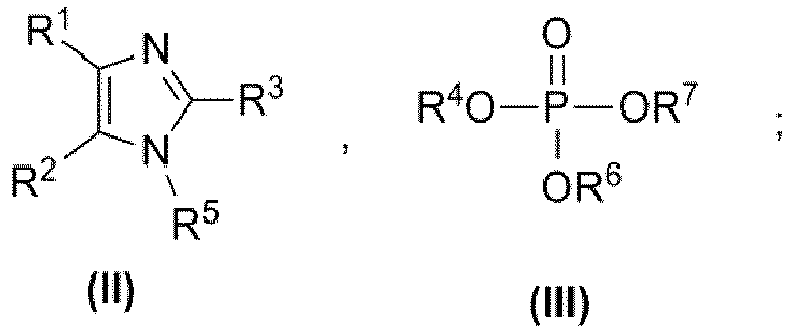
wherein: - each of R1, R2, R3 are independently a hydrogen or alkyl, preferably of 1 to 10, more preferably 1 to 8, even more preferably 1 to 6, most preferably 1 to 4 carbon atoms,
- each of R4, R5, R6, R7 are independently alkyl, preferably of 1 to 10, more preferably 1 to 8, even more preferably 1 to 6, most preferably 1 to 4 carbon atoms.
- In a preferred embodiment of the present invention, R1 = R2 = R3 = hydrogen and each of R4, R5, R6, R7 are independently methyl or ethyl.
- In a more preferred embodiment of the present invention, R1 = R2 = R3 = hydrogen, R5 = methyl and each of R4, R6, R7 are independently methyl or ethyl.
- In an even more preferred embodiment of the present invention, R1 = R2 = R3 = hydrogen, R5 = methyl and R4 = R6 = R7 = ethyl.
- In step a) of the process according to the invention, a compound of formula (II) is reacted with a compound of formula (III) in the presence of water, giving a crude product comprising a compound of formula (I). The skilled person is familiar with the reaction conditions, which are described in
WO 2004/016631 A1 , for example. - In particular, step a) of the process according to the invention is preferably carried out at a temperature in the range of from 130 °C to 200 °C, more preferably 140 °C to 190 °C, even more preferably 150 °C to 175 °C.
- The pressure of the reaction is not critical and may be for example atmospheric pressure, preferably under an inert atmosphere, such as nitrogen.
- As the reaction is exothermic, it may be desirable to control the rate of addition in some cases and/or to apply external cooling during the addition step.
- In general, the compounds of formula (II) and (III) are present in stoichiometric amounts, i.e. the molar relation of compound (II) to compound (III) is in the range 0.9 : 1 to 1.1 : 1, more preferably 1 : 1. In some cases, it might be advantageous to use the imidazole compound (II) in a slight excess over the phosphate ester (III), for example in the range of 1.01 to 1.4 molar equivalents, preferable 1.02 to 1.4.
- The reaction time is not particularly limited. Typically, the reaction is continued until at least 90 % of the compounds (II) or (III) has reacted to form compound (I). "Completion of the reaction" means that at least 90 % of the compounds (II) or (III) has reacted to form compound (I). The progress of the reaction can be conveniently controlled by methods known to the skilled person, such as NMR.
- According to the invention, the reaction is carried out in the presence of water. It has been surprisingly found that even small amounts of water lead to surprising improvements, i.e. bring the level of smelly impurities and the colour number in the resultant product (I) to a minimum.
- In a preferred embodiment, "presence of water" means that compounds (II) and (III) are reacted in the presence of at least 1.0 weight-% of water, based on the combined masses of compounds (II) and (III). Even more preferred, it means that that compounds (II) and (III) are reacted in the presence of at least 3.7 weight-% of water, based on the combined masses of compounds (II) and (III). Even more preferred, it means that that compounds (II) and (III) are reacted in the presence of at least 7.4 weight-% of water, based on the combined masses of compounds (II) and (III). Even more preferred, it means that that compounds (II) and (III) are reacted in the presence of at least 10.0 weight-% of water, based on the combined masses of compounds (II) and (III). Even more preferred, it means that that compounds (II) and (III) are reacted in the presence of at least 20 weight-% of water, based on the combined masses of compounds (II) and (III). Even more preferred, it means that that compounds (II) and (III) are reacted in the presence of at least 40 weight-% of water, based on the combined masses of compounds (II) and (III). Even more preferred, it means that that compounds (II) and (III) are reacted in the presence of at least 80 weight-% of water, based on the combined masses of compounds (II) and (III). Even more preferred, it means that that compounds (II) and (III) are reacted in the presence of at least 100 weight-% of water, based on the combined masses of compounds (II) and (III). Even more preferred, it means that that compounds (II) and (III) are reacted in the presence of at least 150 weight-% of water, based on the combined masses of compounds (II) and (III).
- The reaction between compounds (II) and (III) may be carried out in the presence or absence of an organic solvent, while it is preferred to carry it out in the absence of an organic solvent.
- "Organic solvent" means organic compounds which are known to the skilled person as solvents such as (and preferably) selected from the group consisting of aliphatic solvents, preferably pentane, hexane, heptane, octane, decane, cyclohexane, tetramethylsilane; aromatic solvents, preferably benzene, toluene, xylene; ether compounds, preferably diethyl ether, dipropyl ether, dibutyl ether, methyl tert-butyl ether; halogenated solvents, preferably dichloromethane, chloroform, tetrachloromethane; alcohols, preferably methanol, ethanol, propanol, iso-propanol, butanol, tert-butanol; esters, preferably methyl acetate, ethyl acetate, propyl acetate, butyl acetate; acetone. Polar organic solvents such as esters and alcohols are particularly preferred.
- "Absence of an organic solvent" means particularly that the overall content of all organic solvents in the reaction mixture is below 10 weight-% based on the sum of the weights of compounds (II) and (III), preferably below 5 weight-% b based on the sum of the weights of compounds (II) and (III), more preferably below 1 weight-% based on the sum of the weights of compounds (II) and (III).
- After completion of the reaction, the water (and the organic solvent, in case the reaction is carried out in the presence of such organic solvent), can be at least partially removed by the methods described in the prior art.
- Such at least partial removal can be carried out by extraction, stripping, distillation or any other process known to the skilled person, preferably by extraction, stripping, distillation.
- In this context, "partial removal" means in particular, that at least 50 % of the water (or respectively of the water and the organic solvent, in case the reaction is carried out in the presence of such organic solvent) in the reaction mixture is removed, preferably at least 70 %, even more preferably at least 90 %, even more preferably 99 % of the water (or in each case the respective amount of the water and the organic solvent, in case the reaction is carried out in the presence of such organic solvent) is removed.
- For carrying out the distillation, all apparatuses known to the person skilled in the art can be used, thus e.g. a stirred reactor, a falling-film evaporator or a thin-film evaporator, in each case in combination with a suitable distillation column or another apparatus suitable for the distillation.
- The method of the present invention thus provides as a product an imidazolium salt with a surprisingly low APHA number (indicative of a low level of discolouring) and a low level of odorous impurities such as amines and N-methylimidazole.
- The following examples illustrate the invention.
- In the following examples, N-methylimidazole (CAS number: 616-47-7) and triethylphosphate (CAS number: 78-40-0) were purchased from Sigma Aldrich.
- The APHA numbers were determined by diluting the respective sample 1 : 1 with water and determining the number according to the procedure described in DIN EN ISO 6271 (2005).
- The impurities were determined by headspace GC/MS as follows: 0.1 g of the sample were incubated for 20 minutes at 70 °C in a sampler. The composition of the gas phase was analyzed by condensating it in a cooling trap and analyzing the condensate with gas chromatography ("GC") and mass spectrometry ("MS"). GC was performed with an apparatus of Hewlett Packard ("HP 6890"; sampler: Turbomatrix 40, Perkin Elmer). MS was performed with an apparatus of Hewlett-Packard ("HP 5973").
- Triethylphosphate (929 g, 5.0 mole) was added dropwise over 2 hours to a reaction vessel containing N methylimidazole (411 g, 5.0 mole). Afterwards, the reaction mixture was heated up to 130 °C and stirred under reflux for 14 h. Then, the volatile parts were removed under reduced pressure with a rotary evaporator. 1-Ethyl-3-methylimidazole diethylphosphate was obtained in 98 % (V1) and 99 % (V2) yield, respectively.
- Triethylphosphate (929 g, 5.0 mole) was added dropwise over 2 hours to a reaction vessel containing N-methylimidazole (411 g, 5.0 mole) and water (E1: 50 mL; E2: 100 mL). Afterwards the reaction mixture was heated up to 130 °C and stirred under reflux for 14 h. Then, the volatile parts were removed under reduced pressure with a rotary evaporator. In each case, 1-ethyl-3-methylimidazole diethylphosphate was obtained in 99 % yield.
- Then the residuals in each sample were assessed with GC/MS analysis as described above. The numbers given in the table for each impurity represent the observed peak height, which, in turn, is proportional to the content of each impurity. Moreover, the APHA number was determined by the method described above.
Ex. Water added [ml] Impurities detected by GC/MS APHA number iso-propanol ethyl amine triethyl amine N-methylimidazole V1 0 80 60 40 520 905 V2 0 80 140 30 760 803 E1 50 0 0 10 200 47 E2 100 0 0 10 190 32 - The results summarized in the above table show that the process according to the invention, i.e. carrying out the reaction in the presence of water, lead to surprisingly pure products in terms of colourlessness (the APHA number is reduced by over ~95 %) and in terms of a reduction of impurities in the product. These results were surprising.
Claims (10)
- A process for preparing a compound of formula (I): Q+A-, wherein Q+ is


wherein:each of R1, R2, R3 are independently a hydrogen or alkyl,each of R4, R5, R6, R7 are independently alkyl. - A process according to claim 1, wherein each of R1, R2, R3 are independently a hydrogen or alkyl of 1 to 10 carbon atoms, and each of R4, R5, R6, R7 are independently alkyl of 1 to 10 carbon atoms.
- A process according to claim 2, wherein R1 = R2 = R3 = hydrogen and wherein each of R4, R5, R6, R7 are independently methyl or ethyl.
- A process according to claim 3, wherein R1 = R2 = R3 = hydrogen, R5 = methyl and wherein each of R4, R6, R7 are independently methyl or ethyl.
- A process according to claim 4, wherein R1 = R2 = R3 = hydrogen and R5 = methyl and R4 = R6 = R7 = ethyl.
- A process according to claims 1 to 5, wherein compounds (II) and (III) are reacted in the presence of at least 1.0 weight-% of water, based on the combined masses of compounds (II) and (III).
- A process according to one of claims 1 to 6, which is carried out in the absence of an organic solvent.
- A process according to one of claims 1 to 6, which is carried out in the presence of an organic solvent.
- A process according to one of claims 1 to 8, wherein after completion of the reaction, water and, in case the reaction is carried out in the presence of an organic solvent, the organic solvent are at least partially removed.
- A process according to one of claims 1 to 9, wherein the reaction is carried out at a temperature of 130 °C to 200 °C.
Priority Applications (4)
| Application Number | Priority Date | Filing Date | Title |
|---|---|---|---|
| EP16174312.5A EP3257844A1 (en) | 2016-06-14 | 2016-06-14 | Method of preparing a high purity imidazolium salt |
| US15/619,566 US20170355682A1 (en) | 2016-06-14 | 2017-06-12 | Method of preparing a high purity imidazolium salt |
| CN201710443303.4A CN107501187A (en) | 2016-06-14 | 2017-06-13 | The method for preparing high-purity imidazole salts |
| JP2017116772A JP2017222658A (en) | 2016-06-14 | 2017-06-14 | Method of preparing high purity imidazolium salt |
Applications Claiming Priority (1)
| Application Number | Priority Date | Filing Date | Title |
|---|---|---|---|
| EP16174312.5A EP3257844A1 (en) | 2016-06-14 | 2016-06-14 | Method of preparing a high purity imidazolium salt |
Publications (1)
| Publication Number | Publication Date |
|---|---|
| EP3257844A1 true EP3257844A1 (en) | 2017-12-20 |
Family
ID=56134183
Family Applications (1)
| Application Number | Title | Priority Date | Filing Date |
|---|---|---|---|
| EP16174312.5A Withdrawn EP3257844A1 (en) | 2016-06-14 | 2016-06-14 | Method of preparing a high purity imidazolium salt |
Country Status (4)
| Country | Link |
|---|---|
| US (1) | US20170355682A1 (en) |
| EP (1) | EP3257844A1 (en) |
| JP (1) | JP2017222658A (en) |
| CN (1) | CN107501187A (en) |
Cited By (1)
| Publication number | Priority date | Publication date | Assignee | Title |
|---|---|---|---|---|
| WO2022144511A1 (en) * | 2021-01-04 | 2022-07-07 | Arkema France | Ionic liquid based on bis(fluorosulfonyl)imide |
Families Citing this family (8)
| Publication number | Priority date | Publication date | Assignee | Title |
|---|---|---|---|---|
| DE102015212749A1 (en) | 2015-07-08 | 2017-01-12 | Evonik Degussa Gmbh | Method for dehumidifying moist gas mixtures |
| EP3257568B1 (en) | 2016-06-14 | 2019-09-18 | Evonik Degussa GmbH | Method for the removal of moisture from moist gas mixtures by use of ionic liquids |
| DE102016210478A1 (en) | 2016-06-14 | 2017-12-14 | Evonik Degussa Gmbh | Method for dehumidifying moist gas mixtures |
| DE102016210481B3 (en) | 2016-06-14 | 2017-06-08 | Evonik Degussa Gmbh | Process for purifying an ionic liquid |
| DE102016210483A1 (en) | 2016-06-14 | 2017-12-14 | Evonik Degussa Gmbh | Process and absorbent for dehumidifying moist gas mixtures |
| DE102016210484A1 (en) | 2016-06-14 | 2017-12-14 | Evonik Degussa Gmbh | Method for dehumidifying moist gas mixtures |
| CN115724880A (en) * | 2022-12-27 | 2023-03-03 | 合肥学院 | A kind of preparation method for the ionic liquid of ethyl formate-methanol azeotropic system separation |
| CN116217620A (en) * | 2023-01-10 | 2023-06-06 | 合肥学院 | A kind of phosphorus-containing porphyrin and its preparation method and application |
Citations (2)
| Publication number | Priority date | Publication date | Assignee | Title |
|---|---|---|---|---|
| WO2004016631A1 (en) | 2002-08-16 | 2004-02-26 | Cytec Canada Inc. | Phosphonium and imidazolium salts and methods of their preparation |
| US20110247494A1 (en) | 2009-06-25 | 2011-10-13 | VTU Holding GmbH. | Liquid sorbant, method of using a liquid sorbant, and device for sorbing a gas |
-
2016
- 2016-06-14 EP EP16174312.5A patent/EP3257844A1/en not_active Withdrawn
-
2017
- 2017-06-12 US US15/619,566 patent/US20170355682A1/en not_active Abandoned
- 2017-06-13 CN CN201710443303.4A patent/CN107501187A/en active Pending
- 2017-06-14 JP JP2017116772A patent/JP2017222658A/en active Pending
Patent Citations (2)
| Publication number | Priority date | Publication date | Assignee | Title |
|---|---|---|---|---|
| WO2004016631A1 (en) | 2002-08-16 | 2004-02-26 | Cytec Canada Inc. | Phosphonium and imidazolium salts and methods of their preparation |
| US20110247494A1 (en) | 2009-06-25 | 2011-10-13 | VTU Holding GmbH. | Liquid sorbant, method of using a liquid sorbant, and device for sorbing a gas |
Non-Patent Citations (3)
| Title |
|---|
| SHARON I. LALL-RAMNARINE ET AL: "Probing the Physical Properties, Synthesis and Cellulose Dissolution Ability of Dialkyl Phosphate Ionic Liquids", PHOSPHORUS, SULFUR AND SILICON AND THE RELATED ELEMENTS, vol. 190, no. 5-6, 31 December 2014 (2014-12-31), pages 891 - 895, XP055288918, ISSN: 1042-6507, DOI: 10.1080/10426507.2014.985824 * |
| Y. LUO ET AL., APPL. THERMAL ENG., vol. 31, 2011, pages 2772 - 2777 |
| Y. LUO ET AL., SOLAR ENERGY, vol. 86, 2012, pages 2718 - 2724 |
Cited By (2)
| Publication number | Priority date | Publication date | Assignee | Title |
|---|---|---|---|---|
| WO2022144511A1 (en) * | 2021-01-04 | 2022-07-07 | Arkema France | Ionic liquid based on bis(fluorosulfonyl)imide |
| FR3118679A1 (en) * | 2021-01-04 | 2022-07-08 | Arkema France | Ionic liquid based on bis(fluorosulfonyl)imide |
Also Published As
| Publication number | Publication date |
|---|---|
| JP2017222658A (en) | 2017-12-21 |
| CN107501187A (en) | 2017-12-22 |
| US20170355682A1 (en) | 2017-12-14 |
Similar Documents
| Publication | Publication Date | Title |
|---|---|---|
| EP3257844A1 (en) | Method of preparing a high purity imidazolium salt | |
| US9840473B1 (en) | Method of preparing a high purity imidazolium salt | |
| US10138209B2 (en) | Process for purifying an ionic liquid | |
| CN108910919A (en) | A kind of preparation method of the double oxalic acid lithium phosphates of electron level difluoro | |
| CN112771016A (en) | High-purity isopropyl alcohol and method for producing same | |
| CN110870125A (en) | Method for producing hygroscopic alkali metal salt electrolyte solution | |
| Bingham et al. | Reaction of carbethoxynitrene with allenes | |
| KR100532544B1 (en) | Jasmonic acid compounds and process for the preparation thereof | |
| JP4284802B2 (en) | Process for producing 4-hydroxymethyl-1,3-dioxolan-2-one | |
| CN111004087A (en) | Post-treatment method of trifluorostyrene synthetic liquid | |
| US9994596B2 (en) | Process for preparing a composition containing 2-ethylhexyl silicate | |
| AU2018382416A1 (en) | Process for producing glycerol carbonate methacrylate | |
| EP4069672B1 (en) | Process for the purification of a mixture comprising n-alkyl-hydroxylammonium salts | |
| US20170291913A1 (en) | Process for preparing a composition containing 2-propylheptyl silicate | |
| RU2599790C2 (en) | Method of separating monochloroacetic acid and dichloroacetic acid by extractive distillation | |
| CN112028778A (en) | Synthesis and impurity identification method of bromhexine hydrochloride process impurity positioning reference substance | |
| EP2114964A1 (en) | Process for preparing isocyanatoorganosilanes | |
| EP1747188B1 (en) | Method for the production of long-chained quaternary ammonium oxalates and ammonium hydrogenoxalates | |
| EP2910545B1 (en) | Method for producing n,n-dialkylhomofarnesic acid amide | |
| KR101123214B1 (en) | Method of purifying olefin by using pyrrolidinium-based or piperidinium-based ionic liquids comprising copper(ⅰ) halide | |
| CN113461598B (en) | Process for producing piperidinol compound | |
| JP6622634B2 (en) | Manufacturing method of mirtazapine | |
| MX2014011878A (en) | Process for separating monochloroacetic acid and dichloroacetic acid via extractive distillation using an organic solvent. | |
| Gupton et al. | New Reactions of Quaternary Ammonium Salts Derived from Vinamidinium Salt Reduction Products and A Reassignment of Structure | |
| McLaughlin et al. | A NOVEL BASE ENHANCEMENT FOR THE STILLE CROSS-COUPLING REACTION |
Legal Events
| Date | Code | Title | Description |
|---|---|---|---|
| PUAI | Public reference made under article 153(3) epc to a published international application that has entered the european phase |
Free format text: ORIGINAL CODE: 0009012 |
|
| AK | Designated contracting states |
Kind code of ref document: A1 Designated state(s): AL AT BE BG CH CY CZ DE DK EE ES FI FR GB GR HR HU IE IS IT LI LT LU LV MC MK MT NL NO PL PT RO RS SE SI SK SM TR |
|
| AX | Request for extension of the european patent |
Extension state: BA ME |
|
| STAA | Information on the status of an ep patent application or granted ep patent |
Free format text: STATUS: THE APPLICATION IS DEEMED TO BE WITHDRAWN |
|
| 18D | Application deemed to be withdrawn |
Effective date: 20180621 |