EP3257510A1 - Lactate dehydrogenase inhibitor and antiepileptic drug containing same - Google Patents
Lactate dehydrogenase inhibitor and antiepileptic drug containing same Download PDFInfo
- Publication number
- EP3257510A1 EP3257510A1 EP16749227.1A EP16749227A EP3257510A1 EP 3257510 A1 EP3257510 A1 EP 3257510A1 EP 16749227 A EP16749227 A EP 16749227A EP 3257510 A1 EP3257510 A1 EP 3257510A1
- Authority
- EP
- European Patent Office
- Prior art keywords
- ring structure
- substituents
- binding
- optionally
- structure formed
- Prior art date
- Legal status (The legal status is an assumption and is not a legal conclusion. Google has not performed a legal analysis and makes no representation as to the accuracy of the status listed.)
- Granted
Links
Images









Classifications
-
- A—HUMAN NECESSITIES
- A61—MEDICAL OR VETERINARY SCIENCE; HYGIENE
- A61K—PREPARATIONS FOR MEDICAL, DENTAL OR TOILETRY PURPOSES
- A61K31/00—Medicinal preparations containing organic active ingredients
- A61K31/33—Heterocyclic compounds
- A61K31/335—Heterocyclic compounds having oxygen as the only ring hetero atom, e.g. fungichromin
- A61K31/357—Heterocyclic compounds having oxygen as the only ring hetero atom, e.g. fungichromin having two or more oxygen atoms in the same ring, e.g. crown ethers, guanadrel
- A61K31/36—Compounds containing methylenedioxyphenyl groups, e.g. sesamin
-
- A—HUMAN NECESSITIES
- A61—MEDICAL OR VETERINARY SCIENCE; HYGIENE
- A61K—PREPARATIONS FOR MEDICAL, DENTAL OR TOILETRY PURPOSES
- A61K31/00—Medicinal preparations containing organic active ingredients
- A61K31/33—Heterocyclic compounds
- A61K31/395—Heterocyclic compounds having nitrogen as a ring hetero atom, e.g. guanethidine or rifamycins
- A61K31/435—Heterocyclic compounds having nitrogen as a ring hetero atom, e.g. guanethidine or rifamycins having six-membered rings with one nitrogen as the only ring hetero atom
- A61K31/47—Quinolines; Isoquinolines
- A61K31/472—Non-condensed isoquinolines, e.g. papaverine
- A61K31/4725—Non-condensed isoquinolines, e.g. papaverine containing further heterocyclic rings
-
- A—HUMAN NECESSITIES
- A61—MEDICAL OR VETERINARY SCIENCE; HYGIENE
- A61K—PREPARATIONS FOR MEDICAL, DENTAL OR TOILETRY PURPOSES
- A61K31/00—Medicinal preparations containing organic active ingredients
- A61K31/33—Heterocyclic compounds
- A61K31/395—Heterocyclic compounds having nitrogen as a ring hetero atom, e.g. guanethidine or rifamycins
- A61K31/435—Heterocyclic compounds having nitrogen as a ring hetero atom, e.g. guanethidine or rifamycins having six-membered rings with one nitrogen as the only ring hetero atom
- A61K31/47—Quinolines; Isoquinolines
- A61K31/4738—Quinolines; Isoquinolines ortho- or peri-condensed with heterocyclic ring systems
- A61K31/4741—Quinolines; Isoquinolines ortho- or peri-condensed with heterocyclic ring systems condensed with ring systems having oxygen as a ring hetero atom, e.g. tubocuraran derivatives, noscapine, bicuculline
-
- A—HUMAN NECESSITIES
- A61—MEDICAL OR VETERINARY SCIENCE; HYGIENE
- A61K—PREPARATIONS FOR MEDICAL, DENTAL OR TOILETRY PURPOSES
- A61K31/00—Medicinal preparations containing organic active ingredients
- A61K31/33—Heterocyclic compounds
- A61K31/395—Heterocyclic compounds having nitrogen as a ring hetero atom, e.g. guanethidine or rifamycins
- A61K31/495—Heterocyclic compounds having nitrogen as a ring hetero atom, e.g. guanethidine or rifamycins having six-membered rings with two or more nitrogen atoms as the only ring heteroatoms, e.g. piperazine or tetrazines
- A61K31/496—Non-condensed piperazines containing further heterocyclic rings, e.g. rifampin, thiothixene or sparfloxacin
-
- A—HUMAN NECESSITIES
- A61—MEDICAL OR VETERINARY SCIENCE; HYGIENE
- A61P—SPECIFIC THERAPEUTIC ACTIVITY OF CHEMICAL COMPOUNDS OR MEDICINAL PREPARATIONS
- A61P25/00—Drugs for disorders of the nervous system
- A61P25/08—Antiepileptics; Anticonvulsants
-
- A—HUMAN NECESSITIES
- A61—MEDICAL OR VETERINARY SCIENCE; HYGIENE
- A61P—SPECIFIC THERAPEUTIC ACTIVITY OF CHEMICAL COMPOUNDS OR MEDICINAL PREPARATIONS
- A61P43/00—Drugs for specific purposes, not provided for in groups A61P1/00-A61P41/00
-
- C—CHEMISTRY; METALLURGY
- C07—ORGANIC CHEMISTRY
- C07D—HETEROCYCLIC COMPOUNDS
- C07D317/00—Heterocyclic compounds containing five-membered rings having two oxygen atoms as the only ring hetero atoms
- C07D317/08—Heterocyclic compounds containing five-membered rings having two oxygen atoms as the only ring hetero atoms having the hetero atoms in positions 1 and 3
- C07D317/44—Heterocyclic compounds containing five-membered rings having two oxygen atoms as the only ring hetero atoms having the hetero atoms in positions 1 and 3 ortho- or peri-condensed with carbocyclic rings or ring systems
- C07D317/46—Heterocyclic compounds containing five-membered rings having two oxygen atoms as the only ring hetero atoms having the hetero atoms in positions 1 and 3 ortho- or peri-condensed with carbocyclic rings or ring systems condensed with one six-membered ring
- C07D317/48—Methylenedioxybenzenes or hydrogenated methylenedioxybenzenes, unsubstituted on the hetero ring
- C07D317/50—Methylenedioxybenzenes or hydrogenated methylenedioxybenzenes, unsubstituted on the hetero ring with only hydrogen atoms, hydrocarbon or substituted hydrocarbon radicals, directly attached to atoms of the carbocyclic ring
-
- C—CHEMISTRY; METALLURGY
- C07—ORGANIC CHEMISTRY
- C07D—HETEROCYCLIC COMPOUNDS
- C07D317/00—Heterocyclic compounds containing five-membered rings having two oxygen atoms as the only ring hetero atoms
- C07D317/08—Heterocyclic compounds containing five-membered rings having two oxygen atoms as the only ring hetero atoms having the hetero atoms in positions 1 and 3
- C07D317/44—Heterocyclic compounds containing five-membered rings having two oxygen atoms as the only ring hetero atoms having the hetero atoms in positions 1 and 3 ortho- or peri-condensed with carbocyclic rings or ring systems
- C07D317/46—Heterocyclic compounds containing five-membered rings having two oxygen atoms as the only ring hetero atoms having the hetero atoms in positions 1 and 3 ortho- or peri-condensed with carbocyclic rings or ring systems condensed with one six-membered ring
- C07D317/48—Methylenedioxybenzenes or hydrogenated methylenedioxybenzenes, unsubstituted on the hetero ring
- C07D317/50—Methylenedioxybenzenes or hydrogenated methylenedioxybenzenes, unsubstituted on the hetero ring with only hydrogen atoms, hydrocarbon or substituted hydrocarbon radicals, directly attached to atoms of the carbocyclic ring
- C07D317/54—Radicals substituted by oxygen atoms
-
- C—CHEMISTRY; METALLURGY
- C07—ORGANIC CHEMISTRY
- C07D—HETEROCYCLIC COMPOUNDS
- C07D317/00—Heterocyclic compounds containing five-membered rings having two oxygen atoms as the only ring hetero atoms
- C07D317/08—Heterocyclic compounds containing five-membered rings having two oxygen atoms as the only ring hetero atoms having the hetero atoms in positions 1 and 3
- C07D317/44—Heterocyclic compounds containing five-membered rings having two oxygen atoms as the only ring hetero atoms having the hetero atoms in positions 1 and 3 ortho- or peri-condensed with carbocyclic rings or ring systems
- C07D317/46—Heterocyclic compounds containing five-membered rings having two oxygen atoms as the only ring hetero atoms having the hetero atoms in positions 1 and 3 ortho- or peri-condensed with carbocyclic rings or ring systems condensed with one six-membered ring
- C07D317/48—Methylenedioxybenzenes or hydrogenated methylenedioxybenzenes, unsubstituted on the hetero ring
- C07D317/50—Methylenedioxybenzenes or hydrogenated methylenedioxybenzenes, unsubstituted on the hetero ring with only hydrogen atoms, hydrocarbon or substituted hydrocarbon radicals, directly attached to atoms of the carbocyclic ring
- C07D317/60—Radicals substituted by carbon atoms having three bonds to hetero atoms with at the most one bond to halogen, e.g. ester or nitrile radicals
-
- C—CHEMISTRY; METALLURGY
- C07—ORGANIC CHEMISTRY
- C07D—HETEROCYCLIC COMPOUNDS
- C07D405/00—Heterocyclic compounds containing both one or more hetero rings having oxygen atoms as the only ring hetero atoms, and one or more rings having nitrogen as the only ring hetero atom
- C07D405/02—Heterocyclic compounds containing both one or more hetero rings having oxygen atoms as the only ring hetero atoms, and one or more rings having nitrogen as the only ring hetero atom containing two hetero rings
- C07D405/04—Heterocyclic compounds containing both one or more hetero rings having oxygen atoms as the only ring hetero atoms, and one or more rings having nitrogen as the only ring hetero atom containing two hetero rings directly linked by a ring-member-to-ring-member bond
-
- C—CHEMISTRY; METALLURGY
- C07—ORGANIC CHEMISTRY
- C07D—HETEROCYCLIC COMPOUNDS
- C07D405/00—Heterocyclic compounds containing both one or more hetero rings having oxygen atoms as the only ring hetero atoms, and one or more rings having nitrogen as the only ring hetero atom
- C07D405/02—Heterocyclic compounds containing both one or more hetero rings having oxygen atoms as the only ring hetero atoms, and one or more rings having nitrogen as the only ring hetero atom containing two hetero rings
- C07D405/06—Heterocyclic compounds containing both one or more hetero rings having oxygen atoms as the only ring hetero atoms, and one or more rings having nitrogen as the only ring hetero atom containing two hetero rings linked by a carbon chain containing only aliphatic carbon atoms
-
- C—CHEMISTRY; METALLURGY
- C07—ORGANIC CHEMISTRY
- C07D—HETEROCYCLIC COMPOUNDS
- C07D405/00—Heterocyclic compounds containing both one or more hetero rings having oxygen atoms as the only ring hetero atoms, and one or more rings having nitrogen as the only ring hetero atom
- C07D405/14—Heterocyclic compounds containing both one or more hetero rings having oxygen atoms as the only ring hetero atoms, and one or more rings having nitrogen as the only ring hetero atom containing three or more hetero rings
-
- C—CHEMISTRY; METALLURGY
- C07—ORGANIC CHEMISTRY
- C07D—HETEROCYCLIC COMPOUNDS
- C07D407/00—Heterocyclic compounds containing two or more hetero rings, at least one ring having oxygen atoms as the only ring hetero atoms, not provided for by group C07D405/00
- C07D407/02—Heterocyclic compounds containing two or more hetero rings, at least one ring having oxygen atoms as the only ring hetero atoms, not provided for by group C07D405/00 containing two hetero rings
- C07D407/04—Heterocyclic compounds containing two or more hetero rings, at least one ring having oxygen atoms as the only ring hetero atoms, not provided for by group C07D405/00 containing two hetero rings directly linked by a ring-member-to-ring-member bond
-
- C—CHEMISTRY; METALLURGY
- C07—ORGANIC CHEMISTRY
- C07D—HETEROCYCLIC COMPOUNDS
- C07D407/00—Heterocyclic compounds containing two or more hetero rings, at least one ring having oxygen atoms as the only ring hetero atoms, not provided for by group C07D405/00
- C07D407/02—Heterocyclic compounds containing two or more hetero rings, at least one ring having oxygen atoms as the only ring hetero atoms, not provided for by group C07D405/00 containing two hetero rings
- C07D407/06—Heterocyclic compounds containing two or more hetero rings, at least one ring having oxygen atoms as the only ring hetero atoms, not provided for by group C07D405/00 containing two hetero rings linked by a carbon chain containing only aliphatic carbon atoms
-
- C—CHEMISTRY; METALLURGY
- C07—ORGANIC CHEMISTRY
- C07D—HETEROCYCLIC COMPOUNDS
- C07D413/00—Heterocyclic compounds containing two or more hetero rings, at least one ring having nitrogen and oxygen atoms as the only ring hetero atoms
- C07D413/02—Heterocyclic compounds containing two or more hetero rings, at least one ring having nitrogen and oxygen atoms as the only ring hetero atoms containing two hetero rings
- C07D413/04—Heterocyclic compounds containing two or more hetero rings, at least one ring having nitrogen and oxygen atoms as the only ring hetero atoms containing two hetero rings directly linked by a ring-member-to-ring-member bond
-
- C—CHEMISTRY; METALLURGY
- C07—ORGANIC CHEMISTRY
- C07D—HETEROCYCLIC COMPOUNDS
- C07D417/00—Heterocyclic compounds containing two or more hetero rings, at least one ring having nitrogen and sulfur atoms as the only ring hetero atoms, not provided for by group C07D415/00
- C07D417/02—Heterocyclic compounds containing two or more hetero rings, at least one ring having nitrogen and sulfur atoms as the only ring hetero atoms, not provided for by group C07D415/00 containing two hetero rings
- C07D417/06—Heterocyclic compounds containing two or more hetero rings, at least one ring having nitrogen and sulfur atoms as the only ring hetero atoms, not provided for by group C07D415/00 containing two hetero rings linked by a carbon chain containing only aliphatic carbon atoms
-
- C—CHEMISTRY; METALLURGY
- C07—ORGANIC CHEMISTRY
- C07D—HETEROCYCLIC COMPOUNDS
- C07D453/00—Heterocyclic compounds containing quinuclidine or iso-quinuclidine ring systems, e.g. quinine alkaloids
- C07D453/02—Heterocyclic compounds containing quinuclidine or iso-quinuclidine ring systems, e.g. quinine alkaloids containing not further condensed quinuclidine ring systems
-
- C—CHEMISTRY; METALLURGY
- C07—ORGANIC CHEMISTRY
- C07D—HETEROCYCLIC COMPOUNDS
- C07D487/00—Heterocyclic compounds containing nitrogen atoms as the only ring hetero atoms in the condensed system, not provided for by groups C07D451/00 - C07D477/00
- C07D487/02—Heterocyclic compounds containing nitrogen atoms as the only ring hetero atoms in the condensed system, not provided for by groups C07D451/00 - C07D477/00 in which the condensed system contains two hetero rings
- C07D487/08—Bridged systems
-
- C—CHEMISTRY; METALLURGY
- C07—ORGANIC CHEMISTRY
- C07D—HETEROCYCLIC COMPOUNDS
- C07D491/00—Heterocyclic compounds containing in the condensed ring system both one or more rings having oxygen atoms as the only ring hetero atoms and one or more rings having nitrogen atoms as the only ring hetero atoms, not provided for by groups C07D451/00 - C07D459/00, C07D463/00, C07D477/00 or C07D489/00
- C07D491/02—Heterocyclic compounds containing in the condensed ring system both one or more rings having oxygen atoms as the only ring hetero atoms and one or more rings having nitrogen atoms as the only ring hetero atoms, not provided for by groups C07D451/00 - C07D459/00, C07D463/00, C07D477/00 or C07D489/00 in which the condensed system contains two hetero rings
- C07D491/06—Peri-condensed systems
-
- C—CHEMISTRY; METALLURGY
- C07—ORGANIC CHEMISTRY
- C07D—HETEROCYCLIC COMPOUNDS
- C07D495/00—Heterocyclic compounds containing in the condensed system at least one hetero ring having sulfur atoms as the only ring hetero atoms
- C07D495/02—Heterocyclic compounds containing in the condensed system at least one hetero ring having sulfur atoms as the only ring hetero atoms in which the condensed system contains two hetero rings
- C07D495/04—Ortho-condensed systems
Definitions
- the present invention relates to a lactate dehydrogenase inhibitor and an antiepileptic drug containing isosafrole (or a derivative thereof) as an active ingredient.
- Epilepsy is a neurological disorder caused by excessive excitation of electric activity in the brain and is diagnosed by a characteristic electroencephalogram (epileptic electroencephalogram).
- electroencephalogram epileptic electroencephalogram
- the prevalence of epilepsy is high, reaching about 1% of the total population.
- Treatment methods for epilepsy mainly include drug therapy, and more than 20 types of therapeutic drugs for epilepsy are used in clinical settings (Non-Patent Document 1).
- Non-Patent Document 1 Non-Patent Document 1
- these existing therapeutic drugs for epilepsy do not work for about 30% of patients with epilepsy. From such a background, therapeutic drags for "refractory epilepsy" for which existing drugs do not work are currently needed.
- Non- Patent Document 2 Since epilepsy is caused by excessive neural excitation, therapeutic drugs for epilepsy are mostly targeted to molecules that control electrical activity. Specific examples include ion channels, synaptic receptors, and neurotransmitter transporters (Non- Patent Document 2).
- ketogenic diet treatment is effective for some epilepsy patients for whom these existing drugs do not work.
- Non-Patent Document 3 Recently, anti-epileptic mechanisms mediated by the ketogenic diet have been revealed one after another (Non-Patent Documents 4 to 6). That is, if a drug acting on the energy metabolic pathway is developed, it is promising as a drug for refractory epilepsy.
- Stiripentol (CAS: 49763-96-4, 4-dimethyl-1-[(3, 4-methylenedioxy)-phenyl]-1-penten-3-ol, see formula (I) below) is an antiepileptic drug.
- Stiripentol was first developed as a brain disease drug (Patent Document 1), and it was then shown to be effective for Dravet syndrome (one of childhood epilepsies) which is one of refractory epilepsies (Non-Patent Documents 7 and 8).
- Dravet syndrome one of childhood epilepsies
- Non-Patent Documents 7 and 8 are now clinically used as a drug for Dravet syndrome in Europe (approved in 2007) and Japan (approved in 2012) under the trade name of Diacomit.
- stiripentol therapy was successful in Dravet syndrome, it has not been successful at present in clinical trials for other epilepsies (especially adult epilepsies) (Non-Patent Document 9).
- stiripentol is an inhibitor of lactate dehydrogenase (LDH) (Patent Document 2).
- Lactate dehydrogenase is a "metabolic enzyme" existing "on the energy metabolic pathway” and carrying out interconversion between lactate and pyruvate.
- Lactate dehydrogenase inhibitors themselves have been developed mainly for the purpose of development of antimalarial drugs (Non-Patent Documents 10 and 11), and development of anticancer drugs (Non-Patent Documents 12 and 13).
- Stiripentol has an aromatic allyl alcohol structure and has a chemical structure not found in conventional antiepileptic drugs (Patent Document 1). Moreover, stiripentol is the only compound as "antiepileptic drug having lactic dehydrogenase inhibitory action" (Patent Document 2). Antiepileptic drugs acting on metabolic pathways (metabolic enzymes) are promising as a therapeutic drug for refractory epilepsy. However, although stiripentol is effective for some childhood refractory epilepsies (Dravet syndrome), it is not used for other refractory epilepsies.
- antiepileptic drugs can be developed which are also effective for refractory epilepsies for which stiripentol is not effective.
- antiepileptic drugs have very high industrial utility value.
- an object of the present invention is to provide an antiepileptic drug having "lactate dehydrogenase inhibitory action" and also effective for refractory epilepsies for which stiripentol is not effective.
- Patent Document 1 which characterizes stiripentol (aromatic allyl alcohol) and "functional group at the 3-position" reported in the prior art (Non-Patent Document 14) are rather unnecessary. Therefore, they focused on isosafrole (CAS: 120-58-1, 5-(1-propenyl)-1, 3-benzodioxole, see formula (II) below) which is a substance obtained by removing the hydroxy group and the tertiary butyl group from the 3-position of stiripentol. They have revealed that this isosafrole has an inhibitory action on lactate dehydrogenase.
- lactate dehydrogenase inhibitors having isosafrole as a scaffold with a completely different chemical structure from stiripentol.
- inhibitors of lactate dehydrogenase such as isosafrole remarkably suppressed adult refractory epilepsy (medial temporal lobe epilepsy associated with hippocampal sclerosis) which can not be suppressed by stiripentol, thereby completing the present invention.
- the present invention provides the following invention:
- Stiripentol is the only “antiepileptic drug” having "lactate dehydrogenase inhibitory action” (Patent Documents 1 and 2).
- stiripentol is clinically effective only for some childhood refractory epilepsy (Dravet syndrome).
- isosafrole as a second "antiepileptic drug” having "lactate dehydrogenase inhibitory action”.
- Isosafrole dramatically inhibited refractory epilepsy to which stiripentol is ineffective (medial temporal lobe epilepsy, an adult refractory epilepsy).
- lactate dehydrogenase inhibitors having isosafrole as a scaffold.
- isosafrole and derivatives of isosafrole are industrially available as a therapeutic agent for epilepsy.
- the present invention provides lactate dehydrogenase inhibitors described in (a) and pharmaceuticals containing the same as an active ingredient described in (b) below.
- isosafrole has a chemical structure in which a 1-propenyl group is attached to the 5-position of 1,3-benzodioxole which is an aromatic ring.
- the formula (II) representing isosafrole corresponds to the case where all of R a , R b , R c , R d , R e , R f , R g and R h in formula (III) are represented by hydrogen atoms.
- examples of the compound containing isosafrole as a scaffold include, for example, those in which the propenyl group is modified and those in which 1,3-benzodioxole, an aromatic ring, is functionalized.
- the compound is not particularly limited as long as it is a compound having isosafrole as a scaffold and has a lactate dehydrogenase inhibitory activity, and can be used as an antiepileptic drug.
- Isosafrole and isosafrole analogs are compounds which can be represented by formula (III). Although several stereoisomers of the compound represented by formula (III) may exist, any of the stereoisomers are included. In the present invention, a mixture (racemate) of a plurality of stereoisomers may be used or a purified product of any of stereoisomers may be used as a lactate dehydrogenase inhibitor, and further as an active ingredient of an antiepileptic drug. Those skilled in the art could appropriately judge which of the racemate and each stereoisomer should be used, through testing the effectiveness of each stereoisomer as needed and taking purification costs into consideration.
- R a represents a hydrogen atom, a halogen atom or alkoxy optionally substituted with halogen atoms.
- halogen atom examples include fluorine (F), chlorine (Cl), bromine (Br) and iodine (I).
- alkoxy group examples include groups derived from lower alcohols having about 1 to 4 carbon atoms, such as methoxy (-OCH 3 ) and ethoxy (-OC 2 H 5 ).
- methoxy (-OCH 3 ) and ethoxy (-OC 2 H 5 ) examples include groups derived from lower alcohols having about 1 to 4 carbon atoms, such as methoxy (-OCH 3 ) and ethoxy (-OC 2 H 5 ).
- part or all of hydrogen atoms may be substituted with halogen atoms or may not be substituted at all.
- the alkyl group moiety in the alkoxy group may be linear or branched.
- R b represents a hydrogen atom, a halogen atom, alkoxy optionally substituted with halogen atoms or nitro (-NO 2 ), or represents a group which together with R c , R d or R g forms a ring structure optionally having substituents.
- R c represents a hydrogen atom or carboxyl (-COOH), or represents a group which together with R b , R e ⁇ R f or R g forms a ring structure optionally having substituents.
- the carboxyl group may be in the form of a carboxylate anion (-COO - ).
- R d represents a hydrogen atom or -X 11 -R 11 , or represents a group which together with R b or R g forms a ring structure optionally having substituents.
- X 11 represents alkylene, -NH-CO-, -CH 2 -NR 12 -CO- or -S-.
- alkylene group examples include divalent groups derived from lower alkyl groups having about 1 to 6 carbon atoms, such as methylene (-CH 2 -) and ethylene (-C 2 H 5 -).
- R 11 represents aryl optionally having substituents, carboxyl, alkyl optionally substituted with halogen atoms, or hydroxyalkyl.
- aryl group examples include phenyl (-C 6 H 5 ) and naphthyl (-C 10 Hg).
- substituent of the aryl group examples include a halogen atom, alkyl optionally substituted with halogen atoms, alkoxy optionally substituted with halogen atoms, hydroxy, thioalkoxy (-SR), carboxyl, aryl optionally having substituents, heteroaryl optionally having substituents, and cycloalkyl optionally having substituents.
- the number of substituents and the site to which the substituent is introduced are optionally selected and can be appropriately selected depending on the nature of the substituent.
- alkyl group examples include lower alkyl groups having about 1 to 6 carbon atoms such as methyl, ethyl, propyl, butyl, pentyl and octyl.
- the alkyl group may be linear (n-alkyl) or branched (i-, sec-, tert-alkyl).
- part or all of hydrogen atoms may be substituted with halogen atoms or may not be substituted at all.
- hydroxyalkyl group examples include groups derived from lower alcohols having about 1 to 4 carbon atoms, such as oxymethyl (-CH 2 OH) and oxyethyl (-C 2 H 5 OH).
- the alkyl group moiety in the hydroxyalkyl group may be linear or branched. The number and the site of the hydroxy groups are optionally selected.
- R 12 represents hydroxyalkyl
- R 21 represents hydroxy, or represents a group which together with R c or R g forms a ring structure optionally having substituents.
- R 22 represents nitro, or aminocarbonyl in which two hydrogen atoms bound to a nitrogen atom may be each independently substituted with alkyl.
- R g represents a hydrogen atom, -X 31 -R 31 , -O-X 32 -R 32 , -N(-X 33 -R 33 ) (-X 34 -R 34 ), -CR 35 R 36 R 37 .
- X 31 represents a single bond, alkenylene, -CH 2 -O-CH 2 -CO-NH-, -CH 2 -O-CH 2 -CO- or -CO-.
- the number and the position of the carbon-carbon double bonds are optionally selected.
- R 31 represents aryl optionally having substituents, heteroaryl optionally having substituents, cycloalkyl optionally having substituents, heterocyclic amino optionally having substituents, hydroxy, alkoxy optionally substituted with halogen atoms, or hydroxyalkyl;
- heteroaryl group examples include pyridyl (-C 5 H 5 N), pyrazinyl (-C 4 H 3 N 2 ), triazinyl (-C 3 H 2 N 3 ), tetrazinyl (-C 2 HN 4 ), pyrrolyl (-C 4 H 4 N), thienyl (-C 4 H 3 S), furanyl (-C 4 H 3 O), 1,3-benzodioxole, a group possessed by Compound No. 26, and a group possessed by Compound No. 34.
- the number and the position of substituents possessed by the heteroaryl group the same thing as the above-mentioned substituent possessed by aryl can be said.
- Examples of the cycloalkyl group include those having about 1 to 6 carbon atoms such as cyclopropyl, cyclobutyl, cyclopentyl and cyclohexyl.
- the number and the position of substituents possessed by the cycloalkyl group the same thing as the above-mentioned substituent possessed by aryl can be said.
- heterocyclic amino group examples include pyrrolidinyl (-C 4 H 8 N), piperidinyl (-C S H 10 N), piperazinyl (-C 4 H 9 N 2 ), and a group possessed by the Compound No. 70 (see FIG. 6-10 ).
- the number and the position of substituents optionally possessed by the heterocyclic amino group the same thing as the above-mentioned substituent possessed by aryl can be said.
- substituents include phenyl optionally having a substituent (such as a halogen atom or a halogenated alkyl group).
- X 32 represents a single bond or -CH 2 -CO-NH-.
- R 32 represents aryl optionally having substituents, heteroaryl optionally having substituents, cycloalkyl optionally having substituents or alkyl optionally substituted with halogen atoms.
- X 33 and X 34 each independently represent a single bond, alkylene, -CH 2 -CO-NH- or -SO 2 -.
- R 33 and R 34 each independently represent a hydrogen atom, aryl optionally having substituents, heteroaryl optionally having substituents, cycloalkyl optionally having substituents, hydroxylalkyl, carboxyl, alkyl optionally substituted with halogen atoms or alkynyl group, or represent a group which together with R b , R c , R d or R e ⁇ R f forms a ring structure optionally having substituents, or R 33 and R 34 , together with the nitrogen atom to which they are bound through X 33 and X 34 which are single bonds, represent heterocyclic amino optionally having substituents.
- alkynyl group examples include lower alkynyl groups having about 2 to 6 carbon atoms such as 2,3-propynyl (-CH 2 -C ⁇ CH). The number and the position of the carbon-carbon triple bonds are optionally selected.
- R g represented by -N (-X 33 -R 33 ) (-X 34 -R 34 ) is a group which together with R b , R c , R d or R e ⁇ R f forms a ring structure
- one of -X 33 -R 33 and -X 34 -R 34 may be linked with R b , R c , R d or R e ⁇ R f to form the ring structure, and the other (particularly, other than a hydrogen atom) may be in a form corresponding to a substituent bonded to N contained in the ring structure (Compound No. 57 (see FIG. 6-8 ) and Compound No. 91 (see FIG.
- R 35 , R 36 and R 37 each independently represent a hydrogen atom or -X 31 -R 31 , or represent a group which together with R b , R c , R d or R e ⁇ R f forms a ring structure optionally having substituents.
- R g represented by -CR 35 R 36 R 37 is a group which together with R b , R c , R d or R e ⁇ R f forms a cyclic structure
- one or two of R 35 , R 36 and R 37 may be linked with R b , R c , R d or R e ⁇ R f to form the ring structure, and the remainings group (particularly, other than a hydrogen atom) may be in a form corresponding to a substituent bonded to C contained in the cyclic structure
- Compound No. 54 see FIG. 6-7
- Compound Nos. 59 and 60 see FIG.
- R g represented by -CR 35 R 36 R 37 is a group which together with R b , R c , R d or R e ⁇ R f forms a ring structure such as condensed ring
- R b , R c , R d or R e ⁇ R f forms a ring structure such as condensed ring
- one or two selected from R 35 , R 36 and R 37 are linked with R b , R c , R d or R e ⁇ R f as described above to form a part of the ring structure (one side of the condensed ring)
- the remaining groups may represent groups which link to one of the atoms forming the backbone of the ring structure to form a further part of the ring structure (the other side of the condensed ring) (Compound Nos. 61 to 65 (see FIG. 6-9 )).
- R h represents a hydrogen atom or a halogen atom.
- R d represents a hydrogen atom or -X 11 -R 11 (a group forming a ring structure together with R b is not represented).
- R g is a hydrogen atom
- R e and R f are also limited to hydrogen atoms. That is, the definition that R g is a hydrogen atom is intended to include, in the compound represented by the formula (III), isosafrole and derivatives thereof in which R e , R f and R g are all hydrogen atoms.
- Stiripentol which is in a combination of R e being hydroxy, R f being alkyl (t-butyl) and R g being a hydrogen atom, is not included in the compound represented by the formula (III).
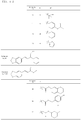
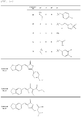
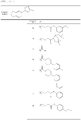
- Specific examples of the compound represented by formula (III) include the compounds (Nos. 1 to 94) listed in FIGS. 6-1 to 6-13 . Among them, compounds having a predetermined ring structure (Ring bc , Ring bd , Ring bg , Ring cef , Ring cg , Ring dg or Ring efg ) are Nos. 44 to 94 (see the corresponding table below), and compounds having no ring structure are Nos. 1 to 43. Any of the Compound Nos. 1 to 94 and the other compounds represented by the formula (III) can be obtained or synthesized according to known methods by one skilled in the art. Table 1 Ring structure Compound No.
- R b and R c together form a ring structure (Ring bc ) (see formula III-bc) 93, 94 R b and R d together form a ring structure (Ring bd ) (see formula III-bd) 92 R b and R g together form a ring structure (Ring bd ) (see formula III-bg) R g : -N(-X 33 -R 33 )(-X 34 -R 34 ) 88-90, 91 R c and R e ⁇ R f together form a ring structure (Ring cef ) (see formula III-cef) 69-81, 82 R c and R g together form a ring structure (Ring cg ) (see formula III-cg ) (see formula III-cg ) R g : -CR 35 R 36 R 37 83-85, 86, 87 R d and R g
- One preferred embodiment of the present invention includes isosafrole or an analog thereof, which is close to the original structure of isosafrole, wherein all of R e , R f and R g are hydrogen atoms, and wherein R c and R d are also hydrogen atoms. That is, compounds are preferred, wherein the carbon atom at the 3-position of the propenyl group in formula (III), and further the carbon atoms at the 1-position and the 2-position are not modified, and wherein only the 1,3-benzodioxole portion may be modified (R a , R b , R h may be other than a hydrogen atom).
- One preferred embodiment of the present invention includes isosafrole analogs in which none of the following are formed in formula (III): a ring structure formed by binding between R b and R c , a ring structure formed by binding between R b and R d , a ring structure formed by binding between R b and R g , a ring structure formed by binding between R c and R e ⁇ R f , a ring structure formed by binding between R c and R g , a ring structure formed by binding between R d and R g , a ring structure formed by binding between R e ⁇ R f and R g .
- Specific examples of such isosafrole analogs are isosafrole and Compound Nos. 1 to 44.
- One preferred embodiment of the present invention includes isosafrole analogs in which any of the following is formed in formula (III): a ring structure formed by binding between R b and R c , a ring structure formed by binding between R b and R d , a ring structure formed by binding between R b and R g , a ring structure formed by binding between R c and R e ⁇ R f , a ring structure formed by binding between R c and R g , a ring structure formed by binding between R d and R g , a ring structure formed by binding between R e ⁇ R f and Rg.
- formula (III) can also be described as formula (III-bc) below.
- the R bc group which is connected via dotted lines to each of the carbon atom on 1,3-benzodioxole originally bound with R b and the carbon atom on the propenyl group originally bound with R c represents a group in which R b and R c together form a ring structure (Ring bc ) optionally having substituents, and the definitions of the other symbols are the same as those in the formula (III).
- formula (III) can also be described as formula (III-bd) below.
- the R bd group which is connected via dotted lines to each of the carbon atom on 1,3-benzodioxole originally bound with R b and the carbon atom on the propenyl group originally bound with R d represents a group in which R b and R d together form a ring structure (Ring bd ) optionally having substituents, and the definitions of the other symbols are the same as those in the formula (III).
- formula (III) can also be described as formula (III-bg) below.
- the R bg group which is connected via dotted lines to each of the carbon atom on 1,3-benzodioxole originally bound with R b and the carbon atom on the propenyl group originally bound with R g represents a group in which R b and R g together form a ring structure (Ring bg ) optionally having substituents, and the definitions of the other symbols are the same as those in the formula (III).
- formula (III) can also be described as formula (III-cef) below.
- the R cef group which is connected via dotted lines to each of the carbon atoms on the propenyl group originally bound with R c and R g represents a group in which R c and R e ⁇ R f together form a ring structure (Ring cef ) optionally having substituents, and the definitions of the other symbols are the same as those in the formula (III).
- formula (III) can also be described as formula (III-cg) below.
- the R cg group which is connected via dotted lines to each of the carbon atoms on the propenyl group originally bound with R c and R g represents a group in which R c and R g together form a ring structure (Ring cg ) optionally having substituents, and the definitions of the other symbols are the same as those in the formula (III).
- formula (III) can also be described as formula (III-dg) below.
- the R dg group which is connected via dotted lines to each of the carbon atoms on the propenyl group originally bound with R d and R g represents a group in which R d and R g together form a ring structure (Ring dg ) optionally having substituents, and the definitions of the other symbols are the same as those in the formula (III).
- formula (III) can also be described as formula (III-efg) below.
- the R efg group which is connected via dotted lines to each of the carbon atoms on the propenyl group originally bound with R e ⁇ R f and R g represents a group in which R e ⁇ R f and R g together form a ring structure (Ring efg ) optionally having substituents, and the definitions of the other symbols are the same as those in the formula (III).
- R bc , R bd , R bg , R cef , R cg , R dg and R efg each contain at least one carbon atom, nitrogen atom, oxygen atom or sulfur atom as atoms forming part of the backbone of Ring bc , Ring bd , Ring bg , Ring cef , Ring cg , Ring dg and Ring efg , respectively.
- Each ring (ring structure) is preferably a five-membered ring, a six-membered ring, a seven-membered ring or a condensed ring thereof (Compound Nos. 59 and 60 ( FIG.
- Each atom forming the backbone of the ring structure may be bound with a hydrogen atom or a halogen atom, or may be bound with a substituent.
- substituent possessed by the ring structure for example, the above-described substituents exemplified as the substituents of the aryl group, an oxygen atom or nitrogen atom bonded through a double bond (Compound Nos. 48 to 52 (see FIGS 6-6 and 6-7 )), or other relatively large substituents (for example, groups represented as R 1 of Compound Nos. 45 to 47 and 58 ( FIG. 6-6 ), groups represented as R 4 of Compound Nos. 48 to 52 ( FIGS. 6-6 and 6-7 ), groups represented in Compound No. 55 ( FIG.
- the type of epilepsy targeted by the pharmaceutical agent of the present invention is not particularly limited as long as it is epilepsy.
- the pharmaceutical agent has an excellent antiepileptic effect on "medial temporal lobe epilepsy associated with hippocampal sclerosis" which is adult refractory epilepsy.
- Pharmaceutical agents are usually prepared as pharmaceutical compositions.
- the pharmaceutical agents of the present invention may contain other drugs or functional compounds as necessary in addition to the active ingredient.
- pharmaceutical agents containing other compounds that improve the in vivo pharmacokinetics of the active ingredient are contemplated.
- excipients, diluents, additives and the like necessary for preparing pharmaceutical agents may be contained.
- the dosage form and administration method of the pharmaceutical agent are not particularly limited, and may be appropriately selected depending on the use of the pharmaceutical agent.
- Examples of the administration method include oral preparation and injection.
- oral preparation it can be selected from tablets, capsules, granules, powders or dry syrup, for example.
- a formulation dissolved in an optional diluent e.g., physiologic saline or dextrose solution is contemplated.
- the pharmaceutical agent of the present invention may be administered in an appropriate amount of active ingredient and at an appropriate number of times in consideration of, for example, the purpose, the age, gender, body weight of the subject to be administered (patient), severity of the disease and route of administration.
- a person skilled in the art such as doctor or pharmacist could determine the dose based on the state of each patient.
- FIGS. 1 to 3 The hippocampal sclerosis model mouse was prepared according to a previous literature (Non-Patent Document 15). Six to seven-week-old ICR mice were used for the experiment. Mice were fully anesthetized with a mixture of ketamine (100 mg/kg) and xylazine (20 mg/kg) and then set on a brain stereotaxic apparatus.
- kainate 0.8 nmol, 40 nL
- a trace amount of kainate 0.8 nmol, 40 nL
- a metal electrode a diameter of 200 ⁇ m
- epileptic electroencephalography was embedded near the kainic acid injection site.
- a small plastic U-shaped frame for head fixation required for in vivo electrical measurements was also attached to the head. After 2 weeks or more from surgery, epileptic spikes in the hippocampus were measured.
- the head was fixed via the U-shaped frame.
- Epileptic spikes were amplified, then measured via a bandpass filter (0.5-30 Hz) and taken into a computer using an AD converter.
- stiripentol 300 mg/kg
- isosafrole 100-300 mg/kg
- sodium oxamate 250-500 mg/kg
- physiological saline was intraperitoneally administered, and then further recording was conducted for 1 hour.
- Sodium oxamate was dissolved in water, and stiripentol and isosafrole were dissolved in sodium carboxymethyl cellulose (1%) and administered intraperitoneally.
- lactate dehydrogenase Evaluation of inhibition of lactate dehydrogenase by isosafrole ( FIG. 4 ): The activity of lactate dehydrogenase was measured by a versatile method based on light absorption of NADH. Lactate dehydrogenase is an enzyme that interconverts pyruvate and lactate. At that time, NADH and NAD are also interconverted. For lactate dehydrogenase activity from lactate to pyruvate, lactate (20 mM), NAD (200 ⁇ M) and lactate dehydrogenase were added and the reaction rate of NADH produced was measured.
- lactate dehydrogenase activity from pyruvate to lactate pyruvate (1.0 mM), NADH (200 ⁇ M) and lactate dehydrogenase were added and the reaction rate of decreasing NADH was measured. Both reactions were carried out at 37°C in 100 mM sodium phosphate buffer (pH7.3). The light absorption of NADH at 340 nm was measured using an absorptiometer at 30 second intervals for 3.5 minutes to determine the reaction rate. Two kinds of human lactate dehydrogenase (human LDH-1 and LDH-5) were examined as lactate dehydrogenase.
- lactate dehydrogenase The amount of lactate dehydrogenase was set so that the maximum rates of the two lactate dehydrogenases were approximately the same: 0.0033 units/ml of LDH-1 and 0.01 units/ml of LDH-5 for the activity from lactate to pyruvate; and 0.0017 units/ml of LDH-1 and 0.0033 units/ml of LDH-5 for the activity from pyruvate to lactate.
- Isosafrole 500 ⁇ M was added to these enzyme reaction systems to examine the inhibitory action of lactate dehydrogenase.
- the background absorbance at 492 nm was first measured with a plate reader (absorbance before coloring reaction).
- a plate reader an enzyme that catalyzes the conversion of NADH to glutathione.
- INT changes to INT formazan by diaphorase in the presence of NADH and develops color
- the absorbance at 492 nm of INT formazan was measured with a plate reader (absorbance after coloring reaction).
- the value obtained by subtracting the absorbance before coloring reaction from the absorbance after coloring reaction was calculated as "absorbance change value ( ⁇ A)", and the inhibition rate was calculated from ⁇ A.
- Isosafrole and compounds having isosafrole as a scaffold were obtained from the following. Isosafrole and Compound No. 1 were obtained from Tokyo Chemical Industry, Compound Nos. 2 - 5 and Nos. 7 - 9 were obtained from Sigma, and Compound No. 6 was obtained from Bionet.
- Compound Nos. 10-94 compound library of Platform for Drug Discovery, Informatics and Structural Life Science from the Ministry of Education, Culture, Sports, Science and Technology was used.
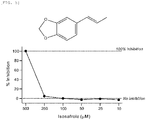
- isosafrole inhibition rates at each concentration of 500 ⁇ M to 10 ⁇ M as shown in FIG. 5 were calculated. For Compound Nos.
- inhibition rates were calculated at 100, 50, 25, 10 ⁇ M, and the lowest concentrations showing the inhibition rate of 100 ⁇ 25% and the inhibition rates are shown in FIG. 7 .
- inhibition rates were calculated at 250 ⁇ M or 50 ⁇ M, and the concentrations used and the inhibition rates are shown in FIG. 7 .
- Non-Patent Document 15 a trace amount of kainic acid was injected to a hippocampus to prepare hippocampal sclerosis model mouse ( FIG. 1A ). After 2 weeks or more from injection of kainic acid, morphological changes were observed in the hippocampus, the pyramidal cell layer became thin ( FIG. 1B ; CA1), and the dentate gyrus region became enlarged ( FIG. 1B ; DG).
- Non-Patent Document 15 This is the same finding as the already reported hippocampal sclerosis model mouse (Non-Patent Document 15), which is similar to the symptom observed in human hippocampal sclerosis (Non-Patent Document 16).
- Non-Patent Document 16 When recording on the hippocampus, spontaneous high-amplitude epileptic spikes were observed ( FIG. 1C ; arrowhead). That is, this hippocampal sclerosis model mouse is a chronic epilepsy model as reported in previous studies.
- stiripentol or isosafrole was intraperitoneally administered to this hippocampal sclerosis model mouse to examine the antiepileptic effect.
- Epileptic spikes were scarcely inhibited by intraperitoneal administration of stiripentol (300 mg/kg) ( Fig. 2A 2 ). This is consistent with the fact that stiripentol is only used as an antiepileptic drug against childhood epilepsy (Dravet syndrome).
- FIG. 3 Summary data on these antiepileptic effects are shown in FIG. 3 .
- isosafrole is an antiepileptic drug also effective for the refractory epilepsy model mouse.
- Compound No. 10 is a compound in which the hydroxyl group in stiripentol is substituted with a carbonyl group and one of the carbons of the tertiary butyl group is substituted with a hydroxy group.
- Compound Nos. 45-68 are compounds in which a C-C bond between the 2- and 3-position of the 1-propenyl group of isosafrole forms part of the ring structure (R d and R g in formula III together form a ring structure)( FIGS. 6-6 to 6-9 ). Specifically, the following compounds are included.
- Compounds (Nos. 45-58) which are bonded to a 5-membered ring through a C-C bond between the 2- and 3- position of the propenyl group.
- the constituent elements of the five-membered ring include not only carbon, but also heterocyclic rings composed of nitrogen, oxygen and sulfur are included. For all of Compound Nos.
- a carbonyl group is formed at the 3-position of the propenyl group.
- Compounds (Nos. 59 and 60) which are bonded to a quinuclidine structure through a C-C bond between the 2- and 3-position of the propenyl group.
- Compounds (Nos. 61-68) which are bound to a condensed ring comprising a five-membered ring and a six-membered ring via C-C bond between the 2- and 3-position of the propenyl group.
- a carbonyl group is formed at the 3-position of the propenyl group.
- some of Compound Nos. 45-68 have various substituents bound to positions other than the 5-position of the benzene ring of 1,3-benzodioxole of isosafrole.
- isosafrole has "lactate dehydrogenase inhibitory action" and is an "antiepileptic drug” effective for refractory epilepsy for which stiripentol is not effective. It was also revealed that many of the compounds having isosafrole as a scaffold have an inhibitory action on lactate dehydrogenase.
Landscapes
- Chemical & Material Sciences (AREA)
- Organic Chemistry (AREA)
- Health & Medical Sciences (AREA)
- Animal Behavior & Ethology (AREA)
- Veterinary Medicine (AREA)
- Public Health (AREA)
- Medicinal Chemistry (AREA)
- General Health & Medical Sciences (AREA)
- Pharmacology & Pharmacy (AREA)
- Life Sciences & Earth Sciences (AREA)
- Epidemiology (AREA)
- General Chemical & Material Sciences (AREA)
- Nuclear Medicine, Radiotherapy & Molecular Imaging (AREA)
- Engineering & Computer Science (AREA)
- Chemical Kinetics & Catalysis (AREA)
- Bioinformatics & Cheminformatics (AREA)
- Pain & Pain Management (AREA)
- Biomedical Technology (AREA)
- Neurology (AREA)
- Neurosurgery (AREA)
- Pharmaceuticals Containing Other Organic And Inorganic Compounds (AREA)
- Acyclic And Carbocyclic Compounds In Medicinal Compositions (AREA)
Abstract
Description
- The present invention relates to a lactate dehydrogenase inhibitor and an antiepileptic drug containing isosafrole (or a derivative thereof) as an active ingredient.
- Epilepsy is a neurological disorder caused by excessive excitation of electric activity in the brain and is diagnosed by a characteristic electroencephalogram (epileptic electroencephalogram). The prevalence of epilepsy is high, reaching about 1% of the total population. Treatment methods for epilepsy mainly include drug therapy, and more than 20 types of therapeutic drugs for epilepsy are used in clinical settings (Non-Patent Document 1). However, it is known that these existing therapeutic drugs for epilepsy do not work for about 30% of patients with epilepsy. From such a background, therapeutic drags for "refractory epilepsy" for which existing drugs do not work are currently needed.
- Since epilepsy is caused by excessive neural excitation, therapeutic drugs for epilepsy are mostly targeted to molecules that control electrical activity. Specific examples include ion channels, synaptic receptors, and neurotransmitter transporters (Non- Patent Document 2). On the other hand, it is clinically known that "diet therapy" called ketogenic diet treatment is effective for some epilepsy patients for whom these existing drugs do not work (Non-Patent Document 3). Recently, anti-epileptic mechanisms mediated by the ketogenic diet have been revealed one after another (Non-Patent
Documents 4 to 6). That is, if a drug acting on the energy metabolic pathway is developed, it is promising as a drug for refractory epilepsy. - Stiripentol (CAS: 49763-96-4, 4-dimethyl-1-[(3, 4-methylenedioxy)-phenyl]-1-penten-3-ol, see formula (I) below) is an antiepileptic drug. Stiripentol was first developed as a brain disease drug (Patent Document 1), and it was then shown to be effective for Dravet syndrome (one of childhood epilepsies) which is one of refractory epilepsies (
Non-Patent Documents 7 and 8). Stiripentol is now clinically used as a drug for Dravet syndrome in Europe (approved in 2007) and Japan (approved in 2012) under the trade name of Diacomit. However, although stiripentol therapy was successful in Dravet syndrome, it has not been successful at present in clinical trials for other epilepsies (especially adult epilepsies) (Non-Patent Document 9). - Recently, it has been reported that stiripentol is an inhibitor of lactate dehydrogenase (LDH) (Patent Document 2). Lactate dehydrogenase is a "metabolic enzyme" existing "on the energy metabolic pathway" and carrying out interconversion between lactate and pyruvate. Lactate dehydrogenase inhibitors themselves have been developed mainly for the purpose of development of antimalarial drugs (
Non-Patent Documents 10 and 11), and development of anticancer drugs (Non-PatentDocuments 12 and 13). However, it is unknown whether these lactate dehydrogenase inhibitors have antiepileptic effects. That is, at this time, stiripentol is the only "antiepileptic drug" having "lactate dehydrogenase inhibitory action".
-
- Patent Document 1:
U.S. Patent No. 3910959 - Patent Document 2:
WO2014/115764 -
- Non-Patent Document 1: Sirven et al, Mayo Clin Proc 87: 879-889, 2012
- Non-Patent Document 2: Meldrum et al, Neurotherapeutics 4: 18-61, 2007
- Non-Patent Document 3: Neal et al, Lancet Neurol 7: 500-506, 2008
- Non-Patent Document 4: Ma et al, J Neurosci 27: 3618-3625, 2007
- Non-Patent Document 5: Juge et al, Neuron 68: 99-112, 2010
- Non-Patent Document 6: Masino et al, J Clin Invest 121: 2679-2683, 2011
- Non-Patent Document 7: Perez et al, Epilepsia 40: 1618-1626, 1999
- Non-Patent Document 8: Chiron et al, Lancet 356: 1638-1642, 2000
- Non-Patent Document 9: Chiron, Neurotherapeutics 4: 123-125, 2007
- Non-Patent Document 10: Deck et al, J Med Chem 41: 3879-3887, 1998
- Non-Patent Document 11: Cameron et al, J Biol Chem 279: 31429-31439, 2004
- Non-Patent Document 12: Granchi et al, J Med Chem 54: 1599-1612, 2011
- Non-Patent Document 13: Farabegoli et al, Eur J Pharm Sci 47: 729-738, 2012
- Non-Patent Document 14: Aboul-Enein et al, Eur J Med Chem 47: 360-369, 2012
- Non-Patent Document 15: Riban et al, Neuroscience 112: 101-111, 2002
- Non-Patent Document 16: Houser, Brain Res 535: 195-204, 1990
- Non-Patent Document 17: Shen et al, Epilepsy Res 7: 40-48, 1990
- Stiripentol has an aromatic allyl alcohol structure and has a chemical structure not found in conventional antiepileptic drugs (Patent Document 1). Moreover, stiripentol is the only compound as "antiepileptic drug having lactic dehydrogenase inhibitory action" (Patent Document 2). Antiepileptic drugs acting on metabolic pathways (metabolic enzymes) are promising as a therapeutic drug for refractory epilepsy. However, although stiripentol is effective for some childhood refractory epilepsies (Dravet syndrome), it is not used for other refractory epilepsies. Thus, by maintaining the lactate dehydrogenase inhibitory activity and modifying the chemical structure of stiripentol, it is expected that "antiepileptic drugs" can be developed which are also effective for refractory epilepsies for which stiripentol is not effective. In addition, such antiepileptic drugs have very high industrial utility value.
- However, it is not easy to assume at the current technological level how to alter the chemical structure to make stiripentol effective for refractory epilepsies for which stiripentol is not effective. Therefore, an object of the present invention is to provide an antiepileptic drug having "lactate dehydrogenase inhibitory action" and also effective for refractory epilepsies for which stiripentol is not effective.
- The present inventors hypothesized that "hydroxy group at the 3-position" (Patent Document 1) which characterizes stiripentol (aromatic allyl alcohol) and "functional group at the 3-position" reported in the prior art (Non-Patent Document 14) are rather unnecessary. Therefore, they focused on isosafrole (CAS: 120-58-1, 5-(1-propenyl)-1, 3-benzodioxole, see formula (II) below) which is a substance obtained by removing the hydroxy group and the tertiary butyl group from the 3-position of stiripentol. They have revealed that this isosafrole has an inhibitory action on lactate dehydrogenase. In addition, they identified a number of "lactate dehydrogenase inhibitors having isosafrole as a scaffold" with a completely different chemical structure from stiripentol. Moreover, they found that inhibitors of lactate dehydrogenase such as isosafrole remarkably suppressed adult refractory epilepsy (medial temporal lobe epilepsy associated with hippocampal sclerosis) which can not be suppressed by stiripentol, thereby completing the present invention.

- In one aspect, the present invention provides the following invention:
- [1] A lactate dehydrogenase inhibitor containing a compound represented by formula (III).

- Ra represents a hydrogen atom, a halogen atom or alkoxy optionally substituted with halogen atoms;
- Rb represents a hydrogen atom, a halogen atom, alkoxy optionally substituted with halogen atoms or nitro, or represents a group which together with Rc, Rd or Rg forms a ring structure optionally having substituents;
- Rc represents a hydrogen atom or carboxyl, or represents a group which together with Rb, Re·Rf or Rg forms a ring structure optionally having substituents;
- Rd represents a hydrogen atom or -X11-R11, or represents a group which together with Rb or Rg forms a ring structure optionally having substituents;
- X11 represents alkylene, -NH-CO-, -CH2-NR12-CO- or -S-;
- R11 represents aryl optionally having substituents, carboxyl, alkyl optionally substituted with halogen atoms, or hydroxyalkyl;
- R12 represents hydroxyalkyl;
- for Re, Rf and Rg:
- (i) all represent a hydrogen atom; or
- (ii) Re and Rf together represent =O, =NR21 or =CR21R22, and Rg represents a hydrogen atom, -X31-R31, -O-X32-R32, -N(-X33-R33)(-X34-R34), -CR35R36R37;
- R21 represents hydroxy, or represents a group which together with Rc or Rg forms a ring structure optionally having substituents;
- R22 represents nitro, or aminocarbonyl in which a hydrogen atom bound to a nitrogen atom may be substituted with alkyl;
- X31 represents a single bond, alkenylene, -CH2-O-CH2-CO-NH-, -CH2-O-CH2-CO- or -CO-;
- R31 represents aryl optionally having substituents, heteroaryl optionally having substituents, cycloalkyl optionally having substituents, heterocyclic amino optionally having substituents, hydroxy, alkoxy optionally substituted with halogen atoms, or hydroxyalkyl;
- wherein, when X31 is a single bond and R31 is heterocyclic amino optionally having substituents, the single bond is bound to an atom other than the nitrogen atom of the heterocyclic amino;
- X32 represents a single bond or -CH2-CO-NH-;
- R32 represents aryl optionally having substituents, heteroaryl optionally having substituents, cycloalkyl optionally having substituents or alkyl optionally substituted with halogen atoms;
- X33 and X34 each independently represent a single bond, alkylene, -CH2-CO-NH- or -SO2-;
- R33 and R34 each independently represent a hydrogen atom, aryl optionally having substituents, heteroaryl optionally having substituents, cycloalkyl optionally having substituents, hydroxylalkyl, carboxyl, alkyl optionally substituted with halogen atoms or alkynyl group, or represent a group which together with Rb, Rc, Rd or Re·Rf forms a ring structure optionally having substituents, or R33 and R34, together with the nitrogen atom to which they are bound through X33 and X34 which are single bonds, represent heterocyclic amino optionally having substituents;
- R35, R36 and R37 each independently represent a hydrogen atom or -X31-R31, or represent a group which together with Rb, Rc, Rd or Re·Rf forms a ring structure optionally having substituents;
- Rh represents a hydrogen atom or a halogen atom;
- wherein the number of the ring structure formed by binding between Rb and Rc, the ring structure formed by binding between Rb and Rd, the ring structure formed by binding between Rb and Rg, the ring structure formed by binding between Rc and Re·Rf, the ring structure formed by binding between Rc and Rg, the ring structure formed by binding between Rd and Rg, or the ring structure formed by binding between Re·Rf and Rg formed in formula (III) is no more than one.
- [2] The lactate dehydrogenase inhibitor described in [1], wherein the compound represented by formula (III) is a compound in which Rc, Rd, Re, Rf, and Rg are all hydrogen atoms.
- [3] The lactate dehydrogenase inhibitor described in [1], wherein the compound represented by formula (III) is isosafrole represented by formula (II).

- [4] The lactate dehydrogenase inhibitor described in [1], wherein the compound represented by formula (III) is a compound in which any of the ring structure formed by binding between Rb and Rc, the ring structure formed by binding between Rb and Rd, the ring structure formed by binding between Rb and Rg, the ring structure formed by binding between Rc and Re·Rf, the ring structure formed by binding between Rc and Rg, the ring structure formed by binding between Rd and Rg, and the ring structure formed by binding between Re·Rf and Rg is not formed.
- [5] The lactate dehydrogenase inhibitor described in [1], wherein the compound represented by formula (III) is a compound in which any one of the ring structure formed by binding between Rb and Rc, the ring structure formed by binding between Rb and Rd, the ring structure formed by binding between Rb and Rg, the ring structure formed by binding between Rc and Re·Rf, the ring structure formed by binding between Rc and Rg, the ring structure formed by binding between Rd and Rg, and the ring structure formed by binding between Re·Rf and Rg is formed.
- [6] An antiepileptic drug containing the lactate dehydrogenase inhibitor described in any one of [1] to [5] as active ingredient.
- Stiripentol is the only "antiepileptic drug" having "lactate dehydrogenase inhibitory action" (
Patent Documents 1 and 2). However, stiripentol is clinically effective only for some childhood refractory epilepsy (Dravet syndrome). We newly found isosafrole as a second "antiepileptic drug" having "lactate dehydrogenase inhibitory action". Isosafrole dramatically inhibited refractory epilepsy to which stiripentol is ineffective (medial temporal lobe epilepsy, an adult refractory epilepsy). In addition, we have also discovered a number of lactate dehydrogenase inhibitors having isosafrole as a scaffold. Thus, isosafrole and derivatives of isosafrole are industrially available as a therapeutic agent for epilepsy. -
-
FIG. 1 shows a hippocampal sclerosis model mouse (see Examples).- A: Preparation method of hippocampal sclerosis model mouse. B: Morphology of normal hippocampus (left) and hippocampus exhibiting hippocampal sclerosis (right). The white arrow indicates a trace of recording electrode. C: Epileptic spikes recorded from hippocampal sclerosis model mouse (arrowhead).
-
FIG. 2 shows effects of stiripentol and isosafrole on epileptic spikes of hippocampal sclerosis model mice (see Examples). A: Chemical structure of stiripentol (A1) and effect of stiripentol on epileptic spikes (A2). B: Chemical structure of isosafrole (B1) and effect of isosafrole on epileptic spikes (B2). Although almost no inhibitory effect by stiripentol is observed, isosafrole shows a remarkable inhibitory effect on epilepsy. -
FIG. 3 shows a summary data on inhibitory effects of sodium oxamate, stiripentol and isosafrole on epileptic spikes of hippocampal sclerosis model mice (see Examples). -
FIG. 4 shows inhibitory effects of isosafrole on enzymatic activities of lactate dehydrogenases (LDH-1 and LDH-5) (see Examples). The enzyme activity when isosafrole was absent (control value) was taken as 100%. That is, 0% indicates that lactate dehydrogenase is completely inhibited. -
FIG. 5 shows a concentration dependence data on the inhibitory effect of isosafrole on the enzymatic activity of lactate dehydrogenase (LDH-5) (see Examples). The structural formula of isosafrole is shown in the upper row. The ordinate of the graph indicates the inhibition rate (% Inhibition), 100% indicates that lactate dehydrogenase is completely inhibited, and 0% indicates that lactate dehydrogenase is not inhibited at all. For calculation of inhibition rate, see Examples. Isosafrole inhibits lactate dehydrogenase at 500 µM but not at 250 µM. -
FIG. 6 shows compounds having isosafrole as a scaffold, which have a stronger inhibitory effect on lactate dehydrogenase compared with that of isosafrole (see Examples). Compounds exhibiting 100% (± 25%) inhibition rate (% Inhibition) at 250 µM or less are shown. -
FIG. 7 shows inhibitory concentrations (µM) against lactate dehydrogenase and their inhibition rate (% Inhibition) for the compounds having isosafrole as a scaffold as shown inFIG. 6 (see Examples). - The present invention provides lactate dehydrogenase inhibitors described in (a) and pharmaceuticals containing the same as an active ingredient described in (b) below.
- (a) A lactate dehydrogenase inhibitor containing isosafrole or a compound having isosafrole as a scaffold (also herein referred to as "isosafrole analog").
- (b) An antiepileptic drug containing the lactate dehydrogenase inhibitor described in (a) as an active ingredient.
- As shown in formula (II), isosafrole has a chemical structure in which a 1-propenyl group is attached to the 5-position of 1,3-benzodioxole which is an aromatic ring. The formula (II) representing isosafrole corresponds to the case where all of Ra, Rb, Rc, Rd, Re, Rf, Rg and Rh in formula (III) are represented by hydrogen atoms.
- On the other hand, examples of the compound containing isosafrole as a scaffold (isosafrole analog) include, for example, those in which the propenyl group is modified and those in which 1,3-benzodioxole, an aromatic ring, is functionalized. However, the compound is not particularly limited as long as it is a compound having isosafrole as a scaffold and has a lactate dehydrogenase inhibitory activity, and can be used as an antiepileptic drug.
- Isosafrole and isosafrole analogs are compounds which can be represented by formula (III). Although several stereoisomers of the compound represented by formula (III) may exist, any of the stereoisomers are included. In the present invention, a mixture (racemate) of a plurality of stereoisomers may be used or a purified product of any of stereoisomers may be used as a lactate dehydrogenase inhibitor, and further as an active ingredient of an antiepileptic drug. Those skilled in the art could appropriately judge which of the racemate and each stereoisomer should be used, through testing the effectiveness of each stereoisomer as needed and taking purification costs into consideration.

- The definitions of the symbols included in formula (III) are as follows. Specific examples and other explanations of the terms used in the definitions of certain symbols (for example, halogen atom at Ra) apply equally to the same terms used in the definitions of other symbols (for example, halogen atom at Rb).
- Ra represents a hydrogen atom, a halogen atom or alkoxy optionally substituted with halogen atoms.
- Examples of the halogen atom include fluorine (F), chlorine (Cl), bromine (Br) and iodine (I).
- Examples of the alkoxy group include groups derived from lower alcohols having about 1 to 4 carbon atoms, such as methoxy (-OCH3) and ethoxy (-OC2H5). In the alkoxy group, part or all of hydrogen atoms may be substituted with halogen atoms or may not be substituted at all. The alkyl group moiety in the alkoxy group may be linear or branched.
- Rb represents a hydrogen atom, a halogen atom, alkoxy optionally substituted with halogen atoms or nitro (-NO2), or represents a group which together with Rc, Rd or Rg forms a ring structure optionally having substituents.
- Rc represents a hydrogen atom or carboxyl (-COOH), or represents a group which together with Rb, Re·Rf or Rg forms a ring structure optionally having substituents.
- The carboxyl group may be in the form of a carboxylate anion (-COO-).
- Rd represents a hydrogen atom or -X11-R11, or represents a group which together with Rb or Rg forms a ring structure optionally having substituents.
- X11 represents alkylene, -NH-CO-, -CH2-NR12-CO- or -S-.
- Examples of the alkylene group include divalent groups derived from lower alkyl groups having about 1 to 6 carbon atoms, such as methylene (-CH2-) and ethylene (-C2H5-).
- R11 represents aryl optionally having substituents, carboxyl, alkyl optionally substituted with halogen atoms, or hydroxyalkyl.
- Examples of the aryl group include phenyl (-C6H5) and naphthyl (-C10Hg).
- Examples of the substituent of the aryl group include a halogen atom, alkyl optionally substituted with halogen atoms, alkoxy optionally substituted with halogen atoms, hydroxy, thioalkoxy (-SR), carboxyl, aryl optionally having substituents, heteroaryl optionally having substituents, and cycloalkyl optionally having substituents. The number of substituents and the site to which the substituent is introduced are optionally selected and can be appropriately selected depending on the nature of the substituent.
- Examples of the alkyl group include lower alkyl groups having about 1 to 6 carbon atoms such as methyl, ethyl, propyl, butyl, pentyl and octyl. The alkyl group may be linear (n-alkyl) or branched (i-, sec-, tert-alkyl). In the alkyl group, part or all of hydrogen atoms may be substituted with halogen atoms or may not be substituted at all.
- Examples of the hydroxyalkyl group include groups derived from lower alcohols having about 1 to 4 carbon atoms, such as oxymethyl (-CH2OH) and oxyethyl (-C2H5OH). The alkyl group moiety in the hydroxyalkyl group may be linear or branched. The number and the site of the hydroxy groups are optionally selected.
- R12 represents hydroxyalkyl.
- Re and Rf each independently represent a hydrogen atom, hydroxy or alkyl optionally substituted with a halogen atom, or together represent =O, =NR21, =CR21R22.
- R21 represents hydroxy, or represents a group which together with Rc or Rg forms a ring structure optionally having substituents.
- R22 represents nitro, or aminocarbonyl in which two hydrogen atoms bound to a nitrogen atom may be each independently substituted with alkyl.
- Rg represents a hydrogen atom, -X31-R31, -O-X32-R32, -N(-X33-R33) (-X34-R34), -CR35R36R37.
- X31 represents a single bond, alkenylene, -CH2-O-CH2-CO-NH-, -CH2-O-CH2-CO- or -CO-.
- Examples of the alkenylene group include divalent groups derived from lower alkenyl groups having about 2 to 6 carbon atoms, such as 1-propenylene (-CH=CH-CH2-) and 2-propenylene (-CH-CH=CH2-). The number and the position of the carbon-carbon double bonds are optionally selected.
- R31 represents aryl optionally having substituents, heteroaryl optionally having substituents, cycloalkyl optionally having substituents, heterocyclic amino optionally having substituents, hydroxy, alkoxy optionally substituted with halogen atoms, or hydroxyalkyl;
- When X31 is a single bond and R31 is heterocyclic amino optionally having substituents, the single bond is bound to an atom other than the nitrogen atom of the heterocyclic amino (this provision is for avoiding duplication of -X31-R31 with -N(-X33-R33) (-X34-R34) when "R33 and R34, together with the nitrogen atom to which they are bound through X33 and X34 which are single bonds, represent heterocyclic amino optionally having substituents" as will be described later).
- Examples of the heteroaryl group include pyridyl (-C5H5N), pyrazinyl (-C4H3N2), triazinyl (-C3H2N3), tetrazinyl (-C2HN4), pyrrolyl (-C4H4N), thienyl (-C4H3S), furanyl (-C4H3O), 1,3-benzodioxole, a group possessed by Compound No. 26, and a group possessed by Compound No. 34. Regarding examples, the number and the position of substituents possessed by the heteroaryl group, the same thing as the above-mentioned substituent possessed by aryl can be said.
- Examples of the cycloalkyl group include those having about 1 to 6 carbon atoms such as cyclopropyl, cyclobutyl, cyclopentyl and cyclohexyl. Regarding examples, the number and the position of substituents possessed by the cycloalkyl group, the same thing as the above-mentioned substituent possessed by aryl can be said.
- Examples of the heterocyclic amino group include pyrrolidinyl (-C4H8N), piperidinyl (-CSH10N), piperazinyl (-C4H9N2), and a group possessed by the Compound No. 70 (see
FIG. 6-10 ). Regarding examples, the number and the position of substituents optionally possessed by the heterocyclic amino group, the same thing as the above-mentioned substituent possessed by aryl can be said. For example, when the heterocyclic amino group is piperazinyl, examples of the substituent include phenyl optionally having a substituent (such as a halogen atom or a halogenated alkyl group). - X32 represents a single bond or -CH2-CO-NH-.
- R32 represents aryl optionally having substituents, heteroaryl optionally having substituents, cycloalkyl optionally having substituents or alkyl optionally substituted with halogen atoms.
- X33 and X34 each independently represent a single bond, alkylene, -CH2-CO-NH- or -SO2-.
- R33 and R34 each independently represent a hydrogen atom, aryl optionally having substituents, heteroaryl optionally having substituents, cycloalkyl optionally having substituents, hydroxylalkyl, carboxyl, alkyl optionally substituted with halogen atoms or alkynyl group, or represent a group which together with Rb, Rc, Rd or Re·Rf forms a ring structure optionally having substituents, or R33 and R34, together with the nitrogen atom to which they are bound through X33 and X34 which are single bonds, represent heterocyclic amino optionally having substituents.
- Examples of the alkynyl group include lower alkynyl groups having about 2 to 6 carbon atoms such as 2,3-propynyl (-CH2-C≡CH). The number and the position of the carbon-carbon triple bonds are optionally selected.
- When Rg represented by -N (-X33-R33) (-X34-R34) is a group which together with Rb, Rc, Rd or Re·Rf forms a ring structure, one of -X33-R33 and -X34-R34 may be linked with Rb, Rc, Rd or Re·Rf to form the ring structure, and the other (particularly, other than a hydrogen atom) may be in a form corresponding to a substituent bonded to N contained in the ring structure (Compound No. 57 (see
FIG. 6-8 ) and Compound No. 91 (seeFIG. 6-13 )), or a form may be taken such that -X33-R33 and -X34-R34 together with Rb, Rc, Rd or Re·Rf form a ring structure (Compound No. 55 (seeFIG. 6-7 ), which includes a double bond derived from R33 and R34). - R35, R36 and R37 each independently represent a hydrogen atom or -X31-R31, or represent a group which together with Rb, Rc, Rd or Re·Rf forms a ring structure optionally having substituents.
- When Rg represented by -CR35R36R37 is a group which together with Rb, Rc, Rd or Re·Rf forms a cyclic structure, one or two of R35, R36 and R37 may be linked with Rb, Rc, Rd or Re·Rf to form the ring structure, and the remainings group (particularly, other than a hydrogen atom) may be in a form corresponding to a substituent bonded to C contained in the cyclic structure (Compound No. 54 (see
FIG. 6-7 ), which includes a double bond derived from R35 and R36 and a substituent derived from R37; Compound Nos. 59 and 60 (seeFIG. 6-8 ), which include two bonds in the quinuclidine structure derived from R35 and R36, respectively). Similarly, when Rg represented by -CR35R36R37 is a group which together with Rb, Rc, Rd or Re·Rf forms a ring structure such as condensed ring, one or two selected from R35, R36 and R37 are linked with Rb, Rc, Rd or Re·Rf as described above to form a part of the ring structure (one side of the condensed ring), and the remaining groups may represent groups which link to one of the atoms forming the backbone of the ring structure to form a further part of the ring structure (the other side of the condensed ring) (Compound Nos. 61 to 65 (seeFIG. 6-9 )). - Rh represents a hydrogen atom or a halogen atom.
- Only at most one of the following is formed in formula (III): a ring structure formed by binding between Rb and Rc, a ring structure formed by binding between Rb and Rd, a ring structure formed by binding between Rb and Rg, a ring structure formed by binding between Rc and Re·Rf (R21 of =NR21 or =CR21R22), a ring structure formed by binding between Rc and Rg (R33 or R34 of -N(-X33-R33) (-X34-R34), or R35, R36 or R37 of-CR35R36R37), a ring structure formed by binding between Rd and Rg, a ring structure formed by binding between Re·Rf and Rg. That is, for example, a ring structure formed by binding between Rb and Rc and a ring structure formed by binding between Rb and Rd are not formed at the same time, and in the case where the former is formed, Rd represents a hydrogen atom or -X11-R11 (a group forming a ring structure together with Rb is not represented).
- When Rg is a hydrogen atom, Re and Rf are also limited to hydrogen atoms. That is, the definition that Rg is a hydrogen atom is intended to include, in the compound represented by the formula (III), isosafrole and derivatives thereof in which Re, Rf and Rg are all hydrogen atoms. Stiripentol, which is in a combination of Re being hydroxy, Rf being alkyl (t-butyl) and Rg being a hydrogen atom, is not included in the compound represented by the formula (III).
- Specific examples of the compound represented by formula (III) include the compounds (Nos. 1 to 94) listed in
FIGS. 6-1 to 6-13 . Among them, compounds having a predetermined ring structure (Ringbc, Ringbd, Ringbg, Ringcef, Ringcg, Ringdg or Ringefg) are Nos. 44 to 94 (see the corresponding table below), and compounds having no ring structure are Nos. 1 to 43. Any of the Compound Nos. 1 to 94 and the other compounds represented by the formula (III) can be obtained or synthesized according to known methods by one skilled in the art.Table 1 Ring structure Compound No. none 1-13,14,15-17,18-34, 35-38, 39, 40-43 Rb and Rc together form a ring structure (Ringbc) (see formula III-bc) 93, 94 Rb and Rd together form a ring structure (Ringbd) (see formula III-bd) 92 R b and Rg together form a ring structure (Ringbd) (see formula III-bg) Rg: -N(-X33-R33)(-X34-R34) 88-90, 91 Rc and Re·Rf together form a ring structure (Ringcef) (see formula III-cef) 69-81, 82 Rc and Rg together form a ring structure (Ringcg) (see formula III-cg) Rg: -CR35R36R37 83-85, 86, 87 Rd and Rg together form a ring structure (Ringdg) (see formula III-dg) Rg: -N(-X33-R33)(-X34-R34) 45-47, 48-52, 55, 56, 57, 58, 66-68 Rg: -O-X32-R32 53 Rg: -CR35R36R37 54, 59, 60, 61-65, Re·Rf and Rg together form a ring structure (Ringefg) (see formula III-efg) Rg: -N(-X33-R33)(-X34-R34) 44 - One preferred embodiment of the present invention includes isosafrole or an analog thereof, which is close to the original structure of isosafrole, wherein all of Re, Rf and Rg are hydrogen atoms, and wherein Rc and Rd are also hydrogen atoms. That is, compounds are preferred, wherein the carbon atom at the 3-position of the propenyl group in formula (III), and further the carbon atoms at the 1-position and the 2-position are not modified, and wherein only the 1,3-benzodioxole portion may be modified (Ra, Rb, Rh may be other than a hydrogen atom).
- As one preferred embodiment of the present invention, embodiments wherein Re and Rf together represent =O, =NR21 or =CR21R22 and wherein Rg represents -X31-R31, -O-X32-R32, -N(-X33-R33) (-X34-R34) or -CR35R36R37 are preferred, and among them, particularly preferred are embodiments wherein Re and Rf together represent =O, to which many compounds belong.
- One preferred embodiment of the present invention includes isosafrole analogs in which none of the following are formed in formula (III): a ring structure formed by binding between Rb and Rc, a ring structure formed by binding between Rb and Rd, a ring structure formed by binding between Rb and Rg, a ring structure formed by binding between Rc and Re·Rf, a ring structure formed by binding between Rc and Rg, a ring structure formed by binding between Rd and Rg, a ring structure formed by binding between Re·Rf and Rg. Specific examples of such isosafrole analogs are isosafrole and Compound Nos. 1 to 44.
- One preferred embodiment of the present invention includes isosafrole analogs in which any of the following is formed in formula (III): a ring structure formed by binding between Rb and Rc, a ring structure formed by binding between Rb and Rd, a ring structure formed by binding between Rb and Rg, a ring structure formed by binding between Rc and Re·Rf, a ring structure formed by binding between Rc and Rg, a ring structure formed by binding between Rd and Rg, a ring structure formed by binding between Re·Rf and Rg.
- When Rb and Rc form a ring structure, formula (III) can also be described as formula (III-bc) below. In the formula (III-bc), the Rbc group which is connected via dotted lines to each of the carbon atom on 1,3-benzodioxole originally bound with Rb and the carbon atom on the propenyl group originally bound with Rc represents a group in which Rb and Rc together form a ring structure (Ringbc) optionally having substituents, and the definitions of the other symbols are the same as those in the formula (III).

- When Rb and Rd form a ring structure, formula (III) can also be described as formula (III-bd) below. In the formula (III-bd), the Rbd group which is connected via dotted lines to each of the carbon atom on 1,3-benzodioxole originally bound with Rb and the carbon atom on the propenyl group originally bound with Rd represents a group in which Rb and Rd together form a ring structure (Ringbd) optionally having substituents, and the definitions of the other symbols are the same as those in the formula (III).

- When Rb and Rg form a ring structure, formula (III) can also be described as formula (III-bg) below. In the formula (III-bg), the Rbg group which is connected via dotted lines to each of the carbon atom on 1,3-benzodioxole originally bound with Rb and the carbon atom on the propenyl group originally bound with Rg represents a group in which Rb and Rg together form a ring structure (Ringbg) optionally having substituents, and the definitions of the other symbols are the same as those in the formula (III).

- When Rc and Re·Rf form a ring structure, formula (III) can also be described as formula (III-cef) below. In the formula (III- cef), the Rcef group which is connected via dotted lines to each of the carbon atoms on the propenyl group originally bound with Rc and Rg represents a group in which Rc and Re·Rf together form a ring structure (Ringcef) optionally having substituents, and the definitions of the other symbols are the same as those in the formula (III).

- When Rc and Rg form a ring structure, formula (III) can also be described as formula (III-cg) below. In the formula (III- cg), the Rcg group which is connected via dotted lines to each of the carbon atoms on the propenyl group originally bound with Rc and Rg represents a group in which Rc and Rg together form a ring structure (Ringcg) optionally having substituents, and the definitions of the other symbols are the same as those in the formula (III).

- When Rd and R g form a ring structure, formula (III) can also be described as formula (III-dg) below. In the formula (III-dg), the Rdg group which is connected via dotted lines to each of the carbon atoms on the propenyl group originally bound with Rd and Rg represents a group in which Rd and Rg together form a ring structure (Ringdg) optionally having substituents, and the definitions of the other symbols are the same as those in the formula (III).

- When Re·Rf and Rg form a ring structure, formula (III) can also be described as formula (III-efg) below. In the formula (III-efg), the Refg group which is connected via dotted lines to each of the carbon atoms on the propenyl group originally bound with Re·Rf and Rg represents a group in which Re·Rf and Rg together form a ring structure (Ringefg) optionally having substituents, and the definitions of the other symbols are the same as those in the formula (III).

- Rbc, Rbd, Rbg, Rcef, Rcg, Rdg and Refg each contain at least one carbon atom, nitrogen atom, oxygen atom or sulfur atom as atoms forming part of the backbone of Ringbc, Ringbd, Ringbg, Ringcef, Ringcg, Ringdg and Ringefg, respectively. Each ring (ring structure) is preferably a five-membered ring, a six-membered ring, a seven-membered ring or a condensed ring thereof (Compound Nos. 59 and 60 (
FIG. 6-8 ) (quinuclidine structure), Compounds 61 to 65 and 66 to 68 (FIG. 6-9 ), Compounds 86 and 87 (seeFIG. 6-12 )) or a spiro ring (Compound No. 94 (seeFIG. 6-13 )). The atoms forming the backbone of the ring structure may be connected through any of a single bond, a double bond, and a triple bond, and the ring structure may be aromatic or non-aromatic. - Each atom forming the backbone of the ring structure may be bound with a hydrogen atom or a halogen atom, or may be bound with a substituent. As the substituent possessed by the ring structure, for example, the above-described substituents exemplified as the substituents of the aryl group, an oxygen atom or nitrogen atom bonded through a double bond (Compound Nos. 48 to 52 (see
FIGS 6-6 and6-7 )), or other relatively large substituents (for example, groups represented as R1 of Compound Nos. 45 to 47 and 58 (FIG. 6-6 ), groups represented as R4 of Compound Nos. 48 to 52 (FIGS. 6-6 and6-7 ), groups represented in Compound No. 55 (FIG. 6-7 ), groups represented in Compound No. 58 (FIG. 6-8 ), groups represented as R3 of Compound Nos. 61 and 64 (seeFIG. 6-9 )) may be bound. A portion (branched portion) corresponding to such substituents is also included in a part of the groups each represented by Rbc, Rbd, Rbg, Rcef, Rcg, Rdg and Refg. - The type of epilepsy targeted by the pharmaceutical agent of the present invention is not particularly limited as long as it is epilepsy. In Examples, it is shown as an example that the pharmaceutical agent has an excellent antiepileptic effect on "medial temporal lobe epilepsy associated with hippocampal sclerosis" which is adult refractory epilepsy.
- Pharmaceutical agents are usually prepared as pharmaceutical compositions. The pharmaceutical agents of the present invention may contain other drugs or functional compounds as necessary in addition to the active ingredient. For example, pharmaceutical agents containing other compounds that improve the in vivo pharmacokinetics of the active ingredient are contemplated. In addition, excipients, diluents, additives and the like necessary for preparing pharmaceutical agents may be contained.
- The dosage form and administration method of the pharmaceutical agent are not particularly limited, and may be appropriately selected depending on the use of the pharmaceutical agent. Examples of the administration method include oral preparation and injection. For oral preparation, it can be selected from tablets, capsules, granules, powders or dry syrup, for example. Also, for injection, a formulation dissolved in an optional diluent (e.g., physiologic saline or dextrose solution) is contemplated.
- The pharmaceutical agent of the present invention may be administered in an appropriate amount of active ingredient and at an appropriate number of times in consideration of, for example, the purpose, the age, gender, body weight of the subject to be administered (patient), severity of the disease and route of administration. A person skilled in the art such as doctor or pharmacist could determine the dose based on the state of each patient.
- Preparation and measurement of hippocampal sclerosis model mouse (
FIGS. 1 to 3 ): The hippocampal sclerosis model mouse was prepared according to a previous literature (Non-Patent Document 15). Six to seven-week-old ICR mice were used for the experiment. Mice were fully anesthetized with a mixture of ketamine (100 mg/kg) and xylazine (20 mg/kg) and then set on a brain stereotaxic apparatus. Using a micro glass electrode and a Hamilton syringe from above the hippocampus of the head, a trace amount of kainate (0.8 nmol, 40 nL) for inducing epilepsy was injected into the dorsal hippocampus (1.6 mm behind the bregma, 1.6 mm laterally from the centerline, 1.4 mm deep from the brain surface), and then a metal electrode (a diameter of 200 µm) for epileptic electroencephalography was embedded near the kainic acid injection site. In addition, a small plastic U-shaped frame for head fixation required for in vivo electrical measurements was also attached to the head. After 2 weeks or more from surgery, epileptic spikes in the hippocampus were measured. The head was fixed via the U-shaped frame. Epileptic spikes were amplified, then measured via a bandpass filter (0.5-30 Hz) and taken into a computer using an AD converter. After measurement of the baseline electroencephalogram for 30 minutes, stiripentol (300 mg/kg), isosafrole (100-300 mg/kg), sodium oxamate (250-500 mg/kg), or physiological saline was intraperitoneally administered, and then further recording was conducted for 1 hour. Sodium oxamate was dissolved in water, and stiripentol and isosafrole were dissolved in sodium carboxymethyl cellulose (1%) and administered intraperitoneally. In data analysis, high-amplitude epilepsy spikes with an amplitude of 0.5 mV or more were counted 30 minutes before and after administration, respectively, and the efficacy was evaluated by normalization using the number of epileptic spikes before administration. In the observation of morphological changes due to hippocampal sclerosis, the brain was sliced to 300 µm thickness, fixed with 10% formalin, and stained with 0.05% cresylviolet. - Evaluation of inhibition of lactate dehydrogenase by isosafrole (
FIG. 4 ): The activity of lactate dehydrogenase was measured by a versatile method based on light absorption of NADH. Lactate dehydrogenase is an enzyme that interconverts pyruvate and lactate. At that time, NADH and NAD are also interconverted. For lactate dehydrogenase activity from lactate to pyruvate, lactate (20 mM), NAD (200 µM) and lactate dehydrogenase were added and the reaction rate of NADH produced was measured. On the other hand, for the lactate dehydrogenase activity from pyruvate to lactate, pyruvate (1.0 mM), NADH (200 µM) and lactate dehydrogenase were added and the reaction rate of decreasing NADH was measured. Both reactions were carried out at 37°C in 100 mM sodium phosphate buffer (pH7.3). The light absorption of NADH at 340 nm was measured using an absorptiometer at 30 second intervals for 3.5 minutes to determine the reaction rate. Two kinds of human lactate dehydrogenase (human LDH-1 and LDH-5) were examined as lactate dehydrogenase. The amount of lactate dehydrogenase was set so that the maximum rates of the two lactate dehydrogenases were approximately the same: 0.0033 units/ml of LDH-1 and 0.01 units/ml of LDH-5 for the activity from lactate to pyruvate; and 0.0017 units/ml of LDH-1 and 0.0033 units/ml of LDH-5 for the activity from pyruvate to lactate. Isosafrole (500 µM) was added to these enzyme reaction systems to examine the inhibitory action of lactate dehydrogenase. - Identification of a lactate dehydrogenase inhibitor having isosafrole as a scaffold (
FIGS. 5 to 7 ): Since NADH absorbs light in the ultraviolet region (340 nm) and many compounds absorb the wavelength, NADH is not suitable for screening using a compound library. Therefore, in order to evaluate the lactate dehydrogenase activity from pyruvate to lactate, pyruvate (100 µM), NADH (100 µM) and lactate dehydrogenase (0.015 U/mL of human LDH-5) were firstly added, then allowed to react in a 100 mM sodium phosphate buffer (pH7.3) at 37°C for 60 minutes (LDH enzyme reaction, 200 µL/well). At this stage, the background absorbance at 492 nm was first measured with a plate reader (absorbance before coloring reaction). Next, in order to measure the amount of NADH remaining in the LDH enzyme reaction, 100 µL/well of a coloring solution in which diaphorase (25 U/mL) and INT (5 mM) were dissolved was added, and then allowed to react in a 100 mM sodium phosphate buffer (pH7.3) at 37°C for 10 minutes (coloring reaction). Since INT changes to INT formazan by diaphorase in the presence of NADH and develops color, the absorbance at 492 nm of INT formazan was measured with a plate reader (absorbance after coloring reaction). In order to eliminate the influence of light absorption possessed by each compound itself, the value obtained by subtracting the absorbance before coloring reaction from the absorbance after coloring reaction was calculated as "absorbance change value (ΔA)", and the inhibition rate was calculated from ΔA. - Calculation of the inhibition rate (% Inhibition) is as follows. ΔA when the above reaction was carried out under the condition that lactate dehydrogenase was present was taken as "0% control value", and ΔA when the above reaction was carried out under the condition that lactate dehydrogenase was absent was taken as "100% control value". Under 0% control condition, low ΔA is shown because of the low amount of NADH remaining by LDH enzymatic reaction, whereas under 100% control condition LDH enzymatic reaction does not occur and high ΔA is shown. Then, the same reaction as the 0% control was carried out in the presence of a compound having isosafrole as a scaffold, and resultant ΔA was defined as "ΔA in the presence of the compound". If the tested compound has no inhibitory effect on lactate dehydrogenase, it shows a low ΔA close to the 0% control value, and if it has an inhibitory effect, it shows a high ΔA close to the 100% control value. Specifically, inhibition rate is calculated as follows: Inhibition rate (%) = 100 × (ΔA in the presence of the compound - 0% control value) / (100% control value - 0% control value). Compounds showing inhibition rate of 100% (± 25%) were described in
FIGS. 6 and7 as lactate dehydrogenase inhibitor. - Isosafrole and compounds having isosafrole as a scaffold (Nos. 1-94, see
FIG. 6 ) were obtained from the following. Isosafrole and Compound No. 1 were obtained from Tokyo Chemical Industry, Compound Nos. 2 - 5 and Nos. 7 - 9 were obtained from Sigma, and Compound No. 6 was obtained from Bionet. For Compound Nos. 10-94, compound library of Platform for Drug Discovery, Informatics and Structural Life Science from the Ministry of Education, Culture, Sports, Science and Technology was used. For isosafrole, inhibition rates at each concentration of 500 µM to 10 µM as shown inFIG. 5 were calculated. For Compound Nos. 1-9, inhibition rates were calculated at 100, 50, 25, 10 µM, and the lowest concentrations showing the inhibition rate of 100 ± 25% and the inhibition rates are shown inFIG. 7 . For Compound Nos. 10-94, inhibition rates were calculated at 250 µM or 50 µM, and the concentrations used and the inhibition rates are shown inFIG. 7 . - Medial temporal lobe epilepsy with hippocampal sclerosis is a typical refractory epilepsy in adults (epilepsy for which existing drugs are not effective). First, according to a previous literature (Non-Patent Document 15), a trace amount of kainic acid was injected to a hippocampus to prepare hippocampal sclerosis model mouse (
FIG. 1A ). After 2 weeks or more from injection of kainic acid, morphological changes were observed in the hippocampus, the pyramidal cell layer became thin (FIG. 1B ; CA1), and the dentate gyrus region became enlarged (FIG. 1B ; DG). This is the same finding as the already reported hippocampal sclerosis model mouse (Non-Patent Document 15), which is similar to the symptom observed in human hippocampal sclerosis (Non-Patent Document 16). When recording on the hippocampus, spontaneous high-amplitude epileptic spikes were observed (FIG. 1C ; arrowhead). That is, this hippocampal sclerosis model mouse is a chronic epilepsy model as reported in previous studies. - Then, stiripentol or isosafrole was intraperitoneally administered to this hippocampal sclerosis model mouse to examine the antiepileptic effect. The compound in which a hydroxy group and a tertiary butyl group at the 3-position are excluded from a pediatric antiepileptic drug stiripentol (
FIG. 2A1 ) is isosafrole (FIG. 2B1 ). Epileptic spikes were scarcely inhibited by intraperitoneal administration of stiripentol (300 mg/kg) (Fig. 2A2 ). This is consistent with the fact that stiripentol is only used as an antiepileptic drug against childhood epilepsy (Dravet syndrome). - On the other hand, it was found that epileptic spikes can be significantly suppressed when isosafrole (300 mg/kg) is intraperitoneally administered (
FIG. 2B2 ). Summary data on these antiepileptic effects are shown inFIG. 3 . First, when sodium oxamate well known as a lactate dehydrogenase inhibitor was intraperitoneally administered, a weak anti-epileptic effect was showed at 500 mg/kg (FIG. 3 ; saline, n = 7; 250 mg/kg, N = 7; 500 mg/kg, n = 7). Previous studies have reported that when intraperitoneally administering stiripentol to rats at 300 mg/kg, drug-induced (pentylenetetrazole-induced) acute epileptic seizures were suppressed, and the plasma concentration at that time was 20-100 µg/ml (85-427 µM) (Non-Patent Document 17). However, intraperitoneal administration of stiripentol at 300 mg/kg showed little antiepileptic effect on this hippocampal sclerosis model mouse (FIG. 3 ; n = 8). On the other hand, when isosafrole was intraperitoneally administered, a remarkable antiepileptic effect was observed at 200-300 mg/kg (FIG. 3 ; 100 mg/kg, n = 8; 200 mg/kg, n = 8; 300 mg/kg, n = 8). These results indicate that isosafrole is an antiepileptic drug also effective for the refractory epilepsy model mouse. - Next, whether or not isosafrole has an inhibitory action against lactate dehydrogenase was examined by enzyme activity measurement. Enzyme activity in the presence of isosafrole (500 µM) was evaluated, assuming the enzyme activity of lactate dehydrogenation in the absence of isosafrole as 100%. Lactate dehydrogenase is composed of two subunits (LDHA and LDHB), LDH-5 is composed only of LDHA, and LDH-1 is composed only of LDHB. First, the effect of isosafrole on lactate dehydrogenase activity from lactate to pyruvate was investigated, and isosafrole was found to show an inhibitory effect on both human LDH-1 and LDH-5 (
FIG. 4 , Lactate → Pyruvate; LDH-1, n = 4; LDH-5, n = 4). In addition, the effect of isosafrole on lactate dehydrogenase activity from pyruvate to lactate was investigated. Then, it was also found that the enzyme activity in the direction of pyruvate → lactate was inhibited in both human LDH-1 and LDH-5, and its inhibitory effect was strong (FIG. 4 , Pyruvate → Lactate; LDH-1, N = 5; LDH-5, n = 6). These results indicate that isosafrole is an inhibitor of lactate dehydrogenase. - Finally, we searched for compounds having inhibitory action on lactate dehydrogenase from among compounds having isosafrole as a scaffold. First, the inhibitory rate of lactate dehydrogenase (LDH-5) was examined at each concentration of isosafrole, and it was found that lactate dehydrogenase was inhibited at 500 µM, but not at 250 µM (
FIG. 5 ). Therefore, we searched for inhibitors of lactate dehydrogenase inhibitors having isosafrole as the scaffold and a stronger effect than isosafrole. As a result, the following 94 compounds were identified as "compounds having isosafrole as a scaffold" which almost completely inhibited lactate dehydrogenase at 250 µM or less (FIG. 6 andFIG. 7 ). - Details of the 94 compounds are as follows (
FIG. 6 ). Compound Nos. 1 to 44 are compounds in which various substituents are bonded to the carbon at the 3-position of 1-propenyl of isosafrole (FIGS. 6-1 to 6-6 ). Specifically, the following compounds are included. Compounds (Nos. 1-9 and 11-13) in which a carbonyl group is formed at the 3-position of the propenyl group (Re and Rf in formula III are =O) and a substituent containing an aromatic ring is also bound at the 3-position (Rg in formula III contains a substituted or unsubstituted aryl or heteroaryl group). Compound (No. 14) in which, at the 3-position of the propenyl group, an oxime group is formed (Re and Rf in formula III are =NR21) and also an aromatic ring is bound. Compounds (Nos. 15-17) in which an ester bond is formed at the 3-position of the propenyl group (Rg in formula III is -O-X32-R32). Compounds (Nos. 18-39) in which an amide bond is formed at the 3-position of the propenyl group (Rg in formula III is -N(-X33-R33) (-X34-R34)). Compounds (Nos. 40-43) in which not only a carbonyl group is formed at the 3-position of the propenyl group, but also various substituents are bound to the 1-position and the 2-position (Rc and Rd in formula III are other than hydrogen atoms). Compound (No. 44) having a uracil structure bound through the carbon at the 3-position of the propenyl group (Re and Rf together represent =CR21R22 and Re·Rf and Rg together form a ring structure). Compound No. 10 is a compound in which the hydroxyl group in stiripentol is substituted with a carbonyl group and one of the carbons of the tertiary butyl group is substituted with a hydroxy group. In addition, some of Compound Nos. 1-44 have various substituents bound to positions other than the 5-position of the benzene ring of 1,3-benzodioxole of isosafrole (Ra, Rb or Rh in formula III is other than a hydrogen atom). - Next, Compound Nos. 45-68 are compounds in which a C-C bond between the 2- and 3-position of the 1-propenyl group of isosafrole forms part of the ring structure (Rd and Rg in formula III together form a ring structure)(
FIGS. 6-6 to 6-9 ). Specifically, the following compounds are included. Compounds (Nos. 45-58) which are bonded to a 5-membered ring through a C-C bond between the 2- and 3- position of the propenyl group. The constituent elements of the five-membered ring include not only carbon, but also heterocyclic rings composed of nitrogen, oxygen and sulfur are included. For all of Compound Nos. 45-58, a carbonyl group is formed at the 3-position of the propenyl group. Compounds (Nos. 59 and 60) which are bonded to a quinuclidine structure through a C-C bond between the 2- and 3-position of the propenyl group. Compounds (Nos. 61-68) which are bound to a condensed ring comprising a five-membered ring and a six-membered ring via C-C bond between the 2- and 3-position of the propenyl group. For all of Compound Nos. 61-68, a carbonyl group is formed at the 3-position of the propenyl group. In addition, some of Compound Nos. 45-68 have various substituents bound to positions other than the 5-position of the benzene ring of 1,3-benzodioxole of isosafrole. - Further, Compound Nos. 69-94 are compounds in which the C=C-C bond at
positions 1 to 3 of the 1-propenyl group of isosafrole forms part of a ring structure (Rc and Re·Rf or Rc and Rg in formula III together form a ring structure) (FIGS. 6-10 to 6-12 ; Nos. 69-87), or compounds in which all or part of the 1-propenyl group of isosafrole form a tricyclic compound (Rb and Rc, Rb and Rd or Rb and Rg in formula III together form a ring structure) (FIGS. 6-12 to 6-13 ; Nos. 88-94). Specifically, the following compounds are included. Compounds (Nos. 69-81) in which the C=C-C bond atpositions 1 to 3 of the propenyl group form part of a isoxazole structure, and Compound (No. 82) which are a part of the thiophene structure. Compounds (Nos. 83-87) in which a C=C-C bond atpositions 1 to 3 of the propenyl group form part of a bicyclic compound. Tricyclic compounds (Nos. 88-91) in which a nitrogen is bound to the 3-position of the propenyl group and the resultant is bound to the 6-position of 1,3-benzodioxole. Tricyclic compound (No. 92) in which a sulfur is bound to the 2-position of the propenyl group and the resultant is bound to the 6-position of 1,3-benzodioxole. Tricyclic compounds (Nos. 93 and 94) in which a nitrogen is bound to the 1-position of the propenyl group and the resultant is bound to the 6-position of 1,3-benzodioxole via a carbon chain. In the above 94 compounds, inhibitory activities on lactate dehydrogenase were observed (FIG. 7 ). - From the above, it was revealed that isosafrole has "lactate dehydrogenase inhibitory action" and is an "antiepileptic drug" effective for refractory epilepsy for which stiripentol is not effective. It was also revealed that many of the compounds having isosafrole as a scaffold have an inhibitory action on lactate dehydrogenase.

Claims (6)
- A lactate dehydrogenase inhibitor containing a compound represented by formula (III):
 Ra represents a hydrogen atom, a halogen atom or alkoxy optionally substituted with halogen atoms;Rb represents a hydrogen atom, a halogen atom, alkoxy optionally substituted with halogen atoms or nitro, or represents a group which together with Rc, Rd or Rg forms a ring structure optionally having substituents;Rc represents a hydrogen atom or carboxyl, or represents a group which together with Rb, Re·Rf or Rg forms a ring structure optionally having substituents;Rd represents a hydrogen atom or -X11-R11, or represents a group which together with Rb or Rg forms a ring structure optionally having substituents;X11 represents alkylene, -NH-CO-, -CH2-NR12-CO- or -S-;R11 represents aryl optionally having substituents, carboxyl, alkyl optionally substituted with halogen atoms, or hydroxyalkyl;R12 represents hydroxyalkyl;for Re, Rf and Rg:(i) all represent a hydrogen atom; or(ii) Re and Rf together represent =O, =NR21 or =CR21R22, and Rg represents -X31-R31, -O-X32-R32, -N(-X33-R33) (-X34-R34) or - CR35R36R37;R21 represents hydroxy, or represents a group which together with Rc or Rg forms a ring structure optionally having substituents;R22 represents nitro, or aminocarbonyl in which a hydrogen atom bound to a nitrogen atom may be substituted with alkyl;X31 represents a single bond, alkenylene, -CH2-O-CH2-CO-NH-, -CH2-O-CH2-CO- or -CO-;R31 represents aryl optionally having substituents, heteroaryl optionally having substituents, cycloalkyl optionally having substituents, heterocyclic amino optionally having substituents, hydroxy, alkoxy optionally substituted with halogen atoms, or hydroxyalkyl;wherein, when X31 is a single bond and R31 is heterocyclic amino optionally having substituents, the single bond is bound to an atom other than the nitrogen atom of the heterocyclic amino;X32 represents a single bond or -CH2-CO-NH-;R32 represents aryl optionally having substituents, heteroaryl optionally having substituents, cycloalkyl optionally having substituents or alkyl optionally substituted with halogen atoms;X33 and X34 each independently represent a single bond, alkylene, -CH2-CO-NH- or -SO2-;R33 and R34 each independently represent a hydrogen atom, aryl optionally having substituents, heteroaryl optionally having substituents, cycloalkyl optionally having substituents, hydroxylalkyl, carboxyl, alkyl optionally substituted with halogen atoms or alkynyl group, or represent a group which together with Rb, Rc, Rd or Re·Rf forms a ring structure optionally having substituents, or R33 and R34, together with the nitrogen atom to which they are bound through X33 and X34 which are single bonds, represent heterocyclic amino optionally having substituents;R35, R36 and R37 each independently represent a hydrogen atom or -X31-R31, or represent a group which together with Rb, Rc, Rd or Re·Rf forms a ring structure optionally having substituents;Rh represents a hydrogen atom or a halogen atom;wherein the number of the ring structure formed by binding between Rb and Rc, the ring structure formed by binding between Rb and Rd, the ring structure formed by binding between Rb and Rg, the ring structure formed by binding between Rc and Re·Rf, the ring structure formed by binding between Rc and Rg, the ring structure formed by binding between Rd and Rg, or the ring structure formed by binding between Re·Rf and Rg formed in formula (III) is no more than one.
 - The lactate dehydrogenase inhibitor of claim 1, wherein the compound represented by formula (III) is a compound in which Rc, Rd, Re, Rf, and Rg are all hydrogen atoms.
- The lactate dehydrogenase inhibitor of claim 2, wherein the compound represented by formula (III) is isosafrole represented by formula (II).

- The lactate dehydrogenase inhibitor of claim 1, wherein the compound represented by formula (III) is a compound in which any of the ring structure formed by binding between Rb and Rc, the ring structure formed by binding between Rb and Rd, the ring structure formed by binding between Rb and Rg, the ring structure formed by binding between Rc and Re·Rf, the ring structure formed by binding between Rc and Rg, the ring structure formed by binding between Rd and Rg, and the ring structure formed by binding between Re·Rf and Rg is not formed.
- The lactate dehydrogenase inhibitor of claim 1, wherein the compound represented by formula (III) is a compound in which any one of the ring structure formed by binding between Rb and Rc, the ring structure formed by binding between Rb and Rd, the ring structure formed by binding between Rb and Rg, the ring structure formed by binding between Rc and Re·Rf, the ring structure formed by binding between Rc and Rg, the ring structure formed by binding between Rd and Rg, and the ring structure formed by binding between Re·Rf and Rg is formed.
- An antiepileptic drug containing the lactate dehydrogenase inhibitor of any one of claims 1 to 5 as active ingredient.
Applications Claiming Priority (2)
| Application Number | Priority Date | Filing Date | Title |
|---|---|---|---|
| JP2015023572 | 2015-02-09 | ||
| PCT/JP2016/053764 WO2016129583A1 (en) | 2015-02-09 | 2016-02-09 | Lactate dehydrogenase inhibitor and antiepileptic drug containing same |
Publications (3)
| Publication Number | Publication Date |
|---|---|
| EP3257510A1 true EP3257510A1 (en) | 2017-12-20 |
| EP3257510A4 EP3257510A4 (en) | 2018-08-22 |
| EP3257510B1 EP3257510B1 (en) | 2021-10-20 |
Family
ID=56614672
Family Applications (1)
| Application Number | Title | Priority Date | Filing Date |
|---|---|---|---|
| EP16749227.1A Not-in-force EP3257510B1 (en) | 2015-02-09 | 2016-02-09 | Lactate dehydrogenase inhibitor and antiepileptic drug containing same |
Country Status (5)
| Country | Link |
|---|---|
| US (1) | US10350192B2 (en) |
| EP (1) | EP3257510B1 (en) |
| JP (1) | JP6681072B2 (en) |
| CN (1) | CN107249583B (en) |
| WO (1) | WO2016129583A1 (en) |
Families Citing this family (10)
| Publication number | Priority date | Publication date | Assignee | Title |
|---|---|---|---|---|
| JP2019533022A (en) | 2016-10-24 | 2019-11-14 | ユマニティ セラピューティクス,インコーポレーテッド | Compounds and uses thereof |
| CA3049010A1 (en) | 2017-01-06 | 2018-07-12 | Yumanity Therapeutics, Inc. | Methods for the treatment of neurological disorders |
| CA3083000A1 (en) | 2017-10-24 | 2019-05-02 | Yumanity Therapeutics, Inc. | Compounds and uses thereof |
| CA3094527A1 (en) | 2018-03-23 | 2019-09-26 | Yumanity Therapeutics, Inc. | Compounds and uses thereof |
| WO2019209962A1 (en) * | 2018-04-25 | 2019-10-31 | Yumanity Therapeutics, Inc. | Compounds and uses thereof |
| US12098146B2 (en) | 2019-01-24 | 2024-09-24 | Janssen Pharmaceutica Nv | Compounds and uses thereof |
| EA202192047A1 (en) | 2019-11-13 | 2021-12-08 | Юманити Терапьютикс, Инк. | COMPOUNDS AND THEIR APPLICATIONS |
| US11939062B2 (en) * | 2020-03-27 | 2024-03-26 | Jamco Corporation | Aircraft lavatory unit |
| JP7650521B2 (en) * | 2020-07-31 | 2025-03-25 | 国立大学法人 岡山大学 | Novel stiripentol derivatives and their uses |
| CN121154622A (en) * | 2025-11-21 | 2025-12-19 | 成都市第三人民医院 | Application of compound in preparation of medicines for protecting pulmonary vascular endothelial cells |
Family Cites Families (9)
| Publication number | Priority date | Publication date | Assignee | Title |
|---|---|---|---|---|
| BE795893A (en) | 1972-02-28 | 1973-06-18 | Unicler | DERIVATIVES OF (METHYLENE DIOXY-3,4 PHENYL) -1 DIMETHYL-4,4 PENTENE-1, THEIR PREPARATION AND THEIR APPLICATION IN THERRAPEUTICS |
| US4209517A (en) | 1978-07-17 | 1980-06-24 | Unicler | α-Ethylenic alcohols and ketones, their preparation, and their use as medicaments |
| JP4166433B2 (en) * | 1997-09-11 | 2008-10-15 | 第一製薬株式会社 | Hormone-dependent disease treatment |
| US20060122198A1 (en) * | 2003-06-27 | 2006-06-08 | Kyowa Hakko Kogyo Co., Ltd. | Antiepileptic agent |
| DE102005024012A1 (en) * | 2005-05-20 | 2006-11-23 | Grünenthal GmbH | Use of 2,5-disubstituted thiazole-4-one derivatives in pharmaceuticals |
| US8642660B2 (en) | 2007-12-21 | 2014-02-04 | The University Of Rochester | Method for altering the lifespan of eukaryotic organisms |
| ITPI20090140A1 (en) | 2009-11-09 | 2011-05-10 | Univ Pisa | COMPOUND INHIBITOR OF THE ENZYME LACTATE DEHYDROGENASE (LDH) AND PHARMACEUTICAL COMPOSITION INCLUDING SUCH COMPOUND |
| US10183008B2 (en) | 2011-02-09 | 2019-01-22 | University Of South Carolina | Treatment of prolonged status epilepticus |
| WO2014115764A1 (en) * | 2013-01-25 | 2014-07-31 | 国立大学法人岡山大学 | Lactic acid dehydrogenase inhibitor and pharmaceutical preparation containing same |
-
2016
- 2016-02-09 EP EP16749227.1A patent/EP3257510B1/en not_active Not-in-force
- 2016-02-09 US US15/549,288 patent/US10350192B2/en active Active
- 2016-02-09 WO PCT/JP2016/053764 patent/WO2016129583A1/en not_active Ceased
- 2016-02-09 CN CN201680009294.1A patent/CN107249583B/en not_active Expired - Fee Related
- 2016-02-09 JP JP2016574804A patent/JP6681072B2/en active Active
Also Published As
| Publication number | Publication date |
|---|---|
| US10350192B2 (en) | 2019-07-16 |
| JPWO2016129583A1 (en) | 2017-11-24 |
| CN107249583A (en) | 2017-10-13 |
| WO2016129583A1 (en) | 2016-08-18 |
| EP3257510A4 (en) | 2018-08-22 |
| CN107249583B (en) | 2021-05-07 |
| US20180015068A1 (en) | 2018-01-18 |
| JP6681072B2 (en) | 2020-04-15 |
| EP3257510B1 (en) | 2021-10-20 |
Similar Documents
| Publication | Publication Date | Title |
|---|---|---|
| US10350192B2 (en) | Lactate dehydrogenase inhibitor and antiepileptic drug containing the same | |
| US8080665B2 (en) | Piperidine compounds useful as malonyl-CoA decarboxylase inhibitors | |
| EP1648564B1 (en) | Cyanoamide compounds useful as malonyl-coa decarboxylase inhibitors | |
| CN113166060A (en) | Treatment of sickle cell disease with pyruvate kinase activating compounds | |
| KR20110053347A (en) | How to treat thalassemia | |
| JP4273235B2 (en) | Aquaporin 4 inhibitor | |
| BR112017026739A2 (en) | compounds for use in the treatment of neuromuscular disorders | |
| US9012481B2 (en) | Benzoarylureido compounds, and composition for prevention or treatment of neurodegenerative brain disease containing the same | |
| JPH07509219A (en) | 4-[4'-piperidinyl or 3'-pyrrolidinyl]-substituted imidazoles as H↓3 receptor antagonists and methods of therapeutic use thereof | |
| CN108699046A (en) | With the method for EZH2 inhibitor for treating medulloblastomas | |
| EP2681209B1 (en) | Compounds and methods for the treatment of pain and other disorders | |
| EP3072892B1 (en) | Pyridine derivative and medical use thereof | |
| JP2018502121A (en) | Trifluoroacetohydrazide compounds, their preparation and pharmaceutical applications | |
| CN111556750B (en) | Improving agent for mitochondrial dysfunction, preventive or therapeutic drug for diseases or symptoms caused by mitochondrial dysfunction, and use thereof | |
| US8383656B2 (en) | Thiazolidinedione energy restriction-mimetic agents | |
| EP1080081B1 (en) | Benzofuroxan derivatives and their use in treating angina pectoris | |
| US20110105517A1 (en) | Therapeutic agent for amyotrophic lateral sclerosis | |
| KR20210015892A (en) | Compound for the treatment of pain, composition comprising the same, and method of using the same | |
| RU2212237C2 (en) | Agent for treatment of neurogenic inflammation | |
| JP5603393B2 (en) | Concomitant drugs containing probucol and tetrazolylalkoxy-dihydrocarbostyril derivatives having superoxide inhibitory effect | |
| US10828289B2 (en) | Hair follicle stem cell activation and hair growth | |
| JPWO2004110444A1 (en) | Nerve cell protectant | |
| JP5512948B2 (en) | TRPV1-mediated disease therapeutic agent | |
| CN111417632B (en) | Thiazole-5-carboxylic acid derivative and its preparation method and application | |
| FR2499853A1 (en) | CARDIOTONIC AGENTS BASED ON 5-PHENYLTHIAZOLE DERIVATIVES AND PHARMACEUTICAL COMPOSITION CONTAINING SUCH AN AGENT |
Legal Events
| Date | Code | Title | Description |
|---|---|---|---|
| STAA | Information on the status of an ep patent application or granted ep patent |
Free format text: STATUS: THE INTERNATIONAL PUBLICATION HAS BEEN MADE |
|
| PUAI | Public reference made under article 153(3) epc to a published international application that has entered the european phase |
Free format text: ORIGINAL CODE: 0009012 |
|
| STAA | Information on the status of an ep patent application or granted ep patent |
Free format text: STATUS: REQUEST FOR EXAMINATION WAS MADE |
|
| 17P | Request for examination filed |
Effective date: 20170825 |
|
| AK | Designated contracting states |
Kind code of ref document: A1 Designated state(s): AL AT BE BG CH CY CZ DE DK EE ES FI FR GB GR HR HU IE IS IT LI LT LU LV MC MK MT NL NO PL PT RO RS SE SI SK SM TR |
|
| AX | Request for extension of the european patent |
Extension state: BA ME |
|
| DAV | Request for validation of the european patent (deleted) | ||
| DAX | Request for extension of the european patent (deleted) | ||
| RIC1 | Information provided on ipc code assigned before grant |
Ipc: A61K 31/4741 20060101ALI20180711BHEP Ipc: A61K 31/4725 20060101ALI20180711BHEP Ipc: C07D 407/06 20060101ALI20180711BHEP Ipc: C07D 405/02 20060101ALI20180711BHEP Ipc: C07D 407/04 20060101ALI20180711BHEP Ipc: A61P 43/00 20060101ALI20180711BHEP Ipc: C07D 405/06 20060101ALI20180711BHEP Ipc: C07D 317/48 20060101ALI20180711BHEP Ipc: C07D 409/02 20060101ALI20180711BHEP Ipc: A61K 31/496 20060101ALI20180711BHEP Ipc: A61K 31/36 20060101AFI20180711BHEP Ipc: A61P 25/08 20060101ALI20180711BHEP Ipc: C07D 405/04 20060101ALI20180711BHEP Ipc: C07D 417/06 20060101ALI20180711BHEP Ipc: C07D 413/04 20060101ALI20180711BHEP |
|
| A4 | Supplementary search report drawn up and despatched |
Effective date: 20180720 |
|
| RIC1 | Information provided on ipc code assigned before grant |
Ipc: A61K 31/4741 20060101ALI20180716BHEP Ipc: C07D 407/04 20060101ALI20180716BHEP Ipc: C07D 409/02 20060101ALI20180716BHEP Ipc: C07D 407/06 20060101ALI20180716BHEP Ipc: C07D 417/06 20060101ALI20180716BHEP Ipc: A61K 31/496 20060101ALI20180716BHEP Ipc: C07D 317/48 20060101ALI20180716BHEP Ipc: A61K 31/36 20060101AFI20180716BHEP Ipc: C07D 405/04 20060101ALI20180716BHEP Ipc: C07D 413/04 20060101ALI20180716BHEP Ipc: A61P 25/08 20060101ALI20180716BHEP Ipc: A61K 31/4725 20060101ALI20180716BHEP Ipc: C07D 405/02 20060101ALI20180716BHEP Ipc: A61P 43/00 20060101ALI20180716BHEP Ipc: C07D 405/06 20060101ALI20180716BHEP |
|
| STAA | Information on the status of an ep patent application or granted ep patent |
Free format text: STATUS: EXAMINATION IS IN PROGRESS |
|
| 17Q | First examination report despatched |
Effective date: 20190823 |
|
| GRAP | Despatch of communication of intention to grant a patent |
Free format text: ORIGINAL CODE: EPIDOSNIGR1 |
|
| STAA | Information on the status of an ep patent application or granted ep patent |
Free format text: STATUS: GRANT OF PATENT IS INTENDED |
|
| INTG | Intention to grant announced |
Effective date: 20210504 |
|
| GRAS | Grant fee paid |
Free format text: ORIGINAL CODE: EPIDOSNIGR3 |
|
| GRAA | (expected) grant |
Free format text: ORIGINAL CODE: 0009210 |
|
| STAA | Information on the status of an ep patent application or granted ep patent |
Free format text: STATUS: THE PATENT HAS BEEN GRANTED |
|
| AK | Designated contracting states |
Kind code of ref document: B1 Designated state(s): AL AT BE BG CH CY CZ DE DK EE ES FI FR GB GR HR HU IE IS IT LI LT LU LV MC MK MT NL NO PL PT RO RS SE SI SK SM TR |
|
| REG | Reference to a national code |
Ref country code: GB Ref legal event code: FG4D |
|
| REG | Reference to a national code |
Ref country code: CH Ref legal event code: EP |
|
| REG | Reference to a national code |
Ref country code: IE Ref legal event code: FG4D |
|
| REG | Reference to a national code |
Ref country code: DE Ref legal event code: R096 Ref document number: 602016065130 Country of ref document: DE |
|
| REG | Reference to a national code |
Ref country code: AT Ref legal event code: REF Ref document number: 1439339 Country of ref document: AT Kind code of ref document: T Effective date: 20211115 |
|
| REG | Reference to a national code |
Ref country code: LT Ref legal event code: MG9D |
|
| REG | Reference to a national code |
Ref country code: NL Ref legal event code: MP Effective date: 20211020 |
|
| REG | Reference to a national code |
Ref country code: AT Ref legal event code: MK05 Ref document number: 1439339 Country of ref document: AT Kind code of ref document: T Effective date: 20211020 |
|
| PG25 | Lapsed in a contracting state [announced via postgrant information from national office to epo] |
Ref country code: RS Free format text: LAPSE BECAUSE OF FAILURE TO SUBMIT A TRANSLATION OF THE DESCRIPTION OR TO PAY THE FEE WITHIN THE PRESCRIBED TIME-LIMIT Effective date: 20211020 Ref country code: LT Free format text: LAPSE BECAUSE OF FAILURE TO SUBMIT A TRANSLATION OF THE DESCRIPTION OR TO PAY THE FEE WITHIN THE PRESCRIBED TIME-LIMIT Effective date: 20211020 Ref country code: FI Free format text: LAPSE BECAUSE OF FAILURE TO SUBMIT A TRANSLATION OF THE DESCRIPTION OR TO PAY THE FEE WITHIN THE PRESCRIBED TIME-LIMIT Effective date: 20211020 Ref country code: BG Free format text: LAPSE BECAUSE OF FAILURE TO SUBMIT A TRANSLATION OF THE DESCRIPTION OR TO PAY THE FEE WITHIN THE PRESCRIBED TIME-LIMIT Effective date: 20220120 Ref country code: AT Free format text: LAPSE BECAUSE OF FAILURE TO SUBMIT A TRANSLATION OF THE DESCRIPTION OR TO PAY THE FEE WITHIN THE PRESCRIBED TIME-LIMIT Effective date: 20211020 |
|
| PGFP | Annual fee paid to national office [announced via postgrant information from national office to epo] |
Ref country code: GB Payment date: 20220215 Year of fee payment: 7 Ref country code: DE Payment date: 20220217 Year of fee payment: 7 |
|
| PG25 | Lapsed in a contracting state [announced via postgrant information from national office to epo] |
Ref country code: IS Free format text: LAPSE BECAUSE OF FAILURE TO SUBMIT A TRANSLATION OF THE DESCRIPTION OR TO PAY THE FEE WITHIN THE PRESCRIBED TIME-LIMIT Effective date: 20220220 Ref country code: SE Free format text: LAPSE BECAUSE OF FAILURE TO SUBMIT A TRANSLATION OF THE DESCRIPTION OR TO PAY THE FEE WITHIN THE PRESCRIBED TIME-LIMIT Effective date: 20211020 Ref country code: PT Free format text: LAPSE BECAUSE OF FAILURE TO SUBMIT A TRANSLATION OF THE DESCRIPTION OR TO PAY THE FEE WITHIN THE PRESCRIBED TIME-LIMIT Effective date: 20220221 Ref country code: PL Free format text: LAPSE BECAUSE OF FAILURE TO SUBMIT A TRANSLATION OF THE DESCRIPTION OR TO PAY THE FEE WITHIN THE PRESCRIBED TIME-LIMIT Effective date: 20211020 Ref country code: NO Free format text: LAPSE BECAUSE OF FAILURE TO SUBMIT A TRANSLATION OF THE DESCRIPTION OR TO PAY THE FEE WITHIN THE PRESCRIBED TIME-LIMIT Effective date: 20220120 Ref country code: NL Free format text: LAPSE BECAUSE OF FAILURE TO SUBMIT A TRANSLATION OF THE DESCRIPTION OR TO PAY THE FEE WITHIN THE PRESCRIBED TIME-LIMIT Effective date: 20211020 Ref country code: LV Free format text: LAPSE BECAUSE OF FAILURE TO SUBMIT A TRANSLATION OF THE DESCRIPTION OR TO PAY THE FEE WITHIN THE PRESCRIBED TIME-LIMIT Effective date: 20211020 Ref country code: HR Free format text: LAPSE BECAUSE OF FAILURE TO SUBMIT A TRANSLATION OF THE DESCRIPTION OR TO PAY THE FEE WITHIN THE PRESCRIBED TIME-LIMIT Effective date: 20211020 Ref country code: GR Free format text: LAPSE BECAUSE OF FAILURE TO SUBMIT A TRANSLATION OF THE DESCRIPTION OR TO PAY THE FEE WITHIN THE PRESCRIBED TIME-LIMIT Effective date: 20220121 Ref country code: ES Free format text: LAPSE BECAUSE OF FAILURE TO SUBMIT A TRANSLATION OF THE DESCRIPTION OR TO PAY THE FEE WITHIN THE PRESCRIBED TIME-LIMIT Effective date: 20211020 |
|
| PGFP | Annual fee paid to national office [announced via postgrant information from national office to epo] |
Ref country code: FR Payment date: 20220215 Year of fee payment: 7 |
|
| REG | Reference to a national code |
Ref country code: DE Ref legal event code: R097 Ref document number: 602016065130 Country of ref document: DE |
|
| PG25 | Lapsed in a contracting state [announced via postgrant information from national office to epo] |
Ref country code: SM Free format text: LAPSE BECAUSE OF FAILURE TO SUBMIT A TRANSLATION OF THE DESCRIPTION OR TO PAY THE FEE WITHIN THE PRESCRIBED TIME-LIMIT Effective date: 20211020 Ref country code: SK Free format text: LAPSE BECAUSE OF FAILURE TO SUBMIT A TRANSLATION OF THE DESCRIPTION OR TO PAY THE FEE WITHIN THE PRESCRIBED TIME-LIMIT Effective date: 20211020 Ref country code: RO Free format text: LAPSE BECAUSE OF FAILURE TO SUBMIT A TRANSLATION OF THE DESCRIPTION OR TO PAY THE FEE WITHIN THE PRESCRIBED TIME-LIMIT Effective date: 20211020 Ref country code: EE Free format text: LAPSE BECAUSE OF FAILURE TO SUBMIT A TRANSLATION OF THE DESCRIPTION OR TO PAY THE FEE WITHIN THE PRESCRIBED TIME-LIMIT Effective date: 20211020 Ref country code: DK Free format text: LAPSE BECAUSE OF FAILURE TO SUBMIT A TRANSLATION OF THE DESCRIPTION OR TO PAY THE FEE WITHIN THE PRESCRIBED TIME-LIMIT Effective date: 20211020 Ref country code: CZ Free format text: LAPSE BECAUSE OF FAILURE TO SUBMIT A TRANSLATION OF THE DESCRIPTION OR TO PAY THE FEE WITHIN THE PRESCRIBED TIME-LIMIT Effective date: 20211020 |
|
| PLBE | No opposition filed within time limit |
Free format text: ORIGINAL CODE: 0009261 |
|
| STAA | Information on the status of an ep patent application or granted ep patent |
Free format text: STATUS: NO OPPOSITION FILED WITHIN TIME LIMIT |
|
| 26N | No opposition filed |
Effective date: 20220721 |
|
| PG25 | Lapsed in a contracting state [announced via postgrant information from national office to epo] |
Ref country code: MC Free format text: LAPSE BECAUSE OF FAILURE TO SUBMIT A TRANSLATION OF THE DESCRIPTION OR TO PAY THE FEE WITHIN THE PRESCRIBED TIME-LIMIT Effective date: 20211020 |
|
| REG | Reference to a national code |
Ref country code: CH Ref legal event code: PL |
|
| REG | Reference to a national code |
Ref country code: BE Ref legal event code: MM Effective date: 20220228 |
|
| PG25 | Lapsed in a contracting state [announced via postgrant information from national office to epo] |
Ref country code: LU Free format text: LAPSE BECAUSE OF NON-PAYMENT OF DUE FEES Effective date: 20220209 Ref country code: AL Free format text: LAPSE BECAUSE OF FAILURE TO SUBMIT A TRANSLATION OF THE DESCRIPTION OR TO PAY THE FEE WITHIN THE PRESCRIBED TIME-LIMIT Effective date: 20211020 |
|
| PG25 | Lapsed in a contracting state [announced via postgrant information from national office to epo] |
Ref country code: SI Free format text: LAPSE BECAUSE OF FAILURE TO SUBMIT A TRANSLATION OF THE DESCRIPTION OR TO PAY THE FEE WITHIN THE PRESCRIBED TIME-LIMIT Effective date: 20211020 |
|
| PG25 | Lapsed in a contracting state [announced via postgrant information from national office to epo] |
Ref country code: LI Free format text: LAPSE BECAUSE OF NON-PAYMENT OF DUE FEES Effective date: 20220228 Ref country code: IE Free format text: LAPSE BECAUSE OF NON-PAYMENT OF DUE FEES Effective date: 20220209 Ref country code: CH Free format text: LAPSE BECAUSE OF NON-PAYMENT OF DUE FEES Effective date: 20220228 |
|
| PG25 | Lapsed in a contracting state [announced via postgrant information from national office to epo] |
Ref country code: BE Free format text: LAPSE BECAUSE OF NON-PAYMENT OF DUE FEES Effective date: 20220228 |
|
| PG25 | Lapsed in a contracting state [announced via postgrant information from national office to epo] |
Ref country code: IT Free format text: LAPSE BECAUSE OF FAILURE TO SUBMIT A TRANSLATION OF THE DESCRIPTION OR TO PAY THE FEE WITHIN THE PRESCRIBED TIME-LIMIT Effective date: 20211020 |
|
| REG | Reference to a national code |
Ref country code: DE Ref legal event code: R119 Ref document number: 602016065130 Country of ref document: DE |
|
| GBPC | Gb: european patent ceased through non-payment of renewal fee |
Effective date: 20230209 |
|
| PG25 | Lapsed in a contracting state [announced via postgrant information from national office to epo] |
Ref country code: GB Free format text: LAPSE BECAUSE OF NON-PAYMENT OF DUE FEES Effective date: 20230209 |
|
| PG25 | Lapsed in a contracting state [announced via postgrant information from national office to epo] |
Ref country code: GB Free format text: LAPSE BECAUSE OF NON-PAYMENT OF DUE FEES Effective date: 20230209 Ref country code: FR Free format text: LAPSE BECAUSE OF NON-PAYMENT OF DUE FEES Effective date: 20230228 Ref country code: DE Free format text: LAPSE BECAUSE OF NON-PAYMENT OF DUE FEES Effective date: 20230901 |
|
| PG25 | Lapsed in a contracting state [announced via postgrant information from national office to epo] |
Ref country code: HU Free format text: LAPSE BECAUSE OF FAILURE TO SUBMIT A TRANSLATION OF THE DESCRIPTION OR TO PAY THE FEE WITHIN THE PRESCRIBED TIME-LIMIT; INVALID AB INITIO Effective date: 20160209 |
|
| PG25 | Lapsed in a contracting state [announced via postgrant information from national office to epo] |
Ref country code: MK Free format text: LAPSE BECAUSE OF FAILURE TO SUBMIT A TRANSLATION OF THE DESCRIPTION OR TO PAY THE FEE WITHIN THE PRESCRIBED TIME-LIMIT Effective date: 20211020 Ref country code: CY Free format text: LAPSE BECAUSE OF FAILURE TO SUBMIT A TRANSLATION OF THE DESCRIPTION OR TO PAY THE FEE WITHIN THE PRESCRIBED TIME-LIMIT Effective date: 20211020 |
|
| PG25 | Lapsed in a contracting state [announced via postgrant information from national office to epo] |
Ref country code: MT Free format text: LAPSE BECAUSE OF FAILURE TO SUBMIT A TRANSLATION OF THE DESCRIPTION OR TO PAY THE FEE WITHIN THE PRESCRIBED TIME-LIMIT Effective date: 20211020 |
|
| PG25 | Lapsed in a contracting state [announced via postgrant information from national office to epo] |
Ref country code: TR Free format text: LAPSE BECAUSE OF FAILURE TO SUBMIT A TRANSLATION OF THE DESCRIPTION OR TO PAY THE FEE WITHIN THE PRESCRIBED TIME-LIMIT Effective date: 20211020 |