EP3256120B1 - Psoralen derivatives as non-peptidic inhibitors of chymotrypsin-like activity of the immunoproteasome - Google Patents
Psoralen derivatives as non-peptidic inhibitors of chymotrypsin-like activity of the immunoproteasome Download PDFInfo
- Publication number
- EP3256120B1 EP3256120B1 EP16720555.8A EP16720555A EP3256120B1 EP 3256120 B1 EP3256120 B1 EP 3256120B1 EP 16720555 A EP16720555 A EP 16720555A EP 3256120 B1 EP3256120 B1 EP 3256120B1
- Authority
- EP
- European Patent Office
- Prior art keywords
- oxo
- compound
- chromen
- methyl
- nmr
- Prior art date
- Legal status (The legal status is an assumption and is not a legal conclusion. Google has not performed a legal analysis and makes no representation as to the accuracy of the status listed.)
- Not-in-force
Links
- 239000003112 inhibitor Substances 0.000 title description 19
- ZCCUUQDIBDJBTK-UHFFFAOYSA-N psoralen Chemical class C1=C2OC(=O)C=CC2=CC2=C1OC=C2 ZCCUUQDIBDJBTK-UHFFFAOYSA-N 0.000 title description 8
- 230000037012 chymotrypsin-like activity Effects 0.000 title description 3
- 150000001875 compounds Chemical class 0.000 claims description 95
- 239000000203 mixture Substances 0.000 claims description 16
- 201000010099 disease Diseases 0.000 claims description 15
- 208000037265 diseases, disorders, signs and symptoms Diseases 0.000 claims description 15
- 230000000694 effects Effects 0.000 claims description 12
- 208000023275 Autoimmune disease Diseases 0.000 claims description 7
- HBAQYPYDRFILMT-UHFFFAOYSA-N 8-[3-(1-cyclopropylpyrazol-4-yl)-1H-pyrazolo[4,3-d]pyrimidin-5-yl]-3-methyl-3,8-diazabicyclo[3.2.1]octan-2-one Chemical class C1(CC1)N1N=CC(=C1)C1=NNC2=C1N=C(N=C2)N1C2C(N(CC1CC2)C)=O HBAQYPYDRFILMT-UHFFFAOYSA-N 0.000 claims description 6
- RAXXELZNTBOGNW-UHFFFAOYSA-N imidazole Natural products C1=CNC=N1 RAXXELZNTBOGNW-UHFFFAOYSA-N 0.000 claims description 6
- 230000003211 malignant effect Effects 0.000 claims description 5
- 208000015122 neurodegenerative disease Diseases 0.000 claims description 5
- YLQBMQCUIZJEEH-UHFFFAOYSA-N Furan Chemical compound C=1C=COC=1 YLQBMQCUIZJEEH-UHFFFAOYSA-N 0.000 claims description 4
- KAESVJOAVNADME-UHFFFAOYSA-N Pyrrole Chemical compound C=1C=CNC=1 KAESVJOAVNADME-UHFFFAOYSA-N 0.000 claims description 4
- YTPLMLYBLZKORZ-UHFFFAOYSA-N Thiophene Chemical compound C=1C=CSC=1 YTPLMLYBLZKORZ-UHFFFAOYSA-N 0.000 claims description 4
- 239000008194 pharmaceutical composition Substances 0.000 claims description 4
- 125000001997 phenyl group Chemical group [H]C1=C([H])C([H])=C(*)C([H])=C1[H] 0.000 claims description 4
- 150000003839 salts Chemical class 0.000 claims description 4
- 125000000999 tert-butyl group Chemical group [H]C([H])([H])C(*)(C([H])([H])[H])C([H])([H])[H] 0.000 claims description 4
- 239000003814 drug Substances 0.000 claims description 3
- 239000012453 solvate Substances 0.000 claims description 3
- ZCQWOFVYLHDMMC-UHFFFAOYSA-N Oxazole Chemical compound C1=COC=N1 ZCQWOFVYLHDMMC-UHFFFAOYSA-N 0.000 claims description 2
- 229910006095 SO2F Inorganic materials 0.000 claims description 2
- 239000000546 pharmaceutical excipient Substances 0.000 claims description 2
- 238000002560 therapeutic procedure Methods 0.000 claims description 2
- 229930192474 thiophene Natural products 0.000 claims description 2
- 241000124008 Mammalia Species 0.000 claims 1
- XEKOWRVHYACXOJ-UHFFFAOYSA-N Ethyl acetate Chemical compound CCOC(C)=O XEKOWRVHYACXOJ-UHFFFAOYSA-N 0.000 description 98
- IAZDPXIOMUYVGZ-WFGJKAKNSA-N Dimethyl sulfoxide Chemical compound [2H]C([2H])([2H])S(=O)C([2H])([2H])[2H] IAZDPXIOMUYVGZ-WFGJKAKNSA-N 0.000 description 86
- YMWUJEATGCHHMB-UHFFFAOYSA-N Dichloromethane Chemical compound ClCCl YMWUJEATGCHHMB-UHFFFAOYSA-N 0.000 description 56
- 235000019439 ethyl acetate Nutrition 0.000 description 49
- 239000000243 solution Substances 0.000 description 42
- 238000005160 1H NMR spectroscopy Methods 0.000 description 39
- 230000008018 melting Effects 0.000 description 37
- 238000002844 melting Methods 0.000 description 37
- 238000002330 electrospray ionisation mass spectrometry Methods 0.000 description 36
- VLKZOEOYAKHREP-UHFFFAOYSA-N n-Hexane Chemical compound CCCCCC VLKZOEOYAKHREP-UHFFFAOYSA-N 0.000 description 36
- 230000002829 reductive effect Effects 0.000 description 36
- 101001136986 Homo sapiens Proteasome subunit beta type-8 Proteins 0.000 description 30
- OKKJLVBELUTLKV-UHFFFAOYSA-N Methanol Chemical compound OC OKKJLVBELUTLKV-UHFFFAOYSA-N 0.000 description 30
- 102100035760 Proteasome subunit beta type-8 Human genes 0.000 description 30
- UIIMBOGNXHQVGW-UHFFFAOYSA-M Sodium bicarbonate Chemical compound [Na+].OC([O-])=O UIIMBOGNXHQVGW-UHFFFAOYSA-M 0.000 description 30
- 239000007787 solid Substances 0.000 description 29
- 238000004440 column chromatography Methods 0.000 description 27
- 230000015572 biosynthetic process Effects 0.000 description 26
- 238000001644 13C nuclear magnetic resonance spectroscopy Methods 0.000 description 25
- 238000000034 method Methods 0.000 description 25
- 239000011541 reaction mixture Substances 0.000 description 24
- HEDRZPFGACZZDS-MICDWDOJSA-N Trichloro(2H)methane Chemical compound [2H]C(Cl)(Cl)Cl HEDRZPFGACZZDS-MICDWDOJSA-N 0.000 description 22
- 238000003786 synthesis reaction Methods 0.000 description 22
- 239000007832 Na2SO4 Substances 0.000 description 21
- PMZURENOXWZQFD-UHFFFAOYSA-L Sodium Sulfate Chemical compound [Na+].[Na+].[O-]S([O-])(=O)=O PMZURENOXWZQFD-UHFFFAOYSA-L 0.000 description 21
- 229910052938 sodium sulfate Inorganic materials 0.000 description 21
- 239000002904 solvent Substances 0.000 description 18
- XLYOFNOQVPJJNP-UHFFFAOYSA-N water Substances O XLYOFNOQVPJJNP-UHFFFAOYSA-N 0.000 description 18
- 229910001868 water Inorganic materials 0.000 description 18
- LFQSCWFLJHTTHZ-UHFFFAOYSA-N Ethanol Chemical compound CCO LFQSCWFLJHTTHZ-UHFFFAOYSA-N 0.000 description 17
- 238000002425 crystallisation Methods 0.000 description 17
- 230000008025 crystallization Effects 0.000 description 17
- 239000012074 organic phase Substances 0.000 description 15
- 229920006395 saturated elastomer Polymers 0.000 description 15
- 229910000030 sodium bicarbonate Inorganic materials 0.000 description 15
- HPALAKNZSZLMCH-UHFFFAOYSA-M sodium;chloride;hydrate Chemical class O.[Na+].[Cl-] HPALAKNZSZLMCH-UHFFFAOYSA-M 0.000 description 14
- 230000003197 catalytic effect Effects 0.000 description 13
- 239000013078 crystal Substances 0.000 description 13
- XKRFYHLGVUSROY-UHFFFAOYSA-N Argon Chemical compound [Ar] XKRFYHLGVUSROY-UHFFFAOYSA-N 0.000 description 12
- ZMANZCXQSJIPKH-UHFFFAOYSA-N Triethylamine Chemical compound CCN(CC)CC ZMANZCXQSJIPKH-UHFFFAOYSA-N 0.000 description 12
- 239000012267 brine Substances 0.000 description 12
- 210000004027 cell Anatomy 0.000 description 12
- 239000007864 aqueous solution Substances 0.000 description 11
- YXFVVABEGXRONW-UHFFFAOYSA-N Toluene Chemical compound CC1=CC=CC=C1 YXFVVABEGXRONW-UHFFFAOYSA-N 0.000 description 10
- 230000005764 inhibitory process Effects 0.000 description 10
- 101001136981 Homo sapiens Proteasome subunit beta type-9 Proteins 0.000 description 9
- VEXZGXHMUGYJMC-UHFFFAOYSA-N Hydrochloric acid Chemical compound Cl VEXZGXHMUGYJMC-UHFFFAOYSA-N 0.000 description 9
- 238000010934 O-alkylation reaction Methods 0.000 description 9
- 206010035226 Plasma cell myeloma Diseases 0.000 description 9
- 108090000708 Proteasome Endopeptidase Complex Proteins 0.000 description 9
- 102000004245 Proteasome Endopeptidase Complex Human genes 0.000 description 9
- 102100035764 Proteasome subunit beta type-9 Human genes 0.000 description 9
- HEMHJVSKTPXQMS-UHFFFAOYSA-M Sodium hydroxide Chemical compound [OH-].[Na+] HEMHJVSKTPXQMS-UHFFFAOYSA-M 0.000 description 9
- QAOWNCQODCNURD-UHFFFAOYSA-N Sulfuric acid Chemical compound OS(O)(=O)=O QAOWNCQODCNURD-UHFFFAOYSA-N 0.000 description 9
- 238000006243 chemical reaction Methods 0.000 description 9
- KRKNYBCHXYNGOX-UHFFFAOYSA-N citric acid Chemical compound OC(=O)CC(O)(C(O)=O)CC(O)=O KRKNYBCHXYNGOX-UHFFFAOYSA-N 0.000 description 9
- 238000007363 ring formation reaction Methods 0.000 description 9
- JUJWROOIHBZHMG-UHFFFAOYSA-N Pyridine Chemical compound C1=CC=NC=C1 JUJWROOIHBZHMG-UHFFFAOYSA-N 0.000 description 8
- 239000010410 layer Substances 0.000 description 8
- 239000000725 suspension Substances 0.000 description 8
- 201000000050 myeloid neoplasm Diseases 0.000 description 7
- 238000012360 testing method Methods 0.000 description 7
- HRPVXLWXLXDGHG-UHFFFAOYSA-N Acrylamide Chemical compound NC(=O)C=C HRPVXLWXLXDGHG-UHFFFAOYSA-N 0.000 description 6
- IAZDPXIOMUYVGZ-UHFFFAOYSA-N Dimethylsulphoxide Chemical compound CS(C)=O IAZDPXIOMUYVGZ-UHFFFAOYSA-N 0.000 description 6
- CSCPPACGZOOCGX-WFGJKAKNSA-N acetone d6 Chemical compound [2H]C([2H])([2H])C(=O)C([2H])([2H])[2H] CSCPPACGZOOCGX-WFGJKAKNSA-N 0.000 description 6
- 229910052786 argon Inorganic materials 0.000 description 6
- 125000000896 monocarboxylic acid group Chemical group 0.000 description 6
- CTSLXHKWHWQRSH-UHFFFAOYSA-N oxalyl chloride Chemical compound ClC(=O)C(Cl)=O CTSLXHKWHWQRSH-UHFFFAOYSA-N 0.000 description 6
- LIGACIXOYTUXAW-UHFFFAOYSA-N phenacyl bromide Chemical compound BrCC(=O)C1=CC=CC=C1 LIGACIXOYTUXAW-UHFFFAOYSA-N 0.000 description 6
- GHMLBKRAJCXXBS-UHFFFAOYSA-N resorcinol Chemical compound OC1=CC=CC(O)=C1 GHMLBKRAJCXXBS-UHFFFAOYSA-N 0.000 description 6
- 239000000758 substrate Substances 0.000 description 6
- WVDQTICJJSVLMO-UHFFFAOYSA-N 3-(5-methyl-7-oxo-3-phenylfuro[3,2-g]chromen-6-yl)propanoic acid Chemical compound C12=CC=3C(C)=C(CCC(O)=O)C(=O)OC=3C=C2OC=C1C1=CC=CC=C1 WVDQTICJJSVLMO-UHFFFAOYSA-N 0.000 description 5
- HVXHWQXJUZGRCG-UHFFFAOYSA-N 6-amino-5-methyl-3-phenylfuro[3,2-g]chromen-7-one Chemical compound NC=1C(OC2=CC3=C(C=C2C=1C)C(=CO3)C1=CC=CC=C1)=O HVXHWQXJUZGRCG-UHFFFAOYSA-N 0.000 description 5
- QTBSBXVTEAMEQO-UHFFFAOYSA-N Acetic acid Chemical compound CC(O)=O QTBSBXVTEAMEQO-UHFFFAOYSA-N 0.000 description 5
- 102000004127 Cytokines Human genes 0.000 description 5
- 108090000695 Cytokines Proteins 0.000 description 5
- 101001124792 Homo sapiens Proteasome subunit beta type-10 Proteins 0.000 description 5
- 102100029081 Proteasome subunit beta type-10 Human genes 0.000 description 5
- 230000002401 inhibitory effect Effects 0.000 description 5
- AGHVEDXIHRKCTB-UHFFFAOYSA-N 2-[3-(4-bromophenyl)-5-methyl-7-oxofuro[3,2-g]chromen-6-yl]acetic acid Chemical compound C12=CC=3C(C)=C(CC(O)=O)C(=O)OC=3C=C2OC=C1C1=CC=C(Br)C=C1 AGHVEDXIHRKCTB-UHFFFAOYSA-N 0.000 description 4
- GNASSCSICHSHKH-UHFFFAOYSA-N 6-(aminomethyl)-5-methyl-3-phenylfuro[3,2-g]chromen-7-one Chemical compound Cc1c(CN)c(=O)oc2cc3occ(-c4ccccc4)c3cc12 GNASSCSICHSHKH-UHFFFAOYSA-N 0.000 description 4
- KDLHZDBZIXYQEI-UHFFFAOYSA-N Palladium Chemical compound [Pd] KDLHZDBZIXYQEI-UHFFFAOYSA-N 0.000 description 4
- 229940124639 Selective inhibitor Drugs 0.000 description 4
- 108060008682 Tumor Necrosis Factor Proteins 0.000 description 4
- 239000008186 active pharmaceutical agent Substances 0.000 description 4
- 150000001263 acyl chlorides Chemical class 0.000 description 4
- DFNYGALUNNFWKJ-UHFFFAOYSA-N aminoacetonitrile Chemical class NCC#N DFNYGALUNNFWKJ-UHFFFAOYSA-N 0.000 description 4
- 239000008346 aqueous phase Substances 0.000 description 4
- 229960001467 bortezomib Drugs 0.000 description 4
- GXJABQQUPOEUTA-RDJZCZTQSA-N bortezomib Chemical compound C([C@@H](C(=O)N[C@@H](CC(C)C)B(O)O)NC(=O)C=1N=CC=NC=1)C1=CC=CC=C1 GXJABQQUPOEUTA-RDJZCZTQSA-N 0.000 description 4
- 239000012043 crude product Substances 0.000 description 4
- MLIREBYILWEBDM-UHFFFAOYSA-N cyanoacetic acid Chemical compound OC(=O)CC#N MLIREBYILWEBDM-UHFFFAOYSA-N 0.000 description 4
- JFRVIXNRVMZXFB-UHFFFAOYSA-N ethyl 3-(7-hydroxy-4-methyl-2-oxochromen-3-yl)propanoate Chemical compound C1=C(O)C=C2OC(=O)C(CCC(=O)OCC)=C(C)C2=C1 JFRVIXNRVMZXFB-UHFFFAOYSA-N 0.000 description 4
- 125000000219 ethylidene group Chemical group [H]C(=[*])C([H])([H])[H] 0.000 description 4
- 238000011156 evaluation Methods 0.000 description 4
- NMHVVMSLVNBWNL-UHFFFAOYSA-N n-(7-hydroxy-4-methyl-2-oxochromen-3-yl)acetamide Chemical compound C1=C(O)C=C2OC(=O)C(NC(=O)C)=C(C)C2=C1 NMHVVMSLVNBWNL-UHFFFAOYSA-N 0.000 description 4
- BWHMMNNQKKPAPP-UHFFFAOYSA-L potassium carbonate Chemical compound [K+].[K+].[O-]C([O-])=O BWHMMNNQKKPAPP-UHFFFAOYSA-L 0.000 description 4
- UMJSCPRVCHMLSP-UHFFFAOYSA-N pyridine Natural products COC1=CC=CN=C1 UMJSCPRVCHMLSP-UHFFFAOYSA-N 0.000 description 4
- DTQVDTLACAAQTR-DYCDLGHISA-N trifluoroacetic acid-d1 Chemical compound [2H]OC(=O)C(F)(F)F DTQVDTLACAAQTR-DYCDLGHISA-N 0.000 description 4
- 230000003827 upregulation Effects 0.000 description 4
- CIUXPFMOQYTDKY-UHFFFAOYSA-N 2-(3,5-dimethylpyrazol-1-yl)acetohydrazide Chemical compound CC=1C=C(C)N(CC(=O)NN)N=1 CIUXPFMOQYTDKY-UHFFFAOYSA-N 0.000 description 3
- JEEBFCMGUDHPGU-UHFFFAOYSA-N 2-(7-oxo-3-phenylfuro[3,2-g]chromen-6-yl)acetic acid Chemical compound O=C1OC2=CC3=C(C=C2C=C1CC(=O)O)C(=CO3)C1=CC=CC=C1 JEEBFCMGUDHPGU-UHFFFAOYSA-N 0.000 description 3
- XFKYKTBPRBZDFG-UHFFFAOYSA-N 2-aminoacetonitrile;hydrochloride Chemical compound Cl.NCC#N XFKYKTBPRBZDFG-UHFFFAOYSA-N 0.000 description 3
- VXGRJERITKFWPL-UHFFFAOYSA-N 4',5'-Dihydropsoralen Natural products C1=C2OC(=O)C=CC2=CC2=C1OCC2 VXGRJERITKFWPL-UHFFFAOYSA-N 0.000 description 3
- 0 Cc(c(O1)c(cc2)C(C)=C(CCC(*)=O)C1=O)c2O Chemical compound Cc(c(O1)c(cc2)C(C)=C(CCC(*)=O)C1=O)c2O 0.000 description 3
- 206010061818 Disease progression Diseases 0.000 description 3
- 241000699670 Mus sp. Species 0.000 description 3
- 206010028980 Neoplasm Diseases 0.000 description 3
- 239000012300 argon atmosphere Substances 0.000 description 3
- 238000003556 assay Methods 0.000 description 3
- 230000005750 disease progression Effects 0.000 description 3
- DPYDGUSNGHWZMV-UHFFFAOYSA-N ethyl 3-(4-methyl-2-oxo-7-phenacyloxychromen-3-yl)propanoate Chemical compound C1=C2OC(=O)C(CCC(=O)OCC)=C(C)C2=CC=C1OCC(=O)C1=CC=CC=C1 DPYDGUSNGHWZMV-UHFFFAOYSA-N 0.000 description 3
- TVRBBNLXKSQMKE-UHFFFAOYSA-N ethyl 7-hydroxy-4-methyl-2-oxochromene-3-carboxylate Chemical compound C1=C(O)C=C2OC(=O)C(C(=O)OCC)=C(C)C2=C1 TVRBBNLXKSQMKE-UHFFFAOYSA-N 0.000 description 3
- 125000001495 ethyl group Chemical group [H]C([H])([H])C([H])([H])* 0.000 description 3
- 238000002474 experimental method Methods 0.000 description 3
- 230000003993 interaction Effects 0.000 description 3
- 230000002427 irreversible effect Effects 0.000 description 3
- 238000004519 manufacturing process Methods 0.000 description 3
- 238000010172 mouse model Methods 0.000 description 3
- 108090000765 processed proteins & peptides Proteins 0.000 description 3
- 230000000770 proinflammatory effect Effects 0.000 description 3
- 102000004169 proteins and genes Human genes 0.000 description 3
- 108090000623 proteins and genes Proteins 0.000 description 3
- UVFAEQZFLBGVRM-MSMWPWNWSA-N succinyl-Leu-Leu-Val-Tyr-7-amino-4-methylcoumarin Chemical compound C([C@H](NC(=O)[C@H](C(C)C)NC(=O)[C@H](CC(C)C)NC(=O)[C@@H](NC(=O)CCC(O)=O)CC(C)C)C(=O)NC=1C=C2OC(=O)C=C(C)C2=CC=1)C1=CC=C(O)C=C1 UVFAEQZFLBGVRM-MSMWPWNWSA-N 0.000 description 3
- 208000024891 symptom Diseases 0.000 description 3
- SULYEHHGGXARJS-UHFFFAOYSA-N 2',4'-dihydroxyacetophenone Chemical compound CC(=O)C1=CC=C(O)C=C1O SULYEHHGGXARJS-UHFFFAOYSA-N 0.000 description 2
- IUNJCFABHJZSKB-UHFFFAOYSA-N 2,4-dihydroxybenzaldehyde Chemical compound OC1=CC=C(C=O)C(O)=C1 IUNJCFABHJZSKB-UHFFFAOYSA-N 0.000 description 2
- IQWQGQREZKOSCN-UHFFFAOYSA-N 2-(5-methyl-7-oxo-3-phenylfuro[3,2-g]chromen-6-yl)acetic acid Chemical compound C12=CC=3C(C)=C(CC(O)=O)C(=O)OC=3C=C2OC=C1C1=CC=CC=C1 IQWQGQREZKOSCN-UHFFFAOYSA-N 0.000 description 2
- GVNVAWHJIKLAGL-UHFFFAOYSA-N 2-(cyclohexen-1-yl)cyclohexan-1-one Chemical compound O=C1CCCCC1C1=CCCCC1 GVNVAWHJIKLAGL-UHFFFAOYSA-N 0.000 description 2
- ZTMADXFOCUXMJE-UHFFFAOYSA-N 2-methylbenzene-1,3-diol Chemical compound CC1=C(O)C=CC=C1O ZTMADXFOCUXMJE-UHFFFAOYSA-N 0.000 description 2
- WKCPIBFTVGPWMQ-UHFFFAOYSA-N 3-(5,9-dimethyl-7-oxo-3-phenylfuro[3,2-g]chromen-6-yl)propanoic acid Chemical compound C12=CC=3C(C)=C(CCC(O)=O)C(=O)OC=3C(C)=C2OC=C1C1=CC=CC=C1 WKCPIBFTVGPWMQ-UHFFFAOYSA-N 0.000 description 2
- NDSJTCLAYRYLOX-UHFFFAOYSA-N 3-[3-(4-methoxyphenyl)-5-methyl-7-oxofuro[3,2-g]chromen-6-yl]propanoic acid Chemical compound C1=CC(OC)=CC=C1C(C1=C2)=COC1=CC1=C2C(C)=C(CCC(O)=O)C(=O)O1 NDSJTCLAYRYLOX-UHFFFAOYSA-N 0.000 description 2
- IHBVNSPHKMCPST-UHFFFAOYSA-N 3-bromopropanoyl chloride Chemical compound ClC(=O)CCBr IHBVNSPHKMCPST-UHFFFAOYSA-N 0.000 description 2
- BBERWFXJRYLVFJ-UHFFFAOYSA-N 5-(5-methyl-7-oxo-3-phenylfuro[3,2-g]chromen-6-yl)-1,3,4-oxathiazol-2-one Chemical compound Cc1c(-c2nsc(=O)o2)c(=O)oc2cc3occ(-c4ccccc4)c3cc12 BBERWFXJRYLVFJ-UHFFFAOYSA-N 0.000 description 2
- WIBDSJQHECXDHF-UHFFFAOYSA-N 5-methyl-7-oxo-3-phenylfuro[3,2-g]chromene-6-carboxamide Chemical compound Cc1c(C(N)=O)c(=O)oc2cc3occ(-c4ccccc4)c3cc12 WIBDSJQHECXDHF-UHFFFAOYSA-N 0.000 description 2
- YVBUZVGSNHWBSG-UHFFFAOYSA-N 5-methyl-7-oxo-3-phenylfuro[3,2-g]chromene-6-carboxylic acid Chemical compound CC1=C(C(OC2=CC3=C(C=C12)C(=CO3)C1=CC=CC=C1)=O)C(=O)O YVBUZVGSNHWBSG-UHFFFAOYSA-N 0.000 description 2
- KKGFUGWQXUYMEX-UHFFFAOYSA-N CC(O1)=NSC1=O Chemical compound CC(O1)=NSC1=O KKGFUGWQXUYMEX-UHFFFAOYSA-N 0.000 description 2
- 101150065749 Churc1 gene Proteins 0.000 description 2
- RTZKZFJDLAIYFH-UHFFFAOYSA-N Diethyl ether Chemical compound CCOCC RTZKZFJDLAIYFH-UHFFFAOYSA-N 0.000 description 2
- 102000004190 Enzymes Human genes 0.000 description 2
- 108090000790 Enzymes Proteins 0.000 description 2
- 208000023105 Huntington disease Diseases 0.000 description 2
- 206010061218 Inflammation Diseases 0.000 description 2
- 102000015696 Interleukins Human genes 0.000 description 2
- 108010063738 Interleukins Proteins 0.000 description 2
- 208000034578 Multiple myelomas Diseases 0.000 description 2
- OFCSXIKRXIEGQB-UHFFFAOYSA-N N-(4-methyl-2-oxo-7-phenacyloxychromen-3-yl)acetamide Chemical compound CC(=O)Nc1c(C)c2ccc(OCC(=O)c3ccccc3)cc2oc1=O OFCSXIKRXIEGQB-UHFFFAOYSA-N 0.000 description 2
- NLUBAARDKPFDSK-UHFFFAOYSA-N N-(5-methyl-7-oxo-3-phenylfuro[3,2-g]chromen-6-yl)acetamide Chemical compound CC(=O)Nc1c(C)c2cc3c(coc3cc2oc1=O)-c1ccccc1 NLUBAARDKPFDSK-UHFFFAOYSA-N 0.000 description 2
- AOESHOQSFJGUSC-UHFFFAOYSA-N N-(5-methyl-7-oxo-3-phenylfuro[3,2-g]chromen-6-yl)prop-2-enamide Chemical compound Cc1c(NC(=O)C=C)c(=O)oc2cc3occ(-c4ccccc4)c3cc12 AOESHOQSFJGUSC-UHFFFAOYSA-N 0.000 description 2
- FKKLWNSHBIGDLP-UHFFFAOYSA-N N-(cyanomethyl)-2-(5-methyl-7-oxo-3-phenylfuro[3,2-g]chromen-6-yl)acetamide Chemical compound Cc1c(CC(=O)NCC#N)c(=O)oc2cc3occ(-c4ccccc4)c3cc12 FKKLWNSHBIGDLP-UHFFFAOYSA-N 0.000 description 2
- NQTADLQHYWFPDB-UHFFFAOYSA-N N-Hydroxysuccinimide Chemical compound ON1C(=O)CCC1=O NQTADLQHYWFPDB-UHFFFAOYSA-N 0.000 description 2
- 238000005481 NMR spectroscopy Methods 0.000 description 2
- 102000035195 Peptidases Human genes 0.000 description 2
- 108091005804 Peptidases Proteins 0.000 description 2
- 208000034943 Primary Sjögren syndrome Diseases 0.000 description 2
- 239000004365 Protease Substances 0.000 description 2
- 229940079156 Proteasome inhibitor Drugs 0.000 description 2
- 102100038239 Protein Churchill Human genes 0.000 description 2
- 241000219061 Rheum Species 0.000 description 2
- VYPSYNLAJGMNEJ-UHFFFAOYSA-N Silicium dioxide Chemical compound O=[Si]=O VYPSYNLAJGMNEJ-UHFFFAOYSA-N 0.000 description 2
- 102000000852 Tumor Necrosis Factor-alpha Human genes 0.000 description 2
- 239000002253 acid Substances 0.000 description 2
- 230000006907 apoptotic process Effects 0.000 description 2
- 230000002238 attenuated effect Effects 0.000 description 2
- 230000008901 benefit Effects 0.000 description 2
- 239000008366 buffered solution Substances 0.000 description 2
- 201000011510 cancer Diseases 0.000 description 2
- 230000015556 catabolic process Effects 0.000 description 2
- 230000001684 chronic effect Effects 0.000 description 2
- 206010009887 colitis Diseases 0.000 description 2
- 230000002860 competitive effect Effects 0.000 description 2
- LDHQCZJRKDOVOX-NSCUHMNNSA-N crotonic acid Chemical compound C\C=C\C(O)=O LDHQCZJRKDOVOX-NSCUHMNNSA-N 0.000 description 2
- 238000006731 degradation reaction Methods 0.000 description 2
- 238000013461 design Methods 0.000 description 2
- 238000011161 development Methods 0.000 description 2
- 230000018109 developmental process Effects 0.000 description 2
- NNOGMCQLKMLNPL-UHFFFAOYSA-N diethyl 2-acetylpentanedioate Chemical compound CCOC(=O)CCC(C(C)=O)C(=O)OCC NNOGMCQLKMLNPL-UHFFFAOYSA-N 0.000 description 2
- AHRDCPFAPNUMFF-UHFFFAOYSA-N ethyl 2-(2-oxo-7-phenacyloxychromen-3-yl)acetate Chemical compound O=C1OC2=CC(=CC=C2C=C1CC(=O)OCC)OCC(C1=CC=CC=C1)=O AHRDCPFAPNUMFF-UHFFFAOYSA-N 0.000 description 2
- SQQRQXULTMLCIG-UHFFFAOYSA-N ethyl 2-(4-methyl-2-oxo-7-phenacyloxychromen-3-yl)acetate Chemical compound CCOC(=O)Cc1c(C)c2ccc(OCC(=O)c3ccccc3)cc2oc1=O SQQRQXULTMLCIG-UHFFFAOYSA-N 0.000 description 2
- TWOKDDMDYMPPDW-UHFFFAOYSA-N ethyl 2-(7-hydroxy-2-oxochromen-3-yl)acetate Chemical compound C1=C(O)C=C2OC(=O)C(CC(=O)OCC)=CC2=C1 TWOKDDMDYMPPDW-UHFFFAOYSA-N 0.000 description 2
- UNIGUELVFGIULR-UHFFFAOYSA-N ethyl 2-(7-hydroxy-4-methyl-2-oxochromen-3-yl)acetate Chemical compound C1=C(O)C=C2OC(=O)C(CC(=O)OCC)=C(C)C2=C1 UNIGUELVFGIULR-UHFFFAOYSA-N 0.000 description 2
- YUXXFBQECDBUIB-UHFFFAOYSA-N ethyl 2-acetamido-3-oxobutanoate Chemical compound CCOC(=O)C(C(C)=O)NC(C)=O YUXXFBQECDBUIB-UHFFFAOYSA-N 0.000 description 2
- LUGRPEQCLZKOBW-UHFFFAOYSA-N ethyl 3-(4,8-dimethyl-2-oxo-7-phenacyloxychromen-3-yl)propanoate Chemical compound CC1=C2OC(=O)C(CCC(=O)OCC)=C(C)C2=CC=C1OCC(=O)C1=CC=CC=C1 LUGRPEQCLZKOBW-UHFFFAOYSA-N 0.000 description 2
- OQZCNKKWUHVSSP-UHFFFAOYSA-N ethyl 3-(7-hydroxy-4,8-dimethyl-2-oxochromen-3-yl)propanoate Chemical compound C1=C(O)C(C)=C2OC(=O)C(CCC(=O)OCC)=C(C)C2=C1 OQZCNKKWUHVSSP-UHFFFAOYSA-N 0.000 description 2
- YXPVTAAPHGKIMX-UHFFFAOYSA-N ethyl 3-[7-[2-(4-methoxyphenyl)-2-oxoethoxy]-4-methyl-2-oxochromen-3-yl]propanoate Chemical compound C1=C2OC(=O)C(CCC(=O)OCC)=C(C)C2=CC=C1OCC(=O)C1=CC=C(OC)C=C1 YXPVTAAPHGKIMX-UHFFFAOYSA-N 0.000 description 2
- XPQVGZNFRJHQDP-UHFFFAOYSA-N ethyl 4-methyl-2-oxo-7-phenacyloxychromene-3-carboxylate Chemical compound CC1=C(C(OC2=CC(=CC=C12)OCC(C1=CC=CC=C1)=O)=O)C(=O)OCC XPQVGZNFRJHQDP-UHFFFAOYSA-N 0.000 description 2
- XYIBRDXRRQCHLP-UHFFFAOYSA-N ethyl acetoacetate Chemical compound CCOC(=O)CC(C)=O XYIBRDXRRQCHLP-UHFFFAOYSA-N 0.000 description 2
- 210000001035 gastrointestinal tract Anatomy 0.000 description 2
- 230000003394 haemopoietic effect Effects 0.000 description 2
- 150000004677 hydrates Chemical class 0.000 description 2
- DFKBQHBEROHUNF-UHFFFAOYSA-N hydron;2-(methylamino)acetonitrile;chloride Chemical compound Cl.CNCC#N DFKBQHBEROHUNF-UHFFFAOYSA-N 0.000 description 2
- 230000002209 hydrophobic effect Effects 0.000 description 2
- 208000027866 inflammatory disease Diseases 0.000 description 2
- 230000004054 inflammatory process Effects 0.000 description 2
- 210000004698 lymphocyte Anatomy 0.000 description 2
- KBTXIGAFTIQCFX-UHFFFAOYSA-N methyl 5-methyl-7-oxo-3-phenylfuro[3,2-g]chromene-6-carboxylate Chemical compound CC1=C(C(OC2=CC3=C(C=C12)C(=CO3)C1=CC=CC=C1)=O)C(=O)OC KBTXIGAFTIQCFX-UHFFFAOYSA-N 0.000 description 2
- 210000001616 monocyte Anatomy 0.000 description 2
- 230000004770 neurodegeneration Effects 0.000 description 2
- 229910000069 nitrogen hydride Inorganic materials 0.000 description 2
- 239000003921 oil Substances 0.000 description 2
- 235000019198 oils Nutrition 0.000 description 2
- 239000012044 organic layer Substances 0.000 description 2
- KJIFKLIQANRMOU-UHFFFAOYSA-N oxidanium;4-methylbenzenesulfonate Chemical compound O.CC1=CC=C(S(O)(=O)=O)C=C1 KJIFKLIQANRMOU-UHFFFAOYSA-N 0.000 description 2
- 210000003819 peripheral blood mononuclear cell Anatomy 0.000 description 2
- 229910000027 potassium carbonate Inorganic materials 0.000 description 2
- 230000036515 potency Effects 0.000 description 2
- 238000002360 preparation method Methods 0.000 description 2
- 102000004196 processed proteins & peptides Human genes 0.000 description 2
- 239000000047 product Substances 0.000 description 2
- 239000003207 proteasome inhibitor Substances 0.000 description 2
- 230000002797 proteolythic effect Effects 0.000 description 2
- 230000001105 regulatory effect Effects 0.000 description 2
- 238000011160 research Methods 0.000 description 2
- 230000002441 reversible effect Effects 0.000 description 2
- 206010039073 rheumatoid arthritis Diseases 0.000 description 2
- 210000003079 salivary gland Anatomy 0.000 description 2
- LPXPTNMVRIOKMN-UHFFFAOYSA-M sodium nitrite Chemical compound [Na+].[O-]N=O LPXPTNMVRIOKMN-UHFFFAOYSA-M 0.000 description 2
- 239000007858 starting material Substances 0.000 description 2
- FYSNRJHAOHDILO-UHFFFAOYSA-N thionyl chloride Chemical compound ClS(Cl)=O FYSNRJHAOHDILO-UHFFFAOYSA-N 0.000 description 2
- 238000012546 transfer Methods 0.000 description 2
- 102000003390 tumor necrosis factor Human genes 0.000 description 2
- WHXCMAQXPWBENN-UHFFFAOYSA-N (2,5-dioxopyrrolidin-1-yl) 2-[3-(4-bromophenyl)-5-methyl-7-oxofuro[3,2-g]chromen-6-yl]acetate Chemical compound Cc1c(CC(=O)ON2C(=O)CCC2=O)c(=O)oc2cc3occ(-c4ccc(Br)cc4)c3cc12 WHXCMAQXPWBENN-UHFFFAOYSA-N 0.000 description 1
- RLQBXYWHHIUGGM-UHFFFAOYSA-N (2,5-dioxopyrrolidin-1-yl) 3-(5-methyl-7-oxo-3-phenylfuro[3,2-g]chromen-6-yl)propanoate Chemical compound Cc1c(CCC(=O)ON2C(=O)CCC2=O)c(=O)oc2cc3occ(-c4ccccc4)c3cc12 RLQBXYWHHIUGGM-UHFFFAOYSA-N 0.000 description 1
- VEYQKXFQDXFZDG-XVNBXDOJSA-N (E)-N-(5-methyl-7-oxo-3-phenylfuro[3,2-g]chromen-6-yl)but-2-enamide Chemical compound C\C=C\C(=O)Nc1c(C)c2cc3c(coc3cc2oc1=O)-c1ccccc1 VEYQKXFQDXFZDG-XVNBXDOJSA-N 0.000 description 1
- TWBSGLODDBKGTJ-XVNBXDOJSA-N (E)-N-[(5-methyl-7-oxo-3-phenylfuro[3,2-g]chromen-6-yl)methyl]but-2-enamide Chemical compound C\C=C\C(=O)NCc1c(C)c2cc3c(coc3cc2oc1=O)-c1ccccc1 TWBSGLODDBKGTJ-XVNBXDOJSA-N 0.000 description 1
- RYHBNJHYFVUHQT-UHFFFAOYSA-N 1,4-Dioxane Chemical compound C1COCCO1 RYHBNJHYFVUHQT-UHFFFAOYSA-N 0.000 description 1
- 238000002223 1H--13C heteronuclear multiple bond coherence Methods 0.000 description 1
- 238000004701 1H-13C HSQC Methods 0.000 description 1
- FALRKNHUBBKYCC-UHFFFAOYSA-N 2-(chloromethyl)pyridine-3-carbonitrile Chemical compound ClCC1=NC=CC=C1C#N FALRKNHUBBKYCC-UHFFFAOYSA-N 0.000 description 1
- MREPXZUFRVLBAH-UHFFFAOYSA-N 2-[3-(4-bromophenyl)-5-methyl-7-oxofuro[3,2-g]chromen-6-yl]-N-(cyanomethyl)-N-methylacetamide Chemical compound CN(CC#N)C(=O)Cc1c(C)c2cc3c(coc3cc2oc1=O)-c1ccc(Br)cc1 MREPXZUFRVLBAH-UHFFFAOYSA-N 0.000 description 1
- OAKMUNXKXJNNSF-UHFFFAOYSA-N 2-[7-[2-(4-bromophenyl)-2-oxoethoxy]-4-methyl-2-oxochromen-3-yl]acetic acid Chemical compound Cc1c(CC(O)=O)c(=O)oc2cc(OCC(=O)c3ccc(Br)cc3)ccc12 OAKMUNXKXJNNSF-UHFFFAOYSA-N 0.000 description 1
- FKJSFKCZZIXQIP-UHFFFAOYSA-N 2-bromo-1-(4-bromophenyl)ethanone Chemical compound BrCC(=O)C1=CC=C(Br)C=C1 FKJSFKCZZIXQIP-UHFFFAOYSA-N 0.000 description 1
- XQJAHBHCLXUGEP-UHFFFAOYSA-N 2-bromo-1-(4-methoxyphenyl)ethanone Chemical compound COC1=CC=C(C(=O)CBr)C=C1 XQJAHBHCLXUGEP-UHFFFAOYSA-N 0.000 description 1
- ZBJAFGRGDBVGLQ-UHFFFAOYSA-N 2-cyano-N-[(5-methyl-7-oxo-3-phenylfuro[3,2-g]chromen-6-yl)methyl]acetamide Chemical compound Cc1c(CNC(=O)CC#N)c(=O)oc2cc3occ(-c4ccccc4)c3cc12 ZBJAFGRGDBVGLQ-UHFFFAOYSA-N 0.000 description 1
- OVCRSNCXKKOFQL-UHFFFAOYSA-N 7-hydroxy-4-methyl-2-oxochromene-3-carboxylic acid Chemical compound C1=C(O)C=CC2=C1OC(=O)C(C(O)=O)=C2C OVCRSNCXKKOFQL-UHFFFAOYSA-N 0.000 description 1
- UOEQXGRDVIMHFZ-CYBMUJFWSA-N 8-[[(2r)-3,3-dimethyloxiran-2-yl]methyl]-5,7-dimethoxychromen-2-one Chemical compound COC1=CC(OC)=C2C=CC(=O)OC2=C1C[C@H]1OC1(C)C UOEQXGRDVIMHFZ-CYBMUJFWSA-N 0.000 description 1
- 208000024827 Alzheimer disease Diseases 0.000 description 1
- NLXLAEXVIDQMFP-UHFFFAOYSA-N Ammonium chloride Substances [NH4+].[Cl-] NLXLAEXVIDQMFP-UHFFFAOYSA-N 0.000 description 1
- VHUUQVKOLVNVRT-UHFFFAOYSA-N Ammonium hydroxide Chemical compound [NH4+].[OH-] VHUUQVKOLVNVRT-UHFFFAOYSA-N 0.000 description 1
- 241000203069 Archaea Species 0.000 description 1
- 241000894006 Bacteria Species 0.000 description 1
- RHLBOBPOIZROJX-UHFFFAOYSA-N CC(N(C(CC1)=O)C1=O)=O Chemical compound CC(N(C(CC1)=O)C1=O)=O RHLBOBPOIZROJX-UHFFFAOYSA-N 0.000 description 1
- CURLTUGMZLYLDI-UHFFFAOYSA-N Carbon dioxide Chemical compound O=C=O CURLTUGMZLYLDI-UHFFFAOYSA-N 0.000 description 1
- 102100025566 Chymotrypsin-like protease CTRL-1 Human genes 0.000 description 1
- 206010009900 Colitis ulcerative Diseases 0.000 description 1
- 206010009944 Colon cancer Diseases 0.000 description 1
- 238000006969 Curtius rearrangement reaction Methods 0.000 description 1
- 108010016626 Dipeptides Proteins 0.000 description 1
- KCXVZYZYPLLWCC-UHFFFAOYSA-N EDTA Chemical compound OC(=O)CN(CC(O)=O)CCN(CC(O)=O)CC(O)=O KCXVZYZYPLLWCC-UHFFFAOYSA-N 0.000 description 1
- 108010059378 Endopeptidases Proteins 0.000 description 1
- 102000005593 Endopeptidases Human genes 0.000 description 1
- 206010066476 Haematological malignancy Diseases 0.000 description 1
- 101000856199 Homo sapiens Chymotrypsin-like protease CTRL-1 Proteins 0.000 description 1
- 108010049171 IPSI-001 Proteins 0.000 description 1
- 208000022559 Inflammatory bowel disease Diseases 0.000 description 1
- 102000008070 Interferon-gamma Human genes 0.000 description 1
- 108010074328 Interferon-gamma Proteins 0.000 description 1
- KFZMGEQAYNKOFK-UHFFFAOYSA-N Isopropanol Chemical compound CC(C)O KFZMGEQAYNKOFK-UHFFFAOYSA-N 0.000 description 1
- 206010058467 Lung neoplasm malignant Diseases 0.000 description 1
- 241000699660 Mus musculus Species 0.000 description 1
- FEEBVOSHGYVEQK-UHFFFAOYSA-N N-(cyanomethyl)-3-(5-methyl-7-oxo-3-phenylfuro[3,2-g]chromen-6-yl)propanamide Chemical compound Cc1c(CCC(=O)NCC#N)c(=O)oc2cc3occ(-c4ccccc4)c3cc12 FEEBVOSHGYVEQK-UHFFFAOYSA-N 0.000 description 1
- FGDFIYJSSMZNNM-UHFFFAOYSA-N N-[(5-methyl-7-oxo-3-phenylfuro[3,2-g]chromen-6-yl)methyl]prop-2-enamide Chemical compound Cc1c(CNC(=O)C=C)c(=O)oc2cc3occ(-c4ccccc4)c3cc12 FGDFIYJSSMZNNM-UHFFFAOYSA-N 0.000 description 1
- 235000019502 Orange oil Nutrition 0.000 description 1
- 206010060862 Prostate cancer Diseases 0.000 description 1
- 208000000236 Prostatic Neoplasms Diseases 0.000 description 1
- 102100031300 Proteasome activator complex subunit 1 Human genes 0.000 description 1
- 101710103872 Proteasome activator complex subunit 1 Proteins 0.000 description 1
- QAOWNCQODCNURD-UHFFFAOYSA-L Sulfate Chemical compound [O-]S([O-])(=O)=O QAOWNCQODCNURD-UHFFFAOYSA-L 0.000 description 1
- 201000006704 Ulcerative Colitis Diseases 0.000 description 1
- 238000009825 accumulation Methods 0.000 description 1
- 230000002378 acidificating effect Effects 0.000 description 1
- 230000032683 aging Effects 0.000 description 1
- 238000013019 agitation Methods 0.000 description 1
- XAGFODPZIPBFFR-UHFFFAOYSA-N aluminium Chemical compound [Al] XAGFODPZIPBFFR-UHFFFAOYSA-N 0.000 description 1
- 229910052782 aluminium Inorganic materials 0.000 description 1
- 235000011114 ammonium hydroxide Nutrition 0.000 description 1
- 206010002026 amyotrophic lateral sclerosis Diseases 0.000 description 1
- 238000010171 animal model Methods 0.000 description 1
- 230000000259 anti-tumor effect Effects 0.000 description 1
- 238000003491 array Methods 0.000 description 1
- 206010003246 arthritis Diseases 0.000 description 1
- 239000012298 atmosphere Substances 0.000 description 1
- 230000031018 biological processes and functions Effects 0.000 description 1
- 125000006367 bivalent amino carbonyl group Chemical group [H]N([*:1])C([*:2])=O 0.000 description 1
- 210000004369 blood Anatomy 0.000 description 1
- 239000008280 blood Substances 0.000 description 1
- 210000000601 blood cell Anatomy 0.000 description 1
- ZADPBFCGQRWHPN-UHFFFAOYSA-N boronic acid Chemical compound OBO ZADPBFCGQRWHPN-UHFFFAOYSA-N 0.000 description 1
- 210000004556 brain Anatomy 0.000 description 1
- 210000005013 brain tissue Anatomy 0.000 description 1
- -1 carboxyalkyl psoralen Chemical compound 0.000 description 1
- 150000001732 carboxylic acid derivatives Chemical class 0.000 description 1
- 229960002438 carfilzomib Drugs 0.000 description 1
- 108010021331 carfilzomib Proteins 0.000 description 1
- BLMPQMFVWMYDKT-NZTKNTHTSA-N carfilzomib Chemical compound C([C@@H](C(=O)N[C@@H](CC(C)C)C(=O)N[C@@H](CC=1C=CC=CC=1)C(=O)N[C@@H](CC(C)C)C(=O)[C@]1(C)OC1)NC(=O)CN1CCOCC1)CC1=CC=CC=C1 BLMPQMFVWMYDKT-NZTKNTHTSA-N 0.000 description 1
- 230000030833 cell death Effects 0.000 description 1
- 230000004663 cell proliferation Effects 0.000 description 1
- 208000037976 chronic inflammation Diseases 0.000 description 1
- 230000006020 chronic inflammation Effects 0.000 description 1
- 238000003776 cleavage reaction Methods 0.000 description 1
- 210000001072 colon Anatomy 0.000 description 1
- 208000029742 colonic neoplasm Diseases 0.000 description 1
- 239000012230 colorless oil Substances 0.000 description 1
- 239000007771 core particle Substances 0.000 description 1
- 210000000172 cytosol Anatomy 0.000 description 1
- 231100000433 cytotoxic Toxicity 0.000 description 1
- 230000001472 cytotoxic effect Effects 0.000 description 1
- 230000003247 decreasing effect Effects 0.000 description 1
- 230000002950 deficient Effects 0.000 description 1
- 230000001419 dependent effect Effects 0.000 description 1
- DVSDDICSXBCMQJ-UHFFFAOYSA-N diethyl 2-acetylbutanedioate Chemical compound CCOC(=O)CC(C(C)=O)C(=O)OCC DVSDDICSXBCMQJ-UHFFFAOYSA-N 0.000 description 1
- 239000012895 dilution Substances 0.000 description 1
- 238000010790 dilution Methods 0.000 description 1
- MKRTXPORKIRPDG-UHFFFAOYSA-N diphenylphosphoryl azide Chemical compound C=1C=CC=CC=1P(=O)(N=[N+]=[N-])C1=CC=CC=C1 MKRTXPORKIRPDG-UHFFFAOYSA-N 0.000 description 1
- 238000004090 dissolution Methods 0.000 description 1
- 229940079593 drug Drugs 0.000 description 1
- 230000032050 esterification Effects 0.000 description 1
- 238000005886 esterification reaction Methods 0.000 description 1
- GHKHALQGIAMGCP-UHFFFAOYSA-N ethyl 2-[7-[2-(4-bromophenyl)-2-oxoethoxy]-4-methyl-2-oxochromen-3-yl]acetate Chemical compound BrC1=CC=C(C=C1)C(COC1=CC=C2C(=C(C(OC2=C1)=O)CC(=O)OCC)C)=O GHKHALQGIAMGCP-UHFFFAOYSA-N 0.000 description 1
- 210000003527 eukaryotic cell Anatomy 0.000 description 1
- 238000001704 evaporation Methods 0.000 description 1
- 230000008020 evaporation Effects 0.000 description 1
- 210000003499 exocrine gland Anatomy 0.000 description 1
- 239000000706 filtrate Substances 0.000 description 1
- 239000011888 foil Substances 0.000 description 1
- 125000000524 functional group Chemical group 0.000 description 1
- 208000014829 head and neck neoplasm Diseases 0.000 description 1
- 230000007062 hydrolysis Effects 0.000 description 1
- 238000006460 hydrolysis reaction Methods 0.000 description 1
- 125000001165 hydrophobic group Chemical group 0.000 description 1
- 230000028993 immune response Effects 0.000 description 1
- 229940124622 immune-modulator drug Drugs 0.000 description 1
- 230000002757 inflammatory effect Effects 0.000 description 1
- 230000028709 inflammatory response Effects 0.000 description 1
- 229960003130 interferon gamma Drugs 0.000 description 1
- 210000001503 joint Anatomy 0.000 description 1
- 210000003734 kidney Anatomy 0.000 description 1
- 210000004561 lacrimal apparatus Anatomy 0.000 description 1
- 201000005202 lung cancer Diseases 0.000 description 1
- 208000020816 lung neoplasm Diseases 0.000 description 1
- 206010025135 lupus erythematosus Diseases 0.000 description 1
- 230000010534 mechanism of action Effects 0.000 description 1
- GXHFUVWIGNLZSC-UHFFFAOYSA-N meldrum's acid Chemical compound CC1(C)OC(=O)CC(=O)O1 GXHFUVWIGNLZSC-UHFFFAOYSA-N 0.000 description 1
- 108020004999 messenger RNA Proteins 0.000 description 1
- 125000000956 methoxy group Chemical group [H]C([H])([H])O* 0.000 description 1
- 230000003278 mimic effect Effects 0.000 description 1
- 230000006961 mixed inhibition Effects 0.000 description 1
- 238000012544 monitoring process Methods 0.000 description 1
- 210000004877 mucosa Anatomy 0.000 description 1
- 239000006225 natural substrate Substances 0.000 description 1
- 201000008383 nephritis Diseases 0.000 description 1
- 230000007935 neutral effect Effects 0.000 description 1
- 208000004235 neutropenia Diseases 0.000 description 1
- 230000036963 noncompetitive effect Effects 0.000 description 1
- 239000010502 orange oil Substances 0.000 description 1
- 210000000056 organ Anatomy 0.000 description 1
- 239000003960 organic solvent Substances 0.000 description 1
- 230000036542 oxidative stress Effects 0.000 description 1
- KLAKIAVEMQMVBT-UHFFFAOYSA-N p-hydroxy-phenacyl alcohol Natural products OCC(=O)C1=CC=C(O)C=C1 KLAKIAVEMQMVBT-UHFFFAOYSA-N 0.000 description 1
- 229910052763 palladium Inorganic materials 0.000 description 1
- 239000002245 particle Substances 0.000 description 1
- 230000001717 pathogenic effect Effects 0.000 description 1
- 239000000825 pharmaceutical preparation Substances 0.000 description 1
- 229940127557 pharmaceutical product Drugs 0.000 description 1
- RGCLLPNLLBQHPF-HJWRWDBZSA-N phosphamidon Chemical compound CCN(CC)C(=O)C(\Cl)=C(/C)OP(=O)(OC)OC RGCLLPNLLBQHPF-HJWRWDBZSA-N 0.000 description 1
- 210000004180 plasmocyte Anatomy 0.000 description 1
- 229920001184 polypeptide Polymers 0.000 description 1
- 239000002244 precipitate Substances 0.000 description 1
- 238000001243 protein synthesis Methods 0.000 description 1
- 230000017854 proteolysis Effects 0.000 description 1
- 238000000746 purification Methods 0.000 description 1
- 230000009467 reduction Effects 0.000 description 1
- MNOALXGAYUJNKX-UHFFFAOYSA-N s-chloro chloromethanethioate Chemical compound ClSC(Cl)=O MNOALXGAYUJNKX-UHFFFAOYSA-N 0.000 description 1
- 230000007017 scission Effects 0.000 description 1
- 238000000926 separation method Methods 0.000 description 1
- 210000003491 skin Anatomy 0.000 description 1
- 239000011734 sodium Substances 0.000 description 1
- 229940074404 sodium succinate Drugs 0.000 description 1
- ZDQYSKICYIVCPN-UHFFFAOYSA-L sodium succinate (anhydrous) Chemical compound [Na+].[Na+].[O-]C(=O)CCC([O-])=O ZDQYSKICYIVCPN-UHFFFAOYSA-L 0.000 description 1
- HSNUIYJWTSJUMS-UHFFFAOYSA-N sodium;trimethyl(oxido)silane Chemical compound [Na+].C[Si](C)(C)[O-] HSNUIYJWTSJUMS-UHFFFAOYSA-N 0.000 description 1
- 238000010561 standard procedure Methods 0.000 description 1
- 150000003431 steroids Chemical class 0.000 description 1
- 239000011550 stock solution Substances 0.000 description 1
- 125000001424 substituent group Chemical group 0.000 description 1
- 229940014800 succinic anhydride Drugs 0.000 description 1
- 238000013268 sustained release Methods 0.000 description 1
- 239000012730 sustained-release form Substances 0.000 description 1
- 201000000596 systemic lupus erythematosus Diseases 0.000 description 1
- 231100000057 systemic toxicity Toxicity 0.000 description 1
- 230000001225 therapeutic effect Effects 0.000 description 1
- 206010043554 thrombocytopenia Diseases 0.000 description 1
- 230000036962 time dependent Effects 0.000 description 1
- 230000001988 toxicity Effects 0.000 description 1
- 231100000419 toxicity Toxicity 0.000 description 1
- 231100000440 toxicity profile Toxicity 0.000 description 1
- 238000011830 transgenic mouse model Methods 0.000 description 1
- 230000014616 translation Effects 0.000 description 1
- 230000001810 trypsinlike Effects 0.000 description 1
- ORHBXUUXSCNDEV-UHFFFAOYSA-N umbelliferone Chemical class C1=CC(=O)OC2=CC(O)=CC=C21 ORHBXUUXSCNDEV-UHFFFAOYSA-N 0.000 description 1
- 230000036967 uncompetitive effect Effects 0.000 description 1
- 239000010930 yellow gold Substances 0.000 description 1
- 229910001097 yellow gold Inorganic materials 0.000 description 1
Classifications
-
- A—HUMAN NECESSITIES
- A61—MEDICAL OR VETERINARY SCIENCE; HYGIENE
- A61K—PREPARATIONS FOR MEDICAL, DENTAL OR TOILETRY PURPOSES
- A61K31/00—Medicinal preparations containing organic active ingredients
- A61K31/33—Heterocyclic compounds
- A61K31/335—Heterocyclic compounds having oxygen as the only ring hetero atom, e.g. fungichromin
- A61K31/365—Lactones
- A61K31/366—Lactones having six-membered rings, e.g. delta-lactones
- A61K31/37—Coumarins, e.g. psoralen
-
- A—HUMAN NECESSITIES
- A61—MEDICAL OR VETERINARY SCIENCE; HYGIENE
- A61K—PREPARATIONS FOR MEDICAL, DENTAL OR TOILETRY PURPOSES
- A61K31/00—Medicinal preparations containing organic active ingredients
- A61K31/33—Heterocyclic compounds
- A61K31/395—Heterocyclic compounds having nitrogen as a ring hetero atom, e.g. guanethidine or rifamycins
- A61K31/40—Heterocyclic compounds having nitrogen as a ring hetero atom, e.g. guanethidine or rifamycins having five-membered rings with one nitrogen as the only ring hetero atom, e.g. sulpiride, succinimide, tolmetin, buflomedil
- A61K31/4025—Heterocyclic compounds having nitrogen as a ring hetero atom, e.g. guanethidine or rifamycins having five-membered rings with one nitrogen as the only ring hetero atom, e.g. sulpiride, succinimide, tolmetin, buflomedil not condensed and containing further heterocyclic rings, e.g. cromakalim
-
- A—HUMAN NECESSITIES
- A61—MEDICAL OR VETERINARY SCIENCE; HYGIENE
- A61P—SPECIFIC THERAPEUTIC ACTIVITY OF CHEMICAL COMPOUNDS OR MEDICINAL PREPARATIONS
- A61P25/00—Drugs for disorders of the nervous system
-
- A—HUMAN NECESSITIES
- A61—MEDICAL OR VETERINARY SCIENCE; HYGIENE
- A61P—SPECIFIC THERAPEUTIC ACTIVITY OF CHEMICAL COMPOUNDS OR MEDICINAL PREPARATIONS
- A61P29/00—Non-central analgesic, antipyretic or antiinflammatory agents, e.g. antirheumatic agents; Non-steroidal antiinflammatory drugs [NSAID]
-
- A—HUMAN NECESSITIES
- A61—MEDICAL OR VETERINARY SCIENCE; HYGIENE
- A61P—SPECIFIC THERAPEUTIC ACTIVITY OF CHEMICAL COMPOUNDS OR MEDICINAL PREPARATIONS
- A61P35/00—Antineoplastic agents
Definitions
- the present invention belongs to the field of pharmaceutical industry and relates to novel inhibitors of chymotrypsin-like activity of the immunoproteasome (inhibitors of ⁇ 5i or LMP7 subunit) with a psoralen-based structure in the form of pure diastereoisomers, mixture of diastereomers, in the form of pure enantiomers, mixture of enantiomers, or pharmaceutically acceptable salts, hydrates or solvates thereof.
- Such compounds are particularly useful for the treatment of diseases that are related with increased activity of the immunoproteasome.
- the present invention also relates to the preparation of these compounds, use of these compounds, and to the pharmaceutical products that contain these compounds. The characteristic of these compounds is that they bind into the active site of the ⁇ 5i subunit through specific noncovalent (polar and hydrophobic interactions) or concurrent noncovalent (polar and hydrophobic interactions) and covalent interactions.
- the proteasome is a large (2.5 MDa) ATP-dependent proteolytic complex that is present in every eukaryotic cell, in archaea, and in some bacteria. It represents the key component of the ubiquitin-proteasome system as it is responsible for the degradation of the majority of proteins into peptides in the cytosol and in the nucleus of the cells. It consists of a 20S core particle with 19S regulatory particles attached to one or both ends of the core.
- the 20S cores (approximately 700 kDa) are hollow cylindrical structures comprising two pairs of 14 different polypeptides arranged in four stacked rings, two inner ⁇ rings and two outer ⁇ rings ( Kish-Trier E. et al. Ann. Rev. Biophys.
- Both inner rings contain seven subunits ( ⁇ 1 - ⁇ 7), whereas the proteolytic activity resides within three catalytic subunits (one copy in each ⁇ -ring), namely ⁇ 1 (also referred to as caspase-like, cleaving preferentially after acidic residues), ⁇ 2 (trypsin-like, with a preference for basic residues), and ⁇ 5 (chymotrypsin-like, preferring neutral, hydrophobic residues at the cleavage site).
- the proteasome utilizes the N-terminal Thr residues of the catalytic subunits to carry out the hydrolysis of the peptide bond ( Arendt C.S. et al. Proc. Natl. Acad. Sci. 1997, 94, 7156-7161 ).
- the immunoproteasome is predominantly expressed in cells of hematopoietic origin (e.g. monocytes and lymphocytes).
- cytokines such as interferon- ⁇ and tumor necrosis factor (TNF) ⁇ also induce the formation of the immunoproteasome in cells of non-hematopoietic origin.
- the immunoproteasome is formed by the replacement of the constitutive catalytic subunits ⁇ , ⁇ 2, and ⁇ 5 with the immunoproteasome-specific catalytic subunits ⁇ 1i (LMP2, low molecular weight protein 2, PSMB9), ⁇ 2i (MECL1, multicatalytic endopeptidase complex-like 1, PSMB10), and ⁇ 5i (LMP7, PSMB8) ( Groettrup M. et al. Nat. Rev. Immunol. 2010, 10, 73-78 ). Upregulated expression and increased activity of the immunoproteasome are characteristic for various diseases that are described in more details in the next paragraphs.
- PR-957 attenuated various inflammatory responses (lowering the production of interleukin (IL)-6, IL-23, and TNF ⁇ ; reduction of the expression of MHC-I receptors on the surface to 50%) and reduced the severity of disease symptoms ( Muchamuel T. et. al. Nat. Med. 2009, 15, 781-787 ).
- IL interleukin
- Cancer cells are generally associated with increased proteasome activity compared to non-malignant cells, possibly related to the rapid cell proliferation, increased oxidative stress, and elevated cytokine levels. Because of the importance and involvement of proteasome in above-mentioned biological processes, it has been thoroughly investigated as a target for the treatment of malignant diseases ( Frankland-Searby S. et. al. Biochim. Biophys. Acta 2012, 1825, 64-76 ).
- the levels of the immunoproteasome in cancer cells are either upregulated (multiple myeloma, prostate cancer, colon cancer, lung cancer) or, in some cases, downregulated (esophageal, renal, skin, neck cancers) ( Lee W. et. al. Curr. Med. Chem. 2011, 11, 2923-2930 ).
- Multiple myeloma (MM) is a consequence of malignantly transformed plasma cells, a subtype of lymphocytes B. The MM is treated with various immunomodulatory drugs, steroids, and proteasome inhibitors, such as bortezomib.
- Bortezomib is a dipeptide boronate that inhibits the catalytic activities of both the constitutive proteasome and the immunoproteasome.
- it has several disadvantages, such as thrombocytopenia and neutropenia. This is most probably the result of the inhibition of constitutive proteasome in healthy cells. Therefore, selective inhibition of the immunoproteasome should represent improved strategy for the treatment of MM, as it should lead to improved toxicity profile over broadly-acting proteasome inhibitors and fewer side effects ( Bellavista E. et. al. Curr. Pharm. Design 2013, 19, 702-718 ).
- IPSI-001 induces apoptosis in haematological malignancies, which express elevated immunoproteasome levels, as well as in bortezomib-resistant cells, and appears to be less cytotoxic to nonmalignant cells ( Kuhn D.J. et. al. Blood 2009, 113, 4667-4676 ). Furthermore, the selective inhibitor of ⁇ 5i subunit, PR-924, was shown to induce apoptosis in numerous MM cell lines and strong antitumor activity in two xenograft models of MM.
- Neurodegenerative diseases such as Alzheimer's disease, amyotrophic lateral sclerosis and Huntington's disease have been frequently associated with accumulation of protein aggregates due to an imbalance between protein synthesis and proteolysis. While the overall activity of the ubiquitin-proteasome system has been shown to be substantially decreased in many of the above-mentioned neurodegenerative diseases, several research groups have shown that the levels of the immunoproteasome-specific subunits are upregulated in these disease settings. For example, upregulation of the ⁇ 1i i and ⁇ 5i subunits has been observed in animal models of Huntington's disease ( Diaz-Hernandez M. et. al. J. Neurosci. 2003, 23, 11653-11661 ).
- immunoproteasome subunits in the human brain tissues show an age-related upregulation, which may also be associated with chronic inflammation of the aged brain ( Mishto M. et. al. Neurobiol. Aging 2006, 27, 54-66 ).
- inhibitors are small, peptide-like compounds that mimic the binding mode of natural substrates of the immunoproteasome through the formation of an antiparallel ⁇ sheet in the substrate binding channel of the active site cleft.
- these compounds are endowed with a reactive functional group (warhead) in the structure that leads to improved inhibitory activity and higher specificity.
- This reactive warhead modifies either reversibly or irreversibly the Thr1 residue of active proteasomal ⁇ subunits by formation of a covalent bond ( Huber E.M. et. al. Angew. Chem. Int. Ed. 2012, 51, 2-15 ).
- PR-957 also inhibited the production of proinflammatory cytokines such as IL-23 and TNF ⁇ in activated monocytes ( Muchamuel T. et. al. Nat. Med. 2009, 15, 781-787 ). Recently, PR-957 was investigated as a potential therapy for the treatment of systemic lupus erythematosus, a complex autoimmune disease that can affect multiple organs in the body (such as blood cells, skin, joints, kidneys).
- the ⁇ 5i-selective PR-957 When tested using lupus-prone mice, the ⁇ 5i-selective PR-957 was as highly effective as bortezomib or carfilzomib that inhibit both the constitutive proteasome and the immunoproteasome.
- PR-924 is another epoxyketone peptide-based inhibitor with structural similarities to PR-957.
- the invention relates to novel inhibitors of the chymotrypsin-like activity of the immunoproteasome with the general Formula (I), with A-E, X and Z as defined in the appended claims, where substituents are clearly defined in the form of pure enantiomers, mixture of enantiomers, in the form of pure diastereoisomers, mixture of diastereomers, and their pharmaceutically acceptable salts, hydrates or solvates.
- the invention relates to the use of the described compounds for the treatment of diseases where immunoproteasome activity is increased.
- the current arrays of compounds that act as inhibitors of the ⁇ 5i subunit and are used in this research field are of peptidic nature. Such compounds have low bioavailability and are prone to nonselective degradation by various proteases.
- the subject of the present invention is the discovery of compounds with non-peptidic structure that bind into the active site of the ⁇ 5i (LMP7) subunit of the immunoproteasome and inhibit its activity.
- the present invention relates to a compound of Formula (I) [0017] wherein:
- Some compounds from this invention possess stereogenic center with an absolute configuration of R or S, where the compounds can appear in a racemic form, in a form of conglomerate or in a form of pure enantiomers.
- the invention further relates to the pharmaceutically acceptable salts with the general Formula (I).
- the invention further relates to the use of the compounds with the general Formula (I) as active pharmaceutical ingredients for the preparation of medicaments.
- Compounds with the general Formula (I) are inhibitors of the ⁇ 5i subunit of the immunoproteasome and are used for the treatment of diseases that are related with increased activity of the immunoproteasome.
- the invention is related to parenteral, peroral, or other pharmaceutically acceptable forms containing the compounds with the general Formula (I).
- the pharmaceutical composition can contain excipients suitable for the intended route of administration.
- Pharmaceutical compositions are prepared using standard procedures. Pharmaceutical compositions can be prepared in the way that ensures the sustained release of the active pharmaceutical ingredient. The dose, frequency, and way of use depend on several factors, which further depend on the active pharmaceutical ingredient used, its pharmacokinetic properties and the condition of the patient.
- Step 1 Ethyl 3-(7-hydroxy-4-methyl-2-oxo-2 H -chromen-3-yl)propanoate
- Step 2 Ethyl 3-(4-methyl-2-oxo-7-(2-oxo-2-phenylethoxy)-2 H -chromen-3-yl)propanoate
- the title compound was prepared from ethyl 3-(7-hydroxy-4-methyl-2-oxo-2 H- chromen-3-yl)propanoate (1.00 g) and 2-bromo-1-phenylethan-1-one according to the general procedure A ( O -alkylation).
- Step 3 3-(5-Methyl-7-oxo-3-phenyl-7 H -furo[3,2- g ]chromen-6-yl)propanoic acid
- the title compound was prepared from ethyl 3-(4-methyl-2-oxo-7-(2-oxo-2-phenylethoxy)-2 H -chromen-3-yl)propanoate (0.55 g) following the general procedure B (base-catalyzed cyclization). The compound was purified by crystallization from EtOAc.
- Step 2 Ethyl 2-(7-(2-(4-bromophenyl)-2-oxoethoxy)-4-methyl-2-oxo-2H-chromen-3-yl)acetate
- the title compound was prepared from ethyl 3-(7-hydroxy-4-methyl-2-oxo-2 H- chromen-3-yl)acetate (1.69 g) and 2-bromo-1-(4-bromophenyl)ethan-1-one according to the general procedure A ( O -alkylation).
- Step 3 2-(3-(4-Bromophenyl)-5-methyl-7-oxo-7 H -furo[3,2- g ]chromen-6-yl)acetic acid
- the title compound was prepared from 2-(7-(2-(4-bromophenyl)-2-oxoethoxy)-4-methyl-2-oxo-2 H -chromen-3-yl)acetate (0.64 g) following the general procedure B (base-catalyzed cyclization). The compound was purified by crystallization from EtOAc.
- Step 1 Ethyl 3-(7-(2-(4-methoxyphenyl)-2-oxoethoxy)-4-methyl-2-oxo-2 H- chromen-3-yl)propanoate
- the title compound was prepared from ethyl 3-(7-hydroxy-4-methyl-2-oxo-2 H- chromen-3-yl)propanoate (0.83 g) and 2-bromo-1-(4-methoxyphenyl)ethan-1-one according to the general procedure A ( O -alkylation).
- Step 2 3-(3-(4-Methoxyphenyl)-5-methyl-7-oxo-7 H -furo[3,2- g ]chromen-6-yl)propanoic acid
- the title compound was prepared from ethyl 3-(7-(2-(4-methoxyphenyl)-2-oxoethoxy)-4-methyl-2-oxo-2 H -chromen-3-yl)propanoate (0.80 g) following the general procedure B (base-catalyzed cyclization). The compound was purified by crystallization from EtOAc.
- the title compound was prepared from ethyl 2-(7-hydroxy-2-oxo-2 H -chromen-3-yl)acetate (0.31 g) and 2-bromo-1-phenylethan-1-one following the general procedure A ( O -alkylation).
- Step 3 2-(7-Oxo-3-phenyl-7 H- furo[3,2- g ]chromen-6-yl)acetic acid
- the title compound was prepared from ethyl 2-(2-oxo-7-(2-oxo-2-phenylethoxy)-2 H -chromen-3-yl)acetate (0.42 g) following the general procedure B (base-catalyzed cyclization). The compound was purified by crystallization from EtOAc.
- the title compound was prepared from 2-(3-(4-bromophenyl)-5-methyl-7-oxo-7 H -furo[3,2-g]chromen-6-yl)acetic acid (0.072 g) and N -methylaminoacetonitrile hydrochloride following the general procedure C (synthesis of N- (cyanomethyl)amides).
- Step 1 Ethyl 2-(4-methyl-2-oxo-7-(2-oxo-2-phenylethoxy)-2 H -chromen-3-yl)acetate
- the title compound was prepared from ethyl 2-(7-hydroxy-4-methyl-2-oxo-2 H- chromen-3-yl)acetate (0.31 g) and 2-bromo-1-phenylethan-1-one according to the general procedure A ( O -alkylation).
- Step 2 2-(5-Methyl-7-oxo-3-phenyl-7 H -furo[3,2- g ]chromen-6-yl)acetic acid
- the title compound was prepared from ethyl 2-(4-methyl-2-oxo-7-(2-oxo-2-phenylethoxy)-2 H -chromen-3-yl)acetate (0.21 g) following the general procedure B (base-catalyzed cyclization). The compound was purified by crystallization from EtOAc.
- Step 3 N -(cyanomethyl)-2-(5-methyl-7-oxo-3-phenyl-7 H -furo[3,2- g ]chromen-6-yl)acetamide
- the title compound was prepared from 2-(5-methyl-7-oxo-3-phenyl-7 H- furo[3,2-g]chromen-6-yl)acetic acid (0.148 g) and aminoacetonitrile hydrochloride following the general procedure C (synthesis of N -(cyanomethyl)amides).
- the title compound was prepared from 3-(5-methyl-7-oxo-3-phenyl-7 H- furo[3,2- g ]chromen-6-yl)propanoic acid (0.503 g) and aminoacetonitrile hydrochloride following the general procedure C (synthesis of N- (cyanomethyl)amides).
- Step 1 Ethyl 7-hydroxy-4-methyl-2-oxo-2 H -chromene-3-carboxylate
- the compound was prepared following the literature procedure ( Draoui N. et al. Bioorg. Med. Chem. 2013, 21, 7107-7117 ). To a 10 mL round-bottomed flask, 2,4-dihydroxyacetophenone (2.00 g, 13.10 mmol) and ammonia solution (7 N NH 3 in MeOH, 15.0 mL) were added. The mixture was stirred under argon for 24 h at 50 °C, followed by the evaporation of the solvent under reduced pressure. To the resulting residue, 2,2-dimethyl-1,3-dioxane-4,6-dione (Meldrum acid; 0.35 g, 15.72 mmol) and absolute EtOH (50 mL) were added. The resulting solution was stirred overnight at 90 °C.
- the title compound was prepared from ethyl 7-hydroxy-4-methyl-2-oxo-2 H- chromene-3-carboxylate (0.21 g) and 2-bromo-1-phenylethan-1-one according to the general procedure A ( O -alkylation).
- Step 4 Methyl 5-methyl-7-oxo-3-phenyl-7 H -furo[3,2- g ]chromene-6-carboxylate
- Step 6 5-(5-Methyl-7-oxo-3-phenyl-7 H- furo[3,2- g ]chromen-6-yl)-1,3,4-oxathiazol-2-one
- Step 1 N -(7-hydroxy-4-methyl-2-oxo-2 H -chromen-3-yl)acetamide
- the compound was prepared in five consecutive reactions starting from commercially available ethyl acetoacetate ( Seo H.J. et al. J. Med. Chem. 2011, 54, 6305-6318 ).
- ethyl acetoacetate 10.20 g, 78.38 mmol, 10.00 mL
- acetic acid 12 mL
- NaNO 2 5.95 g, 86.21 mmol
- cold water (16 mL) was added dropwise at -10 °C.
- the reaction mixture was stirred at -10 °C for 1 h, then water (20 mL) was added and the reaction mixture was stirred for additional 3 h at room temperature.
- Step 2 N -(4-methyl-2-oxo-7-(2-oxo-2-phenylethoxy)-2 H -chromen-3-yl)acetamide
- the title compound was prepared from N -(7-hydroxy-4-methyl-2-oxo-2 H- chromen-3-yl)acetamide (0.85 g) and 2-bromo-1-phenylethan-1-one according to the general procedure A ( O -alkylation). The compound was purified by crystallization from EtOAc.
- Step 3 N -(5-methyl-7-oxo-3-phenyl-7 H -furo[3,2- g ]chromen-6-yl)acetamide
- the title compound was prepared from N -(4-methyl-2-oxo-7-(2-oxo-2-phenylethoxy)-2 H -chromen-3-yl)acetamide (0.96 g) following the general procedure B (base-catalyzed cyclization). The compound was purified by crystallization from CH 2 Cl 2 .
- Step 4 6-Amino-5-methyl-3-phenyl-7 H -furo[3,2- g ]chromen-7-one
- Step 5 N -(5-methyl-7-oxo-3-phenyl-7 H -furo[3,2- g ]chromen-6-yl)acrylamide
- Oxalyl chloride (144 mg, 1.14 mmol, 0.10 mL) and a catalytic amount of DMF were added to a solution of cyanoacetic acid (48 mg, 0.57 mmol) in CH 2 Cl 2 (10 mL). The reaction mixture was stirred at room temperature for 1 h. The solvent was evaporated and the residue dried under vacuum to obtain an acyl chloride that was dissolved in CH 2 Cl 2 (5 mL) and added dropwise to the solution of 6-amino-5-methyl-3-phenyl-7 H -furo[3,2-g]chromen-7-one (110 mg, 0.38 mmol) and pyridine (120 mg, 1.52 mmol, 0.125 mL) in CH 2 Cl 2 (5 mL).
- Oxalyl chloride (0.189 g, 1.49 mmol, 0.126 mL) and a catalytic amount of DMF were added to a solution of cyanoacetic acid (0.189 g, 1.49 mmol, 0.126 mL) in CH 2 Cl 2 (10 mL). The reaction mixture was stirred at room temperature for 1 h.
- Step 2 Ethyl 3-(4,8-dimethyl-2-oxo-7-(2-oxo-2-phenylethoxy)-2H-chromen-3-yl)propanoate
- the title compound was prepared from ethyl 3-(7-hydroxy-4,8-dimethyl-2-oxo-2 H -chromen-3-yl)propanoate (1.02 g) and 2-bromo-1-phenylethan-1-one according to the general procedure A ( O -alkylation). The compound was purified by crystallization from EtOAc.
- Step 3 3-(5,9-Dimethyl-7-oxo-3-phenyl-7 H -furo[3,2- g ]chromen-6-yl)propanoic acid
- the title compound was prepared from ethyl 3-(4,8-dimethyl-2-oxo-7-(2-oxo-2-phenylethoxy)-2 H -chromen-3-yl)propanoate (0.254 g) following the general procedure B (base-catalyzed cyclization). The compound was purified by crystallization from EtOAc.
- test compounds from the preliminary inhibitory assay with residual activities equal to or lower than 60% were characterized further by determining the mode of inhibition (competitive, non-competitive, uncompetitive, mixed inhibition).
- the assays were performed as described above. Five or more different concentrations of the test compounds ranging from 0.1 ⁇ M to 100 ⁇ M were used to determine the kinetic parameters at four different substrate concentrations (Suc-LLVY-AMC ranging from 12.5 ⁇ M to 125 ⁇ M). Final concentration of the immunoproteasome remained the same as before (0.25 ⁇ g/mL).
- the results obtained were analyzed as outlined above (see Equations 1 and 2), and two plots were derived using Microsoft Office Excel 2007:
- the mode of inhibition was estimated from the relative positions of the lines obtained. This data was, together with the k values, was further used to calculate the K i values (GraphPad Prism 5.01).
- test compounds with time-dependent inhibitory activities were treated and evaluated as irreversible inhibitors.
- the assay was performed as described in the 44 section Preliminary evaluation of inhibition of the ⁇ 5i subunit of human immunoproteasome. At least seven different concentrations of the test compounds ranging from 0.001 ⁇ M to 50 ⁇ M were used. The final concentrations of the substrate Suc-LLVY-AMC and the immunoproteasome were 25 ⁇ M and 0.25 ⁇ g/mL, respectively. At least two independent experiments were performed. The increases in fluorescence intensity between 20 th and 60 th minute and appropriate test compounds concentrations were analyzed with GraphPad Prism 5.01 to determine the IC 50 values. Table 1.
Landscapes
- Health & Medical Sciences (AREA)
- Animal Behavior & Ethology (AREA)
- Chemical & Material Sciences (AREA)
- Veterinary Medicine (AREA)
- Public Health (AREA)
- Medicinal Chemistry (AREA)
- General Health & Medical Sciences (AREA)
- Pharmacology & Pharmacy (AREA)
- Life Sciences & Earth Sciences (AREA)
- Nuclear Medicine, Radiotherapy & Molecular Imaging (AREA)
- Organic Chemistry (AREA)
- General Chemical & Material Sciences (AREA)
- Chemical Kinetics & Catalysis (AREA)
- Epidemiology (AREA)
- Pain & Pain Management (AREA)
- Rheumatology (AREA)
- Engineering & Computer Science (AREA)
- Bioinformatics & Cheminformatics (AREA)
- Biomedical Technology (AREA)
- Neurology (AREA)
- Neurosurgery (AREA)
- Pharmaceuticals Containing Other Organic And Inorganic Compounds (AREA)
Description
- The present invention belongs to the field of pharmaceutical industry and relates to novel inhibitors of chymotrypsin-like activity of the immunoproteasome (inhibitors of β5i or LMP7 subunit) with a psoralen-based structure in the form of pure diastereoisomers, mixture of diastereomers, in the form of pure enantiomers, mixture of enantiomers, or pharmaceutically acceptable salts, hydrates or solvates thereof. Such compounds are particularly useful for the treatment of diseases that are related with increased activity of the immunoproteasome. The present invention also relates to the preparation of these compounds, use of these compounds, and to the pharmaceutical products that contain these compounds. The characteristic of these compounds is that they bind into the active site of the β5i subunit through specific noncovalent (polar and hydrophobic interactions) or concurrent noncovalent (polar and hydrophobic interactions) and covalent interactions.
- The proteasome is a large (2.5 MDa) ATP-dependent proteolytic complex that is present in every eukaryotic cell, in archaea, and in some bacteria. It represents the key component of the ubiquitin-proteasome system as it is responsible for the degradation of the majority of proteins into peptides in the cytosol and in the nucleus of the cells. It consists of a 20S core particle with 19S regulatory particles attached to one or both ends of the core. The 20S cores (approximately 700 kDa) are hollow cylindrical structures comprising two pairs of 14 different polypeptides arranged in four stacked rings, two inner β rings and two outer α rings (Kish-Trier E. et al. Ann. Rev. Biophys. 2013, 49, 29-49). Both inner rings contain seven subunits (β1 - β7), whereas the proteolytic activity resides within three catalytic subunits (one copy in each β-ring), namely β1 (also referred to as caspase-like, cleaving preferentially after acidic residues), β2 (trypsin-like, with a preference for basic residues), and β5 (chymotrypsin-like, preferring neutral, hydrophobic residues at the cleavage site). Of note, the proteasome utilizes the N-terminal Thr residues of the catalytic subunits to carry out the hydrolysis of the peptide bond (Arendt C.S. et al. Proc. Natl. Acad. Sci. 1997, 94, 7156-7161).
- While the constitutive proteasome is expressed in all cell types, the immunoproteasome is predominantly expressed in cells of hematopoietic origin (e.g. monocytes and lymphocytes). However, during inflammation, cytokines such as interferon-γ and tumor necrosis factor (TNF) α also induce the formation of the immunoproteasome in cells of non-hematopoietic origin. The immunoproteasome is formed by the replacement of the constitutive catalytic subunits β, β2, and β5 with the immunoproteasome-specific catalytic subunits β1i (LMP2, low molecular weight protein 2, PSMB9), β2i (MECL1, multicatalytic endopeptidase complex-like 1, PSMB10), and β5i (LMP7, PSMB8) (Groettrup M. et al. Nat. Rev. Immunol. 2010, 10, 73-78). Upregulated expression and increased activity of the immunoproteasome are characteristic for various diseases that are described in more details in the next paragraphs.
- As expected form the regulatory roles of proinflammatory cytokines in the formation of the immunoproteasome, the upregulation of this protease has been reported in a number of autoimmune disorders, as well as inflammatory diseases (Lee W. et. al. Curr. Med. Chem. 2011, 11, 2923-2930). One such example is the primary Sjogren syndrome, a chronic autoimmune disease, in which the exocrine glands (specifically the salivary and lacrimal glands) are affected. The studies show marked upregulation of the β1i, β2i, β5i, and PA28α at the mRNA level in the peripheral blood mononuclear cells and salivary glands from the patients with the primary Sjogren syndrome (Krause S. et al. Ann. Rheum. Dis. 2006, 65, 1021-1027). Elevated levels of the immunoproteasome subunits have been reported also in various chronic inflammatory bowel diseases, such as Chron's disease and ulcerative colitis (Basler M. et al. J. Immunol. 2010, 185, 634-641; Visekruna A. et. al. J. Clin. Invest. 2006, 116, 3195-320; Schmidt N. et. al. Gut 2010, 59, 896-906). Furthermore, the β1i subunit was found to be upregulated in a mouse model of dextrane sulfate induced colitis. In the same model, it was also shown that the β5i-selective inhibitor PR-957 reduces the production of various proinflammatory cytokines and thus effectively reduces the inflammation and mitigates damages to colon mucosa (Basler M. et al. J. Immunol. 2010, 185, 634-641). The importance of the β5i subunit in the colitis development was additionally confirmed with β5i-deficient mice that showed attenuated disease progression in comparison with wild-type mice (Schmidt N. et. al. Gut 2010, 59, 896-906). Using mouse models of rheumatoid arthritis and transgenic mice lacking the β5i subunit it was also shown that the immunoproteasome plays a key role in the pathogenic immune response. Importantly, PR-957 attenuated various inflammatory responses (lowering the production of interleukin (IL)-6, IL-23, and TNFα; reduction of the expression of MHC-I receptors on the surface to 50%) and reduced the severity of disease symptoms (Muchamuel T. et. al. Nat. Med. 2009, 15, 781-787).
- Cancer cells are generally associated with increased proteasome activity compared to non-malignant cells, possibly related to the rapid cell proliferation, increased oxidative stress, and elevated cytokine levels. Because of the importance and involvement of proteasome in above-mentioned biological processes, it has been thoroughly investigated as a target for the treatment of malignant diseases (Frankland-Searby S. et. al. Biochim. Biophys. Acta 2012, 1825, 64-76). While the activity of the constitutive proteasome is generally found to be upregulated in the majority of cancers, the levels of the immunoproteasome in cancer cells are either upregulated (multiple myeloma, prostate cancer, colon cancer, lung cancer) or, in some cases, downregulated (esophageal, renal, skin, neck cancers) (Lee W. et. al. Curr. Med. Chem. 2011, 11, 2923-2930). Multiple myeloma (MM) is a consequence of malignantly transformed plasma cells, a subtype of lymphocytes B. The MM is treated with various immunomodulatory drugs, steroids, and proteasome inhibitors, such as bortezomib. Bortezomib is a dipeptide boronate that inhibits the catalytic activities of both the constitutive proteasome and the immunoproteasome. Despite its success on the market, it has several disadvantages, such as thrombocytopenia and neutropenia. This is most probably the result of the inhibition of constitutive proteasome in healthy cells. Therefore, selective inhibition of the immunoproteasome should represent improved strategy for the treatment of MM, as it should lead to improved toxicity profile over broadly-acting proteasome inhibitors and fewer side effects (Bellavista E. et. al. Curr. Pharm. Design 2013, 19, 702-718). It has been shown that the β1i-selective inhibitor IPSI-001 induces apoptosis in haematological malignancies, which express elevated immunoproteasome levels, as well as in bortezomib-resistant cells, and appears to be less cytotoxic to nonmalignant cells (Kuhn D.J. et. al. Blood 2009, 113, 4667-4676). Furthermore, the selective inhibitor of β5i subunit, PR-924, was shown to induce apoptosis in numerous MM cell lines and strong antitumor activity in two xenograft models of MM. Concurrently, no significant toxicities were observed in normal peripheral blood mononuclear cells following exposure to high (up to 20 µM) conentrations of PR-924 (Singh A.V. et. al. Br. J. Haematol. 2011, 152, 155-163).
- Neurodegenerative diseases, such as Alzheimer's disease, amyotrophic lateral sclerosis and Huntington's disease have been frequently associated with accumulation of protein aggregates due to an imbalance between protein synthesis and proteolysis. While the overall activity of the ubiquitin-proteasome system has been shown to be substantially decreased in many of the above-mentioned neurodegenerative diseases, several research groups have shown that the levels of the immunoproteasome-specific subunits are upregulated in these disease settings. For example, upregulation of the β1i i and β5i subunits has been observed in animal models of Huntington's disease (Diaz-Hernandez M. et. al. J. Neurosci. 2003, 23, 11653-11661). However, it must be noted that the immunoproteasome subunits in the human brain tissues show an age-related upregulation, which may also be associated with chronic inflammation of the aged brain (Mishto M. et. al. Neurobiol. Aging 2006, 27, 54-66).
- The majority of currently known inhibitors are small, peptide-like compounds that mimic the binding mode of natural substrates of the immunoproteasome through the formation of an antiparallel β sheet in the substrate binding channel of the active site cleft. In addition to peptidic backbone, these compounds are endowed with a reactive functional group (warhead) in the structure that leads to improved inhibitory activity and higher specificity. This reactive warhead modifies either reversibly or irreversibly the Thr1 residue of active proteasomal β subunits by formation of a covalent bond (Huber E.M. et. al. Angew. Chem. Int. Ed. 2012, 51, 2-15).
- As the field of immunoproteasome biology advances and because its role in various diseases has become evident, the development of immunoproteasome-specific inhibitors has become the focus of recent studies. In particular, current results indicate that selective inhibition of β1i and β5i subunits is of special interest (Miller Z. et. al. Curr. Pharm. Design. 2013, 19, 4140-4151). The most advanced β5i-selective inhibitors are PR-957 and PR-924. The former is an irreversibly acting tripeptide α',β'-epoxyketone that has a promising potential for the treatment of inflammatory and autoimmune diseases. Targeted inhibition of the β5i subunit in mouse models of rheumatoid arthritis was found to offer significant therapeutic benefits, as it blocked disease progression and alleviated the severity of disease symptoms. PR-957 also inhibited the production of proinflammatory cytokines such as IL-23 and TNFα in activated monocytes (Muchamuel T. et. al. Nat. Med. 2009, 15, 781-787). Recently, PR-957 was investigated as a potential therapy for the treatment of systemic lupus erythematosus, a complex autoimmune disease that can affect multiple organs in the body (such as blood cells, skin, joints, kidneys). When tested using lupus-prone mice, the β5i-selective PR-957 was as highly effective as bortezomib or carfilzomib that inhibit both the constitutive proteasome and the immunoproteasome. The fact that all inhibitors prevent disease progression and reduce the symptoms of nephritis to a similar extent, indicate the major advantage of PR-957, i.e. potentially less systemic toxicity as a result of the β5i-selective mechanism of action (Ichikawa H.T. et. al. Arthritis Rheum. 2012, 64, 493-503). PR-924 is another epoxyketone peptide-based inhibitor with structural similarities to PR-957. The selectivity of PR-924 for inhibition of the β5i (IC50 = 22 nM) was shown to be greater that 100-fold over proteasomal β5 and little or no inhibition was observed for other catalytic subunits (β1, β1i, β2, β2i). As mentioned above, it was shown in a recent study that PR-924 can effectively cause cell death in both clinical samples from MM patients an in numerous MM cell lines (Singh A.V. et. al. Br. J. Haematol. 2011, 152, 155-163).
- The invention relates to novel inhibitors of the chymotrypsin-like activity of the immunoproteasome with the general Formula (I), with A-E, X and Z as defined in the appended claims, where substituents are clearly defined in the form of pure enantiomers, mixture of enantiomers, in the form of pure diastereoisomers, mixture of diastereomers, and their pharmaceutically acceptable salts, hydrates or solvates. The invention relates to the use of the described compounds for the treatment of diseases where immunoproteasome activity is increased.

- New medicines for the treatment of autoimmune diseases, malignant diseases, and neurodegenerative disorders are urgently needed. The current arrays of compounds that act as inhibitors of the β5i subunit and are used in this research field are of peptidic nature. Such compounds have low bioavailability and are prone to nonselective degradation by various proteases. The subject of the present invention is the discovery of compounds with non-peptidic structure that bind into the active site of the β5i (LMP7) subunit of the immunoproteasome and inhibit its activity.
- The present invention relates to a compound of Formula (I) [0017]

- n: 0-4
- X: O
- A: is t-Bu, phenyl, furan, thiophene, pyrrole, imidazole, oxazole,
- B: is H or Me
- C: is H or Me
- D: is H or Me
- E: is H or Me
- Z: is CHO, CONHCH2CN, CON(Me)CH2CN, NHCOCH2CN, N(Me)COCH2CN, NHCH2CN, N(Me)CH2CN, NHCOCOMe, N(Me)C(=O)COMe, NHCOCH=CH2, N(Me)COCH=CH2, SO2F,

- Some compounds from this invention possess stereogenic center with an absolute configuration of R or S, where the compounds can appear in a racemic form, in a form of conglomerate or in a form of pure enantiomers.
- The invention further relates to the pharmaceutically acceptable salts with the general Formula (I).
- The invention further relates to the use of the compounds with the general Formula (I) as active pharmaceutical ingredients for the preparation of medicaments. Compounds with the general Formula (I) are inhibitors of the β5i subunit of the immunoproteasome and are used for the treatment of diseases that are related with increased activity of the immunoproteasome.
- The invention is related to parenteral, peroral, or other pharmaceutically acceptable forms containing the compounds with the general Formula (I). Beside active pharmaceutical ingredient, the pharmaceutical composition can contain excipients suitable for the intended route of administration. Pharmaceutical compositions are prepared using standard procedures. Pharmaceutical compositions can be prepared in the way that ensures the sustained release of the active pharmaceutical ingredient. The dose, frequency, and way of use depend on several factors, which further depend on the active pharmaceutical ingredient used, its pharmacokinetic properties and the condition of the patient.
- To a round-bottomed flask, a starting 7-hydroxycoumarine derivative (ethyl 3-(7-hydroxy-4-methyl-2-oxo-2H-chromen-3-yl)propanoate; ethyl 3-(7-hydroxy-4-methyl-2-oxo-2H-chromen-3-yl)acetate; ethyl 3-(7- hydroxy -2-oxo-2H-chromen - 3-yl)acetate; ethyl 7-hydroxy-4-methyl-2-oxo-2H-chromen-3-carboxylate; N-(7-hydroxy-4-methyl-2-oxo-2H-chromen-3-yl)acetamide) (0.5-5.0 g, 1.0 mol. equivalent), a suitable commercially available or according to the literature prepared (
US 6346534 B1 ) α-haloketone (1.5 mol. equivalent), K2CO3 (4.0 mol. equivalent) and KI (0.1 mol. equivalent) were added. Then, 1,4-dioxane (20-50 mL) was added and the mixture was stirred for 24 h at 100 °C. The solvent was evaporated under reduced pressure, EtOAc (150 mL) and water (150 mL) were added to the resulting residue, and transferred to a separating funnel where layers were separated. The aqueous layer was further extracted with EtOAc (3 × 100 mL). The combined organic phases were washed with saturated aqueous solution of NaHCO3 (100 mL), saturated brine (100 mL), dried over Na2SO4, filtered, and evaporated under reduced pressure. The crude products were subsequently purified by crystallization or column chromatography. - To the starting compound (0.1-5.0 g, 1.0 mol. equivalent), 1 M NaOH (6.0-10.0 mol. equivalent) and propan-2-ol (10-20 mL) were added. The reaction mixture was stirred for 3 h at 100 °C, then cooled to room temperature, and acidified with 15% HCI to pH 1-2. The mixture was transferred to a separating funnel using EtOAc (150 mL) where the layers were separated. The aqueous layer was further extracted with EtOAc (3 × 50 mL). The combined organic phases were dried over Na2SO4, filtered, and evaporated under reduced pressure. The crude products were subsequently purified by crystallization or column chromatography.
- To the starting compound (carboxyalkyl psoralen, 0.05-0.50 g, 1.0 mol. equivalent), N-methylaminoacetonitrile hydrochloride or aminoacetonitrile hydrochloride (1.25 mol. equivalent), THF (10-15 mL), EDC (1.25 mol. equivalent), and Et3N (1.25 mol. equivalent) were added under argon atmosphere. The resulting suspension was stirred at room temperature for 24 h. Then, the solvent was evaporated under reduced pressure. To the resulting residue, 1 M HCl (20-50 mL) and EtOAc (20-50 mL) were added, transferred to a separating funnel, shaken intensively and left to allow the separation of the layers. The aqueous layer was further extracted with EtOAc (4 × 20-70 mL). The combined organic phases were dried over Na2SO4, filtered, and evaporated under reduced pressure. The crude products were subsequently purified by crystallization or column chromatography.
-

-

- To the solution of resorcinol (5.00 g, 45.41 mmol) in sulfuric (VI) acid (75%, 60 mL), diethyl 2-acetylglutarate (10.56 g, 45.86 mmol, 9.86 mL) was added dropwise. The reaction mixture was stirred at room temperature for 24 h. After the reaction was complete, the solution was poured onto crushed ice. The solid that formed was filtered off, washed with water and dried. Anhydrous ethanol (60 mL) and the catalytic amount of concentrated sulfuric (VI) acid (0.50 mL) were added to the dried solid. The reaction mixture was stirred at 80 °C overnight. Then, the solvent was evaporated, saturated aqueous solution of NaHCO3 (50 mL) was added to the resulting residue, and the mixture extracted with EtOAc (2 × 100 mL). The combined organic phases were dried over Na2SO4, filtered, and evaporated under reduced pressure.
- Appearance: off-white amorphous solid, m = 10.98 g; Yield: 88%; Melting point: 104-108 °C; ESI-MS [M+H]+: 277; HRMS: (m/z = 277) for C15H17O5: calculated 277.2846, found 277.2850; 1H NMR (400 MHz, DMSO-d6 ) δ (ppm) = 1.15 (t, J = 7.2 Hz, 3H, CH2CH 3), 2.37 (s, 3H, Ar-CH 3), 2.46 (t, J = 7.5 Hz, 2H, CH 2CH2COO), 2.79 (t, J = 7.5 Hz, 2H, CH2CH 2COO), 4.03 (q, J = 7.2 Hz, 2H, CH 2CH3), 6.68 (d, J = 2.4 Hz, 1H, Ar-H), 6.79 (dd, J 1 = 8.8 Hz, J 2 = 2.4 Hz, 1H, Ar-H), 7.61 (d, J = 8.8 Hz, 1H, Ar-H), 10.43 (bs, 1H, OH); IR (ATR): 3240, 2978, 1729, 1670, 1613, 1566, 1293, 1237, 1178, 1154, 1095, 1053, 867, 818, 781, 690
-

- The title compound was prepared from ethyl 3-(7-hydroxy-4-methyl-2-oxo-2H-chromen-3-yl)propanoate (1.00 g) and 2-bromo-1-phenylethan-1-one according to the general procedure A (O-alkylation). The compound was purified by column chromatography (MP = EtOAc : n-hexane = 1 : 1).
- Appearance: white amorphous soild, m = 0.56 g; Yield: 39%; Melting point: 138-142 °C; ESI-MS [M+H]+: 395; 1H NMR (400 MHz, DMSO-d6 ) δ (ppm) = 1.15 (t, J = 7.2 Hz, 3H, CH2CH 3), 2.41 (s, 3H, Ar-CH 3), 2.48 (t, J = 8.0 Hz, 2H, CH 2CH2COO), 2.81 (t, J = 8.0 Hz, 2H, CH2CH 2COO), 4.04 (q, J = 7.2 Hz, 2H, CH 2CH3), 5.74 (s, 2H, COCH 2O), 7.02 (dd, J 1 = 8.8 Hz, J2 = 2.5 Hz, 1H, Ar-H), 7.06 (d, J = 2.5 Hz, 1H, Ar-H), 7.56-7.61 (m, 2H, Ar-H), 7.69-7.75 (m, 2H, Ar-H), 8.02-8.06 (m, 2H, Ar-H); IR (ATR): 2984, 2160, 1974, 1712, 1694, 1612, 1424, 1375, 1296, 1197, 1160, 1092, 998, 976, 841, 760, 689, 641
-

- The title compound was prepared from ethyl 3-(4-methyl-2-oxo-7-(2-oxo-2-phenylethoxy)-2H-chromen-3-yl)propanoate (0.55 g) following the general procedure B (base-catalyzed cyclization). The compound was purified by crystallization from EtOAc.
- Appearance: white crystals, m = 0.48 g; Yield: 98%; Melting point = 189-193 °C; ESI-MS [M+H]+: 349; HRMS: (m/z = 349) for C21H17O5: calculate 349.1076, found 349.1079; 1H NMR (400 MHz, DMSO-d6 ) δ (ppm) = 2.44 (t, J = 8.0 Hz, 2H, CH 2CH2COOH), 2.55 (s, 3H, Ar-CH 3), 2.85 (t, J = 8.0 Hz, 2H, CH2CH 2COOH), 7.40-7.46 (m, 1H, Ar-H), 7.51-7.58 (m, 2H, Ar-H), 7.78 (s, 1H, Ar-H), 7.80-7.85 (m, 2H, Ar-H), 8.17 (s, 1H, Ar-H), 8.47 (s, 1H, Ar-H), 12.23 (bs, 1H, COOH); 13C NMR (100 MHz, DMSO-d6 ) δ (ppm) = 15.11, 22.96, 32.28, 99.37, 116.39, 116.88, 121.18, 122.38, 122.70, 127.14, 127.76, 129.15, 130.64, 144.21, 147.86, 149.74, 155.76, 160.44, 173.59; IR (ATR): 3056, 2160, 2014, 1738, 1659, 1619, 1572, 1386, 1354, 1297, 1198, 1164, 1088, 840, 760, 687
-

-

- To the solution of resorcinol (5.00 g, 45.41 mmol) in sulfuric (VI) acid (75%, 60 mL), diethyl 2-acetylsuccinate (9.92 g, 45.86 mmol, 9.17 mL) was added dropwise. The reaction mixture was stirred at room temperature for 24 h. After the reaction was complete, the solution was poured onto crushed ice. The solid that formed was filtered off, washed with water and dried. Anhydrous ethanol (30 mL) and the catalytic amount of concentrated sulfuric (VI) acid (0.10 mL) were added to the dried solid. The reaction mixture was stirred at 80 °C overnight. Then, 1 M NaOH (15 mL) and water (200 mL) were added to the mixture. The precipitate formed that was filtered off and dried overnight at 50 °C.
- Appearance: white amorphous solid, m = 8.96 g; Yield: 75%; Melting point: 128-133 °C; ESI-MS [M+H]+: 263; 1H NMR (400 MHz, DMSO-d6 ) δ (ppm) = 1.18 (t, J = 7.2 Hz, 3H, CH2CH 3), 2.35 (s, 3H, Ar-CH 3), 3.63 (s, 2H, CH 2COO), 4.08 (q, J = 7.2 Hz, 2H, COOCH 2), 6.72 (d, J = 2.5 Hz, 1H, Ar-H), 6.82 (dd, J1 = 8.7 Hz, J2 = 2.5 Hz, 1H, Ar-H), 7.67 (d, J = 8.7 Hz, 1H, Ar-H), 10.53 (s, 1H, OH); IR (ATR): 3129, 2937, 1720, 1667, 1577, 1444, 1364, 1326, 1226, 1185, 1161, 1140, 1096, 1025, 841, 793, 754
-

- The title compound was prepared from ethyl 3-(7-hydroxy-4-methyl-2-oxo-2H-chromen-3-yl)acetate (1.69 g) and 2-bromo-1-(4-bromophenyl)ethan-1-one according to the general procedure A (O-alkylation). The compound was purified by column chromatography (MP = EtOAc : n-hexane = 1 : 1).
- Appearance: orange amorphous solid, m = 0.65 g; Yield: 22%; Melting point: 157-160 °C; ESI-MS [M+H]+: m/z = 459; HRMS: (m/z = 459) for C22H20BrO6: calculated 459.0430, found 459.0452; 1H NMR (400 MHz, DMSO-d6 ) δ (ppm) = 1.18 (t, J = 7.0 Hz, 3H, CH2CH 3), 2.84 (s, 3H, Ar-CH 3), 3.66 (s, 2H, CH 2COO), 4.08 (q, J = 7.0 Hz, 2H, COOCH 2CH3), 5.73 (s, 2H, COCH 2O), 7.05 (dd, J1 =8.9 Hz, J2 = 2.6 Hz, 1H, Ar-H), 7.12 (d, J = 2.6 Hz, 1H, Ar-H), 7.76 (d, J = 8.9 Hz, 1H, Ar-H), 7.79-7.84 (m, 2H, Ar-H), 7.94-8.00 (m, 2H, Ar-H); IR (ATR): 3650, 2520, 2160, 2030, 1976, 1696, 1611, 1585, 1327, 1227, 1177, 1095, 1071, 989, 970, 822
-

- The title compound was prepared from 2-(7-(2-(4-bromophenyl)-2-oxoethoxy)-4-methyl-2-oxo-2H-chromen-3-yl)acetate (0.64 g) following the general procedure B (base-catalyzed cyclization). The compound was purified by crystallization from EtOAc.
- Appearance: white crystals, m = 0.54 g; Yield: 95%; Melting point 230-235 °C; ESI-MS [M+H]+: m/z = 413; HRMS: (m/z = 413) for C20H14BrO5: calculated 413.0025, found 413.0023; 1H NMR (400 MHz, DMSO-d6 ) δ (ppm) = 2.53 (s, 3H, Ar-CH 3), 3.65 (s, 2H, CH 2COOH), 7.69-7.75 (m, 2H, Ar-H), 7.76-7.81 (m, 3H, Ar-H), 8.17 (s, 1H, Ar-H), 8.52 (s, 1H, Ar-H), 12.51 (bs, 1H, COOH); 13C NMR (100 MHz, DMSO-d6 ) δ (ppm) = 15.56, 32.88, 99.58, 116.75, 116.81, 118.27, 120.22, 120.86, 122.49, 129.25, 129.88, 132.04, 144.72, 149.29, 149.89, 155.95, 160.64, 171.43; IR (ATR): 3137, 2161, 1753, 1656, 1625, 1573, 1393, 1343, 1296, 1165, 1095, 1076, 862, 780, 771, 749, 706, 629
-

-

- The title compound was prepared from ethyl 3-(7-hydroxy-4-methyl-2-oxo-2H-chromen-3-yl)propanoate (0.83 g) and 2-bromo-1-(4-methoxyphenyl)ethan-1-one according to the general procedure A (O-alkylation). The compound was purified by column chromatography (MP = CH2Cl2 : MeOH = 40 : 1).
- Appearance: brown solid, m = 0.41 g; Yield: 32%; Melting point: 112-116 °C; ESI-MS [M+H]+: m/z = 425; HRMS: (m/z = 425) for C24H25O7: calculated 425.1600, found 425.1596; 1H NMR (400 MHz, DMSO-d6 ) δ (ppm) = 1.16 (t, J = 7.0 Hz, 3H, CH2CH 3), 2.40 (s, 3H, Ar-CH 3), 2.47 (t, J = 7.5 Hz, 2H, CH 2CH2COO), 2.81 (t, J = 7.5 Hz, 2H, CH2CH 2COO), 3.87 (s, 3H, OCH 3), 4.03 (q, J = 7.0 Hz, 2H, CH 2CH3), 5.66 (s, 2H, COCH 2O), 7.00 (dd, J1 = 8.5 Hz, J2 = 2.5 Hz, 1H, Ar-H), 7.02 (d, J = 2.5 Hz, 1H, Ar-H), 7.08-7.12 (m, 2H, Ar-H), 7.71 (d, J = 8.5 Hz, 1H, Ar-H), 7.99-8.03 (m, 2H, Ar-H); IR (KBr): 2932, 2839, 1728, 1695, 1601, 1508, 1423, 1377, 1330, 1298, 1238, 1167, 1095
-

- The title compound was prepared from ethyl 3-(7-(2-(4-methoxyphenyl)-2-oxoethoxy)-4-methyl-2-oxo-2H-chromen-3-yl)propanoate (0.80 g) following the general procedure B (base-catalyzed cyclization). The compound was purified by crystallization from EtOAc.
- Appearance: brown crystals, m = 0.63 g; Yield: 89%; Melting point: 210-214 °C; ESI-MS [M+H]+: 379; HRMS: (m/z = 379) for C22H19O6: calculated 379.1182, found 379.1190; 1H NMR (400 MHz, DMSO-d6 ) δ (ppm) = 2.43 (t, J = 7.5 Hz, 2H, CH 2CH2COOH), 2.56 (s, 3H, Ar-CH 3), 2.85 (t, J = 7.5 Hz, 2H, CH2CH 2COO), 3.83 (s, 3H, OCH3), 7.07-7.12 (m, 2H, Ar-H), 7.72-7.77 (m, 3H, Ar-H), 8.13 (s, 1H, Ar-H), 8.37 (s, 1H, Ar-H), 12.23 (bs, 1H, COOH); 13C NMR (100 MHz, DMSO-d6 ) δ (ppm) = 15.11, 22.96, 32.29, 55.14, 99.30, 113.74, 114.59, 116.35, 116.77, 120.86, 122.31, 122.86, 128.42, 143.33, 147.89, 149.70, 155.71, 158.90, 160.48, 173.60; IR (ATR): 2927, 1256, 1162, 1027, 843
-

-

- The title compound was prepared as described in the literature (Kováčová S. et al. Chem. Pap. 2010, 64,806-811), with subsequent acid-catalyzed esterification. 2,4-Dihydroxybenzaldehyde (0.83 g, 6.00 mmol), succinic anhydride (3.09 g, 30 mmol) and sodium succinate (0.44 g, 7.98 mmol) in DMF (2.4 mL) were put into reaction vessel and heated with a heat gun until dissolution. The reaction mixture was irradiated in a focused microwave at 150 °C (Discover, CEM Corporation, Matthews, NC, USA) for 15 min and then transferred to a 50 mL round-bottomed flask. Water (10 mL) and concentrated HCl (4 mL) were added, and the resulting solution was stirred at room temperature for 30 min. The solution was made alkaline (pH 9-10) using K2CO3 and extracted with CH2Cl2 (2 × 30 mL). The organic layer was discharged. The aqueous layer was acidified with concentrated HCI and extracted with EtOAc (3 × 50 mL). The combined organic layers were washed with brine (50 mL), dried with anhydrous Na2SO4, filtered, and evaporated under reduced pressure. To the crude acid (approximately 1.5 g), absolute EtOH (40 mL) and concentrated H2SO4 (5 drops) were added. The reaction mixture was refluxed under argon for 4 h. The solvent was evaporated under reduced pressure, saturated aqueous solution of NaHCO3 (30 mL) was added, and the crude product was extracted with EtOAc (2 × 100 mL). The combined organic phases were washed with brine (50 mL), dried with anhydrous Na2SO4, filtered, and evaporated under reduced pressure. The compound was purified by column chromatography (MP = EtOAc : n-hexane = 1 : 1).
- Appearance: white amorphous solid, m = 0.31 g; Yield: 21%; Melting point 121-123 °C; ESI-MS [M-H]-: 247; HRMS: (m/z = 247) for C13H11O5: calculated 247.0606, found 247.0604; 1H NMR (400 MHz, acetone-d6 ) δ (ppm) = 1.21 (t, J = 7.1 Hz, 3H, CH2CH 3), 3.51 (d, J = 0.9 Hz, 2H, CH 2COO), 4.12 (q, J = 7.1 Hz, 2H, CH 2CH3), 6.76 (d, J = 2.6 Hz, 1H, Ar-H), 6.85 (dd, J 1 = 8.5 Hz, J 2 = 2.3 Hz, 1H, Ar-H), 7.48 (d, J = 8.5 Hz, 1H, Ar-H), 7.79 (s, 1H, Ar-H), 9.40 (br s, 1H, OH); 13C NMR (100 MHz, acetone-d6 ) δ (ppm) = 14.45, 36.49, 61.23, 103.07, 113.03, 113.89, 119.56, 130.09, 142.59, 156.22, 161.51, 161.83, 170.78; IR (ATR): 3555, 3419, 3235, 2984, 1721, 1690, 1614, 1458, 1405, 1372, 1333, 1264, 1183, 1123, 1081, 1017, 965, 915, 862, 830, 775, 735
-

- The title compound was prepared from ethyl 2-(7-hydroxy-2-oxo-2H-chromen-3-yl)acetate (0.31 g) and 2-bromo-1-phenylethan-1-one following the general procedure A (O-alkylation). The compound was purified by column chromatography (MP = EtOAc : n-hexane = 1 : 1).
- Appearance: pale yellow solid, m = 0.34 g; Yield: 76%; Melting point: 134-136 °C; ESI-MS [M+H]+: 367; HRMS: (m/z = 367) for C21H19O6: calculated 367.1182, found 367.1188; 1H NMR (400 MHz, CDCl3) δ (ppm) = 1.25 (t, J = 7.1 Hz, 3H, CH2CH 3), 3.52 (d, J = 0.8 Hz, 2H, CH 2COO), 4.17 (q, J = 7.2 Hz, 2H, CH 2CH3), 5.37 (s, 2H, COCH 2O), 6.77 (d, J = 2.5 Hz, 1H, Ar-H), 6.90 (dd, J 1 = 8.6 Hz, J 2 = 2.5 Hz, 1H, Ar-H), 7.35 (d, J = 8.7 Hz, 1H, Ar-H), 7.47-7.52 (m, 2H, Ar-H), 7.58 (s, 1H, Ar-H), 7.61-7.65 (m, 1H, Ar-H), 7.96-7.87 (m, 2H, Ar-H); 13C NMR (100 MHz, CDCl3) δ (ppm) = 14.06, 35.80, 61.14, 70.48, 101.54, 112.87, 113.36, 119.37, 127.89, 128.67, 128.92, 134.01, 134.16, 141.33, 154.89, 160.57, 161.36, 170.13, 193.08; IR(ATR): 2981, 2931, 1722, 1700, 1614, 1563, 1505, 1467, 1446, 1401, 1386, 1368, 1336, 1293, 1232, 1188, 1161, 1142, 1093, 1060, 1014, 989, 964, 910, 864, 809, 775, 762, 729
-

- The title compound was prepared from ethyl 2-(2-oxo-7-(2-oxo-2-phenylethoxy)-2H-chromen-3-yl)acetate (0.42 g) following the general procedure B (base-catalyzed cyclization). The compound was purified by crystallization from EtOAc.
- Appearance: pale yellow crystals, m = 0.16 g; Yield: 44%; Melting point 226-229 °C; ESI-MS [M+H]+: 321; HRMS: (m/z = 321) for C19H13O5: calculated 321.0763, found 321.0769; 1H NMR (400 MHz, DMSO-d6 ) δ (ppm) = 3.51 (s, 2H, CH 2), 7.41-7.45 (m, 1H, Ar-H), 7.52-7.56 (m, 2H, Ar-H), 7.78-7.81 (m, 2H, Ar-H), 7.83 (s, 1H, Ar-H), 8.13 (s, 1H, Ar-H), 8.29 (s, 1H, Ar-H), 8.51 (s, 1H, Ar-H), 12.55 (br s, 1H, COOH); 13C NMR (100 MHz, acetone-d6 ) δ (ppm) = 37.27, 101.25, 118.18, 121.47, 123.28, 123.76, 125.54, 129.22, 129.74, 130.99, 133.01, 143.98, 145.56, 153.67, 158.70, 162.60, 172.44; IR (ATR): 3309, 1706, 1638, 1624, 1580, 1460, 1441, 1389, 1369, 1304, 1253, 1234, 1209, 1152, 1091, 1069, 963, 903, 888, 856, 826, 794
-

- The compound was synthesized following the previously reported modified Curtius reaction (Ma B. et al. Tetrahedron Lett. 2010, 51, 385-386). To a solution of 2-(7-oxo-3-phenyl-7H-furo[3,2-g]chromen-6-yl)acetic acid (430 mg, 1.29 mmol) in toluene (33 mL), Et3N (160 mg, 1.55 mmol, 215 µL) and diphenylphosphoryl azide (355 mg, 1.29 mmol, 278 µL) were added. The resulting suspension was stirred at 110 °C for 3 h. A solution of sodium trimethylsilanolate (1 M in THF, 2.6 mL) was added to a cooled (0 °C) reaction mixture and stirred at room temperature for 30 min. The reaction was quenched by the addition of citric acid solution (32 mL, 5% w/w). The organic solvents were evaporated under reduced pressure, followed by the addition of 1 M HCI (40 mL) to the residue. The resulting solution was extracted with Et2O (2 × 40 mL) and the organic phases were discarded. The aqueous layer was made alkaline with 4 M NaOH and extracted with CH2Cl2 (3 × 40 mL). The combined organic phases were washed with brine (50 mL), dried with anhydrous Na2SO4, filtered, and evaporated under reduced pressure. The compound was purified by column chromatography (MP = CH2Cl2 : MeOH = 9 : 1).
- Appearance: orange-brown solid, m = 0.24 g; Yield: 62%; Melting point 123-125 °C; ESI-MS [M+H]+: 306; HRMS: (m/z = 306) for C19H16NO3: calculated 306.1130, found 306.1121; 1H NMR (400 MHz, CDCl3) δ (ppm) = 1.79 (br s, 2H, NH 2), 2.54 (s, 3H, CH 3), 3.86 (s, 2H, CH 2), 7.39-7.44 (m, 2H, Ar-H), 7.49-7.53 (m, 2H, Ar-H), 7.59-7.61 (m, 2H, Ar-H), 7.79 (s, 1H, Ar-H), 7.96 (s, 1H, Ar-H); 13C NMR (100 MHz, CDCl3) δ (ppm) = 15.03, 38.87, 99.70, 115.98, 117.12, 122.15, 123.81, 125.09, 127.42, 127.94, 129.15, 130.93, 142.70, 146.94, 150.41, 156.41, 161.70; IR (ATR): 3058, 1700, 1627, 1605, 1574, 1466, 1436, 1390, 1334, 1245, 1156, 1111, 1091, 1058, 1030, 900, 868, 843, 779, 760
-

- To a solution of 3-(5-methyl-7-oxo-3-phenyl-7H-furo[3,2-g]chromen-6-yl)propanoic acid (0.98 g, 2.82 mmol) in dry THF (15 mL), N-hydroxysuccinimide (0.41 g, 3.53 mmol) and EDC (0.68 g, 3.53 mmol) were added under argon atmosphere. After five minutes, Et3N (0.36 g, 3.53 mmol, 0.49 mL) was added. The resulting suspension was stirred at room temperature for 24 h. The solvent was then evaporated under reduced pressure, followed by the addition of EtOAc (50 mL) and citric acid solution (10 %, m/V; 50 mL) to the residue to aid the transfer to a separating funnel. The aqueous phase was further extracted with EtOAc (2 × 20 mL). The combined organic phases were dried with anhydrous Na2SO4, filtered, and evaporated under reduced pressure. The product was purified by column chromatography (MP = EtOAc : n-hexane = 1 : 1).
- Appearance: white amorphous solid, m = 0.42 g; Yield: 33%; Melting point: 203-207 °C; ESI-MS [M+H]+: m/z = 446; HRMS: (m/z = 446) for C25H20NO7: calculated 446.1240, found 446.1250; 1H NMR (400 MHz, CDCl3) δ (ppm) = 2.56 (s, 3H, Ar-CH 3), 2.81 (bs, 4H, succinimide-CH 2), 3.01 (t, J = 7.5 Hz, 2H, CH 2CH2COO), 3.14 (t, J = 7.5 Hz, 2H, CH2CH 2COO), 7.41-7.46 (m, 1H, Ar-H), 7.50-7.56 (m, 3H, Ar-H), 7.62-7.66 (m, 2H, Ar-H), 7.83 (s, 1H, Ar-H), 8.02 (s, 1H, Ar-H); 13C NMR (100 MHz, DMSO-d6 ) δ (ppm) = 15.33, 22.62, 25.37, 28.72, 99.50, 116.65, 116.90, 121.00, 121.23, 122.82, 127.18, 127.82, 129.21, 130.62, 144.33, 148.94,149.87, 155.92, 160.44, 168.22, 170.13; IR (ATR): 3608, 2545, 2161, 2026, 1976, 1728, 1707, 1629, 1581, 1393, 1349, 1203, 1160, 1070, 1015, 804, 771, 704, 651
-

- To a solution of 2-(3-(4-bromophenyl)-5-methyl-7-oxo-7H-furo[3,2-g]chromen-6-yl)acetic acid (0.45 g, 1.08 mmol) in dry THF (15 mL), N-hydroxysuccinimide (0.155 g, 1.35 mmol) and EDC (0.259 g, 1.35 mmol) were added under argon atmosphere. After five minutes, Et3N (0.137 g, 1.35 mmol, 0.187 mL) was added. The resulting suspension was stirred at room temperature for 24 h. The solvent was then evaporated under reduced pressure, followed by the addition of EtOAc (50 mL) and citric acid solution (10 %, m/V; 50 mL) to the residue to aid the transfer to a separating funnel. The aqueous phase was further extracted with EtOAc (2 × 50 mL). The combined organic phases dried with anhydrous Na2SO4, filtered, and evaporated under reduced pressure. The product was purified by column chromatography (MP = EtOAc : n-hexane = 2 : 1).
- Appearance: white amorphous solid, m = 0.083 g; Yield: 15%; Melting point: 218-223 °C; ESI-MS [M+H]+: m/z = 510; HRMS: (m/z = 510) for C24H17NO7Br: calculated 510.0188, found 510.0182; 1H NMR (400 MHz, DMSO-d6 ) δ (ppm) = 2.63 (s, 3H, Ar-CH 3), 2.80 (bs, 4H, succinimide-CH 2), 4.17 (s, 2H, CH 2COO), 7.72-7.75 (m, 2H, Ar-H), 7.79-7.83 (m, 2H, Ar-H), 7.88 (s, 1H, Ar-H), 8.26 (s, 1H, Ar-H), 8.56 (s, 1H, Ar-H); IR (ATR): 3632, 2545, 2160, 2031, 1976, 1736, 1702, 1199, 1156, 1156, 1066, 1005, 874, 817, 786
-

- The title compound was prepared from 2-(3-(4-bromophenyl)-5-methyl-7-oxo-7H-furo[3,2-g]chromen-6-yl)acetic acid (0.072 g) and N-methylaminoacetonitrile hydrochloride following the general procedure C (synthesis of N-(cyanomethyl)amides). The compound was purified by column chromatography (MP = EtOAc).
- Appearance: white amorphous solid, m = 0.017 g; Yield: 15%; Melting point: 230-234 °C; ESI-MS [M-H]-: 463; HRMS: (m/z = 463) for C23H16N2O4Br: calculated 463.0293, found 463.0290; 1H NMR (400 MHz, DMSO-d6 ) δ (ppm) = 2.51 (s, 3H, Ar-CH 3), 3.24 (s, 3H, NCH 3), 3.83 (s, 2H, CH 2CO), 4.43 (s, 2H, CH 2CN), 7.72-7.75 (m, 2H, Ar-H), 7.79-7.83 (m, 2H, Ar-H), 7.84 (s, 1H, Ar-H), 8.21 (s, 1H, Ar-H), 8.55 (s, 1H, Ar-H); IR (ATR): 3619, 2535, 2160, 2029, 1976, 1693, 1581, 1465, 1392, 1160, 1114, 1071, 880, 861, 834, 792
-

-

- The title compound was prepared from ethyl 2-(7-hydroxy-4-methyl-2-oxo-2H-chromen-3-yl)acetate (0.31 g) and 2-bromo-1-phenylethan-1-one according to the general procedure A (O-alkylation). The compound was purified by column chromatography (MP = EtOAc : n-hexane = 1 : 1).
- Appearance: white-yellow amorphous solid, m = 0.210 g; Yield: 55%; Melting point: 140-142 °C; ESI-MS [M+H]+: 381; 1H NMR (400 MHz, DMSO-d6 ) δ (ppm) = 1.18 (t, J = 7.2 Hz, 3H, CH2CH 3), 2.39 (s, 3H, Ar-CH 3), 3.66 (s, 2H, CH 2COO), 4.08 (q, J = 7.2 Hz, 2H, COOCH 2CH3), 5.76 (s, 2H, COCH 2O), 7.05 (dd, J1 =8.8 Hz, J2 = 2.6 Hz, 1H, Ar-H), 7.11 (d, J = 2.6 Hz, 1H, Ar-H), 7.56-7.62 (m, 2H, Ar-H), 7.69-7.73 (m, 1H, Ar-H), 7.76 (d, J = 8.8 Hz, 1H, Ar-H), 8.042-8.07 (m, 2H, Ar-H); IR (ATR): 2976, 2931, 1721, 1695, 1610, 1326, 1287, 1229, 1202, 1174, 1097, 1024, 997, 965, 856, 823, 753, 682, 649
-

- The title compound was prepared from ethyl 2-(4-methyl-2-oxo-7-(2-oxo-2-phenylethoxy)-2H-chromen-3-yl)acetate (0.21 g) following the general procedure B (base-catalyzed cyclization). The compound was purified by crystallization from EtOAc.
- Appearance: yellow-brown crystals, m = 0.120 g; Yield: 65%; Melting point: 191-196 °C; ESI-MS [M+H]+: 335; 1H NMR (400 MHz, DMSO-d6 ) δ (ppm) = 2.55 (s, 3H, Ar-CH 3), 3.66 (s, 2H, CH 2COOH), 7.42-7.46 (m, 1H, Ar-H), 7.53-7.57 (m, 2H, Ar-H), 7.82-7.84 (m, 3H, Ar-H), 8.21 (s, 1H, Ar-H), 8.49 (s, 1H, Ar-H), 12.50 (bs, 1H, COOH); 13C NMR (100 MHz, DMSO-d6 ) δ (ppm) = 15.50, 32.86, 99.42, 116.59, 116.62, 118.14, 121.18, 122.77, 127.13, 127.76, 129.14, 130.60, 144.24, 149.20, 149.76, 155.93, 160.64, 171.47; IR (ATR): 3635, 2546, 2160, 2030, 1976, 1692, 1630, 1578, 1396, 1335, 1224, 1159, 1109, 1022, 882, 842, 764, 695
-

- The title compound was prepared from 2-(5-methyl-7-oxo-3-phenyl-7H-furo[3,2-g]chromen-6-yl)acetic acid (0.148 g) and aminoacetonitrile hydrochloride following the general procedure C (synthesis of N-(cyanomethyl)amides). The compound was purified by column chromatography (MP = EtOAc : n-hexane = 2 : 1).
- Appearance: white amorphous solid, m = 0.046 g; Yield: 28%; Melting point 203-209 °C; ESI-MS [M-H]-: 371; HRMS: (m/z = 371) for C22H15N2O4Br: calculated 371.1032, found 371.1038; 1H NMR (400 MHz, DMSO-d6 ) δ (ppm) = 2.53 (s, 3H, Ar-CH 3), 3.62 (s, 2H, CH 2CO), 4.14 (d, J= 5.6 Hz, 2H, NHCH 2), 7.41-7.46 (m, 1H, Ar-H), 7.52-7.58 (m, 2H, Ar-H), 7.80-7.86 (m, 3H, Ar-H), 8.22 (s, 1H, Ar-H), 8.49 (s, 1H, Ar-H), 8.70 (t, J = 5.6 Hz, 1H, NHCH2); 13C NMR (100 MHz, DMSO-d6 ) δ (ppm) = 15.75, 27.26, 33.83, 99.59, 116.74, 116.96, 117.67, 118.14, 121.34, 122.91, 127.27, 127.91, 129.30, 130.67, 144.37, 150.02, 150.11, 156.10, 160.89, 169.79; IR (ATR): 3633, 3278, 3059, 2526, 2160, 2031, 1976, 1704, 1654, 1631, 1538, 1396, 1334, 1160, 1114, 878, 763, 698, 680
-

- The title compound was prepared from 3-(5-methyl-7-oxo-3-phenyl-7H-furo[3,2-g]chromen-6-yl)propanoic acid (0.503 g) and aminoacetonitrile hydrochloride following the general procedure C (synthesis of N-(cyanomethyl)amides). The compound was purified by column chromatography (MP = EtOAc : n-hexane = 2 : 1).
- Appearance: red-orange amorphous solid, m = 195 mg; Yield: 35%; Melting point: 217-223 °C; ESI-MS [M+H]+: 387; 1H NMR (400 MHz, DMSO-d6 ) δ (ppm) = 2.38 (t, J = 7.5 Hz, 2H, CH 2CH2CO), 2.55 (s, 3H, Ar-CH 3), 2.86 (t, J = 7.5 Hz, 2H, CH2CH 2CO), 4.10 (d, J = 5.5 Hz, 2H, NHCH 2), 7.42-7.46 (m, 1H, Ar-H), 7.52-7.58 (m, 2H, Ar-H), 7.79 (s, 1H, Ar-H), 7.80-7.84 (m, 2H, Ar-H), 8.16 (s, 1H, Ar-H), 8.48 (s, 1H, Ar-H), 8.64 (t, J = 5.5 Hz, 1H, NHCH2); 13C NMR (100 MHz, DMSO-d6 ) δ (ppm) = 15.15, 23.42, 26.91, 33.37, 99.38, 116.47, 116.94, 116.62, 121.21, 122.49, 122.71, 127.15, 127.79, 129.18, 130.65, 144.23, 147.90, 149.79, 155.78, 160.49, 171.85; IR (ATR): 3231, 2809, 2536, 2161, 2032, 1977, 1675, 1629, 1581, 1541, 1396, 1261, 1157, 1092, 1031, 769, 699
-

-

- The compound was prepared following the literature procedure (Draoui N. et al. Bioorg. Med. Chem. 2013, 21, 7107-7117). To a 10 mL round-bottomed flask, 2,4-dihydroxyacetophenone (2.00 g, 13.10 mmol) and ammonia solution (7 N NH3 in MeOH, 15.0 mL) were added. The mixture was stirred under argon for 24 h at 50 °C, followed by the evaporation of the solvent under reduced pressure. To the resulting residue, 2,2-dimethyl-1,3-dioxane-4,6-dione (Meldrum acid; 0.35 g, 15.72 mmol) and absolute EtOH (50 mL) were added. The resulting solution was stirred overnight at 90 °C.
- The solvent was then evaporated, CH2Cl2 (50 mL) was added, the solution was transferred to a separating funnel, and extracted with saturated aqueous solution of NaHCO3 (30 mL). The aqueous phase was acidified with concentrated hydrochloric acid and extracted with EtOAc (6× 50 mL). The combined organic phases were washed with brine (100 mL), dried with anhydrous Na2SO4, filtered, and evaporated under reduced pressure. The compound was crystallized from a mixture of EtOH/H2O, 1/1 (v/v). To a solution of this carboxylic acid (7-hydroxy-4-methyl-2-oxo-2H-chromene-3-carboxylic acid; 0.75 g, 3.41 mmol) in absolute EtOH (15 mL), catalytic amount of concentrated H2SO4 was added and the resulting solution was refluxed overnight. The solvent was evaporated under reduced pressure and EtOAc (50 mL) was added to the resulting oil. The organic phase was extracted with saturated aqueous solution of NaHCO3 (50 mL), brine (50 mL), dried with anhydrous Na2SO4, filtered, and evaporated under reduced pressure. The compound was purified by column chromatography (MP = CH2Cl2 : MeOH = 9 : 1).
- Appearance: grey-white solid, m = 0.75 g; Overall yield (for two steps): 23%; Melting point: 130-132 °C; ESI-MS [M-H]-: 247; HRMS: (m/z = 247) for C13H11O5: calculated 247.0606, found 247.0599; 1H NMR (400 MHz, acetone-d6 ) δ (ppm) = 1.34 (t, J = 7.1 Hz, 3H, CH2CH 3), 2.43 (s, 3H, CH 3), 4.35 (q, J = 7.1 Hz, 2H, CH 2CH3), 6.76 (d, J = 2.4 Hz, 1H, Ar-H), 6.91 (dd, J 1 = 8.8 Hz, J 2 = 2.4 Hz, 1H, Ar-H), 7.73 (d, J = 8.8 Hz, 1H, Ar-H), 9.68 (br s, 1H, OH); 13C NMR (100 MHz, acetone-d6 ) δ (ppm) = 15.40, 17.01, 63.11, 104.27, 113.57, 115.21, 119.48, 129.34,152.36,156.75,159.39,163.74,166.71; IR (ATR): 3221, 2982,1723,1692, 1600, 1558, 1514, 1444, 1386, 1369, 1328, 1193, 1153, 1079, 1051, 1032, 856
-

- The title compound was prepared from ethyl 7-hydroxy-4-methyl-2-oxo-2H-chromene-3-carboxylate (0.21 g) and 2-bromo-1-phenylethan-1-one according to the general procedure A (O-alkylation). The compound was purified by column chromatography (MP = EtOAc : n-hexane = 1 : 2).
- Appearance: pale yellow solid, m = 1.03 g; Yield: 82%; Melting point: 159-161 °C; ESI-MS [M+H]+: 367; HRMS: (m/z = 367) for C21H19O6: calculated 367.1182, found 367.1172; 1H NMR (400 MHz, TFA-d) δ (ppm) = 1.67 (t, J = 7.2 Hz, 3H, CH2CH 3), 2.85 (s, 3H, CH 3), 4.77 (q, J = 7.2 Hz, 2H, CH 2CH3), 5.84 (s, 2H, COCH 2O), 7.26 (d, J = 2.5 Hz, 1H, Ar-H), 7.44 (dd, J 1 = 9.1 Hz, J 2 = 2.5 Hz, 1H, Ar-H), 7.77 (t, J = 7.9 Hz, 2H, Ar-H), 7.94 (t, J = 7.5 Hz, 1H, Ar-H), 8.08 (d, J = 9.1 Hz, 1H, Ar-H), 8.29 (dd, J 1 = 8.8 Hz, J 2 = 1.2 Hz, 2H, Ar-H); 13C NMR (100 MHz, TFA-d) δ (ppm) = 5.50, 8.54, 57.83, 63.16, 94.65, 107.14, 108.61, 109.03, 120.84, 121.47, 122.40, 125.84, 129.31, 147.67, 150.85, 155.98, 156.37, 161.56, 191.86; IR (ATR): 2971, 1698, 1628, 1606, 1577, 1390, 1364, 1295, 1266, 1199, 1155, 1139, 1062, 810, 760
-

- The title compound was prepared from ethyl 4-methyl-2-oxo-7-(2-oxo-2-phenylethoxy)-2H-chromene-3-carboxylate (0.92 g) following the general procedure B (base-catalyzed cyclization). The compound was purified by column chromatography (MP = CH2Cl2 : MeOH : CH3COOH = 9 : 1 : 0.1).
- Appearance: yellow-gold solid, m = 0.23 g; Yield: 28%; Melting point: 203-205 °C; ESI-MS [M-H]-: 319; HRMS: (m/z = 319) for C19H11O5: calculated 319.0606, found 319.0598; 1H NMR (400 MHz, DMSO-d6 ) δ (ppm) = 2.47 (s, 3H, CH 3), 7.42 (tt, J 1 = 7.6 Hz, J 2 = 1.8 Hz, 1H, Ar-H), 7.52-7.56 (m, 2H, Ar-H), 7.71 (s, 1H, Ar-H), 7.80 (dd, J 1 = 8.4 Hz, J 2 = 1.2 Hz, 2H, Ar-H), 8.09 (s, 1H, Ar-H), 8.44 (s, 1H, Ar-H); 13C NMR (100 MHz, DMSO-d6 ) δ (ppm) = 16.19, 99.27, 116.19, 117.07, 121.13, 122.60, 127.14, 127.74 (Ar-C + Ar-CH, confirmed with NMR: 1H-13C HSQC in 1H-13C HMBC experiments), 129.15, 130.76, 142.38, 144.02, 149.92, 155.67, 158.57, 167.47; IR (ATR): 3448, 3061, 1685, 1561, 1397, 1347, 1269, 1215, 1155, 1111, 1071, 1030, 957, 827, 806, 760
-

- To a solution of 5-methyl-7-oxo-3-phenyl-7H-furo[3,2-g]chromene-6-carboxylic acid 0.20 g, 0.60 mmol) in MeOH (50 mL), concentrated H2SO4 (5 drops) was added. The reaction mixture was stirred at 75 °C overnight. The solvent was then removed under reduced pressure, followed by the addition of saturated aqueous solution of NaHCO3 (50 mL). The aqueous phase was extracted with EtOAc (3 × 50 mL), the combined organic phases were dried with anhydrous Na2SO4, filtered, and evaporated under reduced pressure. The compound was purified by column chromatography (MP = EtOAc : n-hexane = 1 : 1).
- Appearance: pale orange oil, m = 0.12 g; Yield: 60%; 1H NMR (400 MHz, CDCl3) δ (ppm) = 2.55 (s, 3H, CH 3), 3.98 (s, 3H, OCH 3), 7.43-7.47 (m, 1H, Ar-H), 7.50-7.56 (m, 3H, Ar-H), 7.60-7.63 (m, 2H, Ar-H), 7.85 (s, 1H, Ar-H), 8.05 (s, 1H, Ar-H)
-

- A solution of methyl 5-methyl-7-oxo-3-phenyl-7H-furo[3,2-g]chromene-6-carboxylate (0.11 g, 0.33 mmol) in MeOH (40 mL) was agitated under a stream of NH3(g) for 15 min. The reaction vessel was sealed and stirred at 75 °C for 24 h. The solvent was removed under reduced pressure. To the oily residue, EtOAc (100 mL) was added, washed with 0.5 M HCl (50 mL), saturated brine (50 mL), and evaporated under reduced pressure. The compound was purified by crystallization from EtOAc.
- Appearance: white crystals, m = 0.037 g; Yield: 35%; Melting point: > 300 °C; 1H NMR (400 MHz, MeOD-d4 ) δ (ppm) = 2.67 (s, 3H, CH 3), 7.43-7.47 (m, 1H, Ar-H), 7.54-7.58 (m, 2H, Ar-H), 7.65 (s, 1H, Ar-H), 7.75-7.77 (m, 2H, Ar-H), 8.17 (s, 1H, Ar-H), 8.26 (s, 1H, Ar-H)
-

- To a suspension of 5-methyl-7-oxo-3-phenyl-7H-furo[3,2-g]chromene-6-carboxamide (0.011 g, 0.034 mmol) in THF (20 mL), chlorocarbonylsulfenyl chloride (0.018 g, 0.137 mmol, 0.012 mL) was added at room temperature. The resulting suspension was stirred at 75 °C for 4 h. The solvent was removed under reduced pressure. The compound was subsequently purified by column chromatography (MP = EtOAc : n-hexane = 1 : 1).
- Appearance: yellow solid, m = 0.006 g; Yield: 47%; Melting point: 191-194 °C; 1H NMR (400 MHz, CDCl3) δ (ppm) = 2.65 (s, 3H, CH 3), 7.45-7.49 (m, 1H, Ar-H), 7.52-7.58 (m, 3H, Ar-H), 7.61-7.64 (m, 2H, Ar-H), 7.88 (s, 1H, Ar-H), 8.13 (s, 1H, Ar-H); 13C NMR (100 MHz, CDCl3) δ (ppm) = 17.13, 100.58, 112.75, 115.55, 117.56, 122.44, 124.97, 127.64, 128.35, 129.38, 130.48, 143.57, 151.42, 153.51, 156.15, 157.74, 158.14, 172.88
-

-

- The compound was prepared in five consecutive reactions starting from commercially available ethyl acetoacetate (Seo H.J. et al. J. Med. Chem. 2011, 54, 6305-6318). To a solution of ethyl acetoacetate (10.20 g, 78.38 mmol, 10.00 mL) in acetic acid (12 mL), a solution of NaNO2 (5.95 g, 86.21 mmol) in cold water (16 mL) was added dropwise at -10 °C. The reaction mixture was stirred at -10 °C for 1 h, then water (20 mL) was added and the reaction mixture was stirred for additional 3 h at room temperature. The mixture was extracted with Et2O (4 × 100 mL), the combined organic phases were washed with saturated aqueous NaHCO3 solution (3 × 100 mL), dried with anhydrous Na2SO4, filtered, and evaporated under reduced pressure to obtain crude ethyl 2-(hydroxyimino)-3-oxobutanoate as a pale yellow oil (11.12 g) that was used in next step without further purification. Crude ethyl 2-(hydroxyimino)-3-oxobutanoate (10.00 g, 63.63 mmol) was dissolved in EtOH (120 mL) and agitated under a stream of argon for 15 min. Pd/C (0.94 g, 10 wt %) and AC2O (19.49 g, 190.88 mmol, 18.0 mL) were added and the suspension was stirred overnight under a H2 atmosphere. The palladium was filtered off through a pad of Celite (Celite® 577 fine) and the filtrate was evaporated under reduced pressure. The compound (ethyl 2-acetamido-3-oxobutanoate) was purified by column chromatography (MP = EtOAc : n-hexane = 1 = 1).
- Appearance: colorless oil, m = 9.77 g; Yield: 82% (calculated with respect to 10.00 g of pure ethyl 2-(hydroxyimino)-3-oxobutanoate); 1H NMR (400 MHz, CDCl3) δ (ppm) = 1.26 (t, J = 7.2 Hz, 3H, CH2CH 3), 2.03 (s, 3H, NHCOCH 3), 2.34 (s, 3H, COCH 3), 4.42 (dq, J 1 = 7.2 Hz, J 2 = 1.0 Hz, 1H, CH 2CH3), 5.22 (d, J = 6.6 Hz, CH), 6.80 (d, J = 5.1 Hz, NH)
- To a solution of resorcinol (2.04 g, 18.53 mmol) and p-toluenesulfonic acid monohydrate (0.35 g, 1.85 mmol) in dry toluene (120 mL), ethyl 2-acetamido-3-oxobutanoate (8.67 g, 46.32 mmol) was added under argon. The mixture was stirred at 120 °C for 18 h. The solvent was evaporated and the title compound (N-(7-hydroxy-4-methyl-2-oxo-2H-chromen-3-yl)acetamide) was purified by crystallization from EtOH.
- Appearance: white crystals, m = 0.88 g; Yield: 20%; Melting point: 260-263 °C; ESI-MS [M-H]-: 232; HRMS: (m/z = 232) for C12H10NO4: calculated 232.0610, found 232.0616; 1H NMR (400 MHz, DMSO-d6 ) δ (ppm) = 2.04 (s, 3H, NHCOCH 3), 2.20 (s, 3H, CH 3), 6.67 (d, J= 2.2 Hz, 1H, Ar-H), 6.77 (dd, J 1 = 8.7 Hz, J 2 = 2.3 Hz, 1H, Ar-H), 7.49 (d, J = 8.7 Hz, 1H, Ar-H), 9.32 (br s, 1H, NH), 10.26 (br s, 1H, OH); 13C NMR (100 MHz, acetone-d6 ) δ (ppm) = 14.28, 22.51, 101.98, 111.86, 113.19, 117.58, 126.98, 146.66, 152.82, 158.61, 160.59, 168.76; IR (ATR): 3320, 3072, 3026, 2964, 2824, 2765, 1713, 1601, 1519, 1474, 1379, 1355, 1337, 1293, 1260, 1248, 1169, 1119, 1070, 846, 800, 771
-

- The title compound was prepared from N-(7-hydroxy-4-methyl-2-oxo-2H-chromen-3-yl)acetamide (0.85 g) and 2-bromo-1-phenylethan-1-one according to the general procedure A (O-alkylation). The compound was purified by crystallization from EtOAc.
- Appearance: white crystals, m = 1.05 g; Yield: 82%; Melting point: 166-168 °C; ESI-MS [M+H]+: 352; HRMS: (m/z = 352) for C20H18NO5: calculated 352.1185, found 352.1182; 1H NMR (400 MHz, TFA-d) δ (ppm) = 2.21 (s, 0.2H, CH 3), 2.47 (s, 2.8H, CH 3), 2.53 (s, 2.8H, CH 3), 2.63 (s, 0.2H, CH 3), 5.64 (s, 2H, CH 2O), 7.08 (d, J = 2.4 Hz, 1H, Ar-H), 7.25 (dd J 1 = 9.0 Hz, J 2 = 2.4 Hz, 1H, Ar-H), 7.58 (d, J = 7.8 Hz, 2H, Ar-H), 7.74 (t, J = 7.4 Hz, 1H, Ar-H), 7.84 (d, J= 7.7 Hz, 1H, Ar-H), 8.09 (d, J = 7.7 Hz, 2H, Ar-H); 13C NMR (100 MHz, TFA-d) δ (ppm) = 6.67, 13.81, 63.07, 94.81, 107.25, 108.13, 108.82, 120.55, 121.36, 122.26, 125.75, 129.14, 146.43, 147.79, 155.08, 156.34, 170.18, 191.86; IR (ATR): 3320, 3257, 3058, 1702, 1691, 1678, 1608, 1515, 1426, 1382, 1360, 1331, 1302, 1257, 1226, 1181, 1163, 1124, 1076, 988, 972, 852, 820, 757
-

- The title compound was prepared from N-(4-methyl-2-oxo-7-(2-oxo-2-phenylethoxy)-2H-chromen-3-yl)acetamide (0.96 g) following the general procedure B (base-catalyzed cyclization). The compound was purified by crystallization from CH2Cl2.
- Appearance: white crystals, m = 0.48 g; Yield: 52%; Melting point: 241-246 °C; ESI-MS [M+H]+: 334; HRMS: (m/z = 334) for C20H16NO4: calculated 334.1079, found 334.1082; 1H NMR (400 MHz, DMSO-d6 ) δ (ppm) = 2.08 (s, 3H, COCH 3), 2.40 (s, 3H, CH 3), 7.42 (tt, J 1 = 7.6 Hz, J 2 = 1.6 Hz, 1H, Ar-H), 7.52-7.56 (m, 2H, Ar-H), 7.80-7.82 (m, 3H, Ar-H), 7.15 (s, 1H, Ar-H), 8.47 (s, 1H, Ar-H), 9.57 (br s, 1H, NHCO); 13C NMR (100 MHz, DMSO-d6 ) δ (ppm) = 14.86, 22.55, 99.59, 116.55, 116.90, 119.69, 121.18, 122.99, 127.17, 127.80, 129.16, 130.57, 144.38, 146.42, 149.23, 155.97, 158.21, 168.79; IR (ATR): 3343, 3113, 1713, 1682, 1625, 1579, 1517, 1458, 1439, 1388, 1347, 1244, 1145, 1069
-

- A suspension of N-(5-methyl-7-oxo-3-phenyl-7H-furo[3,2-g]chromen-6-yl)acetamide (0.45 g, 1.35 mmol) in MeOH (35 mL) and 6 M HCl (27 mL) was heated to 75 °C for 14 h. The reaction mixture was allowed to cool to room temperature and was then neutralized with saturated aqueous NaHCO3 solution, to pH~10. Methanol was evaporated under reduced pressure and the aqueous residue was extracted with EtOAc (3 × 50 mL), the combined organic phases were further washed with brine (50 mL), dried with anhydrous Na2SO4, filtered, and evaporated under reduced pressure. The compound was purified by crystallization from EtOH.
- Appearance: white crystals, m = 0.20 g; Yield: 52%; Melting point: 236-239 °C; ESI-MS [M+H]+: 292; HRMS: (m/z = 292) for C18H14NO3: calculated 292.0974, found 292.0982; 1H NMR (400 MHz, CDCl3) δ (ppm) = 2.30 (s, 3H, CH 3), 4.06 (br s, 2H, NH 2), 7.42 (tt, J 1 = 7.2 Hz, J 2 = 1.2 Hz, 1H, Ar-H), 7.47 (s, 1H, Ar-H), 7.52 (t, J = 7.6 Hz, 2H, Ar-H), 7.64-7.66 (m, 2H, Ar-H), 7.79 (s, 1H, Ar-H), 7.80 (s, 1H, Ar-H); 13C NMR (100 MHz, CDCl3) δ (ppm) = 12.34, 99.67, 112.96, 118.42, 119.75, 122.02, 123.92, 127.49, 127.51, 127.77, 129.12, 131.45, 142.40, 146.95, 154.26, 159.17; IR (ATR): 3472, 3365, 3097, 1694, 1619, 1602, 1569, 1468, 1437, 1285, 1270, 1157, 1093, 850, 829, 758
-

- To a solution of 6-amino-5-methyl-3-phenyl-7H-furo[3,2-g]chromen-7-one (0.095 g, 0.33 mmol) in CH2Cl2 (10 mL), Et3N (0.135 mg, 1.32 mmol, 0.185 mL) and 3-bromopropionyl chloride (0.13 g, 0.72 mmol, 0.076 mL) were added under argon. The reaction mixture was stirred overnight at room temperature. Then, CH2Cl2 (20 mL) was added to the mixture and extracted with 1 M HCI (30 mL), water (30 mL), saturated aqueous solution of NaHCO3 (30 mL), and brine (30 mL), and dried with anhydrous Na2SO4, filtered, and evaporated under reduced pressure. The compound was purified by column chromatography (MP = EtOAc : n-hexane = 1 : 1).
- Appearance: white amorphous solid, m = 0.043 g; Yield: 38%; Melting point: 232-234 °C; ESI-MS [M+H]+: 346; HRMS: (m/z = 346) for C21H16NO4: calculated 346.1079, found 346.1085; 1H NMR (400 MHz, DMSO-d6 ) δ (ppm) = 2.43 (s, 3H, CH 3), 5.80 (dd, J 1 = 10.1 Hz, J 2 = 1.8 Hz, 1H, acrylamide), 6.26 (dd, J 1 = 17.1 Hz, J 2 = 1.9 Hz, 1H, acrylamide), 6.53 (dd, J 1 = 17.1 Hz, J 2 = 10.2 Hz, 1H, acrylamide), 7.41-7.47 (m, 1H, Ar-H), 7.52-7.59 (m, 2H, Ar-H), 7.83-7.86 (m, 2H, Ar-H), 7.87 (s, 1H, Ar-H), 8.21 (s, 1H, Ar-H), 8.51 (s, 1H, Ar-H), 9.82 (br s, 1H, NH); 13C NMR (100 MHz, DMSO-d6 ) δ (ppm) = 15.02, 99.70, 116.54, 117.04, 119.35, 121.22, 123.09, 127.21, 127.34, 127.83, 129.19, 130.56, 130.75, 144.48, 146.60, 149.30, 156.07, 158.09, 163.76; IR (ATR): = 3133, 2988, 1717, 1652, 1625, 1606, 1578, 1538, 1437, 1403, 1288, 1344, 1319, 1250, 1228, 1159, 1128, 1081, 1016, 976, 953, 936, 911, 879, 814, 791, 753
-

- To a solution of 6-(aminomethyl)-5-methyl-3-phenyl-7H-furo[3,2-g]chromen-7-one (0.043 g, 0.14 mmol) in CH2Cl2 (10 mL), Et3N (0.057 g, 0.56 mmol, 0.078 mL) and 3-bromopropionyl chloride (0.053 g, 0.31 mmol, 0.031 mL) were added under argon. The reaction mixture was stirred overnight at room temperature. Then, CH2Cl2 (20 mL) was added to the mixture and extracted with 1 M HCI (30 mL), water (30 mL), saturated aqueous solution of NaHCO3 (30 mL), and brine (30 mL), and dried with anhydrous Na2SO4, filtered, and evaporated under reduced pressure. The compound was purified by column chromatography (MP = EtOAc : n-hexane = 1 : 1) and subsequent crystallization from EtOAc.
- Appearance: white amorphous solid, m = 0.019 g; Yield: 38%; Melting point: 191.5-194 °C; ESI-MS [M+H]+: 360; HRMS: (m/z = 360) for C22H18NO4: calculated 360.1236, found 360.1231; 1H NMR (400 MHz, DMSO-d6 ) δ (ppm) = 2.65 (s, 3H, CH 3), 4.36 (d, J = 5.6 Hz, 2H, CH 2NH), 5.58 (dd, J 1 = 10.1 Hz, J 2 = 2.3 Hz, 1H, acrylamide), 6.10 (dd, J 1 = 17.1 Hz, J 2 = 2.3 Hz, 1H, acrylamide), 6.26 (dd, J 1 = 17.1 Hz, J 2 = 10.1 Hz, 1H, acrylamide), 7.42-7.46 (m, 1H, Ar-H), 7.53-7.58 (m, 2H, Ar-H), 7.82-7.84 (m, 3H, Ar-H), 8.23 (s, 1H, Ar-H), 8.38 (t, J = 5.2 Hz, 1H, NH), 8.49 (s, 1H, Ar-H); 13C NMR (100 MHz, DMSO-d6 ) δ (ppm) = 15.00, 17.49, 99.66, 116.60, 116.96, 119.58, 121.21, 123.05, 124.84 127.20, 127.82, 129.18, 130.57, 140.38, 144.45, 146.40, 149.27, 156.01, 158.19, 163.99; IR (ATR): = 3269, 3057, 1704, 1648, 1622, 1573, 1529, 1469, 1434, 1393, 1330, 1304, 1236, 1156, 1110, 1095, 1072, 1030, 987, 953, 882, 845, 795, 760, 743
-

- Oxalyl chloride (144 mg, 1.14 mmol, 0.10 mL) and a catalytic amount of DMF were added to a solution of cyanoacetic acid (48 mg, 0.57 mmol) in CH2Cl2 (10 mL). The reaction mixture was stirred at room temperature for 1 h. The solvent was evaporated and the residue dried under vacuum to obtain an acyl chloride that was dissolved in CH2Cl2 (5 mL) and added dropwise to the solution of 6-amino-5-methyl-3-phenyl-7H-furo[3,2-g]chromen-7-one (110 mg, 0.38 mmol) and pyridine (120 mg, 1.52 mmol, 0.125 mL) in CH2Cl2 (5 mL). The reaction mixture was stirred at room temperature for 1 h. Then, CH2Cl2 (30 mL) was added and washed subsequently with 1 M HCI (2 × 30 mL), water (30 mL), saturated aqueous solution of NaHCO3 (30 mL), brine (30 mL), dried with anhydrous Na2SO4, filtered, and evaporated under reduced pressure. The compound was purified by column chromatography (MP = CH2Cl2 : MeOH = 20 : 1).
- Appearance: white amorphous solid, m = 0.099 g; Yield: 48%; Melting point: 232-236 °C; ESI-MS [M+H]+: 359; HRMS: (m/z = 359) for C21H15N2O4: calculated 359.1032, found 359.1041; 1H NMR (400 MHz, DMSO-d6 ) δ (ppm) = 2.46 (s, 3H, CH 3), 4.00 (s, 2H, CH 2), 7.44 (tt, J 1 = 7.4 Hz, J 2 = 1.4 Hz, 1H, Ar-H), 7.53-7.58 (m, 2H, Ar-H), 7.83-7.85 (m, 2H, Ar-H), 7.87 (s, 1H, Ar-H), 8.22 (s, 1H, Ar-H), 8.52 (s, 1H, Ar-H), 10.00 (br s, 1H, NH); 13C NMR (100 MHz, DMSO-d6 ) δ (ppm) = 14.79, 25.53, 99.72, 115.83, 116.34, 117.20, 118.79, 121.21, 123.11, 127.21, 127.84, 129.18,130.52, 144.52, 147.28, 149.34, 156.17, 157.80, 161.89; IR(ATR): =3239, 3091, 2943, 2257, 1710, 1670, 1630, 1605, 1577, 1530, 1468, 1437, 1406, 1393, 1343, 1292, 1272, 1241, 1159, 1132, 1092, 1069, 1018, 974, 949, 926, 903, 969, 821, 799, 781, 759, 741
-

- Oxalyl chloride (0.189 g, 1.49 mmol, 0.126 mL) and a catalytic amount of DMF were added to a solution of cyanoacetic acid (0.189 g, 1.49 mmol, 0.126 mL) in CH2Cl2 (10 mL). The reaction mixture was stirred at room temperature for 1 h. The solvent was evaporated and the residue dried under vacuum to obtain an acyl chloride that was dissolved in CH2Cl2 (5 mL) and added dropwise to the solution of 6-(aminomethyl)-5-methyl-3-phenyl-7H-furo[3,2-g]chromen-7-one (0.10 g, 0.38 mmol) and pyridine (0.104 g, 1.32 mmol, 0.106 mL) in CH2Cl2 (5 mL). The reaction mixture was stirred at room temperature for 1 h. Then, CH2Cl2 (30 mL) was added and washed subsequently with 1 M HCl (2 × 30 mL), water (30 mL), saturated aqueous solution of NaHCO3 (30 mL), brine (30 mL), dried with anhydrous Na2SO4, filtered, and evaporated under reduced pressure. The compound was purified by column chromatography (MP = EtOAc : n-hexane = 1 :1).
- Appearance: white solid, m = 0.014 g; Yield: 11%; Melting point: 219.5-220 °C; ESI-MS [M+H]+: 373; HRMS: (m/z = 373) for C22H17N2O4: calculated 373.1188, found 373.1178; 1H NMR (400 MHz, DMSO-d6 ) δ (ppm) = 2.65 (s, 3H, CH3), 3.65 (s, 2H, CH 2CN), 4.31 (d, J= 5.2 Hz, 2H, CH 2NH), 7.43-7.47 (m, 1H, Ar-H), 7.54-7.58 (m, 2H, Ar-H), 7.82-7.85 (m, 3H, Ar-H), 8.24 (s, 1H, Ar-H), 8.50 (s, 1H, Ar-H), 8.58 (t, J= 5.2 Hz, 1H, NH); 13C NMR (100 MHz, DMSO-d6 ) δ (ppm) = 15.33, 25.05, 35.93, 99.58, 116.12, 116.66, 117.09, 119.88, 121.25, 122.92, 127.19, 127.83, 129.19, 130.53, 144.42, 150.06, 150.36, 156.20, 160.51, 162.01; IR (ATR): = 3324, 3052, 2915, 1673, 1624, 1575, 1548, 1468, 1397, 1351, 1327, 1235, 1214, 1163, 1115, 1090, 1030, 940, 881, 796, 766
-
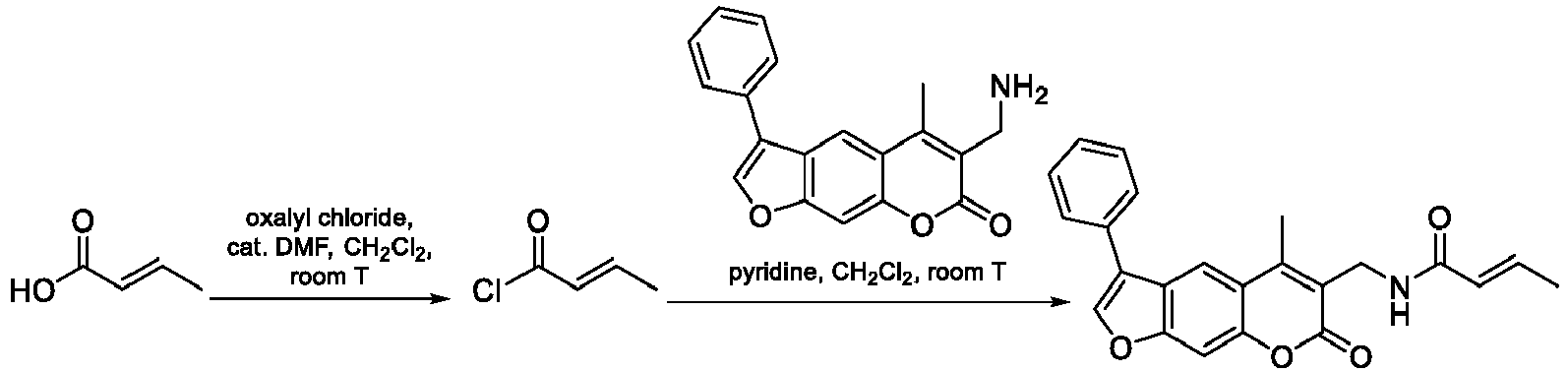
- To a solution of trans-2-butenoic acid (133 mg, 1.54 mmol) in CH2Cl2 (5 mL), a catalytic amount of DMF and oxalyl chloride (401 mg, 3.09 mmol, 0.268 mL) were added at room temperature. The reaction mixture was stirred for 2 h. The solvent was evaporated and the residue was dried under vacuum. The crude acyl chloride was dissolved in CH2Cl2 (10 mL) and added dropwise to the cooled (0 °C) solution of 6-(aminomethyl)-5-methyl-3-phenyl-7H-furo[3,2-g]chromen-7-one (140 mg, 0.46 mmol) and pyridine (0.326 g, 4.12 mmol, 0.332 mL) in CH2Cl2 (10 mL). The reaction mixture was stirred at room temperature overnight. Then, CH2Cl2 (30 mL) was added, the solution transferred to a separating funnel, and washed subsequently with 1 M HCl (3 × 20 mL), water (30 mL), saturated aqueous NaHCO3 solution (30 mL), and brine (30 mL), and dried with anhydrous Na2SO4, and evaporated under reduced pressure. The compound was purified by column chromatography (MP = EtOAc : n-hexane = 1 : 1).
- Appearance: white amorphous solid, m = 0.030 g; Yield: 17%; Melting point: 219.0-222.5 °C; ESI-MS [M+H]+: 374; HRMS: (m/z = 374) for C23H20NO4: calculated 374.1392, found 374.1402; 1H NMR (400 MHz, DMSO-d6 ) δ (ppm) = 1.76 (d, J 1 = 6.9 Hz, J 2 = 1.6 Hz, 3H, CHCH 3), 2.63 (s, 3H, CH 3), 4.33 (d, J= 5.2 Hz, 2H, CH 2NH), 5.93 (dd, J 1 = 15.3 Hz, J 1 = 1.7 Hz, 1H, CH=CHCH3), 6.21 (dq, J 1 = 14.8 Hz, J 2 = 6.8 Hz, 1H, CH=CHCH3), 7.42-7.46 (m, 1H, Ar-H), 7.53-7.58 (m, 2H, Ar-H), 7.81-7.84 (m, 3H, Ar-H), 8.15 (t, J = 5.0 Hz, 1H, NH), 8.23 (s, 1H, Ar-H), 8.49 (s, 1H, Ar-H); 13C NMR (100 MHz, DMSO-d6 ) δ (ppm) = 15.32, 17.32, 35.35, 99.52, 116.81, 116.94, 120.56, 121.26, 122.87, 125.43, 127.20, 127.84, 129.21, 130.58,138.05, 144.36, 150.07, 150.11,156.15, 160.60, 164.68; IR (ATR): = 2922, 2853, 1705, 1628, 1577, 1530, 1464, 1439, 1391, 1340, 1260, 1156, 1083, 1025, 969, 839, 796, 760
-

- To a solution of trans-2-butenoic acid (67 mg, 0.78 mmol) in toluene (5 mL), thionyl chloride (414 mg, 3.48 mmol, 0.253 mL) was added at room temperature. The reaction mixture was stirred at 90 °C for 2 h. The solvent was evaporated and the residue dried under vacuum to obtain the crude acyl chloride that was dissolved in CH2Cl2 (10 mL) and added drop-wise to the cooled (0 °C) solution of compound 6-amino-5-methyl-3-phenyl-7H-furo[3,2-g]chromen-7-one (150 mg, 0.52 mmol) and pyridine (163g, 2.06 mmol, 0.166 mL) in CH2Cl2 (10 mL). The reaction mixture was stirred at room temperature overnight. Then, CH2Cl2 (30 mL) was added, the solution was transferred to a separating funnel, and washed subsequently with 1 M HCl (3 × 20 mL), water (30 mL), saturated aqueous NaHCO3 solution (30 mL), and brine (30 mL), and dried with anhydrous Na2SO4, and evaporated under reduced pressure. The compound was purified by column chromatography (MP = EtOAc : n-hexane = 1 : 2) and subsequent crystallization from EtOAc.
- Appearance: white crystals, m = 0.040 g; Yield: 21%; Melting point: 236.5-238.0 °C; ESI-MS [M+H]+: 360; HRMS: (m/z = 360) for C22H18NO4: calculated 360.1236, found 360.1246; 1H NMR (400 MHz, DMSO-d6 ) δ (ppm) = 1.88 (d, J = 6.8 Hz, 3H, CHCH 3), 2.41 (s, 3H, CH 3), 6.21 (d, J = 16.0 Hz, 1H, CH=CHCH3), 6.21 (dq, J 1 = 14.4 Hz, J 2 = 6.8 Hz, 1H, CH=CHCH3), 7.42-7.46 (m, 1H, Ar-H), 7.53-7.57 (m, 2H, Ar-H), 7.83-7.85 (m, 2H, Ar-H), 7.86 (s, 1H, Ar-H), 8.20 (s, 1H, Ar-H), 8.51 (s, 1H, Ar-H), 9.59 (br s, 1H, NH); 13C NMR (100 MHz, DMSO-d6 ) δ (ppm) = 15.00, 17.49, 99.66, 116.60, 116.96, 119.58, 121.21, 123.05, 124.84, 127.20, 127.82, 129.18, 130.57, 140.38, 144.45, 146.40, 149.27, 156.01, 158.19, 163.99; IR (ATR): = 3253, 1713, 1669, 1638, 1579, 1512, 1469, 1437, 1390, 1339, 1243, 1196, 1158, 1130, 1088, 1067, 1026, 971, 934, 902, 836, 822, 760, 735
-

-

- To the solution of 2-methylresorcinol (12.90 g, 104.00 mmol) in sulfuric (VI) acid (75%, 60 mL), diethyl 2-acetylglutarate (26.80 g, 116.00 mmol, 25.00 mL) was added dropwise. The reaction mixture was stirred at room temperature for 18 h. After the reaction was complete, the solution was poured onto crushed ice. The solid that formed was filtered off, washed with water and dried. Anhydrous ethanol (60 mL) and the catalytic amount of concentrated sulfuric (VI) acid (0.50 mL) were added to the dried solid. The reaction mixture was stirred at 80 °C overnight. The solvent was evaporated, and saturated aqueous solution of NaHCO3 (50 mL) was added to the resulting residue, and further extracted with EtOAc (2 × 100 mL). The combined organic phases were dried over Na2SO4, filtered, and evaporated under reduced pressure.
- Appearance: white amorphous solid, m = 21.2 g; Yield: 70%; Melting point: 153-157 °C; ESI-MS [M+H]+: 291; HRMS: (m/z = 291) for C16H18O5: calculated 291.1229, found 291.1232; 1H NMR (400 MHz, DMSO-d6 ) δ (ppm) = 1.15 (t, J = 7.0 Hz, 3H, CH2CH 3), 2.14 (s, 3H, Ar-CH 3), 2.35 (s, 3H, Ar-CH 3), 2.46 (t, J = 7.6 Hz, 2H, CH 2COO), 2.78 (t, J = 7.6 Hz, 2H, Ar-CH 2), 4.03 (q, J = 7.0 Hz, 2H, COOCH 2), 6.84 (d, J = 8.8 Hz, 1H, Ar-H), 7.45 (d, J = 8.8, 1H, Ar-H), 10.31 (bs, 1H, OH); IR (ATR): 3230, 2986, 2958, 2364, 2344, 1868, 1723, 1675, 1606, 1577, 1507, 1465, 1378, 1363, 1297, 1255, 1192, 1143, 1102, 1052, 1027
-

- The title compound was prepared from ethyl 3-(7-hydroxy-4,8-dimethyl-2-oxo-2H-chromen-3-yl)propanoate (1.02 g) and 2-bromo-1-phenylethan-1-one according to the general procedure A (O-alkylation). The compound was purified by crystallization from EtOAc.
- Appearance: pale yellow crystals, m = 0.871 g; Yield: 61%; Melting point: 183-187 °C; ESI-MS [M+Li]+: 415; ESI-MS [M+Na]+: 431; 1H NMR (400 MHz, DMSO-d6 ) δ (ppm) = 1.15 (t, J = 7.2 Hz, 3H, CH2CH 3), 2.28 (s, 3H, Ar-CH 3), 2.39 (s, 3H, Ar-CH 3), 2.48 (t, J = 7.6 Hz, 2H, CH 2COO), 2.82 (t, J = 7.6 Hz, 2H, Ar-CH 2), 4.04 (q, J = 7.2 Hz, 2H, COOCH 2), 5.78 (s, 2H, COCH 2O), 6.99 (d, J = 8.8, 1H, Ar-H), 7.56-7.61 (m, 3H, Ar-H), 7.67-7.73 (m, 1H, Ar-H). 8.02-8.04 (m, 2H, Ar-H); IR (ATR): 3397, 3063, 2979, 2907, 2363, 2344, 1724, 1709, 1636,1601, 1500, 1474, 1500, 1449, 1378, 1358, 1329, 1284, 1252, 1225, 1206, 1174, 1133, 1069, 1000
-

- The title compound was prepared from ethyl 3-(4,8-dimethyl-2-oxo-7-(2-oxo-2-phenylethoxy)-2H-chromen-3-yl)propanoate (0.254 g) following the general procedure B (base-catalyzed cyclization). The compound was purified by crystallization from EtOAc.
- Appearance: pale brown crystals, m = 0.15 g; Yield: 67%; Melting point: 189-193 °C; ESI-MS [M+H]+: 363; HRMS: (m/z = 363) for C22H19O5: calculated 363.1236, found 363.1246; 1H NMR (400 MHz, DMSO-d6 ) δ (ppm) = 2.43 (t, J = 7.9 Hz, 2H, CH 2COOH), 2.53 (s, 3H, Ar-CH 3), 2.55 (s, 3H, Ar-CH 3), 2.85 (t, J = 7.9 Hz, 2H, Ar-CH 2), 7.40-7.45 (m, 1H, Ar-H), 7.52-7.56 (m, 2H, Ar-H), 7.79-7.82 (m, 2H, Ar-H), 8.01 (s, 1H, Ar-H), 8.48 (s, 1H, Ar-H), 12.22 (bs, 1H, COOH); 13 C NMR (100 MHz, DMSO-d6 ) δ (ppm) = 8.15, 15.16,22.96,32.29, 108.34, 113.44, 116.76, 121.44, 121.67, 121.97, 127.07, 127.69, 129.13, 130.79, 143.96, 147.44, 148.10, 154.75, 160.43, 173.59; IR (ATR): 3854, 3421, 3094, 2363, 2344, 1742, 1717, 1661, 1591, 1566, 1419, 1387, 1340, 1300, 1198, 11169, 1105, 1132, 1027
- Appropriate stock solutions (mM concentration) of the test compounds were prepared in DMSO. Subsequent dilutions of the compounds, as well as the immunoproteasome and the substrate were prepared in buffered solution (50 mM Tris-HCI (pH 8.0), 0.5 mM EDTA, 0.01% SDS). To a 96-well black microtiter plate, human immunoproteasome (final concentration, 0.25 µg/mL) (Boston Biochem, Inc., Cambridge, MA, USA) was added, followed by either test compounds (10 µM final concentration) or buffered solution (with and without the DMSO), which accounted for the control group. Microtiter plate was covered with aluminum foil and incubated at 37 °C for 30 minutes with medium agitation. The reaction was initiated by the addition of β5- and β5i-selective substrate Suc-LLVY-AMC (25 µM final concentration). The reaction progress was recorded on the BioTek Synergy HT microplate reader by monitoring fluorescence at 460 nm (λex = 360 nm) every 5 minutes for 120 min at 37 °C. At least two independent experiments were performed. The initial linear ranges (between 20th and 60th minute) were used to calculate the slope of the line (k) by dividing the difference of fluorescence intensities (F) with the time difference (t) (Equation 1). The residual activities in percentages were calculated from the slopes obtained (Equation 2). The calculations were performed in Microsoft Office Excel 2007.

- k slope of the line
- F fluorescence intensity
- t time (min)
- kt slope of the line for the treated enzyme
- knt slope of the line for the non-treated enzyme
- The test compounds from the preliminary inhibitory assay with residual activities equal to or lower than 60% were characterized further by determining the mode of inhibition (competitive, non-competitive, uncompetitive, mixed inhibition). The assays were performed as described above. Five or more different concentrations of the test compounds ranging from 0.1 µM to 100 µM were used to determine the kinetic parameters at four different substrate concentrations (Suc-LLVY-AMC ranging from 12.5 µM to 125 µM). Final concentration of the immunoproteasome remained the same as before (0.25 µg/mL). The results obtained were analyzed as outlined above (see Equations 1 and 2), and two plots were derived using Microsoft Office Excel 2007:
- - 1/v plotted against inhibitor concentration (Dixon plot; v- velocity, equal to the slope of the line k),
- - [S]/v plotted against different concentrations of inhibitor ([S] equals substrate concentration).
- The mode of inhibition was estimated from the relative positions of the lines obtained. This data was, together with the k values, was further used to calculate the Ki values (GraphPad Prism 5.01).
- The test compounds with time-dependent inhibitory activities were treated and evaluated as irreversible inhibitors. The assay was performed as described in the 44 section Preliminary evaluation of inhibition of the β5i subunit of human immunoproteasome. At least seven different concentrations of the test compounds ranging from 0.001 µM to 50 µM were used. The final concentrations of the substrate Suc-LLVY-AMC and the immunoproteasome were 25 µM and 0.25 µg/mL, respectively. At least two independent experiments were performed. The increases in fluorescence intensity between 20th and 60th minute and appropriate test compounds concentrations were analyzed with GraphPad Prism 5.01 to determine the IC50 values.
Table 1. Inhibitory potencies of reversible psoralen-based inhibitors against the β5i subunit of the human immunoproteasome. The following compounds are not part of the invention. 
n 1R RA (%) or Ki (µM) n 1R RA (%) or Ki (µM) 1 Me 88% 2 Me 94% 1 t-Bu 85% 2 t-Bu 83% 1 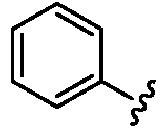
2.4 b 2 
1.6b 1 
12.7b 2 
137 b 1 
8.2 b 2 
84% 1 
7.0 b 2 
29.6b 1 
198 b 2 
102% 1 
36.5 b 2 
52.3 b 1 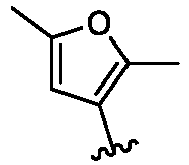
351 b 2 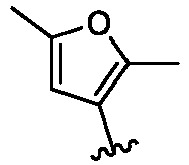
100% 1 
89.3 b 2 
115.6 b 
82% 
3.8 b 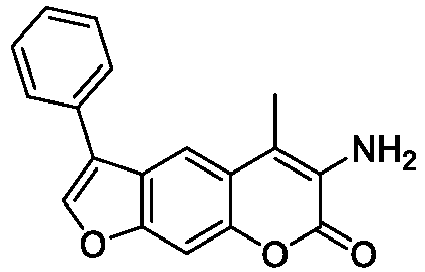
88% 
39.6 b b Competitive inhibitors Table 2. Inhibitory potencies of irreversible psoralene-based inhibitors against the β5i subunit of the human immunoproteasome. Compound IC50 (µM) 
6.4 
0.090 
20.5

Claims (9)
- A compound having general Formula (I):
 n: 0-4X: OZ: is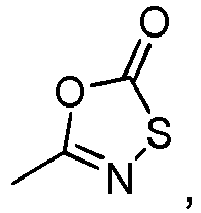

 A: is t-Bu, phenyl, furan, thiophene, pyrrole, imidazole or oxazoleB: is H or MeC: is H or MeD: is H or MeE: is H or Meor a pharmaceutically acceptable salt, hydrate or solvate thereof.
 - The compound of claim 1, wherein Z is


- The compound of claim 1, wherein Z is

- The compound of any one of claims 1 to 3, wherein A is phenyl, B is H, C is Me, D is H, E is H, n is 0 and Z is

- The compound of claim 1, wherein A is phenyl, B is H, C is Me, D is H, E is H, n is 1 or 2 and Z is

- The compound of any one of claims 1 to 5, which is in the form of a pure diastereoisomer or as a mixture of diastereomers, or in the form of a pure enantiomer or as a mixture of enantiomers.
- The compound of any one of claims 1 to 6 for use as a medicament in human or mammal therapy.
- The compound of any one of claims 1 to 6 for use in the treatment of a disease that is related with increased activity of the immunoproteasome; the disease being selected from the group consisting of autoimmune diseases, malignant diseases, and neurodegenerative disorders.
- A pharmaceutical composition comprising a therapeutically effective amount of at least one compound of any one of claims 1 to 6 and a pharmaceutical acceptable excipient.
Applications Claiming Priority (2)
| Application Number | Priority Date | Filing Date | Title |
|---|---|---|---|
| SI201500075A SI24952A (en) | 2015-03-25 | 2015-03-25 | Psoralen derivatives as non-peptide inhibitors of chymotrypsin activity of immunoproteasome |
| PCT/IB2016/051601 WO2016151483A1 (en) | 2015-03-25 | 2016-03-22 | Psoralen derivatives as non-peptidic inhibitors of chymotrypsin-like activity of the immunoproteasome |
Publications (2)
| Publication Number | Publication Date |
|---|---|
| EP3256120A1 EP3256120A1 (en) | 2017-12-20 |
| EP3256120B1 true EP3256120B1 (en) | 2018-11-14 |
Family
ID=55911006
Family Applications (1)
| Application Number | Title | Priority Date | Filing Date |
|---|---|---|---|
| EP16720555.8A Not-in-force EP3256120B1 (en) | 2015-03-25 | 2016-03-22 | Psoralen derivatives as non-peptidic inhibitors of chymotrypsin-like activity of the immunoproteasome |
Country Status (3)
| Country | Link |
|---|---|
| EP (1) | EP3256120B1 (en) |
| SI (1) | SI24952A (en) |
| WO (1) | WO2016151483A1 (en) |
Families Citing this family (1)
| Publication number | Priority date | Publication date | Assignee | Title |
|---|---|---|---|---|
| FR3068244B1 (en) * | 2017-06-29 | 2019-07-19 | L'oreal | DEPIGMENTING COMPOUNDS |
Family Cites Families (5)
| Publication number | Priority date | Publication date | Assignee | Title |
|---|---|---|---|---|
| LU85829A1 (en) * | 1985-04-01 | 1986-11-05 | Cird | PSORALENE BASED BATH COMPOSITION FOR THE TREATMENT OF PSORIASIS |
| WO1993007748A2 (en) * | 1991-10-23 | 1993-04-29 | The General Hospital Corporation | Laser-based inhibition of smooth muscle cell hyperproliferation |
| EP1032265B1 (en) * | 1997-11-20 | 2003-10-29 | Cerus Corporation | New psoralens for pathogen inactivation |
| KR100806162B1 (en) * | 2006-11-30 | 2008-02-22 | (주)아모레퍼시픽 | Skin external composition containing plant-derived PPSA active substance |
| US20160008339A1 (en) * | 2012-07-02 | 2016-01-14 | Max-Delbruck-Centrum Fur Molekulare Medizin | Psoralen derivatives for preventing or treating heart failure or cardiac hypertrophy |
-
2015
- 2015-03-25 SI SI201500075A patent/SI24952A/en active IP Right Grant
-
2016
- 2016-03-22 WO PCT/IB2016/051601 patent/WO2016151483A1/en not_active Ceased
- 2016-03-22 EP EP16720555.8A patent/EP3256120B1/en not_active Not-in-force
Non-Patent Citations (1)
| Title |
|---|
| None * |
Also Published As
| Publication number | Publication date |
|---|---|
| EP3256120A1 (en) | 2017-12-20 |
| WO2016151483A1 (en) | 2016-09-29 |
| SI24952A (en) | 2016-09-30 |
Similar Documents
| Publication | Publication Date | Title |
|---|---|---|
| JP4405602B2 (en) | Histone deacetylase inhibitor | |
| EP3088397B1 (en) | Compounds that abrogate the cell cycle g2 checkpoint for use in the treatment of cancer | |
| EP2968330B1 (en) | Compounds and methods for inducing chondrogenesis | |
| JP2016511237A (en) | Selective HDAC3 inhibitor | |
| JP2002531444A (en) | Benzamide derivatives and their use as apoB-100 secretion inhibitors | |
| JP7083133B2 (en) | Histone deacetylase 6 inhibitor and its use | |
| JP4851051B2 (en) | Coumarin derivatives having COMT inhibitory activity | |
| CZ20014637A3 (en) | Substituted phenoxyacetic acids | |
| JP2007176809A (en) | Heterocyclic ring-substituted amide compound, method for preparing same, and pharmaceutical composition | |
| US6140362A (en) | Method for inhibiting the growth of mammalian cells | |
| JPH11504928A (en) | Benzothiazole and benzoxazole, pharmaceutical compositions containing these compounds, their use and their preparation | |
| EP3256120A1 (en) | Psoralen derivatives as non-peptidic inhibitors of chymotrypsin-like activity of the immunoproteasome | |
| WO2006120104A1 (en) | Inhibitors of prolyl endopeptidase | |
| CN104016942B (en) | Thiazolinone analog derivative and pharmaceutical composition thereof and application | |
| CN1827616A (en) | Synthesis and application of indole analogs of 1-benzyl-3-(5'-hydroxymethyl-2'-furyl)indazole | |
| JP7620629B2 (en) | PDIA4 INHIBITORS AND THEIR USE TO INHIBIT β-CELL PATHOGENESIS AND TREAT DIABETES - Patent application | |
| EP1844775B1 (en) | Therapeutic agent for the treatment of herpes progenitalis after development of lesions | |
| Zhang et al. | Synthesis and biological evaluation of N-(aminopyridine) benzamide analogues as histone deacetylase inhibitors | |
| JP2016531841A (en) | Anticancer agent containing aminoacetonitrile compound as active ingredient | |
| KR101096427B1 (en) | Novel 4-aryl-4-oxobutanoic acid amide derivatives or pharmaceutically acceptable salts thereof, preparation methods thereof, and pharmaceutical compositions containing the same as active ingredients | |
| CN114685496B (en) | Synthesis and use of HDAC6 inhibitors based on hydroxamic acid | |
| CN102020607B (en) | 6-aminoniacinamide derivatives with histone deacetylase inhibiting activity, preparation method and application thereof | |
| CN120040436A (en) | Chimeric body for degrading GPX4 based on HSP70 protein targeting, preparation method and application | |
| CN102020588B (en) | Tricyclic compound with histone deacetylases inhibition activity and preparation method and application thereof | |
| TWI342311B (en) | Novel derivatives of 2-hydroxytetrahydrofuran and their use as medicaments |
Legal Events
| Date | Code | Title | Description |
|---|---|---|---|
| STAA | Information on the status of an ep patent application or granted ep patent |
Free format text: STATUS: THE INTERNATIONAL PUBLICATION HAS BEEN MADE |
|
| PUAI | Public reference made under article 153(3) epc to a published international application that has entered the european phase |
Free format text: ORIGINAL CODE: 0009012 |
|
| STAA | Information on the status of an ep patent application or granted ep patent |
Free format text: STATUS: REQUEST FOR EXAMINATION WAS MADE |
|
| 17P | Request for examination filed |
Effective date: 20170905 |
|
| AK | Designated contracting states |
Kind code of ref document: A1 Designated state(s): AL AT BE BG CH CY CZ DE DK EE ES FI FR GB GR HR HU IE IS IT LI LT LU LV MC MK MT NL NO PL PT RO RS SE SI SK SM TR |
|
| AX | Request for extension of the european patent |
Extension state: BA ME |
|
| RIN1 | Information on inventor provided before grant (corrected) |
Inventor name: KNEZ, DAMIJAN Inventor name: BRUS, BORIS Inventor name: OBREZA, ALES Inventor name: SOSIC, IZIDOR Inventor name: GOBEC, MARTINA Inventor name: GOBEC, STANISLAV Inventor name: MLINARIC-RASCAN, IRENA |
|
| DAV | Request for validation of the european patent (deleted) | ||
| DAX | Request for extension of the european patent (deleted) | ||
| GRAP | Despatch of communication of intention to grant a patent |
Free format text: ORIGINAL CODE: EPIDOSNIGR1 |
|
| STAA | Information on the status of an ep patent application or granted ep patent |
Free format text: STATUS: GRANT OF PATENT IS INTENDED |
|
| INTG | Intention to grant announced |
Effective date: 20180725 |
|
| GRAS | Grant fee paid |
Free format text: ORIGINAL CODE: EPIDOSNIGR3 |
|
| GRAA | (expected) grant |
Free format text: ORIGINAL CODE: 0009210 |
|
| STAA | Information on the status of an ep patent application or granted ep patent |
Free format text: STATUS: THE PATENT HAS BEEN GRANTED |
|
| AK | Designated contracting states |
Kind code of ref document: B1 Designated state(s): AL AT BE BG CH CY CZ DE DK EE ES FI FR GB GR HR HU IE IS IT LI LT LU LV MC MK MT NL NO PL PT RO RS SE SI SK SM TR |
|
| REG | Reference to a national code |
Ref country code: CH Ref legal event code: EP Ref country code: AT Ref legal event code: REF Ref document number: 1063981 Country of ref document: AT Kind code of ref document: T Effective date: 20181115 |
|
| REG | Reference to a national code |
Ref country code: IE Ref legal event code: FG4D |
|
| REG | Reference to a national code |
Ref country code: DE Ref legal event code: R096 Ref document number: 602016007212 Country of ref document: DE |
|
| REG | Reference to a national code |
Ref country code: CH Ref legal event code: PK Free format text: BERICHTIGUNGEN |
|
| RIN2 | Information on inventor provided after grant (corrected) |
Inventor name: SOSIC, IZIDOR Inventor name: GOBEC, STANISLAV Inventor name: GOBEC, MARTINA Inventor name: MLINARIC-RASCAN, IRENA Inventor name: BRUS, BORIS Inventor name: KNEZ, DAMIJAN Inventor name: OBREZA, ALES |
|
| REG | Reference to a national code |
Ref country code: NL Ref legal event code: MP Effective date: 20181114 |
|
| REG | Reference to a national code |
Ref country code: LT Ref legal event code: MG4D |
|
| REG | Reference to a national code |
Ref country code: DE Ref legal event code: R083 Ref document number: 602016007212 Country of ref document: DE |
|
| REG | Reference to a national code |
Ref country code: AT Ref legal event code: MK05 Ref document number: 1063981 Country of ref document: AT Kind code of ref document: T Effective date: 20181114 |
|
| PG25 | Lapsed in a contracting state [announced via postgrant information from national office to epo] |
Ref country code: ES Free format text: LAPSE BECAUSE OF FAILURE TO SUBMIT A TRANSLATION OF THE DESCRIPTION OR TO PAY THE FEE WITHIN THE PRESCRIBED TIME-LIMIT Effective date: 20181114 Ref country code: AT Free format text: LAPSE BECAUSE OF FAILURE TO SUBMIT A TRANSLATION OF THE DESCRIPTION OR TO PAY THE FEE WITHIN THE PRESCRIBED TIME-LIMIT Effective date: 20181114 Ref country code: NO Free format text: LAPSE BECAUSE OF FAILURE TO SUBMIT A TRANSLATION OF THE DESCRIPTION OR TO PAY THE FEE WITHIN THE PRESCRIBED TIME-LIMIT Effective date: 20190214 Ref country code: BG Free format text: LAPSE BECAUSE OF FAILURE TO SUBMIT A TRANSLATION OF THE DESCRIPTION OR TO PAY THE FEE WITHIN THE PRESCRIBED TIME-LIMIT Effective date: 20190214 Ref country code: LT Free format text: LAPSE BECAUSE OF FAILURE TO SUBMIT A TRANSLATION OF THE DESCRIPTION OR TO PAY THE FEE WITHIN THE PRESCRIBED TIME-LIMIT Effective date: 20181114 Ref country code: FI Free format text: LAPSE BECAUSE OF FAILURE TO SUBMIT A TRANSLATION OF THE DESCRIPTION OR TO PAY THE FEE WITHIN THE PRESCRIBED TIME-LIMIT Effective date: 20181114 Ref country code: IS Free format text: LAPSE BECAUSE OF FAILURE TO SUBMIT A TRANSLATION OF THE DESCRIPTION OR TO PAY THE FEE WITHIN THE PRESCRIBED TIME-LIMIT Effective date: 20190314 Ref country code: LV Free format text: LAPSE BECAUSE OF FAILURE TO SUBMIT A TRANSLATION OF THE DESCRIPTION OR TO PAY THE FEE WITHIN THE PRESCRIBED TIME-LIMIT Effective date: 20181114 Ref country code: HR Free format text: LAPSE BECAUSE OF FAILURE TO SUBMIT A TRANSLATION OF THE DESCRIPTION OR TO PAY THE FEE WITHIN THE PRESCRIBED TIME-LIMIT Effective date: 20181114 |
|
| PGFP | Annual fee paid to national office [announced via postgrant information from national office to epo] |
Ref country code: CH Payment date: 20190325 Year of fee payment: 4 Ref country code: LU Payment date: 20190321 Year of fee payment: 4 Ref country code: FR Payment date: 20190326 Year of fee payment: 4 Ref country code: MC Payment date: 20190320 Year of fee payment: 4 Ref country code: DE Payment date: 20190326 Year of fee payment: 4 |
|
| PG25 | Lapsed in a contracting state [announced via postgrant information from national office to epo] |
Ref country code: SE Free format text: LAPSE BECAUSE OF FAILURE TO SUBMIT A TRANSLATION OF THE DESCRIPTION OR TO PAY THE FEE WITHIN THE PRESCRIBED TIME-LIMIT Effective date: 20181114 Ref country code: AL Free format text: LAPSE BECAUSE OF FAILURE TO SUBMIT A TRANSLATION OF THE DESCRIPTION OR TO PAY THE FEE WITHIN THE PRESCRIBED TIME-LIMIT Effective date: 20181114 Ref country code: NL Free format text: LAPSE BECAUSE OF FAILURE TO SUBMIT A TRANSLATION OF THE DESCRIPTION OR TO PAY THE FEE WITHIN THE PRESCRIBED TIME-LIMIT Effective date: 20181114 Ref country code: PT Free format text: LAPSE BECAUSE OF FAILURE TO SUBMIT A TRANSLATION OF THE DESCRIPTION OR TO PAY THE FEE WITHIN THE PRESCRIBED TIME-LIMIT Effective date: 20190314 Ref country code: GR Free format text: LAPSE BECAUSE OF FAILURE TO SUBMIT A TRANSLATION OF THE DESCRIPTION OR TO PAY THE FEE WITHIN THE PRESCRIBED TIME-LIMIT Effective date: 20190215 Ref country code: RS Free format text: LAPSE BECAUSE OF FAILURE TO SUBMIT A TRANSLATION OF THE DESCRIPTION OR TO PAY THE FEE WITHIN THE PRESCRIBED TIME-LIMIT Effective date: 20181114 |
|
| PG25 | Lapsed in a contracting state [announced via postgrant information from national office to epo] |
Ref country code: CZ Free format text: LAPSE BECAUSE OF FAILURE TO SUBMIT A TRANSLATION OF THE DESCRIPTION OR TO PAY THE FEE WITHIN THE PRESCRIBED TIME-LIMIT Effective date: 20181114 Ref country code: PL Free format text: LAPSE BECAUSE OF FAILURE TO SUBMIT A TRANSLATION OF THE DESCRIPTION OR TO PAY THE FEE WITHIN THE PRESCRIBED TIME-LIMIT Effective date: 20181114 Ref country code: DK Free format text: LAPSE BECAUSE OF FAILURE TO SUBMIT A TRANSLATION OF THE DESCRIPTION OR TO PAY THE FEE WITHIN THE PRESCRIBED TIME-LIMIT Effective date: 20181114 Ref country code: IT Free format text: LAPSE BECAUSE OF FAILURE TO SUBMIT A TRANSLATION OF THE DESCRIPTION OR TO PAY THE FEE WITHIN THE PRESCRIBED TIME-LIMIT Effective date: 20181114 |
|
| REG | Reference to a national code |
Ref country code: DE Ref legal event code: R097 Ref document number: 602016007212 Country of ref document: DE |
|
| PG25 | Lapsed in a contracting state [announced via postgrant information from national office to epo] |
Ref country code: SK Free format text: LAPSE BECAUSE OF FAILURE TO SUBMIT A TRANSLATION OF THE DESCRIPTION OR TO PAY THE FEE WITHIN THE PRESCRIBED TIME-LIMIT Effective date: 20181114 Ref country code: RO Free format text: LAPSE BECAUSE OF FAILURE TO SUBMIT A TRANSLATION OF THE DESCRIPTION OR TO PAY THE FEE WITHIN THE PRESCRIBED TIME-LIMIT Effective date: 20181114 Ref country code: SM Free format text: LAPSE BECAUSE OF FAILURE TO SUBMIT A TRANSLATION OF THE DESCRIPTION OR TO PAY THE FEE WITHIN THE PRESCRIBED TIME-LIMIT Effective date: 20181114 Ref country code: EE Free format text: LAPSE BECAUSE OF FAILURE TO SUBMIT A TRANSLATION OF THE DESCRIPTION OR TO PAY THE FEE WITHIN THE PRESCRIBED TIME-LIMIT Effective date: 20181114 |
|
| PLBE | No opposition filed within time limit |
Free format text: ORIGINAL CODE: 0009261 |
|
| STAA | Information on the status of an ep patent application or granted ep patent |
Free format text: STATUS: NO OPPOSITION FILED WITHIN TIME LIMIT |
|
| 26N | No opposition filed |
Effective date: 20190815 |
|
| PG25 | Lapsed in a contracting state [announced via postgrant information from national office to epo] |
Ref country code: SI Free format text: LAPSE BECAUSE OF FAILURE TO SUBMIT A TRANSLATION OF THE DESCRIPTION OR TO PAY THE FEE WITHIN THE PRESCRIBED TIME-LIMIT Effective date: 20181114 |
|
| REG | Reference to a national code |
Ref country code: BE Ref legal event code: MM Effective date: 20190331 |
|
| PG25 | Lapsed in a contracting state [announced via postgrant information from national office to epo] |
Ref country code: IE Free format text: LAPSE BECAUSE OF NON-PAYMENT OF DUE FEES Effective date: 20190322 |
|
| PG25 | Lapsed in a contracting state [announced via postgrant information from national office to epo] |
Ref country code: BE Free format text: LAPSE BECAUSE OF NON-PAYMENT OF DUE FEES Effective date: 20190331 |
|
| PG25 | Lapsed in a contracting state [announced via postgrant information from national office to epo] |
Ref country code: TR Free format text: LAPSE BECAUSE OF FAILURE TO SUBMIT A TRANSLATION OF THE DESCRIPTION OR TO PAY THE FEE WITHIN THE PRESCRIBED TIME-LIMIT Effective date: 20181114 |
|
| PG25 | Lapsed in a contracting state [announced via postgrant information from national office to epo] |
Ref country code: MT Free format text: LAPSE BECAUSE OF NON-PAYMENT OF DUE FEES Effective date: 20190322 |
|
| REG | Reference to a national code |
Ref country code: DE Ref legal event code: R119 Ref document number: 602016007212 Country of ref document: DE |
|
| PG25 | Lapsed in a contracting state [announced via postgrant information from national office to epo] |
Ref country code: MC Free format text: LAPSE BECAUSE OF NON-PAYMENT OF DUE FEES Effective date: 20200331 |
|
| REG | Reference to a national code |
Ref country code: CH Ref legal event code: PL |
|
| PG25 | Lapsed in a contracting state [announced via postgrant information from national office to epo] |
Ref country code: LU Free format text: LAPSE BECAUSE OF NON-PAYMENT OF DUE FEES Effective date: 20200322 |
|
| PG25 | Lapsed in a contracting state [announced via postgrant information from national office to epo] |
Ref country code: CH Free format text: LAPSE BECAUSE OF NON-PAYMENT OF DUE FEES Effective date: 20200331 Ref country code: DE Free format text: LAPSE BECAUSE OF NON-PAYMENT OF DUE FEES Effective date: 20201001 Ref country code: FR Free format text: LAPSE BECAUSE OF NON-PAYMENT OF DUE FEES Effective date: 20200331 Ref country code: LI Free format text: LAPSE BECAUSE OF NON-PAYMENT OF DUE FEES Effective date: 20200331 |
|
| GBPC | Gb: european patent ceased through non-payment of renewal fee |
Effective date: 20200322 |
|
| PG25 | Lapsed in a contracting state [announced via postgrant information from national office to epo] |
Ref country code: GB Free format text: LAPSE BECAUSE OF NON-PAYMENT OF DUE FEES Effective date: 20200322 |
|
| PG25 | Lapsed in a contracting state [announced via postgrant information from national office to epo] |
Ref country code: CY Free format text: LAPSE BECAUSE OF FAILURE TO SUBMIT A TRANSLATION OF THE DESCRIPTION OR TO PAY THE FEE WITHIN THE PRESCRIBED TIME-LIMIT Effective date: 20181114 |
|
| PG25 | Lapsed in a contracting state [announced via postgrant information from national office to epo] |
Ref country code: HU Free format text: LAPSE BECAUSE OF FAILURE TO SUBMIT A TRANSLATION OF THE DESCRIPTION OR TO PAY THE FEE WITHIN THE PRESCRIBED TIME-LIMIT; INVALID AB INITIO Effective date: 20160322 |
|
| PG25 | Lapsed in a contracting state [announced via postgrant information from national office to epo] |
Ref country code: MK Free format text: LAPSE BECAUSE OF FAILURE TO SUBMIT A TRANSLATION OF THE DESCRIPTION OR TO PAY THE FEE WITHIN THE PRESCRIBED TIME-LIMIT Effective date: 20181114 |