EP3255814A1 - Communication system, relay device, reception device, relay method, reception method, relay program, and reception program - Google Patents
Communication system, relay device, reception device, relay method, reception method, relay program, and reception program Download PDFInfo
- Publication number
- EP3255814A1 EP3255814A1 EP16838077.2A EP16838077A EP3255814A1 EP 3255814 A1 EP3255814 A1 EP 3255814A1 EP 16838077 A EP16838077 A EP 16838077A EP 3255814 A1 EP3255814 A1 EP 3255814A1
- Authority
- EP
- European Patent Office
- Prior art keywords
- quantization
- code book
- signal
- likelihood
- unit
- Prior art date
- Legal status (The legal status is an assumption and is not a legal conclusion. Google has not performed a legal analysis and makes no representation as to the accuracy of the status listed.)
- Withdrawn
Links
Images


Classifications
-
- H—ELECTRICITY
- H04—ELECTRIC COMMUNICATION TECHNIQUE
- H04L—TRANSMISSION OF DIGITAL INFORMATION, e.g. TELEGRAPHIC COMMUNICATION
- H04L1/00—Arrangements for detecting or preventing errors in the information received
- H04L1/004—Arrangements for detecting or preventing errors in the information received by using forward error control
- H04L1/0045—Arrangements at the receiver end
- H04L1/0054—Maximum-likelihood or sequential decoding, e.g. Viterbi, Fano, ZJ algorithms
-
- H—ELECTRICITY
- H04—ELECTRIC COMMUNICATION TECHNIQUE
- H04B—TRANSMISSION
- H04B7/00—Radio transmission systems, i.e. using radiation field
- H04B7/02—Diversity systems; Multi-antenna system, i.e. transmission or reception using multiple antennas
- H04B7/04—Diversity systems; Multi-antenna system, i.e. transmission or reception using multiple antennas using two or more spaced independent antennas
- H04B7/0413—MIMO systems
- H04B7/0456—Selection of precoding matrices or codebooks, e.g. using matrices antenna weighting
- H04B7/0482—Adaptive codebooks
-
- H—ELECTRICITY
- H04—ELECTRIC COMMUNICATION TECHNIQUE
- H04B—TRANSMISSION
- H04B17/00—Monitoring; Testing
- H04B17/30—Monitoring; Testing of propagation channels
- H04B17/309—Measuring or estimating channel quality parameters
- H04B17/336—Signal-to-interference ratio [SIR] or carrier-to-interference ratio [CIR]
-
- H—ELECTRICITY
- H04—ELECTRIC COMMUNICATION TECHNIQUE
- H04B—TRANSMISSION
- H04B17/00—Monitoring; Testing
- H04B17/30—Monitoring; Testing of propagation channels
- H04B17/382—Monitoring; Testing of propagation channels for resource allocation, admission control or handover
-
- H—ELECTRICITY
- H04—ELECTRIC COMMUNICATION TECHNIQUE
- H04B—TRANSMISSION
- H04B7/00—Radio transmission systems, i.e. using radiation field
- H04B7/02—Diversity systems; Multi-antenna system, i.e. transmission or reception using multiple antennas
- H04B7/04—Diversity systems; Multi-antenna system, i.e. transmission or reception using multiple antennas using two or more spaced independent antennas
- H04B7/08—Diversity systems; Multi-antenna system, i.e. transmission or reception using multiple antennas using two or more spaced independent antennas at the receiving station
-
- H—ELECTRICITY
- H04—ELECTRIC COMMUNICATION TECHNIQUE
- H04B—TRANSMISSION
- H04B7/00—Radio transmission systems, i.e. using radiation field
- H04B7/02—Diversity systems; Multi-antenna system, i.e. transmission or reception using multiple antennas
- H04B7/04—Diversity systems; Multi-antenna system, i.e. transmission or reception using multiple antennas using two or more spaced independent antennas
- H04B7/08—Diversity systems; Multi-antenna system, i.e. transmission or reception using multiple antennas using two or more spaced independent antennas at the receiving station
- H04B7/0837—Diversity systems; Multi-antenna system, i.e. transmission or reception using multiple antennas using two or more spaced independent antennas at the receiving station using pre-detection combining
- H04B7/0842—Weighted combining
- H04B7/0848—Joint weighting
- H04B7/0857—Joint weighting using maximum ratio combining techniques, e.g. signal-to- interference ratio [SIR], received signal strenght indication [RSS]
-
- H—ELECTRICITY
- H04—ELECTRIC COMMUNICATION TECHNIQUE
- H04B—TRANSMISSION
- H04B7/00—Radio transmission systems, i.e. using radiation field
- H04B7/14—Relay systems
- H04B7/15—Active relay systems
-
- H—ELECTRICITY
- H04—ELECTRIC COMMUNICATION TECHNIQUE
- H04L—TRANSMISSION OF DIGITAL INFORMATION, e.g. TELEGRAPHIC COMMUNICATION
- H04L25/00—Baseband systems
- H04L25/02—Details ; arrangements for supplying electrical power along data transmission lines
- H04L25/06—DC level restoring means; Bias distortion correction ; Decision circuits providing symbol by symbol detection
- H04L25/067—DC level restoring means; Bias distortion correction ; Decision circuits providing symbol by symbol detection providing soft decisions, i.e. decisions together with an estimate of reliability
Definitions
- the present invention relates to a communication system, a relay apparatus, a receiving apparatus, a relay method, a receiving method, a relay program, and a receiving program that improve communication quality by relaying signals from a transmission apparatus.
- the transmission apparatus, the relay apparatus, and the receiving apparatus may be referred to as a transmission node, a relay node, and a receiving node respectively.
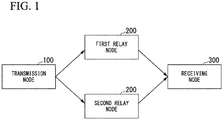
- FIG. 1 is a diagram for describing a configuration of a communication system that utilizes a plurality of relay nodes.
- the communication system shown in FIG. 1 shows a transmission node 100, a first relay node 200-1, a second relay node 200-2, and a receiving node 300.
- the first relay node 200-1 and the second relay node 200-2 are collectively referred to as relay nodes 200 when they are not differentiated.
- the number of relay nodes 200 in the communication system may be an arbitrary number not less than 1.
- the connection between the transmission node 100 and the relay nodes 200, and the connection between the relay nodes 200 and the receiving node 300 may be either one of wired connection and wireless connection.
- An antenna unit refers to a unit that is equipped with a transmission interface, a wireless transmitter/receiver, and an antenna.
- a base station with distributed stations stretched out therefrom functions as a central station to control the plurality of distributed stations.
- FIG. 2 is a diagram for describing a configuration of a communication system that uses likelihood adaptive quantization in the case where the relay nodes and the receiving node are connected by means of wired connection.
- the transmission node 100, the relay nodes 200, and the receiving node 300 in this case can be perceived respectively as a terminal, distributed stations, and a central station in the mobile communication system described above where the base station functions are divided into the central station and the distributed stations.
- a signal transmitted from the transmission node 100 is received at a wireless receiving unit 21 of the relay node 200.
- the signal gets noise added thereto.
- a soft demodulation unit 22 of each relay node 200 performs soft demodulation on the received signal, to thereby detect the likelihood of the received signal.
- a quantization parameter calculation unit 23 calculates a quantization parameter (what type of quantization width to be employed) by observing the probability distribution of the detected likelihood.
- a likelihood adaptive quantization unit 24 performs likelihood adaptive quantization according to this quantization parameter.
- a quantization parameter may be a quantization level value, which is a value after likelihood has been quantized.
- the quantized likelihood is transmitted as a likelihood quantized value, which is expressed as a bit of '0' or '1', from the wired transmission unit 25 of each relay node 200 to the receiving node 300.
- the receiving node 300 is yet to know what type of quantization parameter is used in quantization of the transmitted likelihood. Consequently, the relay node 200 needs to notify the receiving node 300 of the quantization parameter as well as the likelihood quantization bit value.
- reference symbol R1 denotes a signal that includes a likelihood quantization bit value and a quantization parameter (the same applies to the example in FIG. 3 ).
- an inverse quantization unit 32 of the receiving node 300 performs an inverse quantization process to determine the received bit, based on the notified quantization parameter, and the signal is forwarded to an upper layer function unit 33.
- FIG. 3 is a diagram for describing a configuration of a communication system that uses likelihood adaptive quantization in the case where the connection between the relay nodes 200 and the receiving node 300 is wireless connection.
- the process up to performing likelihood adaptive quantization in the relay node 200 is similar to that in the configuration of FIG. 2 .
- a likelihood quantization bit value is modulated in a wireless transmission unit 26, and is transmitted as a wireless signal to the receiving node 300.
- each wireless receiving unit 34 receives a signal from each receiving node 200.
- a demodulation unit 35 demodulates the received signal, and the inverse quantization unit 32 performs the inverse quantization process on the demodulated signal.
- the demodulation process may be either one of hard determination and soft determination.
- the communication systems shown in FIG. 2 and FIG. 3 enable improved communication quality, compared to that in performing direct communication between the transmission node and the receiving node.
- the relay node is required to notify the receiving node of the quantization parameter that is adapted to the current signal (quantization level value for each step).
- a number of bits as many as 512 is required for a single quantization parameter notification.
- an object of the present invention is to provide a communication system, a relay apparatus, a receiving apparatus, a relay method, a receiving method, a relay program, and a receiving program, capable of reducing the number of bits required for quantization parameter notification to reduce transmission overhead, in the case where a relay apparatus detects and quantizes the likelihood of a signal from a transmission apparatus, and transmits it to a receiving apparatus.
- a communication system includes a transmission apparatus, a receiving apparatus, and a relay apparatus that relays a signal from the transmission apparatus to the receiving apparatus
- the transmission apparatus transmits a first signal.
- the relay apparatus includes: a first receiving unit that receives the transmitted first signal; an estimation unit that estimates a reception signal to noise ratio (SNR) value from signal electric power of the received first signal and noise electric power, the estimation unit selecting a code book number based on the estimated reception SNR value, the code book number corresponding to a reception SNR range, the reception SNR range having a range including the estimated reception SNR value; a soft demodulation unit that performs soft demodulation on the received first signal to detect a likelihood of the received first signal; a first memory unit that stores a first quantization code book, the first quantization code book showing, for each code book number, a relationship between a quantization parameter for quantizing a likelihood, and a likelihood quantization bit value showing a quantized likelihood; a quantization unit that refers the first quantization code book to obtain a relationship between a quantization parameter and a likelihood quantization bit value that corresponds to the selected code book number, the quantization unit adaptively quantizing the detected likelihood by using the obtained relationship to obtain a likelihood quant
- the receiving apparatus includes: a second receiving unit that receives the transmitted second signal; a second memory unit that stores a second quantization code book having the same content as that of the first quantization code book; and an inverse quantization unit that refers the second quantization code book to obtain a relationship between a quantization parameter and a likelihood quantization bit value that corresponds to the selected code book number included in the received second signal, the inverse quantization unit inverse-quantizing the likelihood quantization bit value included in the received second signal, by using the obtained relationship.
- a relay apparatus is a relay apparatus for relaying a signal from a transmission apparatus to a receiving apparatus.
- the relay apparatus includes: a first receiving unit that receives a first signal transmitted by the transmission apparatus; an estimation unit that estimates a reception signal to noise ratio (SNR) value from signal electric power of the received first signal and noise electric power, the estimation unit selecting a code book number based on the estimated reception SNR value, the code book number corresponding to a reception SNR range, the reception SNR range having a range including the estimated reception SNR value; a soft demodulation unit that performs soft demodulation on the received first signal to detect a likelihood of the received first signal; a first memory unit that stores a first quantization code book, the first quantization code book showing, for each code book number, a relationship between a quantization parameter for quantizing a likelihood, and a likelihood quantization bit value showing a quantized likelihood; a quantization unit that refers the first quantization code book to obtain a relationship between a quantization parameter and
- SNR reception signal to
- a receiving apparatus is a receiving apparatus for receiving the second signal transmitted by the relay apparatus according to the second aspect.
- the receiving apparatus includes: a second receiving unit that receives the second signal transmitted by the relay apparatus; a second memory unit that stores a second quantization code book having the same content as that of the first quantization code book; and an inverse quantization unit that refers the second quantization code book to obtain a relationship between a quantization parameter and a likelihood quantization bit value that corresponds to the selected code book number included in the received second signal, the inverse quantization unit inverse-quantizing the likelihood quantization bit value included in the received second signal, by using the obtained relationship.
- a relay method is a relay method for relaying a signal from a transmission apparatus to a receiving apparatus.
- the relay method includes: receiving a first signal transmitted by the transmission apparatus; estimating a reception signal to noise ratio (SNR) value from signal electric power of the received first signal and noise electric power; selecting a code book number based on the estimated reception SNR value, the code book number corresponding to a reception SNR range, the reception SNR range having a range including the estimated reception SNR value; performing soft demodulation on the received first signal to detect a likelihood of the first signal; referring a first quantization code book to obtain a relationship between a quantization parameter and a likelihood quantization bit value that corresponds to the selected code book number, the first quantization code book showing, for each code book number, a relationship between a quantization parameter for quantizing a likelihood, and a likelihood quantization bit value showing a quantized likelihood; adaptively quantizing the detected likelihood by using the obtained relationship to obtain a likelihood quantization bit value; and transmitting,
- a receiving method is a receiving method for receiving the second signal transmitted by the relay method according to fourth aspect.
- the receiving method includes: receiving the second signal transmitted by the relay method; referring a second quantization code book to obtain a relationship between a quantization parameter and a likelihood quantization bit value that corresponds to the selected code book number included in the received second signal, the second quantization code book having the same content as that of the first quantization code book; and inverse-quantizing the likelihood quantization bit value included in the received second signal, by using the obtained relationship.
- a relay program is a relay program for causing a computer to realize relay of a signal from a transmission apparatus to a receiving apparatus.
- the relay program causes the computer to execute: receiving a first signal transmitted by the transmission apparatus; estimating a reception signal to noise ratio (SNR) value from signal electric power of the received first signal and noise electric power; selecting a code book number based on the reception SNR value, the code book number corresponding to a reception SNR range, the reception SNR range having a range including the reception SNR value; performing soft demodulation on the received first signal to detect a likelihood of the first signal; referring a first quantization code book to obtain a relationship between a quantization parameter and a likelihood quantization bit value that corresponds to the selected code book number, the first quantization code book showing, for each code book number, a relationship between a quantization parameter for quantizing a likelihood, and a likelihood quantization bit value showing a quantized likelihood; adaptively quantizing the detected likelihood by using the obtained relationship to obtain a likelihood
- SNR reception signal to
- a receiving program is a receiving program for causing a computer to realize reception of the second signal transmitted by the relay apparatus according to the second aspect.
- the receiving program causes the computer to execute: receiving the second signal transmitted by the relay apparatus; referring a second quantization code book to obtain a relationship between a quantization parameter and a likelihood quantization bit value that corresponds to the selected code book number included in the received second signal, the second quantization code book having the same content as that of the first quantization code book; and inverse-quantizing the likelihood quantization bit value included in the received second signal, by using the obtained relationship.
- a relay apparatus According to a relay apparatus, a receiving apparatus, a relay method, a receiving method, a relay program, and a receiving program of an embodiment of the present invention, it is possible to reduce the number of bits required for quantization parameter notification, and reduce transmission overhead, in the case where a relay apparatus detects and quantizes the likelihood of a signal, and transmits it to a receiving apparatus.
- the embodiments of the present invention use the fact that a likelihood probability distribution and an optimal quantization parameter can be preliminarily calculated from the modulation type and reception SNR (signal to noise ratio) in the communication system used between a transmission node and a relay node.
- an optimal quantization parameter is calculated preliminarily, and is prepared in the relay node and the receiving node as a quantization code book.
- Each relay node notifies the receiving node of a code book number that corresponds to the reception SNR range only. As a result, overhead of a signal transmitted from the relay node to the receiving node is reduced.
- FIG. 4 is an example of the quantization code book of the above example where the likelihood quantization bit number is 2.
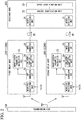
- FIG. 5 is a diagram for describing a configuration of a communication system according to a first embodiment.
- the communication system shown in FIG. 5 includes a transmission node (transmission apparatus) 100 that transmits a signal, a receiving node (receiving apparatus) 301 that receives the signal, and first and second receiving nodes (receiving apparatuses) 201-1, 201-2 that relay the signal between the transmission node 100 and the receiving node 301.
- the first relay node 201-1 and the second relay node 201-2 are collectively referred to as relay nodes 201 when they are not differentiated (the same applies to relay nodes 202 to 204).
- reference symbol R2 denotes a signal that includes a likelihood quantization bit value and a code book number (the same applies to the examples in FIG. 6 to FIG. 8 ).
- the relay node 201 relays a signal from the transmission node 100 to the receiving node 301.
- an interface such as an existing PON (passive optical network) may be used, or a unique interface may be used.
- the relay node 201 includes a wireless receiving unit (first receiving unit) 21, a reception SNR estimation unit (estimation unit) 27, a soft demodulation unit 22, a first code book memory unit (first memory unit) 28, a likelihood adaptive quantization unit (quantization unit) 24, and a wired transmission unit (transmission unit) 25.
- the wireless receiving unit (first receiving unit) 21 receives a signal (first signal) transmitted by the transmission node 100.
- the reception SNR estimation unit 27 estimates a reception SNR value from the signal power of the received signal and noise power. Furthermore, the reception SNR estimation unit 27 selects a code book number corresponding to a reception SNR range that has a range including the estimated reception SNR value, based on the estimated reception SNR value.
- the soft demodulation unit 22 detects a likelihood of the received signal by performing soft demodulation on the received signal.
- the first code book memory unit 28 stores a first quantization code book that shows, for each code book number, a relationship between a quantization parameter for quantizing the likelihood, and a likelihood quantization bit value showing the quantized likelihood.
- the first code book memory unit 28 may be configured with a ROM (read only memory), or a RAM (random access memory).
- the likelihood adaptive quantization unit 24 obtains a relationship corresponding to the selected code book number, between the quantization parameter and the likelihood quantization bit value, by making reference to the first quantization code book. Furthermore, the likelihood adaptive quantization unit 24 obtains a likelihood quantization bit value by adaptively quantizing the detected likelihood, with use of the obtained relationship.
- the wired transmission unit 25 transmits to the receiving node 300 a second signal that includes the obtained likelihood quantization bit value and the selected code book number.
- the relay node 201 can be realized by causing a computer to read a relay program.
- the relay node 201 may realize each process by causing a CPU (central processing unit) to execute the relay program on.
- the relay program causes the computer to execute receiving a signal (first signal) transmitted by the transmission node 100, estimating a reception SNR value from the signal power of the received signal and noise power, and selecting a code book number corresponding to the reception SNR range that has a range including the reception SNR value, based on the reception SNR value.
- the relay program causes the computer to execute detecting a likelihood of the signal by performing soft demodulation on the received signal, and obtaining a relationship corresponding to the selected code book number, between a quantization parameter and a likelihood quantization bit value, by making reference to a first quantization code book that shows, for each code book, the relationship between a quantization parameter for quantizing a likelihood, and a likelihood quantization bit value showing the quantizing likelihood.
- the relay program causes the computer to execute obtaining a likelihood quantization bit value by adaptively quantizing the detected likelihood with use of the obtained relationship, and transmitting to the receiving node 301 a signal (second signal) that includes the obtained likelihood quantization bit value and the selected code book number.
- the receiving node 301 receives a signal that has been transmitted from the transmission node 100 and that has been relayed by the receiving node 201.
- the receiving node 301 includes a wired receiving unit (second receiving unit) 31, a second code book memory unit (second memory unit) 38, and an inverse quantization unit 32.
- the wired receiving unit 31 receives a signal (second signal) transmitted by the relay node 201.
- the second code book memory unit 38 stores a second quantization code book of the same content as that of the first quantization code book.
- the second code book memory unit 38 may be configured with a ROM or a RAM.
- the inverse quantization unit 32 obtains a relationship corresponding to the selected code book number included in the received signal, between the quantization parameter and the likelihood quantization bit value, by making reference to the second quantization code book.
- the inverse quantization unit 32 inverse-quantizes the likelihood quantization bit value included in the received signal, using the obtained relationship.
- the receiving node 301 can be realized by causing a computer to read a receiving program.
- the receiving node 301 may realize each process by causing a CPU to execute the receiving program.
- the receiving program causes the computer to receive a signal (second signal) transmitted by the relay apparatus.
- the receiving program causes the computer to execute obtaining a relationship corresponding to the selected code book number included in the received second signal, between a quantization parameter and a likelihood quantization bit value, by making reference to the second quantization code book of the same content as that of the first quantization code book, and inverse-quantizing the likelihood quantization bit value included in the received second signal, by using the obtained relationship.
- the reception SNR estimation unit 27 of each relay node 201 estimates a reception SNR based on a reception signal.
- the reception SNR can be estimated in a manner such that having estimated the reception power and noise power first, the noise power is subtracted from the reception power to calculate the reception signal power and calculate the ratio of the reception signal power and the noise power.
- the noise power can be estimated by preliminarily providing a no-signal segment in the transmission signal.
- the reception SNR estimation unit 27 selects from the estimated reception SNR a code book number that shows the corresponding reception SNR range, and notifies the likelihood adaptive quantization unit 24 of it. That is to say, the reception SNR estimation unit 27 identifies, among several reception SNR ranges (first reception SNR range, second reception SNR range, and so forth), the reception SNR range that has the range that includes the estimated reception SNR value. Furthermore, the reception SNR estimation unit 27 selects the code book number that corresponds to the identified reception SNR range. The code book number is preliminarily set in the reception SNR estimation unit 27. The reception SNR estimation unit 27 may acquire the code book number (or the first code book) from the first code book memory 28.
- the upper layer function unit 33 preliminarily notifies the relay node 201 of the modulation method type that is used in communication between the transmission node 100 and the relay node 201. Accordingly, the reception SNR estimation unit 27 has preliminarily identified the type of modulation method. Therefore, the reception SNR estimation unit 27 can identify the code book number by identifying the reception SNR ra nge.
- the likelihood adaptive quantization unit 24 reads the quantization parameter corresponding to the notified code book number, by making reference to the quantization code book that stores quantization parameters of several patterns. Furthermore, the likelihood adaptive quantization unit 24 quantizes the likelihood using the quantization parameter, and obtains the likelihood quantization bit value.
- the transmission unit (wired transmission unit 25) of each relay node 201 transmits to the receiving node 301 the likelihood quantization bit value and the code book number notified from the reception SNR estimation unit 27.
- the inverse quantization unit 32 of the receiving node 301 makes reference to the quantization code book stored in the second code book memory unit 38, and after having read the quantization parameter of quantization being performed in the relay node 201, it performs an inverse quantization process on the received likelihood quantization bit value.
- the inverse quantization unit 32 may convert the likelihood quantization bit value into a quantization parameter by performing inverse quantization.
- the connection between the transmission node 100 and the relay node 201 may be wired connection.
- the signal transmitted and received between the transmission node 100 and the relay node 201 may be either one of a single-carrier signal and a multi-carrier signal.
- the relay node 201 may perform a decoding process after the soft demodulation process.
- a second embodiment is an example of a case where the connection between a relay node and a receiving node is wireless connection when using the method of the first embodiment.
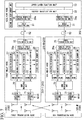
- FIG. 6 is a diagram for describing a configuration of a communication system of the second embodiment.
- a transmission unit of a relay node 202 is a wireless transmission unit 26
- a second receiving unit of a receiving node 302 is a wireless receiving unit 34.
- the process up to acquisition of a likelihood quantization bit value and a code book number is similar to that of the first embodiment.
- the wireless transmission unit 26 which corresponds to a transmission unit, modulates a signal including a likelihood quantization bit value and a code book number, and transmits the modulated signal as a wireless signal to the receiving node 302.
- MIMO multiple-input multiple-output
- each wireless receiving unit 34 receives a signal from each receiving node 202.
- a demodulation unit 35 demodulates the received signal.
- An inverse quantization unit 32 performs an inverse quantization process, as with the first embodiment. At this time, the demodulation process may be either one of hard determination and soft determination.
- a MIMO process is performed in a MIMO processing unit 36 before the demodulation process.
- the connection between the transmission node 100 and the relay node 202 may be wired connection.
- the signal transmitted and received between the transmission node 100 and the relay node 202 may be either one of a single-carrier signal and a multi-carrier signal.
- a wireless transmission unit 21 of each relay node 202 may perform an encoding process before modulation is performed.
- the relay node 202 or the receiving node 302 may perform a decoding process after demodulation is performed.
- a third embodiment is an example of a case where the number of transmission nodes and the number of relay nodes are arbitrary, or in a wireless connection segment, the number of antennas of each transmission node and the number of antennas of each relay node are arbitrary, when using the method of the first embodiment.
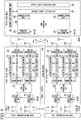
- FIG. 7 is a diagram for describing a configuration of a communication system of the third embodiment.
- the number of transmission nodes 100 is M
- the number of relay nodes 203 is N.
- MIMO transmission may be performed, in which single or several data streams are transmitted.
- each relay node 203 further includes a MIMO processing unit 29.
- the relay node 203 performs reception SNR estimation on a post-MIMO process signal. Then, the relay node 203, for each data stream, performs soft demodulation and likelihood adaptive quantization as described in the first embodiment. Furthermore, a parallel-serial conversion unit 29a of the relay node 203 performs parallel-serial conversion on a likelihood quantization bit value and a code book number, and transmits the post-conversion likelihood quantization bit value and code book number to the receiving node 303.
- a serial-parallel conversion unit 39a of the receiving node 303 performs serial-parallel conversion on the likelihood quantization bit value and the code book number that have been transmitted from each relay node 203.
- the inverse quantization unit 32 of the receiving node 303 performs an inverse quantization process as described in the first embodiment, based on the converted likelihood quantization bit value and code book number, and determines the bit for each data stream, then transmits the determination result to the upper layer function unit 33.
- the connection between the transmission node 100 and the relay node 203 may be wired connection.
- the signal transmitted and received between the transmission node 100 and the relay node 203 may be either one of a single-carrier signal and a multi-carrier signal.
- the relay node 203 may perform a decoding process after the soft demodulation process has been performed.
- a fourth embodiment is an example of a case where the number of transmission nodes and the number of relay nodes are arbitrary, or in a wireless connection segment, the number of antennas of each transmission node and the number of antennas of each relay node are arbitrary, when using the method of the second embodiment.
- FIG. 8 is a diagram for describing a configuration of a communication system of the fourth embodiment.
- the number of transmission nodes 100 is M
- the number of relay nodes 204 is N.
- MIMO transmission may be performed, in which single or several data streams are transmitted.
- each relay node 204 further includes a MIMO processing unit 29.
- First transmission node 100-1 to Mth transmission node 100-M are collectively referred to as transmission nodes 100 when they are not differentiated.
- the relay node 204 performs reception SNR estimation on a post-MIMO process signal. Then, the relay node 204 performs, for each data stream, soft demodulation and likelihood adaptive quantization as described in the second embodiment, and transmits the likelihood quantization bit value and the code book number to the receiving node 304.
- each wireless receiving unit 34 receives a signal from each relay node 204, each demodulation unit 35 demodulates the received signal, and the inverse quantization unit 32 performs an inverse quantization process.
- the demodulation process performed by the demodulation unit 35 may be either one of hard determination and soft determination.
- the connection between the transmission node 100 and the relay node 204 may be wired connection.
- the signal transmitted and received between the transmission node 100 and the relay node 204 may be either one of a single-carrier signal and a multi-carrier signal.
- a wireless transmission unit 21 of each relay node 100 may perform an encoding process before modulation is performed.
- the relay node 100 or the receiving node 304 may perform a decoding process after demodulation is performed.
- a likelihood quantization parameter is adaptively changed and then the quantized likelihood is transmitted from a relay node to a receiving node
- Programs for realizing the function of each apparatus (such as a relay node and a relay node) of the several embodiments described above may be recorded on a computer-readable recording medium, and the programs recorded on this recording medium may be read and executed on a computer system to thereby perform the processes.
- the "computer system” may include an operating system (OS) and hardware such as peripheral devices.
- OS operating system
- peripheral devices such as peripheral devices.
- the "computer-readable recording medium” includes a flexible disk, a magnetic optical disk, a ROM (read only memory), a writable non-volatile memory such as a flash memory, a portable medium such as a DVD (digital versatile disk), and a memory device such as a hard disk drive that is built-into a computer system.
- the "computer-readable recording medium” also includes one that retains a program for a certain period of time, such as a volatile memory (for example, a DRAM (dynamic random access memory)) within a computer system serving as a server computer or a client computer in those cases where the program is transmitted via a network such as the Internet or a communication line such as a telephone line.
- a volatile memory for example, a DRAM (dynamic random access memory)
- DRAM dynamic random access memory
- the above programs may also be transmitted from a computer system having these programs stored in a memory device, to another computer system, via a transmission medium or the transmitted wave in the transmission medium.
- the "transmission medium” that transmits the programs is a medium that has a function of transmitting information such as a network (communication network) including the Internet, and a communication line including a telephone line.
- the above programs may be a so-called difference file (difference program) that is able to realize the above functions in combination with a program recorded preliminarily on a computer system.
- difference file difference program
- the present invention may be applied to a communication system, a relay apparatus, a receiving apparatus, a relay method, a receiving method, a relay program, and a receiving program.
Landscapes
- Engineering & Computer Science (AREA)
- Computer Networks & Wireless Communication (AREA)
- Signal Processing (AREA)
- Physics & Mathematics (AREA)
- Electromagnetism (AREA)
- Power Engineering (AREA)
- Artificial Intelligence (AREA)
- Quality & Reliability (AREA)
- Mobile Radio Communication Systems (AREA)
Abstract
Description
- The present invention relates to a communication system, a relay apparatus, a receiving apparatus, a relay method, a receiving method, a relay program, and a receiving program that improve communication quality by relaying signals from a transmission apparatus.
- In the present description, the transmission apparatus, the relay apparatus, and the receiving apparatus may be referred to as a transmission node, a relay node, and a receiving node respectively.
- There has been considered a communication system that utilizes a plurality of relay nodes present between a transmission node and a receiving node to thereby improve the quality of communication, in a communication system, particularly, in a wireless communication system.
FIG. 1 is a diagram for describing a configuration of a communication system that utilizes a plurality of relay nodes. The communication system shown inFIG. 1 shows atransmission node 100, a first relay node 200-1, a second relay node 200-2, and areceiving node 300. The first relay node 200-1 and the second relay node 200-2 are collectively referred to asrelay nodes 200 when they are not differentiated. The number ofrelay nodes 200 in the communication system may be an arbitrary number not less than 1. The connection between thetransmission node 100 and therelay nodes 200, and the connection between therelay nodes 200 and thereceiving node 300 may be either one of wired connection and wireless connection. - There has been a communication system in which a likelihood detected in a relay node in communication between a transmission node and a relay node is quantized and forwarded to a receiving node. Furthermore, there has been considered a relay system in which quantization parameters are adaptively changed according to the probability distribution of a detected likelihood, in order to reduce likelihood quantization bits (for example, refer to Non-Patent Document 2).
- There has been considered a configuration in a wireless communication system, particularly, in a mobile communication system, such that a plurality of antenna units equipped with some base station functions are physically stretched out and these antenna units are used as distributed stations. An antenna unit refers to a unit that is equipped with a transmission interface, a wireless transmitter/receiver, and an antenna. A base station with distributed stations stretched out therefrom functions as a central station to control the plurality of distributed stations.
-
FIG. 2 is a diagram for describing a configuration of a communication system that uses likelihood adaptive quantization in the case where the relay nodes and the receiving node are connected by means of wired connection. Thetransmission node 100, therelay nodes 200, and thereceiving node 300 in this case can be perceived respectively as a terminal, distributed stations, and a central station in the mobile communication system described above where the base station functions are divided into the central station and the distributed stations. - First, a signal transmitted from the
transmission node 100 is received at awireless receiving unit 21 of therelay node 200. The signal gets noise added thereto. Asoft demodulation unit 22 of eachrelay node 200 performs soft demodulation on the received signal, to thereby detect the likelihood of the received signal. Next, a quantizationparameter calculation unit 23 calculates a quantization parameter (what type of quantization width to be employed) by observing the probability distribution of the detected likelihood. A likelihoodadaptive quantization unit 24 performs likelihood adaptive quantization according to this quantization parameter. For example, a quantization parameter may be a quantization level value, which is a value after likelihood has been quantized. - The quantized likelihood is transmitted as a likelihood quantized value, which is expressed as a bit of '0' or '1', from the
wired transmission unit 25 of eachrelay node 200 to thereceiving node 300. Thereceiving node 300 is yet to know what type of quantization parameter is used in quantization of the transmitted likelihood. Consequently, therelay node 200 needs to notify thereceiving node 300 of the quantization parameter as well as the likelihood quantization bit value. InFIG. 2 , reference symbol R1 denotes a signal that includes a likelihood quantization bit value and a quantization parameter (the same applies to the example inFIG. 3 ). Finally, aninverse quantization unit 32 of thereceiving node 300 performs an inverse quantization process to determine the received bit, based on the notified quantization parameter, and the signal is forwarded to an upperlayer function unit 33. -
FIG. 3 is a diagram for describing a configuration of a communication system that uses likelihood adaptive quantization in the case where the connection between therelay nodes 200 and thereceiving node 300 is wireless connection. In this case, the process up to performing likelihood adaptive quantization in therelay node 200 is similar to that in the configuration ofFIG. 2 . A likelihood quantization bit value is modulated in awireless transmission unit 26, and is transmitted as a wireless signal to thereceiving node 300. In thereceiving node 300, eachwireless receiving unit 34 receives a signal from each receivingnode 200. Ademodulation unit 35 demodulates the received signal, and theinverse quantization unit 32 performs the inverse quantization process on the demodulated signal. At this time, the demodulation process may be either one of hard determination and soft determination. - The communication systems shown in
FIG. 2 andFIG. 3 enable improved communication quality, compared to that in performing direct communication between the transmission node and the receiving node. -
- [Non-Patent Document 1] Shinsuke Ibi, Seiichi Sampei, IEICE Technical Report, vol. 113, no. 456, RCS2013-336, pp. 181-186, "A Study on Optimizations of Quantization Threshold for Decode-Quantize-Forward Relaying", March, 2014.
- [Non-Patent Document 2] Clemens Novak, et al., Proc. ISIT 2009, pp. 1070-1074, "Quantization for Soft-Output Demodulators in Bit-Interleaved Coded Modulation Systems" July, 2009.
- However, in the configurations of
FIG. 2 andFIG. 3 , the number of bits required when notifying the quantization parameter, which change according to the reception quality, becomes great. As a result, there is a problem in that overhead of signals transmitted from the relay node to the receiving node will increase. For example, in the case where the likelihood is quantized by 3 bits, it is necessary that the receiving node is notified of an 8-step quantization level value (quantization parameter) every time when the reception quality changes. Moreover, in order to express each quantization level value, a numerical expression such as a floating-point number needs to be used. For example, in the case of using a double precision floating-point number, a 64-bit bit number is required for a single quantization level value. That is to say, the relay node is required to notify the receiving node of the quantization parameter that is adapted to the current signal (quantization level value for each step). In the case of the above example, a number of bits as many as 512 (= 8 steps x 64 bits) is required for a single quantization parameter notification. - In order to solve the problem above, an object of the present invention is to provide a communication system, a relay apparatus, a receiving apparatus, a relay method, a receiving method, a relay program, and a receiving program, capable of reducing the number of bits required for quantization parameter notification to reduce transmission overhead, in the case where a relay apparatus detects and quantizes the likelihood of a signal from a transmission apparatus, and transmits it to a receiving apparatus.
- A communication system according to a first aspect of the present invention includes a transmission apparatus, a receiving apparatus, and a relay apparatus that relays a signal from the transmission apparatus to the receiving apparatus
- The transmission apparatus transmits a first signal.
- The relay apparatus includes: a first receiving unit that receives the transmitted first signal; an estimation unit that estimates a reception signal to noise ratio (SNR) value from signal electric power of the received first signal and noise electric power, the estimation unit selecting a code book number based on the estimated reception SNR value, the code book number corresponding to a reception SNR range, the reception SNR range having a range including the estimated reception SNR value; a soft demodulation unit that performs soft demodulation on the received first signal to detect a likelihood of the received first signal; a first memory unit that stores a first quantization code book, the first quantization code book showing, for each code book number, a relationship between a quantization parameter for quantizing a likelihood, and a likelihood quantization bit value showing a quantized likelihood; a quantization unit that refers the first quantization code book to obtain a relationship between a quantization parameter and a likelihood quantization bit value that corresponds to the selected code book number, the quantization unit adaptively quantizing the detected likelihood by using the obtained relationship to obtain a likelihood quantization bit value; and a transmission unit that transmits, to the receiving apparatus, a second signal including the obtained likelihood quantization bit value and the selected code book number.
- The receiving apparatus includes: a second receiving unit that receives the transmitted second signal; a second memory unit that stores a second quantization code book having the same content as that of the first quantization code book; and an inverse quantization unit that refers the second quantization code book to obtain a relationship between a quantization parameter and a likelihood quantization bit value that corresponds to the selected code book number included in the received second signal, the inverse quantization unit inverse-quantizing the likelihood quantization bit value included in the received second signal, by using the obtained relationship.
- A relay apparatus according a second aspect of the present invention is a relay apparatus for relaying a signal from a transmission apparatus to a receiving apparatus. The relay apparatus includes: a first receiving unit that receives a first signal transmitted by the transmission apparatus; an estimation unit that estimates a reception signal to noise ratio (SNR) value from signal electric power of the received first signal and noise electric power, the estimation unit selecting a code book number based on the estimated reception SNR value, the code book number corresponding to a reception SNR range, the reception SNR range having a range including the estimated reception SNR value; a soft demodulation unit that performs soft demodulation on the received first signal to detect a likelihood of the received first signal; a first memory unit that stores a first quantization code book, the first quantization code book showing, for each code book number, a relationship between a quantization parameter for quantizing a likelihood, and a likelihood quantization bit value showing a quantized likelihood; a quantization unit that refers the first quantization code book to obtain a relationship between a quantization parameter and a likelihood quantization bit value that corresponds to the selected code book number, the quantization unit adaptively quantizing the detected likelihood by using the obtained relationship to obtain a likelihood quantization bit value; and a transmission unit that transmits, to the receiving apparatus, a second signal including the obtained likelihood quantization bit value and the selected code book number.
- A receiving apparatus according to a third aspect of the present invention is a receiving apparatus for receiving the second signal transmitted by the relay apparatus according to the second aspect. The receiving apparatus includes: a second receiving unit that receives the second signal transmitted by the relay apparatus; a second memory unit that stores a second quantization code book having the same content as that of the first quantization code book; and an inverse quantization unit that refers the second quantization code book to obtain a relationship between a quantization parameter and a likelihood quantization bit value that corresponds to the selected code book number included in the received second signal, the inverse quantization unit inverse-quantizing the likelihood quantization bit value included in the received second signal, by using the obtained relationship.
- A relay method according to a fourth aspect of the present invention is a relay method for relaying a signal from a transmission apparatus to a receiving apparatus. The relay method includes: receiving a first signal transmitted by the transmission apparatus; estimating a reception signal to noise ratio (SNR) value from signal electric power of the received first signal and noise electric power; selecting a code book number based on the estimated reception SNR value, the code book number corresponding to a reception SNR range, the reception SNR range having a range including the estimated reception SNR value; performing soft demodulation on the received first signal to detect a likelihood of the first signal; referring a first quantization code book to obtain a relationship between a quantization parameter and a likelihood quantization bit value that corresponds to the selected code book number, the first quantization code book showing, for each code book number, a relationship between a quantization parameter for quantizing a likelihood, and a likelihood quantization bit value showing a quantized likelihood; adaptively quantizing the detected likelihood by using the obtained relationship to obtain a likelihood quantization bit value; and transmitting, to the receiving apparatus, a second signal including the obtained likelihood quantization bit value and the selected code book number.
- A receiving method according to a fifth aspect of the present invention is a receiving method for receiving the second signal transmitted by the relay method according to fourth aspect. The receiving method includes: receiving the second signal transmitted by the relay method; referring a second quantization code book to obtain a relationship between a quantization parameter and a likelihood quantization bit value that corresponds to the selected code book number included in the received second signal, the second quantization code book having the same content as that of the first quantization code book; and inverse-quantizing the likelihood quantization bit value included in the received second signal, by using the obtained relationship.
- A relay program according to a sixth aspect of the present invention is a relay program for causing a computer to realize relay of a signal from a transmission apparatus to a receiving apparatus. The relay program causes the computer to execute: receiving a first signal transmitted by the transmission apparatus; estimating a reception signal to noise ratio (SNR) value from signal electric power of the received first signal and noise electric power; selecting a code book number based on the reception SNR value, the code book number corresponding to a reception SNR range, the reception SNR range having a range including the reception SNR value; performing soft demodulation on the received first signal to detect a likelihood of the first signal; referring a first quantization code book to obtain a relationship between a quantization parameter and a likelihood quantization bit value that corresponds to the selected code book number, the first quantization code book showing, for each code book number, a relationship between a quantization parameter for quantizing a likelihood, and a likelihood quantization bit value showing a quantized likelihood; adaptively quantizing the detected likelihood by using the obtained relationship to obtain a likelihood quantization bit value; and transmitting, to the receiving apparatus, a second signal including the obtained likelihood quantization bit value and the selected code book number.
- A receiving program according to a seventh aspect of the present invention is a receiving program for causing a computer to realize reception of the second signal transmitted by the relay apparatus according to the second aspect. The receiving program causes the computer to execute: receiving the second signal transmitted by the relay apparatus; referring a second quantization code book to obtain a relationship between a quantization parameter and a likelihood quantization bit value that corresponds to the selected code book number included in the received second signal, the second quantization code book having the same content as that of the first quantization code book; and inverse-quantizing the likelihood quantization bit value included in the received second signal, by using the obtained relationship.
- According to a relay apparatus, a receiving apparatus, a relay method, a receiving method, a relay program, and a receiving program of an embodiment of the present invention, it is possible to reduce the number of bits required for quantization parameter notification, and reduce transmission overhead, in the case where a relay apparatus detects and quantizes the likelihood of a signal, and transmits it to a receiving apparatus.
-
-
FIG. 1 is a diagram for describing a configuration of a communication system that utilizes a plurality of relay nodes according to a related art. -
FIG. 2 is a diagram for describing a configuration of a communication system that uses likelihood adaptive quantization in the case where the connection between relay nodes and a receiving node according to a related art is wired connection. -
FIG. 3 is a diagram for describing a configuration of a communication system that uses likelihood adaptive quantization in the case where the connection between relay nodes and a receiving node according to a related art is wireless connection. -
FIG. 4 is a diagram for describing an example of a quantization code book used in a communication system according to an embodiment of the present invention. -
FIG. 5 is a diagram for describing a configuration of a communication system according to a first embodiment. -
FIG. 6 is a diagram for describing a configuration of a communication system according to a second embodiment. -
FIG. 7 is a diagram for describing a configuration of a communication system according to a third embodiment. -
FIG. 8 is a diagram for describing a configuration of a communication system according to a fourth embodiment. - Hereunder, embodiments of the present invention are described, with reference to the accompanying drawings. The embodiments described below are embodiments of the present invention, and the invention is not limited by the embodiments below. In the present description and figures, constituents with the same reference symbols show the same constituents.
- The embodiments of the present invention use the fact that a likelihood probability distribution and an optimal quantization parameter can be preliminarily calculated from the modulation type and reception SNR (signal to noise ratio) in the communication system used between a transmission node and a relay node. For each reception SNR of a range where the likelihood probability distribution can be seen as the same at the time of each modulation type, an optimal quantization parameter is calculated preliminarily, and is prepared in the relay node and the receiving node as a quantization code book. Each relay node notifies the receiving node of a code book number that corresponds to the reception SNR range only. As a result, overhead of a signal transmitted from the relay node to the receiving node is reduced. For example, in the case where there are two types of modulation types and two steps of reception SNR, there are prepared four types of quantization parameters in total. The bit number of the code book number required for notifying these quantization parameters becomes 2 bits that can express four ways of bit sequences.
FIG. 4 is an example of the quantization code book of the above example where the likelihood quantization bit number is 2. -
FIG. 5 is a diagram for describing a configuration of a communication system according to a first embodiment. The communication system shown inFIG. 5 includes a transmission node (transmission apparatus) 100 that transmits a signal, a receiving node (receiving apparatus) 301 that receives the signal, and first and second receiving nodes (receiving apparatuses) 201-1, 201-2 that relay the signal between thetransmission node 100 and the receivingnode 301. The first relay node 201-1 and the second relay node 201-2 are collectively referred to asrelay nodes 201 when they are not differentiated (the same applies to relaynodes 202 to 204). - In
FIG. 5 , reference symbol R2 denotes a signal that includes a likelihood quantization bit value and a code book number (the same applies to the examples inFIG. 6 to FIG. 8 ). - The
relay node 201 relays a signal from thetransmission node 100 to the receivingnode 301. For signal conversion used in signal transmission between therelay node 201 and the receivingnode 301, an interface such as an existing PON (passive optical network) may be used, or a unique interface may be used. - The
relay node 201 includes a wireless receiving unit (first receiving unit) 21, a reception SNR estimation unit (estimation unit) 27, asoft demodulation unit 22, a first code book memory unit (first memory unit) 28, a likelihood adaptive quantization unit (quantization unit) 24, and a wired transmission unit (transmission unit) 25. - The wireless receiving unit (first receiving unit) 21 receives a signal (first signal) transmitted by the
transmission node 100. - The reception
SNR estimation unit 27 estimates a reception SNR value from the signal power of the received signal and noise power. Furthermore, the receptionSNR estimation unit 27 selects a code book number corresponding to a reception SNR range that has a range including the estimated reception SNR value, based on the estimated reception SNR value. - The
soft demodulation unit 22 detects a likelihood of the received signal by performing soft demodulation on the received signal. - The first code
book memory unit 28 stores a first quantization code book that shows, for each code book number, a relationship between a quantization parameter for quantizing the likelihood, and a likelihood quantization bit value showing the quantized likelihood. The first codebook memory unit 28 may be configured with a ROM (read only memory), or a RAM (random access memory). - The likelihood
adaptive quantization unit 24 obtains a relationship corresponding to the selected code book number, between the quantization parameter and the likelihood quantization bit value, by making reference to the first quantization code book. Furthermore, the likelihoodadaptive quantization unit 24 obtains a likelihood quantization bit value by adaptively quantizing the detected likelihood, with use of the obtained relationship. - The
wired transmission unit 25 transmits to the receiving node 300 a second signal that includes the obtained likelihood quantization bit value and the selected code book number. - The
relay node 201 can be realized by causing a computer to read a relay program. Therelay node 201 may realize each process by causing a CPU (central processing unit) to execute the relay program on. - The relay program causes the computer to execute receiving a signal (first signal) transmitted by the
transmission node 100, estimating a reception SNR value from the signal power of the received signal and noise power, and selecting a code book number corresponding to the reception SNR range that has a range including the reception SNR value, based on the reception SNR value. - Moreover, the relay program causes the computer to execute detecting a likelihood of the signal by performing soft demodulation on the received signal, and obtaining a relationship corresponding to the selected code book number, between a quantization parameter and a likelihood quantization bit value, by making reference to a first quantization code book that shows, for each code book, the relationship between a quantization parameter for quantizing a likelihood, and a likelihood quantization bit value showing the quantizing likelihood.
- Furthermore, the relay program causes the computer to execute obtaining a likelihood quantization bit value by adaptively quantizing the detected likelihood with use of the obtained relationship, and transmitting to the receiving node 301 a signal (second signal) that includes the obtained likelihood quantization bit value and the selected code book number.
- The receiving
node 301 receives a signal that has been transmitted from thetransmission node 100 and that has been relayed by the receivingnode 201. - The receiving
node 301 includes a wired receiving unit (second receiving unit) 31, a second code book memory unit (second memory unit) 38, and aninverse quantization unit 32. - The
wired receiving unit 31 receives a signal (second signal) transmitted by therelay node 201. - The second code
book memory unit 38 stores a second quantization code book of the same content as that of the first quantization code book. The second codebook memory unit 38 may be configured with a ROM or a RAM. - The
inverse quantization unit 32 obtains a relationship corresponding to the selected code book number included in the received signal, between the quantization parameter and the likelihood quantization bit value, by making reference to the second quantization code book. Theinverse quantization unit 32 inverse-quantizes the likelihood quantization bit value included in the received signal, using the obtained relationship. - The receiving
node 301 can be realized by causing a computer to read a receiving program. The receivingnode 301 may realize each process by causing a CPU to execute the receiving program. - The receiving program causes the computer to receive a signal (second signal) transmitted by the relay apparatus.
- Moreover, the receiving program causes the computer to execute obtaining a relationship corresponding to the selected code book number included in the received second signal, between a quantization parameter and a likelihood quantization bit value, by making reference to the second quantization code book of the same content as that of the first quantization code book, and inverse-quantizing the likelihood quantization bit value included in the received second signal, by using the obtained relationship.
- In the first embodiment, instead of the quantization parameter calculation performed by the quantization
parameter calculation unit 23 of therelay nodes 200 ofFIG. 2 andFIG. 3 , the receptionSNR estimation unit 27 of eachrelay node 201 estimates a reception SNR based on a reception signal. The reception SNR can be estimated in a manner such that having estimated the reception power and noise power first, the noise power is subtracted from the reception power to calculate the reception signal power and calculate the ratio of the reception signal power and the noise power. The noise power can be estimated by preliminarily providing a no-signal segment in the transmission signal. - The reception
SNR estimation unit 27 selects from the estimated reception SNR a code book number that shows the corresponding reception SNR range, and notifies the likelihoodadaptive quantization unit 24 of it. That is to say, the receptionSNR estimation unit 27 identifies, among several reception SNR ranges (first reception SNR range, second reception SNR range, and so forth), the reception SNR range that has the range that includes the estimated reception SNR value. Furthermore, the receptionSNR estimation unit 27 selects the code book number that corresponds to the identified reception SNR range. The code book number is preliminarily set in the receptionSNR estimation unit 27. The receptionSNR estimation unit 27 may acquire the code book number (or the first code book) from the firstcode book memory 28. - The upper
layer function unit 33 preliminarily notifies therelay node 201 of the modulation method type that is used in communication between thetransmission node 100 and therelay node 201. Accordingly, the receptionSNR estimation unit 27 has preliminarily identified the type of modulation method. Therefore, the receptionSNR estimation unit 27 can identify the code book number by identifying the reception SNR ra nge. - The likelihood
adaptive quantization unit 24 reads the quantization parameter corresponding to the notified code book number, by making reference to the quantization code book that stores quantization parameters of several patterns. Furthermore, the likelihoodadaptive quantization unit 24 quantizes the likelihood using the quantization parameter, and obtains the likelihood quantization bit value. The transmission unit (wired transmission unit 25) of eachrelay node 201 transmits to the receivingnode 301 the likelihood quantization bit value and the code book number notified from the receptionSNR estimation unit 27. - The
inverse quantization unit 32 of the receivingnode 301, based on the notified code book number, makes reference to the quantization code book stored in the second codebook memory unit 38, and after having read the quantization parameter of quantization being performed in therelay node 201, it performs an inverse quantization process on the received likelihood quantization bit value. Theinverse quantization unit 32 may convert the likelihood quantization bit value into a quantization parameter by performing inverse quantization. - The connection between the
transmission node 100 and therelay node 201 may be wired connection. The signal transmitted and received between thetransmission node 100 and therelay node 201 may be either one of a single-carrier signal and a multi-carrier signal. Therelay node 201 may perform a decoding process after the soft demodulation process. - A second embodiment is an example of a case where the connection between a relay node and a receiving node is wireless connection when using the method of the first embodiment.
FIG. 6 is a diagram for describing a configuration of a communication system of the second embodiment. In the second embodiment, a transmission unit of arelay node 202 is awireless transmission unit 26, and a second receiving unit of a receivingnode 302 is awireless receiving unit 34. Also in the second embodiment, the process up to acquisition of a likelihood quantization bit value and a code book number is similar to that of the first embodiment. In the second embodiment, thewireless transmission unit 26, which corresponds to a transmission unit, modulates a signal including a likelihood quantization bit value and a code book number, and transmits the modulated signal as a wireless signal to the receivingnode 302. At this time, in the wireless transmission between eachrelay node 202 and the receivingnode 302, MIMO (multiple-input multiple-output) transmission may be performed. In the receivingnode 302, eachwireless receiving unit 34 receives a signal from each receivingnode 202. Ademodulation unit 35 demodulates the received signal. Aninverse quantization unit 32 performs an inverse quantization process, as with the first embodiment. At this time, the demodulation process may be either one of hard determination and soft determination. In the case of MIMO transmission, a MIMO process is performed in aMIMO processing unit 36 before the demodulation process. - The connection between the
transmission node 100 and therelay node 202 may be wired connection. The signal transmitted and received between thetransmission node 100 and therelay node 202 may be either one of a single-carrier signal and a multi-carrier signal. Awireless transmission unit 21 of eachrelay node 202 may perform an encoding process before modulation is performed. Therelay node 202 or the receivingnode 302 may perform a decoding process after demodulation is performed. - A third embodiment is an example of a case where the number of transmission nodes and the number of relay nodes are arbitrary, or in a wireless connection segment, the number of antennas of each transmission node and the number of antennas of each relay node are arbitrary, when using the method of the first embodiment.
FIG. 7 is a diagram for describing a configuration of a communication system of the third embodiment. Here, the number oftransmission nodes 100 is M, and the number ofrelay nodes 203 is N. In this case, in the wireless segment, MIMO transmission may be performed, in which single or several data streams are transmitted. In this case, eachrelay node 203 further includes aMIMO processing unit 29. - The
relay node 203 performs reception SNR estimation on a post-MIMO process signal. Then, therelay node 203, for each data stream, performs soft demodulation and likelihood adaptive quantization as described in the first embodiment. Furthermore, a parallel-serial conversion unit 29a of therelay node 203 performs parallel-serial conversion on a likelihood quantization bit value and a code book number, and transmits the post-conversion likelihood quantization bit value and code book number to the receivingnode 303. - A serial-
parallel conversion unit 39a of the receivingnode 303 performs serial-parallel conversion on the likelihood quantization bit value and the code book number that have been transmitted from eachrelay node 203. Theinverse quantization unit 32 of the receivingnode 303 performs an inverse quantization process as described in the first embodiment, based on the converted likelihood quantization bit value and code book number, and determines the bit for each data stream, then transmits the determination result to the upperlayer function unit 33. - The connection between the
transmission node 100 and therelay node 203 may be wired connection. The signal transmitted and received between thetransmission node 100 and therelay node 203 may be either one of a single-carrier signal and a multi-carrier signal. Therelay node 203 may perform a decoding process after the soft demodulation process has been performed. - A fourth embodiment is an example of a case where the number of transmission nodes and the number of relay nodes are arbitrary, or in a wireless connection segment, the number of antennas of each transmission node and the number of antennas of each relay node are arbitrary, when using the method of the second embodiment.
FIG. 8 is a diagram for describing a configuration of a communication system of the fourth embodiment. Here, the number oftransmission nodes 100 is M, and the number ofrelay nodes 204 is N. In this case, in the wireless segment, MIMO transmission may be performed, in which single or several data streams are transmitted. In this case, eachrelay node 204 further includes aMIMO processing unit 29. First transmission node 100-1 to Mth transmission node 100-M are collectively referred to astransmission nodes 100 when they are not differentiated. - The
relay node 204 performs reception SNR estimation on a post-MIMO process signal. Then, therelay node 204 performs, for each data stream, soft demodulation and likelihood adaptive quantization as described in the second embodiment, and transmits the likelihood quantization bit value and the code book number to the receivingnode 304. - In the receiving
node 304, as described in the second embodiment, eachwireless receiving unit 34 receives a signal from eachrelay node 204, eachdemodulation unit 35 demodulates the received signal, and theinverse quantization unit 32 performs an inverse quantization process. At this time, the demodulation process performed by thedemodulation unit 35 may be either one of hard determination and soft determination. - The connection between the
transmission node 100 and therelay node 204 may be wired connection. The signal transmitted and received between thetransmission node 100 and therelay node 204 may be either one of a single-carrier signal and a multi-carrier signal. Awireless transmission unit 21 of eachrelay node 100 may perform an encoding process before modulation is performed. Therelay node 100 or the receivingnode 304 may perform a decoding process after demodulation is performed. - In a system where a likelihood quantization parameter is adaptively changed and then the quantized likelihood is transmitted from a relay node to a receiving node, it is possible to reduce overhead in transmission between the relay node and the receiving node, by transmitting, from the relay node to the receiving node, only a code book number that shows a reception SNR range, instead of a quantization parameter, which requires many bits for a single notification.
- Programs (such as a relay program and a receiving program) for realizing the function of each apparatus (such as a relay node and a relay node) of the several embodiments described above may be recorded on a computer-readable recording medium, and the programs recorded on this recording medium may be read and executed on a computer system to thereby perform the processes.
- The "computer system" here may include an operating system (OS) and hardware such as peripheral devices.
- The "computer-readable recording medium" includes a flexible disk, a magnetic optical disk, a ROM (read only memory), a writable non-volatile memory such as a flash memory, a portable medium such as a DVD (digital versatile disk), and a memory device such as a hard disk drive that is built-into a computer system.
- The "computer-readable recording medium" also includes one that retains a program for a certain period of time, such as a volatile memory (for example, a DRAM (dynamic random access memory)) within a computer system serving as a server computer or a client computer in those cases where the program is transmitted via a network such as the Internet or a communication line such as a telephone line.
- The above programs may also be transmitted from a computer system having these programs stored in a memory device, to another computer system, via a transmission medium or the transmitted wave in the transmission medium. The "transmission medium" that transmits the programs is a medium that has a function of transmitting information such as a network (communication network) including the Internet, and a communication line including a telephone line.
- The above programs may realize a part of the functions described above.
- The above programs may be a so-called difference file (difference program) that is able to realize the above functions in combination with a program recorded preliminarily on a computer system.
- The present invention may be applied to a communication system, a relay apparatus, a receiving apparatus, a relay method, a receiving method, a relay program, and a receiving program.
-
- 21
- Wireless receiving unit
- 22
- Soft demodulation unit
- 23
- Quantization parameter calculation unit
- 24
- Likelihood adaptive quantization unit
- 25
- Wired transmission unit
- 26
- Wireless transmission unit
- 27
- Reception SNR estimation unit
- 28
- First code book memory unit
- 29
- MIMO processing unit
- 29a
- Parallel-serial conversion unit
- 31
- Wired receiving unit
- 32
- Inverse quantization unit
- 33
- Upper layer function unit
- 34
- Wireless receiving unit
- 35
- Demodulation unit
- 36
- MIMO processing unit
- 38
- Second code book memory unit
- 39a
- Serial-parallel conversion unit
- 100
- Transmission node (transmission apparatus)
- 200 to 204
- Relay node (relay apparatus)
- 300 to 304
- Receiving node (receiving apparatus)
Claims (7)
- A communication system comprising a transmission apparatus, a receiving apparatus, and a relay apparatus that relays a signal from the transmission apparatus to the receiving apparatus, wherein
the transmission apparatus transmits a first signal,
the relay apparatus comprises:a first receiving unit that receives the transmitted first signal;an estimation unit that estimates a reception signal to noise ratio (SNR) value from signal electric power of the received first signal and noise electric power, the estimation unit selecting a code book number based on the estimated reception SNR value, the code book number corresponding to a reception SNR range, the reception SNR range having a range including the estimated reception SNR value;a soft demodulation unit that performs soft demodulation on the received first signal to detect a likelihood of the received first signal;a first memory unit that stores a first quantization code book, the first quantization code book showing, for each code book number, a relationship between a quantization parameter for quantizing a likelihood, and a likelihood quantization bit value showing a quantized likelihood;a quantization unit that refers the first quantization code book to obtain a relationship between a quantization parameter and a likelihood quantization bit value that corresponds to the selected code book number, the quantization unit adaptively quantizing the detected likelihood by using the obtained relationship to obtain a likelihood quantization bit value; anda transmission unit that transmits, to the receiving apparatus, a second signal including the obtained likelihood quantization bit value and the selected code book number, andthe receiving apparatus comprises:a second receiving unit that receives the transmitted second signal;a second memory unit that stores a second quantization code book having the same content as that of the first quantization code book; andan inverse quantization unit that refers the second quantization code book to obtain a relationship between a quantization parameter and a likelihood quantization bit value that corresponds to the selected code book number included in the received second signal, the inverse quantization unit inverse-quantizing the likelihood quantization bit value included in the received second signal, by using the obtained relationship. - A relay apparatus for relaying a signal from a transmission apparatus to a receiving apparatus, the relay apparatus comprising:a first receiving unit that receives a first signal transmitted by the transmission apparatus;an estimation unit that estimates a reception signal to noise ratio (SNR) value from signal electric power of the received first signal and noise electric power, the estimation unit selecting a code book number based on the estimated reception SNR value, the code book number corresponding to a reception SNR range, the reception SNR range having a range including the estimated reception SNR value;a soft demodulation unit that performs soft demodulation on the received first signal to detect a likelihood of the received first signal;a first memory unit that stores a first quantization code book, the first quantization code book showing, for each code book number, a relationship between a quantization parameter for quantizing a likelihood, and a likelihood quantization bit value showing a quantized likelihood;a quantization unit that refers the first quantization code book to obtain a relationship between a quantization parameter and a likelihood quantization bit value that corresponds to the selected code book number, the quantization unit adaptively quantizing the detected likelihood by using the obtained relationship to obtain a likelihood quantization bit value; anda transmission unit that transmits, to the receiving apparatus, a second signal including the obtained likelihood quantization bit value and the selected code book number.
- A receiving apparatus for receiving the second signal transmitted by the relay apparatus according to claim 2, the receiving apparatus comprising:a second receiving unit that receives the second signal transmitted by the relay apparatus;a second memory unit that stores a second quantization code book having the same content as that of the first quantization code book; andan inverse quantization unit that refers the second quantization code book to obtain a relationship between a quantization parameter and a likelihood quantization bit value that corresponds to the selected code book number included in the received second signal, the inverse quantization unit inverse-quantizing the likelihood quantization bit value included in the received second signal, by using the obtained relationship.
- A relay method for relaying a signal from a transmission apparatus to a receiving apparatus, the relay method comprising:receiving a first signal transmitted by the transmission apparatus;estimating a reception signal to noise ratio (SNR) value from signal electric power of the received first signal and noise electric power;selecting a code book number based on the estimated reception SNR value, the code book number corresponding to a reception SNR range, the reception SNR range having a range including the estimated reception SNR value;performing soft demodulation on the received first signal to detect a likelihood of the first signal;referring a first quantization code book to obtain a relationship between a quantization parameter and a likelihood quantization bit value that corresponds to the selected code book number, the first quantization code book showing, for each code book number, a relationship between a quantization parameter for quantizing a likelihood, and a likelihood quantization bit value showing a quantized likelihood;adaptively quantizing the detected likelihood by using the obtained relationship to obtain a likelihood quantization bit value; andtransmitting, to the receiving apparatus, a second signal including the obtained likelihood quantization bit value and the selected code book number.
- A receiving method for receiving the second signal transmitted by the relay method according to claim 4, the receiving method comprising:receiving the second signal transmitted by the relay method;referring a second quantization code book to obtain a relationship between a quantization parameter and a likelihood quantization bit value that corresponds to the selected code book number included in the received second signal, the second quantization code book having the same content as that of the first quantization code book; andinverse-quantizing the likelihood quantization bit value included in the received second signal, by using the obtained relationship.
- A relay program for causing a computer to realize relay of a signal from a transmission apparatus to a receiving apparatus, the relay program causing the computer to execute:receiving a first signal transmitted by the transmission apparatus;estimating a reception signal to noise ratio (SNR) value from signal electric power of the received first signal and noise electric power;selecting a code book number based on the reception SNR value, the code book number corresponding to a reception SNR range, the reception SNR range having a range including the reception SNR value;performing soft demodulation on the received first signal to detect a likelihood of the first signal;referring a first quantization code book to obtain a relationship between a quantization parameter and a likelihood quantization bit value that corresponds to the selected code book number, the first quantization code book showing, for each code book number, a relationship between a quantization parameter for quantizing a likelihood, and a likelihood quantization bit value showing a quantized likelihood;adaptively quantizing the detected likelihood by using the obtained relationship to obtain a likelihood quantization bit value; andtransmitting, to the receiving apparatus, a second signal including the obtained likelihood quantization bit value and the selected code book number.
- A receiving program for causing a computer to realize reception of the second signal transmitted by the relay apparatus according to claim 2, the receiving program causing the computer to execute:receiving the second signal transmitted by the relay apparatus;referring a second quantization code book to obtain a relationship between a quantization parameter and a likelihood quantization bit value that corresponds to the selected code book number included in the received second signal, the second quantization code book having the same content as that of the first quantization code book; andinverse-quantizing the likelihood quantization bit value included in the received second signal, by using the obtained relationship.
Applications Claiming Priority (1)
| Application Number | Priority Date | Filing Date | Title |
|---|---|---|---|
| PCT/JP2016/056846 WO2017149774A1 (en) | 2016-03-04 | 2016-03-04 | Communication system, relay device, reception device, relay method, reception method, relay program, and reception program |
Publications (2)
| Publication Number | Publication Date |
|---|---|
| EP3255814A1 true EP3255814A1 (en) | 2017-12-13 |
| EP3255814A4 EP3255814A4 (en) | 2018-10-31 |
Family
ID=59742657
Family Applications (1)
| Application Number | Title | Priority Date | Filing Date |
|---|---|---|---|
| EP16838077.2A Withdrawn EP3255814A4 (en) | 2016-03-04 | 2016-03-04 | Communication system, relay device, reception device, relay method, reception method, relay program, and reception program |
Country Status (4)
| Country | Link |
|---|---|
| US (1) | US10396872B2 (en) |
| EP (1) | EP3255814A4 (en) |
| CN (1) | CN107431564B (en) |
| WO (1) | WO2017149774A1 (en) |
Families Citing this family (2)
| Publication number | Priority date | Publication date | Assignee | Title |
|---|---|---|---|---|
| CN109891763B (en) * | 2016-11-11 | 2022-05-13 | 日本电信电话株式会社 | Wireless communication system and wireless communication method |
| TWI746083B (en) * | 2020-07-24 | 2021-11-11 | 聯陽半導體股份有限公司 | Signal redriver system |
Family Cites Families (17)
| Publication number | Priority date | Publication date | Assignee | Title |
|---|---|---|---|---|
| JP3013698B2 (en) * | 1994-04-20 | 2000-02-28 | 松下電器産業株式会社 | Vector quantization encoding device and decoding device |
| JP3849210B2 (en) * | 1996-09-24 | 2006-11-22 | ヤマハ株式会社 | Speech encoding / decoding system |
| JP3582589B2 (en) * | 2001-03-07 | 2004-10-27 | 日本電気株式会社 | Speech coding apparatus and speech decoding apparatus |
| JP5171470B2 (en) | 2008-08-08 | 2013-03-27 | 日本無線株式会社 | Relay system |
| KR101565558B1 (en) * | 2008-09-01 | 2015-11-03 | 한국전자통신연구원 | Codebook generation device, generation method and data transmission method |
| EP2202904B1 (en) | 2008-12-23 | 2013-10-02 | Ntt Docomo, Inc. | A relay station and a decoder |
| EP2202894B1 (en) | 2008-12-23 | 2011-11-02 | Ntt Docomo, Inc. | Relay station for a mobile communication system |
| US8089916B2 (en) * | 2009-04-07 | 2012-01-03 | Indian Institute Of Science | Leveraging coherent distributed space-time codes for noncoherent communication in relay networks via training |
| US8494088B2 (en) * | 2009-04-27 | 2013-07-23 | Samsung Electronics Co., Ltd. | Transmitting/receiving apparatus and method thereof in codebook based multiple antenna system |
| JP2011081769A (en) * | 2009-09-14 | 2011-04-21 | Ricoh Co Ltd | Apparatus, device and method for transferring data |
| CN102035585B (en) * | 2009-09-28 | 2015-03-11 | 华为技术有限公司 | Pre-coding method, communication device and relay device in cooperative relay system |
| CN101873203B (en) * | 2010-06-01 | 2013-05-29 | 北京邮电大学 | Signal transmission method based on codebook precoding in MIMO relay system |
| US8867673B2 (en) | 2010-07-23 | 2014-10-21 | Qualcomm Incorporated | Selective quantization of decision metrics in wireless communication |
| CN103139922B (en) * | 2011-11-25 | 2015-05-13 | 华为技术有限公司 | Method, device and system for transmitting and receiving control channel information |
| US9973970B2 (en) | 2013-11-26 | 2018-05-15 | Telefonaktiebolaget L M Ericsson (Publ) | Improving data rates of short message noisy network coding and decode-and forward relaying |
| EP2905934B1 (en) | 2014-02-07 | 2018-05-30 | Vodafone GmbH | Mobile telecommunication system using soft-information dequantizer |
| CN104539397B (en) * | 2015-01-19 | 2018-01-16 | 西安电子科技大学 | The denoising mutual information for dividing multiple access access relay system is handed over to keep quantifying retransmission method |
-
2016
- 2016-03-04 US US15/501,046 patent/US10396872B2/en active Active
- 2016-03-04 WO PCT/JP2016/056846 patent/WO2017149774A1/en not_active Ceased
- 2016-03-04 EP EP16838077.2A patent/EP3255814A4/en not_active Withdrawn
- 2016-03-04 CN CN201680002578.8A patent/CN107431564B/en active Active
Also Published As
| Publication number | Publication date |
|---|---|
| CN107431564B (en) | 2020-10-16 |
| CN107431564A (en) | 2017-12-01 |
| EP3255814A4 (en) | 2018-10-31 |
| US10396872B2 (en) | 2019-08-27 |
| US20190028161A1 (en) | 2019-01-24 |
| WO2017149774A1 (en) | 2017-09-08 |
Similar Documents
| Publication | Publication Date | Title |
|---|---|---|
| US8934426B2 (en) | Method and apparatus for determining channel quality index in multiple user-MIMO communication networks | |
| US10820334B2 (en) | Configuration of resolution of uplink data | |
| KR101043698B1 (en) | Signal Detection Device and Method in Spatial Multiplexing System | |
| KR101206116B1 (en) | Transmit diversity scheme for multiple cell cooperative communications | |
| JPWO2017135302A1 (en) | Base station, user apparatus, precoding matrix application method, and precoding matrix acquisition method | |
| CN101527937A (en) | Link self-adaptation method for base station | |
| US20180048439A1 (en) | Wireless communication system and wireless communication method | |
| KR102160148B1 (en) | Method And Apparatus For Transmitting And Receiving Signal Based On Multi-Antenna | |
| EP2555482A3 (en) | Method and device for decoding of precoded signal | |
| US10396872B2 (en) | Communication system, relay apparatus, receiving apparatus, relay method, receiving method, relay program, and receiving program | |
| JPWO2017135295A1 (en) | Base station, user equipment, power ratio application method, and channel state information transmission method | |
| EP3425807B1 (en) | Wireless communication system and communication method | |
| JP6212575B2 (en) | Base station apparatus, radio communication system, and communication method | |
| JP2017092611A (en) | Wireless communication system, communication method, wireless reception device, and program | |
| JPWO2006080360A1 (en) | Communication apparatus and communication method | |
| WO2012093334A1 (en) | Methods of transmitting coordinate multiple point data based on orthogonal covering codes | |
| JP6382040B2 (en) | COMMUNICATION SYSTEM, RELAY DEVICE, RECEPTION DEVICE, RELAY METHOD, RECEPTION METHOD, RELAY PROGRAM, AND RECEPTION PROGRAM | |
| CN111865522B (en) | Channel indication and determination method, device, user equipment and base station | |
| KR100951822B1 (en) | Apparatus and method for downlink scheduling in a multi-antenna wireless communication system | |
| KR102541870B1 (en) | Apparatus and method of blind detection of interference rank information in wireless communication system | |
| KR101495843B1 (en) | Apparatus and method for conpensating frequency offset and time offset in a multiple input multiple output wireless communication systme | |
| KR20090071796A (en) | Channel information feedback apparatus and method in a multi-antenna system | |
| JP2021150707A (en) | Receiver, transmitter, communication method, and program | |
| KR20200004000A (en) | Method and apparatus for controlling power and compression of signal | |
| JP2006191701A (en) | Transmitting apparatus and transmitting method |
Legal Events
| Date | Code | Title | Description |
|---|---|---|---|
| STAA | Information on the status of an ep patent application or granted ep patent |
Free format text: STATUS: UNKNOWN |
|
| STAA | Information on the status of an ep patent application or granted ep patent |
Free format text: STATUS: THE INTERNATIONAL PUBLICATION HAS BEEN MADE |
|
| PUAI | Public reference made under article 153(3) epc to a published international application that has entered the european phase |
Free format text: ORIGINAL CODE: 0009012 |
|
| STAA | Information on the status of an ep patent application or granted ep patent |
Free format text: STATUS: THE APPLICATION HAS BEEN PUBLISHED |
|
| AK | Designated contracting states |
Kind code of ref document: A1 Designated state(s): AL AT BE BG CH CY CZ DE DK EE ES FI FR GB GR HR HU IE IS IT LI LT LU LV MC MK MT NL NO PL PT RO RS SE SI SK SM TR |
|
| AX | Request for extension of the european patent |
Extension state: BA ME |
|
| STAA | Information on the status of an ep patent application or granted ep patent |
Free format text: STATUS: REQUEST FOR EXAMINATION WAS MADE |
|
| 17P | Request for examination filed |
Effective date: 20170303 |
|
| RBV | Designated contracting states (corrected) |
Designated state(s): AL AT BE BG CH CY CZ DE DK EE ES FI FR GB GR HR HU IE IS IT LI LT LU LV MC MK MT NL NO PL PT RO RS SE SI SK SM TR |
|
| A4 | Supplementary search report drawn up and despatched |
Effective date: 20180927 |
|
| RIC1 | Information provided on ipc code assigned before grant |
Ipc: H04L 25/06 20060101ALI20180922BHEP Ipc: H04B 7/08 20060101ALI20180922BHEP Ipc: H04B 7/15 20060101AFI20180922BHEP |
|
| STAA | Information on the status of an ep patent application or granted ep patent |
Free format text: STATUS: EXAMINATION IS IN PROGRESS |
|
| DAV | Request for validation of the european patent (deleted) | ||
| DAX | Request for extension of the european patent (deleted) | ||
| 17Q | First examination report despatched |
Effective date: 20190522 |
|
| STAA | Information on the status of an ep patent application or granted ep patent |
Free format text: STATUS: THE APPLICATION IS DEEMED TO BE WITHDRAWN |
|
| 18D | Application deemed to be withdrawn |
Effective date: 20220125 |