EP3252038B1 - N-benzoate group substituted benzopyrroline-2-one derivative and use thereof - Google Patents
N-benzoate group substituted benzopyrroline-2-one derivative and use thereof Download PDFInfo
- Publication number
- EP3252038B1 EP3252038B1 EP16742703.8A EP16742703A EP3252038B1 EP 3252038 B1 EP3252038 B1 EP 3252038B1 EP 16742703 A EP16742703 A EP 16742703A EP 3252038 B1 EP3252038 B1 EP 3252038B1
- Authority
- EP
- European Patent Office
- Prior art keywords
- group
- alkyl
- compound
- alkoxy
- halogen
- Prior art date
- Legal status (The legal status is an assumption and is not a legal conclusion. Google has not performed a legal analysis and makes no representation as to the accuracy of the status listed.)
- Not-in-force
Links
- 0 CC[C@@]1C*CC1 Chemical compound CC[C@@]1C*CC1 0.000 description 5
- OJLJLTTXEUVTDL-CJLVFECKSA-N C/C(/C(/c1c(CC(c(cc2)ccc2C(OC)=O)=C)cccc1N)=C\c(c(N)ccc1)c1N)=[O]/C Chemical compound C/C(/C(/c1c(CC(c(cc2)ccc2C(OC)=O)=C)cccc1N)=C\c(c(N)ccc1)c1N)=[O]/C OJLJLTTXEUVTDL-CJLVFECKSA-N 0.000 description 1
- BFXLPMNMHCVMCM-AFUMVMLFSA-N CC(C(CC1=O)c2cccc(C)c2/C1=C/c1c(C)cccc1OC)c1ccc(C(C2NC2)=O)c(O)c1 Chemical compound CC(C(CC1=O)c2cccc(C)c2/C1=C/c1c(C)cccc1OC)c1ccc(C(C2NC2)=O)c(O)c1 BFXLPMNMHCVMCM-AFUMVMLFSA-N 0.000 description 1
- KXPGFSTUCNQIGY-UHFFFAOYSA-N Cc1c(C(Cc(c(C2CC2)ccc2)c2Cl)C(N2c(cc3)ccc3C(O)=O)=O)c2ccc1 Chemical compound Cc1c(C(Cc(c(C2CC2)ccc2)c2Cl)C(N2c(cc3)ccc3C(O)=O)=O)c2ccc1 KXPGFSTUCNQIGY-UHFFFAOYSA-N 0.000 description 1
- KJPGYRFGUFTVBL-UHFFFAOYSA-N Cc1c(C(Cc(c(OC)ccc2)c2Cl)C(N2c(cc3)cc(O)c3C(O)=O)=O)c2ccc1 Chemical compound Cc1c(C(Cc(c(OC)ccc2)c2Cl)C(N2c(cc3)cc(O)c3C(O)=O)=O)c2ccc1 KJPGYRFGUFTVBL-UHFFFAOYSA-N 0.000 description 1
- MRQWJHQJWBVVPT-UHFFFAOYSA-N Cc1c(C(Cc2c(C3CC3)cccc2Cl)C(N2c3ccc(C(O)=O)c(O)c3)=O)c2ccc1 Chemical compound Cc1c(C(Cc2c(C3CC3)cccc2Cl)C(N2c3ccc(C(O)=O)c(O)c3)=O)c2ccc1 MRQWJHQJWBVVPT-UHFFFAOYSA-N 0.000 description 1
- JYGFTBXVXVMTGB-UHFFFAOYSA-N O=C1Nc2ccccc2C1 Chemical compound O=C1Nc2ccccc2C1 JYGFTBXVXVMTGB-UHFFFAOYSA-N 0.000 description 1
- STPAUBXKRHGCGU-CPNJWEJPSA-N OC(c(cc1)ccc1N(c1c(/C2=C\c3c(C4CC4)cccc3Cl)c(F)ccc1)C2=O)=O Chemical compound OC(c(cc1)ccc1N(c1c(/C2=C\c3c(C4CC4)cccc3Cl)c(F)ccc1)C2=O)=O STPAUBXKRHGCGU-CPNJWEJPSA-N 0.000 description 1
Images
Classifications
-
- C—CHEMISTRY; METALLURGY
- C07—ORGANIC CHEMISTRY
- C07D—HETEROCYCLIC COMPOUNDS
- C07D209/00—Heterocyclic compounds containing five-membered rings, condensed with other rings, with one nitrogen atom as the only ring hetero atom
- C07D209/02—Heterocyclic compounds containing five-membered rings, condensed with other rings, with one nitrogen atom as the only ring hetero atom condensed with one carbocyclic ring
- C07D209/04—Indoles; Hydrogenated indoles
- C07D209/30—Indoles; Hydrogenated indoles with hetero atoms or with carbon atoms having three bonds to hetero atoms with at the most one bond to halogen, directly attached to carbon atoms of the hetero ring
- C07D209/32—Oxygen atoms
- C07D209/34—Oxygen atoms in position 2
-
- C—CHEMISTRY; METALLURGY
- C07—ORGANIC CHEMISTRY
- C07D—HETEROCYCLIC COMPOUNDS
- C07D209/00—Heterocyclic compounds containing five-membered rings, condensed with other rings, with one nitrogen atom as the only ring hetero atom
- C07D209/02—Heterocyclic compounds containing five-membered rings, condensed with other rings, with one nitrogen atom as the only ring hetero atom condensed with one carbocyclic ring
- C07D209/04—Indoles; Hydrogenated indoles
- C07D209/08—Indoles; Hydrogenated indoles with only hydrogen atoms or radicals containing only hydrogen and carbon atoms, directly attached to carbon atoms of the hetero ring
-
- A—HUMAN NECESSITIES
- A61—MEDICAL OR VETERINARY SCIENCE; HYGIENE
- A61K—PREPARATIONS FOR MEDICAL, DENTAL OR TOILETRY PURPOSES
- A61K31/00—Medicinal preparations containing organic active ingredients
- A61K31/33—Heterocyclic compounds
- A61K31/395—Heterocyclic compounds having nitrogen as a ring hetero atom, e.g. guanethidine or rifamycins
- A61K31/40—Heterocyclic compounds having nitrogen as a ring hetero atom, e.g. guanethidine or rifamycins having five-membered rings with one nitrogen as the only ring hetero atom, e.g. sulpiride, succinimide, tolmetin, buflomedil
- A61K31/403—Heterocyclic compounds having nitrogen as a ring hetero atom, e.g. guanethidine or rifamycins having five-membered rings with one nitrogen as the only ring hetero atom, e.g. sulpiride, succinimide, tolmetin, buflomedil condensed with carbocyclic rings, e.g. carbazole
- A61K31/404—Indoles, e.g. pindolol
-
- A—HUMAN NECESSITIES
- A61—MEDICAL OR VETERINARY SCIENCE; HYGIENE
- A61K—PREPARATIONS FOR MEDICAL, DENTAL OR TOILETRY PURPOSES
- A61K31/00—Medicinal preparations containing organic active ingredients
- A61K31/02—Halogenated hydrocarbons
- A61K31/025—Halogenated hydrocarbons carbocyclic
- A61K31/03—Halogenated hydrocarbons carbocyclic aromatic
-
- A—HUMAN NECESSITIES
- A61—MEDICAL OR VETERINARY SCIENCE; HYGIENE
- A61K—PREPARATIONS FOR MEDICAL, DENTAL OR TOILETRY PURPOSES
- A61K31/00—Medicinal preparations containing organic active ingredients
- A61K31/185—Acids; Anhydrides, halides or salts thereof, e.g. sulfur acids, imidic, hydrazonic or hydroximic acids
- A61K31/19—Carboxylic acids, e.g. valproic acid
- A61K31/195—Carboxylic acids, e.g. valproic acid having an amino group
- A61K31/196—Carboxylic acids, e.g. valproic acid having an amino group the amino group being directly attached to a ring, e.g. anthranilic acid, mefenamic acid, diclofenac, chlorambucil
-
- A—HUMAN NECESSITIES
- A61—MEDICAL OR VETERINARY SCIENCE; HYGIENE
- A61P—SPECIFIC THERAPEUTIC ACTIVITY OF CHEMICAL COMPOUNDS OR MEDICINAL PREPARATIONS
- A61P1/00—Drugs for disorders of the alimentary tract or the digestive system
-
- A—HUMAN NECESSITIES
- A61—MEDICAL OR VETERINARY SCIENCE; HYGIENE
- A61P—SPECIFIC THERAPEUTIC ACTIVITY OF CHEMICAL COMPOUNDS OR MEDICINAL PREPARATIONS
- A61P1/00—Drugs for disorders of the alimentary tract or the digestive system
- A61P1/04—Drugs for disorders of the alimentary tract or the digestive system for ulcers, gastritis or reflux esophagitis, e.g. antacids, inhibitors of acid secretion, mucosal protectants
-
- A—HUMAN NECESSITIES
- A61—MEDICAL OR VETERINARY SCIENCE; HYGIENE
- A61P—SPECIFIC THERAPEUTIC ACTIVITY OF CHEMICAL COMPOUNDS OR MEDICINAL PREPARATIONS
- A61P1/00—Drugs for disorders of the alimentary tract or the digestive system
- A61P1/18—Drugs for disorders of the alimentary tract or the digestive system for pancreatic disorders, e.g. pancreatic enzymes
-
- A—HUMAN NECESSITIES
- A61—MEDICAL OR VETERINARY SCIENCE; HYGIENE
- A61P—SPECIFIC THERAPEUTIC ACTIVITY OF CHEMICAL COMPOUNDS OR MEDICINAL PREPARATIONS
- A61P11/00—Drugs for disorders of the respiratory system
-
- A—HUMAN NECESSITIES
- A61—MEDICAL OR VETERINARY SCIENCE; HYGIENE
- A61P—SPECIFIC THERAPEUTIC ACTIVITY OF CHEMICAL COMPOUNDS OR MEDICINAL PREPARATIONS
- A61P11/00—Drugs for disorders of the respiratory system
- A61P11/02—Nasal agents, e.g. decongestants
-
- A—HUMAN NECESSITIES
- A61—MEDICAL OR VETERINARY SCIENCE; HYGIENE
- A61P—SPECIFIC THERAPEUTIC ACTIVITY OF CHEMICAL COMPOUNDS OR MEDICINAL PREPARATIONS
- A61P11/00—Drugs for disorders of the respiratory system
- A61P11/06—Antiasthmatics
-
- A—HUMAN NECESSITIES
- A61—MEDICAL OR VETERINARY SCIENCE; HYGIENE
- A61P—SPECIFIC THERAPEUTIC ACTIVITY OF CHEMICAL COMPOUNDS OR MEDICINAL PREPARATIONS
- A61P11/00—Drugs for disorders of the respiratory system
- A61P11/08—Bronchodilators
-
- A—HUMAN NECESSITIES
- A61—MEDICAL OR VETERINARY SCIENCE; HYGIENE
- A61P—SPECIFIC THERAPEUTIC ACTIVITY OF CHEMICAL COMPOUNDS OR MEDICINAL PREPARATIONS
- A61P17/00—Drugs for dermatological disorders
-
- A—HUMAN NECESSITIES
- A61—MEDICAL OR VETERINARY SCIENCE; HYGIENE
- A61P—SPECIFIC THERAPEUTIC ACTIVITY OF CHEMICAL COMPOUNDS OR MEDICINAL PREPARATIONS
- A61P17/00—Drugs for dermatological disorders
- A61P17/06—Antipsoriatics
-
- A—HUMAN NECESSITIES
- A61—MEDICAL OR VETERINARY SCIENCE; HYGIENE
- A61P—SPECIFIC THERAPEUTIC ACTIVITY OF CHEMICAL COMPOUNDS OR MEDICINAL PREPARATIONS
- A61P19/00—Drugs for skeletal disorders
-
- A—HUMAN NECESSITIES
- A61—MEDICAL OR VETERINARY SCIENCE; HYGIENE
- A61P—SPECIFIC THERAPEUTIC ACTIVITY OF CHEMICAL COMPOUNDS OR MEDICINAL PREPARATIONS
- A61P19/00—Drugs for skeletal disorders
- A61P19/02—Drugs for skeletal disorders for joint disorders, e.g. arthritis, arthrosis
-
- A—HUMAN NECESSITIES
- A61—MEDICAL OR VETERINARY SCIENCE; HYGIENE
- A61P—SPECIFIC THERAPEUTIC ACTIVITY OF CHEMICAL COMPOUNDS OR MEDICINAL PREPARATIONS
- A61P19/00—Drugs for skeletal disorders
- A61P19/04—Drugs for skeletal disorders for non-specific disorders of the connective tissue
-
- A—HUMAN NECESSITIES
- A61—MEDICAL OR VETERINARY SCIENCE; HYGIENE
- A61P—SPECIFIC THERAPEUTIC ACTIVITY OF CHEMICAL COMPOUNDS OR MEDICINAL PREPARATIONS
- A61P21/00—Drugs for disorders of the muscular or neuromuscular system
- A61P21/04—Drugs for disorders of the muscular or neuromuscular system for myasthenia gravis
-
- A—HUMAN NECESSITIES
- A61—MEDICAL OR VETERINARY SCIENCE; HYGIENE
- A61P—SPECIFIC THERAPEUTIC ACTIVITY OF CHEMICAL COMPOUNDS OR MEDICINAL PREPARATIONS
- A61P25/00—Drugs for disorders of the nervous system
-
- A—HUMAN NECESSITIES
- A61—MEDICAL OR VETERINARY SCIENCE; HYGIENE
- A61P—SPECIFIC THERAPEUTIC ACTIVITY OF CHEMICAL COMPOUNDS OR MEDICINAL PREPARATIONS
- A61P27/00—Drugs for disorders of the senses
- A61P27/02—Ophthalmic agents
-
- A—HUMAN NECESSITIES
- A61—MEDICAL OR VETERINARY SCIENCE; HYGIENE
- A61P—SPECIFIC THERAPEUTIC ACTIVITY OF CHEMICAL COMPOUNDS OR MEDICINAL PREPARATIONS
- A61P29/00—Non-central analgesic, antipyretic or antiinflammatory agents, e.g. antirheumatic agents; Non-steroidal antiinflammatory drugs [NSAID]
-
- A—HUMAN NECESSITIES
- A61—MEDICAL OR VETERINARY SCIENCE; HYGIENE
- A61P—SPECIFIC THERAPEUTIC ACTIVITY OF CHEMICAL COMPOUNDS OR MEDICINAL PREPARATIONS
- A61P3/00—Drugs for disorders of the metabolism
- A61P3/08—Drugs for disorders of the metabolism for glucose homeostasis
- A61P3/10—Drugs for disorders of the metabolism for glucose homeostasis for hyperglycaemia, e.g. antidiabetics
-
- A—HUMAN NECESSITIES
- A61—MEDICAL OR VETERINARY SCIENCE; HYGIENE
- A61P—SPECIFIC THERAPEUTIC ACTIVITY OF CHEMICAL COMPOUNDS OR MEDICINAL PREPARATIONS
- A61P37/00—Drugs for immunological or allergic disorders
- A61P37/02—Immunomodulators
-
- A—HUMAN NECESSITIES
- A61—MEDICAL OR VETERINARY SCIENCE; HYGIENE
- A61P—SPECIFIC THERAPEUTIC ACTIVITY OF CHEMICAL COMPOUNDS OR MEDICINAL PREPARATIONS
- A61P37/00—Drugs for immunological or allergic disorders
- A61P37/02—Immunomodulators
- A61P37/06—Immunosuppressants, e.g. drugs for graft rejection
-
- A—HUMAN NECESSITIES
- A61—MEDICAL OR VETERINARY SCIENCE; HYGIENE
- A61P—SPECIFIC THERAPEUTIC ACTIVITY OF CHEMICAL COMPOUNDS OR MEDICINAL PREPARATIONS
- A61P37/00—Drugs for immunological or allergic disorders
- A61P37/08—Antiallergic agents
-
- A—HUMAN NECESSITIES
- A61—MEDICAL OR VETERINARY SCIENCE; HYGIENE
- A61P—SPECIFIC THERAPEUTIC ACTIVITY OF CHEMICAL COMPOUNDS OR MEDICINAL PREPARATIONS
- A61P43/00—Drugs for specific purposes, not provided for in groups A61P1/00-A61P41/00
-
- A—HUMAN NECESSITIES
- A61—MEDICAL OR VETERINARY SCIENCE; HYGIENE
- A61P—SPECIFIC THERAPEUTIC ACTIVITY OF CHEMICAL COMPOUNDS OR MEDICINAL PREPARATIONS
- A61P5/00—Drugs for disorders of the endocrine system
- A61P5/14—Drugs for disorders of the endocrine system of the thyroid hormones, e.g. T3, T4
-
- A—HUMAN NECESSITIES
- A61—MEDICAL OR VETERINARY SCIENCE; HYGIENE
- A61P—SPECIFIC THERAPEUTIC ACTIVITY OF CHEMICAL COMPOUNDS OR MEDICINAL PREPARATIONS
- A61P7/00—Drugs for disorders of the blood or the extracellular fluid
-
- A—HUMAN NECESSITIES
- A61—MEDICAL OR VETERINARY SCIENCE; HYGIENE
- A61P—SPECIFIC THERAPEUTIC ACTIVITY OF CHEMICAL COMPOUNDS OR MEDICINAL PREPARATIONS
- A61P7/00—Drugs for disorders of the blood or the extracellular fluid
- A61P7/04—Antihaemorrhagics; Procoagulants; Haemostatic agents; Antifibrinolytic agents
-
- C—CHEMISTRY; METALLURGY
- C07—ORGANIC CHEMISTRY
- C07D—HETEROCYCLIC COMPOUNDS
- C07D209/00—Heterocyclic compounds containing five-membered rings, condensed with other rings, with one nitrogen atom as the only ring hetero atom
- C07D209/02—Heterocyclic compounds containing five-membered rings, condensed with other rings, with one nitrogen atom as the only ring hetero atom condensed with one carbocyclic ring
- C07D209/04—Indoles; Hydrogenated indoles
- C07D209/10—Indoles; Hydrogenated indoles with substituted hydrocarbon radicals attached to carbon atoms of the hetero ring
-
- C—CHEMISTRY; METALLURGY
- C07—ORGANIC CHEMISTRY
- C07B—GENERAL METHODS OF ORGANIC CHEMISTRY; APPARATUS THEREFOR
- C07B2200/00—Indexing scheme relating to specific properties of organic compounds
- C07B2200/09—Geometrical isomers
-
- Y—GENERAL TAGGING OF NEW TECHNOLOGICAL DEVELOPMENTS; GENERAL TAGGING OF CROSS-SECTIONAL TECHNOLOGIES SPANNING OVER SEVERAL SECTIONS OF THE IPC; TECHNICAL SUBJECTS COVERED BY FORMER USPC CROSS-REFERENCE ART COLLECTIONS [XRACs] AND DIGESTS
- Y02—TECHNOLOGIES OR APPLICATIONS FOR MITIGATION OR ADAPTATION AGAINST CLIMATE CHANGE
- Y02A—TECHNOLOGIES FOR ADAPTATION TO CLIMATE CHANGE
- Y02A50/00—TECHNOLOGIES FOR ADAPTATION TO CLIMATE CHANGE in human health protection, e.g. against extreme weather
- Y02A50/30—Against vector-borne diseases, e.g. mosquito-borne, fly-borne, tick-borne or waterborne diseases whose impact is exacerbated by climate change
Definitions
- the present application relates to compounds that can be used as modulators of retinoid-related orphan receptor ⁇ (ROR ⁇ ), pharmaceutical compositions thereof, use thereof in manufacturing pharmaceuticals and method for treating and/or preventing ROR ⁇ -mediated diseases in mammals (especially humans) using the same.
- ROR ⁇ retinoid-related orphan receptor ⁇
- Nuclear receptors are a class of ligand-dependent transcription factor superfamily, which are widely distributed in organisms, and play a role in aspects such as metabolism, development, biorhythm, inflammation, immune regulation and the like.
- the ligands for nuclear receptors include thyroid hormones, steroid hormones, retinoic acids, fatty acids, sterols and the like.
- nuclear receptors for which the ligands have not been determined so far, and these receptors are called orphan nuclear receptors.
- Retinoid-related orphan receptors RORs
- NF1R Retinoid-related orphan receptors
- ROR subfamily mainly includes three members, ROR ⁇ , ROR ⁇ and ROR ⁇ .
- ROR ⁇ and ROR ⁇ and ligands thereof are widely expressed in various tissues and organs in the body. It may exist in brain, kidney, liver, testis, ovary, skeletal muscle, thymus, skin, lung and adipose tissue, wherein the highest expression level exists in brain tissue, especially cerebellar and thalamus. Recent researches also show that ROR ⁇ participates in the activity of osteoblast of human body by stimulating osteoblast-promoting factors and inhibiting inflammatory reactions.
- ROR ⁇ mainly includes two subtypes, ROR ⁇ 1 and ROR ⁇ t (ROR ⁇ 2), in which ROR ⁇ 1 is distributed in skeletal muscle, thymus, testis, pancreas, prostate, heart, liver, etc.; while ROR ⁇ t is only expressed in immune cells and is an ROR ⁇ subtype which is specific for T cells.
- Th17 cells are a class of Th cell subgroup which were recently proved to be capable of specifically producing cytokine IL-17. They participate in inducing autoimmune diseases, have strong pro-inflammatory effects, and are relevant to the occurrence and development of various autoimmune diseases, such as multiple sclerosis, psoriasis, arthritis, asthma, and the like.
- ROR ⁇ is a key driving factor of the differentiation and regulation of TH17 cells, and therefore gradually becomes an emerging potential target for developing drugs for autoimmune diseases.
- ROR inverse agonist (antagonist) blocks the occurrence and development of inflammation by affecting the functions of ROR ⁇ , regulating the proliferation and growth of TH17 cells, and inhibiting the generation of cytokine IL-17.
- ROR inverse agonist blocks the occurrence and development of inflammation by affecting the functions of ROR ⁇ , regulating the proliferation and growth of TH17 cells, and inhibiting the generation of cytokine IL-17.
- CIA model, EAE model, etc. mouse autoimmune disease models
- US patent application No. 2014/0038941A discloses a ring-fused heterocyclic derivative represented by the following general formula or a pharmaceutically acceptable salt thereof having a T-type calcium channel regulatory effect and useful as a pruritus therapeutic and/or preventive agent.
- WO2014026328 discloses compounds of the following formula or a pharmaceutically acceptable salt or solvate thereof. Such compounds can be used in the treatment of ROR-gammaT-mediated diseases or conditions.
- ROR ⁇ plays an important role in the occurrence and development of various autoimmune diseases, the synthesis of a series of novel compounds to regulate the function of ROR ⁇ is of great importance. This can lay a foundation for the treatment of autoimmune diseases.
- the present application provides a series of compounds that can be used as modulators of retinoid-related orphan receptor ⁇ (ROR ⁇ ), pharmaceutical compositions thereof, use thereof in manufacturing pharmaceuticals and method for treating and/or preventing ROR ⁇ -mediated diseases in mammals (especially humans) using the same.
- ROR ⁇ retinoid-related orphan receptor ⁇
- One aspect of the present application provides a compound, or a stereoisomer, a tautomer, a pharmaceutically acceptable salt, or a solvate thereof, the compound having a structural formula (I): wherein,
- some compounds of the present application have a structural formula (Ib): wherein,
- some compounds of the present application have a structural formula (Ic): wherein,
- m is 0 or 1, and when m is 1, R 2 is hydroxyl.
- R 6 is C 1-4 alkyl, cycloalkyl or alkoxy.
- the compounds of the present application are represented by a formula (Id): wherein,
- R6 is selected from the following groups: hydrogen, halogen, trifluoromethyl, (C 1-4 )alkyl, (C 1-4 )alkoxy, (C 3-4 )cycloalkyl and C 5-10 aryl;
- R 3 is halogen; and
- R 4 is optionally independently selected from the group consisting of halogen, trifluoromethyl, (C 1-4 )alkyl, (C 1-4 )alkoxy and (C 3-4 )cycloalkyl.
- R 2 is hydrogen, hydroxyl or halogen
- R6 is fluoro, methyl, trifluoromethyl or methoxy
- R 3 is halogen (e.g. chlorine)
- R 4 is optionally independently selected from the group consisting of halogen (e.g. chlorine), trifluoromethyl, (C 1-4 )alkyl, (C 1-4 )alkoxy and (C 3-4 )cycloalkyl (e.g. cyclopropyl).
- R 2 is hydroxyl; R 6 is fluoro, methyl or methoxy; R 3 is halogen (e.g. chlorine); and R 4 is optionally independently selected from the group consisting of halogen (e.g. chlorine), trifluoromethyl, (C 1-4 )alkyl, (C 1-4 )alkoxy and (C 3-4 )cycloalkyl (e.g. cyclopropyl).
- R 2 is hydroxyl; R 6 is methyl; R 3 is chloro; and R 4 is cyclopropyl, trifluoromethyl or chloro.
- compositions which comprises one or more compounds of the present application, or a stereoisomer, a tautomer, a pharmaceutically acceptable salt, or a solvate thereof, as well as a pharmaceutically acceptable excipient.
- compositions which comprises one or more compounds of the present application, or a stereoisomer, a tautomer, a pharmaceutically acceptable salt, or a solvate thereof; as well as one or more anti-inflammatory drugs selected from the group consisting of non-steroidal anti-inflammatory drugs (NSAIDs), non-specific and specific cyclooxygenase-2 inhibitors, gold compounds, corticosteroids, tumor necrosis factor receptor antagonists, salicylate esters or salts, immunosuppressants and methotrexate; as well as a pharmaceutically acceptable excipient.
- NSAIDs non-steroidal anti-inflammatory drugs
- Another aspect of the present application relates to a compound of the present application, or a stereoisomer, a tautomer, a pharmaceutically acceptable salt, or a solvate thereof, for regulating the activity of ROR ⁇ (e.g. inhibiting the activity of ROR ⁇ ), or for preventing or treating ROR ⁇ -mediated diseases.
- Another aspect of the present application relates to use of a compound of the present application, or a stereoisomer, a tautomer, a pharmaceutically acceptable salt, or a solvate thereof, in manufacturing a medicament for regulating the activity of ROR ⁇ (e.g. inhibiting the activity of ROR ⁇ ).
- Another aspect of the present application relates to use of a compound of the present application, or a stereoisomer, a tautomer, a pharmaceutically acceptable salt, or a solvate thereof, in manufacturing a medicament as an ROR ⁇ modulator (e.g. an inhibitor of the activity of ROR ⁇ ).
- an ROR ⁇ modulator e.g. an inhibitor of the activity of ROR ⁇
- Another aspect of the present application relates to a compound of the present application, or a stereoisomer, a tautomer, a pharmaceutically acceptable salt, or a solvate thereof, for regulating the activity of ROR ⁇ (e.g. inhibiting the activity of ROR ⁇ ).
- Another aspect of the present application relates to a compound of the present application, or a stereoisomer, a tautomer, a pharmaceutically acceptable salt, or a solvate thereof, for preventing or treating an ROR ⁇ -mediated disease.
- Another aspect of the present application relates to a method for regulating ROR ⁇ , which comprises contacting a compound of the present application, or a stereoisomer, a tautomer, a pharmaceutically acceptable salt, or a solvate thereof, with ROR ⁇ .
- Another aspect of the present application relates to a method for preventing or treating an ROR ⁇ -mediated disease, comprising administrating a preventively or therapeutically effective amount of a compound of the present application, or a stereoisomer, a tautomer, a pharmaceutically acceptable salt, or a solvate thereof, or a pharmaceutical composition of the present application, to a subject in need thereof.
- Another aspect of the present application relates to a method for preventing or treating an ROR ⁇ -mediated disease, comprising administrating a preventively or therapeutically effective amount of a compound of the present application, or a stereoisomer, a tautomer, a pharmaceutically acceptable salt, or a solvate thereof, as well as one or more anti-inflammatory drugs including, but not limited to, one or more anti-inflammatory drugs selected from the group consisting of non-steroidal anti-inflammatory drugs (NSAIDs), non-specific and specific cyclooxygenase-2 inhibitors, gold compounds, corticosteroids, tumor necrosis factor receptor antagonists, salicylate esters or salts, immunosuppressants and methotrexate, to a subject in need thereof.
- NSAIDs non-steroidal anti-inflammatory drugs
- the ROR ⁇ -mediated disease described in the present application may be an autoimmune disease and/or an inflammatory disease.
- the ROR ⁇ mediated disease to be prevented or treated is selected from the group consisting of multiple sclerosis, rheumatoid arthritis, psoriasis, crohn's disease, asthma, systemic lupus erythematosus, chronic obstructive pulmonary disease, rejections of tissue graft and of transplanted organ, scleroderma, purpura, autoimmune hemolytic and thrombocytopenia symptoms, irritable bowel syndrome, osteoarthritis, kawasaki disease, hashimoto thyroiditis, mucosal leishmaniasis, bronchitis, allergic rhinitis, atopic dermatitis, cystic fibrosis, lung metabolism rejection, child rheumatoid arthritis, ankylosing spondylitis, pancreatitis, autoimmune diabetes mellitus, autoimmune eye disease, ulcerative colitis, sjorgen's syndrome, optic neuritis, diabetes mellitus, optic neuromye
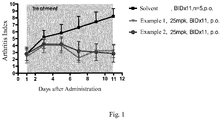
- Fig. 1 shows the in vivo activities of compounds of the present application and a solvent control in rat anti-arthritis CIA model.
- C 1-8 alkyl refers to an alkyl group as defined below having totally 1 to 8 carbon atoms
- C 3-8 cycloalkyl refers to a cycloalkyl group as defined below having totally 3 to 8 carbon atoms
- C 5-10 oaryl refers to an aryl group as defined below having totally 5 to 10 carbon atoms (or ring atoms).
- the total number of carbon atoms in the shorthanded notation does not include the carbon atom(s) that may be present in a substituent of the group.
- the term "member” used hereinbelow refers to the number of ring atoms in a group.
- “6-membered aryl” means that the number of ring atoms in the aryl group is 6.
- 5-tetrazole represents HOC(CF 3 ) 2 represents -OH represents a hydroxyl group
- -NH 2 represents an amino group
- -CN represents a cyano group
- -NO 2 represents a nitro group.
- alkyl group as defined herein (e.g. C 1-6 alkyl).
- the amido group include, but are not limited to, formamido, formamidomethyl, N-acetamido, N-methyl-N'-acetamido, and the like.
- phosphoric acid group refers to and the term “phosphate ester group” refers to in which R a and R b respectively represent alkyl groups as defined below.
- halogen refers to fluorine, chlorine, bromine or iodine, such as fluorine or chlorine.
- alkyl as a group or a part of another group (i.e., alkyl alone or attached to another group), is intended to mean a linear or branched group which consists only of carbon atom(s) and hydrogen atom(s), does not contain an unsaturated bond, and is linked to the remainder of the molecule by a single bond.
- the alkyl group may have, for example, from 1 to 18, from 1 to 8, from 1 to 6, from 1 to 4 carbon atoms.
- alkyl group examples include, but are not limited to, methyl, ethyl, propyl, isopropyl, n-butyl, isobutyl, tert-butyl, n-pentyl, 2-pentyl, hexyl, heptyl, 2-methylhexyl, 3-methylhexyl, octyl, nonyl, decyl, and the like.
- halogenated alkyl refers to an alkyl group as defined above substituted by one or more halogen atoms.
- examples of the halogenated alkyl group include, but are not limited to, trifluoromethyl, trichloromethyl, dichloromethyl, bromomethyl, iodomethyl, 1,2-dichloroethyl, and the like.
- alkoxy refers to a group of formula -OR a , in which R a is an alkyl group as defined above.
- R a is an alkyl group as defined above.
- alkoxy group include, but are not limited to, methoxy, ethoxy, isopropoxy, n-butoxy, isobutoxy, tert-butoxy, and the like.
- halogenated alkoxy refers to an alkoxy group substituted by one or more halogen atoms, in which alkoxy is as defined above.
- alkylmercapto refers to a group of formula -SR a , in which R a is an alkyl group as defined above.
- alkylmercapto group include, but are not limited to, methylmercapto, ethylmercapto, isopropylmercapto, and the like.
- alkylamino refers to a group of formula -NHR a , in which R a is an alkyl group as defined above.
- R a is an alkyl group as defined above.
- alkylamino group include, but are not limited to, methylamino, ethylamino, isopropylamino, and the like.
- dialkylamino refers to a group of formula -NR a R b , in which R a and R b are each independently an alkyl group as defined above.
- dialkylamino group include, but are not limited to, dimethylamino, diethylamino, dipropylamino, methylethylamino, and the like.
- alkylcarbonyl refers to a group of formula -COR a , in which R a is an alkyl group as defined above.
- alkylaminocarbonyl refers to -CONHR a or-CONR a R b , in which R a and R b are each an alkyl group as defined herein (e.g. C 1-6 alkyl).
- alkenyl as a group or a part of another group, means a straight or branched hydrocarbon chain group which consists only of carbon atom(s) and hydrogen atom(s), contains at least one double bond, have for example from 2 to 14, from 2 to 10, from 2 to 8 carbon atoms, and is linked to the remainder of the molecule by a single bond, including, but not limited to, vinyl, propenyl, allyl, but-1-enyl, but-2-enyl, pent-1-enyl, pent-2-enyl, penta-1,4-dienyl, and the like.
- alkynyl as a group or a part of another group, means a straight or branched hydrocarbon chain group which consists only of carbon atom(s) and hydrogen atom(s), contains at least one triple bond and optionally one or more double bonds, have for example from 2 to 14, from 2 to 10, from 2 to 8 carbon atoms, and is linked to the remainder of the molecule by a single bond.
- alkynyl group include, but are not limited to, ethynyl, prop-1-ynyl, pent-1-en-4-ynyl, and the like.
- the term "carbocyclyl”, as a group or a part of another group, means a non-aromatic mono-cyclic or multi-cyclic hydrocarbon group consisting only of carbon atom(s) and hydrogen atom(s). It may include a fused ring system, a bridged ring system or a spiro ring system, have from 3 to 15 carbon atoms, preferably from 3 to 10 carbon atoms, from 3 to 8 carbon atoms, from 3 to 7 carbon atoms, and is saturated or unsaturated, and may be linked to the remainder of the molecule by a single bond via any suitable carbon atom.
- the carbocyclyl group may be saturated (which may be referred to as cycloalkyl) or unsaturated (which may be referred to as cycloalkenyl).
- the carbon atom(s) in the cycloalkyl group may be optionally oxidized.
- carbocyclyl group examples include, but are not limited to, cyclopropyl, cyclobutyl, cyclopentyl, cyclopentenyl, cyclohexyl, cyclohexenyl, cyclohexadienyl, cycloheptyl, cyclooctyl, 1H-indenyl, 2,3-indanyl, 1,2,3,4-tetrahydro-naphthyl, 5,6,7,8-tetrahydro-naphthyl, 8,9-dihydro-7H-benzocyclohepten-6-yl, 6,7,8,9-tetrahydro-5H-benzoheptenyl, 5,6,7,8,9,10-hexahydrobenzocyclooctenyl, fluorenyl, bicyclo[2.2.1]heptyl, 7,7-dimethyl-bicyclo[2.2.1]heptyl, bicyclo[2.
- heterocyclyl as a group or a part of another group, means a 3- to 18-membered non-aromatic cyclic group consisting of from 2 to 12 carbon atoms and from 1 to 6 heteroatoms selected from the group consisting of nitrogen, oxygen and sulfur.
- the heterocyclic group may be saturated or unsaturated.
- the heterocyclyl group may be a monocyclic, bicyclic, tricyclic or polycyclic ring system, which may include fused ring system or bridged ring system.
- the heterocyclyl group is preferably a 5- to 12-membered non-aromatic monocyclic or bicyclic group comprising from 1 to 3 heteroatoms selected from the group consisting of nitrogen, oxygen and sulfur, more preferably a 5- to 8-membered non-aromatic monocyclic group comprising from 1 to 3 heteroatoms selected from the group consisting of nitrogen, oxygen and sulfur, more preferably a 5- to 6-membered non-aromatic monocyclic group comprising from 1 to 2 heteroatoms selected from the group consisting of nitrogen, oxygen and sulfur.
- the nitrogen, carbon or sulfur atom in the heterocyclyl group may optionally be oxidized; the nitrogen atom may optionally be quaternized; and the heterocyclyl group may be partly or fully saturated.
- the heterocyclic group may be linked to the remainder of the molecule by a single bond via a carbon atom or a heteroatom.
- one or more of the rings may be aryl or heteroaryl, provided that the connection point with the remainder of the molecule is a non-aromatic ring atom.
- heterocyclyl group examples include, but are not limited to, pyranyl, tetrahydropyranyl, thiapyranyl, tetrahydrofuranyl, morpholinyl, mercaptomorpholinyl, piperazinyl, piperidinyl, oxazinyl, dioxolanyl, tetrahydroisoquinolyl, decahydroisoquinolyl, imidazolinyl, imidazolidinyl, quinazolinyl, thiazolidinyl, isothiazolidinyl, isoxazolidinyl, dihydroindolyl, octahydroindolyl, octahydroisoindolyl, pyrrolidinyl, pyrazolidinyl, phthalimide, and the like, preferably tetrahydropyranyl, piperazinyl, morpholinyl.
- aryl as a group or a part of another group, means a system having from 6 to 18 (e.g. from 6 to 10, from 5 to 10) carbon atoms and at least one aromatic ring.
- the aryl group may be a monocyclic, bicyclic, tricyclic or polycyclic ring system, which may comprise a fused or bridged ring system.
- the fused ring fused with the aryl group may be a carbocyclyl, heterocyclyl, aryl or heteroaryl group defined in the present application.
- the aryl group is linked to the remainder of the molecule by a single bond via an aromatic ring atom.
- aryl group examples include, but are not limited to, phenyl, naphthyl, anthracenyl, phenanthrenyl, fluorenyl, 2-benzoxazolinone, 2H-1,4-benzoxazin-3(4H)-on-7-yl, and the like, preferably phenyl.
- heteroaryl as a group or a part of another group, means a 5- to 16-membered ring system having from 1 to 15 (e.g. from 1 to 10) carbon atoms and from 1 to 4 heteroatoms selected from the group consisting of nitrogen, oxygen and sulfur, as well as at least one aromatic ring.
- the heteroaryl group may be a monocyclic, bicyclic, tricyclic or polycyclic ring system, which may comprise a fused or bridged ring system, provided that the connection point is an aromatic ring atom.
- the nitrogen, carbon or sulfur atom in the heteroaryl group may optionally be oxidized; and the nitrogen atom may optionally be quaternized.
- the heteroaryl group is preferably a 5- to 12-membered aromatic monocyclic or bicyclic group comprising from 1 to 3 heteroatoms selected from the group consisting of nitrogen, oxygen and sulfur, more preferably a 5- to 8-membered aromatic monocyclic or bicyclic group comprising from 1 to 3 heteroatoms selected from the group consisting of nitrogen, oxygen and sulfur, more preferably a 5- to 6-membered aromatic monocyclic or bicyclic group comprising from 1 to 2 heteroatoms selected from the group consisting of nitrogen, oxygen and sulfur.
- heteroaryl group examples include, but are not limited to, thienyl, furanyl, pyrrolyl, [1,3,4]oxadiazolyl, [1,2,4]thiadiazolyl, [1,3,4]thiadiazolyl, imidazolyl, benzimidazolyl, pyrazolyl, benzopyrazolyl, triazolyl, tetrazolyl, pyridyl, pyrazinyl, triazinyl, pyrimidinyl, pyridazinyl, indolizinyl, indolyl, isoindolyl, indazolyl, isoindazolyl, purinyl, quinolyl, isoquinolyl, quinazolyl, naphthyridinyl, quinoxalinyl, pteridinyl, carbazolyl, carbolinyl, phenanthridinyl, phenanthrolinyl, acridinyl
- Steps refer to compounds consisting of the same atoms, bonded by the same bonds, but having different three-dimensional structures.
- the present application will encompass various stereoisomers and mixtures thereof.
- Tautomers refer to isomers formed by transferring a proton from one atom of a molecule to another atom of the same molecule. All the tautomeric forms of the compound of the present application will also be included in the scope of the present application.
- the term "pharmaceutically acceptable salt” refers to a salt which retains the biological efficacy of the free acid or free base of the compound of the present application, and does not have any adverse effect in biological or other aspects.
- a pharmaceutically acceptable salt refers to converting a basic group or an acidic group in a parent compound into a salt form.
- Pharmaceutically acceptable salts include, but are not limited to, inorganic or organic acid salts of basic groups such as amine (amino) groups.
- Pharmaceutically acceptable salts of the present application may be synthesized from a parent compound. Suitable salts are listed in Remingtong's Pharmaceutical Sciences, 17th ed., Mack Publishing Company, Easton, Pa., 1985, p.
- the salt of the present application may be an acid salt formed from an organic acid/inorganic acid, and a base salt formed from an organic base/inorganic base.
- the basic functional group of the general formula compound is pyridine or imidazole (but not limited thereto) and the acidic functional group is carboxylic acid (but not limited thereto)
- a zwitterion inner salt
- the inner salt is also included in the salt of the present application.
- the compound of the present application may contain a plurality of cations or anions.
- solvate refers to an aggregate comprising one or more molecules of the compound of the present application and one or more solvent molecules. They either react in the solvent or precipitate or crystallize out from the solvent.
- the solvent may be water, in which case the solvate is a hydrate. Alternatively, the solvent may be an organic solvent.
- the solvate of the compound of the present application is also within the scope of the present application.
- a "pharmaceutical composition” refers to a formulation of a compound of the present application with a medium which is generally acceptable in the art for delivering a biologically active compound to a mammal (e.g. human).
- the medium includes pharmaceutically acceptable excipients.
- a "pharmaceutically acceptable excipient” includes, but is not limited to, any adjuvant, carrier, excipient, glidant, sweetener, diluent, preservative, dye/colorant, flavoring agent, surfactant, wetting agent, dispersing agent, suspending agent, stabilizer, isotonic agent, solvent or emulsifier, which is approved by a relevant government administration as acceptable for use in human or domestic animals.
- “preventively or therapeutically effective amount” refers to an amount of the compound of the present application, which is sufficient to effectively prevent or treat a disease in a mammal (e.g. human) when the compound of the present application is administered to a mammal (e.g., human).
- the amount of the compound of the present application which constitutes a “preventively or therapeutically effectively amount” depends on the specific compound used, the specific disorder to be treated, the cause of the disorder, the target of the drug, the severity of the disease, the administration means and the age, body weight, health conditions and the like of the mammal to be treated, but can be conventionally determined by a person skilled in the art according to his/her own knowledge and the disclosure of the present application.
- prevention includes reducing the possibility of the occurrence or deterioration of a disease or disorder.
- treatment includes the following meanings:
- disease and “disorder” may be used interchangeably or may be different.
- RORy-mediated disease refers to any disease or other harmful condition in which ROR ⁇ functions either by the generation of ROR ⁇ per se or the change in its activity level, or by causing the release of another monokine such as (but not limited to) IL-17 or IL-23.
- ROR ⁇ modulator refers to a molecule which interacts with and affects the function of the target ROR ⁇ , such interaction including, but not limited to: antagonism, agonism, inverse agonism and other similar interactions.
- the compound of the present application or a pharmaceutically acceptable salt thereof may comprise one or more chiral carbon atoms.
- Each asymmetric carbon atom may be of R or S configuration, both configurations being within the scope of the present application. Accordingly, the compound may be present as an enantiomer, a diastereisomer, or a mixture thereof.
- the above-mentioned compound may be prepared by selecting a racemate, a diastereisomer or an enantiomer as a raw material or an intermediate.
- An optically active isomer may be prepared using a chiral synthon or a chiral reagent, or resolved by a conventional technology, for example by chiral chromatography or fractional crystallization.
- compositions which comprises one or more compounds of formula I of the present application, or a stereoisomer, a tautomer, a solvate or a pharmaceutically acceptable salt thereof, as well as a pharmaceutically acceptable excipient.
- composition of the present application may be formulated as a solid, semi-solid, liquid or gaseous preparation, such as tablet, capsule, powder, granule, paste, solution, suppository, injection, inhalant, gel, microsphere and aerosol.
- the pharmaceutical composition of the present application may be prepared by a method well known in the pharmacy field.
- a pharmaceutical composition intended for injection administration may be prepared by combining a compound of the present application, or a pharmaceutically acceptable salt thereof, with sterilized distilled water to form a solution.
- a surfactant may be added to promote the formation of a uniform solution or suspension.
- the practical methods for preparing pharmaceutical compositions are known to a person skilled in the art. See, for example, The Science and Practice of Pharmacy, 20th Edition (Philadelphia College of Pharmacy and Science, 2000 ).
- the administration routes of the pharmaceutical composition of the present application include, but are not limited to, oral, topical, transdermal, muscular, intravenous, inhalatory, parenteral, sublingual, rectal, vaginal and intranasal administrations.
- dosage forms suitable for oral administration include capsule, tablet, granule, syrup, and the like.
- the compound of formula I of the present application included in these dosage forms may be solid powders or granules; a solution or suspension in an aqueous or non-aqueous liquid; water-in-oil or oil-in-water emulsion, and the like.
- the above-mentioned dosage forms may be prepared from an active compound and one or more carriers or adjuvants via a common pharmaceutical method.
- the above-mentioned carrier should be compatible with the active compound or other adjuvants.
- non-toxic carriers include, but are not limited to, mannitol, lactose, starch, magnesium stearate, cellulose, glucose, sucrose and the like.
- the carriers for liquid preparations include, but are not limited to, water, normal saline, aqueous solution of glucose, ethylene glycol, polyethylene glycol, and the like.
- the active compound may be formulated into a solution or a suspension with the above carrier.
- the specific administration means and dosage forms depend on the physical and chemical properties of the compound per se and the severity of the disease to be treated. A person skilled in the art can determine the specific administration means according to the above factors in combination with his/her own knowledge.
- the compound of the present application or the pharmaceutical composition of the present application may also be used in combination with one or more anti-inflammatory drugs.
- the anti-inflammatory drugs include, but are not limited to: NSAID, non-specific and specific cyclooxygenase-2 (COX-2) inhibitors, gold compounds, corticosteroids, tumor necrosis factor receptor antagonists, salicylate esters or salts, immunosuppressants and methotrexate.
- the pharmaceutical composition of the present application is prepared, quantified and administered in a manner conforming to medical practice specifications.
- the "preventively or therapeutically effective amount" of the compound of the present application depends on factors such as the particular disorder to be treated, the individual to be treated, the cause of the disorder, the target of the drug, the administration means, and the like.
- the dosage for parenteral administration may be 1-200 mg/kg, and the dosage for oral administration may be 1-1000 mg/kg.
- ranges of the effective dosages provided herein are not intended to limit the scope of the present application, but represent preferred dosage ranges. However, the most preferred dosage may be adjusted for individual subjects, which can be understood and determined by a person skilled in the art (see, for example, Berkow etc., Eds., The Merck Manual, 16th edition, Merck Co., Rahway, N. J., 1992 ).
- Exemplary compounds of the present application can be prepared according to the following schemes. However, the following reaction schemes only exemplarily illustrate the preparation method of the compounds of the present application.
- the functional group in the intermediate compound may need to be protected by an appropriate protective group.
- Such functional groups include hydroxyl, amino, mercapto and carboxyl.
- Suitable protective groups for the hydroxyl group include trialkylsilyl or diarylalkylsilyl (e.g. tert-butyldimethylsilyl, tert-butyldiphenylsilyl or trimethylsilyl), tetrahydropyranyl, benzyl, and the like.
- Suitable protective groups for the amino, amidinyl and guanidyl groups include t-butoxycarbonyl, benzyloxycarbonyl, and the like.
- Suitable protective groups for the mercapto group include -C(O)-R" (wherein R" is alkyl, aryl or arylalkyl), p-methoxybenzyl, triphenylmethyl, and the like.
- Suitable protective groups for the carboxyl group include alkyl, aryl or arylalkyl esters.
- the protective groups may be introduced and removed by standard techniques known to a person skilled in the art and as described herein. Use of protective groups is described in detail in Greene, T. W. and P. G. M. Wuts, Protective Groups in Organic Synthesis, (1999), 4th Ed., Wiley .
- the protective groups can also be a polymer resin.
- R is a substituted 6-membered aryl ring or heteroaryl ring; m is 0, 1, 2, 3 or 4, preferably 0 or 1; X is I, Br, Cl, preferably I or Br; and the other variables are as previously described.
- the base refers to sodium hydroxide, lithium hydroxide, potassium hydroxide or the like
- the solvent refers to methanol, ethanol, tetrahydrofuran, or the like
- R is C 1-4 hydrocarbon, and the other groups are defined as above.
- alkyl, aryl, heteroaryl or the like may be introduced through Suzuki reaction (Route A):
- R includes C 1-6 alkyl or cycloalkyl, aryl, heteroaryl.
- R 3 includes C 1-6 alkyl or cycloalkyl, aryl, heteroaryl, preferably cyclopropyl.
- Example 1 The compound of Example 1 is synthesized from ( 1-1 ) as a starting material, and the detailed route is as follows:
- Step 1 synthesis of methyl 4-(4-methylindolin-2-on)ylsalicylate ( 1-2 )
- Step 2 synthesis of methyl 4-(3-(2-chloro-6-cyclopropyl-benzylidene)-4-methyl indolin-2-on-1-yl)-2-hydroxybenzoate ( 1-3 )
- Methyl 4-(4-Methyl-indolin-2-on)-ylsalicylate 2, 70 mg, 0.24 mmol
- 2-chloro-6-cyclopropyl benzaldehyde 85 mg, 0.48 mmol
- piperidine 22 mg, 0.24 mmol
- Step 3 synthesis of 4-(3-(2-chloro-6-cyclopropyl-benzylidene)-4-methylindolin-2-on-1-yl)-2-hydroxybenzoic acid (Example 1 )
- Example 2 The preparation of the compound of this example was similar to the method described in Example 1, except that the raw material 3a in Step 1 was replaced by the raw material 3b in Table 1, and the following compounds were obtained:
- Example 3 The preparation of the compound of this example was similar to the method described in Example 1, except that the raw material 1a in Step 2 was replaced by the raw material If in Table 1, and (trans)-4-(3-(2-chloro-6-methoxy-benzylidene)-4-methylindolin-2-on-1-yl)-2-hydroxybenzoic acid was obtained
- Example 4 The preparation of the compound of this example was similar to the method described in Example 1, except that the raw material 1a in Step 2 was replaced by the raw material 1b in Table 1, and (trans)-4-(3-(2,6-dichloro-benzylidene)-4-methylindolin-2-on-1-yl)-2-hydroxybenzoic acid was obtained.
- Example 5 The preparation of the compound of this example was similar to the method described in Example 1, except that the raw material 3a in Step 1 was replaced by the raw material 3b in Table 1, and the raw material 1a in Step 2 was replaced by the raw material 1b in Table 1, and (trans)-4-(3-(2,6-dichlorobenzylidene)-4-methylindolin-2-on-1-yl)-benzoic acid was obtained.
- Example 6 The preparation of the compound of this example was similar to the method described in Example 1, except that the raw material 1a in Step 2 was replaced by the raw material 1c in Table 1, and (trans)-4-(3-(2-chloro-6-(trifluoromethyl)-benzylidene)-4-methyl indolin-2-on-1-yl)-2-hydroxybenzoic acid was obtained.
- Example 7 The preparation of the compound of this example was similar to the method described in Example 1, except that the raw material 1a in Step 2 was repalced by the raw material 1e in Table 1, and (trans)-4-(3-(2-chloro-6-bromo-benzylidene)-4-methylindolin-2-on-1-yl)-2-hydroxybenzolic acid was obtained.
- Example 8 The preparation of the compound of this example was similar to the method described in Example 1, except that the raw material 2a in Step 1 was replaced by the raw material 2d in Table 1, and (trans)-4-(3-(2-chloro-6-bromo-benzylidene)-4-methoxyindolin-2-on-1-yl)-2-hydroxybenzolic acid was obtained.
- Example 9 The preparation of the compound of this example was similar to the method described in Example 1, except that the raw material 1a in Step 2 was repalced by the raw material 1g in Table 1, and (trans)-4-(3-(2-chloro-6-bromo-benzylidene)-4-methylindolin-2-on-1-yl)-2-hydroxybenzoic acid was obtained.
- Example 10 The preparation of the compound of this example was similar to the method described in Example 1, except that the raw material 1a in Step 2 was replaced by the raw material 1h in Table 1, and (trans)-4-(3-(2-chloro-6-methyl-benzylidene)-4-methylindolin-2-on-1-yl)-2-hydroxybenzoic acid was obtained.
- Example 11 The preparation of the compound of this example was similar to the method described in Example 1, except that the raw material 2a in Step 1 was replaced by the raw material 2d in Table 1, and the raw material 1a in Step 2 was replaced by the raw material 1b, and (trans)-4-(3-(2,6-dichloro-benzylidene)-4-methoxyindolin-2-on-1-yl)-2-hydroxybenzolic acid was obtained.
- Example 12 The preparation of the compound of this example was similar to the method described in Example 1, except that the raw material 2a in Step 1 was replaced by the raw material 2e in Table 1, and (trans)-4-(3-(2-chloro-6-cyclopropyl-benzylidene)-4-cyclopropyl indolin-2-on-1-yl)-2-hydroxybenzolic acid was obtained.
- Example 13 The preparation of the compound of this example was similar to the method described in Example 1, except that the raw materials 2a and 3a in Step 1 were replaced by the raw materials 2f and 3b in Table 1, respectively, and (trans)-4-(3-(2-chloro-6-cyclopropylbenzylidene)-4-phenylindolin-2-on-1-yl)-2-hydroxy benzolic acid was obtained.
- Example 14 The preparation of the compound of this example was similar to the method described in Example 1, except that the raw material 2a in Step 1 was replaced by the raw material 2c in Table 1, and 4-(3-(2-chloro-6-cyclopropyl-benzylidene)-4-chloro-indolin-2-on-1-yl)-2-hydroxybenzolic acid was obtained.
- Example 15 The preparation of the compound of this example was similar to the method described in Example 1, except that the raw materials 2a and 3a in Step 1 were replaced by the raw materials 2b and 3b in Table 1, respectively, and the raw material 1a in Step 2 was replaced by the raw material 1b, and the following compounds were obtained:
- Example 16 The preparation of the compound of this example was similar to the method described in Example 1, except that the raw materials 2a and 3a in Step 1 were replaced by the raw materials 2b and 3b in Table 1, respectively, and the following compounds were obtained:
- Example 17 The preparation of the compound of this example was similar to the method described in Example 1, except that the raw materials 2a and 3a in Step 1 were replaced by the raw materials 2b and 3b in Table 1, respectively, and the raw material 1a in Step 2 was replaced by the raw material 1g, and the following compounds were obtained:
- Example 18 The preparation of the compound of this example was similar to the method described in Example 1, except that the raw materials 2a and 3a in Step 1 were replaced by the raw materials 2b and 3b in Table 1, and the raw material 1a in Step 2 was replacd by the raw material 1d, and the following compounds were obtained:
- Example 19 The preparation of the compound of this example was similar to the method described in Example 1, except that the raw materials 2a and 3a in Step 1 were replaced by the raw materials 2b and 3b in Table 1, respectively, and the raw material 1a in Step 2 was replaced by the raw material 1c, and the following compounds were obtained:
- Example 20 The preparation of the compound of this example was similar to the method described in Example 1, except that the raw materials 2a and 3a in Step 1 were replaced by the raw materials 2b and 3b in Table 1, respectively, and the raw material 1a in Step 2 was replaced by the raw material 1i, and the following compounds were obtained:
- Example 21 The preparation of the compound of this example was similar to the method described in Example 1, except that the raw material 2a in Step 1 was replaced by the raw material 2b in Table 1, and the following compounds were obtained:
- Example 22 The preparation of the compound of this example was similar to the method described in Example 1, except that the raw material 2a in Step 1 was replaced by the raw material 2b in Table 1, and the raw material 1a in Step 2 was repalced by the raw material 1b, and the following compounds were obtained:
- Example 23 The preparation of the compound of this example was similar to the method described in Example 1, except that the raw materials 2a and 3a in Step 1 were replaced by the raw materials 2c and 3b in Table 1, respectively, and the raw material 1a in Step 2 was replaced by the raw material 1b, and (trans)-4-(3-(2,6-dichloro-benzylidene)-4-chloro-indolin-2-on-1-yl)-benzoic acid was obtained.
- Example 24 The preparation of the compound of this example was similar to the method described in Example 1, except that the raw material 3a in Step 1 was replaced by the raw material 3c in Table 1, and (trans)-4-(3-(2-chloro-6-cyclopropyl-benzylidene)-4-methylindolin-2-on-1-yl)-2-chloro-benzoic acid was obtained.
- Example 25 The preparation of the compound of this example was similar to the method described in Example 1, except that the raw material 3a in Step 1 was replaced by the raw material 3d in Table 1, and (trans)-4-(3-(2-chloro-6-cyclopropyl-benzylidene)-4-methylindolin-2-on-1-yl)-2-fluoro-benzoic acid was obtained.
- Example 26 The preparation of the compound of this example was similar to the method described in Example 1, except that the raw material 2a in Step 1 was replaced by the raw material 2g in Table 1, and (trans)-4-(3-(2-chloro-6-bromo-benzylidene)-4-trifluoromethyl indolin-2-on-1-yl)-2-hydroxybenzolic acid was obtained.
- Example 27 The preparation of the compound of this example was similar to the method described in Example 1, except that the raw material 2a in Step 1 was replaced by the raw material 2h in Table 1, and (trans)-4-(3-(2-chloro-6-bromo-benzylidene)-indolin-2-on-1-yl)-2-hydroxybenzolic acid was obtained.
- Example 29 The preparation of the compound of this example was similar to the method described in Example 1, except that the raw material 1a in Step 2 was replaced by the raw material 1h in Table 1, and the raw material 3a in Step 3 was replaced by the raw material 3b, and (trans)-4-(3-(2-chloro-6-methyl-benzylidene)-4-methylindolin-2-on-1-yl)-benzoic acid was obtained.
- Example 30 The preparation of the compound of this example was similar to the method described in Example 1, except that the raw material 2a in Step 1 was replacd by the raw material 2d in Table 1, and the raw material 3a in Step 3 was replaced by the raw material 3b, and (trans)-4-(3-(2-chloro-6-methyl-benzylidene)-4-methoxyindolin-2-on-1-yl)-benzoic acid was obtained.
- Example 31 The preparation of the compound of this example was similar to the method described in Example 1, except that the raw material 1a in Step 2 was replacd by the raw material 1b in Table 1, and the raw material 3a in Step 3 was replaced by the raw material 3b, and (trans)-4-(3-(2,6-dichloro-benzylidene)-4-methoxyindolin-2-on-1-yl)-benzoic acid was obtained.
- Example 32 The preparation of the compound of this example was similar to the method described in Example 1, except that the raw material aa in Step 2 was replacd by the raw material If in Table 1, and the raw material 3a in Step 3 was replaced by the raw material 3b, and (trans)-4-(3-(2-chloro-6-methoxy-benzylidene)-4-methylindolin-2-on-1-yl)-benzoic acid was obtained.
- Example 33 The preparation of the compound of this example was similar to the method described in Example 1, except that the raw material 3a in Step 3 was replaced by the raw material 3e, and (trans)-4-(3-(2-chloro-6-methoxy-benzylidene)-4-methylindolin-2-on-1-yl)-2-aminobenzoic acid was obtained.
- Example 34 The preparation of the compound of this example was similar to the method described in Example 1, except that the raw material 1a in Step 2 was replacd by the raw material 1j in Table 1, and the raw material 3a in Step 3 was replaced by the raw material 3b, and (trans)-4-(3-(2-chloro-6-cyclohexyl-benzylidene)-4-methylindolin-2-on-1-yl)-benzoic acid was obtained.
- Example 35 The preparation of the compound of this example was similar to the method described in Example 1, except that the raw material 1a in Step 2 was replacd by the raw material 1j in Table 1, and (trans)-4-(3-(2-chloro-6-cyclohexyl-benzylidene)-4-methylindolin-2-on-1-yl)-2-hydroxybenzolic acid was obtained.
- Example 36 The preparation of the compound of this example was similar to the method described in Example 1, except that the raw material 1a in Step 2 was replacd by the raw material 1k in Table 1, and (trans)-4-(3-(2-chloro-6-isopropyl-benzylidene)-4-methylindolin-2-on-1-yl)-2-hydroxybenzolic acid was obtained.
- Example 37 The preparation of the compound of this example was similar to the method described in Example 1, except that the raw material 1a in Step 2 was replacd by the raw material 11 in Table 1, and (trans)-4-(3-(2-chloro-6-ethyl-benzylidene)-4-methylindolin-2-on-1-yl)-2-hydroxybenzolic acid was obtained.
- the compounds of the present application can regulate (inhibit) the biological activity of the nuclear receptor ROR ⁇ , and the intensity of such a regulation (inhibition) can be evaluated by TR-FRET (Time-Resolved Fluorescence Resonance Energy Transfer) screening system.
- Nuclear receptor cofactors co-activators and co-repressors
- a ligand test compound
- a cofactor such as a ligand (test compound) can regulate the transcription of the corresponding gene.
- the method employs LanthaScreen TR-FRET (Time-Resolved Fluorescence Resonance Energy Transfer) technique of Life Technologies Co. to test the compounds for their abilities to regulate (agonize or inversely agonize) the interaction between ROR ⁇ and its co-activator.
- ROR ⁇ -LBD is indirectly labeled by binding a terbium(Tb)-labeled anti-GST antibody (Life Technologies #PV3550) onto the GST tag of ROR ⁇ -LBD (Life Technologies #PV5887).
- ROR ⁇ When no ligand is present, ROR ⁇ can continuously bind to a fluorescein-labeled co-activator, and the binding of an agonist to ROR ⁇ can enhance the interaction between ROR ⁇ and the fluorescein-labeled co-activator; while the binding of an inverse agonist to ROR ⁇ can inhibit the interaction between ROR ⁇ and the fluorescein-labeled co-activator.
- the fluorescein-labeled co-activator and the terbium-labeled anti-GST antibody-RORy-LBD composite are close to each other to a certain distance, an energy transfer can occur, generating a TR-FRET signal.
- the co-activators employed in the method are not limited to D22 (Life Technologies #PV4386).
- Complete Buffer D Preparation of Complete TR-FRET Coregulator Buffer D (hereinbelow referred to as Complete Buffer D): adding DTT (Life Technologies #P2325) to TR-FRET Coregulator Buffer D (Life Technologies #PV4420) until the DTT final concentration is 5 mM.
- a mixed solution of 2X Fluorescein-D22 (0.3 ⁇ M, referring to Table 2 when using other coactivating peptides) and 2X Tb-labeled anti-GST antibody (4 nM) was prepared using Complete Buffer D, and was added to a 384-well plate (Corning 3376) at 10 ⁇ L/well.
- RORy-LBD 4X solution of RORy-LBD (8 nM) was prepared with Complete Buffer D, and was added to a 384-well plate at 5 ⁇ L/well, and mixed uniformly. To a negative control well was added Complete Buffer D (no ROR ⁇ -LBD) at 5 ⁇ L/well. The 384-well plate was placed in a thermostatic oscillator, and was incubated in a dark place at 23°C for 4-5 hours.
- the fluorescence intensity was determined with Tecan M1000 Pro (manufacturer: Tecan): 1) excitation wavelength: 332/20 nm, emission wavelength: 490/10 nm, gain value: optimized, flash: model 2 (100 Hz), delay time: 100 ⁇ s, integration time: 200 ⁇ s; 2) excitation wavelength: 332/20 nm, emission wavelength: 520/20 nm, gain value: optimized, flash: model 2 (100 Hz), delay time: 100 ⁇ s, integration time: 200 ⁇ s.
- a logarithm curve of TR-FRET ratio F520/F490 - compound concentration was plotted using GraphPad Prism program, and the IC 50 value was calculated.
- a lower value represents a stronger regulating (inhibiting) effect of the compound on the receptor ROR ⁇ .
- IC 50 values of the effects of the compounds of the present application on ROR ⁇ are shown in the following table: (Table 3) Compounds in Examples IC 50 Values (nM) Compounds in Examples IC 50 Values (nM) 1 +++ 19A +++ 2A +++ 19B +++ 2B ++ 20A ++ 3 +++ 20B ++ 4 +++ 21A +++ 5 +++ 21B ++ 6 +++ 22A +++ 7 +++ 22B +++ 8 +++ 23 +++ 9 +++ 24 ++ 10 +++ 25 ++ 11 ++ 26 ++ 12 +++ 27 + 13 ++ 28 ++ 14 ++ 29 ++ 15A +++ 30 +++ 15B +++ 31 + 16A +++ 32 + 16B +++ 33 + 17A ++ 34 +++ 17B ++ 35 ++ 18A + 36 +++ 18B + 37 +++
- Table 3 Compounds in Examples IC 50 Values (nM) 1 +++ 19A +++ 2A +++ 19B +++ 2B ++ 20A ++ 3 +++ 20B
- mice CD3 antibody 5 ⁇ g/mL mouse CD3 antibody (purchased from BD) was coated on a 96-well plate (37°C, 2-6 hours) and stored for future use.
- C57 mouse lymph gland naive CD4 positive T cells were separated using CD4+ T cell isolation kit II (purchased from MACS), and were inoculated to the coated 96-well plate at 5 ⁇ 10 5 cells/well/100 ⁇ L.
- the test sample was gradient diluted with RMPI-1640 culture medium (Gibco, 22440), and was made to be 4 times of the final concentration (starting from 1 ⁇ M, 10 times dilution, setting 6 drug concentrations). The diluted test sample was added at 50 ⁇ L/well to the test well inoculated with cells.
- RMPI-1640 culture medium To each of the positive and negative control wells was added 50 ⁇ L RMPI-1640 culture medium. To each of the test wells and the positive control wells was further added 50 ⁇ L mixed solution of activators (20 ug/mL mouse CD28 antibody (purchased from BD); 40 ug/mL mouse IL-4 antibody (purchased from BD); 40 ug/mL mouse IFN ⁇ antibody (purchased from BD); 4 ng/mL mouse TGF- ⁇ 1 (purchased from R&D); 200 ng/mL mouse IL-6 (purchased from R&D); 20 ng/mL mouse IL-23 (purchased from R&D)) having a 4-fold final concentration; to the negative control well was added 50 ⁇ L RMPI-1640 culture medium.
- activators (20 ug/mL mouse CD28 antibody (purchased from BD); 40 ug/mL mouse IL-4 antibody (purchased from BD); 40 ug/mL mouse IFN ⁇ antibody (purchased from
- the loaded 96-well plate was placed in an incubator at 37°C, 5% CO 2 and was cultured for 66 hours, followed by adding to each well 50 uL mixed solution of PMA (purchased from Sigma, working concentration: 50 ng/mL) and Ionomycin (purchased from Sigma, working concentration: 1 ug/mL), and culturing at 37°C for another 6 hours. After the culture was completed, a cell culture supernatant was taken, and the IL-17A content in the supernatant was determined using mouse IL-17A ELISA kit (purchased from Dakewe), and the inhibition rate and the IC 50 value were calculated. The specific operation followed the kit specification (see below):
- Reading the plate 10 min after termination, reading the value using a measurement wavelength of 450 nm.
- Test animals female wistar rats, individual body weight ranging from 180 to 220 g.
- Scoring standards The systematic lesion was evaluated according to a 5-grade scoring method, and the arthritis index (severity score) was calculated according to the total score of the lesion degrees of the 4 limbs.
- the standards are as follows: 0, no redness and swelling; 1, redness and swelling at the ankle joint or the tarsal joint; 2, swelling at from the ankle joint to the tarsal joint; 3, swelling at from the ankle joint to the metatarsal joint; 4, swelling at all the paws and joints, including the ankle joint.
Landscapes
- Health & Medical Sciences (AREA)
- Chemical & Material Sciences (AREA)
- Organic Chemistry (AREA)
- Life Sciences & Earth Sciences (AREA)
- Pharmacology & Pharmacy (AREA)
- Veterinary Medicine (AREA)
- Public Health (AREA)
- General Health & Medical Sciences (AREA)
- Medicinal Chemistry (AREA)
- Animal Behavior & Ethology (AREA)
- Engineering & Computer Science (AREA)
- General Chemical & Material Sciences (AREA)
- Bioinformatics & Cheminformatics (AREA)
- Nuclear Medicine, Radiotherapy & Molecular Imaging (AREA)
- Chemical Kinetics & Catalysis (AREA)
- Epidemiology (AREA)
- Immunology (AREA)
- Diabetes (AREA)
- Pulmonology (AREA)
- Physical Education & Sports Medicine (AREA)
- Hematology (AREA)
- Biomedical Technology (AREA)
- Neurology (AREA)
- Orthopedic Medicine & Surgery (AREA)
- Endocrinology (AREA)
- Rheumatology (AREA)
- Dermatology (AREA)
- Neurosurgery (AREA)
- Obesity (AREA)
- Emergency Medicine (AREA)
- Pain & Pain Management (AREA)
- Otolaryngology (AREA)
- Ophthalmology & Optometry (AREA)
- Transplantation (AREA)
- Pharmaceuticals Containing Other Organic And Inorganic Compounds (AREA)
- Indole Compounds (AREA)
- Medicines That Contain Protein Lipid Enzymes And Other Medicines (AREA)
Description
- The present application relates to compounds that can be used as modulators of retinoid-related orphan receptor γ (RORγ), pharmaceutical compositions thereof, use thereof in manufacturing pharmaceuticals and method for treating and/or preventing RORγ-mediated diseases in mammals (especially humans) using the same.
- Nuclear receptors are a class of ligand-dependent transcription factor superfamily, which are widely distributed in organisms, and play a role in aspects such as metabolism, development, biorhythm, inflammation, immune regulation and the like. The ligands for nuclear receptors include thyroid hormones, steroid hormones, retinoic acids, fatty acids, sterols and the like. In addition, there is a class of nuclear receptors for which the ligands have not been determined so far, and these receptors are called orphan nuclear receptors. Retinoid-related orphan receptors (RORs), also known as NF1R, are named due to their similarity to retinoic acid receptor (RAR) and retinoid X receptor (RXR) in their gene sequences. ROR subfamily mainly includes three members, RORα, RORβ and RORγ. At present, relatively more research is being conducted on RORα and RORγ and ligands thereof (modulators). RORα is widely expressed in various tissues and organs in the body. It may exist in brain, kidney, liver, testis, ovary, skeletal muscle, thymus, skin, lung and adipose tissue, wherein the highest expression level exists in brain tissue, especially cerebellar and thalamus. Recent researches also show that RORα participates in the activity of osteoblast of human body by stimulating osteoblast-promoting factors and inhibiting inflammatory reactions. RORγ mainly includes two subtypes, RORγ1 and RORγt (RORγ2), in which RORγ1 is distributed in skeletal muscle, thymus, testis, pancreas, prostate, heart, liver, etc.; while RORγt is only expressed in immune cells and is an RORγ subtype which is specific for T cells. Th17 cells are a class of Th cell subgroup which were recently proved to be capable of specifically producing cytokine IL-17. They participate in inducing autoimmune diseases, have strong pro-inflammatory effects, and are relevant to the occurrence and development of various autoimmune diseases, such as multiple sclerosis, psoriasis, arthritis, asthma, and the like. RORγ is a key driving factor of the differentiation and regulation of TH17 cells, and therefore gradually becomes an emerging potential target for developing drugs for autoimmune diseases. ROR inverse agonist (antagonist) blocks the occurrence and development of inflammation by affecting the functions of RORγ, regulating the proliferation and growth of TH17 cells, and inhibiting the generation of cytokine IL-17. In recent years, there have been a number of research articles showing that such an important physiological function of RORγ has been verified in experiments of in vitro inhibition of the generation of cytokine IL-17 and in mouse autoimmune disease models (CIA model, EAE model, etc.). (Nature 2011, 472, 486-490; Nature 2011, 472, 491-496; ACS Chem. Biol. 2012, 7, 672-677; Bioorg. Med. Chem. Lett. 23 (2013) 532-536; Journal Exp Med. 2008; 205(5):1063-1075; Immunol Res. 2001; 23(2-3):99-109; Cell 126, 1121-1133, September 22, 2006;
WO2012158784 ;WO2012100732 ;US8389739B1 ;WO2013160418 ;WO2013092939 ;WO2013169704 ;WO2013178362 ; ACS Med. Chem. Lett., 2014, 5(1), 65-68; Bioorg. Med. Chem. 2014(22), 692-702; J Immunol 2014 (192), 2564-2575; Immunity 2014 (40), 477-489). -
US patent application No. 2014/0038941A discloses a ring-fused heterocyclic derivative represented by the following general formula or a pharmaceutically acceptable salt thereof having a T-type calcium channel regulatory effect and useful as a pruritus therapeutic and/or preventive agent.
-
WO2014026328 discloses compounds of the following formula or a pharmaceutically acceptable salt or solvate thereof. Such compounds can be used in the treatment of ROR-gammaT-mediated diseases or conditions.
- Since RORγ plays an important role in the occurrence and development of various autoimmune diseases, the synthesis of a series of novel compounds to regulate the function of RORγ is of great importance. This can lay a foundation for the treatment of autoimmune diseases.
- The present application provides a series of compounds that can be used as modulators of retinoid-related orphan receptor γ (RORγ), pharmaceutical compositions thereof, use thereof in manufacturing pharmaceuticals and method for treating and/or preventing RORγ-mediated diseases in mammals (especially humans) using the same.
- One aspect of the present application provides a compound, or a stereoisomer, a tautomer, a pharmaceutically acceptable salt, or a solvate thereof, the compound having a structural formula (I):

- A is 6-membered aryl or 5- or 6-membered heteroaryl;
- R6 is selected from one or more of the following groups: alkyl, cycloalkyl, alkoxy, aryl, halogen, trifluoromethyl, amino, cyano, hydroxyl, carboxyl, halogenated alkyl, halogenated alkoxy, alkylamino, dialkylamino, alkylsulfonyl, aminosulfonyl, sulfonamido, amido, carbonyl, alkylaminocarbonyl and dialkylaminocarbonyl;
- B is aryl or heteroaryl;
- Q is aryl or heteroaryl, which is optionally and independently substituted by one or more of the following groups: halogen, trifluoromethyl, alkyl, cycloalkyl, alkoxy, hydroxyl, amino, cyano, nitro, carbonyl, aryl, heteroaryl, alkylamino, dialkylamino, alkylaminocarbonyl, dialkylaminocarbonyl, alkylsulfonyl and alkylcarbonyl, wherein the alkyl, cycloalkyl, alkoxy, aryl or heteroaryl group may be optionally substituted by one or more halogens;
- R1 is selected from the group consisting of -C(=O)OH, alkyl-OC(=O)-, amido, 5-tetrazole, HOC(CF3)2, phosphoric acid group, phosphate ester group, cyano, amino, alkylaminocarbonyl, aminosulfonyl, sulfonamido and alkylsulfonyl;
- R2 is hydrogen, hydroxyl, halogen, cyano, nitro, (C1-4)alkyl, (C1-4)alkoxy or (C1-3)alkylC(=O)O-, wherein the (C1-4)alkyl or (C1-4)alkoxy group may be optionally substituted by one or more halogens;
- m is 0, 1, 2, 3 or 4; and
- the heterocyclyl or heteroaryl group has one or more heteroatoms selected from the group consisting of N, O and S.
- A is 6-membered aryl or 5- or 6-membered heteroaryl;
- R6 is selected from one or more of the following groups: alkyl, cycloalkyl, alkoxy, aryl, halogen, trifluoromethyl, amino, cyano, carboxyl, halogenated alkyl, halogenated alkoxy, alkylamino, dialkylamino, alkylsulfonyl, aminosulfonyl, sulfonamide, amido, carbonyl, alkylaminocarbonyl and dialkylaminocarbonyl;
- B is aryl or heteroaryl;
- R1 is selected from the group consisting of -C(=O)OH, alkyl-OC(=O)-, amido, 5-tetrazole, HOC(CF3)2, phosphoric acid group, phosphate ester group, cyano, amino, alkylaminocarbonyl, aminosulfonyl, sulfonamide and alkylsulfonyl;
- R2 is hydrogen, hydroxyl, halogen, cyano, nitro, (C1-4)alkyl, (C1-4)alkoxy or (C1-3)alkylC(=O)O-, wherein the (C1-4)alkyl or (C1-4)alkoxy group may be optionally substituted by one or more halogens;
- R3, R4, R5 may be optionally independently selected from the group consisting of H, halogen, trifluoromethyl, alkyl, cycloalkyl, alkoxy, hydroxyl, amino, cyano, aryl, heteroaryl, alkylamino, dialkylamino, alkylsulfonyl and alkylcarbonyl;
- m is 0, 1, 2, 3 or 4;
- n is 0, 1, 2 or 3; and
- the heterocyclyl or heteroaryl has one or more heteroatoms selected from the group consisting of N, O and S.
- According to some embodiments, some compounds of the present application have a structural formula (Ib):

- A is phenyl, pyridyl, thienyl, furanyl or pyrimidyl;
- R6 is selected from one or more of the following groups: alkyl, cycloalkyl, alkoxy, aryl, halogen, trifluoromethyl, amino, cyano, carboxyl, halogenated alkyl, halogenated alkoxy, alkylamino, dialkylamino, alkylsulfonyl, aminosulfonyl, sulfonamide, amido, carbonyl, alkylaminocarbonyl and dialkylaminocarbonyl;
- R1 is selected from the group consisting of -C(=O)OH, alkyl-OC(=O)-, amido, 5-tetrazole, HOC(CF3)2, phosphoric acid group, phosphate ester group, cyano, amino, alkylaminocarbonyl, aminosulfonyl, sulfonamide and alkylsulfonyl;
- R2 is hydrogen, hydroxyl, halogen, cyano, nitro, (C1-4)alkyl or (C1-4)alkoxy or (C1-3)alkylC(=O)O-, wherein the (C1-4)alkyl or (C1-4)alkoxy group may be optionally substituted by one or more halogens;
- R3, R4, R5 may be optionally independently selected from the group consisting of H, halogen, trifluoromethyl, alkyl, cycloalkyl, alkoxy, hydroxyl, amino, cyano, aryl, heteroaryl, alkylamino, dialkylamino, alkylsulfonyl and alkylcarbonyl;
- m is 0, 1, 2, 3 or 4;
- n is 0, 1, 2 or 3; and
- the heterocyclyl or heteroaryl has one or more heteroatoms selected from the group consisting of N, O and S.
- According to some embodiments, some compounds of the present application have a structural formula (Ic):

- R1 is selected from the group consisting of -C(=O)OH, alkyl-OC(=O)-, amido (e.g. - C(=O)NH2, -C(=O)NHR, -C(=O)NRRa, wherein R and Ra both are selected from C1-6 alkyl), 5-tetrazole, HOC(CF3)2, phosphoric acid group, phosphate ester group, cyano, amino, alkylaminocarbonyl, aminosulfonyl, sulfonamido and alkylsulfonyl;
- R2 is hydrogen, hydroxyl, halogen, cyano, nitro, (C1-4)alkyl, (C1-4)alkoxy or (C1-4)alkylC(=O)O- (e.g. (C1-3)alkylC(=O)O-), wherein the (C1-4)alkyl or (C1-4)alkoxy group may be optionally substituted by one or more halogens;
- R3, R4 and R5 may be optionally and independently selected from the group consisting of H, halogen, trifluoromethyl, alkyl, cycloalkyl, alkoxy, hydroxyl, amino, cyano, aryl, heteroaryl, alkylamino, dialkylamino, alkylsulfonyl and alkylcarbonyl;
- R6 is selected from one or more of the following groups: alkyl, cycloalkyl, alkoxy, aryl, halogen, trifluoromethyl, amino, cyano, carboxyl, halogenated alkyl, halogenated alkoxy, alkylamino, dialkylamino, alkylsulfonyl, aminosulfonyl, sulfonamide, amido, carbonyl, alkylaminocarbonyl and dialkylaminocarbonyl; and
- the heterocyclyl or heteroaryl has one or more heteroatoms selected from the group consisting of N, O and S.
- According to some embodiments, in formulas (I) and (Ia), (Ib), (Ic), m is 0 or 1, and when m is 1, R2 is hydroxyl.
- According to some embodiments, in formulas (I) and (Ia), (Ib), (Ic), R1 is -C(=O)OH.
- According to some embodiments, in formulas (I) and (Ia), (Ib), (Ic), R6 is C1-4alkyl, cycloalkyl or alkoxy.
- According to some embodiments, the compounds of the present application are represented by a formula (Id):

- R2 is optionally selected from the group consisting of hydrogen, hydroxyl, halogen, amino, (C1-4)alkyl, (C1-4)alkoxy and (C1-4)alkylC(=O)O- (e.g. (C1-3)alkylC(=O)O-), wherein the (C1-4)alkyl or (C1-4)alkoxy group may be optionally substituted by one or more halogen atoms;
- R6 is selected from the following groups: hydrogen, halogen, trifluoromethyl, (C1-4)alkyl, (C1-4)alkoxy, (C3-4)cycloalkyl and C5-10 aryl; and
- R3 and R4 are optionally independently selected from the group consisting of halogen (e.g. chlorine), trifluoromethyl, (C1-4)alkyl, (C1-4)alkoxy and (C3-4)cycloalkyl (e.g. cyclopropyl).
- According to a further embodiment, in formula (Id), R2 is optionally selected from the group consisting of hydrogen, hydroxyl, halogen, amino, (C1-4)alkoxy and (C1-4)alkylC(=O)O-, wherein the (C1-4)alkyl or (C1-4)alkoxy group may be optionally substituted by one or more halogen atoms; R6 is selected from the following groups: hydrogen, halogen, trifluoromethyl, (C1-4)alkyl, (C1-4)alkoxy, (C3-4)cycloalkyl and C5-10 aryl; R3 is halogen; and R4 is optionally independently selected from the group consisting of halogen, trifluoromethyl, (C1-4)alkyl, (C1-4)alkoxy and (C3-4)cycloalkyl.
- According to a further embodiment, in formula (Id), R2 is hydrogen, hydroxyl or halogen; R6 is fluoro, methyl, trifluoromethyl or methoxy; R3 is halogen (e.g. chlorine); and R4 is optionally independently selected from the group consisting of halogen (e.g. chlorine), trifluoromethyl, (C1-4)alkyl, (C1-4)alkoxy and (C3-4)cycloalkyl (e.g. cyclopropyl).
- According to a further embodiment, in formula (Id), R2 is hydroxyl; R6 is fluoro, methyl or methoxy; R3 is halogen (e.g. chlorine); and R4 is optionally independently selected from the group consisting of halogen (e.g. chlorine), trifluoromethyl, (C1-4)alkyl, (C1-4)alkoxy and (C3-4)cycloalkyl (e.g. cyclopropyl).
- According to a further embodiment, in formula (Id), R2 is hydroxyl; R6 is methyl; R3 is chloro; and R4 is cyclopropyl, trifluoromethyl or chloro.
- Another aspect of the present application relates to a pharmaceutical composition, which comprises one or more compounds of the present application, or a stereoisomer, a tautomer, a pharmaceutically acceptable salt, or a solvate thereof, as well as a pharmaceutically acceptable excipient.
- Yet another aspect of the present application relates to a pharmaceutical composition, which comprises one or more compounds of the present application, or a stereoisomer, a tautomer, a pharmaceutically acceptable salt, or a solvate thereof; as well as one or more anti-inflammatory drugs selected from the group consisting of non-steroidal anti-inflammatory drugs (NSAIDs), non-specific and specific cyclooxygenase-2 inhibitors, gold compounds, corticosteroids, tumor necrosis factor receptor antagonists, salicylate esters or salts, immunosuppressants and methotrexate; as well as a pharmaceutically acceptable excipient.
- Another aspect of the present application relates to a compound of the present application, or a stereoisomer, a tautomer, a pharmaceutically acceptable salt, or a solvate thereof, for regulating the activity of RORγ (e.g. inhibiting the activity of RORγ), or for preventing or treating RORγ-mediated diseases.
- Another aspect of the present application relates to use of a compound of the present application, or a stereoisomer, a tautomer, a pharmaceutically acceptable salt, or a solvate thereof, in manufacturing a medicament for regulating the activity of RORγ (e.g. inhibiting the activity of RORγ).
- Another aspect of the present application relates to use of a compound of the present application, or a stereoisomer, a tautomer, a pharmaceutically acceptable salt, or a solvate thereof, in manufacturing a medicament as an RORγ modulator (e.g. an inhibitor of the activity of RORγ).
- Another aspect of the present application relates to a compound of the present application, or a stereoisomer, a tautomer, a pharmaceutically acceptable salt, or a solvate thereof, for regulating the activity of RORγ (e.g. inhibiting the activity of RORγ).
- Another aspect of the present application relates to a compound of the present application, or a stereoisomer, a tautomer, a pharmaceutically acceptable salt, or a solvate thereof, for preventing or treating an RORγ-mediated disease.
- Another aspect of the present application relates to a method for regulating RORγ, which comprises contacting a compound of the present application, or a stereoisomer, a tautomer, a pharmaceutically acceptable salt, or a solvate thereof, with RORγ.
- Another aspect of the present application relates to a method for preventing or treating an RORγ-mediated disease, comprising administrating a preventively or therapeutically effective amount of a compound of the present application, or a stereoisomer, a tautomer, a pharmaceutically acceptable salt, or a solvate thereof, or a pharmaceutical composition of the present application, to a subject in need thereof. Another aspect of the present application relates to a method for preventing or treating an RORγ-mediated disease, comprising administrating a preventively or therapeutically effective amount of a compound of the present application, or a stereoisomer, a tautomer, a pharmaceutically acceptable salt, or a solvate thereof, as well as one or more anti-inflammatory drugs including, but not limited to, one or more anti-inflammatory drugs selected from the group consisting of non-steroidal anti-inflammatory drugs (NSAIDs), non-specific and specific cyclooxygenase-2 inhibitors, gold compounds, corticosteroids, tumor necrosis factor receptor antagonists, salicylate esters or salts, immunosuppressants and methotrexate, to a subject in need thereof.
- According to some embodiments, the RORγ-mediated disease described in the present application may be an autoimmune disease and/or an inflammatory disease.
- According to some embodiments, the RORγ mediated disease to be prevented or treated is selected from the group consisting of multiple sclerosis, rheumatoid arthritis, psoriasis, crohn's disease, asthma, systemic lupus erythematosus, chronic obstructive pulmonary disease, rejections of tissue graft and of transplanted organ, scleroderma, purpura, autoimmune hemolytic and thrombocytopenia symptoms, irritable bowel syndrome, osteoarthritis, kawasaki disease, hashimoto thyroiditis, mucosal leishmaniasis, bronchitis, allergic rhinitis, atopic dermatitis, cystic fibrosis, lung metabolism rejection, child rheumatoid arthritis, ankylosing spondylitis, pancreatitis, autoimmune diabetes mellitus, autoimmune eye disease, ulcerative colitis, sjorgen's syndrome, optic neuritis, diabetes mellitus, optic neuromyelitis, myasthenia gravis, uveitis, Guillain-Barre syndrome, psoriasis arthritis, Graves' disease and scleritis.
-
Fig. 1 shows the in vivo activities of compounds of the present application and a solvent control in rat anti-arthritis CIA model. - The present invention is defined by the attached claims.
- Unless otherwise defined, the meanings of all the scientific terms used herein are the same as those generally understood by a person skilled in the art to which the subject matter of the Claims pertains.
- It is to be understood that the foregoing general description and the following detailed description are exemplary and are merely illustrative, and are not intended by any means to limit the subject matter of the present application.
- Some chemical groups defined herein are preceded by shorthanded notations to represent the total numbers of carbon atoms or total numbers of ring atoms present in the groups. For example, C1-8alkyl refers to an alkyl group as defined below having totally 1 to 8 carbon atoms; C3-8cycloalkyl refers to a cycloalkyl group as defined below having totally 3 to 8 carbon atoms; C5-10oaryl refers to an aryl group as defined below having totally 5 to 10 carbon atoms (or ring atoms). The total number of carbon atoms in the shorthanded notation does not include the carbon atom(s) that may be present in a substituent of the group. The term "member" used hereinbelow refers to the number of ring atoms in a group. For example, "6-membered aryl" means that the number of ring atoms in the aryl group is 6.
- In addition to the foregoing, when used in the Description and Claims of the present application, the following terms have the meanings indicated below, unless otherwise indicated.
- In the present application,


- In the present application, the term "alkylsulfonyl" refers to RaS(=O)2, in which Ra represents an alkyl group as defined below.
- In the present application, the term "amido" refers to -C(=O)NH2, RC(=O)NH- or RC(=O)N(Ra)-, in which Ra and R are each an alkyl group as defined herein (e.g. C1-6alkyl). Examples of the amido group include, but are not limited to, formamido, formamidomethyl, N-acetamido, N-methyl-N'-acetamido, and the like.
- In the present application, the term "sulfonamide" refers to RaS(=O)2NH- or RaS(=O)2NRb-, in which Ra and Rb are each an alkyl group as defined herein (e.g. C1-6alkyl).
- In the present application, the term "aminosulfonyl" refers to -S(=O)2NH2, -S(=O)2NHRa or -S(=O)2NRaRb, in which Ra and Rb are each an alkyl group as defined herein (e.g. C1-6alkl).
- In the present application, the term "phosphoric acid group" refers to


- In the present application, the term "halogen" refers to fluorine, chlorine, bromine or iodine, such as fluorine or chlorine.
- In the present application, the term "alkyl", as a group or a part of another group (i.e., alkyl alone or attached to another group), is intended to mean a linear or branched group which consists only of carbon atom(s) and hydrogen atom(s), does not contain an unsaturated bond, and is linked to the remainder of the molecule by a single bond. The alkyl group may have, for example, from 1 to 18, from 1 to 8, from 1 to 6, from 1 to 4 carbon atoms. Examples of the alkyl group include, but are not limited to, methyl, ethyl, propyl, isopropyl, n-butyl, isobutyl, tert-butyl, n-pentyl, 2-pentyl, hexyl, heptyl, 2-methylhexyl, 3-methylhexyl, octyl, nonyl, decyl, and the like.
- In the present application, the term "halogenated alkyl" refers to an alkyl group as defined above substituted by one or more halogen atoms. Examples of the halogenated alkyl group include, but are not limited to, trifluoromethyl, trichloromethyl, dichloromethyl, bromomethyl, iodomethyl, 1,2-dichloroethyl, and the like.
- In the present application, the term "alkoxy" refers to a group of formula -ORa, in which Ra is an alkyl group as defined above. Examples of the alkoxy group include, but are not limited to, methoxy, ethoxy, isopropoxy, n-butoxy, isobutoxy, tert-butoxy, and the like.
- In the present application, the term "halogenated alkoxy" refers to an alkoxy group substituted by one or more halogen atoms, in which alkoxy is as defined above.
- In the present application, the term "alkylmercapto" refers to a group of formula -SRa, in which Ra is an alkyl group as defined above. Examples of the alkylmercapto group include, but are not limited to, methylmercapto, ethylmercapto, isopropylmercapto, and the like.
- In the present application, the term "alkylamino" refers to a group of formula -NHRa, in which Ra is an alkyl group as defined above. Examples of the alkylamino group include, but are not limited to, methylamino, ethylamino, isopropylamino, and the like.
- In the present application, the term "dialkylamino" refers to a group of formula -NRaRb, in which Ra and Rb are each independently an alkyl group as defined above. Examples of the dialkylamino group include, but are not limited to, dimethylamino, diethylamino, dipropylamino, methylethylamino, and the like.
- In the present application, the term "alkylcarbonyl" refers to a group of formula -CORa, in which Ra is an alkyl group as defined above.
- In the present application, the term "alkylaminocarbonyl" refers to -CONHRa or-CONRaRb, in which Ra and Rb are each an alkyl group as defined herein (e.g. C1-6alkyl).
- In the present application, the term "alkenyl", as a group or a part of another group, means a straight or branched hydrocarbon chain group which consists only of carbon atom(s) and hydrogen atom(s), contains at least one double bond, have for example from 2 to 14, from 2 to 10, from 2 to 8 carbon atoms, and is linked to the remainder of the molecule by a single bond, including, but not limited to, vinyl, propenyl, allyl, but-1-enyl, but-2-enyl, pent-1-enyl, pent-2-enyl, penta-1,4-dienyl, and the like.
- In the present application, the term "alkynyl", as a group or a part of another group, means a straight or branched hydrocarbon chain group which consists only of carbon atom(s) and hydrogen atom(s), contains at least one triple bond and optionally one or more double bonds, have for example from 2 to 14, from 2 to 10, from 2 to 8 carbon atoms, and is linked to the remainder of the molecule by a single bond. Examples of the alkynyl group include, but are not limited to, ethynyl, prop-1-ynyl, pent-1-en-4-ynyl, and the like.
- In the present application, the term "carbocyclyl", as a group or a part of another group, means a non-aromatic mono-cyclic or multi-cyclic hydrocarbon group consisting only of carbon atom(s) and hydrogen atom(s). It may include a fused ring system, a bridged ring system or a spiro ring system, have from 3 to 15 carbon atoms, preferably from 3 to 10 carbon atoms, from 3 to 8 carbon atoms, from 3 to 7 carbon atoms, and is saturated or unsaturated, and may be linked to the remainder of the molecule by a single bond via any suitable carbon atom. Unless otherwise indicated in this specification, the carbocyclyl group may be saturated (which may be referred to as cycloalkyl) or unsaturated (which may be referred to as cycloalkenyl). The carbon atom(s) in the cycloalkyl group may be optionally oxidized. Examples of the carbocyclyl group include, but are not limited to, cyclopropyl, cyclobutyl, cyclopentyl, cyclopentenyl, cyclohexyl, cyclohexenyl, cyclohexadienyl, cycloheptyl, cyclooctyl, 1H-indenyl, 2,3-indanyl, 1,2,3,4-tetrahydro-naphthyl, 5,6,7,8-tetrahydro-naphthyl, 8,9-dihydro-7H-benzocyclohepten-6-yl, 6,7,8,9-tetrahydro-5H-benzoheptenyl, 5,6,7,8,9,10-hexahydrobenzocyclooctenyl, fluorenyl, bicyclo[2.2.1]heptyl, 7,7-dimethyl-bicyclo[2.2.1]heptyl, bicyclo[2.2.1]heptenyl, bicyclo[2.2.2]octyl, bicyclo[3.1.1]heptyl, bicyclo[3.2.1]octyl, bicyclo[2.2.2]octenyl, bicyclo[3.2.1]octenyl, adamantyl, octahydro-4,7-methylene-1H-indenyl, octahydro-2,5-methylene-cyclopentadienyl, and the like.
- In the present application, the term "heterocyclyl", as a group or a part of another group, means a 3- to 18-membered non-aromatic cyclic group consisting of from 2 to 12 carbon atoms and from 1 to 6 heteroatoms selected from the group consisting of nitrogen, oxygen and sulfur. The heterocyclic group may be saturated or unsaturated. Unless otherwise indicated in this specification, the heterocyclyl group may be a monocyclic, bicyclic, tricyclic or polycyclic ring system, which may include fused ring system or bridged ring system. For the purpose of the present application, the heterocyclyl group is preferably a 5- to 12-membered non-aromatic monocyclic or bicyclic group comprising from 1 to 3 heteroatoms selected from the group consisting of nitrogen, oxygen and sulfur, more preferably a 5- to 8-membered non-aromatic monocyclic group comprising from 1 to 3 heteroatoms selected from the group consisting of nitrogen, oxygen and sulfur, more preferably a 5- to 6-membered non-aromatic monocyclic group comprising from 1 to 2 heteroatoms selected from the group consisting of nitrogen, oxygen and sulfur. The nitrogen, carbon or sulfur atom in the heterocyclyl group may optionally be oxidized; the nitrogen atom may optionally be quaternized; and the heterocyclyl group may be partly or fully saturated. The heterocyclic group may be linked to the remainder of the molecule by a single bond via a carbon atom or a heteroatom. In a heterocyclic group comprising a fused ring, one or more of the rings may be aryl or heteroaryl, provided that the connection point with the remainder of the molecule is a non-aromatic ring atom. Examples of the heterocyclyl group include, but are not limited to, pyranyl, tetrahydropyranyl, thiapyranyl, tetrahydrofuranyl, morpholinyl, mercaptomorpholinyl, piperazinyl, piperidinyl, oxazinyl, dioxolanyl, tetrahydroisoquinolyl, decahydroisoquinolyl, imidazolinyl, imidazolidinyl, quinazolinyl, thiazolidinyl, isothiazolidinyl, isoxazolidinyl, dihydroindolyl, octahydroindolyl, octahydroisoindolyl, pyrrolidinyl, pyrazolidinyl, phthalimide, and the like, preferably tetrahydropyranyl, piperazinyl, morpholinyl.
- In the present application, the term "aryl", as a group or a part of another group, means a system having from 6 to 18 (e.g. from 6 to 10, from 5 to 10) carbon atoms and at least one aromatic ring. For the present application, the aryl group may be a monocyclic, bicyclic, tricyclic or polycyclic ring system, which may comprise a fused or bridged ring system. The fused ring fused with the aryl group may be a carbocyclyl, heterocyclyl, aryl or heteroaryl group defined in the present application. The aryl group is linked to the remainder of the molecule by a single bond via an aromatic ring atom. Examples of the aryl group include, but are not limited to, phenyl, naphthyl, anthracenyl, phenanthrenyl, fluorenyl, 2-benzoxazolinone, 2H-1,4-benzoxazin-3(4H)-on-7-yl, and the like, preferably phenyl.
- In the present application, the term "heteroaryl", as a group or a part of another group, means a 5- to 16-membered ring system having from 1 to 15 (e.g. from 1 to 10) carbon atoms and from 1 to 4 heteroatoms selected from the group consisting of nitrogen, oxygen and sulfur, as well as at least one aromatic ring. Unless otherwise indicated in this specification, the heteroaryl group may be a monocyclic, bicyclic, tricyclic or polycyclic ring system, which may comprise a fused or bridged ring system, provided that the connection point is an aromatic ring atom. The nitrogen, carbon or sulfur atom in the heteroaryl group may optionally be oxidized; and the nitrogen atom may optionally be quaternized. For the purpose of the present application, the heteroaryl group is preferably a 5- to 12-membered aromatic monocyclic or bicyclic group comprising from 1 to 3 heteroatoms selected from the group consisting of nitrogen, oxygen and sulfur, more preferably a 5- to 8-membered aromatic monocyclic or bicyclic group comprising from 1 to 3 heteroatoms selected from the group consisting of nitrogen, oxygen and sulfur, more preferably a 5- to 6-membered aromatic monocyclic or bicyclic group comprising from 1 to 2 heteroatoms selected from the group consisting of nitrogen, oxygen and sulfur. Examples of the heteroaryl group include, but are not limited to, thienyl, furanyl, pyrrolyl, [1,3,4]oxadiazolyl, [1,2,4]thiadiazolyl, [1,3,4]thiadiazolyl, imidazolyl, benzimidazolyl, pyrazolyl, benzopyrazolyl, triazolyl, tetrazolyl, pyridyl, pyrazinyl, triazinyl, pyrimidinyl, pyridazinyl, indolizinyl, indolyl, isoindolyl, indazolyl, isoindazolyl, purinyl, quinolyl, isoquinolyl, quinazolyl, naphthyridinyl, quinoxalinyl, pteridinyl, carbazolyl, carbolinyl, phenanthridinyl, phenanthrolinyl, acridinyl, phenazinyl, thiazolyl, isothiazolyl, benzothiazolyl, benzothienyl, oxazolyl, isoxazolyl, oxadiazolyl, oxatriazolyl, cinnolinyl, quinazolinyl, phenylmercapto, indolizinyl, phenanthrolinyl, phenoxazinyl, phenothiazinyl, 4,5,6,7-tetrahydrobenzo[b]thienyl, pyridopyridinyl, and the like.
- "Stereoisomers" refer to compounds consisting of the same atoms, bonded by the same bonds, but having different three-dimensional structures. The present application will encompass various stereoisomers and mixtures thereof.
- "Tautomers" refer to isomers formed by transferring a proton from one atom of a molecule to another atom of the same molecule. All the tautomeric forms of the compound of the present application will also be included in the scope of the present application.
- As used herein, the term "pharmaceutically acceptable salt" refers to a salt which retains the biological efficacy of the free acid or free base of the compound of the present application, and does not have any adverse effect in biological or other aspects. A pharmaceutically acceptable salt refers to converting a basic group or an acidic group in a parent compound into a salt form. Pharmaceutically acceptable salts include, but are not limited to, inorganic or organic acid salts of basic groups such as amine (amino) groups. Pharmaceutically acceptable salts of the present application may be synthesized from a parent compound. Suitable salts are listed in Remingtong's Pharmaceutical Sciences, 17th ed., Mack Publishing Company, Easton, Pa., 1985, p. 1418 and Journal of Pharmaceutical Science, 66, 2(1977). Unless specifically indicated, the salt of the present application may be an acid salt formed from an organic acid/inorganic acid, and a base salt formed from an organic base/inorganic base. In addition, when the basic functional group of the general formula compound is pyridine or imidazole (but not limited thereto) and the acidic functional group is carboxylic acid (but not limited thereto), a zwitterion (inner salt) can be formed, and the inner salt is also included in the salt of the present application.
- Depending on the number of charged functional groups and the valence of the cation or anion, the compound of the present application may contain a plurality of cations or anions.
- In general, the crystallization action will produce the solvate of the compound of the present application. In the present application, "solvate" refers to an aggregate comprising one or more molecules of the compound of the present application and one or more solvent molecules. They either react in the solvent or precipitate or crystallize out from the solvent. The solvent may be water, in which case the solvate is a hydrate. Alternatively, the solvent may be an organic solvent. The solvate of the compound of the present application is also within the scope of the present application.
- In the present application, a "pharmaceutical composition" refers to a formulation of a compound of the present application with a medium which is generally acceptable in the art for delivering a biologically active compound to a mammal (e.g. human). The medium includes pharmaceutically acceptable excipients.
- In the present application, a "pharmaceutically acceptable excipient" includes, but is not limited to, any adjuvant, carrier, excipient, glidant, sweetener, diluent, preservative, dye/colorant, flavoring agent, surfactant, wetting agent, dispersing agent, suspending agent, stabilizer, isotonic agent, solvent or emulsifier, which is approved by a relevant government administration as acceptable for use in human or domestic animals.
- In the present application, "preventively or therapeutically effective amount" refers to an amount of the compound of the present application, which is sufficient to effectively prevent or treat a disease in a mammal (e.g. human) when the compound of the present application is administered to a mammal (e.g., human). The amount of the compound of the present application which constitutes a "preventively or therapeutically effectively amount" depends on the specific compound used, the specific disorder to be treated, the cause of the disorder, the target of the drug, the severity of the disease, the administration means and the age, body weight, health conditions and the like of the mammal to be treated, but can be conventionally determined by a person skilled in the art according to his/her own knowledge and the disclosure of the present application.
- As used herein, the term "prevention" includes reducing the possibility of the occurrence or deterioration of a disease or disorder.
- As used herein, the term "treatment" includes the following meanings:
- (1) preventing the occurrence of a disease or disorder in a mammal, especially when such mammal is susceptible to said disease or disorder, but has not been diagnosed to have said disease or disorder;
- (2) inhibiting a disease or disorder, i.e., suppressing the development thereof;
- (3) relieving a disease or disorder, i.e., causing the state of the disease or disorder to subside; or
- (4) alleviating the symptoms of a disease or disorder.
- As used herein, the terms "disease" and "disorder" may be used interchangeably or may be different.
- In the present application, the term "RORy-mediated disease" refers to any disease or other harmful condition in which RORγ functions either by the generation of RORγ per se or the change in its activity level, or by causing the release of another monokine such as (but not limited to) IL-17 or IL-23.
- In the present application, the term "RORγ modulator" refers to a molecule which interacts with and affects the function of the target RORγ, such interaction including, but not limited to: antagonism, agonism, inverse agonism and other similar interactions.
- The compound of the present application or a pharmaceutically acceptable salt thereof may comprise one or more chiral carbon atoms. Each asymmetric carbon atom may be of R or S configuration, both configurations being within the scope of the present application. Accordingly, the compound may be present as an enantiomer, a diastereisomer, or a mixture thereof. The above-mentioned compound may be prepared by selecting a racemate, a diastereisomer or an enantiomer as a raw material or an intermediate. An optically active isomer may be prepared using a chiral synthon or a chiral reagent, or resolved by a conventional technology, for example by chiral chromatography or fractional crystallization.
- Conventional techniques for preparing/separating individual isomers include chiral synthesis from a suitable optically pure precursor, or resolution of racemate (or racemate of a salt or a derivative) by using, for example chiral HPLC; see, for example, Gerald Gübitz and Martin G. Schmid (Eds.), Chiral Separations, Methods and Protocols, Methods in Molecular Biology, Vol. 243, 2004; A.M. Stalcup, Chiral Separations, Annu. Rev. Anal. Chem. 3:341-63, 2010; Fumiss et al. (eds.), VOGEL'S ENCYCLOPEDIA OF PRACTICAL ; Heller, Acc. Chem. Res. 1990, 23, 128.
- Another aspect of the present application relates to a pharmaceutical composition, which comprises one or more compounds of formula I of the present application, or a stereoisomer, a tautomer, a solvate or a pharmaceutically acceptable salt thereof, as well as a pharmaceutically acceptable excipient.
- The pharmaceutical composition of the present application may be formulated as a solid, semi-solid, liquid or gaseous preparation, such as tablet, capsule, powder, granule, paste, solution, suppository, injection, inhalant, gel, microsphere and aerosol.
- The pharmaceutical composition of the present application may be prepared by a method well known in the pharmacy field. For example, a pharmaceutical composition intended for injection administration may be prepared by combining a compound of the present application, or a pharmaceutically acceptable salt thereof, with sterilized distilled water to form a solution. A surfactant may be added to promote the formation of a uniform solution or suspension. The practical methods for preparing pharmaceutical compositions are known to a person skilled in the art. See, for example, The Science and Practice of Pharmacy, 20th Edition (Philadelphia College of Pharmacy and Science, 2000).
- The administration routes of the pharmaceutical composition of the present application include, but are not limited to, oral, topical, transdermal, muscular, intravenous, inhalatory, parenteral, sublingual, rectal, vaginal and intranasal administrations. For example, dosage forms suitable for oral administration include capsule, tablet, granule, syrup, and the like. The compound of formula I of the present application included in these dosage forms may be solid powders or granules; a solution or suspension in an aqueous or non-aqueous liquid; water-in-oil or oil-in-water emulsion, and the like. The above-mentioned dosage forms may be prepared from an active compound and one or more carriers or adjuvants via a common pharmaceutical method. The above-mentioned carrier should be compatible with the active compound or other adjuvants. For solid preparations, commonly used non-toxic carriers include, but are not limited to, mannitol, lactose, starch, magnesium stearate, cellulose, glucose, sucrose and the like. The carriers for liquid preparations include, but are not limited to, water, normal saline, aqueous solution of glucose, ethylene glycol, polyethylene glycol, and the like. The active compound may be formulated into a solution or a suspension with the above carrier. The specific administration means and dosage forms depend on the physical and chemical properties of the compound per se and the severity of the disease to be treated. A person skilled in the art can determine the specific administration means according to the above factors in combination with his/her own knowledge. See, for example, LI Jun, "Clinical pharmacology", People's Medical Publishing House, 2008.06; DING Yufeng, Discussion on Clinical Dosage Form Factors and Drug Rational Use in Hospital, Herald of Medicine, 26(5), 2007; Howard C. Ansel, Loyd V. Allen, Jr., Nicholas G. Popovich, Eds., Translated by JIANG Zhiqiang, Pharmaceutical Dosage Forms and Drug Delivery Systems, China Medical Science Press, 2003.05.
- The compound of the present application or the pharmaceutical composition of the present application may also be used in combination with one or more anti-inflammatory drugs. The anti-inflammatory drugs include, but are not limited to: NSAID, non-specific and specific cyclooxygenase-2 (COX-2) inhibitors, gold compounds, corticosteroids, tumor necrosis factor receptor antagonists, salicylate esters or salts, immunosuppressants and methotrexate.
- The pharmaceutical composition of the present application is prepared, quantified and administered in a manner conforming to medical practice specifications. The "preventively or therapeutically effective amount" of the compound of the present application depends on factors such as the particular disorder to be treated, the individual to be treated, the cause of the disorder, the target of the drug, the administration means, and the like. In general, the dosage for parenteral administration may be 1-200 mg/kg, and the dosage for oral administration may be 1-1000 mg/kg.
- The ranges of the effective dosages provided herein are not intended to limit the scope of the present application, but represent preferred dosage ranges. However, the most preferred dosage may be adjusted for individual subjects, which can be understood and determined by a person skilled in the art (see, for example, Berkow etc., Eds., The Merck Manual, 16th edition, Merck Co., Rahway, N. J., 1992).
- Exemplary compounds of the present application can be prepared according to the following schemes. However, the following reaction schemes only exemplarily illustrate the preparation method of the compounds of the present application.
- Those skilled in the art will appreciate that, in the following description, the combination of substituents are allowable only when such a combination leads to a stable compound.
- Those skilled in the art will also appreciate that, in the methods described below, the functional group in the intermediate compound may need to be protected by an appropriate protective group. Such functional groups include hydroxyl, amino, mercapto and carboxyl. Suitable protective groups for the hydroxyl group include trialkylsilyl or diarylalkylsilyl (e.g. tert-butyldimethylsilyl, tert-butyldiphenylsilyl or trimethylsilyl), tetrahydropyranyl, benzyl, and the like. Suitable protective groups for the amino, amidinyl and guanidyl groups include t-butoxycarbonyl, benzyloxycarbonyl, and the like. Suitable protective groups for the mercapto group include -C(O)-R" (wherein R" is alkyl, aryl or arylalkyl), p-methoxybenzyl, triphenylmethyl, and the like. Suitable protective groups for the carboxyl group include alkyl, aryl or arylalkyl esters. The protective groups may be introduced and removed by standard techniques known to a person skilled in the art and as described herein. Use of protective groups is described in detail in Greene, T. W. and P. G. M. Wuts, Protective Groups in Organic Synthesis, (1999), 4th Ed., Wiley. The protective groups can also be a polymer resin.

- The synthesis of the compound of formula I of the present application is as follows (see Scheme 1). Substituted or un-substituted aryl- or heteroaryl-fused pyrrolid-2-one is used as a starting material, which is first reacted with a halogenated aromatic hydrocarbon or halogenated hydrocarbon (in which halogen is preferably iodine or bromine) shown in the scheme in the presence of a base (potassium carbonate or cesium carbonate, triethylamine, diisopropylethylamine, sodium hydride, or the like) as well as a metal catalyst (copper or palladium catalyst, preferably cuprous iodide) to give N-substituted aryl- or heteroaryl-fused pyrrolid-2-one intermediate, which is then subjected to a condensation reaction with a substituted aryl or heteroaryl aldehyde under a basic (piperidine, triethylamine, sodium alcoholate and the like, preferably piperidine) condition to give the target compound. The common synthetic route only represents a general method in most of the examples. For a compound with a special substituent, a modification which is known by a person with ordinary skill in the art can be made in a certain step. For example, in the synthesis in Example 1, there should be a last step in which the ester is hydrolyzed to give the carboxyl group (Step 3).

- Here, the base refers to sodium hydroxide, lithium hydroxide, potassium hydroxide or the like, the solvent refers to methanol, ethanol, tetrahydrofuran, or the like, R is C1-4 hydrocarbon, and the other groups are defined as above.
- When a substituent is present in the starting
material 1 in theabove Scheme 1, alkyl, aryl, heteroaryl or the like may be introduced through Suzuki reaction (Route A):
- Here, R includes C1-6alkyl or cycloalkyl, aryl, heteroaryl.
- When the aldehyde R-CHO used in the
above Scheme 1 is a substituted benzaldehyde, the substituent such as alkyl, aryl or heteroaryl may be introduced through Suzuki reaction (Route B):
- Here, R3 includes C1-6alkyl or cycloalkyl, aryl, heteroaryl, preferably cyclopropyl.
- When the starting
material 1 used in theabove Scheme 1 has a substituent CF3 (2m), it may be synthesized according to the following route (Route C) by referring to the methods previously disclosed (Tetrahedron Letters, 43(50), 9175-9178, 2002; Synthesis, (1), 51-53, 1993):
Table 1: Raw materials used in various steps in Scheme 1 and sources thereofRaw materials Chemical Structures Sources Raw materials Chemical Structures Sources 1a 
Route B 2a 
Purchased 1b 
Purchased 2b 
Purchased 1c 
Purchased 2c 
Purchased 1d 
Purchased 2d 
Purchased 1e 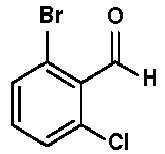
Purchased 2e 
Route A 1f 
Purchased 2f 
Route A 1g 
Purchased 2g 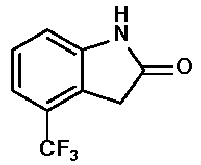
Route C 1h 
Purchased 2h 
Purchased 1i 
Route B 3a 
Purchased 1j 
Route B 3b 
Purchased 1k 
Route B 3c 
Purchased 1l 
Purchased 3d 
Purchased 3e 
Purchased - The following examples illustrate the preparations and the biological activity evaluations of the compounds within the scope of the present application. The following examples and preparations are provided to enable a person skilled in the art to more clearly understand and practice the present application. They should not be construed as limiting the scope of the present application, but are merely illustrative and representative.
- The starting materials used in the experiments of the present invention are either purchased from reagent suppliers or prepared from known raw materials through a well-known method in the art. Unless otherwise indicated, the examples herein employ the following conditions:
- The temperature is in degree Celsius (°C); and the room temperature is defined as 18-25°C;
- The organic solvents are dried on anhydrous magnesium sulfate or anhydrous sodium sulfate; and the solvents are evaporated to dryness under reduced pressure and elevated temperature (e.g. 15 mmHg, 30°C) using a rotary evaporator;
- 200-300 mesh silica gel is used as the stationary phase in the column chromatographic separation, and TLC represents thin layer chromatography;
- Generally, the progress of the reactions is monitored by TLC or LC-MS; and
- The final products are characterized by nuclear magnetic resonance (Bruker AVANCE 300, 300 MHz) and LC-MS (Bruker esquine 6000, Agilent 1200 series).
-

- The compound of Example 1 is synthesized from (1-1) as a starting material, and the detailed route is as follows:

-

- 4-Methylindol-2-one (147 mg, 1 mmol) and methyl 4-iodosalicylate (306 mg, 1.1 mmol) were dissolved in 2 mL dioxane, followed by adding cuprous iodide (38 mg, 0.2 mmol), 1,10-phenanthroline (54 mg, 0.3 mmol) and potassium carbonate (415 mg, 3 mmol). The mixture was heated by microwave at 125°C to react for 120 min. The mixture was cooled to room temperature, diluted with 20 mL ethyl acetate, filtered, and evaporated under reduced pressure to remove the solvent. The residue was separated by column chromatography (silica gel 200-300 mesh, eluent: n-hexane/ethyl acetate = 4/1) to give 70 mg methyl 4-(4-methylindolin-2-on)-ylsalicylate as a yellow solid with a yield of 23.5%.
-

- Methyl 4-(4-Methyl-indolin-2-on)-ylsalicylate (2, 70 mg, 0.24 mmol), 2-chloro-6-cyclopropyl benzaldehyde (85 mg, 0.48 mmol) and piperidine (22 mg, 0.24 mmol) were dissolved in methanol (5 mL), and heated to reflux for two hours under nitrogen protection. The mixture was cooled down to room temperature, evaporated under reduced pressure to remove the solvent, and subjected to column chromatography (silica gel 200-300 mesh, eluent: n-hexane/ethyl acetate = 4/1) to give 88 mg methyl 4-(3-(2-chloro-6-cyclopropyl- benzylidene)-4-methylindolin-2-on-1-yl)-2-hydroxybenzoate with a yield of 80%.
-

- Methyl 4-(3-(2-chloro-6-cyclopropylbenzylidene)-4-methylindolin-2-on-1-yl)-2-hydroxy benzoate (1-3, 88 mg, 0.19 mmol) was dissolved in tetrahydrofuran (10 mL), to which was added an aqueous solution (1 mL) of lithium hydroxide (40 mg) at room temperature. The mixture was stirred overnight at room temperature. The mixture was evaporated under reduced pressure to remove the solvent. The residue was dissolved in water, and pH of the system was adjusted with 1 mol/L hydrochloric acid to 5. The mixture was extracted with ethyl acetate, concentrated under reduced pressure, and purified with prep-HPLC to give 45 mg compound of Example 1 as light yellow powder with a yield of 53%.
- Relevant characterization data are as follows: ESI-MS: [M+H]+= 446.3
1H-NMR (300 MHz, DMSO-d 6) δ: ppm 7.91 (d, J=9.0 Hz, 1H), 7.87 (s, 1H), 7.22-7.31 (m, 3H), 6.95-7.03 (m, 4H), 6.81 (d, J=7.8 Hz, 1H), 2.64 (s, 3H), 1.89-1.99 (m, 1H), 0.84-0.87 (m, 2H), 0.64-0.70 (m, 2H). - Example 2: The preparation of the compound of this example was similar to the method described in Example 1, except that the raw material 3a in
Step 1 was replaced by the raw material 3b in Table 1, and the following compounds were obtained: -

- Relevant characterization data are as follows: ESI-MS: [M+H]+= 430.3
1H-NMR (300 MHz, DMSO-d 6) δ: ppm 8.03 (d, 2H, J=8.7 Hz), 7.84 (s, 1H), 7.50 (d, 2H, J=8.7 Hz), 7.22 (m, 3H), 6.96 (q, 2H, J=7.8 Hz), 6.73 (d, 1H, J=7.8 Hz), 2.60 (s, 3H), 1.87 (m,1H), 0.81 (m, 2H), 0.62 (m, 2H); and -

- Relevant characterization data are as follows: ESI-MS: [M+H]+= 430.2
1H-NMR (300 MHz, DMSO-d 6) δ: ppm 8.03 (d, 2H, J=8.7 Hz), 7.84 (s, 1H), 7.50 (d, 2H, J=8.7 Hz), 7.22 (m, 3H), 6.96 (q, 2H, J=7.8 Hz), 6.73 (d, 1H, J=7.8 Hz), 2.60 (s, 3H), 1.87 (m, 1H), 0.81 (m, 2H), 0.62 (m, 2H). - Example 3: The preparation of the compound of this example was similar to the method described in Example 1, except that the raw material 1a in
Step 2 was replaced by the raw material If in Table 1, and (trans)-4-(3-(2-chloro-6-methoxy-benzylidene)-4-methylindolin-2-on-1-yl)-2-hydroxybenzoic acid was obtained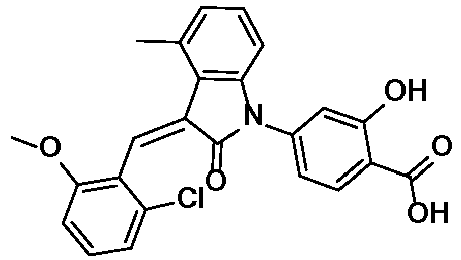
- Relevant characterization data are as follows: ESI-MS: [M+H]+= 436.3
1H-NMR (300 MHz, DMSO-d6 ) δ:ppm 7.92 (dd, J=7.5Hz, J=1.2Hz, 1H), 7.59 (s, 1H), 7.35 (t, J=8.1Hz, 1H), 7.24 (t, J=7.8 Hz, 1H), 6.96-7.11 (m, 5H), 6.80 (d, J=8.1 Hz, 1H), 3.77 (s, 3H), 2.59 (s, 3H). - Example 4: The preparation of the compound of this example was similar to the method described in Example 1, except that the raw material 1a in
Step 2 was replaced by the raw material 1b in Table 1, and (trans)-4-(3-(2,6-dichloro-benzylidene)-4-methylindolin-2-on-1-yl)-2-hydroxybenzoic acid was obtained.
- Relevant characterization data are as follows: ESI-MS: [M+H]+= 440.2
1H-NMR (300 MHz, DMSO-d6 ) δ: ppm 7.91 (d, 1H, J=8.1Hz), 7.70 (s, 1H), 7.52 (d, 2H, J=7.8 Hz),7.36-7.42 (m, 1H), 7.27 (t, 1H, J=7.8 Hz), 7.03 (d, 1H, J=7.8 Hz), 6.93-6.97 (m, 2H), 6.81 (d, 1H, J=8.1 Hz), 2.61 (s, 3H). - Example 5: The preparation of the compound of this example was similar to the method described in Example 1, except that the raw material 3a in
Step 1 was replaced by the raw material 3b in Table 1, and the raw material 1a inStep 2 was replaced by the raw material 1b in Table 1, and (trans)-4-(3-(2,6-dichlorobenzylidene)-4-methylindolin-2-on-1-yl)-benzoic acid was obtained.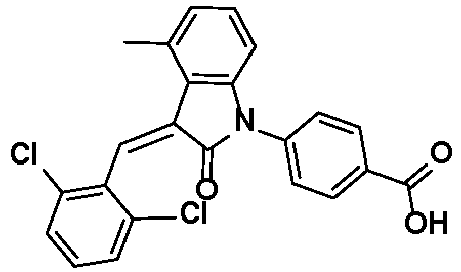
- Relevant characterization data are as follows: ESI-MS: [M+H]+= 424.1
1H-NMR (300 MHz, CDCl3) δ: ppm 8.19 (d, J=8.4 Hz, 2H), 7.57 (s, 1H), 7.55 (d, J=8.1 Hz, 2H), 7.36 (d, J=7.8 Hz, 2H), 7.21 (t, 2H), 6.98 (d, J=7.8 Hz, 1H), 6.83 (d, J=7.8 Hz, 1H), 2.69 (s, 3H). - Example 6: The preparation of the compound of this example was similar to the method described in Example 1, except that the raw material 1a in
Step 2 was replaced by the raw material 1c in Table 1, and (trans)-4-(3-(2-chloro-6-(trifluoromethyl)-benzylidene)-4-methyl indolin-2-on-1-yl)-2-hydroxybenzoic acid was obtained.
- Relevant characterization data are as follows: ESI-MS: [M+H]+= 474.2
1H-NMR (300 MHz, CD3OD-d 4) δ: ppm 7.95 (d, 1H, J = 8.1 Hz), 7.69 (m, 3H), 7.46 (m, 1H), 7.21 (m, 1H), 7.00 (m, 1H), 6.86 (s, 1H), 6.77 (d, 1H, J = 7.8 Hz), 2.59 (s, 3H). - Example 7: The preparation of the compound of this example was similar to the method described in Example 1, except that the raw material 1a in
Step 2 was repalced by the raw material 1e in Table 1, and (trans)-4-(3-(2-chloro-6-bromo-benzylidene)-4-methylindolin-2-on-1-yl)-2-hydroxybenzolic acid was obtained.
- Relevant characterization data are as follows: ESI-MS: [M+H]+= 486.1
1H-NMR (300 MHz, CDCl3) δ: ppm 7.98 (d, 1H, J=8.4 Hz), 7.58 (d, 2H, J=5.4 Hz), 7.45 (d, 1H, J=8.1 Hz), 7.14-7.25 (m, 3H), 7.00-7.08 (m, 2H), 6.93 (d, 1H, J=8.1 Hz), 2.72 (s, 3H). - Example 8: The preparation of the compound of this example was similar to the method described in Example 1, except that the raw material 2a in
Step 1 was replaced by the raw material 2d in Table 1, and (trans)-4-(3-(2-chloro-6-bromo-benzylidene)-4-methoxyindolin-2-on-1-yl)-2-hydroxybenzolic acid was obtained.
- Relevant characterization data are as follows: ESI-MS:[M+H]+= 462.2
1H-NMR (300 MHz, DMSO-d6 ) δ: ppm 8.06 (s, 1H), 7.91 (d, J=9.3 Hz, 1H), 7.21-7.36 (m, 3H), 6.89-6.98 (m, 4H), 6.60 (d, J=7.8 Hz, 1H), 4.02 (s, 3H), 1.85-1.94 (m, 1H), 0.85-0.88 (m, 2H), 0.58-0.75 (m, 2H). - Example 9: The preparation of the compound of this example was similar to the method described in Example 1, except that the raw material 1a in
Step 2 was repalced by the raw material 1g in Table 1, and (trans)-4-(3-(2-chloro-6-bromo-benzylidene)-4-methylindolin-2-on-1-yl)-2-hydroxybenzoic acid was obtained.
- Relevant characterization data are as follows: ESI-MS: [M+H]+= 424.2
1H-NMR (300 MHz, DMSO-d6 ) δ: ppm 7.55 (s, 1H), 7.15-7.33 (m, 4H), 7.03-7.06 (m, 1H), 6.94 (d, J=7.8 Hz, 1H), 6.80-6.84 (m, 2H), 6.72 (d, J=7.8 Hz, 1H), 2.60 (s, 3H). - Example 10: The preparation of the compound of this example was similar to the method described in Example 1, except that the raw material 1a in
Step 2 was replaced by the raw material 1h in Table 1, and (trans)-4-(3-(2-chloro-6-methyl-benzylidene)-4-methylindolin-2-on-1-yl)-2-hydroxybenzoic acid was obtained.
- Relevant characterization data are as follows: ESI-MS: [M+H]+= 420.3
1H-NMR (300 MHz, DMSO-d6 ) δ: ppm 7.89 (d, 1H, J=8.1 Hz), 7.77 (s, 1H), 7.22-7.34 (m, 4H), 6.94-7.03 (m, 3H), 6.79 (d, 1H, J=7.8 Hz), 2.63 (s, 3H), 2.28 (s, 3H). - Example 11: The preparation of the compound of this example was similar to the method described in Example 1, except that the raw material 2a in
Step 1 was replaced by the raw material 2d in Table 1, and the raw material 1a inStep 2 was replaced by the raw material 1b, and (trans)-4-(3-(2,6-dichloro-benzylidene)-4-methoxyindolin-2-on-1-yl)-2-hydroxybenzolic acid was obtained.
- Relevant characterization data are as follows: ESI-MS: [M+H]+= 456.2
1H-NMR (300 MHz, DMSO-d 6) δ: ppm 7.85-7.80 (m, 1H), 7.55-7.30 (m, 5H), 6.91-6.78 (m, 3H), 6.57-6.54 (m, 1H), 5.97-5.95 (m, 1H), 4.01 (s, 3H). - Example 12: The preparation of the compound of this example was similar to the method described in Example 1, except that the raw material 2a in
Step 1 was replaced by the raw material 2e in Table 1, and (trans)-4-(3-(2-chloro-6-cyclopropyl-benzylidene)-4-cyclopropyl indolin-2-on-1-yl)-2-hydroxybenzolic acid was obtained.
- Relevant characterization data are as follows: ESI-MS: [M+H]+= 472.2
1H-NMR (300 MHz, CD3OD-d 4) δ: ppm 8.35 (s, 1H), 7.98 (d, 1H, J=9.0 Hz), 7.24 (m, 3H), 6.91-7.07 (m, 4H), 6.81 (d, 1H, J=7.8 Hz), 2.22 (m, 1H), 1.98 (m, 1H), 1.13 (m, 2H), 0.88 (m, 4H), 0.72 (m, 1H), 0.63 (m, 1H). - Example 13: The preparation of the compound of this example was similar to the method described in Example 1, except that the raw materials 2a and 3a in
Step 1 were replaced by the raw materials 2f and 3b in Table 1, respectively, and (trans)-4-(3-(2-chloro-6-cyclopropylbenzylidene)-4-phenylindolin-2-on-1-yl)-2-hydroxy benzolic acid was obtained.
- Relevant characterization data are as follows: ESI-MS: [M+H]+= 492.3
1H-NMR (300 MHz, DMSO-d 6) δ: ppm 8.18-8.08 (m, 2H), 7.78-7.14 (m, 10H), 7.02-6.87 (m, 4H), 1.54-1.50 (m, 1H), 1.29-1.17 (m, 2H), 0.85-0.75 (m, 2H). - Example 14: The preparation of the compound of this example was similar to the method described in Example 1, except that the raw material 2a in
Step 1 was replaced by the raw material 2c in Table 1, and 4-(3-(2-chloro-6-cyclopropyl-benzylidene)-4-chloro-indolin-2-on-1-yl)-2-hydroxybenzolic acid was obtained.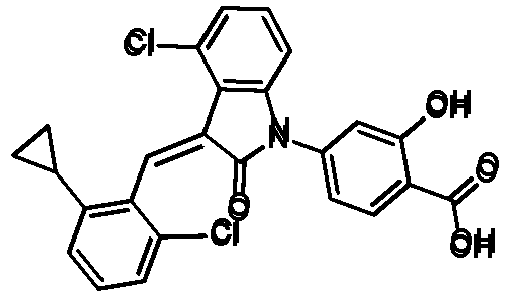
- Relevant characterization data are as follows: ESI-MS: [M+H]+= 466.2
1H-NMR (300 MHz, DMSO-d 6) δ: ppm 8.46-7.94 (m, 1H), 7.79-7.76 (m, 1H), 7.35-7.19 (m, 4H), 7.10-6.79 (m, 2H), 6.76-6.60 (m, 2H), 1.71-1.69 (m, 1H), 1.29-1.23 (m, 2H), 0.88-0.83 (m, 2H). - Example 15: The preparation of the compound of this example was similar to the method described in Example 1, except that the raw materials 2a and 3a in
Step 1 were replaced by the raw materials 2b and 3b in Table 1, respectively, and the raw material 1a inStep 2 was replaced by the raw material 1b, and the following compounds were obtained: -

- Relevant characterization data are as follows: ESI-MS: [M+H]+= 427.8
1H-NMR (CDCl3) δ: ppm 8.21 (d, J=8.4 Hz, 2H), 7.78 (d, J=1.5 Hz, 1H), 7.57 (d, J=8.7 Hz, 2H), 7.39-7.35 (m, 2H), 7.31-7.20 (m, 2H), 6.93-6.87 (m, 1H), 6.78 (d, J = 7.8 Hz, 1H); and (cis)-4-(3-(2,6-dichloro-benzylidene)-4-fluoro-indolin-2-on-1-yl)-benzoic acid (15B)
- Relevant characterization data are as follows: ESI-MS: [M+H]+= 427.8
1H-NMR (CDCl3) δ: ppm 8.30 (d, J=8.4 Hz, 2H), 7.90 (s, 1H), 7.65 (d, J=8.7 Hz, 2H), 7.42-7.38 (m, 2H), 7.32-7.29 (m, 1H), 7.25-7.19 (m, 1H), 7.75-6.65 (m, 2H). - Example 16: The preparation of the compound of this example was similar to the method described in Example 1, except that the raw materials 2a and 3a in
Step 1 were replaced by the raw materials 2b and 3b in Table 1, respectively, and the following compounds were obtained: -

- Relevant characterization data are as follows: ESI-MS: [M+H]+= 433.9
1H-NMR (300 MHz, CDCl3) δ: ppm 8.20 (d, 2H, J=8.7 Hz), 8.04 (s, 1H), 7.56 (d, 2H, J=8.4 Hz), 7.27 (m, 2H), 7.19 (m, 1H), 6.90 (m, 2H), 6.79 (d, 1H, J=7.8 Hz), 1.92 (m, 1H), 0.88 (m, 3H), 0.61 (m, 1H); and -
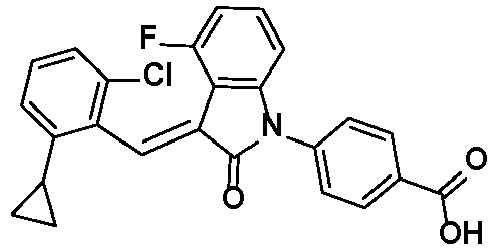
- Relevant characterization data are as follows: ESI-MS: [M+H]+= 433.9
1H-NMR (300 MHz, CDCl3) δ: ppm 8.20 (d, 2H, J=8.7 Hz), 8.04 (s, 1H), 7.56 (d, 2H, J=8.4 Hz), 7.27 (m, 2H), 7.20 (d, 1H, J=8.1 Hz), 6.90 (m, 2H), 6.89 (d, 1H, J=7.8 Hz), 1.92 (m, 1H), 0.83 (m, 3H), 0.59 (m, 1H). - Example 17: The preparation of the compound of this example was similar to the method described in Example 1, except that the raw materials 2a and 3a in
Step 1 were replaced by the raw materials 2b and 3b in Table 1, respectively, and the raw material 1a inStep 2 was replaced by the raw material 1g, and the following compounds were obtained: -

- Relevant characterization data are as follows: ESI-MS: [M+H]+= 411.9
1H-NMR (300 MHz, CDCl3) δ: ppm 8.30 (d, 2H, J=8.4 Hz), 7.88 (s, 1H), 7.62 (d, 2H, J=8.7 Hz), 7.21-7.37 (m, 3H), 7.09 (t, 1H, J=8.7 Hz), 6.73 (d, 2H, J=8.1 Hz); and (cis)-4-(3-(2-chloro-6-fluoro-benzylidene)-4-fluoro-indolin-2-on-1-yl)-benzoic acid (17B)
- Relevant characterization data are as follows: ESI-MS: [M+H]+= 411.9
1H-NMR (300 MHz, CDCl3) δ: ppm 8.22 (d, 2H, J=8.4 Hz), 7.76 (s, 1H), 7.56 (d, 2H, J=8.4 Hz), 7.22-7.31 (m, 3H), 7.05 (t, 1H, J=8.7 Hz), 6.88 (t, 1H, J=9.0 Hz), 6.75 (d, 1H, J=7.8 Hz). - Example 18: The preparation of the compound of this example was similar to the method described in Example 1, except that the raw materials 2a and 3a in
Step 1 were replaced by the raw materials 2b and 3b in Table 1, and the raw material 1a inStep 2 was replacd by the raw material 1d, and the following compounds were obtained: -

- Relevant characterization data are as follows: ESI-MS: [M+H]+= 396.1
1H-NMR (300 MHz, DMSO-d 6) δ: ppm 8.15-8.08 (m, 2H), 7.68-7.66 (m, 2H), 7.60-7.39 (m, 3H), 7.27-6.87 (m, 3H), 6.78-6.73 (m, 1H); and -

- Relevant characterization data are as follows: ESI-MS: [M+H]+= 396.1
1H-NMR (300 MHz, DMSO-d 6) δ: ppm 8.15-8.08 (m, 2H), 7.69-7.57 (m, 4H), 7.41-6.88 (m, 4H), 6.78-6.73 (m, 1H). - Example 19: The preparation of the compound of this example was similar to the method described in Example 1, except that the raw materials 2a and 3a in
Step 1 were replaced by the raw materials 2b and 3b in Table 1, respectively, and the raw material 1a inStep 2 was replaced by the raw material 1c, and the following compounds were obtained: -

- Relevant characterization data are as follows: ESI-MS: [M+H]+= 462.1
1H-NMR (300 MHz, DMSO-d 6) δ: ppm 13.11 (brs, 1H), 8.16-8.13 (d, 2H), 7.90-7.79 (m, 3H), 7.64-7.58 (t, 1H), 7.55-7.52 (d, 1H), 7.45-7.40 (m, 1H), 7.13-7.07 (t, 1H), 6.83-6.80 (d, 1H); and -

- Relevant characterization data are as follows: ESI-MS:[M+H]+= 462.1
1H-NMR (300 MHz, DMSO-d 6) δ: ppm 13.14 (brs, 1H), 8.15-8.13 (d, 2H), 7.93-7.84 (m, 3H), 7.72-7.65 (m, 3H), 7.40-7.33 (m, 1H), 6.83-6.73 (m, 2H). - Example 20: The preparation of the compound of this example was similar to the method described in Example 1, except that the raw materials 2a and 3a in
Step 1 were replaced by the raw materials 2b and 3b in Table 1, respectively, and the raw material 1a inStep 2 was replaced by the raw material 1i, and the following compounds were obtained: -

- Relevant characterization data are as follows: ESI-MS: [M+H]+= 436.2
1H-NMR (CDCl3) δ: ppm 8.31 (d, J=8.4 Hz, 2H), 8.02 (s, 1H), 7.67 (d, J=8.7 Hz, 2H), 7.32-7.27 (m, 2H), 7.23-7.15 (m, 2H), 6.74 (d, J=7.8 Hz, 1H), 6.68-6.62 (m, 1H), 2.60 (t, 2H), 1.58 (m, 2H), 0.89 (t, 3H); and -

- Relevant characterization data are as follows: ESI-MS: [M+H]+= 436.2
1H-NMR (CDCl3) δ: ppm 8.20 (d, J=8.4 Hz, 2H), 7.94 (s, 1H), 7.56 (d, J=9.0 Hz, 2H), 7.30-7.27 (m, 2H), 7.25-7.17 (m, 2H), 6.93-6.88 (m, 1H),6.79 (d, J=7.8 Hz, 1H), 2.63 (t, 2H), 1.60 (m, 2H), 0.91 (t, 3H). - Example 21: The preparation of the compound of this example was similar to the method described in Example 1, except that the raw material 2a in
Step 1 was replaced by the raw material 2b in Table 1, and the following compounds were obtained: -

- Relevant characterization data are as follows: ESI-MS: [M+H]+= 450.2
1H-NMR (300 MHz, CD3OD-d 4) δ: ppm 8.02 (m, 2H), 7.35 (m, 1H), 7.24 (m, 3H), 6.95 (m, 3H), 6.82 (d, 1H, J=8.1 Hz), 1.92 (m, 1H), 0.91 (m, 2H), 0.74 (m, 1H), 0.65 (m, 1H); and -

- Relevant characterization data are as follows: ESI-MS: [M+H]+= 450.2
1H-NMR (300 MHz, CD3OD-d 4) δ: ppm 8.04 (d, 1H, J=8.4 Hz), 8.02 (s, 1H), 7.27 (m, 3H), 7.01-7.19 (m, 3H), 6.93 (m, 1H), 6.76 (d, 1H, J=7.8 Hz), 6.69 (s, 1H), 1.83 (m, 1H), 0.90 (m, 2H), 0.67 (m, 2H). - Example 22: The preparation of the compound of this example was similar to the method described in Example 1, except that the raw material 2a in
Step 1 was replaced by the raw material 2b in Table 1, and the raw material 1a inStep 2 was repalced by the raw material 1b, and the following compounds were obtained: -
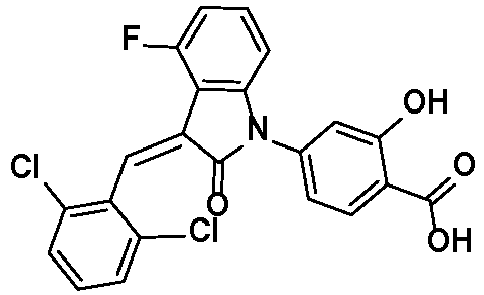
- Relevant characterization data are as follows: ESI-MS: [M+H]+= 444.1
1H-NMR (300 MHz, CD3OD-d 4) δ: ppm 8.07 (d, 1H, J=8.4 Hz), 7.80 (s, 1H), 7.48 (m, 2H), 7.29-7.41 (m, 2H), 7.10 (s, 1H), 7.05 (d, 1H, J=8.4 Hz), 6.69-6.80 (m, 2H); and -

- Relevant characterization data are as follows: ESI-MS: [M+H]+= 444.1
1H-NMR (300 MHz, CD3OD-d 4) δ: ppm 8.01 (d, 1H, J=8.4 Hz), 7.76 (s, 1H), 7.44 (m, 2H), 7.35 (m, 2H), 6.97 (m, 3H), 6.82 (d, 1H, J=7.8 Hz). - Example 23: The preparation of the compound of this example was similar to the method described in Example 1, except that the raw materials 2a and 3a in
Step 1 were replaced by the raw materials 2c and 3b in Table 1, respectively, and the raw material 1a inStep 2 was replaced by the raw material 1b, and (trans)-4-(3-(2,6-dichloro-benzylidene)-4-chloro-indolin-2-on-1-yl)-benzoic acid was obtained.
- Relevant characterization data are as follows: ESI-MS: [M+H]+= 446.1
1H-NMR (300 MHz, DMSO-d 6) δ: ppm 12.99 (brs, 1H), 8.31-7.78 (m, 3H), 7.70-7.52 (m, 4H), 7.43-7.26 (m, 3H), 6.91-6.81 (m, 1H). - Example 24: The preparation of the compound of this example was similar to the method described in Example 1, except that the raw material 3a in
Step 1 was replaced by the raw material 3c in Table 1, and (trans)-4-(3-(2-chloro-6-cyclopropyl-benzylidene)-4-methylindolin-2-on-1-yl)-2-chloro-benzoic acid was obtained.
- Relevant characterization data are as follows: ESI-MS: [M+H]+= 464.3
1H-NMR (300 MHz, DMSO-d 6) δ: ppm 8.01-7.79 (m, 2H), 7.64-7.62 (m, 1H), 7.54-7.49 (m, 1H), 7.35-7.22 (m, 3H), 7.05-6.93 (m, 2H), 6.86-6.71 (m, 1H), 1.76-1.71 (m, 1H), 1.26 (s, 3H), 0.87-0.83 (m, 2H), 0.71-0.63 (m, 2H). - Example 25: The preparation of the compound of this example was similar to the method described in Example 1, except that the raw material 3a in
Step 1 was replaced by the raw material 3d in Table 1, and (trans)-4-(3-(2-chloro-6-cyclopropyl-benzylidene)-4-methylindolin-2-on-1-yl)-2-fluoro-benzoic acid was obtained.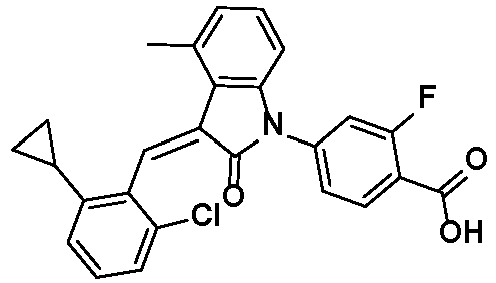
- Relevant characterization data are as follows: ESI-MS: [M+H]+= 448.9
1H-NMR(300MHz, DMSO-d 6) δ: ppm 8.03 (t, 1H, J=8.1 Hz), 7.89 (s, 1H), 7.38-7.46 (m, 2H), 7.22-7.36 (m, 3H), 7.01 (dd, 2H, J=7.5, 18.3 Hz), 6.86 (d, 1H, J=7.8 Hz), 2.64 (s, 3H), 0.83-0.87 (m, 3H), 0.63-0.70 (m, 2H). - Example 26: The preparation of the compound of this example was similar to the method described in Example 1, except that the raw material 2a in
Step 1 was replaced by the raw material 2g in Table 1, and (trans)-4-(3-(2-chloro-6-bromo-benzylidene)-4-trifluoromethyl indolin-2-on-1-yl)-2-hydroxybenzolic acid was obtained.
- Relevant characterization data are as follows: ESI-MS:[M+H]+= 500.3
1H-NMR (300MHz, DMSO-d 6) δ: ppm 11.71 (brs, 1H), 7.98 (S, 1H), 7.90-7.82 (m, 1H), 7.57-7.48 (m, 2H), 7.35-7.25 (m, 2H), 7.19-7.10 (m, 1H), 7.03-6.73 (m, 3H), 5.36 (s, 1H), 1.78-1.73 (m, 1H), 1.49-1.46 (m, 2H), 0.83-0.86 (m, 2H). - Example 27: The preparation of the compound of this example was similar to the method described in Example 1, except that the raw material 2a in
Step 1 was replaced by the raw material 2h in Table 1, and (trans)-4-(3-(2-chloro-6-bromo-benzylidene)-indolin-2-on-1-yl)-2-hydroxybenzolic acid was obtained.
- Relevant characterization data are as follows: ESI-MS: [M+H]+= 432.0
1H-NMR (300MHz, CDCl3) δ: ppm 7.98-8.09 (m, 2H), 7.31-7.37 (m, 2H), 7.10-7.24 (m, 3H), 6.89-6.99 (m, 3H), 6.82-6.84 (m, 1H), 1.89-2.00 (m, 1H), 0.85-0.94 (m, 3H), 0.64-0.76 (m, 1H). -

- Relevant characterization data are as follows: ESI-MS: [M+H]+= 530.1
1H-NMR(300MHz, CDCl3) δ: ppm 8.18 (d, 2H, J=8.4 Hz), 7.81 (s, 1H), 7.43 (dd, 1H, J=8.7 Hz, J=1.8 Hz), 7.16-7.28 (m, 5H), 6.90-7.00 (m, 3H), 2.69 (s, 3H), 1.90-1.95 (m, 1H), 1.35 (s, 9H), 0.80-0.90 (m, 3H), 0.52-0.60 (m, 1H). - Example 29: The preparation of the compound of this example was similar to the method described in Example 1, except that the raw material 1a in
Step 2 was replaced by the raw material 1h in Table 1, and the raw material 3a in Step 3 was replaced by the raw material 3b, and (trans)-4-(3-(2-chloro-6-methyl-benzylidene)-4-methylindolin-2-on-1-yl)-benzoic acid was obtained.
- Relevant characterization data are as follows: ESI-MS: [M+H]+= 404.2
1H-NMR(300MHz, CDCl3) δ: ppm 8.19 (d, J=8.4 Hz, 2H), 7.72 (s, 1H),7.56 (d, J=8.4 Hz, 2H), 7.27-7.15 (m, 4H), 6.98 (d, J=7.8 Hz, 1H), 6.84 (d, J=7.5 Hz, 1H), 2.69 (s, 3H), 2.34 (s, 3H). - Example 30: The preparation of the compound of this example was similar to the method described in Example 1, except that the raw material 2a in
Step 1 was replacd by the raw material 2d in Table 1, and the raw material 3a in Step 3 was replaced by the raw material 3b, and (trans)-4-(3-(2-chloro-6-methyl-benzylidene)-4-methoxyindolin-2-on-1-yl)-benzoic acid was obtained.
- Relevant characterization data are as follows: ESI-MS: [M+H]+= 446.2
1H-NMR (300MHz, DMSO-d6 ) δ: ppm 13.06 (brs, 1H), 8.08-8.06 (m, 3H), 7.55-7.52 (d, 2H), 7.35-7.21 (m, 3H), 6.94-6.90 (s, 2H), 6.58-6.55 (d, 1H), 4.02 (s, 3H), 1.93-1.87 (m, 1H), 0.90-0.84 (m, 2H), 0.73-0.67 (m, 1H), 0.64-0.58 (m, 1H). - Example 31: The preparation of the compound of this example was similar to the method described in Example 1, except that the raw material 1a in
Step 2 was replacd by the raw material 1b in Table 1, and the raw material 3a in Step 3 was replaced by the raw material 3b, and (trans)-4-(3-(2,6-dichloro-benzylidene)-4-methoxyindolin-2-on-1-yl)-benzoic acid was obtained.
- Relevant characterization data are as follows: ESI-MS: [M+H]+= 440.2
1H-NMR (300MHz, DMSO-d6) δ: ppm 12.99 (s, 1H), 8.11 (m, 2H), 7.84 (s, 1H), 7.69-7.51 (m, 4H), 7.33 (m, 2H), 6.93 (d, J=8.4 Hz, 1H),6.56 (d, J=7.8 Hz, 1H), 4.03 (s, 3H). - Example 32: The preparation of the compound of this example was similar to the method described in Example 1, except that the raw material aa in
Step 2 was replacd by the raw material If in Table 1, and the raw material 3a in Step 3 was replaced by the raw material 3b, and (trans)-4-(3-(2-chloro-6-methoxy-benzylidene)-4-methylindolin-2-on-1-yl)-benzoic acid was obtained.
- Relevant characterization data are as follows: ESI-MS: [M+H]+= 420.2
1H-NMR (300MHz, CDCl3) δ: ppm 8.18 (d, J=8.4 Hz, 2H), 8.61 (s, 1H), 7.56 (d, J=8.4 Hz, 2H), 7.24-7.14 (m, 2H), 7.05 (d, J=7.5 Hz, 1H),,6.96 (d, J=7.8 Hz, 1H), 6.85-6.79 (m, 2H), 3.81 (s, 3H), 2.68 (s, 3H). - Example 33: The preparation of the compound of this example was similar to the method described in Example 1, except that the raw material 3a in Step 3 was replaced by the raw material 3e, and (trans)-4-(3-(2-chloro-6-methoxy-benzylidene)-4-methylindolin-2-on-1-yl)-2-aminobenzoic acid was obtained.

- Relevant characterization data are as follows: ESI-MS: [M+H]+= 445.3
1H-NMR(300MHz, DMSO-d6) δ: ppm 7.85-7.78 (m, 2H), 7.31-7.21 (m, 3H), 7.01-6.96 (m, 2H), 6.79-6.77 (m, 2H), 6.52-6.48 (m, 1H), 2.63 (s, 3H), 1.95-1.89 (m, 1H), 0.87-0.83 (m, 2H), 0.69-0.63 (m, 2H). - Example 34: The preparation of the compound of this example was similar to the method described in Example 1, except that the raw material 1a in
Step 2 was replacd by the raw material 1j in Table 1, and the raw material 3a in Step 3 was replaced by the raw material 3b, and (trans)-4-(3-(2-chloro-6-cyclohexyl-benzylidene)-4-methylindolin-2-on-1-yl)-benzoic acid was obtained.
- Relevant characterization data are as follows: ESI-MS: [M+H]+= 444.2
1H-NMR (300MHz, DMSO-d6) δ: ppm 12.94 (brs, 1H), 8.08-8.05 (d, 2H), 7.77 (s, 1H), 7.54-7.51 (d, 2H), 7.34-7.22 (m, 4H), 7.04-7.02 (d, 1H), 6.79-6.76 (d, 1H), 3.65-3.57 (m, 1H), 2.62 (s, 3H), 2.22-1.99 (m, 4H), 1.92-1.70 (m, 2H). - Example 35: The preparation of the compound of this example was similar to the method described in Example 1, except that the raw material 1a in
Step 2 was replacd by the raw material 1j in Table 1, and (trans)-4-(3-(2-chloro-6-cyclohexyl-benzylidene)-4-methylindolin-2-on-1-yl)-2-hydroxybenzolic acid was obtained.
- Relevant characterization data are as follows: ESI-MS: [M+H]+= 460.3
1H-NMR (300MHz, DMSO-d6) δ: ppm 7.91-7.89 (d, 1H), 7.76 (s, 1H), 7.32-7.23 (m, 4H), 7.04-6.93 (m, 3H), 6.82-6.80 (d, 1H), 3.62-3.59 (m, 1H), 2.62 (s, 3H), 2.21-1.99 (m, 4H), 1.92-1.70 (m, 2H). - Example 36: The preparation of the compound of this example was similar to the method described in Example 1, except that the raw material 1a in
Step 2 was replacd by the raw material 1k in Table 1, and (trans)-4-(3-(2-chloro-6-isopropyl-benzylidene)-4-methylindolin-2-on-1-yl)-2-hydroxybenzolic acid was obtained.
- Relevant characterization data are as follows: ESI-MS: [M+H]+= 448.3
1H-NMR (300MHz, CDCl3) δ: ppm 7.96 (d, 1H, J=8.4 Hz), 7.75 (s, 1H), 7.16-7.31 (m, 4H), 7.09 (s, 1H), 7.00 (d, 2H, J=8.4 Hz), 6.91(d, 1H, J=8.4 Hz), 3.29 (m, 2H), 2.61 (s, 3H), 1.15 (t, J=7.5 Hz, 3H). - Example 37: The preparation of the compound of this example was similar to the method described in Example 1, except that the raw material 1a in
Step 2 was replacd by theraw material 11 in Table 1, and (trans)-4-(3-(2-chloro-6-ethyl-benzylidene)-4-methylindolin-2-on-1-yl)-2-hydroxybenzolic acid was obtained.
- Relevant characterization data are as follows: ESI-MS: [M+H]+= 434.3
1H-NMR (300MHz, CD3OD) δ: ppm 7.99 (d, 1H, J=8.4 Hz), 7.81 (s, 1H), 7.19-7.27 (m, 4H), 6.99 (d, 1H, J=8.4 Hz), 6.89-6.94 (m, 2H), 6.78(d, 1H, J=7.8 Hz), 2.69 (s, 3H), 2.02 (s, 3H). - The compounds of the present application can regulate (inhibit) the biological activity of the nuclear receptor RORγ, and the intensity of such a regulation (inhibition) can be evaluated by TR-FRET (Time-Resolved Fluorescence Resonance Energy Transfer) screening system. Nuclear receptor cofactors (co-activators and co-repressors) can regulate the transcription of target genes through interactions with nuclear receptors. If a ligand (test compound) interferes with the interaction between a nuclear receptor and a cofactor, such a ligand (test compound) can regulate the transcription of the corresponding gene.
- The method employs LanthaScreen TR-FRET (Time-Resolved Fluorescence Resonance Energy Transfer) technique of Life Technologies Co. to test the compounds for their abilities to regulate (agonize or inversely agonize) the interaction between RORγ and its co-activator. RORγ-LBD is indirectly labeled by binding a terbium(Tb)-labeled anti-GST antibody (Life Technologies #PV3550) onto the GST tag of RORγ-LBD (Life Technologies #PV5887). When no ligand is present, RORγ can continuously bind to a fluorescein-labeled co-activator, and the binding of an agonist to RORγ can enhance the interaction between RORγ and the fluorescein-labeled co-activator; while the binding of an inverse agonist to RORγ can inhibit the interaction between RORγ and the fluorescein-labeled co-activator. When the fluorescein-labeled co-activator and the terbium-labeled anti-GST antibody-RORy-LBD composite are close to each other to a certain distance, an energy transfer can occur, generating a TR-FRET signal. The co-activators employed in the method are not limited to D22 (Life Technologies #PV4386).
- (1) The final concentrations in the reaction system and the reaction conditions in the method are shown in the table below:
(Table 2) Concentration of ROR γ-LBD Fluorescein-labeled co-activator Concentration of activator peptide Concentration of Tb-labeled anti-GST antibody Total volume (µL) Reaction conditions 2 nM D22 150 nM Fluorescein- D22 2 nM 20 22°C, 5 hr - Preparation of Complete TR-FRET Coregulator Buffer D (hereinbelow referred to as Complete Buffer D): adding DTT (Life Technologies #P2325) to TR-FRET Coregulator Buffer D (Life Technologies #PV4420) until the DTT final concentration is 5 mM.
- A mixed solution of 2X Fluorescein-D22 (0.3 µM, referring to Table 2 when using other coactivating peptides) and 2X Tb-labeled anti-GST antibody (4 nM) was prepared using Complete Buffer D, and was added to a 384-well plate (Corning 3376) at 10 µL/well.
- Gradient diluted solutions of the test compounds having 100X final concentrations were prepared with DMSO. Then, the test compounds were 4X diluted with Complete Buffer D (DMSO content: 4%), and were added to a 384-well plate at 5 µL/well, and mixed uniformly. To a positive control well was added Complete Buffer D (no test compound) containing 4% DMSO at 5 µL/well.
- 4X solution of RORy-LBD (8 nM) was prepared with Complete Buffer D, and was added to a 384-well plate at 5 µL/well, and mixed uniformly. To a negative control well was added Complete Buffer D (no ROR γ-LBD) at 5 µL/well. The 384-well plate was placed in a thermostatic oscillator, and was incubated in a dark place at 23°C for 4-5 hours.
- The fluorescence intensity was determined with Tecan M1000 Pro (manufacturer: Tecan): 1) excitation wavelength: 332/20 nm, emission wavelength: 490/10 nm, gain value: optimized, flash: model 2 (100 Hz), delay time: 100 µs, integration time: 200 µs; 2) excitation wavelength: 332/20 nm, emission wavelength: 520/20 nm, gain value: optimized, flash: model 2 (100 Hz), delay time: 100 µs, integration time: 200 µs.
- A logarithm curve of TR-FRET ratio F520/F490 - compound concentration was plotted using GraphPad Prism program, and the IC50 value was calculated. A lower value represents a stronger regulating (inhibiting) effect of the compound on the receptor RORγ.
- The IC50 values of the effects of the compounds of the present application on RORγ are shown in the following table:
(Table 3) Compounds in Examples IC50 Values (nM) Compounds in Examples IC50 Values (nM) 1 +++ 19A +++ 2A +++ 19B +++ 2B ++ 20A ++ 3 +++ 20B ++ 4 +++ 21A +++ 5 +++ 21B ++ 6 +++ 22A +++ 7 +++ 22B +++ 8 +++ 23 +++ 9 +++ 24 ++ 10 +++ 25 ++ 11 ++ 26 ++ 12 +++ 27 + 13 ++ 28 ++ 14 ++ 29 ++ 15A +++ 30 +++ 15B +++ 31 + 16A +++ 32 + 16B +++ 33 + 17A ++ 34 +++ 17B ++ 35 ++ 18A + 36 +++ 18B + 37 +++ In Table 3, "+" represents an IC50 value of "1000-10000", "++" represents an IC50 value of "100-1000", and "+++" represents an IC50 value of "<100". - 5 µg/mL mouse CD3 antibody (purchased from BD) was coated on a 96-well plate (37°C, 2-6 hours) and stored for future use. C57 mouse lymph gland naive CD4 positive T cells were separated using CD4+ T cell isolation kit II (purchased from MACS), and were inoculated to the coated 96-well plate at 5×10⁵ cells/well/100 µL. The test sample was gradient diluted with RMPI-1640 culture medium (Gibco, 22440), and was made to be 4 times of the final concentration (starting from 1 µM, 10 times dilution, setting 6 drug concentrations). The diluted test sample was added at 50 µL/well to the test well inoculated with cells. To each of the positive and negative control wells was added 50 µL RMPI-1640 culture medium. To each of the test wells and the positive control wells was further added 50 µL mixed solution of activators (20 ug/mL mouse CD28 antibody (purchased from BD); 40 ug/mL mouse IL-4 antibody (purchased from BD); 40 ug/mL mouse IFNγ antibody (purchased from BD); 4 ng/mL mouse TGF-β1 (purchased from R&D); 200 ng/mL mouse IL-6 (purchased from R&D); 20 ng/mL mouse IL-23 (purchased from R&D)) having a 4-fold final concentration; to the negative control well was added 50 µL RMPI-1640 culture medium. The loaded 96-well plate was placed in an incubator at 37°C, 5% CO2 and was cultured for 66 hours, followed by adding to each well 50 uL mixed solution of PMA (purchased from Sigma, working concentration: 50 ng/mL) and Ionomycin (purchased from Sigma, working concentration: 1 ug/mL), and culturing at 37°C for another 6 hours. After the culture was completed, a cell culture supernatant was taken, and the IL-17A content in the supernatant was determined using mouse IL-17A ELISA kit (purchased from Dakewe), and the inhibition rate and the IC50 value were calculated. The specific operation followed the kit specification (see below):
- (1) Determining the number of required strips according to the number of the test wells (blank and standard); taking out the Washing buffer (50×) and the ready-to-use solution from the kit 20 min in advance to balance to room temperature.
- (2) Loading samples: adding diluted Cytokine standard to the standard well at 100 µL/well, adding the sample to the sample well at 100 µL/well, setting a blank well, in which Dilution buffer R (1×) was used instead of the sample and the standard.
- (3) Adding testing antibody: adding diluted Biotinylated antibody at 50 µL/well; covering with a sealing film after mixing uniformly, and incubating at 37°C for 90 min.
- (4) Washing the plate: deducting the liquid in the well, adding 1× washing buffer at 300 µL/well; maintain for 1 min, then discarding the liquid in the well; repeating 4 times, each time deducting to dryness on filter pater.
- (5) Adding enzyme: adding diluted Streptavidin-HRP at 100 µL/well; covering with a sealing film, and incubating at 37°C for 30 min.
- (6) Washing the plate: repeating
Step 5. - (7) Color development: adding TMB at 100 µL/well, incubating at 37°C in a dark place for 5-30 min, and determining to terminate the reaction according to the depth of the color in the well (dark blue). Normally, a good effect can be achieved by color development for 10-20 min.
- (8) Terminating the reaction: rapidly adding a stop solution at 100 µL/well to terminate the reaction.
- Reading the plate: 10 min after termination, reading the value using a measurement wavelength of 450 nm.
- The inhibition activity (inhibition rate) of some compounds of the present application on the differentiation of Th17 cells are shown in the following table:
(Table 4) Compounds of Examples Inhibition Rate (1 µM) Compounds of Examples Inhibition Rate (1 µM) 1 >50% 10 >50% 2A >50% 15A >50% 3 >50% 15B <50% 4 >50% 16B >50% - Test animals: female wistar rats, individual body weight ranging from 180 to 220 g.
-
- (1) Bovine type II collagen (CII, 2mg/ml, Chondrex, 20022) and incomplete Freud's adjuvant (IFA, Sigma-Aldrich) were mixed in 1:1 equal volume, and sufficiently emulsified in an ice bath to give an emulsion in which the final concentration of CII was 1 mg/ml.
- (2) Each rat was intradermally injected at the tail root with 200 ul of emulsion to conduct a primary immunization. 7 days after the primary immunization, each rat was intradermally injected at the tail root with 100 ul of the emulsion to conduct a booster immunization.
- (3) Administration: Beginning from the 12th day after the primary immunization, test compounds (the compound of Example 1 and compound 2A of Example 2 of the present invention) were intragastrically administered to the rat twice a day. After the administration, the lesion degrees of the limb joints of the rats were observed and recorded once every 2 days. The solvent was dimethyl sulfoxide / Tween 80 / PEG400 / deionized water = 1/5/20/74.
- Scoring standards: The systematic lesion was evaluated according to a 5-grade scoring method, and the arthritis index (severity score) was calculated according to the total score of the lesion degrees of the 4 limbs. The standards are as follows: 0, no redness and swelling; 1, redness and swelling at the ankle joint or the tarsal joint; 2, swelling at from the ankle joint to the tarsal joint; 3, swelling at from the ankle joint to the metatarsal joint; 4, swelling at all the paws and joints, including the ankle joint.
- Results: The in vivo activities of the compounds of the present application and the solvent in the rat anti-arthritis CIA model are shown in
Figure 1 . A lower arthritis index (severity score) represents a stronger therapeutic and relieving effect on the lesion and a better in vivo activity of the compound. - The above invention has been described in detail by way of illustration and Examples for the purpose of explanation and understanding. It will be apparent to those skilled in the art that modifications and improvements may be made within the scope of the appended claims. Accordingly, it is to be understood that the above description is illustrative rather than restrictive.

Claims (14)
- A compound, or a stereoisomer, a tautomer, a pharmaceutically acceptable salt, or a solvate thereof, the compound having structural formula (I):
 A is a 6-membered aryl or 5- or 6-membered heteroaryl, wherein the heteroaryl group has one or more heteroatoms selected from the group consisting of N, O and S;R6 is selected from one or more of the following groups: hydrogen, alkyl, cycloalkyl, alkoxy, aryl, halogen, trifluoromethyl, amino, cyano, hydroxyl, carboxyl, halogenated alkyl, halogenated alkoxy, alkylamino, dialkylamino, alkylsulfonyl, aminosulfonyl, sulfonamido, amido, carbonyl, alkylaminocarbonyl or dialkylaminocarbonyl;B is aryl or heteroaryl, wherein the heteroaryl group has one or more heteroatoms selected from the group consisting of N, O and S;Q is aryl or heteroaryl, which is optionally and independently substituted by one or more of the following groups: halogen, trifluoromethyl, alkyl, cycloalkyl, alkoxy, hydroxyl, amino, cyano, nitro, carbonyl, aryl, heteroaryl, alkylamino, dialkylamino, alkylaminocarbonyl, dialkylaminocarbonyl, alkylsulfonyl and alkylcarbonyl, wherein the alkyl, cycloalkyl, alkoxy, aryl or heteroaryl group may be optionally substituted by one or more halogens;R1 is selected from the group consisting of -C(=O)OH, -C(=O)O-alkyl, amido, 5-tetrazole, HOC(CF3)2, phosphoric acid group, phosphate ester group, cyano, amino, alkylaminocarbonyl, aminosulfonyl, sulfonamido and alkylsulfonyl;R2 is selected from the group consisting of hydrogen, hydroxyl, halogen, mercapto, amino, cyano, nitro, (C1-4)alkyl, (C1-4)alkoxy and (C1-4)alkylC(=O)O-, wherein the (C1-4)alkyl or (C1-4)alkoxy group may be optionally substituted by one or more halogens; andm is 0, 1, 2, 3 or 4.
 - The compound of claim 1, or a stereoisomer, a tautomer, a pharmaceutically acceptable salt, or a solvate thereof, the compound having structural formula (Ia):
 A, B, R1 and R2 are as defined in claim 1;R3, R4 and R5 are optionally and independently selected from the group consisting of H, halogen, trifluoromethyl, alkyl, cycloalkyl, alkoxy, hydroxyl, amino, cyano, aryl, heteroaryl, alkylamino, dialkylamino, alkylsulfonyl and alkylcarbonyl;m is 0, 1, 2, 3 or 4; andn is 0, 1, 2 or 3.
 - The compound of claim 2, or a stereoisomer, a tautomer, a pharmaceutically acceptable salt, or a solvate thereof, the compound having structural formula (Ib):
 A is phenyl, pyridyl, thienyl, furanyl or pyrimidinyl, andR1, R2, R3, R4, R5 and R6 are as defined in claim 2.
 - The compound of claim 3, or a stereoisomer, a tautomer, a pharmaceutically acceptable salt, or a solvate thereof, the compound having structural formula (Ic)
 R1 is selected from the group consisting of -C(=O)OH, -C(=O)O-alkyl, amido, 5-tetrazole, HOC(CF3)2, phosphoric acid group, phosphate ester group, cyano, amino, alkylaminocarbonyl, aminosulfonyl, sulfonamido and alkylsulfonyl;R2 is selected from the group consisting of hydrogen, hydroxyl, amino, mercapto, halogen, cyano, nitro, (C1-4)alkyl, (C1-4)alkoxy and (C1-3)alkylC(=O)O-, wherein the (C1-4)alkyl or (C1-4)alkoxy group may be optionally substituted by one or more halogens;R3, R4 and R5 may be optionally and independently selected from the group consisting of H, halogen, trifluoromethyl, alkyl, cycloalkyl, alkoxy, hydroxyl, amino, cyano, aryl, heteroaryl, alkylamino, dialkylamino, alkylsulfonyl and alkylcarbonyl; andR6 is selected from the group consisting of hydrogen, halogen, trifluoromethyl, alkyl, cycloalkyl, alkoxy, aryl, hydroxyl, amino, cyano and carbonyl.
 - The compound of claim 4, wherein, in formula (Ic),
R1 is -C(=O)OH, -C(=O)NH2, -C(=O)O-C1-6alkyl, -C(=O)NHR, -C(=O)N(Ra)R (wherein R and Ra both are selected from C1-6alkyl), 5-tetrazole, HOC(CF3)2, phosphoric acid group, phosphate ester group, cyano, amino, aminosulfonyl, sulfonamido or C1-6alkylsulfonyl;
R2 is selected from the group consisting of hydrogen, hydroxyl, halogen, mercapto and amino;
R3 is selected from the group consisting of halogen, amino, C1-6alkylamino, di-C1-6alkylamino, C1-6alkylsulfonyl and C1-6alkylcarbonyl;
R4 is selected from the group consisting of H, halogen, trifluoromethyl, C1-6alkyl, C3-6cycloalkyl and C1-6alkoxy,
R5 is selected from the group consisting of H, C1-6alkyl, C3-6cycloalkyl and C1-6alkoxy; and
R6 is selected from the group consisting of halogen, trifluoromethyl, C1-6alkyl, C3-6cycloalkyl, C1-6alkoxy and C5-10aryl. - The compound of claim 1, wherein the compound is represented by (Id):
 R2 is selected from the group consisting of hydrogen, hydroxyl, halogen, amino, (C1-4)alkyl, (C1-4)alkoxy and (C1-4)alkylC(=O)O-, wherein the (C1-4)alkyl or (C1-4)alkoxy group may be optionally substituted by one or more halogens;R6 is selected from the following groups: hydrogen, halogen, trifluoromethyl, (C1-4)alkyl, (C1-4)alkoxy, (C3-4)cycloalkyl and C5-10aryl; andR3 and R4 are optionally and independently selected from the group consisting of halogen, trifluoromethyl, (C1-4)alkyl, (C1-4)alkoxy and (C3-4)cycloalkyl.
 - The compound of claim 6, wherein:R2 is optionally selected from the group consisting of hydrogen, hydroxyl, halogen, amino, (C1-4)alkyl, (C1-4)alkoxy and (C1-4)alkylC(=O)O-, wherein the (C1-4)alkyl or (C1-4)alkoxy group may be optionally substituted by one or more halogen atoms;R6 is selected from the following groups: hydrogen, halogen, trifluoromethyl, (C1-4)alkyl, (C1-4)alkoxy, (C3-4)cycloalkyl and C5-10aryl;R3 is selected from halogen; andR4 is optionally and independently selected from the group consisting of halogen, trifluoromethyl, (C1-4)alkyl, (C1-4)alkoxy and (C3-4)cycloalkyl.
- The compound of claim 6 or 7, wherein:R2 is hydrogen, hydroxyl or halogen; andR6 is fluoro, methyl, trifluoromethyl or methoxy,
orR2 is hydroxyl; andR6 is fluoro, methyl or methoxy. - The compound of any one of claims 1-8, wherein R3 is chloro,
or,
R2 is hydroxyl;
R6 is methyl;
R3 is chloro; and
R4 is cyclopropyl, trifluoromethyl or chloro. - The compound of any one of claims 1-9, or a stereoisomer, a tautomer, a pharmaceutically acceptable salt, or a solvate thereof, the compound being selected from the group consisting of:



- A pharmaceutical composition comprising the compound of any one of claims 1-10, or a stereoisomer, a tautomer, a pharmaceutically acceptable salt, or a solvate thereof, and a pharmaceutically acceptable excipient.
- The pharmaceutical composition of claim 11, further comprising one or more anti-inflammatory drugs selected from the group consisting of non-steroidal anti-inflammatory drugs, non-specific and specific cyclooxygenase-2 inhibitors, gold compounds, corticosteroids, tumor necrosis factor receptor antagonists, salicylate esters or salts, immunosuppressants and methotrexate.
- The compound of any one of claims 1-10, or a stereoisomer, a tautomer, a pharmaceutically acceptable salt, or a solvate thereof, for use in treating an RORγ-mediated disease, wherein the disease is an autoimmune disease and/or an inflammatory disease.
- The compound, or a stereoisomer, a tautomer, a pharmaceutically acceptable salt, or a solvate thereof, for use of claim 13, wherein the disease is selected from the group consisting of multiple sclerosis, rheumatoid arthritis, psoriasis, crohn's disease, asthma, systemic lupus erythematosus, chronic obstructive pulmonary disease, rejections of tissue graft and of transplanted organ, scleroderma, purpura, autoimmune hemolytic and thrombocytopenia symptoms, irritable bowel syndrome, osteoarthritis, kawasaki disease, hashimoto thyroiditis, mucosal leishmaniasis, bronchitis, allergic rhinitis, atopic dermatitis, cystic fibrosis, lung metabolism rejection, child rheumatoid arthritis, ankylosing spondylitis, pancreatitis, autoimmune diabetes mellitus, autoimmune eye disease, ulcerative colitis, sjorgen's syndrome, optic neuritis, diabetes mellitus, optic neuromyelitis, myasthenia gravis, uveitis, Guillain-Barre syndrome, psoriasis arthritis, Graves' disease and scleritis.
Applications Claiming Priority (2)
| Application Number | Priority Date | Filing Date | Title |
|---|---|---|---|
| CN201510043379 | 2015-01-28 | ||
| PCT/CN2016/071778 WO2016119641A1 (en) | 2015-01-28 | 2016-01-22 | N-benzoate group substituted benzopyrroline-2-one derivative and use thereof |
Publications (3)
| Publication Number | Publication Date |
|---|---|
| EP3252038A1 EP3252038A1 (en) | 2017-12-06 |
| EP3252038A4 EP3252038A4 (en) | 2018-08-01 |
| EP3252038B1 true EP3252038B1 (en) | 2020-04-08 |
Family
ID=56542407
Family Applications (1)
| Application Number | Title | Priority Date | Filing Date |
|---|---|---|---|
| EP16742703.8A Not-in-force EP3252038B1 (en) | 2015-01-28 | 2016-01-22 | N-benzoate group substituted benzopyrroline-2-one derivative and use thereof |
Country Status (6)
| Country | Link |
|---|---|
| US (1) | US10322108B2 (en) |
| EP (1) | EP3252038B1 (en) |
| JP (1) | JP6449470B2 (en) |
| KR (1) | KR102004721B1 (en) |
| CN (1) | CN105820103B (en) |
| WO (1) | WO2016119641A1 (en) |
Family Cites Families (9)
| Publication number | Priority date | Publication date | Assignee | Title |
|---|---|---|---|---|
| FR2694004B1 (en) | 1992-07-21 | 1994-08-26 | Adir | News 3- (Hydroxybenzylidenyl) -indoline-2-ones and 3- (hydroxybenzylidenyl) -indoline-2-thiones, methods of preparation, and pharmaceutical compositions containing them. |
| US20020028936A1 (en) * | 1999-04-12 | 2002-03-07 | Gerhard Sperl | 1,3-disubstituted indolin-2-ones for neoplasia |
| JP3833532B2 (en) | 1999-07-21 | 2006-10-11 | ベーリンガー インゲルハイム ファーマシューティカルズ インコーポレイテッド | Small molecules useful in the treatment of inflammatory diseases |
| CN100528647C (en) * | 2007-09-21 | 2009-08-19 | 三一重工股份有限公司 | Walking type mechanical supporting device and concrete pump vehicle with the same |
| JP2011001309A (en) * | 2009-06-19 | 2011-01-06 | Gifu Univ | Oxyindole derivative and nerve cell death inhibitor |
| JP5491776B2 (en) * | 2009-06-19 | 2014-05-14 | 花王株式会社 | Silicate ester |
| WO2012105594A1 (en) | 2011-02-01 | 2012-08-09 | 協和発酵キリン株式会社 | Ring-fused heterocyclic derivative |
| US9120776B2 (en) | 2011-09-22 | 2015-09-01 | Takeda Pharmaceutical Company Limited | Condensed heterocyclic compound |
| WO2014026328A1 (en) * | 2012-08-15 | 2014-02-20 | Merck Sharp & Dohme Corp. | 3-cyclohexenyl substituted indole and indazole compounds as rorgammat inhibitors and uses thereof |
-
2016
- 2016-01-22 CN CN201610046788.9A patent/CN105820103B/en active Active
- 2016-01-22 US US15/541,137 patent/US10322108B2/en active Active
- 2016-01-22 EP EP16742703.8A patent/EP3252038B1/en not_active Not-in-force
- 2016-01-22 JP JP2017540241A patent/JP6449470B2/en active Active
- 2016-01-22 WO PCT/CN2016/071778 patent/WO2016119641A1/en not_active Ceased
- 2016-01-22 KR KR1020177024048A patent/KR102004721B1/en active Active
Non-Patent Citations (1)
| Title |
|---|
| None * |
Also Published As
| Publication number | Publication date |
|---|---|
| US20170368028A1 (en) | 2017-12-28 |
| JP2018503665A (en) | 2018-02-08 |
| CN105820103B (en) | 2020-11-03 |
| EP3252038A1 (en) | 2017-12-06 |
| CN105820103A (en) | 2016-08-03 |
| WO2016119641A1 (en) | 2016-08-04 |
| EP3252038A4 (en) | 2018-08-01 |
| KR20170105118A (en) | 2017-09-18 |
| KR102004721B1 (en) | 2019-07-29 |
| US10322108B2 (en) | 2019-06-18 |
| JP6449470B2 (en) | 2019-01-09 |
Similar Documents
| Publication | Publication Date | Title |
|---|---|---|
| ES2582576T3 (en) | Cyclohexylamide derivatives and their use as CRF-1 receptor antagonists | |
| WO2020094104A1 (en) | Nitrogen-containing fused heterocyclic shp2 inhibitor compound, preparation method, and use | |
| WO2012129495A1 (en) | Opioid receptor ligands and methods of using and making same | |
| JP2010518026A (en) | Pyridopyrimidinone compounds useful for the treatment of diseases or conditions mediated by sodium channels | |
| WO2018165385A1 (en) | Inhibitors of malt1 and uses thereof | |
| WO2015139619A1 (en) | Compound serving as rorγ modulator | |
| KR20210070308A (en) | antibacterial compound | |
| JP6754828B2 (en) | Pyridine and pyrimidine derivatives | |
| WO2015139621A1 (en) | 4-heteroaryl substituted benzoic acid or benzamides compound | |
| EP4622970A1 (en) | Inhibitors of ripk2 and medical uses thereof | |
| EP4377306A1 (en) | Rock2 inhibitors and uses thereof | |
| JP2024535804A (en) | Substituted 1,4-dihydro-1,6-naphthimidamides and uses thereof | |
| JP6968091B2 (en) | Condensed pentacyclic imidazole derivative as a modulator of TNF activity | |
| JP7028780B2 (en) | Benzamide derivative | |
| JP7587887B2 (en) | Small molecule compounds as JAK kinase inhibitors and their uses | |
| JP6849668B2 (en) | Pyridine or pyrimidine derivatives | |
| AU2018215089A1 (en) | Anti-fibrotic compounds | |
| CN116854687B (en) | HPK1 kinase inhibitor compounds | |
| US10322108B2 (en) | N-benzoate group substituted benzopyrroline-2-one derivative and use thereof | |
| JP5302214B2 (en) | O-substituted dibenzylurea derivatives as TRPV1 receptor antagonists | |
| WO2018149991A1 (en) | Hydroxylated sulfonamide derivatives as inverse agonists of retinoid-related orphan receptor gamma, ror gamma (t) | |
| CN111377938B (en) | A class of coumarin derivatives and preparation method and application thereof | |
| CN113365980B (en) | Crystal form of deuterium atom substituted indole formamide derivative and preparation method thereof | |
| US12091389B2 (en) | Pyrazolylbenzene-1,3-diols for diseases associated with g protein-coupled receptor 18 and in combination with transient receptor potential vanilloid 1 | |
| CN119684287A (en) | 4- (3- (Piperidin-4-yl) -1H-pyrazol-5-yl) -1H-pyrrole [2,3-b ] pyridine derivative, and preparation method and application thereof |
Legal Events
| Date | Code | Title | Description |
|---|---|---|---|
| STAA | Information on the status of an ep patent application or granted ep patent |
Free format text: STATUS: THE INTERNATIONAL PUBLICATION HAS BEEN MADE |
|
| PUAI | Public reference made under article 153(3) epc to a published international application that has entered the european phase |
Free format text: ORIGINAL CODE: 0009012 |
|
| STAA | Information on the status of an ep patent application or granted ep patent |
Free format text: STATUS: REQUEST FOR EXAMINATION WAS MADE |
|
| 17P | Request for examination filed |
Effective date: 20170719 |
|
| AK | Designated contracting states |
Kind code of ref document: A1 Designated state(s): AL AT BE BG CH CY CZ DE DK EE ES FI FR GB GR HR HU IE IS IT LI LT LU LV MC MK MT NL NO PL PT RO RS SE SI SK SM TR |
|
| AX | Request for extension of the european patent |
Extension state: BA ME |
|
| DAV | Request for validation of the european patent (deleted) | ||
| DAX | Request for extension of the european patent (deleted) | ||
| RIC1 | Information provided on ipc code assigned before grant |
Ipc: A61P 29/00 20060101ALI20180620BHEP Ipc: C07D 209/10 20060101ALI20180620BHEP Ipc: A61K 31/404 20060101ALI20180620BHEP Ipc: C07D 209/08 20060101AFI20180620BHEP |
|
| A4 | Supplementary search report drawn up and despatched |
Effective date: 20180629 |
|
| STAA | Information on the status of an ep patent application or granted ep patent |
Free format text: STATUS: EXAMINATION IS IN PROGRESS |
|
| 17Q | First examination report despatched |
Effective date: 20190529 |
|
| GRAP | Despatch of communication of intention to grant a patent |
Free format text: ORIGINAL CODE: EPIDOSNIGR1 |
|
| STAA | Information on the status of an ep patent application or granted ep patent |
Free format text: STATUS: GRANT OF PATENT IS INTENDED |
|
| INTG | Intention to grant announced |
Effective date: 20191009 |
|
| GRAJ | Information related to disapproval of communication of intention to grant by the applicant or resumption of examination proceedings by the epo deleted |
Free format text: ORIGINAL CODE: EPIDOSDIGR1 |
|
| STAA | Information on the status of an ep patent application or granted ep patent |
Free format text: STATUS: EXAMINATION IS IN PROGRESS |
|
| GRAR | Information related to intention to grant a patent recorded |
Free format text: ORIGINAL CODE: EPIDOSNIGR71 |
|
| GRAS | Grant fee paid |
Free format text: ORIGINAL CODE: EPIDOSNIGR3 |
|
| STAA | Information on the status of an ep patent application or granted ep patent |
Free format text: STATUS: GRANT OF PATENT IS INTENDED |
|
| GRAA | (expected) grant |
Free format text: ORIGINAL CODE: 0009210 |
|
| STAA | Information on the status of an ep patent application or granted ep patent |
Free format text: STATUS: THE PATENT HAS BEEN GRANTED |
|
| INTC | Intention to grant announced (deleted) | ||
| INTG | Intention to grant announced |
Effective date: 20200227 |
|
| AK | Designated contracting states |
Kind code of ref document: B1 Designated state(s): AL AT BE BG CH CY CZ DE DK EE ES FI FR GB GR HR HU IE IS IT LI LT LU LV MC MK MT NL NO PL PT RO RS SE SI SK SM TR |
|
| REG | Reference to a national code |
Ref country code: AT Ref legal event code: REF Ref document number: 1254204 Country of ref document: AT Kind code of ref document: T Effective date: 20200415 Ref country code: CH Ref legal event code: EP |
|
| REG | Reference to a national code |
Ref country code: DE Ref legal event code: R096 Ref document number: 602016033591 Country of ref document: DE |
|
| REG | Reference to a national code |
Ref country code: IE Ref legal event code: FG4D |
|
| REG | Reference to a national code |
Ref country code: NL Ref legal event code: MP Effective date: 20200408 |
|
| REG | Reference to a national code |
Ref country code: LT Ref legal event code: MG4D |
|
| PG25 | Lapsed in a contracting state [announced via postgrant information from national office to epo] |
Ref country code: LT Free format text: LAPSE BECAUSE OF FAILURE TO SUBMIT A TRANSLATION OF THE DESCRIPTION OR TO PAY THE FEE WITHIN THE PRESCRIBED TIME-LIMIT Effective date: 20200408 Ref country code: FI Free format text: LAPSE BECAUSE OF FAILURE TO SUBMIT A TRANSLATION OF THE DESCRIPTION OR TO PAY THE FEE WITHIN THE PRESCRIBED TIME-LIMIT Effective date: 20200408 Ref country code: NO Free format text: LAPSE BECAUSE OF FAILURE TO SUBMIT A TRANSLATION OF THE DESCRIPTION OR TO PAY THE FEE WITHIN THE PRESCRIBED TIME-LIMIT Effective date: 20200708 Ref country code: GR Free format text: LAPSE BECAUSE OF FAILURE TO SUBMIT A TRANSLATION OF THE DESCRIPTION OR TO PAY THE FEE WITHIN THE PRESCRIBED TIME-LIMIT Effective date: 20200709 Ref country code: PT Free format text: LAPSE BECAUSE OF FAILURE TO SUBMIT A TRANSLATION OF THE DESCRIPTION OR TO PAY THE FEE WITHIN THE PRESCRIBED TIME-LIMIT Effective date: 20200817 Ref country code: IS Free format text: LAPSE BECAUSE OF FAILURE TO SUBMIT A TRANSLATION OF THE DESCRIPTION OR TO PAY THE FEE WITHIN THE PRESCRIBED TIME-LIMIT Effective date: 20200808 Ref country code: NL Free format text: LAPSE BECAUSE OF FAILURE TO SUBMIT A TRANSLATION OF THE DESCRIPTION OR TO PAY THE FEE WITHIN THE PRESCRIBED TIME-LIMIT Effective date: 20200408 Ref country code: SE Free format text: LAPSE BECAUSE OF FAILURE TO SUBMIT A TRANSLATION OF THE DESCRIPTION OR TO PAY THE FEE WITHIN THE PRESCRIBED TIME-LIMIT Effective date: 20200408 |
|
| REG | Reference to a national code |
Ref country code: AT Ref legal event code: MK05 Ref document number: 1254204 Country of ref document: AT Kind code of ref document: T Effective date: 20200408 |
|
| PG25 | Lapsed in a contracting state [announced via postgrant information from national office to epo] |
Ref country code: BG Free format text: LAPSE BECAUSE OF FAILURE TO SUBMIT A TRANSLATION OF THE DESCRIPTION OR TO PAY THE FEE WITHIN THE PRESCRIBED TIME-LIMIT Effective date: 20200708 Ref country code: RS Free format text: LAPSE BECAUSE OF FAILURE TO SUBMIT A TRANSLATION OF THE DESCRIPTION OR TO PAY THE FEE WITHIN THE PRESCRIBED TIME-LIMIT Effective date: 20200408 Ref country code: HR Free format text: LAPSE BECAUSE OF FAILURE TO SUBMIT A TRANSLATION OF THE DESCRIPTION OR TO PAY THE FEE WITHIN THE PRESCRIBED TIME-LIMIT Effective date: 20200408 Ref country code: LV Free format text: LAPSE BECAUSE OF FAILURE TO SUBMIT A TRANSLATION OF THE DESCRIPTION OR TO PAY THE FEE WITHIN THE PRESCRIBED TIME-LIMIT Effective date: 20200408 |
|
| PG25 | Lapsed in a contracting state [announced via postgrant information from national office to epo] |
Ref country code: AL Free format text: LAPSE BECAUSE OF FAILURE TO SUBMIT A TRANSLATION OF THE DESCRIPTION OR TO PAY THE FEE WITHIN THE PRESCRIBED TIME-LIMIT Effective date: 20200408 |
|
| REG | Reference to a national code |
Ref country code: DE Ref legal event code: R097 Ref document number: 602016033591 Country of ref document: DE |
|
| PG25 | Lapsed in a contracting state [announced via postgrant information from national office to epo] |
Ref country code: AT Free format text: LAPSE BECAUSE OF FAILURE TO SUBMIT A TRANSLATION OF THE DESCRIPTION OR TO PAY THE FEE WITHIN THE PRESCRIBED TIME-LIMIT Effective date: 20200408 Ref country code: SM Free format text: LAPSE BECAUSE OF FAILURE TO SUBMIT A TRANSLATION OF THE DESCRIPTION OR TO PAY THE FEE WITHIN THE PRESCRIBED TIME-LIMIT Effective date: 20200408 Ref country code: EE Free format text: LAPSE BECAUSE OF FAILURE TO SUBMIT A TRANSLATION OF THE DESCRIPTION OR TO PAY THE FEE WITHIN THE PRESCRIBED TIME-LIMIT Effective date: 20200408 Ref country code: RO Free format text: LAPSE BECAUSE OF FAILURE TO SUBMIT A TRANSLATION OF THE DESCRIPTION OR TO PAY THE FEE WITHIN THE PRESCRIBED TIME-LIMIT Effective date: 20200408 Ref country code: IT Free format text: LAPSE BECAUSE OF FAILURE TO SUBMIT A TRANSLATION OF THE DESCRIPTION OR TO PAY THE FEE WITHIN THE PRESCRIBED TIME-LIMIT Effective date: 20200408 Ref country code: DK Free format text: LAPSE BECAUSE OF FAILURE TO SUBMIT A TRANSLATION OF THE DESCRIPTION OR TO PAY THE FEE WITHIN THE PRESCRIBED TIME-LIMIT Effective date: 20200408 Ref country code: CZ Free format text: LAPSE BECAUSE OF FAILURE TO SUBMIT A TRANSLATION OF THE DESCRIPTION OR TO PAY THE FEE WITHIN THE PRESCRIBED TIME-LIMIT Effective date: 20200408 Ref country code: ES Free format text: LAPSE BECAUSE OF FAILURE TO SUBMIT A TRANSLATION OF THE DESCRIPTION OR TO PAY THE FEE WITHIN THE PRESCRIBED TIME-LIMIT Effective date: 20200408 |
|
| PLBE | No opposition filed within time limit |
Free format text: ORIGINAL CODE: 0009261 |
|
| STAA | Information on the status of an ep patent application or granted ep patent |
Free format text: STATUS: NO OPPOSITION FILED WITHIN TIME LIMIT |
|
| PG25 | Lapsed in a contracting state [announced via postgrant information from national office to epo] |
Ref country code: SK Free format text: LAPSE BECAUSE OF FAILURE TO SUBMIT A TRANSLATION OF THE DESCRIPTION OR TO PAY THE FEE WITHIN THE PRESCRIBED TIME-LIMIT Effective date: 20200408 Ref country code: PL Free format text: LAPSE BECAUSE OF FAILURE TO SUBMIT A TRANSLATION OF THE DESCRIPTION OR TO PAY THE FEE WITHIN THE PRESCRIBED TIME-LIMIT Effective date: 20200408 |
|
| 26N | No opposition filed |
Effective date: 20210112 |
|
| PG25 | Lapsed in a contracting state [announced via postgrant information from national office to epo] |
Ref country code: SI Free format text: LAPSE BECAUSE OF FAILURE TO SUBMIT A TRANSLATION OF THE DESCRIPTION OR TO PAY THE FEE WITHIN THE PRESCRIBED TIME-LIMIT Effective date: 20200408 |
|
| REG | Reference to a national code |
Ref country code: DE Ref legal event code: R119 Ref document number: 602016033591 Country of ref document: DE |
|
| PG25 | Lapsed in a contracting state [announced via postgrant information from national office to epo] |
Ref country code: MC Free format text: LAPSE BECAUSE OF FAILURE TO SUBMIT A TRANSLATION OF THE DESCRIPTION OR TO PAY THE FEE WITHIN THE PRESCRIBED TIME-LIMIT Effective date: 20200408 |
|
| REG | Reference to a national code |
Ref country code: CH Ref legal event code: PL |
|
| GBPC | Gb: european patent ceased through non-payment of renewal fee |
Effective date: 20210122 |
|
| PG25 | Lapsed in a contracting state [announced via postgrant information from national office to epo] |
Ref country code: LU Free format text: LAPSE BECAUSE OF NON-PAYMENT OF DUE FEES Effective date: 20210122 |
|
| REG | Reference to a national code |
Ref country code: BE Ref legal event code: MM Effective date: 20210131 |
|
| PG25 | Lapsed in a contracting state [announced via postgrant information from national office to epo] |
Ref country code: FR Free format text: LAPSE BECAUSE OF NON-PAYMENT OF DUE FEES Effective date: 20210131 |
|
| PG25 | Lapsed in a contracting state [announced via postgrant information from national office to epo] |
Ref country code: LI Free format text: LAPSE BECAUSE OF NON-PAYMENT OF DUE FEES Effective date: 20210131 Ref country code: GB Free format text: LAPSE BECAUSE OF NON-PAYMENT OF DUE FEES Effective date: 20210122 Ref country code: CH Free format text: LAPSE BECAUSE OF NON-PAYMENT OF DUE FEES Effective date: 20210131 Ref country code: DE Free format text: LAPSE BECAUSE OF NON-PAYMENT OF DUE FEES Effective date: 20210803 |
|
| PG25 | Lapsed in a contracting state [announced via postgrant information from national office to epo] |
Ref country code: IE Free format text: LAPSE BECAUSE OF NON-PAYMENT OF DUE FEES Effective date: 20210122 |
|
| PG25 | Lapsed in a contracting state [announced via postgrant information from national office to epo] |
Ref country code: BE Free format text: LAPSE BECAUSE OF NON-PAYMENT OF DUE FEES Effective date: 20210131 |
|
| PG25 | Lapsed in a contracting state [announced via postgrant information from national office to epo] |
Ref country code: CY Free format text: LAPSE BECAUSE OF FAILURE TO SUBMIT A TRANSLATION OF THE DESCRIPTION OR TO PAY THE FEE WITHIN THE PRESCRIBED TIME-LIMIT Effective date: 20200408 |
|
| PG25 | Lapsed in a contracting state [announced via postgrant information from national office to epo] |
Ref country code: HU Free format text: LAPSE BECAUSE OF FAILURE TO SUBMIT A TRANSLATION OF THE DESCRIPTION OR TO PAY THE FEE WITHIN THE PRESCRIBED TIME-LIMIT; INVALID AB INITIO Effective date: 20160122 |
|
| PG25 | Lapsed in a contracting state [announced via postgrant information from national office to epo] |
Ref country code: MK Free format text: LAPSE BECAUSE OF FAILURE TO SUBMIT A TRANSLATION OF THE DESCRIPTION OR TO PAY THE FEE WITHIN THE PRESCRIBED TIME-LIMIT Effective date: 20200408 |
|
| PG25 | Lapsed in a contracting state [announced via postgrant information from national office to epo] |
Ref country code: TR Free format text: LAPSE BECAUSE OF FAILURE TO SUBMIT A TRANSLATION OF THE DESCRIPTION OR TO PAY THE FEE WITHIN THE PRESCRIBED TIME-LIMIT Effective date: 20200408 |
|
| PG25 | Lapsed in a contracting state [announced via postgrant information from national office to epo] |
Ref country code: MT Free format text: LAPSE BECAUSE OF FAILURE TO SUBMIT A TRANSLATION OF THE DESCRIPTION OR TO PAY THE FEE WITHIN THE PRESCRIBED TIME-LIMIT Effective date: 20200408 |