EP3250554B1 - A carboxamide derivative and its diastereomers in stable crystalline form - Google Patents
A carboxamide derivative and its diastereomers in stable crystalline form Download PDFInfo
- Publication number
- EP3250554B1 EP3250554B1 EP16704029.4A EP16704029A EP3250554B1 EP 3250554 B1 EP3250554 B1 EP 3250554B1 EP 16704029 A EP16704029 A EP 16704029A EP 3250554 B1 EP3250554 B1 EP 3250554B1
- Authority
- EP
- European Patent Office
- Prior art keywords
- pyrazole
- pyrazol
- carboxamide
- hydroxyethyl
- cyanophenyl
- Prior art date
- Legal status (The legal status is an assumption and is not a legal conclusion. Google has not performed a legal analysis and makes no representation as to the accuracy of the status listed.)
- Active
Links
Images
Classifications
-
- A—HUMAN NECESSITIES
- A61—MEDICAL OR VETERINARY SCIENCE; HYGIENE
- A61K—PREPARATIONS FOR MEDICAL, DENTAL OR TOILETRY PURPOSES
- A61K31/00—Medicinal preparations containing organic active ingredients
- A61K31/33—Heterocyclic compounds
- A61K31/395—Heterocyclic compounds having nitrogen as a ring hetero atom, e.g. guanethidine or rifamycins
- A61K31/41—Heterocyclic compounds having nitrogen as a ring hetero atom, e.g. guanethidine or rifamycins having five-membered rings with two or more ring hetero atoms, at least one of which being nitrogen, e.g. tetrazole
- A61K31/415—1,2-Diazoles
- A61K31/4155—1,2-Diazoles non condensed and containing further heterocyclic rings
-
- A—HUMAN NECESSITIES
- A61—MEDICAL OR VETERINARY SCIENCE; HYGIENE
- A61K—PREPARATIONS FOR MEDICAL, DENTAL OR TOILETRY PURPOSES
- A61K31/00—Medicinal preparations containing organic active ingredients
- A61K31/02—Halogenated hydrocarbons
- A61K31/025—Halogenated hydrocarbons carbocyclic
- A61K31/03—Halogenated hydrocarbons carbocyclic aromatic
-
- A—HUMAN NECESSITIES
- A61—MEDICAL OR VETERINARY SCIENCE; HYGIENE
- A61K—PREPARATIONS FOR MEDICAL, DENTAL OR TOILETRY PURPOSES
- A61K31/00—Medicinal preparations containing organic active ingredients
- A61K31/16—Amides, e.g. hydroxamic acids
- A61K31/165—Amides, e.g. hydroxamic acids having aromatic rings, e.g. colchicine, atenolol, progabide
- A61K31/166—Amides, e.g. hydroxamic acids having aromatic rings, e.g. colchicine, atenolol, progabide having the carbon of a carboxamide group directly attached to the aromatic ring, e.g. procainamide, procarbazine, metoclopramide, labetalol
-
- A—HUMAN NECESSITIES
- A61—MEDICAL OR VETERINARY SCIENCE; HYGIENE
- A61K—PREPARATIONS FOR MEDICAL, DENTAL OR TOILETRY PURPOSES
- A61K31/00—Medicinal preparations containing organic active ingredients
- A61K31/275—Nitriles; Isonitriles
- A61K31/277—Nitriles; Isonitriles having a ring, e.g. verapamil
-
- A—HUMAN NECESSITIES
- A61—MEDICAL OR VETERINARY SCIENCE; HYGIENE
- A61P—SPECIFIC THERAPEUTIC ACTIVITY OF CHEMICAL COMPOUNDS OR MEDICINAL PREPARATIONS
- A61P35/00—Antineoplastic agents
-
- A—HUMAN NECESSITIES
- A61—MEDICAL OR VETERINARY SCIENCE; HYGIENE
- A61P—SPECIFIC THERAPEUTIC ACTIVITY OF CHEMICAL COMPOUNDS OR MEDICINAL PREPARATIONS
- A61P43/00—Drugs for specific purposes, not provided for in groups A61P1/00-A61P41/00
-
- C—CHEMISTRY; METALLURGY
- C07—ORGANIC CHEMISTRY
- C07D—HETEROCYCLIC COMPOUNDS
- C07D231/00—Heterocyclic compounds containing 1,2-diazole or hydrogenated 1,2-diazole rings
- C07D231/02—Heterocyclic compounds containing 1,2-diazole or hydrogenated 1,2-diazole rings not condensed with other rings
- C07D231/10—Heterocyclic compounds containing 1,2-diazole or hydrogenated 1,2-diazole rings not condensed with other rings having two or three double bonds between ring members or between ring members and non-ring members
- C07D231/14—Heterocyclic compounds containing 1,2-diazole or hydrogenated 1,2-diazole rings not condensed with other rings having two or three double bonds between ring members or between ring members and non-ring members with hetero atoms or with carbon atoms having three bonds to hetero atoms with at the most one bond to halogen, e.g. ester or nitrile radicals, directly attached to ring carbon atoms
Definitions
- the present disclosure relates to solid crystalline forms of the diastereomers of pharmaceutical compound N-((S)-1-(3-(3-chloro-4-cyanophenyl)-1H-pyrazol-1-yl)-propan-2-yl)-5-(1-hydroxyethyl)-1H-pyrazole-3-carboxamide (I), and to methods for preparing such crystalline forms.
- Compound (I) is a potent androgen receptor (AR) modulator useful in the treatment of cancer, particularly AR dependent cancer such as prostate cancer, and other diseases where AR antagonism is desired.
- Compound (I) is represented by the structure:
- compound (I) has another chiral carbon atom with hydroxy group attached therein. Therefore, compound (I) has two diastereomers, namely N-((S)-1-(3-(3-chloro-4-cyanophenyl)-1H-pyrazol-1-yl)propan-2-yl)-5-((S)-1-hydroxyethyl)-1H-pyrazole-3-carboxamide (Ia) and N-((S)-1-(3-(3-chloro-4-cyanophenyl)-1H-pyrazol-1-yl)propan-2-yl)-5-((R)-1-hydroxyethyl)-1H-pyrazole-3-carboxamide (Ib).
- Compounds (Ia) and (Ib) are also potent androgen receptor (AR) modulators useful in the treatment of cancer, particularly AR dependent cancer such as prostate cancer, and other diseases where AR antagonism is desired.
- AR androgen receptor
- the present invention provides crystalline form I' of N-((S)-1-(3-(3-chloro-4-cyanophenyl)-1H-pyrazol-1-yl)propan-2-yl)-5-((S)-1-hydroxyethyl)-1H-pyrazole-3-carboxamide (Ia) having an X-ray powder diffraction pattern comprising characteristic peaks at 9.3, 15.7, 17.0, 24.1 and 25.1 ⁇ 0.15 degrees 2-theta measured using Cu filled X-ray tube.
- the present invention further provides crystalline form I' of N-((S)-1-(3-(3-chloro-4-cyanophenyl)-1H-pyrazol-1-yl)propan-2-yl)-5-((S)-1-hydroxyethyl)-1H-pyrazole-3-carboxamide (Ia) having an X-ray powder diffraction pattern comprising characteristic peaks at 9.3, 11.4, 11.5, 13.6, 14.7, 14.9, 15.7, 16.1, 17.0, 17.7, 18.5, 19.1, 20.5, 21.5, 22.1, 22.6, 23.2, 23.6, 24.1, 25.1, 26.2 and 27.2 ⁇ 0.15 degrees 2-theta measured using Cu filled X-ray tube .
- the present invention further provides crystalline form I" of N-((S)-1-(3-(3-chloro-4-cyanophenyl)-1H-pyrazol-1-yl)propan-2-yl)-5-((R)-1-hydroxyethyl)-1H-pyrazole-3-carboxamide (Ib) having an X-ray powder diffraction pattern comprising characteristic peaks at 9.2, 10.9, 15.1, 15.8 and 22.1 ⁇ 0.15 degrees 2-theta measured using Cu filled X-ray tube.
- the present invention further provides crystalline form I" of N-((S)-1-(3-(3-chloro-4-cyanophenyl)-1H-pyrazol-1-yl)propan-2-yl)-5-((R)-1-hydroxyethyl)-1H-pyrazole-3-carboxamide (Ib) having an X-ray powder diffraction pattern comprising characteristic peaks at 7.9, 9.2, 10.9, 13.2, 14.8, 15.1, 15.5, 15.8, 16.9, 18.4, 20.2, 20.5, 21.8, 22.1 and 24.3 ⁇ 0.15 degrees 2-theta measured using Cu filled X-ray tube.
- the present invention further provides a process for preparing crystalline form I' or I" of N-((S)-1-(3-(3-chloro-4-cyanophenyl)-1H-pyrazol-1-yl)propan-2-yl)-5 -((S)-1-hydroxyethyl)-1H-pyrazole-3-carboxamide (Ia) or N-((S)-1-(3-(3-chloro-4-cyanophenyl)-1H-pyrazol-1-yl)propan-2-yl)-5-((R)-1-hydroxyethyl)-1H-pyrazole-3-carboxamide (Ib), respectively, comprising
- Crystalline form I of compound (I), crystalline form I' of compound (Ia) and crystalline form I" of compound (Ib) have been characterized by X-ray powder diffraction (XRPD) studies.
- the present disclosure provides crystalline form I' of N-((S)-1-(3-(3-chloro-4-cyanophenyl)-1H-pyrazol-1-yl)propan-2-yl)-5-((S)-1-hydroxyethyl)-1H-pyrazole-3-carboxamide (Ia) having an X-ray powder diffraction pattern comprising characteristic peaks at 9.3, 15.7, 17.0, 24.1 and 25.1 ⁇ 0.15 degrees 2-theta.
- the present disclosure provides crystalline form I" of N-((S)-1-(3-(3-chloro-4-cyanophenyl)-1H-pyrazol-1-yl)propan-2-yl)-5-((R)-1-hydroxyethyl)-1H-pyrazole-3-carboxamide (Ib) having an X-ray powder diffraction pattern comprising characteristic peaks at 9.2, 10.9, 15.1, 15.8 and 22.1 ⁇ 0.15 degrees 2-theta.
- the present disclosure provides crystalline form I' of N-((S)-1-(3-(3-chloro-4-cyanophenyl)-1H-pyrazol-1-yl)propan-2-yl)-5-((S)-1-hydroxyethyl)-1H-pyrazole-3-carboxamide (Ia) having an X-ray powder diffraction pattern comprising characteristic peaks at 9.3, 11.4, 11.5, 13.6, 14.7, 14.9, 15.7, 16.1, 17.0, 17.7, 18.5, 19.1, 20.5, 21.5, 22.1, 22.6, 23.2, 23.6, 24.1, 25.1, 26.2 and 27.2 ⁇ 0.15 degrees 2-theta.
- the present disclosure provides crystalline form I" of N-((S)-1-(3-(3-chloro-4-cyanophenyl)-1H-pyrazol-1-yl)propan-2-yl)-5 -((R)-1-hydroxyethyl)-1H-pyrazole-3-carboxamide (Ib) having an X-ray powder diffraction pattern comprising characteristic peaks at about 7.9, 9.2, 10.9, 13.2, 14.8, 15.1, 15.5, 15.8, 16.9, 18.4, 20.2, 20.5, 21.8, 22.1 and 24.3 ⁇ 0.15 degrees 2-theta.
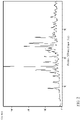
- the present disclosure provides crystalline form I' of N-((S)-1-(3-(3-chloro-4-cyanophenyl)-1H-pyrazol-1-yl)propan-2-yl)-5 -((S)-1-hydroxyethyl)-1H-pyrazole-3-carboxamide (Ia) having an X-ray powder diffraction pattern substantially as illustrated in Figure 2 .
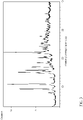
- the present disclosure provides crystalline form I" of N-((S)-1-(3-(3-chloro-4-cyanophenyl)-1H-pyrazol-1-yl)propan-2-yl)-5 -((R)-1-hydroxyethyl)-1H-pyrazole-3-carboxamide (Ib) having an X-ray powder diffraction pattern substantially as illustrated in Figure 3 .
- the X-ray powder diffraction pattern peak positions referred to herein can be subject to variations of +/- 0.15 degrees 2-theta according to various factors such as temperature, concentration, and instrumentation used.
- the present disclosure provides a process for preparing crystalline form I' or I" of N-((S)-1-(3-(3-chloro-4-cyanophenyl)-1H-pyrazol-1-yl)propan-2-yl)-5-((S)-1-hydroxyethyl)-1H-pyrazole-3-carboxamide (Ia) or N-((S)-1-(3-(3-chloro-4-cyanophenyl)-1H-pyrazol-1-yl)propan-2-yl)-5 -((R)-1-hydroxyethyl)-1H-pyrazole-3-carboxamide (Ib), respectively, comprising
- Compound (I) can be synthetized using the procedures described in WO 2011/051540 .
- Pure diastereomers (Ia) and (Ib) can be suitably synthetized, for example, using ketoreductase enzymes (KREDs) for both S- and R-selective reduction of compound 1 to compound 2 as shown in Scheme 1, wherein R is H or C 1-6 alkyl.
- KREDs ketoreductase enzymes
- Intermediate 2 can be protected, preferably with silyl derivatives such as tert -butyldiphenylsilyl, in order to avoid esterification in amidation step.
- ester hydrolysis is typically performed before amidation step, preferably in the presence of LiOH, NaOH or KOH.
- Amidation from compound 3 to compound 5 is suitably carried out using EDCI HBTU, DIPEA system but using other typical amidation methods is also possible. Deprotection of 5 give pure diastereomers (Ia) and (Ib).
- Pyrazole ring without NH substitution is known tautomerizable functionality and is described here only as single tautomer but every intermediate and end product here can exist in both tautomeric forms at the same time.
- the crystalline forms I, I' and I" of compounds (I), (Ia) and (Ib), respectively, can be prepared, for example, by dissolving the compound in question in an acetonitrile:water mixture having volume ratio from 85:15 to 99:1, such as from 90:10 to 98:2, for example 95:5, under heating and slowly cooling the solution until the crystalline form precipitates from the solution.
- concentration of the compound in the acetonitrile:water solvent mixture is suitably about 1 kg of the compound in 5-25 liters of acetonitrile:water solvent mixture, for example 1 kg of the compound in 10-20 liters of acetonitrile:water solvent mixture.
- the compound is suitably dissolved in the acetonitrile:water solvent mixture by heating the solution, for example near to the reflux temperature, for example to 60-80 °C, for example to 75 °C, under stirring and filtering if necessary.
- the solution is suitably then cooled to 0-50 °C, for example to 5-35 °C, for example to RT, over 5 to 24 hours, for example over 6 to 12 hours, and stirred at this temperature for 3 to 72 hours, for example for 5 to 12 hours.
- the obtained crystalline product can then be filtered, washed, and dried.
- the drying is suitably carried out in vacuum at 40 to 60 °C, for example at 55 °C, for 1 to 24 hours, such as for 2 to 12 hours, for example 2 to 6 hours.
- the crystalline forms I, I' and I" of compounds (I), (Ia) and (Ib), respectively, are useful as medicaments and can be formulated into pharmaceutical dosage forms, such as tablets and capsules for oral administration, by mixing with pharmaceutical excipients known in the art.
- the crystalline form of compound (I) obtained in Example 1 was analysed by X-ray powder diffraction method.
- the measurements were performed with the X-ray powder diffractometer PANalytical X'Pert PRO at room temperature using Cu filled X-ray tube (45kV ⁇ 40mA) as the X-ray source, a fixed 1° anti-scatter slit, a programmable divergence slit with 5.0 mm irradiated length and the real time multiple strip detector X'Celerator. Data collection was done in 0.008° steps at a scan speed of 1°/min in the range of 3-80° 2 ⁇ .
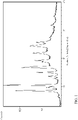
- the crystalline form was characterized by an X-ray powder diffraction pattern as shown in Figure 1 and exhibiting characteristic peaks at about the following 2-theta values: Angle 2-theta ° 6.4 8.5 9.6 9.7 10.4 12.8 13.6 14.9 15.9 16.6 16.9 18.7 19.2 21.8 24.3 25.5
- Example 4 The crystalline form of compound (Ia) obtained in Example 4 was analysed by X-ray powder diffraction method as described in Example 2. The crystalline form was characterized by an X-ray powder diffraction pattern as shown in Figure 2 and exhibiting characteristic peaks at about the following 2-theta values: Angle 2-theta ° 9.3 11.4 11.5 13.6 14.7 14.9 15.7 16.1 17.0 17.7 18.5 19.1 20.5 21.5 22.1 22.6 23.2 23.6 24.1 25.1 26.2 27.2
- Example 7 The crystalline form of compound (Ib) obtained in Example 7 was analysed by X-ray powder diffraction method as described in Example 2. The crystalline form was characterized by an X-ray powder diffraction pattern as shown in Figure 3 and exhibiting characteristic peaks at about the following 2-theta values: Angle 2-theta ° 7.9 9.2 10.9 13.2 14.8 15.1 15.5 15.8 16.9 18.4 20.2 20.5 21.8 22.1 24.3
- Zinc trifluoromethanesulfonate (0.259 g; 0.713 mmol) and (S)-(-)-3-butyn-2-ol (0.25 g; 3.57 mmol) were added to 0.75 ml (5.35 mmol) of Et 3 N under nitrogen atmosphere.
- Ethyldiazoacetate (0.45 ml; 4.28 mmol) was added slowly and the mixture was heated at 100 °C for 2 h. The mixture was cooled to RT and 5 ml of water was added. The mixture was washed with 15 ml of DCM, 5 ml of water was added and phases were separated.
- Tautomer 2 (minor 23%): ⁇ 1.28 (t, 3H), 1.39 (d, 3H), 4.20-4.28 (m, 2H), 4.66-4.85 (m, 1H), 5.04-5.15 (broad s, 1H), 6.71 (broad s, 1H), 13.60 (broad s, 1H).
- Zinc trifluoromethanesulfonate (1.037 g; 2.85 mmol) and (R)-(+)-3-butyn-2-ol (1.00 g; 14.27 mmol) were added to 2.98 ml (21.40 mmol) of Et 3 N under nitrogen atmosphere.
- Ethyldiazoacetate (1.80 ml; 21.40 mmol) was added slowly and then refluxed for 3 h. The mixture was cooled to RT and 45 ml of water was added.
- Tautomer 2 (minor 22%): ⁇ 1.28 (t, 3H), 1.39 (d, 3H), 4.18-4.35 (m, 2H), 4.66-4.85 (m, 1H), 5.09 (broad s, 1H), 6.71 (broad s, 1H), 13.61 (broad s, 1H).
Landscapes
- Health & Medical Sciences (AREA)
- Chemical & Material Sciences (AREA)
- Life Sciences & Earth Sciences (AREA)
- Veterinary Medicine (AREA)
- Public Health (AREA)
- Medicinal Chemistry (AREA)
- General Health & Medical Sciences (AREA)
- Animal Behavior & Ethology (AREA)
- Pharmacology & Pharmacy (AREA)
- Epidemiology (AREA)
- Organic Chemistry (AREA)
- Nuclear Medicine, Radiotherapy & Molecular Imaging (AREA)
- General Chemical & Material Sciences (AREA)
- Chemical Kinetics & Catalysis (AREA)
- Engineering & Computer Science (AREA)
- Bioinformatics & Cheminformatics (AREA)
- Pharmaceuticals Containing Other Organic And Inorganic Compounds (AREA)
- Plural Heterocyclic Compounds (AREA)
- Organic Low-Molecular-Weight Compounds And Preparation Thereof (AREA)
Description
- The present disclosure relates to solid crystalline forms of the diastereomers of pharmaceutical compound N-((S)-1-(3-(3-chloro-4-cyanophenyl)-1H-pyrazol-1-yl)-propan-2-yl)-5-(1-hydroxyethyl)-1H-pyrazole-3-carboxamide (I), and to methods for preparing such crystalline forms.
- The compound N-((S)-1-(3-(3-chloro-4-cyanophenyl)-1H-pyrazol-1-yl)-propan-2-yl)-5-(1-hydroxyethyl)-1H-pyrazole-3-carboxamide (I) and manufacture thereof have been disclosed in
WO 2011/051540 . Compound (I) is a potent androgen receptor (AR) modulator useful in the treatment of cancer, particularly AR dependent cancer such as prostate cancer, and other diseases where AR antagonism is desired. Compound (I) is represented by the structure: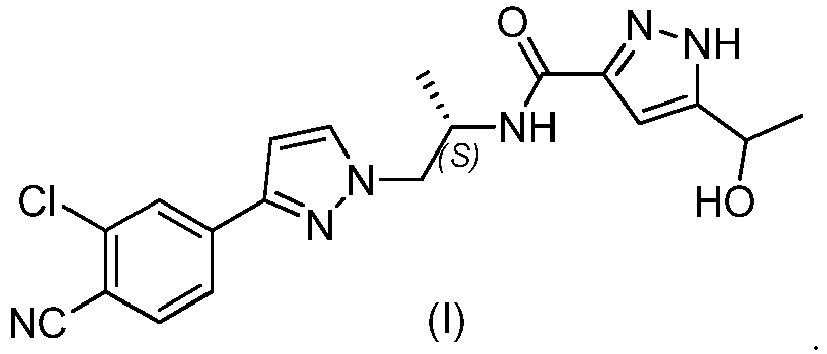
- As the hydrogen atom of the pyrazole ring may exist in tautomeric equilibrium between the 1- and 2-position, it is recognized by the skilled person that the above structure and the chemical name "N-((S)-1-(3-(3-chloro-4-cyanophenyl)-1H-pyrazol-1-yl)-propan-2-yl)-5-(1-hydroxyethyl)-1H-pyrazole-3-carboxamide (I) ," as referred to herein, is inclusive of the tautomer of compound (I), namely N-((S)-1-(3-(3-chloro-4-cyanophenyl)-1H-pyrazol-1-yl)-propan-2-yl)-3-(1-hydroxyethyl)-1H-pyrazole-5-carboxamide.
- In addition to the chiral carbon atom shown in the chemical structure above, compound (I) has another chiral carbon atom with hydroxy group attached therein. Therefore, compound (I) has two diastereomers, namely N-((S)-1-(3-(3-chloro-4-cyanophenyl)-1H-pyrazol-1-yl)propan-2-yl)-5-((S)-1-hydroxyethyl)-1H-pyrazole-3-carboxamide (Ia)


- Due to the tautomeric equilibrium of the hydrogen atom between the 1- and 2-position in the pyrazole ring, the chemical name of diastereomers (Ia) and (Ib) are inclusive of the tautomers of (Ia) and (Ib), similarly to compound (I) as explained above.
- Compounds (Ia) and (Ib) are also potent androgen receptor (AR) modulators useful in the treatment of cancer, particularly AR dependent cancer such as prostate cancer, and other diseases where AR antagonism is desired.
- It has now been found that diastereomers (Ia) and (Ib) can be obtained in a stable and substantially pure crystalline form by crystallization under certain conditions.
- Thus, the present invention provides crystalline form I' of N-((S)-1-(3-(3-chloro-4-cyanophenyl)-1H-pyrazol-1-yl)propan-2-yl)-5-((S)-1-hydroxyethyl)-1H-pyrazole-3-carboxamide (Ia) having an X-ray powder diffraction pattern comprising characteristic peaks at 9.3, 15.7, 17.0, 24.1 and 25.1 ± 0.15 degrees 2-theta measured using Cu filled X-ray tube.
- The present invention further provides crystalline form I' of N-((S)-1-(3-(3-chloro-4-cyanophenyl)-1H-pyrazol-1-yl)propan-2-yl)-5-((S)-1-hydroxyethyl)-1H-pyrazole-3-carboxamide (Ia) having an X-ray powder diffraction pattern comprising characteristic peaks at 9.3, 11.4, 11.5, 13.6, 14.7, 14.9, 15.7, 16.1, 17.0, 17.7, 18.5, 19.1, 20.5, 21.5, 22.1, 22.6, 23.2, 23.6, 24.1, 25.1, 26.2 and 27.2 ± 0.15 degrees 2-theta measured using Cu filled X-ray tube .
- The present invention further provides crystalline form I" of N-((S)-1-(3-(3-chloro-4-cyanophenyl)-1H-pyrazol-1-yl)propan-2-yl)-5-((R)-1-hydroxyethyl)-1H-pyrazole-3-carboxamide (Ib) having an X-ray powder diffraction pattern comprising characteristic peaks at 9.2, 10.9, 15.1, 15.8 and 22.1 ± 0.15 degrees 2-theta measured using Cu filled X-ray tube.
- The present invention further provides crystalline form I" of N-((S)-1-(3-(3-chloro-4-cyanophenyl)-1H-pyrazol-1-yl)propan-2-yl)-5-((R)-1-hydroxyethyl)-1H-pyrazole-3-carboxamide (Ib) having an X-ray powder diffraction pattern comprising characteristic peaks at 7.9, 9.2, 10.9, 13.2, 14.8, 15.1, 15.5, 15.8, 16.9, 18.4, 20.2, 20.5, 21.8, 22.1 and 24.3 ± 0.15 degrees 2-theta measured using Cu filled X-ray tube.
- The present invention further provides a process for preparing crystalline form I' or I" of N-((S)-1-(3-(3-chloro-4-cyanophenyl)-1H-pyrazol-1-yl)propan-2-yl)-5 -((S)-1-hydroxyethyl)-1H-pyrazole-3-carboxamide (Ia) or N-((S)-1-(3-(3-chloro-4-cyanophenyl)-1H-pyrazol-1-yl)propan-2-yl)-5-((R)-1-hydroxyethyl)-1H-pyrazole-3-carboxamide (Ib), respectively, comprising
- a) mixing N-((S)-1-(3-(3-chloro-4-cyanophenyl)-1H-pyrazol-1-yl)propan-2-yl)-5-((S)-1-hydroxyethyl)-1H-pyrazole-3-carboxamide (Ia) or N-((S)-1-(3-(3-chloro-4-cyanophenyl)-1H-pyrazol-1-yl)propan-2-yl)-5-((R)-1-hydroxyethyl)-1H-pyrazole-3-carboxamide (Ib) with a mixture of acetonitrile and water;
- b) heating the mixture from step a) to form a solution;
- c) cooling the solution from step b) to about 0-50 °C; and
- d) isolating the crystalline form.
-
-
Figure 1 shows the X-ray powder diffraction pattern of the crystalline form I of compound (I) obtained in Reference Example 1. -
Figure 2 shows the X-ray powder diffraction pattern of the crystalline form I' of compound (Ia) obtained in Example 4. -
Figure 3 shows the X-ray powder diffraction pattern of the crystalline form I" of compound (Ib) obtained in Example 7. - Crystalline form I of compound (I), crystalline form I' of compound (Ia) and crystalline form I" of compound (Ib) have been characterized by X-ray powder diffraction (XRPD) studies.
- Accordingly, in one aspect, the present disclosure provides crystalline form I' of N-((S)-1-(3-(3-chloro-4-cyanophenyl)-1H-pyrazol-1-yl)propan-2-yl)-5-((S)-1-hydroxyethyl)-1H-pyrazole-3-carboxamide (Ia) having an X-ray powder diffraction pattern comprising characteristic peaks at 9.3, 15.7, 17.0, 24.1 and 25.1 ± 0.15 degrees 2-theta.
- In another aspect, the present disclosure provides crystalline form I" of N-((S)-1-(3-(3-chloro-4-cyanophenyl)-1H-pyrazol-1-yl)propan-2-yl)-5-((R)-1-hydroxyethyl)-1H-pyrazole-3-carboxamide (Ib) having an X-ray powder diffraction pattern comprising characteristic peaks at 9.2, 10.9, 15.1, 15.8 and 22.1 ± 0.15 degrees 2-theta.
- In yet another aspect, the present disclosure provides crystalline form I' of N-((S)-1-(3-(3-chloro-4-cyanophenyl)-1H-pyrazol-1-yl)propan-2-yl)-5-((S)-1-hydroxyethyl)-1H-pyrazole-3-carboxamide (Ia) having an X-ray powder diffraction pattern comprising characteristic peaks at 9.3, 11.4, 11.5, 13.6, 14.7, 14.9, 15.7, 16.1, 17.0, 17.7, 18.5, 19.1, 20.5, 21.5, 22.1, 22.6, 23.2, 23.6, 24.1, 25.1, 26.2 and 27.2 ± 0.15 degrees 2-theta.
- In yet another aspect, the present disclosure provides crystalline form I" of N-((S)-1-(3-(3-chloro-4-cyanophenyl)-1H-pyrazol-1-yl)propan-2-yl)-5 -((R)-1-hydroxyethyl)-1H-pyrazole-3-carboxamide (Ib) having an X-ray powder diffraction pattern comprising characteristic peaks at about 7.9, 9.2, 10.9, 13.2, 14.8, 15.1, 15.5, 15.8, 16.9, 18.4, 20.2, 20.5, 21.8, 22.1 and 24.3 ± 0.15 degrees 2-theta.
- According to still another aspect, the present disclosure provides crystalline form I' of N-((S)-1-(3-(3-chloro-4-cyanophenyl)-1H-pyrazol-1-yl)propan-2-yl)-5 -((S)-1-hydroxyethyl)-1H-pyrazole-3-carboxamide (Ia) having an X-ray powder diffraction pattern substantially as illustrated in
Figure 2 . - According to still another aspect, the present disclosure provides crystalline form I" of N-((S)-1-(3-(3-chloro-4-cyanophenyl)-1H-pyrazol-1-yl)propan-2-yl)-5 -((R)-1-hydroxyethyl)-1H-pyrazole-3-carboxamide (Ib) having an X-ray powder diffraction pattern substantially as illustrated in
Figure 3 . - It is recognized by the skilled person that the X-ray powder diffraction pattern peak positions referred to herein can be subject to variations of +/- 0.15 degrees 2-theta according to various factors such as temperature, concentration, and instrumentation used.
- According to still another aspect, the present disclosure provides a process for preparing crystalline form I' or I" of N-((S)-1-(3-(3-chloro-4-cyanophenyl)-1H-pyrazol-1-yl)propan-2-yl)-5-((S)-1-hydroxyethyl)-1H-pyrazole-3-carboxamide (Ia) or N-((S)-1-(3-(3-chloro-4-cyanophenyl)-1H-pyrazol-1-yl)propan-2-yl)-5 -((R)-1-hydroxyethyl)-1H-pyrazole-3-carboxamide (Ib), respectively, comprising
- a) mixing N-((S)-1-(3-(3-chloro-4-cyanophenyl)-1H-pyrazol-1-yl)propan-2-yl)-5-((S)-1-hydroxyethyl)-1H-pyrazole-3-carboxamide (Ia) or N-((S)-1-(3-(3-chloro-4-cyanophenyl)- 1H-pyrazol-1-yl)propan-2-yl)-5-((R)-1-hydroxyethyl)- 1H-pyrazole-3-carboxamide (Ib) with a mixture of acetonitrile and water;
- b) heating the mixture from step a) to form a solution;
- c) cooling the solution from step b) to about 0-50 °C; and
- d) isolating the crystalline form.
- Also described herein is a process for the manufacture of diastereomer (Ia) or (Ib) comprising
- a) reducing compound of formula (1)


- b) optionally protecting the hydroxyl group of compound of formula (2);
- c) in case R is an C1-6 alkyl, subjecting the compound of formula (2), wherein the hydroxyl group is optionally protected, to cleavage of the ester bond to obtain compound (3);

- d) treating compound (3), wherein the hydroxyl group is optionally protected, with (S)-4-(1-(2-aminopropyl)-1H-pyrazol-3-yl)-2-chlorobenzonitrile, and, in case the hydroxyl group is protected, deprotecting the hydroxyl group, to obtain compound (Ia) or (Ib).
- Compound (I) can be synthetized using the procedures described in
WO 2011/051540 . - Pure diastereomers (Ia) and (Ib) can be suitably synthetized, for example, using ketoreductase enzymes (KREDs) for both S- and R-selective reduction of compound 1 to compound 2 as shown in Scheme 1, wherein R is H or C1-6 alkyl.

- For example, Codexis KRED-130 and KRED -NADH-110 enzymes are useful for obtaining excellent stereoselectivity, even stereospecificity. In Scheme 1 the starting material 1 is preferably an ester (R= C1-6 alkyl), for example ethyl ester (R=ethyl), such as to facilitate extraction of the product into the organic phase as the compound where R=H has a tendency to remain in the water phase. Intermediate 2 can be protected, preferably with silyl derivatives such as tert-butyldiphenylsilyl, in order to avoid esterification in amidation step. In the case of R=C1-6 alkyl, ester hydrolysis is typically performed before amidation step, preferably in the presence of LiOH, NaOH or KOH. Amidation from compound 3 to compound 5 is suitably carried out using EDCI HBTU, DIPEA system but using other typical amidation methods is also possible. Deprotection of 5 give pure diastereomers (Ia) and (Ib).
- Pyrazole ring without NH substitution is known tautomerizable functionality and is described here only as single tautomer but every intermediate and end product here can exist in both tautomeric forms at the same time.
- The stereochemistry of the compounds can be confirmed by using optically pure starting materials with known absolute configuration as demonstrated in Scheme 2, wherein R=H or C1-6 alkyl, preferably alkyl, for example ethyl. The end products of Scheme 2 are typically obtained as a mixture of tautomers at +300K 1H-NMR analyses in DMSO.

- The crystalline forms I, I' and I" of compounds (I), (Ia) and (Ib), respectively, can be prepared, for example, by dissolving the compound in question in an acetonitrile:water mixture having volume ratio from 85:15 to 99:1, such as from 90:10 to 98:2, for example 95:5, under heating and slowly cooling the solution until the crystalline form precipitates from the solution. The concentration of the compound in the acetonitrile:water solvent mixture is suitably about 1 kg of the compound in 5-25 liters of acetonitrile:water solvent mixture, for example 1 kg of the compound in 10-20 liters of acetonitrile:water solvent mixture. The compound is suitably dissolved in the acetonitrile:water solvent mixture by heating the solution, for example near to the reflux temperature, for example to 60-80 °C, for example to 75 °C, under stirring and filtering if necessary. The solution is suitably then cooled to 0-50 °C, for example to 5-35 °C, for example to RT, over 5 to 24 hours, for example over 6 to 12 hours, and stirred at this temperature for 3 to 72 hours, for example for 5 to 12 hours. The obtained crystalline product can then be filtered, washed, and dried. The drying is suitably carried out in vacuum at 40 to 60 °C, for example at 55 °C, for 1 to 24 hours, such as for 2 to 12 hours, for example 2 to 6 hours.
- The crystalline forms I, I' and I" of compounds (I), (Ia) and (Ib), respectively, are useful as medicaments and can be formulated into pharmaceutical dosage forms, such as tablets and capsules for oral administration, by mixing with pharmaceutical excipients known in the art.
- The disclosure is further illustrated by the following examples.
- N-((S)-1-(3-(3-chloro-4-cyanophenyl)-1H-pyrazol-1-yl)-propan-2-yl)-5-(1-hydroxyethyl)-1H-pyrazole-3-carboxamide (I) (5 g), 71.25 ml of acetonitrile, and 3.75 ml of distilled water were charged to a flask, and the mixture was heated up to 75 °C. The mixture was slowly cooled down to RT and stirred at RT for 3 days. The solid obtained was filtered and washed twice with acetonitrile:water (9.5 ml:0.5 ml). The product was dried under vacuum at 40 °C and finally at 60°C to obtain 4.42 g of crystalline title compound (yield of 88 %) which was used in X-ray diffraction study.
- The crystalline form of compound (I) obtained in Example 1 was analysed by X-ray powder diffraction method. The measurements were performed with the X-ray powder diffractometer PANalytical X'Pert PRO at room temperature using Cu filled X-ray tube (45kV × 40mA) as the X-ray source, a fixed 1° anti-scatter slit, a programmable divergence slit with 5.0 mm irradiated length and the real time multiple strip detector X'Celerator. Data collection was done in 0.008° steps at a scan speed of 1°/min in the range of 3-80° 2θ. The crystalline form was characterized by an X-ray powder diffraction pattern as shown in
Figure 1 and exhibiting characteristic peaks at about the following 2-theta values:Angle 2-theta ° 6.4 8.5 9.6 9.7 10.4 12.8 13.6 14.9 15.9 16.6 16.9 18.7 19.2 21.8 24.3 25.5 -
- a) Ethyl-5-((S)1-hydroxyethyl)-1H-pyrazole-3-carboxylate

- b) Ethyl 5-((S)-1-((tert-butyldiphenylsilyl)oxy)ethyl)-1H-pyrazole-3-carboxylate

- c) 5-((S)-1-((tert-Butyldiphenylsilyl)oxy)ethyl)-1H-pyrazole-3-carboxylic acid

- d) 5-((S)-1-((tert-Butyldiphenylsilyl)oxy)ethyl)-N-((S)-1-(3-(3-chloro-4-cyanophenyl)-1H-pyrazol-1-yl)propan-2-yl)-1H-pyrazole-3-carboxamide

- e) N-((S)-1-(3-(3-chloro-4-cyanophenyl)-1H-pyrazol-1-yl)propan-2-yl)-5-((S)-1-hydroxyethyl)-1H-pyrazole-3-carboxamide (Ia)
TBAF hydrate (Bu4NF × 3H2O; 2.34 g; 7.40 mmol) in 10 ml of THF was added to the solution of the compound of Example 3(d) (9.43 g; 14.79 mmol) in THF (94 ml) at 0 °C under nitrogen atmosphere. Stirring was continued at RT for 21.5 h and the mixture was concentrated. DCM (94 ml) was added to the residue and the solution was washed with 3x50 ml of water, dried (Na2SO4), filtered and concentrated. Crude product was purified by flash chromatography (EtOAc/n-heptane) to give 2.1 g of the title compound. 1H-NMR (400MHz; d6-DMSO; 300K): Major tautomer (~85 %): δ 1.11 (d, 3H), 1.39 (d, 3H), 4.24-4.40 (m, 2H), 4.40-4.50 (m, 1H), 6.41(s, 1H), 6.93 (d, 1H), 7.77-7.82 (m, 1H), 7.88-8.01 (m, 2H), 8.08 (s, 1H), 8.19 (d, 1H), 13.02 (broad s, 1H). Minor tautomer (~15 %) δ 1.07-1.19 (m, 3H), 1.32-1.41 (m, 3H), 4.24-4.40 (m, 2H), 4.40-4.50 (m, 1H), 6.80 (broad s, 1H), 6.91-6-94 (m, 1H), 7.77-7.82 (m, 1H), 7.88-8.01 (m, 2H), 8.05-8.09 (m, 1H), 8.31 (d, 1H), 13.10 (broad s, 1H). - N-((S)-1-(3-(3-chloro-4-cyanophenyl)-1H-pyrazol-1-yl)propan-2-yl)-5-((S)-1-hydroxyethyl)-1H-pyrazole-3-carboxamide (Ia) (5.00 g; 12.54 mmol) was mixed with 47.5 ml of ACN and 2.5 ml of water. The mixture was heated until compound (Ia) was fully dissolved. The solution was allowed to cool slowly to RT to form a precipitate. The mixture was then further cooled to 0 °C and kept in this temperature for 30 min. The mixture was filtered and the precipitate was dried under vacuum to obtain 4.50 g of crystalline title compound which was used in the X-ray diffraction study.
- The crystalline form of compound (Ia) obtained in Example 4 was analysed by X-ray powder diffraction method as described in Example 2. The crystalline form was characterized by an X-ray powder diffraction pattern as shown in
Figure 2 and exhibiting characteristic peaks at about the following 2-theta values:Angle 2-theta ° 9.3 11.4 11.5 13.6 14.7 14.9 15.7 16.1 17.0 17.7 18.5 19.1 20.5 21.5 22.1 22.6 23.2 23.6 24.1 25.1 26.2 27.2 -
- a) Ethyl-5-((R)-1-hydroxyethyl)-1H-pyrazole-3-carboxylate

- b) Ethyl-5-((R)-1-((tert-butyldiphenylsilyl)oxy)ethyl)-1H-pyrazole-3-carboxylate

- c) 5-((R)-1-((tert-Butyldiphenylsilyl)oxy)ethyl)-1H-pyrazole-3-carboxylic acid

- d) 5-((R)-1-((tert-Butyldiphenylsilyl)oxy)ethyl)-N-((S)-1-(3-(3-chloro-4-cyanophenyl)-1H-pyrazol-1-yl)propan-2-yl)-1H-pyrazole-3-carboxamide

- e) N-((S)-1-(3-(3-chloro-4-cyanophenyl)-1H-pyrazol-1-yl)propan-2-yl)-5-((R)-1-hydroxyethyl)-1H-pyrazole-3-carboxamide (Ib)
A mixture of the compound of Example 6(d) (6.09 g; 9.56 mmol), 61 ml of THF and TBAF was stirred at 40 °C for 6.5 h. The mixture was concentrated and 61 ml of EtOAc was added to the evaporation residue. Solution was washed with 2x50 ml of 0.5 M HCl and 4x50 ml of water, dried over Na2SO4, filtered and concentrated. Crude product was purified by flash column chromatography (n-heptane-EtOAc) to give 1.71 g of the title compound. 1H-NMR (400MHz; d6-DMSO; 300K): Major tautomer (~85%): δ 1.10 (d, 3H), 1.38 (d, 3H), 4.14-4.57 (m, 2H), 5.42 (d, 1H), 6.39(s, 1H), 6.86-6.98 (m, 1H), 7.74-7.84 (m, 1H), 7.86-8.02 (m, 2H), 8.08 (s, 1H), 8.21 (d, 1H), 13.04 (broad s, 1H). Minor tautomer (~ 15%) δ 0.95-1.24 (m, 3H), 1.25-1.50 (m, 3H), 4.14-4.57 (m, 2H), 4.60-4.90 (m, 1H), 5.08 (d, 1H), 6.78 (broad s, 1H), 6.86-6.98 (m, 1H), 7.77-7.84 (m, 1H), 7.86-8.02 (m, 2H), 8.02-8.12 (m, 1H), 8.32 (d, 1H), 13.11 (broad s, 1H). - N-((S)-1-(3-(3-chloro-4-cyanophenyl)-1H-pyrazol-1-yl)propan-2-yl)-5-((R)-1-hydroxyethyl)-1H-pyrazole-3-carboxamide (Ib) (3.7 g; 9.28 mmol) was mixed with 70 ml of ACN and 3.5 ml of water. The mixture was heated to reflux temperature until compound (Ib) was fully dissolved. The solution was allowed to cool slowly. The mixture was filtered at 50 °C to obtain 6.3 mg of the precipitate. Mother liquid was cooled to 41 °C and filtered again to obtain 20.7 mg of the precipitate. Obtained mother liquid was then cooled to 36 °C and filtered to obtain 173 mg of the precipitate. The final mother liquid was cooled to RT, stirred overnight, cooled to 0 °C, filtered, washed with cold ACN:water (1:1) and dried to obtain 2.71 g of the precipitate. The precipitates were checked for optical purity and the last precipitate of crystalline title compound (
optical purity 100 %) was used in the X-ray diffraction study. - The crystalline form of compound (Ib) obtained in Example 7 was analysed by X-ray powder diffraction method as described in Example 2. The crystalline form was characterized by an X-ray powder diffraction pattern as shown in
Figure 3 and exhibiting characteristic peaks at about the following 2-theta values:Angle 2-theta ° 7.9 9.2 10.9 13.2 14.8 15.1 15.5 15.8 16.9 18.4 20.2 20.5 21.8 22.1 24.3 -

- Zinc trifluoromethanesulfonate (0.259 g; 0.713 mmol) and (S)-(-)-3-butyn-2-ol (0.25 g; 3.57 mmol) were added to 0.75 ml (5.35 mmol) of Et3N under nitrogen atmosphere. Ethyldiazoacetate (0.45 ml; 4.28 mmol) was added slowly and the mixture was heated at 100 °C for 2 h. The mixture was cooled to RT and 5 ml of water was added. The mixture was washed with 15 ml of DCM, 5 ml of water was added and phases were separated. Water phase was washed twice with DCM, all organic layers were combined, dried with phase separator filtration and evaporated to dryness to give 0.523 g of crude material. The product was purified by normal phase column chromatography (0-5 % MeOH:DCM) to give 0.165 mg of the title compound. 1H-NMR (400MHz; d6-DMSO; temp +300 K): Tautomer 1 (major 77%): δ 1.28 (t, 3H), 1.39 (d, 3H), 4.20-4.28 (m, 2H), (d, 1H), 4.75-4.85 (m, 1H) 5.43 (broad d, 1H), 6.54 (broad s, 1H), 13.28 (broad s, 1H). Tautomer 2 (minor 23%): δ 1.28 (t, 3H), 1.39 (d, 3H), 4.20-4.28 (m, 2H), 4.66-4.85 (m, 1H), 5.04-5.15 (broad s, 1H), 6.71 (broad s, 1H), 13.60 (broad s, 1H).
-

- Zinc trifluoromethanesulfonate (1.037 g; 2.85 mmol) and (R)-(+)-3-butyn-2-ol (1.00 g; 14.27 mmol) were added to 2.98 ml (21.40 mmol) of Et3N under nitrogen atmosphere. Ethyldiazoacetate (1.80 ml; 21.40 mmol) was added slowly and then refluxed for 3 h. The mixture was cooled to RT and 45 ml of water was added. The mixture was extracted with 3x50 ml of DCM, organic layers were combined, dried with phase separator filtration and evaporated to dryness to give 2.503 g of crude material which was purified by normal phase column chromatography (0-10 % MeOH:DCM) to give 0.671mg of the title compound. 1H-NMR (400MHz; d6-DMSO; temp +300 K): Tautomer 1 (major 78%): δ 1.28 (t, 3H), 1.39 (d, 3H), 4.18-4.35 (m, 2H), (d, 1H), 4.75-4.85 (m, 1H) 5.42 (broad d, 1H), 6.54 (s, 1H), 13.29 (broad s, 1H). Tautomer 2 (minor 22%): δ 1.28 (t, 3H), 1.39 (d, 3H), 4.18-4.35 (m, 2H), 4.66-4.85 (m, 1H), 5.09 (broad s, 1H), 6.71 (broad s, 1H), 13.61 (broad s, 1H).
- Abbreviations:
- ACN: acetonitrile
- DCM: dichloromethane
- DIPEA: N,N-diisopropyl-ethyl amine
- DMF: dimethylformamide
- DMSO: dimethylsulfoxide
- EDCI×HCl: N-(3-dimethylaminopropyl)-N-ethylcarbodiimide hydrochloride
- EtOAc: ethyl acetate
- EtOH: ethanol
- HBTU: o-benzotriazole-N,N,N' ,N' -tetramethyl-uroniumhexafluoro-phosphate
- KRED: ketoreductase (enzyme)
- RT: room temperature
- TFA: trifluoroacetic acid.
Claims (11)
- Crystalline form I' of N-((S)-1-(3-(3-chloro-4-cyanophenyl)-1H-pyrazol-1-yl)propan-2-yl)-5-((S)-1-hydroxyethyl)-1H-pyrazole-3-carboxamide (Ia) having an X-ray powder diffraction pattern comprising characteristic peaks at 9.3, 15.7, 17.0, 24.1 and 25.1 ± 0.15 degrees 2-theta measured using Cu filled X-ray tube.
- Crystalline form I' of N-((S)-1-(3-(3-chloro-4-cyanophenyl)-1H-pyrazol-1-yl)propan-2-yl)-5-((S)-1-hydroxyethyl)-1H-pyrazole-3-carboxamide (Ia) according to claim 1, having an X-ray powder diffraction pattern comprising characteristic peaks at 9.3, 11.4, 11.5, 13.6, 14.7, 14.9, 15.7, 16.1, 17.0, 17.7, 18.5, 19.1,20.5,21.5, 22.1, 22.6, 23.2, 23.6, 24.1, 25.1, 26.2 and 27.2 ± 0.15 degrees 2-theta measured using Cu filled X-ray tube .
- Crystalline form I" of N-((S)-1-(3-(3-chloro-4-cyanophenyl)-1H-pyrazol-1-yl)propan-2-yl)-5-((R)-1-hydroxyethyl)-1H-pyrazole-3-carboxamide (Ib) having an X-ray powder diffraction pattern comprising characteristic peaks at 9.2, 10.9, 15.1, 15.8 and 22.1 ± 0.15 degrees 2-theta measured using Cu filled X-ray tube.
- Crystalline form I" of N-((S)-1-(3-(3-chloro-4-cyanophenyl)-1H-pyrazol-1-yl)propan-2-yl)-5-((R)-1 -hydroxyethyl)-1H-pyrazole-3-carboxamide (Ib) according to claim 3, having an X-ray powder diffraction pattern comprising characteristic peaks at 7.9, 9.2, 10.9, 13.2, 14.8, 15.1, 15.5, 15.8, 16.9, 18.4, 20.2, 20.5, 21.8, 22.1 and 24.3 ± 0.15 degrees 2-theta measured using Cu filled X-ray tube .
- A process for preparing crystalline form I' or I" of N-((S)-1-(3-(3-chloro-4-cyanophenyl)-1H-pyrazol-1 -yl)propan-2-yl)-5 -((S)-1 -hydroxyethyl)-1H-pyrazole-3-carboxamide (Ia) or N-((S)-1-(3-(3-chloro-4-cyanophenyl)-1H-pyrazol-1-yl)propan-2-yl)-5-((R)-1-hydroxyethyl)-1H-pyrazole-3-carboxamide (Ib), respectively, comprisinga) mixing N-((S)-1-(3-(3-chloro-4-cyanophenyl)-1H-pyrazol-1-yl)propan-2-yl)-5-((S)-1-hydroxyethyl)-1H-pyrazole-3-carboxamide (Ia) or N-((S)-1-(3-(3-chloro-4-cyanophenyl)-1H-pyrazol-1 -yl)propan-2-yl)-5 -((R)-1 -hydroxyethyl)-1H-pyrazole-3-carboxamide (Ib) with a mixture of acetonitrile and water;b) heating the mixture from step a) to form a solution;c) cooling the solution from step b) to about 0-50 °C; andd) isolating the crystalline form.
- The process according to claim 5, wherein the acetonitrile:water mixture has a volume ratio from 85:15 to 99:1.
- The process according to claim 6, wherein the acetonitrile:water mixture has a volume ratio from 90:10 to 98:2.
- The process according to claim 7, wherein the acetonitrile:water mixture has a volume ratio of about 95:5.
- The process according to any of claims 5 to 8, wherein the cooling step c) occurs over 5 to 24 hours.
- The process according to claim 9, wherein the cooling step c) occurs over 6 to 12 hours.
- The process according to any of claims 5 to 10, wherein the isolated crystalline form is dried under vacuum at 40 °C to 60 °C.
Priority Applications (3)
| Application Number | Priority Date | Filing Date | Title |
|---|---|---|---|
| SI201631571T SI3250554T1 (en) | 2015-01-30 | 2016-01-28 | Carboxamide derivative and its diastereomers in stable crystalline form |
| HRP20220998TT HRP20220998T1 (en) | 2015-01-30 | 2016-01-28 | A carboxamide derivative and its diastereomers in stable crystalline form |
| RS20220737A RS63477B1 (en) | 2015-01-30 | 2016-01-28 | CARBOXAMIDE DERIVATIVE AND ITS DIASTEREOISOMERS IN STABLE CRYSTAL FORM |
Applications Claiming Priority (2)
| Application Number | Priority Date | Filing Date | Title |
|---|---|---|---|
| FI20150033 | 2015-01-30 | ||
| PCT/FI2016/050054 WO2016120530A1 (en) | 2015-01-30 | 2016-01-28 | A carboxamide derivative and its diastereomers in stable crystalline form |
Publications (2)
| Publication Number | Publication Date |
|---|---|
| EP3250554A1 EP3250554A1 (en) | 2017-12-06 |
| EP3250554B1 true EP3250554B1 (en) | 2022-05-18 |
Family
ID=55349869
Family Applications (1)
| Application Number | Title | Priority Date | Filing Date |
|---|---|---|---|
| EP16704029.4A Active EP3250554B1 (en) | 2015-01-30 | 2016-01-28 | A carboxamide derivative and its diastereomers in stable crystalline form |
Country Status (14)
| Country | Link |
|---|---|
| US (4) | US10010530B2 (en) |
| EP (1) | EP3250554B1 (en) |
| JP (2) | JP7283861B2 (en) |
| CY (1) | CY1125482T1 (en) |
| DK (1) | DK3250554T3 (en) |
| ES (1) | ES2917549T3 (en) |
| HR (1) | HRP20220998T1 (en) |
| HU (1) | HUE058986T2 (en) |
| LT (1) | LT3250554T (en) |
| PL (1) | PL3250554T3 (en) |
| PT (1) | PT3250554T (en) |
| RS (1) | RS63477B1 (en) |
| SI (1) | SI3250554T1 (en) |
| WO (1) | WO2016120530A1 (en) |
Families Citing this family (15)
| Publication number | Priority date | Publication date | Assignee | Title |
|---|---|---|---|---|
| CN109641851B (en) * | 2016-08-26 | 2022-09-02 | 拜耳消费者护理股份有限公司 | Crystal form of androgen receptor antagonist medicine and preparation method and application thereof |
| CN108218908A (en) * | 2016-12-15 | 2018-06-29 | 连云港润众制药有限公司 | A kind of preparation method of novel androgen receptor antagonists |
| FI3592732T3 (en) | 2017-03-07 | 2025-05-28 | Orion Corp | Manufacture of a crystalline pharmaceutical product |
| WO2019028689A1 (en) * | 2017-08-09 | 2019-02-14 | 杭州领业医药科技有限公司 | Odm-201 crystalline form, preparation method therefor, and pharmaceutical composition thereof |
| CN107602471B (en) * | 2017-09-22 | 2021-04-27 | 成都恒汇化成医药科技有限公司 | Preparation method of crystal form of daroluamide |
| US20210087175A1 (en) * | 2018-02-27 | 2021-03-25 | Sandoz Ag | Crystalline Form II of Darolutamide |
| TW202440088A (en) * | 2019-07-02 | 2024-10-16 | 芬蘭商奧利安公司 | Pharmaceutical composition of darolutamide |
| CN110590668A (en) * | 2019-07-17 | 2019-12-20 | 江苏君若医药有限公司 | Preparation method of N- [ (1S) -2- [3- (3-chloro-4-cyanophenyl) -1H-pyrazol-1-yl ] -1-methylethyl ] -5- (1-hydroxyethyl) -1H-pyrazole-3-formamide |
| CN110452123B (en) * | 2019-08-30 | 2021-10-29 | 南京师范大学 | Synthetic method for one-step construction of C-C, C-N, C-S bonds |
| CN111116476A (en) * | 2019-12-27 | 2020-05-08 | 武汉九州钰民医药科技有限公司 | Method for preparing antitumor drug doramemide |
| WO2022036782A1 (en) * | 2020-08-18 | 2022-02-24 | 拜耳消费者护理股份有限公司 | Crystal form csvi of androgen receptor antagonist drug, and preparation method therefor and use thereof |
| WO2022049075A1 (en) | 2020-09-02 | 2022-03-10 | Bend Research, Inc. | Amorphous solid dispersion of darolutamide |
| WO2022144926A1 (en) * | 2020-12-31 | 2022-07-07 | Msn Laboratories Private Limited, R&D Center | Process for the preparation of amorphous n-{(2s)-1-[3-(3-chloro-4-cyanophenyl)-1h-pyrazol-1-yl]propan-2-yl}-5-(1-hydroxyethyl)-1h-pyrazole-3-carboxamide |
| EP4706772A3 (en) | 2022-02-28 | 2026-04-29 | Química Sintética, S.A. | Crystalline form of darolutamide |
| WO2025229051A1 (en) | 2024-05-03 | 2025-11-06 | F. Hoffmann-La Roche Ag | Use of atr inhibitors in combination with antiandrogen agent |
Citations (2)
| Publication number | Priority date | Publication date | Assignee | Title |
|---|---|---|---|---|
| WO2011051540A1 (en) | 2009-10-27 | 2011-05-05 | Orion Corporation | Androgen receptor modulating compounds |
| US8921378B2 (en) | 2011-04-21 | 2014-12-30 | Orion Corporation | Androgen receptor modulating carboxamides |
-
2016
- 2016-01-28 PT PT167040294T patent/PT3250554T/en unknown
- 2016-01-28 JP JP2017540225A patent/JP7283861B2/en active Active
- 2016-01-28 LT LTEPPCT/FI2016/050054T patent/LT3250554T/en unknown
- 2016-01-28 WO PCT/FI2016/050054 patent/WO2016120530A1/en not_active Ceased
- 2016-01-28 RS RS20220737A patent/RS63477B1/en unknown
- 2016-01-28 EP EP16704029.4A patent/EP3250554B1/en active Active
- 2016-01-28 US US15/547,193 patent/US10010530B2/en active Active
- 2016-01-28 PL PL16704029.4T patent/PL3250554T3/en unknown
- 2016-01-28 DK DK16704029.4T patent/DK3250554T3/en active
- 2016-01-28 HU HUE16704029A patent/HUE058986T2/en unknown
- 2016-01-28 ES ES16704029T patent/ES2917549T3/en active Active
- 2016-01-28 HR HRP20220998TT patent/HRP20220998T1/en unknown
- 2016-01-28 SI SI201631571T patent/SI3250554T1/en unknown
-
2018
- 2018-06-04 US US15/997,028 patent/US10383853B2/en active Active
- 2018-06-04 US US15/997,040 patent/US10376494B2/en active Active
-
2019
- 2019-07-01 US US16/458,435 patent/US10835515B2/en active Active
-
2020
- 2020-10-22 JP JP2020177607A patent/JP2021020935A/en active Pending
-
2022
- 2022-08-16 CY CY20221100554T patent/CY1125482T1/en unknown
Patent Citations (2)
| Publication number | Priority date | Publication date | Assignee | Title |
|---|---|---|---|---|
| WO2011051540A1 (en) | 2009-10-27 | 2011-05-05 | Orion Corporation | Androgen receptor modulating compounds |
| US8921378B2 (en) | 2011-04-21 | 2014-12-30 | Orion Corporation | Androgen receptor modulating carboxamides |
Non-Patent Citations (13)
| Title |
|---|
| "Polymorphism in Pharmaceutical solids ED. 2", 1 January 1999, INFORMA HEALTHCARE , ISBN: 0-8247-0237-9, article GRANT, DAVID J. W.: "Chapter 1: Theory and Origin of Polymorphism", pages: 1 - 33, XP009554252 |
| "Polymorphism in Pharmaceutical solids ED. 2", 31 December 1999, INFORMA HEALTHCARE , ISBN: 0-8247-0237-9, article J. KEITH GUILLORY: "Chapter 5: Generation of Polymorphs, Hydrates, Solvates and Amorphous Solids", pages: 183 - 226, XP009551042 |
| ALFONS GRUNENBERG: "Polymorphie und Thermische Analyse pharmazeutischer Wirkstoffe", PHARMAZIE IN UNSERER ZEIT, vol. 26, no. 5, 1 January 1997 (1997-01-01), pages 224 - 231, XP055745450, DOI: 10.1002/pauz.19970260506 |
| ANONYMOUS: "Codex® KRED Screening Kit", CODEX® KRED SCREENING KIT, CODEXIS, 12 February 2021 (2021-02-12), pages 1 - 11, XP093165676, Retrieved from the Internet <URL:https://d1io3yog0oux5.cloudfront.net/_adc902f547d55adad0079e83c2bc46f3/codexis/db/1157/11119/pdf/KRED-Product-Information.pdf> |
| ANONYMOUS: "Development of New stereoisomeric drugs", FDA GUIDELINE, 1 May 1992 (1992-05-01), pages 1 - 7, XP055645997, [retrieved on 20191125] |
| ANONYMOUS: "Investigation of chiral active substances", EMA GUIDELINES 3CC29A, 1 October 1993 (1993-10-01), pages 1 - 10, XP055645934, [retrieved on 20191125] |
| ANONYMOUS: "The Strem Chemiker January 2014", STREM CHEMIKER, STREM CHEMICALS, DANVERS, MA, US, vol. 27, no. 1, 1 January 2014 (2014-01-01), US , pages 1 - 84, XP093165687, ISSN: 0160-8614 |
| C. HELSEN, ET AL.: "Androgen receptor antagonists for prostate cancer therapy", ENDOCRINE RELATED CANCER, BIOSCIENTIFICA LTD., GB, vol. 21, no. 4, 1 January 2014 (2014-01-01), GB , pages T105 - T118, XP055479333, ISSN: 1351-0088, DOI: 10.1530/ERC-13-0545 |
| D SINGHAL: "Drug polymorphism and dosage form design: a practical perspective", ADVANCED DRUG DELIVERY REVIEWS, ELSEVIER, vol. 56, no. 3, 23 February 2004 (2004-02-23), pages 335 - 347, XP055069199, ISSN: 0169409X, DOI: 10.1016/j.addr.2003.10.008 |
| EMEA: "Assessment report NUBEQA International non-proprietary name: darolutamide. Procedure No. EMEA/H/C/004790/0000", 30 January 2020 (2020-01-30), pages 1 - 137, XP093030691 |
| EMEA: "NOTE FOR GUIDANCE ON SAFETY PHARMACOLOGY STUDIES FOR HUMAN PHARMACEUTICALS (CPMP/ICH/539/00)", ICH TOPIC S 7 A SAFETY PHARMACOLOGY STUDIES FOR HUMAN PHARMACEUTICALS STEP 5, 1 June 2001 (2001-06-01), pages 1 - 10, XP093030688 |
| GIRON, D.: "Thermal analysis and calorimetric methods in teh characterisation of polymorphs and solvates", THERMOCHIMICA ACTA, ELSEVIER SCIENCE PUBLISHERS, AMSTERDAM, NL., vol. 248, 2 January 1995 (1995-01-02), AMSTERDAM, NL. , pages 1 - 59, XP002101808, ISSN: 0040-6031, DOI: 10.1016/0040-6031(94)01953-E |
| JOHN F. BAUER: "Polymorphism - A Critical Consideration in Pharmaceutical Development, Manufacturing, and Stability", JOURNAL OF VALIDATION TECHNOLOGY, FRANCE, 1 January 2008 (2008-01-01), France , pages 15 - 23, XP055517809 |
Also Published As
| Publication number | Publication date |
|---|---|
| CY1125482T1 (en) | 2026-02-25 |
| WO2016120530A1 (en) | 2016-08-04 |
| JP2018503662A (en) | 2018-02-08 |
| DK3250554T3 (en) | 2022-06-27 |
| US10383853B2 (en) | 2019-08-20 |
| PL3250554T3 (en) | 2022-09-19 |
| US20180280354A1 (en) | 2018-10-04 |
| EP3250554A1 (en) | 2017-12-06 |
| ES2917549T3 (en) | 2022-07-08 |
| US20190321333A1 (en) | 2019-10-24 |
| US10376494B2 (en) | 2019-08-13 |
| PT3250554T (en) | 2022-06-02 |
| HRP20220998T1 (en) | 2022-11-11 |
| US20180008577A1 (en) | 2018-01-11 |
| US20180280355A1 (en) | 2018-10-04 |
| SI3250554T1 (en) | 2022-09-30 |
| HUE058986T2 (en) | 2022-09-28 |
| RS63477B1 (en) | 2022-08-31 |
| US10835515B2 (en) | 2020-11-17 |
| LT3250554T (en) | 2022-06-10 |
| JP2021020935A (en) | 2021-02-18 |
| US10010530B2 (en) | 2018-07-03 |
| JP7283861B2 (en) | 2023-05-30 |
Similar Documents
| Publication | Publication Date | Title |
|---|---|---|
| US10376494B2 (en) | Carboxamide derivative and its diastereomers in stable crystalline form | |
| US8846896B2 (en) | Methods of preparing substituted nucleotide analogs | |
| JP3421354B2 (en) | Crystalline cefdiniramine salt | |
| CN101410398B (en) | Improved preparation method of carbapenem compound | |
| IL230027A (en) | Process for the preparation of solifenacin and salts thereof | |
| CA2863772C (en) | Process for preparing tiotropium bromide | |
| EP2151442A2 (en) | Process for preparing temozolomide | |
| WO2016121777A1 (en) | Method for producing pyrazine carboxamide compound, and synthetic intermediate thereof | |
| EP1136470B1 (en) | Process for the preparation of a piperazine derivative | |
| EP3559001B1 (en) | Process for preparing temozolomide and an intermediary compound | |
| US6388091B1 (en) | Process for the preparation of 1,2,3,9-tetrahydro-9-methyl-3-{(2-methyl-1H-imidazol-1-yl)methyl}-4H-carbazol-4-one | |
| ZA200407821B (en) | Compounds useful in preparing camptothecin derivatives. | |
| KR101316653B1 (en) | Manufacturing Method Of Hetero Cyclic Compound | |
| EP2603497B1 (en) | A novel process for preparation of bosentan | |
| JP2009525964A (en) | Synthesis of 6,7-dihydro-5H-imidazo [1,2-a] imidazole-3-sulfonic acid amide | |
| KR20140065036A (en) | Improved process for preparation of highly pure bosentan | |
| KR100911720B1 (en) | Method for preparing crystalline hydrochloride safoglylate | |
| FI85585C (en) | Process for Preparation of 4-Acetyl-Isoquinolinone | |
| US20090281301A1 (en) | Manufacturing Process of 2' ,2' - Difluoronucleoside and Intermediate | |
| WO2024224426A1 (en) | Process for the preparation of 7-chloro-6-fluoro-(1m)-1-[4-methyl-2-(propan-2-yl)pyridin-3-yl]pyrido[2,3-d] pyrimidine-2,4(1h,3h)-dione (m-dione) |
Legal Events
| Date | Code | Title | Description |
|---|---|---|---|
| REG | Reference to a national code |
Ref country code: HR Ref legal event code: TUEP Ref document number: P20220998T Country of ref document: HR |
|
| STAA | Information on the status of an ep patent application or granted ep patent |
Free format text: STATUS: THE INTERNATIONAL PUBLICATION HAS BEEN MADE |
|
| PUAI | Public reference made under article 153(3) epc to a published international application that has entered the european phase |
Free format text: ORIGINAL CODE: 0009012 |
|
| STAA | Information on the status of an ep patent application or granted ep patent |
Free format text: STATUS: REQUEST FOR EXAMINATION WAS MADE |
|
| 17P | Request for examination filed |
Effective date: 20170630 |
|
| AK | Designated contracting states |
Kind code of ref document: A1 Designated state(s): AL AT BE BG CH CY CZ DE DK EE ES FI FR GB GR HR HU IE IS IT LI LT LU LV MC MK MT NL NO PL PT RO RS SE SI SK SM TR |
|
| AX | Request for extension of the european patent |
Extension state: BA ME |
|
| DAV | Request for validation of the european patent (deleted) | ||
| STAA | Information on the status of an ep patent application or granted ep patent |
Free format text: STATUS: EXAMINATION IS IN PROGRESS |
|
| 17Q | First examination report despatched |
Effective date: 20201127 |
|
| GRAP | Despatch of communication of intention to grant a patent |
Free format text: ORIGINAL CODE: EPIDOSNIGR1 |
|
| STAA | Information on the status of an ep patent application or granted ep patent |
Free format text: STATUS: GRANT OF PATENT IS INTENDED |
|
| INTG | Intention to grant announced |
Effective date: 20210719 |
|
| GRAJ | Information related to disapproval of communication of intention to grant by the applicant or resumption of examination proceedings by the epo deleted |
Free format text: ORIGINAL CODE: EPIDOSDIGR1 |
|
| STAA | Information on the status of an ep patent application or granted ep patent |
Free format text: STATUS: EXAMINATION IS IN PROGRESS |
|
| GRAP | Despatch of communication of intention to grant a patent |
Free format text: ORIGINAL CODE: EPIDOSNIGR1 |
|
| STAA | Information on the status of an ep patent application or granted ep patent |
Free format text: STATUS: GRANT OF PATENT IS INTENDED |
|
| INTC | Intention to grant announced (deleted) | ||
| INTG | Intention to grant announced |
Effective date: 20211201 |
|
| GRAS | Grant fee paid |
Free format text: ORIGINAL CODE: EPIDOSNIGR3 |
|
| GRAA | (expected) grant |
Free format text: ORIGINAL CODE: 0009210 |
|
| STAA | Information on the status of an ep patent application or granted ep patent |
Free format text: STATUS: THE PATENT HAS BEEN GRANTED |
|
| AK | Designated contracting states |
Kind code of ref document: B1 Designated state(s): AL AT BE BG CH CY CZ DE DK EE ES FI FR GB GR HR HU IE IS IT LI LT LU LV MC MK MT NL NO PL PT RO RS SE SI SK SM TR |
|
| REG | Reference to a national code |
Ref country code: GB Ref legal event code: FG4D |
|
| REG | Reference to a national code |
Ref country code: CH Ref legal event code: EP |
|
| REG | Reference to a national code |
Ref country code: PT Ref legal event code: SC4A Ref document number: 3250554 Country of ref document: PT Date of ref document: 20220602 Kind code of ref document: T Free format text: AVAILABILITY OF NATIONAL TRANSLATION Effective date: 20220530 |
|
| REG | Reference to a national code |
Ref country code: IE Ref legal event code: FG4D |
|
| REG | Reference to a national code |
Ref country code: RO Ref legal event code: EPE Ref country code: DE Ref legal event code: R096 Ref document number: 602016072220 Country of ref document: DE |
|
| REG | Reference to a national code |
Ref country code: AT Ref legal event code: REF Ref document number: 1493084 Country of ref document: AT Kind code of ref document: T Effective date: 20220615 |
|
| REG | Reference to a national code |
Ref country code: FI Ref legal event code: FGE |
|
| REG | Reference to a national code |
Ref country code: DK Ref legal event code: T3 Effective date: 20220624 |
|
| REG | Reference to a national code |
Ref country code: NL Ref legal event code: FP |
|
| REG | Reference to a national code |
Ref country code: ES Ref legal event code: FG2A Ref document number: 2917549 Country of ref document: ES Kind code of ref document: T3 Effective date: 20220708 |
|
| REG | Reference to a national code |
Ref country code: SE Ref legal event code: TRGR |
|
| REG | Reference to a national code |
Ref country code: EE Ref legal event code: FG4A Ref document number: E022429 Country of ref document: EE Effective date: 20220616 Ref country code: NO Ref legal event code: T2 Effective date: 20220518 |
|
| REG | Reference to a national code |
Ref country code: HU Ref legal event code: AG4A Ref document number: E058986 Country of ref document: HU |
|
| REG | Reference to a national code |
Ref country code: GR Ref legal event code: EP Ref document number: 20220401655 Country of ref document: GR Effective date: 20221010 |
|
| REG | Reference to a national code |
Ref country code: HR Ref legal event code: T1PR Ref document number: P20220998 Country of ref document: HR |
|
| PG25 | Lapsed in a contracting state [announced via postgrant information from national office to epo] |
Ref country code: SM Free format text: LAPSE BECAUSE OF FAILURE TO SUBMIT A TRANSLATION OF THE DESCRIPTION OR TO PAY THE FEE WITHIN THE PRESCRIBED TIME-LIMIT Effective date: 20220518 |
|
| REG | Reference to a national code |
Ref country code: DE Ref legal event code: R026 Ref document number: 602016072220 Country of ref document: DE Ref country code: HR Ref legal event code: ODRP Ref document number: P20220998 Country of ref document: HR Payment date: 20230124 Year of fee payment: 8 |
|
| PLBI | Opposition filed |
Free format text: ORIGINAL CODE: 0009260 |
|
| PLAX | Notice of opposition and request to file observation + time limit sent |
Free format text: ORIGINAL CODE: EPIDOSNOBS2 |
|
| PLAB | Opposition data, opponent's data or that of the opponent's representative modified |
Free format text: ORIGINAL CODE: 0009299OPPO |
|
| 26 | Opposition filed |
Opponent name: HAMM&WITTKOPP PATENTANWAELTE PARTMBB Effective date: 20230217 |
|
| R26 | Opposition filed (corrected) |
Opponent name: HAMM&WITTKOPP PATENTANWAELTE PARTMBB Effective date: 20230217 |
|
| P01 | Opt-out of the competence of the unified patent court (upc) registered |
Effective date: 20230509 |
|
| PLBB | Reply of patent proprietor to notice(s) of opposition received |
Free format text: ORIGINAL CODE: EPIDOSNOBS3 |
|
| REG | Reference to a national code |
Ref country code: AT Ref legal event code: UEP Ref document number: 1493084 Country of ref document: AT Kind code of ref document: T Effective date: 20220518 |
|
| REG | Reference to a national code |
Ref country code: HR Ref legal event code: ODRP Ref document number: P20220998 Country of ref document: HR Payment date: 20240118 Year of fee payment: 9 |
|
| PLCK | Communication despatched that opposition was rejected |
Free format text: ORIGINAL CODE: EPIDOSNREJ1 |
|
| APAH | Appeal reference modified |
Free format text: ORIGINAL CODE: EPIDOSCREFNO |
|
| APBP | Date of receipt of notice of appeal recorded |
Free format text: ORIGINAL CODE: EPIDOSNNOA2O |
|
| APBQ | Date of receipt of statement of grounds of appeal recorded |
Free format text: ORIGINAL CODE: EPIDOSNNOA3O |
|
| REG | Reference to a national code |
Ref country code: HR Ref legal event code: ODRP Ref document number: P20220998 Country of ref document: HR Payment date: 20250116 Year of fee payment: 10 |
|
| PGFP | Annual fee paid to national office [announced via postgrant information from national office to epo] |
Ref country code: AL Payment date: 20250106 Year of fee payment: 10 |
|
| PGFP | Annual fee paid to national office [announced via postgrant information from national office to epo] |
Ref country code: LT Payment date: 20251229 Year of fee payment: 11 |
|
| PGFP | Annual fee paid to national office [announced via postgrant information from national office to epo] |
Ref country code: MT Payment date: 20251230 Year of fee payment: 11 |
|
| REG | Reference to a national code |
Ref country code: CH Ref legal event code: U11 Free format text: ST27 STATUS EVENT CODE: U-0-0-U10-U11 (AS PROVIDED BY THE NATIONAL OFFICE) Effective date: 20260201 |
|
| REG | Reference to a national code |
Ref country code: HR Ref legal event code: ODRP Ref document number: P20220998 Country of ref document: HR Payment date: 20260115 Year of fee payment: 11 |
|
| PGFP | Annual fee paid to national office [announced via postgrant information from national office to epo] |
Ref country code: LU Payment date: 20260121 Year of fee payment: 11 Ref country code: NL Payment date: 20260121 Year of fee payment: 11 |
|
| PGFP | Annual fee paid to national office [announced via postgrant information from national office to epo] |
Ref country code: HU Payment date: 20260123 Year of fee payment: 11 |
|
| PGFP | Annual fee paid to national office [announced via postgrant information from national office to epo] |
Ref country code: SE Payment date: 20260121 Year of fee payment: 11 |
|
| PGFP | Annual fee paid to national office [announced via postgrant information from national office to epo] |
Ref country code: GB Payment date: 20260123 Year of fee payment: 11 |
|
| PGFP | Annual fee paid to national office [announced via postgrant information from national office to epo] |
Ref country code: MC Payment date: 20260123 Year of fee payment: 11 Ref country code: ES Payment date: 20260227 Year of fee payment: 11 |
|
| PGFP | Annual fee paid to national office [announced via postgrant information from national office to epo] |
Ref country code: DE Payment date: 20260121 Year of fee payment: 11 Ref country code: NO Payment date: 20260123 Year of fee payment: 11 Ref country code: DK Payment date: 20260126 Year of fee payment: 11 Ref country code: IE Payment date: 20260122 Year of fee payment: 11 |
|
| PGFP | Annual fee paid to national office [announced via postgrant information from national office to epo] |
Ref country code: HR Payment date: 20260115 Year of fee payment: 11 Ref country code: AT Payment date: 20260122 Year of fee payment: 11 |
|
| PGFP | Annual fee paid to national office [announced via postgrant information from national office to epo] |
Ref country code: BE Payment date: 20260121 Year of fee payment: 11 Ref country code: RO Payment date: 20260121 Year of fee payment: 11 Ref country code: IT Payment date: 20260123 Year of fee payment: 11 Ref country code: FI Payment date: 20260129 Year of fee payment: 11 |
|
| PGFP | Annual fee paid to national office [announced via postgrant information from national office to epo] |
Ref country code: RS Payment date: 20260115 Year of fee payment: 11 |
|
| PGFP | Annual fee paid to national office [announced via postgrant information from national office to epo] |
Ref country code: FR Payment date: 20260123 Year of fee payment: 11 Ref country code: IS Payment date: 20260112 Year of fee payment: 11 |
|
| PGFP | Annual fee paid to national office [announced via postgrant information from national office to epo] |
Ref country code: TR Payment date: 20260123 Year of fee payment: 11 |
|
| PGFP | Annual fee paid to national office [announced via postgrant information from national office to epo] |
Ref country code: CZ Payment date: 20260121 Year of fee payment: 11 Ref country code: CH Payment date: 20260201 Year of fee payment: 11 Ref country code: PT Payment date: 20260115 Year of fee payment: 11 |
|
| PGFP | Annual fee paid to national office [announced via postgrant information from national office to epo] |
Ref country code: GR Payment date: 20260122 Year of fee payment: 11 Ref country code: PL Payment date: 20260109 Year of fee payment: 11 Ref country code: CY Payment date: 20251229 Year of fee payment: 11 |
|
| PGFP | Annual fee paid to national office [announced via postgrant information from national office to epo] |
Ref country code: EE Payment date: 20260119 Year of fee payment: 11 Ref country code: SK Payment date: 20260123 Year of fee payment: 11 Ref country code: LV Payment date: 20260115 Year of fee payment: 11 |
|
| PGFP | Annual fee paid to national office [announced via postgrant information from national office to epo] |
Ref country code: SI Payment date: 20260115 Year of fee payment: 11 |
|
| PGFP | Annual fee paid to national office [announced via postgrant information from national office to epo] |
Ref country code: BG Payment date: 20260123 Year of fee payment: 11 |
|
| PGFP | Annual fee paid to national office [announced via postgrant information from national office to epo] |
Ref country code: MK Payment date: 20260108 Year of fee payment: 11 |