EP3250211B1 - Novel process for preparation of glucocorticoid steroids - Google Patents
Novel process for preparation of glucocorticoid steroids Download PDFInfo
- Publication number
- EP3250211B1 EP3250211B1 EP16742898.6A EP16742898A EP3250211B1 EP 3250211 B1 EP3250211 B1 EP 3250211B1 EP 16742898 A EP16742898 A EP 16742898A EP 3250211 B1 EP3250211 B1 EP 3250211B1
- Authority
- EP
- European Patent Office
- Prior art keywords
- formula
- compound
- acetone
- added
- group
- Prior art date
- Legal status (The legal status is an assumption and is not a legal conclusion. Google has not performed a legal analysis and makes no representation as to the accuracy of the status listed.)
- Active
Links
- 0 C*C1CCCCC1 Chemical compound C*C1CCCCC1 0.000 description 3
Classifications
-
- C—CHEMISTRY; METALLURGY
- C07—ORGANIC CHEMISTRY
- C07J—STEROIDS
- C07J71/00—Steroids in which the cyclopenta(a)hydrophenanthrene skeleton is condensed with a heterocyclic ring
- C07J71/0005—Oxygen-containing hetero ring
- C07J71/0026—Oxygen-containing hetero ring cyclic ketals
- C07J71/0031—Oxygen-containing hetero ring cyclic ketals at positions 16, 17
-
- A—HUMAN NECESSITIES
- A61—MEDICAL OR VETERINARY SCIENCE; HYGIENE
- A61K—PREPARATIONS FOR MEDICAL, DENTAL OR TOILETRY PURPOSES
- A61K31/00—Medicinal preparations containing organic active ingredients
- A61K31/56—Compounds containing cyclopenta[a]hydrophenanthrene ring systems; Derivatives thereof, e.g. steroids
- A61K31/58—Compounds containing cyclopenta[a]hydrophenanthrene ring systems; Derivatives thereof, e.g. steroids containing heterocyclic rings, e.g. danazol, stanozolol, pancuronium or digitogenin
-
- C—CHEMISTRY; METALLURGY
- C07—ORGANIC CHEMISTRY
- C07J—STEROIDS
- C07J13/00—Normal steroids containing carbon, hydrogen, halogen or oxygen having a carbon-to-carbon double bond from or to position 17
- C07J13/005—Normal steroids containing carbon, hydrogen, halogen or oxygen having a carbon-to-carbon double bond from or to position 17 with double bond in position 16 (17)
-
- C—CHEMISTRY; METALLURGY
- C07—ORGANIC CHEMISTRY
- C07J—STEROIDS
- C07J5/00—Normal steroids containing carbon, hydrogen, halogen or oxygen, substituted in position 17 beta by a chain of two carbon atoms, e.g. pregnane and substituted in position 21 by only one singly bound oxygen atom, i.e. only one oxygen bound to position 21 by a single bond
- C07J5/0046—Normal steroids containing carbon, hydrogen, halogen or oxygen, substituted in position 17 beta by a chain of two carbon atoms, e.g. pregnane and substituted in position 21 by only one singly bound oxygen atom, i.e. only one oxygen bound to position 21 by a single bond substituted in position 17 alfa
- C07J5/0061—Normal steroids containing carbon, hydrogen, halogen or oxygen, substituted in position 17 beta by a chain of two carbon atoms, e.g. pregnane and substituted in position 21 by only one singly bound oxygen atom, i.e. only one oxygen bound to position 21 by a single bond substituted in position 17 alfa substituted in position 16
- C07J5/0092—Normal steroids containing carbon, hydrogen, halogen or oxygen, substituted in position 17 beta by a chain of two carbon atoms, e.g. pregnane and substituted in position 21 by only one singly bound oxygen atom, i.e. only one oxygen bound to position 21 by a single bond substituted in position 17 alfa substituted in position 16 by an OH group free esterified or etherified
-
- C—CHEMISTRY; METALLURGY
- C07—ORGANIC CHEMISTRY
- C07J—STEROIDS
- C07J71/00—Steroids in which the cyclopenta(a)hydrophenanthrene skeleton is condensed with a heterocyclic ring
- C07J71/0005—Oxygen-containing hetero ring
- C07J71/001—Oxiranes
- C07J71/0015—Oxiranes at position 9(11)
Definitions
- the present invention provides a synthetic process for the preparation of 16, 17-acetals of pregnane derivatives.
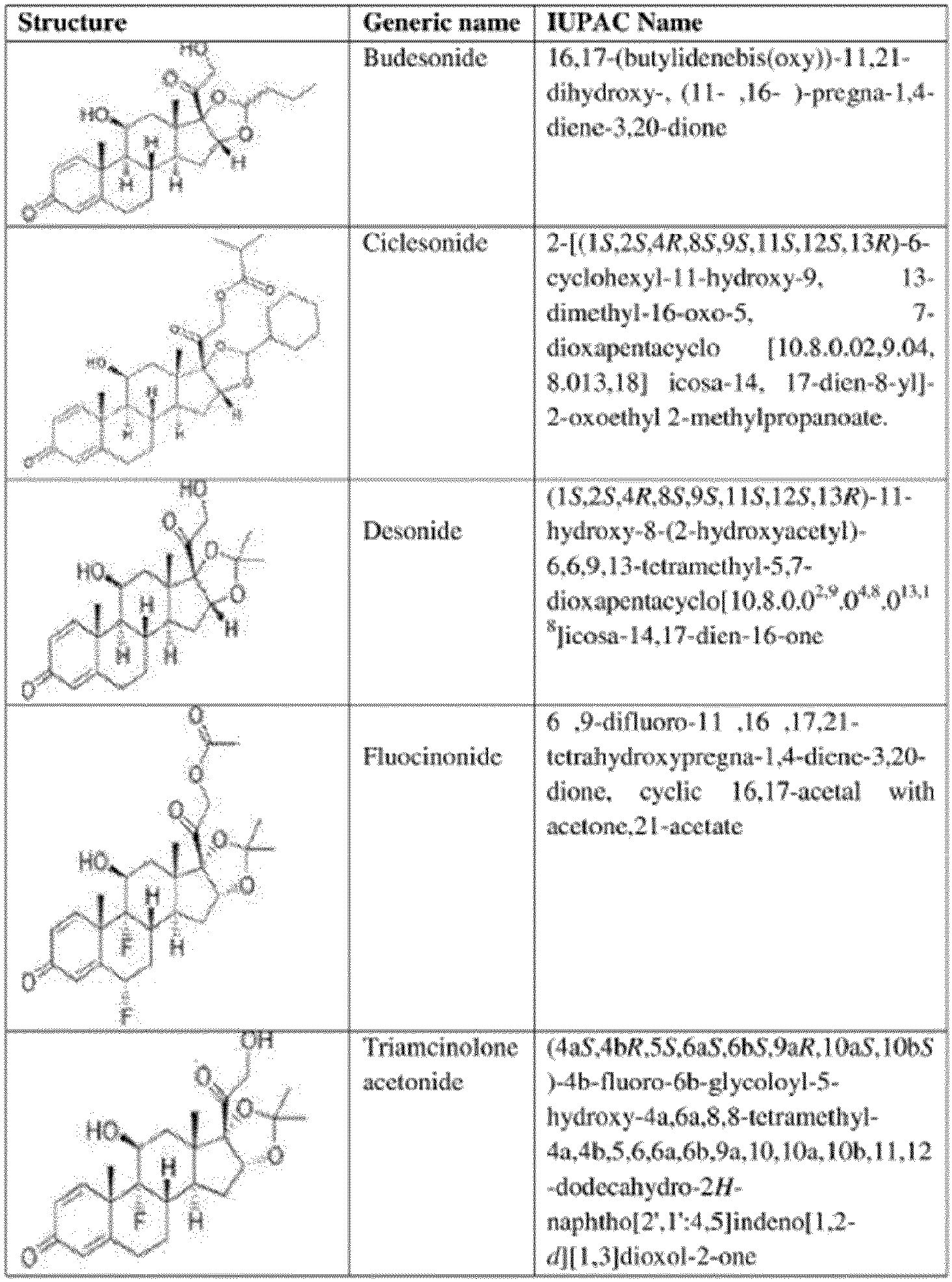
- Glucocorticoids have a number of diverse effects in different body tissues. Glucocorticoids, in topical, oral and inhaled formulations, are useful for their anti-inflammatory and immunosuppressive properties. Several glucocorticoids such as budesonide and ciclesonide are used for treatment of several disorders.
- glucocorticoids have been disclosed at different instances. However, most of these synthetic procedures involve toxic solvents or long reaction times and are ineffective for large scale synthesis.
- US 3,92,9768 discloses a process for preparation of budesonide by reacting 16, 17-dihydroxy compound with aldehyde in solvents such as dioxane, methylene chloride or their combinations.
- Ciclesonide discloses a process for the synthesis of Ciclesonide which involves the intermediate 16A, 17-[(R,S)-cyclohexylmethylenedioxy]-1 13, 21-dihydroxy-pregna-1 4-dien-3,20-one which is obtained by an acid catalysed reaction of 11 , 16 , 17, 21-tetra hydroxypregna-1,4-dien-3,20-one with cyclohexane aldehyde.
- WO 02/38584 discloses the synthesis of Ciclesonide by reacting corresponding 16, 17-ketals with a cyclohexane aldehyde in the presence of 70% perchloric acid, 1-nitropropane as solvent.
- perchloric acid is a dangerous solvent and can cause serious accidents with fatal consequences.
- US Patent No. 6169178 relates to a process for the preparation of budesonide and of 16, 17-acetals of pregnane derivatives structurally co-related thereto comprising treating 16, 17-dios or of 16, 17-ketals or cyclic acetals with aldehydes in the presence of aqueous hydrobromic acid or hydroiodic acid used as reaction catalyst or solvents.
- hydroiodic and other hydrohalic solvents are corrosive, light sensitive and expensive. Further, these acids also post environmental problems. Notwithstanding the use of hydrohalo acids requires use of special equipment since they are extremely corrosive and consequently increase the cost of production.
- US 5,55,6964 discloses a process for the preparation of budesonide by reacting 16 - Hydroxy Prednisolone in acetonitrile in the presence of p-toluene sulfonic acid as a catalyst.
- alkyl sulfonic acid instead of aryl sulfonic acid for the synthesis of budesonide or similar compounds.
- sulfonic acids are hazardous solvents and FDA has expressed significant concern over the presence or traces of sulfonic acid in pharmaceutical products.
- sulfonic acids are hazardous solvents and FDA has expressed significant concern over the presence or traces of sulfonic acid in pharmaceutical products.
- EP 508 900 A and US 2,998,443 disclose a procecess for the preparation of Budenoside, "Chem. Abs. AN: 2012: 106256 discloses a process for the preparation of Ciclesonide which are both pregnane derivatives.
- An object of the present invention is to provide an industrially scalable, viable process for the synthesis of 16, 17-acetals of pregnane compounds without the use of toxic and harmful solvents as recited in claim 1.
- the present invention discloses a process for the preparation of 16, 17-acetals of pregnane derivatives having formula I wherein each substituent is independently selected from;
- the present invention discloses, a novel process for preparing the compounds of formula I;
- the present invention discloses a process for the preparation of 16, 17-acetals of pregnane derivatives having formula I wherein each substituent is independently selected from;
- the process of the present invention comprises of the following steps:
- the process of the present invention may be suitably started from the compound of formula II, known by its IUPAC name 2-((10S,13S,14S)-10,13-dimethyl-3-oxo-6,7,8,10,12,13,14,15- octahydro-3H-cyclopenta[a]phenanthren-17-yl)-2-oxoethyl acetate and hereinafter referred to as 3TR (formula II).
- 3TR is suitably dihydroxylated by an oxidizing agent.
- the oxidizing agent may be selected from the group comprising potassium permanganate, potassium dichromate, chromic acid, peroxyacids or mixtures thereof, preferably potassium permanganate, formic acid and sodium metabisulphite to form compound of formula (III). Under acidic conditions formic acid promotes oxidation reaction and sodium metabisulfite quench the oxidized reaction product to protect the formation of further oxidative impurities in the formulated product.
- dihydroxylation of compound of formula (II) is carried out with an oxidizing agent, selected from group comprising potassium permanganate, potassium dichromate, chromic acid, peroxyacids or mixtures thereof, preferably potassium permanganate, formic acid and sodium metabisulphite to form compound of formula (III).
- an oxidizing agent selected from group comprising potassium permanganate, potassium dichromate, chromic acid, peroxyacids or mixtures thereof, preferably potassium permanganate, formic acid and sodium metabisulphite to form compound of formula (III).
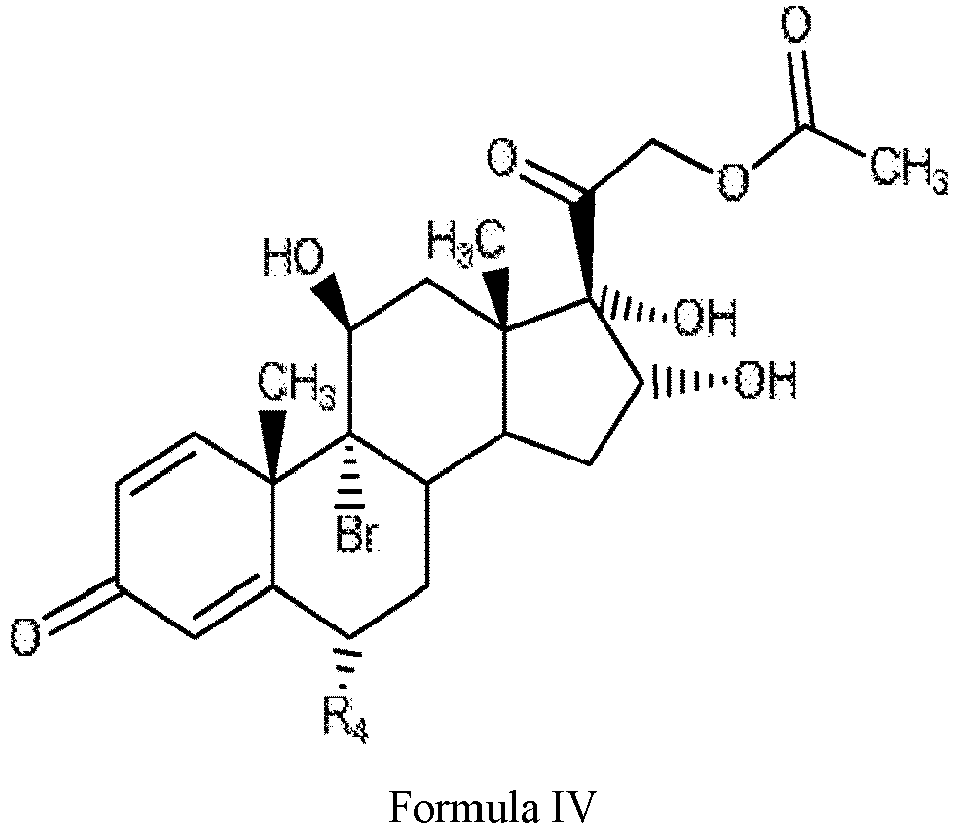
- the process of the present invention involves the bromination of the compound of formula III to yield the hydroxylated brominated compound of formula IV.
- the bromination of compound of Formula III may be conducted by suitably reacting the compound of Formula III with a brominating agent selected from the group comprising dibromantin, N-bromosuccinamide etc, preferably dibromantin, in the presence of a solvent.
- the solvent may be selected from the group comprising tetrahydrofuran, acetone, N, N- dimethyl formamide, DMSO, methanol, methylene dichloride, acetonitrile, ethyl acetate, diethyl ether, 1-butanol, methylethyl ketone, 1-propanol, formamide and the like, preferably tetrahydrofuran.
- compound of formula (III) is brominated with a brominating agent, selected from the group comprising dibromantin, N-bromosuccinamide preferably dibromatin to form compound of formula (IV) in presence of organic solvent, selected from the group comprising tetrahydrofuran, acetone, N,N- dimethyl formamide, DMSO, methanol, methylene dichloride, acetonitrile, ethyl acetate, diethyl ether, 1-butanol, methylethyl ketone, 1-propanol, formamide, preferably tetrahydrofuran.
- a brominating agent selected from the group comprising dibromantin, N-bromosuccinamide preferably dibromatin to form compound of formula (IV) in presence of organic solvent, selected from the group comprising tetrahydrofuran, acetone, N,N- dimethyl formamide, DMSO, methanol, methylene dichloride, acetonit
- catalyst is selected from the group comprising chromous or chromium sulfate, chromous or chromium chloride or its hydrate, preferably chromium chloride hexahydrate.
- the chromium (III) can be recycled to chromium (II) as is known to those skilled in the art.
- the means for recycling chromium (III) to chromium (II) includes zinc, magnesium, zinc amalgam and magnesium amalgam. Preferred is zinc and magnesium; most preferred is zinc. It is preferred that when the means for recycling is zinc it be present as zinc dust.
- compound of formula (IV) is debrominated to form compound of formula (V) in presence of catalyst, Rt--SH (VIII) with an aprotic solvent at appropriate temperature, wherein R t ---SH Formula VIII wherein R t is -CH 2 COOH or -CH 2 CH 2 COOH preferably R t is -CH 2 COOH.
- Suitable aprotic solvents include DMF, DMAC, acetone, methylene chloride, THF, acetonitrile, DMSO and mixtures thereof.
- Alcoholic solvents include methanol, ethanol, isopropanol and butanol. Preferred are DMF and DMSO.
- the temperature is not critical; that temperatures between about -50°C to about 100°C are operable and preferred is about room temperature (20°C-25°C) or up to about 50°C. Better results can be obtained if the temperature is maintained between -10° and 30°C.
- aprotic solvent is selected from the group comprising DMF, DMAC, acetone, methylene chloride, THF, acetonitrile, DMSO and mixtures thereof, preferably DMF and DMSO.
- the compound of formula V may be optionally purified and utilized for commercial purposes.
- C-16 and C-17 of the compound of formula V is "OH”
- the compound hydrolyses from 2-oxo-2-((8S,9S,10R,11S,13S,14S,16R,17S)-11,16,17-trihydroxy-10,13-dimethyl-3-oxo-6,7,8,9,10,11,12,13,14,15,16,17-dodecahydro-3H-cyclo penta[a]phenanthren-17-yl)ethyl acetate to 16 - Hydroxy Prednisolone (Formula VI), also known as 16-HPN.
- the compound of formula V may be converted to compound of formula VI, C-16 and C-17 of the compound of formula V is "OH", then the compound hydrolyses from 2-oxo-2-((8S,9S,10R,11S,13S,14S,16R,17S)-11,16,17-trihydroxy-10,13-dimethyl-3-oxo-6,7,8,9,10, 11,12,13,14,15,16,17-dodecahydro-3H-cyclopenta[(3]phenanthren-17-yl)ethyl acetate to 16 -Hydroxy Prednisolone(Formula VI), also known as 16-HPN.
- compound of formula (V) is deacylated to form compound of formula (VI) 16 - Hydroxy Prednisolone (16-HPN), wherein C-16 and C-17 is OH.
- the starting material for the preparation of compound of formula (VI) is compound of formula (II).
- the compound of formula V is further processed to obtain the compound of formula I.
- the compound of formula V is converted to the compound of formula I by the sequential steps of deacetylation and alkylation The same are illustrated at scheme 1 (conversion of formula V to VI and subsequent conversion of formula VI to formula I).
- the compound of formula VI may be converted to the compound of formula I by reacting with reagents selected from group comprising N-butyraldehyde, cyclohexane carboxaldehyde, sodium metabisulphite complex, isobutyryl chloride, acetone, hydrofluoric acid, isopropenyl acetate, dibromantin, select fluor, perchloric acid, 3,3-dimethyl butyryl chloride and triethylamine or combination, preferably N-butyraldehyde and hydrochloric acid i.e. Budesonide.
- the epimer A ratio of budesonide is in range of 54 to 44 % at temperature between - 5° to -15 °C during addition of N-butyraldehyde and -0° to -10 °C till completion of reaction.
- the compound of formula (VI) is converted to compound of formula (I) comprising R 1 is -H, R 2 is -CH 2 CH 2 CH 3 , R 5 is -OH, by treating with N-butyraldehyde and hydrochloric acid.
- budesonide being a compound of formula (I) comprising R 1 is -H, R 2 is -CH 2 CH 2 CH 3 , R 5 is -OH, has desired epimer A ratio in range of 54 to 44 % at temperature between -5° to -15 ° C during addition of N-butyraldehyde and -0° to -10 ° C till completion of reaction.
- the compound of formula VI may be converted to the compound of formula I by deacetylation and alkylation.
- the compound of formula VI may be converted to the compound of formula I by reacting with the reagent selected from the group comprising N-butyraldehyde, cyclohexane carboxaldehyde, sodium metabisulphite complex, isobutyryl chloride, acetone, hydrofluoric acid, isopropenyl acetate, dibromantin, select fluor, perchloric acid, 3,3-dimethyl butyryl chloride and triethylamine or combination, preferably cyclohexane carboxaldehyde is used to form compound of formula I i.e. Ciclesonide.
- the reagent selected from the group comprising N-butyraldehyde, cyclohexane carboxaldehyde, sodium metabisulphite complex, isobutyryl chloride, acetone, hydrofluoric acid, isopropenyl acetate, dibromantin, select fluor, perchloric acid, 3,3-di
- the compound of formula (VI) is converted to compound of formula (I) comprising R 1 is -H, R 2 is -C 6 H 11 , R 5 is -OCOCH(CH 3 ) 2 , and) is converted to compound of formula (I) by treating with cyclohexane carboxaldehyde, sodium metabisulphite and isobutyryl chloride.
- the compound of formula V may be converted to the compound of formula I by reacting with the reagent selected from the group comprising N-butyraldehyde, cyclohexane carboxaldehyde, sodium metabisulphite complex, isobutyryl chloride, acetone, hydrofluoric acid, isopropenyl acetate, dibromantin, select fluor, perchloric acid, 3,3-dimethyl butyryl chloride and triethylamine or combination, preferably acetone and perchloric acid i.e. Desonide.
- the reagent selected from the group comprising N-butyraldehyde, cyclohexane carboxaldehyde, sodium metabisulphite complex, isobutyryl chloride, acetone, hydrofluoric acid, isopropenyl acetate, dibromantin, select fluor, perchloric acid, 3,3-dimethyl butyryl chloride and triethylamine or
- the compound of formula (V) comprising R 3 and R 4 is H is converted to compound of formula (I) comprising R 1 is -CH 3 , R 2 is -CH 3 , R 5 is -OH, by treating with acetone and perchloric acid.
- the compound of formula II may be converted to the compound of formula I by reacting with the reagent selected from the group comprising N-butyraldehyde, cyclohexane carboxaldehyde, sodium metabisulphite complex, isobutyryl chloride, acetone, hydrofluoric acid, isopropenyl acetate, dibromantin, select fluor, perchloric acid, 3,3 -dimethyl butyryl chloride and triethylamine or combination, preferably acetone, dibromantin, hydrofluoric acid i.e. Triamcinolone acetonide.
- the reagent selected from the group comprising N-butyraldehyde, cyclohexane carboxaldehyde, sodium metabisulphite complex, isobutyryl chloride, acetone, hydrofluoric acid, isopropenyl acetate, dibromantin, select fluor, perchloric acid, 3,3 -d
- the compound of formula (II) comprising R 4 is H converted to compound of formula (I) comprising R 1 is -CH 3 , R 2 is -CH 3 , R 5 is -OH, R 3 is -F, R 4 is -H, by treating with acetone, dibromantin, hydrofluoric acid.
- the compound of formula V may be converted to the compound of formula I by reacting with the reagent selected from the group comprising N-butyraldehyde, cyclohexane carboxaldehyde, sodium metabisulphite complex, isobutyryl chloride, acetone, hydrofluoric acid, isopropenyl acetate, dibromantin, select fluor, perchloric acid, 3,3-dimethyl butyryl chloride and triethylamine or combination, preferably acetone, isopropenyl acetate and select fluor i.e. Flusinolide
- the reagent selected from the group comprising N-butyraldehyde, cyclohexane carboxaldehyde, sodium metabisulphite complex, isobutyryl chloride, acetone, hydrofluoric acid, isopropenyl acetate, dibromantin, select fluor, perchloric acid, 3,3-dimethyl butyryl chlor
- the compound of formula (V) comprising R 3 and R 4 is H is converted to compound of formula (I) comprising R 1 is -CH 3 , R 2 is -CH 3 , R 5 is -OH, R 3 is -H, R 4 is -F, by treating with acetone, isopropenyl acetate and select fluor.
- the compound of formula II may be converted to the compound of formula I by reacting with the reagent selected from the group comprising N-butyraldehyde, cyclohexane carboxaldehyde, sodium metabisulphite complex, isobutyryl chloride, acetone, hydrofluoric acid, isopropenyl acetate, dibromantin, select fluor, perchloric acid, 3,3 -dimethyl butyryl chloride and triethylamine or combination, preferably perchloric acid, dibromantin, hydrofluoric acid and 3, 3 -dimethyl butyryl chloride i.e. Triamcinolone acetonide.
- the reagent selected from the group comprising N-butyraldehyde, cyclohexane carboxaldehyde, sodium metabisulphite complex, isobutyryl chloride, acetone, hydrofluoric acid, isopropenyl acetate, dibromantin,
- the compound of formula (II) comprising R 4 is H is converted to compound of formula (I) comprising R 1 and R 2 is -CH 3 , R 5 is -OH, R 3 is -F, R 4 is -H, by treating with acetone, isopropenyl acetate and select fluor.
- the compound of formula I may be optionally purified to obtain a pure compound. Such purification may be done by means of crystallization or column chromatography.
- Example- 1 Process for preparation of 16-HPN from 3TR
- 3TR Charge 750L of acetone (50 volume), 39L of purified water (2.60 volume) and 15 Kg of 3TR (40.93mol) in a SS Reactor at ambient temperature. Cool to -7°C to -5°C than added 6.0L of formic acid (159.03 mol) and 9.0 kg of potassium permanganate (56.95 mol). Maintain at - 5°Cto -3°C for 30 minutes. In-process check by TLC, 3TR should be less than 1.0%.
- stage-I should be less than 0.50%.
- stage-II should be less than 1.0%.
- Example 2.1 Scale-up process of manufacturing of Budesonide from 16-HPN
- Table 1 Comparative data of budesonide Lab development and Plant batches Exp. No./B atch No. Inpu t Out put Reaction temperat ure during addition of N- butyrald ehyde Addition time Tempera ture/time after addition till completi on Time durati on Results (Isomer ratio) Remarks Epimer -A Epime r-B 14020 0.10k g 0.11 kg (-)5°C to 0°C -30 min 0°Cto 5°C/ 150 min 150Mi n.
- stage-I 158gm of stage-I (0.34mol) was suspended in 1.58L of methylene chloride (10.0 volume) at 25°C to 30°C.
- the reaction mass was chilled to 0°C to 5°C and 81.0ml of triethylamine(0.581 mol) was added, followed by the addition of 79.0ml of isobutyryl chloride [0.75 mol; diluted with 79.0 ml of methylene chloride (0.50 volume)] slowly at 0° to 5°C and maintained at same temperature for 60min.
- Stage-I should be nil.
- the reaction mass was diluted with 2.53L of purified water (16.0 volume) , the organic layer was separated and washed with purified water till neutral pH, than organic layer was separated and concentrated under vacuum to obtained a residue.
- the residue was dissolved by refluxing in 948ml of methanol (6.0 volume); the clear solution was cooled to 0°C to 5°C under stirring and filtered.
- Example 4 Process for synthesis of Desonide from 16HPN acetate (comparative example)
- stage-1 st (0.0436mol) was added at ambient temperature. Cool to 0°C ⁇ 5°C. 0.40gm of sodium hydroxide (0.01mol) solution in 20ml of methanol (1.0volume) was added at 0°C ⁇ 5°C. Stir at 0°C ⁇ 5°C for 120 minutes. In-process check by TLC against stage-1 st it should be nil. Adjust pH to neutral ( ⁇ 7) by 2.0ml of acetic acid at 0°C ⁇ 5°C.
- Example 5 Process for synthesis of Triamcinolone acetonide from 3TR (comparative example)
- stage-I 80gm of stage-I (0.21 mol) was dissolved in 4.0L of acetone (50 volume) and 208ml of purified water (2.6 volume). Cool to -5°C ( ⁇ 2°C) than added 32ml of formic acid (0.85 mol.) and 48gm of potassium permagnate (0.30 mol.) at -5°C ( ⁇ 2°C). Reaction was maintained at - 5°C ⁇ 2°Cfor one hour. In-process check by TLC against stage-I it should be nil. Added 8gm of sodium metabisulphite (0.042 mol.) In 80 ml purified water (01 volume) solution at -5°C ( ⁇ 2°C).
- stage-III 60gm of stage-III (0.13 mol) was dissolved in 600ml of methanol (10volume) and 600ml of methylene chloride (10volume) mixture under argon bubbling. Cool to -5°C ⁇ 2°C and added 1.2gm of sodium hydroxide (0.03mol.) solution in 60ml of methanol (Olvolume) at -5°C ( ⁇ 2°C). Reaction maintained at -5°C ( ⁇ 2°C) for 03 hours. In-process check by TLC against stage-III, it should be nil. Adjust pH neutral ( ⁇ 7) by adding 1.8ml of acetic acid at -5°C ( ⁇ 2°C). Reaction mass was distilled at below 40°C under vacuum till 3 to 4 volume of input.
- Example 6 Process for synthesis of Flunisolide from 16HPN acetate (comparative example)
- stage-2 nd 50ml of isopropenyl acetate (5 volume) was charged in a glass flask and added 10gm of stage-2 nd (0.024mol) at ambient temperature than heated to 65°C and added 1.5ml of methane sulphonic acid (0.023mol) and temperature raised up to 80°C and stir for one hour. In-process check by TLC against stage-2, it should be nil. Reaction mass cooled to 25°C and adjust pH neutral ( ⁇ 7) by triethylamine. Reaction mass was distilled under vacuum till last drop and degases with acetonitrile. 90ml of acetonitrile (09 volume) was added and cooled to - 5°C and than further added 10ml of purified water.
- stage-I 80gm of stage-I (0.21 mol) was dissolved in 4.0L of acetone (50 volume) and 208ml of purified water (2.6 volume). Cool to -5°C ( ⁇ 2°C) than added 32ml of formic acid (0.85 mol.) and 48gm of potassium per magnate (0.30 mol) at -5°C ( ⁇ 2°C). Reaction was maintained at same temperature for one hour. In-process check by TLC against stage-I, it should be nil. Added sodiummetabisulphite solution (8 gm in 80 ml of water) at - 5°C ⁇ 2°C. Temperature was raised up to 27°C and filtered through hyflow bed and washed with acetone.
- Acetone was distilled under vacuum till 3 to 4 volume of stage-I than further cooled to 0°C to 5°C and added 480ml of purified water, stirred, filter and washed with purified water to get wet stage- II.
- stage-III 24gm of stage-III (0.055mol) was dissolved in 240ml of methanol (10volume) and 240ml of methylene chloride (10volume) mixture under argon bubbling. Cool to -5°C ⁇ 2°C and added 0.48gm of sodium hydroxide (0.012mol) solution in 24ml of methanol (Olvolume) at - 5°C ⁇ 2°C. Reaction was maintaining at -5°C ( ⁇ 2°C) for 03hours. In-process check by TLC against stage-III, it should be nil. Adjust pH neutral by adding 0.70ml of acetic acid at -5°C ( ⁇ 2°C). Reaction mass distilled at below 40°C under vacuum till 04-05 volume of input.
- Example 8 Process for synthesis of Triamcinolone Hexacetonide from 3TR (comparative example)
- stage-I 80gm of stage-I (0.21 mol) was dissolved in 4.0L of acetone (50 volume) and 208ml of purified water (2.6 volume). Cool to -5°C than added 32ml of formic acid (0.85 mol.) and 48gm of potassium permanganate (0.30 mol) at -5°C ⁇ 2°C. Reaction maintained at -5°C ( ⁇ 2°C) for one hour. In-process check by TLC against stage-I, it should be nil. Added sodium metabisulphite solution (8 gm in 80 ml water) at -5°C ( ⁇ 2°C). Temperature raised up to 27°Cand filtered through hyflow bed and washed with acetone.
- Acetone was distilled under vacuum till 3 to 4 volume of stage-I than cooled to 0°C to 5°C and added 480ml of purified water, stirred, filtered and washed with purified water to get wet stage-II.
Landscapes
- Chemical & Material Sciences (AREA)
- Organic Chemistry (AREA)
- Health & Medical Sciences (AREA)
- General Health & Medical Sciences (AREA)
- Medicinal Chemistry (AREA)
- Pharmacology & Pharmacy (AREA)
- Epidemiology (AREA)
- Life Sciences & Earth Sciences (AREA)
- Animal Behavior & Ethology (AREA)
- Public Health (AREA)
- Veterinary Medicine (AREA)
- Steroid Compounds (AREA)
Description
- The present invention provides a synthetic process for the preparation of 16, 17-acetals of pregnane derivatives.
- Glucocorticoids have a number of diverse effects in different body tissues. Glucocorticoids, in topical, oral and inhaled formulations, are useful for their anti-inflammatory and immunosuppressive properties. Several glucocorticoids such as budesonide and ciclesonide are used for treatment of several disorders.
- The synthesis and purification of glucocorticoids have been disclosed at different instances. However, most of these synthetic procedures involve toxic solvents or long reaction times and are ineffective for large scale synthesis. For instance,
US 3,92,9768 discloses a process for preparation of budesonide by reacting 16, 17-dihydroxy compound with aldehyde in solvents such as dioxane, methylene chloride or their combinations. -
DE 4129535 discloses a process for the synthesis of Ciclesonide which involves the intermediate 16A, 17-[(R,S)-cyclohexylmethylenedioxy]-1 13, 21-dihydroxy-pregna-1 4-dien-3,20-one which is obtained by an acid catalysed reaction of 11 , 16 , 17, 21-tetra hydroxypregna-1,4-dien-3,20-one with cyclohexane aldehyde. -
WO 02/38584 -
US Patent No. 6169178 relates to a process for the preparation of budesonide and of 16, 17-acetals of pregnane derivatives structurally co-related thereto comprising treating 16, 17-dios or of 16, 17-ketals or cyclic acetals with aldehydes in the presence of aqueous hydrobromic acid or hydroiodic acid used as reaction catalyst or solvents. However, hydroiodic and other hydrohalic solvents are corrosive, light sensitive and expensive. Further, these acids also post environmental problems. Notwithstanding the use of hydrohalo acids requires use of special equipment since they are extremely corrosive and consequently increase the cost of production. -
US 5,55,6964 discloses a process for the preparation of budesonide by reacting 16 - Hydroxy Prednisolone in acetonitrile in the presence of p-toluene sulfonic acid as a catalyst. There are certain other patents that use alkyl sulfonic acid instead of aryl sulfonic acid for the synthesis of budesonide or similar compounds. However, sulfonic acids are hazardous solvents and FDA has expressed significant concern over the presence or traces of sulfonic acid in pharmaceutical products. Hence, there is a need to have a process for the synthesis 16, 17-acetals of pregnane compounds that is industrially scalable and which does not involve the use of harmful solvents. -
EP 508 900 A US 2,998,443 disclose a procecess for the preparation of Budenoside, "Chem. Abs. AN: 2012: 106256 discloses a process for the preparation of Ciclesonide which are both pregnane derivatives. - An object of the present invention is to provide an industrially scalable, viable process for the synthesis of 16, 17-acetals of pregnane compounds without the use of toxic and harmful solvents as recited in claim 1.
- The present invention discloses a process for the preparation of 16, 17-acetals of pregnane derivatives having formula I

- R1 is H or CH3;
- R2 is C1-C6 linear or branched alkyl, alkynyl group or cycloalkyl group; aryl or heteroaryl group; or
- R1 and R2 combine to form C3-C6 saturated, unsaturated cyclic or heterocyclic ring;
- R3 and R4 are same or different and each independently represents H or halogen;
- R5 is -OH or -OCOR wherein R represents H or C1-C6 linear, branched or cyclic alkyl group that may be substituted; or wherein R1 represents H, R2 represents C6H11, R3 and R4 are as defined above, R5 represents OCOR and R represents iPr;.
- The present invention discloses, a novel process for preparing the compounds of formula I;
- i. Dihydroxylation of the compound of formula II being 2-((10S,13S,14S)-10,13- dimethyl-3-oxo-6,7,8,10,12,13,14,15-octahydro-3H-cyclopenta[a]phenanthren-17-yl)- 2-oxoethyl acetate (3TR) to obtain the compound of formula III
- ii. Bromination of the compound of formula III to obtain the hydroxylated brominated compound of formula IV
- iii. Debromination of the compound of formula IV to obtain the compound of formula V, in presence of catalyst, a thiol compound of formula Rt---SH (VIII) and an aprotic solvent at an appropriate temperature, wherein
Rt---SH Formula VIII
wherein in the thiol compound Rt-SH of Formula VIII, Rt is -CH2COOH or -CH2CH2COOH preferably Rt is -CH2COOH; - iv. Deacetylation of the compound of formula V to obtain the compound of formula VI
- v. Alkylation of 16, 17-diol of the compound of formula VI to obtain the compound of formula I.
- The present invention discloses a process for the preparation of 16, 17-acetals of pregnane derivatives having formula I

- R1 is H or CH3;
- R2 is C1-C6 linear or branched alkyl, alkynyl group or cycloalkyl group; aryl or heteroaryl group; or
- R1 and R2 combine to form C3-C6 saturated, unsaturated cyclic or heterocyclic ring;
- R3 and R4 are same or different and each independently represents H or halogen;
- R5 is -OH or -OCOR wherein R represents H or C1-C6 linear, branched or cyclic alkyl group that may be substituted, ; or wherein R1 represents H, R2 represents C6H11, R3 and R4 are as defined above, R5 represents OCOR and R represents iPr;,comprising the steps of:
- i. dihydroxylation of the compound of formula II 2-((10S,13S,14S)-10,13-dimethyl-3- oxo-6,7,8,10,12,13,14,15-octahydro-3H-cyclopenta[a]phenanthren-17-yl)-2-oxoethyl acetate to obtain the compound of formula III;

- ii. bromination of the compound of formula III to obtain the hydroxylated brominated compound of formula IV;

- iii. debromination of the compound of formula IV to obtain the compound of formula V;

Rt---SH Formula VIII
wherein in the thiol compound Rt-SH of Formula VIII, Rt is -CH2COOH or -CH2CH2COOH preferably Rt is -CH2COOH; - iv. deacetylation of the compound of formula V to obtain the compound of formula VI;

- v. alkylation of the compound of formula VI to obtain the compound of formula I.
- i. dihydroxylation of the compound of formula II 2-((10S,13S,14S)-10,13-dimethyl-3- oxo-6,7,8,10,12,13,14,15-octahydro-3H-cyclopenta[a]phenanthren-17-yl)-2-oxoethyl acetate to obtain the compound of formula III;
- The process of the present invention is explained at scheme 1.

- The process of the present invention comprises of the following steps:
- i. Dihydroxylation of the compound of formula II being 2-((10S,13S,14S)-10,13- dimethyl-3-oxo-6,7,8,10,12,13,14,15-octahydro-3H-cyclopenta[a]phenanthren-17-yl)- 2-oxoethyl acetate (3TR) to obtain the compound of formula III
- ii. Bromination of the compound of formula III to obtain the hydroxylated brominated compound of formula IV
- iii. Debromination of the compound of formula IV to obtain the compound of formula V in presence of catalyst, a thiol compound of formula Rt---SH (VIII) and an aprotic solvent at an appropriate temperature, wherein
Rt---SH Formula VIII
wherein in the thiol compound Rt-SH of Formula VIII, Rt is -CH2COOH or -CH2CH2COOH preferably Rt is -CH2COOH; - iv. Deacetylation of the compound of formula V to obtain the compound of formula VI
- v. Alkylation of 16, 17-diol of the compound of formula VI to obtain the compound of formula I.
- The process of the present invention may be suitably started from the compound of formula II, known by its IUPAC name 2-((10S,13S,14S)-10,13-dimethyl-3-oxo-6,7,8,10,12,13,14,15- octahydro-3H-cyclopenta[a]phenanthren-17-yl)-2-oxoethyl acetate and hereinafter referred to as 3TR (formula II).
- 3TR is suitably dihydroxylated by an oxidizing agent. The oxidizing agent may be selected from the group comprising potassium permanganate, potassium dichromate, chromic acid, peroxyacids or mixtures thereof, preferably potassium permanganate, formic acid and sodium metabisulphite to form compound of formula (III). Under acidic conditions formic acid promotes oxidation reaction and sodium metabisulfite quench the oxidized reaction product to protect the formation of further oxidative impurities in the formulated product.
- The dihydroxylation of 3TR results in a compound of formula III.
- According to an embodiment of the present invention, dihydroxylation of compound of formula (II) is carried out with an oxidizing agent, selected from group comprising potassium permanganate, potassium dichromate, chromic acid, peroxyacids or mixtures thereof, preferably potassium permanganate, formic acid and sodium metabisulphite to form compound of formula (III).
- The process of the present invention involves the bromination of the compound of formula III to yield the hydroxylated brominated compound of formula IV. The bromination of compound of Formula III may be conducted by suitably reacting the compound of Formula III with a brominating agent selected from the group comprising dibromantin, N-bromosuccinamide etc, preferably dibromantin, in the presence of a solvent. The solvent may be selected from the group comprising tetrahydrofuran, acetone, N, N- dimethyl formamide, DMSO, methanol, methylene dichloride, acetonitrile, ethyl acetate, diethyl ether, 1-butanol, methylethyl ketone, 1-propanol, formamide and the like, preferably tetrahydrofuran.
- According to an embodiment of the present invention, compound of formula (III) is brominated with a brominating agent, selected from the group comprising dibromantin, N-bromosuccinamide preferably dibromatin to form compound of formula (IV) in presence of organic solvent, selected from the group comprising tetrahydrofuran, acetone, N,N- dimethyl formamide, DMSO, methanol, methylene dichloride, acetonitrile, ethyl acetate, diethyl ether, 1-butanol, methylethyl ketone, 1-propanol, formamide, preferably tetrahydrofuran.
- The debromination of compound of formula IV is conducted in presence of a catalyst, a thiol compound of formula (VIII) and an aprotic solvent at an appropriate temperature to obtain the compound of formula V.
- According to an embodiment of the present invention, catalyst is selected from the group comprising chromous or chromium sulfate, chromous or chromium chloride or its hydrate, preferably chromium chloride hexahydrate. The chromium (III) can be recycled to chromium (II) as is known to those skilled in the art. The means for recycling chromium (III) to chromium (II) includes zinc, magnesium, zinc amalgam and magnesium amalgam. Preferred is zinc and magnesium; most preferred is zinc. It is preferred that when the means for recycling is zinc it be present as zinc dust.
- In the present invention compound of formula (IV) is debrominated to form compound of formula (V) in presence of catalyst, Rt--SH (VIII) with an aprotic solvent at appropriate temperature, wherein
Rt---SH Formula VIII
wherein Rt is -CH2COOH or -CH2CH2COOH preferably Rt is -CH2COOH. - Suitable aprotic solvents include DMF, DMAC, acetone, methylene chloride, THF, acetonitrile, DMSO and mixtures thereof. Alcoholic solvents include methanol, ethanol, isopropanol and butanol. Preferred are DMF and DMSO. The temperature is not critical; that temperatures between about -50°C to about 100°C are operable and preferred is about room temperature (20°C-25°C) or up to about 50°C. Better results can be obtained if the temperature is maintained between -10° and 30°C.
- Accoding to an embodiment of the present invention, aprotic solvent is selected from the group comprising DMF, DMAC, acetone, methylene chloride, THF, acetonitrile, DMSO and mixtures thereof, preferably DMF and DMSO.
- In one embodiment, the compound of formula V may be optionally purified and utilized for commercial purposes. When on C-16 and C-17 of the compound of formula V is "OH", then the compound hydrolyses from 2-oxo-2-((8S,9S,10R,11S,13S,14S,16R,17S)-11,16,17-trihydroxy-10,13-dimethyl-3-oxo-6,7,8,9,10,11,12,13,14,15,16,17-dodecahydro-3H-cyclo penta[a]phenanthren-17-yl)ethyl acetate to 16 - Hydroxy Prednisolone (Formula VI), also known as 16-HPN.
- The compound of formula V may be converted to compound of formula VI, C-16 and C-17 of the compound of formula V is "OH", then the compound hydrolyses from 2-oxo-2-((8S,9S,10R,11S,13S,14S,16R,17S)-11,16,17-trihydroxy-10,13-dimethyl-3-oxo-6,7,8,9,10, 11,12,13,14,15,16,17-dodecahydro-3H-cyclopenta[(3]phenanthren-17-yl)ethyl acetate to 16 -Hydroxy Prednisolone(Formula VI), also known as 16-HPN.
- According to an embodiment of the present invention, compound of formula (V) is deacylated to form compound of formula (VI) 16 - Hydroxy Prednisolone (16-HPN), wherein C-16 and C-17 is OH.
- In the present invention, the starting material for the preparation of compound of formula (VI) is compound of formula (II).
- According to the invention, the compound of formula V is further processed to obtain the compound of formula I. The compound of formula V is converted to the compound of formula I by the sequential steps of deacetylation and alkylation The same are illustrated at scheme 1 (conversion of formula V to VI and subsequent conversion of formula VI to formula I).
- The compound of formula VI may be converted to the compound of formula I by reacting with reagents selected from group comprising N-butyraldehyde, cyclohexane carboxaldehyde, sodium metabisulphite complex, isobutyryl chloride, acetone, hydrofluoric acid, isopropenyl acetate, dibromantin, select fluor, perchloric acid, 3,3-dimethyl butyryl chloride and triethylamine or combination, preferably N-butyraldehyde and hydrochloric acid i.e. Budesonide. The epimer A ratio of budesonide is in range of 54 to 44 % at temperature between - 5° to -15 °C during addition of N-butyraldehyde and -0° to -10 °C till completion of reaction.
- In an embodiment of the present invention the compound of formula (VI) is converted to compound of formula (I) comprising R1 is -H, R2 is -CH2CH2CH3, R5 is -OH, by treating with N-butyraldehyde and hydrochloric acid.
- According to an embodiment of the present invention, budesonide, being a compound of formula (I) comprising R1 is -H, R2 is -CH2CH2CH3, R5 is -OH, has desired epimer A ratio in range of 54 to 44 % at temperature between -5° to -15 °C during addition of N-butyraldehyde and -0° to -10 °C till completion of reaction.
- The compound of formula VI may be converted to the compound of formula I by deacetylation and alkylation.
- The compound of formula VI may be converted to the compound of formula I by reacting with the reagent selected from the group comprising N-butyraldehyde, cyclohexane carboxaldehyde, sodium metabisulphite complex, isobutyryl chloride, acetone, hydrofluoric acid, isopropenyl acetate, dibromantin, select fluor, perchloric acid, 3,3-dimethyl butyryl chloride and triethylamine or combination, preferably cyclohexane carboxaldehyde is used to form compound of formula I i.e. Ciclesonide.
- In an embodiment of the present invention the compound of formula (VI) is converted to compound of formula (I) comprising R1 is -H, R2 is -C6H11, R5 is -OCOCH(CH3)2, and) is converted to compound of formula (I) by treating with cyclohexane carboxaldehyde, sodium metabisulphite and isobutyryl chloride.
- The compound of formula V may be converted to the compound of formula I by reacting with the reagent selected from the group comprising N-butyraldehyde, cyclohexane carboxaldehyde, sodium metabisulphite complex, isobutyryl chloride, acetone, hydrofluoric acid, isopropenyl acetate, dibromantin, select fluor, perchloric acid, 3,3-dimethyl butyryl chloride and triethylamine or combination, preferably acetone and perchloric acid i.e. Desonide.
- In an embodiment of the present invention the compound of formula (V) comprising R3 and R4 is H is converted to compound of formula (I) comprising R1 is -CH3, R2 is -CH3, R5 is -OH, by treating with acetone and perchloric acid.
- The compound of formula II may be converted to the compound of formula I by reacting with the reagent selected from the group comprising N-butyraldehyde, cyclohexane carboxaldehyde, sodium metabisulphite complex, isobutyryl chloride, acetone, hydrofluoric acid, isopropenyl acetate, dibromantin, select fluor, perchloric acid, 3,3 -dimethyl butyryl chloride and triethylamine or combination, preferably acetone, dibromantin, hydrofluoric acid i.e. Triamcinolone acetonide.
- In an embodiment of the present invention the compound of formula (II) comprising R4 is H converted to compound of formula (I) comprising R1 is -CH3, R2 is -CH3, R5 is -OH, R3 is -F, R4 is -H, by treating with acetone, dibromantin, hydrofluoric acid.
- The compound of formula V may be converted to the compound of formula I by reacting with the reagent selected from the group comprising N-butyraldehyde, cyclohexane carboxaldehyde, sodium metabisulphite complex, isobutyryl chloride, acetone, hydrofluoric acid, isopropenyl acetate, dibromantin, select fluor, perchloric acid, 3,3-dimethyl butyryl chloride and triethylamine or combination, preferably acetone, isopropenyl acetate and select fluor i.e. Flusinolide
- In an embodiment of the present invention the compound of formula (V) comprising R3 and R4 is H is converted to compound of formula (I) comprising R1 is -CH3, R2 is -CH3, R5 is -OH, R3 is -H, R4 is -F, by treating with acetone, isopropenyl acetate and select fluor.
- The compound of formula II may be converted to the compound of formula I by reacting with the reagent selected from the group comprising N-butyraldehyde, cyclohexane carboxaldehyde, sodium metabisulphite complex, isobutyryl chloride, acetone, hydrofluoric acid, isopropenyl acetate, dibromantin, select fluor, perchloric acid, 3,3 -dimethyl butyryl chloride and triethylamine or combination, preferably perchloric acid, dibromantin, hydrofluoric acid and 3, 3 -dimethyl butyryl chloride i.e. Triamcinolone acetonide.
- In an embodiment of the present invention the compound of formula (II) comprising R4 is H is converted to compound of formula (I) comprising R1 and R2 is -CH3, R5 is -OH, R3 is -F, R4 is -H, by treating with acetone, isopropenyl acetate and select fluor.
- The compound of formula I may be optionally purified to obtain a pure compound. Such purification may be done by means of crystallization or column chromatography.
-
- 1. The process of the present invention uses commonly available and inexpensive materials.
- 2. The process is simple and does not involve any toxic materials.
- 3. The process yields several intermediates that have biological activity and commercial utility.
- The invention will now be further illustrated by non limiting examples.
-


- Charge 750L of acetone (50 volume), 39L of purified water (2.60 volume) and 15 Kg of 3TR (40.93mol) in a SS Reactor at ambient temperature. Cool to -7°C to -5°C than added 6.0L of formic acid (159.03 mol) and 9.0 kg of potassium permanganate (56.95 mol). Maintain at - 5°Cto -3°C for 30 minutes. In-process check by TLC, 3TR should be less than 1.0%. Added 1.5kg sodium metabisulphite (7.89 mol solution in 12L of purified water at -5°C to -3°C then added 3.0 kg of hyflow super cell at 15°C (±2°C) and filter through 10.0 kg of hyflowbed at 27°C(±3°C) and wash with 150L of acetone Added 1.5 kg of activated charcoal, Stir and filter through hyflow bed and wash with 60L of acetone. Total filtrate was distilled under reduced pressure, while maintaining temperature below 45°C. Added 81L of purified water and cool to 5°C±5°C. Filter through centrifuge and wash with 156L of purified water. Wet material is dry at 60°±5°C till moisture less than 0.50%, Yield=15 kg, HPLC purity=98%.
- Charge 75L of tetrahydrofuran, 16L of purified water and 15.0 kg of Stage-I (37.46 mol) in a glass reactor. Cool to -6°C (±2°C) and added 7.50 kg of dibromantin (26.23 mol) and 0.60L of perchloric acid (9.38 mol) and maintain at -6°C (±2°C) for one hour. In-process check by TLC, stage-I should be less than 0.50%. Reaction mass is quench in 390L of purified water at ~5°C. Raised the temperature to 25°C and maintained for 01 hour, filter through centrifuge and wash with 828L of purified water or till neutral pH. Wet material is dry at 40°C±5°C till moisture content should be less than 10%, Yield=21.0kg, HPLC purity=97%.
- Charge 68.0L of N, N-dimethyl formamide(3.238volume) and 21.0kg of stage-II (42.22 mol) in glass reactor, start argon gas purging and cool to -5°C. Charge 13.0L of N,N-dimethylformamide (0.619volume) , 9.70L of dimethylsulfoxide(0.462volume), 1.62kg of chromium chloride hexahydrate (6.51 mol) and 1.94 kg of zinc dust (0.703 mol). Cool to -10°Cand added 5.50L of thioglycolic acid (79.21 mol). Maintain for one hour while maintaining temperature around -10°C. In-process check by TLC, stage-II should be less than 1.0%. Added 310 L of purified water and cool to 0°C. Filter through centrifuge and wash with 1600L of purified water. Wet material is dry at 60°C± (5°C) till moisture content less than 6.0%, Yield=15.0kg, HPLC Purity=90%.
- Charge 150L of methylene chloride (10 volume), 150L of methanol (10 volume.) and 15.0kg (30.16 mol) of stage-III in a SS Reactor. Heat to clear solution then added 3.0 kg of activated charcoal (20%) and reflux for 04 hours, Filter through hyflow bed and wash with 75L of methylene chloride (5 volume), and 75L of methanol (5 volume) mixture. Total filtrate is distilled till last drop and added 75L (5 volume) of methylene dichloride, reflux for 04 hours than cool to 40°C±(5°C), Filter through centrifuge and wash with 15L (one volume) of methylene chloride. Wet material is dry at 60°C (±5°C) till moisture contents less than 1.0% (Yield =13.0kg, HPLC Purity=96%). Further charge 65.0L (5volume) of ethyl acetate and 13.0 kg (1.0 mol) of purified material. Heat to reflux and maintain for 04 hours under reflux, then cool to 40°C. Filter through centrifuge and wash with 13.0L (one volume) of ethyl acetate. Wet material is dry at 60°C (±5°C) till moisture contents less than 0.50%, Yield=12.0kg, HPLC Purity=98.6%.
- Charge 5.83L of methanol (10 volume) and 5.83L of methylene chloride (10 volume) in a glass flask and added 583 gm of 16-HPN acetate(1.397mol) at RT. Start argon gas purging and cool to 0°C to 5°C under argon purging. Prepare 11.66 gm of sodium hydroxide (0.2915mol) solution in 0.583L of methanol (one volume) under argon purging and cool to 0°Cto 5°C. Sodium hydroxide solution is charge in reaction mass at 0°C to 5°C. Maintained the reaction mass at 0°C to 5°C for one hour, In-process check by TLC against 16-HPN acetate it should be nil. Adjust pH to neutral by 21.40ml of acetic acid (0.3742 mol); distill under reduced pressure while maintaining temperature below 40°C, till dry. Cool to ambient temperature and added 1.166L of purified water (02 volume). Cool to 0°C and maintain for one hour. Filter and wash with 300ml of purified water. Dry at 60°C (±5°C) till moisture content less than 1.0%, Yield=490gm (93.50%), HPLC Purity=98.97%, Single impurity= 0.40%.
-

- Charge 800 ml of aqueous hydrochloric acid (8 volume) in a glass flask, start nitrogen gas purging and Cool to -5°C and maintain for 15 min. then added 100 gm of stage-I (0.27 mol) at -5°C and stir for 15 min., added 30 ml of N-butyraldehyde (0.33 mol) while maintaining temperature -5°C to 0°C in around 30 minutes and maintain at 0°C to 5°C for 150 min. under stirring. In-process check by TLC against stage-I, it should be nil. Reaction mass is quench in 1200 ml of purified water (12 volume) at 5°C to 10°C and stir for 15 min. Added solution of 100 kg of sodium bicarbonate (1.19 mol) and 1 ml of purified water (10 volume) in reaction mass at 5°C to 10°C. Stir at 5°C to 10°C for 15 min. Filter and wash with purified water till neutral pH. Wet material is dry at 50°C (±5°C) till moisture contents less than 1.0 %, Yield =110 gm (96.49%), HPLC purity=96.45%, single impurity=1.29%, Epimer-A=47.76%, Epimer-B=49.69%.
- Charge 2.5 L of methanol (25 volume) in a Glass flask and added 100 gm of above mentioned crude product. Dissolved at 25°C±5°C till clear solution, added 10 gm of activated charcoal and stir for 30 min. than filter through hyflow bed and wash with 200 ml of methanol (2 volume). Combined filtrates charged in a Glass flask and cool to 10°C to 15°C and added 5.40 L of purified water (54 volume) at 5°Cto 10°C, stir for 15min., filter and wash with purified water. Wet material is dry at 50°C (±5°C) under vacuum till moisture content less than 0.50%, Output=90.0gm, HPLC purity=99.66%, single impurity=0.1%, Epimer-A=44.47%, Epimer-B=55.01%.
- Charge 40 L of aqueous hydrochloric acid (8 volume) in a glass flask, start nitrogen gas purging and Cool to - 10°C and maintain for 15 min. then added 5.0 kg of stage-I (13.315 mol) at -10°C and stir for 45 min. added 1.5 L of N-butyraldehyde (16.68 mol) while maintaining temperature -7°C to -11°C in around 30 minutes and maintain at -2°C to -6°C for 60 min. under stirring In-process check by TLC against stage-I, it should be nil. Reaction mass is quench in 60 L of purified water (12 volume) at 5°C to 10°C and stir for 15 min. Added solution of 5.0 kg of sodium bicarbonate (59.525 mol) and 50L of purified water (10 volume) in reaction mass at 5°Cto 10°C. Stir at 5°C to 10°C for 15 min. Filter and wash with purified water till neutral pH. Wet material is dry at 50°C (±5°C) till moisture contents less than 1.0 %, Yield =5.293 kg (94.46%), HPLC purity=95.45%, single impurity=1.45%, Epimer-A=53.51%, Epimer-B=43.78%
- Effect of temperature and its variation on epimer ratio (A and B) with respect to batch size (From lab to commercial batch)
- The results are shown in Table 1:
Table 1: Comparative data of budesonide Lab development and Plant batches Exp. No./B atch No. Inpu t Out put Reaction temperat ure during addition of N-butyrald ehyde Addition time Tempera ture/time after addition till completi on Time durati on Results (Isomer ratio) Remarks Epimer -A Epime r-B 14020 0.10k g 0.11 kg (-)5°C to 0°C -30 min 0°Cto 5°C/ 150 min 150Mi n. 49.69% 46.76 % 14021 0.10k g 0.11 kg (-)5°C to 0°C -30 min 0°C to 5°C/ 150 min 150Mi n. 44.34% 51,09 % 14022 2.00k g 2.22 kg (-)5°C to 0°C ~30 min 0°C to 5°C/ 150 min 150Mi n. 35.29% 62.51 % 14023 2.00k g 2.22 kg (-)7°C to (-) 11°C ~30 min (-) 2°C to (-) 6°C/60 min 60Min 50.54% 45.94 % 3612-14005 5.0 Kg 5.29 3kg (-)7°C to (-) 11°C ~30 min (-) 2°C to (-) 6°C/ 60 min 60Min 53.51% 43.78 % 3612-14006 5.0 Kg 5.27 3kg (-)7°C to (-) 11°C -30 min (-) 2°C to (-) 6°C/60 min 60Min 53.34% 43.42 % 3612-14007 5.0 Kg 5.28 3kg (-)7°C to (-) 11°C ~30 min (-) 2°C to (-) 6°C/ 60 min 60Min 52.20% 44.19 % - From the results in table, it is clear that epimer ratio of A and B is maintained at 0 to -5 °C on lab scale but not on pilot or commercial batch. However as the batch size increases there is substantial variation in epimer ratio at 0 to -5°C. Therefore, this temperature is not suitable for scale up and industrial use. But at temperature -7 to -11 °C the epimer ratio is maintained (within normal standard deviation limits) at pilot as well as commercial batch. In addition, it may be noted that when optimum parameters of temperature and other parameters as set out herein the reaction time is reduced to 60 minutes from 120. Therefore, reducing the cost and increasing the economic viability and industrial applicability.
- 200gm of Cyclohexane carboxaldehyde (1.786 mol) was dissolved in 3.0L of denatured sprit (15 volume) and a solution of 190gm of sodium metabisulphite (1.827 mol) in 300ml of purified water (1.5 volume) was added. The resulting precipitate was filtered and washed with 1.0L of denatured sprit(5.0 volume) and dried under vacuum at 50°C, till moisture content less than 6.00%, Yield=400gm (97 %)
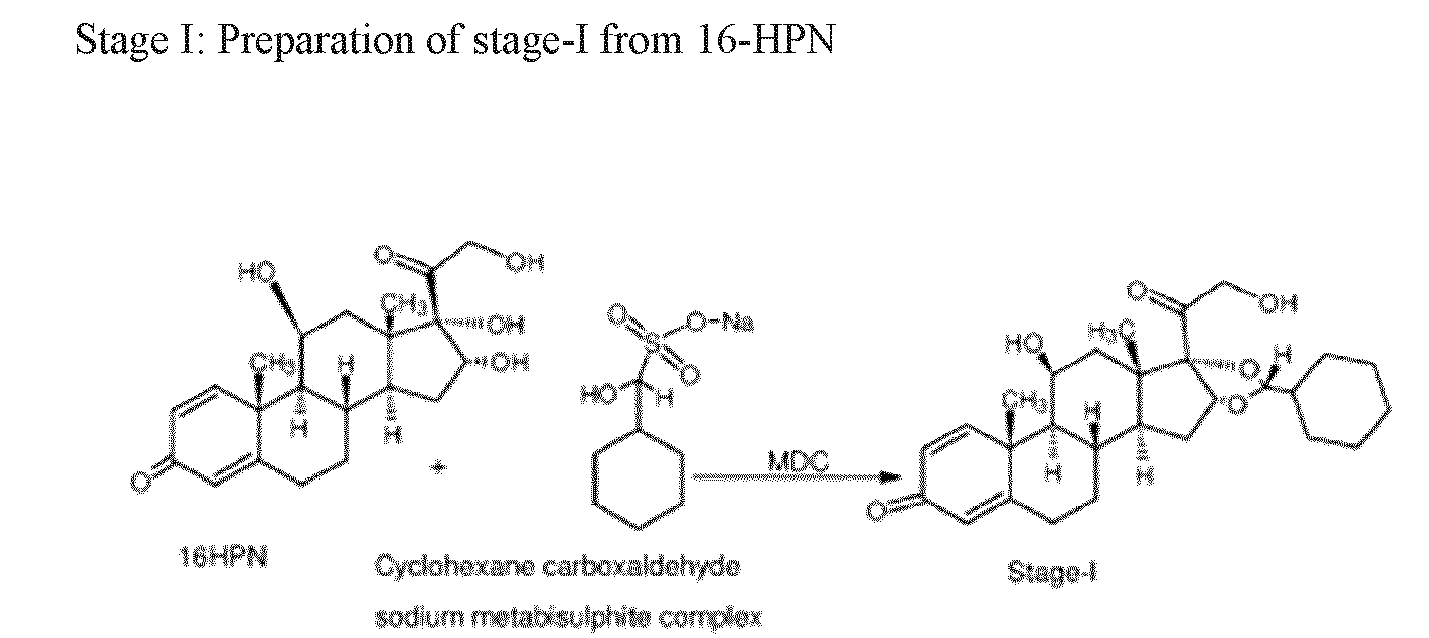
- 170gm of 16-HPN (0.4528 mol) was suspended in 3.40L of dichloromethane (20 volume) and treated with 340ml of 70% perchloric acid. (5.65 mol) and 110.5gm of cyclohexane carboxaldehyde metabisulphite complex (0.512 mol) was added in lots while maintaining the temperature between 0°Cto 5°C. The reaction mass was stirred at 0°C to 5°C for 03 hours. In- process check by TLC 16-HPN should be nil and then neutralized with 10% aqueous sodium bicarbonate solution. The organic layer was separated and concentrated under vacuum to obtain a residue which was stripped with methanol (1.0 volume). The solvent was
- concentrated and the residue was dissolved by refluxing in methanol (5.0 volume). The clear solution was cooled to 0°C to 5.0°C and the resulting solid was filtered and dried at 50°C till moisture content less than 0.50%, Yield=170.0gm (80.0%), HPLC purity=91.68%.
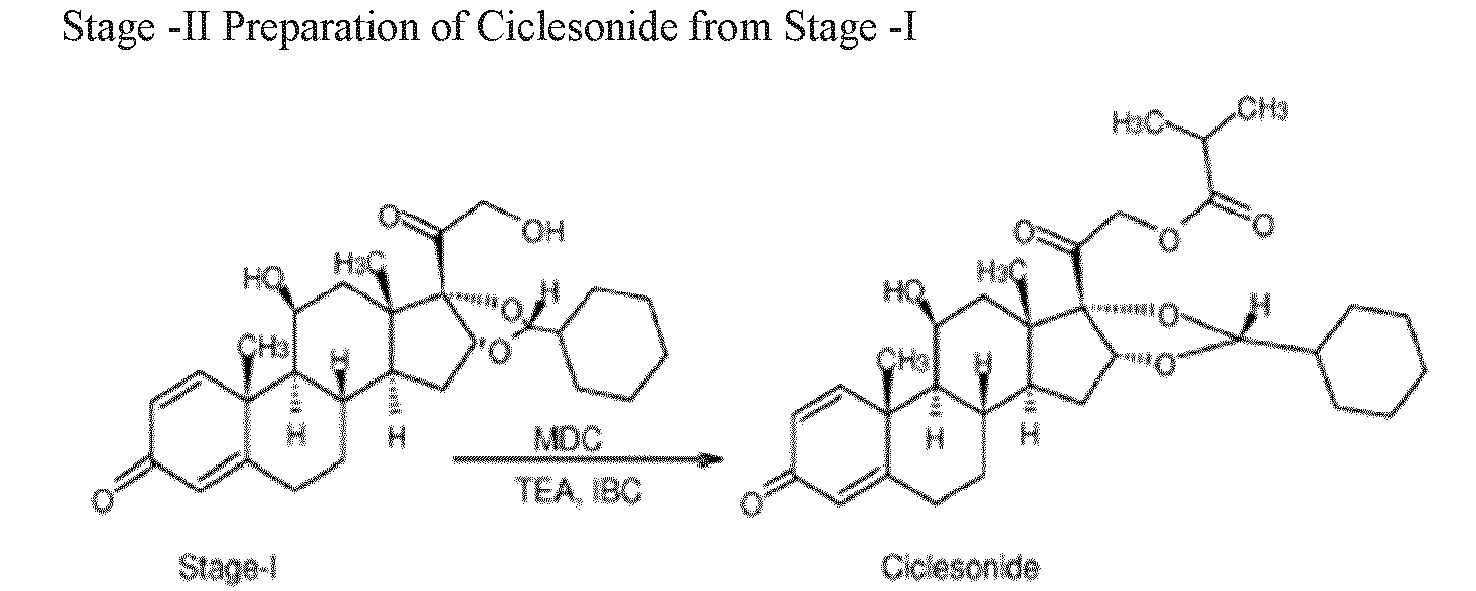
- 158gm of stage-I (0.34mol) was suspended in 1.58L of methylene chloride (10.0 volume) at 25°C to 30°C. The reaction mass was chilled to 0°C to 5°C and 81.0ml of triethylamine(0.581 mol) was added, followed by the addition of 79.0ml of isobutyryl chloride [0.75 mol; diluted with 79.0 ml of methylene chloride (0.50 volume)] slowly at 0° to 5°C and maintained at same temperature for 60min. In-process check by TLC, Stage-I should be nil. The reaction mass was diluted with 2.53L of purified water (16.0 volume) , the organic layer was separated and washed with purified water till neutral pH, than organic layer was separated and concentrated under vacuum to obtained a residue. The residue was dissolved by refluxing in 948ml of methanol (6.0 volume); the clear solution was cooled to
0°C to 5°C under stirring and filtered. The product was dried under vacuum at ~50°C till moisture contents comes less than 0.50%, Yield=158.0 gm (87.0%), HPLC purity=95.74%. - 120gm of Ciclesonide crude was dissolved by refluxing in 600ml of methanol. The clear solution was chilled to 20°C under stirring and filtered. The product was dried under vacuum at 90°C till moisture content less than 0.50%. Yield=105 gm (87.50%), HPLC purity=99.7 %.
-


- 190.0 ml of acetone (7.0 volume) was charged in a glass flask under nitrogen blanketing than added 27 gm of 16HPN acetate (0.0645mol) at ambient temperature. Temperature raised to 28°C (±2°C) and stir for 20 minutes. 1.35 ml of perchloric acid 70% (0.02 lmol) was added at 28°C (±2°C) and stir for 30 minutes. Temperature further raised to 35°C and stir for 60 minutes. In-process check by TLC against 16HPN acetate, it should be nil. Reaction mass cooled to 10°C, filtered and washed with purified water till neutral pH (~7) and finally washed with acetone. Wet material dried at 50°C±5°C till moisture content less than 0.50% to get stage-I. Yield =23gm (77.76%), HPLC Purity=98.28%

- 200 ml of methanol (10 volume) and 200ml of methylene dichloride (10 volume) was charged in a glass flask and start argon gas purging. 20 gm of stage-1st (0.0436mol) was added at ambient temperature. Cool to 0°C±5°C. 0.40gm of sodium hydroxide (0.01mol) solution in 20ml of methanol (1.0volume) was added at 0°C±5°C. Stir at 0°C±5°C for 120 minutes. In-process check by TLC against stage-1st it should be nil. Adjust pH to neutral (~7) by 2.0ml of acetic acid at 0°C±5°C. Distilled the solvent from reaction mass under vacuum while maintaining temperature below 40°C till the volume get reduced to 3 to 4 volume of the input. Cool to 0°C and further added 60ml of purified water and stir for 30 minutes. Filtered, washed with purified water till neutral pH (~7). Wet material dried at 50°C±5°C till moisture content less than 0.50% to get crude Desonide. Yield =14.70gm (80.92%), HPLC Purity=88.15%.
- 140 ml of methanol (10 volume) and 140 ml of methylene chloride (10 volume) was charged in a glass flask and added 14.0 gm of crude material (0.034mol) than stir till clear solution. Added 1.5 gm of activated charcoal and stir for 30 minutes than filtered through hyflow supercel bed and washed with 30ml of methanol and 30ml of methylene chloride mixture. Combined filtrate and distilled the solvent from reaction mass under vacuum while maintaining temperature below 40°C till the volume reduced to 3 to 4 volume of the input. Cool to 0°C. Filtered the reaction mass and washed with 10ml of precooled methanol. Wet material was dried at 50°C±5°C till moisture content less than 0.50% to get Desonide. Yield=8.60gm, HPLC Purity= 99.43%
-

- 100gm of 3TR (0.27 mol.)was suspended in 1300ml (13 volume) acetone. Cooled it to -5°C to -10°C than added 4.0 ml (0.062 mol.) perchloric acid solution and 50gm of dibromantin.
- Maintained the reaction at same temperature for 02 hours. In-process check by TLC against 3TR it should be nil. Added 100gm of potassium carbonate solution (0.723 mol.) in 5 lots and reaction was maintained at 35°C±2°C. In-process check by TLC against step-I reaction mass, it should be nil. Cooled to 0°C (±5°C) and adjust pH neutral (~7) by 36ml of acetic acid (0.63 mol.). Added 3.0L of purified water (30 volume). Filter and washed with purified water till neutral pH (~7). Wet material was dried at 45°C (±2°C) till moisture content less than 0.50%. Yield =87gm, (83.36%), HPLC Purity=97.883%.


- 80gm of stage-I (0.21 mol) was dissolved in 4.0L of acetone (50 volume) and 208ml of purified water (2.6 volume). Cool to -5°C (±2°C) than added 32ml of formic acid (0.85 mol.) and 48gm of potassium permagnate (0.30 mol.) at -5°C (±2°C). Reaction was maintained at - 5°C±2°Cfor one hour. In-process check by TLC against stage-I it should be nil. Added 8gm of sodium metabisulphite (0.042 mol.) In 80 ml purified water (01 volume) solution at -5°C (±2°C). Temperature raised up to 27°C and filtered through hyflow bed and washed with acetone. Acetone was distilled under vacuum till 3 to 4volume of stage-I than cool to 0°C to 5°C and added 480ml of purified water stir and filter and washed with purified water to get wet stage-II. Wet material was dried at 50°C (±5°C) till moisture content less than 3.0%. Yield =78.30gm, (89.88%), HPLC Purity=99.178%.
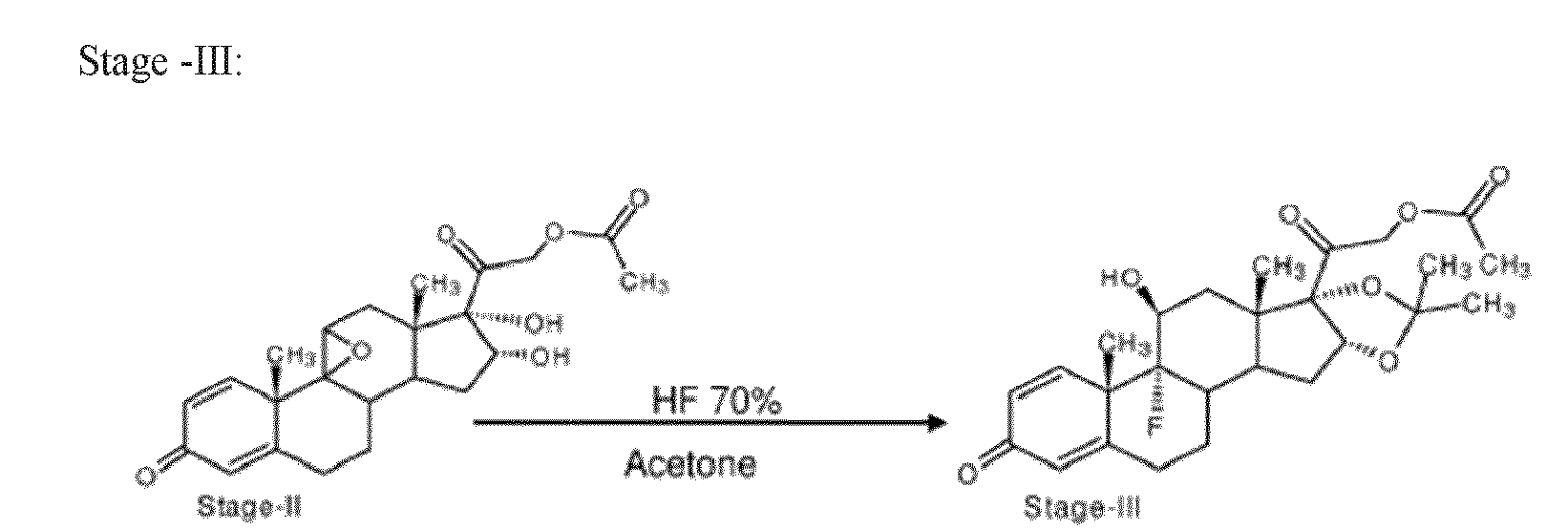
- 300ml of hydrofluoric acid (12.60mol) was cooled at -25°C to -30°C than added 75gm of stage-II (0.180mol). Reaction was maintained at -25°C to -30°C for 04 hours. In-process check by TLC against stage-II, it should be nil. Reaction mass was cooled to -50°C than added 45ml of acetone (0.60volume) at -45°C to -50°C. Reaction was maintained at -45°C to -50°C for 02 hours. In-process check by TLC against before acetone reaction mass. Added 565ml of purified water at 0°C and 340ml of liq. ammonia at ~20°C than reaction mass was quenched in 410ml of liq. ammonia and 735ml of purified water solution at 15°C (±2°C), stir and filter and washed with purified water till neutral pH. Wet material was dried at 45°C to 50°C, Yield =78.50gm, (91.48%), HPLC Purity=91.593%.
- 76 gm of stage-III Crude (0.16 mol.) was dissolved in 760ml of methylene chloride (10volume) and 760ml of methanol (10volume) mixture at ambient temperature. Stir till clear solution and added 7.6gm of activated charcoal (0.10volume) than stir for 30minutes, filter through hyflow bed and washed with methanol (one volume) and methylene chloride (one volume) mixture. Total filtrate was distilled under vacuum till 3 to 4 volume of input. Cool to 0°C to 5°C and stir for 02 hours. Filtered and washed with minimum precooled methanol, Wet material was dried 45°C to 50°C till moisture contents less than 0.50%, Yield=62gm, HPLC Purity=98.633%.

- 60gm of stage-III (0.13 mol) was dissolved in 600ml of methanol (10volume) and 600ml of methylene chloride (10volume) mixture under argon bubbling. Cool to -5°C±2°C and added 1.2gm of sodium hydroxide (0.03mol.) solution in 60ml of methanol (Olvolume) at -5°C (±2°C). Reaction maintained at -5°C (±2°C) for 03 hours. In-process check by TLC against stage-III, it should be nil. Adjust pH neutral (~7) by adding 1.8ml of acetic acid at -5°C (±2°C). Reaction mass was distilled at below 40°C under vacuum till 3 to 4 volume of input.
- Cool to 30°C and added 120ml of purified water, stir for one hour than filter and washed with purified water till neutral pH (~7). Wet material was dried at 45°C to 50°C till moisture content less than 0.50%, Yield =52gm, (95.04%), HPLC Purity=99.21%
- 50gm of crude material (0.12 mol.) was dissolved in 1100ml of acetone (22volume) and 100ml of purified water (02volume) at 50°C than added 2.5gm of activated charcoal and stir for one hour at same temperature, Filter through hyflow bed and washed with 120ml of acetone (2.40volume). Filtrate was distilled below 40°C under vacuum till 3 to 4 volume of input. Cool to 0°C to 5°Cand maintained for one hour at same temperature. Filter and washed with water. Wet material was dried at 45°C to 50°C till moisture content less than 0.50%, Yield=43gm, HPLC Purity=99.40%.
-

- 140ml of acetone (7 volume) was charged in glass flask and start argon blanketing than added 20 gm of 16-HPN acetate (0.048mol) at ambient temperature. Cooled to 28°C (±2°C). 1.0ml of perchloric acid 70% (0.016mol) was added at 28°C (±2°) C and stirred for 30 minutes. Temperature raised up to 35°Cand stirred for 60 minutes. In-process check by TLC against 16-HPN acetate, it should be nil. Reaction mass was cooled to 10°C (±2°C). Reaction mass was filtered and washed with purified water till neutral pH (~7) to get wet material. Wet material was dried at 50°C±5°C till moisture content less than 0.50% to get stage-1st. Yield=17.40gm, (79.40%), HPLC Purity=98.241%.

- 170ml of methanol (10volume) and 170ml of methylene chloride (10volume) was charged in a glass flask and start inert atmosphere. 17gm of stage-1st (0.037mol) was added at ambient temperature. Cooled to -5°C. 0.4gm of sodium hydroxide (0.01mol) solution in 17ml of
- methanol was added at 0°C (±5°C). Reaction mass was stirred for 02 hours at 0°C (±5°C). In- process check by TLC against stage- 1st it should be nil. Neutral pH (~7) was adjusted by acetic acid. Reaction mass was distilled under vacuum at below 40°C till ~ 100ml. Concentrated mass was cooled to 0°C (±5°C) and stir for one hour. Reaction mass was filtered and washed with precooled methanol to get wet material. Wet material was dried at 50°C (±5°C) till moisture content less than 0.50% to get stage-2nd. Yield=14.0gm, (90.67%), HPLC Purity=99.426%, Single impurity=0.136%.


- 50ml of isopropenyl acetate (5 volume) was charged in a glass flask and added 10gm of stage-2nd (0.024mol) at ambient temperature than heated to 65°C and added 1.5ml of methane sulphonic acid (0.023mol) and temperature raised up to 80°C and stir for one hour. In-process check by TLC against stage-2, it should be nil. Reaction mass cooled to 25°C and adjust pH neutral (~7) by triethylamine. Reaction mass was distilled under vacuum till last drop and degases with acetonitrile. 90ml of acetonitrile (09 volume) was added and cooled to - 5°C and than further added 10ml of purified water. 10gm of selectfluor(0.028mol) was added in two lots at 0°C(±5°C) in 02 volume of acetonitrile. Reaction mass was stirred at 10°C to 15°C for 12 hours. In-process check by TLC against before selectfluor reaction mass it should be nil. Adjust pH neutral (~7) by liq. ammonia solution at 0°C±5°C. Reaction mass was quenched in 500ml of purified water (100volume) at ambient temperature. Reaction mass was filtered and washed with purified water till neutral pH (~7). Wet material was dried at 45°C±5°C till moisture content less than 0.50% to get stage-3rd. Yield=8.60gm, (75.17%), HPLC Purity= 94.12%.

- 80ml of methanol (10volume) and 80ml of methylene chloride (10volume) was charged in a glass flask under inert atmosphere at ambient temperature than added 8.0gm of stage-3rd (0.017mol) at ambient temperature. Cooled to -5°C and added 0.16gm of sodium hydroxide (0.004mol) solution in 8ml of methanol at -5°C(±5°C) and stir for 02 hours at -5°C(±5°C). In-process check by TLC against stage-3rd, it should be nil. Adjust pH neutral(~7) by acetic acid and reaction mass was distilled under vacuum at below 40°C(±5°C) till ~40ml of volume. Cool to 0°C to 5°C and stir for one hour. Reaction mass was filtered and washed with precooled methanol to get wet material. Wet material was dried at 45°C (±5°C) till moisture content less than 0.50% to get Flunisolide crude. Yield=6.0gm, (82.30%), HPLC Purity=86.50%.
- 6.0gm of crude Flunisolide(0.014mol) was dissolved in 65ml of ethyl acetate (10.83volume) and 35ml of n-hexane (5.83volume) mixture and clear solution was passed through 60gm of silica gel column. Column was washed with 975ml of ethyl acetate (162.5volume) and 525ml of ft-hexane (87.5volume) mixture. Eluted fraction was distilled under vacuum till 3 to 4 volume of input than cooled it to 0°C and filter to get wet material. Wet material was dried at 50°C (±5°C) till moisture content less than 0.50% to get Flunisolide. Yield=4.28gm, HPLC Purity=95.60%.
-

- 100gm of 3TR (0.27mol) was suspended in 1300ml (13 volume) acetone. Cool to -5°C to- 10°C than added 4.0 ml (0.062mol) perchloric acid solution and 50gm of dibromantin. Reaction maintained at same temperature for 02 hours. In-process check by TLC against 3TR, it should be nil. Added 100gm of potassium carbonate solution (0.723 mol) in 5 lots and reaction was maintained at 35°C (±2°C). In-process check by TLC against step-I reaction mass, it should be nil. Cool to 0°C±5°Cand adjust pH neutral (~7) by 36ml of acetic acid (0.63 mol). Added 3.0L of purified water (30 volume). Filter and washed with purified water till neutral pH (~7). Wet material was dried at 45°C (±2°C) till moisture content less than 0.50% to get stage-I. Yield=85.30gm, (81.74%), HPLC Purity=96.54%.


- 80gm of stage-I (0.21 mol) was dissolved in 4.0L of acetone (50 volume) and 208ml of purified water (2.6 volume). Cool to -5°C (±2°C) than added 32ml of formic acid (0.85 mol.) and 48gm of potassium per magnate (0.30 mol) at -5°C (±2°C). Reaction was maintained at same temperature for one hour. In-process check by TLC against stage-I, it should be nil. Added sodiummetabisulphite solution (8 gm in 80 ml of water) at - 5°C±2°C. Temperature was raised up to 27°C and filtered through hyflow bed and washed with acetone. Acetone was distilled under vacuum till 3 to 4 volume of stage-I than further cooled to 0°C to 5°C and added 480ml of purified water, stirred, filter and washed with purified water to get wet stage- II. Wet material was dried at 50°C (±5°C) till moisture content less than 3.0% to get stage-II. Yield=82gm, (94.13%), HPLC Purity=97.75%.

- 160ml of hydrofluoric acid (70%) (6.72mol) was cooled at -25°C to -30°C than added 40gm of stage-II (0.096mol). Reaction was maintained at -25°C to -30°C for 04 hours. In-process check by TLC against stage-II, it should be nil. Added 280ml of purified water at 0°C and 650ml of liq. ammonia at 20°C than reaction mass was quenched in 200ml of liq. ammonia and 500ml of purified water solution at 15°C(±2°C), stirred, filtered and washed with purified water till neutral pH(~7). Wet material was dried at 45°C to 50°C to get stage-III Yield=40gm, (95.42%), HPLC Purity=88.71%
- 40gm of stage-III crude (0.0916 mol) was refluxed in 160ml of acetone. Cool to 0°C. Filtered and washed with minimum precooled acetone. Wet material was dried at 50°C±5°C till moisture content comes less than 0.50% to get stage-III. Yield=24.9gm HPLC Purity=95.17%.

- 24gm of stage-III (0.055mol) was dissolved in 240ml of methanol (10volume) and 240ml of methylene chloride (10volume) mixture under argon bubbling. Cool to -5°C±2°C and added 0.48gm of sodium hydroxide (0.012mol) solution in 24ml of methanol (Olvolume) at - 5°C±2°C. Reaction was maintaining at -5°C (±2°C) for 03hours. In-process check by TLC against stage-III, it should be nil. Adjust pH neutral by adding 0.70ml of acetic acid at -5°C (±2°C). Reaction mass distilled at below 40°C under vacuum till 04-05 volume of input. Cooled to 0°C±5°Cand stir for one hour than filtered and washed with minimum precooled methanol. Wet material was dried at 45°C to 50°C till moisture content less than 0.50%. Yield=18.50gm, (85.29%), HPLC Purity=98.60%.
-

- 100gm of 3TR (0.27288 mol) was suspended in 1300ml (13 volume) acetone. Cool to -5°C to -10°C than added 4.0 ml (0.0625 mol) perchloric acid solution and 50gm of dibromantin. Reaction was maintained at same temperature for 02 hours. In-process check by TLC against 3TR, it should be nil. Added 100gm of potassium carbonate solution (0.723 mol) in 5 lots and reaction was maintained at 35°C (±2°C). In-process check by TLC against step-I reaction mass, it should be nil. Cool to 0°C (±5°C) and adjust pH neutral (~7) by 36ml of acetic acid (0.63 mol). Added 3.0L of purified water (30 volume). Filter and washed with purified water till neutral pH. Wet material was dried at45°C(±2°C) till moisture content less than 0.50% to get stage-1st. Yield =87gm, (83.36%), HPLC Purity=97.883%.

- 80gm of stage-I (0.21 mol) was dissolved in 4.0L of acetone (50 volume) and 208ml of purified water (2.6 volume). Cool to -5°C than added 32ml of formic acid (0.85 mol.) and 48gm of potassium permanganate (0.30 mol) at -5°C±2°C. Reaction maintained at -5°C (±2°C) for one hour. In-process check by TLC against stage-I, it should be nil. Added sodium metabisulphite solution (8 gm in 80 ml water) at -5°C (±2°C). Temperature raised up to 27°Cand filtered through hyflow bed and washed with acetone. Acetone was distilled under vacuum till 3 to 4 volume of stage-I than cooled to 0°C to 5°C and added 480ml of purified water, stirred, filtered and washed with purified water to get wet stage-II. Wet material was dried at 50°C (±5°C) till moisture content less than 3.0% to get stage-2nd. Yield=78.30gm, (89.88%), HPLC Purity =99.18%.

- 300ml of hydrofluoric acid (12.60mol) was cooled at -25°C to -30°C than added 75gm of stage-II (0.180mol). Reaction was maintained at -25°C to -30°C for 04 hours. In-process check by TLC against stage-II. It should be nil. Reaction mass was cooled to -50°C than added 45ml of acetone (0.60volume) at -45°C to -50°C. Reaction maintained at -45°Cto - 50°C for 02 hours. In-process check by TLC against reaction input, it should be nil. Added 565ml of purified water at 0°C and 340ml of liq. ammonia at 20°C than reaction mass was quenched in 410ml of liq. ammonia and 735ml of purified water solution at 15°C(±2°C), stirred, filtered and washed with purified water till neutral pH (~7). Wet material was dried at 45°C to 50°Cto get stage-3rd. Yield=78.50gm, (91.48%), HPLC Purity=91.59%.
- 76 gm of stage-III Crude (0.16 mol) was dissolved in 760ml of methylene chloride (01 volume) and 760ml of methanol (10volume) mixture at ambient temperature. Stirred till clear solution and added 7.6gm of activated charcoal (0.10volume) than further stir for 30 minutes and filtered through hyflow bed and washed with methanol (one volume) and methylene chloride (one volume) mixture. Total filtrate was distilled under vacuum till 3 to 4 volume of input. Cooled to 0°C to 5°Cand stir for 02 hours. Filtered and washed with minimum precooled methanol. Wet material was dried at 45°C to 50°C till moisture content
less than 0.50% to get purified stage-3rd. Yield=62gm, HPLC Purity=98.633%
- 60gm of stage-III (0.1259 mol) dissolved in 600ml of methanol (10volume) and 600ml of methylene chloride (10volume) mixture under inert atmosphere. Cool to -5°C and added
- 1.2gm of sodium hydroxide (0.03mol) solution in 60ml of methanol (01volume) at -5°C (±2°C). Reaction maintained at -5°C±2°C for 03 hours. In-process check by TLC against
- stage-III, it should be nil. Adjust pH neutral (~7) by adding 1.8ml of acetic acid at -5°C±2°C.
- Reaction mass was distilled below 40°C under vacuum till 3 to 4 volume of input. Cool to
30°C and added 120ml of purified water, stir for one hour than filtered and washed with purified water till neutral pH (~7). Wet material was dried at 45°C to 50°C till moisture content less than 0.50% to get stage-4111 (Triamcinolone acetonide). Yield=52gm, (95.04%), HPLC Purity=99.21%. - 50gm of crude material (0.12 mol) dissolved in 1100ml of acetone (22volume) and 100ml of purified water (02volume) at 50°C than added 2.5gm of activated charcoal and stirred for one
hour at same temperature. Filter through hyflow bed and washed with 120ml acetone (2.40volume). Filtrate was distilled below 40°C under vacuum till 3 to 4 volume of input. - Cool to 0°C to 5°C and maintained for one hour at same temperature. Filtered and washed with water. Wet material was dried at 45°C to 50°C till moisture content less than 0.50% to get purified stage-4th. Yield =43gm, HPLC Purity=99.40%

- 50ml of pyridine (10volume) charged in a glass flask and added 10gm of Triamcinolone acetonide (0.023mol) at ambient temperature. Heated to 80°C to 90°C than added 10ml of 3, 3-dimethyl butyryl chloride (0.11mol) at 80°C to 90°C. Stirred at 80°C to 90°C for 02 hours. In-process check by TLC against Triamcinolone acetonide, it should be nil. Reaction mass cooled to ambient temperature and reaction mass was quenched in 1000ml of purified water (100volume) at ambient temperature, stir for one hour than filtered and washed with purified water till neutral pH (~7). Wet material was dried at 50°C (±5°C) till moisture content less than 1.0% to get stage-5th (Triamcinolone Hexacetonide). Yield=12gm, (97.90%), HPLC Purity=98.63%.
- 120ml of methanol and 120ml of methylene chloride charged in a glass flask and added 12gm of crude material, stir till clear solution than added 1.2gm of activated charcoal and stir for 30 minutes. Filtered through hyflow bed and washed with 12ml of methanol and 12ml of methylene chloride mixture. Total filtrate was distilled under vacuum at below 40°C till 5 to 6 volume of crude. Cooled to 0°C±5°C and stir for one hour. Filtered and washed with 12ml of precooled methanol. Wet material was dried at 40°C±5°C till moisture content less than 0.50% to get TrimcinolneHexacetonide. Yield=8.8gm, HPLC Purity=99.625%

Claims (14)
- A process for the preparation of 16, 17-acetals of pregnane derivatives having formula (I)
 R1 is H or CH3;R2 is C1-C6 linear or branched alkyl, alkynyl group or cycloalkyl group; aryl or heteroaryl group; orR1 and R2 combine to form a saturated, unsaturated C3-C6 cyclic or heterocyclic ring;R3 and R4 are same or different and each independently represents H or halogen;R5 is -OH or -OCOR wherein R represents H or C1-C6 linear, branched or cyclic alkyl group that is substituted; or wherein R1 represents H, R2 represents C6H11, R3 and R4 are as defined above, R5 represents OCOR and R represents iPr;comprising the steps of:i. dihydroxylation of the compound of formula II 2-((10S,13S,14S)-10,13-dimethyl-3-oxo-6,7,8,10,12,13,14,15-octahydro-3 H -cyclopentaphenanthren-17-yl)-2-oxoethyl acetate to obtain the compound of formula III;
 ii. bromination of the compound of formula III to obtain the hydroxylated brominated compound of formula IV;
 iii. wherein compound of formula (IV) is debrominated to form the compound of formula V
Rt---SH Formula VIII
wherein in the thiol compound Rt-SH of Formula VIII, Rt is -CH2COOH or -CH2CH2COOH preferably Rt is -CH2COOH;iv. deacetylation of the compound of formula V to obtain the compound of formula VI;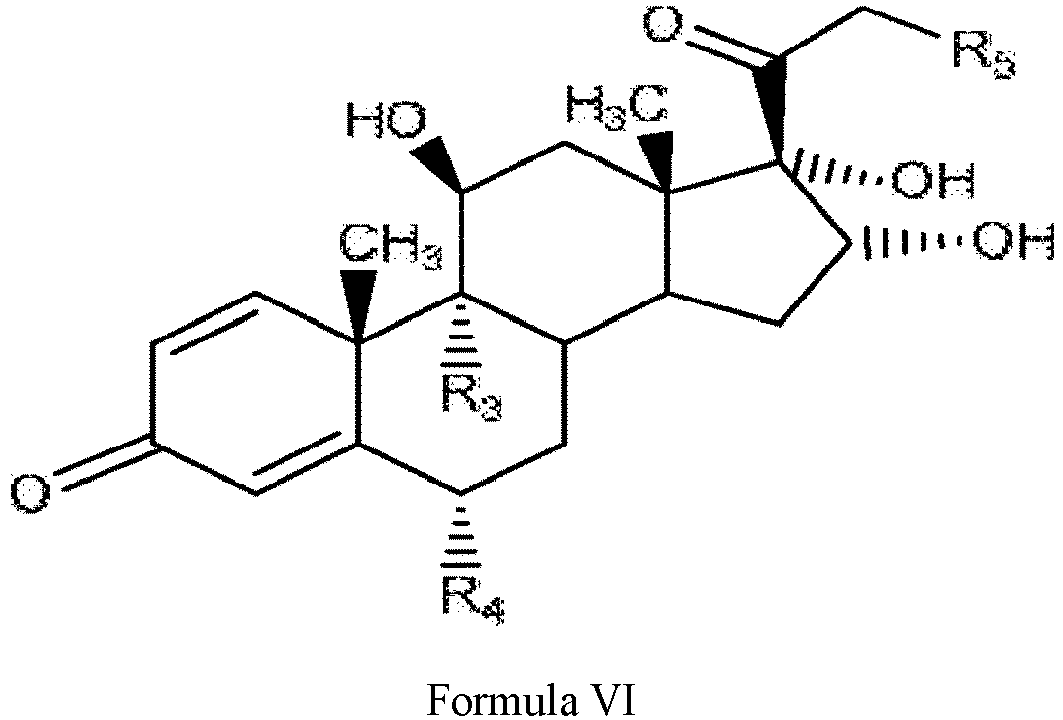 v. alkylation of the compound of formula VI to obtain the compound of formula I.
 - The process according to claim 1, wherein in step (i), dihydroxylation of compound of formula (II) is carried out with an oxidizing agent, selected from group comprising potassium permanganate, potassium dichromate, chromic acid, peroxyacids or mixtures thereof, preferably, potassium permanganate, formic acid and sodium metabisulphite to form compound of formula (III).
- The process according to claim 1, wherein in step (ii) , compound of formula (III) is brominated with a brominating agent, selected from the group comprising dibromantin, N-bromosuccinamide, preferably, dibromatin to form compound of formula (IV) in presence of organic solvent, selected from the group comprising tetrahydrofuran, acetone, N,N- dimethyl formamide, DMSO, methanol, methylene dichloride, acetonitrile, ethyl acetate, diethyl ether, 1-butanol, methylethyl ketone, 1-propanol, formamide, preferably, tetrahydrofuran.
- The process as claimed in claim 1, wherein catalyst is selected from the group comprising chromous or chromium sulfate, chromous or chromium chloride or its hydrate, preferably, chromium chloride hexahydrate.
- The process as claimed in claim 1, wherein aprotic solvent used in step (iii) is selected from the group comprising DMF, DMAC, acetone, methylene chloride, THF, acetonitrile, DMSO and mixtures thereof, preferably, DMF and DMSO.
- The process according to claim 1, wherein in step (iv) a compound of formula (V) is deacylated to form compound of formula (VI) 16 -Hydroxy Prednisolone (16-HPN), wherein C-16 and C-17 is OH.
- The process according to claim 1, wherein in step (v) a compound of formula (VI) is converted to compound of formula (I) by deacetylation and alkylation with reagents selected from group comprising N-butyraldehyde, cyclohexane carboxaldehyde, sodium metabisulphite complex, isobutyryl chloride, acetone, hydrofluoric acid, isopropenyl acetate, dibromantin, select fluor, perchloric acid, 3,3-dimethyl butyryl chloride and triethylamine or combination thereof.
- The process as claimed in claim 1, wherein in formula (I) R1 is -H, R2 is - CH2CH2CH3, R5 is -OH, and wherein compound of formula (VI) is converted to compound of formula (I) by treating with N-butyraldehyde and hydrochloric acid.
- The process as claimed in claim 1, wherein desired epimer A of budesonide is in range of 54 to 44 % at temperature between -5° to -15°C during addition of N-butyraldehyde and -0° to -10°C till completion of reaction.
- The process as claimed in claim 1, wherein in formula (I) R1 is -H, R2 is -C6H11, R5 is - OCOCH(CH3)2, and wherein compound of formula (VI) is converted to compound of formula (I) by treating with cyclohexane carboxaldehyde, sodium metabisulphite and isobutyryl chloride.
- The process as claimed in claim 1, wherein R1 is -CH3, R2 is -CH3, R5 is -OH, and wherein compound of formula (V) wherein R3 and R4 is H is converted to compound of formula (I) by treating with acetone and perchloric acid.
- The process as claimed in claim 1, wherein in formula (I) R1 is -CH3, R2 is -CH3, R5 is -OH, R3 is -F, R4 is -H, and wherein compound of formula (II) wherein R4 is H is converted to compound of formula (I) by treating with acetone, dibromantin, hydrofluoric acid.
- The process as claimed in claim 1, wherein formula (I) R1 is -CH3, R2 is -CH3, R5 is -OH, R3 is -H, R4 is -F, and wherein compound of formula (V) wherein R3 and R4 is H is converted to compound of formula (I) by treating with acetone, isopropenyl acetate and select fluor.
- The process as claimed in claim 1, wherein in formula (I) R1 and R2 is -CH3, R5 is -OH, R3 is -F, R4 is -H, and wherein compound of formula (II) wherein R4 is H is converted to compound of formula (I) by treating with perchloric acid, dibromantin, hydrofluoric acid and 3, 3-dimethyl butyryl chloride.
Applications Claiming Priority (2)
| Application Number | Priority Date | Filing Date | Title |
|---|---|---|---|
| IN272DE2015 | 2015-01-30 | ||
| PCT/IN2016/050031 WO2016120891A1 (en) | 2015-01-30 | 2016-01-29 | Novel process for preparation of glucocorticoid steroids |
Publications (3)
| Publication Number | Publication Date |
|---|---|
| EP3250211A1 EP3250211A1 (en) | 2017-12-06 |
| EP3250211A4 EP3250211A4 (en) | 2018-09-05 |
| EP3250211B1 true EP3250211B1 (en) | 2021-12-22 |
Family
ID=56542569
Family Applications (1)
| Application Number | Title | Priority Date | Filing Date |
|---|---|---|---|
| EP16742898.6A Active EP3250211B1 (en) | 2015-01-30 | 2016-01-29 | Novel process for preparation of glucocorticoid steroids |
Country Status (3)
| Country | Link |
|---|---|
| US (1) | US10233210B2 (en) |
| EP (1) | EP3250211B1 (en) |
| WO (1) | WO2016120891A1 (en) |
Families Citing this family (25)
| Publication number | Priority date | Publication date | Assignee | Title |
|---|---|---|---|---|
| PE20190622A1 (en) | 2016-06-02 | 2019-04-26 | Abbvie Inc | GLUCOCORTICOID AND IMMUNOCONJUGATE RECEPTOR AGONIST OF THE SAME |
| WO2018037423A1 (en) | 2016-08-25 | 2018-03-01 | Coral Drugs Pvt. Ltd. | Novel process for preparation of corticosteroids |
| CN107778344A (en) * | 2016-08-30 | 2018-03-09 | 天津太平洋制药有限公司 | A kind of preparation method of budesonide |
| CN107793461A (en) * | 2016-08-30 | 2018-03-13 | 天津太平洋制药有限公司 | A kind of preparation method of fluoxyprednisolone |
| KR20250114431A (en) | 2016-11-08 | 2025-07-29 | 리제너론 파마슈티칼스 인코포레이티드 | Steroids and protein-conjugates thereof |
| CN107417755A (en) * | 2017-05-09 | 2017-12-01 | 天津太平洋化学制药有限公司 | A kind of synthetic method of Fluocinonide intermediate |
| KR20200007905A (en) | 2017-05-18 | 2020-01-22 | 리제너론 파마슈티칼스 인코포레이티드 | Cyclodextrin protein drug conjugate |
| CN109384827A (en) * | 2017-08-07 | 2019-02-26 | 正大天晴药业集团股份有限公司 | A kind of budesonide industrialized process for preparing |
| IL313068A (en) | 2017-11-07 | 2024-07-01 | Regeneron Pharma | Hydrophilic linkers for drug-antibody conjugates |
| MA49796A (en) | 2017-12-01 | 2020-06-03 | Abbvie Inc | GLUCOCORTICOID RECEPTOR AND IMMUNOCONJUGATE AGONIST |
| IL275757B2 (en) | 2018-01-08 | 2025-08-01 | Regeneron Pharma | Steroids and their anti-inflammatory properties |
| MX2020011546A (en) | 2018-05-09 | 2021-01-29 | Regeneron Pharma | Anti-msr1 antibodies and methods of use thereof. |
| CN109575097A (en) * | 2019-01-20 | 2019-04-05 | 湖南科瑞生物制药股份有限公司 | A kind of new preparation method of 16a- hydroxy prednisonlone product |
| CN109575095A (en) * | 2019-01-20 | 2019-04-05 | 湖南科瑞生物制药股份有限公司 | A kind of preparation method of 16a- hydroxacetic acid prednisolone |
| CN109734763A (en) * | 2019-01-20 | 2019-05-10 | 湖南科瑞生物制药股份有限公司 | A kind of preparation method of 16a- hydroxacetic acid prednisolone product |
| CN109651474A (en) * | 2019-01-20 | 2019-04-19 | 湖南科瑞生物制药股份有限公司 | A kind of new preparation method of 16a- hydroxy prednisonlone |
| CN112142820A (en) * | 2019-06-29 | 2020-12-29 | 天津药业研究院股份有限公司 | Synthetic method of triamcinolone acetonide |
| CN111253457B (en) * | 2020-03-20 | 2021-03-19 | 浙江神洲药业有限公司 | Method for preparing 16alpha-hydroxy prednisolone |
| CN112574270A (en) * | 2020-12-08 | 2021-03-30 | 广州健康元呼吸药物工程技术有限公司 | Preparation method of key intermediate of glucocorticoid |
| CN113817018B (en) * | 2021-09-18 | 2022-11-08 | 上海方予健康医药科技有限公司 | Desonide crystal form B, and preparation method and application thereof |
| CN113698448B (en) * | 2021-10-29 | 2022-02-22 | 山东谷雨春生物科技有限公司 | A kind of preparation method of amcinonide |
| CN114276406B (en) * | 2022-01-06 | 2023-12-19 | 江苏远大仙乐药业有限公司 | Preparation method of intermediate of deoxomilpine |
| IT202200012755A1 (en) | 2022-06-16 | 2023-12-16 | Farmabios Spa | Process for the preparation of a budesonide intermediate |
| CN115322243B (en) * | 2022-09-20 | 2023-10-03 | 山东赛托生物科技股份有限公司 | Method for preparing triamcinolone acetonide key intermediate by one-pot method |
| CN115819487A (en) * | 2022-11-25 | 2023-03-21 | 湖南醇健制药科技有限公司 | Preparation method of budesonide intermediate |
Family Cites Families (16)
| Publication number | Priority date | Publication date | Assignee | Title |
|---|---|---|---|---|
| US2998443A (en) | 1958-10-29 | 1961-08-29 | Monsanto Chemicals | Production of acrylonitrile |
| US2998433A (en) * | 1960-07-22 | 1961-08-29 | American Cyanamid Co | 2alpha-halo-4, 9(11), 16-pregnatriene-3, 20-diones |
| SE378109B (en) | 1972-05-19 | 1975-08-18 | Bofors Ab | |
| GB1504295A (en) * | 1975-02-24 | 1978-03-15 | Palladino G | 6 beta-fluoropregnane-compounds |
| IT1196142B (en) * | 1984-06-11 | 1988-11-10 | Sicor Spa | PROCEDURE FOR THE PREPARATION OF 16.17-ACETALS OF PREGNANIC DERIVATIVES AND NEW COMPOUNDS OBTAINED |
| SE8604059D0 (en) * | 1986-09-25 | 1986-09-25 | Astra Pharma Prod | A METHOD OF CONTROLLING THE EPIMERIC DISTRIBUTION IN THE PREPARATION OF 16,17-ACETALS OF PREGNANE DERIVATIVES |
| EP0374185B1 (en) | 1987-08-14 | 1993-02-10 | The Upjohn Company | IMPROVED 9$g(a)-DEHALOGENATION PROCESS |
| SE8903219D0 (en) * | 1989-10-02 | 1989-10-02 | Astra Ab | PROCESS FOR THE MANUFACTURE OF BUDESONIDE |
| GR1001529B (en) | 1990-09-07 | 1994-03-31 | Elmuquimica Farm Sl | Process for the obtainment of a new pregna-1,4-diene-3,20-dione -16-17-acetal-21 esters |
| FR2675146A1 (en) | 1991-04-10 | 1992-10-16 | Roussel Uclaf | NOVEL STEROUID DERIVATIVES OF PREGNA-1,4-DIENE-3,20-DIONE, THEIR PREPARATION, THEIR APPLICATION TO THE PREPARATION OF SUBSTITUTED 16,17-METHYLENE DIOXY DERIVATIVES, AND NOVEL INTERMEDIATES |
| IT1291288B1 (en) | 1997-04-30 | 1999-01-07 | Farmabios Srl | PROCESS FOR THE PREPARATION OF 16,17 ACETALS OF PREGNAN DERIVATIVES WITH CONTROL OF THE EPIMERICAL DISTRIBUTION AT C-22. |
| EA006231B1 (en) | 2000-11-10 | 2005-10-27 | Алтана Фарма Аг | Process for the production of 16,17-[(cyclohexylmethylen)bis(oxy)]-11,21-dihydroxy-pregna-1,4-dien-3,20-dion or its 21-isobutyrat by transketalisation |
| CA2663737A1 (en) * | 2006-09-19 | 2008-03-27 | Cipla Limited | Processes for the preparation of ciclesonide and its crystal form |
| IT1390851B1 (en) * | 2008-07-31 | 2011-10-19 | Alchymars Spa | PROCESS FOR THE STEREOSELECTIVE SYNTHESIS OF THE 22-R EPIMERO DI CICLESONIDE |
| US9109005B2 (en) * | 2012-02-23 | 2015-08-18 | Boehringer Ingelheim International Gmbh | Method for manufacturing of ciclesonide |
| US9943545B2 (en) * | 2013-03-15 | 2018-04-17 | Fate Therapeutics, Inc. | Stem cell culture media and methods of enhancing cell survival |
-
2016
- 2016-01-29 WO PCT/IN2016/050031 patent/WO2016120891A1/en not_active Ceased
- 2016-01-29 US US15/543,862 patent/US10233210B2/en active Active
- 2016-01-29 EP EP16742898.6A patent/EP3250211B1/en active Active
Non-Patent Citations (1)
| Title |
|---|
| None * |
Also Published As
| Publication number | Publication date |
|---|---|
| WO2016120891A1 (en) | 2016-08-04 |
| US20180002372A1 (en) | 2018-01-04 |
| EP3250211A1 (en) | 2017-12-06 |
| US10233210B2 (en) | 2019-03-19 |
| EP3250211A4 (en) | 2018-09-05 |
Similar Documents
| Publication | Publication Date | Title |
|---|---|---|
| WO2016120891A1 (en) | Novel process for preparation of glucocorticoid steroids | |
| US8158780B2 (en) | Processes for the preparation of ciclesonide and its crystal modification | |
| EP3504221B1 (en) | Novel process for preparation of corticosteroids | |
| CN102348714B (en) | Steroid compound | |
| HUE031809T2 (en) | Process for the production of estetrol intermediates | |
| US10112970B2 (en) | Process for the preparation of 17-desoxy-corticosteroids | |
| IE41545B1 (en) | Fluorination process and novel fluoro steroids | |
| DE3820948A1 (en) | 10SS, 11SS BRIDGED STEROIDS | |
| CA2609021C (en) | Compounds useful for treating neurodegenerative disorders | |
| US20050080063A1 (en) | Process for the production of 16,17-[{cyclohexylmethylen)bis(oxy)]-11,21-dihydroxy-pregna-1,4-dien-3,20-dion or its 21-isobutyrat by transketalisation | |
| BRPI0619428B1 (en) | process for the synthesis of 17a-cyanomethyl-17ß-hydroxystra-4,9-diene-3-one | |
| US20070117974A1 (en) | One-pot processes for preparing prednisolone derivatives | |
| US20070135398A1 (en) | Process for the preparation of ciclesonide | |
| EP1422235B1 (en) | Stereoselective method of producing 6alpha-fluoropregnanes and intermediaries | |
| US8049021B2 (en) | Process for the preparation of fluorotetraene | |
| CN104628807B (en) | The synthetic method of 16-alkene-20-hydroxy-steroids | |
| US9145439B2 (en) | Process for the preparation of 6-alpha-fluoro pregnanes | |
| US2980710A (en) | 2-haloandrost-1-ene-3, 17-diones | |
| JPS6112698A (en) | 17-(substituted thio)-17-(substituted dithio)androstenes | |
| EP0001737A1 (en) | 17-Alpha-(3-iodobenzoyloxy)-9-alpha-chloro-4-pregnene-3.20-diones, their D-homo analogues and process for their preparation | |
| RU2663483C1 (en) | Method of preparing 6-(n-methyl-n-phenyl)aminomethyl-hydrocortisone esters thereof from hydrocortisone 21-acetate | |
| WO2023241877A1 (en) | Process for the preparation of a budesonide intermediate | |
| WO2012147090A1 (en) | Novel process for quaternization of (2p,3a,5a,16p,17p)-2,16-bispiperidino-3,17-diacetoxy-5-androstane | |
| EP2215104B1 (en) | 11 -fluoro-3-acetoxyestra-3,5-diene-17-on and method for the production thereof | |
| AT363204B (en) | METHOD FOR PRODUCING MULTIPLE HALOGENED STEROIDS |
Legal Events
| Date | Code | Title | Description |
|---|---|---|---|
| STAA | Information on the status of an ep patent application or granted ep patent |
Free format text: STATUS: THE INTERNATIONAL PUBLICATION HAS BEEN MADE |
|
| PUAI | Public reference made under article 153(3) epc to a published international application that has entered the european phase |
Free format text: ORIGINAL CODE: 0009012 |
|
| STAA | Information on the status of an ep patent application or granted ep patent |
Free format text: STATUS: REQUEST FOR EXAMINATION WAS MADE |
|
| 17P | Request for examination filed |
Effective date: 20170714 |
|
| AK | Designated contracting states |
Kind code of ref document: A1 Designated state(s): AL AT BE BG CH CY CZ DE DK EE ES FI FR GB GR HR HU IE IS IT LI LT LU LV MC MK MT NL NO PL PT RO RS SE SI SK SM TR |
|
| AX | Request for extension of the european patent |
Extension state: BA ME |
|
| DAV | Request for validation of the european patent (deleted) | ||
| DAX | Request for extension of the european patent (deleted) | ||
| REG | Reference to a national code |
Ref country code: DE Ref legal event code: R079 Ref document number: 602016067609 Country of ref document: DE Free format text: PREVIOUS MAIN CLASS: A61K0031580000 Ipc: C07J0005000000 |
|
| A4 | Supplementary search report drawn up and despatched |
Effective date: 20180808 |
|
| RIC1 | Information provided on ipc code assigned before grant |
Ipc: C07J 71/00 20060101ALI20180727BHEP Ipc: C07J 5/00 20060101AFI20180727BHEP Ipc: C07J 13/00 20060101ALI20180727BHEP |
|
| TPAC | Observations filed by third parties |
Free format text: ORIGINAL CODE: EPIDOSNTIPA |
|
| STAA | Information on the status of an ep patent application or granted ep patent |
Free format text: STATUS: EXAMINATION IS IN PROGRESS |
|
| 17Q | First examination report despatched |
Effective date: 20200218 |
|
| TPAC | Observations filed by third parties |
Free format text: ORIGINAL CODE: EPIDOSNTIPA |
|
| GRAP | Despatch of communication of intention to grant a patent |
Free format text: ORIGINAL CODE: EPIDOSNIGR1 |
|
| STAA | Information on the status of an ep patent application or granted ep patent |
Free format text: STATUS: GRANT OF PATENT IS INTENDED |
|
| INTG | Intention to grant announced |
Effective date: 20210803 |
|
| GRAS | Grant fee paid |
Free format text: ORIGINAL CODE: EPIDOSNIGR3 |
|
| GRAA | (expected) grant |
Free format text: ORIGINAL CODE: 0009210 |
|
| STAA | Information on the status of an ep patent application or granted ep patent |
Free format text: STATUS: THE PATENT HAS BEEN GRANTED |
|
| AK | Designated contracting states |
Kind code of ref document: B1 Designated state(s): AL AT BE BG CH CY CZ DE DK EE ES FI FR GB GR HR HU IE IS IT LI LT LU LV MC MK MT NL NO PL PT RO RS SE SI SK SM TR |
|
| REG | Reference to a national code |
Ref country code: GB Ref legal event code: FG4D |
|
| REG | Reference to a national code |
Ref country code: CH Ref legal event code: EP |
|
| REG | Reference to a national code |
Ref country code: DE Ref legal event code: R096 Ref document number: 602016067609 Country of ref document: DE |
|
| REG | Reference to a national code |
Ref country code: AT Ref legal event code: REF Ref document number: 1457016 Country of ref document: AT Kind code of ref document: T Effective date: 20220115 |
|
| REG | Reference to a national code |
Ref country code: IE Ref legal event code: FG4D |
|
| REG | Reference to a national code |
Ref country code: LT Ref legal event code: MG9D |
|
| PG25 | Lapsed in a contracting state [announced via postgrant information from national office to epo] |
Ref country code: RS Free format text: LAPSE BECAUSE OF FAILURE TO SUBMIT A TRANSLATION OF THE DESCRIPTION OR TO PAY THE FEE WITHIN THE PRESCRIBED TIME-LIMIT Effective date: 20211222 Ref country code: LT Free format text: LAPSE BECAUSE OF FAILURE TO SUBMIT A TRANSLATION OF THE DESCRIPTION OR TO PAY THE FEE WITHIN THE PRESCRIBED TIME-LIMIT Effective date: 20211222 Ref country code: FI Free format text: LAPSE BECAUSE OF FAILURE TO SUBMIT A TRANSLATION OF THE DESCRIPTION OR TO PAY THE FEE WITHIN THE PRESCRIBED TIME-LIMIT Effective date: 20211222 Ref country code: BG Free format text: LAPSE BECAUSE OF FAILURE TO SUBMIT A TRANSLATION OF THE DESCRIPTION OR TO PAY THE FEE WITHIN THE PRESCRIBED TIME-LIMIT Effective date: 20220322 |
|
| REG | Reference to a national code |
Ref country code: NL Ref legal event code: MP Effective date: 20211222 |
|
| REG | Reference to a national code |
Ref country code: AT Ref legal event code: MK05 Ref document number: 1457016 Country of ref document: AT Kind code of ref document: T Effective date: 20211222 |
|
| PG25 | Lapsed in a contracting state [announced via postgrant information from national office to epo] |
Ref country code: SE Free format text: LAPSE BECAUSE OF FAILURE TO SUBMIT A TRANSLATION OF THE DESCRIPTION OR TO PAY THE FEE WITHIN THE PRESCRIBED TIME-LIMIT Effective date: 20211222 Ref country code: NO Free format text: LAPSE BECAUSE OF FAILURE TO SUBMIT A TRANSLATION OF THE DESCRIPTION OR TO PAY THE FEE WITHIN THE PRESCRIBED TIME-LIMIT Effective date: 20220322 Ref country code: LV Free format text: LAPSE BECAUSE OF FAILURE TO SUBMIT A TRANSLATION OF THE DESCRIPTION OR TO PAY THE FEE WITHIN THE PRESCRIBED TIME-LIMIT Effective date: 20211222 Ref country code: HR Free format text: LAPSE BECAUSE OF FAILURE TO SUBMIT A TRANSLATION OF THE DESCRIPTION OR TO PAY THE FEE WITHIN THE PRESCRIBED TIME-LIMIT Effective date: 20211222 Ref country code: GR Free format text: LAPSE BECAUSE OF FAILURE TO SUBMIT A TRANSLATION OF THE DESCRIPTION OR TO PAY THE FEE WITHIN THE PRESCRIBED TIME-LIMIT Effective date: 20220323 |
|
| PG25 | Lapsed in a contracting state [announced via postgrant information from national office to epo] |
Ref country code: NL Free format text: LAPSE BECAUSE OF FAILURE TO SUBMIT A TRANSLATION OF THE DESCRIPTION OR TO PAY THE FEE WITHIN THE PRESCRIBED TIME-LIMIT Effective date: 20211222 |
|
| PG25 | Lapsed in a contracting state [announced via postgrant information from national office to epo] |
Ref country code: SM Free format text: LAPSE BECAUSE OF FAILURE TO SUBMIT A TRANSLATION OF THE DESCRIPTION OR TO PAY THE FEE WITHIN THE PRESCRIBED TIME-LIMIT Effective date: 20211222 Ref country code: SK Free format text: LAPSE BECAUSE OF FAILURE TO SUBMIT A TRANSLATION OF THE DESCRIPTION OR TO PAY THE FEE WITHIN THE PRESCRIBED TIME-LIMIT Effective date: 20211222 Ref country code: RO Free format text: LAPSE BECAUSE OF FAILURE TO SUBMIT A TRANSLATION OF THE DESCRIPTION OR TO PAY THE FEE WITHIN THE PRESCRIBED TIME-LIMIT Effective date: 20211222 Ref country code: PT Free format text: LAPSE BECAUSE OF FAILURE TO SUBMIT A TRANSLATION OF THE DESCRIPTION OR TO PAY THE FEE WITHIN THE PRESCRIBED TIME-LIMIT Effective date: 20220422 Ref country code: ES Free format text: LAPSE BECAUSE OF FAILURE TO SUBMIT A TRANSLATION OF THE DESCRIPTION OR TO PAY THE FEE WITHIN THE PRESCRIBED TIME-LIMIT Effective date: 20211222 Ref country code: EE Free format text: LAPSE BECAUSE OF FAILURE TO SUBMIT A TRANSLATION OF THE DESCRIPTION OR TO PAY THE FEE WITHIN THE PRESCRIBED TIME-LIMIT Effective date: 20211222 Ref country code: CZ Free format text: LAPSE BECAUSE OF FAILURE TO SUBMIT A TRANSLATION OF THE DESCRIPTION OR TO PAY THE FEE WITHIN THE PRESCRIBED TIME-LIMIT Effective date: 20211222 |
|
| REG | Reference to a national code |
Ref country code: DE Ref legal event code: R119 Ref document number: 602016067609 Country of ref document: DE |
|
| PG25 | Lapsed in a contracting state [announced via postgrant information from national office to epo] |
Ref country code: PL Free format text: LAPSE BECAUSE OF FAILURE TO SUBMIT A TRANSLATION OF THE DESCRIPTION OR TO PAY THE FEE WITHIN THE PRESCRIBED TIME-LIMIT Effective date: 20211222 Ref country code: AT Free format text: LAPSE BECAUSE OF FAILURE TO SUBMIT A TRANSLATION OF THE DESCRIPTION OR TO PAY THE FEE WITHIN THE PRESCRIBED TIME-LIMIT Effective date: 20211222 |
|
| REG | Reference to a national code |
Ref country code: CH Ref legal event code: PL |
|
| PG25 | Lapsed in a contracting state [announced via postgrant information from national office to epo] |
Ref country code: MC Free format text: LAPSE BECAUSE OF FAILURE TO SUBMIT A TRANSLATION OF THE DESCRIPTION OR TO PAY THE FEE WITHIN THE PRESCRIBED TIME-LIMIT Effective date: 20211222 Ref country code: IS Free format text: LAPSE BECAUSE OF FAILURE TO SUBMIT A TRANSLATION OF THE DESCRIPTION OR TO PAY THE FEE WITHIN THE PRESCRIBED TIME-LIMIT Effective date: 20220422 |
|
| REG | Reference to a national code |
Ref country code: BE Ref legal event code: MM Effective date: 20220131 |
|
| PLBE | No opposition filed within time limit |
Free format text: ORIGINAL CODE: 0009261 |
|
| STAA | Information on the status of an ep patent application or granted ep patent |
Free format text: STATUS: NO OPPOSITION FILED WITHIN TIME LIMIT |
|
| PG25 | Lapsed in a contracting state [announced via postgrant information from national office to epo] |
Ref country code: LU Free format text: LAPSE BECAUSE OF NON-PAYMENT OF DUE FEES Effective date: 20220129 Ref country code: DK Free format text: LAPSE BECAUSE OF FAILURE TO SUBMIT A TRANSLATION OF THE DESCRIPTION OR TO PAY THE FEE WITHIN THE PRESCRIBED TIME-LIMIT Effective date: 20211222 Ref country code: DE Free format text: LAPSE BECAUSE OF NON-PAYMENT OF DUE FEES Effective date: 20220802 Ref country code: AL Free format text: LAPSE BECAUSE OF FAILURE TO SUBMIT A TRANSLATION OF THE DESCRIPTION OR TO PAY THE FEE WITHIN THE PRESCRIBED TIME-LIMIT Effective date: 20211222 |
|
| GBPC | Gb: european patent ceased through non-payment of renewal fee |
Effective date: 20220322 |
|
| 26N | No opposition filed |
Effective date: 20220923 |
|
| PG25 | Lapsed in a contracting state [announced via postgrant information from national office to epo] |
Ref country code: BE Free format text: LAPSE BECAUSE OF NON-PAYMENT OF DUE FEES Effective date: 20220131 |
|
| PG25 | Lapsed in a contracting state [announced via postgrant information from national office to epo] |
Ref country code: LI Free format text: LAPSE BECAUSE OF NON-PAYMENT OF DUE FEES Effective date: 20220131 Ref country code: FR Free format text: LAPSE BECAUSE OF NON-PAYMENT OF DUE FEES Effective date: 20220222 Ref country code: CH Free format text: LAPSE BECAUSE OF NON-PAYMENT OF DUE FEES Effective date: 20220131 |
|
| PG25 | Lapsed in a contracting state [announced via postgrant information from national office to epo] |
Ref country code: IE Free format text: LAPSE BECAUSE OF NON-PAYMENT OF DUE FEES Effective date: 20220129 Ref country code: GB Free format text: LAPSE BECAUSE OF NON-PAYMENT OF DUE FEES Effective date: 20220322 |
|
| PG25 | Lapsed in a contracting state [announced via postgrant information from national office to epo] |
Ref country code: SI Free format text: LAPSE BECAUSE OF FAILURE TO SUBMIT A TRANSLATION OF THE DESCRIPTION OR TO PAY THE FEE WITHIN THE PRESCRIBED TIME-LIMIT Effective date: 20211222 |
|
| PG25 | Lapsed in a contracting state [announced via postgrant information from national office to epo] |
Ref country code: HU Free format text: LAPSE BECAUSE OF FAILURE TO SUBMIT A TRANSLATION OF THE DESCRIPTION OR TO PAY THE FEE WITHIN THE PRESCRIBED TIME-LIMIT; INVALID AB INITIO Effective date: 20160129 |
|
| PG25 | Lapsed in a contracting state [announced via postgrant information from national office to epo] |
Ref country code: MK Free format text: LAPSE BECAUSE OF FAILURE TO SUBMIT A TRANSLATION OF THE DESCRIPTION OR TO PAY THE FEE WITHIN THE PRESCRIBED TIME-LIMIT Effective date: 20211222 Ref country code: CY Free format text: LAPSE BECAUSE OF FAILURE TO SUBMIT A TRANSLATION OF THE DESCRIPTION OR TO PAY THE FEE WITHIN THE PRESCRIBED TIME-LIMIT Effective date: 20211222 |
|
| PG25 | Lapsed in a contracting state [announced via postgrant information from national office to epo] |
Ref country code: TR Free format text: LAPSE BECAUSE OF FAILURE TO SUBMIT A TRANSLATION OF THE DESCRIPTION OR TO PAY THE FEE WITHIN THE PRESCRIBED TIME-LIMIT Effective date: 20211222 |
|
| PGFP | Annual fee paid to national office [announced via postgrant information from national office to epo] |
Ref country code: IT Payment date: 20260129 Year of fee payment: 11 |
|
| PGFP | Annual fee paid to national office [announced via postgrant information from national office to epo] |
Ref country code: MT Payment date: 20260130 Year of fee payment: 11 |