EP3249617A1 - Quality control method for paper money authentication and system therefor - Google Patents
Quality control method for paper money authentication and system therefor Download PDFInfo
- Publication number
- EP3249617A1 EP3249617A1 EP15878516.2A EP15878516A EP3249617A1 EP 3249617 A1 EP3249617 A1 EP 3249617A1 EP 15878516 A EP15878516 A EP 15878516A EP 3249617 A1 EP3249617 A1 EP 3249617A1
- Authority
- EP
- European Patent Office
- Prior art keywords
- eigenvalue
- cis
- white balance
- multispectral signal
- banknote
- Prior art date
- Legal status (The legal status is an assumption and is not a legal conclusion. Google has not performed a legal analysis and makes no representation as to the accuracy of the status listed.)
- Withdrawn
Links
Images





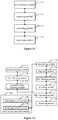
Classifications
-
- G—PHYSICS
- G07—CHECKING-DEVICES
- G07D—HANDLING OF COINS OR VALUABLE PAPERS, e.g. TESTING, SORTING BY DENOMINATIONS, COUNTING, DISPENSING, CHANGING OR DEPOSITING
- G07D7/00—Testing specially adapted to determine the identity or genuineness of valuable papers or for segregating those which are unacceptable, e.g. banknotes that are alien to a currency
- G07D7/06—Testing specially adapted to determine the identity or genuineness of valuable papers or for segregating those which are unacceptable, e.g. banknotes that are alien to a currency using wave or particle radiation
- G07D7/12—Visible light, infrared or ultraviolet radiation
- G07D7/1205—Testing spectral properties
-
- G—PHYSICS
- G07—CHECKING-DEVICES
- G07D—HANDLING OF COINS OR VALUABLE PAPERS, e.g. TESTING, SORTING BY DENOMINATIONS, COUNTING, DISPENSING, CHANGING OR DEPOSITING
- G07D7/00—Testing specially adapted to determine the identity or genuineness of valuable papers or for segregating those which are unacceptable, e.g. banknotes that are alien to a currency
- G07D7/06—Testing specially adapted to determine the identity or genuineness of valuable papers or for segregating those which are unacceptable, e.g. banknotes that are alien to a currency using wave or particle radiation
- G07D7/12—Visible light, infrared or ultraviolet radiation
-
- G—PHYSICS
- G06—COMPUTING OR CALCULATING; COUNTING
- G06F—ELECTRIC DIGITAL DATA PROCESSING
- G06F18/00—Pattern recognition
-
- G—PHYSICS
- G07—CHECKING-DEVICES
- G07D—HANDLING OF COINS OR VALUABLE PAPERS, e.g. TESTING, SORTING BY DENOMINATIONS, COUNTING, DISPENSING, CHANGING OR DEPOSITING
- G07D7/00—Testing specially adapted to determine the identity or genuineness of valuable papers or for segregating those which are unacceptable, e.g. banknotes that are alien to a currency
- G07D7/181—Testing mechanical properties or condition, e.g. wear or tear
- G07D7/187—Detecting defacement or contamination, e.g. dirt
Definitions
- the present disclosure relates to the field of quality control of multispectral signal, and in particular to a quality control method for banknote identification and a system thereof.
- a banknote identification module is a core component of a financial self-service device, and is configured to identify the denomination, authenticity and quality of a banknote in the process of a cash transaction.
- a core element of the banknote identification module is a CIS (contact image sensor).
- the banknote identification module collects multispectral signals of a banknote by the CIS, and performs denomination identification, authenticity identification and quality sorting of a banknote by using characteristics of multispectral imaging of the banknote. For a visible light signal of a previous generation of banknote identification modules, only a natural white light signal is used.
- At least three optical signals are used, including a red light signal, a green light signal and a blue light signal, and level of color information can reach a level of true colors, which significantly improves the reliability and accuracy of banknote identification, in particular for some altered banknotes with a high counterfeit degree, as compared with the detection with the natural white light signal.
- a quality control method for banknote identification and a system thereof are provided according to embodiments of the present disclosure, for solving the technical problems that the accuracy of banknote identification is affected and there is a risk of mistaken identification, because of a difference in the obtained banknote classification result caused by a difference in the CIS performance.
- a quality control method for banknote identification is provided according to an embodiment of the present disclosure, which includes:
- the method may further include:
- the method may further include:
- the detailed process of performing white balance detection on the multispectral signal outputted by the CIS may include:
- the method may further include:
- a quality control system for banknote identification is provided according to an embodiment of the present disclosure, which includes:
- system may further include:
- system may further include:
- the white balance detection module may include:
- system may further include:
- a multispectral signal collected by a CIS is obtained, a first eigenvalue of the multispectral signal is extracted, a corresponding second eigenvalue is obtained according to the first eigenvalue and a pre-set correction conversion value, and the second eigenvalue is inputted into a banknote classifier to obtain a corresponding banknote classification result.
- the corresponding second eigenvalue is obtained according to the first eigenvalue and the pre-set correction conversion value to perform correction processing on the first eigenvalue, which eliminates a deviation brought by a difference in the CIS performance, thereby eliminating a difference in the finally obtained banknote classification result, ensuring the accuracy of banknote identification and eliminating a risk of mistaken identification.
- a quality control method for banknote identification and a system thereof are provided according to embodiments of the present disclosure, to solve the technical problems that the accuracy of banknote identification is affected and there is a risk of mistaken identification, because of a difference in the obtained banknote classification result caused by a difference in the CIS performance.
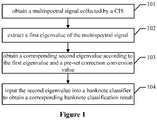
- a quality control method for banknote identification includes steps 101 to 104.
- step 101 a multispectral signal collected by a CIS is obtained.
- the multispectral signal collected by the CIS may be obtained.
- step 102 a first eigenvalue of the multispectral signal is extracted.
- the first eigenvalue of the multispectral signal may be extracted.
- step 103 a corresponding second eigenvalue is obtained according to the first eigenvalue and a pre-set correction conversion value.
- the corresponding second eigenvalue may be obtained according to the first eigenvalue and the pre-set correction conversion value.
- step 104 the second eigenvalue is inputted into a banknote classifier to obtain a corresponding banknote classification result.
- the second eigenvalue may be inputted into the banknote classifier to obtain the corresponding banknote classification result.
- a multispectral signal collected by a CIS is obtained, a first eigenvalue of the multispectral signal is extracted, a corresponding second eigenvalue is obtained according to the first eigenvalue and a pre-set correction conversion value, and the second eigenvalue is inputted into a banknote classifier to obtain a corresponding banknote classification result.
- the corresponding second eigenvalue is obtained according to the first eigenvalue and the pre-set correction conversion value to perform correction processing on the first eigenvalue, which eliminates a deviation brought by a difference in the CIS performance, thereby eliminating a difference in the finally obtained banknote classification results, ensuring the accuracy of banknote identification and eliminating a risk of mistaken identification.
- a quality control method for banknote identification includes steps 201 to 210.
- step 201 a standard eigenvalue corresponding to a multispectral signal collected by a standard CIS is obtained.
- the standard CIS is a CIS with a high color accuracy.
- a multispectral signal outputted by the standard CIS may be regarded to be accurate and as a reference signal for designing a banknote classifier, thereby developing and designing a standard banknote classifier.
- the standard eigenvalue may include base values of multiple colors of the standard CIS.
- multiple colors may be selected, such as five colors, which are red, green, blue, yellow and purple, and standard checking papers of those colors are printed.
- An image of a red paper, an image of a green paper, an image of a blue paper, an image of a yellow paper and an image of a purple paper are respectively collected for m times by the standard CIS, and color features are respectively recorded for each time, thereby obtaining color base values in the standard CIS corresponding to those standard values.
- step 202 a color eigenvalue corresponding to a multispectral signal collected by a CIS to be detected is obtained.
- the color eigenvalue corresponding to the multispectral signal collected by the CIS to be detected may be obtained.
- the CIS to be detected is a CIS which has not been tested and checked. Because of a manufacturing technique, it may be considered that, there are differences between the CIS to be detected and the standard CIS, and there are also some differences between multispectral signals outputted by the two CISs.
- step 203 a correction conversion value is obtained according to the standard eigenvalue and the color eigenvalue.
- the correction conversion value may be obtained according to the standard eigenvalue and the color eigenvalue.
- the correction conversion value includes a conversion relation between the standard eigenvalue and the color eigenvalue. It can be seen from above that, one of the standard eigenvalue and the color eigenvalue may be obtained by the other one through a constant linear conversion. Conversely, in a case that the standard eigenvalue and the color eigenvalue are known, a constant value of the linear conversion, i.e., the correction conversion value, may be computed.
- step 204 white balance detection is performed on a multispectral signal outputted by the CIS.
- white balance detection Before collecting signals by the CIS, white balance detection may be performed on the multispectral signal outputted by the CIS.
- the white balance detection may be classified into white balance detection of white paper and white balance detection of black paper. The detailed process of the white balance detection will be described in detail in the following practical application scenarios, which is not described herein.
- step 205 it is determined whether the CIS passes the white balance detection, if so, the process proceeds to step 207, and if not, the process proceeds to step 206.
- the process proceeds to step 207, and if not, the process proceeds to step 206.
- step 206 the banknote classifying process is suspended.
- the banknote classifying process may be suspended.
- step 207 a multispectral signal collected by the CIS is obtained.
- the CIS passes the white balance detection, it indicates that a deviation of the multispectral signal outputted by the CIS is small and within a reasonable range, and thus the multispectral signal collected by the CIS may be obtained.
- step 208 a first eigenvalue of the multispectral signal is extracted.
- the first eigenvalue of the multispectral signal may be extracted.
- the Process of extracting the first eigenvalue of the multispectral signal is similar to that of obtaining the color eigenvalue corresponding to the multispectral signal collected by the CIS to be detected in above step 202, which is not repeated herein.
- step 209 a corresponding second eigenvalue is obtained according to the first eigenvalue and a pre-set correction conversion value.
- the corresponding second eigenvalue may be obtained according to the first eigenvalue and the pre-set correction conversion value.
- the correction conversion value has been obtained in advance before banknotes are classified, and the correction conversion value includes a conversion relation between the standard eigenvalue and the color eigenvalue, i.e., a conversion relation between the first eigenvalue and the second eigenvalue. Therefore, the corresponding second eigenvalue may be obtained according to the first eigenvalue and the pre-set correction conversion value.
- step 210 the second eigenvalue is inputted into a banknote classifier to obtain a corresponding banknote classification result.
- the second eigenvalue may be inputted into the banknote classifier to obtain the corresponding banknote classification result.
- the signal quality of a multispectral signal outputted by a CIS may be evaluated simply and quickly by performing white balance detection on the multispectral signal outputted by the CIS.
- the banknote classification process is suspended, to avoid affecting the accuracy of banknote identification.
- the quality control method for banknote identification in this practical application scenario includes mainly signal evaluation and signal correction.
- the signal evaluation is to detect the color stability of output signals of a CIS and to evaluate whether there is a color cast defect in the output signals of the CIS.
- the evaluation process requires no human participation, and the detection method is simple and reliable.
- the signal correction is to eliminate a deviation of color signals among different CISs, and includes color correction model training and color correction.
- the signal evaluation is mainly to detect signals by applying principles of color white balance detection.
- shapes of histograms of the three colors i.e., red, green and blue
- the three histograms of the three colors are basically overlapped, and color values gather around a position near 255 and are normally distributed, as shown in Figure 3 .
- shapes of histograms of the three colors i.e., red, green and blue
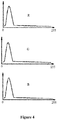
- color values gather around a position near 0 and are normally distributed, as shown in Figure 4 .
- the shift or out of shape will occur in histogram distributions of one or several RGB signals. For example, in Figure 5 , an average value of a blue distribution of a white paper shifts, and in Figure 6 , an average value of a blue distribution of a white paper shifts and a dynamic scope is enlarged.
- whether the color cast occurs on a CIS signal may be detected by computing values of N and ⁇ of three signals of red, green and blue of the CIS and determining whether each of the values of N and ⁇ of every signal meets a test criterion.
- a first step signals of a red image, a green image and a blue image of a standard white detection paper are collected, and the three images are equally divided into n regions in a transverse direction (n is obtained according to experiences in a production process and n takes 4 here from experience, as shown in Figure 8 ). Signal properties of transverse regions are not the same depending on a property of a CIS.
- a fifth step the calculated average values of the images of RGB three colors are respectively recorded as N R , N G , N B , and the calculated dynamic ranges of the images of RGB three colors are respectively recorded as ⁇ R , ⁇ G , ⁇ B .
- the process proceeds to the third step to calculate N R , N G , N B and ⁇ R , ⁇ G , ⁇ B of the other regions, and the process proceeds to the sixth step if all the regions are calculated.
- a loop of the second to fifth step is executed to calculate N R , N G , N B and ⁇ R , ⁇ G , ⁇ B of each region of all the white papers, and average values N R , N G , N B , ⁇ R , ⁇ G , ⁇ B of each region are calculated.
- parameters are determined according to the following determination criterions: N R ⁇ [0.98W51.02 W ], N G ⁇ [0.98 W ,1.02 W ], N B ⁇ [0.98 W ,1.02 W ],
- ⁇ 5 , where W 210 according to an empirical value; and ⁇ R ⁇ [0,1.5 ⁇ 0 ], ⁇ G ⁇ [0,1.5 ⁇ 0 ], ⁇ B ⁇ [0,1.5 ⁇ 0 ],
- the white balance detection of white paper passes, and in a case that one condition of the determination criterions is not satisfied, the loop is broken (or the banknote classification process is suspended), it indicates that the signal outputted by the CIS has a color deviation.
- signals of a standard black detection paper are collected in a similar way to the above.
- a fifth step the calculated average values of the images of RGB three colors are respectively recorded as N R , N G , N B , and the calculated dynamic ranges of the images of RGB three colors are respectively recorded as ⁇ R , ⁇ G , ⁇ B .
- the process proceeds to the third step to calculate N R , N G , N B and ⁇ R , ⁇ G , ⁇ B of the other regions, and the process proceeds to the sixth step if all the regions are calculated.
- a loop of the second to fifth step is executed to calculate N R , N G , N B and ⁇ R , ⁇ G , ⁇ B of each region of all the white papers, and average values N R , N G , N B , ⁇ R , ⁇ G , ⁇ B of each region are calculated.
- parameters are determined according to the following determination criterions: N R ⁇ [ 0,V] , N G ⁇ [0 ,V ], N B ⁇ [0, V ],
- ⁇ 5, where V 10 according to an empirical value; and ⁇ R ⁇ [0, ⁇ 0 ], ⁇ G ⁇ [0, ⁇ 0 ], ⁇ B ⁇ [0, ⁇ 0 ],
- ⁇ 5, where ⁇ 0 10 according to an empirical value.
- the white balance detection of black paper passes, and in a case that one condition of the determination criterions is not satisfied, the loop is broken, it indicates that the signal outputted by the CIS has color deviations.
- Each factory-fresh CIS should pass the white balance detection of white paper and the white balance detection of black paper, which ensures that red, green and blue signals outputted by each CIS are relatively stable and have no severe color cast.
- a standard banknote identification module meeting a test criterion cannot ensure nonoccurrence of color cast in practical engineering applications, and only controls the extent of color cast within an eligible and small range.
- the signal correction of the quality control method in the application scenario is mainly used to correct the color cast with such small amplitude.
- a banknote classifier is designed and developed based on a signal obtained by a reference CIS, that is, a standard classifier classifier s is designed by engineers based on features obtained by a reference CIS.
- a reference CIS which is CIS 0
- feat 0 and feat 1 are impossible to be exactly the same and a deviation exists.
- Each CIS corresponds to a unique conversion matrix, denoted as a conversion matrix ⁇ n corresponding to CIS n .
- the conversion matrix ⁇ n is obtained by a color correction model training unit, and a structural diagram of the color correction model training unit is shown in Figure 9 .
- the color correction model training unit functions to establish a signal correction model, and the detailed steps are as follows.
- a CIS with a high color accuracy is selected as a reference CIS, which is assumed to be CIS 0 , a multispectral signal outputted by CIS 0 is taken as a reference signal for designing a banknote classifier to develop a standard classifier classifier s .
- feat 0 train 3 r 0 3 g 0 3 b 0 3 T
- feat 0 train 4 r 0 4 g 0 4 b 0 4 T
- feat 0 train 5 r 0 5 g 0 5 b 0 5 T .
- a sixth step the above system of equations is solved.
- the matrixes are expanded and the equations are sorted.
- ⁇ n is stored into a storage unit corresponding to CIS n .
- the color correction model corresponding to CIS n is placed in an original banknote classification and identification system.
- a feature converting unit is added between a feature extracting unit and a standard classifier, as shown in Figure 10 .
- the detailed process of improved banknote identification and classification is described in the following.
- a feature feat n ( r n g n b n ) T is obtained by CIS n .
- the feature feat n is converted into a feature feat n ' under the benchmark of a color signal of CIS 0 .
- a system computing unit obtains a corresponding conversion matrix ⁇ n from the storage unit and obtains feat n ' by the following operations:
- feat n ' is inputted into the standard banknote classifier classifier s , and a final banknote classification result is outputted.
- a quality control system for banknote identification includes:
- the first obtaining module 111 obtains a multispectral signal collected by a CIS
- the extracting module 112 extracts a first eigenvalue of the multispectral signal
- the converting module 113 obtains corresponding second eigenvalue according to the first eigenvalue and a pre-set correction conversion value
- the classifying module 114 inputs the second eigenvalue into a banknote classifier to obtain a corresponding banknote classification result.
- the corresponding second eigenvalue is obtained according to the first eigenvalue and the pre-set correction conversion value to perform correction processing on the first eigenvalue, which eliminates a deviation brought by a difference in the CIS performance, thereby eliminating a difference in the finally obtained banknote classification results, ensuring the accuracy of banknote identification and eliminating a risk of mistaken identification.
- a quality control system for banknote identification in the embodiments of the present disclosure is described in detail. Reference is made to Figure 12 .
- a quality control system for banknote identification according to another embodiment of the present disclosure includes:
- the white balance detection module 128 in this embodiment may include:
- the disclosed systems, devices and methods in the embodiments provided by the present application may be implemented in other manners.
- the above embodiments of the device are only illustrative.
- dividing the units is only based on logical functions, and there are other dividing modes in practical implementations.
- multiple units or components can be combined or integrated into another system, or some features can be ignored or not be executed.
- coupling among shown or discussed parts which may be direct coupling or communication connection can be via some interfaces, and the direct coupling or communication connection among devices or units can be electrical, mechanical or other forms.
- Units for showing separation components may or not may be separated physically.
- Components for displaying units may or not may be a physical unit, that is, may be located in a position, or may be distributed to multiple network units. Some or all of units may be selected to implement objects of the technical solutions according to the embodiments, according to practical requirements.
- various function units may be integrated into a processing unit, or various function units may exist independently, or two or more than two of the above units may be integrated into a unit.
- the above integrated units may be implemented in a form of hardware, or in a form of a software function unit.
- the integrated unit can be stored in a readable storage medium of a computing device, if the functions are implemented in a form of a soft function unit and sold or used as an independent product.
- the technical solutions according to the present application essentially or contributing to the conventional technology or all or some of the technical solutions can be embodied in a form of a software product, and the computer software product is stored in a storage medium, which includes several instructions used for a computing device (may be a personal computer, a server, or a network device) to execute all or some of steps described in various embodiments of the present disclosure.
- the storage medium in the forgoing includes various media which can store program codes, such as, a USB disk, a removable hard disk, a read-only memory (ROM), a random access memory (RAM), a magnetic disk, or an optical disk.
Landscapes
- Physics & Mathematics (AREA)
- Health & Medical Sciences (AREA)
- General Health & Medical Sciences (AREA)
- Toxicology (AREA)
- General Physics & Mathematics (AREA)
- Engineering & Computer Science (AREA)
- Spectroscopy & Molecular Physics (AREA)
- Theoretical Computer Science (AREA)
- Bioinformatics & Computational Biology (AREA)
- Bioinformatics & Cheminformatics (AREA)
- Artificial Intelligence (AREA)
- Computer Vision & Pattern Recognition (AREA)
- Data Mining & Analysis (AREA)
- Evolutionary Biology (AREA)
- Evolutionary Computation (AREA)
- General Engineering & Computer Science (AREA)
- Life Sciences & Earth Sciences (AREA)
- Inspection Of Paper Currency And Valuable Securities (AREA)
- Facsimile Image Signal Circuits (AREA)
- Image Analysis (AREA)
- Spectrometry And Color Measurement (AREA)
Abstract
Description
- The present application claims the priority to Chinese Patent Application No.
201510026756.8 - The present disclosure relates to the field of quality control of multispectral signal, and in particular to a quality control method for banknote identification and a system thereof.
- A banknote identification module is a core component of a financial self-service device, and is configured to identify the denomination, authenticity and quality of a banknote in the process of a cash transaction. A core element of the banknote identification module is a CIS (contact image sensor). The banknote identification module collects multispectral signals of a banknote by the CIS, and performs denomination identification, authenticity identification and quality sorting of a banknote by using characteristics of multispectral imaging of the banknote. For a visible light signal of a previous generation of banknote identification modules, only a natural white light signal is used. While, for a visible light signal of a new generation of banknote identification modules, at least three optical signals are used, including a red light signal, a green light signal and a blue light signal, and level of color information can reach a level of true colors, which significantly improves the reliability and accuracy of banknote identification, in particular for some altered banknotes with a high counterfeit degree, as compared with the detection with the natural white light signal.
- It can be seen from above that the accuracy of banknote identification is closely related to the performance of the CIS. However, due to a difference in the manufacturing process, not all of the factory-fresh CISs can be entirely the same and there are some differences more or less in the performance. In the existing banknote identification technology, multispectral signals are generally collected by a CIS, and color eigenvalues corresponding to the multispectral signals are extracted and transmitted to a banknote classifier for banknote classification processing.
- However, since there is a difference in performance among the CISs, multispectral signals collected by different CISs for a same one banknote may also be different, which causes a difference in the finally obtained banknote classification result, thereby affecting the accuracy of banknote identification and resulting in a risk of mistaken identification.
- A quality control method for banknote identification and a system thereof are provided according to embodiments of the present disclosure, for solving the technical problems that the accuracy of banknote identification is affected and there is a risk of mistaken identification, because of a difference in the obtained banknote classification result caused by a difference in the CIS performance.
- A quality control method for banknote identification is provided according to an embodiment of the present disclosure, which includes:
- obtaining a multispectral signal collected by a CIS;
- extracting a first eigenvalue of the multispectral signal;
- obtaining a corresponding second eigenvalue according to the first eigenvalue and a pre-set correction conversion value; and
- inputting the second eigenvalue into a banknote classifier to obtain a corresponding banknote classification result.
- Optionally, the method may further include:
- obtaining a standard eigenvalue corresponding to a multispectral signal collected by a standard CIS;
- obtaining a color eigenvalue corresponding to a multispectral signal collected by a CIS to be detected; and
- obtaining a correction conversion value according to the standard eigenvalue and the color eigenvalue, where the correction conversion value includes a conversion relation between the standard eigenvalue and the color eigenvalue.
- Optionally, the method may further include:
- performing white balance detection on a multispectral signal outputted by the CIS.
- Optionally, the detailed process of performing white balance detection on the multispectral signal outputted by the CIS may include:
- performing white balance detection of white paper on the multispectral signal outputted by the CIS; or
- performing white balance detection of black paper on the multispectral signal outputted by the CIS.
- Optionally, the method may further include:
- determining whether the CIS passes the white balance detection,
- where the step of obtaining a multispectral signal collected by a CIS is performed in a case that it is determined that the CIS passes the white balance detection.
- A quality control system for banknote identification is provided according to an embodiment of the present disclosure, which includes:
- a first obtaining module configured to obtain a multispectral signal collected by a CIS;
- an extracting module configured to extract a first eigenvalue of the multispectral signal;
- a converting module configured to obtain a corresponding second eigenvalue according to the first eigenvalue and a pre-set correction conversion value; and
- a classifying module configured to input the second eigenvalue into a banknote classifier to obtain a corresponding banknote classification result.
- Optionally, the system may further include:
- a second obtaining module configured to obtain a standard eigenvalue corresponding to a multispectral signal collected by a standard CIS;
- a third obtaining module configured to obtain a color eigenvalue corresponding to a multispectral signal collected by a CIS to be detected; and
- a correction value obtaining module configured to obtain a correction conversion value according to the standard eigenvalue and the color eigenvalue, where the correction conversion value includes a conversion relation between the standard eigenvalue and the color eigenvalue.
- Optionally, the system may further include:
- a white balance detection module configured to perform white balance detection on a multispectral signal outputted by the CIS.
- Optionally, the white balance detection module may include:
- a white paper detection unit configured to perform white balance detection of white paper on the multispectral signal outputted by the CIS; or
- a black paper detection unit configured to perform white balance detection of black paper on the multispectral signal outputted by the CIS.
- Optionally, the system may further include:
- a determining module configured to determine whether the CIS passes the white balance detection; and
- a triggering module configured to trigger the first obtaining module, in a case that a determination result of the determining module is positive.
- It can be seen from above technical solutions that the embodiments of the present disclosure have the following advantages.
- According to the embodiments of the present disclosure, a multispectral signal collected by a CIS is obtained, a first eigenvalue of the multispectral signal is extracted, a corresponding second eigenvalue is obtained according to the first eigenvalue and a pre-set correction conversion value, and the second eigenvalue is inputted into a banknote classifier to obtain a corresponding banknote classification result. In the embodiments of the present disclosure, after the first eigenvalue of the multispectral signal is obtained, the corresponding second eigenvalue is obtained according to the first eigenvalue and the pre-set correction conversion value to perform correction processing on the first eigenvalue, which eliminates a deviation brought by a difference in the CIS performance, thereby eliminating a difference in the finally obtained banknote classification result, ensuring the accuracy of banknote identification and eliminating a risk of mistaken identification.
-
-
Figure 1 is a flow chart of a quality control method for banknote identification according to an embodiment of the present disclosure; -
Figure 2 is a flow chart of a quality control method for banknote identification according to another embodiment of the present disclosure; -
Figure 3 illustrates histograms of RGB images of a white paper; -
Figure 4 illustrates histograms of RGB images of a black paper; -
Figure 5 is a schematic diagram of histograms, in which an average value of a blue component shifts; -
Figure 6 is a schematic diagram of histograms, in which an average value of a blue component shifts and dynamic range of the blue component is enlarged; -
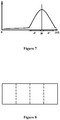
Figure 7 is a schematic diagram of characteristic parameters to be obtained by color cast detection; -
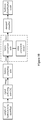
Figure 8 is a schematic diagram of a white paper image equally divided into n regions in a transverse direction; -
Figure 9 is a schematic diagram of a training unit of a color correction model; -
Figure 10 is a schematic diagram of a quality control system for banknote identification applied with color correction; -
Figure 11 is a structural diagram of a quality control system for banknote identification according to an embodiment of the present disclosure; and -
Figure 12 is a structural diagram of a quality control system for banknote identification according to another embodiment of the present disclosure. - A quality control method for banknote identification and a system thereof are provided according to embodiments of the present disclosure, to solve the technical problems that the accuracy of banknote identification is affected and there is a risk of mistaken identification, because of a difference in the obtained banknote classification result caused by a difference in the CIS performance.
- In order to make the objects, features and advantages of the present disclosure clearer and easier to understand, hereinafter the technical solutions of the embodiments of the present disclosure are illustrated clearly and completely in conjunction with drawings of the embodiments of the present disclosure. Apparently, the described embodiments are merely a few rather than all of the embodiments of the present disclosure. All other embodiments obtained by persons of ordinary skill in the art based on the embodiments of the present disclosure without creative efforts shall fall within the protection scope of the present disclosure. Reference is made to
Figure 1 . In an embodiment of the present disclosure, a quality control method for banknote identification includessteps 101 to 104. - In
step 101, a multispectral signal collected by a CIS is obtained. - First, the multispectral signal collected by the CIS may be obtained.
- In
step 102, a first eigenvalue of the multispectral signal is extracted. - After the multispectral signal collected by the CIS is obtained, the first eigenvalue of the multispectral signal may be extracted.
- In
step 103, a corresponding second eigenvalue is obtained according to the first eigenvalue and a pre-set correction conversion value. - After the first eigenvalue of the multispectral signal is extracted, the corresponding second eigenvalue may be obtained according to the first eigenvalue and the pre-set correction conversion value.
- In
step 104, the second eigenvalue is inputted into a banknote classifier to obtain a corresponding banknote classification result. - After the corresponding second eigenvalue is obtained according to the first eigenvalue and the pre-set correction conversion value, the second eigenvalue may be inputted into the banknote classifier to obtain the corresponding banknote classification result.
- In this embodiment, a multispectral signal collected by a CIS is obtained, a first eigenvalue of the multispectral signal is extracted, a corresponding second eigenvalue is obtained according to the first eigenvalue and a pre-set correction conversion value, and the second eigenvalue is inputted into a banknote classifier to obtain a corresponding banknote classification result. In this embodiment, after the first eigenvalue of the multispectral signal is obtained, the corresponding second eigenvalue is obtained according to the first eigenvalue and the pre-set correction conversion value to perform correction processing on the first eigenvalue, which eliminates a deviation brought by a difference in the CIS performance, thereby eliminating a difference in the finally obtained banknote classification results, ensuring the accuracy of banknote identification and eliminating a risk of mistaken identification.
- For ease of understanding, the quality control method for banknote identification according to the embodiment of the present disclosure is described below in detail. Reference is made to
Figure 2 . In another embodiment of the present disclosure, a quality control method for banknote identification includessteps 201 to 210. - In
step 201, a standard eigenvalue corresponding to a multispectral signal collected by a standard CIS is obtained. - Before performing classification processing on a banknote, the standard eigenvalue corresponding to the multispectral signal collected by the standard CIS is obtained. The standard CIS is a CIS with a high color accuracy. A multispectral signal outputted by the standard CIS may be regarded to be accurate and as a reference signal for designing a banknote classifier, thereby developing and designing a standard banknote classifier.
- It should be noted that, the standard eigenvalue may include base values of multiple colors of the standard CIS. For example, multiple colors may be selected, such as five colors, which are red, green, blue, yellow and purple, and standard checking papers of those colors are printed. An image of a red paper, an image of a green paper, an image of a blue paper, an image of a yellow paper and an image of a purple paper are respectively collected for m times by the standard CIS, and color features are respectively recorded for each time, thereby obtaining color base values in the standard CIS corresponding to those standard values.
- In
step 202, a color eigenvalue corresponding to a multispectral signal collected by a CIS to be detected is obtained. - Similarly, before performing classification processing on a banknote, the color eigenvalue corresponding to the multispectral signal collected by the CIS to be detected may be obtained. Contrary to the standard CIS, the CIS to be detected is a CIS which has not been tested and checked. Because of a manufacturing technique, it may be considered that, there are differences between the CIS to be detected and the standard CIS, and there are also some differences between multispectral signals outputted by the two CISs.
- It should be noted that, experiments show that differences among signals outputted by different CISs are linear. That is, by means of a constant linear conversion, a multispectral signal collected by a CIS to be detected may have a value approximate to a value of a signal directly collected by a standard CIS.
- In
step 203, a correction conversion value is obtained according to the standard eigenvalue and the color eigenvalue. - After the standard eigenvalue and the color eigenvalue are obtained, the correction conversion value may be obtained according to the standard eigenvalue and the color eigenvalue. The correction conversion value includes a conversion relation between the standard eigenvalue and the color eigenvalue. It can be seen from above that, one of the standard eigenvalue and the color eigenvalue may be obtained by the other one through a constant linear conversion. Conversely, in a case that the standard eigenvalue and the color eigenvalue are known, a constant value of the linear conversion, i.e., the correction conversion value, may be computed.
- In
step 204, white balance detection is performed on a multispectral signal outputted by the CIS. - Before collecting signals by the CIS, white balance detection may be performed on the multispectral signal outputted by the CIS. The white balance detection may be classified into white balance detection of white paper and white balance detection of black paper. The detailed process of the white balance detection will be described in detail in the following practical application scenarios, which is not described herein.
- In
step 205, it is determined whether the CIS passes the white balance detection, if so, the process proceeds to step 207, and if not, the process proceeds to step 206. - After the white balance detection is performed on the multispectral signal outputted by the CIS, it may be determined whether the CIS passes the white balance detection, if so, the process proceeds to step 207, and if not, the process proceeds to step 206.
- In
step 206, the banknote classifying process is suspended. - In a case that the CIS does not pass the white balance detection, it indicates that a deviation of the multispectral signal outputted by the CIS is significant, and thus the banknote classifying process may be suspended.
- In
step 207, a multispectral signal collected by the CIS is obtained. - In a case that the CIS passes the white balance detection, it indicates that a deviation of the multispectral signal outputted by the CIS is small and within a reasonable range, and thus the multispectral signal collected by the CIS may be obtained.
- In
step 208, a first eigenvalue of the multispectral signal is extracted. - After the multispectral signal collected by the CIS is obtained, the first eigenvalue of the multispectral signal may be extracted. The Process of extracting the first eigenvalue of the multispectral signal is similar to that of obtaining the color eigenvalue corresponding to the multispectral signal collected by the CIS to be detected in
above step 202, which is not repeated herein. - In
step 209, a corresponding second eigenvalue is obtained according to the first eigenvalue and a pre-set correction conversion value. - After the first eigenvalue is obtained, the corresponding second eigenvalue may be obtained according to the first eigenvalue and the pre-set correction conversion value. It may be understood that, the correction conversion value has been obtained in advance before banknotes are classified, and the correction conversion value includes a conversion relation between the standard eigenvalue and the color eigenvalue, i.e., a conversion relation between the first eigenvalue and the second eigenvalue. Therefore, the corresponding second eigenvalue may be obtained according to the first eigenvalue and the pre-set correction conversion value.
- In
step 210, the second eigenvalue is inputted into a banknote classifier to obtain a corresponding banknote classification result. - After the corresponding second eigenvalue is obtained, the second eigenvalue may be inputted into the banknote classifier to obtain the corresponding banknote classification result.
- In this embodiment, the signal quality of a multispectral signal outputted by a CIS may be evaluated simply and quickly by performing white balance detection on the multispectral signal outputted by the CIS. In a case that the signal outputted by the CIS has a large deviation, the banknote classification process is suspended, to avoid affecting the accuracy of banknote identification.
- For ease of understanding, based on the embodiment as shown in
Figure 2 , a practical application scenario of the quality control method for banknote identification is described according to the embodiments of the present disclosure. - The quality control method for banknote identification in this practical application scenario includes mainly signal evaluation and signal correction. The signal evaluation is to detect the color stability of output signals of a CIS and to evaluate whether there is a color cast defect in the output signals of the CIS. The evaluation process requires no human participation, and the detection method is simple and reliable. The signal correction is to eliminate a deviation of color signals among different CISs, and includes color correction model training and color correction.
- The signal evaluation is mainly to detect signals by applying principles of color white balance detection. In a case that a white paper meets white balance, shapes of histograms of the three colors, i.e., red, green and blue, are basically the same, that is, the three histograms of the three colors are basically overlapped, and color values gather around a position near 255 and are normally distributed, as shown in
Figure 3 . Similarly, in a case that a black paper meets white balance, shapes of histograms of the three colors, i.e., red, green and blue, are also basically the same, and color values gather around a position near 0 and are normally distributed, as shown inFigure 4 . - If the color cast occurs in an image signal, the shift or out of shape will occur in histogram distributions of one or several RGB signals. For example, in
Figure 5 , an average value of a blue distribution of a white paper shifts, and inFigure 6 , an average value of a blue distribution of a white paper shifts and a dynamic scope is enlarged. - Since regularities of color distributions of a white paper and a black paper are constant, and collected signal features are stable, a shape of color distribution may be accurately described only with an average value N and a dynamic range µ (or a standard deviation) of a distribution, as shown in
Figure 7 . - Therefore, whether the color cast occurs on a CIS signal may be detected by computing values of N and µ of three signals of red, green and blue of the CIS and determining whether each of the values of N and µ of every signal meets a test criterion.
- The detailed process of the white balance detection of white paper in the practical scenario is described below.
- In a first step, signals of a red image, a green image and a blue image of a standard white detection paper are collected, and the three images are equally divided into n regions in a transverse direction (n is obtained according to experiences in a production process and n takes 4 here from experience, as shown in
Figure 8 ). Signal properties of transverse regions are not the same depending on a property of a CIS. - In a second step, histograms of images of RGB three colors in a first region are respectively calculated.
- In a third step, average values of pixel points whose ratios are within a range of 10% to 95% in the histograms of the images of all the colors are calculated in sequence to obtain N.
- In a fourth step, taking N as a midpoint, the number of pixel points whose pixel values are smaller than N and whose ratios are equal to 40% is calculated to obtain a minimum value min among those points, and taking N as a midpoint, the number of pixel points whose pixel values are greater than or equal to N and whose ratios are equal to 40% is calculated to obtain a maximum value max among those points, and let µ=(max+min)/2.
- In a fifth step, the calculated average values of the images of RGB three colors are respectively recorded as NR , NG, NB , and the calculated dynamic ranges of the images of RGB three colors are respectively recorded as µR , µG, µB. The process proceeds to the third step to calculate NR , NG, NB and µ R, µG , µB of the other regions, and the process proceeds to the sixth step if all the regions are calculated.
- In a sixth step, more than 100 white papers with the same property are collected, a loop of the second to fifth step is executed to calculate NR , NG, NB and µR , µG, µB of each region of all the white papers, and average values
NR ,NG ,NB ,µR ,µG ,µB of each region are calculated. - In a seventh step, parameters are determined according to the following determination criterions:
NR ∈ [0.98W51.02W],NG ∈ [0.98W,1.02W],NB ∈ [0.98W,1.02W], |NR -NB |<5, |NR -NG |<5, |NG -NB |<5, where W=210 according to an empirical value; andµR ∈[0,1.5µ 0],µG ∈[0,1.5µ 0],µB ∈[0,1.5µ 0], |µR -µB |<5, |µR -µG |<5, |µG -µB |<5 , where µ 0 =10 according to an empirical value. - In an eighth step, in a case that
NR ,NG ,NB ,µ R ,µG ,µB of all the regions satisfy the determination criterions, the white balance detection of white paper passes, and in a case that one condition of the determination criterions is not satisfied, the loop is broken (or the banknote classification process is suspended), it indicates that the signal outputted by the CIS has a color deviation. - Similarly, the detailed process of the white balance detection of black paper is described below.
- In a first step, signals of a standard black detection paper are collected in a similar way to the above.
- In a second step, histograms of images of RGB three colors in a first region are respectively calculated.
- In a third step, average values of pixel points whose ratios are within a range of 0% to 90% in the histograms of the images of all the colors are calculated in sequence to obtain N.
- In a fourth step, taking N as a midpoint, the number of pixel points whose pixel values are smaller than N and whose ratios are equal to 40% is calculated to obtain a minimum value min among those points, and taking N as a midpoint, the number of pixel points whose pixel values are greater than or equal to N and whose ratios are equal to 40% is calculated to obtain a maximum value max among those points, and let µ=(max+min)/2.
- In a fifth step, the calculated average values of the images of RGB three colors are respectively recorded as NR , NG, NB , and the calculated dynamic ranges of the images of RGB three colors are respectively recorded as µR , µG, µB. The process proceeds to the third step to calculate NR , NG, NB and µ R, µG , µB of the other regions, and the process proceeds to the sixth step if all the regions are calculated.
- In a sixth step, more than 100 black papers with the same property are collected, a loop of the second to fifth step is executed to calculate NR , NG, NB and µR , µG, µB of each region of all the white papers, and average values
NR ,NG ,NB ,µR ,µG ,µB of each region are calculated. - In a seventh step, parameters are determined according to the following determination criterions:
NR ∈[0,V],NG ∈[0,V],NB ∈ [0,V], |NR -NB |<5, |NR -NG |<5, |NG -NB |<5, where V=10 according to an empirical value; andµR ∈[0,µ 0],µ G ∈[0,µ 0],µB ∈[0,µ 0], |µR -µB |<5, |µR -µG |<5, |µG -µB |<5, where µ 0=10 according to an empirical value. - In an eighth step, in a case that
NR ,NG ,NB ,µ R ,µG ,µB of all the regions satisfy the determination criterions, the white balance detection of black paper passes, and in a case that one condition of the determination criterions is not satisfied, the loop is broken, it indicates that the signal outputted by the CIS has color deviations. - Each factory-fresh CIS should pass the white balance detection of white paper and the white balance detection of black paper, which ensures that red, green and blue signals outputted by each CIS are relatively stable and have no severe color cast.
- By the above detections, a standard banknote identification module meeting a test criterion cannot ensure nonoccurrence of color cast in practical engineering applications, and only controls the extent of color cast within an eligible and small range. The signal correction of the quality control method in the application scenario is mainly used to correct the color cast with such small amplitude.
- It is assumed that a banknote classifier is designed and developed based on a signal obtained by a reference CIS, that is, a standard classifier classifiers is designed by engineers based on features obtained by a reference CIS. For example, a reference CIS, which is CIS 0, extracts a feature of one color which is feat 0 = (r0 g 0 b 0) T , and another CIS, such as CIS 1, extracts a feature of the same color under the same condition which is feat 1 = (r 1 g 1 b 1) T . In practical engineering applications, feat 0 and feat 1 are impossible to be exactly the same and a deviation exists. If a banknote identification system directly inputs feat 1 obtained in CIS 1 into the standard classifier classifiers , an error will be produced inevitably in a classification result of the classifier, and there is a risk of mistaken identification, thereby reducing the identification accuracy of the banknote identification module.
- The color correction method proposed in the application scenario is to establish a conversion model from CIS 1 to CIS 0 and to correct a signal eigenvalue in CIS 1 which is feat 1 = (r 1 g 1 b 1) T to a signal eigenvalue in CIS 0 which is feat 1' =(r 1' g 1' b 1') T .
- Engineering experiments show that differences among different CIS signals are linear in the case of a small deviation, namely, on the basis of satisfying a test criterion set by a signal estimation unit, and in this case, via a constant linear conversion, a signal collected by CIS 1 can have a value approximate to a value of a signal directly collected by CIS 0. The conversion satisfies the following rules,


- Each CIS corresponds to a unique conversion matrix, denoted as a conversion matrix Φ n corresponding to CISn . The conversion matrix Φ n is obtained by a color correction model training unit, and a structural diagram of the color correction model training unit is shown in
Figure 9 . - The color correction model training unit functions to establish a signal correction model, and the detailed steps are as follows.
- In a first step, a CIS with a high color accuracy is selected as a reference CIS, which is assumed to be CIS 0, a multispectral signal outputted by CIS 0 is taken as a reference signal for designing a banknote classifier to develop a standard classifier classifiers .
- In a second step, color base values of CIS 0 are measured, and multiple colors are selected. For example, five colors are selected, which are red, green, blue, yellow and purple, and standard checking papers of those colors are printed. Images of a red paper are collected for m times by CIS 0, color features


- In a third step, similarly, images of papers of the other colors are respectively collected for m times, and color base values of the green, blue, yellow and purple papers in CIS 0 are respectively calculated, which are respectively


- In a fourth step, color base values in CISn to be detected are measured. Images of the red, green, blue, yellow and purple papers are collected for m times by CISn, and color base values of the five colors in CISn are respectively calculated, which are respectively


- In a fifth step, a set of equations of the color base values are established based on CIS 0 and CISn :

- In a sixth step, the above system of equations is solved. There are nine unknown numbers and eighteen equations, so the equation set is over-determined equations. The matrixes are expanded and the equations are sorted. The equations may be classified into three groups, there are three unknown numbers and six equations in each group, and there are three groups of over-determined equations in total:


- In a seventh step, least square solutions of each group of over-determined equations are solved by means of linear regression, to obtain An Bn Cn, En Fn Gn, and Gn Hn In and to obtain a unique conversion matrix

- In an eighth step, Φ n is stored into a storage unit corresponding to CISn .
- After being obtained, the color correction model corresponding to CISn is placed in an original banknote classification and identification system. A feature converting unit is added between a feature extracting unit and a standard classifier, as shown in
Figure 10 . The detailed process of improved banknote identification and classification is described in the following. - In a first step, a feature featn = (rn gn bn ) T is obtained by CISn .
- In a second step, the feature featn is converted into a feature featn ' under the benchmark of a color signal of CIS 0. A system computing unit obtains a corresponding conversion matrix Φ n from the storage unit and obtains featn' by the following operations:
- featn' = Φ nfeatn , namely,
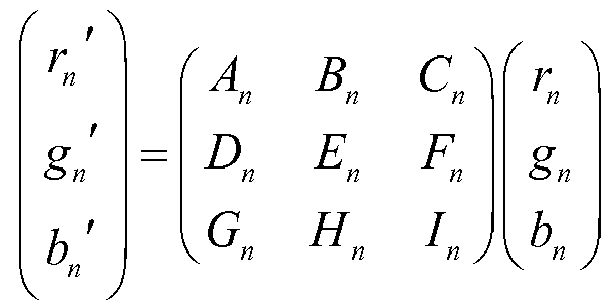
- In a third step, featn' is inputted into the standard banknote classifier classifiers , and a final banknote classification result is outputted.
- The quality control method for banknote identification is mainly described in the above. Hereinafter a quality control system for banknote identification is illustrated. Reference is made to
Figure 11 . A quality control system for banknote identification according to an embodiment of the present disclosure includes: - a first obtaining
module 111 configured to obtain a multispectral signal collected by CIS; - an extracting
module 112 configured to extract a first eigenvalue of the multispectral signal; - a converting
module 113 configured to obtain corresponding second eigenvalue according to the first eigenvalue and a pre-set correction conversion value; and - a classifying
module 114 configured to input the second eigenvalue into a banknote classifier to obtain a corresponding banknote classification result. - In this embodiment, the first obtaining
module 111 obtains a multispectral signal collected by a CIS, the extractingmodule 112 extracts a first eigenvalue of the multispectral signal, the convertingmodule 113 obtains corresponding second eigenvalue according to the first eigenvalue and a pre-set correction conversion value, and the classifyingmodule 114 inputs the second eigenvalue into a banknote classifier to obtain a corresponding banknote classification result. In this embodiment, after the first eigenvalue of the multispectral signal is obtained, the corresponding second eigenvalue is obtained according to the first eigenvalue and the pre-set correction conversion value to perform correction processing on the first eigenvalue, which eliminates a deviation brought by a difference in the CIS performance, thereby eliminating a difference in the finally obtained banknote classification results, ensuring the accuracy of banknote identification and eliminating a risk of mistaken identification. - For ease of understanding, hereinafter the quality control system for banknote identification in the embodiments of the present disclosure is described in detail. Reference is made to
Figure 12 . A quality control system for banknote identification according to another embodiment of the present disclosure includes: - a first obtaining
module 121 configured to obtain a multispectral signal collected by a CIS; - an extracting
module 122 configured to extract a first eigenvalue of the multispectral signal; - a converting
module 123 configured to obtain corresponding second eigenvalue according to the first eigenvalue and a pre-set correction conversion value; and - a classifying
module 124 configured to input the second eigenvalue into a banknote classifier to obtain a corresponding banknote classification result. - The system in this embodiment further includes:
- a second obtaining
module 125 configured to obtain a standard eigenvalue corresponding to the multispectral signal collected by the CIS; - a third obtaining
module 126 configured to obtain a color eigenvalue corresponding to a multispectral signal collected by a CIS to be detected; and - a correction
value obtaining module 127 configured to obtain a correction conversion value according to the standard eigenvalue and the color eigenvalue, where the correction conversion value includes a conversion relation between the standard eigenvalue and the color eigenvalue. - The system in this embodiment further includes:
- a white
balance detection module 128 configured to perform white balance detection on a multispectral signal outputted by the CIS; - The white
balance detection module 128 in this embodiment may include: - a white
paper detection unit 1281 configured to perform the white balance detection of white paper on the multispectral signal outputted by the CIS; or - a black
paper detection unit 1282 configured to perform the white balance detection of black paper on the multispectral signal outputted by the CIS. - The system in this embodiment further includes:
- a determining
module 129 configured to determine whether the CIS passes the white balance detection; and - a triggering
module 130 configured to trigger the first obtaining module, in a case that a determination result of the determining module is positive. - As may be clearly understood by those skills in the art, for convenience and brevity of description, the detailed operating processes of the above systems, devices and units can refer to processes corresponding to the above embodiments of the method, which are not repeated herein.
- It should be understood that, the disclosed systems, devices and methods in the embodiments provided by the present application may be implemented in other manners. For example, the above embodiments of the device are only illustrative. For example, dividing the units is only based on logical functions, and there are other dividing modes in practical implementations. For example, multiple units or components can be combined or integrated into another system, or some features can be ignored or not be executed. In addition, coupling among shown or discussed parts which may be direct coupling or communication connection can be via some interfaces, and the direct coupling or communication connection among devices or units can be electrical, mechanical or other forms.
- Units for showing separation components may or not may be separated physically. Components for displaying units may or not may be a physical unit, that is, may be located in a position, or may be distributed to multiple network units. Some or all of units may be selected to implement objects of the technical solutions according to the embodiments, according to practical requirements.
- In addition, various function units according to various embodiments of the present disclosure may be integrated into a processing unit, or various function units may exist independently, or two or more than two of the above units may be integrated into a unit. The above integrated units may be implemented in a form of hardware, or in a form of a software function unit.
- The integrated unit can be stored in a readable storage medium of a computing device, if the functions are implemented in a form of a soft function unit and sold or used as an independent product. Based on that insight, the technical solutions according to the present application essentially or contributing to the conventional technology or all or some of the technical solutions can be embodied in a form of a software product, and the computer software product is stored in a storage medium, which includes several instructions used for a computing device (may be a personal computer, a server, or a network device) to execute all or some of steps described in various embodiments of the present disclosure. The storage medium in the forgoing includes various media which can store program codes, such as, a USB disk, a removable hard disk, a read-only memory (ROM), a random access memory (RAM), a magnetic disk, or an optical disk.
- The above embodiments are only intended to illustrate the technical solutions of the present disclosure, but not to limit the present disclosure. Even though the present disclosure is illustrated in detail referring to the above embodiments, it should be understood by those skilled in the art, the technical solutions according to the above embodiments can be modified, or some technical features in the technical solutions can be substituted by equivalents; and those modifications or substitutes do not make the essence of the technical solutions depart from the spirit and scope of the technical solutions according to the embodiments of the present disclosure.
Claims (10)
- A quality control method for banknote identification, comprising:obtaining a multispectral signal collected by a CIS;extracting a first eigenvalue of the multispectral signal;obtaining a corresponding second eigenvalue according to the first eigenvalue and a pre-set correction conversion value; andinputting the second eigenvalue into a banknote classifier to obtain a corresponding banknote classification result.
- The method according to claim 1, further comprising:obtaining a standard eigenvalue corresponding to a multispectral signal collected by a standard CIS;obtaining a color eigenvalue corresponding to a multispectral signal collected by a CIS to be detected; andobtaining a correction conversion value according to the standard eigenvalue and the color eigenvalue, wherein the correction conversion value comprises a conversion relation between the standard eigenvalue and the color eigenvalue.
- The method according to claim 1, further comprising performing white balance detection on a multispectral signal outputted by the CIS.
- The method according to claim 3, wherein the performing white balance detection on the multispectral signal outputted by the CIS comprises:performing white balance detection of white paper on the multispectral signal outputted by the CIS; orperforming white balance detection of black paper on the multispectral signal outputted by the CIS.
- The method according to claim 3, further comprising:determining whether the CIS passes the white balance detection,wherein the step of obtaining a multispectral signal collected by a CIS is performed in a case that it is determined that the CIS passes the white balance detection.
- A quality control system for banknote identification, comprising:a first obtaining module configured to obtain a multispectral signal collected by a CIS;an extracting module configured to extract a first eigenvalue of the multispectral signal;a converting module configured to obtain a corresponding second eigenvalue according to the first eigenvalue and a pre-set correction conversion value; anda classifying module configured to input the second eigenvalue into a banknote classifier to obtain a corresponding banknote classification result.
- The system according to claim 6, further comprising:a second obtaining module configured to obtain a standard eigenvalue corresponding to a multispectral signal collected by a standard CIS;a third obtaining module configured to obtain a color eigenvalue corresponding to a multispectral signal collected by a CIS to be detected; anda correction value obtaining module configured to obtain a correction conversion value according to the standard eigenvalue and the color eigenvalue, wherein the correction conversion value comprises a conversion relation between the standard eigenvalue and the color eigenvalue.
- The system according to claim 6, further comprising a white balance detection module configured to perform white balance detection on a multispectral signal outputted by the CIS.
- The system according to claim 8, wherein the white balance detection module comprises:a white paper detection unit configured to perform white balance detection of white paper on the multispectral signal outputted by the CIS; ora black paper detection unit configured to perform white balance detection of black paper on the multispectral signal outputted by the CIS.
- The system according to claim 8, further comprising:a determining module configured to determine whether the CIS passes the white balance detection; anda triggering module configured to trigger the first obtaining module in a case that a determination result of the determining module is positive.
Applications Claiming Priority (2)
| Application Number | Priority Date | Filing Date | Title |
|---|---|---|---|
| CN201510026756.8A CN104732644B (en) | 2015-01-19 | 2015-01-19 | Method of quality control and its system that bank note differentiates |
| PCT/CN2015/083863 WO2016115845A1 (en) | 2015-01-19 | 2015-07-13 | Quality control method for paper money authentication and system therefor |
Publications (2)
| Publication Number | Publication Date |
|---|---|
| EP3249617A1 true EP3249617A1 (en) | 2017-11-29 |
| EP3249617A4 EP3249617A4 (en) | 2018-01-24 |
Family
ID=53456510
Family Applications (1)
| Application Number | Title | Priority Date | Filing Date |
|---|---|---|---|
| EP15878516.2A Withdrawn EP3249617A4 (en) | 2015-01-19 | 2015-07-13 | Quality control method for paper money authentication and system therefor |
Country Status (6)
| Country | Link |
|---|---|
| US (1) | US10319168B2 (en) |
| EP (1) | EP3249617A4 (en) |
| CN (1) | CN104732644B (en) |
| HK (1) | HK1245480A1 (en) |
| RU (1) | RU2678491C1 (en) |
| WO (1) | WO2016115845A1 (en) |
Families Citing this family (5)
| Publication number | Priority date | Publication date | Assignee | Title |
|---|---|---|---|---|
| CN104732644B (en) * | 2015-01-19 | 2017-10-31 | 广州广电运通金融电子股份有限公司 | Method of quality control and its system that bank note differentiates |
| CN105243731B (en) * | 2015-09-17 | 2017-07-18 | 华中科技大学 | A kind of multinational banknote image identifying device of spectrum self adaptation, system and method |
| CN107301717A (en) * | 2017-07-03 | 2017-10-27 | 厦门大学 | A kind of RMB light based on laser becomes safety line false distinguishing method and device |
| CN111127738A (en) * | 2019-12-27 | 2020-05-08 | 恒银金融科技股份有限公司 | Paper currency multispectral image acquisition and analysis system |
| CN120071502B (en) * | 2025-04-29 | 2025-07-08 | 温州钮曼电子科技有限公司 | Image recognition system for currency counting and verification machine |
Family Cites Families (21)
| Publication number | Priority date | Publication date | Assignee | Title |
|---|---|---|---|---|
| US6628808B1 (en) * | 1999-07-28 | 2003-09-30 | Datacard Corporation | Apparatus and method for verifying a scanned image |
| US6788813B2 (en) | 2000-10-27 | 2004-09-07 | Sony Corporation | System and method for effectively performing a white balance operation |
| DE10314071B3 (en) * | 2003-03-28 | 2004-09-30 | Koenig & Bauer Ag | Procedure for the qualitative assessment of a material with at least one identifier |
| JP4628021B2 (en) * | 2004-06-08 | 2011-02-09 | 日本電産コパル株式会社 | Image inspection device |
| DE102006014367A1 (en) | 2006-03-27 | 2007-10-04 | Giesecke & Devrient Gmbh | Data medium e.g. bank note, producing method, involves placing markings in form of pattern on marking layer by application of short laser pulse, where markings are detected in infrared spectral region |
| CN101796550B (en) * | 2007-09-07 | 2012-12-12 | 光荣株式会社 | Paper sheet identification device and paper sheet identification method |
| KR101590881B1 (en) * | 2008-12-24 | 2016-02-02 | 삼성전자 주식회사 | Image processing apparatus and control method thereof |
| EP2246825B1 (en) * | 2009-04-28 | 2014-10-08 | Banqit AB | Method for a banknote detector device, and a banknote detector device |
| CN101826232B (en) * | 2010-01-20 | 2013-07-31 | 上海古鳌电子科技股份有限公司 | Paper currency sorting device and control method thereof |
| CN102568079A (en) * | 2011-12-12 | 2012-07-11 | 中钞实业有限公司 | Note intelligent identifier and note anti-counterfeiting method based on multispectral characteristic |
| ITMI20122131A1 (en) * | 2012-12-13 | 2014-06-14 | Bancor Srl | OPTICAL READER FOR DOCUMENTS WITH PRINTED AND / OR PERFORATED AREAS |
| CN103108107A (en) * | 2013-03-05 | 2013-05-15 | 广州广电运通金融电子股份有限公司 | Image processing device and image data correcting method thereof |
| CN103139430A (en) * | 2013-03-20 | 2013-06-05 | 深圳市怡化电脑有限公司 | Image-scanning device |
| CN203133996U (en) * | 2013-03-29 | 2013-08-14 | 深圳贝斯特机械电子有限公司 | Banknote validation instrument with banknote sequence number printing function |
| CN103200349B (en) * | 2013-04-08 | 2015-01-14 | 武汉大学 | Scanned image color cast automatic detection method |
| CN103297654B (en) * | 2013-06-28 | 2015-08-19 | 电子科技大学 | Based on the method for correcting image of many CIS large format scanner |
| CN103310528B (en) * | 2013-07-08 | 2016-08-17 | 广州广电运通金融电子股份有限公司 | Image compensation modification method and identification banknote tester |
| CN103413368B (en) * | 2013-08-02 | 2015-09-23 | 广东百佳百特实业有限公司 | Carry out before dispatching from the factory or after dispatching from the factory financial detecting the device corrected |
| CN203632743U (en) * | 2013-12-16 | 2014-06-04 | 威海华菱光电股份有限公司 | Image acquisition apparatus |
| CN104019902B (en) * | 2014-06-16 | 2016-09-28 | 武汉工程大学 | Household test paper reader device and detection method thereof |
| CN104732644B (en) * | 2015-01-19 | 2017-10-31 | 广州广电运通金融电子股份有限公司 | Method of quality control and its system that bank note differentiates |
-
2015
- 2015-01-19 CN CN201510026756.8A patent/CN104732644B/en active Active
- 2015-07-13 WO PCT/CN2015/083863 patent/WO2016115845A1/en not_active Ceased
- 2015-07-13 RU RU2017128817A patent/RU2678491C1/en not_active IP Right Cessation
- 2015-07-13 HK HK18104836.0A patent/HK1245480A1/en unknown
- 2015-07-13 EP EP15878516.2A patent/EP3249617A4/en not_active Withdrawn
- 2015-07-13 US US15/543,559 patent/US10319168B2/en active Active
Also Published As
| Publication number | Publication date |
|---|---|
| CN104732644B (en) | 2017-10-31 |
| HK1245480A1 (en) | 2018-08-24 |
| US20180040186A1 (en) | 2018-02-08 |
| US10319168B2 (en) | 2019-06-11 |
| RU2678491C1 (en) | 2019-01-29 |
| WO2016115845A1 (en) | 2016-07-28 |
| EP3249617A4 (en) | 2018-01-24 |
| CN104732644A (en) | 2015-06-24 |
Similar Documents
| Publication | Publication Date | Title |
|---|---|---|
| AU2018292176B2 (en) | Detection of manipulated images | |
| CN111783505B (en) | Method, device and computer-readable storage medium for identifying forged human faces | |
| US10319168B2 (en) | Quality control method for paper money authentication and system therefor | |
| EP2518684B1 (en) | Fake finger determination device | |
| EP3859655A1 (en) | Training method, image processing method, device and storage medium for generative adversarial network | |
| Raghavendra et al. | Presentation attack detection algorithms for finger vein biometrics: A comprehensive study | |
| EP3511912B1 (en) | Currency classification device and currency classification method | |
| RU2438182C1 (en) | Method of processing banknotes (versions) | |
| CN111275070B (en) | A signature verification method and device based on local feature matching | |
| CN104992496A (en) | Paper money face identification method and apparatus | |
| CN114746864B (en) | Method and device for verifying the authenticity of a product | |
| CN102110323B (en) | Method and device for examining money | |
| Viraktamath et al. | Review on detection of fake currency using image processing techniques | |
| Gowri et al. | Real time signature forgery detection using machine learning | |
| US20070160296A1 (en) | Face recognition method and apparatus | |
| CN107705418B (en) | Paper currency facing identification method, device, equipment and readable storage medium | |
| Beveridge et al. | When high-quality face images match poorly | |
| CN102214305A (en) | Method for taking evidence for source of printing paper sheet by using grain characteristic | |
| KR101659989B1 (en) | Apparatus and method for analyzing abnormal data using combination of multi-dimensional features | |
| CN106600812A (en) | Paper currency recognition method and paper currency recognition device | |
| CN110874602A (en) | Image identification method and device | |
| US9165218B2 (en) | Distance-based image analysis | |
| CN105488532B (en) | A kind of license plate screening technique and device | |
| KR20160083620A (en) | Method and System of image evaluation by applying for statistical analysis modeling of subjective and objective point of view | |
| Vishnu et al. | Principal component analysis on Indian currency recognition |
Legal Events
| Date | Code | Title | Description |
|---|---|---|---|
| STAA | Information on the status of an ep patent application or granted ep patent |
Free format text: STATUS: THE INTERNATIONAL PUBLICATION HAS BEEN MADE |
|
| PUAI | Public reference made under article 153(3) epc to a published international application that has entered the european phase |
Free format text: ORIGINAL CODE: 0009012 |
|
| STAA | Information on the status of an ep patent application or granted ep patent |
Free format text: STATUS: REQUEST FOR EXAMINATION WAS MADE |
|
| 17P | Request for examination filed |
Effective date: 20170713 |
|
| AK | Designated contracting states |
Kind code of ref document: A1 Designated state(s): AL AT BE BG CH CY CZ DE DK EE ES FI FR GB GR HR HU IE IS IT LI LT LU LV MC MK MT NL NO PL PT RO RS SE SI SK SM TR |
|
| AX | Request for extension of the european patent |
Extension state: BA ME |
|
| A4 | Supplementary search report drawn up and despatched |
Effective date: 20180103 |
|
| RIC1 | Information provided on ipc code assigned before grant |
Ipc: G07D 7/12 20160101AFI20171220BHEP Ipc: G07D 7/1205 20160101ALI20171220BHEP |
|
| DAV | Request for validation of the european patent (deleted) | ||
| DAX | Request for extension of the european patent (deleted) | ||
| REG | Reference to a national code |
Ref country code: HK Ref legal event code: DE Ref document number: 1245480 Country of ref document: HK |
|
| STAA | Information on the status of an ep patent application or granted ep patent |
Free format text: STATUS: EXAMINATION IS IN PROGRESS |
|
| 17Q | First examination report despatched |
Effective date: 20210507 |
|
| STAA | Information on the status of an ep patent application or granted ep patent |
Free format text: STATUS: THE APPLICATION HAS BEEN WITHDRAWN |
|
| 18W | Application withdrawn |
Effective date: 20210812 |
|
| REG | Reference to a national code |
Ref country code: HK Ref legal event code: WD Ref document number: 1245480 Country of ref document: HK |