EP3249042A1 - Method for producing mature sebaceous gland cells - Google Patents
Method for producing mature sebaceous gland cells Download PDFInfo
- Publication number
- EP3249042A1 EP3249042A1 EP16889780.9A EP16889780A EP3249042A1 EP 3249042 A1 EP3249042 A1 EP 3249042A1 EP 16889780 A EP16889780 A EP 16889780A EP 3249042 A1 EP3249042 A1 EP 3249042A1
- Authority
- EP
- European Patent Office
- Prior art keywords
- cells
- sebaceous gland
- conditions
- gland cells
- human sebaceous
- Prior art date
- Legal status (The legal status is an assumption and is not a legal conclusion. Google has not performed a legal analysis and makes no representation as to the accuracy of the status listed.)
- Granted
Links
- 210000001732 sebaceous gland Anatomy 0.000 title claims abstract description 152
- 238000004519 manufacturing process Methods 0.000 title claims abstract description 13
- 150000002632 lipids Chemical class 0.000 claims abstract description 84
- 206010021143 Hypoxia Diseases 0.000 claims abstract description 60
- 230000001146 hypoxic effect Effects 0.000 claims abstract description 60
- 238000012258 culturing Methods 0.000 claims abstract description 31
- 210000004027 cell Anatomy 0.000 claims description 246
- 238000012360 testing method Methods 0.000 claims description 130
- 239000000126 substance Substances 0.000 claims description 71
- 238000000034 method Methods 0.000 claims description 58
- 210000002374 sebum Anatomy 0.000 claims description 46
- QVGXLLKOCUKJST-UHFFFAOYSA-N atomic oxygen Chemical compound [O] QVGXLLKOCUKJST-UHFFFAOYSA-N 0.000 claims description 42
- 239000001301 oxygen Substances 0.000 claims description 42
- 229910052760 oxygen Inorganic materials 0.000 claims description 42
- 230000028327 secretion Effects 0.000 claims description 37
- 210000004748 cultured cell Anatomy 0.000 claims description 14
- 239000003795 chemical substances by application Substances 0.000 claims description 12
- 230000004069 differentiation Effects 0.000 claims description 11
- 230000001939 inductive effect Effects 0.000 claims description 7
- 101100351303 Caenorhabditis elegans pdfr-1 gene Proteins 0.000 claims description 5
- 230000003068 static effect Effects 0.000 claims description 5
- 238000009825 accumulation Methods 0.000 claims description 4
- 108010067162 Perilipin-1 Proteins 0.000 description 16
- 102000017795 Perilipin-1 Human genes 0.000 description 14
- 230000015572 biosynthetic process Effects 0.000 description 14
- 230000001965 increasing effect Effects 0.000 description 13
- 230000003247 decreasing effect Effects 0.000 description 10
- 239000012190 activator Substances 0.000 description 8
- 239000003112 inhibitor Substances 0.000 description 8
- 239000002609 medium Substances 0.000 description 6
- VOFUROIFQGPCGE-UHFFFAOYSA-N nile red Chemical compound C1=CC=C2C3=NC4=CC=C(N(CC)CC)C=C4OC3=CC(=O)C2=C1 VOFUROIFQGPCGE-UHFFFAOYSA-N 0.000 description 6
- 210000003491 skin Anatomy 0.000 description 6
- 238000004113 cell culture Methods 0.000 description 5
- 206010039792 Seborrhoea Diseases 0.000 description 4
- 210000000805 cytoplasm Anatomy 0.000 description 4
- 235000019197 fats Nutrition 0.000 description 4
- 238000001727 in vivo Methods 0.000 description 4
- 239000000203 mixture Substances 0.000 description 4
- 210000004378 sebocyte Anatomy 0.000 description 4
- 208000002874 Acne Vulgaris Diseases 0.000 description 3
- CURLTUGMZLYLDI-UHFFFAOYSA-N Carbon dioxide Chemical compound O=C=O CURLTUGMZLYLDI-UHFFFAOYSA-N 0.000 description 3
- 206010000496 acne Diseases 0.000 description 3
- 239000007640 basal medium Substances 0.000 description 3
- 230000032823 cell division Effects 0.000 description 3
- 230000008859 change Effects 0.000 description 3
- 239000002537 cosmetic Substances 0.000 description 3
- 238000005516 engineering process Methods 0.000 description 3
- 238000000338 in vitro Methods 0.000 description 3
- 239000000825 pharmaceutical preparation Substances 0.000 description 3
- 229940127557 pharmaceutical product Drugs 0.000 description 3
- 238000003753 real-time PCR Methods 0.000 description 3
- 208000008742 seborrheic dermatitis Diseases 0.000 description 3
- 239000012128 staining reagent Substances 0.000 description 3
- 108091032973 (ribonucleotides)n+m Proteins 0.000 description 2
- 206010013786 Dry skin Diseases 0.000 description 2
- NPGIHFRTRXVWOY-UHFFFAOYSA-N Oil red O Chemical compound Cc1ccc(C)c(c1)N=Nc1cc(C)c(cc1C)N=Nc1c(O)ccc2ccccc12 NPGIHFRTRXVWOY-UHFFFAOYSA-N 0.000 description 2
- 102100031261 Perilipin-1 Human genes 0.000 description 2
- 206010048218 Xeroderma Diseases 0.000 description 2
- 238000011481 absorbance measurement Methods 0.000 description 2
- 239000004480 active ingredient Substances 0.000 description 2
- 210000000270 basal cell Anatomy 0.000 description 2
- 229910002092 carbon dioxide Inorganic materials 0.000 description 2
- 201000010099 disease Diseases 0.000 description 2
- 208000037265 diseases, disorders, signs and symptoms Diseases 0.000 description 2
- 230000037336 dry skin Effects 0.000 description 2
- JYGXADMDTFJGBT-VWUMJDOOSA-N hydrocortisone Chemical compound O=C1CC[C@]2(C)[C@H]3[C@@H](O)C[C@](C)([C@@](CC4)(O)C(=O)CO)[C@@H]4[C@@H]3CCC2=C1 JYGXADMDTFJGBT-VWUMJDOOSA-N 0.000 description 2
- 206010021198 ichthyosis Diseases 0.000 description 2
- NOESYZHRGYRDHS-UHFFFAOYSA-N insulin Chemical compound N1C(=O)C(NC(=O)C(CCC(N)=O)NC(=O)C(CCC(O)=O)NC(=O)C(C(C)C)NC(=O)C(NC(=O)CN)C(C)CC)CSSCC(C(NC(CO)C(=O)NC(CC(C)C)C(=O)NC(CC=2C=CC(O)=CC=2)C(=O)NC(CCC(N)=O)C(=O)NC(CC(C)C)C(=O)NC(CCC(O)=O)C(=O)NC(CC(N)=O)C(=O)NC(CC=2C=CC(O)=CC=2)C(=O)NC(CSSCC(NC(=O)C(C(C)C)NC(=O)C(CC(C)C)NC(=O)C(CC=2C=CC(O)=CC=2)NC(=O)C(CC(C)C)NC(=O)C(C)NC(=O)C(CCC(O)=O)NC(=O)C(C(C)C)NC(=O)C(CC(C)C)NC(=O)C(CC=2NC=NC=2)NC(=O)C(CO)NC(=O)CNC2=O)C(=O)NCC(=O)NC(CCC(O)=O)C(=O)NC(CCCNC(N)=N)C(=O)NCC(=O)NC(CC=3C=CC=CC=3)C(=O)NC(CC=3C=CC=CC=3)C(=O)NC(CC=3C=CC(O)=CC=3)C(=O)NC(C(C)O)C(=O)N3C(CCC3)C(=O)NC(CCCCN)C(=O)NC(C)C(O)=O)C(=O)NC(CC(N)=O)C(O)=O)=O)NC(=O)C(C(C)CC)NC(=O)C(CO)NC(=O)C(C(C)O)NC(=O)C1CSSCC2NC(=O)C(CC(C)C)NC(=O)C(NC(=O)C(CCC(N)=O)NC(=O)C(CC(N)=O)NC(=O)C(NC(=O)C(N)CC=1C=CC=CC=1)C(C)C)CC1=CN=CN1 NOESYZHRGYRDHS-UHFFFAOYSA-N 0.000 description 2
- 230000007246 mechanism Effects 0.000 description 2
- 108020004999 messenger RNA Proteins 0.000 description 2
- 230000009456 molecular mechanism Effects 0.000 description 2
- 230000037312 oily skin Effects 0.000 description 2
- 230000035755 proliferation Effects 0.000 description 2
- 230000009467 reduction Effects 0.000 description 2
- 238000012827 research and development Methods 0.000 description 2
- VBEQCZHXXJYVRD-GACYYNSASA-N uroanthelone Chemical compound C([C@@H](C(=O)N[C@H](C(=O)N[C@@H](CS)C(=O)N[C@@H](CC(N)=O)C(=O)N[C@@H](CS)C(=O)N[C@H](C(=O)N[C@@H]([C@@H](C)CC)C(=O)NCC(=O)N[C@@H](CC=1C=CC(O)=CC=1)C(=O)N[C@@H](CO)C(=O)NCC(=O)N[C@@H](CC(O)=O)C(=O)N[C@@H](CCCNC(N)=N)C(=O)N[C@@H](CS)C(=O)N[C@@H](CCC(N)=O)C(=O)N[C@@H]([C@@H](C)O)C(=O)N[C@@H](CCCNC(N)=N)C(=O)N[C@@H](CC(O)=O)C(=O)N[C@@H](CC(C)C)C(=O)N[C@@H](CCCNC(N)=N)C(=O)N[C@@H](CC=1C2=CC=CC=C2NC=1)C(=O)N[C@@H](CC=1C2=CC=CC=C2NC=1)C(=O)N[C@@H](CCC(O)=O)C(=O)N[C@@H](CC(C)C)C(=O)N[C@@H](CCCNC(N)=N)C(O)=O)C(C)C)[C@@H](C)O)NC(=O)[C@H](CO)NC(=O)[C@H](CC(O)=O)NC(=O)[C@H](CC(C)C)NC(=O)[C@H](CO)NC(=O)[C@H](CCC(O)=O)NC(=O)[C@@H](NC(=O)[C@H](CC=1NC=NC=1)NC(=O)[C@H](CCSC)NC(=O)[C@H](CS)NC(=O)[C@@H](NC(=O)CNC(=O)CNC(=O)[C@H](CC(N)=O)NC(=O)[C@H](CC(C)C)NC(=O)[C@H](CS)NC(=O)[C@H](CC=1C=CC(O)=CC=1)NC(=O)CNC(=O)[C@H](CC(O)=O)NC(=O)[C@H](CC=1C=CC(O)=CC=1)NC(=O)[C@H](CO)NC(=O)[C@H](CO)NC(=O)[C@H]1N(CCC1)C(=O)[C@H](CS)NC(=O)CNC(=O)[C@H]1N(CCC1)C(=O)[C@H](CC=1C=CC(O)=CC=1)NC(=O)[C@H](CO)NC(=O)[C@@H](N)CC(N)=O)C(C)C)[C@@H](C)CC)C1=CC=C(O)C=C1 VBEQCZHXXJYVRD-GACYYNSASA-N 0.000 description 2
- OYHQOLUKZRVURQ-NTGFUMLPSA-N (9Z,12Z)-9,10,12,13-tetratritiooctadeca-9,12-dienoic acid Chemical compound C(CCCCCCC\C(=C(/C\C(=C(/CCCCC)\[3H])\[3H])\[3H])\[3H])(=O)O OYHQOLUKZRVURQ-NTGFUMLPSA-N 0.000 description 1
- FWBHETKCLVMNFS-UHFFFAOYSA-N 4',6-Diamino-2-phenylindol Chemical compound C1=CC(C(=N)N)=CC=C1C1=CC2=CC=C(C(N)=N)C=C2N1 FWBHETKCLVMNFS-UHFFFAOYSA-N 0.000 description 1
- IJGRMHOSHXDMSA-UHFFFAOYSA-N Atomic nitrogen Chemical compound N#N IJGRMHOSHXDMSA-UHFFFAOYSA-N 0.000 description 1
- 208000035985 Body Odor Diseases 0.000 description 1
- 241000699800 Cricetinae Species 0.000 description 1
- 108020004414 DNA Proteins 0.000 description 1
- 208000003556 Dry Eye Syndromes Diseases 0.000 description 1
- 206010013774 Dry eye Diseases 0.000 description 1
- 102000009024 Epidermal Growth Factor Human genes 0.000 description 1
- 101800003838 Epidermal growth factor Proteins 0.000 description 1
- 241000282412 Homo Species 0.000 description 1
- 102000004877 Insulin Human genes 0.000 description 1
- 108090001061 Insulin Proteins 0.000 description 1
- 101710128836 Large T antigen Proteins 0.000 description 1
- 206010024552 Lip dry Diseases 0.000 description 1
- 101150039798 MYC gene Proteins 0.000 description 1
- 241001465754 Metazoa Species 0.000 description 1
- 206010028980 Neoplasm Diseases 0.000 description 1
- 229930040373 Paraformaldehyde Natural products 0.000 description 1
- 239000012980 RPMI-1640 medium Substances 0.000 description 1
- 206010039793 Seborrhoeic dermatitis Diseases 0.000 description 1
- 206010040904 Skin odour abnormal Diseases 0.000 description 1
- 230000002159 abnormal effect Effects 0.000 description 1
- 239000006096 absorbing agent Substances 0.000 description 1
- 230000003213 activating effect Effects 0.000 description 1
- 230000004913 activation Effects 0.000 description 1
- 210000001789 adipocyte Anatomy 0.000 description 1
- 238000013459 approach Methods 0.000 description 1
- 238000010170 biological method Methods 0.000 description 1
- 230000000903 blocking effect Effects 0.000 description 1
- 201000011510 cancer Diseases 0.000 description 1
- 239000001569 carbon dioxide Substances 0.000 description 1
- 239000002299 complementary DNA Substances 0.000 description 1
- 150000001875 compounds Chemical class 0.000 description 1
- 238000001816 cooling Methods 0.000 description 1
- 238000011161 development Methods 0.000 description 1
- 230000000694 effects Effects 0.000 description 1
- 229940116977 epidermal growth factor Drugs 0.000 description 1
- 238000002474 experimental method Methods 0.000 description 1
- 230000002068 genetic effect Effects 0.000 description 1
- 239000011521 glass Substances 0.000 description 1
- 238000010438 heat treatment Methods 0.000 description 1
- 229960000890 hydrocortisone Drugs 0.000 description 1
- 230000006872 improvement Effects 0.000 description 1
- 230000006698 induction Effects 0.000 description 1
- 230000002401 inhibitory effect Effects 0.000 description 1
- 238000007689 inspection Methods 0.000 description 1
- 229940125396 insulin Drugs 0.000 description 1
- 210000002510 keratinocyte Anatomy 0.000 description 1
- 238000011813 knockout mouse model Methods 0.000 description 1
- 108700024542 myc Genes Proteins 0.000 description 1
- JCXJVPUVTGWSNB-UHFFFAOYSA-N nitrogen dioxide Inorganic materials O=[N]=O JCXJVPUVTGWSNB-UHFFFAOYSA-N 0.000 description 1
- 230000037311 normal skin Effects 0.000 description 1
- 229920002866 paraformaldehyde Polymers 0.000 description 1
- 239000011148 porous material Substances 0.000 description 1
- 230000002829 reductive effect Effects 0.000 description 1
- 238000010839 reverse transcription Methods 0.000 description 1
- 239000000523 sample Substances 0.000 description 1
- 230000003248 secreting effect Effects 0.000 description 1
- 210000002966 serum Anatomy 0.000 description 1
- 238000010186 staining Methods 0.000 description 1
- 210000000130 stem cell Anatomy 0.000 description 1
- 238000003786 synthesis reaction Methods 0.000 description 1
- 238000001890 transfection Methods 0.000 description 1
Images


Classifications
-
- C—CHEMISTRY; METALLURGY
- C12—BIOCHEMISTRY; BEER; SPIRITS; WINE; VINEGAR; MICROBIOLOGY; ENZYMOLOGY; MUTATION OR GENETIC ENGINEERING
- C12N—MICROORGANISMS OR ENZYMES; COMPOSITIONS THEREOF; PROPAGATING, PRESERVING, OR MAINTAINING MICROORGANISMS; MUTATION OR GENETIC ENGINEERING; CULTURE MEDIA
- C12N5/00—Undifferentiated human, animal or plant cells, e.g. cell lines; Tissues; Cultivation or maintenance thereof; Culture media therefor
- C12N5/06—Animal cells or tissues; Human cells or tissues
- C12N5/0602—Vertebrate cells
- C12N5/0625—Epidermal cells, skin cells; Cells of the oral mucosa
- C12N5/0633—Cells of secretory glands, e.g. parotid gland, salivary glands, sweat glands, lacrymal glands
-
- C—CHEMISTRY; METALLURGY
- C12—BIOCHEMISTRY; BEER; SPIRITS; WINE; VINEGAR; MICROBIOLOGY; ENZYMOLOGY; MUTATION OR GENETIC ENGINEERING
- C12N—MICROORGANISMS OR ENZYMES; COMPOSITIONS THEREOF; PROPAGATING, PRESERVING, OR MAINTAINING MICROORGANISMS; MUTATION OR GENETIC ENGINEERING; CULTURE MEDIA
- C12N2500/00—Specific components of cell culture medium
- C12N2500/02—Atmosphere, e.g. low oxygen conditions
Definitions
- the present invention relates to a method for producing differentiated sebaceous gland cells capable of forming lipid droplets.
- Sebaceous gland is a multicellular alveolar secretory portion, and it secretes sebum through sebaceous gland openings formed on the inner surfaces of skin pores. Sebaceous gland cells are present in the sebaceous gland and play a role for releasing sebum. The secreted sebum protects and moisturizes the skin and hair. Abnormal secretion of sebum causes skin troubles such as oily skin, dry skin, acne, seborrhea, seborrheic dermatitis, and xeroderma. In particular, acne is a skin trouble which many people in the world, especially, young people have experienced.
- Patent Literature 1 and Non Patent Literature 1 disclose a human-derived sebocyte cell line SZ95, which has been immortalized by transfection of SV-40 large T antigen DNA, and which is useful for the physiological inspection of the sebaceous gland. Since these cells are derived from humans, the genomic information thereof has been known, and it is advantageous as a study tool because it has high proliferation ability. On the other hand, the SZ95 cells are disadvantageous in that they hardly form lipid droplets therein.
- Patent Literature 2 describes that the cultured sebaceous gland cells comprise both differentiated cells which biosynthesize sebum, and undifferentiated cells which have proliferation ability but do not have ability to biosynthesize sebum; and this patent literature proposes an idea that the cultured sebaceous gland cells do not produce sebum because only undifferentiated cells proliferate as a result of subcultures and differentiated cells which biosynthesize sebum are thereby reduced.
- Patent Literature 2 also discloses a method including subjecting undifferentiated sebaceous gland cells to a gyratory culture, so as to induce differentiation of the cells.
- Non Patent Literature 4 reports that when the human-derived sebocyte cell line SZ95 described in Non Patent Literature 1 was treated with linoleic acid, the accumulation of lipid droplets was observed in the cells.
- Non Patent Literature 5 discloses that the accumulation of lipid droplets was confirmed in the sebocyte cell line SEB-1 derived from normal skin from human preauricular area.
- the present invention provides a method for producing mature human sebaceous gland cells, comprising culturing immature human sebaceous gland cells under hypoxic conditions.
- the present invention provides a method for inducing differentiation of immature human sebaceous gland cells into mature human sebaceous gland cells, comprising culturing the immature human sebaceous gland cells under hypoxic conditions.
- the present invention provides a method for evaluating and/or selecting a sebum secretion control agent, which comprises culturing immature human sebaceous gland cells under hypoxic conditions, and examining the influence of a test substance or test conditions on the formation of lipid droplets by the cultured cells.
- the present invention provides a device for culturing mature human sebaceous gland cells, which comprises a chamber for culturing cells and an oxygen concentration controller for adjusting or maintaining the culture atmosphere to hypoxic conditions.
- the present invention provides a device for inducing differentiation of immature human sebaceous gland cells into mature human sebaceous gland cells, which comprises a chamber for culturing cells and an oxygen concentration controller for adjusting or maintaining the culture atmosphere to hypoxic conditions.
- the present invention relates to a method for producing differentiated, cultured sebaceous gland cells, which are capable of forming lipid droplets.
- the present inventors have conducted intensive studies regarding a method for imparting an ability to form lipid droplets, as in the case of sebaceous gland cells in vivo, to conventional cultured human sebaceous gland cells. As a result, the inventors found that human sebaceous gland cells differentiate into cells forming lipid droplets by culturing the human sebaceous gland cells under hypoxic conditions.
- cultured mature human sebaceous gland cells which have acquired the property of forming lipid droplets, as with sebaceous gland cells in vivo, can be provided.
- the cultured mature human sebaceous gland cells which are provided by the present invention, can become useful tools for studies regarding the mechanism of sebum secretion or the development of pharmaceutical products or cosmetic products for controlling sebum secretion.
- basal cells which are undifferentiated sebaceous gland cells
- Basal cells which are undifferentiated sebaceous gland cells
- the cell division is gradually terminated.
- Cells, which have terminated cell division start to accumulate lipid droplets therein, and eventually, a major part of cytoplasm is filled with lipid droplets.
- the sebaceous gland cells, which comprise such lipid droplets are differentiated sebaceous gland cells ( J. Invest. Dermatol, 1974, 62: 147-152 ).
- the differentiated sebaceous gland cells comprising lipid droplets are finally disintegrated and as a result, release sebum.
- the term “mature sebaceous gland cells” is used to mean differentiated sebaceous gland cells, which have lipid droplets therein.
- the term “immature sebaceous gland cells” is used to distinguish the immature sebaceous gland cells from the above described “mature sebaceous gland cells,” and this term means undifferentiated sebaceous gland cells, which are not the above described “mature sebaceous gland cells,” or sebaceous gland cells, which do not have lipid droplets therein.
- lipid droplets in a cell can be confirmed by a known method.
- the presence of such lipid droplets can be confirmed by subjecting cells, which have been stained with a fat staining reagent such as Oil Red O or Nile Red, to microscopic observation, or by performing a fluorescence or absorbance measurement.
- a fat staining reagent such as Oil Red O or Nile Red
- a fluorescence or absorbance measurement For instance, when lipid droplets are present in a cell, a clear dot-shaped or circular stained region is observed in the cytoplasm of the cell, which has been treated with a fat staining reagent (for example, Figure 1 ).
- lipid droplets in a cell can also be confirmed by, for example, measuring the expression level of a lipid droplet-associated protein, such as perilipin 1 (PLIN1), in the cell ( PNAS, 2001, 98: 6494-6499 ).
- a lipid droplet-associated protein such as perilipin 1 (PLIN1)
- the present invention relates to a method for producing mature human sebaceous gland cells.
- the present invention relates to a method for inducing differentiation of immature human sebaceous gland cells into mature human sebaceous gland cells. These methods of the present invention comprise culturing immature human sebaceous gland cells under hypoxic conditions.
- examples of the immature human sebaceous gland cells which are to be subjected to a culture under hypoxic conditions, include: cultured human sebaceous gland cells prepared from the skin of a living body comprising a sebaceous gland according to a known method; and an established human sebaceous gland cell line.
- the immature human sebaceous gland cells are preferably an established human sebaceous gland cell line.
- Examples of the human sebaceous gland cell line include, but are not limited to, immortalized human-derived sebocyte cell lines as described in Patent Literature 1 or Non Patent Literatures 1 and 5 (e.g., DSM ACC2383, SZ95, and SEB-1).
- the above described cultured human sebaceous gland cells and cell lines may include not only immature sebaceous gland cells, but also some mature sebaceous gland cells. However, if a mixture of such immature cells and mature cells is cultured according to the method of the present invention, the cultured sebaceous gland cells, in which the content percentage of mature human sebaceous gland cells comprising lipid droplets has been significantly increased, can be prepared. Accordingly, the immature sebaceous gland cells cultured by the method of the present invention may be either a sebaceous gland cell population consisting of only immature sebaceous gland cells, or a sebaceous gland cell population comprising immature sebaceous gland cells.
- the method for producing mature human sebaceous gland cells of the present invention may be a method for producing mature human sebaceous gland cells from immature human sebaceous gland cells; and in another embodiment, the method for producing mature human sebaceous gland cells of the present invention may be a method for producing a human sebaceous gland cell culture having a higher content percentage of mature human sebaceous gland cells, from a human sebaceous gland cell culture comprising immature human sebaceous gland cells.
- the above described immature human sebaceous gland cells are cultured under hypoxic conditions. Thereby, the immature cells are induced to differentiate into mature human sebaceous gland cells.
- the hypoxic conditions in the present invention are conditions under which the oxygen concentration in the culture atmosphere is preferably approximately 5% or less, more preferably approximately 2% or less, and further preferably approximately 1% or less, or conditions under which the oxygen concentration in the culture atmosphere is from approximately 0.1% to approximately 5%.
- Such hypoxic conditions can be achieved using an incubator equipped with an oxygen concentration controller.
- Such an incubator is known, and various types of incubators are commercially available (for example, BIONIX hypoxic culture kit; SUGIYAMA-GEN CO., LTD.).
- a basal medium such as William's E Medium, D-MEM, RPMI1640, Ham's F-12, or Modified D-MEM/Ham's F-12 (1 : 1) medium (e.g., SebomedTM basal medium), is used; and preferably, Modified D-MEM/Ham's F-12 (1 : 1) medium, to which from 0.1% to 20% of, preferably 10% of serum, from 1 to 10 ng/mL of, preferably from 3 to 6 ng/mL of Epidermal Growth Factor (EGF), from 0.1 to 20 ⁇ g/mL of, preferably from 5 to 15 ⁇ g/mL of hydrocortisone, and from 5 to 50 ⁇ g/mL of, preferably from 8 to 20
- EGF Epidermal Growth Factor
- a culture vessel As a culture vessel, a plastic, a glass or the like, and preferably, a plastic is used.
- the concentration of cells seeded on a medium is from 1 ⁇ 10 3 to 1 ⁇ 10 6 cells/cm 2 , and preferably from 0.5 ⁇ 10 3 cells/cm 2 to 0.5 ⁇ 10 5 cells/cm 2 .
- the culture is carried out at a culture temperature of from 30°C to 40°C, and preferably from 33°C to 38°C, under static, shaking or gyratory culture conditions, and preferably in a static state.
- the culture time may be determined, as appropriate, depending on the state of lipid droplets formed in cells, and it is preferably 24 hours or more, and more preferably approximately from 24 to 72 hours.
- the present invention relates to the use of a cell culture device comprising a means for culturing cells under the above described hypoxic conditions, for use in the culture of mature human sebaceous gland cells, or induction of immature human sebaceous gland cells to differentiate into mature human sebaceous gland cells.
- the cell culture device comprises a chamber for culturing cells and an oxygen concentration controller for adjusting or maintaining the culture atmosphere to hypoxic conditions.
- the chamber used for the above described cell culture is not particularly limited, as long as it is capable of blocking the atmosphere in which cells are cultured, from the normal ambient atmosphere.
- the chamber include a hermetically sealed petri dish, jar, and incubator.
- the above described oxygen concentration controller is a device capable of adjusting or maintaining the oxygen concentration in the above described chamber to a concentration lower than the normal atmosphere, and preferably to the aforementioned hypoxic conditions.
- the oxygen concentration controller include an oxygen absorber, and an oxygen controller capable of mixing oxygen, nitrogen and carbon dioxide at any given concentrations.
- hypoxic culture kit in which the two above devices are combined, is also commercially available (e.g., BIONIX hypoxic culture kit; SUGIYAMA-GEN CO., LTD.).
- apparatuses or kits for hypoxic culture which have been conventionally provided for use in the culture of cancer cells, can be applied as the device for culturing mature human sebaceous gland cells of the present invention.
- the mature human sebaceous gland cells obtained according to the aforementioned procedures have the property of forming or accumulating lipid droplets as with sebaceous gland cells in vivo, these cells can be used as human sebaceous gland models in studies regarding the mechanism of sebum secretion, or in the research and development of pharmaceutical products or cosmetic products for controlling sebum secretion.
- the present invention relates to a method for evaluating and/or selecting a sebum secretion control agent by utilizing the above described human sebaceous gland cells cultured under hypoxic conditions, which have the property of forming or accumulating lipid droplets.
- This method comprises culturing immature human sebaceous gland cells under hypoxic conditions, and examining the influence of a test substance or test conditions on the formation of lipid droplets by the cultured cells.
- the procedures for culturing the immature human sebaceous gland cells under hypoxic conditions are as described above.
- the above described culture of immature human sebaceous gland cells under hypoxic conditions is carried out in the presence of a test substance. After completion of the culture for a predetermined period of time, lipid droplets in the cultured cells are observed, and the influence of the test substance on the formation of lipid droplets by the cells is then examined.
- the above described culture of immature human sebaceous gland cells under hypoxic conditions is carried out under the application of test conditions. After completion of the culture for a predetermined period of time, lipid droplets in the cultured cells are observed, and the influence of the test conditions on the formation of lipid droplets by the cells is then examined.
- the above described culture of immature human sebaceous gland cells under hypoxic conditions is carried out without the application of a test substance or test conditions, and thereafter, the cultured cells are further cultured under the application of a test substance or test conditions.
- This culture after the application of a test substance or test conditions is not necessarily carried out under hypoxic conditions.
- lipid droplets in the cultured cells are observed, and the influence of the test substance or the test conditions on the formation of lipid droplets by the cells is then examined.
- test substance or the test conditions are not particularly limited, as long as they are a substance or conditions which are desirably used for the control of sebum secretion.
- the test substance may be a naturally occurring substance, or may also be a substance artificially synthesized by a chemical or biological method, etc. Otherwise, the test substance may also be a compound, a composition, or a mixture.
- Examples of the test conditions include physicochemical conditions such as light (e.g., light irradiation or light shielding) or temperature (e.g., heating or cooling), but are not limited thereto.
- Examples of the method of applying a test substance or test conditions to the cultured cells include a method of adding a test substance to a medium, a method of directly adding test substance to cells, a method of culturing cells in an atmosphere in which a test substance is present, and a method of exposing cells during culture to predetermined physiochemical conditions, but are not limited thereto.
- lipid droplets formed by cells may be qualitatively evaluated by microscopic observation.
- the amount of lipid droplets formed by cells may also be quantified.
- the method of quantifying the amount of lipid droplets formed by cells include a method of quantifying the oil and fat amount, based on the staining intensity of cells stained with a fat staining reagent such as Oil Red O or Nile Red, which has been measured using a fluorescence or absorbance measurement device, and a method of quantifying the expression level of a lipid droplet-associated protein, such as perilipin 1 (PLIN1), in cells, according to real-time RT-PCR or the like.
- a fat staining reagent such as Oil Red O or Nile Red
- the influence of the test substance or the test conditions on the formation of lipid droplets by the cells is examined.
- the test substance or the test conditions are selected as a sebum secretion control agent. More specifically, when the amount of lipid droplets formed by the cultured cells has been increased by application of a test substance or test conditions, the test substance or the test conditions are selected as a sebum secretion activator. On the other hand, when the amount of lipid droplets formed by the cultured cells has been decreased by application of a test substance or test conditions, the test substance or the test conditions are selected as a sebum secretion inhibitor.
- the amount of lipid droplets formed by cells is compared with a control.
- the test substance or the test conditions are selected as a sebum secretion activator.
- the test substance or the test conditions are selected as a sebum secretion inhibitor.
- the test substance or the test conditions are selected as a sebum secretion activator.
- the amount of lipid droplets formed by cells, which had been cultured under the application of a test substance or test conditions has been decreased to preferably 80% or less, and more preferably 60% or less, in comparison to the case of control cells, the test substance or the test conditions are selected as a sebum secretion inhibitor.
- Examples of such a control include: immature human sebaceous gland cells cultured under hypoxic conditions without the application of a test substance or test conditions, or in the presence of a control substance; and cells, to which a test substance or test conditions have not been applied during or after the culture of the cells under hypoxic conditions.
- the selected sebum secretion control agent has the effect of activating or inhibiting sebum secretion, and is able to treat or ameliorate various conditions or diseases associated with excessive sebum secretion or a reduction in the sebum secretion.
- the sebum secretion inhibitor can be used as an agent for treating or ameliorating acne, oily skin, seborrhea and the like, or as an active ingredient for suppressing odor (body odor, etc.) caused by sebum
- the sebum secretion activator can be used as an active ingredient of an agent for treating or ameliorating dry skin, xeroderma, dry eyes, roughened lips, dry lips, etc.
- the present invention also includes, as illustrative embodiments, the following substances, production methods, intended uses, or methods. However, these embodiments are not intended to limit the scope of the present invention.
- a human sebaceous gland cell line (SZ95) was cultured in SebomedTM basal medium containing 10% FBS and 5 ng/mL EGF.
- the culture under the normal oxygen concentration was carried out in an oxygen concentration (20.9%) in the atmosphere.
- the culture under hypoxic conditions was carried out using BIONIX hypoxic culture kit (SUGIYAMA-GEN CO., LTD.) under conditions of an oxygen concentration of 10%, 5%, 1% or 0.1%. In all cases, the cells were cultured in 5% CO 2 at a temperature of 37°C for at maximum 72 hours.
- the SZ95 cells were immobilized with a 4% paraformaldehyde solution for 5 minutes, and were then stained with a 1 ⁇ g/mL Nile red solution (Sigma Aldrich) and a DAPI solution (Life Technologies) for 15 minutes at a room temperature. Thereafter, lipid droplets were observed under a fluorescence microscope.
- QuantiTect registered trademark
- QIAGEN QuantiTect reverse transcription kit
- TaqMan registered trademark
- Universal master Mix Life technologies
- TaqMan probe Life technologies
- the expression level of mRNA of PLIN1 was corrected based on the expression level of RPLP0.
- Test 1 Activation of the formation of lipid droplets by sebaceous gland cells in the culture of the cells under hypoxic conditions
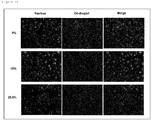
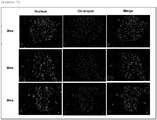
- SZ95 cells were cultured for 2 days in an oxygen concentration of each of 20.9%, 10%, 5%, 1% and 0.1%, and were then stained with Nile red, followed by performing observation under a fluorescence microscope.
- the obtained microscopic images are shown in Figures 1 and 2 .
- the circular region with low brightness (the region enclosed with the dotted line in the enlarged view of Figure 1 ), which is shown as white, indicates the nucleus of a cell
- the white dots with high brightness (indicates with the arrows in the enlarged view of Figure 1 ), which are present in large quantities around the nucleus, indicate lipid droplets.
- the cells which were cultured in oxygen concentrations of 0.1%, 1% and 5%, were strongly stained with Nile red, and thus it became clear that lipid droplets were accumulated in the cells. Among others, it was confirmed that the cells cultured in the lowest oxygen concentration (0.1%) had the highest lipid droplet formation percentage.
- Test 2 Change in the amount of lipid droplets formed in sebaceous gland cells, depending on culture time
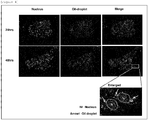
- SZ95 cells were cultured in an oxygen concentration of 0.1% for 3, 6, 9, 24 and 48 hours. As a result, the cells cultured for 24 hours or more were strongly stained with Nile red, and thus, it became clear that lipid droplets were abundantly accumulated in the cells ( Figures 3 and 4 ).
- PLIN1 is associated with the molecular mechanism of lipid droplet formation in sebaceous gland cells under a hypoxic environment, and that the amount of lipid droplets formed in sebaceous gland cells can be quantified using PLIN1 as an indicator.
Landscapes
- Health & Medical Sciences (AREA)
- Engineering & Computer Science (AREA)
- Life Sciences & Earth Sciences (AREA)
- Biomedical Technology (AREA)
- Wood Science & Technology (AREA)
- Zoology (AREA)
- Organic Chemistry (AREA)
- Bioinformatics & Cheminformatics (AREA)
- Genetics & Genomics (AREA)
- Chemical & Material Sciences (AREA)
- Biotechnology (AREA)
- Dermatology (AREA)
- Microbiology (AREA)
- Biochemistry (AREA)
- General Engineering & Computer Science (AREA)
- General Health & Medical Sciences (AREA)
- Cell Biology (AREA)
- Micro-Organisms Or Cultivation Processes Thereof (AREA)
- Measuring Or Testing Involving Enzymes Or Micro-Organisms (AREA)
- Apparatus Associated With Microorganisms And Enzymes (AREA)
Abstract
Description
- The present invention relates to a method for producing differentiated sebaceous gland cells capable of forming lipid droplets.
- Sebaceous gland is a multicellular alveolar secretory portion, and it secretes sebum through sebaceous gland openings formed on the inner surfaces of skin pores. Sebaceous gland cells are present in the sebaceous gland and play a role for releasing sebum. The secreted sebum protects and moisturizes the skin and hair. Abnormal secretion of sebum causes skin troubles such as oily skin, dry skin, acne, seborrhea, seborrheic dermatitis, and xeroderma. In particular, acne is a skin trouble which many people in the world, especially, young people have experienced.
- In order to conduct the research and development of pharmaceutical products or cosmetic products for controlling sebum secretion, it is important to construct a cultured cell model capable of reproducing the behavior of the sebaceous gland of a living animal. At present, as a sebaceous gland cell line which can be used in experiments, a hamster sebaceous gland cell line has been known. This cell line is advantageous in that it forms lipid droplets in cells, as with the sebaceous gland cells of a living body. On the other hand, since the genomic information of this cell line has not yet been elucidated, it is unsuitable for studies using a genetic approach.
-
Patent Literature 1 andNon Patent Literature 1 disclose a human-derived sebocyte cell line SZ95, which has been immortalized by transfection of SV-40 large T antigen DNA, and which is useful for the physiological inspection of the sebaceous gland. Since these cells are derived from humans, the genomic information thereof has been known, and it is advantageous as a study tool because it has high proliferation ability. On the other hand, the SZ95 cells are disadvantageous in that they hardly form lipid droplets therein. - In addition to the SZ95 cells disclosed in
Patent Literature 1 andNon Patent Literature 1, all of the conventional human sebaceous gland cells have the following problem: the cells lose an ability to form lipid droplets if they are cultured in vitro. To date, it has been reported that the accumulation of lipids in cytoplasm is observed when sebaceous gland cells isolated from human skin are cultured, but that the amount of lipids accumulated is only about 4 to 8 times larger than in the case of keratinocytes, and thus that the amount is significantly lower than in the case of sebaceous gland cells in vivo. It is suggested because differentiation of sebaceous gland cells becomes incomplete in the case of in-vitro culture (Non Patent Literature 2). In accordance with this report, it has also been reported that if a Myc gene, which promotes differentiation of the above-mentioned SZ95 cells into sebaceous gland cells, is introduced into the SZ95 cells, lipid droplets are accumulated in the cytoplasm thereof (Non Patent Literature 3). - Patent Literature 2 describes that the cultured sebaceous gland cells comprise both differentiated cells which biosynthesize sebum, and undifferentiated cells which have proliferation ability but do not have ability to biosynthesize sebum; and this patent literature proposes an idea that the cultured sebaceous gland cells do not produce sebum because only undifferentiated cells proliferate as a result of subcultures and differentiated cells which biosynthesize sebum are thereby reduced. Patent Literature 2 also discloses a method including subjecting undifferentiated sebaceous gland cells to a gyratory culture, so as to induce differentiation of the cells.
- Non Patent Literature 4 reports that when the human-derived sebocyte cell line SZ95 described in
Non Patent Literature 1 was treated with linoleic acid, the accumulation of lipid droplets was observed in the cells.Non Patent Literature 5 discloses that the accumulation of lipid droplets was confirmed in the sebocyte cell line SEB-1 derived from normal skin from human preauricular area. -
- (Patent Literature 1)
JP-A-2002-535984 - (Patent Literature 2)
JP-A-5-268948 -
- (Non Patent Literature 1) J Invest Dermatol, 1999, 113: 1011-1120
- (Non Patent Literature 2) Dermatology, 1998, 196: 21-31
- (Non Patent Literature 3) Stem cell, 2008, 26: 1241-1252
- (Non Patent Literature 4) J Invest Dermatol, 2008, 128: 1266-1272
- (Non Patent Literature 5) J Invest Dermatol, 2003, 120: 905-914
- The present invention provides a method for producing mature human sebaceous gland cells, comprising culturing immature human sebaceous gland cells under hypoxic conditions.
- In addition, the present invention provides a method for inducing differentiation of immature human sebaceous gland cells into mature human sebaceous gland cells, comprising culturing the immature human sebaceous gland cells under hypoxic conditions.
- Moreover, the present invention provides a method for evaluating and/or selecting a sebum secretion control agent, which comprises culturing immature human sebaceous gland cells under hypoxic conditions, and examining the influence of a test substance or test conditions on the formation of lipid droplets by the cultured cells.
- Furthermore, the present invention provides a device for culturing mature human sebaceous gland cells, which comprises a chamber for culturing cells and an oxygen concentration controller for adjusting or maintaining the culture atmosphere to hypoxic conditions.
- Further, the present invention provides a device for inducing differentiation of immature human sebaceous gland cells into mature human sebaceous gland cells, which comprises a chamber for culturing cells and an oxygen concentration controller for adjusting or maintaining the culture atmosphere to hypoxic conditions.
-
- [
Figure 1] Figure 1 shows the influence of the oxygen concentration on the formation of lipid droplets by sebaceous gland cells. Left: nucleus stained image, center: lipid droplet stained image, and right: merged image. The numerical value on the left side of the image indicates an oxygen concentration, and the term "Enlarged" indicates an enlarged view of a region surrounded with the white frame in the merged image showing a culture in an oxygen concentration of 1%. - [
Figure 2] Figure 2 shows the influence of the oxygen concentration on the formation of lipid droplets by sebaceous gland cells. Left: nucleus stained image, center: lipid droplet stained image, and right: merged image. The numerical value on the left side of the image indicates an oxygen concentration. - [
Figure 3] Figure 3 shows a change in the amount of lipid droplets formed by sebaceous gland cells, which have been cultured under hypoxic conditions for a culture time of 3 to 9 hours. Left: nucleus stained image, center: lipid droplet stained image, and right: merged image. - [
Figure 4] Figure 4 shows a change in the amount of lipid droplets formed by sebaceous gland cells, which have been cultured under hypoxic conditions for a culture time of 24 to 48 hours. Left: nucleus stained image, center: lipid droplet stained image, and right: merged image. The term "Enlarged" indicates an enlarged view of a region surrounded with the white frame in the merged image showing a culture for 48 hours. - [
Figure 5] Figure 5 shows the improvement of the expression level of PLIN1 in sebaceous gland cells, which have been cultured under hypoxic conditions. Error bar = SD, and n = 3. - The present invention relates to a method for producing differentiated, cultured sebaceous gland cells, which are capable of forming lipid droplets.
- The present inventors have conducted intensive studies regarding a method for imparting an ability to form lipid droplets, as in the case of sebaceous gland cells in vivo, to conventional cultured human sebaceous gland cells. As a result, the inventors found that human sebaceous gland cells differentiate into cells forming lipid droplets by culturing the human sebaceous gland cells under hypoxic conditions.
- According to the present invention, cultured mature human sebaceous gland cells, which have acquired the property of forming lipid droplets, as with sebaceous gland cells in vivo, can be provided. The cultured mature human sebaceous gland cells, which are provided by the present invention, can become useful tools for studies regarding the mechanism of sebum secretion or the development of pharmaceutical products or cosmetic products for controlling sebum secretion.
- In the outermost layer of the sebaceous gland, basal cells, which are undifferentiated sebaceous gland cells, are present and vigorously carry out cell division. After the basal cells have moved to the central portion of the sebaceous gland, the cell division is gradually terminated. Cells, which have terminated cell division, start to accumulate lipid droplets therein, and eventually, a major part of cytoplasm is filled with lipid droplets. The sebaceous gland cells, which comprise such lipid droplets, are differentiated sebaceous gland cells (J. Invest. Dermatol, 1974, 62: 147-152). The differentiated sebaceous gland cells comprising lipid droplets are finally disintegrated and as a result, release sebum.
- In the present description, the term "mature sebaceous gland cells" is used to mean differentiated sebaceous gland cells, which have lipid droplets therein. In addition, in the present description, the term "immature sebaceous gland cells" is used to distinguish the immature sebaceous gland cells from the above described "mature sebaceous gland cells," and this term means undifferentiated sebaceous gland cells, which are not the above described "mature sebaceous gland cells," or sebaceous gland cells, which do not have lipid droplets therein.
- The presence of lipid droplets in a cell can be confirmed by a known method. For example, as described in the after-mentioned examples, the presence of such lipid droplets can be confirmed by subjecting cells, which have been stained with a fat staining reagent such as Oil Red O or Nile Red, to microscopic observation, or by performing a fluorescence or absorbance measurement. For instance, when lipid droplets are present in a cell, a clear dot-shaped or circular stained region is observed in the cytoplasm of the cell, which has been treated with a fat staining reagent (for example,
Figure 1 ). Otherwise, the presence of lipid droplets in a cell can also be confirmed by, for example, measuring the expression level of a lipid droplet-associated protein, such as perilipin 1 (PLIN1), in the cell (PNAS, 2001, 98: 6494-6499). - In the present invention, differentiation of immature human sebaceous gland cells, in which lipid droplets are neither formed nor accumulated, is induced, and as a result, mature human sebaceous gland cells, in which lipid droplets are formed or accumulated, or the amount of lipid droplets accumulated is increased, are prepared. That is to say, in one aspect, the present invention relates to a method for producing mature human sebaceous gland cells. In another aspect, the present invention relates to a method for inducing differentiation of immature human sebaceous gland cells into mature human sebaceous gland cells. These methods of the present invention comprise culturing immature human sebaceous gland cells under hypoxic conditions.
- In the above described methods of the present invention, examples of the immature human sebaceous gland cells, which are to be subjected to a culture under hypoxic conditions, include: cultured human sebaceous gland cells prepared from the skin of a living body comprising a sebaceous gland according to a known method; and an established human sebaceous gland cell line. The immature human sebaceous gland cells are preferably an established human sebaceous gland cell line. Examples of the human sebaceous gland cell line include, but are not limited to, immortalized human-derived sebocyte cell lines as described in
Patent Literature 1 orNon Patent Literatures 1 and 5 (e.g., DSM ACC2383, SZ95, and SEB-1). - The above described cultured human sebaceous gland cells and cell lines may include not only immature sebaceous gland cells, but also some mature sebaceous gland cells. However, if a mixture of such immature cells and mature cells is cultured according to the method of the present invention, the cultured sebaceous gland cells, in which the content percentage of mature human sebaceous gland cells comprising lipid droplets has been significantly increased, can be prepared. Accordingly, the immature sebaceous gland cells cultured by the method of the present invention may be either a sebaceous gland cell population consisting of only immature sebaceous gland cells, or a sebaceous gland cell population comprising immature sebaceous gland cells. In other words, in one embodiment, the method for producing mature human sebaceous gland cells of the present invention may be a method for producing mature human sebaceous gland cells from immature human sebaceous gland cells; and in another embodiment, the method for producing mature human sebaceous gland cells of the present invention may be a method for producing a human sebaceous gland cell culture having a higher content percentage of mature human sebaceous gland cells, from a human sebaceous gland cell culture comprising immature human sebaceous gland cells.
- In the above described method of the present invention, the above described immature human sebaceous gland cells are cultured under hypoxic conditions. Thereby, the immature cells are induced to differentiate into mature human sebaceous gland cells. The hypoxic conditions in the present invention are conditions under which the oxygen concentration in the culture atmosphere is preferably approximately 5% or less, more preferably approximately 2% or less, and further preferably approximately 1% or less, or conditions under which the oxygen concentration in the culture atmosphere is from approximately 0.1% to approximately 5%. Such hypoxic conditions can be achieved using an incubator equipped with an oxygen concentration controller. Such an incubator is known, and various types of incubators are commercially available (for example, BIONIX hypoxic culture kit; SUGIYAMA-GEN CO., LTD.).
- With regard to other conditions applied to the culture of human sebaceous gland cells according to the above described method of the present invention, conditions for the in-vitro culture of ordinary human sebaceous gland cells may be applied. Examples of the culture conditions will be given below: As a medium, a basal medium, such as William's E Medium, D-MEM, RPMI1640, Ham's F-12, or Modified D-MEM/Ham's F-12 (1 : 1) medium (e.g., Sebomed™ basal medium), is used; and preferably, Modified D-MEM/Ham's F-12 (1 : 1) medium, to which from 0.1% to 20% of, preferably 10% of serum, from 1 to 10 ng/mL of, preferably from 3 to 6 ng/mL of Epidermal Growth Factor (EGF), from 0.1 to 20 µg/mL of, preferably from 5 to 15 µg/mL of hydrocortisone, and from 5 to 50 µg/mL of, preferably from 8 to 20 µg/mL of insulin have been added, is used. As a culture vessel, a plastic, a glass or the like, and preferably, a plastic is used. The concentration of cells seeded on a medium is from 1 × 10³ to 1 × 10⁶ cells/cm2, and preferably from 0.5 × 10³ cells/cm2 to 0.5 × 10⁵ cells/cm2. The culture is carried out at a culture temperature of from 30°C to 40°C, and preferably from 33°C to 38°C, under static, shaking or gyratory culture conditions, and preferably in a static state. The culture time may be determined, as appropriate, depending on the state of lipid droplets formed in cells, and it is preferably 24 hours or more, and more preferably approximately from 24 to 72 hours.
- Accordingly, in another aspect, the present invention relates to the use of a cell culture device comprising a means for culturing cells under the above described hypoxic conditions, for use in the culture of mature human sebaceous gland cells, or induction of immature human sebaceous gland cells to differentiate into mature human sebaceous gland cells. In one embodiment, the cell culture device comprises a chamber for culturing cells and an oxygen concentration controller for adjusting or maintaining the culture atmosphere to hypoxic conditions.
- The chamber used for the above described cell culture is not particularly limited, as long as it is capable of blocking the atmosphere in which cells are cultured, from the normal ambient atmosphere. Examples of the chamber include a hermetically sealed petri dish, jar, and incubator. The above described oxygen concentration controller is a device capable of adjusting or maintaining the oxygen concentration in the above described chamber to a concentration lower than the normal atmosphere, and preferably to the aforementioned hypoxic conditions. Examples of the oxygen concentration controller include an oxygen absorber, and an oxygen controller capable of mixing oxygen, nitrogen and carbon dioxide at any given concentrations. The above-exemplified chamber and oxygen concentration controller are commercially available, and further, a hypoxic culture kit, in which the two above devices are combined, is also commercially available (e.g., BIONIX hypoxic culture kit; SUGIYAMA-GEN CO., LTD.). For example, apparatuses or kits for hypoxic culture, which have been conventionally provided for use in the culture of cancer cells, can be applied as the device for culturing mature human sebaceous gland cells of the present invention.
- Since the mature human sebaceous gland cells obtained according to the aforementioned procedures have the property of forming or accumulating lipid droplets as with sebaceous gland cells in vivo, these cells can be used as human sebaceous gland models in studies regarding the mechanism of sebum secretion, or in the research and development of pharmaceutical products or cosmetic products for controlling sebum secretion.
- Therefore, in another aspect, the present invention relates to a method for evaluating and/or selecting a sebum secretion control agent by utilizing the above described human sebaceous gland cells cultured under hypoxic conditions, which have the property of forming or accumulating lipid droplets. This method comprises culturing immature human sebaceous gland cells under hypoxic conditions, and examining the influence of a test substance or test conditions on the formation of lipid droplets by the cultured cells. The procedures for culturing the immature human sebaceous gland cells under hypoxic conditions are as described above.
- In one embodiment of the method for evaluating and/or selecting a sebum secretion control agent of the present invention, the above described culture of immature human sebaceous gland cells under hypoxic conditions is carried out in the presence of a test substance. After completion of the culture for a predetermined period of time, lipid droplets in the cultured cells are observed, and the influence of the test substance on the formation of lipid droplets by the cells is then examined.
- In another embodiment, the above described culture of immature human sebaceous gland cells under hypoxic conditions is carried out under the application of test conditions. After completion of the culture for a predetermined period of time, lipid droplets in the cultured cells are observed, and the influence of the test conditions on the formation of lipid droplets by the cells is then examined.
- In another embodiment, the above described culture of immature human sebaceous gland cells under hypoxic conditions is carried out without the application of a test substance or test conditions, and thereafter, the cultured cells are further cultured under the application of a test substance or test conditions. This culture after the application of a test substance or test conditions is not necessarily carried out under hypoxic conditions. After completion of the culture for a predetermined period of time, lipid droplets in the cultured cells are observed, and the influence of the test substance or the test conditions on the formation of lipid droplets by the cells is then examined.
- The test substance or the test conditions are not particularly limited, as long as they are a substance or conditions which are desirably used for the control of sebum secretion. The test substance may be a naturally occurring substance, or may also be a substance artificially synthesized by a chemical or biological method, etc. Otherwise, the test substance may also be a compound, a composition, or a mixture. Examples of the test conditions include physicochemical conditions such as light (e.g., light irradiation or light shielding) or temperature (e.g., heating or cooling), but are not limited thereto.
- Examples of the method of applying a test substance or test conditions to the cultured cells include a method of adding a test substance to a medium, a method of directly adding test substance to cells, a method of culturing cells in an atmosphere in which a test substance is present, and a method of exposing cells during culture to predetermined physiochemical conditions, but are not limited thereto.
- Upon observation of lipid droplets in cells, such lipid droplets may be qualitatively evaluated by microscopic observation. Alternatively, the amount of lipid droplets formed by cells may also be quantified. Examples of the method of quantifying the amount of lipid droplets formed by cells include a method of quantifying the oil and fat amount, based on the staining intensity of cells stained with a fat staining reagent such as Oil Red O or Nile Red, which has been measured using a fluorescence or absorbance measurement device, and a method of quantifying the expression level of a lipid droplet-associated protein, such as perilipin 1 (PLIN1), in cells, according to real-time RT-PCR or the like.
- Subsequently, the influence of the test substance or the test conditions on the formation of lipid droplets by the cells is examined. When the amount of lipid droplets formed by the cultured cells has been increased or decreased by application of a test substance or test conditions, the test substance or the test conditions are selected as a sebum secretion control agent. More specifically, when the amount of lipid droplets formed by the cultured cells has been increased by application of a test substance or test conditions, the test substance or the test conditions are selected as a sebum secretion activator. On the other hand, when the amount of lipid droplets formed by the cultured cells has been decreased by application of a test substance or test conditions, the test substance or the test conditions are selected as a sebum secretion inhibitor.
- Preferably, the amount of lipid droplets formed by cells is compared with a control. When the amount of lipid droplets formed by cells, which had been cultured under the application of a test substance or test conditions, has been statistically significantly increased in comparison with the case of control cells, the test substance or the test conditions are selected as a sebum secretion activator. On the other hand, when the amount of lipid droplets formed by cells, which had been cultured under the application of a test substance or test conditions, has been statistically significantly decreased in comparison with the case of control cells, the test substance or the test conditions are selected as a sebum secretion inhibitor. Otherwise, when the amount of lipid droplets formed by cells, which had been cultured under the application of a test substance or test conditions, has been increased to preferably 120% or more, and more preferably 150% or more, in comparison to the case of control cells, the test substance or the test conditions are selected as a sebum secretion activator. On the other hand, when the amount of lipid droplets formed by cells, which had been cultured under the application of a test substance or test conditions, has been decreased to preferably 80% or less, and more preferably 60% or less, in comparison to the case of control cells, the test substance or the test conditions are selected as a sebum secretion inhibitor.
- Examples of such a control include: immature human sebaceous gland cells cultured under hypoxic conditions without the application of a test substance or test conditions, or in the presence of a control substance; and cells, to which a test substance or test conditions have not been applied during or after the culture of the cells under hypoxic conditions.
- The selected sebum secretion control agent has the effect of activating or inhibiting sebum secretion, and is able to treat or ameliorate various conditions or diseases associated with excessive sebum secretion or a reduction in the sebum secretion. For instance, the sebum secretion inhibitor can be used as an agent for treating or ameliorating acne, oily skin, seborrhea and the like, or as an active ingredient for suppressing odor (body odor, etc.) caused by sebum, whereas the sebum secretion activator can be used as an active ingredient of an agent for treating or ameliorating dry skin, xeroderma, dry eyes, roughened lips, dry lips, etc.
- The present invention also includes, as illustrative embodiments, the following substances, production methods, intended uses, or methods. However, these embodiments are not intended to limit the scope of the present invention.
- <1> A method for producing mature human sebaceous gland cells, comprising culturing immature human sebaceous gland cells under hypoxic conditions.
- <2> A method for inducing differentiation of immature human sebaceous gland cells into mature human sebaceous gland cells, comprising culturing the immature human sebaceous gland cells under hypoxic conditions.
- <3> A method for increasing the amount of lipid droplets formed by human sebaceous gland cells, comprising culturing immature human sebaceous gland cells under hypoxic conditions.
- <4> The method according to any one of the above <1> to <3>, wherein preferably, the above described immature human sebaceous gland cells are a sebaceous gland cell population consisting of only immature sebaceous gland cells, or a sebaceous gland cell population comprising immature sebaceous gland cells.
- <5> The method according to any one of the above <1> to <3>, wherein the above described immature human sebaceous gland cells are preferably a human sebaceous gland cell line, and more preferably cells registered under Accession No. DSM ACC2383, SZ95 cells, or SEB-1 cells.
- <6> The method according to any one of the above <1> to <5>, wherein the above described hypoxic conditions are conditions in which the oxygen concentration in the culture atmosphere is preferably approximately 5% or less, more preferably approximately 2% or less, and further preferably approximately 1% or less, or conditions in which the oxygen concentration in the culture atmosphere is from approximately 0.1% to approximately 5%.
- <7> The method according to any one of the above <1> to <6>, wherein preferably, the above described culture is carried out in a static state.
- <8> The method according to any one of the above <1> to <7>, wherein preferably, the above described culture is carried out for 24 hours or more.
- <9> A method for evaluating and/or selecting a sebum secretion control agent, which comprises culturing immature human sebaceous gland cells under hypoxic conditions, and examining the influence of a test substance or test conditions on the formation of lipid droplets by the cultured cells.
- <10> The method according to the above <9>, wherein preferably, the above described immature human sebaceous gland cells are a sebaceous gland cell population consisting of only immature sebaceous gland cells, or a sebaceous gland cell population comprising immature sebaceous gland cells.
- <11> The method according to the above <9>, wherein the above described immature human sebaceous gland cells are preferably a human sebaceous gland cell line, and more preferably cells registered under Accession No. DSM ACC2383, SZ95 cells, or SEB-1 cells.
- <12> The method according to any one of the above <9> to <11>, wherein the above described hypoxic conditions are conditions in which the oxygen concentration in the culture atmosphere is preferably approximately 5% or less, more preferably approximately 2% or less, and further preferably approximately 1% or less, or conditions in which the oxygen concentration in the culture atmosphere is from approximately 0.1% to approximately 5%.
- <13> The method according to any one of the above <9> to <12>, wherein preferably the above described culture is carried out in a static state.
- <14> The method according to any one of the above <9> to <13>, wherein preferably, the above described culture is carried out for 24 hours or more.
- <15> The method according to any one of the above <9> to <14>, wherein preferably, the above described culture of immature human sebaceous gland cells under hypoxic conditions is carried out in the presence of a test substance or under the application of test conditions.
- <16> The method according to any one of the above <9> to <14>, wherein preferably, the above described culture of immature human sebaceous gland cells under hypoxic conditions is carried out without the application of a test substance or test conditions, and the above described method further comprises further culturing the cells, which have been cultured under the hypoxic conditions, under the application of a test substance or test conditions.
- <17> The method according to any one of the above <9> to <16>, which preferably further comprises selecting a test substance or test conditions as a sebum secretion control agent, when the amount of lipid droplets formed by the cultured cells has been increased or decreased by the application of the test substance or the test conditions.
- <18> The method according to the above <15>, which preferably further comprises:
- culturing immature human sebaceous gland cells under hypoxic conditions, without the application of a test substance or test conditions, and
- any one of the following steps:
- selecting a test substance or test conditions as a sebum secretion activator, when the amount of lipid droplets formed by cells, which had been cultured under the application of the above described test substance or test conditions, has been statistically significantly increased in comparison to that formed by cells, which had been cultured without the application of the test substance or the test conditions;
- selecting a test substance or test conditions as a sebum secretion inhibitor, when the amount of lipid droplets formed by cells, which had been cultured under the application of the above described test substance or test conditions, has been statistically significantly decreased in comparison to that formed by cells, which had been cultured without the application of the test substance or the test conditions;
- selecting a test substance or test conditions as a sebum secretion activator, when the amount of lipid droplets formed by cells, which had been cultured under the application of the above described test substance or test conditions, has been increased to preferably 120% or more, and more preferably 150% or more, in comparison to that formed by cells, which had been cultured without the application of the test substance or the test conditions; and
- selecting a test substance or test conditions as a sebum secretion inhibitor, when the amount of lipid droplets formed by cells, which had been cultured under the application of the above described test substance or test conditions, has been decreased to preferably 80% or less, and more preferably 60% or less, in comparison to that formed by cells, which had been cultured without the application of the test substance or the test conditions.
- <19> The method according to the above <16>, which preferably further comprises:
- further culturing the above described cells, which had been cultured under the hypoxic conditions, without the application of a test substance or test conditions, and
- any one of the following steps:
- selecting a test substance or test conditions as a sebum secretion activator, when the amount of lipid droplets formed by cells, which had been cultured under the application of the above described test substance or test conditions, has been statistically significantly increased in comparison to that formed by cells, which had been cultured without the application of the test substance or the test conditions;
- selecting a test substance or test conditions as a sebum secretion inhibitor, when the amount of lipid droplets formed by cells, which had been cultured under the application of the above described test substance or test conditions, has been statistically significantly decreased in comparison to that formed by cells, which had been cultured without the application of the test substance or the test conditions;
- selecting a test substance or test conditions as a sebum secretion activator, when the amount of lipid droplets formed by cells, which had been cultured under the application of the above described test substance or test conditions, has been increased to preferably 120% or more, and more preferably 150% or more, in comparison to that formed by cells, which had been cultured without the application of the test substance or the test conditions; and
- selecting a test substance or test conditions as a sebum secretion inhibitor, when the amount of lipid droplets formed by cells, which had been cultured under the application of the above described test substance or test conditions, has been decreased to preferably 80% or less, and more preferably 60% or less, in comparison to that formed by cells, which had been cultured without the application of the test substance or the test conditions.
- <20> The method according to any one of the above <9> to <19>, wherein preferably, the above described sebum secretion control agent is an agent for treating or ameliorating various conditions or diseases, which are associated with excessive sebum secretion or a reduction in the sebum secretion.
- <21> A device for culturing mature human sebaceous gland cells, which comprises a chamber for culturing cells and an oxygen concentration controller for adjusting or maintaining the culture atmosphere to hypoxic conditions.
- <22> A device for inducing differentiation of immature human sebaceous gland cells into mature human sebaceous gland cells, which comprises a chamber for culturing cells and an oxygen concentration controller for adjusting or maintaining the culture atmosphere to hypoxic conditions.
- <23> The device according to the above <21> or <22>, wherein the above described hypoxic conditions are conditions in which the oxygen concentration in the culture atmosphere is preferably approximately 5% or less, more preferably approximately 2% or less, and further preferably approximately 1% or less, or conditions under which the oxygen concentration in the culture atmosphere is from approximately 0.1% to approximately 5%.
- Hereinafter, the present invention will be described more in detail based on the following examples. However, these examples are not intended to limit the scope of the present invention.
- A human sebaceous gland cell line (SZ95) was cultured in Sebomed™ basal medium containing 10% FBS and 5 ng/mL EGF. The culture under the normal oxygen concentration was carried out in an oxygen concentration (20.9%) in the atmosphere. The culture under hypoxic conditions was carried out using BIONIX hypoxic culture kit (SUGIYAMA-GEN CO., LTD.) under conditions of an oxygen concentration of 10%, 5%, 1% or 0.1%. In all cases, the cells were cultured in 5% CO2 at a temperature of 37°C for at maximum 72 hours.
- The SZ95 cells were immobilized with a 4% paraformaldehyde solution for 5 minutes, and were then stained with a 1 µg/mL Nile red solution (Sigma Aldrich) and a DAPI solution (Life Technologies) for 15 minutes at a room temperature. Thereafter, lipid droplets were observed under a fluorescence microscope.
- Total RNA was extracted from the cells using RNeasy (registered trademark) Mini kit, in accordance with protocols included with the kit. For the synthesis of cDNA from the extracted total RNA, QuantiTect (registered trademark) reverse transcription kit (QIAGEN) was used. In real-time PCR, TaqMan (registered trademark) Universal master Mix (Life technologies) and TaqMan probe (Life technologies) were used, and the expression level of mRNA of Perilipin 1 (PLIN1) and of Ribosomal protein LP0 (RPLP0) was quantified. The expression level of mRNA of PLIN1 was corrected based on the expression level of RPLP0.
- SZ95 cells were cultured for 2 days in an oxygen concentration of each of 20.9%, 10%, 5%, 1% and 0.1%, and were then stained with Nile red, followed by performing observation under a fluorescence microscope. The obtained microscopic images are shown in
Figures 1 and2 . InFigures 1 and2 , the circular region with low brightness (the region enclosed with the dotted line in the enlarged view ofFigure 1 ), which is shown as white, indicates the nucleus of a cell, and the white dots with high brightness (indicates with the arrows in the enlarged view ofFigure 1 ), which are present in large quantities around the nucleus, indicate lipid droplets. As a result of the microscopic observation, the cells, which were cultured in oxygen concentrations of 0.1%, 1% and 5%, were strongly stained with Nile red, and thus it became clear that lipid droplets were accumulated in the cells. Among others, it was confirmed that the cells cultured in the lowest oxygen concentration (0.1%) had the highest lipid droplet formation percentage. - SZ95 cells were cultured in an oxygen concentration of 0.1% for 3, 6, 9, 24 and 48 hours. As a result, the cells cultured for 24 hours or more were strongly stained with Nile red, and thus, it became clear that lipid droplets were abundantly accumulated in the cells (
Figures 3 and4 ). - It had been reported that the amount of lipid droplets, which are generally accumulated in adipocytes, are significantly decreased in Perilipin 1 (PLIN1) knockout mice (PNAS, 2001, 98: 6494-6499). In the present test, SZ95 cells were cultured under conditions of an oxygen concentration of 20.9% (normal) and 0.1% (low oxygen) for 24 or 48 hours, and thereafter, the expression level of PLIN1 in the cells was measured. As a result, it became clear that the expression of PLIN1 was significantly increased in the cells cultured under hypoxic conditions (0.1%), in comparison to under normal oxygen concentration (20.9%) conditions (
Figure 5 ). These results suggested that PLIN1 is associated with the molecular mechanism of lipid droplet formation in sebaceous gland cells under a hypoxic environment, and that the amount of lipid droplets formed in sebaceous gland cells can be quantified using PLIN1 as an indicator.
Claims (13)
- A method for producing mature human sebaceous gland cells, comprising culturing immature human sebaceous gland cells under hypoxic conditions.
- A method for inducing differentiation of immature human sebaceous gland cells into mature human sebaceous gland cells, comprising culturing the immature human sebaceous gland cells under hypoxic conditions.
- A method for evaluating and/or selecting a sebum secretion control agent, which comprises culturing immature human sebaceous gland cells under hypoxic conditions, and examining the influence of a test substance or test conditions on the accumulation of lipid droplets in the cultured cells.
- The method according to any one of claims 1 to 3, wherein the immature human sebaceous gland cells are a human sebaceous gland cell line.
- The method according to claim 4, wherein the human sebaceous gland cell line is cells registered under Accession No. DSM ACC2383, SZ95 cells, or SEB-1 cells.
- The method according to any one of claims 1 to 5, wherein the hypoxic conditions are conditions in which the oxygen concentration in the culture atmosphere is 5% or less.
- The method according to any one of claims 1 to 5, wherein the hypoxic conditions are conditions in which the oxygen concentration in the culture atmosphere is 2% or less.
- The method according to any one of claims 1 to 5, wherein the hypoxic conditions are conditions in which the oxygen concentration in the culture atmosphere is 1% or less.
- The method according to any one of claims 1 to 5, wherein the hypoxic conditions are conditions in which the oxygen concentration in the culture atmosphere is from 0.1% to 5%.
- The method according to any one of claims 1 to 9, wherein the culture is carried out in a static state.
- The method according to any one of claims 1 to 10, wherein the culture is carried out for 24 hours or more.
- A device for culturing mature human sebaceous gland cells, which comprises a chamber for culturing cells and an oxygen concentration controller for adjusting or maintaining the culture atmosphere to hypoxic conditions.
- A device for inducing differentiation of immature human sebaceous gland cells into mature human sebaceous gland cells, which comprises a chamber for culturing cells and an oxygen concentration controller for adjusting or maintaining the culture atmosphere to hypoxic conditions.
Applications Claiming Priority (1)
| Application Number | Priority Date | Filing Date | Title |
|---|---|---|---|
| PCT/JP2016/053692 WO2017138078A1 (en) | 2016-02-08 | 2016-02-08 | Method for producing mature sebaceous gland cells |
Publications (3)
| Publication Number | Publication Date |
|---|---|
| EP3249042A1 true EP3249042A1 (en) | 2017-11-29 |
| EP3249042A4 EP3249042A4 (en) | 2018-01-03 |
| EP3249042B1 EP3249042B1 (en) | 2018-08-01 |
Family
ID=57326603
Family Applications (1)
| Application Number | Title | Priority Date | Filing Date |
|---|---|---|---|
| EP16889780.9A Not-in-force EP3249042B1 (en) | 2016-02-08 | 2016-02-08 | Method for producing mature sebaceous gland cells |
Country Status (5)
| Country | Link |
|---|---|
| US (1) | US20180051251A1 (en) |
| EP (1) | EP3249042B1 (en) |
| JP (1) | JP6026707B1 (en) |
| CN (1) | CN107241908B (en) |
| WO (1) | WO2017138078A1 (en) |
Cited By (1)
| Publication number | Priority date | Publication date | Assignee | Title |
|---|---|---|---|---|
| WO2021089501A1 (en) * | 2019-11-06 | 2021-05-14 | Dsm Ip Assets B.V. | Novel method |
Family Cites Families (5)
| Publication number | Priority date | Publication date | Assignee | Title |
|---|---|---|---|---|
| JPH05268948A (en) | 1992-03-30 | 1993-10-19 | Nippon Zeon Co Ltd | Sebaceous gland cell culture method |
| DE19903920B4 (en) * | 1999-02-01 | 2005-08-25 | Zouboulis, Ch.C., Priv.-Doz.Dr. | Sebocytes, sebocyte cell line and their uses |
| JP2013048567A (en) * | 2011-08-30 | 2013-03-14 | Mitsubishi Gas Chemical Co Inc | Gas barrier sealed container |
| JP2015530122A (en) * | 2012-10-05 | 2015-10-15 | チルドレンズ ホスピタル メディカル センター | Sebaceous cell culture and methods of use |
| US9592257B2 (en) * | 2013-10-11 | 2017-03-14 | MWV Cell, LLC | Complete human skin organ generated from culture-expanded cells |
-
2016
- 2016-02-08 CN CN201680004131.4A patent/CN107241908B/en not_active Expired - Fee Related
- 2016-02-08 US US15/531,163 patent/US20180051251A1/en not_active Abandoned
- 2016-02-08 WO PCT/JP2016/053692 patent/WO2017138078A1/en not_active Ceased
- 2016-02-08 JP JP2016515560A patent/JP6026707B1/en active Active
- 2016-02-08 EP EP16889780.9A patent/EP3249042B1/en not_active Not-in-force
Cited By (1)
| Publication number | Priority date | Publication date | Assignee | Title |
|---|---|---|---|---|
| WO2021089501A1 (en) * | 2019-11-06 | 2021-05-14 | Dsm Ip Assets B.V. | Novel method |
Also Published As
| Publication number | Publication date |
|---|---|
| CN107241908B (en) | 2021-02-26 |
| US20180051251A1 (en) | 2018-02-22 |
| JP6026707B1 (en) | 2016-11-16 |
| JPWO2017138078A1 (en) | 2018-02-15 |
| EP3249042B1 (en) | 2018-08-01 |
| CN107241908A (en) | 2017-10-10 |
| EP3249042A4 (en) | 2018-01-03 |
| WO2017138078A1 (en) | 2017-08-17 |
Similar Documents
| Publication | Publication Date | Title |
|---|---|---|
| Yu et al. | Stem cells with neural crest characteristics derived from the bulge region of cultured human hair follicles | |
| KR102202160B1 (en) | Tissue structure and manufacturing method therefor | |
| Su et al. | TAp63 prevents premature aging by promoting adult stem cell maintenance | |
| Ni et al. | Neonatal rat primary microglia: isolation, culturing, and selected applications | |
| CN104694460A (en) | Culture medium for normal epithelial cell of human or mammal, culture methods, normal epithelial cell and application of normal epithelial cell | |
| WO2012093173A1 (en) | Tumour cell and tissue culture | |
| Agabalyan et al. | Enhanced expansion and sustained inductive function of skin-derived precursor cells in computer-controlled stirred suspension bioreactors | |
| JP2015530122A (en) | Sebaceous cell culture and methods of use | |
| Li et al. | In vitro biomimetic platforms featuring a perfusion system and 3D spheroid culture promote the construction of tissue-engineered corneal endothelial layers | |
| CN104271167B (en) | Method for preparing artificial tooth primordium in vitro and artificial tooth primordium obtained therefrom | |
| JP2013502219A (en) | Human skin explant culture system and use thereof | |
| EP3249042B1 (en) | Method for producing mature sebaceous gland cells | |
| Xie et al. | Isolation and culture of primary human gingival epithelial cells using Y-27632 | |
| Pagliaro et al. | Generation of human fetal brain organoids and their CRISPR engineering for brain tumor modeling | |
| JP6182728B2 (en) | Methods for evaluating efficacy and toxicity targeting stem cells | |
| JP5904789B2 (en) | Co-culture system of peripheral nerve cells and keratinocytes and method of use thereof | |
| Goff et al. | Isolation, culture, and transfection of melanocytes | |
| Theus et al. | Reproducible expansion and characterization of mouse neural stem/progenitor cells in adherent cultures derived from the adult subventricular zone | |
| JP7147014B2 (en) | Method for producing senescent pigment-forming cells, cells produced by the method, and screening method for aging-improving substances using the cells | |
| KR20230026952A (en) | Method for manufacturing pluripotent stem cell-derived epidermal organoids | |
| Kang et al. | Mucociliary epithelial organoids from xenopus embryonic cells: generation, culture and high-resolution live imaging | |
| Lo Cicero et al. | Pathological modelling of pigmentation disorders associated with Hutchinson-Gilford Progeria Syndrome (HGPS) revealed an impaired melanogenesis pathway in iPS-derived melanocytes | |
| Do et al. | Exogenous expression of PGC-1α during in vitro maturation impairs the developmental competence of porcine oocytes | |
| Kajtez et al. | Injectable 3D microcultures enable intracerebral transplantation of mature neurons directly reprogrammed from patient fibroblasts | |
| JP6227547B2 (en) | Neural stem cells having increased passage ability, method for producing neural stem cells having increased passage ability, and method for culturing neural stem cells for increasing passage ability of neural stem cells |
Legal Events
| Date | Code | Title | Description |
|---|---|---|---|
| STAA | Information on the status of an ep patent application or granted ep patent |
Free format text: STATUS: THE INTERNATIONAL PUBLICATION HAS BEEN MADE |
|
| PUAI | Public reference made under article 153(3) epc to a published international application that has entered the european phase |
Free format text: ORIGINAL CODE: 0009012 |
|
| STAA | Information on the status of an ep patent application or granted ep patent |
Free format text: STATUS: REQUEST FOR EXAMINATION WAS MADE |
|
| 17P | Request for examination filed |
Effective date: 20170824 |
|
| AK | Designated contracting states |
Kind code of ref document: A1 Designated state(s): AL AT BE BG CH CY CZ DE DK EE ES FI FR GB GR HR HU IE IS IT LI LT LU LV MC MK MT NL NO PL PT RO RS SE SI SK SM TR |
|
| AX | Request for extension of the european patent |
Extension state: BA ME |
|
| A4 | Supplementary search report drawn up and despatched |
Effective date: 20171205 |
|
| RIC1 | Information provided on ipc code assigned before grant |
Ipc: C12N 5/071 20100101AFI20171129BHEP |
|
| GRAP | Despatch of communication of intention to grant a patent |
Free format text: ORIGINAL CODE: EPIDOSNIGR1 |
|
| STAA | Information on the status of an ep patent application or granted ep patent |
Free format text: STATUS: GRANT OF PATENT IS INTENDED |
|
| INTG | Intention to grant announced |
Effective date: 20180126 |
|
| GRAS | Grant fee paid |
Free format text: ORIGINAL CODE: EPIDOSNIGR3 |
|
| GRAA | (expected) grant |
Free format text: ORIGINAL CODE: 0009210 |
|
| STAA | Information on the status of an ep patent application or granted ep patent |
Free format text: STATUS: THE PATENT HAS BEEN GRANTED |
|
| DAV | Request for validation of the european patent (deleted) | ||
| DAX | Request for extension of the european patent (deleted) | ||
| RAP1 | Party data changed (applicant data changed or rights of an application transferred) |
Owner name: KAO CORPORATION |
|
| AK | Designated contracting states |
Kind code of ref document: B1 Designated state(s): AL AT BE BG CH CY CZ DE DK EE ES FI FR GB GR HR HU IE IS IT LI LT LU LV MC MK MT NL NO PL PT RO RS SE SI SK SM TR |
|
| REG | Reference to a national code |
Ref country code: GB Ref legal event code: FG4D |
|
| REG | Reference to a national code |
Ref country code: CH Ref legal event code: EP Ref country code: AT Ref legal event code: REF Ref document number: 1024323 Country of ref document: AT Kind code of ref document: T Effective date: 20180815 |
|
| REG | Reference to a national code |
Ref country code: IE Ref legal event code: FG4D |
|
| REG | Reference to a national code |
Ref country code: DE Ref legal event code: R096 Ref document number: 602016004574 Country of ref document: DE |
|
| REG | Reference to a national code |
Ref country code: NL Ref legal event code: MP Effective date: 20180801 |
|
| REG | Reference to a national code |
Ref country code: LT Ref legal event code: MG4D |
|
| REG | Reference to a national code |
Ref country code: AT Ref legal event code: MK05 Ref document number: 1024323 Country of ref document: AT Kind code of ref document: T Effective date: 20180801 |
|
| PG25 | Lapsed in a contracting state [announced via postgrant information from national office to epo] |
Ref country code: IS Free format text: LAPSE BECAUSE OF FAILURE TO SUBMIT A TRANSLATION OF THE DESCRIPTION OR TO PAY THE FEE WITHIN THE PRESCRIBED TIME-LIMIT Effective date: 20181201 Ref country code: RS Free format text: LAPSE BECAUSE OF FAILURE TO SUBMIT A TRANSLATION OF THE DESCRIPTION OR TO PAY THE FEE WITHIN THE PRESCRIBED TIME-LIMIT Effective date: 20180801 Ref country code: FI Free format text: LAPSE BECAUSE OF FAILURE TO SUBMIT A TRANSLATION OF THE DESCRIPTION OR TO PAY THE FEE WITHIN THE PRESCRIBED TIME-LIMIT Effective date: 20180801 Ref country code: NO Free format text: LAPSE BECAUSE OF FAILURE TO SUBMIT A TRANSLATION OF THE DESCRIPTION OR TO PAY THE FEE WITHIN THE PRESCRIBED TIME-LIMIT Effective date: 20181101 Ref country code: GR Free format text: LAPSE BECAUSE OF FAILURE TO SUBMIT A TRANSLATION OF THE DESCRIPTION OR TO PAY THE FEE WITHIN THE PRESCRIBED TIME-LIMIT Effective date: 20181102 Ref country code: BG Free format text: LAPSE BECAUSE OF FAILURE TO SUBMIT A TRANSLATION OF THE DESCRIPTION OR TO PAY THE FEE WITHIN THE PRESCRIBED TIME-LIMIT Effective date: 20181101 Ref country code: SE Free format text: LAPSE BECAUSE OF FAILURE TO SUBMIT A TRANSLATION OF THE DESCRIPTION OR TO PAY THE FEE WITHIN THE PRESCRIBED TIME-LIMIT Effective date: 20180801 Ref country code: AT Free format text: LAPSE BECAUSE OF FAILURE TO SUBMIT A TRANSLATION OF THE DESCRIPTION OR TO PAY THE FEE WITHIN THE PRESCRIBED TIME-LIMIT Effective date: 20180801 Ref country code: PL Free format text: LAPSE BECAUSE OF FAILURE TO SUBMIT A TRANSLATION OF THE DESCRIPTION OR TO PAY THE FEE WITHIN THE PRESCRIBED TIME-LIMIT Effective date: 20180801 Ref country code: LT Free format text: LAPSE BECAUSE OF FAILURE TO SUBMIT A TRANSLATION OF THE DESCRIPTION OR TO PAY THE FEE WITHIN THE PRESCRIBED TIME-LIMIT Effective date: 20180801 Ref country code: NL Free format text: LAPSE BECAUSE OF FAILURE TO SUBMIT A TRANSLATION OF THE DESCRIPTION OR TO PAY THE FEE WITHIN THE PRESCRIBED TIME-LIMIT Effective date: 20180801 |
|
| PG25 | Lapsed in a contracting state [announced via postgrant information from national office to epo] |
Ref country code: HR Free format text: LAPSE BECAUSE OF FAILURE TO SUBMIT A TRANSLATION OF THE DESCRIPTION OR TO PAY THE FEE WITHIN THE PRESCRIBED TIME-LIMIT Effective date: 20180801 Ref country code: LV Free format text: LAPSE BECAUSE OF FAILURE TO SUBMIT A TRANSLATION OF THE DESCRIPTION OR TO PAY THE FEE WITHIN THE PRESCRIBED TIME-LIMIT Effective date: 20180801 Ref country code: AL Free format text: LAPSE BECAUSE OF FAILURE TO SUBMIT A TRANSLATION OF THE DESCRIPTION OR TO PAY THE FEE WITHIN THE PRESCRIBED TIME-LIMIT Effective date: 20180801 |
|
| PG25 | Lapsed in a contracting state [announced via postgrant information from national office to epo] |
Ref country code: RO Free format text: LAPSE BECAUSE OF FAILURE TO SUBMIT A TRANSLATION OF THE DESCRIPTION OR TO PAY THE FEE WITHIN THE PRESCRIBED TIME-LIMIT Effective date: 20180801 Ref country code: CZ Free format text: LAPSE BECAUSE OF FAILURE TO SUBMIT A TRANSLATION OF THE DESCRIPTION OR TO PAY THE FEE WITHIN THE PRESCRIBED TIME-LIMIT Effective date: 20180801 Ref country code: ES Free format text: LAPSE BECAUSE OF FAILURE TO SUBMIT A TRANSLATION OF THE DESCRIPTION OR TO PAY THE FEE WITHIN THE PRESCRIBED TIME-LIMIT Effective date: 20180801 Ref country code: EE Free format text: LAPSE BECAUSE OF FAILURE TO SUBMIT A TRANSLATION OF THE DESCRIPTION OR TO PAY THE FEE WITHIN THE PRESCRIBED TIME-LIMIT Effective date: 20180801 Ref country code: IT Free format text: LAPSE BECAUSE OF FAILURE TO SUBMIT A TRANSLATION OF THE DESCRIPTION OR TO PAY THE FEE WITHIN THE PRESCRIBED TIME-LIMIT Effective date: 20180801 |
|
| REG | Reference to a national code |
Ref country code: DE Ref legal event code: R097 Ref document number: 602016004574 Country of ref document: DE |
|
| PG25 | Lapsed in a contracting state [announced via postgrant information from national office to epo] |
Ref country code: DK Free format text: LAPSE BECAUSE OF FAILURE TO SUBMIT A TRANSLATION OF THE DESCRIPTION OR TO PAY THE FEE WITHIN THE PRESCRIBED TIME-LIMIT Effective date: 20180801 Ref country code: SM Free format text: LAPSE BECAUSE OF FAILURE TO SUBMIT A TRANSLATION OF THE DESCRIPTION OR TO PAY THE FEE WITHIN THE PRESCRIBED TIME-LIMIT Effective date: 20180801 Ref country code: SK Free format text: LAPSE BECAUSE OF FAILURE TO SUBMIT A TRANSLATION OF THE DESCRIPTION OR TO PAY THE FEE WITHIN THE PRESCRIBED TIME-LIMIT Effective date: 20180801 |
|
| PLBE | No opposition filed within time limit |
Free format text: ORIGINAL CODE: 0009261 |
|
| STAA | Information on the status of an ep patent application or granted ep patent |
Free format text: STATUS: NO OPPOSITION FILED WITHIN TIME LIMIT |
|
| 26N | No opposition filed |
Effective date: 20190503 |
|
| PG25 | Lapsed in a contracting state [announced via postgrant information from national office to epo] |
Ref country code: SI Free format text: LAPSE BECAUSE OF FAILURE TO SUBMIT A TRANSLATION OF THE DESCRIPTION OR TO PAY THE FEE WITHIN THE PRESCRIBED TIME-LIMIT Effective date: 20180801 |
|
| REG | Reference to a national code |
Ref country code: CH Ref legal event code: PL |
|
| PG25 | Lapsed in a contracting state [announced via postgrant information from national office to epo] |
Ref country code: LU Free format text: LAPSE BECAUSE OF NON-PAYMENT OF DUE FEES Effective date: 20190208 Ref country code: MC Free format text: LAPSE BECAUSE OF FAILURE TO SUBMIT A TRANSLATION OF THE DESCRIPTION OR TO PAY THE FEE WITHIN THE PRESCRIBED TIME-LIMIT Effective date: 20180801 |
|
| REG | Reference to a national code |
Ref country code: BE Ref legal event code: MM Effective date: 20190228 |
|
| REG | Reference to a national code |
Ref country code: IE Ref legal event code: MM4A |
|
| PG25 | Lapsed in a contracting state [announced via postgrant information from national office to epo] |
Ref country code: CH Free format text: LAPSE BECAUSE OF NON-PAYMENT OF DUE FEES Effective date: 20190228 Ref country code: LI Free format text: LAPSE BECAUSE OF NON-PAYMENT OF DUE FEES Effective date: 20190228 |
|
| PG25 | Lapsed in a contracting state [announced via postgrant information from national office to epo] |
Ref country code: IE Free format text: LAPSE BECAUSE OF NON-PAYMENT OF DUE FEES Effective date: 20190208 |
|
| PG25 | Lapsed in a contracting state [announced via postgrant information from national office to epo] |
Ref country code: BE Free format text: LAPSE BECAUSE OF NON-PAYMENT OF DUE FEES Effective date: 20190228 |
|
| PG25 | Lapsed in a contracting state [announced via postgrant information from national office to epo] |
Ref country code: TR Free format text: LAPSE BECAUSE OF FAILURE TO SUBMIT A TRANSLATION OF THE DESCRIPTION OR TO PAY THE FEE WITHIN THE PRESCRIBED TIME-LIMIT Effective date: 20180801 |
|
| PG25 | Lapsed in a contracting state [announced via postgrant information from national office to epo] |
Ref country code: MT Free format text: LAPSE BECAUSE OF NON-PAYMENT OF DUE FEES Effective date: 20190208 Ref country code: PT Free format text: LAPSE BECAUSE OF FAILURE TO SUBMIT A TRANSLATION OF THE DESCRIPTION OR TO PAY THE FEE WITHIN THE PRESCRIBED TIME-LIMIT Effective date: 20181201 |
|
| PG25 | Lapsed in a contracting state [announced via postgrant information from national office to epo] |
Ref country code: CY Free format text: LAPSE BECAUSE OF FAILURE TO SUBMIT A TRANSLATION OF THE DESCRIPTION OR TO PAY THE FEE WITHIN THE PRESCRIBED TIME-LIMIT Effective date: 20180801 |
|
| PG25 | Lapsed in a contracting state [announced via postgrant information from national office to epo] |
Ref country code: HU Free format text: LAPSE BECAUSE OF FAILURE TO SUBMIT A TRANSLATION OF THE DESCRIPTION OR TO PAY THE FEE WITHIN THE PRESCRIBED TIME-LIMIT; INVALID AB INITIO Effective date: 20160208 |
|
| PGFP | Annual fee paid to national office [announced via postgrant information from national office to epo] |
Ref country code: GB Payment date: 20211230 Year of fee payment: 7 |
|
| PGFP | Annual fee paid to national office [announced via postgrant information from national office to epo] |
Ref country code: DE Payment date: 20211230 Year of fee payment: 7 |
|
| PGFP | Annual fee paid to national office [announced via postgrant information from national office to epo] |
Ref country code: FR Payment date: 20220118 Year of fee payment: 7 |
|
| PG25 | Lapsed in a contracting state [announced via postgrant information from national office to epo] |
Ref country code: MK Free format text: LAPSE BECAUSE OF FAILURE TO SUBMIT A TRANSLATION OF THE DESCRIPTION OR TO PAY THE FEE WITHIN THE PRESCRIBED TIME-LIMIT Effective date: 20180801 |
|
| REG | Reference to a national code |
Ref country code: DE Ref legal event code: R119 Ref document number: 602016004574 Country of ref document: DE |
|
| GBPC | Gb: european patent ceased through non-payment of renewal fee |
Effective date: 20230208 |
|
| PG25 | Lapsed in a contracting state [announced via postgrant information from national office to epo] |
Ref country code: GB Free format text: LAPSE BECAUSE OF NON-PAYMENT OF DUE FEES Effective date: 20230208 |
|
| PG25 | Lapsed in a contracting state [announced via postgrant information from national office to epo] |
Ref country code: GB Free format text: LAPSE BECAUSE OF NON-PAYMENT OF DUE FEES Effective date: 20230208 Ref country code: FR Free format text: LAPSE BECAUSE OF NON-PAYMENT OF DUE FEES Effective date: 20230228 Ref country code: DE Free format text: LAPSE BECAUSE OF NON-PAYMENT OF DUE FEES Effective date: 20230901 |