EP3247219B1 - Extruded protein product and methods of making - Google Patents
Extruded protein product and methods of making Download PDFInfo
- Publication number
- EP3247219B1 EP3247219B1 EP16740570.3A EP16740570A EP3247219B1 EP 3247219 B1 EP3247219 B1 EP 3247219B1 EP 16740570 A EP16740570 A EP 16740570A EP 3247219 B1 EP3247219 B1 EP 3247219B1
- Authority
- EP
- European Patent Office
- Prior art keywords
- protein
- pieces
- extruded
- extruded pieces
- composition
- Prior art date
- Legal status (The legal status is an assumption and is not a legal conclusion. Google has not performed a legal analysis and makes no representation as to the accuracy of the status listed.)
- Active
Links
Images




Classifications
-
- A—HUMAN NECESSITIES
- A23—FOODS OR FOODSTUFFS; TREATMENT THEREOF, NOT COVERED BY OTHER CLASSES
- A23J—PROTEIN COMPOSITIONS FOR FOODSTUFFS; WORKING-UP PROTEINS FOR FOODSTUFFS; PHOSPHATIDE COMPOSITIONS FOR FOODSTUFFS
- A23J3/00—Working-up of proteins for foodstuffs
- A23J3/22—Working-up of proteins for foodstuffs by texturising
- A23J3/26—Working-up of proteins for foodstuffs by texturising using extrusion or expansion
-
- A—HUMAN NECESSITIES
- A23—FOODS OR FOODSTUFFS; TREATMENT THEREOF, NOT COVERED BY OTHER CLASSES
- A23J—PROTEIN COMPOSITIONS FOR FOODSTUFFS; WORKING-UP PROTEINS FOR FOODSTUFFS; PHOSPHATIDE COMPOSITIONS FOR FOODSTUFFS
- A23J3/00—Working-up of proteins for foodstuffs
- A23J3/14—Vegetable proteins
- A23J3/16—Vegetable proteins from soybean
-
- A—HUMAN NECESSITIES
- A23—FOODS OR FOODSTUFFS; TREATMENT THEREOF, NOT COVERED BY OTHER CLASSES
- A23L—FOODS, FOODSTUFFS OR NON-ALCOHOLIC BEVERAGES, NOT OTHERWISE PROVIDED FOR; PREPARATION OR TREATMENT THEREOF
- A23L33/00—Modifying nutritive qualities of foods; Dietetic products; Preparation or treatment thereof
- A23L33/10—Modifying nutritive qualities of foods; Dietetic products; Preparation or treatment thereof using additives
- A23L33/17—Amino acids, peptides or proteins
- A23L33/185—Vegetable proteins
-
- A—HUMAN NECESSITIES
- A23—FOODS OR FOODSTUFFS; TREATMENT THEREOF, NOT COVERED BY OTHER CLASSES
- A23P—SHAPING OR WORKING OF FOODSTUFFS, NOT FULLY COVERED BY A SINGLE OTHER SUBCLASS
- A23P20/00—Coating of foodstuffs; Coatings therefor; Making laminated, multi-layered, stuffed or hollow foodstuffs
- A23P20/10—Coating with edible coatings, e.g. with oils or fats
-
- A—HUMAN NECESSITIES
- A23—FOODS OR FOODSTUFFS; TREATMENT THEREOF, NOT COVERED BY OTHER CLASSES
- A23P—SHAPING OR WORKING OF FOODSTUFFS, NOT FULLY COVERED BY A SINGLE OTHER SUBCLASS
- A23P20/00—Coating of foodstuffs; Coatings therefor; Making laminated, multi-layered, stuffed or hollow foodstuffs
- A23P20/10—Coating with edible coatings, e.g. with oils or fats
- A23P20/105—Coating with compositions containing vegetable or microbial fermentation gums, e.g. cellulose or derivatives; Coating with edible polymers, e.g. polyvinyalcohol
-
- A—HUMAN NECESSITIES
- A23—FOODS OR FOODSTUFFS; TREATMENT THEREOF, NOT COVERED BY OTHER CLASSES
- A23P—SHAPING OR WORKING OF FOODSTUFFS, NOT FULLY COVERED BY A SINGLE OTHER SUBCLASS
- A23P20/00—Coating of foodstuffs; Coatings therefor; Making laminated, multi-layered, stuffed or hollow foodstuffs
- A23P20/10—Coating with edible coatings, e.g. with oils or fats
- A23P20/11—Coating with compositions containing a majority of oils, fats, mono/diglycerides, fatty acids, mineral oils, waxes or paraffins
-
- A—HUMAN NECESSITIES
- A23—FOODS OR FOODSTUFFS; TREATMENT THEREOF, NOT COVERED BY OTHER CLASSES
- A23P—SHAPING OR WORKING OF FOODSTUFFS, NOT FULLY COVERED BY A SINGLE OTHER SUBCLASS
- A23P30/00—Shaping or working of foodstuffs characterised by the process or apparatus
- A23P30/20—Extruding
Definitions
- the present disclosure generally relates to an extruded protein product and methods of making such a product.
- High protein food products have found popularity among consumers as a way to eat nutritionally dense foods.
- US 2009/0155447 relates to food materials containing a high concentration of vegetable protein and omega-3 fatty acids and processes for their manufacture. Consumers want diverse ways to get increased protein into their diets. Thus, there is a need for new high protein food products to satisfy the increasing consumer desire for protein.
- the present invention relates to a composition comprising extruded pieces according to claim 1, a method of making a protein product according to claim 10 and a method of making a food composition according to claim 20.
- a composition including extruded pieces include protein in an amount of 30% to 90% by weight, a protein matrix disruptive ingredient in an amount of from 5% to 50% by weight, oil in an amount of from 2% to 20% by weight, water in an amount of from 1.5% to 8% by weight, and inclusions in an amount of from 0% to 50% by weight.
- the oil can be substantially uniformly distributed throughout the extruded pieces.
- the extruded pieces can have protein granules within, or surrounded by, a matrix that includes the protein matrix disruptive ingredient.
- the protein granules can have a substantially non-linearly oriented protein matrix, or the protein granules can have regions of a linearly oriented protein matrix.
- the protein granules can have an average size greater than 75 ⁇ m.
- the extruded pieces can have a texture analysis measurement of from 1000 g to 7400 g force, or from 2000 g to 5000 g force, and a density of from 0.7 g/cc to 1.0 g/cc.
- the extruded pieces can have a rough and/or uneven surface.
- the protein can include one or a combination of soy protein, whey protein, bean protein, pea protein, wheat protein, canola protein, or algae protein.
- the protein matrix disruptive ingredient can be a non-protein component of a protein concentrate or a protein isolate.
- the protein matrix disruptive ingredient can be a flour or a syrup. In some embodiments, the protein matrix disruptive ingredient can include a starch, a sugar, or a fiber.
- extruded pieces can have a protein content of 45-70%, or 60-70%, by weight and have a cold water hydration rate of from 1.6 to 1.9, or from 1.7 to 1.9.
- extruded pieces can have a protein content of 45-70%, or 60-70%, by weight and have a hot water hydration rate of from 2.0 to 2.8, or from 2.5 to 2.8.
- extruded pieces can have a protein content of 40-65% by weight and have a cold water hydration rate of from 2.1 to 2.7.
- extruded pieces can have a protein content of 40-65% by weight and have a hot water hydration rate of from 3.0 to 3.75.
- the inclusions can be one or a combination of nuts, seeds, fruit, grains, or coconut.
- the extruded pieces can have inclusions substantially uniformly distributed throughout the extruded pieces.
- extruded pieces can include one or more colorant or flavorant. In some embodiments, extruded pieces can have a marbled appearance.
- the oil can be substantially uniformly distributed throughout the extruded pieces.
- the extruded pieces can have a sugar-based coating, a fat-based coating, or a protein-based coating.
- an extruded piece can be adhered with one or more edible component to form a cluster. In some embodiments, an extruded piece can be adhered to one or more additional extruded piece to form a cluster. In some embodiments, an extruded piece can be adhered with one or more edible component to form a bar.
- a food product includes food product pieces and extruded pieces having protein in an amount of 30% to 90% by weight, a protein matrix disruptive ingredient in an amount of from 5% to 50% by weight, oil in an amount of from 2% to 20% by weight, water in an amount of from 1.5% to 8% by weight, and inclusions in an amount of from 0% to 50% by weight.
- a composition including particulates derived from extruded pieces, where the extruded pieces have protein in an amount of 30% to 90% by weight, a protein matrix disruptive ingredient in an amount of from 5% to 50% by weight, oil in an amount of from 2% to 20% by weight, water in an amount of from 1.5% to 8% by weight, and inclusions in an amount of from 0% to 50% by weight.
- the particulates can be coated on a food product or formed into a food product.
- a food product or kit includes a first food component and at least a second food component, where the first food component includes extruded pieces having protein in an amount of 30% to 90% by weight, a protein matrix disruptive ingredient in an amount of from 5% to 50% by weight, oil in an amount of from 2% to 20% by weight, water in an amount of from 1.5% to 8% by weight, and inclusions in an amount of from 0% to 50% by weight.
- a method of making a food product includes processing, under extrusion conditions, a powdered protein ingredient comprising at least 45% protein by weight of the powdered protein ingredient and a protein matrix disruptive ingredient combined with water and an oil to form a protein matrix composition having a protein content of from 10% to 65% by weight, a moisture content of from 25% to 55% by weight and an oil content of from 1% to 15% by weight, and forming the protein matrix composition into pieces to form the food product.
- the protein product can include protein granules within, or surrounded by, a matrix that includes the protein matrix disruptive ingredient.
- the protein granules can have a substantially non-linearly oriented protein matrix, or the protein granules can have regions of a linearly oriented protein matrix.
- the protein granules can have an average size greater than 75 ⁇ m.
- the extrusion conditions can include a specific mechanical energy (SME) of from 8 Wh/kg to 100 Wh/kg, a die pressure of from 10.3 bar (150 PSI) to 68.9 bar (1000 PSI), and/or a die temperature of from 93.3 °C (200 °F) to 176.7 °C (350° F).
- SME specific mechanical energy
- the powdered protein ingredient includes at least a portion of the protein matrix disruptive ingredient.
- the protein matrix disruptive ingredient can be a flour or a syrup. In some embodiments, the protein matrix disruptive ingredient can include a starch, a sugar, or a fiber.
- the method can further include drying the protein matrix composition pieces to a moisture content of from 1.5% to 8% by weight to form extruded pieces.
- extruded pieces have a texture analysis measurement of from 1000 g to 7400 g force, or from 2000 g to 5000 g force, and a density of from 0.7 g/cc to 1.0 g/cc.
- the oil is substantially uniformly distributed throughout the pieces.
- the method can further include applying a sugar-based or protein-based coating to the extruded pieces to form coated pieces and drying the coated pieces.
- the method can further include applying a fat-based coating to the extruded pieces to form coated pieces and cooling the coated pieces.
- the method can further include comminuting the extruded pieces to form particulates.
- the method can further include producing a food product including the particulates and/or coating a food product with the particulates.
- the method can further include processing inclusions with the powdered protein ingredient, protein matrix disruptive ingredient, water, and oil.
- the inclusions can include one or a combination of nuts, seeds, fruit, grains, or coconut.
- a method of making a food composition includes hydrating extruded pieces that have protein in an amount of 30% to 90% by weight, a protein matrix disruptive ingredient in an amount of from 5% to 50% by weight, oil in an amount of from 2% to 20% by weight, water in an amount of from 1.5% to 8% by weight, and inclusion in an amount of 0% to 50% by weight to form a first food component, and combining the first food component with at least a second food component to make the food composition.
- the extruded pieces can be formulated to perform as a substitute for bacon bits or as a substitute for ground meat.
- the second food component can be a noodle component, a potato component, an oil-in-water emulsion, and/or a seasoning component.
- the food composition is a pasta dish, a salad, a potato dish, or a soup.
- a method of making a frozen or refrigerated food product includes combining a first food component of extruded pieces with at least a second food component to make the frozen or refrigerated food product.
- the extruded pieces include protein granules with an average size greater than 75 ⁇ m within a matrix comprising a protein matrix disruptive ingredient, a protein content of from 10% to 65% by weight, a moisture content of from 25% to 55% by weight and an oil content of from 1% to 15% by weight, the oil being substantially uniformly distributed throughout the extruded pieces.
- the frozen or refrigerated food product is a frozen or refrigerated pizza or a frozen or refrigerated pasta product.
- the extruded pieces can be formulated to perform as a substitute for bacon bits or as a substitute for ground meat.
- a frozen or refrigerated food product includes extruded pieces that have protein granules with an average size greater than 75 ⁇ m within a matrix comprising a protein matrix disruptive ingredient, a protein content of from 10% to 65% by weight, a moisture content of from 25% to 55% by weight and an oil content of from 1% to 15% by weight, the oil being substantially uniformly distributed throughout the extruded pieces.
- the frozen or refrigerated food product can also include a second food component, such as a crust component, a sauce component, and/or a noodle component.
- a second food component such as a crust component, a sauce component, and/or a noodle component.
- the frozen or refrigerated food product is a frozen or refrigerated pizza or a frozen or refrigerated pasta product.
- the extruded pieces can be formulated to perform as a substitute for bacon bits or as a substitute for ground meat.
- Extrusion technology has begun to produce protein products that have an enjoyable texture, while reducing or eliminating the use of animal protein. Many of these products are designed to mimic whole or ground meat and are meant to be eaten in place of meat. However, consumers expect an even greater variety of high protein foods that are suitable for different eating occasions. As described herein, a new protein product has been produced having a high protein content and having an enjoyable texture and flavor that is suitable for a wide variety of eating occasions.
- a protein product provided herein can be a composition comprising extruded pieces.
- Extruded pieces described herein comprise protein, a protein matrix disruptive ingredient, oil, and water.
- extruded pieces provided herein include inclusions.
- Extruded pieces provided herein comprise protein in an amount of 30% to 90% (e.g., 50% to 75%) by weight.
- the amount and type of protein included in extruded pieces described herein can be selected to produce a protein matrix when extruded in the presence of water and an oil.
- the amount and type of protein can be selected to produce extruded pieces that have functions for different eating occasions.
- extruded pieces that are formulated for eating as a breakfast cereal without requiring substantial hydration can have a protein content of from 30% to 60% (e.g., from 40% to 55%).
- extruded pieces that are formulated to perform as a substitute for ground meat such as ground beef or ground turkey, and intended to be hydrated and heated for consumption can have a protein content of from 50% to 90% (e.g., from 45% to 70%, oi 60% to 70%).
- extruded pieces that are formulated to perform as a substitute for bacon bits which may or may not be hydrated and/or heated prior to consumption can have a protein content of from 30% to 70% (e.g., from 40% to 65%).
- an extruded piece provided herein can have granules of compacted protein within, or surrounded by, a matrix that includes protein matrix disruptive ingredient.
- protein granule refers to a particle of compacted protein.
- the protein granules can range from having a protein matrix that is substantially non-linearly oriented to a protein matrix that has localized regions of linear orientation that is relatively non-fibrous. This is in contrast to an extruded product, such as textured vegetable protein (shown in Figs. 3C, 3D , 4C, 4D , the left image in Fig.
- FIG. 9 Another example of an extruded product that has a substantially entirely linearly oriented protein matrix includes an extruded piece that does not contain oil, as illustrated in Figs. 3B and 4B .
- protein granules of an extruded piece provided herein can be relatively large, averaging at least 75 ⁇ m across (e.g., on average, at least 100 ⁇ m across).
- relatively large protein granules within, or surrounded by, a matrix that includes a protein matrix disruptive ingredient can contribute to a desired texture of an extruded piece provided herein, whether dry or hydrated with hot or cold water, an aqueous solution, or an oil-in-water emulsion (e.g., mayonnaise).
- Protein suitable for use in an extruded piece includes plant-based protein (e.g., soy protein, pea protein, wheat protein, oat protein, bean protein, canola protein, lentil protein, chickpea protein, broccoli protein, and the like), microbe-based protein (e.g., algae protein, bacterial protein, and the like), fungal protein (e.g., yeast protein, mushroom protein, and the like), and animal-based protein (e.g., dairy protein, egg protein, insect protein, and the like).
- plant-based protein e.g., soy protein, pea protein, wheat protein, oat protein, bean protein, canola protein, lentil protein, chickpea protein, broccoli protein, and the like
- microbe-based protein e.g., algae protein, bacterial protein, and the like
- fungal protein e.g., yeast protein, mushroom protein, and the like
- animal-based protein e.g., dairy protein, egg protein, insect protein, and the like.
- a protein can be selected
- soy, pea, or bean protein, or the like can be selected to exclude grain-based ingredients, or whey protein can be selected to produce extruded pieces having a crunchier texture.
- Other characteristics can include, for example, GMO-free, gluten-free, soy-free, and/or allergen free.
- blends of proteins can be used in extruded pieces provided herein.
- a protein with a specific functional property can be used.
- a protein can be derived from its source (e.g., a plant, animal, or microorganism) without altering the structure and related functional properties.
- the chemical structure and functional properties of a protein can be altered during and/or after derivation from its source. For example, a soy protein concentrate or isolate with high water binding properties can be used to achieve a desired texture.
- Extruded pieces also comprise a protein matrix disruptive ingredient in an amount of from 5% to 50% (e.g., 15% to 40%) by weight.
- protein matrix disruptive ingredient refers to one or a combination of a flour (e.g., a grain flour, a legume flour, a vegetable or fruit powder, cocoa, or the like), a starch (e.g., tapioca starch, corn starch, a modified starch, a pregelatinized starch, or the like), a sugar (e.g., sucrose, fructose, lactose, or the like), a fiber (e.g., sugar cane fiber, inulin, oat fiber, pea fiber, bran, hull fiber, or the like), a polyol (e.g., glycerol or the like), syrups (e.g., corn syrup, tapioca syrup, honey, or the like), or the like.
- a flour e.g., a grain flour, a legume flour
- a protein matrix disruptive ingredient can include a non-protein component of a protein rich flour (e.g., a soy flour, a pea flour, a lentil flour, or a bean flour), a protein concentrate, or a protein isolate.
- a protein matrix disruptive ingredient disrupts the protein matrix in an extruded piece provided herein to contribute to a desired texture, desired hydration properties, and/or protein matrix structure of the extruded piece.
- a protein matrix disruptive ingredient can be selected, for example, in order to provide a desired nutritional profile, flavor, sweetness, and/or texture to an extruded piece that contains the protein matrix disruptive ingredient.
- oat hull fiber can be selected to produce extruded pieces having a desired fiber content, or a syrup can be selected to adjust texture and/or taste.
- a protein matrix disruptive ingredient can be selected to provide a desired characteristic for an extruded piece, such as being grain-free, gluten-free, GMO-free, soy-free, and the like.
- tapioca flour or starch can be selected to produce a grain-free extruded piece.
- Extruded pieces provided herein include oil in an amount of from 2% to 20% (e.g., 2% to 15%) by weight. Oil in an extruded piece provided herein can be distributed substantially uniformly throughout the piece. This is in contrast to known textured vegetable protein products, which generally are made from defatted or low fat ingredients and do not contain oil or only residual amounts of oil (e.g., less than 2% by weight), or if oil is present, it is found mainly near the surface as a surface treatment of the textured vegetable protein. For example, oil spraying is commonly used to topically apply seasoning or flavor to textured vegetable protein products. The disclosed extruded pieces also contrast to puffed protein products currently available (e.g., soy crisps), which generally contain substantially no oil in the matrix.
- textured vegetable protein products which generally are made from defatted or low fat ingredients and do not contain oil or only residual amounts of oil (e.g., less than 2% by weight), or if oil is present, it is found mainly near the surface as a surface treatment
- an oil included in an extruded piece is liquid at room temperature.
- Suitable oils include, without limitation, canola oil, olive oil, soy oil, sunflower oil, corn oil, and the like.
- An oil to be included in an extruded piece can be selected based on, for example, nutritional profile, compatibility with extrusion process and/or equipment, texture and/or mouthfeel imparted to the extruded piece, and/or price.
- Extruded pieces described herein include water in an amount of from 1.5% to 8% (e.g., 1.5% to 6%) by weight.
- the amount of water in an extruded piece is generally selected in order to provide shelf stability and/or a desired texture to the extruded piece.
- a lower water content can be selected to increase shelf life of an extruded piece.
- a higher water content can be selected in order to reduce the hardness of an extruded piece.
- Water content can also be selected to maintain solubility of one or more ingredients, such as an antioxidant, in an extruded piece.
- extruded pieces provided herein include inclusions up to 50% by weight.
- inclusion refers to a substantially solid edible particle.
- An inclusion is visually (i.e., macroscopically) distinguishable from the protein matrix of an extruded piece.
- Inclusions, when included in an extruded piece are substantially uniformly distributed throughout the piece. Examples of inclusions include, without limitation, nut pieces, whole grain pieces, seeds and/or seed pieces, fruit pieces, coconut, confection pieces, and the like.
- One or more additional ingredients can be included in or on the surface of extruded pieces provided herein.
- An additional ingredient can be selected to impart a desired nutritional profile, flavor, sweetness, texture, shelf life, and/or visual appearance to an extruded piece, or to provide an advantage to the production process of an extruded piece.
- one or more flavorant such as vanilla extract or a spice
- one or more colorants can be included in or on the surface of an extruded piece to provide an appearance similar to ground meat or bacon bits, such as a marbled appearance.
- additional ingredients include, without limitation, flavorants, nutritive and/or non-nutritive sweeteners, salts, colorants, antioxidants, vitamins, and/or minerals, and the like.
- Extruded pieces provided herein can have a texture analysis measurement of from 1000 g to 7400 g (e.g., from 1000 g to 5600 g, or from 2000 g to 5000 g) force.
- the term "texture analysis measurement” refers to an average 50% strain force of 10 replicate measurements in g obtained from the following protocol: a single piece is placed on the stage of a TA.HD Plus Texture Analyzer (Texture Technologies, Massachusetts, USA) and subjected to a 50% strain test at a speed of 2 mm/second using a 50 kg load cell and a 1 inch (2.54 cm) cylindrical stainless steel probe.
- the extruded pieces according to the present invention have a density of from 0.7 g/cc to 1.0 g/cc (e.g. from 0.8 g/cc to 0.9 g/cc).
- density is measured by the displacement of granular sodium chloride. About 150 cc of sodium chloride is placed in a 250 ml graduated cylinder and tapped in a tap density analyzer 300x. The volume of salt is recorded to the nearest cc. The salt is then removed from the cylinder. The salt is poured back into the cylinder in 10-20 cc aliquots alternating with pieces of a known weight of extruded pieces until the volume is approximately 150 cc. The remaining salt is then placed in the cylinder. The cylinder is again tapped 300x in the tap density analyzer. The volume is recorded and the particle density of each sample is calculated as the weight of the sample divided by the difference in tapped volume with and without sample present.
- Extruded pieces provided herein can absorb water at a rate that contributes to a desired eating experience.
- Water absorption rate is measured herein by cold water hydration rate and hot water hydration rate.
- cold water hydration rate is measured by combining 20 g of a sample of extruded pieces with 200 g water at 19.4 °C (67° F), and allowed to sit at room temperature for 10 minutes. The extruded pieces are then drained for 30 seconds using a strainer and the mass of the drained pieces are measured. The cold water hydration rate is calculated by dividing the mass of the drained extruded pieces divided by the mass of the extruded pieces prior to combination with water (20 g).
- hot water hydration rate is measured by combining 20 g of a sample of extruded pieces with 200 g boiling water, which are then covered and allowed to sit at room temperature for 5 minutes. The extruded pieces are then drained for 30 seconds using a strainer, and the mass of the drained pieces is measured. The hot water hydration rate is calculated in the same way the cold water hydration rate is calculated (i.e., mass of drained extruded pieces/20g).
- Cold water hydration rates for extruded pieces described herein can be 1.5 or greater (e.g., from 1.5 to 5), while hot water hydration rates can be 2 or greater (e.g., from 2 to 4).
- Cold and hot water hydration rates can be adjusted as desired for different eating experiences.
- an extruded piece suitable for use as a bacon bit substitute can have a cold water hydration rate from 2.1 to 2.7, or a hot water hydration rate of from 3.0 to 3.75.
- an extruded piece suitable for use as a ground meat substitute can have a cold water hydration rate from 1.6 to 1.9 (e.g., from 1.7 to 1.9), or a hot water hydration rate of from 2.0 to 2.8 (e.g., from 2.5 to 2.8).
- extruded pieces provided herein can have a rough or uneven surface.
- a rough surface can provide a visually interesting appearance to extruded pieces.
- inclusions can contribute to a rough or uneven surface of an extruded piece.
- extruded pieces can have average diameter of from about 2 mm to 15 mm (e.g., from 5 mm to 10 mm).
- the size of an extruded piece can be adjusted for the desired use of the extruded piece or to provide a manufacturing advantage.
- the size of an extruded piece can be adjusted to provide a desired size for eating as a stand-alone snack.
- the size of an extruded piece can be adjusted to result in a desired drying time during manufacturing.
- Piece size can be adjusted using known methods, such as die size and/or die shape selection, rate of extrusion, and/or cutter speed.
- Extruded pieces can be produced by processing, under extrusion conditions, a powdered protein ingredient and a protein matrix disruptive ingredient with sufficient water and an oil to form a protein matrix composition.
- extrusion conditions refers to subjecting components to heat, pressure, and shear in an extruder. Extrusion conditions can include applying sufficient specific mechanical energy (SME) (e.g., at least 8 Wh/kg, or from 10 Wh/kg to 100 Wh/kg, 10 Wh/kg to 50 Wh/kg, or from 15 Wh/kg to 35 Wh/kg) to produce extruded pieces having a desired protein matrix.
- SME specific mechanical energy
- extrusion conditions can comprise a die temperature of at least 93.3 °C (200° F) (e.g., from 93.3 °C (200° F) to 176.7 °C (350° F), or from 121.1 °C (250° F) to 148.9 °C (300° F).
- die temperature refers to the temperature of a protein matrix composition inside the die of an extruder just before exiting the die.
- extrusion conditions can comprise a die pressure of at least 10.3 bar (150 PSI) (e.g., from 10.3 bar (150 PSI) to 68.9 bar (1000 PSI), 13.8 bar (200 PSI) to 41.4 bar (600 PSI), or from 17.2 bar (250 PSI) to 24.1 bar (350 PSI).
- die pressure refers to the pressure a protein matrix composition is exposed to inside the die of an extruder just before exiting the die.
- a powdered protein ingredient is an edible dry ingredient comprising at least 45% protein (e.g., at least 50%, at least 70%, or at least 90%) by weight.
- powdered protein ingredients include, without limitation, flours having a protein content of at least 45% (e.g., defatted soy flour), protein concentrates (e.g., soy protein concentrate, pea protein concentrate, whey protein concentrate, and the like), protein isolates (e.g., soy protein isolate, pea protein isolate, whey protein isolate, and the like), pure proteins, and combinations thereof.
- a powdered protein ingredient can be included in an amount sufficient to produce a protein matrix composition having a protein content of 10% to 65% (e.g., 15% to 50%) protein by weight of the protein matrix composition.
- a powdered protein ingredient can comprise a protein matrix disruptive ingredient.
- a protein concentrate or a protein isolate can include, for example, starch, sugar, fiber, and/or inorganic components, and the like.
- all or part of the protein matrix disruptive ingredient can be combined with powdered protein ingredient, water, and oil as a separate ingredient.
- Water and oil are combined with the powdered protein ingredient, protein matrix disruptive ingredient, and optional inclusions and/or other ingredients in amounts sufficient to form a protein matrix composition having a moisture content of from 25% to 55% by weight and an oil content of from 1% to 15% by weight.
- Water can be provided in any appropriate form. For example, tap or filtered water, fruit or vegetable juice, or the like, can be used to provide the desired moisture content.
- water and oil can be provided as an emulsion for combination with the powdered protein ingredient, protein matrix disruptive ingredient, and optional inclusions and/or other ingredients.
- the amounts of oil and/or water combined with a powdered protein ingredient and protein matrix disruptive ingredient can be adjusted in order to result in a desired appearance and/or texture of extruded pieces. As the amount of oil is increased, extruded pieces generally appear rougher and have a crunchier texture. As the amount of water is increased, extruded pieces generally appear smoother and have a harder texture.
- the amounts of oil and/or water combined with a powdered protein ingredient and protein matrix disruptive ingredient can also be adjusted in order to adjust the amount of shear a protein matrix composition is subjected to.
- higher amounts of water and/or oil reduce the amount of shear that a protein matrix composition is subjected to.
- higher water and/or oil can be used to make extruded pieces with relatively large inclusions.
- Extruders suitable for use in the methods provided herein can include, for example, a single screw, twin, or triple screw extruder, or a ring extruder.
- a co-rotating, intermeshing, twin screw extruder can be used in a method provided herein.
- Manufacturers for co-rotating twin screw extruders include, for example, Coperion, Wenger, Clextral, Bersttorf, APV, Buhler, and Leistritz.
- Manufacturers for single screw extruders include, for example, Wenger, APV, and Buhler.
- a protein matrix composition can be formed into pieces using any suitable method to form protein matrix composition pieces.
- a protein matrix composition can passed through an extrusion die and then cut in order to form pieces.
- the amount of turbulence or laminar flow that a protein matrix composition is exposed to in the extruder die prior to exiting the extruder die can be adjusted to result in protein granules that include regions of linear oriented protein matrix (less turbulence), or protein granules that include substantially non-linearly oriented protein matrix (more turbulence) as desired.
- Turbulence can be increased in an extrusion die by, for example, including a static mixer, or by introducing small, large or multiple variations in die cross section diameter or shape.
- protein matrix composition pieces can be dried to form extruded pieces using any appropriate method to reach a moisture content of from 1.5% to 8% to form extrude pieces.
- protein matrix composition pieces can be subjected to heated air in order to dry them to the desired moisture content.
- an individual may enjoy heating and/or soaking extruded pieces provided herein during various eating occasions, such as when combined with oatmeal, when used as a ground meat substitute (e.g., in a pasta or a taco or burnto), when used in a soup, when used as a bacon bit substitute in hot foods (e.g., in a potato dish, such as mashed potatoes), or when used hydrated or partially-hydrated in a chilled or ambient temperature food, such as a pasta salad.
- a ground meat substitute e.g., in a pasta or a taco or burnto
- hot foods e.g., in a potato dish, such as mashed potatoes
- hydrated or partially-hydrated in a chilled or ambient temperature food such as a pasta salad.
- extruded pieces provided herein can be combined with other food components to produce a food product.
- extruded pieces can be combined with food product pieces, such as ready to eat (RTE) cereal pieces or popcorn, to produce a food product having desired protein content.
- extruded pieces can be combined with dried fruit and/or nuts to produce a snack mix type product or a granola type product.
- extruded pieces provided herein can be packaged into a kit with other food products.
- extruded pieces can be combined as a kit with yogurt, which can be combined prior to eating.
- kits that can include the extruded pieces described herein include, without limitation, taco kits (e.g., including seasoning and/or taco shells or tortillas), pasta kits (e.g., including noodles), instant potato kits (e.g., mashed or potatoes au gratin), instant soup kits, and the like.
- an extruded piece can be adhered with one or more edible component, such as another extruded piece, nut pieces, fresh or dried fruit pieces, seeds, coconut, grain, and the like, to form a cluster.
- An extruded piece and one or more edible component can be adhered to each other using any appropriate method and ingredients (e.g., edible binders and the like).
- a cluster can be produced using a combination of an extruded piece and rolled oats adhered using a honey-based binder or slurry. Clusters can be provided as a food product alone or as part of a food product, such as a snack mix, ready to eat cereal, or oatmeal mix.
- an extruded piece can be adhered with one or more edible component in a similar manner to a cluster described above, and formed into a snack or breakfast bar.
- a snack bar can be crunchy or chewy, sweet or savory.
- extruded pieces provided herein can be comminuted into particulates (i.e., having an average diameter of less than 2 mm) to produce a composition derived from extruded pieces that resembles crumbs or a powder.
- particulates can be used, for example, to coat food products, such as ready to eat cereal pieces, snack food pieces, and the like.
- particulates derived from extruded pieces provided herein can be combined with other components and formed into a food product, such as ready to eat cereal pieces, snack food pieces, baked goods, and the like.
- particulates derived from extruded pieces disclosed herein can be used in addition to, or to partially or completely replace, protein ingredients, such as soy protein concentrate, in other food products where a high protein content is desired.
- protein matrix composition pieces can be either partially dried (e.g., to a moisture greater than 8%) or left undried (e.g., at a moisture level of from 25% to 55%) and frozen or refrigerated.
- Such frozen or refrigerated protein matrix composition pieces can be packaged as-is as a ground meat substitute or bacon bit substitute, or combined with one or more additional food components to produce a frozen or refrigerated food product, such as a frozen or refrigerated pizza or frozen or refrigerated pasta product.
- extruded pieces provided herein can be used for either sweet or savory applications. Extruded pieces disclosed herein can provide a benefit of being a high protein stand-alone food product or provide added protein in combination with other components in food products while also providing an improved flavor and/or texture over other known high protein pieces, such as textured vegetable protein or puffed protein crisps.
- the composition of the present invention is defined in claim 1. In this composition the extruded pieces may comprise a rough and/or uneven surface.
- the composition of the present invention is defined in claim 1.
- the protein may comprise soy protein.
- the composition of the present invention is defined in claim 1. In this composition the protein may comprise whey protein, bean protein, pea protein, wheat protein, canola protein, or algae protein.
- the composition of the present invention is defined in claim 1.
- the protein matrix disruptive ingredient may comprise a flour or a syrup.
- the composition of the present invention is defined in claim 1.
- the protein matrix disruptive ingredient may comprise a non-protein component of a protein concentrate or a protein isolate.
- the composition of the present invention is defined in claim 1.
- the protein matrix disruptive ingredient may comprise a starch, a sugar, or a fiber.
- the composition of the present invention is defined in claim 1.
- the inclusions may comprise nuts, seeds, fruit, grains, or coconut.
- the present invention is further defined by a food product comprising the composition as defined in claim 1 and food product pieces.
- the present invention is further defined by a composition comprising particulates derived from extruded pieces, which extruded pieces are defined in claim 1.
- the present invention is further defined by a food product or kit comprising the composition as defined in claim 1 as a first food component, the food product or kit further comprising a second food component.
- the present invention is defined by a method of claim 12.
- the protein product may include protein granules that have a substantially non-linearly oriented protein matrix.
- the protein product may include protein granules that have regions of a linearly oriented protein matrix.
- a method of the present invention is defined in claim 11.
- the protein matrix disruptive ingredient may comprise a flour or a syrup.
- the protein matrix disruptive ingredient may comprise a starch, a sugar or a fiber.
- the present invention is defined by a method of claim 17.
- the extruded pieces may have a texture analysis measurement of from 2000 g to 5000 g force.
- a method of the present invention is defined in claim 11.
- This method may further comprise processing inclusions with the powdered protein ingredient, protein matrix disruptive ingredient, water, and oil.
- the inclusions may comprise nuts, seeds, fruit, grains, or coconut.
- a method of the present invention is defined in claim 22.
- the extruded pieces may be formulated to perform as a substitute for bacon bits.
- the second food component may be selected from a noodle component and a potato component.
- the extruded pieces may be formulated to perform as a substitute for ground meat.
- the second food component may be selected from a noodle component and a seasoning component.
- Extruded pieces were eaten to determine acceptability of texture for consumption without further preparation (Table 2). Extruded pieces produced using a protein matrix composition having 55% moisture or greater were identified as having an unacceptable hardness when consumed. In addition, extruded pieces produced using a protein matrix composition having 55% moisture or greater exhibited a smooth, even surface. Extruded pieces produced using a protein matrix composition having no added oil resembled TVP and were relatively hard.
- the protein content in extruded pieces from each of the samples was measured (as % weight) using the Dumas method.
- Overall fat content was measured by gas chromatography.
- Moisture content of extruded pieces was also measured by subjecting the extruded pieces to a vacuum oven at 70° C for 16 hours. Protein, fat, and moisture content are shown in Table 2.
- Texture analysis measurements were obtained for extruded pieces from each sample. Extruded pieces from each sample individually placed on the stage of a TA.HD Plus Texture Analyzer (Texture Technologies, Massachusetts, USA) and subjected to a 50% strain test at a speed of 2 mm/second using a 50 kg load cell and a 1 inch (2.54 cm) cylindrical stainless steel probe. The average 50% strain force of 10 replicates determined that acceptable extruded pieces identified in Table 2 had texture analysis measurements from 400 g to 6600 g force, with texture analysis measurements greater than 1000 g force being more preferred.
- TVP textured vegetable protein
- Particle density measurements were obtained for extruded pieces from each sample. Extruded pieces from each sample were analyzed for density by the displacement of granular sodium chloride. Briefly, about 150 cc of sodium chloride was placed in a 250 ml graduated cylinder and tapped in a tap density analyzer 300x. The volume of salt was recorded to the nearest cc. The salt was then removed from the cylinder. The salt was poured back into the cylinder in 10-20 cc aliquots alternating with pieces of a known weight of sample until the volume was approximately 150 cc. The remaining salt was then placed in the cylinder. The cylinder was again tapped 300x in the tap density analyzer.
- the volume was recorded and the particle density of each sample was calculated as the weight of the sample divided by the difference in tapped volume with and without sample present.
- the average particle density for acceptable extruded pieces ranged from 0.7 g/cc to 1.0 g/cc, with densities from 0.8 g/cc to 0.9 g/cc being more preferred.
- Densities of a variety of TVP products ranged from 0.7 g/cc to 0.8 g/cc, while commercially available soy crisps ranged from 0.4 g/cc to 0.5 g/cc.
- acceptable extruded pieces had a similar density to commercially available TVP products, texture was somewhat reduced to result in a product that provides a better eating experience than a TVP product without prior hydration.
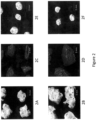
- 1A and 2A being Sample 16, 1B and 2B being Sample 5, 1C and 2C being a first TVP product, 1D and 2D being a second TVP product, 1E and 2E being a first protein crisp, and IF and 2F being a second protein crisp.
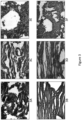
- Extruded pieces were prepared for transmitted light microscopy by hydrating pieces from each sample in a refrigerated 50:50 mixture of Tissue-Tek ® O.C.T TM (Sakura Finetek Europe B.V., The Netherlands) and water until the center was hydrated. Once rehydrated, pieces were frozen and then cut into 20 micron sections using a cryostatic microtome. The sections were stained using 0.1% Ponceau 2R, which stains protein red, and an aqueous iodine solution, which stains starch blue.
- Figure 3 compares light micrographs of an example of an extruded piece (Sample 16 from Table 1; Fig. 3A ), a piece containing no oil (Sample 5 from Table 1; Fig. 3B ), two commercially available TVP products ( Figs. 3C and 3D ), and two commercially available soy crisps ( Figs. 3E and 3F ).
- Sample 16 ( Fig.
- Extruded pieces were prepared for confocal microscopy by cross-sectioning representative pieces from each sample with a razor blade. Autofluorescence of at the cut surface was imaged using an Olympus Fluoview 1000 confocal microscope with a 4x objective and 425-475 mn, 500-530 nm, and 560-660 nm emission filters after excitation at 405 nm, 488 nm, and 568 nm lasers, respectively.
- the images in Fig. 4 are z-stacks of 10 micron optical sections, with imaged stacks from each laser overlaid. It was observed that the TVP samples autofluoresced under the 568 nm laser, but the other samples did not.
- images for the TVP samples (4C and 4D) include overlays of images obtained using excitation at 405 nm, 488 nm, and 568 nm
- images for Sample 16 (4A), Sample 5 (4B), and commercially available protein crisps (4E and 4F) include overlays of images obtained using excitation at 405 nm and 488 nm.
- Extruded pieces including a protein matrix disruptive ingredient comprising insoluble fiber were produced.
- Formulations including soy protein isolate (SPI), flour (F), insoluble fiber (IF), sugar (S), oil (O), water (W), and flavor (R) according to Table 3 SPI, F, IF, S, and R are shown as % weight of dry ingredients and O and W are shown as % weight of protein matrix composition) were combined to form a protein matrix composition, formed, and dried similarly to Example 1.
- Table 3 Sample SPI F IF S R W O SME (Wh/kg) Die temp. (° F) °C Die press.
- Extruded pieces surprisingly incorporated the insoluble fiber without compromising the texture or flavor of the pieces.
- Extruded pieces including relatively high amounts of fiber could be used in various food products, such as granola, RTE cereal, or chewy or crunchy grain bars, to increase protein and/or fiber content while providing an enjoyable eating experience.
- Extruded pieces having almond inclusions were produced.
- Formulations including soy protein isolate (SPI), flour (F), inclusions (I), sugar (S), oil (O), water (W), and flavor (R) according to Table 4 SPI, F, 1, S, and R are shown as % weight of dry ingredients and O and W are shown as % weight of protein matrix composition) were combined to form a protein matrix composition, formed, and dried similarly to Example 1. It is noted that the amount of oil includes the amount contributed by both the almond inclusions and added oil.
- Table 4 Sample SPI F S R I W O SME (Wh/kg) Die temp. (° F) °C Die press.
- Extruded pieces had an acceptable texture and macroscopically identifiable almond pieces.
- Samples were prepared for polarized light microscopy using the same hydration procedure and equipment as for the light microscopy in Example 1, except the microscope was equipped with polarizing filters and first order red plate, and a 10x objective with a 10x eyepiece.
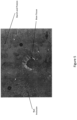
- polarized light microscopy showed relatively large protein granules of substantially non-linearly oriented protein surrounded by protein matrix disruptive ingredient in a loosely packed structure similar to Sample 16 in Example 1.
- nut inclusions and bran are identifiable, as shown in Fig. 5 .
- extruded pieces were produced that included a powdered protein ingredient comprising a combination of soy protein isolate and whey protein using a protocol similar to Example 1.
- the extruded pieces had an acceptable texture, but were slightly cripsier than the acceptable samples in Example 1.
- Extruded pieces comprising whey protein can be used to produce food products where a crispier texture is desired.
- Example 2 Additional samples were also produced using a protocol similar to Example 1 and included a protein matrix disruptive ingredient that comprised apple powder (10% by weight dry ingredients), cinnamon (1.5-2% by weight dry ingredients), or cocoa powder (1.5-2% by weight dry ingredients).
- the extruded pieces were determined to have an acceptable texture.
- the samples that included apple flakes had a light color and an apple flavor.
- the samples that included cocoa were brown in color.
- Oat flour and rice flour were also tested as protein matrix disruptive ingredients, and both produced acceptable extruded pieces.
- Additional inclusions were also tested, including dried cranberry pieces, rolled oats, whole sweet corn, coconut, flax seed, and chia seed. All of the tested inclusions resulted in extruded pieces with macroscopically visible inclusions.
- Formulations including soy flour (SF), soy protein concentrate (SPC), soy protein isolate (SPI), grain flour (F), sugar (Su), salt (Sa), oil (O), water (W), and/or flavor (R) according to Table 5 (SF, SPC, SPI, F, Su, Sa, and R are shown as % weight of dry ingredients and O and W are shown as % weight of protein matrix composition) were combined in a Buhler BCTL-42 extruder to form a protein matrix composition.
- the protein matrix composition was extruded through a single hole die having a diameter of 0.159 inches (4mm) and cut to form protein matrix composition pieces approximately 5 mm to 10 mm.
- Extruded pieces from samples D1-D7 from Table 5 were subjected to texture analysis according to Example 1.
- extruded pieces from all the samples listed in Table 5 were subjected to an alternate texture analysis method. Briefly, extruded pieces from each sample were passed through a 3/8 sieve, with the pieces retained on the 3/8 sieve discarded. The remaining pieces were passed through a #4 sieve. Pieces retained by the #4 sieve were subjected to texture analysis. Multiple extruded pieces from each sample were placed in a trough on the stage of a TA.HD Plus Texture Analyzer and subjected to a 50% strain test at a speed of 2 mm/second using a 250 kg load cell and a single rounded blade.
- Particle density was measured as described in Example 1.
- the average particle density for acceptable extruded pieces ranged from 0.7 g/cc to 1.0 g/cc, with densities from 0.7 g/cc to 0.9 g/cc being more preferred.
- Extruded pieces from Table 5 were also tested to determine cold water and hot water hydration rates.
- 20 g of each sample was combined with 200 g water at 19.4 °C (67° F), and allowed to sit at room temperature for 10 minutes.
- the extruded pieces were then drained for 30 seconds using a strainer and the mass of the drained pieces was measured.
- the cold water hydration rate was calculated by dividing the mass of the drained extruded pieces divided by the mass of the extruded pieces prior to combination with water (20 g).
- 20 g of each sample was combined with 200 g boiling water, covered, and allowed to sit at room temperature for 5 minutes.
- the TVP imitation bacon bits have an aligned, fibrous, linearly-oriented protein structure throughout, while Sample B4 has protein granules with varying degrees of linear orientation surrounded by a matrix including a matrix disruptive ingredient (non-protein components of SPC).
- the protein matrix within the protein granules is not as long or neatly aligned and linear as the structure throughout the TVP imitation bacon bits.
- the protein matrix within the protein granules also does not appear fibrous, as does the protein matrix of the TVP imitation bacon bits.
- Formulations including soy protein isolate (SPI), grain flour (F), oil (O), water (W), and/or flavor (R) according to Table 8 (SPI, F, and R are shown as % weight of dry ingredients and O and W are shown as % weight of protein matrix composition) were combined in a Buhler BCTL-42 extruder to form a protein matrix composition.
- the protein matrix composition was extruded through a single hole die having a diameter of 0.159 inches (4 mm) and cut to form protein matrix composition pieces approximately 5 mm to 10 mm. The pieces were dried using tray dryer to a moisture content of 1.5% to 8% to form extruded pieces.
- Table 8 Sample SPI F O W R SME (Wh/kg) Die (° F) temp. °C Die (PSI) press. bar V16 81.6 14.4 13 48.6 4 16.6 259 126 103 7.1 V17 86.4 9.6 13 48.6 4 15.6 258 125 96 6.6
- Extruded pieces from Table 8 were also tested to determine cold water and hot water hydration rates as described in Example 5.
- Cold water hydration rates for extruded pieces from Table 8 ranged from 1.7 to 1.9.
- Hot water hydration rates for extruded pieces from Table 8 ranged from 2.5 to 2.8.
- Macroscopic and microscopic images of Sample V16 were taken to examine the structure of each sample and compared to a commercially available textured vegetable protein-based bacon bit (TVP imitation bacon bits).
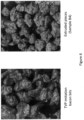
- Macroscopic surface images ( Fig. 8 ), and 0.1% Ponceau 2R/aqueous iodine stained sample light micrographs ( Fig. 9 ) were obtained according to the methods described in Example 1. As visible in Fig. 8 , the surface of Sample V16 extruded pieces appear rougher and less flat than the TVP imitation bacon bits.
- Fig. 9 shows that the TVP imitation bacon bits have an aligned, fibrous, linear protein structure throughout, while Sample V16 has protein granules with varying degrees of linear orientation surrounded by a matrix including a matrix disruptive ingredient (grain flour).
- Starch from the grain flour in sample V16 is stained purple and is visible within the matrix surrounding the protein granules.
- the protein matrix within the protein granules does not appear to be fibrous or as long and neatly aligned and parallel as the structure throughout the TVP imitation bacon bits.
Landscapes
- Chemical & Material Sciences (AREA)
- Life Sciences & Earth Sciences (AREA)
- Engineering & Computer Science (AREA)
- Food Science & Technology (AREA)
- Polymers & Plastics (AREA)
- Oil, Petroleum & Natural Gas (AREA)
- Nutrition Science (AREA)
- Health & Medical Sciences (AREA)
- Biochemistry (AREA)
- Biotechnology (AREA)
- Manufacturing & Machinery (AREA)
- Proteomics, Peptides & Aminoacids (AREA)
- Mycology (AREA)
- General Preparation And Processing Of Foods (AREA)
- Confectionery (AREA)
- Edible Oils And Fats (AREA)
- Peptides Or Proteins (AREA)
- Fodder In General (AREA)
Description
- The present disclosure generally relates to an extruded protein product and methods of making such a product.
- High protein food products have found popularity among consumers as a way to eat nutritionally dense foods.
US 2009/0155447 relates to food materials containing a high concentration of vegetable protein and omega-3 fatty acids and processes for their manufacture. Consumers want diverse ways to get increased protein into their diets. Thus, there is a need for new high protein food products to satisfy the increasing consumer desire for protein. - The present invention relates to a composition comprising extruded pieces according to claim 1, a method of making a protein product according to claim 10 and a method of making a food composition according to claim 20. Provided in the present application is a composition including extruded pieces. The extruded pieces include protein in an amount of 30% to 90% by weight, a protein matrix disruptive ingredient in an amount of from 5% to 50% by weight, oil in an amount of from 2% to 20% by weight, water in an amount of from 1.5% to 8% by weight, and inclusions in an amount of from 0% to 50% by weight. The oil can be substantially uniformly distributed throughout the extruded pieces.
- In some embodiments, the extruded pieces can have protein granules within, or surrounded by, a matrix that includes the protein matrix disruptive ingredient. The protein granules can have a substantially non-linearly oriented protein matrix, or the protein granules can have regions of a linearly oriented protein matrix. The protein granules can have an average size greater than 75 µm.
- In some embodiments, the extruded pieces can have a texture analysis measurement of from 1000 g to 7400 g force, or from 2000 g to 5000 g force, and a density of from 0.7 g/cc to 1.0 g/cc.
- The extruded pieces can have a rough and/or uneven surface.
- The protein can include one or a combination of soy protein, whey protein, bean protein, pea protein, wheat protein, canola protein, or algae protein.
- In some embodiments, the protein matrix disruptive ingredient can be a non-protein component of a protein concentrate or a protein isolate.
- In some embodiments, the protein matrix disruptive ingredient can be a flour or a syrup. In some embodiments, the protein matrix disruptive ingredient can include a starch, a sugar, or a fiber.
- In some embodiments, extruded pieces can have a protein content of 45-70%, or 60-70%, by weight and have a cold water hydration rate of from 1.6 to 1.9, or from 1.7 to 1.9.
- In some embodiments, extruded pieces can have a protein content of 45-70%, or 60-70%, by weight and have a hot water hydration rate of from 2.0 to 2.8, or from 2.5 to 2.8.
- In some embodiments, extruded pieces can have a protein content of 40-65% by weight and have a cold water hydration rate of from 2.1 to 2.7.
- In some embodiments, extruded pieces can have a protein content of 40-65% by weight and have a hot water hydration rate of from 3.0 to 3.75.
- In some embodiments, the inclusions can be one or a combination of nuts, seeds, fruit, grains, or coconut. In some embodiments, the extruded pieces can have inclusions substantially uniformly distributed throughout the extruded pieces.
- In some embodiments, extruded pieces can include one or more colorant or flavorant. In some embodiments, extruded pieces can have a marbled appearance.
- The oil can be substantially uniformly distributed throughout the extruded pieces.
- In some embodiments, the extruded pieces can have a sugar-based coating, a fat-based coating, or a protein-based coating.
- In some embodiments, an extruded piece can be adhered with one or more edible component to form a cluster. In some embodiments, an extruded piece can be adhered to one or more additional extruded piece to form a cluster. In some embodiments, an extruded piece can be adhered with one or more edible component to form a bar.
- A food product is also provided herein. A food product includes food product pieces and extruded pieces having protein in an amount of 30% to 90% by weight, a protein matrix disruptive ingredient in an amount of from 5% to 50% by weight, oil in an amount of from 2% to 20% by weight, water in an amount of from 1.5% to 8% by weight, and inclusions in an amount of from 0% to 50% by weight.
- A composition is provided herein including particulates derived from extruded pieces, where the extruded pieces have protein in an amount of 30% to 90% by weight, a protein matrix disruptive ingredient in an amount of from 5% to 50% by weight, oil in an amount of from 2% to 20% by weight, water in an amount of from 1.5% to 8% by weight, and inclusions in an amount of from 0% to 50% by weight. The particulates can be coated on a food product or formed into a food product.
- A food product or kit is provided herein. The food product or kit includes a first food component and at least a second food component, where the first food component includes extruded pieces having protein in an amount of 30% to 90% by weight, a protein matrix disruptive ingredient in an amount of from 5% to 50% by weight, oil in an amount of from 2% to 20% by weight, water in an amount of from 1.5% to 8% by weight, and inclusions in an amount of from 0% to 50% by weight.
- A method of making a food product is also provided herein. The method includes processing, under extrusion conditions, a powdered protein ingredient comprising at least 45% protein by weight of the powdered protein ingredient and a protein matrix disruptive ingredient combined with water and an oil to form a protein matrix composition having a protein content of from 10% to 65% by weight, a moisture content of from 25% to 55% by weight and an oil content of from 1% to 15% by weight, and forming the protein matrix composition into pieces to form the food product.
- In some embodiments, the protein product can include protein granules within, or surrounded by, a matrix that includes the protein matrix disruptive ingredient. The protein granules can have a substantially non-linearly oriented protein matrix, or the protein granules can have regions of a linearly oriented protein matrix. The protein granules can have an average size greater than 75 µm.
- The extrusion conditions can include a specific mechanical energy (SME) of from 8 Wh/kg to 100 Wh/kg, a die pressure of from 10.3 bar (150 PSI) to 68.9 bar (1000 PSI), and/or a die temperature of from 93.3 °C (200 °F) to 176.7 °C (350° F).
- In some embodiments, the powdered protein ingredient includes at least a portion of the protein matrix disruptive ingredient.
- In some embodiments, the protein matrix disruptive ingredient can be a flour or a syrup. In some embodiments, the protein matrix disruptive ingredient can include a starch, a sugar, or a fiber.
- The method can further include drying the protein matrix composition pieces to a moisture content of from 1.5% to 8% by weight to form extruded pieces. In some embodiments, extruded pieces have a texture analysis measurement of from 1000 g to 7400 g force, or from 2000 g to 5000 g force, and a density of from 0.7 g/cc to 1.0 g/cc. In some embodiments, the oil is substantially uniformly distributed throughout the pieces.
- In some embodiments, the method can further include applying a sugar-based or protein-based coating to the extruded pieces to form coated pieces and drying the coated pieces.
- In some embodiments, the method can further include applying a fat-based coating to the extruded pieces to form coated pieces and cooling the coated pieces.
- In some embodiments, the method can further include comminuting the extruded pieces to form particulates. The method can further include producing a food product including the particulates and/or coating a food product with the particulates.
- In some embodiments, the method can further include processing inclusions with the powdered protein ingredient, protein matrix disruptive ingredient, water, and oil. The inclusions can include one or a combination of nuts, seeds, fruit, grains, or coconut.
- A method of making a food composition is also provided. The method includes hydrating extruded pieces that have protein in an amount of 30% to 90% by weight, a protein matrix disruptive ingredient in an amount of from 5% to 50% by weight, oil in an amount of from 2% to 20% by weight, water in an amount of from 1.5% to 8% by weight, and inclusion in an amount of 0% to 50% by weight to form a first food component, and combining the first food component with at least a second food component to make the food composition.
- In some embodiments, the extruded pieces can be formulated to perform as a substitute for bacon bits or as a substitute for ground meat.
- In some embodiments, the second food component can be a noodle component, a potato component, an oil-in-water emulsion, and/or a seasoning component.
- In some embodiments, the food composition is a pasta dish, a salad, a potato dish, or a soup.
- A method of making a frozen or refrigerated food product is provided. The method includes combining a first food component of extruded pieces with at least a second food component to make the frozen or refrigerated food product. The extruded pieces include protein granules with an average size greater than 75 µm within a matrix comprising a protein matrix disruptive ingredient, a protein content of from 10% to 65% by weight, a moisture content of from 25% to 55% by weight and an oil content of from 1% to 15% by weight, the oil being substantially uniformly distributed throughout the extruded pieces.
- In some embodiments, the frozen or refrigerated food product is a frozen or refrigerated pizza or a frozen or refrigerated pasta product.
- In some embodiments, the extruded pieces can be formulated to perform as a substitute for bacon bits or as a substitute for ground meat.
- A frozen or refrigerated food product is provided herein. The frozen or refrigerated food product includes extruded pieces that have protein granules with an average size greater than 75 µm within a matrix comprising a protein matrix disruptive ingredient, a protein content of from 10% to 65% by weight, a moisture content of from 25% to 55% by weight and an oil content of from 1% to 15% by weight, the oil being substantially uniformly distributed throughout the extruded pieces.
- In some embodiments, the frozen or refrigerated food product can also include a second food component, such as a crust component, a sauce component, and/or a noodle component.
- In some embodiments, the frozen or refrigerated food product is a frozen or refrigerated pizza or a frozen or refrigerated pasta product.
- In some embodiments, the extruded pieces can be formulated to perform as a substitute for bacon bits or as a substitute for ground meat.
- These and various other features and advantages will be apparent from a reading of the following detailed description.
-
-
Figure 1 includes macroscopic images of the surfaces of an extruded piece according to one embodiment (Fig. 1A ), a piece that does not include oil (Fig. 1B ), two commercially available textured vegetable protein products (Figs. 1C and 1D ), and two commercially available puffed soy protein crisps (Figs. 1E and 1F ). -
Figure 2 includes macroscopic images of cross sections of an extruded piece according to one embodiment (Fig. 2A ), a piece that does not include oil (Fig. 2B ), two commercially available textured vegetable protein products (Figs. 2C and 2D ), and two commercially available puffed soy protein crisps (Figs. 2E and 2F ). -
Figure 3 includes light micrographs of an extruded piece according to one embodiment (Fig. 3A ), a piece that does not include oil (Fig. 3B ), two commercially available textured vegetable protein products (Figs. 3C and 3D ), and two commercially available puffed soy protein crisps (Figs. 3E and 3F ). -
Figure 4 includes confocal micrographs of an extruded piece according to one embodiment (Fig. 4A ), a piece that does not include oil (Fig. 4B ), two commercially available textured vegetable protein products (Figs. 4C and 4D ), and two commercially available puffed soy protein crisps (Figs. 4E and 4F ). -
Figure 5 is a polarized light micrograph of an extruded piece having inclusions according to another embodiment. -
Figure 6 includes macroscopic images of the surfaces of a textured vegetable protein-based imitation bacon bit (TVP imitation bacon bits, left image) and an extruded piece according to an embodiment disclosed herein (right image) that is suitable for use as a bacon bit replacement. -
Figure 7 includes light micrographs of a TVP imitation bacon bit (left image) and an extruded piece according to an embodiment disclosed herein (right image) that have been stained to visualize protein. -
Figure 8 includes macroscopic images of the surfaces of a textured vegetable protein-based imitation bacon bit (TVP imitation bacon bits, left image) and an extruded piece according to an embodiment disclosed herein (right image) that is suitable for use as ground beef replacement following hydration. -
Figure 9 includes light micrographs of a TVP imitation bacon bit (left image) and an extruded piece according to an embodiment disclosed herein (right image) that have been stained to visualize protein. - Extrusion technology has begun to produce protein products that have an enjoyable texture, while reducing or eliminating the use of animal protein. Many of these products are designed to mimic whole or ground meat and are meant to be eaten in place of meat. However, consumers expect an even greater variety of high protein foods that are suitable for different eating occasions. As described herein, a new protein product has been produced having a high protein content and having an enjoyable texture and flavor that is suitable for a wide variety of eating occasions.
- A protein product provided herein can be a composition comprising extruded pieces. Extruded pieces described herein comprise protein, a protein matrix disruptive ingredient, oil, and water. In some embodiments, extruded pieces provided herein include inclusions.
- Extruded pieces provided herein comprise protein in an amount of 30% to 90% (e.g., 50% to 75%) by weight. The amount and type of protein included in extruded pieces described herein can be selected to produce a protein matrix when extruded in the presence of water and an oil. In some embodiments, the amount and type of protein can be selected to produce extruded pieces that have functions for different eating occasions. For example, in some embodiments, extruded pieces that are formulated for eating as a breakfast cereal without requiring substantial hydration can have a protein content of from 30% to 60% (e.g., from 40% to 55%). In another example, extruded pieces that are formulated to perform as a substitute for ground meat, such as ground beef or ground turkey, and intended to be hydrated and heated for consumption can have a protein content of from 50% to 90% (e.g., from 45% to 70%, oi 60% to 70%). In another example, extruded pieces that are formulated to perform as a substitute for bacon bits, which may or may not be hydrated and/or heated prior to consumption can have a protein content of from 30% to 70% (e.g., from 40% to 65%).
- As illustrated in
Figs. 3A and4A , the right image inFig. 7 , and the right image inFig. 9 , an extruded piece provided herein can have granules of compacted protein within, or surrounded by, a matrix that includes protein matrix disruptive ingredient. As used herein, the term "protein granule" refers to a particle of compacted protein. The protein granules can range from having a protein matrix that is substantially non-linearly oriented to a protein matrix that has localized regions of linear orientation that is relatively non-fibrous. This is in contrast to an extruded product, such as textured vegetable protein (shown inFigs. 3C, 3D ,4C, 4D , the left image inFig. 7 and the left image ofFig. 9 ), having a substantially entirely linearly oriented protein matrix with elongated, fibrous strands rather than granules of protein. Another example of an extruded product that has a substantially entirely linearly oriented protein matrix includes an extruded piece that does not contain oil, as illustrated inFigs. 3B and4B . - When compared to extruded soy crisps, as shown in
Figs. 3E, 3F ,4E, and 4F , which have small agglomerations of protein that are 50 µm across or less, protein granules of an extruded piece provided herein can be relatively large, averaging at least 75 µm across (e.g., on average, at least 100 µm across). Without being bound to theory, it is believed that relatively large protein granules within, or surrounded by, a matrix that includes a protein matrix disruptive ingredient can contribute to a desired texture of an extruded piece provided herein, whether dry or hydrated with hot or cold water, an aqueous solution, or an oil-in-water emulsion (e.g., mayonnaise). - Protein suitable for use in an extruded piece includes plant-based protein (e.g., soy protein, pea protein, wheat protein, oat protein, bean protein, canola protein, lentil protein, chickpea protein, broccoli protein, and the like), microbe-based protein (e.g., algae protein, bacterial protein, and the like), fungal protein (e.g., yeast protein, mushroom protein, and the like), and animal-based protein (e.g., dairy protein, egg protein, insect protein, and the like). In some embodiments, a protein can be selected to produce a desired characteristic. For example, soy, pea, or bean protein, or the like, can be selected to exclude grain-based ingredients, or whey protein can be selected to produce extruded pieces having a crunchier texture. Other characteristics can include, for example, GMO-free, gluten-free, soy-free, and/or allergen free. In some embodiments, blends of proteins can be used in extruded pieces provided herein.
- In some embodiments, a protein with a specific functional property can be used. In some embodiments, a protein can be derived from its source (e.g., a plant, animal, or microorganism) without altering the structure and related functional properties. In other embodiments, the chemical structure and functional properties of a protein can be altered during and/or after derivation from its source. For example, a soy protein concentrate or isolate with high water binding properties can be used to achieve a desired texture.
- Extruded pieces also comprise a protein matrix disruptive ingredient in an amount of from 5% to 50% (e.g., 15% to 40%) by weight. As used herein, the term "protein matrix disruptive ingredient" refers to one or a combination of a flour (e.g., a grain flour, a legume flour, a vegetable or fruit powder, cocoa, or the like), a starch (e.g., tapioca starch, corn starch, a modified starch, a pregelatinized starch, or the like), a sugar (e.g., sucrose, fructose, lactose, or the like), a fiber (e.g., sugar cane fiber, inulin, oat fiber, pea fiber, bran, hull fiber, or the like), a polyol (e.g., glycerol or the like), syrups (e.g., corn syrup, tapioca syrup, honey, or the like), or the like. In some embodiments, a protein matrix disruptive ingredient can include a non-protein component of a protein rich flour (e.g., a soy flour, a pea flour, a lentil flour, or a bean flour), a protein concentrate, or a protein isolate. Without being bound by theory, it is believed that a protein matrix disruptive ingredient disrupts the protein matrix in an extruded piece provided herein to contribute to a desired texture, desired hydration properties, and/or protein matrix structure of the extruded piece.
- A protein matrix disruptive ingredient can be selected, for example, in order to provide a desired nutritional profile, flavor, sweetness, and/or texture to an extruded piece that contains the protein matrix disruptive ingredient. For example, oat hull fiber can be selected to produce extruded pieces having a desired fiber content, or a syrup can be selected to adjust texture and/or taste. In some embodiments, a protein matrix disruptive ingredient can be selected to provide a desired characteristic for an extruded piece, such as being grain-free, gluten-free, GMO-free, soy-free, and the like. For example, tapioca flour or starch can be selected to produce a grain-free extruded piece.
- Extruded pieces provided herein include oil in an amount of from 2% to 20% (e.g., 2% to 15%) by weight. Oil in an extruded piece provided herein can be distributed substantially uniformly throughout the piece. This is in contrast to known textured vegetable protein products, which generally are made from defatted or low fat ingredients and do not contain oil or only residual amounts of oil (e.g., less than 2% by weight), or if oil is present, it is found mainly near the surface as a surface treatment of the textured vegetable protein. For example, oil spraying is commonly used to topically apply seasoning or flavor to textured vegetable protein products. The disclosed extruded pieces also contrast to puffed protein products currently available (e.g., soy crisps), which generally contain substantially no oil in the matrix.
- Any edible oil is suitable for use in an extruded piece provided herein. Preferably, an oil included in an extruded piece is liquid at room temperature. Suitable oils include, without limitation, canola oil, olive oil, soy oil, sunflower oil, corn oil, and the like. An oil to be included in an extruded piece can be selected based on, for example, nutritional profile, compatibility with extrusion process and/or equipment, texture and/or mouthfeel imparted to the extruded piece, and/or price.
- Extruded pieces described herein include water in an amount of from 1.5% to 8% (e.g., 1.5% to 6%) by weight. The amount of water in an extruded piece is generally selected in order to provide shelf stability and/or a desired texture to the extruded piece. A lower water content can be selected to increase shelf life of an extruded piece. In some embodiments, a higher water content can be selected in order to reduce the hardness of an extruded piece. Water content can also be selected to maintain solubility of one or more ingredients, such as an antioxidant, in an extruded piece.
- In some embodiments, extruded pieces provided herein include inclusions up to 50% by weight. As used herein, the term "inclusion" refers to a substantially solid edible particle. An inclusion is visually (i.e., macroscopically) distinguishable from the protein matrix of an extruded piece. Inclusions, when included in an extruded piece, are substantially uniformly distributed throughout the piece. Examples of inclusions include, without limitation, nut pieces, whole grain pieces, seeds and/or seed pieces, fruit pieces, coconut, confection pieces, and the like.
- One or more additional ingredients can be included in or on the surface of extruded pieces provided herein. An additional ingredient can be selected to impart a desired nutritional profile, flavor, sweetness, texture, shelf life, and/or visual appearance to an extruded piece, or to provide an advantage to the production process of an extruded piece. For example, one or more flavorant, such as vanilla extract or a spice, can be included in or on the surface of an extruded piece to provide a desired sweet or savory flavor. In another example, one or more colorants can be included in or on the surface of an extruded piece to provide an appearance similar to ground meat or bacon bits, such as a marbled appearance.
- Examples of additional ingredients that can be included in an extruded piece include, without limitation, flavorants, nutritive and/or non-nutritive sweeteners, salts, colorants, antioxidants, vitamins, and/or minerals, and the like.
- Extruded pieces provided herein can have a texture analysis measurement of from 1000 g to 7400 g (e.g., from 1000 g to 5600 g, or from 2000 g to 5000 g) force. As used herein, the term "texture analysis measurement" refers to an average 50% strain force of 10 replicate measurements in g obtained from the following protocol: a single piece is placed on the stage of a TA.HDPlus Texture Analyzer (Texture Technologies, Massachusetts, USA) and subjected to a 50% strain test at a speed of 2 mm/second using a 50 kg load cell and a 1 inch (2.54 cm) cylindrical stainless steel probe.
- The extruded pieces according to the present invention have a density of from 0.7 g/cc to 1.0 g/cc (e.g. from 0.8 g/cc to 0.9 g/cc). As used herein, density is measured by the displacement of granular sodium chloride. About 150 cc of sodium chloride is placed in a 250 ml graduated cylinder and tapped in a tap density analyzer 300x. The volume of salt is recorded to the nearest cc. The salt is then removed from the cylinder. The salt is poured back into the cylinder in 10-20 cc aliquots alternating with pieces of a known weight of extruded pieces until the volume is approximately 150 cc. The remaining salt is then placed in the cylinder. The cylinder is again tapped 300x in the tap density analyzer. The volume is recorded and the particle density of each sample is calculated as the weight of the sample divided by the difference in tapped volume with and without sample present.
- Extruded pieces provided herein can absorb water at a rate that contributes to a desired eating experience. Water absorption rate is measured herein by cold water hydration rate and hot water hydration rate. As used herein, cold water hydration rate is measured by combining 20 g of a sample of extruded pieces with 200 g water at 19.4 °C (67° F), and allowed to sit at room temperature for 10 minutes. The extruded pieces are then drained for 30 seconds using a strainer and the mass of the drained pieces are measured. The cold water hydration rate is calculated by dividing the mass of the drained extruded pieces divided by the mass of the extruded pieces prior to combination with water (20 g). As used herein, hot water hydration rate is measured by combining 20 g of a sample of extruded pieces with 200 g boiling water, which are then covered and allowed to sit at room temperature for 5 minutes. The extruded pieces are then drained for 30 seconds using a strainer, and the mass of the drained pieces is measured. The hot water hydration rate is calculated in the same way the cold water hydration rate is calculated (i.e., mass of drained extruded pieces/20g). Cold water hydration rates for extruded pieces described herein can be 1.5 or greater (e.g., from 1.5 to 5), while hot water hydration rates can be 2 or greater (e.g., from 2 to 4). Cold and hot water hydration rates can be adjusted as desired for different eating experiences. For example, an extruded piece suitable for use as a bacon bit substitute can have a cold water hydration rate from 2.1 to 2.7, or a hot water hydration rate of from 3.0 to 3.75. In another example, an extruded piece suitable for use as a ground meat substitute can have a cold water hydration rate from 1.6 to 1.9 (e.g., from 1.7 to 1.9), or a hot water hydration rate of from 2.0 to 2.8 (e.g., from 2.5 to 2.8).
- In some embodiments, extruded pieces provided herein can have a rough or uneven surface. A rough surface can provide a visually interesting appearance to extruded pieces. In some embodiments, inclusions can contribute to a rough or uneven surface of an extruded piece.
- In some embodiments, extruded pieces can have average diameter of from about 2 mm to 15 mm (e.g., from 5 mm to 10 mm). The size of an extruded piece can be adjusted for the desired use of the extruded piece or to provide a manufacturing advantage. For example, the size of an extruded piece can be adjusted to provide a desired size for eating as a stand-alone snack. In another example, the size of an extruded piece can be adjusted to result in a desired drying time during manufacturing. Piece size can be adjusted using known methods, such as die size and/or die shape selection, rate of extrusion, and/or cutter speed.
- Extruded pieces can be produced by processing, under extrusion conditions, a powdered protein ingredient and a protein matrix disruptive ingredient with sufficient water and an oil to form a protein matrix composition. As used herein, the term "extrusion conditions" refers to subjecting components to heat, pressure, and shear in an extruder. Extrusion conditions can include applying sufficient specific mechanical energy (SME) (e.g., at least 8 Wh/kg, or from 10 Wh/kg to 100 Wh/kg, 10 Wh/kg to 50 Wh/kg, or from 15 Wh/kg to 35 Wh/kg) to produce extruded pieces having a desired protein matrix. In some embodiments, extrusion conditions can comprise a die temperature of at least 93.3 °C (200° F) (e.g., from 93.3 °C (200° F) to 176.7 °C (350° F), or from 121.1 °C (250° F) to 148.9 °C (300° F). As used herein, the term "die temperature" refers to the temperature of a protein matrix composition inside the die of an extruder just before exiting the die. In some embodiments, extrusion conditions can comprise a die pressure of at least 10.3 bar (150 PSI) (e.g., from 10.3 bar (150 PSI) to 68.9 bar (1000 PSI), 13.8 bar (200 PSI) to 41.4 bar (600 PSI), or from 17.2 bar (250 PSI) to 24.1 bar (350 PSI). As used herein, the term "die pressure" refers to the pressure a protein matrix composition is exposed to inside the die of an extruder just before exiting the die.
- A powdered protein ingredient, as used herein, is an edible dry ingredient comprising at least 45% protein (e.g., at least 50%, at least 70%, or at least 90%) by weight. Examples of powdered protein ingredients include, without limitation, flours having a protein content of at least 45% (e.g., defatted soy flour), protein concentrates (e.g., soy protein concentrate, pea protein concentrate, whey protein concentrate, and the like), protein isolates (e.g., soy protein isolate, pea protein isolate, whey protein isolate, and the like), pure proteins, and combinations thereof. A powdered protein ingredient can be included in an amount sufficient to produce a protein matrix composition having a protein content of 10% to 65% (e.g., 15% to 50%) protein by weight of the protein matrix composition.
- In some embodiments, a powdered protein ingredient can comprise a protein matrix disruptive ingredient. For example, a protein concentrate or a protein isolate can include, for example, starch, sugar, fiber, and/or inorganic components, and the like. In some embodiments, all or part of the protein matrix disruptive ingredient can be combined with powdered protein ingredient, water, and oil as a separate ingredient.
- Water and oil are combined with the powdered protein ingredient, protein matrix disruptive ingredient, and optional inclusions and/or other ingredients in amounts sufficient to form a protein matrix composition having a moisture content of from 25% to 55% by weight and an oil content of from 1% to 15% by weight. Water can be provided in any appropriate form. For example, tap or filtered water, fruit or vegetable juice, or the like, can be used to provide the desired moisture content. In some embodiments, water and oil can be provided as an emulsion for combination with the powdered protein ingredient, protein matrix disruptive ingredient, and optional inclusions and/or other ingredients.
- It has been discovered that incorporating oil into a protein matrix composition results in extruded pieces that have a structure that includes granules of protein loosely packed in a matrix that includes a protein matrix disruptive ingredient that imparts a desirable texture. The addition of too much oil (e.g., more than 15% by weight) results in incomplete incorporation of the oil. It has also been discovered that too little water addition (i.e., less than 25% by weight) can result in oil being squeezed from the protein matrix composition, which alters the texture of extruded pieces and/or interferes with the proper function of extruder equipment. However, it has also been discovered that the addition of too much water (i.e., more than 55% by weight) can result in extruded pieces that are harder than desired or have an undesired even surface appearance. It has further been discovered that incorporation of water and oil into a protein matrix composition allows for the incorporation of inclusions that are visually distinguishable from protein matrix rather than being crushed or degenerated during extrusion at low water and/or low or no oil conditions such that inclusions remain visually indistinguishable.
- The amounts of oil and/or water combined with a powdered protein ingredient and protein matrix disruptive ingredient can be adjusted in order to result in a desired appearance and/or texture of extruded pieces. As the amount of oil is increased, extruded pieces generally appear rougher and have a crunchier texture. As the amount of water is increased, extruded pieces generally appear smoother and have a harder texture.
- The amounts of oil and/or water combined with a powdered protein ingredient and protein matrix disruptive ingredient can also be adjusted in order to adjust the amount of shear a protein matrix composition is subjected to. Generally, higher amounts of water and/or oil reduce the amount of shear that a protein matrix composition is subjected to. In some embodiments, higher water and/or oil can be used to make extruded pieces with relatively large inclusions.
- In some embodiments, dry ingredients, such as a powdered protein ingredient, a protein matrix disruptive ingredient, inclusions and/or other optional components, can be combined prior to combining with water and/or oil under extrusion conditions. In some embodiments, components can be added stepwise or at essentially the same time before combining under extrusion conditions.
- Extruders suitable for use in the methods provided herein can include, for example, a single screw, twin, or triple screw extruder, or a ring extruder. For example a co-rotating, intermeshing, twin screw extruder can be used in a method provided herein. Manufacturers for co-rotating twin screw extruders include, for example, Coperion, Wenger, Clextral, Bersttorf, APV, Buhler, and Leistritz. Manufacturers for single screw extruders include, for example, Wenger, APV, and Buhler.
- A protein matrix composition can be formed into pieces using any suitable method to form protein matrix composition pieces. For example, a protein matrix composition can passed through an extrusion die and then cut in order to form pieces. During formation, the amount of turbulence or laminar flow that a protein matrix composition is exposed to in the extruder die prior to exiting the extruder die can be adjusted to result in protein granules that include regions of linear oriented protein matrix (less turbulence), or protein granules that include substantially non-linearly oriented protein matrix (more turbulence) as desired. Turbulence can be increased in an extrusion die by, for example, including a static mixer, or by introducing small, large or multiple variations in die cross section diameter or shape.
- Following formation, protein matrix composition pieces can be dried to form extruded pieces using any appropriate method to reach a moisture content of from 1.5% to 8% to form extrude pieces. For example, protein matrix composition pieces can be subjected to heated air in order to dry them to the desired moisture content.
- In some embodiments, extruded pieces provided herein can be packaged and sold as a food product without any other components. Such packaged extruded pieces can be intended to be eaten as a food product alone or in combination with other food products. For example, extruded pieces can be packaged and sold as a stand alone snack, as part of a ready-to-eat breakfast cereal, or can be used as a topping for yogurt or oatmeal, as a bacon bit substitute, or as a hydratable ground meat crumble substitute as part of a dry meal kit. Extruded pieces provided herein can have a texture suitable such that they need not be further prepared for eating by, for example, heating or soaking. However, in some embodiments, it is to be understood that an individual may enjoy heating and/or soaking extruded pieces provided herein during various eating occasions, such as when combined with oatmeal, when used as a ground meat substitute (e.g., in a pasta or a taco or burnto), when used in a soup, when used as a bacon bit substitute in hot foods (e.g., in a potato dish, such as mashed potatoes), or when used hydrated or partially-hydrated in a chilled or ambient temperature food, such as a pasta salad.
- In some embodiments, extruded pieces provided herein can be combined with other food components to produce a food product. For example, extruded pieces can be combined with food product pieces, such as ready to eat (RTE) cereal pieces or popcorn, to produce a food product having desired protein content. In another example, extruded pieces can be combined with dried fruit and/or nuts to produce a snack mix type product or a granola type product.
- In some embodiments, extruded pieces provided herein can be packaged into a kit with other food products. For example, extruded pieces can be combined as a kit with yogurt, which can be combined prior to eating. Other examples of kits that can include the extruded pieces described herein include, without limitation, taco kits (e.g., including seasoning and/or taco shells or tortillas), pasta kits (e.g., including noodles), instant potato kits (e.g., mashed or potatoes au gratin), instant soup kits, and the like.
- In some embodiments, an extruded piece can be adhered with one or more edible component, such as another extruded piece, nut pieces, fresh or dried fruit pieces, seeds, coconut, grain, and the like, to form a cluster. An extruded piece and one or more edible component can be adhered to each other using any appropriate method and ingredients (e.g., edible binders and the like). For example, a cluster can be produced using a combination of an extruded piece and rolled oats adhered using a honey-based binder or slurry. Clusters can be provided as a food product alone or as part of a food product, such as a snack mix, ready to eat cereal, or oatmeal mix.
- In some embodiments, an extruded piece can be adhered with one or more edible component in a similar manner to a cluster described above, and formed into a snack or breakfast bar. Such a snack bar can be crunchy or chewy, sweet or savory.
- In some embodiments, extruded pieces provided herein can be comminuted into particulates (i.e., having an average diameter of less than 2 mm) to produce a composition derived from extruded pieces that resembles crumbs or a powder. Such particulates can be used, for example, to coat food products, such as ready to eat cereal pieces, snack food pieces, and the like. In some embodiments, particulates derived from extruded pieces provided herein can be combined with other components and formed into a food product, such as ready to eat cereal pieces, snack food pieces, baked goods, and the like. In some embodiments, particulates derived from extruded pieces disclosed herein can be used in addition to, or to partially or completely replace, protein ingredients, such as soy protein concentrate, in other food products where a high protein content is desired.
- In some embodiments, following formation, protein matrix composition pieces can be either partially dried (e.g., to a moisture greater than 8%) or left undried (e.g., at a moisture level of from 25% to 55%) and frozen or refrigerated. Such frozen or refrigerated protein matrix composition pieces can be packaged as-is as a ground meat substitute or bacon bit substitute, or combined with one or more additional food components to produce a frozen or refrigerated food product, such as a frozen or refrigerated pizza or frozen or refrigerated pasta product.
- It is to be understood that extruded pieces provided herein can be used for either sweet or savory applications. Extruded pieces disclosed herein can provide a benefit of being a high protein stand-alone food product or provide added protein in combination with other components in food products while also providing an improved flavor and/or texture over other known high protein pieces, such as textured vegetable protein or puffed protein crisps.
The composition of the present invention is defined in claim 1. In this composition the extruded pieces may comprise a rough and/or uneven surface. The composition of the present invention is defined in claim 1. In this composition the protein may comprise soy protein. The composition of the present invention is defined in claim 1. In this composition the protein may comprise whey protein, bean protein, pea protein, wheat protein, canola protein, or algae protein. The composition of the present invention is defined in claim 1. In this composition the protein matrix disruptive ingredient may comprise a flour or a syrup. The composition of the present invention is defined in claim 1. In this composition the protein matrix disruptive ingredient may comprise a non-protein component of a protein concentrate or a protein isolate. The composition of the present invention is defined in claim 1. In this composition the protein matrix disruptive ingredient may comprise a starch, a sugar, or a fiber. The composition of the present invention is defined in claim 1. In this composition the inclusions may comprise nuts, seeds, fruit, grains, or coconut.
The present invention is further defined by a food product comprising the composition as defined in claim 1 and food product pieces. The present invention is further defined by a composition comprising particulates derived from extruded pieces, which extruded pieces are defined in claim 1. These particulates may be coated on a food product. Furthermore, these particulates may be formed into a food product. The present invention is further defined by a food product or kit comprising the composition as defined in claim 1 as a first food component, the food product or kit further comprising a second food component. In a preferred embodiment the present invention is defined by a method of claim 12. In this method, the protein product may include protein granules that have a substantially non-linearly oriented protein matrix. Furthermore, in this method the protein product may include protein granules that have regions of a linearly oriented protein matrix.
A method of the present invention is defined in claim 11. In this method the protein matrix disruptive ingredient may comprise a flour or a syrup. Furthermore, in this method the protein matrix disruptive ingredient may comprise a starch, a sugar or a fiber. In a preferred embodiment the present invention is defined by a method of claim 17. In this method the extruded pieces may have a texture analysis measurement of from 2000 g to 5000 g force. A method of the present invention is defined in claim 11. This method may further comprise processing inclusions with the powdered protein ingredient, protein matrix disruptive ingredient, water, and oil. Preferably the inclusions may comprise nuts, seeds, fruit, grains, or coconut. A method of the present invention is defined in claim 22. In this method the extruded pieces may be formulated to perform as a substitute for bacon bits. Preferably the second food component may be selected from a noodle component and a potato component. In this method as disclosed in claim 22 the extruded pieces may be formulated to perform as a substitute for ground meat. Preferably the second food component may be selected from a noodle component and a seasoning component. - Formulations including soy protein isolate (SPI), flour (F), sugar (S), oil (O), water (W), and flavor (R) according to Table 1 (SPI, F, S, and R are shown as % weight of dry ingredients and O and W are shown as % weight of protein matrix composition) were combined in a Buhler BCTL-42 extruder (Buhler Inc., Minnesota, USA) to form a protein matrix composition. The protein matrix composition was extruded through a single hole die having a diameter of 0.159 inches (4mm) and cut to form protein matrix composition pieces approximately 5 mm to 10 mm. The pieces were dried using tray dryer to a moisture content of 1.5% to 8% to form extruded pieces.
Table 1 Sample SPI F S O W R SME (Wh/kg) Die (° F) temp. °C Die (PSI) press.bar 1 75 20 4 5.4 59.8 0.6 9.6 248 120 152 10.5 2 75 20 4 6.5 50.4 0.6 15.4 253 123 199 13.7 3 75 20 4 7.8 40.4 0.6 24.6 265 129 297 20.5 4 75 20 4 9.0 30.7 0.6 27.9 274 134 330 22.8 5 75 20 4 0 33.7 0.6 82.6 313 156 810 55.9 6 75 20 4 3.5 56.6 0.6 14.9 257 125 193 13.3 7 75 20 4 4.4 46.7 0.6 17.1 262 128 273 18.8 8 75 20 4 5.2 36.6 0.6 24.5 275 135 411 28.3 9 75 20 4 1.8 37.9 0.6 32.1 284 140 506 34.9 10 75 20 4 1.5 48.2 0.6 20.0 275 135 320 22.1 11 75 20 4 1.2 58.0 0.6 14.5 259 126 213 14.7 12 65 30 4 6.5 50.1 0.6 12.6 256 124 194 13.4 13 65 30 4 7.8 40.3 0.6 18.3 263 128 294 20.3 14 65 30 4 9.0 30.7 0.6 19.9 274 134 305 21.0 15 65 30 4 5.9 27.6 0.6 23.9 282 139 377 26.0 16 65 30 4 5.6 31.8 0.6 23.1 282 139 412 28.4 17 65 30 4 4.8 41.7 0.6 19.9 272 133 337 23.2 18 65 30 4 1.6 43.0 0.6 25.1 275 135 370 25.5 19 65 30 4 1.9 33.1 0.6 46.2 288 142 547 37.7 20 65 30 4 2.1 2 0.6 47.8 291 144 571 39.4 - Formulations were attempted using 25% moisture or less, but oil separated during extrusion.
- Extruded pieces were eaten to determine acceptability of texture for consumption without further preparation (Table 2). Extruded pieces produced using a protein matrix composition having 55% moisture or greater were identified as having an unacceptable hardness when consumed. In addition, extruded pieces produced using a protein matrix composition having 55% moisture or greater exhibited a smooth, even surface. Extruded pieces produced using a protein matrix composition having no added oil resembled TVP and were relatively hard.
- The protein content in extruded pieces from each of the samples was measured (as % weight) using the Dumas method. Overall fat content (as % weight) was measured by gas chromatography. Moisture content of extruded pieces was also measured by subjecting the extruded pieces to a vacuum oven at 70° C for 16 hours. Protein, fat, and moisture content are shown in Table 2.
Table 2 Sample Measured protein (% wt) Measured fat (% wt) Moisture (% wt) Acceptable texture for consumption 1 58.5 13.2 6.7 No 2 61.4 13.9 2.3 Yes 3 61.9 13.4 1.9 Yes 4 61.6 12.3 2.9 Yes 5 65.7 1.9 7.8 No (TVP-like) 6 63.6 10.7 3.7 No 7 63.6 9.5 4.0 Yes 8 63.4 10.6 4.2 Yes 9 67.9 6.3 2.3 Yes 10 67.4 4.9 2.9 Yes 11 67.4 5.0 3.8 No 12 55.7 14.6 2.1 Yes 13 54.7 13.1 4.0 Yes 14 53.8 12.1 4.0 Yes 15 56.3 9.0 4.6 Yes 16 56.7 9.4 3.8 Yes 17 57.0 10.1 3.2 Yes 18 59.9 5.7 3.5 Yes 19 60.5 4.3 3.0 Yes 20 60.6 4.4 3.4 Yes - Texture analysis measurements were obtained for extruded pieces from each sample. Extruded pieces from each sample individually placed on the stage of a TA.HDPlus Texture Analyzer (Texture Technologies, Massachusetts, USA) and subjected to a 50% strain test at a speed of 2 mm/second using a 50 kg load cell and a 1 inch (2.54 cm) cylindrical stainless steel probe. The average 50% strain force of 10 replicates determined that acceptable extruded pieces identified in Table 2 had texture analysis measurements from 400 g to 6600 g force, with texture analysis measurements greater than 1000 g force being more preferred. Texture analysis measurements taken for a variety of commercially available textured vegetable protein (TVP) products, sold as meat analog, substitute, or imitation, ranged from 7400 g to 9000 g force, while a variety of commercially available soy crisps ranged from 1300 g to 1400 g force. Many available TVP products are considered to be too hard to be enjoyable to eat without soaking in a liquid first.
- Particle density measurements were obtained for extruded pieces from each sample. Extruded pieces from each sample were analyzed for density by the displacement of granular sodium chloride. Briefly, about 150 cc of sodium chloride was placed in a 250 ml graduated cylinder and tapped in a tap density analyzer 300x. The volume of salt was recorded to the nearest cc. The salt was then removed from the cylinder. The salt was poured back into the cylinder in 10-20 cc aliquots alternating with pieces of a known weight of sample until the volume was approximately 150 cc. The remaining salt was then placed in the cylinder. The cylinder was again tapped 300x in the tap density analyzer. The volume was recorded and the particle density of each sample was calculated as the weight of the sample divided by the difference in tapped volume with and without sample present. The average particle density for acceptable extruded pieces (see, Table 2) ranged from 0.7 g/cc to 1.0 g/cc, with densities from 0.8 g/cc to 0.9 g/cc being more preferred. Densities of a variety of TVP products ranged from 0.7 g/cc to 0.8 g/cc, while commercially available soy crisps ranged from 0.4 g/cc to 0.5 g/cc. Thus, while acceptable extruded pieces had a similar density to commercially available TVP products, texture was somewhat reduced to result in a product that provides a better eating experience than a TVP product without prior hydration.
- Macroscopic and microscopic images of Sample 16 (Table 1),
Sample 5, which contains no added oil (Table 1), two commercially available TVP products, and two commercially available protein (soy) crisps were taken to examine the structure of each sample. The surface of extruded pieces were imaged using an Epson ® V700 (Epson America Inc., California, USA) photographic scanner. Pieces were also sectioned using a razor blade and the interior of pieces were imaged using an Epson V700 photographic scanner.Fig. 1 shows macroscopic images of the surfaces of representative pieces of each sample, whileFig. 2 shows macroscopic images of the interiors of representative pieces of each sample, with 1A and2A being Sample 2B being Sample - Extruded pieces were prepared for transmitted light microscopy by hydrating pieces from each sample in a refrigerated 50:50 mixture of Tissue-Tek ® O.C.T ™ (Sakura Finetek Europe B.V., The Netherlands) and water until the center was hydrated. Once rehydrated, pieces were frozen and then cut into 20 micron sections using a cryostatic microtome. The sections were stained using 0.1% Ponceau 2R, which stains protein red, and an aqueous iodine solution, which stains starch blue. The sections were imaged using an Olympus ® AX70 Microscope light microscope with a 20x objective and Olympus ® DP70 digital camera with a 10X eyepiece (Olympus America Inc., Pennsylvania, USA).
Figure 3 compares light micrographs of an example of an extruded piece (Sample 16 from Table 1;Fig. 3A ), a piece containing no oil (Sample 5 from Table 1;Fig. 3B ), two commercially available TVP products (Figs. 3C and 3D ), and two commercially available soy crisps (Figs. 3E and 3F ). Sample 16 (Fig. 3A ) had relatively large protein granules or agglomerations of non-linearly oriented protein surrounded by protein matrix disruptive ingredient (starch in this example) in a loosely packed structure. This contrasts to Sample 5 (Fig. 3B ), which had fibrous, linearly-oriented protein with protein matrix disruptive ingredient dispersed in spaces between protein strands rather than having protein granules within, or surrounded by, a matrix that includes protein matrix disruptive ingredient. Commercially available TVP products (Figs. 3C and 3D ) appeared similar in structure toSample 5, with fibrous, linearly oriented protein and no protein granules. Without being bound to theory, it is believed that the similarity of the monolithic, fibrous, linearly oriented protein structure of the commercially available TVP products toSample 5 is, in part, due to absence of any significant amount of oil during extrusion. Commercially available soy crisps (Figs. 3E and 3F ) showed agglomerations of protein that are smaller and more tightly packed compared to Sample 16 (Fig. 3A ). - Extruded pieces were prepared for confocal microscopy by cross-sectioning representative pieces from each sample with a razor blade. Autofluorescence of at the cut surface was imaged using an Olympus Fluoview 1000 confocal microscope with a 4x objective and 425-475 mn, 500-530 nm, and 560-660 nm emission filters after excitation at 405 nm, 488 nm, and 568 nm lasers, respectively. The images in
Fig. 4 are z-stacks of 10 micron optical sections, with imaged stacks from each laser overlaid. It was observed that the TVP samples autofluoresced under the 568 nm laser, but the other samples did not. Thus, images for the TVP samples (4C and 4D) include overlays of images obtained using excitation at 405 nm, 488 nm, and 568 nm, while images for Sample 16 (4A), Sample 5 (4B), and commercially available protein crisps (4E and 4F) include overlays of images obtained using excitation at 405 nm and 488 nm. - Extruded pieces including a protein matrix disruptive ingredient comprising insoluble fiber (e.g., oat hull fiber), were produced. Formulations including soy protein isolate (SPI), flour (F), insoluble fiber (IF), sugar (S), oil (O), water (W), and flavor (R) according to Table 3 (SPI, F, IF, S, and R are shown as % weight of dry ingredients and O and W are shown as % weight of protein matrix composition) were combined to form a protein matrix composition, formed, and dried similarly to Example 1.
Table 3 Sample SPI F IF S R W O SME (Wh/kg) Die temp. (° F) °C Die press. (PSI)bar 1 55.4 20.0 20.0 4.0 0.6 43.0 4.7 29.8 274 133 300 20.7 2 55.4 20.0 20.0 4.0 0.6 40.9 8.9 23.0 270 132 242 16.7 3 55.4 20.0 20.0 4.0 0.6 48.9 7.8 16.1 261 127 194 13.4 4 45.4 20.0 30.0 4.0 0.6 48.6 7.8 17.3 256 124 201 13.9 5 45.4 20.0 30.0 4.0 0.6 36.4 9.7 31.4 271 133 291 20.1 6 45.4 20.0 30.0 4.0 0.6 36.4 9.7 29.9 273 134 287 19.8 7 35.4 20.0 40.0 4.0 0.6 34.2 10.0 34.8 280 138 313 21.6 - Extruded pieces surprisingly incorporated the insoluble fiber without compromising the texture or flavor of the pieces. Extruded pieces including relatively high amounts of fiber could be used in various food products, such as granola, RTE cereal, or chewy or crunchy grain bars, to increase protein and/or fiber content while providing an enjoyable eating experience.
- Extruded pieces having almond inclusions were produced. Formulations including soy protein isolate (SPI), flour (F), inclusions (I), sugar (S), oil (O), water (W), and flavor (R) according to Table 4 (SPI, F, 1, S, and R are shown as % weight of dry ingredients and O and W are shown as % weight of protein matrix composition) were combined to form a protein matrix composition, formed, and dried similarly to Example 1. It is noted that the amount of oil includes the amount contributed by both the almond inclusions and added oil.
Table 4 Sample SPI F S R I W O SME (Wh/kg) Die temp. (° F) °C Die press. (PSI) bar 1 65.4 30.0 4.0 0.6 12.3 31.5 12.0 27.9 273 134 348 24.0 2 65.4 30.0 4.0 0.6 11.6 35.5 11.3 26.5 266 130 325 22.4 3 65.4 30.0 4.0 0.6 10.8 39.9 10.5 23.8 261 127 287 19.8 - Extruded pieces had an acceptable texture and macroscopically identifiable almond pieces.
- Samples were prepared for polarized light microscopy using the same hydration procedure and equipment as for the light microscopy in Example 1, except the microscope was equipped with polarizing filters and first order red plate, and a 10x objective with a 10x eyepiece. As shown in
Fig. 5 , polarized light microscopy showed relatively large protein granules of substantially non-linearly oriented protein surrounded by protein matrix disruptive ingredient in a loosely packed structure similar to Sample 16 in Example 1. In addition, nut inclusions and bran are identifiable, as shown inFig. 5 . - Additional extruded pieces were produced that included a powdered protein ingredient comprising a combination of soy protein isolate and whey protein using a protocol similar to Example 1. The extruded pieces had an acceptable texture, but were slightly cripsier than the acceptable samples in Example 1. Extruded pieces comprising whey protein can be used to produce food products where a crispier texture is desired.
- Additional samples were also produced using a protocol similar to Example 1 and included a protein matrix disruptive ingredient that comprised apple powder (10% by weight dry ingredients), cinnamon (1.5-2% by weight dry ingredients), or cocoa powder (1.5-2% by weight dry ingredients). The extruded pieces were determined to have an acceptable texture. The samples that included apple flakes had a light color and an apple flavor. The samples that included cocoa were brown in color. Oat flour and rice flour were also tested as protein matrix disruptive ingredients, and both produced acceptable extruded pieces.
- Additional inclusions were also tested, including dried cranberry pieces, rolled oats, whole sweet corn, coconut, flax seed, and chia seed. All of the tested inclusions resulted in extruded pieces with macroscopically visible inclusions.
- Formulations including soy flour (SF), soy protein concentrate (SPC), soy protein isolate (SPI), grain flour (F), sugar (Su), salt (Sa), oil (O), water (W), and/or flavor (R) according to Table 5 (SF, SPC, SPI, F, Su, Sa, and R are shown as % weight of dry ingredients and O and W are shown as % weight of protein matrix composition) were combined in a Buhler BCTL-42 extruder to form a protein matrix composition. The protein matrix composition was extruded through a single hole die having a diameter of 0.159 inches (4mm) and cut to form protein matrix composition pieces approximately 5 mm to 10 mm. The pieces were dried using tray dryer to a moisture content of about 1.5% to about 8% to form extruded pieces.
Table 5 Sample SF SPC SPI F Su Sa O w R SME (Wh/ kg) Die temp (°F) °C Die press. (PSI) bar B1 93 0 0 0 1 1.5 4.2 43.8 4.5 31 257 125 164 11.3 B2 0 64.2 0 28.8 1 1.5 20.9 27.6 4.5 31 264 129 154 10.6 B3 0 0 53 40 1 1.5 8.1 30.6 4.5 45 274 134 261 18.0 B4 0 86 0 0 2 3 4.2 41.1 9 39 270 132 350 24.1 B5 0 0 77.2 15.8 1 1.5 8.1 38.1 4.5 24 261 127 184 12.7 D1 0 90.5 0 0 2 3 4.2 39.5 4.5 38 264 129 363 25.0 D2 0 90.5 0 0 2 3 4.2 43.8 4.5 35 261 127 327 22.5 D3 0 90.5 0 0 2 3 4.2 43.8 4.5 34 275 135 347 23.9 D4 0 90.5 0 0 2 3 8.1 49 4.5 21 264 129 193 13.3 D5 0 90.5 0 0 2 3 4.2 43.8 4.5 34 263 128 347 23.9' D6 4 80 0 2 2 3 8.1 38.1 9 33 263 128 284 17.1 D7 0 88.5 0 0 4 3 4.2 43.8 4.5 33 261 127 346 23.9 - Extruded pieces were mixed into a pasta salad (Betty Crocker™ Suddenly Pasta Salad™ Ranch and Bacon, General Mills, Inc., Minneapolis, MN, USA) and eaten to determine acceptability of texture for consumption as a bacon bit substitute (Table 6). Briefly, the pasta salad was prepared according to the directions on the package, but replacing the imitation bacon bits with extruded pieces from Table 5 and omitting optional ingredients, and refrigerated for 30 minutes before eating.
- Protein and moisture content provided in Table 6 were measured as described in Example 1.
Table 6 Sample Measured protein (% wt) Moisture (% wt) Texture liking B1 44.9 5.73 B2 39.5 7.16 B3 43.9 6.36 B4 59.7 2.18 + B5 62.0 4.51 D1 60.2 7.04 D2 61.8 6.09 D3 59.6 9.24 D4 61.0 3.51 ++ D5 62.0 5.36 D6 57.0 4.09 + D7 60.7 4.62 - Extruded pieces from samples D1-D7 from Table 5 were subjected to texture analysis according to Example 1. In addition, extruded pieces from all the samples listed in Table 5 were subjected to an alternate texture analysis method. Briefly, extruded pieces from each sample were passed through a 3/8 sieve, with the pieces retained on the 3/8 sieve discarded. The remaining pieces were passed through a #4 sieve. Pieces retained by the #4 sieve were subjected to texture analysis. Multiple extruded pieces from each sample were placed in a trough on the stage of a TA.HDPlus Texture Analyzer and subjected to a 50% strain test at a speed of 2 mm/second using a 250 kg load cell and a single rounded blade. The average 50% strain force of 5 replicates was measured in kg. In Table 7, the measured texture analysis values for both methods are provided for samples D1-D7. For samples B1-B5, the measured texture values for the alternate texture analysis method are provided and texture values that correlate to the texture analysis method in Example 1 were calculated and are provided in Table 7. It was determined that acceptable extruded pieces identified in Table 6 had texture analysis values that correlated to from 1000 g to 7400 g force, with texture analysis values around 2000 g to 5000 g force being more preferred.
Table 7 Sample Ex. 1 Method Texture (measured, in grams) Ex. 1 Method Texture (calculated, in grams) Alt. Method Texture (measured, in kilograms) B1 4890 32.6 B2 9195 61.3 B3 8565 57.1 B4 3855 25.7 B5 3855 25.7 D1 2349 21.8 D2 3972 22.8 D3 6208 49.5 D4 2014 11.5 D5 3596 25.8 D6 2280 14.7 D7 4947 23.8 - Particle density was measured as described in Example 1. The average particle density for acceptable extruded pieces (see, Table 6) ranged from 0.7 g/cc to 1.0 g/cc, with densities from 0.7 g/cc to 0.9 g/cc being more preferred.
- Extruded pieces from Table 5 were also tested to determine cold water and hot water hydration rates. In order to determine cold water hydration rate, 20 g of each sample was combined with 200 g water at 19.4 °C (67° F), and allowed to sit at room temperature for 10 minutes. The extruded pieces were then drained for 30 seconds using a strainer and the mass of the drained pieces was measured. The cold water hydration rate was calculated by dividing the mass of the drained extruded pieces divided by the mass of the extruded pieces prior to combination with water (20 g). In order to determine hot water hydration rate, 20 g of each sample was combined with 200 g boiling water, covered, and allowed to sit at room temperature for 5 minutes. The extruded pieces were then drained for 30 seconds using a strainer, and the mass of the drained pieces was measured. The hot water hydration rate was calculated in the same way the cold water hydration rate was calculated. Cold water hydration rates for extruded pieces identified in Table 6 as being acceptable as a bacon bit substitute ranged from 2.1 to 2.7. Hot water hydration rates for extruded pieces identified in Table 6 as being acceptable as a bacon bit substitute ranged from 3.0 to 3.75.
- Macroscopic and microscopic images of Samples B4 (Table 5) were taken to examine the structure of each sample and compared to a commercially available textured vegetable protein-based bacon bit (TVP imitation bacon bits). Macroscopic surface images (
Fig. 6 ), and 0.1% Ponceau 2R/aqueous iodine stained sample light micrographs (Fig. 7 ) were obtained according to the methods described in Example 1. As visible inFig. 6 , the surface of Sample B4 extruded pieces appear rougher and less flat than the TVP imitation bacon bits.Fig. 7 shows that the TVP imitation bacon bits have an aligned, fibrous, linearly-oriented protein structure throughout, while Sample B4 has protein granules with varying degrees of linear orientation surrounded by a matrix including a matrix disruptive ingredient (non-protein components of SPC). The protein matrix within the protein granules is not as long or neatly aligned and linear as the structure throughout the TVP imitation bacon bits. The protein matrix within the protein granules also does not appear fibrous, as does the protein matrix of the TVP imitation bacon bits. - Formulations including soy protein isolate (SPI), grain flour (F), oil (O), water (W), and/or flavor (R) according to Table 8 (SPI, F, and R are shown as % weight of dry ingredients and O and W are shown as % weight of protein matrix composition) were combined in a Buhler BCTL-42 extruder to form a protein matrix composition. The protein matrix composition was extruded through a single hole die having a diameter of 0.159 inches (4 mm) and cut to form protein matrix composition pieces approximately 5 mm to 10 mm. The pieces were dried using tray dryer to a moisture content of 1.5% to 8% to form extruded pieces.
Table 8 Sample SPI F O W R SME (Wh/kg) Die (° F) temp. °C Die (PSI) press. bar V16 81.6 14.4 13 48.6 4 16.6 259 126 103 7.1 V17 86.4 9.6 13 48.6 4 15.6 258 125 96 6.6 - Hamburger Helper Cheeseburger Macaroni (General Mills, Inc.) as well as Hamburger Helper Stroganoff (General Mills, Inc.) were prepared according to the directions on the box, except instead of ground beef, samples from Table 8 were used and additional water was added to account for proper hydration of the extruded pieces. Additional water was added in amounts of half to ¾ of the weight of the added protein pieces. It was observed that the protein pieces hydrated completely during the normal preparation procedure and time. Each of the samples from Table 8 exhibited a texture similar to ground beef upon preparation.
- Extruded pieces from Table 8 were also tested to determine cold water and hot water hydration rates as described in Example 5. Cold water hydration rates for extruded pieces from Table 8 ranged from 1.7 to 1.9. Hot water hydration rates for extruded pieces from Table 8 ranged from 2.5 to 2.8.
- Macroscopic and microscopic images of Sample V16 were taken to examine the structure of each sample and compared to a commercially available textured vegetable protein-based bacon bit (TVP imitation bacon bits). Macroscopic surface images (
Fig. 8 ), and 0.1% Ponceau 2R/aqueous iodine stained sample light micrographs (Fig. 9 ) were obtained according to the methods described in Example 1. As visible inFig. 8 , the surface of Sample V16 extruded pieces appear rougher and less flat than the TVP imitation bacon bits.Fig. 9 shows that the TVP imitation bacon bits have an aligned, fibrous, linear protein structure throughout, while Sample V16 has protein granules with varying degrees of linear orientation surrounded by a matrix including a matrix disruptive ingredient (grain flour). Starch from the grain flour in sample V16 is stained purple and is visible within the matrix surrounding the protein granules. The protein matrix within the protein granules does not appear to be fibrous or as long and neatly aligned and parallel as the structure throughout the TVP imitation bacon bits. - The implementations described above and other implementations are within the scope of the following claims. One skilled in the art will appreciate that the present disclosure can be practiced with embodiments other than those disclosed. The disclosed embodiments are presented for purposes of illustration and not limitation.
Claims (23)
- A composition comprising extruded pieces, the extruded pieces comprising:a. protein in an amount of 30% to 90% by weight,b. a protein matrix disruptive ingredient in an amount of from 5% to 50% by weight,c. oil in an amount of from 2% to 20% by weight,d. water in an amount of from 1.5% to 8% by weight, ande. inclusions in an amount of from 0% to 50% by weightwherein the extruded pieces have a density of from 0.7 g/cc to 1.0 g/cc.
- The composition of claim 1, wherein the extruded pieces comprise protein granules with an average size greater than 75 µm within a matrix comprising the protein matrix disruptive ingredient.
- The composition of claim 2, wherein the extruded pieces comprise protein granules that have a substantially non-linearly oriented protein matrix or wherein the extruded pieces comprise protein granules that have regions of linearly oriented protein matrix.
- The composition of claim 1, wherein the extruded pieces have a texture analysis measurement of from 1000 g to 7400 g force or wherein the extruded pieces have a texture analysis measurement of from 2000 g to 5000 g force, wherein texture analysis measurement refers to an average 50% strain force of 10 replicated measurements in g following the protocol, wherein a single piece is placed on the stage of a texture analyzer and subjected to a 50% strain test at a speed of 2 mm/second using a 50 kg load cell and a 1 inch (2.54 cm) cylindrical stainless steel probe.
- The composition of claim 1, wherein the oil is substantially uniformly distributed throughout the extruded pieces.
- The composition of claim 1, wherein the extruded pieces have a density of from 0.8 g/cc to 1.0 g/cc.
- The composition of claim 1, wherein the extruded pieces comprise inclusions substantially uniformly distributed throughout the extruded pieces.
- The composition of claim 3, wherein the extruded pieces comprise protein in an amount of 45-70% or 40-65%, and have a cold water hydration rate of from 1.6 to 1.9 or from 2.1 to 2.7, respectively; or wherein the extruded pieces comprise protein in an amount of 45-70% or 40-65%, and have a hot water hydration rate of from 2.0 to 2.8 or from 3.0 to 3.75, respectively.
- The composition of claim 1, wherein the extruded pieces comprise one or more colorant or flavorant; a sugar-based coating, a fat-based coating, or a protein-based coating.
- The composition of claim 1 wherein an extruded piece is adhered with one or more edible component to form a cluster, wherein preferably the one or more edible component is one or more additional extruded piece, or wherein an extruded piece is adhered with one or more edible component to form a bar.
- A method of making a protein product, comprising:
processing, under extrusion conditions, a powdered protein ingredient comprising at least 45% protein by weight of the powdered protein ingredient and a protein matrix disruptive ingredient combined with water and an oil to form a protein matrix composition having a protein content of from 10% to 65% by weight, a moisture content of from 25% to 55% by weight and an oil content of from 1% to 15% by weight, and forming the protein matrix composition into pieces to form the protein product, wherein the extruded pieces have a density of from 0.7 g/cc to 1.0 g/cc. - The method of claim 1 1, wherein the protein product has protein granules with an average size greater than 75 µm within a matrix comprising the protein matrix disruptive ingredient.
- The method of claim 11, wherein the extruded pieces have a density of from 0.8 g/cc to 1.0 g/cc.
- The method of claim 11, wherein the extrusion conditions comprise a specific mechanical energy (SME) of from 8 Wh/kg to 100 Wh/kg, a die pressure of from 10.3 bar to 69 bar (150 PSI to 1000 PSI), and/or a die temperature of from 93° C to 176.7° C (200° F to 350° F).
- The method of claim 11, wherein the powdered protein ingredient comprises at least a portion of the protein matrix disruptive ingredient.
- The method of claim 11, further comprising drying the protein matrix composition pieces to a moisture content of from 1.5% to 8% by weight to form extruded pieces.
- The method of claim 16, wherein the extruded pieces have a texture analysis measurement of from 1000 g to 7400 g force, wherein texture analysis measurement refers to an average 50% strain force of 10 replicated measurements in g following the protocol, wherein a single piece is placed on the stage of a texture analyzer and subjected to a 50% strain test at a speed of 2 mm/second using a 50 kg load cell and a 1 inch (2.54 cm) cylindrical stainless steel probe.
- The method of claim 16, further comprising applying a sugar-based or protein-based coating to the extruded pieces to form coated pieces and drying the coated pieces or further comprising applying a fat-based coating to the extruded pieces to form coated pieces and cooling the coated pieces.
- The method of claim 16, further comprising comminuting the extruded pieces to form particulates and preferably further comprising producing a food product comprising the particulates or coating a food product with the particulates.
- The method of claim 11, wherein the oil is substantially uniformly distributed throughout the pieces.
- The method of claim 11, further comprising processing inclusions with the powdered protein ingredient, protein matrix disruptive ingredient, water, and oil.
- A method of making a food composition, comprising hydrating extruded pieces of the composition of claim 1 to produce hydrated extruded pieces as a first food component of the food product and combining the hydrated extruded pieces with at least a second food component to make the food composition, wherein the food composition is preferably a pasta dish, a salad, a potato dish, or a soup.
- The method of claim 22, wherein the extruded pieces are formulated to perform as a substitute for bacon bits or as a substitute for ground meat.
Priority Applications (1)
| Application Number | Priority Date | Filing Date | Title |
|---|---|---|---|
| EP24216836.7A EP4505882A3 (en) | 2015-01-19 | 2016-01-19 | Extruded protein product and methods of making |
Applications Claiming Priority (2)
| Application Number | Priority Date | Filing Date | Title |
|---|---|---|---|
| US14/599,763 US20160205985A1 (en) | 2015-01-19 | 2015-01-19 | Extruded protein product and methods of making |
| PCT/US2016/013854 WO2016118479A1 (en) | 2015-01-19 | 2016-01-19 | Extruded protein product and methods of making |
Related Child Applications (1)
| Application Number | Title | Priority Date | Filing Date |
|---|---|---|---|
| EP24216836.7A Division EP4505882A3 (en) | 2015-01-19 | 2016-01-19 | Extruded protein product and methods of making |
Publications (3)
| Publication Number | Publication Date |
|---|---|
| EP3247219A1 EP3247219A1 (en) | 2017-11-29 |
| EP3247219A4 EP3247219A4 (en) | 2018-12-12 |
| EP3247219B1 true EP3247219B1 (en) | 2024-12-25 |
Family
ID=56406786
Family Applications (2)
| Application Number | Title | Priority Date | Filing Date |
|---|---|---|---|
| EP24216836.7A Pending EP4505882A3 (en) | 2015-01-19 | 2016-01-19 | Extruded protein product and methods of making |
| EP16740570.3A Active EP3247219B1 (en) | 2015-01-19 | 2016-01-19 | Extruded protein product and methods of making |
Family Applications Before (1)
| Application Number | Title | Priority Date | Filing Date |
|---|---|---|---|
| EP24216836.7A Pending EP4505882A3 (en) | 2015-01-19 | 2016-01-19 | Extruded protein product and methods of making |
Country Status (9)
| Country | Link |
|---|---|
| US (2) | US20160205985A1 (en) |
| EP (2) | EP4505882A3 (en) |
| CN (1) | CN107205431A (en) |
| AU (1) | AU2016209516B2 (en) |
| BR (1) | BR112017014069B1 (en) |
| CA (1) | CA2973194C (en) |
| ES (1) | ES3005457T3 (en) |
| PL (1) | PL3247219T3 (en) |
| WO (1) | WO2016118479A1 (en) |
Families Citing this family (20)
| Publication number | Priority date | Publication date | Assignee | Title |
|---|---|---|---|---|
| US20160205985A1 (en) | 2015-01-19 | 2016-07-21 | General Mills, Inc. | Extruded protein product and methods of making |
| US10918117B2 (en) | 2015-01-19 | 2021-02-16 | General Mills, Inc. | Extruded protein product and methods of making |
| LT3155903T (en) | 2015-10-16 | 2018-03-12 | Gold&Green Foods Oy | A method of manufacturing a textured food product and a texturized food product |
| CN108713601A (en) * | 2018-04-10 | 2018-10-30 | 东北农业大学 | A kind of preparation method of low sensitization soy milk powder |
| USD864516S1 (en) | 2018-05-14 | 2019-10-29 | Intercontinental Great Brands Llc | Thin food cluster |
| CN113710098A (en) * | 2019-04-10 | 2021-11-26 | 雀巢产品有限公司 | Meat analog and meat analog extrusion apparatus and method |
| CN120283867A (en) | 2019-07-13 | 2025-07-11 | 维利奥有限公司 | Meat substitute product, method for producing the same and twin-screw extruder |
| FI130756B1 (en) | 2021-01-20 | 2024-02-27 | Valio Oy | A meat-replacement product and a method of manufacturing the same |
| FI130222B (en) * | 2021-03-08 | 2023-05-02 | Teknologian Tutkimuskeskus Vtt Oy | Protein-rich extrudates, food products, and processes for making the same |
| CN113317389B (en) * | 2021-06-04 | 2024-02-27 | 安琪纽特股份有限公司 | Yeast protein puffed product and preparation method and application thereof |
| JP7813789B2 (en) * | 2021-06-14 | 2026-02-13 | 株式会社J-オイルミルズ | Textured protein food ingredients |
| EP4460182A1 (en) * | 2022-01-05 | 2024-11-13 | General Mills, Inc. | Extruded food pieces having a rough textured surface and methods of making |
| US20250134151A1 (en) * | 2022-02-14 | 2025-05-01 | General Mills, Inc. | Extruded flattened high protein food pieces and methods of making |
| EP4478899A1 (en) * | 2022-02-14 | 2024-12-25 | General Mills, Inc. | Extruded puffed high protein food pieces and methods of making |
| US20240081372A1 (en) * | 2022-09-12 | 2024-03-14 | General Mills, Inc. | High Fat Extruded Protein Product and Method of Making |
| FI131596B1 (en) * | 2022-09-30 | 2025-07-31 | Valio Oy | DIETARY FIBER-RICH TEXTURED VEGETABLE PROTEIN PRODUCT |
| EP4547034A1 (en) | 2022-10-26 | 2025-05-07 | Firmenich SA | Extrusion methods and flavored products formed thereby |
| WO2024173059A1 (en) * | 2023-02-14 | 2024-08-22 | General Mills, Inc. | Extruded puffed high protein food pieces with fiber and methods of making |
| CN118415271A (en) * | 2023-08-25 | 2024-08-02 | 中国农业大学 | Protein extruded meat prepared from pea protein and whey protein and preparation method thereof |
| CN120323561A (en) * | 2025-05-28 | 2025-07-18 | 安徽农业大学 | Plant meat and preparation method and application thereof |
Family Cites Families (39)
| Publication number | Priority date | Publication date | Assignee | Title |
|---|---|---|---|---|
| US3102031A (en) * | 1962-03-05 | 1963-08-27 | Gen Foods Corp | High protein food granules |
| US3537859A (en) | 1966-05-02 | 1970-11-03 | Archer Daniels Midland Co | Protein food product and process |
| US3863019A (en) | 1971-07-23 | 1975-01-28 | Gen Mills Inc | Process for texturing a protein slurry |
| US3925566A (en) | 1971-09-13 | 1975-12-09 | Quaker Oats Co | Simulated meat product |
| US4338339A (en) * | 1977-01-05 | 1982-07-06 | Cpc International Inc. | Co-crystallization of dextrose and sucrose on cereal products |
| US4568550A (en) | 1981-09-08 | 1986-02-04 | General Foods Corporation | Process for preparing a cooked extruded flour-based product |
| JPS59198951A (en) * | 1983-04-25 | 1984-11-10 | Takeda Chem Ind Ltd | Production of processed soybean food |
| JPS6078550A (en) * | 1983-10-04 | 1985-05-04 | Taiyo Yushi Kk | Preparation of food like minced meat |
| DK464486A (en) * | 1986-03-13 | 1988-03-30 | Int Foods Corp | PORTABLE PRODUCT |
| US4978544A (en) * | 1988-07-07 | 1990-12-18 | Mallinckrodt, Inc. | Flour-based foodstuffs with improved texture |
| US5071668A (en) | 1989-06-07 | 1991-12-10 | Nabisco Brands, Inc. | Extrusion baking of cookies containing heat and shear sensitive additives |
| US5464644A (en) * | 1989-09-27 | 1995-11-07 | Kellogg Company | Ready-to-eat-cereal containing psyllium and use thereof for lowering cholesterol levels |
| JPH078177A (en) * | 1993-06-28 | 1995-01-13 | Nisshin Oil Mills Ltd:The | Production of meaty proteinaceous food |
| US5456933A (en) * | 1993-12-15 | 1995-10-10 | Lee; Patrick S. | Process for preparing retort-stable, extruded, shaped food pieces |
| US6605309B2 (en) * | 2001-06-22 | 2003-08-12 | Cargill, Inc. | Food composition |
| CN1393169A (en) * | 2001-06-29 | 2003-01-29 | 洛阳春都食品股份有限公司 | Process for preparing vegetarian food and its product |
| US20030064145A1 (en) * | 2001-10-03 | 2003-04-03 | Fannon John E. | Puffed protein based snack food |
| US20050089623A1 (en) * | 2001-10-03 | 2005-04-28 | Fannon John E. | Puffed protein based snack food |
| AU2002952721A0 (en) | 2002-11-18 | 2002-12-05 | Mars, Incorporated | Meat analogue of authentic appearance |
| US7419695B1 (en) * | 2003-05-22 | 2008-09-02 | Solae, Llc | Soy protein blend for soft confectionary food bars |
| US20060073261A1 (en) * | 2004-10-06 | 2006-04-06 | Mcmindes Matthew K | Soy protein containing food product and process for preparing same |
| US8685485B2 (en) * | 2006-05-19 | 2014-04-01 | Solae, Llc | Protein composition and its use in restructured meat and food products |
| DE602007014078D1 (en) * | 2006-08-23 | 2011-06-01 | Kellog Co | FOODSTUFFS REINFORCED WITH OMEGA-3 FATTY ACIDS AND METHOD FOR THE PRODUCTION THEREOF |
| US20080102165A1 (en) * | 2006-09-28 | 2008-05-01 | Solae, Llc | Extruded Protein Compositions |
| FR2912602B1 (en) | 2007-02-15 | 2009-05-15 | Clextral Soc Par Actions Simpl | PROCESS AND PLANT FOR CONTINUOUS PRODUCTION OF EXPANDED FOOD PRODUCT |
| US20080248167A1 (en) | 2007-04-05 | 2008-10-09 | Solae, Llc | Processed Meat Products Comprising Structured Protein Products |
| US20090155447A1 (en) * | 2007-12-12 | 2009-06-18 | Solae, Llc | Protein extrudates comprising omega-3 fatty acids |
| FR2936683B1 (en) | 2008-10-06 | 2011-01-14 | Clextral | CONTINUOUS MANUFACTURING DEVICE BY COOKING EXTRUSION OF A FOOD PRODUCT CONTAINING WHOLE AND SOLID PIECES AND EXTRUSION MACHINE EQUIPPED WITH SUCH A DEVICE |
| WO2011011456A2 (en) * | 2009-07-20 | 2011-01-27 | Solae, Llc | Amorphous protein extrudates |
| US20120093994A1 (en) * | 2010-10-13 | 2012-04-19 | The Curators Of The University Of Missouri | Meat Analog Compositions and Process |
| CN103442586B (en) * | 2011-03-23 | 2015-03-25 | 好侍食品株式会社 | Simulated meat food and manufacturing method thereof |
| EP2696699A1 (en) * | 2011-04-12 | 2014-02-19 | GEA Food Solutions Bakel B.V. | Process for the production of a meat-like product |
| US20120269939A1 (en) * | 2011-04-19 | 2012-10-25 | Glanbia Nutritionals (Ireland), Ltd. | Cereal Binder Compositions and Methods for Making Cereal Bars and Cereal Clusters |
| CA2840081C (en) * | 2011-06-30 | 2016-08-16 | Noman Khan | Method for preparing extruded legume micro pellets |
| US20130251877A1 (en) | 2012-03-26 | 2013-09-26 | Snak King Corporation | Snack products and method for producing same |
| CA2877292A1 (en) * | 2012-06-19 | 2013-12-27 | Cargill, Incorporated | Food product |
| US10918117B2 (en) | 2015-01-19 | 2021-02-16 | General Mills, Inc. | Extruded protein product and methods of making |
| US20160205985A1 (en) * | 2015-01-19 | 2016-07-21 | General Mills, Inc. | Extruded protein product and methods of making |
| WO2016150834A1 (en) * | 2015-03-20 | 2016-09-29 | Nestec S.A. | A process for preparing a meat-analogue food product |
-
2015
- 2015-01-19 US US14/599,763 patent/US20160205985A1/en not_active Abandoned
-
2016
- 2016-01-19 CA CA2973194A patent/CA2973194C/en active Active
- 2016-01-19 EP EP24216836.7A patent/EP4505882A3/en active Pending
- 2016-01-19 WO PCT/US2016/013854 patent/WO2016118479A1/en not_active Ceased
- 2016-01-19 ES ES16740570T patent/ES3005457T3/en active Active
- 2016-01-19 BR BR112017014069-1A patent/BR112017014069B1/en active IP Right Grant
- 2016-01-19 PL PL16740570.3T patent/PL3247219T3/en unknown
- 2016-01-19 EP EP16740570.3A patent/EP3247219B1/en active Active
- 2016-01-19 AU AU2016209516A patent/AU2016209516B2/en active Active
- 2016-01-19 CN CN201680006266.4A patent/CN107205431A/en active Pending
-
2020
- 2020-02-27 US US16/803,453 patent/US11985991B2/en active Active
Also Published As
| Publication number | Publication date |
|---|---|
| EP4505882A2 (en) | 2025-02-12 |
| US20200196630A1 (en) | 2020-06-25 |
| US11985991B2 (en) | 2024-05-21 |
| WO2016118479A1 (en) | 2016-07-28 |
| BR112017014069A2 (en) | 2018-01-02 |
| AU2016209516B2 (en) | 2020-04-30 |
| CN107205431A (en) | 2017-09-26 |
| US20160205985A1 (en) | 2016-07-21 |
| CA2973194A1 (en) | 2016-07-28 |
| AU2016209516A1 (en) | 2017-06-29 |
| EP3247219A1 (en) | 2017-11-29 |
| BR112017014069B1 (en) | 2022-09-06 |
| PL3247219T3 (en) | 2025-06-09 |
| CA2973194C (en) | 2021-09-28 |
| EP4505882A3 (en) | 2025-05-07 |
| EP3247219A4 (en) | 2018-12-12 |
| ES3005457T3 (en) | 2025-03-14 |
Similar Documents
| Publication | Publication Date | Title |
|---|---|---|
| US11793214B2 (en) | Extruded protein product and methods of making | |
| AU2016209516B2 (en) | Extruded protein product and methods of making | |
| AU2012268324B2 (en) | Ready-to-eat cereal flakes containing legumes | |
| US20070077345A1 (en) | High-protein soy-wheat crisps | |
| KR20120050453A (en) | Amorphous protein extrudates | |
| EP3344061B1 (en) | High protein puffed whole egg snack | |
| US6534102B2 (en) | Method of making high protein savory seasoning bits | |
| CN102395283B (en) | Wholegrain instant pasta | |
| Sevatson et al. | Extruders in the food industry | |
| EP1852019A1 (en) | Method for the production of non-fried snacks and product thus obtained | |
| US20250057186A1 (en) | Extruded food pieces having a rough textured surface and methods of making | |
| WO2025160519A1 (en) | Extruded puffed high protein and high fiber food pieces and methods of making | |
| WO2025160517A1 (en) | Extruded puffed high protein grain-based food pieces and methods of making | |
| WO2025160518A1 (en) | Extruded puffed high soluble fiber food and high total fiber pieces and methods of making | |
| JP2025156174A (en) | Manufacturing method of puffed confectionery | |
| Barroca | 9 Breakfast Cereals | |
| MXPA97000432A (en) | Improved extrusion procedure to make a reconstitute bee product refri |
Legal Events
| Date | Code | Title | Description |
|---|---|---|---|
| STAA | Information on the status of an ep patent application or granted ep patent |
Free format text: STATUS: THE INTERNATIONAL PUBLICATION HAS BEEN MADE |
|
| PUAI | Public reference made under article 153(3) epc to a published international application that has entered the european phase |
Free format text: ORIGINAL CODE: 0009012 |
|
| STAA | Information on the status of an ep patent application or granted ep patent |
Free format text: STATUS: REQUEST FOR EXAMINATION WAS MADE |
|
| 17P | Request for examination filed |
Effective date: 20170821 |
|
| AK | Designated contracting states |
Kind code of ref document: A1 Designated state(s): AL AT BE BG CH CY CZ DE DK EE ES FI FR GB GR HR HU IE IS IT LI LT LU LV MC MK MT NL NO PL PT RO RS SE SI SK SM TR |
|
| AX | Request for extension of the european patent |
Extension state: BA ME |
|
| DAV | Request for validation of the european patent (deleted) | ||
| DAX | Request for extension of the european patent (deleted) | ||
| RIC1 | Information provided on ipc code assigned before grant |
Ipc: A23J 1/02 20060101AFI20180816BHEP Ipc: A23P 30/20 20160101ALI20180816BHEP Ipc: A23J 1/14 20060101ALI20180816BHEP Ipc: A23J 3/26 20060101ALI20180816BHEP |
|
| A4 | Supplementary search report drawn up and despatched |
Effective date: 20181114 |
|
| RIC1 | Information provided on ipc code assigned before grant |
Ipc: A23J 1/14 20060101ALI20181108BHEP Ipc: A23J 1/02 20060101AFI20181108BHEP Ipc: A23P 30/20 20160101ALI20181108BHEP Ipc: A23J 3/26 20060101ALI20181108BHEP |
|
| STAA | Information on the status of an ep patent application or granted ep patent |
Free format text: STATUS: EXAMINATION IS IN PROGRESS |
|
| 17Q | First examination report despatched |
Effective date: 20201104 |
|
| RIN1 | Information on inventor provided before grant (corrected) |
Inventor name: HECK, CALEB IAN Inventor name: LAFAVOR, JOEL, R. Inventor name: WRIGHT, KEVIN, H. Inventor name: ROBIE, STEVEN, C. Inventor name: WALTHER, GOERAN |
|
| GRAP | Despatch of communication of intention to grant a patent |
Free format text: ORIGINAL CODE: EPIDOSNIGR1 |
|
| STAA | Information on the status of an ep patent application or granted ep patent |
Free format text: STATUS: GRANT OF PATENT IS INTENDED |
|
| RIC1 | Information provided on ipc code assigned before grant |
Ipc: A23L 33/185 20160101ALI20240322BHEP Ipc: A23J 3/16 20060101ALI20240322BHEP Ipc: A23P 20/10 20160101ALI20240322BHEP Ipc: A23P 30/20 20160101ALI20240322BHEP Ipc: A23J 3/26 20060101ALI20240322BHEP Ipc: A23J 1/14 20060101ALI20240322BHEP Ipc: A23J 1/02 20060101AFI20240322BHEP |
|
| INTG | Intention to grant announced |
Effective date: 20240425 |
|
| GRAS | Grant fee paid |
Free format text: ORIGINAL CODE: EPIDOSNIGR3 |
|
| GRAJ | Information related to disapproval of communication of intention to grant by the applicant or resumption of examination proceedings by the epo deleted |
Free format text: ORIGINAL CODE: EPIDOSDIGR1 |
|
| GRAL | Information related to payment of fee for publishing/printing deleted |
Free format text: ORIGINAL CODE: EPIDOSDIGR3 |
|
| STAA | Information on the status of an ep patent application or granted ep patent |
Free format text: STATUS: EXAMINATION IS IN PROGRESS |
|
| GRAP | Despatch of communication of intention to grant a patent |
Free format text: ORIGINAL CODE: EPIDOSNIGR1 |
|
| STAA | Information on the status of an ep patent application or granted ep patent |
Free format text: STATUS: GRANT OF PATENT IS INTENDED |
|
| INTC | Intention to grant announced (deleted) | ||
| P01 | Opt-out of the competence of the unified patent court (upc) registered |
Free format text: CASE NUMBER: APP_48426/2024 Effective date: 20240823 |
|
| INTG | Intention to grant announced |
Effective date: 20240916 |
|
| GRAA | (expected) grant |
Free format text: ORIGINAL CODE: 0009210 |
|
| STAA | Information on the status of an ep patent application or granted ep patent |
Free format text: STATUS: THE PATENT HAS BEEN GRANTED |
|
| AK | Designated contracting states |
Kind code of ref document: B1 Designated state(s): AL AT BE BG CH CY CZ DE DK EE ES FI FR GB GR HR HU IE IS IT LI LT LU LV MC MK MT NL NO PL PT RO RS SE SI SK SM TR |
|
| REG | Reference to a national code |
Ref country code: GB Ref legal event code: FG4D |
|
| REG | Reference to a national code |
Ref country code: CH Ref legal event code: EP |
|
| REG | Reference to a national code |
Ref country code: DE Ref legal event code: R096 Ref document number: 602016090731 Country of ref document: DE |
|
| REG | Reference to a national code |
Ref country code: IE Ref legal event code: FG4D |
|
| REG | Reference to a national code |
Ref country code: ES Ref legal event code: FG2A Ref document number: 3005457 Country of ref document: ES Kind code of ref document: T3 Effective date: 20250314 |
|
| REG | Reference to a national code |
Ref country code: LT Ref legal event code: MG9D |
|
| PG25 | Lapsed in a contracting state [announced via postgrant information from national office to epo] |
Ref country code: HR Free format text: LAPSE BECAUSE OF FAILURE TO SUBMIT A TRANSLATION OF THE DESCRIPTION OR TO PAY THE FEE WITHIN THE PRESCRIBED TIME-LIMIT Effective date: 20241225 |
|
| PG25 | Lapsed in a contracting state [announced via postgrant information from national office to epo] |
Ref country code: FI Free format text: LAPSE BECAUSE OF FAILURE TO SUBMIT A TRANSLATION OF THE DESCRIPTION OR TO PAY THE FEE WITHIN THE PRESCRIBED TIME-LIMIT Effective date: 20241225 |
|
| PG25 | Lapsed in a contracting state [announced via postgrant information from national office to epo] |
Ref country code: BG Free format text: LAPSE BECAUSE OF FAILURE TO SUBMIT A TRANSLATION OF THE DESCRIPTION OR TO PAY THE FEE WITHIN THE PRESCRIBED TIME-LIMIT Effective date: 20241225 |
|
| PG25 | Lapsed in a contracting state [announced via postgrant information from national office to epo] |
Ref country code: NO Free format text: LAPSE BECAUSE OF FAILURE TO SUBMIT A TRANSLATION OF THE DESCRIPTION OR TO PAY THE FEE WITHIN THE PRESCRIBED TIME-LIMIT Effective date: 20250325 |
|
| PG25 | Lapsed in a contracting state [announced via postgrant information from national office to epo] |
Ref country code: LV Free format text: LAPSE BECAUSE OF FAILURE TO SUBMIT A TRANSLATION OF THE DESCRIPTION OR TO PAY THE FEE WITHIN THE PRESCRIBED TIME-LIMIT Effective date: 20241225 Ref country code: GR Free format text: LAPSE BECAUSE OF FAILURE TO SUBMIT A TRANSLATION OF THE DESCRIPTION OR TO PAY THE FEE WITHIN THE PRESCRIBED TIME-LIMIT Effective date: 20250326 |
|
| PG25 | Lapsed in a contracting state [announced via postgrant information from national office to epo] |
Ref country code: RS Free format text: LAPSE BECAUSE OF FAILURE TO SUBMIT A TRANSLATION OF THE DESCRIPTION OR TO PAY THE FEE WITHIN THE PRESCRIBED TIME-LIMIT Effective date: 20250325 |
|
| REG | Reference to a national code |
Ref country code: NL Ref legal event code: MP Effective date: 20241225 |
|
| PG25 | Lapsed in a contracting state [announced via postgrant information from national office to epo] |
Ref country code: NL Free format text: LAPSE BECAUSE OF FAILURE TO SUBMIT A TRANSLATION OF THE DESCRIPTION OR TO PAY THE FEE WITHIN THE PRESCRIBED TIME-LIMIT Effective date: 20241225 |
|
| REG | Reference to a national code |
Ref country code: AT Ref legal event code: MK05 Ref document number: 1753386 Country of ref document: AT Kind code of ref document: T Effective date: 20241225 |
|
| PG25 | Lapsed in a contracting state [announced via postgrant information from national office to epo] |
Ref country code: SM Free format text: LAPSE BECAUSE OF FAILURE TO SUBMIT A TRANSLATION OF THE DESCRIPTION OR TO PAY THE FEE WITHIN THE PRESCRIBED TIME-LIMIT Effective date: 20241225 |
|
| PG25 | Lapsed in a contracting state [announced via postgrant information from national office to epo] |
Ref country code: IS Free format text: LAPSE BECAUSE OF FAILURE TO SUBMIT A TRANSLATION OF THE DESCRIPTION OR TO PAY THE FEE WITHIN THE PRESCRIBED TIME-LIMIT Effective date: 20250425 |
|
| PG25 | Lapsed in a contracting state [announced via postgrant information from national office to epo] |
Ref country code: PT Free format text: LAPSE BECAUSE OF FAILURE TO SUBMIT A TRANSLATION OF THE DESCRIPTION OR TO PAY THE FEE WITHIN THE PRESCRIBED TIME-LIMIT Effective date: 20250428 |
|
| PG25 | Lapsed in a contracting state [announced via postgrant information from national office to epo] |
Ref country code: EE Free format text: LAPSE BECAUSE OF FAILURE TO SUBMIT A TRANSLATION OF THE DESCRIPTION OR TO PAY THE FEE WITHIN THE PRESCRIBED TIME-LIMIT Effective date: 20241225 |
|
| PG25 | Lapsed in a contracting state [announced via postgrant information from national office to epo] |
Ref country code: AT Free format text: LAPSE BECAUSE OF FAILURE TO SUBMIT A TRANSLATION OF THE DESCRIPTION OR TO PAY THE FEE WITHIN THE PRESCRIBED TIME-LIMIT Effective date: 20241225 Ref country code: RO Free format text: LAPSE BECAUSE OF FAILURE TO SUBMIT A TRANSLATION OF THE DESCRIPTION OR TO PAY THE FEE WITHIN THE PRESCRIBED TIME-LIMIT Effective date: 20241225 |
|
| PG25 | Lapsed in a contracting state [announced via postgrant information from national office to epo] |
Ref country code: SK Free format text: LAPSE BECAUSE OF FAILURE TO SUBMIT A TRANSLATION OF THE DESCRIPTION OR TO PAY THE FEE WITHIN THE PRESCRIBED TIME-LIMIT Effective date: 20241225 |
|
| PG25 | Lapsed in a contracting state [announced via postgrant information from national office to epo] |
Ref country code: CZ Free format text: LAPSE BECAUSE OF FAILURE TO SUBMIT A TRANSLATION OF THE DESCRIPTION OR TO PAY THE FEE WITHIN THE PRESCRIBED TIME-LIMIT Effective date: 20241225 |
|
| REG | Reference to a national code |
Ref country code: CH Ref legal event code: PL |
|
| PG25 | Lapsed in a contracting state [announced via postgrant information from national office to epo] |
Ref country code: SE Free format text: LAPSE BECAUSE OF FAILURE TO SUBMIT A TRANSLATION OF THE DESCRIPTION OR TO PAY THE FEE WITHIN THE PRESCRIBED TIME-LIMIT Effective date: 20241225 |
|
| PG25 | Lapsed in a contracting state [announced via postgrant information from national office to epo] |
Ref country code: MC Free format text: LAPSE BECAUSE OF FAILURE TO SUBMIT A TRANSLATION OF THE DESCRIPTION OR TO PAY THE FEE WITHIN THE PRESCRIBED TIME-LIMIT Effective date: 20241225 Ref country code: LU Free format text: LAPSE BECAUSE OF NON-PAYMENT OF DUE FEES Effective date: 20250119 |
|
| REG | Reference to a national code |
Ref country code: DE Ref legal event code: R097 Ref document number: 602016090731 Country of ref document: DE |
|
| PG25 | Lapsed in a contracting state [announced via postgrant information from national office to epo] |
Ref country code: DK Free format text: LAPSE BECAUSE OF FAILURE TO SUBMIT A TRANSLATION OF THE DESCRIPTION OR TO PAY THE FEE WITHIN THE PRESCRIBED TIME-LIMIT Effective date: 20241225 |
|
| PG25 | Lapsed in a contracting state [announced via postgrant information from national office to epo] |
Ref country code: BE Free format text: LAPSE BECAUSE OF NON-PAYMENT OF DUE FEES Effective date: 20250131 |
|
| PG25 | Lapsed in a contracting state [announced via postgrant information from national office to epo] |
Ref country code: CH Free format text: LAPSE BECAUSE OF NON-PAYMENT OF DUE FEES Effective date: 20250131 |
|
| REG | Reference to a national code |
Ref country code: BE Ref legal event code: MM Effective date: 20250131 |
|
| PLBE | No opposition filed within time limit |
Free format text: ORIGINAL CODE: 0009261 |
|
| STAA | Information on the status of an ep patent application or granted ep patent |
Free format text: STATUS: NO OPPOSITION FILED WITHIN TIME LIMIT |
|
| 26N | No opposition filed |
Effective date: 20250926 |
|
| PGFP | Annual fee paid to national office [announced via postgrant information from national office to epo] |
Ref country code: GB Payment date: 20251220 Year of fee payment: 11 |
|
| PGFP | Annual fee paid to national office [announced via postgrant information from national office to epo] |
Ref country code: FR Payment date: 20251217 Year of fee payment: 11 |
|
| PG25 | Lapsed in a contracting state [announced via postgrant information from national office to epo] |
Ref country code: IE Free format text: LAPSE BECAUSE OF NON-PAYMENT OF DUE FEES Effective date: 20250119 |
|
| PGFP | Annual fee paid to national office [announced via postgrant information from national office to epo] |
Ref country code: PL Payment date: 20251217 Year of fee payment: 11 |
|
| PGFP | Annual fee paid to national office [announced via postgrant information from national office to epo] |
Ref country code: ES Payment date: 20260202 Year of fee payment: 11 |
|
| PGFP | Annual fee paid to national office [announced via postgrant information from national office to epo] |
Ref country code: DE Payment date: 20251217 Year of fee payment: 11 |
|
| PGFP | Annual fee paid to national office [announced via postgrant information from national office to epo] |
Ref country code: IT Payment date: 20260107 Year of fee payment: 11 |
|
| PGFP | Annual fee paid to national office [announced via postgrant information from national office to epo] |
Ref country code: TR Payment date: 20260106 Year of fee payment: 11 |