EP3246745A1 - Display unit and method for representing information - Google Patents
Display unit and method for representing information Download PDFInfo
- Publication number
- EP3246745A1 EP3246745A1 EP17170881.1A EP17170881A EP3246745A1 EP 3246745 A1 EP3246745 A1 EP 3246745A1 EP 17170881 A EP17170881 A EP 17170881A EP 3246745 A1 EP3246745 A1 EP 3246745A1
- Authority
- EP
- European Patent Office
- Prior art keywords
- display unit
- display
- operating mode
- representation
- user
- Prior art date
- Legal status (The legal status is an assumption and is not a legal conclusion. Google has not performed a legal analysis and makes no representation as to the accuracy of the status listed.)
- Withdrawn
Links
Images


Classifications
-
- G—PHYSICS
- G06—COMPUTING OR CALCULATING; COUNTING
- G06T—IMAGE DATA PROCESSING OR GENERATION, IN GENERAL
- G06T19/00—Manipulating three-dimensional [3D] models or images for computer graphics
- G06T19/006—Mixed reality
-
- B—PERFORMING OPERATIONS; TRANSPORTING
- B60—VEHICLES IN GENERAL
- B60K—ARRANGEMENT OR MOUNTING OF PROPULSION UNITS OR OF TRANSMISSIONS IN VEHICLES; ARRANGEMENT OR MOUNTING OF PLURAL DIVERSE PRIME-MOVERS IN VEHICLES; AUXILIARY DRIVES FOR VEHICLES; INSTRUMENTATION OR DASHBOARDS FOR VEHICLES; ARRANGEMENTS IN CONNECTION WITH COOLING, AIR INTAKE, GAS EXHAUST OR FUEL SUPPLY OF PROPULSION UNITS IN VEHICLES
- B60K35/00—Instruments specially adapted for vehicles; Arrangement of instruments in or on vehicles
- B60K35/10—Input arrangements, i.e. from user to vehicle, associated with vehicle functions or specially adapted therefor
-
- B—PERFORMING OPERATIONS; TRANSPORTING
- B60—VEHICLES IN GENERAL
- B60K—ARRANGEMENT OR MOUNTING OF PROPULSION UNITS OR OF TRANSMISSIONS IN VEHICLES; ARRANGEMENT OR MOUNTING OF PLURAL DIVERSE PRIME-MOVERS IN VEHICLES; AUXILIARY DRIVES FOR VEHICLES; INSTRUMENTATION OR DASHBOARDS FOR VEHICLES; ARRANGEMENTS IN CONNECTION WITH COOLING, AIR INTAKE, GAS EXHAUST OR FUEL SUPPLY OF PROPULSION UNITS IN VEHICLES
- B60K35/00—Instruments specially adapted for vehicles; Arrangement of instruments in or on vehicles
- B60K35/20—Output arrangements, i.e. from vehicle to user, associated with vehicle functions or specially adapted therefor
- B60K35/21—Output arrangements, i.e. from vehicle to user, associated with vehicle functions or specially adapted therefor using visual output, e.g. blinking lights or matrix displays
- B60K35/211—Output arrangements, i.e. from vehicle to user, associated with vehicle functions or specially adapted therefor using visual output, e.g. blinking lights or matrix displays producing three-dimensional [3D] effects, e.g. stereoscopic images
-
- B—PERFORMING OPERATIONS; TRANSPORTING
- B60—VEHICLES IN GENERAL
- B60K—ARRANGEMENT OR MOUNTING OF PROPULSION UNITS OR OF TRANSMISSIONS IN VEHICLES; ARRANGEMENT OR MOUNTING OF PLURAL DIVERSE PRIME-MOVERS IN VEHICLES; AUXILIARY DRIVES FOR VEHICLES; INSTRUMENTATION OR DASHBOARDS FOR VEHICLES; ARRANGEMENTS IN CONNECTION WITH COOLING, AIR INTAKE, GAS EXHAUST OR FUEL SUPPLY OF PROPULSION UNITS IN VEHICLES
- B60K35/00—Instruments specially adapted for vehicles; Arrangement of instruments in or on vehicles
- B60K35/20—Output arrangements, i.e. from vehicle to user, associated with vehicle functions or specially adapted therefor
- B60K35/21—Output arrangements, i.e. from vehicle to user, associated with vehicle functions or specially adapted therefor using visual output, e.g. blinking lights or matrix displays
- B60K35/213—Virtual instruments
-
- B—PERFORMING OPERATIONS; TRANSPORTING
- B60—VEHICLES IN GENERAL
- B60K—ARRANGEMENT OR MOUNTING OF PROPULSION UNITS OR OF TRANSMISSIONS IN VEHICLES; ARRANGEMENT OR MOUNTING OF PLURAL DIVERSE PRIME-MOVERS IN VEHICLES; AUXILIARY DRIVES FOR VEHICLES; INSTRUMENTATION OR DASHBOARDS FOR VEHICLES; ARRANGEMENTS IN CONNECTION WITH COOLING, AIR INTAKE, GAS EXHAUST OR FUEL SUPPLY OF PROPULSION UNITS IN VEHICLES
- B60K35/00—Instruments specially adapted for vehicles; Arrangement of instruments in or on vehicles
- B60K35/20—Output arrangements, i.e. from vehicle to user, associated with vehicle functions or specially adapted therefor
- B60K35/21—Output arrangements, i.e. from vehicle to user, associated with vehicle functions or specially adapted therefor using visual output, e.g. blinking lights or matrix displays
- B60K35/215—Output arrangements, i.e. from vehicle to user, associated with vehicle functions or specially adapted therefor using visual output, e.g. blinking lights or matrix displays characterised by the combination of multiple visual outputs, e.g. combined instruments with analogue meters and additional displays
-
- B—PERFORMING OPERATIONS; TRANSPORTING
- B60—VEHICLES IN GENERAL
- B60K—ARRANGEMENT OR MOUNTING OF PROPULSION UNITS OR OF TRANSMISSIONS IN VEHICLES; ARRANGEMENT OR MOUNTING OF PLURAL DIVERSE PRIME-MOVERS IN VEHICLES; AUXILIARY DRIVES FOR VEHICLES; INSTRUMENTATION OR DASHBOARDS FOR VEHICLES; ARRANGEMENTS IN CONNECTION WITH COOLING, AIR INTAKE, GAS EXHAUST OR FUEL SUPPLY OF PROPULSION UNITS IN VEHICLES
- B60K35/00—Instruments specially adapted for vehicles; Arrangement of instruments in or on vehicles
- B60K35/20—Output arrangements, i.e. from vehicle to user, associated with vehicle functions or specially adapted therefor
- B60K35/21—Output arrangements, i.e. from vehicle to user, associated with vehicle functions or specially adapted therefor using visual output, e.g. blinking lights or matrix displays
- B60K35/23—Head-up displays [HUD]
-
- B—PERFORMING OPERATIONS; TRANSPORTING
- B60—VEHICLES IN GENERAL
- B60K—ARRANGEMENT OR MOUNTING OF PROPULSION UNITS OR OF TRANSMISSIONS IN VEHICLES; ARRANGEMENT OR MOUNTING OF PLURAL DIVERSE PRIME-MOVERS IN VEHICLES; AUXILIARY DRIVES FOR VEHICLES; INSTRUMENTATION OR DASHBOARDS FOR VEHICLES; ARRANGEMENTS IN CONNECTION WITH COOLING, AIR INTAKE, GAS EXHAUST OR FUEL SUPPLY OF PROPULSION UNITS IN VEHICLES
- B60K35/00—Instruments specially adapted for vehicles; Arrangement of instruments in or on vehicles
- B60K35/20—Output arrangements, i.e. from vehicle to user, associated with vehicle functions or specially adapted therefor
- B60K35/28—Output arrangements, i.e. from vehicle to user, associated with vehicle functions or specially adapted therefor characterised by the type of the output information, e.g. video entertainment or vehicle dynamics information; characterised by the purpose of the output information, e.g. for attracting the attention of the driver
-
- B—PERFORMING OPERATIONS; TRANSPORTING
- B60—VEHICLES IN GENERAL
- B60K—ARRANGEMENT OR MOUNTING OF PROPULSION UNITS OR OF TRANSMISSIONS IN VEHICLES; ARRANGEMENT OR MOUNTING OF PLURAL DIVERSE PRIME-MOVERS IN VEHICLES; AUXILIARY DRIVES FOR VEHICLES; INSTRUMENTATION OR DASHBOARDS FOR VEHICLES; ARRANGEMENTS IN CONNECTION WITH COOLING, AIR INTAKE, GAS EXHAUST OR FUEL SUPPLY OF PROPULSION UNITS IN VEHICLES
- B60K35/00—Instruments specially adapted for vehicles; Arrangement of instruments in or on vehicles
- B60K35/80—Arrangements for controlling instruments
- B60K35/81—Arrangements for controlling instruments for controlling displays
-
- G—PHYSICS
- G02—OPTICS
- G02B—OPTICAL ELEMENTS, SYSTEMS OR APPARATUS
- G02B27/00—Optical systems or apparatus not provided for by any of the groups G02B1/00 - G02B26/00, G02B30/00
- G02B27/01—Head-up displays
- G02B27/0101—Head-up displays characterised by optical features
-
- G—PHYSICS
- G06—COMPUTING OR CALCULATING; COUNTING
- G06F—ELECTRIC DIGITAL DATA PROCESSING
- G06F3/00—Input arrangements for transferring data to be processed into a form capable of being handled by the computer; Output arrangements for transferring data from processing unit to output unit, e.g. interface arrangements
- G06F3/01—Input arrangements or combined input and output arrangements for interaction between user and computer
- G06F3/017—Gesture based interaction, e.g. based on a set of recognized hand gestures
-
- G—PHYSICS
- G06—COMPUTING OR CALCULATING; COUNTING
- G06F—ELECTRIC DIGITAL DATA PROCESSING
- G06F3/00—Input arrangements for transferring data to be processed into a form capable of being handled by the computer; Output arrangements for transferring data from processing unit to output unit, e.g. interface arrangements
- G06F3/01—Input arrangements or combined input and output arrangements for interaction between user and computer
- G06F3/048—Interaction techniques based on graphical user interfaces [GUI]
- G06F3/0481—Interaction techniques based on graphical user interfaces [GUI] based on specific properties of the displayed interaction object or a metaphor-based environment, e.g. interaction with desktop elements like windows or icons, or assisted by a cursor's changing behaviour or appearance
- G06F3/04815—Interaction with a metaphor-based environment or interaction object displayed as three-dimensional [3D], e.g. changing the user viewpoint with respect to the environment or object
-
- G—PHYSICS
- G06—COMPUTING OR CALCULATING; COUNTING
- G06F—ELECTRIC DIGITAL DATA PROCESSING
- G06F3/00—Input arrangements for transferring data to be processed into a form capable of being handled by the computer; Output arrangements for transferring data from processing unit to output unit, e.g. interface arrangements
- G06F3/01—Input arrangements or combined input and output arrangements for interaction between user and computer
- G06F3/048—Interaction techniques based on graphical user interfaces [GUI]
- G06F3/0487—Interaction techniques based on graphical user interfaces [GUI] using specific features provided by the input device, e.g. functions controlled by the rotation of a mouse with dual sensing arrangements, or of the nature of the input device, e.g. tap gestures based on pressure sensed by a digitiser
- G06F3/0488—Interaction techniques based on graphical user interfaces [GUI] using specific features provided by the input device, e.g. functions controlled by the rotation of a mouse with dual sensing arrangements, or of the nature of the input device, e.g. tap gestures based on pressure sensed by a digitiser using a touch-screen or digitiser, e.g. input of commands through traced gestures
-
- H—ELECTRICITY
- H04—ELECTRIC COMMUNICATION TECHNIQUE
- H04N—PICTORIAL COMMUNICATION, e.g. TELEVISION
- H04N5/00—Details of television systems
- H04N5/44—Receiver circuitry for the reception of television signals according to analogue transmission standards
- H04N5/445—Receiver circuitry for the reception of television signals according to analogue transmission standards for displaying additional information
- H04N5/44504—Circuit details of the additional information generator, e.g. details of the character or graphics signal generator, overlay mixing circuits
-
- B—PERFORMING OPERATIONS; TRANSPORTING
- B60—VEHICLES IN GENERAL
- B60K—ARRANGEMENT OR MOUNTING OF PROPULSION UNITS OR OF TRANSMISSIONS IN VEHICLES; ARRANGEMENT OR MOUNTING OF PLURAL DIVERSE PRIME-MOVERS IN VEHICLES; AUXILIARY DRIVES FOR VEHICLES; INSTRUMENTATION OR DASHBOARDS FOR VEHICLES; ARRANGEMENTS IN CONNECTION WITH COOLING, AIR INTAKE, GAS EXHAUST OR FUEL SUPPLY OF PROPULSION UNITS IN VEHICLES
- B60K2360/00—Indexing scheme associated with groups B60K35/00 or B60K37/00 relating to details of instruments or dashboards
- B60K2360/143—Touch sensitive instrument input devices
- B60K2360/1438—Touch screens
-
- B—PERFORMING OPERATIONS; TRANSPORTING
- B60—VEHICLES IN GENERAL
- B60K—ARRANGEMENT OR MOUNTING OF PROPULSION UNITS OR OF TRANSMISSIONS IN VEHICLES; ARRANGEMENT OR MOUNTING OF PLURAL DIVERSE PRIME-MOVERS IN VEHICLES; AUXILIARY DRIVES FOR VEHICLES; INSTRUMENTATION OR DASHBOARDS FOR VEHICLES; ARRANGEMENTS IN CONNECTION WITH COOLING, AIR INTAKE, GAS EXHAUST OR FUEL SUPPLY OF PROPULSION UNITS IN VEHICLES
- B60K2360/00—Indexing scheme associated with groups B60K35/00 or B60K37/00 relating to details of instruments or dashboards
- B60K2360/146—Instrument input by gesture
-
- B—PERFORMING OPERATIONS; TRANSPORTING
- B60—VEHICLES IN GENERAL
- B60K—ARRANGEMENT OR MOUNTING OF PROPULSION UNITS OR OF TRANSMISSIONS IN VEHICLES; ARRANGEMENT OR MOUNTING OF PLURAL DIVERSE PRIME-MOVERS IN VEHICLES; AUXILIARY DRIVES FOR VEHICLES; INSTRUMENTATION OR DASHBOARDS FOR VEHICLES; ARRANGEMENTS IN CONNECTION WITH COOLING, AIR INTAKE, GAS EXHAUST OR FUEL SUPPLY OF PROPULSION UNITS IN VEHICLES
- B60K2360/00—Indexing scheme associated with groups B60K35/00 or B60K37/00 relating to details of instruments or dashboards
- B60K2360/20—Optical features of instruments
- B60K2360/33—Illumination features
- B60K2360/334—Projection means
-
- B—PERFORMING OPERATIONS; TRANSPORTING
- B60—VEHICLES IN GENERAL
- B60K—ARRANGEMENT OR MOUNTING OF PROPULSION UNITS OR OF TRANSMISSIONS IN VEHICLES; ARRANGEMENT OR MOUNTING OF PLURAL DIVERSE PRIME-MOVERS IN VEHICLES; AUXILIARY DRIVES FOR VEHICLES; INSTRUMENTATION OR DASHBOARDS FOR VEHICLES; ARRANGEMENTS IN CONNECTION WITH COOLING, AIR INTAKE, GAS EXHAUST OR FUEL SUPPLY OF PROPULSION UNITS IN VEHICLES
- B60K35/00—Instruments specially adapted for vehicles; Arrangement of instruments in or on vehicles
- B60K35/60—Instruments characterised by their location or relative disposition in or on vehicles
-
- G—PHYSICS
- G02—OPTICS
- G02B—OPTICAL ELEMENTS, SYSTEMS OR APPARATUS
- G02B27/00—Optical systems or apparatus not provided for by any of the groups G02B1/00 - G02B26/00, G02B30/00
- G02B27/01—Head-up displays
- G02B27/0101—Head-up displays characterised by optical features
- G02B2027/0118—Head-up displays characterised by optical features comprising devices for improving the contrast of the display / brillance control visibility
-
- G—PHYSICS
- G02—OPTICS
- G02B—OPTICAL ELEMENTS, SYSTEMS OR APPARATUS
- G02B27/00—Optical systems or apparatus not provided for by any of the groups G02B1/00 - G02B26/00, G02B30/00
- G02B27/01—Head-up displays
- G02B27/0101—Head-up displays characterised by optical features
- G02B2027/014—Head-up displays characterised by optical features comprising information/image processing systems
-
- G—PHYSICS
- G02—OPTICS
- G02B—OPTICAL ELEMENTS, SYSTEMS OR APPARATUS
- G02B27/00—Optical systems or apparatus not provided for by any of the groups G02B1/00 - G02B26/00, G02B30/00
- G02B27/01—Head-up displays
- G02B27/0179—Display position adjusting means not related to the information to be displayed
- G02B2027/0185—Displaying image at variable distance
-
- G—PHYSICS
- G02—OPTICS
- G02B—OPTICAL ELEMENTS, SYSTEMS OR APPARATUS
- G02B27/00—Optical systems or apparatus not provided for by any of the groups G02B1/00 - G02B26/00, G02B30/00
- G02B27/01—Head-up displays
- G02B2027/0192—Supplementary details
- G02B2027/0194—Supplementary details with combiner of laminated type, for optical or mechanical aspects
-
- G—PHYSICS
- G06—COMPUTING OR CALCULATING; COUNTING
- G06F—ELECTRIC DIGITAL DATA PROCESSING
- G06F2203/00—Indexing scheme relating to G06F3/00 - G06F3/048
- G06F2203/048—Indexing scheme relating to G06F3/048
- G06F2203/04804—Transparency, e.g. transparent or translucent windows
Definitions
- the invention relates to a display unit for representing information, which comprises at least one head-up display unit with an image generating unit and a projection surface for generating a virtual image.
- the invention also relates to a method for representing information on a display unit, wherein a virtual image is generated in a first operating mode of the display unit by a head-up display unit.
- a head-up display also abbreviated as HUD, denotes a display system in which the user can substantially retain the position of his head and of the direction of his view in the original alignment in order to observe the displayed information.
- Such head-up displays generally comprise an image-generating unit which makes available the information to be represented in the form of an image, a lens module which makes possible the beam course inside the head-up display up to an exit opening and which is also designated as a mirror lens, and comprises a projection surface for representing the image to be generated.
- the lens module guides the image onto the projection surface, which is constructed as a reflecting, light-permeable disk and is also designated as a combiner.
- the vehicle driver sees the reflected information of the image-generating unit and at the same time sees the actual environment behind the disk. Therefore, the attention of a vehicle driver remains, for example when driving a vehicle, on what is happening in front of the vehicle while he can detect the information projected into the visual field.
- the information which can be represented includes the displaying of operating states such as indications of the speed, engine speed, safe load, equipment and information from a navigation system, radar system or target detection system.
- operating states such as indications of the speed, engine speed, safe load, equipment and information from a navigation system, radar system or target detection system.
- information about the current stretch limitations such as no passing and speed limits or the current adaptive cruise control, abbreviated as ACC, and others can be displayed.
- contact-analog information or display elements denote such information or display elements which are inserted in the correct position and correct location in such a manner into the current view of the motor vehicle driver that the vehicle driver has the impression that this information or these display elements are a component of the environment of the vehicle. Therefore, he has the impression that a represented arrow indicating a change of the direction of travel or a lane change is arranged directly on the road since the representation of the image of the arrow was superposed on the environment perceived by the vehicle driver. Therefore, this partially covering or superimposing, positionally correct and locationally correct insertion of such information results in a supplementation of the environmental image perceived by a vehicle driver.
- an interval beam can also be represented, for example, which should indicate an interval to be maintained from a motor vehicle driving in front.
- a representation of walls or barriers is also possible which are placed on existing road markings.
- gesture recognition is also known from the prior art in which an automatic recognition of gestures made by a person, in particular a movement of the head, arm, hand or finger of a person takes place.
- Sensors such as a video camera are required for the contactless recognition of such gestures and which records the gestures of the person.
- This image information is processed in a calculating unit such as a computer by an appropriate software and makes a recognition of gestures possible in this manner which can be utilized, for example, for a human-machine interaction.
- the described method for navigation of a motor vehicle using a graphic projection display comprises the monitoring of a navigation state graphic which represents a navigation intention and which is displayed on the graphic projection display.
- the method also comprises the monitoring of a user input which is displayed on a section of the graphic projection display, the initiation of a navigation command defined by the user based on the monitored navigation graphic and of the monitored user input, and the operating of the motor vehicle according to the navigation command defined by the user.
- the graphic projection display comprises a substantially transparent windshield as part of an HUD, a touch image screen display, a human-machine interface and a display monitor which is attached inside the motor vehicle.
- US 2012/0249589 A1 teaches a method for the outputting of graphic driving suggestions in which in order to support the vehicle driver of an automobile when carrying out the driving manoeuvre the graphic driving suggestions are outputted by a head-up display provided in the automobile.
- the method comprises the following steps, -the outputting of a first graphic driving suggestion in the form of a driving stretch change which points out to the vehicle driver the direction of a driving stretch travel at the beginning of the manoeuvre to a theoretical driving stretch, - the outputting of a second graphic driving suggestion in the form of a contact-analog driving stretch marking which emphasizes the theoretical driving stretch graphically in contrast to other driving stretches, - the outputting of a third graphic driving suggestion in the form of a contact-analog manoeuvring impulse which comprises a driving path starting from the theoretical driving stretch and corresponding to the driving manoeuvre, - and the outputting of a fourth graphic driving suggestion in the form of a symbolic representation of a manoeuvre suggested which symbolically indicates the started driving manoeuvre after the entrance of the vehicle into the driving path.
- EP 2 894 509 A1 teaches a view field display for a vehicle for representing image information in two independent images for an observer.
- One view field display is disclosed in it which comprises a device for making available a first image of the two independent images in a first optical axis and makes available a second image of the two independent images in a second optical axis which is different at least in sections from the first optical axis, and comprises a device for deflecting a projection of the first image and/or a projection of the second image.
- the deflection device is constructed as an at least partially transparent projection surface which is arranged in the first optical axis of the first image and/or in the second optical axis of the second image, wherein the projection of the first image is guided along the first optical axis in the direction of the observer and wherein the projection of the second image is guided along the second optical axis in the direction of the observer.
- the view field display can comprise a projection surface here which is constructed for deflecting the projection and for generating a contact-analog display.
- EP 2 018 992 A1 is an automobile cockpit with a plurality of display units for the representing of information.
- the display units are arranged at different positions in the interior of the automobile.
- the type and the content of the information represented at a display unit can be controlled by a control arrangement.
- An association of a limb of a user with a first display unit as well as a gesture -dependent change of the association to another display unit can be detected in a contactless manner by a receiving means, the information about the change of the association can be forwarded to the control arrangement, and the other display unit for representing the information of the first display unit can be controlled by the control arrangement in accordance with the change of the association.
- a representation can be shifted from a display in a central console of the vehicle to a head-up display.
- a disadvantage of the known prior art is the fact that a projection surface of an HUD or a windshield used for the representation, that is, the projection surface for the representation of the image to be generated is usually located outside of the reach of the vehicle driver or at least cannot be reached in a comfortable and reliable manner.
- Another disadvantage resides in the separation between a projection surface and an input means suitable for an interaction.
- a user input by touching the projection surface is also rendered difficult in that a projected object such an in input key optically appears behind the projection surface and can therefore not be reached by a finger of the user.
- head-up display units do not comprise touch-sensitive means suitable for the operation, these head-up display units are only used as display instruments for representing information for the vehicle driver. A use in the form of a central control display in a motor vehicle does not take place.
- the task of the invention is to make available a display unit for representing information and a method for representing information on a display unit, wherein a two-dimensional and also a three-dimensional representation of contents as well as also an interaction by inputs of a user are made possible.
- the arrangement should be able to be produced in a simple and economical manner.
- the present invention makes it possible to use a display unit in the form of a head-up display not only as a display instrument for representing information for a vehicle driver but also as a central control display, for example in a central console of an automobile.
- the present invention therefore describes a combination of a contactless display, also designated as a touchscreen display, with a head-up display, which makes possible graphic representations as well as interactions with the vehicle driver.
- a customary head-up display unit for representing graphic information or objects is used with a combiner, which is also designated as a projection surface.
- the head-up display unit can generate two-dimensional or three-dimensional representations by a central control unit not described in detail and project them, for example, into the viewing area of a vehicle driver. Therefore, the vehicle driver sees information from the vehicle environment as well as the image information generated by the head-up display unit.
- the invention is also provided with a using of the display unit of the invention in the area of the central console of an automobile.
- the vehicle driver sees the representation of graphic information or objects by the projection surface in the form of a holographic representation without information from the vehicle environment.
- a transparent display for example, consisting of organic light-emitting diodes, abbreviated as an OLED display, is arranged on the back side of the projection surface.
- a connection between the projection surface and the transparent display can then take place, for example by adhesion or bonding.
- a means for recognizing gestures of the vehicle driver is arranged inside the vehicle.
- inputs by the vehicle driver can also be detected by a capacitively acting input means or one based on infrared technology.
- Such input means can extend, for example, parallel to the surface of the projection surface and can detect an approach to the projection surface or display surface or can detect a touching of the display surface by the vehicle driver.
- Another means for recognizing gestures are fly-time systems, also designated as TOF systems for "time of flight”, which can make gestures recognizable by a photomixing detector, also designated as a PMD sensor for "photonic mixing device", by a measuring of the run time of the emitted light.
- the detected gestures or touches are evaluated in a central control unit and therefore, for example, an interaction of the vehicle driver such as activating a virtual key represented only in the display unit is recognized.
- a corresponding reaction such as a turning on or a turning off of a function or of a structural group of the vehicle is realized. Furthermore, even functions such as loudness, brightness, zoom and many others can be regulated. This enumeration does not represent any limitation and can be changed and expanded as desired by a person skilled in the art in all areas in which a display is used with which an interaction can take place.
- a transparent display connected to the upper layer of the projection surface is provided on which objects or symbols can be indicated which are provided for an interaction with the vehicle driver.
- the transparent display which can be constructed, for example, as an OLED display, makes a display available which seems to be two-dimensional and can be readily reached and touched, for example, by a finger of the vehicle driver.
- a change can be made between a holographic, three-dimensional representation, abbreviated as a 3D representation or 3D and a two-dimensional representation, abbreviated as a 2D representation or 2D. Therefore, for example a change from a 3D representation to a 2D representation can take place if it is recognized by appropriate sensors that the finger of the vehicle driver approaches the projection surface or the display surface or touches the projection surface or the display surface.
- an object previously shown three-dimensionally can be converted into an object shown two-dimensionally by a suitably designed graphic transfer and can therefore be represented in such a manner that it can be reached by the vehicle driver.
- the impression can be imparted here that the user during the approach to the projection surface or to the display surface as a graphical user surface, abbreviated as GUI for "Graphical User Interface” pulls the object from the virtual image onto the projection surface or the display surface.
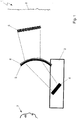
- Figure 1 shows the display unit 1 according to the invention, which comprises a projection surface 2 of a head-up display unit 3 with an image generating unit 4.
- the representation of figure 1 comprises only components of the units which area essential and necessary for their explanation.
- the image generation unit 4 arranged in the head-up display unit 3 projects an image to be represented onto the projection surface 2, the so-called combiner, and generates a virtual image 5.
- the virtual image 5 appears for a user 7 at an appropriate distance behind the projection surface 2. In addition to this virtual image 5, the user 7 can also see the background 8 of the virtual image 5.
- the user 7 can recognize the real vehicle environment in which the user 7 is moving with the vehicle as background 8 in the area of the front windshield.
- the background 8 can be fixed as desired.
- an image or a video can be used as background 8. Even the insertion of a scene from the vehicle environment recorded by a camera located in or on the motor vehicle is possible, for example, a view behind the vehicle before or during a retrograde movement of the motor vehicle can be inserted.
- a transparent display 6 is arranged, for example, behind the projection surface 2.
- the transparent display 6, which can be constructed, for example, as an OLED display, is advantageously permanently connected to the surface of the projection surface 2. Such a connection can be achieved by a bonding method or an adhesive method.
- the user 7 sees, for example, the virtual image 5 and the vehicle environment or the virtual image 5 and a background 8 which is appropriately inserted or is firmly present in the display unit 1
- the display 6 is controlled by an appropriate control unit, which is not shown, in such a manner that one or more contents or objects 9 such as graphics, written signs, symbols and others according to figure 2 are displayed, the user 7 sees the objects 9 in two dimensions on the surface of the display unit 1. Therefore, for example, him selection keys or functional keys can be made available by which the user 7 can make a selection.
- Vehicle functions for example, the air conditioning, sound system, automatic transmission functions and other adjustment or usages such as a navigation program can be controlled by such a selection.
- Figure 2 shows a graphic representation generated with an arrangement according to figure 1 .
- a virtual image 5 is generated by the head-up display unit 3 which image appears to the user 7 behind the surface of the display unit 1 in a three-dimensional representation.
- the virtual image 5 is shown offset laterally to the right. The offset should correspond to a spatial impression of a user 7 looking from the left onto the display unit 1.
- the user 7 perceives from his position as the vehicle driver the image in the form of a holographic representation.
- the head-up display unit 3 is turned off or controlled in such a manner that the virtual image 5 is no longer generated and the transparent display 6 is activated.
- various methods for recognizing gestures or, for example, methods which function capacitively or with infrared can be used.
- Figure 2 shows by way of example three rectangular objects 9, wherein the qualities of the objects 9 such as shape, colour, the location of the representation, labels and others can be adapted as desired.
- an object 9 can also be, for example, a written character, a symbol, a geometrical shape, a graphic, an image and other things.
- a selection of available radio stations, operating functions or travel destinations can be made available with the above.
- the user 7 can make his selection interactively by touching the surface of the display unit 1 at the position of an appropriate object 9.
- the display unit 1 recognizes on a capacitive or infrared basis the undertaken selection with the aid of the central control unit and initiates a corresponding reaction in accordance with the undertaken selection of the user 7.
- the transfer from the first to the second operating mode and vice versa is smoothly completed here, which means that the 3D representation in the first operating mode, for example, is changed in such a manner that the impression is created that a represented 3D object is drawn out of the distance behind the projection surface 2 onto the surface of the transparent display 6 and merges into a 2D object.
- the 2D object is then available for an interaction with the vehicle driver or user 7.
- the transfer from the second to the first operating mode can also be started by a corresponding input of the user 7.
- a special embodiment of the invention provides that the transfer from one operating mode to the other operating mode is not completely carried out.
- a part of the 3D representation remains retained while a 2D representation is displayed for the selection and/or for information by the transparent display 6.
- the visibility of the 3D representation is reduced in order to ensure a good ability to recognize the 2D representation.
- the visibility of the 3D representation is reduced, for example, to a value of 25%, 20%, 15%, 10%, or 5% and therefore the 3D representation is rendered transparent.
- Figure 3 shows an exemplary course of the method for controlling the display unit 1 of the invention.
- step 10 the display unit 1 with the head-up display unit 3 is started up.
- this method step there is the possibility of generating a 3D representation.
- step 11 a check is made by a method for gesture recognition or by a sensor operating with infrared or capacitively whether a hand of the user 7 is approaching the surface of the display unit 1.
- step 12 a 3D representation of a virtual image 5 is generated in accordance with the first operating mode in step 12.
- step 13 If a hand is detected in step 11 approaching the surface of the display unit 1, then a check is made in step 13 whether a set distance to the surface of the display unit 1 was dropped below during the approach. If a given distance to the surface of the display unit 1 is dropped below, in step 14 an at least partial cutting off of the head-up display unit 3 will take place.
- the head-up display unit 3 can be completely cut off and therefore does not generate any more virtual image 5.
- the head-up display unit 3 is controlled in such a manner that the virtual image 5 is reduced in its intensity and therefore can only be perceived to a low degree.
- the first operating mode is terminated.
- a change of position of the represented 3D object, that is, of the virtual image 5, for example, up to an object 9 represented in 2D can also take place with the reduction.
- step 15 Objects 9 are displayed on this transparent display 6 which are suitable for an interaction with the user 7.
- step 15 for example, selection possibilities in the area of air conditioning, the navigation unit, of a sound system or of a radio receiver and more can be displayed.
- the user 7 in step 16 select, change or turn on or turn off functions of the above-described systems.
- the surface is provided with any means known from the prior art for detecting a touching of the surface which can operate, for example, capacitively.
- step 17 If the hand of the user 7 is removed from the surface of the display unit 1, this is recognized in step 17 by one of the means already described for the approach. Consequently, the transparent display 6 is turned off in step 18 and then appears completely transparent again. The second operating mode is terminated and the transfer to the first operating mode takes place in which the head-up display unit 3 is started up again and a virtual image 5 is generated.
- step 17 After leaving the step 17 the course is continued in step 10, wherein the described course starts from the beginning.
- the display unit 1 according to the invention with the unit consisting of a projection surface 2 and the transparent display 6 is arranged so that it can be readily reached by the user 7, virtual images 5 can be inserted into the environment located in front of the vehicle, as is known from the prior art, and an interaction while observing certain safety regulations is possible. Also, contact-analog representations in the environment of the vehicle are then possible.
Landscapes
- Engineering & Computer Science (AREA)
- Chemical & Material Sciences (AREA)
- Mechanical Engineering (AREA)
- Transportation (AREA)
- Combustion & Propulsion (AREA)
- Physics & Mathematics (AREA)
- General Engineering & Computer Science (AREA)
- Theoretical Computer Science (AREA)
- General Physics & Mathematics (AREA)
- Human Computer Interaction (AREA)
- Computer Graphics (AREA)
- Optics & Photonics (AREA)
- Signal Processing (AREA)
- Computer Hardware Design (AREA)
- Software Systems (AREA)
- Multimedia (AREA)
- Instrument Panels (AREA)
- User Interface Of Digital Computer (AREA)
- Controls And Circuits For Display Device (AREA)
Abstract
Description
- The invention relates to a display unit for representing information, which comprises at least one head-up display unit with an image generating unit and a projection surface for generating a virtual image.
- The invention also relates to a method for representing information on a display unit, wherein a virtual image is generated in a first operating mode of the display unit by a head-up display unit.
- It is known from the prior art that information can be projected to the visual field of a car driver or of a pilot by a head-up display. A head-up display, also abbreviated as HUD, denotes a display system in which the user can substantially retain the position of his head and of the direction of his view in the original alignment in order to observe the displayed information. Such head-up displays generally comprise an image-generating unit which makes available the information to be represented in the form of an image, a lens module which makes possible the beam course inside the head-up display up to an exit opening and which is also designated as a mirror lens, and comprises a projection surface for representing the image to be generated. The lens module guides the image onto the projection surface, which is constructed as a reflecting, light-permeable disk and is also designated as a combiner. The vehicle driver sees the reflected information of the image-generating unit and at the same time sees the actual environment behind the disk. Therefore, the attention of a vehicle driver remains, for example when driving a vehicle, on what is happening in front of the vehicle while he can detect the information projected into the visual field.
- The information which can be represented includes the displaying of operating states such as indications of the speed, engine speed, safe load, equipment and information from a navigation system, radar system or target detection system. In addition, for example in motor vehicles, information about the current stretch limitations such as no passing and speed limits or the current adaptive cruise control, abbreviated as ACC, and others can be displayed.
- The using of a so-called contact-analog representation in vehicles in a 2D perspective or a 3D perspective is also known. Contact-analog information or display elements denote such information or display elements which are inserted in the correct position and correct location in such a manner into the current view of the motor vehicle driver that the vehicle driver has the impression that this information or these display elements are a component of the environment of the vehicle. Therefore, he has the impression that a represented arrow indicating a change of the direction of travel or a lane change is arranged directly on the road since the representation of the image of the arrow was superposed on the environment perceived by the vehicle driver. Therefore, this partially covering or superimposing, positionally correct and locationally correct insertion of such information results in a supplementation of the environmental image perceived by a vehicle driver.
- Aside from a navigation arrow located directly on the street, an interval beam can also be represented, for example, which should indicate an interval to be maintained from a motor vehicle driving in front. A representation of walls or barriers is also possible which are placed on existing road markings.
- In addition, a so-called gesture recognition is also known from the prior art in which an automatic recognition of gestures made by a person, in particular a movement of the head, arm, hand or finger of a person takes place. Sensors such as a video camera are required for the contactless recognition of such gestures and which records the gestures of the person. This image information is processed in a calculating unit such as a computer by an appropriate software and makes a recognition of gestures possible in this manner which can be utilized, for example, for a human-machine interaction.
-
DE 10 2011 121 746 A1 teaches a motor vehicle operating system and a motor vehicle control system for autonomous motor vehicles on an entire windshield display. The described method for navigation of a motor vehicle using a graphic projection display comprises the monitoring of a navigation state graphic which represents a navigation intention and which is displayed on the graphic projection display. The method also comprises the monitoring of a user input which is displayed on a section of the graphic projection display, the initiation of a navigation command defined by the user based on the monitored navigation graphic and of the monitored user input, and the operating of the motor vehicle according to the navigation command defined by the user. - The graphic projection display comprises a substantially transparent windshield as part of an HUD, a touch image screen display, a human-machine interface and a display monitor which is attached inside the motor vehicle.
-
US 2012/0249589 A1 teaches a method for the outputting of graphic driving suggestions in which in order to support the vehicle driver of an automobile when carrying out the driving manoeuvre the graphic driving suggestions are outputted by a head-up display provided in the automobile. - The method comprises the following steps, -the outputting of a first graphic driving suggestion in the form of a driving stretch change which points out to the vehicle driver the direction of a driving stretch travel at the beginning of the manoeuvre to a theoretical driving stretch, - the outputting of a second graphic driving suggestion in the form of a contact-analog driving stretch marking which emphasizes the theoretical driving stretch graphically in contrast to other driving stretches, - the outputting of a third graphic driving suggestion in the form of a contact-analog manoeuvring impulse which comprises a driving path starting from the theoretical driving stretch and corresponding to the driving manoeuvre, - and the outputting of a fourth graphic driving suggestion in the form of a symbolic representation of a manoeuvre suggested which symbolically indicates the started driving manoeuvre after the entrance of the vehicle into the driving path.
-
EP 2 894 509 A1 - The deflection device is constructed as an at least partially transparent projection surface which is arranged in the first optical axis of the first image and/or in the second optical axis of the second image, wherein the projection of the first image is guided along the first optical axis in the direction of the observer and wherein the projection of the second image is guided along the second optical axis in the direction of the observer.
- The view field display can comprise a projection surface here which is constructed for deflecting the projection and for generating a contact-analog display.
-
EP 2 018 992 A1 - It is possible by an appropriate hand movement which is recognized as a gesture to shift the representation of a signal or of a piece of information from a first representation site such as a first display to a second or third representation site inside a motor vehicle. In this manner, for example, a representation can be shifted from a display in a central console of the vehicle to a head-up display.
- A disadvantage of the known prior art is the fact that a projection surface of an HUD or a windshield used for the representation, that is, the projection surface for the representation of the image to be generated is usually located outside of the reach of the vehicle driver or at least cannot be reached in a comfortable and reliable manner.
- Another disadvantage resides in the separation between a projection surface and an input means suitable for an interaction.
- Furthermore, a user input by touching the projection surface is also rendered difficult in that a projected object such an in input key optically appears behind the projection surface and can therefore not be reached by a finger of the user.
- Since the known head-up display units do not comprise touch-sensitive means suitable for the operation, these head-up display units are only used as display instruments for representing information for the vehicle driver. A use in the form of a central control display in a motor vehicle does not take place.
- The task of the invention is to make available a display unit for representing information and a method for representing information on a display unit, wherein a two-dimensional and also a three-dimensional representation of contents as well as also an interaction by inputs of a user are made possible. In addition, the arrangement should be able to be produced in a simple and economical manner.
- The task is solved by the subject matter with the features according to
Claim 1 of the independent claims. Further developments are indicated in thedependent Claims 2 to 4. - The task is also solved by a method with the features according to
Claim 5 of the independent claims. Further developments are indicated in thedependent Claims 6 to 12. - The present invention makes it possible to use a display unit in the form of a head-up display not only as a display instrument for representing information for a vehicle driver but also as a central control display, for example in a central console of an automobile.
- The present invention therefore describes a combination of a contactless display, also designated as a touchscreen display, with a head-up display, which makes possible graphic representations as well as interactions with the vehicle driver.
- To this end a customary head-up display unit for representing graphic information or objects is used with a combiner, which is also designated as a projection surface. The head-up display unit can generate two-dimensional or three-dimensional representations by a central control unit not described in detail and project them, for example, into the viewing area of a vehicle driver. Therefore, the vehicle driver sees information from the vehicle environment as well as the image information generated by the head-up display unit.
- The invention is also provided with a using of the display unit of the invention in the area of the central console of an automobile. In this embodiment the vehicle driver sees the representation of graphic information or objects by the projection surface in the form of a holographic representation without information from the vehicle environment.
- In order to realize the display unit according to the invention, it is provided that a transparent display, for example, consisting of organic light-emitting diodes, abbreviated as an OLED display, is arranged on the back side of the projection surface. A connection between the projection surface and the transparent display can then take place, for example by adhesion or bonding.
- In order to make an interaction of the vehicle driver with the display unit of the invention possible, a means for recognizing gestures of the vehicle driver is arranged inside the vehicle. Alternatively, inputs by the vehicle driver can also be detected by a capacitively acting input means or one based on infrared technology. Such input means can extend, for example, parallel to the surface of the projection surface and can detect an approach to the projection surface or display surface or can detect a touching of the display surface by the vehicle driver. Another means for recognizing gestures are fly-time systems, also designated as TOF systems for "time of flight", which can make gestures recognizable by a photomixing detector, also designated as a PMD sensor for "photonic mixing device", by a measuring of the run time of the emitted light.
- The detected gestures or touches are evaluated in a central control unit and therefore, for example, an interaction of the vehicle driver such as activating a virtual key represented only in the display unit is recognized.
- After the recognition of the key activation a corresponding reaction such as a turning on or a turning off of a function or of a structural group of the vehicle is realized. Furthermore, even functions such as loudness, brightness, zoom and many others can be regulated. This enumeration does not represent any limitation and can be changed and expanded as desired by a person skilled in the art in all areas in which a display is used with which an interaction can take place.
- Since the image reflected by the projection surface seems to float for the vehicle driver or user in the space behind the projection surface, which is also designated as a virtual image, the user has the impression that a type of hologram is concerned.
- Since it is not possible to touch with a finger a virtual object generated by the projection surface, a transparent display connected to the upper layer of the projection surface is provided on which objects or symbols can be indicated which are provided for an interaction with the vehicle driver.
- The transparent display, which can be constructed, for example, as an OLED display, makes a display available which seems to be two-dimensional and can be readily reached and touched, for example, by a finger of the vehicle driver.
- It is also provided here that a change can be made between a holographic, three-dimensional representation, abbreviated as a 3D representation or 3D and a two-dimensional representation, abbreviated as a 2D representation or 2D. Therefore, for example a change from a 3D representation to a 2D representation can take place if it is recognized by appropriate sensors that the finger of the vehicle driver approaches the projection surface or the display surface or touches the projection surface or the display surface.
- For example, an object previously shown three-dimensionally can be converted into an object shown two-dimensionally by a suitably designed graphic transfer and can therefore be represented in such a manner that it can be reached by the vehicle driver. The impression can be imparted here that the user during the approach to the projection surface or to the display surface as a graphical user surface, abbreviated as GUI for "Graphical User Interface" pulls the object from the virtual image onto the projection surface or the display surface.
- If the finger of the vehicle driver is removed again after an input or interaction from the projection surface or the display surface, an inversely shaped graphic transfer from aa 2D object to a 3D object can be brought about.
- Other details, features and advantages of embodiment of the invention result from the following description of exemplary embodiments with reference made to the attached drawings. In the drawings:
- Fig. 1
- shows a basic representation of an arrangement according to a preferred embodiment of the invention for representing information on a display unit,
- Fig. 2
- shows an exemplary representation of 2D objects and 3D objects with the display unit according to
Figure 1 , and - Fig. 3
- shows a course of a method for controlling the display unit according to a preferred embodiment of the invention.
-
Figure 1 shows thedisplay unit 1 according to the invention, which comprises aprojection surface 2 of a head-updisplay unit 3 with animage generating unit 4. The representation offigure 1 comprises only components of the units which area essential and necessary for their explanation. Theimage generation unit 4 arranged in the head-updisplay unit 3 projects an image to be represented onto theprojection surface 2, the so-called combiner, and generates avirtual image 5. Thevirtual image 5 appears for auser 7 at an appropriate distance behind theprojection surface 2. In addition to thisvirtual image 5, theuser 7 can also see thebackground 8 of thevirtual image 5. - In the arrangement of the head-up
display unit 3 in a motor vehicle theuser 7 can recognize the real vehicle environment in which theuser 7 is moving with the vehicle asbackground 8 in the area of the front windshield. In the case that the head-updisplay unit 3 is being used in a central console of a motor vehicle, thebackground 8 can be fixed as desired. In addition to mono-colour ormulti-coloured backgrounds 8 even an image or a video can be used asbackground 8. Even the insertion of a scene from the vehicle environment recorded by a camera located in or on the motor vehicle is possible, for example, a view behind the vehicle before or during a retrograde movement of the motor vehicle can be inserted. - In order to realize the idea according to the invention of making available a 2D view as well as a 3D view in the display for a
user 7 and interactions with thedisplay unit 1, atransparent display 6 is arranged, for example, behind theprojection surface 2. Thetransparent display 6, which can be constructed, for example, as an OLED display, is advantageously permanently connected to the surface of theprojection surface 2. Such a connection can be achieved by a bonding method or an adhesive method. - In the case that the
display 6 is transparent, theuser 7 sees, for example, thevirtual image 5 and the vehicle environment or thevirtual image 5 and abackground 8 which is appropriately inserted or is firmly present in thedisplay unit 1 - In the case that the
display 6 is controlled by an appropriate control unit, which is not shown, in such a manner that one or more contents orobjects 9 such as graphics, written signs, symbols and others according tofigure 2 are displayed, theuser 7 sees theobjects 9 in two dimensions on the surface of thedisplay unit 1. Therefore, for example, him selection keys or functional keys can be made available by which theuser 7 can make a selection. Vehicle functions, for example, the air conditioning, sound system, automatic transmission functions and other adjustment or usages such as a navigation program can be controlled by such a selection. -
Figure 2 shows a graphic representation generated with an arrangement according tofigure 1 . In a first operating mode of thedisplay unit 1 in which thetransparent display 6 appears transparently, avirtual image 5 is generated by the head-updisplay unit 3 which image appears to theuser 7 behind the surface of thedisplay unit 1 in a three-dimensional representation. In the representation offigure 2 thevirtual image 5 is shown offset laterally to the right. The offset should correspond to a spatial impression of auser 7 looking from the left onto thedisplay unit 1. Theuser 7 perceives from his position as the vehicle driver the image in the form of a holographic representation. - In the case that the
user 7 comes in the vicinity of the surface of thedisplay unit 1 with his hand or with a finger, the head-updisplay unit 3 is turned off or controlled in such a manner that thevirtual image 5 is no longer generated and thetransparent display 6 is activated. In order to recognize an approach to the surface of thedisplay unit 1, various methods for recognizing gestures or, for example, methods which function capacitively or with infrared can be used. - If an approach to the surface of the
display unit 1 is detected, selection possibilities or switches for the corresponding operating function in the form of one ormore objects 9 are represented on thedisplay 6 in a second operating mode by thetransparent display 6.Figure 2 shows by way of example threerectangular objects 9, wherein the qualities of theobjects 9 such as shape, colour, the location of the representation, labels and others can be adapted as desired. Such anobject 9 can also be, for example, a written character, a symbol, a geometrical shape, a graphic, an image and other things. - For example, a selection of available radio stations, operating functions or travel destinations can be made available with the above. The
user 7 can make his selection interactively by touching the surface of thedisplay unit 1 at the position of anappropriate object 9. Thedisplay unit 1 recognizes on a capacitive or infrared basis the undertaken selection with the aid of the central control unit and initiates a corresponding reaction in accordance with the undertaken selection of theuser 7. - The transfer from the first to the second operating mode and vice versa is smoothly completed here, which means that the 3D representation in the first operating mode, for example, is changed in such a manner that the impression is created that a represented 3D object is drawn out of the distance behind the
projection surface 2 onto the surface of thetransparent display 6 and merges into a 2D object. The 2D object is then available for an interaction with the vehicle driver oruser 7. - When the
user 7 has made his selection or has removed his hand or his finger from the surface of thedisplay unit 1 again, after the passage of a given time a transfer from the second operating mode to the first operating mode is completed. In order to recognize the removal of the finger from the surface of thedisplay unit 1, a gesture recognition is used or a detection by a capacitive or infrared sensor is again carried out. - Alternatively, the transfer from the second to the first operating mode can also be started by a corresponding input of the
user 7. - A special embodiment of the invention provides that the transfer from one operating mode to the other operating mode is not completely carried out. In this case, for example, a part of the 3D representation remains retained while a 2D representation is displayed for the selection and/or for information by the
transparent display 6. In this case it is provided that the visibility of the 3D representation is reduced in order to ensure a good ability to recognize the 2D representation. The visibility of the 3D representation is reduced, for example, to a value of 25%, 20%, 15%, 10%, or 5% and therefore the 3D representation is rendered transparent. -
Figure 3 shows an exemplary course of the method for controlling thedisplay unit 1 of the invention. Instep 10 thedisplay unit 1 with the head-updisplay unit 3 is started up. In this method step there is the possibility of generating a 3D representation. - In step 11 a check is made by a method for gesture recognition or by a sensor operating with infrared or capacitively whether a hand of the
user 7 is approaching the surface of thedisplay unit 1. - In the case that no approach is detected in
step 11, in step 12 a 3D representation of avirtual image 5 is generated in accordance with the first operating mode instep 12. - If a hand is detected in
step 11 approaching the surface of thedisplay unit 1, then a check is made instep 13 whether a set distance to the surface of thedisplay unit 1 was dropped below during the approach. If a given distance to the surface of thedisplay unit 1 is dropped below, instep 14 an at least partial cutting off of the head-updisplay unit 3 will take place. The head-updisplay unit 3 can be completely cut off and therefore does not generate any morevirtual image 5. Alternatively, the head-updisplay unit 3 is controlled in such a manner that thevirtual image 5 is reduced in its intensity and therefore can only be perceived to a low degree. The first operating mode is terminated. A change of position of the represented 3D object, that is, of thevirtual image 5, for example, up to anobject 9 represented in 2D can also take place with the reduction. - Along with the influencing of the head-up
display unit 3 instep 14, at the same time thetransparent display 6 is started in a second operating mode instep 15.Objects 9 are displayed on thistransparent display 6 which are suitable for an interaction with theuser 7. Instep 15, for example, selection possibilities in the area of air conditioning, the navigation unit, of a sound system or of a radio receiver and more can be displayed. - Subsequently, it is possible for the
user 7 instep 16 to select, change or turn on or turn off functions of the above-described systems. In order to detect the touching of the surface of thedisplay unit 1, the surface is provided with any means known from the prior art for detecting a touching of the surface which can operate, for example, capacitively. - If the hand of the
user 7 is removed from the surface of thedisplay unit 1, this is recognized instep 17 by one of the means already described for the approach. Consequently, thetransparent display 6 is turned off instep 18 and then appears completely transparent again. The second operating mode is terminated and the transfer to the first operating mode takes place in which the head-updisplay unit 3 is started up again and avirtual image 5 is generated. - After leaving the
step 17 the course is continued instep 10, wherein the described course starts from the beginning. - If the
display unit 1 according to the invention with the unit consisting of aprojection surface 2 and thetransparent display 6 is arranged so that it can be readily reached by theuser 7,virtual images 5 can be inserted into the environment located in front of the vehicle, as is known from the prior art, and an interaction while observing certain safety regulations is possible. Also, contact-analog representations in the environment of the vehicle are then possible. -
- 1
- display unit
- 2
- projection surface
- 3
- head-up display unit
- 4
- image generation unit
- 5
- virtual image
- 6
- transparent display
- 7
- user
- 8
- background
- 9
- two-dimensional object
- 10
- head-up
display unit 3 ready for operation - 11
- detection of hand in the vicinity of the
display unit 1 - 12
- generation of a virtual three-
dimensional image 5 - 13
- distance comparison with threshold value
- 14
- turn off head-up
display unit 3 - 15
- turn on
transparent display 6 - 16
- user input (interaction)
- 17
- hand removed from
display unit 1 - 18
- turn off
transparent display 6
Claims (12)
- A display unit (1) for representing information, which comprises at least one head-up display unit (3) with an image generating unit (4) and a projection surface (2) for generating a virtual image (5), characterized in that a transparent display (6) is arranged on a surface of the projection surface (2).
- The display unit (1) according to Claim 1, characterized in that the projection surface (2) comprises a first surface facing the image generating unit (4) and a second surface facing away from the image generating unit (4), and that the transparent display (6) is arranged on the second surface.
- The display unit (1) according to Claim 1 or 2, characterized in that the transparent display (6) is arranged by bonding or adhesion on the second surface of the projection surface (2).
- The display unit (1) according to one of Claims 1 to 3, characterized in that the transparent display (6) is designed as an OLED display.
- A method for representing information on a display unit (1), wherein in a first operating mode of the display unit (1) a virtual image (5) is generated by a head-up display unit (3), characterized in that the display unit (1) can be operated in a second operating mode, and that in this second operating mode a representation of two-dimensional objects (9) takes place in a plane of a transparent display (6) alternatively to the first operating mode or additionally to this first operating mode.
- The method according to Claim 5, characterized in that a detection of inputs of a user (7) on a surface of the display unit (1) takes place in the first and/or in the second operating mode.
- The method according to Claim 5 or 6, characterized in that a transfer of the representation of information on the display unit (1) from the first to the second operating mode is carried out in such a manner that the virtual image (5) is reduced at least partially in its intensity or is completely turned off and at the same time the representation of the two-dimensional objects (9) in the plane of the transparent display (6) takes place.
- The method according to Claim 5 or 6, characterized in that a transfer of the representation of information on the display unit (1) from the second to the first operating mode is carried out in such a manner that a turning off of the representation of the two-dimensional objects (9) in the plane of the transparent display (6) takes place and at the same time a turning on or an increase of the intensity of the representation of the virtual image (5) takes place.
- The method according to one of Claims 5 to 8, characterized in that the transfer of the representation of information on the display unit (1) from the first to the second operating mode takes place for the case that an approach of a hand of a user (7) to the surface of the display unit (1) is detected and that a transfer from the second to the to the first operating mode takes place for the case that the removal of the hand of the user (7) from the surface of the display unit (1) is detected.
- The method according to one of Claims 5 to 9, characterized in that the detection of the approach or of the removal of a hand of a user (7) to or from the surface of the display unit (1) is detected by a means for gesture recognition.
- The method according to one of Claims 5 to 9, characterized in that a detection of the approach or of the removal of a hand of a user (7) to or from the surface of the display unit (1) is detected by a means for distance recognition which operates capacitively or with infrared.
- The method according to one of Claims 5 to 11, characterized in that an object (9) is a written character, a symbol, a geometrical shape, a graphic or an image.
Applications Claiming Priority (1)
| Application Number | Priority Date | Filing Date | Title |
|---|---|---|---|
| DE102016108878.1A DE102016108878A1 (en) | 2016-05-13 | 2016-05-13 | Display unit and method for displaying information |
Publications (1)
| Publication Number | Publication Date |
|---|---|
| EP3246745A1 true EP3246745A1 (en) | 2017-11-22 |
Family
ID=58709312
Family Applications (1)
| Application Number | Title | Priority Date | Filing Date |
|---|---|---|---|
| EP17170881.1A Withdrawn EP3246745A1 (en) | 2016-05-13 | 2017-05-12 | Display unit and method for representing information |
Country Status (3)
| Country | Link |
|---|---|
| US (1) | US10482667B2 (en) |
| EP (1) | EP3246745A1 (en) |
| DE (1) | DE102016108878A1 (en) |
Families Citing this family (4)
| Publication number | Priority date | Publication date | Assignee | Title |
|---|---|---|---|---|
| US10347030B2 (en) * | 2017-05-15 | 2019-07-09 | Envisics Ltd | Adjusting depth of augmented reality content on a heads up display |
| CN108725810B (en) * | 2018-04-24 | 2024-03-29 | 中航大(天津)模拟机工程技术有限公司 | Airplane HUD system based on transparent OLED display screen |
| DE102018213820A1 (en) | 2018-08-16 | 2020-02-20 | Bayerische Motoren Werke Aktiengesellschaft | Method for operating a field of view display device for a motor vehicle |
| DE102018217125B3 (en) | 2018-10-08 | 2019-09-19 | Audi Ag | Display device and method for displaying an optical image information in an electronic display, and motor vehicle |
Citations (13)
| Publication number | Priority date | Publication date | Assignee | Title |
|---|---|---|---|---|
| US5552935A (en) * | 1988-07-01 | 1996-09-03 | Robert Bosch Gmbh | Head-up display device for motor vehicles |
| EP2018992A1 (en) | 2007-07-27 | 2009-01-28 | Continental Automotive GmbH | Motor vehicle cockpit |
| DE102011121746A1 (en) | 2010-12-29 | 2012-07-05 | GM Global Technology Operations LLC ( n.d. Ges. d. Staates Delaware) | Vehicle operation and vehicle control system for autonomous vehicles on a full windshield display |
| US20120249589A1 (en) | 2011-03-29 | 2012-10-04 | Bayerische Motoren Werke Aktiengesellschaft | Method for the Output of Graphic Driving Indications |
| CN202806308U (en) * | 2012-08-21 | 2013-03-20 | 惠州市德赛西威汽车电子有限公司 | Automotive windshield |
| WO2013104376A1 (en) * | 2012-01-09 | 2013-07-18 | Audi Ag | Method for displacing at least one display content |
| US20130187950A1 (en) * | 2012-01-20 | 2013-07-25 | Microsoft Corporation | Transparent display for mobile device |
| EP2695792A2 (en) * | 2012-08-09 | 2014-02-12 | Valeo Schalter und Sensoren GmbH | Device with a steering handle and a control panel and motor vehicle |
| US20140139928A1 (en) * | 2012-11-22 | 2014-05-22 | Sypro Optics Gmbh | Display arrangement for a motor vehicle, with an imager and an image splitter |
| WO2015041106A1 (en) * | 2013-09-18 | 2015-03-26 | 旭硝子株式会社 | Laminated glass and vehicular display device |
| EP2894509A1 (en) | 2014-01-13 | 2015-07-15 | Robert Bosch Gmbh | Field of vision display for a vehicle for displaying image information in two independent images to a viewer |
| WO2015152753A1 (en) * | 2014-03-31 | 2015-10-08 | Общество с ограниченной ответственностью "ВэйРэй" | Method of displaying information through automobile windshield, and device for implementing same |
| US20150367859A1 (en) * | 2012-12-21 | 2015-12-24 | Harman Becker Automotive Systems Gmbh | Input device for a motor vehicle |
Family Cites Families (10)
| Publication number | Priority date | Publication date | Assignee | Title |
|---|---|---|---|---|
| DE3101854A1 (en) | 1980-01-22 | 1983-12-15 | Elliott Brothers London Ltd | VIEWING DEVICE FOR A PREVIEW DISPLAY (HEAD-UP DISPLAY) |
| DE19708610A1 (en) * | 1997-03-03 | 1998-09-24 | Siemens Ag | Pixel matrix display device for transport systems |
| US20050084659A1 (en) * | 2003-10-20 | 2005-04-21 | General Atomics | Vehicle windshield head-up display |
| DE102008012638A1 (en) * | 2008-03-05 | 2009-09-10 | Carl Zeiss Microimaging Gmbh | Display system i.e. head-up display, for projecting information in field of vision of driver of harvester, has touch screen sheet for control commands, where sheet is arranged before disk in viewing direction of operator |
| FR2947920B1 (en) * | 2009-07-10 | 2011-07-29 | Thales Sa | OPTICAL COMBINATION HIGH HEAD SUN VISOR PROVIDING PROTECTION AGAINST SUNLIGHT |
| US8633979B2 (en) * | 2010-12-29 | 2014-01-21 | GM Global Technology Operations LLC | Augmented road scene illustrator system on full windshield head-up display |
| CN105008170B (en) * | 2013-02-22 | 2018-11-13 | 歌乐株式会社 | Vehicle head-up display device |
| DE102014118380A1 (en) * | 2014-12-11 | 2016-06-16 | Valeo Schalter Und Sensoren Gmbh | Display device for a motor vehicle with force sensor, motor vehicle and method |
| JP6354633B2 (en) * | 2015-03-25 | 2018-07-11 | マツダ株式会社 | Head-up display device |
| WO2017022176A1 (en) * | 2015-08-06 | 2017-02-09 | パナソニックIpマネジメント株式会社 | Head-up display and moving body equipped with head-up display |
-
2016
- 2016-05-13 DE DE102016108878.1A patent/DE102016108878A1/en not_active Withdrawn
-
2017
- 2017-05-12 US US15/593,418 patent/US10482667B2/en active Active
- 2017-05-12 EP EP17170881.1A patent/EP3246745A1/en not_active Withdrawn
Patent Citations (15)
| Publication number | Priority date | Publication date | Assignee | Title |
|---|---|---|---|---|
| US5552935A (en) * | 1988-07-01 | 1996-09-03 | Robert Bosch Gmbh | Head-up display device for motor vehicles |
| EP2018992A1 (en) | 2007-07-27 | 2009-01-28 | Continental Automotive GmbH | Motor vehicle cockpit |
| DE102011121746A1 (en) | 2010-12-29 | 2012-07-05 | GM Global Technology Operations LLC ( n.d. Ges. d. Staates Delaware) | Vehicle operation and vehicle control system for autonomous vehicles on a full windshield display |
| US20120249589A1 (en) | 2011-03-29 | 2012-10-04 | Bayerische Motoren Werke Aktiengesellschaft | Method for the Output of Graphic Driving Indications |
| WO2013104376A1 (en) * | 2012-01-09 | 2013-07-18 | Audi Ag | Method for displacing at least one display content |
| US20130187950A1 (en) * | 2012-01-20 | 2013-07-25 | Microsoft Corporation | Transparent display for mobile device |
| EP2695792A2 (en) * | 2012-08-09 | 2014-02-12 | Valeo Schalter und Sensoren GmbH | Device with a steering handle and a control panel and motor vehicle |
| CN202806308U (en) * | 2012-08-21 | 2013-03-20 | 惠州市德赛西威汽车电子有限公司 | Automotive windshield |
| US20140139928A1 (en) * | 2012-11-22 | 2014-05-22 | Sypro Optics Gmbh | Display arrangement for a motor vehicle, with an imager and an image splitter |
| US20150367859A1 (en) * | 2012-12-21 | 2015-12-24 | Harman Becker Automotive Systems Gmbh | Input device for a motor vehicle |
| WO2015041106A1 (en) * | 2013-09-18 | 2015-03-26 | 旭硝子株式会社 | Laminated glass and vehicular display device |
| US20160159282A1 (en) * | 2013-09-18 | 2016-06-09 | Asahi Glass Company, Limited | Laminated glass and vehicular display device |
| EP2894509A1 (en) | 2014-01-13 | 2015-07-15 | Robert Bosch Gmbh | Field of vision display for a vehicle for displaying image information in two independent images to a viewer |
| WO2015152753A1 (en) * | 2014-03-31 | 2015-10-08 | Общество с ограниченной ответственностью "ВэйРэй" | Method of displaying information through automobile windshield, and device for implementing same |
| EP3128356A1 (en) * | 2014-03-31 | 2017-02-08 | Ooo "Wayray" | Method of displaying information through automobile windshield, and device for implementing same |
Also Published As
| Publication number | Publication date |
|---|---|
| DE102016108878A1 (en) | 2017-11-16 |
| US20170330383A1 (en) | 2017-11-16 |
| US10482667B2 (en) | 2019-11-19 |
Similar Documents
| Publication | Publication Date | Title |
|---|---|---|
| US9605971B2 (en) | Method and device for assisting a driver in lane guidance of a vehicle on a roadway | |
| JP7480756B2 (en) | Vehicle display control device, vehicle display device, vehicle display control method, and vehicle display control program | |
| EP2936065B1 (en) | A system for a vehicle | |
| US10789490B2 (en) | Method for calculating a display of additional information for an advertisement, a display unit, apparatus for carrying out the method, and transportation vehicle and computer program | |
| US11904688B2 (en) | Method for calculating an AR-overlay of additional information for a display on a display unit, device for carrying out the method, as well as motor vehicle and computer program | |
| KR101367593B1 (en) | Interactive operating device and method for operating the interactive operating device | |
| JP5136950B2 (en) | In-vehicle device operation device | |
| US20140195096A1 (en) | Apparatus and method for contactlessly detecting objects and/or persons and gestures and/or operating procedures made and/or carried out thereby | |
| CN105026203B (en) | Method for synchronizing a display device of a motor vehicle | |
| JP2018150043A (en) | System for information transmission in motor vehicle | |
| US20200057546A1 (en) | User interface and methods for inputting and outputting information in a vehicle | |
| CN102105322B (en) | Method for displaying two-sided flat object on display in motor vehicle and display device for vehicle | |
| US20200055397A1 (en) | User interface and method for the input and output of information in a vehicle | |
| CN113784861A (en) | Display control method and display control device | |
| CN109643219B (en) | Method for interacting with image content presented on a display device in a vehicle | |
| US10482667B2 (en) | Display unit and method of controlling the display unit | |
| CN109204305A (en) | Equipment and motor vehicle used in abundant visual field method, observer's vehicle and object | |
| EP3457254A1 (en) | Method and system for displaying virtual reality information in a vehicle | |
| US10795155B2 (en) | Projection display device and control method for the same | |
| CN108153411A (en) | For the method and apparatus interacted with graphic user interface | |
| CN115755405A (en) | Method and apparatus for driving assistance based on augmented reality technology | |
| CN108944665B (en) | Supports operation of objects located in the passenger compartment and motor vehicles | |
| CN114867992A (en) | Method and apparatus for presenting virtual navigation elements | |
| JP2016215770A (en) | Image display device for vehicle driver | |
| KR20160068487A (en) | Cruise control system and cruise control method |
Legal Events
| Date | Code | Title | Description |
|---|---|---|---|
| PUAI | Public reference made under article 153(3) epc to a published international application that has entered the european phase |
Free format text: ORIGINAL CODE: 0009012 |
|
| STAA | Information on the status of an ep patent application or granted ep patent |
Free format text: STATUS: THE APPLICATION HAS BEEN PUBLISHED |
|
| AK | Designated contracting states |
Kind code of ref document: A1 Designated state(s): AL AT BE BG CH CY CZ DE DK EE ES FI FR GB GR HR HU IE IS IT LI LT LU LV MC MK MT NL NO PL PT RO RS SE SI SK SM TR |
|
| AX | Request for extension of the european patent |
Extension state: BA ME |
|
| STAA | Information on the status of an ep patent application or granted ep patent |
Free format text: STATUS: REQUEST FOR EXAMINATION WAS MADE |
|
| 17P | Request for examination filed |
Effective date: 20180522 |
|
| RBV | Designated contracting states (corrected) |
Designated state(s): AL AT BE BG CH CY CZ DE DK EE ES FI FR GB GR HR HU IE IS IT LI LT LU LV MC MK MT NL NO PL PT RO RS SE SI SK SM TR |
|
| STAA | Information on the status of an ep patent application or granted ep patent |
Free format text: STATUS: EXAMINATION IS IN PROGRESS |
|
| 17Q | First examination report despatched |
Effective date: 20190306 |
|
| STAA | Information on the status of an ep patent application or granted ep patent |
Free format text: STATUS: THE APPLICATION IS DEEMED TO BE WITHDRAWN |
|
| 18D | Application deemed to be withdrawn |
Effective date: 20201125 |