EP3246658A1 - Soft sensor device - Google Patents
Soft sensor device Download PDFInfo
- Publication number
- EP3246658A1 EP3246658A1 EP17165852.9A EP17165852A EP3246658A1 EP 3246658 A1 EP3246658 A1 EP 3246658A1 EP 17165852 A EP17165852 A EP 17165852A EP 3246658 A1 EP3246658 A1 EP 3246658A1
- Authority
- EP
- European Patent Office
- Prior art keywords
- value
- variable
- arithmetic operation
- function
- time
- Prior art date
- Legal status (The legal status is an assumption and is not a legal conclusion. Google has not performed a legal analysis and makes no representation as to the accuracy of the status listed.)
- Granted
Links
Images




Classifications
-
- G—PHYSICS
- G06—COMPUTING OR CALCULATING; COUNTING
- G06F—ELECTRIC DIGITAL DATA PROCESSING
- G06F17/00—Digital computing or data processing equipment or methods, specially adapted for specific functions
- G06F17/10—Complex mathematical operations
- G06F17/15—Correlation function computation including computation of convolution operations
-
- G—PHYSICS
- G06—COMPUTING OR CALCULATING; COUNTING
- G06F—ELECTRIC DIGITAL DATA PROCESSING
- G06F9/00—Arrangements for program control, e.g. control units
- G06F9/06—Arrangements for program control, e.g. control units using stored programs, i.e. using an internal store of processing equipment to receive or retain programs
- G06F9/30—Arrangements for executing machine instructions, e.g. instruction decode
- G06F9/30003—Arrangements for executing specific machine instructions
- G06F9/3004—Arrangements for executing specific machine instructions to perform operations on memory
-
- G—PHYSICS
- G05—CONTROLLING; REGULATING
- G05B—CONTROL OR REGULATING SYSTEMS IN GENERAL; FUNCTIONAL ELEMENTS OF SUCH SYSTEMS; MONITORING OR TESTING ARRANGEMENTS FOR SUCH SYSTEMS OR ELEMENTS
- G05B15/00—Systems controlled by a computer
- G05B15/02—Systems controlled by a computer electric
-
- F—MECHANICAL ENGINEERING; LIGHTING; HEATING; WEAPONS; BLASTING
- F02—COMBUSTION ENGINES; HOT-GAS OR COMBUSTION-PRODUCT ENGINE PLANTS
- F02M—SUPPLYING COMBUSTION ENGINES IN GENERAL WITH COMBUSTIBLE MIXTURES OR CONSTITUENTS THEREOF
- F02M35/00—Combustion-air cleaners, air intakes, intake silencers, or induction systems specially adapted for, or arranged on, internal-combustion engines
- F02M35/10—Air intakes; Induction systems
- F02M35/10373—Sensors for intake systems
- F02M35/1038—Sensors for intake systems for temperature or pressure
-
- G—PHYSICS
- G05—CONTROLLING; REGULATING
- G05B—CONTROL OR REGULATING SYSTEMS IN GENERAL; FUNCTIONAL ELEMENTS OF SUCH SYSTEMS; MONITORING OR TESTING ARRANGEMENTS FOR SUCH SYSTEMS OR ELEMENTS
- G05B17/00—Systems involving the use of models or simulators of said systems
- G05B17/02—Systems involving the use of models or simulators of said systems electric
-
- G—PHYSICS
- G06—COMPUTING OR CALCULATING; COUNTING
- G06F—ELECTRIC DIGITAL DATA PROCESSING
- G06F11/00—Error detection; Error correction; Monitoring
- G06F11/07—Responding to the occurrence of a fault, e.g. fault tolerance
- G06F11/08—Error detection or correction by redundancy in data representation, e.g. by using checking codes
- G06F11/10—Adding special bits or symbols to the coded information, e.g. parity check, casting out 9's or 11's
- G06F11/1076—Parity data used in redundant arrays of independent storages, e.g. in RAID systems
- G06F11/108—Parity data distribution in semiconductor storages, e.g. in SSD
-
- G—PHYSICS
- G06—COMPUTING OR CALCULATING; COUNTING
- G06F—ELECTRIC DIGITAL DATA PROCESSING
- G06F12/00—Accessing, addressing or allocating within memory systems or architectures
- G06F12/02—Addressing or allocation; Relocation
- G06F12/08—Addressing or allocation; Relocation in hierarchically structured memory systems, e.g. virtual memory systems
- G06F12/0802—Addressing of a memory level in which the access to the desired data or data block requires associative addressing means, e.g. caches
- G06F12/0806—Multiuser, multiprocessor or multiprocessing cache systems
- G06F12/0811—Multiuser, multiprocessor or multiprocessing cache systems with multilevel cache hierarchies
-
- G—PHYSICS
- G06—COMPUTING OR CALCULATING; COUNTING
- G06F—ELECTRIC DIGITAL DATA PROCESSING
- G06F17/00—Digital computing or data processing equipment or methods, specially adapted for specific functions
- G06F17/10—Complex mathematical operations
- G06F17/11—Complex mathematical operations for solving equations, e.g. nonlinear equations, general mathematical optimization problems
- G06F17/13—Differential equations
-
- G—PHYSICS
- G06—COMPUTING OR CALCULATING; COUNTING
- G06F—ELECTRIC DIGITAL DATA PROCESSING
- G06F9/00—Arrangements for program control, e.g. control units
- G06F9/06—Arrangements for program control, e.g. control units using stored programs, i.e. using an internal store of processing equipment to receive or retain programs
- G06F9/30—Arrangements for executing machine instructions, e.g. instruction decode
- G06F9/38—Concurrent instruction execution, e.g. pipeline or look ahead
- G06F9/3885—Concurrent instruction execution, e.g. pipeline or look ahead using a plurality of independent parallel functional units
- G06F9/3889—Concurrent instruction execution, e.g. pipeline or look ahead using a plurality of independent parallel functional units controlled by multiple instructions, e.g. MIMD, decoupled access or execute
- G06F9/3891—Concurrent instruction execution, e.g. pipeline or look ahead using a plurality of independent parallel functional units controlled by multiple instructions, e.g. MIMD, decoupled access or execute organised in groups of units sharing resources, e.g. clusters
-
- G—PHYSICS
- G06—COMPUTING OR CALCULATING; COUNTING
- G06F—ELECTRIC DIGITAL DATA PROCESSING
- G06F9/00—Arrangements for program control, e.g. control units
- G06F9/06—Arrangements for program control, e.g. control units using stored programs, i.e. using an internal store of processing equipment to receive or retain programs
- G06F9/46—Multiprogramming arrangements
-
- G—PHYSICS
- G01—MEASURING; TESTING
- G01D—MEASURING NOT SPECIALLY ADAPTED FOR A SPECIFIC VARIABLE; ARRANGEMENTS FOR MEASURING TWO OR MORE VARIABLES NOT COVERED IN A SINGLE OTHER SUBCLASS; TARIFF METERING APPARATUS; MEASURING OR TESTING NOT OTHERWISE PROVIDED FOR
- G01D1/00—Measuring arrangements giving results other than momentary value of variable, of general application
- G01D1/16—Measuring arrangements giving results other than momentary value of variable, of general application giving a value which is a function of two or more values, e.g. product or ratio
Definitions
- the present application relates to a soft sensor device that acquires a state variable by calculation.
- a soft sensor refers to software in which the relationship that is established between a state variable desired to be estimated and an input variable that can be observed is described by a function.
- the software is implemented in a computer, and thereby functions as "a device" similar to a conventional sensor.
- the device which is realized by implementing a soft sensor that is software in a computer that is hardware will be referred to as a "soft sensor device”.
- Responsiveness is required of a soft sensor device similarly to the conventional sensors. That is, reduction of the time period which is required until acquisition of a state variable that is desired to be estimated is required.
- the arithmetic capacities of calculation devices including a soft sensor device can be enhanced by enhancing the operating frequencies of cores.
- the operating frequencies may be lower as compared with a single-core processor, when processing the same amount of arithmetic operation. Further, by performing parallel computation by assigning the task to be processed to a plurality of cores, the arithmetic operation time period can be reduced as compared with the case of performing calculation in a single core.
- the present application is made in the light of the problem as described above, and has an object to reduce an arithmetic operation time period that is required to acquire a state variable, in a soft sensor device that acquires the state variable which is an estimation object by calculation using a plurality of processor cores.
- a soft sensor for estimating the state variable by calculation is expressed by expression 1 as follows.
- the state variable that is the estimation object is expressed by "x”
- the input variable that is observable is expressed by "u”.
- x is a vector having one or a plurality of state quantities as a component
- u is a vector having one or a plurality of input signals as a component.
- a time derivative dx/dt of the state variable x is expressed by a function f(x, g(x), u) in which the state variable x, an inner function g(x) having the state variable x as an independent variable, and the input variable u are independent variables.
- the inner function g(x) is present in the function f(x, g(x), u)
- the soft sensor has a sequential structure. Therefore, when expression 1 is directly calculated, much time is required to acquire the state variable x, because the inner function g(x) is calculated first, and next, the function f(x, g(x), u) is calculated.
- both sides of expression 2 are time-differentiated, and the relationship in expression 1 is used, whereby next expression 3 is obtained.
- a right side in expression 3 is expressed by a product of a partial derivative ⁇ g(x)/ ⁇ x of the inner function g(x) with respect to the state variable x and a function f(x, v, u).
- a first row in a right side in expression 4 expresses the function f(x, v, u), and inputs thereof are a state variable x(t), an intervening variable v(t) and an input variable u(t). Further, a second row expresses a product of the partial derivative ⁇ g(x)/ ⁇ x and the function f(x, v, u), and inputs of the second row are also the state variable x(t), the intervening variable v(t), and the input variable u(t). All of the state variable x(t), the intervening variable v(t) and the input variable u(t) are variables determined by time, and are not functions of other variables. That is, expression 4 does not include a sequential structure.
- Expression 4 is one selection for performing calculation in expression 1 by parallelizing the expression, and is a specific selection that can eliminate a sequential structure that expression 1 has. Eliminating a sequential structure of an algorithm is an especially important matter in enhancing a speed of an arithmetic operation using a plurality of processor cores.
- the inventors relating to the present application reduces an arithmetic operation time period that is required to acquire the state variable x by configuring the soft sensor device so that parallel computation expressed by expression 4 is performed by using a plurality of processor cores.
- a configuration of the soft sensor device of the present application will be described.
- a soft sensor device of the present application includes a first arithmetic operation device configured to perform an arithmetic operation by using one processor core (a plurality of processor cores may be used), and a second arithmetic operation device configured to perform an arithmetic operation by using one or a plurality of processor cores that is or are different from the processor cores that is or are used in the first arithmetic operation device.
- the soft sensor device includes a multi-core processor or a many-core processor
- both the first arithmetic operation device and the second arithmetic operation device may be included in the single multi-core processor or the single many-core processor.
- the first arithmetic operation device is programmed to calculate the function f(x, v, u) by using respective values of the state variable x, the intervening variable v, and the input variable u, and further obtain a value of the state variable x by time-integrating a value of the function f(x, v, u).
- the second arithmetic operation device is programmed to calculate the intervening variable v that is used as the input in the first arithmetic operation device.
- a value of the state variable x that is calculated in the first arithmetic operation device in processing of a previous time, a value of the intervening variable v that is calculated in the second arithmetic operation device in the processing of the previous time, and a value of the input variable u that is inputted in processing of this time are used.
- the value of the intervening variable v that is calculated in advance in the second arithmetic operation device is used in the calculation of the function f(x, v, u) by the first arithmetic operation device, so that the state variable x that is desired to be estimated can be acquired with high responsiveness by an arithmetic operation at a high speed due to no sequential processing.
- the second arithmetic operation device may be programmed to calculate a product of the partial derivative ⁇ g(x)/ ⁇ x and the function f(x, v, u), by using the value of the state variable x that is calculated in the first arithmetic operation device in the processing of the previous time, the value of the intervening variable v that is calculated in the second arithmetic operation device in the processing of the previous time, and the value of the input variable u that is inputted in the processing of this time. That is, components in the second row in the right side of expression 4 may be integrally calculated.
- the second arithmetic operation device is programmed to obtain the value of the intervening variable v by time-integrating a value that is obtained in the calculation.
- the second arithmetic operation device may be programmed to calculate the partial derivative ⁇ g(x)/ ⁇ x by using the value of the state variable x that is calculated in the first arithmetic operation device in the processing of the previous time, and acquire a value of the function f(x, v, u) that is calculated in the first arithmetic operation device in the processing of this time. That is, the component in the second row in the right side of expression 4 is divided into the partial derivative ⁇ g(x)/ ⁇ x and the function f(x, v, u), and only the partial ⁇ g(x)/ ⁇ x may be calculated.
- the second arithmetic operation device is programmed to obtain the value of the intervening variable v by time-integrating a value that is obtained by multiplying a value of the partial derivative ⁇ g(x)/ ⁇ x that is obtained by the calculation, and the value of the function f(x, v, u) that is acquired from the first arithmetic operation device.
- the first arithmetic operation device may perform an arithmetic operation of a component in a first row in a right side of expression 11, and the second arithmetic operation device may perform arithmetic operations of respective components from a second row through an n+1 th row in the right side.
- the first arithmetic operation device may perform an arithmetic operation of the component in the first row in the right side, and may obtain the value of the state variable x by time-integrating the value obtained by the arithmetic operation.
- the second arithmetic operation device may obtain the value of the intervening variable v n that is used in the arithmetic operation of the function f(x, v n , u) in the first arithmetic operation device by time-integrating a value of the component in the n+1 th row that is obtained by the arithmetic operation.
- the second arithmetic operation device has a plurality of processor cores, not only the arithmetic operation time period in the first arithmetic operation device but also the arithmetic operation time period that is required to acquire the intervening variable v n in the second arithmetic operation device can be reduced, by performing the arithmetic operations of the respective components from the second row through the n+1 th row in the right side by different processor cores respectively.
- a processor core that performs an arithmetic operation of a component in an i+1 th row in the right side of expression 11 may be programmed to calculate a product of i of partial derivatives from a partial derivative ⁇ g 1 (x(t))/ ⁇ x through a partial derivative ⁇ g i (v i-1 (t))/ ⁇ v i-1 , and the function f(x, v, u), by using the value of the state variable x that is calculated in the first arithmetic operation device in the processing of the previous time, respective values of i-1 of intervening variables from an intervening variable v 1 through an intervening variable v i-1 that are calculated in other processor cores in the processing of the previous time, the value of the intervening variable v that is calculated in the second arithmetic operation device in the processing of the previous time, and the value of the input variable u that is inputted in the processing of this time, and obtain a value of the intervening variable v i by time-integrating
- the processor core that performs an arithmetic operation of a component in the i+1 th row in the right side of expression 11 may be programmed to calculate a value of a partial derivative ⁇ g i (v i-1 (t))/ ⁇ v i-1 by using a value of an intervening variable v i-1 that is calculated in another processor core that performs an arithmetic operation of a component in an i th row in the right side of expression 11 in the processing of the previous time, and obtain a value of the intervening variable v i by time-integrating a value that is obtained by multiplying the value of the partial derivative ⁇ g i (v i-1 (t))/ ⁇ v i-1 , and a value of the component in the i th row in the right side of expression 11 described above that is calculated in the other processor core in the processing of this time.
- the value of the intervening variable v that is calculated in advance in the second arithmetic operation device is used in calculation of the function f(x, v, u) by the first arithmetic operation device, so that the state variable x that is desired to be estimated can be acquired with high responsiveness by the arithmetic operation at a high speed due to no sequential processing.
- a soft sensor device of the present application can be applied to a monitoring device that monitors a state variable x. Further, the soft sensor device of the present application can be also applied to a control system that performs an operation to a control object based on the state variable x of the control object.
- a control system that performs an operation to a control object based on the state variable x of the control object.
- a control system is configured by a controller 2, a control object 4, and a soft sensor device 10.
- the control object 4 is not limited.
- a state variable (a vector having one or a plurality of state quantities as a component) of the control object 4 is observed by a sensor (an ordinary sensor which is not a soft sensor) not illustrated.
- the observable state variable is not included in the state variable x that is estimated by the soft sensor device 10.
- a control method of the controller 2 is not limited. However, in the controller 2, an operation signal for controlling the control object 4 is generated based on the state variable that is observed, an external input by an operator or an external sensor, for example, and the state variable x of the control object 4 that is estimated by the soft sensor device 10.
- an operation signal that is given to the control object 4 from the controller 2 is used as an input variable u to the soft sensor device 10. If there is a relationship between a change of the state variable x and an operation to the control object 4, the state variable x can be estimated based on the operation signal by creating a function f(x, g(x), u) with the operation signal as the input variable u.
- an external input that is given to the controller 2 is used as the input variable u to the soft sensor device 10.
- the operation signal that is given to the control object 4 is generated based on the external input, and therefore, a relationship may be also found between the external input and the state variable x. If there is a relationship between the change of the state variable x and the external input, the state variable x can be estimated based on the external input by creating the function f(x, g(x), u) with the external input as the input variable u.
- an observable state variable is used as the input variable u to the soft sensor device 10.
- two different state quantities may be related with each other as a relationship between a pressure and a temperature, for example. If there is a relationship between a change of the state variable x and the observable state variable, the state variable x can be estimated based on the observable state variable by creating the function f(x, g(x), u) using the observable state variable as the input variable u.
- the function f(x, g(x), u) may be a function that models the control object 4 based on a physical law, or may be a function that is obtained based on an empirical rule.
- the soft sensor device 10 and the controller 2 are separate bodies, but the two may be integrally configured.
- a single computer may be caused to function as the soft sensor device 10, and may be also caused to function as the controller 2.
- the soft sensor device 10 is configured by using a multi-core processor or a many-core processor having a plurality of processor cores (hereinafter, simply referred to as cores).
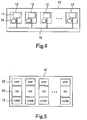
- Fig. 4 is a schematic diagram illustrating an example of a hardware architecture of the soft sensor device 10.
- Each of cores 12 includes a CPU 14 equipped with a cache, and a local memory 16, and the cores 12 are connected to one another with a bus 18.
- the local memory 16 various programs that are executed in the CPU 14 and various data that are used at a time of execution of the programs are stored.
- a shared memory that is shared by the cores is also connected to the bus 18.
- Fig. 5 is a schematic diagram illustrating an example of a software architecture of the soft sensor device 10.
- different OSs 20 operate on the respective cores 12.
- different applications 22 operate on the respective OSs 20.
- the soft sensor as the software is one of those applications 22.
- the OS 20 and the application 22 that are related with each of the cores 12 are installed in the local memory 16 in each of the cores 12.
- each of the cores 12 can individually execute the application 22.
- inter-core communication inter-OS communication
- Fig. 6 is a block diagram illustrating a logic of a soft sensor device of a first embodiment.
- parallel computation expressed by expression 4 is performed by using two cores 100 and 110.
- the cores 100 and 110 are part of the plurality of cores 12 illustrated in Figs. 4 and 5 .
- a first core 100 is a core that configures a first arithmetic operation device, and is programmed to perform calculation of a first row in a right side of expression 4, and integration of a value that is obtained by the calculation.
- a second core 110 is a core that configures a second arithmetic operation device, and is programmed to perform calculation of a second row in the right side of expression 4, and integration of a value that is obtained by the calculation.
- the first core 100 is programmed to function as an arithmetic operator 101 and an integrator 102. To the arithmetic operator 101, a value of the state variable x that is calculated by the first core 100 in processing of a previous time, a value of an intervening variable v that is calculated by the second core 110 in the processing of the previous time, and a value of the input variable u that is inputted in processing of this time are inputted.
- the arithmetic operator 101 is configured to calculate the function f(x, v, u) by using the respective values of the state variable x, the intervening variable v, and the input variable u.
- a time derivative dx/dt of the state variable x is obtained.
- a value of the time derivative dx/dt that is outputted from the arithmetic operator 101 By time-integrating a value of the time derivative dx/dt that is outputted from the arithmetic operator 101, a value (a value of the processing of this time) of the state variable x that is an estimation object is obtained.
- the second core 110 is programmed to function as an arithmetic operator 111 and an integrator 112. To the arithmetic operator 111, the value of the state variable x that is calculated by the first core 100 in the processing of the previous time, the value of the intervening variable v that is calculated by the second core 110 in the processing of the previous time, and the value of the input variable u that is inputted in the processing of this time are inputted.
- the arithmetic operator 111 is configured to calculate a product of a partial derivative ⁇ g(x)/ ⁇ x of an inner function g(x) with respect to the state variable x, and the function f(x, v, u), that is, a function ⁇ g(x) / ⁇ x*f(x, v, u), by using the respective values of the state variable x, the intervening variable v and the input variable u.
- the function ⁇ g(x) / ⁇ x*f(x, v, u) the time derivative dv/dt of the intervening variable v is obtained.
- a value (a value in the processing of this time) of the intervening variable v is obtained.
- the value of the intervening variable v that is obtained in the processing of this time is used in calculation of the function f(x, v, u) by the first core 100 in processing of a next time.
- a comparative example to the soft sensor device of the first embodiment will be cited.
- Fig. 7 is a block diagram illustrating a logic of a soft sensor device of the comparative example.
- a soft sensor expressed by expression 1 is implemented in a single-core processor.
- a core 900 is programmed to function as a first arithmetic operator 901, a second arithmetic operator 902, and an integrator 903.
- a value of the state variable x that is calculated by the core 900 in processing of a previous time is inputted.
- the first arithmetic operator 901 is configured to calculate the inner function g(x) by using the value of the state variable x. By calculating the inner function g(x), the intervening variable v is obtained.
- the value of the state variable x that is calculated by the core 900 in the processing of the previous time, a value of the intervening variable v that is calculated by the first arithmetic operator 901 in processing of this time, and a value of the input variable u that is inputted in the processing of this time are inputted.
- the second arithmetic operator 902 is configured to calculate the function f(x, v, u) by using the respective values of the state variable x, the intervening variable v and the input variable u. By calculating the function f(x, v, u), the time derivative dx/dt of the state variable x is obtained.
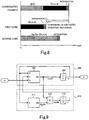
- Fig. 8 is a diagram comparing and illustrating operation time periods that are required until the value of the state variable x is obtained in the soft sensor device of the first embodiment and the comparative example.
- the function f(x, g (x), u) is calculated by using the value of the intervening variable v that is obtained in the calculation of the inner function g(x).
- an arithmetic operation time period that is required until the value of the state variable x is obtained is a total time period of an arithmetic operation time period of the inner function g(x), an arithmetic operation time period of the function f(x, v, u), and an arithmetic operation time period of time integration.
- the value of the intervening variable v that is calculated in the second core 110 in the processing of the previous time is used in calculation of the function f(x, v, u) that is performed in the first core 100. Therefore, in the soft sensor device of the first embodiment, the arithmetic operation time period that is required until the value of the state variable x is obtained is reduced to a total time period of the arithmetic operation time period of the function f(x, v, u) and the arithmetic operation time period of the time integration.
- the state variable x which is desired to be estimated can be acquired with high responsiveness by the arithmetic operation at a high speed due to no sequential processing.
- a total time period of an arithmetic operation time period of the function ⁇ g(x) / ⁇ x*f(x, v, u) and an arithmetic operation time period of the time integration is required until the value of the intervening variable v is obtained.
- the arithmetic operation time period that is required in the second core 110 may become longer than the arithmetic operation time period that is required in the first core 100, as illustrated in Fig. 8 .
- the responsiveness of the soft sensor device is not influenced by the arithmetic operation time period in the second core 110.
- Fig. 9 is a block diagram illustrating a logic of a soft sensor device of a second embodiment.
- the parallel computation expressed by expression 4 is performed by using two cores 200 and 210. These cores 200 and 210 are part of the plurality of cores 12 illustrated in Figs. 4 and 5 .
- the first core 200 is a core that configures the first arithmetic operation device, and is programmed to perform calculation of the first row in the right side of expression 4, and integration of a value that is obtained by the calculation.
- the second core 210 is a core that configures a second arithmetic operation device, and is programmed to perform calculation of the second row in the right side in expression 4, and integration of a value obtained by the calculation.
- the first core 200 is programmed to function as an arithmetic operator 201 and an integrator 202. To the arithmetic operator 201, a value of the state variable x that is calculated by the first core 200 in processing of a previous time, a value of the intervening variable v that is calculated by the second core 210 in the processing of the previous time, and a value of the input variable u that is inputted in processing of this time are inputted.
- the arithmetic operator 201 is configured to calculate the function f(x, v, u) by using the respective values of the state variable x, the intervening variable v and the input variable u.
- the time derivative dx/dt of the state variable x is obtained.
- a value (a value in the processing of this time) of the state variable x that is an estimation object is obtained.
- the second core 210 is programmed to function as an arithmetic operator 211, a multiplier 212 and an integrator 213.
- the arithmetic operator 211 the value of the state variable x that is calculated by the first core 200 in the processing of the previous time is inputted.
- the arithmetic operator 211 is configured to calculate the partial derivative ⁇ g(x)/ ⁇ x of the inner function g(x) with respect to the state variable x.
- To the multiplier 212 the value of the partial derivative ⁇ g(x)/ ⁇ x that is calculated by the arithmetic operator 211, and a value of the function f(x, v, u) that is calculated by the first core 200 in the processing of this time are inputted.
- the multiplier 212 is configured to multiply the value of the partial derivative ⁇ g(x)/ ⁇ x and the value of the function f(x, v, u) that are inputted. A value obtained by the calculation is equivalent to a value of the time derivative dv/dt of the intervening variable v.
- the value of the time derivative dv/dt that is outputted from the multiplier 212 is time-integrated by the integrator 213, whereby a value (a value in the processing of this time) of the intervening variable v is obtained.
- the value of the intervening variable v that is obtained in the processing of this time is used in calculation of the function f(x, v, u) by the first core 200 in processing of a next time.
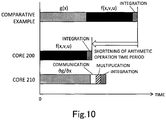
- Fig. 10 is a diagram comparing and illustrating arithmetic operation time periods that are required until the value of the state variable x is obtained in the soft sensor device in the second embodiment and the comparative example.
- the arithmetic operation time period that is required until the value of the state variable x is obtained is the total time period of the arithmetic operation time period of the inner function g(x), the arithmetic operation time period of the function f(x, v, u), and the arithmetic operation time period of the time integration, since there is the sequential nature between the function f(x, g (x), u) and the inner function g(x), as described above.
- the value of the intervening variable v that is calculated by the second core 210 in the processing of the previous processing is used. Therefore, in the soft sensor device of the second embodiment 2, an arithmetic operation time period that is required until the value of the state variable x is obtained is reduced to a total time period of the arithmetic operation time period of the function f(x, v, u) and the arithmetic operation time period of the time integration. That is, according to the soft sensor device of the second embodiment, the state variable x that is desired to be estimated can be acquired with high responsiveness by the arithmetic operation at a high speed due to no sequential processing, similarly to the soft sensor device of the first embodiment.
- the arithmetic operation time period of the second core 210 in the second embodiment is considered to be shorter, due to a difference between an arithmetic operation amount of the partial derivative ⁇ g(x)/ ⁇ x and an arithmetic operation amount of the function ⁇ g(x) / ⁇ x*f(x, v, u).
- the arithmetic operation time period of the second core 210 becomes longer due to the communication time period that is required for inter-core communication.
- the logic of the second embodiment can be said as suitable as the logic of the soft sensor device.
- the logic of the first embodiment can be said as suitable for an object with the communication time period of the inter-core communication being long for the arithmetic operation amount.
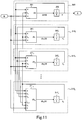
- Fig. 11 is a block diagram illustrating a logic of a soft sensor device of a third embodiment.
- parallel computation expressed by expression 11 is performed by using n+1 of cores 300, 310 1 to 310 n .
- These cores 300 and 310 1 to 310 n are part of the plurality of cores 12 illustrated in Figs. 4 and 5 .
- a first core 300 is a core that configures a first arithmetic operation device, and is programmed to perform calculation of a first row in a right side of expression 11, and integration of a value that is obtained by the calculation.
- Cores as many as n from a second core 310 1 through the n+1 th core 310 n are cores that configure a second arithmetic operation device.
- the i+1 th core 310 i that is included in the second arithmetic operation device is programmed to perform calculation of an i+1 th row in the right side of expression 11, and integration of a value obtained by the calculation (i represents integers from 1 through n).
- the first core 300 is programmed to function as an arithmetic operator 301 and an integrator 302. To the arithmetic operator 301, a value of the state variable x that is calculated by the first core 300 in processing of a previous time, a value of an intervening variable v n that is calculated by the n+1 th core 310 n in the processing of the previous time, and a value of the input variable u that is inputted in processing of this time are inputted.
- the arithmetic operator 301 is configured to calculate the function f(x, v n , u) by using the respective values of the state variable x, the intervening variable v n , and the input variable u.
- a time derivative dx/dt of the state variable x is obtained.
- a value of the time derivative dx/dt that is outputted from the arithmetic operator 301 in the integrator 302 a value (a value in the processing of this time) of the state variable x that is an estimation object is obtained.
- the second core 310 1 is programmed to function as an arithmetic operator 311 1 and an integrator 312 1 .
- the value of the state variable x that is calculated by the first core 300 in the processing of the previous time the value of the intervening variable v n that is calculated by the n+1 th core 310 n in the processing of the previous time, and the value of the input variable u that is inputted in the processing of this time are inputted.
- the arithmetic operator 311 1 is configured to calculate a product of the partial derivative ⁇ g 1 (x)/ ⁇ x by the state variable x of an inner function g 1 (x), and the function f(x, v, u), that is, a function ⁇ g 1 (x) / ⁇ x*f(x, v n , u), by using the respective values of the state variable x, the intervening variable v n and the input variable u. This does not include a sequential structure, and therefore, an arithmetic operation by the arithmetic operator 311 1 is performed at a high speed.
- the time derivative dv 1 /dt of the intervening variable v 1 is obtained.
- a value (a value in the processing of this time) of the intervening variable v 1 is obtained.
- the value of the intervening variable v 1 that is obtained in the processing of this time is used in arithmetic operations in the respective cores from the third core 310 2 through the n+1 th core 310 n in processing of a next time.
- the respective cores from the third core 310 2 through the n+1 th core 310 n will be described.
- the i+1 th core 310 i is programmed to function as an arithmetic operator 311 i and an integrator 312 i .
- the value of the state variable x that is calculated by the first core 300 in the processing of the previous time respective values of i-1 of intervening variables from the intervening variable v 1 through the intervening variable v i-1 that are calculated by the cores from the second core 310 1 through an i th core 310 i-1 in the processing of the previous time, the value of the intervening variable v n that is calculated by the n+1 th core 310 n in the processing of the previous time, and a value of the input variable u that is inputted in the processing of this time are inputted.
- An arithmetic operator 311 i is configured to calculate a product of i of partial derivatives from a partial derivative ⁇ g 1 (x(t))/ ⁇ x through a partial derivative ⁇ g i (v i-1 (t))/ ⁇ v i-1 and the function f(x, v n , u), that is, a function ⁇ g i (v i-1 (t))/ ⁇ v i-1 * ... * ⁇ g 1 (x(t))/ ⁇ x*f(x, v n , u), by using the respective values of the state variable x, the intervening variable v 1 to V i-1 and the input variable u. This does not include a sequential structure, and therefore, an arithmetic operation by the arithmetic operator 311 i is performed at a high speed.
- a time derivative dv i /dt of an intervening variable v i is obtained.
- a value of the time derivative dv i /dt that is outputted from the arithmetic operator 311 i in the integrator 312 i a value (a value in the processing of this time) of the intervening variable v i is obtained.
- the value of the intervening variable v i that is obtained in the processing of this time is used in arithmetic operations in respective cores from an i+2 th core 310 i+1 through the n+1 th core 310 n in the processing of the next time, when i is arbitrary integers from 2 through n-1.
- i being n
- the value of the intervening variable v n that is obtained in the processing of this time is used in arithmetic operations in all the cores including the first core 300 in the processing of the next time.
- the function f(x, g(x), u) that expresses the soft sensor is complicated, and the inner function g(x) includes a sequential structure with multiple stages.
- the arithmetic operation is performed in accordance with the above described logic, not only the sequential structure which the function f(x, g(x), u) has, but also the sequential structure which the inner function g(x) has is eliminated.
- the arithmetic operation time period that is required to acquire the state variable x but also the arithmetic operation time period that is required to acquire the intervening variable v n is reduced, and therefore, occurrence of timeout is avoided.
- the soft sensor device with excellent responsiveness and high precision can be obtained.
- Fig. 12 is a block diagram illustrating a logic of a soft sensor device of a fourth embodiment.
- the parallel computation expressed by expression 11 is performed by using n+1 of cores 400, 410 1 to 410 n .
- These cores 400, and 410 1 to 410 n are part of the plurality of cores 12 illustrated in Figs. 4 and 5 .
- a first core 400 is a core that configures a first arithmetic operation device, and is programmed to perform calculation of the first row in the right side of expression 11, and integration of a value that is obtained by the calculation.
- Cores as many as n from a second core 410 1 to the n+1 th core 410 n are cores that configure a second arithmetic operation device.
- An i+1 th core 410 i that is included in the second arithmetic operation device is programmed to perform calculation of an i+1 th row in the right side of expression 11, and integration of a value that is obtained by the calculation (note that "i” represents integers from 1 through “n”).
- the first core 400 is programmed to function as an arithmetic operator 401 and an integrator 402. To the arithmetic operator 401, a value of the state variable x that is calculated by the first core 400 in processing of a previous time, a value of an intervening variable v n that is calculated by the n+1 th core 410 n in the processing of the previous time, and a value of the input variable u that is inputted in processing of this time are inputted.
- the arithmetic operator 401 is configured to calculate the function f(x, v n , u) by using the respective values of the state variable x, the intervening variable v n , and the input variable u.
- the time derivative dx/dt of the state variable x is obtained.
- a value of the time derivative dx/dt that is outputted from the arithmetic operator 401 by the integrator 402 a value (a value in the processing of this time) of the state variable x that is an estimation object is obtained.
- the second core 410 1 is programmed to function as an arithmetic operator 411 1 , a multiplier 412 1 and an integrator 413 1 .
- the arithmetic operator 411 1 To the arithmetic operator 411 1 , the value of the state variable x that is calculated by the first core 400 in the processing of the previous time is inputted.
- the arithmetic operator 411 1 is configured to calculate the partial derivative ⁇ g 1 (x)/ ⁇ x of the inner function g 1 (x) with respect to the state variable x by using the value of the state variable x.
- the multiplier 412 1 To the multiplier 412 1 , the value of the partial derivative ⁇ g 1 (x)/ ⁇ x that is calculated by the arithmetic operator 411 1 , and a value of the function f(x, v n , u) that is calculated by the first core 400 in the processing of this time are inputted.
- the multiplier 412 1 is configured to multiply the value of the partial derivative ⁇ g 1 (x)/ ⁇ x and the value of the function f(x, v n , u) that are inputted.
- a value obtained by the calculation is equivalent to a value of the time derivative dv 1 /dt of the intervening variable v 1 .
- the value of the time derivative dv 1 /dt that is outputted from the multiplier 412 1 is time-integrated by the integrator 413 1 , whereby a value (a value in the processing of this time) of the intervening variable v 1 is obtained.
- the value of the intervening variable v 1 that is obtained in the processing of this time is used in an arithmetic operation in a third core 410 2 in processing of the next time.
- the i+1 th core 410 i is programmed to function as an arithmetic operator 411 i , a multiplier 412i and an integrator 413 i .
- a value of an intervening variable v i-1 that is calculated by the i th core 410 i-1 in the previous processing is inputted.
- An arithmetic operator 411 i is configured to calculate a partial derivative ⁇ g i (x)/ ⁇ v i-1 of the inner function g i (x) with respect to the intervening variable v i-1 by using a value of the intervening variable v i-1 .
- the multiplier 412 i To the multiplier 412 i , the value of the partial derivative ⁇ g i (x) / ⁇ v i-1 that is calculated by the arithmetic operator 411 i , and a value of a time derivative d vi-1 /dt that is calculated by the i th core 410 i-1 in the processing of this time are inputted.
- the multiplier 412 i is configured to multiply the value of the partial derivative ⁇ g i (x)/ ⁇ v i-1 and the value of the time derivative dv i-1 /dt that are inputted.
- a value obtained by the calculation is equivalent to a value of the time derivative dv i /dt of the intervening variable v i as shown in expression 10.
- the value of the time derivative dv i /dt that is outputted from the multiplier 412 i is time-integrated by the integrator 413 i , whereby a value (a value in the processing of this time) of the intervening variable v i is obtained.
- the value of the intervening variable v i that is obtained in the processing of this time is used in an arithmetic operation in an i+2 th core 410 i+1 in processing of a next time, when i is arbitrary integers from 2 through n-1.
- the logic of the fourth embodiment can be said as suitable as the logic of the soft sensor device.
- the logic of the third embodiment can be said as suitable for an object with the communication time period of the inter-core communication being long for the arithmetic operation amount.
- the soft sensor device is used in estimation of the intake pressure of an internal combustion engine.
- Fig. 13 is a schematic view of an internal combustion engine 30 to which the intake pressure soft sensor device of example 1 is applied.
- a gas constant is R
- an atmospheric temperature in an inlet port of an air cleaner 31 is Ta
- an atmospheric pressure in the inlet port of the air cleaner 31 is Pa
- an opening degree area of a throttle 32 is A th
- an intake pressure in an intake manifold 33 is Pm
- a mass flow rate m th of air that passes through the throttle 32 can be expressed by expression 12 and expression 13 as follows in accordance with a known formula of a throttle.
- the intake pressure soft sensor that is expressed by expression 16 and expression 17 as follows is obtained.
- the state variable x in the intake pressure soft sensor is the intake pressure Pm
- the input variable u is the throttle opening degree area A th .
- the function f(x, v, u) in expression 16 can be implemented in the arithmetic operator 101 of the first core 100 illustrated in Fig. 6 . Further, a function ⁇ g(x)/ ⁇ x*f(x, v, u) that is expressed by the product of the partial derivative ⁇ g(x)/ ⁇ x in expression 20 and the function f(x, v, u) in expression 16 can be implemented in the arithmetic operator 111 of the second core 110.
- the function f(x, v, u) in expression 16 can be implemented in the arithmetic operator 201 of the first core 200 illustrated in Fig. 9 .
- the partial derivative ⁇ g(x)/ ⁇ x in expression 20 can be implemented in the arithmetic operator 211 of the second core 210.
- the soft sensor device is used in estimation of a position of a movable body.
- relationships shown in expression 21 and expression 22 as follows are found between a propulsive force u that is applied to the movable body and a moved distance x in an x-axis direction of the movable body.
- the relationships may be theoretically obtained, or may be empirically obtained.
- K 1 and K 2 in expression 21 are coefficients.
- the soft sensor is designed based on the above described relationships, and is implemented in a multi-core processor or a many-core processor, whereby a position soft sensor device can be made, which estimates the moved distance x of the movable body that is the state variable, from the propulsive force u that is applied to the movable body, which is the input variable.
- the function f(x, v, u) in expression 21 is implemented in the arithmetic operator 101 of the first core 100 illustrated in Fig. 6 . Further, the function ⁇ g(x)/ ⁇ x*f(x, v, u) that is expressed by the product of the partial derivative ⁇ g(x)/ ⁇ x in expression 23 and the function f(x, v, u) in expression 21 can be implemented in the arithmetic operator 111 in the second core 110.
- the function f(x, v, u) in expression 21 can be implemented in the arithmetic operator 201 of the first core 200 illustrated in Fig. 9 .
- the partial derivative ⁇ g(x)/ ⁇ x in expression 23 can be implemented in the arithmetic operator 211 of the second core 210.
- the arithmetic operator 101 and the integrator 102 may be implemented in separate cores.
Landscapes
- Engineering & Computer Science (AREA)
- Physics & Mathematics (AREA)
- General Physics & Mathematics (AREA)
- Theoretical Computer Science (AREA)
- General Engineering & Computer Science (AREA)
- Software Systems (AREA)
- Mathematical Physics (AREA)
- Computational Mathematics (AREA)
- Mathematical Analysis (AREA)
- Mathematical Optimization (AREA)
- Pure & Applied Mathematics (AREA)
- Automation & Control Theory (AREA)
- Data Mining & Analysis (AREA)
- Algebra (AREA)
- Databases & Information Systems (AREA)
- Chemical & Material Sciences (AREA)
- Quality & Reliability (AREA)
- Computing Systems (AREA)
- Analytical Chemistry (AREA)
- Combustion & Propulsion (AREA)
- Mechanical Engineering (AREA)
- Operations Research (AREA)
- Complex Calculations (AREA)
- Feedback Control In General (AREA)
- Testing Or Calibration Of Command Recording Devices (AREA)
- Combined Controls Of Internal Combustion Engines (AREA)
Abstract
Description
- The present application relates to a soft sensor device that acquires a state variable by calculation.
- In recent years, a study on a soft sensor has been advanced, which estimates state variables including various physical quantities such as a temperature, a pressure, a speed, an acceleration, an angular velocity, a voltage, a current and a resistance value by calculation instead of actually measuring the state variables. A soft sensor refers to software in which the relationship that is established between a state variable desired to be estimated and an input variable that can be observed is described by a function. The software is implemented in a computer, and thereby functions as "a device" similar to a conventional sensor. In the present description, the device which is realized by implementing a soft sensor that is software in a computer that is hardware will be referred to as a "soft sensor device".
- Responsiveness is required of a soft sensor device similarly to the conventional sensors. That is, reduction of the time period which is required until acquisition of a state variable that is desired to be estimated is required. The arithmetic capacities of calculation devices including a soft sensor device can be enhanced by enhancing the operating frequencies of cores. However, from the viewpoint of power efficiency, there is a limit in enhancement in performance by enhancing the operating frequency. Consequently, in recent years, attention has been focused on a multi-core processor in which a plurality of processor cores are loaded on a single semiconductor chip, and further, a many-core processor in which a larger number of processor cores are loaded, as disclosed in
JP 2014-211113 A - However, in using a multi-core processor and a many-core processor, it is necessary to pay attention to the sequential nature which the algorithm of the soft sensor has. According to the Amdahl's Law, when the program in which a ratio of an execution time period of a part capable of being parallelized is "a" is executed by using N of processor cores, an entire performance enhancement rate S is expressed by S = 1/((1-a)+a/N). As is understandable from this, in the case of the program having an algorithm with a high sequential nature, it is difficult to enhance performance by increasing the number of cores. Further, as the number of cores is increased, a delay accompanying exchange of data among the cores becomes more remarkable.
- Therefore, performance cannot be sufficiently enhanced, by only applying a multi-core processor and a many-core processor to a soft sensor device.
- The present application is made in the light of the problem as described above, and has an object to reduce an arithmetic operation time period that is required to acquire a state variable, in a soft sensor device that acquires the state variable which is an estimation object by calculation using a plurality of processor cores.
- When a value of a state variable that is an estimation object changes in relation to an input variable that is observable, a soft sensor for estimating the state variable by calculation is expressed by
expression 1 as follows. In the present description, the state variable that is the estimation object is expressed by "x", and the input variable that is observable is expressed by "u". Note that "x" is a vector having one or a plurality of state quantities as a component, and "u" is a vector having one or a plurality of input signals as a component.
[Expression 1]
- As shown in
expression 1, in the soft sensor, a time derivative dx/dt of the state variable x is expressed by a function f(x, g(x), u) in which the state variable x, an inner function g(x) having the state variable x as an independent variable, and the input variable u are independent variables. As is understandable from the fact that the inner function g(x) is present in the function f(x, g(x), u), the soft sensor has a sequential structure. Therefore, whenexpression 1 is directly calculated, much time is required to acquire the state variable x, because the inner function g(x) is calculated first, and next, the function f(x, g(x), u) is calculated. - Consequently, the inventors relating to the present application parallelized calculation of
expression 1 as described as follows. - First, an intervening variable v that is defined by the inner function g(x) as follows is prepared.
[Expression 2]
- Next, both sides of
expression 2 are time-differentiated, and the relationship inexpression 1 is used, whereby next expression 3 is obtained. A right side in expression 3 is expressed by a product of a partial derivative ∂g(x)/∂x of the inner function g(x) with respect to the state variable x and a function f(x, v, u).
[Expression 3]
- By combining
expression 1 and expression 3, an equivalent equation shown inexpression 4 is obtained.
[Expression 4]
- A first row in a right side in
expression 4 expresses the function f(x, v, u), and inputs thereof are a state variable x(t), an intervening variable v(t) and an input variable u(t). Further, a second row expresses a product of the partial derivative ∂g(x)/∂x and the function f(x, v, u), and inputs of the second row are also the state variable x(t), the intervening variable v(t), and the input variable u(t). All of the state variable x(t), the intervening variable v(t) and the input variable u(t) are variables determined by time, and are not functions of other variables. That is,expression 4 does not include a sequential structure. -
Expression 4 is one selection for performing calculation inexpression 1 by parallelizing the expression, and is a specific selection that can eliminate a sequential structure thatexpression 1 has. Eliminating a sequential structure of an algorithm is an especially important matter in enhancing a speed of an arithmetic operation using a plurality of processor cores. The inventors relating to the present application reduces an arithmetic operation time period that is required to acquire the state variable x by configuring the soft sensor device so that parallel computation expressed byexpression 4 is performed by using a plurality of processor cores. Hereinafter, a configuration of the soft sensor device of the present application will be described. - A soft sensor device of the present application includes a first arithmetic operation device configured to perform an arithmetic operation by using one processor core (a plurality of processor cores may be used), and a second arithmetic operation device configured to perform an arithmetic operation by using one or a plurality of processor cores that is or are different from the processor cores that is or are used in the first arithmetic operation device. When the soft sensor device includes a multi-core processor or a many-core processor, both the first arithmetic operation device and the second arithmetic operation device may be included in the single multi-core processor or the single many-core processor.
- The first arithmetic operation device is programmed to calculate the function f(x, v, u) by using respective values of the state variable x, the intervening variable v, and the input variable u, and further obtain a value of the state variable x by time-integrating a value of the function f(x, v, u). The second arithmetic operation device is programmed to calculate the intervening variable v that is used as the input in the first arithmetic operation device. In the calculation of the function f(x, v, u) by the first arithmetic operation device, a value of the state variable x that is calculated in the first arithmetic operation device in processing of a previous time, a value of the intervening variable v that is calculated in the second arithmetic operation device in the processing of the previous time, and a value of the input variable u that is inputted in processing of this time are used.
- According to the soft sensor device configured as above, the value of the intervening variable v that is calculated in advance in the second arithmetic operation device is used in the calculation of the function f(x, v, u) by the first arithmetic operation device, so that the state variable x that is desired to be estimated can be acquired with high responsiveness by an arithmetic operation at a high speed due to no sequential processing.
- In more detail, the second arithmetic operation device may be programmed to calculate a product of the partial derivative ∂g(x)/∂x and the function f(x, v, u), by using the value of the state variable x that is calculated in the first arithmetic operation device in the processing of the previous time, the value of the intervening variable v that is calculated in the second arithmetic operation device in the processing of the previous time, and the value of the input variable u that is inputted in the processing of this time. That is, components in the second row in the right side of
expression 4 may be integrally calculated. In this case, the second arithmetic operation device is programmed to obtain the value of the intervening variable v by time-integrating a value that is obtained in the calculation. - Alternatively, the second arithmetic operation device may be programmed to calculate the partial derivative ∂g(x)/∂x by using the value of the state variable x that is calculated in the first arithmetic operation device in the processing of the previous time, and acquire a value of the function f(x, v, u) that is calculated in the first arithmetic operation device in the processing of this time. That is, the component in the second row in the right side of
expression 4 is divided into the partial derivative ∂g(x)/∂x and the function f(x, v, u), and only the partial ∂g(x)/∂x may be calculated. In this case, the second arithmetic operation device is programmed to obtain the value of the intervening variable v by time-integrating a value that is obtained by multiplying a value of the partial derivative ∂g(x)/∂x that is obtained by the calculation, and the value of the function f(x, v, u) that is acquired from the first arithmetic operation device. - When the inner function g(x) is a composite function that is expressed by expression 5 as follows, and has a sequential structure including n of functions gn, ···, g2 and g1 that are two or more,
expression 4 can be further parallelized.
[Expression 5]
- Here, the intervening variable vi is defined as in expression 6 and expression 7 as follows. Note that i represents an integer that is n or smaller and larger than 1. As shown in expression 8, the intervening variable vn corresponds to the aforementioned intervening variable v.
[Expression 6]
[Expression 7]
[Expression 8]
- By time-differentiating both sides in expression 6 and expression 7, expression 9 and
expression 10 as follows are obtained.
[Expression 9]
[Expression 10]
- An equivalent equation shown in expression 11 is obtained by further parallelizing
expression 4 by using expression 9 andexpression 10 based on the relationship shown in expression 5.
[Expression 11]
- If parallel computation expressed by expression 11 is performed by using a plurality of processor cores, the first arithmetic operation device may perform an arithmetic operation of a component in a first row in a right side of expression 11, and the second arithmetic operation device may perform arithmetic operations of respective components from a second row through an n+1th row in the right side. In more detail, the first arithmetic operation device may perform an arithmetic operation of the component in the first row in the right side, and may obtain the value of the state variable x by time-integrating the value obtained by the arithmetic operation. The second arithmetic operation device may obtain the value of the intervening variable vn that is used in the arithmetic operation of the function f(x, vn, u) in the first arithmetic operation device by time-integrating a value of the component in the n+1th row that is obtained by the arithmetic operation. If the second arithmetic operation device has a plurality of processor cores, not only the arithmetic operation time period in the first arithmetic operation device but also the arithmetic operation time period that is required to acquire the intervening variable vn in the second arithmetic operation device can be reduced, by performing the arithmetic operations of the respective components from the second row through the n+1th row in the right side by different processor cores respectively.
- In more detail, a processor core that performs an arithmetic operation of a component in an i+1th row in the right side of expression 11 may be programmed to calculate a product of i of partial derivatives from a partial derivative ∂g1(x(t))/∂x through a partial derivative ∂gi(vi-1(t))/∂vi-1, and the function f(x, v, u), by using the value of the state variable x that is calculated in the first arithmetic operation device in the processing of the previous time, respective values of i-1 of intervening variables from an intervening variable v1 through an intervening variable vi-1 that are calculated in other processor cores in the processing of the previous time, the value of the intervening variable v that is calculated in the second arithmetic operation device in the processing of the previous time, and the value of the input variable u that is inputted in the processing of this time, and obtain a value of the intervening variable vi by time-integrating a value of the product.
- Alternatively, the processor core that performs an arithmetic operation of a component in the i+1th row in the right side of expression 11 may be programmed to calculate a value of a partial derivative ∂gi(vi-1(t))/∂vi-1 by using a value of an intervening variable vi-1 that is calculated in another processor core that performs an arithmetic operation of a component in an ith row in the right side of expression 11 in the processing of the previous time, and obtain a value of the intervening variable vi by time-integrating a value that is obtained by multiplying the value of the partial derivative ∂gi(vi-1(t))/∂vi-1, and a value of the component in the ith row in the right side of expression 11 described above that is calculated in the other processor core in the processing of this time.
- As described above, according to the soft sensor device according to the present application, the value of the intervening variable v that is calculated in advance in the second arithmetic operation device is used in calculation of the function f(x, v, u) by the first arithmetic operation device, so that the state variable x that is desired to be estimated can be acquired with high responsiveness by the arithmetic operation at a high speed due to no sequential processing.
-
-
Fig. 1 is a diagram illustrating a configuration example 1 in a case where a soft sensor device is applied to a control system; -
Fig. 2 is a diagram illustrating a configuration example 2 in the case where the soft sensor device is applied to the control system; -
Fig. 3 is a diagram illustrating a configuration example 3 in the case where the soft sensor device is applied to the control system; -
Fig. 4 is a schematic diagram illustrating an example of a hardware architecture of a processor included by the soft sensor device; -
Fig. 5 is a schematic diagram illustrating an example of a software architecture of the processor included by the soft sensor device; -
Fig. 6 is a block diagram illustrating a logic of a soft sensor device of a first embodiment; -
Fig. 7 is a block diagram illustrating a logic of a soft sensor device of a comparative example; -
Fig. 8 is a diagram comparing and illustrating arithmetic operation time periods in the soft sensor device of the first embodiment and the comparative example; -
Fig. 9 is a block diagram illustrating a logic of a soft sensor device of a second embodiment; -
Fig. 10 is a diagram comparing and illustrating arithmetic operation time periods in the soft sensor device of the second embodiment and the comparative example; -
Fig. 11 is a block diagram illustrating a logic of a soft sensor device of a third embodiment; -
Fig. 12 is a block diagram illustrating a logic of a soft sensor device of a fourth embodiment; -
Fig. 13 is a schematic view of an internal combustion engine to which an intake pressure soft sensor device of example 1 is applied; and -
Fig. 14 is a diagram for explaining a position soft sensor device of example 2. - A soft sensor device of the present application can be applied to a monitoring device that monitors a state variable x. Further, the soft sensor device of the present application can be also applied to a control system that performs an operation to a control object based on the state variable x of the control object. Here, several configuration examples in a case where the soft sensor device of the present application is applied to a control system will be described.
- In each of configuration examples illustrated in
Figs. 1 to 3 , a control system is configured by acontroller 2, acontrol object 4, and asoft sensor device 10. Thecontrol object 4 is not limited. However, a state variable (a vector having one or a plurality of state quantities as a component) of thecontrol object 4 is observed by a sensor (an ordinary sensor which is not a soft sensor) not illustrated. The observable state variable is not included in the state variable x that is estimated by thesoft sensor device 10. - A control method of the
controller 2 is not limited. However, in thecontroller 2, an operation signal for controlling thecontrol object 4 is generated based on the state variable that is observed, an external input by an operator or an external sensor, for example, and the state variable x of thecontrol object 4 that is estimated by thesoft sensor device 10. - In a configuration example 1 illustrated in
Fig. 1 , an operation signal that is given to thecontrol object 4 from thecontroller 2 is used as an input variable u to thesoft sensor device 10. If there is a relationship between a change of the state variable x and an operation to thecontrol object 4, the state variable x can be estimated based on the operation signal by creating a function f(x, g(x), u) with the operation signal as the input variable u. - In a configuration example 2 illustrated in
Fig. 2 , an external input that is given to thecontroller 2 is used as the input variable u to thesoft sensor device 10. The operation signal that is given to thecontrol object 4 is generated based on the external input, and therefore, a relationship may be also found between the external input and the state variable x. If there is a relationship between the change of the state variable x and the external input, the state variable x can be estimated based on the external input by creating the function f(x, g(x), u) with the external input as the input variable u. - In a configuration example 3 illustrated in
Fig. 3 , an observable state variable is used as the input variable u to thesoft sensor device 10. For example, two different state quantities may be related with each other as a relationship between a pressure and a temperature, for example. If there is a relationship between a change of the state variable x and the observable state variable, the state variable x can be estimated based on the observable state variable by creating the function f(x, g(x), u) using the observable state variable as the input variable u. - Note that in each of the configuration examples described above, the function f(x, g(x), u) may be a function that models the
control object 4 based on a physical law, or may be a function that is obtained based on an empirical rule. - Further, in each of the configuration examples described above, the
soft sensor device 10 and thecontroller 2 are separate bodies, but the two may be integrally configured. For example, a single computer may be caused to function as thesoft sensor device 10, and may be also caused to function as thecontroller 2. - The
soft sensor device 10 is configured by using a multi-core processor or a many-core processor having a plurality of processor cores (hereinafter, simply referred to as cores).Fig. 4 is a schematic diagram illustrating an example of a hardware architecture of thesoft sensor device 10. Each ofcores 12 includes aCPU 14 equipped with a cache, and alocal memory 16, and thecores 12 are connected to one another with abus 18. In thelocal memory 16, various programs that are executed in theCPU 14 and various data that are used at a time of execution of the programs are stored. Although not illustrated, a shared memory that is shared by the cores is also connected to thebus 18. -
Fig. 5 is a schematic diagram illustrating an example of a software architecture of thesoft sensor device 10. In thesoft sensor device 10,different OSs 20 operate on therespective cores 12. Further,different applications 22 operate on therespective OSs 20. The soft sensor as the software is one of thoseapplications 22. TheOS 20 and theapplication 22 that are related with each of thecores 12 are installed in thelocal memory 16 in each of thecores 12. In the multi-core processor (or the many-core processor) having the software architecture like this, each of thecores 12 can individually execute theapplication 22. When an arithmetic operation result by anothercore 12, or data of anothercore 12 is required to execute theapplication 22, the data is exchanged by inter-core communication (inter-OS communication) through thebus 18. - Hereinafter, embodiments of the soft sensor device will be described with reference to the drawings.
-
Fig. 6 is a block diagram illustrating a logic of a soft sensor device of a first embodiment. In the first embodiment, parallel computation expressed byexpression 4 is performed by using twocores cores cores 12 illustrated inFigs. 4 and 5 . Afirst core 100 is a core that configures a first arithmetic operation device, and is programmed to perform calculation of a first row in a right side ofexpression 4, and integration of a value that is obtained by the calculation. Asecond core 110 is a core that configures a second arithmetic operation device, and is programmed to perform calculation of a second row in the right side ofexpression 4, and integration of a value that is obtained by the calculation. - The
first core 100 is programmed to function as anarithmetic operator 101 and anintegrator 102. To thearithmetic operator 101, a value of the state variable x that is calculated by thefirst core 100 in processing of a previous time, a value of an intervening variable v that is calculated by thesecond core 110 in the processing of the previous time, and a value of the input variable u that is inputted in processing of this time are inputted. Thearithmetic operator 101 is configured to calculate the function f(x, v, u) by using the respective values of the state variable x, the intervening variable v, and the input variable u. By calculating the function f(x, v, u), a time derivative dx/dt of the state variable x is obtained. By time-integrating a value of the time derivative dx/dt that is outputted from thearithmetic operator 101, a value (a value of the processing of this time) of the state variable x that is an estimation object is obtained. - The
second core 110 is programmed to function as anarithmetic operator 111 and anintegrator 112. To thearithmetic operator 111, the value of the state variable x that is calculated by thefirst core 100 in the processing of the previous time, the value of the intervening variable v that is calculated by thesecond core 110 in the processing of the previous time, and the value of the input variable u that is inputted in the processing of this time are inputted. Thearithmetic operator 111 is configured to calculate a product of a partial derivative ∂g(x)/∂x of an inner function g(x) with respect to the state variable x, and the function f(x, v, u), that is, a function ∂g(x) / ∂x*f(x, v, u), by using the respective values of the state variable x, the intervening variable v and the input variable u. By calculating the function ∂g(x) / ∂x*f(x, v, u), the time derivative dv/dt of the intervening variable v is obtained. By time-integrating the value of the time derivative dv/dt that is outputted from thearithmetic operator 111 in theintegrator 112, a value (a value in the processing of this time) of the intervening variable v is obtained. The value of the intervening variable v that is obtained in the processing of this time is used in calculation of the function f(x, v, u) by thefirst core 100 in processing of a next time. - Here, a comparative example to the soft sensor device of the first embodiment will be cited.
Fig. 7 is a block diagram illustrating a logic of a soft sensor device of the comparative example. In the comparative example, a soft sensor expressed byexpression 1 is implemented in a single-core processor. - In the soft sensor device of the comparative example, a
core 900 is programmed to function as a firstarithmetic operator 901, a secondarithmetic operator 902, and anintegrator 903. To the firstarithmetic operator 901, a value of the state variable x that is calculated by thecore 900 in processing of a previous time is inputted. The firstarithmetic operator 901 is configured to calculate the inner function g(x) by using the value of the state variable x. By calculating the inner function g(x), the intervening variable v is obtained. - To the second
arithmetic operator 902, the value of the state variable x that is calculated by thecore 900 in the processing of the previous time, a value of the intervening variable v that is calculated by the firstarithmetic operator 901 in processing of this time, and a value of the input variable u that is inputted in the processing of this time are inputted. The secondarithmetic operator 902 is configured to calculate the function f(x, v, u) by using the respective values of the state variable x, the intervening variable v and the input variable u. By calculating the function f(x, v, u), the time derivative dx/dt of the state variable x is obtained. By time-integrating the value of the time derivative dx/dt that is outputted from the secondarithmetic operator 902 by theintegrator 903, a value (a value in the processing of this time) of the state variable x that is an estimation object is obtained. -
Fig. 8 is a diagram comparing and illustrating operation time periods that are required until the value of the state variable x is obtained in the soft sensor device of the first embodiment and the comparative example. In the case of the comparative example, there is the sequential nature between the function f(x, g (x), u) and the inner function g(x), so that after calculation of the inner function g(x) is finished, the function f(x, v, u) is calculated by using the value of the intervening variable v that is obtained in the calculation of the inner function g(x). Therefore, in the case of the comparative example, an arithmetic operation time period that is required until the value of the state variable x is obtained is a total time period of an arithmetic operation time period of the inner function g(x), an arithmetic operation time period of the function f(x, v, u), and an arithmetic operation time period of time integration. - Meanwhile, in the case of the soft sensor device of the first embodiment, the value of the intervening variable v that is calculated in the
second core 110 in the processing of the previous time is used in calculation of the function f(x, v, u) that is performed in thefirst core 100. Therefore, in the soft sensor device of the first embodiment, the arithmetic operation time period that is required until the value of the state variable x is obtained is reduced to a total time period of the arithmetic operation time period of the function f(x, v, u) and the arithmetic operation time period of the time integration. As is understandable from comparison with the comparative example, according to the soft sensor device of the first embodiment, the state variable x which is desired to be estimated can be acquired with high responsiveness by the arithmetic operation at a high speed due to no sequential processing. - In the
second core 110, a total time period of an arithmetic operation time period of the function ∂g(x) / ∂x*f(x, v, u) and an arithmetic operation time period of the time integration is required until the value of the intervening variable v is obtained. Depending on the arithmetic operation amount of the function ∂g(x) / ∂x*f(x, v, u), the arithmetic operation time period that is required in thesecond core 110 may become longer than the arithmetic operation time period that is required in thefirst core 100, as illustrated inFig. 8 . However, as long as the arithmetic operation is completed in a cycle, and the value of the intervening variable V can be transferred to thefirst core 100 before the processing of the next time, that is, as long as time is not out, the responsiveness of the soft sensor device is not influenced by the arithmetic operation time period in thesecond core 110. -
Fig. 9 is a block diagram illustrating a logic of a soft sensor device of a second embodiment. In the second embodiment, the parallel computation expressed byexpression 4 is performed by using twocores cores cores 12 illustrated inFigs. 4 and 5 . Thefirst core 200 is a core that configures the first arithmetic operation device, and is programmed to perform calculation of the first row in the right side ofexpression 4, and integration of a value that is obtained by the calculation. Thesecond core 210 is a core that configures a second arithmetic operation device, and is programmed to perform calculation of the second row in the right side inexpression 4, and integration of a value obtained by the calculation. - The
first core 200 is programmed to function as anarithmetic operator 201 and anintegrator 202. To thearithmetic operator 201, a value of the state variable x that is calculated by thefirst core 200 in processing of a previous time, a value of the intervening variable v that is calculated by thesecond core 210 in the processing of the previous time, and a value of the input variable u that is inputted in processing of this time are inputted. Thearithmetic operator 201 is configured to calculate the function f(x, v, u) by using the respective values of the state variable x, the intervening variable v and the input variable u. By calculating the function f(x, v, u), the time derivative dx/dt of the state variable x is obtained. By time-integrating the value of the time derivative dx/dt that is outputted from thearithmetic operator 201 by theintegrator 202, a value (a value in the processing of this time) of the state variable x that is an estimation object is obtained. - The
second core 210 is programmed to function as anarithmetic operator 211, amultiplier 212 and anintegrator 213. To thearithmetic operator 211, the value of the state variable x that is calculated by thefirst core 200 in the processing of the previous time is inputted. Thearithmetic operator 211 is configured to calculate the partial derivative ∂g(x)/∂x of the inner function g(x) with respect to the state variable x. To themultiplier 212, the value of the partial derivative ∂g(x)/∂x that is calculated by thearithmetic operator 211, and a value of the function f(x, v, u) that is calculated by thefirst core 200 in the processing of this time are inputted. Themultiplier 212 is configured to multiply the value of the partial derivative ∂g(x)/∂x and the value of the function f(x, v, u) that are inputted. A value obtained by the calculation is equivalent to a value of the time derivative dv/dt of the intervening variable v. The value of the time derivative dv/dt that is outputted from themultiplier 212 is time-integrated by theintegrator 213, whereby a value (a value in the processing of this time) of the intervening variable v is obtained. The value of the intervening variable v that is obtained in the processing of this time is used in calculation of the function f(x, v, u) by thefirst core 200 in processing of a next time. - Here, the comparative example illustrated in the first embodiment and the soft sensor device of the second embodiment will be compared with respect to the arithmetic operation time period.
Fig. 10 is a diagram comparing and illustrating arithmetic operation time periods that are required until the value of the state variable x is obtained in the soft sensor device in the second embodiment and the comparative example. In the case of the comparative example, the arithmetic operation time period that is required until the value of the state variable x is obtained is the total time period of the arithmetic operation time period of the inner function g(x), the arithmetic operation time period of the function f(x, v, u), and the arithmetic operation time period of the time integration, since there is the sequential nature between the function f(x, g (x), u) and the inner function g(x), as described above. - Meanwhile, in the case of the soft sensor device of the second embodiment, the value of the intervening variable v that is calculated by the
second core 210 in the processing of the previous processing is used. Therefore, in the soft sensor device of thesecond embodiment 2, an arithmetic operation time period that is required until the value of the state variable x is obtained is reduced to a total time period of the arithmetic operation time period of the function f(x, v, u) and the arithmetic operation time period of the time integration. That is, according to the soft sensor device of the second embodiment, the state variable x that is desired to be estimated can be acquired with high responsiveness by the arithmetic operation at a high speed due to no sequential processing, similarly to the soft sensor device of the first embodiment. - In the
second core 210, a total time period of the arithmetic operation time period of the partial derivative ∂g(x)/∂x, a communication time period that is required to receive the value of the function f(x, v, u) from thefirst core 200 by inter-core communication, an arithmetic operation time period of multiplication, and the arithmetic operation time period of time integration is required until the value of the intervening variable v is obtained. When comparing with the arithmetic operation time period of thesecond core 110 in the first embodiment, the arithmetic operation time period of thesecond core 210 in the second embodiment is considered to be shorter, due to a difference between an arithmetic operation amount of the partial derivative ∂g(x)/∂x and an arithmetic operation amount of the function ∂g(x) / ∂x*f(x, v, u). However, it is also conceivable that the arithmetic operation time period of thesecond core 210 becomes longer due to the communication time period that is required for inter-core communication. Therefore, for an object with the communication time period of the inter-core communication including a time period of access to the memory being short for the arithmetic operation amount, the logic of the second embodiment can be said as suitable as the logic of the soft sensor device. Conversely, for an object with the communication time period of the inter-core communication being long for the arithmetic operation amount, the logic of the first embodiment can be said as suitable. -
Fig. 11 is a block diagram illustrating a logic of a soft sensor device of a third embodiment. In the third embodiment, parallel computation expressed by expression 11 is performed by using n+1 ofcores cores cores 12 illustrated inFigs. 4 and 5 . Afirst core 300 is a core that configures a first arithmetic operation device, and is programmed to perform calculation of a first row in a right side of expression 11, and integration of a value that is obtained by the calculation. Cores as many as n from asecond core 3101 through the n+1thcore 310n are cores that configure a second arithmetic operation device. The i+1thcore 310i that is included in the second arithmetic operation device is programmed to perform calculation of an i+1th row in the right side of expression 11, and integration of a value obtained by the calculation (i represents integers from 1 through n). - The
first core 300 is programmed to function as anarithmetic operator 301 and anintegrator 302. To thearithmetic operator 301, a value of the state variable x that is calculated by thefirst core 300 in processing of a previous time, a value of an intervening variable vn that is calculated by the n+1thcore 310n in the processing of the previous time, and a value of the input variable u that is inputted in processing of this time are inputted. Thearithmetic operator 301 is configured to calculate the function f(x, vn, u) by using the respective values of the state variable x, the intervening variable vn, and the input variable u. By calculating the function f(x, vn, u), a time derivative dx/dt of the state variable x is obtained. By performing time-integration of a value of the time derivative dx/dt that is outputted from thearithmetic operator 301 in theintegrator 302, a value (a value in the processing of this time) of the state variable x that is an estimation object is obtained. - The
second core 3101 is programmed to function as anarithmetic operator 3111 and anintegrator 3121. To thearithmetic operator 3111, the value of the state variable x that is calculated by thefirst core 300 in the processing of the previous time, the value of the intervening variable vn that is calculated by the n+1thcore 310n in the processing of the previous time, and the value of the input variable u that is inputted in the processing of this time are inputted. Thearithmetic operator 3111 is configured to calculate a product of the partial derivative ∂g1(x)/∂x by the state variable x of an inner function g1(x), and the function f(x, v, u), that is, a function ∂g1(x) / ∂x*f(x, vn, u), by using the respective values of the state variable x, the intervening variable vn and the input variable u. This does not include a sequential structure, and therefore, an arithmetic operation by thearithmetic operator 3111 is performed at a high speed. - By calculating the function ∂g1(x) / ∂x*f(x, v, u), the time derivative dv1/dt of the intervening variable v1 is obtained. By time-integrating the value of the time derivative dv1/dt that is outputted from the
arithmetic operator 3111 in theintegrator 3121, a value (a value in the processing of this time) of the intervening variable v1 is obtained. The value of the intervening variable v1 that is obtained in the processing of this time is used in arithmetic operations in the respective cores from thethird core 3102 through the n+1thcore 310n in processing of a next time. - Next, the respective cores from the
third core 3102 through the n+1thcore 310n will be described. Here, when "i" is set as an arbitrary integer from 2 through n, the i+1thcore 310i is programmed to function as anarithmetic operator 311i and anintegrator 312i. To thearithmetic operator 311i, the value of the state variable x that is calculated by thefirst core 300 in the processing of the previous time, respective values of i-1 of intervening variables from the intervening variable v1 through the intervening variable vi-1 that are calculated by the cores from thesecond core 3101 through an ith core 310i-1 in the processing of the previous time, the value of the intervening variable vn that is calculated by the n+1thcore 310n in the processing of the previous time, and a value of the input variable u that is inputted in the processing of this time are inputted. - An
arithmetic operator 311i is configured to calculate a product of i of partial derivatives from a partial derivative ∂g1(x(t))/∂x through a partial derivative ∂gi(vi-1(t))/∂vi-1 and the function f(x, vn, u), that is, a function ∂gi(vi-1(t))/∂vi-1* ... *∂g1(x(t))/ ∂x*f(x, vn, u), by using the respective values of the state variable x, the intervening variable v1 to Vi-1 and the input variable u. This does not include a sequential structure, and therefore, an arithmetic operation by thearithmetic operator 311i is performed at a high speed. - By calculating a function ∂gi(vi-1(t))/∂vi-1* ... *∂g1(x(t))/∂x*f(x, vn, u), a time derivative dvi/dt of an intervening variable vi is obtained. By time-integrating a value of the time derivative dvi/dt that is outputted from the
arithmetic operator 311i in theintegrator 312i, a value (a value in the processing of this time) of the intervening variable vi is obtained. The value of the intervening variable vi that is obtained in the processing of this time is used in arithmetic operations in respective cores from an i+2thcore 310i+1 through the n+1thcore 310n in the processing of the next time, when i is arbitrary integers from 2 through n-1. In a case of i being n, that is, in the case of the n+1thcore 310n, the value of the intervening variable vn that is obtained in the processing of this time is used in arithmetic operations in all the cores including thefirst core 300 in the processing of the next time. - When estimation precision of the soft sensor is to be enhanced, the function f(x, g(x), u) that expresses the soft sensor is complicated, and the inner function g(x) includes a sequential structure with multiple stages. In this regard, if the arithmetic operation is performed in accordance with the above described logic, not only the sequential structure which the function f(x, g(x), u) has, but also the sequential structure which the inner function g(x) has is eliminated. Thereby, not only the arithmetic operation time period that is required to acquire the state variable x, but also the arithmetic operation time period that is required to acquire the intervening variable vn is reduced, and therefore, occurrence of timeout is avoided. That is, according to the third embodiment, it is possible to perform a high-speed arithmetic operation even for the function f(x, g(x), u) that has a complicated structure, so that the soft sensor device with excellent responsiveness and high precision can be obtained.
-
Fig. 12 is a block diagram illustrating a logic of a soft sensor device of a fourth embodiment. In the fourth embodiment, the parallel computation expressed by expression 11 is performed by using n+1 ofcores cores cores 12 illustrated inFigs. 4 and 5 . Afirst core 400 is a core that configures a first arithmetic operation device, and is programmed to perform calculation of the first row in the right side of expression 11, and integration of a value that is obtained by the calculation. Cores as many as n from asecond core 4101 to the n+1thcore 410n are cores that configure a second arithmetic operation device. An i+1thcore 410i that is included in the second arithmetic operation device is programmed to perform calculation of an i+1th row in the right side of expression 11, and integration of a value that is obtained by the calculation (note that "i" represents integers from 1 through "n"). - The
first core 400 is programmed to function as anarithmetic operator 401 and anintegrator 402. To thearithmetic operator 401, a value of the state variable x that is calculated by thefirst core 400 in processing of a previous time, a value of an intervening variable vn that is calculated by the n+1thcore 410n in the processing of the previous time, and a value of the input variable u that is inputted in processing of this time are inputted. Thearithmetic operator 401 is configured to calculate the function f(x, vn, u) by using the respective values of the state variable x, the intervening variable vn, and the input variable u. By calculating the function f(x, vn, u), the time derivative dx/dt of the state variable x is obtained. By performing time-integration of a value of the time derivative dx/dt that is outputted from thearithmetic operator 401 by theintegrator 402, a value (a value in the processing of this time) of the state variable x that is an estimation object is obtained. - The
second core 4101 is programmed to function as anarithmetic operator 4111, amultiplier 4121 and anintegrator 4131. To thearithmetic operator 4111, the value of the state variable x that is calculated by thefirst core 400 in the processing of the previous time is inputted. Thearithmetic operator 4111 is configured to calculate the partial derivative ∂g1(x)/∂x of the inner function g1(x) with respect to the state variable x by using the value of the state variable x. - To the
multiplier 4121, the value of the partial derivative ∂g1(x)/∂x that is calculated by thearithmetic operator 4111, and a value of the function f(x, vn, u) that is calculated by thefirst core 400 in the processing of this time are inputted. Themultiplier 4121 is configured to multiply the value of the partial derivative ∂g1(x)/∂x and the value of the function f(x, vn, u) that are inputted. A value obtained by the calculation is equivalent to a value of the time derivative dv1/dt of the intervening variable v1. The value of the time derivative dv1/dt that is outputted from themultiplier 4121 is time-integrated by theintegrator 4131, whereby a value (a value in the processing of this time) of the intervening variable v1 is obtained. The value of the intervening variable v1 that is obtained in the processing of this time is used in an arithmetic operation in athird core 4102 in processing of the next time. - Next, the respective cores from the
third core 4102 through the n+1thcore 410n will be described. Here, when i is set as an arbitrary integer from 2 through n, the i+1thcore 410i is programmed to function as anarithmetic operator 411i, a multiplier 412i and anintegrator 413i. To thearithmetic operator 411i, a value of an intervening variable vi-1 that is calculated by the ith core 410i-1 in the previous processing is inputted. Anarithmetic operator 411i is configured to calculate a partial derivative ∂gi(x)/∂vi-1 of the inner function gi(x) with respect to the intervening variable vi-1 by using a value of the intervening variable vi-1. - To the
multiplier 412i, the value of the partial derivative ∂gi(x) / ∂vi-1 that is calculated by thearithmetic operator 411i, and a value of a time derivative dvi-1/dt that is calculated by the ith core 410i-1 in the processing of this time are inputted. Themultiplier 412i is configured to multiply the value of the partial derivative ∂gi(x)/∂vi-1 and the value of the time derivative dvi-1/dt that are inputted. A value obtained by the calculation is equivalent to a value of the time derivative dvi/dt of the intervening variable vi as shown inexpression 10. The value of the time derivative dvi/dt that is outputted from themultiplier 412i is time-integrated by theintegrator 413i, whereby a value (a value in the processing of this time) of the intervening variable vi is obtained. The value of the intervening variable vi that is obtained in the processing of this time is used in an arithmetic operation in an i+2thcore 410i+1 in processing of a next time, when i is arbitrary integers from 2 through n-1. When i is n, that is, in the n+1thcore 410n, the value of the intervening variable vn that is obtained in the processing of this time is used in an arithmetic operation in thefirst core 400 in the processing of the next time. - If the arithmetic operation is performed in accordance with the above described logic, not only the sequential structure which the function f(x, g(x), u) has, but also the sequential structure which the inner function g(x) has is eliminated. Therefore, according to the fourth embodiment, it is possible to perform a high-speed arithmetic operation of even the function f(x, g(x), u) that has a complicated structure, so that the soft sensor device with excellent responsiveness and high precision can be obtained, as in the third embodiment. When the fourth embodiment and the third embodiment are compared, for an object with the communication time period of the inter-core communication including a time period of access to the memory being short for the arithmetic operation amount, the logic of the fourth embodiment can be said as suitable as the logic of the soft sensor device. Conversely, for an object with the communication time period of the inter-core communication being long for the arithmetic operation amount, the logic of the third embodiment can be said as suitable.
- Hereinafter, specific examples of the soft sensor device will be illustrated.
- In example 1, the soft sensor device is used in estimation of the intake pressure of an internal combustion engine.
Fig. 13 is a schematic view of aninternal combustion engine 30 to which the intake pressure soft sensor device of example 1 is applied. First, when a gas constant is R, an atmospheric temperature in an inlet port of anair cleaner 31 is Ta, an atmospheric pressure in the inlet port of theair cleaner 31 is Pa, an opening degree area of athrottle 32 is Ath, and an intake pressure in anintake manifold 33 is Pm, a mass flow rate mth of air that passes through thethrottle 32 can be expressed byexpression 12 and expression 13 as follows in accordance with a known formula of a throttle.
[Expression 12]
[Expression 13]
- Further, a time change dPm/dt of the intake pressure Pm can be expressed by
expression 14 as follows when a volume of theintake manifold 33 is Vm, a temperature in theintake manifold 33 is Tm, and a mass flow rate of air that is taken into a cylinder is mcy1.
[Expression 14]
- The mass flow rate mcy1 of the air that is taken into the cylinder can be expressed by expression 15 as follows. Note that ηv represents a volume efficiency, Ne represents an engine speed, and Vd represents a cylinder volume.
[Expression 15]
- Here, when Tm, Ta, Pa and Ne are constant in the relationships shown in
expression 12 to expression 15, the intake pressure soft sensor that is expressed byexpression 16 and expression 17 as follows is obtained. Note that the state variable x in the intake pressure soft sensor is the intake pressure Pm, and the input variable u is the throttle opening degree area Ath.
[Expression 16]
[Expression 17]
- Note that in
expression 16, coefficients K1 and K2 are respectively defined byexpression 18 and expression 19 as follows.
[Expression 18]
[Expression 19]
- The partial derivative ∂g(x)/∂x of the inner function g(x) with respect to the state variable x shown in expression 17 is expressed by
expression 20 as follows.
[Expression 20]
- When the soft sensor device of the first embodiment is configured as the intake pressure soft sensor device, the function f(x, v, u) in
expression 16 can be implemented in thearithmetic operator 101 of thefirst core 100 illustrated inFig. 6 . Further, a function ∂g(x)/∂x*f(x, v, u) that is expressed by the product of the partial derivative ∂g(x)/∂x inexpression 20 and the function f(x, v, u) inexpression 16 can be implemented in thearithmetic operator 111 of thesecond core 110. - When the soft sensor device of the second embodiment is configured as the intake pressure soft sensor device, the function f(x, v, u) in
expression 16 can be implemented in thearithmetic operator 201 of thefirst core 200 illustrated inFig. 9 . Further, the partial derivative ∂g(x)/∂x inexpression 20 can be implemented in thearithmetic operator 211 of thesecond core 210. - In example 2, the soft sensor device is used in estimation of a position of a movable body. Here, it is assumed that relationships shown in expression 21 and
expression 22 as follows are found between a propulsive force u that is applied to the movable body and a moved distance x in an x-axis direction of the movable body. The relationships may be theoretically obtained, or may be empirically obtained. Note that K1 and K2 in expression 21 are coefficients.
[Expression 21]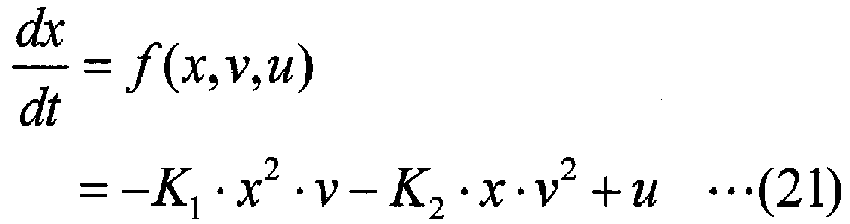
[Expression 22]
- The soft sensor is designed based on the above described relationships, and is implemented in a multi-core processor or a many-core processor, whereby a position soft sensor device can be made, which estimates the moved distance x of the movable body that is the state variable, from the propulsive force u that is applied to the movable body, which is the input variable.
- The partial derivative ∂g(x)/∂x by the state variable x of the inner function g(x) shown in
expression 22 is expressed by expression 23 as follows.
[Expression 23]
- When the soft sensor device of the first embodiment is configured as the position pressure soft sensor device, the function f(x, v, u) in expression 21 is implemented in the
arithmetic operator 101 of thefirst core 100 illustrated inFig. 6 . Further, the function ∂g(x)/∂x*f(x, v, u) that is expressed by the product of the partial derivative ∂g(x)/∂x in expression 23 and the function f(x, v, u) in expression 21 can be implemented in thearithmetic operator 111 in thesecond core 110. - When the soft sensor device in the second embodiment is configured as the position pressure soft sensor device, the function f(x, v, u) in expression 21 can be implemented in the
arithmetic operator 201 of thefirst core 200 illustrated inFig. 9 . Further, the partial derivative ∂g(x)/∂x in expression 23 can be implemented in thearithmetic operator 211 of thesecond core 210. - When the first embodiment is cited as an example, the
arithmetic operator 101 and theintegrator 102 may be implemented in separate cores.
Claims (8)
- A soft sensor device that acquires a state variable x by calculation using a plurality of processor cores, in which a value of the state variable x changes in relation to an input variable u that is observable, and a time derivative dx/dt of the state variable x is expressed by a function f(x, g(x), u) having the state variable x, an inner function g(x) having the state variable x as an independent variable, and the input variable u, as independent variables, the soft sensor device, comprising:a first arithmetic operation device (100; 200; 300; 400) that is an arithmetic operation device configured to perform an arithmetic operation by using one or a plurality of processor cores, and is programmed to calculate a function f(x, v, u) by using respective values of the state variable x, an intervening variable v that is defined by the inner function g(x), and the input variable u, and further obtain a value of the state variable x by time-integrating a value of the function f(x, v, u); anda second arithmetic operation device (110; 210; 3101 to 310n; 4101 to 410n) that is an arithmetic operation device configured to perform an arithmetic operation by using one or a plurality of processor cores that is or are different from the processor core or the processor cores used in the first arithmetic operation device (100; 200; 300; 400), and is programmed to calculate the intervening variable v,wherein the first arithmetic operation device (100; 200; 300; 400) is programmed to calculate the function f(x, v, u) by using a value of the state variable x that is calculated in the first arithmetic operation device (100; 200; 300; 400) in processing of a previous time, a value of the intervening variable v that is calculated in the second arithmetic device in the processing of the previous time, and a value of the input variable u that is inputted in processing of this time.
- The soft sensor device according to claim 1,
wherein the second arithmetic operation device (110; 210; 3101 to 310n; 4101 to 410n) is programmed to
calculate a product of a partial derivative ∂g(x)/∂x of the inner function g(x) with respect to the state variable x and the function f(x, v, u), by using the value of the state variable x that is calculated in the first arithmetic operation device (100; 200; 300; 400) in the processing of the previous time, the value of the intervening variable v that is calculated in the second arithmetic operation device (110; 210; 3101 to 310n; 4101 to 410n) in the processing of the previous time, and the value of the input variable u that is inputted in the processing of this time, and obtain a value of the intervening variable v by time-integrating a value of the product. - The soft sensor device according to claim 1,
wherein the second arithmetic operation device (110; 210; 3101 to 310n; 4101 to 410n) is programmed to
calculate a partial derivative ∂g(x)/∂x with respect to the state variable x of the inner function g(x) by using the value of the state variable x that is calculated in the first arithmetic operation device (100; 200; 300; 400) in the processing of the previous time, and
obtain a value of the intervening variable v by time-integrating a value that is obtained by multiplying a value of the partial derivative ∂g(x)/∂x, and a value of the function f(x, v, u) that is calculated in the first arithmetic operation device (100; 200; 300; 400) in the processing of this time. - The soft sensor device according to claim 1,
wherein when the inner function g(x) is a composite function that is expressed by expression A as follows, and has a sequential structure comprising n of functions gn, ···, g2 and g1, and an intervening variable vi is defined by expressions B, C and D as follows with respect to the respective functions gn, ···, g2 and g1,
the first arithmetic operation device (100; 200; 300; 400) is programmed to perform an arithmetic operation of a component in a first row in a right side of expression E as follows, time-integrate an obtained value and thereby obtain a value of the state variable x, and
the second arithmetic operation device (110; 210; 3101 to 310n; 4101 to 410n) is programmed to perform arithmetic operations of respective components from a second row through an n+1th row in the right side of the expression E by using different processor cores respectively, and obtain a value of an intervening variable vn that is used in calculation of a function f(x, vn, u) in the first arithmetic operation device (100; 200; 300; 400), by time-integrating a value of a component in the n+1th row in the right side.
[Expression A]
[Expression B]
[Expression C]
[Expression D]
[Expression E]
- The soft sensor device according to claim 4,
wherein a processor core that performs an arithmetic operation of a component in an i+1th row in the right side of the expression E is programmed to
calculate a product of i of partial derivatives from a partial derivative ∂g1(x(t))/∂x through a partial derivative ∂gi(vi-1(t))/∂vi-1, and the function f(x, vn, u), by using the value of the state variable x that is calculated in the first arithmetic operation device (100; 200; 300; 400) in the processing of the previous time, respective values of i-1 of intervening variables from an intervening variable v1 through an intervening variable vi-1 that are calculated in other processor cores in the processing of the previous time, the value of the intervening variable vn that is calculated in the second arithmetic operation device (110; 210; 3101 to 310n; 4101 to 410n) in the processing of the previous time, and the value of the input variable u that is inputted in the processing of this time, and obtain a value of an intervening variable vi by time-integrating a value of the product. - The soft sensor device according to claim 4,
wherein a processor core that performs an arithmetic operation of a component in an i+1th row in the right side of the expression E is programmed to
calculate a value of a partial derivative ∂gi(vi-1(t))/∂vi-1 by using a value of an intervening variable vi-1 that is calculated in another processor core that performs an arithmetic operation of a component in an ith row in the right side of the expression E in the processing of the previous time, and
obtain a value of the intervening variable vi by time-integrating a value that is obtained by multiplying the value of the partial derivative ∂gi(vi-1(t))/∂vi-1, and a value of the component in the ith row in the right side of the expression E that is calculated in the other processor core in the processing of this time. - The soft sensor device according to any one of claims 1 to 3,
wherein the state variable x is an intake pipe pressure of an internal combustion engine,
the input variable u is a throttle opening degree area, and
the function f(x, g(x), u) is a function based on a throttle formula that defines a physical law established among a mass flow rate of air that passes through a throttle, the throttle opening degree area and the intake pipe pressure. - The soft sensor device according to any one of claims 1 to 3,
wherein the state variable x is a moved distance of a movable body,
the input variable u is a propulsive force that is applied to the movable body, and
the function f(x, g(x), u) is a function that expresses a relationship that is theoretically or empirically obtained between the moved distance and the propulsive force.
Applications Claiming Priority (1)
| Application Number | Priority Date | Filing Date | Title |
|---|---|---|---|
| JP2016098930A JP6458767B2 (en) | 2016-05-17 | 2016-05-17 | Soft sensor device |
Publications (2)
| Publication Number | Publication Date |
|---|---|
| EP3246658A1 true EP3246658A1 (en) | 2017-11-22 |
| EP3246658B1 EP3246658B1 (en) | 2019-02-27 |
Family
ID=58692297
Family Applications (1)
| Application Number | Title | Priority Date | Filing Date |
|---|---|---|---|
| EP17165852.9A Not-in-force EP3246658B1 (en) | 2016-05-17 | 2017-04-11 | Soft sensor device |
Country Status (4)
| Country | Link |
|---|---|
| US (1) | US10338922B2 (en) |
| EP (1) | EP3246658B1 (en) |
| JP (1) | JP6458767B2 (en) |
| CN (1) | CN107391441B (en) |
Citations (3)
| Publication number | Priority date | Publication date | Assignee | Title |
|---|---|---|---|---|
| US6389364B1 (en) * | 1999-07-10 | 2002-05-14 | Mykrolis Corporation | System and method for a digital mass flow controller |
| JP2014211113A (en) | 2013-04-18 | 2014-11-13 | トヨタ自動車株式会社 | Internal combustion engine controller |
| GB2528882A (en) * | 2014-08-01 | 2016-02-10 | Bae Systems Plc | Turbine blade monitoring |
Family Cites Families (5)
| Publication number | Priority date | Publication date | Assignee | Title |
|---|---|---|---|---|
| US6142908A (en) * | 1998-07-01 | 2000-11-07 | Nissan Motor Co., Ltd. | Speed ratio controller and control method of continuously variable transmission |
| JP3922277B2 (en) | 2004-09-06 | 2007-05-30 | トヨタ自動車株式会社 | Air quantity estimation device for internal combustion engine |
| JP5853752B2 (en) * | 2012-02-15 | 2016-02-09 | トヨタ自動車株式会社 | Control device for internal combustion engine |
| CN102831280B (en) * | 2012-09-10 | 2014-12-03 | 北京航空航天大学 | Meshless physical deformation simulation method based on moving least squares |
| CN105243280B (en) * | 2015-10-30 | 2018-02-02 | 西安电子科技大学 | Time domain physical optical computing method based on CPU Yu the mixed asynchronous parallel modes of GPU |
-
2016
- 2016-05-17 JP JP2016098930A patent/JP6458767B2/en not_active Expired - Fee Related
-
2017
- 2017-04-11 EP EP17165852.9A patent/EP3246658B1/en not_active Not-in-force
- 2017-05-11 CN CN201710327714.7A patent/CN107391441B/en not_active Expired - Fee Related
- 2017-05-15 US US15/594,854 patent/US10338922B2/en not_active Expired - Fee Related
Patent Citations (3)
| Publication number | Priority date | Publication date | Assignee | Title |
|---|---|---|---|---|
| US6389364B1 (en) * | 1999-07-10 | 2002-05-14 | Mykrolis Corporation | System and method for a digital mass flow controller |
| JP2014211113A (en) | 2013-04-18 | 2014-11-13 | トヨタ自動車株式会社 | Internal combustion engine controller |
| GB2528882A (en) * | 2014-08-01 | 2016-02-10 | Bae Systems Plc | Turbine blade monitoring |
Non-Patent Citations (1)
| Title |
|---|
| T. O. TING ET AL: "Tuning of Kalman Filter Parameters via Genetic Algorithm for State-of-Charge Estimation in Battery Management System", THE SCIENTIFIC WORLD JOURNAL, vol. 2014, 1 January 2014 (2014-01-01), pages 1 - 11, XP055410396, ISSN: 2356-6140, DOI: 10.1155/2014/176052 * |
Also Published As
| Publication number | Publication date |
|---|---|
| US10338922B2 (en) | 2019-07-02 |
| US20170337057A1 (en) | 2017-11-23 |
| JP6458767B2 (en) | 2019-01-30 |
| CN107391441B (en) | 2020-06-09 |
| JP2017206987A (en) | 2017-11-24 |
| CN107391441A (en) | 2017-11-24 |
| EP3246658B1 (en) | 2019-02-27 |
Similar Documents
| Publication | Publication Date | Title |
|---|---|---|
| CN102859158B (en) | Control device and method for calculating output variables for control | |
| US20140278303A1 (en) | Method and system of dynamic model identification for monitoring and control of dynamic machines with variable structure or variable operation conditions | |
| US20110054863A1 (en) | Method and system for empirical modeling of time-varying, parameter-varying, and nonlinear systems via iterative linear subspace computation | |
| US8924331B2 (en) | System and method for solving quadratic programming problems with bound constraints utilizing a semi-explicit quadratic programming solver | |
| CN102236325A (en) | Microcontroller having a computing unit and a logic circuit, and method for carrying out computations by a microcontroller for a regulation or a control in a vehicle | |
| CN104573822A (en) | Model calculation unit for calculating LOLIMOT for integrated control assembly | |
| Yu et al. | An iterative augmented unscented Kalman filter for simultaneous state-parameter-input estimation for systems with/without direct feedthrough | |
| KR102541463B1 (en) | Apparatus for accelerating graph convolution neural network for semantic segmentation of 3d point cloud, and method for semantic segmentation of 3d point cloud using the same | |
| US20160063142A1 (en) | Control system design assist device, control system design assist program, control system design assist method, operation change amount calculation device and control device | |
| EP3246658B1 (en) | Soft sensor device | |
| Lazutkin et al. | Modified multiple shooting combined with collocation method in JModelica. org with symbolic calculations | |
| EP2960727B1 (en) | Control device design method and control device | |
| Tang et al. | FPGA implementation of RANSAC algorithm for real-time image geometry estimation | |
| Kempa | GI/G/1/∞ batch arrival queueing system with a single exponential vacation | |
| Cook et al. | Applications of the CESE method in LS-DYNA | |
| Kang et al. | Continuation/GMRES method based nonlinear model predictive control for IC engines | |
| Zhang et al. | A software configurable and parallelized coprocessor architecture for LQR control | |
| Padulo et al. | Robust aircraft conceptual design using automatic differentiation in Matlab | |
| CN119642638B (en) | Phase state monitoring method and device for microchannel heat exchange module | |
| Yin et al. | High frequency attitude determination of micro satellites based on FPGA | |
| CN107481191B (en) | Spark-based massive remote sensing image parallel mosaic method and system | |
| Garbergs et al. | Specialised hardware for state space control of a dynamic process | |
| Quirynen et al. | Projected preconditioning within a block-sparse active-set method for MPC | |
| Elshimy et al. | SysIDLib: a high-level synthesis FPGA library for online system identification | |
| Campbell | DAE approximations of PDE modeled control problems |
Legal Events
| Date | Code | Title | Description |
|---|---|---|---|
| PUAI | Public reference made under article 153(3) epc to a published international application that has entered the european phase |
Free format text: ORIGINAL CODE: 0009012 |
|
| STAA | Information on the status of an ep patent application or granted ep patent |
Free format text: STATUS: REQUEST FOR EXAMINATION WAS MADE |
|
| 17P | Request for examination filed |
Effective date: 20170411 |
|
| AK | Designated contracting states |
Kind code of ref document: A1 Designated state(s): AL AT BE BG CH CY CZ DE DK EE ES FI FR GB GR HR HU IE IS IT LI LT LU LV MC MK MT NL NO PL PT RO RS SE SI SK SM TR |
|
| AX | Request for extension of the european patent |
Extension state: BA ME |
|
| GRAP | Despatch of communication of intention to grant a patent |
Free format text: ORIGINAL CODE: EPIDOSNIGR1 |
|
| RIC1 | Information provided on ipc code assigned before grant |
Ipc: G05B 23/02 20060101ALI20180807BHEP Ipc: G01B 5/00 20060101AFI20180807BHEP Ipc: G05B 13/04 20060101ALI20180807BHEP |
|
| STAA | Information on the status of an ep patent application or granted ep patent |
Free format text: STATUS: GRANT OF PATENT IS INTENDED |
|
| INTG | Intention to grant announced |
Effective date: 20180913 |
|
| RIN1 | Information on inventor provided before grant (corrected) |
Inventor name: OHATA, AKIRA Inventor name: AZUMA, SHUNICHI Inventor name: SATA, KOTA |
|
| GRAS | Grant fee paid |
Free format text: ORIGINAL CODE: EPIDOSNIGR3 |
|
| GRAA | (expected) grant |
Free format text: ORIGINAL CODE: 0009210 |
|
| STAA | Information on the status of an ep patent application or granted ep patent |
Free format text: STATUS: THE PATENT HAS BEEN GRANTED |
|
| RAP1 | Party data changed (applicant data changed or rights of an application transferred) |
Owner name: TOYOTA JIDOSHA KABUSHIKI KAISHA |
|
| RIN1 | Information on inventor provided before grant (corrected) |
Inventor name: SATA, KOTA Inventor name: OHATA, AKIRA Inventor name: AZUMA, SHUNICHI |
|
| AK | Designated contracting states |
Kind code of ref document: B1 Designated state(s): AL AT BE BG CH CY CZ DE DK EE ES FI FR GB GR HR HU IE IS IT LI LT LU LV MC MK MT NL NO PL PT RO RS SE SI SK SM TR |
|
| REG | Reference to a national code |
Ref country code: GB Ref legal event code: FG4D |
|
| REG | Reference to a national code |
Ref country code: CH Ref legal event code: EP |
|
| REG | Reference to a national code |
Ref country code: AT Ref legal event code: REF Ref document number: 1102004 Country of ref document: AT Kind code of ref document: T Effective date: 20190315 |
|
| REG | Reference to a national code |
Ref country code: IE Ref legal event code: FG4D |
|
| REG | Reference to a national code |
Ref country code: DE Ref legal event code: R096 Ref document number: 602017002278 Country of ref document: DE |
|
| REG | Reference to a national code |
Ref country code: DE Ref legal event code: R084 Ref document number: 602017002278 Country of ref document: DE |
|
| REG | Reference to a national code |
Ref country code: NL Ref legal event code: MP Effective date: 20190227 |
|
| REG | Reference to a national code |
Ref country code: LT Ref legal event code: MG4D |
|
| PG25 | Lapsed in a contracting state [announced via postgrant information from national office to epo] |
Ref country code: NL Free format text: LAPSE BECAUSE OF FAILURE TO SUBMIT A TRANSLATION OF THE DESCRIPTION OR TO PAY THE FEE WITHIN THE PRESCRIBED TIME-LIMIT Effective date: 20190227 Ref country code: FI Free format text: LAPSE BECAUSE OF FAILURE TO SUBMIT A TRANSLATION OF THE DESCRIPTION OR TO PAY THE FEE WITHIN THE PRESCRIBED TIME-LIMIT Effective date: 20190227 Ref country code: NO Free format text: LAPSE BECAUSE OF FAILURE TO SUBMIT A TRANSLATION OF THE DESCRIPTION OR TO PAY THE FEE WITHIN THE PRESCRIBED TIME-LIMIT Effective date: 20190527 Ref country code: PT Free format text: LAPSE BECAUSE OF FAILURE TO SUBMIT A TRANSLATION OF THE DESCRIPTION OR TO PAY THE FEE WITHIN THE PRESCRIBED TIME-LIMIT Effective date: 20190627 Ref country code: SE Free format text: LAPSE BECAUSE OF FAILURE TO SUBMIT A TRANSLATION OF THE DESCRIPTION OR TO PAY THE FEE WITHIN THE PRESCRIBED TIME-LIMIT Effective date: 20190227 Ref country code: LT Free format text: LAPSE BECAUSE OF FAILURE TO SUBMIT A TRANSLATION OF THE DESCRIPTION OR TO PAY THE FEE WITHIN THE PRESCRIBED TIME-LIMIT Effective date: 20190227 |
|
| PG25 | Lapsed in a contracting state [announced via postgrant information from national office to epo] |
Ref country code: IS Free format text: LAPSE BECAUSE OF FAILURE TO SUBMIT A TRANSLATION OF THE DESCRIPTION OR TO PAY THE FEE WITHIN THE PRESCRIBED TIME-LIMIT Effective date: 20190627 Ref country code: HR Free format text: LAPSE BECAUSE OF FAILURE TO SUBMIT A TRANSLATION OF THE DESCRIPTION OR TO PAY THE FEE WITHIN THE PRESCRIBED TIME-LIMIT Effective date: 20190227 Ref country code: RS Free format text: LAPSE BECAUSE OF FAILURE TO SUBMIT A TRANSLATION OF THE DESCRIPTION OR TO PAY THE FEE WITHIN THE PRESCRIBED TIME-LIMIT Effective date: 20190227 Ref country code: GR Free format text: LAPSE BECAUSE OF FAILURE TO SUBMIT A TRANSLATION OF THE DESCRIPTION OR TO PAY THE FEE WITHIN THE PRESCRIBED TIME-LIMIT Effective date: 20190528 Ref country code: BG Free format text: LAPSE BECAUSE OF FAILURE TO SUBMIT A TRANSLATION OF THE DESCRIPTION OR TO PAY THE FEE WITHIN THE PRESCRIBED TIME-LIMIT Effective date: 20190527 Ref country code: LV Free format text: LAPSE BECAUSE OF FAILURE TO SUBMIT A TRANSLATION OF THE DESCRIPTION OR TO PAY THE FEE WITHIN THE PRESCRIBED TIME-LIMIT Effective date: 20190227 |
|
| REG | Reference to a national code |
Ref country code: AT Ref legal event code: MK05 Ref document number: 1102004 Country of ref document: AT Kind code of ref document: T Effective date: 20190227 |
|
| PG25 | Lapsed in a contracting state [announced via postgrant information from national office to epo] |
Ref country code: CZ Free format text: LAPSE BECAUSE OF FAILURE TO SUBMIT A TRANSLATION OF THE DESCRIPTION OR TO PAY THE FEE WITHIN THE PRESCRIBED TIME-LIMIT Effective date: 20190227 Ref country code: AL Free format text: LAPSE BECAUSE OF FAILURE TO SUBMIT A TRANSLATION OF THE DESCRIPTION OR TO PAY THE FEE WITHIN THE PRESCRIBED TIME-LIMIT Effective date: 20190227 Ref country code: RO Free format text: LAPSE BECAUSE OF FAILURE TO SUBMIT A TRANSLATION OF THE DESCRIPTION OR TO PAY THE FEE WITHIN THE PRESCRIBED TIME-LIMIT Effective date: 20190227 Ref country code: DK Free format text: LAPSE BECAUSE OF FAILURE TO SUBMIT A TRANSLATION OF THE DESCRIPTION OR TO PAY THE FEE WITHIN THE PRESCRIBED TIME-LIMIT Effective date: 20190227 Ref country code: IT Free format text: LAPSE BECAUSE OF FAILURE TO SUBMIT A TRANSLATION OF THE DESCRIPTION OR TO PAY THE FEE WITHIN THE PRESCRIBED TIME-LIMIT Effective date: 20190227 Ref country code: EE Free format text: LAPSE BECAUSE OF FAILURE TO SUBMIT A TRANSLATION OF THE DESCRIPTION OR TO PAY THE FEE WITHIN THE PRESCRIBED TIME-LIMIT Effective date: 20190227 Ref country code: SK Free format text: LAPSE BECAUSE OF FAILURE TO SUBMIT A TRANSLATION OF THE DESCRIPTION OR TO PAY THE FEE WITHIN THE PRESCRIBED TIME-LIMIT Effective date: 20190227 Ref country code: ES Free format text: LAPSE BECAUSE OF FAILURE TO SUBMIT A TRANSLATION OF THE DESCRIPTION OR TO PAY THE FEE WITHIN THE PRESCRIBED TIME-LIMIT Effective date: 20190227 |
|
| REG | Reference to a national code |
Ref country code: DE Ref legal event code: R097 Ref document number: 602017002278 Country of ref document: DE |
|
| PG25 | Lapsed in a contracting state [announced via postgrant information from national office to epo] |
Ref country code: PL Free format text: LAPSE BECAUSE OF FAILURE TO SUBMIT A TRANSLATION OF THE DESCRIPTION OR TO PAY THE FEE WITHIN THE PRESCRIBED TIME-LIMIT Effective date: 20190227 Ref country code: SM Free format text: LAPSE BECAUSE OF FAILURE TO SUBMIT A TRANSLATION OF THE DESCRIPTION OR TO PAY THE FEE WITHIN THE PRESCRIBED TIME-LIMIT Effective date: 20190227 |
|
| REG | Reference to a national code |
Ref country code: BE Ref legal event code: MM Effective date: 20190430 |
|
| PG25 | Lapsed in a contracting state [announced via postgrant information from national office to epo] |
Ref country code: AT Free format text: LAPSE BECAUSE OF FAILURE TO SUBMIT A TRANSLATION OF THE DESCRIPTION OR TO PAY THE FEE WITHIN THE PRESCRIBED TIME-LIMIT Effective date: 20190227 Ref country code: MC Free format text: LAPSE BECAUSE OF FAILURE TO SUBMIT A TRANSLATION OF THE DESCRIPTION OR TO PAY THE FEE WITHIN THE PRESCRIBED TIME-LIMIT Effective date: 20190227 Ref country code: LU Free format text: LAPSE BECAUSE OF NON-PAYMENT OF DUE FEES Effective date: 20190411 |
|
| PLBE | No opposition filed within time limit |
Free format text: ORIGINAL CODE: 0009261 |
|
| STAA | Information on the status of an ep patent application or granted ep patent |
Free format text: STATUS: NO OPPOSITION FILED WITHIN TIME LIMIT |
|
| 26N | No opposition filed |
Effective date: 20191128 |
|
| PG25 | Lapsed in a contracting state [announced via postgrant information from national office to epo] |
Ref country code: SI Free format text: LAPSE BECAUSE OF FAILURE TO SUBMIT A TRANSLATION OF THE DESCRIPTION OR TO PAY THE FEE WITHIN THE PRESCRIBED TIME-LIMIT Effective date: 20190227 Ref country code: BE Free format text: LAPSE BECAUSE OF NON-PAYMENT OF DUE FEES Effective date: 20190430 |
|
| PG25 | Lapsed in a contracting state [announced via postgrant information from national office to epo] |
Ref country code: TR Free format text: LAPSE BECAUSE OF FAILURE TO SUBMIT A TRANSLATION OF THE DESCRIPTION OR TO PAY THE FEE WITHIN THE PRESCRIBED TIME-LIMIT Effective date: 20190227 |
|
| PG25 | Lapsed in a contracting state [announced via postgrant information from national office to epo] |
Ref country code: IE Free format text: LAPSE BECAUSE OF NON-PAYMENT OF DUE FEES Effective date: 20190411 |
|
| REG | Reference to a national code |
Ref country code: CH Ref legal event code: PL |
|
| PG25 | Lapsed in a contracting state [announced via postgrant information from national office to epo] |
Ref country code: CH Free format text: LAPSE BECAUSE OF NON-PAYMENT OF DUE FEES Effective date: 20200430 Ref country code: LI Free format text: LAPSE BECAUSE OF NON-PAYMENT OF DUE FEES Effective date: 20200430 |
|
| PG25 | Lapsed in a contracting state [announced via postgrant information from national office to epo] |
Ref country code: CY Free format text: LAPSE BECAUSE OF FAILURE TO SUBMIT A TRANSLATION OF THE DESCRIPTION OR TO PAY THE FEE WITHIN THE PRESCRIBED TIME-LIMIT Effective date: 20190227 |
|
| PG25 | Lapsed in a contracting state [announced via postgrant information from national office to epo] |
Ref country code: MT Free format text: LAPSE BECAUSE OF FAILURE TO SUBMIT A TRANSLATION OF THE DESCRIPTION OR TO PAY THE FEE WITHIN THE PRESCRIBED TIME-LIMIT Effective date: 20190227 Ref country code: HU Free format text: LAPSE BECAUSE OF FAILURE TO SUBMIT A TRANSLATION OF THE DESCRIPTION OR TO PAY THE FEE WITHIN THE PRESCRIBED TIME-LIMIT; INVALID AB INITIO Effective date: 20170411 |
|
| GBPC | Gb: european patent ceased through non-payment of renewal fee |
Effective date: 20210411 |
|
| PG25 | Lapsed in a contracting state [announced via postgrant information from national office to epo] |
Ref country code: GB Free format text: LAPSE BECAUSE OF NON-PAYMENT OF DUE FEES Effective date: 20210411 |
|
| PGFP | Annual fee paid to national office [announced via postgrant information from national office to epo] |
Ref country code: FR Payment date: 20220308 Year of fee payment: 6 |
|
| PG25 | Lapsed in a contracting state [announced via postgrant information from national office to epo] |
Ref country code: MK Free format text: LAPSE BECAUSE OF FAILURE TO SUBMIT A TRANSLATION OF THE DESCRIPTION OR TO PAY THE FEE WITHIN THE PRESCRIBED TIME-LIMIT Effective date: 20190227 |
|
| PGFP | Annual fee paid to national office [announced via postgrant information from national office to epo] |
Ref country code: DE Payment date: 20220302 Year of fee payment: 6 |
|
| P01 | Opt-out of the competence of the unified patent court (upc) registered |
Effective date: 20230427 |
|
| REG | Reference to a national code |
Ref country code: DE Ref legal event code: R119 Ref document number: 602017002278 Country of ref document: DE |
|
| PG25 | Lapsed in a contracting state [announced via postgrant information from national office to epo] |
Ref country code: FR Free format text: LAPSE BECAUSE OF NON-PAYMENT OF DUE FEES Effective date: 20230430 Ref country code: DE Free format text: LAPSE BECAUSE OF NON-PAYMENT OF DUE FEES Effective date: 20231103 |