EP3246376A1 - Liquid crystal compound, liquid crystal composition and liquid crystal display device using the same - Google Patents
Liquid crystal compound, liquid crystal composition and liquid crystal display device using the same Download PDFInfo
- Publication number
- EP3246376A1 EP3246376A1 EP17171628.5A EP17171628A EP3246376A1 EP 3246376 A1 EP3246376 A1 EP 3246376A1 EP 17171628 A EP17171628 A EP 17171628A EP 3246376 A1 EP3246376 A1 EP 3246376A1
- Authority
- EP
- European Patent Office
- Prior art keywords
- formula
- liquid crystal
- compound
- fluorine
- hydrogen
- Prior art date
- Legal status (The legal status is an assumption and is not a legal conclusion. Google has not performed a legal analysis and makes no representation as to the accuracy of the status listed.)
- Granted
Links
- 150000001875 compounds Chemical class 0.000 title claims abstract description 212
- 239000004973 liquid crystal related substance Substances 0.000 title claims abstract description 110
- 239000000203 mixture Substances 0.000 title claims description 77
- 239000011737 fluorine Substances 0.000 claims abstract description 67
- 229910052731 fluorine Inorganic materials 0.000 claims abstract description 67
- 229910052739 hydrogen Inorganic materials 0.000 claims abstract description 63
- 239000001257 hydrogen Substances 0.000 claims abstract description 63
- UFHFLCQGNIYNRP-UHFFFAOYSA-N Hydrogen Chemical compound [H][H] UFHFLCQGNIYNRP-UHFFFAOYSA-N 0.000 claims abstract description 54
- 125000002496 methyl group Chemical group [H]C([H])([H])* 0.000 claims abstract description 21
- 125000002023 trifluoromethyl group Chemical group FC(F)(F)* 0.000 claims abstract description 15
- 125000000876 trifluoromethoxy group Chemical group FC(F)(F)O* 0.000 claims abstract description 11
- 229910052736 halogen Inorganic materials 0.000 claims abstract description 10
- 150000002367 halogens Chemical class 0.000 claims abstract description 10
- 125000004653 anthracenylene group Chemical group 0.000 claims abstract description 9
- 125000004957 naphthylene group Chemical group 0.000 claims abstract description 9
- 125000001495 ethyl group Chemical group [H]C([H])([H])C([H])([H])* 0.000 claims abstract description 8
- PXGOKWXKJXAPGV-UHFFFAOYSA-N Fluorine Chemical compound FF PXGOKWXKJXAPGV-UHFFFAOYSA-N 0.000 claims abstract 22
- -1 1,4-phenylene, 2-fluoro-1,4-phenylene, 2,5-difluoro-1,4-phenylene Chemical group 0.000 claims description 35
- 125000000217 alkyl group Chemical group 0.000 claims description 35
- 125000003342 alkenyl group Chemical group 0.000 claims description 27
- 125000004955 1,4-cyclohexylene group Chemical group [H]C1([H])C([H])([H])C([H])([*:1])C([H])([H])C([H])([H])C1([H])[*:2] 0.000 claims description 13
- 150000002431 hydrogen Chemical class 0.000 claims description 9
- ZAMOUSCENKQFHK-UHFFFAOYSA-N Chlorine atom Chemical compound [Cl] ZAMOUSCENKQFHK-UHFFFAOYSA-N 0.000 claims description 5
- 239000000460 chlorine Substances 0.000 claims description 5
- 229910052801 chlorine Inorganic materials 0.000 claims description 5
- 125000005714 2,5- (1,3-dioxanylene) group Chemical group [H]C1([H])OC([H])([*:1])OC([H])([H])C1([H])[*:2] 0.000 claims description 4
- 230000004044 response Effects 0.000 abstract description 15
- YCKRFDGAMUMZLT-UHFFFAOYSA-N Fluorine atom Chemical compound [F] YCKRFDGAMUMZLT-UHFFFAOYSA-N 0.000 description 44
- 238000005259 measurement Methods 0.000 description 15
- 230000007704 transition Effects 0.000 description 15
- VHYFNPMBLIVWCW-UHFFFAOYSA-N 4-Dimethylaminopyridine Chemical compound CN(C)C1=CC=NC=C1 VHYFNPMBLIVWCW-UHFFFAOYSA-N 0.000 description 10
- 239000004990 Smectic liquid crystal Substances 0.000 description 10
- 230000001965 increasing effect Effects 0.000 description 10
- 238000006116 polymerization reaction Methods 0.000 description 9
- WYURNTSHIVDZCO-UHFFFAOYSA-N Tetrahydrofuran Chemical compound C1CCOC1 WYURNTSHIVDZCO-UHFFFAOYSA-N 0.000 description 8
- 239000004975 biaxial nematic Substances 0.000 description 7
- 239000003112 inhibitor Substances 0.000 description 7
- 239000003505 polymerization initiator Substances 0.000 description 7
- HEDRZPFGACZZDS-MICDWDOJSA-N Trichloro(2H)methane Chemical compound [2H]C(Cl)(Cl)Cl HEDRZPFGACZZDS-MICDWDOJSA-N 0.000 description 6
- 239000000654 additive Substances 0.000 description 6
- 239000013078 crystal Substances 0.000 description 6
- 238000011161 development Methods 0.000 description 6
- 238000010586 diagram Methods 0.000 description 6
- LMDZBCPBFSXMTL-UHFFFAOYSA-N 1-ethyl-3-(3-dimethylaminopropyl)carbodiimide Chemical compound CCN=C=NCCCN(C)C LMDZBCPBFSXMTL-UHFFFAOYSA-N 0.000 description 5
- 239000002518 antifoaming agent Substances 0.000 description 5
- 239000003963 antioxidant agent Substances 0.000 description 5
- 230000003078 antioxidant effect Effects 0.000 description 5
- 230000003247 decreasing effect Effects 0.000 description 5
- 239000004611 light stabiliser Substances 0.000 description 5
- 230000003287 optical effect Effects 0.000 description 5
- 238000003786 synthesis reaction Methods 0.000 description 5
- 229940124543 ultraviolet light absorber Drugs 0.000 description 5
- 239000006097 ultraviolet radiation absorber Substances 0.000 description 5
- BDNKZNFMNDZQMI-UHFFFAOYSA-N 1,3-diisopropylcarbodiimide Chemical compound CC(C)N=C=NC(C)C BDNKZNFMNDZQMI-UHFFFAOYSA-N 0.000 description 4
- HEDRZPFGACZZDS-UHFFFAOYSA-N Chloroform Chemical compound ClC(Cl)Cl HEDRZPFGACZZDS-UHFFFAOYSA-N 0.000 description 4
- 230000000996 additive effect Effects 0.000 description 4
- 230000015572 biosynthetic process Effects 0.000 description 4
- 230000008859 change Effects 0.000 description 4
- 238000006243 chemical reaction Methods 0.000 description 4
- 239000003795 chemical substances by application Substances 0.000 description 4
- 239000012760 heat stabilizer Substances 0.000 description 4
- 239000011159 matrix material Substances 0.000 description 4
- 238000000034 method Methods 0.000 description 4
- YLQBMQCUIZJEEH-UHFFFAOYSA-N tetrahydrofuran Natural products C=1C=COC=1 YLQBMQCUIZJEEH-UHFFFAOYSA-N 0.000 description 4
- 238000002834 transmittance Methods 0.000 description 4
- 125000001140 1,4-phenylene group Chemical group [H]C1=C([H])C([*:2])=C([H])C([H])=C1[*:1] 0.000 description 3
- 238000005160 1H NMR spectroscopy Methods 0.000 description 3
- YMWUJEATGCHHMB-UHFFFAOYSA-N Dichloromethane Chemical compound ClCCl YMWUJEATGCHHMB-UHFFFAOYSA-N 0.000 description 3
- 238000002441 X-ray diffraction Methods 0.000 description 3
- 230000001747 exhibiting effect Effects 0.000 description 3
- 238000001914 filtration Methods 0.000 description 3
- NWVVVBRKAWDGAB-UHFFFAOYSA-N hydroquinone methyl ether Natural products COC1=CC=C(O)C=C1 NWVVVBRKAWDGAB-UHFFFAOYSA-N 0.000 description 3
- RAXXELZNTBOGNW-UHFFFAOYSA-N imidazole Natural products C1=CNC=N1 RAXXELZNTBOGNW-UHFFFAOYSA-N 0.000 description 3
- 239000007788 liquid Substances 0.000 description 3
- 239000007787 solid Substances 0.000 description 3
- 238000001308 synthesis method Methods 0.000 description 3
- FPIRBHDGWMWJEP-UHFFFAOYSA-N 1-hydroxy-7-azabenzotriazole Chemical compound C1=CN=C2N(O)N=NC2=C1 FPIRBHDGWMWJEP-UHFFFAOYSA-N 0.000 description 2
- FPQQSJJWHUJYPU-UHFFFAOYSA-N 3-(dimethylamino)propyliminomethylidene-ethylazanium;chloride Chemical compound Cl.CCN=C=NCCCN(C)C FPQQSJJWHUJYPU-UHFFFAOYSA-N 0.000 description 2
- UXVMQQNJUSDDNG-UHFFFAOYSA-L Calcium chloride Chemical compound [Cl-].[Cl-].[Ca+2] UXVMQQNJUSDDNG-UHFFFAOYSA-L 0.000 description 2
- QIGBRXMKCJKVMJ-UHFFFAOYSA-N Hydroquinone Chemical compound OC1=CC=C(O)C=C1 QIGBRXMKCJKVMJ-UHFFFAOYSA-N 0.000 description 2
- 239000004988 Nematic liquid crystal Substances 0.000 description 2
- 238000009825 accumulation Methods 0.000 description 2
- 125000003545 alkoxy group Chemical group 0.000 description 2
- 239000001110 calcium chloride Substances 0.000 description 2
- 229910001628 calcium chloride Inorganic materials 0.000 description 2
- PFKFTWBEEFSNDU-UHFFFAOYSA-N carbonyldiimidazole Chemical compound C1=CN=CN1C(=O)N1C=CN=C1 PFKFTWBEEFSNDU-UHFFFAOYSA-N 0.000 description 2
- 210000004027 cell Anatomy 0.000 description 2
- MVPPADPHJFYWMZ-UHFFFAOYSA-N chlorobenzene Chemical compound ClC1=CC=CC=C1 MVPPADPHJFYWMZ-UHFFFAOYSA-N 0.000 description 2
- 230000005621 ferroelectricity Effects 0.000 description 2
- 125000005647 linker group Chemical group 0.000 description 2
- 238000002844 melting Methods 0.000 description 2
- 230000008018 melting Effects 0.000 description 2
- MNZMMCVIXORAQL-UHFFFAOYSA-N naphthalene-2,6-diol Chemical compound C1=C(O)C=CC2=CC(O)=CC=C21 MNZMMCVIXORAQL-UHFFFAOYSA-N 0.000 description 2
- 229920000642 polymer Polymers 0.000 description 2
- 238000011084 recovery Methods 0.000 description 2
- 238000001953 recrystallisation Methods 0.000 description 2
- 230000009467 reduction Effects 0.000 description 2
- 239000007858 starting material Substances 0.000 description 2
- 125000001424 substituent group Chemical group 0.000 description 2
- 238000012360 testing method Methods 0.000 description 2
- CNHDIAIOKMXOLK-UHFFFAOYSA-N toluquinol Chemical compound CC1=CC(O)=CC=C1O CNHDIAIOKMXOLK-UHFFFAOYSA-N 0.000 description 2
- ZKJNETINGMOHJG-GGWOSOGESA-N (e)-1-[(e)-prop-1-enoxy]prop-1-ene Chemical compound C\C=C\O\C=C\C ZKJNETINGMOHJG-GGWOSOGESA-N 0.000 description 1
- VNQNXQYZMPJLQX-UHFFFAOYSA-N 1,3,5-tris[(3,5-ditert-butyl-4-hydroxyphenyl)methyl]-1,3,5-triazinane-2,4,6-trione Chemical compound CC(C)(C)C1=C(O)C(C(C)(C)C)=CC(CN2C(N(CC=3C=C(C(O)=C(C=3)C(C)(C)C)C(C)(C)C)C(=O)N(CC=3C=C(C(O)=C(C=3)C(C)(C)C)C(C)(C)C)C2=O)=O)=C1 VNQNXQYZMPJLQX-UHFFFAOYSA-N 0.000 description 1
- 150000005208 1,4-dihydroxybenzenes Chemical class 0.000 description 1
- ASOKPJOREAFHNY-UHFFFAOYSA-N 1-Hydroxybenzotriazole Chemical compound C1=CC=C2N(O)N=NC2=C1 ASOKPJOREAFHNY-UHFFFAOYSA-N 0.000 description 1
- WJFKNYWRSNBZNX-UHFFFAOYSA-N 10H-phenothiazine Chemical compound C1=CC=C2NC3=CC=CC=C3SC2=C1 WJFKNYWRSNBZNX-UHFFFAOYSA-N 0.000 description 1
- 238000004293 19F NMR spectroscopy Methods 0.000 description 1
- WEPXLRANFJEOFZ-UHFFFAOYSA-N 2,3,4-trifluorobenzoic acid Chemical compound OC(=O)C1=CC=C(F)C(F)=C1F WEPXLRANFJEOFZ-UHFFFAOYSA-N 0.000 description 1
- KODNTHAUOGOFJY-UHFFFAOYSA-N 2,4-diethylxanthen-9-one Chemical compound C1=CC=C2C(=O)C3=CC(CC)=CC(CC)=C3OC2=C1 KODNTHAUOGOFJY-UHFFFAOYSA-N 0.000 description 1
- JECYNCQXXKQDJN-UHFFFAOYSA-N 2-(2-methylhexan-2-yloxymethyl)oxirane Chemical compound CCCCC(C)(C)OCC1CO1 JECYNCQXXKQDJN-UHFFFAOYSA-N 0.000 description 1
- ZMWRRFHBXARRRT-UHFFFAOYSA-N 2-(benzotriazol-2-yl)-4,6-bis(2-methylbutan-2-yl)phenol Chemical compound CCC(C)(C)C1=CC(C(C)(C)CC)=CC(N2N=C3C=CC=CC3=N2)=C1O ZMWRRFHBXARRRT-UHFFFAOYSA-N 0.000 description 1
- OLFNXLXEGXRUOI-UHFFFAOYSA-N 2-(benzotriazol-2-yl)-4,6-bis(2-phenylpropan-2-yl)phenol Chemical compound C=1C(N2N=C3C=CC=CC3=N2)=C(O)C(C(C)(C)C=2C=CC=CC=2)=CC=1C(C)(C)C1=CC=CC=C1 OLFNXLXEGXRUOI-UHFFFAOYSA-N 0.000 description 1
- IYAZLDLPUNDVAG-UHFFFAOYSA-N 2-(benzotriazol-2-yl)-4-(2,4,4-trimethylpentan-2-yl)phenol Chemical compound CC(C)(C)CC(C)(C)C1=CC=C(O)C(N2N=C3C=CC=CC3=N2)=C1 IYAZLDLPUNDVAG-UHFFFAOYSA-N 0.000 description 1
- IJXPXNZUSXLSTF-UHFFFAOYSA-N 2-[2-(4-butoxyphenyl)ethenyl]-5-(trichloromethyl)-1,3,4-oxadiazole Chemical compound C1=CC(OCCCC)=CC=C1C=CC1=NN=C(C(Cl)(Cl)Cl)O1 IJXPXNZUSXLSTF-UHFFFAOYSA-N 0.000 description 1
- VFBJXXJYHWLXRM-UHFFFAOYSA-N 2-[2-[3-(3,5-ditert-butyl-4-hydroxyphenyl)propanoyloxy]ethylsulfanyl]ethyl 3-(3,5-ditert-butyl-4-hydroxyphenyl)propanoate Chemical compound CC(C)(C)C1=C(O)C(C(C)(C)C)=CC(CCC(=O)OCCSCCOC(=O)CCC=2C=C(C(O)=C(C=2)C(C)(C)C)C(C)(C)C)=C1 VFBJXXJYHWLXRM-UHFFFAOYSA-N 0.000 description 1
- SITYOOWCYAYOKL-UHFFFAOYSA-N 2-[4,6-bis(2,4-dimethylphenyl)-1,3,5-triazin-2-yl]-5-(3-dodecoxy-2-hydroxypropoxy)phenol Chemical compound OC1=CC(OCC(O)COCCCCCCCCCCCC)=CC=C1C1=NC(C=2C(=CC(C)=CC=2)C)=NC(C=2C(=CC(C)=CC=2)C)=N1 SITYOOWCYAYOKL-UHFFFAOYSA-N 0.000 description 1
- DNDBXYWKDTXSPJ-UHFFFAOYSA-N 2-[bis(2-hydroxyethyl)amino]propan-1-ol Chemical compound OCC(C)N(CCO)CCO DNDBXYWKDTXSPJ-UHFFFAOYSA-N 0.000 description 1
- QPXVRLXJHPTCPW-UHFFFAOYSA-N 2-hydroxy-2-methyl-1-(4-propan-2-ylphenyl)propan-1-one Chemical compound CC(C)C1=CC=C(C(=O)C(C)(C)O)C=C1 QPXVRLXJHPTCPW-UHFFFAOYSA-N 0.000 description 1
- LWRBVKNFOYUCNP-UHFFFAOYSA-N 2-methyl-1-(4-methylsulfanylphenyl)-2-morpholin-4-ylpropan-1-one Chemical compound C1=CC(SC)=CC=C1C(=O)C(C)(C)N1CCOCC1 LWRBVKNFOYUCNP-UHFFFAOYSA-N 0.000 description 1
- FPENCTDAQQQKNY-UHFFFAOYSA-N 3,4-difluorobenzoic acid Chemical compound OC(=O)C1=CC=C(F)C(F)=C1 FPENCTDAQQQKNY-UHFFFAOYSA-N 0.000 description 1
- QRLSTWVLSWCGBT-UHFFFAOYSA-N 4-((4,6-bis(octylthio)-1,3,5-triazin-2-yl)amino)-2,6-di-tert-butylphenol Chemical compound CCCCCCCCSC1=NC(SCCCCCCCC)=NC(NC=2C=C(C(O)=C(C=2)C(C)(C)C)C(C)(C)C)=N1 QRLSTWVLSWCGBT-UHFFFAOYSA-N 0.000 description 1
- MZWDAEVXPZRJTQ-WUXMJOGZSA-N 4-[(e)-(4-fluorophenyl)methylideneamino]-3-methyl-1h-1,2,4-triazole-5-thione Chemical compound CC1=NNC(=S)N1\N=C\C1=CC=C(F)C=C1 MZWDAEVXPZRJTQ-WUXMJOGZSA-N 0.000 description 1
- XESZUVZBAMCAEJ-UHFFFAOYSA-N 4-tert-butylcatechol Chemical compound CC(C)(C)C1=CC=C(O)C(O)=C1 XESZUVZBAMCAEJ-UHFFFAOYSA-N 0.000 description 1
- MTRFEWTWIPAXLG-UHFFFAOYSA-N 9-phenylacridine Chemical compound C1=CC=CC=C1C1=C(C=CC=C2)C2=NC2=CC=CC=C12 MTRFEWTWIPAXLG-UHFFFAOYSA-N 0.000 description 1
- NIXOWILDQLNWCW-UHFFFAOYSA-M Acrylate Chemical compound [O-]C(=O)C=C NIXOWILDQLNWCW-UHFFFAOYSA-M 0.000 description 1
- DIJCWEAQRJWIQM-UHFFFAOYSA-N COC1=CC=C(C=C1)C=1C(=NN(NC1)C(Cl)(Cl)Cl)C(Cl)(Cl)Cl Chemical compound COC1=CC=C(C=C1)C=1C(=NN(NC1)C(Cl)(Cl)Cl)C(Cl)(Cl)Cl DIJCWEAQRJWIQM-UHFFFAOYSA-N 0.000 description 1
- 239000004593 Epoxy Substances 0.000 description 1
- OKOBUGCCXMIKDM-UHFFFAOYSA-N Irganox 1098 Chemical compound CC(C)(C)C1=C(O)C(C(C)(C)C)=CC(CCC(=O)NCCCCCCNC(=O)CCC=2C=C(C(O)=C(C=2)C(C)(C)C)C(C)(C)C)=C1 OKOBUGCCXMIKDM-UHFFFAOYSA-N 0.000 description 1
- CSNNHWWHGAXBCP-UHFFFAOYSA-L Magnesium sulfate Chemical compound [Mg+2].[O-][S+2]([O-])([O-])[O-] CSNNHWWHGAXBCP-UHFFFAOYSA-L 0.000 description 1
- CERQOIWHTDAKMF-UHFFFAOYSA-M Methacrylate Chemical compound CC(=C)C([O-])=O CERQOIWHTDAKMF-UHFFFAOYSA-M 0.000 description 1
- 238000005481 NMR spectroscopy Methods 0.000 description 1
- JKIJEFPNVSHHEI-UHFFFAOYSA-N Phenol, 2,4-bis(1,1-dimethylethyl)-, phosphite (3:1) Chemical compound CC(C)(C)C1=CC(C(C)(C)C)=CC=C1OP(OC=1C(=CC(=CC=1)C(C)(C)C)C(C)(C)C)OC1=CC=C(C(C)(C)C)C=C1C(C)(C)C JKIJEFPNVSHHEI-UHFFFAOYSA-N 0.000 description 1
- 239000004983 Polymer Dispersed Liquid Crystal Substances 0.000 description 1
- 101100020289 Xenopus laevis koza gene Proteins 0.000 description 1
- BGYHLZZASRKEJE-UHFFFAOYSA-N [3-[3-(3,5-ditert-butyl-4-hydroxyphenyl)propanoyloxy]-2,2-bis[3-(3,5-ditert-butyl-4-hydroxyphenyl)propanoyloxymethyl]propyl] 3-(3,5-ditert-butyl-4-hydroxyphenyl)propanoate Chemical compound CC(C)(C)C1=C(O)C(C(C)(C)C)=CC(CCC(=O)OCC(COC(=O)CCC=2C=C(C(O)=C(C=2)C(C)(C)C)C(C)(C)C)(COC(=O)CCC=2C=C(C(O)=C(C=2)C(C)(C)C)C(C)(C)C)COC(=O)CCC=2C=C(C(O)=C(C=2)C(C)(C)C)C(C)(C)C)=C1 BGYHLZZASRKEJE-UHFFFAOYSA-N 0.000 description 1
- 239000000783 alginic acid Substances 0.000 description 1
- 125000005452 alkenyloxyalkyl group Chemical group 0.000 description 1
- 125000004183 alkoxy alkyl group Chemical group 0.000 description 1
- 125000005082 alkoxyalkenyl group Chemical group 0.000 description 1
- 150000001412 amines Chemical class 0.000 description 1
- 125000004429 atom Chemical group 0.000 description 1
- 150000001558 benzoic acid derivatives Chemical class 0.000 description 1
- RWCCWEUUXYIKHB-UHFFFAOYSA-N benzophenone Chemical compound C=1C=CC=CC=1C(=O)C1=CC=CC=C1 RWCCWEUUXYIKHB-UHFFFAOYSA-N 0.000 description 1
- 239000012965 benzophenone Substances 0.000 description 1
- 150000008366 benzophenones Chemical class 0.000 description 1
- FLPKSBDJMLUTEX-UHFFFAOYSA-N bis(1,2,2,6,6-pentamethylpiperidin-4-yl) 2-butyl-2-[(3,5-ditert-butyl-4-hydroxyphenyl)methyl]propanedioate Chemical compound C1C(C)(C)N(C)C(C)(C)CC1OC(=O)C(C(=O)OC1CC(C)(C)N(C)C(C)(C)C1)(CCCC)CC1=CC(C(C)(C)C)=C(O)C(C(C)(C)C)=C1 FLPKSBDJMLUTEX-UHFFFAOYSA-N 0.000 description 1
- XITRBUPOXXBIJN-UHFFFAOYSA-N bis(2,2,6,6-tetramethylpiperidin-4-yl) decanedioate Chemical compound C1C(C)(C)NC(C)(C)CC1OC(=O)CCCCCCCCC(=O)OC1CC(C)(C)NC(C)(C)C1 XITRBUPOXXBIJN-UHFFFAOYSA-N 0.000 description 1
- OCWYEMOEOGEQAN-UHFFFAOYSA-N bumetrizole Chemical compound CC(C)(C)C1=CC(C)=CC(N2N=C3C=C(Cl)C=CC3=N2)=C1O OCWYEMOEOGEQAN-UHFFFAOYSA-N 0.000 description 1
- 150000001718 carbodiimides Chemical class 0.000 description 1
- 229910052799 carbon Inorganic materials 0.000 description 1
- 239000003054 catalyst Substances 0.000 description 1
- 238000012790 confirmation Methods 0.000 description 1
- 210000002858 crystal cell Anatomy 0.000 description 1
- 239000011903 deuterated solvents Substances 0.000 description 1
- 125000000118 dimethyl group Chemical group [H]C([H])([H])* 0.000 description 1
- 239000012153 distilled water Substances 0.000 description 1
- 230000000694 effects Effects 0.000 description 1
- 238000013213 extrapolation Methods 0.000 description 1
- HJUFTIJOISQSKQ-UHFFFAOYSA-N fenoxycarb Chemical compound C1=CC(OCCNC(=O)OCC)=CC=C1OC1=CC=CC=C1 HJUFTIJOISQSKQ-UHFFFAOYSA-N 0.000 description 1
- 239000000706 filtrate Substances 0.000 description 1
- 125000001153 fluoro group Chemical group F* 0.000 description 1
- 239000006260 foam Substances 0.000 description 1
- 239000011521 glass Substances 0.000 description 1
- NPZTUJOABDZTLV-UHFFFAOYSA-N hydroxybenzotriazole Substances O=C1C=CC=C2NNN=C12 NPZTUJOABDZTLV-UHFFFAOYSA-N 0.000 description 1
- 230000006872 improvement Effects 0.000 description 1
- 230000001939 inductive effect Effects 0.000 description 1
- 239000000463 material Substances 0.000 description 1
- DBQGARDMYOMOOS-UHFFFAOYSA-N methyl 4-(dimethylamino)benzoate Chemical compound COC(=O)C1=CC=C(N(C)C)C=C1 DBQGARDMYOMOOS-UHFFFAOYSA-N 0.000 description 1
- 238000002156 mixing Methods 0.000 description 1
- NGAVKPIEGZEJAO-UHFFFAOYSA-N naphtho[1,2-g]phthalazine Chemical compound N1=NC=C2C=C3C4=CC=CC=C4C=CC3=CC2=C1 NGAVKPIEGZEJAO-UHFFFAOYSA-N 0.000 description 1
- 229910052757 nitrogen Inorganic materials 0.000 description 1
- 238000000655 nuclear magnetic resonance spectrum Methods 0.000 description 1
- 239000011368 organic material Substances 0.000 description 1
- 238000006053 organic reaction Methods 0.000 description 1
- AHHWIHXENZJRFG-UHFFFAOYSA-N oxetane Chemical compound C1COC1 AHHWIHXENZJRFG-UHFFFAOYSA-N 0.000 description 1
- 229910052760 oxygen Inorganic materials 0.000 description 1
- 239000001301 oxygen Substances 0.000 description 1
- UCUUFSAXZMGPGH-UHFFFAOYSA-N penta-1,4-dien-3-one Chemical compound C=CC(=O)C=C UCUUFSAXZMGPGH-UHFFFAOYSA-N 0.000 description 1
- 230000002688 persistence Effects 0.000 description 1
- 229950000688 phenothiazine Drugs 0.000 description 1
- 125000000843 phenylene group Chemical group C1(=C(C=CC=C1)*)* 0.000 description 1
- XYFCBTPGUUZFHI-UHFFFAOYSA-O phosphonium Chemical compound [PH4+] XYFCBTPGUUZFHI-UHFFFAOYSA-O 0.000 description 1
- 230000000704 physical effect Effects 0.000 description 1
- 229920003216 poly(methylphenylsiloxane) Polymers 0.000 description 1
- 238000002360 preparation method Methods 0.000 description 1
- 238000010898 silica gel chromatography Methods 0.000 description 1
- 229920002545 silicone oil Polymers 0.000 description 1
- 239000002904 solvent Substances 0.000 description 1
- 229910052717 sulfur Inorganic materials 0.000 description 1
- CZDYPVPMEAXLPK-UHFFFAOYSA-N tetramethylsilane Chemical compound C[Si](C)(C)C CZDYPVPMEAXLPK-UHFFFAOYSA-N 0.000 description 1
- 229920001187 thermosetting polymer Polymers 0.000 description 1
- CYRMSUTZVYGINF-UHFFFAOYSA-N trichlorofluoromethane Chemical compound FC(Cl)(Cl)Cl CYRMSUTZVYGINF-UHFFFAOYSA-N 0.000 description 1
- IMNIMPAHZVJRPE-UHFFFAOYSA-N triethylenediamine Chemical compound C1CN2CCN1CC2 IMNIMPAHZVJRPE-UHFFFAOYSA-N 0.000 description 1
- 229920002554 vinyl polymer Polymers 0.000 description 1
- XLYOFNOQVPJJNP-UHFFFAOYSA-N water Chemical compound O XLYOFNOQVPJJNP-UHFFFAOYSA-N 0.000 description 1
Images



Classifications
-
- G—PHYSICS
- G02—OPTICS
- G02F—OPTICAL DEVICES OR ARRANGEMENTS FOR THE CONTROL OF LIGHT BY MODIFICATION OF THE OPTICAL PROPERTIES OF THE MEDIA OF THE ELEMENTS INVOLVED THEREIN; NON-LINEAR OPTICS; FREQUENCY-CHANGING OF LIGHT; OPTICAL LOGIC ELEMENTS; OPTICAL ANALOGUE/DIGITAL CONVERTERS
- G02F1/00—Devices or arrangements for the control of the intensity, colour, phase, polarisation or direction of light arriving from an independent light source, e.g. switching, gating or modulating; Non-linear optics
- G02F1/01—Devices or arrangements for the control of the intensity, colour, phase, polarisation or direction of light arriving from an independent light source, e.g. switching, gating or modulating; Non-linear optics for the control of the intensity, phase, polarisation or colour
- G02F1/13—Devices or arrangements for the control of the intensity, colour, phase, polarisation or direction of light arriving from an independent light source, e.g. switching, gating or modulating; Non-linear optics for the control of the intensity, phase, polarisation or colour based on liquid crystals, e.g. single liquid crystal display cells
- G02F1/133—Constructional arrangements; Operation of liquid crystal cells; Circuit arrangements
-
- C—CHEMISTRY; METALLURGY
- C09—DYES; PAINTS; POLISHES; NATURAL RESINS; ADHESIVES; COMPOSITIONS NOT OTHERWISE PROVIDED FOR; APPLICATIONS OF MATERIALS NOT OTHERWISE PROVIDED FOR
- C09K—MATERIALS FOR MISCELLANEOUS APPLICATIONS, NOT PROVIDED FOR ELSEWHERE
- C09K19/00—Liquid crystal materials
- C09K19/04—Liquid crystal materials characterised by the chemical structure of the liquid crystal components, e.g. by a specific unit
- C09K19/06—Non-steroidal liquid crystal compounds
- C09K19/08—Non-steroidal liquid crystal compounds containing at least two non-condensed rings
- C09K19/10—Non-steroidal liquid crystal compounds containing at least two non-condensed rings containing at least two benzene rings
- C09K19/20—Non-steroidal liquid crystal compounds containing at least two non-condensed rings containing at least two benzene rings linked by a chain containing carbon and oxygen atoms as chain links, e.g. esters or ethers
-
- C—CHEMISTRY; METALLURGY
- C09—DYES; PAINTS; POLISHES; NATURAL RESINS; ADHESIVES; COMPOSITIONS NOT OTHERWISE PROVIDED FOR; APPLICATIONS OF MATERIALS NOT OTHERWISE PROVIDED FOR
- C09K—MATERIALS FOR MISCELLANEOUS APPLICATIONS, NOT PROVIDED FOR ELSEWHERE
- C09K19/00—Liquid crystal materials
- C09K19/04—Liquid crystal materials characterised by the chemical structure of the liquid crystal components, e.g. by a specific unit
- C09K19/06—Non-steroidal liquid crystal compounds
- C09K19/32—Non-steroidal liquid crystal compounds containing condensed ring systems, i.e. fused, bridged or spiro ring systems
-
- C—CHEMISTRY; METALLURGY
- C09—DYES; PAINTS; POLISHES; NATURAL RESINS; ADHESIVES; COMPOSITIONS NOT OTHERWISE PROVIDED FOR; APPLICATIONS OF MATERIALS NOT OTHERWISE PROVIDED FOR
- C09K—MATERIALS FOR MISCELLANEOUS APPLICATIONS, NOT PROVIDED FOR ELSEWHERE
- C09K19/00—Liquid crystal materials
- C09K19/04—Liquid crystal materials characterised by the chemical structure of the liquid crystal components, e.g. by a specific unit
- C09K19/06—Non-steroidal liquid crystal compounds
- C09K19/32—Non-steroidal liquid crystal compounds containing condensed ring systems, i.e. fused, bridged or spiro ring systems
- C09K19/322—Compounds containing a naphthalene ring or a completely or partially hydrogenated naphthalene ring
-
- C—CHEMISTRY; METALLURGY
- C09—DYES; PAINTS; POLISHES; NATURAL RESINS; ADHESIVES; COMPOSITIONS NOT OTHERWISE PROVIDED FOR; APPLICATIONS OF MATERIALS NOT OTHERWISE PROVIDED FOR
- C09K—MATERIALS FOR MISCELLANEOUS APPLICATIONS, NOT PROVIDED FOR ELSEWHERE
- C09K19/00—Liquid crystal materials
- C09K19/04—Liquid crystal materials characterised by the chemical structure of the liquid crystal components, e.g. by a specific unit
- C09K19/42—Mixtures of liquid crystal compounds covered by two or more of the preceding groups C09K19/06 - C09K19/40
- C09K19/44—Mixtures of liquid crystal compounds covered by two or more of the preceding groups C09K19/06 - C09K19/40 containing compounds with benzene rings directly linked
-
- C—CHEMISTRY; METALLURGY
- C09—DYES; PAINTS; POLISHES; NATURAL RESINS; ADHESIVES; COMPOSITIONS NOT OTHERWISE PROVIDED FOR; APPLICATIONS OF MATERIALS NOT OTHERWISE PROVIDED FOR
- C09K—MATERIALS FOR MISCELLANEOUS APPLICATIONS, NOT PROVIDED FOR ELSEWHERE
- C09K19/00—Liquid crystal materials
- C09K19/04—Liquid crystal materials characterised by the chemical structure of the liquid crystal components, e.g. by a specific unit
- C09K19/06—Non-steroidal liquid crystal compounds
- C09K19/08—Non-steroidal liquid crystal compounds containing at least two non-condensed rings
- C09K19/30—Non-steroidal liquid crystal compounds containing at least two non-condensed rings containing saturated or unsaturated non-aromatic rings, e.g. cyclohexane rings
- C09K19/3001—Cyclohexane rings
- C09K19/3066—Cyclohexane rings in which the rings are linked by a chain containing carbon and oxygen atoms, e.g. esters or ethers
-
- C—CHEMISTRY; METALLURGY
- C09—DYES; PAINTS; POLISHES; NATURAL RESINS; ADHESIVES; COMPOSITIONS NOT OTHERWISE PROVIDED FOR; APPLICATIONS OF MATERIALS NOT OTHERWISE PROVIDED FOR
- C09K—MATERIALS FOR MISCELLANEOUS APPLICATIONS, NOT PROVIDED FOR ELSEWHERE
- C09K19/00—Liquid crystal materials
- C09K19/04—Liquid crystal materials characterised by the chemical structure of the liquid crystal components, e.g. by a specific unit
- C09K2019/0444—Liquid crystal materials characterised by the chemical structure of the liquid crystal components, e.g. by a specific unit characterized by a linking chain between rings or ring systems, a bridging chain between extensive mesogenic moieties or an end chain group
- C09K2019/0448—Liquid crystal materials characterised by the chemical structure of the liquid crystal components, e.g. by a specific unit characterized by a linking chain between rings or ring systems, a bridging chain between extensive mesogenic moieties or an end chain group the end chain group being a polymerizable end group, e.g. -Sp-P or acrylate
-
- C—CHEMISTRY; METALLURGY
- C09—DYES; PAINTS; POLISHES; NATURAL RESINS; ADHESIVES; COMPOSITIONS NOT OTHERWISE PROVIDED FOR; APPLICATIONS OF MATERIALS NOT OTHERWISE PROVIDED FOR
- C09K—MATERIALS FOR MISCELLANEOUS APPLICATIONS, NOT PROVIDED FOR ELSEWHERE
- C09K19/00—Liquid crystal materials
- C09K19/04—Liquid crystal materials characterised by the chemical structure of the liquid crystal components, e.g. by a specific unit
- C09K19/06—Non-steroidal liquid crystal compounds
- C09K19/08—Non-steroidal liquid crystal compounds containing at least two non-condensed rings
- C09K19/10—Non-steroidal liquid crystal compounds containing at least two non-condensed rings containing at least two benzene rings
- C09K19/20—Non-steroidal liquid crystal compounds containing at least two non-condensed rings containing at least two benzene rings linked by a chain containing carbon and oxygen atoms as chain links, e.g. esters or ethers
- C09K19/2007—Non-steroidal liquid crystal compounds containing at least two non-condensed rings containing at least two benzene rings linked by a chain containing carbon and oxygen atoms as chain links, e.g. esters or ethers the chain containing -COO- or -OCO- groups
- C09K2019/2042—Ph-Ph-COO-Ph
-
- C—CHEMISTRY; METALLURGY
- C09—DYES; PAINTS; POLISHES; NATURAL RESINS; ADHESIVES; COMPOSITIONS NOT OTHERWISE PROVIDED FOR; APPLICATIONS OF MATERIALS NOT OTHERWISE PROVIDED FOR
- C09K—MATERIALS FOR MISCELLANEOUS APPLICATIONS, NOT PROVIDED FOR ELSEWHERE
- C09K19/00—Liquid crystal materials
- C09K19/04—Liquid crystal materials characterised by the chemical structure of the liquid crystal components, e.g. by a specific unit
- C09K19/06—Non-steroidal liquid crystal compounds
- C09K19/08—Non-steroidal liquid crystal compounds containing at least two non-condensed rings
- C09K19/10—Non-steroidal liquid crystal compounds containing at least two non-condensed rings containing at least two benzene rings
- C09K19/20—Non-steroidal liquid crystal compounds containing at least two non-condensed rings containing at least two benzene rings linked by a chain containing carbon and oxygen atoms as chain links, e.g. esters or ethers
- C09K19/2007—Non-steroidal liquid crystal compounds containing at least two non-condensed rings containing at least two benzene rings linked by a chain containing carbon and oxygen atoms as chain links, e.g. esters or ethers the chain containing -COO- or -OCO- groups
- C09K2019/2078—Ph-COO-Ph-COO-Ph
-
- C—CHEMISTRY; METALLURGY
- C09—DYES; PAINTS; POLISHES; NATURAL RESINS; ADHESIVES; COMPOSITIONS NOT OTHERWISE PROVIDED FOR; APPLICATIONS OF MATERIALS NOT OTHERWISE PROVIDED FOR
- C09K—MATERIALS FOR MISCELLANEOUS APPLICATIONS, NOT PROVIDED FOR ELSEWHERE
- C09K19/00—Liquid crystal materials
- C09K19/04—Liquid crystal materials characterised by the chemical structure of the liquid crystal components, e.g. by a specific unit
- C09K19/06—Non-steroidal liquid crystal compounds
- C09K19/08—Non-steroidal liquid crystal compounds containing at least two non-condensed rings
- C09K19/30—Non-steroidal liquid crystal compounds containing at least two non-condensed rings containing saturated or unsaturated non-aromatic rings, e.g. cyclohexane rings
- C09K19/3001—Cyclohexane rings
- C09K19/3003—Compounds containing at least two rings in which the different rings are directly linked (covalent bond)
- C09K2019/3012—Cy-Cy-Cy-Ph, or more Cy rings
-
- C—CHEMISTRY; METALLURGY
- C09—DYES; PAINTS; POLISHES; NATURAL RESINS; ADHESIVES; COMPOSITIONS NOT OTHERWISE PROVIDED FOR; APPLICATIONS OF MATERIALS NOT OTHERWISE PROVIDED FOR
- C09K—MATERIALS FOR MISCELLANEOUS APPLICATIONS, NOT PROVIDED FOR ELSEWHERE
- C09K19/00—Liquid crystal materials
- C09K19/04—Liquid crystal materials characterised by the chemical structure of the liquid crystal components, e.g. by a specific unit
- C09K19/06—Non-steroidal liquid crystal compounds
- C09K19/08—Non-steroidal liquid crystal compounds containing at least two non-condensed rings
- C09K19/30—Non-steroidal liquid crystal compounds containing at least two non-condensed rings containing saturated or unsaturated non-aromatic rings, e.g. cyclohexane rings
- C09K19/3001—Cyclohexane rings
- C09K19/3003—Compounds containing at least two rings in which the different rings are directly linked (covalent bond)
- C09K2019/3021—Cy-Ph-Ph-Cy
Definitions
- the invention relates to a liquid crystal compound. Moreover, the invention also relates to a liquid crystal composition using the liquid crystal compound and a liquid crystal display device using the same.
- a liquid crystal television using a liquid crystal display is known.
- a compound exhibiting a uniaxial nematic phase is generally utilized in such a liquid crystal display.
- the liquid crystal display using the compound exhibiting the uniaxial nematic phase is indicated to be low in a response speed thereof.
- the response speed means a period of time taken for a liquid crystal device to be directed toward a predetermined direction according to voltage applied. If the response speed is slow, a period of time during which color is changed from color first displayed to objective color becomes long, and therefore upon displaying moving images, a residual image easily appears.
- a way of light to pass therethrough is changed by significantly changing a direction of molecules in a major axis.
- the way of light to pass therethrough is changed by changing the direction of molecules in a minor axis while the direction of molecules in the major axis is kept.
- Non-patent literature No. 1 bent-type (Non-patent literature No. 1) molecules are generally known.
- Non-patent literature No. 2 in order to avoid response speed reduction that may occur in the molecules having high anisotropy as described in Non-patent literature No. 1, simple rod-like molecules in which an excluded volume in rotation around the major axis is small have also been developed.
- Non-patent literature No. 1 and Non-patent literature No. 2 have a possibility of being unable to obtain a high-speed response and a sufficient contrast ratio in switching of a display device.
- an object is to provide a liquid crystal compound according to which the high-speed response and the sufficient contrast ratio can be obtained in switching of the display device. Further, the invention also provides a liquid crystal composition using the liquid crystal compound, and a liquid crystal display device using the same.
- the invention can provide a liquid crystal compound for obtaining a high-speed response and a sufficient contrast ratio in switching of a display device, a liquid crystal composition and a liquid crystal display device using the same.
- a liquid crystal compound is a generic term for a compound having a liquid crystal phase such as a nematic phase and a smectic phase, and a compound having no liquid crystal phase but to be added for the purpose of adjusting physical properties of a composition, such as maximum temperature, minimum temperature, viscosity and dielectric anisotropy.
- the liquid crystal compound, a liquid crystal composition and a liquid crystal display device may be occasionally abbreviated as “compound,” “composition” and “device,” respectively.
- the liquid crystal display device is a generic term for a liquid crystal display panel and a liquid crystal display module.
- a clearing point is transition temperature between the liquid crystal phase and an isotropic phase in the liquid crystal compound.
- a minimum temperature of the liquid crystal phase is transition temperature between a solid and the liquid crystal phase (a smectic phase, a nematic phase or the like) in the liquid crystal compound.
- the maximum temperature of the nematic phase is transition temperature between the nematic phase and the isotropic phase in the liquid crystal composition, and may be occasionally abbreviated as "maximum temperature.”
- a minimum temperature of the nematic phase may be occasionally abbreviated as "minimum temperature.”
- a compound represented by formula (1) may be occasionally abbreviated as "compound (1).” The abbreviation may also apply occasionally to a compound represented by formula (2) or the like.
- formulas (2) to (15) a symbol of B 1 , C 1 or the like surrounded by a hexagonal shape corresponds to ring B 1 , ring C 1 or the like, respectively.
- formula (8) when i is 2, two of ring D 1 exists.
- two groups represented by two of ring D 1 may be identical or different.
- a same rule applies also to two of arbitrary ring D 1 when i is larger than 2.
- a same rule applies also to a symbol such as any other ring and a bonding group.
- liquid crystal compounds include a liquid crystal compound having a six-membered ring such as 1, 4-cyclohexylene and 1,4-phenylene, and having rod-like molecular structure.
- a liquid crystal composition may be prepared by further mixing such liquid crystal compounds.
- a proportion (content) of the liquid crystal compounds is expressed in terms of weight percent (% by weight) based on the weight of the liquid crystal composition.
- An additive such as an optically active compound, an antioxidant, an ultraviolet light absorber, a light stabilizer, a heat stabilizer, an antifoaming agent, a polymerization initiator and a polymerization inhibitor is added to the composition when necessary.
- a proportion (amount of addition) of the additive is expressed in terms of weight percent (% by weight) based on the weight of the liquid crystal composition in a manner similar to the liquid crystal compound. Weight parts per million (ppm) may be occasionally used. However, the polymerization initiator and the polymerization inhibitor are expressed based on the weight of the polymerizable compound.
- An expression “at least one piece of “A” may be replaced by “B” " means that, when the number of “A” is 1, a position of "A” is arbitrary, and also when the number of "A” is 2 or more, positions thereof can be freely selected without restriction.
- An expression “at least one piece of A may be replaced by B, C or D” means including a case where at least one piece of A is replaced by B, a case where at least one piece of A is replaced by C, and a case where at least one piece of A is replaced by D, and also a case where a plurality of pieces A are replaced by at least two of B, C and D.
- a case where two pieces of consecutive -CH 2 - are replaced by -O- to form -O-O- is not preferred.
- alkyl or the like a case where -CH 2 - of a methyl part (-CH 2 -H) is replaced by -O- to form -O-H is not preferred, either.
- the invention includes contents described in the following items.
- Compound (1) has the following structure: wherein, in formula (1),
- Compound (1) has the structure described above, and thus exhibits ferroelectricity in a nematic phase, and simultaneously contributes to development of biaxiality. Then, a device containing compound (1) exhibits a high-speed response during applying voltage.
- ring A is naphthylene, phenantolylene or anthracenylene, and in the groups, at least one piece of hydrogen is preferably a group that may be replaced by fluorine, -CH 3 or -CF 3 .
- the compound represented by formula (1) is preferably represented by any one of formula (1-1) to formula (1-12): wherein, in formula (1-1) to formula (1-12),
- T 1 , T 2 , T 3 , T 4 , T 5 , T 6 , T 7 , T 8 , T 9 and T 10 are hydrogen, fluorine or -CH 3 in formula (1-1) to formula (1-12) described above cause reduction of a liquid crystal phase transition temperature, and improvement in compatibility with other liquid crystals, and therefore such a case is preferred.
- the compound being represented by any one of formula (1-1-A), formula (1-2-A), formula (1-5-A), formula (1-6-A), formula (1-11-A) and formula (1-12-A) described below in formula (1-1) to formula (1-12) described above causes development of the liquid crystal phase in a large temperature range, and therefore such a case is preferred.
- X 1 and Y 1 are independently hydrogen or fluorine.
- Compound (1) can be prepared by suitably combining techniques in synthetic organic chemistry. Methods for introducing an objective terminal group, ring and bonding group into a starting material are described in books such as Organic Syntheses (John Wiley & Sons, Inc.), Organic Reactions (John Wiley & Sons, Inc.), Comprehensive Organic Synthesis (Pergamon Press) and New Experimental Chemistry Course (Shin Jikken Kagaku Koza in Japanese) (Maruzen Co., Ltd.).
- a compound represented by formula (1) is prepared, for example, using the starting materials (i) and (ii) described below: wherein, in formula (i), ring A is naphthylene, phenantolylene or anthracenylene, and in the groups, at least one piece of hydrogen may be replaced by fluorine, -CH 3 or -CF 3 . wherein, X 1 , X 2 , X 3 , X 4 and X 5 are independently hydrogen or fluorine, but at least two or more of X 1 , X 2 , X 3 , X 4 and X 5 is fluorine.
- Y 1 , Y 2 , Y 3 , Y 4 and Y 5 are independently hydrogen or fluorine, but at least two or more of Y 1 , Y 2 , Y 3 , Y 4 and Y 5 is fluorine.
- a carbodiimide condensing agent such as N,N-dicyclocarbodiimide (DCC), 1-[3-(dimethylamino)propyl]3-ethylcarbodiimide (EDC) and 1-ethyl-3-(3-dimethylaminopropyl)carbodiimide hydrochloride (EDC-HCl), an imidazole condensing agent such as N,N'-carbonyldiimidazole, and a phosphonium condensing agent such as 1H-benzotriazol-1-yloxytris(dimethylamino)phosphonium hexafluorophosphate can also be utilized.
- DCC N,N-dicyclocarbodiimide
- EDC 1-[3-(dimethylamino)propyl]3-ethylcarbodiimide
- EDC-HCl 1-ethyl-3-(3-dimethylaminopropyl)car
- DMAP 4-dimethylaminopyridine
- HOBt 1-hydroxybenzotriazole
- HOAt 1-hydroxy-7-azabenzotriazole
- N-hydroxy imide succinate exemplified in the formula described above
- a mole ratio of the compound represented by formula (i) to the compound represented by formula (ii) upon the reaction include 1 : 2.5 to 1 : 0.5.
- asymmetrical compound (1) can be prepared by stepwise preparing the compound by adjusting a ratio of the compound represented by formula (ii).
- reaction temperature include 0°C to 110°C.
- a composition of the invention is mainly used in a liquid crystal display device.
- the composition contains at least one of compound (1) as a first component.
- the composition may contain compounds (2) to (15) described above.
- the composition may contain any other liquid crystal compound different from compounds (2) to (15).
- a preferred composition contains at least one of compound (1) as the first component, and at least one of compounds (2) to (4) as a second component.
- a third component is selected from compounds (5) to (15) based on a mode of the device.
- compounds (5) to (7) are suitable for the third component.
- compound (8) is suitable for the third component.
- compounds (9) to (15) are suitable for the third component.
- the composition may further contain a liquid crystal compound different from compounds (1) to (15).
- the composition may contain the additive such as the optically active compound, the antioxidant, the ultraviolet light absorber, the light stabilizer, the heat stabilizer, the antifoaming agent, the polymerizable compound, the polymerization initiator and the polymerization inhibitor when necessary.
- the composition preferably contains at least one of compounds (1) in the range of about 1% by weight to about 99% by weight.
- a further preferred proportion is in the range of about 3% by weight to about 90% by weight.
- the most preferred proportion is in the range of about 5% by weight to about 60% by weight.
- two terminal groups are alkyl or the like, and dielectric anisotropy is small.
- Preferred examples of the compounds include compounds (2-1) to (2-11), compounds (3-1) to (3-19) and compounds (4-1) to (4-7).
- R 11 and R 12 are independently alkyl having 1 to 10 carbons or alkenyl having 2 to 10 carbons, and in the alkyl or the alkenyl, at least one piece of -CH 2 -may be replaced by -0- , and at least one piece of hydrogen may be replaced by fluorine.
- Compound (2) is mainly effective in decreasing viscosity or adjusting optical anisotropy.
- Compounds (3) and (4) are effective in extending the temperature range of the nematic phase by increasing the maximum temperature, or in adjusting the optical anisotropy.
- Compounds (2) to (4) have the small dielectric anisotropy. As a content of compounds (2) to (4) is increased, the viscosity of the composition is decreased, but the dielectric anisotropy is decreased. Thus, as long as a desired value of threshold voltage of the device is met, the content is preferably as large as possible. Accordingly, when a composition for a mode such as an IPS mode and the VA mode is prepared, the content of compounds (2) to (4) is preferably about 30% by weight or more, and further preferably about 40% by weight or more, based on the weight of the liquid crystal composition.
- Compounds (5) to (7) have a halogen-containing group or a fluorine-containing group at a right terminal.
- Preferred examples of the compounds include compounds (5-1) to (5-16), compounds (6-1) to (6-113) and compounds (7-1) to (7-57).
- R 13 is alkyl having 1 to 10 carbons or alkenyl having 2 to 10 carbons, and in the alkyl and the alkenyl, at least one piece of -CH 2 - may be replaced by -O-, and at least one piece of hydrogen may be replaced by fluorine; and X 11 is fluorine, chlorine, -OCF 3 , -OCHF 2 , -CF 3 , -CHF 2 , -CH 2 F, -OCF 2 CHF 2 or -OCF 2 CHFCF 3 .
- Compounds (5) to (7) have positively large dielectric anisotropy, and superb stability to heat and light, and therefore are used when a composition for a mode such as the IPS mode, the FFS mode and an OCB mode is prepared.
- a content of compounds (5) to (7) is suitably in the range of about 1% by weight to about 99% by weight, preferably in the range of about 10% by weight to about 97% by weight, and further preferably in the range of about 40% by weight to about 95% by weight, based on the weight of the liquid crystal composition.
- the content of the compounds is preferably about 30% by weight or less based on the weight of the liquid crystal composition.
- An elastic constant of the composition can be adjusted, and a voltage-transmittance curve of the device can be adjusted by adding compounds (5) to (7).
- a right-terminal group is -C ⁇ N or -C ⁇ C-C ⁇ N.
- Preferred examples of the compound include compounds (8-1) to (8-64).
- R 14 is alkyl having 1 to 10 carbons or alkenyl having 2 to 10 carbons, and in the alkyl and the alkenyl, at least one piece of -CH 2 - may be replaced by -O-, and at least one piece of hydrogen may be replaced by fluorine; and
- X 12 is -C ⁇ N or -C ⁇ C-C ⁇ N.
- Compound (8) has positive dielectric anisotropy, a value of which is large, and therefore is mainly used for preparing a composition for the mode such as the TN mode and the STN mode. Dielectric anisotropy of the composition can be increased by adding compound (8).
- Compound (8) is effective in extending the temperature range of the liquid crystal phase, adjusting the viscosity or adjusting the optical anisotropy. The compound is also useful for adjustment of the voltage-transmittance curve of the device.
- a content of compound (8) is suitably in the range of about 1% by weight to about 99% by weight, preferably in the range of about 10% by weight to about 97% by weight, and further preferably in the range of about 40% by weight to about 95% by weight, based on the weight of the liquid crystal composition.
- the content of the compound is preferably about 30% by weight or less based on the weight of the liquid crystal composition.
- the elastic constant of the composition can be adjusted, and the voltage-transmittance curve of the device can be adjusted by adding compound (8).
- Compounds (9) to (15) have phenylene in which atoms in lateral positions are replaced by two pieces of halogen.
- Preferred examples of the compounds include compounds (9-1) to (9-8), compounds (10-1) to (10-17), compound (11-1), compounds (12-1) to (12-3), compounds (13-1) to (13-11), compounds (14-1) to (14-3) and compounds (15-1) to (15-3).
- R 15 and R 16 are independently alkyl having 1 to 10 carbons or alkenyl having 2 to 10 carbons, and in the alkyl and the alkenyl, at least one piece of -CH 2 - may be replaced by -O-, and at least one piece of hydrogen may be replaced by fluorine; and R 17 is hydrogen, fluorine, alkyl having 1 to 10 carbons or alkenyl having 2 to 10 carbons, and in the alkyl and the alkenyl, at least one piece of -CH 2 - may be replaced by -O-, and at least one piece of hydrogen may be replaced by fluorine.
- Compounds (9) to (15) have negatively large dielectric anisotropy.
- the compounds are used when a composition for a mode such as the IPS mode, the VA mode and the PSA mode is prepared.
- the dielectric anisotropy of the composition is negatively increased, but the viscosity is increased.
- the content is preferably as small as possible. Accordingly, when the dielectric anisotropy at a degree of -5 is taken into account, the content is preferably about 40% by weight or more in order to allow a sufficient voltage driving.
- compound (9) is a bicyclic compound, and therefore is mainly effective in decreasing the viscosity, adjusting the optical anisotropy or increasing the dielectric anisotropy.
- Compounds (10) and (11) are a tricyclic compound, and therefore are effective in increasing the maximum temperature, the optical anisotropy or the dielectric anisotropy.
- Compounds (12) to (15) are effective in increasing the dielectric anisotropy.
- a content of compounds (9) to (15) is preferably about 40% by weight or more, and further preferably in the range of about 50% by weight to about 95% by weight, based on the weight of the liquid crystal composition.
- the content of the compounds is preferably about 30% by weight or less based on the weight of the liquid crystal composition.
- the elastic constant of the composition can be adjusted, and the voltage-transmittance curve of the device can be adjusted by adding the compounds.
- the additive may be added to the composition.
- the additives include an optically active compound, an antioxidant, an ultraviolet light absorber, a light stabilizer, a heat stabilizer, an antifoaming agent, a polymerizable compound, a polymerization initiator and a polymerization inhibitor.
- Such additives are well known to those skilled in the art, and described in literature.
- the optically active compound is effective in inducing helical structure in liquid crystal molecules to give a required twist angle, and thereby preventing a reverse twist.
- a helical pitch can be adjusted by adding the optically active compound thereto.
- Two or more optically active compounds may be added for the purpose of adjusting temperature dependence of the helical pitch.
- Specific examples of a preferred optically active compound include compounds (Op-1) to (Op-18) described below.
- ring J is 1, 4-cyclohexylene or 1,4-phenylene
- R 28 is alkyl having 1 to 10 carbons.
- the antioxidant is effective for maintaining a large voltage holding ratio.
- a preferred antioxidant include compounds (AO-1) and (AO-2) described below; and IRGANOX 415, IRGANOX 565, IRGANOX 1010, IRGANOX 1035, IRGANOX 3114 and IRGANOX 1098 (trade names: BASF SE).
- the ultraviolet light absorber is effective for preventing a decrease of the maximum temperature.
- Specific examples of a preferred ultraviolet light absorber include a benzophenone derivative, a benzoate derivative and a triazole derivative.
- AO-3 and (AO-4) described below include compounds (AO-3) and (AO-4) described below; TINUVIN 329, TINUVIN P, TINUVIN 326, TINUVIN 234, TINUVIN 213, TINUVIN 400, TINUVIN 328 and TINUVIN 99-2 (trade names: BASF SE) ; and 1,4-diazabicyclo[2.2.2]octane (DABCO).
- the light stabilizer such as an amine having steric hindrance is preferred for maintaining the large voltage holding ratio.
- a preferred light stabilizer include compounds (AO-5) and (AO-6) described below; and TINUVIN 144, TINUVIN 765 and TINUVIN 770DF (trade names: BASF SE).
- the heat stabilizer is also effective for maintaining the large voltage holding ratio, and preferred examples include IRGAFOS 168 (trade name: BASF SE).
- the antifoaming agent is effective for preventing foam formation.
- Specific examples of a preferred antifoaming agent include dimethyl silicone oil and methylphenyl silicone oil.
- R 40 is alkyl having 1 to 20 carbons, alkoxy having 1 to 20 carbons, -COOR 41 or -CH 2 CH 2 COOR 41 , in which R 41 is alkyl having 1 to 20 carbons.
- R 42 is alkyl having 1 to 20 carbons.
- R 43 is hydrogen, methyl or O (oxygen radical) ;
- ring G is 1,4-cyclohexylene or 1,4-phenylene; and
- z is 1, 2 or 3.
- the polymerizable compound is polymerized while being sterically controlled, and thus a response time of the device can be shortened to decrease image persistence.
- a preferred polymerizable compound include acrylate, methacrylate, a vinyl compound, a vinyloxy compound, propenyl ether, an epoxy compound (oxirane, oxetane) and vinyl ketone.
- Further preferred examples include a compound having at least one piece of acryloyloxy, and a compound having at least one piece of methacryloyloxy.
- Still further preferred examples also include a compound having both acryloyloxy and methacryloyloxy.
- Additional examples of other polymerizable compounds include compounds (M-1) to (M-17).
- R 25 , R 26 , R 27 , R 28 , R 29 , R 30 and R 31 are independently hydrogen or methyl; s, v and x are independently 0 or 1; and t and u are independently an integer from 1 to 10.
- L 21 , L 22 , L 23 , L 24 , L 25 and L 26 are independently hydrogen or fluorine; and L 27 and L 28 are independently hydrogen, fluorine or methyl.
- the polymerizable compound can be rapidly polymerized by adding the polymerization initiator. An amount of a remaining polymerizable compound can be decreased by optimizing the reaction temperature.
- photoradical polymerization initiators include TPO, 1173 and 4265 from Darocur series of BASF SE, and 184, 369, 500, 651, 784, 819, 907, 1300, 1700, 1800, 1850 and 2959 from Irgacure series of BASF SE.
- photoradical polymerization initiators include 4-methoxyphenyl-2,4-bis(trichloromethyl)triazine, 2-(4-butoxystyryl)-5-trichloromethyl-1,3,4-oxadiazole, 9-phenylacridine, 9,10-benzphenazine, a benzophenone-Michler's ketone mixture, a hexaarylbiimidazole-mercaptobenzimidazole mixture, 1-(4-isopropylphenyl)-2-hydroxy-2-methylpropane-1-one, benzyl dimethyl ketal, 2-methyl-1-[4-(methylthio)phenyl]-2-morpholinopropane-1-one, a mixture of 2,4-diethylxanthone and methyl p-dimethylaminobenzoate and a mixture of benzophenone and methyltriethanolamine.
- the polymerization inhibitor may be added thereto for preventing polymerization.
- the polymerizable compound is ordinarily added to the composition without removing the polymerization inhibitor.
- Specific examples of the polymerization inhibitor include hydroquinone, a hydroquinone derivative such as methylhydroquinone, 4-t-butylcatechol, 4-methoxyphenol and phenothiazine.
- the liquid crystal composition having positively large dielectric anisotropy can be used in a liquid crystal display device having an operating mode such as a PC mode, the TN mode, the STN mode, the OCB mode and the PSA mode, and driven by an active matrix (AM mode).
- the composition can also be used in a liquid crystal display device having an operating mode such as the PC mode, the TN mode, the STN mode, the OCB mode, the VA mode and the IPS mode, and driven by a passive matrix (PM) mode.
- the AM mode device and the PM mode device can also be applied to any of a reflective type, a transmissive type and a transflective type.
- a liquid crystal composition having negatively large dielectric anisotropy has negative dielectric anisotropy, and therefore can be suitably used in a liquid crystal display device having an operating mode such as the VA mode, the IPS mode and the PSA mode, and driven by the AM mode.
- the composition can be particularly suitably used in a liquid crystal display device having the VA mode, and driven by the AM mode.
- Such a composition can also be used in a nematic curvilinear aligned phase (NCAP) device prepared by microencapsulating a nematic liquid crystal, a polymer dispersed liquid crystal display device (PDLCD) and a polymer network liquid crystal display device (PNLCD) prepared by forming a three-dimensional network-polymer in the liquid crystal.
- NCAP nematic curvilinear aligned phase
- PDLCD polymer dispersed liquid crystal display device
- PLCD polymer network liquid crystal display device
- a liquid crystal display device having the PSA mode is prepared.
- the device having the PSA mode can be driven by a driving mode such as the active matrix (AM) mode and the passive matrix (PM) mode.
- a device having a polymer dispersed mode can also be prepared by increasing the amount of adding the polymerizable compound.
- DPX-300 made by Bruker BioSpin Corporation was used.
- 1 H-NMR measurement a sample was dissolved in a deuterated solvent such as CDCl 3 , and measurement was carried out under conditions of room temperature, 300 MHz and 16 times of accumulation. Tetramethylsilane was used as an internal standard.
- CFCl 3 was used as an internal standard, and measurement was carried out under conditions of 24 times of accumulation.
- s, d, t, q, quin, sex and m stand for a singlet, a doublet, a triplet, a quartet, a quintet, a sextet and a multiplet, and br being broad, respectively.
- a crystal was expressed as C. When kinds of the crystals were distinguishable, each of the crystals was expressed as C 1 or C 2 .
- the smectic phase and the nematic phase were expressed as S and N, respectively.
- S A , S B , S C or S F the phases were expressed as S A , S B , S C or S F , respectively.
- a liquid (isotropic) was expressed as I.
- a transition temperature was expressed as "C 50.0 N 100.0 I," for example. The expression indicates that transition temperature from the crystals to the nematic phase is 50 . 0°C, and transition temperature from the nematic phase to the liquid is 100.0°C.
- XRD X-ray diffraction
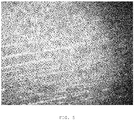
- FIG. 6 A rapid change of light and darkness was shown if the triangular wave was applied to a liquid crystal cell into which compound No. 6 was sealed in a state of a nematic liquid crystal (185°C) ( FIG. 4 ): 0 V, ( FIG. 5 ) : 100 Vpp, 5 Hz. Behavior of current upon the above occasion was as shown in FIG. 6 .
- Compound No. 6 showed a shoulder peak derived from polarized inversion current to exhibit ferroelectric behavior under conditions of 1.0 to 200 Vpp and 5 Hz.
- a liquid crystal compound of the invention has ferroelectricity, and a liquid crystal display device using the liquid crystal compound produces a contrast ratio. Accordingly, a liquid crystal display device using a liquid crystal composition containing the liquid crystal compound can be used in a liquid crystal projector, a liquid crystal television and so forth.
Landscapes
- Chemical & Material Sciences (AREA)
- Crystallography & Structural Chemistry (AREA)
- Engineering & Computer Science (AREA)
- Materials Engineering (AREA)
- Organic Chemistry (AREA)
- Physics & Mathematics (AREA)
- Nonlinear Science (AREA)
- Mathematical Physics (AREA)
- General Physics & Mathematics (AREA)
- Optics & Photonics (AREA)
- Liquid Crystal Substances (AREA)
- Organic Low-Molecular-Weight Compounds And Preparation Thereof (AREA)
Abstract

ring A is naphthylene, phenantolylene or anthracenylene, and in the groups, at least one piece of hydrogen may be replaced by halogen, -CH3, -C2H5, -CF3, -CHF2, -CH2F, -OCF3, -OCHF2 or -OCH2F; and
X1, X2, X3, X4, X5, Y1, Y2, Y3, Y4 and Y5 are independently hydrogen or fluorine, but at least two or more of X1, X2, X3, X4, X5, Y1, Y2, Y3, Y4 and Y5 is fluorine.
Description
- The invention relates to a liquid crystal compound. Moreover, the invention also relates to a liquid crystal composition using the liquid crystal compound and a liquid crystal display device using the same.
- A liquid crystal television using a liquid crystal display is known. A compound exhibiting a uniaxial nematic phase is generally utilized in such a liquid crystal display. The liquid crystal display using the compound exhibiting the uniaxial nematic phase is indicated to be low in a response speed thereof. The response speed means a period of time taken for a liquid crystal device to be directed toward a predetermined direction according to voltage applied. If the response speed is slow, a period of time during which color is changed from color first displayed to objective color becomes long, and therefore upon displaying moving images, a residual image easily appears.
- On the other hand, a field sequential system attracts attention as a next-generation liquid crystal display system, and the system requires the
response speed 3 times or more the response speed of a current system. In order to achieve a fast response speed, a compound exhibiting a biaxial nematic phase has been developed. - In a conventional display device utilizing the uniaxial nematic phase, a way of light to pass therethrough is changed by significantly changing a direction of molecules in a major axis. In contrast, in a display device utilizing the biaxial nematic phase, the way of light to pass therethrough is changed by changing the direction of molecules in a minor axis while the direction of molecules in the major axis is kept.
- In order to realize the biaxial nematic phase, a molecule having high anisotropy has been so far designed and prepared. As such molecules, for example, bent-type (Non-patent literature No. 1) molecules are generally known. Moreover, in Non-patent literature No. 2, in order to avoid response speed reduction that may occur in the molecules having high anisotropy as described in Non-patent literature No. 1, simple rod-like molecules in which an excluded volume in rotation around the major axis is small have also been developed.
-
- Non-patent literature No. 1: EKISHO Vol. 15 No. 2, 2011, pp. 125-131.
- Non-patent literature No. 2: 123rd Study Group Document (2.28, 2012) pp. 8-14 of Japan Society for the Promotion of Science "142nd Committee for Organic Materials for Information Science" Subcommittee A (liquid crystal materials).
- Molecules as described in Non-patent literature No. 1 and Non-patent literature No. 2 have a possibility of being unable to obtain a high-speed response and a sufficient contrast ratio in switching of a display device.
- Then, in the invention, an object is to provide a liquid crystal compound according to which the high-speed response and the sufficient contrast ratio can be obtained in switching of the display device. Further, the invention also provides a liquid crystal composition using the liquid crystal compound, and a liquid crystal display device using the same.
- The present inventors have found that a high-speed response and a sufficient contrast ratio are obtained in switching of a display device if a compound represented by formula (1) described below is utilized, and thus have completed the invention.

- ring A is naphthylene, phenantolylene or anthracenylene, and in the groups, at least one piece of hydrogen may be replaced by halogen, -CH3, -C2H5, -CF3, -CHF2, -CH2F, -OCF3, -OCHF2 or -OCH2F ; and
- X1, X2, X3, X4, X5, Y1, Y2, Y3, Y4 and Y5 are independently hydrogen or fluorine, but at least two or more of X1, X2, X3, X4, X5, Y1, Y2, Y3, Y4 and Y5 is fluorine.
- The invention can provide a liquid crystal compound for obtaining a high-speed response and a sufficient contrast ratio in switching of a display device, a liquid crystal composition and a liquid crystal display device using the same.
-
-
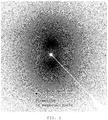
FIG. 1 is a diagram (photograph) showing measurement results of 2D-XRD of compound No. 4 prepared in Example 1. -
FIG. 2 is a diagram (photograph) showing measurement results of 2D-XRD of compound No. 6 prepared in Example 1. -
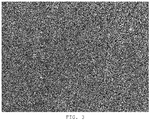
FIG. 3 is a diagram (photograph) showing a state before measurement of inversion current (before applying a triangular wave) in compound No. 6. -
FIG. 4 is a diagram (photograph) showing a state of results (voltage 0 V) obtained by measurement of inversion current in compound No. 6. -
FIG. 5 is a diagram (photograph) showing a state of results (voltage 100 Vpp) obtained by measurement of inversion current in compound No. 6. -
FIG. 6 is a diagram showing behavior of voltage and current upon measuring inversion current in compound No. 6. - Usage of terms herein is as described below. A liquid crystal compound is a generic term for a compound having a liquid crystal phase such as a nematic phase and a smectic phase, and a compound having no liquid crystal phase but to be added for the purpose of adjusting physical properties of a composition, such as maximum temperature, minimum temperature, viscosity and dielectric anisotropy. The liquid crystal compound, a liquid crystal composition and a liquid crystal display device may be occasionally abbreviated as "compound," "composition" and "device," respectively. The liquid crystal display device is a generic term for a liquid crystal display panel and a liquid crystal display module. A clearing point is transition temperature between the liquid crystal phase and an isotropic phase in the liquid crystal compound. A minimum temperature of the liquid crystal phase is transition temperature between a solid and the liquid crystal phase (a smectic phase, a nematic phase or the like) in the liquid crystal compound. The maximum temperature of the nematic phase is transition temperature between the nematic phase and the isotropic phase in the liquid crystal composition, and may be occasionally abbreviated as "maximum temperature." A minimum temperature of the nematic phase may be occasionally abbreviated as "minimum temperature."
- A compound represented by formula (1) may be occasionally abbreviated as "compound (1)." The abbreviation may also apply occasionally to a compound represented by formula (2) or the like. In formulas (2) to (15), a symbol of B1, C1 or the like surrounded by a hexagonal shape corresponds to ring B1, ring C1 or the like, respectively. In formula (8), when i is 2, two of ring D1 exists. In the compound, two groups represented by two of ring D1 may be identical or different. A same rule applies also to two of arbitrary ring D1 when i is larger than 2. A same rule applies also to a symbol such as any other ring and a bonding group.
- Specific examples of the liquid crystal compounds include a liquid crystal compound having a six-membered ring such as 1, 4-cyclohexylene and 1,4-phenylene, and having rod-like molecular structure. A liquid crystal composition may be prepared by further mixing such liquid crystal compounds. A proportion (content) of the liquid crystal compounds is expressed in terms of weight percent (% by weight) based on the weight of the liquid crystal composition. An additive such as an optically active compound, an antioxidant, an ultraviolet light absorber, a light stabilizer, a heat stabilizer, an antifoaming agent, a polymerization initiator and a polymerization inhibitor is added to the composition when necessary. A proportion (amount of addition) of the additive is expressed in terms of weight percent (% by weight) based on the weight of the liquid crystal composition in a manner similar to the liquid crystal compound. Weight parts per million (ppm) may be occasionally used. However, the polymerization initiator and the polymerization inhibitor are expressed based on the weight of the polymerizable compound.
- An expression "at least one piece of "A" may be replaced by "B" " means that, when the number of "A" is 1, a position of "A" is arbitrary, and also when the number of "A" is 2 or more, positions thereof can be freely selected without restriction. An expression "at least one piece of A may be replaced by B, C or D" means including a case where at least one piece of A is replaced by B, a case where at least one piece of A is replaced by C, and a case where at least one piece of A is replaced by D, and also a case where a plurality of pieces A are replaced by at least two of B, C and D. For example, alkyl in which at least one piece of -CH2- (or -CH2CH2-) may be replaced by -O- (or -CH=CH-) includes alkyl, alkenyl, alkoxy, alkoxyalkyl, alkoxyalkenyl and alkenyloxyalkyl. In addition, a case where two pieces of consecutive -CH2- are replaced by -O- to form -O-O- is not preferred. In alkyl or the like, a case where -CH2- of a methyl part (-CH2-H) is replaced by -O- to form -O-H is not preferred, either.
- The invention includes contents described in the following items.
- Item 1. A compound, represented by formula (1) :

- ring A is naphthylene, phenantolylene or anthracenylene, and in the groups, at least one piece of hydrogen may be independently replaced by halogen, -CH3, -C2H5, -CF3, -CHF2, -CH2F, -OCF3, -OCHF2 or -OCH2F ; and
- X1, X2, X3, X4, X5, Y1, Y2, Y3, Y4 and Y5 are independently hydrogen or fluorine, but at least two or more of X1, X2, X3, X4, X5, Y1, Y2, Y3, Y4 and Y5 is fluorine.
- Item 2. The compound according to item 1,
wherein, in formula (1),- ring A is naphthylene, phenantolylene or anthracenylene, and in the groups, at least one piece of hydrogen may be independently replaced by fluorine, -CH3 or -CF3.
-
Item 3. The compound according to item 1, represented by any one of formula (1-1) to formula (1-12):

- T1, T2, T3, T4, T5, T6, T7, T8, T9 and T10 are independently hydrogen, halogen, -CH3, -C2H5, -CF3, -CHF2, -CH2F, -OCF3, -OCHF2 or -OCH2F ; and
- X1, X2, X3, X4, X5, Y1, Y2, Y3, Y4 and Y5 are independently hydrogen or fluorine, but at least two or more of X1, X2, X3, X4, X5, Y1, Y2, Y3, Y4 and Y5 is fluorine.
- Item 4. The compound according to
item 3, wherein, in formula (1-1) to formula (1-12), T1, T2, T3, T4, T5, T6, T7, T8, T9 and T10 are hydrogen, fluorine or -CH3. -
Item 5. The compound according toitem 3, wherein, in formula (1-1) to formula (1-12), X2, X3, Y2 and Y3 are fluorine. - Item 6. The compound according to
item 3, represented by any one of formula (1-1), formula (1-2), formula (1-5), formula (1-6), formula (1-11) or formula (1-12). - Item 7. The compound according to
item 3, represented by any one of formula (1-3), formula (1-4), formula (1-7), formula (1-8), formula (1-9) or formula (1-10). - Item 8. The compound according to
item 3, represented by any one of formula (1-1-A), formula (1-2-A), formula (1-5-A), formula (1-6-A), formula (1-11-A) and formula (1-12-A):
- Item 9. The compound according to item 8, wherein, in formula (1-1-A), formula (1-2-A), formula (1-5-A), formula (1-6-A), formula (1-11-A) and formula (1-12-A), both X1 and Y1 are hydrogen.
-
Item 10. The compound according to item 9, represented by formula (1-1-A) and formula (1-2-A). - Item 11. A liquid crystal composition, containing at least one compound according to any one of items 1 to 10.
- Item 12. The liquid crystal composition according to item 11, further containing at least one compound selected from the group of compounds represented by formulas (2) to (4):

- R11 and R12 are independently alkyl having 1 to 10 carbons or alkenyl having 2 to 10 carbons, and in the alkyl and the alkenyl, at least one piece of -CH2- may be replaced by -O-, and in the groups, at least one piece of hydrogen may be replaced by fluorine;
- ring B1, ring B2, ring B3 and ring B4 are independently 1,4-cyclohexylene, 1,4-phenylene, 2-fluoro-1,4-phenylene, 2,5-difluoro-1,4-phenylene or pyrimidine-2,5-diyl; and
- Z11, Z12 and Z13 are independently a single bond, -COO-, -CH2CH2-, -CH=CH- or -C≡C-.
- Item 13. The liquid crystal composition according to item 11 or 12, further containing at least one compound selected from the group of compounds represented by formulas (5) to (7):

- R13 is alkyl having 1 to 10 carbons or alkenyl having 2 to 10 carbons, and in the alkyl and the alkenyl, at least one piece of -CH2- may be replaced by -O-, and in the groups, at least one piece of hydrogen may be replaced by fluorine;
- X11 is fluorine, chlorine, -OCF3, -OCHF2, -CF3, -CHF2, -CH2F, -OCF2CHF2 or -OCF2CHFCF3 ;
- ring C1, ring C2 and ring C3 are independently 1,4-cyclohexylene, 1,4-phenylene, 1,4-phenylene in which at least one piece of hydrogen is replaced by fluorine, tetrahydropyran-2,5-diyl, 1,3-dioxane-2,5-diyl or pyrimidine-2,5-diyl;
- Z14, Z15 and Z16 are independently a single bond, -COO-, -OCO-, -CH2O-, -OCH2-, -CF2O-, -OCF2-, -CH2CH2-, -CH=CH-, -C=C- or -(CH2)4- ; and
- L11 and L12 are independently hydrogen or fluorine.
- Item 14. The liquid crystal composition according to any one of items 11 to 13, further containing at least one compound selected from the group of compounds represented by formula (8):


- R14 is alkyl having 1 to 10 carbons or alkenyl having 2 to 10 carbons, and in the alkyl and the alkenyl, at least one piece of -CH2- may be replaced by -O-, and in the groups, at least one piece of hydrogen may be replaced by fluorine;
- X12 is -C=N or -C=C-C=N ;
- ring D1 is 1,4-cyclohexylene, 1,4-phenylene, 1,4-phenylene in which at least one piece of hydrogen is replaced by fluorine, tetrahydropyran-2,5-diyl, 1,3-dioxane-2,5-diyl or pyrimidine-2,5-diyl;
- Z17 is a single bond, -COO-, -OCO-, -CH2O-, -OCH2-, -CF2O-, -OCF2-, -CH2CH2- or -C≡C- ;
- L13 and L14 are independently hydrogen or fluorine; and
- i is 1, 2, 3 or 4.
- Item 15. The liquid crystal composition according to any one of items 11 to 14, further containing at least one compound selected from the group of compounds represented by formulas (9) to (15):


- R15, R16 and R17 are independently alkyl having 1 to 10 carbons or alkenyl having 2 to 10 carbons, and in the alkyl and the alkenyl, at least one piece of -CH2- may be replaced by -O-, and in the groups, at least one piece of hydrogen may be replaced by fluorine, and R17 may be hydrogen or fluorine;
- ring E1, ring E2, ring E3 and ring E4 are independently 1,4-cyclohexylene, 1,4-cyclohexenylene, 1,4-phenylene, 1,4-phenylene in which at least one piece of hydrogen is replaced by fluorine, tetrahydropyran-2,5-diyl or decahydronaphthalene-2,6-diyl;
- ring E5 and ring E6 are independently 1,4-cyclohexylene, 1,4-cyclohexenylene, 1,4-phenylene, tetrahydropyran-2,5-diyl or decahydronaphthalene-2,6-diyl;
- Z18, Z19, Z20 and Z21 are independently a single bond, -COO-, -OCO-, -CH2O-, -OCH2-, -CF2O-, -OCF2-, -CH2CH2-, -CF2OCH2CH2- or -OCF2CH2CH2- ;
- L15 and L16 are independently fluorine or chlorine;
- S11 is hydrogen or methyl;
- X is -CHF- or -CF2- ; and
- j, k, m, n, p, q, r and s are independently 0 or 1, a sum of k, m, n and p is 1 or 2, a sum of q, r and s is 0, 1, 2 or 3, and t is 1, 2 or 3.
- Item 16. A liquid crystal display device, including the liquid crystal composition according to any one of items 11 to 15.
- Compound (1) will be first described, and then a synthesis method, the liquid crystal composition and the liquid crystal display device will be described in the order.
- Compound (1) has the following structure:

- ring A is naphthylene, phenantolylene or anthracenylene, and in the groups, at least one piece of hydrogen may be replaced by halogen, -CH3, -C2H5, -CF3, -CHF2, -CH2F, -OCF3, -OCHF2 or -OCH2F ; and
- X1, X2, X3, X4, X5, Y1, Y2, Y3, Y4 and Y5 are independently hydrogen or fluorine, but at least two or more of X1, X2, X3, X4, X5, Y1, Y2, Y3, Y4 and Y5 is fluorine.
- Compound (1) has the structure described above, and thus exhibits ferroelectricity in a nematic phase, and simultaneously contributes to development of biaxiality. Then, a device containing compound (1) exhibits a high-speed response during applying voltage.
- In formula (1), ring A is naphthylene, phenantolylene or anthracenylene, and in the groups, at least one piece of hydrogen is preferably a group that may be replaced by fluorine, -CH3 or -CF3.
- The compound represented by formula (1) is preferably represented by any one of formula (1-1) to formula (1-12):


- T1, T2, T3, T4, T5, T6, T7, T8, T9 and T10 are hydrogen, halogen, -CH3, -C2H5, -CF3, -CHF2, -CH2F, -OCF3, -OCHF2 or -OCH2F ; and
- X1, X2, X3, X4, X5, Y1, Y2, Y3, Y4 and Y5 are independently hydrogen or fluorine, but at least two or more of X1, X2, X3, X4, X5, Y1, Y2, Y3, Y4 and Y5 is fluorine.
- The compound in which T1, T2, T3, T4, T5, T6, T7, T8, T9 and T10 are hydrogen, fluorine or -CH3 in formula (1-1) to formula (1-12) described above cause reduction of a liquid crystal phase transition temperature, and improvement in compatibility with other liquid crystals, and therefore such a case is preferred.
- The compound in which X2, X3, Y2 and Y3 are fluorine in formula (1-1) to formula (1-12) causes development of a biaxial nematic phase having low transition temperature, and therefore such a case is preferred.
- The compound being represented by any one of formula (1-1), formula (1-2), formula (1-5), formula (1-6), formula (1-11) and formula (1-12) in formula (1-1) to formula (1-12) described above causes development of the liquid crystal phase in a moderate temperature region, and therefore such a case is preferred.
- The compound being represented by any one of formula (1-3), formula (1-4), formula (1-7), formula (1-8), formula (1-9) or formula (1-10) in formula (1-1) to formula (1-12) described above causes generation of a large birefringence change in an electrooptical response, and therefore such a case is preferred.
- The compound being represented by any one of formula (1-1-A), formula (1-2-A), formula (1-5-A), formula (1-6-A), formula (1-11-A) and formula (1-12-A) described below in formula (1-1) to formula (1-12) described above causes development of the liquid crystal phase in a large temperature range, and therefore such a case is preferred.


- Both X1 and Y1 being hydrogen in formula (1-1-A), formula (1-2-A), formula (1-5-A), formula (1-6-A), formula (1-11-A) and formula (1-12-A) described above causes development of the biaxial nematic phase, and therefore such a case is preferred.
- The compound being represented by formula (1-1-A) and formula (1-2-A) in formula (1-1-A), formula (1-2-A), formula (1-5-A), formula (1-6-A), formula (1-11-A) and formula (1-12-A) described above causes development of the liquid crystal phase, and therefore such a case is preferred.
- Compounds exemplified below can be prepared with reference to a section of Synthesis Method of compound (1) described below, and a method described in Synthesis Example 1 in Examples described below.


- Compound (1) can be prepared by suitably combining techniques in synthetic organic chemistry. Methods for introducing an objective terminal group, ring and bonding group into a starting material are described in books such as Organic Syntheses (John Wiley & Sons, Inc.), Organic Reactions (John Wiley & Sons, Inc.), Comprehensive Organic Synthesis (Pergamon Press) and New Experimental Chemistry Course (Shin Jikken Kagaku Koza in Japanese) (Maruzen Co., Ltd.).
- A compound represented by formula (1) is prepared, for example, using the starting materials (i) and (ii) described below:


- The compound represented by formula (i) is allowed to react with the compound represented by formula (ii) according to the following scheme to obtain compound (1) represented by formula (iii).


- As the compound represented by formula (ii), not only one kind, but also the following compound having other substituents as substituents of X1 to X5 may be used.

- In the reaction described above, as a condensing agent, in addition to N,N-diisopropylcarbodiimide (DICP) exemplified in the formula described above, a carbodiimide condensing agent such as N,N-dicyclocarbodiimide (DCC), 1-[3-(dimethylamino)propyl]3-ethylcarbodiimide (EDC) and 1-ethyl-3-(3-dimethylaminopropyl)carbodiimide hydrochloride (EDC-HCl), an imidazole condensing agent such as N,N'-carbonyldiimidazole, and a phosphonium condensing agent such as 1H-benzotriazol-1-yloxytris(dimethylamino)phosphonium hexafluorophosphate can also be utilized.
- Moreover, as a catalyst, 4-dimethylaminopyridine (DMAP), 1-hydroxybenzotriazole (HOBt), 1-hydroxy-7-azabenzotriazole (HOAt) and N-hydroxy imide succinate exemplified in the formula described above can also be utilized.
- Specific examples of a mole ratio of the compound represented by formula (i) to the compound represented by formula (ii) upon the reaction include 1 : 2.5 to 1 : 0.5. In particular, asymmetrical compound (1) can be prepared by stepwise preparing the compound by adjusting a ratio of the compound represented by formula (ii). Specific example of reaction temperature include 0°C to 110°C.
- A composition of the invention is mainly used in a liquid crystal display device. The composition contains at least one of compound (1) as a first component. The composition may contain compounds (2) to (15) described above. The composition may contain any other liquid crystal compound different from compounds (2) to (15).
- A preferred composition contains at least one of compound (1) as the first component, and at least one of compounds (2) to (4) as a second component. A third component is selected from compounds (5) to (15) based on a mode of the device. When the composition is used in a device having a mode such as an FFS mode and a PSA mode, compounds (5) to (7) are suitable for the third component. When the composition is used in a device having a mode such as a TN mode and an STN mode, compound (8) is suitable for the third component. When the composition is used in a device having a mode such as a VA mode and the PSA mode, compounds (9) to (15) are suitable for the third component. The composition may further contain a liquid crystal compound different from compounds (1) to (15). The composition may contain the additive such as the optically active compound, the antioxidant, the ultraviolet light absorber, the light stabilizer, the heat stabilizer, the antifoaming agent, the polymerizable compound, the polymerization initiator and the polymerization inhibitor when necessary.
- In order to develop excellent characteristics, the composition preferably contains at least one of compounds (1) in the range of about 1% by weight to about 99% by weight. A further preferred proportion is in the range of about 3% by weight to about 90% by weight. The most preferred proportion is in the range of about 5% by weight to about 60% by weight.
- In compounds (2) to (4), two terminal groups are alkyl or the like, and dielectric anisotropy is small. Preferred examples of the compounds include compounds (2-1) to (2-11), compounds (3-1) to (3-19) and compounds (4-1) to (4-7). In the compounds, R11 and R12 are independently alkyl having 1 to 10 carbons or alkenyl having 2 to 10 carbons, and in the alkyl or the alkenyl, at least one piece of -CH2-may be replaced by -0- , and at least one piece of hydrogen may be replaced by fluorine.
- Compound (2) is mainly effective in decreasing viscosity or adjusting optical anisotropy. Compounds (3) and (4) are effective in extending the temperature range of the nematic phase by increasing the maximum temperature, or in adjusting the optical anisotropy.
- Compounds (2) to (4) have the small dielectric anisotropy. As a content of compounds (2) to (4) is increased, the viscosity of the composition is decreased, but the dielectric anisotropy is decreased. Thus, as long as a desired value of threshold voltage of the device is met, the content is preferably as large as possible. Accordingly, when a composition for a mode such as an IPS mode and the VA mode is prepared, the content of compounds (2) to (4) is preferably about 30% by weight or more, and further preferably about 40% by weight or more, based on the weight of the liquid crystal composition.
- Compounds (5) to (7) have a halogen-containing group or a fluorine-containing group at a right terminal. Preferred examples of the compounds include compounds (5-1) to (5-16), compounds (6-1) to (6-113) and compounds (7-1) to (7-57). In the compounds, R13 is alkyl having 1 to 10 carbons or alkenyl having 2 to 10 carbons, and in the alkyl and the alkenyl, at least one piece of -CH2- may be replaced by -O-, and at least one piece of hydrogen may be replaced by fluorine; and X11 is fluorine, chlorine, -OCF3, -OCHF2, -CF3, -CHF2, -CH2F, -OCF2CHF2 or -OCF2CHFCF3.


- Compounds (5) to (7) have positively large dielectric anisotropy, and superb stability to heat and light, and therefore are used when a composition for a mode such as the IPS mode, the FFS mode and an OCB mode is prepared. A content of compounds (5) to (7) is suitably in the range of about 1% by weight to about 99% by weight, preferably in the range of about 10% by weight to about 97% by weight, and further preferably in the range of about 40% by weight to about 95% by weight, based on the weight of the liquid crystal composition. When the compounds are added to a composition having negative dielectric anisotropy, the content of the compounds is preferably about 30% by weight or less based on the weight of the liquid crystal composition. An elastic constant of the composition can be adjusted, and a voltage-transmittance curve of the device can be adjusted by adding compounds (5) to (7).
- In compound (8), a right-terminal group is -C≡N or -C≡C-C≡N. Preferred examples of the compound include compounds (8-1) to (8-64). In the compounds, R14 is alkyl having 1 to 10 carbons or alkenyl having 2 to 10 carbons, and in the alkyl and the alkenyl, at least one piece of -CH2- may be replaced by -O-, and at least one piece of hydrogen may be replaced by fluorine; and X12 is -C≡N or -C≡C-C≡N.


- Compound (8) has positive dielectric anisotropy, a value of which is large, and therefore is mainly used for preparing a composition for the mode such as the TN mode and the STN mode. Dielectric anisotropy of the composition can be increased by adding compound (8). Compound (8) is effective in extending the temperature range of the liquid crystal phase, adjusting the viscosity or adjusting the optical anisotropy. The compound is also useful for adjustment of the voltage-transmittance curve of the device.
- When the composition for the mode such as the TN mode and the STN mode is prepared, a content of compound (8) is suitably in the range of about 1% by weight to about 99% by weight, preferably in the range of about 10% by weight to about 97% by weight, and further preferably in the range of about 40% by weight to about 95% by weight, based on the weight of the liquid crystal composition. When compound (8) is added to the composition having negative dielectric anisotropy, the content of the compound is preferably about 30% by weight or less based on the weight of the liquid crystal composition. The elastic constant of the composition can be adjusted, and the voltage-transmittance curve of the device can be adjusted by adding compound (8).
- Compounds (9) to (15) have phenylene in which atoms in lateral positions are replaced by two pieces of halogen. Preferred examples of the compounds include compounds (9-1) to (9-8), compounds (10-1) to (10-17), compound (11-1), compounds (12-1) to (12-3), compounds (13-1) to (13-11), compounds (14-1) to (14-3) and compounds (15-1) to (15-3). In the compounds, R15 and R16 are independently alkyl having 1 to 10 carbons or alkenyl having 2 to 10 carbons, and in the alkyl and the alkenyl, at least one piece of -CH2- may be replaced by -O-, and at least one piece of hydrogen may be replaced by fluorine; and R17 is hydrogen, fluorine, alkyl having 1 to 10 carbons or alkenyl having 2 to 10 carbons, and in the alkyl and the alkenyl, at least one piece of -CH2- may be replaced by -O-, and at least one piece of hydrogen may be replaced by fluorine.
- Compounds (9) to (15) have negatively large dielectric anisotropy. The compounds are used when a composition for a mode such as the IPS mode, the VA mode and the PSA mode is prepared. As a content of the compounds is increased, the dielectric anisotropy of the composition is negatively increased, but the viscosity is increased. Thus, as long as the desired value of threshold voltage of the device is met, the content is preferably as small as possible. Accordingly, when the dielectric anisotropy at a degree of -5 is taken into account, the content is preferably about 40% by weight or more in order to allow a sufficient voltage driving.
- Among the compounds, compound (9) is a bicyclic compound, and therefore is mainly effective in decreasing the viscosity, adjusting the optical anisotropy or increasing the dielectric anisotropy. Compounds (10) and (11) are a tricyclic compound, and therefore are effective in increasing the maximum temperature, the optical anisotropy or the dielectric anisotropy. Compounds (12) to (15) are effective in increasing the dielectric anisotropy.


- When the composition for the mode such as the IPS mode, the VA mode and the PSA mode is prepared, a content of compounds (9) to (15) is preferably about 40% by weight or more, and further preferably in the range of about 50% by weight to about 95% by weight, based on the weight of the liquid crystal composition. When compounds (9) to (15) are added to a composition having positive dielectric anisotropy, the content of the compounds is preferably about 30% by weight or less based on the weight of the liquid crystal composition. The elastic constant of the composition can be adjusted, and the voltage-transmittance curve of the device can be adjusted by adding the compounds.
- Preparation of the liquid crystal composition is performed according to a method for dissolving required components at temperature higher than room temperature, or the like. According to an application, the additive may be added to the composition. Specific examples of the additives include an optically active compound, an antioxidant, an ultraviolet light absorber, a light stabilizer, a heat stabilizer, an antifoaming agent, a polymerizable compound, a polymerization initiator and a polymerization inhibitor. Such additives are well known to those skilled in the art, and described in literature.
- The optically active compound is effective in inducing helical structure in liquid crystal molecules to give a required twist angle, and thereby preventing a reverse twist. A helical pitch can be adjusted by adding the optically active compound thereto. Two or more optically active compounds may be added for the purpose of adjusting temperature dependence of the helical pitch. Specific examples of a preferred optically active compound include compounds (Op-1) to (Op-18) described below. In compound (Op-18), ring J is 1, 4-cyclohexylene or 1,4-phenylene, and R28 is alkyl having 1 to 10 carbons.


- The antioxidant is effective for maintaining a large voltage holding ratio. Specific examples of a preferred antioxidant include compounds (AO-1) and (AO-2) described below; and IRGANOX 415, IRGANOX 565, IRGANOX 1010, IRGANOX 1035, IRGANOX 3114 and IRGANOX 1098 (trade names: BASF SE). The ultraviolet light absorber is effective for preventing a decrease of the maximum temperature. Specific examples of a preferred ultraviolet light absorber include a benzophenone derivative, a benzoate derivative and a triazole derivative. Specific examples include compounds (AO-3) and (AO-4) described below; TINUVIN 329, TINUVIN P, TINUVIN 326, TINUVIN 234, TINUVIN 213, TINUVIN 400, TINUVIN 328 and TINUVIN 99-2 (trade names: BASF SE) ; and 1,4-diazabicyclo[2.2.2]octane (DABCO).
- The light stabilizer such as an amine having steric hindrance is preferred for maintaining the large voltage holding ratio. Specific examples of a preferred light stabilizer include compounds (AO-5) and (AO-6) described below; and TINUVIN 144, TINUVIN 765 and TINUVIN 770DF (trade names: BASF SE). The heat stabilizer is also effective for maintaining the large voltage holding ratio, and preferred examples include IRGAFOS 168 (trade name: BASF SE). The antifoaming agent is effective for preventing foam formation. Specific examples of a preferred antifoaming agent include dimethyl silicone oil and methylphenyl silicone oil.


- In compound (AO-1), R40 is alkyl having 1 to 20 carbons, alkoxy having 1 to 20 carbons, -COOR41 or -CH2CH2COOR41, in which R41 is alkyl having 1 to 20 carbons. In compound (AO-2), R42 is alkyl having 1 to 20 carbons. In compound (AO-5), R42 is alkyl having 1 to 20 carbons; R43 is hydrogen, methyl or O (oxygen radical) ; ring G is 1,4-cyclohexylene or 1,4-phenylene; and z is 1, 2 or 3.
- The polymerizable compound is polymerized while being sterically controlled, and thus a response time of the device can be shortened to decrease image persistence. Specific examples of a preferred polymerizable compound include acrylate, methacrylate, a vinyl compound, a vinyloxy compound, propenyl ether, an epoxy compound (oxirane, oxetane) and vinyl ketone. Further preferred examples include a compound having at least one piece of acryloyloxy, and a compound having at least one piece of methacryloyloxy. Still further preferred examples also include a compound having both acryloyloxy and methacryloyloxy.
- Additional examples of other polymerizable compounds include compounds (M-1) to (M-17). In compounds (M-1) to (M-17), R25, R26, R27, R28, R29, R30 and R31 are independently hydrogen or methyl; s, v and x are independently 0 or 1; and t and u are independently an integer from 1 to 10. L21, L22, L23, L24, L25 and L26 are independently hydrogen or fluorine; and L27 and L28 are independently hydrogen, fluorine or methyl.


- The polymerizable compound can be rapidly polymerized by adding the polymerization initiator. An amount of a remaining polymerizable compound can be decreased by optimizing the reaction temperature. Specific examples of photoradical polymerization initiators include TPO, 1173 and 4265 from Darocur series of BASF SE, and 184, 369, 500, 651, 784, 819, 907, 1300, 1700, 1800, 1850 and 2959 from Irgacure series of BASF SE.
- Additional examples of the photoradical polymerization initiators include 4-methoxyphenyl-2,4-bis(trichloromethyl)triazine, 2-(4-butoxystyryl)-5-trichloromethyl-1,3,4-oxadiazole, 9-phenylacridine, 9,10-benzphenazine, a benzophenone-Michler's ketone mixture, a hexaarylbiimidazole-mercaptobenzimidazole mixture, 1-(4-isopropylphenyl)-2-hydroxy-2-methylpropane-1-one, benzyl dimethyl ketal, 2-methyl-1-[4-(methylthio)phenyl]-2-morpholinopropane-1-one, a mixture of 2,4-diethylxanthone and methyl p-dimethylaminobenzoate and a mixture of benzophenone and methyltriethanolamine.
- Upon storing the polymerizable compound, the polymerization inhibitor may be added thereto for preventing polymerization. The polymerizable compound is ordinarily added to the composition without removing the polymerization inhibitor. Specific examples of the polymerization inhibitor include hydroquinone, a hydroquinone derivative such as methylhydroquinone, 4-t-butylcatechol, 4-methoxyphenol and phenothiazine.
- The liquid crystal composition having positively large dielectric anisotropy can be used in a liquid crystal display device having an operating mode such as a PC mode, the TN mode, the STN mode, the OCB mode and the PSA mode, and driven by an active matrix (AM mode). The composition can also be used in a liquid crystal display device having an operating mode such as the PC mode, the TN mode, the STN mode, the OCB mode, the VA mode and the IPS mode, and driven by a passive matrix (PM) mode. The AM mode device and the PM mode device can also be applied to any of a reflective type, a transmissive type and a transflective type.
- A liquid crystal composition having negatively large dielectric anisotropy has negative dielectric anisotropy, and therefore can be suitably used in a liquid crystal display device having an operating mode such as the VA mode, the IPS mode and the PSA mode, and driven by the AM mode. The composition can be particularly suitably used in a liquid crystal display device having the VA mode, and driven by the AM mode.
- Such a composition can also be used in a nematic curvilinear aligned phase (NCAP) device prepared by microencapsulating a nematic liquid crystal, a polymer dispersed liquid crystal display device (PDLCD) and a polymer network liquid crystal display device (PNLCD) prepared by forming a three-dimensional network-polymer in the liquid crystal. When an amount of adding the polymerizable compound is in the range of about 0.1% by weight to about 2% by weight based on the weight of the liquid crystal composition, a liquid crystal display device having the PSA mode is prepared. The device having the PSA mode can be driven by a driving mode such as the active matrix (AM) mode and the passive matrix (PM) mode. A device having a polymer dispersed mode can also be prepared by increasing the amount of adding the polymerizable compound.
- For measurement, DPX-300 made by Bruker BioSpin Corporation was used. In 1H-NMR measurement, a sample was dissolved in a deuterated solvent such as CDCl3, and measurement was carried out under conditions of room temperature, 300 MHz and 16 times of accumulation. Tetramethylsilane was used as an internal standard. In 19F-NMR measurement, CFCl3 was used as an internal standard, and measurement was carried out under conditions of 24 times of accumulation. In explaining nuclear magnetic resonance spectra obtained, s, d, t, q, quin, sex and m stand for a singlet, a doublet, a triplet, a quartet, a quintet, a sextet and a multiplet, and br being broad, respectively.
- Determination of liquid crystal phase group and transition temperature:
- (1) Phase structure: A sample was placed on Hot and Cold Stage (Hot and Cold Stage, HCS400 made by Instec, Inc.) of a melting point apparatus equipped with a polarizing microscope (Nikon, ECLIPSE E400 POL). A state of phase and a change thereof were observed with the polarizing microscope while the sample was heated at a rate of 1°C per minute, and a kind of the phase was specified.
- (2) Transition temperature (°C) : For measurement, as a differential scanning calorimeter, DSC 3100S, made by MAC Science Co., Ltd. was used. A sample was heated and then cooled at a rate of 5°C per minute, and a starting point of an endothermic peak or an exothermic peak caused by a phase change of the sample was determined by extrapolation, and thus transition temperature was determined. A melting point and a polymerization starting temperature of a compound were also measured using the apparatus. Temperature at which a compound undergoes transition from a solid to a liquid crystal phase such as a smectic phase and a nematic phase may be occasionally abbreviated as "minimum temperature of the liquid crystal phase." Temperature at which the compound undergoes transition from the liquid crystal phase to liquid may be occasionally abbreviated as "clearing point."
- A crystal was expressed as C. When kinds of the crystals were distinguishable, each of the crystals was expressed as C1 or C2. The smectic phase and the nematic phase were expressed as S and N, respectively. When smectic A phase, smectic B phase, smectic C phase or smectic F phase was distinguishable among the smectic phases, the phases were expressed as SA, SB, SC or SF, respectively. A liquid (isotropic) was expressed as I. A transition temperature was expressed as "C 50.0 N 100.0 I," for example. The expression indicates that transition temperature from the crystals to the nematic phase is 50 . 0°C, and transition temperature from the nematic phase to the liquid is 100.0°C.
- XRD (X-ray diffraction) measurement was carried out as confirmation of biaxiality of the nematic phase. For measurement, RINT2200 diffractometer made by Rigaku Corporation, and TRY-DXGSA-HHIP diffractometer made by TRY SE Co., Ltd. were used.
- Compound (No. 4)

- In a 200 mL recovery flask to which a calcium chloride tube was attached, 3.33 g (18.9 mmol) of 2, 3,4-trifluorobenzoic acid (r-1), 1.40 g (8.75 mmol) of 2,6-dihydroxynaphthalene (r-2), 2.40 g (19.0 mmol) of N,N'-diisopropylcarbodiimide (DIPC) and 0.21 g (1.7 mmol) of 4-dimethylaminopyridine (DMAP) were dissolved into 50 mL of tetrahydrofuran (THF), and the resulting mixture was stirred at room temperature for 24 hours. The filtered solid was put in 50 mL of THF, the resulting mixture was stirred for 24 hours, the resulting crystals after filtration were put in 100 mL of dichloromethane, and the resulting mixture was stirred for 24 hours. The resulting crystals after filtration were subjected to recrystallization from chlorobenzene to obtain compound (No. 4).
- 1H-NMR (CDCl3 ; δ ppm) : 7. 90 - 8.00 (m, 2H), 7.91 (d, 2H), 7.77 (d, 2H), 7.41 (dd, 2H), 7.14 (dd, 2H).
Transition temperature: C 227.9 N 234.7 I. - Compound (No. 6)
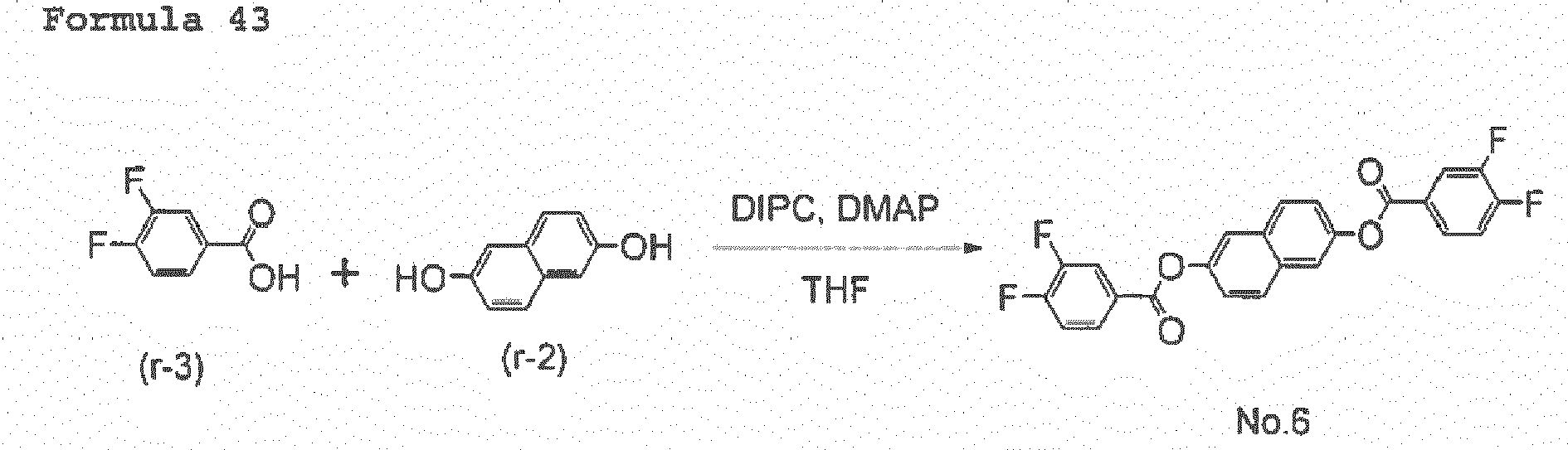
- In a 200 mL recovery flask to which a calcium chloride tube was attached, 2.99 g (18.9 mmol) of 3,4-difluorobenzoic acid (r-3), 1.40 g (8.75 mmol) of 2,6-dihydroxynaphthalene, 2.40 g of DIPC (18.9 mmol) and 0.21g (1.7 mmol) of DMAP were dissolved into 50 mL of THF, and the resulting mixture was stirred at room temperature for 24 hours. Filtrate after filtration was washed with distilled water, and dried by adding anhydrous magnesium sulfate thereto. A solvent was distilled off, the residue was purified by silica gel chromatography (chloroform), and then further recrystallization was performed from chloroform to obtain compound (No. 6).
- 1H-NMR (CDCl3 ; δ ppm) : 8.04 - 8.12 (m, 4H), 7.91 (d, 2H), 7.73 (d, 2H), 7.26 - 7.41 (m, 4H).
Transition temperature: C 185.1 N 206.1 I. - In compounds No. 4 and No. 6 in which a liquid crystal phase was developed, 2D-XRD was performed in a state in which a magnetic field was applied thereto to allow alignment in a state of a nematic phase.
- As a result, in compound No. 4, if directions were aligned by the magnetic field in a liquid crystal phase, layer structure was observed, and therefore the liquid crystal phase was determined to be a biaxial nematic phase locally having SmA (
FIG. 1 ). A liquid crystal phase of compound No. 6 was shown to form layer structure similar to a smectic phase to have orderliness also in a minor axis direction, indicating that the liquid crystal phase was also the biaxial nematic phase having layer structure locally similar to SmA structure (FIG. 2 ). - In compound No. 6 in which a nematic phase was developed, measurement of inversion current was carried out. A sample was injected into a glass cell coated with an ITO electrode (10 mm x 10 mm) and a polyimide-alignment film (homogeneous alignment) and having a cell thickness of 15 µm. Liquid crystal molecules were aligned with the polyimide-alignment film to generate a dark field before applying a triangular wave (
FIG. 3 ): Temperature of 185°C. - A rapid change of light and darkness was shown if the triangular wave was applied to a liquid crystal cell into which compound No. 6 was sealed in a state of a nematic liquid crystal (185°C) (
FIG. 4 ): 0 V, (FIG. 5 ) : 100 Vpp, 5 Hz. Behavior of current upon the above occasion was as shown inFIG. 6 . - Compound No. 6 showed a shoulder peak derived from polarized inversion current to exhibit ferroelectric behavior under conditions of 1.0 to 200 Vpp and 5 Hz.
- A liquid crystal compound of the invention has ferroelectricity, and a liquid crystal display device using the liquid crystal compound produces a contrast ratio. Accordingly, a liquid crystal display device using a liquid crystal composition containing the liquid crystal compound can be used in a liquid crystal projector, a liquid crystal television and so forth.
Claims (14)
- A compound, represented by formula (1) :
 ring A is naphthylene, phenantolylene or anthracenylene, and in the groups, at least one piece of hydrogen may be replaced by halogen, -CH3, -C2H5, -CF3, -CHF2, -CH2F, -OCF3, -OCHF2 or -OCH2F ; andX1, X2, X3, X4, X5, Y1, Y2, Y3, Y4 and Y5 are independently hydrogen or fluorine, but at least two or more of X1, X2, X3, X4, X5, Y1, Y2, Y3, Y4 and Y5 are fluorine.
 - The compound according to claim 1,
wherein, in formula (1),
ring A is naphthylene, phenantolylene or anthracenylene, and in the groups, at least one piece of hydrogen may be independently replaced by fluorine, -CH3 or -CF3. - The compound according to claim 1, represented by any one of formulas (1-1) to (1-12):


 T1, T2, T3, T4, T5, T6, T7, T8, T9 and T10 are independently hydrogen, halogen, -CH3, -C2H5, -CF3, -CHF2, -CH2F, -OCF3, -OCHF2 or -OCH2F ; andX1, X2, X3, X4, X5, Y1, Y2, Y3, Y4 and Y5 are independently hydrogen or fluorine, but at least two or more of X1, X2, X3, X4, X5, Y1, Y2, Y3, Y4 and Y5 are fluorine.
 - The compound according to claim 3, wherein, in formulas (1-1) to (1-12), T1, T2, T3, T4, T5, T6, T7, T8, T9 and T10 are independently hydrogen, fluorine or -CH3.
- The compound according to claim 3, wherein, in formulas (1-1) to (1-12), X2, X3, Y2 and Y3 are fluorine.
- The compound according to claim 3, represented by any one of formula (1-1-A), formula (1-2-A), formula (1-5-A), formula (1-6-A), formula (1-11-A) and formula (1-12-A):


- The compound according to claim 6, wherein, in formula (1-1-A), formula (1-2-A), formula (1-5-A), formula (1-6-A), formula (1-11-A) and formula (1-12-A), both of X1 and Y1 are hydrogen.
- The compound according to claim 7, represented by formula (1-1-A) and formula (1-2-A).
- A liquid crystal composition, containing at least one compound according to any one of claims 1 to 8.
- The liquid crystal composition according to claim 9, further containing at least one compound selected from the group consisting of compounds represented by formulas (2) to (4):


 R11 and R12 are independently alkyl having 1 to 10 carbons or alkenyl having 2 to 10 carbons, and in the alkyl and the alkenyl, at least one piece of -CH2- may be replaced by -O-, and in the groups, at least one piece of hydrogen may be replaced by fluorine;ring B1, ring B2, ring B3 and ring B4 are independently 1,4-cyclohexylene, 1,4-phenylene, 2-fluoro-1,4-phenylene, 2,5-difluoro-1,4-phenylene or pyrimidine-2,5-diyl; andZ11, Z12 and Z13 are independently a single bond, -COO-, -CH2CH2-, -CH=CH- or -C≡C-.
 - The liquid crystal composition according to claim 9 or 10, further containing at least one compound selected from the group consisting of compounds represented by formulas (5) to (7):

 R13 is alkyl having 1 to 10 carbons or alkenyl having 2 to 10 carbons, and in the alkyl and the alkenyl, at least one piece of -CH2- may be replaced by -O-, and in the groups, at least one piece of hydrogen may be replaced by fluorine;X11 is fluorine, chlorine, -OCF3, -OCHF2, -CF3, -CHF2, -CH2F, -OCF2CHF2 or -OCF2CHFCF3 ;ring C1, ring C2 and ring C3 are independently 1,4-cyclohexylene, 1,4-phenylene, 1,4-phenylene in which at least one piece of hydrogen is replaced by fluorine, tetrahydropyran-2,5-diyl, 1,3-dioxane-2,5-diyl or pyrimidine-2,5-diyl;Z14, Z15 and Z16 are independently a single bond, -COO-, -OCO-, -CH2O-, -OCH2-, -CF2O-, -OCF2-, -CH2CH2-, -CH=CH-, -C≡C- or -(CH2)4- ; andL11 and L12 are independently hydrogen or fluorine.
 - The liquid crystal composition according to any one of claims 9 to 11, further containing at least one compound represented by formula (8):
 R14 is alkyl having 1 to 10 carbons or alkenyl having 2 to 10 carbons, and in the alkyl and the alkenyl, at least one piece of -CH2- may be replaced by -O-, and in the groups, at least one piece of hydrogen may be replaced by fluorine;X12 is -C=N or -C≡C-C≡N ;ring D1 is 1,4-cyclohexylene, 1,4-phenylene, 1,4-phenylene in which at least one piece of hydrogen is replaced by fluorine, tetrahydropyran-2,5-diyl, 1,3-dioxane-2,5-diyl or pyrimidine-2,5-diyl;Z17 is a single bond, -COO-, -OCO-, -CH2O-, -OCH2-, -CF2O-, -OCF2-, -CH2CH2- or -C≡C- ;L13 and L14 are independently hydrogen or fluorine; andi is 1, 2, 3 or 4.
 - The liquid crystal composition according to any one of claims 9 to 12, further containing at least one compound selected from the group consisting of compounds represented by formulas (9) to (15) :




 R15, R16 and R17 are independently alkyl having 1 to 10 carbons or alkenyl having 2 to 10 carbons, and in the alkyl and the alkenyl, at least one piece of -CH2- may be replaced by -O-, and in the groups, at least one piece of hydrogen may be replaced by fluorine, and R17 may be hydrogen or fluorine;ring E1, ring E2, ring E3 and ring E4 are independently 1,4-cyclohexylene, 1,4-cyclohexenylene, 1,4-phenylene, 1,4-phenylene in which at least one piece of hydrogen is replaced by fluorine, tetrahydropyran-2,5-diyl or decahydronaphthalene-2,6-diyl;ring E5 and ring E6 are independently 1,4-cyclohexylene, 1,4-cyclohexenylene, 1,4-phenylene, tetrahydropyran-2,5-diyl or decahydronaphthalene-2,6-diyl;Z18, Z19, Z20 and Z21 are independently a single bond, -COO-, -OCO-, -CH2O-, -OCH2-, -CF2O-, -OCF2-, -CH2CH2-, -CF2OCH2CH2- or -OCF2CH2CH2- ;L15 and L16 are independently fluorine or chlorine;S11 is hydrogen or methyl ;X is -CHF- or -CF2- ; andj, k, m, n, p, q, r and s are independently 0 or 1, a sum of k, m, n and p is 1 or 2, a sum of q, r and s is 0, 1, 2 or 3, and t is 1, 2 or 3.
 - A liquid crystal display device, including the liquid crystal composition according to any one of claims 9 to 13.
Applications Claiming Priority (1)
| Application Number | Priority Date | Filing Date | Title |
|---|---|---|---|
| JP2016101478A JP6669338B2 (en) | 2016-05-20 | 2016-05-20 | Liquid crystal compound, liquid crystal composition and liquid crystal display device using the same |
Publications (2)
| Publication Number | Publication Date |
|---|---|
| EP3246376A1 true EP3246376A1 (en) | 2017-11-22 |
| EP3246376B1 EP3246376B1 (en) | 2019-02-27 |
Family
ID=58715081
Family Applications (1)
| Application Number | Title | Priority Date | Filing Date |
|---|---|---|---|
| EP17171628.5A Not-in-force EP3246376B1 (en) | 2016-05-20 | 2017-05-18 | Liquid crystal compound, liquid crystal composition and liquid crystal display device using the same |
Country Status (3)
| Country | Link |
|---|---|
| US (1) | US10310303B2 (en) |
| EP (1) | EP3246376B1 (en) |
| JP (1) | JP6669338B2 (en) |
Citations (2)
| Publication number | Priority date | Publication date | Assignee | Title |
|---|---|---|---|---|
| US20080058544A1 (en) * | 2006-08-30 | 2008-03-06 | National Institute Of Advanced Industrial Science And Technology | Liquid crystalline organic semiconductor material and organic semiconductor device using same |
| US20150102259A1 (en) * | 2013-10-16 | 2015-04-16 | Jnc Corporation | Polymerizable compound, polymerizable composition and liquid crystal display device |
Family Cites Families (4)
| Publication number | Priority date | Publication date | Assignee | Title |
|---|---|---|---|---|
| EP1739151B1 (en) * | 2005-07-01 | 2010-09-15 | Merck Patent GmbH | Mesogenic compounds, liquid crystal medium and liquid display |
| US8003558B2 (en) * | 2008-07-29 | 2011-08-23 | Basf Corporation | Internal donor for olefin polymerization catalysts |
| US8211819B2 (en) * | 2009-12-21 | 2012-07-03 | Basf Corporation | Internal and external donor compounds for olefin polymerization catalysts |
| JP2013200516A (en) * | 2012-03-26 | 2013-10-03 | Fujifilm Corp | Liquid crystal film, infrared reflecting plate and glass laminate |
-
2016
- 2016-05-20 JP JP2016101478A patent/JP6669338B2/en not_active Expired - Fee Related
-
2017
- 2017-05-17 US US15/597,186 patent/US10310303B2/en active Active
- 2017-05-18 EP EP17171628.5A patent/EP3246376B1/en not_active Not-in-force
Patent Citations (2)
| Publication number | Priority date | Publication date | Assignee | Title |
|---|---|---|---|---|
| US20080058544A1 (en) * | 2006-08-30 | 2008-03-06 | National Institute Of Advanced Industrial Science And Technology | Liquid crystalline organic semiconductor material and organic semiconductor device using same |
| US20150102259A1 (en) * | 2013-10-16 | 2015-04-16 | Jnc Corporation | Polymerizable compound, polymerizable composition and liquid crystal display device |
Non-Patent Citations (9)
| Title |
|---|
| "Comprehensive Organic Synthesis", PERGAMON PRESS |
| "New Experimental Chemistry Course", MARUZEN CO., LTD. |
| "Organic Reactions", JOHN WILEY SONS, INC. |
| "Organic Syntheses", JOHN WILEY & SONS, INC. |
| 123RD STUDY GROUP DOCUMENT, vol. 2.28, 2012, pages 8 - 14 |
| EKISHO, vol. 15, no. 2, 2011, pages 125 - 131 |
| R. AMARANATHA REDDY ET AL: "Banana-shaped mesogens: observation of a direct transition from the antiferroelectric B2 to nematic phase", CHEMICAL COMMUNICATIONS - CHEMCOM., no. 19, 1 January 2001 (2001-01-01), pages 1972 - 1973, XP055415507, ISSN: 1359-7345, DOI: 10.1039/b106458b * |
| YASUYUKI SASADA ET AL: "Drastic Change of Mesomorphism Induced by the Fluorination of Peripherally Attached Phenyl Groups in Triphenylene Mesogens", MOLECULAR CRYSTALS AND LIQUID CRYSTALS, vol. 525, no. 1, 20 July 2010 (2010-07-20), UK, pages 153 - 157, XP055415522, ISSN: 1542-1406, DOI: 10.1080/15421401003799060 * |
| YASUYUKI SASADA ET AL: "Drastic enhancement of discotic mesomorphism induced by fluorination of the peripheral phenyl groups in triphenylene mesogens", CHEMICAL COMMUNICATIONS - CHEMCOM., no. 12, 1 January 2008 (2008-01-01), pages 1452, XP055415527, ISSN: 1359-7345, DOI: 10.1039/b716920e * |
Also Published As
| Publication number | Publication date |
|---|---|
| JP2017206480A (en) | 2017-11-24 |
| US20170336660A1 (en) | 2017-11-23 |
| JP6669338B2 (en) | 2020-03-18 |
| US10310303B2 (en) | 2019-06-04 |
| EP3246376B1 (en) | 2019-02-27 |
Similar Documents
| Publication | Publication Date | Title |
|---|---|---|
| CN104379554B (en) | Polymerizable compound, purpose thereof, polymer, liquid crystal composition, and liquid crystal display element | |
| KR102079992B1 (en) | Compound having four polymerizable groups, liquid crystal composition, and liquid crystal display element | |
| JP6098415B2 (en) | Compound having 2,2-difluorovinyloxy group or 1,2,2-trifluorovinyloxy group, liquid crystal composition and liquid crystal display device | |
| TWI694068B (en) | Liquid crystal compound with benzothiophene, liquid crystal composition and liquid crystal display element | |
| WO2018025974A1 (en) | Liquid-crystal display element and display device | |
| CN111732569A (en) | Liquid crystal compound having dibenzothiophene ring, liquid crystal composition and liquid crystal display element | |
| JP2015078282A (en) | Polymerizable compound, polymerizable composition and liquid crystal display element | |
| CN107663457B (en) | Liquid crystalline compound having polyfluoro-2-butenyloxy group, liquid crystal composition, and liquid crystal display element | |
| WO2015076077A1 (en) | Piperidine derivative, liquid crystal composition, and liquid crystal display element | |
| WO2018097093A1 (en) | Method for manufacturing liquid crystal display element without orientation film | |
| TWI694140B (en) | Polymerizable polar compound, liquid crystal composition and liquid crystal display element | |
| CN106565652B (en) | Compound having tetrahydropyran ring, liquid crystal composition, and liquid crystal display element | |
| CN113166035A (en) | Compound, liquid crystal composition and liquid crystal display element | |
| CN111278800B (en) | Polymerizable polar compound, liquid crystal composition, and liquid crystal display element | |
| CN109486499A (en) | Liquid crystal compounds, liquid-crystal composition and the liquid crystal display element that dielectric anisotropy with fluorine xenyl is negative | |
| CN110325507B (en) | Polymerizable compound, polymerizable composition, liquid crystal composite, optically anisotropic body, and liquid crystal display element | |
| TWI728101B (en) | Polymerizable polar compound, liquid crystal composition and liquid crystal display element | |
| CN112334441B (en) | Polymerizable polar compound, liquid crystal composition, and liquid crystal display element | |
| CN110914233B (en) | Polymerizable polar compound, liquid crystal composition and liquid crystal display element | |
| EP3246376B1 (en) | Liquid crystal compound, liquid crystal composition and liquid crystal display device using the same | |
| JP6103214B2 (en) | Polymerizable compound having thioester group, polymerizable composition, and liquid crystal display device | |
| CN113717147B (en) | Compound, liquid crystal composition and liquid crystal display element | |
| CN111587237A (en) | Compound, liquid crystal composition and liquid crystal display element | |
| CN111819165B (en) | Compound, liquid crystal composition and liquid crystal display element | |
| CN107868665A (en) | Liquid crystal compounds, liquid-crystal composition and liquid crystal display cells |
Legal Events
| Date | Code | Title | Description |
|---|---|---|---|
| PUAI | Public reference made under article 153(3) epc to a published international application that has entered the european phase |
Free format text: ORIGINAL CODE: 0009012 |
|
| STAA | Information on the status of an ep patent application or granted ep patent |
Free format text: STATUS: THE APPLICATION HAS BEEN PUBLISHED |
|
| AK | Designated contracting states |
Kind code of ref document: A1 Designated state(s): AL AT BE BG CH CY CZ DE DK EE ES FI FR GB GR HR HU IE IS IT LI LT LU LV MC MK MT NL NO PL PT RO RS SE SI SK SM TR |
|
| AX | Request for extension of the european patent |
Extension state: BA ME |
|
| STAA | Information on the status of an ep patent application or granted ep patent |
Free format text: STATUS: REQUEST FOR EXAMINATION WAS MADE |
|
| 17P | Request for examination filed |
Effective date: 20180322 |
|
| RBV | Designated contracting states (corrected) |
Designated state(s): AL AT BE BG CH CY CZ DE DK EE ES FI FR GB GR HR HU IE IS IT LI LT LU LV MC MK MT NL NO PL PT RO RS SE SI SK SM TR |
|
| STAA | Information on the status of an ep patent application or granted ep patent |
Free format text: STATUS: EXAMINATION IS IN PROGRESS |
|
| 17Q | First examination report despatched |
Effective date: 20180718 |
|
| GRAJ | Information related to disapproval of communication of intention to grant by the applicant or resumption of examination proceedings by the epo deleted |
Free format text: ORIGINAL CODE: EPIDOSDIGR1 |
|
| STAA | Information on the status of an ep patent application or granted ep patent |
Free format text: STATUS: GRANT OF PATENT IS INTENDED |
|
| GRAP | Despatch of communication of intention to grant a patent |
Free format text: ORIGINAL CODE: EPIDOSNIGR1 |
|
| RIC1 | Information provided on ipc code assigned before grant |
Ipc: C09K 19/20 20060101ALI20180912BHEP Ipc: C09K 19/30 20060101ALI20180912BHEP Ipc: C09K 19/44 20060101ALI20180912BHEP Ipc: C09K 19/32 20060101AFI20180912BHEP Ipc: C09K 19/04 20060101ALI20180912BHEP Ipc: G02F 1/133 20060101ALI20180912BHEP |
|
| INTG | Intention to grant announced |
Effective date: 20181005 |
|
| GRAS | Grant fee paid |
Free format text: ORIGINAL CODE: EPIDOSNIGR3 |
|
| GRAA | (expected) grant |
Free format text: ORIGINAL CODE: 0009210 |
|
| STAA | Information on the status of an ep patent application or granted ep patent |
Free format text: STATUS: THE PATENT HAS BEEN GRANTED |
|
| AK | Designated contracting states |
Kind code of ref document: B1 Designated state(s): AL AT BE BG CH CY CZ DE DK EE ES FI FR GB GR HR HU IE IS IT LI LT LU LV MC MK MT NL NO PL PT RO RS SE SI SK SM TR |
|
| REG | Reference to a national code |
Ref country code: GB Ref legal event code: FG4D |
|
| REG | Reference to a national code |
Ref country code: CH Ref legal event code: EP |
|
| REG | Reference to a national code |
Ref country code: AT Ref legal event code: REF Ref document number: 1101325 Country of ref document: AT Kind code of ref document: T Effective date: 20190315 |
|
| REG | Reference to a national code |
Ref country code: IE Ref legal event code: FG4D |
|
| REG | Reference to a national code |
Ref country code: DE Ref legal event code: R096 Ref document number: 602017002299 Country of ref document: DE |
|
| REG | Reference to a national code |
Ref country code: NL Ref legal event code: MP Effective date: 20190227 |
|
| REG | Reference to a national code |
Ref country code: LT Ref legal event code: MG4D |
|
| PG25 | Lapsed in a contracting state [announced via postgrant information from national office to epo] |
Ref country code: NO Free format text: LAPSE BECAUSE OF FAILURE TO SUBMIT A TRANSLATION OF THE DESCRIPTION OR TO PAY THE FEE WITHIN THE PRESCRIBED TIME-LIMIT Effective date: 20190527 Ref country code: SE Free format text: LAPSE BECAUSE OF FAILURE TO SUBMIT A TRANSLATION OF THE DESCRIPTION OR TO PAY THE FEE WITHIN THE PRESCRIBED TIME-LIMIT Effective date: 20190227 Ref country code: FI Free format text: LAPSE BECAUSE OF FAILURE TO SUBMIT A TRANSLATION OF THE DESCRIPTION OR TO PAY THE FEE WITHIN THE PRESCRIBED TIME-LIMIT Effective date: 20190227 Ref country code: PT Free format text: LAPSE BECAUSE OF FAILURE TO SUBMIT A TRANSLATION OF THE DESCRIPTION OR TO PAY THE FEE WITHIN THE PRESCRIBED TIME-LIMIT Effective date: 20190627 Ref country code: NL Free format text: LAPSE BECAUSE OF FAILURE TO SUBMIT A TRANSLATION OF THE DESCRIPTION OR TO PAY THE FEE WITHIN THE PRESCRIBED TIME-LIMIT Effective date: 20190227 Ref country code: LT Free format text: LAPSE BECAUSE OF FAILURE TO SUBMIT A TRANSLATION OF THE DESCRIPTION OR TO PAY THE FEE WITHIN THE PRESCRIBED TIME-LIMIT Effective date: 20190227 |
|
| PG25 | Lapsed in a contracting state [announced via postgrant information from national office to epo] |
Ref country code: LV Free format text: LAPSE BECAUSE OF FAILURE TO SUBMIT A TRANSLATION OF THE DESCRIPTION OR TO PAY THE FEE WITHIN THE PRESCRIBED TIME-LIMIT Effective date: 20190227 Ref country code: HR Free format text: LAPSE BECAUSE OF FAILURE TO SUBMIT A TRANSLATION OF THE DESCRIPTION OR TO PAY THE FEE WITHIN THE PRESCRIBED TIME-LIMIT Effective date: 20190227 Ref country code: BG Free format text: LAPSE BECAUSE OF FAILURE TO SUBMIT A TRANSLATION OF THE DESCRIPTION OR TO PAY THE FEE WITHIN THE PRESCRIBED TIME-LIMIT Effective date: 20190527 Ref country code: GR Free format text: LAPSE BECAUSE OF FAILURE TO SUBMIT A TRANSLATION OF THE DESCRIPTION OR TO PAY THE FEE WITHIN THE PRESCRIBED TIME-LIMIT Effective date: 20190528 Ref country code: IS Free format text: LAPSE BECAUSE OF FAILURE TO SUBMIT A TRANSLATION OF THE DESCRIPTION OR TO PAY THE FEE WITHIN THE PRESCRIBED TIME-LIMIT Effective date: 20190627 Ref country code: RS Free format text: LAPSE BECAUSE OF FAILURE TO SUBMIT A TRANSLATION OF THE DESCRIPTION OR TO PAY THE FEE WITHIN THE PRESCRIBED TIME-LIMIT Effective date: 20190227 |
|
| REG | Reference to a national code |
Ref country code: AT Ref legal event code: MK05 Ref document number: 1101325 Country of ref document: AT Kind code of ref document: T Effective date: 20190227 |
|
| PG25 | Lapsed in a contracting state [announced via postgrant information from national office to epo] |
Ref country code: DK Free format text: LAPSE BECAUSE OF FAILURE TO SUBMIT A TRANSLATION OF THE DESCRIPTION OR TO PAY THE FEE WITHIN THE PRESCRIBED TIME-LIMIT Effective date: 20190227 Ref country code: ES Free format text: LAPSE BECAUSE OF FAILURE TO SUBMIT A TRANSLATION OF THE DESCRIPTION OR TO PAY THE FEE WITHIN THE PRESCRIBED TIME-LIMIT Effective date: 20190227 Ref country code: EE Free format text: LAPSE BECAUSE OF FAILURE TO SUBMIT A TRANSLATION OF THE DESCRIPTION OR TO PAY THE FEE WITHIN THE PRESCRIBED TIME-LIMIT Effective date: 20190227 Ref country code: CZ Free format text: LAPSE BECAUSE OF FAILURE TO SUBMIT A TRANSLATION OF THE DESCRIPTION OR TO PAY THE FEE WITHIN THE PRESCRIBED TIME-LIMIT Effective date: 20190227 Ref country code: RO Free format text: LAPSE BECAUSE OF FAILURE TO SUBMIT A TRANSLATION OF THE DESCRIPTION OR TO PAY THE FEE WITHIN THE PRESCRIBED TIME-LIMIT Effective date: 20190227 Ref country code: IT Free format text: LAPSE BECAUSE OF FAILURE TO SUBMIT A TRANSLATION OF THE DESCRIPTION OR TO PAY THE FEE WITHIN THE PRESCRIBED TIME-LIMIT Effective date: 20190227 Ref country code: AL Free format text: LAPSE BECAUSE OF FAILURE TO SUBMIT A TRANSLATION OF THE DESCRIPTION OR TO PAY THE FEE WITHIN THE PRESCRIBED TIME-LIMIT Effective date: 20190227 Ref country code: SK Free format text: LAPSE BECAUSE OF FAILURE TO SUBMIT A TRANSLATION OF THE DESCRIPTION OR TO PAY THE FEE WITHIN THE PRESCRIBED TIME-LIMIT Effective date: 20190227 |
|
| REG | Reference to a national code |
Ref country code: DE Ref legal event code: R097 Ref document number: 602017002299 Country of ref document: DE |
|
| PG25 | Lapsed in a contracting state [announced via postgrant information from national office to epo] |
Ref country code: SM Free format text: LAPSE BECAUSE OF FAILURE TO SUBMIT A TRANSLATION OF THE DESCRIPTION OR TO PAY THE FEE WITHIN THE PRESCRIBED TIME-LIMIT Effective date: 20190227 Ref country code: PL Free format text: LAPSE BECAUSE OF FAILURE TO SUBMIT A TRANSLATION OF THE DESCRIPTION OR TO PAY THE FEE WITHIN THE PRESCRIBED TIME-LIMIT Effective date: 20190227 |
|
| PG25 | Lapsed in a contracting state [announced via postgrant information from national office to epo] |
Ref country code: AT Free format text: LAPSE BECAUSE OF FAILURE TO SUBMIT A TRANSLATION OF THE DESCRIPTION OR TO PAY THE FEE WITHIN THE PRESCRIBED TIME-LIMIT Effective date: 20190227 |
|
| PLBE | No opposition filed within time limit |
Free format text: ORIGINAL CODE: 0009261 |
|
| STAA | Information on the status of an ep patent application or granted ep patent |
Free format text: STATUS: NO OPPOSITION FILED WITHIN TIME LIMIT |
|
| PG25 | Lapsed in a contracting state [announced via postgrant information from national office to epo] |
Ref country code: MC Free format text: LAPSE BECAUSE OF FAILURE TO SUBMIT A TRANSLATION OF THE DESCRIPTION OR TO PAY THE FEE WITHIN THE PRESCRIBED TIME-LIMIT Effective date: 20190227 |
|
| 26N | No opposition filed |
Effective date: 20191128 |
|
| REG | Reference to a national code |
Ref country code: BE Ref legal event code: MM Effective date: 20190531 |
|
| PG25 | Lapsed in a contracting state [announced via postgrant information from national office to epo] |
Ref country code: SI Free format text: LAPSE BECAUSE OF FAILURE TO SUBMIT A TRANSLATION OF THE DESCRIPTION OR TO PAY THE FEE WITHIN THE PRESCRIBED TIME-LIMIT Effective date: 20190227 Ref country code: LU Free format text: LAPSE BECAUSE OF NON-PAYMENT OF DUE FEES Effective date: 20190518 |
|
| PG25 | Lapsed in a contracting state [announced via postgrant information from national office to epo] |
Ref country code: TR Free format text: LAPSE BECAUSE OF FAILURE TO SUBMIT A TRANSLATION OF THE DESCRIPTION OR TO PAY THE FEE WITHIN THE PRESCRIBED TIME-LIMIT Effective date: 20190227 |
|
| PG25 | Lapsed in a contracting state [announced via postgrant information from national office to epo] |
Ref country code: IE Free format text: LAPSE BECAUSE OF NON-PAYMENT OF DUE FEES Effective date: 20190518 |
|
| PG25 | Lapsed in a contracting state [announced via postgrant information from national office to epo] |
Ref country code: BE Free format text: LAPSE BECAUSE OF NON-PAYMENT OF DUE FEES Effective date: 20190531 |
|
| PG25 | Lapsed in a contracting state [announced via postgrant information from national office to epo] |
Ref country code: FR Free format text: LAPSE BECAUSE OF NON-PAYMENT OF DUE FEES Effective date: 20190531 |
|
| PG25 | Lapsed in a contracting state [announced via postgrant information from national office to epo] |
Ref country code: CH Free format text: LAPSE BECAUSE OF NON-PAYMENT OF DUE FEES Effective date: 20200531 Ref country code: LI Free format text: LAPSE BECAUSE OF NON-PAYMENT OF DUE FEES Effective date: 20200531 |
|
| PG25 | Lapsed in a contracting state [announced via postgrant information from national office to epo] |
Ref country code: CY Free format text: LAPSE BECAUSE OF FAILURE TO SUBMIT A TRANSLATION OF THE DESCRIPTION OR TO PAY THE FEE WITHIN THE PRESCRIBED TIME-LIMIT Effective date: 20190227 |
|
| PG25 | Lapsed in a contracting state [announced via postgrant information from national office to epo] |
Ref country code: MT Free format text: LAPSE BECAUSE OF FAILURE TO SUBMIT A TRANSLATION OF THE DESCRIPTION OR TO PAY THE FEE WITHIN THE PRESCRIBED TIME-LIMIT Effective date: 20190227 Ref country code: HU Free format text: LAPSE BECAUSE OF FAILURE TO SUBMIT A TRANSLATION OF THE DESCRIPTION OR TO PAY THE FEE WITHIN THE PRESCRIBED TIME-LIMIT; INVALID AB INITIO Effective date: 20170518 |
|
| GBPC | Gb: european patent ceased through non-payment of renewal fee |
Effective date: 20210518 |
|
| PG25 | Lapsed in a contracting state [announced via postgrant information from national office to epo] |
Ref country code: GB Free format text: LAPSE BECAUSE OF NON-PAYMENT OF DUE FEES Effective date: 20210518 |
|
| PG25 | Lapsed in a contracting state [announced via postgrant information from national office to epo] |
Ref country code: MK Free format text: LAPSE BECAUSE OF FAILURE TO SUBMIT A TRANSLATION OF THE DESCRIPTION OR TO PAY THE FEE WITHIN THE PRESCRIBED TIME-LIMIT Effective date: 20190227 |
|
| PGFP | Annual fee paid to national office [announced via postgrant information from national office to epo] |
Ref country code: DE Payment date: 20220329 Year of fee payment: 6 |
|
| REG | Reference to a national code |
Ref country code: DE Ref legal event code: R119 Ref document number: 602017002299 Country of ref document: DE |
|
| PG25 | Lapsed in a contracting state [announced via postgrant information from national office to epo] |
Ref country code: DE Free format text: LAPSE BECAUSE OF NON-PAYMENT OF DUE FEES Effective date: 20231201 |