EP3246333B1 - Mu opioid receptor agonist analogs of the endomorphins - Google Patents
Mu opioid receptor agonist analogs of the endomorphins Download PDFInfo
- Publication number
- EP3246333B1 EP3246333B1 EP17167969.9A EP17167969A EP3246333B1 EP 3246333 B1 EP3246333 B1 EP 3246333B1 EP 17167969 A EP17167969 A EP 17167969A EP 3246333 B1 EP3246333 B1 EP 3246333B1
- Authority
- EP
- European Patent Office
- Prior art keywords
- nhr
- peptide
- phe
- amino acid
- opioid receptor
- Prior art date
- Legal status (The legal status is an assumption and is not a legal conclusion. Google has not performed a legal analysis and makes no representation as to the accuracy of the status listed.)
- Not-in-force
Links
Images


Classifications
-
- C—CHEMISTRY; METALLURGY
- C07—ORGANIC CHEMISTRY
- C07K—PEPTIDES
- C07K7/00—Peptides having 5 to 20 amino acids in a fully defined sequence; Derivatives thereof
- C07K7/04—Linear peptides containing only normal peptide links
- C07K7/06—Linear peptides containing only normal peptide links having 5 to 11 amino acids
-
- C—CHEMISTRY; METALLURGY
- C07—ORGANIC CHEMISTRY
- C07K—PEPTIDES
- C07K5/00—Peptides containing up to four amino acids in a fully defined sequence; Derivatives thereof
- C07K5/04—Peptides containing up to four amino acids in a fully defined sequence; Derivatives thereof containing only normal peptide links
- C07K5/12—Cyclic peptides with only normal peptide bonds in the ring
- C07K5/126—Tetrapeptides
-
- A—HUMAN NECESSITIES
- A61—MEDICAL OR VETERINARY SCIENCE; HYGIENE
- A61K—PREPARATIONS FOR MEDICAL, DENTAL OR TOILETRY PURPOSES
- A61K38/00—Medicinal preparations containing peptides
- A61K38/04—Peptides having up to 20 amino acids in a fully defined sequence; Derivatives thereof
- A61K38/12—Cyclic peptides, e.g. bacitracins; Polymyxins; Gramicidins S, C; Tyrocidins A, B or C
-
- A—HUMAN NECESSITIES
- A61—MEDICAL OR VETERINARY SCIENCE; HYGIENE
- A61K—PREPARATIONS FOR MEDICAL, DENTAL OR TOILETRY PURPOSES
- A61K45/00—Medicinal preparations containing active ingredients not provided for in groups A61K31/00 - A61K41/00
- A61K45/06—Mixtures of active ingredients without chemical characterisation, e.g. antiphlogistics and cardiaca
-
- A—HUMAN NECESSITIES
- A61—MEDICAL OR VETERINARY SCIENCE; HYGIENE
- A61P—SPECIFIC THERAPEUTIC ACTIVITY OF CHEMICAL COMPOUNDS OR MEDICINAL PREPARATIONS
- A61P1/00—Drugs for disorders of the alimentary tract or the digestive system
-
- A—HUMAN NECESSITIES
- A61—MEDICAL OR VETERINARY SCIENCE; HYGIENE
- A61P—SPECIFIC THERAPEUTIC ACTIVITY OF CHEMICAL COMPOUNDS OR MEDICINAL PREPARATIONS
- A61P1/00—Drugs for disorders of the alimentary tract or the digestive system
- A61P1/04—Drugs for disorders of the alimentary tract or the digestive system for ulcers, gastritis or reflux esophagitis, e.g. antacids, inhibitors of acid secretion, mucosal protectants
-
- A—HUMAN NECESSITIES
- A61—MEDICAL OR VETERINARY SCIENCE; HYGIENE
- A61P—SPECIFIC THERAPEUTIC ACTIVITY OF CHEMICAL COMPOUNDS OR MEDICINAL PREPARATIONS
- A61P1/00—Drugs for disorders of the alimentary tract or the digestive system
- A61P1/12—Antidiarrhoeals
-
- A—HUMAN NECESSITIES
- A61—MEDICAL OR VETERINARY SCIENCE; HYGIENE
- A61P—SPECIFIC THERAPEUTIC ACTIVITY OF CHEMICAL COMPOUNDS OR MEDICINAL PREPARATIONS
- A61P25/00—Drugs for disorders of the nervous system
- A61P25/04—Centrally acting analgesics, e.g. opioids
-
- A—HUMAN NECESSITIES
- A61—MEDICAL OR VETERINARY SCIENCE; HYGIENE
- A61P—SPECIFIC THERAPEUTIC ACTIVITY OF CHEMICAL COMPOUNDS OR MEDICINAL PREPARATIONS
- A61P25/00—Drugs for disorders of the nervous system
- A61P25/30—Drugs for disorders of the nervous system for treating abuse or dependence
-
- A—HUMAN NECESSITIES
- A61—MEDICAL OR VETERINARY SCIENCE; HYGIENE
- A61P—SPECIFIC THERAPEUTIC ACTIVITY OF CHEMICAL COMPOUNDS OR MEDICINAL PREPARATIONS
- A61P25/00—Drugs for disorders of the nervous system
- A61P25/30—Drugs for disorders of the nervous system for treating abuse or dependence
- A61P25/36—Opioid-abuse
-
- C—CHEMISTRY; METALLURGY
- C07—ORGANIC CHEMISTRY
- C07K—PEPTIDES
- C07K14/00—Peptides having more than 20 amino acids; Gastrins; Somatostatins; Melanotropins; Derivatives thereof
- C07K14/435—Peptides having more than 20 amino acids; Gastrins; Somatostatins; Melanotropins; Derivatives thereof from animals; from humans
- C07K14/665—Peptides having more than 20 amino acids; Gastrins; Somatostatins; Melanotropins; Derivatives thereof from animals; from humans derived from pro-opiomelanocortin, pro-enkephalin or pro-dynorphin
-
- C—CHEMISTRY; METALLURGY
- C07—ORGANIC CHEMISTRY
- C07K—PEPTIDES
- C07K7/00—Peptides having 5 to 20 amino acids in a fully defined sequence; Derivatives thereof
- C07K7/64—Cyclic peptides containing only normal peptide links
-
- G—PHYSICS
- G01—MEASURING; TESTING
- G01N—INVESTIGATING OR ANALYSING MATERIALS BY DETERMINING THEIR CHEMICAL OR PHYSICAL PROPERTIES
- G01N33/00—Investigating or analysing materials by specific methods not covered by groups G01N1/00 - G01N31/00
- G01N33/48—Biological material, e.g. blood, urine; Haemocytometers
- G01N33/50—Chemical analysis of biological material, e.g. blood, urine; Testing involving biospecific ligand binding methods; Immunological testing
- G01N33/94—Chemical analysis of biological material, e.g. blood, urine; Testing involving biospecific ligand binding methods; Immunological testing involving narcotics or drugs or pharmaceuticals, neurotransmitters or associated receptors
- G01N33/9486—Analgesics, e.g. opiates, aspirine
-
- A—HUMAN NECESSITIES
- A61—MEDICAL OR VETERINARY SCIENCE; HYGIENE
- A61K—PREPARATIONS FOR MEDICAL, DENTAL OR TOILETRY PURPOSES
- A61K38/00—Medicinal preparations containing peptides
-
- G—PHYSICS
- G01—MEASURING; TESTING
- G01N—INVESTIGATING OR ANALYSING MATERIALS BY DETERMINING THEIR CHEMICAL OR PHYSICAL PROPERTIES
- G01N2333/00—Assays involving biological materials from specific organisms or of a specific nature
- G01N2333/435—Assays involving biological materials from specific organisms or of a specific nature from animals; from humans
- G01N2333/705—Assays involving receptors, cell surface antigens or cell surface determinants
- G01N2333/70571—Assays involving receptors, cell surface antigens or cell surface determinants for neuromediators, e.g. serotonin receptor, dopamine receptor
-
- G—PHYSICS
- G01—MEASURING; TESTING
- G01N—INVESTIGATING OR ANALYSING MATERIALS BY DETERMINING THEIR CHEMICAL OR PHYSICAL PROPERTIES
- G01N2333/00—Assays involving biological materials from specific organisms or of a specific nature
- G01N2333/435—Assays involving biological materials from specific organisms or of a specific nature from animals; from humans
- G01N2333/705—Assays involving receptors, cell surface antigens or cell surface determinants
- G01N2333/72—Assays involving receptors, cell surface antigens or cell surface determinants for hormones
- G01N2333/726—G protein coupled receptor, e.g. TSHR-thyrotropin-receptor, LH/hCG receptor, FSH
-
- G—PHYSICS
- G01—MEASURING; TESTING
- G01N—INVESTIGATING OR ANALYSING MATERIALS BY DETERMINING THEIR CHEMICAL OR PHYSICAL PROPERTIES
- G01N2500/00—Screening for compounds of potential therapeutic value
- G01N2500/04—Screening involving studying the effect of compounds C directly on molecule A (e.g. C are potential ligands for a receptor A, or potential substrates for an enzyme A)
Definitions
- the present invention relates to peptide agonists that bind to the mu (morphine) opioid receptor and their use in the treatment of acute and chronic pain.
- Activation of the mu opioid receptor is among the most effective means of alleviating a wide range of pain conditions.
- opioid receptors e.g., mu (3,19,20), delta (6,9), and kappa (12-14)
- the vast majority of clinically used opioids act at the mu receptor.
- the absence of the mu receptor eliminates the analgesic effects of morphine (8), illustrating its central role in opioid-induced pain relief.
- mu agonists can be attributed to several factors, including their presence in numerous regions of the nervous system that regulate pain processing and activation of multiple mechanisms that limit pain transmission (e.g., inhibiting release of excitatory transmitters from the peripheral nervous system and decreasing cellular excitability in the central nervous system).
- Natural endogenous peptides from bovine and human brain that are highly selective for the mu opioid receptor relative to the delta or kappa receptor have been described (22 and US Patent No. 6,303,578 ). These peptides are potent analgesics and have shown promise of reduced abuse liability (21) and respiratory depression (4,5), as measured in rodent studies.
- the limited metabolic stability of the natural peptides led to the development of cyclized, D-amino acid-containing tetrapeptide analogs of the endomorphins ( U.S. Patent No. 5,885,958 ) of sufficient metabolic stability to produce potent analgesia in rodents after peripheral administration.
- a lead compound from this group reportedly was 3-fold more potent than morphine in alleviating neuropathic pain and showed reduced rewarding properties in animal models that are correlated with abuse potential. While these results are promising, the development of additional compounds showing equal or better properties is desirable.
- the instant invention addresses this need by providing peptide analogs having unexpectedly better solubility and side-effect profiles than the previously described materials.
- An embodiment of the instant invention is directed to pentapeptide and hexapeptide analogs of endomorphins that differ from the previously described tetrapeptide analogs by having (i) a carboxy-terminal extension with an amidated hydrophilic amino acid, (ii) a substitution in amino acid position 2; or (iii) a combination of (i) and (ii).
- the pentapeptide and hexapeptide analogs of the present invention exhibit increased solubility relative to the tetrapeptides while maintaining favorable therapeutic ratios of analgesia-to-side effects.
- the compounds of the present invention are cyclic peptides that act as mu opioid receptor agonists with high affinity. These compounds provide relief of acute pain, chronic pain, or both, and comprise or consist of compounds of Formula I:
- X 5 is Ala-NH 2 , Arg-NH 2 , Asn-NH 2 , Asp-NH 2 , Cys-NH 2 , Glu-NH 2 , Gln-NH 2 , Gly-NH 2 , His-NH 2 , Ile-NH 2 , Leu-NH 2 , Met-NH 2 , Orn-NH 2 , Phe-NH 2 , Pro-NH 2 , Ser-NH 2 , Thr-NH 2 , Trp-NH 2 , Tyr-NH 2, or Val-NH 2, (i.e., the peptide is an amidated hexapeptide).
- X 5 is Ala-NH 2 , Arg-NH 2 , Asn-NH 2 , Asp-NH 2 , Cys-NH 2 , Glu-NH 2 , Gln-NH 2 , Gly-NH 2 , His-NH 2 , Ile-NH 2 , Leu-NH 2 , Met-NH 2 , Orn-NH 2 , Phe-NH 2 , Pro-NH 2 , Ser-NH 2 , Thr-NH 2 , Trp-NH 2 , Tyr-NH 2 , or Val-NH 2 .
- Another embodiment of the invention is directed to a peptide of Formula I, wherein X 1 is D-Asp, D-Glu, D-Lys, or D-Orn; and X 4 is Asp, Glu, Lys, or Orn.
- Another embodiment of the invention is directed to a peptide of Formula I, wherein the aromatic amino acid residue X 3 is Phe, D-Phe, Trp, D-Trp, D-Tyr, N-alkyl-Phe, and the alkyl group of N-alkyl-Phe is (C 1 to C 10 ) alkyl or p-Y-Phe, wherein Y is NO 2 , F, Cl, or Br.
- Another embodiment of the invention is directed to a peptide of Formula I, wherein the aromatic amino acid of X 3 is Phe, D-Phe, or p-Y-Phe, wherein Y is NO 2 , F, Cl, or Br.
- X 3 is p-Cl-Phe.
- Another aspect of the invention is directed to a pharmaceutical composition
- a pharmaceutical composition comprising a peptide of Formula I and a pharmaceutically acceptable carrier (e.g., a diluent or excipient).
- a pharmaceutically acceptable carrier e.g., a diluent or excipient
- Yet another aspect of the invention is directed to the use of a peptide of Formula I in a method of treating a patient having a condition that responds to an opioid, or a condition for which opioid treatment is standard in the art.
- a method comprises or consists of administering to the patient an effective amount of a peptide of Formula I of the invention.
- Particular embodiments of this method can be followed for the purpose of providing at least one effect selected from (i) analgesia (pain relief), (ii) relief from a gastrointestinal disorder such as diarrhea, (iii) therapy for an opioid drug dependence, and (iv) treatment of any condition for which an opioid is indicated.
- the peptides of Formula I can be used to treat acute or chronic pain.
- Uses for the peptides of Formula I also include, but are not be limited to, use as antimigraine agents, immunomodulatory agents, immunosuppressive agents or antiarthritic agents.
- Certain embodiments of the methods of the present invention such as treatment of pain or opioid drug dependence, are directed to patients having a history of opioid substance abuse.
- the peptide is administered parenterally (e.g., intravenous).
- This invention also relates to a peptide of Formula I for use in one of said methods of treatment.
- Another aspect of the invention is directed to a method of activating or regulating a mu-opioid receptor by contacting the mu-opioid receptor with a compound of the invention, as well as the use of the peptide of Formula I in such a treatment.
- Another aspect of the invention is directed to a method of measuring the quantity of a mu opioid receptor in a sample using a peptide of Formula I.
- This method can comprise or consist of the following steps: (i) contacting a sample suspected of containing a mu opioid receptor with a peptide of Formula I to form a compound-receptor complex, (ii) detecting the complex, and (iii) quantifying the amount of complex formed.
- Another aspect of the invention is directed to the use of a peptide of Formula I to perform a competitive assay method of detecting the presence of a molecule that binds to a mu opioid receptor.
- This method can comprise or consist of the following steps: (i) contacting a sample suspected of containing a molecule that binds to a mu opioid receptor with a mu opioid receptor and a peptide of Formula I, wherein the compound and receptor form a compound-receptor complex; (ii) measuring the amount of the complex formed in step (i); and (iii) comparing the amount of complex measured in step (ii) with the amount of a complex formed between the mu opioid receptor and the peptide in the absence of said sample.
- Peptides of Formula I which are cyclic pentapeptide and hexapeptide analogs of endomorphin-1 (Tyr-Pro-Trp-Phe-NH2, SEQ ID NO:8) and endomorphin-2 (Tyr-Pro-Phe-Phe-NH 2 , SEQ ID NO:9) were prepared.
- Non-limiting examples of peptides with the composition of Formula I include Compounds 1-7 below, wherein the side chains of amino acid residues 2 (X 1 ) and 5 (X 4 ) in the sequence are linked by an amide bond between the side-chains thereof.
- the formulae of Compounds 1-7 are shown in Table 1. Table 1.
- the peptides of Formula I includes peptides with an N-alkylated phenylalanine in position 3 (X 2 ).
- Alkyl groups suitable in the peptides of the present invention include (C 1 to C 10 ) alkyl groups, preferably (C 1 to C 6 ) alkyl groups (e.g., methyl or ethyl).
- Compound 6 illustrates a cyclic analog whose linear primary amino acid sequence contains an N-methylated phenylalanine in position 3.
- Other peptides of this invention include compounds wherein the amino acid at position 4 (X 3 ) is p-Y-phenylalanine, wherein Y is NO 2 , F, Cl or Br, in order to enhance receptor binding and potency.
- An exemplary peptide (Compound 7) whose linear primary amino acid sequence is provided in SEQ ID NO:7, has a p-chlorophenylalanine (p-Cl-Phe) in position 4.
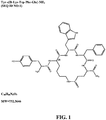
- Compounds 1 ( Figure 1 ), 2 ( Figure 2 ), 5 and 6 are examples of cyclic pentapeptides, and Compounds 3, 4 ( Figure 3 ) and 7 are examples of cyclic hexapeptides of the instant invention.
- amino acids described herein include alanine (Ala), arginine (Arg), asparagine (Asn), aspartic acid (Asp), cysteine (Cys), glutamine (Gln), glutamic acid (Glu), glycine (Gly), histidine (His), isoleucine (Ile), leucine (Leu), lysine (Lys), methionine (Met), phenylalanine (Phe), proline (Pro), serine (Ser), threonine (Thr), tryptophan (Trp), tyrosine (Tyr), valine (Val), ornithine (Orn), naphthylalanine (Nal), 2,3-diaminopropionic acid (Dpr), and 2,4-diaminobutyric acid (Dab).
- Al alanine
- Arg arginine
- Asparagine Asparagine
- Asp aspartic acid
- L- or D-enantiomeric forms of these and other amino acids can be included in the peptides of Formula I.
- Other amino acids, or derivatives or unnatural forms thereof such as those listed in the 2009/2010 Aldrich Handbook of Fine Chemicals (incorporated herein by reference in its entirety, particularly those sections therein listing amino acid derivatives and unnatural amino acids) can be used in preparing compounds of the invention.
- X 1 can be, for example, D-Asp, D-Glu, D-Lys, D-Orn, D-Dpr or D-Dab
- X 4 can be, for example, Asp, Glu, Lys, Orn, Dpr or Dab.
- an amino acid or derivative thereof can be used as X 1 or X 4 if it contains either an amino group or a carboxyl group in its side chain.
- the amino acid used for X 1 can be a D-enantiomeric form of such amino acid.
- X 2 and X 3 in Formula I are aromatic amino acids.
- aromatic amino acids are unsubstituted or substituted aromatic amino acids selected from the group consisting of phenylalanine, heteroarylalanine, naphthylalanine (Nal), homophenylalanine, histidine, tryptophan, tyrosine, arylglycine, heteroarylglycine, thyroxine, aryl-beta-alanine, and heteroaryl-beta-alanine.
- substituted versions of these aromatic amino acids are disclosed in U.S. Patent No. 7,629,319 , which is herein incorporated by reference in its entirety.
- aromatic amino acid refers to an ⁇ -amino acid comprising an aromatic group (including aromatic hydrocarbon and aromatic heterocyclic groups) in the side-chain thereof.
- X 2 in Formula I can be N-alkyl-Phe, where the alkyl group comprises 1 to about 6 carbon atoms. Alternatively, the alkyl group can comprise about 1, 2, 3, 4, 5, 6, 7, 8, 9, or 10 carbons, for example.
- the alkyl group can be a methyl (i.e., X 2 is N-Me-Phe), ethyl, propyl, isopropyl, butyl, isobutyl, pentyl, isopentyl, hexyl, isohexyl, heptyl, or isoheptyl group, or any other branched form thereof, for example.
- the alkyl group of N-alkyl-Phe is linked to the ⁇ -amino group of phenylalanine.
- This alpha amino group is involved in an amide bond with the X 1 residue in certain peptides of the invention; therefore, the alpha amino group of X 2 (when N-alkyl-Phe) as it exists in such peptides is a tertiary amide.
- X 3 in Formula I is para-Y-Phe (p-Y-Phe), where Y is NO 2 , F, Cl, or Br, for example.
- Y is NO 2 , F, Cl, or Br
- X 3 can be p-Cl-Phe.
- the NO 2 , F, Cl, or Br groups can be linked in the ortho or meta positions of the phenyl ring of Phe.
- Any aromatic amino acid incorporated in the compounds of the invention such as at X 2 or X 3 can have the above groups linked thereto in the ortho, meta, or para positions.
- solubility of the peptides of Formula I typically is enhanced relative to the prior art tetrapeptide analogs of the endomorphins.
- Compound 1 was soluble in water, saline and 20% PEG/saline at about 43, 21 and 90 mg/mL, respectively, compared to less than about 2 mg/mL for the previously described compounds. While increases in solubility are associated with improved pharmaceutical delivery properties, higher solubility is also often associated with reduced functional activity (e.g., receptor binding) that may depend on lipophilicity. Surprisingly however, as described in examples below, the functional properties of the compounds of the invention are not diminished, and indeed are generally improved.
- the peptides of Formula I can be prepared by conventional solution phase (2) or solid phase (18) methods with the use of proper protecting groups and coupling agents; references 2 and 20 are herein incorporated by reference in their entirety. Such methods generally utilize various protecting groups on the various amino acid residues of the peptides. A suitable deprotection method is employed to remove specified or all of the protecting groups, including splitting off the resin if solid phase synthesis is applied.
- the peptides can be synthesized, for example, as described below.
- Peptides of Formula I were synthesized on Rink Amide resin via Fmoc chemistry.
- a t-butyl group was used for Tyr, Glu, Asp side chain protection and Boc was used for Lys, Orn and Trp side chain protection. All materials were obtained from EMD Biosciences, Inc (San Diego, CA).
- the peptide was assembled on Rink Amide resin by repetitive removal of the Fmoc protecting group and coupling of protected amino acid.
- HBTU O-benzotriazole-N,N,N',N'-tetramethyluronium hexafluorophosphate; CAS # 94790-37-1) and HOBT (N-hydroxybenzotriazole; CAS # 2592-95-2) were used as coupling reagents in N,N-dimethylformamide (DMF) and diisopropylethylamine (DIPEA) was used as a base.
- DMF N,N-dimethylformamide
- DIPEA diisopropylethylamine
- the resin was treated with an aqueous cocktail of trifluoroacetic acid and triisopropylsilane (TFA/TIS/H 2 O cocktail) for cleavage and removal of the side chain protecting groups. Crude peptide was precipitated with diethyl ether and collected by filtration.
- RP-HPLC reverse phase high performance liquid chromatography
- Reverse phase HPLC was performed using a gradient made from two solvents: (A) 0.1 % TFA in water and (B) 0.1% TFA in acetonitrile.
- VYDAC® 218TP510 column 250 x 10 mm; Alltech Associates, Inc.
- the same gradient was used for analytical runs on a VYDAC®218TP54 column (250 x 4.6 mm) at a flow rate of about 1 mL/min.
- the instant invention also provides pharmaceutical preparations which contain a pharmaceutically effective amount of the peptides in a pharmaceutically acceptable carrier (e.g., a diluent, complexing agent, additive, excipient, adjuvant and the like).
- a pharmaceutically acceptable carrier e.g., a diluent, complexing agent, additive, excipient, adjuvant and the like.
- the peptide can be present for example in a salt form, a micro-crystal form, a nano-crystal form, a co-crystal form, a nanoparticle form, a mirocparticle form, or an amphiphilic form.
- the carrier can be an organic or inorganic carrier that is suitable for external, enteral or parenteral applications.
- the peptides of the present invention can be compounded, for example, with the usual non-toxic, pharmaceutically acceptable carriers for tablets, pellets, capsules, liposomes, suppositories, intranasal sprays, solutions, emulsions, suspensions, aerosols, targeted chemical delivery systems (15), and any other form suitable for use.
- carriers that can be used include water, glucose, lactose, gum acacia, gelatin, mannitol, starch paste, magnesium trisilicate, talc, corn starch, keratin, colloidal silica, potato starch, urea and other carriers suitable for use in manufacturing preparations, in solid, semisolid, liquid or aerosol form.
- the present invention also provides pharmaceutical compositions useful for treating pain and related conditions, as described herein.
- the pharmaceutical compositions comprise at least one peptide of Formula I in combination with a pharmaceutically acceptable carrier, vehicle, or diluent, such as an aqueous buffer at a physiologically acceptable pH (e.g., pH 7 to 8.5), a polymer-based nanoparticle vehicle, a liposome, and the like.
- a pharmaceutically acceptable carrier such as an aqueous buffer at a physiologically acceptable pH (e.g., pH 7 to 8.5), a polymer-based nanoparticle vehicle, a liposome, and the like.
- the pharmaceutical compositions can be delivered in any suitable dosage form, such as a liquid, gel, solid, cream, or paste dosage form.
- the compositions can be adapted to give sustained release of the peptide.
- the pharmaceutical compositions include, but are not limited to, those forms suitable for oral, rectal, nasal, topical, (including buccal and sublingual), transdermal, vaginal, parenteral (including intramuscular, subcutaneous, and intravenous), spinal (epidural, intrathecal), and central (intracerebroventricular) administration.
- the compositions can, where appropriate, be conveniently provided in discrete dosage units.
- the pharmaceutical compositions of the invention can be prepared by any of the methods well known in the pharmaceutical arts. Some preferred modes of administration include intravenous (iv), topical, subcutaneous, oral and spinal.
- compositions suitable for oral administration include capsules, cachets, or tablets, each containing a predetermined amount of one or more of the peptides, as a powder or granules.
- the oral composition is a solution, a suspension, or an emulsion.
- the peptides can be provided as a bolus, electuary, or paste.
- Tablets and capsules for oral administration can contain conventional excipients such as binding agents, fillers, lubricants, disintegrants, colorants, flavoring agents, preservatives, or wetting agents.
- the tablets can be coated according to methods well known in the art, if desired.
- Oral liquid preparations include, for example, aqueous or oily suspensions, solutions, emulsions, syrups, or elixirs.
- the compositions can be provided as a dry product for constitution with water or another suitable vehicle before use.
- Such liquid preparations can contain conventional additives such as suspending agents, emulsifying agents, non-aqueous vehicles (which may include edible oils), preservatives, and the like.
- the additives, excipients, and the like typically will be included in the compositions for oral administration within a range of concentrations suitable for their intended use or function in the composition, and which are well known in the pharmaceutical formulation art.
- peptides of the present invention will be included in the compositions within a therapeutically useful and effective concentration range, as determined by routine methods that are well known in the medical and pharmaceutical arts.
- a typical composition can include one or more of the peptides at a concentration in the range of at least about 0.01 nanomolar to about 1 molar, preferably at least about 1 nanomolar to about 100 millimolar.
- compositions for parenteral, spinal, or central administration e.g. by bolus injection or continuous infusion
- injection into amniotic fluid can be provided in unit dose form in ampoules, pre-filled syringes, small volume infusion, or in multi-dose containers, and preferably include an added preservative.
- the compositions for parenteral administration can be suspensions, solutions, or emulsions, and can contain excipients such as suspending agents, stabilizing agents, and dispersing agents.
- the peptides can be provided in powder form, obtained by aseptic isolation of sterile solid or by lyophilization from solution, for constitution with a suitable vehicle, e.g. sterile, pyrogen-free water, before use.
- compositions for parenteral administration typically will be included in the compositions for parenteral administration within a range of concentrations suitable for their intended use or function in the composition, and which are well known in the pharmaceutical formulation art.
- the peptides of the present invention will be included in the compositions within a therapeutically useful and effective concentration range, as determined by routine methods that are well known in the medical and pharmaceutical arts.
- a typical composition can include one or more of the peptides at a concentration in the range of at least about 0.01 nanomolar to about 100 millimolar, preferably at least about 1 nanomolar to about 10 millimolar.
- compositions for topical administration of the peptides to the epidermis can be formulated as ointments, creams, lotions, gels, or as a transdermal patch.
- transdermal patches can contain penetration enhancers such as linalool, carvacrol, thymol, citral, menthol, t-anethole, and the like.
- Ointments and creams can, for example, include an aqueous or oily base with the addition of suitable thickening agents, gelling agents, colorants, and the like.
- Lotions and creams can include an aqueous or oily base and typically also contain one or more emulsifying agents, stabilizing agents, dispersing agents, suspending agents, thickening agents, coloring agents, and the like.
- Gels preferably include an aqueous carrier base and include a gelling agent such as cross-linked polyacrylic acid polymer, a derivatized polysaccharide (e.g., carboxymethyl cellulose), and the like.
- the additives, excipients, and the like typically will be included in the compositions for topical administration to the epidermis within a range of concentrations suitable for their intended use or function in the composition, and which are well known in the pharmaceutical formulation art.
- peptides of the present invention will be included in the compositions within a therapeutically useful and effective concentration range, as determined by routine methods that are well known in the medical and pharmaceutical arts.
- a typical composition can include one or more of the peptides at a concentration in the range of at least about 0.01 nanomolar to about 1 molar, preferably at least about 1 nanomolar to about 100 millimolar.
- compositions suitable for topical administration in the mouth include lozenges comprising the peptide in a flavored base, such as sucrose, acacia, or tragacanth; pastilles comprising the peptide in an inert base such as gelatin and glycerin or sucrose and acacia; and mouthwashes comprising the active ingredient in a suitable liquid carrier.
- the pharmaceutical compositions for topical administration in the mouth can include penetration enhancing agents, if desired.
- the additives, excipients, and the like typically will be included in the compositions of topical oral administration within a range of concentrations suitable for their intended use or function in the composition, and which are well known in the pharmaceutical formulation art.
- peptides of the present invention will be included in the compositions within a therapeutically useful and effective concentration range, as determined by routine methods that are well known in the medical and pharmaceutical arts.
- a typical composition can include one or more of the peptides at a concentration in the range of at least about 0.01 nanomolar to about 1 molar, preferably at least about 1 nanomolar to about 100 millimolar.
- a pharmaceutical composition suitable for rectal administration comprises a peptide of the present invention in combination with a solid or semisolid (e.g., cream or paste) carrier or vehicle.
- a solid or semisolid carrier or vehicle e.g., cream or paste
- Such rectal compositions can be provided as unit dose suppositories.
- Suitable carriers or vehicles include cocoa butter and other materials commonly used in the art.
- the additives, excipients, and the like typically will be included in the compositions of rectal administration within a range of concentrations suitable for their intended use or function in the composition, and which are well known in the pharmaceutical formulation art.
- the peptides of the present invention will be included in the compositions within a therapeutically useful and effective concentration range, as determined by routine methods that are well known in the medical and pharmaceutical arts.
- a typical composition can include one or more of the peptides at a concentration in the range of at least about 0.01 nanomolar to about 1 molar, preferably at least about 1 nanomolar to about 100 mill
- compositions of the present invention suitable for vaginal administration are provided as pessaries, tampons, creams, gels, pastes, foams, or sprays containing a peptide of the invention in combination with carriers as are known in the art.
- compositions suitable for vaginal administration can be delivered in a liquid or solid dosage form.
- the additives, excipients, and the like typically will be included in the compositions of vaginal administration within a range of concentrations suitable for their intended use or function in the composition, and which are well known in the pharmaceutical formulation art.
- the peptides of the present invention will be included in the compositions within a therapeutically useful and effective concentration range, as determined by routine methods that are well known in the medical and pharmaceutical arts.
- a typical composition can include one or more of the peptides at a concentration in the range of at least about 0.01 nanomolar to about 1 molar, preferably at least about 1 nanomolar to about 100 millimolar.
- compositions suitable for intra-nasal administration are also encompassed by the present invention.
- Such intra-nasal compositions comprise a peptide of the invention in a vehicle and suitable administration device to deliver a liquid spray, dispersible powder, or drops.
- Drops may be formulated with an aqueous or non-aqueous base also comprising one or more dispersing agents, solubilizing agents, or suspending agents.
- Liquid sprays are conveniently delivered from a pressurized pack, an insufflator, a nebulizer, or other convenient means of delivering an aerosol comprising the peptide.
- Pressurized packs comprise a suitable propellant such as dichlorodifluoromethane, trichlorofluoromethane, dichlorotetrafluoroethane, carbon dioxide, or other suitable gas as is well known in the art. Aerosol dosages can be controlled by providing a valve to deliver a metered amount of the peptide.
- pharmaceutical compositions for administration by inhalation or insufflation can be provided in the form of a dry powder composition, for example, a powder mix of the peptide and a suitable powder base such as lactose or starch.
- Such powder composition can be provided in unit dosage form, for example, in capsules, cartridges, gelatin packs, or blister packs, from which the powder can be administered with the aid of an inhalator or insufflator.
- the additives, excipients, and the like typically will be included in the compositions of intra-nasal administration within a range of concentrations suitable for their intended use or function in the composition, and which are well known in the pharmaceutical formulation art.
- the peptides of the present invention will be included in the compositions within a therapeutically useful and effective concentration range, as determined by routine methods that are well known in the medical and pharmaceutical arts.
- a typical composition can include one or more of the peptides at a concentration in the range of at least about 0.01 nanomolar to about 1 molar, preferably at least about 1 nanomolar to about 100 millimolar.
- the pharmaceutical compositions of the present invention can include one or more other therapeutic agent, e.g., as a combination therapy.
- the additional therapeutic agent will be included in the compositions within a therapeutically useful and effective concentration range, as determined by routine methods that are well known in the medical and pharmaceutical arts.
- the concentration of any particular additional therapeutic agent may be in the same range as is typical for use of that agent as a monotherapy, or the concentration may be lower than a typical monotherapy concentration if there is a synergy when combined with a peptide of the present invention.
- the present invention provides for the use of the peptides of Formula I for treatment of pain, treatment of discomfort associated with gastrointestinal disorders, and treatment of drug dependence.
- Methods for providing analgesia (alleviating or reducing pain), relief from gastrointestinal disorders such as diarrhea, and therapy for drug dependence in patients, such as mammals, including humans, comprise administering to a patient suffering from one of the aforementioned conditions an effective amount of a peptide of Formula I.
- Diarrhea may be caused by a number of sources, such as infectious disease, cholera, or an effect or side-effect of various drugs or therapies, including those used for cancer therapy.
- the peptide is administered parenterally or enterally.
- the dosage of the effective amount of the peptides can vary depending upon the age and condition of each individual patient to be treated. However, suitable unit dosages typically range from about 0.01 to about 100 mg. For example, a unit dose can be in the range of about 0.2 mg to about 50 mg. Such a unit dose can be administered more than once a day, e.g., two or three times a day.
- All of the embodiments of the peptides of Formula I can be in the "isolated" state.
- an "isolated" peptide is one that has been completely or partially purified.
- the isolated compound will be part of a greater composition, buffer system or reagent mix.
- the isolated peptide may be purified to homogeneity.
- a composition may comprise the peptide or compound at a level of at least about 50, 80, 90, or 95% (on a molar basis or weight basis) of all the other species that are also present therein. Mixtures of the peptides of Formula I may be used in practicing methods provided by the invention.
- Additional embodiments of the current invention are directed towards methods of using the peptides of Formula I disclosed herein in medicinal formulations or as therapeutic agents, for example. These methods may involve the use of a single peptide, or multiple peptides in combination (i.e., a mixture). Accordingly, certain embodiments of the invention are drawn to medicaments comprising the peptides of Formula I, and methods of manufacturing such medicaments.
- the terms “reducing,” “inhibiting,” “blocking,” “preventing”, alleviating,” or “relieving” when referring to a compound mean that the compound brings down the occurrence, severity, size, volume, or associated symptoms of a condition, event, or activity by at least about 7.5%, 10%, 12.5%, 15%, 17.5%, 20%, 22.5%, 25%, 27.5%, 30%, 35%, 40%, 45%, 50%, 55%, 60%, 65%, 70%, 75%, 80%, 90%, or 100% compared to how the condition, event, or activity would normally exist without application of the compound or a composition comprising the compound.
- the terms “increasing,” “elevating,” “enhancing,” “upregulating”,”improving,” or “activating” when referring to a compound mean that the compound increases the occurrence or activity of a condition, event, or activity by at least about 7.5%, 10%, 12.5%, 15%, 17.5%, 20%, 22.5%, 25%, 27.5%, 30%, 35%, 40%, 45%, 50%, 55%, 60%, 65%, 70%, 75%, 80%, 90%, 100%, 150%, 200%, 250%, 300%, 400%, 500%, 750%, or 1000% compared to how the condition, event, or activity would normally exist without application of the compound or a composition comprising the compound.
- Example 1 Binding and activation of human opioid receptors.
- the peptides of Formula I showed surprisingly high affinity (subnanomolar) for the human mu opioid receptor with selective binding relative to the delta and kappa opioid receptors.
- the compounds were tested in standard binding assays using 3 H-DAMGO (tritiated [D-Ala 2 , N-Me-Phe 4 , Gly-ol]-enkephalin; CAS # 78123-71-4), 3 H-DPDPE (CAS# 88373-73-3), and 3 H-U69593 (CAS# 96744-75-1) to label mu, delta and kappa receptors, respectively, in membranes from CHO cells expressing human cloned receptors.
- 3 H-DAMGO tritiated [D-Ala 2 , N-Me-Phe 4 , Gly-ol]-enkephalin; CAS # 78123-71-4
- 3 H-DPDPE CAS# 88373-73-3
- 3 H-U69593 CAS# 96744-
- endomorphin-1 (EM1, SEQ ID NO:8) and endomorphin -2 (EM2, SEQ ID NO:9) are the most selective endogenous mu agonists previously reported. Analogs based on these natural opioids show greater affinity for the mu receptor, albeit with less selectivity. Tetrapeptide endomorphin analogs described earlier ( U.S. Patent No. 5,885,958 ; ck1, Tyr-c[D-Lys-Trp-Phe] (SEQ ID NO: 10); ck2, Tyr-c[D-Lys-Phe-Phe] (SEQ ID NO:11)) showed the highest affinity of the compounds tested.
- Peptides of Formula I which include a hydrophilic amino acid and amidated carboxy-terminus (Compounds 1, 2, 5) retained high affinity binding, but increased selectivity for the mu receptor.
- Table 2 Compound binding to opioid receptors.
- K i (nM) Selectivity Mu Delta Kappa Delta/Mu Kappa/Mu Morphine 0.92 242 56 264 61 DAMGO 0.78 589 334 754 429 EM1 2.07 1215 >10000 587 >5000 EM2 1.32 5704 >10000 4328 >5000 ck1 0.32 28 35 90 111 ck2 0.36 3 12 9
- Compound 2 0.73 69 71 94 Compound 5 0.43 140 29 328 67
- Receptor activation GTPyS functional assay. Functional activation of the three opioid receptors was tested in standard assays in which the non-hydrolysable GTP analog, 35 S-GTP ⁇ S, was used to quantify activation of cloned human opioid receptors expressed in cell membranes.
- Figure 4A shows that Compound 1 is a full efficacy agonist with significantly greater potency than the reference compound, DAMGO.
- Figure 4B shows that Compound 1 exhibits unexpected full efficacy as a delta antagonist; i.e., it is able to inhibit the delta activation produced by an EDso dose of the reference delta agonist, SNC80 (CAS # 156727-74-1).
- Table 3 shows that all agonists tested are potent activators of the mu receptor, with EC 50 (median effective concentration) values at low-nanomolar to sub-nanomolar concentrations. All compounds were found to be full efficacy (>90%) agonists at the mu receptor.
- the endomorphins and the compounds of Formula I of the invention show remarkable selectivity for receptor activation, with delta activation below 50% at concentrations up to 10 ⁇ M, reflecting selectivity >100000.
- Compounds 1 and 3 showed full efficacy delta antagonism; Compound 1 exhibited this antagonism at a relatively low concentration.
- Table 3 Opioid receptor activation by compounds.
- Agonist EC 50 (nM) Selectivity Delta Antagonist mu delta kappa delta/mu kappa/mu IC 50 efficacy MS a 3.90 1245 2404 319 616 DAMGO 1.98 3641 13094 1839 6613 ck1 0.21 138 469.51 658 2236 ck2 0.15 7 206.11 44 1374 EM1 1.82 >100000 >100000 >50000 >50000 4287 100 EM2 8.44 > 100000 >100000 > 10000 > 10000 30000 88 Comp. 1 0.15 > 100000 963.79 >500000 6425 105 93 Comp. 2 0.99 >100000 12114.00 >100000 12236 2750 51 Comp. 5 0.22 >100000 740.34 >400000 3365 557 100 a morphine sulfate
- Beta-arrestin recruitment is an intracellular protein that is recruited to the mu opioid receptor following activation by agonists. It has been shown to activate intracellular signaling pathways that in many cases are independent of well-known G-protein mediated pathways. It has recently been shown that beta-arrestin knockout mice exhibit altered responses to morphine, including increased analgesia and decreased side effects such as tolerance, respiratory depression, and constipation (16). These results indicate that the analgesic and side-effects of morphine are separable by manipulation of cell signaling processes. These findings also provide support for the recent concept known variously as "functional selectivity”, “biased agonism”,”agonist directed signaling” and other descriptions.
- agonists capable of producing a different cascade of signaling at a given receptor could produce a different profile of desired and undesired effects relative to other agonists for that receptor.
- Three of the analogs of this invention were tested and showed patterns of beta-arrestin recruitment (ranging from high potency with low efficacy to moderate potency with significant efficacy) that were different from each other and from morphine.
- beta arrestin results suggest that these compounds exhibit "functional selectivity", favoring analgesia over adverse side-effects.
- delta antagonism is expected to attenuate opioid-induced tolerance, dependence, and reward.
- delta antagonists can reduce morphine-induced tolerance and dependence, while maintaining or enhancing analgesia.
- Recent studies (11) have also shown reduced rewarding properties of mu agonist/delta antagonists as reflected in the conditioned place preference (CPP) test described below.
- the activity of the peptides of Formula I (e.g., Compound 1) as mu agonists/delta antagonists as well as at mu/delta receptor dimers indicate that the peptides will produce effective analgesia with reduced tolerance, dependence, and reward (18).
- Example 2 Providing analgesia of greater duration, but with reduced respiratory depression, relative to morphine after intravenous administration.
- Respiratory depression is a major safety issue in the use of opioids.
- Effectiveness after systemic administration, such as intravenous (i.v.) injection is unusual for peptide-based compounds, and would be critical for the clinical utility thereof.
- Two peptides (Compounds 1 and 2) were tested for their effects on respiration (minute ventilation) and duration of antinociception relative to morphine. Rats with indwelling jugular catheters were placed in a BUXCOTM whole body plethysmograph apparatus for determining multiple respiratory parameters. For 20 minutes following i.v.
- Example 3 Providing analgesia of greater duration than morphine with reduced impairment of neuromotor coordination and cognitive function.
- Neuromotor and cognitive impairment are characteristics of opioids that are of particular importance in two populations, i.e., military combat troops, where escape from immediate danger can require unimpaired motor and cognitive skills, and the elderly, where these impairments can exacerbate compromised function including impaired balance, which can lead to increased risk of fractures.
- Example 3a Neuromotor coordination.
- Figure 6A illustrates that Compound 2 produces significantly greater antinociception, but significantly reduced motor impairment, relative to morphine (MS). Both compounds were administered by cumulative intravenous (i.v.) doses in rats. Increasing quarter-log doses were given every 20 minutes, and a tail flick (TF) test (a test of latency to remove the tail from a hot light beam) followed by a rotorod test were conducted about 15 minutes after each injection. Escalating doses were given until each animal showed greater than 90% maximum possible effect (%MPE) on the TF test, determined as: [(latency to TF minus baseline latency) / (9 sec maximum (cut off) time to avoid tissue damage) minus baseline)] x 100.
- TF tail flick
- %Maximum Possible Inhibition (%MPI) of motor coordination was determined as 100 - (latency to fall/180 x 100).
- Example 3b Cognitive impairment.
- MMM Morris Water Maze
- rats learn to find a hidden escape platform based on spatial memory. Average latency to the platform, as well as average distance from the platform (a measure unaffected by swim speed), decrease as the task is acquired and provide indices of spatial memory.
- an injection of morphine produced impairment of spatial memory, as reflected by a significant increase in the latency to, and average distance from, the platform.
- Compound 2 at doses that provide equal or greater antinociception than morphine, did not produce significant impairment.
- Example 4 Providing analgesia of greater duration, but reduced reward, relative to morphine.
- animals are first allowed, on Day 1, to freely explore a 3-compartment apparatus consisting of a small "start box” and two larger compartments that are perceptually distinct (gray vs. black and white stripes in this example).
- start box a small "start box”
- vehicle is given in the other.
- the time at which the drug or vehicle is given (a.m. or p.m.) is counterbalanced, as is the compartment in which the drug is given (preferred or non-preferred, as determined during the baseline test).
- This unbiased design allows for detection of both drug preference and drug aversion.
- FIG. 8 shows that Compound 2 provides unexpectedly potent relief of neuropathic pain induced by the spared nerve injury (SNI) model in the rat.
- SNI spared nerve injury
- Morphine and Compound 2 were administered by intrathecal delivery in doses chosen to produce full alleviation of the hyperalgesia. Cumulative dosing showed that the ED 50 for the return to the pre-surgical baseline response was about 1.4 ⁇ g for morphine and about 0.018 ⁇ g for Compound 2. On a molar basis, Compound 2 was 160-fold more potent than morphine against neuropathic pain. Similar results were observed after other forms of chronic pain including post-incisional (post-operative) and inflammatory pain induced by Complete Freund's Adjuvant (CFA).
- CFA Complete Freund's Adjuvant
- morphine Chronic administration of morphine has been shown in several studies to produce an inflammatory response in the spinal cord, reflected by increased activation of glial cells (astroglia and microglia) and "opioid induced hyperalgesia".
- glial cells astroglia and microglia
- opioid induced hyperalgesia When morphine and Compound 1, at doses producing similar antinociception after initial dosing, were administered twice/day for three days, morphine produced greater glial activation than did compound 1.
Landscapes
- Health & Medical Sciences (AREA)
- Chemical & Material Sciences (AREA)
- Life Sciences & Earth Sciences (AREA)
- Organic Chemistry (AREA)
- General Health & Medical Sciences (AREA)
- Medicinal Chemistry (AREA)
- Engineering & Computer Science (AREA)
- Molecular Biology (AREA)
- Pharmacology & Pharmacy (AREA)
- Bioinformatics & Cheminformatics (AREA)
- Biochemistry (AREA)
- Proteomics, Peptides & Aminoacids (AREA)
- Veterinary Medicine (AREA)
- Animal Behavior & Ethology (AREA)
- Public Health (AREA)
- Biophysics (AREA)
- Genetics & Genomics (AREA)
- Biomedical Technology (AREA)
- Immunology (AREA)
- Nuclear Medicine, Radiotherapy & Molecular Imaging (AREA)
- General Chemical & Material Sciences (AREA)
- Chemical Kinetics & Catalysis (AREA)
- Urology & Nephrology (AREA)
- Hematology (AREA)
- Gastroenterology & Hepatology (AREA)
- Epidemiology (AREA)
- Pain & Pain Management (AREA)
- Addiction (AREA)
- Neurosurgery (AREA)
- Neurology (AREA)
- Microbiology (AREA)
- Food Science & Technology (AREA)
- Physics & Mathematics (AREA)
- Analytical Chemistry (AREA)
- Cell Biology (AREA)
- General Physics & Mathematics (AREA)
- Pathology (AREA)
- Biotechnology (AREA)
- Emergency Medicine (AREA)
- Toxicology (AREA)
Description
- A portion of the work described herein was supported by a Senior Career Research Scientist Award and Competitive Merit Review Program funding grant from the Department of Veteran Affairs to James E. Zadina. The United States government has certain rights in this invention.
- The present invention relates to peptide agonists that bind to the mu (morphine) opioid receptor and their use in the treatment of acute and chronic pain.
- Activation of the mu opioid receptor is among the most effective means of alleviating a wide range of pain conditions. Of the recently cloned opioid receptors e.g., mu (3,19,20), delta (6,9), and kappa (12-14), the vast majority of clinically used opioids act at the mu receptor. As illustrated in genetically altered "knock-out" mice, the absence of the mu receptor eliminates the analgesic effects of morphine (8), illustrating its central role in opioid-induced pain relief. The unique effectiveness of mu agonists can be attributed to several factors, including their presence in numerous regions of the nervous system that regulate pain processing and activation of multiple mechanisms that limit pain transmission (e.g., inhibiting release of excitatory transmitters from the peripheral nervous system and decreasing cellular excitability in the central nervous system).
- Limitations on the use of opioids result from negative side effects, including abuse liability, respiratory depression, and cognitive and motor impairment. Major efforts to develop compounds that maintain analgesic properties while reducing the negative side effects have met with limited success. This is evident from the recent epidemic of prescription drug abuse. Numerous attempts at targeting alternative mechanisms of pain relief to avoid these side effects have generally been met with similar problems, i.e., a profile of adverse effects that are different from opioids, but often sufficiently serious to warrant removal from the market (e.g., COX inhibitors) or lack of approval to enter the market (e.g., TRP receptor antagonists). Over 100 million patients annually in the United States experience acute or chronic pain and frequently do not achieve adequate relief from existing drugs due to limited efficacy or excessive side effects.
- Elderly patients tend to show greater sensitivity to severe pain and recent guidelines of the American Geriatric Society suggest greater use of opioids and reduction of non-steroidal anti-inflammatory drugs (NSAIDs) (10). Impairment of motor and cognitive function can be more debilitating in the elderly than in younger patients, particularly due to increased risk of fractures (7). Opioids with reduced motor and cognitive impairment are therefore a growing unmet need.
- Natural endogenous peptides from bovine and human brain that are highly selective for the mu opioid receptor relative to the delta or kappa receptor have been described (22 and
US Patent No. 6,303,578 ). These peptides are potent analgesics and have shown promise of reduced abuse liability (21) and respiratory depression (4,5), as measured in rodent studies. The limited metabolic stability of the natural peptides led to the development of cyclized, D-amino acid-containing tetrapeptide analogs of the endomorphins (U.S. Patent No. 5,885,958 ) of sufficient metabolic stability to produce potent analgesia in rodents after peripheral administration. A lead compound from this group reportedly was 3-fold more potent than morphine in alleviating neuropathic pain and showed reduced rewarding properties in animal models that are correlated with abuse potential. While these results are promising, the development of additional compounds showing equal or better properties is desirable. The instant invention addresses this need by providing peptide analogs having unexpectedly better solubility and side-effect profiles than the previously described materials. - An embodiment of the instant invention is directed to pentapeptide and hexapeptide analogs of endomorphins that differ from the previously described tetrapeptide analogs by having (i) a carboxy-terminal extension with an amidated hydrophilic amino acid, (ii) a substitution in
amino acid position 2; or (iii) a combination of (i) and (ii). The pentapeptide and hexapeptide analogs of the present invention exhibit increased solubility relative to the tetrapeptides while maintaining favorable therapeutic ratios of analgesia-to-side effects. - The compounds of the present invention are cyclic peptides that act as mu opioid receptor agonists with high affinity. These compounds provide relief of acute pain, chronic pain, or both, and comprise or consist of compounds of Formula I:
- (I) H-Tyr-c[X1-X2-X3-X4]-X5. X1 and X4 each independently is an acidic amino acid (i.e., an amino acid comprising a carboxylic acid-substituted side-chain) or a basic amino acid (i.e., an amino acid comprising an amino-substituted side-chain), and X1 is a D- amino acid, with the proviso that if X1 is an acidic amino acid (e.g., D-Asp or D-Glu), then X4 is a basic amino acid (e.g., Lys, Orn, Dpr, or Dab), and vice versa. Preferably, X1 is D-Asp, D-Glu, D-Lys, D-Orn, D-Dpr or D-Dab; while X4 preferably is Asp, Glu, Lys, Orn, Dpr or Dab. X2 is Phe, and X3 is an aromatic amino acid (i.e., an amino acid comprising an aromatic group in the side chain thereof). . X3 preferably is Phe, D-Phe, or p-Y-Phe where Y is NO2, F, Cl, or Br. X5 is selected from the group consisting of Ala-NHR, Arg-NHR, Asn-NHR, Asp-NHR, Cys-NHR, Glu-NHR, Gln-NHR, Gly-NHR, His-NHR, Ile-NHR, Leu-NHR, Met-NHR, Orn-NHR, Phe-NHR, Pro-NHR, Ser-NHR, Thr-NHR, Trp-NHR, Tyr-NHR, and Val-NHR; where R is H or an alkyl group (e.g. a (C1 to C10) alkyl group such as methyl, ethyl, propyl, isopropyl, butyl, isobutyl, pentyl, isopentyl, hexyl, isohexyl, heptyl, or isoheptyl). The peptide of Formula I is cyclic (shown as "c[X1-X2-X3-X4]" in the formula) by virtue of an amide linkage between the carboxylic acid and amino substituents of the side chains of amino acid residues X1 and X4. For example, the linkage can be an amide bond formed between the side chain amino group of the D-Lys, D-Orn, D-Dpr, D-Dab, Lys, Orn, Dpr, or Dab with the side chain carboxyl group of D-Asp, D-Glu, Asp, or Glu.
- In one embodiment of the invention directed to a peptide of Formula I, X5 is Ala-NH2, Arg-NH2, Asn-NH2, Asp-NH2, Cys-NH2, Glu-NH2, Gln-NH2, Gly-NH2, His-NH2, Ile-NH2, Leu-NH2, Met-NH2, Orn-NH2, Phe-NH2, Pro-NH2, Ser-NH2, Thr-NH2, Trp-NH2, Tyr-NH2, or Val-NH2, (i.e., the peptide is an amidated hexapeptide). In other particular embodiments, X5 is Ala-NH2, Arg-NH2, Asn-NH2, Asp-NH2, Cys-NH2, Glu-NH2, Gln-NH2, Gly-NH2, His-NH2, Ile-NH2, Leu-NH2, Met-NH2, Orn-NH2, Phe-NH2, Pro-NH2, Ser-NH2, Thr-NH2, Trp-NH2, Tyr-NH2, or Val-NH2.
- Another embodiment of the invention is directed to a peptide of Formula I, wherein X1 is D-Asp, D-Glu, D-Lys, or D-Orn; and X4 is Asp, Glu, Lys, or Orn.
- Another embodiment of the invention is directed to a peptide of Formula I, wherein the aromatic amino acid residue X3 is Phe, D-Phe, Trp, D-Trp, D-Tyr, N-alkyl-Phe, and the alkyl group of N-alkyl-Phe is (C1 to C10) alkyl or p-Y-Phe, wherein Y is NO2, F, Cl, or Br.
- Another embodiment of the invention is directed to a peptide of Formula I, wherein the aromatic amino acid of X3 is Phe, D-Phe, or p-Y-Phe, wherein Y is NO2, F, Cl, or Br. In one particular embodiment, X3 is p-Cl-Phe.
- Another embodiment of the invention is directed to a peptide of Formula I selected from the group consisting of:
- Tyr-c[D-Glu-Phe-Phe-Lys]-Gly-NH2 (SEQ ID NO:4); and
- Tyr-c[D-Orn-Phe-p-Cl-Phe-Asp]-Val-NH2 (SEQ ID NO:7).
- Another aspect of the invention is directed to a pharmaceutical composition comprising a peptide of Formula I and a pharmaceutically acceptable carrier (e.g., a diluent or excipient).
- Yet another aspect of the invention is directed to the use of a peptide of Formula I in a method of treating a patient having a condition that responds to an opioid, or a condition for which opioid treatment is standard in the art. Such a method comprises or consists of administering to the patient an effective amount of a peptide of Formula I of the invention. Particular embodiments of this method can be followed for the purpose of providing at least one effect selected from (i) analgesia (pain relief), (ii) relief from a gastrointestinal disorder such as diarrhea, (iii) therapy for an opioid drug dependence, and (iv) treatment of any condition for which an opioid is indicated. In some embodiments the peptides of Formula I can be used to treat acute or chronic pain. Uses for the peptides of Formula I also include, but are not be limited to, use as antimigraine agents, immunomodulatory agents, immunosuppressive agents or antiarthritic agents. Certain embodiments of the methods of the present invention, such as treatment of pain or opioid drug dependence, are directed to patients having a history of opioid substance abuse. In certain embodiments of the present methods, the peptide is administered parenterally (e.g., intravenous). This invention also relates to a peptide of Formula I for use in one of said methods of treatment.
- Another aspect of the invention is directed to a method of activating or regulating a mu-opioid receptor by contacting the mu-opioid receptor with a compound of the invention, as well as the use of the peptide of Formula I in such a treatment.
- Another aspect of the invention is directed to a method of measuring the quantity of a mu opioid receptor in a sample using a peptide of Formula I. This method can comprise or consist of the following steps: (i) contacting a sample suspected of containing a mu opioid receptor with a peptide of Formula I to form a compound-receptor complex, (ii) detecting the complex, and (iii) quantifying the amount of complex formed.
- Another aspect of the invention is directed to the use of a peptide of Formula I to perform a competitive assay method of detecting the presence of a molecule that binds to a mu opioid receptor. This method can comprise or consist of the following steps: (i) contacting a sample suspected of containing a molecule that binds to a mu opioid receptor with a mu opioid receptor and a peptide of Formula I, wherein the compound and receptor form a compound-receptor complex; (ii) measuring the amount of the complex formed in step (i); and (iii) comparing the amount of complex measured in step (ii) with the amount of a complex formed between the mu opioid receptor and the peptide in the absence of said sample.
-
-
FIG. 1 shows Tyr-c[D-Lys-Trp-Phe-Glu]-NH2 (SEQ ID NO:1), which is described as "Compound 1" in the following disclosure. The structural and basic molecular formulae, as well as the molecular weight (MW), are shown forCompound 1. -
FIG. 2 shows Tyr-c[D-Glu-Phe-Phe-Lys]-NH2 (SEQ ID NO:2), which is described as "Compound 2" in the following disclosure. The structural and basic molecular formulae, as well as the molecular weight (MW), are shown forCompound 2. -
FIG. 3 shows Tyr-c[D-Glu-Phe-Phe-Lys]-Gly-NH2 (SEQ ID NO:4), which is described as "Compound 4" in the following disclosure. The structural and basic molecular formulae, as well as the molecular weight (MW), are shown forCompound 4. -
FIG. 4 shows opioid receptor binding activity forCompound 1. (A) mu receptor binding of "Compound 1" (triangles) or DAMGO (squares). (B) Antagonist activity ofCompound 1 against binding of SNC80 to delta receptor. -
FIG. 5 shows effects of compounds on antinociception and respiration. (A) Effects ofCompounds Compounds -
FIG. 6 shows the effects ofCompound 2 on antinociception and motor impairment. (A) The effects of Compound 2 (filled triangles) and morphine sulfate (MS, filled squares) on antinociception were measured by the tail flick (TF) test. Also, the effects of Compound 2 (open triangles) and morphine sulfate (open squares) on motor behavior were measured. (* = p<0.05). (B) The bar graph shows the ratio of the area under the curve (AUC) for percent motor impairment relative to the AUC for percent antinociception. This ratio is significantly greater (*p < 0.05) for morphine than forCompound 2, consistent with greater motor impairment relative to analgesia for morphine. -
FIG. 7 shows the effects of compounds on drug abuse liability. (A) The effects of Compound 1 (filled triangles), morphine (filled squares), and vehicle (filled circles) on antinociception were measured by the tail flick (TF) test. * p < 0.05. (B) The cumulative doses of either morphine orCompound 1 that were shown to produce maximal antinociception as shown in (A) were tested for the ability to induce conditioned place preference (CPP). *** p < 0.01. -
FIG. 8 shows a graph of paw pressure required to elicit a paw withdrawal response at times before and after spared nerve injury surgery for rats treated withCompound 2, compared to rats treated with morphine or no analgesic. - Peptides of Formula I, which are cyclic pentapeptide and hexapeptide analogs of endomorphin-1 (Tyr-Pro-Trp-Phe-NH2, SEQ ID NO:8) and endomorphin-2 (Tyr-Pro-Phe-Phe-NH2, SEQ ID NO:9) were prepared. Non-limiting examples of peptides with the composition of Formula I include Compounds 1-7 below, wherein the side chains of amino acid residues 2 (X1) and 5 (X4) in the sequence are linked by an amide bond between the side-chains thereof. The formulae of Compounds 1-7 are shown in Table 1.
Table 1. Compound H-Tyr- X1- X2- X3- X4- X5 SEQ ID NO: 1. Tyr-c[D-Lys Trp Phe Glu] NH2 (SEQ ID NO:1) 2. Tyr-c[D-Glu Phe Phe Lys] NH2 (SEQ ID NO:2) 3. Tyr-c[D-Lys Trp Phe Glu] Gly-NH2 (SEQ ID NO:3) 4. Tyr-c[D-Glu Phe Phe Lys] Gly-NH2 (SEQ ID NO:4) 5. Tyr-c[D-Lys Trp Phe Asp] NH2 (SEQ ID NO:5) 6. Tyr-c[D-Glu N-Me-Phe Phe Lys] NH2 (SEQ ID NO:6) 7. Tyr-c[D-Orn Phe p-Cl-Phe Asp] Val-NH2 (SEQ ID NO:7) - In some embodiments, the peptides of Formula I includes peptides with an N-alkylated phenylalanine in position 3 (X2). Alkyl groups suitable in the peptides of the present invention include (C1 to C10) alkyl groups, preferably (C1 to C6) alkyl groups (e.g., methyl or ethyl).
Compound 6 illustrates a cyclic analog whose linear primary amino acid sequence contains an N-methylated phenylalanine inposition 3. Other peptides of this invention include compounds wherein the amino acid at position 4 (X3) is p-Y-phenylalanine, wherein Y is NO2, F, Cl or Br, in order to enhance receptor binding and potency. An exemplary peptide (Compound 7), whose linear primary amino acid sequence is provided in SEQ ID NO:7, has a p-chlorophenylalanine (p-Cl-Phe) inposition 4. - Compounds 1 (
Figure 1 ), 2 (Figure 2 ),5 and6 are examples of cyclic pentapeptides, and Compounds 3, 4 (Figure 3 ) and7 are examples of cyclic hexapeptides of the instant invention. - For reference, the abbreviations for amino acids described herein include alanine (Ala), arginine (Arg), asparagine (Asn), aspartic acid (Asp), cysteine (Cys), glutamine (Gln), glutamic acid (Glu), glycine (Gly), histidine (His), isoleucine (Ile), leucine (Leu), lysine (Lys), methionine (Met), phenylalanine (Phe), proline (Pro), serine (Ser), threonine (Thr), tryptophan (Trp), tyrosine (Tyr), valine (Val), ornithine (Orn), naphthylalanine (Nal), 2,3-diaminopropionic acid (Dpr), and 2,4-diaminobutyric acid (Dab). The L- or D-enantiomeric forms of these and other amino acids can be included in the peptides of Formula I. Other amino acids, or derivatives or unnatural forms thereof such as those listed in the 2009/2010 Aldrich Handbook of Fine Chemicals (incorporated herein by reference in its entirety, particularly those sections therein listing amino acid derivatives and unnatural amino acids) can be used in preparing compounds of the invention.
- In Formula I, X1 can be, for example, D-Asp, D-Glu, D-Lys, D-Orn, D-Dpr or D-Dab, and X4 can be, for example, Asp, Glu, Lys, Orn, Dpr or Dab. In general, an amino acid or derivative thereof can be used as X1 or X4 if it contains either an amino group or a carboxyl group in its side chain. In some embodiments, the amino acid used for X1 can be a D-enantiomeric form of such amino acid.
- X2 and X3 in Formula I are aromatic amino acids. Examples of such amino acids are unsubstituted or substituted aromatic amino acids selected from the group consisting of phenylalanine, heteroarylalanine, naphthylalanine (Nal), homophenylalanine, histidine, tryptophan, tyrosine, arylglycine, heteroarylglycine, thyroxine, aryl-beta-alanine, and heteroaryl-beta-alanine. Examples of substituted versions of these aromatic amino acids are disclosed in
U.S. Patent No. 7,629,319 , which is herein incorporated by reference in its entirety. As used herein, "aromatic amino acid" refers to an α-amino acid comprising an aromatic group (including aromatic hydrocarbon and aromatic heterocyclic groups) in the side-chain thereof. - In some embodiments, X2 in Formula I can be N-alkyl-Phe, where the alkyl group comprises 1 to about 6 carbon atoms. Alternatively, the alkyl group can comprise about 1, 2, 3, 4, 5, 6, 7, 8, 9, or 10 carbons, for example. The alkyl group can be a methyl (i.e., X2 is N-Me-Phe), ethyl, propyl, isopropyl, butyl, isobutyl, pentyl, isopentyl, hexyl, isohexyl, heptyl, or isoheptyl group, or any other branched form thereof, for example. By definition, the alkyl group of N-alkyl-Phe is linked to the α-amino group of phenylalanine. This alpha amino group is involved in an amide bond with the X1 residue in certain peptides of the invention; therefore, the alpha amino group of X2 (when N-alkyl-Phe) as it exists in such peptides is a tertiary amide.
- In some embodiments X3 in Formula I is para-Y-Phe (p-Y-Phe), where Y is NO2, F, Cl, or Br, for example. For example, X3 can be p-Cl-Phe. Alternatively, the NO2, F, Cl, or Br groups can be linked in the ortho or meta positions of the phenyl ring of Phe. Any aromatic amino acid incorporated in the compounds of the invention such as at X2 or X3 can have the above groups linked thereto in the ortho, meta, or para positions.
- The solubility of the peptides of Formula I (e.g., in saline or physiologic buffer) typically is enhanced relative to the prior art tetrapeptide analogs of the endomorphins. Addition of a hydrophilic amino acid and amidated C-terminus to the relatively hydrophobic tetrapeptide sequences Tyr-c-[D-Lys-Trp-Phe] (SEQ ID NO:10) and Tyr-c-[D-Lys-Phe-Phe] (SEQ ID NO:11), resulted in an unexpectedly high improvement in solubility while maintaining or improving functionality. For example,
Compound 1 was soluble in water, saline and 20% PEG/saline at about 43, 21 and 90 mg/mL, respectively, compared to less than about 2 mg/mL for the previously described compounds. While increases in solubility are associated with improved pharmaceutical delivery properties, higher solubility is also often associated with reduced functional activity (e.g., receptor binding) that may depend on lipophilicity. Surprisingly however, as described in examples below, the functional properties of the compounds of the invention are not diminished, and indeed are generally improved. - The peptides of Formula I can be prepared by conventional solution phase (2) or solid phase (18) methods with the use of proper protecting groups and coupling agents;
references - Peptides of Formula I were synthesized on Rink Amide resin via Fmoc chemistry. A t-butyl group was used for Tyr, Glu, Asp side chain protection and Boc was used for Lys, Orn and Trp side chain protection. All materials were obtained from EMD Biosciences, Inc (San Diego, CA). The peptide was assembled on Rink Amide resin by repetitive removal of the Fmoc protecting group and coupling of protected amino acid. HBTU (O-benzotriazole-N,N,N',N'-tetramethyluronium hexafluorophosphate; CAS # 94790-37-1) and HOBT (N-hydroxybenzotriazole; CAS # 2592-95-2) were used as coupling reagents in N,N-dimethylformamide (DMF) and diisopropylethylamine (DIPEA) was used as a base. The resin was treated with an aqueous cocktail of trifluoroacetic acid and triisopropylsilane (TFA/TIS/H2O cocktail) for cleavage and removal of the side chain protecting groups. Crude peptide was precipitated with diethyl ether and collected by filtration.
- Cyclization of the linear Fmoc-Tyr-c[X1-X2-X3-X4]-X5 precursors: About 1 mmol of peptide was dissolved in about 1000 mL DMF and about 2 mmol DIPEA was added to the solution, followed by a solution of HBTU (about 1.1 mmol) and HOBT (about 1.1 mmol) in about 100 mL DMF. The reaction mixture was stirred at room temperature overnight. Solvent was removed in vacuo. The resulting solid residue was washed with 5% citric acid, saturated NaCl, saturated NaHCO3, and water. The final solid was washed with diethyl ether and dried under high vacuum.
- Preparation of Tyr-c[X1-X2-X3-X4]-X5 peptides. The solids obtained above were dissolved in 20% piperidine/DMF. The mixture was stirred at room temperature for about 1 hour. Solvent was removed in vacuo. Residues were dissolved in 10% aqueous acetonitrile (MeCN/H2O) and lyophilized.
- Purification of the crude lyophilized peptides was performed with reverse phase high performance liquid chromatography (RP-HPLC). The HPLC system Gold 32 Karat (Beckman) consisting of the programmable solvent module 126 and the diode array detector module 168 was used in the purification and the purity control of the peptides. Reverse phase HPLC was performed using a gradient made from two solvents: (A) 0.1 % TFA in water and (B) 0.1% TFA in acetonitrile. For preparative runs, a VYDAC® 218TP510 column (250 x 10 mm; Alltech Associates, Inc.) was used with a gradient of 5-20% solvent B in solvent A over a period of 10 min, 20-25% B over a period of 30 minutes, 25-80% B over a period of 1 minute and isocratic elution over 9 minutes at a flow rate of about 4 mL/min, absorptions being measured at both 214 and 280 nm. The same gradient was used for analytical runs on a VYDAC®218TP54 column (250 x 4.6 mm) at a flow rate of about 1 mL/min.
- The instant invention also provides pharmaceutical preparations which contain a pharmaceutically effective amount of the peptides in a pharmaceutically acceptable carrier (e.g., a diluent, complexing agent, additive, excipient, adjuvant and the like). The peptide can be present for example in a salt form, a micro-crystal form, a nano-crystal form, a co-crystal form, a nanoparticle form, a mirocparticle form, or an amphiphilic form. The carrier can be an organic or inorganic carrier that is suitable for external, enteral or parenteral applications. The peptides of the present invention can be compounded, for example, with the usual non-toxic, pharmaceutically acceptable carriers for tablets, pellets, capsules, liposomes, suppositories, intranasal sprays, solutions, emulsions, suspensions, aerosols, targeted chemical delivery systems (15), and any other form suitable for use. Non-limiting examples of carriers that can be used include water, glucose, lactose, gum acacia, gelatin, mannitol, starch paste, magnesium trisilicate, talc, corn starch, keratin, colloidal silica, potato starch, urea and other carriers suitable for use in manufacturing preparations, in solid, semisolid, liquid or aerosol form. In addition auxiliary, stabilizing, thickening and coloring agents and perfumes can be used.
The present invention also provides pharmaceutical compositions useful for treating pain and related conditions, as described herein. The pharmaceutical compositions comprise at least one peptide of Formula I in combination with a pharmaceutically acceptable carrier, vehicle, or diluent, such as an aqueous buffer at a physiologically acceptable pH (e.g.,pH 7 to 8.5), a polymer-based nanoparticle vehicle, a liposome, and the like. The pharmaceutical compositions can be delivered in any suitable dosage form, such as a liquid, gel, solid, cream, or paste dosage form. In one embodiment, the compositions can be adapted to give sustained release of the peptide. - In some embodiments, the pharmaceutical compositions include, but are not limited to, those forms suitable for oral, rectal, nasal, topical, (including buccal and sublingual), transdermal, vaginal, parenteral (including intramuscular, subcutaneous, and intravenous), spinal (epidural, intrathecal), and central (intracerebroventricular) administration. The compositions can, where appropriate, be conveniently provided in discrete dosage units. The pharmaceutical compositions of the invention can be prepared by any of the methods well known in the pharmaceutical arts. Some preferred modes of administration include intravenous (iv), topical, subcutaneous, oral and spinal.
- Pharmaceutical formulations suitable for oral administration include capsules, cachets, or tablets, each containing a predetermined amount of one or more of the peptides, as a powder or granules. In another embodiment, the oral composition is a solution, a suspension, or an emulsion. Alternatively, the peptides can be provided as a bolus, electuary, or paste. Tablets and capsules for oral administration can contain conventional excipients such as binding agents, fillers, lubricants, disintegrants, colorants, flavoring agents, preservatives, or wetting agents. The tablets can be coated according to methods well known in the art, if desired. Oral liquid preparations include, for example, aqueous or oily suspensions, solutions, emulsions, syrups, or elixirs. Alternatively, the compositions can be provided as a dry product for constitution with water or another suitable vehicle before use. Such liquid preparations can contain conventional additives such as suspending agents, emulsifying agents, non-aqueous vehicles (which may include edible oils), preservatives, and the like. The additives, excipients, and the like typically will be included in the compositions for oral administration within a range of concentrations suitable for their intended use or function in the composition, and which are well known in the pharmaceutical formulation art. The peptides of the present invention will be included in the compositions within a therapeutically useful and effective concentration range, as determined by routine methods that are well known in the medical and pharmaceutical arts. For example, a typical composition can include one or more of the peptides at a concentration in the range of at least about 0.01 nanomolar to about 1 molar, preferably at least about 1 nanomolar to about 100 millimolar.
- Pharmaceutical compositions for parenteral, spinal, or central administration (e.g. by bolus injection or continuous infusion) or injection into amniotic fluid can be provided in unit dose form in ampoules, pre-filled syringes, small volume infusion, or in multi-dose containers, and preferably include an added preservative. The compositions for parenteral administration can be suspensions, solutions, or emulsions, and can contain excipients such as suspending agents, stabilizing agents, and dispersing agents. Alternatively, the peptides can be provided in powder form, obtained by aseptic isolation of sterile solid or by lyophilization from solution, for constitution with a suitable vehicle, e.g. sterile, pyrogen-free water, before use. The additives, excipients, and the like typically will be included in the compositions for parenteral administration within a range of concentrations suitable for their intended use or function in the composition, and which are well known in the pharmaceutical formulation art. The peptides of the present invention will be included in the compositions within a therapeutically useful and effective concentration range, as determined by routine methods that are well known in the medical and pharmaceutical arts. For example, a typical composition can include one or more of the peptides at a concentration in the range of at least about 0.01 nanomolar to about 100 millimolar, preferably at least about 1 nanomolar to about 10 millimolar.
- Pharmaceutical compositions for topical administration of the peptides to the epidermis (mucosal or cutaneous surfaces) can be formulated as ointments, creams, lotions, gels, or as a transdermal patch. Such transdermal patches can contain penetration enhancers such as linalool, carvacrol, thymol, citral, menthol, t-anethole, and the like. Ointments and creams can, for example, include an aqueous or oily base with the addition of suitable thickening agents, gelling agents, colorants, and the like. Lotions and creams can include an aqueous or oily base and typically also contain one or more emulsifying agents, stabilizing agents, dispersing agents, suspending agents, thickening agents, coloring agents, and the like. Gels preferably include an aqueous carrier base and include a gelling agent such as cross-linked polyacrylic acid polymer, a derivatized polysaccharide (e.g., carboxymethyl cellulose), and the like. The additives, excipients, and the like typically will be included in the compositions for topical administration to the epidermis within a range of concentrations suitable for their intended use or function in the composition, and which are well known in the pharmaceutical formulation art. The peptides of the present invention will be included in the compositions within a therapeutically useful and effective concentration range, as determined by routine methods that are well known in the medical and pharmaceutical arts. For example, a typical composition can include one or more of the peptides at a concentration in the range of at least about 0.01 nanomolar to about 1 molar, preferably at least about 1 nanomolar to about 100 millimolar.
- Pharmaceutical compositions suitable for topical administration in the mouth (e.g., buccal or sublingual administration) include lozenges comprising the peptide in a flavored base, such as sucrose, acacia, or tragacanth; pastilles comprising the peptide in an inert base such as gelatin and glycerin or sucrose and acacia; and mouthwashes comprising the active ingredient in a suitable liquid carrier. The pharmaceutical compositions for topical administration in the mouth can include penetration enhancing agents, if desired. The additives, excipients, and the like typically will be included in the compositions of topical oral administration within a range of concentrations suitable for their intended use or function in the composition, and which are well known in the pharmaceutical formulation art. The peptides of the present invention will be included in the compositions within a therapeutically useful and effective concentration range, as determined by routine methods that are well known in the medical and pharmaceutical arts. For example, a typical composition can include one or more of the peptides at a concentration in the range of at least about 0.01 nanomolar to about 1 molar, preferably at least about 1 nanomolar to about 100 millimolar.
- A pharmaceutical composition suitable for rectal administration comprises a peptide of the present invention in combination with a solid or semisolid (e.g., cream or paste) carrier or vehicle. For example, such rectal compositions can be provided as unit dose suppositories. Suitable carriers or vehicles include cocoa butter and other materials commonly used in the art. The additives, excipients, and the like typically will be included in the compositions of rectal administration within a range of concentrations suitable for their intended use or function in the composition, and which are well known in the pharmaceutical formulation art. The peptides of the present invention will be included in the compositions within a therapeutically useful and effective concentration range, as determined by routine methods that are well known in the medical and pharmaceutical arts. For example, a typical composition can include one or more of the peptides at a concentration in the range of at least about 0.01 nanomolar to about 1 molar, preferably at least about 1 nanomolar to about 100 millimolar.
- According to one embodiment, pharmaceutical compositions of the present invention suitable for vaginal administration are provided as pessaries, tampons, creams, gels, pastes, foams, or sprays containing a peptide of the invention in combination with carriers as are known in the art. Alternatively, compositions suitable for vaginal administration can be delivered in a liquid or solid dosage form. The additives, excipients, and the like typically will be included in the compositions of vaginal administration within a range of concentrations suitable for their intended use or function in the composition, and which are well known in the pharmaceutical formulation art. The peptides of the present invention will be included in the compositions within a therapeutically useful and effective concentration range, as determined by routine methods that are well known in the medical and pharmaceutical arts. For example, a typical composition can include one or more of the peptides at a concentration in the range of at least about 0.01 nanomolar to about 1 molar, preferably at least about 1 nanomolar to about 100 millimolar.
- Pharmaceutical compositions suitable for intra-nasal administration are also encompassed by the present invention. Such intra-nasal compositions comprise a peptide of the invention in a vehicle and suitable administration device to deliver a liquid spray, dispersible powder, or drops. Drops may be formulated with an aqueous or non-aqueous base also comprising one or more dispersing agents, solubilizing agents, or suspending agents. Liquid sprays are conveniently delivered from a pressurized pack, an insufflator, a nebulizer, or other convenient means of delivering an aerosol comprising the peptide. Pressurized packs comprise a suitable propellant such as dichlorodifluoromethane, trichlorofluoromethane, dichlorotetrafluoroethane, carbon dioxide, or other suitable gas as is well known in the art. Aerosol dosages can be controlled by providing a valve to deliver a metered amount of the peptide. Alternatively, pharmaceutical compositions for administration by inhalation or insufflation can be provided in the form of a dry powder composition, for example, a powder mix of the peptide and a suitable powder base such as lactose or starch. Such powder composition can be provided in unit dosage form, for example, in capsules, cartridges, gelatin packs, or blister packs, from which the powder can be administered with the aid of an inhalator or insufflator. The additives, excipients, and the like typically will be included in the compositions of intra-nasal administration within a range of concentrations suitable for their intended use or function in the composition, and which are well known in the pharmaceutical formulation art. The peptides of the present invention will be included in the compositions within a therapeutically useful and effective concentration range, as determined by routine methods that are well known in the medical and pharmaceutical arts. For example, a typical composition can include one or more of the peptides at a concentration in the range of at least about 0.01 nanomolar to about 1 molar, preferably at least about 1 nanomolar to about 100 millimolar.
- Optionally, the pharmaceutical compositions of the present invention can include one or more other therapeutic agent, e.g., as a combination therapy. The additional therapeutic agent will be included in the compositions within a therapeutically useful and effective concentration range, as determined by routine methods that are well known in the medical and pharmaceutical arts. The concentration of any particular additional therapeutic agent may be in the same range as is typical for use of that agent as a monotherapy, or the concentration may be lower than a typical monotherapy concentration if there is a synergy when combined with a peptide of the present invention.
- In another aspect, the present invention provides for the use of the peptides of Formula I for treatment of pain, treatment of discomfort associated with gastrointestinal disorders, and treatment of drug dependence. Methods for providing analgesia (alleviating or reducing pain), relief from gastrointestinal disorders such as diarrhea, and therapy for drug dependence in patients, such as mammals, including humans, comprise administering to a patient suffering from one of the aforementioned conditions an effective amount of a peptide of Formula I. Diarrhea may be caused by a number of sources, such as infectious disease, cholera, or an effect or side-effect of various drugs or therapies, including those used for cancer therapy. Preferably, the peptide is administered parenterally or enterally. The dosage of the effective amount of the peptides can vary depending upon the age and condition of each individual patient to be treated. However, suitable unit dosages typically range from about 0.01 to about 100 mg. For example, a unit dose can be in the range of about 0.2 mg to about 50 mg. Such a unit dose can be administered more than once a day, e.g., two or three times a day.
- All of the embodiments of the peptides of Formula I can be in the "isolated" state. For example, an "isolated" peptide is one that has been completely or partially purified. In some instances, the isolated compound will be part of a greater composition, buffer system or reagent mix. In other circumstances, the isolated peptide may be purified to homogeneity. A composition may comprise the peptide or compound at a level of at least about 50, 80, 90, or 95% (on a molar basis or weight basis) of all the other species that are also present therein. Mixtures of the peptides of Formula I may be used in practicing methods provided by the invention.
- Additional embodiments of the current invention are directed towards methods of using the peptides of Formula I disclosed herein in medicinal formulations or as therapeutic agents, for example. These methods may involve the use of a single peptide, or multiple peptides in combination (i.e., a mixture). Accordingly, certain embodiments of the invention are drawn to medicaments comprising the peptides of Formula I, and methods of manufacturing such medicaments.
- As used herein, the terms "reducing," "inhibiting," "blocking," "preventing", alleviating," or "relieving" when referring to a compound (e.g., a peptide), mean that the compound brings down the occurrence, severity, size, volume, or associated symptoms of a condition, event, or activity by at least about 7.5%, 10%, 12.5%, 15%, 17.5%, 20%, 22.5%, 25%, 27.5%, 30%, 35%, 40%, 45%, 50%, 55%, 60%, 65%, 70%, 75%, 80%, 90%, or 100% compared to how the condition, event, or activity would normally exist without application of the compound or a composition comprising the compound. The terms "increasing," "elevating," "enhancing," "upregulating","improving," or "activating" when referring to a compound mean that the compound increases the occurrence or activity of a condition, event, or activity by at least about 7.5%, 10%, 12.5%, 15%, 17.5%, 20%, 22.5%, 25%, 27.5%, 30%, 35%, 40%, 45%, 50%, 55%, 60%, 65%, 70%, 75%, 80%, 90%, 100%, 150%, 200%, 250%, 300%, 400%, 500%, 750%, or 1000% compared to how the condition, event, or activity would normally exist without application of the compound or a composition comprising the compound.
- The following examples are included to demonstrate certain aspects of the invention. It should be appreciated by those of skill in the art that the techniques disclosed in the examples, which represent techniques known to function well in practicing the invention, can be considered to constitute preferred modes for its practice. The examples are provided for illustration purposes only and are not intended to be limiting.
- The peptides of Formula I showed surprisingly high affinity (subnanomolar) for the human mu opioid receptor with selective binding relative to the delta and kappa opioid receptors. The compounds were tested in standard binding assays using 3H-DAMGO (tritiated [D-Ala2, N-Me-Phe4, Gly-ol]-enkephalin; CAS # 78123-71-4), 3H-DPDPE (CAS# 88373-73-3), and 3H-U69593 (CAS# 96744-75-1) to label mu, delta and kappa receptors, respectively, in membranes from CHO cells expressing human cloned receptors. As shown in Table 2, endomorphin-1 (EM1, SEQ ID NO:8) and endomorphin -2 (EM2, SEQ ID NO:9) are the most selective endogenous mu agonists previously reported. Analogs based on these natural opioids show greater affinity for the mu receptor, albeit with less selectivity. Tetrapeptide endomorphin analogs described earlier (
U.S. Patent No. 5,885,958 ; ck1, Tyr-c[D-Lys-Trp-Phe] (SEQ ID NO: 10); ck2, Tyr-c[D-Lys-Phe-Phe] (SEQ ID NO:11)) showed the highest affinity of the compounds tested. Peptides of Formula I, which include a hydrophilic amino acid and amidated carboxy-terminus (Compounds Table 2: Compound binding to opioid receptors. Ki (nM) Selectivity Mu Delta Kappa Delta/Mu Kappa/Mu Morphine 0.92 242 56 264 61 DAMGO 0.78 589 334 754 429 EM1 2.07 1215 >10000 587 >5000 EM2 1.32 5704 >10000 4328 >5000 ck1 0.32 28 35 90 111 ck2 0.36 3 12 9 33 Compound 10.49 132 128 267 260 Compound 20.73 69 71 94 98 Compound 50.43 140 29 328 67 - Receptor activation: GTPyS functional assay. Functional activation of the three opioid receptors was tested in standard assays in which the non-hydrolysable GTP analog, 35S-GTPγS, was used to quantify activation of cloned human opioid receptors expressed in cell membranes.
Figure 4A shows thatCompound 1 is a full efficacy agonist with significantly greater potency than the reference compound, DAMGO.Figure 4B shows thatCompound 1 exhibits unexpected full efficacy as a delta antagonist; i.e., it is able to inhibit the delta activation produced by an EDso dose of the reference delta agonist, SNC80 (CAS # 156727-74-1). Table 3 shows that all agonists tested are potent activators of the mu receptor, with EC50 (median effective concentration) values at low-nanomolar to sub-nanomolar concentrations. All compounds were found to be full efficacy (>90%) agonists at the mu receptor. The endomorphins and the compounds of Formula I of the invention show remarkable selectivity for receptor activation, with delta activation below 50% at concentrations up to 10 µM, reflecting selectivity >100000.Compounds Compound 1 exhibited this antagonism at a relatively low concentration.Table 3: Opioid receptor activation by compounds. Agonist EC50 (nM) Selectivity Delta Antagonist mu delta kappa delta/mu kappa/ mu IC 50 efficacy MSa 3.90 1245 2404 319 616 DAMGO 1.98 3641 13094 1839 6613 ck1 0.21 138 469.51 658 2236 ck2 0.15 7 206.11 44 1374 EM1 1.82 >100000 >100000 >50000 >50000 4287 100 EM2 8.44 > 100000 >100000 > 10000 > 10000 30000 88 Comp. 1 0.15 > 100000 963.79 >500000 6425 105 93 Comp. 2 0.99 >100000 12114.00 >100000 12236 2750 51 Comp. 5 0.22 >100000 740.34 >400000 3365 557 100 amorphine sulfate - Receptor activation: Beta-arrestin recruitment. Beta-arrestin is an intracellular protein that is recruited to the mu opioid receptor following activation by agonists. It has been shown to activate intracellular signaling pathways that in many cases are independent of well-known G-protein mediated pathways. It has recently been shown that beta-arrestin knockout mice exhibit altered responses to morphine, including increased analgesia and decreased side effects such as tolerance, respiratory depression, and constipation (16). These results indicate that the analgesic and side-effects of morphine are separable by manipulation of cell signaling processes. These findings also provide support for the recent concept known variously as "functional selectivity", "biased agonism","agonist directed signaling" and other descriptions. According to this concept, agonists capable of producing a different cascade of signaling at a given receptor could produce a different profile of desired and undesired effects relative to other agonists for that receptor. Three of the analogs of this invention were tested and showed patterns of beta-arrestin recruitment (ranging from high potency with low efficacy to moderate potency with significant efficacy) that were different from each other and from morphine. Together with the differential analgesic/side-effect profiles relative to morphine described in previous examples, the beta arrestin results suggest that these compounds exhibit "functional selectivity", favoring analgesia over adverse side-effects.
- Beyond the value of high mu agonist selectivity (i.e., exclusion of potential side-effects resulting from activation of multiple receptors), delta antagonism is expected to attenuate opioid-induced tolerance, dependence, and reward. As first shown in 1991 (1) and supported in numerous studies since, delta antagonists can reduce morphine-induced tolerance and dependence, while maintaining or enhancing analgesia. Recent studies (11) have also shown reduced rewarding properties of mu agonist/delta antagonists as reflected in the conditioned place preference (CPP) test described below. The activity of the peptides of Formula I (e.g., Compound 1) as mu agonists/delta antagonists as well as at mu/delta receptor dimers indicate that the peptides will produce effective analgesia with reduced tolerance, dependence, and reward (18).
- Respiratory depression is a major safety issue in the use of opioids. An opioid providing analgesia as effective as that produced by morphine, but with less respiratory depression, would be a major advance for the safe use of opioid analgesics. Effectiveness after systemic administration, such as intravenous (i.v.) injection, is unusual for peptide-based compounds, and would be critical for the clinical utility thereof. Two peptides (
Compounds 1 and 2) were tested for their effects on respiration (minute ventilation) and duration of antinociception relative to morphine. Rats with indwelling jugular catheters were placed in a BUXCO™ whole body plethysmograph apparatus for determining multiple respiratory parameters. For 20 minutes following i.v. injection of vehicle (saline), baseline minute ventilation was determined. Animals were then injected with morphine or test compound and changes from baseline were determined for 20 minutes, the period of maximal inhibition of minute ventilation by all compounds. The standard tail-flick (TF) test was used to determine antinociception. A baseline test was conducted before placing the animal in the BUXCO™ chamber, at the end of the 20-minute respiratory test, and at every 20 minutes thereafter until the TF latency returned to below 2x baseline TF. Baseline latencies were 3-4 seconds and a cut-off time ("maximal antinociception") was set at 9 seconds to avoid tissue damage. -
Figure 5A shows that 10 mg/kg doses ofCompounds Compounds Compound 1 and in the 5.6 mg/kg dose of Compound 2 (Figure 5B ). These results indicate an unexpected and clearly safer therapeutic profile for the peptides of Formula I over the current standard opioid analgesic. - Neuromotor and cognitive impairment are characteristics of opioids that are of particular importance in two populations, i.e., military combat troops, where escape from immediate danger can require unimpaired motor and cognitive skills, and the elderly, where these impairments can exacerbate compromised function including impaired balance, which can lead to increased risk of fractures.
-
Figure 6A illustrates thatCompound 2 produces significantly greater antinociception, but significantly reduced motor impairment, relative to morphine (MS). Both compounds were administered by cumulative intravenous (i.v.) doses in rats. Increasing quarter-log doses were given every 20 minutes, and a tail flick (TF) test (a test of latency to remove the tail from a hot light beam) followed by a rotorod test were conducted about 15 minutes after each injection. Escalating doses were given until each animal showed greater than 90% maximum possible effect (%MPE) on the TF test, determined as: [(latency to TF minus baseline latency) / (9 sec maximum (cut off) time to avoid tissue damage) minus baseline)] x 100. The animal was then placed on a rod that rotated at speeds escalating to 13 revolutions per minute (RPM) over 3 minutes, and the latency to fall from the rod was determined. Only animals that consistently remained on the rod for the full 180 seconds during training in the drug-naive state were tested. %Maximum Possible Inhibition (%MPI) of motor coordination was determined as 100 - (latency to fall/180 x 100). - The two compounds showed similar onset to maximal antinociception, but
Compound 2 produced significantly longer antinociception, as reflected by TF latencies significantly (* = p<0.05) longer than those of the morphine group at 135 and 155 minutes (Figure 6A ). Despite this greater antinociception, the motor impairment was significantly less than that of morphine (Figure 6B , * p < 0.05). The impairment of motor behavior by morphine was significantly above that of vehicle controls (* p < 0.05) while that ofCompound 2 was not. - A widely used standard test of cognitive function is the Morris Water Maze (MWM). During training, rats learn to find a hidden escape platform based on spatial memory. Average latency to the platform, as well as average distance from the platform (a measure unaffected by swim speed), decrease as the task is acquired and provide indices of spatial memory. After 4 days of training, an injection of morphine produced impairment of spatial memory, as reflected by a significant increase in the latency to, and average distance from, the platform. By contrast,
Compound 2, at doses that provide equal or greater antinociception than morphine, did not produce significant impairment. These results indicate an unexpected and superior therapeutic profile of the peptides ofFormula 1 with regard to cognitive function relative to the current standard opioid analgesic. - Opioids remain the standard treatment for relief of severe pain, but diversion of pain medications for non-pain use has become a serious national problem (see U.S. Department of Health and Human Services Substance Abuse and Mental Health Services Administration, found at world wide website oas.samhsa.gov/2k9/painRelievers/ nonmedicalTrends.pdf). Considerable efforts in academia and industry have focused on "tamper-proof' versions of opioid medications, but there has been little success in developing opioids that provide highly effective analgesia with minimal abuse potential. The conditioned place preference (CPP) paradigm is a widely accepted model for demonstrating rewarding properties of drugs, and all major classes of abused drugs produce CPP, including opioids such as morphine and heroin. Briefly, animals are first allowed, on
Day 1, to freely explore a 3-compartment apparatus consisting of a small "start box" and two larger compartments that are perceptually distinct (gray vs. black and white stripes in this example). For the next three days, the animals are given an i.v. injection of drug and confined to one compartment, and vehicle is given in the other. The time at which the drug or vehicle is given (a.m. or p.m.) is counterbalanced, as is the compartment in which the drug is given (preferred or non-preferred, as determined during the baseline test). This unbiased design allows for detection of both drug preference and drug aversion. After three days of conditioning (Days Day 5 in the drug-free state and the change in absolute time and proportion of time spent in the drug-paired compartment are determined. A significant increase in the time or proportion of time spent in the drug-paired compartment on the post-conditioning test day relative to that on the preconditioning baseline test is interpreted as a conditioned place preference, reflective of rewarding properties and potential abuse liability. - When the cumulative doses of either morphine or
Compound 1 that were shown to produce maximal antinociception (Figure 7A ) were tested for the ability to induce CPP (Figure 7B ), morphine produced a significant (*** p < 0.01) increase in the time spent on the drug side, whileCompound 1 did not, even though significantly (* p < 0.05) greater antinociception (Figure 7A ) was observed withCompound 1 from 140-180 minutes after its injection. These findings are consistent with less abuse liability for the novel analogs relative to morphine. - Chronic pain affects a large proportion of the population. One form of chronic pain, neuropathic pain, is particularly difficult to treat.
Figure 8 shows thatCompound 2 provides unexpectedly potent relief of neuropathic pain induced by the spared nerve injury (SNI) model in the rat. Prior to SNI surgery ("pre-surgery"), an average pressure of about 177 g applied to the hindpaw with a Randall-Selitto device was required to elicit a paw withdrawal response. About 7-10 days post-surgery, the animals showed hyperalgesia, indicated by a reduction in the average pressure (to about 70 g) required to elicit withdrawal. Morphine andCompound 2 were administered by intrathecal delivery in doses chosen to produce full alleviation of the hyperalgesia. Cumulative dosing showed that the ED50 for the return to the pre-surgical baseline response was about 1.4 µg for morphine and about 0.018 µg forCompound 2. On a molar basis,Compound 2 was 160-fold more potent than morphine against neuropathic pain. Similar results were observed after other forms of chronic pain including post-incisional (post-operative) and inflammatory pain induced by Complete Freund's Adjuvant (CFA). The foregoing examples are illustrative, but not exhaustive, as to the types of acute or chronic pain for which the peptides of Formula I are effective. - Chronic administration of morphine has been shown in several studies to produce an inflammatory response in the spinal cord, reflected by increased activation of glial cells (astroglia and microglia) and "opioid induced hyperalgesia". When morphine and
Compound 1, at doses producing similar antinociception after initial dosing, were administered twice/day for three days, morphine produced greater glial activation than didcompound 1. These results suggest that compounds ofFormula 1 will induce fewer side-effects associated with inflammatory responses compared to morphine. - Preferred embodiments of this invention are described herein, including the best mode known to the inventors for carrying out the invention. Variations of those preferred embodiments may become apparent to those of ordinary skill in the art upon reading the foregoing description.
- The following references are referred to in this application:
- (1) Abdelhamid E. E., Sultana M., Portoghese P. S. and Takemori A. E. (1991) Selective blockage of delta opioid receptors prevents the development of morphine tolerance and dependence in mice. J. Pharmacol. Exp. Ther. 258, 299-303;
- (2) Bodanszky M. (1993) Peptide Chemistry: A Practical Textbook. Springer-Verlag, New York;
- (3) Chen Y., Mestek A., Liu J., Hurley J. A. and Yu L. (1993) Molecular cloning and functional expression of a µ-opioid receptor from rat brain. Mol. Pharmacol. 44, 8-12;
- (4) Czapla M. A., Gozal D., Alea O. A., Beckerman R. C. and Zadina J. E. (2000) Differential cardiorespiratory effects of ;
- (5) Czapla M. A. and Zadina J. E. (2005) Reduced suppression of CO2-induced ventilatory stimulation by endomorphins relative to morphine. Brain Res. 1059, 159-166;
- (6) Evans C. J., Keith D. E., Jr., Morrison H., Magendzo K. and Edwards R. H. (1992) Cloning of a delta opioid receptor by functional expression. Science 258, 1952-1955;
- (7) Gianni W., Ceci M., Bustacchini S., Corsonello A., Abbatecola A. M., Brancati A. M., Assisi A., Scuteri A., Cipriani L. and Lattanzio F. (2009) Opioids for the treatment of chronic non-cancer pain in older people. Drugs Aging 26 ;
- (8) Kieffer B. L. (1999) Opioids: first lessons from knockout mice. ;
- (9) Kieffer B. L., Befort K., Gaveriaux-Ruff C. and Hirth C. G. (1992) The δ-opioid receptor: isolation of a cDNA by expression cloning and pharmacological characterization. Proc. Natl. Acad. Sci U. S A 89, 12048-12052;
- (10) Kuehn B. M. (2009) New pain guideline for older patients: avoid NSAIDs, consider opioids. JAMA 302, 19;
- (11) Lenard N. R., Daniels D. J., Portoghese P. S. and Roerig S. C. (2007) Absence of conditioned place preference or reinstatement with bivalent ligands containing mu-opioid receptor agonist and delta-opioid receptor antagonist pharmacophores. Eur. J. Pharmacol. 566, 75-82;
- (12) Meng F., Xie G. X., Thompson R. C., Mansour A., Goldstein A., Watson S. J. and Akil H. (1993) Cloning and pharmacological characterization of a rat κ opioid receptor. Proc. Natl. Acad. ;
- (13) Minami M., Toya T., Katao Y., Maekawa K., Nakamura S., Onogi T., Kaneko S. and Satoh M. (1993) Cloning and expression of a cDNA for the rat κ-opioid receptor. FEBS Lett. 329, 291-295;
- (14) Nishi M., Takeshima H., Fukuda K., Kato S. and Mori K. (1993) cDNA cloning and pharmacological characterization of an opioid receptor with high affinities for κ-subtypeselective ligands. FEBS Lett. 330, 77-80;
- (15) Prokai-Tatrai K., Prokai L. and Bodor N. (1996) Brain-targeted delivery of a leucine-enkephalin analogue by retrometabolic design. J. Med Chem. 39, 4775-4782;
- (16) Raehal, KM, JKL Walker, and LM Bohn (2005) Morphine Side Effects in β-
- (17) Rozenfeld R. and Devi L. A. (2010) Receptor heteromerization and drug discovery. Trends Pharmacol. Sci 31, 124-130;
- (18) Stewart J. M. and Young J. D. (1984) Solid Phase Peptide Synthesis. Pierce Chemical Company;
- (19) Thompson R. C., Mansour A., Akil H. and Watson S. J. (1993) Cloning and pharmacological characterization of a rat µ opioid receptor. ;
- (20) Wang J. B., Johnson P. S., Persico A. M., Hawkins A. L., Griffin C. A. and Uhl G. R. (1994) Human µ opiate receptor. cDNA and genomic clones, pharmacologic characterization and chromosomal assignment. FEBS Lett. 338, 217-222;
- (21) Wilson A. M., Soignier R. D., Zadina J. E., Kastin A. J., Nores W. L., Olson R. D. and Olson G. A. (2000) Dissociation of analgesic and rewarding effects of endomorphin-1 in rats. Peptides 21, 1871-1874; and
- (22) Zadina J. E., Hackler L., Ge L. J. and Kastin A. J. (1997) A potent and selective endogenous agonist for the µ-opiate receptor. Nature 386, 499-502.
-
- <110> THE ADMINISTRATORS OF THE TULANE EDUCATIONAL FUND U.S. DEPARTMENT OF VETERANS AFFAIRS ZADINA, James E. HACKLER, Laszlo
- <120> MU OPIOID RECEPTOR AGONIST ANALOGS OF
THE ENDOMORPHINS - <130> P56906EP1
- <150>
EP11804387.6
<151> 2013-01-21 - <150>
PCT/US2011/043306
<151> 2011-07-08 - <150>
61/363,039
<151> 2010-07-09 - <160> 11
- <170> FastSEQ for Windows Version 4.0
- <210> 1
<211> 5
<212> PRT
<213> Artificial Sequence - <220>
<223> Cyclic peptide, side chain amide bond between D-Lys2 and Glu5 - <221> VARIANT
<222> 2
<223> Xaa=D-Lys - <400> 1

- <210> 2
<211> 5
<212> PRT
<213> Artificial Sequence - <220>
<223> Cyclic peptide, side chain amide bond between D-Glu2 and Lys5 - <221> VARIANT
<222> 2
<223> Xaa=D-Glu - <400> 2

- <210> 3
<211> 6
<212> PRT
<213> Artificial Sequence - <220>
<223> Cyclic peptide, side chain amide bond between D-Lys2 and Glu5 - <221> VARIANT
<222> 2
<223> Xaa=D-Lys - <400> 3

- <210> 4
<211> 6
<212> PRT
<213> Artificial Sequence - <220>
<223> Cyclic peptide, side chain amide bond between D-Glu2 and Lys5 - <221> VARIANT
<222> 2
<223> Xaa=D-Glu - <400> 4

- <210> 5
<211> 5
<212> PRT
<213> Artificial Sequence - <220>
<223> Cyclic peptide, side chain amide bond between D-Lys2 and Asp5 - <221> VARIANT
<222> 2
<223> Xaa=D-Lys - <400> 5

- <210> 6
<211> 5
<212> PRT
<213> Artificial Sequence - <220>
<223> Cyclic peptide, side chain amide bond between D-Glu2 and Lys5 - <221> VARIANT
<222> 2
<223> Xaa=D-Glu - <221> VARIANT
<222> 3
<223> Xaa=N-Methyl-Phe - <400> 6

- <210> 7
<211> 6
<212> PRT
<213> Artificial Sequence - <220>
<223> Cyclic peptide, side chain amide bond between D-Orn2 and Asp5 - <221> VARIANT
<222> 2
<223> Xaa=D-Orn - <221> VARIANT
<222> 4
<223> Xaa=para-chloro-Phe - <400> 7

- <210> 8
<211> 4
<212> PRT
<213> Homo sapiens - <400> 8

- <210> 9
<211> 4
<212> PRT
<213> Homo sapiens - <400> 9

- <210> 10
<211> 4
<212> PRT
<213> Artificial Sequence - <220>
- <223> Cyclic peptide, amide bond between Phe4 and side chain of D-Lys2
- <221> VARIANT
<222> 2
<223> Xaa=D-Lys - <400> 10

- <210> 11
<211> 4
<212> PRT
<213> Artificial Sequence - <220>
<223> Cyclic peptide, amide bond between Phe4 and side chain of D-Lys2 - <221> VARIANT
<222> 2
<223> Xaa=D-Lys - <400> 11

Claims (12)
- A cyclic peptide of Formula I:
(I) H-Tyr-c[X1-X2-X3-X4]-X5,
whereinX1 and X4 each independently is an acidic amino acid or a basic amino acid;X2 is Phe;X3 is an aromatic amino acid;X5 is Ala-NHR, Arg-NHR, Asn-NHR, Asp-NHR, Cys-NHR, Glu-NHR, Gln-NHR, Gly-NHR, His-NHR, Ile-NHR, Leu-NHR, Met-NHR, Orn-NHR, Phe-NHR, Pro-NHR, Ser-NHR, Thr-NHR, Trp-NHR, Tyr-NHR, or Val-NHR, wherein R is H or an alkyl group; and there is an amide bond between an amino group and a carboxylic acid group on side chains of amino acids X1 and X4;with the proviso that when X1 is an acidic amino acid, then X4 is a basic amino acid; and when X1 is a basic amino acid, then X4 is an acidic amino acid;wherein X1 is a D-amino acid. - The peptide of claim 1 wherein:(i) X1 is selected from the group consisting of D-Lys and D-Orn; and X4 is selected from the group consisting of D-Asp, D-Glu, Asp, and Glu; or(ii) X1 is selected from the group consisting of D-Asp and D-Glu; and X4 is selected from the group consisting of D-Lys, D-Orn, Lys, and Orn.
- The peptide of claim 1, wherein X3 is p-Cl-Phe.
- The peptide of claim 1, wherein R is H and X5 is Ala-NH2, Arg-NH2, Asn-NH2, Asp-NH2, Cys-NH2, Glu-NH2, Gln-NH2, Gly-NH2, His-NH2, Ile-NH2, Leu-NH2, Met-NH2, Orn-NH2, Phe-NH2, Pro-NH2, Ser-NH2, Thr-NH2, Trp-NH2, Tyr-NH2, or Val-NH2.
- The peptide of claim 1, wherein the alkyl group is a methyl, ethyl, propyl, isopropyl, butyl, isobutyl, pentyl, isopentyl, hexyl, isohexyl, heptyl, or isoheptyl group.
- The peptide of claim 1, selected from the group consisting of:Tyr-c[D-Glu-Phe-Phe-Lys]-Gly-NH2 (SEQ ID NO:4), andTyr-c[D-Orn-Phe-p-Cl-Phe-Asp]-Val-NH2 (SEQ ID NO:7).
- A pharmaceutical composition comprising a pharmaceutically acceptable carrier and a peptide according to any one of claims 1 to 6.
- A peptide according to any one of claims 1 to 6 for use in medicine.
- An in vitro method of activating a mu opioid receptor, wherein the method comprises contacting the mu opioid receptor with a peptide according to any one of claims 1 to 6.
- A method for measuring the quantity of a mu opioid receptor in a sample, comprising:(i) contacting a sample suspected of containing a mu opioid receptor with a peptide to form a compound-receptor complex, wherein the peptide is a peptide of any one of claims 1 to 6;(ii) detecting the complex formed in step (i); and(iii) quantifying the amount of complex detected in step (ii).
- A competitive assay method for detecting the presence of a molecule that binds to a mu opioid receptor comprising:(i) contacting a sample suspected of containing a molecule that binds to a mu opioid receptor with a mu opioid receptor and a peptide of any one of claims 1 to 6, wherein the peptide and receptor form a compound-receptor complex;(ii) measuring the amount of the complex formed in step (i); and(iii) comparing the amount of complex measured in step (ii) with the amount of a complex formed between the mu opioid receptor and the peptide in the absence of the sample.
- A peptide of any one of claims 1 to 6 for use in treating pain.
Applications Claiming Priority (3)
| Application Number | Priority Date | Filing Date | Title |
|---|---|---|---|
| US36303910P | 2010-07-09 | 2010-07-09 | |
| PCT/US2011/043306 WO2012006497A2 (en) | 2010-07-09 | 2011-07-08 | Mu opioid receptor agonist analogs of the endomorphins |
| EP11804387.6A EP2590992B1 (en) | 2010-07-09 | 2011-07-08 | Mu opioid receptor agonist analogs of the endomorphins |
Related Parent Applications (1)
| Application Number | Title | Priority Date | Filing Date |
|---|---|---|---|
| EP11804387.6A Division EP2590992B1 (en) | 2010-07-09 | 2011-07-08 | Mu opioid receptor agonist analogs of the endomorphins |
Publications (2)
| Publication Number | Publication Date |
|---|---|
| EP3246333A1 EP3246333A1 (en) | 2017-11-22 |
| EP3246333B1 true EP3246333B1 (en) | 2020-10-07 |
Family
ID=45441820
Family Applications (2)
| Application Number | Title | Priority Date | Filing Date |
|---|---|---|---|
| EP17167969.9A Not-in-force EP3246333B1 (en) | 2010-07-09 | 2011-07-08 | Mu opioid receptor agonist analogs of the endomorphins |
| EP11804387.6A Not-in-force EP2590992B1 (en) | 2010-07-09 | 2011-07-08 | Mu opioid receptor agonist analogs of the endomorphins |
Family Applications After (1)
| Application Number | Title | Priority Date | Filing Date |
|---|---|---|---|
| EP11804387.6A Not-in-force EP2590992B1 (en) | 2010-07-09 | 2011-07-08 | Mu opioid receptor agonist analogs of the endomorphins |
Country Status (13)
| Country | Link |
|---|---|
| US (3) | US8716436B2 (en) |
| EP (2) | EP3246333B1 (en) |
| JP (2) | JP6039553B2 (en) |
| CA (1) | CA2810170C (en) |
| CY (1) | CY1120618T1 (en) |
| ES (1) | ES2632787T3 (en) |
| HR (1) | HRP20171119T1 (en) |
| HU (1) | HUE033875T2 (en) |
| PL (1) | PL2590992T3 (en) |
| PT (1) | PT2590992T (en) |
| RS (1) | RS56129B1 (en) |
| SI (1) | SI2590992T1 (en) |
| WO (1) | WO2012006497A2 (en) |
Families Citing this family (13)
| Publication number | Priority date | Publication date | Assignee | Title |
|---|---|---|---|---|
| US20110065648A1 (en) * | 2009-09-15 | 2011-03-17 | Maione Theodore E | Advantageous mu-opiate receptor peptide compounds |
| US20160176930A1 (en) | 2010-07-09 | 2016-06-23 | The Administrators Of The Tulane Educational Fund | Mu opioid receptor agonist analogs of the endomorphins |
| WO2014137496A1 (en) * | 2013-03-08 | 2014-09-12 | The Administrators Of The Tulane Educational Fund | Mu opioid receptor agonist analogs of the endomorphins |
| US20130178427A1 (en) * | 2010-07-09 | 2013-07-11 | The Administrators Of The Tulane Educational Fund | Mu opioid receptor agonist analogs of the endomorphins |
| US10975121B2 (en) | 2017-06-24 | 2021-04-13 | Cytogel Pharma, Llc | Analgesic mu-opioid receptor binding peptide pharmaceutical formulations and uses thereof |
| US10278957B2 (en) | 2017-09-11 | 2019-05-07 | Protagonist Therapeutics, Inc. | Opioid agonist peptides and uses thereof |
| WO2019100004A2 (en) | 2017-11-17 | 2019-05-23 | Cytogel Pharma, Llc | Polymer agonists of mu opioid receptors |
| ES2969958T3 (en) | 2017-11-30 | 2024-05-23 | Cytogel Pharma Llc | Novel analgesic pharmaceutical formulations and uses thereof |
| US11578100B2 (en) | 2018-03-28 | 2023-02-14 | Florida Atlantic University Research Corporation | Cyclic peptides, cyclic peptide conjugates and methods of use thereof |
| RU2687740C1 (en) * | 2018-11-26 | 2019-05-16 | Федеральное государственное бюджетное образовательное учреждение высшего образования "Курский государственный медицинский университет" Министерства здравоохранения Российской Федерации | USE OF PEPTIDE Gly-His-Lys-Pro-Gly-Pro TO ACHIEVE ANALGESIC EFFECT IN PAIN CAUSED BY TEMPERATURE IRRITATION |
| EP3962928A4 (en) * | 2019-05-03 | 2023-05-17 | The Administrators of The Tulane Educational Fund | METHOD OF TREATMENT OF AN OPIOID USE DISORDER |
| WO2023235232A2 (en) * | 2022-05-31 | 2023-12-07 | The Administrators Of The Tulane Educational Fund | Glycosylated cyclic endomorphin analogs |
| CN116120402B (en) * | 2022-11-04 | 2024-03-15 | 深圳市维琪科技股份有限公司 | A kind of cyclic peptide and its composition and use |
Family Cites Families (6)
| Publication number | Priority date | Publication date | Assignee | Title |
|---|---|---|---|---|
| SE9203496D0 (en) * | 1992-11-20 | 1992-11-20 | Kabi Pharmacia Ab | NEW OLIGOPEPTIDES |
| US5885958A (en) * | 1997-03-25 | 1999-03-23 | Administrators Of The Tulane Educational Fund | Mu-opiate receptor peptides |
| US6759520B1 (en) * | 1999-10-28 | 2004-07-06 | The New England Medical Center Hospitals, Inc. | Chimeric analgesic peptides |
| WO2004060913A2 (en) | 2002-12-23 | 2004-07-22 | Janssen Pharmaceutica N.V. | Heteroaryl peptidomimetics as thrombin receptor antagonists |
| US7399762B2 (en) * | 2005-04-25 | 2008-07-15 | Research Triangle Institute | Opioid receptor agonist compounds and their use in treatment of pain |
| WO2010006267A2 (en) * | 2008-07-11 | 2010-01-14 | University Of Kansas | Cyclic tetrapeptides |
-
2011
- 2011-07-08 EP EP17167969.9A patent/EP3246333B1/en not_active Not-in-force
- 2011-07-08 HR HRP20171119TT patent/HRP20171119T1/en unknown
- 2011-07-08 CA CA2810170A patent/CA2810170C/en not_active Expired - Fee Related
- 2011-07-08 PT PT118043876T patent/PT2590992T/en unknown
- 2011-07-08 ES ES11804387.6T patent/ES2632787T3/en active Active
- 2011-07-08 PL PL11804387T patent/PL2590992T3/en unknown
- 2011-07-08 RS RS20170643A patent/RS56129B1/en unknown
- 2011-07-08 HU HUE11804387A patent/HUE033875T2/en unknown
- 2011-07-08 SI SI201131226T patent/SI2590992T1/en unknown
- 2011-07-08 EP EP11804387.6A patent/EP2590992B1/en not_active Not-in-force
- 2011-07-08 JP JP2013519718A patent/JP6039553B2/en not_active Expired - Fee Related
- 2011-07-08 WO PCT/US2011/043306 patent/WO2012006497A2/en not_active Ceased
-
2012
- 2012-05-22 US US13/477,423 patent/US8716436B2/en active Active
-
2014
- 2014-05-02 US US14/268,057 patent/US20150315238A1/en not_active Abandoned
-
2016
- 2016-01-21 JP JP2016010055A patent/JP6279626B2/en not_active Expired - Fee Related
-
2017
- 2017-07-03 CY CY171100700T patent/CY1120618T1/en unknown
- 2017-09-14 US US15/704,730 patent/US20180222940A1/en not_active Abandoned
Non-Patent Citations (1)
| Title |
|---|
| None * |
Also Published As
| Publication number | Publication date |
|---|---|
| CY1120618T1 (en) | 2019-12-11 |
| US20180222940A1 (en) | 2018-08-09 |
| ES2632787T3 (en) | 2017-09-15 |
| CA2810170A1 (en) | 2012-01-12 |
| JP6279626B2 (en) | 2018-02-14 |
| PL2590992T3 (en) | 2017-09-29 |
| CA2810170C (en) | 2022-01-25 |
| HRP20171119T1 (en) | 2017-10-06 |
| PT2590992T (en) | 2017-07-26 |
| US20150315238A1 (en) | 2015-11-05 |
| SI2590992T1 (en) | 2017-11-30 |
| WO2012006497A2 (en) | 2012-01-12 |
| EP2590992A2 (en) | 2013-05-15 |
| HK1246811A1 (en) | 2018-09-14 |
| JP2013533890A (en) | 2013-08-29 |
| AU2011274522A1 (en) | 2013-02-07 |
| JP2016084357A (en) | 2016-05-19 |
| WO2012006497A3 (en) | 2012-05-24 |
| RS56129B1 (en) | 2017-10-31 |
| AU2011274522A8 (en) | 2016-04-14 |
| JP6039553B2 (en) | 2016-12-07 |
| EP3246333A1 (en) | 2017-11-22 |
| HUE033875T2 (en) | 2018-01-29 |
| EP2590992B1 (en) | 2017-04-26 |
| EP2590992A4 (en) | 2013-12-18 |
| US8716436B2 (en) | 2014-05-06 |
| US20120322740A1 (en) | 2012-12-20 |
| AU2011274522B2 (en) | 2016-03-31 |
Similar Documents
| Publication | Publication Date | Title |
|---|---|---|
| EP2590992B1 (en) | Mu opioid receptor agonist analogs of the endomorphins | |
| US20170369531A1 (en) | Mu opioid receptor agonist analogs of the endomorphins | |
| EP0843726B1 (en) | Opioid antagonists and methods of their use | |
| SK13082001A3 (en) | Cyclic peptide analogue and production thereof | |
| Arttamangkul et al. | Synthesis and opioid activity of conformationally constrained dynorphin A analogues. 2. Conformational constraint in the “address” sequence | |
| US10919939B2 (en) | Mu opioid receptor agonist analogs of the endomorphins | |
| Kleczkowska et al. | Antinociceptive effect induced by a combination of opioid and neurotensin moieties vs. their hybrid peptide [Ile9] PK20 in an acute pain treatment in rodents | |
| CN108976287A (en) | The disulfide bond of one opioids and neuropeptide FF receptor multiple target point molecule BN-9 are cyclized analog and the preparation method and application thereof | |
| AU2011274522B8 (en) | Mu opioid receptor agonist analogs of the endomorphins | |
| WO2014137496A1 (en) | Mu opioid receptor agonist analogs of the endomorphins | |
| HK1246811B (en) | Mu opioid receptor agonist analogs of the endomorphins | |
| HK1180344B (en) | Mu opioid receptor agonist analogs of the endomorphins | |
| HK1180344A (en) | Mu opioid receptor agonist analogs of the endomorphins | |
| US20250296958A1 (en) | Glycosylated cyclic endomorphin analogs | |
| CN120774991A (en) | Neuropeptide FF receptor peptide ligand, preparation and application thereof | |
| WO2025245292A1 (en) | Non-naturally occurring melanocortin receptor agonists and uses thereof for modulating weight loss | |
| Joshi | Synthesis and biological evaluation of dynorphin analogs and, Caco-2 permeability of opioid macrocyclic tetrapeptides | |
| WO2020227134A1 (en) | Method for treating opioid use disorder | |
| Rew | Synthesis and biological activities of heteroatom-bridged cyclic enkephalin analogs | |
| AU2014200739A1 (en) | Methods for treating pain and screening analgesic compounds |
Legal Events
| Date | Code | Title | Description |
|---|---|---|---|
| PUAI | Public reference made under article 153(3) epc to a published international application that has entered the european phase |
Free format text: ORIGINAL CODE: 0009012 |
|
| STAA | Information on the status of an ep patent application or granted ep patent |
Free format text: STATUS: THE APPLICATION HAS BEEN PUBLISHED |
|
| AC | Divisional application: reference to earlier application |
Ref document number: 2590992 Country of ref document: EP Kind code of ref document: P |
|
| AK | Designated contracting states |
Kind code of ref document: A1 Designated state(s): AL AT BE BG CH CY CZ DE DK EE ES FI FR GB GR HR HU IE IS IT LI LT LU LV MC MK MT NL NO PL PT RO RS SE SI SK SM TR |
|
| STAA | Information on the status of an ep patent application or granted ep patent |
Free format text: STATUS: REQUEST FOR EXAMINATION WAS MADE |
|
| 17P | Request for examination filed |
Effective date: 20180521 |
|
| RBV | Designated contracting states (corrected) |
Designated state(s): AL AT BE BG CH CY CZ DE DK EE ES FI FR GB GR HR HU IE IS IT LI LT LU LV MC MK MT NL NO PL PT RO RS SE SI SK SM TR |
|
| STAA | Information on the status of an ep patent application or granted ep patent |
Free format text: STATUS: EXAMINATION IS IN PROGRESS |
|
| REG | Reference to a national code |
Ref country code: HK Ref legal event code: DE Ref document number: 1246811 Country of ref document: HK |
|
| 17Q | First examination report despatched |
Effective date: 20180907 |
|
| GRAP | Despatch of communication of intention to grant a patent |
Free format text: ORIGINAL CODE: EPIDOSNIGR1 |
|
| STAA | Information on the status of an ep patent application or granted ep patent |
Free format text: STATUS: GRANT OF PATENT IS INTENDED |
|
| INTG | Intention to grant announced |
Effective date: 20190606 |
|
| GRAJ | Information related to disapproval of communication of intention to grant by the applicant or resumption of examination proceedings by the epo deleted |
Free format text: ORIGINAL CODE: EPIDOSDIGR1 |
|
| STAA | Information on the status of an ep patent application or granted ep patent |
Free format text: STATUS: EXAMINATION IS IN PROGRESS |
|
| GRAP | Despatch of communication of intention to grant a patent |
Free format text: ORIGINAL CODE: EPIDOSNIGR1 |
|
| STAA | Information on the status of an ep patent application or granted ep patent |
Free format text: STATUS: GRANT OF PATENT IS INTENDED |
|
| INTC | Intention to grant announced (deleted) | ||
| INTG | Intention to grant announced |
Effective date: 20191105 |
|
| GRAS | Grant fee paid |
Free format text: ORIGINAL CODE: EPIDOSNIGR3 |
|
| GRAA | (expected) grant |
Free format text: ORIGINAL CODE: 0009210 |
|
| STAA | Information on the status of an ep patent application or granted ep patent |
Free format text: STATUS: THE PATENT HAS BEEN GRANTED |
|
| AC | Divisional application: reference to earlier application |
Ref document number: 2590992 Country of ref document: EP Kind code of ref document: P |
|
| AK | Designated contracting states |
Kind code of ref document: B1 Designated state(s): AL AT BE BG CH CY CZ DE DK EE ES FI FR GB GR HR HU IE IS IT LI LT LU LV MC MK MT NL NO PL PT RO RS SE SI SK SM TR |
|
| REG | Reference to a national code |
Ref country code: GB Ref legal event code: FG4D |
|
| REG | Reference to a national code |
Ref country code: CH Ref legal event code: EP Ref country code: AT Ref legal event code: REF Ref document number: 1321054 Country of ref document: AT Kind code of ref document: T Effective date: 20201015 |
|
| REG | Reference to a national code |
Ref country code: IE Ref legal event code: FG4D |
|
| REG | Reference to a national code |
Ref country code: DE Ref legal event code: R096 Ref document number: 602011068892 Country of ref document: DE |
|
| REG | Reference to a national code |
Ref country code: NL Ref legal event code: MP Effective date: 20201007 |
|
| REG | Reference to a national code |
Ref country code: AT Ref legal event code: MK05 Ref document number: 1321054 Country of ref document: AT Kind code of ref document: T Effective date: 20201007 |
|
| PG25 | Lapsed in a contracting state [announced via postgrant information from national office to epo] |
Ref country code: FI Free format text: LAPSE BECAUSE OF FAILURE TO SUBMIT A TRANSLATION OF THE DESCRIPTION OR TO PAY THE FEE WITHIN THE PRESCRIBED TIME-LIMIT Effective date: 20201007 Ref country code: GR Free format text: LAPSE BECAUSE OF FAILURE TO SUBMIT A TRANSLATION OF THE DESCRIPTION OR TO PAY THE FEE WITHIN THE PRESCRIBED TIME-LIMIT Effective date: 20210108 Ref country code: RS Free format text: LAPSE BECAUSE OF FAILURE TO SUBMIT A TRANSLATION OF THE DESCRIPTION OR TO PAY THE FEE WITHIN THE PRESCRIBED TIME-LIMIT Effective date: 20201007 Ref country code: PT Free format text: LAPSE BECAUSE OF FAILURE TO SUBMIT A TRANSLATION OF THE DESCRIPTION OR TO PAY THE FEE WITHIN THE PRESCRIBED TIME-LIMIT Effective date: 20210208 Ref country code: NL Free format text: LAPSE BECAUSE OF FAILURE TO SUBMIT A TRANSLATION OF THE DESCRIPTION OR TO PAY THE FEE WITHIN THE PRESCRIBED TIME-LIMIT Effective date: 20201007 Ref country code: NO Free format text: LAPSE BECAUSE OF FAILURE TO SUBMIT A TRANSLATION OF THE DESCRIPTION OR TO PAY THE FEE WITHIN THE PRESCRIBED TIME-LIMIT Effective date: 20210107 |
|
| REG | Reference to a national code |
Ref country code: LT Ref legal event code: MG4D |
|
| PG25 | Lapsed in a contracting state [announced via postgrant information from national office to epo] |
Ref country code: AT Free format text: LAPSE BECAUSE OF FAILURE TO SUBMIT A TRANSLATION OF THE DESCRIPTION OR TO PAY THE FEE WITHIN THE PRESCRIBED TIME-LIMIT Effective date: 20201007 Ref country code: ES Free format text: LAPSE BECAUSE OF FAILURE TO SUBMIT A TRANSLATION OF THE DESCRIPTION OR TO PAY THE FEE WITHIN THE PRESCRIBED TIME-LIMIT Effective date: 20201007 Ref country code: IS Free format text: LAPSE BECAUSE OF FAILURE TO SUBMIT A TRANSLATION OF THE DESCRIPTION OR TO PAY THE FEE WITHIN THE PRESCRIBED TIME-LIMIT Effective date: 20210207 Ref country code: LV Free format text: LAPSE BECAUSE OF FAILURE TO SUBMIT A TRANSLATION OF THE DESCRIPTION OR TO PAY THE FEE WITHIN THE PRESCRIBED TIME-LIMIT Effective date: 20201007 Ref country code: PL Free format text: LAPSE BECAUSE OF FAILURE TO SUBMIT A TRANSLATION OF THE DESCRIPTION OR TO PAY THE FEE WITHIN THE PRESCRIBED TIME-LIMIT Effective date: 20201007 Ref country code: BG Free format text: LAPSE BECAUSE OF FAILURE TO SUBMIT A TRANSLATION OF THE DESCRIPTION OR TO PAY THE FEE WITHIN THE PRESCRIBED TIME-LIMIT Effective date: 20210107 Ref country code: SE Free format text: LAPSE BECAUSE OF FAILURE TO SUBMIT A TRANSLATION OF THE DESCRIPTION OR TO PAY THE FEE WITHIN THE PRESCRIBED TIME-LIMIT Effective date: 20201007 |
|
| PG25 | Lapsed in a contracting state [announced via postgrant information from national office to epo] |
Ref country code: HR Free format text: LAPSE BECAUSE OF FAILURE TO SUBMIT A TRANSLATION OF THE DESCRIPTION OR TO PAY THE FEE WITHIN THE PRESCRIBED TIME-LIMIT Effective date: 20201007 |
|
| REG | Reference to a national code |
Ref country code: DE Ref legal event code: R097 Ref document number: 602011068892 Country of ref document: DE |
|
| PG25 | Lapsed in a contracting state [announced via postgrant information from national office to epo] |
Ref country code: EE Free format text: LAPSE BECAUSE OF FAILURE TO SUBMIT A TRANSLATION OF THE DESCRIPTION OR TO PAY THE FEE WITHIN THE PRESCRIBED TIME-LIMIT Effective date: 20201007 Ref country code: CZ Free format text: LAPSE BECAUSE OF FAILURE TO SUBMIT A TRANSLATION OF THE DESCRIPTION OR TO PAY THE FEE WITHIN THE PRESCRIBED TIME-LIMIT Effective date: 20201007 Ref country code: LT Free format text: LAPSE BECAUSE OF FAILURE TO SUBMIT A TRANSLATION OF THE DESCRIPTION OR TO PAY THE FEE WITHIN THE PRESCRIBED TIME-LIMIT Effective date: 20201007 Ref country code: SM Free format text: LAPSE BECAUSE OF FAILURE TO SUBMIT A TRANSLATION OF THE DESCRIPTION OR TO PAY THE FEE WITHIN THE PRESCRIBED TIME-LIMIT Effective date: 20201007 Ref country code: SK Free format text: LAPSE BECAUSE OF FAILURE TO SUBMIT A TRANSLATION OF THE DESCRIPTION OR TO PAY THE FEE WITHIN THE PRESCRIBED TIME-LIMIT Effective date: 20201007 Ref country code: RO Free format text: LAPSE BECAUSE OF FAILURE TO SUBMIT A TRANSLATION OF THE DESCRIPTION OR TO PAY THE FEE WITHIN THE PRESCRIBED TIME-LIMIT Effective date: 20201007 |
|
| PLBE | No opposition filed within time limit |
Free format text: ORIGINAL CODE: 0009261 |
|
| STAA | Information on the status of an ep patent application or granted ep patent |
Free format text: STATUS: NO OPPOSITION FILED WITHIN TIME LIMIT |
|
| PG25 | Lapsed in a contracting state [announced via postgrant information from national office to epo] |
Ref country code: DK Free format text: LAPSE BECAUSE OF FAILURE TO SUBMIT A TRANSLATION OF THE DESCRIPTION OR TO PAY THE FEE WITHIN THE PRESCRIBED TIME-LIMIT Effective date: 20201007 |
|
| PGFP | Annual fee paid to national office [announced via postgrant information from national office to epo] |
Ref country code: BE Payment date: 20210617 Year of fee payment: 11 |
|
| 26N | No opposition filed |
Effective date: 20210708 |
|
| PG25 | Lapsed in a contracting state [announced via postgrant information from national office to epo] |
Ref country code: IT Free format text: LAPSE BECAUSE OF FAILURE TO SUBMIT A TRANSLATION OF THE DESCRIPTION OR TO PAY THE FEE WITHIN THE PRESCRIBED TIME-LIMIT Effective date: 20201007 Ref country code: AL Free format text: LAPSE BECAUSE OF FAILURE TO SUBMIT A TRANSLATION OF THE DESCRIPTION OR TO PAY THE FEE WITHIN THE PRESCRIBED TIME-LIMIT Effective date: 20201007 |
|
| PG25 | Lapsed in a contracting state [announced via postgrant information from national office to epo] |
Ref country code: SI Free format text: LAPSE BECAUSE OF FAILURE TO SUBMIT A TRANSLATION OF THE DESCRIPTION OR TO PAY THE FEE WITHIN THE PRESCRIBED TIME-LIMIT Effective date: 20201007 |
|
| REG | Reference to a national code |
Ref country code: CH Ref legal event code: PL |
|
| PG25 | Lapsed in a contracting state [announced via postgrant information from national office to epo] |
Ref country code: MC Free format text: LAPSE BECAUSE OF FAILURE TO SUBMIT A TRANSLATION OF THE DESCRIPTION OR TO PAY THE FEE WITHIN THE PRESCRIBED TIME-LIMIT Effective date: 20201007 |
|
| PG25 | Lapsed in a contracting state [announced via postgrant information from national office to epo] |
Ref country code: LI Free format text: LAPSE BECAUSE OF NON-PAYMENT OF DUE FEES Effective date: 20210731 Ref country code: CH Free format text: LAPSE BECAUSE OF NON-PAYMENT OF DUE FEES Effective date: 20210731 |
|
| PG25 | Lapsed in a contracting state [announced via postgrant information from national office to epo] |
Ref country code: IS Free format text: LAPSE BECAUSE OF FAILURE TO SUBMIT A TRANSLATION OF THE DESCRIPTION OR TO PAY THE FEE WITHIN THE PRESCRIBED TIME-LIMIT Effective date: 20210207 Ref country code: LU Free format text: LAPSE BECAUSE OF NON-PAYMENT OF DUE FEES Effective date: 20210708 |
|
| PG25 | Lapsed in a contracting state [announced via postgrant information from national office to epo] |
Ref country code: IE Free format text: LAPSE BECAUSE OF NON-PAYMENT OF DUE FEES Effective date: 20210708 |
|
| REG | Reference to a national code |
Ref country code: BE Ref legal event code: MM Effective date: 20220731 |
|
| PG25 | Lapsed in a contracting state [announced via postgrant information from national office to epo] |
Ref country code: HU Free format text: LAPSE BECAUSE OF FAILURE TO SUBMIT A TRANSLATION OF THE DESCRIPTION OR TO PAY THE FEE WITHIN THE PRESCRIBED TIME-LIMIT; INVALID AB INITIO Effective date: 20110708 Ref country code: CY Free format text: LAPSE BECAUSE OF FAILURE TO SUBMIT A TRANSLATION OF THE DESCRIPTION OR TO PAY THE FEE WITHIN THE PRESCRIBED TIME-LIMIT Effective date: 20201007 Ref country code: BE Free format text: LAPSE BECAUSE OF NON-PAYMENT OF DUE FEES Effective date: 20220731 |
|
| P01 | Opt-out of the competence of the unified patent court (upc) registered |
Effective date: 20230601 |
|
| PG25 | Lapsed in a contracting state [announced via postgrant information from national office to epo] |
Ref country code: MK Free format text: LAPSE BECAUSE OF FAILURE TO SUBMIT A TRANSLATION OF THE DESCRIPTION OR TO PAY THE FEE WITHIN THE PRESCRIBED TIME-LIMIT Effective date: 20201007 |
|
| PGFP | Annual fee paid to national office [announced via postgrant information from national office to epo] |
Ref country code: GB Payment date: 20240530 Year of fee payment: 14 |
|
| PGFP | Annual fee paid to national office [announced via postgrant information from national office to epo] |
Ref country code: FR Payment date: 20240611 Year of fee payment: 14 |
|
| PG25 | Lapsed in a contracting state [announced via postgrant information from national office to epo] |
Ref country code: MT Free format text: LAPSE BECAUSE OF FAILURE TO SUBMIT A TRANSLATION OF THE DESCRIPTION OR TO PAY THE FEE WITHIN THE PRESCRIBED TIME-LIMIT Effective date: 20201007 |
|
| PGFP | Annual fee paid to national office [announced via postgrant information from national office to epo] |
Ref country code: DE Payment date: 20240604 Year of fee payment: 14 |
|
| PG25 | Lapsed in a contracting state [announced via postgrant information from national office to epo] |
Ref country code: TR Free format text: LAPSE BECAUSE OF FAILURE TO SUBMIT A TRANSLATION OF THE DESCRIPTION OR TO PAY THE FEE WITHIN THE PRESCRIBED TIME-LIMIT Effective date: 20201007 |
|
| REG | Reference to a national code |
Ref country code: DE Ref legal event code: R119 Ref document number: 602011068892 Country of ref document: DE |
|
| GBPC | Gb: european patent ceased through non-payment of renewal fee |
Effective date: 20250708 |
|
| PG25 | Lapsed in a contracting state [announced via postgrant information from national office to epo] |
Ref country code: GB Free format text: LAPSE BECAUSE OF NON-PAYMENT OF DUE FEES Effective date: 20250708 |
|
| PG25 | Lapsed in a contracting state [announced via postgrant information from national office to epo] |
Ref country code: DE Free format text: LAPSE BECAUSE OF NON-PAYMENT OF DUE FEES Effective date: 20260203 |
|
| PG25 | Lapsed in a contracting state [announced via postgrant information from national office to epo] |
Ref country code: FR Free format text: LAPSE BECAUSE OF NON-PAYMENT OF DUE FEES Effective date: 20250731 |