EP3246314A1 - Carbamate compound and use thereof - Google Patents
Carbamate compound and use thereof Download PDFInfo
- Publication number
- EP3246314A1 EP3246314A1 EP16737233.3A EP16737233A EP3246314A1 EP 3246314 A1 EP3246314 A1 EP 3246314A1 EP 16737233 A EP16737233 A EP 16737233A EP 3246314 A1 EP3246314 A1 EP 3246314A1
- Authority
- EP
- European Patent Office
- Prior art keywords
- pyr2
- compound
- halogen atoms
- atom
- alkyl group
- Prior art date
- Legal status (The legal status is an assumption and is not a legal conclusion. Google has not performed a legal analysis and makes no representation as to the accuracy of the status listed.)
- Granted
Links
- 0 CC1CC(*)CC1 Chemical compound CC1CC(*)CC1 0.000 description 7
Classifications
-
- A—HUMAN NECESSITIES
- A01—AGRICULTURE; FORESTRY; ANIMAL HUSBANDRY; HUNTING; TRAPPING; FISHING
- A01N—PRESERVATION OF BODIES OF HUMANS OR ANIMALS OR PLANTS OR PARTS THEREOF; BIOCIDES, e.g. AS DISINFECTANTS, AS PESTICIDES OR AS HERBICIDES; PEST REPELLANTS OR ATTRACTANTS; PLANT GROWTH REGULATORS
- A01N43/00—Biocides, pest repellants or attractants, or plant growth regulators containing heterocyclic compounds
- A01N43/34—Biocides, pest repellants or attractants, or plant growth regulators containing heterocyclic compounds having rings with one nitrogen atom as the only ring hetero atom
- A01N43/40—Biocides, pest repellants or attractants, or plant growth regulators containing heterocyclic compounds having rings with one nitrogen atom as the only ring hetero atom six-membered rings
-
- A—HUMAN NECESSITIES
- A01—AGRICULTURE; FORESTRY; ANIMAL HUSBANDRY; HUNTING; TRAPPING; FISHING
- A01N—PRESERVATION OF BODIES OF HUMANS OR ANIMALS OR PLANTS OR PARTS THEREOF; BIOCIDES, e.g. AS DISINFECTANTS, AS PESTICIDES OR AS HERBICIDES; PEST REPELLANTS OR ATTRACTANTS; PLANT GROWTH REGULATORS
- A01N47/00—Biocides, pest repellants or attractants, or plant growth regulators containing organic compounds containing a carbon atom not being member of a ring and having no bond to a carbon or hydrogen atom, e.g. derivatives of carbonic acid
- A01N47/08—Biocides, pest repellants or attractants, or plant growth regulators containing organic compounds containing a carbon atom not being member of a ring and having no bond to a carbon or hydrogen atom, e.g. derivatives of carbonic acid the carbon atom having one or more single bonds to nitrogen atoms
- A01N47/10—Carbamic acid derivatives, i.e. containing the group —O—CO—N<; Thio analogues thereof
- A01N47/20—N-Aryl derivatives thereof
-
- A—HUMAN NECESSITIES
- A01—AGRICULTURE; FORESTRY; ANIMAL HUSBANDRY; HUNTING; TRAPPING; FISHING
- A01P—BIOCIDAL, PEST REPELLANT, PEST ATTRACTANT OR PLANT GROWTH REGULATORY ACTIVITY OF CHEMICAL COMPOUNDS OR PREPARATIONS
- A01P3/00—Fungicides
-
- C—CHEMISTRY; METALLURGY
- C07—ORGANIC CHEMISTRY
- C07D—HETEROCYCLIC COMPOUNDS
- C07D213/00—Heterocyclic compounds containing six-membered rings, not condensed with other rings, with one nitrogen atom as the only ring hetero atom and three or more double bonds between ring members or between ring members and non-ring members
- C07D213/02—Heterocyclic compounds containing six-membered rings, not condensed with other rings, with one nitrogen atom as the only ring hetero atom and three or more double bonds between ring members or between ring members and non-ring members having three double bonds between ring members or between ring members and non-ring members
- C07D213/04—Heterocyclic compounds containing six-membered rings, not condensed with other rings, with one nitrogen atom as the only ring hetero atom and three or more double bonds between ring members or between ring members and non-ring members having three double bonds between ring members or between ring members and non-ring members having no bond between the ring nitrogen atom and a non-ring member or having only hydrogen or carbon atoms directly attached to the ring nitrogen atom
- C07D213/60—Heterocyclic compounds containing six-membered rings, not condensed with other rings, with one nitrogen atom as the only ring hetero atom and three or more double bonds between ring members or between ring members and non-ring members having three double bonds between ring members or between ring members and non-ring members having no bond between the ring nitrogen atom and a non-ring member or having only hydrogen or carbon atoms directly attached to the ring nitrogen atom with hetero atoms or with carbon atoms having three bonds to hetero atoms with at the most one bond to halogen, e.g. ester or nitrile radicals, directly attached to ring carbon atoms
- C07D213/61—Halogen atoms or nitro radicals
Definitions
- the present invention relates to carbamate compounds and use thereof.
- the present invention provides compounds having an excellent effect of controlling plant diseases.
- halogen atoms in the case of two or more halogen atoms, the halogen atoms may be same or different.
- C1-C3 means that the number of the carbon atoms is from 1 to 3, from 3 to 4, and from 1 to 5, respectively.
- the halogen atom is a fluorine atom, a chlorine atom, a bromine atom or an iodine atom.
- the carbamate compounds include:
- the carbamate compounds of the present invention can be produced by the following Production Methods.
- One of the carbamate compounds of the present invention can be produced by reacting a compound represented by formula (A1) (hereinafter referred to as Compound (A1)) with a compound represented by formula (A2) (hereinafter referred to as Compound (A2)) in the presence of a base and a palladium catalyst wherein, X 3 represents a chlorine atom, a bromine atom or an iodine atom, Z 10 represents a di(C1-C3 alkoxy)boranyl group or a 4,4,5,5-tetramethyl-1,3,2-dioxaboran-2-yl group, R 1 , R 2 , R 3 , R 4 , R 5 , Z 1 , Z 2 and m have the same meanings as defined above.
- the reaction is usually carried out in a solvent.
- the solvent include hydrocarbons such as hexane, cyclohexane, toluene, and xylene; ethers such as diethyl ether, tetrahydrofuran, 1,4-dioxane, ethylene glycol dimethyl ether, anisole, methyl tert-butyl ether and diisopropyl ether; halogenated hydrocarbons such as chloroform, 1,2-dichloroethane and chlorobenzene; acid amides such as N,N-dimethylformamide, 1,3-dimethyl-2-imidazolidinone and N-methylpyrrolidone; esters such as ethyl acetate and methyl acetate; sulfoxides such as dimethyl sulfoxide; nitriles such as acetonitrile and propionitrile; ketones such as acetone, ethyl methyl ketone and iso
- the palladium catalyst examples include palladium(II) acetate, tetrakis(triphenyphospine)palladium(0), tris(dibenzylideneacetone)-dipalladium(0) and [1,1'-bis(dipheylphosphino)ferrocene]palladium(II) dichloride dichloromethane adduct.
- Examples of the base include alkali metal carbonates such as lithium carbonate, sodium carbonate, potassium carbonate and cesium carbonate; alkali metal hydrogen carbonates such as lithium hydrogen carbonate, sodium hydrogen carbonate, potassium hydrogen carbonate, cesium hydrogen carbonate; alkali metal acetate such as potassium acetate and potassium phosphate tribasic.
- alkali metal carbonates such as lithium carbonate, sodium carbonate, potassium carbonate and cesium carbonate
- alkali metal hydrogen carbonates such as lithium hydrogen carbonate, sodium hydrogen carbonate, potassium hydrogen carbonate, cesium hydrogen carbonate
- alkali metal acetate such as potassium acetate and potassium phosphate tribasic.
- the reaction temperature of the reaction is usually within a range of 0 to 150°C and the reaction time is usually within a range of 0.1 to 24 hours.
- the carbamate compound of the present invention can be isolated by carrying out post-treatment operation such as extracting the reaction mixture by using an organic solvent, drying the organic layer, and condensing the organic layer.
- Another carbamate compound of the present invention can be produced by reacting a compound represented by formula (B1) (hereinafter referred to as Compound (B1)) with methyl chloroformate.
- Compound (B1) a compound represented by formula (B1) (hereinafter referred to as Compound (B1)) with methyl chloroformate.
- R 1 , R 2 , R 3 , R 4 , R 5 , Z 1 , Z 2 and m have the same meanings as defined above.
- the reaction is usually carried out in a solvent.
- the solvent include hydrocarbons, ethers, halogenated hydrocarbons, acid amides, esters, sulfoxides, ketones, nitriles, and water and mixture thereof as described in Production Method A.
- the reaction temperature of the reaction is usually within a range of -20 to 150°C and the reaction time is usually within a range of 0.1 to 24 hours.
- organic bases such as triethylamine, N,N'-diisopropylethylamine and pyridine; bases such as alkali metal carbonate and alkali metal hydrogen carbonate may be added, and 0.05 to 5 moles of the base is usually usedper mole of Compound (B1).
- the carbamate compound of the present invention can be isolated by carrying out post-treatment operation such as extracting the reaction mixture by using an organic solvent, drying the organic layer, and condensing the organic layer.
- Compound (A1) can be produced by reacting a compound represented by formula (A3) (hereinafter referred to as Compound (A3)) with a boron compound in the presence of a palladium catalyst in accordance with the Miyaura-Ishiyama Borylation reaction. It can be also referred to Angewandte Chemie, International Edition, 46, 5359-5363 (2007 ).
- X 1 represents a chlorine atom, a bromine atom or an iodine atom
- R 1 , R 2 , R 3 , R 4 , R 5 and Z 10 have the same meanings as defined above.
- Compound (A3) can be produced by reacting a compound represented by formula (A4) (hereinafter referred to as Compound (A4)) with methyl chloroformate in the same manner as Production Method B.
- R 1 , R 2 , R 3 , R 4 , R 5 , and X 1 have the same meanings as defined above.
- Compound (A4) can be produced by reacting a compound represented by formula (A5) (hereinafter referred to as Compound (A5)) with a reducing agent in the presence of a catalyst.
- a compound represented by formula (A5) hereinafter referred to as Compound (A5)
- a catalyst wherein, R 1 , R 2 , R 3 , R 4 , R 5 , and X 1 have the same meanings as defined above.
- the reaction is usually carried out in a solvent.
- the solvent include hydrocarbons such as hexane, cyclohexane, toluene, and xylene; ethers such as diethyl ether, tetrahydrofuran, 1,4-dioxane, ethylene glycol dimethyl ether, anisole, methyl tert-butyl ether and diisopropyl ether; halogenated hydrocarbons such as chloroform, 1,2-dichloroethane and chlorobenzene; alcohols such as methanol, ethanol, propanol and butanol; and mixture thereof.
- hydrocarbons such as hexane, cyclohexane, toluene, and xylene
- ethers such as diethyl ether, tetrahydrofuran, 1,4-dioxane, ethylene glycol dimethyl ether, anisole, methyl tert-butyl ether and
- Examples of the reducing agent include potassium borohydride and sodium borohydride.
- Examples of the catalyst include copper(I) chloride, iron powder and palladium.
- the reaction temperature of the reaction is usually within a range of -20 to 150°C and the reaction time is usually within a range of 0.1 to 24 hours.
- Compound (A4) can be isolated by carrying out post-treatment operation such as extracting the reaction mixture by using an organic solvent, drying the organic layer, and condensing the organic layer.
- Compound (A5) can be produced by reacting a compound represented by formula (A6) (hereinafter referred to as Compound (A6)) with a compound represented by formula (A7) (hereinafter referred to as Compound (A7)) in the presence of a base.
- X 2 represents a leaving group such as a chlorine atom, a bromine atom, an iodine atom, a mesyloxy group or a tosyloxy group
- R 1 , R 2 , R 3 , R 4 , R 5 and X 1 have the same meanings as defined above.
- the reaction can be carried out in accordance with Production Method N of US Patent Application Publication No. 2015/203511 .
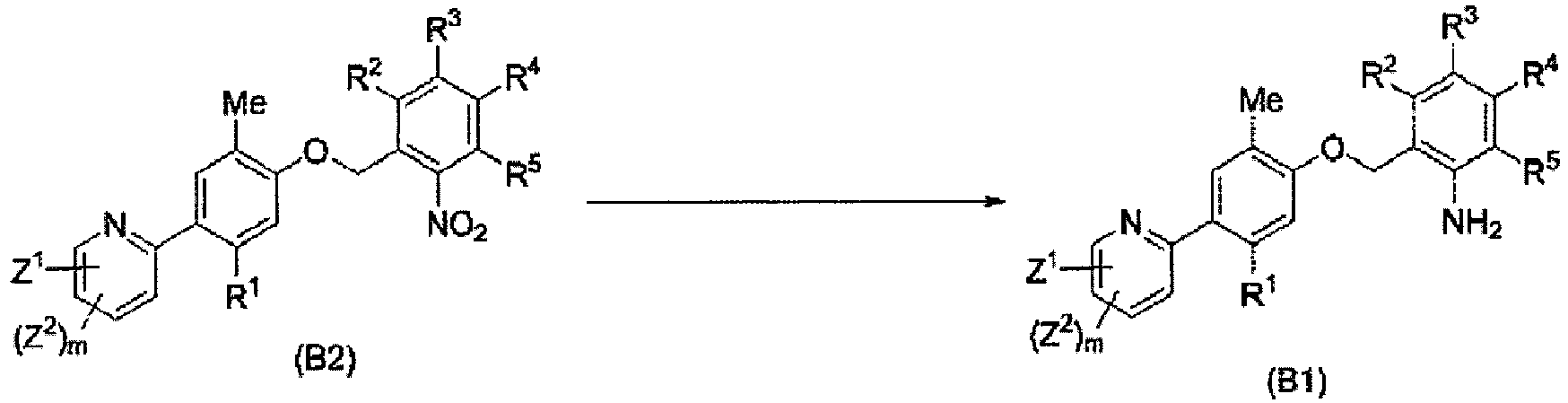
- Compound (B1) can be produced by reacting a compound represented by formula (B2) (hereinafter referred to as Compound (B2)) with the reducing agent in the presence of the metal catalyst in the same manner as Reference Production Method A-3.
- R 1 , R 2 , R 3 , R 4 , R 5 , Z 1 , Z 2 and m have the same meanings as defined above.
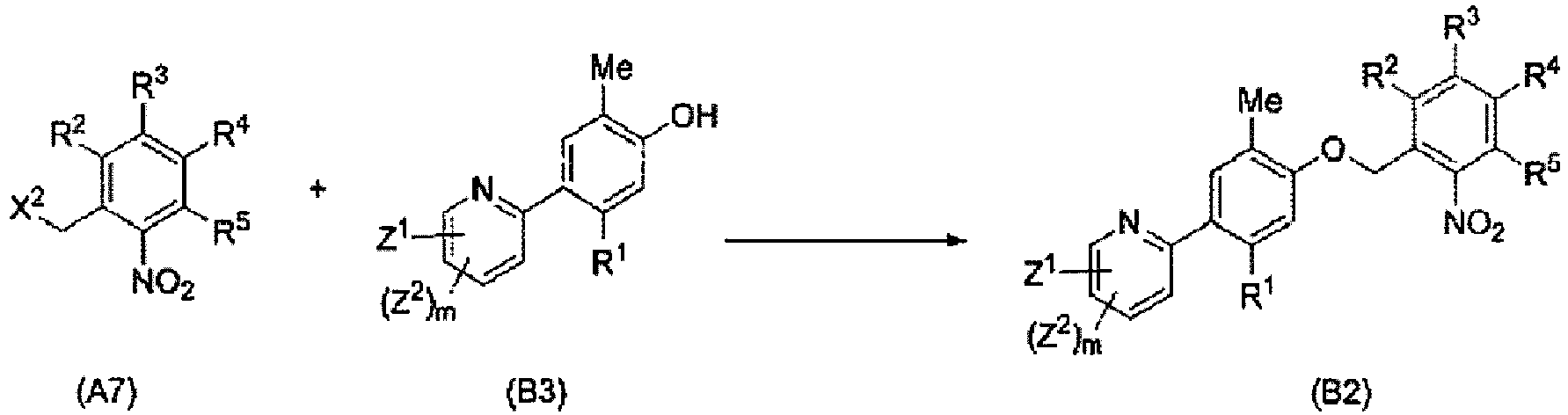
- Compound (B2) can be produced by reacting Compound (A7) with a compound represented by formula (B3) (hereinafter referred to as Compound (B3)) in the presence of a base in the same manner as Reference Production Method A-4.
- a compound represented by formula (B3) hereinafter referred to as Compound (B3)
- R 1 , R 2 , R 3 , R 4 , R 5 , X 2 , Z 1 , Z 2 and m have the same meanings as defined above.
- Compound (B3) can be produced by reacting a compound represented by formula (B4) (hereinafter referred to as Compound (B4)) with a protic acid.
- R 11 represents a C1-C5 alkyl group
- R 1 , Z 1 , Z 2 and m have the same meanings as defined above.
- the reaction is usually carried out in a solvent.
- the solvent include alcohols such as methanol, ethanol, propanol and butanol; water; acetic acid, and mixture thereof.
- protic acids examples include hydrochloric acid, hydrobromic acid and sulfuric acid.
- the reaction temperature of the reaction is usually within a range of -20 to 150°C and the reaction time is usually within a range of 0.1 to 100 hours.
- Compound (B3) can be isolated by carrying out post-treatment operation such as extracting the reaction mixture by using an organic solvent, drying the organic layer, and condensing the organic layer.
- Compound (B4) can be produced by reacting a compound represented by formula (B5) (hereinafter referred to as Compound (B5)) with Compound (A2) in the presence of a base and a palladium catalyst in the same manner as Production Method A.
- Z 11 represents a di(C1-C3 alkoxy)boranyl group, a 4,4,5,5-tetramethyl-1,3,2-dioxaboran-2-yl group or a borono group
- R 1 , R 11 , X 3 , Z 1 , Z 2 and m have the same meanings as defined above.
- Each compound produced in accordance with the above Production Methods and Reference Production Methods can be further purified by known means such as crystallization, recrystallization and chromatography.
- the carbamate compound of the present invention can be use as it is, the present carbamate compound is usually used after being mixed with any of solid carriers, liquid carriers, surfactants, and the like, and optionally adding any of auxiliary agents for formulation, such as stickers, dispersers, and stabilizers, to the carbamate compound in order to formulate wettable powders, water dispersible granules, flowables, granules, dry flowables, emulsifiable concentrates, aqueous solutions, oil solutions, smoking agents, aerosols, microcapsules, or the like.
- the carbamate compound of the present invention is usually included in an amount of 0.1 to 99% by weight, preferably 0.2 to 90% by weight.
- the solid carriers include clays (for example, kaolin, diatomaceous earth, synthetic hydrated silicon dioxide, Fubasami clay, bentonite, and acid clay), talcs, pyrophyllite or other inorganic minerals (for example, sericite, quartz powder, sulfur powder, activated charcoal, calcium carbonate, and hydrated silica) in the form of fine powders or particulates, and examples of the liquid carries include water, alcohols, ketones, hydrocarbons, esters, nitriles, ethers, acid amides and halogenated hydrocarbons.
- clays for example, kaolin, diatomaceous earth, synthetic hydrated silicon dioxide, Fubasami clay, bentonite, and acid clay
- talcs for example, sericite, quartz powder, sulfur powder, activated charcoal, calcium carbonate, and hydrated silica
- the liquid carries include water, alcohols, ketones, hydrocarbons, esters, nitriles, ethers, acid amides and halogenated
- surfactants examples include alkyl sulfates, alkyl sulfonates, alkyl aryl sulfonates, alkyl aryl ethers, and polyoxyethylenated compounds thereof, polyoxyethylene glycol ethers, polyhydric alcohol esters, and sugar alcohol derivatives.
- auxiliary agents for formulation examples include sticking agents, dispersing agents and stabilizers, specifically casein, gelatin, polysaccharides (such as starch, gum arabic, cellulose derivatives and alginic acid), lignin derivatives, bentonite, sugars, watersoluble synthetic polymers (such as polyvinyl alcohols, polyvinylpyrrolidones, and polyacrylic acids), PAP (acidic isopropyl phosphate), BHT (2,6-di-tert-butyl-4-methylphenol), BHA (a mixture of 2-tert-butyl-4-methoxyphenol and 3-tert-butyl-4-methoxyphenol), vegetable oils, mineral oils, fatty acids or fatty acid esters thereof, and the like.
- sticking agents such as gelatin, polysaccharides (such as starch, gum arabic, cellulose derivatives and alginic acid), lignin derivatives, bentonite, sugars, watersoluble synthetic polymers (such as polyvinyl alcohols, poly
- the said formulated carbamate compound of the present invention may be diluted with water or the like at the time of application thereof; however, in which case, the formulated carbamate compound may be applied after being mixed with any of spreading agents such as various oils, such as mineral oils and vegetable oils, and surfactants.
- the spreading agents include Nimbus®, Assist®, Aureo®, Iharol®, Silwet L-77®, BreakThru®, Sundance II®, Induce®, Penetrator®, AgriDex®, Lutensol A8®, NP-7®, Triton®, Nufilm®, Emulgator NP7®, Emulad®, TRITON X 45®, AGRAL 90®, AGROTIN®, ARPON®, EnSpray N®, BANOLE®, and the like.
- the method for applying the carbamate compound of the present invention are not particularly limited, and includes, for example, an application to plants such as a foliage application; an application to soil such as seed disinfection; and an application to area for cultivating plants such as a submerged treatment.
- the carbamate compound of the present invention can be used as an agent for controlling plant diseases in agricultural lands such as fields, paddy fields, lawns and orchards, and can control diseases occurred in the agricultural lands for cultivating the following "plants".
- Crops corn, rice, wheat, barley, rye, oat, sorghum, cotton, soybean, peanut, buckwheat, beet, rapeseed, sunflower, sugar cane, tobacco, and the like;
- Vegetables solanaceous vegetables (for example, eggplant, tomato, pimento, pepper, and potato), cucurbitaceous vegetables (for example, cucumber, pumpkin, zucchini, water melon, and melon), cruciferous vegetables (for example, Japanese radish, white turnip, horseradish, kohlrabi, Chinese cabbage, cabbage, leaf mustard, broccoli, and cauliflower), asteraceous vegetables (for example, burdock, crown daisy, artichoke, and lettuce), liliaceous vegetables (for example, green onion, onion, garlic, and asparagus), ammiaceous vegetables (for example, carrot, parsley, celery, and parsnip), chenopodiaceous vegetables (for example, spinach and Swiss chard), lamiaceous vegetables (for example, Perilla
- Fruits pomaceous fruits (for example, apple, pear, Japanese pear, Chinese quince, and quince), stone fruits (for example, peach, plum, nectarine, Prunus mume, cherry fruit, apricot, and prune), citrus fruits (for example, Citrus unshiu, orange, lemon, lime, and grapefruit), nuts (for example, chestnut, walnuts, hazelnuts, almond, pistachio, cashew nuts, and macadamia nuts), berry fruits (for example, blueberry, cranberry, blackberry, and raspberry), grape, kaki persimmon, olive, Japanese plum, banana, coffee, date palm, coconuts, and the like; Trees other than fruit trees: tea, mulberry, flowering plant, roadside trees (for example, ash, birch, dogwood, Eucalyptus, Ginkgo biloba, lilac, maple, Quercus, poplar, Judas tree, Liquidambar formosana, plane tree, zel
- plants include genetically modified crops.
- plant diseases include plant diseases caused by filamentous fungus, bacteria, virus and the like, and the specific examples are shown below; however, the plant diseases are not limited thereto.
- Rice diseases rice blast (Magnaporthe grisea), brown spot (Cochliobolus miyabeanus), sheath blight (Rhizoctonia solani), bakanae disease (Gibberella fujikuroi), and downy mildew (Sclerophthora macrospora); Wheat diseases: powdery mildew (Erysiphe graminis), fusarium blight (Fusarium gaminearum, F. avenaceum, F. culmorum, Microdochium nivale), rust (Puccinia striiformis, P. graminis, P.
- Thielaviopsis species Thielaviopsis basicola
- Coffee diseases rust (Hemileia vastatrix), leaf spot disease (Cercospora coffeicola); Rapeseed diseases: sclerotinia rot (Sclerotinia sclerotiorum), black spot (Alternaria brassicae), and black leg (Phoma lingam); Sugar cane disease: rust ((Puccinia melanocephela, Puccinia kuehnii), smut (Ustilago scitaminea); Sunflower disease: rust (Puccinia helianthi), downey mildew (Plasmopara halstedii); Citrus diseases: melanose (Diaporthe citri), scab (Elsinoe fawcetti), and fruit rot (Penicillium digitatum, P.
- Phytophthora rot (Phytophthora parasitica Phytophthora citrophthora); Apple diseases: blossom blight (Monilinia mali), canker (Valsa ceratosperma), powdery mildew (Podosphaera leucotricha), alternaria leaf spot (Alternaria alternata apple pathotype), scab (Venturia inaequalis), and bitter rot (Glomerella cingulata), brown spot (Diplocarpon mali), black rot (Botryosphaeria berengeriana); phytophthora rot (Phytophtora cactorum); Pear diseases: scab (Venturia nashicola, V.
- Seed diseases and early growth disease of various crops are caused by Aspergillus, Penicillium, Fusarium, Gibberella, Tricoderma, Thielaviopsis, Rhizopus, Mucor, Corticium, Phoma, Rhizoctonia and Diplodia.
- Bacterial seedling blight of rice Bacterial spot of cucumber; Bacterial wilt of eggplant; Bacterial canker of Citrus and Bacterial soft rot of Chinese cabbage.
- Virus diseases of various diseases mediated by Polymixa and Olpidium Virus diseases of various diseases mediated by Polymixa and Olpidium.
- 1 H-NMR means a proton nuclear magnetic resonance spectrum, in which tetramethylsilane is used as an internal standard material, and chemical shifts ( ⁇ ) are indicated in ppm.
- Compounds HA1001-1 to HA1036-236 are the carbamate compounds, wherein E means any one of substituent numbers 1 to 236, as shown below.
- E means any one of substituent numbers 1 to 236, as shown below.
- Me represents a methyl group
- Et represents an ethyl group
- F represents a fluorine atom
- Cl represents a chlorine atom
- Br represent a bromine atom
- I represents an iodine atom
- PYR2 represents a pyridine-2-yl group.
- barley cultivar: Mikamo-Golden
- water was added so as to adjust the water dilution to a predetermined concentration (500 ppm), and the adjusted dilution was sprayed over stems and leaves of the barley so that the liquid sufficiently adhered to surfaces of the leaves of the barley. After being sprayed, the barley was air-dried.
- wheat (cultivar: Shirogane) was sowed and grown in a greenhouse for 9 days.
- water was added so as to adjust the water dilution to a predetermined concentration (500 ppm), and the adjusted dilution was sprayed over stems and leaves of the barley so that the liquid sufficiently adhered to surfaces of the leaves of the wheat. After being sprayed, the wheat was air-dried so as to dry the leaves. After the wheat was cultivated at 20°C for 5 days under illumination, and then inoculated by sprinkling with spores of wheat rust fungus (Puccinia recondita).
- the wheat was left to stand at 23°C for one day under dark and high humidity condition, and cultivated under illumination at 20°C for 8 days, and then the area of the lesion was investigated. As a result, it was found that the area of the lesion on the wheat treated with the present Compound 1, 2, 3, 4, 6, 7, 8, 10 or 12 were 30% or less than those on untreated wheat.
- rice cultivar: Nipponbare
- water was added so as to adjust the water dilution to a predetermined concentration (500 ppm), and the adjusted dilution was sprayed over stems and leaves of the rice so that the liquid sufficiently adhered to surfaces of the leaves of the rice.
- the rice After being sprayed, the rice was air-dried; and the rice subjected to the spray treatment was placed in contact with rice seedling (cultivar: Nipponbare) infected by rice blast fungus (Magnaporthe grisea), and these two plants were left to stand for 6 days at 24°C in the daytime and 20°C at night under high humidity condition; and then the area of the lesion of the rice was investigated.
- rice seedling plant: Nipponbare
- Magnnaporthe grisea infected by rice blast fungus
- water was added so as to adjust the water dilution to a predetermined concentration (500 ppm), and the adjusted dilution was sprayed over stems and leaves of the kidney bean so that the liquid sufficiently adhered to surfaces of the leaves of the kidney bean.
- the kidney bean was air-dried, and a PDA medium containing hyphae of the kidney bean stem rot fungus (Sclerotinia sclerotiorum) was placed on the leaves of the kidney bean.
- the kidney beans were left to stand under high humidity condition only at night. Four days after the inoculation, the area of the lesion were investigated. As a result, the area of the lesion on the kidney bean treated with the present compound 1, 2, 3, 4, 6, 7, 8, 9, 10, 11 or 12 was 30% or less than those on untreated kidney bean.
- wheat (cultivar: Apogee) was sowed and grown in a greenhouse for 10 days.
- water was added so as to adjust the water dilution to a predetermined concentration (500 ppm), and the adjusted dilution was sprayed over stems and leaves of the wheat so that the liquid sufficiently adhered to surfaces of the leaves of the wheat. After being sprayed, the wheat was air-dried. After 4 days, an aqueous suspension containing spores of wheat speckled leaf blotch fungus (Septoria tritici) was sprayed to inoculate the spores.
- the wheat was left to stand at 18°C under high humidity condition for 3 days and left to stand under illumination for 14 to 18 days, and then the area of the lesion was investigated.
- the area of the lesion on the wheat treated with the present compound 1, 2, 4, 7, 10 or 12 were 30% or less than those on untreated wheat.
- cucumber cultivar: Sagami Hanjiro
- water was added so as to adjust the water dilution to a predetermined concentration (500 ppm), and the adjusted dilution was sprayed over stems and leaves of the cucumber so that the liquid sufficiently adhered to surfaces of the leaves of the cucumber.
- the cucumber After being sprayed, the cucumber was air-dried, and then inoculated by being sprinkled with spores of cucumber powdery mildew fungus (Sphaerotheca fuliginea, a QoI-resistant strain in which, among the genes encoding cytochrome b, the amino acid residue at position 143 of cytochrome b was mutated from glycine to alanine).
- the cucumber After the inoculation, the cucumber was cultivated in a greenhouse at 24°C in the daytime and 20°C at night for 8 days, and then the area of the lesion was investigated. As a result, the area of the lesion on the cucumber treated with the present Compound 1, 2, 3, 4, 6, 7, 8, 10, 11 or 12 were 30% or less than those on untreated cucumber.
- the carbamate compounds of the present invention are effective at controlling plant diseases, and are useful as active ingredients of plant disease controlling agents.
Landscapes
- Life Sciences & Earth Sciences (AREA)
- Chemical & Material Sciences (AREA)
- Organic Chemistry (AREA)
- Environmental Sciences (AREA)
- Zoology (AREA)
- Engineering & Computer Science (AREA)
- Pest Control & Pesticides (AREA)
- Plant Pathology (AREA)
- Wood Science & Technology (AREA)
- Agronomy & Crop Science (AREA)
- General Health & Medical Sciences (AREA)
- Dentistry (AREA)
- Health & Medical Sciences (AREA)
- Microbiology (AREA)
- Mycology (AREA)
- Chemical Kinetics & Catalysis (AREA)
- General Chemical & Material Sciences (AREA)
- Agricultural Chemicals And Associated Chemicals (AREA)
- Pyridine Compounds (AREA)
- Organic Low-Molecular-Weight Compounds And Preparation Thereof (AREA)
Abstract
wherein,
R1 represents a hydrogen atom or a C1-C3 alkyl group;
R2, R3, R4 and R5 each independently represents a hydrogen atom, a halogen atom, a C1-C3 alkyl group optionally having one or more halogen atoms, a C3-C4 cycloalkyl group optionally having one or more halogen atoms or a C1-C3 alkoxy group optionally having one or more halogen atoms;
Z1 represents a halogen atom; and
Z2 represents a halogen atom or a C1-C3 alkyl group; and
m represents any one of integers from 0 to 3;
has an excellent effect of controlling plant diseases.
Description
- The present invention relates to carbamate compounds and use thereof.
- For example, previously, a compound represented by the following formula (X):

US Patent No. 5824705 ). -
- [PTL 1]
-
US Patent No. 5824705 - The present invention provides compounds having an excellent effect of controlling plant diseases.
- According to the present invention, a carbamate compound represented by formula (I):

- R1 represents a hydrogen atom or a C1-C3 alkyl group;
- R2, R3, R4 and R5 each independently represents a hydrogen atom, a halogen atom, a C1-C3 alkyl group optionally having one or more halogen atoms, a C3-C4 cycloalkyl group optionally having one or more halogen atoms, or a C1-C3 alkoxy group optionally having one or more halogen atoms;
- Z1 represents a halogen atom; and
- Z2 represents a halogen atom or a C1-C3 alkyl group; and
- m represents any one of integers from 0 to 3, provided that when m is 2 or 3, two or three of Z2 may be the same or different;
- In the expression of "optionally having one or more halogen atoms", in the case of two or more halogen atoms, the halogen atoms may be same or different.
- In the present specification, the expressions of "C1-C3", "C3-C4" and "C1-C5" mean that the number of the carbon atoms is from 1 to 3, from 3 to 4, and from 1 to 5, respectively.
- The halogen atom is a fluorine atom, a chlorine atom, a bromine atom or an iodine atom.
- As the embodiment of the present carbamate compounds are exemplified the following compounds.
- In the present invention, the carbamate compounds include:
- a carbamate compound, wherein R1 is a hydrogen atom or a methyl group;
- a carbamate compound, wherein R1 is a hydrogen atom;
- a carbamate compound, wherein R1 is a methyl group;
- a carbamate compound, wherein R2, R3, R4 and R5 are hydrogen atoms;
- a carbamate compound, wherein R2 is a halogen atom, a C1-C3 alkyl group optionally having one or more halogen atoms, a C3-C4 cycloalkyl group optionally having one or more halogen atoms or a C1-C3 alkoxy group optionally having one or more halogen atoms, and R3, R4 and R5 are hydrogen atoms;
- a carbamate compound, wherein R2 is a halogen atom, and R3, R4 and R5 are hydrogen atoms;
- a carbamate compound, wherein R2 is a C1-C3 alkyl group optionally having one or more halogen atoms, and R3, R4 and R5 are hydrogen atoms;
- a carbamate compound, wherein R2 is a C3-C4 cycloalkyl group optionally having one or more halogen atoms, and R3, R4 and R5 are hydrogen atoms;
- a carbamate compound, wherein R2 is a C1-C3 alkoxy group optionally having one or more halogen atoms, and R3, R4 and R5 are hydrogen atoms;
- a carbamate compound, wherein R5 is a halogen atom, a C1-C3 alkyl group optionally having one or more halogen atoms, a C3-C4 cycloalkyl group optionally having one or more halogen atoms or a C1-C3 alkoxy group optionally having one or more halogen atoms, and R2, R3 and R4 are hydrogen atoms;
- a carbamate compound, wherein R5 is a halogen atom, and R2, R3 and R4 are hydrogen atoms;
- a carbamate compound, wherein R5 is a C1-C3 alkyl group optionally having one or more halogen atoms, and R2, R3 and R4 are hydrogen atoms;
- a carbamate compound, wherein R5 is a C3-C4 cycloalkyl group optionally having one or more halogen atoms, and R2, R3 and R4 are hydrogen atoms;
- a carbamate compound, wherein R5 is a C1-C3 alkoxy group optionally having one or more halogen atoms, and R2, R3 and R4 are hydrogen atoms;
- a carbamate compound, wherein R1 is a hydrogen atom, R2 is a C1-C3 alkyl group optionally having one or more halogen atoms, R3, R4 and R5 are hydrogen atoms, and m is 0 or 1;
- a carbamate compound, wherein R2, R3, R4 and R5 each independently represents a hydrogen atom or a C1-C3 alkyl group, m is 0 or 1 and Z2 is a C1-C3 alkyl group;
- a carbamate compound, wherein R1 is a hydrogen atom, R2, R3, R4 and R5 each independently represents a hydrogen atom or a C1-C3 alkyl group, and m is 0 or 1;
- a carbamate compound, wherein R1 is a hydrogen atom, R2 is a C1-C3 alkyl group optionally having one or more halogen atoms, R3, R4 and R5 are hydrogen atoms, and m is 0;
- a carbamate compound, wherein R1 is a hydrogen atom, R2, R3, R4 and R5 are hydrogen atoms, halogen atoms or methyl groups, and m is 0; and
- a carbamate compound, wherein R1 is a hydrogen atom, R2, R3, R4, and R5 are hydrogen atoms, halogen atoms or methyl groups, Z2 is a methyl group, and m is 1.
- The carbamate compounds of the present invention can be produced by the following Production Methods.
- One of the carbamate compounds of the present invention can be produced by reacting a compound represented by formula (A1) (hereinafter referred to as Compound (A1)) with a compound represented by formula (A2) (hereinafter referred to as Compound (A2)) in the presence of a base and a palladium catalyst

- The reaction is usually carried out in a solvent. Examples of the solvent include hydrocarbons such as hexane, cyclohexane, toluene, and xylene; ethers such as diethyl ether, tetrahydrofuran, 1,4-dioxane, ethylene glycol dimethyl ether, anisole, methyl tert-butyl ether and diisopropyl ether; halogenated hydrocarbons such as chloroform, 1,2-dichloroethane and chlorobenzene; acid amides such as N,N-dimethylformamide, 1,3-dimethyl-2-imidazolidinone and N-methylpyrrolidone; esters such as ethyl acetate and methyl acetate; sulfoxides such as dimethyl sulfoxide; nitriles such as acetonitrile and propionitrile; ketones such as acetone, ethyl methyl ketone and isobutyl methyl ketone; water and mixture thereof.
- Examples of the palladium catalyst include palladium(II) acetate, tetrakis(triphenyphospine)palladium(0), tris(dibenzylideneacetone)-dipalladium(0) and [1,1'-bis(dipheylphosphino)ferrocene]palladium(II) dichloride dichloromethane adduct.
- Examples of the base include alkali metal carbonates such as lithium carbonate, sodium carbonate, potassium carbonate and cesium carbonate; alkali metal hydrogen carbonates such as lithium hydrogen carbonate, sodium hydrogen carbonate, potassium hydrogen carbonate, cesium hydrogen carbonate; alkali metal acetate such as potassium acetate and potassium phosphate tribasic.
- In the reaction, usually, 1 to 10 moles of Compound (A2) is used , 0.0001 to 1 mole of the palladium catalyst is used and 1 to 10 moles of the base is used ,per mole of Compound (A1).
- The reaction temperature of the reaction is usually within a range of 0 to 150°C and the reaction time is usually within a range of 0.1 to 24 hours.
- After the completion of the reaction, the carbamate compound of the present invention can be isolated by carrying out post-treatment operation such as extracting the reaction mixture by using an organic solvent, drying the organic layer, and condensing the organic layer.
- Another carbamate compound of the present invention can be produced by reacting a compound represented by formula (B1) (hereinafter referred to as Compound (B1)) with methyl chloroformate.

- The reaction is usually carried out in a solvent. Examples of the solvent include hydrocarbons, ethers, halogenated hydrocarbons, acid amides, esters, sulfoxides, ketones, nitriles, and water and mixture thereof as described in Production Method A.
- In the reaction, usually, 1 to 10 moles of methyl cloroformate is used per mole of Compound (B1).
- The reaction temperature of the reaction is usually within a range of -20 to 150°C and the reaction time is usually within a range of 0.1 to 24 hours.
- To the reaction, organic bases such as triethylamine, N,N'-diisopropylethylamine and pyridine; bases such as alkali metal carbonate and alkali metal hydrogen carbonate may be added, and 0.05 to 5 moles of the base is usually usedper mole of Compound (B1).
- After the completion of the reaction, the carbamate compound of the present invention can be isolated by carrying out post-treatment operation such as extracting the reaction mixture by using an organic solvent, drying the organic layer, and condensing the organic layer.
- The process for producing Intermediate compound will be described.
- Compound (A1) can be produced by reacting a compound represented by formula (A3) (hereinafter referred to as Compound (A3)) with a boron compound in the presence of a palladium catalyst in accordance with the Miyaura-Ishiyama Borylation reaction. It can be also referred to Angewandte Chemie, International Edition, 46, 5359-5363 (2007).

- wherein, X1 represents a chlorine atom, a bromine atom or an iodine atom, and R1, R2, R3, R4, R5 and Z10 have the same meanings as defined above.
- Compound (A3) can be produced by reacting a compound represented by formula (A4) (hereinafter referred to as Compound (A4)) with methyl chloroformate in the same manner as Production Method B.

- Compound (A4) can be produced by reacting a compound represented by formula (A5) (hereinafter referred to as Compound (A5)) with a reducing agent in the presence of a catalyst.

- The reaction is usually carried out in a solvent. Examples of the solvent include hydrocarbons such as hexane, cyclohexane, toluene, and xylene; ethers such as diethyl ether, tetrahydrofuran, 1,4-dioxane, ethylene glycol dimethyl ether, anisole, methyl tert-butyl ether and diisopropyl ether; halogenated hydrocarbons such as chloroform, 1,2-dichloroethane and chlorobenzene; alcohols such as methanol, ethanol, propanol and butanol; and mixture thereof.
- Examples of the reducing agent include potassium borohydride and sodium borohydride.
- Examples of the catalyst include copper(I) chloride, iron powder and palladium.
- In the reaction, 1 to 10 moles of the reducing agent is usually used and 0.5 to 10 moles of the catalyst is usually used per mole of Compound (A5).
- The reaction temperature of the reaction is usually within a range of -20 to 150°C and the reaction time is usually within a range of 0.1 to 24 hours.
- After the completion of the reaction, Compound (A4) can be isolated by carrying out post-treatment operation such as extracting the reaction mixture by using an organic solvent, drying the organic layer, and condensing the organic layer.
- Compound (A5) can be produced by reacting a compound represented by formula (A6) (hereinafter referred to as Compound (A6)) with a compound represented by formula (A7) (hereinafter referred to as Compound (A7)) in the presence of a base.

- The reaction can be carried out in accordance with Production Method N of
US Patent Application Publication No. 2015/203511 . - Compound (B1) can be produced by reacting a compound represented by formula (B2) (hereinafter referred to as Compound (B2)) with the reducing agent in the presence of the metal catalyst in the same manner as Reference Production Method A-3.
- Compound (B2) can be produced by reacting Compound (A7) with a compound represented by formula (B3) (hereinafter referred to as Compound (B3)) in the presence of a base in the same manner as Reference Production Method A-4.
- Compound (B3) can be produced by reacting a compound represented by formula (B4) (hereinafter referred to as Compound (B4)) with a protic acid.

- The reaction is usually carried out in a solvent. Examples of the solvent include alcohols such as methanol, ethanol, propanol and butanol; water; acetic acid, and mixture thereof.
- Examples of the protic acids include hydrochloric acid, hydrobromic acid and sulfuric acid.
- In the reaction, a large excess amount of the protic acid is usually used.
- The reaction temperature of the reaction is usually within a range of -20 to 150°C and the reaction time is usually within a range of 0.1 to 100 hours.
- After the completion of the reaction, Compound (B3) can be isolated by carrying out post-treatment operation such as extracting the reaction mixture by using an organic solvent, drying the organic layer, and condensing the organic layer.
- Compound (B4) can be produced by reacting a compound represented by formula (B5) (hereinafter referred to as Compound (B5)) with Compound (A2) in the presence of a base and a palladium catalyst in the same manner as Production Method A.

- Each compound produced in accordance with the above Production Methods and Reference Production Methods can be further purified by known means such as crystallization, recrystallization and chromatography.
- Although the carbamate compound of the present invention can be use as it is, the present carbamate compound is usually used after being mixed with any of solid carriers, liquid carriers, surfactants, and the like, and optionally adding any of auxiliary agents for formulation, such as stickers, dispersers, and stabilizers, to the carbamate compound in order to formulate wettable powders, water dispersible granules, flowables, granules, dry flowables, emulsifiable concentrates, aqueous solutions, oil solutions, smoking agents, aerosols, microcapsules, or the like. In these formulations, the carbamate compound of the present invention is usually included in an amount of 0.1 to 99% by weight, preferably 0.2 to 90% by weight.
- Examples of the solid carriers include clays (for example, kaolin, diatomaceous earth, synthetic hydrated silicon dioxide, Fubasami clay, bentonite, and acid clay), talcs, pyrophyllite or other inorganic minerals (for example, sericite, quartz powder, sulfur powder, activated charcoal, calcium carbonate, and hydrated silica) in the form of fine powders or particulates, and examples of the liquid carries include water, alcohols, ketones, hydrocarbons, esters, nitriles, ethers, acid amides and halogenated hydrocarbons.
- Examples of the surfactants include alkyl sulfates, alkyl sulfonates, alkyl aryl sulfonates, alkyl aryl ethers, and polyoxyethylenated compounds thereof, polyoxyethylene glycol ethers, polyhydric alcohol esters, and sugar alcohol derivatives.
- Examples of other auxiliary agents for formulation include sticking agents, dispersing agents and stabilizers, specifically casein, gelatin, polysaccharides (such as starch, gum arabic, cellulose derivatives and alginic acid), lignin derivatives, bentonite, sugars, watersoluble synthetic polymers (such as polyvinyl alcohols, polyvinylpyrrolidones, and polyacrylic acids), PAP (acidic isopropyl phosphate), BHT (2,6-di-tert-butyl-4-methylphenol), BHA (a mixture of 2-tert-butyl-4-methoxyphenol and 3-tert-butyl-4-methoxyphenol), vegetable oils, mineral oils, fatty acids or fatty acid esters thereof, and the like.
- The said formulated carbamate compound of the present invention may be diluted with water or the like at the time of application thereof; however, in which case, the formulated carbamate compound may be applied after being mixed with any of spreading agents such as various oils, such as mineral oils and vegetable oils, and surfactants. Specific examples of the spreading agents, which can be used as the mixture, include Nimbus®, Assist®, Aureo®, Iharol®, Silwet L-77®, BreakThru®, Sundance II®, Induce®, Penetrator®, AgriDex®, Lutensol A8®, NP-7®, Triton®, Nufilm®, Emulgator NP7®, Emulad®, TRITON X 45®, AGRAL 90®, AGROTIN®, ARPON®, EnSpray N®, BANOLE®, and the like.
- The method for applying the carbamate compound of the present invention are not particularly limited, and includes, for example, an application to plants such as a foliage application; an application to soil such as seed disinfection; and an application to area for cultivating plants such as a submerged treatment.
- The carbamate compound of the present invention can be used as an agent for controlling plant diseases in agricultural lands such as fields, paddy fields, lawns and orchards, and can control diseases occurred in the agricultural lands for cultivating the following "plants".
- Crops: corn, rice, wheat, barley, rye, oat, sorghum, cotton, soybean, peanut, buckwheat, beet, rapeseed, sunflower, sugar cane, tobacco, and the like; Vegetables: solanaceous vegetables (for example, eggplant, tomato, pimento, pepper, and potato), cucurbitaceous vegetables (for example, cucumber, pumpkin, zucchini, water melon, and melon), cruciferous vegetables (for example, Japanese radish, white turnip, horseradish, kohlrabi, Chinese cabbage, cabbage, leaf mustard, broccoli, and cauliflower), asteraceous vegetables (for example, burdock, crown daisy, artichoke, and lettuce), liliaceous vegetables (for example, green onion, onion, garlic, and asparagus), ammiaceous vegetables (for example, carrot, parsley, celery, and parsnip), chenopodiaceous vegetables (for example, spinach and Swiss chard), lamiaceous vegetables (for example, Perilla frutescens, mint, and basil), strawberry, sweet potato, Dioscorea japonica, colocasia, and the like;
- Fruits: pomaceous fruits (for example, apple, pear, Japanese pear, Chinese quince, and quince), stone fruits (for example, peach, plum, nectarine, Prunus mume, cherry fruit, apricot, and prune), citrus fruits (for example, Citrus unshiu, orange, lemon, lime, and grapefruit), nuts (for example, chestnut, walnuts, hazelnuts, almond, pistachio, cashew nuts, and macadamia nuts), berry fruits (for example, blueberry, cranberry, blackberry, and raspberry), grape, kaki persimmon, olive, Japanese plum, banana, coffee, date palm, coconuts, and the like;
Trees other than fruit trees: tea, mulberry, flowering plant, roadside trees (for example, ash, birch, dogwood, Eucalyptus, Ginkgo biloba, lilac, maple, Quercus, poplar, Judas tree, Liquidambar formosana, plane tree, zelkova, Japanese arborvitae, fir wood, hemlock, juniper, Pinus, Picea, and Taxus cuspidate); and the like. - The above-mentioned "plants" include genetically modified crops.
- Examples of plant diseases include plant diseases caused by filamentous fungus, bacteria, virus and the like, and the specific examples are shown below; however, the plant diseases are not limited thereto.
- Rice diseases: rice blast (Magnaporthe grisea), brown spot (Cochliobolus miyabeanus), sheath blight (Rhizoctonia solani), bakanae disease (Gibberella fujikuroi), and downy mildew (Sclerophthora macrospora); Wheat diseases: powdery mildew (Erysiphe graminis), fusarium blight (Fusarium gaminearum, F. avenaceum, F. culmorum, Microdochium nivale), rust (Puccinia striiformis, P. graminis, P. recondita), snow mould (Micronectriella nivale), typhulasnow blight (Typhula sp.), loose smut (Ustilago tritici), stinking smut (Tilletia caries, T. controversa), eyespot (Pseudocercosporella herpotrichoides), leaf blotch (Septoria tritici), glume blotch (Stagonospora nodorum), tan spot (Pyrenophora triticirepentis), seeding blight caused by the genus Rhizoctonia (Rhizoctonia solani), and take all disease (Gaeumannomyces graminis); Barly diseases: powdery mildew (Erysiphe graminis), fusarium blight (Fusarium gaminearum, F. avenaceum, F. culmorum, Microdochium nivale), rust (Puccinia striiformis, P. graminis, P. hordei), loose smut (Ustilago nuda), scald (Rhynchosporium secalis), net blotch (Pyrenophora teres), spot blotch (Cochliobolus sativus), leaf stripe (Pyrenophora graminea), Ramularia disease (Ramularia collo-cygni), and seeding blight caused by the genus Rhizoctonia (Rhizoctonia solani); Corn diseases: rust (Puccinia sorghi), southern rust (Puccinia polysora), northern leaf blight (Setosphaeria turcica), topical rust (Physopella zeae), southern leaf blight (Cochliobolus heterostrophus), anthracnose (Colletotrichum graminicola), gray leaf spot (Cercospora zeae-maydis), eyespot (Kabatiella zeae), and phaeosphaeria leaf spot (Phaeosphaeria maydis), diplodia disease (Stenocarpella maydis, Stenocarpella macrospora), Stalk rot disease (Fusarium graminearum, Fusarium verticilioides, Colletotrichum graminicola), leaf and stem smut (Ustilago maydis); Cotton diseases: anthracnose (Colletotrichum gossypii), grey mildew (Ramuraria areola), and alternaria leaf spot (Alternaria macrospora, A. gossypii); black root rot caused by Thielaviopsis species (Thielaviopsis basicola); Coffee diseases: rust (Hemileia vastatrix), leaf spot disease (Cercospora coffeicola); Rapeseed diseases: sclerotinia rot (Sclerotinia sclerotiorum), black spot (Alternaria brassicae), and black leg (Phoma lingam); Sugar cane disease: rust ((Puccinia melanocephela, Puccinia kuehnii), smut (Ustilago scitaminea); Sunflower disease: rust (Puccinia helianthi), downey mildew (Plasmopara halstedii); Citrus diseases: melanose (Diaporthe citri), scab (Elsinoe fawcetti), and fruit rot (Penicillium digitatum, P. italicum); Phytophthora rot (Phytophthora parasitica Phytophthora citrophthora); Apple diseases: blossom blight (Monilinia mali), canker (Valsa ceratosperma), powdery mildew (Podosphaera leucotricha), alternaria leaf spot (Alternaria alternata apple pathotype), scab (Venturia inaequalis), and bitter rot (Glomerella cingulata), brown spot (Diplocarpon mali), black rot (Botryosphaeria berengeriana); phytophthora rot (Phytophtora cactorum); Pear diseases: scab (Venturia nashicola, V. pirina), black spot (Alternaria alternata Japanese pear pathotype), and rust (Gymnosporangium haraeanum); Peach diseases: brown rot (Monilinia fructicola), scab (Cladosporium carpophilum), and Phomopsis rot (Phomopsis sp.); Grapes diseases: anthracnose (Elsinoe ampelina), ripe rot (Glomerella cingulata, Colletotrichum acutatum), powdery mildew (Uncinula necator), rust (Phakopsora ampelopsidis), black rot (Guignardia bidwellii), and downy mildew (Plasmopara viticola); Japanese persimmon diseases: anthracnose (Gloeosporium kaki) and leaf spot (Cercospora kaki, Mycosphaerella nawae); Diseases of gourd family: anthracnose (Colletotrichum lagenarium), powdery mildew (Sphaerotheca fuliginea), gummy stem blight (Didymella bryoniae), target spot (Corynespora cassiicola), fusarium wilt (Fusarium oxysporum), downy mildew (Pseudoperonospora cubensis), phytophthora rot (Phytophthora sp.), and damping-off (Pythium sp.); Tomato diseases: early blight (Alternaria solani), leaf mold (Cladosporium fulvum), leaf mold (Pseudocercospora fuligena), and late blight (Phytophthora infestans); Eggplant diseases: brown spot (Phomopsis vexans) and powdery mildew (Erysiphe cichoracearum); Cruciferous vegetables diseases: alternaria leaf spot (Alternaria japonica), white spot (Cercosporella brassicae), clubroot (Plasmodiophora brassicae), and downy mildew (Peronospora parasitica); Welsh onion diseases: rust (Puccinia allii); Soybean diseases: purple stain (Cercospora kikuchii), sphaceloma scad (Elsinoe glycines), pod and stem blight (Diaporthe phaseolorum var. sojae), rust (phakopsora pachyrhizi), target spot (Corynespora cassiicola), anthracnose (Colletotrithum glycines, C. truncatum), Rhizoctonia aerial blight (Rhizoctonia solani), septoria brown spot (Septoria glycines), and frog eye leaf spot (Cercospora sojina); sclerotinia rot (Sclerotinia sclerotiorum), powdery mildew (Microspaera diffusa), phytophthora rot (Phytophthora sojae), downey mildew (Peronospora manshurica), sudden death disease (Fusarium virguliforme); Kidney beans diseases: stem rot (Sclerotinia sclerotiorum), watery soft rot (Sclerotinia sclerotiorum), rust (Uromyces appendiculatus), angular leaf spot (Phaeoisariopsis griseola), anthracnose (Colletotrichum lindemthianum); Peanut diseases: early leaf spot (Cercospora personata), late leaf spot (Cercospora arachidicola), and southern blight (Sclerotium rolfsii); Garden pea diseases: powdery mildew (Erysiphe pisi); Potato diseases: early blight (Alternaria solani), late blight (Phytophthora infestans), pink rot (Phytophthora erythroseptica), powdery scab (Spongospora subterranean f. sp. subterranean), verticilliun wilt (Verticillium alboatrum, V. dahlia, V. nigrescens); Strawberry diseases: powdery mildew (Sphaerotheca humuli); Tea diseases: net blister blight (Exobasidium reticulatum), white scab (Elsinoe leucospila), gray blight (Pestalotiopsis sp.), and anthracnose (Colletotrichum theaesinensis); Tabacco diseases: brown spot (Alternaria longipes), powdery mildew (Erysiphe cichoracearum), anthracnose (Colletotrichum tabacum), downy mildew (Peronospora tabacina), and black shank (Phytophthora nicotianae); Sugar beet diseases: cercospora leaf spot (Cercospora beticola), leaf blight (Thanatephorus cucumeris), root rot (Thanatephorus cucumeris), and aphanomyces root rot (Aphanomyces cochlioides); Rose diseases: black spot (Diplocarpon rosae) and powdery mildew (Sphaerotheca pannosa); Chrysanthemum diseases: leaf blight (Septoria chrysanthemiindici) and white rust (Puccinia horiana); Onion diseases: botrytis leaf blight (Botrytis cinerea, B. byssoidea, B. squamosa), graymold neck rot (Botrytis slli), and small sclerotial rot (Botrytis squamosa); various crops diseases: gray mold (Botrytis cinerea) and sclerotinia rot (Sclerotinia sclerotiorum); Japanese radish diseases: alternaria leaf spot (Alternaria brassicicola); Turfgrass diseases: dollar spot (Sclerotinia homeocarpa) and brown patch and large patch (Rhizoctonia solani); and Banana diseases: Sigatoka disease (Mycosphaerella fijiensis, Mycosphaerella musicola).
- Seed diseases and early growth disease of various crops are caused by Aspergillus, Penicillium, Fusarium, Gibberella, Tricoderma, Thielaviopsis, Rhizopus, Mucor, Corticium, Phoma, Rhizoctonia and Diplodia.
- Bacterial seedling blight of rice; Bacterial spot of cucumber; Bacterial wilt of eggplant; Bacterial canker of Citrus and Bacterial soft rot of Chinese cabbage.
- Virus diseases of various diseases mediated by Polymixa and Olpidium.
- The present invention will be described in more detail below by way of Production Examples, Reference Production Examples, Formulation Examples and Test Examples; however, the present invention is not limited to these Examples.
- 1H-NMR means a proton nuclear magnetic resonance spectrum, in which tetramethylsilane is used as an internal standard material, and chemical shifts (δ) are indicated in ppm.
- A mixture of 0.82 g of Intermediate (17A) described in the following Reference Production Example 4, 0.44 g of 2-chloro-5-fluoro-6-methylpyridine, 0.04 g of [1,1'-bis(diphenylphosphino)ferrocene] palladium(II) dichloride dichloromethane adduct, 1.28 g of potassium phosphate tribasic, 8 ml of 1,2-dimethoxyethane and 0.8 ml of water was stirred at 85°C for 4 hours. After the reaction mixture was cooled, the residue was obtained by being condensed and was subjected to silica gel column chromatography to give 0.79 g of a present Compound 1.

- Compounds represented by formula (a):

Table 1 Z21 Z22 Z23 Z24 Present Compound 2 Cl H H H Present Compound 3 H Cl H H Present Compound 4 H H Cl H Present Compound 5 Me F H H Present Compound 12 H F Me H -
- The present Compound 2
1H-NMR (CDCl3) δ: 7.87-7.83 (2H, m), 7.79 (1H, brs), 7.68 (1H, t), 7.61-7.59 (1H, m), 7.50 (1H, brs), 7.31-7.27 (1H, m), 7.22-7.20 (1H, m), 7.06 (1H, d), 7.00 (1H, d), 5.16 (2H, s), 3.75 (3H, s), 2.42 (3H, s), 2.29 (3H, s). The present Compound 3
1H-NMR (CDCl3) δ: 8.60-8.60 (1H, m), 7.82-7.74 (3H, m), 7.71-7.68 (1H, m), 7.63 (1H, d), 7.49 (1H, brs), 7.31-7.26 (1H, m), 7.08 (1H, d), 7.00 (1H, d), 5.16 (2H, s), 3.75 (3H, s), 2.42 (3H, s), 2.29 (3H, s). - The present Compound 4
1H-NMR (CDCl3) δ: 8.55 (1H, d), 7.85-7.74 (3H, m), 7.69 (1H, d), 7.49 (1H, brs), 7.29 (1H, t), 7.20 (1H, dd), 7.08 (1H, d), 7.00 (1H, d), 5.16 (2H, s), 3.75 (3H, s), 2.42 (3H, s), 2.29 (3H, s). - The present Compound 5
1H-NMR (CDCl3) δ: 7.78-7.74 (3H, m), 7.52-7.46 (2H, m), 7.35 (1H, dd), 7.30-7.26 (1H, m), 7.05 (1H, d), 6.99 (1H, d), 5.15 (2H, s), 3.75 (3H, s), 2.59 (3H, s), 2.42 (3H, s), 2.29 (3H, s). - The present Compound 12
1H-NMR (CDCl3) δ: 8.39 (1H, s), 7.78-7.74 (3H, m), 7.52-7.51 (2H, m), 7.30-7.28 (1H, m), 7.06 (1H, d, J = 8.4 Hz), 6.99 (1H, d, J = 7.5 Hz), 5.15 (2H, s), 3.75 (3H, s), 2.42 (3H, s), 2.37 (3H, s), 2.29 (3H, s). - The compounds produced in accordance with Reference Production Example 1 and their physical property values will be shown below.
- Compounds represented by formula (b):

Table 2 R21 R31 R41 R51 Present Compound 6 H H H H Present Compound 7 Me H H H Present Compound 8 H Me H H Present Compound 9 H H Me H Present Compound 10 H H H Me -
- The present Compound 6
]1H-NMR (CDCl3) δ: 8.50 (1H, d), 8.02 (1H, brs), 7.79 (1H, s), 7.74 (1H, dd), 7.70-7.64 (2H, m), 7.46-7.37 (2H, m), 7.32 (1H, d), 7.10 (1H, t), 7.03 (1H, d), 5.15 (2H, s), 3.77 (3H, s), 2.33 (3H, s). - The present Compound 7
1H-NMR (CDCl3) δ: 8.51 (1H, d), 7.79-7.76 (3H, m), 7.67 (1H, dd), 7.52 (1H, brs), 7.48-7.43 (1H, m), 7.30-7.27 (1H, m), 7.08 (1H, d), 7.00 (1H, d), 5.16 (2H, s), 3.75 (3H, s), 2.42 (3H, s), 2.30 (3H, s). - The present Compound 8
1H-NMR (CDCl3) δ: 8.50 (1H, d), 7.85 (1H, brs), 7.78 (1H, s), 7.74 (1H, d), 7.66 (1H, dd), 7.51-7.41 (2H, m), 7.19 (1H, d), 7.14 (1H, s), 7.03 (1H, d), 5.10 (2H, s), 3.75 (3H, s), 2.33 (3H, s), 2.33 (3H, s). - The present Compound 9
1H-NMR (CDCl3) δ: 8.50 (1H, d), 7.86 (1H, brs), 7.79 (1H, d), 7.73 (1H, dd), 7.67-7.61 (2H, m), 7.43 (1H, td), 7.20 (1H, d), 7.03 (1H, d), 6.91 (1H, d), 5.11 (2H, s), 3.76 (3H, s), 2.38 (3H, s), 2.32 (3H, s). - The present Compound 10
1H-NMR (CDCl3) δ: 8.49 (1H, d), 7.78 (1H, s), 7.71 (1H, d), 7.64 (1H, dd), 7.42 (1H, td), 7.34 (1H, brm), 7.26-7.20 (2H, m), 6.97 (1H, d), 6.62 (1H, brs), 5.11 (2H, s), 3.75 (3H, s), 2.32 (6H, s). - A mixture of 0.48 g of Intermediate (23A) described in the following Reference Production Example 7, 0.28 g of pyridine, 5 ml of chloroform was cooled with ice, followed by addition of 0.18 g of methyl chloroformate to the mixture and was stirred at room temperature for 30 minutes. The residue obtained by being condensed under reduced pressure was subjected to a silica gel chromatography to give 0.44 g of a present Compound 11 represented by the following formula.

- Reference Production Examples of production intermediates will be described below.
- A mixture of 4.0 g of 2-(bromomethyl)-3-methylnitrobenzene, 2.4 g of 4-bromo-2-methylphenol, 4.8 g of potassium carbonate and 40 ml of acetonitrile was heated to reflux for 5 hours. The reaction solution was filtered through Celite®. The residue obtained by condensing the filtrate under reduced pressure was subjected to silica gel chromatography to give 3.2 g of the following Intermediate (1A).
- The compounds produced in accordance with Reference Production Example 1 and their physical property values will be shown below.
- The compounds represented by formula (aA):

Table 3 R21 R31 R41 R51 Intermediate (1A) Me H H H Intermediate (2A) H H H H Intermediate (3A) H Me H H Intermediate (4A) H H Me H Intermediate (5A) H H H Me -
- Intermediate (1A)
1H-NMR (DMSO-d6) δ: 7.74 (1H, d), 7.62 (1H, d), 7.53 (1H, t), 7.39-7.32 (2H, m), 7.04 (1H, d), 5.20 (2H, s), 2.50 (3H, s), 2.03 (3H, s). - Intermediate (2A)
1H NMR (CDCl3) δ: 8.17 (1H, d), 7.87 (1H, d), 7.70 (1H, t), 7.51 (1H, t), 7.31 (1H, d), 7.24 (1H, d), 6.74 (1H, d), 5.46 (2H, s), 2.31 (3H, s). - Intermediate (3A)
1H-NMR (CDCl3) δ: 8.10 (1H, d), 7.65 (1H, s), 7.34-7.21 (3H, m), 6.75 (1H, d), 5.44 (2H, s), 2.47 (3H, s), 2.31(3H, s). - Intermediate (4A)
1H-NMR (CDCl3) δ: 7.98 (1H, s), 7.71 (1H, d), 7.49 (1H, d), 7.32-7.18 (2H, m), 6.72 (1H, d), 5.41 (2H, s), 2.46 (3H, s), 2.29 (3H, s). - Intermediate (5A)
1H NMR (CDCl3) δ: 7.50-7.38 (2H, m), 7.32-7.18 (3H, m), 6.67 (1H, d), 5.09 (2H, s), 2.39 (3H, s), 2.22 (3H, s). - A mixture of 3.2 g of Intermediate (1A), 2.9 g of copper(I) chloride and 50 ml of methanol was cooled with ice, followed by addition of 3.3 g of potassium borohydride to the mixture, and was stirred for 1 hour while being cooled with ice. After filtration of the reactant through Celite®, to the residue obtained by condensing the filtrate under reduced pressure, ethyl acetate was added; and the mixture was washed with an aqueous saturated sodium hydrogen carbonate solution. The organic layer was dried over anhydrous magnesium sulfate, and concentrated under reduced pressure to give 2.0 g of the following Intermediate (6A).
- The compounds produced in accordance with Reference Production Example 2 and their physical property values will be shown below.
- The compounds represented by formula (bA):
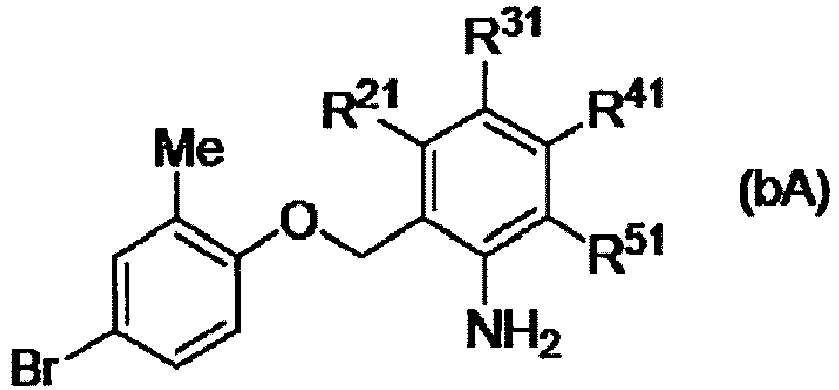
Table 4 R21 R31 R41 R51 Intermediate (6A) Me H H H Intermediate (7A) H H H H Intermediate (8A) H Me H H Intermediate (9A) H H Me H Intermediate (10A) H H H Me -
- Intermediate (6A)
1H-NMR (CDCl3) δ: 7.32-7.25 (2H, m), 7.07 (1H, t), 6.88 (1H, d), 6.68-6.56 (2H, m), 5.03 (2H, s), 3.96 (2H, brs), 2.34 (3H, s), 2.16 (3H, s). - Intermediate (7A)
1H NMR (DMSO-d6) δ: 7.36-7. 28 (2H, m), 7.22-7. 16 (1H, m), 7.06-6.97 (2H, m), 6.67 (1H, d), 6.60-6.54 (1H, m), 5.05 (2H, brs), 4.96 (2H, s), 2.17 (3H, s). - Intermediate (8A)
1H-NMR (DMSO-d6) δ: 7.33-7.20 (2H, m), 6.99 (2H, d), 6.79-6.88 (1H, m), 6.65 (1H, d), 4.97 (2H, s), 3.91 (2H, brs), 2.26 (3H, s), 2.19 (3H, s). - Intermediate (9A)
1H-NMR (CDCl3) δ: 7.30-7.21 (2H, m), 7.07 (1H, d), 6.83 (1H, d), 6.62-6.49 (2H, m), 4.98 (2H, s), 3.95 (2H, brs), 2.27 (3H, s), 2.18 (3H, s). - Intermediate (10A)
1H-NMR (DMSO-d6) δ: 7.26-7.21 (2H, m), 7.21-7.01 (2H, m), 6.90-6.81 (1H, s), 6.70 (1H, t), 5.02 (2H, s), 4.05 (2H, brs), 2.20 (3H, s), 2.19 (3H, s). - In the method described in Production Example 2, Intermediate (6A) was used instead of Intermediate (23A) to give the following Intermediate (11A).
- The compounds produced in accordance with Reference Production Example 3 and their physical property values will be shown below.
- The compounds represented by formula (cA):

Table 5 R21 R31 R41 R51 Intermediate (11A) Me H H H Intermediate (12A) H H H H Intermediate (13A) H Me H H Intermediate (14A) H H Me H Intermediate (15A) H H H Me -
- Intermediate (11A)
1H-NMR (DMSO-d6) δ: 9.07 (1H, brs), 7.30-7.38 (2H, m), 7.25 (2H, d), 7.12-6.96 (2H, m), 5.05 (2H, s), 3.60 (3H, s), 2.35 (3H, s), 2.06 (3H, s). - Intermediate (12A)
1H-NMR (DMSO-d6) δ: 9.0 (1H, brs), 7.47 (2H, t), 7.40-7.22 (3H, m), 7.25-7.16 (1H, m), 6.92 (1H, d), 5.12 (2H, s), 3.65 (3H, s), 2.17 (3H, s). - Intermediate (13A)
1H-NMR (DMSO-d6) δ: 8.89 (1H, brs), 7.38-7.23 (4H, m), 7.16-7.08 (1H, m), 6.92 (1H, d), 5.07 (2H, s), 3.63 (3H, s), 2.28 (3H, s), 2.16 (3H, s). - Intermediate (14A)
1H NMR (DMSO-d6) δ: 8.93 (1H, brs), 7.35-7.30 (4H, m), 6.98 (1H, d), 6.90 (1H, d), 5.07 (2H, s), 3.64 (3H, s), 2.29 (3H, s), 2.15 (3H, s). - Intermediate (15A)
1H-NMR (DMSO-d6) δ: 8.80 (1H, brs), 7.34 (1H, d), 7.31-7.25 (2H, m), 7.26-7.17 (2H, m), 6.86 (1H, d), 5.05 (2H, s), 3.62 (3H, s), 2.20 (3H, s), 2.18 (3H, s). - A mixture of 0.50 g of Intermediate (11A), 0.42 g of bis-(pinacolato)diboron, 0.40 g of potassium acetate, 10 ml of 1,4-dioxane and 0.06 g of [1,1'-bis-(diphenylphosphino)ferrocene] palladium(II) dichloride dichloromethane adduct was heated to reflux for 16 hours. After filtration of the reactant through Celite®, the residue obtained by condensing the filtrate was subjected to silica gel column chromatography to give 0.35 g of the following Intermediate (16A).
- The compounds produced in accordance with Reference Production Example 4 and their physical property values will be shown below.
- The compounds represented by formula (dA):

Table 6 R21 R31 R41 R51 Intermediate (16A) Me H H H Intermediate (17A) H H H H Intermediate (18A) H Me H H Intermediate (19A) H H Me H Intermediate (20A) H H H Me -
- Intermediate (16A)
1H-NMR (DMSO-d6) δ: 9.08 (1H, brs), 7.51 (1H, d), 7.44 (1H, s), 7.25 (2H, t), 7.12-7.02 (2H, m), 5.09 (2H, s), 3.61 (3H, s), 2.35 (3H, s), 2.07 (3H, s), 1.27 (12H, s). - Intermediate (17A)
1H NMR (DMSO-d6) δ: 9.01 (1H, brs), 7.42-7.56 (4H, m), 7.38-7.26 (1H, m), 7.24-7.13 (1H, m), 6.97 (1H, d), 5.17 (2H, s), 3.66 (3H, s), 2.19 (3H, s), 1.27 (12H, s). - Intermediate (18A)
1H-NMR (DMSO-d6) δ: 8.89 (1H, brs), 7.48 (2H, d), 7.24-7.36 (2H, m), 7.11 (1H, dd), 6.96 (1H, d), 5.10 (2H, s), 3.63 (3H, s), 2.28 (3H, s), 2.18 (3H, s), 1.27 (12H, s). - Intermediate (19A)
1H-NMR (DMSO-d6) δ: 8.93 (1H, brs), 7.47 (2H, d), 7.32 (2H, t), 6.97 (2H, t), 5.11 (2H, s), 3.64 (3H, s), 2.29 (3H, s), 2.16 (3H, s), 1.27 (12H, s). - Intermediate (20A)
1H-NMR (DMSO-d6) δ: 8.8 (1H, brs), 7.46 (2H, d), 7.31 (1H, dd), 7.25-7.17 (2H, m), 6.91 (1H, d), 5.09 (2H, s), 3.62 (3H, s), 2.20 (3H, s), 2.19 (3H, s), 1.27 (12H, s). - A mixture of 10.5 g of 2-chloro-5-fluoropyridine, 12.0 g of 4-methoxy-2,3-dimethylphenylboronic acid pinacol ester, 2.72 g of [1,1'-bis(diphenylphosphino)ferrocene] palladium(II) dichloride dichloromethane adduct, 28.3 g of potassium phosphate tribasic, 40 ml of 1,2-dimethoxymethane and 20 ml of water was stirred at 80°C for 6.5 hours. After being cooled, water was added and the reaction mixture was filtered, and then the filtrate was extracted with ethyl acetate. The organic layer was washed with water and saturated aqueous sodium chloride, and was dried over anhydrous sodium sulfate, followed by being condensed under reduced pressure. The result residue was subjected to silica gel column chromatography to give 8.40 g of Intermediate (21A) represented by the following formula.

- A mixture of 8.40 g of Intermediate (21A), 30 ml of 48% hydrobromic acid and 30 ml of acetic acid was stirred at 110°C for 20 hours. The reaction solution was concentrated and basified by adding tert-butyl methyl ether and an aqueous sodium hydroxide solution, and subjected to liquid separation operation. The separated aqueous layer was neutralized by adding hydrochloric acid and extracted with ethyl acetate, and the organic layer was washed with water and saturated aqueous sodium chloride, and was dried over anhydrous sodium sulfate. The organic layer was concentrated under reduced pressure to give 7.11 g of the following Intermediate (22A).

- A mixture of 0.76 g of Intermediate (22A), 0.96 g of potassium carbonate, and 20 ml of acetonitrile was stirred while being heated to reflux for 9 hours. After being cooled, the reaction mixture was filtered through Celite®. To 0.80 g of the residue obtained by being condensed under reduced pressure, 10 ml of methanol was added. To this solution, 0.28 g of copper(I) chloride was added and was cooled with ice. To this solution, 0.79 g of potassium borohydride was added; and the reaction solution was stirred for 2 hours while being cooled with ice, and then was filtrated through Celite®. The filtrate was condensed under reduced pressure. To the obtained residue, ethyl acetate was added; and the mixture was washed with saturate aqueous sodium hydrogen carbonate. The organic layer was concentrated after being dried by using anhydrous magnesium sulfate to give 0.48 g of Intermediate (23A) represented by the following formula.
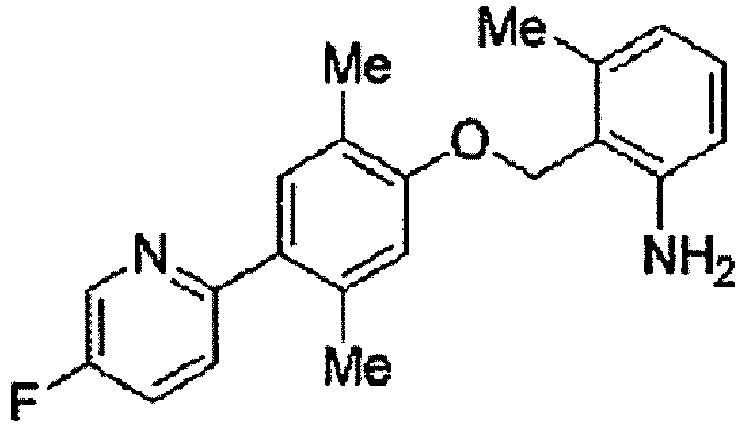
- Compounds HA1001-1 to HA1036-236 could be obtained in accordance with the above-described method.
- Compounds HA1001-1 to HA1036-236 are the carbamate compounds, wherein E means any one of substituent numbers 1 to 236, as shown below. In the following [substituent numbers: E], Me represents a methyl group, Et represents an ethyl group, F represents a fluorine atom, Cl represents a chlorine atom, Br represent a bromine atom, I represents an iodine atom, and PYR2 represents a pyridine-2-yl group.



- [1; 3-F-PYR2], [2; 3-Cl-PYR2], [3; 3-Br-PYR2], [4; 3-I-PYR2], [5; 4-F-PYR2], [6; 4-Cl-PYR2], [7; 4-Br-PYR2], [8; 4-I-PYR2], [9; 5-F-PYR2], [10; 5-Cl-PYR2], [11; 5-Br-PYR2], [12; 5-I-PYR2], [13; 6-F-PYR2], [14; 6-Cl-PYR2], [15; 6-Br-PYR2], [16; 6-I-PYR2], [17; 3-Me-4-F-PYR2], [18; 3-Me-4-Cl-PYR2], [19; 3-Me-4-Br-PYR2], [20; 3-Me-4-I-PYR2], [21; 3-Me-5-F-PYR2], [22; 3-Me-5-Cl-PYR2], [23; 3-Me-5-Br-PYR2], [24; 3-Me-5-I-PYR2], [25; 3-Me-6-F-PYR2], [26; 3-Me-6-Cl-PYR2], [27; 3-Me-6-Br-PYR2], [28; 3-Me-6-I-PYR2], [29; 3-Et-4-F-PYR2], [30; 3-Et-4-Cl-PYR2], [31; 3-Et-4-Br-PYR2], [32; 3-Et-4-I-PYR2], [33; 3-Et-5-F-PYR2], [34; 3-Et-5-Cl-PYR2], [35; 3-Et-5-Br-PYR2], [36; 3-Et-5-I-PYR2], [37; 3-Et-5-F-PYR2], [38; 3-Et-5-Cl-PYR2], [39; 3-Et-5-Br-PYR2], [40; 3-Et-5-I-PYR2], [41; 3-F-4-Me-PYR2], [42; 3-F-4-Et-PYR2], [43; 3-F-4-F-PYR2], [44; 3-F-4-Cl-PYR2], [45; 3-F-4-Br-PYR2], [46; 3-F-4-I-PYR2], [47; 3-F-5-Me-PYR2], [48; 3-F-5-Et-PYR2], [49; 3-F-5-F-PYR2], [50; 3-F-5-Cl-PYR2], [51; 3-F-5-Br-PYR2], [52; 3-F-5-I-PYR2], [53; 3-F-6-Me-PYR2], [54; 3-F-6-Et-PYR2], [55; 3-F-6-F-PYR2], [56; 3-F-6-Cl-PYR2], [57; 3-F-6-Br-PYR2], [58; 3-F-6-I-PYR2], [59; 3-Cl-4-Me-PYR2], [60; 3-Cl-4-Et-PYR2], [61; 3-Cl-4-F-PYR2], [62; 3-Cl-4-Cl-PYR2], [63; 3-Cl-4-Br-PYR2], [64; 3-Cl-4-I-PYR2], [65; 3-Cl-5-Me-PYR2], [66; 3-Cl-5-Et-PYR2], [67; 3-Cl-5-F-PYR2], [68; 3-Cl-5-Cl-PYR2], [69; 3-Cl-5-Br-PYR2], [70; 3-Cl-5-I-PYR2], [71; 3-Cl-6-Me-PYR2], [72; 3-Cl-6-Et-PYR2], [73; 3-Cl-6-F-PYR2], [74; 3-Cl-6-Cl-PYR2], [75; 3-Cl-6-Br-PYR2], [76; 3-Cl-6-I-PYR2], [77; 3-Br-4-Me-PYR2], [78; 3-Br-4-Et-PYR2], [79; 3-Br-4-F-PYR2], [80; 3-Br-4-Cl-PYR2], [81; 3-Br-4-Br-PYR2], [82; 3-Br-4-I-PYR2], [83; 3-Br-5-Me-PYR2], [84; 3-Br-5-Et-PYR2], [85; 3-Br-5-F-PYR2], [86; 3-Br-5-Cl-PYR2], [87; 3-Br-5-Br-PYR2], [88; 3-Br-5-I-PYR2], [89; 3-Br-6-Me-PYR2], [90; 3-Br-6-Et-PYR2], [91; 3-Br-6-F-PYR2], [92; 3-Br-6-Cl-PYR2], [93; 3-Br-6-Br-PYR2], [94; 3-Br-6-I-PYR2], [95; 3-I-4-Me-PYR2], [96; 3-I-4-Et-PYR2], [97; 3-I-4-F-PYR2], [98; 3-I-4-Cl-PYR2], [99; 3-I-4-Br-PYR2], [100; 3-I-4-I-PYR2], [101; 3-I-5-Me-PYR2], [102; 3-I-5-Et-PYR2], [103; 3-I-5-F-PYR2], [104; 3-I-5-Cl-PYR2], [105; 3-I-5-Br-PYR2], [106; 3-I-5-I-PYR2], [107; 3-I-6-Me-PYR2], [108; 3-I-6-Et-PYR2], [109; 3-I-6-F-PYR2], [110; 3-I-6-Cl-PYR2], [111; 3-I-6-Br-PYR2], [112; 3-I-6-I-PYR2], [113; 4-Me-5-F-PYR2], [114; 4-Me-5-Cl-PYR2], [115; 4-Me-5-Br-PYR2], [116; 4-Me-5-I-PYR2], [117; 4-Me-6-F-PYR2], [118; 4-Me-6-Cl-PYR2], [119; 4-Me-6-Br-PYR2], [120; 4-Me-6-I-PYR2], [121; 4-Et-5-F-PYR2], [122; 4-Et-5-Cl-PYR2], [123; 4-Et-5-Br-PYR2], [124; 4-Et-5-I-PYR2], [125; 4-Et-6-F-PYR2], [126; 4-Et-6-Cl-PYR2], [127; 4-Et-6-Br-PYR2], [128; 4-Et-6-I-PYR2], [129; 4-F-5-Me-PYR2], [130; 4-F-5-Et-PYR2], [131; 4-F-5-F-PYR2], [132; 4-F-5-Cl-PYR2], [133; 4-F-5-Br-PYR2], [134; 4-F-5-I-PYR2], [135; 4-F-6-Me-PYR2], [136; 4-F-6-Et-PYR2], [137; 4-F-6-F-PYR2], [138; 4-F-6-Cl-PYR2], [139; 4-F-6-Br-PYR2], [140; 4-F-6-I-PYR2], [141; 4-Cl-5-Me-PYR2], [142; 4-Cl-5-Et-PYR2], [143; 4-Cl-5-F-PYR2], [144; 4-Cl-5-Cl-PYR2], [145; 4-Cl-5-Br-PYR2], [146; 4-Cl-5-I-PYR2], [147; 4-Cl-6-Me-PYR2], [148; 4-Cl-6-Et-PYR2], [149; 4-Cl-6-F-PYR2], [150; 4-Cl-6-Cl-PYR2], [151; 4-Cl-6-Br-PYR2], [152; 4-Cl-6-I-PYR2], [153; 4-Br-5-Me-PYR2], [154; 4-Br-5-Et-PYR2], [155; 4-Br-5-F-PYR2], [156; 4-Br-5-Cl-PYR2], [157; 4-Br-5-Br-PYR2], [158; 4-Br-5-I-PYR2], [159; 4-Br-6-Me-PYR2], [160; 4-Br-6-Et-PYR2], [161; 4-Br-6-F-PYR2], [162; 4-Br-6-Cl-PYR2], [163; 4-Br-6-Br-PYR2], [164; 4-Br-6-I-PYR2], [165; 5-Me-6-F-PYR2], [166; 5-Me-6-Cl-PYR2], [167; 5-Me-6-Br-PYR2], [168; 5-Me-6-I-PYR2], [169; 5-Et-6-F-PYR2], [170; 5-Et-6-Cl-PYR2], [171; 5-Et-6-Br-PYR2], [172; 5-Et-6-I-PYR2], [173; 5-F-6-Me-PYR2], [174; 5-F-6-Et-PYR2], [175; 5-F-6-F-PYR2], [176; 5-F-6-Cl-PYR2], [177; 5-F-6-Br-PYR2], [178; 5-F-6-I-PYR2], [179; 5-Cl-6-Me-PYR2], [180; 5-Cl-6-Et-PYR2], [181; 5-Cl-6-F-PYR2], [182; 5-Cl-6-Cl-PYR2], [183; 5-Cl-6-Br-PYR2], [184; 5-Cl-6-I-PYR2], [185; 5-Br-6-Me-PYR2], [186; 5-Br-6-Et-PYR2], [187; 5-Br-6-F-PYR2], [188; 5-Br-6-Cl-PYR2], [189; 5-Br-6-Br-PYR2], [190; 5-Br-6-I-PYR2], [191; 5-I-6-Me-PYR2], [192; 5-I-6-Et-PYR2], [193; 5-I-6-F-PYR2], [194; 5-I-6-Cl-PYR2], [195; 5-I-6-Br-PYR2], [196; 5-I-6-I-PYR2], [197; 3-F-4-F-5-F-PYR2], [198; 4-F-5-F-6-F-PYR2], [199; 3-F-4-F-6-F-PYR2], [200; 3-F-5-F-6-F-PYR2], [201; 3-Me-4-F-6-Me-PYR2], [202; 3-Et-4-F-6-Me-PYR2], [203; 3-F-4-F-6-Me-PYR2], [204; 3-Cl-4-F-6-Me-PYR2], [205; 3-Br-4-F-6-Me-PYR2], [206; 3-I-4-F-6-Me-PYR2], [207; 3-Me-5-F-6-Me-PYR2], [208; 3-Et-5-F-6-Me-PYR2], [209; 3-F-5-F-6-Me-PYR2], [210; 3-Cl-5-F-6-Me-PYR2], [211; 3-Br-5-F-6-Me-PYR2], [212; 3-I-5-F-6-Me-PYR2], [213; 3-Me-4-Me-5-Cl-PYR2], [214; 3-Et-4-Me-5-Cl-PYR2], [215; 3-F-4-Me-5-Cl-PYR2], [216; 3-Cl-4-Me-5-Cl-PYR2], [217; 3-Br-4-Me-5-Cl-PYR2], [218; 3-I-4-Me-5-Cl-PYR2], [219; 4-F-5-Me-6-Me-PYR2], [220; 4-F-5-Me-6-Et-PYR2], [221; 4-F-5-Me-6-F-PYR2], [222; 4-F-5-Me-6-Cl-PYR2], [223; 4-F-5-Me-6-Br-PYR2], [224; 4-F-5-Me-6-I-PYR2], [225; 4-Me-5-F-6-Me-PYR2], [226; 4-Me-5-F-6-Et-PYR2], [227; 4-Me-5-F-6-F-PYR2], [228; 4-Me-5-F-6-Cl-PYR2], [229; 4-Me-5-F-6-Br-PYR2], [230; 4-Me-5-F-6-I-PYR2], [231; 4-Me-5-Cl-6-Et-PYR2], [232; 4-Et-5-Cl-6-Et-PYR2], [233; 4-F-5-Cl-6-Et-PYR2], [234; 4-Cl-5-Cl-6-Et-PYR2], [235; 4-Br-5-Cl-6-Et-PYR2], [236; 4-I-5-Cl-6-Et-PYR2].
For example, in the compound represented by formula HA1001, HA1001-46 is the compound represented by the following formula:
- Formulation Examples are shown below. In the following Formulation Examples, part means part by weight.
- Fifty parts (50 parts) of any one of Compounds HA1001-1 to HA1036-236, 3 parts of calcium lignin sulfonate, 2 parts of magnesium lauryl sulfate, and 45 parts of synthetic hydrous silicon oxide are thoroughly ground and mixed to give a formulation.
- Twenty parts (20 parts) of any one of Compounds HA1001-1 to HA1036-236 and 1.5 parts of sorbitan trioleate are mixed with 28.5 parts of an aqueous solution containing 2 parts of polyvinyl alcohol; and the mixture is finely ground by a wet grinding method. Then, to the mixture, 40 parts of an aqueous solution containing 0.05 part of xanthan gum and 0.1 part of aluminum magnesium silicate is added, and 10 parts of propylene glycol was further added, followed by stirring and mixing to give a formulation.
- Two parts (2 parts) of any one of Compounds HA1001-1 to HA1036-236, 88 parts of kaolin clay, and 10 parts of talc are thoroughly ground and mixed to give a formulation.
- Five parts (5 parts) of any one of Compounds HA1001-1 to HA1036-236, 14 parts of polyoxyethylene styrylphenyl ether, 6 parts of calcium dodecylbenzenesulfonate, and 75 parts of xylene are thoroughly ground and mixed to give a formulation.
- Two parts (2 parts) of any one of Compounds HA1001-1 to HA1036-236, 1 part of synthetic hydrous silicon oxide, 2 parts of calcium lignin sulfonate, 30 parts of bentonite, and 65 parts of kaolin clay are thoroughly ground and mixed, followed by addition of water to the mixture; and the mixture is thoroughly kneaded and further granulated and dried to give a formulation.
- Twenty parts (20 parts) of any one of Compounds HA1001-1 to HA1036-236, 35 parts of a mixture of white carbon and ammonium polyoxyethylene alkyl ether sulfate (weight ratio 1:1), and 45 parts of water are mixed and finely ground by a wet grinding method to give a formulation.
- Hereinafter, Test Examples are shown.
- Plastic pots each were filled with soil, and barley (cultivar: Mikamo-Golden) was sowed and grown in a greenhouse for 7 days. To the formulated present Compound 1, 2, 3, 4, 6, 7, 8, 9, 10, 11 or 12 according to Formulation Example 6, water was added so as to adjust the water dilution to a predetermined concentration (500 ppm), and the adjusted dilution was sprayed over stems and leaves of the barley so that the liquid sufficiently adhered to surfaces of the leaves of the barley. After being sprayed, the barley was air-dried. After 2 days, an aqueous suspension containing spores of barley net blotch fungus (Pyrenophora teres) was sprayed to inoculate the spores. After completion of the inoculation, the barley was left to stand for 3 days in a greenhouse at 23°C in the daytime and 20°C at night under high humidity condition, and was cultivated in a greenhouse for 7 days; and then the area of the lesion was investigated. As a result, the areas of the lesion on the barley treated with the present Compound 1, 2, 3, 4, 6, 7, 8, 9, 10, 11 or 12 were 30% or less than those on untreated barley.
- Plastic pots each were filled with soil, and wheat (cultivar: Shirogane) was sowed and grown in a greenhouse for 9 days. To the formulated present Compound 1, 2, 3, 4, 6, 7, 8, 10 or 12 according to Formulation Example 6, water was added so as to adjust the water dilution to a predetermined concentration (500 ppm), and the adjusted dilution was sprayed over stems and leaves of the barley so that the liquid sufficiently adhered to surfaces of the leaves of the wheat. After being sprayed, the wheat was air-dried so as to dry the leaves. After the wheat was cultivated at 20°C for 5 days under illumination, and then inoculated by sprinkling with spores of wheat rust fungus (Puccinia recondita). After the inoculation, the wheat was left to stand at 23°C for one day under dark and high humidity condition, and cultivated under illumination at 20°C for 8 days, and then the area of the lesion was investigated. As a result, it was found that the area of the lesion on the wheat treated with the present Compound 1, 2, 3, 4, 6, 7, 8, 10 or 12 were 30% or less than those on untreated wheat.
- Meanwhile, in the same test using methyl N-(2-{[4-(pyridine-2-yl)phenoxy)methyl}phenyl)carbamate in place of the present Compounds, the result was 70% or more than the treated wheat.
- Plastic pots each were filled with soil, and rice (cultivar: Nipponbare) was sowed and grown in a greenhouse for 20 days. To the formulated present Compound 1, 2, 3, 4, 7 or 10 according to Formulation Example 6, water was added so as to adjust the water dilution to a predetermined concentration (500 ppm), and the adjusted dilution was sprayed over stems and leaves of the rice so that the liquid sufficiently adhered to surfaces of the leaves of the rice. After being sprayed, the rice was air-dried; and the rice subjected to the spray treatment was placed in contact with rice seedling (cultivar: Nipponbare) infected by rice blast fungus (Magnaporthe grisea), and these two plants were left to stand for 6 days at 24°C in the daytime and 20°C at night under high humidity condition; and then the area of the lesion of the rice was investigated. As a result, the area of the lesion on the rice treated with the present compound 1, 2, 3, 4, 7 or 10 were 30% or less than those on the non-treated plant.
- Plastic pots each were filled with soil, and kidney bean (cultivar: Nagauzura Saitou) and was sowed and grown in a greenhouse for 8 days. To the formulated present Compound 1, 2, 3, 4, 6, 7, 8, 9, 10, 11 or 12 according to Formulation Example 6, water was added so as to adjust the water dilution to a predetermined concentration (500 ppm), and the adjusted dilution was sprayed over stems and leaves of the kidney bean so that the liquid sufficiently adhered to surfaces of the leaves of the kidney bean. After being sprayed, the kidney bean was air-dried, and a PDA medium containing hyphae of the kidney bean stem rot fungus (Sclerotinia sclerotiorum) was placed on the leaves of the kidney bean. After the inoculation, the kidney beans were left to stand under high humidity condition only at night. Four days after the inoculation, the area of the lesion were investigated. As a result, the area of the lesion on the kidney bean treated with the present compound 1, 2, 3, 4, 6, 7, 8, 9, 10, 11 or 12 was 30% or less than those on untreated kidney bean.
- Plastic pots each were filled with soil, and wheat (cultivar: Apogee) was sowed and grown in a greenhouse for 10 days. To the formulated present Compound 1, 2, 4, 7, 10 or 12 according to Formulation Example 6, water was added so as to adjust the water dilution to a predetermined concentration (500 ppm), and the adjusted dilution was sprayed over stems and leaves of the wheat so that the liquid sufficiently adhered to surfaces of the leaves of the wheat. After being sprayed, the wheat was air-dried. After 4 days, an aqueous suspension containing spores of wheat speckled leaf blotch fungus (Septoria tritici) was sprayed to inoculate the spores. After completion of the inoculation, the wheat was left to stand at 18°C under high humidity condition for 3 days and left to stand under illumination for 14 to 18 days, and then the area of the lesion was investigated. As a result, the area of the lesion on the wheat treated with the present compound 1, 2, 4, 7, 10 or 12 were 30% or less than those on untreated wheat.
- Plastic pots each were filled with soil, and cucumber (cultivar: Sagami Hanjiro) was sowed and grown in a greenhouse for 12 days. To the formulated present Compound 1, 2, 3, 4, 6, 7, 8, 10, 11 or 12 according to Formulation Example 6, water was added so as to adjust the water dilution to a predetermined concentration (500 ppm), and the adjusted dilution was sprayed over stems and leaves of the cucumber so that the liquid sufficiently adhered to surfaces of the leaves of the cucumber. After being sprayed, the cucumber was air-dried, and then inoculated by being sprinkled with spores of cucumber powdery mildew fungus (Sphaerotheca fuliginea, a QoI-resistant strain in which, among the genes encoding cytochrome b, the amino acid residue at position 143 of cytochrome b was mutated from glycine to alanine). After the inoculation, the cucumber was cultivated in a greenhouse at 24°C in the daytime and 20°C at night for 8 days, and then the area of the lesion was investigated. As a result, the area of the lesion on the cucumber treated with the present Compound 1, 2, 3, 4, 6, 7, 8, 10, 11 or 12 were 30% or less than those on untreated cucumber.
- Plastic pots each were filled with soil, and soybean (cultivar: Tachinagaha) was sowed and grown in a greenhouse for 13 days. Then the soybean was inoculated by being sprayed with an aqueous suspension of Cercospora leaf spot (Cercospora sojina) spores by spraying. After inoculation the soybean was allowed to stand for 4 days in the grrenhouse at 23°C under high humidity condition. Five days after the inoculation, to the present Compound 1, 2, 4, 5, 6, 7, 8, 10 or 11 formulated according to Formulation Example 6, water was added so as to adjust the water dilution to a predetermined concentration (200 ppm), and the adjusted dilution was sprayed over stems and leaves of the soybean so that the dilution sufficiently adhered to surfaces of the leaves of the soybean. After being sprayed, the soybean was air-dried and was cultivated for 14 days in the greenhouse, and then the area of the lesion on the soybean were investigated. As a result, the area of the lesion on the soybean treated with the present Compound 1, 2, 4, 5, 6, 7, 8, 10 or 11 were 30% or less than those on untreated soybean.
- The carbamate compounds of the present invention are effective at controlling plant diseases, and are useful as active ingredients of plant disease controlling agents.
Claims (6)
- A a carbamate compound represented by formula (I):
 R1 represents a hydrogen atom or a C1-C3 alkyl group;R2, R3, R4 and R5 each independently represents a hydrogen atom, a halogen atom, a C1-C3 alkyl group optionally having one or more halogen atoms, a C3-C4 cycloalkyl group optionally having one or more halogen atoms, or a C1-C3 alkoxy group optionally having one or more halogen atoms;Z1 represents a halogen atom; andZ2 represents a halogen atom or a C1-C3 alkyl group; andm represents any one of integers from 0 to 3.
 - A carbamate compound according to Claim 1, wherein R1 is a hydrogen atom; R2, R3, R4 and R5 are hydrogen atoms, halogen atoms or methyl groups; and m is 0.
- A carbamate compound according to Claim 1, wherein R1 is a hydrogen atom, R2, R3, R4 and R5 are hydrogen atoms, halogen atoms or methyl groups, Z2 is a methyl group, and m is 1.
- A plant disease controlling agent, which comprises a carbamate compound represented by formula (I):
 R1 represents a hydrogen atom or a C1-C3 alkyl group;R2, R3, R4 and R5 each independently represents a hydrogen atom, a halogen atom, a C1-C3 alkyl group optionally having one or more halogen atoms, a C3-C4 cycloalkyl group optionally having one or more halogen atoms or a C1-C3 alkoxy group optionally having one or more halogen atoms;Z1 represents a halogen atom; andZ2 represents a halogen atom or a C1-C3 alkyl group; andm represents any one of integers from 0 to 3.as an active ingredient.
 - A method for controlling plant diseases by treating plants or soil for cultivating plants with an effective amount of a carbamate compound represented by formula (I):
 R1 represents a hydrogen atom or a C1-C3 alkyl group;R2, R3, R4 and R5 each independently represents a hydrogen atom, a halogen atom, a C1-C3 alkyl group optionally having one or more halogen atoms, a C3-C4 cycloalkyl group optionally having one or more halogen atoms or a C1-C3 alkoxy group optionally having one or more halogen atoms;Z1 represents a halogen atom; andZ2 represents a halogen atom or a C1-C3 alkyl group; andm represents any one of integers from 0 to 3.
 - Use of a carbamate compound represented by formula (I):
 R1 represents a hydrogen atom or a C1-C3 alkyl group;R2, R3, R4 and R5 each independently represents a hydrogen atom, a halogen atom, a C1-C3 alkyl group optionally having one or more halogen atoms, a C3-C4 cycloalkyl group optionally having one or more halogen atoms or a C1-C3 alkoxy group optionally having one or more halogen atoms;Z1 represents a halogen atom; andZ2 represents a halogen atom or a C1-C3 alkyl group; andm represents any one of integers from 0 to 3,for controlling plant diseases.
Applications Claiming Priority (2)
| Application Number | Priority Date | Filing Date | Title |
|---|---|---|---|
| JP2015003942 | 2015-01-13 | ||
| PCT/JP2016/050073 WO2016114162A1 (en) | 2015-01-13 | 2016-01-05 | Carbamate compound and use thereof |
Publications (3)
| Publication Number | Publication Date |
|---|---|
| EP3246314A1 true EP3246314A1 (en) | 2017-11-22 |
| EP3246314A4 EP3246314A4 (en) | 2018-06-20 |
| EP3246314B1 EP3246314B1 (en) | 2020-04-08 |
Family
ID=56405709
Family Applications (1)
| Application Number | Title | Priority Date | Filing Date |
|---|---|---|---|
| EP16737233.3A Active EP3246314B1 (en) | 2015-01-13 | 2016-01-05 | Carbamate compound and use thereof |
Country Status (6)
| Country | Link |
|---|---|
| US (1) | US10383333B2 (en) |
| EP (1) | EP3246314B1 (en) |
| JP (1) | JP6624074B2 (en) |
| CN (1) | CN107108505A (en) |
| BR (1) | BR112017014679B1 (en) |
| WO (1) | WO2016114162A1 (en) |
Families Citing this family (3)
| Publication number | Priority date | Publication date | Assignee | Title |
|---|---|---|---|---|
| CN107108523B (en) | 2015-01-13 | 2020-09-18 | 住友化学株式会社 | Carbamate compounds and their uses |
| BR112017014657B1 (en) | 2015-01-13 | 2021-05-04 | Sumitomo Chemical Company, Limited | carbamate compound and its use |
| WO2018138692A1 (en) | 2017-01-30 | 2018-08-02 | Insecticides (India) Limited | Novel fungicidal carbamate compounds |
Family Cites Families (12)
| Publication number | Priority date | Publication date | Assignee | Title |
|---|---|---|---|---|
| EP0335519A1 (en) | 1988-03-31 | 1989-10-04 | Imperial Chemical Industries Plc | Insecticides |
| DE4124989A1 (en) | 1991-07-27 | 1993-02-04 | Basf Ag | (BETA) -SUBSTITUTED CINNAMENT DERIVATIVES |
| NZ246603A (en) * | 1992-01-29 | 1996-10-28 | Basf Ag | Carbamate derivatives and fungicidal compositions thereof |
| JP2004531551A (en) | 2001-05-15 | 2004-10-14 | バイエル・クロツプサイエンス・アクチエンゲゼルシヤフト | Heterocyclyl phenyl benzyl ether used as a fungicide |
| DE10135549A1 (en) | 2001-05-15 | 2002-11-21 | Bayer Ag | New 4-heterocyclyl-1-benzyloxybenzene derivatives, useful as pesticides for plant protection and preservation of technical products, and as intermediates for active compounds |
| EP3020715B1 (en) * | 2013-07-12 | 2021-06-16 | Sumitomo Chemical Company Limited | Tetrazolinone compound and use thereof |
| US9521848B2 (en) | 2013-07-31 | 2016-12-20 | Sumitomo Chemical Company, Limited | Tetrazolinone compound and use therefor |
| CN103910670B (en) * | 2014-03-11 | 2016-02-17 | 浙江工业大学 | A kind of methoxy carbamate compound and its preparation method and application |
| US9907307B2 (en) | 2014-03-28 | 2018-03-06 | Sumitomo Chemical Company, Limited | Aromatic compound and uses thereof |
| US9788547B2 (en) | 2014-03-28 | 2017-10-17 | Sumitomo Chemical Company, Limited | Aromatic compound and uses thereof |
| CN107108523B (en) | 2015-01-13 | 2020-09-18 | 住友化学株式会社 | Carbamate compounds and their uses |
| BR112017014657B1 (en) | 2015-01-13 | 2021-05-04 | Sumitomo Chemical Company, Limited | carbamate compound and its use |
-
2016
- 2016-01-05 WO PCT/JP2016/050073 patent/WO2016114162A1/en not_active Ceased
- 2016-01-05 US US15/541,821 patent/US10383333B2/en active Active
- 2016-01-05 BR BR112017014679-7A patent/BR112017014679B1/en active IP Right Grant
- 2016-01-05 CN CN201680005560.3A patent/CN107108505A/en active Pending
- 2016-01-05 EP EP16737233.3A patent/EP3246314B1/en active Active
- 2016-01-05 JP JP2016569302A patent/JP6624074B2/en active Active
Also Published As
| Publication number | Publication date |
|---|---|
| WO2016114162A1 (en) | 2016-07-21 |
| CN107108505A (en) | 2017-08-29 |
| EP3246314A4 (en) | 2018-06-20 |
| BR112017014679B1 (en) | 2021-05-04 |
| EP3246314B1 (en) | 2020-04-08 |
| JPWO2016114162A1 (en) | 2017-10-19 |
| BR112017014679A2 (en) | 2018-01-02 |
| JP6624074B2 (en) | 2019-12-25 |
| US10383333B2 (en) | 2019-08-20 |
| US20180014539A1 (en) | 2018-01-18 |
Similar Documents
| Publication | Publication Date | Title |
|---|---|---|
| US8765756B2 (en) | Plant disease controlling composition and use thereof | |
| EP2604116A1 (en) | Plant disease control composition and application for same | |
| EP2604117A1 (en) | Plant disease control composition and application for same | |
| EP3246314B1 (en) | Carbamate compound and use thereof | |
| EP3246319B1 (en) | Carbamate compounds for controlling plant diseases | |
| EP3246312B1 (en) | Carbamate compound and use thereof | |
| EP3246318B1 (en) | Carbamate compound and use thereof | |
| EP3246316B1 (en) | Carbamate compound and use thereof | |
| EP3124476B1 (en) | Tetrazolinone compound and application thereof | |
| EP3504199B1 (en) | Tetrazolinone compounds and its use | |
| EP3279196A1 (en) | Tetrazolinone compound and use thereof |
Legal Events
| Date | Code | Title | Description |
|---|---|---|---|
| STAA | Information on the status of an ep patent application or granted ep patent |
Free format text: STATUS: THE INTERNATIONAL PUBLICATION HAS BEEN MADE |
|
| PUAI | Public reference made under article 153(3) epc to a published international application that has entered the european phase |
Free format text: ORIGINAL CODE: 0009012 |
|
| STAA | Information on the status of an ep patent application or granted ep patent |
Free format text: STATUS: REQUEST FOR EXAMINATION WAS MADE |
|
| 17P | Request for examination filed |
Effective date: 20170704 |
|
| AK | Designated contracting states |
Kind code of ref document: A1 Designated state(s): AL AT BE BG CH CY CZ DE DK EE ES FI FR GB GR HR HU IE IS IT LI LT LU LV MC MK MT NL NO PL PT RO RS SE SI SK SM TR |
|
| AX | Request for extension of the european patent |
Extension state: BA ME |
|
| DAV | Request for validation of the european patent (deleted) | ||
| DAX | Request for extension of the european patent (deleted) | ||
| A4 | Supplementary search report drawn up and despatched |
Effective date: 20180517 |
|
| RIC1 | Information provided on ipc code assigned before grant |
Ipc: A01N 43/40 20060101ALI20180511BHEP Ipc: A01N 47/20 20060101ALI20180511BHEP Ipc: C07D 213/61 20060101AFI20180511BHEP |
|
| GRAP | Despatch of communication of intention to grant a patent |
Free format text: ORIGINAL CODE: EPIDOSNIGR1 |
|
| STAA | Information on the status of an ep patent application or granted ep patent |
Free format text: STATUS: GRANT OF PATENT IS INTENDED |
|
| INTG | Intention to grant announced |
Effective date: 20191025 |
|
| GRAS | Grant fee paid |
Free format text: ORIGINAL CODE: EPIDOSNIGR3 |
|
| GRAA | (expected) grant |
Free format text: ORIGINAL CODE: 0009210 |
|
| STAA | Information on the status of an ep patent application or granted ep patent |
Free format text: STATUS: THE PATENT HAS BEEN GRANTED |
|
| AK | Designated contracting states |
Kind code of ref document: B1 Designated state(s): AL AT BE BG CH CY CZ DE DK EE ES FI FR GB GR HR HU IE IS IT LI LT LU LV MC MK MT NL NO PL PT RO RS SE SI SK SM TR |
|
| REG | Reference to a national code |
Ref country code: AT Ref legal event code: REF Ref document number: 1254205 Country of ref document: AT Kind code of ref document: T Effective date: 20200415 Ref country code: CH Ref legal event code: EP |
|
| REG | Reference to a national code |
Ref country code: DE Ref legal event code: R096 Ref document number: 602016033574 Country of ref document: DE |
|
| REG | Reference to a national code |
Ref country code: IE Ref legal event code: FG4D |
|
| REG | Reference to a national code |
Ref country code: NL Ref legal event code: MP Effective date: 20200408 |
|
| REG | Reference to a national code |
Ref country code: LT Ref legal event code: MG4D |
|
| PG25 | Lapsed in a contracting state [announced via postgrant information from national office to epo] |
Ref country code: GR Free format text: LAPSE BECAUSE OF FAILURE TO SUBMIT A TRANSLATION OF THE DESCRIPTION OR TO PAY THE FEE WITHIN THE PRESCRIBED TIME-LIMIT Effective date: 20200709 Ref country code: LT Free format text: LAPSE BECAUSE OF FAILURE TO SUBMIT A TRANSLATION OF THE DESCRIPTION OR TO PAY THE FEE WITHIN THE PRESCRIBED TIME-LIMIT Effective date: 20200408 Ref country code: FI Free format text: LAPSE BECAUSE OF FAILURE TO SUBMIT A TRANSLATION OF THE DESCRIPTION OR TO PAY THE FEE WITHIN THE PRESCRIBED TIME-LIMIT Effective date: 20200408 Ref country code: IS Free format text: LAPSE BECAUSE OF FAILURE TO SUBMIT A TRANSLATION OF THE DESCRIPTION OR TO PAY THE FEE WITHIN THE PRESCRIBED TIME-LIMIT Effective date: 20200808 Ref country code: NO Free format text: LAPSE BECAUSE OF FAILURE TO SUBMIT A TRANSLATION OF THE DESCRIPTION OR TO PAY THE FEE WITHIN THE PRESCRIBED TIME-LIMIT Effective date: 20200708 Ref country code: PT Free format text: LAPSE BECAUSE OF FAILURE TO SUBMIT A TRANSLATION OF THE DESCRIPTION OR TO PAY THE FEE WITHIN THE PRESCRIBED TIME-LIMIT Effective date: 20200817 Ref country code: SE Free format text: LAPSE BECAUSE OF FAILURE TO SUBMIT A TRANSLATION OF THE DESCRIPTION OR TO PAY THE FEE WITHIN THE PRESCRIBED TIME-LIMIT Effective date: 20200408 Ref country code: NL Free format text: LAPSE BECAUSE OF FAILURE TO SUBMIT A TRANSLATION OF THE DESCRIPTION OR TO PAY THE FEE WITHIN THE PRESCRIBED TIME-LIMIT Effective date: 20200408 |
|
| REG | Reference to a national code |
Ref country code: AT Ref legal event code: MK05 Ref document number: 1254205 Country of ref document: AT Kind code of ref document: T Effective date: 20200408 |
|
| PG25 | Lapsed in a contracting state [announced via postgrant information from national office to epo] |
Ref country code: HR Free format text: LAPSE BECAUSE OF FAILURE TO SUBMIT A TRANSLATION OF THE DESCRIPTION OR TO PAY THE FEE WITHIN THE PRESCRIBED TIME-LIMIT Effective date: 20200408 Ref country code: LV Free format text: LAPSE BECAUSE OF FAILURE TO SUBMIT A TRANSLATION OF THE DESCRIPTION OR TO PAY THE FEE WITHIN THE PRESCRIBED TIME-LIMIT Effective date: 20200408 Ref country code: BG Free format text: LAPSE BECAUSE OF FAILURE TO SUBMIT A TRANSLATION OF THE DESCRIPTION OR TO PAY THE FEE WITHIN THE PRESCRIBED TIME-LIMIT Effective date: 20200708 Ref country code: RS Free format text: LAPSE BECAUSE OF FAILURE TO SUBMIT A TRANSLATION OF THE DESCRIPTION OR TO PAY THE FEE WITHIN THE PRESCRIBED TIME-LIMIT Effective date: 20200408 |
|
| PG25 | Lapsed in a contracting state [announced via postgrant information from national office to epo] |
Ref country code: AL Free format text: LAPSE BECAUSE OF FAILURE TO SUBMIT A TRANSLATION OF THE DESCRIPTION OR TO PAY THE FEE WITHIN THE PRESCRIBED TIME-LIMIT Effective date: 20200408 |
|
| REG | Reference to a national code |
Ref country code: DE Ref legal event code: R097 Ref document number: 602016033574 Country of ref document: DE |
|
| PG25 | Lapsed in a contracting state [announced via postgrant information from national office to epo] |
Ref country code: ES Free format text: LAPSE BECAUSE OF FAILURE TO SUBMIT A TRANSLATION OF THE DESCRIPTION OR TO PAY THE FEE WITHIN THE PRESCRIBED TIME-LIMIT Effective date: 20200408 Ref country code: DK Free format text: LAPSE BECAUSE OF FAILURE TO SUBMIT A TRANSLATION OF THE DESCRIPTION OR TO PAY THE FEE WITHIN THE PRESCRIBED TIME-LIMIT Effective date: 20200408 Ref country code: AT Free format text: LAPSE BECAUSE OF FAILURE TO SUBMIT A TRANSLATION OF THE DESCRIPTION OR TO PAY THE FEE WITHIN THE PRESCRIBED TIME-LIMIT Effective date: 20200408 Ref country code: SM Free format text: LAPSE BECAUSE OF FAILURE TO SUBMIT A TRANSLATION OF THE DESCRIPTION OR TO PAY THE FEE WITHIN THE PRESCRIBED TIME-LIMIT Effective date: 20200408 Ref country code: EE Free format text: LAPSE BECAUSE OF FAILURE TO SUBMIT A TRANSLATION OF THE DESCRIPTION OR TO PAY THE FEE WITHIN THE PRESCRIBED TIME-LIMIT Effective date: 20200408 Ref country code: CZ Free format text: LAPSE BECAUSE OF FAILURE TO SUBMIT A TRANSLATION OF THE DESCRIPTION OR TO PAY THE FEE WITHIN THE PRESCRIBED TIME-LIMIT Effective date: 20200408 Ref country code: RO Free format text: LAPSE BECAUSE OF FAILURE TO SUBMIT A TRANSLATION OF THE DESCRIPTION OR TO PAY THE FEE WITHIN THE PRESCRIBED TIME-LIMIT Effective date: 20200408 |
|
| PLBE | No opposition filed within time limit |
Free format text: ORIGINAL CODE: 0009261 |
|
| STAA | Information on the status of an ep patent application or granted ep patent |
Free format text: STATUS: NO OPPOSITION FILED WITHIN TIME LIMIT |
|
| PG25 | Lapsed in a contracting state [announced via postgrant information from national office to epo] |
Ref country code: SK Free format text: LAPSE BECAUSE OF FAILURE TO SUBMIT A TRANSLATION OF THE DESCRIPTION OR TO PAY THE FEE WITHIN THE PRESCRIBED TIME-LIMIT Effective date: 20200408 Ref country code: PL Free format text: LAPSE BECAUSE OF FAILURE TO SUBMIT A TRANSLATION OF THE DESCRIPTION OR TO PAY THE FEE WITHIN THE PRESCRIBED TIME-LIMIT Effective date: 20200408 |
|
| 26N | No opposition filed |
Effective date: 20210112 |
|
| PG25 | Lapsed in a contracting state [announced via postgrant information from national office to epo] |
Ref country code: SI Free format text: LAPSE BECAUSE OF FAILURE TO SUBMIT A TRANSLATION OF THE DESCRIPTION OR TO PAY THE FEE WITHIN THE PRESCRIBED TIME-LIMIT Effective date: 20200408 |
|
| PG25 | Lapsed in a contracting state [announced via postgrant information from national office to epo] |
Ref country code: MC Free format text: LAPSE BECAUSE OF FAILURE TO SUBMIT A TRANSLATION OF THE DESCRIPTION OR TO PAY THE FEE WITHIN THE PRESCRIBED TIME-LIMIT Effective date: 20200408 |
|
| REG | Reference to a national code |
Ref country code: CH Ref legal event code: PL |
|
| PG25 | Lapsed in a contracting state [announced via postgrant information from national office to epo] |
Ref country code: LU Free format text: LAPSE BECAUSE OF NON-PAYMENT OF DUE FEES Effective date: 20210105 |
|
| REG | Reference to a national code |
Ref country code: BE Ref legal event code: MM Effective date: 20210131 |
|
| PG25 | Lapsed in a contracting state [announced via postgrant information from national office to epo] |
Ref country code: LI Free format text: LAPSE BECAUSE OF NON-PAYMENT OF DUE FEES Effective date: 20210131 Ref country code: CH Free format text: LAPSE BECAUSE OF NON-PAYMENT OF DUE FEES Effective date: 20210131 |
|
| PG25 | Lapsed in a contracting state [announced via postgrant information from national office to epo] |
Ref country code: IE Free format text: LAPSE BECAUSE OF NON-PAYMENT OF DUE FEES Effective date: 20210105 |
|
| PG25 | Lapsed in a contracting state [announced via postgrant information from national office to epo] |
Ref country code: BE Free format text: LAPSE BECAUSE OF NON-PAYMENT OF DUE FEES Effective date: 20210131 |
|
| PG25 | Lapsed in a contracting state [announced via postgrant information from national office to epo] |
Ref country code: HU Free format text: LAPSE BECAUSE OF FAILURE TO SUBMIT A TRANSLATION OF THE DESCRIPTION OR TO PAY THE FEE WITHIN THE PRESCRIBED TIME-LIMIT; INVALID AB INITIO Effective date: 20160105 |
|
| P01 | Opt-out of the competence of the unified patent court (upc) registered |
Effective date: 20230516 |
|
| PG25 | Lapsed in a contracting state [announced via postgrant information from national office to epo] |
Ref country code: CY Free format text: LAPSE BECAUSE OF FAILURE TO SUBMIT A TRANSLATION OF THE DESCRIPTION OR TO PAY THE FEE WITHIN THE PRESCRIBED TIME-LIMIT Effective date: 20200408 |
|
| PG25 | Lapsed in a contracting state [announced via postgrant information from national office to epo] |
Ref country code: MK Free format text: LAPSE BECAUSE OF FAILURE TO SUBMIT A TRANSLATION OF THE DESCRIPTION OR TO PAY THE FEE WITHIN THE PRESCRIBED TIME-LIMIT Effective date: 20200408 |
|
| PG25 | Lapsed in a contracting state [announced via postgrant information from national office to epo] |
Ref country code: TR Free format text: LAPSE BECAUSE OF FAILURE TO SUBMIT A TRANSLATION OF THE DESCRIPTION OR TO PAY THE FEE WITHIN THE PRESCRIBED TIME-LIMIT Effective date: 20200408 |
|
| PG25 | Lapsed in a contracting state [announced via postgrant information from national office to epo] |
Ref country code: MT Free format text: LAPSE BECAUSE OF FAILURE TO SUBMIT A TRANSLATION OF THE DESCRIPTION OR TO PAY THE FEE WITHIN THE PRESCRIBED TIME-LIMIT Effective date: 20200408 |
|
| PGFP | Annual fee paid to national office [announced via postgrant information from national office to epo] |
Ref country code: GB Payment date: 20251220 Year of fee payment: 11 |
|
| PGFP | Annual fee paid to national office [announced via postgrant information from national office to epo] |
Ref country code: FR Payment date: 20251217 Year of fee payment: 11 |
|
| PGFP | Annual fee paid to national office [announced via postgrant information from national office to epo] |
Ref country code: DE Payment date: 20251217 Year of fee payment: 11 |
|
| PGFP | Annual fee paid to national office [announced via postgrant information from national office to epo] |
Ref country code: IT Payment date: 20260107 Year of fee payment: 11 |