EP3246183A1 - Pneumatic tire and method of manufacturing pneumatic tire - Google Patents
Pneumatic tire and method of manufacturing pneumatic tire Download PDFInfo
- Publication number
- EP3246183A1 EP3246183A1 EP17168472.3A EP17168472A EP3246183A1 EP 3246183 A1 EP3246183 A1 EP 3246183A1 EP 17168472 A EP17168472 A EP 17168472A EP 3246183 A1 EP3246183 A1 EP 3246183A1
- Authority
- EP
- European Patent Office
- Prior art keywords
- plate
- slits
- pneumatic tire
- tire
- tread portion
- Prior art date
- Legal status (The legal status is an assumption and is not a legal conclusion. Google has not performed a legal analysis and makes no representation as to the accuracy of the status listed.)
- Granted
Links
Images




Classifications
-
- B—PERFORMING OPERATIONS; TRANSPORTING
- B60—VEHICLES IN GENERAL
- B60C—VEHICLE TYRES; TYRE INFLATION; TYRE CHANGING; CONNECTING VALVES TO INFLATABLE ELASTIC BODIES IN GENERAL; DEVICES OR ARRANGEMENTS RELATED TO TYRES
- B60C5/00—Inflatable pneumatic tyres or inner tubes
-
- B—PERFORMING OPERATIONS; TRANSPORTING
- B29—WORKING OF PLASTICS; WORKING OF SUBSTANCES IN A PLASTIC STATE IN GENERAL
- B29D—PRODUCING PARTICULAR ARTICLES FROM PLASTICS OR FROM SUBSTANCES IN A PLASTIC STATE
- B29D30/00—Producing pneumatic or solid tyres or parts thereof
- B29D30/0061—Accessories, details or auxiliary operations not otherwise provided for
-
- B—PERFORMING OPERATIONS; TRANSPORTING
- B60—VEHICLES IN GENERAL
- B60C—VEHICLE TYRES; TYRE INFLATION; TYRE CHANGING; CONNECTING VALVES TO INFLATABLE ELASTIC BODIES IN GENERAL; DEVICES OR ARRANGEMENTS RELATED TO TYRES
- B60C19/00—Tyre parts or constructions not otherwise provided for
- B60C19/002—Noise damping elements provided in the tyre structure or attached thereto, e.g. in the tyre interior
-
- B—PERFORMING OPERATIONS; TRANSPORTING
- B29—WORKING OF PLASTICS; WORKING OF SUBSTANCES IN A PLASTIC STATE IN GENERAL
- B29D—PRODUCING PARTICULAR ARTICLES FROM PLASTICS OR FROM SUBSTANCES IN A PLASTIC STATE
- B29D30/00—Producing pneumatic or solid tyres or parts thereof
- B29D30/0061—Accessories, details or auxiliary operations not otherwise provided for
- B29D2030/0072—Attaching fasteners to tyres, e.g. patches, in order to connect devices to tyres
Definitions
- the present invention relates to a pneumatic tire which can reduce a cavity resonance noise by attaching a plate-like member to an inner surface of a tread portion, and a method of manufacturing the pneumatic tire.
- a sound called as a road noise may be generated within the vehicle.
- the road noise is one of the sound with which a tire is involved.
- a cavity resonance noise is excited in an internal portion of the tire by the oscillation, and the sound is caused within the vehicle.
- Patent Document 1 describes a pneumatic tire in which a sound control material made of a sponge material is disposed in a tire inner cavity which is surrounded by a rim and the pneumatic tire, for reducing the road noise.
- the sponge material mentioned above causes increase in the weight of a whole tire, resulting in a lowered fuel efficiency. Further, there is a problem that a cost increase is caused since a lot of sponge material is required.
- Patent Document 2 describes a pneumatic tire in which a partition wall comparting an air chamber in a circumferential direction is provided within the air chamber, which is formed between a tire inner peripheral surface and a rim outer peripheral surface, for the purpose of preventing increase in the road noise while suppressing a great cost increase.
- An equivalent length of an air column within the air chamber becomes short by comparting the air chamber in the circumferential direction by the partition wall, and it is possible to shift a resonant frequency of an air column resonance. As a result, it is possible to prevent the road noise from being increased by the air column resonance.
- Patent Document 3 describes a pneumatic tire in which an inner wall of the tire is provided with a thin elastic divider plate extending approximately in an axial direction within the tire inner cavity, for the purpose of reducing the load noise which is caused by the cavity resonance noise, while suppressing the increase of the weight.
- a sound pressure mode is changed in a whole of the tire inner cavity by the provision of the elastic divider plate within the tire inner cavity, and an in-vehicle sound level is reduced.
- the partition wall and the divider plate oscillate themselves and may increase the road noise caused by the cavity resonance noise by serving a new sound source.
- an object of the present invention is to provide a pneumatic tire which can reduce a cavity resonance noise while suppressing weight increase and cost increase, and a method of manufacturing the pneumatic tire.
- the present invention provides a pneumatic tire including a plate-like member in which a plurality of through holes and slits having both ends positioned within a plate surface are formed, and a supporting member which is inserted into the slits and supports plate-like portions in both sides of the slits in opposite directions to each other, wherein the plate-like member is attached to an inner surface of the tread portion by mounting portions which are respectively positioned closer to an outer side than both ends of the slits, so that a space is formed between the plate-like member and the inner surface of the tread portion.
- the plate-like member having a plurality of through holes formed therein is attached to the inner surface of the tread portion. More specifically, the plate-like member is attached to the inner surface of the tread portion so that the space is formed between the plate-like member and the inner surface of the tread portion.
- the sound within the tire passes through the through hole by attaching the plate-like member having the through holes formed therein to the inner surface of the tread portion, whereby it is possible to damp and reduce the cavity resonance noise. Further, since it is not necessary to provide a lot of noise absorbing material and sound control material such as sponge material, it is possible to suppress increase of the weight and increase of the cost.
- the supporting member inserted to the slits formed in the plate-like member supports the plate-like portions in both sides of the slits in the opposite directions to each other, it is possible to prevent a situation where the plate-like member is crushed against the inner surface of the tread portion due to the centrifugal force in association with the rotation of the tire and, thereby, the through holes are closed. As a result, it is possible to damp and reduce the cavity resonance noise not only at a low to middle speed, but also at a high speed.
- the slits may be formed along a tire circumferential direction.
- the air flow in a tire circumferential direction generated within the tire easily passes through the through holes, it is possible to effectively reduce the cavity resonance noise.
- the supporting member may be formed into a cylindrical shape, and a cylindrical axis direction thereof may be orthogonal to a length direction of the slits, and a length of each of the slits may be equal to or less than an outer diameter of the supporting member.
- the structure it is possible to prevent the supporting member from falling away from the slits during traveling. Further, since it is not necessary to fix the supporting member to the plate-like member by an adhesive agent, it is possible to suppress the increase of the weight.
- both ends of the slits may reach the through holes in a circular shape.
- the structure it is possible to prevent the plate-like member from being ruptured due to the concentration of the stress into both ends of the slits.
- the plate-like member may be attached to the inner surface of the tread portion over a whole periphery thereof, and a plurality of the slits may be formed so as to be uniformly spaced apart in a tire circumferential direction.
- the plate-like member is attached over a whole periphery of the inner surface of the tread portion, it is possible to effectively reduce the cavity resonance noise by the through holes. Further, it is possible to suppress deterioration of uniformity and a weight balance by arranging the supporting member in each of the slits which are formed at a uniform interval over the whole periphery in the tire circumferential direction.
- the present invention provides a method of manufacturing a pneumatic tire, the method including a step of forming, to a plate-like member, a plurality of through holes and slits having both ends positioned within a plate surface, a step of inserting a supporting member into the slits, and a step of attaching the plate-like member to an inner surface of the tread portion by mounting portions which are respectively positioned closer to an outer side than both ends of the slits, so that a space is formed between the plate-like member and the inner surface of the tread portion.
- the plate-like member having a plurality of through holes formed therein is attached to the inner surface of the tread portion. More specifically, the plate-like member is attached to the inner surface of the tread portion so that the space is formed between the plate-like member and the inner surface of the tread portion. As a result, a plurality of through holes are formed in the plate-like member which is in a floating state from the inner surface of the tread portion. In general, when the sound passes through the through hole, there are generated the viscous damping caused by the friction between the air and the inner wall surface of the through hole, and the pressure loss damping caused by the vortex generated by the passing.
- the sound is damped. Therefore, the sound within the tire passes through the through hole by attaching the plate-like member having the through holes formed therein to the inner surface of the tread portion, whereby it is possible to damp and reduce the cavity resonance noise. Further, since it is not necessary to provide a lot of noise absorbing material and sound control material such as sponge material, it is possible to suppress increase of the weight and increase of the cost.
- the supporting member inserted to the slits formed in the plate-like member supports the plate-like portions in both sides of the slits in the opposite directions to each other, it is possible to prevent a situation where the plate-like member is crushed against the inner surface of the tread portion due to the centrifugal force in association with the rotation of the tire and, thereby, the through holes are closed. As a result, it is possible to damp and reduce the cavity resonance noise not only at a low to the middle speed, but also at a high speed.
- FIG. 1 is a perspective view showing an example of a pneumatic tire.
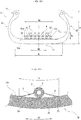
- FIG. 2A is an example of a tire meridian cross sectional view of the pneumatic tire.
- FIG. 2B is an example of a cross sectional view in a tire circumferential direction of the pneumatic tire.
- reference symbol H denotes a tire cross sectional height.
- the tire cross sectional height H is a height from a nominal rim diameter to a tread surface, in a tire meridian cross section, in a state of being filled with air at a pneumatic pressure prescribed by JATMA.
- a pneumatic tire 1 is provided with a pair of annular bead portions 11, side wall portions 12 which extend to outer sides in a tire diametrical direction from each of the bead portions 11, and a tread portion 13 which is connected to outer ends in the tire diametrical direction of each of the side wall portions 12, as shown in FIGS. 1 and 2A .
- the pneumatic tire 1 is provided with a plate-like member 2 which is attached to an inner surface 13a of the tread portion.
- the plate-like member 2 is attached to the inner surface 13a of the tread portion by two mounting portions 2a and 2b which are arranged so as to be spaced apart in a tire circumferential direction CD.
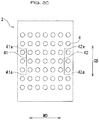
- FIG. 2C is an expansion plan view in which the plate-like member 2 is expanded on a plane.
- a plurality of through holes 4 and slits 41 and 42 having both ends positioned within a plate surface are formed in the plate-like member 2.
- two slits 41 and 42 are formed.
- the slits 41 and 42 are formed along the tire circumferential direction CD. Both ends 41 a, in an extending direction, of the slit 41 are positioned within the plate surface. Similarly, both ends 42a, in an extending direction, of the slit 42 are positioned within the plate surface.
- a supporting member 3 is inserted into the slits 41 and 42.
- the supporting member 3 according to the present embodiment is formed into a cylindrical shape which extends along a tire width direction WD, and a cylindrical axial direction is orthogonal to a length direction of the slits 41 and 42, that is, the tire circumferential direction CD. Details of the supporting member 3 will be described later.
- the supporting member 3 supports the plate-like portions in both sides of the slits 41 and 42 in the opposite directions to each other. Specifically, the supporting member 3 supports the plate-like portion, which is closer to an outer side in the tire width direction than the slits 41 and 42, in an external side in the tire diametrical direction. On the other hand, the supporting member 3 supports the plate-like portion, which is closer to the inner side in the tire width direction than the slits 41 and 42, in an internal side in the tire diametrical direction. As a result, the plate-like portion sandwiched by the slits 41 and the slit 42 in the plate-like member 2 is in a state of floating from the inner surface 13a of the tread portion.
- the plate-like member 2 is attached to the inner surface 13a of the tread portion by the mounting portions 2a and 2b in such a manner that a space 20 is formed between the plate-like member 2 and the inner surface 13a of the tread portion. In other words, a part of the plate-like member 2 is in non-contact with the inner surface 13a of the tread portion.
- the mounting portions 2a and 2b are respectively positioned outer sides of both ends 41 a and 42a of the slits 41 and 42.
- both end portions in the tire width direction WD of the plate-like member 2 positioned in the outer side in the tire diametrical direction of the supporting member 3 are in contact with the inner surface 13a of the tread portion, however, are not fixed to the inner surface 13a of the tread portion.
- the space 20 is an area which is between two mounting portions 2a and 2b and is surrounded by the outer surface of the plate-like member 2 and the inner surface 13a of the tread portion.
- a plurality of through holes 4 are formed in the plate-like member 2.
- the through holes 4 are formed in a whole surface of the plate-like member 2. There exist the through holes 4 which are formed toward the space 20 without being in contact with the supporting member 3, in addition to the through holes 4 which are in contact with the supporting member 3.
- the through holes 4 are arranged at the positions having a greater particle speed, the cavity resonance noise can be effectively damped. Further, since an air flow is added to the speed, the through holes 4 are preferably arranged in the place having the air flow, in the rotating tire.
- FIG. 3 is an enlarged cross sectional view showing the plate-like member 2 having the through holes 4 formed therein in an enlarged manner (in this case, the supporting member 3 is not shown).
- the air flow within the tire is shown by arrows.
- Within the tire there exist an air flow Sr in the tire diametrical direction which is generated by deformation of the tire caused by the ground on the road surface, and an air flow Sc in the circumferential direction CD which is generated by restoration of the deformation. Since the sound generated by the input from the road surface and the air flow Sr in the tire diametrical direction pass through the through holes 4 by arranging the plate-like member 2 so as to cover the inner surface 13a of the tread portion, it is possible to effectively reduce the cavity resonance noise.
- the sound transmitted in the tire circumferential direction CD and the air flow Sc in the tire circumferential direction CD pass through the through holes 4 by attaching the plate-like member 2 to the inner surface 13a of the tread portion so that the space 20 is formed between the plate-like member 2 and the inner surface 13a of the tread portion, it is possible to effectively reduce the cavity resonance noise.
- the plate-like member 2 having the through holes 4 therein is attached to the inner surface 13a of the tread portion.
- the supporting member 3 is inserted into the slits 41 and 42 which are formed in the plate-like member 2.
- the plate-like member 2 is preferably formed with a small thickness for suppressing the increase of the weight. However, in the case that the thickness is small, the plate-like member 2 is crushed against the inner surface 13a of the tread portion due to centrifugal force and, thereby, the through holes 4 are closed when the tire is rotated at a high speed.
- the deformation of the plate-like member 2 can be suppressed by making the plate-like member 2 thick or hard.
- the weight is increased or the performance of following the deformation of the tire is obstructed, there is a risk that the other performances and the durability are adversely affected.
- the plate-like member 2 can be prevented from being crushed, by inserting the supporting member 3 to the slits 41 and 42 and supporting the plate-like portions in both sides of the slits 41 and 42 in the opposite directions to each other, it is possible to reduce the cavity resonance noise not only at a low to the middle speed, but also at a high speed.
- the supporting member 3 is preferably formed by a porous material. Accordingly, it is possible to obtain a sound absorbing effect of the supporting member 3 itself while suppressing the increase of the weight by the supporting member 3.
- the porous material is constructed, for example, by a sponge and an unwoven fabric.
- the porous material is not limited to them, however, a sponge made of a soft polyurethane foam is preferably employed.
- the unwoven fabric is employed as the porous material
- the supporting member 3 is formed by making the unwoven fabric into a ball or folding the fabric.
- the supporting member 3 is formed into a tubular shape which extends along the tire width direction WD.
- an air layer is formed in an inner portion.
- the shape of the supporting member 3 is not particularly limited as long as the shape is the one which can support the plate-like member 2 against the centrifugal force, and a solid columnar shape may be employed.
- the supporting member 3 does not necessarily support a whole, in the tire width direction, of the plate-like member 2, but may be formed into a shape which can support at least a part of the plate-like member 2. Further, the supporting member 3 may be formed into a shape which extends along the tire width direction WD beyond the width, in the tire width direction WD, of the plate-like member 2.
- a cylindrical shape is particularly preferable for the shape of the supporting member 3.
- the sound absorbing effect can be achieved in relation to the sound from any angles.
- the cross-sectional shape of the supporting member 3 may be formed into polygonal shapes such as a triangular shape and a quadrangular shape, in addition to the circular shape.
- the supporting member 3 is preferably locked to the slits 41 and 42.
- the supporting member 3 may be inserted into the slits 41 and 42 in a compressed state.
- the maximum circumferential length formed by the slits 41 and 42 is smaller than an outer peripheral length of the supporting member 3.
- the supporting member 3 is hard to come off from the slits 41 and 42.
- a thickness of the plate-like member 2 is preferably between 0.1 mm and 10 mm, and more preferably between 0.2 mm and 2 mm.
- the thickness of the plate-like member 2 is made smaller than 0.1 mm, the effect of reducing the cavity resonance noise by the plate-like member 2 becomes small.
- the thickness of the plate-like member 2 is made larger than 10 mm, the inner surface 13a of the tread portion is locally added with weight by the plate-like member 2. As a result, there is a tendency that the high-speed uniformity is deteriorated, and a vibration and ride quality caused thereby are deteriorated.
- the maximum height Hp of the plate-like member 2 from the inner surface 13a of the tread portion in a tire equator is preferably equal to or more than one tenths of the tire cross sectional height H (or 10 mm).
- the maximum height Hp of the plate-like member 2 is made lower than one tenths of the tire cross sectional height H (or 10 mm)
- the effect of reducing the cavity resonance noise by the plate-like member 2 becomes small.
- the maximum height Hp of the plate-like member 2 is preferably equal to or less than one half of the tire cross sectional height H.
- the maximum height Hp of the plate-like member 2 is made higher than one half of the tire cross sectional height H, there is a risk that the plate-like member 2 comes into contact with the rim flange at a time of assembling in the rim and a malfunction may be caused.
- a width Wp in the tire width direction of the plate-like member 2 is preferably between 30 % and 120 % of a ground width W.
- the width Wp of the plate-like member 2 is made smaller than 30 % of the ground with W, the effect of reducing the cavity resonance noise becomes small.
- the width Wp of the plate-like member 2 is made larger than 120 % of the ground width W, there is a risk that the plate-like member 2 comes into contact with the inner surface of the side wall due to the deformation at the grounding time and the following performance to the curved surface is deteriorated. Therefore, the malfunction may be caused.
- a length Lp in the tire circumferential direction of the plate-like member 2 is preferably equal to or less than the ground length, and is preferably about one half thereof, it is not limited thereto depending on the mounting number and the tire size.
- the length Lp in the tire circumferential direction of the plate-like member 2 is preferably in a size that partially overlaps with the ground length for covering the ground portion in stepping in and kicking out.
- FIG. 4 is a plan view showing a state in which a part of the plate-like member 2 is expanded into a plane shape.
- a hole diameter ⁇ of the through hole 4 is preferably between 0.4 mm and 10 mm, and is more preferably between 1 mm and 5 mm.
- the hole diameter ⁇ is smaller than 0.4 mm, the resistance when the sound and the air pass through becomes too large. As a result, it is hard to produce the through hole as well as the through hole is not effective.
- the hole diameter ⁇ is larger than 10 mm, the resistance when the sound and the air pass through becomes too small. As a result, the damping effect becomes small.
- a hole area rate P is preferably between 1 % and 20 %, and more preferably between 1 % and 10 %.
- the hole area rate P is smaller than 1 %, the resistance when the sound and the air pass through becomes too large. As a result, the hole is not effective.
- the hole area rate P is larger than 20 %, the resistance when the sound and the air pass through becomes too small. As a result, the damping effect becomes small.
- the hole area rate P is about 7 %.
- the hole distance t between the through holes 4 can be appropriately set by the hole area rate P and the hole diameter ⁇ while using the expression described above; however, the hole distance t is preferably between 1 mm and 30 mm and is more preferably between 5 mm and 15 mm, for example. In the case that the hole distance t is smaller than 1 mm, the number of the holes is necessarily increased.
- the resistance when the sound and the air pass through becomes too small, the damping effect becomes small, and a strength of the plate itself is further deteriorated.
- the hole distance t is larger than 30 mm, the number of the holes is necessarily reduced, and the obtained damping effect becomes small.
- the plate-like member 2 is formed by a plate-like or film-like resin.
- resin general-purpose resins such as PET, PU, TPU, PVC, PC and PEN can be exemplified.
- the plate-like member 2 is attached to the inner surface 13a of the tread portion by the mounting portions 21 a and 21b.
- the plate-like member 2 is fixed to the inner surface 13a of the tread portion by an adhesive agent or a double-stick tape.
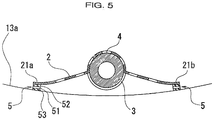
- the plate-like member 2 is preferably fixed to the inner surface 13a of the tread portion via a cushion layer 5, as shown in FIG. 5 .
- the cushion layer 5 includes a cushion layer main body 51 having a stretching property, and double-stick tapes 52 and 53 on both sides of the cushion layer main body 51. Accordingly, the cushion layer main body 51 in the cushion layer 5 is deformed, and can follow the shape of the curved surface of the inner surface 13a of the tread portion and the deformation at the grounding time. As a result, it is possible to stably fix the plate-like member 2 to the inner surface 13a of the tread portion.
- the weight of the plate-like member 2 is preferably equal to or less than 15 g, and more preferably equal to or less than 10 g.
- the weight of the plate-like member 2 locally increases the weight of the inner surface 13a of the tread portion, and tends to deteriorate high-speed uniformity and deteriorate the vibration caused thereby and the ride quality.
- a total weight including the plate-like member 2, the supporting member 3 and the cushion layer 5 is preferably set to be equal to or less than 20 g, and more preferably set to be equal to or less than 15 g.
- the example provided with the plate-like member 2 in which a plurality of through holes 4 and the slits 41 and 42 including both ends 41 a and 42a positioned within the plate are formed, and one supporting member 3 which is inserted into the slits 41 and 42, and supports the plate-like portions in both sides of the slits 41 and 42 in the opposite directions to each other.
- a long plate-like member 2 may be attached over a whole periphery of the inner surface 13a of the tread portion, a plurality of slits 41 and 42 may be formed at uniform intervals in the tire circumferential direction CD, and supporting members 3 may be inserted respectively into the slits 41 and 42.
- the method of manufacturing the pneumatic tire according to the present invention includes a step of forming a plurality of through holes 4, and the slits 41 and 42 having both ends 41 a and 42a positioned within the plate, in relation to the plate-like member 2, a step of inserting the supporting member 3 into the slits 41 and 42, and a step of attaching the plate-like member 2 to the inner surface 13a of the tread portion by the mounting portions 2a and 2b which are respectively positioned closer to the outer side than both ends 41a and 42a of the slits 41 and 42, so that the space 20 is formed between the plate-like member 2 and the inner surface 13a of the tread portion.
Landscapes
- Engineering & Computer Science (AREA)
- Mechanical Engineering (AREA)
- Tires In General (AREA)
Abstract
Description
- The present invention relates to a pneumatic tire which can reduce a cavity resonance noise by attaching a plate-like member to an inner surface of a tread portion, and a method of manufacturing the pneumatic tire.
- When the vehicle travels on a rough road surface or climbs over a joint of the road surface, a sound called as a road noise may be generated within the vehicle. The road noise is one of the sound with which a tire is involved. In the case that the tire is vibrated by an input caused by irregularity on the road surface, a cavity resonance noise is excited in an internal portion of the tire by the oscillation, and the sound is caused within the vehicle.
-
Patent Document 1 describes a pneumatic tire in which a sound control material made of a sponge material is disposed in a tire inner cavity which is surrounded by a rim and the pneumatic tire, for reducing the road noise. However, there is the possibility that the sponge material mentioned above causes increase in the weight of a whole tire, resulting in a lowered fuel efficiency. Further, there is a problem that a cost increase is caused since a lot of sponge material is required. -
Patent Document 2 describes a pneumatic tire in which a partition wall comparting an air chamber in a circumferential direction is provided within the air chamber, which is formed between a tire inner peripheral surface and a rim outer peripheral surface, for the purpose of preventing increase in the road noise while suppressing a great cost increase. - An equivalent length of an air column within the air chamber becomes short by comparting the air chamber in the circumferential direction by the partition wall, and it is possible to shift a resonant frequency of an air column resonance. As a result, it is possible to prevent the road noise from being increased by the air column resonance.
- Further,
Patent Document 3 describes a pneumatic tire in which an inner wall of the tire is provided with a thin elastic divider plate extending approximately in an axial direction within the tire inner cavity, for the purpose of reducing the load noise which is caused by the cavity resonance noise, while suppressing the increase of the weight. A sound pressure mode is changed in a whole of the tire inner cavity by the provision of the elastic divider plate within the tire inner cavity, and an in-vehicle sound level is reduced. - However, the partition wall and the divider plate oscillate themselves and may increase the road noise caused by the cavity resonance noise by serving a new sound source.
-
- Patent Document 1:
-
JP-A-2006-306302 - Patent Document 2:
-
JP-A-7-117404 - Patent Document 3:
-
JP-A-5-294102 - Accordingly, an object of the present invention is to provide a pneumatic tire which can reduce a cavity resonance noise while suppressing weight increase and cost increase, and a method of manufacturing the pneumatic tire.
- The object can be achieved by the following present invention. That is, the present invention provides a pneumatic tire including a plate-like member in which a plurality of through holes and slits having both ends positioned within a plate surface are formed, and a supporting member which is inserted into the slits and supports plate-like portions in both sides of the slits in opposite directions to each other, wherein the plate-like member is attached to an inner surface of the tread portion by mounting portions which are respectively positioned closer to an outer side than both ends of the slits, so that a space is formed between the plate-like member and the inner surface of the tread portion.
- In the pneumatic tire according to the present invention, the plate-like member having a plurality of through holes formed therein is attached to the inner surface of the tread portion. More specifically, the plate-like member is attached to the inner surface of the tread portion so that the space is formed between the plate-like member and the inner surface of the tread portion.
- As a result, a plurality of through holes are formed in the plate-like member which is in a state of floating from the inner surface of the tread portion. In general, when the sound passes through the through hole, there are generated the viscous damping caused by the friction between the air and the inner wall surface of the through hole, and the pressure loss damping caused by the vortex generated by the passing. Consequently, the sound is damped.
- Therefore, the sound within the tire passes through the through hole by attaching the plate-like member having the through holes formed therein to the inner surface of the tread portion, whereby it is possible to damp and reduce the cavity resonance noise. Further, since it is not necessary to provide a lot of noise absorbing material and sound control material such as sponge material, it is possible to suppress increase of the weight and increase of the cost.
- Further, in the present invention, since the supporting member inserted to the slits formed in the plate-like member supports the plate-like portions in both sides of the slits in the opposite directions to each other, it is possible to prevent a situation where the plate-like member is crushed against the inner surface of the tread portion due to the centrifugal force in association with the rotation of the tire and, thereby, the through holes are closed. As a result, it is possible to damp and reduce the cavity resonance noise not only at a low to middle speed, but also at a high speed.
- In the pneumatic tire according to the present invention, the slits may be formed along a tire circumferential direction.
- According to the structure, since the air flow in a tire circumferential direction generated within the tire easily passes through the through holes, it is possible to effectively reduce the cavity resonance noise.
- In the pneumatic tire according to the present invention, the supporting member may be formed into a cylindrical shape, and a cylindrical axis direction thereof may be orthogonal to a length direction of the slits, and a length of each of the slits may be equal to or less than an outer diameter of the supporting member.
- According to the structure, it is possible to prevent the supporting member from falling away from the slits during traveling. Further, since it is not necessary to fix the supporting member to the plate-like member by an adhesive agent, it is possible to suppress the increase of the weight.
- In the pneumatic tire according to the present invention, both ends of the slits may reach the through holes in a circular shape.
- According to the structure, it is possible to prevent the plate-like member from being ruptured due to the concentration of the stress into both ends of the slits.
- In the pneumatic tire according to the present invention, the plate-like member may be attached to the inner surface of the tread portion over a whole periphery thereof, and a plurality of the slits may be formed so as to be uniformly spaced apart in a tire circumferential direction.
- According to the structure, since the plate-like member is attached over a whole periphery of the inner surface of the tread portion, it is possible to effectively reduce the cavity resonance noise by the through holes. Further, it is possible to suppress deterioration of uniformity and a weight balance by arranging the supporting member in each of the slits which are formed at a uniform interval over the whole periphery in the tire circumferential direction.
- Further the present invention provides a method of manufacturing a pneumatic tire, the method including a step of forming, to a plate-like member, a plurality of through holes and slits having both ends positioned within a plate surface, a step of inserting a supporting member into the slits, and a step of attaching the plate-like member to an inner surface of the tread portion by mounting portions which are respectively positioned closer to an outer side than both ends of the slits, so that a space is formed between the plate-like member and the inner surface of the tread portion.
- In the pneumatic tire manufactured by the manufacturing method according to the present invention, the plate-like member having a plurality of through holes formed therein is attached to the inner surface of the tread portion. More specifically, the plate-like member is attached to the inner surface of the tread portion so that the space is formed between the plate-like member and the inner surface of the tread portion. As a result, a plurality of through holes are formed in the plate-like member which is in a floating state from the inner surface of the tread portion. In general, when the sound passes through the through hole, there are generated the viscous damping caused by the friction between the air and the inner wall surface of the through hole, and the pressure loss damping caused by the vortex generated by the passing.
- Consequently, the sound is damped. Therefore, the sound within the tire passes through the through hole by attaching the plate-like member having the through holes formed therein to the inner surface of the tread portion, whereby it is possible to damp and reduce the cavity resonance noise. Further, since it is not necessary to provide a lot of noise absorbing material and sound control material such as sponge material, it is possible to suppress increase of the weight and increase of the cost.
- Further, in the pneumatic tire manufactured by the manufacturing method according to the present invention, since the supporting member inserted to the slits formed in the plate-like member supports the plate-like portions in both sides of the slits in the opposite directions to each other, it is possible to prevent a situation where the plate-like member is crushed against the inner surface of the tread portion due to the centrifugal force in association with the rotation of the tire and, thereby, the through holes are closed. As a result, it is possible to damp and reduce the cavity resonance noise not only at a low to the middle speed, but also at a high speed.
-
- FIG. 1
- is a perspective view showing an example of a pneumatic tire according to the present invention;
- FIG. 2A
- is a tire meridian cross sectional view of the pneumatic tire;
- FIG. 2B
- is a cross sectional view in a tire circumferential direction of the pneumatic tire;
- FIG. 2C
- is an expansion plan view in which a plate-like member is expanded on a plane;
- FIG. 3
- is an enlarged cross sectional view showing the plate-like member in an enlarged manner;
- FIG. 4
- is a plan view of the plate-like member;
- FIG. 5
- is a cross sectional view in a tire circumferential direction of a pneumatic tire according to another embodiment;
- FIG. 6
- is a cross sectional view in the tire circumferential direction of the pneumatic tire according to the other embodiment;
- FIG. 7
- is a perspective view showing the pneumatic tire according to the other embodiment;
- FIG. 8
- is an expansion plan view of a plate-like member according to the other embodiment; and
- FIG. 9
- is a perspective view of a supporting member according to the other embodiment.
- A description will be given below of embodiments according to the present invention with reference to the accompanying drawings.
-
FIG. 1 is a perspective view showing an example of a pneumatic tire.FIG. 2A is an example of a tire meridian cross sectional view of the pneumatic tire.FIG. 2B is an example of a cross sectional view in a tire circumferential direction of the pneumatic tire. Here, reference symbol H denotes a tire cross sectional height. The tire cross sectional height H is a height from a nominal rim diameter to a tread surface, in a tire meridian cross section, in a state of being filled with air at a pneumatic pressure prescribed by JATMA. - A
pneumatic tire 1 is provided with a pair ofannular bead portions 11,side wall portions 12 which extend to outer sides in a tire diametrical direction from each of thebead portions 11, and atread portion 13 which is connected to outer ends in the tire diametrical direction of each of theside wall portions 12, as shown inFIGS. 1 and2A . - The
pneumatic tire 1 is provided with a plate-like member 2 which is attached to aninner surface 13a of the tread portion. The plate-like member 2 is attached to theinner surface 13a of the tread portion by two mountingportions -
FIG. 2C is an expansion plan view in which the plate-like member 2 is expanded on a plane. A plurality of throughholes 4 and slits 41 and 42 having both ends positioned within a plate surface are formed in the plate-like member 2. - In the present embodiment, two
slits slits slit 41 are positioned within the plate surface. Similarly, both ends 42a, in an extending direction, of theslit 42 are positioned within the plate surface. - A supporting
member 3 is inserted into theslits member 3 according to the present embodiment is formed into a cylindrical shape which extends along a tire width direction WD, and a cylindrical axial direction is orthogonal to a length direction of theslits member 3 will be described later. - The supporting
member 3 supports the plate-like portions in both sides of theslits member 3 supports the plate-like portion, which is closer to an outer side in the tire width direction than theslits member 3 supports the plate-like portion, which is closer to the inner side in the tire width direction than theslits slits 41 and theslit 42 in the plate-like member 2 is in a state of floating from theinner surface 13a of the tread portion. - Further, the plate-
like member 2 is attached to theinner surface 13a of the tread portion by the mountingportions space 20 is formed between the plate-like member 2 and theinner surface 13a of the tread portion. In other words, a part of the plate-like member 2 is in non-contact with theinner surface 13a of the tread portion. The mountingportions slits - In the present embodiment, both end portions in the tire width direction WD of the plate-
like member 2 positioned in the outer side in the tire diametrical direction of the supportingmember 3 are in contact with theinner surface 13a of the tread portion, however, are not fixed to theinner surface 13a of the tread portion. Thespace 20 is an area which is between two mountingportions like member 2 and theinner surface 13a of the tread portion. - A plurality of through
holes 4 are formed in the plate-like member 2. The throughholes 4 are formed in a whole surface of the plate-like member 2. There exist the throughholes 4 which are formed toward thespace 20 without being in contact with the supportingmember 3, in addition to the throughholes 4 which are in contact with the supportingmember 3. - Here, a description will be given of an effect of damping a cavity resonance noise by the through holes 4. When the sound passes through the through
holes 4, the cavity resonance noise is damped by friction between air serving as a medium and an inner wall surface of the through hole 4 (viscous damping). Further, when the sound passes through the throughhole 4, the cavity resonance noise is damped by a pressure loss caused by a vortex which is generated by the passing (pressure loss damping). - As a result, since the sound within the tire passes through the through
holes 4 by attaching the plate-like member 2 having the throughholes 4 formed therein to theinner surface 13a of the tread portion, it is possible to damp and reduce the cavity resonance noise. - Further, a particle speed of the air is involved with the viscous damping and the pressure loss damping when the sound passes through the through holes 4. In the case that the through
holes 4 are arranged at the positions having a greater particle speed, the cavity resonance noise can be effectively damped. Further, since an air flow is added to the speed, the throughholes 4 are preferably arranged in the place having the air flow, in the rotating tire. -
FIG. 3 is an enlarged cross sectional view showing the plate-like member 2 having the throughholes 4 formed therein in an enlarged manner (in this case, the supportingmember 3 is not shown). The air flow within the tire is shown by arrows. Within the tire, there exist an air flow Sr in the tire diametrical direction which is generated by deformation of the tire caused by the ground on the road surface, and an air flow Sc in the circumferential direction CD which is generated by restoration of the deformation. Since the sound generated by the input from the road surface and the air flow Sr in the tire diametrical direction pass through the throughholes 4 by arranging the plate-like member 2 so as to cover theinner surface 13a of the tread portion, it is possible to effectively reduce the cavity resonance noise. - Further, since the sound transmitted in the tire circumferential direction CD and the air flow Sc in the tire circumferential direction CD pass through the through
holes 4 by attaching the plate-like member 2 to theinner surface 13a of the tread portion so that thespace 20 is formed between the plate-like member 2 and theinner surface 13a of the tread portion, it is possible to effectively reduce the cavity resonance noise. - Further, the closer to the
inner surface 13a of the tread portion the air flow is, the faster the air flow is. Considering the fact, in the present invention, the plate-like member 2 having the throughholes 4 therein is attached to theinner surface 13a of the tread portion. - The supporting
member 3 is inserted into theslits like member 2. The plate-like member 2 is preferably formed with a small thickness for suppressing the increase of the weight. However, in the case that the thickness is small, the plate-like member 2 is crushed against theinner surface 13a of the tread portion due to centrifugal force and, thereby, the throughholes 4 are closed when the tire is rotated at a high speed. - As a result, there is a risk that the effect of reducing the cavity resonance noise by the through
holes 4 cannot be obtained or is lowered. On the contrary, the deformation of the plate-like member 2 can be suppressed by making the plate-like member 2 thick or hard. However, as the weight is increased or the performance of following the deformation of the tire is obstructed, there is a risk that the other performances and the durability are adversely affected. - According to the present invention, since the plate-
like member 2 can be prevented from being crushed, by inserting the supportingmember 3 to theslits slits - The supporting
member 3 is preferably formed by a porous material. Accordingly, it is possible to obtain a sound absorbing effect of the supportingmember 3 itself while suppressing the increase of the weight by the supportingmember 3. Here, the porous material is constructed, for example, by a sponge and an unwoven fabric. The porous material is not limited to them, however, a sponge made of a soft polyurethane foam is preferably employed. Further, in the case that the unwoven fabric is employed as the porous material, the supportingmember 3 is formed by making the unwoven fabric into a ball or folding the fabric. - The supporting
member 3 according to the present embodiment is formed into a tubular shape which extends along the tire width direction WD. In the case that the supportingmember 3 is formed into the tubular shape, an air layer is formed in an inner portion. As a result, the effect of absorbing the sound passing through the supportingmember 3 made of the porous material is enhanced. However, the shape of the supportingmember 3 is not particularly limited as long as the shape is the one which can support the plate-like member 2 against the centrifugal force, and a solid columnar shape may be employed. - Further, the supporting
member 3 does not necessarily support a whole, in the tire width direction, of the plate-like member 2, but may be formed into a shape which can support at least a part of the plate-like member 2. Further, the supportingmember 3 may be formed into a shape which extends along the tire width direction WD beyond the width, in the tire width direction WD, of the plate-like member 2. - Further, a cylindrical shape is particularly preferable for the shape of the supporting
member 3. In the case that the supportingmember 3 is formed into the cylindrical shape, the sound absorbing effect can be achieved in relation to the sound from any angles. However, the cross-sectional shape of the supportingmember 3 may be formed into polygonal shapes such as a triangular shape and a quadrangular shape, in addition to the circular shape. - The supporting
member 3 is preferably locked to theslits member 3 is formed by the porous material as described above, the supportingmember 3 may be inserted into theslits slits member 3, the maximum circumferential length formed by theslits member 3. As a result, the supportingmember 3 is hard to come off from theslits - A thickness of the plate-
like member 2 is preferably between 0.1 mm and 10 mm, and more preferably between 0.2 mm and 2 mm. In the case that the thickness of the plate-like member 2 is made smaller than 0.1 mm, the effect of reducing the cavity resonance noise by the plate-like member 2 becomes small. On the contrary, in the case that the thickness of the plate-like member 2 is made larger than 10 mm, theinner surface 13a of the tread portion is locally added with weight by the plate-like member 2. As a result, there is a tendency that the high-speed uniformity is deteriorated, and a vibration and ride quality caused thereby are deteriorated. - The maximum height Hp of the plate-
like member 2 from theinner surface 13a of the tread portion in a tire equator is preferably equal to or more than one tenths of the tire cross sectional height H (or 10 mm). In the case that the maximum height Hp of the plate-like member 2 is made lower than one tenths of the tire cross sectional height H (or 10 mm), the effect of reducing the cavity resonance noise by the plate-like member 2 becomes small. On the contrary, the maximum height Hp of the plate-like member 2 is preferably equal to or less than one half of the tire cross sectional height H. In the case that the maximum height Hp of the plate-like member 2 is made higher than one half of the tire cross sectional height H, there is a risk that the plate-like member 2 comes into contact with the rim flange at a time of assembling in the rim and a malfunction may be caused. - A width Wp in the tire width direction of the plate-
like member 2 is preferably between 30 % and 120 % of a ground width W. In the case that the width Wp of the plate-like member 2 is made smaller than 30 % of the ground with W, the effect of reducing the cavity resonance noise becomes small. On the contrary, in the case that the width Wp of the plate-like member 2 is made larger than 120 % of the ground width W, there is a risk that the plate-like member 2 comes into contact with the inner surface of the side wall due to the deformation at the grounding time and the following performance to the curved surface is deteriorated. Therefore, the malfunction may be caused. - Although a length Lp in the tire circumferential direction of the plate-
like member 2 is preferably equal to or less than the ground length, and is preferably about one half thereof, it is not limited thereto depending on the mounting number and the tire size. The length Lp in the tire circumferential direction of the plate-like member 2 is preferably in a size that partially overlaps with the ground length for covering the ground portion in stepping in and kicking out. -
FIG. 4 is a plan view showing a state in which a part of the plate-like member 2 is expanded into a plane shape. A hole diameter φ of the throughhole 4 is preferably between 0.4 mm and 10 mm, and is more preferably between 1 mm and 5 mm. In the case that the hole diameter φ is smaller than 0.4 mm, the resistance when the sound and the air pass through becomes too large. As a result, it is hard to produce the through hole as well as the through hole is not effective. On the contrary, in the case that the hole diameter φ is larger than 10 mm, the resistance when the sound and the air pass through becomes too small. As a result, the damping effect becomes small. - Further, a hole area rate P is preferably between 1 % and 20 %, and more preferably between 1 % and 10 %. In the case that the hole area rate P is smaller than 1 %, the resistance when the sound and the air pass through becomes too large. As a result, the hole is not effective. On the contrary, in the case that the hole area rate P is larger than 20 %, the resistance when the sound and the air pass through becomes too small. As a result, the damping effect becomes small.
- When a hole distance between the through
holes 4 is represented by t, the hole area rate P in the case that a plurality of throughholes 4 are arranged in parallel vertically and laterally as in the present embodiment is defined by an expression P = (π x φ2)/(4 x t2). For example, when the hole diameter φ is 3 mm and the hole distance t is 10 mm, the hole area rate P is about 7 %. - The hole distance t between the through
holes 4 can be appropriately set by the hole area rate P and the hole diameter φ while using the expression described above; however, the hole distance t is preferably between 1 mm and 30 mm and is more preferably between 5 mm and 15 mm, for example. In the case that the hole distance t is smaller than 1 mm, the number of the holes is necessarily increased. - As a result, the resistance when the sound and the air pass through becomes too small, the damping effect becomes small, and a strength of the plate itself is further deteriorated. On the contrary, in the case that the hole distance t is larger than 30 mm, the number of the holes is necessarily reduced, and the obtained damping effect becomes small.
- The plate-
like member 2 is formed by a plate-like or film-like resin. As the resin, general-purpose resins such as PET, PU, TPU, PVC, PC and PEN can be exemplified. - The plate-
like member 2 is attached to theinner surface 13a of the tread portion by the mountingportions like member 2 is fixed to theinner surface 13a of the tread portion by an adhesive agent or a double-stick tape. At this time, the plate-like member 2 is preferably fixed to theinner surface 13a of the tread portion via acushion layer 5, as shown inFIG. 5 . - The
cushion layer 5 includes a cushion layermain body 51 having a stretching property, and double-stick tapes main body 51. Accordingly, the cushion layermain body 51 in thecushion layer 5 is deformed, and can follow the shape of the curved surface of theinner surface 13a of the tread portion and the deformation at the grounding time. As a result, it is possible to stably fix the plate-like member 2 to theinner surface 13a of the tread portion. - The weight of the plate-
like member 2 is preferably equal to or less than 15 g, and more preferably equal to or less than 10 g. The weight of the plate-like member 2 locally increases the weight of theinner surface 13a of the tread portion, and tends to deteriorate high-speed uniformity and deteriorate the vibration caused thereby and the ride quality. In the case that thecushion layer 5 described above is provided, a total weight including the plate-like member 2, the supportingmember 3 and thecushion layer 5 is preferably set to be equal to or less than 20 g, and more preferably set to be equal to or less than 15 g. - In the first embodiment described above, there is shown the example provided with the plate-
like member 2 in which a plurality of throughholes 4 and theslits member 3 which is inserted into theslits slits - However, as shown in
FIG. 6 , a long plate-like member 2 may be attached over a whole periphery of theinner surface 13a of the tread portion, a plurality ofslits members 3 may be inserted respectively into theslits - Next, a description will be given of a method of manufacturing the pneumatic tire. The method of manufacturing the pneumatic tire according to the present invention includes a step of forming a plurality of through
holes 4, and theslits like member 2, a step of inserting the supportingmember 3 into theslits like member 2 to theinner surface 13a of the tread portion by the mountingportions slits space 20 is formed between the plate-like member 2 and theinner surface 13a of the tread portion. -
- (1) In the embodiments described above, two
slits
FIG. 7 shows an example in which fourslits member 3 supports the plate-like portion which is closer to the outer side in the tire width direction than theslit 41, the plate-like portion which is sandwiched between theslit 43 and theslit 44, and the plate-like portion which is closer to the outer side in the tire width direction than theslit 42, in an external side in the tire diametrical direction, and supports the plate-like portion which is sandwiched between theslit 41 and theslit 43, and the plate-like portion which is sandwiched between theslit 42 and theslit 44, in an internal side in the tire diametrical direction.
However, the supportingmember 3 may support the plate-like portion which is closer to the outer side in the tire width direction than theslit 41, the plate-like portion which is sandwiched between theslit 43 and theslit 44, and the plate-like portion which is closer to the outer side in the tire width direction than theslit 42, in the internal side in the tire diametrical direction, and may support the plate-like portion which is sandwiched between theslit 41 and theslit 43, and the plate-like portion which is sandwiched between theslit 42 and theslit 44, in the external side in the tire diametrical direction. In this case, the number of the throughholes 4 formed in the plate-like portion supported to the internal side in the tire diametrical direction is preferably more than the number of the through holes formed in the plate-like portion supported to the external side in the tire diametrical direction. - (2) In the example shown in
FIG. 2C , theslits holes 4 are respectively arranged independently, however, they are not limited to this. For example, as shown inFIG. 8 , theslits holes 4. Further, in this example, both ends 41 a and 42a of theslits holes 4, and it is possible to avoid stress concentration on both theends - (3) The slits are not necessarily formed along the tire circumferential direction CD. For example, the slits may be formed along the tire width direction WD. At this time, the axial direction of the supporting
member 3 is arranged along the tire circumferential direction CD. - (4) In the example shown in
FIG. 2B , the outer surface of the plate-like member 2 positioned in the outer side in the tire diametrical direction of the supportingmember 3 is in contact with theinner surface 13a of the tread portion, however, it is preferable that it is not in contact with theinner surface 13a of the tread portion (refer toFIG. 5 ). - (5) The shape of the supporting
member 3 is not limited to the shape described above. For example, the shape may be a solid circular cylinder shape or a solid square post shape. - (6) Further, the supporting
member 3 is not necessarily formed by the porous material. For example, the supportingmember 3 may be formed by the resin frame as shown inFIG. 9 . As the resin, there can be exemplified the general-purpose resins such as PET, PU, TPU, PVC, PC, PE and PEN. The shape of the frame is not limited to the trapezoidal cross section as shown inFIG. 9 , but may be a triangular cross section or a rectangular cross section.
Claims (11)
- A pneumatic tire (1) comprising:- a plate-like member (2) in which a plurality of through holes (4) and slits (41, 42, 43, 44) having both ends (41a, 42a) positioned within a plate surface are formed; and- a supporting member (3) which is inserted into the slits (41, 42, 43, 44) and supports plate-like portions in both sides of the slits (41, 42, 43, 44) in opposite directions to each other,wherein the plate-like member (2) is attached to an inner surface (13a) of the tread portion (13) by mounting portions (2a, 2b) which are respectively positioned closer to an outer side than both ends (41a, 42a) of the slits (41, 42, 43, 44), so that a space (20) is formed between the plate-like member (2) and the inner surface (13a) of the tread portion (13).
- The pneumatic tire (1) according to claim 1,
wherein the slits (41, 42, 43, 44) are formed along a tire circumferential direction. - The pneumatic tire (1) according to claim 1 or 2,
wherein the supporting member (3) is formed into a cylindrical shape, and a cylindrical axis direction thereof is orthogonal to a length direction of the slits (41, 42, 43, 44), and
wherein a length of each of the slits (41, 42, 43, 44) is equal to or less than an outer diameter of the supporting member (3). - The pneumatic tire (1) according to any one of claims 1 to 3,
wherein both ends (41a, 42a) of the slits (41, 42, 43, 44) reach the through holes (4) in a circular shape. - The pneumatic tire (1) according to any one of claims 1 to 4,
wherein the plate-like member (2) is attached to the inner surface (13a) of the tread portion (13) over a whole periphery thereof, and a plurality of the slits (41, 42, 43, 44) are formed so as to be uniformly spaced apart in a tire circumferential direction (CD). - The pneumatic tire (1) according to any one of claims 1 to 5,
wherein the plate-like members (2) is fixed to the inner surface (13a) of the tread portion (13) by means of a cushion layer (5). - The pneumatic tire (1) according to claim 6,
wherein the cushion layer (5) comprises a cushion layer main body (51) having a stretching property and double-stick tapes (52, 53) on both sides of the cushion layer main body (51). - The pneumatic tire (1) according to any one of claims 1 to 7,
wherein the plate-like member (2) is made of general purpose resins, in particular PET, PU, TPU, PVC, PC and PEN. - The pneumatic tire (1) according to any one of claims 1 to 8,
wherein the supporting member (3) is made from a porous material in particular a sponge and an unwoven fabric. - The pneumatic tire (1) according to any one of claims 1 to 8,
wherein the support member (3) is formed by a resin frame made of general-purpose resins such as PET, PU, TPU, PVC, PC, PE and PEN - A method of manufacturing a pneumatic tire,
the method comprising:- a step of forming, to a plate-like member (2), a plurality of through holes (4) and slits (41, 42, 43, 44) having both ends (41 a, 42a) positioned within a plate surface;- a step of inserting a supporting member (3) into the slits (41, 42, 43, 44); and- a step of attaching the plate-like member (2) to an inner surface (13a) of the tread portion (13) by mounting portions (2a, 2b) which are respectively positioned closer to an outer side than both ends (41a, 42a) of the slits (41, 42, 43, 44), so that a space (20) is formed between the plate-like member (2) and the inner surface (13a) of the tread portion (13).
Applications Claiming Priority (1)
| Application Number | Priority Date | Filing Date | Title |
|---|---|---|---|
| JP2016096916A JP6291520B2 (en) | 2016-05-13 | 2016-05-13 | Pneumatic tire and method for manufacturing pneumatic tire |
Publications (3)
| Publication Number | Publication Date |
|---|---|
| EP3246183A1 true EP3246183A1 (en) | 2017-11-22 |
| EP3246183B1 EP3246183B1 (en) | 2019-03-20 |
| EP3246183B8 EP3246183B8 (en) | 2019-06-05 |
Family
ID=58638783
Family Applications (1)
| Application Number | Title | Priority Date | Filing Date |
|---|---|---|---|
| EP17168472.3A Active EP3246183B8 (en) | 2016-05-13 | 2017-04-27 | Pneumatic tire and method of manufacturing pneumatic tire |
Country Status (4)
| Country | Link |
|---|---|
| US (1) | US10549584B2 (en) |
| EP (1) | EP3246183B8 (en) |
| JP (1) | JP6291520B2 (en) |
| CN (1) | CN107444013B (en) |
Families Citing this family (8)
| Publication number | Priority date | Publication date | Assignee | Title |
|---|---|---|---|---|
| JP6994373B2 (en) * | 2017-12-08 | 2022-01-14 | Toyo Tire株式会社 | How to make a pneumatic tire |
| JP7089418B2 (en) * | 2018-06-29 | 2022-06-22 | Toyo Tire株式会社 | Pneumatic tires |
| JP7136628B2 (en) | 2018-08-22 | 2022-09-13 | Toyo Tire株式会社 | pneumatic tire |
| JP7238562B2 (en) * | 2019-04-11 | 2023-03-14 | 横浜ゴム株式会社 | pneumatic tire |
| KR102044888B1 (en) | 2019-04-12 | 2019-11-14 | 한국타이어앤테크놀로지 주식회사 | Pneumatic tire comprising resonance noise reduction structure |
| KR102127660B1 (en) * | 2020-01-06 | 2020-06-29 | 한국타이어앤테크놀로지 주식회사 | pneumatic tire reduced cavity resonance noise using noise absorber and noise insulator membrane |
| KR102351699B1 (en) * | 2020-02-17 | 2022-01-17 | 한국타이어앤테크놀로지 주식회사 | Tires with self generation and sound absorption |
| CN115972824A (en) * | 2021-10-15 | 2023-04-18 | 正新橡胶工业股份有限公司 | Microporous noise reducer and tire with the microporous noise reducer |
Citations (4)
| Publication number | Priority date | Publication date | Assignee | Title |
|---|---|---|---|---|
| JPH05294102A (en) | 1992-04-17 | 1993-11-09 | Bridgestone Corp | Pneumatic tire |
| JPH07117404A (en) | 1993-10-28 | 1995-05-09 | Mitsubishi Motors Corp | Tire structure with bulkhead |
| JP2006306302A (en) | 2005-04-28 | 2006-11-09 | Sumitomo Rubber Ind Ltd | Pneumatic tire and rim assembly |
| US20160031269A1 (en) * | 2014-08-01 | 2016-02-04 | Toyo Tire & Rubber Co., Ltd. | Pneumatic tire |
Family Cites Families (15)
| Publication number | Priority date | Publication date | Assignee | Title |
|---|---|---|---|---|
| JP3988587B2 (en) * | 2002-08-28 | 2007-10-10 | 東海ゴム工業株式会社 | Soundproof tire |
| FR2861650B1 (en) * | 2003-11-05 | 2006-01-06 | Michelin Soc Tech | DEVICE FOR FIXING A SURVEILLANCE MODULE ON THE INNER SURFACE OF A TIRE |
| JP4415738B2 (en) * | 2004-04-14 | 2010-02-17 | 横浜ゴム株式会社 | Tire wheel assembly and run-flat core |
| DE202005005144U1 (en) * | 2005-03-31 | 2005-06-23 | Stahlgruber Otto Gruber Gmbh & Co Kg | Holder for fixing an electronic component to a rubber article |
| JP4522958B2 (en) * | 2006-03-09 | 2010-08-11 | 横浜ゴム株式会社 | Tire noise reduction device and pneumatic tire |
| FR2899150B1 (en) * | 2006-04-04 | 2010-09-10 | Michelin Soc Tech | DEVICE FOR FASTENING A MODULE ON THE INTERNAL WALL OF A TIRE |
| FR2908068B1 (en) * | 2006-11-02 | 2009-01-16 | Michelin Soc Tech | METHOD FOR MOLDING A PNEUMATIC HAVING IMPROVED NOISE PERFORMANCE |
| JP2008149864A (en) * | 2006-12-15 | 2008-07-03 | Bridgestone Corp | Attaching patch and pneumatic tire |
| GB2483255A (en) * | 2010-09-01 | 2012-03-07 | Bentley Motors Ltd | Tyre cavity noise absorber |
| US20120325383A1 (en) * | 2011-06-24 | 2012-12-27 | Gm Global Technolofgy Operations Llc | Acoustical core for absorbing noise within a tire interior cavity |
| US9302537B2 (en) * | 2013-08-16 | 2016-04-05 | GM Global Technology Operations LLC | Noise suppression device for a wheel assembly |
| JP6446936B2 (en) * | 2014-09-18 | 2019-01-09 | 横浜ゴム株式会社 | Tire noise reduction device and pneumatic tire |
| JP6277111B2 (en) * | 2014-11-17 | 2018-02-07 | 東洋ゴム工業株式会社 | Pneumatic tire |
| JP6620008B2 (en) * | 2015-12-21 | 2019-12-11 | 株式会社ブリヂストン | Pneumatic tire and tire / rim assembly |
| JP6272944B2 (en) * | 2016-05-13 | 2018-01-31 | 東洋ゴム工業株式会社 | Pneumatic tire and method for manufacturing pneumatic tire |
-
2016
- 2016-05-13 JP JP2016096916A patent/JP6291520B2/en active Active
-
2017
- 2017-04-14 CN CN201710245196.4A patent/CN107444013B/en active Active
- 2017-04-27 EP EP17168472.3A patent/EP3246183B8/en active Active
- 2017-04-27 US US15/499,098 patent/US10549584B2/en active Active
Patent Citations (4)
| Publication number | Priority date | Publication date | Assignee | Title |
|---|---|---|---|---|
| JPH05294102A (en) | 1992-04-17 | 1993-11-09 | Bridgestone Corp | Pneumatic tire |
| JPH07117404A (en) | 1993-10-28 | 1995-05-09 | Mitsubishi Motors Corp | Tire structure with bulkhead |
| JP2006306302A (en) | 2005-04-28 | 2006-11-09 | Sumitomo Rubber Ind Ltd | Pneumatic tire and rim assembly |
| US20160031269A1 (en) * | 2014-08-01 | 2016-02-04 | Toyo Tire & Rubber Co., Ltd. | Pneumatic tire |
Also Published As
| Publication number | Publication date |
|---|---|
| US20170326924A1 (en) | 2017-11-16 |
| JP2017202790A (en) | 2017-11-16 |
| CN107444013A (en) | 2017-12-08 |
| EP3246183B1 (en) | 2019-03-20 |
| EP3246183B8 (en) | 2019-06-05 |
| US10549584B2 (en) | 2020-02-04 |
| CN107444013B (en) | 2019-06-21 |
| JP6291520B2 (en) | 2018-03-14 |
Similar Documents
| Publication | Publication Date | Title |
|---|---|---|
| EP3246183B1 (en) | Pneumatic tire and method of manufacturing pneumatic tire | |
| EP3246182B1 (en) | Pneumatic tire and method of manufacturing pneumatic tire | |
| US10000096B2 (en) | Pneumatic tire | |
| US20160031269A1 (en) | Pneumatic tire | |
| US8109361B2 (en) | Solid-borne sound reducing structure | |
| CN103079842B (en) | Tyre cavity noise absorber | |
| US8025273B2 (en) | Liquid-filled anti-vibration mounting device | |
| CN106394220B (en) | Decoupling device for hydraulic engine suspension | |
| KR101541031B1 (en) | Automotive wheel with a cavity between the bolt holes in the hub mounting | |
| JP2013536783A5 (en) | ||
| JP2006341681A (en) | Tire sound absorbing structure | |
| KR102229485B1 (en) | A pneumatic tire having through hole type sound absorbing member | |
| KR20110106072A (en) | Air damping mount with variable orifice hole | |
| JP2019098717A (en) | Manufacturing method of pneumatic tire | |
| EP4074525B1 (en) | Pneumatic tire | |
| JP2015116865A (en) | Pneumatic tire | |
| JP2019027465A (en) | Dynamic damper | |
| JP2013252741A (en) | Pneumatic tire |
Legal Events
| Date | Code | Title | Description |
|---|---|---|---|
| PUAI | Public reference made under article 153(3) epc to a published international application that has entered the european phase |
Free format text: ORIGINAL CODE: 0009012 |
|
| STAA | Information on the status of an ep patent application or granted ep patent |
Free format text: STATUS: THE APPLICATION HAS BEEN PUBLISHED |
|
| AK | Designated contracting states |
Kind code of ref document: A1 Designated state(s): AL AT BE BG CH CY CZ DE DK EE ES FI FR GB GR HR HU IE IS IT LI LT LU LV MC MK MT NL NO PL PT RO RS SE SI SK SM TR |
|
| AX | Request for extension of the european patent |
Extension state: BA ME |
|
| STAA | Information on the status of an ep patent application or granted ep patent |
Free format text: STATUS: REQUEST FOR EXAMINATION WAS MADE |
|
| 17P | Request for examination filed |
Effective date: 20180522 |
|
| RBV | Designated contracting states (corrected) |
Designated state(s): AL AT BE BG CH CY CZ DE DK EE ES FI FR GB GR HR HU IE IS IT LI LT LU LV MC MK MT NL NO PL PT RO RS SE SI SK SM TR |
|
| RIC1 | Information provided on ipc code assigned before grant |
Ipc: B60C 19/00 20060101AFI20180622BHEP Ipc: B60C 23/04 20060101ALI20180622BHEP |
|
| GRAP | Despatch of communication of intention to grant a patent |
Free format text: ORIGINAL CODE: EPIDOSNIGR1 |
|
| STAA | Information on the status of an ep patent application or granted ep patent |
Free format text: STATUS: GRANT OF PATENT IS INTENDED |
|
| INTG | Intention to grant announced |
Effective date: 20180927 |
|
| RIN1 | Information on inventor provided before grant (corrected) |
Inventor name: SAKAKIBARA, KAZUHIRO |
|
| GRAS | Grant fee paid |
Free format text: ORIGINAL CODE: EPIDOSNIGR3 |
|
| GRAA | (expected) grant |
Free format text: ORIGINAL CODE: 0009210 |
|
| STAA | Information on the status of an ep patent application or granted ep patent |
Free format text: STATUS: THE PATENT HAS BEEN GRANTED |
|
| AK | Designated contracting states |
Kind code of ref document: B1 Designated state(s): AL AT BE BG CH CY CZ DE DK EE ES FI FR GB GR HR HU IE IS IT LI LT LU LV MC MK MT NL NO PL PT RO RS SE SI SK SM TR |
|
| REG | Reference to a national code |
Ref country code: GB Ref legal event code: FG4D |
|
| REG | Reference to a national code |
Ref country code: CH Ref legal event code: EP |
|
| RAP2 | Party data changed (patent owner data changed or rights of a patent transferred) |
Owner name: TOYO TIRE CORPORATION |
|
| REG | Reference to a national code |
Ref country code: AT Ref legal event code: REF Ref document number: 1110157 Country of ref document: AT Kind code of ref document: T Effective date: 20190415 |
|
| REG | Reference to a national code |
Ref country code: IE Ref legal event code: FG4D |
|
| REG | Reference to a national code |
Ref country code: DE Ref legal event code: R096 Ref document number: 602017002766 Country of ref document: DE |
|
| REG | Reference to a national code |
Ref country code: DE Ref legal event code: R082 Ref document number: 602017002766 Country of ref document: DE Representative=s name: MEISSNER BOLTE PATENTANWAELTE RECHTSANWAELTE P, DE |
|
| REG | Reference to a national code |
Ref country code: CH Ref legal event code: PK Free format text: BERICHTIGUNG B8 |
|
| REG | Reference to a national code |
Ref country code: NL Ref legal event code: MP Effective date: 20190320 |
|
| PG25 | Lapsed in a contracting state [announced via postgrant information from national office to epo] |
Ref country code: FI Free format text: LAPSE BECAUSE OF FAILURE TO SUBMIT A TRANSLATION OF THE DESCRIPTION OR TO PAY THE FEE WITHIN THE PRESCRIBED TIME-LIMIT Effective date: 20190320 Ref country code: LT Free format text: LAPSE BECAUSE OF FAILURE TO SUBMIT A TRANSLATION OF THE DESCRIPTION OR TO PAY THE FEE WITHIN THE PRESCRIBED TIME-LIMIT Effective date: 20190320 Ref country code: SE Free format text: LAPSE BECAUSE OF FAILURE TO SUBMIT A TRANSLATION OF THE DESCRIPTION OR TO PAY THE FEE WITHIN THE PRESCRIBED TIME-LIMIT Effective date: 20190320 Ref country code: NO Free format text: LAPSE BECAUSE OF FAILURE TO SUBMIT A TRANSLATION OF THE DESCRIPTION OR TO PAY THE FEE WITHIN THE PRESCRIBED TIME-LIMIT Effective date: 20190620 |
|
| REG | Reference to a national code |
Ref country code: LT Ref legal event code: MG4D |
|
| PG25 | Lapsed in a contracting state [announced via postgrant information from national office to epo] |
Ref country code: NL Free format text: LAPSE BECAUSE OF FAILURE TO SUBMIT A TRANSLATION OF THE DESCRIPTION OR TO PAY THE FEE WITHIN THE PRESCRIBED TIME-LIMIT Effective date: 20190320 Ref country code: HR Free format text: LAPSE BECAUSE OF FAILURE TO SUBMIT A TRANSLATION OF THE DESCRIPTION OR TO PAY THE FEE WITHIN THE PRESCRIBED TIME-LIMIT Effective date: 20190320 Ref country code: RS Free format text: LAPSE BECAUSE OF FAILURE TO SUBMIT A TRANSLATION OF THE DESCRIPTION OR TO PAY THE FEE WITHIN THE PRESCRIBED TIME-LIMIT Effective date: 20190320 Ref country code: GR Free format text: LAPSE BECAUSE OF FAILURE TO SUBMIT A TRANSLATION OF THE DESCRIPTION OR TO PAY THE FEE WITHIN THE PRESCRIBED TIME-LIMIT Effective date: 20190621 Ref country code: LV Free format text: LAPSE BECAUSE OF FAILURE TO SUBMIT A TRANSLATION OF THE DESCRIPTION OR TO PAY THE FEE WITHIN THE PRESCRIBED TIME-LIMIT Effective date: 20190320 Ref country code: BG Free format text: LAPSE BECAUSE OF FAILURE TO SUBMIT A TRANSLATION OF THE DESCRIPTION OR TO PAY THE FEE WITHIN THE PRESCRIBED TIME-LIMIT Effective date: 20190620 |
|
| REG | Reference to a national code |
Ref country code: AT Ref legal event code: MK05 Ref document number: 1110157 Country of ref document: AT Kind code of ref document: T Effective date: 20190320 |
|
| PG25 | Lapsed in a contracting state [announced via postgrant information from national office to epo] |
Ref country code: EE Free format text: LAPSE BECAUSE OF FAILURE TO SUBMIT A TRANSLATION OF THE DESCRIPTION OR TO PAY THE FEE WITHIN THE PRESCRIBED TIME-LIMIT Effective date: 20190320 Ref country code: ES Free format text: LAPSE BECAUSE OF FAILURE TO SUBMIT A TRANSLATION OF THE DESCRIPTION OR TO PAY THE FEE WITHIN THE PRESCRIBED TIME-LIMIT Effective date: 20190320 Ref country code: CZ Free format text: LAPSE BECAUSE OF FAILURE TO SUBMIT A TRANSLATION OF THE DESCRIPTION OR TO PAY THE FEE WITHIN THE PRESCRIBED TIME-LIMIT Effective date: 20190320 Ref country code: RO Free format text: LAPSE BECAUSE OF FAILURE TO SUBMIT A TRANSLATION OF THE DESCRIPTION OR TO PAY THE FEE WITHIN THE PRESCRIBED TIME-LIMIT Effective date: 20190320 Ref country code: SK Free format text: LAPSE BECAUSE OF FAILURE TO SUBMIT A TRANSLATION OF THE DESCRIPTION OR TO PAY THE FEE WITHIN THE PRESCRIBED TIME-LIMIT Effective date: 20190320 Ref country code: AL Free format text: LAPSE BECAUSE OF FAILURE TO SUBMIT A TRANSLATION OF THE DESCRIPTION OR TO PAY THE FEE WITHIN THE PRESCRIBED TIME-LIMIT Effective date: 20190320 Ref country code: PT Free format text: LAPSE BECAUSE OF FAILURE TO SUBMIT A TRANSLATION OF THE DESCRIPTION OR TO PAY THE FEE WITHIN THE PRESCRIBED TIME-LIMIT Effective date: 20190720 Ref country code: IT Free format text: LAPSE BECAUSE OF FAILURE TO SUBMIT A TRANSLATION OF THE DESCRIPTION OR TO PAY THE FEE WITHIN THE PRESCRIBED TIME-LIMIT Effective date: 20190320 |
|
| PG25 | Lapsed in a contracting state [announced via postgrant information from national office to epo] |
Ref country code: SM Free format text: LAPSE BECAUSE OF FAILURE TO SUBMIT A TRANSLATION OF THE DESCRIPTION OR TO PAY THE FEE WITHIN THE PRESCRIBED TIME-LIMIT Effective date: 20190320 Ref country code: PL Free format text: LAPSE BECAUSE OF FAILURE TO SUBMIT A TRANSLATION OF THE DESCRIPTION OR TO PAY THE FEE WITHIN THE PRESCRIBED TIME-LIMIT Effective date: 20190320 |
|
| REG | Reference to a national code |
Ref country code: BE Ref legal event code: MM Effective date: 20190430 |
|
| PG25 | Lapsed in a contracting state [announced via postgrant information from national office to epo] |
Ref country code: LU Free format text: LAPSE BECAUSE OF NON-PAYMENT OF DUE FEES Effective date: 20190427 Ref country code: IS Free format text: LAPSE BECAUSE OF FAILURE TO SUBMIT A TRANSLATION OF THE DESCRIPTION OR TO PAY THE FEE WITHIN THE PRESCRIBED TIME-LIMIT Effective date: 20190720 Ref country code: AT Free format text: LAPSE BECAUSE OF FAILURE TO SUBMIT A TRANSLATION OF THE DESCRIPTION OR TO PAY THE FEE WITHIN THE PRESCRIBED TIME-LIMIT Effective date: 20190320 |
|
| REG | Reference to a national code |
Ref country code: DE Ref legal event code: R097 Ref document number: 602017002766 Country of ref document: DE |
|
| PLBE | No opposition filed within time limit |
Free format text: ORIGINAL CODE: 0009261 |
|
| STAA | Information on the status of an ep patent application or granted ep patent |
Free format text: STATUS: NO OPPOSITION FILED WITHIN TIME LIMIT |
|
| PG25 | Lapsed in a contracting state [announced via postgrant information from national office to epo] |
Ref country code: DK Free format text: LAPSE BECAUSE OF FAILURE TO SUBMIT A TRANSLATION OF THE DESCRIPTION OR TO PAY THE FEE WITHIN THE PRESCRIBED TIME-LIMIT Effective date: 20190320 Ref country code: MC Free format text: LAPSE BECAUSE OF FAILURE TO SUBMIT A TRANSLATION OF THE DESCRIPTION OR TO PAY THE FEE WITHIN THE PRESCRIBED TIME-LIMIT Effective date: 20190320 |
|
| 26N | No opposition filed |
Effective date: 20200102 |
|
| PG25 | Lapsed in a contracting state [announced via postgrant information from national office to epo] |
Ref country code: BE Free format text: LAPSE BECAUSE OF NON-PAYMENT OF DUE FEES Effective date: 20190430 Ref country code: SI Free format text: LAPSE BECAUSE OF FAILURE TO SUBMIT A TRANSLATION OF THE DESCRIPTION OR TO PAY THE FEE WITHIN THE PRESCRIBED TIME-LIMIT Effective date: 20190320 |
|
| PG25 | Lapsed in a contracting state [announced via postgrant information from national office to epo] |
Ref country code: TR Free format text: LAPSE BECAUSE OF FAILURE TO SUBMIT A TRANSLATION OF THE DESCRIPTION OR TO PAY THE FEE WITHIN THE PRESCRIBED TIME-LIMIT Effective date: 20190320 |
|
| PG25 | Lapsed in a contracting state [announced via postgrant information from national office to epo] |
Ref country code: IE Free format text: LAPSE BECAUSE OF NON-PAYMENT OF DUE FEES Effective date: 20190427 |
|
| REG | Reference to a national code |
Ref country code: CH Ref legal event code: PL |
|
| PG25 | Lapsed in a contracting state [announced via postgrant information from national office to epo] |
Ref country code: LI Free format text: LAPSE BECAUSE OF NON-PAYMENT OF DUE FEES Effective date: 20200430 Ref country code: CH Free format text: LAPSE BECAUSE OF NON-PAYMENT OF DUE FEES Effective date: 20200430 |
|
| PG25 | Lapsed in a contracting state [announced via postgrant information from national office to epo] |
Ref country code: CY Free format text: LAPSE BECAUSE OF FAILURE TO SUBMIT A TRANSLATION OF THE DESCRIPTION OR TO PAY THE FEE WITHIN THE PRESCRIBED TIME-LIMIT Effective date: 20190320 |
|
| PG25 | Lapsed in a contracting state [announced via postgrant information from national office to epo] |
Ref country code: MT Free format text: LAPSE BECAUSE OF FAILURE TO SUBMIT A TRANSLATION OF THE DESCRIPTION OR TO PAY THE FEE WITHIN THE PRESCRIBED TIME-LIMIT Effective date: 20190320 Ref country code: HU Free format text: LAPSE BECAUSE OF FAILURE TO SUBMIT A TRANSLATION OF THE DESCRIPTION OR TO PAY THE FEE WITHIN THE PRESCRIBED TIME-LIMIT; INVALID AB INITIO Effective date: 20170427 |
|
| GBPC | Gb: european patent ceased through non-payment of renewal fee |
Effective date: 20210427 |
|
| PG25 | Lapsed in a contracting state [announced via postgrant information from national office to epo] |
Ref country code: GB Free format text: LAPSE BECAUSE OF NON-PAYMENT OF DUE FEES Effective date: 20210427 |
|
| PG25 | Lapsed in a contracting state [announced via postgrant information from national office to epo] |
Ref country code: MK Free format text: LAPSE BECAUSE OF FAILURE TO SUBMIT A TRANSLATION OF THE DESCRIPTION OR TO PAY THE FEE WITHIN THE PRESCRIBED TIME-LIMIT Effective date: 20190320 |
|
| PGFP | Annual fee paid to national office [announced via postgrant information from national office to epo] |
Ref country code: DE Payment date: 20250305 Year of fee payment: 9 |
|
| PGFP | Annual fee paid to national office [announced via postgrant information from national office to epo] |
Ref country code: FR Payment date: 20260309 Year of fee payment: 10 |