EP3245888A2 - Sock and shoe - Google Patents
Sock and shoe Download PDFInfo
- Publication number
- EP3245888A2 EP3245888A2 EP17167958.2A EP17167958A EP3245888A2 EP 3245888 A2 EP3245888 A2 EP 3245888A2 EP 17167958 A EP17167958 A EP 17167958A EP 3245888 A2 EP3245888 A2 EP 3245888A2
- Authority
- EP
- European Patent Office
- Prior art keywords
- sock
- shoe
- foot
- soccer
- synthetic fiber
- Prior art date
- Legal status (The legal status is an assumption and is not a legal conclusion. Google has not performed a legal analysis and makes no representation as to the accuracy of the status listed.)
- Pending
Links
Images



Classifications
-
- A—HUMAN NECESSITIES
- A41—WEARING APPAREL
- A41B—SHIRTS; UNDERWEAR; BABY LINEN; HANDKERCHIEFS
- A41B11/00—Hosiery; Panti-hose
- A41B11/008—Hosiery with an anti-slip coating
-
- A—HUMAN NECESSITIES
- A41—WEARING APPAREL
- A41B—SHIRTS; UNDERWEAR; BABY LINEN; HANDKERCHIEFS
- A41B11/00—Hosiery; Panti-hose
-
- A—HUMAN NECESSITIES
- A41—WEARING APPAREL
- A41B—SHIRTS; UNDERWEAR; BABY LINEN; HANDKERCHIEFS
- A41B11/00—Hosiery; Panti-hose
- A41B11/02—Reinforcements
- A41B11/04—Reinforcements of the stocking top
-
- A—HUMAN NECESSITIES
- A41—WEARING APPAREL
- A41B—SHIRTS; UNDERWEAR; BABY LINEN; HANDKERCHIEFS
- A41B17/00—Selection of special materials for underwear
-
- A—HUMAN NECESSITIES
- A43—FOOTWEAR
- A43B—CHARACTERISTIC FEATURES OF FOOTWEAR; PARTS OF FOOTWEAR
- A43B1/00—Footwear characterised by the material
-
- A—HUMAN NECESSITIES
- A43—FOOTWEAR
- A43B—CHARACTERISTIC FEATURES OF FOOTWEAR; PARTS OF FOOTWEAR
- A43B1/00—Footwear characterised by the material
- A43B1/02—Footwear characterised by the material made of fibres or fabrics made therefrom
- A43B1/028—Synthetic or artificial fibres
-
- A—HUMAN NECESSITIES
- A43—FOOTWEAR
- A43B—CHARACTERISTIC FEATURES OF FOOTWEAR; PARTS OF FOOTWEAR
- A43B23/00—Uppers; Boot legs; Stiffeners; Other single parts of footwear
- A43B23/02—Uppers; Boot legs
- A43B23/0245—Uppers; Boot legs characterised by the constructive form
-
- A—HUMAN NECESSITIES
- A41—WEARING APPAREL
- A41B—SHIRTS; UNDERWEAR; BABY LINEN; HANDKERCHIEFS
- A41B2400/00—Functions or special features of shirts, underwear, baby linen or handkerchiefs not provided for in other groups of this subclass
- A41B2400/80—Friction or grip reinforcement
-
- A—HUMAN NECESSITIES
- A41—WEARING APPAREL
- A41B—SHIRTS; UNDERWEAR; BABY LINEN; HANDKERCHIEFS
- A41B2500/00—Materials for shirts, underwear, baby linen or handkerchiefs not provided for in other groups of this subclass
- A41B2500/10—Knitted
-
- A—HUMAN NECESSITIES
- A41—WEARING APPAREL
- A41B—SHIRTS; UNDERWEAR; BABY LINEN; HANDKERCHIEFS
- A41B2500/00—Materials for shirts, underwear, baby linen or handkerchiefs not provided for in other groups of this subclass
- A41B2500/50—Synthetic resins or rubbers
- A41B2500/52—Synthetic resins or rubbers in sheet form
-
- A—HUMAN NECESSITIES
- A43—FOOTWEAR
- A43B—CHARACTERISTIC FEATURES OF FOOTWEAR; PARTS OF FOOTWEAR
- A43B13/00—Soles; Sole-and-heel integral units
- A43B13/02—Soles; Sole-and-heel integral units characterised by the material
- A43B13/12—Soles with several layers of different materials
-
- A—HUMAN NECESSITIES
- A43—FOOTWEAR
- A43B—CHARACTERISTIC FEATURES OF FOOTWEAR; PARTS OF FOOTWEAR
- A43B13/00—Soles; Sole-and-heel integral units
- A43B13/14—Soles; Sole-and-heel integral units characterised by the constructive form
- A43B13/22—Soles made slip-preventing or wear-resisting, e.g. by impregnation or spreading a wear-resisting layer
-
- A—HUMAN NECESSITIES
- A43—FOOTWEAR
- A43B—CHARACTERISTIC FEATURES OF FOOTWEAR; PARTS OF FOOTWEAR
- A43B23/00—Uppers; Boot legs; Stiffeners; Other single parts of footwear
- A43B23/02—Uppers; Boot legs
- A43B23/0205—Uppers; Boot legs characterised by the material
- A43B23/0215—Plastics or artificial leather
-
- A—HUMAN NECESSITIES
- A43—FOOTWEAR
- A43B—CHARACTERISTIC FEATURES OF FOOTWEAR; PARTS OF FOOTWEAR
- A43B5/00—Footwear for sporting purposes
- A43B5/02—Football boots or shoes, i.e. for soccer, football or rugby
-
- A—HUMAN NECESSITIES
- A43—FOOTWEAR
- A43B—CHARACTERISTIC FEATURES OF FOOTWEAR; PARTS OF FOOTWEAR
- A43B5/00—Footwear for sporting purposes
- A43B5/02—Football boots or shoes, i.e. for soccer, football or rugby
- A43B5/025—Football boots or shoes, i.e. for soccer, football or rugby characterised by an element which improves the contact between the ball and the footwear
Definitions
- the present invention relates to a sock, in particular to a soccer sock. Moreover, the present invention also relates to a shoe, in particular a sports shoe.
- Socks in particular soccer socks, generally provide certain functionalities to a wearer of the socks, e.g. they provide an interface between foot and shoe and also protect the skin of the foot. Notably, socks may also significantly contribute to increase the stability of the foot of a wearer within the shoe.
- One option to increase the stability of the foot is to provide socks with gripping elements.
- Various socks applied with gripping elements are known, for example from US 2012/0058316 A1 , US 2015/0275422 A1 , US 7 748 240 B1 , US 2005/0144703 A1 , US 2004/0221371 A1 , US 8 544 300 B2 , EP 2 043 466 B1 , WO 98/20758 A1 and DE 202 19 015 U1 .
- conventional socks applied with gripping elements can create skin irritations, e.g. blisters, at the portions where the gripping elements are arranged. Moreover, they are not adapted to provide increased slip resistance during movements with high pressure loads as they occur in certain sports.
- Teijin offers a synthetic fiber available under the tradename NanofrontTM having a thickness of about 700 nm. According to a press release of this company (http://www.teijin.com/news/2012/ebd120110_00.html), it is known to use such fibers for the manufacture of socks, wherein the toe area, the heel area and the cuff are free from such fibers. Moreover, according to another press release of this company (http://www.teijin.com/news/2012/ebd120704_01.html), it is also known to use such fibers also for insoles for running shoes and shoelaces.
- Nike also offers a sock including nanofibers (http://news.nike.com/news/grip-socks).
- the underlying problem of the present invention is to at least partly overcome the above mentioned deficiencies.
- the sock comprises (a) at least one first portion comprising a synthetic fiber having a diameter of less than 1 ⁇ m, (b) wherein one of the at least one first portions is arranged at least partly in the heel part of the sock and (c) wherein the at least one first portion comprises more than 30%, preferably more than 50% and more preferably more than 80% of the surface of the sock encompassing the foot.
- the present invention is based on a different approach:
- the sock includes one or more first portions comprising such fibers which are arranged at least partly in the heel part of the sock.
- the inventors found out that the heel area of a foot represents an important initial contact point for the movement of a wearer. Stabilizing the foot against sliding movements inside the shoe is therefore of primary importance in this part of the shoe.
- the inventors also found out that a significant percentage of the surface of the sock has to comprise such fibers in order to achieve improved slipping properties.
- the sock according to an embodiment of the invention provides for more than 30%, preferably more than 50%, more preferably more than 80% of its surface a significantly increased slip resistance.
- This features provides a stabilization of the foot inside the shoe during extreme movements such as acceleration, slowing down and lateral movements.
- the present invention reduces the risk of skin irritations, such as blisters, and thus provides an improved protection for the wearer.
- the diameter of such fibers is at least sixty times smaller than a human hair.
- the synthetic fibers which may be woven into the material provide a much higher surface compared to conventional fibers which leads to the increased slip resistance.
- the use of such fibers does not significantly limit the possibilities to optimize the sock in the same manner as with conventional fibers.
- the sock further comprises at least one second portion without a synthetic fiber having a diameter of less than 1 ⁇ m.
- the inventors found out that some areas of the foot have to be movable inside the shoe, i.e. such areas might not need an increased slip resistance in order to provide sufficient flexibility of the foot in each direction during movements. For example, if a wearer such as a soccer player is in a duel with another soccer player, the sock may provide the sufficient stability due to the increased slip resistance in the heel area of the foot and may also provide the necessary flexibility in other portions.
- the sock further comprises at least two first portions in the heel area and in the toe area of a foot.
- a first portion may be arranged in the toe area below the big toe of a foot.
- Such an arrangement of the first portions may further increase the slip resistance of the foot inside the shoe, in particular, as the toe area of the foot represents another important contact point for the movement of a wearer.
- the toe area is located at the furthest distance from the heel area, i.e. improving the slip resistance in these two areas may be sufficient to control any slip of the foot inside the shoe.
- the at least one first portion is arranged on the inner and outer surface of the sock.
- the sock further comprises a shin part, wherein the shin part comprises at least one first portion.
- a first portion in a shin part of the sock may provide increased slip resistance and thus less movement of any shin guards. This leads to a maximum of protection for the wearer while simultaneously maintaining a high wearing comfort.
- the sock further comprises at least one first portion in the cuff part of the sock. If the cuff part of the sock provides first portions with increased slip resistance, an unnecessary slipping down of the sock at the ankle or at the calve may be avoided.
- the synthetic fiber is incorporated into a yarn having a linear mass density of 100 - 200 dtex, preferably 120 - 180 dtex and most preferably 130 - 170 dtex.
- the inventors have found that such yarns provide a good compromise between improved slip resistance and stability as well as flexibility of the sock so that it fits closely and tightly to the foot of the wearer.
- the synthetic fiber is adapted to provide a greater friction force of the first portion inside a sports shoe in wet state compared to a dry state. Especially for sports applications where a wearer tends to sweat and / or may be exposed to poor weather conditions, this effect is enhanced as the intake of water may positively contribute to the frictional force.
- a shoe in particular a sports shoe, comprises at least one first portion with a synthetic fiber having a diameter of less than 1 ⁇ m.
- a synthetic fiber having a diameter of less than 1 ⁇ m.
- the at least one first portion is arranged at an inner side of the shoe.
- the at least one first portion may be arranged in the heel part of the shoe.
- the at least one first portion may be arranged in the toe part of the shoe.
- the at least one first portion may be arranged in a part below the big toe.
- the at least one first portion is arranged on an upper of the shoe for example on the inside of the upper.
- the at least one first portion may be arranged on the inside of a heel part of the upper.
- the at least one first portion may alternatively or in addition also be arranged on the inside of a toe part of the upper.
- the upper of a shoe covers a major part of the surface of the interface between a foot and a shoe. Therefore, by providing the first portions on the inside of the upper, the slip resistance of the foot is further increased. As a result, a wearer of such a shoe might not have to cord up tightly the upper without losing stability. It is even conceivable to provide shoes with such first portions, e.g. incorporating such fibers in the knitting process of the upper, without laces as the frictional force alone may be sufficient to provide stability for the foot.
- the at least one first portion is arranged on the inside of an instep area of the upper.
- the at least one first portion is arranged on the outside of the upper.
- the at least one first portion may be arranged on the outside of the instep area of the upper.
- Such an embodiment provides not only the above mentioned advantages of an increased slip resistance and control of the movements, but further provides control of items contacted by the instep such as a ball.
- a soccer player may be able to control better the ball for shooting and passing.
- the soccer player can perform extraordinary spinning shots.
- the at least one portion may be arranged in a last of a board lasted shoe. Such an embodiment provides an increased slip resistance, but does not need an insole.
- the present invention relates to a sock, in particular a soccer sock, comprising a shin part, wherein the shin part comprises a synthetic fiber having a diameter of less than 1 ⁇ m.
- a sock and a shoe Possible embodiments and variations of the present invention are described in the following with particular reference to a sock and a shoe.
- the concept of the present invention may identically or similarly be applied to any sports equipment such as functional sportswear or pieces of sports equipment.
- providing such fibers on the surface of sports equipment may also lead to improved gripping properties.
- a strap such as chest strap with a sensor
- sports apparel e.g. a waistband
- increased friction on the skin of a wearer may be provided leading to a better fit.
- better gripping properties may be provided in one or more areas of a glove which may be advantageous e.g.
- soccer such as for a goalkeeper or a throw-in of a field player during cold weather conditions
- rugby such as for the field players for throwing, catching, holding the ball
- American Football such as for the quarterback to control the ball or for the wide receiver to catch the ball
- baseball such as for the pitcher to throw the ball or the field players to catch/throw the ball as well as to hold the bat
- archery such as for controlling the arrow
- darts such as to provide extra spin for throwing a dart
- motorsports such as for the driver or the pit crew
- bicycling for holding the handlebars
- fencing such as for controlling the fencing weapon
- kayaking or rowing such as for holding the paddle
- riding such as for holding the reins
- shooting such as for controlling the weapon
- golfing such as for holding the golf club
- a camera under water.
- the outer surface of a sports equipment such as a ball, e.g. for soccer, rugby, American Football, basketball, baseball etc. or the surface of a piece of sports equipment such as a tennis racket, golf club, baseball bat, badminton racket, cricket bat, ice-hockey stick, hockey stick, squash racket, table-tennis bat, etc. may be provided with such fibers.
- outdoor equipment such as a backpack provided with certain grip areas comprising such fibers may be advantageous to fix the backpack.
- Fig. 1 presents a heat map of a foot sole 100, in particular of a right foot.
- the heat map of the foot sole 100 shows data of the averaged foot pressure loads measured from four key football movements of twenty players.
- the foot sole 100 comprises a heel area 110, a midfoot area 120, a ball of the foot area 130 and a toe area 140.
- the heel area 110, the ball of the foot area 130 and the toe area 140, in particular the area below the big toe include portions 150 which show the highest values for the averaged foot pressure load. Therefore, embodiments of the invention may provide increased slip resistance in these portions in order to provide the above mentioned advantages of the present invention.
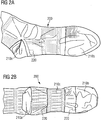
- Figs. 2A - 2D present embodiments of a soccer sock 200 according to the present invention.
- the soccer sock 200 comprises a first portion 210a comprising a synthetic fiber having a diameter of less than 1 ⁇ m (the fibers are too small to be shown in this figure), wherein the first portion 210a is arranged at least partly in the heel part of the soccer sock 200.
- Such fibers are available from a plurality of manufactures, such as the company Teijin mentioned above.
- the first portion 210a encompasses essentially the whole heel part of the soccer sock 200.
- the first portion 210a may encompass the ankle part and / or other parts of the soccer sock 200. Since the heel area of a foot is rather rigid, it requires special support and friction control for foot movements during sports such as soccer.
- the first portion 210a may only encompass the area below the heel part of the soccer sock 200.
- Such an arrangement of the first portion 210a may be used in order to achieve a selective adhesion of the foot within a shoe, i.e. an arrangement, where other portions of the sock are allowed to slide within the shoe.
- the soccer sock 200 may further comprise a second first portion 210b which is arranged in the ball of the foot part and in the toe part of the soccer sock 200.
- the first portions 210a and 210b may comprise approx. 30% of the outer surface of the sock 200 in order to provide sufficient gripping properties for the wearer.
- the highest values for the averaged foot pressure load appear in the corresponding areas of the foot. Therefore, providing the above-mentioned increased gripping properties of the fibers in the heel, the ball and the toe part allows to achieve a significant improved slip resistance. This may maximize the performance of a soccer player during training and / or gaming situations as the soccer player has more stability and a better pressure transmission from the foot to the shoe.
- the synthetic fibers may be made from a plastic material such as polyester. It is also conceivable that any other appropriate material may be used, which are generally well-known to the skilled person.
- the soccer sock 200 may further comprise a second portion 220 without a synthetic fiber having a diameter of less than 1 ⁇ m.
- certain parts of the soccer sock 200 such as e.g. an upper side of an instep part may be designed to provide less slip resistance in order to be movable and thus to provide a desired flexibility of the foot inside the shoe.
- the first portions 210a, 210b may comprise different thicknesses. Such different thicknesses may be helpful in order to provide a tight fit of the soccer sock 200 over the surface of the foot of the wearer.
- a thicker portion may provide a certain cushioning in order to protect the toe area of the soccer player and to may prevent injuries.
- one of the first portions and the second portion may comprise different thicknesses leading to the similar advantages.
- the first portions 210a, 210b may be arranged on the inner and outer surface of the soccer sock 200.
- such an arrangement of the fibers between the foot and the soccer sock 200 as well as between the soccer sock 200 and the shoe may provide a further increased slip resistance and therefore an even better stability of the foot inside the shoe.
- the soccer sock 200 may further comprise a shin portion which may also include a first portion (not shown in Fig. 2A ).
- a shin portion which may also include a first portion (not shown in Fig. 2A ).
- a first portion may extend around the whole shin portion of a soccer sock according to the invention which may further strengthen the above mentioned advantages.
- the synthetic fibers may be adapted to provide a greater friction force of the first portions 210a, 210b inside a sports shoe in wet state compared to a dry state.
- the nano-scale unevenness of such fibers may provide a bigger surface of the surface of the soccer sock 200 which may generate greater frictional force. If a soccer player sweats or may be exposed to poor weather conditions, this effect is enhanced as the intake of water may generate additional frictional forces. In other words, the water may perform like an adhesive between the soccer sock 200 and the foot as well as between the soccer sock 200 and the shoe.
- the soccer sock 200 comprises one first portion 210a in the heel part, one first portion 210b in the toe part and finally a third first portion 210c in the midfoot part of the soccer sock 200.
- the soccer sock 200 also comprises two second portions 220 between the first portions 210a, 210b and 210c.
- the first portions 210a, 210b and 210c may comprise approx. 50% of the surface of the sock 200.
- Such an arrangement of the fibers with increased gripping properties may be suitable for spring movements, where a high amount of longitudinal slip resistance is needed.
- the soccer sock 200 of another embodiment comprises one first portion 210 which encompasses entirely the whole foot sole, e.g. more than 80% of the surface of the sock 200. Moreover, the soccer sock 200 also comprises one second portion 220. Such an arrangement of the first portion 210 may provide the maximal possible slip resistance for the pressure transmission over the foot sole of a soccer player. For any movement of the soccer player in any direction, such a soccer sock 200 may provide a high slip resistance.
- Fig. 2D presents a front and rear view of a further embodiment.
- the soccer sock 200 comprises in the part of the sock encompassing the foot one first portion 210 which extends from the toe part along the sole part, i.e. along the lower surface of the midfoot part, to the heel part of the soccer sock 200.
- the first portion 210 may also extend from the heel part along the Achilles tendon part.
- the first portion may also extend in a portion of the sock encompassing the lower part of the leg.
- the upper end of the soccer sock 200 with its first portion 210 may encompass the entire lower calve part.
- the soccer sock 200 also comprises one second portion 220 without a synthetic fiber having a diameter of less than 1 ⁇ m which covers the upper surface of the midfoot part.
- Such an arrangement of the first portion 210 may provide increased stability of the foot inside a sports shoe such as shoe 300 as mentioned below. Therefore, possible injuries in the heel part such as ankle injuries or Achilles tendon injuries may be prevented due to the increased stability.
- Fig. 3 presents a schematic view of a possible embodiment of a shoe 300, in particular a soccer shoe, according to another aspect of the present invention.
- the soccer shoe 300 comprises an upper 310 and a first portion 320a comprising a synthetic fiber having a diameter of less than 1 ⁇ m.
- the first portion 320a is arranged on the outside of the instep area of the upper 310.
- such an arrangement of the fibers with increased gripping properties may provide an increased slip resistance and control of the movements on the one side.
- sports equipment such as a ball, e.g. a soccer ball.
- Other types of sports shoes may benefit as well from such a first portion 320a on the outside of the upper 310, for example shoes for climbing, where the first portion increases the slip resistance of the outsoles of shoes on a rock.
- the shoe 300 may comprise a further first portion 320b arranged in the toe part of an insole 315 of the shoe 300, in particular in a part below the big toe. Moreover, the first portion 320b is also arranged in the toe part of the upper 310. Similar considerations concerning the increased slip resistance of the soccer sock 200 may apply to the shoe 300.
- the thin fibers with their enhanced surface provide more frictional forces and thus avoid an undesirable slipping of the foot inside the shoe.
- cross section B - B shows that the shoe 300 may further comprise a first portion 320c arranged in the midfoot area of the insole 315 of the shoe 300.
- the midfoot area might be supported by increased gripping properties of the fibers in order to provide sufficient frictional force for acceleration of a soccer player.
- the shoe 300 may comprise two first portions 320d arranged on the inside of a heel part of the upper 310 and one first portion 320c in the heel part of the insole 315 of the shoe 300.
- the aforementioned advantages of a stabilization do also apply for the heel part of the soccer player's foot.
- possible injuries in the heel part such as ankle injuries may be prevented due to the increased stability of the foot inside the shoe 300.
- such a shoe provides first portions 320b, 320c and 320d which may enable barefoot playing, e.g. for soccer, and / or barefoot performing sports such as running.
- the improved stabilization of a wearer's foot may help the wearer to improve its performance.
- the fibers may be woven in a special direction, e.g. along the direction form the heel part to the toe part of a foot, in order to better fix the foot in that direction. It is also possible that by providing the improved gripping properties there may be no need any more for special sockliners as the foot may be stabilized sufficiently.
Landscapes
- Engineering & Computer Science (AREA)
- Textile Engineering (AREA)
- Chemical & Material Sciences (AREA)
- Materials Engineering (AREA)
- Socks And Pantyhose (AREA)
- Footwear And Its Accessory, Manufacturing Method And Apparatuses (AREA)
- Professional, Industrial, Or Sporting Protective Garments (AREA)
- Health & Medical Sciences (AREA)
- General Health & Medical Sciences (AREA)
- Physical Education & Sports Medicine (AREA)
Abstract
Description
- The present invention relates to a sock, in particular to a soccer sock. Moreover, the present invention also relates to a shoe, in particular a sports shoe.
- Socks, in particular soccer socks, generally provide certain functionalities to a wearer of the socks, e.g. they provide an interface between foot and shoe and also protect the skin of the foot. Notably, socks may also significantly contribute to increase the stability of the foot of a wearer within the shoe.
- One option to increase the stability of the foot is to provide socks with gripping elements. Various socks applied with gripping elements are known, for example from
US 2012/0058316 A1 ,US 2015/0275422 A1 ,US 7 748 240 B1 ,US 2005/0144703 A1 ,US 2004/0221371 A1 ,US 8 544 300 B2 ,EP 2 043 466 B1 ,WO 98/20758 A1 DE 202 19 015 U1 . - However, conventional socks applied with gripping elements can create skin irritations, e.g. blisters, at the portions where the gripping elements are arranged. Moreover, they are not adapted to provide increased slip resistance during movements with high pressure loads as they occur in certain sports.
- The company Teijin offers a synthetic fiber available under the tradename Nanofront™ having a thickness of about 700 nm. According to a press release of this company (http://www.teijin.com/news/2012/ebd120110_00.html), it is known to use such fibers for the manufacture of socks, wherein the toe area, the heel area and the cuff are free from such fibers. Moreover, according to another press release of this company (http://www.teijin.com/news/2012/ebd120704_01.html), it is also known to use such fibers also for insoles for running shoes and shoelaces.
- Furthermore, the company Nike also offers a sock including nanofibers (http://news.nike.com/news/grip-socks).
- However, none of the socks of the prior art are capable to sufficiently overcome the above difficulties. As a result, an excessive amount of slip of the foot inside a shoe cannot be reliably avoided, which in turn may lead to blisters and also to a lack of control of the foot movements.
- Therefore, the underlying problem of the present invention is to at least partly overcome the above mentioned deficiencies.
-
- The above mentioned problem is at least partly solved by a sock according to the present invention. In one embodiment, the sock comprises (a) at least one first portion comprising a synthetic fiber having a diameter of less than 1 µm, (b) wherein one of the at least one first portions is arranged at least partly in the heel part of the sock and (c) wherein the at least one first portion comprises more than 30%, preferably more than 50% and more preferably more than 80% of the surface of the sock encompassing the foot.
- Whereas in the prior art an improved slip resistance of the foot within the shoe is provided by including such fibers mainly in parts of the midfoot, the present invention is based on a different approach: Here, the sock includes one or more first portions comprising such fibers which are arranged at least partly in the heel part of the sock. The inventors found out that the heel area of a foot represents an important initial contact point for the movement of a wearer. Stabilizing the foot against sliding movements inside the shoe is therefore of primary importance in this part of the shoe. Moreover, the inventors also found out that a significant percentage of the surface of the sock has to comprise such fibers in order to achieve improved slipping properties. Therefore, the sock according to an embodiment of the invention provides for more than 30%, preferably more than 50%, more preferably more than 80% of its surface a significantly increased slip resistance. This features provides a stabilization of the foot inside the shoe during extreme movements such as acceleration, slowing down and lateral movements. Moreover, as the slipping resistance is more evenly distributed, there are no longer any point loads on certain parts of a foot sliding inside the shoe. Thus, the present invention reduces the risk of skin irritations, such as blisters, and thus provides an improved protection for the wearer.
- The diameter of such fibers is at least sixty times smaller than a human hair. Thus, the synthetic fibers which may be woven into the material provide a much higher surface compared to conventional fibers which leads to the increased slip resistance. At the same time, the use of such fibers does not significantly limit the possibilities to optimize the sock in the same manner as with conventional fibers.
- In one embodiment, the sock further comprises at least one second portion without a synthetic fiber having a diameter of less than 1 µm. The inventors found out that some areas of the foot have to be movable inside the shoe, i.e. such areas might not need an increased slip resistance in order to provide sufficient flexibility of the foot in each direction during movements. For example, if a wearer such as a soccer player is in a duel with another soccer player, the sock may provide the sufficient stability due to the increased slip resistance in the heel area of the foot and may also provide the necessary flexibility in other portions.
- In one embodiment, the sock further comprises at least two first portions in the heel area and in the toe area of a foot. In a more specific embodiment, a first portion may be arranged in the toe area below the big toe of a foot.
- Such an arrangement of the first portions may further increase the slip resistance of the foot inside the shoe, in particular, as the toe area of the foot represents another important contact point for the movement of a wearer. The toe area is located at the furthest distance from the heel area, i.e. improving the slip resistance in these two areas may be sufficient to control any slip of the foot inside the shoe.
- In one embodiment, the at least one first portion is arranged on the inner and outer surface of the sock. The inventors found out that the increased slip resistance concept of the present invention may be applied to both interfaces, namely between the foot and the sock and between the sock and the shoe. Such an arrangement of the first portions may provide even better stability.
- In one embodiment, the sock further comprises a shin part, wherein the shin part comprises at least one first portion. Such a first portion in a shin part of the sock may provide increased slip resistance and thus less movement of any shin guards. This leads to a maximum of protection for the wearer while simultaneously maintaining a high wearing comfort.
- In one embodiment, the sock further comprises at least one first portion in the cuff part of the sock. If the cuff part of the sock provides first portions with increased slip resistance, an unnecessary slipping down of the sock at the ankle or at the calve may be avoided.
- In one embodiment, the synthetic fiber is incorporated into a yarn having a linear mass density of 100 - 200 dtex, preferably 120 - 180 dtex and most preferably 130 - 170 dtex. The inventors have found that such yarns provide a good compromise between improved slip resistance and stability as well as flexibility of the sock so that it fits closely and tightly to the foot of the wearer.
- In one embodiment, the synthetic fiber is adapted to provide a greater friction force of the first portion inside a sports shoe in wet state compared to a dry state. Especially for sports applications where a wearer tends to sweat and / or may be exposed to poor weather conditions, this effect is enhanced as the intake of water may positively contribute to the frictional force.
- Moreover, the inventors found out that the new concept of using such fibers to increase the slip resistance of a foot inside a shoe may also be applied to a shoe. According to another aspect of the invention, a shoe, in particular a sports shoe, comprises at least one first portion with a synthetic fiber having a diameter of less than 1 µm. As explained above, such fibers provide an unprecedented possibility to increase the slip resistance of the foot inside of a shoe or between the shoe and another item such as a ball. Combined with or without a sock according to the invention, the wearer of such a shoe may experience a highly improved stability of its foot during movements. Moreover, the risk of blisters may be further avoided or at least reduced with such a shoe, which therefore positively contributes to the wearing comfort.
- In one embodiment, the at least one first portion is arranged at an inner side of the shoe. In a more specific embodiment, the at least one first portion may be arranged in the heel part of the shoe. Moreover, the at least one first portion may be arranged in the toe part of the shoe. Furthermore, the at least one first portion may be arranged in a part below the big toe.
- All of these embodiments follow the same idea of providing an increased slip resistance for a foot within a shoe during movements. As explained above, the inventors found out from measurements that the heel area and toe area, in particular the area below the big toe, represent points or areas with high pressure loads. A stabilization here is especially effective. During certain movements of wearers such as acceleration or slowing down high shearing forces may occur. By providing first portions in such areas of a shoe having increased gripping properties, a significant improvement of the slip resistance for the overall foot can be achieved.
- In one embodiment, the at least one first portion is arranged on an upper of the shoe for example on the inside of the upper. In a more specific embodiment, the at least one first portion may be arranged on the inside of a heel part of the upper. Furthermore, the at least one first portion may alternatively or in addition also be arranged on the inside of a toe part of the upper.
- The upper of a shoe covers a major part of the surface of the interface between a foot and a shoe. Therefore, by providing the first portions on the inside of the upper, the slip resistance of the foot is further increased. As a result, a wearer of such a shoe might not have to cord up tightly the upper without losing stability. It is even conceivable to provide shoes with such first portions, e.g. incorporating such fibers in the knitting process of the upper, without laces as the frictional force alone may be sufficient to provide stability for the foot.
- In one embodiment, the at least one first portion is arranged on the inside of an instep area of the upper. The inventors found out that such a shoe may provide an increased control of the foot inside the shoe. For example, many basic movements in soccer need the use of the instep of the foot in order to pass exactly to teammates or to perform shoots.
- In one embodiment, the at least one first portion is arranged on the outside of the upper. In a more specific embodiment, the at least one first portion may be arranged on the outside of the instep area of the upper. Such an embodiment provides not only the above mentioned advantages of an increased slip resistance and control of the movements, but further provides control of items contacted by the instep such as a ball. For example, if one first portion is arranged on the outside of the instep, a soccer player may be able to control better the ball for shooting and passing. Moreover, due to the higher frictional forces on the surface of the upper of such an embodiment, the soccer player can perform extraordinary spinning shots.
- In one embodiment, the at least one portion may be arranged in a last of a board lasted shoe. Such an embodiment provides an increased slip resistance, but does not need an insole.
- According to a further aspect, the present invention relates to a sock, in particular a soccer sock, comprising a shin part, wherein the shin part comprises a synthetic fiber having a diameter of less than 1 µm.
- Possible embodiments of the present invention are further described in the following detailed description, with reference to the following figures:
- Fig. 1:
- presents a heat map of a foot sole with averaged foot pressure load data;
- Figs. 2A - 2D:
- present possible embodiments of a soccer sock according to the present invention; and
- Fig. 3:
- presents a schematic view of a possible embodiment of a shoe according to another aspect of the present invention.
- Possible embodiments and variations of the present invention are described in the following with particular reference to a sock and a shoe. However, the concept of the present invention may identically or similarly be applied to any sports equipment such as functional sportswear or pieces of sports equipment. For example, providing such fibers on the surface of sports equipment may also lead to improved gripping properties. Thus, for wearable applications, e.g. a strap such as chest strap with a sensor, for sports apparel, e.g. a waistband, increased friction on the skin of a wearer may be provided leading to a better fit. In a further example, better gripping properties may be provided in one or more areas of a glove which may be advantageous e.g. for the following: soccer such as for a goalkeeper or a throw-in of a field player during cold weather conditions, rugby such as for the field players for throwing, catching, holding the ball, American Football such as for the quarterback to control the ball or for the wide receiver to catch the ball, baseball such as for the pitcher to throw the ball or the field players to catch/throw the ball as well as to hold the bat, archery such as for controlling the arrow, darts such as to provide extra spin for throwing a dart, motorsports such as for the driver or the pit crew, bicycling for holding the handlebars, fencing such as for controlling the fencing weapon, kayaking or rowing such as for holding the paddle, riding such as for holding the reins, shooting such as for controlling the weapon, golfing such as for holding the golf club, surfing during cold conditions for stand-up before drop in the wave, sailing such as for holding the wheel and / or the ropes and diving such as for holding stuff, e.g. a camera, under water. In a further example, the outer surface of a sports equipment such as a ball, e.g. for soccer, rugby, American Football, basketball, baseball etc. or the surface of a piece of sports equipment such as a tennis racket, golf club, baseball bat, badminton racket, cricket bat, ice-hockey stick, hockey stick, squash racket, table-tennis bat, etc. may be provided with such fibers. In a further example, outdoor equipment such as a backpack provided with certain grip areas comprising such fibers may be advantageous to fix the backpack.
- Moreover, for brevity only a limited number of embodiments are described in the following. However, the skilled person will recognize that the specific features described with reference to these embodiments may be modified and combined differently and that certain aspects of the specific embodiments may also be omitted. Moreover, it is noted that the aspects described in the subsequent detailed description may be combined with aspects described in the above summary section.
-
Fig. 1 presents a heat map of a foot sole 100, in particular of a right foot. The heat map of the foot sole 100 shows data of the averaged foot pressure loads measured from four key football movements of twenty players. As can be seen, the foot sole 100 comprises aheel area 110, amidfoot area 120, a ball of thefoot area 130 and atoe area 140. As a result of the heat map, theheel area 110, the ball of thefoot area 130 and thetoe area 140, in particular the area below the big toe, includeportions 150 which show the highest values for the averaged foot pressure load. Therefore, embodiments of the invention may provide increased slip resistance in these portions in order to provide the above mentioned advantages of the present invention. -
Figs. 2A - 2D present embodiments of asoccer sock 200 according to the present invention. - As can be seen in
Fig. 2A , thesoccer sock 200 comprises afirst portion 210a comprising a synthetic fiber having a diameter of less than 1 µm (the fibers are too small to be shown in this figure), wherein thefirst portion 210a is arranged at least partly in the heel part of thesoccer sock 200. Such fibers are available from a plurality of manufactures, such as the company Teijin mentioned above. Thefirst portion 210a encompasses essentially the whole heel part of thesoccer sock 200. In addition, thefirst portion 210a may encompass the ankle part and / or other parts of thesoccer sock 200. Since the heel area of a foot is rather rigid, it requires special support and friction control for foot movements during sports such as soccer. Alternatively, thefirst portion 210a may only encompass the area below the heel part of thesoccer sock 200. Such an arrangement of thefirst portion 210a may be used in order to achieve a selective adhesion of the foot within a shoe, i.e. an arrangement, where other portions of the sock are allowed to slide within the shoe. - Moreover, the
soccer sock 200 may further comprise a secondfirst portion 210b which is arranged in the ball of the foot part and in the toe part of thesoccer sock 200. In summary, thefirst portions sock 200 in order to provide sufficient gripping properties for the wearer. As shown inFig. 1 , the highest values for the averaged foot pressure load appear in the corresponding areas of the foot. Therefore, providing the above-mentioned increased gripping properties of the fibers in the heel, the ball and the toe part allows to achieve a significant improved slip resistance. This may maximize the performance of a soccer player during training and / or gaming situations as the soccer player has more stability and a better pressure transmission from the foot to the shoe. - In one embodiment, the synthetic fibers may be made from a plastic material such as polyester. It is also conceivable that any other appropriate material may be used, which are generally well-known to the skilled person.
- The
soccer sock 200 may further comprise asecond portion 220 without a synthetic fiber having a diameter of less than 1 µm. As mentioned above, certain parts of thesoccer sock 200 such as e.g. an upper side of an instep part may be designed to provide less slip resistance in order to be movable and thus to provide a desired flexibility of the foot inside the shoe. It is also conceivable that thefirst portions soccer sock 200 over the surface of the foot of the wearer. Moreover, in some areas such as the toe area where a soccer player contacts the ball, a thicker portion may provide a certain cushioning in order to protect the toe area of the soccer player and to may prevent injuries. In addition to a varying thickness within the first portions, it is also possible that one of the first portions and the second portion may comprise different thicknesses leading to the similar advantages. - In the embodiment of
Fig. 2A , thefirst portions soccer sock 200. As explained above, such an arrangement of the fibers between the foot and thesoccer sock 200 as well as between thesoccer sock 200 and the shoe may provide a further increased slip resistance and therefore an even better stability of the foot inside the shoe. - The
soccer sock 200 may further comprise a shin portion which may also include a first portion (not shown inFig. 2A ). As explained above, many soccer players wear shin guards. By providing a first portion in the shin part, especially below the knee of a wearer, the shin guards may be more reliably positioned. This leads to an improved wearing comfort, as thesoccer sock 200 may be prevented from slipping down. Moreover, the risk of losing a shin guard and thus protection is reduced. It is also conceivable that a first portion may extend around the whole shin portion of a soccer sock according to the invention which may further strengthen the above mentioned advantages. - In the embodiment of
Fig. 2A , the synthetic fibers may be adapted to provide a greater friction force of thefirst portions soccer sock 200 which may generate greater frictional force. If a soccer player sweats or may be exposed to poor weather conditions, this effect is enhanced as the intake of water may generate additional frictional forces. In other words, the water may perform like an adhesive between thesoccer sock 200 and the foot as well as between thesoccer sock 200 and the shoe. -
Fig. 2B presents a further embodiment. Here, thesoccer sock 200 comprises onefirst portion 210a in the heel part, onefirst portion 210b in the toe part and finally a thirdfirst portion 210c in the midfoot part of thesoccer sock 200. Moreover, thesoccer sock 200 also comprises twosecond portions 220 between thefirst portions first portions sock 200. Such an arrangement of the fibers with increased gripping properties may be suitable for spring movements, where a high amount of longitudinal slip resistance is needed. - As can be seen in
Fig. 2C , thesoccer sock 200 of another embodiment comprises onefirst portion 210 which encompasses entirely the whole foot sole, e.g. more than 80% of the surface of thesock 200. Moreover, thesoccer sock 200 also comprises onesecond portion 220. Such an arrangement of thefirst portion 210 may provide the maximal possible slip resistance for the pressure transmission over the foot sole of a soccer player. For any movement of the soccer player in any direction, such asoccer sock 200 may provide a high slip resistance. -
Fig. 2D presents a front and rear view of a further embodiment. Here, thesoccer sock 200 comprises in the part of the sock encompassing the foot onefirst portion 210 which extends from the toe part along the sole part, i.e. along the lower surface of the midfoot part, to the heel part of thesoccer sock 200. Moreover, thefirst portion 210 may also extend from the heel part along the Achilles tendon part. In addition, the first portion may also extend in a portion of the sock encompassing the lower part of the leg. For example, it can be seen inFig. 2D that the upper end of thesoccer sock 200 with itsfirst portion 210 may encompass the entire lower calve part. Furthermore, thesoccer sock 200 also comprises onesecond portion 220 without a synthetic fiber having a diameter of less than 1 µm which covers the upper surface of the midfoot part. Such an arrangement of thefirst portion 210 may provide increased stability of the foot inside a sports shoe such asshoe 300 as mentioned below. Therefore, possible injuries in the heel part such as ankle injuries or Achilles tendon injuries may be prevented due to the increased stability. -
Fig. 3 presents a schematic view of a possible embodiment of ashoe 300, in particular a soccer shoe, according to another aspect of the present invention. Thesoccer shoe 300 comprises an upper 310 and afirst portion 320a comprising a synthetic fiber having a diameter of less than 1 µm. Thefirst portion 320a is arranged on the outside of the instep area of the upper 310. As explained above, such an arrangement of the fibers with increased gripping properties may provide an increased slip resistance and control of the movements on the one side. For example, it may allow to better control sports equipment such as a ball, e.g. a soccer ball. Other types of sports shoes may benefit as well from such afirst portion 320a on the outside of the upper 310, for example shoes for climbing, where the first portion increases the slip resistance of the outsoles of shoes on a rock. - As can be seen in cross section A - A, the
shoe 300 may comprise a furtherfirst portion 320b arranged in the toe part of aninsole 315 of theshoe 300, in particular in a part below the big toe. Moreover, thefirst portion 320b is also arranged in the toe part of the upper 310. Similar considerations concerning the increased slip resistance of thesoccer sock 200 may apply to theshoe 300. The thin fibers with their enhanced surface provide more frictional forces and thus avoid an undesirable slipping of the foot inside the shoe. - In the embodiment of
Fig. 3 , cross section B - B shows that theshoe 300 may further comprise afirst portion 320c arranged in the midfoot area of theinsole 315 of theshoe 300. In accordance withFig. 2C , the midfoot area might be supported by increased gripping properties of the fibers in order to provide sufficient frictional force for acceleration of a soccer player. - As can be seen in cross section C - C, the
shoe 300 may comprise twofirst portions 320d arranged on the inside of a heel part of the upper 310 and onefirst portion 320c in the heel part of theinsole 315 of theshoe 300. The aforementioned advantages of a stabilization do also apply for the heel part of the soccer player's foot. Moreover, possible injuries in the heel part such as ankle injuries may be prevented due to the increased stability of the foot inside theshoe 300. It is also conceivable that such a shoe providesfirst portions - Finally, it is noted that a combination of the described sock and the described shoe is also conceivable. The present invention therefore also covers their combination, wherein the distribution of the first portions in the sock and the shoe may be specifically adapted to correspond and / or to be complementary in order to provide a maximum slip resistance.
- In the following, further embodiments are described to facilitate the understanding of the invention:
- 1. Sock, in particular a soccer sock, comprising:
- a. at least one first portion comprising a synthetic fiber having a diameter of less than 1 µm,
- b. wherein one of the at least one first portions is arranged at least partly in the heel part of the sock, and
- c. wherein the at least one first portion comprises more than 30%, preferably more than 50% and more preferably more than 80% of the surface of the sock encompassing the foot.
- 2. Sock according to embodiment 1, further comprising at least one second portion without a synthetic fiber having a diameter of less than 1 µm.
- 3. Sock according to one of the preceding embodiments 1 or 2, further comprising at least two first portions in the heel area and in the toe area of a foot.
- 4. Sock according to the preceding embodiment 3, wherein a first portion is arranged in the toe area below the big toe of a foot.
- 5. Sock according to one of the preceding embodiments 1 - 4, wherein the at least one first portion is arranged on the inner and outer surface of the sock.
- 6. Sock according to one of the preceding embodiments 1 - 5, further comprising a shin part, wherein the shin part comprises at least one first portion.
- 7. Sock according to one of the preceding embodiments 1 - 6, further comprising at least one first portion in the cuff part of the sock.
- 8. Sock according to one of the preceding embodiments 1 - 7, wherein the synthetic fiber is incorporated into a yarn having a linear mass density of 100 - 200 dtex, preferably 120 - 180 dtex and most preferably 130 - 170 dtex.
- 9. Sock according to one of the preceding embodiments 1 - 8, wherein the synthetic fiber is adapted to provide a greater friction force of the first portion inside a sports shoe in a wet state compared to a dry state.
- 10. Shoe, in particular sports shoe, comprising at least one first portion with a synthetic fiber having a diameter of less than 1 µm.
- 11. Shoe according to the preceding embodiment 10, wherein the at least one first portion is arranged on an inner side of the shoe.
- 12. Shoe according to one of the preceding embodiments 10 or 11, wherein the at least one first portion is arranged on an upper of the shoe.
- 13. Shoe according to the preceding embodiment 12, wherein the at least one first portion is arranged on the inside of the upper.
- 14. Shoe according to the preceding embodiment 13, wherein at least one first portion is arranged on the inside of a heel part of the upper.
- 15. Shoe according to one of the preceding embodiments 13 or 14, wherein the at least one first portion is arranged on the inside of a toe part of the upper.
- 16. Shoe according to one of the preceding embodiments 13 - 15, wherein the at least one first portion is arranged on the inside of an instep area of the upper.
- 17. Shoe according to the preceding embodiment 12, wherein the at least one first portion is arranged on the outside of the upper.
- 18. Shoe according to the preceding embodiment 17, wherein the at least one first portion is arranged on the outside of the instep area of the upper.
- 19. Shoe according to the preceding embodiment 11, wherein at least one first portion is arranged in a last of a board lasted shoe.
- 20. Sock, in particular a soccer sock, comprising a shin part, wherein the shin part comprises a synthetic fiber having a diameter of less than 1 µm.
Claims (15)
- Sock (200), in particular a soccer sock, comprising:a. at least one first portion (210a; 210b; 210c) comprising a synthetic fiber having a diameter of less than 1 µm,b. wherein one of the at least one first portions (210a; 210b; 210c) is arranged at least partly in the heel part of the sock (200), andc. wherein the at least one first portion (210a; 210b; 210c) comprises more than 30%, preferably more than 50% and more preferably more than 80% of the surface of the sock (200) encompassing the foot.
- Sock (200) according to claim 1, further comprising at least one second portion (220) without a synthetic fiber having a diameter of less than 1 µm.
- Sock (200) according to one of the preceding claims 1 or 2, further comprising at least two first portions (210a; 210b; 210c) in the heel area (110) and in the toe area (140) of a foot (100).
- Sock (200) according to the preceding claim 3, wherein a first portion (210a; 210b; 210c) is arranged in the toe area (140) below the big toe of a foot (100).
- Sock (200) according to one of the preceding claims 1 - 4, wherein the at least one first portion (210a; 210b; 210c) is arranged on the inner and outer surface of the sock (200).
- Sock (200) according to one of the preceding claims 1 - 5, further comprising a shin part, wherein the shin part comprises at least one first portion (210a; 210b; 210c).
- Sock (200) according to one of the preceding claims 1 - 6, further comprising at least one first portion (210a; 210b; 210c) in the cuff part of the sock (200).
- Sock (200) according to one of the preceding claims 1 - 7, wherein the synthetic fiber is incorporated into a yarn having a linear mass density of 100 - 200 dtex, preferably 120 - 180 dtex and most preferably 130 - 170 dtex.
- Sock (200) according to one of the preceding claims 1 - 8, wherein the synthetic fiber is adapted to provide a greater friction force of the first portion (210a; 210b; 210c) inside a sports shoe in a wet state compared to a dry state.
- Shoe (300), in particular sports shoe, comprising at least one first portion (320a; 320b; 320c; 320d) with a synthetic fiber having a diameter of less than 1 µm.
- Shoe (300) according to the preceding claim 10, wherein the at least one first portion (320b; 320c; 320d) is arranged on an inner side of the shoe (300).
- Shoe (300) according to one of the preceding claims 10 or 11, wherein the at least one first portion (320a; 320b; 320d) is arranged on an upper (310) of the shoe (300).
- Shoe (300) according to the preceding claim 12, wherein the at least one first portion (320d) is arranged on the inside of the upper (310).
- Shoe (300) according to the preceding claim 13, wherein at least one first portion (320d) is arranged on the inside of a heel part of the upper (310).
- Shoe (300) according to one of the preceding claims 13 or 14, wherein the at least one first portion (320b) is arranged on the inside of a toe part of the upper (310).
Applications Claiming Priority (1)
| Application Number | Priority Date | Filing Date | Title |
|---|---|---|---|
| DE102016207387.7A DE102016207387B4 (en) | 2016-04-29 | 2016-04-29 | sock |
Publications (2)
| Publication Number | Publication Date |
|---|---|
| EP3245888A2 true EP3245888A2 (en) | 2017-11-22 |
| EP3245888A3 EP3245888A3 (en) | 2018-12-05 |
Family
ID=58632284
Family Applications (1)
| Application Number | Title | Priority Date | Filing Date |
|---|---|---|---|
| EP17167958.2A Pending EP3245888A3 (en) | 2016-04-29 | 2017-04-25 | Sock and shoe |
Country Status (5)
| Country | Link |
|---|---|
| US (1) | US20170311650A1 (en) |
| EP (1) | EP3245888A3 (en) |
| JP (1) | JP6499224B2 (en) |
| CN (1) | CN107334185B (en) |
| DE (1) | DE102016207387B4 (en) |
Cited By (1)
| Publication number | Priority date | Publication date | Assignee | Title |
|---|---|---|---|---|
| WO2020149951A1 (en) * | 2019-01-14 | 2020-07-23 | Nike Innovate C.V. | Sock with integrally knit grip strips of varying widths |
Families Citing this family (24)
| Publication number | Priority date | Publication date | Assignee | Title |
|---|---|---|---|---|
| DE102012206062B4 (en) | 2012-04-13 | 2019-09-12 | Adidas Ag | SHOE UPPER PART |
| DE102013202306B4 (en) | 2013-02-13 | 2014-12-18 | Adidas Ag | Sole for a shoe |
| DE102013207163B4 (en) | 2013-04-19 | 2022-09-22 | Adidas Ag | shoe upper |
| DE102013207156B4 (en) | 2013-04-19 | 2025-12-24 | Adidas Ag | shoe, especially a sports shoe |
| US12250994B2 (en) | 2013-04-19 | 2025-03-18 | Adidas Ag | Shoe |
| US11666113B2 (en) | 2013-04-19 | 2023-06-06 | Adidas Ag | Shoe with knitted outer sole |
| DE102013207155B4 (en) | 2013-04-19 | 2020-04-23 | Adidas Ag | Shoe upper |
| DE102014202432B4 (en) | 2014-02-11 | 2017-07-27 | Adidas Ag | Improved football boot |
| DE102014220087B4 (en) | 2014-10-02 | 2016-05-12 | Adidas Ag | Flat knitted shoe top for sports shoes |
| JP1581802S (en) | 2016-03-23 | 2017-07-24 | ||
| ITUA20164535A1 (en) * | 2016-06-01 | 2017-12-01 | Pro Eight S R L | UPPER FOR FOOTWEAR. |
| JP1584710S (en) | 2016-11-02 | 2017-08-28 | ||
| USD845597S1 (en) | 2017-03-06 | 2019-04-16 | Adidas Ag | Shoe |
| DE102017205830B4 (en) | 2017-04-05 | 2020-09-24 | Adidas Ag | Process for the aftertreatment of a large number of individual expanded particles for the production of at least a part of a cast sports article, sports article and sports shoe |
| KR102863224B1 (en) * | 2017-12-12 | 2025-09-29 | 트레레 이노베이션 에스.알.엘. | Dynamic ventilation system for socks |
| CN109452933B (en) * | 2018-09-17 | 2021-03-12 | 周建菊 | A kind of multifunctional rehabilitation pants for patients with severe hemiplegia |
| IT202000010843A1 (en) * | 2020-05-13 | 2021-11-13 | Coffinardi & Delpanno Ind Srl | SOCKS WITH BIOMECHANICAL, CIRCULATORY AND NEUROLOGICAL FUNCTIONAL EFFECTIVENESS |
| US12193521B2 (en) | 2020-12-31 | 2025-01-14 | Nike, Inc. | Sleeve for an extremity |
| EP4650501A3 (en) | 2020-12-31 | 2026-02-18 | NIKE Innovate C.V. | Athletic sock |
| US20230337753A1 (en) * | 2022-04-25 | 2023-10-26 | Stephan Shin | Sporting Socks |
| JP7736341B1 (en) | 2024-04-16 | 2025-09-09 | イーグルワン合同会社 | Golf socks |
| JP2025181481A (en) * | 2024-05-31 | 2025-12-11 | 美津濃株式会社 | Sports socks |
| DE102024125300A1 (en) * | 2024-09-04 | 2026-03-05 | Adidas Ag | Footwear items |
| EP4670543A1 (en) * | 2025-07-01 | 2025-12-31 | Shoedoctor d.o.o. | Sports climbing sock for wearing inside a sports climbing shoe and method for manufacturing the sports climbing sock |
Citations (11)
| Publication number | Priority date | Publication date | Assignee | Title |
|---|---|---|---|---|
| WO1998020758A1 (en) | 1996-11-12 | 1998-05-22 | Ogden & Company, Inc. | Enhanced frictional engagement sock |
| DE20219015U1 (en) | 2002-12-06 | 2003-03-06 | Sterntaler GmbH & Co KG, 65599 Dornburg | Children's sock or tights in slide-resistant in instep section |
| US20040221371A1 (en) | 2003-03-24 | 2004-11-11 | Royal Corporation | Sock |
| US20050144703A1 (en) | 2004-01-07 | 2005-07-07 | Hilbert Vicki L. | Slip-resistant stocking |
| US7748240B1 (en) | 2009-03-04 | 2010-07-06 | James Paul Cherneski | Foot gripping garment |
| US7757518B2 (en) | 2008-05-12 | 2010-07-20 | Okamoto Corporation | Sock |
| US20120058316A1 (en) | 2010-09-03 | 2012-03-08 | James Paul Cherneski | Construction Of A Gripping Fabric |
| EP2043466B1 (en) | 2006-07-13 | 2012-09-19 | FALKE KGaA | Item of clothing for the foot |
| US8544300B2 (en) | 2010-06-11 | 2013-10-01 | Okamoto Corporation | Sock |
| US20150275422A1 (en) | 2014-03-28 | 2015-10-01 | James Paul Cherneski | Continuous Non-slip Layered Garment |
| US20160034081A1 (en) | 2013-04-15 | 2016-02-04 | Fujifilm Corporation | Method for manufacturing touch-panel conductive sheet, and touch-panel conductive sheet |
Family Cites Families (62)
| Publication number | Priority date | Publication date | Assignee | Title |
|---|---|---|---|---|
| US3310889A (en) * | 1963-10-21 | 1967-03-28 | Samuels Samuel | Baseball shoe with integral toe and instep guard |
| DE1910713A1 (en) * | 1968-11-27 | 1970-07-23 | Feinstrumpfwerke Esda Veb | Highly elastic hosiery |
| US3952358A (en) * | 1973-10-03 | 1976-04-27 | Tatsuo Fukuoka | Shoe and a method for manufacturing the same |
| US4034431A (en) * | 1973-10-03 | 1977-07-12 | Tatsuo Fukuoka | Method for manufacturing a footwear |
| US4021860A (en) * | 1976-04-13 | 1977-05-10 | The Kendall Company | Non-slip therapeutic stocking and method |
| IT8121560U1 (en) * | 1981-04-23 | 1982-10-23 | Nuova Zarine S P A Costruzione Macch E Stampi Per Calzature | Footwear with upper zonally covered with injected synthetic material permanently joined to the canvas |
| US4756098A (en) * | 1987-01-21 | 1988-07-12 | Gencorp Inc. | Athletic shoe |
| US5216827A (en) * | 1989-12-01 | 1993-06-08 | Yoav Cohen | Soccer training shoe |
| JPH06248501A (en) * | 1993-02-19 | 1994-09-06 | Mizuno Corp | Socks for sports |
| JP3034798B2 (en) * | 1996-05-23 | 2000-04-17 | 株式会社ミヤタ | Training shoes |
| US5947845A (en) * | 1997-04-15 | 1999-09-07 | Canelas; Carlos | Combination ball and shoes |
| JP2000238142A (en) * | 1999-02-22 | 2000-09-05 | Ykk Corp | Molding material containing reinforcing fiber, method for producing molded article using the same, and safety shoe tip |
| JP4128312B2 (en) * | 1999-02-24 | 2008-07-30 | 株式会社クラレ | Leather-like sheet with surface napping |
| JP2000282303A (en) * | 1999-03-30 | 2000-10-10 | Asai Akihiro | Stocking |
| DE19921829C2 (en) * | 1999-05-11 | 2002-11-28 | Therm Ic Products Gmbh Gleisdo | Insole, sock and footwear system as well as processes, foils and retrofit kits for their manufacture |
| JP3064834U (en) * | 1999-05-24 | 2000-01-28 | 晃司 岡井 | Baseball, golf, tennis, ball-ball, sucker-ball, basketball and snowboard socks |
| US6971192B2 (en) * | 1999-11-15 | 2005-12-06 | Ringstar, Inc. | Padded shoe |
| TW526303B (en) * | 2000-01-06 | 2003-04-01 | Kuraray Co | Artificial leather shoe and artificial leather suited therefor |
| SE522661C2 (en) * | 2000-12-20 | 2004-02-24 | Arbesko Ab | Flexible protective layer intended to be used to provide a footwear protection for footwear to prevent damage from penetrating objects, as well as a footwear comprising the flexible protective layer and a means of providing the flexible protective layer |
| FR2818506B1 (en) * | 2000-12-22 | 2004-06-18 | Salomon Sa | SHOE |
| JP4212787B2 (en) * | 2001-07-02 | 2009-01-21 | 株式会社クラレ | Leather-like sheet |
| US6910288B2 (en) * | 2002-12-18 | 2005-06-28 | Nike, Inc. | Footwear incorporating a textile with fusible filaments and fibers |
| GB0329813D0 (en) * | 2003-12-23 | 2004-01-28 | Terra Plana Internat Ltd | Footwear |
| US20060174520A1 (en) * | 2005-02-08 | 2006-08-10 | Chi-Kung Wu | Vamp for a sport shoe |
| CN101304874A (en) * | 2005-06-29 | 2008-11-12 | 阿尔巴尼国际公司 | Yarn containing siliconized micro-denier polyester fibers |
| JP3119255U (en) * | 2005-12-06 | 2006-02-16 | 一晃 西村 | socks |
| JP2007204864A (en) * | 2006-01-31 | 2007-08-16 | Toray Ind Inc | Fabric, innerwear and stockings using the same |
| US7774956B2 (en) * | 2006-11-10 | 2010-08-17 | Nike, Inc. | Article of footwear having a flat knit upper construction or other upper construction |
| KR101210782B1 (en) * | 2006-12-01 | 2012-12-10 | 나이키 인터내셔널 엘티디. | A sock and a method for its manufacture |
| JP5614474B2 (en) * | 2007-04-03 | 2014-10-29 | 日清紡ホールディングス株式会社 | Antibacterial expression method of fiber |
| JP2008274512A (en) * | 2007-04-03 | 2008-11-13 | Nisshinbo Ind Inc | Antibacterial nanofiber |
| JP2009001920A (en) | 2007-06-19 | 2009-01-08 | Takao Uehara | Socks |
| KR100869451B1 (en) * | 2008-03-19 | 2008-11-19 | (주)한비트레이딩 | Toe shoes |
| WO2009157400A1 (en) * | 2008-06-23 | 2009-12-30 | 東レ株式会社 | Laminated cloth, and method for production thereof |
| FR2932964B1 (en) * | 2008-06-27 | 2010-10-15 | Salomon Sa | FOOTWEAR THAT ENHANCES FOOTWEAR |
| US8069587B2 (en) * | 2008-11-20 | 2011-12-06 | 3M Innovative Properties Company | Molded insulated shoe footbed and method of making an insulated footbed |
| US8490299B2 (en) * | 2008-12-18 | 2013-07-23 | Nike, Inc. | Article of footwear having an upper incorporating a knitted component |
| JP2010163712A (en) * | 2009-01-15 | 2010-07-29 | Teijin Fibers Ltd | Sock |
| JP2010275649A (en) * | 2009-05-27 | 2010-12-09 | Teijin Fibers Ltd | Textile structures and textile products |
| CN201536628U (en) * | 2009-09-04 | 2010-08-04 | 浪莎针织有限公司 | Baseball socks |
| JP3157686U (en) * | 2009-12-11 | 2010-02-25 | 浩彰 中川 | Socks structure for soccer |
| KR101008344B1 (en) * | 2010-06-15 | 2011-01-13 | 임옥순 | Shoes with front and rear soles spaced apart from the bottom of the shoe upper |
| US8578632B2 (en) * | 2010-07-19 | 2013-11-12 | Nike, Inc. | Decoupled foot stabilizer system |
| WO2012025113A2 (en) * | 2010-08-27 | 2012-03-01 | Bechler Juergen | Piece of footwear |
| US9573331B2 (en) * | 2010-12-10 | 2017-02-21 | Converse Inc. | Thermoplastic polyurethane infused mesh |
| US9009992B2 (en) * | 2011-03-15 | 2015-04-21 | Nike, Inc. | Article of footwear with a ball contacting member |
| US20130312284A1 (en) * | 2011-05-27 | 2013-11-28 | Nike, Inc. | Article of Footwear Having Welded Upper |
| US20130025157A1 (en) * | 2011-07-27 | 2013-01-31 | Nike, Inc. | Upper with Zonal Contouring and Fabrication of Same |
| US9420845B2 (en) * | 2011-12-27 | 2016-08-23 | Cheng-Tung Hsiao | Shoe upper structure |
| CN104869858B (en) * | 2012-12-21 | 2017-07-18 | 耐克创新有限合伙公司 | The footwear uppers of the plane of braiding |
| US9930928B2 (en) * | 2013-02-13 | 2018-04-03 | Adidas Ag | Sole for a shoe |
| US9826799B2 (en) * | 2013-03-14 | 2017-11-28 | Nike, Inc. | Uppers and articles incorporating same |
| US20140338090A1 (en) * | 2013-05-20 | 2014-11-20 | Etre Vous, LLC | Dance footwear |
| US20140345158A1 (en) * | 2013-05-25 | 2014-11-27 | Shayne Joseph Fox | Footwear insert |
| US9113675B2 (en) * | 2013-06-05 | 2015-08-25 | Nike, Inc. | Article of footwear |
| JP2015025224A (en) * | 2013-07-26 | 2015-02-05 | コーマ株式会社 | Assembled yarn, twisted yarn using the assembled yarn, cloth product and socks using the twisted yarn |
| JP2015025223A (en) * | 2013-07-26 | 2015-02-05 | コーマ株式会社 | Piled yarn (twisted union yarn) and cloth product and hosiery obtained by using the same |
| US20150075031A1 (en) * | 2013-09-13 | 2015-03-19 | Nike, Inc. | Article Of Footwear Incorporating A Knitted Component With Monofilament Areas |
| US10182619B2 (en) * | 2014-02-21 | 2019-01-22 | Nike, Inc. | Article of footwear incorporating a woven or non-woven textile with durable water repellant properties |
| US20150264995A1 (en) * | 2014-03-24 | 2015-09-24 | Henry Lucius Hilderbrand, IV | Grip-Enhancing Sportswear and Methods of Manufacturing the Same |
| CN104366700A (en) * | 2014-11-25 | 2015-02-25 | 江阴市超宇针织有限公司 | Anti-skidding sock |
| US9976237B2 (en) | 2015-05-18 | 2018-05-22 | Nike, Inc. | Sock with heel locating features |
-
2016
- 2016-04-29 DE DE102016207387.7A patent/DE102016207387B4/en active Active
-
2017
- 2017-04-25 EP EP17167958.2A patent/EP3245888A3/en active Pending
- 2017-04-27 JP JP2017088276A patent/JP6499224B2/en active Active
- 2017-04-27 CN CN201710285992.0A patent/CN107334185B/en active Active
- 2017-04-28 US US15/581,112 patent/US20170311650A1/en not_active Abandoned
Patent Citations (12)
| Publication number | Priority date | Publication date | Assignee | Title |
|---|---|---|---|---|
| WO1998020758A1 (en) | 1996-11-12 | 1998-05-22 | Ogden & Company, Inc. | Enhanced frictional engagement sock |
| DE20219015U1 (en) | 2002-12-06 | 2003-03-06 | Sterntaler GmbH & Co KG, 65599 Dornburg | Children's sock or tights in slide-resistant in instep section |
| US20040221371A1 (en) | 2003-03-24 | 2004-11-11 | Royal Corporation | Sock |
| US20050144703A1 (en) | 2004-01-07 | 2005-07-07 | Hilbert Vicki L. | Slip-resistant stocking |
| EP2043466B1 (en) | 2006-07-13 | 2012-09-19 | FALKE KGaA | Item of clothing for the foot |
| US7757518B2 (en) | 2008-05-12 | 2010-07-20 | Okamoto Corporation | Sock |
| US7748240B1 (en) | 2009-03-04 | 2010-07-06 | James Paul Cherneski | Foot gripping garment |
| US8544300B2 (en) | 2010-06-11 | 2013-10-01 | Okamoto Corporation | Sock |
| EP2395141B1 (en) | 2010-06-11 | 2016-08-31 | Okamoto Corporation | Sock |
| US20120058316A1 (en) | 2010-09-03 | 2012-03-08 | James Paul Cherneski | Construction Of A Gripping Fabric |
| US20160034081A1 (en) | 2013-04-15 | 2016-02-04 | Fujifilm Corporation | Method for manufacturing touch-panel conductive sheet, and touch-panel conductive sheet |
| US20150275422A1 (en) | 2014-03-28 | 2015-10-01 | James Paul Cherneski | Continuous Non-slip Layered Garment |
Cited By (1)
| Publication number | Priority date | Publication date | Assignee | Title |
|---|---|---|---|---|
| WO2020149951A1 (en) * | 2019-01-14 | 2020-07-23 | Nike Innovate C.V. | Sock with integrally knit grip strips of varying widths |
Also Published As
| Publication number | Publication date |
|---|---|
| CN107334185B (en) | 2020-06-02 |
| EP3245888A3 (en) | 2018-12-05 |
| DE102016207387A1 (en) | 2017-11-02 |
| JP2017206802A (en) | 2017-11-24 |
| JP6499224B2 (en) | 2019-04-10 |
| CN107334185A (en) | 2017-11-10 |
| DE102016207387B4 (en) | 2021-11-18 |
| US20170311650A1 (en) | 2017-11-02 |
Similar Documents
| Publication | Publication Date | Title |
|---|---|---|
| US20170311650A1 (en) | Sock and Shoe | |
| US12137771B2 (en) | Article of footwear with dynamic support | |
| US6061829A (en) | Low friction outer apparel | |
| JP6685976B2 (en) | Uppers for shoes | |
| US12575646B2 (en) | Article of footwear having a harness system | |
| EP4483741A1 (en) | Upper for a shoe with a ball contact area | |
| JP5466442B2 (en) | Sport socks | |
| WO2010125862A1 (en) | Soccer shoes | |
| US10034520B1 (en) | Sports shoe with cleat | |
| JP5260149B2 (en) | socks | |
| AU1200699A (en) | Low friction articles | |
| CN217906365U (en) | Sports sock for net feather sports | |
| CN209965248U (en) | Sports socks with instep protection function | |
| EP4706435A1 (en) | Article of footwear | |
| US20250366540A1 (en) | Sports socks | |
| KR20230116337A (en) | Ankle protection socks for skate | |
| CN205728089U (en) | There is instep protection and the socks for bicycle sport of wear-resistant vibration-damping function | |
| HK1017229B (en) | Low friction apparel |
Legal Events
| Date | Code | Title | Description |
|---|---|---|---|
| PUAI | Public reference made under article 153(3) epc to a published international application that has entered the european phase |
Free format text: ORIGINAL CODE: 0009012 |
|
| STAA | Information on the status of an ep patent application or granted ep patent |
Free format text: STATUS: REQUEST FOR EXAMINATION WAS MADE |
|
| 17P | Request for examination filed |
Effective date: 20170425 |
|
| AK | Designated contracting states |
Kind code of ref document: A2 Designated state(s): AL AT BE BG CH CY CZ DE DK EE ES FI FR GB GR HR HU IE IS IT LI LT LU LV MC MK MT NL NO PL PT RO RS SE SI SK SM TR |
|
| AX | Request for extension of the european patent |
Extension state: BA ME |
|
| PUAL | Search report despatched |
Free format text: ORIGINAL CODE: 0009013 |
|
| AK | Designated contracting states |
Kind code of ref document: A3 Designated state(s): AL AT BE BG CH CY CZ DE DK EE ES FI FR GB GR HR HU IE IS IT LI LT LU LV MC MK MT NL NO PL PT RO RS SE SI SK SM TR |
|
| AX | Request for extension of the european patent |
Extension state: BA ME |
|
| RIC1 | Information provided on ipc code assigned before grant |
Ipc: D01D 5/00 20060101ALI20181031BHEP Ipc: A41B 11/00 20060101AFI20181031BHEP Ipc: A43B 1/00 20060101ALI20181031BHEP Ipc: A43B 1/14 20060101ALI20181031BHEP |
|
| STAA | Information on the status of an ep patent application or granted ep patent |
Free format text: STATUS: EXAMINATION IS IN PROGRESS |
|
| 17Q | First examination report despatched |
Effective date: 20191017 |