EP3244099A1 - Combined oil control ring - Google Patents
Combined oil control ring Download PDFInfo
- Publication number
- EP3244099A1 EP3244099A1 EP15877035.4A EP15877035A EP3244099A1 EP 3244099 A1 EP3244099 A1 EP 3244099A1 EP 15877035 A EP15877035 A EP 15877035A EP 3244099 A1 EP3244099 A1 EP 3244099A1
- Authority
- EP
- European Patent Office
- Prior art keywords
- plating film
- oil control
- control ring
- combined oil
- spacer expander
- Prior art date
- Legal status (The legal status is an assumption and is not a legal conclusion. Google has not performed a legal analysis and makes no representation as to the accuracy of the status listed.)
- Granted
Links
Images


Classifications
-
- F—MECHANICAL ENGINEERING; LIGHTING; HEATING; WEAPONS; BLASTING
- F16—ENGINEERING ELEMENTS AND UNITS; GENERAL MEASURES FOR PRODUCING AND MAINTAINING EFFECTIVE FUNCTIONING OF MACHINES OR INSTALLATIONS; THERMAL INSULATION IN GENERAL
- F16J—PISTONS; CYLINDERS; SEALINGS
- F16J9/00—Piston-rings, e.g. non-metallic piston-rings, seats therefor; Ring sealings of similar construction
- F16J9/26—Piston-rings, e.g. non-metallic piston-rings, seats therefor; Ring sealings of similar construction characterised by the use of particular materials
-
- C—CHEMISTRY; METALLURGY
- C23—COATING METALLIC MATERIAL; COATING MATERIAL WITH METALLIC MATERIAL; CHEMICAL SURFACE TREATMENT; DIFFUSION TREATMENT OF METALLIC MATERIAL; COATING BY VACUUM EVAPORATION, BY SPUTTERING, BY ION IMPLANTATION OR BY CHEMICAL VAPOUR DEPOSITION, IN GENERAL; INHIBITING CORROSION OF METALLIC MATERIAL OR INCRUSTATION IN GENERAL
- C23C—COATING METALLIC MATERIAL; COATING MATERIAL WITH METALLIC MATERIAL; SURFACE TREATMENT OF METALLIC MATERIAL BY DIFFUSION INTO THE SURFACE, BY CHEMICAL CONVERSION OR SUBSTITUTION; COATING BY VACUUM EVAPORATION, BY SPUTTERING, BY ION IMPLANTATION OR BY CHEMICAL VAPOUR DEPOSITION, IN GENERAL
- C23C28/00—Coating for obtaining at least two superposed coatings either by methods not provided for in a single one of groups C23C2/00 - C23C26/00 or by combinations of methods provided for in subclasses C23C and C25C or C25D
- C23C28/30—Coatings combining at least one metallic layer and at least one inorganic non-metallic layer
- C23C28/32—Coatings combining at least one metallic layer and at least one inorganic non-metallic layer including at least one pure metallic layer
-
- C—CHEMISTRY; METALLURGY
- C23—COATING METALLIC MATERIAL; COATING MATERIAL WITH METALLIC MATERIAL; CHEMICAL SURFACE TREATMENT; DIFFUSION TREATMENT OF METALLIC MATERIAL; COATING BY VACUUM EVAPORATION, BY SPUTTERING, BY ION IMPLANTATION OR BY CHEMICAL VAPOUR DEPOSITION, IN GENERAL; INHIBITING CORROSION OF METALLIC MATERIAL OR INCRUSTATION IN GENERAL
- C23C—COATING METALLIC MATERIAL; COATING MATERIAL WITH METALLIC MATERIAL; SURFACE TREATMENT OF METALLIC MATERIAL BY DIFFUSION INTO THE SURFACE, BY CHEMICAL CONVERSION OR SUBSTITUTION; COATING BY VACUUM EVAPORATION, BY SPUTTERING, BY ION IMPLANTATION OR BY CHEMICAL VAPOUR DEPOSITION, IN GENERAL
- C23C28/00—Coating for obtaining at least two superposed coatings either by methods not provided for in a single one of groups C23C2/00 - C23C26/00 or by combinations of methods provided for in subclasses C23C and C25C or C25D
- C23C28/30—Coatings combining at least one metallic layer and at least one inorganic non-metallic layer
- C23C28/34—Coatings combining at least one metallic layer and at least one inorganic non-metallic layer including at least one inorganic non-metallic material layer, e.g. metal carbide, nitride, boride, silicide layer and their mixtures, enamels, phosphates and sulphates
-
- C—CHEMISTRY; METALLURGY
- C23—COATING METALLIC MATERIAL; COATING MATERIAL WITH METALLIC MATERIAL; CHEMICAL SURFACE TREATMENT; DIFFUSION TREATMENT OF METALLIC MATERIAL; COATING BY VACUUM EVAPORATION, BY SPUTTERING, BY ION IMPLANTATION OR BY CHEMICAL VAPOUR DEPOSITION, IN GENERAL; INHIBITING CORROSION OF METALLIC MATERIAL OR INCRUSTATION IN GENERAL
- C23C—COATING METALLIC MATERIAL; COATING MATERIAL WITH METALLIC MATERIAL; SURFACE TREATMENT OF METALLIC MATERIAL BY DIFFUSION INTO THE SURFACE, BY CHEMICAL CONVERSION OR SUBSTITUTION; COATING BY VACUUM EVAPORATION, BY SPUTTERING, BY ION IMPLANTATION OR BY CHEMICAL VAPOUR DEPOSITION, IN GENERAL
- C23C8/00—Solid state diffusion of only non-metal elements into metallic material surfaces; Chemical surface treatment of metallic material by reaction of the surface with a reactive gas, leaving reaction products of surface material in the coating, e.g. conversion coatings, passivation of metals
- C23C8/02—Pretreatment of the material to be coated
-
- C—CHEMISTRY; METALLURGY
- C23—COATING METALLIC MATERIAL; COATING MATERIAL WITH METALLIC MATERIAL; CHEMICAL SURFACE TREATMENT; DIFFUSION TREATMENT OF METALLIC MATERIAL; COATING BY VACUUM EVAPORATION, BY SPUTTERING, BY ION IMPLANTATION OR BY CHEMICAL VAPOUR DEPOSITION, IN GENERAL; INHIBITING CORROSION OF METALLIC MATERIAL OR INCRUSTATION IN GENERAL
- C23C—COATING METALLIC MATERIAL; COATING MATERIAL WITH METALLIC MATERIAL; SURFACE TREATMENT OF METALLIC MATERIAL BY DIFFUSION INTO THE SURFACE, BY CHEMICAL CONVERSION OR SUBSTITUTION; COATING BY VACUUM EVAPORATION, BY SPUTTERING, BY ION IMPLANTATION OR BY CHEMICAL VAPOUR DEPOSITION, IN GENERAL
- C23C8/00—Solid state diffusion of only non-metal elements into metallic material surfaces; Chemical surface treatment of metallic material by reaction of the surface with a reactive gas, leaving reaction products of surface material in the coating, e.g. conversion coatings, passivation of metals
- C23C8/06—Solid state diffusion of only non-metal elements into metallic material surfaces; Chemical surface treatment of metallic material by reaction of the surface with a reactive gas, leaving reaction products of surface material in the coating, e.g. conversion coatings, passivation of metals using gases
- C23C8/08—Solid state diffusion of only non-metal elements into metallic material surfaces; Chemical surface treatment of metallic material by reaction of the surface with a reactive gas, leaving reaction products of surface material in the coating, e.g. conversion coatings, passivation of metals using gases only one element being applied
- C23C8/24—Nitriding
- C23C8/26—Nitriding of ferrous surfaces
-
- C—CHEMISTRY; METALLURGY
- C25—ELECTROLYTIC OR ELECTROPHORETIC PROCESSES; APPARATUS THEREFOR
- C25D—PROCESSES FOR THE ELECTROLYTIC OR ELECTROPHORETIC PRODUCTION OF COATINGS; ELECTROFORMING; APPARATUS THEREFOR
- C25D5/00—Electroplating characterised by the process; Pretreatment or after-treatment of workpieces
- C25D5/10—Electroplating with more than one layer of the same or of different metals
- C25D5/12—Electroplating with more than one layer of the same or of different metals at least one layer being of nickel or chromium
- C25D5/14—Electroplating with more than one layer of the same or of different metals at least one layer being of nickel or chromium two or more layers being of nickel or chromium, e.g. duplex or triplex layers
-
- C—CHEMISTRY; METALLURGY
- C25—ELECTROLYTIC OR ELECTROPHORETIC PROCESSES; APPARATUS THEREFOR
- C25D—PROCESSES FOR THE ELECTROLYTIC OR ELECTROPHORETIC PRODUCTION OF COATINGS; ELECTROFORMING; APPARATUS THEREFOR
- C25D5/00—Electroplating characterised by the process; Pretreatment or after-treatment of workpieces
- C25D5/34—Pretreatment of metallic surfaces to be electroplated
- C25D5/36—Pretreatment of metallic surfaces to be electroplated of iron or steel
-
- C—CHEMISTRY; METALLURGY
- C25—ELECTROLYTIC OR ELECTROPHORETIC PROCESSES; APPARATUS THEREFOR
- C25D—PROCESSES FOR THE ELECTROLYTIC OR ELECTROPHORETIC PRODUCTION OF COATINGS; ELECTROFORMING; APPARATUS THEREFOR
- C25D5/00—Electroplating characterised by the process; Pretreatment or after-treatment of workpieces
- C25D5/48—After-treatment of electroplated surfaces
- C25D5/50—After-treatment of electroplated surfaces by heat-treatment
-
- C—CHEMISTRY; METALLURGY
- C25—ELECTROLYTIC OR ELECTROPHORETIC PROCESSES; APPARATUS THEREFOR
- C25D—PROCESSES FOR THE ELECTROLYTIC OR ELECTROPHORETIC PRODUCTION OF COATINGS; ELECTROFORMING; APPARATUS THEREFOR
- C25D5/00—Electroplating characterised by the process; Pretreatment or after-treatment of workpieces
- C25D5/60—Electroplating characterised by the structure or texture of the layers
- C25D5/605—Surface topography of the layers, e.g. rough, dendritic or nodular layers
- C25D5/611—Smooth layers
-
- C—CHEMISTRY; METALLURGY
- C25—ELECTROLYTIC OR ELECTROPHORETIC PROCESSES; APPARATUS THEREFOR
- C25D—PROCESSES FOR THE ELECTROLYTIC OR ELECTROPHORETIC PRODUCTION OF COATINGS; ELECTROFORMING; APPARATUS THEREFOR
- C25D5/00—Electroplating characterised by the process; Pretreatment or after-treatment of workpieces
- C25D5/60—Electroplating characterised by the structure or texture of the layers
- C25D5/615—Microstructure of the layers, e.g. mixed structure
- C25D5/617—Crystalline layers
-
- C—CHEMISTRY; METALLURGY
- C25—ELECTROLYTIC OR ELECTROPHORETIC PROCESSES; APPARATUS THEREFOR
- C25D—PROCESSES FOR THE ELECTROLYTIC OR ELECTROPHORETIC PRODUCTION OF COATINGS; ELECTROFORMING; APPARATUS THEREFOR
- C25D5/00—Electroplating characterised by the process; Pretreatment or after-treatment of workpieces
- C25D5/627—Electroplating characterised by the visual appearance of the layers, e.g. colour, brightness or mat appearance
-
- C—CHEMISTRY; METALLURGY
- C25—ELECTROLYTIC OR ELECTROPHORETIC PROCESSES; APPARATUS THEREFOR
- C25D—PROCESSES FOR THE ELECTROLYTIC OR ELECTROPHORETIC PRODUCTION OF COATINGS; ELECTROFORMING; APPARATUS THEREFOR
- C25D7/00—Electroplating characterised by the article coated
-
- F—MECHANICAL ENGINEERING; LIGHTING; HEATING; WEAPONS; BLASTING
- F02—COMBUSTION ENGINES; HOT-GAS OR COMBUSTION-PRODUCT ENGINE PLANTS
- F02F—CYLINDERS, PISTONS OR CASINGS, FOR COMBUSTION ENGINES; ARRANGEMENTS OF SEALINGS IN COMBUSTION ENGINES
- F02F5/00—Piston rings, e.g. associated with piston crown
-
- F—MECHANICAL ENGINEERING; LIGHTING; HEATING; WEAPONS; BLASTING
- F16—ENGINEERING ELEMENTS AND UNITS; GENERAL MEASURES FOR PRODUCING AND MAINTAINING EFFECTIVE FUNCTIONING OF MACHINES OR INSTALLATIONS; THERMAL INSULATION IN GENERAL
- F16J—PISTONS; CYLINDERS; SEALINGS
- F16J9/00—Piston-rings, e.g. non-metallic piston-rings, seats therefor; Ring sealings of similar construction
- F16J9/06—Piston-rings, e.g. non-metallic piston-rings, seats therefor; Ring sealings of similar construction using separate springs or elastic elements expanding the rings; Springs therefor ; Expansion by wedging
-
- F—MECHANICAL ENGINEERING; LIGHTING; HEATING; WEAPONS; BLASTING
- F16—ENGINEERING ELEMENTS AND UNITS; GENERAL MEASURES FOR PRODUCING AND MAINTAINING EFFECTIVE FUNCTIONING OF MACHINES OR INSTALLATIONS; THERMAL INSULATION IN GENERAL
- F16J—PISTONS; CYLINDERS; SEALINGS
- F16J9/00—Piston-rings, e.g. non-metallic piston-rings, seats therefor; Ring sealings of similar construction
- F16J9/06—Piston-rings, e.g. non-metallic piston-rings, seats therefor; Ring sealings of similar construction using separate springs or elastic elements expanding the rings; Springs therefor ; Expansion by wedging
- F16J9/064—Rings with a flat annular side rail
- F16J9/065—Spring expander with massive cross-section
-
- C—CHEMISTRY; METALLURGY
- C25—ELECTROLYTIC OR ELECTROPHORETIC PROCESSES; APPARATUS THEREFOR
- C25D—PROCESSES FOR THE ELECTROLYTIC OR ELECTROPHORETIC PRODUCTION OF COATINGS; ELECTROFORMING; APPARATUS THEREFOR
- C25D3/00—Electroplating: Baths therefor
- C25D3/02—Electroplating: Baths therefor from solutions
- C25D3/12—Electroplating: Baths therefor from solutions of nickel or cobalt
-
- C—CHEMISTRY; METALLURGY
- C25—ELECTROLYTIC OR ELECTROPHORETIC PROCESSES; APPARATUS THEREFOR
- C25D—PROCESSES FOR THE ELECTROLYTIC OR ELECTROPHORETIC PRODUCTION OF COATINGS; ELECTROFORMING; APPARATUS THEREFOR
- C25D7/00—Electroplating characterised by the article coated
- C25D7/06—Wires; Strips; Foils
- C25D7/0614—Strips or foils
- C25D7/0685—Spraying of electrolyte
Definitions
- the present invention relates to a combined oil control ring attached to an engine piston for oil control, which may also be called “combined oil ring” or “oil ring.”
- Tension reduction is important in piston rings, particularly in oil rings whose tension occupies 50% or more of the entire tension of piston rings. To this end, the tolerance range reduction of the tension is also required.
- Patent Reference 1 specifically discloses a compression ring as wide as 1.0 mm or less, and a combined oil control ring as wide as 2.0 mm or less.
- Patent Reference 2 discloses a method for forming an oil-repellent coating by a sol-gel method from a metal alkoxide and fluoroalkyl-substituted metal alkoxide, in which part of alkoxy groups are substituted by fluoroalkyl groups.
- Patent Reference 3 discloses the nitriding of a spacer expander
- a nitrided layer as thick as 30 ⁇ m is formed by gas-phase nitriding on an entire surface of the spacer expander, the tension increases 18 N than before forming the nitrided layer, resulting in difficulty in controlling the tension.
- Patent Reference 5 teaches a method for producing a spacer expander comprising a first step of forming a nitridation-preventing layer of Ni, Cr or Cu as thick as 1-5 ⁇ m on a surface of a wire for a spacer expander, a second step of providing the wire with a corrugated shape by using gears, a third step of forming seating tabs by shearing on an inner peripheral surface of the corrugated wire, and a fourth step of nitriding the sheared surfaces.
- the base material of a spacer expander body, particularly its corrugated corner portions, is exposed by gear rolling, in case that Ni plating layers on the corrugated corner portions are cracked, peeled, or made thin.
- Patent Reference 6 teaches that other surfaces than the sheared surfaces should be covered with a Ni plating film as thick as 1-7 ⁇ m having a Ni-diffused layer.
- Patent Reference 7 teaches that the Ni plating film suppresses the sticking of oil sludge, because of its surface free energy and hydrogen bonding force.
- Ni plating film well functions as a nitridation-preventing film or an anti-sticking film.
- the Ni plating film per se may be chipped or peeled depending on the production conditions, practically needing further investigation of the preferred structure of a Ni plating film.
- An object of the present invention is to provide a combined oil control ring having low tension with small variation, as well as excellent wear resistance and sludge resistance.
- a plating film free from defects and not suffering chipping and peeling can be formed by adjusting its crystal orientations and its structure in predetermined ranges.
- the combined oil control ring of the present invention comprises a pair of annular side rails each having a gap, and an axially corrugated spacer expander arranged between the annular side rails; the corrugated spacer expander having on the inside seating tabs for pushing an inner peripheral surface of each side rail; the side-rail-pushing surface of each seating tab being provided with a nitrided layer; an entire surface of the spacer expander except for those provided with the nitrided layer being coated with a plating film; and the plating film having Vickers hardness HV0.01 of 300 or less.
- a ratio [I (111) /I (200) ] of a diffraction intensity I (111) of a (111) plane to a diffraction intensity I (200) of a (200) plane is preferably 2.0 or less.
- the texture coefficient of the (200) plane is preferably 1.1 or more.
- the plating film preferably does not contain columnar crystals having an average diameter of less than 0.2 ⁇ m.
- the plating film is preferably as thick as 1-7 ⁇ m.
- the plating film preferably has centerline average surface roughness Ra 75 of 0.005-0.4 ⁇ m.
- the plating film is preferably a Ni plating film.
- the nitrided layer is preferably as thick as 30 ⁇ m or more.
- the combined oil control ring of the present invention preferably has combined tension of 5-20 N.
- the combined oil ring, particularly the oil ring having a Ni plating film, of the present invention will be explained in detail below.
- Fig. 1 shows a combined oil control ring
- Fig. 2 is a perspective view showing part of a spacer expander.
- the combined oil control ring 1 comprises a pair of annular side rails 3, 3 each having a gap, and a spacer expander 2 supporting the side rails 3, 3; the spacer expander 2 having on the inside seating tabs 4 for pushing inner peripheral surfaces of the side rails 3, 3, and if necessary, axially projecting support portions 5 for supporting the side rails 3, 3 on the outside.
- the support portions 5 are provided, a connecting portion of each seating tab 4 and each support portion 5 is called an intermediate portion 6.
- a side-rail-pushing surface 7 of the seating tab 4 is provided with a nitrided layer, and an entire surface of the spacer expander except for those having the nitrided layer is coated with a Ni plating film.
- the Ni plating film is formed on a belt-like hoop wire before formed into a spacer expander.
- the spacer expander is produced by providing a Ni-plated belt-like hoop wire with an axially corrugated form, such that it has continuous upper portions 10 and lower portions 20 as shown in Fig. 3 , and then forming seating tabs 4 in the upper and lower portions 10, 20 on their inside, and support portions 5 and intermediate portions 6 on their outside as shown in Fig. 2 .
- each seating tab 4 is provided with a sheared surface free of the Ni plating film on the side facing the intermediate portion 6.
- the nitrided layer is formed only on the sheared surfaces (side-rail-pushing surfaces 7).
- the Ni plating film on other portions acts as a nitridation-preventing film, the Ni plating film should be free from such defects as chipping and peeling, even after the belt-like hoop wire is formed into spacer expander.
- the as-plated Ni film of the present invention has Vickers hardness HV0.01 of about 350-550. Because hardness on this level provides as small elongation as about 6%, the Ni plating film may be chipped or peeled when a spacer expander is formed. Accordingly, heat treatment is carried out to reduce the hardness HV0.01 of the Ni plating film to 300 or less.
- the heat treatment is preferably conducted at a temperature of 500-700°C in a non-oxidizing atmosphere (for example, N 2 atmosphere). Taking productivity into consideration, the heat treatment is more preferably conducted at a temperature of 550°C or higher for 1 minute or less.
- the concentration of oxygen in the non-oxidizing atmosphere is preferably 200 ppm or less.
- the Ni plating film subjected to such heat treatment has hardness HV0.01 of more preferably 270 or less, further preferably 250 or less.
- hardness HV0.01 is 250 or less, it is said that the Ni plating film has elongation of 10% or more.
- a ratio [I (111) /I (200) ] of the diffraction intensity I (111) of a (111) plane to the diffraction intensity I (200) of a (200) plane is preferably 2.0 or less, more preferably 1.8 or less.
- the diffraction intensity I (200) of a (200) plane is further preferably maximum.
- the ratio [I (111) /I (200) ] is preferably 0.8 or less.
- the texture coefficient of a (200) plane is preferably 1.1 or more.
- the texture coefficient of a (200) plane is more preferably 1.2 or more, further preferably 1.3 or more.
- the texture coefficient of a (200) plane is further preferably 1.8 or more.
- the Ni plating film of the present invention preferably does not have columnar crystals penetrating the film in a thickness direction, and also preferably does not have columnar crystals having an average diameter of less than 0.2 ⁇ m.
- the columnar structure has an aspect ratio (length/diameter) of 2 or more, and those having aspect ratios of less than 2 are categorized in the granular structure.
- heat treatment causes recrystallization in the Ni plating film of the present invention, it is preferable that crystals grow to proper sizes with few defects.
- the Ni plating film is preferably constituted by granular crystals having an average grain size of 0.2-3 ⁇ m and/or columnar crystals having an average diameter of 0.2-3 ⁇ m.
- the average grain size of granular crystals is more preferably 0.3-2 ⁇ m, further preferably 0.5-1.5 ⁇ m.
- the average diameter of columnar crystals is more preferably 0.3-2 ⁇ m, further preferably 0.5-1.5 ⁇ m.
- the average grain size and the average diameter can be determined by the image analysis of granular crystals and columnar crystals.
- the thickness of the Ni plating film is preferably 1-7 ⁇ m, more preferably 3-6.5 ⁇ m, further preferably 4-6 ⁇ m.
- a mirror-polished surface is of course preferable, and a glossy Ni plating film can have surface roughness within this range.
- the surface roughness Ra 75 of the Ni plating film is more preferably 0.005-0.25 ⁇ m, further preferably 0.005-0.15 ⁇ m.
- the axial width (A) of the support portion 5 is preferably 0.07 mm or more, more preferably 0.09 mm or more, further preferably 0.11 mm or more, from the structural point of view.
- a nitrided layer formed on the side-rail-pushing surfaces 7 of the spacer expander seating tabs 4 is preferably as thick as 30 ⁇ m or more, more preferably 35 ⁇ m or more, further preferably 40 ⁇ m or more, from the aspect of wear resistance. From the aspect of productivity, the upper limit is preferably 60 ⁇ m.
- the combined oil control ring of the present invention has low tension with small variation, so that the combined tension can be as small as 5-20 N.
- the spacer expander substrate (base material) is made of austenitic stainless steel such as SUS304, in the present invention. Because the substrate is covered with a passive film, it is preferably electrolytically degreased by electrolytic polishing with hydrochloric acid, activated by washing with hydrochloric acid, and then subjected to Ni strike plating in a Wood's bath, as pretreatments for the Ni plating film. Ni plating can be conducted in various baths such as a Watts bath, a sulfamate bath, etc. Because of bending to a spacer expander, dispersion-reinforced plating is not preferable, and the amounts of additives such as a gloss agent, etc.
- Ni plating film is preferably carried out by 2 or more steps under different conditions.
- semi-glossy Ni plating film and further glossy Ni plating film are preferably carried out after Ni strike plating.
- a diffusion phase is not required between the substrate and the Ni plating film in the present invention, though a diffusion phase formed by a softening heat treatment for hardness adjustment is preferable without causing any problem.
- a diffusion phase formed by a heat treatment at 550°C or higher within 1 minute for productivity covers the substrate only locally or is extremely thin.
- a Ni plating film formed through Ni strike plating and having a structure with a high (200) plane ratio would sufficiently act as a nitridation-preventing film, even if the diffusion phase were not formed.
- a belt-like hoop wire coated with the above Ni plating film is formed into spacer expanders, through gear-forming including local bending and the formation of seating tabs by shearing, coiling, cutting to a predetermined length, and finishing of gap surface portions. Because the seating tabs are formed by a gear-forming step of upper and lower portions, and then a shearing step on the inside, the seating tabs do not have a Ni plating film on their side-rail-pushing surfaces. If a Ni plating film were too thick, it may remain on part of the pushing surfaces, but there would be no problem if its thickness were within 10 ⁇ m.
- the tension of the spacer expander can be controlled by adjusting its developed length, though it is important that the spacer expander has an accurate shape and suppressed variation of the developed length.
- gas-phase nitriding using an NH 3 -containing gas is preferable in the present invention.
- Salt-bath nitriding may be used, though it is difficult to form a thick nitrided layer.
- the substrate of the spacer expander is made of SUS304, it is preferable to add ammonium chloride at predetermined timing before nitriding, to reduce its passive film.
- the nitriding temperature is preferably 470-600°C, and the nitriding time is determinable depending on the desired thickness of the nitrided layer.
- Ni-plated hoop wire was cleaned with warm water, dried, and then subjected to a softening heat treatment at 600°C for 30 seconds in an N 2 atmosphere (oxygen concentration: 50 ppm).
- the hardness of a mirror-polished surface of the Ni plating film was measured at a test force of 0.098 N (10 g) using a micro-Vickers hardness tester.
- the hardness HV0.01 of the Ni plating film of Example 1 was 435 before the heat treatment, and 245 after the heat treatment.
- the centerline-average surface roughness Ra 75 of a heat-treated hoop-forming strip was measured by a stylus-type surface roughness meter.
- the centerline-average roughness Ra 75 of Example 1 was 0.16 ⁇ m.
- Fig. 4 shows an X-ray diffraction profile in Example 1.
- each diffraction intensity of (111), (200) and (220) was determined to calculate a ratio [I (111) /I (200) ] of the diffraction intensity I (111) of the (111) plane to the diffraction intensity I (200) of the (200) plane, and a texture coefficient of the (200) plane.
- I (111) /I (200) was 1.25
- the texture coefficient of a (200) plane was 1.35.
- Fig. 5 is a SEM photograph.
- the Ni plating film of Example 1 as thick as about 5 ⁇ m was constituted by a Ni strike plating layer 31, a semi-glossy Ni plating layer 32, and a glossy Ni plating layer 33.
- the Ni plating film was also free from columnar crystals penetrating the film in a thickness direction, and columnar crystals having an average diameter of less than 0.2 ⁇ m.
- the granular structure had an average grain size of 0.8 ⁇ m.
- a spacer expander was formed from the above Ni-plated hoop wire by a usual gear-forming method, to provide a combined oil control ring having a nominal diameter of 82.5 mm, a combined nominal width of 2.5 mm, a combined thickness of 2.8 mm, and tension of 23 ⁇ 3.0 N.
- a side rail was formed by coiling from a belt-like hoop wire of SUS440B rolled to 2.30 mm x 0.40 mm (0.3 R at ends), ion-plated with CrN on its outer peripheral surface, and further coated with an oil-sludge-resistant composition containing C6FMA, PolySiMA and SiMA described in Patent Reference 8 on its entire surface.
- the side-rail-pushing surfaces of seating tabs of the spacer expander were nitrided at 570°C for 80 minutes in a gas-phase nitriding atmosphere (NH 3 : 90%, and N 2 : 10%).
- the nitrided layer was as thick as 27 ⁇ m.
- Each combined oil control ring having a nominal diameter of 82.5 mm, a combined nominal width of 2.5 mm, a combined thickness of 2.8 mm, and a tension of 23 ⁇ 3.0 N was produced under the same plating and production conditions as in Example 1, except for changing the current density and the initial pH as shown in Table 1, and adjusting the plating time to form a film as thick as about 5 ⁇ m.
- Tables 1 and 2 show various test results of Example 1.
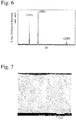
- the X-ray diffraction profile and SEM cross section photograph of the film of Example 3 are shown in Figs. 6 and 7
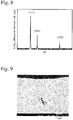
- the X-ray diffraction profile and SEM cross section photograph of the film of Comparative Example 1 are shown in Figs. 8 and 9 .
- plating films formed at current density in a range of 5-10 A/dm 2 and initial pH in a range of 2.8-4.7 and heat-treated at 600°C for 30 seconds had hardness HV of 300 or less and I (111) /I (200) of 2.0 or less, without fine columnar crystals having an average diameter of less than 0.2 ⁇ m.
- higher initial pH provided I (111) /I (200) of larger than 2.0, and fine columnar crystals having an average diameter of less than 0.2 ⁇ m as shown in the SEM photograph of Fig. 9 . Further, defects were observed in the structure containing fine columnar crystals having an average diameter of less than 0.2 ⁇ m.
- Example 1-5 and Comparative Examples 1-3 were as thick as 27-43 ⁇ m.
- the tension measured was 23 N on average, substantially a target value, with standard deviation of 0.28-0.39 N, and sufficient process capabilities of 2.56-3.57 as Cp and 2.45-3.25 as Cpk were obtained.
- Cpk was extremely low among the process capabilities; Cpk was minus, for example, in Comparative Example 2, failing to meet the average tension standard.
- each oil ring of Examples 1-4 was used in each cylinder, to conduct an actual-engine durability test under the operation conditions of 6,500 rpm with wide open throttle (WOT).
- WOT wide open throttle
- a top ring and a second ring were those commonly used for this engine.
- the tension of each oil ring measured after a predetermined period of time was 22.15 N in Example 1, 22.34 N in Example 2, 22.11 N in Example 3, and 22.26 N in Example 4, all sufficiently meeting the standard. No decrease in tension due to the wearing of seating tabs of the spacer expander was observed at all.
- a combined oil control ring having a nominal diameter of 75.0 mm, a combined nominal width of 2.0 mm, a combined thickness of 2.5 mm, and tension of 7.5 ⁇ 2.0 N was produced in the same manner as in Example 1, except that a spacer expander was formed by a belt-like hoop wire of SUS304 rolled to 2.2 mm x 0.275 mm (0.3 R at ends), and that a side rail was formed by a belt-like hoop wire of SUS440B rolled to 2.00 mm x 0.40 mm (0.3 R at ends).
- the combined oil control ring of Example 6 had average tension of 7.23 N, with standard deviation of 0.33 N, Cp of 2.02, and Cpk of 1.75.
- Example 6 In a four-cylinder gasoline engine having displacement of 1500 cm 3 , the combined oil control rings of Example 6 were used in all of four cylinders, to carry out an actual-engine durability test under the operation conditions of 6,000 rpm with wide open throttle (WOT). A top ring and a second ring were those commonly used for this engine. The tension of each oil ring measured after a predetermined period of time was 7.15 N, 7.09 N, 7.12 N, and 7.04 N, all sufficiently meeting the standard. No decrease in tension due to the wearing of seating tabs of the spacer expander was observed at all.
- WOT wide open throttle
- Example 6 too, the above engine having displacement of 1500 cm 3 was used to carry out an actual-engine oil sludge resistance test.
- the combined oil control rings of Example 6 were used in all four cylinders. After a predetermined period of time passed, a piston was taken out of each cylinder to observe the oil ring. As a result, it was confirmed that the spacer expander was not stuck to the side rail. After the oil ring was removed from a piston and ultrasonically washed with acetone for a predetermined period of time, it was also confirmed that only a trace amount of deposits were attached to the oil ring, indicating that the low-tension combined oil control ring had excellent oil sludge resistance.
- a plating film formed on a belt-like hoop wire for a spacer expander has a crystal structure having a high (200) plane ratio with suppressed preferential orientation of a (111) plane, thereby being substantially free from defects, and resistant to chipping and peeling.
- This plating film surely functions as a nitridation-preventing film, enabling the formation of a thick nitrided layer on side-rail-pushing surfaces of seating tabs of the spacer expander.
- a plating film having a centerline-average surface roughness Ra 75 of 0.005-0.4 ⁇ m can further suppress the sticking of oil sludge, providing a low-tension combined oil control ring having small tension variation and excellent wear resistance and sludge resistance, contributing to reducing fuel consumption even in a severe environment provided by improved combustion efficiency.
Landscapes
- Chemical & Material Sciences (AREA)
- Engineering & Computer Science (AREA)
- Organic Chemistry (AREA)
- Chemical Kinetics & Catalysis (AREA)
- Materials Engineering (AREA)
- Metallurgy (AREA)
- Electrochemistry (AREA)
- Mechanical Engineering (AREA)
- General Engineering & Computer Science (AREA)
- Inorganic Chemistry (AREA)
- Crystallography & Structural Chemistry (AREA)
- Combustion & Propulsion (AREA)
- Pistons, Piston Rings, And Cylinders (AREA)
- Electroplating Methods And Accessories (AREA)
- Solid-Phase Diffusion Into Metallic Material Surfaces (AREA)
Abstract
Description
- The present invention relates to a combined oil control ring attached to an engine piston for oil control, which may also be called "combined oil ring" or "oil ring."
- With the reduction of CO2 emission recently required to prevent global warming, fuel efficiency has been improved in automobile engines. For this purpose, improvement has been made to reduce the friction of sliding portions in a piston system.
- Tension reduction is important in piston rings, particularly in oil rings whose tension occupies 50% or more of the entire tension of piston rings. To this end, the tolerance range reduction of the tension is also required.
- However, the improvement of combustion efficiency by the elevation of combustion temperatures or by the direct injection of fuel causes the problems that oil sludge generated due to the degradation of engine-lubricating oils is stuck to side rails and spacer expanders, and that side rails and seating tabs of spacer expanders coming into contact with inner peripheral surfaces of the side rails are worn.
- The tension reduction of oil rings results in decrease in conformability to cylinder wall surfaces, drastically increasing oil consumption, and the sticking and wearing of oil rings.
- With respect to conformability, a method of increasing a conformability coefficient by reducing the widths of side rails has been proposed. With respect to the sticking of oil rings, a method of forming an oil-repellent film such as a fluorine-containing film on the oil ring surface has been proposed. With respect to wearing, a method of plating chromium on oil rings, and a method of nitriding oil rings have been proposed.
- With respect to the width reduction of a piston ring,
Patent Reference 1 specifically discloses a compression ring as wide as 1.0 mm or less, and a combined oil control ring as wide as 2.0 mm or less. - With respect to the sticking of an oil ring,
Patent Reference 2 discloses a method for forming an oil-repellent coating by a sol-gel method from a metal alkoxide and fluoroalkyl-substituted metal alkoxide, in which part of alkoxy groups are substituted by fluoroalkyl groups. - With respect to wearing,
Patent Reference 3 discloses the nitriding of a spacer expander, andWO 2005/040645 discloses the formation of a gas-nitrided layer as thick as 10-60 µm, which contains special S phases having peaks at 2θ = 40° and 46°, respectively, in X-ray diffraction with Cu-Kα, as a nitrided layer having excellent corrosion resistance. - However, increase in the area and thickness of a nitrided layer leads to increase in the Young's modulus and developed length (circumferential length) of a spacer expander, resulting in larger variation of tension, and thus making it difficult to nitride a spacer expander within a predetermined accuracy range. For example, when a nitrided layer as thick as 30 µm is formed by gas-phase nitriding on an entire surface of the spacer expander, the tension increases 18 N than before forming the nitrided layer, resulting in difficulty in controlling the tension.
- To reduce the variation of tension,
Patent Reference 5 teaches a method for producing a spacer expander comprising a first step of forming a nitridation-preventing layer of Ni, Cr or Cu as thick as 1-5 µm on a surface of a wire for a spacer expander, a second step of providing the wire with a corrugated shape by using gears, a third step of forming seating tabs by shearing on an inner peripheral surface of the corrugated wire, and a fourth step of nitriding the sheared surfaces. The base material of a spacer expander body, particularly its corrugated corner portions, is exposed by gear rolling, in case that Ni plating layers on the corrugated corner portions are cracked, peeled, or made thin. To prevent the base material from being exposed,Patent Reference 6 teaches that other surfaces than the sheared surfaces should be covered with a Ni plating film as thick as 1-7 µm having a Ni-diffused layer. -
Patent Reference 7 teaches that the Ni plating film suppresses the sticking of oil sludge, because of its surface free energy and hydrogen bonding force. - As described above, it has been confirmed that a Ni plating film well functions as a nitridation-preventing film or an anti-sticking film. However, the Ni plating film per se may be chipped or peeled depending on the production conditions, practically needing further investigation of the preferred structure of a Ni plating film.
-
- Patent Reference 1:
JP 2003-286898 A - Patent Reference 2:
JP 2000-27995 A - Patent Reference 3: JU
53-147308 A - Patent Reference 4:
WO 2005/040645 - Patent Reference 5:
JP 2003-28299 A - Patent Reference 6:
JP 4,323,456 B - Patent Reference 7:
JP 5,463,364 B - Patent Reference 8:
JP 2011-122060 A - Patent Reference 9:
JP 10-311763 A - An object of the present invention is to provide a combined oil control ring having low tension with small variation, as well as excellent wear resistance and sludge resistance.
- As a result of intensive research on the structure of a plating film formed on a spacer expander in a combined oil control ring, the inventors have found that a plating film free from defects and not suffering chipping and peeling can be formed by adjusting its crystal orientations and its structure in predetermined ranges.
- Thus, the combined oil control ring of the present invention comprises a pair of annular side rails each having a gap, and an axially corrugated spacer expander arranged between the annular side rails;
the corrugated spacer expander having on the inside seating tabs for pushing an inner peripheral surface of each side rail;
the side-rail-pushing surface of each seating tab being provided with a nitrided layer;
an entire surface of the spacer expander except for those provided with the nitrided layer being coated with a plating film; and
the plating film having Vickers hardness HV0.01 of 300 or less. - In an X-ray diffraction profile of a plating film surface, a ratio [I(111)/I(200)] of a diffraction intensity I(111) of a (111) plane to a diffraction intensity I(200) of a (200) plane is preferably 2.0 or less. The texture coefficient of the (200) plane is preferably 1.1 or more.
- The plating film preferably does not contain columnar crystals having an average diameter of less than 0.2 µm.
- The plating film is preferably as thick as 1-7 µm.
- The plating film preferably has centerline average surface roughness Ra75 of 0.005-0.4 µm.
- The plating film is preferably a Ni plating film.
- In the combined oil control ring of the present invention, the nitrided layer is preferably as thick as 30 µm or more.
- The combined oil control ring of the present invention preferably has combined tension of 5-20 N.
-
-
Fig. 1 is a cross-sectional view showing the combined oil control ring of the present invention. -
Fig. 2 is a partial perspective view showing the combined oil control ring of the present invention. -
Fig. 3 is a partial perspective view showing a longitudinally corrugated hoop-forming strip. -
Fig. 4 is a graph showing an X-ray diffraction profile of a Ni plating film obtained in Example 1. -
Fig. 5 is a SEM photograph showing a cross section of the Ni plating film of Example 1. -
Fig. 6 is a graph showing an X-ray diffraction profile of a Ni plating film obtained in Example 3. -
Fig. 7 is a SEM photograph showing a cross section of the Ni plating film of Example 3. -
Fig. 8 is a graph showing an X-ray diffraction profile of a Ni plating film obtained in Comparative Example 1. -
Fig. 9 is a SEM photograph showing a cross section of the Ni plating film of Comparative Example 1. - The combined oil ring, particularly the oil ring having a Ni plating film, of the present invention will be explained in detail below.
-
Fig. 1 shows a combined oil control ring, andFig. 2 is a perspective view showing part of a spacer expander. The combinedoil control ring 1 comprises a pair ofannular side rails side rails inside seating tabs 4 for pushing inner peripheral surfaces of theside rails support portions 5 for supporting theside rails support portions 5 are provided, a connecting portion of eachseating tab 4 and eachsupport portion 5 is called anintermediate portion 6. In the present invention, a side-rail-pushingsurface 7 of theseating tab 4 is provided with a nitrided layer, and an entire surface of the spacer expander except for those having the nitrided layer is coated with a Ni plating film. - The Ni plating film is formed on a belt-like hoop wire before formed into a spacer expander. The spacer expander is produced by providing a Ni-plated belt-like hoop wire with an axially corrugated form, such that it has continuous
upper portions 10 andlower portions 20 as shown inFig. 3 , and then formingseating tabs 4 in the upper andlower portions support portions 5 andintermediate portions 6 on their outside as shown inFig. 2 . By this forming process, eachseating tab 4 is provided with a sheared surface free of the Ni plating film on the side facing theintermediate portion 6. The nitrided layer is formed only on the sheared surfaces (side-rail-pushing surfaces 7). In order that the Ni plating film on other portions acts as a nitridation-preventing film, the Ni plating film should be free from such defects as chipping and peeling, even after the belt-like hoop wire is formed into spacer expander. - The as-plated Ni film of the present invention has Vickers hardness HV0.01 of about 350-550. Because hardness on this level provides as small elongation as about 6%, the Ni plating film may be chipped or peeled when a spacer expander is formed. Accordingly, heat treatment is carried out to reduce the hardness HV0.01 of the Ni plating film to 300 or less. The heat treatment is preferably conducted at a temperature of 500-700°C in a non-oxidizing atmosphere (for example, N2 atmosphere). Taking productivity into consideration, the heat treatment is more preferably conducted at a temperature of 550°C or higher for 1 minute or less. The concentration of oxygen in the non-oxidizing atmosphere is preferably 200 ppm or less. The Ni plating film subjected to such heat treatment has hardness HV0.01 of more preferably 270 or less, further preferably 250 or less. For example, when the hardness HV0.01 is 250 or less, it is said that the Ni plating film has elongation of 10% or more.
- In the present invention, in an X-ray diffraction profile of a surface of the heat-treated Ni plating film, a ratio [I(111)/I(200)] of the diffraction intensity I(111) of a (111) plane to the diffraction intensity I(200) of a (200) plane is preferably 2.0 or less, more preferably 1.8 or less. The diffraction intensity I(200) of a (200) plane is further preferably maximum. When the diffraction intensity I(200) of a (200) plane is maximum, the ratio [I(111)/I(200)] is preferably 0.8 or less.
- The texture coefficient of a (200) plane is preferably 1.1 or more.
- The texture coefficient of a (hkl) plane is generally defined by:


- I0(111) is 100, I0(200) is 42, and I0(220) is 21. The texture coefficient of a (200) plane is more preferably 1.2 or more, further preferably 1.3 or more. When the diffraction intensity I(200) of a (200) plane is maximum, the texture coefficient of a (200) plane is further preferably 1.8 or more.
- The Ni plating film of the present invention preferably does not have columnar crystals penetrating the film in a thickness direction, and also preferably does not have columnar crystals having an average diameter of less than 0.2 µm. In the present invention, the columnar structure has an aspect ratio (length/diameter) of 2 or more, and those having aspect ratios of less than 2 are categorized in the granular structure. Though heat treatment causes recrystallization in the Ni plating film of the present invention, it is preferable that crystals grow to proper sizes with few defects. Accordingly, the Ni plating film is preferably constituted by granular crystals having an average grain size of 0.2-3 µm and/or columnar crystals having an average diameter of 0.2-3 µm. The average grain size of granular crystals is more preferably 0.3-2 µm, further preferably 0.5-1.5 µm. The average diameter of columnar crystals is more preferably 0.3-2 µm, further preferably 0.5-1.5 µm. The average grain size and the average diameter can be determined by the image analysis of granular crystals and columnar crystals.
- In the present invention, the thickness of the Ni plating film is preferably 1-7 µm, more preferably 3-6.5 µm, further preferably 4-6 µm.
- With respect to the problem of oil sludge, the reduction of a gap width of a top ring for reducing a blowby gas to suppress the deterioration of an engine oil, and the formation of a coating on a spacer expander and side rails to make sludge less attachable to them are effective. In this respect, as described in
Patent Reference 7, it is effective to form the Ni plating film on an entire surface of the spacer expander except for the side-rail-pushing surfaces of seating tabs, because the Ni plating film has a function of suppressing the sticking of oil sludge. Further, oil sludge resistance can be improved by adjusting the centerline-average surface roughness Ra75 of this Ni plating film to 0.005-0.4 µm. A mirror-polished surface is of course preferable, and a glossy Ni plating film can have surface roughness within this range. The surface roughness Ra75 of the Ni plating film is more preferably 0.005-0.25 µm, further preferably 0.005-0.15 µm. - Oil sludge is easily attached to and accumulated particularly in narrow space between an
intermediate portion 6 of thespacer expander 2 and eachside rail support portion 5 is preferably 0.07 mm or more, more preferably 0.09 mm or more, further preferably 0.11 mm or more, from the structural point of view. - A nitrided layer formed on the side-rail-pushing
surfaces 7 of the spacerexpander seating tabs 4 is preferably as thick as 30 µm or more, more preferably 35 µm or more, further preferably 40 µm or more, from the aspect of wear resistance. From the aspect of productivity, the upper limit is preferably 60 µm. - Because the nitrided layer is formed only on the side-rail-pushing surfaces of the spacer expander as described above in detail, the combined oil control ring of the present invention has low tension with small variation, so that the combined tension can be as small as 5-20 N.
- Though not restrictive, the spacer expander substrate (base material) is made of austenitic stainless steel such as SUS304, in the present invention. Because the substrate is covered with a passive film, it is preferably electrolytically degreased by electrolytic polishing with hydrochloric acid, activated by washing with hydrochloric acid, and then subjected to Ni strike plating in a Wood's bath, as pretreatments for the Ni plating film. Ni plating can be conducted in various baths such as a Watts bath, a sulfamate bath, etc. Because of bending to a spacer expander, dispersion-reinforced plating is not preferable, and the amounts of additives such as a gloss agent, etc. are preferably minimum necessary for securing predetermined surface roughness and uniform thickness. In order that the Ni plating film does not have columnar crystals penetrating in a thickness direction, Ni plating is preferably carried out by 2 or more steps under different conditions. In this respect, semi-glossy Ni plating film and further glossy Ni plating film are preferably carried out after Ni strike plating.
- As long as Ni strike plating is carried out as a pretreatment, a diffusion phase is not required between the substrate and the Ni plating film in the present invention, though a diffusion phase formed by a softening heat treatment for hardness adjustment is preferable without causing any problem. A diffusion phase formed by a heat treatment at 550°C or higher within 1 minute for productivity covers the substrate only locally or is extremely thin. A Ni plating film formed through Ni strike plating and having a structure with a high (200) plane ratio would sufficiently act as a nitridation-preventing film, even if the diffusion phase were not formed.
- A belt-like hoop wire coated with the above Ni plating film is formed into spacer expanders, through gear-forming including local bending and the formation of seating tabs by shearing, coiling, cutting to a predetermined length, and finishing of gap surface portions. Because the seating tabs are formed by a gear-forming step of upper and lower portions, and then a shearing step on the inside, the seating tabs do not have a Ni plating film on their side-rail-pushing surfaces. If a Ni plating film were too thick, it may remain on part of the pushing surfaces, but there would be no problem if its thickness were within 10 µm. The tension of the spacer expander can be controlled by adjusting its developed length, though it is important that the spacer expander has an accurate shape and suppressed variation of the developed length.
- To form a nitrided layer as thick as 30 µm or more, gas-phase nitriding using an NH3-containing gas is preferable in the present invention. Salt-bath nitriding may be used, though it is difficult to form a thick nitrided layer. When the substrate of the spacer expander is made of SUS304, it is preferable to add ammonium chloride at predetermined timing before nitriding, to reduce its passive film. The nitriding temperature is preferably 470-600°C, and the nitriding time is determinable depending on the desired thickness of the nitrided layer.
- A belt-like hoop wire of SUS304 rolled to 2.50 mm x 0.25 mm (0.3 R at ends) was plated with Ni under the following conditions.
- Pretreatments: Electrolytic degreasing, activation with acid, and Ni strike plating.
- Ni-plating bath: A semi-glossy Ni-plating bath (Ni sulfamate solution + Ni chloride + boric acid + additive A), and a glossy Ni-plating bath (Ni sulfamate solution + Ni chloride + boric acid + additive B).
- Bath temperature: 50°C.
- Initial pH: 2.8.
- Current density: 8 A/dm2.
- Time: 60 seconds for semi-glossy Ni plating, and 30 seconds for glossy Ni plating.
- The Ni-plated hoop wire was cleaned with warm water, dried, and then subjected to a softening heat treatment at 600°C for 30 seconds in an N2 atmosphere (oxygen concentration: 50 ppm).
- The hardness of a mirror-polished surface of the Ni plating film was measured at a test force of 0.098 N (10 g) using a micro-Vickers hardness tester. The hardness HV0.01 of the Ni plating film of Example 1 was 435 before the heat treatment, and 245 after the heat treatment.
- The centerline-average surface roughness Ra75 of a heat-treated hoop-forming strip was measured by a stylus-type surface roughness meter. The centerline-average roughness Ra75 of Example 1 was 0.16 µm.
- The X-ray diffraction intensity of the mirror-polished surface was measured with Cu-Kα rays at tube voltage of 40 kV and tube current of 30 mA, in a range of 2θ = 35-90°, which covered all of the (111), (200) and (220) planes of Ni.
Fig. 4 shows an X-ray diffraction profile in Example 1. With the maximum intensity among three diffraction intensities assumed as 100, each diffraction intensity of (111), (200) and (220) was determined to calculate a ratio [I(111)/I(200)] of the diffraction intensity I(111) of the (111) plane to the diffraction intensity I(200) of the (200) plane, and a texture coefficient of the (200) plane. In Example 1, I(111)/I(200) was 1.25, and the texture coefficient of a (200) plane was 1.35. - Thickness measurement and structure observation were conducted on a scanning electron photomicrograph (SEM photograph) of a mirror-polished cross section perpendicular to the coating surface.
Fig. 5 is a SEM photograph. The Ni plating film of Example 1 as thick as about 5 µm was constituted by a Nistrike plating layer 31, a semi-glossyNi plating layer 32, and a glossyNi plating layer 33. The Ni plating film was also free from columnar crystals penetrating the film in a thickness direction, and columnar crystals having an average diameter of less than 0.2 µm. Incidentally, the granular structure had an average grain size of 0.8 µm. - A spacer expander was formed from the above Ni-plated hoop wire by a usual gear-forming method, to provide a combined oil control ring having a nominal diameter of 82.5 mm, a combined nominal width of 2.5 mm, a combined thickness of 2.8 mm, and tension of 23 ±3.0 N. A side rail was formed by coiling from a belt-like hoop wire of SUS440B rolled to 2.30 mm x 0.40 mm (0.3 R at ends), ion-plated with CrN on its outer peripheral surface, and further coated with an oil-sludge-resistant composition containing C6FMA, PolySiMA and SiMA described in
Patent Reference 8 on its entire surface. - After cleaning for degreasing, the side-rail-pushing surfaces of seating tabs of the spacer expander were nitrided at 570°C for 80 minutes in a gas-phase nitriding atmosphere (NH3: 90%, and N2: 10%). The nitrided layer was as thick as 27 µm.
- 20 sets of combined oil control ring samples for tension measurement were prepared, and tension measurement was conducted by a tensiometer described in Patent Reference 9. The tension was 22.91 N on average with standard deviation of 0.31 N, the process capability index Cp was 3.23, and the process capability index Cpk was 3.13.
- Each combined oil control ring having a nominal diameter of 82.5 mm, a combined nominal width of 2.5 mm, a combined thickness of 2.8 mm, and a tension of 23 ±3.0 N was produced under the same plating and production conditions as in Example 1, except for changing the current density and the initial pH as shown in Table 1, and adjusting the plating time to form a film as thick as about 5 µm. The measurements of the hardness before and after heat treatment, surface roughness after heat treatment, and X-ray diffraction of the Ni plating film, as well as the SEM observation of its structure, were conducted as in Example 1, and the measurements of the thickness and surface hardness of the nitrided layer, and the tension of the combined oil control ring were also conducted as in Example 1. The results are shown in Tables 1 and 2. Tables also show various test results of Example 1. The X-ray diffraction profile and SEM cross section photograph of the film of Example 3 are shown in
Figs. 6 and 7 , and the X-ray diffraction profile and SEM cross section photograph of the film of Comparative Example 1 are shown inFigs. 8 and 9 .Table 1 No. Ni Plating Film Plating Conditions Hardness HV0.01 Ra75 (3) (µm) X-Ray Diffraction Structure CD(1) (A/dm2) Initial pH Before HT(2) After HT(2) I(111) /I(200) TC(4) of (200) Fine Columnar Crystals Example 1 8 2.8 435 245 0.16 1.25 1.35 No Example 2 5 3.1 495 291 0.21 0.90 2.03 No Example 3 5 3.3 448 208 0.18 0.78 1.86 No Example 4 10 4.7 472 198 0.14 1.75 1.23 No Example 5 10 3.2 453 212 0.07 1.96 1.13 No Com. Ex. 1 10 6.4 465 315 0.23 2.22 0.86 Yes Com. Ex. 2 10 5.2 438 274 0.19 2.38 0.96 Yes Com. Ex. 3 15 4.0 480 301 0.29 3.33 0.80 Yes Note: (1) CD means current density.
(2) HT means heat treatment.
(3) Surface roughness Ra75.
(4) TC means a texture coefficient.Table 2 No. Nitrided Layer Thickness (µm) Tension Measurement Average Tension (N) Standard Deviation (N) Process Capability Index Cp Cpk Example 1 27 22.91 0.31 3.23 3.13 Example 2 43 23.27 0.28 3.57 3.25 Example 3 31 23.18 0.29 3.12 3.22 Example 4 35 23.18 0.34 2.94 2.76 Example 5 37 23.13 0.39 2.56 2.45 Com. Ex. 1 39 25.79 0.61 1.64 0.11 Com. Ex. 2 34 27.21 0.67 1.49 -0.60 Com. Ex. 3 33 26.25 0.65 1.55 0.56 - It was found in Examples 1-5 and Comparative Examples 1-3 that plating films formed at current density in a range of 5-10 A/dm2 and initial pH in a range of 2.8-4.7 and heat-treated at 600°C for 30 seconds had hardness HV of 300 or less and I(111)/I(200) of 2.0 or less, without fine columnar crystals having an average diameter of less than 0.2 µm. On the other hand, higher initial pH provided I(111)/I(200) of larger than 2.0, and fine columnar crystals having an average diameter of less than 0.2 µm as shown in the SEM photograph of
Fig. 9 . Further, defects were observed in the structure containing fine columnar crystals having an average diameter of less than 0.2 µm. - The nitrided layers in Examples 1-5 and Comparative Examples 1-3 were as thick as 27-43 µm. In Examples 1-5, the tension measured was 23 N on average, substantially a target value, with standard deviation of 0.28-0.39 N, and sufficient process capabilities of 2.56-3.57 as Cp and 2.45-3.25 as Cpk were obtained. In Comparative Examples 1-3, on the other hand, Cpk was extremely low among the process capabilities; Cpk was minus, for example, in Comparative Example 2, failing to meet the average tension standard.
- In a four-cylinder gasoline engine having displacement of 2400 cm3, each oil ring of Examples 1-4 was used in each cylinder, to conduct an actual-engine durability test under the operation conditions of 6,500 rpm with wide open throttle (WOT). A top ring and a second ring were those commonly used for this engine. The tension of each oil ring measured after a predetermined period of time was 22.15 N in Example 1, 22.34 N in Example 2, 22.11 N in Example 3, and 22.26 N in Example 4, all sufficiently meeting the standard. No decrease in tension due to the wearing of seating tabs of the spacer expander was observed at all.
- Using the same actual engine as in the above durability test, with each oil ring of Examples 1-4 used in each cylinder, an actual-engine oil sludge resistance test was conducted with a degraded engine oil recovered from the market, in an operation range from a stopped state to a maximum-power rotation state, under the cyclic operation of continuously changing temperatures of coolant and lubricant from a low temperature to a high temperature. In this test, too, a top ring and a second ring were those commonly used for this engine. After a predetermined period of time passed, a piston was taken out of each cylinder to observe the oil ring. As a result, it was confirmed that the spacer expander was not stuck to the side rail. After the oil ring was removed from a piston and ultrasonically washed with acetone for a predetermined period of time, it was also confirmed that only a trace amount of deposits were attached to the oil ring, indicating that the combined oil control rings of Examples 1-4 had excellent oil sludge resistance.
- A combined oil control ring having a nominal diameter of 75.0 mm, a combined nominal width of 2.0 mm, a combined thickness of 2.5 mm, and tension of 7.5 ± 2.0 N was produced in the same manner as in Example 1, except that a spacer expander was formed by a belt-like hoop wire of SUS304 rolled to 2.2 mm x 0.275 mm (0.3 R at ends), and that a side rail was formed by a belt-like hoop wire of SUS440B rolled to 2.00 mm x 0.40 mm (0.3 R at ends). The combined oil control ring of Example 6 had average tension of 7.23 N, with standard deviation of 0.33 N, Cp of 2.02, and Cpk of 1.75.
- In a four-cylinder gasoline engine having displacement of 1500 cm3, the combined oil control rings of Example 6 were used in all of four cylinders, to carry out an actual-engine durability test under the operation conditions of 6,000 rpm with wide open throttle (WOT). A top ring and a second ring were those commonly used for this engine. The tension of each oil ring measured after a predetermined period of time was 7.15 N, 7.09 N, 7.12 N, and 7.04 N, all sufficiently meeting the standard. No decrease in tension due to the wearing of seating tabs of the spacer expander was observed at all.
- In Example 6, too, the above engine having displacement of 1500 cm3 was used to carry out an actual-engine oil sludge resistance test. The combined oil control rings of Example 6 were used in all four cylinders. After a predetermined period of time passed, a piston was taken out of each cylinder to observe the oil ring. As a result, it was confirmed that the spacer expander was not stuck to the side rail. After the oil ring was removed from a piston and ultrasonically washed with acetone for a predetermined period of time, it was also confirmed that only a trace amount of deposits were attached to the oil ring, indicating that the low-tension combined oil control ring had excellent oil sludge resistance.
- In the combined oil control ring of the present invention, a plating film formed on a belt-like hoop wire for a spacer expander has a crystal structure having a high (200) plane ratio with suppressed preferential orientation of a (111) plane, thereby being substantially free from defects, and resistant to chipping and peeling. This plating film surely functions as a nitridation-preventing film, enabling the formation of a thick nitrided layer on side-rail-pushing surfaces of seating tabs of the spacer expander. A plating film having a centerline-average surface roughness Ra75 of 0.005-0.4 µm can further suppress the sticking of oil sludge, providing a low-tension combined oil control ring having small tension variation and excellent wear resistance and sludge resistance, contributing to reducing fuel consumption even in a severe environment provided by improved combustion efficiency.
Claims (9)
- A combined oil control ring comprising a pair of annular side rails each having a gap, and an axially corrugated spacer expander arranged between said side rails;
said corrugated spacer expander having on the inside seating tabs for pushing inner peripheral surfaces of said side rails;
a side-rail-pushing surface of each seating tab being provided with a nitrided layer;
an entire surface of each spacer expander except for those provided with said nitrided layer being coated with a plating film; and
said plating film having Vickers hardness HV0.01 of 300 or less. - The combined oil control ring according to claim 1, wherein in an X-ray diffraction profile of a plating film surface, a ratio [I(111)/I(200)] of a diffraction intensity I(111) of a (111) plane to a diffraction intensity I(200) of a (200) plane is 2.0 or less.
- The combined oil control ring according to claim 2, wherein the texture coefficient of said (200) plane is 1.1 or more.
- The combined oil control ring according to any one of claims 1-3, wherein said plating film does not contain columnar crystals having an average diameter of less than 0.2 µm.
- The combined oil control ring according to any one of claims 1-4, wherein said plating film is as thick as 1-7 µm.
- The combined oil control ring according to any one of claims 1-5, wherein said plating film has a centerline-average roughness Ra75 of 0.005-0.4 µm.
- The combined oil control ring according to any one of claims 1-6, wherein said plating film is a Ni plating film.
- The combined oil control ring according to any one of claims 1-7, wherein said nitrided layer is as thick as 30 µm or more.
- The combined oil control ring according to any one of claims 1-8, wherein combined tension is 5-20 N.
Applications Claiming Priority (2)
| Application Number | Priority Date | Filing Date | Title |
|---|---|---|---|
| JP2015002946A JP5980966B2 (en) | 2015-01-09 | 2015-01-09 | Combination oil control ring |
| PCT/JP2015/085791 WO2016111162A1 (en) | 2015-01-09 | 2015-12-22 | Combined oil control ring |
Publications (3)
| Publication Number | Publication Date |
|---|---|
| EP3244099A1 true EP3244099A1 (en) | 2017-11-15 |
| EP3244099A4 EP3244099A4 (en) | 2018-07-04 |
| EP3244099B1 EP3244099B1 (en) | 2019-12-04 |
Family
ID=56355862
Family Applications (1)
| Application Number | Title | Priority Date | Filing Date |
|---|---|---|---|
| EP15877035.4A Active EP3244099B1 (en) | 2015-01-09 | 2015-12-22 | Combined oil control ring |
Country Status (5)
| Country | Link |
|---|---|
| US (1) | US10352446B2 (en) |
| EP (1) | EP3244099B1 (en) |
| JP (1) | JP5980966B2 (en) |
| KR (1) | KR101863107B1 (en) |
| WO (1) | WO2016111162A1 (en) |
Families Citing this family (1)
| Publication number | Priority date | Publication date | Assignee | Title |
|---|---|---|---|---|
| JP6389970B1 (en) | 2018-01-16 | 2018-09-12 | Tpr株式会社 | Combination oil ring |
Family Cites Families (45)
| Publication number | Priority date | Publication date | Assignee | Title |
|---|---|---|---|---|
| US2904377A (en) * | 1957-05-21 | 1959-09-15 | Muskegon Piston Ring Co Inc | Spacer and expander for piston rings |
| US2854301A (en) * | 1957-09-06 | 1958-09-30 | Wilkening Mfg Co | Piston ring expander and method of forming same |
| FR1540312A (en) * | 1967-02-17 | 1968-09-27 | Piston and rings assembly for internal combustion engine | |
| US3695622A (en) * | 1970-12-18 | 1972-10-03 | Sealed Power Corp | Piston ring construction |
| US4111437A (en) * | 1976-09-08 | 1978-09-05 | Sealed Power Corporation | Oil control ring spacer-expander with improved slip latch |
| US4115959A (en) * | 1977-01-31 | 1978-09-26 | Ramsey Corporation | Method for increasing the life of silicon carbide grinding wheels |
| JPS5638199Y2 (en) | 1977-04-26 | 1981-09-07 | ||
| US4194747A (en) * | 1978-12-05 | 1980-03-25 | Muskegon Piston Ring Company | Three-piece oil control ring |
| US4429885A (en) * | 1982-11-04 | 1984-02-07 | Kabushiki Kaisha Riken | Spacer and expander member for holding and biasing piston ring rails |
| JPS6026147A (en) * | 1983-07-21 | 1985-02-09 | Toyota Motor Corp | Combined oil ring |
| JPS6088164U (en) * | 1983-11-24 | 1985-06-17 | 株式会社リケン | combination oil ring |
| GB2175065B (en) * | 1985-05-17 | 1988-07-13 | Ae Plc | Multiple part oil-control ring for piston |
| JPS6323067A (en) * | 1986-07-15 | 1988-01-30 | Nippon Piston Ring Co Ltd | Spacer expander |
| CA2023718C (en) * | 1989-08-31 | 1998-07-14 | Sumio Ono | Steel oil ring assembly |
| US5469616A (en) * | 1990-11-15 | 1995-11-28 | Teikoku Piston Ring Co., Ltd. | Method of manufacturing a side rail of a combined oil ring |
| US5195758A (en) * | 1991-11-19 | 1993-03-23 | Hastings Manufacturing Company | Three-piece oil control ring assembly |
| US5794941A (en) * | 1995-06-01 | 1998-08-18 | Dana Corporation | Piston ring assembly |
| JP2855419B2 (en) * | 1995-12-19 | 1999-02-10 | 帝国ピストンリング株式会社 | Combination oil ring spacer expander and combination oil ring |
| JPH10311763A (en) | 1997-05-09 | 1998-11-24 | Riken Corp | Apparatus and method for measuring tension of piston ring |
| JP2000027995A (en) | 1998-07-15 | 2000-01-25 | Toyota Motor Corp | piston ring |
| JP2002206188A (en) | 2001-01-09 | 2002-07-26 | Sumitomo Electric Fine Polymer Inc | Electroformed nickel belt, coated nickel belt and method of manufacturing coated nickel belt |
| JP2003028299A (en) | 2001-07-11 | 2003-01-29 | Riken Corp | Spacer expander and method for manufacturing the same |
| JP2003148617A (en) * | 2001-11-15 | 2003-05-21 | Nippon Piston Ring Co Ltd | Steel-made combined oil control ring |
| JP4132815B2 (en) * | 2001-12-28 | 2008-08-13 | 株式会社リケン | Side rail and combination oil ring |
| US6655697B2 (en) * | 2002-01-18 | 2003-12-02 | Dana Corporation | Piston oil ring having land flanked by concave sidewalls |
| JP2003286898A (en) | 2002-03-28 | 2003-10-10 | Teikoku Piston Ring Co Ltd | Combination of piston rings |
| TWI258547B (en) * | 2002-08-27 | 2006-07-21 | Riken Co Ltd | Side rails for combined oil control ring and their nitriding method |
| TWI238233B (en) * | 2003-02-20 | 2005-08-21 | Riken Kk | Combined oil control ring |
| US20060113730A1 (en) * | 2003-04-07 | 2006-06-01 | Takao Suzuki | Combination oil ring |
| JP4480369B2 (en) * | 2003-08-21 | 2010-06-16 | 株式会社リケン | Spacer expander |
| TWI255885B (en) | 2003-10-27 | 2006-06-01 | Riken Kk | Three-piece type combined oil control ring |
| JP4323456B2 (en) * | 2005-04-07 | 2009-09-02 | 株式会社リケン | Spacer expander and manufacturing method thereof |
| JP2006300224A (en) * | 2005-04-21 | 2006-11-02 | Riken Corp | 3-piece combination oil ring |
| JP4633639B2 (en) * | 2006-01-31 | 2011-02-16 | 日本ピストンリング株式会社 | 3-piece oil ring and combination of 3-piece oil ring and piston |
| CN101680078B (en) | 2006-11-14 | 2012-05-30 | 株式会社理研 | Chromium nitride coating film by ion plating, process for producing the same, and piston ring for internal combustion engine |
| JP2008133923A (en) * | 2006-11-29 | 2008-06-12 | Teikoku Piston Ring Co Ltd | Combined oil ring |
| WO2007147532A2 (en) * | 2007-06-16 | 2007-12-27 | Mahle International Gmbh | Piston ring with chromium nitride coating for internal combustion engines |
| CN102639852B (en) | 2009-10-06 | 2014-10-15 | 株式会社理研 | Oil ring for internal combustion engine |
| JP5562018B2 (en) | 2009-12-10 | 2014-07-30 | 株式会社リケン | Coating composition for engine parts and engine parts using the same |
| JP5557562B2 (en) * | 2010-03-10 | 2014-07-23 | Tpr株式会社 | Combination oil ring |
| WO2011151927A1 (en) * | 2010-06-04 | 2011-12-08 | 日本ピストンリング株式会社 | Oil ring for internal combustion engine |
| WO2012133714A1 (en) * | 2011-03-31 | 2012-10-04 | 株式会社リケン | Multi-piece oil ring |
| JP2014009776A (en) | 2012-06-29 | 2014-01-20 | Nippon Piston Ring Co Ltd | Manufacturing method of spacer expander |
| BR102012024729B1 (en) * | 2012-09-27 | 2020-05-19 | Mahle Metal Leve S/A | three-piece oil control ring for internal combustion engines, expansion element and ring element |
| JP6239964B2 (en) | 2013-12-18 | 2017-11-29 | 株式会社リケン | Combination oil control ring |
-
2015
- 2015-01-09 JP JP2015002946A patent/JP5980966B2/en not_active Expired - Fee Related
- 2015-12-22 US US15/536,799 patent/US10352446B2/en active Active
- 2015-12-22 KR KR1020177022235A patent/KR101863107B1/en active Active
- 2015-12-22 EP EP15877035.4A patent/EP3244099B1/en active Active
- 2015-12-22 WO PCT/JP2015/085791 patent/WO2016111162A1/en not_active Ceased
Also Published As
| Publication number | Publication date |
|---|---|
| US10352446B2 (en) | 2019-07-16 |
| US20170350508A1 (en) | 2017-12-07 |
| JP2016128700A (en) | 2016-07-14 |
| JP5980966B2 (en) | 2016-08-31 |
| KR101863107B1 (en) | 2018-05-31 |
| EP3244099A4 (en) | 2018-07-04 |
| EP3244099B1 (en) | 2019-12-04 |
| KR20170097226A (en) | 2017-08-25 |
| WO2016111162A1 (en) | 2016-07-14 |
Similar Documents
| Publication | Publication Date | Title |
|---|---|---|
| US8123227B2 (en) | Sliding member | |
| EP2886912A1 (en) | Combined oil control ring | |
| US9353864B2 (en) | Oil ring for internal combustion engine | |
| DE112011100377B4 (en) | piston ring | |
| US20100319647A1 (en) | Combination structure of piston ring and cylinder liner for internal combustion engine | |
| EP2940350B1 (en) | Combination of cylinder and piston ring | |
| EP1686295B1 (en) | Three piece-combined oil ring | |
| DE102007054181A1 (en) | Corrosion-resistant coating and manufacturing method thereof | |
| EP3327320A1 (en) | Piston ring and manufacturing method therefor | |
| EP3244099B1 (en) | Combined oil control ring | |
| EP3076053B1 (en) | Combined oil control ring | |
| JP6029790B2 (en) | Combination oil control ring | |
| US6596410B2 (en) | Chrome-plated sliding member and manufacturing method thereof | |
| DE102008062220A1 (en) | Sliding layer useful in a sliding element for a tribological system, consists of amorphous carbon and chromium carbide, where particles of the amorphous carbon and chromium carbide are uniformly distributed | |
| JP4323456B2 (en) | Spacer expander and manufacturing method thereof | |
| EP4102087B1 (en) | Sliding member, production method of sliding member, and evaluation method of sliding member | |
| EP4202199A1 (en) | Sliding member | |
| EP4545777A1 (en) | Piston ring | |
| JP2775159B2 (en) | Combination of cylinder liner and piston ring for internal combustion engine | |
| JPH11190430A (en) | Piston ring and manufacture thereof | |
| SU1414541A1 (en) | Method of reconditioning worn surfaces of bearing shells | |
| JPH0552264A (en) | Piston ring |
Legal Events
| Date | Code | Title | Description |
|---|---|---|---|
| STAA | Information on the status of an ep patent application or granted ep patent |
Free format text: STATUS: THE INTERNATIONAL PUBLICATION HAS BEEN MADE |
|
| PUAI | Public reference made under article 153(3) epc to a published international application that has entered the european phase |
Free format text: ORIGINAL CODE: 0009012 |
|
| STAA | Information on the status of an ep patent application or granted ep patent |
Free format text: STATUS: REQUEST FOR EXAMINATION WAS MADE |
|
| 17P | Request for examination filed |
Effective date: 20170627 |
|
| AK | Designated contracting states |
Kind code of ref document: A1 Designated state(s): AL AT BE BG CH CY CZ DE DK EE ES FI FR GB GR HR HU IE IS IT LI LT LU LV MC MK MT NL NO PL PT RO RS SE SI SK SM TR |
|
| AX | Request for extension of the european patent |
Extension state: BA ME |
|
| DAV | Request for validation of the european patent (deleted) | ||
| DAX | Request for extension of the european patent (deleted) | ||
| A4 | Supplementary search report drawn up and despatched |
Effective date: 20180606 |
|
| RIC1 | Information provided on ipc code assigned before grant |
Ipc: F16J 9/26 20060101ALI20180528BHEP Ipc: C25D 5/50 20060101ALI20180528BHEP Ipc: C25D 5/36 20060101ALI20180528BHEP Ipc: C23C 8/02 20060101ALI20180528BHEP Ipc: C23C 8/26 20060101ALI20180528BHEP Ipc: F02F 5/00 20060101ALI20180528BHEP Ipc: C25D 7/00 20060101ALI20180528BHEP Ipc: F16J 9/06 20060101AFI20180528BHEP Ipc: C25D 7/06 20060101ALI20180528BHEP |
|
| STAA | Information on the status of an ep patent application or granted ep patent |
Free format text: STATUS: EXAMINATION IS IN PROGRESS |
|
| 17Q | First examination report despatched |
Effective date: 20190205 |
|
| GRAP | Despatch of communication of intention to grant a patent |
Free format text: ORIGINAL CODE: EPIDOSNIGR1 |
|
| STAA | Information on the status of an ep patent application or granted ep patent |
Free format text: STATUS: GRANT OF PATENT IS INTENDED |
|
| INTG | Intention to grant announced |
Effective date: 20190718 |
|
| RIC1 | Information provided on ipc code assigned before grant |
Ipc: C25D 5/36 20060101ALI20190705BHEP Ipc: F16J 9/06 20060101AFI20190705BHEP Ipc: C25D 7/06 20060101ALI20190705BHEP Ipc: C23C 28/00 20060101ALI20190705BHEP Ipc: C25D 7/00 20060101ALI20190705BHEP Ipc: F16J 9/26 20060101ALI20190705BHEP Ipc: C23C 28/02 20060101ALI20190705BHEP Ipc: F02F 5/00 20060101ALI20190705BHEP Ipc: C25D 5/50 20060101ALI20190705BHEP Ipc: C23C 8/02 20060101ALI20190705BHEP Ipc: C23C 8/26 20060101ALI20190705BHEP |
|
| GRAS | Grant fee paid |
Free format text: ORIGINAL CODE: EPIDOSNIGR3 |
|
| GRAA | (expected) grant |
Free format text: ORIGINAL CODE: 0009210 |
|
| STAA | Information on the status of an ep patent application or granted ep patent |
Free format text: STATUS: THE PATENT HAS BEEN GRANTED |
|
| AK | Designated contracting states |
Kind code of ref document: B1 Designated state(s): AL AT BE BG CH CY CZ DE DK EE ES FI FR GB GR HR HU IE IS IT LI LT LU LV MC MK MT NL NO PL PT RO RS SE SI SK SM TR |
|
| REG | Reference to a national code |
Ref country code: GB Ref legal event code: FG4D |
|
| REG | Reference to a national code |
Ref country code: CH Ref legal event code: EP |
|
| REG | Reference to a national code |
Ref country code: AT Ref legal event code: REF Ref document number: 1209825 Country of ref document: AT Kind code of ref document: T Effective date: 20191215 |
|
| REG | Reference to a national code |
Ref country code: DE Ref legal event code: R096 Ref document number: 602015043239 Country of ref document: DE |
|
| REG | Reference to a national code |
Ref country code: IE Ref legal event code: FG4D |
|
| REG | Reference to a national code |
Ref country code: NL Ref legal event code: MP Effective date: 20191204 |
|
| REG | Reference to a national code |
Ref country code: LT Ref legal event code: MG4D |
|
| PG25 | Lapsed in a contracting state [announced via postgrant information from national office to epo] |
Ref country code: NO Free format text: LAPSE BECAUSE OF FAILURE TO SUBMIT A TRANSLATION OF THE DESCRIPTION OR TO PAY THE FEE WITHIN THE PRESCRIBED TIME-LIMIT Effective date: 20200304 Ref country code: GR Free format text: LAPSE BECAUSE OF FAILURE TO SUBMIT A TRANSLATION OF THE DESCRIPTION OR TO PAY THE FEE WITHIN THE PRESCRIBED TIME-LIMIT Effective date: 20200305 Ref country code: LV Free format text: LAPSE BECAUSE OF FAILURE TO SUBMIT A TRANSLATION OF THE DESCRIPTION OR TO PAY THE FEE WITHIN THE PRESCRIBED TIME-LIMIT Effective date: 20191204 Ref country code: SE Free format text: LAPSE BECAUSE OF FAILURE TO SUBMIT A TRANSLATION OF THE DESCRIPTION OR TO PAY THE FEE WITHIN THE PRESCRIBED TIME-LIMIT Effective date: 20191204 Ref country code: BG Free format text: LAPSE BECAUSE OF FAILURE TO SUBMIT A TRANSLATION OF THE DESCRIPTION OR TO PAY THE FEE WITHIN THE PRESCRIBED TIME-LIMIT Effective date: 20200304 Ref country code: FI Free format text: LAPSE BECAUSE OF FAILURE TO SUBMIT A TRANSLATION OF THE DESCRIPTION OR TO PAY THE FEE WITHIN THE PRESCRIBED TIME-LIMIT Effective date: 20191204 Ref country code: LT Free format text: LAPSE BECAUSE OF FAILURE TO SUBMIT A TRANSLATION OF THE DESCRIPTION OR TO PAY THE FEE WITHIN THE PRESCRIBED TIME-LIMIT Effective date: 20191204 |
|
| PG25 | Lapsed in a contracting state [announced via postgrant information from national office to epo] |
Ref country code: HR Free format text: LAPSE BECAUSE OF FAILURE TO SUBMIT A TRANSLATION OF THE DESCRIPTION OR TO PAY THE FEE WITHIN THE PRESCRIBED TIME-LIMIT Effective date: 20191204 Ref country code: RS Free format text: LAPSE BECAUSE OF FAILURE TO SUBMIT A TRANSLATION OF THE DESCRIPTION OR TO PAY THE FEE WITHIN THE PRESCRIBED TIME-LIMIT Effective date: 20191204 |
|
| PG25 | Lapsed in a contracting state [announced via postgrant information from national office to epo] |
Ref country code: AL Free format text: LAPSE BECAUSE OF FAILURE TO SUBMIT A TRANSLATION OF THE DESCRIPTION OR TO PAY THE FEE WITHIN THE PRESCRIBED TIME-LIMIT Effective date: 20191204 |
|
| PG25 | Lapsed in a contracting state [announced via postgrant information from national office to epo] |
Ref country code: ES Free format text: LAPSE BECAUSE OF FAILURE TO SUBMIT A TRANSLATION OF THE DESCRIPTION OR TO PAY THE FEE WITHIN THE PRESCRIBED TIME-LIMIT Effective date: 20191204 Ref country code: PT Free format text: LAPSE BECAUSE OF FAILURE TO SUBMIT A TRANSLATION OF THE DESCRIPTION OR TO PAY THE FEE WITHIN THE PRESCRIBED TIME-LIMIT Effective date: 20200429 Ref country code: CZ Free format text: LAPSE BECAUSE OF FAILURE TO SUBMIT A TRANSLATION OF THE DESCRIPTION OR TO PAY THE FEE WITHIN THE PRESCRIBED TIME-LIMIT Effective date: 20191204 Ref country code: NL Free format text: LAPSE BECAUSE OF FAILURE TO SUBMIT A TRANSLATION OF THE DESCRIPTION OR TO PAY THE FEE WITHIN THE PRESCRIBED TIME-LIMIT Effective date: 20191204 Ref country code: RO Free format text: LAPSE BECAUSE OF FAILURE TO SUBMIT A TRANSLATION OF THE DESCRIPTION OR TO PAY THE FEE WITHIN THE PRESCRIBED TIME-LIMIT Effective date: 20191204 Ref country code: EE Free format text: LAPSE BECAUSE OF FAILURE TO SUBMIT A TRANSLATION OF THE DESCRIPTION OR TO PAY THE FEE WITHIN THE PRESCRIBED TIME-LIMIT Effective date: 20191204 |
|
| REG | Reference to a national code |
Ref country code: CH Ref legal event code: PL |
|
| REG | Reference to a national code |
Ref country code: BE Ref legal event code: MM Effective date: 20191231 |
|
| PG25 | Lapsed in a contracting state [announced via postgrant information from national office to epo] |
Ref country code: SM Free format text: LAPSE BECAUSE OF FAILURE TO SUBMIT A TRANSLATION OF THE DESCRIPTION OR TO PAY THE FEE WITHIN THE PRESCRIBED TIME-LIMIT Effective date: 20191204 Ref country code: IS Free format text: LAPSE BECAUSE OF FAILURE TO SUBMIT A TRANSLATION OF THE DESCRIPTION OR TO PAY THE FEE WITHIN THE PRESCRIBED TIME-LIMIT Effective date: 20200404 Ref country code: SK Free format text: LAPSE BECAUSE OF FAILURE TO SUBMIT A TRANSLATION OF THE DESCRIPTION OR TO PAY THE FEE WITHIN THE PRESCRIBED TIME-LIMIT Effective date: 20191204 |
|
| REG | Reference to a national code |
Ref country code: DE Ref legal event code: R097 Ref document number: 602015043239 Country of ref document: DE |
|
| REG | Reference to a national code |
Ref country code: AT Ref legal event code: MK05 Ref document number: 1209825 Country of ref document: AT Kind code of ref document: T Effective date: 20191204 |
|
| PG25 | Lapsed in a contracting state [announced via postgrant information from national office to epo] |
Ref country code: MC Free format text: LAPSE BECAUSE OF FAILURE TO SUBMIT A TRANSLATION OF THE DESCRIPTION OR TO PAY THE FEE WITHIN THE PRESCRIBED TIME-LIMIT Effective date: 20191204 |
|
| PLBE | No opposition filed within time limit |
Free format text: ORIGINAL CODE: 0009261 |
|
| STAA | Information on the status of an ep patent application or granted ep patent |
Free format text: STATUS: NO OPPOSITION FILED WITHIN TIME LIMIT |
|
| PG25 | Lapsed in a contracting state [announced via postgrant information from national office to epo] |
Ref country code: LU Free format text: LAPSE BECAUSE OF NON-PAYMENT OF DUE FEES Effective date: 20191222 Ref country code: IE Free format text: LAPSE BECAUSE OF NON-PAYMENT OF DUE FEES Effective date: 20191222 Ref country code: FR Free format text: LAPSE BECAUSE OF NON-PAYMENT OF DUE FEES Effective date: 20200204 Ref country code: DK Free format text: LAPSE BECAUSE OF FAILURE TO SUBMIT A TRANSLATION OF THE DESCRIPTION OR TO PAY THE FEE WITHIN THE PRESCRIBED TIME-LIMIT Effective date: 20191204 |
|
| 26N | No opposition filed |
Effective date: 20200907 |
|
| PG25 | Lapsed in a contracting state [announced via postgrant information from national office to epo] |
Ref country code: LI Free format text: LAPSE BECAUSE OF NON-PAYMENT OF DUE FEES Effective date: 20191231 Ref country code: CH Free format text: LAPSE BECAUSE OF NON-PAYMENT OF DUE FEES Effective date: 20191231 Ref country code: AT Free format text: LAPSE BECAUSE OF FAILURE TO SUBMIT A TRANSLATION OF THE DESCRIPTION OR TO PAY THE FEE WITHIN THE PRESCRIBED TIME-LIMIT Effective date: 20191204 Ref country code: SI Free format text: LAPSE BECAUSE OF FAILURE TO SUBMIT A TRANSLATION OF THE DESCRIPTION OR TO PAY THE FEE WITHIN THE PRESCRIBED TIME-LIMIT Effective date: 20191204 Ref country code: BE Free format text: LAPSE BECAUSE OF NON-PAYMENT OF DUE FEES Effective date: 20191231 Ref country code: PL Free format text: LAPSE BECAUSE OF FAILURE TO SUBMIT A TRANSLATION OF THE DESCRIPTION OR TO PAY THE FEE WITHIN THE PRESCRIBED TIME-LIMIT Effective date: 20191204 |
|
| PG25 | Lapsed in a contracting state [announced via postgrant information from national office to epo] |
Ref country code: IT Free format text: LAPSE BECAUSE OF FAILURE TO SUBMIT A TRANSLATION OF THE DESCRIPTION OR TO PAY THE FEE WITHIN THE PRESCRIBED TIME-LIMIT Effective date: 20191204 |
|
| GBPC | Gb: european patent ceased through non-payment of renewal fee |
Effective date: 20200304 |
|
| PG25 | Lapsed in a contracting state [announced via postgrant information from national office to epo] |
Ref country code: GB Free format text: LAPSE BECAUSE OF NON-PAYMENT OF DUE FEES Effective date: 20200304 |
|
| PG25 | Lapsed in a contracting state [announced via postgrant information from national office to epo] |
Ref country code: CY Free format text: LAPSE BECAUSE OF FAILURE TO SUBMIT A TRANSLATION OF THE DESCRIPTION OR TO PAY THE FEE WITHIN THE PRESCRIBED TIME-LIMIT Effective date: 20191204 |
|
| PG25 | Lapsed in a contracting state [announced via postgrant information from national office to epo] |
Ref country code: MT Free format text: LAPSE BECAUSE OF FAILURE TO SUBMIT A TRANSLATION OF THE DESCRIPTION OR TO PAY THE FEE WITHIN THE PRESCRIBED TIME-LIMIT Effective date: 20191204 Ref country code: HU Free format text: LAPSE BECAUSE OF FAILURE TO SUBMIT A TRANSLATION OF THE DESCRIPTION OR TO PAY THE FEE WITHIN THE PRESCRIBED TIME-LIMIT; INVALID AB INITIO Effective date: 20151222 |
|
| PG25 | Lapsed in a contracting state [announced via postgrant information from national office to epo] |
Ref country code: TR Free format text: LAPSE BECAUSE OF FAILURE TO SUBMIT A TRANSLATION OF THE DESCRIPTION OR TO PAY THE FEE WITHIN THE PRESCRIBED TIME-LIMIT Effective date: 20191204 |
|
| PG25 | Lapsed in a contracting state [announced via postgrant information from national office to epo] |
Ref country code: MK Free format text: LAPSE BECAUSE OF FAILURE TO SUBMIT A TRANSLATION OF THE DESCRIPTION OR TO PAY THE FEE WITHIN THE PRESCRIBED TIME-LIMIT Effective date: 20191204 |
|
| P01 | Opt-out of the competence of the unified patent court (upc) registered |
Effective date: 20230517 |
|
| PGFP | Annual fee paid to national office [announced via postgrant information from national office to epo] |
Ref country code: DE Payment date: 20251028 Year of fee payment: 11 |