EP3240220A1 - Method for realizing sending of hybrid automatic repeat request information, and data receiving end - Google Patents
Method for realizing sending of hybrid automatic repeat request information, and data receiving end Download PDFInfo
- Publication number
- EP3240220A1 EP3240220A1 EP16742821.8A EP16742821A EP3240220A1 EP 3240220 A1 EP3240220 A1 EP 3240220A1 EP 16742821 A EP16742821 A EP 16742821A EP 3240220 A1 EP3240220 A1 EP 3240220A1
- Authority
- EP
- European Patent Office
- Prior art keywords
- receiving end
- data receiving
- feedback
- harq
- scheduling resource
- Prior art date
- Legal status (The legal status is an assumption and is not a legal conclusion. Google has not performed a legal analysis and makes no representation as to the accuracy of the status listed.)
- Granted
Links
Images

Classifications
-
- H—ELECTRICITY
- H04—ELECTRIC COMMUNICATION TECHNIQUE
- H04L—TRANSMISSION OF DIGITAL INFORMATION, e.g. TELEGRAPHIC COMMUNICATION
- H04L1/00—Arrangements for detecting or preventing errors in the information received
- H04L1/12—Arrangements for detecting or preventing errors in the information received by using return channel
- H04L1/16—Arrangements for detecting or preventing errors in the information received by using return channel in which the return channel carries supervisory signals, e.g. repetition request signals
- H04L1/18—Automatic repetition systems, e.g. Van Duuren systems
- H04L1/1812—Hybrid protocols; Hybrid automatic repeat request [HARQ]
-
- H—ELECTRICITY
- H04—ELECTRIC COMMUNICATION TECHNIQUE
- H04L—TRANSMISSION OF DIGITAL INFORMATION, e.g. TELEGRAPHIC COMMUNICATION
- H04L1/00—Arrangements for detecting or preventing errors in the information received
- H04L1/12—Arrangements for detecting or preventing errors in the information received by using return channel
- H04L1/16—Arrangements for detecting or preventing errors in the information received by using return channel in which the return channel carries supervisory signals, e.g. repetition request signals
- H04L1/18—Automatic repetition systems, e.g. Van Duuren systems
- H04L1/1829—Arrangements specially adapted for the receiver end
- H04L1/1861—Physical mapping arrangements
-
- H—ELECTRICITY
- H04—ELECTRIC COMMUNICATION TECHNIQUE
- H04L—TRANSMISSION OF DIGITAL INFORMATION, e.g. TELEGRAPHIC COMMUNICATION
- H04L5/00—Arrangements affording multiple use of the transmission path
- H04L5/003—Arrangements for allocating sub-channels of the transmission path
- H04L5/0053—Allocation of signalling, i.e. of overhead other than pilot signals
- H04L5/0055—Physical resource allocation for ACK/NACK
-
- H—ELECTRICITY
- H04—ELECTRIC COMMUNICATION TECHNIQUE
- H04L—TRANSMISSION OF DIGITAL INFORMATION, e.g. TELEGRAPHIC COMMUNICATION
- H04L5/00—Arrangements affording multiple use of the transmission path
- H04L5/14—Two-way operation using the same type of signal, i.e. duplex
-
- H—ELECTRICITY
- H04—ELECTRIC COMMUNICATION TECHNIQUE
- H04L—TRANSMISSION OF DIGITAL INFORMATION, e.g. TELEGRAPHIC COMMUNICATION
- H04L5/00—Arrangements affording multiple use of the transmission path
- H04L5/14—Two-way operation using the same type of signal, i.e. duplex
- H04L5/1469—Two-way operation using the same type of signal, i.e. duplex using time-sharing
-
- H—ELECTRICITY
- H04—ELECTRIC COMMUNICATION TECHNIQUE
- H04W—WIRELESS COMMUNICATION NETWORKS
- H04W84/00—Network topologies
- H04W84/02—Hierarchically pre-organised networks, e.g. paging networks, cellular networks, WLAN [Wireless Local Area Network] or WLL [Wireless Local Loop]
- H04W84/04—Large scale networks; Deep hierarchical networks
- H04W84/042—Public Land Mobile systems, e.g. cellular systems
Definitions
- the present application relates to, but not limited to, the field of communications, and more particularly to a method for sending of Hybrid Automatic Repeat reQuest (HARQ) information, and a data receiving end.
- HARQ Hybrid Automatic Repeat reQuest
- a network side usually sends data to a terminal (data receiving end) without limiting on a carrier/process. Accordingly, the data receiving end needs to send HARQ information to the data sending end, namely feeds a result indicating whether data on each carrier/process is correct back. If detection is correct, an Acknowledgement (ACK) will be fed back. Otherwise, a Negative Acknowledgement (NACK) will be fed back.
- ACK Acknowledgement
- NACK Negative Acknowledgement
- the terminal needs to feed HARQ information back according to the number of carriers configured and a transmission mode of each carrier by the network side. If the transmission mode of the carriers is a spatial multiplexing mode, each carrier needs to feed 2-bit HARQ information back. Otherwise, each carrier needs to feed 1-bit HARQ information back.
- the network side configures five carriers for the terminal, and a transmission mode of each carrier is a spatial multiplexing mode, then, the terminal needs to feed 10-bit HARQ information back to a network on an uplink sub-frame.
- the terminal also needs to configure HARQ information according to unlink and downlink configurations of the carriers.
- TDD Time Division Duplexing
- the network configures a TDD carrier for the terminal and an uplink and downlink configuration of the carrier is a configuration 5, the terminal needs to feed HARQ information (9 bits) of nine downlink sub-frames back on an uplink sub-frame.
- the network configures two TDD carriers for the terminal, and uplink and downlink configurations of the carriers are configurations 5, the terminal needs to feed HARQ information (18 bits) of 18 downlink sub-frames back on an uplink sub-frame.
- the number of carriers and the number of downlink sub-frames in the above-mentioned examples are a resource range of data probably sent to the terminal by the network side. Actually, due to the reasons of network loads, carrier availability and the like, at most situations the network side may send data to the terminal over some resources within the resource range. When the resource range configured by the network side is very large and there are few available resources that are used in the actual sending, the terminal still feeds the HARQ information back according to resources configured by the network side, then the following problems will be caused: many bits that are fed back are unavailable, thus not only increasing the overhead, but also reducing the performance of available bits; if the power is increased to ensure the performance of the available bits, the intra-system interference is also increased equivalently.
- a method for solving the above-mentioned problem is that: the terminal conducts HARQ feedback according to detected actual situations, but this also causes another problem: since the reliability of a physical layer control signaling indicating data transmission is much lower than the reliability of high-layer configuration information, this feedback mode may cause that the network cannot correctly understand the HARQ information fed back by the terminal.
- the network sends data to the terminal over a resource 0, a resource 1 and a resource 2.
- the terminal does not correctly receive the physical layer control signaling indicating data transmission over the resource 0 and the resource 1.
- the terminal only feeds HARQ information corresponding to the resource 2 back to the network. After receiving the information, the network side does not know which resource the HARQ information belongs to.
- the embodiment of the present invention provides a method and device for sending of HARQ information, capable of making a network side clearly know for which resource HARQ information is fed back whilst conducting HARQ feedback according to detected actual situations.
- the embodiment of the present invention provides a method for implementing sending of HARQ information.
- the method includes that:
- a data receiving end sends HARQ information to a data sending end according to the number of scheduling resources and the feedback number of expected maximum feedback ACKs and the HARQ information is determined through detection results for received transport blocks includes:
- the M is a value pre-determined by the data receiving end and the data sending end.
- the M is:
- M ⁇ N ⁇ 1 2 ; herein ⁇ ⁇ represents round-down.
- the feedback number of expected maximum feedback ACKs is sent to the data receiving end in a signaling mode.
- the method further includes: the data receiving end determines the number of scheduling resources and/or the feedback number of expected maximum feedback ACKs according to resource configuration information.
- that the data receiving end determines HARQ information according to the detection results for the received transport blocks includes:
- the method when the detection results are that the number of ACKs is Q and a scheduling resource index corresponding to an i th ACK or NACK is S i , the method further includes:
- the method further includes:
- that the data receiving end randomly selects M scheduling resource indexes from ⁇ S 0 ,S 1 ??S Q- 1 ⁇ includes:
- that the data receiving end randomly selects M scheduling resource indexes from ⁇ S 0 , S 1 ?? S Q -1 ⁇ includes:
- the method further includes:
- the method further includes:
- the method further includes:
- the method before the r is sent to the data sending end, the method further includes:
- the embodiment of the present invention also provides a data receiving end for implementing sending of HARQ information, which includes: a determination unit and a feedback sending unit.
- the determination unit is configured to determine the number of bits of HARQ according to the number of scheduling resources and the feedback number of expected maximum feedback ACKs.
- the feedback sending unit is configured to determine HARQ information according to detection results for received transport blocks, and send the HARQ information to a data sending end by using the determined number of bits of HARQ.
- the feedback number is M, and the number of scheduling resources is N, and the N is a positive integer greater than or equal to 3, and the M is a positive integer less than the N.
- the data receiving end further includes a receiving unit configured to receive the feedback number of expected maximum feedback ACKs sent in a signaling mode.
- the feedback sending unit is configured to,
- the data receiving end further includes an information determination unit, configured to determine the number of scheduling resources and/or the feedback number of expected maximum feedback ACKs according to resource configuration information.
- the index mapping unit is further configured to, when Q>M, randomly select M scheduling resource indexes from ⁇ S 0 ,S 17-8 S Q -1 ⁇ according to a scheduling resource index selection range pre-determined by the data sending end and the data receiving end.
- the index mapping unit is further configured to, when Q>M, randomly select M maximum or minimum scheduling resource indexes from ⁇ S 0 ,S 1 ??S Q -1 ⁇ according to a scheduling resource index selection range pre-determined by the data sending end and the data receiving end.
- the data receiving end further includes an index mapping unit, configured to, after determining that the number of bits of HARQ information to be fed back is K, map scheduling resource indexes corresponding to different detection results indicating ACKs or NACKs to an integer r, and send the r, served as the determined HARQ information, to the data sending end, such that the data sending end performs an query according to a value of r to obtain scheduling resource index corresponding to ACKs of the detection results;
- the technical solution provided in the present invention includes: a data receiving end sends HARQ information determined through detection results for received transport blocks to a data sending end according to the number of scheduling resources and the feedback number of expected maximum feedback ACKs.
- the bit number of an HARQ is determined by the number of scheduling resources and the feedback number, and HARQ information is determined according to the detection results for the received transport blocks, and feedback is conducted on the determined bit number of the HARQ, so that a data sending end determines the HARQ information is a content sent for which HARQ information.
- the overhead of the HARQ information is saved by mapping of the scheduling resource indexes.
- FIG. 1 is a flowchart of a method for sending of HARQ information according to an embodiment of the present invention. As shown in FIG. 1 , the method includes that:
- the method further includes the steps 100-101 as follows.
- step 100 the data receiving end determines the number of bits of HARQ according to the number of scheduling resources and the feedback number of expected maximum feedback ACKs.
- the feedback number is M
- the number of scheduling resources is N
- the N is a positive integer greater than or equal to 3
- the M is a positive integer less than N.
- the M is a value pre-determined by the data receiving end and the data sending end.
- the M is:
- M ⁇ ⁇ N ⁇ 1 2 ⁇ herein ⁇ ⁇ represents round-down.
- the feedback number of expected maximum feedback ACKs is sent to the data receiving end in a signaling mode.
- the method before the present step, further includes: the data receiving end determines the number of scheduling resources and/or the feedback number of expected maximum feedback ACKs according to resource configuration information.
- the number of scheduling resources is sent to the data receiving end in a signaling mode.
- the number of scheduling resources is determined according to resource configuration information pre-determined by the data receiving end and the data sending end.
- the content of the resource configuration information is determined according to a data sending mode of the data sending end.
- resource configuration information when the data receiving end determines that the data sending end sends data on a Frequency Division Duplexing (FDD) carrier, resource configuration information includes: carriers for sending data, and/or a transmission mode of each carrier, and/or an HARQ feedback mode of each carrier; and when the data receiving end determines that the data sending end sends data on a TDD carrier, resource configuration information includes: carriers for sending data, and/or a transmission mode of each carrier, and/or an HARQ feedback mode of each carrier, and uplink and downlink configuration information of TDD.
- FDD Frequency Division Duplexing
- the HARQ feedback mode includes: a one-to-one mode where one of the transport blocks of a carrier corresponds to one HARQ bit, and a many-to-one mode where the multiple transport blocks of a carrier correspond to one HARQ bit.
- Determining P w according to the uplink and downlink configuration information and a carrier working mode includes: according to a scenario where an uplink configuration of the carrier is configuration 2 and one uplink sub-frame needs to feed data of four downlink sub-frames back, when the carrier working mode is the spatial multiplexing mode, P w is determined to be 8; and when the carrier working mode is the non-spatial multiplexing mode, P w is determined to be 4.
- step 101 the data receiving end determines HARQ information according to detection results for received transport blocks, and sends the HARQ information to the data sending end by using the determined number of bits of HARQ.
- That the data receiving end determines HARQ information according to detection results for received transport blocks includes:
- the method in the present invention further includes:
- that the data receiving end randomly selects M scheduling resource indexes from ⁇ S 0 , S 1 ?? S Q -1 ⁇ includes: the data receiving end selects M scheduling resource indexes from ⁇ S 0 , S 1 ?? S Q -1 ⁇ according to a scheduling resource index selection range pre-determined by the data sending end and the data receiving end.
- M minimum or maximum scheduling resource indexes are selected.
- the data receiving end maps the M scheduling resource indexes to an integer r, and sends the integer r, served as the determined HARQ information, to the data sending end.
- the method in the embodiment of the present invention further includes:
- the method in the embodiment of the present invention further includes:
- the method in the embodiment of the present invention further includes:
- the method in the embodiment of the present invention further includes:
- coding and/or modulating and/or interleaving r or the like are conventional processing for information in a communication process. In a practical application, other corresponding processing may be conducted on r according to actual situations.
- the number of bits of HARQ is determined by pre-determined resource configuration information and feedback number, and HARQ information is determined according to detection results for received transport blocks, and feedback is conducted by the determined bit number of the HARQ, so that a data sending end can determine that the HARQ information is the content sent for which HARQ information.
- the overhead of the HARQ information is saved by mapping of scheduling resource indexes.
- FIG. 2 is a structural block diagram of a data receiving end for sending of HARQ information according to an embodiment of the present invention.
- the data receiving end includes: a determination unit and a feedback sending unit.
- the determination unit is configured to, determine the number of bits of HARQ according to the number of scheduling resources and the feedback number of expected maximum feedback ACKs.
- the feedback sending unit is configured to, determine HARQ information according to detection results for received transport blocks, and send the HARQ information to a data sending end by using the determined number of bits of HARQ.
- the feedback number is M, and the number of scheduling resources is N, herein the N is a positive integer greater than or equal to 3, and the M is a positive integer less than the N.
- the data receiving end further includes a receiving unit, configured to receive the feedback number of expected maximum feedback ACKs sent in a signaling mode.
- the data receiving end in the present invention further includes an information determination unit, configured to determine the number of scheduling resources and/or the feedback number of expected maximum feedback ACKs according to resource configuration information.
- the feedback sending unit is configured to, detect the received transport blocks, and take scheduling resource index information corresponding to detection results indicating ACKs or NACKs as the determined HARQ information; and send the HARQ information to the data sending end by the determined feedback number of bits of HARQ.
- the index mapping unit is further configured to, when Q>M, randomly select M scheduling resource indexes from ⁇ S 0 ,S 1 ??S Q -1 ⁇ according to a scheduling resource index selection range pre-determined by the data sending end and the data receiving end.
- FIG. 3 is a flowchart of a method in a first application example of the present invention. As shown in FIG. 3 , the method includes the steps 300-303 as follows.
- a data receiving end determines that a feedback number of bits of HARQ information is K according to the number N of scheduling resources and the feedback number M of expected maximum feedback ACKs.
- the number of scheduling resources and the feedback number are pre-determined by the data receiving end and the data sending end.
- the data receiving end determines the number of scheduling resources and the feedback number through receiving resource configuration information sent by the data sending end, and the resource configuration information includes: carriers possibly sent by transport blocks, a transmission mode of each carrier, HARQ feedback modes of the carriers, the feedback number of expected maximum feedback ACKs, uplink and downlink configuration information of TDD, and the like (if the above-mentioned carriers are TDD carriers).
- a transport block sent by a scheduling resource corresponds to 1-bit HARQ information, and if the transport block on the scheduling resource is correctly detected, an ACK will be fed back, and otherwise, an NACK will be fed back.
- Pre-determination of the data receiving end and the data sending end includes two conditions.
- a carrier or a sub-frame or a mixture thereof may correspond to one or more scheduling resources.
- multiple carriers or multiple sub-frames or a mixture thereof may correspond to one or more scheduling resources.
- carriers, possibly sending transport blocks, of the data sending end include four FDD carriers: a carrier 0, a carrier 1, a carrier 2 and a carrier 3.
- a transmission mode of the carrier 0 is non-spatial multiplexing, and transmission modes of the carriers 1, 2 and 3 are spatial multiplexing.
- HARQ feedback modes of the above four carriers are a one-to-one mode (a transport block corresponds to 1-bit HARQ information, and if the transport block is correctly detected, an ACK will be fed back, and otherwise, an NACK will be fed back).
- the data receiving end determines the number N of scheduling resources according to the resource configuration information pre-determined with the data sending end.
- the resource configuration information includes carriers possibly used for sending data, a transmission mode of each carrier, and HARQ feedback modes of the carriers.
- the HARQ feedback modes mainly include: a one-to-one mode where one transport block corresponds to one HARQ bit, and a many-to-one mode where many transport blocks correspond to one HARQ bit.
- the carrier is the TDD carrier
- the resource configuration information further includes uplink and downlink configuration information of TDD.
- carriers possibly used for sending data include four FDD carriers: a carrier 0, a carrier 1, a carrier 2 and a carrier 3.
- a transmission mode of the carrier 0 is non-spatial multiplexing, and transmission modes of the carriers 1, 2 and 3 are spatial multiplexing. Supposed that at most two data streams are multiplexed under spatial multiplexing, HARQ feedback modes of the above four carriers are the one-to-one mode.
- an uplink and downlink configuration is a configuration 5
- an HARQ feedback mode is a many-to-one mode, and two transport blocks correspond to one HARQ bit and others remain unchanged
- carriers possibly used for sending transport blocks, of the data sending end include four FDD carriers: a carrier 0, a carrier 1, a carrier 2 and a carrier 3.
- a transmission mode of the carrier 0 is non-spatial multiplexing, and transmission modes of the carriers 1, 2 and 3 are spatial multiplexing.
- each carrier corresponds to two scheduling resources.
- the data receiving end needs to feed HARQ back to nine downlink sub-frames on an uplink sub-frame. Since the transmission mode is spatial multiplexing, one sub-frame corresponds to two scheduling resources.
- the carrier 3 is a TDD carrier, and an uplink and downlink configuration is a configuration 5 and a transmission mode is non-spatial multiplexing, one sub-frame of the carrier corresponds to one scheduling resource, and the carrier corresponds to nine scheduling resources totally.
- one sub-frame of the carrier 3 still corresponds to one scheduling resource, and the carrier corresponds to nine scheduling resources totally.
- the carrier is an FDD carrier
- P w is equal to 1 or 2 usually.
- P w is associated with uplink and downlink configuration information of TDD in addition to the above-mentioned information.
- an uplink and downlink configuration of a certain carrier w is a configuration 2, and an uplink sub-frame needs to feed data of four downlink sub-frames back.
- the feedback number M of expected maximum feedback ACKs is the maximum number of scheduling resources required to be fed back by the data receiving end under the agreement of the data sending end and the data receiving end.
- the feedback number M of expected maximum feedback ACKs is the maximum number of scheduling resources used for sending transport blocks by the data receiving end under the agreement of the data sending end and the data receiving end.
- M is a positive integer. In an exemplary embodiment, M is less than or equal to ⁇ N ⁇ 1 2 ⁇ .
- step 301 the data receiving end determines HARQ information according to detection results for received transport blocks.
- the data receiving end detects received data, and it is supposed that the detection results are that the number of ACKs is Q.
- S i is a positive integer mutually different in a monotonic function
- resource index information corresponding to the ACK corresponds to a number r
- the number r is served as HARQ information to be fed back.
- a determination mode of r is as follows.
- a situation of Q>M may occur. For example, when the number of scheduling resources used for sending transport blocks by the data sending end is greater than M, the data receiving end detects a result that the number Q of ACKs is probably greater than M.
- the data receiving end may randomly select M resource indexes from ⁇ S 0 ,S 1 ??S Q -1 ⁇
- the M selected resource indexes are: D 0 ,D 1 ??D M -1
- D i is a positive integer mutually different in a monotonic function.
- D i ⁇ D i+1
- the above-mentioned resource index information corresponds to a number r, and the number r is served as HARQ information to be fed back.
- M resource indexes that may be selected from ⁇ S 0 , S 1 ?? S Q- 1 ⁇ by the data receiving end are appointed by the data sending end and the data receiving end in advance. For example, they appoint that M minimum indexes or M maximum indexes are selected, etc.
- r determined by using the above-mentioned method is the same as r determined according to some situations when Q ⁇ M. That may probably cause that the data sending end falsely takes some transport blocks that are detected to be correct as transport blocks that are detected to be wrong.
- P is an integer greater than M
- the number of scheduling resources that are correctly detected by the data receiving end will not generally exceed M (e.g., the reasons that the channel environment is severe, the power is limited, the rate exceeds a Shannon limit, and the like). Since the probability of Q>M is usually very low, the overhead will still be remarkably reduced by using the above-mentioned mode.
- step 302 the HARQ information is sent to a data sending end by using the determined number of bits of HARQ.
- K binary bits are used to represent the above-mentioned integer r (representing a number by a binary bit falls within the conventional art, which will not be elaborated herein), and then the above-mentioned information is sent to the data sending end. Before sending, common operations such as coding, modulation and interleaving on the above-mentioned information are probably included.
- a terminal usually needs to feed 32-bit HARQ information back.
- the terminal when the terminal does not have uplink data, the terminal mainly feeds HARQ information back to the network through a physical uplink control channel, but the physical uplink control channel can send at most 20-bit HARQ information at present, and the network can configure at most 20 carriers for the terminal according to a calculation manner that one carrier corresponds to one HARQ bit.
- the network side configures 32 unlicensed carriers for the terminal, and a transmission mode of each carrier is non-spatial multiplexing, and an HARQ feedback mode is a one-to-one mode, and the feedback number M of expected maximum feedback ACKs is equal to 5.
- the terminal may determine that the number N of scheduling resources is equal to 32 according to the configuration information, and determine that the feedback number of bits of HARQ information K is equal to 18 according to the number N of scheduling resources and the feedback number M of expected maximum feedback ACKs.
- the network side not only can configure more resources for the terminal and improve the peak rate and user experience of a user, but also has the effect of simplifying the implementation complexity of the terminal and a system.
- the terminal detects received data.
- the number of ACKs is Q (0 ⁇ Q ⁇ M)
- Resource index information corresponding to the above-mentioned ACK corresponds to a number r, and the number r is served as the HARQ information to be fed back.
- the terminal represents the above-mentioned integer r by using 18 binary bits (representing a number by a binary bit falls within the conventional art, which will not be elaborated herein), and then sends the above-mentioned information to the network. Before sending, common operations such as coding, modulation and interleaving of a wireless communication system on the above-mentioned information are probably included.
- a network side configures a TDD carrier for a terminal, and an uplink and downlink configuration of the carrier is a configuration 5, and a transmission mode of the carrier is a non-spatial multiplexing mode.
- a maximum sub-frame number of a scheduling target terminal is 2.
- the terminal may determine that the number N of scheduling numbers is equal to 9. Without loss of generality, supposed that scheduling resource indexes are 1, 2, ..., 9 (here, the scheduling resource indexes correspond to nine downlink sub-frame indexes of the configuration 5). An expected maximum feedback resource number M is equal to 2.
- the terminal determines feedback information according to detection results that the number of ACKs is Q (0 ⁇ Q ⁇ M). Details are as follows.
- S i is a positive integer mutually different in a monotonic function, for example, S i ⁇ S i+1 .
- resource indexes corresponding to the ACK are different values, and corresponding values of r are as shown in the following table: Table 1 s 0 1 2 3 4 5 6 7 8 9 R 9 8 7 6 5 4 3 2 1
- resource indexes corresponding to the ACK are different values, and corresponding values of r are as shown in the following table: Table 2 s 0 , s 1 1,2 1,3 1,4 1,5 1,6 1,7 1,8 1,9 2,3 R 45 44 43 42 41 40 39 38 37 s 0 , s 1 2,4 2,5 2,6 2,7 2,8 2,9 3,4 3,5 3,6 R 36 35 34 33 32 31 30 29 28 s 0 , s 1 3,7 3,8 3,9 4,5 4,6 4,7 4,8 4,9 5,6 R 27 26 25 24 23 22 21 20 19 s 0 , s 1 5,7 5,8 5,9 6,7 6,8 6,9 7,8 7,9 8,9 R 18 17 16 15 14 13 12 11 10
- K binary bits are used to represent the above-mentioned integer r, and then the above-mentioned information is sent to the network side. Before sending, common operations such as coding, modulation and interleaving of a wireless communication system on the above-mentioned information are probably included.
- the network recovers the number r according to the above-mentioned received information, and determines HARQ information fed back by the terminal according to the above tables. For example, if r recovered by the network is equal to 17, the network may determine that transport blocks sent on scheduling resource blocks 5 and 8 are correctly received.
- a network side configures 32 unlicensed carriers for a terminal, and a transmission mode of each carrier is non-spatial multiplexing, and an HARQ feedback mode is a one-to-one mode.
- the network side not only can configure more resources for the terminal and improve the peak rate and user experience of a user, but also has the effect of simplifying the implementation complexity of the terminal and a system.
- the terminal detects received data.
- the number of ACKs is Q (QM)
- Resource index information corresponding to the above-mentioned ACK corresponds to a number r, and binary bits corresponding to the number r are served as the HARQ information to be fed back.
- each module/unit in the above-mentioned embodiments may be implemented in a form of hardware, and for example, corresponding functions thereof are implemented by means of an integrated circuit.
- Each module/unit may also be implemented in a form of software function module, and for example, corresponding functions thereof are implemented by executing programs/instructions stored in a memory by the processor.
- the present invention is not limited to the combination of hardware and software in any specific form.
- the data sending end determines HARQ information is a content sent for which HARQ information.
Landscapes
- Engineering & Computer Science (AREA)
- Signal Processing (AREA)
- Computer Networks & Wireless Communication (AREA)
- Mobile Radio Communication Systems (AREA)
- Detection And Prevention Of Errors In Transmission (AREA)
Abstract
Description
- The present application relates to, but not limited to, the field of communications, and more particularly to a method for sending of Hybrid Automatic Repeat reQuest (HARQ) information, and a data receiving end.
- To improve the peak rate and user experience of a user, a network side (data sending end) usually sends data to a terminal (data receiving end) without limiting on a carrier/process. Accordingly, the data receiving end needs to send HARQ information to the data sending end, namely feeds a result indicating whether data on each carrier/process is correct back. If detection is correct, an Acknowledgement (ACK) will be fed back. Otherwise, a Negative Acknowledgement (NACK) will be fed back.
- In an existing 3rd Generation Partnership Project (3GPP) Long Term Evolution (LTE) system, the terminal needs to feed HARQ information back according to the number of carriers configured and a transmission mode of each carrier by the network side. If the transmission mode of the carriers is a spatial multiplexing mode, each carrier needs to feed 2-bit HARQ information back. Otherwise, each carrier needs to feed 1-bit HARQ information back. For example, the network side configures five carriers for the terminal, and a transmission mode of each carrier is a spatial multiplexing mode, then, the terminal needs to feed 10-bit HARQ information back to a network on an uplink sub-frame. If the carriers are Time Division Duplexing (TDD) carriers, the terminal also needs to configure HARQ information according to unlink and downlink configurations of the carriers. Supposed that the network configures a TDD carrier for the terminal and an uplink and downlink configuration of the carrier is a configuration 5, the terminal needs to feed HARQ information (9 bits) of nine downlink sub-frames back on an uplink sub-frame. Likewise, if the network configures two TDD carriers for the terminal, and uplink and downlink configurations of the carriers are configurations 5, the terminal needs to feed HARQ information (18 bits) of 18 downlink sub-frames back on an uplink sub-frame. The number of carriers and the number of downlink sub-frames in the above-mentioned examples are a resource range of data probably sent to the terminal by the network side. Actually, due to the reasons of network loads, carrier availability and the like, at most situations the network side may send data to the terminal over some resources within the resource range. When the resource range configured by the network side is very large and there are few available resources that are used in the actual sending, the terminal still feeds the HARQ information back according to resources configured by the network side, then the following problems will be caused: many bits that are fed back are unavailable, thus not only increasing the overhead, but also reducing the performance of available bits; if the power is increased to ensure the performance of the available bits, the intra-system interference is also increased equivalently. A method for solving the above-mentioned problem is that: the terminal conducts HARQ feedback according to detected actual situations, but this also causes another problem: since the reliability of a physical layer control signaling indicating data transmission is much lower than the reliability of high-layer configuration information, this feedback mode may cause that the network cannot correctly understand the HARQ information fed back by the terminal. For example, the network sends data to the terminal over a resource 0, a resource 1 and a resource 2. However, due to the reasons such as a channel, the terminal does not correctly receive the physical layer control signaling indicating data transmission over the resource 0 and the resource 1. In this case, the terminal only feeds HARQ information corresponding to the resource 2 back to the network. After receiving the information, the network side does not know which resource the HARQ information belongs to.
- Any effective solution has not been proposed yet at present for the above-mentioned problem.
- The following is a summary for a subject described herein in detail. The summary is not intended to restrict the scope of protection of claims.
- The embodiment of the present invention provides a method and device for sending of HARQ information, capable of making a network side clearly know for which resource HARQ information is fed back whilst conducting HARQ feedback according to detected actual situations.
- The embodiment of the present invention provides a method for implementing sending of HARQ information. The method includes that:
- a data receiving end sends HARQ information to a data sending end according to the number of scheduling resources and the feedback number of expected maximum feedback ACKs, and the HARQ information is determined through detection results for received transport blocks.
- In an exemplary embodiment, that a data receiving end sends HARQ information to a data sending end according to the number of scheduling resources and the feedback number of expected maximum feedback ACKs and the HARQ information is determined through detection results for received transport blocks includes:
- the data receiving end determines a number of bits of HARQ according to the number of scheduling resources and the feedback number of expected maximum feedback ACKs; and
- the data receiving end determines HARQ information according to the detection results for the received transport blocks, and sends the HARQ information to the data sending end by using the determined number of bits of HARQ;
- herein the feedback number is M, and the number of scheduling resources is N; and the N is a positive integer greater than or equal to 3, and the M is a positive integer less than the N.
- In an exemplary embodiment, the M is a value pre-determined by the data receiving end and the data sending end.
- In an exemplary embodiment, the M is:
- a maximum value greater than or equal to the number of scheduling resources used for receiving the transport blocks by the data receiving end, or,
- a maximum value greater than or equal to the number of scheduling resources used for sending the transport blocks by the data sending end.
- In an exemplary embodiment,

- In an exemplary embodiment, the number of bits of HARQ is K,

- In an exemplary embodiment, the feedback number of expected maximum feedback ACKs is sent to the data receiving end in a signaling mode.
- In an exemplary embodiment, the method further includes: the data receiving end determines the number of scheduling resources and/or the feedback number of expected maximum feedback ACKs according to resource configuration information.
- In an exemplary embodiment, that the data receiving end determines HARQ information according to the detection results for the received transport blocks includes:
- the data receiving end detects the received transport blocks, and takes scheduling resource index information corresponding to detection results indicating ACKs or NACKs as the determined HARQ information.
- In an exemplary embodiment, when the detection results are that the number of ACKs is Q and a scheduling resource index corresponding to an ith ACK or NACK is Si, the method further includes:
- mapping scheduling resource indexes corresponding to different detection results indicating ACKs or NACKs to an integer r, and sending r, served as the determined HARQ information, to the data sending end;
- when 0 ≤ Q ≤ M, r is:


- herein N scheduling resource indexes are 1, 2, ..., N, and Si is a positive integer mutually different in a monotonic function, and
- i ∈ [0,1,... Q-1], and C is an integer constant.
- In an exemplary embodiment, the method further includes:
- when Q>M, the data receiving end randomly selects M scheduling resource indexes from {S 0,S 1.....S Q-1}, herein the M randomly-selected scheduling resource indexes are: D 0 ,D 1 ......D M-1, and Di is a positive integer mutually different in a monotonic function; and
- the data receiving end maps the M scheduling resource indexes to an integer r, and sends the integer r, served as the determined HARQ information, to the data sending end,
- herein r is:

- In an exemplary embodiment, that the data receiving end randomly selects M scheduling resource indexes from {S 0 ,S 1 .....S Q-1} includes:
- the data receiving end selects M scheduling resource indexes from {S 0,S 1 .....S Q-1} according to a scheduling resource index selection range pre-determined by the data sending end and the data receiving end.
- In an exemplary embodiment, that the data receiving end randomly selects M scheduling resource indexes from {S 0,S 1.....S Q-1} includes:
- the data receiving end selects M minimum or maximum scheduling resource indexes from {S 0 ,S 1 .....S Q-1} according to a scheduling resource index selection range pre-determined by the data sending end and the data receiving end.
- In an exemplary embodiment, when Q ≤ M and M is greater than or equal to 2,
the method further includes: - the data receiving end determines that the number of bits of HARQ information to be fed back is K according to N and M, herein K≥┌log2(N-M+2)┐+M-1.
- In an exemplary embodiment, after it is determined that the number of bits of HARQ information to be fed back is K, the method further includes:
- mapping scheduling resource indexes corresponding to different detection results indicating ACKs or NACKs to an integer r, and sending r, served as the determined HARQ information, to the data sending end,
- ris: (R+C 1)mod(2 K-1);
- herein

-

-

-

- C1 and C2 are integer constants.
- In an exemplary embodiment, the method further includes:
- representing the integer r by using K binary bits respectively, and sending the integer r to the data sending end.
- In an exemplary embodiment, before the r is sent to the data sending end, the method further includes:
- coding and/or modulating and/or interleaving the r.
- In another aspect, the embodiment of the present invention also provides a data receiving end for implementing sending of HARQ information, which includes: a determination unit and a feedback sending unit.
- The determination unit is configured to determine the number of bits of HARQ according to the number of scheduling resources and the feedback number of expected maximum feedback ACKs.
- The feedback sending unit is configured to determine HARQ information according to detection results for received transport blocks, and send the HARQ information to a data sending end by using the determined number of bits of HARQ.
- The feedback number is M, and the number of scheduling resources is N, and the N is a positive integer greater than or equal to 3, and the M is a positive integer less than the N.
- In an exemplary embodiment, the data receiving end further includes a receiving unit configured to receive the feedback number of expected maximum feedback ACKs sent in a signaling mode.
- In an exemplary embodiment, the feedback sending unit is configured to,
- detect the received transport blocks, and take scheduling resource index information corresponding to detection results indicating ACKs or NACKs as the determined HARQ information; and
- send the HARQ information to the data sending end on the determined number of bits of HARQ to be fed back.
- In an exemplary embodiment, the data receiving end further includes an information determination unit, configured to determine the number of scheduling resources and/or the feedback number of expected maximum feedback ACKs according to resource configuration information.
- In an exemplary embodiment, the data receiving end further includes an index mapping unit, configured to: when the detection results are that the number of ACKs is Q and a scheduling resource index corresponding to an ith ACK is Si,
map scheduling resource indexes corresponding to different detection results indicating ACKs or an NACKs to an integer r, and send r, served as the determined HARQ information, to the data sending end, such that the data sending end performs a query according to the value of r to obtain scheduling resource indexes corresponding to ACKs of the detection results; and
map scheduling resource indexes corresponding to ACKs of different detection results to a mutually-different integer r, and send r, served as the determined HARQ information, to the data sending end,
when 0 ≤ Q ≤ M, r is:

herein N scheduling resource indexes are 1, 2, ..., N, and Si is a positive integer mutually different in a monotonic function, and
i ∈ [0,1,... Q-1], and C is an integer constant. - In an exemplary embodiment, the index mapping unit is further configured to,
when Q>M, randomly select M scheduling resource indexes from {S0,S1.....S Q-1}, herein the M randomly-selected scheduling resource indexes are: D 0 ,D 1 ......D M-1 , and Di is a positive integer mutually different in a monotonic function; and
map the M scheduling resource indexes to a mutually-different integer r, and send the integer r, served as the determined HARQ information, to the data sending end,
herein the r is:
- In an exemplary embodiment, the index mapping unit is further configured to,
when Q>M, randomly select M scheduling resource indexes from {S 0 ,S1.....S Q-1} according to a scheduling resource index selection range pre-determined by the data sending end and the data receiving end. - In an exemplary embodiment, the index mapping unit is further configured to,
when Q>M, randomly select M maximum or minimum scheduling resource indexes from {S 0 ,S 1 .....S Q-1} according to a scheduling resource index selection range pre-determined by the data sending end and the data receiving end. - In an exemplary embodiment, the data receiving end further includes an index mapping unit, configured to, after determining that the number of bits of HARQ information to be fed back is K,
map scheduling resource indexes corresponding to different detection results indicating ACKs or NACKs to an integer r, and send the r, served as the determined HARQ information, to the data sending end, such that the data sending end performs an query according to a value of r to obtain scheduling resource index corresponding to ACKs of the detection results;
the r is: (R+C 1)mod(2 K-1),
herein


C1 and C2 are integer constants. - Compared with the conventional art, the technical solution provided in the present invention includes: a data receiving end sends HARQ information determined through detection results for received transport blocks to a data sending end according to the number of scheduling resources and the feedback number of expected maximum feedback ACKs. By means of the present invention, the bit number of an HARQ is determined by the number of scheduling resources and the feedback number, and HARQ information is determined according to the detection results for the received transport blocks, and feedback is conducted on the determined bit number of the HARQ, so that a data sending end determines the HARQ information is a content sent for which HARQ information. On the other hand, the overhead of the HARQ information is saved by mapping of the scheduling resource indexes.
- After the drawings and the detailed descriptions are read and understood, other aspects may be understood.
-
-
FIG. 1 is a flowchart of a method for sending of HARQ information according to an embodiment of the present invention. -
FIG. 2 is a block diagram of a data receiving end for sending of HARQ information according to an embodiment of the present invention. -
FIG. 3 is a flowchart of a method in application example one of the present invention. - The embodiments of the present invention will be illustrated hereinbelow with the drawings in detail. It is important to note that embodiments in the present application and characteristics in the embodiments may be arbitrarily combined with each other under the condition of no conflicts.
-
FIG. 1 is a flowchart of a method for sending of HARQ information according to an embodiment of the present invention. As shown inFIG. 1 , the method includes that: - a data receiving end sends HARQ information determined through detection results for received transport blocks to a data sending end according to the number of scheduling resources and the feedback number of expected maximum feedback ACKs.
- The method further includes the steps 100-101 as follows.
- In
step 100, the data receiving end determines the number of bits of HARQ according to the number of scheduling resources and the feedback number of expected maximum feedback ACKs. - Here, the feedback number is M, and the number of scheduling resources is N, and the N is a positive integer greater than or equal to 3, and the M is a positive integer less than N.
- In an exemplary embodiment, in the present step, the M is a value pre-determined by the data receiving end and the data sending end.
- In an exemplary embodiment, the M is:
- a maximum value greater than or equal to the number of scheduling resources used for receiving the transport blocks by the data receiving end, or,
- a maximum value greater than or equal to the number of scheduling resources used for sending the transport blocks by the data sending end.
- In an exemplary embodiment,

- In an exemplary embodiment, in the present step, the feedback number of expected maximum feedback ACKs is sent to the data receiving end in a signaling mode.
- In the embodiment of the present invention, before the present step, the method further includes: the data receiving end determines the number of scheduling resources and/or the feedback number of expected maximum feedback ACKs according to resource configuration information.
- It is important to note that in practical application, the number of scheduling resources is sent to the data receiving end in a signaling mode. The number of scheduling resources is determined according to resource configuration information pre-determined by the data receiving end and the data sending end. The content of the resource configuration information is determined according to a data sending mode of the data sending end.
- Specifically, when the data receiving end determines that the data sending end sends data on a Frequency Division Duplexing (FDD) carrier, resource configuration information includes: carriers for sending data, and/or a transmission mode of each carrier, and/or an HARQ feedback mode of each carrier; and when the data receiving end determines that the data sending end sends data on a TDD carrier, resource configuration information includes: carriers for sending data, and/or a transmission mode of each carrier, and/or an HARQ feedback mode of each carrier, and uplink and downlink configuration information of TDD. Herein, the HARQ feedback mode includes: a one-to-one mode where one of the transport blocks of a carrier corresponds to one HARQ bit, and a many-to-one mode where the multiple transport blocks of a carrier correspond to one HARQ bit.
- When carrier indexes of the carriers for sending data are 0, 1, 2, ..., (L-1); and the number of transport blocks of the wth carrier is Pw, every Xw transport blocks correspond to one HARQ bit, and the determined number of scheduling resources is

- In
step 101, the data receiving end determines HARQ information according to detection results for received transport blocks, and sends the HARQ information to the data sending end by using the determined number of bits of HARQ. - In an exemplary embodiment, in the present step, the number of bits of HARQ is K, and

- That the data receiving end determines HARQ information according to detection results for received transport blocks includes:
- the data receiving end detects the received transport blocks, and takes scheduling resource index information corresponding to detection results indicating ACKs or NACKs as the determined HARQ information.
- When the detection results are that the number of ACKs is Q and a scheduling resource index corresponding to the ith ACK or NACK is Si, the method in the present invention further includes:
- scheduling resource indexes corresponding to different detection results indicating ACKs or NACKs are mapped to an integer r, and the r, served as the determined HARQ information, is sent to the data sending end;
- when ≤Q≤M, r is:


- herein N scheduling resource indexes are 1, 2, ..., N, and Si is a positive integer mutually different in a monotonic function, and
- i ∈ [0,1,... Q-1], and C is an integer constant.
- It is important to note that since the scheduling resource indexes for ACKs or NACKs are mapped, when a data block does not receive scheduling resource index information, namely, it is indicated that detection results for part of transport blocks are the NACKs, the transport blocks for the NACKs are processed.
- The method in the embodiment of the present invention further includes that:
- when Q>M, the data receiving end randomly selects M scheduling resource indexes from {S 0 ,S 1 .....S Q-1}, herein the M randomly-selected scheduling resource indexes are D 0,D 1 ......D M-1, and Di is a positive integer mutually different in a monotonic function.
- In an exemplary embodiment, that the data receiving end randomly selects M scheduling resource indexes from {S 0,S 1.....S Q-1} includes: the data receiving end selects M scheduling resource indexes from {S 0,S 1.....S Q-1} according to a scheduling resource index selection range pre-determined by the data sending end and the data receiving end.
- In an exemplary embodiment, M minimum or maximum scheduling resource indexes are selected.
- The data receiving end maps the M scheduling resource indexes to an integer r, and sends the integer r, served as the determined HARQ information, to the data sending end.
- Herein r is:

- In an exemplary embodiment, when Q ≤ M and M is greater than or equal to 2, the method in the embodiment of the present invention further includes:
- the data receiving end determines that a feedback number of bits of HARQ information is K according to N and M, herein K≥┌log2(N-M+2)┐+M-1.
- After it is determined that the feedback number of bits of HARQ information is K, the method in the embodiment of the present invention further includes:
- scheduling resource indexes corresponding to different detection results indicating ACKs or NACKs are mapped to an integer r, and r, served as the determined HARQ information, is sent to the data sending end;
- herein r is: (R + C 1) mod(2 K-1);
- herein

-

-

-

- C1 and C2 are integer constants.
- In an exemplary embodiment, the method in the embodiment of the present invention further includes:
- the integer r to which scheduling resource indexes of different detection results indicating ACKs map are represented by using K binary bits respectively, and the integer r to the data sending end.
- In an exemplary embodiment, before the r is sent to the data sending end, the method in the embodiment of the present invention further includes:
- coding and/or modulating and/or interleaving the r.
- It is important to note that coding and/or modulating and/or interleaving r or the like are conventional processing for information in a communication process. In a practical application, other corresponding processing may be conducted on r according to actual situations.
- By means of the present invention, the number of bits of HARQ is determined by pre-determined resource configuration information and feedback number, and HARQ information is determined according to detection results for received transport blocks, and feedback is conducted by the determined bit number of the HARQ, so that a data sending end can determine that the HARQ information is the content sent for which HARQ information. On the other hand, the overhead of the HARQ information is saved by mapping of scheduling resource indexes.
-
FIG. 2 is a structural block diagram of a data receiving end for sending of HARQ information according to an embodiment of the present invention. As shown inFIG. 2 , the data receiving end includes: a determination unit and a feedback sending unit. - The determination unit is configured to, determine the number of bits of HARQ according to the number of scheduling resources and the feedback number of expected maximum feedback ACKs.
- The feedback sending unit is configured to, determine HARQ information according to detection results for received transport blocks, and send the HARQ information to a data sending end by using the determined number of bits of HARQ.
- The feedback number is M, and the number of scheduling resources is N, herein the N is a positive integer greater than or equal to 3, and the M is a positive integer less than the N.
- The data receiving end further includes a receiving unit, configured to receive the feedback number of expected maximum feedback ACKs sent in a signaling mode.
- The data receiving end in the present invention further includes an information determination unit, configured to determine the number of scheduling resources and/or the feedback number of expected maximum feedback ACKs according to resource configuration information.
- The feedback sending unit is configured to,
detect the received transport blocks, and take scheduling resource index information corresponding to detection results indicating ACKs or NACKs as the determined HARQ information; and
send the HARQ information to the data sending end by the determined feedback number of bits of HARQ. - The data receiving end further includes an index mapping unit, configured to, when the detection results are that the number of ACKs is Q and a scheduling resource index corresponding to the ith ACK or NACK is Si,
map scheduling resource indexes corresponding to different detection results indicating ACKs or NACKs to an integer r, and send r, served as the determined HARQ information, to the data sending end, such that the data sending end performs a query according to the value of the r to obtain scheduling resource indexes corresponding to detection results indicating ACKs; and
map scheduling resource indexes corresponding to different detection results indicating ACKs or NACKs to a mutually-different integer r, and send r, served as the determined HARQ information, to the data sending end,
herein when 0 ≤ Q ≤ M, the r is:

herein N scheduling resource indexes are 1, 2, ..., N, and Si is a positive integer mutually different in a monotonic function, and
i ∈ [0,1,... Q-1], and C is an integer constant. - The index mapping unit is further configured to,
when Q>M, randomly select M scheduling resource indexes from {S0,S1.....S Q-1}, herein the M randomly-selected scheduling resource indexes are: D 0 ,D 1 ......D M-1 , and Di is a positive integer mutually different in a monotonic function; and
map the M scheduling resource indexes to a mutually-different integer r, and send the integer r, served as the determined HARQ information, to the data sending end,
herein the r is:
- The index mapping unit is further configured to,
when Q>M, randomly select M scheduling resource indexes from {S 0 ,S 1 .....S Q-1} according to a scheduling resource index selection range pre-determined by the data sending end and the data receiving end. - The data receiving end further includes an index mapping unit, configured to, after it is determined that the feedback number of bits of HARQ information is K,
map scheduling resource indexes corresponding to different detection results indicating an ACK or an NACK to an integer r, and send r, served as the determined HARQ information, to the data sending end;
herein r is: (R+C 1)mod(2 K-1);
herein


C1 and C2 are integer constants. - The method in the embodiment of the present invention will be clearly described in detail hereinbelow by means of specific application examples. The application examples are only used for stating the embodiment of the present invention, and not intended to limit the scope of protection of the method in the present invention.
-
FIG. 3 is a flowchart of a method in a first application example of the present invention. As shown inFIG. 3 , the method includes the steps 300-303 as follows. - In
step 300, a data receiving end determines that a feedback number of bits of HARQ information is K according to the number N of scheduling resources and the feedback number M of expected maximum feedback ACKs. - The number of scheduling resources and the feedback number are pre-determined by the data receiving end and the data sending end. For example, the data receiving end determines the number of scheduling resources and the feedback number through receiving resource configuration information sent by the data sending end, and the resource configuration information includes: carriers possibly sent by transport blocks, a transmission mode of each carrier, HARQ feedback modes of the carriers, the feedback number of expected maximum feedback ACKs, uplink and downlink configuration information of TDD, and the like (if the above-mentioned carriers are TDD carriers).
- A transport block sent by a scheduling resource corresponds to 1-bit HARQ information, and if the transport block on the scheduling resource is correctly detected, an ACK will be fed back, and otherwise, an NACK will be fed back.
- Pre-determination of the data receiving end and the data sending end includes two conditions. First, a carrier or a sub-frame or a mixture thereof may correspond to one or more scheduling resources. Second, multiple carriers or multiple sub-frames or a mixture thereof may correspond to one or more scheduling resources. For example, according to resource configuration information, carriers, possibly sending transport blocks, of the data sending end include four FDD carriers: a carrier 0, a carrier 1, a carrier 2 and a carrier 3. A transmission mode of the carrier 0 is non-spatial multiplexing, and transmission modes of the carriers 1, 2 and 3 are spatial multiplexing. Supposed that at most two data streams are multiplexed under spatial multiplexing, HARQ feedback modes of the above four carriers are a one-to-one mode (a transport block corresponds to 1-bit HARQ information, and if the transport block is correctly detected, an ACK will be fed back, and otherwise, an NACK will be fed back).
- The data receiving end determines the number N of scheduling resources according to the resource configuration information pre-determined with the data sending end. When a carrier is a TDD carrier, the resource configuration information includes carriers possibly used for sending data, a transmission mode of each carrier, and HARQ feedback modes of the carriers. Herein the HARQ feedback modes mainly include: a one-to-one mode where one transport block corresponds to one HARQ bit, and a many-to-one mode where many transport blocks correspond to one HARQ bit. If the carrier is the TDD carrier, the resource configuration information further includes uplink and downlink configuration information of TDD. For example, carriers possibly used for sending data include four FDD carriers: a carrier 0, a carrier 1, a carrier 2 and a carrier 3. A transmission mode of the carrier 0 is non-spatial multiplexing, and transmission modes of the carriers 1, 2 and 3 are spatial multiplexing. Supposed that at most two data streams are multiplexed under spatial multiplexing, HARQ feedback modes of the above four carriers are the one-to-one mode.
- Number N of scheduling resources = number of scheduling resources of carrier 0 + number of scheduling resources of carrier 1 + number of scheduling resources of carrier 2 + number of scheduling resources of carrier 3 = 1+2+2+2=7.
- If the carrier 3 is a TDD carrier, and an uplink and downlink configuration of the carrier 3 is a configuration 5 and others remain unchanged, then number N of scheduling resources = number of scheduling resources of carrier 0 + number of scheduling resources of carrier 1 + number of scheduling resources of carrier 2 + number of scheduling resources of carrier 3 = 1+2+2+18=23.
- If the carrier 3 is a TDD carrier, an uplink and downlink configuration is a configuration 5, and an HARQ feedback mode is a many-to-one mode, and two transport blocks correspond to one HARQ bit and others remain unchanged, then number N of scheduling resources = number of scheduling resources of carrier 0 + number of scheduling resources of carrier 1 + number of scheduling resources of carrier 2 + number of scheduling resources of carrier 3 = 1+2+2+9=14.
- According to resource configuration information, carriers possibly used for sending transport blocks, of the data sending end include four FDD carriers: a carrier 0, a carrier 1, a carrier 2 and a carrier 3. A transmission mode of the carrier 0 is non-spatial multiplexing, and transmission modes of the carriers 1, 2 and 3 are spatial multiplexing. Supposed that at most two data streams are multiplexed under spatial multiplexing, HARQ feedback modes of the above four carriers are the one-to-one mode (a transport block corresponds to 1-bit HARQ information, and if the transport block is correctly detected, an ACK will be fed back, and otherwise, an NACK will be fed back). Therefore,
number N of scheduling resources = number of scheduling resources of carrier 0 + number of scheduling resources of carrier 1 + number of scheduling resources of carrier 2 + number of scheduling resources of carrier 3 = 1+2+2+2=7. - In the example, for the carrier 0, one carrier corresponds to one scheduling resource, and for the carriers 2, 3 and 4, each carrier corresponds to two scheduling resources.
- If the carrier 3 is a TDD carrier, and an uplink and downlink configuration is a configuration 5 and others remain unchanged, then number N of scheduling resources = number of scheduling resources of carrier 0 + number of scheduling resources of carrier 1 + number of scheduling resources of carrier 2 + number of scheduling resources of carrier 3 = 1+2+2+18=23.
- In the present application example, for the carrier 3, the data receiving end needs to feed HARQ back to nine downlink sub-frames on an uplink sub-frame. Since the transmission mode is spatial multiplexing, one sub-frame corresponds to two scheduling resources.
- If the carrier 3 is a TDD carrier, and an uplink and downlink configuration is a configuration 5 and a transmission mode is non-spatial multiplexing, one sub-frame of the carrier corresponds to one scheduling resource, and the carrier corresponds to nine scheduling resources totally.
- If the carrier 3 is a TDD carrier, and an uplink and downlink configuration is a configuration 5, and an HARQ feedback mode is a many-to-one mode, and two transport blocks correspond to one HARQ bit and others remain unchanged, number N of scheduling resources = number of scheduling resources of carrier 0 + number of scheduling resources of carrier 1 + number of scheduling resources of carrier 2 + number of scheduling resources of carrier 3 = 1+2+2+9=14. In this case, one sub-frame of the carrier 3 still corresponds to one scheduling resource, and the carrier corresponds to nine scheduling resources totally.
- Supposed that carrier indexes of the carriers used for sending data are 0, 1, 2, ..., (L-1); and the number of transport blocks of the wth (w=0, 1, 2, ..., (L-1)) carrier is Pw, and every Xw transport blocks correspond to one HARQ bit, then the number of scheduling resources is

- Further, the feedback number M of expected maximum feedback ACKs is the maximum number of scheduling resources required to be fed back by the data receiving end under the agreement of the data sending end and the data receiving end.
- Or, the feedback number M of expected maximum feedback ACKs is the maximum number of scheduling resources used for sending transport blocks by the data receiving end under the agreement of the data sending end and the data receiving end. M is a positive integer. In an exemplary embodiment, M is less than or equal to

- In the present step, it is determined that the feedback number of bits of HARQ information is K that is a positive integer not less than
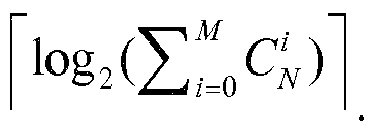

- In
step 301, the data receiving end determines HARQ information according to detection results for received transport blocks. - The data receiving end detects received data, and it is supposed that the detection results are that the number of ACKs is Q.
- Usually, when 0 ≤ Q ≤ M, supposed that a scheduling resource index corresponding to the ith (i=0, 1, ..., Q-1) ACK is Si, and Si is a positive integer mutually different in a monotonic function; then resource index information corresponding to the ACK corresponds to a number r, and the number r is served as HARQ information to be fed back. Specifically, a determination mode of r is as follows.
- When Q=0, r=C, herein C is an integer constant that may be represented by K bits. For example, C=0.
- When Q≠0, r is

- They may also be unified as:
- r:

-

- Sometimes, to reduce the feedback overhead, a situation of Q>M may occur. For example, when the number of scheduling resources used for sending transport blocks by the data sending end is greater than M, the data receiving end detects a result that the number Q of ACKs is probably greater than M.
- When Q>M, the data receiving end may randomly select M resource indexes from {S 0 ,S 1 .....S Q-1} Supposed that the M selected resource indexes are: D 0 ,D 1 ......D M-1 , and Di is a positive integer mutually different in a monotonic function. For example, Di<Di+1,
and at the same time, the above-mentioned resource index information corresponds to a number r, and the number r is served as HARQ information to be fed back. Specifically, a determination mode of r is as follows.
r is
- Further, when Q>M, M resource indexes that may be selected from {S 0,S 1.....S Q-1} by the data receiving end are appointed by the data sending end and the data receiving end in advance. For example, they appoint that M minimum indexes or M maximum indexes are selected, etc.
- When Q>M, r determined by using the above-mentioned method is the same as r determined according to some situations when Q<M. That may probably cause that the data sending end falsely takes some transport blocks that are detected to be correct as transport blocks that are detected to be wrong. However, considering a wireless channel environment, if the data sending end considers that the transport blocks are sent by using P (P is an integer greater than M) scheduling resources, the number of scheduling resources that are correctly detected by the data receiving end will not generally exceed M (e.g., the reasons that the channel environment is severe, the power is limited, the rate exceeds a Shannon limit, and the like). Since the probability of Q>M is usually very low, the overhead will still be remarkably reduced by using the above-mentioned mode.
- In
step 302, the HARQ information is sent to a data sending end by using the determined number of bits of HARQ. - K binary bits are used to represent the above-mentioned integer r (representing a number by a binary bit falls within the conventional art, which will not be elaborated herein), and then the above-mentioned information is sent to the data sending end. Before sending, common operations such as coding, modulation and interleaving on the above-mentioned information are probably included.
- Note that:
- during calculation, if X<Y, then

- Configuring more unlicensed carriers for a terminal by a network side is an important way capable of improving the user experience and lowering the cost. Supposed that a network has 32 unlicensed downlink carriers, according to the conventional art, a terminal usually needs to feed 32-bit HARQ information back. However, according to an LTE protocol, when the terminal does not have uplink data, the terminal mainly feeds HARQ information back to the network through a physical uplink control channel, but the physical uplink control channel can send at most 20-bit HARQ information at present, and the network can configure at most 20 carriers for the terminal according to a calculation manner that one carrier corresponds to one HARQ bit.
- In the present application example, the network side configures 32 unlicensed carriers for the terminal, and a transmission mode of each carrier is non-spatial multiplexing, and an HARQ feedback mode is a one-to-one mode, and the feedback number M of expected maximum feedback ACKs is equal to 5.
- The terminal may determine that the number N of scheduling resources is equal to 32 according to the configuration information, and determine that the feedback number of bits of HARQ information K is equal to 18 according to the number N of scheduling resources and the feedback number M of expected maximum feedback ACKs. Compared with the conventional art, the present invention has the advantages that the overhead can be saved by 32-18=14 bits, and since the final feedback bit number does not exceed 20 bits, the terminal may send HARQ information by reusing the physical uplink control channel in the conventional art. Thus, by using the method in the present application example, the network side not only can configure more resources for the terminal and improve the peak rate and user experience of a user, but also has the effect of simplifying the implementation complexity of the terminal and a system.
- In terms of determination of the feedback HARQ information, the terminal detects received data. Supposed that detection results are that the number of ACKs is Q (0 ≤ Q ≤ M), a scheduling resource index corresponding to the ith (i=0, 1, ..., Q-1) ACK is Si (supposed that N scheduling resource indexes (equivalent to carrier indexes in the present application example) are 1, 2, ..., N), and Si<Si+1. Resource index information corresponding to the above-mentioned ACK corresponds to a number r, and the number r is served as the HARQ information to be fed back. Specifically, the value of r is:

- The terminal represents the above-mentioned integer r by using 18 binary bits (representing a number by a binary bit falls within the conventional art, which will not be elaborated herein), and then sends the above-mentioned information to the network. Before sending, common operations such as coding, modulation and interleaving of a wireless communication system on the above-mentioned information are probably included.
- A network side configures a TDD carrier for a terminal, and an uplink and downlink configuration of the carrier is a configuration 5, and a transmission mode of the carrier is a non-spatial multiplexing mode. Within a radio frame, a maximum sub-frame number of a scheduling target terminal is 2.
- On the basis of the above-mentioned configuration information, the terminal may determine that the number N of scheduling numbers is equal to 9. Without loss of generality, supposed that scheduling resource indexes are 1, 2, ..., 9 (here, the scheduling resource indexes correspond to nine downlink sub-frame indexes of the configuration 5). An expected maximum feedback resource number M is equal to 2. The terminal determines the bit number K of HARQ information according to the following formula:

- Furthermore, the terminal determines feedback information according to detection results that the number of ACKs is Q (0 ≤ Q ≤ M). Details are as follows.
- Supposed that a resource index corresponding to the ith (i=0, 1, ..., Q-1) ACK is Si, and Si is a positive integer mutually different in a monotonic function, for example, Si<Si+1. When the number of ACKs is Q, the terminal represents HARQ information required to be fed back by using a number r, and r is determined as:

- Supposed that C=0, and apparently, when Q=0, r=0. Table 1 is a mapping table of mapping a resource index corresponding to an ACK to r when Q=1. When Q=1, resource indexes corresponding to the ACK are different values, and corresponding values of r are as shown in the following table:
Table 1 s 0 1 2 3 4 5 6 7 8 9 R 9 8 7 6 5 4 3 2 1 - Table 2 is a mapping table of mapping a resource index corresponding to an ACK to r when Q=2. When Q=2, resource indexes corresponding to the ACK are different values, and corresponding values of r are as shown in the following table:
Table 2 s 0,s 1 1,2 1,3 1,4 1,5 1,6 1,7 1,8 1,9 2,3 R 45 44 43 42 41 40 39 38 37 s 0,s 1 2,4 2,5 2,6 2,7 2,8 2,9 3,4 3,5 3,6 R 36 35 34 33 32 31 30 29 28 s 0,s 1 3,7 3,8 3,9 4,5 4,6 4,7 4,8 4,9 5,6 R 27 26 25 24 23 22 21 20 19 s 0,s 1 5,7 5,8 5,9 6,7 6,8 6,9 7,8 7,9 8,9 R 18 17 16 15 14 13 12 11 10 - K binary bits are used to represent the above-mentioned integer r, and then the above-mentioned information is sent to the network side. Before sending, common operations such as coding, modulation and interleaving of a wireless communication system on the above-mentioned information are probably included.
- At the network side, the network recovers the number r according to the above-mentioned received information, and determines HARQ information fed back by the terminal according to the above tables. For example, if r recovered by the network is equal to 17, the network may determine that transport blocks sent on scheduling resource blocks 5 and 8 are correctly received.
- In the present application example, a network side configures 32 unlicensed carriers for a terminal, and a transmission mode of each carrier is non-spatial multiplexing, and an HARQ feedback mode is a one-to-one mode. Also M is equal to a maximum number of scheduling resources used for sending transport blocks by a data sending end and pre-determined by the data sending end and a data receiving end, and M is not less than 2, and the above-mentioned M scheduling resources are successive, and in the present application example, M=10. The terminal may determine that the number N of scheduling resources is equal to 32 according to the configuration information, and determine the feedback number of bits of HARQ information K according to N and M, and K=┌log2(N-M+2)+M-1=10. Compared with the conventional art, the present application example has the advantages that the overhead can be saved by 32-10=22 bits, and since the final feedback bit number does not exceed 20 bits, the terminal may send HARQ information by reusing a physical uplink control channel in the conventional art. Thus, by using the method in the present application example, the network side not only can configure more resources for the terminal and improve the peak rate and user experience of a user, but also has the effect of simplifying the implementation complexity of the terminal and a system.
- In terms of determination of the HARQ information to be fed back, the terminal detects received data. Supposed that detection results are that the number of ACKs is Q (QM), a scheduling resource index corresponding to the ith (i=0, 1, ..., Q-1) ACK is Si (supposed N scheduling resource indexes (equivalent to carrier indexes in the present application example) are 1, 2, ..., N), and Si is a positive integer mutually different in a monotonic function, for example, Si>Si+1. Resource index information corresponding to the above-mentioned ACK corresponds to a number r, and binary bits corresponding to the number r are served as the HARQ information to be fed back. Specifically, r is determined as:


- Those ordinary skilled in the art may understand that all or some of the steps in the above-mentioned method may be completed by instructing relevant hardware (e.g., processor) through a program. The program may be stored in a computer-readable storage medium such as a read-only memory, a magnetic disk or an optical disk or the like. In an exemplary embodiment, all or some of the steps in the above-mentioned embodiments may be implemented by using one or more integrated circuits. Accordingly, each module/unit in the above-mentioned embodiments may be implemented in a form of hardware, and for example, corresponding functions thereof are implemented by means of an integrated circuit. Each module/unit may also be implemented in a form of software function module, and for example, corresponding functions thereof are implemented by executing programs/instructions stored in a memory by the processor. The present invention is not limited to the combination of hardware and software in any specific form.
- Although the implementation mode disclosed in the present application is as above, the content is only the implementation modes adopted for convenience of understanding the present application, not intended to limit the present application, such as specific implementation methods in the implementation mode of the present invention. Any person skilled in the art may make any modifications and changes about an implementation form and details without departing from the essence and scope disclosed in the present application. However, the scope of patent protection of the present application must be subject to the scope defined by the appended claims.
- In the above-mentioned technical solution, the data sending end determines HARQ information is a content sent for which HARQ information.
Claims (27)
- A method for implementing sending of Hybrid Automatic Repeat reQuest, HARQ, information, comprising:sending, by a data receiving end, HARQ information to a data sending end according to a number of scheduling resources and a feedback number of expected maximum feedback Acknowledgements, ACKs, and the HARQ information being determined through detection results for received transport blocks.
- The method according to claim 1, wherein the sending HARQ information to a data sending end according to a number of scheduling resources and a feedback number of expected maximum feedback ACKs, and the HARQ information being determined through detection results for received transport blocks comprises:determining, by the data receiving end, the number of bits of HARQ according to the number of scheduling resources and the feedback number of expected maximum feedback ACKs; anddetermining, by the data receiving end, HARQ information according to the detection results for the received transport blocks, and sending the HARQ information to the data sending end by using the determined number of bits of HARQ;wherein the feedback number is M, and the number of scheduling resources is N; and the N is a positive integer greater than or equal to 3, and the M is a positive integer less than the N.
- The method according to claim 2, wherein the M is a value pre-determined by the data receiving end and the data sending end.
- The method according to claim 2 or 3, wherein the M is:a maximum value greater than or equal to the number of scheduling resources used for receiving the transport blocks by the data receiving end, or,a maximum value greater than or equal to the number of scheduling resources used for sending the transport blocks by the data sending end.
- The method according to any one of claims 1 to 3, wherein

wherein └ ┘ represents round-down. - The method according to any one of claims 1 to 3, wherein the number of bits of HARQ is K,

- The method according to any one of claims 1 to 3, wherein the feedback number of expected maximum feedback ACKs is sent to the data receiving end in a signaling mode.
- The method according to any one of claims 1 to 3, further comprising: determining, by the data receiving end, the number of scheduling resources and/or the feedback number of expected maximum feedback ACKs according to resource configuration information.
- The method according to any one of claims 1 to 3, wherein the determining, by the data receiving end, HARQ information according to the detection results for the received transport blocks comprises:detecting, by the data receiving end, the received transport blocks, and taking scheduling resource index information corresponding to detection results indicating ACKs or NACKs as the determined HARQ information.
- The method according to claim 6, further comprising: when the detection results are that the number of ACKs is Q and a scheduling resource index corresponding to an ith ACK or NACK is Si,
mapping scheduling resource indexes corresponding to different detection results indicating ACKs or NACKs to an integer r, and sending r, served as the determined HARQ information, to the data sending end; wherein
when 0 ≤ Q ≤ M, r is:

wherein N scheduling resource indexes are 1, 2, ..., N, and Si is a positive integer mutually different in a monotonic function, and
i ∈ [0,1,... Q-1], and C is an integer constant. - The method according to claim 10, further comprising:when Q>M, randomly selecting, by the data receiving end, M scheduling resource indexes from {S 0 ,S 1 .....S Q-1}, wherein the M randomly-selected scheduling resource indexes are: D 0 ,D 1 ......D M-1, and Di is a positive integer mutually different in a monotonic function; andmapping the M scheduling resource indexes to an integer r, and sending the integer r, served as the determined HARQ information, to the data sending end,wherein r is:

- The method according to claim 11, wherein the randomly selecting, by the data receiving end, M scheduling resource indexes from {S 0 ,S 1 .....S Q-1} comprises:selecting, by the data receiving end, M scheduling resource indexes from {S 0 ,S 1 .....S Q-1} according to a scheduling resource index selection range pre-determined by the data sending end and the data receiving end.
- The method according to claim 11, wherein the randomly selecting, by the data receiving end, M scheduling resource indexes from {S 0 ,S 1 .....S Q-1} comprises:selecting, by the data receiving end, M minimum or maximum scheduling resource indexes from {S 0 ,S 1 .....S Q-1} according to a scheduling resource index selection range pre-determined by the data sending end and the data receiving end.
- The method according to claim 3, further comprising: when Q≤M and M is greater than or equal to 2,
determining, by the data receiving end, that the number of bits of HARQ information to be fed back is K according to N and M, wherein K≥┌log 2 (N-M+2)┐+M-1. - The method according to claim 14, further comprising: after determining that the number of bits of HARQ information to be fed back is K,
mapping scheduling resource indexes corresponding to different detection results indicating ACKs or an NACKs to an integer r, and sending r, served as the determined HARQ information, to the data sending end;
wherein r is: (R+C 1)mod(2 K-1);
wherein


C1 and C2 are integer constants. - The method according to claim 10, 11 or 15, further comprising:representing the integer r by using K binary bits respectively, and sending the integer r to the data sending end.
- The method according to claim 10, 11, 15 or 16, further comprising: before the r is sent to the data sending end,
coding and/or modulating and/or interleaving the r. - A data receiving end for implementing sending of Hybrid Automatic Repeat reQuest, HARQ, information, comprising: a determination unit and a feedback sending unit, wherein
the determination unit is configured to determine a number of bits of HARQ according to a number of scheduling resources and a feedback number of expected maximum feedback Acknowledgements, ACKs; and
the feedback sending unit is configured to determine HARQ information according to detection results for received transport blocks, and send the HARQ information to a data sending end by using the determined number of bits of HARQ;
wherein the feedback number is M, and the number of scheduling resources is N; and the N is a positive integer greater than or equal to 3, and the M is a positive integer less than the N. - The data receiving end according to claim 18, further comprising a receiving unit, configured to receive the feedback number of expected maximum feedback ACKs sent in a signaling mode.
- The data receiving end according to claim 18, wherein the feedback sending unit is configured to,
detect the received transport blocks, and take scheduling resource index information corresponding to detection results indicating ACKs or NACKs as the determined HARQ information; and
send the HARQ information to the data sending end by the determined number of bits of HARQ to be fed back. - The data receiving end according to claim 18, further comprising an information determination unit, configured to determine the number of scheduling resources and/or the feedback number of expected maximum feedback ACKs according to resource configuration information.
- The data receiving end according to any one of claims 18 to 21, further comprising an index mapping unit, configured to, when the detection results are that the number of ACKs is Q and a scheduling resource index corresponding to an ith ACK is Si,
map scheduling resource indexes corresponding to different detection results indicating ACKs or NACKs to an integer r, and send r, served as the determined HARQ information, to the data sending end, such that the data sending end performs a query according to the value of r to obtain scheduling resource indexes corresponding to ACKs of the detection results; and
map scheduling resource indexes corresponding to ACKs of different detection results to mutually-different integers r, and send r, served as the determined HARQ information, to the data sending end;
wherein when 0 ≤ Q ≤ M, r is:

wherein N scheduling resource indexes are 1, 2, ..., N, and Si is a positive integer mutually different in a monotonic function, and
i ∈ [0,1,...Q-1], and C is an integer constant. - The data receiving end according to claim 22, wherein the index mapping unit is further configured to,
when Q>M, randomly select M scheduling resource indexes from {S 0,S 1.....S Q-1} wherein the M randomly-selected scheduling resource indexes are: D 0,D 1......D M-1, and Di is a positive integer mutually different in a monotonic function; and
map the M scheduling resource indexes to a mutually-different integer r, and send the integer r, served as the determined HARQ information, to the data sending end,
wherein the r is:
- The data receiving end according to claim 23, wherein the index mapping unit is further configured to,
when Q>M, randomly select M scheduling resource indexes from {S 0,S 1 .....S Q-1} according to a scheduling resource index selection range pre-determined by the data sending end and the data receiving end. - The data receiving end according to claim 23, wherein the index mapping unit is further configured to,
when Q>M, randomly select M maximum or minimum scheduling resource indexes from {S 0,S 1.....S Q-1} according to a scheduling resource index selection range pre-determined by the data sending end and the data receiving end. - The data receiving end according to any one of claims 18 to 21, further comprising an index mapping unit, configured to, after determining that the feedback number of bits of HARQ information is K,
map scheduling resource indexes corresponding to different detection results indicating ACKs or NACKs to an integer r, and send the r, served as the determined HARQ information, to the data sending end, such that the data sending end performs an query according to a value of r to obtain scheduling resource index corresponding to ACKs of the detection results;
wherein the r is: (R+C 1)mod(2 K-1);
wherein


C1 and C2 are integer constants. - A computer storage medium in which a computer-executable instruction is stored, wherein the computer-executable instruction is used for executing the method according to any one of claims 1 to 17.
Applications Claiming Priority (2)
| Application Number | Priority Date | Filing Date | Title |
|---|---|---|---|
| CN201510050725.6A CN105991248B (en) | 2015-01-30 | 2015-01-30 | Method for realizing hybrid automatic repeat request information transmission and data receiving end |
| PCT/CN2016/073098 WO2016119759A1 (en) | 2015-01-30 | 2016-02-01 | Method for realizing sending of hybrid automatic repeat request information, and data receiving end |
Publications (3)
| Publication Number | Publication Date |
|---|---|
| EP3240220A1 true EP3240220A1 (en) | 2017-11-01 |
| EP3240220A4 EP3240220A4 (en) | 2017-12-27 |
| EP3240220B1 EP3240220B1 (en) | 2025-04-16 |
Family
ID=56542478
Family Applications (1)
| Application Number | Title | Priority Date | Filing Date |
|---|---|---|---|
| EP16742821.8A Active EP3240220B1 (en) | 2015-01-30 | 2016-02-01 | Method for realizing sending of hybrid automatic repeat request information, and data receiving end |
Country Status (4)
| Country | Link |
|---|---|
| US (1) | US10530533B2 (en) |
| EP (1) | EP3240220B1 (en) |
| CN (1) | CN105991248B (en) |
| WO (1) | WO2016119759A1 (en) |
Families Citing this family (7)
| Publication number | Priority date | Publication date | Assignee | Title |
|---|---|---|---|---|
| CN107733558B (en) | 2016-08-12 | 2020-07-21 | 华为技术有限公司 | Hybrid automatic repeat request acknowledgement HARQ-ACK feedback method and device |
| AU2017345518B2 (en) | 2016-10-21 | 2020-07-02 | Telefonaktiebolaget L M Ericsson (Publ) | HARQ feedback for unscheduled uplink |
| EP3536019B1 (en) * | 2016-11-04 | 2026-03-25 | Nokia Technologies Oy | Single cell point-to-multipoint feedback |
| EP4221029A1 (en) * | 2018-05-11 | 2023-08-02 | Telefonaktiebolaget LM Ericsson (publ) | Harq codebook for radio access networks |
| CN111490855B (en) * | 2019-01-25 | 2023-08-15 | 北京小米松果电子有限公司 | Hybrid automatic repeat request (HARQ) feedback method, device, medium and electronic equipment |
| CN111835468B (en) * | 2019-08-12 | 2021-10-29 | 维沃移动通信有限公司 | A kind of information sending and receiving method, terminal and control node |
| CN115118394B (en) * | 2021-03-19 | 2025-09-16 | 中国移动通信有限公司研究院 | Method and device for processing hybrid automatic repeat request information and communication equipment |
Family Cites Families (11)
| Publication number | Priority date | Publication date | Assignee | Title |
|---|---|---|---|---|
| DE202008018610U1 (en) * | 2007-10-02 | 2016-08-30 | Nokia Solutions And Networks Oy | Improved ACK / NACK / DTX capture for LTE |
| CN101631007B (en) * | 2008-07-14 | 2013-06-05 | 电信科学技术研究院 | Method, device and system for transmitting data |
| EP2293486A1 (en) * | 2009-09-03 | 2011-03-09 | Panasonic Corporation | Feedback scheme for providing feedback on plural transmissions |
| WO2011049420A2 (en) * | 2009-10-23 | 2011-04-28 | 엘지전자 주식회사 | Apparatus for transmitting and receiving downlink harq feedback and its method |
| CN102082643B (en) * | 2010-07-28 | 2013-05-22 | 电信科学技术研究院 | Method, system and device for sending feedback information |
| CN103095437A (en) * | 2011-11-07 | 2013-05-08 | 北京三星通信技术研究有限公司 | Acknowledgement character (ACK)/negative acknowledgement (NACK) feedback method aiming at downlink transmission |
| CN104285401A (en) * | 2012-05-11 | 2015-01-14 | 瑞典爱立信有限公司 | Methods, arrangements and nodes for providing composite acknowledgement information in a wireless communication system |
| CN103095473B (en) * | 2013-01-25 | 2016-03-02 | 福建星网锐捷网络有限公司 | The source-specific multicast method of crossing virtual private networks network, device and the network equipment |
| US9706568B2 (en) * | 2013-06-28 | 2017-07-11 | Texas Instruments Incorporated | Uplink control signaling for joint FDD and TDD carrier aggregation |
| US10257818B2 (en) * | 2014-07-29 | 2019-04-09 | Nec Corporation | Method and apparatus for processing downlink HARQ process in carrier aggregation |
| JP6629863B2 (en) * | 2014-12-31 | 2020-01-15 | ホアウェイ・テクノロジーズ・カンパニー・リミテッド | User equipment, access network device, and method for transmitting and receiving feedback information |
-
2015
- 2015-01-30 CN CN201510050725.6A patent/CN105991248B/en active Active
-
2016
- 2016-02-01 US US15/547,593 patent/US10530533B2/en active Active
- 2016-02-01 WO PCT/CN2016/073098 patent/WO2016119759A1/en not_active Ceased
- 2016-02-01 EP EP16742821.8A patent/EP3240220B1/en active Active
Also Published As
| Publication number | Publication date |
|---|---|
| EP3240220B1 (en) | 2025-04-16 |
| US10530533B2 (en) | 2020-01-07 |
| WO2016119759A1 (en) | 2016-08-04 |
| EP3240220A4 (en) | 2017-12-27 |
| CN105991248A (en) | 2016-10-05 |
| US20180026754A1 (en) | 2018-01-25 |
| CN105991248B (en) | 2020-02-28 |
Similar Documents
| Publication | Publication Date | Title |
|---|---|---|
| EP3952178B1 (en) | Resource determining and receiving methods, electronic device, and storage medium | |
| US10848293B2 (en) | Method for transmitting ACK/NACK in wireless communication system and device using same | |
| US10306608B2 (en) | Method for transmitting and receiving uplink control information, terminal, base station | |
| EP3240220B1 (en) | Method for realizing sending of hybrid automatic repeat request information, and data receiving end | |
| US10912038B2 (en) | Uplink scheduling method and apparatus | |
| EP2736293B1 (en) | Ack/nack/sr resource mapping method and apparatus | |
| US9118474B2 (en) | Uplink control information transmission on backward compatible PUCCH formats with carrier aggregation | |
| US9112686B2 (en) | HARQ ACK/NACK for dynamic PDSCH | |
| US10517096B2 (en) | Method for sending control information, user equipment, and base station | |
| US10727985B2 (en) | Control information sending method and communications device | |
| EP3451567B1 (en) | Method of feeding back ack/nack information, terminal equipment, and network equipment | |
| CN102170339B (en) | Method and device for transmitting ACK (acknowledgment) /NACK (negative acknowledgement) feedback information | |
| KR20150020708A (en) | Ack/nack feedback bit number determination method and device | |
| EP3091682A1 (en) | Method and device for response information transmission, terminal, base station, and storage medium | |
| EP3836710A1 (en) | Communication method and device | |
| US10749636B2 (en) | HARQ sending and receiving methods and devices, and node |
Legal Events
| Date | Code | Title | Description |
|---|---|---|---|
| STAA | Information on the status of an ep patent application or granted ep patent |
Free format text: STATUS: THE INTERNATIONAL PUBLICATION HAS BEEN MADE |
|
| PUAI | Public reference made under article 153(3) epc to a published international application that has entered the european phase |
Free format text: ORIGINAL CODE: 0009012 |
|
| STAA | Information on the status of an ep patent application or granted ep patent |
Free format text: STATUS: REQUEST FOR EXAMINATION WAS MADE |
|
| 17P | Request for examination filed |
Effective date: 20170728 |
|
| AK | Designated contracting states |
Kind code of ref document: A1 Designated state(s): AL AT BE BG CH CY CZ DE DK EE ES FI FR GB GR HR HU IE IS IT LI LT LU LV MC MK MT NL NO PL PT RO RS SE SI SK SM TR |
|
| AX | Request for extension of the european patent |
Extension state: BA ME |
|
| A4 | Supplementary search report drawn up and despatched |
Effective date: 20171129 |
|
| RIC1 | Information provided on ipc code assigned before grant |
Ipc: H04L 5/00 20060101ALI20171123BHEP Ipc: H04L 1/18 20060101AFI20171123BHEP |
|
| DAV | Request for validation of the european patent (deleted) | ||
| DAX | Request for extension of the european patent (deleted) | ||
| STAA | Information on the status of an ep patent application or granted ep patent |
Free format text: STATUS: EXAMINATION IS IN PROGRESS |
|
| 17Q | First examination report despatched |
Effective date: 20210503 |
|
| GRAP | Despatch of communication of intention to grant a patent |
Free format text: ORIGINAL CODE: EPIDOSNIGR1 |
|
| STAA | Information on the status of an ep patent application or granted ep patent |
Free format text: STATUS: GRANT OF PATENT IS INTENDED |
|
| INTG | Intention to grant announced |
Effective date: 20250109 |
|
| GRAS | Grant fee paid |
Free format text: ORIGINAL CODE: EPIDOSNIGR3 |
|
| GRAA | (expected) grant |
Free format text: ORIGINAL CODE: 0009210 |
|
| STAA | Information on the status of an ep patent application or granted ep patent |
Free format text: STATUS: THE PATENT HAS BEEN GRANTED |
|
| AK | Designated contracting states |
Kind code of ref document: B1 Designated state(s): AL AT BE BG CH CY CZ DE DK EE ES FI FR GB GR HR HU IE IS IT LI LT LU LV MC MK MT NL NO PL PT RO RS SE SI SK SM TR |
|
| REG | Reference to a national code |
Ref country code: GB Ref legal event code: FG4D |
|
| REG | Reference to a national code |
Ref country code: CH Ref legal event code: EP |
|
| REG | Reference to a national code |
Ref country code: IE Ref legal event code: FG4D |
|
| REG | Reference to a national code |
Ref country code: DE Ref legal event code: R096 Ref document number: 602016091916 Country of ref document: DE |
|
| REG | Reference to a national code |
Ref country code: NL Ref legal event code: MP Effective date: 20250416 |
|
| PG25 | Lapsed in a contracting state [announced via postgrant information from national office to epo] |
Ref country code: NL Free format text: LAPSE BECAUSE OF FAILURE TO SUBMIT A TRANSLATION OF THE DESCRIPTION OR TO PAY THE FEE WITHIN THE PRESCRIBED TIME-LIMIT Effective date: 20250416 |
|
| REG | Reference to a national code |
Ref country code: AT Ref legal event code: MK05 Ref document number: 1786557 Country of ref document: AT Kind code of ref document: T Effective date: 20250416 |
|
| PG25 | Lapsed in a contracting state [announced via postgrant information from national office to epo] |
Ref country code: PT Free format text: LAPSE BECAUSE OF FAILURE TO SUBMIT A TRANSLATION OF THE DESCRIPTION OR TO PAY THE FEE WITHIN THE PRESCRIBED TIME-LIMIT Effective date: 20250818 Ref country code: FI Free format text: LAPSE BECAUSE OF FAILURE TO SUBMIT A TRANSLATION OF THE DESCRIPTION OR TO PAY THE FEE WITHIN THE PRESCRIBED TIME-LIMIT Effective date: 20250416 Ref country code: ES Free format text: LAPSE BECAUSE OF FAILURE TO SUBMIT A TRANSLATION OF THE DESCRIPTION OR TO PAY THE FEE WITHIN THE PRESCRIBED TIME-LIMIT Effective date: 20250416 |
|
| REG | Reference to a national code |
Ref country code: LT Ref legal event code: MG9D |
|
| PG25 | Lapsed in a contracting state [announced via postgrant information from national office to epo] |
Ref country code: NO Free format text: LAPSE BECAUSE OF FAILURE TO SUBMIT A TRANSLATION OF THE DESCRIPTION OR TO PAY THE FEE WITHIN THE PRESCRIBED TIME-LIMIT Effective date: 20250716 Ref country code: GR Free format text: LAPSE BECAUSE OF FAILURE TO SUBMIT A TRANSLATION OF THE DESCRIPTION OR TO PAY THE FEE WITHIN THE PRESCRIBED TIME-LIMIT Effective date: 20250717 |
|
| PG25 | Lapsed in a contracting state [announced via postgrant information from national office to epo] |
Ref country code: PL Free format text: LAPSE BECAUSE OF FAILURE TO SUBMIT A TRANSLATION OF THE DESCRIPTION OR TO PAY THE FEE WITHIN THE PRESCRIBED TIME-LIMIT Effective date: 20250416 |
|
| PG25 | Lapsed in a contracting state [announced via postgrant information from national office to epo] |
Ref country code: BG Free format text: LAPSE BECAUSE OF FAILURE TO SUBMIT A TRANSLATION OF THE DESCRIPTION OR TO PAY THE FEE WITHIN THE PRESCRIBED TIME-LIMIT Effective date: 20250416 |
|
| PG25 | Lapsed in a contracting state [announced via postgrant information from national office to epo] |
Ref country code: HR Free format text: LAPSE BECAUSE OF FAILURE TO SUBMIT A TRANSLATION OF THE DESCRIPTION OR TO PAY THE FEE WITHIN THE PRESCRIBED TIME-LIMIT Effective date: 20250416 |
|
| PG25 | Lapsed in a contracting state [announced via postgrant information from national office to epo] |
Ref country code: AT Free format text: LAPSE BECAUSE OF FAILURE TO SUBMIT A TRANSLATION OF THE DESCRIPTION OR TO PAY THE FEE WITHIN THE PRESCRIBED TIME-LIMIT Effective date: 20250416 |
|
| PG25 | Lapsed in a contracting state [announced via postgrant information from national office to epo] |
Ref country code: RS Free format text: LAPSE BECAUSE OF FAILURE TO SUBMIT A TRANSLATION OF THE DESCRIPTION OR TO PAY THE FEE WITHIN THE PRESCRIBED TIME-LIMIT Effective date: 20250716 |
|
| PG25 | Lapsed in a contracting state [announced via postgrant information from national office to epo] |
Ref country code: IS Free format text: LAPSE BECAUSE OF FAILURE TO SUBMIT A TRANSLATION OF THE DESCRIPTION OR TO PAY THE FEE WITHIN THE PRESCRIBED TIME-LIMIT Effective date: 20250816 |
|
| PG25 | Lapsed in a contracting state [announced via postgrant information from national office to epo] |
Ref country code: LV Free format text: LAPSE BECAUSE OF FAILURE TO SUBMIT A TRANSLATION OF THE DESCRIPTION OR TO PAY THE FEE WITHIN THE PRESCRIBED TIME-LIMIT Effective date: 20250416 |
|
| PGFP | Annual fee paid to national office [announced via postgrant information from national office to epo] |
Ref country code: GB Payment date: 20251211 Year of fee payment: 11 |
|
| PG25 | Lapsed in a contracting state [announced via postgrant information from national office to epo] |
Ref country code: SM Free format text: LAPSE BECAUSE OF FAILURE TO SUBMIT A TRANSLATION OF THE DESCRIPTION OR TO PAY THE FEE WITHIN THE PRESCRIBED TIME-LIMIT Effective date: 20250416 Ref country code: DK Free format text: LAPSE BECAUSE OF FAILURE TO SUBMIT A TRANSLATION OF THE DESCRIPTION OR TO PAY THE FEE WITHIN THE PRESCRIBED TIME-LIMIT Effective date: 20250416 |
|
| PGFP | Annual fee paid to national office [announced via postgrant information from national office to epo] |
Ref country code: FR Payment date: 20251208 Year of fee payment: 11 |
|
| REG | Reference to a national code |
Ref country code: DE Ref legal event code: R097 Ref document number: 602016091916 Country of ref document: DE |
|
| PG25 | Lapsed in a contracting state [announced via postgrant information from national office to epo] |
Ref country code: CZ Free format text: LAPSE BECAUSE OF FAILURE TO SUBMIT A TRANSLATION OF THE DESCRIPTION OR TO PAY THE FEE WITHIN THE PRESCRIBED TIME-LIMIT Effective date: 20250416 |
|
| PG25 | Lapsed in a contracting state [announced via postgrant information from national office to epo] |
Ref country code: EE Free format text: LAPSE BECAUSE OF FAILURE TO SUBMIT A TRANSLATION OF THE DESCRIPTION OR TO PAY THE FEE WITHIN THE PRESCRIBED TIME-LIMIT Effective date: 20250416 |
|
| PG25 | Lapsed in a contracting state [announced via postgrant information from national office to epo] |
Ref country code: SK Free format text: LAPSE BECAUSE OF FAILURE TO SUBMIT A TRANSLATION OF THE DESCRIPTION OR TO PAY THE FEE WITHIN THE PRESCRIBED TIME-LIMIT Effective date: 20250416 Ref country code: RO Free format text: LAPSE BECAUSE OF FAILURE TO SUBMIT A TRANSLATION OF THE DESCRIPTION OR TO PAY THE FEE WITHIN THE PRESCRIBED TIME-LIMIT Effective date: 20250416 |
|
| PG25 | Lapsed in a contracting state [announced via postgrant information from national office to epo] |
Ref country code: IT Free format text: LAPSE BECAUSE OF FAILURE TO SUBMIT A TRANSLATION OF THE DESCRIPTION OR TO PAY THE FEE WITHIN THE PRESCRIBED TIME-LIMIT Effective date: 20250416 |
|
| PLBE | No opposition filed within time limit |
Free format text: ORIGINAL CODE: 0009261 |
|
| STAA | Information on the status of an ep patent application or granted ep patent |
Free format text: STATUS: NO OPPOSITION FILED WITHIN TIME LIMIT |
|
| REG | Reference to a national code |
Ref country code: CH Ref legal event code: L10 Free format text: ST27 STATUS EVENT CODE: U-0-0-L10-L00 (AS PROVIDED BY THE NATIONAL OFFICE) Effective date: 20260225 |
|
| 26N | No opposition filed |
Effective date: 20260119 |
|
| PGFP | Annual fee paid to national office [announced via postgrant information from national office to epo] |
Ref country code: DE Payment date: 20251210 Year of fee payment: 11 |