EP3240198A1 - Mobile terminal and antenna determining method - Google Patents
Mobile terminal and antenna determining method Download PDFInfo
- Publication number
- EP3240198A1 EP3240198A1 EP17166506.0A EP17166506A EP3240198A1 EP 3240198 A1 EP3240198 A1 EP 3240198A1 EP 17166506 A EP17166506 A EP 17166506A EP 3240198 A1 EP3240198 A1 EP 3240198A1
- Authority
- EP
- European Patent Office
- Prior art keywords
- pressure sensors
- mobile terminal
- antenna
- side pressure
- contact positions
- Prior art date
- Legal status (The legal status is an assumption and is not a legal conclusion. Google has not performed a legal analysis and makes no representation as to the accuracy of the status listed.)
- Granted
Links
Images




Classifications
-
- H—ELECTRICITY
- H04—ELECTRIC COMMUNICATION TECHNIQUE
- H04M—TELEPHONIC COMMUNICATION
- H04M1/00—Substation equipment, e.g. for use by subscribers
- H04M1/72—Mobile telephones; Cordless telephones, i.e. devices for establishing wireless links to base stations without route selection
- H04M1/725—Cordless telephones
-
- H—ELECTRICITY
- H04—ELECTRIC COMMUNICATION TECHNIQUE
- H04B—TRANSMISSION
- H04B1/00—Details of transmission systems, not covered by a single one of groups H04B3/00 - H04B13/00; Details of transmission systems not characterised by the medium used for transmission
- H04B1/38—Transceivers, i.e. devices in which transmitter and receiver form a structural unit and in which at least one part is used for functions of transmitting and receiving
- H04B1/3827—Portable transceivers
- H04B1/3833—Hand-held transceivers
-
- H—ELECTRICITY
- H01—ELECTRIC ELEMENTS
- H01Q—ANTENNAS, i.e. RADIO AERIALS
- H01Q1/00—Details of, or arrangements associated with, antennas
- H01Q1/12—Supports; Mounting means
- H01Q1/22—Supports; Mounting means by structural association with other equipment or articles
- H01Q1/24—Supports; Mounting means by structural association with other equipment or articles with receiving set
- H01Q1/241—Supports; Mounting means by structural association with other equipment or articles with receiving set used in mobile communications, e.g. GSM
- H01Q1/242—Supports; Mounting means by structural association with other equipment or articles with receiving set used in mobile communications, e.g. GSM specially adapted for hand-held use
-
- H—ELECTRICITY
- H04—ELECTRIC COMMUNICATION TECHNIQUE
- H04B—TRANSMISSION
- H04B7/00—Radio transmission systems, i.e. using radiation field
- H04B7/02—Diversity systems; Multi-antenna system, i.e. transmission or reception using multiple antennas
- H04B7/04—Diversity systems; Multi-antenna system, i.e. transmission or reception using multiple antennas using two or more spaced independent antennas
- H04B7/06—Diversity systems; Multi-antenna system, i.e. transmission or reception using multiple antennas using two or more spaced independent antennas at the transmitting station
- H04B7/0602—Diversity systems; Multi-antenna system, i.e. transmission or reception using multiple antennas using two or more spaced independent antennas at the transmitting station using antenna switching
-
- H—ELECTRICITY
- H04—ELECTRIC COMMUNICATION TECHNIQUE
- H04B—TRANSMISSION
- H04B7/00—Radio transmission systems, i.e. using radiation field
- H04B7/02—Diversity systems; Multi-antenna system, i.e. transmission or reception using multiple antennas
- H04B7/04—Diversity systems; Multi-antenna system, i.e. transmission or reception using multiple antennas using two or more spaced independent antennas
- H04B7/08—Diversity systems; Multi-antenna system, i.e. transmission or reception using multiple antennas using two or more spaced independent antennas at the receiving station
- H04B7/0802—Diversity systems; Multi-antenna system, i.e. transmission or reception using multiple antennas using two or more spaced independent antennas at the receiving station using antenna selection
-
- H—ELECTRICITY
- H01—ELECTRIC ELEMENTS
- H01Q—ANTENNAS, i.e. RADIO AERIALS
- H01Q1/00—Details of, or arrangements associated with, antennas
- H01Q1/12—Supports; Mounting means
- H01Q1/22—Supports; Mounting means by structural association with other equipment or articles
- H01Q1/24—Supports; Mounting means by structural association with other equipment or articles with receiving set
- H01Q1/241—Supports; Mounting means by structural association with other equipment or articles with receiving set used in mobile communications, e.g. GSM
- H01Q1/242—Supports; Mounting means by structural association with other equipment or articles with receiving set used in mobile communications, e.g. GSM specially adapted for hand-held use
- H01Q1/243—Supports; Mounting means by structural association with other equipment or articles with receiving set used in mobile communications, e.g. GSM specially adapted for hand-held use with built-in antennas
-
- H—ELECTRICITY
- H01—ELECTRIC ELEMENTS
- H01Q—ANTENNAS, i.e. RADIO AERIALS
- H01Q1/00—Details of, or arrangements associated with, antennas
- H01Q1/12—Supports; Mounting means
- H01Q1/22—Supports; Mounting means by structural association with other equipment or articles
- H01Q1/24—Supports; Mounting means by structural association with other equipment or articles with receiving set
- H01Q1/241—Supports; Mounting means by structural association with other equipment or articles with receiving set used in mobile communications, e.g. GSM
- H01Q1/242—Supports; Mounting means by structural association with other equipment or articles with receiving set used in mobile communications, e.g. GSM specially adapted for hand-held use
- H01Q1/245—Supports; Mounting means by structural association with other equipment or articles with receiving set used in mobile communications, e.g. GSM specially adapted for hand-held use with means for shaping the antenna pattern, e.g. in order to protect user against rf exposure
-
- H—ELECTRICITY
- H04—ELECTRIC COMMUNICATION TECHNIQUE
- H04M—TELEPHONIC COMMUNICATION
- H04M2250/00—Details of telephonic subscriber devices
- H04M2250/12—Details of telephonic subscriber devices including a sensor for measuring a physical value, e.g. temperature or motion
Definitions
- the present invention is related to the field of terminal technology, and more particularly, to a mobile terminal and an antenna determining method.
- An antenna is an element of a mobile terminal for receiving and sending signals. Through the antenna, the mobile terminal can receive signals sent by other devices or send signals to other devices. To prevent the function of receiving and sending signals from being affected by a failure of an antenna, the mobile terminal is usually configured with multiple antennas. When it needs to receive or send signals, one of the antennas can be selected randomly for receiving or sending the signals.
- a user When using the mobile terminal, a user may hold it with a hand. At that time, if the user's hand covers one of the mobile terminal's antennas which is being used, signals received or sent by the antenna will be interfered with and the mobile terminal's function of receiving and sending signals will be affected.
- the present invention provides a mobile terminal and an antenna determining method as below.
- a mobile terminal comprising: a housing, a processor, at least two antennas and at least two pressure sensors arranged at two sides of the mobile terminal.
- the at least two antennas and the at least two pressure sensors are connected with the processor respectively.
- Sensing elements of one or more first side pressure sensors among the at least two pressure sensors are arranged on a surface of a first side frame of the housing, and sensing elements of one or more second side pressure sensors among the at least two pressure sensors are arranged on a surface of a second side frame of the housing.
- the second side frame opposing the first side frame.
- the at least two pressure sensors are configured to acquire values of pressures applied to a surface of the housing and send the acquired pressure values to the processor.
- the processor is configured to receive pressure values sent by the pressure sensors, to determine multiple contact positions between a user and the mobile terminal based on pressure values sent by at least one of the first side pressure sensors and at least one of the second side pressure sensors, and to determine an antenna to receive or send signals from the at least two antennas based on the multiple contact positions so as to receive or send signals using the determined antenna.
- the processor is configured to, if it is determined that pressure values sent by at least one of the first side pressure sensors and at least one of the second side pressure sensors at a current time point are different from those sent at a last time point, determine sensing positions of the at least one of the first side pressure sensors and the at least one of the second side pressure sensors as the contact positions between the user and the mobile terminal.
- the processor is configured to, if it is determined that pressure values sent by at least one of the first side pressure sensors and at least one of the second side pressure sensors belong to a preset set of pressure values, determine sensing positions of the at least one of the first side pressure sensors and the at least one of the second side pressure sensors as the contact positions between the user and the mobile terminal, wherein the preset set of pressure values is set according to pressure values generated when a human presses the housing surface of the mobile terminal.
- the processor is configured to, if it is determined that pressure values sent by at least one of the first side pressure sensors and at least one of the second side pressure sensors at a current time point are different from those sent at a last time point and belong to a preset set of pressure values, determine sensing positions of the at least one of the first side pressure sensors and the at least one of the second side pressure sensors as the contact positions between the user and the mobile terminal, wherein the preset set of pressure values is set according to pressure values generated when a human presses the housing surface of the mobile terminal.
- the processor is configured to statistically process the multiple contact positions to obtain a central contact position of the multiple contact positions, and to determine the furthest antenna from the central contact position among the at least two antennas as the antenna to receive or send signals.
- the processor is configured to, if a first contact position among the multiple contact positions and the rest of the contact positions are located on surfaces of different side frames, determine the furthest antenna from the first contact position among the at least two antennas as the antenna to receive or send signals.
- the processor is further configured to actuate the at least two pressure sensors when receiving a service request for receiving or sending a signal.
- an antenna determining method comprising: acquiring values of pressures applied to a housing surface of a mobile terminal by at least two pressure sensors arranged at two sides of the mobile terminal, wherein sensing elements of one or more first side pressure sensors among the at least two pressure sensors are arranged on a surface of a first side frame of the mobile terminal, and sensing elements of one or more second side pressure sensors among the at least two pressure sensors are arranged on a surface of a second side frame of the mobile terminal, the second side frame opposing the first side frame; determining multiple contact positions between a user and the mobile terminal, based on pressure values acquired by at least one of the first side pressure sensors and at least one of the second side pressure sensors; and determining an antenna to receive or send signals from the at least two antennas based on the multiple contact positions, so as to receive or send signals using the determined antenna.
- determining the multiple contact positions between the user and the mobile terminal based on the pressure values acquired by the at least one of the first side pressure sensors and the at least one of the second side pressure sensors comprises: if it is determined that pressure values acquired by at least one of the first side pressure sensors and at least one of the second side pressure sensors at a current time point are different from those acquired at a last time point, determining sensing positions of the at least one of the first side pressure sensors and the at least one of the second side pressure sensors as the contact positions between the user and the mobile terminal.
- determining the multiple contact positions between the user and the mobile terminal based on the pressure values acquired by the at least one of the first side pressure sensors and the at least one of the second side pressure sensors comprises: if it is determined that pressure values acquired by at least one of the first side pressure sensors and at least one of the second side pressure sensors belong to a preset set of pressure values, determining sensing positions of the at least one of the first side pressure sensors and the at least one of the second side pressure sensors as the contact positions between the user and the mobile terminal, wherein the preset set of pressure values is set according to pressure values generated when a human presses the housing surface of the mobile terminal.
- determining the multiple contact positions between the user and the mobile terminal based on the pressure values acquired by the at least one of the first side pressure sensors and the at least one of the second side pressure sensors comprises: if it is determined that pressure values acquired by at least one of the first side pressure sensors and at least one of the second side pressure sensors at a current time point are different from those acquired at a last time point and belong to a preset set of pressure values, determining sensing positions of the at least one of the first side pressure sensors and the at least one of the second side pressure sensors as the contact positions between the user and the mobile terminal, wherein the preset set of pressure values is set according to pressure values generated when a human presses the housing surface of the mobile terminal.
- determining the antenna to receive or send signals from the at least two antennas based on the multiple contact positions comprises: statistically processing the multiple contact positions to obtain a central contact position of the multiple contact positions; and determining the furthest antenna from the central contact position among the at least two antennas as the antenna to receive or send signals.
- determining the antenna to receive or send signals from the at least two antennas based on the multiple contact positions comprises: if a first contact position among the multiple contact positions and the rest of the contact positions are located on surfaces of different side frames, determining the furthest antenna from the first contact position among the at least two antennas as the antenna to receive or send signals.
- the method further comprises: actuating the at least two pressure sensors when receiving a service request for receiving or sending a signal.
- a mobile terminal comprising: a pressure acquiring module configured to acquire values of pressures applied to a housing surface of the mobile terminal by at least two pressure sensors arranged at two sides of the mobile terminal, wherein sensing elements of one or more first side pressure sensors among the at least two pressure sensors are arranged on a surface of a first side frame of the mobile terminal, and sensing elements of one or more second side pressure sensors among the at least two pressure sensors are arranged on a surface of a second side frame of the mobile terminal, the second side frame opposing the first side frame; a position determining module configured to determine multiple contact positions between a user and the mobile terminal, based on pressure values acquired by at least one of the first side pressure sensors and at least one of the second side pressure sensors; and an antenna determining module configured to determine an antenna to receive or send signals from the at least two antennas based on the multiple contact positions so as to receive or send signals using the determined antenna.
- an antenna to receive or send signals can be determined based on multiple contact positions between the user and the mobile terminal when the user holds the mobile terminal with a hand, thereby avoiding interference to signals transmitted or received by an antenna due to the antenna being covered by the user's hand, and thus preventing the mobile terminal's function of receiving and sending signals from being affected.
- Fig. 1A is a schematic diagram of a mobile terminal according to an example embodiment.
- the mobile terminal may be a handset (mobile phone), a tablet computer or the like, which will not be limited in this embodiment.
- the mobile terminal comprises a housing 101, a processor 102, at least two antennas 103 and at least two pressure sensors 104 arranged at two sides of the mobile terminal.
- the at least two antennas 103 may be completely arranged inside the housing 101, or may be partly arranged inside the housing 101 with a part of the at least two antennas 103 protruding from the surface of the housing 101, which will not be limited in this embodiment.
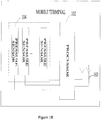
- the at least two antennas 103 and the at least two pressure sensors 104 are connected with the processor 102 respectively. That is, outputs of the at least two pressure sensors 104 are connected with the processor 102 so as to send acquired pressure values thereto.
- the at least two antennas 103 are connected with the processor 102 so as to transfer received signals thereto or send signals under the control of the processor 102.
- An existing mobile terminal is typically configured with multiple antennas. When it is required to receive or send signals, any one of the multiple antennas can be selected for receiving or sending signals. However, when a user holds the mobile terminal with a hand that covers an antenna of the mobile terminal, the signals received or transmitted by the antenna will be interfered with. Therefore, to avoid interference, the mobile terminal may first determine contact positions between the user and the mobile terminal, and then select an antenna to receive or send signals from the multiple antennas based on the determined contact positions, so as not to use the antenna covered by the user.
- At least two pressure sensors 104 may be arranged in the mobile terminal, so that the contact positions between the user and the mobile terminal can be determined based on the pressure values acquired by the at least two pressure sensors 104.
- the at least two pressure sensors 104 include sensing elements arranged on the surface of the housing 101 for sensing pressures applied to the mobile terminal.
- the positions where the sensing elements are arranged are the sensing positions of the pressure sensors.
- the at least two pressure sensors 104 may include strain gauge pressure sensors, piezoelectric pressure sensors or the like, which will not be limited in this embodiment.
- Different types of pressure sensors include different types of sensing elements.
- sensing elements of strain gauge pressure sensors are resistance strain gauges
- sensing elements of piezoelectric pressure sensors are piezoelectric materials such as quartz.
- the types of the at least two pressure sensors 104 may be the same or different, which will not be limited in this embodiment.
- the sensing elements of the at least two pressure sensors 104 may be distributed on the mobile terminal evenly or unevenly, which will not be limited in this embodiment.
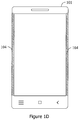
- the at least two pressure sensors 104 may be distributed in various manners. Referring to Fig. 1C , the at least two pressure sensors 104 may be distributed on the housing surface in a dotted manner. That is, each pressure sensor corresponds to one sensing position and can acquire a pressure value at the corresponding sensing position. Alternatively, referring to Fig. 1D , the sensing elements of the at least two pressure sensors may be distributed on the housing surface in a strip-shaped manner. That is, each pressure sensor extends in a continuous manner over multiple sensing positions and can acquire pressure values at the corresponding sensing positions.
- the at least two pressure sensors 104 may be distributed at two side frames of the mobile terminal. That is, the at least two pressure sensors 104 includes one or more first side pressure sensor 104a and one or more second side pressure sensor 104b, wherein sensing elements of the first side pressure sensors 104a are arranged on a surface of a first side frame of the housing 101, and sensing elements of the second side pressure sensors 104b are arranged on a surface of a second side frame of the housing 101, and the second side frame opposes the first side frame.
- the sensing elements can sense the pressures applied to the frame surface of the mobile terminal.
- the pressure sensors 104 can acquire values of pressures at the contact positions between the user and the frame surface of the mobile terminal through the sensing elements.
- the first side frame and the second side frame may be left and right frames of the housing 101, or upper and lower frames thereof or the like, and the first side frame opposes the second side frame.
- the first side frame is the left frame
- the second side frame will be the right frame
- the first side frame is the upper frame
- the second side frame will be the lower frame, which will not be limited in this embodiment.
- the mobile terminal includes multiple pressure sensors 104, and the sensing elements of the multiple pressure sensors 104 are distributed at the surfaces of the left and right frames of the housing 101 respectively.
- determining the contact positions between the user and the mobile terminal based on the pressure values acquired by the at least two pressure sensors 104 may be performed in any of the following three manners.
- Manner 1 If it is determined by the processor 102 that the pressure values sent by at least one of the first side pressure sensors 104a and at least one of the second side pressure sensors 104b at a current time point are different from those sent at a last time point, sensing positions of the at least one of the first side pressure sensors and the at least one of the second side pressure sensors are determined as the contact positions between the user and the mobile terminal.
- values of pressures on the housing surface of the mobile terminal change it can be considered that the user is contacting the mobile terminal.
- values of pressures on the first side surface and the second side surface of the housing change it can be considered that the user is contacting both side surfaces of the housing, that is, the user is holding the mobile terminal.
- the processor 102 receives the pressure values sent by the multiple pressure sensors 104, if it is determined by the processor 102 that pressure values sent by at least one of the first side pressure sensors 104a and at least one of the second side pressure sensors 104b at a current time point are different from those sent at a last time point (which means that the pressure values at the sensing positions of the at least one of the first side pressure sensors 104a and the at least one of the second side sensors 104b change), then it can be determined that the user has contacted the sensing positions of the at least one of the first side pressure sensors 104a and the at least one of the second side pressure sensors 104b, and the sensing positions of the at least one of the first side pressure sensors 104a and the at least one of the second side pressure sensors 104b are determined as the contact positions between the user and the mobile terminal.
- Manner 2 If it is determined by the processor 102 that pressure values sent by at least one of the first side pressure sensors 104a and at least one of the second side pressure sensors 104b belong to a preset set of pressure values, sensing positions of the at least one of the first side pressure sensors and the at least one of the second side pressure sensors are determined as the contact positions between the user and the mobile terminal.
- the mobile terminal may previously determine a preset set of pressure values, which is set according to pressure values generated when a human presses the housing surface of the mobile terminal.
- a pressure value sent by a pressure sensor belongs to the preset set of pressure values, it means that the user has contacted the sensing position of the pressure sensor.
- the processor 102 determines that pressure values sent by at least one of the first side pressure sensors 104a and at least one of the second side pressure sensors 104b belong to the preset set of pressure values respectively (which means that the user has contacted the sensing positions of the at least one of the first side pressure sensors 104a and the at least one of the second side pressure sensors 104b), then the sensing positions of the at least one of the first side pressure sensors 104a and the at least one of the second side pressure sensors 104b are determined as the contact positions between the user and the mobile terminal.
- the preset set of pressure values may include a continuous range of pressure values, or one or more discrete pressure values, which will not be limited in this embodiment.
- the preset set of pressure values may include at least a minimum pressure value. Only when the pressure values sent by the at least one of the first side pressure sensors 104a and the at least one of the second side pressure sensors 104b are greater than the minimum pressure value, will it be guaranteed that the pressure values are large enough and do not result from contacts between other objects and the mobile terminal.
- Manner 3 If it is determined by the processor 102 that pressure values sent by at least one of the first side pressure sensors 104a and at least one of the second side pressure sensors 104b at a current time point are different from those sent at a last time point and belong to a preset set of pressure values, sensing positions of the at least one of the first side pressure sensors and the at least one of the second side pressure sensors are determined as the contact positions between the user and the mobile terminal, wherein the preset set of pressure values is set according to pressure values generated when a human presses the housing surface of the mobile terminal.
- Manners 1 and 2 may be combined. That is, only if it is determined by the processor 102 that pressure values sent by at least one of the first side pressure sensors 104a and at least one of the second side pressure sensors 104b at a current time point are different from those sent at a last time point and belong to a preset set of pressure values, it is determined that the user has contacted the sensing positions of the at least one of the first side pressure sensors 104a and the at least one of the second side pressure sensors 104b, and the sensing positions of the at least one of the first side pressure sensors 104a and the at least one of the second side pressure sensors 104b are determined as the contact positions between the user and the mobile terminal.
- an antenna to receive or send signals can be determined based on multiple contact positions between the user and the mobile terminal when the user holds the mobile terminal with a hand, thereby avoiding interference to signals transmitted or received by an antenna due to the antenna being covered by the user's hand, and thus preventing the mobile terminal's function of receiving and sending signals from being affected.
- the furthest antenna from the multiple contact positions among the at least two antennas may be selected as the antenna to receive or send signals, so as to avoid interference to signals received or sent by the antenna caused by the user.
- the processor 102 may statistically process the multiple contact positions to obtain a central contact position of the multiple contact positions, and determine the furthest antenna from the central contact position among the at least two antennas as the antenna to receive or send signals.
- the processor 102 may establish a coordinate system, calculate average coordinates based on coordinates of the multiple contact positions in the coordinate system and take the position corresponding to the calculated average coordinates as the central contact position.
- the processor may select one of the multiple contact positions which is located at the center as the central contact position based on the coordinates of the multiple contact positions in the coordinate system; that is, to select one of the contact positions whose distances from the other contact positions are relatively small as the central contact position.
- the processor 102 can determine the antenna to receive or send signals from the at least two antennas based on the contact position between the thumb and the mobile terminal.
- the contact position between the thumb and the mobile terminal is usually located at a side different from that at which the contact positions between other fingers and the mobile terminal are located. Therefore, after the processor 102 determines the multiple contact positions between the user and the mobile terminal, the processor 102 can determine surfaces of side frames where the contact positions are located respectively. If the processor 102 determines that a first contact position among the multiple contact positions and the rest of the contact positions are located on surfaces of different side frames (which means that the first contact position is the contact position between the user's thumb and the mobile terminal), then the processor 102 determines the furthest antenna from the first contact position among the at least two antennas as the antenna to receive or send signals.
- the case where the first contact position among the multiple contact positions and the rest of the contact positions are located on surfaces of different side frames may include a case where the first contact position is located on the surface of a first side frame while the rest of the contact positions other than the first contact position are located on the surface of a second side frame or vice versa, which will not be limited in this embodiment.
- the mobile terminal is provided with two antennas at its upper and lower portions respectively.
- the upper antenna is selected for receiving or sending signals.
- the lower antenna is selected for receiving or sending signals.
- the processor 102 may determine the antenna for receiving or sending signals based on the multiple contact positions between the user and the mobile terminal using other methods which will not be limited in this embodiment, so long as the determined antenna is further from the multiple contact positions compared with any other antenna.
- the processor 102 may actuate the at least two pressure sensors in real time.
- the at least two pressure sensors acquire values of pressure on the mobile terminal to determine an antenna to receive or send signals. Then, after receiving a service request for receiving or sending a signal, the processor 102 can receive or send the signal using the determined antenna.
- the processor 102 may actuate the at least two pressure sensors only when receiving a service request for receiving or sending a signal.
- the service request for receiving or sending a signal refers to a service request for receiving a signal or sending a signal.
- the service request may be triggered by the processor 102, the user's operation of receiving or sending a signal or any other member of the mobile terminal, which will not be limited in this embodiment.
- the processor 102 may actuate the at least two pressure sensors, and determine the antenna to receive or send signals based on the pressure values acquired by the at least two pressure sensors, so as to receive or send the signal using the determined antenna in response to the service request.
- the at least two pressure sensors may be shut off.
- the processor 102 performs switching of antenna so as to receive or send signals using the currently determined antenna. If the antenna to receive or send signals previously determined is the same as that currently determined, the processor 102 does not need to perform switching of antenna but receives or sends signals directly using the determined antenna.
- the mobile terminal by determining multiple contact positions between the user and the mobile terminal, it is judged which antenna is furthest from the multiple contact positions.
- the antenna furthest from the multiple contact positions can be considered as not covered by the user (i.e., having the highest signal quality). Therefore, switching of antenna is performed to use the antenna furthest from the multiple contact positions.
- this switching approach it is possible to switch to the antenna having the highest signal quality in real time, thereby maintaining the signal quality of the mobile terminal in the best state, ensuring adequate signal strength and improving the user experience.
- Optional embodiments of this invention can be formed by combining the above optional technical solutions in appropriate manners, which will not be described herein one by one.
- Fig. 2 is a flow chart showing an antenna determining method according to an example embodiment. As shown in Fig. 2 , the antenna determining method is implemented in a mobile terminal and comprises the following steps.
- step 201 values of pressures applied to a housing surface of the mobile terminal are acquired by at least two pressure sensors arranged at two sides of the mobile terminal, wherein sensing elements of one or more first side pressure sensors among the at least two pressure sensors are arranged on a surface of a first side frame, and sensing elements of one or more second side pressure sensors among the at least two pressure sensors are arranged on a surface of a second side frame.
- the second side frame opposes the first side frame.
- step 202 multiple contact positions between a user and the mobile terminal are determined based on pressure values acquired by at least one of the first side pressure sensors and at least one of the second side pressure sensors.
- an antenna to receive or send signals is determined from the at least two antennas based on the multiple contact positions, so as to receive or send signals using the determined antenna.
- an antenna to receive or send signals can be determined based on multiple contact positions between the user and the mobile terminal when the user holds the mobile terminal with a hand, thereby avoiding interference to signals transmitted or received by an antenna due to the antenna being covered by the user's hand, and thus preventing the mobile terminal's function of receiving and sending signals from being affected.
- determining the multiple contact positions between the user and the mobile terminal based on the pressure values acquired by the at least one of the first side pressure sensors and the at least one of the second side pressure sensors comprises: if it is determined that pressure values acquired by at least one of the first side pressure sensors and at least one of the second side pressure sensors at a current time point are different from those acquired at a last time point, determining sensing positions of the at least one of the first side pressure sensors and the at least one of the second side pressure sensors as the contact positions between the user and the mobile terminal.
- determining the multiple contact positions between the user and the mobile terminal based on the pressure values acquired by the at least one of the first side pressure sensors and the at least one of the second side pressure sensors comprises: if it is determined that pressure values acquired by at least one of the first side pressure sensors and at least one of the second side pressure sensors belong to a preset set of pressure values, determining sensing positions of the at least one of the first side pressure sensors and the at least one of the second side pressure sensors as the contact positions between the user and the mobile terminal, wherein the preset set of pressure values is set according to pressure values generated when a human presses the housing surface of the mobile terminal.
- determining the multiple contact positions between the user and the mobile terminal based on the pressure values acquired by the at least one of the first side pressure sensors and the at least one of the second side pressure sensors comprises: if it is determined that pressure values acquired by at least one of the first side pressure sensors and at least one of the second side pressure sensors at a current time point are different from those sent at a last time point and belong to a preset set of pressure values, determining sensing positions of the at least one of the first side pressure sensors and the at least one of the second side pressure sensors as the contact positions between the user and the mobile terminal, wherein the preset set of pressure values is set according to pressure values generated when a human presses the housing surface of the mobile terminal.
- determining the antenna to receive or send signals from the at least two antennas based on the multiple contact positions comprises: statistically processing the multiple contact positions to obtain a central contact position of the multiple contact positions; and determining the furthest antenna from the central contact position among the at least two antennas as the antenna to receive or send signals.
- determining the antenna to receive or send signals from the at least two antennas based on the multiple contact positions comprises: if a first contact position among the multiple contact positions and the rest of the contact position are located on surfaces of different side frames, determining the furthest antenna from the first contact position among the at least two antennas as the antenna to receive or send signals.
- the method further comprises: actuating the at least two pressure sensors when receiving a service request for receiving or sending a signal.
- Fig. 3 is a flow chart showing an antenna determining method according to another example embodiment. As shown in Fig. 3 , the antenna determining method is implemented in a mobile terminal and comprises the following steps.
- step 301 the mobile terminal actuates at least two pressure sensors arranged at its two sides, after receiving a service request for receiving or sending a signal.
- the at least two pressure sensors comprises one or more first side pressure sensors and one or more second side pressure sensors. Sensing elements of the first side pressure sensors are arranged on a surface of a first side frame of a housing of the mobile terminal, and sensing elements of the second side pressure sensors are arranged on a surface of a second side frame of the housing of the mobile terminal. The second side frame opposes the first side frame.
- the mobile terminal acquires values of pressures applied to the housing surface of the mobile terminal using the first side pressure sensors and the second side pressure sensors, and determines multiple contact positions between a user and the mobile terminal based on the acquired pressure values.
- Step 302 may comprise any one of steps 3021-3023.
- step 3021 if it is determined that pressure values acquired by at least one of the first side pressure sensors and at least one of the second side pressure sensors at a current time point are different from those acquired at a last time point, sensing positions of the at least one of the first side pressure sensors and the at least one of the second side pressure sensors are determined as the contact positions between the user and the mobile terminal.
- step 3022 if it is determined that pressure values acquired by at least one of the first side pressure sensors and at least one of the second side pressure sensors belong to a preset set of pressure values, sensing positions of the at least one of the first side pressure sensors and the at least one of the second side pressure sensors are determined as the contact positions between the user and the mobile terminal, wherein the preset set of pressure values is set according to pressure values generated when a human presses the housing surface of the mobile terminal.
- step 3023 if it is determined that pressure values sent by at least one of the first side pressure sensors and at least one of the second side pressure sensors at a current time point are different from those sent at a last time point and belong to a preset set of pressure values, sensing positions of the at least one of the first side pressure sensors and the at least one of the second side pressure sensors are determined as the contact positions between the user and the mobile terminal, wherein the preset set of pressure values is set according to pressure values generated when a human presses the housing surface of the mobile terminal.
- multiple contact positions between the user and the mobile terminal can be determined according to changes of the pressure values.
- the mobile terminal may determine the multiple contact positions using methods other than above steps 3021-3023, which will not be limited in this embodiment.
- step 303 if a first contact position among the multiple contact positions and the rest of the contact positions are located on surfaces of different side frames, the furthest antenna from the first contact position among the at least two antennas is determined as the antenna to receive or send signals, so as to receive or send signals using the determined antenna.
- This embodiment only takes step 303 as an example to describe how the antenna is determined based on the multiple contact positions. In fact, the antenna can be determined based on the multiple contact positions according to other methods.
- step 303 may be replaced by the following steps of: statistically processing the multiple contact positions to obtain a central contact position of the multiple contact positions; and determining the furthest antenna from the central contact position among the at least two antennas as the antenna to receive or send signals.
- the mobile terminal may establish a coordinate system, calculate average coordinates based on coordinates of the multiple contact positions in the coordinate system and take the position corresponding to the calculated average coordinates as the central contact position, or select one of the multiple contact positions which is located at the center as the central contact position based on the coordinates of the multiple contact positions in the coordinate system.
- control logic programs of the mobile terminal may be run by a processor of the mobile terminal.
- pressure values sent by the pressure sensors are received, multiple contact positions between the user and the mobile terminal are determined based on the received pressure values, and then switching of antenna can be controlled based on the multiple contact positions.
- an antenna to receive or send signals can be determined based on multiple contact positions between the user and the mobile terminal when the user holds the mobile terminal with a hand, thereby avoiding interference to signals transmitted or received by an antenna due to the antenna being covered by the user's hand, and thus preventing the mobile terminal's function of receiving and sending signals from being affected.
- Fig. 4 is block diagram illustrating a mobile terminal according to an example embodiment. As shown in Fig. 4 , the mobile terminal comprises a pressure acquiring module 401, a position determining module 402 and an antenna determining module 403.
- the pressure acquiring module 401 is configured to acquire values of pressures applied to a housing surface of the mobile terminal by at least two pressure sensors arranged at two sides of the mobile terminal, wherein sensing elements of one or more first side pressure sensors among the at least two pressure sensors are arranged on a surface of a first side frame of the mobile terminal, and sensing elements of one or more second side pressure sensors among the at least two pressure sensors are arranged on a surface of a second side frame of the mobile terminal, the second side frame opposing the first side frame.
- the position determining module 402 is configured to determine multiple contact positions between a user and the mobile terminal, based on pressure values acquired by at least one of the first side pressure sensors and at least one of the second side pressure sensors.
- the antenna determining module 403 is configured to determine an antenna to receive or send signals from the at least two antennas based on the multiple contact positions so as to receive or send signals using the determined antenna.
- an antenna to receive or send signals can be determined based on multiple contact positions between the user and the mobile terminal when the user holds the mobile terminal with a hand, thereby avoiding interference to signals transmitted or received by an antenna due to the antenna being covered by the user's hand, and thus preventing the mobile terminal's function of receiving and sending signals from being affected.
- the position determining module 402 is configured to, if it is determined that pressure values acquired by at least one of the first side pressure sensors and at least one of the second side pressure sensors at a current time point are different from those acquired at a last time point, determine sensing positions of the at least one of the first side pressure sensors and the at least one of the second side pressure sensors as the contact positions between the user and the mobile terminal.
- the position determining module 402 is configured to, if it is determined that pressure values acquired by at least one of the first side pressure sensors and at least one of the second side pressure sensors belong to a preset set of pressure values, determine sensing positions of the at least one of the first side pressure sensors and the at least one of the second side pressure sensors as the contact positions between the user and the mobile terminal, wherein the preset set of pressure values is set according to pressure values generated when a human presses the housing surface of the mobile terminal.
- the position determining module 402 is configured to, if it is determined that pressure values acquired by at least one of the first side pressure sensors and at least one of the second side pressure sensors at a current time point are different from those sent at a last time point and belong to a preset set of pressure values, determine sensing positions of the at least one of the first side pressure sensors and the at least one of the second side pressure sensors as the contact positions between the user and the mobile terminal, wherein the preset set of pressure values is set according to pressure values generated when a human presses the housing surface of the mobile terminal.
- the antenna determining module 403 is configured to statistically process the multiple contact positions to obtain a central contact position of the multiple contact positions, and to determine the furthest antenna from the central contact position among the at least two antennas as the antenna to receive or send signals.
- the antenna determining module 403 is configured to, if a first contact position among the multiple contact positions and the rest of the contact positions are located on surfaces of different side frames, determine the furthest antenna from the first contact position among the at least two antennas as the antenna to receive or send signals.
- the mobile terminal further comprises: an actuating module configured to actuate the at least two pressure sensors when a service request for receiving or sending a signal is received.
- the above division into respective functional modules is only given by way of example.
- the above functions may be implemented by different functional modules as required; that is, the internal structure of the mobile terminal may be divided into different functional modules to realize all or part of the above functions.
- the mobile terminal and the antenna determining method provided by the above embodiments belong to the same concept, reference can be made to the method embodiments for the implementation of the mobile terminal, and the description thereof will be omitted here for simplicity.
Landscapes
- Engineering & Computer Science (AREA)
- Computer Networks & Wireless Communication (AREA)
- Signal Processing (AREA)
- Telephone Function (AREA)
- Telephone Set Structure (AREA)
Abstract
Description
- The present invention is related to the field of terminal technology, and more particularly, to a mobile terminal and an antenna determining method.
- An antenna is an element of a mobile terminal for receiving and sending signals. Through the antenna, the mobile terminal can receive signals sent by other devices or send signals to other devices. To prevent the function of receiving and sending signals from being affected by a failure of an antenna, the mobile terminal is usually configured with multiple antennas. When it needs to receive or send signals, one of the antennas can be selected randomly for receiving or sending the signals.
- When using the mobile terminal, a user may hold it with a hand. At that time, if the user's hand covers one of the mobile terminal's antennas which is being used, signals received or sent by the antenna will be interfered with and the mobile terminal's function of receiving and sending signals will be affected.
- In order to solve the problem in the related art, the present invention provides a mobile terminal and an antenna determining method as below.
- According to a first aspect of an embodiment of the present invention, there is provided a mobile terminal comprising: a housing, a processor, at least two antennas and at least two pressure sensors arranged at two sides of the mobile terminal. The at least two antennas and the at least two pressure sensors are connected with the processor respectively. Sensing elements of one or more first side pressure sensors among the at least two pressure sensors are arranged on a surface of a first side frame of the housing, and sensing elements of one or more second side pressure sensors among the at least two pressure sensors are arranged on a surface of a second side frame of the housing. The second side frame opposing the first side frame. The at least two pressure sensors are configured to acquire values of pressures applied to a surface of the housing and send the acquired pressure values to the processor. The processor is configured to receive pressure values sent by the pressure sensors, to determine multiple contact positions between a user and the mobile terminal based on pressure values sent by at least one of the first side pressure sensors and at least one of the second side pressure sensors, and to determine an antenna to receive or send signals from the at least two antennas based on the multiple contact positions so as to receive or send signals using the determined antenna.
- In another embodiment, the processor is configured to, if it is determined that pressure values sent by at least one of the first side pressure sensors and at least one of the second side pressure sensors at a current time point are different from those sent at a last time point, determine sensing positions of the at least one of the first side pressure sensors and the at least one of the second side pressure sensors as the contact positions between the user and the mobile terminal.
- In yet another embodiment, the processor is configured to, if it is determined that pressure values sent by at least one of the first side pressure sensors and at least one of the second side pressure sensors belong to a preset set of pressure values, determine sensing positions of the at least one of the first side pressure sensors and the at least one of the second side pressure sensors as the contact positions between the user and the mobile terminal, wherein the preset set of pressure values is set according to pressure values generated when a human presses the housing surface of the mobile terminal.
- In yet another embodiment, the processor is configured to, if it is determined that pressure values sent by at least one of the first side pressure sensors and at least one of the second side pressure sensors at a current time point are different from those sent at a last time point and belong to a preset set of pressure values, determine sensing positions of the at least one of the first side pressure sensors and the at least one of the second side pressure sensors as the contact positions between the user and the mobile terminal, wherein the preset set of pressure values is set according to pressure values generated when a human presses the housing surface of the mobile terminal.
- In yet another embodiment, the processor is configured to statistically process the multiple contact positions to obtain a central contact position of the multiple contact positions, and to determine the furthest antenna from the central contact position among the at least two antennas as the antenna to receive or send signals.
- In yet another embodiment, the processor is configured to, if a first contact position among the multiple contact positions and the rest of the contact positions are located on surfaces of different side frames, determine the furthest antenna from the first contact position among the at least two antennas as the antenna to receive or send signals.
- In yet another embodiment, the processor is further configured to actuate the at least two pressure sensors when receiving a service request for receiving or sending a signal.
- According to a second aspect of an embodiment of the present invention, there is provided an antenna determining method, comprising: acquiring values of pressures applied to a housing surface of a mobile terminal by at least two pressure sensors arranged at two sides of the mobile terminal, wherein sensing elements of one or more first side pressure sensors among the at least two pressure sensors are arranged on a surface of a first side frame of the mobile terminal, and sensing elements of one or more second side pressure sensors among the at least two pressure sensors are arranged on a surface of a second side frame of the mobile terminal, the second side frame opposing the first side frame; determining multiple contact positions between a user and the mobile terminal, based on pressure values acquired by at least one of the first side pressure sensors and at least one of the second side pressure sensors; and determining an antenna to receive or send signals from the at least two antennas based on the multiple contact positions, so as to receive or send signals using the determined antenna.
- In another embodiment, determining the multiple contact positions between the user and the mobile terminal based on the pressure values acquired by the at least one of the first side pressure sensors and the at least one of the second side pressure sensors comprises: if it is determined that pressure values acquired by at least one of the first side pressure sensors and at least one of the second side pressure sensors at a current time point are different from those acquired at a last time point, determining sensing positions of the at least one of the first side pressure sensors and the at least one of the second side pressure sensors as the contact positions between the user and the mobile terminal.
- In yet another embodiment, determining the multiple contact positions between the user and the mobile terminal based on the pressure values acquired by the at least one of the first side pressure sensors and the at least one of the second side pressure sensors comprises: if it is determined that pressure values acquired by at least one of the first side pressure sensors and at least one of the second side pressure sensors belong to a preset set of pressure values, determining sensing positions of the at least one of the first side pressure sensors and the at least one of the second side pressure sensors as the contact positions between the user and the mobile terminal, wherein the preset set of pressure values is set according to pressure values generated when a human presses the housing surface of the mobile terminal.
- In yet another embodiment, determining the multiple contact positions between the user and the mobile terminal based on the pressure values acquired by the at least one of the first side pressure sensors and the at least one of the second side pressure sensors comprises: if it is determined that pressure values acquired by at least one of the first side pressure sensors and at least one of the second side pressure sensors at a current time point are different from those acquired at a last time point and belong to a preset set of pressure values, determining sensing positions of the at least one of the first side pressure sensors and the at least one of the second side pressure sensors as the contact positions between the user and the mobile terminal, wherein the preset set of pressure values is set according to pressure values generated when a human presses the housing surface of the mobile terminal.
- In yet another embodiment, determining the antenna to receive or send signals from the at least two antennas based on the multiple contact positions comprises: statistically processing the multiple contact positions to obtain a central contact position of the multiple contact positions; and determining the furthest antenna from the central contact position among the at least two antennas as the antenna to receive or send signals.
- In yet another embodiment, determining the antenna to receive or send signals from the at least two antennas based on the multiple contact positions comprises: if a first contact position among the multiple contact positions and the rest of the contact positions are located on surfaces of different side frames, determining the furthest antenna from the first contact position among the at least two antennas as the antenna to receive or send signals.
- In yet another embodiment, the method further comprises: actuating the at least two pressure sensors when receiving a service request for receiving or sending a signal.
- According to a third aspect of an embodiment of the present invention, there is provided a mobile terminal, comprising: a pressure acquiring module configured to acquire values of pressures applied to a housing surface of the mobile terminal by at least two pressure sensors arranged at two sides of the mobile terminal, wherein sensing elements of one or more first side pressure sensors among the at least two pressure sensors are arranged on a surface of a first side frame of the mobile terminal, and sensing elements of one or more second side pressure sensors among the at least two pressure sensors are arranged on a surface of a second side frame of the mobile terminal, the second side frame opposing the first side frame; a position determining module configured to determine multiple contact positions between a user and the mobile terminal, based on pressure values acquired by at least one of the first side pressure sensors and at least one of the second side pressure sensors; and an antenna determining module configured to determine an antenna to receive or send signals from the at least two antennas based on the multiple contact positions so as to receive or send signals using the determined antenna.
- The technical solutions provided in the embodiments of the present invention may have the following beneficial effects.
- According to the mobile terminal and the antenna determining method provided by the embodiments, by acquiring values of pressures applied to the mobile terminal using at least two pressure sensors arranged at two sides of the mobile terminal, an antenna to receive or send signals can be determined based on multiple contact positions between the user and the mobile terminal when the user holds the mobile terminal with a hand, thereby avoiding interference to signals transmitted or received by an antenna due to the antenna being covered by the user's hand, and thus preventing the mobile terminal's function of receiving and sending signals from being affected.
- It should be understood that both the foregoing general description and the following detailed description are only illustrative and explanatory and are not restrictive of the invention.
- The accompanying drawings, which are incorporated in and constitute a part of this specification, illustrate embodiments consistent with the invention and, together with the description, serve to explain the principles of the invention.
-
Fig. 1A is a schematic diagram of a mobile terminal according to an example embodiment; -
Fig. 1B is a schematic structural diagram of a mobile terminal according to an example embodiment; -
Fig. 1C is a schematic diagram showing a distribution of pressure sensors according to an example embodiment; -
Fig. 1D is a schematic diagram showing another distribution of pressure sensors according to an example embodiment; -
Fig. 1E are schematic left and right views according to an embodiment; -
Fig. 2 is a flow chart showing an antenna determining method according to an example embodiment; -
Fig. 3 is a flow chart showing an antenna determining method according to another example embodiment; and -
Fig. 4 is block diagram illustrating a mobile terminal according to an example embodiment. - In order to make the objects, the technical solutions and the advantages of the present invention more clear, the present invention will be described in detail with reference to the accompany drawings. The illustrative embodiments of the invention and the description thereof are intended to explain this invention rather than to limit this invention.
- The embodiments of this invention provide a mobile terminal and an antenna determining method, which will be described in detail with reference to the accompany drawings.
-
Fig. 1A is a schematic diagram of a mobile terminal according to an example embodiment. The mobile terminal may be a handset (mobile phone), a tablet computer or the like, which will not be limited in this embodiment. As shown inFig. 1A , the mobile terminal comprises ahousing 101, aprocessor 102, at least twoantennas 103 and at least twopressure sensors 104 arranged at two sides of the mobile terminal. - The at least two
antennas 103 may be completely arranged inside thehousing 101, or may be partly arranged inside thehousing 101 with a part of the at least twoantennas 103 protruding from the surface of thehousing 101, which will not be limited in this embodiment. - Referring to
Fig. 1B , the at least twoantennas 103 and the at least twopressure sensors 104 are connected with theprocessor 102 respectively. That is, outputs of the at least twopressure sensors 104 are connected with theprocessor 102 so as to send acquired pressure values thereto. The at least twoantennas 103 are connected with theprocessor 102 so as to transfer received signals thereto or send signals under the control of theprocessor 102. - An existing mobile terminal is typically configured with multiple antennas. When it is required to receive or send signals, any one of the multiple antennas can be selected for receiving or sending signals. However, when a user holds the mobile terminal with a hand that covers an antenna of the mobile terminal, the signals received or transmitted by the antenna will be interfered with. Therefore, to avoid interference, the mobile terminal may first determine contact positions between the user and the mobile terminal, and then select an antenna to receive or send signals from the multiple antennas based on the determined contact positions, so as not to use the antenna covered by the user.
- In practical application, when the user wants to use the mobile terminal, he/she usually first picks up the mobile terminal with his/her hand. Then, the user's fingers will contact the housing surface of the mobile terminal, and apply some pressures thereon. Therefore, values of pressures applied to the housing surface of the mobile terminal or changes of such values can reflect the contact condition between the user and the mobile terminal.
- To conveniently determine the contact positions between the user and the mobile terminal, at least two
pressure sensors 104 may be arranged in the mobile terminal, so that the contact positions between the user and the mobile terminal can be determined based on the pressure values acquired by the at least twopressure sensors 104. - The at least two
pressure sensors 104 include sensing elements arranged on the surface of thehousing 101 for sensing pressures applied to the mobile terminal. The positions where the sensing elements are arranged are the sensing positions of the pressure sensors. - The at least two
pressure sensors 104 may include strain gauge pressure sensors, piezoelectric pressure sensors or the like, which will not be limited in this embodiment. Different types of pressure sensors include different types of sensing elements. For example, sensing elements of strain gauge pressure sensors are resistance strain gauges, and sensing elements of piezoelectric pressure sensors are piezoelectric materials such as quartz. In addition, the types of the at least twopressure sensors 104 may be the same or different, which will not be limited in this embodiment. - Further, the sensing elements of the at least two
pressure sensors 104 may be distributed on the mobile terminal evenly or unevenly, which will not be limited in this embodiment. The at least twopressure sensors 104 may be distributed in various manners. Referring toFig. 1C , the at least twopressure sensors 104 may be distributed on the housing surface in a dotted manner. That is, each pressure sensor corresponds to one sensing position and can acquire a pressure value at the corresponding sensing position. Alternatively, referring toFig. 1D , the sensing elements of the at least two pressure sensors may be distributed on the housing surface in a strip-shaped manner. That is, each pressure sensor extends in a continuous manner over multiple sensing positions and can acquire pressure values at the corresponding sensing positions. - To facilitate sensing the pressures applied to the frame surface of the mobile terminal when the user holds the mobile terminal with a hand, the at least two
pressure sensors 104 may be distributed at two side frames of the mobile terminal. That is, the at least twopressure sensors 104 includes one or more first side pressure sensor 104a and one or more second side pressure sensor 104b, wherein sensing elements of the first side pressure sensors 104a are arranged on a surface of a first side frame of thehousing 101, and sensing elements of the second side pressure sensors 104b are arranged on a surface of a second side frame of thehousing 101, and the second side frame opposes the first side frame. The sensing elements can sense the pressures applied to the frame surface of the mobile terminal. When the user holds the mobile terminal with a hand, thepressure sensors 104 can acquire values of pressures at the contact positions between the user and the frame surface of the mobile terminal through the sensing elements. - The first side frame and the second side frame may be left and right frames of the
housing 101, or upper and lower frames thereof or the like, and the first side frame opposes the second side frame. For example, if the first side frame is the left frame, the second side frame will be the right frame; if the first side frame is the upper frame, the second side frame will be the lower frame, which will not be limited in this embodiment. - Take the pressure sensors distributed in a dotted manner as an example. Referring to the left and right views in
Fig. 1E , the mobile terminal includesmultiple pressure sensors 104, and the sensing elements of themultiple pressure sensors 104 are distributed at the surfaces of the left and right frames of thehousing 101 respectively. - In this embodiment, determining the contact positions between the user and the mobile terminal based on the pressure values acquired by the at least two
pressure sensors 104 may be performed in any of the following three manners. - Manner 1: If it is determined by the
processor 102 that the pressure values sent by at least one of the first side pressure sensors 104a and at least one of the second side pressure sensors 104b at a current time point are different from those sent at a last time point, sensing positions of the at least one of the first side pressure sensors and the at least one of the second side pressure sensors are determined as the contact positions between the user and the mobile terminal. - When values of pressures on the housing surface of the mobile terminal change, it can be considered that the user is contacting the mobile terminal. When values of pressures on the first side surface and the second side surface of the housing change, it can be considered that the user is contacting both side surfaces of the housing, that is, the user is holding the mobile terminal. Therefore, after the
processor 102 receives the pressure values sent by themultiple pressure sensors 104, if it is determined by theprocessor 102 that pressure values sent by at least one of the first side pressure sensors 104a and at least one of the second side pressure sensors 104b at a current time point are different from those sent at a last time point (which means that the pressure values at the sensing positions of the at least one of the first side pressure sensors 104a and the at least one of the second side sensors 104b change), then it can be determined that the user has contacted the sensing positions of the at least one of the first side pressure sensors 104a and the at least one of the second side pressure sensors 104b, and the sensing positions of the at least one of the first side pressure sensors 104a and the at least one of the second side pressure sensors 104b are determined as the contact positions between the user and the mobile terminal. - Manner 2: If it is determined by the
processor 102 that pressure values sent by at least one of the first side pressure sensors 104a and at least one of the second side pressure sensors 104b belong to a preset set of pressure values, sensing positions of the at least one of the first side pressure sensors and the at least one of the second side pressure sensors are determined as the contact positions between the user and the mobile terminal. - Since pressure values generated when a human presses the housing surface of the mobile terminal are usually maintained within a certain range, values of pressures applied to contact positions on the mobile terminal by the user when the user contacts the mobile terminal should belong to a range of pressure values generated when a human presses the housing surface of the mobile terminal normally. In view of this, the mobile terminal may previously determine a preset set of pressure values, which is set according to pressure values generated when a human presses the housing surface of the mobile terminal. When a pressure value sent by a pressure sensor belongs to the preset set of pressure values, it means that the user has contacted the sensing position of the pressure sensor.
- Therefore, if it is determined by the
processor 102 that pressure values sent by at least one of the first side pressure sensors 104a and at least one of the second side pressure sensors 104b belong to the preset set of pressure values respectively (which means that the user has contacted the sensing positions of the at least one of the first side pressure sensors 104a and the at least one of the second side pressure sensors 104b), then the sensing positions of the at least one of the first side pressure sensors 104a and the at least one of the second side pressure sensors 104b are determined as the contact positions between the user and the mobile terminal. - The preset set of pressure values may include a continuous range of pressure values, or one or more discrete pressure values, which will not be limited in this embodiment. In addition, when other objects for daily use contact the mobile terminal, small pressures will be generated with respect to the housing surface of the mobile terminal. For example, if the mobile terminal is put in a pocket, pressures will be generated by the pocket with respect to the housing surface of the mobile terminal. Therefore, to avoid undesirable contacts, the preset set of pressure values may include at least a minimum pressure value. Only when the pressure values sent by the at least one of the first side pressure sensors 104a and the at least one of the second side pressure sensors 104b are greater than the minimum pressure value, will it be guaranteed that the pressure values are large enough and do not result from contacts between other objects and the mobile terminal.
- Manner 3: If it is determined by the
processor 102 that pressure values sent by at least one of the first side pressure sensors 104a and at least one of the second side pressure sensors 104b at a current time point are different from those sent at a last time point and belong to a preset set of pressure values, sensing positions of the at least one of the first side pressure sensors and the at least one of the second side pressure sensors are determined as the contact positions between the user and the mobile terminal, wherein the preset set of pressure values is set according to pressure values generated when a human presses the housing surface of the mobile terminal. - To improve the detection accuracy, Manners 1 and 2 may be combined. That is, only if it is determined by the
processor 102 that pressure values sent by at least one of the first side pressure sensors 104a and at least one of the second side pressure sensors 104b at a current time point are different from those sent at a last time point and belong to a preset set of pressure values, it is determined that the user has contacted the sensing positions of the at least one of the first side pressure sensors 104a and the at least one of the second side pressure sensors 104b, and the sensing positions of the at least one of the first side pressure sensors 104a and the at least one of the second side pressure sensors 104b are determined as the contact positions between the user and the mobile terminal. - According to the mobile terminal provided by the present embodiment, by acquiring values of pressures applied to the mobile terminal using at least two pressure sensors arranged at two sides of the mobile terminal, an antenna to receive or send signals can be determined based on multiple contact positions between the user and the mobile terminal when the user holds the mobile terminal with a hand, thereby avoiding interference to signals transmitted or received by an antenna due to the antenna being covered by the user's hand, and thus preventing the mobile terminal's function of receiving and sending signals from being affected.
- In another embodiment, after the
processor 102 determines the multiple contact positions between the user and the mobile terminal, the furthest antenna from the multiple contact positions among the at least two antennas may be selected as the antenna to receive or send signals, so as to avoid interference to signals received or sent by the antenna caused by the user. - For example, the
processor 102 may statistically process the multiple contact positions to obtain a central contact position of the multiple contact positions, and determine the furthest antenna from the central contact position among the at least two antennas as the antenna to receive or send signals. - The
processor 102 may establish a coordinate system, calculate average coordinates based on coordinates of the multiple contact positions in the coordinate system and take the position corresponding to the calculated average coordinates as the central contact position. Alternatively, the processor may select one of the multiple contact positions which is located at the center as the central contact position based on the coordinates of the multiple contact positions in the coordinate system; that is, to select one of the contact positions whose distances from the other contact positions are relatively small as the central contact position. - In addition, when the user holds the mobile terminal with a hand, the user's palm will most likely cover an antenna; and among the five fingers, the contact position between the thumb and the mobile terminal can best reflect the position of the user's palm. In view of this, to prevent the antenna from being covered by the user's palm, the
processor 102 can determine the antenna to receive or send signals from the at least two antennas based on the contact position between the thumb and the mobile terminal. - When the user holds the mobile terminal with a hand, the contact position between the thumb and the mobile terminal is usually located at a side different from that at which the contact positions between other fingers and the mobile terminal are located. Therefore, after the
processor 102 determines the multiple contact positions between the user and the mobile terminal, theprocessor 102 can determine surfaces of side frames where the contact positions are located respectively. If theprocessor 102 determines that a first contact position among the multiple contact positions and the rest of the contact positions are located on surfaces of different side frames (which means that the first contact position is the contact position between the user's thumb and the mobile terminal), then theprocessor 102 determines the furthest antenna from the first contact position among the at least two antennas as the antenna to receive or send signals. - The case where the first contact position among the multiple contact positions and the rest of the contact positions are located on surfaces of different side frames may include a case where the first contact position is located on the surface of a first side frame while the rest of the contact positions other than the first contact position are located on the surface of a second side frame or vice versa, which will not be limited in this embodiment.
- For example, the mobile terminal is provided with two antennas at its upper and lower portions respectively. When the user holds the mobile terminal with a hand and the thumb is located at the lower portion of the mobile terminal (which means that the user's palm is located at the lower portion of the mobile terminal and will probably cover the lower antenna), the upper antenna is selected for receiving or sending signals. When the user holds the mobile terminal with a hand and the thumb is located at the upper portion of the mobile terminal (which means the user's palm is located at the upper portion of the mobile terminal and will probably cover the upper antenna), the lower antenna is selected for receiving or sending signals.
- Of course, the
processor 102 may determine the antenna for receiving or sending signals based on the multiple contact positions between the user and the mobile terminal using other methods which will not be limited in this embodiment, so long as the determined antenna is further from the multiple contact positions compared with any other antenna. - In another embodiment, the
processor 102 may actuate the at least two pressure sensors in real time. The at least two pressure sensors acquire values of pressure on the mobile terminal to determine an antenna to receive or send signals. Then, after receiving a service request for receiving or sending a signal, theprocessor 102 can receive or send the signal using the determined antenna. Alternatively, to prevent excessive power consumption and save resources, theprocessor 102 may actuate the at least two pressure sensors only when receiving a service request for receiving or sending a signal. - The service request for receiving or sending a signal refers to a service request for receiving a signal or sending a signal. The service request may be triggered by the
processor 102, the user's operation of receiving or sending a signal or any other member of the mobile terminal, which will not be limited in this embodiment. After receiving the service request for receiving or sending a signal, theprocessor 102 may actuate the at least two pressure sensors, and determine the antenna to receive or send signals based on the pressure values acquired by the at least two pressure sensors, so as to receive or send the signal using the determined antenna in response to the service request. After responding to the service request for receiving or sending a signal, if no signal needs to be received or sent, the at least two pressure sensors may be shut off. - It should be noted that if an antenna to receive or send signals previously determined is different from that currently determined, the
processor 102 performs switching of antenna so as to receive or send signals using the currently determined antenna. If the antenna to receive or send signals previously determined is the same as that currently determined, theprocessor 102 does not need to perform switching of antenna but receives or sends signals directly using the determined antenna. - According to this embodiment, by determining multiple contact positions between the user and the mobile terminal, it is judged which antenna is furthest from the multiple contact positions. The antenna furthest from the multiple contact positions can be considered as not covered by the user (i.e., having the highest signal quality). Therefore, switching of antenna is performed to use the antenna furthest from the multiple contact positions. By way of this switching approach, it is possible to switch to the antenna having the highest signal quality in real time, thereby maintaining the signal quality of the mobile terminal in the best state, ensuring adequate signal strength and improving the user experience.
- Optional embodiments of this invention can be formed by combining the above optional technical solutions in appropriate manners, which will not be described herein one by one.
-
Fig. 2 is a flow chart showing an antenna determining method according to an example embodiment. As shown inFig. 2 , the antenna determining method is implemented in a mobile terminal and comprises the following steps. - In
step 201, values of pressures applied to a housing surface of the mobile terminal are acquired by at least two pressure sensors arranged at two sides of the mobile terminal, wherein sensing elements of one or more first side pressure sensors among the at least two pressure sensors are arranged on a surface of a first side frame, and sensing elements of one or more second side pressure sensors among the at least two pressure sensors are arranged on a surface of a second side frame. The second side frame opposes the first side frame. - In
step 202, multiple contact positions between a user and the mobile terminal are determined based on pressure values acquired by at least one of the first side pressure sensors and at least one of the second side pressure sensors. - In
step 203, an antenna to receive or send signals is determined from the at least two antennas based on the multiple contact positions, so as to receive or send signals using the determined antenna. - According to the antenna determining method provided by this embodiment, by acquiring values of pressures applied to the mobile terminal using at least two pressure sensors arranged at two sides of the mobile terminal, an antenna to receive or send signals can be determined based on multiple contact positions between the user and the mobile terminal when the user holds the mobile terminal with a hand, thereby avoiding interference to signals transmitted or received by an antenna due to the antenna being covered by the user's hand, and thus preventing the mobile terminal's function of receiving and sending signals from being affected.
- In another embodiment, determining the multiple contact positions between the user and the mobile terminal based on the pressure values acquired by the at least one of the first side pressure sensors and the at least one of the second side pressure sensors comprises: if it is determined that pressure values acquired by at least one of the first side pressure sensors and at least one of the second side pressure sensors at a current time point are different from those acquired at a last time point, determining sensing positions of the at least one of the first side pressure sensors and the at least one of the second side pressure sensors as the contact positions between the user and the mobile terminal.
- In yet another embodiment, determining the multiple contact positions between the user and the mobile terminal based on the pressure values acquired by the at least one of the first side pressure sensors and the at least one of the second side pressure sensors comprises: if it is determined that pressure values acquired by at least one of the first side pressure sensors and at least one of the second side pressure sensors belong to a preset set of pressure values, determining sensing positions of the at least one of the first side pressure sensors and the at least one of the second side pressure sensors as the contact positions between the user and the mobile terminal, wherein the preset set of pressure values is set according to pressure values generated when a human presses the housing surface of the mobile terminal.
- In yet another embodiment, determining the multiple contact positions between the user and the mobile terminal based on the pressure values acquired by the at least one of the first side pressure sensors and the at least one of the second side pressure sensors comprises: if it is determined that pressure values acquired by at least one of the first side pressure sensors and at least one of the second side pressure sensors at a current time point are different from those sent at a last time point and belong to a preset set of pressure values, determining sensing positions of the at least one of the first side pressure sensors and the at least one of the second side pressure sensors as the contact positions between the user and the mobile terminal, wherein the preset set of pressure values is set according to pressure values generated when a human presses the housing surface of the mobile terminal.
- In yet another embodiment, determining the antenna to receive or send signals from the at least two antennas based on the multiple contact positions comprises: statistically processing the multiple contact positions to obtain a central contact position of the multiple contact positions; and determining the furthest antenna from the central contact position among the at least two antennas as the antenna to receive or send signals.
- In yet another embodiment, determining the antenna to receive or send signals from the at least two antennas based on the multiple contact positions comprises: if a first contact position among the multiple contact positions and the rest of the contact position are located on surfaces of different side frames, determining the furthest antenna from the first contact position among the at least two antennas as the antenna to receive or send signals.
- In yet another embodiment, the method further comprises: actuating the at least two pressure sensors when receiving a service request for receiving or sending a signal.
-
Fig. 3 is a flow chart showing an antenna determining method according to another example embodiment. As shown inFig. 3 , the antenna determining method is implemented in a mobile terminal and comprises the following steps. - In
step 301, the mobile terminal actuates at least two pressure sensors arranged at its two sides, after receiving a service request for receiving or sending a signal. - The at least two pressure sensors comprises one or more first side pressure sensors and one or more second side pressure sensors. Sensing elements of the first side pressure sensors are arranged on a surface of a first side frame of a housing of the mobile terminal, and sensing elements of the second side pressure sensors are arranged on a surface of a second side frame of the housing of the mobile terminal. The second side frame opposes the first side frame.
- In
step 302, the mobile terminal acquires values of pressures applied to the housing surface of the mobile terminal using the first side pressure sensors and the second side pressure sensors, and determines multiple contact positions between a user and the mobile terminal based on the acquired pressure values. - Step 302 may comprise any one of steps 3021-3023.
- In step 3021, if it is determined that pressure values acquired by at least one of the first side pressure sensors and at least one of the second side pressure sensors at a current time point are different from those acquired at a last time point, sensing positions of the at least one of the first side pressure sensors and the at least one of the second side pressure sensors are determined as the contact positions between the user and the mobile terminal.
- In step 3022, if it is determined that pressure values acquired by at least one of the first side pressure sensors and at least one of the second side pressure sensors belong to a preset set of pressure values, sensing positions of the at least one of the first side pressure sensors and the at least one of the second side pressure sensors are determined as the contact positions between the user and the mobile terminal, wherein the preset set of pressure values is set according to pressure values generated when a human presses the housing surface of the mobile terminal.
- In step 3023, if it is determined that pressure values sent by at least one of the first side pressure sensors and at least one of the second side pressure sensors at a current time point are different from those sent at a last time point and belong to a preset set of pressure values, sensing positions of the at least one of the first side pressure sensors and the at least one of the second side pressure sensors are determined as the contact positions between the user and the mobile terminal, wherein the preset set of pressure values is set according to pressure values generated when a human presses the housing surface of the mobile terminal.
- By using any one of the above steps 3021-3023, multiple contact positions between the user and the mobile terminal can be determined according to changes of the pressure values. Of course, the mobile terminal may determine the multiple contact positions using methods other than above steps 3021-3023, which will not be limited in this embodiment.
- In
step 303, if a first contact position among the multiple contact positions and the rest of the contact positions are located on surfaces of different side frames, the furthest antenna from the first contact position among the at least two antennas is determined as the antenna to receive or send signals, so as to receive or send signals using the determined antenna. - This embodiment only takes
step 303 as an example to describe how the antenna is determined based on the multiple contact positions. In fact, the antenna can be determined based on the multiple contact positions according to other methods. - For example, step 303 may be replaced by the following steps of: statistically processing the multiple contact positions to obtain a central contact position of the multiple contact positions; and determining the furthest antenna from the central contact position among the at least two antennas as the antenna to receive or send signals.
- When statistically processing the multiple contact positions, the mobile terminal may establish a coordinate system, calculate average coordinates based on coordinates of the multiple contact positions in the coordinate system and take the position corresponding to the calculated average coordinates as the central contact position, or select one of the multiple contact positions which is located at the center as the central contact position based on the coordinates of the multiple contact positions in the coordinate system.
- It should be noted that the above steps 301-303 may be performed by control logic programs of the mobile terminal. In operation, the control logic programs may be run by a processor of the mobile terminal. Under the control of the control logic programs, pressure values sent by the pressure sensors are received, multiple contact positions between the user and the mobile terminal are determined based on the received pressure values, and then switching of antenna can be controlled based on the multiple contact positions.
- According to the antenna determining method provided by this embodiment, by acquiring values of pressures applied to the mobile terminal using at least two pressure sensors arranged at two sides of the mobile terminal, an antenna to receive or send signals can be determined based on multiple contact positions between the user and the mobile terminal when the user holds the mobile terminal with a hand, thereby avoiding interference to signals transmitted or received by an antenna due to the antenna being covered by the user's hand, and thus preventing the mobile terminal's function of receiving and sending signals from being affected.
- With respect to the method in the above embodiment, the specific manners for executing the individual steps have been described in detail in the embodiments of the mobile terminal shown in
Fig. 1A and will not be elaborated herein. -
Fig. 4 is block diagram illustrating a mobile terminal according to an example embodiment. As shown inFig. 4 , the mobile terminal comprises apressure acquiring module 401, aposition determining module 402 and anantenna determining module 403. - The
pressure acquiring module 401 is configured to acquire values of pressures applied to a housing surface of the mobile terminal by at least two pressure sensors arranged at two sides of the mobile terminal, wherein sensing elements of one or more first side pressure sensors among the at least two pressure sensors are arranged on a surface of a first side frame of the mobile terminal, and sensing elements of one or more second side pressure sensors among the at least two pressure sensors are arranged on a surface of a second side frame of the mobile terminal, the second side frame opposing the first side frame. - The
position determining module 402 is configured to determine multiple contact positions between a user and the mobile terminal, based on pressure values acquired by at least one of the first side pressure sensors and at least one of the second side pressure sensors. - The
antenna determining module 403 is configured to determine an antenna to receive or send signals from the at least two antennas based on the multiple contact positions so as to receive or send signals using the determined antenna. - According to the mobile terminal provided by this embodiment, by acquiring values of pressures applied to the mobile terminal using at least two pressure sensors arranged at two sides of the mobile terminal, an antenna to receive or send signals can be determined based on multiple contact positions between the user and the mobile terminal when the user holds the mobile terminal with a hand, thereby avoiding interference to signals transmitted or received by an antenna due to the antenna being covered by the user's hand, and thus preventing the mobile terminal's function of receiving and sending signals from being affected.
- In another embodiment, the
position determining module 402 is configured to, if it is determined that pressure values acquired by at least one of the first side pressure sensors and at least one of the second side pressure sensors at a current time point are different from those acquired at a last time point, determine sensing positions of the at least one of the first side pressure sensors and the at least one of the second side pressure sensors as the contact positions between the user and the mobile terminal. - In yet another embodiment, the
position determining module 402 is configured to, if it is determined that pressure values acquired by at least one of the first side pressure sensors and at least one of the second side pressure sensors belong to a preset set of pressure values, determine sensing positions of the at least one of the first side pressure sensors and the at least one of the second side pressure sensors as the contact positions between the user and the mobile terminal, wherein the preset set of pressure values is set according to pressure values generated when a human presses the housing surface of the mobile terminal. - In yet another embodiment, the
position determining module 402 is configured to, if it is determined that pressure values acquired by at least one of the first side pressure sensors and at least one of the second side pressure sensors at a current time point are different from those sent at a last time point and belong to a preset set of pressure values, determine sensing positions of the at least one of the first side pressure sensors and the at least one of the second side pressure sensors as the contact positions between the user and the mobile terminal, wherein the preset set of pressure values is set according to pressure values generated when a human presses the housing surface of the mobile terminal. - In yet another embodiment, the
antenna determining module 403 is configured to statistically process the multiple contact positions to obtain a central contact position of the multiple contact positions, and to determine the furthest antenna from the central contact position among the at least two antennas as the antenna to receive or send signals. - In yet another embodiment, the
antenna determining module 403 is configured to, if a first contact position among the multiple contact positions and the rest of the contact positions are located on surfaces of different side frames, determine the furthest antenna from the first contact position among the at least two antennas as the antenna to receive or send signals. - In yet another embodiment, the mobile terminal further comprises: an actuating module configured to actuate the at least two pressure sensors when a service request for receiving or sending a signal is received.
- With respect to the mobile terminal in the above embodiment, the specific manners for the individual modules to perform operations have been described in detail in the embodiments of the mobile terminal shown in
Fig. 1A and will not be elaborated herein. - It should be noted that: when an antenna is determined by using the mobile terminal provided by the above embodiments, the above division into respective functional modules is only given by way of example. In practical application, the above functions may be implemented by different functional modules as required; that is, the internal structure of the mobile terminal may be divided into different functional modules to realize all or part of the above functions. In addition, since the mobile terminal and the antenna determining method provided by the above embodiments belong to the same concept, reference can be made to the method embodiments for the implementation of the mobile terminal, and the description thereof will be omitted here for simplicity.
- Other embodiments of the invention will be apparent to those skilled in the art from consideration of the specification and practice of the invention disclosed here. This application is intended to cover any variations, uses, or adaptations of the invention following the general principles thereof and including such departures from the present invention as come within known or customary practice in the art. It is intended that the specification and examples be considered as illustrative and explanatory only, with a true scope of the invention being indicated by the following claims.
Claims (14)
- A mobile terminal comprising: a housing (101), a processor (102), at least two antennas (103) and at least two pressure sensors (104) arranged at two sides of the mobile terminal, wherein the at least two antennas (103) and the at least two pressure sensors (104) are connected with the processor respectively;
sensing elements of one or more first side pressure sensors (104) among the at least two pressure sensors are arranged on a surface of a first side frame of the housing (101), and sensing elements of one or more second side pressure sensors (104) among the at least two pressure sensors are arranged on a surface of a second side frame of the housing (101), the second side frame opposing the first side frame;
the at least two pressure sensors (104) are configured to acquire values of pressures applied to a surface of the housing (101) and send the acquired pressure values to the processor (102); and
the processor (102) is configured to receive pressure values sent by the pressure sensors (104), to determine multiple contact positions between a user and the mobile terminal based on pressure values sent by at least one of the first side pressure sensors and at least one of the second side pressure sensors, and to determine an antenna to receive or send signals from the at least two antennas based on the multiple contact positions so as to receive or send signals using the determined antenna. - The mobile terminal according to claim 1, wherein the processor (102) is configured to, if it is determined that pressure values sent by at least one of the first side pressure sensors and at least one of the second side pressure sensors at a current time point are different from those sent at a last time point, determine sensing positions of the at least one of the first side pressure sensors and the at least one of the second side pressure sensors as the contact positions between the user and the mobile terminal.
- The mobile terminal according to claim 1, wherein the processor (102) is configured to, if it is determined that pressure values sent by at least one of the first side pressure sensors and at least one of the second side pressure sensors belong to a preset set of pressure values, determine sensing positions of the at least one of the first side pressure sensors and the at least one of the second side pressure sensors as the contact positions between the user and the mobile terminal, wherein the preset set of pressure values is set according to pressure values generated when a human presses the housing surface of the mobile terminal.
- The mobile terminal according to claim 1, wherein the processor (102) is configured to, if it is determined that pressure values sent by at least one of the first side pressure sensors and at least one of the second side pressure sensors at a current time point are different from those sent at a last time point and belong to a preset set of pressure values, determine sensing positions of the at least one of the first side pressure sensors and the at least one of the second side pressure sensors as the contact positions between the user and the mobile terminal, wherein the preset set of pressure values is set according to pressure values generated when a human presses the housing surface of the mobile terminal.
- The mobile terminal according to claim 1, wherein the processor (102) is configured to statistically process the multiple contact positions to obtain a central contact position of the multiple contact positions, and to determine the furthest antenna from the central contact position among the at least two antennas as the antenna to receive or send signals.
- The mobile terminal according to claim 1, wherein the processor (102) is configured to, if a first contact position among the multiple contact positions and the rest of the contact positions are located on surfaces of different side frames, determine the furthest antenna from the first contact position among the at least two antennas as the antenna to receive or send signals.
- The mobile terminal according to claim 1, wherein the processor (102) is further configured to actuate the at least two pressure sensors when receiving a service request for receiving or sending a signal.
- An antenna determining method, comprising:acquiring (201) values of pressures applied to a housing surface of a mobile terminal by at least two pressure sensors arranged at two sides of the mobile terminal, wherein sensing elements of one or more first side pressure sensors among the at least two pressure sensors are arranged on a surface of a first side frame of the mobile terminal, and sensing elements of one or more second side pressure sensors among the at least two pressure sensors are arranged on a surface of a second side frame of the mobile terminal, the second side frame opposing the first side frame;determining (202) multiple contact positions between a user and the mobile terminal, based on pressure values acquired by at least one of the first side pressure sensors and at least one of the second side pressure sensors; anddetermining (203) an antenna to receive or send signals from the at least two antennas based on the multiple contact positions, so as to receive or send signals using the determined antenna.
- The method according to claim 8, wherein determining (202) the multiple contact positions between the user and the mobile terminal based on the pressure values acquired by the at least one of the first side pressure sensors and the at least one of the second side pressure sensors comprises:if it is determined that pressure values acquired by at least one of the first side pressure sensors and at least one of the second side pressure sensors at a current time point are different from those acquired at a last time point, determining sensing positions of the at least one of the first side pressure sensors and the at least one of the second side pressure sensors as the contact positions between the user and the mobile terminal.
- The method according to claim 8, wherein determining (202) the multiple contact positions between the user and the mobile terminal based on the pressure values acquired by the at least one of the first side pressure sensors and the at least one of the second side pressure sensors comprises:if it is determined that pressure values acquired by at least one of the first side pressure sensors and at least one of the second side pressure sensors belong to a preset set of pressure values, determining sensing positions of the at least one of the first side pressure sensors and the at least one of the second side pressure sensors as the contact positions between the user and the mobile terminal, wherein the preset set of pressure values is set according to pressure values generated when a human presses the housing surface of the mobile terminal.
- The method according to claim 8, wherein determining (202) the multiple contact positions between the user and the mobile terminal based on the pressure values acquired by the at least one of the first side pressure sensors and the at least one of the second side pressure sensors comprises:if it is determined that pressure values acquired by at least one of the first side pressure sensors and at least one of the second side pressure sensors at a current time point are different from those acquired at a last time point and belong to a preset set of pressure values, determining sensing positions of the at least one of the first side pressure sensors and the at least one of the second side pressure sensors as contact positions between the user and the mobile terminal, wherein the preset set of pressure values is set according to pressure values generated when a human presses the housing surface of the mobile terminal.
- The method according to claim 8, wherein determining the antenna to receive or send signals from the at least two antennas based on the multiple contact positions comprises:statistically processing the multiple contact positions to obtain a central contact position of the multiple contact positions; anddetermining the furthest antenna from the central contact position among the at least two antennas as the antenna to receive or send signals.
- The method according to claim 8, wherein determining (203) the antenna to receive or send signals from the at least two antennas based on the multiple contact positions comprises: if a first contact position among the multiple contact positions and the rest of the contact positions are located on surfaces of different side frames, determining the furthest antenna from the first contact position among the at least two antennas as the antenna to receive or send signals.
- The method according to claim 8, further comprising: actuating the at least two pressure sensors when receiving a service request for receiving or sending a signal.
Applications Claiming Priority (1)
| Application Number | Priority Date | Filing Date | Title |
|---|---|---|---|
| CN201610261203.5A CN107306143B (en) | 2016-04-25 | 2016-04-25 | Mobile terminal and method for determining antenna |
Publications (2)
| Publication Number | Publication Date |
|---|---|
| EP3240198A1 true EP3240198A1 (en) | 2017-11-01 |
| EP3240198B1 EP3240198B1 (en) | 2021-10-13 |
Family
ID=58701378
Family Applications (1)
| Application Number | Title | Priority Date | Filing Date |
|---|---|---|---|
| EP17166506.0A Not-in-force EP3240198B1 (en) | 2016-04-25 | 2017-04-13 | Mobile terminal and antenna determining method |
Country Status (4)
| Country | Link |
|---|---|
| US (1) | US10178212B2 (en) |
| EP (1) | EP3240198B1 (en) |
| CN (1) | CN107306143B (en) |
| WO (1) | WO2017185565A1 (en) |
Families Citing this family (7)
| Publication number | Priority date | Publication date | Assignee | Title |
|---|---|---|---|---|
| US10630325B2 (en) * | 2017-06-09 | 2020-04-21 | T-Mobile Usa, Inc. | Systems and methods for detecting and deterring signal attenuation from phased-array antenna systems |
| WO2019210938A1 (en) * | 2018-05-02 | 2019-11-07 | Telefonaktiebolaget Lm Ericsson (Publ) | User equipment, method by a user equipment, and network node |
| CN108429575A (en) * | 2018-05-29 | 2018-08-21 | Oppo(重庆)智能科技有限公司 | antenna switching method, mobile terminal and computer readable storage medium |
| US20200076488A1 (en) * | 2018-08-30 | 2020-03-05 | Skyworks Solutions, Inc. | Beamforming communication systems with sensor aided beam management |
| CN109547084B (en) * | 2019-01-03 | 2023-12-22 | 上海龙旗科技股份有限公司 | Method, device and storage medium for determining target antenna |
| CN109688270B (en) * | 2019-01-14 | 2020-09-25 | 电子科技大学 | Mobile phone shell and intelligent anti-theft and early warning method based on same |
| CN112615136B (en) | 2019-09-18 | 2026-03-13 | 华为技术有限公司 | Multi-antenna systems and electronic devices |
Citations (3)
| Publication number | Priority date | Publication date | Assignee | Title |
|---|---|---|---|---|
| US6285893B1 (en) * | 1998-02-09 | 2001-09-04 | Nec Corporation | Portable radio device |
| US20020094789A1 (en) * | 2001-01-15 | 2002-07-18 | Nobuya Harano | Portable radio terminal device |
| EP1453136A1 (en) * | 2003-02-26 | 2004-09-01 | Nokia Corporation | A radio apparatus with a planar antenna |
Family Cites Families (7)
| Publication number | Priority date | Publication date | Assignee | Title |
|---|---|---|---|---|
| US8406806B2 (en) * | 2010-09-20 | 2013-03-26 | Smartech Worldwide Limited | Mobile telephone capable of automatically switching antenna according to user's hand position |
| CN102684718A (en) * | 2011-03-18 | 2012-09-19 | 和硕联合科技股份有限公司 | Electronic device and method for switching antenna |
| CN103187986A (en) * | 2011-12-30 | 2013-07-03 | 深圳富泰宏精密工业有限公司 | Wireless communication device |
| CN103716468B (en) * | 2013-12-30 | 2017-08-29 | 联想(北京)有限公司 | Information processing method and electronic equipment |
| US9608711B2 (en) * | 2014-08-07 | 2017-03-28 | Google Technology Holdings LLC | Apparatus and methods for antenna correlation estimation in a multi-antenna system |
| CN104638344B (en) * | 2015-01-15 | 2018-12-11 | 优能通信科技(杭州)有限公司 | A kind of master adaptively switched, diversity antenna and communication terminal |
| CN104993855B (en) * | 2015-05-12 | 2018-06-26 | 深圳市万普拉斯科技有限公司 | Antenna switching method and communication terminal in communication terminal |
-
2016
- 2016-04-25 CN CN201610261203.5A patent/CN107306143B/en not_active Expired - Fee Related
- 2016-08-16 WO PCT/CN2016/095563 patent/WO2017185565A1/en not_active Ceased
-
2017
- 2017-04-13 EP EP17166506.0A patent/EP3240198B1/en not_active Not-in-force
- 2017-04-17 US US15/489,226 patent/US10178212B2/en active Active
Patent Citations (3)
| Publication number | Priority date | Publication date | Assignee | Title |
|---|---|---|---|---|
| US6285893B1 (en) * | 1998-02-09 | 2001-09-04 | Nec Corporation | Portable radio device |
| US20020094789A1 (en) * | 2001-01-15 | 2002-07-18 | Nobuya Harano | Portable radio terminal device |
| EP1453136A1 (en) * | 2003-02-26 | 2004-09-01 | Nokia Corporation | A radio apparatus with a planar antenna |
Also Published As
| Publication number | Publication date |
|---|---|
| US10178212B2 (en) | 2019-01-08 |
| US20170310805A1 (en) | 2017-10-26 |
| EP3240198B1 (en) | 2021-10-13 |
| WO2017185565A1 (en) | 2017-11-02 |
| CN107306143A (en) | 2017-10-31 |
| CN107306143B (en) | 2020-10-13 |
Similar Documents
| Publication | Publication Date | Title |
|---|---|---|
| EP3240198B1 (en) | Mobile terminal and antenna determining method | |
| JP7460820B2 (en) | PRS resource configuration method, measurement interval configuration method and related equipment | |
| US12335184B2 (en) | Beam indication method and apparatus, device, and medium | |
| EP3340589B1 (en) | Electronic device including component mounting structure through bended display | |
| CN108508969B (en) | Electronic device including curved display and method of displaying image of electronic device | |
| KR102436915B1 (en) | Transmission method, mobile terminal and network device | |
| KR20210036968A (en) | Random access method, terminal and network device | |
| KR20220150355A (en) | Information reporting method, access method determination method, terminal and network device | |
| KR102735505B1 (en) | Touch keys, control methods and electronic devices | |
| CN113382423B (en) | Signal transmission method, information indication method and related equipment | |
| US20240212399A1 (en) | Automobile Diagnosis System and Method, and Cloud Server | |
| CN103813023A (en) | State control method and device and electronic device | |
| EP3677924A1 (en) | Method and electronic device for correcting measurement value of sensor | |
| EP4262181A1 (en) | Method and electronic device for removing echo flowing in due to external device | |
| KR20170054080A (en) | Electronic Device And Operating Method Thereof | |
| KR20200101255A (en) | Touch circuit for preventing error touch due to change of temperature, elctronic device comprising touch circuit, and opeartion method of thereof | |
| KR20210044695A (en) | Method and apparatus for designing rate matching pattern for partial demodulation reference signal (dmrs) transmission | |
| CN111787444A (en) | Bluetooth headset pairing method and device, Bluetooth headset and storage medium | |
| WO2020052243A8 (en) | Multimodal location sensing on a mobile phone | |
| CN107219959B (en) | Input control method and device for smart wearable device | |
| CN110691168B (en) | Screen control method and device of mobile terminal and storage medium | |
| US11669202B2 (en) | Touch circuit for processing touch-associated data, electronic device comprising touch circuit, and method for operating same | |
| EP3962223A1 (en) | Random access method and terminal | |
| CN112449297A (en) | Method for detecting wearing state of earphone | |
| EP3826346A1 (en) | Method for determining monitoring result and terminal |
Legal Events
| Date | Code | Title | Description |
|---|---|---|---|
| PUAI | Public reference made under article 153(3) epc to a published international application that has entered the european phase |
Free format text: ORIGINAL CODE: 0009012 |
|
| STAA | Information on the status of an ep patent application or granted ep patent |
Free format text: STATUS: THE APPLICATION HAS BEEN PUBLISHED |
|
| AK | Designated contracting states |
Kind code of ref document: A1 Designated state(s): AL AT BE BG CH CY CZ DE DK EE ES FI FR GB GR HR HU IE IS IT LI LT LU LV MC MK MT NL NO PL PT RO RS SE SI SK SM TR |
|
| AX | Request for extension of the european patent |
Extension state: BA ME |
|
| STAA | Information on the status of an ep patent application or granted ep patent |
Free format text: STATUS: REQUEST FOR EXAMINATION WAS MADE |
|
| 17P | Request for examination filed |
Effective date: 20180502 |
|
| RBV | Designated contracting states (corrected) |
Designated state(s): AL AT BE BG CH CY CZ DE DK EE ES FI FR GB GR HR HU IE IS IT LI LT LU LV MC MK MT NL NO PL PT RO RS SE SI SK SM TR |
|
| GRAP | Despatch of communication of intention to grant a patent |
Free format text: ORIGINAL CODE: EPIDOSNIGR1 |
|
| STAA | Information on the status of an ep patent application or granted ep patent |
Free format text: STATUS: GRANT OF PATENT IS INTENDED |
|
| INTG | Intention to grant announced |
Effective date: 20210601 |
|
| GRAS | Grant fee paid |
Free format text: ORIGINAL CODE: EPIDOSNIGR3 |
|
| GRAA | (expected) grant |
Free format text: ORIGINAL CODE: 0009210 |
|
| STAA | Information on the status of an ep patent application or granted ep patent |
Free format text: STATUS: THE PATENT HAS BEEN GRANTED |
|
| AK | Designated contracting states |
Kind code of ref document: B1 Designated state(s): AL AT BE BG CH CY CZ DE DK EE ES FI FR GB GR HR HU IE IS IT LI LT LU LV MC MK MT NL NO PL PT RO RS SE SI SK SM TR |
|
| REG | Reference to a national code |
Ref country code: GB Ref legal event code: FG4D |
|
| REG | Reference to a national code |
Ref country code: CH Ref legal event code: EP |
|
| REG | Reference to a national code |
Ref country code: DE Ref legal event code: R096 Ref document number: 602017047451 Country of ref document: DE |
|
| REG | Reference to a national code |
Ref country code: IE Ref legal event code: FG4D |
|
| REG | Reference to a national code |
Ref country code: AT Ref legal event code: REF Ref document number: 1438917 Country of ref document: AT Kind code of ref document: T Effective date: 20211115 |
|
| REG | Reference to a national code |
Ref country code: LT Ref legal event code: MG9D |
|
| REG | Reference to a national code |
Ref country code: NL Ref legal event code: MP Effective date: 20211013 |
|
| REG | Reference to a national code |
Ref country code: AT Ref legal event code: MK05 Ref document number: 1438917 Country of ref document: AT Kind code of ref document: T Effective date: 20211013 |
|
| PG25 | Lapsed in a contracting state [announced via postgrant information from national office to epo] |
Ref country code: RS Free format text: LAPSE BECAUSE OF FAILURE TO SUBMIT A TRANSLATION OF THE DESCRIPTION OR TO PAY THE FEE WITHIN THE PRESCRIBED TIME-LIMIT Effective date: 20211013 Ref country code: LT Free format text: LAPSE BECAUSE OF FAILURE TO SUBMIT A TRANSLATION OF THE DESCRIPTION OR TO PAY THE FEE WITHIN THE PRESCRIBED TIME-LIMIT Effective date: 20211013 Ref country code: FI Free format text: LAPSE BECAUSE OF FAILURE TO SUBMIT A TRANSLATION OF THE DESCRIPTION OR TO PAY THE FEE WITHIN THE PRESCRIBED TIME-LIMIT Effective date: 20211013 Ref country code: BG Free format text: LAPSE BECAUSE OF FAILURE TO SUBMIT A TRANSLATION OF THE DESCRIPTION OR TO PAY THE FEE WITHIN THE PRESCRIBED TIME-LIMIT Effective date: 20220113 Ref country code: AT Free format text: LAPSE BECAUSE OF FAILURE TO SUBMIT A TRANSLATION OF THE DESCRIPTION OR TO PAY THE FEE WITHIN THE PRESCRIBED TIME-LIMIT Effective date: 20211013 |
|
| PG25 | Lapsed in a contracting state [announced via postgrant information from national office to epo] |
Ref country code: IS Free format text: LAPSE BECAUSE OF FAILURE TO SUBMIT A TRANSLATION OF THE DESCRIPTION OR TO PAY THE FEE WITHIN THE PRESCRIBED TIME-LIMIT Effective date: 20220213 Ref country code: SE Free format text: LAPSE BECAUSE OF FAILURE TO SUBMIT A TRANSLATION OF THE DESCRIPTION OR TO PAY THE FEE WITHIN THE PRESCRIBED TIME-LIMIT Effective date: 20211013 Ref country code: PT Free format text: LAPSE BECAUSE OF FAILURE TO SUBMIT A TRANSLATION OF THE DESCRIPTION OR TO PAY THE FEE WITHIN THE PRESCRIBED TIME-LIMIT Effective date: 20220214 Ref country code: PL Free format text: LAPSE BECAUSE OF FAILURE TO SUBMIT A TRANSLATION OF THE DESCRIPTION OR TO PAY THE FEE WITHIN THE PRESCRIBED TIME-LIMIT Effective date: 20211013 Ref country code: NO Free format text: LAPSE BECAUSE OF FAILURE TO SUBMIT A TRANSLATION OF THE DESCRIPTION OR TO PAY THE FEE WITHIN THE PRESCRIBED TIME-LIMIT Effective date: 20220113 Ref country code: NL Free format text: LAPSE BECAUSE OF FAILURE TO SUBMIT A TRANSLATION OF THE DESCRIPTION OR TO PAY THE FEE WITHIN THE PRESCRIBED TIME-LIMIT Effective date: 20211013 Ref country code: LV Free format text: LAPSE BECAUSE OF FAILURE TO SUBMIT A TRANSLATION OF THE DESCRIPTION OR TO PAY THE FEE WITHIN THE PRESCRIBED TIME-LIMIT Effective date: 20211013 Ref country code: HR Free format text: LAPSE BECAUSE OF FAILURE TO SUBMIT A TRANSLATION OF THE DESCRIPTION OR TO PAY THE FEE WITHIN THE PRESCRIBED TIME-LIMIT Effective date: 20211013 Ref country code: GR Free format text: LAPSE BECAUSE OF FAILURE TO SUBMIT A TRANSLATION OF THE DESCRIPTION OR TO PAY THE FEE WITHIN THE PRESCRIBED TIME-LIMIT Effective date: 20220114 Ref country code: ES Free format text: LAPSE BECAUSE OF FAILURE TO SUBMIT A TRANSLATION OF THE DESCRIPTION OR TO PAY THE FEE WITHIN THE PRESCRIBED TIME-LIMIT Effective date: 20211013 |
|
| REG | Reference to a national code |
Ref country code: DE Ref legal event code: R097 Ref document number: 602017047451 Country of ref document: DE |
|
| PG25 | Lapsed in a contracting state [announced via postgrant information from national office to epo] |
Ref country code: SM Free format text: LAPSE BECAUSE OF FAILURE TO SUBMIT A TRANSLATION OF THE DESCRIPTION OR TO PAY THE FEE WITHIN THE PRESCRIBED TIME-LIMIT Effective date: 20211013 Ref country code: SK Free format text: LAPSE BECAUSE OF FAILURE TO SUBMIT A TRANSLATION OF THE DESCRIPTION OR TO PAY THE FEE WITHIN THE PRESCRIBED TIME-LIMIT Effective date: 20211013 Ref country code: RO Free format text: LAPSE BECAUSE OF FAILURE TO SUBMIT A TRANSLATION OF THE DESCRIPTION OR TO PAY THE FEE WITHIN THE PRESCRIBED TIME-LIMIT Effective date: 20211013 Ref country code: EE Free format text: LAPSE BECAUSE OF FAILURE TO SUBMIT A TRANSLATION OF THE DESCRIPTION OR TO PAY THE FEE WITHIN THE PRESCRIBED TIME-LIMIT Effective date: 20211013 Ref country code: DK Free format text: LAPSE BECAUSE OF FAILURE TO SUBMIT A TRANSLATION OF THE DESCRIPTION OR TO PAY THE FEE WITHIN THE PRESCRIBED TIME-LIMIT Effective date: 20211013 Ref country code: CZ Free format text: LAPSE BECAUSE OF FAILURE TO SUBMIT A TRANSLATION OF THE DESCRIPTION OR TO PAY THE FEE WITHIN THE PRESCRIBED TIME-LIMIT Effective date: 20211013 |
|
| PLBE | No opposition filed within time limit |
Free format text: ORIGINAL CODE: 0009261 |
|
| STAA | Information on the status of an ep patent application or granted ep patent |
Free format text: STATUS: NO OPPOSITION FILED WITHIN TIME LIMIT |
|
| 26N | No opposition filed |
Effective date: 20220714 |
|
| PG25 | Lapsed in a contracting state [announced via postgrant information from national office to epo] |
Ref country code: AL Free format text: LAPSE BECAUSE OF FAILURE TO SUBMIT A TRANSLATION OF THE DESCRIPTION OR TO PAY THE FEE WITHIN THE PRESCRIBED TIME-LIMIT Effective date: 20211013 |
|
| PG25 | Lapsed in a contracting state [announced via postgrant information from national office to epo] |
Ref country code: SI Free format text: LAPSE BECAUSE OF FAILURE TO SUBMIT A TRANSLATION OF THE DESCRIPTION OR TO PAY THE FEE WITHIN THE PRESCRIBED TIME-LIMIT Effective date: 20211013 |
|
| REG | Reference to a national code |
Ref country code: CH Ref legal event code: PL |
|
| REG | Reference to a national code |
Ref country code: BE Ref legal event code: MM Effective date: 20220430 |
|
| PG25 | Lapsed in a contracting state [announced via postgrant information from national office to epo] |
Ref country code: MC Free format text: LAPSE BECAUSE OF FAILURE TO SUBMIT A TRANSLATION OF THE DESCRIPTION OR TO PAY THE FEE WITHIN THE PRESCRIBED TIME-LIMIT Effective date: 20211013 Ref country code: LU Free format text: LAPSE BECAUSE OF NON-PAYMENT OF DUE FEES Effective date: 20220413 Ref country code: LI Free format text: LAPSE BECAUSE OF NON-PAYMENT OF DUE FEES Effective date: 20220430 Ref country code: CH Free format text: LAPSE BECAUSE OF NON-PAYMENT OF DUE FEES Effective date: 20220430 |
|
| PG25 | Lapsed in a contracting state [announced via postgrant information from national office to epo] |
Ref country code: BE Free format text: LAPSE BECAUSE OF NON-PAYMENT OF DUE FEES Effective date: 20220430 |
|
| REG | Reference to a national code |
Ref country code: DE Ref legal event code: R082 Ref document number: 602017047451 Country of ref document: DE Representative=s name: CBDL PATENTANWAELTE GBR, DE Ref country code: DE Ref legal event code: R082 Ref document number: 602017047451 Country of ref document: DE Representative=s name: CBDL PATENTANWAELTE EGBR, DE |
|
| PG25 | Lapsed in a contracting state [announced via postgrant information from national office to epo] |
Ref country code: IE Free format text: LAPSE BECAUSE OF NON-PAYMENT OF DUE FEES Effective date: 20220413 |
|
| PG25 | Lapsed in a contracting state [announced via postgrant information from national office to epo] |
Ref country code: IT Free format text: LAPSE BECAUSE OF FAILURE TO SUBMIT A TRANSLATION OF THE DESCRIPTION OR TO PAY THE FEE WITHIN THE PRESCRIBED TIME-LIMIT Effective date: 20211013 |
|
| P01 | Opt-out of the competence of the unified patent court (upc) registered |
Effective date: 20230523 |
|
| PGFP | Annual fee paid to national office [announced via postgrant information from national office to epo] |
Ref country code: FR Payment date: 20230424 Year of fee payment: 7 Ref country code: DE Payment date: 20220620 Year of fee payment: 7 |
|
| PGFP | Annual fee paid to national office [announced via postgrant information from national office to epo] |
Ref country code: GB Payment date: 20230419 Year of fee payment: 7 |
|
| PG25 | Lapsed in a contracting state [announced via postgrant information from national office to epo] |
Ref country code: HU Free format text: LAPSE BECAUSE OF FAILURE TO SUBMIT A TRANSLATION OF THE DESCRIPTION OR TO PAY THE FEE WITHIN THE PRESCRIBED TIME-LIMIT; INVALID AB INITIO Effective date: 20170413 |
|
| PG25 | Lapsed in a contracting state [announced via postgrant information from national office to epo] |
Ref country code: MK Free format text: LAPSE BECAUSE OF FAILURE TO SUBMIT A TRANSLATION OF THE DESCRIPTION OR TO PAY THE FEE WITHIN THE PRESCRIBED TIME-LIMIT Effective date: 20211013 Ref country code: CY Free format text: LAPSE BECAUSE OF FAILURE TO SUBMIT A TRANSLATION OF THE DESCRIPTION OR TO PAY THE FEE WITHIN THE PRESCRIBED TIME-LIMIT Effective date: 20211013 |
|
| PG25 | Lapsed in a contracting state [announced via postgrant information from national office to epo] |
Ref country code: MT Free format text: LAPSE BECAUSE OF FAILURE TO SUBMIT A TRANSLATION OF THE DESCRIPTION OR TO PAY THE FEE WITHIN THE PRESCRIBED TIME-LIMIT Effective date: 20211013 |
|
| REG | Reference to a national code |
Ref country code: DE Ref legal event code: R119 Ref document number: 602017047451 Country of ref document: DE |
|
| GBPC | Gb: european patent ceased through non-payment of renewal fee |
Effective date: 20240413 |
|
| PG25 | Lapsed in a contracting state [announced via postgrant information from national office to epo] |
Ref country code: DE Free format text: LAPSE BECAUSE OF NON-PAYMENT OF DUE FEES Effective date: 20241105 |
|
| PG25 | Lapsed in a contracting state [announced via postgrant information from national office to epo] |
Ref country code: GB Free format text: LAPSE BECAUSE OF NON-PAYMENT OF DUE FEES Effective date: 20240413 |
|
| PG25 | Lapsed in a contracting state [announced via postgrant information from national office to epo] |
Ref country code: FR Free format text: LAPSE BECAUSE OF NON-PAYMENT OF DUE FEES Effective date: 20240430 |
|
| PG25 | Lapsed in a contracting state [announced via postgrant information from national office to epo] |
Ref country code: GB Free format text: LAPSE BECAUSE OF NON-PAYMENT OF DUE FEES Effective date: 20240413 Ref country code: FR Free format text: LAPSE BECAUSE OF NON-PAYMENT OF DUE FEES Effective date: 20240430 Ref country code: DE Free format text: LAPSE BECAUSE OF NON-PAYMENT OF DUE FEES Effective date: 20241105 |
|
| PG25 | Lapsed in a contracting state [announced via postgrant information from national office to epo] |
Ref country code: TR Free format text: LAPSE BECAUSE OF FAILURE TO SUBMIT A TRANSLATION OF THE DESCRIPTION OR TO PAY THE FEE WITHIN THE PRESCRIBED TIME-LIMIT Effective date: 20211013 |