EP3240080A1 - Fuel cell device - Google Patents
Fuel cell device Download PDFInfo
- Publication number
- EP3240080A1 EP3240080A1 EP16167054.2A EP16167054A EP3240080A1 EP 3240080 A1 EP3240080 A1 EP 3240080A1 EP 16167054 A EP16167054 A EP 16167054A EP 3240080 A1 EP3240080 A1 EP 3240080A1
- Authority
- EP
- European Patent Office
- Prior art keywords
- unit
- fuel cell
- desulfurization
- fuel
- reformer
- Prior art date
- Legal status (The legal status is an assumption and is not a legal conclusion. Google has not performed a legal analysis and makes no representation as to the accuracy of the status listed.)
- Granted
Links
Images

Classifications
-
- H—ELECTRICITY
- H01—ELECTRIC ELEMENTS
- H01M—PROCESSES OR MEANS, e.g. BATTERIES, FOR THE DIRECT CONVERSION OF CHEMICAL ENERGY INTO ELECTRICAL ENERGY
- H01M8/00—Fuel cells; Manufacture thereof
- H01M8/06—Combination of fuel cells with means for production of reactants or for treatment of residues
- H01M8/0662—Treatment of gaseous reactants or gaseous residues, e.g. cleaning
- H01M8/0675—Removal of sulfur
-
- H—ELECTRICITY
- H01—ELECTRIC ELEMENTS
- H01M—PROCESSES OR MEANS, e.g. BATTERIES, FOR THE DIRECT CONVERSION OF CHEMICAL ENERGY INTO ELECTRICAL ENERGY
- H01M8/00—Fuel cells; Manufacture thereof
- H01M8/04—Auxiliary arrangements, e.g. for control of pressure or for circulation of fluids
- H01M8/04082—Arrangements for control of reactant parameters, e.g. pressure or concentration
-
- H—ELECTRICITY
- H01—ELECTRIC ELEMENTS
- H01M—PROCESSES OR MEANS, e.g. BATTERIES, FOR THE DIRECT CONVERSION OF CHEMICAL ENERGY INTO ELECTRICAL ENERGY
- H01M8/00—Fuel cells; Manufacture thereof
- H01M8/04—Auxiliary arrangements, e.g. for control of pressure or for circulation of fluids
- H01M8/04223—Auxiliary arrangements, e.g. for control of pressure or for circulation of fluids during start-up or shut-down; Depolarisation or activation, e.g. purging; Means for short-circuiting defective fuel cells
- H01M8/04228—Auxiliary arrangements, e.g. for control of pressure or for circulation of fluids during start-up or shut-down; Depolarisation or activation, e.g. purging; Means for short-circuiting defective fuel cells during shut-down
-
- H—ELECTRICITY
- H01—ELECTRIC ELEMENTS
- H01M—PROCESSES OR MEANS, e.g. BATTERIES, FOR THE DIRECT CONVERSION OF CHEMICAL ENERGY INTO ELECTRICAL ENERGY
- H01M8/00—Fuel cells; Manufacture thereof
- H01M8/06—Combination of fuel cells with means for production of reactants or for treatment of residues
- H01M8/0606—Combination of fuel cells with means for production of reactants or for treatment of residues with means for production of gaseous reactants
- H01M8/0612—Combination of fuel cells with means for production of reactants or for treatment of residues with means for production of gaseous reactants from carbon-containing material
- H01M8/0618—Reforming processes, e.g. autothermal, partial oxidation or steam reforming
-
- H—ELECTRICITY
- H01—ELECTRIC ELEMENTS
- H01M—PROCESSES OR MEANS, e.g. BATTERIES, FOR THE DIRECT CONVERSION OF CHEMICAL ENERGY INTO ELECTRICAL ENERGY
- H01M8/00—Fuel cells; Manufacture thereof
- H01M8/10—Fuel cells with solid electrolytes
- H01M8/12—Fuel cells with solid electrolytes operating at high temperature, e.g. with stabilised ZrO2 electrolyte
- H01M2008/1293—Fuel cells with solid oxide electrolytes
-
- Y—GENERAL TAGGING OF NEW TECHNOLOGICAL DEVELOPMENTS; GENERAL TAGGING OF CROSS-SECTIONAL TECHNOLOGIES SPANNING OVER SEVERAL SECTIONS OF THE IPC; TECHNICAL SUBJECTS COVERED BY FORMER USPC CROSS-REFERENCE ART COLLECTIONS [XRACs] AND DIGESTS
- Y02—TECHNOLOGIES OR APPLICATIONS FOR MITIGATION OR ADAPTATION AGAINST CLIMATE CHANGE
- Y02E—REDUCTION OF GREENHOUSE GAS [GHG] EMISSIONS, RELATED TO ENERGY GENERATION, TRANSMISSION OR DISTRIBUTION
- Y02E60/00—Enabling technologies; Technologies with a potential or indirect contribution to GHG emissions mitigation
- Y02E60/30—Hydrogen technology
- Y02E60/50—Fuel cells
Definitions
- Fuel cell device which is provided to be operated with a fluidic fuel, with a desulfurization unit, which is provided to desulfurize the fuel at least partially, with a reformer unit, which is provided for generating at least one fuel gas, and with a fuel cell unit, is already known.
- the invention is based on a fuel cell device, which is provided to be operated with a fluidic fuel, with a desulfurization unit, which is provided to desulfurize the fuel at least partially, with a reformer unit, which is provided for generating at least one fuel gas, and with a fuel cell unit.
- the desulfurization unit is provided for at least limiting a transfer of at least one noxious gas from the desulfurization unit into the reformer unit and/or into the fuel cell unit at least when shutting down the fuel cell unit.
- a “fuel cell device” is to be understood in particular a functional component, in particular a structural and/or functioning component of a fuel cell system.
- a “fuel cell system” is to be understood as a system provided for stationary and/or mobile generation of in particular electrical and/or thermal energy by using at least one fuel cell unit.
- “Provided” is to be understood in particular as specifically programmed, designed and/or equipped.
- a fuel cell unit a unit with at least one fuel cell, which is provided for converting at least a chemical reaction energy of at least one in particular continuously supplied fuel gas, in particular hydrogen and/or carbon monoxide, and at least one oxidizing agent, in particular oxygen from air, into electrical and/or thermal energy.
- the at least one fuel cell may be embodied in particular as a solid oxide fuel cell (SOFC).
- SOFC solid oxide fuel cell
- the fuel cell unit comprises a plurality of fuel cells, which are in particular arranged in a fuel cell stack.
- a "desulfurization unit” is to be understood as a unit provided to reduce a volume and/or mole fraction of sulfur compounds in the fuel, in particular below a specified threshold value and preferably to remove a volume and/or mole fraction of sulfur compounds in the fuel at least substantially from the fuel, preferably by at least one physical and/or chemical adsorption and/or absorption process.
- a "reformer unit” in particular a chemical-technical unit is to be understood, which is provided for processing the fuel in particular for generating a fuel gas containing gas mixture, in particular by partial oxidation and/or by an autothermal reforming and/or preferably by steam reforming.
- the reformer unit is embodied as a steam reformer unit.
- a “steam reformer unit” is to be understood in particular as a reformer unit provided to process the fuel by addition of water vapor for generating the fuel gas containing gas mixture.
- the fuel cell device comprises a water supply unit which is provided for supplying water to the reformer unit during a normal operation of the fuel cell unit.
- a “water supply unit” is to be understood in particular a unit, which is provided for supplying water which is required for a reforming process to the reformer unit.
- the water supply unit is provided for supplying water continuously to the reformer unit.
- the water supply unit comprises at least one water supply pump provided for in particular continuous conveyance of the water.
- the water supply unit in particular comprises at least one vaporizer, which is fluidically arranged upstream of the reformer unit and which is provided for vaporizing the supplied water.
- a "noxious gas” is to be understood in particular a gaseous substance, which is able to damage and/or destroy at least one unit and/or component of the fuel cell device if the gaseous substance is led into said unit and/or component.
- the noxious gas is methane or a methane containing gas mixture.
- materials of the desulfurization unit may absorb methane.
- the absorbed methane may be desorbed, which may lead to a coking of the reformer unit and/or the fuel cell unit if the methane streams into the reformer unit/or the fuel cell unit. In particular, this may occur if no water or an insufficient amount of water is supplied to the reformer unit.
- the desulfurization unit being provided for "at least limiting" a transfer of the noxious gas from the desulfurization unit into the reformer unit and/or into the fuel cell unit at least when shutting down the fuel cell unit it is in particular to be understood that the desulfurization unit is provided to reduce the amount of the noxious gas streaming from the desulfurization unit into the reformer unit and/or into the fuel cell unit or preferably completely prevent a transfer of noxious gas from the desulfurization unit into the reformer unit and/or into the fuel cell unit.
- a limitation of a transfer of the noxious gas from the desulfurization unit into the reformer unit and/or into the fuel cell unit may be achieved by reducing the amount of noxious gas desorbed from materials of the desulfurization unit, by redirecting a noxious gas flow and/or by blocking a noxious gas flow.
- a fuel cell device having advantageous operative features, in particular an enhanced shut down behavior, can be provided.
- a transfer of at least one noxious gas from the desulfurization unit into the reformer unit and/or into the fuel cell unit at least when shutting down the fuel cell unit coking of the reformer unit and/or the fuel cell unit can be advantageously reduced or preferably advantageously avoided.
- the desulfurization unit comprises at least one outlet valve, which is in particular fluidically arranged between the desulfurization unit and the reformer unit and which is provided to be closed when shutting down the fuel cell unit.
- the outlet valve is in particular arranged within a fluid line, which connects an outlet of the desulfurization unit with a supply line of the reformer unit.
- the outlet valve is provided to be closed automatically when shutting down the fuel cell unit.
- the outlet valve is in particular embodied as a shut off valve.
- the outlet valve is embodied electro-magnetically actuatable.
- the outlet valve is embodied normally closed.
- each outlet valve of the desulfurization unit is embodied normally closed.
- the outlet valve is kept open during a normal operation of the fuel cell unit by electrical power provided by the fuel cell unit.
- a power supply of the outlet valve is in particular automatically interrupted.
- a noxious gas flow from the desulfurization unit towards the reformer unit and/or the fuel cell unit can be advantageously prevented when shutting down the fuel cell unit.
- the desulfurization unit comprises at least one drain valve, which is provided to be opened for draining the noxious gas from the desulfurization unit when shutting down the fuel cell unit.
- the drain valve is in particular arranged within a fluid line which connects an outlet of the desulfurization unit with at least one flue line of the fuel cell device.
- the drain valve is provided to be opened automatically when shutting down the fuel cell unit.
- the drain valve is in particular embodied as a shut off valve.
- the drain valve is embodied electro-magnetically actuatable.
- the drain valve is embodied normally open.
- each drain valve of the desulfurization unit is embodied normally open.
- the drain valve is kept close during a normal operation of the fuel cell unit by electrical power provided by the fuel cell unit.
- a power supply of the drain valve is in particular automatically interrupted.
- a noxious gas desorbed from the desulfurization unit towards the reformer unit and/or the fuel cell unit can be advantageously discharged from the desulfurization unit when shutting down the fuel cell unit.
- the desulfurization unit comprises at least two desulfurization reactors, which are connected parallel to each other and which are provided to be operated in alternation.
- a “desulfurization reactor” is to be understood in particular a reaction container in which chemical and/or physical processes and/or reactions for a desulfurization of the fluidic fuel take place.
- the desulfurization reactors being provided "to be operated in alternation” it is in particular to be understood that at each point in time during a normal operation of the fuel cell unit solely one of the desulfurization reactors is involved in a desulfurization of the fluidic fuel.
- the desulfurization unit respectively comprises an inlet valve, an outlet valve and a drain valve for each desulfurization reactor.
- a changeover may be executed once, in particular when a service life end of the desulfurization reactor in use is reached.
- a changeover may be executed periodically, e.g. daily or monthly.
- absorptive capacity respectively desorption capacity of each desulfurization reactor regarding the noxious gas is below a sufficient amount of the noxious gas for damaging and/or destroying the reformer unit and/or the fuel cell unit.
- the amount of the noxious gas streaming from the desulfurization unit into the reformer unit and/or into the fuel cell unit when shutting down the fuel cell unit can be advantageously reduced.
- each inlet valve of the desulfurization unit is embodied normally closed.
- the inlet valve is in particular arranged within a fluid line which connects a fuel supply line of the fuel cell unit with an inlet of a desulfurization reactor.
- the inlet valve is provided to be closed automatically when shutting down the fuel cell unit.
- the inlet valve is in particular embodied as a shut off valve.
- the inlet valve is embodied electro-magnetically actuatable.
- the inlet valve is embodied normally closed. In particular the inlet valve is kept open during a normal operation by electrical power provided by the fuel cell unit.
- a power supply of the inlet valve is in particular automatically interrupted.
- a streaming of fluidic fuel into the desulfurization unit, especially into desulfurization reactors of the desulfurization unit can be advantageously interrupted when shutting down the fuel cell unit.
- a fuel cell system is proposed with at least one fuel cell device according to the invention.
- the fuel cell system may comprise further components and/or units such as supply pipes for fuel and/or air, flue pipes, heat exchangers, compressors, catalytic converters, compressors, and/or afterburners.
- supply pipes for fuel and/or air flue pipes, heat exchangers, compressors, catalytic converters, compressors, and/or afterburners.
- a method for operating a fuel cell device which is provided to be operated with a fluidic fuel, with a desulfurization unit, which is provided to desulfurize the fuel at least partially, with a reformer unit, which is provided for generating at least one fuel gas, and with a fuel cell unit, wherein a transfer of at least one noxious gas from the desulfurization unit into the reformer unit and/or into the fuel cell unit is limited when shutting down the fuel cell unit, is provided.
- coking of the reformer unit and/or the fuel cell unit can be advantageously reduced or preferably advantageously avoided.
- the fuel cell device according to the invention is herein not to be restricted to the application and implementation described above.
- the fuel cell device according to the invention may comprise a number of individual elements, components and units, which differ from the number herein mentioned.
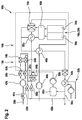
- FIG. 1 shows a schematic view of a fuel cell system 30a.
- the fuel cell system 30a comprises a fuel cell device 10a, which is provided to be operated with a fluidic fuel, in particular with natural gas. Alternatively, it is also conceivable to operate the fuel cell device 10a with another hydrocarbon containing in particular gaseous fuel such as biogas.
- the fuel cell device 10a comprises a fuel cell unit 16a.
- the fuel cell unit 16a is shown here simplified as a single fuel cell 32a. However, a fuel cell unit embodied as a fuel cell stack comprising a plurality of fuel cells is expedient.
- the fuel cell 32a is preferably embodied as a solid oxide fuel cell.
- the fuel cell 32a has an anode 34a and a cathode 36a.
- a fuel supply line 38a the fluidic fuel is fed to the fuel cell system 30a. Feed-in of the fluidic fuel can be controlled and/or regulated and/or entirely interrupted by a fuel valve 40a.
- the fuel valve 40a is preferably electro-magnetically actuatable.
- a fuel compressor 42a By means of a fuel compressor 42a a sufficient flow-rate of the fluidic fuel is ensured.
- Air is fed to a cathode 36a of the fuel cell unit 16a by means of a further compressor 44a or fan. Before entering the cathode 36a the air is preheated by a preheating unit 46a.
- the fuel cell device 10a comprises a desulfurization unit 12a. The desulfurization unit 12a is connected downstream of the fuel compressor 42a.
- the desulfurization unit 12a is provided to desulfurize the fluidic fuel.
- the fuel cell unit 10a further comprises a reformer unit 14a.
- the reformer unit 14a is provided for obtaining a hydrogen-rich fuel gas by processing the desulfurized fluidic fuel.
- the reformer unit 14a is embodied as a steam reformer unit.
- the hydrogen-rich gas leaving the reformer unit 14a is mainly fed to the anode 34a of the fuel cell unit 16a.
- the fuel cell device 10a further comprises a water supply pump 26a.
- the water supply pump 26a is provided for supplying water to the reformer unit 14a. Before entering the reformer unit 14a the water supplied is vaporized by a vaporizer unit 58a.
- the water supply pump 26a is provided for continuously supplying water to the reformer unit 14a during a normal operation of the fuel cell unit 16a.
- the water supply pump 26a is provided for a continuous conveyance of the water from a water source 60a.
- the water conveyed by the water supply pump 26a is mixed with the desulfurized fluidic fuel leaving the desulfurization unit 12a.
- materials of the desulfurization unit 12a may absorb a noxious gas, especially methane.
- the absorbed noxious gas may be desorbed, which may lead to a coking of the reformer unit 14a and/or the fuel cell unit 16a.
- the desulfurization unit 12a is provided for at least limiting a transfer of the noxious gas from the desulfurization unit 12a into the reformer unit 14a and/or into the fuel cell unit 16a when shutting down the fuel cell unit 16a.
- the desulfurization unit 12a comprises a desulfurization reactor 18a and an outlet valve 20a.
- the outlet valve 20a is arranged between the desulfurization unit 12a and the reformer unit 14a. To prevent a transfer of the noxious gas from the desulfurization unit 12a into the reformer unit 14a and/or into the fuel cell unit 16a the outlet valve 20a is provided to be closed when shutting down the fuel cell unit 16a.
- the outlet valve 20a is embodied normally closed.
- the outlet valve 20a is embodied electro-magnetically actuatable. In particular, the outlet valve 20a is kept open during a normal operation of the fuel cell unit 16a by electrical power provided by the fuel cell unit 16a.
- the desulfurization unit 12a comprises a drain valve 22a, which is provided to be opened for draining the noxious gas from the desulfurization reactor 18a when shutting down the fuel cell unit 16a.
- the drain valve 22a is arranged within a fluid line 68a, which connects an outlet of the desulfurization reactor 18a with at least one flue line or chimney 56a of the fuel cell device 10a.
- the drain valve 22a is provided to be opened automatically when shutting down the fuel cell unit 16a.
- the drain valve 22a is in particular embodied as a shut off valve.
- the drain valve 22a is embodied electro-magnetically actuatable.
- the drain valve 22a is embodied normally open.
- the drain valve 22a is kept close during a normal operation of the fuel cell unit 16a by electrical power provided by the fuel cell unit 16a.
- a power supply of the drain valve 22a is automatically interrupted.
- an exhaust gas of the anode 34a and air from the cathode 36a of the fuel cell unit 16a are fed to a combustion unit 50a in which an afterburning of combustible components remaining in the anode exhaust gas is effected.
- Thermal energy herein released is transferred, for example to a heating water circulation 52a via a heat exchanger 54a, to the reformer unit 14a, to the preheating unit 46a and/or to the vaporizer unit 58a.
- An exhaust gas is discharged via the chimney 56a.
- Figure 2 shows a further exemplary embodiment of the invention.
- the following descriptions and the drawings are essentially limited to the differences between the embodiments, wherein regarding equally designated components, in particular with regard to components with the same reference numerals, reference can be made to the drawings and/or the description of the embodiment of figure 1 .
- the letter a is attached to the reference numerals of the embodiment of figure 1 .
- the letter a is replaced by the letter b.
- FIG 2 shows a schematic view of a fuel cell system 30b.
- the fuel cell system 30b comprises a fuel cell device 10b, which is provided to be operated with a fluidic fuel, in particular with natural gas. Alternatively, it is also conceivable to operate the fuel cell device 10b with another hydrocarbon containing in particular gaseous fuel such as biogas.
- the fuel cell device 10b comprises a fuel cell unit 16b.
- the fuel cell unit 16b is shown here simplified as a single fuel cell 32b. However, a fuel cell unit embodied as a fuel cell stack comprising a plurality of fuel cells is expedient.
- the fuel cell 32b is preferably embodied as a solid oxide fuel cell.
- the fuel cell 32b has an anode 34b and a cathode 36b.
- the fluidic fuel is fed to the fuel cell system 30b. Feed-in of the fluidic fuel can be controlled and/or regulated and/or entirely interrupted by a fuel valve 40b.
- the fuel valve 40b is preferably electro-magnetically actuatable.
- a fuel compressor 42b By means of a fuel compressor 42b a sufficient flow-rate of the fluidic fuel is ensured.
- Air is fed to a cathode 36b of the fuel cell unit 16b by means of a further compressor 44b or fan. Before entering the cathode 36b the air is preheated by a preheating unit 46b.
- the fuel cell device 10b comprises a desulfurization unit 12b. The desulfurization unit 12b is connected downstream of the fuel compressor 42b.
- the desulfurization unit 12b is provided to desulfurize the fluidic fuel.
- the fuel cell unit 10b further comprises a reformer unit 14b.
- the reformer unit 14b is provided for obtaining a hydrogen-rich fuel gas by processing the desulfurized fluidic fuel.
- the reformer unit 14b is embodied as a steam reformer unit.
- the hydrogen-rich gas leaving the reformer unit 14b is mainly fed to the anode 34b of the fuel cell unit 16b.
- the fuel cell device 10b further comprises a water supply pump 26b.
- the water supply pump 26b is provided for supplying water to the reformer unit 14b. Before entering the reformer unit 14b the water supplied is vaporized by a vaporizer unit 58b.
- the water supply pump 26b is provided for continuously supplying water to the reformer unit 14b during a normal operation of the fuel cell unit 16b.
- the water supply pump 26b is provided for a continuous conveyance of the water from a water source 60b.
- the water conveyed by the water supply pump 26b is mixed with the desulfurized fluidic fuel leaving the desulfurization unit 12b.
- materials of the desulfurization unit 12b may absorb a noxious gas, especially methane.
- the absorbed noxious gas may be desorbed, which may lead to a coking of the reformer unit 14b and/or of the fuel cell unit 16b.
- the desulfurization unit 12b is provided for at least limiting a transfer of the noxious gas from the desulfurization unit 12b into the reformer unit 14b and/or into the fuel cell unit 16b when shutting down the fuel cell unit 16b.
- the desulfurization unit 12b comprises two desulfurization reactors 18b, 24b, which are connected parallel to each other and which are provided to be operated in alternation. At each point in time during a normal operation of the fuel cell unit 16b solely one of the desulfurization reactors 18b, 24b is involved in a desulfurization of the fluidic fuel. In particular, at each point in time during a normal operation of the fuel cell unit 16b a fluidic fuel flow is solely led towards one of the desulfurization reactors 18b, 24b.
- the desulfurization unit 12b respectively comprises an inlet valve 28b, 62b, an outlet valve 20b, 64b and a drain valve 22b, 66b for each desulfurization reactor.
- a changeover may be executed once, in particular when a service life end of the desulfurization reactor 18b, 24b in use is reached. In addition or alternatively, a changeover may be executed periodically, e.g. daily or monthly.
- An absorptive capacity respectively desorption capacity of each desulfurization reactor 18b, 24b regarding the noxious gas is below a sufficient amount of the noxious gas for damaging and/or destroying the reformer unit 14b and/or the fuel cell unit 16b.
- the amount of the noxious gas streaming from the desulfurization unit 12b into the reformer unit 14b and/or into the fuel cell unit 16b when shutting down the fuel cell unit 16b can be advantageously reduced.
- an exhaust gas of the anode 34a and air from the cathode 36a of the fuel cell unit 16a are fed to a combustion unit 50a in which an afterburning of combustible components remaining in the anode exhaust gas is effected.
- Thermal energy herein released is transferred, for example to a heating water circulation 52a via a heat exchanger 54a, to the reformer unit 14a, to the preheating unit 46a and/or to the vaporizer unit 58a.
- An exhaust gas is discharged via a chimney 56a.
Landscapes
- Life Sciences & Earth Sciences (AREA)
- Engineering & Computer Science (AREA)
- Manufacturing & Machinery (AREA)
- Sustainable Development (AREA)
- Sustainable Energy (AREA)
- Chemical & Material Sciences (AREA)
- Chemical Kinetics & Catalysis (AREA)
- Electrochemistry (AREA)
- General Chemical & Material Sciences (AREA)
- Fuel Cell (AREA)
Abstract
Description
- Fuel cell device, which is provided to be operated with a fluidic fuel, with a desulfurization unit, which is provided to desulfurize the fuel at least partially, with a reformer unit, which is provided for generating at least one fuel gas, and with a fuel cell unit, is already known.
- The invention is based on a fuel cell device, which is provided to be operated with a fluidic fuel, with a desulfurization unit, which is provided to desulfurize the fuel at least partially, with a reformer unit, which is provided for generating at least one fuel gas, and with a fuel cell unit.
- It is proposed that the desulfurization unit is provided for at least limiting a transfer of at least one noxious gas from the desulfurization unit into the reformer unit and/or into the fuel cell unit at least when shutting down the fuel cell unit.
- In this context, by a "fuel cell device" is to be understood in particular a functional component, in particular a structural and/or functioning component of a fuel cell system. In this context, a "fuel cell system" is to be understood as a system provided for stationary and/or mobile generation of in particular electrical and/or thermal energy by using at least one fuel cell unit. "Provided" is to be understood in particular as specifically programmed, designed and/or equipped. By an object being provided for a certain function, it is to be understood in particular that the object fulfills and carries out this certain function in at least one application state and/or operation state In this context, by a "fuel cell unit" is to be understood a unit with at least one fuel cell, which is provided for converting at least a chemical reaction energy of at least one in particular continuously supplied fuel gas, in particular hydrogen and/or carbon monoxide, and at least one oxidizing agent, in particular oxygen from air, into electrical and/or thermal energy. The at least one fuel cell may be embodied in particular as a solid oxide fuel cell (SOFC). Preferably, the fuel cell unit comprises a plurality of fuel cells, which are in particular arranged in a fuel cell stack. In this context, a "desulfurization unit" is to be understood as a unit provided to reduce a volume and/or mole fraction of sulfur compounds in the fuel, in particular below a specified threshold value and preferably to remove a volume and/or mole fraction of sulfur compounds in the fuel at least substantially from the fuel, preferably by at least one physical and/or chemical adsorption and/or absorption process. In this context, a "reformer unit" in particular a chemical-technical unit is to be understood, which is provided for processing the fuel in particular for generating a fuel gas containing gas mixture, in particular by partial oxidation and/or by an autothermal reforming and/or preferably by steam reforming. Preferably, the reformer unit is embodied as a steam reformer unit. In this context, a "steam reformer unit" is to be understood in particular as a reformer unit provided to process the fuel by addition of water vapor for generating the fuel gas containing gas mixture. In particular, the fuel cell device comprises a water supply unit which is provided for supplying water to the reformer unit during a normal operation of the fuel cell unit. In this context, by a "water supply unit" is to be understood in particular a unit, which is provided for supplying water which is required for a reforming process to the reformer unit. During normal operation of the fuel cell unit the water supply unit is provided for supplying water continuously to the reformer unit. In particular, the water supply unit comprises at least one water supply pump provided for in particular continuous conveyance of the water. The water supply unit in particular comprises at least one vaporizer, which is fluidically arranged upstream of the reformer unit and which is provided for vaporizing the supplied water.
- In this context, by a "noxious gas" is to be understood in particular a gaseous substance, which is able to damage and/or destroy at least one unit and/or component of the fuel cell device if the gaseous substance is led into said unit and/or component. In particular, the noxious gas is methane or a methane containing gas mixture. In particular, during a normal operation of the fuel cell unit materials of the desulfurization unit may absorb methane. When shutting down the fuel cell unit, e.g. in case of an emergency shutdown, the absorbed methane may be desorbed, which may lead to a coking of the reformer unit and/or the fuel cell unit if the methane streams into the reformer unit/or the fuel cell unit. In particular, this may occur if no water or an insufficient amount of water is supplied to the reformer unit.
- By the desulfurization unit being provided for "at least limiting" a transfer of the noxious gas from the desulfurization unit into the reformer unit and/or into the fuel cell unit at least when shutting down the fuel cell unit it is in particular to be understood that the desulfurization unit is provided to reduce the amount of the noxious gas streaming from the desulfurization unit into the reformer unit and/or into the fuel cell unit or preferably completely prevent a transfer of noxious gas from the desulfurization unit into the reformer unit and/or into the fuel cell unit. In particular, a limitation of a transfer of the noxious gas from the desulfurization unit into the reformer unit and/or into the fuel cell unit may be achieved by reducing the amount of noxious gas desorbed from materials of the desulfurization unit, by redirecting a noxious gas flow and/or by blocking a noxious gas flow.
- By such an implementation a fuel cell device, having advantageous operative features, in particular an enhanced shut down behavior, can be provided. By limiting a transfer of at least one noxious gas from the desulfurization unit into the reformer unit and/or into the fuel cell unit at least when shutting down the fuel cell unit, coking of the reformer unit and/or the fuel cell unit can be advantageously reduced or preferably advantageously avoided.
- It is further proposed that the desulfurization unit comprises at least one outlet valve, which is in particular fluidically arranged between the desulfurization unit and the reformer unit and which is provided to be closed when shutting down the fuel cell unit. The outlet valve is in particular arranged within a fluid line, which connects an outlet of the desulfurization unit with a supply line of the reformer unit. In particular, the outlet valve is provided to be closed automatically when shutting down the fuel cell unit. The outlet valve is in particular embodied as a shut off valve. Preferably, the outlet valve is embodied electro-magnetically actuatable. Preferably, the outlet valve is embodied normally closed. Preferably, each outlet valve of the desulfurization unit is embodied normally closed. In particular, the outlet valve is kept open during a normal operation of the fuel cell unit by electrical power provided by the fuel cell unit. When shutting down the fuel cell unit a power supply of the outlet valve is in particular automatically interrupted. Hereby, a noxious gas flow from the desulfurization unit towards the reformer unit and/or the fuel cell unit can be advantageously prevented when shutting down the fuel cell unit.
- It is moreover proposed that the desulfurization unit comprises at least one drain valve, which is provided to be opened for draining the noxious gas from the desulfurization unit when shutting down the fuel cell unit. The drain valve is in particular arranged within a fluid line which connects an outlet of the desulfurization unit with at least one flue line of the fuel cell device. In particular, the drain valve is provided to be opened automatically when shutting down the fuel cell unit. The drain valve is in particular embodied as a shut off valve. Preferably, the drain valve is embodied electro-magnetically actuatable. Preferably, the drain valve is embodied normally open. Preferably, each drain valve of the desulfurization unit is embodied normally open. In particular, the drain valve is kept close during a normal operation of the fuel cell unit by electrical power provided by the fuel cell unit. When shutting down the fuel cell unit a power supply of the drain valve is in particular automatically interrupted. Hereby a noxious gas desorbed from the desulfurization unit towards the reformer unit and/or the fuel cell unit can be advantageously discharged from the desulfurization unit when shutting down the fuel cell unit.
- It is moreover proposed that the desulfurization unit comprises at least two desulfurization reactors, which are connected parallel to each other and which are provided to be operated in alternation. In this context, by a "desulfurization reactor" is to be understood in particular a reaction container in which chemical and/or physical processes and/or reactions for a desulfurization of the fluidic fuel take place. By the desulfurization reactors being provided "to be operated in alternation" it is in particular to be understood that at each point in time during a normal operation of the fuel cell unit solely one of the desulfurization reactors is involved in a desulfurization of the fluidic fuel. In particular, at each point in time during a normal operation of the fuel cell unit a fluidic fuel flow is solely led towards one of the desulfurization reactors. Preferably, the desulfurization unit respectively comprises an inlet valve, an outlet valve and a drain valve for each desulfurization reactor. In particular, a changeover may be executed once, in particular when a service life end of the desulfurization reactor in use is reached. In addition or alternatively a changeover may be executed periodically, e.g. daily or monthly. In particular absorptive capacity respectively desorption capacity of each desulfurization reactor regarding the noxious gas is below a sufficient amount of the noxious gas for damaging and/or destroying the reformer unit and/or the fuel cell unit. Hereby, the amount of the noxious gas streaming from the desulfurization unit into the reformer unit and/or into the fuel cell unit when shutting down the fuel cell unit can be advantageously reduced.
- It is further proposed that the inlet valve is embodied normally closed. Preferably, each inlet valve of the desulfurization unit is embodied normally closed. The inlet valve is in particular arranged within a fluid line which connects a fuel supply line of the fuel cell unit with an inlet of a desulfurization reactor. In particular, the inlet valve is provided to be closed automatically when shutting down the fuel cell unit. The inlet valve is in particular embodied as a shut off valve. Preferably, the inlet valve is embodied electro-magnetically actuatable. Preferably, the inlet valve is embodied normally closed. In particular the inlet valve is kept open during a normal operation by electrical power provided by the fuel cell unit. When shutting down the fuel cell unit a power supply of the inlet valve is in particular automatically interrupted. Hereby, a streaming of fluidic fuel into the desulfurization unit, especially into desulfurization reactors of the desulfurization unit can be advantageously interrupted when shutting down the fuel cell unit.
- Furthermore, a fuel cell system is proposed with at least one fuel cell device according to the invention. Besides the fuel cell device the fuel cell system may comprise further components and/or units such as supply pipes for fuel and/or air, flue pipes, heat exchangers, compressors, catalytic converters, compressors, and/or afterburners. Hereby, a fuel cell system, having an enhanced shut down behavior, can be provided.
- Further a method for operating a fuel cell device, which is provided to be operated with a fluidic fuel, with a desulfurization unit, which is provided to desulfurize the fuel at least partially, with a reformer unit, which is provided for generating at least one fuel gas, and with a fuel cell unit, wherein a transfer of at least one noxious gas from the desulfurization unit into the reformer unit and/or into the fuel cell unit is limited when shutting down the fuel cell unit, is provided. Hereby, coking of the reformer unit and/or the fuel cell unit can be advantageously reduced or preferably advantageously avoided.
- The fuel cell device according to the invention is herein not to be restricted to the application and implementation described above. In particular, for fulfilling a function herein described, the fuel cell device according to the invention may comprise a number of individual elements, components and units, which differ from the number herein mentioned.
- Further advantages may be gathered from the following description of the drawing. In the drawing two exemplary embodiments of the invention are shown. The drawing, the description and the claims comprise a plurality of features in combination. The person skilled in the art will expediently also consider the features individually and will bring them together in further purposeful combinations.
- The drawing shows:
- In fig. 1
- a schematic view of a fuel cell system with a fuel cell device comprising a reformer unit, a fuel cell unit and a desulfurization unit which is provided for preventing a transfer of a noxious gas from the desulfurization unit into the reformer unit and/or into the fuel cell unit when shutting down the fuel cell unit, and
- In fig. 2
- a schematic view of a fuel cell system with a fuel cell device comprising a reformer unit, a fuel cell unit and a desulfurization unit with two desulfurization reactors which are connected parallel to each other and which are provided to be operated in alternation.
-
Figure 1 shows a schematic view of afuel cell system 30a. Thefuel cell system 30a comprises afuel cell device 10a, which is provided to be operated with a fluidic fuel, in particular with natural gas. Alternatively, it is also conceivable to operate thefuel cell device 10a with another hydrocarbon containing in particular gaseous fuel such as biogas. Thefuel cell device 10a comprises afuel cell unit 16a. Thefuel cell unit 16a is shown here simplified as asingle fuel cell 32a. However, a fuel cell unit embodied as a fuel cell stack comprising a plurality of fuel cells is expedient. Thefuel cell 32a is preferably embodied as a solid oxide fuel cell. Thefuel cell 32a has ananode 34a and acathode 36a. From afuel supply line 38a the fluidic fuel is fed to thefuel cell system 30a. Feed-in of the fluidic fuel can be controlled and/or regulated and/or entirely interrupted by afuel valve 40a. Thefuel valve 40a is preferably electro-magnetically actuatable. By means of afuel compressor 42a a sufficient flow-rate of the fluidic fuel is ensured. Air is fed to acathode 36a of thefuel cell unit 16a by means of afurther compressor 44a or fan. Before entering thecathode 36a the air is preheated by a preheatingunit 46a. Furthermore, thefuel cell device 10a comprises adesulfurization unit 12a. Thedesulfurization unit 12a is connected downstream of thefuel compressor 42a. Thedesulfurization unit 12a is provided to desulfurize the fluidic fuel. Thefuel cell unit 10a further comprises areformer unit 14a. Thereformer unit 14a is provided for obtaining a hydrogen-rich fuel gas by processing the desulfurized fluidic fuel. Thereformer unit 14a is embodied as a steam reformer unit. The hydrogen-rich gas leaving thereformer unit 14a is mainly fed to theanode 34a of thefuel cell unit 16a. - The
fuel cell device 10a further comprises awater supply pump 26a. Thewater supply pump 26a is provided for supplying water to thereformer unit 14a. Before entering thereformer unit 14a the water supplied is vaporized by avaporizer unit 58a. Thewater supply pump 26a is provided for continuously supplying water to thereformer unit 14a during a normal operation of thefuel cell unit 16a. Thewater supply pump 26a is provided for a continuous conveyance of the water from awater source 60a. The water conveyed by thewater supply pump 26a is mixed with the desulfurized fluidic fuel leaving thedesulfurization unit 12a. During a normal operation of thefuel cell unit 16a materials of thedesulfurization unit 12a may absorb a noxious gas, especially methane. When shutting down thefuel cell unit 16a, e.g. in case of an emergency shutdown, the absorbed noxious gas may be desorbed, which may lead to a coking of thereformer unit 14a and/or thefuel cell unit 16a. To avoid coking of thereformer unit 14a and/or of the offuel cell unit 16a by desorbed noxious gas thedesulfurization unit 12a is provided for at least limiting a transfer of the noxious gas from thedesulfurization unit 12a into thereformer unit 14a and/or into thefuel cell unit 16a when shutting down thefuel cell unit 16a. - The
desulfurization unit 12a comprises adesulfurization reactor 18a and anoutlet valve 20a. Theoutlet valve 20a is arranged between thedesulfurization unit 12a and thereformer unit 14a. To prevent a transfer of the noxious gas from thedesulfurization unit 12a into thereformer unit 14a and/or into thefuel cell unit 16a theoutlet valve 20a is provided to be closed when shutting down thefuel cell unit 16a. Theoutlet valve 20a is embodied normally closed. Preferably, theoutlet valve 20a is embodied electro-magnetically actuatable. In particular, theoutlet valve 20a is kept open during a normal operation of thefuel cell unit 16a by electrical power provided by thefuel cell unit 16a. When shutting down thefuel cell unit 16a a power supply of theoutlet valve 20a is automatically interrupted. Furthermore, thedesulfurization unit 12a comprises adrain valve 22a, which is provided to be opened for draining the noxious gas from thedesulfurization reactor 18a when shutting down thefuel cell unit 16a. Thedrain valve 22a is arranged within afluid line 68a, which connects an outlet of thedesulfurization reactor 18a with at least one flue line orchimney 56a of thefuel cell device 10a. In particular, thedrain valve 22a is provided to be opened automatically when shutting down thefuel cell unit 16a. Thedrain valve 22a is in particular embodied as a shut off valve. Preferably, thedrain valve 22a is embodied electro-magnetically actuatable. Preferably, thedrain valve 22a is embodied normally open. In particular, thedrain valve 22a is kept close during a normal operation of thefuel cell unit 16a by electrical power provided by thefuel cell unit 16a. When shutting down thefuel cell unit 16a a power supply of thedrain valve 22a is automatically interrupted. - During normal operation of the
fuel cell unit 16a an exhaust gas of theanode 34a and air from thecathode 36a of thefuel cell unit 16a are fed to acombustion unit 50a in which an afterburning of combustible components remaining in the anode exhaust gas is effected. Thermal energy herein released is transferred, for example to aheating water circulation 52a via aheat exchanger 54a, to thereformer unit 14a, to thepreheating unit 46a and/or to thevaporizer unit 58a. An exhaust gas is discharged via thechimney 56a. -
Figure 2 shows a further exemplary embodiment of the invention. The following descriptions and the drawings are essentially limited to the differences between the embodiments, wherein regarding equally designated components, in particular with regard to components with the same reference numerals, reference can be made to the drawings and/or the description of the embodiment offigure 1 . To distinguish the exemplary embodiments the letter a is attached to the reference numerals of the embodiment offigure 1 . In the exemplary embodiment offigure 2 the letter a is replaced by the letter b. -
Figure 2 shows a schematic view of afuel cell system 30b. Thefuel cell system 30b comprises afuel cell device 10b, which is provided to be operated with a fluidic fuel, in particular with natural gas. Alternatively, it is also conceivable to operate thefuel cell device 10b with another hydrocarbon containing in particular gaseous fuel such as biogas. Thefuel cell device 10b comprises afuel cell unit 16b. Thefuel cell unit 16b is shown here simplified as asingle fuel cell 32b. However, a fuel cell unit embodied as a fuel cell stack comprising a plurality of fuel cells is expedient. Thefuel cell 32b is preferably embodied as a solid oxide fuel cell. Thefuel cell 32b has ananode 34b and acathode 36b. From afuel supply line 38b the fluidic fuel is fed to thefuel cell system 30b. Feed-in of the fluidic fuel can be controlled and/or regulated and/or entirely interrupted by afuel valve 40b. Thefuel valve 40b is preferably electro-magnetically actuatable. By means of afuel compressor 42b a sufficient flow-rate of the fluidic fuel is ensured. Air is fed to acathode 36b of thefuel cell unit 16b by means of afurther compressor 44b or fan. Before entering thecathode 36b the air is preheated by a preheatingunit 46b. Furthermore, thefuel cell device 10b comprises adesulfurization unit 12b. Thedesulfurization unit 12b is connected downstream of thefuel compressor 42b. Thedesulfurization unit 12b is provided to desulfurize the fluidic fuel. Thefuel cell unit 10b further comprises areformer unit 14b. Thereformer unit 14b is provided for obtaining a hydrogen-rich fuel gas by processing the desulfurized fluidic fuel. Thereformer unit 14b is embodied as a steam reformer unit. The hydrogen-rich gas leaving thereformer unit 14b is mainly fed to theanode 34b of thefuel cell unit 16b. - The
fuel cell device 10b further comprises awater supply pump 26b. Thewater supply pump 26b is provided for supplying water to thereformer unit 14b. Before entering thereformer unit 14b the water supplied is vaporized by avaporizer unit 58b. Thewater supply pump 26b is provided for continuously supplying water to thereformer unit 14b during a normal operation of thefuel cell unit 16b. Thewater supply pump 26b is provided for a continuous conveyance of the water from awater source 60b. The water conveyed by thewater supply pump 26b is mixed with the desulfurized fluidic fuel leaving thedesulfurization unit 12b. During a normal operation of thefuel cell unit 16b materials of thedesulfurization unit 12b may absorb a noxious gas, especially methane. When shutting down thefuel cell unit 16b, e.g. in case of an emergency shutdown, the absorbed noxious gas may be desorbed, which may lead to a coking of thereformer unit 14b and/or of thefuel cell unit 16b. To avoid coking of thereformer unit 14a and/or of thefuel cell unit 16b by desorbed noxious gas thedesulfurization unit 12b is provided for at least limiting a transfer of the noxious gas from thedesulfurization unit 12b into thereformer unit 14b and/or into thefuel cell unit 16b when shutting down thefuel cell unit 16b. - The
desulfurization unit 12b comprises twodesulfurization reactors fuel cell unit 16b solely one of thedesulfurization reactors fuel cell unit 16b a fluidic fuel flow is solely led towards one of thedesulfurization reactors desulfurization unit 12b respectively comprises aninlet valve outlet valve drain valve desulfurization reactor desulfurization reactor reformer unit 14b and/or thefuel cell unit 16b. Hereby, the amount of the noxious gas streaming from thedesulfurization unit 12b into thereformer unit 14b and/or into thefuel cell unit 16b when shutting down thefuel cell unit 16b can be advantageously reduced. - During normal operation of the
fuel cell unit 16a an exhaust gas of theanode 34a and air from thecathode 36a of thefuel cell unit 16a are fed to acombustion unit 50a in which an afterburning of combustible components remaining in the anode exhaust gas is effected. Thermal energy herein released is transferred, for example to aheating water circulation 52a via aheat exchanger 54a, to thereformer unit 14a, to thepreheating unit 46a and/or to thevaporizer unit 58a. An exhaust gas is discharged via achimney 56a.
Claims (10)
- Fuel cell device, which is provided to be operated with a fluidic fuel, with a desulfurization unit (12a; 12b), which is provided to desulfurize the fuel at least partially, with a reformer unit (14a; 14b), which is provided for generating at least one fuel gas, and with a fuel cell unit (16a; 16b), characterized in that the desulfurization unit (12a; 12b) is provided for at least limiting a transfer of at least one noxious gas from the desulfurization unit (12a; 12b) into the reformer unit (14a; 14b) and/or into the fuel cell unit (16a; 16b) at least when shutting down the fuel cell unit (16a; 16b).
- Fuel cell device according to claim 1, characterized in that the desulfurization unit (12a) comprises at least one outlet valve (20a), which is arranged between the desulfurization unit (12a) and the reformer unit (14a) and which is provided to be closed when shutting down the fuel cell unit (16a).
- The fuel cell device according to claim 2, characterized in that the outlet valve (20a) is embodied normally closed.
- Fuel cell device according to one of the preceding claims, characterized in that the desulfurization unit (12a) comprises at least one drain valve (22a), which is provided to be opened for draining the noxious gas from the desulfurization unit (12a) when shutting down the fuel cell unit (16a).
- Fuel cell device according to claim 4, characterized in that the drain valve (22a) is embodied normally open.
- Fuel cell device according to one of the preceding claims, characterized in that the desulfurization unit (12b) comprises at least two desulfurization reactors (18b, 24b), which are connected parallel to each other and which are provided to be operated in alternation.
- Fuel cell device according to claim 6, characterized in that the desulfurization unit (12a; 12b) respectively comprises an inlet valve (28b, 62b), an outlet valve (20b, 64b) and a drain valve (22b, 66b) for each desulfurization reactor (18b, 24b).
- Fuel cell device according to claim 7, characterized in that the inlet valve (28b, 62b) is embodied normally closed.
- Fuel cell system with at least one fuel cell device (10a; 10b) according to one of the preceding claims.
- Method for operating a fuel cell device, which is provided to be operated with a fluidic fuel, with a desulfurization unit (12a; 12b), which is provided to desulfurize the fuel at least partially, with a reformer unit (14a; 14b), which is provided for generating at least one fuel gas, and with a fuel cell unit (16a; 16b), characterized in that a transfer of at least one noxious gas from the desulfurization unit (12a; 12b) into the reforming unit (14a; 14b) and/or into the fuel cell unit (16a; 16b) is limited when shutting down the fuel cell unit (16a; 16b).
Priority Applications (1)
| Application Number | Priority Date | Filing Date | Title |
|---|---|---|---|
| EP16167054.2A EP3240080B1 (en) | 2016-04-26 | 2016-04-26 | Fuel cell device |
Applications Claiming Priority (1)
| Application Number | Priority Date | Filing Date | Title |
|---|---|---|---|
| EP16167054.2A EP3240080B1 (en) | 2016-04-26 | 2016-04-26 | Fuel cell device |
Publications (2)
| Publication Number | Publication Date |
|---|---|
| EP3240080A1 true EP3240080A1 (en) | 2017-11-01 |
| EP3240080B1 EP3240080B1 (en) | 2018-12-19 |
Family
ID=55862571
Family Applications (1)
| Application Number | Title | Priority Date | Filing Date |
|---|---|---|---|
| EP16167054.2A Active EP3240080B1 (en) | 2016-04-26 | 2016-04-26 | Fuel cell device |
Country Status (1)
| Country | Link |
|---|---|
| EP (1) | EP3240080B1 (en) |
Cited By (1)
| Publication number | Priority date | Publication date | Assignee | Title |
|---|---|---|---|---|
| AT520770A1 (en) * | 2018-01-12 | 2019-07-15 | Avl List Gmbh | Desulphurisation arrangement and method for exchanging a desulphurisation unit in a fuel cell system |
Citations (5)
| Publication number | Priority date | Publication date | Assignee | Title |
|---|---|---|---|---|
| US20030003332A1 (en) * | 2001-06-28 | 2003-01-02 | Ballard Power Systems Inc. | Self-inerting fuel processing system |
| US20030072978A1 (en) * | 2001-10-11 | 2003-04-17 | Meyer Alfred P. | Procedure for purging a fuel cell system with inert gas made from organic fuel |
| JP2010116304A (en) * | 2008-11-14 | 2010-05-27 | Idemitsu Kosan Co Ltd | Reforming apparatus, fuel cell system, and method for operating reforming apparatus |
| EP2487742A2 (en) * | 2011-02-10 | 2012-08-15 | Aisin Seiki Kabushiki Kaisha | Fuel cell system |
| US20160036078A1 (en) * | 2014-07-29 | 2016-02-04 | Robert Bosch Gmbh | Fuel cell device |
-
2016
- 2016-04-26 EP EP16167054.2A patent/EP3240080B1/en active Active
Patent Citations (5)
| Publication number | Priority date | Publication date | Assignee | Title |
|---|---|---|---|---|
| US20030003332A1 (en) * | 2001-06-28 | 2003-01-02 | Ballard Power Systems Inc. | Self-inerting fuel processing system |
| US20030072978A1 (en) * | 2001-10-11 | 2003-04-17 | Meyer Alfred P. | Procedure for purging a fuel cell system with inert gas made from organic fuel |
| JP2010116304A (en) * | 2008-11-14 | 2010-05-27 | Idemitsu Kosan Co Ltd | Reforming apparatus, fuel cell system, and method for operating reforming apparatus |
| EP2487742A2 (en) * | 2011-02-10 | 2012-08-15 | Aisin Seiki Kabushiki Kaisha | Fuel cell system |
| US20160036078A1 (en) * | 2014-07-29 | 2016-02-04 | Robert Bosch Gmbh | Fuel cell device |
Cited By (2)
| Publication number | Priority date | Publication date | Assignee | Title |
|---|---|---|---|---|
| AT520770A1 (en) * | 2018-01-12 | 2019-07-15 | Avl List Gmbh | Desulphurisation arrangement and method for exchanging a desulphurisation unit in a fuel cell system |
| AT520770B1 (en) * | 2018-01-12 | 2020-04-15 | Avl List Gmbh | Desulfurization arrangement and method for replacing a desulfurization unit in a fuel cell system |
Also Published As
| Publication number | Publication date |
|---|---|
| EP3240080B1 (en) | 2018-12-19 |
Similar Documents
| Publication | Publication Date | Title |
|---|---|---|
| EP2518013B1 (en) | Hydrogen generator and fuel cell system | |
| EP2518012B1 (en) | Method for operating a hydrogen generation device | |
| CN100486019C (en) | Hydrogen generator, method of shutting down operation of hydrogen generator, and fuel cell electricity generation device | |
| JP5133165B2 (en) | Fuel cell system | |
| US6562502B2 (en) | Fuel cell hot zone pressure regulator | |
| WO2004086536A3 (en) | Solid oxide fuel cell with selective anode tail gas circulation | |
| JP5372980B2 (en) | Fuel cell system | |
| US8916302B2 (en) | Method and apparatus for improving water balance in fuel cell power unit | |
| EP3240080B1 (en) | Fuel cell device | |
| US12258524B2 (en) | Fuel processing system and method for sulfur bearing fuels | |
| CN110088957B (en) | Fuel cell device and method for starting a fuel cell device | |
| JP5127395B2 (en) | Fuel cell power generation system | |
| EP3239097B1 (en) | Fuel cell device | |
| US10847824B2 (en) | Fuel cell system including high-temperature desulfurization subsystem and method of operating the same | |
| KR102194278B1 (en) | Fuel cell system with combined passive and active adsorbent beds | |
| US10483575B2 (en) | Fuel cell device | |
| JP5148164B2 (en) | Liquid fuel processing apparatus and fuel cell power generation system | |
| JP6523841B2 (en) | Fuel cell system | |
| JP2009076392A (en) | Liquid fuel cell power generation system | |
| JP2010024402A (en) | Fuel cell power generation system and desulfurizer used therefor | |
| WO2005005313A1 (en) | Fuel treatment device and fuel treatment method | |
| JP5466871B2 (en) | Fuel cell reformer | |
| EP4497805A1 (en) | Mixed media desulfurization systems and fuel cell systems including the same | |
| US20250038237A1 (en) | Mixed media desulfurization systems and fuel cell systems including the same | |
| JP4383972B2 (en) | Desulfurization system and method for stopping the same |
Legal Events
| Date | Code | Title | Description |
|---|---|---|---|
| PUAI | Public reference made under article 153(3) epc to a published international application that has entered the european phase |
Free format text: ORIGINAL CODE: 0009012 |
|
| STAA | Information on the status of an ep patent application or granted ep patent |
Free format text: STATUS: THE APPLICATION HAS BEEN PUBLISHED |
|
| AK | Designated contracting states |
Kind code of ref document: A1 Designated state(s): AL AT BE BG CH CY CZ DE DK EE ES FI FR GB GR HR HU IE IS IT LI LT LU LV MC MK MT NL NO PL PT RO RS SE SI SK SM TR |
|
| AX | Request for extension of the european patent |
Extension state: BA ME |
|
| STAA | Information on the status of an ep patent application or granted ep patent |
Free format text: STATUS: REQUEST FOR EXAMINATION WAS MADE |
|
| 17P | Request for examination filed |
Effective date: 20180425 |
|
| RBV | Designated contracting states (corrected) |
Designated state(s): AL AT BE BG CH CY CZ DE DK EE ES FI FR GB GR HR HU IE IS IT LI LT LU LV MC MK MT NL NO PL PT RO RS SE SI SK SM TR |
|
| GRAP | Despatch of communication of intention to grant a patent |
Free format text: ORIGINAL CODE: EPIDOSNIGR1 |
|
| STAA | Information on the status of an ep patent application or granted ep patent |
Free format text: STATUS: GRANT OF PATENT IS INTENDED |
|
| RIC1 | Information provided on ipc code assigned before grant |
Ipc: H01M 8/0662 20160101ALI20180614BHEP Ipc: H01M 8/124 20160101ALN20180614BHEP Ipc: H01M 8/04082 20160101ALI20180614BHEP Ipc: H01M 8/0612 20160101AFI20180614BHEP Ipc: H01M 8/04228 20160101ALI20180614BHEP |
|
| INTG | Intention to grant announced |
Effective date: 20180711 |
|
| GRAS | Grant fee paid |
Free format text: ORIGINAL CODE: EPIDOSNIGR3 |
|
| GRAA | (expected) grant |
Free format text: ORIGINAL CODE: 0009210 |
|
| STAA | Information on the status of an ep patent application or granted ep patent |
Free format text: STATUS: THE PATENT HAS BEEN GRANTED |
|
| AK | Designated contracting states |
Kind code of ref document: B1 Designated state(s): AL AT BE BG CH CY CZ DE DK EE ES FI FR GB GR HR HU IE IS IT LI LT LU LV MC MK MT NL NO PL PT RO RS SE SI SK SM TR |
|
| REG | Reference to a national code |
Ref country code: GB Ref legal event code: FG4D |
|
| REG | Reference to a national code |
Ref country code: CH Ref legal event code: EP |
|
| REG | Reference to a national code |
Ref country code: IE Ref legal event code: FG4D |
|
| REG | Reference to a national code |
Ref country code: DE Ref legal event code: R096 Ref document number: 602016008336 Country of ref document: DE |
|
| REG | Reference to a national code |
Ref country code: AT Ref legal event code: REF Ref document number: 1079651 Country of ref document: AT Kind code of ref document: T Effective date: 20190115 |
|
| REG | Reference to a national code |
Ref country code: NL Ref legal event code: MP Effective date: 20181219 |
|
| PG25 | Lapsed in a contracting state [announced via postgrant information from national office to epo] |
Ref country code: LV Free format text: LAPSE BECAUSE OF FAILURE TO SUBMIT A TRANSLATION OF THE DESCRIPTION OR TO PAY THE FEE WITHIN THE PRESCRIBED TIME-LIMIT Effective date: 20181219 Ref country code: HR Free format text: LAPSE BECAUSE OF FAILURE TO SUBMIT A TRANSLATION OF THE DESCRIPTION OR TO PAY THE FEE WITHIN THE PRESCRIBED TIME-LIMIT Effective date: 20181219 Ref country code: BG Free format text: LAPSE BECAUSE OF FAILURE TO SUBMIT A TRANSLATION OF THE DESCRIPTION OR TO PAY THE FEE WITHIN THE PRESCRIBED TIME-LIMIT Effective date: 20190319 Ref country code: NO Free format text: LAPSE BECAUSE OF FAILURE TO SUBMIT A TRANSLATION OF THE DESCRIPTION OR TO PAY THE FEE WITHIN THE PRESCRIBED TIME-LIMIT Effective date: 20190319 Ref country code: LT Free format text: LAPSE BECAUSE OF FAILURE TO SUBMIT A TRANSLATION OF THE DESCRIPTION OR TO PAY THE FEE WITHIN THE PRESCRIBED TIME-LIMIT Effective date: 20181219 Ref country code: FI Free format text: LAPSE BECAUSE OF FAILURE TO SUBMIT A TRANSLATION OF THE DESCRIPTION OR TO PAY THE FEE WITHIN THE PRESCRIBED TIME-LIMIT Effective date: 20181219 |
|
| REG | Reference to a national code |
Ref country code: LT Ref legal event code: MG4D |
|
| REG | Reference to a national code |
Ref country code: AT Ref legal event code: MK05 Ref document number: 1079651 Country of ref document: AT Kind code of ref document: T Effective date: 20181219 |
|
| PG25 | Lapsed in a contracting state [announced via postgrant information from national office to epo] |
Ref country code: RS Free format text: LAPSE BECAUSE OF FAILURE TO SUBMIT A TRANSLATION OF THE DESCRIPTION OR TO PAY THE FEE WITHIN THE PRESCRIBED TIME-LIMIT Effective date: 20181219 Ref country code: SE Free format text: LAPSE BECAUSE OF FAILURE TO SUBMIT A TRANSLATION OF THE DESCRIPTION OR TO PAY THE FEE WITHIN THE PRESCRIBED TIME-LIMIT Effective date: 20181219 Ref country code: AL Free format text: LAPSE BECAUSE OF FAILURE TO SUBMIT A TRANSLATION OF THE DESCRIPTION OR TO PAY THE FEE WITHIN THE PRESCRIBED TIME-LIMIT Effective date: 20181219 Ref country code: GR Free format text: LAPSE BECAUSE OF FAILURE TO SUBMIT A TRANSLATION OF THE DESCRIPTION OR TO PAY THE FEE WITHIN THE PRESCRIBED TIME-LIMIT Effective date: 20190320 |
|
| PG25 | Lapsed in a contracting state [announced via postgrant information from national office to epo] |
Ref country code: NL Free format text: LAPSE BECAUSE OF FAILURE TO SUBMIT A TRANSLATION OF THE DESCRIPTION OR TO PAY THE FEE WITHIN THE PRESCRIBED TIME-LIMIT Effective date: 20181219 |
|
| PG25 | Lapsed in a contracting state [announced via postgrant information from national office to epo] |
Ref country code: PL Free format text: LAPSE BECAUSE OF FAILURE TO SUBMIT A TRANSLATION OF THE DESCRIPTION OR TO PAY THE FEE WITHIN THE PRESCRIBED TIME-LIMIT Effective date: 20181219 Ref country code: IT Free format text: LAPSE BECAUSE OF FAILURE TO SUBMIT A TRANSLATION OF THE DESCRIPTION OR TO PAY THE FEE WITHIN THE PRESCRIBED TIME-LIMIT Effective date: 20181219 Ref country code: PT Free format text: LAPSE BECAUSE OF FAILURE TO SUBMIT A TRANSLATION OF THE DESCRIPTION OR TO PAY THE FEE WITHIN THE PRESCRIBED TIME-LIMIT Effective date: 20190419 Ref country code: ES Free format text: LAPSE BECAUSE OF FAILURE TO SUBMIT A TRANSLATION OF THE DESCRIPTION OR TO PAY THE FEE WITHIN THE PRESCRIBED TIME-LIMIT Effective date: 20181219 Ref country code: CZ Free format text: LAPSE BECAUSE OF FAILURE TO SUBMIT A TRANSLATION OF THE DESCRIPTION OR TO PAY THE FEE WITHIN THE PRESCRIBED TIME-LIMIT Effective date: 20181219 |
|
| PG25 | Lapsed in a contracting state [announced via postgrant information from national office to epo] |
Ref country code: RO Free format text: LAPSE BECAUSE OF FAILURE TO SUBMIT A TRANSLATION OF THE DESCRIPTION OR TO PAY THE FEE WITHIN THE PRESCRIBED TIME-LIMIT Effective date: 20181219 Ref country code: IS Free format text: LAPSE BECAUSE OF FAILURE TO SUBMIT A TRANSLATION OF THE DESCRIPTION OR TO PAY THE FEE WITHIN THE PRESCRIBED TIME-LIMIT Effective date: 20190419 Ref country code: EE Free format text: LAPSE BECAUSE OF FAILURE TO SUBMIT A TRANSLATION OF THE DESCRIPTION OR TO PAY THE FEE WITHIN THE PRESCRIBED TIME-LIMIT Effective date: 20181219 Ref country code: SM Free format text: LAPSE BECAUSE OF FAILURE TO SUBMIT A TRANSLATION OF THE DESCRIPTION OR TO PAY THE FEE WITHIN THE PRESCRIBED TIME-LIMIT Effective date: 20181219 Ref country code: SK Free format text: LAPSE BECAUSE OF FAILURE TO SUBMIT A TRANSLATION OF THE DESCRIPTION OR TO PAY THE FEE WITHIN THE PRESCRIBED TIME-LIMIT Effective date: 20181219 |
|
| REG | Reference to a national code |
Ref country code: DE Ref legal event code: R097 Ref document number: 602016008336 Country of ref document: DE |
|
| PLBE | No opposition filed within time limit |
Free format text: ORIGINAL CODE: 0009261 |
|
| STAA | Information on the status of an ep patent application or granted ep patent |
Free format text: STATUS: NO OPPOSITION FILED WITHIN TIME LIMIT |
|
| PG25 | Lapsed in a contracting state [announced via postgrant information from national office to epo] |
Ref country code: AT Free format text: LAPSE BECAUSE OF FAILURE TO SUBMIT A TRANSLATION OF THE DESCRIPTION OR TO PAY THE FEE WITHIN THE PRESCRIBED TIME-LIMIT Effective date: 20181219 Ref country code: DK Free format text: LAPSE BECAUSE OF FAILURE TO SUBMIT A TRANSLATION OF THE DESCRIPTION OR TO PAY THE FEE WITHIN THE PRESCRIBED TIME-LIMIT Effective date: 20181219 |
|
| 26N | No opposition filed |
Effective date: 20190920 |
|
| REG | Reference to a national code |
Ref country code: CH Ref legal event code: PL |
|
| REG | Reference to a national code |
Ref country code: BE Ref legal event code: MM Effective date: 20190430 |
|
| PG25 | Lapsed in a contracting state [announced via postgrant information from national office to epo] |
Ref country code: LU Free format text: LAPSE BECAUSE OF NON-PAYMENT OF DUE FEES Effective date: 20190426 Ref country code: MC Free format text: LAPSE BECAUSE OF FAILURE TO SUBMIT A TRANSLATION OF THE DESCRIPTION OR TO PAY THE FEE WITHIN THE PRESCRIBED TIME-LIMIT Effective date: 20181219 |
|
| PG25 | Lapsed in a contracting state [announced via postgrant information from national office to epo] |
Ref country code: CH Free format text: LAPSE BECAUSE OF NON-PAYMENT OF DUE FEES Effective date: 20190430 Ref country code: LI Free format text: LAPSE BECAUSE OF NON-PAYMENT OF DUE FEES Effective date: 20190430 |
|
| PG25 | Lapsed in a contracting state [announced via postgrant information from national office to epo] |
Ref country code: FR Free format text: LAPSE BECAUSE OF NON-PAYMENT OF DUE FEES Effective date: 20190430 Ref country code: SI Free format text: LAPSE BECAUSE OF FAILURE TO SUBMIT A TRANSLATION OF THE DESCRIPTION OR TO PAY THE FEE WITHIN THE PRESCRIBED TIME-LIMIT Effective date: 20181219 Ref country code: BE Free format text: LAPSE BECAUSE OF NON-PAYMENT OF DUE FEES Effective date: 20190430 |
|
| PG25 | Lapsed in a contracting state [announced via postgrant information from national office to epo] |
Ref country code: TR Free format text: LAPSE BECAUSE OF FAILURE TO SUBMIT A TRANSLATION OF THE DESCRIPTION OR TO PAY THE FEE WITHIN THE PRESCRIBED TIME-LIMIT Effective date: 20181219 |
|
| PG25 | Lapsed in a contracting state [announced via postgrant information from national office to epo] |
Ref country code: IE Free format text: LAPSE BECAUSE OF NON-PAYMENT OF DUE FEES Effective date: 20190426 |
|
| GBPC | Gb: european patent ceased through non-payment of renewal fee |
Effective date: 20200426 |
|
| PG25 | Lapsed in a contracting state [announced via postgrant information from national office to epo] |
Ref country code: GB Free format text: LAPSE BECAUSE OF NON-PAYMENT OF DUE FEES Effective date: 20200426 |
|
| PG25 | Lapsed in a contracting state [announced via postgrant information from national office to epo] |
Ref country code: CY Free format text: LAPSE BECAUSE OF FAILURE TO SUBMIT A TRANSLATION OF THE DESCRIPTION OR TO PAY THE FEE WITHIN THE PRESCRIBED TIME-LIMIT Effective date: 20181219 |
|
| PG25 | Lapsed in a contracting state [announced via postgrant information from national office to epo] |
Ref country code: HU Free format text: LAPSE BECAUSE OF FAILURE TO SUBMIT A TRANSLATION OF THE DESCRIPTION OR TO PAY THE FEE WITHIN THE PRESCRIBED TIME-LIMIT; INVALID AB INITIO Effective date: 20160426 Ref country code: MT Free format text: LAPSE BECAUSE OF FAILURE TO SUBMIT A TRANSLATION OF THE DESCRIPTION OR TO PAY THE FEE WITHIN THE PRESCRIBED TIME-LIMIT Effective date: 20181219 |
|
| PG25 | Lapsed in a contracting state [announced via postgrant information from national office to epo] |
Ref country code: MK Free format text: LAPSE BECAUSE OF FAILURE TO SUBMIT A TRANSLATION OF THE DESCRIPTION OR TO PAY THE FEE WITHIN THE PRESCRIBED TIME-LIMIT Effective date: 20181219 |
|
| P01 | Opt-out of the competence of the unified patent court (upc) registered |
Effective date: 20230525 |
|
| PGFP | Annual fee paid to national office [announced via postgrant information from national office to epo] |
Ref country code: DE Payment date: 20250430 Year of fee payment: 10 |