EP3239854A1 - Textual emotion detection - Google Patents
Textual emotion detection Download PDFInfo
- Publication number
- EP3239854A1 EP3239854A1 EP16205181.7A EP16205181A EP3239854A1 EP 3239854 A1 EP3239854 A1 EP 3239854A1 EP 16205181 A EP16205181 A EP 16205181A EP 3239854 A1 EP3239854 A1 EP 3239854A1
- Authority
- EP
- European Patent Office
- Prior art keywords
- emotion
- weights
- topic
- topics
- textual input
- Prior art date
- Legal status (The legal status is an assumption and is not a legal conclusion. Google has not performed a legal analysis and makes no representation as to the accuracy of the status listed.)
- Withdrawn
Links
Images


Classifications
-
- G—PHYSICS
- G06—COMPUTING OR CALCULATING; COUNTING
- G06F—ELECTRIC DIGITAL DATA PROCESSING
- G06F40/00—Handling natural language data
- G06F40/40—Processing or translation of natural language
-
- G—PHYSICS
- G06—COMPUTING OR CALCULATING; COUNTING
- G06F—ELECTRIC DIGITAL DATA PROCESSING
- G06F16/00—Information retrieval; Database structures therefor; File system structures therefor
- G06F16/30—Information retrieval; Database structures therefor; File system structures therefor of unstructured textual data
- G06F16/31—Indexing; Data structures therefor; Storage structures
- G06F16/313—Selection or weighting of terms for indexing
-
- G—PHYSICS
- G06—COMPUTING OR CALCULATING; COUNTING
- G06F—ELECTRIC DIGITAL DATA PROCESSING
- G06F16/00—Information retrieval; Database structures therefor; File system structures therefor
- G06F16/30—Information retrieval; Database structures therefor; File system structures therefor of unstructured textual data
- G06F16/35—Clustering; Classification
-
- G—PHYSICS
- G06—COMPUTING OR CALCULATING; COUNTING
- G06F—ELECTRIC DIGITAL DATA PROCESSING
- G06F16/00—Information retrieval; Database structures therefor; File system structures therefor
- G06F16/30—Information retrieval; Database structures therefor; File system structures therefor of unstructured textual data
- G06F16/36—Creation of semantic tools, e.g. ontology or thesauri
-
- G—PHYSICS
- G06—COMPUTING OR CALCULATING; COUNTING
- G06F—ELECTRIC DIGITAL DATA PROCESSING
- G06F40/00—Handling natural language data
- G06F40/10—Text processing
- G06F40/166—Editing, e.g. inserting or deleting
- G06F40/169—Annotation, e.g. comment data or footnotes
-
- G—PHYSICS
- G06—COMPUTING OR CALCULATING; COUNTING
- G06F—ELECTRIC DIGITAL DATA PROCESSING
- G06F40/00—Handling natural language data
- G06F40/30—Semantic analysis
-
- G—PHYSICS
- G06—COMPUTING OR CALCULATING; COUNTING
- G06F—ELECTRIC DIGITAL DATA PROCESSING
- G06F40/00—Handling natural language data
- G06F40/30—Semantic analysis
- G06F40/35—Discourse or dialogue representation
-
- G—PHYSICS
- G06—COMPUTING OR CALCULATING; COUNTING
- G06N—COMPUTING ARRANGEMENTS BASED ON SPECIFIC COMPUTATIONAL MODELS
- G06N7/00—Computing arrangements based on specific mathematical models
- G06N7/01—Probabilistic graphical models, e.g. probabilistic networks
Definitions
- Textual emotion detection systems may be designed to infer the underlying emotion associated with a text. Such systems may be employed in sentiment analysis, computer-assisted creativity, text-to-speech generation, human-computer interactions, and the like. Some conventional textual emotion detection systems may employ a keyword spotting technique. Keyword spotting techniques may include finding occurrences of predefined keywords within a text. The predefined keywords may be pre-associated with particular emotions. Thus, for example, a text may be associated with an emotion should a keyword associated with the emotion be found in the text. The keyword spotting may include word-based, line-based, and document-based keyword spotting.
- a textual input may be tokenized.
- Emotion words may be detected by matching the resulting tokens against a predefined set of words.
- the identified emotion words may be analyzed for their intensity.
- a negation check may determine whether a negative (e.g., "not") is present in the text and an emotion class may be output.
- a probabilistic affinity may be assigned to arbitrary words rather than detecting pre-defined emotional keywords.
- the probabilities may be assigned based on linguistic corpora.
- a method may include receiving a textual input. Topics associated with the textual input and top words associated with each of the topics may be generated by way of Latent Dirichlet Allocation (LDA) topic modeling. Relevance weights may be generated for each emotion associated with the topics generated by the LDA topic modeling. Emotion weights associated with the textual input may be output. The emotion weights may be based, at least in part, on the relevance weights.
- LDA Latent Dirichlet Allocation
- Keywords spotting- and/or lexical affinity-based textual emotion detection may fix keywords with certain pre-defined, static meanings that may resist dynamic alterations based on context. For example, the word “accident” may be assigned a high probability of indicating a negative emotion, but may not contribute correctly to an emotional assessment of a phrase such as "the new element was discovered by accident," which may be associated with a negative emotion although it may actually convey a positive emotion. Keywords may have multiple meanings that may depend on the context in which the keywords are used. The keywords spotting- and/or lexical affinity-based textual emotion detection may not consider linguistic information, such as syntax structure and/or semantics that may influence the emotion of the text.
- phrases "John laughed at him” and “he laughed at John” may convey different emotions from a reader's perspective.
- lexical affinity-based textual emotion detection may be biased towards the corpus-specific information. That is, the probabilities assigned to the words may be dependent on the corpus.
- Learning-based textual emotion detection may include supervised methods employing training classifiers on a corpus of data, described as “training data.” Based on the training, emotions may be recognized in new data, described as “test data.” Support vector machines (SVM) or decision trees may be employed.
- SVM Support vector machines
- a conventional SVM-based approach may employ word features, punctuation features, and emotion lexicon features for multi-class emotion classification.
- Other conventional approaches may include the use of hidden Markov models or the use of latent semantic analysis. Such approaches may lack sufficient emotion detection features, which may result in relatively poor emotion associations.
- Embodiments described herein may include textual emotion detection systems and methods that may rank words of a text in proportion to their relevance to an emotion and a topic or content.
- the textual emotion detection may facilitate automatic and unsupervised identification of the top words in a text excerpt.
- embodiments may facilitate automatic estimations of underlying emotion independent of system training via emotion-specific information or content.
- Some embodiments may employ some portions of Latent Dirichlet Allocation (LDA) based topic modeling in identifying the top words of the text excerpt.
- LDA Latent Dirichlet Allocation
- the textual emotion detection may be context-sensitive. For example, the relative relevance of the topics of a text may be identified. Alternately or additionally, the top words of the text may be ranked with respect to relevance to a topic, the context, and/or an emotion.
- Embodiments may facilitate relatively improved emotion detection accuracy relative to conventional systems. That is, embodiments may offer improvements in the technological area of textual emotion detection, as well as sentiment analysis, computer-assisted creativity technologies, text-to-speech generation technologies, human-computer interaction technologies, machine-translation technologies, document search technologies, or the like.
- embodiments may be employed in applications such as virtual assistants, patient treatment, social behavior analysis, or the like.
- Virtual assistants may employ embodiments described herein to create emotionally intelligent virtual assistants or agents.
- Patient treatment systems may employ embodiments described herein to facilitate understanding of patients' emotional well-being in developing and implementing treatment plans.
- the emotional states identified by textual emotion detection systems may be influenced in part on the system application.
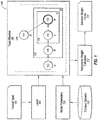
- Figure 1 illustrates a diagram of an example text emotion detection system 100.
- the system 100 may include a textual input 102.
- the textual input 102 may include one or more phrases, sentences, paragraphs, and/or documents or the like or any combination thereof.
- the textual input 102 may include test data.
- the system 100 may include a lexer 104, which may include a lexical processor.
- the lexer 104 may receive the textual input 102.
- the lexer 104 may perform spelling correction on the textual input 102.
- the lexer 104 may remove stop words of the textual input 102.
- the stop words may include function/structure words, conjunctions, prepositions, articles, or the like or any combination thereof.
- the lexer 104 may generate a clean text based on the textual input 102.
- the clean text may be submitted to a topic modeler 106 of the system 100.
- the topic modeler 106 may perform LDA on the textual input 102 and/or on the clean text from the lexer 104.
- the topic modeler 106 may alternately or additionally perform other topic modeling configured to generate topics and/or top words associated with the textual input 102.
- the LDA performed by the topic modeler 106 may be based at least in part on model parameters 108.
- the model parameters 108 may include a vocabulary based on emotion synonym sets (synsets) of an emotion synsets database 110.
- the emotion synsets 110 may be generated by identifying word sets of synonyms for each emotion of a set of emotions.
- emotions may include “love,” “hate,” “happy,” “angry,” “surprise,” “sad,” “scared,” “optimistic,” “pessimistic,” “interested,” “uninterested,” worried,” “lonely,” or the like or any combination thereof.
- a synset for “happy” may include “happy,” “joy,” “delight,” “bliss,” “glad,” “thrilled,” “elated,” “merry,” “jubilant,” “pleased,” “ecstatic,” “joyous,” or the like or any combination thereof.
- a synset for “love” may include “love,” “affection,” “attachment,” “adore,” “fondness,” “amity,” “liking,” “warmth,” “fondle,” or the like or any combination thereof.
- the model parameters 108 may further include a number of iterations to be performed by the topic modeler 106, a number of topics to be identified by the topic modeler 106, Bayesian hyperparameters, such as a hyperparameter for topic proportions, or the like or any combination thereof.
- the model parameters 108 may be used to configure the LDA and/or other topic modeling to be performed by the topic modeler 106.
- the topic modeler 106 may perform LDA.
- the LDA may automatically discover topics of the textual input 102 and/or the clean text from the lexer 104.
- a topic mixture for the textual input 102 may be selected.
- the topic mixture may be selected according to a prior Dirichlet distribution over a fixed set of K topics. By way of example, if two topics are selected, the textual input 102 may be selected to consist of 50% of each topic.
- the LDA may generate each word in the textual input 102 and/or the clean text from the lexer 104 by selecting a topic. For example, a first topic with 50% probability may be selected. The topic may then be used to generate the word itself according to the first topic's distribution. By way of example, the first topic may output the word "worried" with 40% probability, or the like. Where such a generative model may be employed for a collection of documents, the LDA and/or other topic modeling may backtrack from the documents to identify a set of topics associated with the collection of documents.
- the LDA may be represented by an LDA plate notation diagram 120.
- Documents such as the textual input 102 and/or the clean text generated by the lexer 104 from the textual input 102 may be represented as random mixtures over latent topics. Each topic may be characterized by a distribution over words.
- Parameter ⁇ 122 may represent a parameter of the Dirichlet prior on per-document topic distributions.
- Parameter ⁇ 134 may represent a parameter of the Dirichlet prior on per-topic word distribution.
- Parameter ⁇ _ i 126, located on outermost plate 124, may represent topic distribution for document i.
- Parameter M may represent a number of documents.
- Parameter z _ ij 130 located on innermost plate 128, may represent the topic for the j -th word in document i.
- Parameter w _ ij 132 may represent the j -th word in document i .
- Parameter N may represent a number of words.
- the LDA may employ a generative process for a corpus including M documents each having a length of N_i .
- the parameter ⁇ _ i may be chosen so ⁇ _ i ⁇ Dir( ⁇ ), where i ⁇ ⁇ 1, 2, ... M ⁇ and Dir( ⁇ ) represents the Dirichlet distribution for the parameter ⁇ .
- a topic z_ij may be chosen so z_ij ⁇ Multinomial ( ⁇ _ i )
- a word w_ij may be chosen so w_ij ⁇ Multinomial ( ⁇ _k ).
- Parameter ⁇ _k may represent a word distribution for topic k.
- the parameter ⁇ _k may be chosen so ⁇ _k ⁇ Dir( ⁇ ).
- the various parameters may be a problem of Bayesian inference and may be solved via collapsed Gibbs sampling.
- Collapsed Gibbs sampler may integrate out one or more of the variables when sampling for some other variable.
- a model may include three variables A, B, and C .
- a simple Gibbs sampler may sample from p (A
- a collapsed Gibbs sampler may replace the sampling of A with a sample taken from the marginal distribution p (A
- the topic modeler 106 may receive the following sentences, which may be included in the textual input 102.
- the topic modeler 106 may further receive instructions, which may be received via the model parameters 108, to identify three topics from the sentences.
- the topic modeler 106 may employ LDA and may generate the following sentence-to-topic mapping.
- topic modeler 106 and the employed LDA may generate the following topics, which may list the top words arranged according to a relative ranking of the top words for each of the topics.
- the top words for topic 1 may be “stressed,” “rest,” and “relaxation,” where “stressed” may have a rank of first, “rest” may have a rank of second, and “relaxation” may have a rank of third.
- the top words for topic 2 may be "tired” and “shower” and the top words for topic 3 may be “bored” and "worry.”
- the top words of topics 2 and/or 3 may be ranked in a manner similar to the top words of topic 1.
- the system 100 may include a relevance weight calculator 112.
- the relevance weight calculator 112 may receive the top words for various topics from the topic modeler 106. The top words received by the relevance weight calculator 112 may be ranked. The relevance weight calculator 112 may weigh the top words based on the relevance of the top words to emotions to generate an emotion weight vector 114.
- the emotion weight vector 114 may describe the emotions of the textual input 102. Furthermore, the emotion weight vector 114 may describe the emotions of the textual input 102 more accurately than LDA may alone.
- the emotion weight vector 114 may include a normalized emotion weight vector, which may represent normalized proportions of the emotions associated with the textual input 102.
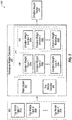
- FIG 2 illustrates a diagram of an emotion weight vector calculator 200.
- the emotion weight vector calculator 200 may include a relevance weight calculator 203, which may generally correspond to the relevance weight calculator 112 of Figure 1 .
- the relevance weight calculator 203 may include a rank scaler 204 and a top words counter 206.
- the relevance weight calculator 203 may receive top words 202 associated with a textual input, which may generally correspond to the textual input 102 of Figure 1 .
- the top words 202 may generally correspond to top words output by the topic modeler 106 of Figure 1 .
- Multiple topics may be associated with the textual input.
- the top words 202 may include top words 202a associated with a first topic, top words 202b for a second topic, through top words 202c for a K -th topic.
- the top words 202c for the K -th topic may be represented by the set T_K according to the following equation.
- T K t K 1 , t K 2 , ... , t K r
- t i _K represents the i -th top word in the K -th topic.
- the number of top words of the topic K common with the full emotion vocabulary may be represented by N_K .
- the number of top words common with the emotion E in the vocabulary may be represented by N E _K .
- having relatively more words associated with a particular topic may indicate that the particular topic may be relatively more relevant.
- the relevance weight calculator 203 may assign scalars to individual top words of a topic.
- the scalars may be assigned in an inverse manner represented by the following equation.
- Scalar t K j 1 j ⁇ N K
- j may be represented according to the following expression such that a relatively higher rank word may be assigned a relatively higher scalar and thus, for example, a relatively higher weight.
- j ⁇ 1 , 2 , ... N K
- a highest top word may be assigned a scalar of N _ K
- a second-highest top word may be assigned a scalar of 1/2 N _ K
- a third-highest top word may be assigned a scalar of 1/3 N _ K
- N_K as a scalar base
- a highest top word may be assigned a scalar of 1
- a second-highest top word may be assigned a scalar of 1/2
- a third-highest top word may be assigned a scalar of 1/3, and so on.
- the relevance weight calculator 203 may calculate emotion weights by topic 208.
- the relevance weight calculator 203 may calculate weights associated with an emotion E, which may be represented by w E _K according to the following equation.
- w K E ⁇ j Scalar t K j Where the summation over j may be from 1 to N E _K .
- the emotion weights by topic 208 may include an emotion weight associated with the first topic 208a, an emotion weight associated with the second topic 208b, through an emotion weight associated with a K -th topic 208c.
- the relevance weight calculator 203 may calculate emotion weights by emotion 209.
- the relevance weight calculator 203 may calculate a net weight associated with an emotion E across all K topics, which may be represented by E_w .
- the emotion weights by emotion 209 may include an emotion weight associated with a first emotion 209a, an emotion weight associated with a second emotion 209b, through an emotion weight associated with an S -th emotion 209c, where S may represent a total number of emotion states being considered.
- the emotion weights by topic 208 and the emotion weights by emotion 209 may be described generally as emotion weights 211.
- the relevance weight calculator 203 may further calculate a normalized emotion weight vector 210, represented by D_v , according to the following equation.
- the normalized emotion weight vector 210 may generally correspond to the emotion weight vector 114 of Figure 1 .
- the relevance weight calculator 203 may output the emotion weight vector 210. Alternately or additionally, the relevance weight calculator 203 may output the emotion weights by emotion 209 and/or the emotion weights by topic 208.
- Figure 3 illustrates an example text emotion detection process 300.
- the process 300 may generate an emotion weight vector 312 from a textual input 302.
- the textual input 302 may generally correspond to the textual input 102 of Figure 1 .
- the textual input 302 may include the following text: "I'm feeling like I have no direction and I'm confused about what to do with my career. I'm also anxious and feel like I have nothing to offer, so it's hard for me to get motivated.”
- the textual input 302 may be received by a lexer 303.
- the lexer may generally correspond to the lexer 104 of Figure 1 .
- the lexer 303 may generate a clean text 305 from the textual input 302.
- the clean text may include the following text: "feeling like direction confused career also anxious feel like nothing offer hard get motivated.”
- the clean text 305 may be received by a topic modeler 304.
- the topic modeler 304 may generally correspond to the topic modeler 106 of Figure 1 .
- the topic modeler 304 may employ a LDA topic modeler.
- the topic modeler 304 may generate top words 306 from the textual input 302. For example, the topic modeler 304 may generate top words associated with a first topic 306a and top words associated with a second topic 306b.
- the top words associated with the first topic 306a may include the following words: "feeling, direction, confused career.”
- the top words associated with the second topic 306b may include the following words: "anxious, feeling, like, direction.”
- the topic modeler 304 may generate document-to-topic mapping and/or sentence-to-topic mapping for the clean text 305 and/or the textual input 302.
- the top words 306 may be received by a relevance weight calculator 308.
- the relevance weight calculator 308 may generally correspond to the relevance weight calculator 112 of Figure 1 and the relevance weight calculator 203 of Figure 2 .
- the relevance weight calculator 308 may generate emotion weights by emotion 310 for emotions in each of the first and second topics. For example, the relevance weight calculator 308 may generate an emotion weight 310a of 0.1 for the emotion "sad” and an emotion weight 310b of 0.333 for the emotion " concerned. " In this and other embodiments, the emotion weights by emotion 310 may be calculated via the above equations 1-5.
- the relevance weight calculator 308 may calculate the emotion weight vector 312 from the emotion weights 310. For example, the relevance weight calculator 308 may calculate the emotion weight vector 312 via the above equation 6. The relevance weight calculator 308 may output the emotion weight vector 312.
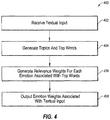
- Figure 4 is a flowchart of an example method 400.
- the method 400 may begin at block 402 by receiving a textual input.
- the textual input may generally correspond to the textual input 102 of Figure 1 and/or the textual input 302 of Figure 3 .
- the method 400 may continue to block 404 by generating topics and top words.
- the topics may be associated with the received textual input.
- the top words may be associated with each of the topics.
- the top words associated with each of the topics may be arranged according to a ranking of the top words.
- the top words may generally correspond to the top words 202 of Figure 2 and/or the top words 306 of Figure 3 .
- the topics and/or the top words may be generated by a topic modeler generally corresponding to the topic modeler 106 of Figure 1 and/or the topic modeler 304 of Figure 3 .
- the topics and top words may be generated by way of LDA topic modeling.
- the LDA topic modeling may be performed according to model parameters, which may generally correspond to the model parameters 108 of Figure 1 .
- the model parameters may include a vocabulary.
- the vocabulary may be based on emotion synsets, which may generally correspond to the emotion synsets 110 of Figure 1 .
- the model parameters may include a number of topics for the LDA to identify.
- the method 400 may continue to block 406 by generating relevance weights for each emotion associated with the top words.
- generating the relevance weights may include assigning a scalar to each of the top words according to a relative rank of the top word.
- generating the relevance weights may include calculating emotion weights by topic, which may generally correspond to the emotion weights by topic 208 of Figure 2 .
- the emotion weights by topic may be calculated based on the scalars assigned to the top words.
- generating the relevance weights may include calculating emotion weights by emotion, which may generally correspond to the emotion weights by emotion 209 of Figure 2 .
- the emotion weights by emotion may be calculated based on the emotion weights by topic.
- the method 400 may continue to block 408 by outputting emotion weights associated with the textual input.
- the emotion weights may be based on the relevance weights.
- the emotion weights may include the emotion weights by emotion.
- the method 400 may further include generating a normalized emotion weight vector, which may generally correspond to the emotion weight vector 114 of Figure 1 , the normalized emotion weight vector 210 of Figure 2 , and/or the emotion weight vector 312 of Figure 3 .
- the output emotion weights may include the normalized emotion weight vector.
- the method 400 may alternately or additionally include performing lexical processing on the textual input to generate a clean text associated with the textual input.
- Figure 5 illustrates a diagram of an example computing device 500.
- the computing device 500 may be arranged to detect textual emotion in accordance with the present disclosure.
- the computing device 500 may be one example of an embodiment of the system 100 of Figure 1 and/or an embodiment of the emotion weight vector calculator 200 of Figure 2 .
- the computing device 500 typically includes one or more processors 504 and a system memory 506.
- a memory bus 508 may be used for communicating between the processor 504 and the system memory 506.
- the processor 504 may be of any type including but not limited to a microprocessor ( ⁇ P), a microcontroller ( ⁇ C), a digital signal processor (DSP), or any combination thereof.
- the processor 504 may include one more levels of caching, such as a level one cache 510 and a level two cache 512, a processor core 514, and registers 516.
- An example processor core 514 may include an arithmetic logic unit (ALU), a floating point unit (FPU), a digital signal processing core (DSP Core), or any combination thereof.
- An example memory controller 518 may also be used with the processor 504, or in some implementations the memory controller 518 may be an internal part of the processor 504.
- the system memory 506 may be of any type including but not limited to volatile memory, such as Random Access Memory (RAM); non-volatile memory, such as Read Only Memory (ROM), flash memory, etc.; or any combination thereof.
- the system memory 506 may include an operating system 520, one or more applications 522, and program data 524.
- the application 522 may include a text emotion detection algorithm 526 that may be arranged to perform the functions as described herein including those described with respect to the system 100 of Figure 1 , the emotion weight vector calculator 200 of Figure 2 , the process 300 of Figure 3 , and the method 400 of Figure 4 .
- the program data 524 may include text/emotion data 528 such as may be included in the textual input 102, model parameters 108, emotion synsets 110, and/or emotion weight vector 114 of Figure 1 ; the top words 202, emotion weights by topic 208, emotion weights by emotion 209, and/or the normalized emotion weight vector 210 of Figure 2 ; and/or the textual input 302, clean text 305, top words 306, emotion weights 310, and/or emotion weight vector 312 of Figure 3 and that may be useful for operation with the text emotion detection algorithm 526 as is described herein.
- the application 522 may be arranged to operate with the program data 524 on the operating system 520 such that textual emotion detection may be provided as described herein.
- the computing device 500 may have additional features or functionality, and additional interfaces to facilitate communications between the basic configuration 502 and other devices and interfaces.
- a bus/interface controller 530 may be used to facilitate communications between the basic configuration 502 and one or more data storage devices 532 via a storage interface bus 534.
- the data storage devices 532 may be removable storage devices 536, non-removable storage devices 538, or a combination thereof.
- Examples of removable storage and non-removable storage devices include magnetic disk devices such as flexible disk drives and hard-disk drives (HDD), optical disk drives such as compact disk (CD) drives or digital versatile disk (DVD) drives, solid state drives (SSD), and tape drives to name a few.
- Example computer storage media may include volatile and nonvolatile, removable and non-removable media implemented in any method or technology for storage of information, such as computer readable instructions, data structures, program modules, or other data.
- Computer storage media includes, but is not limited to, RAM, ROM, Electronically Erasable and Programmable Read Only Memory (EEPROM), flash memory or other memory technology, Compact Disc-Read Only Memory (CD-ROM), digital versatile disks (DVD) or other optical storage, magnetic cassettes, magnetic tape, magnetic disk storage or other magnetic storage devices, or any other medium which may be used to store the desired information and which may be accessed by computing device 500. Any such computer storage media may be part of computing device 500.
- Computing device 500 may also include an interface bus 540 for facilitating communication from various interface devices (e.g., output devices 542, peripheral interfaces 544, and communication devices 546) to the basic configuration 502 via the bus/interface controller 530.
- Example output devices 542 include a graphics processing unit 548 and an audio processing unit 550, which may be configured to communicate to various external devices such as a display or speakers via one or more A/V ports 552.
- Example peripheral interfaces 544 include a serial interface controller 554 or a parallel interface controller 556, which may be configured to communicate with external devices such as input devices (e.g., keyboard, mouse, pen, voice input device, touch input device, etc.) or other peripheral devices (e.g., printer, scanner, etc.) via one or more input/output (I/O) ports 558.
- An example communication device 546 includes a network controller 560, which may be arranged to facilitate communications with one or more other computing devices 562 over a network communication link via one or more communication ports 564.
- the network communication link may be one example of a communication media.
- Communication media may typically be embodied by computer readable instructions, data structures, program modules, or other data in a modulated data signal, such as a carrier wave or other transport mechanism, and may include any information delivery media.
- a "modulated data signal" may be a signal that has one or more of its characteristics set or changed in such a manner as to encode information in the signal.
- communication media may include wired media such as a wired network or direct-wired connection, and wireless media such as acoustic, radio frequency (RF), microwave, infrared (IR) and other wireless media.
- RF radio frequency
- IR infrared
- the term computer readable media as used herein may include both storage media and communication media.
- the computing device 500 may be implemented as a portion of a small-form factor portable (or mobile) electronic device such as a cell phone, a tablet computer, a smartphone, a smartwatch, smart glasses, a personal data assistant (PDA), a personal media player device, a wireless web-watch device, a personal headset device, an application specific device, or a hybrid device that include any of the above functions.
- a small-form factor portable (or mobile) electronic device such as a cell phone, a tablet computer, a smartphone, a smartwatch, smart glasses, a personal data assistant (PDA), a personal media player device, a wireless web-watch device, a personal headset device, an application specific device, or a hybrid device that include any of the above functions.
- PDA personal data assistant
- the computing device 500 may also be implemented as a personal computer including both laptop computer and non-laptop computer configurations.
- modeler may refer to specific hardware implementations configured to perform the operations of the modules and/or software objects or software routines that may be stored on and/or executed by the computing device 500.
- the different modules described herein may be implemented as a part of the application 522 and/or the text emotion detection algorithm 526.
- the lexer 104, the topic modeler 106, and/or the relevance weight calculator 112 of Figure 1 ; the relevance weight calculator 203, the rank scaler 204, and/or the top words counter 206 of Figure 2 ; and/or the lexer 303, the topic modeler 304, and/or the relevance weight calculator 308 of Figure 3 may be implemented by computer-executable instructions stored in the system memory 506 and executed by the processor 504. While some of the system and methods described herein are generally described as being implemented in software, specific hardware implementations or a combination of software and specific hardware implementations are also possible and contemplated.
- the invention also provides a computer program or a computer program product for carrying out any of the methods described herein, and a computer readable medium having stored thereon a program for carrying out any of the methods described herein.
- a computer program embodying the invention maybe stored on a computer-readable medium, or it could, for example, be in the form of a signal such as a downloadable data signal provided from an Internet website, or it could be in any other form.
Landscapes
- Engineering & Computer Science (AREA)
- Theoretical Computer Science (AREA)
- Physics & Mathematics (AREA)
- General Physics & Mathematics (AREA)
- General Engineering & Computer Science (AREA)
- Data Mining & Analysis (AREA)
- Computational Linguistics (AREA)
- Artificial Intelligence (AREA)
- Databases & Information Systems (AREA)
- General Health & Medical Sciences (AREA)
- Audiology, Speech & Language Pathology (AREA)
- Health & Medical Sciences (AREA)
- Software Systems (AREA)
- Computing Systems (AREA)
- Mathematical Physics (AREA)
- Evolutionary Computation (AREA)
- Computational Mathematics (AREA)
- Algebra (AREA)
- Probability & Statistics with Applications (AREA)
- Mathematical Analysis (AREA)
- Pure & Applied Mathematics (AREA)
- Mathematical Optimization (AREA)
- Machine Translation (AREA)
- Information Retrieval, Db Structures And Fs Structures Therefor (AREA)
Abstract
Description
- The embodiments discussed herein are related to textual emotion detection.
- Textual emotion detection systems may be designed to infer the underlying emotion associated with a text. Such systems may be employed in sentiment analysis, computer-assisted creativity, text-to-speech generation, human-computer interactions, and the like. Some conventional textual emotion detection systems may employ a keyword spotting technique. Keyword spotting techniques may include finding occurrences of predefined keywords within a text. The predefined keywords may be pre-associated with particular emotions. Thus, for example, a text may be associated with an emotion should a keyword associated with the emotion be found in the text. The keyword spotting may include word-based, line-based, and document-based keyword spotting.
- In an example keyword spotting process, a textual input may be tokenized. Emotion words may be detected by matching the resulting tokens against a predefined set of words. The identified emotion words may be analyzed for their intensity. Furthermore, a negation check may determine whether a negative (e.g., "not") is present in the text and an emotion class may be output.
- In a modified approach, which may be described as a lexical affinity technique, a probabilistic affinity may be assigned to arbitrary words rather than detecting pre-defined emotional keywords. The probabilities may be assigned based on linguistic corpora.
- The subject matter claimed herein is not limited to embodiments that solve any disadvantages or that operate only in environments such as those described above. Rather, this background is only provided to illustrate one example technology area where some embodiments described herein may be practiced.
- According to an aspect of an embodiment, a method may include receiving a textual input. Topics associated with the textual input and top words associated with each of the topics may be generated by way of Latent Dirichlet Allocation (LDA) topic modeling. Relevance weights may be generated for each emotion associated with the topics generated by the LDA topic modeling. Emotion weights associated with the textual input may be output. The emotion weights may be based, at least in part, on the relevance weights.
- The object and advantages of the embodiments will be realized and achieved at least by the elements, features, and combinations particularly pointed out in the claims.
- Both the foregoing general description and the following detailed description are exemplary and explanatory and are not restrictive of the claims.
- Example embodiments will be described and explained with additional specificity and detail through the use of the accompanying drawings.
-
Figure 1 illustrates a diagram of an example text emotion detection system. -
Figure 2 illustrates a diagram of an emotion weight vector calculator. -
Figure 3 illustrates an example text emotion detection process. -
Figure 4 is a flowchart of an example method. -
Figure 5 illustrates a diagram of an example computing device. - Keywords spotting- and/or lexical affinity-based textual emotion detection may fix keywords with certain pre-defined, static meanings that may resist dynamic alterations based on context. For example, the word "accident" may be assigned a high probability of indicating a negative emotion, but may not contribute correctly to an emotional assessment of a phrase such as "the new element was discovered by accident," which may be associated with a negative emotion although it may actually convey a positive emotion. Keywords may have multiple meanings that may depend on the context in which the keywords are used. The keywords spotting- and/or lexical affinity-based textual emotion detection may not consider linguistic information, such as syntax structure and/or semantics that may influence the emotion of the text. For example, the phrases "John laughed at him" and "he laughed at John" may convey different emotions from a reader's perspective. Alternately or additionally, lexical affinity-based textual emotion detection may be biased towards the corpus-specific information. That is, the probabilities assigned to the words may be dependent on the corpus.
- Learning-based textual emotion detection may include supervised methods employing training classifiers on a corpus of data, described as "training data." Based on the training, emotions may be recognized in new data, described as "test data." Support vector machines (SVM) or decision trees may be employed. For example, a conventional SVM-based approach may employ word features, punctuation features, and emotion lexicon features for multi-class emotion classification. Other conventional approaches may include the use of hidden Markov models or the use of latent semantic analysis. Such approaches may lack sufficient emotion detection features, which may result in relatively poor emotion associations.
- Embodiments described herein may include textual emotion detection systems and methods that may rank words of a text in proportion to their relevance to an emotion and a topic or content. The textual emotion detection may facilitate automatic and unsupervised identification of the top words in a text excerpt. For example, embodiments may facilitate automatic estimations of underlying emotion independent of system training via emotion-specific information or content. Some embodiments may employ some portions of Latent Dirichlet Allocation (LDA) based topic modeling in identifying the top words of the text excerpt.
- The textual emotion detection may be context-sensitive. For example, the relative relevance of the topics of a text may be identified. Alternately or additionally, the top words of the text may be ranked with respect to relevance to a topic, the context, and/or an emotion.
- Embodiments may facilitate relatively improved emotion detection accuracy relative to conventional systems. That is, embodiments may offer improvements in the technological area of textual emotion detection, as well as sentiment analysis, computer-assisted creativity technologies, text-to-speech generation technologies, human-computer interaction technologies, machine-translation technologies, document search technologies, or the like.
- By way of example, and not of limitation, embodiments may be employed in applications such as virtual assistants, patient treatment, social behavior analysis, or the like. Virtual assistants may employ embodiments described herein to create emotionally intelligent virtual assistants or agents. Patient treatment systems may employ embodiments described herein to facilitate understanding of patients' emotional well-being in developing and implementing treatment plans. The emotional states identified by textual emotion detection systems may be influenced in part on the system application.
- Embodiments will be explained with reference to the accompanying drawings.
-
Figure 1 illustrates a diagram of an example textemotion detection system 100. Thesystem 100 may include atextual input 102. Thetextual input 102 may include one or more phrases, sentences, paragraphs, and/or documents or the like or any combination thereof. Thetextual input 102 may include test data. - The
system 100 may include alexer 104, which may include a lexical processor. Thelexer 104 may receive thetextual input 102. In some embodiments, thelexer 104 may perform spelling correction on thetextual input 102. Alternately or additionally, thelexer 104 may remove stop words of thetextual input 102. The stop words may include function/structure words, conjunctions, prepositions, articles, or the like or any combination thereof. - Thus, for example, the
lexer 104 may generate a clean text based on thetextual input 102. The clean text may be submitted to atopic modeler 106 of thesystem 100. In some embodiments, thetopic modeler 106 may perform LDA on thetextual input 102 and/or on the clean text from thelexer 104. The topic modeler 106 may alternately or additionally perform other topic modeling configured to generate topics and/or top words associated with thetextual input 102. - In some embodiments, the LDA performed by the
topic modeler 106 may be based at least in part onmodel parameters 108. Themodel parameters 108 may include a vocabulary based on emotion synonym sets (synsets) of anemotion synsets database 110. - The emotion synsets 110 may be generated by identifying word sets of synonyms for each emotion of a set of emotions. By way of example, emotions may include "love," "hate," "happy," "angry," "surprise," "sad," "scared," "optimistic," "pessimistic," "interested," "uninterested," worried," "lonely," or the like or any combination thereof. By way of further example, a synset for "happy" may include "happy," "joy," "delight," "bliss," "glad," "thrilled," "elated," "merry," "jubilant," "pleased," "ecstatic," "joyous," or the like or any combination thereof. By way of yet further example, a synset for "love" may include "love," "affection," "attachment," "adore," "fondness," "amity," "liking," "warmth," "fondle," or the like or any combination thereof.
- The
model parameters 108 may further include a number of iterations to be performed by thetopic modeler 106, a number of topics to be identified by thetopic modeler 106, Bayesian hyperparameters, such as a hyperparameter for topic proportions, or the like or any combination thereof. Themodel parameters 108 may be used to configure the LDA and/or other topic modeling to be performed by thetopic modeler 106. - In some embodiments, the
topic modeler 106 may perform LDA. The LDA may automatically discover topics of thetextual input 102 and/or the clean text from thelexer 104. In some embodiments, a topic mixture for thetextual input 102 may be selected. The topic mixture may be selected according to a prior Dirichlet distribution over a fixed set of K topics. By way of example, if two topics are selected, thetextual input 102 may be selected to consist of 50% of each topic. - The LDA may generate each word in the
textual input 102 and/or the clean text from thelexer 104 by selecting a topic. For example, a first topic with 50% probability may be selected. The topic may then be used to generate the word itself according to the first topic's distribution. By way of example, the first topic may output the word "worried" with 40% probability, or the like. Where such a generative model may be employed for a collection of documents, the LDA and/or other topic modeling may backtrack from the documents to identify a set of topics associated with the collection of documents. - The LDA may be represented by an LDA plate notation diagram 120. Documents such as the
textual input 102 and/or the clean text generated by thelexer 104 from thetextual input 102 may be represented as random mixtures over latent topics. Each topic may be characterized by a distribution over words.Parameter α 122 may represent a parameter of the Dirichlet prior on per-document topic distributions.Parameter β 134 may represent a parameter of the Dirichlet prior on per-topic word distribution.Parameter θ_i 126, located onoutermost plate 124, may represent topic distribution for document i. Parameter M may represent a number of documents.Parameter z_ij 130, located oninnermost plate 128, may represent the topic for the j-th word in document i.Parameter w_ij 132 may represent the j-th word in document i. Parameter N may represent a number of words. - The LDA may employ a generative process for a corpus including M documents each having a length of N_i. The parameter θ_i may be chosen so θ_i ∼ Dir(α), where i ∈ {1, 2, ... M} and Dir(α) represents the Dirichlet distribution for the parameter α. For each of the word positions, a topic z_ij may be chosen so z_ij ~ Multinomial (θ_i), and a word w_ij may be chosen so w_ij ∼ Multinomial (ϕ_k). Parameter ϕ_k may represent a word distribution for topic k. The parameter ϕ_k may be chosen so ϕ_k ∼ Dir(β).
- In some embodiments, the various parameters may be a problem of Bayesian inference and may be solved via collapsed Gibbs sampling. Collapsed Gibbs sampler may integrate out one or more of the variables when sampling for some other variable. For example, a model may include three variables A, B, and C. A simple Gibbs sampler may sample from p(A|B,C), then p(B|A,C), and then p(C|A,B). By way of example, a collapsed Gibbs sampler may replace the sampling of A with a sample taken from the marginal distribution p(A|C), where variable B may be integrated out in this case.
- By way of example, the
topic modeler 106 may receive the following sentences, which may be included in thetextual input 102. - Sentence 1: "John needs rest as he is stressed."
- Sentence 2: "It is common to get tired after a long day."
- Sentence 3: "There is no need to worry if bored."
- Sentence 4: "Try watching movie when bored."
- Sentence 5: "Try muscle relaxation when stressed."
- Sentence 6: "Take a shower when tired."
- The topic modeler 106 may further receive instructions, which may be received via the
model parameters 108, to identify three topics from the sentences. The topic modeler 106 may employ LDA and may generate the following sentence-to-topic mapping. - "
Sentence 1 is 100% topic 1." - "
Sentence 2 is 100% topic 2." - "Sentence 3 and 4 are 100% topic 3."
- "Sentence 5 is 75
% topic 1 and 25% topic 3." - "Sentence 6 is 100
% topic 2." - Furthermore, the
topic modeler 106 and the employed LDA may generate the following topics, which may list the top words arranged according to a relative ranking of the top words for each of the topics. - "
Topic 1 is about stressed, rest, relaxation." - "
Topic 2 is about tired, shower." - "Topic 3 is about bored, worry."
- Thus, for example, the top words for
topic 1 may be "stressed," "rest," and "relaxation," where "stressed" may have a rank of first, "rest" may have a rank of second, and "relaxation" may have a rank of third. The top words fortopic 2 may be "tired" and "shower" and the top words for topic 3 may be "bored" and "worry." The top words oftopics 2 and/or 3 may be ranked in a manner similar to the top words oftopic 1. - The
system 100 may include arelevance weight calculator 112. Therelevance weight calculator 112 may receive the top words for various topics from thetopic modeler 106. The top words received by therelevance weight calculator 112 may be ranked. Therelevance weight calculator 112 may weigh the top words based on the relevance of the top words to emotions to generate anemotion weight vector 114. Theemotion weight vector 114 may describe the emotions of thetextual input 102. Furthermore, theemotion weight vector 114 may describe the emotions of thetextual input 102 more accurately than LDA may alone. In some embodiments, theemotion weight vector 114 may include a normalized emotion weight vector, which may represent normalized proportions of the emotions associated with thetextual input 102. -
Figure 2 illustrates a diagram of an emotionweight vector calculator 200. The emotionweight vector calculator 200 may include arelevance weight calculator 203, which may generally correspond to therelevance weight calculator 112 ofFigure 1 . Therelevance weight calculator 203 may include arank scaler 204 and a top words counter 206. Therelevance weight calculator 203 may receivetop words 202 associated with a textual input, which may generally correspond to thetextual input 102 ofFigure 1 . - The
top words 202 may generally correspond to top words output by thetopic modeler 106 ofFigure 1 . Multiple topics may be associated with the textual input. For example, thetop words 202 may includetop words 202a associated with a first topic,top words 202b for a second topic, throughtop words 202c for a K-th topic. Thetop words 202c for the K-th topic may be represented by the set T_K according to the following equation.
- The
relevance weight calculator 203 may assign scalars to individual top words of a topic. In some embodiments, the scalars may be assigned in an inverse manner represented by the following equation.

- For example, a highest top word may be assigned a scalar of N_K, a second-highest top word may be assigned a scalar of 1/2 N_K, a third-highest top word may be assigned a scalar of 1/3 N_K, and so on. Employing N_K as a scalar base may encourage relatively higher combined and/or individual scalar values for top words associated with topics having relatively higher numbers of top words, which may correspond to topics associated with a relatively higher relevance. In some embodiments, other rank scales may be used. For example, a highest top word may be assigned a scalar of 1, a second-highest top word may be assigned a scalar of 1/2, a third-highest top word may be assigned a scalar of 1/3, and so on.
- The
relevance weight calculator 203 may calculate emotion weights bytopic 208. For example, therelevance weight calculator 203 may calculate weights associated with an emotion E, which may be represented by wE_K according to the following equation.
- By way of example, the emotion weights by
topic 208 may include an emotion weight associated with thefirst topic 208a, an emotion weight associated with thesecond topic 208b, through an emotion weight associated with a K-th topic 208c. - In this and other embodiments, the
relevance weight calculator 203 may calculate emotion weights byemotion 209. For example, therelevance weight calculator 203 may calculate a net weight associated with an emotion E across all K topics, which may be represented by E_w. The emotion weights byemotion 209 may be calculated according to the following equation.
- By way of example, the emotion weights by
emotion 209 may include an emotion weight associated with afirst emotion 209a, an emotion weight associated with asecond emotion 209b, through an emotion weight associated with an S-th emotion 209c, where S may represent a total number of emotion states being considered. The emotion weights bytopic 208 and the emotion weights byemotion 209 may be described generally asemotion weights 211. - The
relevance weight calculator 203 may further calculate a normalizedemotion weight vector 210, represented by D_v, according to the following equation.
emotion weight vector 210 may generally correspond to theemotion weight vector 114 ofFigure 1 . Therelevance weight calculator 203 may output theemotion weight vector 210. Alternately or additionally, therelevance weight calculator 203 may output the emotion weights byemotion 209 and/or the emotion weights bytopic 208. -
Figure 3 illustrates an example textemotion detection process 300. Theprocess 300 may generate anemotion weight vector 312 from atextual input 302. Thetextual input 302 may generally correspond to thetextual input 102 ofFigure 1 . By way of example, thetextual input 302 may include the following text: "I'm feeling like I have no direction and I'm confused about what to do with my career. I'm also anxious and feel like I have nothing to offer, so it's hard for me to get motivated." - The
textual input 302 may be received by alexer 303. The lexer may generally correspond to thelexer 104 ofFigure 1 . Thelexer 303 may generate aclean text 305 from thetextual input 302. By way of example, the clean text may include the following text: "feeling like direction confused career also anxious feel like nothing offer hard get motivated." - The
clean text 305 may be received by atopic modeler 304. The topic modeler 304 may generally correspond to thetopic modeler 106 ofFigure 1 . The topic modeler 304 may employ a LDA topic modeler. The topic modeler 304 may generatetop words 306 from thetextual input 302. For example, thetopic modeler 304 may generate top words associated with afirst topic 306a and top words associated with a second topic 306b. By way of example, the top words associated with thefirst topic 306a may include the following words: "feeling, direction, confused career." The top words associated with the second topic 306b may include the following words: "anxious, feeling, like, direction." Alternately or additionally, thetopic modeler 304 may generate document-to-topic mapping and/or sentence-to-topic mapping for theclean text 305 and/or thetextual input 302. - The
top words 306 may be received by arelevance weight calculator 308. Therelevance weight calculator 308 may generally correspond to therelevance weight calculator 112 ofFigure 1 and therelevance weight calculator 203 ofFigure 2 . Therelevance weight calculator 308 may generate emotion weights byemotion 310 for emotions in each of the first and second topics. For example, therelevance weight calculator 308 may generate anemotion weight 310a of 0.1 for the emotion "sad" and anemotion weight 310b of 0.333 for the emotion "worried." In this and other embodiments, the emotion weights byemotion 310 may be calculated via the above equations 1-5. - The
relevance weight calculator 308 may calculate theemotion weight vector 312 from theemotion weights 310. For example, therelevance weight calculator 308 may calculate theemotion weight vector 312 via the above equation 6. Therelevance weight calculator 308 may output theemotion weight vector 312. -
Figure 4 is a flowchart of anexample method 400. Themethod 400 may begin atblock 402 by receiving a textual input. The textual input may generally correspond to thetextual input 102 ofFigure 1 and/or thetextual input 302 ofFigure 3 . - The
method 400 may continue to block 404 by generating topics and top words. The topics may be associated with the received textual input. The top words may be associated with each of the topics. In some embodiments, the top words associated with each of the topics may be arranged according to a ranking of the top words. The top words may generally correspond to thetop words 202 ofFigure 2 and/or thetop words 306 ofFigure 3 . In some embodiments, the topics and/or the top words may be generated by a topic modeler generally corresponding to thetopic modeler 106 ofFigure 1 and/or thetopic modeler 304 ofFigure 3 . - In some embodiments, the topics and top words may be generated by way of LDA topic modeling. In some embodiments, the LDA topic modeling may be performed according to model parameters, which may generally correspond to the
model parameters 108 ofFigure 1 . The model parameters may include a vocabulary. The vocabulary may be based on emotion synsets, which may generally correspond to theemotion synsets 110 ofFigure 1 . Alternately or additionally, the model parameters may include a number of topics for the LDA to identify. - The
method 400 may continue to block 406 by generating relevance weights for each emotion associated with the top words. In some embodiments, generating the relevance weights may include assigning a scalar to each of the top words according to a relative rank of the top word. Alternately or additionally, generating the relevance weights may include calculating emotion weights by topic, which may generally correspond to the emotion weights bytopic 208 ofFigure 2 . The emotion weights by topic may be calculated based on the scalars assigned to the top words. Alternately or additionally, generating the relevance weights may include calculating emotion weights by emotion, which may generally correspond to the emotion weights byemotion 209 ofFigure 2 . The emotion weights by emotion may be calculated based on the emotion weights by topic. - The
method 400 may continue to block 408 by outputting emotion weights associated with the textual input. The emotion weights may be based on the relevance weights. In some embodiments, the emotion weights may include the emotion weights by emotion. - For this and other processes and methods disclosed herein, the functions performed in the processes and methods may be implemented in differing order. Furthermore, the outlined operations are provided only as examples, and some of the operations may be optional, combined into fewer operations, or expanded into additional operations without detracting from the essence of the embodiments.
- For example, in some embodiments, the
method 400 may further include generating a normalized emotion weight vector, which may generally correspond to theemotion weight vector 114 ofFigure 1 , the normalizedemotion weight vector 210 ofFigure 2 , and/or theemotion weight vector 312 ofFigure 3 . In some embodiments, the output emotion weights may include the normalized emotion weight vector. - The
method 400 may alternately or additionally include performing lexical processing on the textual input to generate a clean text associated with the textual input. -
Figure 5 illustrates a diagram of anexample computing device 500. Thecomputing device 500 may be arranged to detect textual emotion in accordance with the present disclosure. Thecomputing device 500 may be one example of an embodiment of thesystem 100 ofFigure 1 and/or an embodiment of the emotionweight vector calculator 200 ofFigure 2 . In a configuration 502, thecomputing device 500 typically includes one ormore processors 504 and asystem memory 506. A memory bus 508 may be used for communicating between theprocessor 504 and thesystem memory 506. - Depending on the desired configuration, the
processor 504 may be of any type including but not limited to a microprocessor (µP), a microcontroller (µC), a digital signal processor (DSP), or any combination thereof. Theprocessor 504 may include one more levels of caching, such as a level onecache 510 and a level twocache 512, a processor core 514, and registers 516. An example processor core 514 may include an arithmetic logic unit (ALU), a floating point unit (FPU), a digital signal processing core (DSP Core), or any combination thereof. An example memory controller 518 may also be used with theprocessor 504, or in some implementations the memory controller 518 may be an internal part of theprocessor 504. - Depending on the desired configuration, the
system memory 506 may be of any type including but not limited to volatile memory, such as Random Access Memory (RAM); non-volatile memory, such as Read Only Memory (ROM), flash memory, etc.; or any combination thereof. Thesystem memory 506 may include anoperating system 520, one ormore applications 522, andprogram data 524. Theapplication 522 may include a textemotion detection algorithm 526 that may be arranged to perform the functions as described herein including those described with respect to thesystem 100 ofFigure 1 , the emotionweight vector calculator 200 ofFigure 2 , theprocess 300 ofFigure 3 , and themethod 400 ofFigure 4 . Theprogram data 524 may include text/emotion data 528 such as may be included in thetextual input 102,model parameters 108,emotion synsets 110, and/oremotion weight vector 114 ofFigure 1 ; thetop words 202, emotion weights bytopic 208, emotion weights byemotion 209, and/or the normalizedemotion weight vector 210 ofFigure 2 ; and/or thetextual input 302,clean text 305,top words 306,emotion weights 310, and/oremotion weight vector 312 ofFigure 3 and that may be useful for operation with the textemotion detection algorithm 526 as is described herein. In some embodiments, theapplication 522 may be arranged to operate with theprogram data 524 on theoperating system 520 such that textual emotion detection may be provided as described herein. - The
computing device 500 may have additional features or functionality, and additional interfaces to facilitate communications between the basic configuration 502 and other devices and interfaces. For example, a bus/interface controller 530 may be used to facilitate communications between the basic configuration 502 and one or moredata storage devices 532 via a storage interface bus 534. Thedata storage devices 532 may beremovable storage devices 536,non-removable storage devices 538, or a combination thereof. Examples of removable storage and non-removable storage devices include magnetic disk devices such as flexible disk drives and hard-disk drives (HDD), optical disk drives such as compact disk (CD) drives or digital versatile disk (DVD) drives, solid state drives (SSD), and tape drives to name a few. Example computer storage media may include volatile and nonvolatile, removable and non-removable media implemented in any method or technology for storage of information, such as computer readable instructions, data structures, program modules, or other data. - The
system memory 506, theremovable storage devices 536, and thenon-removable storage devices 538 are examples of computer storage media. Computer storage media includes, but is not limited to, RAM, ROM, Electronically Erasable and Programmable Read Only Memory (EEPROM), flash memory or other memory technology, Compact Disc-Read Only Memory (CD-ROM), digital versatile disks (DVD) or other optical storage, magnetic cassettes, magnetic tape, magnetic disk storage or other magnetic storage devices, or any other medium which may be used to store the desired information and which may be accessed by computingdevice 500. Any such computer storage media may be part ofcomputing device 500. -
Computing device 500 may also include an interface bus 540 for facilitating communication from various interface devices (e.g.,output devices 542,peripheral interfaces 544, and communication devices 546) to the basic configuration 502 via the bus/interface controller 530.Example output devices 542 include agraphics processing unit 548 and anaudio processing unit 550, which may be configured to communicate to various external devices such as a display or speakers via one or more A/V ports 552. Exampleperipheral interfaces 544 include aserial interface controller 554 or aparallel interface controller 556, which may be configured to communicate with external devices such as input devices (e.g., keyboard, mouse, pen, voice input device, touch input device, etc.) or other peripheral devices (e.g., printer, scanner, etc.) via one or more input/output (I/O)ports 558. Anexample communication device 546 includes anetwork controller 560, which may be arranged to facilitate communications with one or more other computing devices 562 over a network communication link via one ormore communication ports 564. - The network communication link may be one example of a communication media. Communication media may typically be embodied by computer readable instructions, data structures, program modules, or other data in a modulated data signal, such as a carrier wave or other transport mechanism, and may include any information delivery media. A "modulated data signal" may be a signal that has one or more of its characteristics set or changed in such a manner as to encode information in the signal. By way of example, and not limitation, communication media may include wired media such as a wired network or direct-wired connection, and wireless media such as acoustic, radio frequency (RF), microwave, infrared (IR) and other wireless media. The term computer readable media as used herein may include both storage media and communication media.
- The
computing device 500 may be implemented as a portion of a small-form factor portable (or mobile) electronic device such as a cell phone, a tablet computer, a smartphone, a smartwatch, smart glasses, a personal data assistant (PDA), a personal media player device, a wireless web-watch device, a personal headset device, an application specific device, or a hybrid device that include any of the above functions. Thecomputing device 500 may also be implemented as a personal computer including both laptop computer and non-laptop computer configurations. - As used herein, the terms "modeler," "lexer," "calculator," "scaler" and/or "counter" (collectively, "modules") may refer to specific hardware implementations configured to perform the operations of the modules and/or software objects or software routines that may be stored on and/or executed by the
computing device 500. In some embodiments, the different modules described herein may be implemented as a part of theapplication 522 and/or the textemotion detection algorithm 526. For example, thelexer 104, thetopic modeler 106, and/or therelevance weight calculator 112 ofFigure 1 ; therelevance weight calculator 203, therank scaler 204, and/or the top words counter 206 ofFigure 2 ; and/or thelexer 303, thetopic modeler 304, and/or therelevance weight calculator 308 ofFigure 3 may be implemented by computer-executable instructions stored in thesystem memory 506 and executed by theprocessor 504. While some of the system and methods described herein are generally described as being implemented in software, specific hardware implementations or a combination of software and specific hardware implementations are also possible and contemplated. - All examples and conditional language recited herein are intended for pedagogical objects to aid the reader in understanding the embodiments and the concepts contributed to furthering the art, and are to be construed as being without limitation to such specifically recited examples and conditions. Although embodiments have been described in detail, it should be understood that the various changes, substitutions, and alterations could be made hereto without departing from the scope of the embodiments.
- In any of the above aspects, the various features may be implemented in hardware, or as software modules running on one or more processors. Features of one aspect may be applied to any of the other aspects.
- The invention also provides a computer program or a computer program product for carrying out any of the methods described herein, and a computer readable medium having stored thereon a program for carrying out any of the methods described herein. A computer program embodying the invention maybe stored on a computer-readable medium, or it could, for example, be in the form of a signal such as a downloadable data signal provided from an Internet website, or it could be in any other form.
- The following statements are useful for understanding embodiments of the present invention.
- S1. A method comprising:
- receiving a textual input;
- generating, by way of Latent Dirichlet Allocation (LDA) topic modeling, topics associated with the textual input and top words associated with each of the topics;
- generating relevance weights for each emotion associated with the topics generated by the LDA topic modeling; and
- outputting emotion weights associated with the textual input, the emotion weights based, at least in part, on the relevance weights.
- S2. The method of
statement S 1, further comprising performing lexical processing on the textual input to generate a clean text associated with the textual input. - S3. The method of statement S1, wherein the LDA topic modeling is performed, at least in part, according to model parameters including a vocabulary based on emotion synonym sets (synsets) including word sets of synonyms associated with emotions of a set of emotions.
- S4. The method of statement S1, wherein the LDA topic modeling is performed, at least in part, according to model parameters including a number of topics for the LDA to identify.
- S5. The method of
statement S 1, wherein the top words associated with each of the topics are arranged according to a ranking of the top words and the generating the relevance weights includes assigning a scalar to each of the top words according to a relative rank of the top words. - S6. The method of statement S5, wherein the generating the relevance weights includes calculating emotion weights by topic based, at least in part, on the scalars assigned to the top words.
- S7. The method of statement S6, wherein the generating the relevance weights includes calculating emotion weights by emotion based, at least in part, on the emotion weights by topic, the output emotion weights including the emotion weights by emotion.
- S8. The method of statement S6, wherein the generating the relevance weights includes calculating emotion weights by emotion based, at least in part, on the emotion weights by topic, the method further comprising generating a normalized emotion weight vector representing normalized proportions of each emotion associated with the textual input, the normalized emotion weight vector based, at least in part, on the emotion weights by emotion, and wherein the output emotion weights include the normalized emotion weight vector.
- S9. A non-transitory computer-readable medium having encoded therein programing code executable by a processor to perform operations comprising:
- receiving a textual input;
- generating, by way of Latent Dirichlet Allocation (LDA) topic modeling, topics associated with the textual input and top words associated with each of the topics;
- generating relevance weights for each emotion associated with the topics generated by the LDA topic modeling; and
- outputting emotion weights associated with the textual input.
- S10. The computer-readable medium of statement S9, wherein the LDA topic modeling is performed, at least in part, according to model parameters including a vocabulary based on emotion synonym sets (synsets) including word sets of synonyms associated with emotions of a set of emotions.
- S11. The computer-readable medium of statement S9, wherein the LDA topic modeling is performed, at least in part, according to model parameters including a number of topics for the LDA to identify.
- S12. The computer-readable medium of statement S9, wherein the top words associated with each of the topics are arranged according to a ranking of the top words and the generating the relevance weights includes assigning a scalar to each of the top words according to a relative rank of the top words.
- S 13. The computer-readable medium of statement S12, wherein the generating the relevance weights includes calculating emotion weights by topic based, at least in part, on the scalars assigned to the top words.
- S 14. The computer-readable medium of statement S13, wherein the generating the relevance weights includes calculating emotion weights by emotion based, at least in part, on the emotion weights by topic, the output emotion weights including the emotion weights by emotion.
- S15. The computer-readable medium of statement S 13, wherein the generating the relevance weights includes calculating emotion weights by emotion based, at least in part, on the emotion weights by topic, the operations further comprising generating a normalized emotion weight vector representing normalized proportions of each emotion associated with the textual input, the normalized emotion weight vector based, at least in part, on the emotion weights by emotion, and wherein the output emotion weights include the normalized emotion weight vector.
- S16. A method comprising:
- receiving a textual input;
- generating topics associated with the textual input and top words associated with each of the topics;
- generating relevance weights for each emotion associated with the topics; and
- outputting emotion weights associated with the textual input, the emotion weights based, at least in part, on the relevance weights.
- S 17. The method of statement S16, wherein the top words associated with each of the topics are arranged according to a ranking of the top words and the generating the relevance weights includes assigning a scalar to each of the top words according to a relative rank of the top words.
- S18. The method of statement S 17, wherein the generating the relevance weights includes calculating emotion weights by topic based, at least in part, on the scalars assigned to the top words.
- S19. The method of statement S18, wherein the generating the relevance weights includes calculating emotion weights by emotion based, at least in part, on the emotion weights by topic, the output emotion weights including the emotion weights by emotion.
- S20. The method of statement S18, wherein the generating the relevance weights includes calculating emotion weights by emotion based, at least in part, on the emotion weights by topic, the method further comprising generating a normalized emotion weight vector representing normalized proportions of each emotion associated with the textual input, the normalized emotion weight vector based, at least in part, on the emotion weights by emotion, and wherein the output emotion weights include the normalized emotion weight vector.
Claims (14)
- A method comprising:receiving a textual input;generating topics associated with the textual input and top words associated with each of the topics;generating relevance weights for each emotion associated with the topics; andoutputting emotion weights associated with the textual input.
- The method of claim 1, wherein said emotion weights are based, at least in part, on the relevance weights.
- The method of claim 1 or 2, wherein:the topics associated with the textual input and top words associated with each of the topics are generated by way of Latent Dirichlet Allocation (LDA) topic modeling; andsaid relevance weights are generated for each emotion associated with the topics generated by the LDA topic modeling.
- The method of claim 3, wherein the LDA topic modeling is performed, at least in part, according to model parameters including a vocabulary based on emotion synonym sets (synsets) including word sets of synonyms associated with emotions of a set of emotions.
- The method of claim 3 or 4, wherein the LDA topic modeling is performed, at least in part, according to model parameters including a number of topics for the LDA to identify.
- The method of any of the preceding claims, further comprising performing lexical processing on the textual input to generate a clean text associated with the textual input.
- The method of any of the preceding claims, wherein the top words associated with each of the topics are arranged according to a ranking of the top words and the generating the relevance weights includes assigning a scalar to each of the top words according to a relative rank of the top words.
- The method of claim 7, wherein the generating the relevance weights includes calculating emotion weights by topic based, at least in part, on the scalars assigned to the top words.
- The method of claim 8, wherein the generating the relevance weights includes calculating emotion weights by emotion based, at least in part, on the emotion weights by topic, the output emotion weights including the emotion weights by emotion.
- The method of claim 8 or 9, wherein the generating the relevance weights includes calculating emotion weights by emotion based, at least in part, on the emotion weights by topic, the method further comprising generating a normalized emotion weight vector representing normalized proportions of each emotion associated with the textual input, the normalized emotion weight vector based, at least in part, on the emotion weights by emotion, and wherein the output emotion weights include the normalized emotion weight vector.
- Programing code executable by a processor to perform the method of any of the preceding claims.
- A computer-readable medium having encoded therein the programming code of claim 11.
- A system configured to carry out the method of any of claims 1 to 10.
- The system of claim 13, comprising or being a computing device.
Applications Claiming Priority (1)
| Application Number | Priority Date | Filing Date | Title |
|---|---|---|---|
| US15/143,479 US9864743B2 (en) | 2016-04-29 | 2016-04-29 | Textual emotion detection |
Publications (1)
| Publication Number | Publication Date |
|---|---|
| EP3239854A1 true EP3239854A1 (en) | 2017-11-01 |
Family
ID=57680078
Family Applications (1)
| Application Number | Title | Priority Date | Filing Date |
|---|---|---|---|
| EP16205181.7A Withdrawn EP3239854A1 (en) | 2016-04-29 | 2016-12-19 | Textual emotion detection |
Country Status (3)
| Country | Link |
|---|---|
| US (1) | US9864743B2 (en) |
| EP (1) | EP3239854A1 (en) |
| JP (1) | JP6862895B2 (en) |
Cited By (1)
| Publication number | Priority date | Publication date | Assignee | Title |
|---|---|---|---|---|
| CN108287922A (en) * | 2018-02-28 | 2018-07-17 | 福州大学 | A kind of text data viewpoint abstract method for digging of fusion topic attribute and emotion information |
Families Citing this family (10)
| Publication number | Priority date | Publication date | Assignee | Title |
|---|---|---|---|---|
| US10170100B2 (en) * | 2017-03-24 | 2019-01-01 | International Business Machines Corporation | Sensor based text-to-speech emotional conveyance |
| CN107168943B (en) * | 2017-04-07 | 2018-07-03 | 平安科技(深圳)有限公司 | The method and apparatus of topic early warning |
| US10783329B2 (en) * | 2017-12-07 | 2020-09-22 | Shanghai Xiaoi Robot Technology Co., Ltd. | Method, device and computer readable storage medium for presenting emotion |
| US10592609B1 (en) | 2019-04-26 | 2020-03-17 | Tucknologies Holdings, Inc. | Human emotion detection |
| US11610136B2 (en) * | 2019-05-20 | 2023-03-21 | Kyndryl, Inc. | Predicting the disaster recovery invocation response time |
| CN110362744B (en) * | 2019-06-26 | 2023-10-24 | 联通沃悦读科技文化有限公司 | Reading recommendation method and system, terminal equipment, computer equipment and medium |
| WO2022085823A1 (en) * | 2020-10-22 | 2022-04-28 | 주식회사 데이타솔루션 | Device and method for generating positioning map using topic modeling technique |
| KR20220152829A (en) * | 2021-05-10 | 2022-11-17 | 현대자동차주식회사 | Vehicle sound based emotional care apparatus and method |
| US12223283B2 (en) * | 2021-10-18 | 2025-02-11 | Tencent America LLC | Conversational aspect sentiment analysis for dialogue understanding |
| CN116072152A (en) * | 2022-11-25 | 2023-05-05 | 网易(杭州)网络有限公司 | Speech synthesis method, device and electronic equipment |
Citations (3)
| Publication number | Priority date | Publication date | Assignee | Title |
|---|---|---|---|---|
| US20130018651A1 (en) * | 2011-07-11 | 2013-01-17 | Accenture Global Services Limited | Provision of user input in systems for jointly discovering topics and sentiments |
| US20130054502A1 (en) * | 2011-08-30 | 2013-02-28 | Accenture Global Services Limited | Determination of document credibility |
| US20150286627A1 (en) * | 2014-04-03 | 2015-10-08 | Adobe Systems Incorporated | Contextual sentiment text analysis |
Family Cites Families (11)
| Publication number | Priority date | Publication date | Assignee | Title |
|---|---|---|---|---|
| US7996210B2 (en) | 2007-04-24 | 2011-08-09 | The Research Foundation Of The State University Of New York | Large-scale sentiment analysis |
| US8781989B2 (en) * | 2008-01-14 | 2014-07-15 | Aptima, Inc. | Method and system to predict a data value |
| US8650094B2 (en) * | 2008-05-07 | 2014-02-11 | Microsoft Corporation | Music recommendation using emotional allocation modeling |
| US9529910B2 (en) * | 2011-07-13 | 2016-12-27 | Jean Alexandera Munemann | Systems and methods for an expert-informed information acquisition engine utilizing an adaptive torrent-based heterogeneous network solution |
| US8825764B2 (en) * | 2012-09-10 | 2014-09-02 | Facebook, Inc. | Determining user personality characteristics from social networking system communications and characteristics |
| US9852239B2 (en) * | 2012-09-24 | 2017-12-26 | Adobe Systems Incorporated | Method and apparatus for prediction of community reaction to a post |
| GB2517212B (en) * | 2013-08-16 | 2018-04-25 | Toshiba Res Europe Limited | A Computer Generated Emulation of a subject |
| GB2517503B (en) * | 2013-08-23 | 2016-12-28 | Toshiba Res Europe Ltd | A speech processing system and method |
| US10607188B2 (en) * | 2014-03-24 | 2020-03-31 | Educational Testing Service | Systems and methods for assessing structured interview responses |
| US9547471B2 (en) * | 2014-07-03 | 2017-01-17 | Microsoft Technology Licensing, Llc | Generating computer responses to social conversational inputs |
| US9514124B2 (en) * | 2015-02-05 | 2016-12-06 | International Business Machines Corporation | Extracting and recommending business processes from evidence in natural language systems |
-
2016
- 2016-04-29 US US15/143,479 patent/US9864743B2/en not_active Expired - Fee Related
- 2016-12-19 EP EP16205181.7A patent/EP3239854A1/en not_active Withdrawn
-
2017
- 2017-02-17 JP JP2017027937A patent/JP6862895B2/en not_active Expired - Fee Related
Patent Citations (3)
| Publication number | Priority date | Publication date | Assignee | Title |
|---|---|---|---|---|
| US20130018651A1 (en) * | 2011-07-11 | 2013-01-17 | Accenture Global Services Limited | Provision of user input in systems for jointly discovering topics and sentiments |
| US20130054502A1 (en) * | 2011-08-30 | 2013-02-28 | Accenture Global Services Limited | Determination of document credibility |
| US20150286627A1 (en) * | 2014-04-03 | 2015-10-08 | Adobe Systems Incorporated | Contextual sentiment text analysis |
Non-Patent Citations (1)
| Title |
|---|
| KRCADINAC UROS ET AL: "Synesketch: An Open Source Library for Sentence-Based Emotion Recognition", IEEE TRANSACTIONS ON AFFECTIVE COMPUTING, IEEE, USA, vol. 4, no. 3, 1 July 2013 (2013-07-01), pages 312 - 325, XP011529369, ISSN: 1949-3045, [retrieved on 20131010], DOI: 10.1109/T-AFFC.2013.18 * |
Cited By (2)
| Publication number | Priority date | Publication date | Assignee | Title |
|---|---|---|---|---|
| CN108287922A (en) * | 2018-02-28 | 2018-07-17 | 福州大学 | A kind of text data viewpoint abstract method for digging of fusion topic attribute and emotion information |
| CN108287922B (en) * | 2018-02-28 | 2022-03-08 | 福州大学 | Text data viewpoint abstract mining method fusing topic attributes and emotional information |
Also Published As
| Publication number | Publication date |
|---|---|
| JP2017199350A (en) | 2017-11-02 |
| US9864743B2 (en) | 2018-01-09 |
| US20170315987A1 (en) | 2017-11-02 |
| JP6862895B2 (en) | 2021-04-21 |
Similar Documents
| Publication | Publication Date | Title |
|---|---|---|
| US9864743B2 (en) | Textual emotion detection | |
| Christian et al. | Text based personality prediction from multiple social media data sources using pre-trained language model and model averaging | |
| Fikri et al. | A comparative study of sentiment analysis using SVM and SentiWordNet | |
| Montejo-Ráez et al. | Ranked wordnet graph for sentiment polarity classification in twitter | |
| Yu | An evaluation of text classification methods for literary study | |
| US8566363B2 (en) | Ontology expansion | |
| Seah et al. | Troll detection by domain-adapting sentiment analysis | |
| Carvalho et al. | Lexical-morphological modeling for legal text analysis | |
| Melamud et al. | A two level model for context sensitive inference rules | |
| Németh et al. | Bio, psycho, or social: supervised machine learning to classify discursive framing of depression in online health communities | |
| Amnueypornsakul et al. | Machine-guided solution to mathematical word problems | |
| Alarcón et al. | Hulat-ALexS CWI Task-CWI for Language and Learning Disabilities Applied to University Educational Texts. | |
| Lee | N-Gram language model | |
| Sharma et al. | Automated essay grading: An empirical analysis of ensemble learning techniques | |
| Lal et al. | Effective Negation Handling Approach for Sentiment Classification using synsets in the WordNet lexical database | |
| Lee | N-Gram Language Model | |
| Schmidt et al. | Lexicalization is all you need: examining the impact of lexical knowledge in a compositional QALD system | |
| Nagendra et al. | A systematic review on features extraction techniques for aspect based text classification using artificial intelligence | |
| Diao et al. | Homographic pun location using multi-dimensional semantic relationships: Y. Diao et al. | |
| Fialho et al. | To bert or not to bert dealing with possible bert failures in an entailment task | |
| Holmes et al. | Style over substance: A psychologically informed approach to feature selection and generalisability for author classification | |
| Lee et al. | Lexical bundles in computer science research articles: A corpus-based study | |
| Leoni et al. | Conversiamo: Improving Italian question answering exploiting IBM watson services | |
| Niraula et al. | A machine learning approach to pronominal anaphora resolution in dialogue based intelligent tutoring systems | |
| Barkovska et al. | Analysis of the impact of the contextual embeddings usage on the text classification accuracy |
Legal Events
| Date | Code | Title | Description |
|---|---|---|---|
| PUAI | Public reference made under article 153(3) epc to a published international application that has entered the european phase |
Free format text: ORIGINAL CODE: 0009012 |
|
| STAA | Information on the status of an ep patent application or granted ep patent |
Free format text: STATUS: THE APPLICATION HAS BEEN PUBLISHED |
|
| AK | Designated contracting states |
Kind code of ref document: A1 Designated state(s): AL AT BE BG CH CY CZ DE DK EE ES FI FR GB GR HR HU IE IS IT LI LT LU LV MC MK MT NL NO PL PT RO RS SE SI SK SM TR |
|
| AX | Request for extension of the european patent |
Extension state: BA ME |
|
| STAA | Information on the status of an ep patent application or granted ep patent |
Free format text: STATUS: REQUEST FOR EXAMINATION WAS MADE |
|
| 17P | Request for examination filed |
Effective date: 20180118 |
|
| RBV | Designated contracting states (corrected) |
Designated state(s): AL AT BE BG CH CY CZ DE DK EE ES FI FR GB GR HR HU IE IS IT LI LT LU LV MC MK MT NL NO PL PT RO RS SE SI SK SM TR |
|
| STAA | Information on the status of an ep patent application or granted ep patent |
Free format text: STATUS: EXAMINATION IS IN PROGRESS |
|
| 17Q | First examination report despatched |
Effective date: 20200731 |
|
| STAA | Information on the status of an ep patent application or granted ep patent |
Free format text: STATUS: THE APPLICATION HAS BEEN WITHDRAWN |
|
| 18W | Application withdrawn |
Effective date: 20210203 |