EP3239831A1 - Information processing apparatus and information processing method - Google Patents
Information processing apparatus and information processing method Download PDFInfo
- Publication number
- EP3239831A1 EP3239831A1 EP17161477.9A EP17161477A EP3239831A1 EP 3239831 A1 EP3239831 A1 EP 3239831A1 EP 17161477 A EP17161477 A EP 17161477A EP 3239831 A1 EP3239831 A1 EP 3239831A1
- Authority
- EP
- European Patent Office
- Prior art keywords
- power supply
- communication
- information processing
- power
- instruction
- Prior art date
- Legal status (The legal status is an assumption and is not a legal conclusion. Google has not performed a legal analysis and makes no representation as to the accuracy of the status listed.)
- Ceased
Links
Images





Classifications
-
- H—ELECTRICITY
- H04—ELECTRIC COMMUNICATION TECHNIQUE
- H04W—WIRELESS COMMUNICATION NETWORKS
- H04W52/00—Power management, e.g. Transmission Power Control [TPC] or power classes
- H04W52/04—Transmission power control [TPC]
- H04W52/18—TPC being performed according to specific parameters
- H04W52/28—TPC being performed according to specific parameters using user profile, e.g. mobile speed, priority or network state, e.g. standby, idle or non-transmission
-
- G—PHYSICS
- G06—COMPUTING OR CALCULATING; COUNTING
- G06F—ELECTRIC DIGITAL DATA PROCESSING
- G06F3/00—Input arrangements for transferring data to be processed into a form capable of being handled by the computer; Output arrangements for transferring data from processing unit to output unit, e.g. interface arrangements
- G06F3/12—Digital output to print unit, e.g. line printer, chain printer
- G06F3/1201—Dedicated interfaces to print systems
- G06F3/1202—Dedicated interfaces to print systems specifically adapted to achieve a particular effect
- G06F3/1203—Improving or facilitating administration, e.g. print management
- G06F3/1209—Improving or facilitating administration, e.g. print management resulting in adapted or bridged legacy communication protocols, e.g. emulation, protocol extension
-
- G—PHYSICS
- G06—COMPUTING OR CALCULATING; COUNTING
- G06F—ELECTRIC DIGITAL DATA PROCESSING
- G06F1/00—Details not covered by groups G06F3/00 - G06F13/00 and G06F21/00
- G06F1/26—Power supply means, e.g. regulation thereof
- G06F1/32—Means for saving power
- G06F1/3203—Power management, i.e. event-based initiation of a power-saving mode
- G06F1/3206—Monitoring of events, devices or parameters that trigger a change in power modality
- G06F1/3209—Monitoring remote activity, e.g. over telephone lines or network connections
-
- G—PHYSICS
- G06—COMPUTING OR CALCULATING; COUNTING
- G06F—ELECTRIC DIGITAL DATA PROCESSING
- G06F1/00—Details not covered by groups G06F3/00 - G06F13/00 and G06F21/00
- G06F1/26—Power supply means, e.g. regulation thereof
- G06F1/32—Means for saving power
- G06F1/3203—Power management, i.e. event-based initiation of a power-saving mode
- G06F1/3234—Power saving characterised by the action undertaken
- G06F1/325—Power saving in peripheral device
- G06F1/3284—Power saving in printer
-
- G—PHYSICS
- G06—COMPUTING OR CALCULATING; COUNTING
- G06F—ELECTRIC DIGITAL DATA PROCESSING
- G06F3/00—Input arrangements for transferring data to be processed into a form capable of being handled by the computer; Output arrangements for transferring data from processing unit to output unit, e.g. interface arrangements
- G06F3/12—Digital output to print unit, e.g. line printer, chain printer
- G06F3/1201—Dedicated interfaces to print systems
- G06F3/1202—Dedicated interfaces to print systems specifically adapted to achieve a particular effect
- G06F3/1211—Improving printing performance
-
- G—PHYSICS
- G06—COMPUTING OR CALCULATING; COUNTING
- G06F—ELECTRIC DIGITAL DATA PROCESSING
- G06F3/00—Input arrangements for transferring data to be processed into a form capable of being handled by the computer; Output arrangements for transferring data from processing unit to output unit, e.g. interface arrangements
- G06F3/12—Digital output to print unit, e.g. line printer, chain printer
- G06F3/1201—Dedicated interfaces to print systems
- G06F3/1223—Dedicated interfaces to print systems specifically adapted to use a particular technique
- G06F3/1236—Connection management
-
- G—PHYSICS
- G06—COMPUTING OR CALCULATING; COUNTING
- G06F—ELECTRIC DIGITAL DATA PROCESSING
- G06F3/00—Input arrangements for transferring data to be processed into a form capable of being handled by the computer; Output arrangements for transferring data from processing unit to output unit, e.g. interface arrangements
- G06F3/12—Digital output to print unit, e.g. line printer, chain printer
- G06F3/1201—Dedicated interfaces to print systems
- G06F3/1223—Dedicated interfaces to print systems specifically adapted to use a particular technique
- G06F3/1237—Print job management
- G06F3/1238—Secure printing, e.g. user identification, user rights for device usage, unallowed content, blanking portions or fields of a page, releasing held jobs
-
- G—PHYSICS
- G06—COMPUTING OR CALCULATING; COUNTING
- G06F—ELECTRIC DIGITAL DATA PROCESSING
- G06F3/00—Input arrangements for transferring data to be processed into a form capable of being handled by the computer; Output arrangements for transferring data from processing unit to output unit, e.g. interface arrangements
- G06F3/12—Digital output to print unit, e.g. line printer, chain printer
- G06F3/1201—Dedicated interfaces to print systems
- G06F3/1223—Dedicated interfaces to print systems specifically adapted to use a particular technique
- G06F3/1237—Print job management
- G06F3/1259—Print job monitoring, e.g. job status
-
- G—PHYSICS
- G06—COMPUTING OR CALCULATING; COUNTING
- G06F—ELECTRIC DIGITAL DATA PROCESSING
- G06F3/00—Input arrangements for transferring data to be processed into a form capable of being handled by the computer; Output arrangements for transferring data from processing unit to output unit, e.g. interface arrangements
- G06F3/12—Digital output to print unit, e.g. line printer, chain printer
- G06F3/1201—Dedicated interfaces to print systems
- G06F3/1278—Dedicated interfaces to print systems specifically adapted to adopt a particular infrastructure
- G06F3/1292—Mobile client, e.g. wireless printing
-
- H—ELECTRICITY
- H04—ELECTRIC COMMUNICATION TECHNIQUE
- H04L—TRANSMISSION OF DIGITAL INFORMATION, e.g. TELEGRAPHIC COMMUNICATION
- H04L69/00—Network arrangements, protocols or services independent of the application payload and not provided for in the other groups of this subclass
- H04L69/28—Timers or timing mechanisms used in protocols
-
- H—ELECTRICITY
- H04—ELECTRIC COMMUNICATION TECHNIQUE
- H04W—WIRELESS COMMUNICATION NETWORKS
- H04W4/00—Services specially adapted for wireless communication networks; Facilities therefor
- H04W4/80—Services using short range communication, e.g. near-field communication [NFC], radio-frequency identification [RFID] or low energy communication
-
- H—ELECTRICITY
- H04—ELECTRIC COMMUNICATION TECHNIQUE
- H04W—WIRELESS COMMUNICATION NETWORKS
- H04W68/00—User notification, e.g. alerting and paging, for incoming communication, change of service or the like
-
- H—ELECTRICITY
- H04—ELECTRIC COMMUNICATION TECHNIQUE
- H04W—WIRELESS COMMUNICATION NETWORKS
- H04W76/00—Connection management
- H04W76/30—Connection release
- H04W76/38—Connection release triggered by timers
-
- Y—GENERAL TAGGING OF NEW TECHNOLOGICAL DEVELOPMENTS; GENERAL TAGGING OF CROSS-SECTIONAL TECHNOLOGIES SPANNING OVER SEVERAL SECTIONS OF THE IPC; TECHNICAL SUBJECTS COVERED BY FORMER USPC CROSS-REFERENCE ART COLLECTIONS [XRACs] AND DIGESTS
- Y02—TECHNOLOGIES OR APPLICATIONS FOR MITIGATION OR ADAPTATION AGAINST CLIMATE CHANGE
- Y02D—CLIMATE CHANGE MITIGATION TECHNOLOGIES IN INFORMATION AND COMMUNICATION TECHNOLOGIES [ICT], I.E. INFORMATION AND COMMUNICATION TECHNOLOGIES AIMING AT THE REDUCTION OF THEIR OWN ENERGY USE
- Y02D10/00—Energy efficient computing, e.g. low power processors, power management or thermal management
-
- Y—GENERAL TAGGING OF NEW TECHNOLOGICAL DEVELOPMENTS; GENERAL TAGGING OF CROSS-SECTIONAL TECHNOLOGIES SPANNING OVER SEVERAL SECTIONS OF THE IPC; TECHNICAL SUBJECTS COVERED BY FORMER USPC CROSS-REFERENCE ART COLLECTIONS [XRACs] AND DIGESTS
- Y02—TECHNOLOGIES OR APPLICATIONS FOR MITIGATION OR ADAPTATION AGAINST CLIMATE CHANGE
- Y02D—CLIMATE CHANGE MITIGATION TECHNOLOGIES IN INFORMATION AND COMMUNICATION TECHNOLOGIES [ICT], I.E. INFORMATION AND COMMUNICATION TECHNOLOGIES AIMING AT THE REDUCTION OF THEIR OWN ENERGY USE
- Y02D30/00—Reducing energy consumption in communication networks
- Y02D30/70—Reducing energy consumption in communication networks in wireless communication networks
Definitions
- the present invention relates to an information processing technology in general, and, embodiments described here in particular relates to an information processing apparatus, a corresponding system, and an information processing method.
- a plurality of apparatuses has been wirelessly connected.
- Bluetooth registered trademark
- an apparatus that operates as a master accesses an apparatus that operates as a slave, and pairing is performed between the two apparatuses, thereby establishing communication.
- first apparatus when an apparatus (second apparatus) that operates as a slave is brought into a state in which communication is impossible by turning off the power or the like, by transmitting a keepalive signal or the like, the communication (session) is maintained for a predetermined time.
- the first apparatus that operates also as the slave cannot establish new communication during the time when the preceding communication is maintained, even if the first apparatus receives an access from the second apparatus restored by turning on the power.
- an information processing apparatus configured to establish wireless communication with an external apparatus in response to a communication request from the external apparatus, comprising:
- the information processing apparatus further comprises:
- the controller is configured to cause the storage device to store the connection destination information that indicates the external apparatus with which the communication is established by the communication interface
- the controller when the power supply from the power supply device is turned on, the controller is configured to access the external apparatus indicated by the connection destination information stored in the storage device through the communication interface.
- the information processing apparatus further comprises:
- the controller is configured to cause the notification device to notify the reception of the instruction to turn off the power supply from the power supply device by the operation device during waiting for the predetermined time.
- the controller when the operation device receives the instruction to turn off the power supply from the power supply device, the controller is configured to determine a type of the external apparatus, and on the basis of a result of the determination, to determine whether the disconnection request is transmitted or not.
- the invention also relates to a system in which information is processed, the system being configured to establish wireless communication with an external system in response to a communication request from the external system, and comprising:
- the system further comprises:
- system further comprises:
- the controller means is configured to determine a type of the external system, and on the basis of a result of the determination, to determine whether the disconnection request is transmitted or not.
- the invention further relates to an information processing method for an information processing apparatus, the information processing apparatus being configured to establish wireless communication with an external apparatus in response to a communication request from the external apparatus, comprising:
- the information processing method further comprises:
- the information processing method further comprises:
- the information processing method further comprises:
- an information processing apparatus is an information processing apparatus that establishes wireless communication with an external apparatus in response to a communication request from the external apparatus.
- the information processing apparatus includes a power supply device, an operation device, a communication interface, and a controller.
- the power supply device supplies power to each unit of the information processing apparatus.
- the operation device receives an instruction to turn off a power supply from the power supply device.
- the communication interface establishes communication with the external apparatus.
- the controller transmits a request of disconnection of the communication to the external apparatus through the communication interface when the operation device receives the instruction to turn off the power supply from the power supply device.
- the controller turns off the power supply from the power supply device after waiting for a predetermined time after the transmission of the disconnection request.
- the embodiments described below are an example in which a printer apparatus is applied as the information processing apparatus.
- the information processing apparatus according to the embodiments is not limited to the printer apparatus.
- the above embodiment can be applied mutatis mutandis to a system in which information is processed using corresponding means..
- Fig. 1 is a block diagram showing an example of a printer apparatus according to a first embodiment.
- a printer apparatus 10 includes a controller 11.
- the controller 11 has a computer configuration including a CPU (Central Processing Unit) or a SoC (System-on-a-Chip), a ROM (Read Only Memory), a RAM (Random Access Memory), and the like. Further, the controller 11 includes a timing apparatus such as an RTC (Real Time Clock) (not shown).
- RTC Real Time Clock
- a storage device 12 is connected via a bus or the like.
- the storage device 12 is a storage apparatus such as an HDD (Hard Disk Drive) or a flash memory.
- the storage device 12 stores operation programs executed by the controller 11 and data used to execute the operation program.
- a print device 13 and a power supply device 14 are connected via the bus or the like.
- the print device 13 is a printer engine such as a thermal printer and a dot impact printer.
- the power supply device 14 supplies power stored in a battery 15 to each of units of the printer apparatus 10.
- the power supply device 14 is not limited to the battery 15 and may be a commercially available power supply.
- turning on of the power supply by the power supply device 14 may be simply referred to as turning on a power or power-on in some cases. Further, turning off of the power supply by the power supply device 14 may be simply referred to as turning off a power or power-off in some cases.
- a power-off process is performed after the printer apparatus 10 terminates a system operation in execution. That is, the power-off process includes so-called shutdown.
- the display device 16 is a display device such as a liquid crystal display.
- the operation device 17 has various operators for receiving an operation input from a user.
- the operation device 17 includes, for example, a power supply button 18 for giving an instruction to perform power-on or power-off of the printer apparatus 10.
- the controller 11 performs the power-off process to be described later in accordance with an operation of power-off through the power supply button 18.
- the power supply button 18 does not turn off the power by directly cutting off electrical connection but notifies the controller 11 of a power-off instruction to cause the controller 11 to turn off the power.
- the power supply button 18 notifies the controller 11 of the power-off instruction.
- the notification device 19 is a sound output apparatus capable of outputting sounds. Under the control by the controller 11, the notification device 19 outputs a sound such as a beep sound, and thus sends a notification to a user. It should be noted that the notification device 19 is not limited to the sound output apparatus.
- the notification device 19 may be a light-emitting apparatus such as an indicator lamp.
- the communication interface 20 is an interface for performing communication with a host computer 30.
- the communication interface 20 communicates with the communication interface provided to the host computer 30 with Bluetooth (registered trademark).
- the host computer 30 is, for example, an information equipment such as a smartphone, a tablet terminal, a personal computer (PC), and a handy terminal.
- the host computer 30 has a controller including a computer configuration including a CPU, a ROM, a RAM, and the like (not shown).
- the controller operates in cooperation with a predetermined operating system (OS) stored in a storage apparatus such as an HDD, thereby performing various computation processes.
- OS operating system
- the host computer 30 has a communication interface that allows near field communication by Bluetooth (registered trademark), and operates as a master in the communication. More specifically, the host computer 30 searches for the printer apparatus 10 that operates as the slave, and performs an access to request the printer apparatus 10 to perform communication. Then, the host computer 30 establishes communication by paring with the printer apparatus 10 as an access destination. When the communication is established with the printer apparatus 10, the host computer 30 transmits and receives various pieces of information to and from the printer apparatus 10. For example, the host computer 30 transmits print data (image data or the like) to be printed to the printer apparatus 10 in accordance with an operation input by a user.
- print data image data or the like
- the host computer 30 in this embodiment operates as the master described above and also operates as a slave that receives an access from another apparatus. Both of the operations as the master and slave can be achieved by a technology called scatternet, for example.
- the host computer 30 operates as the slave, and thus when receiving an access from the printer apparatus 10, for example, the host computer 30 pairs with the printer apparatus 10, thereby establishing communication.
- a function of achieving both of the master and slave is referred to as a scatternet function.
- the controller 11 executes operation programs stored in the storage device 12 to perform overall control for the operations of the printer apparatus 10. For example, the controller 11 temporarily stores the print data received from the host computer 30 in a RAM or the storage device 12. Further, the controller 11 controls the print device 13 to cause the print device 13 to print the print data temporarily stored.
- the controller 11 of the printer apparatus 10 has function modules such as a display control module 111, a communication control module 112, and a power supply control module 113.
- the function modules are achieved as software by executing programs stored in the storage device 12 or achieved as hardware by dedicated processors or the like of the controller 11.
- the display control module 111 controls the display device 16 to cause the display device 16 to display various pieces of information such as a print status. Further, the display control module 111 operates in cooperation with the power supply control module 113, to cause the display device 16 to display various pieces of information relating to power-off control.
- the communication control module 112 is a function module corresponding to a communication control means in this embodiment.
- the communication control module 112 operates in cooperation with the communication interface 20, thereby controlling communication with the host computer 30. More specifically, communication control module 112 pairs with the host computer 30 in accordance with the access from the host computer 30, thereby establishing wireless communication with the host computer 30. Further, the communication control module 112 causes the storage device 12 to store connection destination information (for example, BD_ADDR) that indicates a connection destination of the host computer 30 with which the communication is established. Then, when the printer apparatus 10 is powered on, the communication control module 112 accesses the connection destination of the address information on the condition that the connection destination information is stored in the storage device 12.
- connection destination information for example, BD_ADDR
- the printer apparatus 10 accesses the connection destination information stored in the storage device 12, thereby performing reconnection with the host computer 30 to which the printer apparatus has been connected till power-off. It should be noted that in the case where the address information is not stored in the storage device 12 and in the case where communication cannot be established with the connection destination indicated by the connection destination information, the printer apparatus 10 (communication control module 112) operates as the slave. It should be noted that, the access from the printer apparatus 10 to the host computer 30 may be achieved by the scatternet function described above.
- the apparatus (first apparatus) that operates as the master when the apparatus (second apparatus) that operates as the slave is in a communication impossible state due to power-off or the like, by transmitting a keepalive signal or the like, the communication (session) is maintained for a predetermined time.
- the first apparatus that operates also as the slave cannot establish new communication during when the preceding communication is maintained, even if the first apparatus receives an access from the second apparatus restored by power-on.
- the second apparatus cannot perform reconnection with the first apparatus till time-out of the preceding communication, even when the second apparatus accesses the first apparatus at a time of reboot or the like that power-off and power-on are performed in a short time.
- the printer apparatus 10 in this embodiment has the power supply control module 113.
- the power supply control module 113 a description will be given on the power supply control module 113.
- the power supply control module 113 is a function module corresponding to a reception means, a transmission means, and a control means in this embodiment.
- the power supply control module 113 operates in cooperation with the power supply button 18, and thus receives a power-off instruction.
- the power supply control module 113 operates in cooperation with the communication control module 112 and transmits a disconnection request to the host computer 30 with which the communication is established.
- the disconnection request is a command or the like for requesting disconnection (termination) of communication.
- the host computer 30 Upon reception of the disconnection request from the printer apparatus 10, the host computer 30 sends a reply such as acknowledge (ACK), and then disconnects the communication with the printer apparatus 10.
- ACK acknowledge
- the power supply control module 113 transmits the disconnection request to the host computer 30, and thus the communication between the printer apparatus 10 and the host computer 30 is terminated.
- the printer apparatus 10 can prevent the communication with the printer apparatus 10 from being unintentionally maintained in the host computer 30 after the power-off.
- the printer apparatus 10 accesses the host computer 30 on the basis of the connection destination information, and thus can be reconnected with the host computer 30 without waiting for time-out of the preceding communication.
- the power supply control module 113 waits for a predetermined waiting time (hereinafter, referred to as power-off waiting time). After that, by controlling the power supply device 14, the power supply control module 113 turns off the power of the printer apparatus 10.
- the power-off includes shutdown as described above.
- the power-off waiting time is not particularly limited and can be set to an arbitrary value.
- the power-off waiting time may be a preset fixed value, for example, one second. In this case, it is desirable that the fixed value be a value depending on a processing time necessary to disconnect the communication in the host computer 30.
- the power-off waiting time may be a time from when the printer apparatus 10 transmits the disconnection request to the host computer 30 until the printer apparatus 10 receives a reply (ACK or the like) from the host computer 30.
- the power-off waiting time may be a time from when the printer apparatus 10 transmits the disconnection request to the host computer 30 until the communication interface 20 detects an offline with the host computer 30. It should be noted that, in this embodiment, a description will be given on the assumption that the power-off waiting time is a preset fixed value.
- the power supply control module 113 waits for the power-off waiting time, to wait till a reliable completion of the disconnection of the communication on the host computer 30 side. As a result, even in the case where the reboot or the like that power-off and power-on are performed in a short time is performed, the printer apparatus 10 can be reconnected with the host computer 30 smoothly.
- the power supply control module 113 causes the notification device 19 to operate, thereby notifying reception of the power-off instruction. Specifically, the power supply control module 113 outputs sound (beep sound) at a time of an elapse of a predetermined time (hereinafter, notification waiting time) after the power-off instruction is given, thereby performing notification. It should be noted that the notification waiting time is set to be shorter than the power-off waiting time (notification waiting time ⁇ power-off waiting time).
- the power supply control module 113 outputs sound after 0.5 second (notification waiting time) from when timing of the power-off waiting time is started, thereby notifying a user of the reception of the power-off instruction.
- the notification waiting time is not limited to this. For example, by setting the notification waiting time to zero, the notification may be performed at a time when counting of the notification waiting time is started. Further, by setting the notification waiting time to 1/3 or 1/2 of the power-off waiting time, the notification may be performed at a time when 1/3 or 1/2 of the power-off waiting time elapses.
- the power supply control module 113 notifies the reception of the power-off instruction by beep sound or the like during the power-off waiting time.
- the printer apparatus 10 can cause a user to recognize that a power-off operation is correctly input. Further, the printer apparatus 10 can relax a sense of discomfort of a user resulting from waiting for the power-off waiting time.
- the notification method is not limited to sound, and another method may be used.
- the power supply control module 113 operates in cooperation with the display control module 111, and thus may notify the reception of the power-off instruction by screen displaying (on a notification screen).
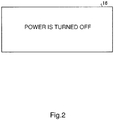
- Figs. 2 to 4 are diagrams each showing an example of the notification screen.
- the power supply control module 113 may display a message of "power is turned off” or the like on the display device 16, thereby notifying the reception of the power-off instruction. Further, as shown in Fig. 3 , the power supply control module 113 may display a loading image G1 with a message of "in power-off process" as an indication of during the power-off process on the display device 16, thereby notifying the reception of the power-off instruction. Further, as shown in Fig. 4 , the power supply control module 113 may display a message of "power is turned off after X seconds" or the like on the display device 16, thereby notifying a counting status of the power-off waiting time.
- the power supply control module 113 may display countdown, a progress bar, or the like that indicates the counting status of the power-off waiting time on the display device 16, thereby notifying the reception of the power-off instruction. It should be noted that timing when the notification screen is displayed is not particularly limited and may be the same timing as the notification by the sound described above. Further, the notification screen may be displayed at the same time when the counting of the power-off waiting time is started.
- the power supply control module 113 notifies the reception of the power-off instruction by the screen display.
- the printer apparatus 10 can cause a user to recognize that the power-off operation is correctly input. Further, the printer apparatus 10 can notify a time to the power-off, with the result that it is possible to improve convenience of a user.
- Fig. 5 is a flowchart showing an example of the power-off process performed by the printer apparatus 10. It should be noted that the assumption is made that the communication is established between the printer apparatus 10 that operates as the slave and the host computer 30 that operates as the master in this process.
- Step S11 shown in Fig. 5 the controller 11 (power supply control module 113) waits until the power-off is instructed by an operation with the power supply button 18 (No in Step S11).
- the process of the controller 11 proceeds to Step S12.
- Step S12 the controller 11 (power supply control module 113) operates in cooperation with the communication control module 112, and transmits the disconnection request to the host computer 30.
- Step S13 the controller 11 (power supply control module 113) starts timing in accordance with the power-off instruction.
- Step S 14 the controller 11 (power supply control module 113) waits until the elapsed time reaches the notification waiting time (for example, 0.5 second) (No in Step S14).
- the process of the controller 11 proceeds to Step S15.
- Step S15 the controller 11 (power supply control module 113) outputs sound or the notification screen, thereby notifying the reception of the power-off instruction.
- Step S16 the controller 11 (power supply control module 113) waits until the elapsed time reaches the power-off waiting time (for example, one second) (No in Step S16).
- the process of the controller 11 proceeds to Step S17.
- Step S17 the controller 11 (power supply control module 113) turns off the power of the printer apparatus 10, and terminates this process.
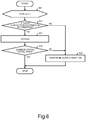
- Fig. 6 is a flowchart showing an example of a reconnection process performed by the printer apparatus 10.
- the controller 11 determines that the printer apparatus 10 is powered on.
- the controller 11 (communication control module 112) determines whether connection destination information is stored in the storage device 12 or not.
- Step S22 in the case where the connection destination information is not stored in the storage device 12 (No in Step S22), the process of the controller 11 proceeds to Step S23.
- Step S23 the controller (communication control module 112) causes the own apparatus to operate as the slave, and terminates this process.
- Step S22 in the case where the connection destination information is stored in the storage device 12 (Yes in Step S22), the process of the controller 11 proceeds to Step S24.
- Step S24 the controller 11 (communication control module 112) accesses the connection destination (host computer 30) indicated by the connection destination information.
- Step S25 the controller 11 (communication control module 112) determines whether the communication with the connection destination is established or not.
- Step S25 in the case where the communication with the connection destination cannot be established (No in Step S25), the process of the controller 11 proceeds to Step S23.
- Step S23 as described above, the controller 11 causes the own apparatus to operate as the slave.
- Step S25 in the case where the communication with the connection destination is established (Yes in Step S25), the controller 11 (communication control module 112) maintains the communication state, and terminates this process.
- the printer apparatus 10 operates as the master, and the host computer 30 operates as the slave.
- the communication control module 112 may overwrite the connection destination information of the connection destination in the storage device 12. Further, when the own apparatus operates as the slave, the communication control module 112 may store (overwrite) the connection destination information.
- the printer apparatus 10 in this embodiment terminates the communication with the host computer 30 by transmitting the disconnection request. Further, after transmitting the disconnection request, the printer apparatus 10 waits for the power-off waiting time, and then turns off the power. As a result, when the power is turned on again, the printer apparatus 10 can establish the communication with the host computer 30 without waiting for the time-out of the preceding communication. Thus, it is possible to perform smooth reconnection.
- the power supply control module 113 may perform the processes of Steps S12 to S17 described above in the case where the power is automatically turned off due to a reduction or the like of a remaining battery level of the battery 15.
- the host computer 30 has the scatternet function.
- the host computer 30 dedicated to the master operation with no scatternet function also exists.
- the types of the host computer 30 include a type or a version of an OS installed in the host computer 30, a type or a version of a communication interface, and the like.
- the host computer 30 In the case where the host computer 30 exclusively performs the master operation, when accessed by the printer apparatus 10, the communication cannot be established. Therefore, the host computer 30 accesses the printer apparatus 10 to be connected thereto anew. Thus, in the case where the host computer 30 exclusively performs the master operation, the printer apparatus 10 does not have to transmit the disconnection request and wait for the power-off waiting time.
- Fig. 7 is a block diagram showing an example of the configuration of a printer apparatus according to the second embodiment.
- a printer apparatus 10a has a hardware configuration similar to the printer apparatus 10 described with reference to Fig. 1 .
- a controller 11 a of the printer apparatus 10a includes function modules such as the display control module 111, the communication control module 112, a type determination module 114, and a power supply control module 115.
- the function modules are achieved as software by executing programs stored in the storage device 12 or achieved as hardware by dedicated processors or the like of the controller 11a.
- the type determination module 114 operates in cooperation with the communication control module 112, thereby determining the type of the host computer 30 with which the communication is established.
- the type determination method for the host computer 30 is not particularly limited.
- the type determination module 114 may determine the type of the host computer 30 on the basis of information that indicates the type included in information transmitted from the host computer 30. Further, the type determination module 114 may request the information that indicates the type to the host computer 30, and determine the type of the host computer 30 on the basis of the information provided in response to the request. Further, the type determination module 114 may determine the type of the host computer 30 on the basis of a paring method with the host computer 30, a communication protocol, or the like.
- the power supply control module 115 determines whether the host computer 30 as the connection destination is an apparatus equipped for the scatternet function. More specifically, on the basis of a setting table in which types of the host computer 30 and presence or absence of the scatternet function are associated, the power supply control module 115 determines whether the determined type is equipped for the scatternet function or not.
- the power supply control module 115 performs a similar process as in the first embodiment. Specifically, after transmitting the disconnection request to the host computer 30, the power supply control module 115 waits for the power-off waiting time, and then turns off the power of the printer apparatus 10a. Further, in the case where the host computer 30 is not equipped for the scatternet function, on the condition that the power-off instruction is given, the power supply control module 115 turns off the power of the printer apparatus 10a. As described above, in accordance with the type of the host computer 30, the power supply control module 115 determines whether the disconnection request is transmitted or not.
- FIG. 8 is a flowchart showing an example of a power-off process performed by the printer apparatus 10a. It should be noted that the assumption is made that the communication is established between the printer apparatus 10a that operates as the slave and the host computer 30 that operates as the master. Further, the assumption is made that the type of the host computer 30 is determined by the type determination module 114.
- Step S31 of Fig. 8 the controller 11a (power supply control module 115) waits until the power-off instruction is given by the operation of the power supply button 18 (No in Step S31).
- the process of the controller 11a proceeds to Step S32.
- the controller 11 a determines whether the computer 30 is equipped for the scatternet function on the basis of the determination result of the type determination module 114.
- Step S32 the process of the controller 11a proceeds to Step S38.
- Step S38 the controller 11a (power supply control module 115) turns off the power. Further, in the case where the host computer 30 is equipped for the scatternet function (Yes in Step S32), the process of the controller 11a proceeds to Step S33. In Step S33, the controller 11a (power supply control module 115) transmits the disconnection request to the host computer 30.
- Steps S34 to S38 the controller 11a (power supply control module 115) performs the process of Steps S34 to S38 and terminates this process. It should be noted that the process of Steps S34 to S38 is similar to the process of Steps S13 to 17 described with reference to Fig. 5 , so a description thereof will be omitted.
- the printer apparatus 10a in this embodiment determines whether the type of the host computer 30 is equipped for the scatternet function or not. In the case where the host computer 30 is equipped for the scatternet function, the printer apparatus 10a turns off the power in a process similar to that in the first embodiment. Further, in the case where the host computer 30 is not equipped for the scatternet function, the printer apparatus 10a does not transmit the disconnection request and wait for the power-off waiting time, and turns off the power. As a result, the printer apparatus 10a can turn off the power by the method appropriate to the type of the host computer 30.
- the power supply control module 115 may determine whether the type of the host computer 30 is equipped for the scatternet function or not before the power-off instruction is received. Further, the power supply control module 115 may determine whether the host computer 30 is equipped for the scatternet function or not at a time when the type of the host computer 30 is determined by the type determination module 114.
- the scatternet is cited as an example of the technology (function) capable of establishing the communication in response to the request from the slave.
- this technology instead of this technology, another technology may be used. It should be noted that even in the case where a technology (function) other than the scatternet is used, by determining whether the host computer 30 is ready for the function or the like, the same effect as this embodiment can be obtained.
- the description is given on the example in which the printer apparatus 10 (10a) is applied as the information processing apparatus, but an apparatus as an application target is not limited to this.
- the information processing apparatus according to the embodiment may be applied to the host computer 30, for example.
- the type of the information processing apparatus according to the embodiment is not particularly limited, as long as the apparatus can achieve the operations (functions) of the master and slave at the same time or at different times.
- the controller 11 automatically accesses the external apparatus (host computer 30) on the basis of the connection destination information stored in the storage device 12, but may access the external apparatus in accordance with an operation by a user instead.
- the communication control module 112 searches for external apparatuses that operate as the slaves, and may access an external apparatus selected from among the external apparatuses searched out.
Landscapes
- Engineering & Computer Science (AREA)
- Theoretical Computer Science (AREA)
- Physics & Mathematics (AREA)
- General Engineering & Computer Science (AREA)
- General Physics & Mathematics (AREA)
- Computer Networks & Wireless Communication (AREA)
- Human Computer Interaction (AREA)
- Signal Processing (AREA)
- Computer Security & Cryptography (AREA)
- Power Sources (AREA)
- Accessory Devices And Overall Control Thereof (AREA)
- Facsimiles In General (AREA)
- Mobile Radio Communication Systems (AREA)
- Telephone Function (AREA)
Abstract
Description
- The present invention relates to an information processing technology in general, and, embodiments described here in particular relates to an information processing apparatus, a corresponding system, and an information processing method.
- In the past, a plurality of apparatuses has been wirelessly connected. For example, in communication with Bluetooth (registered trademark), an apparatus that operates as a master accesses an apparatus that operates as a slave, and pairing is performed between the two apparatuses, thereby establishing communication.
- Further, these days, apparatuses using a technology such as scatternet, which is capable of operating as a master and a slave that receives an access from another apparatus, are known. Furthermore, for a slave apparatus, there has been proposed the technology for accessing a lastly connected connection destination on the basis of information that indicates the connection destination along with turning on a power.
- Incidentally, in an apparatus (first apparatus) that operates as a master, when an apparatus (second apparatus) that operates as a slave is brought into a state in which communication is impossible by turning off the power or the like, by transmitting a keepalive signal or the like, the communication (session) is maintained for a predetermined time. In this case, the first apparatus that operates also as the slave cannot establish new communication during the time when the preceding communication is maintained, even if the first apparatus receives an access from the second apparatus restored by turning on the power. For this reason, there is a problem in that, in the second apparatus, even if the first apparatus is accessed at a time of reboot or the like that power-off and power-on are performed in a short time, it is impossible to perform reconnection to the first apparatus till time-out of the preceding communication.
- To solve such problems, there is provided an information processing apparatus configured to establish wireless communication with an external apparatus in response to a communication request from the external apparatus, comprising:
- a power supply device configured to supply power to each unit of the information processing apparatus;
- an operation device configured to receive an instruction to turn off a power supply from the power supply device;
- a communication interface configured to establish communication with the external apparatus; and
- a controller configured to
- transmit a request of disconnection of the communication to the external apparatus through the communication interface when the operation device receives the instruction to turn off the power supply from the power supply device, and
- turn off the power supply from the power supply device after waiting for a predetermined time after the transmission of the disconnection request.
- Preferably, the information processing apparatus further comprises:
- a storage device configured to store connection destination information that indicates the external apparatus.
- Preferably still, the controller is configured to cause the storage device to store the connection destination information that indicates the external apparatus with which the communication is established by the communication interface
- Preferably yet, when the power supply from the power supply device is turned on, the controller is configured to access the external apparatus indicated by the connection destination information stored in the storage device through the communication interface.
- Suitably, the information processing apparatus further comprises:
- a notification device configured to notify a reception of the instruction to turn off the power supply from the power supply device by the operation device.
- Suitably still, the controller is configured to cause the notification device to notify the reception of the instruction to turn off the power supply from the power supply device by the operation device during waiting for the predetermined time.
- Suitably yet, when the operation device receives the instruction to turn off the power supply from the power supply device, the controller is configured to determine a type of the external apparatus, and on the basis of a result of the determination, to determine whether the disconnection request is transmitted or not.
- The invention also relates to a system in which information is processed, the system being configured to establish wireless communication with an external system in response to a communication request from the external system, and comprising:
- a power supply means configured to supply power to each unit of the information processing system;
- an operation means configured to receive an instruction to turn off a power supply from the power supply means;
- a communication interface means configured to establish communication with the external system; and
- a controller means configured to
- transmit a request of disconnection of the communication to the external system through the communication interface means when the operation means receives the instruction to turn off the power supply from the power supply means, and
- turn off the power supply from the power supply means after waiting for a predetermined time after the transmission of the disconnection request.
- Preferably, the system further comprises:
- a storage means configured to store connection destination information that indicates the external system.
- Preferably still, the system further comprises:
- a notification means configured to notify a reception of the instruction to turn off the power supply from the power supply means by the operation means.
- Preferably yet,when the operation means receives the instruction to turn off the power supply from the power supply means, the controller means is configured to determine a type of the external system, and on the basis of a result of the determination, to determine whether the disconnection request is transmitted or not.
- The invention further relates to an information processing method for an information processing apparatus, the information processing apparatus being configured to establish wireless communication with an external apparatus in response to a communication request from the external apparatus, comprising:
- establishing communication with the external apparatus by a communication interface;
- receiving, when the communication is established with the external apparatus, an instruction to turn off a power supply from a power supply device by an operation device;
- transmitting a request of disconnection of the communication to the external apparatus through the communication interface; and
- turning off the power supply from the power supply device after waiting for a predetermined time after the transmission of the disconnection request.
- Suitably, the information processing method further comprises:
- storing, in a storage device, connection destination information that indicates the external apparatus with which the communication is established by the communication interface.
- Suitably still, the information processing method further comprises:
- accessing, when the power supply from the power supply device is turned on, the external apparatus indicated by the connection destination information stored in the storage device through the communication interface.
- Suitably further, the information processing method further comprises:
- causing a notification device to notify a reception of the instruction to turn off the power supply from the power supply device by the operation device.
- The above and other objects, features and advantages of the present invention will be made apparent from the following description of the preferred embodiments, given as non-limiting examples, with reference to the accompanying drawings, in which:
-
Fig. 1 is a block diagram showing an example of a printer apparatus according to a first embodiment. -
Fig. 2 is a diagram showing an example of a notification screen of the printer apparatus according to the first embodiment. -
Fig. 3 is a diagram showing an example of the notification screen of the printer apparatus according to the first embodiment. -
Fig. 4 is a diagram showing an example of the notification screen of the printer apparatus according to the first embodiment. -
Fig. 5 is a flowchart showing an example of a process of turning off a power performed by the printer apparatus according to the first embodiment. -
Fig. 6 is a flowchart showing an example of a process of reconnection performed by the printer apparatus according to the first embodiment. -
Fig. 7 is a block diagram showing an example of a printer apparatus according to a second embodiment. -
Fig. 8 is a flowchart showing an example of a process of turning off a power performed by the printer apparatus according to the second embodiment. - According to an embodiment, an information processing apparatus is an information processing apparatus that establishes wireless communication with an external apparatus in response to a communication request from the external apparatus. The information processing apparatus includes a power supply device, an operation device, a communication interface, and a controller.
- The power supply device supplies power to each unit of the information processing apparatus.
- The operation device receives an instruction to turn off a power supply from the power supply device.
- The communication interface establishes communication with the external apparatus.
- The controller transmits a request of disconnection of the communication to the external apparatus through the communication interface when the operation device receives the instruction to turn off the power supply from the power supply device.
- Further, the controller turns off the power supply from the power supply device after waiting for a predetermined time after the transmission of the disconnection request.
- Hereinafter, an information processing apparatus and an information processing method according to embodiments will be further described with reference to the drawings. The embodiments described below are an example in which a printer apparatus is applied as the information processing apparatus. However, the information processing apparatus according to the embodiments is not limited to the printer apparatus. For instance, the above embodiment can be applied mutatis mutandis to a system in which information is processed using corresponding means..
- In the drawings, the same reference numerals and symbols denote the same or similar parts.
-
Fig. 1 is a block diagram showing an example of a printer apparatus according to a first embodiment. Aprinter apparatus 10 includes acontroller 11. Thecontroller 11 has a computer configuration including a CPU (Central Processing Unit) or a SoC (System-on-a-Chip), a ROM (Read Only Memory), a RAM (Random Access Memory), and the like. Further, thecontroller 11 includes a timing apparatus such as an RTC (Real Time Clock) (not shown). - Further, to the
controller 11, astorage device 12 is connected via a bus or the like. Thestorage device 12 is a storage apparatus such as an HDD (Hard Disk Drive) or a flash memory. Thestorage device 12 stores operation programs executed by thecontroller 11 and data used to execute the operation program. - Further, to the
controller 11, aprint device 13 and apower supply device 14 are connected via the bus or the like. Theprint device 13 is a printer engine such as a thermal printer and a dot impact printer. Thepower supply device 14 supplies power stored in abattery 15 to each of units of theprinter apparatus 10. Thepower supply device 14 is not limited to thebattery 15 and may be a commercially available power supply. - It should be noted that, in the following description, turning on of the power supply by the
power supply device 14 may be simply referred to as turning on a power or power-on in some cases. Further, turning off of the power supply by thepower supply device 14 may be simply referred to as turning off a power or power-off in some cases. A power-off process is performed after theprinter apparatus 10 terminates a system operation in execution. That is, the power-off process includes so-called shutdown. - Further, to the
controller 11, via the bus or the like, adisplay device 16, anoperation device 17, anotification device 19, and a communication interface (I/F) 20 are connected. Thedisplay device 16 is a display device such as a liquid crystal display. - The
operation device 17 has various operators for receiving an operation input from a user. Theoperation device 17 includes, for example, apower supply button 18 for giving an instruction to perform power-on or power-off of theprinter apparatus 10. It should be noted that in this embodiment, thecontroller 11 performs the power-off process to be described later in accordance with an operation of power-off through thepower supply button 18. Accordingly, thepower supply button 18 does not turn off the power by directly cutting off electrical connection but notifies thecontroller 11 of a power-off instruction to cause thecontroller 11 to turn off the power. For example, by holding down thepower supply button 18, thepower supply button 18 notifies thecontroller 11 of the power-off instruction. - The
notification device 19 is a sound output apparatus capable of outputting sounds. Under the control by thecontroller 11, thenotification device 19 outputs a sound such as a beep sound, and thus sends a notification to a user. It should be noted that thenotification device 19 is not limited to the sound output apparatus. For example, thenotification device 19 may be a light-emitting apparatus such as an indicator lamp. - The
communication interface 20 is an interface for performing communication with ahost computer 30. In this embodiment, thecommunication interface 20 communicates with the communication interface provided to thehost computer 30 with Bluetooth (registered trademark). - The
host computer 30 is, for example, an information equipment such as a smartphone, a tablet terminal, a personal computer (PC), and a handy terminal. Thehost computer 30 has a controller including a computer configuration including a CPU, a ROM, a RAM, and the like (not shown). The controller operates in cooperation with a predetermined operating system (OS) stored in a storage apparatus such as an HDD, thereby performing various computation processes. - Further, the
host computer 30 has a communication interface that allows near field communication by Bluetooth (registered trademark), and operates as a master in the communication. More specifically, thehost computer 30 searches for theprinter apparatus 10 that operates as the slave, and performs an access to request theprinter apparatus 10 to perform communication. Then, thehost computer 30 establishes communication by paring with theprinter apparatus 10 as an access destination. When the communication is established with theprinter apparatus 10, thehost computer 30 transmits and receives various pieces of information to and from theprinter apparatus 10. For example, thehost computer 30 transmits print data (image data or the like) to be printed to theprinter apparatus 10 in accordance with an operation input by a user. - Further, the
host computer 30 in this embodiment operates as the master described above and also operates as a slave that receives an access from another apparatus. Both of the operations as the master and slave can be achieved by a technology called scatternet, for example. Thehost computer 30 operates as the slave, and thus when receiving an access from theprinter apparatus 10, for example, thehost computer 30 pairs with theprinter apparatus 10, thereby establishing communication. Hereinafter, a function of achieving both of the master and slave is referred to as a scatternet function. - In the
printer apparatus 10 described above, thecontroller 11 executes operation programs stored in thestorage device 12 to perform overall control for the operations of theprinter apparatus 10. For example, thecontroller 11 temporarily stores the print data received from thehost computer 30 in a RAM or thestorage device 12. Further, thecontroller 11 controls theprint device 13 to cause theprint device 13 to print the print data temporarily stored. - Further, as shown in
Fig. 1 , thecontroller 11 of theprinter apparatus 10 has function modules such as adisplay control module 111, acommunication control module 112, and a powersupply control module 113. The function modules are achieved as software by executing programs stored in thestorage device 12 or achieved as hardware by dedicated processors or the like of thecontroller 11. - The
display control module 111 controls thedisplay device 16 to cause thedisplay device 16 to display various pieces of information such as a print status. Further, thedisplay control module 111 operates in cooperation with the powersupply control module 113, to cause thedisplay device 16 to display various pieces of information relating to power-off control. - The
communication control module 112 is a function module corresponding to a communication control means in this embodiment. Thecommunication control module 112 operates in cooperation with thecommunication interface 20, thereby controlling communication with thehost computer 30. More specifically,communication control module 112 pairs with thehost computer 30 in accordance with the access from thehost computer 30, thereby establishing wireless communication with thehost computer 30. Further, thecommunication control module 112 causes thestorage device 12 to store connection destination information (for example, BD_ADDR) that indicates a connection destination of thehost computer 30 with which the communication is established. Then, when theprinter apparatus 10 is powered on, thecommunication control module 112 accesses the connection destination of the address information on the condition that the connection destination information is stored in thestorage device 12. - As described above, the
printer apparatus 10 accesses the connection destination information stored in thestorage device 12, thereby performing reconnection with thehost computer 30 to which the printer apparatus has been connected till power-off. It should be noted that in the case where the address information is not stored in thestorage device 12 and in the case where communication cannot be established with the connection destination indicated by the connection destination information, the printer apparatus 10 (communication control module 112) operates as the slave. It should be noted that, the access from theprinter apparatus 10 to thehost computer 30 may be achieved by the scatternet function described above. - Incidentally, in the past, in the apparatus (first apparatus) that operates as the master, when the apparatus (second apparatus) that operates as the slave is in a communication impossible state due to power-off or the like, by transmitting a keepalive signal or the like, the communication (session) is maintained for a predetermined time. In this case, the first apparatus that operates also as the slave cannot establish new communication during when the preceding communication is maintained, even if the first apparatus receives an access from the second apparatus restored by power-on. For this reason, there is a problem in that the second apparatus cannot perform reconnection with the first apparatus till time-out of the preceding communication, even when the second apparatus accesses the first apparatus at a time of reboot or the like that power-off and power-on are performed in a short time.
- In view of this, in order to cope with the problem described above, the
printer apparatus 10 in this embodiment has the powersupply control module 113. Hereinafter, a description will be given on the powersupply control module 113. - The power
supply control module 113 is a function module corresponding to a reception means, a transmission means, and a control means in this embodiment. The powersupply control module 113 operates in cooperation with thepower supply button 18, and thus receives a power-off instruction. Upon reception of the power-off instruction, the powersupply control module 113 operates in cooperation with thecommunication control module 112 and transmits a disconnection request to thehost computer 30 with which the communication is established. Here, the disconnection request is a command or the like for requesting disconnection (termination) of communication. Upon reception of the disconnection request from theprinter apparatus 10, thehost computer 30 sends a reply such as acknowledge (ACK), and then disconnects the communication with theprinter apparatus 10. - As described above, when the power-off instruction is given, the power
supply control module 113 transmits the disconnection request to thehost computer 30, and thus the communication between theprinter apparatus 10 and thehost computer 30 is terminated. As a result, theprinter apparatus 10 can prevent the communication with theprinter apparatus 10 from being unintentionally maintained in thehost computer 30 after the power-off. Thus, theprinter apparatus 10 accesses thehost computer 30 on the basis of the connection destination information, and thus can be reconnected with thehost computer 30 without waiting for time-out of the preceding communication. - Further, after transmitting the disconnection request, the power
supply control module 113 waits for a predetermined waiting time (hereinafter, referred to as power-off waiting time). After that, by controlling thepower supply device 14, the powersupply control module 113 turns off the power of theprinter apparatus 10. Here, the power-off includes shutdown as described above. - It should be noted that the power-off waiting time is not particularly limited and can be set to an arbitrary value. For example, the power-off waiting time may be a preset fixed value, for example, one second. In this case, it is desirable that the fixed value be a value depending on a processing time necessary to disconnect the communication in the
host computer 30. Further, the power-off waiting time may be a time from when theprinter apparatus 10 transmits the disconnection request to thehost computer 30 until theprinter apparatus 10 receives a reply (ACK or the like) from thehost computer 30. Further, the power-off waiting time may be a time from when theprinter apparatus 10 transmits the disconnection request to thehost computer 30 until thecommunication interface 20 detects an offline with thehost computer 30. It should be noted that, in this embodiment, a description will be given on the assumption that the power-off waiting time is a preset fixed value. - As described above, after transmitting the disconnection request, the power
supply control module 113 waits for the power-off waiting time, to wait till a reliable completion of the disconnection of the communication on thehost computer 30 side. As a result, even in the case where the reboot or the like that power-off and power-on are performed in a short time is performed, theprinter apparatus 10 can be reconnected with thehost computer 30 smoothly. - Further, on the condition that the power-off instruction is given, the power
supply control module 113 causes thenotification device 19 to operate, thereby notifying reception of the power-off instruction. Specifically, the powersupply control module 113 outputs sound (beep sound) at a time of an elapse of a predetermined time (hereinafter, notification waiting time) after the power-off instruction is given, thereby performing notification. It should be noted that the notification waiting time is set to be shorter than the power-off waiting time (notification waiting time < power-off waiting time). For example, in the case where the power-off waiting time is one second, the powersupply control module 113 outputs sound after 0.5 second (notification waiting time) from when timing of the power-off waiting time is started, thereby notifying a user of the reception of the power-off instruction. It should be noted that the notification waiting time is not limited to this. For example, by setting the notification waiting time to zero, the notification may be performed at a time when counting of the notification waiting time is started. Further, by setting the notification waiting time to 1/3 or 1/2 of the power-off waiting time, the notification may be performed at a time when 1/3 or 1/2 of the power-off waiting time elapses. - As described above, the power
supply control module 113 notifies the reception of the power-off instruction by beep sound or the like during the power-off waiting time. As a result, theprinter apparatus 10 can cause a user to recognize that a power-off operation is correctly input. Further, theprinter apparatus 10 can relax a sense of discomfort of a user resulting from waiting for the power-off waiting time. - It should be noted that, the notification method is not limited to sound, and another method may be used. For example, the power
supply control module 113 operates in cooperation with thedisplay control module 111, and thus may notify the reception of the power-off instruction by screen displaying (on a notification screen). Here,Figs. 2 to 4 are diagrams each showing an example of the notification screen. - For example, as shown in
Fig. 2 , the powersupply control module 113 may display a message of "power is turned off" or the like on thedisplay device 16, thereby notifying the reception of the power-off instruction. Further, as shown inFig. 3 , the powersupply control module 113 may display a loading image G1 with a message of "in power-off process" as an indication of during the power-off process on thedisplay device 16, thereby notifying the reception of the power-off instruction. Further, as shown inFig. 4 , the powersupply control module 113 may display a message of "power is turned off after X seconds" or the like on thedisplay device 16, thereby notifying a counting status of the power-off waiting time. In addition, the powersupply control module 113 may display countdown, a progress bar, or the like that indicates the counting status of the power-off waiting time on thedisplay device 16, thereby notifying the reception of the power-off instruction. It should be noted that timing when the notification screen is displayed is not particularly limited and may be the same timing as the notification by the sound described above. Further, the notification screen may be displayed at the same time when the counting of the power-off waiting time is started. - As described above, the power
supply control module 113 notifies the reception of the power-off instruction by the screen display. As a result, theprinter apparatus 10 can cause a user to recognize that the power-off operation is correctly input. Further, theprinter apparatus 10 can notify a time to the power-off, with the result that it is possible to improve convenience of a user. - Subsequently, with reference to
Fig. 5 andFig. 6 , a description will be given on an example of the operation of theprinter apparatus 10 described above. -
Fig. 5 is a flowchart showing an example of the power-off process performed by theprinter apparatus 10. It should be noted that the assumption is made that the communication is established between theprinter apparatus 10 that operates as the slave and thehost computer 30 that operates as the master in this process. - First, in Step S11 shown in
Fig. 5 , the controller 11 (power supply control module 113) waits until the power-off is instructed by an operation with the power supply button 18 (No in Step S11). When the power-off is instructed by holding thepower supply button 18 down (Yes in Step S11), the process of thecontroller 11 proceeds to Step S12. - In Step S12, the controller 11 (power supply control module 113) operates in cooperation with the
communication control module 112, and transmits the disconnection request to thehost computer 30. - Then, in Step S13, the controller 11 (power supply control module 113) starts timing in accordance with the power-off instruction.
- Subsequently, in
Step S 14, the controller 11 (power supply control module 113) waits until the elapsed time reaches the notification waiting time (for example, 0.5 second) (No in Step S14). When the elapsed time reaches the notification waiting time (Yes in Step S14), the process of thecontroller 11 proceeds to Step S15. In Step S15, the controller 11 (power supply control module 113) outputs sound or the notification screen, thereby notifying the reception of the power-off instruction. - Subsequently, in Step S16, the controller 11 (power supply control module 113) waits until the elapsed time reaches the power-off waiting time (for example, one second) (No in Step S16). When the elapsed time reaches the power-off waiting time (Yes in Step S16), the process of the
controller 11 proceeds to Step S17. In Step S17, the controller 11 (power supply control module 113) turns off the power of theprinter apparatus 10, and terminates this process. -
Fig. 6 is a flowchart showing an example of a reconnection process performed by theprinter apparatus 10. In Step S21 ofFig. 6 , thecontroller 11 determines that theprinter apparatus 10 is powered on. Then, in Step S22, the controller 11 (communication control module 112) determines whether connection destination information is stored in thestorage device 12 or not. - In Step S22, in the case where the connection destination information is not stored in the storage device 12 (No in Step S22), the process of the
controller 11 proceeds to Step S23. In Step S23, the controller (communication control module 112) causes the own apparatus to operate as the slave, and terminates this process. - On the other hand, in Step S22, in the case where the connection destination information is stored in the storage device 12 (Yes in Step S22), the process of the
controller 11 proceeds to Step S24. In Step S24, the controller 11 (communication control module 112) accesses the connection destination (host computer 30) indicated by the connection destination information. Then, in Step S25, the controller 11 (communication control module 112) determines whether the communication with the connection destination is established or not. - In Step S25, in the case where the communication with the connection destination cannot be established (No in Step S25), the process of the
controller 11 proceeds to Step S23. In Step S23, as described above, thecontroller 11 causes the own apparatus to operate as the slave. - Further, in Step S25, in the case where the communication with the connection destination is established (Yes in Step S25), the controller 11 (communication control module 112) maintains the communication state, and terminates this process. In this case, the
printer apparatus 10 operates as the master, and thehost computer 30 operates as the slave. It should be noted that, when the communication is established in Step S25, thecommunication control module 112 may overwrite the connection destination information of the connection destination in thestorage device 12. Further, when the own apparatus operates as the slave, thecommunication control module 112 may store (overwrite) the connection destination information. - As described above, when the power-off instruction is given, the
printer apparatus 10 in this embodiment terminates the communication with thehost computer 30 by transmitting the disconnection request. Further, after transmitting the disconnection request, theprinter apparatus 10 waits for the power-off waiting time, and then turns off the power. As a result, when the power is turned on again, theprinter apparatus 10 can establish the communication with thehost computer 30 without waiting for the time-out of the preceding communication. Thus, it is possible to perform smooth reconnection. - It should be noted that in the power-off process shown in
Fig. 5 , the example is described in which the disconnection request is transmitted on the basis of the power-off operation through thepower supply button 18, but the embodiment is not limited to this. For example, the powersupply control module 113 may perform the processes of Steps S12 to S17 described above in the case where the power is automatically turned off due to a reduction or the like of a remaining battery level of thebattery 15. - Subsequently, a second embodiment will be described. In the first embodiment, the
host computer 30 has the scatternet function. However, depending on types of thehost computer 30, thehost computer 30 dedicated to the master operation with no scatternet function also exists. Here, the types of thehost computer 30 include a type or a version of an OS installed in thehost computer 30, a type or a version of a communication interface, and the like. - In the case where the
host computer 30 exclusively performs the master operation, when accessed by theprinter apparatus 10, the communication cannot be established. Therefore, thehost computer 30 accesses theprinter apparatus 10 to be connected thereto anew. Thus, in the case where thehost computer 30 exclusively performs the master operation, theprinter apparatus 10 does not have to transmit the disconnection request and wait for the power-off waiting time. - In view of this, in the second embodiment, a mode will be described in which details of the power-off process can be switched depending on the types of the
host computer 30. It should be noted that the same components as in theprinter apparatus 10 described in the first embodiment will be denoted by the same reference numerals, and descriptions thereof will be omitted. -
Fig. 7 is a block diagram showing an example of the configuration of a printer apparatus according to the second embodiment. A printer apparatus 10a has a hardware configuration similar to theprinter apparatus 10 described with reference toFig. 1 . Further, as shown inFig. 7 , acontroller 11 a of the printer apparatus 10a includes function modules such as thedisplay control module 111, thecommunication control module 112, atype determination module 114, and a powersupply control module 115. The function modules are achieved as software by executing programs stored in thestorage device 12 or achieved as hardware by dedicated processors or the like of thecontroller 11a. - The
type determination module 114 operates in cooperation with thecommunication control module 112, thereby determining the type of thehost computer 30 with which the communication is established. Here, the type determination method for thehost computer 30 is not particularly limited. For example, thetype determination module 114 may determine the type of thehost computer 30 on the basis of information that indicates the type included in information transmitted from thehost computer 30. Further, thetype determination module 114 may request the information that indicates the type to thehost computer 30, and determine the type of thehost computer 30 on the basis of the information provided in response to the request. Further, thetype determination module 114 may determine the type of thehost computer 30 on the basis of a paring method with thehost computer 30, a communication protocol, or the like. - On the basis of a determination result of the
type determination module 114, the powersupply control module 115 determines whether thehost computer 30 as the connection destination is an apparatus equipped for the scatternet function. More specifically, on the basis of a setting table in which types of thehost computer 30 and presence or absence of the scatternet function are associated, the powersupply control module 115 determines whether the determined type is equipped for the scatternet function or not. - In the case where the
host computer 30 is equipped for the scatternet function, on the condition that the power-off instruction is given, the powersupply control module 115 performs a similar process as in the first embodiment. Specifically, after transmitting the disconnection request to thehost computer 30, the powersupply control module 115 waits for the power-off waiting time, and then turns off the power of the printer apparatus 10a. Further, in the case where thehost computer 30 is not equipped for the scatternet function, on the condition that the power-off instruction is given, the powersupply control module 115 turns off the power of the printer apparatus 10a. As described above, in accordance with the type of thehost computer 30, the powersupply control module 115 determines whether the disconnection request is transmitted or not. - Subsequently, with reference to
Fig. 8 , an example of the operation of the printer apparatus 10a will be described.Fig. 8 is a flowchart showing an example of a power-off process performed by the printer apparatus 10a. It should be noted that the assumption is made that the communication is established between the printer apparatus 10a that operates as the slave and thehost computer 30 that operates as the master. Further, the assumption is made that the type of thehost computer 30 is determined by thetype determination module 114. - First, in Step S31 of
Fig. 8 , thecontroller 11a (power supply control module 115) waits until the power-off instruction is given by the operation of the power supply button 18 (No in Step S31). Here, when the fact that the power-off instruction is given by holding down thepower supply button 18 is detected (Yes in Step S31), the process of thecontroller 11a proceeds to Step S32. In Step S32, thecontroller 11 a (power supply control module 115) determines whether thecomputer 30 is equipped for the scatternet function on the basis of the determination result of thetype determination module 114. - In the case where the
host computer 30 is not equipped for the scatternet function (No in Step S32), the process of thecontroller 11a proceeds to Step S38. - In Step S38, the
controller 11a (power supply control module 115) turns off the power. Further, in the case where thehost computer 30 is equipped for the scatternet function (Yes in Step S32), the process of thecontroller 11a proceeds to Step S33. In Step S33, thecontroller 11a (power supply control module 115) transmits the disconnection request to thehost computer 30. - Subsequently, the
controller 11a (power supply control module 115) performs the process of Steps S34 to S38 and terminates this process. It should be noted that the process of Steps S34 to S38 is similar to the process of Steps S13 to 17 described with reference toFig. 5 , so a description thereof will be omitted. - As described above, when the power-off instruction is given, the printer apparatus 10a in this embodiment determines whether the type of the
host computer 30 is equipped for the scatternet function or not. In the case where thehost computer 30 is equipped for the scatternet function, the printer apparatus 10a turns off the power in a process similar to that in the first embodiment. Further, in the case where thehost computer 30 is not equipped for the scatternet function, the printer apparatus 10a does not transmit the disconnection request and wait for the power-off waiting time, and turns off the power. As a result, the printer apparatus 10a can turn off the power by the method appropriate to the type of thehost computer 30. - It should be noted that in the power-off process shown in
Fig. 8 , in response to the power-off instruction, it is determined whetherhost computer 30 is equipped for the scatternet function or not. However, a timing when the determination is performed is not limited to this. For example, the powersupply control module 115 may determine whether the type of thehost computer 30 is equipped for the scatternet function or not before the power-off instruction is received. Further, the powersupply control module 115 may determine whether thehost computer 30 is equipped for the scatternet function or not at a time when the type of thehost computer 30 is determined by thetype determination module 114. - Further, in this embodiment, the scatternet is cited as an example of the technology (function) capable of establishing the communication in response to the request from the slave. However, instead of this technology, another technology may be used. It should be noted that even in the case where a technology (function) other than the scatternet is used, by determining whether the
host computer 30 is ready for the function or the like, the same effect as this embodiment can be obtained. - In the above embodiments, the description is given on the example in which the printer apparatus 10 (10a) is applied as the information processing apparatus, but an apparatus as an application target is not limited to this. The information processing apparatus according to the embodiment may be applied to the
host computer 30, for example. Specifically, the type of the information processing apparatus according to the embodiment is not particularly limited, as long as the apparatus can achieve the operations (functions) of the master and slave at the same time or at different times. - Further, in the above embodiments, the controller 11 (communication control module 112) automatically accesses the external apparatus (host computer 30) on the basis of the connection destination information stored in the
storage device 12, but may access the external apparatus in accordance with an operation by a user instead. For example, thecommunication control module 112 searches for external apparatuses that operate as the slaves, and may access an external apparatus selected from among the external apparatuses searched out. - While certain embodiments have been described, these embodiments have been presented by way of example only, and are not intended to limit the scope of the inventions. Indeed, the novel embodiments described herein may be embodied in a variety of other forms; furthermore, various omissions, substitutions and changes in the form of the embodiments described herein may be made without departing from the framework of the inventions. The accompanying claims and their equivalents are intended to cover such forms or modifications as would fall within the scope and framework of the inventions.
Claims (15)
- An information processing apparatus configured to establish wireless communication with an external apparatus in response to a communication request from the external apparatus, comprising:a power supply device configured to supply power to each unit of the information processing apparatus;an operation device configured to receive an instruction to turn off a power supply from the power supply device;a communication interface configured to establish communication with the external apparatus; anda controller configured totransmit a request of disconnection of the communication to the external apparatus through the communication interface when the operation device receives the instruction to turn off the power supply from the power supply device, andturn off the power supply from the power supply device after waiting for a predetermined time after the transmission of the disconnection request.
- The information processing apparatus according to claim 1, further comprising:a storage device configured to store connection destination information that indicates the external apparatus.
- The information processing apparatus according to claim 2, wherein
the controller is configured to cause the storage device to store the connection destination information that indicates the external apparatus with which the communication is established by the communication interface - The information processing apparatus according to claim 2 or 3, wherein
when the power supply from the power supply device is turned on, the controller is configured to access the external apparatus indicated by the connection destination information stored in the storage device through the communication interface. - The information processing apparatus according to any one of claims 1 to 4, further comprising:a notification device configured to notify a reception of the instruction to turn off the power supply from the power supply device by the operation device.
- The information processing apparatus according to claim 5, wherein
the controller is configured to cause the notification device to notify the reception of the instruction to turn off the power supply from the power supply device by the operation device during waiting for the predetermined time. - The information processing apparatus according to any one of claims 1 to 6, wherein
when the operation device receives the instruction to turn off the power supply from the power supply device, the controller is configured to determine a type of the external apparatus, and on the basis of a result of the determination, to determine whether the disconnection request is transmitted or not. - A system in which information is processed, the system being configured to establish wireless communication with an external system in response to a communication request from the external system, and comprising:a power supply means configured to supply power to each unit of the information processing system;an operation means configured to receive an instruction to turn off a power supply from the power supply means;a communication interface means configured to establish communication with the external system; anda controller means configured totransmit a request of disconnection of the communication to the external system through the communication interface means when the operation means receives the instruction to turn off the power supply from the power supply means, andturn off the power supply from the power supply means after waiting for a predetermined time after the transmission of the disconnection request.
- The system according to claim 8, further comprising:a storage means configured to store connection destination information that indicates the external system.
- The system according to claim 8 or 9, further comprising:a notification means configured to notify a reception of the instruction to turn off the power supply from the power supply means by the operation means.
- The system according to any one of claims 8 to 10, wherein
when the operation means receives the instruction to turn off the power supply from the power supply means, the controller means is configured to determine a type of the external system, and on the basis of a result of the determination, to determine whether the disconnection request is transmitted or not. - An information processing method for an information processing apparatus, the information processing apparatus being configured to establish wireless communication with an external apparatus in response to a communication request from the external apparatus, comprising:establishing communication with the external apparatus by a communication interface;receiving, when the communication is established with the external apparatus, an instruction to turn off a power supply from a power supply device by an operation device;transmitting a request of disconnection of the communication to the external apparatus through the communication interface; andturning off the power supply from the power supply device after waiting for a predetermined time after the transmission of the disconnection request.
- The information processing method according to claim 12, further comprising:storing, in a storage device, connection destination information that indicates the external apparatus with which the communication is established by the communication interface.
- The information processing method according to claim 13, further comprising:accessing, when the power supply from the power supply device is turned on, the external apparatus indicated by the connection destination information stored in the storage device through the communication interface.
- The information processing method according to any one of claims 12 to 14, further comprising:causing a notification device to notify a reception of the instruction to turn off the power supply from the power supply device by the operation device.
Applications Claiming Priority (1)
| Application Number | Priority Date | Filing Date | Title |
|---|---|---|---|
| JP2016088265A JP6705691B2 (en) | 2016-04-26 | 2016-04-26 | Information processing device and program |
Publications (1)
| Publication Number | Publication Date |
|---|---|
| EP3239831A1 true EP3239831A1 (en) | 2017-11-01 |
Family
ID=58401382
Family Applications (1)
| Application Number | Title | Priority Date | Filing Date |
|---|---|---|---|
| EP17161477.9A Ceased EP3239831A1 (en) | 2016-04-26 | 2017-03-17 | Information processing apparatus and information processing method |
Country Status (4)
| Country | Link |
|---|---|
| US (2) | US10045309B2 (en) |
| EP (1) | EP3239831A1 (en) |
| JP (1) | JP6705691B2 (en) |
| CN (1) | CN107315550A (en) |
Families Citing this family (4)
| Publication number | Priority date | Publication date | Assignee | Title |
|---|---|---|---|---|
| KR101885540B1 (en) * | 2012-03-23 | 2018-09-11 | 주식회사 골드피크이노베이션즈 | Apparatus and method for uplink synchronizing in multiple component carrier system |
| JP6705691B2 (en) * | 2016-04-26 | 2020-06-03 | 東芝テック株式会社 | Information processing device and program |
| CN110879546A (en) * | 2019-10-30 | 2020-03-13 | 西安海云物联科技有限公司 | Method for realizing double-chip power supply management by combining software and hardware |
| CN113568329B (en) * | 2020-04-28 | 2023-10-24 | 广州汽车集团股份有限公司 | A shutdown control method and system based on MCU and SOC communication |
Citations (3)
| Publication number | Priority date | Publication date | Assignee | Title |
|---|---|---|---|---|
| EP2645226A2 (en) * | 2012-03-29 | 2013-10-02 | Brother Kogyo Kabushiki Kaisha | Image processing apparatus and image processing system |
| US20150153978A1 (en) * | 2013-11-29 | 2015-06-04 | Canon Kabushiki Kaisha | Communication apparatus capable of notifying temporary disconnection from network, communication system, method of controlling communication apparatus, and storage medium |
| US20150254030A1 (en) * | 2012-02-14 | 2015-09-10 | Seiko Epson Corporation | Control device, control method of a control device, and a storage medium |
Family Cites Families (23)
| Publication number | Priority date | Publication date | Assignee | Title |
|---|---|---|---|---|
| JP3911162B2 (en) * | 2002-01-18 | 2007-05-09 | アルパイン株式会社 | Hands-free device for mobile phone |
| JP2004070527A (en) * | 2002-08-02 | 2004-03-04 | Canon Inc | Recording system, electronic information terminal constituting recording system, recording method, storage medium, and program |
| JP2004236163A (en) * | 2003-01-31 | 2004-08-19 | Toshiba Corp | Electronic device and control method thereof |
| WO2005024613A1 (en) * | 2003-08-28 | 2005-03-17 | Fujitsu Limited | Host apparatus, device, and communication system control method |
| JP4302019B2 (en) * | 2004-09-03 | 2009-07-22 | 株式会社東京精密 | Wireless connection method |
| JP4619225B2 (en) * | 2005-07-27 | 2011-01-26 | 京セラ株式会社 | Communication terminal device and communication method thereof |
| JP2008124745A (en) * | 2006-11-10 | 2008-05-29 | Toshiba Corp | Wireless communication apparatus and power control method for wireless communication apparatus |
| ATE539553T1 (en) * | 2007-02-26 | 2012-01-15 | Olympus Medical Systems Corp | CAPSULE ENDOSCOPE |
| JP2010198303A (en) * | 2009-02-25 | 2010-09-09 | Canon Inc | Information processing apparatus, method of controlling same, and storage medium |
| JP2012074974A (en) * | 2010-09-29 | 2012-04-12 | Nec Casio Mobile Communications Ltd | Mobile radio device, function restriction method and program |
| JP2012099058A (en) * | 2010-11-05 | 2012-05-24 | Sony Corp | Information processing device, method and program |
| JP2013067030A (en) * | 2011-09-20 | 2013-04-18 | Fuji Xerox Co Ltd | Printing apparatus, information processing apparatus, printing system and program |
| JP6273586B2 (en) * | 2012-10-24 | 2018-02-07 | マーベル ワールド トレード リミテッド | Dynamic power management in wireless devices |
| JP2014155030A (en) | 2013-02-08 | 2014-08-25 | Mobilelife Kk | Light emitting module for specific radio signal |
| US9625884B1 (en) * | 2013-06-10 | 2017-04-18 | Timothy Harris Ousley | Apparatus for extending control and methods thereof |
| JP6379767B2 (en) * | 2014-07-11 | 2018-08-29 | ブラザー工業株式会社 | Terminal device, printer, computer program |
| JP6324251B2 (en) * | 2014-07-24 | 2018-05-16 | キヤノン株式会社 | Information processing apparatus, program, and control method |
| JP6451251B2 (en) * | 2014-11-20 | 2019-01-16 | セイコーエプソン株式会社 | Printing apparatus and printing system |
| JP6477132B2 (en) * | 2015-03-27 | 2019-03-06 | ブラザー工業株式会社 | Communication equipment |
| JP6551054B2 (en) * | 2015-08-26 | 2019-07-31 | セイコーエプソン株式会社 | Driver program and control method |
| JP6624888B2 (en) * | 2015-10-30 | 2019-12-25 | キヤノン株式会社 | Terminal device and program connectable to wireless network |
| CN107066215B (en) * | 2016-01-07 | 2020-03-06 | 精工爱普生株式会社 | Network system, printing apparatus, information processing apparatus, and control method |
| JP6705691B2 (en) * | 2016-04-26 | 2020-06-03 | 東芝テック株式会社 | Information processing device and program |
-
2016
- 2016-04-26 JP JP2016088265A patent/JP6705691B2/en not_active Expired - Fee Related
-
2017
- 2017-02-14 US US15/432,043 patent/US10045309B2/en active Active
- 2017-03-08 CN CN201710134453.7A patent/CN107315550A/en active Pending
- 2017-03-17 EP EP17161477.9A patent/EP3239831A1/en not_active Ceased
-
2018
- 2018-07-10 US US16/030,890 patent/US10405282B2/en not_active Expired - Fee Related
Patent Citations (3)
| Publication number | Priority date | Publication date | Assignee | Title |
|---|---|---|---|---|
| US20150254030A1 (en) * | 2012-02-14 | 2015-09-10 | Seiko Epson Corporation | Control device, control method of a control device, and a storage medium |
| EP2645226A2 (en) * | 2012-03-29 | 2013-10-02 | Brother Kogyo Kabushiki Kaisha | Image processing apparatus and image processing system |
| US20150153978A1 (en) * | 2013-11-29 | 2015-06-04 | Canon Kabushiki Kaisha | Communication apparatus capable of notifying temporary disconnection from network, communication system, method of controlling communication apparatus, and storage medium |
Also Published As
| Publication number | Publication date |
|---|---|
| US20180317181A1 (en) | 2018-11-01 |
| US10045309B2 (en) | 2018-08-07 |
| US10405282B2 (en) | 2019-09-03 |
| JP6705691B2 (en) | 2020-06-03 |
| US20170311270A1 (en) | 2017-10-26 |
| CN107315550A (en) | 2017-11-03 |
| JP2017200009A (en) | 2017-11-02 |
Similar Documents
| Publication | Publication Date | Title |
|---|---|---|
| US9648190B2 (en) | Image forming apparatus that performs user authentication by wireless communication, method of controlling the same, and storage medium | |
| EP3422777B1 (en) | Communication apparatus and control method therefor | |
| US10203917B2 (en) | Mobile terminal, method for controlling mobile terminal, printing apparatus, and storage medium | |
| US10405282B2 (en) | Information processing apparatus and information processing method | |
| US20150062643A1 (en) | Wireless communication apparatus, wireless communication method, and storage medium | |
| US9678561B2 (en) | Information processing apparatus | |
| EP2799952B1 (en) | Information processing system, information processing apparatus and start up control method | |
| US20130215466A1 (en) | Print control apparatus, printing system, method for controlling print control apparatus, and storage medium | |
| TW201337577A (en) | Method and system for transmitting data and electronic apparatus using the method | |
| WO2020129303A1 (en) | Image-capturing apparatus | |
| US11393467B2 (en) | Electronic device, control method, and storage medium | |
| JP6540980B1 (en) | INFORMATION PROCESSING APPARATUS, CONTROL METHOD, AND PROGRAM | |
| US10372388B2 (en) | Communication system, communication device, and control method | |
| JP6364866B2 (en) | Terminal device, communication control system, and communication control method | |
| CN105992133A (en) | Wireless communication device, electronic watch, recording medium, and wireless communication system | |
| JP6570414B2 (en) | COMMUNICATION DEVICE, COMMUNICATION CONTROL METHOD, AND PROGRAM | |
| JP6544977B2 (en) | INFORMATION PROCESSING APPARATUS, CONTROL METHOD, AND PROGRAM | |
| JP6463163B2 (en) | COMMUNICATION DEVICE, ITS CONTROL METHOD, AND PROGRAM | |
| US11431885B2 (en) | Communication apparatus including a communication device for communicating with an external apparatus, and to control in activating the communication device by the communication apparatus and method for controlling the same | |
| JP2016152457A5 (en) | COMMUNICATION DEVICE, ITS CONTROL METHOD, AND PROGRAM | |
| JP2018068041A (en) | Function expansion device, electronic circuit, electronic system, and power control program | |
| JP2015106393A (en) | Image forming system, image forming apparatus, control method and program thereof | |
| JP2015231158A (en) | Information processing device and control method thereof, and program | |
| JP2012137918A (en) | Host device | |
| JP2017085855A (en) | Control apparatus, power transmission apparatus, control method, and program |
Legal Events
| Date | Code | Title | Description |
|---|---|---|---|
| PUAI | Public reference made under article 153(3) epc to a published international application that has entered the european phase |
Free format text: ORIGINAL CODE: 0009012 |
|
| STAA | Information on the status of an ep patent application or granted ep patent |
Free format text: STATUS: THE APPLICATION HAS BEEN PUBLISHED |
|
| AK | Designated contracting states |
Kind code of ref document: A1 Designated state(s): AL AT BE BG CH CY CZ DE DK EE ES FI FR GB GR HR HU IE IS IT LI LT LU LV MC MK MT NL NO PL PT RO RS SE SI SK SM TR |
|
| AX | Request for extension of the european patent |
Extension state: BA ME |
|
| STAA | Information on the status of an ep patent application or granted ep patent |
Free format text: STATUS: REQUEST FOR EXAMINATION WAS MADE |
|
| 17P | Request for examination filed |
Effective date: 20180502 |
|
| RBV | Designated contracting states (corrected) |
Designated state(s): AL AT BE BG CH CY CZ DE DK EE ES FI FR GB GR HR HU IE IS IT LI LT LU LV MC MK MT NL NO PL PT RO RS SE SI SK SM TR |
|
| STAA | Information on the status of an ep patent application or granted ep patent |
Free format text: STATUS: EXAMINATION IS IN PROGRESS |
|
| 17Q | First examination report despatched |
Effective date: 20180921 |
|
| STAA | Information on the status of an ep patent application or granted ep patent |
Free format text: STATUS: THE APPLICATION HAS BEEN REFUSED |
|
| 18R | Application refused |
Effective date: 20191108 |