EP3237600B1 - Thermo-stable strains, products and methods thereof - Google Patents
Thermo-stable strains, products and methods thereof Download PDFInfo
- Publication number
- EP3237600B1 EP3237600B1 EP15846869.4A EP15846869A EP3237600B1 EP 3237600 B1 EP3237600 B1 EP 3237600B1 EP 15846869 A EP15846869 A EP 15846869A EP 3237600 B1 EP3237600 B1 EP 3237600B1
- Authority
- EP
- European Patent Office
- Prior art keywords
- present disclosure
- lactobacillus
- thermostable
- microorganism
- lactobacillus acidophilus
- Prior art date
- Legal status (The legal status is an assumption and is not a legal conclusion. Google has not performed a legal analysis and makes no representation as to the accuracy of the status listed.)
- Active
Links
Images





Classifications
-
- A—HUMAN NECESSITIES
- A61—MEDICAL OR VETERINARY SCIENCE; HYGIENE
- A61K—PREPARATIONS FOR MEDICAL, DENTAL OR TOILETRY PURPOSES
- A61K35/00—Medicinal preparations containing materials or reaction products thereof with undetermined constitution
- A61K35/66—Microorganisms or materials therefrom
- A61K35/74—Bacteria
- A61K35/741—Probiotics
- A61K35/744—Lactic acid bacteria, e.g. enterococci, pediococci, lactococci, streptococci or leuconostocs
- A61K35/747—Lactobacilli, e.g. L. acidophilus or L. brevis
-
- A—HUMAN NECESSITIES
- A21—BAKING; EDIBLE DOUGHS
- A21D—TREATMENT OF FLOUR OR DOUGH FOR BAKING, e.g. BY ADDITION OF MATERIALS; BAKING; BAKERY PRODUCTS
- A21D8/00—Methods for preparing or baking dough
- A21D8/02—Methods for preparing dough; Treating dough prior to baking
- A21D8/04—Methods for preparing dough; Treating dough prior to baking treating dough with microorganisms or enzymes
-
- A—HUMAN NECESSITIES
- A23—FOODS OR FOODSTUFFS; TREATMENT THEREOF, NOT COVERED BY OTHER CLASSES
- A23G—COCOA; COCOA PRODUCTS, e.g. CHOCOLATE; SUBSTITUTES FOR COCOA OR COCOA PRODUCTS; CONFECTIONERY; CHEWING GUM; ICE-CREAM; PREPARATION THEREOF
- A23G1/00—Cocoa; Cocoa products, e.g. chocolate; Substitutes therefor
- A23G1/30—Cocoa products, e.g. chocolate; Substitutes therefor
- A23G1/32—Cocoa products, e.g. chocolate; Substitutes therefor characterised by the composition containing organic or inorganic compounds
- A23G1/42—Cocoa products, e.g. chocolate; Substitutes therefor characterised by the composition containing organic or inorganic compounds containing microorganisms or enzymes; containing paramedical or dietetical agents, e.g. vitamins
- A23G1/423—Cocoa products, e.g. chocolate; Substitutes therefor characterised by the composition containing organic or inorganic compounds containing microorganisms or enzymes; containing paramedical or dietetical agents, e.g. vitamins containing microorganisms or enzymes
-
- A—HUMAN NECESSITIES
- A23—FOODS OR FOODSTUFFS; TREATMENT THEREOF, NOT COVERED BY OTHER CLASSES
- A23L—FOODS, FOODSTUFFS OR NON-ALCOHOLIC BEVERAGES, NOT OTHERWISE PROVIDED FOR; PREPARATION OR TREATMENT THEREOF
- A23L23/00—Soups; Sauces; Preparation or treatment thereof
-
- A—HUMAN NECESSITIES
- A23—FOODS OR FOODSTUFFS; TREATMENT THEREOF, NOT COVERED BY OTHER CLASSES
- A23L—FOODS, FOODSTUFFS OR NON-ALCOHOLIC BEVERAGES, NOT OTHERWISE PROVIDED FOR; PREPARATION OR TREATMENT THEREOF
- A23L33/00—Modifying nutritive qualities of foods; Dietetic products; Preparation or treatment thereof
- A23L33/10—Modifying nutritive qualities of foods; Dietetic products; Preparation or treatment thereof using additives
- A23L33/135—Bacteria or derivatives thereof, e.g. probiotics
-
- C—CHEMISTRY; METALLURGY
- C12—BIOCHEMISTRY; BEER; SPIRITS; WINE; VINEGAR; MICROBIOLOGY; ENZYMOLOGY; MUTATION OR GENETIC ENGINEERING
- C12N—MICROORGANISMS OR ENZYMES; COMPOSITIONS THEREOF; PROPAGATING, PRESERVING, OR MAINTAINING MICROORGANISMS; MUTATION OR GENETIC ENGINEERING; CULTURE MEDIA
- C12N1/00—Microorganisms; Compositions thereof; Processes of propagating, maintaining or preserving microorganisms or compositions thereof; Processes of preparing or isolating a composition containing a microorganism; Culture media therefor
- C12N1/20—Bacteria; Culture media therefor
- C12N1/205—Bacterial isolates
-
- A—HUMAN NECESSITIES
- A23—FOODS OR FOODSTUFFS; TREATMENT THEREOF, NOT COVERED BY OTHER CLASSES
- A23F—COFFEE; TEA; THEIR SUBSTITUTES; MANUFACTURE, PREPARATION, OR INFUSION THEREOF
- A23F3/00—Tea; Tea substitutes; Preparations thereof
- A23F3/16—Tea extraction; Tea extracts; Treating tea extract; Making instant tea
-
- A—HUMAN NECESSITIES
- A23—FOODS OR FOODSTUFFS; TREATMENT THEREOF, NOT COVERED BY OTHER CLASSES
- A23G—COCOA; COCOA PRODUCTS, e.g. CHOCOLATE; SUBSTITUTES FOR COCOA OR COCOA PRODUCTS; CONFECTIONERY; CHEWING GUM; ICE-CREAM; PREPARATION THEREOF
- A23G3/00—Sweetmeats; Confectionery; Marzipan; Coated or filled products
- A23G3/34—Sweetmeats, confectionery or marzipan; Processes for the preparation thereof
- A23G3/36—Sweetmeats, confectionery or marzipan; Processes for the preparation thereof characterised by the composition containing organic or inorganic compounds
- A23G3/364—Sweetmeats, confectionery or marzipan; Processes for the preparation thereof characterised by the composition containing organic or inorganic compounds containing microorganisms or enzymes; containing paramedical or dietetical agents, e.g. vitamins
- A23G3/366—Sweetmeats, confectionery or marzipan; Processes for the preparation thereof characterised by the composition containing organic or inorganic compounds containing microorganisms or enzymes; containing paramedical or dietetical agents, e.g. vitamins containing microorganisms, enzymes
-
- A—HUMAN NECESSITIES
- A23—FOODS OR FOODSTUFFS; TREATMENT THEREOF, NOT COVERED BY OTHER CLASSES
- A23V—INDEXING SCHEME RELATING TO FOODS, FOODSTUFFS OR NON-ALCOHOLIC BEVERAGES AND LACTIC OR PROPIONIC ACID BACTERIA USED IN FOODSTUFFS OR FOOD PREPARATION
- A23V2002/00—Food compositions, function of food ingredients or processes for food or foodstuffs
-
- A—HUMAN NECESSITIES
- A23—FOODS OR FOODSTUFFS; TREATMENT THEREOF, NOT COVERED BY OTHER CLASSES
- A23V—INDEXING SCHEME RELATING TO FOODS, FOODSTUFFS OR NON-ALCOHOLIC BEVERAGES AND LACTIC OR PROPIONIC ACID BACTERIA USED IN FOODSTUFFS OR FOOD PREPARATION
- A23V2400/00—Lactic or propionic acid bacteria
- A23V2400/11—Lactobacillus
- A23V2400/113—Acidophilus
-
- A—HUMAN NECESSITIES
- A23—FOODS OR FOODSTUFFS; TREATMENT THEREOF, NOT COVERED BY OTHER CLASSES
- A23V—INDEXING SCHEME RELATING TO FOODS, FOODSTUFFS OR NON-ALCOHOLIC BEVERAGES AND LACTIC OR PROPIONIC ACID BACTERIA USED IN FOODSTUFFS OR FOOD PREPARATION
- A23V2400/00—Lactic or propionic acid bacteria
- A23V2400/11—Lactobacillus
- A23V2400/169—Plantarum
-
- A—HUMAN NECESSITIES
- A61—MEDICAL OR VETERINARY SCIENCE; HYGIENE
- A61K—PREPARATIONS FOR MEDICAL, DENTAL OR TOILETRY PURPOSES
- A61K35/00—Medicinal preparations containing materials or reaction products thereof with undetermined constitution
- A61K2035/11—Medicinal preparations comprising living procariotic cells
- A61K2035/115—Probiotics
-
- C—CHEMISTRY; METALLURGY
- C12—BIOCHEMISTRY; BEER; SPIRITS; WINE; VINEGAR; MICROBIOLOGY; ENZYMOLOGY; MUTATION OR GENETIC ENGINEERING
- C12R—INDEXING SCHEME ASSOCIATED WITH SUBCLASSES C12C - C12Q, RELATING TO MICROORGANISMS
- C12R2001/00—Microorganisms ; Processes using microorganisms
- C12R2001/01—Bacteria or Actinomycetales ; using bacteria or Actinomycetales
- C12R2001/225—Lactobacillus
- C12R2001/23—Lactobacillus acidophilus
-
- C—CHEMISTRY; METALLURGY
- C12—BIOCHEMISTRY; BEER; SPIRITS; WINE; VINEGAR; MICROBIOLOGY; ENZYMOLOGY; MUTATION OR GENETIC ENGINEERING
- C12R—INDEXING SCHEME ASSOCIATED WITH SUBCLASSES C12C - C12Q, RELATING TO MICROORGANISMS
- C12R2001/00—Microorganisms ; Processes using microorganisms
- C12R2001/01—Bacteria or Actinomycetales ; using bacteria or Actinomycetales
- C12R2001/225—Lactobacillus
- C12R2001/25—Lactobacillus plantarum
Definitions
- the present disclosure relates to the field of microbiology and industrial biotechnology.
- the present disclosure relates to thermo-stable or heat stable strain(s) of microorganisms, probiotic food products comprising thermo-stable strain(s), method of preparing food products comprising thermo-stable strain(s) and method of managing various disorders using the thermostable strains.
- Lactobacillus is a varied group of lactic acid bacteria which has important implications in food fermentation and is commonly found in fermented food products like yogurt. The ability of these bacteria to colonize a variety of habitats is a direct consequence of the wide metabolic versatility of this genus of bacteria i.e. Lactobacillus.
- Lactobacilli find application in food and feed biotechnology, including their use as probiotics, dairy starters, silage inoculants, and microbial cell factories. They are incorporated in nutraceuticals food items to treat disorders relating to the gut like colic infections, inflammation of colon, urinary and genital infections. Therefore, there is a huge demand for Lactobacilli food supplements in the market. Moreover, such food items can be a boon to people who suffer from lactose intolerance, by avoiding intake of milk and milk products. Food items/products containing Lactobacilli have been produced, in the form of probiotic drinks, probiotic curd etc. Probiotics incorporated in foods have various advantages when compared to consuming the probiotics separately:
- Lactobacilli The biggest drawback associated with manufacturing food products containing Lactobacilli is the issue of heat/thermal sensitivity of Lactobacilli, i.e. these bacteria lose their viability at high temperatures. During the process of manufacturing of various food items, as the temperature rises, the Lactobacilli are not able to survive and die in the process. Since it is well known that probiotics have to be alive when administered, one of the main concerns resides in the 'viability' and 'reproducibility' of Lactobacilli on a large scale of the observed results, as well as the viability and stability of Lactobacilli during use and storage and finally the ability to survive in the intestinal ecosystem.
- a common method for storing probiotic food products is cold storage, which is an expensive and complicated process.
- Cold chains are common in the food and pharmaceutical industries and also in some chemical shipments.
- One common temperature range for a cold chain in pharmaceutical industries is 2 °C to 8 °C, but the specific temperature (and time at temperature) tolerances depend on the actual product being shipped.
- Unique to fresh produce cargos, the cold chain requires to additionally maintain product specific environment parameters which include air quality levels (carbon dioxide, oxygen, humidity and others), which makes this the most complicated cold chain to operate.
- thermo-stable strain(s) and food or food products comprising the thermo-stable strain(s) which addresses and manages gut and immune associated problems, simultaneously eliminating the need for cold storage, which is an enormous cost saving for the supply chain.
- the present disclosure relates to a food product comprising a thermostable Lactobacillus microorganism, wherein the thermostable microorganism is selected from the group consisting of Lactobacillus plantarum with ATCC SD No. 6863 and Lactobacillus acidophilus with ATCC SD No. 6864; a method of preparing a food product, said method comprising act of combining a thermostable strain selected from the group consisting of Lactobacillus plantarum with ATCC SD No. 6863 and Lactobacillus acidophilus with ATCC SD No.
- thermostable Lactobacillus microorganism selected from the group consisting of Lactobacillus plantarum with ATCC SD No. 6863 and Lactobacillus acidophilus with ATCC SD No. 6864; a thermostable microorganism for use in treating a disorder in a subject, wherein the microorganism is selected from the group consisting of Lactobacillus plantarum with ATCC SD No. 6863 and Lactobacillus acidophilus with ATCC SD No. 6864.
- thermostable Lactobacillus microorganism wherein the thermostable microorganism is selected from the group consisting of Lactobacillus plantarum with ATCC SD No. 6863 and Lactobacillus acidophilus with ATCC SD No. 6864.
- the present disclosure also relates to a method of preparing a food product, said method comprising act of combining a thermostable strain selected from the group consisting of Lactobacillus plantarum with ATCC SD No. 6863 and Lactobacillus acidophilus with ATCC SD No. 6864; with a component of the food product during or after preparation of the food product.
- a thermostable strain selected from the group consisting of Lactobacillus plantarum with ATCC SD No. 6863 and Lactobacillus acidophilus with ATCC SD No. 6864
- the food product is selected from the group consisting of beverage, yogurt, dairy product, nectar, fruit juice, energy drink, bakery food, chocolate, cereal and soup.
- thermostable microorganism is viable at temperature ranging from about 25°C to 250°C.
- the present disclosure also relates to a thermostable Lactobacillus microorganism selected from the group consisting of Lactobacillus plantarum with ATCC SD No. 6863 and Lactobacillus acidophilus with ATCC SD No. 6864.
- the Lactobacillus plantarum has genomic sequence set forth in SEQ ID No. 1.
- the Lactobacillus acidophilus has genomic sequence set forth in SEQ ID No.2.
- thermostable microorganism is viable at temperature ranging from about 25°C to 250°C.
- the present disclosure also relates to a thermostable microorganism for use in treating a disorder in a subject, wherein the microorganism is selected from the group consisting of Lactobacillus plantarum with ATCC SD No. 6863 and Lactobacillus acidophilus with ATCC SD No. 6864.
- the disorder is selected from group comprising diarrhea, antibiotic-associated diarrhea, irritable bowel syndrome, constipation, lactose intolerance, vaginal infection, intestinal infection, inflammatory bowel disease, and combinations thereof.
- the microorganism is in free form or form of food product.
- the subject is selected from group comprising animal and human being.
- the micro-organism(s) is from Lactobacillus species.
- thermo-stable strain(s) of the present disclosure have a tolerance to high temperatures.
- thermoostable is intended to convey that the strains are able to survive at high temperatures for a long period of time.
- the strains are viable, tolerant and resistant to high temperatures.
- thermostable strains are isolated thermostable strains.
- thermostable strains depict viability ranging from 1 % to 99 %.
- the viability of the strains is dependent on environmental factors such as pH, temperature and time period.
- viability of the thermostable strains is equal to and greater than 1.0 -1.5 X 10 9 colony forming units (cfu) is considered to be satisfactory for use in a food product.
- the number of cfu's in a product differs depending on the mode of products. For example, for tablets/sachets/capsules, it is expressed per tablet/sachet/capsule, whereas, in food example like chocolate/muffin/cookie/bread it is expressed based on the serving.
- Probiotic dosing varies depending on the product and specific indication. No consensus exists about the minimum number of microorganisms that must be ingested to obtain a beneficial effect. Typically, a probiotic should contain several billion microorganisms to increase the likelihood of adequate gut colonization. For Lactobacilli, typical doses used range from 1-20 billion colony-forming units per day.
- thermo-stable strain is mixed or combined with a food component during the preparation of the food product.
- thermo-stable strain is mixed or combined with the food product after preparation of the food product.
- 1.00 g of a spray dried powdered sample of Lactobacillus acidophilus TSP-Lal contains a total viable cell count of 82.0 billion cfu/gm.
- 1.00 g of a spray dried powdered sample of Lactobacillus plantarum TSP-Lp1 contains a total viable cell count of 248.25 billion cfu/gm.
- the temperature ranges from about 25°C to about 250°C.
- the free form of the strains of the disclosure is selected from group comprising spray dried capsule, powder, tablet, sachet, ez melt, and chewable tablet.
- the spray dried powder is used in making different foods example Gummies, chocolate, cookies, muffins, bread, etc.
- the strains have the ability to perform their functions in different food products even at higher temperatures, which makes them therapeutically effective.
- Lactobacillus acidophilus is a naturally occurring beneficial bacterium which supports the health of the intestinal tract. It maintains a healthy microflora by protecting the body against an overgrowth of harmful bacteria, helps improve digestion, protects against gastrointestinal upsets, abdominal pains, constipation and antibiotic-induced diarrhea.
- Lactobacillus plantarum can live in the stomach for a considerable period. It continuously fights disease and prevents entry of pathogenic microorganisms. It also improves digestive health, helps treat Irritable Bowel Syndrome (IBS), and prevents food allergies.
- IBS Irritable Bowel Syndrome
- CFU colony forming units
- MIC Minimum Inhibitory Concentration
- TVCC relates to Total Viable Cell Count.
- GYEA Glucose Yeast Extract Agar
- PBS Phosphate Buffered Saline
- beverage includes- Soup, Tea, Coffee, Energy drinks, and fruit juices.
- bakery food includes Bread, Muffins, and Cookies.
- the temperature-stable probiotic strains of Lactobacillus plantarum (TSP-Lp1) & Lactobacillus acidophilus (TSP-Lal) have the ability to withstand harsh manufacturing processes, especially required during making Food /Beverage and in the Pharma industries. Most of the probiotics currently available in the market cannot survive a harsh environment observed during manufacturing and acidic environment of the stomach. These currently available probiotics are enteric coated to withstand harsh conditions. Probiotics that fail to reach intestinal tract alive are not likely to provide digestive and immune support. In the table provided below, the strains of the present disclosure are compared with commercial strains and their advantageous features are highlighted.
- the term “managing” or “management” or “manage” includes therapeutic and prophylactic activities. It includes treatment and healing of a disease or disorder, or ill effects or side effects of the disease or the disorder. The term also includes prevention of further progress of the disease or disorder, and prevention of further progress of ill effects or side effects of the disease or the disorder. It further includes maintenance of the optimum state in an individual.
- thermo-stable Lactobacillus strain is selected from a group comprising Lactobacillus plantarum and Lactobacillus acidophilus
- thermo-stable Lactobacillus strain is Lactobacillus plantarum TSP-Lp1. -
- the parent strains for the present disclosure have been procured form Microbial Type Culture Collection (MTCC).
- MTCC Microbial Type Culture Collection
- thermo-stable Lactobacillus plantarum is Lactobacillus plantarum TSP-Lp1.
- Lactobacillus plantarum strain of the present disclosure is also referred to as LP throughout the present disclosure.
- thermo-stable Lactobacillus acidophilus is Lactobacillus acidophilus TSP-Lal.
- Lactobacillus acidophilus strain of the present disclosure is also referred to as La throughout the present disclosure.
- thermo-stable strain(s) of the present disclosure are able to withstand temperature ranging from room temperature i.e. about 25°C to about 250°C.
- the present disclosure relates to food product comprising thermo-stable strain(s) of microorganism(s).
- the present disclosure relates to probiotic food products comprising thermo-stable strain(s) of micro-organism(s).
- micro-organism(s) is from Lactobacillus species.
- the food or food product contains micro-organism(s) from Lactobacillus species.
- the Lactobacillus strain(s) in food product/probiotic food products is selected from a group comprising Lactobacillus plantarum and Lactobacillus acidophilus and combinations thereof.
- Food products according to the present disclosure may comprise one or more strains selected from the above defined strains.
- Other mixtures or single thermostable strains are used advantageously within the scope of the present disclosure.
- the probiotic food products of the present disclosure comprising thermo-stable strain(s) of Lactobacillus provide for enhanced nutrition and help in eliminating disorders relating to gut, the disorder being selected from a group comprising but not limiting to irritable bowel syndrome, different forms of diarrhea, irritable bowel disorder, constipation, lactose intolerance and any combinations thereof and vaginal infections.
- the food product is selected from a group comprising but not limiting to, beverage, yogurt, dairy product, nectar, fruit juice, energy drink, bakery food, chocolate, cereal, soup and combinations thereof.
- the food product having heat stable or thermostable strain(s) of micro-organism(s) is referred to as probiotic food products within the ambit of the present disclosure.
- the present disclosure provides probiotic food products which involve heating at high temperatures, especially those required to make hot beverages like soup, tea, coffee, chocolates, cereals and other food products as the probiotic strains of the present disclosure are able to withstand high temperatures.
- thermo-stable strain(s) in the food product of the present disclosure is able to withstand high temperature ranging from room temperature of about 25°C to about 250°C.
- the probiotic food products of the present disclosure eliminate the requirement of cold storage and thus are economically beneficial to the end user.
- the food products of the present disclosure having heat stable strain(s) of the present disclosure when heated at a high temperature are not affected in terms of taste or efficacy of the probiotic culture.
- the present disclosure relates to a process of obtaining heat stable strain(s) of micro-organism(s) comprising act of fermentation and spray drying.
- the present disclosure also relates to a process of manufacturing a food product comprising thermo-stable strain(s) of micro-organism(s), wherein the process comprises act of mixing the thermo-stable strain(s) with at least one of the components of the food product at any time during preparation of the food product
- the probiotic food of the present disclosure has various advantages which are listed below:
- the present disclosure provides heat stable/thermo-stable microbial strain(s) capable of surviving high temperatures, wherein these strain(s) incorporated in foods serve as probiotic foods and manage diseases/disorders.
- thermo-stable microbial strain(s) of the disclosure is also alternatively referred to as “Probiotic food” or “Probiotic food product” and the terms have the same meaning and scope.
- thermo-stable microbial strain(s) of the disclosure are alternatively referred to as “heat stable microbial strain(s)", “heat stable/thermo-stable microbial strain(s)”.
- EXAMPLE 1 METHOD FOR PRODUCING PROBIOTICS i.e. HEAT STABLE STRAINS OF LACTOBACILLUS PLANTARUM
- EXAMPLE 2 METHOD OF FORMULATING FOOD PRODUCTS CONTAINING LACTOBACILLUS HEAT STABLE STRAINS
- the probiotic culture is taken in an inoculum vial and then added to a shake flask.
- the medium prepared is added into the Seed fermenter along with the probiotic strain from the shake flask.
- the entire culture is then transferred into a Production fermenter and allowed to grow.
- the cells of the culture are then filtered or centrifuged, and spray dried or vacuum dried to obtain the cells in powder form. This is followed by Formulation of the probiotic, after which the product is packed and labeled.
- probiotic strains After preparation of the probiotic strains, they are formulated into the food items in order to produce various food products such as but not limiting to beverages, yogurt, dairy products, nectars, fruit juices, energy drinks, bakery food, chocolates, cereals, soup and combinations thereof.
- EXAMPLE 3A The stability of the heat stable probiotic strain Lactobacillus plantarum is determined in this example.
- Lactobacillus plantarum is 95% viable at 90°C for 120 seconds.
- Table 2B Sl No. Time Interval TVSC (billion/g) % of Viability Initial assay 6.20 100% 1 140°C for 30sec 6.10 98.3% 2 140°C for 60sec 5.8 93.5% 3 140°C for 120sec 5.5 88.7%
- Lactobacillus plantarum is 88% viable at 140°C for 120 seconds.
- Table 2C Sl No. Time Interval TVSC (billion/g) % of Viability Initial assay 6.20 100% 1 160°C for 2 min 3.20 52.4 % 2 160°C for 5 min 0.68 million 11.0% 3 160°C for 10 min 0.0% 0.00%
- Lactobacillus plantarum is still 11% viable at 160°C for 300 seconds.
- EXAMPLE 3B The stability of the heat stable probiotic strain Lactobacillus acidophilus TSP-La-1 is determined in this example.
- EXAMPLE 3C During the preparation of Probiotic gummies, chocolates and soup, the probiotic strains are subjected to high temperatures where the probiotic strains are present/added. The heat stability exhibited by these probiotic strains in the food products are determined by checking their viability.
- Lactobacillus acidophilus is 83.3% viable at 55°C for time duration up to 2 minutes.
- Table 3B Sl No. Time Interval TVCC (Million cfu /chocolate) % of Viability Initial Assay 150 100% 1 55°C for 1 min 140 93.3% 2 55°C for 2 minutes 125 83.3% 3 55°C for 3 minutes 102 68.0%
- Lactobacillus acidophilus is stable up to 83% and viable at 55°C for up to 2 minutes and is 68.0% viable at 55°C up to 3 minutes.
- Table 3C Sl No. Time Interval TVCC (Million cfu/ml) % of Viability Initial Assay 160 100% 1 55°C for 5 min 91.6/ml 57.2 2 55°C for 10 minutes 42.3/ml 26.4 3 55°C for 15 minutes 0.94/ml 0.59
- EXAMPLE 3D - Lactobacillus plantarum (TSP-Lp 1) strain and Lactobacillus acidophilus TSP-La1 strain is incorporated into cookie dough, cookies are baked and their stability is checked at 180°C. The results are provided in Tables 4A and 4B below.
- Lactobacillus acidophilus is 55% viable at 180°C for 12 minutes and Lactobacillus plantarum is 37% viable at 180°C for 12 minutes.
- EXAMPLE 4 HEAT STABILITY OF THERMOSTABLE STRAINS IN MUFFINS FOOD PRODUCT
- the probiotic muffins are prepared by adding the Lactobacillus acidophilus TSP-Lal and Lactobacillus plantarum TSP-Lp1 strains to them during their preparation. The muffins are baked in an oven at 160°C for 15 minutes.
- Table 5B Time Interval TVSC (Billion cfu/muffin) % of Viability Initial assay 5.0 100% 1 160°C for 15 min 3.85 77%
- thermostable strain Lactobacillus acidophilus in the muffin depicts a viability of up to 75% at 160°C for 15 minutes. Further, Lactobacillus plantarum is 77% viable at 160°C for 15 minutes.
- EXAMPLE 5A HEAT STABILITY OF Lactobacillus acidophilus IN BREAD FOOD PRODUCT
- Lactobacillus acidophilus strains of the present disclosure are stable in extremely high temperatures like 240°C with a viability of 60 % and thereby provide for efficient heat stable strains.
- EXAMPLE 5B HEAT STABILITY OF LACTOBACILLUS PLANTARUM IN BREAD FOOD PRODUCT
- EXAMPLE 6A HEAT STABILITY OF LACTOBACILLUS ACIDOPHILUS IN TEA AT 50°C AND 60°C FOR DIFFERENT TIME INTERVALS
- Lactobacillus species are not viable in liquid medium.
- Lactobacillus acidophilus TSP-Lal of the present disclosure is formulated into a tea product (Twining's Tea), which is later suspended in water while brewing the tea, significant amount of viability of about 39% is observed at 50°C and 60°C for up to 7 minutes.
- Time Interval TVCC (million cfu/tea bag) % of Viability Initial Count 100 million 100% 1 50°C for 1min 65.6 million 65.6% 2 50°C for 3min 50.0 million 50.0% 3 50°C for 5min 48.0 million 48.0% 4 50°C for 7min 39.0 million 39.0% 5 50°C for 10 min 1.0 million 1.0% Table 8B Sl No.
- Time Interval TVCC (million cfu/tea bag) % of Viability Initial Count 100 million 100% 1 60°C for 1min 43.0 million 43.0% 2 60°C for 3min 28.36 million 28.36% 3 60°C for 5min 25.60 million 25.60% 4 60°C for 7 min 1.41 million 1.41% 5 60°C for 10 min 0.84 million 0.84%
- LA strains of the present disclosure are viable in liquid medium at room temperature and higher temperatures like 50°C and 60°C and hence these strains can be formulated into even liquid based media/product.
- EXAMPLE 6B HEAT STABILITY OF Lactobacillus plantarum IN TEA AT 50°C AND 60°C FOR DIFFERENT TIME INTERVALS
- Lactobacillus species are not viable in liquid medium.
- TSP-Lp1 of the present disclosure is formulated into a tea product (Twining's Tea), which is later suspended in water while brewing the tea, significant amount of viability is observed at 50°C and 60°C.
- EXAMPLE 7 ACID TOLERANCE OF LACTOBACILLUS ACIDOPHILUS AT DIFFERENT pH AND TIME INTERVALS
- the Lactobacillus acidophilus strains are subjected to extreme pH conditions within the range of 1.5 to 3.0 to ascertain that the food products containing these strains are able to survive the low acidity of the stomach during digestion.
- the table no. 10 below depicts the plate viability of LA strains when subjected to pH 1.5, 2.5 3.0 and 7.2 for 0.5, 1.5 and 3 hours.
- the period of 0 hour is the time when the cultures are plated immediately for assay upon being exposed to PBS with different pH values.
- thermo-stable strains of the present disclosure are suitable for being incorporated into food products and act beneficially in the environment of the stomach.
- Example 7 The same acid tolerance test as provided in Example 7 is conducted with Lactobacillus plantarum TSP-Lp1 and similar results are observed.
- the table no. 11 below indicates the viability % of the LP strains subjected to the low pH usually present in the stomach.
- the period of 0 hour is the time when the cultures are plated immediately for assay upon being exposed to PBS with different pH value.
- thermo-stable strains of the present disclosure are suitable for being incorporated into food products and act beneficially in the environment of the stomach.
- Antibiotic susceptibility profile for Lactobacillus acidophilus is created by disk diffusion method.
- the susceptibility criteria used is established by Charteris et al.
- the Lactobacillus acidophilus is grown in Man Rogosa Sharpe Agar (MRSA) .
- Lactobacillus MRS Agar is recommended for cultivation of all Lactobacillus species.
- Lactobacillus acidophilus strain of the present disclosure is sensitive to Amoxicillin, Ciprofloxacin, Cephalothin, Chloramphenicol, Clindamycin, Methicillin, Rifampicin and Streptomycin and is resistant to Ampicillin, Erythromycin, Gentamycin, Kanamycin, Oxacillin, Tetracycline and Vancomycin.
- Lactobacillus plantarum is sensitive to Amoxicillin, Ciprofloxacin, Cephalothin, Chloramphenicol, Clindamycin, Erythromycin, Methicillin, Rifampicin, Streptomycin and Tetracycline and resistant to Ampicillin, Gentamycin, Kanamycin, Oxacillin and Vancomycin.
- the strains of Lactobacillus acidophilus TSP-Lal thermostable strain of the present disclosure are tested for their tolerance towards various concentrations to Bile in the body. Therefore, various concentrations of Bile ranging from 0.3 % to 1% are subjected to the LA strains of the present disclosure as depicted in Table no. 14 below.
- Total plate counts for Lactobacillus acidophilus on GYEA agars at different bile concentration of 0.3%, 0.5%, 1.0% and control over 0, 3.0 and 6.0 hour intervals are provided in the table below.
- the period of 0 hour is the time when the cultures are plated immediately for assay upon being exposed to PBS with different Bile concentration values.
- thermo-stable strains of the present disclosure are suitable for being incorporated into food products and act beneficially in the environment of the stomach.
- the table below provides the viability % of the LP strains of the present disclosure when subjected to varying concentrations of Bile.
- Total plate counts for Lactobacillus plantarum on GYEA agars at different bile concentration of 0.3%, 0.5%, 1.0% and control aver 0, 3.0 and 6.0 hour intervals are provided.
- the period of 0 hour is the time when the cultures are plated immediately for assay upon being exposed to PBS with different Bile concentration values.
- EXAMPLE 13 TESTS FOR THE IDENTIFICATION OF Lactobacillus acidophilus
- EXAMPLE 14 TESTS FOR THE IDENTIFICATION OF LACTOBACILLUS PLANTARUM
- the strain of Lactobacillus plantarum TSP -Lp1 is identified as Bacillus (Rod), Gram-positive and non-motile.
- thermo-stable strains of the present disclosure are able to utilize the nutrients and substrates in a normal diet.
- thermo-stable strains of the present disclosure are able to utilize the nutrients and substrates in a normal diet and thus aids in providing general good health when consumed.
- EXAMPLE 16 COMPARISON WTH COMMERCIALLY AVAILABLE STRAINS
- the objective of this experiment is to establish the stability of the temperature stable Lactobacillus acidophilus TSP-Lal strain of the present disclosure in comparison to commercially available Freeze dried Lactobacillus acidophilus at 70°C in chocolates.
- the objective of this experiment is to establish the stability of the temperature stable Lactobacillus plantarum TSP-Lp1 strain of the present disclosure in comparison to commercially available Freeze dried Lactobacillus plantarum at 70°C in chocolates.
- EXAMPLE 17 LONG TERM STABILITY STUDIES
- the objective of this example is to establish the stability of the thermo-stable strains of the present disclosure over a period of 1-9 months.
- Lactobacillus acidophilus TSP-Lal is stable for a period of up to 9 months at room temperature.
- probiotic gummy with strain Lactobacillus acidophilus TSP-La1 is stored at 25 ⁇ 2°C and relative humidity of 60 ⁇ 5 % relative humidity. Tests are performed for color and flavor. Assays are also performed. The tests are performed each month for a period of 6 months
- the probiotic strain containing product is stable at Room temperature condition for 6 months.
- the objective of this example is to establish the stability of the thermo-stable strains of the present disclosure in cookies at 20 °C for a period of 6 days.
- Probiotic cookies are prepared with a blend of 2 strains Lactobacillus acidophilus TSP-Lal & Lactobacillus plantarum TSP-Lp1 of the present disclosure at 12.5gm each Cookie.
- the stability studies are carried out at 20 ⁇ 2 °C and the humidity is maintained at 50 ⁇ 5%. The results are provided in the table below.
- thermostable microorganism Lactobacillus plantarum has genomic sequence set forth in SEQ ID No.1.
- thermostable microorganism Lactobacillus acidophilus has genomic sequence set forth in SEQ ID No.2.
- thermo-stable strain(s) of the present disclosure eliminate the requirement of cold storage and thus are economical and at the same time provide for enhanced nutrition to the consumers.
Landscapes
- Life Sciences & Earth Sciences (AREA)
- Health & Medical Sciences (AREA)
- Chemical & Material Sciences (AREA)
- Engineering & Computer Science (AREA)
- Microbiology (AREA)
- Mycology (AREA)
- Food Science & Technology (AREA)
- Nutrition Science (AREA)
- Polymers & Plastics (AREA)
- Medicinal Chemistry (AREA)
- General Health & Medical Sciences (AREA)
- Bioinformatics & Cheminformatics (AREA)
- Biotechnology (AREA)
- Organic Chemistry (AREA)
- Zoology (AREA)
- Wood Science & Technology (AREA)
- Genetics & Genomics (AREA)
- Public Health (AREA)
- Pharmacology & Pharmacy (AREA)
- Epidemiology (AREA)
- Veterinary Medicine (AREA)
- Animal Behavior & Ethology (AREA)
- Molecular Biology (AREA)
- General Engineering & Computer Science (AREA)
- Biomedical Technology (AREA)
- Biochemistry (AREA)
- Virology (AREA)
- Tropical Medicine & Parasitology (AREA)
- Inorganic Chemistry (AREA)
- Micro-Organisms Or Cultivation Processes Thereof (AREA)
- Coloring Foods And Improving Nutritive Qualities (AREA)
Description
- The present disclosure relates to the field of microbiology and industrial biotechnology. In particular, the present disclosure relates to thermo-stable or heat stable strain(s) of microorganisms, probiotic food products comprising thermo-stable strain(s), method of preparing food products comprising thermo-stable strain(s) and method of managing various disorders using the thermostable strains.
- The genus Lactobacillus is a varied group of lactic acid bacteria which has important implications in food fermentation and is commonly found in fermented food products like yogurt. The ability of these bacteria to colonize a variety of habitats is a direct consequence of the wide metabolic versatility of this genus of bacteria i.e. Lactobacillus.
- It is known that the presence of Lactobacillus species in the gut has following advantages:
- Ample production of lactic acid in the gut lowers the pH of the gut to prevent bacteria such as Clostridium, Salmonella, Shigella, etc.
- Decreases production of a variety of toxic or carcinogenic metabolites.
- Helps in absorption of minerals, especially Calcium, due to increased intestinal acidity.
- Helps in production of β- D- galactosidase enzymes that break down lactose.
- Produce a wide range of antimicrobial substances such as -Acidophilin, Bacteriocin, etc. to control pathogenic bacteria.
- Production of Vitamins (especially Vitamin B and vitamin K).
- Thus, Lactobacilli find application in food and feed biotechnology, including their use as probiotics, dairy starters, silage inoculants, and microbial cell factories. They are incorporated in nutraceuticals food items to treat disorders relating to the gut like colic infections, inflammation of colon, urinary and genital infections. Therefore, there is a huge demand for Lactobacilli food supplements in the market. Moreover, such food items can be a boon to people who suffer from lactose intolerance, by avoiding intake of milk and milk products. Food items/products containing Lactobacilli have been produced, in the form of probiotic drinks, probiotic curd etc. Probiotics incorporated in foods have various advantages when compared to consuming the probiotics separately:
- Synergistic effect between components of foods and probiotic cultures.
- The natural buffering of stomach acid by food also enhances the stability of consumed probiotics.
- Dairy products containing probiotics provide a number of high quality nutrients including Calcium, protein, bioactive peptides, sphingo lipids, and conjugated linoleic acids.
- Incorporating foods containing probiotics into daily food choices can become a lifestyle habit.
- The biggest drawback associated with manufacturing food products containing Lactobacilli is the issue of heat/thermal sensitivity of Lactobacilli, i.e. these bacteria lose their viability at high temperatures. During the process of manufacturing of various food items, as the temperature rises, the Lactobacilli are not able to survive and die in the process. Since it is well known that probiotics have to be alive when administered, one of the main concerns resides in the 'viability' and 'reproducibility' of Lactobacilli on a large scale of the observed results, as well as the viability and stability of Lactobacilli during use and storage and finally the ability to survive in the intestinal ecosystem.
- Therefore, only products containing live organisms shown in reproducible human studies to confer a health benefit can actually claim to be a probiotic. The correct definition of health benefit, backed with scientific evidence, is a strong element for the proper identification and assessment of the effect of a probiotic. This aspect represents a major challenge for scientific and industrial investigations because several difficulties arise, such as variability in the site for probiotic use (oral, vaginal, intestinal) and mode of application.
- Another drawback associated with such probiotic food products is that they need to be transported and stored effectively so as to maintain the viability of these probiotics which have been incorporated in the food products. A common method for storing probiotic food products is cold storage, which is an expensive and complicated process. Cold chains are common in the food and pharmaceutical industries and also in some chemical shipments. One common temperature range for a cold chain in pharmaceutical industries is 2 °C to 8 °C, but the specific temperature (and time at temperature) tolerances depend on the actual product being shipped. Unique to fresh produce cargos, the cold chain requires to additionally maintain product specific environment parameters which include air quality levels (carbon dioxide, oxygen, humidity and others), which makes this the most complicated cold chain to operate.
- To overcome the drawbacks of prior art, the present disclosure provides thermo-stable strain(s) and food or food products comprising the thermo-stable strain(s) which addresses and manages gut and immune associated problems, simultaneously eliminating the need for cold storage, which is an enormous cost saving for the supply chain.
- Accordingly, the present disclosure relates to a food product comprising a thermostable Lactobacillus microorganism, wherein the thermostable microorganism is selected from the group consisting of Lactobacillus plantarum with ATCC SD No. 6863 and Lactobacillus acidophilus with ATCC SD No. 6864; a method of preparing a food product, said method comprising act of combining a thermostable strain selected from the group consisting of Lactobacillus plantarum with ATCC SD No. 6863 and Lactobacillus acidophilus with ATCC SD No. 6864, with a component of the food product during or after preparation of the food product; a thermostable Lactobacillus microorganism selected from the group consisting of Lactobacillus plantarum with ATCC SD No. 6863 and Lactobacillus acidophilus with ATCC SD No. 6864; a thermostable microorganism for use in treating a disorder in a subject, wherein the microorganism is selected from the group consisting of Lactobacillus plantarum with ATCC SD No. 6863 and Lactobacillus acidophilus with ATCC SD No. 6864.
- In order that the disclosure may be readily understood and put into practical effect, reference will now be made to exemplary embodiments as illustrated with reference to the accompanying figures. The figures together with a detailed description below, are incorporated in and form part of the specification, and serve to further illustrate the embodiments and explain various principles and advantages, in accordance with the present disclosure wherein:
-
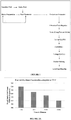
Figure 1 depicts the flow chart for the manufacture of Probiotic food of the present disclosure. -
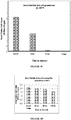
Figure 2A depicts the stability of thermostable strain Lactobacillus acidophilus (TSP-Lal) at 70°C for different time intervals in gummies.- -
Figure 2B depicts the stability of thermostable strain Lactobacillus acidophilus (TSP-Lal) at 55°C for different time intervals in chocolates. -
Figure 3 depicts the stability of thermostable strain Lactobacillus acidophilus TSP-Lal at 55°C for initial period and after 10 minutes in soup. -
Figures 4A, 4B and4C depict the stability of thermostable strain Lactobacillus plantarum TSP-Lp1 at 90°C, 140°C and 160°C. - -
Figures 4D ,4E and 4F depict the stability of thermostable strain Lactobacillus acidophilus TSP-La1 at 90°C, 140°C and 160°C. -
Figures 5A and 5B depicts the stability of thermostable strain Lactobacillus acidophilus TSP-La1 and Lactobacillus plantarum TSP-Lp1 at 160°C for initial period and after 15 minutes in muffins. -
Figure 6 depicts the stability of thermostable strain Lactobacillus acidophilus TSP-Lal at 240°C for initial period and after 10 minutes in bread. -
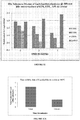
Figure 7A and7B depict the viability of thermostable strain Lactobacillus acidophilus TSP-Lal in Twining's Tea sample at 50°C and 60°C respectively for varied time period. -
Figure 8 depicts the Acid tolerance quantitative analysis for thermostable strain Lactobacillus acidophilus TSP-Lal at different pH. -
Figure 9 depicts the Acid tolerance quantitative analysis for Lactobacillus plantarum TSP-Lp1 at different pH. -
Figure 10 depicts the Bile Tolerance of thermostable strain Lactobacillus acidophilus TSP-Lal at different bile concentration values and time intervals. -
Figure 11 depicts the Bile Tolerance of thermostable strain Lactobacillus plantarum TSP- Lp1 at different bile concentration values and time intervals. -
Figures 12A and12B depict stability of Lactobacillus acidophilus TSP-Lal and Lactobacillus plantarum TSP-Lp1 in cookie at 180°C for 12 minutes. -
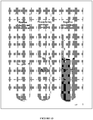
Figure 13 depicts the results of carbohydrate fermentation test with thermostable strains of the present disclosure. - The present disclosure relates to a food product comprising a thermostable Lactobacillus microorganism, wherein the thermostable microorganism is selected from the group consisting of Lactobacillus plantarum with ATCC SD No. 6863 and Lactobacillus acidophilus with ATCC SD No. 6864.
- The present disclosure also relates to a method of preparing a food product, said method comprising act of combining a thermostable strain selected from the group consisting of Lactobacillus plantarum with ATCC SD No. 6863 and Lactobacillus acidophilus with ATCC SD No. 6864; with a component of the food product during or after preparation of the food product.
- In an embodiment of the present disclosure, the food product is selected from the group consisting of beverage, yogurt, dairy product, nectar, fruit juice, energy drink, bakery food, chocolate, cereal and soup.
- In another embodiment of the present disclosure, the thermostable microorganism is viable at temperature ranging from about 25°C to 250°C.
- The present disclosure also relates to a thermostable Lactobacillus microorganism selected from the group consisting of Lactobacillus plantarum with ATCC SD No. 6863 and Lactobacillus acidophilus with ATCC SD No. 6864.
- In an embodiment of the present disclosure, the Lactobacillus plantarum has genomic sequence set forth in SEQ ID No. 1.
- In another embodiment of the present disclosure, the Lactobacillus acidophilus has genomic sequence set forth in SEQ ID No.2.
- In yet another embodiment of the present disclosure, the thermostable microorganism is viable at temperature ranging from about 25°C to 250°C.
- The present disclosure also relates to a thermostable microorganism for use in treating a disorder in a subject, wherein the microorganism is selected from the group consisting of Lactobacillus plantarum with ATCC SD No. 6863 and Lactobacillus acidophilus with ATCC SD No. 6864.
- In an embodiment of the present disclosure, the disorder is selected from group comprising diarrhea, antibiotic-associated diarrhea, irritable bowel syndrome, constipation, lactose intolerance, vaginal infection, intestinal infection, inflammatory bowel disease, and combinations thereof.
- In another embodiment of the present disclosure, the microorganism is in free form or form of food product.
- In yet another embodiment of the present disclosure, the subject is selected from group comprising animal and human being.
- The present disclosure relates to thermo-stable strain(s) of micro-organism(s).
- In an embodiment of the present disclosure, the micro-organism(s) is from Lactobacillus species.
- In an embodiment of the present disclosure, the thermo-stable strain(s) of the present disclosure have a tolerance to high temperatures.
- In the present disclosure, the term "thermostable" is intended to convey that the strains are able to survive at high temperatures for a long period of time.
- In embodiments of the present disclosure, the strains are viable, tolerant and resistant to high temperatures.
- In embodiments of the present disclosure, the thermostable strains are isolated thermostable strains.
- In embodiments of the present disclosure, the thermostable strains depict viability ranging from 1 % to 99 %.
- In embodiments of the present disclosure, the viability of the strains is dependent on environmental factors such as pH, temperature and time period.
- In embodiments of the present disclosure, viability of the thermostable strains is equal to and greater than 1.0 -1.5
X 109 colony forming units (cfu) is considered to be satisfactory for use in a food product. - It is to be noted that the number of cfu's in a product differs depending on the mode of products. For example, for tablets/sachets/capsules, it is expressed per tablet/sachet/capsule, whereas, in food example like chocolate/muffin/cookie/bread it is expressed based on the serving.
- Probiotic dosing varies depending on the product and specific indication. No consensus exists about the minimum number of microorganisms that must be ingested to obtain a beneficial effect. Typically, a probiotic should contain several billion microorganisms to increase the likelihood of adequate gut colonization. For Lactobacilli, typical doses used range from 1-20 billion colony-forming units per day.
- In embodiments of the present disclosure, the thermo-stable strain is mixed or combined with a food component during the preparation of the food product.
- In embodiments of the present disclosure, the thermo-stable strain is mixed or combined with the food product after preparation of the food product.
- In an embodiment of the present disclosure, 1.00 g of a spray dried powdered sample of Lactobacillus acidophilus TSP-Lal contains a total viable cell count of 82.0 billion cfu/gm.
- In an embodiment of the present disclosure, 1.00 g of a spray dried powdered sample of Lactobacillus plantarum TSP-Lp1 contains a total viable cell count of 248.25 billion cfu/gm.
- In embodiments, the temperature ranges from about 25°C to about 250°C.
- In embodiments of the present disclosure, the free form of the strains of the disclosure is selected from group comprising spray dried capsule, powder, tablet, sachet, ez melt, and chewable tablet.
- In the form of a food product, the spray dried powder is used in making different foods example Gummies, chocolate, cookies, muffins, bread, etc.
- In particular embodiments of the present disclosure, the strains have the ability to perform their functions in different food products even at higher temperatures, which makes them therapeutically effective.
- Lactobacillus acidophilus is a naturally occurring beneficial bacterium which supports the health of the intestinal tract. It maintains a healthy microflora by protecting the body against an overgrowth of harmful bacteria, helps improve digestion, protects against gastrointestinal upsets, abdominal pains, constipation and antibiotic-induced diarrhea.
- Lactobacillus plantarum can live in the stomach for a considerable period. It continuously fights disease and prevents entry of pathogenic microorganisms. It also improves digestive health, helps treat Irritable Bowel Syndrome (IBS), and prevents food allergies.
- In the present disclosure, the term "CFU" relates to colony forming units.
- In the present disclosure, the term "MIC" relates to Minimum Inhibitory Concentration.
- In the present disclosure, the term "TVCC" relates to Total Viable Cell Count.
- In the present disclosure, the term "GYEA" relates to "Glucose Yeast Extract Agar".
- In the present disclosure, the term "PBS" relates to "Phosphate Buffered Saline."
- In the present disclosure, the term beverage includes- Soup, Tea, Coffee, Energy drinks, and fruit juices.
- In the present disclosure, the term bakery food includes Bread, Muffins, and Cookies.
- The temperature-stable probiotic strains, of Lactobacillus plantarum (TSP-Lp1) & Lactobacillus acidophilus (TSP-Lal) have the ability to withstand harsh manufacturing processes, especially required during making Food /Beverage and in the Pharma industries. Most of the probiotics currently available in the market cannot survive a harsh environment observed during manufacturing and acidic environment of the stomach. These currently available probiotics are enteric coated to withstand harsh conditions. Probiotics that fail to reach intestinal tract alive are not likely to provide digestive and immune support. In the table provided below, the strains of the present disclosure are compared with commercial strains and their advantageous features are highlighted.

- In the present disclosure, the term "managing" or "management" or "manage" includes therapeutic and prophylactic activities. It includes treatment and healing of a disease or disorder, or ill effects or side effects of the disease or the disorder. The term also includes prevention of further progress of the disease or disorder, and prevention of further progress of ill effects or side effects of the disease or the disorder. It further includes maintenance of the optimum state in an individual.
- In the present disclosure, it is within the knowledge of the person skilled in the art to determine a suitable dosage of the strains and dosage form for administering to a particular subject.
- In another embodiment of the present disclosure, the thermo-stable Lactobacillus strain is selected from a group comprising Lactobacillus plantarum and Lactobacillus acidophilus
- In yet another embodiment of the present disclosure, the thermo-stable Lactobacillus strain is Lactobacillus plantarum TSP-Lp1. -
- The parent strains for the present disclosure have been procured form Microbial Type Culture Collection (MTCC).
- In yet another embodiment of the present disclosure, the thermo-stable Lactobacillus plantarum is Lactobacillus plantarum TSP-Lp1.
- The Lactobacillus plantarum strain of the present disclosure is also referred to as LP throughout the present disclosure.
- In still another embodiment of the present disclosure, the thermo-stable Lactobacillus acidophilus is Lactobacillus acidophilus TSP-Lal.
- The Lactobacillus acidophilus strain of the present disclosure is also referred to as La throughout the present disclosure.
- The novel strains of the present disclosure have been deposited in American Type Culture Collection (ATCC), Virginia, USA. The strains have been allotted accession numbers as follows:
- Lactobacillus plantarum SD 6863 (SD-Safe Deposit)
- Lactobacillus acidophilus SD 6864 (SD-Safe Deposit)
- In yet another embodiment, the thermo-stable strain(s) of the present disclosure are able to withstand temperature ranging from room temperature i.e. about 25°C to about 250°C.
- The present disclosure relates to food product comprising thermo-stable strain(s) of microorganism(s).
- The present disclosure relates to probiotic food products comprising thermo-stable strain(s) of micro-organism(s).
- In an embodiment of the present disclosure, micro-organism(s) is from Lactobacillus species.
- In an embodiment of the present disclosure, the food or food product contains micro-organism(s) from Lactobacillus species.
- In another embodiment of the present disclosure, the Lactobacillus strain(s) in food product/probiotic food products is selected from a group comprising Lactobacillus plantarum and Lactobacillus acidophilus and combinations thereof.
- Food products according to the present disclosure may comprise one or more strains selected from the above defined strains. Other mixtures or single thermostable strains are used advantageously within the scope of the present disclosure.
- These novel strains survive long periods of storage in room temperature and are endurable. Thus, food products containing the strains of the present disclosure have a long shelf life and are easily included in different food products.
- In yet another embodiment, the probiotic food products of the present disclosure comprising thermo-stable strain(s) of Lactobacillus provide for enhanced nutrition and help in eliminating disorders relating to gut, the disorder being selected from a group comprising but not limiting to irritable bowel syndrome, different forms of diarrhea, irritable bowel disorder, constipation, lactose intolerance and any combinations thereof and vaginal infections.
- In still another embodiment, the food product is selected from a group comprising but not limiting to, beverage, yogurt, dairy product, nectar, fruit juice, energy drink, bakery food, chocolate, cereal, soup and combinations thereof.
- In still another embodiment, the food product having heat stable or thermostable strain(s) of micro-organism(s) is referred to as probiotic food products within the ambit of the present disclosure.
- In still another embodiment, the present disclosure provides probiotic food products which involve heating at high temperatures, especially those required to make hot beverages like soup, tea, coffee, chocolates, cereals and other food products as the probiotic strains of the present disclosure are able to withstand high temperatures.
- In still another embodiment, the thermo-stable strain(s) in the food product of the present disclosure is able to withstand high temperature ranging from room temperature of about 25°C to about 250°C.
- In yet another embodiment, the probiotic food products of the present disclosure eliminate the requirement of cold storage and thus are economically beneficial to the end user.
- In yet another embodiment, the food products of the present disclosure having heat stable strain(s) of the present disclosure when heated at a high temperature are not affected in terms of taste or efficacy of the probiotic culture.
- The present disclosure relates to a process of obtaining heat stable strain(s) of micro-organism(s) comprising act of fermentation and spray drying.
- The present disclosure also relates to a process of manufacturing a food product comprising thermo-stable strain(s) of micro-organism(s), wherein the process comprises act of mixing the thermo-stable strain(s) with at least one of the components of the food product at any time during preparation of the food product
- In an embodiment of the present disclosure, the probiotic food of the present disclosure has various advantages which are listed below:
- Able to survive the passage through the digestive system.
- Able to attach to the intestinal epithelia and colonise effectively and multiply. Able to maintain good viability.
- Able to utilise the nutrients and substrates in a normal diet.
- Non-pathogenic and non-toxic.
- Capable of exerting a beneficial effect on the host. Stability of desired characteristics during processing, storage and transportation.
- Anti-inflammatory, anti-mutagenic and immuno-stimulatory in nature.
- Thus, the present disclosure provides heat stable/thermo-stable microbial strain(s) capable of surviving high temperatures, wherein these strain(s) incorporated in foods serve as probiotic foods and manage diseases/disorders.
- Throughout the specification, the food product comprising thermo-stable microbial strain(s) of the disclosure is also alternatively referred to as "Probiotic food" or "Probiotic food product" and the terms have the same meaning and scope.
- Throughout the specification, the thermo-stable microbial strain(s) of the disclosure are alternatively referred to as "heat stable microbial strain(s)", "heat stable/thermo-stable microbial strain(s)".
- The present disclosure is further elaborated with reference to the following examples, which are only illustrative in nature and should not be construed to limit the scope of the present disclosure in any manner.
- The various steps involved in the production of probiotics are provided below briefly:
- Fermentation / Perfusion Technology: The mother strain of Lactobacillus spp. is grown in media at optimized temperatures. The thermo-stable Lactobacillus species of the present disclosure are manufactured using a fermentation procedure by employing perfusion mode. The perfusion technology improves the cell densities during fermentation.
- Spray Drying: This step is carried out in order to obtain powdered form of probiotics, wherein the medium containing the strains is sprinkled on to the walls of the dryer and dried by subjecting them to a temperature of about 90°C - 120°C. The down streaming process for the Lactobacillus species is completed with a custom built spray drier wherein the microbial strains/probiotics are powdered.
- Testing (QA/QC): A complete microbiological analysis is performed for viable count colony forming units/g. of Lactobacillus spp on the spray dried product.
- The flow chart for the manufacture of probiotic food of the present disclosure is provided in
Figure 1 of the present disclosure. - As observed, the probiotic culture is taken in an inoculum vial and then added to a shake flask. The medium prepared is added into the Seed fermenter along with the probiotic strain from the shake flask. The entire culture is then transferred into a Production fermenter and allowed to grow. The cells of the culture are then filtered or centrifuged, and spray dried or vacuum dried to obtain the cells in powder form. This is followed by Formulation of the probiotic, after which the product is packed and labeled.
- After preparation of the probiotic strains, they are formulated into the food items in order to produce various food products such as but not limiting to beverages, yogurt, dairy products, nectars, fruit juices, energy drinks, bakery food, chocolates, cereals, soup and combinations thereof.
- Ingredients for batch size of 230 gm:
- Phase A- Water - 36gm and Gelatin - 21.0gm
- Phase B- Corn syrup - 66.4gm, Water - 66.3gm and Sugar - 90.2gm
- Phase C- Citric acid - 0.9gm, Colour Red #40 - 1.2gm and Mixed berry flavour - 0.9gm
- Lactobacillus acidophilus - 3.0gm (From 1.5 x 10⁹)
- Lactobacillus plantarum - 0.28gm (From 1.9 x 10¹¹)
- Temperature: 70°C
-
- 1. The ingredient of Phase A is weighed and is mixed and is kept at room temperature for 10-15 minutes.
- 2. The ingredients of the Phase B are weighed and dissolved. The phase B ingredients are kept for boiling until the mixture formed is thick and viscous.
- 3. Then ingredients of the Phase C is weighed & dissolved.
- 4. Then ingredients of Phase A and B are mixed uniformly and is added to ingredients of Phase C and mixed for 2 - 3 minutes.
- 5. When the temperature is around 70°C, the probiotics (Lactobacillus acidophilus/ Lactobacillus plantarum) is weighed as per requirement (500 million cfu/gummy) is added and is mixed uniformly.
- 6. It is then poured into the moulds and kept for refrigeration for 45 minutes, for the gummies to set.
- 7. After 45 minutes the gummies are subjected to conditioning for 24 hours. The gummy samples are taken up for total viable count analysis to check viability of probiotic.
- Ingredients for batch size of 100ml:
- Knorr Soup (Ready-made) - 7.5gm
- Lactobacillus acidophilus - 0.75gm (From 1.6x10⁹)
- Lactobacillus plantarum - 0.065gm (From 2.48x10¹¹)
- Temperature: 55°C
-
- 1. A known amount (7.5gm) of the Knorr soup is mixed with water (100ml) so that there is no formation of lumps.
- 2. It is placed on a stove and brought to boil while stirring continuously, then simmered for 3 minutes.
- 3. After 3 minutes the soup temperature is brought down to 55°C and maintained.
- 4. When the soup temperature is at 55°C, the probiotic (Lactobacillus acidophilus/ Lactobacillus plantarum) is weighed as per requirement (160 million cfu/serving), added and mixed thoroughly.
- 5. The soup temperature is maintained at 55°C and samples of the soup are drawn at 5th, 10th & 15th minute respectively.
- 6. Then the samples of different time intervals are taken up for Total viable count analysis to check the percentage of viable probiotic.
- Ingredients Batch size of 25g:
- Wilton Candy Melts (Readymade chocolates chips) - 25gm
- Lactobacillus acidophilus - 1.5gm (From 1.6 x 10⁹)
- Lactobacillus plantarum - 0.13gm (From 1.9 x 10¹¹)
- Temperature: 70°C
-
- 1. The pre-weighed chocolates chips are subjected to heating in the oven at 70°C for 1 to 2 minutes until the chocolate chips melt.
- 2. Once the chocolate chips are melted and temperature is around 70°C, the probiotic (Lactobacillus acidophilus /Lactobacillus plantarum) is weighed as per requirement (100 million cfu/chocolate) is added and mixed thoroughly for 2 minutes to get a uniform distribution.
- 3. Then it is refrigerated for 20 minutes for the chocolate to set and then taken up for Total viable count analysis to check the percentage of viable probiotic.
- Ingredients for batch size of 20gm:
- All-purpose flour - 10.0gm
- Baking soda - 0.4gm
- Salt - 0.1gm
- Butter -1.23gm
- Milk- 8.08gm
- Lactobacillus acidophilus - 0.7gm (From 1.44 x 10¹¹)
- Lactobacillus plantarum - 0.52gm (From 2.38 x 10¹¹)
- Temperature: 240°C
- Baking Time: 10 minutes
-
- 1. The bread dough is prepared using all-purpose flour, baking soda, salt, butter, milk and probiotic strain (Lactobacillus acidophilus/Lactobacillus plantarum) is added to it.
- 2. Initially the dough is prepared by adding part amount of all-purpose flour, milk and part amount of probiotic (L.acidophilus/L.plantarum) and mixed thoroughly for 10 to 15 minutes.
- 3. The dough is kept at room temperature for 42 hours and the remaining probiotic strain (L.acidophilus/L.plantarum) is kept for rehydration for 42 hours at room temperature.
- 4. After 42 hours the remaining ingredients like (Butter, milk) are mixed with the dough and kneaded for 15- 20 minutes till it is not moist and sticky.
- 5. Then the dough is greased & kept for proofing for 2 hours at room temperature.
- 6. Then the dough is baked at 240°C for 10 minutes.
- 7. After this, the bread is cooled for 10 - 15 minutes.
- 8. Then the bread is taken up for total viable cell count analysis to check the viability of probiotic.
- Ingredients for batch size of 20gm:
- All-purpose flour- 4.82gm
- Baking powder - 0.329gm
- Sugar- 2.85gm
- Unsalted butter - 4.82gm
- Egg - 4.3gm
- Dark chocolate chips - 2.85gm
- Lactobacillus acidophilus - 1.42gm (From 1.4x 10¹¹)
- Lactobacillus plantarum - 0.572gm (From 1.9 x 10¹¹)
- Temperature: 160°C
- Baking Time: 15 minutes
-
- 1. The probiotics (Lactobacillus acidophilus/Lactobacillus plantarum) powder is suspended in 0.9% NaCl overnight (15-17 hours).
- 2. The muffin batter is prepared using unsalted butter, sugar and egg is beaten together for uniform mixing, to this the overnight probiotic (Lactobacillus acidophilus/Lactobacillus plantarum) powder is added to it.
- 3. The dry ingredients (All-purpose flour, baking powder, sugar are then weighed and are added to the liquid batter and mixed thoroughly for 5 -10 minutes.
- 4. The muffin mould is then greased and the batter is kept for proofing for 1hour at room temperature.
- 5. The oven is kept for pre-heating and the muffin batter is baked at 160°C for 15 minutes.
- 6. After baking, the muffin is cooled for 5 -10 minutes at room temperature.
- 7. Then the muffin is taken up for total viable count analysis to check the viability of probiotic.
-
- Twining's Tea & Brooke Bond - 2.0gm
- Lactobacillus acidophilus - 0.1682gm (From 1.44x 10¹¹)
- Lactobacillus plantarum - 0.001gm (From 1.9 x 10¹¹)
- Temperature: 50°C, 60°C & 70°C
-
- 1. The pre-weighed tea bag is taken and is brewed at 100°C for 2 minutes.
- 2. The temperature of tea solution is then brought down to 50°C, 60°C and 70°C and maintained.
- 3. Then the probiotic (Lactobacillus acidophilus/Lactobacillus plantarum) is weighed as per requirement (100 million cfu/tea bag) is introduced in the tea solution and mixed.
- 1. The tea solution temperature is maintained at 50°C, 60°C and 70°C, samples of the tea solution are drawn at 1st minutes, 3rd minutes, 5th minutes, 7th minute and 10th minute respectively.
- 2. Then the samples of different time intervals are taken up for Total viable count analysis to check the percentage of viable probiotic.
- Ingredients for batch size of 15gm:
- All-purpose flour -7.51gm
- Baking powder - 0.237gm
- Sugar - 2.37gm
- Unsalted butter - 2.68gm
- Milk - 1.426gm
- Salt - 0.01gm
- Vanilla essence - 0.118gm
- Lactobacillus acidophilus - 0.51gm (From 1.44 x 10¹¹)
- Lactobacillus plantarum - 0.55gm (From 2.38 x 10¹¹)
- Temperature: 180°C
- Baking Time: 12 minutes
-
- 1. The probiotics (Lactobacillus acidophilus/Lactobacillus plantarum) powder is suspended in 0.9% NaCl overnight (15-17 hours)
- 2. The dry ingredients (All-purpose flour, salt, baking powder are then weighed and mixed thoroughly for 5 -10 minutes.
- 3. Then butter is taken in a beaker & granulated sugar is added and beaten till it becomes fluffy after approximately 2 - 3 minutes.
- 4. Then to this the overnight probiotic solution (Lactobacillus acidophilus/Lactobacillus plantarum) pre-weighed as per requirement (5.0 billion cfu/cookie) is added and is mixed uniformly.
- 5. To this vanilla extract & milk is added and then all the ingredients are whisked together for 5-10 minutes.
- 6. Then the cookie dough is flattered on a parchment paper & chilled in refrigerator (4-8°C) for 1 hour
- 7. After 1 hour, the oven is kept for pre-heating and the cookie dough is baked at 180°C for 12 minutes.
- 8. After baking for 12 minutes the cookie is cooled for 5 -10 minutes at room temperature.
- 9. Then the cookie is taken up for total viable count analysis to check the viability of probiotic.
- EXAMPLE 3A- The stability of the heat stable probiotic strain Lactobacillus plantarum is determined in this example.
- The stability of Lactobacillus plantarum at 90°C, 140°C &160°C is checked for different time intervals in a Hot Air Oven. The results are depicted in the table below.
Table 2A Sl No. Time Interval TVSC (billion/g) % of Viability Initial assay 6.20 100% 1 90°C for 30sec 6.10 98.3% 2 90°C for 60sec 6.02 97.0% 3 90°C for 120sec 5.90 95.1% - It is derived from the table above and
figure 4A of the present disclosure that the Lactobacillus plantarum is 95% viable at 90°C for 120 seconds.Table 2B Sl No. Time Interval TVSC (billion/g) % of Viability Initial assay 6.20 100% 1 140°C for 30sec 6.10 98.3% 2 140°C for 60sec 5.8 93.5% 3 140°C for 120sec 5.5 88.7% - It is derived from the table above and
figure 4B of the present disclosure that Lactobacillus plantarum is 88% viable at 140°C for 120 seconds.Table 2C Sl No. Time Interval TVSC (billion/g) % of Viability Initial assay 6.20 100% 1 160°C for 2 min 3.20 52.4 % 2 160°C for 5 min 0.68 million 11.0% 3 160°C for 10 min 0.0% 0.00% - It is derived from the table above and
figure 4C of the present disclosure that Lactobacillus plantarum is still 11% viable at 160°C for 300 seconds. - EXAMPLE 3B- The stability of the heat stable probiotic strain Lactobacillus acidophilus TSP-La-1 is determined in this example.
- The stability of Lactobacillus acidophilus at 90°C, 140°C & 160°C is checked for different time intervals in a Hot Air Oven. The results are depicted in the table below.
Table 2D Sl No. Time Interval TVCC (billion cfu/gm) % of Viability Initial assay 2.16 100% 1 90°C for 30sec 2.10 97.2% 2 90°C for 60sec 1.98 91.6% 3 90°C for 120sec 1.75 81.0% - Conclusion: The above data and
figure 4D shows that Lactobacillus acidophilus is still heat stable and viable at 81% at 90°C for 120 sec.Table 2E Sl No. Time Interval TVCC (billion cfu/g) % of Viability Initial assay 2.16 100% 1 140°C for 30sec 2.08 96.2% 2 140°C for 60sec 1.90 89.3% 3 140°C for 120sec 1.55 71.7% - Conclusion: The above data and
figure 4E shows that Lactobacillus acidophilus is still heat stable and viable at 71% at 140°C for 120 sec.Table 2F Sl No. Time Interval TVCC (billion cfu/gm) % of Viability Initial assay 2.1 100% 1 160°C for 2min 0.86 4.09% 2 160°C for 5min 0.0 0.0% 3 160°C for 10min 0.0 0.0% - Conclusion: The above data and
figure 4F shows that Lactobacillus acidophilus 4.09% is still Heat stable at 160°C for 120 sec - EXAMPLE 3C - During the preparation of Probiotic gummies, chocolates and soup, the probiotic strains are subjected to high temperatures where the probiotic strains are present/added. The heat stability exhibited by these probiotic strains in the food products are determined by checking their viability.
- As shown in Table 3A below and
Figure 2A , it is observed that in Gummies, Lactobacillus acidophilus is 92.0% viable at 70°C for time duration up to 3 minutes.Table 3A Sl No. Time Interval TVCC (Million cfu/gummy) % of Viability Initial Assay 500 100% 1 70°C for 1 min 485 97% 2 70°C for 2 minutes 475 95% 3 70°C for 3 minutes 460 92% - As shown in Table 3B below and
Figure 2B , it is observed that in chocolates, Lactobacillus acidophilus is 83.3% viable at 55°C for time duration up to 2 minutes.Table 3B Sl No. Time Interval TVCC (Million cfu /chocolate) % of Viability Initial Assay 150 100% 1 55°C for 1 min 140 93.3% 2 55°C for 2 minutes 125 83.3% 3 55°C for 3 minutes 102 68.0% - The above results depict that the Lactobacillus acidophilus is stable up to 83% and viable at 55°C for up to 2 minutes and is 68.0% viable at 55°C up to 3 minutes.
- As shown in Table 3C below and
Figure 3 , it is observed that in soup (liquid medium), Lactobacillus acidophilus, is 57% viable at 55°C for 5 minutes & 26% viable up to 10 minutes.Table 3C Sl No. Time Interval TVCC (Million cfu/ml) % of Viability Initial Assay 160 100% 1 55°C for 5 min 91.6/ml 57.2 2 55°C for 10 minutes 42.3/ml 26.4 3 55°C for 15 minutes 0.94/ml 0.59 - The same experiment as above is performed by introducing Lactobacillus plantarum strains into soup and checking the viability at 55°C and 75°C, where the viability is found to be good, as shown in Table 3D.
Table 3D Sl No. Time Interval TVCC (Million cfu/ml) % of Viability Initial Assay 160 100% 1 55°C for 5 min 7.8 4.87% 2 55°C for 10 minutes 3.7 2.31 %. 3 55°C for 15 minutes 0.27 0.16% - EXAMPLE 3D - Lactobacillus plantarum (TSP-Lp 1) strain and Lactobacillus acidophilus TSP-La1 strain is incorporated into cookie dough, cookies are baked and their stability is checked at 180°C. The results are provided in Tables 4A and 4B below.
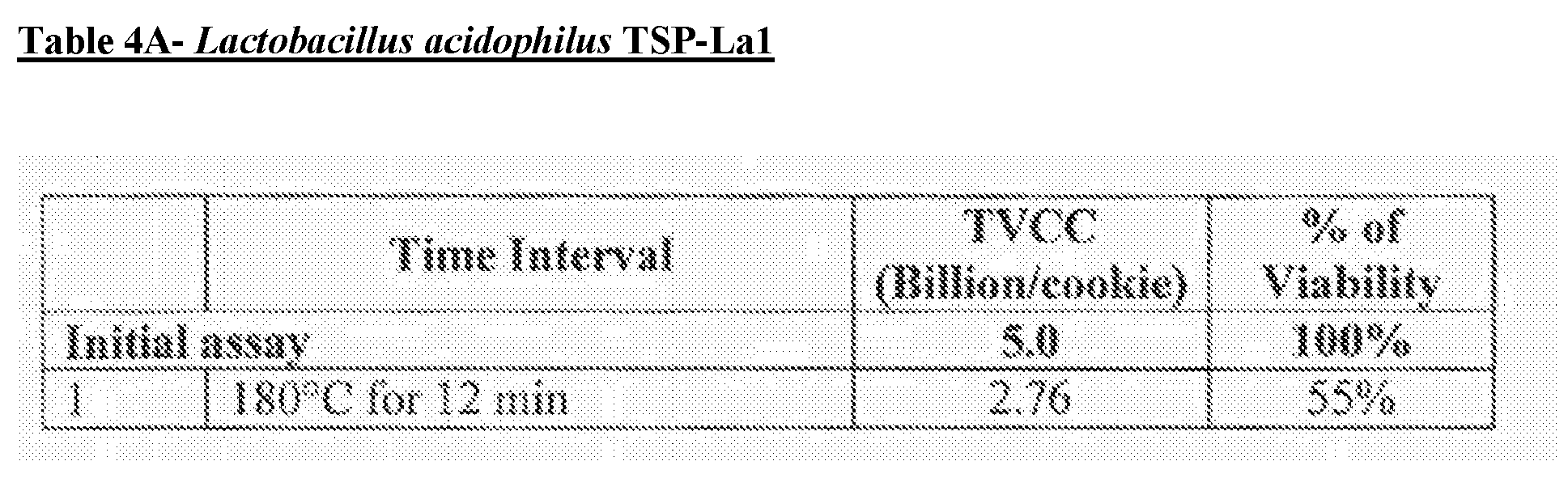

- It is derived from Tables 4A and 4B, and
Figures 12A and12B that Lactobacillus acidophilus is 55% viable at 180°C for 12 minutes and Lactobacillus plantarum is 37% viable at 180°C for 12 minutes. - The probiotic muffins are prepared by adding the Lactobacillus acidophilus TSP-Lal and Lactobacillus plantarum TSP-Lp1 strains to them during their preparation. The muffins are baked in an oven at 160°C for 15 minutes.
Table 5A Time Interval TVCC (Billion cfu/muffin) % of Viability Initial assay 10.0 100% 1 160°C for 15 min 7.5 75% Table 5B Time Interval TVSC (Billion cfu/muffin) % of Viability Initial assay 5.0 100% 1 160°C for 15 min 3.85 77% - It is observed from Tables 5A-5B and
Figures 5A-5B that the thermostable strain Lactobacillus acidophilus in the muffin depicts a viability of up to 75% at 160°C for 15 minutes. Further, Lactobacillus plantarum is 77% viable at 160°C for 15 minutes. - This study is conducted to check the stability of Lactobacillus acidophilus in bread which is baked in oven at temperatures above 200°C. The Table No. 6 as depicted below showcases that the Lactobacillus acidophilus strains of the present disclosure are stable at temperatures as high as 240°C for a period of about 10 minutes.
Table 6 Time Interval TVCC (Billion cfu/bread) % of Viability Initial assay 5.0 100% 1 240°C for 10 min 3.0 60% - Thus, it is clear that the Lactobacillus acidophilus strains of the present disclosure are stable in extremely high temperatures like 240°C with a viability of 60 % and thereby provide for efficient heat stable strains.
- The above data in the table and
figure 6 shows that Lactobacillus acidophilus is 60% viable at 240°C for 10 minutes. - This study is conducted to check the stability of Lactobacillus plantarum in bread which is baked in oven at temperatures above 200°C. This study showcases that the Lactobacillus plantarum strains of the present disclosure are stable at temperatures as high as 240°C for a period of about 10 minutes.
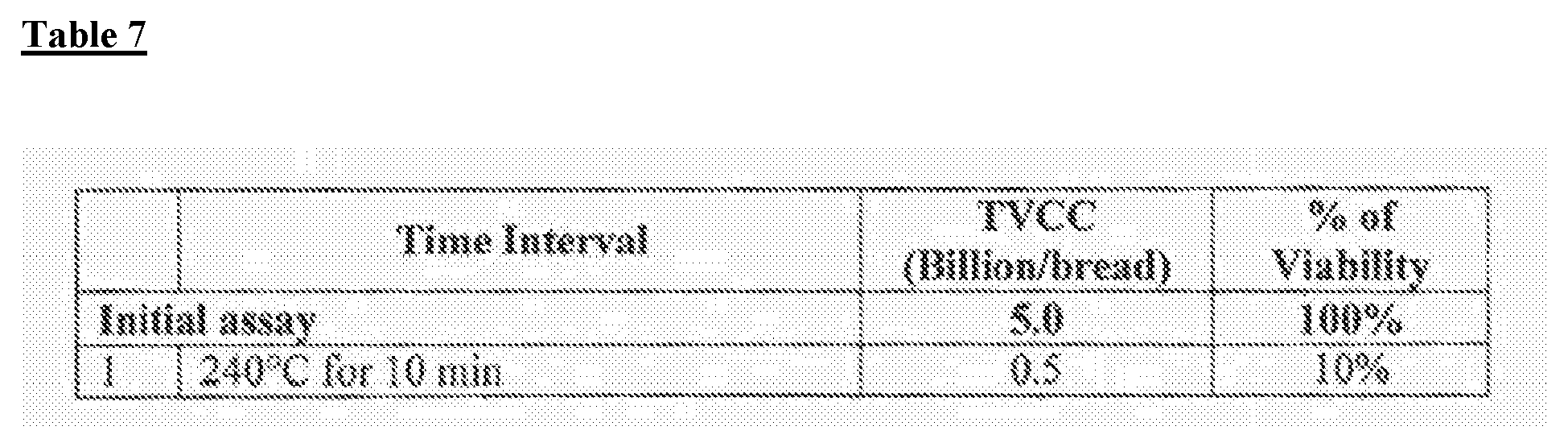
- It is stated in the prior art that Lactobacillus species are not viable in liquid medium. However, when the Lactobacillus acidophilus TSP-Lal of the present disclosure is formulated into a tea product (Twining's Tea), which is later suspended in water while brewing the tea, significant amount of viability of about 39% is observed at 50°C and 60°C for up to 7 minutes.
Table 8A Sl No. Time Interval TVCC (million cfu/tea bag) % of Viability Initial Count 100 million 100% 1 50°C for 1min 65.6 million 65.6% 2 50°C for 3min 50.0 million 50.0% 3 50°C for 5min 48.0 million 48.0% 4 50°C for 7min 39.0 million 39.0% 5 50°C for 10 min 1.0 million 1.0% Table 8B Sl No. Time Interval TVCC (million cfu/tea bag) % of Viability Initial Count 100 million 100% 1 60°C for 1min 43.0 million 43.0% 2 60°C for 3min 28.36 million 28.36% 3 60°C for 5min 25.60 million 25.60% 4 60°C for 7 min 1.41 million 1.41% 5 60°C for 10 min 0.84 million 0.84% - From the above data in the tables and from
figures 7A and7B , it is inferred that the LA strains of the present disclosure are viable in liquid medium at room temperature and higher temperatures like 50°C and 60°C and hence these strains can be formulated into even liquid based media/product. - It is stated in the prior art that Lactobacillus species are not viable in liquid medium. However, when the Lactobacillus plantarum TSP-Lp1 of the present disclosure is formulated into a tea product (Twining's Tea), which is later suspended in water while brewing the tea, significant amount of viability is observed at 50°C and 60°C.


- The Lactobacillus acidophilus strains are subjected to extreme pH conditions within the range of 1.5 to 3.0 to ascertain that the food products containing these strains are able to survive the low acidity of the stomach during digestion. Total plate counts for Lactobacillus acidophilus on GYEA agars at different pH values of 1.5., 3.0 and 7.2 (control) over 1.5 hour intervals. The table no. 10 below depicts the plate viability of LA strains when subjected to pH 1.5, 2.5 3.0 and 7.2 for 0.5, 1.5 and 3 hours. The period of 0 hour is the time when the cultures are plated immediately for assay upon being exposed to PBS with different pH values.

- It is observed from the table above and
figure 8 that the strains are able to resist the low pH of the stomach and are viable in the stomach. At pH 3.0, the Lactobacillus acidophilus has steady viability until 3.0 hour. - Thus, the thermo-stable strains of the present disclosure are suitable for being incorporated into food products and act beneficially in the environment of the stomach.
- The same acid tolerance test as provided in Example 7 is conducted with Lactobacillus plantarum TSP-Lp1 and similar results are observed. The table no. 11 below indicates the viability % of the LP strains subjected to the low pH usually present in the stomach. The period of 0 hour is the time when the cultures are plated immediately for assay upon being exposed to PBS with different pH value.
Table 11 Strain pH Total plate counts (log9 CFU/ mL) 0hr % of Viability 1.5 hr % of Viability 3.0 hr % of Viability Lactobacillus plantarum TSP-Lp1 1.5 0.76 47.20% - 0.0% 0.0 0.0% 2.5 0.84 52.17% 0.19 11.8% 8 cfu/ml 0.004% 3.0 1.20 74.50% 0.58 36.02% 0.11 6.83 % 7.2 1.61 100% 1.20 74.50% 1.03 63.90% - From the above results in the table and
figure 9 , it is evident that the LP strains of the present disclosure are viable at low pH for a considerable amount of time. At pH 3.0, the Lactobacillus plantarum has steady viability until 3.0 hours. - Thus, the thermo-stable strains of the present disclosure are suitable for being incorporated into food products and act beneficially in the environment of the stomach.
- In order to ascertain the sensitivity of the thermostable strains in the food products towards antibiotics, Antibiotic susceptibility profile for Lactobacillus acidophilus is created by disk diffusion method. The susceptibility criteria used is established by Charteris et al. The Lactobacillus acidophilus is grown in Man Rogosa Sharpe Agar (MRSA).
- Lactobacillus MRS Agar is recommended for cultivation of all Lactobacillus species.
-
Ingredients Gms / Litre Proteose peptone 10.000 Beef extract 10.000 Yeast extract 5.000 Dextrose 20.000 Poly sorbate 801.000 Ammonium citrate 2.000 Sodium acetate 5.000 Magnesium sulphate 0.100 Manganese sulphate 0.050 Di potassium phosphate 2.000 Agar 12.000 Final pH (at 25°C) 6.5±0.2 - 67.15 grams is suspended in 1000 ml distilled water and heated to boiling to dissolve the medium completely. It is sterilized by autoclaving at 15 lbs pressure (121°C) for 20 minutes, mixed well and poured into sterile Petri plates.
- The table below depicts the results carried out for a list of common antibiotics. The concentration of the tested antibiotics has been included depending upon their minimum inhibitory concentrations.
Table 12 Sl No Antibiotic Concentration MIC Results Resistant/Sensitive STRAIN : Lactobacillus acidophilus TSP-Lal 01. Ampicillin 10µg 10mm Resistant 02. Amoxicillin 30µg 32mm Sensitive 03. Ciprofloxacin 10µg 22mm Sensitive 04. Cephalothin 30µg 25mm Sensitive 05. Chloramphenicol 30µg 29mm Sensitive 06. Clindamycin 2µg 31mm Sensitive 07. Erythromycin 15µg 14mm Resistant 08. Gentamycin 10µg 10mm Resistant 09. Kanamycin 30µg No Zone Resistant 10. Methicillin 5µg 30mm Sensitive 11. Oxacillin 1µg No Zone Resistant 12. Rifampicin 5µg 35mm Sensitive 13. Streptomycin 10µg 18mm Sensitive 14. Tetracycline 30µg 11mm Resistant 15. Vancomycin 30µg No Zone Resistant - It is seen from the table above that the Lactobacillus acidophilus strain of the present disclosure is sensitive to Amoxicillin, Ciprofloxacin, Cephalothin, Chloramphenicol, Clindamycin, Methicillin, Rifampicin and Streptomycin and is resistant to Ampicillin, Erythromycin, Gentamycin, Kanamycin, Oxacillin, Tetracycline and Vancomycin.
- The same set of study as the previous example is conducted using Lactobacillus plantarum strain of the present disclosure and the results for the study are depicted in Table No. 13 as below. The susceptibility criteria used is established by Charteris et al. The Lactobacillus acidophilus is grown in Man Rogosa Sharpe Agar,
Table 13 Sl No Antibiotic Concentration MIC Results Resistant/Sensitive STRAIN: Lactobacillus plantarum TSP-Lp1 01. Ampicillin 10µg No Zone Resistant 02. Amoxicillin 30µg 39 mm Sensitive 03. Ciprofloxacin 10µg 31 mm Sensitive 04. Cephalothin 30µg 23 mm Sensitive 05. Chloramphenicol 30µg 31 mm Sensitive 06. Clindamycin 2µg 34 mm Sensitive 07. Erythromycin 15µg 14 mm Sensitive 08. Gentamycin 10µg 8 mm Resistant 09. Kanamycin 30µg No Zone Resistant 10. Methicillin 5µg 15mm Sensitive 11. Oxacillin 1µg No Zone Resistant 12. Rifampicin 5µg 43 mm Sensitive 13. Streptomycin 10µg 20mm Sensitive 14. Tetracycline 30µg 14 mm Sensitive 15. Vancomycin 30µg No Zone Resistant - From the above table, it is observed that Lactobacillus plantarum is sensitive to Amoxicillin, Ciprofloxacin, Cephalothin, Chloramphenicol, Clindamycin, Erythromycin, Methicillin, Rifampicin, Streptomycin and Tetracycline and resistant to Ampicillin, Gentamycin, Kanamycin, Oxacillin and Vancomycin.
- The strains of Lactobacillus acidophilus TSP-Lal thermostable strain of the present disclosure are tested for their tolerance towards various concentrations to Bile in the body. Therefore, various concentrations of Bile ranging from 0.3 % to 1% are subjected to the LA strains of the present disclosure as depicted in Table no. 14 below.
- Total plate counts for Lactobacillus acidophilus on GYEA agars at different bile concentration of 0.3%, 0.5%, 1.0% and control over 0, 3.0 and 6.0 hour intervals are provided in the table below. The period of 0 hour is the time when the cultures are plated immediately for assay upon being exposed to PBS with different Bile concentration values.
- It is to be noted that the concentration for Bile in the body only reaches up to a maximum of 1%.
Table 14 Strain Bile Conc., Total plate counts (log9 CFU/ mL) 0hr %of Viability 3.0 hr % of Viability 6.0 hr % of Viability Lactobacillus acidophilus TSP- La1 0.3% 1.37 94.4% 1.29 82.69% 0.75 44.6% 0.5% 1.18 81.3% 1.02 65.38% 0.59 35.1% 1.0% 1.05 72.4% 0.12 7.69% 0.02 1.19% Control 1.45 100% 1.56 100% 1.68 100% - From the above table and
figure 10 of the present disclosure, it is clear that the LA strains of the present disclosure are capable of tolerating high concentrations of the Bile. Thus, the thermo-stable strains of the present disclosure are suitable for being incorporated into food products and act beneficially in the environment of the stomach. - The same study as described in the previous example is carried out with Lactobacillus plantarum TSP-Lp1 strain of the present disclosure, wherein the strain is subjected to different concentrations of Bile i.e. 0.3% to 1%.
- The table below provides the viability % of the LP strains of the present disclosure when subjected to varying concentrations of Bile. Total plate counts for Lactobacillus plantarum on GYEA agars at different bile concentration of 0.3%, 0.5%, 1.0% and control aver 0, 3.0 and 6.0 hour intervals are provided. The period of 0 hour is the time when the cultures are plated immediately for assay upon being exposed to PBS with different Bile concentration values.

figure 11 of the present disclosure, it is clear that the LP strains of the present disclosure are capable of tolerating high concentrations of Bile. Thus, the thermo-stable strains of the present disclosure are suitable for being incorporated into food products and act beneficially in the environment of the stomach. - In this study, identification studies are carried oust to ascertain the morphological, biochemical and physiological behavior of the strains of the present disclosure. As seen in the table below, the strain of Lactobacillus acidophilus TSP-Lal is identified as Bacillus (Rod), Gram-positive and non-motile.
- Clean glass slides, Inoculating loop, Bunsen burner, Microscope, Immersion oil, Saline and Cultures.
-
1. Primary Stain - Crystal Violet 2. Mordant - Grams Iodine 3. Decolourizer - Ethyl Alcohol 4. Secondary Stain - Safranin -
- 1. The slide with heat fixed smear is placed on staining tray.
- 2. The smear is flooded with crystal violet and kept aside for 1 minute.
- 3. The slide is tilted slightly and gently rinsed with tap water or distilled water using a wash bottle.
- 4. The smear is flooded with Gram's iodine and kept aside for 1 minute.
- 5. The slide is tilted slightly and gently rinsed with tap water or distilled water using a wash bottle. The smear appears as a purple circle on the slide.
- 6. It is decolorized using 95% ethyl alcohol or acetone. The slide is tilted slightly and the alcohol is applied drop by drop for 5 to 10 seconds until the alcohol runs almost clear.
- 7. The slide is immediately rinsed with water.
- 8. The slide is flooded with safranin to counter-stain and kept aside for 45 seconds.
- 9. The slide is tilted slightly and gently rinsed with tap water or distilled water using a wash bottle.
- 10. The slide is blotted dry with bibulous paper.
- 11. The smear is viewed using a light-microscope under oil-immersion.
-
- Two test tubes with Nutrient Agar medium
- Inoculation Stab needle
- Over night grown Cultures - 18-24hrs (Lactobacillus acidophilus & Lactobacillus plantarum)
-
- 1. The tubes of Nutrient Agar media are labeled with the names of the organisms.
- 2. The inoculating stab needle is flamed and cooled and inserted into the culture after flaming the neck of the tube.
- 3. The cap is removed from the tube of medium, the neck is flamed, and stabbed 2/3 of the way down to the bottom. The neck of the tube is flamed again before returning the cap to the tube.
- 4. The tubes are incubated at 37°C for 24 to 48 hours.
- 5. The cultures are examined for the presence or absence of a precipitate along the line of the stab inoculation.
- In this study, the same set of morphological, biological and physiological studies are conducted for the strain i.e. Lactobacillus plantarum TSP-Lp1 of the present disclosure. The table below lists the morphological and physiological characteristics of the LP strain.
Table 17 PARAMETER RESULTS Lactobacillus plantarum TSP - Lp 1Microscopy Bacillus (Rod) Gram Staining + Motility Non Motile Lactic Acid Production + Indole Test - Catalase Test - Gelatin Hydrolysis Test - Starch Hydrolysis Test - SUGAR FERMENTATION TEST Glucose (0.1%) +/- Dextrose (0.1%) +/- Sucrose (0.1%) +/- FOS (0.1%) +/- Maltose (0.1%) +/- "+" is Positive.
"-" is Negative.
"+/-" indicates the Production of Acid but does not produce Gas.
+/+" indicates the production of both Acid and Gas. - As seen in the table above, the strain of Lactobacillus plantarum TSP -Lp1 is identified as Bacillus (Rod), Gram-positive and non-motile.
- This example establishes that the thermo-stable strains of the present disclosure are able to utilize the nutrients and substrates in a normal diet.
-
- 1. Phenol Red Carbohydrate Fermentation Broth.
- 2. Bacterial culture.
- 3. Inoculation loop.
- 4. Incubator (37° C).
-
- 1. The trypticase, Sodium chloride, and Phenol red is weighed and dissolved in 100 ml distilled water and transferred into conical flasks.
- 2. 0.5% to 1% of desired carbohydrate is added into all flasks.
- 3. Inverted Durham tubes are inserted into all tubes, and the Durham tubes should be fully filled with broth.
- 4. The tubes are sterilized at 121° C for 20 minutes.
- 5. It is important to not overheat the Phenol red Carbohydrate fermentation broth. The overheating will result in breaking down of the molecules and form compounds with a characteristic color and flavor.
- 6. The sugar is transferred into screw capped tubes or fermentation tubes and labelled properly.
-
- 1. Trypticase: 1g
- 2. Carbohydrate: 0.5g (Glucose, Dextrose, Sucrose, Maltose, Fructo Oligosaccharide (FOS)
- 3. Sodium Chloride: 0.5g
- 4. Phenol red: 0.0189mg
- Autoclaved at 121°C for 20 minutes.
-
- 1. Each labeled carbohydrate broth is aseptically inoculated with both the thermo-stable strains of the present disclosure and un-inoculated tubes as kept as control tubes.
- 2. The tubes are incubated at 18-24 hours at 37°C.
- 3. The reaction is observed and results are provided in
Figure 13 of the present disclosure. - It is observed from
figure 13 that after inoculation with either of the strains of the present disclosure, in the tubes: - 1. Acid production: Changes the medium into yellow color- the organism ferments the given carbohydrate and produces organic acids thereby reducing the pH of the medium into acidic.
- 2. Acid and Gas production: Changes the medium into yellow color-the organism ferments the given carbohydrate and produce organic acids and gas. Gas production can be detected by the presence of small bubbles in the inverted Durham tubes.
- 3. Absence of fermentation in Control: The broth retains the red color. The organism is not present so carbohydrate is not utilized.
- Thus, from this example, establishes that the thermo-stable strains of the present disclosure are able to utilize the nutrients and substrates in a normal diet and thus aids in providing general good health when consumed.
- ) The objective of this experiment is to establish the stability of the temperature stable Lactobacillus acidophilus TSP-Lal strain of the present disclosure in comparison to commercially available Freeze dried Lactobacillus acidophilus at 70°C in chocolates.
- Temperature: 70°C
- Probiotic Strain: Temperature stable Lactobacillus acidophilus TSP-Lal
- Commercial strain: Freeze dried Lactobacillus acidophilus
Table 18 Sl No. PROBIOTIC STRAIN LIMIT (MILLION CFU/CHOCOLATE) Viability (MILLION CFU/CHOCOLATE) 1. Lactobacillus acidophilus TSP-La1 Not less than 100 103 2. Freeze dried Lactobacillus acidophilus Not less than 100 00 - B) The objective of this experiment is to establish the stability of the temperature stable Lactobacillus plantarum TSP-Lp1 strain of the present disclosure in comparison to commercially available Freeze dried Lactobacillus plantarum at 70°C in chocolates.
- Temperature: 70°C
- Probiotic Strain: Temperature stable Lactobacillus plantarum TSP-Lp1
- Commercial strain: Freeze dried Lactobacillus plantarum.
Table 19 Sl No. PROBIOTIC STRAIN LIMIT (MILLION CFU/CHOCOLATE) Viability (MILLION CFU/CHOCOLATE) 1. Lactobacillus plantarum TSP-Lp1 Not less than 100 105 2. Freeze dried Lactobacillus plantarum Not less than 100 00 - It is observed from the table above that commercial strains as well as the strains of the present disclosure are present in chocolate at an amount more than 100 million cfu/chocolate. However, after heating the chocolate to 70°C, all the cells of the commercially available strain are destroyed, whereas the viability of the thermo-stable strains of the present disclosure is high. Thus, it is concluded that the strains of the present disclosure is viable and stable at 70°C (Temperature used to make chocolates as prototype).
- The objective of this example is to establish the stability of the thermo-stable strains of the present disclosure over a period of 1-9 months.
-
- PRODUCT: Lactobacillus acidophilus TSP-La1
- STABILITY STUDIES: At Room Temperature at 25 ± 2°C
- PERIOD OF TESTING: 1, 2, 3, 6, 9, 12, 18, and 24 Months
- QUANTITY: 50 gm
- No significant changes are observed during the studies. Thus, it is concluded that the strain of the present disclosure Lactobacillus acidophilus TSP-Lal is stable for a period of up to 9 months at room temperature.
- In this example, probiotic gummy with strain Lactobacillus acidophilus TSP-La1 is stored at 25± 2°C and relative humidity of 60 ± 5 % relative humidity. Tests are performed for color and flavor. Assays are also performed. The tests are performed each month for a period of 6 months
- Assay A- Total yeast and mould count.
- Assay B -Total viable cell count.
- The results are provided below.
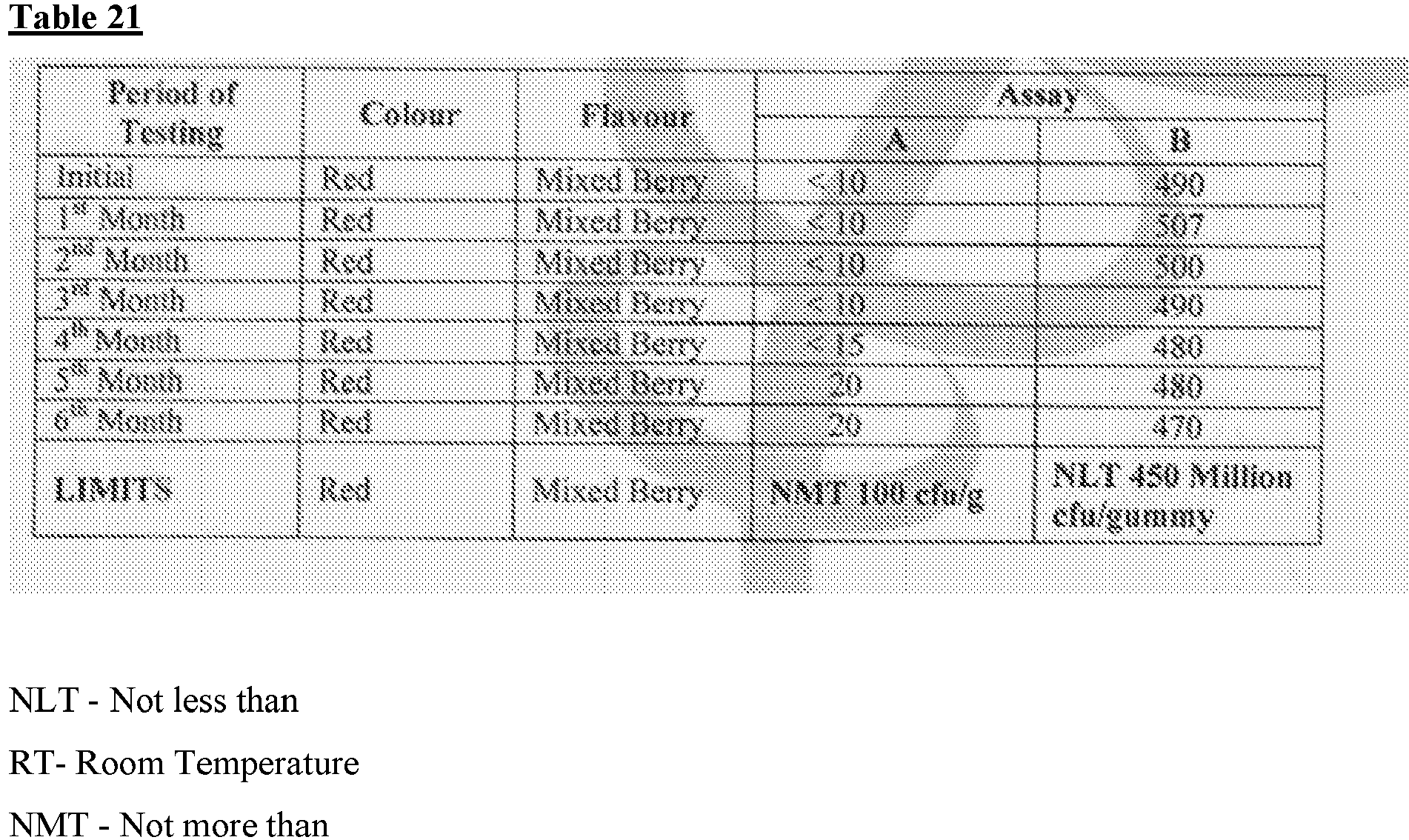
- No Significant change is observed during the studies. Thus, the probiotic strain containing product is stable at Room temperature condition for 6 months.
- The objective of this example is to establish the stability of the thermo-stable strains of the present disclosure in cookies at 20 °C for a period of 6 days.
- Probiotic cookies are prepared with a blend of 2 strains Lactobacillus acidophilus TSP-Lal & Lactobacillus plantarum TSP-Lp1 of the present disclosure at 12.5gm each Cookie. The stability studies are carried out at 20 ± 2 °C and the humidity is maintained at 50 ± 5%. The results are provided in the table below.


- It is concluded from the table above that the strains of the present disclosure are viable for up to 97.2% for 6 days at 20°C.
- In this example, the 16S rRNA gene sequencing of the strains of the present disclosure is provided. The thermostable microorganism Lactobacillus plantarum has genomic sequence set forth in SEQ ID No.1. The thermostable microorganism Lactobacillus acidophilus has genomic sequence set forth in SEQ ID No.2.


- In view of the above examples and results, it is evident that the strain(s) of the present disclosure when incorporated in the food products are viable at high temperatures.
- Thus, the thermo-stable strain(s) of the present disclosure eliminate the requirement of cold storage and thus are economical and at the same time provide for enhanced nutrition to the consumers.
- The foregoing description of the specific embodiments will so fully reveal the general nature of the embodiments herein that others can, by applying current knowledge, readily modify and/or adapt for various applications such specific embodiments without departing from the generic concept, and, therefore, such adaptations and modifications should and are intended to be comprehended within the meaning and range of equivalents of the disclosed embodiments. It is to be understood that the phraseology or terminology employed herein is for the purpose of description and not of limitation. Therefore, while the embodiments in this disclosure have been described in terms of preferred embodiments, those skilled in the art will recognize that the embodiments herein can be practiced with modification within the spirit and scope of the embodiments as described herein.
- While considerable emphasis has been placed herein on the particular features of this disclosure, it will be appreciated that various modifications can be made, and that many changes can be made in the preferred embodiments without departing from the principles of the disclosure. These and other modifications in the nature of the disclosure or the preferred embodiments will be apparent to those skilled in the art from the disclosure herein, whereby it is to be distinctly understood that the foregoing descriptive matter is to be interpreted merely as illustrative of the disclosure and not as a limitation.
-
- <110> TRIPHASE PHARMACEUTICALS PVT. LTD.
- <120> THERMO-STABLE STRAINS, PRODUCTS AND METHODS THEREOF
- <130> IP27333
- <140> 04978/CHE/2014
<141> 2014-10-01 - <160> 2
- <170> PatentIn version 3.5
- <210> 1
<211> 1489
<212> DNA
<213> Lactobacillus plantarum - <220>
<221> gene
<222> (1)..(1489) - <400> 1


- <210> 2
<211> 516
<212> DNA
<213> Lactobacillus acidophilus - <220>
<221> gene
<222> (1)..(516) - <400> 2
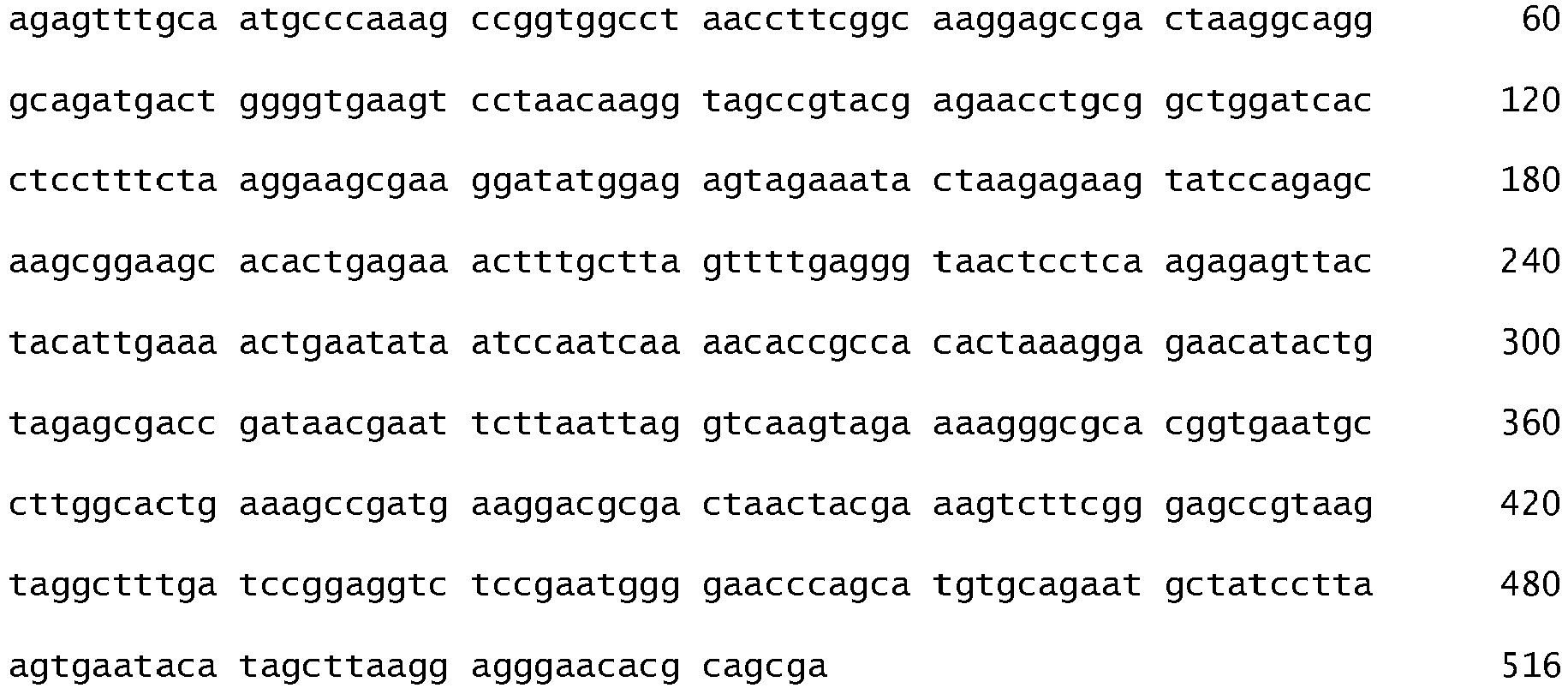
-
- <110> TRIPHASE PHARMACEUTICALS PVT. LTD.
- <120> THERMO-STABLE STRAINS, PRODUCTS AND METHODS THEREOF
- <130> IP27333
- <140> 04978/CHE/2014
<141> 2014-10-01 - <160> 2
- <170> PatentIn version 3.5
- <210> 1
<211> 1489
<212> DNA
<213> Lactobacillus plantarum - <220>
<221> gene
<222> (1)..(1489) - <400> 1


- <210> 2
<211> 516
<212> DNA
<213> Lactobacillus acidophilus - <220>
<221> gene
<222> (1)..(516) - <400> 2


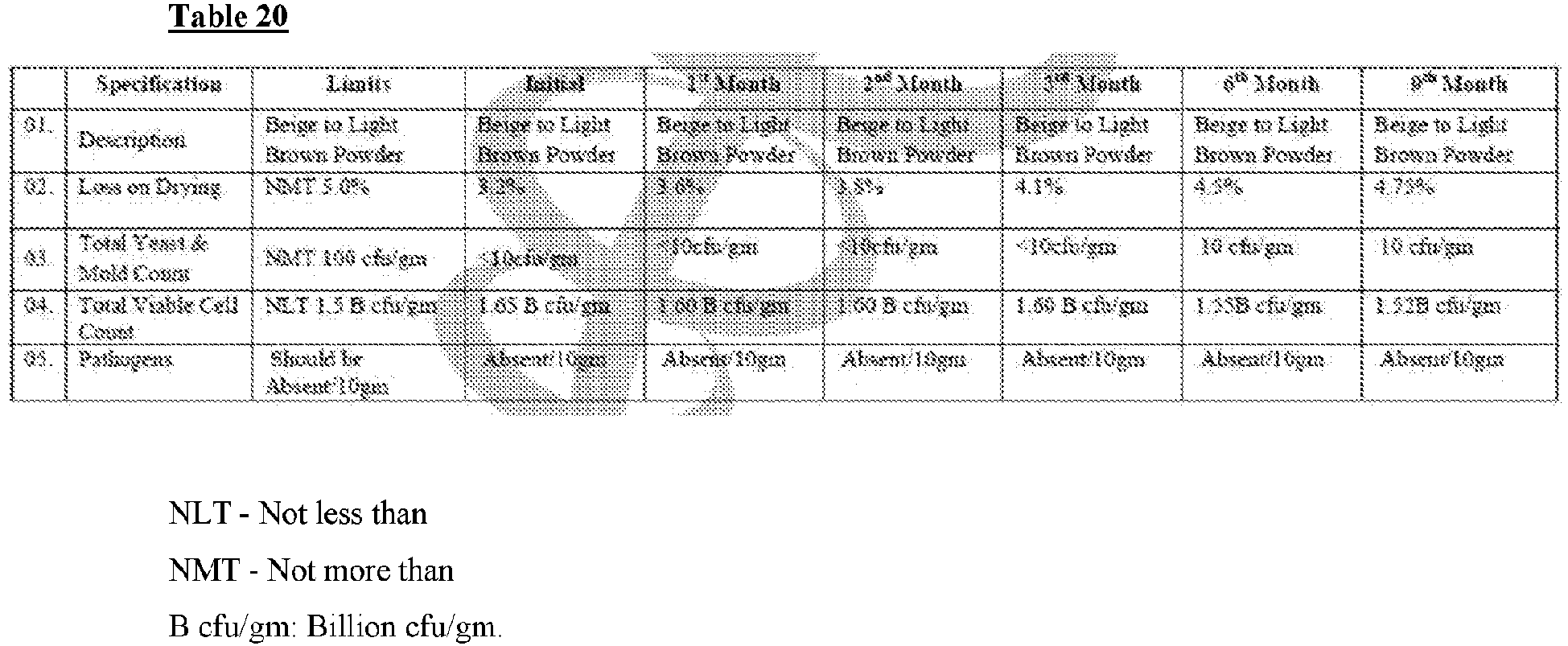
Claims (11)
- A food product comprising a thermostable Lactobacillus microorganism, wherein the thermostable microorganism is selected from the group consisting of Lactobacillus plantarum with ATCC SD No. 6863 and Lactobacillus acidophilus with ATCC SD No. 6864.
- A method of preparing a food product, said method comprising act of combining a thermostable strain selected from the group consisting of Lactobacillus plantarum with ATCC SD No. 6863 and Lactobacillus acidophilus with ATCC SD No. 6864; with a component of the food product during or after preparation of the food product.
- The food product as claimed in claim 1 and the method as claimed in claim 2, wherein the food product is selected from the group consisting of beverage, yogurt, dairy product, nectar, fruit juice, energy drink, bakery food, chocolate, cereal and soup.
- The food product as claimed in claim 1 and method as claimed in claim 2, wherein the thermostable microorganism is viable at temperature ranging from 25°C to 250°C.
- A thermostable Lactobacillus microorganism selected from the group consisting of Lactobacillus plantarum with ATCC SD No. 6863 and Lactobacillus acidophilus with ATCC SD No. 6864.
- The thermostable microorganism as claimed in claim 5, wherein the Lactobacillus plantarum has genomic sequence set forth in SEQ ID No.1.
- The thermostable microorganism as claimed in claim 5, wherein the Lactobacillus acidophilus has genomic sequence set forth in SEQ ID No.2.
- The thermostable microorganism as claimed in claim 5, wherein the thermostable microorganism is viable at temperature ranging from 25°C to 250°C.
- A thermostable microorganism for use in treating a disorder in a subject, wherein the microorganism is selected from the group consisting of Lactobacillus plantarum with ATCC SD No. 6863 and Lactobacillus acidophilus with ATCC SD No. 6864.
- The thermostable microorganism for use as claimed in claim 9, wherein the disorder is selected from the group consisting of diarrhoea, antibiotic-associated diarrhoea, irritable bowel syndrome, constipation, lactose intolerance, vaginal infection, intestinal infection, inflammatory bowel disease, and combinations thereof.
- The thermostable microorganism for use as claimed in claim 9, wherein the microorganism is in free form or form of food product and wherein the subject is selected from group comprising animal and human being.
Priority Applications (1)
| Application Number | Priority Date | Filing Date | Title |
|---|---|---|---|
| PL15846869T PL3237600T3 (en) | 2014-10-01 | 2015-09-30 | Thermo-stable strains, products and methods thereof |
Applications Claiming Priority (2)
| Application Number | Priority Date | Filing Date | Title |
|---|---|---|---|
| IN4978CH2014 | 2014-10-01 | ||
| PCT/IB2015/057497 WO2016051358A1 (en) | 2014-10-01 | 2015-09-30 | Thermo-stable strains, products and methods thereof |
Publications (3)
| Publication Number | Publication Date |
|---|---|
| EP3237600A1 EP3237600A1 (en) | 2017-11-01 |
| EP3237600A4 EP3237600A4 (en) | 2018-08-01 |
| EP3237600B1 true EP3237600B1 (en) | 2020-04-29 |
Family
ID=55629507
Family Applications (1)
| Application Number | Title | Priority Date | Filing Date |
|---|---|---|---|
| EP15846869.4A Active EP3237600B1 (en) | 2014-10-01 | 2015-09-30 | Thermo-stable strains, products and methods thereof |
Country Status (7)
| Country | Link |
|---|---|
| US (1) | US10058577B2 (en) |
| EP (1) | EP3237600B1 (en) |
| CA (1) | CA2963213C (en) |
| DK (1) | DK3237600T3 (en) |
| ES (1) | ES2808677T3 (en) |
| PL (1) | PL3237600T3 (en) |
| WO (1) | WO2016051358A1 (en) |
Families Citing this family (2)
| Publication number | Priority date | Publication date | Assignee | Title |
|---|---|---|---|---|
| CN114736838B (en) * | 2022-06-14 | 2022-11-08 | 广东容大生物股份有限公司 | Enteromogenous probiotic strain and culture method and application thereof |
| MX2023005340A (en) * | 2023-05-04 | 2024-12-06 | Grupo Bimbo Sab De Cv | Formulation of a stable probiotic at baking temperatures and encapsulated therein to ensure its shelf-life in shelf foods until viability in consumption. |
Family Cites Families (9)
| Publication number | Priority date | Publication date | Assignee | Title |
|---|---|---|---|---|
| US3689640A (en) * | 1967-09-28 | 1972-09-05 | Univ Of Nebraska The | Antibiotic acidophilin and process of preparing the same |
| DE3335351A1 (en) * | 1983-09-29 | 1985-04-11 | Diamalt AG, 8000 München | Process for producing a ready-to-use, dried baking concentrate and use thereof |
| IT1309427B1 (en) * | 1999-05-28 | 2002-01-23 | Mendes S U R L | DIETARY OR PHARMACEUTICAL COMPOSITION USEFUL FOR THE PREVENTION OR TREATMENT OF HYPEROXIDE AND ITS USE |
| US7052898B2 (en) * | 2001-07-16 | 2006-05-30 | Bioneer A/S | Thermostable isomerase and use hereof, in particular for producing tagatose |
| US6667165B2 (en) | 2001-11-13 | 2003-12-23 | Eppendorf Ag | Method and compositions for reversible inhibition of thermostable polymerases |
| US8137952B2 (en) * | 2006-03-17 | 2012-03-20 | Probac Ab | Thermostable lactobacillus strains |
| EP2556152A1 (en) | 2010-04-06 | 2013-02-13 | Universiteit Gent | A thermostable sucrose phosphorylase |
| KR101372200B1 (en) * | 2010-12-21 | 2014-03-14 | 한국생명공학연구원 | Lactobacillus plantarum SY99 and Use Thereof |
| CN102533591B (en) * | 2011-12-15 | 2013-06-05 | 天津工业大学 | High temperature resisting and high-glucose resisting lactic acid bacteria |
-
2015
- 2015-09-30 EP EP15846869.4A patent/EP3237600B1/en active Active
- 2015-09-30 WO PCT/IB2015/057497 patent/WO2016051358A1/en not_active Ceased
- 2015-09-30 PL PL15846869T patent/PL3237600T3/en unknown
- 2015-09-30 ES ES15846869T patent/ES2808677T3/en active Active
- 2015-09-30 DK DK15846869.4T patent/DK3237600T3/en active
- 2015-09-30 CA CA2963213A patent/CA2963213C/en active Active
- 2015-09-30 US US15/115,446 patent/US10058577B2/en active Active
Non-Patent Citations (1)
| Title |
|---|
| None * |
Also Published As
| Publication number | Publication date |
|---|---|
| EP3237600A1 (en) | 2017-11-01 |
| DK3237600T3 (en) | 2020-08-03 |
| ES2808677T3 (en) | 2021-03-01 |
| EP3237600A4 (en) | 2018-08-01 |
| US20170157184A1 (en) | 2017-06-08 |
| US10058577B2 (en) | 2018-08-28 |
| PL3237600T3 (en) | 2020-11-16 |
| WO2016051358A1 (en) | 2016-04-07 |
| CA2963213A1 (en) | 2016-04-07 |
| CA2963213C (en) | 2021-02-09 |
Similar Documents
| Publication | Publication Date | Title |
|---|---|---|
| RU2061392C1 (en) | Method of kvass producing | |
| CN113088465B (en) | Bifidobacterium lactis strain J605 and application thereof | |
| US20130011368A1 (en) | Metabolically Active Micro-Organisms and Methods for Their Production | |
| KR20060056991A (en) | Bacterial strains, compositions comprising them and uses thereof | |
| CN105765057A (en) | Novel lactic acid bacterium lactobacillus fermentum isolated from adults in longevity village, helpful for defecation | |
| WO2014068338A1 (en) | Diverticulitis treatment | |
| WO2025112581A1 (en) | Lactobacillus delbrueckii subsp. bulgaricus vb183, and culture apparatus and application thereof | |
| CN118370776A (en) | A postbiotic with the function of regulating intestinal flora and its application | |
| TW201722446A (en) | Antiallergic agent for infants | |
| TW201722447A (en) | Infection preventive agent for infants | |
| WO2025107696A1 (en) | Lactobacillus reuteri vb319, and culture apparatus and use therefor | |
| CN104245920A (en) | Novel Lactobacillus plantarum isolated from tea leaves | |
| WO2025102814A1 (en) | Bifidobacterium breve vb316 and use therefor | |
| KR20220004864A (en) | Lactobacillus plantarum SRCM101587 strain having probiotics-related enzyme secretion activity, fibrinolytic activity, antimicrobial activity, and not producing harmful enzyme and harmful metabolite and uses thereof | |
| US10058577B2 (en) | Thermo-stable strains, products and methods thereof | |
| RU2303058C2 (en) | Agent "biobalans-k" for treatment of intestine infections complicated with dysbacteriosis | |
| Sherwani | Probiotics in processed dairy products and their role in gut microbiota health | |
| KR102004204B1 (en) | lactic acid bacteria improved stability and preparing method thereof | |
| RU2491336C1 (en) | Bifidobacterial and lactobacillary consortium for preparing bacterial preparations and dietary supplements for correcting gastrointestinal microflora in individuals of fourteen and older, and method for preparing it, dietary supplement for correcting gastrointestinal microflora in individuals of fourteen and older and bacterial preparation for treating dysbiotic gastrointestinal conditions in individuals of fourteen and older | |
| KR20220004865A (en) | Lactobacillus brevis SRCM101607 strain having probiotics-related enzyme secretion activity, antioxidant activity, Bile salt hydrolysis, antimicrobial activity, and not producing harmful enzyme and harmful metabolite and uses thereof | |
| CN101574375A (en) | Lactobacillus health-care capsule and preparation method thereof | |
| CN101491304A (en) | Active lactic acid bacteria beverage for pet and preparation method thereof | |
| TW201809263A (en) | Immunnomodulatory Lactobacillus plantarumand use thereof | |
| RU2264451C2 (en) | Biopreparation useful in prophylaxis and treatment of dysbacteriosis and infective diseases of gastrointenstinal tract in children of 3 months - 3 years old | |
| Chen et al. | Development of prebiotic steamed buns and their influence on gut microbiota and the glycemic index in simulated digestion |
Legal Events
| Date | Code | Title | Description |
|---|---|---|---|
| STAA | Information on the status of an ep patent application or granted ep patent |
Free format text: STATUS: THE INTERNATIONAL PUBLICATION HAS BEEN MADE |
|
| PUAI | Public reference made under article 153(3) epc to a published international application that has entered the european phase |
Free format text: ORIGINAL CODE: 0009012 |
|
| STAA | Information on the status of an ep patent application or granted ep patent |
Free format text: STATUS: REQUEST FOR EXAMINATION WAS MADE |
|
| 17P | Request for examination filed |
Effective date: 20170817 |
|
| AK | Designated contracting states |
Kind code of ref document: A1 Designated state(s): AL AT BE BG CH CY CZ DE DK EE ES FI FR GB GR HR HU IE IS IT LI LT LU LV MC MK MT NL NO PL PT RO RS SE SI SK SM TR |
|
| AX | Request for extension of the european patent |
Extension state: BA ME |
|
| DAV | Request for validation of the european patent (deleted) | ||
| DAX | Request for extension of the european patent (deleted) | ||
| A4 | Supplementary search report drawn up and despatched |
Effective date: 20180628 |
|
| RIC1 | Information provided on ipc code assigned before grant |
Ipc: A61K 35/00 20060101ALI20180622BHEP Ipc: C12N 1/00 20060101AFI20180622BHEP Ipc: A23G 3/36 20060101ALI20180622BHEP Ipc: A23L 33/135 20160101ALI20180622BHEP Ipc: A23L 23/00 20160101ALI20180622BHEP Ipc: C12R 1/23 20060101ALI20180622BHEP Ipc: A61K 35/747 20150101ALI20180622BHEP Ipc: A21D 8/04 20060101ALI20180622BHEP Ipc: C12R 1/25 20060101ALI20180622BHEP Ipc: A23G 1/42 20060101ALI20180622BHEP Ipc: A23F 3/16 20060101ALI20180622BHEP |
|
| STAA | Information on the status of an ep patent application or granted ep patent |
Free format text: STATUS: EXAMINATION IS IN PROGRESS |
|
| 17Q | First examination report despatched |
Effective date: 20190625 |
|
| GRAP | Despatch of communication of intention to grant a patent |
Free format text: ORIGINAL CODE: EPIDOSNIGR1 |
|
| STAA | Information on the status of an ep patent application or granted ep patent |
Free format text: STATUS: GRANT OF PATENT IS INTENDED |
|
| INTG | Intention to grant announced |
Effective date: 20191217 |
|
| GRAS | Grant fee paid |
Free format text: ORIGINAL CODE: EPIDOSNIGR3 |
|
| GRAA | (expected) grant |
Free format text: ORIGINAL CODE: 0009210 |
|
| STAA | Information on the status of an ep patent application or granted ep patent |
Free format text: STATUS: THE PATENT HAS BEEN GRANTED |
|
| AK | Designated contracting states |
Kind code of ref document: B1 Designated state(s): AL AT BE BG CH CY CZ DE DK EE ES FI FR GB GR HR HU IE IS IT LI LT LU LV MC MK MT NL NO PL PT RO RS SE SI SK SM TR |
|
| REG | Reference to a national code |
Ref country code: GB Ref legal event code: FG4D |
|
| REG | Reference to a national code |
Ref country code: CH Ref legal event code: EP |
|
| REG | Reference to a national code |
Ref country code: AT Ref legal event code: REF Ref document number: 1263320 Country of ref document: AT Kind code of ref document: T Effective date: 20200515 |
|
| REG | Reference to a national code |
Ref country code: DE Ref legal event code: R096 Ref document number: 602015051861 Country of ref document: DE |
|
| REG | Reference to a national code |
Ref country code: IE Ref legal event code: FG4D |
|
| REG | Reference to a national code |
Ref country code: CH Ref legal event code: NV Representative=s name: COSMOVICI INTELLECTUAL PROPERTY SARL, CH |
|
| REG | Reference to a national code |
Ref country code: DK Ref legal event code: T3 Effective date: 20200731 |
|
| REG | Reference to a national code |
Ref country code: NL Ref legal event code: FP |
|
| REG | Reference to a national code |
Ref country code: SE Ref legal event code: TRGR |
|
| REG | Reference to a national code |
Ref country code: LT Ref legal event code: MG4D |
|
| PG25 | Lapsed in a contracting state [announced via postgrant information from national office to epo] |
Ref country code: LT Free format text: LAPSE BECAUSE OF FAILURE TO SUBMIT A TRANSLATION OF THE DESCRIPTION OR TO PAY THE FEE WITHIN THE PRESCRIBED TIME-LIMIT Effective date: 20200429 Ref country code: IS Free format text: LAPSE BECAUSE OF FAILURE TO SUBMIT A TRANSLATION OF THE DESCRIPTION OR TO PAY THE FEE WITHIN THE PRESCRIBED TIME-LIMIT Effective date: 20200829 Ref country code: NO Free format text: LAPSE BECAUSE OF FAILURE TO SUBMIT A TRANSLATION OF THE DESCRIPTION OR TO PAY THE FEE WITHIN THE PRESCRIBED TIME-LIMIT Effective date: 20200729 Ref country code: FI Free format text: LAPSE BECAUSE OF FAILURE TO SUBMIT A TRANSLATION OF THE DESCRIPTION OR TO PAY THE FEE WITHIN THE PRESCRIBED TIME-LIMIT Effective date: 20200429 Ref country code: PT Free format text: LAPSE BECAUSE OF FAILURE TO SUBMIT A TRANSLATION OF THE DESCRIPTION OR TO PAY THE FEE WITHIN THE PRESCRIBED TIME-LIMIT Effective date: 20200831 Ref country code: GR Free format text: LAPSE BECAUSE OF FAILURE TO SUBMIT A TRANSLATION OF THE DESCRIPTION OR TO PAY THE FEE WITHIN THE PRESCRIBED TIME-LIMIT Effective date: 20200730 |
|
| REG | Reference to a national code |
Ref country code: AT Ref legal event code: MK05 Ref document number: 1263320 Country of ref document: AT Kind code of ref document: T Effective date: 20200429 |
|
| PG25 | Lapsed in a contracting state [announced via postgrant information from national office to epo] |
Ref country code: RS Free format text: LAPSE BECAUSE OF FAILURE TO SUBMIT A TRANSLATION OF THE DESCRIPTION OR TO PAY THE FEE WITHIN THE PRESCRIBED TIME-LIMIT Effective date: 20200429 Ref country code: HR Free format text: LAPSE BECAUSE OF FAILURE TO SUBMIT A TRANSLATION OF THE DESCRIPTION OR TO PAY THE FEE WITHIN THE PRESCRIBED TIME-LIMIT Effective date: 20200429 Ref country code: BG Free format text: LAPSE BECAUSE OF FAILURE TO SUBMIT A TRANSLATION OF THE DESCRIPTION OR TO PAY THE FEE WITHIN THE PRESCRIBED TIME-LIMIT Effective date: 20200729 Ref country code: LV Free format text: LAPSE BECAUSE OF FAILURE TO SUBMIT A TRANSLATION OF THE DESCRIPTION OR TO PAY THE FEE WITHIN THE PRESCRIBED TIME-LIMIT Effective date: 20200429 |
|
| PG25 | Lapsed in a contracting state [announced via postgrant information from national office to epo] |
Ref country code: AL Free format text: LAPSE BECAUSE OF FAILURE TO SUBMIT A TRANSLATION OF THE DESCRIPTION OR TO PAY THE FEE WITHIN THE PRESCRIBED TIME-LIMIT Effective date: 20200429 |
|
| PG25 | Lapsed in a contracting state [announced via postgrant information from national office to epo] |
Ref country code: SM Free format text: LAPSE BECAUSE OF FAILURE TO SUBMIT A TRANSLATION OF THE DESCRIPTION OR TO PAY THE FEE WITHIN THE PRESCRIBED TIME-LIMIT Effective date: 20200429 Ref country code: EE Free format text: LAPSE BECAUSE OF FAILURE TO SUBMIT A TRANSLATION OF THE DESCRIPTION OR TO PAY THE FEE WITHIN THE PRESCRIBED TIME-LIMIT Effective date: 20200429 Ref country code: AT Free format text: LAPSE BECAUSE OF FAILURE TO SUBMIT A TRANSLATION OF THE DESCRIPTION OR TO PAY THE FEE WITHIN THE PRESCRIBED TIME-LIMIT Effective date: 20200429 Ref country code: RO Free format text: LAPSE BECAUSE OF FAILURE TO SUBMIT A TRANSLATION OF THE DESCRIPTION OR TO PAY THE FEE WITHIN THE PRESCRIBED TIME-LIMIT Effective date: 20200429 Ref country code: CZ Free format text: LAPSE BECAUSE OF FAILURE TO SUBMIT A TRANSLATION OF THE DESCRIPTION OR TO PAY THE FEE WITHIN THE PRESCRIBED TIME-LIMIT Effective date: 20200429 |
|
| REG | Reference to a national code |
Ref country code: DE Ref legal event code: R097 Ref document number: 602015051861 Country of ref document: DE |
|
| PG25 | Lapsed in a contracting state [announced via postgrant information from national office to epo] |
Ref country code: SK Free format text: LAPSE BECAUSE OF FAILURE TO SUBMIT A TRANSLATION OF THE DESCRIPTION OR TO PAY THE FEE WITHIN THE PRESCRIBED TIME-LIMIT Effective date: 20200429 |
|
| REG | Reference to a national code |
Ref country code: ES Ref legal event code: FG2A Ref document number: 2808677 Country of ref document: ES Kind code of ref document: T3 Effective date: 20210301 |
|
| PLBE | No opposition filed within time limit |
Free format text: ORIGINAL CODE: 0009261 |
|
| STAA | Information on the status of an ep patent application or granted ep patent |
Free format text: STATUS: NO OPPOSITION FILED WITHIN TIME LIMIT |
|
| 26N | No opposition filed |
Effective date: 20210201 |
|
| PG25 | Lapsed in a contracting state [announced via postgrant information from national office to epo] |
Ref country code: SI Free format text: LAPSE BECAUSE OF FAILURE TO SUBMIT A TRANSLATION OF THE DESCRIPTION OR TO PAY THE FEE WITHIN THE PRESCRIBED TIME-LIMIT Effective date: 20200429 |
|
| PG25 | Lapsed in a contracting state [announced via postgrant information from national office to epo] |
Ref country code: LU Free format text: LAPSE BECAUSE OF NON-PAYMENT OF DUE FEES Effective date: 20200930 |
|
| PG25 | Lapsed in a contracting state [announced via postgrant information from national office to epo] |
Ref country code: IE Free format text: LAPSE BECAUSE OF NON-PAYMENT OF DUE FEES Effective date: 20200930 |
|
| PG25 | Lapsed in a contracting state [announced via postgrant information from national office to epo] |
Ref country code: TR Free format text: LAPSE BECAUSE OF FAILURE TO SUBMIT A TRANSLATION OF THE DESCRIPTION OR TO PAY THE FEE WITHIN THE PRESCRIBED TIME-LIMIT Effective date: 20200429 Ref country code: MT Free format text: LAPSE BECAUSE OF FAILURE TO SUBMIT A TRANSLATION OF THE DESCRIPTION OR TO PAY THE FEE WITHIN THE PRESCRIBED TIME-LIMIT Effective date: 20200429 Ref country code: CY Free format text: LAPSE BECAUSE OF FAILURE TO SUBMIT A TRANSLATION OF THE DESCRIPTION OR TO PAY THE FEE WITHIN THE PRESCRIBED TIME-LIMIT Effective date: 20200429 |
|
| PG25 | Lapsed in a contracting state [announced via postgrant information from national office to epo] |
Ref country code: MK Free format text: LAPSE BECAUSE OF FAILURE TO SUBMIT A TRANSLATION OF THE DESCRIPTION OR TO PAY THE FEE WITHIN THE PRESCRIBED TIME-LIMIT Effective date: 20200429 Ref country code: MC Free format text: LAPSE BECAUSE OF FAILURE TO SUBMIT A TRANSLATION OF THE DESCRIPTION OR TO PAY THE FEE WITHIN THE PRESCRIBED TIME-LIMIT Effective date: 20200429 |
|
| P01 | Opt-out of the competence of the unified patent court (upc) registered |
Effective date: 20230530 |
|
| PGFP | Annual fee paid to national office [announced via postgrant information from national office to epo] |
Ref country code: SE Payment date: 20250331 Year of fee payment: 10 |
|
| PGFP | Annual fee paid to national office [announced via postgrant information from national office to epo] |
Ref country code: DE Payment date: 20250331 Year of fee payment: 10 |
|
| PGFP | Annual fee paid to national office [announced via postgrant information from national office to epo] |
Ref country code: NL Payment date: 20250331 Year of fee payment: 10 Ref country code: DK Payment date: 20250331 Year of fee payment: 10 |
|
| PGFP | Annual fee paid to national office [announced via postgrant information from national office to epo] |
Ref country code: BE Payment date: 20250331 Year of fee payment: 10 Ref country code: CH Payment date: 20250331 Year of fee payment: 10 |
|
| PGFP | Annual fee paid to national office [announced via postgrant information from national office to epo] |
Ref country code: PL Payment date: 20250331 Year of fee payment: 10 Ref country code: FR Payment date: 20250331 Year of fee payment: 10 |
|
| PGFP | Annual fee paid to national office [announced via postgrant information from national office to epo] |
Ref country code: ES Payment date: 20250428 Year of fee payment: 10 |
|
| PGFP | Annual fee paid to national office [announced via postgrant information from national office to epo] |
Ref country code: IT Payment date: 20250331 Year of fee payment: 10 |
|
| PGFP | Annual fee paid to national office [announced via postgrant information from national office to epo] |
Ref country code: GB Payment date: 20250921 Year of fee payment: 11 |
|
| REG | Reference to a national code |
Ref country code: DE Ref legal event code: R119 Ref document number: 602015051861 Country of ref document: DE |
|
| REG | Reference to a national code |
Ref country code: DK Ref legal event code: EBP Effective date: 20250930 |
|
| REG | Reference to a national code |
Ref country code: CH Ref legal event code: H13 Free format text: ST27 STATUS EVENT CODE: U-0-0-H10-H13 (AS PROVIDED BY THE NATIONAL OFFICE) Effective date: 20260504 |
|
| REG | Reference to a national code |
Ref country code: NL Ref legal event code: MM Effective date: 20251001 |
|
| REG | Reference to a national code |
Ref country code: BE Ref legal event code: MM Effective date: 20250930 |
|
| PG25 | Lapsed in a contracting state [announced via postgrant information from national office to epo] |
Ref country code: NL Free format text: LAPSE BECAUSE OF NON-PAYMENT OF DUE FEES Effective date: 20251001 |
|
| PG25 | Lapsed in a contracting state [announced via postgrant information from national office to epo] |
Ref country code: IT Free format text: LAPSE BECAUSE OF NON-PAYMENT OF DUE FEES Effective date: 20250930 |
|
| PG25 | Lapsed in a contracting state [announced via postgrant information from national office to epo] |
Ref country code: DE Free format text: LAPSE BECAUSE OF NON-PAYMENT OF DUE FEES Effective date: 20260401 |
|
| PG25 | Lapsed in a contracting state [announced via postgrant information from national office to epo] |
Ref country code: SE Free format text: LAPSE BECAUSE OF NON-PAYMENT OF DUE FEES Effective date: 20251001 |
|
| PG25 | Lapsed in a contracting state [announced via postgrant information from national office to epo] |
Ref country code: CH Free format text: LAPSE BECAUSE OF NON-PAYMENT OF DUE FEES Effective date: 20250930 Ref country code: BE Free format text: LAPSE BECAUSE OF NON-PAYMENT OF DUE FEES Effective date: 20250930 |
|
| PG25 | Lapsed in a contracting state [announced via postgrant information from national office to epo] |
Ref country code: FR Free format text: LAPSE BECAUSE OF NON-PAYMENT OF DUE FEES Effective date: 20250930 |