EP3235915A1 - Method for the production of nanostructured skutterudites of the cosb3 type - Google Patents
Method for the production of nanostructured skutterudites of the cosb3 type Download PDFInfo
- Publication number
- EP3235915A1 EP3235915A1 EP15845394.4A EP15845394A EP3235915A1 EP 3235915 A1 EP3235915 A1 EP 3235915A1 EP 15845394 A EP15845394 A EP 15845394A EP 3235915 A1 EP3235915 A1 EP 3235915A1
- Authority
- EP
- European Patent Office
- Prior art keywords
- acetate
- ranges
- concentration
- polyvinylpyrrolidone
- weight
- Prior art date
- Legal status (The legal status is an assumption and is not a legal conclusion. Google has not performed a legal analysis and makes no representation as to the accuracy of the status listed.)
- Withdrawn
Links
- 238000000034 method Methods 0.000 title claims abstract description 111
- 238000004519 manufacturing process Methods 0.000 title claims abstract description 17
- 159000000021 acetate salts Chemical class 0.000 claims abstract description 78
- 239000002243 precursor Substances 0.000 claims abstract description 72
- 229910018985 CoSb3 Inorganic materials 0.000 claims abstract description 55
- 229920000642 polymer Polymers 0.000 claims abstract description 45
- 238000001523 electrospinning Methods 0.000 claims abstract description 34
- 239000012298 atmosphere Substances 0.000 claims abstract description 21
- 238000000889 atomisation Methods 0.000 claims abstract description 19
- ZMXDDKWLCZADIW-UHFFFAOYSA-N N,N-Dimethylformamide Chemical compound CN(C)C=O ZMXDDKWLCZADIW-UHFFFAOYSA-N 0.000 claims description 186
- 229920000036 polyvinylpyrrolidone Polymers 0.000 claims description 58
- 235000013855 polyvinylpyrrolidone Nutrition 0.000 claims description 58
- 239000001267 polyvinylpyrrolidone Substances 0.000 claims description 57
- PXHVJJICTQNCMI-UHFFFAOYSA-N nickel Substances [Ni] PXHVJJICTQNCMI-UHFFFAOYSA-N 0.000 claims description 43
- 229920002239 polyacrylonitrile Polymers 0.000 claims description 35
- 239000000945 filler Substances 0.000 claims description 34
- XEEYBQQBJWHFJM-UHFFFAOYSA-N iron Substances [Fe] XEEYBQQBJWHFJM-UHFFFAOYSA-N 0.000 claims description 34
- 229910052788 barium Inorganic materials 0.000 claims description 27
- 229910052769 Ytterbium Inorganic materials 0.000 claims description 25
- 229910052746 lanthanum Inorganic materials 0.000 claims description 25
- 229910052742 iron Inorganic materials 0.000 claims description 24
- 229910052759 nickel Inorganic materials 0.000 claims description 24
- QAHREYKOYSIQPH-UHFFFAOYSA-L cobalt(II) acetate Chemical compound [Co+2].CC([O-])=O.CC([O-])=O QAHREYKOYSIQPH-UHFFFAOYSA-L 0.000 claims description 21
- 238000007669 thermal treatment Methods 0.000 claims description 19
- 229910052684 Cerium Inorganic materials 0.000 claims description 18
- 239000011261 inert gas Substances 0.000 claims description 18
- JVLRYPRBKSMEBF-UHFFFAOYSA-K diacetyloxystibanyl acetate Chemical compound [Sb+3].CC([O-])=O.CC([O-])=O.CC([O-])=O JVLRYPRBKSMEBF-UHFFFAOYSA-K 0.000 claims description 17
- 229910052779 Neodymium Inorganic materials 0.000 claims description 12
- 229910052772 Samarium Inorganic materials 0.000 claims description 12
- 229910052738 indium Inorganic materials 0.000 claims description 12
- 150000003839 salts Chemical class 0.000 claims description 12
- AIYYMMQIMJOTBM-UHFFFAOYSA-L nickel(ii) acetate Chemical compound [Ni+2].CC([O-])=O.CC([O-])=O AIYYMMQIMJOTBM-UHFFFAOYSA-L 0.000 claims description 7
- LNOZJRCUHSPCDZ-UHFFFAOYSA-L iron(ii) acetate Chemical compound [Fe+2].CC([O-])=O.CC([O-])=O LNOZJRCUHSPCDZ-UHFFFAOYSA-L 0.000 claims description 6
- 150000001875 compounds Chemical class 0.000 claims description 5
- 239000002904 solvent Substances 0.000 abstract description 13
- 239000002086 nanomaterial Substances 0.000 abstract description 4
- 230000008569 process Effects 0.000 description 36
- 239000000047 product Substances 0.000 description 34
- 239000000463 material Substances 0.000 description 24
- QTBSBXVTEAMEQO-UHFFFAOYSA-M Acetate Chemical compound CC([O-])=O QTBSBXVTEAMEQO-UHFFFAOYSA-M 0.000 description 18
- 238000001694 spray drying Methods 0.000 description 15
- 238000002360 preparation method Methods 0.000 description 12
- 229910052716 thallium Inorganic materials 0.000 description 12
- BKVIYDNLLOSFOA-UHFFFAOYSA-N thallium Chemical compound [Tl] BKVIYDNLLOSFOA-UHFFFAOYSA-N 0.000 description 12
- 229910052787 antimony Inorganic materials 0.000 description 11
- 238000011049 filling Methods 0.000 description 11
- 238000001035 drying Methods 0.000 description 9
- WATWJIUSRGPENY-UHFFFAOYSA-N antimony atom Chemical group [Sb] WATWJIUSRGPENY-UHFFFAOYSA-N 0.000 description 8
- 229940011182 cobalt acetate Drugs 0.000 description 8
- 229910052751 metal Inorganic materials 0.000 description 8
- 239000002184 metal Substances 0.000 description 8
- 239000011800 void material Substances 0.000 description 8
- 239000007789 gas Substances 0.000 description 6
- 238000010438 heat treatment Methods 0.000 description 6
- 239000012300 argon atmosphere Substances 0.000 description 5
- 230000008030 elimination Effects 0.000 description 5
- 238000003379 elimination reaction Methods 0.000 description 5
- XKRFYHLGVUSROY-UHFFFAOYSA-N Argon Chemical compound [Ar] XKRFYHLGVUSROY-UHFFFAOYSA-N 0.000 description 4
- IJGRMHOSHXDMSA-UHFFFAOYSA-N Atomic nitrogen Chemical compound N#N IJGRMHOSHXDMSA-UHFFFAOYSA-N 0.000 description 4
- 229910052693 Europium Inorganic materials 0.000 description 4
- 239000013078 crystal Substances 0.000 description 4
- 238000003760 magnetic stirring Methods 0.000 description 4
- 239000000843 powder Substances 0.000 description 4
- 239000007787 solid Substances 0.000 description 4
- -1 Fe or Ni Chemical class 0.000 description 3
- HEMHJVSKTPXQMS-UHFFFAOYSA-M Sodium hydroxide Chemical compound [OH-].[Na+] HEMHJVSKTPXQMS-UHFFFAOYSA-M 0.000 description 3
- 238000002441 X-ray diffraction Methods 0.000 description 3
- 239000003638 chemical reducing agent Substances 0.000 description 3
- 238000010907 mechanical stirring Methods 0.000 description 3
- 150000002739 metals Chemical class 0.000 description 3
- 239000000203 mixture Substances 0.000 description 3
- 238000005057 refrigeration Methods 0.000 description 3
- QGZKDVFQNNGYKY-UHFFFAOYSA-N Ammonia Chemical compound N QGZKDVFQNNGYKY-UHFFFAOYSA-N 0.000 description 2
- 229910018989 CoSb Inorganic materials 0.000 description 2
- LFQSCWFLJHTTHZ-UHFFFAOYSA-N Ethanol Chemical compound CCO LFQSCWFLJHTTHZ-UHFFFAOYSA-N 0.000 description 2
- UFHFLCQGNIYNRP-UHFFFAOYSA-N Hydrogen Chemical compound [H][H] UFHFLCQGNIYNRP-UHFFFAOYSA-N 0.000 description 2
- WHNWPMSKXPGLAX-UHFFFAOYSA-N N-Vinyl-2-pyrrolidone Chemical compound C=CN1CCCC1=O WHNWPMSKXPGLAX-UHFFFAOYSA-N 0.000 description 2
- 229910052777 Praseodymium Inorganic materials 0.000 description 2
- MQRWBMAEBQOWAF-UHFFFAOYSA-N acetic acid;nickel Chemical compound [Ni].CC(O)=O.CC(O)=O MQRWBMAEBQOWAF-UHFFFAOYSA-N 0.000 description 2
- 229910052768 actinide Inorganic materials 0.000 description 2
- 150000001255 actinides Chemical class 0.000 description 2
- 150000001342 alkaline earth metals Chemical class 0.000 description 2
- 150000001462 antimony Chemical class 0.000 description 2
- FAPDDOBMIUGHIN-UHFFFAOYSA-K antimony trichloride Chemical compound Cl[Sb](Cl)Cl FAPDDOBMIUGHIN-UHFFFAOYSA-K 0.000 description 2
- 229910052786 argon Inorganic materials 0.000 description 2
- 229910052785 arsenic Inorganic materials 0.000 description 2
- ITHZDDVSAWDQPZ-UHFFFAOYSA-L barium acetate Chemical compound [Ba+2].CC([O-])=O.CC([O-])=O ITHZDDVSAWDQPZ-UHFFFAOYSA-L 0.000 description 2
- DSAJWYNOEDNPEQ-UHFFFAOYSA-N barium atom Chemical class [Ba] DSAJWYNOEDNPEQ-UHFFFAOYSA-N 0.000 description 2
- 230000015572 biosynthetic process Effects 0.000 description 2
- 229910052791 calcium Inorganic materials 0.000 description 2
- GWXLDORMOJMVQZ-UHFFFAOYSA-N cerium Chemical class [Ce] GWXLDORMOJMVQZ-UHFFFAOYSA-N 0.000 description 2
- 238000006243 chemical reaction Methods 0.000 description 2
- 150000003841 chloride salts Chemical class 0.000 description 2
- ZBYYWKJVSFHYJL-UHFFFAOYSA-L cobalt(2+);diacetate;tetrahydrate Chemical compound O.O.O.O.[Co+2].CC([O-])=O.CC([O-])=O ZBYYWKJVSFHYJL-UHFFFAOYSA-L 0.000 description 2
- OGPBJKLSAFTDLK-UHFFFAOYSA-N europium atom Chemical class [Eu] OGPBJKLSAFTDLK-UHFFFAOYSA-N 0.000 description 2
- 238000000227 grinding Methods 0.000 description 2
- 229910001026 inconel Inorganic materials 0.000 description 2
- APFVFJFRJDLVQX-UHFFFAOYSA-N indium atom Chemical class [In] APFVFJFRJDLVQX-UHFFFAOYSA-N 0.000 description 2
- 229910052741 iridium Inorganic materials 0.000 description 2
- 229910052747 lanthanoid Inorganic materials 0.000 description 2
- 150000002602 lanthanoids Chemical class 0.000 description 2
- FZLIPJUXYLNCLC-UHFFFAOYSA-N lanthanum atom Chemical class [La] FZLIPJUXYLNCLC-UHFFFAOYSA-N 0.000 description 2
- JLRJWBUSTKIQQH-UHFFFAOYSA-K lanthanum(3+);triacetate Chemical compound [La+3].CC([O-])=O.CC([O-])=O.CC([O-])=O JLRJWBUSTKIQQH-UHFFFAOYSA-K 0.000 description 2
- 239000011859 microparticle Substances 0.000 description 2
- QEFYFXOXNSNQGX-UHFFFAOYSA-N neodymium atom Chemical class [Nd] QEFYFXOXNSNQGX-UHFFFAOYSA-N 0.000 description 2
- 229940078494 nickel acetate Drugs 0.000 description 2
- 229910052757 nitrogen Inorganic materials 0.000 description 2
- 238000007254 oxidation reaction Methods 0.000 description 2
- 239000002245 particle Substances 0.000 description 2
- 229910052698 phosphorus Inorganic materials 0.000 description 2
- 238000004917 polyol method Methods 0.000 description 2
- 229910001848 post-transition metal Inorganic materials 0.000 description 2
- 230000009467 reduction Effects 0.000 description 2
- 229910052703 rhodium Inorganic materials 0.000 description 2
- KZUNJOHGWZRPMI-UHFFFAOYSA-N samarium atom Chemical class [Sm] KZUNJOHGWZRPMI-UHFFFAOYSA-N 0.000 description 2
- 239000007921 spray Substances 0.000 description 2
- 238000003756 stirring Methods 0.000 description 2
- 229910052712 strontium Inorganic materials 0.000 description 2
- 239000000126 substance Substances 0.000 description 2
- 239000000725 suspension Substances 0.000 description 2
- 238000003786 synthesis reaction Methods 0.000 description 2
- XLYOFNOQVPJJNP-UHFFFAOYSA-N water Chemical compound O XLYOFNOQVPJJNP-UHFFFAOYSA-N 0.000 description 2
- NAWDYIZEMPQZHO-UHFFFAOYSA-N ytterbium Chemical class [Yb] NAWDYIZEMPQZHO-UHFFFAOYSA-N 0.000 description 2
- OSCVBYCJUSOYPN-UHFFFAOYSA-K ytterbium(3+);triacetate Chemical compound [Yb+3].CC([O-])=O.CC([O-])=O.CC([O-])=O OSCVBYCJUSOYPN-UHFFFAOYSA-K 0.000 description 2
- UGNSMKDDFAUGFT-UHFFFAOYSA-N 4,4-dimethyl-2-phenyl-5h-1,3-oxazole Chemical compound CC1(C)COC(C=2C=CC=CC=2)=N1 UGNSMKDDFAUGFT-UHFFFAOYSA-N 0.000 description 1
- 229910020913 Co1-xFex Inorganic materials 0.000 description 1
- 229910021580 Cobalt(II) chloride Inorganic materials 0.000 description 1
- 230000005679 Peltier effect Effects 0.000 description 1
- 230000005678 Seebeck effect Effects 0.000 description 1
- 229910052784 alkaline earth metal Inorganic materials 0.000 description 1
- 229910045601 alloy Inorganic materials 0.000 description 1
- 239000000956 alloy Substances 0.000 description 1
- 229910021529 ammonia Inorganic materials 0.000 description 1
- 238000000137 annealing Methods 0.000 description 1
- 238000000498 ball milling Methods 0.000 description 1
- 229910052797 bismuth Inorganic materials 0.000 description 1
- JCXGWMGPZLAOME-UHFFFAOYSA-N bismuth atom Chemical compound [Bi] JCXGWMGPZLAOME-UHFFFAOYSA-N 0.000 description 1
- 125000002091 cationic group Chemical group 0.000 description 1
- VGBWDOLBWVJTRZ-UHFFFAOYSA-K cerium(3+);triacetate Chemical compound [Ce+3].CC([O-])=O.CC([O-])=O.CC([O-])=O VGBWDOLBWVJTRZ-UHFFFAOYSA-K 0.000 description 1
- 239000003153 chemical reaction reagent Substances 0.000 description 1
- 239000003795 chemical substances by application Substances 0.000 description 1
- 238000000975 co-precipitation Methods 0.000 description 1
- 150000001868 cobalt Chemical class 0.000 description 1
- 229910017052 cobalt Inorganic materials 0.000 description 1
- 239000010941 cobalt Substances 0.000 description 1
- GUTLYIVDDKVIGB-UHFFFAOYSA-N cobalt atom Chemical group [Co] GUTLYIVDDKVIGB-UHFFFAOYSA-N 0.000 description 1
- ZNZBNNSAYYRTPF-UHFFFAOYSA-K cobalt(3+) triacetate tetrahydrate Chemical compound O.O.O.O.C(C)(=O)[O-].[Co+3].C(C)(=O)[O-].C(C)(=O)[O-] ZNZBNNSAYYRTPF-UHFFFAOYSA-K 0.000 description 1
- 238000007796 conventional method Methods 0.000 description 1
- VBXWCGWXDOBUQZ-UHFFFAOYSA-K diacetyloxyindiganyl acetate Chemical compound [In+3].CC([O-])=O.CC([O-])=O.CC([O-])=O VBXWCGWXDOBUQZ-UHFFFAOYSA-K 0.000 description 1
- SMRRYUGQTFYZGD-UHFFFAOYSA-K diacetyloxythallanyl acetate Chemical compound [Tl+3].CC([O-])=O.CC([O-])=O.CC([O-])=O SMRRYUGQTFYZGD-UHFFFAOYSA-K 0.000 description 1
- 239000012153 distilled water Substances 0.000 description 1
- 230000000694 effects Effects 0.000 description 1
- 230000005611 electricity Effects 0.000 description 1
- 238000005516 engineering process Methods 0.000 description 1
- 230000007613 environmental effect Effects 0.000 description 1
- LNYNHRRKSYMFHF-UHFFFAOYSA-K europium(3+);triacetate Chemical compound [Eu+3].CC([O-])=O.CC([O-])=O.CC([O-])=O LNYNHRRKSYMFHF-UHFFFAOYSA-K 0.000 description 1
- 230000002650 habitual effect Effects 0.000 description 1
- 229920001519 homopolymer Polymers 0.000 description 1
- 238000007731 hot pressing Methods 0.000 description 1
- 230000036571 hydration Effects 0.000 description 1
- 238000006703 hydration reaction Methods 0.000 description 1
- 239000001257 hydrogen Substances 0.000 description 1
- 229910052739 hydrogen Inorganic materials 0.000 description 1
- 230000007062 hydrolysis Effects 0.000 description 1
- 238000006460 hydrolysis reaction Methods 0.000 description 1
- 239000013067 intermediate product Substances 0.000 description 1
- PVFSDGKDKFSOTB-UHFFFAOYSA-K iron(3+);triacetate Chemical compound [Fe+3].CC([O-])=O.CC([O-])=O.CC([O-])=O PVFSDGKDKFSOTB-UHFFFAOYSA-K 0.000 description 1
- 238000005551 mechanical alloying Methods 0.000 description 1
- 238000002074 melt spinning Methods 0.000 description 1
- 238000003801 milling Methods 0.000 description 1
- 238000002156 mixing Methods 0.000 description 1
- 239000002121 nanofiber Substances 0.000 description 1
- 239000002105 nanoparticle Substances 0.000 description 1
- KETUDCKOKOGBJB-UHFFFAOYSA-K neodymium(3+);triacetate Chemical compound [Nd+3].CC([O-])=O.CC([O-])=O.CC([O-])=O KETUDCKOKOGBJB-UHFFFAOYSA-K 0.000 description 1
- 229940078487 nickel acetate tetrahydrate Drugs 0.000 description 1
- OINIXPNQKAZCRL-UHFFFAOYSA-L nickel(2+);diacetate;tetrahydrate Chemical compound O.O.O.O.[Ni+2].CC([O-])=O.CC([O-])=O OINIXPNQKAZCRL-UHFFFAOYSA-L 0.000 description 1
- 229910052756 noble gas Inorganic materials 0.000 description 1
- 150000002835 noble gases Chemical class 0.000 description 1
- 238000005457 optimization Methods 0.000 description 1
- 230000003647 oxidation Effects 0.000 description 1
- 230000037361 pathway Effects 0.000 description 1
- 230000000737 periodic effect Effects 0.000 description 1
- 239000012071 phase Substances 0.000 description 1
- 229920001223 polyethylene glycol Polymers 0.000 description 1
- 229940069328 povidone Drugs 0.000 description 1
- 230000001376 precipitating effect Effects 0.000 description 1
- 238000001556 precipitation Methods 0.000 description 1
- JPDBEEUPLFWHAJ-UHFFFAOYSA-K samarium(3+);triacetate Chemical compound [Sm+3].CC([O-])=O.CC([O-])=O.CC([O-])=O JPDBEEUPLFWHAJ-UHFFFAOYSA-K 0.000 description 1
- 239000004065 semiconductor Substances 0.000 description 1
- 239000012279 sodium borohydride Substances 0.000 description 1
- 229910000033 sodium borohydride Inorganic materials 0.000 description 1
- 239000007790 solid phase Substances 0.000 description 1
- 239000012265 solid product Substances 0.000 description 1
- XSOKHXFFCGXDJZ-UHFFFAOYSA-N telluride(2-) Chemical compound [Te-2] XSOKHXFFCGXDJZ-UHFFFAOYSA-N 0.000 description 1
- UWHCKJMYHZGTIT-UHFFFAOYSA-N tetraethylene glycol Chemical compound OCCOCCOCCOCCO UWHCKJMYHZGTIT-UHFFFAOYSA-N 0.000 description 1
- 229910052718 tin Inorganic materials 0.000 description 1
- 229910052723 transition metal Inorganic materials 0.000 description 1
- 150000003624 transition metals Chemical class 0.000 description 1
- 238000007704 wet chemistry method Methods 0.000 description 1
Images



Classifications
-
- C—CHEMISTRY; METALLURGY
- C01—INORGANIC CHEMISTRY
- C01G—COMPOUNDS CONTAINING METALS NOT COVERED BY SUBCLASSES C01D OR C01F
- C01G51/00—Compounds of cobalt
-
- C—CHEMISTRY; METALLURGY
- C01—INORGANIC CHEMISTRY
- C01G—COMPOUNDS CONTAINING METALS NOT COVERED BY SUBCLASSES C01D OR C01F
- C01G53/00—Compounds of nickel
- C01G53/80—Compounds containing nickel, with or without oxygen or hydrogen, and containing one or more other elements
- C01G53/82—Compounds containing nickel, with or without oxygen or hydrogen, and containing two or more other elements
-
- H—ELECTRICITY
- H10—SEMICONDUCTOR DEVICES; ELECTRIC SOLID-STATE DEVICES NOT OTHERWISE PROVIDED FOR
- H10N—ELECTRIC SOLID-STATE DEVICES NOT OTHERWISE PROVIDED FOR
- H10N10/00—Thermoelectric devices comprising a junction of dissimilar materials, i.e. devices exhibiting Seebeck or Peltier effects
- H10N10/80—Constructional details
- H10N10/85—Thermoelectric active materials
- H10N10/851—Thermoelectric active materials comprising inorganic compositions
- H10N10/853—Thermoelectric active materials comprising inorganic compositions comprising arsenic, antimony or bismuth
-
- B—PERFORMING OPERATIONS; TRANSPORTING
- B82—NANOTECHNOLOGY
- B82Y—SPECIFIC USES OR APPLICATIONS OF NANOSTRUCTURES; MEASUREMENT OR ANALYSIS OF NANOSTRUCTURES; MANUFACTURE OR TREATMENT OF NANOSTRUCTURES
- B82Y30/00—Nanotechnology for materials or surface science, e.g. nanocomposites
-
- C—CHEMISTRY; METALLURGY
- C01—INORGANIC CHEMISTRY
- C01P—INDEXING SCHEME RELATING TO STRUCTURAL AND PHYSICAL ASPECTS OF SOLID INORGANIC COMPOUNDS
- C01P2002/00—Crystal-structural characteristics
- C01P2002/50—Solid solutions
- C01P2002/52—Solid solutions containing elements as dopants
-
- C—CHEMISTRY; METALLURGY
- C01—INORGANIC CHEMISTRY
- C01P—INDEXING SCHEME RELATING TO STRUCTURAL AND PHYSICAL ASPECTS OF SOLID INORGANIC COMPOUNDS
- C01P2002/00—Crystal-structural characteristics
- C01P2002/70—Crystal-structural characteristics defined by measured X-ray, neutron or electron diffraction data
- C01P2002/72—Crystal-structural characteristics defined by measured X-ray, neutron or electron diffraction data by d-values or two theta-values, e.g. as X-ray diagram
Definitions
- the present invention relates to the preparation of thermoelectric materials; more specifically, a method for the production of nanostructured skutterudites of the CoSb 3 type.
- Thermoelectric materials are those capable of converting heat energy into electrical energy as a result of the Seebeck effect or, conversely, obtain a refrigeration effect from electrical energy, due to the Peltier effect.
- Thermoelectric conversion technology has numerous applications, since it makes it possible to produce electricity from the residual heat released in various processes that would otherwise be wasted, which allows for greater energy efficiency and represents an energy source of great interest from the environmental standpoint.
- thermoelectric materials Possible applications of thermoelectric materials are, for example, in the automotive industry, where the heat released by automobiles, particularly from the exhaust pipes, may be utilised, and in industrial facilities, where useful electrical energy may be generated from the heat released in various processes.
- thermoelectric devices also has well-known applications, for example, in refrigeration systems, with the advantages that movable parts or potentially harmful refrigerating substances, such as freon gases, are not required, and that such systems have a very small size and weight.
- Z figure of merit
- ZT dimensionless figure of merit
- thermoelectric material has a high ZT value, for which reason it is desirable that said materials have a high electrical conductivity ( ⁇ ), but a low thermal conductivity ( ⁇ ).
- thermoelectric materials are skutterudites.
- the general formula for binary skutterudites is MX 3 , where the metal atom M is generally Co, Ir or Rh, and X is a pnictogenic atom, which may be P, As or Sb.
- Binary skutterudites crystallise in a cubic structure with eight MX 3 groups in the unit cell, and the crystal structure presents two interstitial void spaces in each unit cell. For this reason, the formula for skutterudites is occasionally represented as V 2 M 8 X 24 or, alternatively, as VM 4 X 12 , where V represents the void spaces in the structure.
- thermoelectric materials due to their excellent electrical conductivity properties and their high Seebeck coefficient.
- they have a high thermal conductivity.
- derivatives In order to reduce this high thermal conductivity, derivatives have been prepared by means of doping and/or the introduction of a filler element (rattling) into the voids of the crystal structure; said derivatives present even better thermoelectric properties, as a considerable reduction in their thermal conductivity is achieved whilst maintaining their good electrical conductivity.
- Doped skutterudites are those wherein the M and/or X atoms are partially substituted by other elements.
- doped skutterudites of the CoSb 3 type have been prepared by partially substituting the Co by transition metals, such as Fe or Ni, to form skutterudites of the Co 1-x Fe x Sb 3 or Co 1-x Ni x Sb 3 types, where the doping level may generally be of up to approximately 40%, i.e. x usually has a value ranging between 0 and approximately 0.4.
- Skutterudites have also been prepared using a filler element; i.e. a host element is housed in some of the void spaces of the crystal structure, according to an R y M 4 X 12 structure, where R represents the filler element(s) and " y " is the filling fraction.
- R represents the filler element(s)
- y is the filling fraction.
- the maximum filling fraction would be 1, i.e. with all the void spaces of the skutterudite occupied by a host element.
- the maximum effective filling fraction is typically lower, since it largely depends on each particular skutterudite and the nature of the filler elements introduced, as well as the possible doping elements.
- said formula may be represented as R y Co 4 Sb 12 .
- said filler elements belong to the group of rare earths, such as lanthanides and actinides (La, Ce, Yb, Nd, Eu, Sm, Pm and Pr, for example), p-block metals or post-transition metals, such as TI or In, and also alkaline earth metals such as Ca, Sr or Ba.
- thermoelectric CoSb3 Adv. Funct. Mater., 2004, 14 (12), pp. 1189-1196 .
- Crushing techniques such as grinding or milling, or those known as wet-chemistry techniques have been used to obtain nanostructured skutterudites. According to the literature, the best results have been obtained by means of ball-milling, melt-spinning and coprecipitation processes, as described, for example, in Lan et al. Enhancement of thermoelectric figure-of-merit by a bulk nanostructuring approach. Adv. Funct. Mater., 2010, 20, pp. 357-376 .
- thermoelectric materials undoped or doped with one or more elements, without filler elements or with one or more elements that partially fill the voids in the structure, and nanostructured or not.
- thermoelectric materials Due to the multiple applications of thermoelectric materials, there is an increasing interest in the production of said materials and, consequently, in the development of new processes that allow for the preparation thereof in the most efficient and economical manner possible.
- thermoelectric materials of the skutterudite type have been disclosed.
- the conventional method for synthesising skutterudite is based on the widely used metallurgical pathway wherein the elements are induction-melted at high temperatures and, subsequently, an annealing is performed, also at high temperature, for two weeks, for example as described in the article Kim et al.
- Skutterudites of the CoSb 3 type have also been prepared from the corresponding precursors in the form of salts, to which end various reducing agents must be used in order to reduce the Co and the Sb from their oxidised forms Co 2+ and Sb 3+ present in said salts, until the skutterudite is formed.
- 26th International Conference on Thermoelectrics, pp. 187-188 discloses the preparation of the CoSb 3 skutterudite using the process called modified polyol process, from the corresponding precursors in the form of a chloride salt, CoCl 2 .6H 2 0 and SbCl 3 , in a solution with tetraethylene glycol as the solvent and using NaBH 4 as the reducing agent, and heating said solution to 240oC.
- the powder product obtained must be washed and filtered several times with ethanol and distilled water, and subsequently dried.
- the object of the present invention is a method for the production skutterudites of the CoSb 3 type.
- the object of the present invention is a method for the production skutterudites of the CoSb 3 type, selected from the compound with the general formula (I): Co 1-x D x Sb 3 (I) wherein:
- the authors of the present invention have developed a method for the production of nanostructured skutterudites of the CoSb 3 type from the precursor acetate salts, which, surprisingly, makes it possible to obtain said thermoelectric material with a high purity by means of a thermal treatment that does not require using additional reducing agents. Moreover, when the nanostructured skutterudites are obtained, they present improved thermoelectric properties, with a high figure of merit (ZT).
- Skutterudites are well-known within the field of thermoelectric materials, as described, for example, in the chapter Uher C. Structure-Property Relations in Skutterudites, pp. 121-146, in: Chemistry, Physics, and Materials Science of Thermoelectric Materials. Beyond Bismuth Telluride, edited by Kanatzidis, Mahanti and Hogan, Kluwer Academic, Plenum Publishers, New York, 2003 (ISBN 0-306-47738-6 ); or in the chapter Nolas et al. Semiconductors and Thermoelectric Materials, pp. 129-137, in: Thermal Conductivity. Theory, Properties, and Applications, edited by T. M. Tritt, Kluwer Academic, Plenum Publishers, New York, 2004 (ISBN 0-306-48327-0 ).
- the chemical formula for binary skutterudites is MX 3 , wherein the metal atom M is Co, Ir or Rh, and the X atom is P, As or Sb.
- the X atom is also called pnictogenic atom, since this is how the elements in Group V of the Periodic Table are occasionally called.
- Skutterudites crystallise in a cubic structure the unit cell thereof is composed of eight cubic spaces delimited by the metal atoms, with the interior occupied by four pnictogenic atoms that form a square ring, except for two of the eight cubic spaces, which are void.
- the formula for skutterudites is occasionally represented as V 2 M 8 X 24 or, alternatively, as VM 4 X 12 , wherein V represents the void spaces in the structure.
- skutterudites derivatives are also well-known, for example, doped skutterudites wherein the metal M is partially substituted by other metals, primarily Ni or Fe, and/or the pnictogenic atom is partially substituted by other atoms, for example, Sn or Te.
- skutterudite derivatives wherein the void spaces in the crystal structure are partially filled with other elements, typically elements from the group of rare earths, such as lanthanides and actinides (La, Ce, Yb, Nd, Eu, Sm, Pm, and Pr, for example) or p-block elements or post-transition metals, such as TI or In, or elements from the alkaline earth metal group, such as Ca, Sr or Ba.
- rare earths such as lanthanides and actinides (La, Ce, Yb, Nd, Eu, Sm, Pm, and Pr, for example) or p-block elements or post-transition metals, such as TI or In, or elements from the alkaline earth metal group, such as Ca, Sr or Ba.
- the present invention specifically relates to a method for the production skutterudites wherein the metal M is cobalt (Co) and the pnictogenic atom X is antimony (Sb), according to the formula CoSb 3 , which are called "skutterudites of the CoSb 3 type".
- skutterudites of the CoSb 3 type broadly includes the following skutterudites based on the CoSb 3 skutterudite:
- Unfilled skutterudites of the CoSb 3 type optionally doped with Ni or Fe, have the general formula Co 1-x D x Sb 3 (I), wherein D is Ni or Fe, and x ranges between 0 and 0.4 (i.e. 0 ⁇ x ⁇ 0.4), and preferably between 0 and 0.25 (i.e. 0 ⁇ x ⁇ 0.25).
- x 0, it is a simple, undoped binary skutterudite with the formula CoSb 3 .
- x values greater than 0, within the interval 0 ⁇ x ⁇ 0.4 refer to forms doped with Ni or Fe.
- Partially-filled skutterudites of the CoSb 3 type, optionally doped with Ni or Fe, are those which have the interstitial spaces partially occupied by a host element and the general formula R y Co 4-x' D x' Sb 12 (II), wherein D is Ni or Fe, and x' ranges between 0 and 1.6 (i.e. 0 ⁇ x' ⁇ 1.6), and preferably between 0 and 1 (i.e.
- the parameter " y " represents the filling level, with values within the range 0 ⁇ y ⁇ 0.75, preferably within the range 0 ⁇ y ⁇ 0.5 and, more preferably, within the range 0 ⁇ y ⁇ 0.3; and R represents one, two, three or four filler elements selected from the group consisting of La, Ce, Yb, Nd, Eu, Pr, Sm, TI, In and Ba, and preferably from La, Ce, Yb and Ba; and, more preferably, R represents one, two or three filler elements selected from the group consisting of La, Yb and Ba.
- R represents between one and four different filler elements, i.e. the filled forms also include forms with more than one host or filler element R, generally up to four different filler elements, such that the formula (II) R y Co 4-x' D x' Sb 12 is implicitly understood to include those forms wherein R represents one, two, three or four filler elements, and, in turn, the parameter y implicitly represents each of the partial filling levels.
- R y Co 4-x' D x' Sb 12 is understood to include the formulas R 1 y1 Co 4-x' D x' Sb 12 (IIa), with a single filler element R 1 , R 1 y1 R 2 y2 Co 4-x' D x' Sb 12 (IIb), with two different filler elements (R 1 and R 2 ), R 1 y1 R 2 y2 R 3 y3 Co 4-x' D x' Sb 12 (IIc), with three different filler elements (R 1 , R 2 and R 3 ), and R 1 y1 R 2 y2 R 3 y3 R 4 y4 Co 4-x' D x Sb 12 (IId), with four different filler elements (R 1 , R 2 , R 3 and R 4 ), wherein R 1 , R 2 , R 3 and R 4 may be La, Ce, Yb, Nd, Eu, Pr, Sm, TI, In or Ba, and
- R represents between one and three different filler elements that are selected from La, Yb and Ba.
- the general formula (II) includes the formulas (IIa), with a single filler element R 1 , (IIb), with two different filler elements (R 1 and R 2 ), and (IIc), with three different filler elements (R 1 , R 2 and R 3 ), as defined above, wherein R 1 , R 2 and R 3 are selected from La, Yb and Ba.
- the first step of the method of the present invention consists of dissolving the acetate salts of each of the component elements of skutterudite, together with a polymer selected from polyvinylpyrrolidone (PVP) and polyacrylonitrile (PAN), in dimethylformamide (DMF).
- a polymer selected from polyvinylpyrrolidone (PVP) and polyacrylonitrile (PAN), in dimethylformamide (DMF).
- the skutterudite according to the method of the present invention is prepared from the precursors thereof, which are the acetate salts of each of their component elements, i.e. cobalt acetate and antimony acetate, and, optionally, the acetate salts of nickel, iron, lanthanum, cerium, ytterbium, neodymium, europium, praseodynium, samarium, thallium, indium or barium, in order to prepare the corresponding skutterudites doped with nickel (Ni) or iron (Fe), and/or filled with lanthanum (La), cerium (Ce), ytterbium (Yb), neodymium (Nd), europium (Eu), praseodynium (Pr), samarium (Sm), thallium (TI), indium (In), and/or barium (Ba) in the interstitial spaces, as described above.
- the precursors thereof which are the
- the acetate salts of the component elements are well-known in the prior art, and are composed of the acetate anion (CH 3 COO - ) and the corresponding elements Co, Sb, Ni, Fe, La, Ce, Yb, Nd, Eu, Pr, Sm, TI, In or Ba in cationic form, according to their oxidation states.
- Co (II) acetate or Co (III) acetate are used; more preferably, the following are used: Co (II) acetate, Sb (III) acetate, iron (II) acetate, nickel (II) acetate, lanthanum (III) acetate, cerium (III) acetate, ytterbium (III) acetate, neodymium (III) acetate, europium (III) acetate, praseodynium (III) acetate, samarium (III) acetate, thallium (III) acetate, indium (III) acetate and barium (II) acetate.
- the acetate salts also include the possible hydrated forms thereof.
- the precursor acetate salts may be prepared by means described in the prior art, and are also commercially available, for example, through the companies Sigma-Aldrich or Alfa Aesar.
- the solution prepared in step 1) contains the precursor acetate salts and a polymer selected from polyvinylpyrrolidone (PVP) and polyacrylonitrile (PAN).
- PVP polyvinylpyrrolidone
- PAN polyacrylonitrile
- Polyvinylpyrrolidone also known as povidone or PVP, is the 1-ethenyl-2-pyrrolidone homopolymer. Polyvinylpyrrolidone exists in different degrees, depending on the molecular weight.
- PVP with a mean molecular weight ranging between 5,000 g/mol and 2,000,000 g/mol is preferably used, more preferably ranging between 100,000 g/mol and 1,500,000 g/mol, even more preferably ranging between 1,000,000 g/mol and 1,400,000 g/mol, and, even more preferably, with a mean molecular weight of 1,300,000 g/mol, such as, for example, that distributed by the company Sigma-Aldrich.
- Polyacrylonitrile also known by the acronym PAN, is the acrylonitrile homopolymer.
- PAN polyacrylonitrile with a mean molecular weight ranging between 100,000 g/mol and 200,000 g/mol is preferably used, and preferably PAN with a mean molecular weight of 150,000 g/mol, such as, for example, that distributed by the company Sigma-Aldrich.
- the solvent used in this first step is dimethylformamide, also called N , N- dimethylformamide or DMF, which is a good solvent for both the precursor acetate salts and the PVP and PAN polymers.
- the molar ratio between the Co acetate and the Sb acetate used to prepare the solution of step 1) of the method according to the invention typically ranges between (1 - x ):3 and (1 - x ):4.5, to prepare unfilled skutterudites with the formula (I), or between (1 - x' /4):3 and (1 - x' /4):4.5, to prepare filled skutterudites with the formula (II), wherein x and x' have the same meaning described above for the formulas (I) and (II).
- the molar ratio between Co acetate and Sb acetate used to prepare the solution of step 1) typically ranges between 1:3 and 1:4.5.
- the concentration of the precursor acetate salts in the DMF solution of step 1) generally ranges between 5% and 20% by weight, with respect to the weight of the solution.
- the concentration of the solution of step 1) as the weight percentages of each component, i.e. the ratio between the weight of said component with respect to the total weight of the solution, the latter including the weight of dimethylformamide and that of all the components, i.e. the salts and the polymer.
- the concentration of the polymer in the DMF solution of step 1) generally ranges between 5% and 15% by weight.
- the weight ratio of polymer:precursor acetate salts in the solution prepared in step 1) ranges between 2.1:1 and 1:1.1, more preferably the ratio is approximately 1:1 by weight and, even more preferably, it is 1:1.
- the weight of the precursor acetate salts corresponds to the sum of all the salts used.
- the total weight of the salt is taken into consideration, including the hydration water.
- the second step of the method according to the present invention consists of eliminating the solvent, i.e. the dimethylformamide, from the solution prepared in step 1), to obtain an intermediate nanostructured product.
- the elimination of the solvent is performed by means of a atomisation process, also known as spray-drying.
- the atomisation process is a well-known method used to produce particles of a given material from a solution or suspension by means of rapid drying with hot gas.
- the atomisation process has numerous industrial applications, since it makes it possible to prepare pulverulent products with various compositions.
- the size of the particles obtained for a given product may vary depending on the concentration of the initial solution or suspension, the temperature used in the drying process, and the flow rate at which the solution is introduced into the atomiser.
- the DMF solution prepared in step 1) which contains the precursor acetate salts of skutterudite and the polymer, is subjected to a atomisation process by means of which the dimethylformamide is eliminated, to leave a solid residue, typically in the form of microparticles and nanofibres.
- Any conventional equipment may be used to perform said process, such as any commercially accessible one, for example, the Mini Spray Dryer B-290 equipment from the company Buchi.
- a temperature ranging between room temperature and 220oC may be used, preferably ranging between 160oC and 180oC, and, more preferably, 170oC.
- the feed flow rate typically ranges between 4 ml/min and 8 ml/min, and, preferably, is 6 ml/min.
- the concentration of the polymer in the initial solution prepared in step 1) that is subjected to the spray drying process preferably ranges between 5% and 10%, more preferably between 6% and 9%, and, even more preferably, between 7.5% and 8.5%, wherein said percentages are expressed by weight, i.e. as the weight of the polymer with respect to the total weight of the solution.
- the polymer is PVP.
- the concentration of the precursor acetate salts in the initial solution prepared in step 1) that is subjected to the spray drying process preferably ranges between 5% and 10%, more preferably between 6% and 9%, and, even more preferably, between 7.5% and 8.5%, wherein said percentages are expressed by weight, i.e. as the sum of the weight of the precursor acetate salts with respect to the total weight of the solution.
- the weight ratio of polymer:precursor acetate salts in the solution prepared in step 1) preferably ranges between 1.1:1 and 1:1.1, more preferably, the ratio is approximately 1:1 by weight, and, even more preferably, the ratio is 1:1.
- the weight of the precursor acetate salts corresponds to the sum of all the salts used.
- the proportion between the precursor acetate salts used to prepare the solution of step 1) is preferably a stoichiometric molar ratio.
- an unfilled skutterudite of the CoSb 3 type optionally doped with Ni or Fe, with the formula (I) Co 1-x D x Sb 3 , wherein D is Ni or Fe, and x has a value ranging between 0 and 0.4 (i.e. 0 ⁇ x ⁇ 0.4), and preferably ranging between 0 and 0.25 (i.e. 0 ⁇ x ⁇ 0.25), a molar ratio of cobalt acetate:antimony acetate:iron acetate or nickel acetate (1 - x):3:x is preferably used.
- a molar ratio of cobalt acetate:antimony acetate of 1:3 is preferably used.
- a nanostructured skutterudite of the CoSb 3 type filled with at least one element selected from La, Ce, Yb, Nd, Eu, Pr, Sm, TI, In and Ba preferably selected from La, Ce, Yb and Ba, and, even more preferably, filled with a maximum of three elements selected from La, Yb and Ba, and optionally doped with Ni or Fe, with the general formula (II) R y Co 4-x' D x' Sb 12 , wherein R represents the filler element(s), D is Ni or Fe, and x ' ranges between 0 and 1.6, and, more preferably, between 0 and 1, and y has a value within the range 0 ⁇ y ⁇ 0.75, more preferably within the range 0 ⁇ y ⁇ 0.5, and, even more preferably, within the range 0 ⁇ y ⁇ 0.3, a molar ratio of the acetate of the filler element(s) R:iron or
- y represents the set of the partial filling levels for each of the filler elements, and it is understood that, when there is more than one filler element (R 1 , R 2 , etc.), the ratio is stoichiometric with respect to each of the precursor acetate salts.
- a molar ratio between the precursor acetate salts of y 1 :x' :(4 - x' ):12 is preferably used; when there are two different filler elements R 1 and R 2 , with partial filling levels of y 1 and y 2 , respectively, a molar ratio between the precursor acetate salts of y 1 :y 2 : x' :(4 - x' ):12 is preferably used; when there are three different filler elements R 1 , R 2 and R 3 , with partial filling levels of y 1 , y 2 and y 3 , respectively, a molar ratio between the precursor acetate salts of y 1 :y 2 :y 3 :x' :(4 - x' ):12 is preferably used; and, when there are four different filler elements R 1 , R 2 , R 3 and R 4
- the preferred stoichiometric ratio between the precursor acetate salts used also includes small variations of up to 5%, which are also considered to be included within the term "stoichiometric ratio".
- the elimination of the solvent in the second step of the method is performed by means of an electrospinning process.
- the electrospinning process is also well-known in the prior art, and it makes it possible to prepare nanofibres from a solution of a given material, typically polymers, by applying an electric current with a sufficiently high voltage, which causes the expulsion of fine threads from a capillary tube, whilst the solvent is evaporated, thereby forming nanofibres of said material.
- a given material typically polymers
- the DMF solution prepared in step 1) which contains the precursor acetate salts of skutterudite and the polymer, is subjected to an electrospinning process by means of which the dimethylformamide is eliminated, and nanofibres are formed that contain said polymer and the corresponding precursor acetate salts.
- Suitable conditions to perform the electrospinning include, for example, a voltage of 30 kV, a flow rate ranging between 1 and 3 ml/h for one needle, or 7 ml/h for a multijet system, a distance between the needle and the collector of 15 cm, and a collection rate of 500 rpm.
- the concentration of the polymer in the initial solution prepared in step 1) that is subjected to drying by electrospinning typically ranges between 4% and 16%.
- the polymer is polyvinylpyrrolidone and the concentration of said polymer in the initial solution prepared in step 1) preferably ranges between 8% and 14%, and, more preferably, between 12% and 13%, wherein said percentages are expressed by weight, i.e. as the weight of the polymer with respect to the total weight of the solution.
- a weight ratio of polyvinylpyrrolidone:precursor acetate salts in the solution of step 1) ranging between 1.1:1 and 1:1.1 is used, more preferably the ratio is approximately 1:1 by weight, and, even more preferably, the ratio is 1:1.
- this ratio it is understood that the weight of the precursor acetate salts corresponds to the sum of all the salts used.
- the polymer is polyacrylonitrile and the concentration of said polymer in the initial solution prepared in step 1) preferably ranges between 4% and 8%, wherein the percentage is expressed by weight, i.e. as the weight of the polymer with respect to the total weight of the solution.
- a weight ratio of polyacrylonitrile:precursor acetate salts in the solution of step 1) ranging between 1:2.1 and 1.1:2 is used, more preferably, the ratio is approximately 1:2 by weight, and, even more preferably, the ratio is 1:2.
- the weight of the precursor acetate salts corresponds to the sum of all the salts used.
- the concentration of the precursor acetate salts in the initial solution prepared in step 1) that is subjected to drying by electrospinning preferably ranges between 8% and 16%, and, more preferably, between 10% and 15%, wherein said percentages are expressed by weight, i.e. as the sum of the weights of the precursor acetate salts with respect to the total weight of the solution.
- the molar ratio of cobalt acetate:antimony acetate in the initial solution that is subjected to electrospinning preferably ranges between (1 - x ):4.25 and (1 - x ):4.75, and, more preferably, it is (1 - x ):4.5, to prepare unfilled skutterudites with the formula (I), or preferably ranges between (1 - x' /4):4.25 and (1 - x '/4):4.75, and, more preferably, it is (1 - x' /4):4.5, to prepare filled skutterudites with the formula (II), wherein x and x' have the same meaning described above for the formulas (I) and (II).
- a molar ratio of cobalt acetate:antimony acetate ranging between 1:4.25 and 1:4.75 is preferably used, and, more preferably, said ratio is 1:4.5.
- step 3 of the method of the invention the dry residue obtained following elimination of the solvent, either after atomisation or after electrospinning, is subjected to a thermal treatment at a temperature ranging between 500oC and 850oC in an inert gas atmosphere.
- Said thermal treatment is typically performed in a suitable oven, such as those commercially available; for example, a CWF 1200 model oven, from the company Carbolite, may be used, equipped with a gas chamber from Inconel®.
- a suitable oven such as those commercially available; for example, a CWF 1200 model oven, from the company Carbolite, may be used, equipped with a gas chamber from Inconel®.
- an inert gas atmosphere refers to the use of a gas that does not react, primarily in order to prevent undesired hydrolysis and oxidation reactions, to which purpose noble gases or nitrogen are typically used.
- the most habitual inert gases are argon and nitrogen.
- argon gas is preferably used.
- the subsequent thermal treatment of the atomised product according to step 3) of the method of the invention is preferably performed at a temperature ranging between 500oC and 650oC, more preferably ranging between 525oC and 575oC, and, even more preferably, at a temperature of 550oC.
- said thermal treatment is preferably performed for a period ranging between 5 and 7 hours, preferably for 6 hours.
- the subsequent thermal treatment of the product resulting from the electrospinning process according to step 3) of the method of the invention is preferably performed at a temperature ranging between 700oC and 850oC, more preferably ranging between 775oC and 825oC, and, even more preferably, at a temperature of 800oC.
- Said treatment is generally performed for a period ranging between 2 and 4 hours, preferably for 3 hours.
- the polymer is PVP.
- the subsequent thermal treatment of the product resulting from the electrospinning process according to step 3) of the method of the invention is preferably performed at a temperature ranging between 500oC and 600oC, more preferably ranging between 525oC and 575oC, and, even more preferably, at a temperature of 550oC.
- Said treatment is generally performed for a period ranging between 10 and 18 hours, preferably for 16 hours.
- the polymer is PAN.
- the method for the production skutterudites of the CoSb 3 type with the formula (I) or with the formula (II), as defined above comprises the following steps:
- a preferred embodiment of the present invention relates to a method for the production a skutterudite with the formula CoSb 3 which comprises the following steps:
- Another preferred embodiment of the present invention relates to a method for the production a doped skutterudite with the formula (I) Co 1-x D x Sb 3 , wherein D is selected from Ni and Fe, and x has a value within the range 0 ⁇ x ⁇ 0.4, and, more preferably, within the range 0 ⁇ x ⁇ 0.25, which comprises the following steps:
- D is Ni and x is 0.15. In another particularly preferred embodiment of this embodiment, D is Fe and x is 0.2.
- R represents one, two, three, or four different filler elements that are selected from La, Ce, Yb, Nd, Eu, Pr, Sm, TI, In and Ba, and, preferably, between La, Ce, Yb and Ba; and, more preferably, R represents one, two or three different filler elements that are selected from La, Yb and Ba;
- y has a value within the range 0 ⁇ y ⁇ 0.75, preferably within the range 0 ⁇ y ⁇ 0.5, and, more preferably, within the range 0 ⁇ y ⁇ 0.3;
- D is selected from Ni and Fe; and
- x' has a value within the range 0 ⁇ x' ⁇ 1.6, and, preferably, within the range 0 ⁇ x' ⁇ 1, which comprises the following steps:
- the method for the production skutterudites of the CoSb 3 type with the formula (I) or the formula (II), as defined above comprises the following steps:
- a preferred embodiment of the present invention relates to a method for the production an unfilled undoped skutterudite with the formula CoSb 3 , which comprises the following steps:
- Another preferred embodiment of the present invention relates to a method for the production skutterudites of the CoSb 3 type with the formula (I) or the formula (II), as defined above, which comprises the following steps:
- Another preferred embodiment of the present invention relates to a method for the production an unfilled undoped skutterudite with the formula CoSb 3 , which comprises the following steps:
- DMF N,N -dimethylformamide
- PAN polyacrylonitrile powder
- PVP powder polyvinylpyrrolidone
- Example 1 Preparation of a nanostructured skutterudite with the formula CoSb 3 according to the method of the invention, by means of spray-drying
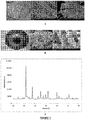
- Figure 1-A shows a photograph of the solid obtained (photograph on the left) and two images (photographs at the centre and on the right) obtained with the scanning electronic microscope, where the nanostructuring of this intermediate may be observed.
- Figure 1-B shows a photograph of the skutterudite obtained (photograph on the left) and two images (photographs at the centre and on the right) obtained with the scanning electronic microscope, where the nanostructure of the skutterudite may be observed.
- Figure 1-C shows the X-ray diffractogram of the skutterudite with the formula CoSb 3 obtained in this example, which presents a high degree of purity and is characterised in that it comprises peaks at the following angles 2Theta: 31.64; 37.56; 45.18; 47.48; 49.74; 51.84; 59.92; 61.82; 69.14 and 70.95 ⁇ 0.02.
- Example 2 Preparation of the nanostructured doped skutterudite with the formula Ni 0.15 Co 0.85 Sb 3 according to the method of the invention, by means of spray-drying
- acetate salts i.e. antimony (III) acetate, cobalt (II) acetate and nickel (II) acetate according to a stoichiometric ratio between Sb:Co:Ni, i.e.
- Said solution was subjected to the spray drying process at a temperature of 170oC and a flow rate of 6 ml/min.
- the intermediate solid product obtained was thermally treated in an argon atmosphere at a heating rate of 10°C/min and a temperature of 550oC for 6 hours.
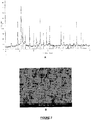
- Figure 2-A shows the X-ray diffraction pattern of the doped skutterudite obtained.
- Figure 2-B shows an image obtained with the scanning electronic microscope, SEM, where the nanostructuring of the doped skutterudite obtained may be observed.
- Example 3 Preparation of the nanostructured doped skutterudite with the formula Fe 0.2 Co 0.8 Sb 3 according to the method of the invention, by means of spray-drying
- Example 2 the same method described in Example 2 was followed, using the following starting products: 44.28 g of PVP, 35.11404 g of Sb(CH 3 COO) 3 , 7.8030 g of Co(CH 3 COO) 2 -4H 2 0 and 1.362 g of Fe(CH 3 COO) 2 , and a total of 460 mg of DMF, as in the preceding example.
- Figure 3 shows the X-ray diffraction pattern of the doped skutterudite obtained.
- Example 4 Yb 0.002 Ba 0.08 La 0.05 Co 4 Sb 12
- Example 5 Ba 0.3 Ni 0.05 Co 3.95 Sb 12
- Precursor acetate salts 34.3763 g Sb(CH 3 COO) 3 34.084 g Sb(CH 3 COO) 3 9.5512 g Co(CH 3 COO) 2 -4H 2 0 9.3496 g Co(CH 3 COO) 2 -4H 2 0 0.0067 g Yb(CH 3 COO) 3 0.1514 g La(CH 3 COO) 3 0.1182 g Ni(CH 3 COO) 3 -4H 2 0 0.1958 g Ba(CH 3 COO) 2 0.7279 g Ba(CH 3 COO) 2 Solvent (DMF) 460 g 460 g
- the atomised material obtained was thermally treated in an argon atmosphere, at a heating rate of 10oC/min and a temperature of 550oC for 6 h.
- Figure 4 and Figure 5 show, respectively, the X-ray diffractogram of the Yb 0.002 Ba 0.08 La 0.05 Co 4 Sb 12 skutterudite and the Ba 0.3 Ni 0.05 Co 3.95 Sb 12 skutterudite, where the CoSb 3 phase is confirmed.
- Example 6 Preparation of a nanostructured skutterudite with the formula CoSb 3 according to the method of the invention, using PVP as the polymer and drying by electrospinning
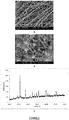
- Figure 6-A shows an image of the nanofibres resulting from the electrospinning process, obtained with the scanning electronic microscope.
- This product resulting from the electrospinning process was subjected to a thermal treatment in an argon atmosphere, using a heating rate of 10oC/min, at a temperature of 800oC for 3h, after which period the skutterudite with the formula CoSb 3 was obtained.
- Figure 6-B corresponds to an image obtained with the scanning electronic microscope, which shows the skutterudite obtained after the thermal treatment.
- Figure 6-C shows the X-ray diffractogram of the skutterudite with the formula CoSb 3 obtained in this example, which presents a high degree of purity and a profile analogous to that of the product obtained in Example 1, with peaks at the following angles 2Theta: 31.40; 37.36; 44.98; 47.25; 49.49; 51.70; 59.77; 61.74 and 70.79 ⁇ 0.02.
- Example 7 Preparation of a nanostructured skutterudite with the formula CoSb 3 according to the method of the invention, using PAN as the polymer and drying by electrospinning
- the method used was analogous to that described in Example 6, but in this case the polymer used was polyacrylonitrile (PAN) instead of polyvinylpyrrolidone (PVP).
- PAN polyacrylonitrile
- PVP polyvinylpyrrolidone
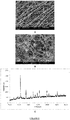
- Figure 7-A shows a photograph of the product obtained following the electrospinning process (image on the left) and an image of said product obtained with the scanning electronic microscope, where the nanofibre structure may be observed (image on the right).
- This product resulting from the electrospinning process was subjected to a thermal treatment in an argon atmosphere, using a heating rate of 10oC/min, at a temperature of 550oC for 16h, after which period the skutterudite with the formula CoSb 3 of the title was obtained.
- the product obtained presented an X-ray diffractogram substantially analogous to that of the product obtained in Example 1.
- Figure 7-B shows a photograph of the skutterudite obtained (image on the left) and an image of said skutterudite obtained with the electronic microscope (image on the right).
Landscapes
- Chemical & Material Sciences (AREA)
- Organic Chemistry (AREA)
- Inorganic Chemistry (AREA)
- Powder Metallurgy (AREA)
Abstract
Description
- The present invention relates to the preparation of thermoelectric materials; more specifically, a method for the production of nanostructured skutterudites of the CoSb3 type.
- Thermoelectric materials are those capable of converting heat energy into electrical energy as a result of the Seebeck effect or, conversely, obtain a refrigeration effect from electrical energy, due to the Peltier effect.
- Thermoelectric conversion technology has numerous applications, since it makes it possible to produce electricity from the residual heat released in various processes that would otherwise be wasted, which allows for greater energy efficiency and represents an energy source of great interest from the environmental standpoint.
- Possible applications of thermoelectric materials are, for example, in the automotive industry, where the heat released by automobiles, particularly from the exhaust pipes, may be utilised, and in industrial facilities, where useful electrical energy may be generated from the heat released in various processes.
- On the other hand, the refrigeration capacity of thermoelectric devices also has well-known applications, for example, in refrigeration systems, with the advantages that movable parts or potentially harmful refrigerating substances, such as freon gases, are not required, and that such systems have a very small size and weight.
- The thermoelectric properties of materials are typically characterised by a parameter called figure of merit (Z) or a related parameter, called dimensionless figure of merit (ZT), which is defined by the formula ZT=S2α/κT, where S is a constant, called Seebeck coefficient, α is the electrical conductivity of the material, κ is its thermal conductivity and T is the absolute temperature.
- In general, a good thermoelectric material has a high ZT value, for which reason it is desirable that said materials have a high electrical conductivity (α), but a low thermal conductivity (κ).
- Worth highlighting amongst the main thermoelectric materials are skutterudites. The general formula for binary skutterudites is MX3, where the metal atom M is generally Co, Ir or Rh, and X is a pnictogenic atom, which may be P, As or Sb. Binary skutterudites crystallise in a cubic structure with eight MX3 groups in the unit cell, and the crystal structure presents two interstitial void spaces in each unit cell. For this reason, the formula for skutterudites is occasionally represented as V2M8X24 or, alternatively, as VM4X12, where V represents the void spaces in the structure.
- Amongst skutterudites, those based on CoSb3 are of special interest as thermoelectric materials due to their excellent electrical conductivity properties and their high Seebeck coefficient. However, they have a high thermal conductivity. In order to reduce this high thermal conductivity, derivatives have been prepared by means of doping and/or the introduction of a filler element (rattling) into the voids of the crystal structure; said derivatives present even better thermoelectric properties, as a considerable reduction in their thermal conductivity is achieved whilst maintaining their good electrical conductivity.
- Doped skutterudites are those wherein the M and/or X atoms are partially substituted by other elements. For example, doped skutterudites of the CoSb3 type have been prepared by partially substituting the Co by transition metals, such as Fe or Ni, to form skutterudites of the Co1-xFexSb3 or Co1-xNixSb3 types, where the doping level may generally be of up to approximately 40%, i.e. x usually has a value ranging between 0 and approximately 0.4.
- Skutterudites have also been prepared using a filler element; i.e. a host element is housed in some of the void spaces of the crystal structure, according to an RyM4X12 structure, where R represents the filler element(s) and "y" is the filling fraction. Theoretically, the maximum filling fraction would be 1, i.e. with all the void spaces of the skutterudite occupied by a host element. However, in practice, the maximum effective filling fraction is typically lower, since it largely depends on each particular skutterudite and the nature of the filler elements introduced, as well as the possible doping elements.
- In the case of skutterudites of the CoSb3 type, said formula may be represented as RyCo4Sb12. In general, said filler elements belong to the group of rare earths, such as lanthanides and actinides (La, Ce, Yb, Nd, Eu, Sm, Pm and Pr, for example), p-block metals or post-transition metals, such as TI or In, and also alkaline earth metals such as Ca, Sr or Ba.
- Another well-known strategy to reduce the high thermal conductivity of skutterudites and thus improve their thermoelectric properties is by means of nanostructuring, as described in the literature, for example in the article Toprak et al. The impact of nanostructuring on the thermal conductivity of thermoelectric CoSb3. Adv. Funct. Mater., 2004, 14 (12), pp. 1189-1196.
- Crushing techniques, such as grinding or milling, or those known as wet-chemistry techniques have been used to obtain nanostructured skutterudites. According to the literature, the best results have been obtained by means of ball-milling, melt-spinning and coprecipitation processes, as described, for example, in Lan et al. Enhancement of thermoelectric figure-of-merit by a bulk nanostructuring approach. Adv. Funct. Mater., 2010, 20, pp. 357-376.
- In the prior art, numerous derivatives of skutterudites of the CoSb3 type have been disclosed which present good properties as thermoelectric materials, undoped or doped with one or more elements, without filler elements or with one or more elements that partially fill the voids in the structure, and nanostructured or not.
- Due to the multiple applications of thermoelectric materials, there is an increasing interest in the production of said materials and, consequently, in the development of new processes that allow for the preparation thereof in the most efficient and economical manner possible.
- In the prior art, different methods for preparing thermoelectric materials of the skutterudite type have been disclosed.
- The conventional method for synthesising skutterudite is based on the widely used metallurgical pathway wherein the elements are induction-melted at high temperatures and, subsequently, an annealing is performed, also at high temperature, for two weeks, for example as described in the article Kim et al. An optimization of composition ratio among triple-filled atoms in In0.3-x-yBaxCeyCo4Sb12 system. J. Nanomaterials, 2013, Article ID 973060.
- Other methods have been disclosed in the literature for preparing nanostructured skutterudites. Thus, for example, a solid-phase preparation of different skutterudites of the CoSb3 type has been disclosed which starts from its elementary components in the form of fine powder, using the grinding and hot pressing method, for example as described in the articles He et al. Nanostructured thermoelectric skutterudite Co1-xNixSb3 Alloys. J. Nanosci. Nanotechnol., 2008, 8, 40003-4006; or in Ur et al. Thermoelectric properties of nano-structured CoSb3 synthetized by mechanical alloying, Materials Science Forum, 2007, 534-537 (Pt. 2), 1425-1428.
- Skutterudites of the CoSb3 type have also been prepared from the corresponding precursors in the form of salts, to which end various reducing agents must be used in order to reduce the Co and the Sb from their oxidised forms Co2+ and Sb3+ present in said salts, until the skutterudite is formed.
- Thus, for example, the article Yang et al. Synthesis of nano-sized CoSb3-based skutterudites using a modified polyol process. Thermoelectrics 2007, ICT 2007. 26th International Conference on Thermoelectrics, pp. 187-188, discloses the preparation of the CoSb3 skutterudite using the process called modified polyol process, from the corresponding precursors in the form of a chloride salt, CoCl2.6H20 and SbCl3, in a solution with tetraethylene glycol as the solvent and using NaBH4 as the reducing agent, and heating said solution to 240ºC. The powder product obtained must be washed and filtered several times with ethanol and distilled water, and subsequently dried.
- The article Chu et al. Synthesis and thermal properties of nanoscale skutterudite via cross-precipitation. Key Engineering Materials, 2007, 336-338 (Pt. 1), pp. 831-833, discloses the preparation of CoSb3 from a precursor obtained from the reaction of the chloride salts CoCl2 and SbCl3 with the precipitating agents sodium hydroxide and ammonia. The precursor thus obtained is reduced by means of a thermal treatment in a reducing atmosphere of hydrogen gas.
- Despite the numerous processes disclosed in the prior art, there is still a need to develop an alternative method for preparing nanostructured skutterudites of the CoSb3 type that is simple and economical, makes it possible to obtain a high-purity product from affordable starting products, with the least possible number of steps, and does not require delicate processes such as reduction in a hydrogen atmosphere.
- The object of the present invention is a method for the production skutterudites of the CoSb3 type.
-
-
Figure 1-A shows a photograph (image on the left) and two images taken with a scanning electronic microscope (images at the centre and on the right) of the intermediate nanostructured product obtained in Example 1, following spray drying and prior to the thermal treatment. -
Figure 1-B shows a photograph (image on the left) and two images taken with a scanning electronic microscope (images at the centre and on the right) of the nanostructured skutterudite with the formula CoSb3 obtained in Example 1, after performing the thermal treatment. -
Figure 1-C shows the X-ray diffractogram of the nanostructured CoSb3 skutterudite obtained in Example 1, where the x-axis represents the angle 2Theta and the y-axis represents the intensity. Said diffractogram substantially coincides with the reference diffractograms of CoSb3 skutterudites available in the literature. -
Figure 2-A shows the X-ray diffractogram of the nanostructured doped skutterudite with the formula Ni0.15Co0.85Sb3 prepared in Example 2, where the x-axis represents the angle 2Theta and the y-axis represents the intensity. -
Figure 2-B shows an image of said doped skutterudite obtained with a scanning electronic microscope. -
Figure 3 shows the X-ray diffractogram of the doped skutterudite with the formula Fe0.2Co0.8Sb3 prepared in Example 3, where the x-axis represents the angle 2Theta and the y-axis represents the intensity. -
Figure 4 shows the X-ray diffractogram of the skutterudite with the formula Yb0.002Ba0.08La0.05Co4Sb12 prepared in Example 4, where the x-axis represents the angle 2Theta and the y-axis represents the intensity. -
Figure 5 shows the X-ray diffractogram of the skutterudite with the formula Ba0.3Ni0.05Co3.95Sb12 prepared in Example 5, where the x-axis represents the angle 2Theta and the y-axis represents the intensity. -
Figure 6-A shows an image of the intermediate nanostructured product obtained in Example 6, following the electrospinning process, obtained with a scanning electronic microscope. -
Figure 6-B shows an image taken with a scanning electronic microscope of the skutterudite with the formula CoSb3 obtained in Example 6, following the corresponding thermal treatment of the intermediate ofFigure 6-A . -
Figure 6-C shows the X-ray diffraction pattern of the skutterudite with the formula CoSb3 obtained in Example 6, where the x-axis represents the angle 2Theta and the y-axis represents the intensity. Said diffractogram substantially coincides with the reference diffractograms of CoSb3 skutterudites available in the literature. -
Figure 7-A shows a photograph of the intermediate product of Example 7, obtained following the electrospinning process (image on the left) and an image of said product obtained with a scanning electronic microscope (image on the right). -
Figure 7-B shows a photograph of the nanostructured skutterudite with the formula CoSb3 obtained in Example 7 (image on the left), following the corresponding thermal treatment of the intermediate ofFigure 6-A , and an image of said skutterudite obtained with a scanning electronic microscope (image on the right) - The object of the present invention is a method for the production skutterudites of the CoSb3 type, selected from the compound with the general formula (I):
Co1-xDxSb3 (I)
wherein: - D is Ni or Fe, and
- x ranges between 0 and 0.4,
- D is Ni or Fe,
- x' ranges between 0 and 1.6,
- y is greater than 0 and less than or equal to 0.75, and
- R represents one, two, three or four different elements selected from the group consisting of La, Ce, Yb, Nd, Eu, Pr, Sm, TI, In and Ba,
- 1) dissolving the acetate salts of each of their component elements and a polymer selected from polyvinylpyrrolidone and polyacrylonitrile in dimethylformamide;
- 2) eliminating the dimethylformamide from the solution prepared in step 1) by means of atomisation or electrospinning; and
- 3) thermally treating the product obtained in step 2) at a temperature ranging between 500ºC and 850ºC in an inert gas atmosphere.
- The authors of the present invention have developed a method for the production of nanostructured skutterudites of the CoSb3 type from the precursor acetate salts, which, surprisingly, makes it possible to obtain said thermoelectric material with a high purity by means of a thermal treatment that does not require using additional reducing agents. Moreover, when the nanostructured skutterudites are obtained, they present improved thermoelectric properties, with a high figure of merit (ZT).
- Skutterudites are well-known within the field of thermoelectric materials, as described, for example, in the chapter Uher C. Structure-Property Relations in Skutterudites, pp. 121-146, in: Chemistry, Physics, and Materials Science of Thermoelectric Materials. Beyond Bismuth Telluride, edited by Kanatzidis, Mahanti and Hogan, Kluwer Academic, Plenum Publishers, New York, 2003 (ISBN 0-306-47738-6); or in the chapter Nolas et al. Semiconductors and Thermoelectric Materials, pp. 129-137, in: Thermal Conductivity. Theory, Properties, and Applications, edited by T. M. Tritt, Kluwer Academic, Plenum Publishers, New York, 2004 (ISBN 0-306-48327-0).
- The chemical formula for binary skutterudites is MX3, wherein the metal atom M is Co, Ir or Rh, and the X atom is P, As or Sb. The X atom is also called pnictogenic atom, since this is how the elements in Group V of the Periodic Table are occasionally called.
- Skutterudites crystallise in a cubic structure, the unit cell thereof is composed of eight cubic spaces delimited by the metal atoms, with the interior occupied by four pnictogenic atoms that form a square ring, except for two of the eight cubic spaces, which are void. For this reason, the formula for skutterudites is occasionally represented as V2M8X24 or, alternatively, as VM4X12, wherein V represents the void spaces in the structure.
- Various skutterudites derivatives are also well-known, for example, doped skutterudites wherein the metal M is partially substituted by other metals, primarily Ni or Fe, and/or the pnictogenic atom is partially substituted by other atoms, for example, Sn or Te.
- Also well-known are skutterudite derivatives wherein the void spaces in the crystal structure are partially filled with other elements, typically elements from the group of rare earths, such as lanthanides and actinides (La, Ce, Yb, Nd, Eu, Sm, Pm, and Pr, for example) or p-block elements or post-transition metals, such as TI or In, or elements from the alkaline earth metal group, such as Ca, Sr or Ba.
- The present invention specifically relates to a method for the production skutterudites wherein the metal M is cobalt (Co) and the pnictogenic atom X is antimony (Sb), according to the formula CoSb3, which are called "skutterudites of the CoSb3 type".
- As understood in the present invention, the term "skutterudites of the CoSb3 type" broadly includes the following skutterudites based on the CoSb3 skutterudite:
- forms with interstitial void spaces (unfilled),
- partially filled forms (called "rattled"), with up to four filler elements selected from La, Ce, Yb, Nd, Eu, Pr, Sm, TI, In and Ba, preferably selected from La, Ce, Yb and Ba, and, more preferably, with up to three filler elements selected from La, Yb and Ba;
- Unfilled skutterudites of the CoSb3 type, optionally doped with Ni or Fe, have the general formula Co1-xDxSb3 (I), wherein D is Ni or Fe, and x ranges between 0 and 0.4 (i.e. 0 ≤ x ≤ 0.4), and preferably between 0 and 0.25 (i.e. 0 ≤ x ≤ 0.25). When x = 0, it is a simple, undoped binary skutterudite with the formula CoSb3. x values greater than 0, within the interval 0 < x ≤ 0.4 refer to forms doped with Ni or Fe.
- Partially-filled skutterudites of the CoSb3 type, optionally doped with Ni or Fe, are those which have the interstitial spaces partially occupied by a host element and the general formula RyCo4-x'Dx'Sb12 (II), wherein D is Ni or Fe, and x' ranges between 0 and 1.6 (i.e. 0 ≤ x' ≤ 1.6), and preferably between 0 and 1 (i.e. 0 ≤ x' ≤ 1), such that, when x' = 0, they are undoped forms and, for x' values greater than 0, within the interval 0 < x' ≤ 1.6, or the preferred sub-interval 0 < x' ≤ 1, they are forms doped with Ni or Fe. The parameter "y" represents the filling level, with values within the range 0 < y ≤ 0.75, preferably within the range 0 < y ≤ 0.5 and, more preferably, within the range 0 < y ≤ 0.3; and R represents one, two, three or four filler elements selected from the group consisting of La, Ce, Yb, Nd, Eu, Pr, Sm, TI, In and Ba, and preferably from La, Ce, Yb and Ba; and, more preferably, R represents one, two or three filler elements selected from the group consisting of La, Yb and Ba.
- In the formula (II), R represents between one and four different filler elements, i.e. the filled forms also include forms with more than one host or filler element R, generally up to four different filler elements, such that the formula (II) RyCo4-x'Dx'Sb12 is implicitly understood to include those forms wherein R represents one, two, three or four filler elements, and, in turn, the parameter y implicitly represents each of the partial filling levels.
- In other words, the general formula (II) RyCo4-x'Dx'Sb12 is understood to include the formulas R1 y1Co4-x'Dx'Sb12 (IIa), with a single filler element R1, R1 y1R2 y2Co4-x'Dx'Sb12 (IIb), with two different filler elements (R1 and R2), R1 y1R2 y2R3 y3Co4-x'Dx'Sb12 (IIc), with three different filler elements (R1, R2 and R3), and R1 y1R2 y2R3 y3R4 y4Co4-x'DxSb12 (IId), with four different filler elements (R1, R2, R3 and R4), wherein R1, R2, R3 and R4 may be La, Ce, Yb, Nd, Eu, Pr, Sm, TI, In or Ba, and preferably, are selected from La, Ce, Yb and Ba; wherein y 1, y 2, y 3 and y 4 represent the partial filling levels for each element R1, R2, R3 and R4, respectively, such that the sum is y, i.e. y 1 + y 2 + y 3 + y 1 = y, and wherein x' and D have the same meaning described above for the formula (II).
- In a particularly preferred embodiment, R represents between one and three different filler elements that are selected from La, Yb and Ba. I.e. in this case the general formula (II) includes the formulas (IIa), with a single filler element R1, (IIb), with two different filler elements (R1 and R2), and (IIc), with three different filler elements (R1, R2 and R3), as defined above, wherein R1, R2 and R3 are selected from La, Yb and Ba.
- The first step of the method of the present invention consists of dissolving the acetate salts of each of the component elements of skutterudite, together with a polymer selected from polyvinylpyrrolidone (PVP) and polyacrylonitrile (PAN), in dimethylformamide (DMF).
- The skutterudite according to the method of the present invention is prepared from the precursors thereof, which are the acetate salts of each of their component elements, i.e. cobalt acetate and antimony acetate, and, optionally, the acetate salts of nickel, iron, lanthanum, cerium, ytterbium, neodymium, europium, praseodynium, samarium, thallium, indium or barium, in order to prepare the corresponding skutterudites doped with nickel (Ni) or iron (Fe), and/or filled with lanthanum (La), cerium (Ce), ytterbium (Yb), neodymium (Nd), europium (Eu), praseodynium (Pr), samarium (Sm), thallium (TI), indium (In), and/or barium (Ba) in the interstitial spaces, as described above.
- The acetate salts of the component elements are well-known in the prior art, and are composed of the acetate anion (CH3COO-) and the corresponding elements Co, Sb, Ni, Fe, La, Ce, Yb, Nd, Eu, Pr, Sm, TI, In or Ba in cationic form, according to their oxidation states.
- Specifically, Co (II) acetate or Co (III) acetate are used; more preferably, the following are used: Co (II) acetate, Sb (III) acetate, iron (II) acetate, nickel (II) acetate, lanthanum (III) acetate, cerium (III) acetate, ytterbium (III) acetate, neodymium (III) acetate, europium (III) acetate, praseodynium (III) acetate, samarium (III) acetate, thallium (III) acetate, indium (III) acetate and barium (II) acetate.
- Within the context of the invention, the acetate salts also include the possible hydrated forms thereof.
- The precursor acetate salts may be prepared by means described in the prior art, and are also commercially available, for example, through the companies Sigma-Aldrich or Alfa Aesar.
- The solution prepared in step 1) contains the precursor acetate salts and a polymer selected from polyvinylpyrrolidone (PVP) and polyacrylonitrile (PAN). Preferably, PVP is used.
- Polyvinylpyrrolidone, also known as povidone or PVP, is the 1-ethenyl-2-pyrrolidone homopolymer. Polyvinylpyrrolidone exists in different degrees, depending on the molecular weight. In the method of the present invention, in any of the embodiments that comprise using PVP, PVP with a mean molecular weight ranging between 5,000 g/mol and 2,000,000 g/mol is preferably used, more preferably ranging between 100,000 g/mol and 1,500,000 g/mol, even more preferably ranging between 1,000,000 g/mol and 1,400,000 g/mol, and, even more preferably, with a mean molecular weight of 1,300,000 g/mol, such as, for example, that distributed by the company Sigma-Aldrich.
- Polyacrylonitrile, also known by the acronym PAN, is the acrylonitrile homopolymer. In the method of the present invention, in any of the embodiments that comprise using PAN, polyacrylonitrile with a mean molecular weight ranging between 100,000 g/mol and 200,000 g/mol is preferably used, and preferably PAN with a mean molecular weight of 150,000 g/mol, such as, for example, that distributed by the company Sigma-Aldrich.
- The solvent used in this first step is dimethylformamide, also called N,N-dimethylformamide or DMF, which is a good solvent for both the precursor acetate salts and the PVP and PAN polymers.
- The molar ratio between the Co acetate and the Sb acetate used to prepare the solution of step 1) of the method according to the invention typically ranges between (1 - x):3 and (1 - x):4.5, to prepare unfilled skutterudites with the formula (I), or between (1 - x'/4):3 and (1 - x'/4):4.5, to prepare filled skutterudites with the formula (II), wherein x and x' have the same meaning described above for the formulas (I) and (II).
- Therefore, according to this molar ratio, when undoped skutterudites with the formula (I) (x = 0) or the formula (II) (x'= 0) are prepared, the molar ratio between Co acetate and Sb acetate used to prepare the solution of step 1) typically ranges between 1:3 and 1:4.5.
- The concentration of the precursor acetate salts in the DMF solution of step 1) generally ranges between 5% and 20% by weight, with respect to the weight of the solution.
- Throughout the present invention, we refer to the concentration of the solution of step 1) as the weight percentages of each component, i.e. the ratio between the weight of said component with respect to the total weight of the solution, the latter including the weight of dimethylformamide and that of all the components, i.e. the salts and the polymer.
- When reference is made to the concentration, or weight percentage, of the precursor acetate salts, reference is made to the sum of the weights of all the acetate salts present in the solution with respect to the total weight of the solution.
- The concentration of the polymer in the DMF solution of step 1) generally ranges between 5% and 15% by weight.
- Preferably, the weight ratio of polymer:precursor acetate salts in the solution prepared in step 1) ranges between 2.1:1 and 1:1.1, more preferably the ratio is approximately 1:1 by weight and, even more preferably, it is 1:1.
- Throughout the present description, when reference is made to the weight ratios of polymer:precursor acetate salts, the weight of the precursor acetate salts corresponds to the sum of all the salts used.
- When a hydrated acetate salt is used, the total weight of the salt is taken into consideration, including the hydration water.
- The second step of the method according to the present invention consists of eliminating the solvent, i.e. the dimethylformamide, from the solution prepared in step 1), to obtain an intermediate nanostructured product.
- In one embodiment of the invention, the elimination of the solvent is performed by means of a atomisation process, also known as spray-drying.
- The atomisation process, or spray-drying, is a well-known method used to produce particles of a given material from a solution or suspension by means of rapid drying with hot gas. The atomisation process has numerous industrial applications, since it makes it possible to prepare pulverulent products with various compositions. The size of the particles obtained for a given product may vary depending on the concentration of the initial solution or suspension, the temperature used in the drying process, and the flow rate at which the solution is introduced into the atomiser.
- The DMF solution prepared in step 1), which contains the precursor acetate salts of skutterudite and the polymer, is subjected to a atomisation process by means of which the dimethylformamide is eliminated, to leave a solid residue, typically in the form of microparticles and nanofibres.
- Any conventional equipment may be used to perform said process, such as any commercially accessible one, for example, the Mini Spray Dryer B-290 equipment from the company Buchi.
- A temperature ranging between room temperature and 220ºC may be used, preferably ranging between 160ºC and 180ºC, and, more preferably, 170ºC.
- The feed flow rate typically ranges between 4 ml/min and 8 ml/min, and, preferably, is 6 ml/min.
- It is understood that said conditions are for guidance only, and that a person skilled in the art knows how to adjust said parameters on the basis of the desired characteristics of the atomised product.
- The concentration of the polymer in the initial solution prepared in step 1) that is subjected to the spray drying process preferably ranges between 5% and 10%, more preferably between 6% and 9%, and, even more preferably, between 7.5% and 8.5%, wherein said percentages are expressed by weight, i.e. as the weight of the polymer with respect to the total weight of the solution. In a particularly preferred embodiment, the polymer is PVP.
- The concentration of the precursor acetate salts in the initial solution prepared in step 1) that is subjected to the spray drying process preferably ranges between 5% and 10%, more preferably between 6% and 9%, and, even more preferably, between 7.5% and 8.5%, wherein said percentages are expressed by weight, i.e. as the sum of the weight of the precursor acetate salts with respect to the total weight of the solution.
- When the method of the invention comprises a spray drying process in step 2), the weight ratio of polymer:precursor acetate salts in the solution prepared in step 1) preferably ranges between 1.1:1 and 1:1.1, more preferably, the ratio is approximately 1:1 by weight, and, even more preferably, the ratio is 1:1. When referring to this ratio, it is understood that the weight of the precursor acetate salts corresponds to the sum of all the salts used.
- When the method of the invention comprises a spray drying process in step 2), the proportion between the precursor acetate salts used to prepare the solution of step 1) is preferably a stoichiometric molar ratio.
- Therefore, in order to prepare an unfilled skutterudite of the CoSb3 type, optionally doped with Ni or Fe, with the formula (I) Co1-xDxSb3, wherein D is Ni or Fe, and x has a value ranging between 0 and 0.4 (i.e. 0 ≤ x ≤ 0.4), and preferably ranging between 0 and 0.25 (i.e. 0 ≤ x ≤ 0.25), a molar ratio of cobalt acetate:antimony acetate:iron acetate or nickel acetate (1 - x):3:x is preferably used.
- Specifically, in order to prepare a simple skutterudite of the CoSb3 type, unfilled and undoped, with the formula CoSb3 (formula (I) for x= 0), a molar ratio of cobalt acetate:antimony acetate of 1:3 is preferably used.
- Similarly, in order to prepare a nanostructured skutterudite of the CoSb3 type filled with at least one element selected from La, Ce, Yb, Nd, Eu, Pr, Sm, TI, In and Ba, preferably selected from La, Ce, Yb and Ba, and, even more preferably, filled with a maximum of three elements selected from La, Yb and Ba, and optionally doped with Ni or Fe, with the general formula (II) RyCo4-x'Dx'Sb12, wherein R represents the filler element(s), D is Ni or Fe, and x' ranges between 0 and 1.6, and, more preferably, between 0 and 1, and y has a value within the range 0 < y ≤ 0.75, more preferably within the range 0 < y ≤ 0.5, and, even more preferably, within the range 0 < y ≤ 0.3, a molar ratio of the acetate of the filler element(s) R:iron or nickel acetate:cobalt acetate:antimony acetate of y:x':(4 - x):12 is preferably used. In this ratio, y represents the set of the partial filling levels for each of the filler elements, and it is understood that, when there is more than one filler element (R1, R2, etc.), the ratio is stoichiometric with respect to each of the precursor acetate salts. Thus, when there is only one filler element R1, with a filling level y 1, a molar ratio between the precursor acetate salts of y 1 :x':(4 - x'):12 is preferably used; when there are two different filler elements R1 and R2, with partial filling levels of y 1 and y 2, respectively, a molar ratio between the precursor acetate salts of y 1:y2:x':(4 - x'):12 is preferably used; when there are three different filler elements R1, R2 and R3, with partial filling levels of y 1, y2 and y 3, respectively, a molar ratio between the precursor acetate salts of y1:y2:y3:x':(4 - x'):12 is preferably used; and, when there are four different filler elements R1, R2, R3 and R4, with partial filling levels of y1 , y2 , y3 and y4 , respectively, a molar ratio between the precursor acetate salts of y 1:y2:y3:y4:x':(4 - x'):12 is preferably used.
- It is understood that the preferred stoichiometric ratio between the precursor acetate salts used also includes small variations of up to 5%, which are also considered to be included within the term "stoichiometric ratio".
- According to one embodiment of the invention, the elimination of the solvent in the second step of the method is performed by means of an electrospinning process.
- The electrospinning process is also well-known in the prior art, and it makes it possible to prepare nanofibres from a solution of a given material, typically polymers, by applying an electric current with a sufficiently high voltage, which causes the expulsion of fine threads from a capillary tube, whilst the solvent is evaporated, thereby forming nanofibres of said material.
- Thus, the DMF solution prepared in step 1), which contains the precursor acetate salts of skutterudite and the polymer, is subjected to an electrospinning process by means of which the dimethylformamide is eliminated, and nanofibres are formed that contain said polymer and the corresponding precursor acetate salts.
- Suitable conditions to perform the electrospinning include, for example, a voltage of 30 kV, a flow rate ranging between 1 and 3 ml/h for one needle, or 7 ml/h for a multijet system, a distance between the needle and the collector of 15 cm, and a collection rate of 500 rpm.
- Said conditions are understood to be for guidance only, and a person skilled in the art knows how to adjust said parameters on the basis of the desired characteristics of the product to be prepared.
- The concentration of the polymer in the initial solution prepared in step 1) that is subjected to drying by electrospinning typically ranges between 4% and 16%.
- In one preferred embodiment, the polymer is polyvinylpyrrolidone and the concentration of said polymer in the initial solution prepared in step 1) preferably ranges between 8% and 14%, and, more preferably, between 12% and 13%, wherein said percentages are expressed by weight, i.e. as the weight of the polymer with respect to the total weight of the solution. In an even more preferred embodiment, a weight ratio of polyvinylpyrrolidone:precursor acetate salts in the solution of step 1) ranging between 1.1:1 and 1:1.1 is used, more preferably the ratio is approximately 1:1 by weight, and, even more preferably, the ratio is 1:1. When referring to this ratio, it is understood that the weight of the precursor acetate salts corresponds to the sum of all the salts used.
- In another preferred embodiment, the polymer is polyacrylonitrile and the concentration of said polymer in the initial solution prepared in step 1) preferably ranges between 4% and 8%, wherein the percentage is expressed by weight, i.e. as the weight of the polymer with respect to the total weight of the solution. In an even more preferred embodiment, a weight ratio of polyacrylonitrile:precursor acetate salts in the solution of step 1) ranging between 1:2.1 and 1.1:2 is used, more preferably, the ratio is approximately 1:2 by weight, and, even more preferably, the ratio is 1:2. When referring to this ratio, it is understood that the weight of the precursor acetate salts corresponds to the sum of all the salts used.
- The concentration of the precursor acetate salts in the initial solution prepared in step 1) that is subjected to drying by electrospinning preferably ranges between 8% and 16%, and, more preferably, between 10% and 15%, wherein said percentages are expressed by weight, i.e. as the sum of the weights of the precursor acetate salts with respect to the total weight of the solution.
- In a particularly preferred embodiment of the invention, the molar ratio of cobalt acetate:antimony acetate in the initial solution that is subjected to electrospinning preferably ranges between (1 - x):4.25 and (1 - x):4.75, and, more preferably, it is (1 - x):4.5, to prepare unfilled skutterudites with the formula (I), or preferably ranges between (1 - x'/4):4.25 and (1 - x'/4):4.75, and, more preferably, it is (1 - x'/4):4.5, to prepare filled skutterudites with the formula (II), wherein x and x' have the same meaning described above for the formulas (I) and (II). Thus, in order to prepare undoped skutterudites (x = 0 or x'= 0), a molar ratio of cobalt acetate:antimony acetate ranging between 1:4.25 and 1:4.75 is preferably used, and, more preferably, said ratio is 1:4.5.
- According to step 3) of the method of the invention, the dry residue obtained following elimination of the solvent, either after atomisation or after electrospinning, is subjected to a thermal treatment at a temperature ranging between 500ºC and 850ºC in an inert gas atmosphere.
- Said thermal treatment is typically performed in a suitable oven, such as those commercially available; for example, a
CWF 1200 model oven, from the company Carbolite, may be used, equipped with a gas chamber from Inconel®. - As it is well-known to a person skilled in the art, the use of an inert gas atmosphere refers to the use of a gas that does not react, primarily in order to prevent undesired hydrolysis and oxidation reactions, to which purpose noble gases or nitrogen are typically used. The most habitual inert gases are argon and nitrogen. In the method of the present invention, argon gas is preferably used.
- In one embodiment of the invention, when the method comprises a spray drying process in step 2), the subsequent thermal treatment of the atomised product according to step 3) of the method of the invention is preferably performed at a temperature ranging between 500ºC and 650ºC, more preferably ranging between 525ºC and 575ºC, and, even more preferably, at a temperature of 550ºC. In general, said thermal treatment is preferably performed for a period ranging between 5 and 7 hours, preferably for 6 hours.
- In another embodiment of the invention, when the method comprises drying by electrospinning in step 2), the subsequent thermal treatment of the product resulting from the electrospinning process according to step 3) of the method of the invention is preferably performed at a temperature ranging between 700ºC and 850ºC, more preferably ranging between 775ºC and 825ºC, and, even more preferably, at a temperature of 800ºC. Said treatment is generally performed for a period ranging between 2 and 4 hours, preferably for 3 hours. Preferably, the polymer is PVP.
- In another embodiment of the invention, when the method comprises drying by electrospinning in step 2), the subsequent thermal treatment of the product resulting from the electrospinning process according to step 3) of the method of the invention is preferably performed at a temperature ranging between 500ºC and 600ºC, more preferably ranging between 525ºC and 575ºC, and, even more preferably, at a temperature of 550ºC. Said treatment is generally performed for a period ranging between 10 and 18 hours, preferably for 16 hours. Preferably, the polymer is PAN.
- According to a preferred embodiment of the present invention, the method for the production skutterudites of the CoSb3 type with the formula (I) or with the formula (II), as defined above, comprises the following steps:
- 1) dissolving the acetate salts of each of their component elements and polyvinylpyrrolidone in dimethylformamide, wherein the solution preferably has a concentration of polyvinylpyrrolidone ranging between 5% and 10%, more preferably ranging between 6% and 9%, and, even more preferably, ranging between 7.5% and 8.5%; and a concentration of the precursor acetate salts ranging between 5% and 10%, more preferably ranging between 6% and 9%, and, even more preferably, ranging between 7.5% and 8.5%, wherein said percentages are expressed by weight;
- 2) eliminating the dimethylformamide from the solution prepared in step 1) by means of atomisation; and
- 3) thermally treating the product obtained in step 2) at a temperature ranging between 500ºC and 650ºC; preferably between 525ºC and 575ºC, and, even more preferably, at 550ºC, in an inert gas atmosphere for a period preferably ranging between 5 and 7 hours, and, more preferably for 6 hours;
- A preferred embodiment of the present invention relates to a method for the production a skutterudite with the formula CoSb3 which comprises the following steps:
- 1) dissolving cobalt (II) acetate and antimony (III) acetate, in a 1:3 molar ratio, and polyvinylpyrrolidone in dimethylformamide, wherein the concentration of polyvinylpyrrolidone preferably ranges between 5% and 10%, more preferably between 6% and 9%, and, even more preferably, between 7.5% and 8.5%; and the concentration of the acetate salts ranges between 5% and 10%, more preferably between 6% and 9%, and, even more preferably, between 7.5% and 8.5%, wherein the percentages are expressed by weight;
- 2) eliminating the dimethylformamide from the solution prepared in step 1) by means of atomisation; and
- 3) thermally treating the product obtained in step 2) at a temperature ranging between 500ºC and 650ºC, preferably between 525ºC and 575ºC, and, more preferably, at 550ºC, in an inert gas atmosphere for a period preferably ranging between 5 and 7 hours, and, more preferably, for 6 hours;
- Another preferred embodiment of the present invention relates to a method for the production a doped skutterudite with the formula (I) Co1-xDxSb3, wherein D is selected from Ni and Fe, and x has a value within the range 0 < x ≤ 0.4, and, more preferably, within the range 0 < x ≤ 0.25, which comprises the following steps:
- 1) dissolving cobalt (II) acetate, antimony (III) acetate and a salt selected from iron (II) acetate and nickel (II) acetate, in a (1 - x):3:x molar ratio, and polyvinylpyrrolidone in dimethylformamide; wherein the concentration of polyvinylpyrrolidone preferably ranges between 5% and 10%, more preferably between 6% and 9%, and, even more preferably, between 7.5% and 8.5%; and the concentration of the precursor acetate salts ranges between 5% and 10%, more preferably between 6% and 9%, and, even more preferably, between 7.5% and 8.5%, wherein the percentages are expressed by weight;
- 2) eliminating the dimethylformamide from the solution prepared in step 1) by means of atomisation; and
- 3) thermally treating the product obtained in step 2) at a temperature ranging between 500ºC and 650ºC, preferably between 525ºC and 575ºC, and, even more preferably, at 550ºC, in an inert gas atmosphere for a period preferably ranging between 5 and 7 hours, and, more preferably, for 6 hours;
- In a particularly preferred embodiment of this embodiment, D is Ni and x is 0.15. In another particularly preferred embodiment of this embodiment, D is Fe and x is 0.2.
- Another preferred embodiment of the present invention relates to a method for the production a filled skutterudite with the formula (II) RyCo4-x'Dx'Sb12, wherein R represents one, two, three, or four different filler elements that are selected from La, Ce, Yb, Nd, Eu, Pr, Sm, TI, In and Ba, and, preferably, between La, Ce, Yb and Ba; and, more preferably, R represents one, two or three different filler elements that are selected from La, Yb and Ba; y has a value within the range 0 < y ≤ 0.75, preferably within the range 0 < y ≤ 0.5, and, more preferably, within the range 0 < y ≤ 0.3; D is selected from Ni and Fe; and x' has a value within the range 0 ≤ x' ≤ 1.6, and, preferably, within the range 0 ≤ x' ≤ 1, which comprises the following steps:
- 1) dissolving cobalt (II) acetate, antimony (III) acetate, optionally one salt selected from iron (II) acetate and nickel (II) acetate, and the acetate salt(s) of the filler element(s) R, in a (4 - x'):12:x':y molar ratio, and polyvinylpyrrolidone in dimethylformamide; wherein the concentration of polyvinylpyrrolidone preferably ranges between 5% and 10%, more preferably between 6% and 9%, and, even more preferably, between 7.5% and 8.5%; and the concentration of the precursor acetate salts ranges between 5% and 10%, more preferably between 6% and 9%, and, even more preferably, between 7.5% and 8.5%, wherein the percentages are expressed by weight;
- 2) eliminating the dimethylformamide from the solution prepared in step 1) by means of atomisation; and
- 3) thermally treating the product obtained in step 2) at a temperature ranging between 500ºC and 650ºC, preferably between 525ºC and 575ºC, and, even more preferably, at 550ºC, in an inert gas atmosphere for a period preferably ranging between 5 and 7 hours, and, more preferably, for 6 hours;
- In a particularly preferred embodiment of the embodiment, the skutterudite with the formula (II) is Yb0.002Ba0.08La0.05Co4Sb12, i.e. R represents the elements R1, R2 and R3, wherein R1 is Yb, R2 is Ba and R3 is La, y1 = 0.002, y2 = 0.08, y3 = 0.05, y1 + y2 + y3 = 0.132, and x' = 0. In another particularly preferred embodiment of this embodiment, the skutterudite with the formula (II) is Ba0.3Ni0.05Co3.95Sb12, i.e. R represents a single element R1, which is Ba, y = y1 = 0.3, D is Ni and x'= 0.05.
- According to a preferred embodiment of the present invention, the method for the production skutterudites of the CoSb3 type with the formula (I) or the formula (II), as defined above, comprises the following steps:
- 1) dissolving the acetate salts of each of their component elements, wherein the molar ratio of cobalt acetate:antimony acetate ranges between (1 - x):4.25 and (1 - x):4.75, or between (1 - x'/4):4.25 and (1 - x'/4):4.75, and, more preferably, said ratio is (1 - x):4.5 or (1 - x'/4):4.5, and polyvinylpyrrolidone in dimethylformamide, wherein the concentration of polyvinylpyrrolidone preferably ranges between 8% and 15%, more preferably between 10% and 14%, and, even more preferably, between 12% and 13%; and the concentration of the precursor acetate salts ranges between 8% and 15%, more preferably between 10% and 14%, and, even more preferably, between 12% and 13%, wherein the percentages are expressed by weight;
- 2) eliminating the dimethylformamide from the solution prepared in step 1) by means of electrospinning; and
- 3) thermally treating the product obtained in step 2) at a temperature ranging between 700ºC and 850ºC, preferably between 775ºC and 825ºC, and, more preferably, at approximately 800ºC in an inert gas atmosphere for a period preferably ranging between 2 and 4 hours, and, more preferably, for approximately 3 hours;
- A preferred embodiment of the present invention relates to a method for the production an unfilled undoped skutterudite with the formula CoSb3, which comprises the following steps:
- 1) dissolving cobalt (II) acetate and antimony (III) acetate at a molar ratio ranging between 1:4.25 and 1:4.75, and, preferably, 1:4.5, and polyvinylpyrrolidone in dimethylformamide, wherein the concentration of polyvinylpyrrolidone preferably ranges between 8% and 15%, more preferably between 10% and 14%, and, even more preferably, between 12% and 13%; and the concentration of the precursor acetate salts ranges between 8% and 15%, more preferably between 10% and 14%, and, even more preferably, between 12% and 13%, wherein the percentages are expressed by weight;
- 2) eliminating the dimethylformamide from the solution prepared in step 1) by means of electrospinning; and
- 3) thermally treating the product obtained in step 2) at a temperature ranging between 700ºC and 850ºC, preferably ranging between 775ºC and 825ºC, and, more preferably, at approximately 800ºC in an inert gas atmosphere for a period preferably ranging between 2 and 4 hours, and, more preferably, for approximately 3 hours;
- Another preferred embodiment of the present invention relates to a method for the production skutterudites of the CoSb3 type with the formula (I) or the formula (II), as defined above, which comprises the following steps:
- 1) dissolving the acetate salts of each of their component elements, wherein the molar ratio of cobalt acetate:antimony acetate ranges between (1 - x):4.25 and (1 - x):4.75, or between (1 - x'/4):4.25 and (1 - x'/4):4.75, and, more preferably, said ratio is (1 - x):4.5 or (1 - x'/4):4.5, and polyacrylonitrile in dimethylformamide; wherein the concentration of polyacrylonitrile preferably ranges between 4% and 10%, and, more preferably, between 7% and 8%; and the concentration of the precursor acetate salts ranges between 8% and 20%, and, more preferably, between 14% and 16%, wherein the percentages are expressed by weight;
- 2) eliminating the dimethylformamide from the solution prepared in step 1) by means of electrospinning; and
- 3) thermally treating the product obtained in step 2) at a temperature ranging between 500ºC and 600ºC, preferably ranging between 525ºC and 575ºC, and, more preferably, at a temperature of approximately 550ºC in an inert gas atmosphere for a period preferably ranging between 10 and 18 hours, and, more preferably, for approximately 16 hours;
- Another preferred embodiment of the present invention relates to a method for the production an unfilled undoped skutterudite with the formula CoSb3, which comprises the following steps:
- 1) dissolving cobalt (II) acetate and antimony (III) acetate at a molar ratio ranging between 1:4.25 and 1:4.75, and, more preferably, said ratio is 1:4.5, and polyacrylonitrile in dimethylformamide; wherein the concentration of polyacrylonitrile preferably ranges between 4% and 10%, and, more preferably, between 7% and 8%; and the concentration of the precursor acetate salts ranges between 8% and 20%, and, more preferably, between 14% and 16%, wherein the percentages are expressed by weight;
- 2) eliminating the dimethylformamide from the solution prepared in step 1) by means of electrospinning; and
- 3) thermally treating the product obtained in step 2) at a temperature ranging between 500ºC and 600ºC, preferably ranging between 525ºC and 575ºC, and, more preferably, at a temperature of approximately 550ºC in an inert gas atmosphere for a period preferably ranging between 10 and 18 hours, and, more preferably, for approximately 16 hours;
- The following examples of the present invention are offered for illustrative purposes only, and should not be interpreted as limiting the scope thereof.
- To perform the spray drying process, a commercial atomiser, model Mini Spray Dryer B-290, from the company Buchi, was used.
- To perform the drying by electrospinning, a commercial equipment, model NF-103, from the company MECC Co. Ltd., was used.
- For the thermal treatment in an inert atmosphere, an oven from the company Carbolite,
model CWF 1200, was used, equipped with a gas chamber from Inconel®. - To observe and obtain images of the nanostructures obtained in the examples, a scanning electronic microscope, or SEM, model JSM-6010-LV, from the company JEOL, was used.
- To obtain the X-ray diffractograms, or XRD, of the skutterudites obtained, a four-circle diffractometer, model Philips X'Pert, was used.
- The following solvents and reagents were used: N,N-dimethylformamide (DMF) from the company Sigma-Aldrich, polyacrylonitrile powder (PAN) with a molecular weight of 150,000 and powder polyvinylpyrrolidone (PVP) with a molecular weight of 1,300,000, both from the company Sigma-Aldrich; cobalt (III) acetate tetrahydrate (98% purity) from the company Alfa-Aesar; antimony (III) acetate (97% purity), nickel (II) acetate tetrahydrate (99.999% purity), barium (II) acetate (99% purity), lanthanum (III) acetate (purity greater than 99.99%), ytterbium (III) acetate (99.999% purity), and iron (II) acetate (99.999% purity), all of them from the company Sigma-Aldrich.
- 11.07 g of PVP were dissolved in 50 g of DMF in a container. In a second container, a solution was prepared with the precursor acetate salts, i.e. antimony (III) acetate and cobalt (II) acetate at a 3:1 molar ratio, to which end 8.6634 g of antimony (III) acetate (Sb(CH3COO)3) were dissolved in 50 g of DMF, and, subsequently, 2.4066 g of cobalt (II) acetate tetrahydrate (Co(CH3COO)2-4H20) were slowly added, keeping the container in an ultrasonic bath for 1 hour, after which time a pink-coloured solution was obtained.
- Both solutions were mixed under vigorous mechanical stirring using a Dispermat® CV3 stirrer and further adding 15 g of DMF. The resulting solution was left under magnetic stirring overnight.
- Subsequently, the solution was subjected to a spray drying process, at a temperature of 170ºC and a flow rate of 6 ml/min. A pink-coloured fibrous solid consisting of microparticles and nanofibres (15 g) was obtained.
-
Figure 1-A shows a photograph of the solid obtained (photograph on the left) and two images (photographs at the centre and on the right) obtained with the scanning electronic microscope, where the nanostructuring of this intermediate may be observed. - 10 g of this solid were thermally treated in an oven, in an argon atmosphere at a temperature of 550ºC for 6 h, at a heating rate of 10ºC/min, after which 4 g of CoSb3 skutterudite were obtained (40% yield).
-
Figure 1-B shows a photograph of the skutterudite obtained (photograph on the left) and two images (photographs at the centre and on the right) obtained with the scanning electronic microscope, where the nanostructure of the skutterudite may be observed. -
Figure 1-C shows the X-ray diffractogram of the skutterudite with the formula CoSb3 obtained in this example, which presents a high degree of purity and is characterised in that it comprises peaks at the following angles 2Theta: 31.64; 37.56; 45.18; 47.48; 49.74; 51.84; 59.92; 61.82; 69.14 and 70.95 ± 0.02. - In order to prepare the skutterudite of the CoSb3 type doped with nickel (x = 0.15), a method analogous to that of Example 1 was followed, but adding the nickel acetate salt as the third precursor.
- Thus, 44.28 g of PVP were dissolved in 200 g of DMF in a container. In a second container, a solution was prepared with the precursor acetate salts, i.e. antimony (III) acetate, cobalt (II) acetate and nickel (II) acetate according to a stoichiometric ratio between Sb:Co:Ni, i.e. 3:0.85:0.15, to which end 34.6548 g of antimony (III) acetate (Sb(CH3COO)3) were dissolved in 200 g of DMF, and, subsequently, 8.1825 g of cobalt (II) acetate tetrahydrate (Co(CH3COO)2-4H20) and 1.4426 g of nickel acetate tetrahydrate (Ni(CH3COO)2-4H20) were slowly added, keeping the container in an ultrasonic bath for 1 hour. Both solutions were mixed under vigorous mechanical stirring using a Dispermat® CV3 stirrer and further adding 15 g of DMF. The resulting solution was left under magnetic stirring overnight.
- Said solution was subjected to the spray drying process at a temperature of 170ºC and a flow rate of 6 ml/min. The intermediate solid product obtained was thermally treated in an argon atmosphere at a heating rate of 10°C/min and a temperature of 550ºC for 6 hours.
- Approximately 25 g of doped skutterudite with the formula Ni0.15Co0.85Sb3 were obtained from 72 g of the atomised intermediate (35% yield).
-
Figure 2-A shows the X-ray diffraction pattern of the doped skutterudite obtained. -
Figure 2-B shows an image obtained with the scanning electronic microscope, SEM, where the nanostructuring of the doped skutterudite obtained may be observed. - A skutterudite of the type CoSb3, doped with iron (x = 0.2), with the formula Fe0.2Co0.8Sb3 was prepared, to which end the precursor acetate salts were used, according to a stoichiometric molar ratio between Sb:Co:Fe, i.e. 3:0.8:0.2.
- To this end, the same method described in Example 2 was followed, using the following starting products: 44.28 g of PVP, 35.11404 g of Sb(CH3COO)3, 7.8030 g of Co(CH3COO)2-4H20 and 1.362 g of Fe(CH3COO)2, and a total of 460 mg of DMF, as in the preceding example.
- Following a method analogous to that of Example 2, under the same conditions for the atomisation process and the thermal treatment, the doped skutterudite of the title, Fe0.2Co0.8Sb3, was finally obtained. Approximately 17 g of this compound were obtained from 50 g of precursors (34% yield).
-
Figure 3 shows the X-ray diffraction pattern of the doped skutterudite obtained. - Following a method analogous to that used in Examples 2 and 3, two filled skutterudites were prepared, specifically, with the formulas Yb0.002Ba0.08La0.05Co4Sb12 (filled with Yb, Ba and La, y = 0.002 + 0.08 + 0.05 = 0.132) and Ba0.3Ni0.05Co3.95Sb12 (filled with Ba, y = 0.3, and doped with Ni, x' = 0.05). The starting products listed in the following table were used:
Example 4
Yb0.002Ba0.08La0.05Co4Sb12Example 5
Ba0.3Ni0.05Co3.95Sb12Polymer (PVP) 44.28 g 44.28 g Precursor acetate salts 34.3763 g Sb(CH3COO)3 34.084 g Sb(CH3COO)3 9.5512 g Co(CH3COO)2-4H20 9.3496 g Co(CH3COO)2-4H20 0.0067 g Yb(CH3COO)3 0.1514 g La(CH3COO)3 0.1182 g Ni(CH3COO)3-4H20 0.1958 g Ba(CH3COO)2 0.7279 g Ba(CH3COO)2 Solvent (DMF) 460 g 460 g - In both cases, an analogous method was followed: preparing a solution with the polymer in 200 g of DMF and another solution with the precursor acetate salts in 200 g of DMF, in this case by first dissolving the antimony salt and adding the others gradually, and finally mixing both solutions, under vigorus stirring and adding 60 additonal g of DMF. After leaving the mixture under magnetic stirring overnight, it was subjected to atomisation (T = 170ºC, flow rate = 6 ml/min).
- The atomised material obtained was thermally treated in an argon atmosphere, at a heating rate of 10ºC/min and a temperature of 550ºC for 6 h.
- The following were obtained: respectively, 19 g of the filled skutterudite (rattled) with the formula Yb0.002Ba0.08La0.05Co4Sb12 from 55 g of precursors (35% yield) and 18 g of the filled doped skutterudite with the formula Ba0.3Ni0.05Co3.95Sb12 from 50 g of precursors (36% yield).
-
Figure 4 andFigure 5 show, respectively, the X-ray diffractogram of the Yb0.002Ba0.08La0.05Co4Sb12 skutterudite and the Ba0.3Ni0.05Co3.95Sb12 skutterudite, where the CoSb3 phase is confirmed. - 16.9394 g of PVP were dissolved in 47 g of DMF in a container. In a second container, a solution was prepared with the precursor acetate salts, i.e. antimony (III) acetate and cobalt (II) acetate, at a 4.5:1 molar ratio, to which end 14.2926 g of Sb(CH3COO)3 were dissolved in 47 g of DMF, and, subsequently, 2.6468 g of Co(CH3COO)2-4H20 were slowly added, keeping the container in an ultrasonic bath for 1 hour, after which period a pink-coloured solution was obtained.
- Both solutions were mixed under vigorous mechanical stirring using a Dispermat® CV3 stirrer, and further adding 10 g of DMF. The resulting solution was left under magnetic stirring overnight.
- Subsequently, the solution was subjected to an electrospinning process under the following conditions: voltage = 30 kV, flow rate = 1-3 ml/h (1 needle) or 7 ml/h (multijet), needle-collector distance = 5 cm, collection rate = 500 rpm. Pink-coloured nanofibres were obtained, forming a mesh.
-
Figure 6-A shows an image of the nanofibres resulting from the electrospinning process, obtained with the scanning electronic microscope. - This product resulting from the electrospinning process was subjected to a thermal treatment in an argon atmosphere, using a heating rate of 10ºC/min, at a temperature of 800ºC for 3h, after which period the skutterudite with the formula CoSb3 was obtained.
-
Figure 6-B corresponds to an image obtained with the scanning electronic microscope, which shows the skutterudite obtained after the thermal treatment. -
Figure 6-C shows the X-ray diffractogram of the skutterudite with the formula CoSb3 obtained in this example, which presents a high degree of purity and a profile analogous to that of the product obtained in Example 1, with peaks at the following angles 2Theta: 31.40; 37.36; 44.98; 47.25; 49.49; 51.70; 59.77; 61.74 and 70.79 ± 0.02. - The method used was analogous to that described in Example 6, but in this case the polymer used was polyacrylonitrile (PAN) instead of polyvinylpyrrolidone (PVP).
- In this case, 5.63 g of PAN, 8.92 g of Sb(CH3COO)3, 1.65 g of Co(CH3COO)2-4H20 and 29.4 g of DMF were used. The molar ratio between the cobalt salt and the antimony salt was, as in the preceding example, 1:4.5. In an analogous manner to that of the preceding examples, the polymer was dissolved separately in 29.4 g of DMF, and the precursor acetate salts were dissolved, also separately, in 29.4 g of DMF, and both solutions were subsequently mixed.
- The solution obtained was kept under stirring overnight, and subjected to an electrospinning process under the same conditions as in Example 7.
-
Figure 7-A shows a photograph of the product obtained following the electrospinning process (image on the left) and an image of said product obtained with the scanning electronic microscope, where the nanofibre structure may be observed (image on the right). - This product resulting from the electrospinning process was subjected to a thermal treatment in an argon atmosphere, using a heating rate of 10ºC/min, at a temperature of 550ºC for 16h, after which period the skutterudite with the formula CoSb3 of the title was obtained. The product obtained presented an X-ray diffractogram substantially analogous to that of the product obtained in Example 1.
-
Figure 7-B shows a photograph of the skutterudite obtained (image on the left) and an image of said skutterudite obtained with the electronic microscope (image on the right).
RyCo4-x'Dx'Sb12 (II)
wherein:
wherein the precursor acetate salts are preferably used in a relative quantity according to a stoichiometric molar ratio; and
wherein a polyvinylpyrrolidone with a mean molecular weight ranging between 5,000 g/mol and 2,000,000 g/mol is preferably used, more preferably ranging between 100,000 g/mol and 1,500,000 g/mol, even more preferably ranging between 1,000,000 g/mol and 1,400,000 g/mol, and, even more preferably, with a mean molecular weight of 1,300,000 g/mol.
wherein a polyvinylpyrrolidone with a mean molecular weight ranging between 5,000 g/mol and 2,000,000 g/mol is preferably used, more preferably ranging between 100,000 g/mol and 1,500,000 g/mol, even more preferably ranging between 1,000,000 g/mol and 1,400,000 g/mol, and, even more preferably, with a mean molecular weight of 1,300,000 g/mol.
wherein a polyvinylpyrrolidone with a mean molecular weight ranging between 5,000 g/mol and 2,000,000 g/mol is preferably used, more preferably ranging between 100,000 g/mol and 1,500,000 g/mol, even more preferably ranging between 1,000,000 g/mol and 1,400,000 g/mol, and, even more preferably, with a mean molecular weight of 1,300,000 g/mol.
wherein a polyvinylpyrrolidone with a mean molecular weight ranging between 5,000 g/mol and 2,000,000 g/mol is preferably used, more preferably ranging between 100,000 g/mol and 1,500,000 g/mol, even more preferably ranging between 1,000,000 g/mol and 1,400,000 g/mol, and, even more preferably, with a mean molecular weight of 1,300,000 g/mol.
wherein a polyvinylpyrrolidone with a mean molecular weight ranging between 5,000 g/mol and 2,000,000 g/mol is preferably used, more preferably ranging between 100,000 g/mol and 1,500,000 g/mol, even more preferably ranging between 1,000,000 g/mol and 1,400,000 g/mol, and, even more preferably, with a mean molecular weight de 1,300,000 g/mol.
wherein a polyvinylpyrrolidone with a mean molecular weight ranging between 5,000 g/mol and 2,000,000 g/mol is preferably used, more preferably ranging between 100,000 g/mol and 1,500,000 g/mol, even more preferably ranging between 1,000,000 g/mol and 1,400,000 g/mol, and, even more preferably, with a mean molecular weight of 1,300,000 g/mol.
wherein a polyacrylonitrile with a mean molecular weight ranging between 100,000 g/mol and 200,000 g/mol is preferably used, and, more preferably, a PAN with a mean molecular weight of approximately 150,000 g/mol is used.
wherein a polyacrylonitrile with a mean molecular weight ranging between 100,000 g/mol and 200,000 g/mol is preferably used, and, more preferably, a PAN with a mean molecular weight of approximately 150,000 g/mol is used.
Claims (23)
- Method for the production skutterudites of the CoSb3 type, selected from the compound with the general formula (I):
Co1-xDxSb3 (I)
wherein:D is Ni or Fe, andx ranges between 0 and 0.4,and the compound with the general formula (II):
RyCo4-x'Dx'Sb12 (II)
wherein:D is Ni or Fe,x' ranges between 0 and 1.6,y is greater than 0 and less than or equal to 0.75, andR represents one, two, three or four different elements selected from the group consisting of La, Ce, Yb, Nd, Eu, Pr, Sm, TI, In and Ba,characterised in that it comprises the following steps:1) dissolving the acetate salts of each of their component elements and a polymer, selected from polyvinylpyrrolidone and polyacrylonitrile, in dimethylformamide;2) eliminating the dimethylformamide from the solution prepared in step 1) by means of atomisation or electrospinning; and3) thermally treating the product obtained in step 2) at a temperature ranging between 500ºC and 850ºC in an inert gas atmosphere. - Method according to claim 1, wherein x ranges between 0 and 0.25; x' ranges between 0 and 1; and y is greater than 0 and less than or equal to 0.5.
- Method according to claims 1 or 2, wherein y is greater than 0 and less than or equal to 0.3.
- Method according to any of claims 1 to 3, wherein, for the skutterudites with the general formula (II), R is selected from the group consisting of La, Ce, Yb and Ba.
- Method according to any of claims 1 to 4, wherein step 2) is performed by atomisation.
- Method according to claim 5, wherein the concentration of the polymer in the solution prepared in step 1) ranges between 5% and 10% by weight.
- Method according to claims 5 or 6, wherein the polymer is polyvinylpyrrolidone.
- Method according to any of claims 5 to 7, wherein the concentration of the precursor acetate salts in the solution prepared in step 1) ranges between 5% and 10% by weight.
- Method according to any of claims 5 to 8, wherein the weight ratio of polymer:precursor acetate salts in the solution prepared in step 1) ranges between 1.1:1 and 1:1.1.
- Method according to any of claims 5 to 9, wherein the proportion between the precursor acetate salts used to prepare the solution of step 1) is a stoichiometric molar ratio.
- Method according to any of claims 5 to 10, wherein the thermal treatment of step 3) is preferably performed at a temperature ranging between 500ºC and 650ºC.
- Method according to any of claims 1 to 4, wherein step 2) is performed by electrospinning.
- Method according to claim 12, wherein polyvinylpyrrolidone is used in step 1).
- Method according to claim 13, wherein the concentration of polyvinylpyrrolidone in the solution prepared in step 1) ranges between 8% and 14%, expressed by weight.
- Method according to claim 14, wherein the weight ratio of polyvinylpyrrolidone:precursor acetate salts in the solution of step 1) ranges between 1.1:1 and 1:1.1.
- Method according to claim 12, wherein polyacrylonitrile is used in step 1).
- Method according to claim 16, wherein the concentration of polyacrylonitrile in the solution prepared in step 1) ranges between 4% and 8%, expressed by weight.
- Method according to claim 17, wherein the weight ratio of polyacrylonitrile:precursor acetate salts in the solution of step 1) ranges between 1:2.1 and 1.1:2.
- Method according to claim 1 for preparing a skutterudite with the formula CoSb3, comprising the following steps:1) dissolving cobalt (II) acetate and antimony (III) acetate, according to a 1:3 molar ratio, and polyvinylpyrrolidone in dimethylformamide, wherein the concentration of polyvinylpyrrolidone ranges between 5% and 10%, and the concentration of the acetate salts ranges between 5% and 10%, wherein the percentages are expressed by weight;2) eliminating the dimethylformamide from the solution prepared in step 1) by means of atomisation; and3) thermally treating the product obtained in step 2) at a temperature ranging between 500ºC and 650ºC in an inert gas atmosphere for a period ranging between 5 and 7 hours.
- Method according to any of claims 1 to 2 for preparing a skutterudite with the formula (I), comprising the following steps:1) dissolving cobalt (II) acetate, antimony (III) acetate and a salt selected from iron (II) acetate and nickel (II) acetate, according to a (1 - x):3:x molar ratio, and polyvinylpyrrolidone in dimethylformamide, wherein the concentration of polyvinylpyrrolidone ranges between 5% and 10%, and the concentration of the acetate salts ranges between 5% and 10%, and wherein the percentages are expressed by weight;2) eliminating the dimethylformamide from the solution prepared in step 1) by means of atomisation; and3) thermally treating the product obtained in step 2) at a temperature ranging between 500ºC and 650ºC in an inert gas atmosphere for a period ranging between 5 and 7 hours.
- Method according to claim 1 for preparing a skutterudite with the formula (II), comprising the following steps:1) dissolving cobalt (II) acetate, antimony (III) acetate, optionally a salt selected from iron (II) acetate and nickel (II) acetate, and the acetate salt(s) of the filler element(s) R, according to a (4 - x):12:x':y molar ratio, and polyvinylpyrrolidone in dimethylformamide, wherein the concentration of polyvinylpyrrolidone ranges between 5% and 10%, and the concentration of the precursor acetate salts ranges between 5% and 10%, and wherein the percentages are expressed by weight;2) eliminating the dimethylformamide from the solution prepared in step 1) by means of atomisation; and3) thermally treating the product obtained in step 2) at a temperature ranging between 500ºC and 650ºC, in an inert gas atmosphere for a period ranging between 5 and 7 hours.
- Method according to claim 1 for preparing a skutterudite with the formula CoSb3, comprising the following steps:1) dissolving cobalt (II) acetate and antimony (III) acetate, according to a molar ratio ranging between 1:4.25 and 1:4.75, and polyvinylpyrrolidone in dimethylformamide, wherein the concentration of polyvinylpyrrolidone ranges between 8% and 15%, and the concentration of the precursor acetate salts ranges between 8% and 15%, and wherein the percentages are expressed by weight;2) eliminating the dimethylformamide from the solution prepared in step 1) by means of electrospinning; and3) thermally treating the product obtained in step 2) at a temperature ranging between 700ºC and 850ºC in an inert gas atmosphere for a period ranging between 2 and 4 hours.
- Method according to claim 1 for preparing a skutterudite with the formula CoSb3, comprising the following steps:1) dissolving cobalt (II) acetate and antimony (III) acetate, according to a molar ratio ranging between 1:4.25 and 1:4.75, and polyacrylonitrile in dimethylformamide, wherein the concentration of polyacrylonitrile ranges between 4% and 10%, and the concentration of the precursor acetate salts ranges between 8% and 20%, and wherein the percentages are expressed by weight;2) eliminating the dimethylformamide from the solution prepared in step 1) by means of electrospinning; and3) thermally treating the product obtained in step 2) at a temperature ranging between 500ºC and 600ºC in an inert gas atmosphere for a period ranging between 10 and 18 hours.
Applications Claiming Priority (2)
| Application Number | Priority Date | Filing Date | Title |
|---|---|---|---|
| ES201431385A ES2567647B1 (en) | 2014-09-23 | 2014-09-23 | PROCEDURE FOR THE PREPARATION OF Nanostructured SKUTTERUDITAS OF THE COSB3 TYPE |
| PCT/ES2015/070686 WO2016046437A1 (en) | 2014-09-23 | 2015-09-22 | Method for the production of nanostructured skutterudites of the cosb3 type |
Publications (2)
| Publication Number | Publication Date |
|---|---|
| EP3235915A1 true EP3235915A1 (en) | 2017-10-25 |
| EP3235915A4 EP3235915A4 (en) | 2018-10-31 |
Family
ID=55580359
Family Applications (1)
| Application Number | Title | Priority Date | Filing Date |
|---|---|---|---|
| EP15845394.4A Withdrawn EP3235915A4 (en) | 2014-09-23 | 2015-09-22 | Method for the production of nanostructured skutterudites of the cosb3 type |
Country Status (3)
| Country | Link |
|---|---|
| EP (1) | EP3235915A4 (en) |
| ES (1) | ES2567647B1 (en) |
| WO (1) | WO2016046437A1 (en) |
Family Cites Families (4)
| Publication number | Priority date | Publication date | Assignee | Title |
|---|---|---|---|---|
| JP4747512B2 (en) * | 2004-05-14 | 2011-08-17 | 大日本印刷株式会社 | Thermoelectric conversion material and method for producing the same |
| DE102005063038A1 (en) * | 2005-12-29 | 2007-07-05 | Basf Ag | Nano wires or nano tubes manufacturing method for e.g. air conditioning system, involves providing melted mass or solution, which contains thermo electric active material or precursor compounds of thermo electric active materials |
| KR101308740B1 (en) * | 2010-07-08 | 2013-09-16 | 전남대학교산학협력단 | Intermetallic compound embedded carbon nanofiber and method of manufacturing the same |
| JP2015515435A (en) * | 2012-03-02 | 2015-05-28 | コーネル・ユニバーシティーCornell University | Lithium-containing nanofiber |
-
2014
- 2014-09-23 ES ES201431385A patent/ES2567647B1/en not_active Expired - Fee Related
-
2015
- 2015-09-22 WO PCT/ES2015/070686 patent/WO2016046437A1/en not_active Ceased
- 2015-09-22 EP EP15845394.4A patent/EP3235915A4/en not_active Withdrawn
Also Published As
| Publication number | Publication date |
|---|---|
| ES2567647B1 (en) | 2017-01-31 |
| EP3235915A4 (en) | 2018-10-31 |
| ES2567647A1 (en) | 2016-04-25 |
| WO2016046437A1 (en) | 2016-03-31 |
Similar Documents
| Publication | Publication Date | Title |
|---|---|---|
| Portehault et al. | A general solution route toward metal boride nanocrystals | |
| Xue et al. | Nanosized barium titanate powder by mechanical activation | |
| JP4917091B2 (en) | Thermoelectric composition and method | |
| KR101594132B1 (en) | Thermoelectric nano-complex and thermoelectric module and thermoelectric apparatus comprising same | |
| CN101942577A (en) | Thermoelectric composite and preparation method thereof | |
| Im et al. | Solvothermal synthesis of Sb2Te3 nanoplates under various synthetic conditions and their thermoelectric properties | |
| JP2010166016A (en) | Thermoelectric material and method of manufacturing the same | |
| EP1174933B1 (en) | Complex oxide having high thermoelectric conversion efficiency | |
| Kruszewski et al. | Review of rapid fabrication methods of skutterudite materials | |
| US9634220B2 (en) | Fabrication method for synthesizing a BixSb2-xTe3 thermoelectric nanocompound and thermoelectric nanocompound thereby | |
| JP2005325419A (en) | Inorganic nanoparticles and method for producing the same | |
| KR101300141B1 (en) | Method for synthesizing a BixSb2-xTe3 thermoelectric nanocompound and the thermoelectric nanocompound thereof | |
| Ito et al. | Synthesis of Na x Co2O4 thermoelectric oxide with crystallographic anisotropy by chemical solution process | |
| KR20160137847A (en) | Thermoelectric materials composite and preparation method of the same | |
| JP5313858B2 (en) | MnSix powder and manufacturing method thereof, and CaSiy powder for manufacturing MnSix powder and manufacturing method thereof | |
| Quetel-Weben et al. | Thermoelectric Ca0. 9Yb0. 1MnO3− δ grain growth controlled by spark plasma sintering | |
| KR20130036638A (en) | Method for fabricating a bixte3-ysey thermoelectric nanocompound and the thermoelectric nanocompound thereof | |
| Yang et al. | Low-temperature, solution-based, scalable synthesis of Sb2Te3 nanoparticles with an enhanced power factor | |
| ES2567647B1 (en) | PROCEDURE FOR THE PREPARATION OF Nanostructured SKUTTERUDITAS OF THE COSB3 TYPE | |
| KR20140058129A (en) | Manufacturing method of iron powder | |
| JP3472814B2 (en) | Composite oxide with excellent thermoelectric conversion performance | |
| Lee et al. | Synthesis of Bi-Te-Se-based thermoelectric powder by an oxide-reduction process | |
| KR101303581B1 (en) | Sintering technology of oxide thermoelectric materials | |
| Xue et al. | Inducing crystallization in an amorphous lead zirconate titanate precursor by mechanical activation | |
| Kim et al. | A study of the synthesis of bismuth tellurium selenide nanocompounds and procedures for improving their thermoelectric performance |
Legal Events
| Date | Code | Title | Description |
|---|---|---|---|
| STAA | Information on the status of an ep patent application or granted ep patent |
Free format text: STATUS: THE INTERNATIONAL PUBLICATION HAS BEEN MADE |
|
| PUAI | Public reference made under article 153(3) epc to a published international application that has entered the european phase |
Free format text: ORIGINAL CODE: 0009012 |
|
| STAA | Information on the status of an ep patent application or granted ep patent |
Free format text: STATUS: REQUEST FOR EXAMINATION WAS MADE |
|
| 17P | Request for examination filed |
Effective date: 20170418 |
|
| AK | Designated contracting states |
Kind code of ref document: A1 Designated state(s): AL AT BE BG CH CY CZ DE DK EE ES FI FR GB GR HR HU IE IS IT LI LT LU LV MC MK MT NL NO PL PT RO RS SE SI SK SM TR |
|
| AX | Request for extension of the european patent |
Extension state: BA ME |
|
| RAP1 | Party data changed (applicant data changed or rights of an application transferred) |
Owner name: ACONDICIONAMIENTO TARRASENSE |
|
| DAV | Request for validation of the european patent (deleted) | ||
| DAX | Request for extension of the european patent (deleted) | ||
| A4 | Supplementary search report drawn up and despatched |
Effective date: 20181004 |
|
| RIC1 | Information provided on ipc code assigned before grant |
Ipc: B82Y 30/00 20110101ALI20180927BHEP Ipc: C01G 30/00 20060101ALI20180927BHEP Ipc: C01G 51/02 20060101ALI20180927BHEP Ipc: H01L 35/00 20060101ALI20180927BHEP Ipc: C22C 1/00 20060101AFI20180927BHEP |
|
| STAA | Information on the status of an ep patent application or granted ep patent |
Free format text: STATUS: THE APPLICATION IS DEEMED TO BE WITHDRAWN |
|
| 18D | Application deemed to be withdrawn |
Effective date: 20200603 |