EP3235816B1 - 2-morpholin-4,6-disubstituted pyrimidine derivative, and preparation method and pharmaceutical use thereof - Google Patents
2-morpholin-4,6-disubstituted pyrimidine derivative, and preparation method and pharmaceutical use thereof Download PDFInfo
- Publication number
- EP3235816B1 EP3235816B1 EP15869340.8A EP15869340A EP3235816B1 EP 3235816 B1 EP3235816 B1 EP 3235816B1 EP 15869340 A EP15869340 A EP 15869340A EP 3235816 B1 EP3235816 B1 EP 3235816B1
- Authority
- EP
- European Patent Office
- Prior art keywords
- compound
- cancer
- methyl
- pharmaceutically acceptable
- esi
- Prior art date
- Legal status (The legal status is an assumption and is not a legal conclusion. Google has not performed a legal analysis and makes no representation as to the accuracy of the status listed.)
- Active
Links
- WEZFCFQMCDIVTK-UHFFFAOYSA-N CC(C)(C(N1C)=CC(c(c(C(F)(F)F)c2)cnc2N)=NC1N1CCOCC1)S(c(cc1)ccc1F)(=O)=O Chemical compound CC(C)(C(N1C)=CC(c(c(C(F)(F)F)c2)cnc2N)=NC1N1CCOCC1)S(c(cc1)ccc1F)(=O)=O WEZFCFQMCDIVTK-UHFFFAOYSA-N 0.000 description 1
- QBVMXONQAJAVOK-UHFFFAOYSA-N CC(C)(c1nc(N2CCOCC2)nc(-c(c(C(F)(F)F)c2)cnc2N)c1)S(c1cccc(F)c1)(=O)=O Chemical compound CC(C)(c1nc(N2CCOCC2)nc(-c(c(C(F)(F)F)c2)cnc2N)c1)S(c1cccc(F)c1)(=O)=O QBVMXONQAJAVOK-UHFFFAOYSA-N 0.000 description 1
- HJYKEVNNEZVQAE-UHFFFAOYSA-N CC(C)(c1nc(N2CCOCC2)nc(-c(c(F)c2)cnc2N)c1)S(C)(=O)=O Chemical compound CC(C)(c1nc(N2CCOCC2)nc(-c(c(F)c2)cnc2N)c1)S(C)(=O)=O HJYKEVNNEZVQAE-UHFFFAOYSA-N 0.000 description 1
- SYGUILAKUYDYQV-UHFFFAOYSA-N CC(C)(c1nc(N2CCOCC2)nc(-c(cc2)cnc2N)c1)S(C)(=O)=O Chemical compound CC(C)(c1nc(N2CCOCC2)nc(-c(cc2)cnc2N)c1)S(C)(=O)=O SYGUILAKUYDYQV-UHFFFAOYSA-N 0.000 description 1
- AHNBKJSRXQDYEO-UHFFFAOYSA-N CC1(C)OB(c(c(C(F)(F)F)c2)cnc2N)OC1(C)C Chemical compound CC1(C)OB(c(c(C(F)(F)F)c2)cnc2N)OC1(C)C AHNBKJSRXQDYEO-UHFFFAOYSA-N 0.000 description 1
- MEBCKTWEYUNXOQ-UHFFFAOYSA-N CC1=C(C)C[IH]C1 Chemical compound CC1=C(C)C[IH]C1 MEBCKTWEYUNXOQ-UHFFFAOYSA-N 0.000 description 1
- QRDJCCQTEQVLKC-UHFFFAOYSA-N CC1C(C2)C2CC1 Chemical compound CC1C(C2)C2CC1 QRDJCCQTEQVLKC-UHFFFAOYSA-N 0.000 description 1
- COVSDBTYNIAUIA-ZDUSSCGKSA-N CCS(C1(CCC1)c1nc(N2[C@@H](C)COCC2)nc(-c2c(C(F)(F)F)cc(N)nc2)c1)(=O)=O Chemical compound CCS(C1(CCC1)c1nc(N2[C@@H](C)COCC2)nc(-c2c(C(F)(F)F)cc(N)nc2)c1)(=O)=O COVSDBTYNIAUIA-ZDUSSCGKSA-N 0.000 description 1
- PRACHHKFWUIYCY-UHFFFAOYSA-N CN(C)c(nc1)cc(C(F)(F)F)c1-c1cc(C2(CC2)S(C)(=O)=O)nc(N2CCOCC2)n1 Chemical compound CN(C)c(nc1)cc(C(F)(F)F)c1-c1cc(C2(CC2)S(C)(=O)=O)nc(N2CCOCC2)n1 PRACHHKFWUIYCY-UHFFFAOYSA-N 0.000 description 1
- PWLXQKIGIOYLHR-UHFFFAOYSA-N CS(C(c1nc(N2CC[U]CC2)nc(-c2c(C(F)(F)F)cc(N)nc2)c1)(F)F)(=O)=O Chemical compound CS(C(c1nc(N2CC[U]CC2)nc(-c2c(C(F)(F)F)cc(N)nc2)c1)(F)F)(=O)=O PWLXQKIGIOYLHR-UHFFFAOYSA-N 0.000 description 1
- QOFAEMKKSYNAQU-UHFFFAOYSA-N CS(C1(CC1)c1cc(-c2c(C(F)(F)F)cc(N)nc2)nc(N2CCOCC2)n1)(=O)=O Chemical compound CS(C1(CC1)c1cc(-c2c(C(F)(F)F)cc(N)nc2)nc(N2CCOCC2)n1)(=O)=O QOFAEMKKSYNAQU-UHFFFAOYSA-N 0.000 description 1
- DUGIGJLFRHHMFE-UHFFFAOYSA-N CS(C1(CC1)c1nc(N2CCOCC2)nc(-c(cnc(N)c2)c2F)c1)(=O)=O Chemical compound CS(C1(CC1)c1nc(N2CCOCC2)nc(-c(cnc(N)c2)c2F)c1)(=O)=O DUGIGJLFRHHMFE-UHFFFAOYSA-N 0.000 description 1
- HPMXVGXKAMXVCU-NSHDSACASA-N C[C@@H](COCC1)N1c1nc(-c(c(F)c2)cnc2N)cc(C(C)(C)S(C)(=O)=O)n1 Chemical compound C[C@@H](COCC1)N1c1nc(-c(c(F)c2)cnc2N)cc(C(C)(C)S(C)(=O)=O)n1 HPMXVGXKAMXVCU-NSHDSACASA-N 0.000 description 1
- LBIPJQHFIZPQHA-NSHDSACASA-N C[C@@H](COCC1)N1c1nc(-c(c(F)c2)cnc2N)cc(C2(CC2)S(C)(=O)=O)n1 Chemical compound C[C@@H](COCC1)N1c1nc(-c(c(F)c2)cnc2N)cc(C2(CC2)S(C)(=O)=O)n1 LBIPJQHFIZPQHA-NSHDSACASA-N 0.000 description 1
- TVMLLBNXRXSQFV-ZDUSSCGKSA-N C[C@@H](COCC1)N1c1nc(-c(cnc(N)c2)c2OC)cc(C2(CCC2)S(C)(=O)=O)n1 Chemical compound C[C@@H](COCC1)N1c1nc(-c(cnc(N)c2)c2OC)cc(C2(CCC2)S(C)(=O)=O)n1 TVMLLBNXRXSQFV-ZDUSSCGKSA-N 0.000 description 1
- RKXAAGKXOPYTQD-LBPRGKRZSA-N C[C@@H](COCC1)N1c1nc(-c2cnc(N)nc2)cc(C2(CCC2)S(C)(=O)=O)n1 Chemical compound C[C@@H](COCC1)N1c1nc(-c2cnc(N)nc2)cc(C2(CCC2)S(C)(=O)=O)n1 RKXAAGKXOPYTQD-LBPRGKRZSA-N 0.000 description 1
- AUPVIAZEVGWKIV-LLVKDONJSA-N C[C@H](COCC1)N1c1nc(-c(c(C(F)(F)F)c2)cnc2N)cc(C(C)(C)OC)n1 Chemical compound C[C@H](COCC1)N1c1nc(-c(c(C(F)(F)F)c2)cnc2N)cc(C(C)(C)OC)n1 AUPVIAZEVGWKIV-LLVKDONJSA-N 0.000 description 1
- FLVILURLDWSMOU-UHFFFAOYSA-N Fc1cccc(SCc2nc(N3CCOCC3)nc(Cl)c2)c1 Chemical compound Fc1cccc(SCc2nc(N3CCOCC3)nc(Cl)c2)c1 FLVILURLDWSMOU-UHFFFAOYSA-N 0.000 description 1
- LESWEGHJBSSCQS-UHFFFAOYSA-N Nc(nc1)cc(C(F)(F)F)c1-c1cc(C2(CC2)S(c2cccc(F)c2)(=O)=O)nc(N2CCOCC2)n1 Chemical compound Nc(nc1)cc(C(F)(F)F)c1-c1cc(C2(CC2)S(c2cccc(F)c2)(=O)=O)nc(N2CCOCC2)n1 LESWEGHJBSSCQS-UHFFFAOYSA-N 0.000 description 1
- RUNHRBIKLXJWBJ-UHFFFAOYSA-N O=S(C1(CC1)c1nc(N2CCOCC2)nc(Cl)c1)(c1cccc(F)c1)=O Chemical compound O=S(C1(CC1)c1nc(N2CCOCC2)nc(Cl)c1)(c1cccc(F)c1)=O RUNHRBIKLXJWBJ-UHFFFAOYSA-N 0.000 description 1
Classifications
-
- C—CHEMISTRY; METALLURGY
- C07—ORGANIC CHEMISTRY
- C07D—HETEROCYCLIC COMPOUNDS
- C07D401/00—Heterocyclic compounds containing two or more hetero rings, having nitrogen atoms as the only ring hetero atoms, at least one ring being a six-membered ring with only one nitrogen atom
- C07D401/02—Heterocyclic compounds containing two or more hetero rings, having nitrogen atoms as the only ring hetero atoms, at least one ring being a six-membered ring with only one nitrogen atom containing two hetero rings
- C07D401/04—Heterocyclic compounds containing two or more hetero rings, having nitrogen atoms as the only ring hetero atoms, at least one ring being a six-membered ring with only one nitrogen atom containing two hetero rings directly linked by a ring-member-to-ring-member bond
-
- A—HUMAN NECESSITIES
- A61—MEDICAL OR VETERINARY SCIENCE; HYGIENE
- A61K—PREPARATIONS FOR MEDICAL, DENTAL OR TOILETRY PURPOSES
- A61K31/00—Medicinal preparations containing organic active ingredients
- A61K31/33—Heterocyclic compounds
- A61K31/395—Heterocyclic compounds having nitrogen as a ring hetero atom, e.g. guanethidine or rifamycins
- A61K31/535—Heterocyclic compounds having nitrogen as a ring hetero atom, e.g. guanethidine or rifamycins having six-membered rings with at least one nitrogen and one oxygen as the ring hetero atoms, e.g. 1,2-oxazines
- A61K31/5375—1,4-Oxazines, e.g. morpholine
- A61K31/5377—1,4-Oxazines, e.g. morpholine not condensed and containing further heterocyclic rings, e.g. timolol
-
- A—HUMAN NECESSITIES
- A61—MEDICAL OR VETERINARY SCIENCE; HYGIENE
- A61P—SPECIFIC THERAPEUTIC ACTIVITY OF CHEMICAL COMPOUNDS OR MEDICINAL PREPARATIONS
- A61P1/00—Drugs for disorders of the alimentary tract or the digestive system
- A61P1/04—Drugs for disorders of the alimentary tract or the digestive system for ulcers, gastritis or reflux esophagitis, e.g. antacids, inhibitors of acid secretion, mucosal protectants
-
- A—HUMAN NECESSITIES
- A61—MEDICAL OR VETERINARY SCIENCE; HYGIENE
- A61P—SPECIFIC THERAPEUTIC ACTIVITY OF CHEMICAL COMPOUNDS OR MEDICINAL PREPARATIONS
- A61P1/00—Drugs for disorders of the alimentary tract or the digestive system
- A61P1/16—Drugs for disorders of the alimentary tract or the digestive system for liver or gallbladder disorders, e.g. hepatoprotective agents, cholagogues, litholytics
-
- A—HUMAN NECESSITIES
- A61—MEDICAL OR VETERINARY SCIENCE; HYGIENE
- A61P—SPECIFIC THERAPEUTIC ACTIVITY OF CHEMICAL COMPOUNDS OR MEDICINAL PREPARATIONS
- A61P1/00—Drugs for disorders of the alimentary tract or the digestive system
- A61P1/18—Drugs for disorders of the alimentary tract or the digestive system for pancreatic disorders, e.g. pancreatic enzymes
-
- A—HUMAN NECESSITIES
- A61—MEDICAL OR VETERINARY SCIENCE; HYGIENE
- A61P—SPECIFIC THERAPEUTIC ACTIVITY OF CHEMICAL COMPOUNDS OR MEDICINAL PREPARATIONS
- A61P11/00—Drugs for disorders of the respiratory system
-
- A—HUMAN NECESSITIES
- A61—MEDICAL OR VETERINARY SCIENCE; HYGIENE
- A61P—SPECIFIC THERAPEUTIC ACTIVITY OF CHEMICAL COMPOUNDS OR MEDICINAL PREPARATIONS
- A61P13/00—Drugs for disorders of the urinary system
- A61P13/08—Drugs for disorders of the urinary system of the prostate
-
- A—HUMAN NECESSITIES
- A61—MEDICAL OR VETERINARY SCIENCE; HYGIENE
- A61P—SPECIFIC THERAPEUTIC ACTIVITY OF CHEMICAL COMPOUNDS OR MEDICINAL PREPARATIONS
- A61P13/00—Drugs for disorders of the urinary system
- A61P13/10—Drugs for disorders of the urinary system of the bladder
-
- A—HUMAN NECESSITIES
- A61—MEDICAL OR VETERINARY SCIENCE; HYGIENE
- A61P—SPECIFIC THERAPEUTIC ACTIVITY OF CHEMICAL COMPOUNDS OR MEDICINAL PREPARATIONS
- A61P13/00—Drugs for disorders of the urinary system
- A61P13/12—Drugs for disorders of the urinary system of the kidneys
-
- A—HUMAN NECESSITIES
- A61—MEDICAL OR VETERINARY SCIENCE; HYGIENE
- A61P—SPECIFIC THERAPEUTIC ACTIVITY OF CHEMICAL COMPOUNDS OR MEDICINAL PREPARATIONS
- A61P15/00—Drugs for genital or sexual disorders; Contraceptives
-
- A—HUMAN NECESSITIES
- A61—MEDICAL OR VETERINARY SCIENCE; HYGIENE
- A61P—SPECIFIC THERAPEUTIC ACTIVITY OF CHEMICAL COMPOUNDS OR MEDICINAL PREPARATIONS
- A61P17/00—Drugs for dermatological disorders
-
- A—HUMAN NECESSITIES
- A61—MEDICAL OR VETERINARY SCIENCE; HYGIENE
- A61P—SPECIFIC THERAPEUTIC ACTIVITY OF CHEMICAL COMPOUNDS OR MEDICINAL PREPARATIONS
- A61P21/00—Drugs for disorders of the muscular or neuromuscular system
-
- A—HUMAN NECESSITIES
- A61—MEDICAL OR VETERINARY SCIENCE; HYGIENE
- A61P—SPECIFIC THERAPEUTIC ACTIVITY OF CHEMICAL COMPOUNDS OR MEDICINAL PREPARATIONS
- A61P25/00—Drugs for disorders of the nervous system
-
- A—HUMAN NECESSITIES
- A61—MEDICAL OR VETERINARY SCIENCE; HYGIENE
- A61P—SPECIFIC THERAPEUTIC ACTIVITY OF CHEMICAL COMPOUNDS OR MEDICINAL PREPARATIONS
- A61P35/00—Antineoplastic agents
-
- A—HUMAN NECESSITIES
- A61—MEDICAL OR VETERINARY SCIENCE; HYGIENE
- A61P—SPECIFIC THERAPEUTIC ACTIVITY OF CHEMICAL COMPOUNDS OR MEDICINAL PREPARATIONS
- A61P35/00—Antineoplastic agents
- A61P35/02—Antineoplastic agents specific for leukemia
-
- A—HUMAN NECESSITIES
- A61—MEDICAL OR VETERINARY SCIENCE; HYGIENE
- A61P—SPECIFIC THERAPEUTIC ACTIVITY OF CHEMICAL COMPOUNDS OR MEDICINAL PREPARATIONS
- A61P43/00—Drugs for specific purposes, not provided for in groups A61P1/00-A61P41/00
-
- A—HUMAN NECESSITIES
- A61—MEDICAL OR VETERINARY SCIENCE; HYGIENE
- A61P—SPECIFIC THERAPEUTIC ACTIVITY OF CHEMICAL COMPOUNDS OR MEDICINAL PREPARATIONS
- A61P5/00—Drugs for disorders of the endocrine system
-
- C—CHEMISTRY; METALLURGY
- C07—ORGANIC CHEMISTRY
- C07D—HETEROCYCLIC COMPOUNDS
- C07D239/00—Heterocyclic compounds containing 1,3-diazine or hydrogenated 1,3-diazine rings
- C07D239/02—Heterocyclic compounds containing 1,3-diazine or hydrogenated 1,3-diazine rings not condensed with other rings
- C07D239/24—Heterocyclic compounds containing 1,3-diazine or hydrogenated 1,3-diazine rings not condensed with other rings having three or more double bonds between ring members or between ring members and non-ring members
- C07D239/28—Heterocyclic compounds containing 1,3-diazine or hydrogenated 1,3-diazine rings not condensed with other rings having three or more double bonds between ring members or between ring members and non-ring members with hetero atoms or with carbon atoms having three bonds to hetero atoms with at the most one bond to halogen, directly attached to ring carbon atoms
- C07D239/32—One oxygen, sulfur or nitrogen atom
- C07D239/42—One nitrogen atom
-
- C—CHEMISTRY; METALLURGY
- C07—ORGANIC CHEMISTRY
- C07D—HETEROCYCLIC COMPOUNDS
- C07D401/00—Heterocyclic compounds containing two or more hetero rings, having nitrogen atoms as the only ring hetero atoms, at least one ring being a six-membered ring with only one nitrogen atom
- C07D401/14—Heterocyclic compounds containing two or more hetero rings, having nitrogen atoms as the only ring hetero atoms, at least one ring being a six-membered ring with only one nitrogen atom containing three or more hetero rings
-
- C—CHEMISTRY; METALLURGY
- C07—ORGANIC CHEMISTRY
- C07D—HETEROCYCLIC COMPOUNDS
- C07D403/00—Heterocyclic compounds containing two or more hetero rings, having nitrogen atoms as the only ring hetero atoms, not provided for by group C07D401/00
- C07D403/02—Heterocyclic compounds containing two or more hetero rings, having nitrogen atoms as the only ring hetero atoms, not provided for by group C07D401/00 containing two hetero rings
- C07D403/04—Heterocyclic compounds containing two or more hetero rings, having nitrogen atoms as the only ring hetero atoms, not provided for by group C07D401/00 containing two hetero rings directly linked by a ring-member-to-ring-member bond
-
- C—CHEMISTRY; METALLURGY
- C07—ORGANIC CHEMISTRY
- C07D—HETEROCYCLIC COMPOUNDS
- C07D413/00—Heterocyclic compounds containing two or more hetero rings, at least one ring having nitrogen and oxygen atoms as the only ring hetero atoms
- C07D413/14—Heterocyclic compounds containing two or more hetero rings, at least one ring having nitrogen and oxygen atoms as the only ring hetero atoms containing three or more hetero rings
Definitions
- the present invention relates to the field of pharmaceutical technology, and more particularly to cancer drugs, in particular to a 2-morpholin-4,6-disubstituted pyrimidine derivative, or a pharmaceutically acceptable salt, solvate, stereoisomer or prodrug thereof, and a pharmaceutical composition thereof and a use thereof.
- Tumor cells rely on these pathways to achieve intracellular transduction of extracellular signals and regulate their own sustained proliferation, invasion, metastasis, anti-apoptosis and other activities, thereby maintaining their malignant phenotypic characteristics on one hand and gaining tolerance against treatment through regulating specific genes and protein products thereof on the other hand.
- PI3K phosphatidylinositol 3-kinase
- mTOR phosphatidylinositol 3-kinase
- Phosphatidylinositol 3-kinase belongs to the family of lipokines and can be divided into three classes according to their structural characteristics and substrate selectivity.
- Class 1 PI3K the most intensively studied, is a heterodimer protein which is composed of subunits with catalytic function ( ⁇ 110 ⁇ , ⁇ 110 ⁇ , ⁇ 110 ⁇ and ⁇ 110 ⁇ and subunits with regulatory function ( ⁇ 85 ⁇ , ⁇ 85 ⁇ , ⁇ 50 ⁇ , ⁇ 55 ⁇ and ⁇ 55 ⁇ ), respectively.
- Type la PI3K enzyme subunits ⁇ 100 ⁇ and ⁇ 100 ⁇ are always co-expressed in various cell types, while the expression of ⁇ 110 ⁇ is more restricted by leukocyte populations and some epithelial cells.
- Type lb PI3K enzyme consists of ⁇ 110 ⁇ catalytic subunit interacting with ⁇ 101 regulatory subunit, and mainly distributes in leukocytes, platelets and cardiomyocytes. Wherein p85 regulatory subunit is activated via phosphorylation through interaction with the receptor tyrosine kinase.
- the amino terminus of p85 contains a SH3 domain and a proline enriched region which is capable of binding to the SH3 domain, and its carboxyl terminus contains two SH2 domains and one ⁇ 110-binding region.
- the ⁇ 110 subunit has homology with protein kinase, and this subunit itself has both serine/threonine protein kinase activity and phosphatidylinositol kinase activity, and can convert phosphatidylinositol diphosphate (PI2P) to phosphatidylinositol triphosphate (PI3P), wherein the latter can in turn activate a number of downstream signaling molecules, thereby accomplishing the continuing transmission of extracellular signals.
- P2P phosphatidylinositol diphosphate
- P3P phosphatidylinositol triphosphate
- Type la PI3K enzymes can directly or indirectly promote the occurrence of human cancer ( Vivanco and Sawyers, Nature Reviews Cancer, 2002, 2, 489-501 ).
- the gene PIK3CA is widely amplified or mutated in various cancers, and the activation mutations in the catalytic site of the ⁇ 110 ⁇ subtype encoded by this gene are associated with various other tumors such as tumors of colon or rectum, mammary gland and lung.
- the expression of ⁇ 110 ⁇ is approximately 5% amplified in severe epithelial ovarian cancer, breast cancer and PTEN-lacking tumor cell lines.
- ⁇ 110 ⁇ is associated with immunosuppression and is commonly used in transplant rejection and autoimmune diseases.
- Type la PI3K can indirectly trigger tumors by causing a variety of downstream signaling events. For example, by activating Akt, PI3K-mediated signaling events are enhanced, leading to various cancers.
- Akt PI3K-mediated signaling events are enhanced, leading to various cancers.
- a large number of studies have shown that different PI3K subtypes have different roles and the best way to inhibit the growth of malignant cells is to choose the inhibitors that are more specific to a certain ⁇ 110 subtype than to broadly suppress all Type I PI3K enzymes ( Susan and Kenneth, Cancer Treatment Reviews, 2013 Aug 26. pii: S0305-7372 (13) 00171-0 ).
- PI3K inhibitors have been observed for non-selective PI3K inhibitors in clinic, including nausea, vomiting, diarrhea, fatigue, elevated transaminases, hyperglycemia and the like which are commonly seen for PI3K inhibitors.
- PI3K selective inhibitors since PIK3CA/ ⁇ 110 ⁇ is the most common PI3K mutant subtype, the PI3K ⁇ selective inhibitors are also the ones that potentially have the most potent tumor-suppressing effect.
- PI3K ⁇ selective inhibitors can also, to the greatest extent, avoid pneumonia, neutropenia, thrombocytopenia, anemia, elevated transaminase and other side effects caused by PI3K ⁇ and PI3K ⁇ inhibitors in clinic ( Brana and Siu, BMC Medicine, 2012, 10: 161 ).
- PI3K is a key regulatory pathway for cell function. Its abnormal signaling is closely related to the activation of proto-oncogene, and PI3K thus has a critical effect on the onset and development of tumor. Therefore, it can be expected that developing small molecule compounds to inhibit PI3K as a tumor treatment drug has a promising prospect.
- PI3K inhibitors for PI3K signaling pathways, there are currently a number of compounds independently inhibiting PI3K activity under development and clinical trials.
- BKM-120 developed by Novartis
- BYL-719 developed by Novartis for the treatment of solid tumors, and head and neck cancer, is also in clinical phase III now.
- PI3 kinase inhibitors for the treatment of cancer have been disclosed in WO2007/084786 and WO2009/066084 . Therefore, the development of medicaments against PI3K with higher activity, better selectivity, and less toxicity is of great significance.
- the object of the present invention is to overcome the above-mentioned disadvantages of the prior art by providing a compound with higher activity, better selectivity, and less toxicity, or a pharmaceutically acceptable salt, solvate, stereoisomer, thereof, and pharmaceutical compositions and use thereof.
- the first aspect of the present invention is to provide a compound as shown in formula (I), or a pharmaceutically acceptable salt, solvate, stereoisomer thereof,
- R 6 and R 7 are each independently selected from the group consisting of halogen, C 1-3 alkyl; or R 6 and R 7 together with the carbon atom to which they are attached form a 3- to 6- membered saturated monocyclic ring.
- R 6 and R 7 are halogen, C 1-3 alkyl at the same time; or R 6 and R 7 together with the carbon atom to which they are attached form a 3- to 6- membered saturated monocyclic ring.
- R 6 and R 7 are each independently selected from the group consisting of hydrogen, F, Cl, Br, I methyl, ethyl, propyl; or R 6 and R 7 together with the carbon atom to which they are attached form the following structure:
- R 6 and R 7 are F, Cl, methyl, ethyl, propyl at the same time; or R 6 and R 7 together with the carbon atom to which they are attached form the following structure:
- R 8 is C 1-6 alkyl or substituted or unsubstituted phenyl, wherein said "substituted” means that 1 hydrogen atom on the benzene ring is substituted with a substituent selected from the group consisting of halogen.
- R 8 is methyl, ethyl, propyl, isopropyl substituted or unsubstituted phenyl; wherein said "substituted” means that 1 hydrogen atom on the benzene ring is substituted with a substituent selected from the group consisting of F and Cl.
- X is a bond
- Y is SO 2 R 8 ;
- the compound of formula (I) is shown in formula (I-b) as defined in the claims.
- R 61 is F or methyl
- R 71 is F or methyl
- R 61 and R 71 are F ot methyl at the same time.
- m is 0 or 1; R 1 is methyl; R 8 is methyl, ethyl, propyl and isopropyl; Z is CH, or N; R 2 is hydrogen, methoxy, F, Cl or trifluoromethyl; R 3 is H; R 4 is hydrogen or methyl; R 5 is hydrogen or methyl; R 6 and R 7 are each independently selected from the group consisting of F, Cl, methyl, ethyl, propyl, isopropyl; or R 6 and R 7 together with the carbon atom to which they are attached form the following structure: or (ii) m is 0; Z is CH; R 2 is F, Cl or trifluoromethyl; R 3 is H; R 4 and R 5 are H; R 8 is substituted or unsubstituted phenyl; wherein said "substituted"means that 1 hydrogen atoms on the benzene ring is substituted with F; R 6 and R 7 are each independently methyl; or R 6 and
- the compound of the present invention is anyone of the the compounds represented by the following chemical structural formulas: or
- the compound of the present invention is selected from the group consisting of the following:
- the second aspect of the present invention provides a pharmaceutical composition
- a pharmaceutical composition comprising the compound as described above, or a pharmaceutically acceptable salt, solvate, stereoisomer, thereof; and a pharmaceutically acceptable carrier.
- the third aspect of the present invention provides a use of the compound as described above, or a pharmaceutically acceptable salt, solvate, stereoisomer, thereof, or the pharmaceutical composition as described above, in the manufacture of a medicament for treating a protein tyrosine kinase-mediated disease.
- said protein tyrosine kinase-mediated disease is a PI3K kinase-mediated disease.
- the fourth aspect of the present invention provides a use of the compound as described above, or a pharmaceutically acceptable salt, solvate, stereoisomer, thereof, or the pharmaceutical composition as described above, in the manufacture of a medicament for inhibiting the PI3K kinase.
- the fifth aspect of the present invention provides a use of the compound as described above, or a pharmaceutically acceptable salt, solvate, stereoisomer, thereof, or the pharmaceutical composition as described above, in the manufacture of a medicament for treating cancer or a tissue proliferative disease.
- the cancer is selected from the group consisting of melanoma, papillary thyroid neoplasms, cholangiocarcinoma, colon cancer, ovarian cancer, endometrial cancer, cervical cancer, lung cancer, esophageal cancer, brain cancer, malignant lymphoma, liver cancer, stomach cancer, kidney cancer, bladder cancer, prostate cancer, breast cancer, pancreatic cancer or sarcoma, and primary or recurrent solid tumors of the skin, colon, thyroid, lung, and ovary, leukemia, head and neck cancer, glioma, glioblastoma.
- the utilization of the compound of the present invention, or the pharmaceutically acceptable salt, solvate, stereoisomer thereof, or the pharmaceutical composition and use thereof, has a significant PI3K kinase inhibitory activity, not only exhibiting high inhibitory activity on PI3K and especially PI3K- ⁇ kinase on enzyme level, but also exhibiting high inhibitory effect on PIK3CA mutant breast cancer cell lines T47D and MCF-7, while at the same time showing low cytotoxicity.
- these compounds have relatively low cytotoxicity in normal cell lines (such as NIH-3T3 cells), thereby significantly reducing nonspecific side effects.
- They may be formulated with one or more pharmaceutically acceptable carriers in a suitable dosage form to be administered.
- dosage forms are suitable for oral administration, rectal administration, topical administration, intraoral administration, and other parenteral (e.g., subcutaneous, intramuscular, intravenous, etc.) administration.
- the dosage forms suitable for oral administration include capsules, tablets, granules, syrups and the like.
- the compounds of the present invention contained in these formulations may be solid powders or granules; solutions or suspensions in aqueous or non-aqueous liquids; water-in-oil or oil-in-water emulsions and the like. They have very practical values.
- C 1-10 alkyl refers to a straight or branched saturated aliphatic hydrocarbyl having from 1 to 10 carbon atoms, including but not limited to methyl, ethyl, propyl, isopropyl, n-butyl, isobutyl, tert-butyl, sec-butyl, n-pentyl, 1,1-dimethylpropyl, 1,2-dimethylpropyl, 2,2-dimethylpropyl, 1-ethylpropyl, 2-methylbutyl, 3-methylbutyl, n-hexyl, 1-ethyl-2-methylpropyl, 1,1,2-trimethylpropyl, 1,1-dimethylbutyl, 1,2-dimethylbutyl, 2,2-dimethylbutyl, 1,3-dimethylbutyl, 2-ethylbutyl, 2-methylpentyl, 3-methylpentyl, 4-methylpentyl, 2,3-dimethylbutyl, n-d
- Alkyl may be substituted or unsubstituted.
- the substituent may be substituenting at any possible attachment point, preferably one or more of the following groups, independently selected from the group consisting of alkyl, alkenyl, alkynyl, alkoxy, alkylthio, alkylamino, halogen, thiol, hydroxy, nitro, cyano, cycloalkyl, heterocyclyl, aryl, heteroaryl, cycloalkoxy, heterocycloalkoxy, cycloalkylthio, heterocycloalkylthio, oxo, amino, 3 ⁇ 4 substituted alkyl, hydroxyalkyl, carboxyl and carboxylate.
- C 1-10 haloalkyl means that C 1-10 alkyl is substituted with 1, 2 or 3 halogen atoms (preferably fluorine atom), preferably C 1-6 haloalkyl, more preferably C 1-3 haloalkyl, such as monochloroethyl, dichloromethyl, 1,2-dichloroethyl, monobromoethyl, monofluoroethyl, monofluoromethyl, difluoromethyl, trifluoromethyl and the like.
- halogen atoms preferably fluorine atom
- C 3-10 cycloalkyl refers to a cycloalkyl having 3 to 10 carbon atoms.
- Examples of cycloalkyl are cyclopropyl, cyclobutyl, cyclopentyl, cyclohexyl and the like.
- C 3-8 cycloalkoxy refers to C 3-8 cycloalkyl-O-, such as cyclopropyloxy, cyclobutoxy, cyclopentyloxy, cyclohexyloxy and the like.
- C 1-10 alkoxy refers to C 1-10 alkyl-O-, such as methoxy, ethoxy, propoxy, butoxy and the like.
- C 6-10 aryl and C 6-10 aromatic ring are used interchangeably and refer to an aromatic hydrocarbyl having 6 to 10 carbon atoms, such as phenyl, naphthyl and the like.
- halogen refers to fluoro, chloro, bromo or iodo.
- C 4-10 cycloalkenyl refers to a partially unsaturated monocyclic carbon ring containing from 4 to 10 ring atoms, preferably C 4-8 cycloalkenyl, for example, including, but not limited to, cyclopentenyl, 1,3-cyclohexadienyl, 1,4-cyclohexadienyl, cyclohexenyl, cycloheptenyl and the like.
- Heteroaromatic ring and “heteroaryl” are used interchangeably and refer to a radical that has 5-10 ring atoms, preferably 5, 6, 9 or 10 ring atoms, shares 6, 10 or 14 ⁇ electrons in the ring array, and has 1 to 5 heteroatoms in addition to carbon atoms.
- heteroatom refers to nitrogen, oxygen or sulfur.
- Partially unsaturated refers to a ⁇ -electron system that contains one or more unsaturated bonds but is not fully conjugated.
- 5- to 6- membered monocyclic heteroaryl ring refers to a monocyclic heteroaryl ring containing 5 to 6 ring atoms, including, but not limited to, thiophene rings, furan rings, thiazole rings, imidazole rings, oxazole ring, pyrrole ring, pyrazole ring, triazole ring, tetrazole ring, isoxazole ring, oxadiazole ring, thiadiazole ring, pyridine ring, pyridazine ring, pyrimidine ring, pyrazine ring and the like.
- 8- to 10- membered bicyclic heteroaryl ring refers to a bicyclic heteroaryl ring containing from 8 to 10 ring atoms, including but not limited to, benzofuran ring, benzothiophene ring, indole ring, isoindole ring, quinoline ring, isoquinoline ring, indazole ring, benzothiazole ring, benzimidazole ring, quinazoline ring, quinoxaline ring, cinnoline ring, and phthalazine ring.
- 3- to 10- membered saturated or partially unsaturated mono-heterocyclic ring means that 1, 2 or 3 carbon atoms are replaced by nitrogen, oxygen or sulfur atoms in the mono-heterocyclic ring.
- 3- to 10- membered saturated or partially unsaturated monocyclic ring refers to saturated monocyclic carbon ring or partially unsaturated monocyclic carbon ring containing 3-10 ring atoms, such as (but not limited to) cyclopropyl ring, cyclobutyl ring, cyclopentyl ring, cyclohexyl ring, cyclohexadienyl ring, cycloheptyl ring, cycloheptatrienyl ring and the like.
- the active substance of the present invention or “the active compound of the present invention” refers to the compound of formula (I) of the present invention, or a pharmaceutically acceptable salt, solvate, stereoisomer, thereof, which has significant PI3K kinase inhibitory activity, and which not only has high inhibitory activity on PI3K, especially PI3K- ⁇ kinase, on enzyme level, but also has high inhibitory effect on PIK3CA mutant breast cancer cell lines T47D and MCF-7, while at the same time has low cytotoxicity.
- Said "pharmaceutically acceptable salt” includes a pharmaceutically acceptable acid addition salt and a pharmaceutically acceptable base addition salt.
- “Pharmaceutically acceptable acid addition salt” refers to a salt formed with an inorganic acid or an organic acid that is capable of retaining the bioavailability of the free base without any other side effects.
- Inorganic acid salt includes, but is not limited to, hydrochloride, hydrobromide, sulfate, phosphate and the like; and organic acid salt includes, but is not limited to, formate, acetate, propionate, glycolate, gluconate, lactate, oxalate, maleate, succinate, fumarate, tartrate, citrate, glutamate, aspartate, benzoate, methanesulfonate, p-toluenesulfonate, salicylate and the like. These salts can be prepared by the methods known in the art.
- “Pharmaceutically acceptable base addition salt” includes, but is not limited to, salt of an inorganic base such as sodium, potassium, calcium and magnesium salts and the like, and includes, but is not limited to, salt of an organic base such as ammonium salt, triethylamine salt, lysine salt, arginine salt and the like. These salts can be prepared by the methods known in the art.
- the compounds of formula (I) may be present in one or more crystalline forms, and the active compounds of the present invention include various crystalline forms and mixtures thereof.
- Solidvate refers to a complex formed by the compound of the present invention with a solvent. They either react in a solvent or precipitate or crystallize out of the solvent. For example, a complex formed with water is called a "hydrate”. Solvates of the compounds of formula (I) are within the scope of this invention.
- the compounds represented by formula (I) of the present invention may contain one or more chiral centers and exist in different optically active forms.
- the compound comprises an enantiomer.
- the present invention includes both isomers and mixtures thereof, such as racemic mixtures. Enantiomers can be resolved by methods known in the art, such as crystallization, chiral chromatography and the like.
- diastereomers may be present.
- the present invention includes specific optically pure isomers which have been resolved, as well as mixtures of diastereomers. Diastereomers can be resolved by methods known in the art, such as crystallization and preparative chromatography.
- the compound of the present invention or pharmaceutically acceptable salt, solvate, stereoisomer, thereof may be administered in a suitable dosage form with one or more pharmaceutically acceptable carriers.
- These dosage forms are suitable for oral administration, rectal administration, topical administration, intraoral administration, and other parenteral (e.g., subcutaneous, intramuscular, intravenous, etc.) administration.
- dosage forms suitable for oral administration include capsules, tablets, granules, syrups and the like.
- the compound of the present invention contained in these formulations may be solid powders or granules; solutions or suspensions in aqueous or non-aqueous liquids; water-in-oil or oil-in-water emulsions and the like.
- the above dosage forms may be made from the active compound and one or more carriers or excipients via a general pharmaceutical method.
- the aforementioned carrier needs to be compatible with the active compound or other excipients.
- non-toxic carriers commonly used include, but are not limited to, mannitol, lactose, starch, magnesium stearate, cellulose, glucose, sucrose and the like.
- Carriers for liquid preparations include water, physiological saline, aqueous dextrose solution, ethylene glycol, polyethylene glycol and the like.
- the active compound may form a solution or a suspension with the above carrier.
- compositions of the present invention are formulated, quantified and administered in a manner consistent with medical practice.
- the "therapeutically effective amount" of the compound to be administered is determined by factors such as the particular condition to be treated, the subject being treated, the cause of the disorder, the target of the drug, the mode of administration and the like.
- terapéuticaally effective amount refers to an amount that can be functional or active to humans and/or animals and also can be accepted by humans and/or animals.
- the therapeutically effective amount of the compound of the present invention or the pharmaceutically acceptable salt, solvate, stereoisomer, thereof contained in the pharmaceutical composition or medicinal composition of the present invention is preferably from 0.1 mg to 5 g/kg (body weight).
- LC-MS Agilent 1200 HPLC System/6140 MS spectrometer (manufacturer: Agilent), WatersX-Bridge column, 150 ⁇ 4.6mm, 3.5 ⁇ m.
- Preparative high performance liquid chromatography Waters PHW007, XBridge C18 column, 4.6*150mm, 3.5um.
- ISCO Combiflash-Rf75 or Rf200 automatic column instrument as well as Agela 4 g, 12 g, 20 g, 40 g, 80 g, and 120 g disposable silica gel column were used.
- Known starting materials may be synthesized using methods known in the art, or can be purchased from ABCR GmbH & Co. KG, Acros Organics, Aldrich Chemical Company, Accela ChemBio Inc, Darryl Chemicals and so on.
- DMF dimethylformamide
- DMSO dimethylsulfoxide
- THF tetrahydrofuran
- DIEA N,N-diisopropylethylamine
- EA ethyl acetate
- PE petroleum ether
- BINAP (2R,3S)-2,2'-bis-diphenylphosphino-1,1'-binaphthalene.
- NBS N-bromosuccinimide
- NCS N-chlorosuccinimide
- Pd 2 (dba) 3 tris (dibenzylideneacetone) dipalladium
- Pd(dppf)Cl 2 [1,1'-bis (diphenylphosphino) ferrocene] dichloropalladium
- room temperature refers to about 20-30 °C.
- Step 2 Methyl 2-(6-chloro-2-morpholin-4-yl)-2-(methylsulfonyl) acetate
- Step 4 4-(4-chloro-6-(1-(methylsulfonyl)cyclopropyl)pyrimidin-2-yl)morpholine
- 1,2-dibromoethane (1.3 g, 7 mmol) and sodium hydride (300 mg, 7 mmol) were added to the solution of compound 1-d (500 mg, 1.7 mmol) in 15 ml of dimethylformamide and stirred at room temperature for 1 hour. The reaction was completed, and the reaction mixture was extracted with water and ethyl acetate. The combined organic phase was separated, dried over anhydrous sodium sulfate and filtered. The filtrate was concentrated under reduced pressure to give crude compound 1-e (48 mg). Purity: 12%, spectrum data: MS m/z(ESI): 318[M+H]+.
- Step 5 5-(6-(1-(methylsulfonyl)cyclopropyl)-2-morpholinopyrimidin-4-yl)-4-(trifluoromethyl)pyridi n-2-amine
- Compound S-9 was prepared by refering to the method in Example 1 and using compound 1-a as the starting material except that morpholine in step 1 was replaced by (S)-3-methylmorpholine and 1,2-dibromoethane in step 4 was replaced by 1,3-dibromopropane.
- Compounds S-36 and S-40 were prepared by refering to the method in Example 1 and using compound 1-a as the starting material except that compound 1a in step 5 was replaced by compound 8a, and 5a, respectively.
- Compound S-39 was prepared by refering to the method in Example 1 and using compound 1-a as the starting material except that 1,2-dibromoethane in step 4 was replaced by methyl iodide and compound 1a in step 5 was replaced by 5a.
- Compound S-42 was prepared by refering to the method in Example 1 and using compound 1-a as the starting material except that morpholine in step 1 was replaced by (S)-3-methylmorpholine and 1,2-dibromoethane in step 4 was replaced by 1,4-dibromobutane. No.
- Example 6 472 1 H NMR (400 MHz, CDCl 3 ) ⁇ 8.31 (s, 1H), 7.04 (s, 1H), 6.80 (s, 1H), 4.88 (brs, 2H), 3.89 - 3.81 (m, 4H), 3.81 - 3.73 (m, 4H), 2.75 (s, 3H), 2.71 - 2.63 (m, 2H), 2.61 - 2.50 (m, 2H), 1.98 - 1.88 (m, 2H), 1.72 - 1.62 (m, 2H).
- Example 7 486 1 H NMR (400 MHz, CDCl 3 ) ⁇ 8.32 (s, 1H), 7.02 (s, 1H), 6.80 (s, 1H), 4.89 (brs, 2H), 3.86 - 3.81 (m, 4H), 3.81 - 3.75 (m, 4H), 2.78-2.71 (m, 2H), 2.70 (s, 3H), 2.15-2.06 (m, 2H), 1.88-1.76 (m, 2H), 1.38 - 1.21 (m, 4H).
- Example 8 446 1 H NMR (400 MHz, CDCl 3 ) ⁇ 8.31 (s, 1H), 7.00 (s, 1H), 6.80 (s, 1H), 4.87 (brs, 2H), 3.93 - 3.81 (m, 4H), 3.81 - 3.70 (m, 4H), 2.85 (s, 3H), 1.83 (s, 6H).
- Step 1 4-(4-chloro-6-(2-(methylsulfonyl)prop-2-yl)pyrimidin-2-yl)morpholine
- Step 2 4-chloro-5-(6-(2-(methylsulfonyl)prop-2-yl)-2-morpholinopyrimidin-4-yl) pyridin-2-amine
- Example 22 The preparation of 1-(6-(6-amino-4-(trifluoromethyl)pyridin-3-yl)-2-morpholinopyrimidin-4-yl)cyclopropanecarboxylic acid (S-2)
- the crude compound 2-b (440 mg) was obtained by referring to the synthesis method of step 2 in Example 1 and using compound 1-b (1.2 g) as the starting material except that methyl 2-(methylsulfonyl) acetate was replaced by diethyl malonate. Purity: 40%, spectrum data: MS m/z(ESI): 358[M+H]+.
- Step 2 methyl 2-(6-chloro-2-morpholin-4-yl) acetate
- the crude compound 2-d (140 mg) was obtained by refering to the synthesis method of step 4 in Example 1 and using compound 2-c (130mg) as the starting material. Purity: 60%, spectrum data: MS m/z(ESI): 312[M+H]+.
- Step 4 1-(6-(6-amino-4-(trifluoromethyl)pyridin-3-yl)-2-morpholinopyrimidin-4-yl) cyclopropanecarboxylic acid
- Step 3 (1-(6-(6-amino-4-(trifluoromethyl)pyridin-3-yl)-2-morpholinopyrimidin-4-yl) cyclopropyl)(morpholino)ketone
- Example 25 The preparation of 5-(2-morpholino-6-(1-(morpholinomethyl) cyclopropyl)pyrimidin-4-yl)-4-(trifluoromethyl)pyridin-2-amine (S-8)
- Step 3 4-(4-chloro-6-(1-(iodomethyl)cyclopropyl)pyrimidin-2-yl)morpholine
- Step 4 4-(4-chloro-6-(1-(methylsulfonylmethyl)cyclopropyl)pyrimidin-2-yl) morpholine
- Step 5 5-(6-(1-(methylsulfonylmethyl)cyclopropyl)-2-morpholin-4-yl)-4-(trifluoromethyl)pyridin-2-amine
- Step 1 ethyl (S)-methyl-6-chloro-2-(3-methylmorpholino)pyrimidin-4-carboxylate
- Step 5 (S)-4-(4-chloro-6-(isopropylsulfonylmethyl)pyrimidin-2-yl)-3-methyl morpholine
- Step 6 (S)-4-(4-chloro-6-(1-(isopropylsulfonyl)cyclobutyl)pyrimidin-2-yl)-3-methyl morpholine
- Step 7 (S)-5-(6-(1-(isopropylsulfonyl)cyclobutyl)-2-(3-methylmorpholino)pyrimidin-4-yl)-4-(trifluoromethyl)pyridin-2-amine
- Compound S-19 was obtained by refering to the method in Example 27 and using compound 2-a as the starting material except that (S)-3-methylmorpholine in step 1 was replaced by morpholine.
- Compound S-20 was obtained by refering to the method in Example 27 and using compound 2-a as the starting material except that (S)-3-methylmorpholine in step 1 was replaced by morpholine, and sodium propane-2-sulfonic acid in step 5 was replaced by sodium benzenesulfinate.
- Compound S41 was obtained by refering to the method in Example 27 and using compound 2-a as the starting material except that 2a in step 5 was replaced by sodium methylsulfinate, and 13-dibromoroane in step 6 was replaced by methyl iodide. No.
- Example 29 472 1 H NMR (500 MHz, CDCl 3 ) ⁇ 8.29 (s, 1H), 7.20 (s, 1H), 6.80 (s, 1H), 4.85 (brs, 2H), 3.84 - 3.80 (m, 4H), 3.79 - 3.74 (m, 4H),3.47 - 3.26 (m, 1H), 1.83 - 1.79 (m, , 2H), 1.60 - 1.53 (m, 2H), 1.40 (s, 3H), 1.38 (s, 3H).
- Example 30 486 1 H NMR (500 MHz, CDCl 3 ) ⁇ 8.30 (s, 1H), 7.02 (s, 1H), 6.80 (s, 1H), 4.88 (brs, 2H), 3.89 - 3.84 (m, 4H), 3.75 - 3.80 (m, 4H), 3.22 - 3.12 (m, 2H), 2.84 - 2.75 (m, 3H), 2.19 - 2.08 (m, 1H), 2.01 - 1.95 (m, 1H), 1.27 (s, 3H), 1.26 (s, 3H).
- Example 33 474 1 H NMR (500 MHz, CDCl 3 ) ⁇ 8.28 (s, 1H), 7.10 (s, 1H), 6.81 (s, 1H), 4.90 (brs, 2H), 3.91 - 3.81 (m, 4H), 3.81 - 3.70 (m, 4H), 3.48 - 3.35 (m, 1H), 1.84 (s, 6H), 1.20 (s, 3H), 1.18(s, 3H).
- Example 39 The preparation of N-(1-(6-(6-amino-4-(trifluoromethyl)pyridin-3-yl)-2-morpholinopyrimidin-4-yl)cyclopropyl)-N-methylmethanesulfonamide (S-14)
- Step 1 tert-butyl-1-(6-chloro-2-morpholinopyrimidin-4-yl)cyclopropyl aminoformate
- Triethylamine (0.30 g, 0.0030 mol) and diphenyl azidophosphate (0.82 g, 0.0030 mol) were added to the solution of compound 3-b (0.71 g, 0.0025 mol) in 25ml of toluene and stirred at room temperature for 1 h.
- Tert -butanol (7 ml) was added and stirred at 100 °C for 16 hours.
- the reaction was completed and the mixture was cooled to room temperature, added with water and ethyl acetate.
- the organic phase was separated, rinsed with 26% brine, and dried over sodium sulfate.
- Step 5 N-(1-(6-(6-amino-4-(trifluoromethyl)pyridin-3-yl)-2-morpholino pyrimidin-4-yl)cyclopropyl)-N - methylmethanesulfonamide
- Step 2 N-(1-(6-(6-amino-4-(trifluoromethyl)pyridin-3-yl)-2-morpholino pyrimidin-4-yl)cyclopropyl)acetamide
- Diethyl malonate (2.33g, 0.014mol), and sodium hydride(0.87g, 0.021mol) were added to the compound 27-b (3.6g, 0.014mol) in 50ml of dimethyl sulfoxide under Ar at 100 °C and stirred under microwave for 3 ⁇ 5 h.
- the mixture was cooled to room temperature, and diethyl malonate (2.33g, 0.014mol) and sodium hydride(0.87g, 0.021mol) were added and stirred at 100 °C under microwave for 3 h.
- Step 4 (S)-ethyl 1-(6-chloro-2-(3-methylmorpholino)pyrimidin-4-yl)cyclobutane carboxylate
- Step 5 (S)-1-(6-chloro-2-(3-methylmorpholino)pyrimidin-4-yl)cyclobutane carboxylic acid
- Step 6 (S)-tert-butyl 1-(6-chloro-2-(3-methylmorpholino)pyrimidin-4-yl)cyclobutyl aminocarboxylate
- Step 7 (S)-tert-butyl 1-(6-chloro-2-(3-methylmorpholino)pyrimidin-4-yl)cyclobutyl (methyl)aminoformic acid
- Step 8 (S)-tert-butyl 1-(6-(6-amino-4-(trifluoromethyl)pyridin-3-yl)-2-(3-methyl morpholino)pyrimidin-4-yl)cyclobutyl(methyl)aminoformic acid
- Step 9 (S)-5-(6-(1-(methylamino)cyclobutyl)-2-(3-methylmorpholino) pyrimidin-4-yl)-4-(trifluoromethyl)pyridin-2-amine
- Example 44 The preparation of 5-(6-(1-(methylsulfonyl)cyclopropyl)-2-morpholino pyrimidin-4-yl)-3-(trifluoromethyl)pyridin-2-amine (S-44)
- 1 H NMR 500 MHz, DMSO) ⁇ 9.03 (s, 1H), 8.44 (s, 1H), 7.34 (s, 1H), 7.11 (brs, 2H), 3.81 - 3.75 (m, 4H), 3.74 - 3.68 (m, 4H), 3.25 (s, 3H), 1.77 - 1.64 (m, 2H), 1.62 - 1.58 (m, 2H).
- Compound S-46 was obtained by using compound 1-a as the starting material and referring to the method in Example 1 except that 1a in step 5 was replaced by 3a.
- Step 1 1-(6-chloro-2-morpholin-4-yl)-N-(prop-2-ynyl)cyclopropanecarboxamide
- HATU (2-(7-azobenzotriazole)-N,N,N',N'-tetramethyluronium hexafluorophosphate) (0.4 g, 0.001 mol), N,N-diisopropylethylamine (0.28 g, 0.0022 mol) and prop-2-yn-1-amine (0.048 g, 0.00088 mol) were added to the solution of compound 3-b (0.25 g, 0.00088 mol) in 10 ml of dichloromethane and stirred at room temperature for 2 hours.
- Step 2 4-(4-chloro-6-(1-(5-methyloxazol-2-yl)cyclopropyl)pyrimidin-2-yl) morpholine
- Trifluoromethanesulfonic acid (0.056 g, 0.00037 mol) was added to the solution of compound 61-b (0.12 g, 0.00037 mol) in 4 ml of 1,4-dioxane and stirred at 90 °C for 16 hours. The reaction was complete and the mixture was cooled to room temperature and concentrated under reduced pressure. Dichloromethane and saturated sodium bicarbonate solution were added. The organic phase was separated, dried over anhydrous sodium sulfate and filtered. The filtrate was concentrated under reduced pressure to give the crude product which was purified by Combi-flash column chromatography to give compound 61-c (70 mg) as a yellow oil. Purity: 67%, yield: 58%, spectrum data: MS m/z(ESI): 321.0[M+H]+.
- Step 3 5-(6-(1-(5-methyloxazol-2-yl)cyclopropyl)-2-morpholinopyrimidin-4-yl)-4-(trifluoromethyl)pyridin-2-amine
- Step 5 4-(4-chloro-6-(ethylsulfonyl)pyrimidin-2-yl)morpholine
- Step 6 4-(4-chloro-6-(1-(ethylsulfonyl)cyclobutyl)pyrimidin-2-yl)morpholine
- 1,3-dibromopropane (0.049 g, 0.00024 mol), sodium hydroxide (0.28 g) and tetrabutylammonium bromide (0.0052 g , 0.000016 mol) were added to the solution of compound 49-f (0.05 g, 0.00016 mol) in 10 ml of toluene and stirred at 45 °C for 1 hour. The reaction was complete and the mixture was cooled to room temperature, extracted by adding water and ethyl acetate.
- Step 7 5-(6-(1-(ethylsulfonyl)cyclobutyl)-2-morpholinopyrimidin-4-yl)-4-(trifluoromethyl)pyridin-2-amine
- Example 50 The preparation of 5-(6-(fluoro(methylsulfonyl)methyl)-2-morpholino pyrimidin-4-yl)-4-(trifluoromethyl)pyridin-2-amine (S-52)
- Step 1 4-(4-chloro-6-(fluoro(methylsulfonyl)methyl)pyrimidin-2-yl)morpholine
- N-fluorobisbenzenesulfonamide 80 mg, 0.255 mmol was then added and stirred for 1 h. The reaction was complete and the mixture was warmed to room temperature. Saturated ammonium chloride solution was added and the mixture was extracted with ethyl acetate. The organic phase was separated without being rinsed with saturated brine, dried over anhydrous sodium sulfate, filtered and concentrated under reduced pressure to give the crude compound 52-b (23.4 mg), spectrum data: MS m/z(ESI): 310[M+H]+.
- Step 2 5-(6-(fluoro(methylsulfonyl)methyl)-2-morpholinopyrimidin-4-yl)-4-(trifluoromethyl)pyridin-2-amine
- Example 52 The preparation of 4-chloro-5-(6-(difluoro(methylsulfonyl)methyl)-2-morpholinopyrimidin-4-yl)pyridin-2-amine (S-54)
- Step 1 4-(4-chloro-6-(difluoro(methylsulfonyl)methyl)pyrimidin-2-yl)morpholine
- Step 2 4-chloro-5-(6-(difluoro(methylsulfonyl)methyl)-2-morpholinopyrimidin-4-yl) pyridin-2-amine
- Step 3 4-(4-chloro-6-(2-(phenylsulfonyl)propan-2-yl)pyrimidin-2-yl)morpholine
- Step 4 4-chloro-5-(2-morpholinyl-6-(2-(phenylsulfonyl)propan-2-yl)pyrimidin-4-yl) pyridin-2-amine
- Example 54 The preparation of 5-(6-(2-(1H-indazol-1-yl)propan-2-yl)-2-morpholinopyrimidin-4-yl)-4-(trifluoromethyl)pyridin-2-amine (S-56)
- Step 3 5-(6-(2-(1H-indazol-1-yl)propan-2-yl)-2-morpholinopyrimidin-4-yl)-4-(trifluoromethyl)pyridin-2-amine
- Step 1 4-(4-chloro-6-((3-fluorophenyl)methyl)pyrimidin-2-yl)morpholine
- Step 2 4-(4-chloro-6-((3-fluorophenylsulfonyl)methyl)pyrimidin-2-yl)morpholine
- Step 3 4-(4-chloro-6-(1-(3-fluorophenylsulfonyl)cyclopropyl)pyrimidin-2-yl) morpholine
- Step 4 5-(6-(1-(3-fluorophenylsulfonyl)cyclopropyl)-2-morpholinopyrimidin-4-yl)-4-(trifluoromethyl)pyridin-2-amine
- Example 58 526.5 1 H NMR (500 MHz, CDCl 3 ) ⁇ 8.27 (s, 1H), 7.42 - 7.35 (m, 1H), 7.32 - 7.27 (m, 2H), 7.24 - 7.19 (m, 1H), 7.01 (s, 1H), 6.83 (s, 1H), 4.91 (brs, 2H), 3.69 - 3.40 (m, 8H), 1.83 (s, 6H).
- Example 60 The preparation of 5-(6-(methylsulfonylmethyl)-2-morpholino pyrimidin-4-yl)-4-(trifluoromethyl)pyridin-2-amine (S-71)
- Step 1 4-(4-chloro-6-(2-methoxypropan-2-yl)pyrimidin-2-yl)morpholine
- Step 2 5-(6-(2-methoxypropan-2-yl)-2-morpholinopyrimidin-4-yl)-4-(trifluoromethyl) pyridin-2-amine
- Examples 61-64 may be prepared in a manner similar to the preparation method of compound S-50 based on raw materials having different substituents. These raw materials are either commercially available or can be obtained according to the preparation methods well known to those skilled in the art. No. structure MS [M+H] + 1 HNMR Example 61 350.1 1 H NMR (500 MHz, CDCl 3 ) ⁇ 8.40 (s, 1H), 6.92 (s, 1H), 6.59 (s, 1H), 4.72 (s, 1H), 4.68 (s, 2H), 3.82 - 3.77 (m, 4H), 3.91 - 3.86 (m, 4H), 1.51 (s, 6H).
- Example 62 385.1 1 H NMR (500 MHz, CDCl 3 ) ⁇ 8.61 (s, 1H), 6.69 (s, 1H), 5.47 (s, 2H), 4.52 (s, 1H), 3.90 - 3.84 (m, 4H), 3.82 - 3.75 (m, 4H), 1.51 (s, 6H).
- Examples 68-75 may be prepared in a manner similar to the preparation method of compound S-57 based on raw materials having different substituents.These raw materials are either commercially available or can be obtained according to the preparation methods well known to those skilled in the art. No.
- Example 71 544.1 1 H NMR (500 MHz, DMSO) ⁇ 8.18 (s, 1H), 7.68 (dd, J 18.0, 8.5 Hz, 1H), 7.45-7.36 (m, 2H), 7.03 (s, 1 H), 6.98 (s, 2H),6.87 (s, 1H), 3.54-3.45 (m, 8H), 1.75 (s, 6H).
- Example 72 541.8 1 H NMR (500 MHz, DMSO) ⁇ 8.17 (s, 1H), 7.75-7.70 (m, 2H), 7.62 (d, J 7.5Hz, 1H), 7.52 (m, 1H), 7.07 (s, 1H), 6.96 (s, 2H), 6.87 (s, 1H), 3.50 - 3.35 (m, 8H), 1.78 (s, 6H).
- Example 86 436.2 1 H NMR (500 MHz, DMSO) ⁇ 8.29 (s, 1H), 7.26 (s, 1H), 6.71 (s, 2H), 6.58 (s, 1H), 3.78 - 3.71 (m, 4H), 3.72 - 3.65 (m, 4H), 2.94 - 2.85 (m, 1H), 1.67-1.64 (m, 2H),1.59-1.57 (m,2H), 1.04 - 0.98 (m, 2H), 0.97-0.93 (m, 2H).
- Comparative example 1 The preparation of 4-(1-(methylsulfonyl)cyclopropyl)-6-morpholino-4'-(trifluoromethyl)-2,3'bipyridyl-6'-amine (Comparative compound 1)
- Step 1 morpholine(430mg, 4.88mmol) and potassium carbonate (1.35g, 9.76mmol) were added to the solution of compound 48-a (1g, 4.88mmol) in 20 ml of acetonitrile and stirred at 80 °C overnight. The reaction was complete and the mixture was cooled to room temperature, concentrated under reduced pressure, and extracted by adding water and ethyl acetate. The organic phase was separated, rinsed with saturated brine, dried over sodium sulfate, and filtered. The filtrate was concentrated under reduced pressure to give crude compound 48-b (1.2 g). Spectrum data: MS m/z(ESI): 257[M+H]+.
- Step 6 4-(6-chloro-4-(1-(methylsulfonyl)cyclopropyl)pyridin-2-yl)morpholine
- Compound 48-g (70mg) was prepared by using compound 48-f (50mg) as the starting material and referring to the synthesis method of step 4 in Example 1.
- Step 7 4-(1-(methylsulfonyl)cyclopropyl)-6-morpholino-4'-(trifluoromethyl)-2,3'bipyridyl-6'-amine
- Comparative compound 1 (21.3 mg) as a white solid compound was prepared by using compound 48-g (60 mg) as the starting material and referring to the synthesis method of step 5 in Example 1. Purity: 97%, yield: 20%. Spectrum data: MS m/z(ESI): 443[M+H]+.
- 1 H NMR 500 MHz, CDCl 3 ) ⁇ 8.26 (s, 1H), 6.86 (s, 1H), 6.84 (s, 1H), 6.79 (s, 1H), 4.78 (brs, 2H), 3.88 - 3.75 (m, 4H), 3.62 - 3.51 (m, 4H), 2.82 (s, 3H), 1.85 - 1.81 (m, 2H), 1.32 - 1.28 (m, 2H).
- Compound 51-d (500 mg) was obtained by using compound 51-c (500 mg) as the starting material and referring to the synthesis method of step 1 in Example 53.
- Step 5 4-(2-chloro-6-(1-(methylsulfonyl)cyclopropyl)pyrimidin-4-yl)morpholine
- Step 6 5-(4-(1-(methylsulfonyl)cyclopropyl)-6-morpholinopyridin-2-yl)-4-(trifluoromethyl)pyridin-2-amine
- Comparative compound 2 (42 mg) was obtained by using compound 51-f (200 mg) as the starting material and referring to the synthesis method of step 5 in Example 1. Purity: 100%. Spectrum data: MS m/z(ESI): 444[M+H]+.
- 1 H NMR 400 MHz, CDCl 3 ) ⁇ 8.62 (s, 1H), 6.90 (s, 1H), 6.80 (s, 1H), 4.86 (brs, 2H), 3.85 - 3.75 (m, 4H), 3.72 - 3.66 (m, 4H), 3.01 (s, 3H), 1.88 - 1.76 (m, 2H), 1.56 - 1.50 (m, 2H).
- Test Example 1 Determination of PI3K kinase activity
- the PI3K kinase used in the experiment p110 ⁇ /p85 ⁇ (Invitrogen PV4788), p110 ⁇ /p85 ⁇ (Millipore 14-603), p110 ⁇ /p85 ⁇ (Millipore 14-604M), and p110 ⁇ (Invitrogen PV4786).
- ADP transcreener kinase (3010-10k) kit was purchased from Bellbrook labs.
- the inhibition of PI3K kinase activity by the compound to be tested was determined by the following method.
- the working concentration of each component in the 25 ⁇ L enzyme reaction system was: p110 ⁇ /p85 ⁇ 3ng (or p110 ⁇ /p85 ⁇ 60 ng, or p110 ⁇ /p85 ⁇ 90ng, or p110 ⁇ 100 ng), ATP 10 ⁇ M, PIP2: PS (Invitrogen PV5100) 30 ⁇ M and the DMSO concentration was 2% after addition of the compound to be tested.
- the compound to be tested was dissolved in dimethylsulfoxide (DMSO) according to the desired concentration of the experiment.
- DMSO dimethylsulfoxide
- the compound to be tested was gradiently diluted 3 times (0.00046 - 1 ⁇ M, 8 concentration points) with 10% DMSO.
- 5 ⁇ L of the compound to be tested was added to each well of a 96-well plate (Greiner 675076) in duplicate.
- 2.5 ⁇ buffer was prepared and 1 ⁇ L of DTT (Millipore 20-265) was added to each 800 ⁇ L of 2.5 ⁇ buffer.
- ATP/PIP2 PS enzyme/substrate working solution and the PI3K enzyme working solution in proper concentration were prepared with 2.5 ⁇ buffer.
- the compounds of the present invention have a significant inhibitory effect on all the PI3K kinases (PI3K- ⁇ , PI3K- ⁇ , PI3K-y, and PI3K- ⁇ ).
- the inhibitory activities on PI3K- ⁇ , PI3K-y, and PI3K- ⁇ are weaker compared with the PI3K- ⁇ inhibitory activity, which means that the compounds of the present invention have some selective inhibitory effect on PI3K- ⁇ .
- the selectivity of the compounds of the present invention to PI3K kinase is ⁇ > ⁇ > ⁇ or ⁇ .
- the example compounds of the present invention have a strong inhibitory effect on the PI3 K- ⁇ kinase, and the study has shown that when the substituent at position 4 of the pyrimidine ring is replaced by phenyl, the inhibitory effect on PI3K- ⁇ kinase is significantly reduced.
- This experiment was performed by cell level fluorescence image processing method.
- Triton X-100 10% aqueous Triton X-100 solution (Sigma T8787-100 mL) was prepared, stored at 4 °C and diluted by 1: 100 to give 0.1% Triton X-100 aqueous solution for use in the experiment.
- PC-3 cells in logarithmic growth phase were digested with 0.25% EDTA trypsin.
- 3000 cells/90 ⁇ L were seeded in a 96-well plate (BD 356692) and cultured at 37 °C and 5% CO 2 .
- 10 ⁇ L of the compound to be tested which was gradiently diluted 3 times (0.0046 to 10 ⁇ M, 8 concentration points, in duplicate) was added and incubated for 2 hours, followed by addition of 100 ⁇ L of 4% paraformaldehyde (DINGGUO AR-0211) and incubated at room temperature for 45 minutes. Then 100 ⁇ L of 0.1% Triton X-100 solution was added and incubated for another 30 minutes.
- Triton X-100 solution was removed and the cells were rinsed with 200 ⁇ l of PBS twice (300 rpm vibration for 1 minute).
- the blocking solution 1% BSA solution in PBS
- Genview FA016-100G was added and incubated at room temperature for 2 hours.
- the plate was rinsed with PBS once (300 rpm, 1 min) and 30 ⁇ L of Ser473-p-Akt antibody (cell signaling 4060L) diluted with 0.1% BSA was added and incubated overnight at 4 °C. Ser473-p-Akt antibody was removed and the plate was rinsed with PBS twice (300 rpm, 1 minute).
- Inhibition ratio % 1 ⁇ the mean value of the fluorescence intensity of the compound to be tested ⁇ the mean value of the fluorescence intensity of the negative control group / the mean value of the fluorescence intensity of the positive control group ⁇ the mean value of the fluorescence intensity of the negative control group ⁇ 100 ⁇ %
- PC-3 cell (IC 50 /nM) S-1 319 S-38 332 S-71 555 S-4 248 S-39 513 S-75 385 S-9 184 S-40 465 S-76 531 S-10 384 S-41 414 S-81 215 S-13 463 S-45 156 S-82 369 S-16 312 S-46 131 S-83 196 S-18 430 S-49 382 S-84 121 S-19 575 S-50 39 S-85 161 S-23 366 S-54 488 S-86 240 S-28 301 S-58 367 S-88 349 S-30 101 S-63 577 S-89 351 S-31 126 S-64 330 Comparative compound 1 2257 S-32 74 S-66 253 Comparative compound 2 1025 S-33 109 S-67 187 BKM-120 (positive control) 596 S-37 198 S-68 183
- the compounds of the examples of the present invention all have a remarkable inhibitory activity against Akt phosphorylation in PC-3 cells.
- the compounds of the examples of the present invention apparently have a stronger inhibitory activity against Akt phosphorylation in PC-3 cells compared with the positive compound BKM-120 and comparative compounds 1 and 2.
- MTT assay procedure and steps were carried out as well known to those skilled in the art, and all the reagents used in the methods were commercially available.
- the cells in logarithmic growth phase were digested with 0.25% EDTA trypsin (Gibco, 25200-056) and resuspended in fresh medium.
- 90 ⁇ L of the cell suspension was inoculated into a 96-well cell culture plate (BD Faclon 353072) with a suitable cell density and cultured at 37 °C under 5% CO 2 .
- 10 ⁇ L of the test compound at different concentrations (0.0046 - 10 ⁇ M, 8 concentration points) was added and incubated for another 72 h.
- 10 ⁇ L of MTT (5 mg/mL PBS solution) (Sigma, M5655) was added to react for 4 h.
- T47D cell culture medium RPMI-1640 medium (Hyclone SH30809.01B) + 10% FBS (Gibco 10099-141)
- MCF-7 cell culture medium DMEM medium (Hyclone SH30243.01B + 10% FBS (Gibco 10099-141)
- NIH3T3 cell culture medium DMEM medium (Hyclone SH30243.01B + 10% FBS (Gibco 10099-141)
- T47D cell (IC 50 /nM) Compound No. T47D cell (IC 50 /nM) Compound No. T47D cell (IC 50 /nM) Compound No. T47D cell (IC 50 /nM) S-1 167 S-32 95 S-68 73 S-4 124 S-33 120 S-70 219 S-6 129 S-37 202 S-71 165 S-9 93 S-38 244 S-75 249 S-10 218 S-41 148 S-76 289 S-13 244 S-42 139 S-78 206 S-14 278 S-43 317 S-81 123 S-16 58 S-45 163 S-82 62 S-18 160 S-46 137 S-83 30 S-19 178 S-49 208 S-84 33 S-20 332 S-50 449 S-85 63 S-23 20 S-54 255 S-86 69 S-24 305 S-57 242 S-87 101 S-25 324 S-58 129 S-88 81 S-28 225
- MCF-7 cell (IC 50 /nM) Compound No. MCF-7 cell (IC 50 /nM) Compound No. MCF-7 cell (IC 50 /nM) S-1 283 S-39 441 S-71 436 S-6 112 S-40 355 S-73 176 S-9 78 S-41 170 S-75 131 S-10 340 S-42 159 S-76 66 S-13 153 S-45 329 S-78 318 S-14 267 S-46 301 S-80 474 S-16 224 S-49 187 S-81 104 S-18 437 S-53 408 S-82 27 S-23 246 S-54 159 S-83 11 S-28 295 S-57 286 S-84 15 S-30 101 S-58 184 S-85 25 S-31 45 S-63 240 S-86 29 S-32 73 S-65 469 S-87 170 S-33 79 S-66 212 S-88 102 S-37 258 S-67 105 S-89 30 S-38
- the compounds in the examples of the present invention exhibit significant proliferation inhibitory activity against the breast cancer cell lines T47D and MCF-7. Compared with the comparative compounds 1 and 2, the compounds in the examples of the present invention have significantly stronger inhibitory activity against the proliferation of the above two cell lines.
- the compounds in the examples of the present invention all have low toxicity to NIH3T3 cells.
- Buffer A 1 L solution of 100 mM potassium dihydrogen phosphate containing 1mM EDTA (Sigma, V900157-100G) was prepared.
- Buffer B 1 L solution of 100 mM dipotassium hydrogen phosphate containing 1mM EDTA was prepared.
- Buffer C 700 mL of buffer B was taken out and titrated with buffer A to pH 7.4.
- Half-life 0.693/K (the slope by plotting based on the incubation time and logarithm of the concentration value)
- Clearance ratio 0.693 / half-life ⁇ 1 / protein concentration 0.5 mg / mL ⁇ proportional factor
- the K value and the proportional factor were calculated by those skilled in the art according to the methods described in the prior art and contained in the instructions of the liver microsome product.
- Table 7 Clearance ratio of liver microsomal metabolism in mice Compound No. Clearance ratio (mL/min/kg) Compound No.
- the compounds of the present invention have a significant PI3K kinase inhibitory activity. They not only exhibit high inhibitory activity on PI3K- ⁇ kinase at enzyme level, but also exhibit high inhibitory effect on PIK3CA mutant breast cancer cell lines T47D and MCF-7, and at the same time they also have low cytotoxicity. Moreover, these compounds have low cytotoxicity in normal cell lines (such as NIH-3T3 cells), thereby significantly reducing nonspecific side effects. They may be formulated with one or more pharmaceutically acceptable carriers in a suitable dosage form for administration.
- dosage forms are suitable for oral administration, rectal administration, topical administration, intraoral administration, and other parenteral administration (e.g., subcutaneous, intramuscular, intravenous, etc.).
- the dosage forms suitable for oral administration include capsules, tablets, granules, syrups and the like.
- the compounds of the present invention contained in these formulations may be solid powders or granules; solutions or suspensions in aqueous or non-aqueous liquids; water-in-oil or oil-in-water emulsions and the like. They are greatly valuable for practical use.
Landscapes
- Chemical & Material Sciences (AREA)
- Health & Medical Sciences (AREA)
- Organic Chemistry (AREA)
- Life Sciences & Earth Sciences (AREA)
- General Health & Medical Sciences (AREA)
- Veterinary Medicine (AREA)
- Public Health (AREA)
- Pharmacology & Pharmacy (AREA)
- Medicinal Chemistry (AREA)
- Animal Behavior & Ethology (AREA)
- General Chemical & Material Sciences (AREA)
- Nuclear Medicine, Radiotherapy & Molecular Imaging (AREA)
- Chemical Kinetics & Catalysis (AREA)
- Engineering & Computer Science (AREA)
- Bioinformatics & Cheminformatics (AREA)
- Urology & Nephrology (AREA)
- Epidemiology (AREA)
- Neurology (AREA)
- Endocrinology (AREA)
- Oncology (AREA)
- Diabetes (AREA)
- Orthopedic Medicine & Surgery (AREA)
- Physical Education & Sports Medicine (AREA)
- Dermatology (AREA)
- Biomedical Technology (AREA)
- Neurosurgery (AREA)
- Pulmonology (AREA)
- Gastroenterology & Hepatology (AREA)
- Reproductive Health (AREA)
- Hematology (AREA)
- Pharmaceuticals Containing Other Organic And Inorganic Compounds (AREA)
- Plural Heterocyclic Compounds (AREA)
Description
- The present invention relates to the field of pharmaceutical technology, and more particularly to cancer drugs, in particular to a 2-morpholin-4,6-disubstituted pyrimidine derivative, or a pharmaceutically acceptable salt, solvate, stereoisomer or prodrug thereof, and a pharmaceutical composition thereof and a use thereof.
- With the deepening of tumor genetics and biology research, multiple intracellular tumor-related key signaling pathways have been found. Tumor cells rely on these pathways to achieve intracellular transduction of extracellular signals and regulate their own sustained proliferation, invasion, metastasis, anti-apoptosis and other activities, thereby maintaining their malignant phenotypic characteristics on one hand and gaining tolerance against treatment through regulating specific genes and protein products thereof on the other hand. Studies have revealed that the transduction pathway mediated by the phosphatidylinositol 3-kinase (PI3K)-AKT-mammalian rapamycin target (mTOR) plays an important role in some cellular processes including proliferation and survival, and malfunction of these pathways is pathogenic factor for a wide range of human cancers and other disease profiles (Katso et al., Annual Rev. Cell Dev. BioL, 2001, 17: 615-617).
- Phosphatidylinositol 3-kinase (PI3K) belongs to the family of lipokines and can be divided into three classes according to their structural characteristics and substrate selectivity. Class 1 PI3K, the most intensively studied, is a heterodimer protein which is composed of subunits with catalytic function (ρ110α, ρ110β, ρ110δ and ρ110γ and subunits with regulatory function (ρ85α, ρ85β, ρ50α, ρ55α and ρ55γ), respectively. Type la PI3K enzyme subunits ρ100α and ρ100β are always co-expressed in various cell types, while the expression of ρ110δ is more restricted by leukocyte populations and some epithelial cells. Type lb PI3K enzyme consists of ρ110γ catalytic subunit interacting with ρ101 regulatory subunit, and mainly distributes in leukocytes, platelets and cardiomyocytes. Wherein p85 regulatory subunit is activated via phosphorylation through interaction with the receptor tyrosine kinase. The amino terminus of p85 contains a SH3 domain and a proline enriched region which is capable of binding to the SH3 domain, and its carboxyl terminus contains two SH2 domains and one ρ110-binding region. The ρ110 subunit has homology with protein kinase, and this subunit itself has both serine/threonine protein kinase activity and phosphatidylinositol kinase activity, and can convert phosphatidylinositol diphosphate (PI2P) to phosphatidylinositol triphosphate (PI3P), wherein the latter can in turn activate a number of downstream signaling molecules, thereby accomplishing the continuing transmission of extracellular signals.
- Studies have shown that Type la PI3K enzymes can directly or indirectly promote the occurrence of human cancer (Vivanco and Sawyers, Nature Reviews Cancer, 2002, 2, 489-501). For example, the gene PIK3CA is widely amplified or mutated in various cancers, and the activation mutations in the catalytic site of the ρ110α subtype encoded by this gene are associated with various other tumors such as tumors of colon or rectum, mammary gland and lung. The expression of ρ110β is approximately 5% amplified in severe epithelial ovarian cancer, breast cancer and PTEN-lacking tumor cell lines. ρ110δ is associated with immunosuppression and is commonly used in transplant rejection and autoimmune diseases. In addition to the direct effect, Type la PI3K can indirectly trigger tumors by causing a variety of downstream signaling events. For example, by activating Akt, PI3K-mediated signaling events are enhanced, leading to various cancers. A large number of studies have shown that different PI3K subtypes have different roles and the best way to inhibit the growth of malignant cells is to choose the inhibitors that are more specific to a certain ρ110 subtype than to broadly suppress all Type I PI3K enzymes (Susan and Kenneth, Cancer Treatment Reviews, 2013 Aug 26. pii: S0305-7372 (13) 00171-0). Currently, unavoidable side effects have been observed for non-selective PI3K inhibitors in clinic, including nausea, vomiting, diarrhea, fatigue, elevated transaminases, hyperglycemia and the like which are commonly seen for PI3K inhibitors. Among the PI3K selective inhibitors, since PIK3CA/ρ110α is the most common PI3K mutant subtype, the PI3Kα selective inhibitors are also the ones that potentially have the most potent tumor-suppressing effect. At the same time, PI3Kα selective inhibitors can also, to the greatest extent, avoid pneumonia, neutropenia, thrombocytopenia, anemia, elevated transaminase and other side effects caused by PI3Kβ and PI3Kδ inhibitors in clinic (Brana and Siu, BMC Medicine, 2012, 10: 161).
- PI3K is a key regulatory pathway for cell function. Its abnormal signaling is closely related to the activation of proto-oncogene, and PI3K thus has a critical effect on the onset and development of tumor. Therefore, it can be expected that developing small molecule compounds to inhibit PI3K as a tumor treatment drug has a promising prospect.
- For PI3K signaling pathways, there are currently a number of compounds independently inhibiting PI3K activity under development and clinical trials. For example, the PI3K inhibitor, BKM-120, developed by Novartis, is now in phase III clinical stage for breast cancer. Another PI3K inhibitor, BYL-719, developed by Novartis for the treatment of solid tumors, and head and neck cancer, is also in clinical phase III now.

- Further PI3 kinase inhibitors for the treatment of cancer have been disclosed in
WO2007/084786 andWO2009/066084 . Therefore, the development of medicaments against PI3K with higher activity, better selectivity, and less toxicity is of great significance. - The object of the present invention is to overcome the above-mentioned disadvantages of the prior art by providing a compound with higher activity, better selectivity, and less toxicity, or a pharmaceutically acceptable salt, solvate, stereoisomer, thereof, and pharmaceutical compositions and use thereof.
- The invention is defined by the claims.
- In order to achieve the object stated above, the first aspect of the present invention is to provide a compound as shown in formula (I), or a pharmaceutically acceptable salt, solvate, stereoisomer thereof,

- wherein, Z is N or CRo;
- (R1)m means that the hydrogen atom on the morpholine ring is substituted by R1 and the number of R1 is m, wherein, m is 0 or 1 and R1 is methyl;
- R2 is hydrogen, halogen, halomethyl or methoxy;
- R3 is hydrogen;
- R4 and R5 are each independently selected from the group consisting of hydrogen and methyl;
- R6 and R7 are each independently selected from the group consisting of halogen, and C1-3 alkyl, or R6 and R7, together with the carbon atom to which they are attached, form a 3- to 6- membered saturated monocyclic ring;
- X is one bond, NH or -N(CH3); Y is -SO2R8;
- R0 is hydrogen;
- R8 is C1-10 alkyl or C6-10 aryl, said aryl is unsubstituted or substituted with 1 halogen;
- R6 and R7 are each independently selected from the group consisting of halogen, C1-3 alkyl; or R6 and R7 together with the carbon atom to which they are attached form a 3- to 6- membered saturated monocyclic ring.
- Preferably, R6 and R7 are halogen, C1-3 alkyl at the same time; or R6 and R7 together with the carbon atom to which they are attached form a 3- to 6- membered saturated monocyclic ring.
- Preferably, R6 and R7 are each independently selected from the group consisting of hydrogen, F, Cl, Br, I methyl, ethyl, propyl; or R6 and R7 together with the carbon atom to which they are attached form the following structure:

- Preferably, R6 and R7 are F, Cl, methyl, ethyl, propyl at the same time; or R6 and R7 together with the carbon atom to which they are attached form the following structure:

- Preferably, R8 is C1-6 alkyl or substituted or unsubstituted phenyl, wherein said "substituted" means that 1 hydrogen atom on the benzene ring is substituted with a substituent selected from the group consisting of halogen.
- Preferably, R8 is methyl, ethyl, propyl, isopropyl substituted or unsubstituted phenyl; wherein said "substituted" means that 1 hydrogen atom on the benzene ring is substituted with a substituent selected from the group consisting of F and Cl.
- Preferably, X is a bond.
- Preferably, when X is a bond, Y is SO2R8;
- Preferably, the compound of formula (I) is shown in formula (I-a) as defined in the claims,

- wherein R1, R2, R3, R4, R5, m, and Z are defined as described in the claims, n is 1, 2 or 3;
- X1 is one bond, , -NH- or -N(CH3)-;
- Y1 is -SO2R8.
- Preferably, the compound of formula (I) is shown in formula (I-b) as defined in the claims.

- wherein, R1, R2, R3, R4, R5, m, and Z are defined as described in the claims;
- R61 and R71 are each independently selected from the group consisting of halogen and C1-3 alkyl;
- X2 is one bond;
- Y2 is -SO2R8; wherein R8 and R9 are defined as described in the claims.
- Preferably, R61 is F or methyl; R71 is F or methyl.
- Preferably, R61 and R71 are F ot methyl at the same time.
- Preferably, (i) m is 0 or 1; R1 is methyl;
R8 is methyl, ethyl, propyl and isopropyl;
Z is CH, or N;
R2 is hydrogen, methoxy, F, Cl or trifluoromethyl; R3 is H; R4 is hydrogen or methyl; R5 is hydrogen or methyl;
R6 and R7 are each independently selected from the group consisting of F, Cl, methyl, ethyl, propyl, isopropyl; or R6 and R7 together with the carbon atom to which they are attached form the following structure:
R2 is F, Cl or trifluoromethyl; R3 is H; R4 and R5 are H;
R8 is substituted or unsubstituted phenyl; wherein said "substituted"means that 1 hydrogen atoms on the benzene ring is substituted with F;
R6 and R7 are each independently methyl; or R6 and R7 together with the carbon atom to which they are attached form the following structure:
- Preferably, the compound of the present invention is anyone of the the compounds represented by the following chemical structural formulas:


- Preferably, the compound of the present invention is selected from the group consisting of the following:


- The second aspect of the present invention provides a pharmaceutical composition comprising the compound as described above, or a pharmaceutically acceptable salt, solvate, stereoisomer, thereof; and a pharmaceutically acceptable carrier.
- The third aspect of the present invention provides a use of the compound as described above, or a pharmaceutically acceptable salt, solvate, stereoisomer, thereof, or the pharmaceutical composition as described above, in the manufacture of a medicament for treating a protein tyrosine kinase-mediated disease.
- Preferably, said protein tyrosine kinase-mediated disease is a PI3K kinase-mediated disease.
- The fourth aspect of the present invention provides a use of the compound as described above, or a pharmaceutically acceptable salt, solvate, stereoisomer, thereof, or the pharmaceutical composition as described above, in the manufacture of a medicament for inhibiting the PI3K kinase.
- The fifth aspect of the present invention provides a use of the compound as described above, or a pharmaceutically acceptable salt, solvate, stereoisomer, thereof, or the pharmaceutical composition as described above, in the manufacture of a medicament for treating cancer or a tissue proliferative disease.
- Preferably, the cancer is selected from the group consisting of melanoma, papillary thyroid neoplasms, cholangiocarcinoma, colon cancer, ovarian cancer, endometrial cancer, cervical cancer, lung cancer, esophageal cancer, brain cancer, malignant lymphoma, liver cancer, stomach cancer, kidney cancer, bladder cancer, prostate cancer, breast cancer, pancreatic cancer or sarcoma, and primary or recurrent solid tumors of the skin, colon, thyroid, lung, and ovary, leukemia, head and neck cancer, glioma, glioblastoma.
- The utilization of the compound of the present invention, or the pharmaceutically acceptable salt, solvate, stereoisomer thereof, or the pharmaceutical composition and use thereof, has a significant PI3K kinase inhibitory activity, not only exhibiting high inhibitory activity on PI3K and especially PI3K-α kinase on enzyme level, but also exhibiting high inhibitory effect on PIK3CA mutant breast cancer cell lines T47D and MCF-7, while at the same time showing low cytotoxicity. Moreover, these compounds have relatively low cytotoxicity in normal cell lines (such as NIH-3T3 cells), thereby significantly reducing nonspecific side effects. They may be formulated with one or more pharmaceutically acceptable carriers in a suitable dosage form to be administered. These dosage forms are suitable for oral administration, rectal administration, topical administration, intraoral administration, and other parenteral (e.g., subcutaneous, intramuscular, intravenous, etc.) administration. For example, the dosage forms suitable for oral administration include capsules, tablets, granules, syrups and the like. The compounds of the present invention contained in these formulations may be solid powders or granules; solutions or suspensions in aqueous or non-aqueous liquids; water-in-oil or oil-in-water emulsions and the like. They have very practical values.
- In order to provide a clearer understanding of the technical contents of the present invention, the specific embodiments of the present description will be further illustrated as follows.
- "C1-10 alkyl" refers to a straight or branched saturated aliphatic hydrocarbyl having from 1 to 10 carbon atoms, including but not limited to methyl, ethyl, propyl, isopropyl, n-butyl, isobutyl, tert-butyl, sec-butyl, n-pentyl, 1,1-dimethylpropyl, 1,2-dimethylpropyl, 2,2-dimethylpropyl, 1-ethylpropyl, 2-methylbutyl, 3-methylbutyl, n-hexyl, 1-ethyl-2-methylpropyl, 1,1,2-trimethylpropyl, 1,1-dimethylbutyl, 1,2-dimethylbutyl, 2,2-dimethylbutyl, 1,3-dimethylbutyl, 2-ethylbutyl, 2-methylpentyl, 3-methylpentyl, 4-methylpentyl, 2,3-dimethylbutyl, n-heptyl, 2-methylhexyl, 3-methylhexyl, 4-methylhexyl, 5-methylhexyl, 2,3-dimethylpentyl, 2,4-dimethylpentyl, 2,2-dimethylpentyl, 3,3-dimethylpentyl, 2-ethylpentyl, 3-ethylpentyl, n-octyl, 2,3-dimethylhexyl, 2,4-dimethylhexyl, 2,5-dimethylhexyl, 2,2-dimethylhexyl, 3,3-dimethylhexyl, 4,4-dimethylhexyl, 2-ethylhexyl, 3-ethylhexyl, 4-ethylhexyl, 2-methyl-2-ethylpentyl, 2-methyl-3-ethylpentyl, n-nonyl, 2-methyl-2-ethylhexyl, 2-methyl-3-ethylhexyl, 2,2-diethylpentyl, n-decyl, 3,3-diethylhexyl, 2,2-diethylhexyl, various branched isomers thereof and the like. Alkyl may be substituted or unsubstituted. When it is substituted, the substituent may be substituenting at any possible attachment point, preferably one or more of the following groups, independently selected from the group consisting of alkyl, alkenyl, alkynyl, alkoxy, alkylthio, alkylamino, halogen, thiol, hydroxy, nitro, cyano, cycloalkyl, heterocyclyl, aryl, heteroaryl, cycloalkoxy, heterocycloalkoxy, cycloalkylthio, heterocycloalkylthio, oxo, amino, ¾ substituted alkyl, hydroxyalkyl, carboxyl and carboxylate.
- "C1-10 haloalkyl" means that C1-10 alkyl is substituted with 1, 2 or 3 halogen atoms (preferably fluorine atom), preferably C1-6 haloalkyl, more preferably C1-3 haloalkyl, such as monochloroethyl, dichloromethyl, 1,2-dichloroethyl, monobromoethyl, monofluoroethyl, monofluoromethyl, difluoromethyl, trifluoromethyl and the like.
- "C3-10 cycloalkyl" refers to a cycloalkyl having 3 to 10 carbon atoms. Examples of cycloalkyl are cyclopropyl, cyclobutyl, cyclopentyl, cyclohexyl and the like.
- "C3-8 cycloalkoxy" refers to C3-8 cycloalkyl-O-, such as cyclopropyloxy, cyclobutoxy, cyclopentyloxy, cyclohexyloxy and the like.
- "C1-10 alkoxy" refers to C1-10 alkyl-O-, such as methoxy, ethoxy, propoxy, butoxy and the like.
- "C2-10 alkenyl" refers to a linear or branched unsaturated aliphatic hydrocarbyl having a carbon-carbon double bond (C=C) having 2 to 10 (preferably 2 to 6) carbon atoms, such as vinyl, propenyl, isopropenyl, n-butenyl, isobutenyl, pentenyl, hexenyl and the like.
- "C6-10 aryl" and "C6-10 aromatic ring" are used interchangeably and refer to an aromatic hydrocarbyl having 6 to 10 carbon atoms, such as phenyl, naphthyl and the like.
- "halogen" refers to fluoro, chloro, bromo or iodo.
- "C4-10 cycloalkenyl" refers to a partially unsaturated monocyclic carbon ring containing from 4 to 10 ring atoms, preferably C4-8 cycloalkenyl, for example, including, but not limited to, cyclopentenyl, 1,3-cyclohexadienyl, 1,4-cyclohexadienyl, cyclohexenyl, cycloheptenyl and the like.
- "Heteroaromatic ring" and "heteroaryl" are used interchangeably and refer to a radical that has 5-10 ring atoms, preferably 5, 6, 9 or 10 ring atoms, shares 6, 10 or 14 π electrons in the ring array, and has 1 to 5 heteroatoms in addition to carbon atoms. The term "heteroatom" refers to nitrogen, oxygen or sulfur.
- "Partially unsaturated" refers to a π-electron system that contains one or more unsaturated bonds but is not fully conjugated.
- "5- to 6- membered monocyclic heteroaryl ring" refers to a monocyclic heteroaryl ring containing 5 to 6 ring atoms, including, but not limited to, thiophene rings, furan rings, thiazole rings, imidazole rings, oxazole ring, pyrrole ring, pyrazole ring, triazole ring, tetrazole ring, isoxazole ring, oxadiazole ring, thiadiazole ring, pyridine ring, pyridazine ring, pyrimidine ring, pyrazine ring and the like.
- "8- to 10- membered bicyclic heteroaryl ring" refers to a bicyclic heteroaryl ring containing from 8 to 10 ring atoms, including but not limited to, benzofuran ring, benzothiophene ring, indole ring, isoindole ring, quinoline ring, isoquinoline ring, indazole ring, benzothiazole ring, benzimidazole ring, quinazoline ring, quinoxaline ring, cinnoline ring, and phthalazine ring.
- "3- to 10- membered saturated or partially unsaturated mono-heterocyclic ring" means that 1, 2 or 3 carbon atoms are replaced by nitrogen, oxygen or sulfur atoms in the mono-heterocyclic ring.
- "3- to 10- membered saturated or partially unsaturated monocyclic ring" refers to saturated monocyclic carbon ring or partially unsaturated monocyclic carbon ring containing 3-10 ring atoms, such as (but not limited to) cyclopropyl ring, cyclobutyl ring, cyclopentyl ring, cyclohexyl ring, cyclohexadienyl ring, cycloheptyl ring, cycloheptatrienyl ring and the like.
- The phrase "the active substance of the present invention" or "the active compound of the present invention" refers to the compound of formula (I) of the present invention, or a pharmaceutically acceptable salt, solvate, stereoisomer, thereof, which has significant PI3K kinase inhibitory activity, and which not only has high inhibitory activity on PI3K, especially PI3K-α kinase, on enzyme level, but also has high inhibitory effect on PIK3CA mutant breast cancer cell lines T47D and MCF-7, while at the same time has low cytotoxicity.
- Said "pharmaceutically acceptable salt" includes a pharmaceutically acceptable acid addition salt and a pharmaceutically acceptable base addition salt.
- "Pharmaceutically acceptable acid addition salt" refers to a salt formed with an inorganic acid or an organic acid that is capable of retaining the bioavailability of the free base without any other side effects. Inorganic acid salt includes, but is not limited to, hydrochloride, hydrobromide, sulfate, phosphate and the like; and organic acid salt includes, but is not limited to, formate, acetate, propionate, glycolate, gluconate, lactate, oxalate, maleate, succinate, fumarate, tartrate, citrate, glutamate, aspartate, benzoate, methanesulfonate, p-toluenesulfonate, salicylate and the like. These salts can be prepared by the methods known in the art.
- "Pharmaceutically acceptable base addition salt" includes, but is not limited to, salt of an inorganic base such as sodium, potassium, calcium and magnesium salts and the like, and includes, but is not limited to, salt of an organic base such as ammonium salt, triethylamine salt, lysine salt, arginine salt and the like. These salts can be prepared by the methods known in the art.
- The compounds of formula (I) may be present in one or more crystalline forms, and the active compounds of the present invention include various crystalline forms and mixtures thereof.
- "Solvate" mentioned in the present invention refers to a complex formed by the compound of the present invention with a solvent. They either react in a solvent or precipitate or crystallize out of the solvent. For example, a complex formed with water is called a "hydrate". Solvates of the compounds of formula (I) are within the scope of this invention.
- The compounds represented by formula (I) of the present invention may contain one or more chiral centers and exist in different optically active forms. When the compound contains one chiral center, the compound comprises an enantiomer. The present invention includes both isomers and mixtures thereof, such as racemic mixtures. Enantiomers can be resolved by methods known in the art, such as crystallization, chiral chromatography and the like. When the compound of formula (I) contains more than one chiral centers, diastereomers may be present. The present invention includes specific optically pure isomers which have been resolved, as well as mixtures of diastereomers. Diastereomers can be resolved by methods known in the art, such as crystallization and preparative chromatography.
- In general, the compound of the present invention or pharmaceutically acceptable salt, solvate, stereoisomer, thereof may be administered in a suitable dosage form with one or more pharmaceutically acceptable carriers. These dosage forms are suitable for oral administration, rectal administration, topical administration, intraoral administration, and other parenteral (e.g., subcutaneous, intramuscular, intravenous, etc.) administration. For example, dosage forms suitable for oral administration include capsules, tablets, granules, syrups and the like. The compound of the present invention contained in these formulations may be solid powders or granules; solutions or suspensions in aqueous or non-aqueous liquids; water-in-oil or oil-in-water emulsions and the like. The above dosage forms may be made from the active compound and one or more carriers or excipients via a general pharmaceutical method. The aforementioned carrier needs to be compatible with the active compound or other excipients. For solid preparations, non-toxic carriers commonly used include, but are not limited to, mannitol, lactose, starch, magnesium stearate, cellulose, glucose, sucrose and the like. Carriers for liquid preparations include water, physiological saline, aqueous dextrose solution, ethylene glycol, polyethylene glycol and the like. The active compound may form a solution or a suspension with the above carrier.
- The compositions of the present invention are formulated, quantified and administered in a manner consistent with medical practice. The "therapeutically effective amount" of the compound to be administered is determined by factors such as the particular condition to be treated, the subject being treated, the cause of the disorder, the target of the drug, the mode of administration and the like.
- The phrase "therapeutically effective amount" refers to an amount that can be functional or active to humans and/or animals and also can be accepted by humans and/or animals.
- The therapeutically effective amount of the compound of the present invention or the pharmaceutically acceptable salt, solvate, stereoisomer, thereof contained in the pharmaceutical composition or medicinal composition of the present invention is preferably from 0.1 mg to 5 g/kg (body weight).
- The experimental methods which do not specify specific conditions in the following examples are generally carried out according to conventional conditions such as those described in Sambrook et al., Molecular Cloning: Laboratory Manual (New York: Cold Spring Harbor Laboratory Press, 1989), or conditions as recommended by the manufacturers. Unless otherwise indicated, percentages and parts are by weight.
- Unless otherwise defined, terms used herein are of the same meanings that are familiar to those skilled in the art. In addition, any methods and materials similar with or equivalent to those described herein can be applied to the present invention.
- 1HNMR: Bruker AVANCE-400 NMR instrument, internal standard is tetramethylsilane (TMS).
- LC-MS: Agilent 1200 HPLC System/6140 MS spectrometer (manufacturer: Agilent), WatersX-Bridge column, 150×4.6mm, 3.5µm.
- Preparative high performance liquid chromatography (pre-HPLC): Waters PHW007, XBridge C18 column, 4.6*150mm, 3.5um.
- ISCO Combiflash-Rf75 or Rf200 automatic column instrument as well as Agela 4 g, 12 g, 20 g, 40 g, 80 g, and 120 g disposable silica gel column were used.
- Known starting materials may be synthesized using methods known in the art, or can be purchased from ABCR GmbH & Co. KG, Acros Organics, Aldrich Chemical Company, Accela ChemBio Inc, Darryl Chemicals and so on.
- Unless otherwise specified, the reactions in the examples were carried out in a nitrogen or argon atmosphere.
- Unless otherwise stated, the solutions in the examples were aqueous solutions.
- DMF: dimethylformamide, DMSO: dimethylsulfoxide, THF: tetrahydrofuran, DIEA: N,N-diisopropylethylamine, EA: ethyl acetate, PE: petroleum ether, BINAP: (2R,3S)-2,2'-bis-diphenylphosphino-1,1'-binaphthalene. NBS (N-bromosuccinimide), NCS (N-chlorosuccinimide), Pd2(dba)3(tris (dibenzylideneacetone) dipalladium), Pd(dppf)Cl2 ([1,1'-bis (diphenylphosphino) ferrocene] dichloropalladium).
- As used herein, room temperature refers to about 20-30 °C.
-

- Step a: N-bromosuccinimide (6.0 g, 34 mmol) was added to a solution of 1a-1 (5.0 g, 30 mmol) in trichloromethane (100 ml) and the mixture was stirred at room temperature for 2 hours. The reaction was complete and the mixture was concentrated under reduced pressure and extracted with dichloromethane. The organic phase was separated and concentrated under reduced pressure to give crude product which was purified by Combi-flash column chromatography to obtain compound 1a-2 (6.0g). Purity: 80%, spectrum data: MS m/z(ESI): 241[M+H]+.
- Step b:Compound 1a-2 (3.0g, 12.5mmol), bis(pinacol)diboron (3.49 g, 13.75 mmol), potassium acetate (3.68g, 37.5mmol) and Pd(dppf)Cl2 (50 mg, 0.625 mmol) were added to the solution of 1,4-dioxane (50 ml) and the mixture was stirred at 115 °C overnight. The reaction was complete and the mixture was cooled to room temperature, filtered, extracted with water and ethyl acetate. The organic phase was separated and concentrated under reduced pressure to give the crude product which was purified by Combi-flash column chromatography to give compound 1a (1.5 g). Purity: 80%, spectrum data: MS m/z(ESI): 289[M+H]+.
-

- Step: Compound 2a-1 (500 mg, 3.5 mmol) was added to sodium sulphite (485 mg, 3.85 mmol) in 7 ml of water at room temperature and heated to 50 °C. A saturated aqueous solution of sodium bicarbonate was added dropwise to adjust the pH to 8 and the mixture was stirred at 50 °C for 4 hours. The reaction was completed and the mixture was cooled to room temperature, concentrated under reduced pressure, dissolved in ethanol and filtered. The filtrate was concentrated under reduced pressure to give crude product 2a (400 mg) which was used directly in the next reaction.
-

- Step a: Compound 3a-2 (600 mg) was obtained in a manner similar to the preparation method of step a in compound 1a using compound 3a-1 (500 mg) as the starting material, and the purity was 82%.
- Step b: Compound 3a (320 mg) was obtained in a manner similar to the preparation method of step b in compound 1a using compound 3a-2 (600 mg) as the starting material. Purity: 74%, yield: 40%, spectrum data: MS m/z(ESI): 290[M+H]+.
-

- Step a: Compound 4a-2 (1.2 g) as a yellow solid was obtained in a manner similar to the preparation method of step a in compound 1a using compound 4a-1 (1.0 g) as the starting material. Purity: 84%, spectrum data: MS m/z(ESI): 207[M+H]+.
- Step b: Compound 4a (100 mg) as a yellow solid was obtained in a manner similar to the preparation method of step b in compound 1a using compound 4a-2 (1.2 g) as the starting material. Purity: 82%, yield: 5%, spectrum data: MS m/z(ESI): 255[M+H]+.
-

- Step: Compound 5a (800 mg) was obtained in a manner similar to the preparation method of step b in compound 1a using compound 5a-1 (500mg) as the starting material. Spectrum data: MS m/z(ESI): 221[M+H]+.
-

- Step: Compound 6a (800 mg) was obtained in a manner similar to the preparation method of step b in compound 1a using compound 6a-1 (500mg) as the starting material. Purity: 37%, spectrum data: MS m/z(ESI): 222[M+H]+.
-
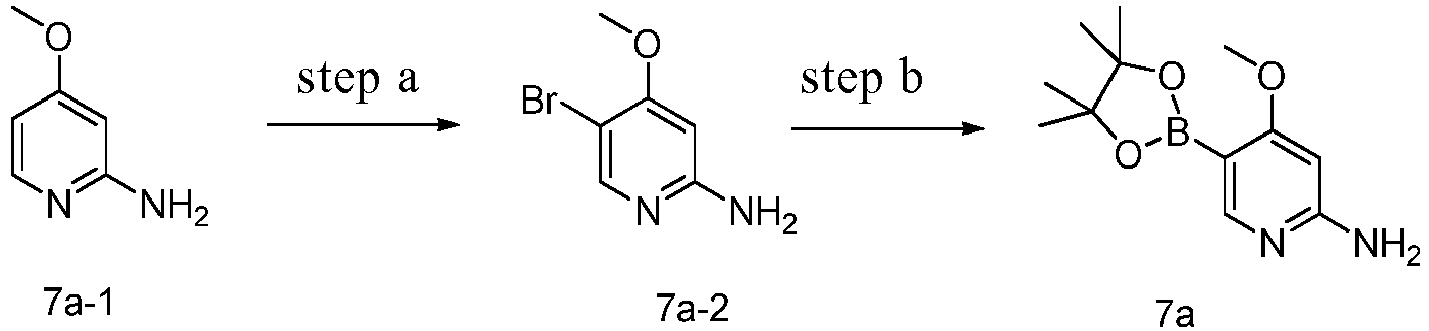
- Step a: A solution of compound 7a-1 (500 mg, 4 mmol) in 10 ml of acetic acid was added to a solution of bromine (4 ml, 1 M in acetic acid) and stirred at room temperature for 1 hour. The reaction was complete and the mixture was filtered and extracted with ethyl acetate and saturated sodium bicarbonate. The organic phase was dried over anhydrous sodium sulfate, separated and concentrated under reduced pressure to give the crude product which was purified by Combi-flash column chromatography to give the compound 7a-2 (340 mg). Purity: 78%, yield: 41%. spectrum data: MS m/z(ESI): 203[M+H]+.
- Step b: Compound 7a was obtained in a manner similar to the preparation method of step b in compound 1a using compound 7a- 2(390 mg) as the starting material, and directly used in the next step. Spectrum data: MS m/z(ESI): 251 [M+H]+.
-

- Step a: Compound 1a-2 (1.5 g, 6.28 mmol), formaldehyde (1.13 g, 37.66 mmol) and sodium methoxide (3.39 g, 62.8 mmol) were added to 25 ml of methanol and stirred at 65 °C for 4 hours. The mixture was cooled to room temperature and sodium borohydride (1.43 g, 37.68 mmol) was added and stirred at 70 °C for 2 hours. The reaction was completed and the mixture was cooled to room temperature, concentrated under reduced pressure, and extracted with saturated brine and ethyl acetate. The organic phase was separated and concentrated under reduced pressure to give compound 8a-2 (1.2 g). Spectrum data: MS m/z(ESI): 255[M+H]+.
- Step b: Compound 8a (500 mg) was obtained in a manner similar to the preparation method of step b in compound 1a using compound 8a-2 (650 mg) as the starting material. Spectrum data: MS m/z(ESI): 303[M+H]+.
-

- Step a: Sodium methoxide (0.83 g, 15.2 mmol) was added to the solution of compound 9a-1 (1.0 g, 7.6 mmol) in 30 ml of methanol and the mixture was stirred at 80 °C for 2 hours. The reaction was complete and the mixture was cooled to room temperature, concentrated under reduced pressure and purified by Combi-flash column chromatography to give compound 9a-2 (630 mg). Purity: 84%, spectrum data: MS m/z(ESI): 126[M+H]+.
- Step b: Compound 9a-3 (630 mg) was obtained in a manner similar to the preparation method of step a in compound 1a using compound 9a-2 (500 mg) as the starting material.
- Step c: Compound 9a (351 mg) was obtained in a manner similar to the preparation method of step b in compound 1a using compound 9a-3 (300 mg) as the starting material. Spectrum data: MS m/z(ESI): 170[M-81]+.
-

- Step a: Compound 10a-2 (2.97 g) was obtained in a manner similar to the preparation method of step a in compound 1a using compound 10a-1 (2 g) as the starting material. Purity: 95%, spectrum data: MS m/z(ESI): 241 [M+H]+.
- Step b: Compound 10a (3.6 g) was obtained in a manner similar to the preparation method of step b in compound 1a using compound 10a-2 (2.97 g) as the starting material. Purity: 32%, spectrum data: MS m/z(ESI): 289[M+H]+.
-
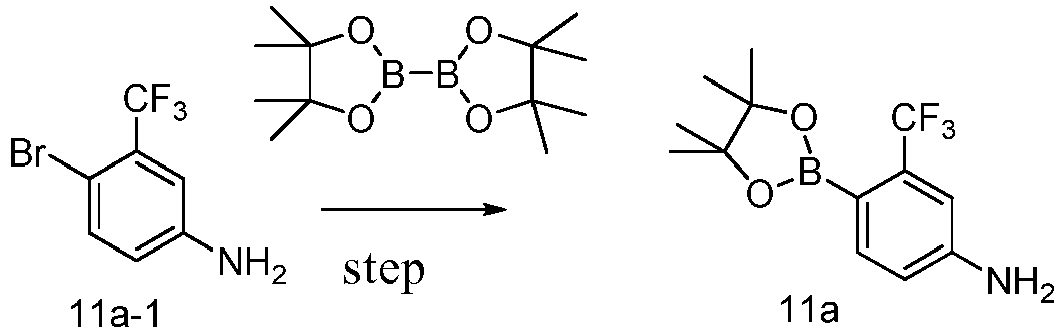
- Step: Compound 11a (900 mg) was obtained in a manner similar to the preparation method of step b in compound 1a using compound 11a-1 (1 g) as the starting material. Purity: 55%, spectrum data: MS m/z(ESI): 288[M+H]+.
-

- The solution of compound 1-a (5.0 g, 27.5 mmol) and triethylamine (3.0 g, 30 mmol) in 25 ml of dichloromethane was added dropwise to a solution of morpholine (2.4 g, 27.5 mmol) in 5 ml of dichloromethane at 5 to 15 °C and stirred at room temperature for 2 hours. The reaction was completed and the mixture was extracted with dichloromethane. The combined organic phases were separated and concentrated under reduced pressure to give the crude product which was purified by Combi-flash column chromatography to give compound 1-b (1.4 g). Purity: 95%. Spectrum data: MS m/z(ESI): 234[M+H]+.
- A mixture of compound 1-b (1.4 g, 6 mmol), methyl 2-(methylsulfonyl) acetate (1.0 g, 6.6 mmol), sodium hydride (500 mg, 12 mmol) and dimethylsulfoxide (30 mL) was added to a sealed tube and stirred at 120 °C under microwave for 15 minutes. The reaction was completed, the mixture was cooled to room temperature and extracted with ethyl acetate. The combined organic phase was separated and concentrated under reduced pressure to give crude product which was purified by Combi-flash column chromatography to give compound 1-c (500 mg). Purity: 95%. Spectrum data: MS m/z(ESI): 350[M+H]+.
- Compound 1-c (500 mg, 1.4 mmol) and sodium hydroxide (170 mg, 4.3 mmol) were added to methanol/water (10 ml / 2.5 ml) and stirred at 60 °C for 1 hour. The reaction was completed. The mixture was cooled to room temperature, extracted with ethyl acetate, washed with water and the organic phase was separated and concentrated under reduced pressure to give crude compound 1-d (500 mg). Purity: 10%, spectrum data: MS m/z(ESI): 292[M+H]+.
- 1,2-dibromoethane (1.3 g, 7 mmol) and sodium hydride (300 mg, 7 mmol) were added to the solution of compound 1-d (500 mg, 1.7 mmol) in 15 ml of dimethylformamide and stirred at room temperature for 1 hour. The reaction was completed, and the reaction mixture was extracted with water and ethyl acetate. The combined organic phase was separated, dried over anhydrous sodium sulfate and filtered. The filtrate was concentrated under reduced pressure to give crude compound 1-e (48 mg). Purity: 12%, spectrum data: MS m/z(ESI): 318[M+H]+.
- Compound 1-e (450 mg, 0.17 mmol), compound 1a (65 mg, 0.17 mmol), Pd(dppf)Cl2 ([1,1'-bis(diphenylphosphino)ferrocene]dichloropalladium (15 mg, 0.02 mmol), sodium carbonate (50 mg, 0.4 mmol) and acetonitrile/water (5 ml/1 ml) were added to a sealed tube and stirred at 120 °C under micromave for 10 minutes. The reaction was completed and the mixture was cooled to room temperature, filtered and the filtrate was concentrated under reduced pressure to give crude product which was purified by Combi-flash column chromatography to give compound S-1 (75 mg). Purity: 35%. Spectrum data: MS m/z(ESI): 444[M+H]+. 1H NMR (400 MHz, CDCl3) δ 8.29 (s, 1H), 7.09 (s, 1H), 6.80 (s, 1H), 4.90 (brs, 2H), 3.89 - 3.80 (m, 4H), 3.79 - 3.73 (m, 4H), 3.07 (s, 3H), 1.86 (q, J = 4.5 Hz, 2H), 1.57 (q, J = 4.8 Hz, 2H).
- Compounds S-4, S-10, S-12, S-16, and S-17 were prepared by refering to the method in Example 1 and using compound 1-a as the starting material except that 1,2-dibromoethane in step 4 was replaced by 1,3-dibromopropane, 1,4-dibromobutane, 1,5-dibromopentane, methyl iodide, and 2-iodopropane, respectively.
- Compounds S-5 and S-6 were prepared by refering to the method in Example 1 and using compound 1-a as the starting material except that morpholine in step 1 was replaced by (R)-3-methylmorpholine and (S)-3-methylmorpholine.
- Compound S-9 was prepared by refering to the method in Example 1 and using compound 1-a as the starting material except that morpholine in step 1 was replaced by (S)-3-methylmorpholine and 1,2-dibromoethane in step 4 was replaced by 1,3-dibromopropane.
- Compounds S-30, S-31, S-32, S-33, S-34, and S-43 were prepared by refering to the method in Example 1 and using compound 1-a as the starting material except that morpholine in step 1 was replaced by (S)-3-methylmorpholine, 1,2-dibromoethane in step 4 was replaced by 1,3-dibromopropane and compound 1a in step 5 was replaced by compound 3a, 4a, 5a, 6a, 7a, and 9a, respectively.
- Compounds S-36 and S-40 were prepared by refering to the method in Example 1 and using compound 1-a as the starting material except that compound 1a in step 5 was replaced by compound 8a, and 5a, respectively.
- Compound S-39 was prepared by refering to the method in Example 1 and using compound 1-a as the starting material except that 1,2-dibromoethane in step 4 was replaced by methyl iodide and compound 1a in step 5 was replaced by 5a.
- Compound S-42 was prepared by refering to the method in Example 1 and using compound 1-a as the starting material except that morpholine in step 1 was replaced by (S)-3-methylmorpholine and 1,2-dibromoethane in step 4 was replaced by 1,4-dibromobutane.
No. Structure MS [M+H]+ 1HNMR Example 2 
458 1H NMR (400 MHz, CDCl3) δ 8.31 (s, 1H), 6.90 (s, 1H), 6.81 (s, 1H), 4.88 (brs, 2H), 3.90 - 3.82 (m, 4H), 3.81 - 3.73 (m, 4H), 3.13 - 2.99 (m, 2H), 2.86 - 2.75 (m, 2H), 2.71 (s, 3H), 2.32 - 2.17 (m, 1H), 2.07 - 1.93 (m, 1H). Example 3 
458 1H NMR (400 MHz, CDCl3) δ 8.30 (s, 1H), 7.07 (s, 1H), 6.80 (s, 1H), 4.89 (brs, 2H), 4.81 - 4.64 (m, 1H), 4.36 (dd, J = 13.6, 2.2 Hz, 1H), 3.98 (dd, J = 11.4, 3.5 Hz, 1H), 3.77 (d, J = 11.4 Hz, 1H), 3.70 (dd, J = 11.4, 3.0 Hz, 1H), 3.55 (td, J = 12.0, 3.0 Hz, 1H), 3.27 (td, J = 13.1, 3.8 Hz, 1H), 3.08 (s, 3H), 1.92 - 1.80 (m, 2H), 1.60 - 1.54 (m, 2H), 1.30 (d, J = 6.8 Hz, 3H). Example 4 
458 1H NMR (400 MHz, CDCl3) δ 8.30 (s, 1H), 7.07 (s, 1H), 6.80 (s, 1H), 4.87 (brs, 2H), 4.75 - 4.67 (m, 1H), 4.36 (dd, J = 13.9, 2.6 Hz, 1H), 3.98 (dd, J = 11.2, 3.5 Hz, 1H), 3.77 (d, J = 11.3 Hz, 1H), 3.70 (dd, J = 11.4, 3.1 Hz, 1H), 3.55 (td, J = 11.9, 3.0 Hz, 1H), 3.28 (td, J = 12.8, 3.6 Hz, 1H), 3.08 (s, 3H), 1.90 - 1.85 (m, 2H), 1.57 (overlap, 2H), 1.30 (d, J = 6.8 Hz, 3H). Example 5 
472 1H NMR (400 MHz, CDCl3) δ 8.31 (s, 1H), 6.88 (s, 1H), 6.80 (s, 1H), 4.88 (brs, 2H), 4.78 - 4.70 (m, 1H), 4.39 (dd, J = 13.6, 2.5 Hz, 1H), 3.99 (dd, J = 11.3, 3.6 Hz, 1H), 3.78 (d, J = 11.4 Hz, 1H), 3.71 (dd, J = 11.5, 3.1 Hz, 1H), 3.56 (td, J = 11.9, 3.0 Hz, 1H), 3.28 (td, J = 12.4, 3.6 Hz, 1H), 3.12 - 2.99 (m, 2H), 2.88 - 2.73 (m, 2H), 2.71 (s, 3H), 2.33 - 2.18 (m, 1H), 2.06 - 1.93 (m, 1H), 1.30 (d, J = 6.8 Hz, 3H). Example 6 
472 1H NMR (400 MHz, CDCl3) δ 8.31 (s, 1H), 7.04 (s, 1H), 6.80 (s, 1H), 4.88 (brs, 2H), 3.89 - 3.81 (m, 4H), 3.81 - 3.73 (m, 4H), 2.75 (s, 3H), 2.71 - 2.63 (m, 2H), 2.61 - 2.50 (m, 2H), 1.98 - 1.88 (m, 2H), 1.72 - 1.62 (m, 2H). Example 7 
486 1H NMR (400 MHz, CDCl3) δ 8.32 (s, 1H), 7.02 (s, 1H), 6.80 (s, 1H), 4.89 (brs, 2H), 3.86 - 3.81 (m, 4H), 3.81 - 3.75 (m, 4H), 2.78-2.71 (m, 2H), 2.70 (s, 3H), 2.15-2.06 (m, 2H), 1.88-1.76 (m, 2H), 1.38 - 1.21 (m, 4H). Example 8 
446 1H NMR (400 MHz, CDCl3) δ 8.31 (s, 1H), 7.00 (s, 1H), 6.80 (s, 1H), 4.87 (brs, 2H), 3.93 - 3.81 (m, 4H), 3.81 - 3.70 (m, 4H), 2.85 (s, 3H), 1.83 (s, 6H). Example 9 
460 1H NMR (400 MHz, CDCl3) δ 8.30 (s, 1H), 6.82 (s, 1H), 6.80 (s, 1H), 4.88 (brs, 2H), 3.87 - 3.73 (m, 8H), 2.85 (s, 3H), 2.81 - 2.64 (m, 1H), 1.32 (d, J = 6.7 Hz, 3H), 0.95 (d, J = 6.7 Hz, 3H). Example 10 
473 1H NMR (400 MHz, CDCl3) δ 8.61 (s, 1H), 6.87 (s, 1H), 5.53 (brs, 2H), 4.78 - 4.68 (m, 1H), 4.39 (dd, J = 13.6, 2.4 Hz, 1H), 4.00 (dd, J = 11.4, 3.5 Hz, 1H), 3.79 (d, J = 11.4 Hz, 1H), 3.71 (dd, J = 11.5, 3.1 Hz, 1H), 3.56 (td, J = 12.0, 3.0 Hz, 1H), 3.29 (td, J = 13.0, 3.8 Hz, 1H), 3.13 - 2.99 (m, 2H), 2.88 - 2.73 (m, 2H), 2.71 (s, 3H), 2.35 - 2.19 (m, 1H), 2.08 - 1.93 (m, 1H), 1.30 (d, J = 6.8 Hz, 3H). Example 11 
438 1H NMR (400 MHz, CDCl3) δ 8.42 (s, 1H), 7.12 (s, 1H), 6.58 (s, 1H), 4.80 - 4.74 (m, 1H), 4.72 (brs, 2H), 4.42 (dd, J = 13.6, 2.1 Hz, 1H), 4.00 (dd, J = 11.3, 3.3 Hz, 1H), 3.80 (d, J = 11.4 Hz, 1H), 3.72 (dd, J = 11.4, 3.1 Hz, 1H), 3.57 (td, J = 12.0, 3.0 Hz, 1H), 3.29 (td, J = 13.1, 3.8 Hz, 1H), 3.11 - 3.01 (m, 2H), 2.84 - 2.75 (m, 2H), 2.73 (s, 3H), 2.33 - 2.18 (m, 1H), 2.05 - 1.93 (m, 1H), 1.31 (d, J = 6.8 Hz, 3H). Example 12 
404 1H NMR (400 MHz, DMSO) δ 8.79 (d, J = 2.3 Hz, 1H), 8.15 (dd, J = 8.8, 2.4 Hz, 1H), 7.19 (s, 1H), 6.57 (brs, 2H), 6.52 (d, J = 8.8 Hz, 1H), 4.77 - 4.65 (m, 1H), 4.38 (d, J = 13.1 Hz, 1H), 3.94 (dd, J = 11.3, 3.2 Hz, 1H), 3.74 (d, J = 11.4 Hz, 1H), 3.62 (dd, J = 11.3, 2.9 Hz, 1H), 3.47 (td, J = 11.8, 2.7 Hz, 1H), 3.20 (td, J = 13.2, 3.7 Hz, 1H), 2.96 - 2.71 (m, 7H), 2.12 - 1.84 (m, 2H), 1.22 (d, J = 6.7 Hz, 3H). Example 13 
405 1H NMR (400 MHz, DMSO) δ 9.03 (s, 2H), 7.28 (s, 1H), 7.27 (brs, 2H), 4.76 - 4.66 (m, 1H), 4.38 (d, J = 12.6 Hz, 1H), 3.94 (dd, J = 11.3, 3.3 Hz, 1H), 3.74 (d, J = 11.4 Hz, 1H), 3.62 (dd, J = 11.5, 3.1 Hz, 1H), 3.47 (td, J = 11.9, 2.8 Hz, 1H), 3.20 (td, J = 13.1, 3.7 Hz, 1H), 2.94 - 2.65 (m, 7H), 2.11 - 1.99 (m, 1H), 1.96 - 1.84 (m, 1H), 1.22 (d, J = 6.7 Hz, 3H). Example 14 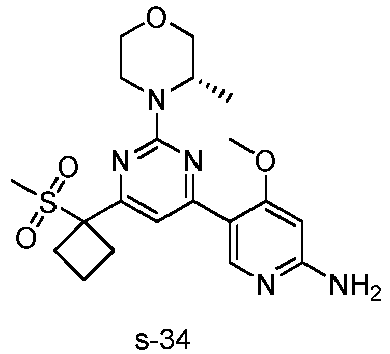
434 1H NMR (400 MHz, DMSO) δ 8.56 (s, 1H), 7.21 (s, 1H), 6.43 (brs, 2H), 6.09 (s, 1H), 4.72 - 4.61 (m, 1H), 4.32 (dd, J = 13.5, 1.8 Hz, 1H), 3.94 (dd, J = 11.1, 3.1 Hz, 1H), 3.83 (s, 3H), 3.73 (d, J = 11.3 Hz, 1H), 3.62 (dd, J = 11.4, 3.0 Hz, 1H), 3.46 (td, J = 11.9, 2.8 Hz, 1H), 3.17 (td, J = 13.1, 3.6 Hz, 1H), 2.97 - 2.81 (m, 5H), 2.77 - 2.63 (m, 2H), 2.11 - 2.00 (m, 1H), 1.96 - 1.83 (m, 1H), 1.21 (d, J = 6.7 Hz, 3H). Example 15 
458 1H NMR (500 MHz, CDCl3) δ 8.34 (s, 1H), 7.09 (s, 1H), 6.67 (s, 1H), 4.97 (brs, 1H), 3.85 - 3.80 (m, 4H), 3.79 - 3.74 (m, 4H), 3.08 (s, 3H), 3.02 (d, J = 5.2 Hz, 3H), 1.79 (q, J = 4.6 Hz, 2H)1.61 - 1.56 (m, 2H). Example 16 
378 1H NMR (500 MHz, CDCl3) δ 8.80 (d, J = 2.0 Hz, 1H), 8.10 (dd, J = 8.6, 2.3 Hz, 1H), 7.17 (s, 1H), 6.55 (d, J = 8.6 Hz, 1H), 4.73 (brs, 2H), 3.94 - 3.83 (m, 4H), 3.85 - 3.71 (m, 4H), 2.87 (s, 3H), 1.82 (s, 6H). Example 17 
376 1H NMR (500 MHz, CDCl3) δ 8.80 (d, J = 2.1 Hz, 1H), 8.11 (dd, J = 8.7, 2.3 Hz, 1H), 7.27 (s, 1H), 6.55 (d, J = 8.7 Hz, 1H), 4.73 (brs, 2H), 3.90 - 3.83 (m, 4H), 3.83 - 3.76 (m, 4H), 3.06 (s, 3H), 1.84 (q, J = 4.6 Hz, 2H), 1.53 (q, J = 2.5 Hz, 2H). Example 18 
486 1H NMR (400 MHz, CDCl3) δ 8.33 (s, 1H), 7.03 (s, 1H), 6.80 (s, 1H), 4.88 (brs, 2H), 4.77 -4.69 (m, 1H), 4.38 (dd, J = 13.7, 2.5 Hz, 1H), 3.99 (dd, J = 11.4, 3.6 Hz, 1H), 3.79 (d, J = 11.4 Hz, 1H), 3.72 (dd, J = 11.4, 3.1 Hz, 1H), 3.56 (td, J = 11.9, 3.0 Hz, 1H), 3.28 (td, J = 12.8, 4.0 Hz 1H), 2.74 (s, 3H), 2.72 - 2.53 (m, 4H), 1.98 - 1.88 (m, 2H), 1.71 - 1.64 (m, 2H), 1.30 (d, J = 6.8 Hz, 3H). Example 19 
435 1H NMR (400 MHz, CDCl3) δ 8.97 (s, 1H), 7.37 (s, 1H), 5.14 (brs, 2H), 4.78 - 4.71 (m, 1H), 4.41 (dd, J = 13.1, 2.1 Hz, 1H), 4.03 - 3.98 (m, 4H), 3.80 (d, J = 11.3 Hz, 1H), 3.72 (dd, J = 11.3, 3.1 Hz, 1H), 3.57 (td, J = 12.1, 3.1 Hz, 1H), 3.28 (td, J = 12.0, 4.0 Hz, 1H), 3.10 -3.01 (m, 2H), 2.81 - 2.77 (m, 2H), 2.72 (s, 3H), 2.27 - 2.20 (m, 1H), 1.99 -1.94 (m, 1H), 1.29 (d, J = 6.8 Hz, 3H). -

- The mixture of compound 1-e (50 mg, 0.157 mmol), compound 4a (120 mg, 0.47 mmol), Pd(dppf)Cl2 ([1,1'-bis(diphenylphosphino)ferrocene]dichloropalladium) (11.52 g, 0.016 mmol), sodium carbonate (24 mg, 0.314 mmol), and acetonitrile/water (5 ml/1 ml) was added to a sealed tube and stirred at 120 °C under microwave for 10 minutes. The reaction was completed and the mixture was cooled to room temperature, filtered, and extracted with water and ethyl acetate. The organic phase was separated and dried over sodium sulfate. The organic phase was separated and concentrated under reduced pressure to give the crude product which was separated and purified by preparative liquid chromatography to obtain compound S-37 (7.06 mg). Purity: 98.25%. Spectrum data: MS m/z(ESI): 410[M+H]+. 1H NMR (500 MHz, CDCl3) δ 8.40 (s, 1H), 7.31 (s, 1H), 6.58 (s, 1H), 4.69 (brs, 2H), 3.88 - 3.81 (m, 4H), 3.80-3.76 (m, 4H), 3.09 (s, 3H), 1.86 (q, J= 4.5 Hz, 2H), 1.54 - 1.49 (m, 2H).
-

- Compound 1-d (100 mg, 0.344 mmol), methyl iodide (146 mg, 1.031 mmol) and sodium hydride (53 mg, 1.376 mmol) were added to 5 ml of dimethylformamide and stirred at room temperature for 2 h. The reaction was completed and the mixture was extracted with water and ethyl acetate. The organic phases were separated, combined, and concentrated under reduced pressure to give crude compound 38-b (120 mg). Purity: 93%, spectrum data: MS m/z(ESI): 320[M+H]+.stirred at 120 °C under microwave for 10 minutes
- The mixture of compound 38-b (50 mg, 0.157 mmol), compound 4a (120 mg, 0.47 mmol), Pd(dppf)Cl2 ([1,1'-bis(diphenylphosphino)ferrocene]dichloropalladium) (5.76 mg, 0.0208 mol), sodium carbonate (34mg, 0.314mmol), and acetonitrile/water (4 ml/1 ml) was added to a sealed tube and stirred at 120 °C under microwave for 10 minutes. The reaction was completed and the mixture was cooled to room temperature and filtered. The filtrate was concentrated under reduced pressure to give crude product which was purified by Combi-flash column chromatography to obtain compound S-38 (7.68 mg). Purity: 100%. Spectrum data: MS m/z(ESI): 412[M+H]+. 1H NMR (500 MHz, CDCl3) δ 8.41 (s, 1H), 7.24 (s, 1H), 6.59 (s, 1H), 4.70 (brs, 2H), 3.90 - 3.83 (m, 4H), 3.82 - 3.76 (m, 4H), 2.88 (s, 3H), 1.84 (s, 6H).
-

- The crude compound 2-b (440 mg) was obtained by referring to the synthesis method of step 2 in Example 1 and using compound 1-b (1.2 g) as the starting material except that methyl 2-(methylsulfonyl) acetate was replaced by diethyl malonate. Purity: 40%, spectrum data: MS m/z(ESI): 358[M+H]+.
- Sodium chloride (80 mg, 1.35 mmol) was added to the solution of compound 2-b (320 mg, 0.9 mmol) in dimethyl sulfoxide/water (10 ml/0.5 ml) and stirred at 140 °C for 4 h. The reaction was completed. The mixture was cooled to room temperature and extracted by adding water and ethyl acetate. The combined organic phases were separated and concentrated under reduced pressure to give crude compound 2-c (280 mg) as an oil. Purity: 70%, spectrum data: MS m/z(ESI): 286[M+H]+.
- The crude compound 2-d (140 mg) was obtained by refering to the synthesis method of step 4 in Example 1 and using compound 2-c (130mg) as the starting material. Purity: 60%, spectrum data: MS m/z(ESI): 312[M+H]+.
- The compound S-2 (54 mg) was obtained by refering to the synthesis method of step 5 in Example 1 and using compound 2-d (160 mg) as the starting material. Purity: 100%. Spectrum data: MS m/z(ESI): 438[M+H]+. 1H NMR (400 MHz, CDCl3) δ 8.30 (s, 1H), 7.12 (s, 1H), 6.80 (s, 1H), 4.84 (brs, 2H), 4.20 (q, J = 7.1 Hz, 2H), 3.86 - 3.67 (m, 8H), 1.64 (overlap, 4H), 1.26 (t, J = 7.1 Hz, 3H).
-

- Sodium hydroxide (5N, 2.5 ml) was added to the solution of compound 2-d (50 mg, 0.16 mmol) in methanol (2.5 ml) and stirred at room temperature for 4 hours. The reaction was complete, and extracted by adding water and ethyl acetate. The combined organic phases were separated, and concentrated under reduced pressure to givecompound 3-b (70mg). Purity: 80%, spectrum data: MS m/z(ESI): 284[M+H]+.
- Morpholine (32 mg, 0.36 mmol), triethylamine (50 mg, 0.48 mmol), 4-dimethylaminopyridine (5 mg, 0.024 mmol), and HATU (2-(7-azobenzotriazole)-N,N,N',N'-tetramethyluronium hexafluorophosphate) (110 mg, 0.288 mmol) were added to the solution of compound 3-b (70 mg, 0.24 mmol) in dichloromethane (5 ml) and stirred at room temperature for 2 hours. The reaction was completed, and extracted by adding water and dichloromethane. The combined organic phases were separated and concentrated under reduced pressure to give compound 3-c (80 mg). Purity: 80%, spectrum data: MS m/z(ESI): 353[M+H]+.
- Compound S-3 (100 mg) was obtained by refering to the synthesis method of step 5 in Example 1 and using compound 3-c (85 mg) as the starting material. Purity: 33%. Spectrum data: MS m/z(ESI): 479 [M+H]+. 1H NMR (400 MHz, CDCl3) δ 8.24 (s, 1H), 6.79 (s, 1H), 6.53 (s, 1H), 4.84 (brs, 2H), 3.83 - 3.77 (m, 4H), 3.77 - 3.73 (m, 4H), 3.70 - 3.65 (m, 4H), 3.57 - 3.43 (m, 4H), 1.54 - 1.51 (m, 2H), 1.36 (q, J = 4.4 Hz, 2H).
- Compound S-7 was obtained by refering to the synthesis method in Example 23 and using compound 2-d as the starting material except that morpholine was replaced by piperidine.
No. Structure MS [M+H]+ 1HNMR example 24 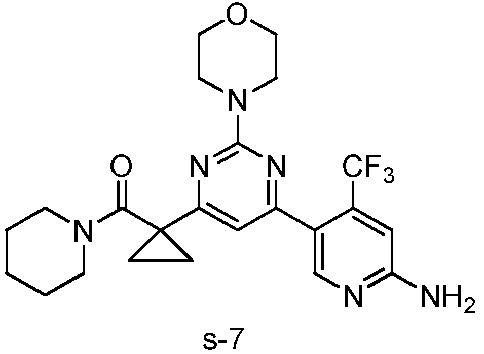
477 1H NMR (400 MHz, CDCl3) δ 8.23 (s, 1H), 6.79 (s, 1H), 6.54 (s, 1H), 4.87 (brs, 2H), 3.84 - 3.71 (m, 8H), 3.61 (t, J = 4.8 Hz, 2H), 3.39 (t, J = 5.2 Hz, 2H), 1.62 - 1.52 (m, 6H), 1.46 - 1.37 (m, 4H). -

- Step: borane (1 ml) was added to the solution of compound S-3 (120 mg, 0.2 mmol) in 10 ml of tetrahydrofuran and the mixture was stirred at room temperature for 1 hour. The reaction was completed and methanol was added. The mixture was concentrated under reduced pressure and extracted with water and ethyl acetate. The combined organic phases were separated and concentrated under reduced pressure to give the crude product which was separated and purified by preparative liquid chromatography to obtain compound S-8 (8.5 mg). Purity: 10%. Spectrum data: MS m/z(ESI): 465[M+H]+. 1H NMR (400 MHz, CDCl3) δ 8.32 (s, 1H), 7.20 (s, 1H), 6.81 (s, 1H), 4.81 (brs, 2H), 3.79 - 3.72 (m, 8H), 3.65 (t, J = 4.4 Hz, 4H), 2.67 (s, 2H), 2.48 (brs, 4H), 1.58 (overlap, 2H), 1.41 (q, J = 3.6 Hz, 2H).
-

- Lithium aluminum hydride (32 mg, 0.28 mmol) was added to the solution of compound 2-d (50 mg, 0.18 mmol) in 5 ml of tetrahydrofuran at 0 °C and stirred at 0 °C to room temperature for 2 hours. The reaction was complete, and 3 drops of water, sodium hydroxide (5N, 3 drops), and 1 ml of water were added. The mixture was filtered and the filtrate was concentrated under reduced pressure to give the crude product which was purified by Combi-flash column chromatography to give compound 11-b (50 mg). Purity: 90%, yield: 30%. Spectrum data: MS m/z(ESI): 270[M+H]+.
- Methanesulfonyl chloride (32 mg, 0.28 mmol) and triethylamine (40 mg, 0.37 mmol) were added to the solution of compound 11-b (50 mg, 0.18 mmol) in 5 ml of dichloromethane at 0 °C and stirred at 0 °C to room temperature for 2 hours. The reaction was completed and the mixture was extracted by adding water and dichloromethane, and dried over sodium sulfate. The organic phase was separated and concentrated under reduced pressure to give crude compound 11-c (60 mg). Purity: 80%. Spectrum data: MS m/z(ESI): 348[M+H]+.
- Sodium iodide (52 mg, 0.35 mmol) was added to the solution of compound 11-c (60 mg, 0.17 mmol) in 5 ml of acetone and stirred at room temperature overnight. The reaction was completed. The mixture was extracted by adding water and ethyl acetate, and dried over sodium sulfate. The organic phase was separated, and concentrated under reduced pressure to give crude compound 11-d (60 mg). Purity: 73%. Spectrum data: MS m/z(ESI): 380[M+H]+.
- Sodium methanesulfinate (30 mg, 0.24 mmol) was added to the solution of compound 11-d (60 mg, 0.16 mmol) in 5 ml of dimethylformamide and stirred at room temperature for 2 h. The reaction was completed and the mixture was extracted by adding water and ethyl acetate, and dried over sodium sulfate. The organic phase was separated and concentrated under reduced pressure to give crude compound 11-e (60 mg). Purity: 60%. Spectrum data: MS m/z(ESI): 332[M+H]+.
- Compound S-11 (30 mg) as a white solid was obained by refering to the synthesis method of step 5 in Example 1 and using compound 11-e (60 mg) as the starting material. Purity: 100%. Spectrum data: MS m/z(ESI): 458 [M+H]+.1H NMR (400 MHz, CDCl3) δ 8.25 (s, 1H), 6.79 (s, 1H), 6.34 (s, 1H), 4.86 (brs, 2H), 3.88 - 3.80 (m, 4H), 3.79 - 3.75 (m, 4H), 3.74 (s, 2H), 2.77 (s, 3H), 1.51 - 1.46 (m, 2H), 1.41 - 1.36 (m, 2H).
-


- (S)-3-methylmorpholine (6.3 g, 0.72 mol) was added to the solution of compound 2-a (15 g, 0.72 mol) in 120 ml of dichloromethane at 40 °C and stirred at 40 °C for 2 hours. The reaction was completed and the mixture was cooled to room temperature, and extracted by adding water and dichloromethane. The organic phase was separated, rinsed with saturated brine, dried over sodium sulfate, and filtered. The filtrate was concentrated under reduced pressure to give crude compound 13-b (900mg). Spectrum data: MS m/z(ESI): 272[M+H]+.
- Sodium borohydride (900 mg) was added to the solution of compound 13-b (1.5 g, 5.5 mmol) in 20 ml of methanol and stirred at 65 °C for 1 h. The reaction was completed and the mixture was cooled to room temperature, concentrated under reduced pressure, extracted by adding water and dichloromethane. The organic phase was separated, rinsed with saturated brine, dried over sodium sulfate, and filtered. The filtrate was concentrated under reduced pressure to give crude compound 13-c (550mg). Purity: 90%, yield: 30%. Spectrum data: MS m/z(ESI): 244.1[M+H]+.
- Compound 13-d (740 mg) was obtained by refering to the synthesis method of step 2 in Example 26 and using compound 13-c (550 mg) as the starting material. Purity: 96%. Spectrum data: MS m/z(ESI): 322.0[M+H]+.
- Compound 13-e (680 mg) was obtained by refering to the synthesis method of step 3 in Example 26 and using compound 13-d (740 mg) as the starting material. Spectrum data: MS m/z(ESI): 354.0[M+H]+.
- Compound 13-f (45 mg) was obtained by refering to the synthesis method of step 4 in Example 26 and using compound 13-e (225 mg) as the starting material except that sodium methanesulfinate in the step was replaced by 2a. Spectrum data: MS m/z(ESI): 334.1[M+H]+.
- Compound 13-g (0.02 g) as a pale yellow oil was obtained by refering to the synthesis method of step 4 in Example 1 and using compound 13-f (0.045 g) as the starting material except that 1,2-dibromoethane was replaced by 1,3-dibromoethane. Purity: 46.4%, yield: 39.7%. Spectrum data: MS m/z(ESI): 374.12[M+H]+.
- Compound S-13 (3.2 mg) as a yellow solid was obtained by refering to the synthesis method of step 5 in Example 1 and using compound 13-g (0.02 g) as the starting material. Purity: 20.5%, yield: 11.96%. Spectrum data: MS m/z(ESI): 500.19[M+H]+. 1H NMR (400 MHz, DMSO) δ 8.25 (s, 1H), 6.96 (s, 1H), 6.95 (s, 2H), 6.86 (s, 1H), 4.66 (d, J = 6.6 Hz, 1H), 4.30 (d, J = 11.9 Hz, 1H), 3.94 (d, J = 8.4 Hz, 1H), 3.73 (d, J = 11.5 Hz, 1H), 3.61 (d, J = 8.7 Hz, 1H), 3.49 - 3.41 (m, 1H), 3.21 (m, 1H), 2.94 (m, 2H), 2.83 (m, 2H), 2.77 (m, 1H), 2.02 - 1.86 (m, 2H), 1.22 (d, J = 6.8 Hz, 3H), 1.14 (m, 6H).
- Compounds S-15 and S-23 were obtained by refering to the method in Example 27 and using compound 2-a as the starting material except that 2a in step 5 was replaced by sodium benzenesulfinate and sodium ethanesulfinate, respectively.
- Compounds S-18 and S-22 were obtained by refering to the method in Example 27 and using compound 2-a as the starting material except that (S)-3-methylmorpholine in step 1 was replaced by morpholine and 1,3-dibromopropane in step 6 was replaced by 1,2-dibromoethane and methyl iodide, respectively.
- Compound S-19 was obtained by refering to the method in Example 27 and using compound 2-a as the starting material except that (S)-3-methylmorpholine in step 1 was replaced by morpholine.
- Compound S-20 was obtained by refering to the method in Example 27 and using compound 2-a as the starting material except that (S)-3-methylmorpholine in step 1 was replaced by morpholine, and sodium propane-2-sulfonic acid in step 5 was replaced by sodium benzenesulfinate.
- Compounds S-21, S-25, S-28, and S-29 were obtained by refering to the method in Example 27 and using compound 2-a as the starting material except that (S)-3-methylmorpholine in step 1 was replaced by morpholine, 2a in step 5 was replaced by sodium benzenesulfinate, sodium benzenesulfinate, sodium ethanesulfinate, and sodium ethanesulfinate, respectively, and 1,3-dibromopropane in step 6 was replaced by methyl iodide, 1,2-dibromoethane, 1,2-dibromoethane, and methyl iodide, respectively.
- Compound S41 was obtained by refering to the method in Example 27 and using compound 2-a as the starting material except that 2a in step 5 was replaced by sodium methylsulfinate, and 13-dibromoroane in step 6 was replaced by methyl iodide.
No. structure MS [M+H]+ 1HNMR Example 28 
534.17 1H NMR (400 MHz, DMSO) δ 8.43 (brs, 1H, HCOOH), 8.14 (s, 1H), 7.68 (s, 1H), 7.46 (t, J = 7.7 Hz, 2H), 7.38 (d, J = 7.8 Hz, 2H), 6.92 (brs, 2H), 6.85 (s, 1H), 6.79 (s, 1H), 4.32 - 4.19 (m, 1H), 3.76 (d, J = 11.4 Hz, 1H), 3.58 (d, J = 11.2 Hz, 1H), 3.25 - 3.15 (m, 3H), 3.05 - 2.93 (m, 2H), 2.81 - 2.69 (m, 2H), 2.13 - 1.97 (m, 2H), 0.97 (d, J = 6.5 Hz, 3H). Example 29 
472 1H NMR (500 MHz, CDCl3) δ 8.29 (s, 1H), 7.20 (s, 1H), 6.80 (s, 1H), 4.85 (brs, 2H), 3.84 - 3.80 (m, 4H), 3.79 - 3.74 (m, 4H),3.47 - 3.26 (m, 1H), 1.83 - 1.79 (m, , 2H), 1.60 - 1.53 (m, 2H), 1.40 (s, 3H), 1.38 (s, 3H). Example 30 
486 1H NMR (500 MHz, CDCl3) δ 8.30 (s, 1H), 7.02 (s, 1H), 6.80 (s, 1H), 4.88 (brs, 2H), 3.89 - 3.84 (m, 4H), 3.75 - 3.80 (m, 4H), 3.22 - 3.12 (m, 2H), 2.84 - 2.75 (m, 3H), 2.19 - 2.08 (m, 1H), 2.01 - 1.95 (m, 1H), 1.27 (s, 3H), 1.26 (s, 3H). Example 31 
520 1H NMR (500 MHz, CDCl3) δ 8.24 (s, 1H), 7.56 (t, J = 7.4 Hz, 1H), 7.46 (d, J = 7.4 Hz, 2H), 7.37 (t, J = 7.8 Hz, 2H), 6.87 (s, 1H), 6.82 (s, 1H), 4.89 (brs, 2H), 3.64 - 3.55 (m, 4H), 3.51 - 3.42 (m, 4H),3.27 - 3.08 (m, 2H), 2.83 - 2.66 (m, 2H), 2.32 - 2.28 (m ,1H), 2.01 - 1.91 (m, 1H). Example 32 
508 1H NMR (500 MHz, CDCl3) δ 8.26 (s, 1H), 7.59 (t, J = 7.4 Hz, 1H), 7.50 (dd, J = 8.0, 1.0 Hz, 2H), 7.40 (t, J = 7.8 Hz, 2H), 7.01 (s, 1H), 6.83 (s, 1H), 4.88 (brs, 2H), 3.61 - 3.56 (m, 4H), 3.54 - 4.42 (m, 4H), 1.83 (s, 6H). Example 33 
474 1H NMR (500 MHz, CDCl3) δ 8.28 (s, 1H), 7.10 (s, 1H), 6.81 (s, 1H), 4.90 (brs, 2H), 3.91 - 3.81 (m, 4H), 3.81 - 3.70 (m, 4H), 3.48 - 3.35 (m, 1H), 1.84 (s, 6H), 1.20 (s, 3H), 1.18(s, 3H). Example 34 
486.2 1H NMR (400 MHz, DMSO) δ 8.24 (s, 1H), 7.56 (s, 1H), 6.94 (brs, 2H), 6.86 (s, 1H), 4.65 (s, 1H), 4.29 (d, J = 13.4 Hz, 1H), 3.93 (d, J = 9.0 Hz, 1H), 3.72 (d, J = 11.2 Hz, 1H), 3.65 - 3.55 (m, 1H), 3.50 - 3.38 (m, 1H), 3.24 - 3.09 (m, 1H), 3.05 - 2.83 (m, 4H), 2.82 - 2.68 (m, 2H), 2.14 - 1.82 (m, 2H), 1.20 (d, J = 5.4 Hz, 3H), 1.16 - 0.94 (m, 3H). Example 35 
506 1H NMR (400 MHz, CDCl3) δ 8.16 (s, 1H), 7.78 - 7.70 (m, 2H), 7.59 (t, J = 7.4 Hz, 1H), 7.47 (t, J = 7.8 Hz, 2H), 7.06 (s, 1H), 6.80 (s, 1H), 4.86 (brs, 2H), 3.63 - 3.59 (m, 8H), 2.01 (dd, J = 7.2, 4.4 Hz, 2H), 1.60 (dd, J = 7.2, 4.4 Hz, 2H). Example 36 
458.1 1H NMR (500 MHz, DMSO) δ 8.25 (s, 1H), 7.03 (s, 1H), 6.94 (brs, 2H), 6.86 (s, 1H), 3.75 - 3.69 (m, 4H), 3.68 - 3.64 (m, 4H), 3.36 (q, J = 7.5 Hz, 2H), 1.68 - 1.62 (m, 2H), 1.61-1.56 (m, 2H), 1.27 (t, J = 7.4 Hz, 3H). Example 37 
460.2 1H NMR (500 MHz, DMSO) δ 8.23 (s, 1H), 7.05 (s, 1H), 6.94 (brs, 2H), 6.87 (s, 1H), 3.79 - 3.71 (m, 4H), 3.70 - 3.62 (m, 4H), 3.13 (q, J = 7.4 Hz, 2H), 1.74 (s, 6H), 1.13 (t, J = 7.4 Hz, 3H). Example 38 
460 1H NMR (500 MHz, CDCl3) δ 8.31 (s, 1H), 6.99 (s, 1H), 6.80 (s, 1H), 4.87 (brs, 2H), 4.80 - 4.64 (m, 1H), 4.38 (dd, J = 13.6, 2.3 Hz, 1H), 3.99 (dd, J = 11.3, 3.5 Hz, 1H), 3.78 (d, J = 11.4 Hz, 1H), 3.72 (dd, J = 11.5,3.0 Hz, 1H), 3.56 (td, J = 11.9,3.0 Hz, 1H), 3.29 (td, J = 13.0, 3.8 Hz, 1H), 2.84 (s, 3H), 1.83 (s, 3H), 1.83 (s, 3H), 1.30 (d, J = 6.8 Hz, 4H). -

- Triethylamine (0.30 g, 0.0030 mol) and diphenyl azidophosphate (0.82 g, 0.0030 mol) were added to the solution of compound 3-b (0.71 g, 0.0025 mol) in 25ml of toluene and stirred at room temperature for 1 h. Tert -butanol (7 ml) was added and stirred at 100 °C for 16 hours. The reaction was completed and the mixture was cooled to room temperature, added with water and ethyl acetate. The organic phase was separated, rinsed with 26% brine, and dried over sodium sulfate. The organic phase was separated and concentrated under reduced pressure to give the crude product which was purified by Combi-flashcolumn chromatography to give compound 14-b (0.27g) as an orange oil. Purity: 30.3%. Spectrum data: MS m/z(ESI): 355.15[M+H]+.
- 5 ml of trifluoroacetic acid was added to the solution of compound 14-b (0.27 g, 0.00076 mol) in 5 ml of dichloromethane and stirred at room temperature for 2∼4 h. The reaction was complete, and trifluoroacetic acid was concentrated at room temperature under reduced pressure. Dichloromethane and saturated sodium bicarbonate solution were added, and the organic phase was separated and dried over sodium sulfate. The organic phase was separated, concentrated under reduced pressure at below 50 °C to give compound 14-c (0.2 g) as a pale yellow solid. Purity: 75.5%. Spectrum data: MS m/z(ESI): 255.09[M+H]+.
- Compound 14-d (0.17 g) as a yellow oil was obtained by refering to the synthesis method of step 2 in example 26 and using compound 14-c (0.1 g) as the starting material. Purity: 62%. Spectrum data: MS m/z(ESI): 333.07[M+H]+.
- Sodium hydride (0.013 g, 0.00034 mol) was added to the solution of compound 14-d (0.087 g, 0.00026 mol) in 6 ml of dimethylformamid at 0 °C and stirred at 0 °C for 10 minutes. Methyl iodide (0.055 g, 0.00039 mol) was added and stirred at room temperature for 4 - 16 h. The reaction was complete, saturated ammonium chloride solution and ethyl acetate were added and the organic phase was separated and concentrated under reduced pressure to give crude product which was purified by Combi-flashcolumn chromatography to give compound 14-e (0.06g) as a pale yellow solid. Purity: 53%. Spectrum data: MS m/z(ESI): 347.09[M+H]+.
- Compound S-14 (33.65 mg) as a white solid was obtained by refering to the synthesis method of step 5 in example 1 and using compound 14-e (0.06 g) as the starting material. Purity: 56.7%, yield: 41.0%. Spectrum data: MS m/z(ESI): 473.15[M+H]+.1H NMR (400 MHz, DMSO) δ 8.18 (s, 1H), 6.89 (brs, 2H), 6.85 (s, 1H), 6.81 (s, 1H), 3.60 - 3.70 (m, 8H), 2.97 (d, J = 7.0 Hz, 6H), 1.42 - 1.67 (m, 4H).
-

- Step: Compound S-24 (5.12 mg) was obtained by refering to the synthesis method of step 5 in example 1 and using compound 14-d (50 mg) as the starting material. Spectrum data: MS m/z(ESI): 459.1 [M+H]+. 1H NMR (400 MHz, CDCl3) δ 8.25 (s, 1H), 6.80 (s, 1H), 6.58 (s, 1H), 5.77 (s, 1H), 4.87 (brs, 2H), 3.84 - 3.82 (m, 4H), 3.78 - 3.74 (m, 4H), 1.68 (dd, J= 7.9, 4.8 Hz, 2H), 1.51 (dd, J = 7.9, 4.8 Hz, 2H).
-

- Compound 26-b (50 mg) as a white solid was obtained by refering to the synthesis method of step 2 in example 26 and using compound 14-c (0.09 g) as the starting material except that methanesulfonyl chloride in the step was replaced by acetyl chloride. Purity: 65.7%. Spectrum data: MS m/z(ESI): 297.10[M+H]+.
- Compound S-26 (7.12mg) as a white solid was obtained by refering to the synthesis method of step 5 in Example 1 and using compound 26-b (0.05 g) as a starting material. Spectrum data: MS m/z(ESI): 423.17[M+H]+.1H NMR (400 MHz, Acetone) δ 8.19 (s, 1H), 7.82 (s, 1H), 6.94 (s, 1H), 6.87 (s, 1H), 6.21 (brs, 2H), 3.75 - 3.70 (m, 4H), 3.69 - 3.64 (m, 4H), 1.95 (s, 3H), 1.62 - 1.59 (m, 2H), 1.22 - 1.19 (m, 2H).
-

- Compound 27-b (3.6g) as a white solid was obtained by referring to the synthesis method of step 1 in Example 1 and using compound 1-a (10.0g) as the starting material except that morpholine in the step was replaced by (S)-3-methylmorpholine. Purity: 44.3%, yield: 26.5%. Spectrum data: MS m/z(ESI): 248.1[M+H]+.
- Diethyl malonate (2.33g, 0.014mol), and sodium hydride(0.87g, 0.021mol) were added to the compound 27-b (3.6g, 0.014mol) in 50ml of dimethyl sulfoxide under Ar at 100 °C and stirred under microwave for 3∼5 h. The mixture was cooled to room temperature, and diethyl malonate (2.33g, 0.014mol) and sodium hydride(0.87g, 0.021mol) were added and stirred at 100 °C under microwave for 3 h. The reaction was complete, the mixture was cooled to room temperature, and saturated ammonium chloride and ethyl acetate were added. The combined organic phases were separated, rinsed with 26% brine, and dried over sodium sulfate. The organic phase was separated and concentrated under reduced pressure to give the crude product which was purified by Combi-flash column chromatography to obtain compound 27-c (2.7g) as an orange oil. Purity: 85%, yield: 49.9%. Spectrum data: MS m/z(ESI): 372.2[M+H]+.
- compound 27-d (1.0g) as a pale yellow oil was obtained by using compound 27-c (2.7g) as the starting material and referring to the synthesis method of Step 2 in Example 22. Purity: 98%, spectrum data: MS m/z(ESI): 300.0[M+H]+.
- Compound 27-e (1.1g) as a yellow oil was obtained by using compound 27-d (1.0 g) as the starting material and referring to the synthesis method of Step 4 in Example 1 except that 1,2-dibromoethane in the step was replaced by 1,3-dibromopropane. Purity: 33%, spectrum data: MS m/z(ESI): 340.2[M+H]+.
- Lithium hydroxide (4N, 8 ml) was added to the solution of compound 27-e (1.1g, 0.0032mol) in dioxane (8 ml) under Ar and stirred at room temperature for 2 - 4 h. The reaction was complete, and ethyl acetate was added. The aqueous phase was separated, and the pH was adjusted to 2 to 3 with 2N hydrochloric acid. The mixture was extracted with ethyl acetate. The organic phase was separated and rinsed with 26% brine, and the organic phase was separated and concentrated under reduced pressure to give compound 27-f (0.48 g) as a yellow oil. Purity: 88.4%, spectrum data: MS m/z(ESI): 312.1[M+H]+.
- Compound 27-g (210 mg) as a white solid was obtained by using compound 27-f (0.048g) as the starting material and referring to the synthesis method of Step 1 in Example 39. Purity: 22.7%, yield: 35.6%. Spectrum data: MS m/z(ESI): 383.1[M+H]+.
- Compound 27-g (0.1g, 0.00026mol) and methyl iodide (0.044g, 0.00031mol) were added to the solution of sodium hydride (0.012g, 0.00031mol) in 5 ml of dimethylformamide under Ar and stirred at room temperature for 3 h. The reaction was complete and the mixture was cooled to 5∼10 °C, poured into water, and extracted with ethyl acetate. The organic phase was separated and rinsed with 26% brine. The organic phase was separated and concentrated under reduced pressure to give a crude product which was purified by Combi-flash column chromatography to obtain compound 27-h (30 mg) as a pale yellow oil. Purity: 95%, yield: 28.9%. Spectrum data: MS m/z(ESI): 397.3[M+H]+.
- Compound 27-i (130mg) as an orange oil was obtained by using compound 27-h (0.03g) as the starting material and referring to the synthesis method of Step 5 in Example 1. Purity: 59%. Spectrum data: MS m/z(ESI): 523.3[M+H]+.
- Compound S-27 (13.9mg) as a white solid was obtained by using compound 27-1 (0.03g) as the starting material and referring to the synthesis method of Step 3 in Example 39, separated and purified by preparative liquid chromatography. Purity: 100%, yield: 41.0%. Spectrum data: MS m/z(ESI): 423.2[M+H]+.1H NMR (500 MHz, DMSO) δ 8.20 (s, 1H), 6.91 (s, 1H), 6.84 (s, 1H), 6.84 (brs, 2H), 4.67 (d, J = 6.6 Hz, 1H), 4.33 (d, J = 12.0 Hz, 1H), 3.93 (dd, J = 11.1, 3.2 Hz, 1H), 3.72 (d, J = 11.4 Hz, 1H), 3.61 (dd, J = 11.4, 3.0 Hz, 1H), 3.49 - 3.41 (m, 1H), 3.20 - 3.12 (m, 1H), 2.41 - 2.33 (m, 2H), 2.11 - 2.03 (m, 2H), 2.02 (s, 3H), 1.92 - 1.80 (m, 2H), 1.20 (d, J= 6.7 Hz, 3H).
-

- Step: an excess amount of sodium hydrogen and methyl iodide were added to the solution of compound S-1 (30 mg, 0.067 mmol) in 5 ml of dimethylformamide under argon and stirred at room temperature for 2 hours. The reaction was complete and water and ethyl acetate were added. The organic phase was separated and concentrated under reduced pressure to give the crude product which was purified by preparative liquid chromatography to obtain compound S-35 (8.5 mg). Purity: 80%. Spectrum data: MS m/z(ESI): 472[M+H]+.1H NMR (500 MHz, CDCl3) δ 8.41 (s, 1H), 7.10 (s, 1H), 6.77 (s, 1H), 3.86 - 3.79 (m, 4H), 3.79 - 3.74 (m, 4H), 3.19 (s, 6H), 3.08 (s, 3H), 1.86 (q, J = 4.6 Hz, 2H) 1.59 - 1.55 (m, 2H).
-

- Step: Compound S-44 (10.8 mg) was obtained by using compound 1-e (50 mg) as the starting material and referring to the synthesis method of Step 5 in Example 1 except that 1a in the step was replaced by 10a. Purity: 100%. Spectrum data: MS m/z(ESI): 444[M+H]+.1H NMR (500 MHz, DMSO) δ 9.03 (s, 1H), 8.44 (s, 1H), 7.34 (s, 1H), 7.11 (brs, 2H), 3.81 - 3.75 (m, 4H), 3.74 - 3.68 (m, 4H), 3.25 (s, 3H), 1.77 - 1.64 (m, 2H), 1.62 - 1.58 (m, 2H).
- Compound S-46 was obtained by using compound 1-a as the starting material and referring to the method in Example 1 except that 1a in step 5 was replaced by 3a.
- Compound S-45 was obtained by using compound 1-a as the starting material and referring to the method in Example 1 except that 1,2-dibromoethane in step 4 was replaced by methyl iodide, and 1a in step 5 was replaced by 3a.
No. strucutre MS [M+H]+ 1HNMR Example 45 
447 1H NMR (400 MHz, CDCl3) δ 8.61 (s, 1H), 6.99 (s, 1H), 5.48 (brs, 2H), 3.87 - 3.81 (m, 4H), 3.81 - 3.75 (m, 4H),2.86 (s, 3H), 1.58 (s, 6H). Example 46 
445 1H NMR (400 MHz, CDCl3) δ 8.60 (s, 1H), 7.09 (s, 1H), 5.48 (brs, 2H), 3.85 - 3.80 (m, 4H), 3.80 - 3.74 (m, 4H) 3.07 (s, 3H), 1.88 (q, J = 4.6 Hz, 2H) 1.60 - 1.58 (m, 2H). -

- HATU (2-(7-azobenzotriazole)-N,N,N',N'-tetramethyluronium hexafluorophosphate) (0.4 g, 0.001 mol), N,N-diisopropylethylamine (0.28 g, 0.0022 mol) and prop-2-yn-1-amine (0.048 g, 0.00088 mol) were added to the solution of compound 3-b (0.25 g, 0.00088 mol) in 10 ml of dichloromethane and stirred at room temperature for 2 hours. The reaction was complete, water was added, the organic phase was separated, dried over anhydrous sodium sulfate, filtered and the filtrate was concentrated at below 50 °C under reduced pressure to give compound 61-b (0.28 g) as a pale yellow oil. Purity 83%, spectrum data: MS m/z(ESI): 321.1[M+H]+.
- Trifluoromethanesulfonic acid (0.056 g, 0.00037 mol) was added to the solution of compound 61-b (0.12 g, 0.00037 mol) in 4 ml of 1,4-dioxane and stirred at 90 °C for 16 hours. The reaction was complete and the mixture was cooled to room temperature and concentrated under reduced pressure. Dichloromethane and saturated sodium bicarbonate solution were added. The organic phase was separated, dried over anhydrous sodium sulfate and filtered. The filtrate was concentrated under reduced pressure to give the crude product which was purified by Combi-flash column chromatography to give compound 61-c (70 mg) as a yellow oil. Purity: 67%, yield: 58%, spectrum data: MS m/z(ESI): 321.0[M+H]+.
- Compound S-61 (14.3 mg) as a white powder was obtained by using compound 61-c (0.07 g) as the starting material and referring to the synthesis method of step 5 in Example 1. Purity: 97.7%, yield: 14.9%. Spectrum data: MS m/z(ESI): 447.3[M+H]+.1H NMR (500 MHz, DMSO) δ 8.15 (s, 1H), 6.88 (brs, 2H), 6.82 (s, 1H), 6.80 (d, J = 1.5 Hz, 1H), 6.62 (s, 1H), 3.73 - 3.61 (m, 8H), 2.28 (d, J= 1.2 Hz, 3H), 1.72 (dd, J = 7.2, 3.9 Hz, 2H), 1.53 (dd, J = 7.2, 3.8 Hz, 2H).
-

- Compound 49-b (2.0 g) as an orange solid was obtained by using compound 2-a (15 g) as the starting material and referring to the synthesis method of Step 1 in Example 27 except that (S)-3-methylmorpholine in the step was replaced by morpholine. Purity: 30.9, yield: 10.6%. Spectrum data: MS m/z(ESI): 258.1[M+H]+.
- Compound 49-c (1.16 g) as a yellow solid was obtained by using compound 49-b (2.0 g) as the starting material and referring to the synthesis method of Step 2 in Example 27. Purity: 86.8%. Spectrum data: MS m/z(ESI): 230.1 [M+H]+.
- Compound 49-d (1.45 g) as a yellow oil was obtained by using compound 49-c (1.16 g) as the starting material and referring to the synthesis method of Step 2 in Example 26. Purity: 79%. Spectrum data: MS m/z(ESI): 308.0[M+H]+.
- Compound 49-e (1.2 g) as an orange solid was obtained by using compound 49-d (1.45 g) as the starting material and referring to the synthesis method of Step 3 in Example 26. Purity: 62.4%. Spectrum data: MS m/z(ESI): 340.0[M+H]+.
- Compound 49-f (0.6 g) as a yellow oil was obtained by using compound 49-e (0.9 g) as the starting material and referring to the synthesis method of Step 4 in Example 26 except that sodium methanesulphinate in the step was replaced by sodium ethanesulfinate. Purity: 53%, yield: 74%. Spectrum data: MS m/z(ESI): 306.1[M+H]+.
- 1,3-dibromopropane (0.049 g, 0.00024 mol), sodium hydroxide (0.28 g) and tetrabutylammonium bromide (0.0052 g , 0.000016 mol) were added to the solution of compound 49-f (0.05 g, 0.00016 mol) in 10 ml of toluene and stirred at 45 °C for 1 hour. The reaction was complete and the mixture was cooled to room temperature, extracted by adding water and ethyl acetate. The organic phase was rinsed with 26% brine and separated, dried over anhydrous sodium sulfate, filtered and the filtrate was concentrated under reduced pressure to give the crude product which was purified by Combi-flash column chromatography to give compound 49-g (20 mg) as a yellow oil. Purity: 40%, yield: 35.3%. Spectrum data: MS m/z(ESI): 346.0[M+H]+.
- Compound S-49 (3.9 mg) as a white solid was obtained by using compound 49-g (0.02 g) as the starting material and referring to the synthesis method of Step 5 in Example 1. Purity: 100%, yield: 32.5%. Spectrum data: MS m/z(ESI): 472.1[M+H]+.1H NMR (500 MHz, DMSO) δ 8.25 (s, 1H), 6.95 (brs, 2H), 6.94 (s, 1H), 6.86 (s, 1H), 3.77 - 3.72 (m, 4H), 3.70 - 3.64 (m, 4H), 2.96 - 2.86 (m, 4H), 2.80 - 2.75 (m, 2H), 2.10 - 2.00 (m, 1H), 1.96 - 1.87 (m, 1H), 1.12 (t, J = 7.4 Hz, 3H).
-

- Methylmagnesium bromide (0.25 ml, 0.8 mmol) was slowly added to a solution of compound 49-b (50 mg, 0.2 mmol) in 5 ml of tetrahydrofuran at 0 °C and stirred for 4 hours at 0 °C to room temperature under argon. The reaction was complete and the mixture was extracted by adding water and ethyl acetate. The organic phase was rinsed with saturated brine, separated, dried over sodium sulfate, and filtered. The filtrate was concentrated under reduced pressure to give crude compound 50-b (50 mg). Purity: 79%. Spectrum data: MS m/z(ESI): 258[M+H]+.
- Compound S-50 (30 mg) as a white solid was obtained by using compound 50-b (50 mg) as the starting material and referring to the synthesis method of Step 5 in Example 1. Purity: 97.32%, yield: 40%. Spectrum data: MS m/z(ESI): 384[M+H]+.1H NMR (400 MHz, CDCl3) δ 8.30 (s, 1H), 6.81 (s, 1H), 6.70 (s, 1H), 4.87 (brs, 2H), 4.65 (s, 1H), 3.90 - 3.83 (m, 4H), 3.82 - 3.74 (m, 4H), 1.51 (s, 6H).
-

- Sodium bis(trimethylsilyl)amide (2 M in tetrahydrofuran) (0.085 ml, 0.17 mmol) was added to a solution of compound 1-d (50 mg, 0.17 mol) in 10 ml of tetrahydrofuran under argon at -78 °C and stirred for 15 minutes. N-fluorobisbenzenesulfonamide (80 mg, 0.255 mmol) was then added and stirred for 1 h. Sodium bis(trimethylsilyl)amide (80 mg, 0.255 mmol) was added under argon at -78 °C and stirred for 15 minutes. N-fluorobisbenzenesulfonamide (80 mg, 0.255 mmol) was then added and stirred for 1 h. The reaction was complete and the mixture was warmed to room temperature. Saturated ammonium chloride solution was added and the mixture was extracted with ethyl acetate. The organic phase was separated without being rinsed with saturated brine, dried over anhydrous sodium sulfate, filtered and concentrated under reduced pressure to give the crude compound 52-b (23.4 mg), spectrum data: MS m/z(ESI): 310[M+H]+.
- Compound S-52 (7.16 mg) was obtained by using compound 52-b (60 mg) as the starting material and referring to the synthesis method of step 5 in Example 1. Purity: 100%. Spectrum data: MS m/z (ESI): 436[M+H]+.1H NMR (500 MHz, CDCl3) δ 8.30 (s, 1H), 6.92 (s, 1H), 6.84 (s, 1H), 5.86 (d, J = 46.6 Hz, 1H), 5.10 (brs, 2H), 3.90 - 3.82 (m, 4H), 3.79 - 3.72 (m, 4H), 3.06 (d, J = 1.6 Hz, 3H).
- Compound S-53 was obtained by using compound 1-d as the starting material and referring to the method in Example 50.
No. Structure MS [M+H]+ 1HNMR Example 51 
454 1H NMR (500 MHz, CDCl3) δ 8.31 (s, 1H), 7.05 (s, 1H), 6.85 (s, 1H), 5.08 (brs, 2H), 3.90 - 3.84 (m, 4H), 3.80 - 3.75 (m, 4H), 3.21 (s, 3H). -

- Lithium hexamethyldisilazide (1 M in tetrahydrofuran) (0.34 ml, 0.34 mmol) was added to the solution of compound 1-d (50 mg, 0.17 mol) in 5 ml of tetrahydrofuran at 0 °C, N-fluorobisbenzenesulfonamide (160 mg, 0.51 mmol) was added dropwise, and stirred at 0 °C for 3 h. The reaction was complete and the mixture was warmed to room temperature, extracted by adding water and ethyl acetate. The organic phase was separated without being rinsed with saturated brine, dried over anhydrous sodium sulfate, filtered and concentrated under reduced pressure to give the crude compound 54-b (56 mg), spectrum data: MS m/z(ESI): 328.0[M+H]+.
- Compound S-54 (6.02 mg) was obtained by using compound 54-b (55 mg) as the starting material and referring to the synthesis method of step 1 in Example 1 except that 1a in the step was replaced by 4a. Purity. spectrum data: MS m/z(ESI): 420.1 [M+H]+.1H NMR (500 MHz, CDCl3) δ 8.41 (s, 1H), 7.31 (s, 1H), 6.64 (s, 1H), 5.07 (brs, 2H), 3.88 (d, J = 4.9 Hz, 4H), 3.81 - 3.76 (m, 4H), 3.21 (s, 3H).
-

- Thionyl chloride (0.5 ml, 5.5 mmol) was added to the solution of compound 49-c (250 mg, 1.1 mol) in 5 ml of dichloromethane and the mixture was stirred at room temperature for 20 minutes. The reaction was complete and the mixture was concentrated under reduced pressure to give crude compound 55-b (260 mg). Purity: 92%. Spectrum data: MS m/z(ESI): 248[M+H]+.
- Compound 55-c (145 mg) was obtained by using compound 55-b (100 mg) as the starting material and referring to the synthesis method of step 4 in Example 26 except that sodium methanesulfinate in the step was replaced by sodium benzenesulfinate. Spectrum data: MS m/z(ESI): 354[M+H]+.
- Compound 55-d (160 mg) was obtained by using compound 55-c (145 mg) as the starting material and referring to the synthesis method of step 4 in Example 1 except that 1,2-dibromoethane in the step was replaced by methyl iodide. Spectrum data: MS m/z(ESI): 382[M+H]+.
- Compound S-55 (12.12 mg) was obtained by using compound 55-d (160 mg) as the starting material and referring to the synthesis method of step 5 in Example 1 except that 1a in the step was replaced by 4a. Spectrum data: MS m/z(ESI): 474[M+H]+. 1H NMR (400 MHz, DMSO) δ 8.23 (s, 1H), 7.73 (t, J = 7.5 Hz, 1H), 7.56 (t, J = 7.8 Hz, 2H), 7.49 (d, J = 8.1 Hz, 2H), 7.12 (s, 1H), 6.77 (brs, 2H), 6.61 (s, 1H), 3.56 - 3.50 (m, 4H), 3.45 - 3.41 (m, 4H), 1.72 (s, 6H).
-

- 1H-indazole (150 mg, 1.21 mmol) and potassium carbonate (500 mg, 3.65 mmol) were added to the solution of compound 55-b (300mg, 1.21mol) in 10ml of dimethylformamide and stirred at room temperature overnight. The reaction was complete, and the mixture was extracted by adding water and ethyl acetate. The organic phase was rinsed with water and saturated brine, respectively, dried over sodium sulfate and filtered. The filtrate was concentrated under reduced pressure to give crude compound 56-b (400 mg). Purity: 67%. Spectrum data: MS m/z(ESI): 330[M+H]+.
- Compound 56-c (420 mg) was obtained by using compound 56-b (400 mg) as the starting material and referring to the synthesis method of step 4 in Example 1 except that 1,2-dibromoethane in the step was replaced by methyl iodide. Spectrum data: MS m/z(ESI): 358 [M+H]+.
- Compound S-56 (51 mg) was obtained by using compound 56-c (200 mg) as the starting material and referring to the synthesis method of step 5 in Example 1. Spectrum data: MS m/z(ESI): 484[M+H]+. 1H NMR (500 MHz, CDCl3) δ 8.04 (s, 1H), 7.91 (s, 1H), 7.73 (d, J = 8.0 Hz, 1H), 7.17 (t, J = 7.5 Hz, 1H), 7.09 (t, J = 7.4 Hz, 1H), 6.93 (d, J = 8.5 Hz, 1H), 6.68 (s, 1H), 6.02 (s, 1H), 4.73 (brs, 2H), 3.94 - 3.84 (m, 4H), 3.84 - 3.71 (m, 4H), 2.06 (s, 6H).
-

- 3-fluorobenzenethiol (120 mg, 0.96 mmol) was added to the solution of potassium tert-butoxide (140 mg, 1.6 mmol) in 10 ml of acetonitrile under argon and the solution of compound 55-b (200 mg, 0.8 mmol) in acetonitrile was added and stirred at room temperature overnight. The reaction was complete and the mixture was extracted by adding water and ethyl acetate. The organic phase was rinsed with saturated sodium bicarbonate, separated, dried over anhydrous sodium sulfate and filtered and the filtrate was concentrated under reduced pressure to give the crude compound 57-b (220 mg). Purity: 71%. Spectrum data: MS m/z(ESI): 340[M+H]+.
- m-chloroperoxybenzoic acid (410 mg, 2.36 mmol) was added to the solution of compound 57-b (200 mg, 0.59 mmol) in 10 ml of dichloromethane and stirred at room temperature for 2 hours. The reaction was complete and the mixture was extracted by adding water and dichloromethane. The organic phase was rinsed with saturated brine, separated, dried over sodium sulfate, and filtered. The filtrate was concentrated under reduced pressure to give crude compound 57-c (300 mg).
- Compound 57-d (320 mg) was obtained by using compound 56-c (200 mg) as the starting material and referring to the synthesis method of step 6 in Example 48 except that 1,3-dibromopropane in the step was replaced by 1,2-dibromoethane. Spectrum data: MS m/z(ESI): 398[M+H]+.
- Compound S-57 (39 mg) was obtained by using compound 57-d (320 mg) as the starting material and referring to the synthesis method of step 5 in Example 1. Spectrum data: MS m/z(ESI): 524[M+H]+. 1H NMR (500 MHz, CDCl3) δ 8.20 (s, 1H), 7.53 (d, J = 7.9 Hz, 1H), 7.49 - 7.41 (m, 2H), 7.29 (t, J = 7.1 Hz, 1H), 7.06 (s, 1H), 6.80 (s, 1H), 4.87 (brs, 2H), 3.72 - 3.54 (m, 8H), 2.00 - 1.97 (m, 2H), 1.63 - 1.59 (m, 2H).
- Compounds S-58 and S-59 were prepared by using compound 55-b as the starting material and referring to the method in Example 55 except that 3-fluorobenzenethiol in step 1 was replaced by 2-fluorobenzenethiol and 4-fluorobenzenethiol, respectively.
- Compound S-60 was prepared by using compound 55-b as the starting material and referring to the synthesis method in Example 55 except that 1,2-dibromoethane in step 3 was replaced by methyl iodide.
No. Structure MS [M+H]+ 1HNMR Example 56 
524 1H NMR (500 MHz, CDCl3) δ 8.13 (s, 1H), 7.79 (t, J = 7.3 Hz, 1H), 7.58 (dd, J = 13.2, 7.2 Hz, 1H), 7.23 (t, J = 7.6 Hz, 1H), 7.18 (t, J = 9.0 Hz, 1H), 6.96 (s, 1H), 6.79 (s, 1H), 4.86 (brs, 2H), 3.68 - 3.49 (m, 8H), 2.15 - 2.10 (m, 2H), 1.70 - 1.62 (m, 2H). Example 57 
524 1H NMR (500 MHz, CDCl3) δ 8.21 (s, 1H), 7.74 (dd, J = 8.8, 5.1 Hz, 2H), 7.14 (t, J = 8.5 Hz, 2H), 7.09 (s, 1H), 6.81 (s, 1H), 4.87 (brs, 2H), 3.69 - 3.54 (m, 8H), 1.98 (dd, J = 7.0, 4.5 Hz, 2H), 1.59 (dd, J = 7.0, 4.5 Hz, 2H). Example 58 
526.5 1H NMR (500 MHz, CDCl3) δ 8.27 (s, 1H), 7.42 - 7.35 (m, 1H), 7.32 - 7.27 (m, 2H), 7.24 - 7.19 (m, 1H), 7.01 (s, 1H), 6.83 (s, 1H), 4.91 (brs, 2H), 3.69 - 3.40 (m, 8H), 1.83 (s, 6H). -

- The title compound was prepared by referring to example 1 except that step 4 in Example 1 was omitted. MS m/z(ESI): 418[M+H]+. 1H NMR (500 MHz, CDCl3) δ 8.30 (s, 1H), 6.81 (s, 2H), 4.90 (brs, 2H), 4.24 (s, 2H), 3.86 - 3.82 (m, 4H), 3.78 - 3.74 (m, 4H), 3.04 (s, 3H).
-

- Methyl iodide (90 mg, 0.6 mmol) and sodium hydride (30 mg, 0.6 mmol) were added to the solution of compound 50-b (50 mg, 0.2 mmol) in 5ml of dimethylformamide and stirred at room temperature for 1 h. The reaction was complete and the mixture was extracted by adding water and ethyl acetate. The organic phase was rinsed with water and saturated brine, respectively, dried over sodium sulfate, and filtered. The filtrate was and concentrated under reduced pressure to give crude compound 62-b (60 mg). Purity: 88%, spectrum data: MS m/z(ESI): 272[M+H]+.
- Compound S-71 (12 mg) as a white solid was obtained by using compound 62-b (50 mg) as the starting material and referring to the synthesis method of step 5 in Example 1. Purity: 100%, yield: 16%. Spectrum data: MS m/z(ESI): 398[M+H]+.1H NMR (500 MHz, CDC13) δ 8.31 (s, 1H), 6.92 (s, 1H), 6.80 (s, 1H), 4.85 (s, 2H), 3.87 - 3.81 (m, 4H), 3.80 - 3.74 (m, 4H), 3.21 (s, 3H), 1.50 (s, 6H).
- The compounds in Examples 61-64 may be prepared in a manner similar to the preparation method of compound S-50 based on raw materials having different substituents. These raw materials are either commercially available or can be obtained according to the preparation methods well known to those skilled in the art.
No. structure MS [M+H]+ 1HNMR Example 61 
350.1 1H NMR (500 MHz, CDCl3) δ 8.40 (s, 1H), 6.92 (s, 1H), 6.59 (s, 1H), 4.72 (s, 1H), 4.68 (s, 2H), 3.82 - 3.77 (m, 4H), 3.91 - 3.86 (m, 4H), 1.51 (s, 6H). Example 62 
385.1 1H NMR (500 MHz, CDCl3) δ 8.61 (s, 1H), 6.69 (s, 1H), 5.47 (s, 2H), 4.52 (s, 1H), 3.90 - 3.84 (m, 4H), 3.82 - 3.75 (m, 4H), 1.51 (s, 6H). Example 63 
398.2 1H NMR (500 MHz, DMSO) δ 8.19 (s, 1H), 7.01 (s, 1H), 6.87 (s, 2H), 6.85 (s, 1H), 5.22 (s, 1H), 4.63 (d, J = 4.1 Hz, 1H), 4.29 (d, J = 12.2 Hz, 1H), 3.95 - 3.86 (m, 1H), 3.71 (d, J = 11.3 Hz, 1H), 3.58 (dd, J = 11.4, 3.0 Hz, 1H), 3.42 (t, J = 10.4 Hz, 1H), 3.15-3.09 (m, 1H), 1.41 (s, 6H), 1.17 (d, J = 6.7 Hz, 3H). Example 64 
364.2 1H NMR (500 MHz, CDCl3) δ 8.41 (s, 1H), 6.91 (s, 1H), 6.60 (s, 1H), 4.80-4.78 (m, 2H), 4.74 (brs, 2H), 4.44 (d, J = 13.0 Hz, 1H), 4.01 (d, J = 10.9 Hz, 1H), 3.80 (d, J = 11Hz, 1H), 3.73 (d, J= 12Hz, 1H), 3.61 - 3.56 (m, 1H), 3.35-3.31 (m, 1H), 1.52 (s, 6H), , 1.34 (d, J = 6.7 Hz, 3H). - The compounds in Examples 65-67 may be prepared in a manner similar to the preparation method of compound S-71 based on raw materials having different substituents. These raw materials are either commercially available or can be obtained according to the preparation methods well known to those skilled in the art.
No. structure MS [M+H]+ 1HNMR Example 65 
412.2 1H NMR (500 MHz, DMSO) δ 8.21 (s, 1H), 6.88 (s, 2H), 6.85 (s, 1H), 6.84 (s, 1H), 4.62 (s, 1H), 4.29 (d, J = 12.7 Hz, 1H), 3.92 (d, J = 8.2 Hz, 1H), 3.71 (d, J = 11.3 Hz, 1H), 3.59 (d, J = 8.4 Hz, 1H), 3.43 (t, J = 10.4 Hz, 1H), 3.15 (d, J = 12.9 Hz, 1H), 3.12 (s, 3H), 1.43 (s, 6H), 1.18 (d, J = 6.7 Hz, 3H). Example 66 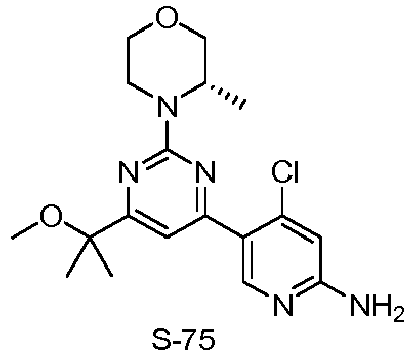
378.2 1H NMR (500 MHz, CDCl3) δ 8.41 (s, 1H), 7.12 (s, 1H), 6.59 (s, 1H), 4.79 - 4.75 (m, 1H), 4.64 (brs, 2H), 4.43 (dd, J = 13.6 Hz, 2.0Hz, 1H), 3.99 (dd, J = 11.2, 3.4 Hz, 1H), 3.80-3.72 (m, 2H), 3.61-3.55 (m, 1H), 3.32 - 3.19 (m, 1H), 3.23(s,3H), 1.50 (s, 6H), , 1.30 (d, J = 6.8 Hz, 3H). Example 67 
364.2 1H NMR (500 MHz, CDCl3) δ 8.40 (s, 1H), 7.14 (s, 1H), 6.59 (s, 1H), 4.65 (s, 2H), 3.90 - 3.83 (m, 4H), 3.82 - 3.76 (m, 4H), 3.22 (s, 3H), 1.51 (s, 6H). - The compounds in Examples 68-75 may be prepared in a manner similar to the preparation method of compound S-57 based on raw materials having different substituents.These raw materials are either commercially available or can be obtained according to the preparation methods well known to those skilled in the art.
No. structure MS [M+H]+ 1HNMR Example 68 
526.1 1H NMR (500 MHz, CDCl3) δ 8.20 (s, 1H), 7.54 - 7.50 (m, 1H), 7.48 - 7.45 (m, 1H), 7.12 (t, J = 7.7 Hz, 1H), 7.02 (t, J = 12.8 Hz, 1H), 6.93 (s, 1H), 6.76 (s, 1H), 4.85 (brs, 2H), 3.54 - 3.42 (m, 8H), 1.79 (s, 6H). Example 69 
526.2 1H NMR (500 MHz, DMSO) δ 8.17 (s, 1H), 7.48 (m, 2H), 7.40 (t, J = 8.4 Hz, 2H), 7.01 (s, 1H),6.96 (s, 1H), 6.87 (s, 1H), 3.53-3.36 (m, 8H), 1.74 (s, 6H). Example 70 
492.1 1H NMR (500 MHz, DMSO) δ 8.23 (s, 1H), 7.71 - 7.57 (m, 2H), 7.38 - 7.36 (m, 1H), 7.25 (d, J = 8.3 Hz, 1H), 7.14 (s, 1H), 6.75 (s, 1H), 6.60 (s, 1H), 3.72 -3.45 (m,8H), 1.74 (s, 6H). Example 71 
544.1 1H NMR (500 MHz, DMSO) δ 8.18 (s, 1H), 7.68 (dd, J = 18.0, 8.5 Hz, 1H), 7.45-7.36 (m, 2H), 7.03 (s, 1H), 6.98 (s, 2H),6.87 (s, 1H), 3.54-3.45 (m, 8H), 1.75 (s, 6H). Example 72 
541.8 1H NMR (500 MHz, DMSO) δ 8.17 (s, 1H), 7.75-7.70 (m, 2H), 7.62 (d, J= 7.5Hz, 1H), 7.52 (m, 1H), 7.07 (s, 1H), 6.96 (s, 2H), 6.87 (s, 1H), 3.50 - 3.35 (m, 8H), 1.78 (s, 6H). Example 73 
490.1 1H NMR (500 MHz, CDCl3) δ 8.28 (s, 1H), 7.83 (t, J = 6.5 Hz, 1H), 7.60 - 7.55 (m, 1H), 7.28 - 7.12 (m, 3H), 6.56 (s, 1H), 4.69 (brs, 2H), 3.65 - 3.40 (m, 8H), 2.15 - 2.13 (m, 2H), 1.72 - 1.59 (m, 2H). Example 74 
542.1 1H NMR (500 MHz, DMSO) δ 8.14 (s, 1H), 7.94-7.90(m, 1H), 7.73- 7.66 (m, 2H), 6.97 (s, 2H), 6.87 (s, 1H), 6.84 (s, 1H), 3.55 -3.48 (m, 8H), 1.94 (m, 2H), 1.64 (m, 2H). Example 75 
539.8 1H NMR (500 MHz, DMSO) δ 8.08 (s, 1H), 7.89 (d, J = 7.7 Hz, 1H), 7.69 (d, J = 3.7 Hz, 2H), 7.52 - 7.49 (m, 1H), 6.95 (s, 2H), 6.83 (d, J = 5.1 Hz, 2H), 3.49-3.40 (m, 8H), 1.98 - 1.95 (m, 2H), 1.75 - 1.72 (m,2H). - The compounds in Examples 76-77 may be prepared in a manner similar to the preparation method of compound S-24 based on raw materials having different substituents. These raw materials are either commercially available or can be obtained according to the preparation methods well known to those skilled in the art.
No. structure MS [M+H]+ 1HNMR Example 76 
409.2 1H NMR (400 MHz, DMSO) δ 8.70 (d, J = 11.7 Hz, 1H), 8.31 (s, 1H), 7.31 (s, 1H), 6.79 (s, 2H), 6.26 (d, J = 14.3 Hz, 1H), 3.67 (d, J = 5.1 Hz, 8H), 2.92 (s, 3H), 1.53-1.50 (m, 2H), 1.42 - 1.35 (m, 2H). Example 77 
425.2 1H NMR (400 MHz, DMSO) δ 8.22 (s, 1H), 7.25 (s, 1H), 6.64 (s, 2H), 6.58 (s, 1H), 6.11 (s, 1H), 3.66 (d, J = 5.9 Hz, 8H), 2.93 (s, 3H), 1.51 (s, 2H), 1.40 (d, J = 3.2 Hz, 2H). - The compounds in Examples 78-87 may be prepared in a manner similar to the preparation method of compound S-13 based on raw materials having different substituents. These raw materials are either commercially available or can be obtained according to the preparation methods well known to those skilled in the art.
No. structure MS [M+H]+ 1HNMR Example 78 
426.2 1H NMR (500 MHz, DMSO) δ 8.28 (s, 1H), 7.14 (s, 1H), 6.72 (s, 2H), 6.59 (s, 1H), 4.66 (d, J = 4.2 Hz, 1H), 4.33 (d, J = 11.8 Hz, 1H), 3.94 (d, J = 8.2 Hz, 1H), 3.74 (d, J = 11.4 Hz, 1H), 3.64 - 3.58 (m, 1H), 3.46 (t, J = 10.4 Hz, 1H), 3.24 - 3.15 (m, 1H), 2.97 (s, 3H), 1.72 (s, 6H), 1.22 (d, J = 6.7 Hz, 3H). Example 79 
424.2 1H NMR (500 MHz, DMSO) δ 8.28 (s, 1H), 7.13 (s, 1H), 6.72 (s, 2H), 6.58 (s, 1H), 4.62 (d, J = 4.4 Hz, 1H), 4.29 (d, J = 12.8 Hz, 1H), 3.96 - 3.90 (m, 1H), 3.73 (d, J = 11.3 Hz, 1H), 3.60 (dd, J = 11.4, 2.9 Hz, 1H), 3.48-3.43 (m, 1H), 3.22 (s, 3H), 3.20 - 3.16 (m, 1H), 1.71 - 1.64 (m, 2H), 1.61 - 1.52 (m, 2H), 1.22 (d, J = 6.7 Hz, 3H). Example 80 
396.1 1H NMR (500 MHz, CDCl3) δ 8.84 (d, J = 10.9 Hz, 1H), 7.24 (s, 1H), 6.21 (d, J = 13.0 Hz, 1H), 4.84 (s, 2H), 3.90 - 3.83 (m, 4H), 3.82 - 3.75 (m, 4H), 2.89 (s, 3H), 1.83 (s, 6H). Example 81 
394.1 1H NMR (500 MHz, CDCl3) δ 8.85 (d, J = 10.8 Hz, 1H), 7.30 (s, 1H), 6.22 (d, J = 12.9 Hz, 1H), 4.80 (s, 2H), 3.86 - 3.84 (m, 4H), 3.80 - 3.78 (m, 4H), 3.10 (s, 3H), 1.85 (q, J = 5.0 Hz, 2H), 1.54 (q, J = 5.0 Hz, 2H). Example 82 
408.2 1H NMR (500 MHz, CDCl3) δ 8.85 (d, J = 10.9 Hz, 1H), 7.28 (d, J = 1.4 Hz, 1H), 6.22 (d, J = 13.0 Hz, 1H), 4.85 (s, 2H), 4.76 - 7.72 (m, 1H), 4.40 (d, J = 11.7 Hz, 1H), 4.00 (dd, J = 11.3, 3.3 Hz, 1H), 3.80 (d, J = 11.4 Hz, 1H), 3.72 (dd, J = 11.4, 3.0 Hz, 1H), 3.57 (td, J = 12.0, 2.9 Hz, 1H), 3.28 (td, J = 13.1, 3.8 Hz, 1H), 3.09 (s, 3H), 1.84 (q, J = 4.5 Hz, 2H), 1.53 (q, J = 5.7 Hz, 2H), 1.30 (d, J = 6.8 Hz, 3H). Example 83 
410.3 1H NMR (500 MHz, CDCl3) δ 8.86 (d, J = 10.9 Hz, 1H), 7.23 (d, J = 1.2 Hz, 1H), 6.22 (d, J = 13.0 Hz, 1H), 4.80 (s, 2H), 4.76 - 4.67 (m, 1H), 4.41 (d, J = 13.2 Hz, 1H), 4.01 (dd, J = 11.3, 3.5 Hz, 1H), 3.81 (d, J = 11.4 Hz, 1H), 3.73 (dd, J = 11.4, 3.0 Hz, 1H), 3.58 (td, J = 12.0, 3.0 Hz, 1H), 3.30 (td, J = 13.0, 3.8 Hz, 1H), 2.88 (s, 3H), 1.83 (s, 6H), 1.31 (d, J= 7.0 Hz, 3H). Example 84 
408.2 1H NMR (500 MHz, CDCl3) δ 8.84 (d, J = 10.9 Hz, 1H), 7.35 (d, J = 1.6 Hz, 1H), 6.22 (d, J = 12.9 Hz, 1H), 4.81 (s, 2H), 3.85 - 3.83 (m, 4H), 3.80 - 3.77 (m, 4H), 3.22 (q, J = 7.5 Hz, 2H), 1.81 (q, J = 4.6 Hz, 2H), 1.52 (q, J = 4.7 Hz, 2H), 1.41 (t, J = 7.5 Hz, 3H). Example 85 
422.2 1H NMR (500 MHz, CDCl3) δ 8.84 (d, J = 10.8 Hz, 1H), 7.42 (d, J = 1.7 Hz, 1H), 6.22 (d, J = 12.9 Hz, 1H), 4.80 (s, 2H), 3.85 - 3.83 (m, 4H), 3.79 - 3.77 (m, 4H), 3.47 - 3.41 (m, 1H), 1.80 (q, J = 4.6 Hz, 2H), 1.53 (q, J = 4.7 Hz, 2H), 1.39 (d, J= 6.9 Hz, 6H). Example 86 
436.2 1H NMR (500 MHz, DMSO) δ 8.29 (s, 1H), 7.26 (s, 1H), 6.71 (s, 2H), 6.58 (s, 1H), 3.78 - 3.71 (m, 4H), 3.72 - 3.65 (m, 4H), 2.94 - 2.85 (m, 1H), 1.67-1.64 (m, 2H),1.59-1.57 (m,2H), 1.04 - 0.98 (m, 2H), 0.97-0.93 (m, 2H). Example 87 
420.1 1H NMR (500 MHz, CDCl3) δ 8.85 (d, J = 10.9 Hz, 1H), 7.44 (d, J = 1.8 Hz, 1H), 6.22 (d, J = 12.9 Hz, 1H), 4.81 (s, 2H), 3.85 - 3.83 (m, 4H), 3.80 - 3.77 (m, 4H), 2.65 - 2.60 (m, 1H), 1.81 (q, J = 4.5 Hz, 2H), 1.56 (q, J = 5.0 Hz, 2H), 1.21 - 1.14 (m, 2H), 0.99 - 0.92 (m, 2H). - 230 mg of the free alkali sample was weighed and loaded into a 20 mL glass vial, and 3 mL of acetone was added. The sample was dissolved by sonication to form a clear solution. The hydrochloric acid solution (1 mol/L, 536µL) was slowly added dropwise with stirring at 50 °C and reacted for 2 h. After 2 h, the mixture was slowly cool to 0 °C and incubated at 0 °C for 2 h. The mixture was subjected to vacuum filtration to separate the solid which was rinsed with acetone 3-5 times and dried at 60 °C in vacuum overnight. The solid product was obtained and the yield was 64.3%. The acid-to-base molar ratio of the obtained salt is 1:1 and the melting point is 261 °C - 265 °C.
- 218 mg of the free alkali sample was weighed and loaded into a 20 mL glass vial, and 3 mL of acetone was added. The sample was dissolved by sonication to form a clear solution. The sulfuric acid solution (0.5 mol/L, 536µL) was slowly added dropwise with stirring at 50 °C and reacted for 2 h. After 2 h, the mixture was slowly cool to 0 °C and incubated at 0 °C for 2 h. The mixture was subjected to vacuum filtration to separate the solid which was rinsed with acetone 3-5 times and dried at 60 °C in vacuum overnight. The solid product was obtained and the yield was 84.8%. The acid-to-base molar ratio of the obtained salt is 2:1 and the melting point is 261 °C - 265 °C.
- 237 mg of the free alkali sample was weighed and loaded into a 20 mL glass vial, and 3 mL of acetone was added. The sample was dissolved by sonication to form a clear solution. The maleic acid solution (1 mol/L, 536µL) was slowly added dropwise with stirring at 50 °C and reacted for 2 h. After 2 h, the mixture was slowly cool to 0 °C and incubated at 0 °C for 2 h. The mixture was subjected to vacuum filtration to separate the solid which was rinsed with acetone 3-5 times and dried at 60 °C in vacuum overnight. The solid product was obtained and the yield was 89.6%. The acid-to-base molar ratio of the obtained salt is 1:1 and the melting point is 205 °C - 207 °C.
- 248 mg of the free alkali sample was weighed and loaded into a 20 mL glass vial, and 3 mL of acetone was added. The sample was dissolved by sonication to form a clear solution. The aqueous solution of fumaric acid in DMSO (0.25 mol/L, 536µL) was slowly added dropwise with stirring at 50 °C and reacted for 2 h, wherein the volumn ratio of DMSO and water in the solution was 1:1. After 2 h, the mixture was slowly cool to 0 °C and incubated at 0 °C for 2 h. The mixture was subjected to vacuum filtration to separate the solid which was rinsed with acetone 3-5 times and dried at 60 °C in vacuum overnight. The solid product was obtained and the yield was 79.0%. The acid-to-base molar ratio of the obtained salt is 2:1 and the melting point is 234 °C - 236 °C.
- 128 mg of the free alkali sample was weighed and loaded into a 20 mL glass vial, and 2 mL of acetone was added. The sample was dissolved by sonication to form a clear solution. The aqueous methanesulfonic acid solution (1 mol/L, 268µL) was slowly added dropwise with stirring at 50 °C and reacted for 1 h. After 1 h, the mixture was slowly cool to 0 °C and incubated at 0 °C for 1 h. The mixture was subjected to vacuum filtration to separate the solid which was rinsed with acetone 3-5 times and dried at 60 °C in vacuum for 4 h. The solid product was obtained. The acid-to-base molar ratio of the obtained salt is 0.9:1 and the melting point is 248 °C - 249 °C.
- 96 mg of the free alkali sample was weighed and loaded into a 20 mL glass vial, and 2 mL of acetone was added. The sample was dissolved by sonication to form a clear solution. The aqueous L-tartaric acid solution (1 mol/L, 268µL) was slowly added dropwise with stirring at 50 °C and reacted for 1 h. After 1 h, the mixture was slowly cool to 0 °C and incubated at 0 °C for 1 h. The mixture was subjected to vacuum filtration to separate the solid which was rinsed with acetone 3-5 times and dried at 60 °C in vacuum for 4 h. The solid product was obtained. The acid-to-base molar ratio of the obtained salt is 2:1 and the melting point is 196 °C - 198 °C.
-

- Step 1: morpholine(430mg, 4.88mmol) and potassium carbonate (1.35g, 9.76mmol) were added to the solution of compound 48-a (1g, 4.88mmol) in 20 ml of acetonitrile and stirred at 80 °C overnight. The reaction was complete and the mixture was cooled to room temperature, concentrated under reduced pressure, and extracted by adding water and ethyl acetate. The organic phase was separated, rinsed with saturated brine, dried over sodium sulfate, and filtered. The filtrate was concentrated under reduced pressure to give crude compound 48-b (1.2 g). Spectrum data: MS m/z(ESI): 257[M+H]+.
- Compound 48-c (1.0 g) was prepared by using compound 48-b (1.2 g) as the starting material and referring to the synthesis method of step 2 in Example 27. Purity: 73%. Spectrum data: MS m/z(ESI): 229[M+H]+.
- Compound 48-d (1.5 g) was prepared by using compound 48-c (1.0 g) as the starting material and referring to the synthesis method of step 2 in Example 26. Purity: 86%. Spectrum data: MS m/z(ESI): 307[M+H]+.
- Compound 48-e (1.0 g) was prepared by using compound 48-d (1.5 g) as the starting material and referring to the synthesis method of step 3 in Example 26. Purity: 76%. Spectrum data: MS m/z(ESI): 339[M+H]+.
- Compound 48-f (110 mg) was prepared by using compound 48-e (1.5 g) as the starting material and referring to the synthesis method of step 4 in Example 26. Purity: 71%. Spectrum data: MS m/z(ESI): 291[M+H]+.
- Compound 48-g (70mg) was prepared by using compound 48-f (50mg) as the starting material and referring to the synthesis method of step 4 in Example 1.
- Comparative compound 1 (21.3 mg) as a white solid compound was prepared by using compound 48-g (60 mg) as the starting material and referring to the synthesis method of step 5 in Example 1. Purity: 97%, yield: 20%. Spectrum data: MS m/z(ESI): 443[M+H]+.1H NMR (500 MHz, CDCl3) δ 8.26 (s, 1H), 6.86 (s, 1H), 6.84 (s, 1H), 6.79 (s, 1H), 4.78 (brs, 2H), 3.88 - 3.75 (m, 4H), 3.62 - 3.51 (m, 4H), 2.82 (s, 3H), 1.85 - 1.81 (m, 2H), 1.32 - 1.28 (m, 2H).
-

- Compound 51-b (3.4g) was obtained by using compound 2-a (15g) as the starting material and referring to the synthesis method of step 1 in Example 27. Purity: 31%. Spectrum data: MS m/z(ESI): 258[M+H]+.
- Compound 51-c (500 mg) was obtained by using compound 51-b (500 mg) as the starting material and referring to the synthesis method of step 2 in Example 27. Purity: 99%. Spectrum data: MS m/z(ESI): 230[M+H]+.
- Compound 51-d (500 mg) was obtained by using compound 51-c (500 mg) as the starting material and referring to the synthesis method of step 1 in Example 53.
- Compound 51-e (600 mg) was obtained by using compound 51-d (500 mg) as the starting material and referring to the synthesis method of step 4 in Example 26. Purity: 75%. Spectrum data: MS m/z(ESI): 292[M+H]+.
- Compound 51-f (70 mg) was obtained by using compound 51-e (600 mg) as the starting material and referring to the synthesis method of step 4 in Example 1. Purity: 65%. Spectrum data: MS m/z(ESI): 318[M+H]+.
- Comparative compound 2 (42 mg) was obtained by using compound 51-f (200 mg) as the starting material and referring to the synthesis method of step 5 in Example 1. Purity: 100%. Spectrum data: MS m/z(ESI): 444[M+H]+.1H NMR (400 MHz, CDCl3) δ 8.62 (s, 1H), 6.90 (s, 1H), 6.80 (s, 1H), 4.86 (brs, 2H), 3.85 - 3.75 (m, 4H), 3.72 - 3.66 (m, 4H), 3.01 (s, 3H), 1.88 - 1.76 (m, 2H), 1.56 - 1.50 (m, 2H).
-

- The title compound was prepared by referring to Example 1 except that 1a in step 5 was replaced by 11a. MS m/z(ESI): 443[M+H]+.1H NMR (500 MHz, CDCl3) δ 7.34 (d, J = 8.3 Hz, 1H), 7.06 (s, 1H), 7.02 (d, J = 2.2 Hz, 1H), 6.84 (dd, J = 8.2, 2.3 Hz, 1H), 4.02 (brs, 2H), 3.86 - 3.80 (m, 4H), 3.80 - 3.73 (m, 4H), 3.08 (s, 3H), 1.85 (q, J = 4.5 Hz, 2H) 1.60- 1.57 (m, 2H).
- Test reagents and test methods.
- The PI3K kinase used in the experiment: p110α/p85α (Invitrogen PV4788), p110β/p85α (Millipore 14-603), p110δ/p85α (Millipore 14-604M), and p110γ (Invitrogen PV4786). ADP transcreener kinase (3010-10k) kit was purchased from Bellbrook labs.
- The inhibition of PI3K kinase activity by the compound to be tested was determined by the following method. The working concentration of each component in the 25 µL enzyme reaction system was: p110α/p85α 3ng (or p110β/p85α 60 ng, or p110δ/p85α 90ng, or p110γ 100 ng), ATP 10µM, PIP2: PS (Invitrogen PV5100) 30µM and the DMSO concentration was 2% after addition of the compound to be tested.
- At the time of the test, the compound to be tested was dissolved in dimethylsulfoxide (DMSO) according to the desired concentration of the experiment. The compound to be tested was gradiently diluted 3 times (0.00046 - 1 µM, 8 concentration points) with 10% DMSO. 5 µL of the compound to be tested was added to each well of a 96-well plate (Greiner 675076) in duplicate. 2.5 × buffer was prepared and 1 µL of DTT (Millipore 20-265) was added to each 800 µL of 2.5 × buffer. ATP/PIP2: PS enzyme/substrate working solution and the PI3K enzyme working solution in proper concentration were prepared with 2.5 × buffer. 10 µL of ATP/PIP2: PS and 10 µL of the PI3K enzyme working solution were added to each well in a 96-well plate. The plate was shaken and mixed uniformly, and then incubated at 25 °C for 1 hour. At the same time, ADP and ATP (0.01 µM, 0.02 µM, 0.04 µM, 0.06 µM, 0.08 µM, 0.08 µM, 0.1 µM, 0.25 µM, 0.5 µM, 1 µM, 2 µM, 5 µM, 10 µM, 12 concentration points) were diluted with buffer to set the standard curve. After completion of the enzyme reaction, 25 µL of ADP assay solution (1% 100×ADP tracer, 0.79% ADP antibody and 10% 10x reaction stop solution) was added and incubated at 25 °C for 1 hour. Fluorescence polarization value [mP] of each well was measured with a Perkin Elmer Victor X5 Fluorescent Microplate. The ADP concentration [ADP] was calculated from the ADP/ATP standard curve and the IC50 values were calculated using the XLFit software. The measured IC50 values of inhibitory activities of the compounds tested against PI3K kinase are shown in Table 1.
Table 1 IC50 values of inhibitory activities of the compounds of the present invention against PI3K kinase Compound No. PI3K-α/nM PI3K-β/nM PI3K-γ/nM PI3K-δ/nM S-1 16 314 288 240 S-4 12 527 354 184 S-6 16 264 164 197 S-9 5 105 155 63 S-10 42 1140 592 367 S-13 67 1666 >3000 226 S-14 13 1124 S-16 13 196 138 244 S-18 58 548 957 246 S-19 80 512 >3000 493 S-20 24 676 1163 42 S-21 9 832 843 214 S-22 55 1544 2122 491 S-23 16 620 525 62 S-24 10 376 291 85 S-25 26 217 1932 67 S-28 13 121 765 78 S-29 40 1738 256 612 S-30 12 18 141 12 S-31 12 171 148 103 S-32 76 977 923 161 S-33 12 115 112 58 S-37 4 28 114 84 S-38 17 113 369 212 S-41 6 82 331 79 S-42 22 1211 718 324 S-45 35 28 78 17 S-46 6 8 96 13 S-49 17 327 2018 85 S-52 18 2784 914 336 S-53 33 1552 287 516 S-54 12 92 199 145 S-57 18 284 236 62 S-58 4 72 121 33 S-59 37 721 813 235 S-63 21 228 428 158 S-64 13 27 431 19 S-65 22 1223 S-66 9 73 160 46 S-67 6 208 113 59 S-68 8 92 184 143 S-70 22 525 S-71 9 177 1026 S-72 18 797 1153 370 S-73 14 396 623 514 S-74 28 2088 2495 1011 S-75 23 943 654 810 S-76 53 316 228 207 S-78 7 419 925 85 S-81 43 812 181 178 S-82 39 86 116 132 S-83 20 376 204 46 S-84 21 812 219 18 S-85 29 484 244 228 S-86 26 763 192 397 S-87 14 386 134 117 S-88 48 521 98 209 S-91 40 646 Comparative compound 2 90 2161 >3000 2578 Table 2 IC50 values of inhibitory activities of the compounds of the present invention against PI3K-α kinase Compound No. PI3K-α / nM Compound No. PI3K-α / nM Compound No. PI3K-α / nM S-1 16 S-38 17 S-71 9 S-2 550 S-40 92 S-72 18 S-3 280 S-41 6 S-73 14 S-4 12 S-42 22 S-74 28 S-6 16 S-44 858 S-75 23 S-9 5 S-45 35 S-76 53 S-10 42 S-46 6 S-77 62 S-14 13 S-49 17 S-78 7 S-16 13 S-50 39 S-79 55 S-18 58 S-52 18 S-80 31 S-19 80 S-53 33 S-85 29 S-20 24 S-54 12 S-86 26 S-21 9 S-55 40 S-87 14 S-22 65 S-57 18 S-88 48 S-23 16 S-58 4 S-90 75 S-24 10 S-59 37 S-91 40 S-25 26 S-60 35 Comparative compound 3 >1000 S-26 390 S-61 195 S-27 285 S-62 189 S-28 13 S-65 22 S-29 40 S-66 9 S-30 12 S-67 6 S-31 12 S-68 8 S-33 12 S-69 59 S-37 4 S-70 22 - As can be seen from Table 1, the compounds of the present invention have a significant inhibitory effect on all the PI3K kinases (PI3K-α, PI3K-β, PI3K-y, and PI3K-δ). The inhibitory activities on PI3K-β, PI3K-y, and PI3K-δ are weaker compared with the PI3K-α inhibitory activity, which means that the compounds of the present invention have some selective inhibitory effect on PI3K-α. Namely, the selectivity of the compounds of the present invention to PI3K kinase is α> δ> β or γ.
- As can be seen from Table 2, the example compounds of the present invention have a strong inhibitory effect on the PI3 K-α kinase, and the study has shown that when the substituent at position 4 of the pyrimidine ring is replaced by phenyl, the inhibitory effect on PI3K-α kinase is significantly reduced.
- In addition, most of the compounds of the present invention have an inhibitory activity against PI3K-α kinase higher than that of the positive compound BKM-120 (IC50 = 57), wherein the inhibitory activities of some of the preferred compounds (e.g., S-9, S-37 and S-46) are increased by about 10 times.
- When Z is not N or CH; or X is a bond, and Y is a heterocycle, an ester group, an amide group or an amine group; or the methylene attached to X is not substituted in the compound, the inhibition effect is significantly reduced.
- This experiment was performed by cell level fluorescence image processing method.
- Triton X-100: 10% aqueous Triton X-100 solution (Sigma T8787-100 mL) was prepared, stored at 4 °C and diluted by 1: 100 to give 0.1% Triton X-100 aqueous solution for use in the experiment.
- Prodium Iodide (PI): 1 mg/mL (1.5 mM) PI (Sigma P4170) storage solution was prepared with PBS and stored at -25 °C in the dark. For use, the PI storage solution was diluted with PBS by 1: 1000 to give a 1.5µM solution and used in dark.
- PC-3 cells in logarithmic growth phase were digested with 0.25% EDTA trypsin. 3000 cells/90 µL were seeded in a 96-well plate (BD 356692) and cultured at 37 °C and 5% CO2. After the cells adhered, 10 µL of the compound to be tested which was gradiently diluted 3 times (0.0046 to 10 µM, 8 concentration points, in duplicate) was added and incubated for 2 hours, followed by addition of 100 µL of 4% paraformaldehyde (DINGGUO AR-0211) and incubated at room temperature for 45 minutes. Then 100 µL of 0.1% Triton X-100 solution was added and incubated for another 30 minutes.
- Triton X-100 solution was removed and the cells were rinsed with 200 µl of PBS twice (300 rpm vibration for 1 minute). The blocking solution (1% BSA solution in PBS) (Genview FA016-100G) was added and incubated at room temperature for 2 hours. The plate was rinsed with PBS once (300 rpm, 1 min) and 30 µL of Ser473-p-Akt antibody (cell signaling 4060L) diluted with 0.1% BSA was added and incubated overnight at 4 °C. Ser473-p-Akt antibody was removed and the plate was rinsed with PBS twice (300 rpm, 1 minute). 35 µL of Alexa Flour 488 donkey anti-rabbit IgG (Invitrogen A21206) was added and incubated at room temperature for 1.5 hours. The plate was rinsed with PBS twice (300 rpm, 1 minute) and 35µL of 1.5µM PI was added and incubated at room temperature for 0.5 h. The fluorescence intensity was measured with Acumen eX3 (TTP LabTech).
- 10 µM BEZ235 (Selleck S1009) treatment group was negative control and DMSO treatment group was positive control.

- 2.4 IC50 values were calculated based on the calculated inhibition ratios by using XLFIT 5.0 software and shown in Table 3.
Table 3 The measured IC50 values of the compounds of the present invention for PC-3 cell activity Compound No. PC-3 cell (IC50/nM) Compound No. PC-3 cell (IC50/ nM) Compound No. PC-3 cell (IC50/nM) S-1 319 S-38 332 S-71 555 S-4 248 S-39 513 S-75 385 S-9 184 S-40 465 S-76 531 S-10 384 S-41 414 S-81 215 S-13 463 S-45 156 S-82 369 S-16 312 S-46 131 S-83 196 S-18 430 S-49 382 S-84 121 S-19 575 S-50 39 S-85 161 S-23 366 S-54 488 S-86 240 S-28 301 S-58 367 S-88 349 S-30 101 S-63 577 S-89 351 S-31 126 S-64 330 Comparative compound 1 2257 S-32 74 S-66 253 Comparative compound 2 1025 S-33 109 S-67 187 BKM-120 (positive control) 596 S-37 198 S-68 183 - As can be seen from Table 3, the compounds of the examples of the present invention all have a remarkable inhibitory activity against Akt phosphorylation in PC-3 cells. The compounds of the examples of the present invention apparently have a stronger inhibitory activity against Akt phosphorylation in PC-3 cells compared with the positive compound BKM-120 and comparative compounds 1 and 2.
- The MTT assay procedure and steps were carried out as well known to those skilled in the art, and all the reagents used in the methods were commercially available.
- The cells in logarithmic growth phase were digested with 0.25% EDTA trypsin (Gibco, 25200-056) and resuspended in fresh medium. 90 µL of the cell suspension was inoculated into a 96-well cell culture plate (BD Faclon 353072) with a suitable cell density and cultured at 37 °C under 5% CO2. After the cells adhered, 10 µL of the test compound at different concentrations (0.0046 - 10 µM, 8 concentration points) was added and incubated for another 72 h. 10 µL of MTT (5 mg/mL PBS solution) (Sigma, M5655) was added to react for 4 h. The absorbance at 492 nm was measured by using Thermo Scientific Multiskan MK3 microplate reader and IC50 was calculated using XLFIT 5.0 software (UK IDBS).
T47D cell culture medium: RPMI-1640 medium (Hyclone SH30809.01B) + 10% FBS (Gibco 10099-141)
MCF-7 cell culture medium: DMEM medium (Hyclone SH30243.01B + 10% FBS (Gibco 10099-141)
NIH3T3 cell culture medium: DMEM medium (Hyclone SH30243.01B + 10% FBS (Gibco 10099-141)Table 4 IC50 values of the compounds of the present invention for T47D cell growth inhibition Compound No. T47D cell (IC50/nM) Compound No. T47D cell (IC50/nM) Compound No. T47D cell (IC50/nM) S-1 167 S-32 95 S-68 73 S-4 124 S-33 120 S-70 219 S-6 129 S-37 202 S-71 165 S-9 93 S-38 244 S-75 249 S-10 218 S-41 148 S-76 289 S-13 244 S-42 139 S-78 206 S-14 278 S-43 317 S-81 123 S-16 58 S-45 163 S-82 62 S-18 160 S-46 137 S-83 30 S-19 178 S-49 208 S-84 33 S-20 332 S-50 449 S-85 63 S-23 20 S-54 255 S-86 69 S-24 305 S-57 242 S-87 101 S-25 324 S-58 129 S-88 81 S-28 225 S-65 280 S-89 118 S-30 100 S-66 147 Comparative compound 1 1220 S-31 73 S-67 88 Comparative compound 2 854 Table 5 IC50 values of the compounds of the present invention for MCF-7 cell growth inhibition Compound No. MCF-7 cell (IC50/nM) Compound No. MCF-7 cell (IC50/nM) Compound No. MCF-7 cell (IC50/nM) S-1 283 S-39 441 S-71 436 S-6 112 S-40 355 S-73 176 S-9 78 S-41 170 S-75 131 S-10 340 S-42 159 S-76 66 S-13 153 S-45 329 S-78 318 S-14 267 S-46 301 S-80 474 S-16 224 S-49 187 S-81 104 S-18 437 S-53 408 S-82 27 S-23 246 S-54 159 S-83 11 S-28 295 S-57 286 S-84 15 S-30 101 S-58 184 S-85 25 S-31 45 S-63 240 S-86 29 S-32 73 S-65 469 S-87 170 S-33 79 S-66 212 S-88 102 S-37 258 S-67 105 S-89 30 S-38 180 S-68 94 Comparative compound 1 996 Comparative compound 2 639 - As shown in Table 4 and Table 5, the compounds in the examples of the present invention exhibit significant proliferation inhibitory activity against the breast cancer cell lines T47D and MCF-7. Compared with the comparative compounds 1 and 2, the compounds in the examples of the present invention have significantly stronger inhibitory activity against the proliferation of the above two cell lines.
- The results show that the substitution position of the morpholine ring on the pyrimidine ring has a great effect on the inhibitory activity on the cell lines. When the substituent morpholine ring is at position 4 or 6, the inhibitory activity of the compound on the cell lines is significantly reduced in comparison with the position 2 substitution.
- All the compounds in the examples of the present invention showed low cytotoxicity and some of the test results are shown in Table 6, wherein, the symbols in the table are defined as follows:
- A: NIH3T3 cells (IC50/nM) value is > 10000, indicating extremely low cytotoxicity;
- B: NIH3T3 cells (IC50/nM) value is in the range of 5000 - 10,000, indicating very low cytotoxicity;
- C: NIH3T3 cells (IC50/nM) value is in the range of 3000-5000, indicating low cytotoxicity;
- D: NIH3T3 cells (IC50/nM) value is in the range of 1000-3000, indicating slightly high cytotoxicity;
- E: NIH3T3 cells (IC50/nM) value is in the range of 500-1000, indicating high cytotoxicity;
- F: NIH3T3 cells (IC50/nM) value is <500, indicating extremely high cytotoxicity.
- As can be seen from Table 6, the compounds in the examples of the present invention all have low toxicity to NIH3T3 cells.
- Buffer A: 1 L solution of 100 mM potassium dihydrogen phosphate containing 1mM EDTA (Sigma, V900157-100G) was prepared. Buffer B: 1 L solution of 100 mM dipotassium hydrogen phosphate containing 1mM EDTA was prepared. Buffer C: 700 mL of buffer B was taken out and titrated with buffer A to pH 7.4.
-
- 2.1 10 µl of 10 mM compound to be tested and 10 µl of 10 mM ketanserin were taken out and 190 µl of pure acetonitrile was added to each of them to prepare 500 µM compound to be tested and ketanserin, respectively.
- 2.2 20 µl (20 mg / mL) of liver microsomes (XENOTECH, H0610) stock solution was added to 513.4 µl of buffer C on wet ice. 0.75 mg/mL liver microsomal solution was obtained.
- 2.3 1.5 µl of each of the above-mentioned compound to be tested and ketanserin solution was added to 498.5 µl of liver microsomal solution (0.7 5mg/mL) respectively on wet ice. 1.5 µM mixed solution of compound to be tested and 1.5 µM mixed solution of ketanserin were obtained.
- 2.4 At the time points 0, 5, 15, 30, 45, and 60 min, 30 µl of the mixed solution of compound to be tested and 30 µl of the mixed solution of ketanserin were dispensed into the reaction plate on wet ice, respectively.
- 2.5 5 mg reduced coenzyme II (Roche, 10621706001) was weighed and dissolved in 1 mL of buffer C. 6 mM reduced coenzyme II solution was obtained. The reduced coenzyme II solution was dispensed into the reaction plate.
- 2.6 Imipramine was dissolved to give a 10 mM solution. 10 µl imipramine solution was added to 100 mL of blank acetonitrile to generate the internal reference.
- 2.7 At 0 min, 135 µL of iced acetonitrile (Merck, UN 1648) containing the internal reference was added to each well and then 15 µL of buffer C was added.
- 2.8 The reaction plate was placed into a 37 °C water bath incubator for 5 min. In the reaction plate, 15 µL of reduced coenzyme II solution was added to each well to initiate the reaction, and the time keeping was started. At the time points of 5, 15, 30, 45, and 60 min, 135 µL of iced acetonitrile containing the internal reference was added to each well to terminate the reaction.
- 2.9 The reaction plate was sealed with an aluminum film, placed on a vibration mixer and shaken at 500 rpm for 5min. The plate was then centrifuged in a centrifuge at 3750 rp for 15 min.
- 2.10 The sample was diluted with pure water in accordance with the ratio of 1: 1 and detected by LC/MS. The clearance ratio was calculated according to the following formula based on the obtained values, and shown in Table 7.
- Half-life: 0.693/K (the slope by plotting based on the incubation time and logarithm of the concentration value)

Table 7 Clearance ratio of liver microsomal metabolism in mice Compound No. Clearance ratio (mL/min/kg) Compound No. Clearance ratio (mL/min/kg) mouse mouse S-4 442.63 S-20 5641.44 S-21 6337.31 S-38 103.77 S-45 89.54 S-46 100.1 S-59 7163.43 S-82 39.75 - As can be seen from Table 7, different sulfonyl groups have significant impact on the metabolism stability. When the arylsulfonyl is replaced by alkylsulfonyl, the metabolism stability is greatly improved.
- The compounds of the present invention, or the pharmaceutically acceptable salt, solvate, stereoisomer thereof, or the pharmaceutical composition and use thereof, have a significant PI3K kinase inhibitory activity. They not only exhibit high inhibitory activity on PI3K-α kinase at enzyme level, but also exhibit high inhibitory effect on PIK3CA mutant breast cancer cell lines T47D and MCF-7, and at the same time they also have low cytotoxicity. Moreover, these compounds have low cytotoxicity in normal cell lines (such as NIH-3T3 cells), thereby significantly reducing nonspecific side effects. They may be formulated with one or more pharmaceutically acceptable carriers in a suitable dosage form for administration. These dosage forms are suitable for oral administration, rectal administration, topical administration, intraoral administration, and other parenteral administration (e.g., subcutaneous, intramuscular, intravenous, etc.). For example, the dosage forms suitable for oral administration include capsules, tablets, granules, syrups and the like. The compounds of the present invention contained in these formulations may be solid powders or granules; solutions or suspensions in aqueous or non-aqueous liquids; water-in-oil or oil-in-water emulsions and the like. They are greatly valuable for practical use.
| Compound No. | NIH3T3 cell (IC50/nM) | Compound No. | NIH3T3 cell (IC50/nM) |
| S-2 | B | S-24 | B |
| S-3 | A | S-25 | D |
| S-5 | D | S-26 | A |
| S-6 | D | S-29 | D |
| S-7 | A | S-36 | C |
| S-8 | A | S-44 | D |
| S-10 | D | S-48 | D |
| S-14 | D | S-50 | D |
| S-15 | B | S-52 | C |
| S-19 | D | S-53 | D |
| S-20 | D | S-56 | A |
| S-21 | D | S-57 | D |
| S-22 | D | S-59 | D |
Claims (11)
- A compound as shown in formula (I), or a pharmaceutically acceptable salt, solvate, or stereoisomer thereof,
 wherein, Z is N or CRo;(R1)m means that the hydrogen atom on the morpholine ring is substituted by R1 and the number of R1 is m, wherein m is 0 or 1, and R1 is methyl;R2 is hydrogen, halogen, halomethyl or methoxy;R3 is hydrogen;R4 and R5 are each independently selected from the group consisting of hydrogen, and methyl;R6 and R7 are each independently selected from the group consisting of halogen, and C1-3 alkyl, or R6 and R7, together with the carbon atom to which they are attached, form a 3- to 6-membered saturated monocyclic ring;X is one bond, NH or -N(CH3)-; Y is -SO2R8;R0 is hydrogen;R8 is C1-10 alkyl, or C6-10 aryl; said aryl is unsubstituted or substituted with 1 halogen.
 - The compound or the pharmaceutically acceptable salt, solvate, or stereoisomer thereof according to claim 1, wherein R8 is selected from the group consisting of C1-6 alkyl, and substituted or unsubstituted phenyl, wherein said "substituted" means that 1 hydrogen atom on the benzene ring is substituted with halogen.
- The compound or the pharmaceutically acceptable salt, solvate, or stereoisomer thereof according to claim 1 or 2, wherein it is as shown in formula (I-a),
 wherein R1, R2, R3, R4, R5, m, and Z are defined as in claim 1 or 2, n is 1, 2, or3;X1 is one bond, -NH- or -N(CH3)-;Y1 is -SO2R8.
 - The compound or the pharmaceutically acceptable salt, solvate, or stereoisomer thereof according to claim 1 or 2, wherein it is as shown in formula (I-b),
 wherein, R1, R2, R3, R4, R5, m, and Z are defined as in claim 1 or 2;R61 and R71 are each independently selected from the group consisting of halogen, and C1-3 alkyl;X2 is one bond;Y2 is -SO2R8; wherein R8 is defined as in claim 1.
 - The compound or the pharmaceutically acceptable salt, solvate, or stereoisomer thereof according to claim 4, wherein R61 is selected from the group consisting of F and methyl; R71 is selected from the group consisting of F and methyl.
- The compound or the pharmaceutically acceptable salt, solvate, or stereoisomer thereof according to claim 4, wherein R61 and R71 are F, or methyl at the same time.
- The compound or the pharmaceutically acceptable salt, solvate, or stereoisomer thereof according to claim 4, wherein,(i) m is 0 or 1; R1 is methyl;
R8 is selected from the group consisting of methyl, ethyl, propyl, and isopropyl;
Z is CH, or N;
R2 is hydrogen, methoxy, F, Cl or trifluoromethyl; R3 is H; R4 is hydrogen or methyl; R5 is hydrogen or methyl;
R6 and R7 are each independently selected from the group consisting of F, Cl, methyl, ethyl, propyl, isopropyl,; or R6 and R7, together with carbon atom to which they are attached, form the following structure: (ii) m is 0; Z is CH;
R2 is F, Cl or trifluoromethyl; R3 is H; R4 and R5 are H;
R8 is substituted or unsubstituted phenyl; wherein said "substituted" means that 1 hydrogen atom on the benzene ring are substituted with F;
R6 and R7 are each independently methyl; or R6 and R7, together with the carbon atom to which they are attached, form the following structure:
- The compound or the pharmaceutically acceptable salt, solvate, or stereoisomer thereof according to anyone of claims 1-7, wherein it is anyone of the compounds represented by the following chemical structural formulas:


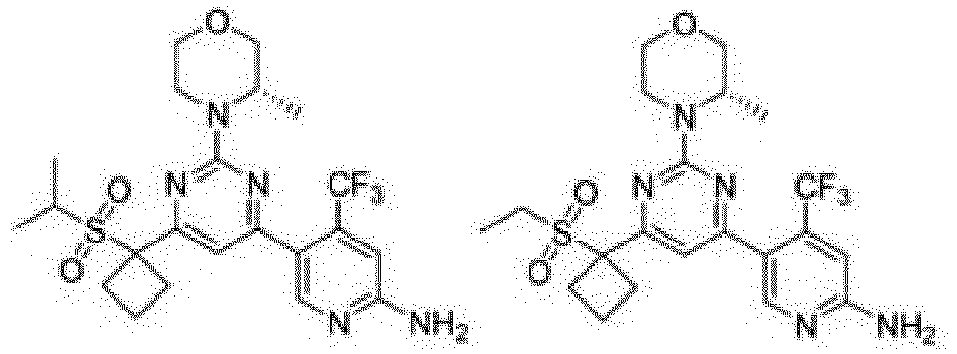


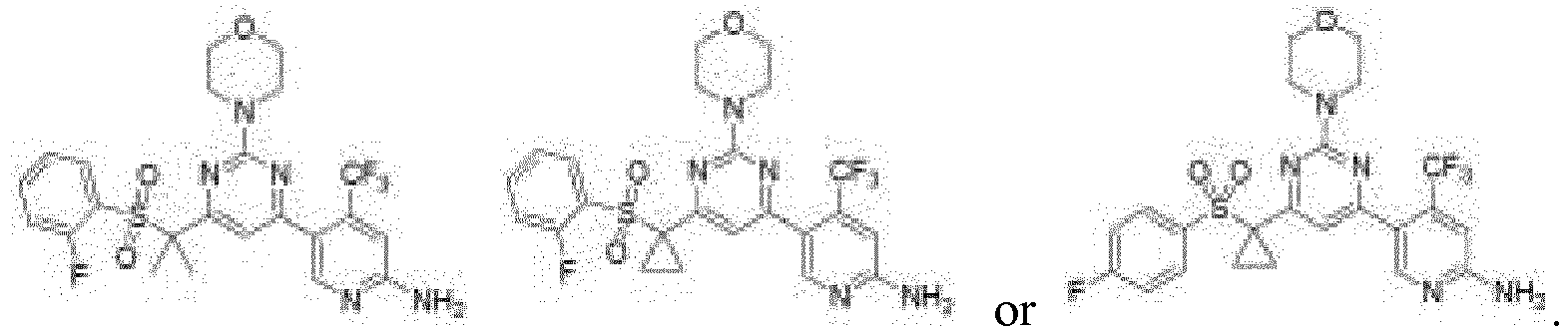
- The compound or the pharmaceutically acceptable salt, solvate, or stereoisomer thereof according to anyone of claims 1-7, wherein it is selected from the group consisting of the following:


- A pharmaceutical composition comprising the compound or the pharmaceutically acceptable salt, solvate, or stereoisomer thereof according to anyone of claims 1-9; and
a pharmaceutically acceptable carrier. - Compound or the pharmaceutically acceptable salt, solvate, or stereoisomer thereof according to anyone of claims 1-9 or the pharmaceutical composition according to claim 10 for use in the treatment of a protein tyrosine kinase-mediated disease selected from the group consisting of melanoma, papillary thyroid neoplasms, cholangiocarcinoma, colon cancer, ovarian cancer, endometrial cancer, cervical cancer, lung cancer, esophageal cancer, brain cancer, malignant lymphoma, liver cancer, stomach cancer, kidney cancer, bladder cancer, prostate cancer, breast cancer, pancreatic cancer or sarcoma, and primary or recurrent solid tumors of the skin, colon, thyroid, lung, and ovary, leukemia, head and neck cancer, glioma, glioblastoma.
Applications Claiming Priority (2)
| Application Number | Priority Date | Filing Date | Title |
|---|---|---|---|
| CN201410790769 | 2014-12-17 | ||
| PCT/CN2015/097739 WO2016095833A1 (en) | 2014-12-17 | 2015-12-17 | 2-morpholin-4,6-disubstituted pyrimidine derivative, and preparation method and pharmaceutical use thereof |
Publications (3)
| Publication Number | Publication Date |
|---|---|
| EP3235816A1 EP3235816A1 (en) | 2017-10-25 |
| EP3235816A4 EP3235816A4 (en) | 2018-06-27 |
| EP3235816B1 true EP3235816B1 (en) | 2020-02-12 |
Family
ID=56125952
Family Applications (1)
| Application Number | Title | Priority Date | Filing Date |
|---|---|---|---|
| EP15869340.8A Active EP3235816B1 (en) | 2014-12-17 | 2015-12-17 | 2-morpholin-4,6-disubstituted pyrimidine derivative, and preparation method and pharmaceutical use thereof |
Country Status (7)
| Country | Link |
|---|---|
| US (1) | US10227324B2 (en) |
| EP (1) | EP3235816B1 (en) |
| JP (1) | JP6397577B2 (en) |
| CN (1) | CN107001348B (en) |
| AU (1) | AU2015366357B2 (en) |
| CA (1) | CA2971118C (en) |
| WO (1) | WO2016095833A1 (en) |
Families Citing this family (4)
| Publication number | Priority date | Publication date | Assignee | Title |
|---|---|---|---|---|
| CN108430987B (en) * | 2016-06-02 | 2021-06-18 | 上海海雁医药科技有限公司 | PI3K inhibitors, pharmaceutically acceptable salts and polymorphs thereof, and uses thereof |
| AU2019251360B2 (en) * | 2018-04-10 | 2025-03-13 | Neuropore Therapies, Inc. | Tri-substituted aryl and heteroaryl derivatives as modulators of PI3-kinase and autophagy pathways |
| CN112939966B (en) * | 2019-12-10 | 2023-03-24 | 武汉光谷亚太医药研究院有限公司 | Pyrimidine derivatives, their preparation and use |
| CN119768404A (en) * | 2022-09-01 | 2025-04-04 | 上海海雁医药科技有限公司 | Heteroaryl-substituted pyridopyrrolone derivatives, pharmaceutical compositions and applications thereof |
Family Cites Families (6)
| Publication number | Priority date | Publication date | Assignee | Title |
|---|---|---|---|---|
| JO2660B1 (en) * | 2006-01-20 | 2012-06-17 | نوفارتيس ايه جي | PI-3 Kinase inhibitors and methods of their use |
| BRPI0814818A2 (en) * | 2007-07-09 | 2019-09-10 | Astrazeneca Ab | compound, use of a compound, methods for producing an antiproliferative effect and a inhibitor effect of mtor kinase in a warm-blooded animal, method for treating disease, and, pharmaceutical composition |
| WO2009066084A1 (en) * | 2007-11-21 | 2009-05-28 | F. Hoffmann-La Roche Ag | 2 -morpholinopyrimidines and their use as pi3 kinase inhibitors |
| ES2439793T3 (en) * | 2009-04-17 | 2014-01-24 | Wyeth Llc | Pyrimidine compounds, their use as inhibitors of mTOR kinase and PI3 kinase, and their synthesis |
| KR20130119928A (en) | 2010-10-01 | 2013-11-01 | 노파르티스 아게 | Manufacturing process for pyrimidine derivatives |
| WO2014090147A1 (en) * | 2012-12-14 | 2014-06-19 | 上海恒瑞医药有限公司 | Pyrimidine derivatives and salts thereof, preparation method and pharmaceutical use thereof |
-
2015
- 2015-12-17 AU AU2015366357A patent/AU2015366357B2/en not_active Ceased
- 2015-12-17 EP EP15869340.8A patent/EP3235816B1/en active Active
- 2015-12-17 WO PCT/CN2015/097739 patent/WO2016095833A1/en not_active Ceased
- 2015-12-17 US US15/537,002 patent/US10227324B2/en active Active
- 2015-12-17 CN CN201580055224.5A patent/CN107001348B/en active Active
- 2015-12-17 JP JP2017532797A patent/JP6397577B2/en not_active Expired - Fee Related
- 2015-12-17 CA CA2971118A patent/CA2971118C/en active Active
Non-Patent Citations (1)
| Title |
|---|
| None * |
Also Published As
| Publication number | Publication date |
|---|---|
| CA2971118A1 (en) | 2016-06-23 |
| AU2015366357A1 (en) | 2017-07-13 |
| EP3235816A1 (en) | 2017-10-25 |
| US20170349568A1 (en) | 2017-12-07 |
| WO2016095833A1 (en) | 2016-06-23 |
| CN107001348A (en) | 2017-08-01 |
| JP2017538730A (en) | 2017-12-28 |
| US10227324B2 (en) | 2019-03-12 |
| JP6397577B2 (en) | 2018-09-26 |
| EP3235816A4 (en) | 2018-06-27 |
| CN107001348B (en) | 2019-10-11 |
| AU2015366357B2 (en) | 2018-07-19 |
| CA2971118C (en) | 2020-07-14 |
Similar Documents
| Publication | Publication Date | Title |
|---|---|---|
| JP7684002B2 (en) | Pyrimidine compounds and their medical uses | |
| BR112020000772A2 (en) | leucine-rich repeat kinase 2 inhibitors | |
| AU2015366357B2 (en) | 2-morpholin-4,6-disubstituted pyrimidine derivative, and preparation method and pharmaceutical use thereof | |
| WO2015140195A1 (en) | Novel compounds | |
| JP2022533572A (en) | Bis-heterocyclic carbonyl-substituted dihydropyrazole compounds, processes for their preparation, and pharmaceutical uses thereof | |
| CN105916506B (en) | Quinazoline derivatives as TAM family kinase inhibitors | |
| JP7562828B2 (en) | Unit dosage form compositions of AKT inhibitors | |
| JP7507892B2 (en) | 3,4-Dihydroisoquinoline compounds and their uses | |
| WO2021202796A1 (en) | Pyrrolidine-pyrazoles as pyruvate kinase activators | |
| WO2015140196A1 (en) | Inhibitors of the wnt signalling pathways | |
| JP2008513463A (en) | Thiazolopyridine kinase inhibitor | |
| EP3259268A1 (en) | 1,3,4-thiadiazol-2-yl-benzamide derivatives as inhibitorsof the wnt signalling pathway | |
| US10544137B2 (en) | PI3K inhibitor, and pharmaceutically acceptable salt, polycrystalline form, and application thereof | |
| WO2016131810A1 (en) | N-phenyl-(morpholin-4-yl or piperazinyl)acetamide derivatives and their use as inhibitors of the wnt signalling pathways | |
| EP3030561B1 (en) | N-cyanomethylamides as inhibitors of janus kinase | |
| TWI847289B (en) | Quinazoline compounds, compositions and applications thereof | |
| TW202024072A (en) | 1,5-naphthyridin-4(1h)-one derivatives as pi3kbeta inhibitors | |
| CN111848605A (en) | A kind of substituted pyrido[3,4-b]pyrazin-2(1H)-one compound, its preparation method and use | |
| US12312329B2 (en) | Aminopyrimidine compound used for inhibiting activity of protein kinase | |
| US20110172274A1 (en) | Fluoro-substituted 3,4-diaryl-4,5-dihydro-1h-pyrazole-1-carboxamidine derivatives having cb1-antagonistic activity | |
| CN117677614A (en) | Heterocyclic compounds with AKT kinase inhibitory activity and preparation methods and medicinal uses thereof | |
| JP2026509913A (en) | Adenine derivatives as HSP90 inhibitors | |
| HK1228287A1 (en) | Quinazoline derivatives as tam family kinase inhibitors |
Legal Events
| Date | Code | Title | Description |
|---|---|---|---|
| STAA | Information on the status of an ep patent application or granted ep patent |
Free format text: STATUS: THE INTERNATIONAL PUBLICATION HAS BEEN MADE |
|
| PUAI | Public reference made under article 153(3) epc to a published international application that has entered the european phase |
Free format text: ORIGINAL CODE: 0009012 |
|
| STAA | Information on the status of an ep patent application or granted ep patent |
Free format text: STATUS: REQUEST FOR EXAMINATION WAS MADE |
|
| 17P | Request for examination filed |
Effective date: 20170711 |
|
| AK | Designated contracting states |
Kind code of ref document: A1 Designated state(s): AL AT BE BG CH CY CZ DE DK EE ES FI FR GB GR HR HU IE IS IT LI LT LU LV MC MK MT NL NO PL PT RO RS SE SI SK SM TR |
|
| AX | Request for extension of the european patent |
Extension state: BA ME |
|
| DAV | Request for validation of the european patent (deleted) | ||
| DAX | Request for extension of the european patent (deleted) | ||
| A4 | Supplementary search report drawn up and despatched |
Effective date: 20180530 |
|
| RIC1 | Information provided on ipc code assigned before grant |
Ipc: C07D 413/14 20060101AFI20180524BHEP Ipc: A61P 35/00 20060101ALI20180524BHEP Ipc: A61K 31/5377 20060101ALI20180524BHEP Ipc: C07D 239/42 20060101ALI20180524BHEP Ipc: C07D 401/14 20060101ALI20180524BHEP Ipc: C07D 401/04 20060101ALI20180524BHEP |
|
| STAA | Information on the status of an ep patent application or granted ep patent |
Free format text: STATUS: EXAMINATION IS IN PROGRESS |
|
| 17Q | First examination report despatched |
Effective date: 20190304 |
|
| GRAP | Despatch of communication of intention to grant a patent |
Free format text: ORIGINAL CODE: EPIDOSNIGR1 |
|
| STAA | Information on the status of an ep patent application or granted ep patent |
Free format text: STATUS: GRANT OF PATENT IS INTENDED |
|
| INTG | Intention to grant announced |
Effective date: 20191107 |
|
| GRAS | Grant fee paid |
Free format text: ORIGINAL CODE: EPIDOSNIGR3 |
|
| RAP1 | Party data changed (applicant data changed or rights of an application transferred) |
Owner name: SHANGHAI HAIYAN PHARMACEUTICAL TECHNOLOGY CO., LTD Owner name: YANGTZE RIVER PHARMACEUTICAL GROUP CO., LTD. |
|
| GRAA | (expected) grant |
Free format text: ORIGINAL CODE: 0009210 |
|
| STAA | Information on the status of an ep patent application or granted ep patent |
Free format text: STATUS: THE PATENT HAS BEEN GRANTED |
|
| AK | Designated contracting states |
Kind code of ref document: B1 Designated state(s): AL AT BE BG CH CY CZ DE DK EE ES FI FR GB GR HR HU IE IS IT LI LT LU LV MC MK MT NL NO PL PT RO RS SE SI SK SM TR |
|
| REG | Reference to a national code |
Ref country code: GB Ref legal event code: FG4D |
|
| REG | Reference to a national code |
Ref country code: CH Ref legal event code: EP |
|
| REG | Reference to a national code |
Ref country code: AT Ref legal event code: REF Ref document number: 1231958 Country of ref document: AT Kind code of ref document: T Effective date: 20200215 |
|
| REG | Reference to a national code |
Ref country code: IE Ref legal event code: FG4D |
|
| REG | Reference to a national code |
Ref country code: DE Ref legal event code: R096 Ref document number: 602015047076 Country of ref document: DE |
|
| PG25 | Lapsed in a contracting state [announced via postgrant information from national office to epo] |
Ref country code: FI Free format text: LAPSE BECAUSE OF FAILURE TO SUBMIT A TRANSLATION OF THE DESCRIPTION OR TO PAY THE FEE WITHIN THE PRESCRIBED TIME-LIMIT Effective date: 20200212 Ref country code: NO Free format text: LAPSE BECAUSE OF FAILURE TO SUBMIT A TRANSLATION OF THE DESCRIPTION OR TO PAY THE FEE WITHIN THE PRESCRIBED TIME-LIMIT Effective date: 20200512 Ref country code: RS Free format text: LAPSE BECAUSE OF FAILURE TO SUBMIT A TRANSLATION OF THE DESCRIPTION OR TO PAY THE FEE WITHIN THE PRESCRIBED TIME-LIMIT Effective date: 20200212 |
|
| REG | Reference to a national code |
Ref country code: LT Ref legal event code: MG4D |
|
| REG | Reference to a national code |
Ref country code: NL Ref legal event code: MP Effective date: 20200212 |
|
| PG25 | Lapsed in a contracting state [announced via postgrant information from national office to epo] |
Ref country code: GR Free format text: LAPSE BECAUSE OF FAILURE TO SUBMIT A TRANSLATION OF THE DESCRIPTION OR TO PAY THE FEE WITHIN THE PRESCRIBED TIME-LIMIT Effective date: 20200513 Ref country code: IS Free format text: LAPSE BECAUSE OF FAILURE TO SUBMIT A TRANSLATION OF THE DESCRIPTION OR TO PAY THE FEE WITHIN THE PRESCRIBED TIME-LIMIT Effective date: 20200612 Ref country code: BG Free format text: LAPSE BECAUSE OF FAILURE TO SUBMIT A TRANSLATION OF THE DESCRIPTION OR TO PAY THE FEE WITHIN THE PRESCRIBED TIME-LIMIT Effective date: 20200512 Ref country code: HR Free format text: LAPSE BECAUSE OF FAILURE TO SUBMIT A TRANSLATION OF THE DESCRIPTION OR TO PAY THE FEE WITHIN THE PRESCRIBED TIME-LIMIT Effective date: 20200212 Ref country code: LV Free format text: LAPSE BECAUSE OF FAILURE TO SUBMIT A TRANSLATION OF THE DESCRIPTION OR TO PAY THE FEE WITHIN THE PRESCRIBED TIME-LIMIT Effective date: 20200212 Ref country code: SE Free format text: LAPSE BECAUSE OF FAILURE TO SUBMIT A TRANSLATION OF THE DESCRIPTION OR TO PAY THE FEE WITHIN THE PRESCRIBED TIME-LIMIT Effective date: 20200212 |
|
| PG25 | Lapsed in a contracting state [announced via postgrant information from national office to epo] |
Ref country code: NL Free format text: LAPSE BECAUSE OF FAILURE TO SUBMIT A TRANSLATION OF THE DESCRIPTION OR TO PAY THE FEE WITHIN THE PRESCRIBED TIME-LIMIT Effective date: 20200212 |
|
| PG25 | Lapsed in a contracting state [announced via postgrant information from national office to epo] |
Ref country code: EE Free format text: LAPSE BECAUSE OF FAILURE TO SUBMIT A TRANSLATION OF THE DESCRIPTION OR TO PAY THE FEE WITHIN THE PRESCRIBED TIME-LIMIT Effective date: 20200212 Ref country code: SM Free format text: LAPSE BECAUSE OF FAILURE TO SUBMIT A TRANSLATION OF THE DESCRIPTION OR TO PAY THE FEE WITHIN THE PRESCRIBED TIME-LIMIT Effective date: 20200212 Ref country code: CZ Free format text: LAPSE BECAUSE OF FAILURE TO SUBMIT A TRANSLATION OF THE DESCRIPTION OR TO PAY THE FEE WITHIN THE PRESCRIBED TIME-LIMIT Effective date: 20200212 Ref country code: ES Free format text: LAPSE BECAUSE OF FAILURE TO SUBMIT A TRANSLATION OF THE DESCRIPTION OR TO PAY THE FEE WITHIN THE PRESCRIBED TIME-LIMIT Effective date: 20200212 Ref country code: DK Free format text: LAPSE BECAUSE OF FAILURE TO SUBMIT A TRANSLATION OF THE DESCRIPTION OR TO PAY THE FEE WITHIN THE PRESCRIBED TIME-LIMIT Effective date: 20200212 Ref country code: PT Free format text: LAPSE BECAUSE OF FAILURE TO SUBMIT A TRANSLATION OF THE DESCRIPTION OR TO PAY THE FEE WITHIN THE PRESCRIBED TIME-LIMIT Effective date: 20200705 Ref country code: LT Free format text: LAPSE BECAUSE OF FAILURE TO SUBMIT A TRANSLATION OF THE DESCRIPTION OR TO PAY THE FEE WITHIN THE PRESCRIBED TIME-LIMIT Effective date: 20200212 Ref country code: RO Free format text: LAPSE BECAUSE OF FAILURE TO SUBMIT A TRANSLATION OF THE DESCRIPTION OR TO PAY THE FEE WITHIN THE PRESCRIBED TIME-LIMIT Effective date: 20200212 Ref country code: SK Free format text: LAPSE BECAUSE OF FAILURE TO SUBMIT A TRANSLATION OF THE DESCRIPTION OR TO PAY THE FEE WITHIN THE PRESCRIBED TIME-LIMIT Effective date: 20200212 |
|
| REG | Reference to a national code |
Ref country code: DE Ref legal event code: R097 Ref document number: 602015047076 Country of ref document: DE |
|
| REG | Reference to a national code |
Ref country code: AT Ref legal event code: MK05 Ref document number: 1231958 Country of ref document: AT Kind code of ref document: T Effective date: 20200212 |
|
| PLBE | No opposition filed within time limit |
Free format text: ORIGINAL CODE: 0009261 |
|
| STAA | Information on the status of an ep patent application or granted ep patent |
Free format text: STATUS: NO OPPOSITION FILED WITHIN TIME LIMIT |
|
| 26N | No opposition filed |
Effective date: 20201113 |
|
| PG25 | Lapsed in a contracting state [announced via postgrant information from national office to epo] |
Ref country code: AT Free format text: LAPSE BECAUSE OF FAILURE TO SUBMIT A TRANSLATION OF THE DESCRIPTION OR TO PAY THE FEE WITHIN THE PRESCRIBED TIME-LIMIT Effective date: 20200212 Ref country code: IT Free format text: LAPSE BECAUSE OF FAILURE TO SUBMIT A TRANSLATION OF THE DESCRIPTION OR TO PAY THE FEE WITHIN THE PRESCRIBED TIME-LIMIT Effective date: 20200212 |
|
| PG25 | Lapsed in a contracting state [announced via postgrant information from national office to epo] |
Ref country code: PL Free format text: LAPSE BECAUSE OF FAILURE TO SUBMIT A TRANSLATION OF THE DESCRIPTION OR TO PAY THE FEE WITHIN THE PRESCRIBED TIME-LIMIT Effective date: 20200212 Ref country code: SI Free format text: LAPSE BECAUSE OF FAILURE TO SUBMIT A TRANSLATION OF THE DESCRIPTION OR TO PAY THE FEE WITHIN THE PRESCRIBED TIME-LIMIT Effective date: 20200212 |
|
| REG | Reference to a national code |
Ref country code: CH Ref legal event code: PL |
|
| PG25 | Lapsed in a contracting state [announced via postgrant information from national office to epo] |
Ref country code: MC Free format text: LAPSE BECAUSE OF FAILURE TO SUBMIT A TRANSLATION OF THE DESCRIPTION OR TO PAY THE FEE WITHIN THE PRESCRIBED TIME-LIMIT Effective date: 20200212 |
|
| REG | Reference to a national code |
Ref country code: BE Ref legal event code: MM Effective date: 20201231 |
|
| PG25 | Lapsed in a contracting state [announced via postgrant information from national office to epo] |
Ref country code: LU Free format text: LAPSE BECAUSE OF NON-PAYMENT OF DUE FEES Effective date: 20201217 Ref country code: IE Free format text: LAPSE BECAUSE OF NON-PAYMENT OF DUE FEES Effective date: 20201217 |
|
| PG25 | Lapsed in a contracting state [announced via postgrant information from national office to epo] |
Ref country code: LI Free format text: LAPSE BECAUSE OF NON-PAYMENT OF DUE FEES Effective date: 20201231 Ref country code: CH Free format text: LAPSE BECAUSE OF NON-PAYMENT OF DUE FEES Effective date: 20201231 |
|
| PG25 | Lapsed in a contracting state [announced via postgrant information from national office to epo] |
Ref country code: TR Free format text: LAPSE BECAUSE OF FAILURE TO SUBMIT A TRANSLATION OF THE DESCRIPTION OR TO PAY THE FEE WITHIN THE PRESCRIBED TIME-LIMIT Effective date: 20200212 Ref country code: MT Free format text: LAPSE BECAUSE OF FAILURE TO SUBMIT A TRANSLATION OF THE DESCRIPTION OR TO PAY THE FEE WITHIN THE PRESCRIBED TIME-LIMIT Effective date: 20200212 Ref country code: CY Free format text: LAPSE BECAUSE OF FAILURE TO SUBMIT A TRANSLATION OF THE DESCRIPTION OR TO PAY THE FEE WITHIN THE PRESCRIBED TIME-LIMIT Effective date: 20200212 |
|
| PG25 | Lapsed in a contracting state [announced via postgrant information from national office to epo] |
Ref country code: MK Free format text: LAPSE BECAUSE OF FAILURE TO SUBMIT A TRANSLATION OF THE DESCRIPTION OR TO PAY THE FEE WITHIN THE PRESCRIBED TIME-LIMIT Effective date: 20200212 Ref country code: AL Free format text: LAPSE BECAUSE OF FAILURE TO SUBMIT A TRANSLATION OF THE DESCRIPTION OR TO PAY THE FEE WITHIN THE PRESCRIBED TIME-LIMIT Effective date: 20200212 |
|
| PG25 | Lapsed in a contracting state [announced via postgrant information from national office to epo] |
Ref country code: BE Free format text: LAPSE BECAUSE OF NON-PAYMENT OF DUE FEES Effective date: 20201231 |
|
| PGFP | Annual fee paid to national office [announced via postgrant information from national office to epo] |
Ref country code: FR Payment date: 20221018 Year of fee payment: 8 |
|
| PGFP | Annual fee paid to national office [announced via postgrant information from national office to epo] |
Ref country code: GB Payment date: 20221012 Year of fee payment: 8 |
|
| PGFP | Annual fee paid to national office [announced via postgrant information from national office to epo] |
Ref country code: DE Payment date: 20221221 Year of fee payment: 8 |
|
| REG | Reference to a national code |
Ref country code: DE Ref legal event code: R119 Ref document number: 602015047076 Country of ref document: DE |
|
| GBPC | Gb: european patent ceased through non-payment of renewal fee |
Effective date: 20231217 |
|
| PG25 | Lapsed in a contracting state [announced via postgrant information from national office to epo] |
Ref country code: DE Free format text: LAPSE BECAUSE OF NON-PAYMENT OF DUE FEES Effective date: 20240702 |
|
| PG25 | Lapsed in a contracting state [announced via postgrant information from national office to epo] |
Ref country code: GB Free format text: LAPSE BECAUSE OF NON-PAYMENT OF DUE FEES Effective date: 20231217 |
|
| PG25 | Lapsed in a contracting state [announced via postgrant information from national office to epo] |
Ref country code: FR Free format text: LAPSE BECAUSE OF NON-PAYMENT OF DUE FEES Effective date: 20231231 |
|
| PG25 | Lapsed in a contracting state [announced via postgrant information from national office to epo] |
Ref country code: GB Free format text: LAPSE BECAUSE OF NON-PAYMENT OF DUE FEES Effective date: 20231217 Ref country code: FR Free format text: LAPSE BECAUSE OF NON-PAYMENT OF DUE FEES Effective date: 20231231 Ref country code: DE Free format text: LAPSE BECAUSE OF NON-PAYMENT OF DUE FEES Effective date: 20240702 |