EP3233246B1 - Method for gas separation - Google Patents
Method for gas separation Download PDFInfo
- Publication number
- EP3233246B1 EP3233246B1 EP15868684.0A EP15868684A EP3233246B1 EP 3233246 B1 EP3233246 B1 EP 3233246B1 EP 15868684 A EP15868684 A EP 15868684A EP 3233246 B1 EP3233246 B1 EP 3233246B1
- Authority
- EP
- European Patent Office
- Prior art keywords
- ion
- methane
- aluminosilicate
- nitrogen
- exchangeable cations
- Prior art date
- Legal status (The legal status is an assumption and is not a legal conclusion. Google has not performed a legal analysis and makes no representation as to the accuracy of the status listed.)
- Active
Links
Images

Classifications
-
- B—PERFORMING OPERATIONS; TRANSPORTING
- B01—PHYSICAL OR CHEMICAL PROCESSES OR APPARATUS IN GENERAL
- B01J—CHEMICAL OR PHYSICAL PROCESSES, e.g. CATALYSIS OR COLLOID CHEMISTRY; THEIR RELEVANT APPARATUS
- B01J20/00—Solid sorbent compositions or filter aid compositions; Sorbents for chromatography; Processes for preparing, regenerating or reactivating thereof
- B01J20/02—Solid sorbent compositions or filter aid compositions; Sorbents for chromatography; Processes for preparing, regenerating or reactivating thereof comprising inorganic material
- B01J20/10—Solid sorbent compositions or filter aid compositions; Sorbents for chromatography; Processes for preparing, regenerating or reactivating thereof comprising inorganic material comprising silica or silicate
- B01J20/16—Alumino-silicates
- B01J20/18—Synthetic zeolitic molecular sieves
- B01J20/186—Chemical treatments in view of modifying the properties of the sieve, e.g. increasing the stability or the activity, also decreasing the activity
-
- B—PERFORMING OPERATIONS; TRANSPORTING
- B01—PHYSICAL OR CHEMICAL PROCESSES OR APPARATUS IN GENERAL
- B01D—SEPARATION
- B01D53/00—Separation of gases or vapours; Recovering vapours of volatile solvents from gases; Chemical or biological purification of waste gases, e.g. engine exhaust gases, smoke, fumes, flue gases, aerosols
- B01D53/02—Separation of gases or vapours; Recovering vapours of volatile solvents from gases; Chemical or biological purification of waste gases, e.g. engine exhaust gases, smoke, fumes, flue gases, aerosols by adsorption, e.g. preparative gas chromatography
- B01D53/04—Separation of gases or vapours; Recovering vapours of volatile solvents from gases; Chemical or biological purification of waste gases, e.g. engine exhaust gases, smoke, fumes, flue gases, aerosols by adsorption, e.g. preparative gas chromatography with stationary adsorbents
- B01D53/047—Pressure swing adsorption
-
- B—PERFORMING OPERATIONS; TRANSPORTING
- B01—PHYSICAL OR CHEMICAL PROCESSES OR APPARATUS IN GENERAL
- B01J—CHEMICAL OR PHYSICAL PROCESSES, e.g. CATALYSIS OR COLLOID CHEMISTRY; THEIR RELEVANT APPARATUS
- B01J20/00—Solid sorbent compositions or filter aid compositions; Sorbents for chromatography; Processes for preparing, regenerating or reactivating thereof
- B01J20/02—Solid sorbent compositions or filter aid compositions; Sorbents for chromatography; Processes for preparing, regenerating or reactivating thereof comprising inorganic material
- B01J20/04—Solid sorbent compositions or filter aid compositions; Sorbents for chromatography; Processes for preparing, regenerating or reactivating thereof comprising inorganic material comprising compounds of alkali metals, alkaline earth metals or magnesium
- B01J20/041—Oxides or hydroxides
-
- B—PERFORMING OPERATIONS; TRANSPORTING
- B01—PHYSICAL OR CHEMICAL PROCESSES OR APPARATUS IN GENERAL
- B01J—CHEMICAL OR PHYSICAL PROCESSES, e.g. CATALYSIS OR COLLOID CHEMISTRY; THEIR RELEVANT APPARATUS
- B01J20/00—Solid sorbent compositions or filter aid compositions; Sorbents for chromatography; Processes for preparing, regenerating or reactivating thereof
- B01J20/02—Solid sorbent compositions or filter aid compositions; Sorbents for chromatography; Processes for preparing, regenerating or reactivating thereof comprising inorganic material
- B01J20/06—Solid sorbent compositions or filter aid compositions; Sorbents for chromatography; Processes for preparing, regenerating or reactivating thereof comprising inorganic material comprising oxides or hydroxides of metals not provided for in group B01J20/04
-
- B—PERFORMING OPERATIONS; TRANSPORTING
- B01—PHYSICAL OR CHEMICAL PROCESSES OR APPARATUS IN GENERAL
- B01J—CHEMICAL OR PHYSICAL PROCESSES, e.g. CATALYSIS OR COLLOID CHEMISTRY; THEIR RELEVANT APPARATUS
- B01J20/00—Solid sorbent compositions or filter aid compositions; Sorbents for chromatography; Processes for preparing, regenerating or reactivating thereof
- B01J20/02—Solid sorbent compositions or filter aid compositions; Sorbents for chromatography; Processes for preparing, regenerating or reactivating thereof comprising inorganic material
- B01J20/10—Solid sorbent compositions or filter aid compositions; Sorbents for chromatography; Processes for preparing, regenerating or reactivating thereof comprising inorganic material comprising silica or silicate
- B01J20/16—Alumino-silicates
- B01J20/165—Natural alumino-silicates, e.g. zeolites
-
- B—PERFORMING OPERATIONS; TRANSPORTING
- B01—PHYSICAL OR CHEMICAL PROCESSES OR APPARATUS IN GENERAL
- B01J—CHEMICAL OR PHYSICAL PROCESSES, e.g. CATALYSIS OR COLLOID CHEMISTRY; THEIR RELEVANT APPARATUS
- B01J20/00—Solid sorbent compositions or filter aid compositions; Sorbents for chromatography; Processes for preparing, regenerating or reactivating thereof
- B01J20/22—Solid sorbent compositions or filter aid compositions; Sorbents for chromatography; Processes for preparing, regenerating or reactivating thereof comprising organic material
- B01J20/223—Solid sorbent compositions or filter aid compositions; Sorbents for chromatography; Processes for preparing, regenerating or reactivating thereof comprising organic material containing metals, e.g. organo-metallic compounds, coordination complexes
- B01J20/226—Coordination polymers, e.g. metal-organic frameworks [MOF], zeolitic imidazolate frameworks [ZIF]
-
- C—CHEMISTRY; METALLURGY
- C07—ORGANIC CHEMISTRY
- C07C—ACYCLIC OR CARBOCYCLIC COMPOUNDS
- C07C7/00—Purification; Separation; Use of additives
- C07C7/12—Purification; Separation; Use of additives by adsorption, i.e. purification or separation of hydrocarbons with the aid of solids, e.g. with ion-exchangers
-
- C—CHEMISTRY; METALLURGY
- C07—ORGANIC CHEMISTRY
- C07C—ACYCLIC OR CARBOCYCLIC COMPOUNDS
- C07C7/00—Purification; Separation; Use of additives
- C07C7/12—Purification; Separation; Use of additives by adsorption, i.e. purification or separation of hydrocarbons with the aid of solids, e.g. with ion-exchangers
- C07C7/13—Purification; Separation; Use of additives by adsorption, i.e. purification or separation of hydrocarbons with the aid of solids, e.g. with ion-exchangers by molecular-sieve technique
-
- B—PERFORMING OPERATIONS; TRANSPORTING
- B01—PHYSICAL OR CHEMICAL PROCESSES OR APPARATUS IN GENERAL
- B01D—SEPARATION
- B01D2253/00—Adsorbents used in seperation treatment of gases and vapours
- B01D2253/10—Inorganic adsorbents
- B01D2253/106—Silica or silicates
-
- B—PERFORMING OPERATIONS; TRANSPORTING
- B01—PHYSICAL OR CHEMICAL PROCESSES OR APPARATUS IN GENERAL
- B01D—SEPARATION
- B01D2253/00—Adsorbents used in seperation treatment of gases and vapours
- B01D2253/10—Inorganic adsorbents
- B01D2253/106—Silica or silicates
- B01D2253/108—Zeolites
- B01D2253/1085—Zeolites characterized by a silicon-aluminium ratio
-
- B—PERFORMING OPERATIONS; TRANSPORTING
- B01—PHYSICAL OR CHEMICAL PROCESSES OR APPARATUS IN GENERAL
- B01D—SEPARATION
- B01D2253/00—Adsorbents used in seperation treatment of gases and vapours
- B01D2253/10—Inorganic adsorbents
- B01D2253/116—Molecular sieves other than zeolites
-
- B—PERFORMING OPERATIONS; TRANSPORTING
- B01—PHYSICAL OR CHEMICAL PROCESSES OR APPARATUS IN GENERAL
- B01D—SEPARATION
- B01D2253/00—Adsorbents used in seperation treatment of gases and vapours
- B01D2253/20—Organic adsorbents
- B01D2253/204—Metal organic frameworks (MOF's)
-
- B—PERFORMING OPERATIONS; TRANSPORTING
- B01—PHYSICAL OR CHEMICAL PROCESSES OR APPARATUS IN GENERAL
- B01D—SEPARATION
- B01D2253/00—Adsorbents used in seperation treatment of gases and vapours
- B01D2253/30—Physical properties of adsorbents
- B01D2253/302—Dimensions
- B01D2253/306—Surface area, e.g. BET-specific surface
-
- B—PERFORMING OPERATIONS; TRANSPORTING
- B01—PHYSICAL OR CHEMICAL PROCESSES OR APPARATUS IN GENERAL
- B01D—SEPARATION
- B01D2253/00—Adsorbents used in seperation treatment of gases and vapours
- B01D2253/30—Physical properties of adsorbents
- B01D2253/302—Dimensions
- B01D2253/308—Pore size
-
- B—PERFORMING OPERATIONS; TRANSPORTING
- B01—PHYSICAL OR CHEMICAL PROCESSES OR APPARATUS IN GENERAL
- B01D—SEPARATION
- B01D2253/00—Adsorbents used in seperation treatment of gases and vapours
- B01D2253/30—Physical properties of adsorbents
- B01D2253/302—Dimensions
- B01D2253/31—Pore size distribution
-
- B—PERFORMING OPERATIONS; TRANSPORTING
- B01—PHYSICAL OR CHEMICAL PROCESSES OR APPARATUS IN GENERAL
- B01D—SEPARATION
- B01D2253/00—Adsorbents used in seperation treatment of gases and vapours
- B01D2253/30—Physical properties of adsorbents
- B01D2253/302—Dimensions
- B01D2253/311—Porosity, e.g. pore volume
-
- B—PERFORMING OPERATIONS; TRANSPORTING
- B01—PHYSICAL OR CHEMICAL PROCESSES OR APPARATUS IN GENERAL
- B01D—SEPARATION
- B01D2256/00—Main component in the product gas stream after treatment
- B01D2256/24—Hydrocarbons
- B01D2256/245—Methane
-
- B—PERFORMING OPERATIONS; TRANSPORTING
- B01—PHYSICAL OR CHEMICAL PROCESSES OR APPARATUS IN GENERAL
- B01D—SEPARATION
- B01D2257/00—Components to be removed
- B01D2257/10—Single element gases other than halogens
- B01D2257/102—Nitrogen
-
- B—PERFORMING OPERATIONS; TRANSPORTING
- B01—PHYSICAL OR CHEMICAL PROCESSES OR APPARATUS IN GENERAL
- B01D—SEPARATION
- B01D2259/00—Type of treatment
- B01D2259/40—Further details for adsorption processes and devices
- B01D2259/40011—Methods relating to the process cycle in pressure or temperature swing adsorption
- B01D2259/40013—Pressurization
-
- B—PERFORMING OPERATIONS; TRANSPORTING
- B01—PHYSICAL OR CHEMICAL PROCESSES OR APPARATUS IN GENERAL
- B01D—SEPARATION
- B01D2259/00—Type of treatment
- B01D2259/40—Further details for adsorption processes and devices
- B01D2259/40011—Methods relating to the process cycle in pressure or temperature swing adsorption
- B01D2259/40043—Purging
-
- B—PERFORMING OPERATIONS; TRANSPORTING
- B01—PHYSICAL OR CHEMICAL PROCESSES OR APPARATUS IN GENERAL
- B01D—SEPARATION
- B01D53/00—Separation of gases or vapours; Recovering vapours of volatile solvents from gases; Chemical or biological purification of waste gases, e.g. engine exhaust gases, smoke, fumes, flue gases, aerosols
- B01D53/02—Separation of gases or vapours; Recovering vapours of volatile solvents from gases; Chemical or biological purification of waste gases, e.g. engine exhaust gases, smoke, fumes, flue gases, aerosols by adsorption, e.g. preparative gas chromatography
- B01D53/04—Separation of gases or vapours; Recovering vapours of volatile solvents from gases; Chemical or biological purification of waste gases, e.g. engine exhaust gases, smoke, fumes, flue gases, aerosols by adsorption, e.g. preparative gas chromatography with stationary adsorbents
- B01D53/0462—Temperature swing adsorption
-
- B—PERFORMING OPERATIONS; TRANSPORTING
- B01—PHYSICAL OR CHEMICAL PROCESSES OR APPARATUS IN GENERAL
- B01D—SEPARATION
- B01D53/00—Separation of gases or vapours; Recovering vapours of volatile solvents from gases; Chemical or biological purification of waste gases, e.g. engine exhaust gases, smoke, fumes, flue gases, aerosols
- B01D53/02—Separation of gases or vapours; Recovering vapours of volatile solvents from gases; Chemical or biological purification of waste gases, e.g. engine exhaust gases, smoke, fumes, flue gases, aerosols by adsorption, e.g. preparative gas chromatography
- B01D53/04—Separation of gases or vapours; Recovering vapours of volatile solvents from gases; Chemical or biological purification of waste gases, e.g. engine exhaust gases, smoke, fumes, flue gases, aerosols by adsorption, e.g. preparative gas chromatography with stationary adsorbents
- B01D53/047—Pressure swing adsorption
- B01D53/0476—Vacuum pressure swing adsorption
Definitions
- a method for separating methane from nitrogen from a feed containing a mixture of at least methane and nitrogen is a method for separating methane from nitrogen from a feed containing a mixture of at least methane and nitrogen.
- Methane, CH 4 is the primary component of natural gas. It is both a valuable source of energy and potent greenhouse gas, with 21 times the global warming potential of carbon dioxide, CO 2 .
- Nitrogen, N 2 is a common impurity in natural gas, varying from 0.5 % to 25 % by volume, depending on the source. This impurity has no energy content, no global warming potential, and needs to be removed from the natural gas to varying degrees to meet product sales specifications. Its removal is particularly important in the production of liquefied natural gas (LNG).
- LNG liquefied natural gas
- N 2 and CH 4 are molecules with very similar physical properties such as molecular size (0.364 and 0.380 nm respectively) and normal boiling point (-196 and -161 °C, respectively).
- cryogenic distillation which is an expensive and energy intensive process.
- the removed N 2 must be disposed of and generally this is done by venting the N 2 to atmosphere.
- the purity of this vent is limited by the similarity of the physical properties of N 2 and CH 4 .
- a N 2 vent stream containing about 2 % CH 4 can be achieved with a single stage of cryogenic distillation.
- the magnitude of the vent stream ( ⁇ 50 tonnes/hour per 5 million tonne per annum LNG train) means that such a CH 4 concentration corresponds to a significant amount of wasted energy and source of greenhouse gas emissions.
- US 2005/045030 A1 discloses a separation process using a microchannel separator using a range of sorption media. However, it is not disclosed any porous support that comprises exchangeable cations where at least a portion of the exchangeable cations are organic cations.
- GB2296712A discloses an adsorbent for separating nitrogen from a feed gas containing at least one other gas having molecular dimensions equal to or larger than methane, the adsorbent comprising clinoptilolite having a sodium ion content of at least 17 equivalent percent of the total ion exchangeable cations and optionally one or more non-univalent cations, which if present comprise in total less than 12 equivalent percent of the total ion-exchangeable cations, the balance, if any, being one or more non-sodium univalent cations.
- WO02058818A2 discloses a pressure swing adsorption process for the separation of nitrogen from natural gas.
- a method for separating methane from nitrogen from a feed containing a mixture of at least methane and nitrogen comprising contacting the feed with an adsorbent comprising a porous support wherein the porous support comprises exchangeable cations and at least a portion of the exchangeable cations are organic cations, selected from a substituted ammonium cation, a substituted phosphonium cation or an organic nitrogen-containing cation, wherein the porous support has pore diameters large enough to adsorb methane, and wherein the porous support is a zeolite or an aluminosilicate.
- the method of the present invention may not remove all of the at least one methane from the mixture.
- mixture containing methane and nitrogen may contain other gases.
- the at least one hydrocarbon may be selected from C1-C4 saturated or unsaturated hydrocarbons. Apart from methane, the at least one hydrocarbon may also be selected from a group containing ethane, propane, butane, iso-butane, methylene, ethylene and propylene.
- zeolites and aluminosilicate are claimed as porous support, disclosed but not claimed are also zeolite-like metal-organic frameworks, molecular sieves, titanosilicates, layered hydroxides or hydrotalcites.
- porous support may be selected from the group comprising coordinated polymeric materials, including metal organic frameworks or carbonaceous materials.
- some molecular sieves are also aluminosilicates and some aluminosilicates are also molecular sieves.
- the porous support is a zeolite.
- Zeolites are crystalline aluminosilicates with open three dimensional framework structures built of, for example, SiO 4 and AlO 4 tetrahedra linked to each other by sharing all the oxygen atoms to form regular intra-crystalline cavities and channels of molecular dimensions.
- the electrovalence of the aluminium-containing tetrahedra is balanced by the inclusion of a cation, usually an alkaline metal or alkaline earth metal.
- zeolites may also comprise building blocks of TiO 4 , GaO 4 and FeO 4 .
- the International Zeolite Association has recognized 229 families of zeolites. It is believed that about 67 naturally occurring zeolite frameworks are known. The number of synthetic zeolites grows regularly and many naturally occurring zeolites can now be synthesized.
- the zeolite may be a natural zeolite or a synthetic zeolite.
- Zeolites that may be used in the present invention include ferrierite, brewsterite, stilbite, dachiardite, epistilbite, heulandite, chabazite and clinoptilolite.
- the zeolite has faujasite topology. In an alternate form of the invention, the zeolite has Linde type A topology. In an alternate form of the invention, the zeolite has chabazite topology.
- Other suitable topologies include GME, LTL, MEI, MOZ and DFO as listed by the Structure Commission of the International Zeolite Association (http://izasc.ethz.ch/fmi/xsl/IZA-SC/ft.xsl).
- Zeolites are distinguished by their Si:Al ratios. Zeolites with low ratios ( ⁇ 1:1) are termed X zeolites and those with high ratios (>1.5:1), Y zeolites. Commercially available Y zeolites include: CBV 100 (2.5:1); CBV 712 (6:1) and CBV720 (15:1).
- An X zeolite with sodium cations is commonly designated NaX and a Y zeolite with sodium cations is commonly designated NaY.
- the Si:Al ratio will have an effect on the number of cations per unit cell of the zeolite.
- the substitution of trivalent aluminum ions for a fraction of the tetravalent silicon ions at lattice positions results in a network that bears a net negative charge that is compensated by positively charged counter-ions.
- a lower ratio means a higher cation density. If the Si/Al ratio is too high, the low cation density may not be sufficient to accommodate enough organic cations.
- the pore aperture size of the zeolite should be larger than the dimension of the organic cation to allow for the transfer of the organic cation into the cavity.
- TMA tetramethylammonium
- cations have a diameter of approximately 6 ⁇ . Consequently, it is possible to exchange sodium ions with TMA ions in large pore zeolites for example, FAU types. It will be appreciated that if the dimensions of the organic cation and the pore aperture are close, such an ion exchange may not be experimentally viable due to limitation of mass transfer kinetics.
- porous supports suitable for use in the practice of the invention are those with pore diameters large enough to adsorb a hydrocarbon of interest. Diameters of exemplary hydrocarbons include:
- the zeolite is preferred to have a large accessible pore volume.
- organic cations are much bigger than the metal cations, e.g. Na + , K + , Ca 2+ found in normal zeolites, a sufficiently large pore volume is required to accommodate multiple organic cations per unit cell; otherwise, there will not be enough room for a higher cation exchange rate.
- the Si/Al ratio will have an effect on the percentage of metal cations that can be exchanged by organic cations (ion exchange capacity). It would therefore be understood by a person skilled in the art that the ion exchange capacity of the zeolite would be increased by reducing the Si/Al ratio, thus providing an increased number of exchange sites.
- the applicant has discovered however, that if the Si/Al ratio is too low, the cation density may be too high to allow for higher degree of cation exchange due to space hindrance and diffusion limitation. This would result in excess metal cations sitting unexchanged in the cavity of the zeolites, leading to reduced CH 4 -over-N 2 adsorption performance. It is therefore preferable to balance the number of exchange sites with the cation density.
- the zeolite is a Y zeolite. More preferably, the zeolite has a Si/Al ratio of 2 - 20. More preferably, the zeolite has a Si/Al ratio of 2.5 - 15. More preferably, the zeolite has a Si/Al ratio of 2.5 - 6.
- the organic cations have the physical properties that are specified for the adsorption of target molecules.
- the organic cations preferably have low charge density and low polarity for the purpose of substantially reducing the adsorption energy of N 2 .
- TMA + has the same charge as Na + but a much larger size and thus the density of the charge is much smaller than that of the sodium cation, leading to increased selectivity.
- the organic cation is an ionic liquid.
- the organic cation is selected from the following; substituted ammonium cations, substituted phosphonium cations and organic nitrogen-containing cations.
- the substituted ammonium cation is an alkylammonium cation.
- the alkylammonium cation is a quaternary alkylammonium ion.
- the alkyl ammonium ion may be selected from the following: monomethylammonium, dimethylammoinium, trimethylammonium, tetramethylammonium, monoethylammonium, diethylammonium, triethylammonium, tetraethylammonium, monopropylammonium, dipropylammonium, tripropylammonium, tetrapropylammonium, monobutylammonium, dibutylammonium, tributylammonium and tetrabutylammonium.
- the alkylammonium cation is tetramethylammonium.
- the alkyl ammonium cation may contain alkyl chains of varying lengths such as dimethyldiethylammonium.
- the substituted phosphonium cation is an alkylphosphonium cation.
- the alkylphosphonium cation is a quaternary alkylphosphonium ion.
- the alkyl phosphonium ion may be selected from the following: monomethylphosphonium, dimethylphosphonium, trimethylphosphonium, tetramethylphosphonium, monoethylphosphonium, diethylphosphonium, triethylphosphonium, tetraethylphosphonium, monopropylphosphonium, dipropylphosphonium, tripropylphosphonium, tetrapropylphosphonium, monobutylphosphonium, dibutylphosphonium, tributylphosphonium and tetrabutylphosphonium.
- the alkylphosphonium cation is tetramethylphosphonium.
- the alkyl phosphonium cation may contain alkyl chains of varying lengths such as dimethyldiethylphosphonium.
- the organic cation is an organic nitrogen-containing cation. More preferably, the organic nitrogen-containing cation is derived from ethylenediamine, pyrrole, imidazole, pyrazole, pyridine, pyrazine, pyrimidine or pyridazine.
- the organic nitrogen-containing cation may be selected from dimethylimidazolium or 2-(hydroxyalkyl)trialkylammonium compounds such as 2-(hydroxyethyl)trimethylammonium.
- the organic cation content of the porous support is at least 5 % of the ion-exchangeable cations in the aluminosilicate. In one form of the invention, the organic cation content is at least 10 % of the ion-exchangeable cations in the aluminosilicate. In an alternate form of the invention, the organic cation content is at least 20 % of the ion-exchangeable cations in the aluminosilicate. In an alternate form of the invention, the organic cation content is at least 30 % of the ion-exchangeable cations in the aluminosilicate.
- the organic cation content is at least 40 % of the ion-exchangeable cations in the aluminosilicate. In an alternate form of the invention, the organic cation content is at least 50 % of the ion-exchangeable cations in the aluminosilicate. In an alternate form of the invention, the organic cation content is at least 60 % of the ion-exchangeable cations in the aluminosilicate. In an alternate form of the invention, the organic cation content is at least 70 % of the ion-exchangeable cations in the aluminosilicate.
- the organic cation content is at least 80 % of the ion-exchangeable cations in the aluminosilicate. In an alternate form of the invention, the organic cation content is at least 90 % of the ion-exchangeable cations in the aluminosilicate. It will be appreciated that higher contents of organic cation provide increased selectivity of methane over nitrogen. It will be appreciated that due to steric hindrance and depending on the aluminosilicate and the organic cation, 100 % conversion may not be possible.
- the selectivity for methane over nitrogen is at least 5.
- the method of the present invention may be used with a wide range of gas sources, such as coal mining gas, biogas and LNG vent gas.
- 50% binary mixtures e.g. coal mining gas, biogas
- Gas streams containing as little as 1 % methane may be purified by the method of the invention down to 100 ppm methane.
- the present invention may be performed using any known adsorption technique such as pressure swing adsorption, vacuum swing adsorption, thermal swing adsorption, displacement purge or nonadsorbable purge (i.e. partial pressure reduction), dual reflux adsorption, or combination of the above.
- adsorption technique such as pressure swing adsorption, vacuum swing adsorption, thermal swing adsorption, displacement purge or nonadsorbable purge (i.e. partial pressure reduction), dual reflux adsorption, or combination of the above.
- the pressure during adsorption is preferably between about 68.95 Pa to 13.79 kPa (10 psi to 2000 psi), preferably about 689.5 Pa to 10.34 kPa (100 psi to 1500 psi), more preferably 3.45 kPa to 6.90 kPa (500 psi to 1000 psi).
- the pressure during desorption is lower than during adsorption and is effective to cause the desorption of methane, preferably form about 13.33 Pa to 1.03 kPa (about 0.1 torr to 150 psi), more preferably from about 13.33 Pa to about 344.75 Pa (about 0.1 torr to about 50 psi) and most preferably from about 13.33 Pa to about 172.38 Pa (about 0.1 torr to about 25 psi).
- an adsorbent comprising a porous support wherein the porous support comprises exchangeable cations and at least a portion of the exchangeable cations are organic cations.
- the porous support is a zeolite or an aluminosilicate.
- the porous support is a zeolite.
- Zeolites are crystalline aluminosilicates with open three dimensional framework structures built of, for example, SiO 4 and AlO 4 tetrahedra linked to each other by sharing all the oxygen atoms to form regular intra-crystalline cavities and channels of molecular dimensions.
- the electrovalence of the aluminium-containing tetrahedra is balanced by the inclusion of a cation, usually an alkaline metal or alkaline earth metal.
- zeolites may also comprise building blocks of TiO 4 , GaO 4 and FeO 4 .
- the zeolite may be a natural zeolite or a synthetic zeolite.
- Zeolites that may be used in the present invention include ferrierite, brewsterite, stilbite, dachiardite, epistilbite, heulandite, chabazite and clinoptilolite.
- the zeolite has faujasite topology. In an alternate form of the invention, the zeolite has Linde type A topology. In an alternate form of the invention, the zeolite has chabazite topology.
- Other suitable topologies include GME, LTL, MEI, MOZ and DFO as listed by the Structure Commission of the International Zeolite Association (http://izasc.ethz.ch/fmi/xsl/IZA-SC/ft.xsl).
- the zeolite is a Y zeolite. More preferably, the zeolite has a Si/Al ratio of 2 - 20. More preferably, the zeolite has a Si/Al ratio of 2.5 - 15. More preferably, the zeolite has a Si/Al ratio of 2.5 - 6.
- the porous support has pore diameters large enough to adsorb a hydrocarbon of interest.
- the hydrocarbon of interest may be selected from C1-C4 saturated or unsaturated hydrocarbons.
- the hydrocarbon may be selected from a group containing ethane, propane, butane, iso-butane, methylene, ethylene and propylene. According to the present invention, the hydrocarbon is methane.
- the pore aperture size of the zeolite should be larger than the dimension of the organic cation to allow for the transfer of the organic cation into the cavity.
- TMA tetramethylammonium
- cations have a diameter of approximately 6 ⁇ . Consequently, it is possible to exchange sodium ions with TMA ions in large pore zeolites for example, FAU types. It will be appreciated that if the dimensions of the organic cation and the pore aperture are close, such an ion exchange may not be experimentally viable due to limitation of mass transfer kinetics.
- the organic cation is an ionic liquid.
- the organic cation is selected from the following; substituted ammonium cations, substituted phosphonium cations and organic nitrogen-containing cations.
- the substituted ammonium cation is an alkylammonium cation.
- the alkylammonium cation is a quaternary alkylammonium ion.
- the alkyl ammonium ion may be selected from the following: monomethylammonium, dimethylammoinium, trimethylammonium, tetramethylammonium, monoethylammonium, diethylammonium, triethylammonium, tetraethylammonium, monopropylammonium, dipropylammonium, tripropylammonium, tetrapropylammonium, monobutylammonium, dibutylammonium, tributylammonium and tetrabutylammonium.
- the alkylammonium cation is tetramethylammonium.
- the alkyl ammonium cation may contain alkyl chains of varying lengths such as dimethyldiethylammonium.
- the substituted phosphonium cation is an alkylphosphonium cation.
- the alkylphosphonium cation is a quaternary alkylphosphonium ion.
- the alkyl phosphonium ion may be selected from the following: monomethylphosphonium, dimethylphosphonium, trimethylphosphonium, tetramethylphosphonium, monoethylphosphonium, diethylphosphonium, triethylphosphonium, tetraethylphosphonium, monopropylphosphonium, dipropylphosphonium, tripropylphosphonium, tetrapropylphosphonium, monobutylphosphonium, dibutylphosphonium, tributylphosphonium and tetrabutylphosphonium.
- the alkylphosphonium cation is tetramethylphosphonium.
- the alkyl phosphonium cation may contain alkyl chains of varying lengths such as dimethyldiethylphosphonium.
- the organic cation is an organic nitrogen-containing cation. More preferably, the organic nitrogen-containing cation is derived from ethylenediamine, pyrrole, imidazole, pyrazole, pyridine, pyrazine, pyrimidine or pyridazine.
- the organic nitrogen-containing cation may be selected from dimethylimidazolium or 2-(hydroxyalkyl)trialkylammonium compounds such as 2-(hydroxyethyl)trimethylammonium.
- the organic cation content of the porous support is at least 5 % of the ion-exchangeable cations in the aluminosilicate. In one form of the invention, the organic cation content is at least 10 % of the ion-exchangeable cations in the aluminosilicate. In an alternate form of the invention, the organic cation content is at least 20 % of the ion-exchangeable cations in the aluminosilicate. In an alternate form of the invention, the organic cation content is at least 30 % of the ion-exchangeable cations in the aluminosilicate.
- the organic cation content is at least 40 % of the ion-exchangeable cations in the aluminosilicate. In an alternate form of the invention, the organic cation content is at least 50 % of the ion-exchangeable cations in the aluminosilicate. In an alternate form of the invention, the organic cation content is at least 60 % of the ion-exchangeable cations in the aluminosilicate. In an alternate form of the invention, the organic cation content is at least 70 % of the ion-exchangeable cations in the aluminosilicate.
- the organic cation content is at least 80 % of the ion-exchangeable cations in the aluminosilicate. In an alternate form of the invention, the organic cation content is at least 90 % of the ion-exchangeable cations in the aluminosilicate. It will be appreciated that higher contents of organic cation provide increased selectivity of methane over nitrogen. It will be appreciated that due to steric hindrance and depending on the aluminosilicate and the organic cation, 100 % conversion may not be possible.
- DFT Ab initio density functional theory
- the pore volume of zeolites is normally between 9-30%, as shown in Table 1.
- a number of zeolite candidates (Table 2) were selected as potential parent frameworks for preparing adsorbents with organic cations, which may be referred to as Ionic Liquidic Zeolites (ILZ). However, this does not exclude the suitability of other medium/large pore zeolites.
- Table 1 List of selected zeolites and their pore dimensions (reference: http://izasc.ethz.ch/fmi/xsl/IZA-SC/ft.xsl).
- the zeolites of the present invention can be prepared by ion exchanging the existing cations in the aluminosilicate frameworks with organic cations or by synthesizing the aluminosilicate frameworks with organic cation templates.
- Ion exchange of tetramethylammonium was conducted by shaking tetramethylammonium chloride and zeolite in a water bath at 40 - 70 °C for 0.5 - 15 hr. The mixture was centrifuged at 3000 rpm for 5 min and the solid component washed with deionized water. The centrifuge and washing steps were repeated. The solid component was shaken in a water bath with further tetramethylammonium chloride at 40 -70 °C for at least 0.5 - 15 hr and centrifuged and washed as before two further times. The solid component was dried at no higher than 250 °C.
- TMAY and TMAX were confirmed by ICP-MS (inductively-coupled plasma mass spectrometry).
- the unit cell formula for TMAY and TMAX was [C 4 H 12 N] 8.1 Na 18.9 Al 27 Sl 69 O 192 and [C 4 H 12 N] 3.7 Na 38 Al 41.7 Si 54.3 O 192 , respectively, indicating that the corresponding degree of TMA saturation (i.e. ion exchange rate) was 31% and 9%, respectively.
- TMA saturation in the X zeolite is believed to be a result of the cation density being too high to allow for higher degree of cation exchange due to space hindrance and diffusion limitation. This results in excessive metal cations sitting unexchanged in the cavity of the zeolites.
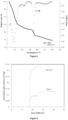
- TMA + in the zeolites was confirmed by FTIR as shown in Figure 2 by the presence of the N + and CH 3 peaks.
- TGA Thermal Gravimetric Analysis
- the synthesized TMAY (Si/Al 2.55) with 31% TMA + exchange contained 8 TMA + per unit cell, which is equivalent to no more than 4 TMA + per supercavity. This admits the possibility of having TMA + sitting in the passage connecting two supercavities. Though full saturation of TMA + in FAU is desired, it is unlikely achievable in practice because of (1) the lack of space for diffusion of the large organic cations inside some cavities and (2) the maximum exchange rate diminishes with a decrease in the Si/Al ratio, i.e. increase of cation density.
- the adsorption equilibrium experiments of TMAX and TMAY suggest FAU zeolites with a higher degree of TMA saturation have a higher CH 4 -to-N 2 selectivity.
- TMAY powder was pressurized into 1-2 mm pellets with a 50 ton high pressure pelletizer (XRF Scientific Instruments).
- the TMAY pellets (5.36 g dry base) were preactivated at 593 K under vacuum on a Micromeritics ASAP2020 for 24 hr.
- Single-component isotherms of N 2 and CH 4 adsorption on TMAY were collected at temperatures ranging from 243 K to 323 K and pressures up to 120 kPa using a standard volumetric method on a Micromeritics ASAP2020 accelerated surface area and porosity analyzer.
- the surface area and DFT pore size distribution of the prepared samples were measured by N 2 adsorption at 77 K. Prior to each measurement, the samples were thoroughly dehydrated and degassed on a Micromeritics ASAP2020 analyzer by stepwise heating (1 K/min) up to 593 K and held at 593 K under high vacuum for 300 min and then cooled to 295 K followed by backfill with helium.
- Figure 5 shows a plot of single component (CH4 or N2) adsorption isotherms on parent zeolite NaY (a) and ion exchanged TMAY (b, c, d).
- CH 4 /N 2 selectivity is improved by 300% in TMAY compared with parent NaY; CH 4 capacity is improved by 15.
- TMAY pellets were transferred into a stainless-steel adsorption column (3/8 in. diameter, 16 cm long) and flushed with helium for 1 hr.
- Binary CH 4 /N 2 adsorption isotherms on TMAY were measured with a dynamic column breakthrough (DCB) apparatus as known in the art.
- Binary breakthrough experiments were carried out at 248 K, 273 K and 303 K respectively in the pressure range of 103.8 - 902.8 kPa by feeding CH 4 /N 2 gas mixtures (with CH 4 mole fraction of 0.064 - 0.914) at a flow rate of 50 mL/min at STP set by mass flow controllers.
- TMAY maintained high CH 4 /N 2 selectivity even at high pressures is particularly advantageous for the gas industry for two reasons: (1) most of the upstream and downstream gas processes are operated at elevated pressures and thus a high pressure CH 4 /N 2 separation will help to retain the energy; (2) high pressure CH 4 /N 2 separation process will also reduce the column size and the cost.
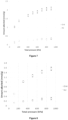
- Figure 7 shows the CH 4 capacity at 248 K reaches as high as 2.1 mmol/g in the binary equimolar mixture of CH 4 and N 2 .
- Figures 8 and 9 present the results of binary adsorption isotherms at 273 K and 303 K respectively.
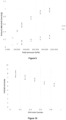
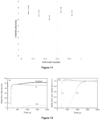
- Figure 10 presents the results of CH 4 /N 2 selectivity at 2 bar and 248 K as a function of CH 4 mole fraction.
- Figure 11 presents the results of CH 4 /N 2 selectivity at 4 bar and 248 K as a function of CH 4 mole fraction.
- Figure 12 is a plot of the binary breakthrough of 10% CH 4 + 90% N 2 at 2 bar pressure and 248 K temperature from a bed of TMA-Y: (a) outlet mass flows, and (b) normalized molar flows.
- the data in Figure 12 can be used to show that the rate of adsorption by either N 2 or CH 4 is fast (similar to the parent zeolite), which means that the selectivities being observed here are equilibrium properties of the material.
- Figure 13 shows the CH 4 capacity at 248 K reaches 2.0 mmol/g at 2 bar.
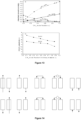
- Figure 16 shows the CH 4 capacity on three of the FAU type ILZ materials, namely DMA-Y, TriMA-Y, and TMA-Y. It is noticeable that TMA-Y has the highest capacity for CH 4 adsorption. Further study suggests the CH 4 /N 2 selectivity on TMA-Y remains the highest among the three samples.
Landscapes
- Chemical & Material Sciences (AREA)
- Organic Chemistry (AREA)
- Analytical Chemistry (AREA)
- Chemical Kinetics & Catalysis (AREA)
- Inorganic Chemistry (AREA)
- Engineering & Computer Science (AREA)
- Oil, Petroleum & Natural Gas (AREA)
- Water Supply & Treatment (AREA)
- General Chemical & Material Sciences (AREA)
- Solid-Sorbent Or Filter-Aiding Compositions (AREA)
- Separation Of Gases By Adsorption (AREA)
- Silicates, Zeolites, And Molecular Sieves (AREA)
Description
- A method for separating methane from nitrogen from a feed containing a mixture of at least methane and nitrogen.
- The following discussion of the background art is intended to facilitate an understanding of the present invention only. The discussion is not an acknowledgement or admission that any of the material referred to is or was part of the common general knowledge as at the priority date of the application.
- Methane, CH4 is the primary component of natural gas. It is both a valuable source of energy and potent greenhouse gas, with 21 times the global warming potential of carbon dioxide, CO2. Nitrogen, N2, is a common impurity in natural gas, varying from 0.5 % to 25 % by volume, depending on the source. This impurity has no energy content, no global warming potential, and needs to be removed from the natural gas to varying degrees to meet product sales specifications. Its removal is particularly important in the production of liquefied natural gas (LNG).
- The separation of N2 and CH4 is challenging because they are molecules with very similar physical properties such as molecular size (0.364 and 0.380 nm respectively) and normal boiling point (-196 and -161 °C, respectively). Conventionally, the removal of N2 during LNG production is performed through cryogenic distillation, which is an expensive and energy intensive process. The removed N2 must be disposed of and generally this is done by venting the N2 to atmosphere. However, the purity of this vent is limited by the similarity of the physical properties of N2 and CH4. A N2 vent stream containing about 2 % CH4 can be achieved with a single stage of cryogenic distillation. However, the magnitude of the vent stream (~50 tonnes/hour per 5 million tonne per annum LNG train) means that such a CH4 concentration corresponds to a significant amount of wasted energy and source of greenhouse gas emissions.
- Adsorption technologies based on molecular diameter differences have been attempted for CH4 capture. However, separation of CH4 and N2 is very challenging because of their very close molecular diameters (3.80 Å vs 3.64 Å).
- A significant amount of prior art (e.g.
US 2011/315012 A1 ) is directed at the selective removal of various hydrocarbons from natural gas streams, however, none of them achieve the separation of methane from nitrogen. -
US 2005/045030 A1 discloses a separation process using a microchannel separator using a range of sorption media. However, it is not disclosed any porous support that comprises exchangeable cations where at least a portion of the exchangeable cations are organic cations. -
GB2296712A -
WO02058818A2 - In accordance with the present invention, there is provided a method for separating methane from nitrogen from a feed containing a mixture of at least methane and nitrogen, comprising contacting the feed with an adsorbent comprising a porous support wherein the porous support comprises exchangeable cations and at least a portion of the exchangeable cations are organic cations, selected from a substituted ammonium cation, a substituted phosphonium cation or an organic nitrogen-containing cation, wherein the porous support has pore diameters large enough to adsorb methane, and wherein the porous support is a zeolite or an aluminosilicate.
- It will be appreciated that the method of the present invention may not remove all of the at least one methane from the mixture.
- It will be appreciated that the mixture containing methane and nitrogen may contain other gases.
- Although only methane being claimed, the at least one hydrocarbon may be selected from C1-C4 saturated or unsaturated hydrocarbons. Apart from methane, the at least one hydrocarbon may also be selected from a group containing ethane, propane, butane, iso-butane, methylene, ethylene and propylene.
- Although only zeolites and aluminosilicate are claimed as porous support, disclosed but not claimed are also zeolite-like metal-organic frameworks, molecular sieves, titanosilicates, layered hydroxides or hydrotalcites.
- Disclosed but not claimed are also alternatives where the porous support may be selected from the group comprising coordinated polymeric materials, including metal organic frameworks or carbonaceous materials.
- It will be appreciated that there may be overlap between the types of porous supports described. For example, some molecular sieves are also aluminosilicates and some aluminosilicates are also molecular sieves.
- Preferably, the porous support is a zeolite. Zeolites are crystalline aluminosilicates with open three dimensional framework structures built of, for example, SiO4 and AlO4 tetrahedra linked to each other by sharing all the oxygen atoms to form regular intra-crystalline cavities and channels of molecular dimensions. The electrovalence of the aluminium-containing tetrahedra is balanced by the inclusion of a cation, usually an alkaline metal or alkaline earth metal. It will be appreciated that zeolites may also comprise building blocks of TiO4, GaO4 and FeO4.
- The International Zeolite Association has recognized 229 families of zeolites. It is believed that about 67 naturally occurring zeolite frameworks are known. The number of synthetic zeolites grows regularly and many naturally occurring zeolites can now be synthesized.
- The zeolite may be a natural zeolite or a synthetic zeolite. Zeolites that may be used in the present invention include ferrierite, brewsterite, stilbite, dachiardite, epistilbite, heulandite, chabazite and clinoptilolite.
- In one form of the invention, the zeolite has faujasite topology. In an alternate form of the invention, the zeolite has Linde type A topology. In an alternate form of the invention, the zeolite has chabazite topology. Other suitable topologies include GME, LTL, MEI, MOZ and DFO as listed by the Structure Commission of the International Zeolite Association (http://izasc.ethz.ch/fmi/xsl/IZA-SC/ft.xsl).
- Zeolites are distinguished by their Si:Al ratios. Zeolites with low ratios (~1:1) are termed X zeolites and those with high ratios (>1.5:1), Y zeolites. Commercially available Y zeolites include: CBV 100 (2.5:1); CBV 712 (6:1) and CBV720 (15:1).
- An X zeolite with sodium cations is commonly designated NaX and a Y zeolite with sodium cations is commonly designated NaY.
- It will be appreciated that the Si:Al ratio will have an effect on the number of cations per unit cell of the zeolite. The substitution of trivalent aluminum ions for a fraction of the tetravalent silicon ions at lattice positions results in a network that bears a net negative charge that is compensated by positively charged counter-ions. Thus, a lower ratio means a higher cation density. If the Si/Al ratio is too high, the low cation density may not be sufficient to accommodate enough organic cations.
- It will be appreciated that the pore aperture size of the zeolite should be larger than the dimension of the organic cation to allow for the transfer of the organic cation into the cavity. As an example, tetramethylammonium (TMA) cations have a diameter of approximately 6 Å. Consequently, it is possible to exchange sodium ions with TMA ions in large pore zeolites for example, FAU types. It will be appreciated that if the dimensions of the organic cation and the pore aperture are close, such an ion exchange may not be experimentally viable due to limitation of mass transfer kinetics.
- It will be appreciated that porous supports suitable for use in the practice of the invention are those with pore diameters large enough to adsorb a hydrocarbon of interest. Diameters of exemplary hydrocarbons include:
- monomethylammonium - 3.9 Å (estimated);
- trimethylammonium - 5.4 Å (estimated); and
- tetramethylammonium - 6 Å.
- The zeolite is preferred to have a large accessible pore volume. As the dimensions of organic cations are much bigger than the metal cations, e.g. Na+, K+, Ca2+ found in normal zeolites, a sufficiently large pore volume is required to accommodate multiple organic cations per unit cell; otherwise, there will not be enough room for a higher cation exchange rate.
- The Si/Al ratio will have an effect on the percentage of metal cations that can be exchanged by organic cations (ion exchange capacity). It would therefore be understood by a person skilled in the art that the ion exchange capacity of the zeolite would be increased by reducing the Si/Al ratio, thus providing an increased number of exchange sites. The applicant has discovered however, that if the Si/Al ratio is too low, the cation density may be too high to allow for higher degree of cation exchange due to space hindrance and diffusion limitation. This would result in excess metal cations sitting unexchanged in the cavity of the zeolites, leading to reduced CH4-over-N2 adsorption performance. It is therefore preferable to balance the number of exchange sites with the cation density.
- Preferably, the zeolite is a Y zeolite. More preferably, the zeolite has a Si/Al ratio of 2 - 20. More preferably, the zeolite has a Si/Al ratio of 2.5 - 15. More preferably, the zeolite has a Si/Al ratio of 2.5 - 6.
- It will be appreciated that it is desirable that the organic cations have the physical properties that are specified for the adsorption of target molecules. Where CH4-over-N2 selectivity is desired, the organic cations preferably have low charge density and low polarity for the purpose of substantially reducing the adsorption energy of N2. For example, TMA+ has the same charge as Na+ but a much larger size and thus the density of the charge is much smaller than that of the sodium cation, leading to increased selectivity.
- Preferably, the organic cation is an ionic liquid.
- The organic cation is selected from the following; substituted ammonium cations, substituted phosphonium cations and organic nitrogen-containing cations.
- Preferably, the substituted ammonium cation is an alkylammonium cation.
- Preferably, the alkylammonium cation is a quaternary alkylammonium ion.
- The alkyl ammonium ion may be selected from the following: monomethylammonium, dimethylammoinium, trimethylammonium, tetramethylammonium, monoethylammonium, diethylammonium, triethylammonium, tetraethylammonium, monopropylammonium, dipropylammonium, tripropylammonium, tetrapropylammonium, monobutylammonium, dibutylammonium, tributylammonium and tetrabutylammonium.
- Preferably, the alkylammonium cation is tetramethylammonium.
- The alkyl ammonium cation may contain alkyl chains of varying lengths such as dimethyldiethylammonium.
- Preferably, the substituted phosphonium cation is an alkylphosphonium cation. Preferably, the alkylphosphonium cation is a quaternary alkylphosphonium ion.
- The alkyl phosphonium ion may be selected from the following: monomethylphosphonium, dimethylphosphonium, trimethylphosphonium, tetramethylphosphonium, monoethylphosphonium, diethylphosphonium, triethylphosphonium, tetraethylphosphonium, monopropylphosphonium, dipropylphosphonium, tripropylphosphonium, tetrapropylphosphonium, monobutylphosphonium, dibutylphosphonium, tributylphosphonium and tetrabutylphosphonium.
- Preferably, the alkylphosphonium cation is tetramethylphosphonium.
- The alkyl phosphonium cation may contain alkyl chains of varying lengths such as dimethyldiethylphosphonium.
- In an alternate form of the present invention, the organic cation is an organic nitrogen-containing cation. More preferably, the organic nitrogen-containing cation is derived from ethylenediamine, pyrrole, imidazole, pyrazole, pyridine, pyrazine, pyrimidine or pyridazine. The organic nitrogen-containing cation may be selected from dimethylimidazolium or 2-(hydroxyalkyl)trialkylammonium compounds such as 2-(hydroxyethyl)trimethylammonium.
- Advantageously, many quaternary alkylammonium ions and quaternary alkylphosphonium ions have a high degree of symmetry, leading to decreased polarity. Additionally, where provided, such alkyl moieties provide shielding to the charged nitrogen atom within the ion. As a result, the interactions between the electrical field and the quadrupole of N2 will be suppressed considerably while the van der Waals interactions with CH4 are less affected.
- Preferably, the organic cation content of the porous support is at least 5 % of the ion-exchangeable cations in the aluminosilicate. In one form of the invention, the organic cation content is at least 10 % of the ion-exchangeable cations in the aluminosilicate. In an alternate form of the invention, the organic cation content is at least 20 % of the ion-exchangeable cations in the aluminosilicate. In an alternate form of the invention, the organic cation content is at least 30 % of the ion-exchangeable cations in the aluminosilicate. In an alternate form of the invention, the organic cation content is at least 40 % of the ion-exchangeable cations in the aluminosilicate. In an alternate form of the invention, the organic cation content is at least 50 % of the ion-exchangeable cations in the aluminosilicate. In an alternate form of the invention, the organic cation content is at least 60 % of the ion-exchangeable cations in the aluminosilicate. In an alternate form of the invention, the organic cation content is at least 70 % of the ion-exchangeable cations in the aluminosilicate. In an alternate form of the invention, the organic cation content is at least 80 % of the ion-exchangeable cations in the aluminosilicate. In an alternate form of the invention, the organic cation content is at least 90 % of the ion-exchangeable cations in the aluminosilicate. It will be appreciated that higher contents of organic cation provide increased selectivity of methane over nitrogen. It will be appreciated that due to steric hindrance and depending on the aluminosilicate and the organic cation, 100 % conversion may not be possible.
- Preferably, the selectivity for methane over nitrogen is at least 5.
- The method of the present invention may be used with a wide range of gas sources, such as coal mining gas, biogas and LNG vent gas. 50% binary mixtures (e.g. coal mining gas, biogas) can be treated to increase the concentration of the methane component. Gas streams containing as little as 1 % methane (e.g. LNG vent gas) may be purified by the method of the invention down to 100 ppm methane.
- The present invention may be performed using any known adsorption technique such as pressure swing adsorption, vacuum swing adsorption, thermal swing adsorption, displacement purge or nonadsorbable purge (i.e. partial pressure reduction), dual reflux adsorption, or combination of the above.
- It is desirable to utilize a pressure swing adsorption process at a temperature and pressure effective for adsorption and desorption of methane, with the temperature preferably maintained in the range -50 °C to 100 °C, and more preferably from 0 °C to 70 °C. The pressure during adsorption is preferably between about 68.95 Pa to 13.79 kPa (10 psi to 2000 psi), preferably about 689.5 Pa to 10.34 kPa (100 psi to 1500 psi), more preferably 3.45 kPa to 6.90 kPa (500 psi to 1000 psi). The pressure during desorption is lower than during adsorption and is effective to cause the desorption of methane, preferably form about 13.33 Pa to 1.03 kPa (about 0.1 torr to 150 psi), more preferably from about 13.33 Pa to about 344.75 Pa (about 0.1 torr to about 50 psi) and most preferably from about 13.33 Pa to about 172.38 Pa (about 0.1 torr to about 25 psi).
- In accordance with the present invention, there is provided an adsorbent (not claimed) comprising a porous support wherein the porous support comprises exchangeable cations and at least a portion of the exchangeable cations are organic cations.
- The porous support is a zeolite or an aluminosilicate.
- Preferably, the porous support is a zeolite. Zeolites are crystalline aluminosilicates with open three dimensional framework structures built of, for example, SiO4 and AlO4 tetrahedra linked to each other by sharing all the oxygen atoms to form regular intra-crystalline cavities and channels of molecular dimensions. The electrovalence of the aluminium-containing tetrahedra is balanced by the inclusion of a cation, usually an alkaline metal or alkaline earth metal. It will be appreciated that zeolites may also comprise building blocks of TiO4, GaO4 and FeO4.
- The zeolite may be a natural zeolite or a synthetic zeolite. Zeolites that may be used in the present invention include ferrierite, brewsterite, stilbite, dachiardite, epistilbite, heulandite, chabazite and clinoptilolite.
- In one form of the invention, the zeolite has faujasite topology. In an alternate form of the invention, the zeolite has Linde type A topology. In an alternate form of the invention, the zeolite has chabazite topology. Other suitable topologies include GME, LTL, MEI, MOZ and DFO as listed by the Structure Commission of the International Zeolite Association (http://izasc.ethz.ch/fmi/xsl/IZA-SC/ft.xsl).
- Preferably, the zeolite is a Y zeolite. More preferably, the zeolite has a Si/Al ratio of 2 - 20. More preferably, the zeolite has a Si/Al ratio of 2.5 - 15. More preferably, the zeolite has a Si/Al ratio of 2.5 - 6.
- The porous support has pore diameters large enough to adsorb a hydrocarbon of interest.
- Although only methane being claimed, the hydrocarbon of interest may be selected from C1-C4 saturated or unsaturated hydrocarbons. Apart from methane, the hydrocarbon may be selected from a group containing ethane, propane, butane, iso-butane, methylene, ethylene and propylene. According to the present invention, the hydrocarbon is methane.
- It will be appreciated that the pore aperture size of the zeolite should be larger than the dimension of the organic cation to allow for the transfer of the organic cation into the cavity. As an example, tetramethylammonium (TMA) cations have a diameter of approximately 6 Å. Consequently, it is possible to exchange sodium ions with TMA ions in large pore zeolites for example, FAU types. It will be appreciated that if the dimensions of the organic cation and the pore aperture are close, such an ion exchange may not be experimentally viable due to limitation of mass transfer kinetics.
- Preferably, the organic cation is an ionic liquid.
- The organic cation is selected from the following; substituted ammonium cations, substituted phosphonium cations and organic nitrogen-containing cations.
- Preferably, the substituted ammonium cation is an alkylammonium cation.
- Preferably, the alkylammonium cation is a quaternary alkylammonium ion.
- The alkyl ammonium ion may be selected from the following: monomethylammonium, dimethylammoinium, trimethylammonium, tetramethylammonium, monoethylammonium, diethylammonium, triethylammonium, tetraethylammonium, monopropylammonium, dipropylammonium, tripropylammonium, tetrapropylammonium, monobutylammonium, dibutylammonium, tributylammonium and tetrabutylammonium.
- Preferably, the alkylammonium cation is tetramethylammonium.
- The alkyl ammonium cation may contain alkyl chains of varying lengths such as dimethyldiethylammonium.
- Preferably, the substituted phosphonium cation is an alkylphosphonium cation. Preferably, the alkylphosphonium cation is a quaternary alkylphosphonium ion.
- The alkyl phosphonium ion may be selected from the following: monomethylphosphonium, dimethylphosphonium, trimethylphosphonium, tetramethylphosphonium, monoethylphosphonium, diethylphosphonium, triethylphosphonium, tetraethylphosphonium, monopropylphosphonium, dipropylphosphonium, tripropylphosphonium, tetrapropylphosphonium, monobutylphosphonium, dibutylphosphonium, tributylphosphonium and tetrabutylphosphonium.
- Preferably, the alkylphosphonium cation is tetramethylphosphonium.
- The alkyl phosphonium cation may contain alkyl chains of varying lengths such as dimethyldiethylphosphonium.
- In an alternate form of the present invention, the organic cation is an organic nitrogen-containing cation. More preferably, the organic nitrogen-containing cation is derived from ethylenediamine, pyrrole, imidazole, pyrazole, pyridine, pyrazine, pyrimidine or pyridazine. The organic nitrogen-containing cation may be selected from dimethylimidazolium or 2-(hydroxyalkyl)trialkylammonium compounds such as 2-(hydroxyethyl)trimethylammonium.
- Preferably, the organic cation content of the porous support is at least 5 % of the ion-exchangeable cations in the aluminosilicate. In one form of the invention, the organic cation content is at least 10 % of the ion-exchangeable cations in the aluminosilicate. In an alternate form of the invention, the organic cation content is at least 20 % of the ion-exchangeable cations in the aluminosilicate. In an alternate form of the invention, the organic cation content is at least 30 % of the ion-exchangeable cations in the aluminosilicate. In an alternate form of the invention, the organic cation content is at least 40 % of the ion-exchangeable cations in the aluminosilicate. In an alternate form of the invention, the organic cation content is at least 50 % of the ion-exchangeable cations in the aluminosilicate. In an alternate form of the invention, the organic cation content is at least 60 % of the ion-exchangeable cations in the aluminosilicate. In an alternate form of the invention, the organic cation content is at least 70 % of the ion-exchangeable cations in the aluminosilicate. In an alternate form of the invention, the organic cation content is at least 80 % of the ion-exchangeable cations in the aluminosilicate. In an alternate form of the invention, the organic cation content is at least 90 % of the ion-exchangeable cations in the aluminosilicate. It will be appreciated that higher contents of organic cation provide increased selectivity of methane over nitrogen. It will be appreciated that due to steric hindrance and depending on the aluminosilicate and the organic cation, 100 % conversion may not be possible.
- Further features of the present invention are more fully described in the following description of several non-limiting embodiments thereof. This description is included solely for the purposes of exemplifying the present invention. It should not be understood as a restriction on the broad summary, disclosure or description of the invention as set out above. The description will be made with reference to the accompanying drawings in which:
-
Figure 1 shows a representation of ab initio DFT calculations used to estimate interaction energies; -
Figure 2 is an FTIR plot demonstrating the existence of TMA+ in the zeolite; -
Figure 3 is a TGA plot; -
Figure 4 is a plot of the change in parent NaY zeolite (CBV100) upon 31 % exchange of its Na+ ions with TMA+ ions, showing the zeolite's cumulative pore volume as a function of pore size before and after ion exchange; -
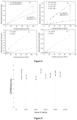
Figure 5 is a plot of single component (CH4 or N2) adsorption isotherms on parent zeolite NaY (a) and ion exchanged TMAY (b, c, d); -
Figure 6 is a plot of CH4/N2 selectivity for their equimolar binary mixture on ionic liquidic zeolite TMA-Y at 248 K; -
Figure 7 shows a binary isotherm of equimolar CH4 + N2 on TMA-Y at 248 K; -
Figure 8 shows binary isotherms of equimolar CH4 + N2 on TMA-Y at 273 K; -
Figure 9 shows binary isotherms of equimolar CH4 + N2 on TMA-Y at 303 K; -
Figure 10 is a plot of CH4/N2 selectivity as a function of composition at a fixed total pressure of 2 bar and 248 K; -
Figure 11 is a plot of CH4/N2 selectivity as a function of composition at a fixed total pressure of 4 bar and 248 K; -
Figure 12 is a plot of the binary breakthrough of 10% CH4 + 90% N2 at 2 bar pressure and 248 K temperature from a bed of TMA-Y: (a) outlet mass flows, and (b) normalized molar flows; -
Figure 13 is a binary isotherm (a) and selectivity (b) with varying composition and fixed total pressure of 2 bar; and -
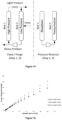
Figure 14 is a schematic representation of a PSA process; and -
Figure 15 is a schematic of the dual-reflux PL-A cycle. The second half of the cycle is the same but with the adsorption bed numbering reversed. The combined pressurization and blowdown step is called the pressure reversal step. - Ab initio density functional theory (DFT) calculations show a CH4 molecule (left panel of
figure 1 ) binds much more strongly on TMAY (with 3 TMA+ per zeolite supercavity) than a N2 molecule (right panel) does. Charge difference analysis of the DFT calculation shows much a greater charge redistribution for the adsorbed CH4 molecule on TMAY than for N2: charges accumulate (electron cloud 1) at the end of the gas molecules closest to the TMA+ ion and deplete (electron could 2) from the gas molecule's other end. - It will be appreciated that higher degrees of TMA+ saturation will substantially suppress the adsorption of N2. Theoretical studies by DFT calculation show the energy of adsorption of CH4 in a typical TMAY zeolite increased from 22.92 kJ/mol with one TMA+ per supercavity, to 27.20 kJ/mol with two TMA+, and eventually to 29.57 kJ with three TMA+ per supercavity. By contrast, the energy of N2 adsorption was not sensitive to the number of TMA+ in the zeolite supercavity, with a change of less than 1.5 kJ/mol. Generally, the larger the difference in adsorption energy, the higher the adsorption selectivity in the low pressure region.
- The pore volume of zeolites is normally between 9-30%, as shown in Table 1. A number of zeolite candidates (Table 2) were selected as potential parent frameworks for preparing adsorbents with organic cations, which may be referred to as Ionic Liquidic Zeolites (ILZ). However, this does not exclude the suitability of other medium/large pore zeolites.
Table 1. List of selected zeolites and their pore dimensions (reference: http://izasc.ethz.ch/fmi/xsl/IZA-SC/ft.xsl). Zeolite type Max radius (Å) Max diffusible diameter (Å) Accessible volume FAU 11.24 7.35 28% LTA 11.05 4.21 21% AFR 8.36 6.97 20% AFS 9.51 6.01 22% AFY 7.82 5.9 22% ATS 7.3 6.82 16% BEA 6.68 5.95 23% BEC 6.95 6.09 21% BOF 5.58 4.67 9% BOG 8.05 6.88 18% BOZ 8.71 4.92 23% BHP 9.51 6.01 22% CGS 5.86 4.01 11% -CLO 15.72 6.31 34% CON 7.45 5.6 19% DFO 11.29 7.19 22% DON 8.79 8.07 16% EMT 11.55 7.37 28% EON 7.83 6.79 13% EZT 6.57 6.13 13% GME 7.76 7.11 17.3% IFR 7.24 6.38 16% IMF 7.34 5.44 12% IRR 14.46 12.12 38% ISV 7.01 6.32 21% ITR 6.36 5.12 12% -ITV 9.32 6.98 38% IWR 7.48 5.91 19% IWS 8.25 6.66 23% IWV 8.54 7.03 22% IWW 7.07 6.25 15% LTF 8.16 7.5 11.6% LTL 10.01 7.5 15.4% MAZ 8.09 7.5 13.2% MEI 8.06 6.9 21.6% MOZ 10.03 7.54 13.1% MOR 6.7 6.45 12.6% OFF 7 6.61 15.1% Table 2. Examples of zeolites with large diffusible diameter and accessible pore volumes. Zeolite name Zeolite pore size (Å) Max diffusible diameter (Å) Accessible volume FAU 11.24 7.35 28% -CLO 15.72 6.31 34% EMT 11.55 7.37 28% -ITV 9.32 6.98 38% MEI 8.06 6.9 21.6% DFO 11.29 7.19 22% LTL 10.01 7.5 15.4% MOZ 10.03 7.54 13.1% GME 7.76 7.11 17.3% - The zeolites of the present invention can be prepared by ion exchanging the existing cations in the aluminosilicate frameworks with organic cations or by synthesizing the aluminosilicate frameworks with organic cation templates.
- Commercial NaY (CBV100 and CBV712) and NaX and laboratory made sodium chabazite (CHA) were tested for TMA exchange. Both the Y and X zeolites having the same crystal structure and topology, belong to the FAU family with a pore aperture diameter of 7.4 Å, whereas the chabazite zeolite belongs to the CHA family with a much smaller pore aperture, 3.8 Å in diameter.
- Ion exchange of tetramethylammonium was conducted by shaking tetramethylammonium chloride and zeolite in a water bath at 40 - 70 °C for 0.5 - 15 hr. The mixture was centrifuged at 3000 rpm for 5 min and the solid component washed with deionized water. The centrifuge and washing steps were repeated. The solid component was shaken in a water bath with further tetramethylammonium chloride at 40 -70 °C for at least 0.5 - 15 hr and centrifuged and washed as before two further times. The solid component was dried at no higher than 250 °C.
- The chemical compositions of the prepared TMAY and TMAX were confirmed by ICP-MS (inductively-coupled plasma mass spectrometry). The unit cell formula for TMAY and TMAX was [C4H12N]8.1Na18.9Al27Sl69O192 and [C4H12N]3.7Na38Al41.7Si54.3O192, respectively, indicating that the corresponding degree of TMA saturation (i.e. ion exchange rate) was 31% and 9%, respectively. As discussed previously, lower TMA saturation in the X zeolite is believed to be a result of the cation density being too high to allow for higher degree of cation exchange due to space hindrance and diffusion limitation. This results in excessive metal cations sitting unexchanged in the cavity of the zeolites.
- The crystal structure of the materials was verified by powder XRD. There was no change for the positions of the main peaks after ion exchange.
- The existence of TMA+ in the zeolites was confirmed by FTIR as shown in
Figure 2 by the presence of the N+ and CH3 peaks. - The thermal stability of the organic cation exchanged zeolites was verified by Thermal Gravimetric Analysis (TGA), which suggests the TMA-zeolites are stable up to 573 K as shown in
Figure 3 . - The synthesized TMAY (Si/Al = 2.55) with 31% TMA+ exchange contained 8 TMA+ per unit cell, which is equivalent to no more than 4 TMA+ per supercavity. This admits the possibility of having TMA+ sitting in the passage connecting two supercavities. Though full saturation of TMA+ in FAU is desired, it is unlikely achievable in practice because of (1) the lack of space for diffusion of the large organic cations inside some cavities and (2) the maximum exchange rate diminishes with a decrease in the Si/Al ratio, i.e. increase of cation density. The adsorption equilibrium experiments of TMAX and TMAY suggest FAU zeolites with a higher degree of TMA saturation have a higher CH4-to-N2 selectivity.
- TMAY powder was pressurized into 1-2 mm pellets with a 50 ton high pressure pelletizer (XRF Scientific Instruments). The TMAY pellets (5.36 g dry base) were preactivated at 593 K under vacuum on a Micromeritics ASAP2020 for 24 hr.
- Single-component isotherms of N2 and CH4 adsorption on TMAY were collected at temperatures ranging from 243 K to 323 K and pressures up to 120 kPa using a standard volumetric method on a Micromeritics ASAP2020 accelerated surface area and porosity analyzer. The surface area and DFT pore size distribution of the prepared samples were measured by N2 adsorption at 77 K. Prior to each measurement, the samples were thoroughly dehydrated and degassed on a Micromeritics ASAP2020 analyzer by stepwise heating (1 K/min) up to 593 K and held at 593 K under high vacuum for 300 min and then cooled to 295 K followed by backfill with helium.
- Larger accessible pore volumes also allow for higher adsorption capacity at very high pressures. As shown in
Figure 4 , the pore volume of FAU zeolite is reduced by 60% after exchanging 30% of the original Na+ by TMA+. However, this should not affect the loading of CH4 at low and medium pressures. For example, experimental data inFigure 5 suggests CH4 capacity was even improved by 15 % at 1 bar pressure after TMA+ exchange. -
Figure 5 shows a plot of single component (CH4 or N2) adsorption isotherms on parent zeolite NaY (a) and ion exchanged TMAY (b, c, d). The calculated CH4/N2 selectivity is improved by 300% in TMAY compared with parent NaY; CH4 capacity is improved by 15. - Following preactivation, TMAY pellets were transferred into a stainless-steel adsorption column (3/8 in. diameter, 16 cm long) and flushed with helium for 1 hr. Binary CH4/N2 adsorption isotherms on TMAY were measured with a dynamic column breakthrough (DCB) apparatus as known in the art. Binary breakthrough experiments were carried out at 248 K, 273 K and 303 K respectively in the pressure range of 103.8 - 902.8 kPa by feeding CH4/N2 gas mixtures (with CH4 mole fraction of 0.064 - 0.914) at a flow rate of 50 mL/min at STP set by mass flow controllers. All component gases used were supplied by BOC with the flowing fractional purities: He 99.999 %, CH4 99.995%, and N2 99.999 %.
Figure 6 shows that tetramethylammonium-Y zeolite, has a CH4/N2 selectivity constantly between 6 and 8 for binary equimolar mixtures of CH4 + N2 at 248 K up to the maximum tested pressure of 9 bar. Importantly this selectivity was achieved without loss of CH4 capacity. That the TMAY maintained high CH4/N2 selectivity even at high pressures is particularly advantageous for the gas industry for two reasons: (1) most of the upstream and downstream gas processes are operated at elevated pressures and thus a high pressure CH4/N2 separation will help to retain the energy; (2) high pressure CH4/N2 separation process will also reduce the column size and the cost. -
Figure 7 shows the CH4 capacity at 248 K reaches as high as 2.1 mmol/g in the binary equimolar mixture of CH4 and N2. -
Figures 8 and9 present the results of binary adsorption isotherms at 273 K and 303 K respectively. -
Figure 10 presents the results of CH4/N2 selectivity at 2 bar and 248 K as a function of CH4 mole fraction.Figure 11 presents the results of CH4/N2 selectivity at 4 bar and 248 K as a function of CH4 mole fraction. -
Figure 12 is a plot of the binary breakthrough of 10% CH4 + 90% N2 at 2 bar pressure and 248 K temperature from a bed of TMA-Y: (a) outlet mass flows, and (b) normalized molar flows. The data inFigure 12 can be used to show that the rate of adsorption by either N2 or CH4 is fast (similar to the parent zeolite), which means that the selectivities being observed here are equilibrium properties of the material. -
Figure 13 shows the CH4 capacity at 248 K reaches 2.0 mmol/g at 2 bar. - A simulation of a 10-step two column PSA process using TMAY to treat an equimolar binary mixture of CH4+N2 using TMAY achieved 94.1% CH4 product purity and 94.4% recovery with the following conditions
- Column physical size: ID = 100mm L=1.8m
- Adsorbent: TMAY, 2mm pellet
- Feed flow rate: 130.5 litre per minute (standard)
- Pressure: 3.0 bar
- Temperature: 30 °C
- The ten step process is represented schematically at
Figure 14 wherein the steps are as follows: - Step 1: adsorption
- Step 2: blow down to 1 bar
- Step 3: pressure equalization
- Step 4: depressurization/purge to the other column
-
Step -
Step 8 and 9: pressurization/equalization from the other column - Step 10: re-pressurization
- Experiments using a four-step dual-reflux pressure swing adsorption process schematically represented in
Figure 15 to treat a 2.6% dilute CH4 achieved 22 times enrichment of methane with 99.9% recovery, with the following conditions:Table 3. The operating parameters that were held constant across all experiments. The valve positions in Figure 15 correspond to Step 1 (left) and Step 2 (right). Cycle Parameters Feed / Purge Time 120 s Pressurisation / Blowdown Time 90 s High Pressure 5.0 bar Low Pressure 1.4 bar Pressure Ratio 3.6 Column 1Column 2Step 1HP Heavy Purge LP Feed/ Light Purge Step 2 Blowdown Pressurisation Step 3 LP Feed/Light Purge HP Heavy Purge Step 4 Pressurisation Blowdown Feed Parameters Flowrate 1.25 SLPM Pressure 1.4 bar Temperature (atmospheric) 20-25 °C Fractional Axial Feed Position 0.5 - Isothermal equilibrium adsorption for single component gas of O2, CO, C2H6 and C3H8 was tested on TMAY, respectively. At 298 K and 100 kPa total pressure, the determined selectivity (based on direct comparison between the uptakes of two gases at same partial pressure) for the above gases are CH4/O2 = 5.28, CH4/CO = 2.97, C2H6/CH4 = 4.66, C3H8/CH4 = 2.71.
- Other ionic liquidic zeolites (FAU framework) containing organic cations of dimethylamine and trimethylamine have been prepared as described above. Elemental analysis of the resultant products shows the DMA-Y has a cation exchange rate of 60% and the TriMA-Y has 42%, in comparison with 30% for TMA-Y, which is consistent with the size of the organic cations, i.e. smaller organic cations allows for higher exchange rate.
-
Figure 16 shows the CH4 capacity on three of the FAU type ILZ materials, namely DMA-Y, TriMA-Y, and TMA-Y. It is noticeable that TMA-Y has the highest capacity for CH4 adsorption. Further study suggests the CH4/N2 selectivity on TMA-Y remains the highest among the three samples. - Throughout this specification, unless the context requires otherwise, the word "comprise" or variations such as "comprises" or "comprising", will be understood to imply the inclusion of a stated integer or group of integers but not the exclusion of any other integer or group of integers.
Claims (6)
- A method for separating methane from nitrogen, using a feed containing a mixture of at least methane and nitrogen, comprising contacting the feed with an adsorbent comprising a porous support wherein the porous support comprises exchangeable cations and at least a portion of the exchangeable cations are organic cations, selected from a substituted ammonium cation, a substituted phosphonium cation or an organic nitrogen-containing cation, wherein the porous support has pore diameters large enough to adsorb methane, and wherein the porous support is a zeolite or an aluminosilicate.
- A method for separating methane from nitrogen, using a feed containing a mixture of at least methane and nitrogen according to claim 1, wherein the zeolite is selected from the group comprising ferrierite, brewsterite, stilbite, dachiardite, epistilbite, heulandite, faujasite, Linde type A or chabazite materials.
- A method for separating methane from nitrogen, using a feed containing a mixture of at least methane and nitrogen according to any one of the preceding claims, wherein the zeolite has a Si/Al ratio of 2 - 20.
- A method for separating methane from nitrogen, using a feed containing a mixture of at least methane and nitrogen according to any one of the preceding claims, wherein the organic cation is from an ionic liquid, or where the organic cation is selected from the group comprising monomethylammonium, dimethylammonium, trimethylammonium, tetramethylammonium, monoethylammonium, diethylammonium, triethylammonium, tetraethylammonium, monopropylammonium, dipropylammonium, tripropylammonium, tetrapropylammonium, monobutylammonium, dibutylammonium, tributylammonium and tetrabutylammonium.
- A method for separating methane from nitrogen, using a feed containing a mixture of at least methane and nitrogen according to any one of the preceding claims, wherein the organic cation content of the porous support is at least 5 % of the ion-exchangeable cations in the aluminosilicate; at least 10 % of the ion-exchangeable cations in the aluminosilicate; at least 20 % of the ion-exchangeable cations in the aluminosilicate; at least 30 % of the ion-exchangeable cations in the aluminosilicate; at least 40 % of the ion-exchangeable cations in the aluminosilicate; at least 50 % of the ion-exchangeable cations in the aluminosilicate; at least 60 % of the ion-exchangeable cations in the aluminosilicate; at least 70 % of the ion-exchangeable cations in the aluminosilicate; at least 80 % of the ion-exchangeable cations in the aluminosilicate at least 90 % of the ion-exchangeable cations in the aluminosilicate.
- A method for separating methane from nitrogen, using a feed containing a mixture of at least methane and nitrogen according to any one of the preceding claims, wherein, the selectivity for methane over nitrogen is at least 5.
Applications Claiming Priority (2)
| Application Number | Priority Date | Filing Date | Title |
|---|---|---|---|
| AU2014905107A AU2014905107A0 (en) | 2014-12-17 | Method for Gas Separation | |
| PCT/AU2015/000588 WO2016094929A1 (en) | 2014-12-17 | 2015-09-24 | Method for gas separation |
Publications (4)
| Publication Number | Publication Date |
|---|---|
| EP3233246A1 EP3233246A1 (en) | 2017-10-25 |
| EP3233246A4 EP3233246A4 (en) | 2018-12-19 |
| EP3233246B1 true EP3233246B1 (en) | 2024-07-31 |
| EP3233246C0 EP3233246C0 (en) | 2024-07-31 |
Family
ID=56125428
Family Applications (1)
| Application Number | Title | Priority Date | Filing Date |
|---|---|---|---|
| EP15868684.0A Active EP3233246B1 (en) | 2014-12-17 | 2015-09-24 | Method for gas separation |
Country Status (6)
| Country | Link |
|---|---|
| US (1) | US10562005B2 (en) |
| EP (1) | EP3233246B1 (en) |
| CN (1) | CN107106963B (en) |
| AU (1) | AU2015367272B2 (en) |
| CA (1) | CA2970547C (en) |
| WO (1) | WO2016094929A1 (en) |
Families Citing this family (4)
| Publication number | Priority date | Publication date | Assignee | Title |
|---|---|---|---|---|
| CN106118777A (en) * | 2016-08-24 | 2016-11-16 | 深圳前海中盛环保科技有限公司 | A kind of marsh gas purifying purifies the method for methane |
| CN112569898A (en) * | 2019-09-30 | 2021-03-30 | 中国科学院大连化学物理研究所 | Adsorbent and preparation method and application thereof |
| CN114618438B (en) * | 2020-12-10 | 2023-06-06 | 中国科学院大连化学物理研究所 | A kind of oxygen selective adsorbent and its preparation method and application |
| CN119192556B (en) * | 2024-11-25 | 2025-03-14 | 合肥普力先进材料科技有限公司 | Method for removing phenolic compounds and metal ions in carbon dioxide-based polyol |
Family Cites Families (17)
| Publication number | Priority date | Publication date | Assignee | Title |
|---|---|---|---|---|
| JPS5512295B1 (en) * | 1970-04-10 | 1980-04-01 | ||
| GB8334610D0 (en) * | 1983-12-30 | 1984-02-08 | Bp Chem Int Ltd | Selective absorption of carbon monoxide on zeolites |
| US4554398A (en) * | 1984-10-29 | 1985-11-19 | Exxon Research & Engineering Co. | Process for the separation of C9 aromatic isomers |
| US5013334A (en) * | 1990-01-09 | 1991-05-07 | Uop | Methane purification by pressure swing adsorption |
| GB2296712B (en) * | 1995-01-05 | 1999-02-24 | British Gas Plc | Absorbents for separating nitrogen from a feed gas |
| US5616170A (en) * | 1995-08-11 | 1997-04-01 | The Boc Group, Inc. | Adsorptive separation of nitrogen from other gases |
| US5669958A (en) * | 1996-02-29 | 1997-09-23 | Membrane Technology And Research, Inc. | Methane/nitrogen separation process |
| US6531103B1 (en) * | 2000-03-09 | 2003-03-11 | Union Carbide Chemicals And Plastics Technology Corporation | Process for removing sulfur compounds from gas and liquid hydrocarbon streams |
| US6632767B2 (en) * | 2000-12-19 | 2003-10-14 | Praxair Technology, Inc. | Stabilization of molecular sieves by salt addition |
| EP1437172B1 (en) * | 2001-09-17 | 2009-02-11 | Ngk Insulators, Ltd. | Method for preparing ddr type zeolite film, ddr type zeolite film, and composite ddr type zeolite film, and method for preparation thereof |
| WO2005032693A2 (en) | 2003-08-29 | 2005-04-14 | Velocys Inc. | Process for separating nitrogen from methane using microchannel process technology |
| WO2008072896A1 (en) * | 2006-12-13 | 2008-06-19 | Korea Research Institute Of Chemical Technology | A porous organic-inorganic hybrid materials and an absorbent comprising the same |
| CN100586858C (en) * | 2007-04-04 | 2010-02-03 | 中国石油化工股份有限公司 | Porous symbiotic material and its synthesis method |
| US8282709B2 (en) * | 2010-06-29 | 2012-10-09 | The Governors Of The University Of Alberta | Removal of ethane from natural gas at high pressure |
| JP2014512259A (en) * | 2011-03-01 | 2014-05-22 | エクソンモービル リサーチ アンド エンジニアリング カンパニー | Swing adsorption method with controlled adsorption front |
| US8540800B2 (en) | 2011-03-21 | 2013-09-24 | Uop Llc | Microporous UZM-5 inorganic zeolite membranes for gas, vapor, and liquid separations |
| US9333482B2 (en) * | 2014-06-23 | 2016-05-10 | Saudi Arabian Oil Company | Synthesis of ultra-small pore aluminosilicates by controlled structural collapse of zeolites |
-
2015
- 2015-09-24 CN CN201580069594.4A patent/CN107106963B/en active Active
- 2015-09-24 CA CA2970547A patent/CA2970547C/en active Active
- 2015-09-24 EP EP15868684.0A patent/EP3233246B1/en active Active
- 2015-09-24 US US15/535,692 patent/US10562005B2/en active Active
- 2015-09-24 WO PCT/AU2015/000588 patent/WO2016094929A1/en not_active Ceased
- 2015-09-24 AU AU2015367272A patent/AU2015367272B2/en active Active
Also Published As
| Publication number | Publication date |
|---|---|
| EP3233246A4 (en) | 2018-12-19 |
| US20170348670A1 (en) | 2017-12-07 |
| AU2015367272A1 (en) | 2017-06-29 |
| US10562005B2 (en) | 2020-02-18 |
| EP3233246A1 (en) | 2017-10-25 |
| WO2016094929A1 (en) | 2016-06-23 |
| CN107106963B (en) | 2021-08-06 |
| CA2970547A1 (en) | 2016-06-23 |
| CN107106963A (en) | 2017-08-29 |
| CA2970547C (en) | 2023-02-21 |
| AU2015367272B2 (en) | 2021-04-22 |
| EP3233246C0 (en) | 2024-07-31 |
Similar Documents
| Publication | Publication Date | Title |
|---|---|---|
| Yang et al. | Experimental and simulation study on efficient CH4/N2 separation by pressure swing adsorption on silicalite-1 pellets | |
| Ren et al. | Highly enhanced selectivity for the separation of CH4 over N2 on two ultra-microporous frameworks with multiple coordination modes | |
| Alonso-Vicario et al. | Purification and upgrading of biogas by pressure swing adsorption on synthetic and natural zeolites | |
| Wang et al. | Efficient adsorption separation of methane from CO2 and C2–C3 hydrocarbons in a microporous closo-dodecaborate [B12H12] 2-pillared metal–organic framework | |
| US10562005B2 (en) | Method for gas separation | |
| Momma | Clathrate compounds of silica | |
| KR20090005508A (en) | Pressure swing adsorption system and hydrogen purification method using the same | |
| US10646848B2 (en) | RHO adsorbent compositions, methods of making and using them | |
| US10343139B2 (en) | Processes using improved RHO adsorbent compositions | |
| US10092875B2 (en) | Removal of contaminants from gas using zeolite SSZ-36, zeolite SSZ-39, or zeolite SSZ-45 | |
| Shen et al. | Recovery of light hydrocarbons from natural gas by vacuum pressure swing adsorption process | |
| Shi et al. | High pressure adsorptive separation of ethylene and ethane on Na-ETS-10 | |
| CN111918711A (en) | Characteristics of tunable adsorbents for rate-selective separation of nitrogen from methane | |
| Wang et al. | Fabricating a Robust Ultramicroporous Metal‐Organic Framework for Purifying Natural Gas and Coal Mine Methane | |
| Prats et al. | Computational simulation study of the influence of faujasite Si/Al ratio on CO2 capture by temperature swing adsorption | |
| Yang et al. | Enhanced CH4 adsorption capacity and effective CH4/N2 separation in fully crystalline shaped silicalite-1 | |
| Shang et al. | Enriching low-concentration coalbed methane using a hydrophobic adsorbent under humid conditions | |
| US11571651B2 (en) | Core-shell composite adsorbent for use in hydrogen and helium PSA processes | |
| KR101780199B1 (en) | Method for Producing High Purity Germane by a Continuous or Semi-Continuous Process | |
| AU2018229963B2 (en) | Removal of acid gas from a feed gas stream using small pore zeolites containing double-six-rings and cages | |
| KR102583047B1 (en) | Methane-selective adsorbent and method for selective separation of methane using the same | |
| US20200114301A1 (en) | Methods of capturing of co2 and h2o | |
| Fan et al. | Efficient ethylene/ethane separation using commercial zeolites: Structure-performance relationships and mechanistic insights | |
| WO2023107758A1 (en) | Co2 removal from hydrocarbon containing feed using zeolite itq-55 | |
| Wang et al. | Selective separation of coal-derived C8 cyclohexane isomers using all-silica zeolites through integrated molecular simulation and experimental validation |
Legal Events
| Date | Code | Title | Description |
|---|---|---|---|
| STAA | Information on the status of an ep patent application or granted ep patent |
Free format text: STATUS: THE INTERNATIONAL PUBLICATION HAS BEEN MADE |
|
| PUAI | Public reference made under article 153(3) epc to a published international application that has entered the european phase |
Free format text: ORIGINAL CODE: 0009012 |
|
| STAA | Information on the status of an ep patent application or granted ep patent |
Free format text: STATUS: REQUEST FOR EXAMINATION WAS MADE |
|
| 17P | Request for examination filed |
Effective date: 20170705 |
|
| AK | Designated contracting states |
Kind code of ref document: A1 Designated state(s): AL AT BE BG CH CY CZ DE DK EE ES FI FR GB GR HR HU IE IS IT LI LT LU LV MC MK MT NL NO PL PT RO RS SE SI SK SM TR |
|
| AX | Request for extension of the european patent |
Extension state: BA ME |
|
| DAV | Request for validation of the european patent (deleted) | ||
| DAX | Request for extension of the european patent (deleted) | ||
| RIC1 | Information provided on ipc code assigned before grant |
Ipc: B01J 39/16 20170101ALI20180726BHEP Ipc: B01J 20/22 20060101ALI20180726BHEP Ipc: B01D 53/02 20060101AFI20180726BHEP Ipc: B01J 20/282 20060101ALI20180726BHEP |
|
| A4 | Supplementary search report drawn up and despatched |
Effective date: 20181115 |
|
| RIC1 | Information provided on ipc code assigned before grant |
Ipc: B01J 39/16 20170101ALI20181109BHEP Ipc: B01J 20/282 20060101ALI20181109BHEP Ipc: B01D 53/02 20060101AFI20181109BHEP Ipc: B01J 20/22 20060101ALI20181109BHEP |
|
| STAA | Information on the status of an ep patent application or granted ep patent |
Free format text: STATUS: EXAMINATION IS IN PROGRESS |
|
| 17Q | First examination report despatched |
Effective date: 20191004 |
|
| RAP1 | Party data changed (applicant data changed or rights of an application transferred) |
Owner name: GAS CAPTURE TECHNOLOGIES PTY LTD |
|
| REG | Reference to a national code |
Ref country code: DE Ref legal event code: R079 Ref document number: 602015089416 Country of ref document: DE Free format text: PREVIOUS MAIN CLASS: B01D0053020000 Ipc: B01J0020040000 Ref country code: DE Ref legal event code: R079 Free format text: PREVIOUS MAIN CLASS: B01D0053020000 Ipc: B01J0020040000 |
|
| GRAP | Despatch of communication of intention to grant a patent |
Free format text: ORIGINAL CODE: EPIDOSNIGR1 |
|
| STAA | Information on the status of an ep patent application or granted ep patent |
Free format text: STATUS: GRANT OF PATENT IS INTENDED |
|
| RIC1 | Information provided on ipc code assigned before grant |
Ipc: B01D 53/04 20060101ALI20240209BHEP Ipc: B01D 53/047 20060101ALI20240209BHEP Ipc: B01J 20/04 20060101AFI20240209BHEP |
|
| INTG | Intention to grant announced |
Effective date: 20240227 |
|
| GRAS | Grant fee paid |
Free format text: ORIGINAL CODE: EPIDOSNIGR3 |
|
| GRAA | (expected) grant |
Free format text: ORIGINAL CODE: 0009210 |
|
| STAA | Information on the status of an ep patent application or granted ep patent |
Free format text: STATUS: THE PATENT HAS BEEN GRANTED |
|
| AK | Designated contracting states |
Kind code of ref document: B1 Designated state(s): AL AT BE BG CH CY CZ DE DK EE ES FI FR GB GR HR HU IE IS IT LI LT LU LV MC MK MT NL NO PL PT RO RS SE SI SK SM TR |
|
| REG | Reference to a national code |
Ref country code: CH Ref legal event code: EP Ref country code: GB Ref legal event code: FG4D |
|
| REG | Reference to a national code |
Ref country code: DE Ref legal event code: R096 Ref document number: 602015089416 Country of ref document: DE |
|
| REG | Reference to a national code |
Ref country code: IE Ref legal event code: FG4D |
|
| U01 | Request for unitary effect filed |
Effective date: 20240830 |
|
| U07 | Unitary effect registered |
Designated state(s): AT BE BG DE DK EE FI FR IT LT LU LV MT NL PT RO SE SI Effective date: 20240910 |
|
| PG25 | Lapsed in a contracting state [announced via postgrant information from national office to epo] |
Ref country code: NO Free format text: LAPSE BECAUSE OF FAILURE TO SUBMIT A TRANSLATION OF THE DESCRIPTION OR TO PAY THE FEE WITHIN THE PRESCRIBED TIME-LIMIT Effective date: 20241031 |
|
| PG25 | Lapsed in a contracting state [announced via postgrant information from national office to epo] |
Ref country code: GR Free format text: LAPSE BECAUSE OF FAILURE TO SUBMIT A TRANSLATION OF THE DESCRIPTION OR TO PAY THE FEE WITHIN THE PRESCRIBED TIME-LIMIT Effective date: 20241101 Ref country code: PL Free format text: LAPSE BECAUSE OF FAILURE TO SUBMIT A TRANSLATION OF THE DESCRIPTION OR TO PAY THE FEE WITHIN THE PRESCRIBED TIME-LIMIT Effective date: 20240731 |
|
| PG25 | Lapsed in a contracting state [announced via postgrant information from national office to epo] |
Ref country code: IS Free format text: LAPSE BECAUSE OF FAILURE TO SUBMIT A TRANSLATION OF THE DESCRIPTION OR TO PAY THE FEE WITHIN THE PRESCRIBED TIME-LIMIT Effective date: 20241130 |
|
| PG25 | Lapsed in a contracting state [announced via postgrant information from national office to epo] |
Ref country code: HR Free format text: LAPSE BECAUSE OF FAILURE TO SUBMIT A TRANSLATION OF THE DESCRIPTION OR TO PAY THE FEE WITHIN THE PRESCRIBED TIME-LIMIT Effective date: 20240731 |
|
| PG25 | Lapsed in a contracting state [announced via postgrant information from national office to epo] |
Ref country code: RS Free format text: LAPSE BECAUSE OF FAILURE TO SUBMIT A TRANSLATION OF THE DESCRIPTION OR TO PAY THE FEE WITHIN THE PRESCRIBED TIME-LIMIT Effective date: 20241031 Ref country code: ES Free format text: LAPSE BECAUSE OF FAILURE TO SUBMIT A TRANSLATION OF THE DESCRIPTION OR TO PAY THE FEE WITHIN THE PRESCRIBED TIME-LIMIT Effective date: 20240731 |
|
| PG25 | Lapsed in a contracting state [announced via postgrant information from national office to epo] |
Ref country code: RS Free format text: LAPSE BECAUSE OF FAILURE TO SUBMIT A TRANSLATION OF THE DESCRIPTION OR TO PAY THE FEE WITHIN THE PRESCRIBED TIME-LIMIT Effective date: 20241031 Ref country code: PL Free format text: LAPSE BECAUSE OF FAILURE TO SUBMIT A TRANSLATION OF THE DESCRIPTION OR TO PAY THE FEE WITHIN THE PRESCRIBED TIME-LIMIT Effective date: 20240731 Ref country code: NO Free format text: LAPSE BECAUSE OF FAILURE TO SUBMIT A TRANSLATION OF THE DESCRIPTION OR TO PAY THE FEE WITHIN THE PRESCRIBED TIME-LIMIT Effective date: 20241031 Ref country code: IS Free format text: LAPSE BECAUSE OF FAILURE TO SUBMIT A TRANSLATION OF THE DESCRIPTION OR TO PAY THE FEE WITHIN THE PRESCRIBED TIME-LIMIT Effective date: 20241130 Ref country code: HR Free format text: LAPSE BECAUSE OF FAILURE TO SUBMIT A TRANSLATION OF THE DESCRIPTION OR TO PAY THE FEE WITHIN THE PRESCRIBED TIME-LIMIT Effective date: 20240731 Ref country code: GR Free format text: LAPSE BECAUSE OF FAILURE TO SUBMIT A TRANSLATION OF THE DESCRIPTION OR TO PAY THE FEE WITHIN THE PRESCRIBED TIME-LIMIT Effective date: 20241101 Ref country code: ES Free format text: LAPSE BECAUSE OF FAILURE TO SUBMIT A TRANSLATION OF THE DESCRIPTION OR TO PAY THE FEE WITHIN THE PRESCRIBED TIME-LIMIT Effective date: 20240731 |
|
| U21 | Renewal fee for the european patent with unitary effect paid with additional fee |
Year of fee payment: 10 Effective date: 20250221 |
|
| PG25 | Lapsed in a contracting state [announced via postgrant information from national office to epo] |
Ref country code: SM Free format text: LAPSE BECAUSE OF FAILURE TO SUBMIT A TRANSLATION OF THE DESCRIPTION OR TO PAY THE FEE WITHIN THE PRESCRIBED TIME-LIMIT Effective date: 20240731 |
|
| PG25 | Lapsed in a contracting state [announced via postgrant information from national office to epo] |
Ref country code: MC Free format text: LAPSE BECAUSE OF FAILURE TO SUBMIT A TRANSLATION OF THE DESCRIPTION OR TO PAY THE FEE WITHIN THE PRESCRIBED TIME-LIMIT Effective date: 20240731 |
|
| PG25 | Lapsed in a contracting state [announced via postgrant information from national office to epo] |
Ref country code: CZ Free format text: LAPSE BECAUSE OF FAILURE TO SUBMIT A TRANSLATION OF THE DESCRIPTION OR TO PAY THE FEE WITHIN THE PRESCRIBED TIME-LIMIT Effective date: 20240731 |
|
| PG25 | Lapsed in a contracting state [announced via postgrant information from national office to epo] |
Ref country code: SK Free format text: LAPSE BECAUSE OF FAILURE TO SUBMIT A TRANSLATION OF THE DESCRIPTION OR TO PAY THE FEE WITHIN THE PRESCRIBED TIME-LIMIT Effective date: 20240731 |
|
| REG | Reference to a national code |
Ref country code: CH Ref legal event code: PL |
|
| PLBE | No opposition filed within time limit |
Free format text: ORIGINAL CODE: 0009261 |
|
| STAA | Information on the status of an ep patent application or granted ep patent |
Free format text: STATUS: NO OPPOSITION FILED WITHIN TIME LIMIT |
|
| 26N | No opposition filed |
Effective date: 20250501 |
|
| PG25 | Lapsed in a contracting state [announced via postgrant information from national office to epo] |
Ref country code: CH Free format text: LAPSE BECAUSE OF NON-PAYMENT OF DUE FEES Effective date: 20240930 |
|
| PG25 | Lapsed in a contracting state [announced via postgrant information from national office to epo] |
Ref country code: IE Free format text: LAPSE BECAUSE OF NON-PAYMENT OF DUE FEES Effective date: 20240924 |
|
| PGFP | Annual fee paid to national office [announced via postgrant information from national office to epo] |
Ref country code: GB Payment date: 20250919 Year of fee payment: 11 |
|
| U20 | Renewal fee for the european patent with unitary effect paid |
Year of fee payment: 11 Effective date: 20250924 |
|
| PG25 | Lapsed in a contracting state [announced via postgrant information from national office to epo] |
Ref country code: CY Free format text: LAPSE BECAUSE OF FAILURE TO SUBMIT A TRANSLATION OF THE DESCRIPTION OR TO PAY THE FEE WITHIN THE PRESCRIBED TIME-LIMIT; INVALID AB INITIO Effective date: 20150924 |
|
| PG25 | Lapsed in a contracting state [announced via postgrant information from national office to epo] |
Ref country code: HU Free format text: LAPSE BECAUSE OF FAILURE TO SUBMIT A TRANSLATION OF THE DESCRIPTION OR TO PAY THE FEE WITHIN THE PRESCRIBED TIME-LIMIT; INVALID AB INITIO Effective date: 20150924 |