EP3232603A1 - Key-exchange method, key-exchange system, key device, terminal device, and program - Google Patents
Key-exchange method, key-exchange system, key device, terminal device, and program Download PDFInfo
- Publication number
- EP3232603A1 EP3232603A1 EP16737330.7A EP16737330A EP3232603A1 EP 3232603 A1 EP3232603 A1 EP 3232603A1 EP 16737330 A EP16737330 A EP 16737330A EP 3232603 A1 EP3232603 A1 EP 3232603A1
- Authority
- EP
- European Patent Office
- Prior art keywords
- key
- terminal device
- assumed
- calculates
- public keys
- Prior art date
- Legal status (The legal status is an assumption and is not a legal conclusion. Google has not performed a legal analysis and makes no representation as to the accuracy of the status listed.)
- Granted
Links
Images



Classifications
-
- H—ELECTRICITY
- H04—ELECTRIC COMMUNICATION TECHNIQUE
- H04L—TRANSMISSION OF DIGITAL INFORMATION, e.g. TELEGRAPHIC COMMUNICATION
- H04L9/00—Cryptographic mechanisms or cryptographic arrangements for secret or secure communications; Network security protocols
- H04L9/08—Key distribution or management, e.g. generation, sharing or updating, of cryptographic keys or passwords
- H04L9/0816—Key establishment, i.e. cryptographic processes or cryptographic protocols whereby a shared secret becomes available to two or more parties, for subsequent use
- H04L9/0838—Key agreement, i.e. key establishment technique in which a shared key is derived by parties as a function of information contributed by, or associated with, each of these
- H04L9/0841—Key agreement, i.e. key establishment technique in which a shared key is derived by parties as a function of information contributed by, or associated with, each of these involving Diffie-Hellman or related key agreement protocols
- H04L9/0844—Key agreement, i.e. key establishment technique in which a shared key is derived by parties as a function of information contributed by, or associated with, each of these involving Diffie-Hellman or related key agreement protocols with user authentication or key authentication, e.g. ElGamal, MTI, MQV-Menezes-Qu-Vanstone protocol or Diffie-Hellman protocols using implicitly-certified keys
-
- G—PHYSICS
- G09—EDUCATION; CRYPTOGRAPHY; DISPLAY; ADVERTISING; SEALS
- G09C—CIPHERING OR DECIPHERING APPARATUS FOR CRYPTOGRAPHIC OR OTHER PURPOSES INVOLVING THE NEED FOR SECRECY
- G09C1/00—Apparatus or methods whereby a given sequence of signs, e.g. an intelligible text, is transformed into an unintelligible sequence of signs by transposing the signs or groups of signs or by replacing them by others according to a predetermined system
-
- H—ELECTRICITY
- H04—ELECTRIC COMMUNICATION TECHNIQUE
- H04L—TRANSMISSION OF DIGITAL INFORMATION, e.g. TELEGRAPHIC COMMUNICATION
- H04L9/00—Cryptographic mechanisms or cryptographic arrangements for secret or secure communications; Network security protocols
- H04L9/06—Cryptographic mechanisms or cryptographic arrangements for secret or secure communications; Network security protocols the encryption apparatus using shift registers or memories for block-wise or stream coding, e.g. DES systems or RC4; Hash functions; Pseudorandom sequence generators
- H04L9/0643—Hash functions, e.g. MD5, SHA, HMAC or f9 MAC
-
- H—ELECTRICITY
- H04—ELECTRIC COMMUNICATION TECHNIQUE
- H04L—TRANSMISSION OF DIGITAL INFORMATION, e.g. TELEGRAPHIC COMMUNICATION
- H04L9/00—Cryptographic mechanisms or cryptographic arrangements for secret or secure communications; Network security protocols
- H04L9/08—Key distribution or management, e.g. generation, sharing or updating, of cryptographic keys or passwords
- H04L9/0816—Key establishment, i.e. cryptographic processes or cryptographic protocols whereby a shared secret becomes available to two or more parties, for subsequent use
- H04L9/0819—Key transport or distribution, i.e. key establishment techniques where one party creates or otherwise obtains a secret value, and securely transfers it to the other(s)
-
- H—ELECTRICITY
- H04—ELECTRIC COMMUNICATION TECHNIQUE
- H04L—TRANSMISSION OF DIGITAL INFORMATION, e.g. TELEGRAPHIC COMMUNICATION
- H04L9/00—Cryptographic mechanisms or cryptographic arrangements for secret or secure communications; Network security protocols
- H04L9/08—Key distribution or management, e.g. generation, sharing or updating, of cryptographic keys or passwords
- H04L9/0816—Key establishment, i.e. cryptographic processes or cryptographic protocols whereby a shared secret becomes available to two or more parties, for subsequent use
- H04L9/0838—Key agreement, i.e. key establishment technique in which a shared key is derived by parties as a function of information contributed by, or associated with, each of these
- H04L9/0841—Key agreement, i.e. key establishment technique in which a shared key is derived by parties as a function of information contributed by, or associated with, each of these involving Diffie-Hellman or related key agreement protocols
-
- H—ELECTRICITY
- H04—ELECTRIC COMMUNICATION TECHNIQUE
- H04L—TRANSMISSION OF DIGITAL INFORMATION, e.g. TELEGRAPHIC COMMUNICATION
- H04L9/00—Cryptographic mechanisms or cryptographic arrangements for secret or secure communications; Network security protocols
- H04L9/08—Key distribution or management, e.g. generation, sharing or updating, of cryptographic keys or passwords
- H04L9/0861—Generation of secret information including derivation or calculation of cryptographic keys or passwords
- H04L9/0869—Generation of secret information including derivation or calculation of cryptographic keys or passwords involving random numbers or seeds
-
- H—ELECTRICITY
- H04—ELECTRIC COMMUNICATION TECHNIQUE
- H04L—TRANSMISSION OF DIGITAL INFORMATION, e.g. TELEGRAPHIC COMMUNICATION
- H04L9/00—Cryptographic mechanisms or cryptographic arrangements for secret or secure communications; Network security protocols
- H04L9/08—Key distribution or management, e.g. generation, sharing or updating, of cryptographic keys or passwords
- H04L9/0894—Escrow, recovery or storing of secret information, e.g. secret key escrow or cryptographic key storage
-
- H—ELECTRICITY
- H04—ELECTRIC COMMUNICATION TECHNIQUE
- H04L—TRANSMISSION OF DIGITAL INFORMATION, e.g. TELEGRAPHIC COMMUNICATION
- H04L9/00—Cryptographic mechanisms or cryptographic arrangements for secret or secure communications; Network security protocols
- H04L9/08—Key distribution or management, e.g. generation, sharing or updating, of cryptographic keys or passwords
- H04L9/0894—Escrow, recovery or storing of secret information, e.g. secret key escrow or cryptographic key storage
- H04L9/0897—Escrow, recovery or storing of secret information, e.g. secret key escrow or cryptographic key storage involving additional devices, e.g. trusted platform module [TPM], smartcard or USB
-
- H—ELECTRICITY
- H04—ELECTRIC COMMUNICATION TECHNIQUE
- H04L—TRANSMISSION OF DIGITAL INFORMATION, e.g. TELEGRAPHIC COMMUNICATION
- H04L9/00—Cryptographic mechanisms or cryptographic arrangements for secret or secure communications; Network security protocols
- H04L9/14—Cryptographic mechanisms or cryptographic arrangements for secret or secure communications; Network security protocols using a plurality of keys or algorithms
-
- H—ELECTRICITY
- H04—ELECTRIC COMMUNICATION TECHNIQUE
- H04L—TRANSMISSION OF DIGITAL INFORMATION, e.g. TELEGRAPHIC COMMUNICATION
- H04L9/00—Cryptographic mechanisms or cryptographic arrangements for secret or secure communications; Network security protocols
- H04L9/30—Public key, i.e. encryption algorithm being computationally infeasible to invert or user's encryption keys not requiring secrecy
- H04L9/3093—Public key, i.e. encryption algorithm being computationally infeasible to invert or user's encryption keys not requiring secrecy involving Lattices or polynomial equations, e.g. NTRU scheme
-
- H—ELECTRICITY
- H04—ELECTRIC COMMUNICATION TECHNIQUE
- H04L—TRANSMISSION OF DIGITAL INFORMATION, e.g. TELEGRAPHIC COMMUNICATION
- H04L2209/00—Additional information or applications relating to cryptographic mechanisms or cryptographic arrangements for secret or secure communication H04L9/00
- H04L2209/04—Masking or blinding
- H04L2209/046—Masking or blinding of operations, operands or results of the operations
-
- H—ELECTRICITY
- H04—ELECTRIC COMMUNICATION TECHNIQUE
- H04L—TRANSMISSION OF DIGITAL INFORMATION, e.g. TELEGRAPHIC COMMUNICATION
- H04L2209/00—Additional information or applications relating to cryptographic mechanisms or cryptographic arrangements for secret or secure communication H04L9/00
- H04L2209/76—Proxy, i.e. using intermediary entity to perform cryptographic operations
Definitions
- the present invention relates to an applied technology in the information security field and, in particular, relates to a cloud key management-type key exchange technique.
- Proxy calculation is commissioning another device to perform some calculations.
- Well-known proxy calculation is requesting a device having a decoding function to decode cipher text and thereby obtaining plain text.
- a client holds cipher text C obtained by encrypting plain text m by using a public key y and a key device holds a secret key s for the public key y.
- the client sends the cipher text C to the key device, and the key device obtains the plain text m by decoding the cipher text C by using the secret key s corresponding to the public key y and returns the plain text m to the client.
- Proxy calculation can solve the problems such as (1) a shortage of calculation capability and functions to be held by the client, (2) leakage of confidential information necessary for the client to execute a function (for example, in an ordinary configuration that does not use proxy calculation, the client themselves has to manage a secret key and there is a possibility that the secret key leaks from the client), and (3) unauthorized use due to loss or theft of a device owned by the client (for example, the key device can stop the decoding function of the client by invalidating the secret key and thereby prevent unauthorized use).
- Non-patent Literatures 1 and 2 key exchange techniques are described. Key exchange is a system for allowing two clients to exchange (share) a key safely by using a communications channel which was made public. As a specific example of key exchange, there is the Diffie-Hellman-Merkle (DHM) key exchange system.
- DHM Diffie-Hellman-Merkle
- key management is necessary because a secret key is used in encryption and decoding.
- key management becomes unnecessary because random numbers are used in the DHM key exchange system, which improves safety.
- examples of a system that performs key exchange while authenticating the other party with whom a key is shared include authentication key exchange using a digital signature, Menezes-Qu-Vanstone (MQV) authentication key exchange, Hashed MQV (HMQV) authentication key exchange (about these examples, see Non-patent Literature 1), and FSU authentication key exchange (see Non-patent Literature 2).
- MQV Menezes-Qu-Vanstone
- HMQV Hashed MQV
- FSU authentication key exchange see Non-patent Literature 2
- Self-correction is a technique that always performs correct calculation by using a calculator or a system that does not always output correct calculation results. More specifically, this is a technique that outputs correct calculation results if a calculator that outputs correct calculation results is used and outputs correct calculation results or the results to the effect that calculation is not possible if a calculator that does not always output correct results is used.
- Patent Literature 1 Japanese Registered Patent No. 5161177
- Patent Literature 2 Japanese Registered Patent No. 5506704
- an object of this invention is to provide a key exchange technique that does not allow a key device to calculate a common key and allows a client to confirm that processing has been performed correctly by a correct key device.
- s 1 and s 2 are assumed to be random numbers which are mutually prime and s' 1 and s' 2 are assumed to be random numbers which satisfy a predetermined relationship with the random numbers s 1 and s 2
- the key exchange method includes: a random number generating step in which the terminal device generates the random numbers s 1 , s 2 , s' 1 , and s' 2 ; a public keys randomizing step in which the terminal device generates first randomized public keys information obtained by randomizing a public key of the terminal device and a public key of another terminal device by using the random number s 1 and second randomized public keys information obtained by randomizing the public key of the terminal device and the public key of the other terminal device by using the random number s 2 ; a proxy calculation step in which the key device calculates a first commission result from the first randomized public keys information
- the key device Since a public key which is sent from a terminal device to a key device has been randomized, the key device cannot identify the other terminal device with which the terminal device, which has commissioned the key device to perform calculation, performs key exchange. Moreover, since the terminal device commissions proxy calculation after randomizing a public key of the other terminal device, the key device cannot calculate a common key.
- the terminal device sends a public key thereof and a public key of the other party which has been randomized to the key device and the key device returns processing results about both of them, if a correct key device has not been selected or the key device has not performed processing correctly, an error occurs between two values obtained as a result of the commission which are necessary for key exchange. By checking the presence or absence of the error, the terminal device can confirm that the key device is a correct key device and processing has been performed correctly.
- the key exchange technique of this invention does not allow the key device to calculate a common key and allows a client to confirm that processing has been performed correctly by a correct key device.
- Proxy calculation using self-correction in particular, group homomorphism proxy calculation will be described. Assume that there are two groups G and H and a homomorphism therebetween is F: G ⁇ H. Then, a binary operation defined by G and H does not lose generality also as multiplication.
- a method by which a client terminal U sends g ⁇ G to a proxy calculation device P with g ⁇ G being in a concealed state and commissions the proxy calculation device P to calculate F(g) will be described below.
- a first embodiment is a DHM key exchange system using self-correction.
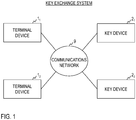
- the key exchange system of the present embodiment includes, as depicted in Fig. 1 , for example, two terminal devices 1 1 and 1 2 that perform exchange of a common key and two key devices 2 1 and 2 2 corresponding to the terminal devices.
- the terminal devices 1 and the key devices 2 are connected in such a way that they can communicate with one another via a communications network 9.
- the communications network 9 can be configured as, for example, the Internet, a wide area network (WAN), a local area network (LAN), a dedicated line, a public switched telephone network, or a mobile telephone communications network.
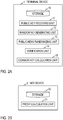
- the terminal device 1 includes, as depicted in Fig. 2A , for example, a storage 10, a public key receiving unit 11, a random number generating unit 12, a public keys randomizing unit 13, a verification unit 14, and a common key calculation unit 15.
- the key device 2 includes, as depicted in Fig. 2B , for example, a storage 20 and a proxy calculation unit 21.
- the terminal device 1 and the key device 2 are each a special device configured as a result of a special program being read into a publicly known or dedicated computer including, for example, a central processing unit (CPU), a main storage (random access memory: RAM), and so forth.
- the terminal device 1 and the key device 2 execute each processing under control of the central processing unit, for example.
- the data input to the terminal device 1 and the key device 2 and the data obtained by each processing are stored in the main storage, for example, and the data stored in the main storage is read therefrom when necessary and used for another processing.
- at least part of each processing unit of the terminal device 1 and the key device 2 may be configured by using hardware such as an integrated circuit.
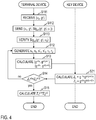
- FIG. 3 a processing procedure of a key exchange method of the present embodiment will be described.
- Fig. 3 only processing of the terminal device 1 1 and the key device 2 1 is depicted, but the terminal device 1 2 and the key device 2 2 perform similar processing.
- g is assumed to be an element of a group G whose order is a prime number p
- Zp is assumed to be a factor ring of the order p
- an assumption is made that x, y ⁇ Zp holds.
- a secret key x of the terminal device 1 1 is stored in the storage 20 of the key device 2 1 .
- a public key g x of the terminal device 1 1 is stored in the storage 10 of the terminal device 1 1 .
- a secret key y of the terminal device 1 2 is stored in the storage 20 of the key device 2 2 .
- a public key g y of the terminal device 1 2 is stored in the storage 10 of the terminal device 1 2 .
- Step S11 the public key receiving unit 11 of the terminal device 1 2 sends the public key g y of the terminal device 1 2 to the terminal device 1 1 .
- the public key receiving unit 11 of the terminal device 1 1 receives the public key g y from the terminal device 1 2 .
- the public key receiving unit 11 of the terminal device 1 1 sends the public key g x of the terminal device 1 1 to the terminal device 1 2 .
- the public key receiving unit 11 of the terminal device 1 2 receives the public key g x from the terminal device 1 1 .
- Step S12 the random number generating unit 12 of the terminal device 1 1 generates random numbers s 1 , s 2 , s' 1 , s' 2 , r 1 , and r 2 .
- r 1 and r 2 may be arbitrary numbers.
- the random number generating unit 12 of the terminal device 1 2 generates s 3 , s 4 , s' 3 , s' 4 , r 3 , and r 4 .
- r 3 and r 4 may be arbitrary numbers.
- the public keys randomizing unit 13 of the terminal device 1 1 calculates, by Formula (1), values (hereinafter referred to as first randomized public keys information) obtained by randomizing a set of the public key g x of the terminal device 1 1 and the public key g y of the terminal device 1 2 by using the random numbers s 1 and r 1 .
- the public keys randomizing unit 13 calculates, by Formula (2), values (hereinafter referred to as second randomized public keys information) obtained by randomizing a set of the public key g x of the terminal device 1 1 and the public key g y of the terminal device 1 2 by using the random numbers s 2 and r 2 .
- the public keys randomizing unit 13 sends a pair of the calculated first randomized public keys information and second randomized public keys information to the key device 2 1 .
- the first randomized public keys information can be calculated in the following manner.
- g x is raised to the -r 1 -th power to calculate g -r1x .
- g y is raised to the s 1 -th power to calculate g s1y .
- g is raised to the r 1 -th power to calculate g r1 .
- g s1y and g r1 are multiplied together to calculate g s1y+r1 .
- the second randomized public keys information can also be calculated in a similar manner.
- the public keys randomizing unit 13 of the terminal device 1 2 calculates, by Formula (3), values (hereinafter referred to as first randomized public keys information) obtained by randomizing a set of the public key g x of the terminal device 1 1 and the public key g y of the terminal device 1 2 by using the random numbers s 3 and r 3 .
- the public keys randomizing unit 13 calculates, by Formula (4), values (hereinafter referred to as second randomized public keys information) obtained by randomizing a set of the public key g x of the terminal device 1 1 and the public key g y of the terminal device 1 2 by using the random numbers s 4 and r 4 .
- the public keys randomizing unit 13 sends a pair of the calculated first randomized public keys information and second randomized public keys information to the key device 2 2 .
- Step S21 the proxy calculation unit 21 of the key device 2 1 calculates, by Formula (5), a value Z 1 (hereinafter referred to as a first commission result) necessary for calculation of a common key from the first randomized public keys information by using the secret key x. Moreover, the proxy calculation unit 21 calculates, by Formula (6), a value Z 2 (hereinafter referred to as a second commission result) necessary for calculation of the common key from the second randomized public keys information by using the secret key x. The proxy calculation unit 21 sends the calculated first commission result Z 1 and second commission result Z 2 to the terminal device 1 1 .
- Z 1 g ⁇ r 1 x g s 1 y + r 1 x
- Z 2 g ⁇ r 2 x g s 2 y + r 2 x
- the first commission result Z 1 can be calculated in the following manner.
- g s1y+r1 is raised to the x-th power to calculate g (s1y+r1)x .
- g r1x and g (s1y+r1)x are multiplied together to calculate g -r1x g (s1y+r1)x .
- the second commission result Z 2 can also be calculated in a similar manner.
- the proxy calculation unit 21 of the key device 2 2 calculates, by Formula (7), a value Z 3 (hereinafter referred to as a first commission result) necessary for calculation of the common key from the first randomized public keys information by using the secret key y. Moreover, the proxy calculation unit 21 calculates, by Formula (8), a value Z 4 (hereinafter referred to as a second commission result) necessary for calculation of the common key from the second randomized public keys information by using the secret key y. The proxy calculation unit 21 sends the calculated first commission result Z 3 and second commission result Z 4 to the terminal device 1 2 .
- Z 3 g ⁇ r 3 x g s 3 y + r 3 x
- Z 4 g ⁇ r 4 x g s 4 y + r 4 x
- Step S 14 the verification unit 14 of the terminal device 1 1 verifies, by Formula (9), whether or not a value (hereinafter referred to as a first verification value) obtained by raising the first commission result Z 1 to the s 2 -th power and a value (hereinafter referred to as a second verification value) obtained by raising the second commission result Z 2 to the s 1 -th power coincide with each other.
- a value hereinafter referred to as a first verification value obtained by raising the first commission result Z 1 to the s 2 -th power
- a value hereinafter referred to as a second verification value
- the verification unit 14 of the terminal device 1 2 verifies, by Formula (10), whether or not a value (hereinafter referred to as a first verification value) obtained by raising the first commission result Z 3 to the s 4 -th power and a value (hereinafter referred to as a second verification value) obtained by raising the second commission result Z 4 to the s 3 -th power coincide with each other. If the first verification value and the second verification value coincide with each other, the processing proceeds to Step S15. If the first verification value and the second verification value do not coincide with each other, the processing is returned to Step S12.
- Step S 15 the common key calculation unit 15 of the terminal device 1 1 calculates, by Formula (11), a common key K from the first commission result Z 1 and the second commission result Z 2 by using the random numbers s' 1 and s' 2 .
- the common key calculation unit 15 of the terminal device 1 2 calculates, by Formula (12), the common key K from the first commission result Z 3 and the second commission result Z 4 by using the random numbers s' 3 and s' 4 .
- K Z 1 s 1 ′ * Z 2 s 2 ′
- K Z 3 s 3 ′ * Z 4 s 4 ′
- Step S 13 the public keys randomizing unit 13 of the terminal device 1 1 sends, to the key device 2 1 , only g s1y+r1 as the first randomized public keys information and only g s2y+r2 as the second randomized public keys information. At this time, the public keys randomizing unit 13 holds g -r1x and g -r2x .
- Step S21 the proxy calculation unit 21 of the key device 2 1 calculates a first commission result Z' 1 and a second commission result Z' 2 by Formula (13).
- Z 1 ′ g s 1 y + r 1 x
- Z 2 ′ g s 2 y + r 2 x ,
- Step S 14 the verification unit 14 of the terminal device 1 1 calculates a first commission result Z 1 and a second commission result Z 2 by Formula (14).
- Z 1 g ⁇ r 1 x
- Z 1 ′ g ⁇ r 1 x g s 1 y + r 1 x
- Z 2 g ⁇ r 2 x
- Z 2 ′ g ⁇ r 2 x g s 2 y + r 2 x
- a second embodiment is an authentication key exchange system using self-correction and a digital signature.
- a public key g x of the terminal device 1 1 a signature key Sig u1 of the terminal device 1 1 , a verification key Ver u2 of the terminal device 1 2 , and a user identifier u 1 of the terminal device 1 1 are stored.
- a secret key x of the terminal device 1 1 is stored in the storage 10 of the terminal device 1 1 .
- a public key g y of the terminal device 1 2 a signature key Sig u2 of the terminal device 1 2 , a verification key Ver u1 of the terminal device 1 1 , and a user identifier u 2 of the terminal device 1 2 are stored.
- a secret key y of the terminal device 1 2 is stored in the storage 20 of the key device 2 2 .
- Step S111 the public key receiving unit 11 of the terminal device 1 2 sends a set (u 2 , g y ) of the user identifier u 2 and the public key g y to the terminal device 1 1 .
- the public key receiving unit 11 of the terminal device 1 1 receives (u 2 , g y ) from the terminal device 1 2 .
- the public key receiving unit 11 of the terminal device 1 1 sends a set (u 1 , g x ) of the user identifier u 1 and the public key g x to the terminal device 1 2 .
- the public key receiving unit 11 of the terminal device 1 2 receives (u 1 , g x ) from the terminal device 1 1 .
- Step S112 the public key receiving unit 11 of the terminal device 1 1 generates a signature Sig u1 (g x , g y , u 1 ) for a set of the public key g x , the public key g y , and the user identifier u 1 by using the signature key Sig u1 and sends (u 1 , g x , Sig u1 (g x , g y , u1 )) to the terminal device 1 2 .
- the public key receiving unit 11 of the terminal device 1 2 receives (u 1 , g x , Sig u1 (g x , g y , u 1 )) from the terminal device 1 1 .
- the public key receiving unit 11 of the terminal device 1 2 generates a signature Sig u2 (g x , g y , u 2 ) for a set of the public key g x , the public key g y , and the user identifier u 2 by using the signature key Sig u2 and sends (u 2 , g y , Sig u2 (g x , g y , u 2 )) to the terminal device 1 1 .
- the public key receiving unit 11 of the terminal device 1 1 receives (u 2 , g y , Sig u2 (g x , g y , u 2 )) from the terminal device 1 2 .
- Step S113 the public key receiving unit 11 of the terminal device 1 1 verifies the signature Sig u2 (g x , g y , u 2 ) by using the verification key Ver u2 .
- the public key receiving unit 11 of the terminal device 1 2 verifies the signature Sig u1 (g x , g y , u 1 ) by using the verification key Ver u1 . If the signature Sig u2 (g x , g y , u 2 ) and the signature Sig u1 (g x , g y , u 1 ) are correct, the processing proceeds to Step S12. If the signature Sig u2 (g x , g y , u 2 ) or the signature Sig u1 (g x , g y , u 1 ) is not correct, the processing is ended.
- a third embodiment is an MQV key exchange system using self-correction.
- a fixed secret key a ⁇ Zp of the terminal device 1 1 is stored in the storage 20 of the key device 2 1 .
- a fixed public key A g a of the terminal device 1 1
- a temporary secret key x ⁇ Zp of the terminal device 1 1 is stored in the storage 10 of the terminal device 1 1 .
- a fixed secret key b ⁇ Zp of the terminal device 1 2 is stored in the storage 20 of the key device 2 2 .
- a fixed public key B g b of the terminal device 1 2
- Step S111 the public key receiving unit 11 of the terminal device 1 2 sends a set (B, Y) of the fixed public key B and the temporary public key Y to the terminal device 1 1 .
- the public key receiving unit 11 of the terminal device 1 1 receives (B, Y) from the terminal device 1 2 .
- the public key receiving unit 11 of the terminal device 1 1 sends a set (A, X) of the fixed public key A and the temporary public key X to the terminal device 1 2 .
- the public key receiving unit 11 of the terminal device 1 2 receives (A, X) from the terminal device 1 1 .
- and a value d ⁇ X ⁇
- means a higher-order p bit when ⁇ is expressed in bits.
- and a value d ⁇ X ⁇
- Step S 13 the public keys randomizing unit 13 of the terminal device 1 1 calculates first randomized public keys information by Formula (15). Moreover, the public keys randomizing unit 13 calculates second randomized public keys information by Formula (16). The public keys randomizing unit 13 sends a pair of the calculated first randomized public keys information and second randomized public keys information to the key device 2 1 .
- the first randomized public keys information can be calculated in the following manner.
- g a is raised to the -r 1 -th power to calculate g -r1a .
- g b is raised to the e-th power to calculate g be , which is multiplied by g y to calculate g y+be
- g y+be is raised to the s 1 -th power to calculate g (y+be)s1 .
- g is raised to the r 1 -th power to calculate g r1
- g (y+be)s1 and g r1 are multiplied together to calculate g (y+be)s1+r1 .
- the second randomized public keys information can also be calculated in a similar manner.
- the public keys randomizing unit 13 of the terminal device 1 2 calculates first randomized public keys information by Formula (17). Moreover, the public keys randomizing unit 13 calculates second randomized public keys information by Formula (18). The public keys randomizing unit 13 sends a pair of the calculated first randomized public keys information and second randomized public keys information to the key device 2 2 .
- Step S21 the proxy calculation unit 21 of the key device 2 1 calculates a first commission result Z 1 by Formula (19). Moreover, the proxy calculation unit 21 calculates a second commission result Z 2 by Formula (20). The proxy calculation unit 21 sends the calculated first commission result Z 1 and second commission result Z 2 to the terminal device 1 1 .
- Z 1 g ⁇ r 1 a g y + be s 1 a + r 1 a
- Z 2 g ⁇ r 2 a g y + be s 2 a + r 2 a
- the proxy calculation unit 21 of the key device 2 2 calculates a first commission result Z 3 by Formula (21). Moreover, the proxy calculation unit 21 calculates a second commission result Z 4 by Formula (22). The proxy calculation unit 21 sends the calculated first commission result Z 3 and second commission result Z 4 to the terminal device 1 2 .
- Z 3 g ⁇ r 3 b g x + ad s 3 b + r 3 b
- Z 4 g ⁇ r 4 b g x + ad s 4 b + r 4 b
- Step S 151 the common key calculation unit 15 of the terminal device 1 1 calculates, by Formula (23), a value YB ea from the first commission result Z 1 and the second commission result Z 2 by using the random numbers s' 1 and s' 2 .
- the common key calculation unit 15 of the terminal device 1 2 calculates, by Formula (24), a value XA db from the first commission result Z 3 and the second commission result Z 4 by using the random numbers s' 3 and s' 4 .
- Step S152 the common key calculation unit 15 of the terminal device 1 1 calculates a common key K by Formula (25).
- KDF is a key derivation function, which is a function that randomizes an input value.
- the common key calculation unit 15 of the terminal device 1 2 calculates the common key K by Formula (26).
- K KDF YB e x + ad
- K KDF XA d y + be
- (YB e ) x+ad can be calculated in the following manner.
- YB e is raised to the x-th power to calculate YB ex .
- YB ea is raised to the d-th power to calculate YB ead .
- YB ex and YB ead are multiplied together to calculate (YB e ) x+ad .
- (XA d ) y+be can also be calculated in a similar manner.
- Step S 13 the public keys randomizing unit 13 of the terminal device 1 1 sends, to the key device 2 1 , only g (y+be)s1+r1 as the first randomized public keys information and only g (y+be)s2+r2 as the second randomized public keys information. At this time, the public keys randomizing unit 13 holds g -r1a and g -r2a .
- Step S21 the proxy calculation unit 21 of the key device 2 1 calculates a first commission result Z 1 ' and a second commission result Z 2 ' by Formula (27).
- Z 1 ′ g y + be s 1 a + r 1 a
- Z 2 ′ g y + be s 2 a + r 2 a ,
- Step S 14 the verification unit 14 of the terminal device 1 1 calculates a first commission result Z 1 and a second commission result Z 2 by Formula (28).
- Z 1 g ⁇ r 1 a
- Z 1 ′ g ⁇ r 1 a g y + be s 1 a + r 1 a
- Z 2 g ⁇ r 2 a
- Z 2 ′ g ⁇ r 2 a g y + be s 2 a + r 2 a
- a fourth embodiment is an HMQV key exchange system using self-correction.
- H( ⁇ ) is a cryptographic hash function. Examples of the cryptographic hash function include SHA-1, SHA-2, and so forth.
- the present embodiment differs from the third embodiment only in that the values e and d are determined by the hash function and the other processing is similar to that of the third embodiment.
- a fifth embodiment is an id-id AKE method using self-correction.
- the present embodiment is a configuration in which, in particular, the key device holds a secret key and the terminal device generates a short-term secret key.
- a key exchange system of the present embodiment includes a key generating device 3.
- ⁇ is assumed to be a security parameter
- G 1 , G 2 , and G T are assumed to be cyclic groups whose order is a prime number q with ⁇ bit length
- g 1 , g 2 , and g T are assumed to be generators of the groups G 1 , G 2 , and G T , respectively.
- An assumption is made that e: G 1 x G 2 ⁇ G T is pairing.
- g T e(g 1 , g 2 ) is assumed to be satisfied.
- c i,0,0 , c i,0,1 , c i,1,0 , and c i,1,1 may be constants or may be numbers which are determined depending on a short-term public key, a public key, a user ID, or the like.
- key generation is performed in the following manner.
- Step S111 the public key receiving unit 11 of the terminal device 1 1 sends information (ID A , ID B , X A,1 , X A,2 ) formed of the identifiers and the short-term public keys to the terminal device 1 2 .
- the public key receiving unit 11 of the terminal device 1 2 receives the information (ID A , ID B , X A,1 , X A,2 ) from the terminal device 1 1 .
- the public key receiving unit 11 of the terminal device 1 2 sends information (ID A , ID B , X B,1 , X B,2 ) formed of the identifiers and the short-term public keys to the terminal device 1 1 .
- the public key receiving unit 11 of the terminal device 1 1 receives the information (ID A , ID B , X B,1 , X B,2 ) from the terminal device 1 2 .
- Step S 112 the public key receiving unit 11 of the terminal device 1 1 checks whether or not Formula (30) holds. Likewise, the public key receiving unit 11 of the terminal device 1 2 checks whether or not Formula (31) holds. If any one of these formulas is not correct, the processing is performed again from key generation.
- processing in Steps S121, S122, S13, S21, S14, and S 151 is repeatedly performed m times.
- Step S121 the random number generating unit 12 of the terminal device 1 1 performs calculation of Formula (32). Likewise, the random number generating unit 12 of the terminal device 1 2 performs calculation of Formula (33).
- Step S122 the random number generating unit 12 of the terminal device 1 1 generates random numbers s i1 , s i2 , s' i1 , s' i2 , r i1 , and r i2 .
- An assumption is made that r i1 and r i2 are arbitrary nonzero integers.
- the random number generating unit 12 of the terminal device 1 2 generates t i1 , t i2 , t' i1 , t' i2 , l i1 , and l i2 .
- An assumption is made that l i1 and l i2 are arbitrary nonzero integers.
- Step S 13 the public keys randomizing unit 13 of the terminal device 1 1 calculates, by Formula (34), values (hereinafter referred to as first randomized public keys information) obtained by randomizing the public key Q B,2 and the short-term public key X B,2 of the terminal device 1 2 by using the random numbers s i1 and r i1 . Moreover, the public keys randomizing unit 13 calculates, by Formula (35), values (hereinafter referred to as second randomized public keys information) obtained by randomizing the public key Q B,2 and the short-term public key X B,2 of the terminal device 1 2 by using the random numbers s i2 and r i2 .
- Formula (34) values obtained by randomizing the public key Q B,2 and the short-term public key X B,2 of the terminal device 1 2 by using the random numbers s i1 and r i1 .
- the public keys randomizing unit 13 sends a pair of the calculated first randomized public keys information and second randomized public keys information to the key device 2 1 .
- P i , B Q B , 2 c i , 0 , 0 X B , 2 c i , 0 , 1
- the public keys randomizing unit 13 of the terminal device 1 2 calculates, by Formula (36), values (hereinafter referred to as first randomized public keys information) obtained by randomizing the public key Q A,1 and the short-term public key X A,1 of the terminal device 1 1 by using the random numbers t i1 and l i1 .
- the public keys randomizing unit 13 calculates, by Formula (37), values (hereinafter referred to as second randomized public keys information) obtained by randomizing the public key Q A,1 and the short-term public key X A,1 of the terminal device 1 1 by using the random numbers t i2 and l i2 .
- the public keys randomizing unit 13 sends a pair of the calculated first randomized public keys information and second randomized public keys information to the key device 2 2 .
- P i , A Q A , 1 c i , 0 , 0 X A , 1 c i , 1 , 0
- Step S21 the proxy calculation unit 21 of the key device 2 1 calculates, by Formula (38), a value ⁇ A,i1 (hereinafter referred to as a first commission result) necessary for calculation of a common key from the first randomized public keys information by using the secret key D A,1 . Moreover, the proxy calculation unit 21 calculates, by Formula (39), a value ⁇ A,i2 (hereinafter referred to as a second commission result) necessary for calculation of the common key from the second randomized public keys information by using the secret key D A,2 . The proxy calculation unit 21 sends the calculated first commission result ⁇ A,i1 and second commission result ⁇ A,i2 to the terminal device 1 1 .
- Formula (38) a value necessary for calculation of a common key from the first randomized public keys information by using the secret key D A,1 .
- a value ⁇ A,i2 hereinafter referred to as a second commission result
- the proxy calculation unit 21 of the key device 2 2 calculates, by Formula (40), a value ⁇ B,i1 (hereinafter referred to as a first commission result) necessary for calculation of the common key from the first randomized public keys information by using the secret key D B,2 .
- the proxy calculation unit 21 calculates, by Formula (41), a value ⁇ B,i2 (hereinafter referred to as a second commission result) necessary for calculation of the common key from the second randomized public keys information by using the secret key D B,2 .
- the proxy calculation unit 21 sends the calculated first commission result ⁇ B,i1 and second commission result ⁇ B,i2 to the terminal device 1 2 .
- Step S 14 the verification unit 14 of the terminal device 1 1 verifies, by Formula (42), whether or not a value (hereinafter referred to as a first verification value) obtained by raising the first commission result ⁇ A,i1 to the s i2 -th power and a value (hereinafter referred to as a second verification value) obtained by raising the second commission result ⁇ A,i2 to the s i1 -th power coincide with each other.
- a value hereinafter referred to as a first verification value obtained by raising the first commission result ⁇ A,i1 to the s i2 -th power
- a value hereinafter referred to as a second verification value
- the verification unit 14 of the terminal device 1 2 verifies, by Formula (43), whether or not a value (hereinafter referred to as a first verification value) obtained by raising the first commission result ⁇ B,i1 to the t i2 -th power and a value (hereinafter referred to as a second verification value) obtained by raising the second commission result ⁇ B,i2 to the t i1 -th power coincide with each other. If the first verification value and the second verification value coincide with each other, the processing proceeds to Step S 151. If the first verification value and the second verification value do not coincide with each other, the processing is returned to Step S122.
- Step S151 the common key calculation unit 15 of the terminal device 1 1 calculates, by Formula (44), a commission result ⁇ A,i from the first commission result ⁇ A,i1 and the second commission result ⁇ A,i2 by using the random numbers s' i1 and s' i2 .
- the common key calculation unit 15 of the terminal device 1 2 calculates, by Formula (45), a commission result ⁇ B,i from the first commission result ⁇ B,i1 and the second commission result ⁇ B,i2 by using the random numbers t' i1 and t' i2 .
- Step S153 the common key calculation unit 15 of the terminal device 1 1 calculates values ⁇ m+1 and ⁇ m+2 by Formula (48). Likewise, the common key calculation unit 15 of the terminal device 1 2 calculates values ⁇ m+1 and ⁇ m+2 by Formula (49).
- Step S 154 the common key calculation units 15 of the terminal device 1 1 and the terminal device 1 2 calculate a common key K by using the values ⁇ 1 , ..., ⁇ m+2 by using Formula (50).
- K H ⁇ 1 , ... , ⁇ m + 2 , ID A , ID B , X A , 1 , X A , 2 , X B , 1 , X B , 2
- Modification 5-1 is a modification of the id-id AKE method using self-correction of the fifth embodiment.
- the present modification is a configuration in which, in particular, in a configuration in which the key device holds a secret key and the key device generates a short-term secret key, the key device is commissioned to calculate a power of the group G T .
- key generation is performed in the following manner.
- Steps S121, S122, S13, S21, S 14, and S151 is repeatedly performed m times
- processing in the following Steps S121b, S122b, S13b, S21b, S 14b, and S151b is repeatedly performed m+2 times.
- i 1, ..., m+2
- Step S121b the random number generating unit 12 of the terminal device 1 1 performs calculation of Formula (52). Likewise, the random number generating unit 12 of the terminal device 1 2 performs calculation of Formula (53).
- Step S122b the random number generating unit 12 of the terminal device 1 1 generates random numbers S i21 , S i22 , S' i21 , S' i22 , r i21 , and r i22 .
- An assumption is made that r i21 and r i22 are arbitrary nonzero integers.
- the random number generating unit 12 of the terminal device 1 2 generates random numbers t i21 , t i22 , t' i21 , t' i22 , l i21 , and l i22 .
- An assumption is made that l i21 and l i22 are arbitrary nonzero integers.
- Step S13b the public keys randomizing unit 13 of the terminal device 1 1 calculates, by Formula (54), values (hereinafter referred to as first randomized public keys information) obtained by randomizing the public key Q B,2 and the short-term public key X B,2 of the terminal device 1 2 by using the random numbers s i21 and r i21 . Moreover, the public keys randomizing unit 13 calculates, by Formula (55), values (hereinafter referred to as second randomized public keys information) obtained by randomizing the public key Q B,2 and the short-term public key X B,2 of the terminal device 1 2 by using the random numbers s i22 and r i22 .
- Formula (54) values obtained by randomizing the public key Q B,2 and the short-term public key X B,2 of the terminal device 1 2 by using the random numbers s i21 and r i21 .
- the public keys randomizing unit 13 sends a pair of the calculated first randomized public keys information and second randomized public keys information to the key device 2 1 .
- the public keys randomizing unit 13 of the terminal device 1 2 calculates, by Formula (56), values (hereinafter referred to as first randomized public keys information) obtained by randomizing the public key Q A,1 and the short-term public key X A,1 of the terminal device 1 1 by using the random numbers t i21 and l i21 .
- the public keys randomizing unit 13 calculates, by Formula (57), values (hereinafter referred to as second randomized public keys information) obtained by randomizing the public key Q A,1 and the short-term public key X A,1 of the terminal device 1 1 by using the random numbers t i22 and l i22 .
- the public keys randomizing unit 13 sends a pair of the calculated first randomized public keys information and second randomized public keys information to the key device 2 2 .
- Step S21b the proxy calculation unit 21 of the key device 2 1 calculates, by Formula (58), a value ⁇ A,i1 (hereinafter referred to as a first commission result) necessary for calculation of a common key from the first randomized public keys information by using a short-term secret key x A . Moreover, the proxy calculation unit 21 calculates, by Formula (59), a value ⁇ A,i2 (hereinafter referred to as a second commission result) necessary for calculation of the common key from the second randomized public keys information by using the short-term secret key x A . The proxy calculation unit 21 sends the calculated first commission result ⁇ A,i1 and second commission result ⁇ A,i2 to the terminal device 1 1 .
- Formula (58) a value necessary for calculation of a common key from the first randomized public keys information by using a short-term secret key x A .
- the proxy calculation unit 21 calculates, by Formula (59), a value ⁇ A,i2 (hereinafter referred to as a second commission
- the proxy calculation unit 21 of the key device 2 2 calculates, by Formula (60), a value ⁇ B,i1 (hereinafter referred to as a first commission result) necessary for calculation of the common key from the first randomized public keys information by using a short-term secret key x B . Moreover, the proxy calculation unit 21 calculates, by Formula (61), a value ⁇ B,i2 (hereinafter referred to as a second commission result) necessary for calculation of the common key from the second randomized public keys information by using the short-term secret key x B . The proxy calculation unit 21 sends the calculated first commission result ⁇ B,i1 and second commission result ⁇ B,i2 to the terminal device 1 2 .
- Step S 14b the verification unit 14 of the terminal device 1 1 verifies, by Formula (62), whether or not a value (hereinafter referred to as a first verification value) obtained by raising the first commission result ⁇ A,i1 to the s i22 -th power and a value (hereinafter referred to as a second verification value) obtained by raising the second commission result ⁇ A,i2 to the s i21 -th power coincide with each other.
- a value hereinafter referred to as a first verification value obtained by raising the first commission result ⁇ A,i1 to the s i22 -th power
- a value hereinafter referred to as a second verification value
- the verification unit 14 of the terminal device 1 2 verifies, by Formula (63), whether or not a value (hereinafter referred to as a first verification value) obtained by raising the first commission result ⁇ B,i1 to the t i22 -th power and a value (hereinafter referred to as a second verification value) obtained by raising the second commission result ⁇ B,i2 to the t i21 -th power coincide with each other. If the first verification value and the second verification value coincide with each other, the processing proceeds to Step S151b. If the first verification value and the second verification value do not coincide with each other, the processing is returned to Step S122b.
- Step S151b the common key calculation unit 15 of the terminal device 1 1 calculates, by Formula (64), a commission result ⁇ A,i from the first commission result ⁇ A,i1 and the second commission result ⁇ A,i2 by using the random numbers s' i21 and s' i22 .
- the common key calculation unit 15 of the terminal device 1 2 calculates, by Formula (65), a commission result ⁇ B,i from the first commission result ⁇ B,i1 and the second commission result ⁇ B,i2 by using the random numbers t' i21 and t' i22 .
- Step S153 the common key calculation unit 15 of the terminal device 1 1 calculates values ⁇ m+1 and ⁇ m+2 by Formula (68). Likewise, the common key calculation unit 15 of the terminal device 1 2 calculates values ⁇ m+1 and ⁇ m+2 by Formula (69).
- ⁇ m + 1 X B , 1 x A
- ⁇ m + 2 X B , 2 x A
- ⁇ m + 1 X A , 1 x B
- ⁇ m + 2 X A , 2 x B
- Step S154 the common key calculation unit 15 of the terminal device 1 1 and the common key calculation unit 15 of the terminal device 1 2 calculate a common key K by using the values ⁇ 1 , ..., ⁇ m+2 by Formula (70).
- K H ⁇ 1 , ... , ⁇ m + 2 , ID A , ID B , X A , 1 , X A , 2 , X B , 1 , X B , 2
- Modification 5-2 is a modification of the id-id AKE method using self-correction of the fifth embodiment.
- the present modification is a configuration in which, in particular, in a configuration in which the key device holds a secret key and the key device generates a short-term secret key, the key device is commissioned to calculate pairing of the group G T .
- Steps S121, S122, S13, S21, S 14, and S 151 are repeatedly performed m times.
- processing in the following Steps S121c, S122c, S 13 c, S21c, S14c, and S 151 c is repeatedly performed m times.
- i 1, ..., m
- Step S122c the random number generating unit 12 of the terminal device 1 1 generates random numbers s i31 , s i32 , s' i31 , s' i32 , r i31 , and r i32 .
- An assumption is made that r i31 and r i32 are arbitrary nonzero integers.
- the random number generating unit 12 of the terminal device 1 2 generates random numbers t i31 , t i32 , t' i31 , t' i32 , l i31 , and l i32 .
- An assumption is made that l i31 and l i32 are arbitrary nonzero integers.
- Step S13c the public keys randomizing unit 13 of the terminal device 1 1 calculates, by Formula (73), values (hereinafter referred to as first randomized public keys information) obtained by randomizing the public key Q B,2 and the short-term public key X B,2 of the terminal device 1 2 by using the random numbers s i31 and r i31 . Moreover, the public keys randomizing unit 13 calculates, by Formula (74), values (hereinafter referred to as second randomized public keys information) obtained by randomizing the public key Q B,2 and the short-term public key X B,2 of the terminal device 1 2 by using the random numbers s i32 and r i32 .
- Formula (73) values obtained by randomizing the public key Q B,2 and the short-term public key X B,2 of the terminal device 1 2 by using the random numbers s i32 and r i32 .
- the public keys randomizing unit 13 sends a pair of the calculated first randomized public keys information and second randomized public keys information to the key device 2 1 .
- P i , B ′ Q B , 2 c i , 1 , 0 X B , 2 c i , 1 , 1
- the public keys randomizing unit 13 of the terminal device 1 2 calculates, by Formula (75), values (hereinafter referred to as first randomized public keys information) obtained by randomizing the public key Q A,1 and the short-term public key X A,1 of the terminal device 1 1 by using the random numbers t i31 and l i31 .
- the public keys randomizing unit 13 calculates, by Formula (76), values (hereinafter referred to as second randomized public keys information) obtained by randomizing the public key Q A,1 and the short-term public key X A,1 of the terminal device 1 1 by using the random numbers t i32 and l i32 .
- the public keys randomizing unit 13 sends a pair of the calculated first randomized public keys information and second randomized public keys information to the key device 2 2 .
- P i , B ′ Q A , 1 c i , 0 , 1 X A , 1 c i , 1 , 1
- Step S21c the proxy calculation unit 21 of the key device 2 1 calculates, by Formula (77), a value ⁇ A,i1 (hereinafter referred to as a first commission result) necessary for calculation of a common key from the first randomized public keys information by using a short-term secret key X A . Moreover, the proxy calculation unit 21 calculates, by Formula (78), a value ⁇ A,i2 (hereinafter referred to as a second commission result) necessary for calculation of the common key from the second randomized public keys information by using the short-term secret key X A . The proxy calculation unit 21 sends the calculated first commission result ⁇ A,i1 and second commission result ⁇ A,i2 to the terminal device 1 1 .
- Formula (77) a value necessary for calculation of a common key from the first randomized public keys information by using a short-term secret key X A .
- the proxy calculation unit 21 calculates, by Formula (78), a value ⁇ A,i2 (hereinafter referred to as a second commission
- the proxy calculation unit 21 of the key device 2 2 calculates, by Formula (79), a value ⁇ B,i1 (hereinafter referred to as a first commission result) necessary for calculation of the common key from the first randomized public keys information by using a short-term secret key x B . Moreover, the proxy calculation unit 21 calculates, by Formula (80), a value ⁇ B,i2 (hereinafter referred to as a second commission result) necessary for calculation of the common key from the second randomized public keys information by using the short-term secret key x B .
- Step S 14c the verification unit 14 of the terminal device 1 1 verifies, by Formula (81), whether or not a value (hereinafter referred to as a first verification value) obtained by raising the first commission result ⁇ A,i1 to the S i32 -th power and a value (hereinafter referred to as a second verification value) obtained by raising the second commission result ⁇ A,i2 to the s i31 -th power coincide with each other.
- a value hereinafter referred to as a first verification value obtained by raising the first commission result ⁇ A,i1 to the S i32 -th power
- a value hereinafter referred to as a second verification value
- the verification unit 14 of the terminal device 1 2 verifies, by Formula (82), whether or not a value (hereinafter referred to as a first verification value) obtained by raising the first commission result ⁇ B,i1 to the t i32 -th power and a value (hereinafter referred to as a second verification value) obtained by raising the second commission result ⁇ B,i2 to the t i31 -th power coincide with each other. If the first verification value and the second verification value coincide with each other, the processing proceeds to Step S151c. If the first verification value and the second verification value do not coincide with each other, the processing is returned to Step S122c.
- Step S151c the common key calculation unit 15 of the terminal device 1 1 calculates, by Formula (83), a commission result ⁇ A,i from the first commission result ⁇ A,i1 and the second commission result ⁇ A,i2 by using the random numbers s' i31 and s' i32 ⁇
- the common key calculation unit 15 of the terminal device 1 2 calculates, by Formula (84), a commission result ⁇ B,i from the first commission result ⁇ B,i1 and the second commission result ⁇ B,i2 by using the random numbers t' i21 and t' i22 .
- a sixth embodiment is a cert-cert AKE method using self-correction.
- the present embodiment is, in particular, a configuration in which the key device holds a secret key and the terminal device generates a short-term secret key.
- a key exchange system of the present embodiment includes a certificate authority device 4.
- key generation is performed in the following manner.
- the certificate authority device 4 authenticates the public key S A of the terminal device 1 1 and the public key S B of the terminal device 1 2 .
- Step S11 the public key receiving unit 11 of the terminal device 1 1 sends information (S A , X A ) formed of the public key and the short-term public key to the terminal device 1 2 .
- the public key receiving unit 11 of the terminal device 1 2 receives the information (S A , X A ) from the terminal device 1 1 .
- the public key receiving unit 11 of the terminal device 1 2 sends information (S B , X B ) formed of the public key and the short-term public key to the terminal device 1 1 .
- the public key receiving unit 11 of the terminal device 1 1 receives the information (S B , X B ) from the terminal device 1 2 .
- processing in Steps S12, S13, S21, S14, and S151 is repeatedly performed m times.
- Step S12 the random number generating unit 12 of the terminal device 1 1 generates random numbers s i1 , s i2 , s' i1 , s' i2 ⁇ Z and group elements g 1 , g 2 ⁇ G.
- An assumption is made that g 1 and g 2 are elements which are not unit elements of the group G.
- the random number generating unit 12 of the terminal device 1 2 generates random numbers t i1 , t i2 , t' i1 , t' i2 ⁇ Z and group elements g 3 , g 4 ⁇ G.
- An assumption is made that g 3 and g 4 are elements which are not unit elements of the group G.
- the public keys randomizing unit 13 of the terminal device 1 1 calculates, by Formula (85), values (hereinafter referred to as first randomized public keys information) obtained by randomizing the public key S B and the short-term public key X B of the terminal device 1 2 by using the random number s i1 . Moreover, the public keys randomizing unit 13 calculates, by Formula (86), values (hereinafter referred to as second randomized public keys information) obtained by randomizing the public key S B and the short-term public key X B of the terminal device 1 2 by using the random number s i2 . The public keys randomizing unit 13 sends a pair of the calculated first randomized public keys information and second randomized public keys information to the key device 2 1 .
- Formula (85) values obtained by randomizing the public key S B and the short-term public key X B of the terminal device 1 2 by using the random number s i1 .
- the public keys randomizing unit 13 calculates, by Formula (86), values (hereinafter referred to as second randomized
- the public keys randomizing unit 13 of the terminal device 1 2 calculates, by Formula (87), values (hereinafter referred to as first randomized public keys information) obtained by randomizing the public key S A and the short-term public key X A of the terminal device 1 1 by using the random number t i1 .
- the public keys randomizing unit 13 calculates, by Formula (88), values (hereinafter referred to as second randomized public keys information) obtained by randomizing the public key S A and the short-term public key X A of the terminal device 1 1 by using the random number ti 2 .
- the public keys randomizing unit 13 sends a pair of the calculated first randomized public keys information and second randomized public keys information to the key device 2 2 .
- Step S21 the proxy calculation unit 21 of the key device 2 1 calculates, by Formula (89), a value ⁇ A,i1 (hereinafter referred to as a first commission result) necessary for calculation of a common key for a homomorphism F A : G ⁇ G, h ⁇ h xA . Moreover, the proxy calculation unit 21 calculates, by Formula (90), a value ⁇ A,i2 (hereinafter referred to as a second commission result) necessary for calculation of the common key. The proxy calculation unit 21 sends the calculated first commission result ⁇ A,i1 and second commission result ⁇ A,i2 to the terminal device 1 1 .
- Formula (89) a value necessary for calculation of a common key for a homomorphism F A : G ⁇ G, h ⁇ h xA .
- the proxy calculation unit 21 calculates, by Formula (90), a value ⁇ A,i2 (hereinafter referred to as a second commission result) necessary for calculation of the common key.
- the proxy calculation unit 21 of the key device 2 2 calculates, by Formula (91), a value ⁇ B,i1 (hereinafter referred to as a first commission result) necessary for calculation of the common key for a homomorphism F B : G ⁇ G, h ⁇ h xB . Moreover, the proxy calculation unit 21 calculates, by Formula (92), a value ⁇ B,i2 (hereinafter referred to as a second commission result) necessary for calculation of the common key. The proxy calculation unit 21 sends the calculated first commission result ⁇ B,i1 and second commission result ⁇ B,i2 to the terminal device 1 2 .
- Step S14 the verification unit 14 of the terminal device 1 1 verifies, by Formula (93), whether or not a value (hereinafter referred to as a first verification value) obtained by raising the first commission result ⁇ A,i1 to the s i2 -th power and a value (hereinafter referred to as a second verification value) obtained by raising the second commission result ⁇ A,i2 to the s i1 -th power coincide with each other.
- a value hereinafter referred to as a first verification value obtained by raising the first commission result ⁇ A,i1 to the s i2 -th power
- a value hereinafter referred to as a second verification value
- the verification unit 14 of the terminal device 1 2 verifies, by Formula (94), whether or not a value (hereinafter referred to as a first verification value) obtained by raising the first commission result ⁇ B,i1 to the t i2 -th power and a value (hereinafter referred to as a second verification value) obtained by raising the second commission result ⁇ B,i2 to the t i1 -th power coincide with each other. If the first verification value and the second verification value coincide with each other, the processing proceeds to Step S151. If the first verification value and the second verification value do not coincide with each other, the processing is returned to Step S12.
- Step S151 the common key calculation unit 15 of the terminal device 1 1 calculates, by Formula (95), a commission result ⁇ A,i from the first commission result ⁇ A,i1 and the second commission result ⁇ A,i2 by using the random numbers s' i1 and s' i2 .
- the common key calculation unit 15 of the terminal device 1 2 calculates, by Formula (96), a commission result ⁇ B,i from the first commission result ⁇ B,i1 and the second commission result ⁇ B,i2 by using the random numbers t' i1 and t' i2 .
- Step S154 the common key calculation units 15 of the terminal device 1 1 and the terminal device 1 2 calculate a common key K by using the values ⁇ 1 , ..., ..., ⁇ m by Formula (99).
- K H ⁇ 1 , ... , ⁇ m , S A , S B , X A , X B
- Modification 6 is a modification of the cert-cert AKE method using self-correction of the sixth embodiment.
- the present modification is a configuration in which, in particular, in a configuration in which the key device holds a secret key and the key device generates a short-term secret key, the key device is commissioned to calculate a power of the group G T .
- key generation is performed in the following manner.
- the certificate authority device 4 authenticates the public key S A of the terminal device 1 1 and the public key S B of the terminal device 1 2 .
- Steps S12, S13, S21, S14, and S151 are repeatedly performed m times.
- processing in the following Steps S12b, S13b, S21b, S14b, and S151b is repeatedly performed m times.
- i 1, ..., m
- Step S12b the random number generating unit 12 of the terminal device 1 1 generates random numbers s i21 , s i22 , s' i21 , s' i22 ⁇ Z and group elements g 1 , g 2 ⁇ G.
- An assumption is made that g 1 and g 2 are elements which are not unit elements of the group G.
- the random number generating unit 12 of the terminal device 1 2 generates random numbers t i21 , t i22 , t' i21 , t' i22 ⁇ Z and group elements g 3 , g 4 ⁇ G.
- An assumption is made that g 3 and g 4 are elements which are not unit elements of the group G.
- Step S13b the public keys randomizing unit 13 of the terminal device 1 1 calculates, by Formula (101), values (hereinafter referred to as first randomized public keys information) obtained by randomizing the public key S B and the short-term public key X B of the terminal device 1 2 by using the random number s i21 . Moreover, the public keys randomizing unit 13 calculates, by Formula (102), values (hereinafter referred to as second randomized public keys information) obtained by randomizing the public key S B and the short-term public key X B of the terminal device 1 2 by using the random number s i22 . The public keys randomizing unit 13 sends a pair of the calculated first randomized public keys information and second randomized public keys information to the key device 2 1 .
- Formula (101) values obtained by randomizing the public key S B and the short-term public key X B of the terminal device 1 2 by using the random number s i21 .
- the public keys randomizing unit 13 calculates, by Formula (102), values (hereinafter referred to
- the public keys randomizing unit 13 of the terminal device 1 2 calculates, by Formula (103), values (hereinafter referred to as first randomized public keys information) obtained by randomizing the public key S A and the short-term public key X A of the terminal device 1 1 by using the random number t i21 .
- the public keys randomizing unit 13 calculates, by Formula (104), values (hereinafter referred to as second randomized public keys information) obtained by randomizing the public key S A and the short-term public key X A of the terminal device 1 1 by using the random number t i22 .
- the public keys randomizing unit 13 sends a pair of the calculated first randomized public keys information and second randomized public keys information to the key device 2 2 .
- Step S21b the proxy calculation unit 21 of the key device 2 1 calculates, by Formula (105), a value ⁇ A,i1 (hereinafter referred to as a first commission result) necessary for calculation of a common key for a homomorphism F A,2 : G ⁇ G, h ⁇ h sA . Moreover, the proxy calculation unit 21 calculates, by Formula (106), a value ⁇ A,i2 (hereinafter referred to as a second commission result) necessary for calculation of the common key. The proxy calculation unit 21 sends the calculated first commission result ⁇ A,i1 and second commission result ⁇ A,i2 to the terminal device 1 1 .
- Formula (105) a value necessary for calculation of a common key for a homomorphism F A,2 : G ⁇ G, h ⁇ h sA .
- the proxy calculation unit 21 calculates, by Formula (106), a value ⁇ A,i2 (hereinafter referred to as a second commission result) necessary for calculation of
- the proxy calculation unit 21 of the key device 2 2 calculates, by Formula (107), a value ⁇ B,i1 (hereinafter referred to as a first commission result) necessary for calculation of the common key for a homomorphism F B,2 : G ⁇ G, h ⁇ h sB . Moreover, the proxy calculation unit 21 calculates, by Formula (108), a value ⁇ B,i2 (hereinafter referred to as a second commission result) necessary for calculation of the common key.
- Step S14b the verification unit 14 of the terminal device 1 1 verifies, by Formula (109), whether or not a value (hereinafter referred to as a first verification value) obtained by raising the first commission result ⁇ A,i1 to the s i22 -th power and a value (hereinafter referred to as a second verification value) obtained by raising the second commission result ⁇ A,i2 to the s i21 -th power coincide with each other.
- a value hereinafter referred to as a first verification value obtained by raising the first commission result ⁇ A,i1 to the s i22 -th power
- a value hereinafter referred to as a second verification value
- the verification unit 14 of the terminal device 1 2 verifies, by Formula (110), whether or not a value (hereinafter referred to as a first verification value) obtained by raising the first commission result ⁇ B,i1 to the t i2 -th power and a value (hereinafter referred to as a second verification value) obtained by raising the second commission result ⁇ B,i2 to the t i1 -th power coincide with each other. If the first verification value and the second verification value coincide with each other, the processing proceeds to Step S151b. If the first verification value and the second verification value do not coincide with each other, the processing is returned to Step S12b.
- Step S151b the common key calculation unit 15 of the terminal device 1 1 calculates, by Formula (111), a commission result ⁇ A,i from the first commission result ⁇ A,i1 and the second commission result ⁇ A,i2 by using the random numbers s' i21 and s' i22 ⁇
- the common key calculation unit 15 of the terminal device 1 2 calculates, by Formula (112), a commission result 00 ⁇ B,i from the first commission result ⁇ B,i1 and the second commission result ⁇ B,i2 by using the random numbers t' i1 and t' i2 .
- Step S154 the common key calculation units 15 of the terminal device 1 1 and the terminal device 1 2 calculate a common key K by using the values ⁇ 1 , ..., ..., ⁇ m by Formula (115).
- K H ⁇ 1 , ... , ⁇ m , S A , S B , X A , X B
- a seventh embodiment is a cert-id AKE method using self-correction.
- the present embodiment is a configuration in which, in particular, the key device holds a secret key and the terminal device generates a short-term secret key.
- a key exchange system of the present embodiment includes a key generating device 3 and a certificate authority device 4.
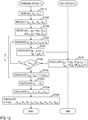
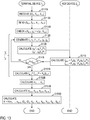
- Fig. 12 illustrates a processing flow of the terminal device 1 1 and the key device 2 1
- Fig. 13 illustrates a processing flow of the terminal device 1 2 and the key device 2 2 .
- key generation is performed in the following manner.
- the certificate authority device 4 authenticates a public key S B of the key device 2 2 .
- Step S111A the public key receiving unit 11 of the terminal device 1 1 sends information (ID A , X A,1 , X A,2 ) formed of the identifier and the short-term public keys to the terminal device 1 2 .
- Step S111B the public key receiving unit 11 of the terminal device 1 2 receives the information (ID A , X A,1 , X A,2 ) from the terminal device 1 1 .
- Step S 112B the public key receiving unit 11 of the terminal device 1 2 sends information (S B,1 , S B,2 , X B,1 , X B,2 ) formed of the public keys and the short-term public keys to the terminal device 1 1 .
- Step S112A the public key receiving unit 11 of the terminal device 1 1 receives the information (S B,1 , S B,2 , X B,1 , X B,2 ) from the terminal device 1 2 .
- Step S113A the public key receiving unit 11 of the terminal device 1 1 checks whether or not Formula (116) holds.
- Step S 113B the public key receiving unit 11 of the terminal device 1 2 checks whether or not Formula (117) holds. If any one of these formulas is not correct, the processing is performed again from key generation.
- processing in Steps S12A, S13A, S21A, S14A, and S151A of Fig. 12 is repeatedly performed m times.
- Step S12A the random number generating unit 12 of the terminal device 1 1 generates random numbers s i1 , s i2 , s' i1 , s' i2 ⁇ Z and group elements g 1 , g 2 ⁇ G.
- An assumption is made that g 1 and g 2 are elements which are not unit elements of the group G.
- Step S13A the public keys randomizing unit 13 of the terminal device 1 1 calculates, by Formula (118), values (hereinafter referred to as first randomized public keys information) obtained by randomizing the public key S B,2 and the short-term public key X B,2 of the terminal device 1 2 by using the random number s i1 . Moreover, the public keys randomizing unit 13 calculates, by Formula (119), values (hereinafter referred to as second randomized public keys information) obtained by randomizing the public key S B,2 and the short-term public key X B,2 of the terminal device 1 2 by using the random number s i2 .
- Formula (118) values obtained by randomizing the public key S B,2 and the short-term public key X B,2 of the terminal device 1 2 by using the random number s i1 .
- the public keys randomizing unit 13 sends a pair of the calculated first randomized public keys information and second randomized public keys information to the key device 2 1 .
- ⁇ i , B S B , 2 c i , 0 , 0 X B , 2 c i , 0 , 1
- Step S21A the proxy calculation unit 21 of the key device 2 1 calculates, by Formula (120), a value ⁇ A,i1 (hereinafter referred to as a first commission result) necessary for calculation of a common key for a homomorphism F A : G 2 ⁇ G T , h 2 ⁇ e(D A,1 , h 2 ). Moreover, the proxy calculation unit 21 calculates, by Formula (121), a value ⁇ A,i2 (hereinafter referred to as a second commission result) necessary for calculation of the common key. The proxy calculation unit 21 sends the calculated first commission result ⁇ A,i1 and second commission result ⁇ A,i2 to the terminal device 1 1 .
- Formula (120) a value necessary for calculation of a common key for a homomorphism F A : G 2 ⁇ G T , h 2 ⁇ e(D A,1 , h 2 ).
- the proxy calculation unit 21 calculates, by Formula (121), a value ⁇ A,i2
- Step S 14A the verification unit 14 of the terminal device 1 1 verifies, by Formula (122), whether or not a value (hereinafter referred to as a first verification value) obtained by raising the first commission result ⁇ A,i1 to the s i2 -th power and a value (hereinafter referred to as a second verification value) obtained by raising the second commission result ⁇ A,i2 to the s i1 -th power coincide with each other. If the first verification value and the second verification value coincide with each other, the processing proceeds to Step S151A. If the first verification value and the second verification value do not coincide with each other, the processing is returned to Step S12A.
- ⁇ A , i 1 s i 2 ⁇ A , i 2 s i 1
- Step S151A the common key calculation unit 15 of the terminal device 1 1 calculates, by Formula (123), a commission result ⁇ A,i from the first commission result ⁇ A,i1 and the second commission result ⁇ A,i2 by using the random numbers s' i1 and s' i2 .
- Step S153A the common key calculation unit 15 of the terminal device 1 1 calculates values ⁇ m+1 , ⁇ m+2 , ⁇ m+3 , and ⁇ m+4 by Formula (125).
- ⁇ m + 1 X B , 1 x A
- ⁇ m + 2 X B , 2 x A
- ⁇ m + 3 S B , 1 x A
- ⁇ m + 4 s B , 2 x A
- Step S154A the common key calculation unit 15 of the terminal device 1 1 calculates a common key K by using the values ⁇ 1 , ..., ⁇ m+4 by Formula (126).
- K H ⁇ 1 , ... , ⁇ m + 4 , ID A , ID B , X A , 1 , X A , 2 , X B , 1 , X B , 2 , S B , 1 , S B , 2
- processing in Steps S12B, S13B, S21B, S14B, and S151B of Fig. 13 is repeatedly performed m times.
- Step S12B the random number generating unit 12 of the terminal device 1 2 generates random numbers t i1 , t i2 , t' i1 , t' i2 ⁇ Z and group elements g 3 , g 4 ⁇ G.
- An assumption is made that g 3 and g 4 are elements which are not unit elements of the group G.
- Step S13B the public keys randomizing unit 13 of the terminal device 1 1 calculates, by Formula (127), values (hereinafter referred to as first randomized public keys information) obtained by randomizing the public key Q A,1 and the short-term public key X A,1 of the terminal device 1 2 by using the random number t i1 . Moreover, the public keys randomizing unit 13 calculates, by Formula (128), values (hereinafter referred to as second randomized public keys information) obtained by randomizing the public key Q A,1 and the short-term public key X A,1 of the terminal device 1 2 by using the random number t i2 .
- Formula (128) values (hereinafter referred to as second randomized public keys information) obtained by randomizing the public key Q A,1 and the short-term public key X A,1 of the terminal device 1 2 by using the random number t i2 .
- the public keys randomizing unit 13 sends a pair of the calculated first randomized public keys information and second randomized public keys information to the key device 2 1 .
- ⁇ i , A Q A , 1 c i , 0 , 0 X A , 1 c i , 1 , 0
- Step S21B the proxy calculation unit 21 of the key device 2 2 calculates, by Formula (129), a value ⁇ B,i1 (hereinafter referred to as a first commission result) necessary for calculation of a common key for a homomorphism F B : G 1 ⁇ G T , h 1 ⁇ e(h 1 , Z 2 sB ). Moreover, the proxy calculation unit 21 calculates, by Formula (130), a value ⁇ B,i2 (hereinafter referred to as a second commission result) necessary for calculation of the common key. The proxy calculation unit 21 sends the calculated first commission result ⁇ B,i1 and second commission result ⁇ B,i2 to the terminal device 1 2 .
- Formula (129) a value necessary for calculation of a common key for a homomorphism F B : G 1 ⁇ G T , h 1 ⁇ e(h 1 , Z 2 sB ).
- the proxy calculation unit 21 calculates, by Formula (130), a value ⁇ B,i2
- Step S14B the verification unit 14 of the terminal device 1 2 verifies, by Formula (131), whether or not a value (hereinafter referred to as a first verification value) obtained by raising the first commission result ⁇ B,i1 to the t i2 -th power and a value (hereinafter referred to as a second verification value) obtained by raising the second commission result ⁇ B,i2 to the t i1 -th power coincide with each other. If the first verification value and the second verification value coincide with each other, the processing proceeds to Step S151B. If the first verification value and the second verification value do not coincide with each other, the processing is returned to Step S12B.
- ⁇ B , i 1 t i 2 ⁇ B , i 2 t i 1
- Step S151B the common key calculation unit 15 of the terminal device 1 2 calculates, by Formula (132), a commission result ⁇ B,i from the first commission result ⁇ B,i1 and the second commission result ⁇ B,i2 by using the random numbers t' i1 and t' i2 .
- Step S153B the common key calculation unit 15 of the terminal device 1 2 calculates values ⁇ m+1 and ⁇ m+2 by Formula (134). Moreover, the common key calculation unit 15 commissions the key device 2 2 to calculate values ⁇ m+3 and ⁇ m+4 by Formula (135).
- ⁇ m + 1 X A , 1 x B
- ⁇ m + 2 X A , 2 x B
- ⁇ m + 3 X A , 1 s B
- ⁇ m + 4 X A , 2 s B
- Step S154B the common key calculation unit 15 of the terminal device 1 1 calculates a common key K by using the values ⁇ 1 , ..., ⁇ m+4 by Formula (136).
- K H ⁇ 1 , ... , ⁇ m + 4 , ID A , ID B , X A , 1 , X A , 2 , X B , 1 , X B , 2 , S B , 1 , S B , 2
- calculation of Formula (138) is performed by proxy calculation which is performed in Steps S 13B and S21B.
- Modification 7 is a modification of the cert-id AKE method using self-correction of the seventh embodiment.
- the present modification is a configuration in which, in particular, the key device holds a secret key and the key device generates a short-term secret key.
- key generation is performed in the following manner.
- the certificate authority device 4 authenticates a public key S B of the key device 2 2 .
- Steps S12A, S13A, S21A, S14A, and S151A is repeatedly performed m times
- processing in the following Steps S12Ab, S13Ab, S21Ab, S14Ab, and S151Ab is repeatedly performed m times.
- i 1, ..., m
- Step S12Ab the random number generating unit 12 of the terminal device 1 1 generates random numbers s i21 , s i22 , s' i21 , s' i22 ⁇ Z and group elements g 1 and g 2 ⁇ G.
- An assumption is made that g 1 and g 2 are elements which are not unit elements of the group G.
- the public keys randomizing unit 13 of the terminal device 1 1 calculates, by Formula (140), values (hereinafter referred to as first randomized public keys information) obtained by randomizing the public key S B,2 and the short-term public key X B,2 of the terminal device 1 2 by using the random number s i21 . Moreover, the public keys randomizing unit 13 calculates, by Formula (141), values (hereinafter referred to as second randomized public keys information) obtained by randomizing the public key S B,2 and the short-term public key X B,2 of the terminal device 1 2 by using the random number S i22 .
- Formula (140) values obtained by randomizing the public key S B,2 and the short-term public key X B,2 of the terminal device 1 2 by using the random number s i21 .
- the public keys randomizing unit 13 sends a pair of the calculated first randomized public keys information and second randomized public keys information to the key device 2 1 .
- ⁇ i , B S B , 2 c i , 1 , 0 X B , 2 c i , 1 , 1
- Step S21Ab the proxy calculation unit 21 of the key device 2 1 calculates, by Formula (142), a value ⁇ A,i1 (hereinafter referred to as a first commission result) necessary for calculation of a common key for a homomorphism F 1,A : G 2 ⁇ G T , h 2 ⁇ e(Z 1 xA , h 2 ). Moreover, the proxy calculation unit 21 calculates, by Formula (143), a value ⁇ A,i2 (hereinafter referred to as a second commission result) necessary for calculation of the common key. The proxy calculation unit 21 sends the calculated first commission result ⁇ A,i1 and second commission result ⁇ A,i2 to the terminal device 1 1 .
- Formula (142) a value necessary for calculation of a common key for a homomorphism F 1,A : G 2 ⁇ G T , h 2 ⁇ e(Z 1 xA , h 2 ).
- the proxy calculation unit 21 calculates, by Formula (143), a value ⁇
- Step S14Ab the verification unit 14 of the terminal device 1 1 verifies, by Formula (144), whether or not a value (hereinafter referred to as a first verification value) obtained by raising the first commission result ⁇ A,i1 to the s i22 -th power and a value (hereinafter referred to as a second verification value) obtained by raising the second commission result ⁇ A,i2 to the s i21 -th power coincide with each other. If the first verification value and the second verification value coincide with each other, the processing proceeds to Step S151Ab. If the first verification value and the second verification value do not coincide with each other, the processing is returned to Step S12Ab.
- ⁇ A , i 1 s i 22 ⁇ A , i 2 s i 21
- Step S151Ab the common key calculation unit 15 of the terminal device 1 1 calculates, by Formula (145), a commission result ⁇ A,i from the first commission result ⁇ A,i1 and the second commission result ⁇ A,i2 by using the random numbers s' i21 and s' i22 .
- Steps S153A and S154A are similar to that of the seventh embodiment.
- Steps S12B, S13B, S21B, S14B, and S151B is repeatedly performed m times
- processing in the following Steps S12Bb, S13Bb, S21Bb, S14Bb, and S151Bb is repeatedly performed m times.
- i 1, ..., m
- Step S12Bb the random number generating unit 12 of the terminal device 1 2 generates random numbers t i21 , t i22 , t' i21 , t' i22 ⁇ Z and group elements g 3 , g 4 ⁇ G.
- An assumption is made that g 3 and g 4 are elements which are not unit elements of the group G.
- Step S13Bb the public keys randomizing unit 13 of the terminal device 1 1 calculates, by Formula (147), values (hereinafter referred to as first randomized public keys information) obtained by randomizing the public key Q A,1 and the short-term public key X A,1 of the terminal device 1 2 by using the random number t i21 . Moreover, the public keys randomizing unit 13 calculates, by Formula (148), values (hereinafter referred to as second randomized public keys information) obtained by randomizing the public key Q A,1 and the short-term public key X A,1 of the terminal device 1 2 by using the random number t i22 .
- Formula (147) values obtained by randomizing the public key Q A,1 and the short-term public key X A,1 of the terminal device 1 2 by using the random number t i21 .
- the public keys randomizing unit 13 sends a pair of the calculated first randomized public keys information and second randomized public keys information to the key device 2 1 .
- ⁇ 1 , i , A Q A , 1 c i , 0 , 1 X A , 1 c i , 1 , 1
- Step S21Bb the proxy calculation unit 21 of the key device 2 2 calculates, by Formula (149), a value ⁇ B,i1 (hereinafter referred to as a first commission result) necessary for calculation of a common key for a homomorphism F 1,B : G 1 ⁇ G T , h 1 ⁇ e(h 1 , Z 2 xB ). Moreover, the proxy calculation unit 21 calculates, by Formula (150), a value ⁇ B,i2 (hereinafter referred to as a second commission result) necessary for calculation of the common key. The proxy calculation unit 21 sends the calculated first commission result ⁇ B,i1 and second commission result ⁇ B,i2 to the terminal device 1 2 .
- Formula (149) a value necessary for calculation of a common key for a homomorphism F 1,B : G 1 ⁇ G T , h 1 ⁇ e(h 1 , Z 2 xB ).
- the proxy calculation unit 21 calculates, by Formula (150), a value ⁇ B
- Step S14Bb the verification unit 14 of the terminal device 1 2 verifies, by Formula (151), whether or not a value (hereinafter referred to as a first verification value) obtained by raising the first commission result ⁇ B,i1 to the t i22 -th power and a value (hereinafter referred to as a second verification value) obtained by raising the second commission result ⁇ B,i2 to the t i21 -th power coincide with each other. If the first verification value and the second verification value coincide with each other, the processing proceeds to Step S151Bb. If the first verification value and the second verification value do not coincide with each other, the processing is returned to Step S12Bb.
- ⁇ B , i 1 t i 22 ⁇ B , i 2 t i 21
- Step S151Bb the common key calculation unit 15 of the terminal device 1 2 calculates, by Formula (152), a commission result ⁇ B,i from the first commission result ⁇ B,i1 and the second commission result ⁇ B,i2 by using the random numbers t' i21 and t' i22 .
- Steps S153B and S154B are similar to that of the seventh embodiment.
- calculation of Formula (154) is performed by proxy calculation which is performed in Steps S13Ab and S21Ab.
- Step S13Ab by replacing ⁇ i,B with ⁇ ' i,B of Formula (155) in Step S13Ab and replacing the homomorphism F 1,A : G 2 ⁇ G T , h 2 ⁇ e(Z 1 xA , h 2 ) with F 2,A : G T ⁇ G T , h T ⁇ g T xA in Step S21Ab, it is also possible to perform similar proxy calculation.
- ⁇ i , B ′ e Z 1 , S B , 2 c i , 1 , 0 X B , 2 c i , 1 , 1
- Step S13Bb By replacing ⁇ 1,i,A with ⁇ 2,i,A of Formula (157) in Step S13Bb and replacing the homomorphism F 1,B : G 1 ⁇ G T , h 1 ⁇ e(h 1 , Z 2 xB ) with F 2,B : G T ⁇ G T , h T ⁇ g T xB in Step S21Bb, it is also possible to perform similar proxy calculation.
- ⁇ 2 , i , A e Q A , 1 c i , 0 , 0 X A , 1 c i , 1 , 0 , Z 2
- An eighth embodiment is a configuration in which the key device stores intrinsic information of the terminal device and only the terminal device that has registered intrinsic information in advance can commission proxy calculation.
- a configuration in which the above configuration is applied to the first embodiment will be described as an example, but the above configuration can also be applied to each of the above-described embodiments in a similar manner.
- intrinsic information Add 1 is stored in the storage 10 of the terminal device 1 1 .
- the storage 20 of the key device 2 1 in addition to the secret key x of the terminal device 1 1 , a list List 1 is stored in the storage 20 of the key device 2 1 .
- the intrinsic information Add 1 of the terminal device 1 1 is registered in advance.
- Step S13 the public keys randomizing unit 13 of the terminal device 1 1 sends, in addition to the pair of the first randomized public keys information and the second randomized public keys information, the intrinsic information Add 1 to the key device 2 1 .
- Step S21 the proxy calculation unit 21 of the key device 2 1 checks whether or not the received intrinsic information Add 1 is registered in the list List 1 of the storage 20. If the received intrinsic information Add 1 is registered in the list List 1 , the proxy calculation unit 21 calculates a first commission result Z 1 and a second commission result Z 2 . If the received intrinsic information Add 1 is not registered in the list List 1 , the proxy calculation unit 21 ends the processing without performing proxy calculation.
- the program describing the processing details can be recorded on a computer-readable recording medium.
- the computer-readable recording medium may be any computer-readable recording medium such as a magnetic recording device, an optical disk, a magneto-optical recording medium, or semiconductor memory.
- this program is performed by, for example, selling, transferring, or lending a portable recording medium such as a DVD or a CD-ROM on which the program is recorded. Furthermore, a configuration may be adopted in which this program is distributed by storing the program in a storage device of a server computer and transferring the program to other computers from the server computer via a network.
- the computer that executes such a program first, for example, temporarily stores the program recorded on the portable recording medium or the program transferred from the server computer in a storage device thereof. At the time of execution of processing, the computer reads the program stored in the storage device thereof and executes the processing in accordance with the read program. Moreover, as another mode of execution of this program, the computer may read the program directly from the portable recording medium and execute the processing in accordance with the program and, furthermore, every time the program is transferred to the computer from the server computer, the computer may sequentially execute the processing in accordance with the received program.
- a configuration may be adopted in which the transfer of a program to the computer from the server computer is not performed and the above-described processing is executed by so-called application service provider (ASP)-type service by which the processing functions are implemented only by an instruction for execution thereof and result acquisition.
- ASP application service provider
- the program in the present embodiment is assumed to include information (data or the like which is not a direct command to the computer but has the property of defining the processing of the computer) which is used for processing by an electronic calculator and is equivalent to a program.
- the present device is assumed to be configured as a result of a predetermined program being executed on the computer, but at least part of these processing details may be implemented on the hardware.
Landscapes
- Engineering & Computer Science (AREA)
- Computer Security & Cryptography (AREA)
- Computer Networks & Wireless Communication (AREA)
- Signal Processing (AREA)
- Physics & Mathematics (AREA)
- General Physics & Mathematics (AREA)
- Theoretical Computer Science (AREA)
- Power Engineering (AREA)
- Algebra (AREA)
- Mathematical Analysis (AREA)
- Mathematical Optimization (AREA)
- Mathematical Physics (AREA)
- Pure & Applied Mathematics (AREA)
- Computing Systems (AREA)
- Storage Device Security (AREA)
Abstract

Description
- The present invention relates to an applied technology in the information security field and, in particular, relates to a cloud key management-type key exchange technique.
- In
Patent Literature 1, a proxy calculation technique is described. Proxy calculation is commissioning another device to perform some calculations. Well-known proxy calculation is requesting a device having a decoding function to decode cipher text and thereby obtaining plain text. For example, assume that a client holds cipher text C obtained by encrypting plain text m by using a public key y and a key device holds a secret key s for the public key y. The client sends the cipher text C to the key device, and the key device obtains the plain text m by decoding the cipher text C by using the secret key s corresponding to the public key y and returns the plain text m to the client. Proxy calculation can solve the problems such as (1) a shortage of calculation capability and functions to be held by the client, (2) leakage of confidential information necessary for the client to execute a function (for example, in an ordinary configuration that does not use proxy calculation, the client themselves has to manage a secret key and there is a possibility that the secret key leaks from the client), and (3) unauthorized use due to loss or theft of a device owned by the client (for example, the key device can stop the decoding function of the client by invalidating the secret key and thereby prevent unauthorized use). - In
Non-patent Literatures - In
Patent Literature 2, a self-correcting technique is described. Self-correction is a technique that always performs correct calculation by using a calculator or a system that does not always output correct calculation results. More specifically, this is a technique that outputs correct calculation results if a calculator that outputs correct calculation results is used and outputs correct calculation results or the results to the effect that calculation is not possible if a calculator that does not always output correct results is used. - Patent Literature 1: Japanese Registered Patent No.
5161177 5506704 -
- Non-patent Literature 1: Tatsuaki Okamoto, "Key Exchange: Advent of Modern Cryptography and Its Advance", The Institute of Electronics, Information and Communication Engineers, Fundamentals Review, vol. 1, no. 4, pp. 70-76, 2007
- Non-patent Literature 2: Atsushi Fujioka, Koutarou Suzuki, Berkant Ustaoglu, "Ephemeral Key Leakage Resilient and Efficient ID-AKEs That Can Share Identities, Private and Master Keys", Pairing 2010, Lecture Notes in Computer Science, vol. 6487, pp. 187-205, 2010.
- When key exchange is performed by using proxy calculation, the following problems arise.
- (1) The problem of leakage of a common key arises. For example, when a client u1 and a client u2 perform key exchange by proxy calculation by using a key device (a proxy calculation device), the key device can obtain a common key which only the clients should know and can decipher the cipher communication between the clients. Specifically, since the client u1 sends a public key of the client u2 to the key device as it is, the key device is capable of knowing that the client u1 and the client u2 are about to perform key exchange. Then, the key device can calculate a common key by using a secret key of the client u1 and the public key of the client u2 which was made public or sent.
- (2) The problem of processing correctness of a key device arises. If a key device holding a secret key cannot perform correct processing due to a bug or a breakdown, a client cannot verify whether or not the key device has performed correct processing.
- (3) The problem of correctness of a key device arises. If a wrong key device is requested to perform proxy calculation, a client cannot detect that the result is the processing result of the wrong key device.
- In view of these points, an object of this invention is to provide a key exchange technique that does not allow a key device to calculate a common key and allows a client to confirm that processing has been performed correctly by a correct key device.
- In order to solve the above-described problem, in a key exchange method of this invention, s1 and s2 are assumed to be random numbers which are mutually prime and s'1 and s'2 are assumed to be random numbers which satisfy a predetermined relationship with the random numbers s1 and s2, in a storage of a key device, a secret key of a terminal device is stored, and the key exchange method includes: a random number generating step in which the terminal device generates the random numbers s1, s2, s'1, and s'2; a public keys randomizing step in which the terminal device generates first randomized public keys information obtained by randomizing a public key of the terminal device and a public key of another terminal device by using the random number s1 and second randomized public keys information obtained by randomizing the public key of the terminal device and the public key of the other terminal device by using the random number s2; a proxy calculation step in which the key device calculates a first commission result from the first randomized public keys information by using the secret key and calculates a second commission result from the second randomized public keys information by using the secret key; a verification step in which the terminal device calculates a first verification value from the first commission result by using the random number s2, calculates a second verification value from the second commission result by using the random number s1, and verifies whether or not the first verification value and the second verification value coincide with each other; and a common key calculation step in which, if the first verification value and the second verification value coincide with each other, the terminal device calculates a common key from the first commission result and the second commission result by using the random numbers s'1 and s'2.
- Since a public key which is sent from a terminal device to a key device has been randomized, the key device cannot identify the other terminal device with which the terminal device, which has commissioned the key device to perform calculation, performs key exchange. Moreover, since the terminal device commissions proxy calculation after randomizing a public key of the other terminal device, the key device cannot calculate a common key.
- Furthermore, since the terminal device sends a public key thereof and a public key of the other party which has been randomized to the key device and the key device returns processing results about both of them, if a correct key device has not been selected or the key device has not performed processing correctly, an error occurs between two values obtained as a result of the commission which are necessary for key exchange. By checking the presence or absence of the error, the terminal device can confirm that the key device is a correct key device and processing has been performed correctly.
- Therefore, the key exchange technique of this invention does not allow the key device to calculate a common key and allows a client to confirm that processing has been performed correctly by a correct key device.
-
-
Fig. 1 is a diagram illustrating the functional configuration of a key exchange system of a first embodiment. -
Fig. 2A is a diagram illustrating the functional configuration of a terminal device.Fig. 2B is a diagram illustrating the functional configuration of a key device. -
Fig. 3 is a diagram illustrating a processing flow of a key exchange method of the first embodiment. -
Fig. 4 is a diagram illustrating a processing flow of a key exchange method of a second embodiment. -
Fig. 5 is a diagram illustrating a processing flow of a key exchange method of a third embodiment. -
Fig. 6 is a diagram illustrating a processing flow of a key exchange method of a fourth embodiment. -
Fig. 7 is a diagram illustrating the functional configuration of a key exchange system of a fifth embodiment. -
Fig. 8 is a diagram illustrating a processing flow of a key exchange method of the fifth embodiment. -
Fig. 9 is a diagram illustrating the functional configuration of a key exchange system of a sixth embodiment. -
Fig. 10 is a diagram illustrating a processing flow of a key exchange method of the sixth embodiment. -
Fig. 11 is a diagram illustrating the functional configuration of a key exchange system of a seventh embodiment. -
Fig. 12 is a diagram illustrating a processing flow of a key exchange method of the seventh embodiment. -
Fig. 13 is a diagram illustrating a processing flow of the key exchange method of the seventh embodiment. - Hereinafter, embodiments of this invention will be described in detail. Incidentally, in the drawings, component units having the same function are identified with the same reference numerals and overlapping explanations are omitted.
- Proxy calculation using self-correction, in particular, group homomorphism proxy calculation will be described. Assume that there are two groups G and H and a homomorphism therebetween is F: G → H. Then, a binary operation defined by G and H does not lose generality also as multiplication. A method by which a client terminal U sends g ∈ G to a proxy calculation device P with g ∈ G being in a concealed state and commissions the proxy calculation device P to calculate F(g) will be described below.
- (1) The client terminal U calculates F(g0) for an appropriate element g0 ∈ G which is not a unit element.
- (2) The client terminal U determines random integers s1, s2 ∈ Z such that the random integers s1 and s2 are mutually prime and sets s'1 and s'2 such that s'1 and s'2 satisfy s1s'1 + s2s'2 =1.
- (3) The client terminal U sets arbitrary elements g1, g2 ∈ G which are not unit elements and sends two pairs (g1 -1, g1gs1) and (g2 -1, g2gs2) to the proxy calculation device P.
- (4) The proxy calculation device P calculates ζ1 = F(g1 -1)F(g1gs1) and ζ2 = F(g2 -1)F(g2gs2) and sends ζ1 and ζ2 to the client terminal U.
- (5) The client terminal U checks whether or not ζ1 s2 = ζ2 s1. If ζ1 s2 = ζ2 s1 does not hold, the client terminal U goes back to (1). If ζ1 s2 = ζ2 s1 holds, the client terminal U calculates ζ1 s'1ζ2 s'2 = F(gs1s'1+s2s'2) = F(g).
- A first embodiment is a DHM key exchange system using self-correction.
- The key exchange system of the present embodiment includes, as depicted in
Fig. 1 , for example, twoterminal devices key devices terminal devices 1 perform key exchange will be described, but the number ofterminal devices 1 and the number ofkey devices 2, theterminal devices 1 and thekey devices 2 being included in the key exchange system, are not limited. Theterminal devices 1 and thekey devices 2 are connected in such a way that they can communicate with one another via acommunications network 9. Thecommunications network 9 can be configured as, for example, the Internet, a wide area network (WAN), a local area network (LAN), a dedicated line, a public switched telephone network, or a mobile telephone communications network. - The
terminal device 1 includes, as depicted inFig. 2A , for example, astorage 10, a publickey receiving unit 11, a randomnumber generating unit 12, a publickeys randomizing unit 13, averification unit 14, and a commonkey calculation unit 15. - The
key device 2 includes, as depicted inFig. 2B , for example, astorage 20 and aproxy calculation unit 21. - The
terminal device 1 and thekey device 2 are each a special device configured as a result of a special program being read into a publicly known or dedicated computer including, for example, a central processing unit (CPU), a main storage (random access memory: RAM), and so forth. Theterminal device 1 and thekey device 2 execute each processing under control of the central processing unit, for example. The data input to theterminal device 1 and thekey device 2 and the data obtained by each processing are stored in the main storage, for example, and the data stored in the main storage is read therefrom when necessary and used for another processing. Moreover, at least part of each processing unit of theterminal device 1 and thekey device 2 may be configured by using hardware such as an integrated circuit. - Hereinafter, with reference to
Fig. 3 , a processing procedure of a key exchange method of the present embodiment will be described. InFig. 3 , only processing of theterminal device 11 and thekey device 21 is depicted, but theterminal device 12 and thekey device 22 perform similar processing. - In the following description, g is assumed to be an element of a group G whose order is a prime number p, Zp is assumed to be a factor ring of the order p, and an assumption is made that x, y ∈ Zp holds.
- In the
storage 20 of thekey device 21, a secret key x of theterminal device 11 is stored. In thestorage 10 of theterminal device 11, a public key gx of theterminal device 11 is stored. Likewise, in thestorage 20 of thekey device 22, a secret key y of theterminal device 12 is stored. In thestorage 10 of theterminal device 12, a public key gy of theterminal device 12 is stored. - In Step S11, the public
key receiving unit 11 of theterminal device 12 sends the public key gy of theterminal device 12 to theterminal device 11. The publickey receiving unit 11 of theterminal device 11 receives the public key gy from theterminal device 12. Likewise, the publickey receiving unit 11 of theterminal device 11 sends the public key gx of theterminal device 11 to theterminal device 12. The publickey receiving unit 11 of theterminal device 12 receives the public key gx from theterminal device 11. - In Step S12, the random
number generating unit 12 of theterminal device 11 generates random numbers s1, s2, s'1, s'2, r1, and r2. Here, s1 and s2 are assumed to be mutually prime and satisfy s1s'1 + s2s'2 = 1. r1 and r2 may be arbitrary numbers. Likewise, the randomnumber generating unit 12 of theterminal device 12 generates s3, s4, s'3, s'4, r3, and r4. Here, s3 and s4 are assumed to be mutually prime and satisfy s3s'3 + s4s'4 = 1. r3 and r4 may be arbitrary numbers. - In Step S13, the public
keys randomizing unit 13 of theterminal device 11 calculates, by Formula (1), values (hereinafter referred to as first randomized public keys information) obtained by randomizing a set of the public key gx of theterminal device 11 and the public key gy of theterminal device 12 by using the random numbers s1 and r1. Moreover, the publickeys randomizing unit 13 calculates, by Formula (2), values (hereinafter referred to as second randomized public keys information) obtained by randomizing a set of the public key gx of theterminal device 11 and the public key gy of theterminal device 12 by using the random numbers s2 and r2. The publickeys randomizing unit 13 sends a pair of the calculated first randomized public keys information and second randomized public keys information to thekey device 21.

- Specifically, the first randomized public keys information can be calculated in the following manner. gx is raised to the -r1-th power to calculate g-r1x. gy is raised to the s1-th power to calculate gs1y. g is raised to the r1-th power to calculate gr1. gs1y and gr1 are multiplied together to calculate gs1y+r1, The second randomized public keys information can also be calculated in a similar manner.
- Likewise, the public
keys randomizing unit 13 of theterminal device 12 calculates, by Formula (3), values (hereinafter referred to as first randomized public keys information) obtained by randomizing a set of the public key gx of theterminal device 11 and the public key gy of theterminal device 12 by using the random numbers s3 and r3. Moreover, the publickeys randomizing unit 13 calculates, by Formula (4), values (hereinafter referred to as second randomized public keys information) obtained by randomizing a set of the public key gx of theterminal device 11 and the public key gy of theterminal device 12 by using the random numbers s4 and r4. The publickeys randomizing unit 13 sends a pair of the calculated first randomized public keys information and second randomized public keys information to thekey device 22.

- In Step S21, the
proxy calculation unit 21 of thekey device 21 calculates, by Formula (5), a value Z1 (hereinafter referred to as a first commission result) necessary for calculation of a common key from the first randomized public keys information by using the secret key x. Moreover, theproxy calculation unit 21 calculates, by Formula (6), a value Z2 (hereinafter referred to as a second commission result) necessary for calculation of the common key from the second randomized public keys information by using the secret key x. Theproxy calculation unit 21 sends the calculated first commission result Z1 and second commission result Z2 to theterminal device 11.

- Specifically, the first commission result Z1 can be calculated in the following manner. gs1y+r1 is raised to the x-th power to calculate g(s1y+r1)x. gr1x and g(s1y+r1)x are multiplied together to calculate g-r1xg(s1y+r1)x. The second commission result Z2 can also be calculated in a similar manner.
- Likewise, the
proxy calculation unit 21 of thekey device 22 calculates, by Formula (7), a value Z3 (hereinafter referred to as a first commission result) necessary for calculation of the common key from the first randomized public keys information by using the secret key y. Moreover, theproxy calculation unit 21 calculates, by Formula (8), a value Z4 (hereinafter referred to as a second commission result) necessary for calculation of the common key from the second randomized public keys information by using the secret key y. Theproxy calculation unit 21 sends the calculated first commission result Z3 and second commission result Z4 to theterminal device 12.

- In
Step S 14, theverification unit 14 of theterminal device 11 verifies, by Formula (9), whether or not a value (hereinafter referred to as a first verification value) obtained by raising the first commission result Z1 to the s2-th power and a value (hereinafter referred to as a second verification value) obtained by raising the second commission result Z2 to the s1-th power coincide with each other. Likewise, theverification unit 14 of theterminal device 12 verifies, by Formula (10), whether or not a value (hereinafter referred to as a first verification value) obtained by raising the first commission result Z3 to the s4-th power and a value (hereinafter referred to as a second verification value) obtained by raising the second commission result Z4 to the s3-th power coincide with each other. If the first verification value and the second verification value coincide with each other, the processing proceeds to Step S15. If the first verification value and the second verification value do not coincide with each other, the processing is returned to Step S12.

- In
Step S 15, the commonkey calculation unit 15 of theterminal device 11 calculates, by Formula (11), a common key K from the first commission result Z1 and the second commission result Z2 by using the random numbers s'1 and s'2. Likewise, the commonkey calculation unit 15 of theterminal device 12 calculates, by Formula (12), the common key K from the first commission result Z3 and the second commission result Z4 by using the random numbers s'3 and s'4.

- The present embodiment may be modified in the following manner. In
Step S 13, the publickeys randomizing unit 13 of theterminal device 11 sends, to thekey device 21, only gs1y+r1 as the first randomized public keys information and only gs2y+r2 as the second randomized public keys information. At this time, the publickeys randomizing unit 13 holds g-r1x and g-r2x. In Step S21, theproxy calculation unit 21 of thekey device 21 calculates a first commission result Z'1 and a second commission result Z'2 by Formula (13).
- Then, in
Step S 14, theverification unit 14 of theterminal device 11 calculates a first commission result Z1 and a second commission result Z2 by Formula (14).
- A second embodiment is an authentication key exchange system using self-correction and a digital signature.
- Hereinafter, with reference to
Fig. 4 , a processing procedure of a key exchange method of the present embodiment will be described. In the following description, a difference from the above-described first embodiment will be mainly explained. - In the present embodiment, in the
storage 10 of theterminal device 11, a public key gx of theterminal device 11, a signature key Sigu1 of theterminal device 11, a verification key Veru2 of theterminal device 12, and a user identifier u1 of theterminal device 11 are stored. In thestorage 20 of thekey device 21, as in the case of the first embodiment, a secret key x of theterminal device 11 is stored. Likewise, in thestorage 10 of theterminal device 12, a public key gy of theterminal device 12, a signature key Sigu2 of theterminal device 12, a verification key Veru1 of theterminal device 11, and a user identifier u2 of theterminal device 12 are stored. In thestorage 20 of thekey device 22, as in the case of the first embodiment, a secret key y of theterminal device 12 is stored. - In Step S111, the public
key receiving unit 11 of theterminal device 12 sends a set (u2, gy) of the user identifier u2 and the public key gy to theterminal device 11. The publickey receiving unit 11 of theterminal device 11 receives (u2, gy) from theterminal device 12. Likewise, the publickey receiving unit 11 of theterminal device 11 sends a set (u1, gx) of the user identifier u1 and the public key gx to theterminal device 12. The publickey receiving unit 11 of theterminal device 12 receives (u1, gx) from theterminal device 11. - In Step S112, the public
key receiving unit 11 of theterminal device 11 generates a signature Sigu1(gx, gy, u1) for a set of the public key gx, the public key gy, and the user identifier u1 by using the signature key Sigu1 and sends (u1, gx, Sigu1(gx, gy, u1)) to theterminal device 12. The publickey receiving unit 11 of theterminal device 12 receives (u1, gx, Sigu1(gx, gy, u1)) from theterminal device 11. Likewise, the publickey receiving unit 11 of theterminal device 12 generates a signature Sigu2(gx, gy, u2) for a set of the public key gx, the public key gy, and the user identifier u2 by using the signature key Sigu2 and sends (u2, gy, Sigu2(gx, gy, u2)) to theterminal device 11. The publickey receiving unit 11 of theterminal device 11 receives (u2, gy, Sigu2(gx, gy, u2)) from theterminal device 12. - In Step S113, the public
key receiving unit 11 of theterminal device 11 verifies the signature Sigu2(gx, gy, u2) by using the verification key Veru2. Likewise, the publickey receiving unit 11 of theterminal device 12 verifies the signature Sigu1(gx, gy, u1) by using the verification key Veru1. If the signature Sigu2(gx, gy, u2) and the signature Sigu1(gx, gy, u1) are correct, the processing proceeds to Step S12. If the signature Sigu2(gx, gy, u2) or the signature Sigu1(gx, gy, u1) is not correct, the processing is ended. - The processing in Steps S12 to S15 and S21 which follow is similar to that of the first embodiment.
- A third embodiment is an MQV key exchange system using self-correction.
- Hereinafter, with reference to
Fig. 5 , a processing procedure of a key exchange method of the present embodiment will be described. In the following description, a difference from the above-described first embodiment will be mainly explained. - In the present embodiment, in the
storage 20 of thekey device 21, a fixed secret key a ∈ Zp of theterminal device 11 is stored. In thestorage 10 of theterminal device 11, a fixed public key A = ga of theterminal device 11, a temporary secret key x ∈ Zp of theterminal device 11, and a temporary public key X = gx of theterminal device 11 are stored. Likewise, in thestorage 20 of thekey device 22, a fixed secret key b ∈ Zp of theterminal device 12 is stored. In thestorage 10 of theterminal device 12, a fixed public key B = gb of theterminal device 12, a temporary secret key y ∈ Zp of theterminal device 12, and a temporary public key Y = gy of theterminal device 12 are stored. - In Step S111, the public
key receiving unit 11 of theterminal device 12 sends a set (B, Y) of the fixed public key B and the temporary public key Y to theterminal device 11. The publickey receiving unit 11 of theterminal device 11 receives (B, Y) from theterminal device 12. Likewise, the publickey receiving unit 11 of theterminal device 11 sends a set (A, X) of the fixed public key A and the temporary public key X to theterminal device 12. The publickey receiving unit 11 of theterminal device 12 receives (A, X) from theterminal device 11. - In Step S112, the public
key receiving unit 11 of theterminal device 11 calculates a value e = {Y}|p| and a value d = {X}|p|. Here, {·}|p| means a higher-order p bit when · is expressed in bits. Likewise, the publickey receiving unit 11 of theterminal device 12 calculates a value e = {Y}|p| and a value d = {X}|p|. - In
Step S 13, the publickeys randomizing unit 13 of theterminal device 11 calculates first randomized public keys information by Formula (15). Moreover, the publickeys randomizing unit 13 calculates second randomized public keys information by Formula (16). The publickeys randomizing unit 13 sends a pair of the calculated first randomized public keys information and second randomized public keys information to thekey device 21.

- Specifically, the first randomized public keys information can be calculated in the following manner. ga is raised to the -r1-th power to calculate g-r1a. gb is raised to the e-th power to calculate gbe, which is multiplied by gy to calculate gy+be, gy+be is raised to the s1-th power to calculate g(y+be)s1. g is raised to the r1-th power to calculate gr1, and g(y+be)s1 and gr1 are multiplied together to calculate g(y+be)s1+r1. The second randomized public keys information can also be calculated in a similar manner.
- Likewise, the public
keys randomizing unit 13 of theterminal device 12 calculates first randomized public keys information by Formula (17). Moreover, the publickeys randomizing unit 13 calculates second randomized public keys information by Formula (18). The publickeys randomizing unit 13 sends a pair of the calculated first randomized public keys information and second randomized public keys information to thekey device 22.

- In Step S21, the
proxy calculation unit 21 of thekey device 21 calculates a first commission result Z1 by Formula (19). Moreover, theproxy calculation unit 21 calculates a second commission result Z2 by Formula (20). Theproxy calculation unit 21 sends the calculated first commission result Z1 and second commission result Z2 to theterminal device 11.

- Likewise, the
proxy calculation unit 21 of thekey device 22 calculates a first commission result Z3 by Formula (21). Moreover, theproxy calculation unit 21 calculates a second commission result Z4 by Formula (22). Theproxy calculation unit 21 sends the calculated first commission result Z3 and second commission result Z4 to theterminal device 12.

- In Step S 151, the common
key calculation unit 15 of theterminal device 11 calculates, by Formula (23), a value YBea from the first commission result Z1 and the second commission result Z2 by using the random numbers s'1 and s'2. Likewise, the commonkey calculation unit 15 of theterminal device 12 calculates, by Formula (24), a value XAdb from the first commission result Z3 and the second commission result Z4 by using the random numbers s'3 and s'4.

- In Step S152, the common
key calculation unit 15 of theterminal device 11 calculates a common key K by Formula (25). Incidentally, KDF is a key derivation function, which is a function that randomizes an input value. Likewise, the commonkey calculation unit 15 of theterminal device 12 calculates the common key K by Formula (26).

- Specifically, (YBe)x+ad can be calculated in the following manner. YBe is raised to the x-th power to calculate YBex. YBea is raised to the d-th power to calculate YBead. YBex and YBead are multiplied together to calculate (YBe)x+ad. (XAd)y+be can also be calculated in a similar manner.
- The present embodiment may be modified in the following manner. In
Step S 13, the publickeys randomizing unit 13 of theterminal device 11 sends, to thekey device 21, only g(y+be)s1+r1 as the first randomized public keys information and only g(y+be)s2+r2 as the second randomized public keys information. At this time, the publickeys randomizing unit 13 holds g-r1a and g-r2a. In Step S21, theproxy calculation unit 21 of thekey device 21 calculates a first commission result Z1' and a second commission result Z2' by Formula (27).
- Then, in
Step S 14, theverification unit 14 of theterminal device 11 calculates a first commission result Z1 and a second commission result Z2 by Formula (28).
- A fourth embodiment is an HMQV key exchange system using self-correction.
- Hereinafter, with reference to
Fig. 6 , a processing procedure of a key exchange method of the present embodiment will be described. In the following description, a difference from the above-described third embodiment will be mainly explained. - In Step S112, the public
key receiving unit 11 of theterminal device 11 calculates a value e = H(Y, X) and a value d = H(X, B). Here, H(·) is a cryptographic hash function. Examples of the cryptographic hash function include SHA-1, SHA-2, and so forth. Likewise, the publickey receiving unit 11 of theterminal device 12 calculates a value e = H(Y, X) and a value d = H(X, B). - The present embodiment differs from the third embodiment only in that the values e and d are determined by the hash function and the other processing is similar to that of the third embodiment.
- A fifth embodiment is an id-id AKE method using self-correction. The present embodiment is a configuration in which, in particular, the key device holds a secret key and the terminal device generates a short-term secret key.
- In addition to the
terminal devices key devices Fig. 7 , for example, a key exchange system of the present embodiment includes akey generating device 3. - In the following description, κ is assumed to be a security parameter, G1, G2, and GT are assumed to be cyclic groups whose order is a prime number q with κ bit length, and g1, g2, and gT are assumed to be generators of the groups G1, G2, and GT, respectively. An assumption is made that e: G1 x G2 → GT is pairing. Here, gT = e(g1, g2) is assumed to be satisfied. An assumption is made that each of H: {0, 1}* → {0, 1}κ, H1: {0, 1}* → G1, and H2: {0, 1}* → G2 is a cryptographic hash function.
- For a natural number m which is greater than or equal to 2, m polynomials pi ∈ Zq[u0, u1, v0, v1] (i = 1, ..., m) are given as in Formula (29). Incidentally, ci,0,0, ci,0,1, ci,1,0, and ci,1,1 may be constants or may be numbers which are determined depending on a short-term public key, a public key, a user ID, or the like.

- Hereinafter, with reference to
Fig. 8 , a processing procedure of a key exchange method of the present embodiment will be described. - In the present embodiment, key generation is performed in the following manner. The
key generating device 3 randomly selects a master secret key z ∈ Zq, and calculates a pair of master public keys (Z1 = g1 z ∈ G1, Z2 = g2 z ∈ G2) and makes the pair (Z1 = g1 z ∈ G1, Z2 = g2 z ∈ G2) public. Theterminal device 11 calculates a pair of public keys (QA,1 = H1(IDA) ∈ G1, QA,2 = H2(IDA) ∈ G2) by using an identifier IDA and makes the pair (QA,1 = H1(IDA) ∈ G1, QA,2 = H2(IDA) ∈ G2) public. Likewise, theterminal device 12 calculates a pair of public keys (QB,1 = H1(IDB) ∈ G1, QB,2 = H2(IDB) ∈ G2) by using an identifier IDB and makes the pair (QB,1 = H1(IDB) ∈ G1, QB,2 = H2(IDB) ∈ G2) public. Thekey generating device 3 calculates two pairs of secret keys (DA,1 = QA,1 z, DA,2 = QA,2 z) and (DB,1 = QB,1 z, DB,2 = QB,2 z) by using the two pairs of public keys (QA,1, QA,2) and (QB,1, QB,2) and distributes the pair of secret keys (DA,1, DA,2) to thekey device 21 and the pair of secret keys (DB,1, DB,2) to thekey device 22. Theterminal device 11 randomly selects a short-term secret key zA ∈ Zq and generates a pair of short-term public keys (XA,1 = g1 xA, XA,2 = g2 xA). Likewise, theterminal device 12 randomly selects a short-term secret key zB ∈ Zq and generates a pair of short-term public keys (XB,1 = g1 xB, XB,2= g2 xB). - In Step S111, the public
key receiving unit 11 of theterminal device 11 sends information (IDA, IDB, XA,1, XA,2) formed of the identifiers and the short-term public keys to theterminal device 12. The publickey receiving unit 11 of theterminal device 12 receives the information (IDA, IDB, XA,1, XA,2) from theterminal device 11. Likewise, the publickey receiving unit 11 of theterminal device 12 sends information (IDA, IDB, XB,1, XB,2) formed of the identifiers and the short-term public keys to theterminal device 11. The publickey receiving unit 11 of theterminal device 11 receives the information (IDA, IDB, XB,1, XB,2) from theterminal device 12. - In
Step S 112, the publickey receiving unit 11 of theterminal device 11 checks whether or not Formula (30) holds. Likewise, the publickey receiving unit 11 of theterminal device 12 checks whether or not Formula (31) holds. If any one of these formulas is not correct, the processing is performed again from key generation.

- In the present embodiment, processing in Steps S121, S122, S13, S21, S14, and S 151 is repeatedly performed m times. In the following description, a processing procedure in the i (= 1, ..., m)-th repetition of the processing will be described.
- In Step S121, the random
number generating unit 12 of theterminal device 11 performs calculation of Formula (32). Likewise, the randomnumber generating unit 12 of theterminal device 12 performs calculation of Formula (33).

- In Step S122, the random
number generating unit 12 of theterminal device 11 generates random numbers si1, si2, s'i1, s'i2, ri1, and ri2. Here, si1 and si2 are assumed to be mutually prime and satisfy si1s'i1 + si2s'i2 = 1. An assumption is made that ri1 and ri2 are arbitrary nonzero integers. Likewise, the randomnumber generating unit 12 of theterminal device 12 generates ti1, ti2, t'i1, t'i2, li1, and li2. Here, ti1 and ti2 are assumed to be mutually prime and satisfy ti1t'i1 + ti2t'i2 = 1. An assumption is made that li1 and li2 are arbitrary nonzero integers. - In
Step S 13, the publickeys randomizing unit 13 of theterminal device 11 calculates, by Formula (34), values (hereinafter referred to as first randomized public keys information) obtained by randomizing the public key QB,2 and the short-term public key XB,2 of theterminal device 12 by using the random numbers si1 and ri1. Moreover, the publickeys randomizing unit 13 calculates, by Formula (35), values (hereinafter referred to as second randomized public keys information) obtained by randomizing the public key QB,2 and the short-term public key XB,2 of theterminal device 12 by using the random numbers si2 and ri2. The publickeys randomizing unit 13 sends a pair of the calculated first randomized public keys information and second randomized public keys information to thekey device 21.


- Likewise, the public
keys randomizing unit 13 of theterminal device 12 calculates, by Formula (36), values (hereinafter referred to as first randomized public keys information) obtained by randomizing the public key QA,1 and the short-term public key XA,1 of theterminal device 11 by using the random numbers ti1 and li1. Moreover, the publickeys randomizing unit 13 calculates, by Formula (37), values (hereinafter referred to as second randomized public keys information) obtained by randomizing the public key QA,1 and the short-term public key XA,1 of theterminal device 11 by using the random numbers ti2 and li2. The publickeys randomizing unit 13 sends a pair of the calculated first randomized public keys information and second randomized public keys information to thekey device 22.


- In Step S21, the
proxy calculation unit 21 of thekey device 21 calculates, by Formula (38), a value ζA,i1 (hereinafter referred to as a first commission result) necessary for calculation of a common key from the first randomized public keys information by using the secret key DA,1. Moreover, theproxy calculation unit 21 calculates, by Formula (39), a value ζA,i2 (hereinafter referred to as a second commission result) necessary for calculation of the common key from the second randomized public keys information by using the secret key DA,2. Theproxy calculation unit 21 sends the calculated first commission result ζA,i1 and second commission result ζA,i2 to theterminal device 11.

- Likewise, the
proxy calculation unit 21 of thekey device 22 calculates, by Formula (40), a value ζB,i1 (hereinafter referred to as a first commission result) necessary for calculation of the common key from the first randomized public keys information by using the secret key DB,2. Moreover, theproxy calculation unit 21 calculates, by Formula (41), a value ζB,i2 (hereinafter referred to as a second commission result) necessary for calculation of the common key from the second randomized public keys information by using the secret key DB,2. Theproxy calculation unit 21 sends the calculated first commission result ζB,i1 and second commission result ζB,i2 to theterminal device 12.

- In
Step S 14, theverification unit 14 of theterminal device 11 verifies, by Formula (42), whether or not a value (hereinafter referred to as a first verification value) obtained by raising the first commission result ζA,i1 to the si2-th power and a value (hereinafter referred to as a second verification value) obtained by raising the second commission result ζA,i2 to the si1-th power coincide with each other. Likewise, theverification unit 14 of theterminal device 12 verifies, by Formula (43), whether or not a value (hereinafter referred to as a first verification value) obtained by raising the first commission result ζB,i1 to the ti2-th power and a value (hereinafter referred to as a second verification value) obtained by raising the second commission result ζB,i2 to the ti1-th power coincide with each other. If the first verification value and the second verification value coincide with each other, the processing proceeds to Step S 151. If the first verification value and the second verification value do not coincide with each other, the processing is returned to Step S122.

- In Step S151, the common
key calculation unit 15 of theterminal device 11 calculates, by Formula (44), a commission result ζA,i from the first commission result ζA,i1 and the second commission result ζA,i2 by using the random numbers s'i1 and s'i2. Likewise, the commonkey calculation unit 15 of theterminal device 12 calculates, by Formula (45), a commission result ζB,i from the first commission result ζB,i1 and the second commission result ζB,i2 by using the random numbers t'i1 and t'i2.

- In Step S152, the common
key calculation unit 15 of theterminal device 11 generates values σ1, ..., σm by calculating a value σi for i = 1, ..., m by Formula (46). Likewise, the commonkey calculation unit 15 of theterminal device 12 generates values σ1, ..., σm by calculating a value σi for i = 1, ..., m by Formula (47).

- In Step S153, the common
key calculation unit 15 of theterminal device 11 calculates values σm+1 and σm+2 by Formula (48). Likewise, the commonkey calculation unit 15 of theterminal device 12 calculates values σm+1 and σm+2 by Formula (49).

- In Step S 154, the common
key calculation units 15 of theterminal device 11 and theterminal device 12 calculate a common key K by using the values σ1, ..., σm+2 by using Formula (50).
- All of the values σ1, ..., σm+2 calculated by the common
key calculation units 15 of theterminal device 11 and theterminal device 12 can be expressed as in Formula (51) on the assumption that i = 1, ..., m. Therefore, the common key K calculated by theterminal device 11 and the common key K calculated by theterminal device 12 coincide with each other.
- Modification 5-1 is a modification of the id-id AKE method using self-correction of the fifth embodiment. The present modification is a configuration in which, in particular, in a configuration in which the key device holds a secret key and the key device generates a short-term secret key, the key device is commissioned to calculate a power of the group GT.
- Hereinafter, a processing procedure of a key exchange method of the present modification will be described. In the following description, a difference from the above-described fifth embodiment will be mainly explained.
- In the present modification, key generation is performed in the following manner. The
key generating device 3 randomly selects a master secret key z ∈ Zq, and calculates a pair of master public keys (Z1 = g1 z ∈ G1, Z2 = g2 z ∈ G2) and makes the pair (Z1 = g1 z ∈ G1, Z2 = g2 z ∈ G2) public. Theterminal device 11 calculates a pair of public keys (QA,1 = H1(IDA) ∈ G1, QA,2 = H2(IDA) ∈ G2) by using an identifier IDA and makes the pair (QA,1 = H1(IDA) ∈ G1, QA,2 = H2(IDA) ∈ G2) public. Likewise, theterminal device 12 calculates a pair of public keys (QB,1 = H1(IDB) ∈ G1, QB,2 = H2(IDB) ∈ G2) by using an identifier IDB and makes the pair (QB,1 = H1(IDB) ∈ G1, QB,2 = H2(IDB) ∈ G2) public. Thekey generating device 3 calculates two pairs of secret keys (DA,1 = QA,1 z, DA,2 = QA,2 z) and (DB,1 =Q B,1z, DB,2 = QB,2 z) by using the two pairs of public keys (QA,1, QA,2) and (QB,1, QB,2) and distributes the pair of secret keys (DA,1, DA,2) to thekey device 21 and the pair of secret keys (DB,1, DB,2) to thekey device 22. Thekey device 21 randomly selects a short-term secret key zA ∈ Zq, generates a pair of short-term public keys (XA,1 = g1 xA, XA,2 = g2 xA), and sends the pair (XA,1 = g1 xA, XA,2 = g2 xA) to theterminal device 11. Likewise, thekey device 22 randomly selects a short-term secret key zB ∈ Zq, generates a pair of short-term public keys (XB,1 = g1 xB, XB,2 = g2 xB), and sends the pair (XB,1 = g1 xB, XB,2 = g2 xB) to theterminal device 12. - In the present modification, after the processing in Steps S121, S122, S13, S21,
S 14, and S151 is repeatedly performed m times, processing in the following Steps S121b, S122b, S13b, S21b, S 14b, and S151b (not depicted in the drawing) is repeatedly performed m+2 times. In the following description, a processing procedure in the i (= 1, ..., m+2)-th repetition of the processing will be described. - In Step S121b, the random
number generating unit 12 of theterminal device 11 performs calculation of Formula (52). Likewise, the randomnumber generating unit 12 of theterminal device 12 performs calculation of Formula (53).

- In Step S122b, the random
number generating unit 12 of theterminal device 11 generates random numbers Si21, Si22, S'i21, S'i22, ri21, and ri22. Here, si21 and si22 are assumed to be mutually prime and satisfy si21s'i21 + si22s'i22 = 1. An assumption is made that ri21 and ri22 are arbitrary nonzero integers. Likewise, the randomnumber generating unit 12 of theterminal device 12 generates random numbers ti21, ti22, t'i21, t'i22, li21, and li22. Here, ti21 and ti22 are assumed to be mutually prime and satisfy ti21t'i21 + ti22t'i22 = 1. An assumption is made that li21 and li22 are arbitrary nonzero integers. - In Step S13b, the public
keys randomizing unit 13 of theterminal device 11 calculates, by Formula (54), values (hereinafter referred to as first randomized public keys information) obtained by randomizing the public key QB,2 and the short-term public key XB,2 of theterminal device 12 by using the random numbers si21 and ri21. Moreover, the publickeys randomizing unit 13 calculates, by Formula (55), values (hereinafter referred to as second randomized public keys information) obtained by randomizing the public key QB,2 and the short-term public key XB,2 of theterminal device 12 by using the random numbers si22 and ri22. The publickeys randomizing unit 13 sends a pair of the calculated first randomized public keys information and second randomized public keys information to thekey device 21.


- Likewise, the public
keys randomizing unit 13 of theterminal device 12 calculates, by Formula (56), values (hereinafter referred to as first randomized public keys information) obtained by randomizing the public key QA,1 and the short-term public key XA,1 of theterminal device 11 by using the random numbers ti21 and li21. Moreover, the publickeys randomizing unit 13 calculates, by Formula (57), values (hereinafter referred to as second randomized public keys information) obtained by randomizing the public key QA,1 and the short-term public key XA,1 of theterminal device 11 by using the random numbers ti22 and li22. The publickeys randomizing unit 13 sends a pair of the calculated first randomized public keys information and second randomized public keys information to thekey device 22.


- In Step S21b, the
proxy calculation unit 21 of thekey device 21 calculates, by Formula (58), a value ξA,i1 (hereinafter referred to as a first commission result) necessary for calculation of a common key from the first randomized public keys information by using a short-term secret key xA. Moreover, theproxy calculation unit 21 calculates, by Formula (59), a value ζA,i2 (hereinafter referred to as a second commission result) necessary for calculation of the common key from the second randomized public keys information by using the short-term secret key xA. Theproxy calculation unit 21 sends the calculated first commission result ξA,i1 and second commission result ζA,i2 to theterminal device 11.

- Likewise, the
proxy calculation unit 21 of thekey device 22 calculates, by Formula (60), a value ξB,i1 (hereinafter referred to as a first commission result) necessary for calculation of the common key from the first randomized public keys information by using a short-term secret key xB. Moreover, theproxy calculation unit 21 calculates, by Formula (61), a value ζB,i2 (hereinafter referred to as a second commission result) necessary for calculation of the common key from the second randomized public keys information by using the short-term secret key xB. Theproxy calculation unit 21 sends the calculated first commission result ζB,i1 and second commission result ζB,i2 to theterminal device 12.

- In Step S 14b, the
verification unit 14 of theterminal device 11 verifies, by Formula (62), whether or not a value (hereinafter referred to as a first verification value) obtained by raising the first commission result ξA,i1 to the si22-th power and a value (hereinafter referred to as a second verification value) obtained by raising the second commission result ζA,i2 to the si21-th power coincide with each other. Likewise, theverification unit 14 of theterminal device 12 verifies, by Formula (63), whether or not a value (hereinafter referred to as a first verification value) obtained by raising the first commission result ξB,i1 to the ti22-th power and a value (hereinafter referred to as a second verification value) obtained by raising the second commission result ζB,i2 to the ti21-th power coincide with each other. If the first verification value and the second verification value coincide with each other, the processing proceeds to Step S151b. If the first verification value and the second verification value do not coincide with each other, the processing is returned to Step S122b.

- In Step S151b, the common
key calculation unit 15 of theterminal device 11 calculates, by Formula (64), a commission result ξA,i from the first commission result ξA,i1 and the second commission result ζA,i2 by using the random numbers s'i21 and s'i22. Likewise, the commonkey calculation unit 15 of theterminal device 12 calculates, by Formula (65), a commission result ξB,i from the first commission result ζB,i1 and the second commission result ζB,i2 by using the random numbers t'i21 and t'i22.

- In Step S152, the common
key calculation unit 15 of theterminal device 11 generates values σ1, ..., σm by calculating a value σi for i = 1, ..., m by Formula (66). Likewise, the commonkey calculation unit 15 of theterminal device 12 generates values σ1, ..., σm by calculating a value σi for i = 1, ..., m by Formula (67).

- In Step S153, the common
key calculation unit 15 of theterminal device 11 calculates values σm+1 and σm+2 by Formula (68). Likewise, the commonkey calculation unit 15 of theterminal device 12 calculates values σm+1 and σm+2 by Formula (69).

- In Step S154, the common
key calculation unit 15 of theterminal device 11 and the commonkey calculation unit 15 of theterminal device 12 calculate a common key K by using the values σ1, ..., σm+2 by Formula (70).
- Modification 5-2 is a modification of the id-id AKE method using self-correction of the fifth embodiment. The present modification is a configuration in which, in particular, in a configuration in which the key device holds a secret key and the key device generates a short-term secret key, the key device is commissioned to calculate pairing of the group GT.
- Hereinafter, a processing procedure of a key exchange method of the present modification will be described. In the following description, a difference from the above-described fifth embodiment will be mainly explained.
- In the present modification, key generation is performed in a manner similar to Modification 5-1.
- In the present modification, after the processing in Steps S121, S122, S13, S21,
S 14, and S 151 is repeatedly performed m times, processing in the following Steps S121c, S122c, S 13 c, S21c, S14c, and S 151 c (not depicted in the drawing) is repeatedly performed m times. In the following description, a processing procedure in the i (= 1, ..., m)-th repetition of the processing will be described. Then, the above-described processing in Steps S121b, S122b, S13b, S21b, S14b, and S151b is performed on i = m+1 and m+2. - In Step S121c, the random
number generating unit 12 of theterminal device 11 performs calculation of Formula (71). Likewise, the randomnumber generating unit 12 of theterminal device 12 performs calculation of Formula (72).

- In Step S122c, the random
number generating unit 12 of theterminal device 11 generates random numbers si31, si32, s'i31, s'i32, ri31, and ri32. Here, si31 and si32 are assumed to be mutually prime and satisfy si31s'i31 + si32s'i32 = 1. An assumption is made that ri31 and ri32 are arbitrary nonzero integers. Likewise, the randomnumber generating unit 12 of theterminal device 12 generates random numbers ti31, ti32, t'i31, t'i32, li31, and li32. Here, ti31 and ti32 are assumed to be mutually prime and satisfy ti31t'i31 + ti32t'i32 = 1. An assumption is made that li31 and li32 are arbitrary nonzero integers. - In Step S13c, the public
keys randomizing unit 13 of theterminal device 11 calculates, by Formula (73), values (hereinafter referred to as first randomized public keys information) obtained by randomizing the public key QB,2 and the short-term public key XB,2 of theterminal device 12 by using the random numbers si31 and ri31. Moreover, the publickeys randomizing unit 13 calculates, by Formula (74), values (hereinafter referred to as second randomized public keys information) obtained by randomizing the public key QB,2 and the short-term public key XB,2 of theterminal device 12 by using the random numbers si32 and ri32. The publickeys randomizing unit 13 sends a pair of the calculated first randomized public keys information and second randomized public keys information to thekey device 21.


- Likewise, the public
keys randomizing unit 13 of theterminal device 12 calculates, by Formula (75), values (hereinafter referred to as first randomized public keys information) obtained by randomizing the public key QA,1 and the short-term public key XA,1 of theterminal device 11 by using the random numbers ti31 and li31. Moreover, the publickeys randomizing unit 13 calculates, by Formula (76), values (hereinafter referred to as second randomized public keys information) obtained by randomizing the public key QA,1 and the short-term public key XA,1 of theterminal device 11 by using the random numbers ti32 and li32. The publickeys randomizing unit 13 sends a pair of the calculated first randomized public keys information and second randomized public keys information to thekey device 22.


- In Step S21c, the
proxy calculation unit 21 of thekey device 21 calculates, by Formula (77), a value ξA,i1 (hereinafter referred to as a first commission result) necessary for calculation of a common key from the first randomized public keys information by using a short-term secret key XA. Moreover, theproxy calculation unit 21 calculates, by Formula (78), a value ξA,i2 (hereinafter referred to as a second commission result) necessary for calculation of the common key from the second randomized public keys information by using the short-term secret key XA. Theproxy calculation unit 21 sends the calculated first commission result ξA,i1 and second commission result ξA,i2 to theterminal device 11.

- Likewise, the
proxy calculation unit 21 of thekey device 22 calculates, by Formula (79), a value ξB,i1 (hereinafter referred to as a first commission result) necessary for calculation of the common key from the first randomized public keys information by using a short-term secret key xB. Moreover, theproxy calculation unit 21 calculates, by Formula (80), a value ξB,i2 (hereinafter referred to as a second commission result) necessary for calculation of the common key from the second randomized public keys information by using the short-term secret key xB. Theproxy calculation unit 21 sends the calculated first commission result ξB,i1 and second commission result ξB,i2 to theterminal device 12,

- In Step S 14c, the
verification unit 14 of theterminal device 11 verifies, by Formula (81), whether or not a value (hereinafter referred to as a first verification value) obtained by raising the first commission result ξA,i1 to the Si32-th power and a value (hereinafter referred to as a second verification value) obtained by raising the second commission result ξA,i2 to the si31-th power coincide with each other. Likewise, theverification unit 14 of theterminal device 12 verifies, by Formula (82), whether or not a value (hereinafter referred to as a first verification value) obtained by raising the first commission result ξB,i1 to the ti32-th power and a value (hereinafter referred to as a second verification value) obtained by raising the second commission result ξB,i2 to the ti31-th power coincide with each other. If the first verification value and the second verification value coincide with each other, the processing proceeds to Step S151c. If the first verification value and the second verification value do not coincide with each other, the processing is returned to Step S122c.

- In Step S151c, the common
key calculation unit 15 of theterminal device 11 calculates, by Formula (83), a commission result ξA,i from the first commission result ξA,i1 and the second commission result ξA,i2 by using the random numbers s'i31 and s'i32· Likewise, the commonkey calculation unit 15 of theterminal device 12 calculates, by Formula (84), a commission result ξB,i from the first commission result ξB,i1 and the second commission result ξB,i2 by using the random numbers t'i21 and t'i22.

- A sixth embodiment is a cert-cert AKE method using self-correction. The present embodiment is, in particular, a configuration in which the key device holds a secret key and the terminal device generates a short-term secret key.
- In addition to the
terminal devices key devices Fig. 9 , for example, a key exchange system of the present embodiment includes acertificate authority device 4. - Hereinafter, with reference to
Fig. 10 , a processing procedure of a key exchange method of the present embodiment will be described. In the following description, a difference from the above-described fifth embodiment will be mainly explained. - In the present embodiment, key generation is performed in the following manner. The
key device 21 randomly selects a secret key sA ∈ Zq, calculates a public key SA = gsA ∈ G, and sends the public key SA to theterminal device 11. Likewise, thekey device 22 randomly selects a secret key sB ∈ Zq, calculates a public key SB = gsB ∈ G, and sends the public key SB to theterminal device 12. Thecertificate authority device 4 authenticates the public key SA of theterminal device 11 and the public key SB of theterminal device 12. Theterminal device 11 randomly selects a short-term secret key XA ∈ Zq and calculates a short-term public key XA = gxA ∈ G. Likewise, theterminal device 12 randomly selects a short-term secret key xB ∈ Zq and calculates a short-term public key XB = gxB ∈ G. - In Step S11, the public
key receiving unit 11 of theterminal device 11 sends information (SA, XA) formed of the public key and the short-term public key to theterminal device 12. The publickey receiving unit 11 of theterminal device 12 receives the information (SA, XA) from theterminal device 11. Likewise, the publickey receiving unit 11 of theterminal device 12 sends information (SB, XB) formed of the public key and the short-term public key to theterminal device 11. The publickey receiving unit 11 of theterminal device 11 receives the information (SB, XB) from theterminal device 12. - In the present embodiment, processing in Steps S12, S13, S21, S14, and S151 is repeatedly performed m times. In the following description, a processing procedure in the i (= 1, ..., m)-th repetition of the processing will be described.
- In Step S12, the random
number generating unit 12 of theterminal device 11 generates random numbers si1, si2, s'i1, s'i2 ∈ Z and group elements g1, g2 ∈ G. Here, si1 and si2 are assumed to be mutually prime and satisfy si1s'i1 + si2s'i2 = 1. An assumption is made that g1 and g2 are elements which are not unit elements of the group G. Likewise, the randomnumber generating unit 12 of theterminal device 12 generates random numbers ti1, ti2, t'i1, t'i2 ∈ Z and group elements g3, g4 ∈ G. Here, ti1 and ti2 are assumed to be mutually prime and satisfy ti1t'i1 + ti2t'i2 = 1. An assumption is made that g3 and g4 are elements which are not unit elements of the group G. - In Step S13, the public
keys randomizing unit 13 of theterminal device 11 calculates, by Formula (85), values (hereinafter referred to as first randomized public keys information) obtained by randomizing the public key SB and the short-term public key XB of theterminal device 12 by using the random number si1. Moreover, the publickeys randomizing unit 13 calculates, by Formula (86), values (hereinafter referred to as second randomized public keys information) obtained by randomizing the public key SB and the short-term public key XB of theterminal device 12 by using the random number si2. The publickeys randomizing unit 13 sends a pair of the calculated first randomized public keys information and second randomized public keys information to thekey device 21.


- Likewise, the public
keys randomizing unit 13 of theterminal device 12 calculates, by Formula (87), values (hereinafter referred to as first randomized public keys information) obtained by randomizing the public key SA and the short-term public key XA of theterminal device 11 by using the random number ti1. Moreover, the publickeys randomizing unit 13 calculates, by Formula (88), values (hereinafter referred to as second randomized public keys information) obtained by randomizing the public key SA and the short-term public key XA of theterminal device 11 by using the random number ti2. The publickeys randomizing unit 13 sends a pair of the calculated first randomized public keys information and second randomized public keys information to thekey device 22.


- In Step S21, the
proxy calculation unit 21 of thekey device 21 calculates, by Formula (89), a value ξA,i1 (hereinafter referred to as a first commission result) necessary for calculation of a common key for a homomorphism FA: G → G, h → hxA. Moreover, theproxy calculation unit 21 calculates, by Formula (90), a value ζA,i2 (hereinafter referred to as a second commission result) necessary for calculation of the common key. Theproxy calculation unit 21 sends the calculated first commission result ζA,i1 and second commission result ξA,i2 to theterminal device 11.

- Likewise, the
proxy calculation unit 21 of thekey device 22 calculates, by Formula (91), a value ζB,i1 (hereinafter referred to as a first commission result) necessary for calculation of the common key for a homomorphism FB: G → G, h → hxB. Moreover, theproxy calculation unit 21 calculates, by Formula (92), a value ζB,i2 (hereinafter referred to as a second commission result) necessary for calculation of the common key. Theproxy calculation unit 21 sends the calculated first commission result ζB,i1 and second commission result ζB,i2 to theterminal device 12.

- In Step S14, the
verification unit 14 of theterminal device 11 verifies, by Formula (93), whether or not a value (hereinafter referred to as a first verification value) obtained by raising the first commission result ζA,i1 to the si2-th power and a value (hereinafter referred to as a second verification value) obtained by raising the second commission result ζA,i2 to the si1-th power coincide with each other. Likewise, theverification unit 14 of theterminal device 12 verifies, by Formula (94), whether or not a value (hereinafter referred to as a first verification value) obtained by raising the first commission result ζB,i1 to the ti2-th power and a value (hereinafter referred to as a second verification value) obtained by raising the second commission result ξB,i2 to the ti1-th power coincide with each other. If the first verification value and the second verification value coincide with each other, the processing proceeds to Step S151. If the first verification value and the second verification value do not coincide with each other, the processing is returned to Step S12.

- In Step S151, the common
key calculation unit 15 of theterminal device 11 calculates, by Formula (95), a commission result ξA,i from the first commission result ζA,i1 and the second commission result ζA,i2 by using the random numbers s'i1 and s'i2. Likewise, the commonkey calculation unit 15 of theterminal device 12 calculates, by Formula (96), a commission result ζB,i from the first commission result ζB,i1 and the second commission result ζB,i2 by using the random numbers t'i1 and t'i2.

- In Step S152, the common
key calculation unit 15 of theterminal device 11 generates values σ1, ..., σm by calculating a value σi for i = 1, ..., m by Formula (97). Likewise, the commonkey calculation unit 15 of theterminal device 12 generates values σ1, ..., σm by calculating a value σi for i = 1, ..., m by Formula (98).

- In Step S154, the common
key calculation units 15 of theterminal device 11 and theterminal device 12 calculate a common key K by using the values σ1, ..., ..., σm by Formula (99).
- All of the values σ1, ..., σm calculated by the common
key calculation units 15 of theterminal device 11 and theterminal device 12 can be expressed as in Formula (100) on the assumption that i = 1, ..., m. Therefore, the common key K calculated by theterminal device 11 and the common key K calculated by theterminal device 12 coincide with each other.
- Modification 6 is a modification of the cert-cert AKE method using self-correction of the sixth embodiment. The present modification is a configuration in which, in particular, in a configuration in which the key device holds a secret key and the key device generates a short-term secret key, the key device is commissioned to calculate a power of the group GT.
- Hereinafter, a processing procedure of a key exchange method of the present modification will be described. In the following description, a difference from the above-described sixth embodiment will be mainly explained.
- In the present modification, key generation is performed in the following manner. The
key device 21 randomly selects a secret key sA ∈ Zq, calculates a public key SA = gsA ∈ G, and sends the public key SA to theterminal device 11. Likewise, thekey device 22 randomly selects a secret key sB ∈ Zq, calculates a public key SB = gsB ∈ G, and sends the public key SB to theterminal device 12. Thecertificate authority device 4 authenticates the public key SA of theterminal device 11 and the public key SB of theterminal device 12. Thekey device 21 randomly selects a short-term secret key XA ∈ Zq, calculates a short-term public key XA = gxA ∈ G, and sends the short-term public key XA to theterminal device 11. Likewise, thekey device 22 randomly selects a short-term secret key xB ∈ Zq, calculates a short-term public key XB = gxB ∈ G, and sends the short-term public key XB to theterminal device 12. - In the present modification, after the processing in Steps S12, S13, S21, S14, and S151 is repeatedly performed m times, processing in the following Steps S12b, S13b, S21b, S14b, and S151b (not depicted in the drawing) is repeatedly performed m times. In the following description, a processing procedure in the i (= 1, ..., m)-th repetition of the processing will be described.
- In Step S12b, the random
number generating unit 12 of theterminal device 11 generates random numbers si21, si22, s'i21, s'i22 ∈ Z and group elements g1, g2 ∈ G. Here, si21 and si22 are assumed to be mutually prime and satisfy si21s'i21 + si22s'i22 = 1. An assumption is made that g1 and g2 are elements which are not unit elements of the group G. Likewise, the randomnumber generating unit 12 of theterminal device 12 generates random numbers ti21, ti22, t'i21, t'i22 ∈ Z and group elements g3, g4 ∈ G. Here, ti21 and ti22 are assumed to be mutually prime and satisfy ti21t'i21 + ti22t'i22 = 1. An assumption is made that g3 and g4 are elements which are not unit elements of the group G. - In Step S13b, the public
keys randomizing unit 13 of theterminal device 11 calculates, by Formula (101), values (hereinafter referred to as first randomized public keys information) obtained by randomizing the public key SB and the short-term public key XB of theterminal device 12 by using the random number si21. Moreover, the publickeys randomizing unit 13 calculates, by Formula (102), values (hereinafter referred to as second randomized public keys information) obtained by randomizing the public key SB and the short-term public key XB of theterminal device 12 by using the random number si22. The publickeys randomizing unit 13 sends a pair of the calculated first randomized public keys information and second randomized public keys information to thekey device 21.


- Likewise, the public
keys randomizing unit 13 of theterminal device 12 calculates, by Formula (103), values (hereinafter referred to as first randomized public keys information) obtained by randomizing the public key SA and the short-term public key XA of theterminal device 11 by using the random number ti21. Moreover, the publickeys randomizing unit 13 calculates, by Formula (104), values (hereinafter referred to as second randomized public keys information) obtained by randomizing the public key SA and the short-term public key XA of theterminal device 11 by using the random number ti22. The publickeys randomizing unit 13 sends a pair of the calculated first randomized public keys information and second randomized public keys information to thekey device 22.


- In Step S21b, the
proxy calculation unit 21 of thekey device 21 calculates, by Formula (105), a value ξA,i1 (hereinafter referred to as a first commission result) necessary for calculation of a common key for a homomorphism FA,2: G → G, h → hsA. Moreover, theproxy calculation unit 21 calculates, by Formula (106), a value ξA,i2 (hereinafter referred to as a second commission result) necessary for calculation of the common key. Theproxy calculation unit 21 sends the calculated first commission result ξA,i1 and second commission result ξA,i2 to theterminal device 11.

- Likewise, the
proxy calculation unit 21 of thekey device 22 calculates, by Formula (107), a value ξB,i1 (hereinafter referred to as a first commission result) necessary for calculation of the common key for a homomorphism FB,2: G → G, h → hsB. Moreover, theproxy calculation unit 21 calculates, by Formula (108), a value ξB,i2 (hereinafter referred to as a second commission result) necessary for calculation of the common key.

- In Step S14b, the
verification unit 14 of theterminal device 11 verifies, by Formula (109), whether or not a value (hereinafter referred to as a first verification value) obtained by raising the first commission result ξA,i1 to the si22-th power and a value (hereinafter referred to as a second verification value) obtained by raising the second commission result ξA,i2 to the si21-th power coincide with each other. Likewise, theverification unit 14 of theterminal device 12 verifies, by Formula (110), whether or not a value (hereinafter referred to as a first verification value) obtained by raising the first commission result ξB,i1 to the ti2-th power and a value (hereinafter referred to as a second verification value) obtained by raising the second commission result ξB,i2 to the ti1-th power coincide with each other. If the first verification value and the second verification value coincide with each other, the processing proceeds to Step S151b. If the first verification value and the second verification value do not coincide with each other, the processing is returned to Step S12b.

- In Step S151b, the common
key calculation unit 15 of theterminal device 11 calculates, by Formula (111), a commission result ξA,i from the first commission result ξA,i1 and the second commission result ξA,i2 by using the random numbers s'i21 and s'i22· Likewise, the commonkey calculation unit 15 of theterminal device 12 calculates, by Formula (112), a commission result 00ξB,i from the first commission result ξB,i1 and the second commission result ξB,i2 by using the random numbers t'i1 and t'i2.

- In Step S152, the common
key calculation unit 15 of theterminal device 11 generates values σ1, ..., σm by calculating a value σi for i = 1, ..., m by Formula (113). Likewise, the commonkey calculation unit 15 of theterminal device 12 generates values σ1, ..., ..., σm by calculating a value σi for i = 1, ..., m by Formula (114).

- In Step S154, the common
key calculation units 15 of theterminal device 11 and theterminal device 12 calculate a common key K by using the values σ1, ..., ..., σm by Formula (115).
- A seventh embodiment is a cert-id AKE method using self-correction. The present embodiment is a configuration in which, in particular, the key device holds a secret key and the terminal device generates a short-term secret key.
- In addition to the
terminal devices key devices Fig. 11 , for example, a key exchange system of the present embodiment includes akey generating device 3 and acertificate authority device 4. - Hereinafter, with reference to
Figs. 12 and13 , a processing procedure of a key exchange method of the present embodiment will be described. In the following description, a difference from the above-described fifth embodiment will be mainly explained.Fig. 12 illustrates a processing flow of theterminal device 11 and thekey device 21, andFig. 13 illustrates a processing flow of theterminal device 12 and thekey device 22. - In the present embodiment, key generation is performed in the following manner. The
key generating device 3 randomly selects a master secret key z ∈ Zq, and calculates a pair of master public keys (Z1 = g1 z ∈ G1, Z2 = g2 z ∈ G2) and makes the pair (Z1 = g1 z ∈ G1, Z2 = g2 z ∈ G2) public. Theterminal device 11 calculates a pair of public keys (QA,1 = H1(IDA) ∈ G1, QA,2 = H2(IDA) ∈ G2) by using an identifier IDA and makes the pair (QA,1 = H1(IDA) ∈ G1, QA,2 = H2(IDA) ∈ G2) public. Thekey generating device 3 calculates a pair of secret keys (DA,1 = QA,1 z, DA,2 = QA,2 z) by using the pair of public keys (QA,1, QA,2) and distributes the pair (DA,1 = QA,1 z, DA,2 = QA,2 z) to thekey device 21. Thekey device 22 randomly selects a secret key sB ∈ Zq, calculates a pair of public keys (SB,1 = g1 sB ∈ G1, SB,2 = g2 sB ∈ G2), and sends the pair (SB,1 = g1 sB ∈ G1, SB,2 = g2 sB ∈ G2) to theterminal device 12. Thecertificate authority device 4 authenticates a public key SB of thekey device 22. Theterminal device 11 randomly selects a short-term secret key zA ∈ Zq and generates a pair of short-term public keys (XA,1 = g1 xA, XA,2 = g2 xA). Likewise, theterminal device 12 randomly selects a short-term secret key xB ∈ Zq and generates a pair of short-term public keys (XB,1 = g1 xB, XB,2 = g2 xB). - In Step S111A, the public
key receiving unit 11 of theterminal device 11 sends information (IDA, XA,1, XA,2) formed of the identifier and the short-term public keys to theterminal device 12. In Step S111B, the publickey receiving unit 11 of theterminal device 12 receives the information (IDA, XA,1, XA,2) from theterminal device 11. - In Step S 112B, the public
key receiving unit 11 of theterminal device 12 sends information (SB,1, SB,2, XB,1, XB,2) formed of the public keys and the short-term public keys to theterminal device 11. In Step S112A, the publickey receiving unit 11 of theterminal device 11 receives the information (SB,1, SB,2, XB,1, XB,2) from theterminal device 12. - In Step S113A, the public
key receiving unit 11 of theterminal device 11 checks whether or not Formula (116) holds. In Step S 113B, the publickey receiving unit 11 of theterminal device 12 checks whether or not Formula (117) holds. If any one of these formulas is not correct, the processing is performed again from key generation.

- In the present embodiment, processing in Steps S12A, S13A, S21A, S14A, and S151A of
Fig. 12 is repeatedly performed m times. In the following description, a processing procedure in the i (= 1, ..., m)-th repetition of the processing will be described. - In Step S12A, the random
number generating unit 12 of theterminal device 11 generates random numbers si1, si2, s'i1, s'i2 ∈ Z and group elements g1, g2 ∈ G. Here, si1 and si2 are assumed to be mutually prime and satisfy si1s'i1 + si2s'i2 = 1. An assumption is made that g1 and g2 are elements which are not unit elements of the group G. - In Step S13A, the public
keys randomizing unit 13 of theterminal device 11 calculates, by Formula (118), values (hereinafter referred to as first randomized public keys information) obtained by randomizing the public key SB,2 and the short-term public key XB,2 of theterminal device 12 by using the random number si1. Moreover, the publickeys randomizing unit 13 calculates, by Formula (119), values (hereinafter referred to as second randomized public keys information) obtained by randomizing the public key SB,2 and the short-term public key XB,2 of theterminal device 12 by using the random number si2. The publickeys randomizing unit 13 sends a pair of the calculated first randomized public keys information and second randomized public keys information to thekey device 21.


- In Step S21A, the
proxy calculation unit 21 of thekey device 21 calculates, by Formula (120), a value ζA,i1 (hereinafter referred to as a first commission result) necessary for calculation of a common key for a homomorphism FA: G2 → GT, h2 → e(DA,1, h2). Moreover, theproxy calculation unit 21 calculates, by Formula (121), a value ξA,i2 (hereinafter referred to as a second commission result) necessary for calculation of the common key. Theproxy calculation unit 21 sends the calculated first commission result ξA,i1 and second commission result ξA,i2 to theterminal device 11.

- In Step S 14A, the
verification unit 14 of theterminal device 11 verifies, by Formula (122), whether or not a value (hereinafter referred to as a first verification value) obtained by raising the first commission result ξA,i1 to the si2-th power and a value (hereinafter referred to as a second verification value) obtained by raising the second commission result ζA,i2 to the si1-th power coincide with each other. If the first verification value and the second verification value coincide with each other, the processing proceeds to Step S151A. If the first verification value and the second verification value do not coincide with each other, the processing is returned to Step S12A.
- In Step S151A, the common
key calculation unit 15 of theterminal device 11 calculates, by Formula (123), a commission result ζA,i from the first commission result ζA,i1 and the second commission result ζA,i2 by using the random numbers s'i1 and s'i2.
- In Step S152A, the common
key calculation unit 15 of theterminal device 11 generates values σ1, ..., ..., σm by calculating a value σi for i=1, ..., m by Formula (124).
- In Step S153A, the common
key calculation unit 15 of theterminal device 11 calculates values σm+1, σm+2, σm+3, and σm+4 by Formula (125).
- In Step S154A, the common
key calculation unit 15 of theterminal device 11 calculates a common key K by using the values σ1, ..., σm+4 by Formula (126).
- In the present embodiment, processing in Steps S12B, S13B, S21B, S14B, and S151B of
Fig. 13 is repeatedly performed m times. In the following description, a processing procedure in the i (= 1, ..., m)-th repetition of the processing will be described. - In Step S12B, the random
number generating unit 12 of theterminal device 12 generates random numbers ti1, ti2, t'i1, t'i2 ∈ Z and group elements g3, g4 ∈ G. Here, ti1 and ti2 are assumed to be mutually prime and satisfy ti1t'i1 + ti2t'i2 =1. An assumption is made that g3 and g4 are elements which are not unit elements of the group G. - In Step S13B, the public
keys randomizing unit 13 of theterminal device 11 calculates, by Formula (127), values (hereinafter referred to as first randomized public keys information) obtained by randomizing the public key QA,1 and the short-term public key XA,1 of theterminal device 12 by using the random number ti1. Moreover, the publickeys randomizing unit 13 calculates, by Formula (128), values (hereinafter referred to as second randomized public keys information) obtained by randomizing the public key QA,1 and the short-term public key XA,1 of theterminal device 12 by using the random number ti2. The publickeys randomizing unit 13 sends a pair of the calculated first randomized public keys information and second randomized public keys information to thekey device 21.


- In Step S21B, the
proxy calculation unit 21 of thekey device 22 calculates, by Formula (129), a value ξB,i1 (hereinafter referred to as a first commission result) necessary for calculation of a common key for a homomorphism FB: G1 → GT, h1 → e(h1, Z2 sB). Moreover, theproxy calculation unit 21 calculates, by Formula (130), a value ζB,i2 (hereinafter referred to as a second commission result) necessary for calculation of the common key. Theproxy calculation unit 21 sends the calculated first commission result ζB,i1 and second commission result ξB,i2 to theterminal device 12.

- In Step S14B, the
verification unit 14 of theterminal device 12 verifies, by Formula (131), whether or not a value (hereinafter referred to as a first verification value) obtained by raising the first commission result ζB,i1 to the ti2-th power and a value (hereinafter referred to as a second verification value) obtained by raising the second commission result ζB,i2 to the ti1-th power coincide with each other. If the first verification value and the second verification value coincide with each other, the processing proceeds to Step S151B. If the first verification value and the second verification value do not coincide with each other, the processing is returned to Step S12B.
- In Step S151B, the common
key calculation unit 15 of theterminal device 12 calculates, by Formula (132), a commission result ζB,i from the first commission result ζB,i1 and the second commission result ξB,i2 by using the random numbers t'i1 and t'i2.
- In Step S152B, the common
key calculation unit 15 of theterminal device 12 generates values σ1, ..., σm by calculating a value σi for i = 1, ..., m by Formula (133).
- In Step S153B, the common
key calculation unit 15 of theterminal device 12 calculates values σm+1 and σm+2 by Formula (134). Moreover, the commonkey calculation unit 15 commissions thekey device 22 to calculate values σm+3 and σm+4 by Formula (135).

- In Step S154B, the common
key calculation unit 15 of theterminal device 11 calculates a common key K by using the values σ1, ..., σm+4 by Formula (136).
- All of the values σ1, ..., σm+2 calculated by the common
key calculation units 15 of theterminal device 11 and theterminal device 12 can be expressed as in Formula (137) on the assumption that i = 1, ..., m. Therefore, the common key K calculated by theterminal device 11 and the common key K calculated by theterminal device 12 coincide with other.
- Incidentally, in the present embodiment, calculation of Formula (138) is performed by proxy calculation which is performed in Steps S 13B and S21B.

- Thus, by replacing βi,A with β'i,A of Formula (139) in Step S13B and replacing the homomorphism FB: G1 → GT, h1 → e(h1, Z2 sB) with F'B: GT → GT, hT → hT sB in Step S21B, it is also possible to perform similar proxy calculation.

- Modification 7 is a modification of the cert-id AKE method using self-correction of the seventh embodiment. The present modification is a configuration in which, in particular, the key device holds a secret key and the key device generates a short-term secret key.
- Hereinafter, a processing procedure of a key exchange method of the present modification will be described. In the following description, a difference from the above-described seventh embodiment will be mainly explained.
- In the present modification, key generation is performed in the following manner. The
key generating device 3 randomly selects a master secret key z ∈ Zq, and calculates a pair of master public keys (Z1 = g1 z ∈ G1, Z2 = g2 z ∈ G2) and makes the pair (Z1 = g1 z ∈ G1, Z2 = g2 z ∈ G2) public. Theterminal device 11 calculates a pair of public keys (QA,1 = H1(IDA) ∈ G1, QA,2 = H2(IDA) ∈ G2) by using an identifier IDA and makes the pair (QA,1 = H1(IDA) ∈ G1, QA,2 = H2(IDA) ∈ G2) public. Thekey generating device 3 calculates a pair of secret keys (DA,1 = QA,1 z, DA,2 = QA,2 z) by using the pair of public keys (QA,1, QA,2) and distributes the pair (DA,1 = QA,1 z, DA,2 = QA,2 z) to thekey device 21. Thekey device 22 randomly selects a secret key sB ∈ Zq, and calculates a pair of public keys (SB,1 = g1 sB ∈ G1, SB,2 = g2 sB ∈ G2) and sends the pair (SB,1 = g1 sB ∈ G1, SB,2 = g2 sB ∈ G2) to theterminal device 12. Thecertificate authority device 4 authenticates a public key SB of thekey device 22. Thekey device 21 randomly selects a short-term secret key zA ∈ Zq, generates a pair of short-term public keys (XA,1 = g1 xA, XA,2 = g2 xA), and sends the pair (XA,1 = g1 xA, XA,2 = g2 xA) to theterminal device 11. Likewise, thekey device 22 randomly selects a short-term secret key zB ∈ Zq, generates a pair of short-term public keys (XB,1 = g1 xB, XB,2 = g2 xB), and sends the pair (XB,1 = g1 xB, XB,2 = g2 xB) to theterminal device 12. - In the present modification, after the processing in Steps S12A, S13A, S21A, S14A, and S151A is repeatedly performed m times, processing in the following Steps S12Ab, S13Ab, S21Ab, S14Ab, and S151Ab (not depicted in the drawing) is repeatedly performed m times. In the following description, a processing procedure in the i (= 1, ..., m)-th repetition of the processing will be described.
- In Step S12Ab, the random
number generating unit 12 of theterminal device 11 generates random numbers si21, si22, s'i21, s'i22 ∈ Z and group elements g1 and g2 ∈ G. Here, si21 and si22 are assumed to be mutually prime and satisfy si21s'i21 + si22s'i22 = 1. An assumption is made that g1 and g2 are elements which are not unit elements of the group G. - In Step S13Ab, the public
keys randomizing unit 13 of theterminal device 11 calculates, by Formula (140), values (hereinafter referred to as first randomized public keys information) obtained by randomizing the public key SB,2 and the short-term public key XB,2 of theterminal device 12 by using the random number si21. Moreover, the publickeys randomizing unit 13 calculates, by Formula (141), values (hereinafter referred to as second randomized public keys information) obtained by randomizing the public key SB,2 and the short-term public key XB,2 of theterminal device 12 by using the random number Si22. The publickeys randomizing unit 13 sends a pair of the calculated first randomized public keys information and second randomized public keys information to thekey device 21.


- In Step S21Ab, the
proxy calculation unit 21 of thekey device 21 calculates, by Formula (142), a value ξA,i1 (hereinafter referred to as a first commission result) necessary for calculation of a common key for a homomorphism F1,A: G2 → GT, h2 → e(Z1 xA, h2). Moreover, theproxy calculation unit 21 calculates, by Formula (143), a value ξA,i2 (hereinafter referred to as a second commission result) necessary for calculation of the common key. Theproxy calculation unit 21 sends the calculated first commission result ξA,i1 and second commission result ξA,i2 to theterminal device 11.

- In Step S14Ab, the
verification unit 14 of theterminal device 11 verifies, by Formula (144), whether or not a value (hereinafter referred to as a first verification value) obtained by raising the first commission result ξA,i1 to the si22-th power and a value (hereinafter referred to as a second verification value) obtained by raising the second commission result ξA,i2 to the si21-th power coincide with each other. If the first verification value and the second verification value coincide with each other, the processing proceeds to Step S151Ab. If the first verification value and the second verification value do not coincide with each other, the processing is returned to Step S12Ab.
- In Step S151Ab, the common
key calculation unit 15 of theterminal device 11 calculates, by Formula (145), a commission result ξA,i from the first commission result ξA,i1 and the second commission result ξA,i2 by using the random numbers s'i21 and s'i22.
- In Step S152A, the common
key calculation unit 15 of theterminal device 11 generates values σ1, ..., σm by calculating a value σi for i = 1, ..., m by Formula (146).
- The processing in Steps S153A and S154A is similar to that of the seventh embodiment.
- In the present modification, after the processing in Steps S12B, S13B, S21B, S14B, and S151B is repeatedly performed m times, processing in the following Steps S12Bb, S13Bb, S21Bb, S14Bb, and S151Bb (not depicted in the drawing) is repeatedly performed m times. In the following description, a processing procedure in the i (= 1, ..., m)-th repetition of the processing will be described.
- In Step S12Bb, the random
number generating unit 12 of theterminal device 12 generates random numbers ti21, ti22, t'i21, t'i22 ∈ Z and group elements g3, g4 ∈ G. Here, ti21 and ti22 are assumed to be mutually prime and satisfy ti21t'i21 + ti22t'i22 = 1. An assumption is made that g3 and g4 are elements which are not unit elements of the group G. - In Step S13Bb, the public
keys randomizing unit 13 of theterminal device 11 calculates, by Formula (147), values (hereinafter referred to as first randomized public keys information) obtained by randomizing the public key QA,1 and the short-term public key XA,1 of theterminal device 12 by using the random number ti21. Moreover, the publickeys randomizing unit 13 calculates, by Formula (148), values (hereinafter referred to as second randomized public keys information) obtained by randomizing the public key QA,1 and the short-term public key XA,1 of theterminal device 12 by using the random number ti22. The publickeys randomizing unit 13 sends a pair of the calculated first randomized public keys information and second randomized public keys information to thekey device 21.


- In Step S21Bb, the
proxy calculation unit 21 of thekey device 22 calculates, by Formula (149), a value ξB,i1 (hereinafter referred to as a first commission result) necessary for calculation of a common key for a homomorphism F1,B: G1 → GT, h1 → e(h1, Z2 xB). Moreover, theproxy calculation unit 21 calculates, by Formula (150), a value ξB,i2 (hereinafter referred to as a second commission result) necessary for calculation of the common key. Theproxy calculation unit 21 sends the calculated first commission result ξB,i1 and second commission result ξB,i2 to theterminal device 12.

- In Step S14Bb, the
verification unit 14 of theterminal device 12 verifies, by Formula (151), whether or not a value (hereinafter referred to as a first verification value) obtained by raising the first commission result ξB,i1 to the ti22-th power and a value (hereinafter referred to as a second verification value) obtained by raising the second commission result ξB,i2 to the ti21-th power coincide with each other. If the first verification value and the second verification value coincide with each other, the processing proceeds to Step S151Bb. If the first verification value and the second verification value do not coincide with each other, the processing is returned to Step S12Bb.
- In Step S151Bb, the common
key calculation unit 15 of theterminal device 12 calculates, by Formula (152), a commission result ξB,i from the first commission result ξB,i1 and the second commission result ξB,i2 by using the random numbers t'i21 and t'i22.
- In Step S152B, the common
key calculation unit 15 of theterminal device 12 generates values σ1, ..., σm by calculating a value σi for i = 1, ..., m by Formula (153).
- The processing in Steps S153B and S154B is similar to that of the seventh embodiment.
- In the present modification, calculation of Formula (154) is performed by proxy calculation which is performed in Steps S13Ab and S21Ab.

- Thus, by replacing βi,B with β'i,B of Formula (155) in Step S13Ab and replacing the homomorphism F1,A: G2 → GT, h2 → e(Z1 xA, h2) with F2,A: GT → GT, hT → gT xA in Step S21Ab, it is also possible to perform similar proxy calculation.

- Moreover, in the present modification, by proxy calculation which is performed in Steps S13Bb and S21Bb, calculation of Formula (156) is performed.

- Thus, by replacing β1,i,A with β2,i,A of Formula (157) in Step S13Bb and replacing the homomorphism F1,B: G1 → GT, h1 → e(h1, Z2 xB) with F2,B: GT → GT, hT → gT xB in Step S21Bb, it is also possible to perform similar proxy calculation.

- An eighth embodiment is a configuration in which the key device stores intrinsic information of the terminal device and only the terminal device that has registered intrinsic information in advance can commission proxy calculation. In the following description, a configuration in which the above configuration is applied to the first embodiment will be described as an example, but the above configuration can also be applied to each of the above-described embodiments in a similar manner.
- Hereinafter, a processing procedure of a key exchange method of the present embodiment will be described. In the following description, a difference from the above-described first embodiment will be mainly explained.
- In the present embodiment, in the
storage 10 of theterminal device 11, in addition to the public key gx of theterminal device 11, intrinsic information Add1 is stored. In thestorage 20 of thekey device 21, in addition to the secret key x of theterminal device 11, a list List1 is stored. In the list List1, the intrinsic information Add1 of theterminal device 11 is registered in advance. - In Step S13, the public
keys randomizing unit 13 of theterminal device 11 sends, in addition to the pair of the first randomized public keys information and the second randomized public keys information, the intrinsic information Add1 to thekey device 21. - In Step S21, the
proxy calculation unit 21 of thekey device 21 checks whether or not the received intrinsic information Add1 is registered in the list List1 of thestorage 20. If the received intrinsic information Add1 is registered in the list List1, theproxy calculation unit 21 calculates a first commission result Z1 and a second commission result Z2. If the received intrinsic information Add1 is not registered in the list List1, theproxy calculation unit 21 ends the processing without performing proxy calculation. - It goes without saying that this invention is not limited to the above-described embodiments and changes may be made thereto as appropriate without departing from the spirit of this invention. The various kinds of processing described in the above embodiments may be executed, in addition to being executed in chronological order in accordance with the descriptions, in parallel or individually depending on the processing power of a device that executes the processing or when needed.
- When the various processing functions of each device described in the above embodiments are implemented by a computer, the processing details of the functions supposed to be provided in each device are described by a program. Then, as a result of this program being executed by the computer, the various processing functions in each device described above are implemented on the computer.
- The program describing the processing details can be recorded on a computer-readable recording medium. The computer-readable recording medium may be any computer-readable recording medium such as a magnetic recording device, an optical disk, a magneto-optical recording medium, or semiconductor memory.
- Moreover, the distribution of this program is performed by, for example, selling, transferring, or lending a portable recording medium such as a DVD or a CD-ROM on which the program is recorded. Furthermore, a configuration may be adopted in which this program is distributed by storing the program in a storage device of a server computer and transferring the program to other computers from the server computer via a network.
- The computer that executes such a program first, for example, temporarily stores the program recorded on the portable recording medium or the program transferred from the server computer in a storage device thereof. At the time of execution of processing, the computer reads the program stored in the storage device thereof and executes the processing in accordance with the read program. Moreover, as another mode of execution of this program, the computer may read the program directly from the portable recording medium and execute the processing in accordance with the program and, furthermore, every time the program is transferred to the computer from the server computer, the computer may sequentially execute the processing in accordance with the received program. In addition, a configuration may be adopted in which the transfer of a program to the computer from the server computer is not performed and the above-described processing is executed by so-called application service provider (ASP)-type service by which the processing functions are implemented only by an instruction for execution thereof and result acquisition. Incidentally, the program in the present embodiment is assumed to include information (data or the like which is not a direct command to the computer but has the property of defining the processing of the computer) which is used for processing by an electronic calculator and is equivalent to a program.
- Moreover, in this embodiment, the present device is assumed to be configured as a result of a predetermined program being executed on the computer, but at least part of these processing details may be implemented on the hardware.
Claims (9)
- A key exchange method, wherein
s1 and s2 are assumed to be random numbers which are mutually prime and s'1 and s'2 are assumed to be random numbers which satisfy a predetermined relationship with the random numbers s1 and s2,
in a storage of a key device, a secret key of a terminal device is stored, and
the key exchange method includes:a random number generating step in which the terminal device generates the random numbers s1, s2, s'1, and s'2;a public keys randomizing step in which the terminal device generates first randomized public keys information obtained by randomizing a public key of the terminal device and a public key of another terminal device by using the random number s1 and second randomized public keys information obtained by randomizing the public key of the terminal device and the public key of the other terminal device by using the random number s2;a proxy calculation step in which the key device calculates a first commission result from the first randomized public keys information by using the secret key and calculates a second commission result from the second randomized public keys information by using the secret key;a verification step in which the terminal device calculates a first verification value from the first commission result by using the random number s2, calculates a second verification value from the second commission result by using the random number s1, and verifies whether or not the first verification value and the second verification value coincide with each other; anda common key calculation step in which, if the first verification value and the second verification value coincide with each other, the terminal device calculates a common key from the first commission result and the second commission result by using the random numbers s'1 and s'2. - The key exchange method according to Claim 1, wherein
g is assumed to be an element of a group G, x is assumed to be the secret key of the terminal device, gx is assumed to be the public key of the terminal device, y is assumed to be a secret key of the other terminal device, gy is assumed to be the public key of the other terminal device, and r1 and r2 are assumed to be arbitrary numbers,
the public keys randomizing step calculates the first randomized public keys information by a formula below:


the common key calculation step calculates the common key K by a formula below:
- The key exchange method according to Claim 1, wherein
G1, G2, and GT are assumed to be cyclic groups whose order is a prime number q with κ bit length, g1, g2, and gT are assumed to be generators of the groups G1, G2, and GT, respectively, e: G1 x G2 → GT is assumed to be pairing that satisfies gT = e(g1, g2), H: {0, 1}* → {0, 1}κ, H1: {0, 1}* → G1, and H2: {0, 1}* → G2 are assumed to be cryptographic hash functions, m is assumed to be a natural number which is greater than or equal to 2, an assumption is made that i = 1, ..., m holds, ci,0,0, ci,0,1, ci,1,0, and ci,1,1 are assumed to be constants, pi ∈ Zq[u0, u1, v0, v1] is assumed to be m polynomials which are defined by a formula below:

the random number generating step generates the random numbers si1, si2, s'i1, and s'i2,
the public keys randomizing step calculates the first randomized public keys information for i = 1, ..., m by a formula below:


the common key calculation step generates the common key by using commission results ζ1, ..., ζm after calculating a commission result ζi for i = 1, ..., m by a formula below:
- The key exchange method according to Claim 1, wherein
G is assumed to be a cyclic group whose order is a prime number q with κ bit length, g is assumed to be a generator of the group G, H: {0, 1}* → { 0, 1}κ and H1: { 0, 1}* → G are assumed to be cryptographic hash functions, m is assumed to be a natural number which is greater than or equal to 2, an assumption is made that i = 1, ..., m holds, ci,0,0, ci,0,1, ci,1,0, and ci,1,1 are assumed to be constants, pi ∈ Zq[u0, u1, v0, v1] is assumed to be m polynomials which are defined by a formula below:

the random number generating step generates the random numbers si1, si2, s'i1, and s'i2,
the public keys randomizing step calculates the first randomized public keys information for i = 1, ..., m by a formula below: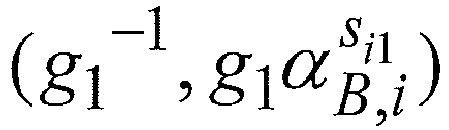



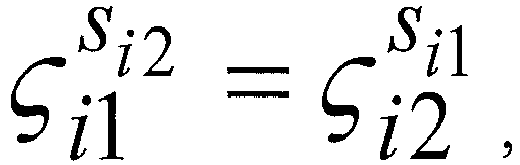
the common key calculation step generates the common key by using commission results ζ1, ..., ζm after calculating a commission result ζi for i = 1, ..., m by a formula below:
- The key exchange method according to any one of Claims 1 to 4, wherein
in the storage of the key device, intrinsic information of the terminal device is stored, and
the proxy calculation step calculates the first commission result and the second commission result if intrinsic information which is received along with the first randomized public keys information and the second randomized public keys information coincides with the intrinsic information of the terminal device. - A key exchange system, wherein
s1 and s2 are assumed to be random numbers which are mutually prime and s'1 and s'2 are assumed to be random numbers which satisfy a predetermined relationship with the random numbers s1 and s2,
the key exchange system includes a plurality of terminal devices and at least one key device,
the terminal device includes:a random number generating unit that generates the random number s1, s2, s'1, and s'2;a public keys randomizing unit that generates first randomized public keys information obtained by randomizing a public key of the terminal device and a public key of another terminal device by using the random number s1 and second randomized public keys information obtained by randomizing the public key of the terminal device and the public key of the other terminal device by using the random number s2;a verification unit that receives a first commission result and a second commission result from the key device, calculates a first verification value from the first commission result by using the random number s2, calculates a second verification value from the second commission result by using the random number s1, and verifies whether or not the first verification value and the second verification value coincide with each other; anda common key calculation unit that calculates a common key from the first commission result and the second commission result by using the random numbers s'1 and s'2 if the first verification value and the second verification value coincide with each other; andthe key device includes:a storage that stores a secret key of the terminal device; anda proxy calculation unit that calculates the first commission result from the first randomized public keys information by using the secret key and calculates the second commission result from the second randomized public keys information by using the secret key. - A key device, wherein
s1 and s2 are assumed to be random numbers which are mutually prime and s'1 and s'2 are assumed to be random numbers which satisfy a predetermined relationship with the random number s1 and s2,
the key device includes:a storage that stores a secret key of a terminal device; anda proxy calculation unit that calculates a first commission result from a first randomized public keys information by using the secret key and calculates a second commission result from a second randomized public keys information by using the secret key,the first randomized public keys information is obtained by randomizing a public key of the terminal device and a public key of another terminal device by using the random number s1; and
the second randomized public keys information is obtained by randomizing the public key of the terminal device and the public key of the other terminal device by using the random number s2. - A terminal device, wherein
s1 and s2 are assumed to be random numbers which are mutually prime and s'1 and s'2 are assumed to be random numbers which satisfy a predetermined relationship with the random numbers s1 and s2,
the terminal device includes:a public keys randomizing unit that generates first randomized public keys information obtained by randomizing a public key of the terminal device and a public key of another terminal device by using the random number s1 and second randomized public keys information obtained by randomizing the public key of the terminal device and the public key of the other terminal device by using the random number s2;a verification unit that receives a first commission result and a second commission result which are calculated by a key device, calculates a first verification value from the first commission result by using the random number s2, calculates a second verification value from the second commission result by using the random number s1, and verifies whether or not the first verification value and the second verification value coincide with each other; anda common key calculation unit that calculates a common key from the first commission result and the second commission result by using the random numbers s'1 and s'2 if the first verification value and the second verification value coincide with each other,the first commission result is calculated from the first randomized public keys information by using a secret key of the terminal device; and
the second commission result is calculated from the second randomized public keys information by using the secret key of the terminal device. - A program for making a computer function as the key device according to Claim 7 or the terminal device according to Claim 8.
Applications Claiming Priority (2)
| Application Number | Priority Date | Filing Date | Title |
|---|---|---|---|
| JP2015007033 | 2015-01-16 | ||
| PCT/JP2016/050695 WO2016114259A1 (en) | 2015-01-16 | 2016-01-12 | Key-exchange method, key-exchange system, key device, terminal device, and program |
Publications (3)
| Publication Number | Publication Date |
|---|---|
| EP3232603A1 true EP3232603A1 (en) | 2017-10-18 |
| EP3232603A4 EP3232603A4 (en) | 2018-03-14 |
| EP3232603B1 EP3232603B1 (en) | 2023-05-31 |
Family
ID=56405804
Family Applications (1)
| Application Number | Title | Priority Date | Filing Date |
|---|---|---|---|
| EP16737330.7A Active EP3232603B1 (en) | 2015-01-16 | 2016-01-12 | Key-exchange method, key-exchange system, terminal device, and program |
Country Status (5)
| Country | Link |
|---|---|
| US (1) | US10419213B2 (en) |
| EP (1) | EP3232603B1 (en) |
| JP (1) | JP6594348B2 (en) |
| CN (1) | CN107113168B (en) |
| WO (1) | WO2016114259A1 (en) |
Cited By (1)
| Publication number | Priority date | Publication date | Assignee | Title |
|---|---|---|---|---|
| EP3748611A1 (en) * | 2019-06-07 | 2020-12-09 | STMicroelectronics S.r.l. | Method and device for elliptic curve computations by low resource devices |
Families Citing this family (4)
| Publication number | Priority date | Publication date | Assignee | Title |
|---|---|---|---|---|
| CN108365959B (en) * | 2018-02-14 | 2020-09-15 | 东北大学 | Full-proxy outsourcing polynomial verification method in cloud environment |
| WO2020240741A1 (en) * | 2019-05-29 | 2020-12-03 | 日本電信電話株式会社 | Key exchange system, communication device, key exchange method, and program |
| WO2022185336A1 (en) * | 2021-03-01 | 2022-09-09 | International Institute Of Information Technology, Hyderabad | System and method for proven secret key agreement between initiating unit and responding unit |
| US11784798B2 (en) | 2021-03-30 | 2023-10-10 | Visa International Service Association | System, method, and computer program product for data security |
Family Cites Families (13)
| Publication number | Priority date | Publication date | Assignee | Title |
|---|---|---|---|---|
| CN1682485A (en) * | 2002-09-20 | 2005-10-12 | 皇家飞利浦电子股份有限公司 | Method and system for generating public keys |
| US7480384B2 (en) * | 2003-02-10 | 2009-01-20 | International Business Machines Corporation | Method for distributing and authenticating public keys using random numbers and Diffie-Hellman public keys |
| JP2004297578A (en) * | 2003-03-27 | 2004-10-21 | Matsushita Electric Ind Co Ltd | Public key generation device, shared key generation device, key exchange device, and key exchange method |
| KR100581590B1 (en) * | 2003-06-27 | 2006-05-22 | 주식회사 케이티 | Dual element authentication key exchange method, authentication method using the same, and a recording medium storing a program including the method |
| US20110194698A1 (en) * | 2008-10-22 | 2011-08-11 | Tomoyuki Asano | Key Sharing System |
| JP5161177B2 (en) | 2009-09-04 | 2013-03-13 | 日本電信電話株式会社 | Proxy calculation request device, proxy calculation request method, proxy calculation request program, recording medium |
| US9037623B2 (en) | 2010-01-12 | 2015-05-19 | Nippon Telegraph And Telephone Corporation | Proxy calculation system, proxy calculation method, proxy calculation requesting apparatus, and proxy calculation program and recording medium therefor |
| CN103221988B (en) * | 2010-10-26 | 2016-08-03 | 日本电信电话株式会社 | Calculating system, calculating device, ability offer device are provided, computational methods, ability offer method are provided |
| JP5506704B2 (en) | 2011-01-20 | 2014-05-28 | 日本電信電話株式会社 | Decryption system, key device, decryption method, and program |
| JP5447544B2 (en) * | 2012-01-27 | 2014-03-19 | 沖電気工業株式会社 | Consignment parameter information generation device, shared key composition device, signature information composition device, communication device, key sharing computation-commission device, signature information generation computation-commission device, computation-commission device, key sharing system, signature information verification system, and communication system |
| JP5964759B2 (en) * | 2013-01-18 | 2016-08-03 | 日本電信電話株式会社 | Calculation system |
| JP6187251B2 (en) * | 2013-12-27 | 2017-08-30 | 富士通株式会社 | Data communication method and data communication apparatus |
| US10305864B2 (en) * | 2016-01-25 | 2019-05-28 | Cisco Technology, Inc. | Method and system for interest encryption in a content centric network |
-
2016
- 2016-01-12 EP EP16737330.7A patent/EP3232603B1/en active Active
- 2016-01-12 WO PCT/JP2016/050695 patent/WO2016114259A1/en not_active Ceased
- 2016-01-12 JP JP2016569359A patent/JP6594348B2/en active Active
- 2016-01-12 US US15/542,538 patent/US10419213B2/en active Active
- 2016-01-12 CN CN201680005046.XA patent/CN107113168B/en active Active
Cited By (3)
| Publication number | Priority date | Publication date | Assignee | Title |
|---|---|---|---|---|
| EP3748611A1 (en) * | 2019-06-07 | 2020-12-09 | STMicroelectronics S.r.l. | Method and device for elliptic curve computations by low resource devices |
| FR3097093A1 (en) * | 2019-06-07 | 2020-12-11 | Stmicroelectronics S.R.L. | Method and device for calculating on elliptical curves by devices with limited resources |
| US11502835B2 (en) | 2019-06-07 | 2022-11-15 | Stmicroelectronics S.R.L. | Method and device for elliptic curve computations by low resource devices |
Also Published As
| Publication number | Publication date |
|---|---|
| US10419213B2 (en) | 2019-09-17 |
| CN107113168A (en) | 2017-08-29 |
| JPWO2016114259A1 (en) | 2017-10-19 |
| US20170373841A1 (en) | 2017-12-28 |
| EP3232603A4 (en) | 2018-03-14 |
| JP6594348B2 (en) | 2019-10-23 |
| WO2016114259A1 (en) | 2016-07-21 |
| EP3232603B1 (en) | 2023-05-31 |
| CN107113168B (en) | 2020-09-08 |
Similar Documents
| Publication | Publication Date | Title |
|---|---|---|
| CN110555933B (en) | Electronic voting method, apparatus, equipment and computer storage medium | |
| JP6950745B2 (en) | Key exchange device, key exchange system, key exchange method, and key exchange program | |
| KR101493214B1 (en) | Method for password based authentication and apparatus executing the method | |
| CN110268676A (en) | Private key computing system and method for identity-based self-authentication signature scheme | |
| Delavar et al. | PUF‐based solutions for secure communications in Advanced Metering Infrastructure (AMI) | |
| WO2020115265A1 (en) | Certificateless public key encryption using pairings | |
| Neji et al. | Distributed key generation protocol with a new complaint management strategy | |
| NL1043779B1 (en) | Method for electronic signing and authenticaton strongly linked to the authenticator factors possession and knowledge | |
| CN104821933A (en) | Device and method certificate generation | |
| KR101586439B1 (en) | User data integrity verification method and apparatus capable of guaranteeing privacy | |
| EP3232603B1 (en) | Key-exchange method, key-exchange system, terminal device, and program | |
| US20150043735A1 (en) | Re-encrypted data verification program, re-encryption apparatus and re-encryption system | |
| CN110932850A (en) | Communication encryption method and system | |
| Mir et al. | Decentralized, Privacy‐Preserving, Single Sign‐On | |
| CN109547413A (en) | The access control method of convertible data cloud storage with data source authentication | |
| Salim et al. | A secure and timestamp-based communication scheme for cloud environment | |
| Bayat et al. | A secure and efficient chaotic maps based authenticated key-exchange protocol for smart grid | |
| GB2543359A (en) | Methods and apparatus for secure communication | |
| Choudhary et al. | An efficient key agreement protocol for smart grid communication | |
| Al-Attab et al. | Authentication scheme for insecure networks in cloud computing | |
| Chen et al. | Blockchain as a CA: A provably secure signcryption scheme leveraging blockchains | |
| Gharib et al. | Authentication architecture using threshold cryptography in kerberos for mobile ad hoc networks | |
| Yamuna et al. | Efficient and Secure Data Storage in Cloud Computing RSA and DSE Function | |
| Tang et al. | Robot: Robust Threshold BBS+ in Two Rounds | |
| Krzywiecki et al. | Deniable key establishment resistance against eKCI attacks |
Legal Events
| Date | Code | Title | Description |
|---|---|---|---|
| STAA | Information on the status of an ep patent application or granted ep patent |
Free format text: STATUS: THE INTERNATIONAL PUBLICATION HAS BEEN MADE |
|
| PUAI | Public reference made under article 153(3) epc to a published international application that has entered the european phase |
Free format text: ORIGINAL CODE: 0009012 |
|
| STAA | Information on the status of an ep patent application or granted ep patent |
Free format text: STATUS: REQUEST FOR EXAMINATION WAS MADE |
|
| 17P | Request for examination filed |
Effective date: 20170710 |
|
| AK | Designated contracting states |
Kind code of ref document: A1 Designated state(s): AL AT BE BG CH CY CZ DE DK EE ES FI FR GB GR HR HU IE IS IT LI LT LU LV MC MK MT NL NO PL PT RO RS SE SI SK SM TR |
|
| AX | Request for extension of the european patent |
Extension state: BA ME |
|
| A4 | Supplementary search report drawn up and despatched |
Effective date: 20180213 |
|
| RIC1 | Information provided on ipc code assigned before grant |
Ipc: H04L 9/30 20060101ALI20180207BHEP Ipc: H04L 9/08 20060101AFI20180207BHEP Ipc: G09C 1/00 20060101ALI20180207BHEP |
|
| DAV | Request for validation of the european patent (deleted) | ||
| DAX | Request for extension of the european patent (deleted) | ||
| STAA | Information on the status of an ep patent application or granted ep patent |
Free format text: STATUS: EXAMINATION IS IN PROGRESS |
|
| 17Q | First examination report despatched |
Effective date: 20181024 |
|
| APBK | Appeal reference recorded |
Free format text: ORIGINAL CODE: EPIDOSNREFNE |
|
| APBN | Date of receipt of notice of appeal recorded |
Free format text: ORIGINAL CODE: EPIDOSNNOA2E |
|
| APBR | Date of receipt of statement of grounds of appeal recorded |
Free format text: ORIGINAL CODE: EPIDOSNNOA3E |
|
| APAF | Appeal reference modified |
Free format text: ORIGINAL CODE: EPIDOSCREFNE |
|
| APBT | Appeal procedure closed |
Free format text: ORIGINAL CODE: EPIDOSNNOA9E |
|
| GRAP | Despatch of communication of intention to grant a patent |
Free format text: ORIGINAL CODE: EPIDOSNIGR1 |
|
| STAA | Information on the status of an ep patent application or granted ep patent |
Free format text: STATUS: GRANT OF PATENT IS INTENDED |
|
| INTG | Intention to grant announced |
Effective date: 20221214 |
|
| GRAS | Grant fee paid |
Free format text: ORIGINAL CODE: EPIDOSNIGR3 |
|
| GRAA | (expected) grant |
Free format text: ORIGINAL CODE: 0009210 |
|
| STAA | Information on the status of an ep patent application or granted ep patent |
Free format text: STATUS: THE PATENT HAS BEEN GRANTED |
|
| AK | Designated contracting states |
Kind code of ref document: B1 Designated state(s): AL AT BE BG CH CY CZ DE DK EE ES FI FR GB GR HR HU IE IS IT LI LT LU LV MC MK MT NL NO PL PT RO RS SE SI SK SM TR |
|
| REG | Reference to a national code |
Ref country code: GB Ref legal event code: FG4D Ref country code: CH Ref legal event code: EP |
|
| REG | Reference to a national code |
Ref country code: AT Ref legal event code: REF Ref document number: 1571627 Country of ref document: AT Kind code of ref document: T Effective date: 20230615 Ref country code: DE Ref legal event code: R096 Ref document number: 602016079696 Country of ref document: DE |
|
| REG | Reference to a national code |
Ref country code: IE Ref legal event code: FG4D |
|
| REG | Reference to a national code |
Ref country code: LT Ref legal event code: MG9D |
|
| REG | Reference to a national code |
Ref country code: NL Ref legal event code: MP Effective date: 20230531 |
|
| REG | Reference to a national code |
Ref country code: AT Ref legal event code: MK05 Ref document number: 1571627 Country of ref document: AT Kind code of ref document: T Effective date: 20230531 |
|
| PG25 | Lapsed in a contracting state [announced via postgrant information from national office to epo] |
Ref country code: SE Free format text: LAPSE BECAUSE OF FAILURE TO SUBMIT A TRANSLATION OF THE DESCRIPTION OR TO PAY THE FEE WITHIN THE PRESCRIBED TIME-LIMIT Effective date: 20230531 Ref country code: NO Free format text: LAPSE BECAUSE OF FAILURE TO SUBMIT A TRANSLATION OF THE DESCRIPTION OR TO PAY THE FEE WITHIN THE PRESCRIBED TIME-LIMIT Effective date: 20230831 Ref country code: ES Free format text: LAPSE BECAUSE OF FAILURE TO SUBMIT A TRANSLATION OF THE DESCRIPTION OR TO PAY THE FEE WITHIN THE PRESCRIBED TIME-LIMIT Effective date: 20230531 Ref country code: AT Free format text: LAPSE BECAUSE OF FAILURE TO SUBMIT A TRANSLATION OF THE DESCRIPTION OR TO PAY THE FEE WITHIN THE PRESCRIBED TIME-LIMIT Effective date: 20230531 |
|
| PG25 | Lapsed in a contracting state [announced via postgrant information from national office to epo] |
Ref country code: RS Free format text: LAPSE BECAUSE OF FAILURE TO SUBMIT A TRANSLATION OF THE DESCRIPTION OR TO PAY THE FEE WITHIN THE PRESCRIBED TIME-LIMIT Effective date: 20230531 Ref country code: PL Free format text: LAPSE BECAUSE OF FAILURE TO SUBMIT A TRANSLATION OF THE DESCRIPTION OR TO PAY THE FEE WITHIN THE PRESCRIBED TIME-LIMIT Effective date: 20230531 Ref country code: NL Free format text: LAPSE BECAUSE OF FAILURE TO SUBMIT A TRANSLATION OF THE DESCRIPTION OR TO PAY THE FEE WITHIN THE PRESCRIBED TIME-LIMIT Effective date: 20230531 Ref country code: LV Free format text: LAPSE BECAUSE OF FAILURE TO SUBMIT A TRANSLATION OF THE DESCRIPTION OR TO PAY THE FEE WITHIN THE PRESCRIBED TIME-LIMIT Effective date: 20230531 Ref country code: LT Free format text: LAPSE BECAUSE OF FAILURE TO SUBMIT A TRANSLATION OF THE DESCRIPTION OR TO PAY THE FEE WITHIN THE PRESCRIBED TIME-LIMIT Effective date: 20230531 Ref country code: IS Free format text: LAPSE BECAUSE OF FAILURE TO SUBMIT A TRANSLATION OF THE DESCRIPTION OR TO PAY THE FEE WITHIN THE PRESCRIBED TIME-LIMIT Effective date: 20230930 Ref country code: HR Free format text: LAPSE BECAUSE OF FAILURE TO SUBMIT A TRANSLATION OF THE DESCRIPTION OR TO PAY THE FEE WITHIN THE PRESCRIBED TIME-LIMIT Effective date: 20230531 Ref country code: GR Free format text: LAPSE BECAUSE OF FAILURE TO SUBMIT A TRANSLATION OF THE DESCRIPTION OR TO PAY THE FEE WITHIN THE PRESCRIBED TIME-LIMIT Effective date: 20230901 |
|
| PG25 | Lapsed in a contracting state [announced via postgrant information from national office to epo] |
Ref country code: FI Free format text: LAPSE BECAUSE OF FAILURE TO SUBMIT A TRANSLATION OF THE DESCRIPTION OR TO PAY THE FEE WITHIN THE PRESCRIBED TIME-LIMIT Effective date: 20230531 |
|
| PG25 | Lapsed in a contracting state [announced via postgrant information from national office to epo] |
Ref country code: SK Free format text: LAPSE BECAUSE OF FAILURE TO SUBMIT A TRANSLATION OF THE DESCRIPTION OR TO PAY THE FEE WITHIN THE PRESCRIBED TIME-LIMIT Effective date: 20230531 |
|
| PG25 | Lapsed in a contracting state [announced via postgrant information from national office to epo] |
Ref country code: SM Free format text: LAPSE BECAUSE OF FAILURE TO SUBMIT A TRANSLATION OF THE DESCRIPTION OR TO PAY THE FEE WITHIN THE PRESCRIBED TIME-LIMIT Effective date: 20230531 Ref country code: SK Free format text: LAPSE BECAUSE OF FAILURE TO SUBMIT A TRANSLATION OF THE DESCRIPTION OR TO PAY THE FEE WITHIN THE PRESCRIBED TIME-LIMIT Effective date: 20230531 Ref country code: RO Free format text: LAPSE BECAUSE OF FAILURE TO SUBMIT A TRANSLATION OF THE DESCRIPTION OR TO PAY THE FEE WITHIN THE PRESCRIBED TIME-LIMIT Effective date: 20230531 Ref country code: PT Free format text: LAPSE BECAUSE OF FAILURE TO SUBMIT A TRANSLATION OF THE DESCRIPTION OR TO PAY THE FEE WITHIN THE PRESCRIBED TIME-LIMIT Effective date: 20231002 Ref country code: EE Free format text: LAPSE BECAUSE OF FAILURE TO SUBMIT A TRANSLATION OF THE DESCRIPTION OR TO PAY THE FEE WITHIN THE PRESCRIBED TIME-LIMIT Effective date: 20230531 Ref country code: DK Free format text: LAPSE BECAUSE OF FAILURE TO SUBMIT A TRANSLATION OF THE DESCRIPTION OR TO PAY THE FEE WITHIN THE PRESCRIBED TIME-LIMIT Effective date: 20230531 Ref country code: CZ Free format text: LAPSE BECAUSE OF FAILURE TO SUBMIT A TRANSLATION OF THE DESCRIPTION OR TO PAY THE FEE WITHIN THE PRESCRIBED TIME-LIMIT Effective date: 20230531 |
|
| REG | Reference to a national code |
Ref country code: DE Ref legal event code: R097 Ref document number: 602016079696 Country of ref document: DE |
|
| PLBE | No opposition filed within time limit |
Free format text: ORIGINAL CODE: 0009261 |
|
| STAA | Information on the status of an ep patent application or granted ep patent |
Free format text: STATUS: NO OPPOSITION FILED WITHIN TIME LIMIT |
|
| PG25 | Lapsed in a contracting state [announced via postgrant information from national office to epo] |
Ref country code: SI Free format text: LAPSE BECAUSE OF FAILURE TO SUBMIT A TRANSLATION OF THE DESCRIPTION OR TO PAY THE FEE WITHIN THE PRESCRIBED TIME-LIMIT Effective date: 20230531 |
|
| 26N | No opposition filed |
Effective date: 20240301 |
|
| PG25 | Lapsed in a contracting state [announced via postgrant information from national office to epo] |
Ref country code: SI Free format text: LAPSE BECAUSE OF FAILURE TO SUBMIT A TRANSLATION OF THE DESCRIPTION OR TO PAY THE FEE WITHIN THE PRESCRIBED TIME-LIMIT Effective date: 20230531 Ref country code: IT Free format text: LAPSE BECAUSE OF FAILURE TO SUBMIT A TRANSLATION OF THE DESCRIPTION OR TO PAY THE FEE WITHIN THE PRESCRIBED TIME-LIMIT Effective date: 20230531 |
|
| PG25 | Lapsed in a contracting state [announced via postgrant information from national office to epo] |
Ref country code: MC Free format text: LAPSE BECAUSE OF FAILURE TO SUBMIT A TRANSLATION OF THE DESCRIPTION OR TO PAY THE FEE WITHIN THE PRESCRIBED TIME-LIMIT Effective date: 20230531 |
|
| PG25 | Lapsed in a contracting state [announced via postgrant information from national office to epo] |
Ref country code: MC Free format text: LAPSE BECAUSE OF FAILURE TO SUBMIT A TRANSLATION OF THE DESCRIPTION OR TO PAY THE FEE WITHIN THE PRESCRIBED TIME-LIMIT Effective date: 20230531 |
|
| REG | Reference to a national code |
Ref country code: CH Ref legal event code: PL |
|
| PG25 | Lapsed in a contracting state [announced via postgrant information from national office to epo] |
Ref country code: LU Free format text: LAPSE BECAUSE OF NON-PAYMENT OF DUE FEES Effective date: 20240112 |
|
| PG25 | Lapsed in a contracting state [announced via postgrant information from national office to epo] |
Ref country code: LU Free format text: LAPSE BECAUSE OF NON-PAYMENT OF DUE FEES Effective date: 20240112 |
|
| PG25 | Lapsed in a contracting state [announced via postgrant information from national office to epo] |
Ref country code: BE Free format text: LAPSE BECAUSE OF NON-PAYMENT OF DUE FEES Effective date: 20240131 |
|
| PG25 | Lapsed in a contracting state [announced via postgrant information from national office to epo] |
Ref country code: CH Free format text: LAPSE BECAUSE OF NON-PAYMENT OF DUE FEES Effective date: 20240131 |
|
| PG25 | Lapsed in a contracting state [announced via postgrant information from national office to epo] |
Ref country code: CH Free format text: LAPSE BECAUSE OF NON-PAYMENT OF DUE FEES Effective date: 20240131 Ref country code: BE Free format text: LAPSE BECAUSE OF NON-PAYMENT OF DUE FEES Effective date: 20240131 |
|
| REG | Reference to a national code |
Ref country code: BE Ref legal event code: MM Effective date: 20240131 |
|
| PG25 | Lapsed in a contracting state [announced via postgrant information from national office to epo] |
Ref country code: BG Free format text: LAPSE BECAUSE OF FAILURE TO SUBMIT A TRANSLATION OF THE DESCRIPTION OR TO PAY THE FEE WITHIN THE PRESCRIBED TIME-LIMIT Effective date: 20230531 |
|
| PG25 | Lapsed in a contracting state [announced via postgrant information from national office to epo] |
Ref country code: BG Free format text: LAPSE BECAUSE OF FAILURE TO SUBMIT A TRANSLATION OF THE DESCRIPTION OR TO PAY THE FEE WITHIN THE PRESCRIBED TIME-LIMIT Effective date: 20230531 |
|
| PG25 | Lapsed in a contracting state [announced via postgrant information from national office to epo] |
Ref country code: IE Free format text: LAPSE BECAUSE OF NON-PAYMENT OF DUE FEES Effective date: 20240112 |
|
| PG25 | Lapsed in a contracting state [announced via postgrant information from national office to epo] |
Ref country code: IE Free format text: LAPSE BECAUSE OF NON-PAYMENT OF DUE FEES Effective date: 20240112 |
|
| PG25 | Lapsed in a contracting state [announced via postgrant information from national office to epo] |
Ref country code: CY Free format text: LAPSE BECAUSE OF FAILURE TO SUBMIT A TRANSLATION OF THE DESCRIPTION OR TO PAY THE FEE WITHIN THE PRESCRIBED TIME-LIMIT; INVALID AB INITIO Effective date: 20160112 |
|
| PG25 | Lapsed in a contracting state [announced via postgrant information from national office to epo] |
Ref country code: HU Free format text: LAPSE BECAUSE OF FAILURE TO SUBMIT A TRANSLATION OF THE DESCRIPTION OR TO PAY THE FEE WITHIN THE PRESCRIBED TIME-LIMIT; INVALID AB INITIO Effective date: 20160112 |
|
| PG25 | Lapsed in a contracting state [announced via postgrant information from national office to epo] |
Ref country code: TR Free format text: LAPSE BECAUSE OF FAILURE TO SUBMIT A TRANSLATION OF THE DESCRIPTION OR TO PAY THE FEE WITHIN THE PRESCRIBED TIME-LIMIT Effective date: 20230531 |
|
| REG | Reference to a national code |
Ref country code: DE Ref legal event code: R081 Ref document number: 602016079696 Country of ref document: DE Owner name: NTT, INC., JP Free format text: FORMER OWNER: NIPPON TELEGRAPH AND TELEPHONE CORPORATION, TOKYO, JP Ref country code: DE Ref legal event code: R082 Ref document number: 602016079696 Country of ref document: DE Representative=s name: DENNEMEYER & ASSOCIATES RECHTSANWALTSGESELLSCH, DE |
|
| PGFP | Annual fee paid to national office [announced via postgrant information from national office to epo] |
Ref country code: GB Payment date: 20260123 Year of fee payment: 11 |
|
| PGFP | Annual fee paid to national office [announced via postgrant information from national office to epo] |
Ref country code: DE Payment date: 20260121 Year of fee payment: 11 |
|
| PGFP | Annual fee paid to national office [announced via postgrant information from national office to epo] |
Ref country code: FR Payment date: 20260123 Year of fee payment: 11 |